EP0938298B1 - Liposome-based composition - Google Patents
Liposome-based composition Download PDFInfo
- Publication number
- EP0938298B1 EP0938298B1 EP97940250A EP97940250A EP0938298B1 EP 0938298 B1 EP0938298 B1 EP 0938298B1 EP 97940250 A EP97940250 A EP 97940250A EP 97940250 A EP97940250 A EP 97940250A EP 0938298 B1 EP0938298 B1 EP 0938298B1
- Authority
- EP
- European Patent Office
- Prior art keywords
- liposomes
- polynucleotide
- dna
- composition according
- entrapped
- Prior art date
- Legal status (The legal status is an assumption and is not a legal conclusion. Google has not performed a legal analysis and makes no representation as to the accuracy of the status listed.)
- Expired - Lifetime
Links
- 239000002502 liposome Substances 0.000 title claims abstract description 184
- 239000000203 mixture Substances 0.000 title claims description 59
- 108091033319 polynucleotide Proteins 0.000 claims abstract description 69
- 239000002157 polynucleotide Substances 0.000 claims abstract description 69
- 102000040430 polynucleotide Human genes 0.000 claims abstract description 69
- 238000000034 method Methods 0.000 claims abstract description 62
- 125000002091 cationic group Chemical group 0.000 claims abstract description 50
- 230000028993 immune response Effects 0.000 claims abstract description 35
- 239000000427 antigen Substances 0.000 claims abstract description 28
- 108091007433 antigens Proteins 0.000 claims abstract description 28
- 102000036639 antigens Human genes 0.000 claims abstract description 28
- 108020004414 DNA Proteins 0.000 claims description 117
- KWVJHCQQUFDPLU-YEUCEMRASA-N 2,3-bis[[(z)-octadec-9-enoyl]oxy]propyl-trimethylazanium Chemical group CCCCCCCC\C=C/CCCCCCCC(=O)OCC(C[N+](C)(C)C)OC(=O)CCCCCCC\C=C/CCCCCCCC KWVJHCQQUFDPLU-YEUCEMRASA-N 0.000 claims description 35
- 239000013612 plasmid Substances 0.000 claims description 31
- 239000000047 product Substances 0.000 claims description 25
- REYJJPSVUYRZGE-UHFFFAOYSA-N Octadecylamine Chemical compound CCCCCCCCCCCCCCCCCCN REYJJPSVUYRZGE-UHFFFAOYSA-N 0.000 claims description 23
- 108090000765 processed proteins & peptides Proteins 0.000 claims description 19
- 238000001890 transfection Methods 0.000 claims description 19
- 229920001184 polypeptide Polymers 0.000 claims description 17
- 102000004196 processed proteins & peptides Human genes 0.000 claims description 17
- 239000007900 aqueous suspension Substances 0.000 claims description 16
- 241001465754 Metazoa Species 0.000 claims description 14
- HVYWMOMLDIMFJA-DPAQBDIFSA-N cholesterol Chemical compound C1C=C2C[C@@H](O)CC[C@]2(C)[C@@H]2[C@@H]1[C@@H]1CC[C@H]([C@H](C)CCCC(C)C)[C@@]1(C)CC2 HVYWMOMLDIMFJA-DPAQBDIFSA-N 0.000 claims description 14
- 230000002163 immunogen Effects 0.000 claims description 10
- 238000002360 preparation method Methods 0.000 claims description 10
- 230000008569 process Effects 0.000 claims description 10
- 206010028980 Neoplasm Diseases 0.000 claims description 9
- 201000011510 cancer Diseases 0.000 claims description 8
- 125000004432 carbon atom Chemical group C* 0.000 claims description 8
- 230000014509 gene expression Effects 0.000 claims description 8
- 238000011282 treatment Methods 0.000 claims description 8
- 235000012000 cholesterol Nutrition 0.000 claims description 7
- 238000000338 in vitro Methods 0.000 claims description 7
- 229910052757 nitrogen Inorganic materials 0.000 claims description 7
- 150000008104 phosphatidylethanolamines Chemical group 0.000 claims description 7
- 238000004108 freeze drying Methods 0.000 claims description 6
- 239000000725 suspension Substances 0.000 claims description 6
- JZNWSCPGTDBMEW-UHFFFAOYSA-N Glycerophosphorylethanolamin Natural products NCCOP(O)(=O)OCC(O)CO JZNWSCPGTDBMEW-UHFFFAOYSA-N 0.000 claims description 5
- 125000000217 alkyl group Chemical group 0.000 claims description 5
- 230000018044 dehydration Effects 0.000 claims description 5
- 238000006297 dehydration reaction Methods 0.000 claims description 5
- 208000015181 infectious disease Diseases 0.000 claims description 5
- 238000002560 therapeutic procedure Methods 0.000 claims description 5
- IJGRMHOSHXDMSA-UHFFFAOYSA-N Atomic nitrogen Chemical compound N#N IJGRMHOSHXDMSA-UHFFFAOYSA-N 0.000 claims description 4
- 125000004429 atom Chemical group 0.000 claims description 4
- 230000000799 fusogenic effect Effects 0.000 claims description 4
- 125000005456 glyceride group Chemical group 0.000 claims description 4
- 230000002458 infectious effect Effects 0.000 claims description 4
- 125000004433 nitrogen atom Chemical group N* 0.000 claims description 4
- RLKJVRDMIQCNGX-UHFFFAOYSA-M 2,3-dihexadecoxypropyl(trimethyl)azanium;chloride Chemical compound [Cl-].CCCCCCCCCCCCCCCCOCC(C[N+](C)(C)C)OCCCCCCCCCCCCCCCC RLKJVRDMIQCNGX-UHFFFAOYSA-M 0.000 claims description 3
- 238000004519 manufacturing process Methods 0.000 claims description 3
- 239000008194 pharmaceutical composition Substances 0.000 claims description 3
- 238000002255 vaccination Methods 0.000 claims description 3
- 108091032973 (ribonucleotides)n+m Proteins 0.000 claims description 2
- MYMOFIZGZYHOMD-UHFFFAOYSA-N Dioxygen Chemical compound O=O MYMOFIZGZYHOMD-UHFFFAOYSA-N 0.000 claims description 2
- 125000003342 alkenyl group Chemical group 0.000 claims description 2
- 125000000304 alkynyl group Chemical group 0.000 claims description 2
- 150000001450 anions Chemical group 0.000 claims description 2
- 125000003710 aryl alkyl group Chemical group 0.000 claims description 2
- 125000003118 aryl group Chemical group 0.000 claims description 2
- 230000015572 biosynthetic process Effects 0.000 claims description 2
- 125000004122 cyclic group Chemical group 0.000 claims description 2
- VILAVOFMIJHSJA-UHFFFAOYSA-N dicarbon monoxide Chemical compound [C]=C=O VILAVOFMIJHSJA-UHFFFAOYSA-N 0.000 claims description 2
- 239000012634 fragment Substances 0.000 claims description 2
- 239000001257 hydrogen Substances 0.000 claims description 2
- 229910052739 hydrogen Inorganic materials 0.000 claims description 2
- 125000004435 hydrogen atom Chemical class [H]* 0.000 claims description 2
- 230000001524 infective effect Effects 0.000 claims description 2
- 230000003287 optical effect Effects 0.000 claims description 2
- 229910052760 oxygen Inorganic materials 0.000 claims description 2
- 239000001301 oxygen Substances 0.000 claims description 2
- 238000011321 prophylaxis Methods 0.000 claims description 2
- 229910052717 sulfur Inorganic materials 0.000 claims description 2
- 125000004434 sulfur atom Chemical group 0.000 claims description 2
- 102000053602 DNA Human genes 0.000 claims 1
- 125000003917 carbamoyl group Chemical group [H]N([H])C(*)=O 0.000 claims 1
- 238000001125 extrusion Methods 0.000 claims 1
- 239000012467 final product Substances 0.000 claims 1
- 108020004999 messenger RNA Proteins 0.000 claims 1
- 239000000546 pharmaceutical excipient Substances 0.000 claims 1
- 238000003786 synthesis reaction Methods 0.000 claims 1
- 108090000623 proteins and genes Proteins 0.000 abstract description 44
- 229960005486 vaccine Drugs 0.000 abstract description 4
- KSXTUUUQYQYKCR-LQDDAWAPSA-M 2,3-bis[[(z)-octadec-9-enoyl]oxy]propyl-trimethylazanium;chloride Chemical compound [Cl-].CCCCCCCC\C=C/CCCCCCCC(=O)OCC(C[N+](C)(C)C)OC(=O)CCCCCCC\C=C/CCCCCCCC KSXTUUUQYQYKCR-LQDDAWAPSA-M 0.000 abstract 1
- MWRBNPKJOOWZPW-CLFAGFIQSA-N dioleoyl phosphatidylethanolamine Chemical compound CCCCCCCC\C=C/CCCCCCCC(=O)OCC(COP(O)(=O)OCCN)OC(=O)CCCCCCC\C=C/CCCCCCCC MWRBNPKJOOWZPW-CLFAGFIQSA-N 0.000 description 81
- WTJKGGKOPKCXLL-RRHRGVEJSA-N phosphatidylcholine Chemical compound CCCCCCCCCCCCCCCC(=O)OC[C@H](COP([O-])(=O)OCC[N+](C)(C)C)OC(=O)CCCCCCCC=CCCCCCCCC WTJKGGKOPKCXLL-RRHRGVEJSA-N 0.000 description 80
- 150000002632 lipids Chemical class 0.000 description 33
- 241000699670 Mus sp. Species 0.000 description 30
- 210000004027 cell Anatomy 0.000 description 27
- 238000002474 experimental method Methods 0.000 description 20
- 230000004044 response Effects 0.000 description 19
- 108091061960 Naked DNA Proteins 0.000 description 17
- TZCPCKNHXULUIY-RGULYWFUSA-N 1,2-distearoyl-sn-glycero-3-phosphoserine Chemical compound CCCCCCCCCCCCCCCCCC(=O)OC[C@H](COP(O)(=O)OC[C@H](N)C(O)=O)OC(=O)CCCCCCCCCCCCCCCCC TZCPCKNHXULUIY-RGULYWFUSA-N 0.000 description 15
- ZWZWYGMENQVNFU-UHFFFAOYSA-N Glycerophosphorylserin Natural products OC(=O)C(N)COP(O)(=O)OCC(O)CO ZWZWYGMENQVNFU-UHFFFAOYSA-N 0.000 description 15
- 238000010348 incorporation Methods 0.000 description 15
- 108060001084 Luciferase Proteins 0.000 description 14
- 239000005089 Luciferase Substances 0.000 description 13
- 230000007935 neutral effect Effects 0.000 description 13
- 101100297345 Caenorhabditis elegans pgl-2 gene Proteins 0.000 description 12
- 230000000694 effects Effects 0.000 description 12
- 238000002347 injection Methods 0.000 description 12
- 239000007924 injection Substances 0.000 description 12
- 102000016911 Deoxyribonucleases Human genes 0.000 description 11
- 108010053770 Deoxyribonucleases Proteins 0.000 description 11
- 102000004169 proteins and genes Human genes 0.000 description 11
- 102000039446 nucleic acids Human genes 0.000 description 10
- 108020004707 nucleic acids Proteins 0.000 description 10
- 150000007523 nucleic acids Chemical class 0.000 description 10
- 150000001875 compounds Chemical class 0.000 description 9
- 241000212384 Bifora Species 0.000 description 8
- 238000002965 ELISA Methods 0.000 description 8
- 239000004148 curcumin Substances 0.000 description 8
- 102000004127 Cytokines Human genes 0.000 description 7
- 108090000695 Cytokines Proteins 0.000 description 7
- 102000004388 Interleukin-4 Human genes 0.000 description 7
- 108090000978 Interleukin-4 Proteins 0.000 description 7
- 208000002672 hepatitis B Diseases 0.000 description 7
- 238000002649 immunization Methods 0.000 description 7
- 238000001727 in vivo Methods 0.000 description 7
- 229940028885 interleukin-4 Drugs 0.000 description 7
- 239000000463 material Substances 0.000 description 7
- 150000003904 phospholipids Chemical class 0.000 description 7
- 210000000952 spleen Anatomy 0.000 description 7
- 238000012360 testing method Methods 0.000 description 7
- -1 cationic lipid Chemical class 0.000 description 6
- 238000001415 gene therapy Methods 0.000 description 6
- NRJAVPSFFCBXDT-HUESYALOSA-N 1,2-distearoyl-sn-glycero-3-phosphocholine Chemical compound CCCCCCCCCCCCCCCCCC(=O)OC[C@H](COP([O-])(=O)OCC[N+](C)(C)C)OC(=O)CCCCCCCCCCCCCCCCC NRJAVPSFFCBXDT-HUESYALOSA-N 0.000 description 5
- HVUMOYIDDBPOLL-XWVZOOPGSA-N Sorbitan monostearate Chemical compound CCCCCCCCCCCCCCCCCC(=O)OC[C@@H](O)[C@H]1OC[C@H](O)[C@H]1O HVUMOYIDDBPOLL-XWVZOOPGSA-N 0.000 description 5
- 238000005119 centrifugation Methods 0.000 description 5
- 239000003795 chemical substances by application Substances 0.000 description 5
- 238000010668 complexation reaction Methods 0.000 description 5
- 238000011534 incubation Methods 0.000 description 5
- 210000004072 lung Anatomy 0.000 description 5
- 210000001519 tissue Anatomy 0.000 description 5
- KCXVZYZYPLLWCC-UHFFFAOYSA-N EDTA Chemical compound OC(=O)CN(CC(O)=O)CCN(CC(O)=O)CC(O)=O KCXVZYZYPLLWCC-UHFFFAOYSA-N 0.000 description 4
- 102100037850 Interferon gamma Human genes 0.000 description 4
- 108010074328 Interferon-gamma Proteins 0.000 description 4
- ATUOYWHBWRKTHZ-UHFFFAOYSA-N Propane Chemical compound CCC ATUOYWHBWRKTHZ-UHFFFAOYSA-N 0.000 description 4
- 241000700605 Viruses Species 0.000 description 4
- 125000000129 anionic group Chemical group 0.000 description 4
- 238000005243 fluidization Methods 0.000 description 4
- 239000002609 medium Substances 0.000 description 4
- 239000002953 phosphate buffered saline Substances 0.000 description 4
- 210000002966 serum Anatomy 0.000 description 4
- 230000008685 targeting Effects 0.000 description 4
- 239000006144 Dulbecco’s modified Eagle's medium Substances 0.000 description 3
- 102000004190 Enzymes Human genes 0.000 description 3
- 108090000790 Enzymes Proteins 0.000 description 3
- 101710163270 Nuclease Proteins 0.000 description 3
- 238000000246 agarose gel electrophoresis Methods 0.000 description 3
- 230000003416 augmentation Effects 0.000 description 3
- 238000004587 chromatography analysis Methods 0.000 description 3
- 230000006378 damage Effects 0.000 description 3
- 235000014113 dietary fatty acids Nutrition 0.000 description 3
- 238000005538 encapsulation Methods 0.000 description 3
- 150000002148 esters Chemical class 0.000 description 3
- 229930195729 fatty acid Natural products 0.000 description 3
- 239000000194 fatty acid Substances 0.000 description 3
- 150000004665 fatty acids Chemical group 0.000 description 3
- 238000009472 formulation Methods 0.000 description 3
- 238000001476 gene delivery Methods 0.000 description 3
- 238000009169 immunotherapy Methods 0.000 description 3
- 238000007912 intraperitoneal administration Methods 0.000 description 3
- 239000003446 ligand Substances 0.000 description 3
- 244000005700 microbiome Species 0.000 description 3
- 210000003205 muscle Anatomy 0.000 description 3
- 239000002736 nonionic surfactant Substances 0.000 description 3
- 239000008188 pellet Substances 0.000 description 3
- 210000002381 plasma Anatomy 0.000 description 3
- 238000007920 subcutaneous administration Methods 0.000 description 3
- 239000006228 supernatant Substances 0.000 description 3
- 210000004881 tumor cell Anatomy 0.000 description 3
- 239000013598 vector Substances 0.000 description 3
- 239000013603 viral vector Substances 0.000 description 3
- HJCMDXDYPOUFDY-WHFBIAKZSA-N Ala-Gln Chemical compound C[C@H](N)C(=O)N[C@H](C(O)=O)CCC(N)=O HJCMDXDYPOUFDY-WHFBIAKZSA-N 0.000 description 2
- 241000894006 Bacteria Species 0.000 description 2
- 102000007260 Deoxyribonuclease I Human genes 0.000 description 2
- 108010008532 Deoxyribonuclease I Proteins 0.000 description 2
- RTZKZFJDLAIYFH-UHFFFAOYSA-N Diethyl ether Chemical compound CCOCC RTZKZFJDLAIYFH-UHFFFAOYSA-N 0.000 description 2
- LFQSCWFLJHTTHZ-UHFFFAOYSA-N Ethanol Chemical compound CCO LFQSCWFLJHTTHZ-UHFFFAOYSA-N 0.000 description 2
- 241000233866 Fungi Species 0.000 description 2
- 208000005176 Hepatitis C Diseases 0.000 description 2
- 208000026350 Inborn Genetic disease Diseases 0.000 description 2
- 239000012124 Opti-MEM Substances 0.000 description 2
- 102000018594 Tumour necrosis factor Human genes 0.000 description 2
- 108050007852 Tumour necrosis factor Proteins 0.000 description 2
- HIHOWBSBBDRPDW-PTHRTHQKSA-N [(3s,8s,9s,10r,13r,14s,17r)-10,13-dimethyl-17-[(2r)-6-methylheptan-2-yl]-2,3,4,7,8,9,11,12,14,15,16,17-dodecahydro-1h-cyclopenta[a]phenanthren-3-yl] n-[2-(dimethylamino)ethyl]carbamate Chemical compound C1C=C2C[C@@H](OC(=O)NCCN(C)C)CC[C@]2(C)[C@@H]2[C@@H]1[C@@H]1CC[C@H]([C@H](C)CCCC(C)C)[C@@]1(C)CC2 HIHOWBSBBDRPDW-PTHRTHQKSA-N 0.000 description 2
- ATBOMIWRCZXYSZ-XZBBILGWSA-N [1-[2,3-dihydroxypropoxy(hydroxy)phosphoryl]oxy-3-hexadecanoyloxypropan-2-yl] (9e,12e)-octadeca-9,12-dienoate Chemical compound CCCCCCCCCCCCCCCC(=O)OCC(COP(O)(=O)OCC(O)CO)OC(=O)CCCCCCC\C=C\C\C=C\CCCCC ATBOMIWRCZXYSZ-XZBBILGWSA-N 0.000 description 2
- 125000002252 acyl group Chemical group 0.000 description 2
- AWUCVROLDVIAJX-UHFFFAOYSA-N alpha-glycerophosphate Natural products OCC(O)COP(O)(O)=O AWUCVROLDVIAJX-UHFFFAOYSA-N 0.000 description 2
- 238000004458 analytical method Methods 0.000 description 2
- 230000000890 antigenic effect Effects 0.000 description 2
- 239000000872 buffer Substances 0.000 description 2
- 230000015556 catabolic process Effects 0.000 description 2
- 150000001767 cationic compounds Chemical class 0.000 description 2
- 230000004087 circulation Effects 0.000 description 2
- 238000006731 degradation reaction Methods 0.000 description 2
- 238000010790 dilution Methods 0.000 description 2
- 239000012895 dilution Substances 0.000 description 2
- 239000003814 drug Substances 0.000 description 2
- 229940079593 drug Drugs 0.000 description 2
- 208000016361 genetic disease Diseases 0.000 description 2
- 230000003053 immunization Effects 0.000 description 2
- 230000006872 improvement Effects 0.000 description 2
- 230000001939 inductive effect Effects 0.000 description 2
- 206010022000 influenza Diseases 0.000 description 2
- 230000003834 intracellular effect Effects 0.000 description 2
- 210000003141 lower extremity Anatomy 0.000 description 2
- 238000003670 luciferase enzyme activity assay Methods 0.000 description 2
- 238000002156 mixing Methods 0.000 description 2
- 239000002808 molecular sieve Substances 0.000 description 2
- 229940067605 phosphatidylethanolamines Drugs 0.000 description 2
- 239000001294 propane Substances 0.000 description 2
- 239000000700 radioactive tracer Substances 0.000 description 2
- 238000009256 replacement therapy Methods 0.000 description 2
- 229920006395 saturated elastomer Polymers 0.000 description 2
- URGAHOPLAPQHLN-UHFFFAOYSA-N sodium aluminosilicate Chemical compound [Na+].[Al+3].[O-][Si]([O-])=O.[O-][Si]([O-])=O URGAHOPLAPQHLN-UHFFFAOYSA-N 0.000 description 2
- 230000001225 therapeutic effect Effects 0.000 description 2
- 230000001052 transient effect Effects 0.000 description 2
- 241001430294 unidentified retrovirus Species 0.000 description 2
- 239000002691 unilamellar liposome Substances 0.000 description 2
- JNYAEWCLZODPBN-JGWLITMVSA-N (2r,3r,4s)-2-[(1r)-1,2-dihydroxyethyl]oxolane-3,4-diol Chemical compound OC[C@@H](O)[C@H]1OC[C@H](O)[C@H]1O JNYAEWCLZODPBN-JGWLITMVSA-N 0.000 description 1
- SNKAWJBJQDLSFF-NVKMUCNASA-N 1,2-dioleoyl-sn-glycero-3-phosphocholine Chemical compound CCCCCCCC\C=C/CCCCCCCC(=O)OC[C@H](COP([O-])(=O)OCC[N+](C)(C)C)OC(=O)CCCCCCC\C=C/CCCCCCCC SNKAWJBJQDLSFF-NVKMUCNASA-N 0.000 description 1
- GEYOCULIXLDCMW-UHFFFAOYSA-N 1,2-phenylenediamine Chemical compound NC1=CC=CC=C1N GEYOCULIXLDCMW-UHFFFAOYSA-N 0.000 description 1
- QHZLMUACJMDIAE-UHFFFAOYSA-N 1-monopalmitoylglycerol Chemical compound CCCCCCCCCCCCCCCC(=O)OCC(O)CO QHZLMUACJMDIAE-UHFFFAOYSA-N 0.000 description 1
- LDGWQMRUWMSZIU-LQDDAWAPSA-M 2,3-bis[(z)-octadec-9-enoxy]propyl-trimethylazanium;chloride Chemical compound [Cl-].CCCCCCCC\C=C/CCCCCCCCOCC(C[N+](C)(C)C)OCCCCCCCC\C=C/CCCCCCCC LDGWQMRUWMSZIU-LQDDAWAPSA-M 0.000 description 1
- UMCMPZBLKLEWAF-BCTGSCMUSA-N 3-[(3-cholamidopropyl)dimethylammonio]propane-1-sulfonate Chemical compound C([C@H]1C[C@H]2O)[C@H](O)CC[C@]1(C)[C@@H]1[C@@H]2[C@@H]2CC[C@H]([C@@H](CCC(=O)NCCC[N+](C)(C)CCCS([O-])(=O)=O)C)[C@@]2(C)[C@@H](O)C1 UMCMPZBLKLEWAF-BCTGSCMUSA-N 0.000 description 1
- 108020005544 Antisense RNA Proteins 0.000 description 1
- 108010039209 Blood Coagulation Factors Proteins 0.000 description 1
- 102000015081 Blood Coagulation Factors Human genes 0.000 description 1
- 108010017384 Blood Proteins Proteins 0.000 description 1
- 102000004506 Blood Proteins Human genes 0.000 description 1
- 241000283690 Bos taurus Species 0.000 description 1
- 108091003079 Bovine Serum Albumin Proteins 0.000 description 1
- WSNMPAVSZJSIMT-UHFFFAOYSA-N COc1c(C)c2COC(=O)c2c(O)c1CC(O)C1(C)CCC(=O)O1 Chemical compound COc1c(C)c2COC(=O)c2c(O)c1CC(O)C1(C)CCC(=O)O1 WSNMPAVSZJSIMT-UHFFFAOYSA-N 0.000 description 1
- OYPRJOBELJOOCE-UHFFFAOYSA-N Calcium Chemical compound [Ca] OYPRJOBELJOOCE-UHFFFAOYSA-N 0.000 description 1
- 101710132601 Capsid protein Proteins 0.000 description 1
- CURLTUGMZLYLDI-UHFFFAOYSA-N Carbon dioxide Chemical compound O=C=O CURLTUGMZLYLDI-UHFFFAOYSA-N 0.000 description 1
- 241000282693 Cercopithecidae Species 0.000 description 1
- 201000003883 Cystic fibrosis Diseases 0.000 description 1
- 102100023419 Cystic fibrosis transmembrane conductance regulator Human genes 0.000 description 1
- 238000011238 DNA vaccination Methods 0.000 description 1
- 239000012591 Dulbecco’s Phosphate Buffered Saline Substances 0.000 description 1
- 101000907783 Homo sapiens Cystic fibrosis transmembrane conductance regulator Proteins 0.000 description 1
- 108010001336 Horseradish Peroxidase Proteins 0.000 description 1
- 102000002265 Human Growth Hormone Human genes 0.000 description 1
- 108010000521 Human Growth Hormone Proteins 0.000 description 1
- 239000000854 Human Growth Hormone Substances 0.000 description 1
- 102000000588 Interleukin-2 Human genes 0.000 description 1
- 108010002350 Interleukin-2 Proteins 0.000 description 1
- 206010024229 Leprosy Diseases 0.000 description 1
- FYYHWMGAXLPEAU-UHFFFAOYSA-N Magnesium Chemical compound [Mg] FYYHWMGAXLPEAU-UHFFFAOYSA-N 0.000 description 1
- 108091034117 Oligonucleotide Proteins 0.000 description 1
- 108700008625 Reporter Genes Proteins 0.000 description 1
- 239000006146 Roswell Park Memorial Institute medium Substances 0.000 description 1
- 241000242678 Schistosoma Species 0.000 description 1
- 229920002684 Sepharose Polymers 0.000 description 1
- 241000700584 Simplexvirus Species 0.000 description 1
- FAPWRFPIFSIZLT-UHFFFAOYSA-M Sodium chloride Chemical compound [Na+].[Cl-] FAPWRFPIFSIZLT-UHFFFAOYSA-M 0.000 description 1
- 208000000277 Splenic Neoplasms Diseases 0.000 description 1
- 108010090804 Streptavidin Proteins 0.000 description 1
- 101000874347 Streptococcus agalactiae IgA FC receptor Proteins 0.000 description 1
- 230000024932 T cell mediated immunity Effects 0.000 description 1
- 230000006052 T cell proliferation Effects 0.000 description 1
- 239000007984 Tris EDTA buffer Substances 0.000 description 1
- 108010067390 Viral Proteins Proteins 0.000 description 1
- NYDLOCKCVISJKK-WRBBJXAJSA-N [3-(dimethylamino)-2-[(z)-octadec-9-enoyl]oxypropyl] (z)-octadec-9-enoate Chemical compound CCCCCCCC\C=C/CCCCCCCC(=O)OCC(CN(C)C)OC(=O)CCCCCCC\C=C/CCCCCCCC NYDLOCKCVISJKK-WRBBJXAJSA-N 0.000 description 1
- 238000002835 absorbance Methods 0.000 description 1
- 230000004913 activation Effects 0.000 description 1
- 239000004480 active ingredient Substances 0.000 description 1
- 230000001464 adherent effect Effects 0.000 description 1
- 230000002776 aggregation Effects 0.000 description 1
- 238000004220 aggregation Methods 0.000 description 1
- 210000004102 animal cell Anatomy 0.000 description 1
- 238000010171 animal model Methods 0.000 description 1
- 230000001093 anti-cancer Effects 0.000 description 1
- 230000003466 anti-cipated effect Effects 0.000 description 1
- 230000000840 anti-viral effect Effects 0.000 description 1
- 210000000612 antigen-presenting cell Anatomy 0.000 description 1
- 238000003556 assay Methods 0.000 description 1
- 230000005540 biological transmission Effects 0.000 description 1
- 230000017531 blood circulation Effects 0.000 description 1
- 239000003114 blood coagulation factor Substances 0.000 description 1
- 229940019700 blood coagulation factors Drugs 0.000 description 1
- 229940098773 bovine serum albumin Drugs 0.000 description 1
- 239000011575 calcium Substances 0.000 description 1
- 229910052791 calcium Inorganic materials 0.000 description 1
- 244000309466 calf Species 0.000 description 1
- 235000011089 carbon dioxide Nutrition 0.000 description 1
- 239000000969 carrier Substances 0.000 description 1
- 229920006317 cationic polymer Polymers 0.000 description 1
- 230000006037 cell lysis Effects 0.000 description 1
- 210000003855 cell nucleus Anatomy 0.000 description 1
- 238000001516 cell proliferation assay Methods 0.000 description 1
- 238000006243 chemical reaction Methods 0.000 description 1
- 239000003153 chemical reaction reagent Substances 0.000 description 1
- YTRQFSDWAXHJCC-UHFFFAOYSA-N chloroform;phenol Chemical compound ClC(Cl)Cl.OC1=CC=CC=C1 YTRQFSDWAXHJCC-UHFFFAOYSA-N 0.000 description 1
- 239000002299 complementary DNA Substances 0.000 description 1
- 239000003184 complementary RNA Substances 0.000 description 1
- 239000012059 conventional drug carrier Substances 0.000 description 1
- 210000000805 cytoplasm Anatomy 0.000 description 1
- 230000007812 deficiency Effects 0.000 description 1
- 230000002950 deficient Effects 0.000 description 1
- 230000003111 delayed effect Effects 0.000 description 1
- 239000003599 detergent Substances 0.000 description 1
- 230000001627 detrimental effect Effects 0.000 description 1
- 230000029087 digestion Effects 0.000 description 1
- VHJLVAABSRFDPM-QWWZWVQMSA-N dithiothreitol Chemical compound SC[C@@H](O)[C@H](O)CS VHJLVAABSRFDPM-QWWZWVQMSA-N 0.000 description 1
- 239000003937 drug carrier Substances 0.000 description 1
- 238000002296 dynamic light scattering Methods 0.000 description 1
- 230000009881 electrostatic interaction Effects 0.000 description 1
- 210000001163 endosome Anatomy 0.000 description 1
- 108010048367 enhanced green fluorescent protein Proteins 0.000 description 1
- 210000002919 epithelial cell Anatomy 0.000 description 1
- 230000001747 exhibiting effect Effects 0.000 description 1
- 239000013604 expression vector Substances 0.000 description 1
- 150000002191 fatty alcohols Chemical class 0.000 description 1
- 230000002068 genetic effect Effects 0.000 description 1
- 208000006454 hepatitis Diseases 0.000 description 1
- 231100000283 hepatitis Toxicity 0.000 description 1
- 239000005556 hormone Substances 0.000 description 1
- 229940088597 hormone Drugs 0.000 description 1
- 238000002657 hormone replacement therapy Methods 0.000 description 1
- 210000005260 human cell Anatomy 0.000 description 1
- 230000028996 humoral immune response Effects 0.000 description 1
- 230000004727 humoral immunity Effects 0.000 description 1
- 230000008348 humoral response Effects 0.000 description 1
- 230000036039 immunity Effects 0.000 description 1
- 230000001024 immunotherapeutic effect Effects 0.000 description 1
- 238000011293 immunotherapeutic strategy Methods 0.000 description 1
- 230000010354 integration Effects 0.000 description 1
- 210000000936 intestine Anatomy 0.000 description 1
- 238000007918 intramuscular administration Methods 0.000 description 1
- 238000001990 intravenous administration Methods 0.000 description 1
- BWHLPLXXIDYSNW-UHFFFAOYSA-N ketorolac tromethamine Chemical compound OCC(N)(CO)CO.OC(=O)C1CCN2C1=CC=C2C(=O)C1=CC=CC=C1 BWHLPLXXIDYSNW-UHFFFAOYSA-N 0.000 description 1
- 210000003734 kidney Anatomy 0.000 description 1
- 235000019388 lanolin Nutrition 0.000 description 1
- 229940099367 lanolin alcohols Drugs 0.000 description 1
- 239000010410 layer Substances 0.000 description 1
- 230000021633 leukocyte mediated immunity Effects 0.000 description 1
- 210000004185 liver Anatomy 0.000 description 1
- 238000011068 loading method Methods 0.000 description 1
- 238000011866 long-term treatment Methods 0.000 description 1
- 210000001165 lymph node Anatomy 0.000 description 1
- 210000004698 lymphocyte Anatomy 0.000 description 1
- 239000006166 lysate Substances 0.000 description 1
- 239000012139 lysis buffer Substances 0.000 description 1
- 239000011777 magnesium Substances 0.000 description 1
- 229910052749 magnesium Inorganic materials 0.000 description 1
- 201000004792 malaria Diseases 0.000 description 1
- 239000003550 marker Substances 0.000 description 1
- 230000001404 mediated effect Effects 0.000 description 1
- 230000000813 microbial effect Effects 0.000 description 1
- 239000002858 neurotransmitter agent Substances 0.000 description 1
- 210000001331 nose Anatomy 0.000 description 1
- 239000002773 nucleotide Substances 0.000 description 1
- 125000003729 nucleotide group Chemical group 0.000 description 1
- 210000004940 nucleus Anatomy 0.000 description 1
- 125000001117 oleyl group Chemical group [H]C([*])([H])C([H])([H])C([H])([H])C([H])([H])C([H])([H])C([H])([H])C([H])([H])C([H])([H])/C([H])=C([H])\C([H])([H])C([H])([H])C([H])([H])C([H])([H])C([H])([H])C([H])([H])C([H])([H])C([H])([H])[H] 0.000 description 1
- 238000007427 paired t-test Methods 0.000 description 1
- 210000000496 pancreas Anatomy 0.000 description 1
- 244000045947 parasite Species 0.000 description 1
- 239000002245 particle Substances 0.000 description 1
- 230000001717 pathogenic effect Effects 0.000 description 1
- 102000013415 peroxidase activity proteins Human genes 0.000 description 1
- 108040007629 peroxidase activity proteins Proteins 0.000 description 1
- 150000008106 phosphatidylserines Chemical class 0.000 description 1
- 231100000683 possible toxicity Toxicity 0.000 description 1
- 230000000750 progressive effect Effects 0.000 description 1
- 230000001737 promoting effect Effects 0.000 description 1
- 230000000069 prophylactic effect Effects 0.000 description 1
- 125000001436 propyl group Chemical group [H]C([*])([H])C([H])([H])C([H])([H])[H] 0.000 description 1
- 238000002731 protein assay Methods 0.000 description 1
- 238000011084 recovery Methods 0.000 description 1
- 230000009467 reduction Effects 0.000 description 1
- 230000001172 regenerating effect Effects 0.000 description 1
- 230000001105 regulatory effect Effects 0.000 description 1
- 230000003362 replicative effect Effects 0.000 description 1
- 230000000717 retained effect Effects 0.000 description 1
- 238000000926 separation method Methods 0.000 description 1
- 210000003491 skin Anatomy 0.000 description 1
- 239000012064 sodium phosphate buffer Substances 0.000 description 1
- 239000000243 solution Substances 0.000 description 1
- 239000002904 solvent Substances 0.000 description 1
- 238000000527 sonication Methods 0.000 description 1
- 239000001587 sorbitan monostearate Substances 0.000 description 1
- 229940035048 sorbitan monostearate Drugs 0.000 description 1
- 238000001179 sorption measurement Methods 0.000 description 1
- 241000894007 species Species 0.000 description 1
- 201000002471 spleen cancer Diseases 0.000 description 1
- 238000010186 staining Methods 0.000 description 1
- 238000007619 statistical method Methods 0.000 description 1
- 239000000126 substance Substances 0.000 description 1
- 239000000758 substrate Substances 0.000 description 1
- 150000005846 sugar alcohols Polymers 0.000 description 1
- 238000004381 surface treatment Methods 0.000 description 1
- 239000004094 surface-active agent Substances 0.000 description 1
- 239000008348 synthetic phosphatidyl choline Substances 0.000 description 1
- 238000010257 thawing Methods 0.000 description 1
- 231100000331 toxic Toxicity 0.000 description 1
- 230000002588 toxic effect Effects 0.000 description 1
- 239000003053 toxin Substances 0.000 description 1
- 231100000765 toxin Toxicity 0.000 description 1
- 108700012359 toxins Proteins 0.000 description 1
- 238000012546 transfer Methods 0.000 description 1
- 238000002054 transplantation Methods 0.000 description 1
- 230000032258 transport Effects 0.000 description 1
- 201000008827 tuberculosis Diseases 0.000 description 1
- 241000701161 unidentified adenovirus Species 0.000 description 1
- 238000011870 unpaired t-test Methods 0.000 description 1
- XLYOFNOQVPJJNP-UHFFFAOYSA-N water Chemical compound O XLYOFNOQVPJJNP-UHFFFAOYSA-N 0.000 description 1
Images

Classifications
-
- A—HUMAN NECESSITIES
- A61—MEDICAL OR VETERINARY SCIENCE; HYGIENE
- A61K—PREPARATIONS FOR MEDICAL, DENTAL OR TOILETRY PURPOSES
- A61K9/00—Medicinal preparations characterised by special physical form
- A61K9/10—Dispersions; Emulsions
- A61K9/127—Synthetic bilayered vehicles, e.g. liposomes or liposomes with cholesterol as the only non-phosphatidyl surfactant
-
- C—CHEMISTRY; METALLURGY
- C12—BIOCHEMISTRY; BEER; SPIRITS; WINE; VINEGAR; MICROBIOLOGY; ENZYMOLOGY; MUTATION OR GENETIC ENGINEERING
- C12N—MICROORGANISMS OR ENZYMES; COMPOSITIONS THEREOF; PROPAGATING, PRESERVING, OR MAINTAINING MICROORGANISMS; MUTATION OR GENETIC ENGINEERING; CULTURE MEDIA
- C12N15/00—Mutation or genetic engineering; DNA or RNA concerning genetic engineering, vectors, e.g. plasmids, or their isolation, preparation or purification; Use of hosts therefor
- C12N15/09—Recombinant DNA-technology
- C12N15/87—Introduction of foreign genetic material using processes not otherwise provided for, e.g. co-transformation
- C12N15/88—Introduction of foreign genetic material using processes not otherwise provided for, e.g. co-transformation using microencapsulation, e.g. using amphiphile liposome vesicle
-
- A—HUMAN NECESSITIES
- A61—MEDICAL OR VETERINARY SCIENCE; HYGIENE
- A61K—PREPARATIONS FOR MEDICAL, DENTAL OR TOILETRY PURPOSES
- A61K39/00—Medicinal preparations containing antigens or antibodies
-
- A—HUMAN NECESSITIES
- A61—MEDICAL OR VETERINARY SCIENCE; HYGIENE
- A61K—PREPARATIONS FOR MEDICAL, DENTAL OR TOILETRY PURPOSES
- A61K48/00—Medicinal preparations containing genetic material which is inserted into cells of the living body to treat genetic diseases; Gene therapy
-
- A—HUMAN NECESSITIES
- A61—MEDICAL OR VETERINARY SCIENCE; HYGIENE
- A61K—PREPARATIONS FOR MEDICAL, DENTAL OR TOILETRY PURPOSES
- A61K9/00—Medicinal preparations characterised by special physical form
- A61K9/10—Dispersions; Emulsions
- A61K9/127—Synthetic bilayered vehicles, e.g. liposomes or liposomes with cholesterol as the only non-phosphatidyl surfactant
- A61K9/1271—Non-conventional liposomes, e.g. PEGylated liposomes or liposomes coated or grafted with polymers
- A61K9/1272—Non-conventional liposomes, e.g. PEGylated liposomes or liposomes coated or grafted with polymers comprising non-phosphatidyl surfactants as bilayer-forming substances, e.g. cationic lipids or non-phosphatidyl liposomes coated or grafted with polymers
-
- A—HUMAN NECESSITIES
- A61—MEDICAL OR VETERINARY SCIENCE; HYGIENE
- A61P—SPECIFIC THERAPEUTIC ACTIVITY OF CHEMICAL COMPOUNDS OR MEDICINAL PREPARATIONS
- A61P31/00—Antiinfectives, i.e. antibiotics, antiseptics, chemotherapeutics
-
- A—HUMAN NECESSITIES
- A61—MEDICAL OR VETERINARY SCIENCE; HYGIENE
- A61P—SPECIFIC THERAPEUTIC ACTIVITY OF CHEMICAL COMPOUNDS OR MEDICINAL PREPARATIONS
- A61P37/00—Drugs for immunological or allergic disorders
-
- Y—GENERAL TAGGING OF NEW TECHNOLOGICAL DEVELOPMENTS; GENERAL TAGGING OF CROSS-SECTIONAL TECHNOLOGIES SPANNING OVER SEVERAL SECTIONS OF THE IPC; TECHNICAL SUBJECTS COVERED BY FORMER USPC CROSS-REFERENCE ART COLLECTIONS [XRACs] AND DIGESTS
- Y10—TECHNICAL SUBJECTS COVERED BY FORMER USPC
- Y10S—TECHNICAL SUBJECTS COVERED BY FORMER USPC CROSS-REFERENCE ART COLLECTIONS [XRACs] AND DIGESTS
- Y10S977/00—Nanotechnology
- Y10S977/70—Nanostructure
- Y10S977/788—Of specified organic or carbon-based composition
- Y10S977/802—Virus-based particle
- Y10S977/803—Containing biological material in its interior
-
- Y—GENERAL TAGGING OF NEW TECHNOLOGICAL DEVELOPMENTS; GENERAL TAGGING OF CROSS-SECTIONAL TECHNOLOGIES SPANNING OVER SEVERAL SECTIONS OF THE IPC; TECHNICAL SUBJECTS COVERED BY FORMER USPC CROSS-REFERENCE ART COLLECTIONS [XRACs] AND DIGESTS
- Y10—TECHNICAL SUBJECTS COVERED BY FORMER USPC
- Y10S—TECHNICAL SUBJECTS COVERED BY FORMER USPC CROSS-REFERENCE ART COLLECTIONS [XRACs] AND DIGESTS
- Y10S977/00—Nanotechnology
- Y10S977/902—Specified use of nanostructure
- Y10S977/904—Specified use of nanostructure for medical, immunological, body treatment, or diagnosis
-
- Y—GENERAL TAGGING OF NEW TECHNOLOGICAL DEVELOPMENTS; GENERAL TAGGING OF CROSS-SECTIONAL TECHNOLOGIES SPANNING OVER SEVERAL SECTIONS OF THE IPC; TECHNICAL SUBJECTS COVERED BY FORMER USPC CROSS-REFERENCE ART COLLECTIONS [XRACs] AND DIGESTS
- Y10—TECHNICAL SUBJECTS COVERED BY FORMER USPC
- Y10S—TECHNICAL SUBJECTS COVERED BY FORMER USPC CROSS-REFERENCE ART COLLECTIONS [XRACs] AND DIGESTS
- Y10S977/00—Nanotechnology
- Y10S977/902—Specified use of nanostructure
- Y10S977/904—Specified use of nanostructure for medical, immunological, body treatment, or diagnosis
- Y10S977/906—Drug delivery
- Y10S977/907—Liposome
-
- Y—GENERAL TAGGING OF NEW TECHNOLOGICAL DEVELOPMENTS; GENERAL TAGGING OF CROSS-SECTIONAL TECHNOLOGIES SPANNING OVER SEVERAL SECTIONS OF THE IPC; TECHNICAL SUBJECTS COVERED BY FORMER USPC CROSS-REFERENCE ART COLLECTIONS [XRACs] AND DIGESTS
- Y10—TECHNICAL SUBJECTS COVERED BY FORMER USPC
- Y10S—TECHNICAL SUBJECTS COVERED BY FORMER USPC CROSS-REFERENCE ART COLLECTIONS [XRACs] AND DIGESTS
- Y10S977/00—Nanotechnology
- Y10S977/902—Specified use of nanostructure
- Y10S977/904—Specified use of nanostructure for medical, immunological, body treatment, or diagnosis
- Y10S977/915—Therapeutic or pharmaceutical composition
- Y10S977/917—Vaccine
-
- Y—GENERAL TAGGING OF NEW TECHNOLOGICAL DEVELOPMENTS; GENERAL TAGGING OF CROSS-SECTIONAL TECHNOLOGIES SPANNING OVER SEVERAL SECTIONS OF THE IPC; TECHNICAL SUBJECTS COVERED BY FORMER USPC CROSS-REFERENCE ART COLLECTIONS [XRACs] AND DIGESTS
- Y10—TECHNICAL SUBJECTS COVERED BY FORMER USPC
- Y10S—TECHNICAL SUBJECTS COVERED BY FORMER USPC CROSS-REFERENCE ART COLLECTIONS [XRACs] AND DIGESTS
- Y10S977/00—Nanotechnology
- Y10S977/902—Specified use of nanostructure
- Y10S977/904—Specified use of nanostructure for medical, immunological, body treatment, or diagnosis
- Y10S977/918—Immunological
Definitions
- the present invention relates to compositions of liposomes with entrapped polynucleotide encoding a desired polypeptide.
- the polypeptide preferably encodes an immunogenic polypeptide useful to induce a desired immune response in a subject, for instance for prophylactic immunisation against infective microbes or for immunotherapeutic treatment.
- the liposomes preferably include at least one cationically charged lipid and are preferably made by a dehydration-rehydration technique.
- tumour necrosis factor TNF
- interleukin-2 interleukin-2
- HLA-B7 human class 1 major histocompatibility antigen
- vectors have been proposed for the delivery and expression of nucleic acids in gene therapy (Mulligan, 1993). They include viruses (eg. retroviruses and adenoviruses) as well as non-viral vectors (eg. cationic polymers and vesicles).
- viruses eg. retroviruses and adenoviruses
- non-viral vectors eg. cationic polymers and vesicles
- WO-A-9117424 (Vical, Inc) describes various complexes of positively and negatively charged lipid species and an active compound with improved intracellular delivery. It is suggested that low rates of entrapment of polynucleotide into cationic liposomes can be overcome by a method in which a net positively charged complex of preformed positively charged liposomes and polynucleotides (which are negatively charged) is subsequently associated with an excess of preformed negatively charged liposomes which are said to coat the positively charged complex. However, since the polynucleotide is not entrapped inside any vesicle, it is believed that it will be accessible to nucleases in plasma.
- Eppstein et al describe liposomes formed of cationic lipid for use in intracellular delivery of active compounds.
- active compound is a polynucleotide, for instance encoding enzymes for use in enzyme deficiency conditions, hormones for use in hormone replacement therapy, blood coagulation factors, neuro transmitters, anti-viral compounds and anti-cancer compounds or for delivery of anti-sense RNA for selectively turning off expression of certain proteins.
- the active compounds are admixed with preformed, empty liposomes and optionally the conjugate is subsequently admixed with further preformed liposomes.
- the polynucleotide is intended to reach the cell nucleus.
- the self-assembled particles are believed by the present inventor not to be constituted by a bilayer, and thus would not be defined as liposomes.
- liposomes formed from lipids including cationically charged lipids are used to form liposome based compositions containing genes.
- the specification does not describe a process involving dehydration of a liposomal composition followed by rehydration.
- JP-A-01-047381 a polyhydric alcohol is included at a late stage of a process for forming a gene-including liposome.
- a process in which an aqueous suspension of gene and liposomes is dehydrated then rehydrated is not disclosed. The nature of the gene is not specified.
- cationic lipids are used to form gene-including liposomal compositions.
- the nature of the gene is not specified.
- a process in which an aqueous suspension comprising nucleic acid liposomes is dehydrated then rehydrated is not specifically disclosed.
- liposomal compositions containing high loading levels of polymeric substances, such as polynucleotides are disclosed. There is no disclosure of liposome forming compositions which are cationic in nature, nor of nucleic acid encoding an immunogenic polypeptide.
- WO-A-95/13796 discloses liposomal compositions comprising release rate modifying agent.
- the active ingredient may be selected from a long list of possible materials, including nucleic acids. There is no disclosure of nucleic acids encoding immunogenic polypeptides.
- the lipids should have a net negative charge.
- a first aspect of the present invention provides a new composition comprising liposomes formed from liposome forming components and, entrapped within the intravesicular space of the liposomes, a polynucleotide operatively coding for an immunogenic polypeptide useful to induce a desired immune response in a human or animal subject which the liposomes have been formed by a dehydration-rehydration process in which an aqueous suspension of polynucleotide and preformed liposomes is dehydrated and then rehydrated to form dehydration-rehydration vesicles in the interior space of which the polynucleotide is entrapped.
- the term entrapped means that the polynucleotide is the intravesicular space.
- the liposomes have been formed in the presence of the polynucleotide. This is to be contrasted to the prior art complexes of preformed liposomes and polynucleotides.
- the product of the gene should be an antigen against which an immune response is desired.
- the peptide thus includes one or more antigenic determinants of infectious microorganisms, such as viruses, bacteria or fungi.
- the method is of particular utility in immunisation against bacteria, fungi and viruses, especially influenza, HIV, Hepatitis B and Hepatitis C.
- the gene product may therefore be HBsAg or Hepatitis C core protein or an influenza antigen or an antigenic HIV peptide or fragment.
- the invention is also of value where the gene product is one or more herpes simplex virus proteins, a cancer virus product, such as SV40, or a cancer antigen, tuberculosis antigens and even antigens of more complex microorganisms, such as parasites such as malaria.
- the target tissue for liposome uptake may be muscle, skin, liver, spleen cancer cells to be destroyed, mucosal cells, such as in the nose or lungs or intestine and especially cells of the lymph nodes.
- the target cells for gene vaccines are generally antigen presenting cells.
- the composition may be administered systemically, for instance by IV injection, or may be administered directly to the target tissue, for instance intranasally, intramuscularly or intradermally, or even transdermally or orally.
- the present invention has allowed for the first time, successful generation of an immune response where the liposomes are administered subcutaneously. It is a preferred aspect of this invention, therefore that the composition is administered subcutaneously.
- liposome refers to vesicles surrounded by a bilayer formed of components usually including lipids optionally in combination with non-lipidic components.
- the external surface of the liposome may be desirable to provide the external surface of the liposome with a targeting moiety, for instance an antibody, suitable for recognising target tissue.
- a targeting moiety for instance an antibody
- cell specific ligands attached to the external surface of the liposome would direct the nucleic acids to the target cells (Gregoriadis, 1995).
- the gene should be present in a form such that the desired product can be produced in the target cell, and thus preferably includes regulatory elements that facilitate expression in the target cells.
- the polynucleotide thus includes a promoter, as well as regions to mediate ribosome binding, and optionally also other regions which might enhance gene expression.
- the polynucleotide may be RNA, but is preferably DNA. It is generally in the form of a plasmid, preferably a substantially non-replicating plasmid, since for this aspect of the invention, transient activity over a period of weeks or a few months is generally appropriate.
- the liposome forming components used to form the liposomes may include neutral, zwitterionic, anionic and/or cationic lipid moieties. These may be used in relative amounts such as to confer an overall charge on the liposome or, less preferably, the liposomes may have no overall charge. It is found that using lipid components such that the liposome has an overall positive charge can provide improved results in this aspect of the invention, in terms of giving an increase immune response when used to deliver an antigen-encoding gene.
- the liposome forming components may include non-lipidic components (i.e. which are not naturally occurring lipids) such as non-ionic or cationic surface active agents.
- the new composition comprises liposomes formed from liposome forming components including at least one cationically charged component in an amount such that the liposomes have an overall positive charge.
- liposomes formed from liposome forming components including at least one cationically charged component in an amount whereby the liposome forming components have an overall positive charge and polynucleotide encoding a desired polypeptide product and is characterised in that the polynucleotide is entrapped within the intravesicular space of the liposomes by a process in which empty liposomes are formed from the liposome forming components, the empty liposomes are mixed with polynucleotide and then dehydrated, and then the dehydrated mixture is rehydrated in aqueous composition to form dehydration - rehydration vesicles.
- the present inventor has established that in an in vitro system, the entrapment of DNA encoding for luciferase marker protein gives increased levels of luciferase expression as compared to other methods using uncharged liposomes or anionically charged liposomes. Whilst the levels of expression were lower than using a complex of preformed cationically charged liposomes (the commercially available LipofectAMINE (trade mark)), it is expected that an improvement in resistance to nuclease attack by the entrapment as compared to the complex would be exhibited in vivo.
- the liposomes do not aggregate rapidly, whereas such aggregation can occur for mixed preformed liposomes - polynucleotide systems especially in the presence of serum proteins.
- the entrapment of polynucleotide provides greater freedom to provide targeting ligands on the liposome surface or carrying out other surface treatments on the liposomes with entrapped actives. It is expected that the high level of expression of the model protein luciferase would be exhibited where the gene product was an antigen inducing a desired immune response.
- mice with liposome-entrapped pRc/CMV HBS encoding the S region of hepatitis B surface antigen; subtype ayw
- routes of injection intramuscular, im; subcutaneous, sc; intravenous, iv; and intraperitoneal, ip.
- Such responses are in most cases significantly greater than those seen with naked DNA under identical conditions (see example 5 below).
- the cationic component incorporated into the liposome may be any of those which have been used in liposome preparations for improving transfection rate by complexation with polynucleotides.
- the component may be a lipidic or a non lipidic compound and may be synthetic or natural.
- Preferred cationic lipids are, 1,2-bis(oleoyloxy)-3-(trimethylammonio)propane (DOTAP), 1,2-bis(hexadecyloxy)-3-trimethylaminopropane (BisHOP), N-[1-(2,3-dioleyloxy)propyl]-N,N,N-triethylammoniumchloride (DOTMA) and other lipids of structure I defined in US-A-4,897,355, or the ester analogues.
- DOTAP 1,2-bis(oleoyloxy)-3-(trimethylammonio)propane
- BisHOP 1,2-bis(hexadecyloxy)-3-trimethylaminopropane
- DOTMA N-[1-(2,3-dioleyloxy)propyl]-N,N,N-triethylammoniumchloride
- the structure is as follows: or an optical isomer thereof, wherein Y 1 and Y 2 are the same or different and are each -O- or O-C(O)- wherein the carbonyl carbon is joined to R 1 of R 2 as the case may be; R 1 and R 2 are independently an alkyl, alkenyl, or alkynyl group of 6 to 24 carbon atoms, R 3 , R 4 and R 5 are independently hydrogen, alkyl of 1 to 8 carbon atoms, aryl or aralkyl of 6 to 11 carbon atoms; alternatively two or three of R 3 , R 4 and R 5 are combined with the positively charged nitrogen atom to form a cyclic structure having from 5 to 8 atoms, where, in addition to the positively charged nitrogen atom, the atoms in the structure are carbon atoms and can include one oxygen, nitrogen or sulfur atom; n is 1 to 8; and X is an anion.
- compositions wherein R 1 and R 2 individually have from 0 to 6 sites of unsaturation, and have the structure CH 3 -(CH 2 ) a -(CH CH-CH 2 ) b -(CH 2 ) c - wherein the sume of a and c is from 1 to 23; and b is 0 to 6.
- R 1 and R 2 is oleyl.
- Particularly preferred embodiments are compositions wherein the long chain akyl groups are fatty acids, that is, wherein Y 1 and Y 2 are alike and are -O-C(O)-.
- cationic lipids of the general structure I or the general structure II defined in US-A-5,459,127 Alternatively cationic lipids of the general structure I or the general structure II defined in US-A-5,459,127.
- Suitable cationic compounds are the non-lipid component stearylamine and 3 ⁇ [N-(N'N'-dimethylaminoethane)-carbamyl] cholesterol (DC-Chol) (a lipidic component).
- the liposomes in addition to comprising cationic components, generally also comprise non-ionic and/or zwitterionic components which include lipids, which may be phospholipids or other lipids not including phosphoryl groups.
- lipids include phospholipids, such as natural or synthetic phosphatidylcholines, phosphatidylethanolamines, phosphatidylserines in any of which the long chain alkyl groups (which may be joined through ester or ether linkages) may be saturated or unsaturated.
- the acyl groups of glyceride lipids are unsaturated.
- the components may include non-lipidic components, for instance non-ionic surfactants such as sorbitan mono esters of fatty acids, and/or ethoxylated fatty acids or other analogues, such as ethoxylated lanolins.
- non-ionic surfactants such as sorbitan mono esters of fatty acids, and/or ethoxylated fatty acids or other analogues, such as ethoxylated lanolins.
- the liposomes include fusogenic lipids, which are usually phosphatidyl ethanolamines in which the acyl groups are unsaturated. Cholesterol may be included although it seems to render the liposomes too stable for adequate delivery of polynucleotide into target cells.
- the amount of cationic component is preferably in the range 5 to 50% of the total moles of liposome forming components, preferably in the range 10 to 25% mole.
- the liposome composition is generally in the form of an aqueous suspension for instance, a physiological buffer. Alternatively it could be a dried composition for rehydration.
- the product liposomes may be multilamellar or unilamellar vesicles and may be relatively large (vesicle diameters in the range 300 nm to 2000 nm preferably with average diameters in the range 500-1000 nm), or small (vesicle diameters in the range 100 nm to 400 nm preferably with average diameters in the range 200 to 300 nm).
- the liposomes Preferably have a mean diameter not exceeding 500 nm, and preferably substantially all have diameters less than 2000 nm.
- the liposomes are formed by a process in which the vesicles are formed, mixed with nucleotide to be entrapped and are then dehydrated, preferably by freeze drying, and subsequently rehydrated in aqueous composition to make dehydration-rehydration vesicles, and preferably subsequently subjected to micro fluidization to reduce the average size.
- the non-entrapped material is separated from liposomes by centrifugation or molecular sieve chromatography, after the rehydration and/or microfluidization steps.
- DRV's can provide increased entrapment levels for polynucleotides.
- a method of entrapping polynucleotide into liposomes involving the steps of:
- a method of entrapping polynucleotide into liposomes involving the steps of:
- the liposomes in step 1 are small unilamellar (SUV's) and made in step 3 are preferably multilamellar liposomes (MLV's) respectively.
- the product liposomes of step 3 are generally called dehydration-rehydration vesicles (DRV's).
- Micro fluidization of the DRV's is carried out substantially as described in WO-A-92/04009, and by Gregoriadis et al, 1990.
- the present inventor has established that an overall solute entrapment yield of above 10% can be achieved.
- the inventor has established that up to 90% or even more of the polynucleotide present in the aqueous suspension subjected to the freeze drying step can be entrapped into the liposomes.
- micro fluidization whilst resulting in a reduction of the percentage of polynucleotide incorporated, nevertheless allows entrapment rates for polynucleotide of more than 10%, for instance up to 50%, to be achieved.
- the level of polynucleotide entrapment in the liposomal composition is preferably in the range 0.05 to 5, preferably 0.1 to 1.0, more preferably 0.2 to 0.5 ⁇ g/ ⁇ mole liposome forming components (or in the range 0.1 to 20, preferably up to 10 ⁇ g DNA per mg liposome forming components).
- This aspect of the invention is preferably used to make the liposomal preparations of the first two aspects.
- the polynucleotide is preferably one which operatively encodes for an immunogenic polypeptide useful to induce a desired immune response in a subject, it may also be useful for delivery of genes for other applications, such as in gene replacement therapy, gene augmentation therapy, gene immunotherapy (for instance in cancer treatment), introduction of genes encoding therapeutically active polypeptides and introduction of genes encoding cell toxins (i.e. compounds which are toxic to cells, for instance for killing cancer cells).
- the invention includes also the use of the novel liposomes or made by the novel processes of the invention in the manufacture of a composition for use in a method of therapy or prophylaxis.
- the method may be the immunisation (vaccination) of a human or animal subject to protect it against infection by infectious micro organisms.
- an immune response may be generated by the gene product which is useful in immune therapy, for instance to treat cancer.
- the polynucleotide may be useful in gene augmentation or replacement therapy.
- transfecting human or animal cells The cells may subsequently be cultured in vitro and/or may be subsequently implanted into the patient from which they were removed.
- the transfected cells may be used in an ex vivo transplantation method, for instance of the type described in WO-A-93/14778.
- compositions including a liposomal composition according to the first aspect or the product of the second aspect of the invention and a pharmaceutically acceptable carrier.
- the composition may be suitable for administration by injection, for instance intravenously (i.v.), intramuscularly (i.m.), intraperitoneally (i.p.) orally or subcutaneously (s.c.).
- the composition is suitable for intranasal administration, or for delivery directly to the lung, by inhalation, or for transthermal delivery.
- Conventional pharmaceutical carriers used for liposomal administration can be used.
- the inventor has found that the invention allows injection of the cDNA using im techniques whereas where naked DNA has been used as a vaccine in the past it has been found that special highly controlled injection protocols have to be followed to avoid any damage to the muscle and to inject in exactly the same position to be able to provide reliable comparable results. For instance, it has been found that muscle regenerating agents must be preadministered to improve response.
- the use of the loposomes in the manufacture of a composition for use in a method of treatment in which the novel pharmaceutical composition is administered to a human or animal subject may thus be a method of inducing an immune response to an antigen encoded by the polynucleotide, for instance which is an antigen of an infectious microbial agent.
- the method may be for gene replacement or augmentation therapy, for immune therapy, for instance for cancer treatment or for the administration of a polynucleotide encoding a pharmacologically useful polypeptide.
- DNA encoding luciferase is used as a model polynucleotide, luciferase being a model gene product.
- PC egg phosphatidylcholine
- SA stearylamine
- BisHOP 1,2-bis (hexadecyloxy)-3-trimethylaminopropane
- DOTMA N[1-(2,3-dioleyloxy)propyl]-N,N,N-trimethylammonium
- PS Phosphatidylserine
- DOPE dioleoyl phosphatidylethanolamine
- the eukaryotic expression vector pGL2-control ( ⁇ 3.99 X 10 6 Daltons) expressing the luciferase reporter gene from a SV40 promoter was purchased from Promega (Southampton, UK).
- the cationic LipofectAMINE obtained from Gibco BRL (Paisly, UK), was complexed with pGL2 in OptiMEM 1 reduced serum medium containing GLUTAMAX 1 (Gibco BRL) at a ratio of 15:1 (wt:st) before use.
- Deoxyribonuclease I (bovine pancreas, type II; specific activity:2500 Kunitz units mg -1 protein) was from Sigma Chemical Co.
- RQ1 deoxyribonuclease (1 unit ⁇ l -1 ) and the luciferase assay system kit were purchased from Promega.
- the pGL2 plasmid DNA was radiolabelled with 35 S-dATP (37 kBq; ICN Flow, Thame, UK) by the method of Wheeler and Coutelle (1995). All other reagents were of analytical grade.
- microfluidized liposomes were microfluidized (Gregoriadis et al, 1990) in a Microfluidizer M110S (Microfluidics, Newton, MA, USA) for 3 cycles or for 1, 2, 3, 5 and 10 cycles (PC:DOPE-:DOTMA liposomes only). Separation of incorporated DNA from free DNA in microfluidized liposomes was carried out by centrifugation as above (1, 2, 3 and 5 cycles) or molecular sieve chromatography (10 cycles) using (Gregoriadis et al, 1990) a Sepharose 4B CL column (Pharmacia).
- preformed (DNA-free) DRV were mixed with 10 or 50 ⁇ g DNA and either incubated at 20°C for 20 h or microfluidized for 3 cycles.
- liposomes were centrifuged as above to separate adsorbed from non-adsorbed DNA. DNA incorporation into liposomes or adsorption onto their surface was estimated on the basis of 35 S radioactivity recovered in the suspended pellets (non-microfluidized DRV and DRV microfluidized for 1,2,3 or 5 cycles) or the eluted fractions following chromatography (10 cycles).
- the z-average mean size of non-microfluidized and microfluidized DRV was measured in a Malvern Autosizer IIc as described elsewhere (Gregoriadis et al, 1993; Gregoriadis et al, 1990).
- Non-microfluidized or microfluidized (3 cycles) DRV incorporating pGL2 plasmid DNA (0.75-22.5 ⁇ g) and tracer 35 S-labelled pGL2 plasmid DNA in 1 ml PBS were mixed with 100 units deoxyribonuclease I, and incubated at 37°C for 10 min. The reaction was stopped with 1 ⁇ l of 0.5 M EDTA (pH8) and the mixtures were centrifuged to separate digested from non-digested liposomal DNA. Digested DNA was estimated on the basis of released radioactivity in the supernatants. Preliminary work had established complete degradation of 100 ⁇ g naked pGL2 under identical conditions.
- samples of similar liposomes containing 2 ⁇ g DNA were diluted to 100 ⁇ l with a buffer containing 50 mM dithiothreitol and 50 ⁇ g/ml bovine serum albumin (fraction V; Sigma Chemical Co.), mixed with one unit of RQ1 deoxyribonuclease (Promega) and incubated at 37°C for 30 min. Digestion was terminated by the addition of 1 ⁇ l 0.5 M EDTA (pH 8.0).
- DNA in the aqueous layer was precipitated with ethanol, re-suspended in 20 ⁇ l TE buffer (10 mM Tris-Cl, pH 8.0 and 1 mM EDTA, pH 8.0) and subjected to agarose gel electrophoresis to determine DNA integrity.
- DMEM Dulbecco's modified Eagle medium
- FLUTAMAX I Gibco BRL
- Falcon 24-well plates
- Plasmid DNA was incorporated into neutral DRV (710-843 nm diameter; Examples 1.1. (1-6) composed of PC and DOPE, a phospholipid pondered (Legendre and Szoka, 1995) to facilitate transfection, and in similar liposomes supplemented with negatively (590-871 nm; Examples 1.2. (1-5) or positively (647-899 nm; Examples 1.3. (1-6), 1.4. (1-4) and 1.5 (1-2) charged amphiphiles.
- Charged vesicle bilayer surfaces are known (Bangham et al, 1974) to contribute to larger aqueous spaces in between bilayers and, thus, to greater solute entrapment.
- the polynucleotide is plasmid DNA expressing the Hepatitis B surface antigen (S region, plasmid pRc/CMV-HBS of the ayw type (Davis HL et al)).
- Liposomes were formed in each case using 16 micromoles PC (12mg) throughout, with the cationic lipid specified in the tables in the ratios used in the tables. Plasmid DNA was either entrapped into the liposomes (in the amount specified in the table) using the methods of example 1, or complexes of preformed cationic liposomes and DNA were made, by mixing those components together in aqueous suspension (using techniques comparable to the prior art by Eppstein, mentioned above).
- Liposomes with entrapped DNA, the complexes and naked DNA were then administered to mice for the in vivo transfection experiments.
- Balb/c mice in groups of three or four, were injected intramusuclarly (hind leg) with the preparations in an amount such as to adminster ⁇ g DNA tables.
- Plasmid DNA was either entrapped into the liposomes (in the amount specified in the table) using the methods of example 1, or complexes or preformed cationic liposomes and DNA, by mixing those components together in aqueous suspension (using techniques comparable to the prior art by Eppstein, mentioned above).
- Liposomes with entrapped DNA, the complexes and naked DNA were then administered to mice for the in vivo transfection experiments.
- the amount of lipid in the liposome preparation administered to the mice is approximately constant and is a value in the range 1-2 mg total PC lipid.
- mice were bled and the sera were tested by ELISA techniques to determine the immune response.
- the ELISA test is carried out as described by Davis et al (1987) using the S region antigen of ayw Type Hepatitis B. Tests were used to determine anti-HBS Ag (S region ayw type) - IgG 1 , IgG 2a and IgG 2b .
- the immune responses obtained are expressed as log 10 (mean + or - standard deviation) of serum dilutions required to give an absorbance reading (in the horseradish peroxidase ELISA test) of about 0.200.
- mice were injected on days 0, 10, 20, 27 and 37 and were bled on days 26, 34 and 44.
- results given in table 5 the mice were injected on days 0, 7, 14, 21 and 28 and were bled on days 21 and 28.
- Table 3 shows that the percentage entrapment is extremely high for lipid compositions containing cationic lipids.
- the complexation rate of plasmid DNA with preformed lipids is also very high. In each case, the percentage entrapment/complexation rate is little effected by the use of 100 ⁇ g or 150 ⁇ g of DNA.
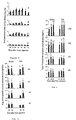
- Table 4 and Figure 1 show that the immune response following immunisation of mice with entrapped DNA encoding Hepatitis B surface antigen is much higher than following immunisation with naked DNA. Whilst this effect is already apparent after 26 days from the start of the experiment, the effect becomes yet more pronounced as the experiment continues. The effect is particularly pronounced for IgG 1 although the levels of both IgG 2a and IgG 2b are also present in increased amounts as compared to naked DNA transmission, after all bleeds.
- the immune response does appear to be developing after 28 days from the start of the experiment, for both levels of DNA administration and is significantly higher than the response after administration of naked DNA.
- the immune responses are not as high as those obtained for the DNA entrapped within cationic liposomes.
- mice in groups of four were injected intramuscularly on days 0.7, 14, 21 and 28 with 1 (white bars) or 10 ⁇ g (black bars) of pRc/CMV HBS entrapped in positively charged liposomes composed of PC, DOPE and DOTAP (A), uncharged liposomes composed of PC and DOPE (B), complexed with similar performed cationic DOTAP liposomes (C) or in naked form (D).
- Control represents cytokine levels in normal unimmunized mice. Three weeks after the final injection, mice were killed and their spleens subjected to cytokine analysis.
- Endogenous levels of IFN- ⁇ and IL-4 in the spleen were determined by the method of Nakane et al as previously modified by de Souza et al. Individual spleens were weighed, homogenized in ice-cold RPMI containing 1% 3-[(cholamidopropyl)dimethylammonio]-1-propanesulphonate (CHAPS; Sigma) in a Dounce tissue homogenizer and 10% (wt/vol) homogenates were prepared. Homogenates were left on ice for 1 h and insoluble debris were then removed by centrifugation at 2000 Xg for 20 min. The clear supernatants were stored at -70°C.
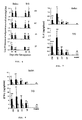
- Balb/c mice in groups of four were injected once intramuscularly with 2 (white bars see figure 3) or 10 ⁇ g (black bars) of pRc/CMV HBS entrapped in positively charged liposomes composed of PC, DOPE and DOTAP (A), uncharged liposomes composed of PC and DOPE (B), complexed with preformed similar DOTAP liposomes (C) or in the naked form (D).
- Anti-HBsAg IgG 1 responses were analysed (ELISA) in sera obtained at time intervals after injection. Immune responses were mounted by all mice injected with liposomal DNA but became measurable only at 20-27 days. The remaining details were as in example 2.
- mice immunized with cationic liposomal DNA were statistically significant (P ⁇ 0.0001-0.002).
- IgG 1 responses were 2.25 ⁇ 0.0 and 2.73 ⁇ 0.0 at 21 and 29 days respectively.
- mice Groups of mice (4-5 animals per group) were injected (i.m., i.p., i.v. or s.c.) twice (on days 0 and 7) with 10 ⁇ g pRc/CMV HBS (encoding the S region of hepatitis B surface antigen; subtype ayw) entrapped in cationic DRV liposomes composed of egg phosphatidylcholine (PC), dioleoyl phosphatidylcholine (DOPE) and 1,2-dioleoyl-3-(trimethylammonium) propane (DOTAP) (molar ratios 1:5.5:0.25) (produced using the general techniques and materials described above in example 1), or with 10 ⁇ g of naked pRc/CMV HBS (both in PBS).
- PC egg phosphatidylcholine
- DOPE dioleoyl phosphatidylcholine
- DOTAP 1,2-dioleoyl-3-(trimethylammonium
- mice Animals were bled at time intervals and IgG 1 , IgG 2a and IgG 2b were measured by ELISA in the plasma. At the end of the experiment (38 days after the first injection) animals were killed and the cytokines IFN ⁇ and IL-4 were measured in the spleen as described (for additional experimental details see Gregoriadis et al, 1997). The cytokines were also measured in the spleen of control (intact) mice.
- results show that immune responses (mean ⁇ SD) for both strains of mice became measurable only after 21 (IgG 1 ; Fig 4) or 28 days (IgG 2a and IgG 2b ; Figs 5 and 6 respectively) after the first injection.
- Responses for liposomal DNA black bars
- were generally significantly greater than those for naked DNA dotted bars
- Significant levels increase in the order of + *,**,***.
- 35 S-labelled plasmid DNA (10-500 ⁇ g) was incorporated into or mixed with neutral, anionic or cationic dehydration rehydration vesicle (DRV) using the technique described in example 1.
- the plasmid DNAs used were the following:
- the lipids used included neutral lipids PC and DOPE described in example 1 above, anionic lipids, PS, phosphatidyl serine, described in example 1 or phosphatidyl glycerol (PG) and cationic compounds stearylamine (SA), BisHOP and DOTMA, all described in example 1, DC-Chol and DOTAP, as used in example 2 and, in addition 1,2-dioleoyl-3-dimethylammonium propane DODAP.
- neutral lipids PC and DOPE described in example 1 above, anionic lipids, PS, phosphatidyl serine, described in example 1 or phosphatidyl glycerol (PG) and cationic compounds stearylamine (SA), BisHOP and DOTMA, all described in example 1, DC-Chol and DOTAP, as used in example 2 and, in addition 1,2-dioleoyl-3-dimethylammonium propane DODAP.
- the table below indicates whether the plasmid DNA was incorporated (that is encapsulated into (a) or merely admixed (b) with the DRV).
- the table further indicates the lipid components and the incorporation values for DNA. Previous tests had shown that incorporation values using different amounts of DNA for each of the DRV formulations did not differ significantly. Results were therefore pooled and the values shown in the table are means of values obtained from 3 to 5 experiments.
- plasmid DNA was entrapped into various cationic liposomes.
- the lipids used and the molar ratios are shown in table 7 below.
- the lipids were as used in previous examples and additional PE is phosphatidyl ethanolamine with egg lipid, and DSPC, di-stearoylphosphatidylcholine, a saturated lipid.
- Balb/c mice were injected intramuscularly in groups of 5 with 10 ⁇ g of free or liposome entrapped plasmid on day zero, two weeks and five weeks. Animals were bled at 8, 10 and 13 weeks and sera assayed by ELISA for anti-HBsAg (S region) IgG 1 antibodies.
- the liposome forming components included a glyceride, MonoPal; 1-Monopalmitoylrac-glycerol, and nonionic surfactants, Span 60(-sorbitan monostearate) and Solulan 24, (a 24 mole ethoxylated complex of lanolin alcohols and related fatty alcohols). (Span 60 and Solulan 24 are trademarks).
- the mole ratios of the liposome forming components are shown in the table.
- the other components are as used in the above examples.
- Non-invasive liposome-mediated gene delivery can correct the ion transport defect in cystic fibrosis mutant mice Nat.Genet. 5, 135-142
- DBV Dehydration-rehydration vesicles
Landscapes
- Health & Medical Sciences (AREA)
- Life Sciences & Earth Sciences (AREA)
- Chemical & Material Sciences (AREA)
- Genetics & Genomics (AREA)
- General Health & Medical Sciences (AREA)
- Engineering & Computer Science (AREA)
- Animal Behavior & Ethology (AREA)
- Veterinary Medicine (AREA)
- Public Health (AREA)
- Medicinal Chemistry (AREA)
- Pharmacology & Pharmacy (AREA)
- Molecular Biology (AREA)
- Biotechnology (AREA)
- Epidemiology (AREA)
- Organic Chemistry (AREA)
- Bioinformatics & Cheminformatics (AREA)
- Biomedical Technology (AREA)
- Biophysics (AREA)
- Zoology (AREA)
- General Engineering & Computer Science (AREA)
- Wood Science & Technology (AREA)
- Microbiology (AREA)
- Dispersion Chemistry (AREA)
- Chemical Kinetics & Catalysis (AREA)
- Nuclear Medicine, Radiotherapy & Molecular Imaging (AREA)
- Plant Pathology (AREA)
- Physics & Mathematics (AREA)
- General Chemical & Material Sciences (AREA)
- Biochemistry (AREA)
- Immunology (AREA)
- Oncology (AREA)
- Communicable Diseases (AREA)
- Mycology (AREA)
- Medicinal Preparation (AREA)
- Medicines That Contain Protein Lipid Enzymes And Other Medicines (AREA)
- Pharmaceuticals Containing Other Organic And Inorganic Compounds (AREA)
- Medicines Containing Antibodies Or Antigens For Use As Internal Diagnostic Agents (AREA)
- Manufacturing Of Micro-Capsules (AREA)
Priority Applications (2)
| Application Number | Priority Date | Filing Date | Title |
|---|---|---|---|
| ES02016936T ES2305157T3 (es) | 1996-09-13 | 1997-09-15 | Liposomas. |
| EP02016936A EP1254657B1 (en) | 1996-09-13 | 1997-09-15 | Liposomes |
Applications Claiming Priority (7)
| Application Number | Priority Date | Filing Date | Title |
|---|---|---|---|
| GB9619172 | 1996-09-13 | ||
| GBGB9619172.1A GB9619172D0 (en) | 1996-09-13 | 1996-09-13 | Liposomes |
| GBGB9625917.1A GB9625917D0 (en) | 1996-12-13 | 1996-12-13 | Liposomes |
| GB9625917 | 1996-12-13 | ||
| GBGB9713994.3A GB9713994D0 (en) | 1997-07-01 | 1997-07-01 | Liposomes |
| GB9713994 | 1997-07-01 | ||
| PCT/GB1997/002490 WO1998010748A1 (en) | 1996-09-13 | 1997-09-15 | Liposomes |
Related Child Applications (1)
| Application Number | Title | Priority Date | Filing Date |
|---|---|---|---|
| EP02016936A Division EP1254657B1 (en) | 1996-09-13 | 1997-09-15 | Liposomes |
Publications (2)
| Publication Number | Publication Date |
|---|---|
| EP0938298A1 EP0938298A1 (en) | 1999-09-01 |
| EP0938298B1 true EP0938298B1 (en) | 2002-12-04 |
Family
ID=27268476
Family Applications (2)
| Application Number | Title | Priority Date | Filing Date |
|---|---|---|---|
| EP97940250A Expired - Lifetime EP0938298B1 (en) | 1996-09-13 | 1997-09-15 | Liposome-based composition |
| EP02016936A Expired - Lifetime EP1254657B1 (en) | 1996-09-13 | 1997-09-15 | Liposomes |
Family Applications After (1)
| Application Number | Title | Priority Date | Filing Date |
|---|---|---|---|
| EP02016936A Expired - Lifetime EP1254657B1 (en) | 1996-09-13 | 1997-09-15 | Liposomes |
Country Status (11)
| Country | Link |
|---|---|
| US (1) | US7790696B2 (https=) |
| EP (2) | EP0938298B1 (https=) |
| JP (1) | JP2001502299A (https=) |
| KR (1) | KR100507660B1 (https=) |
| CN (1) | CN1138533C (https=) |
| AT (2) | ATE395904T1 (https=) |
| AU (1) | AU728581B2 (https=) |
| CA (1) | CA2271388C (https=) |
| DE (2) | DE69738719D1 (https=) |
| ES (2) | ES2305157T3 (https=) |
| WO (1) | WO1998010748A1 (https=) |
Families Citing this family (62)
| Publication number | Priority date | Publication date | Assignee | Title |
|---|---|---|---|---|
| EP1146907A2 (en) * | 1999-02-05 | 2001-10-24 | Genzyme Corporation | Use of cationic lipids to generate anti-tumor immunity |
| EP1210046A4 (en) * | 1999-06-22 | 2007-05-02 | Res Dev Foundation | IMPROVED DRESSING THAT CAN ACCELERATE THE HEALING OF INJURIES |
| WO2001024773A1 (en) * | 1999-10-01 | 2001-04-12 | Lipoxen Technologies Limited | Liposome-entrapped dna oral vaccines |
| US7381421B2 (en) | 1999-12-13 | 2008-06-03 | Lipoxen Technologies Limited | Liposomes |
| US6372250B1 (en) * | 2000-04-25 | 2002-04-16 | The Regents Of The University Of California | Non-invasive gene targeting to the brain |
| DE10109897A1 (de) * | 2001-02-21 | 2002-11-07 | Novosom Ag | Fakultativ kationische Liposomen und Verwendung dieser |
| US7604803B2 (en) | 2002-07-05 | 2009-10-20 | Lipoxen Technologies Limited | Method to enhance an immune response of nucleic acid vaccination |
| DE10347710B4 (de) | 2003-10-14 | 2006-03-30 | Johannes-Gutenberg-Universität Mainz | Rekombinante Impfstoffe und deren Verwendung |
| JP4546115B2 (ja) * | 2004-03-05 | 2010-09-15 | 三菱化学メディエンス株式会社 | 細胞中atpの定量法 |
| DE102004057303A1 (de) * | 2004-11-26 | 2006-06-01 | Merck Patent Gmbh | Stabile Kristallmodifikationen von DOTAP Chlorid |
| DE102005046490A1 (de) | 2005-09-28 | 2007-03-29 | Johannes-Gutenberg-Universität Mainz | Modifikationen von RNA, die zu einer erhöhten Transkriptstabilität und Translationseffizienz führen |
| CN100400667C (zh) * | 2006-06-27 | 2008-07-09 | 浙江大学 | 脂质体包裹弓形虫pGRA4真核表达质粒的方法及用途 |
| CA2687208C (en) | 2006-12-22 | 2017-02-14 | Soluciones Biotecnologicas Innovacion Ltda | Process and formulation for immunizing fish in aquaculture systems |
| RU2367443C1 (ru) * | 2008-02-28 | 2009-09-20 | Общество с ограниченной ответственностью "Битеп" | Средство на основе природных фосфолипидов |
| EP2184054A1 (en) | 2008-11-08 | 2010-05-12 | Lipoxen Technologies Limited | Small Interfering RNA Delivery |
| JP5854559B2 (ja) * | 2009-07-06 | 2016-02-09 | ヴァリエーション バイオテクノロジーズ インコーポレイテッド | 小胞を調製する方法及びこれから製造される製剤 |
| CA2803282C (en) | 2009-07-06 | 2018-05-01 | David E. Anderson | Methods for preparing vesicles and formulations produced therefrom |
| US12419839B2 (en) | 2009-10-09 | 2025-09-23 | Signablok, Inc. | Methods and compositions for targeted delivery of protein fragments |
| US10525152B2 (en) | 2009-10-09 | 2020-01-07 | Signablok, Inc. | Methods and compositions for targeted imaging |
| US10894098B2 (en) | 2012-04-09 | 2021-01-19 | Signablok, Inc. | Methods and compositions for targeted imaging |
| EP3318248B1 (en) | 2009-12-01 | 2019-04-10 | Translate Bio, Inc. | Delivery of mrna for the augmentation of proteins and enzymes in human genetic diseases |
| KR101773643B1 (ko) * | 2010-04-28 | 2017-08-31 | 교와 핫꼬 기린 가부시키가이샤 | 양이온성 지질 |
| NZ606591A (en) | 2010-07-06 | 2015-02-27 | Novartis Ag | Cationic oil-in-water emulsions |
| MX342608B (es) | 2010-07-06 | 2016-10-06 | Novartis Ag * | Particulas de suministro similares a viriones para moleculas de arn de autorreplicacion. |
| ES2557382T3 (es) | 2010-07-06 | 2016-01-25 | Glaxosmithkline Biologicals Sa | Liposomas con lípidos que tienen un valor de pKa ventajoso para el suministro de ARN |
| EP2591114B1 (en) | 2010-07-06 | 2016-06-08 | GlaxoSmithKline Biologicals SA | Immunisation of large mammals with low doses of rna |
| WO2012006367A2 (en) | 2010-07-06 | 2012-01-12 | Variation Biotechnologies, Inc. | Compositions and methods for treating influenza |
| ES2646669T3 (es) | 2010-07-06 | 2017-12-14 | Glaxosmithkline Biologicals Sa | Procedimientos de aumento de una respuesta inmunitaria mediante el suministro de ARN |
| LT4226941T (lt) | 2010-08-31 | 2025-01-10 | Glaxosmithkline Biologicals Sa | Pegilintos liposomos, skirtos imunogeną koduojančios rnr pristatymui |
| WO2012051211A2 (en) | 2010-10-11 | 2012-04-19 | Novartis Ag | Antigen delivery platforms |
| US10736844B2 (en) | 2011-01-13 | 2020-08-11 | Variation Biotechnologies Inc. | Compositions and methods for treating viral infections |
| RU2491062C2 (ru) * | 2011-03-16 | 2013-08-27 | Общество С Ограниченной Ответственностью "Биотехнологии Пущино" | Композиции протекторов острых и хронических печеночных энцелопатий и способ лечения острых и хронических печеночных энцелопатий |
| PL3892295T3 (pl) | 2011-05-24 | 2023-07-24 | BioNTech SE | Zindywidualizowane szczepionki przeciwnowotworowe |
| RU2013154295A (ru) | 2011-06-08 | 2015-07-20 | Шир Хьюман Дженетик Терапис, Инк. | КОМПОЗИЦИИ ЛИПИДНЫХ НАНОЧАСТИЦ И СПОСОБЫ ДЛЯ ДОСТАВКИ мРНК |
| EP2729165B1 (en) | 2011-07-06 | 2017-11-08 | GlaxoSmithKline Biologicals SA | Immunogenic combination compositions and uses thereof |
| JP6059220B2 (ja) | 2011-07-06 | 2017-01-18 | ノバルティス アーゲー | 核酸を含む水中油型エマルジョン |
| MX350258B (es) | 2011-07-06 | 2017-08-31 | Novartis Ag | Emulsiones cationicas de aceite en agua. |
| AU2013208693B2 (en) | 2012-01-12 | 2017-12-07 | Variation Biotechnologies Inc. | Compositions and methods for treating viral infections |
| EP2806894A4 (en) | 2012-01-27 | 2015-11-04 | Variation Biotechnologies Inc | METHODS AND COMPOSITIONS FOR THERAPEUTIC AGENTS |
| WO2013143555A1 (en) | 2012-03-26 | 2013-10-03 | Biontech Ag | Rna formulation for immunotherapy |
| WO2013185067A1 (en) | 2012-06-08 | 2013-12-12 | Shire Human Genetic Therapies, Inc. | Nuclease resistant polynucleotides and uses thereof |
| EP2858679B2 (en) * | 2012-06-08 | 2024-06-05 | Translate Bio, Inc. | Pulmonary delivery of mrna to non-lung target cells |
| EP3417874B1 (en) | 2012-11-28 | 2024-09-11 | BioNTech SE | Individualized vaccines for cancer |
| JP6586075B2 (ja) | 2013-03-14 | 2019-10-02 | トランスレイト バイオ, インコーポレイテッド | メッセンジャーrnaの精製方法 |
| RS57739B1 (sr) | 2013-03-14 | 2018-12-31 | Translate Bio Inc | Kompozicije cftr irnk i postupci i upotrebe u vezi sa njima |
| WO2014180490A1 (en) | 2013-05-10 | 2014-11-13 | Biontech Ag | Predicting immunogenicity of t cell epitopes |
| JP6506749B2 (ja) | 2013-10-22 | 2019-04-24 | シャイアー ヒューマン ジェネティック セラピーズ インコーポレイテッド | フェニルケトン尿症のためのmRNA療法 |
| CN106413811A (zh) | 2013-10-22 | 2017-02-15 | 夏尔人类遗传性治疗公司 | 精氨基琥珀酸合成酶缺乏症的mrna疗法 |
| US20160324986A1 (en) * | 2013-12-27 | 2016-11-10 | Teloregen, Inc. | Compositions and methods for providing active telomerase to cells in vivo |
| BR112016016356B1 (pt) * | 2014-01-17 | 2023-12-26 | Fundació Institut Català De Nanociència I Nanotecnologia | Lipossoma, usos dos mesmos, e composição farmacêutica ou veterinária |
| US9850269B2 (en) | 2014-04-25 | 2017-12-26 | Translate Bio, Inc. | Methods for purification of messenger RNA |
| WO2016045732A1 (en) | 2014-09-25 | 2016-03-31 | Biontech Rna Pharmaceuticals Gmbh | Stable formulations of lipids and liposomes |
| WO2016128060A1 (en) | 2015-02-12 | 2016-08-18 | Biontech Ag | Predicting t cell epitopes useful for vaccination |
| WO2017059902A1 (en) | 2015-10-07 | 2017-04-13 | Biontech Rna Pharmaceuticals Gmbh | 3' utr sequences for stabilization of rna |
| EA201991747A1 (ru) | 2017-02-27 | 2020-06-04 | Транслейт Био, Инк. | НОВАЯ КОДОН-ОПТИМИЗИРОВАННАЯ мРНК CFTR |
| MX2019013752A (es) | 2017-05-16 | 2020-07-20 | Translate Bio Inc | Tratamiento de la fibrosis quística mediante el suministro de arnm que codifica cftr optimizado en codones. |
| WO2018224166A1 (en) | 2017-06-09 | 2018-12-13 | Biontech Rna Pharmaceuticals Gmbh | Methods for predicting the usefulness of disease specific amino acid modifications for immunotherapy |
| KR102950141B1 (ko) | 2018-08-24 | 2026-04-07 | 트랜슬레이트 바이오 인코포레이티드 | 전령 rna의 정제 방법 |
| WO2020106946A1 (en) | 2018-11-21 | 2020-05-28 | Translate Bio, Inc. | TREATMENT OF CYSTIC FIBROSIS BY DELIVERY OF NEBULIZED mRNA ENCODING CFTR |
| EP4031662A1 (en) | 2019-09-20 | 2022-07-27 | Translate Bio, Inc. | Mrna encoding engineered cftr |
| EP3892260A1 (en) * | 2020-04-10 | 2021-10-13 | Bayer Animal Health GmbH | Immunostimulatory compositions based on liposomes with zwiterionic and cationic lipids |
| WO2022204032A1 (en) | 2021-03-22 | 2022-09-29 | Illumina Cambridge Limited | Methods for improving nucleic acid cluster clonality |
Family Cites Families (29)
| Publication number | Priority date | Publication date | Assignee | Title |
|---|---|---|---|---|
| US4515736A (en) | 1983-05-12 | 1985-05-07 | The Regents Of The University Of California | Method for encapsulating materials into liposomes |
| DE3582905D1 (de) | 1984-08-10 | 1991-06-27 | Syntex Inc | Stabile liposome mit wasserloeslichen arzneimitteln. |
| US4897355A (en) | 1985-01-07 | 1990-01-30 | Syntex (U.S.A.) Inc. | N[ω,(ω-1)-dialkyloxy]- and N-[ω,(ω-1)-dialkenyloxy]-alk-1-yl-N,N,N-tetrasubstituted ammonium lipids and uses therefor |
| US5049386A (en) | 1985-01-07 | 1991-09-17 | Syntex (U.S.A.) Inc. | N-ω,(ω-1)-dialkyloxy)- and N-(ω,(ω-1)-dialkenyloxy)Alk-1-YL-N,N,N-tetrasubstituted ammonium lipids and uses therefor |
| ATE50983T1 (de) | 1985-01-07 | 1990-03-15 | Syntex Inc | Oberflaechenaktive n-(omega, omega-1-dialkoxy)und n-(omega, omega-1-dialkenoxy)-alk-1-yl-n,n,ntrisubstituierte ammoniumverbindungen, deren herstellung und sie enthaltende pharmazeutische formulierungen. |
| US5550289A (en) | 1985-01-07 | 1996-08-27 | Syntex (U.S.A.) Inc. | N-(1,(1-1)-dialkyloxy)-and N-(1,(1-1)-dialkenyloxy alk-1-yl-N-N,N-tetrasubstituted ammonium lipids and uses therefor |
| US5208036A (en) | 1985-01-07 | 1993-05-04 | Syntex (U.S.A.) Inc. | N-(ω, (ω-1)-dialkyloxy)- and N-(ω, (ω-1)-dialkenyloxy)-alk-1-yl-N,N,N-tetrasubstituted ammonium lipids and uses therefor |
| US4946787A (en) | 1985-01-07 | 1990-08-07 | Syntex (U.S.A.) Inc. | N-(ω,(ω-1)-dialkyloxy)- and N-(ω,(ω-1)-dialkenyloxy)-alk-1-yl-N,N,N-tetrasubstituted ammonium lipids and uses therefor |
| US4885172A (en) | 1985-06-26 | 1989-12-05 | The Liposome Company, Inc. | Composition for targeting, storing and loading of liposomes |
| JP2627899B2 (ja) * | 1987-08-19 | 1997-07-09 | 株式会社 ビタミン研究所 | 遺伝子封入リポソームの製法 |
| US4882172A (en) * | 1988-04-08 | 1989-11-21 | Nabisco Brands, Inc. | System for processing chewing gum |
| JP2923296B2 (ja) * | 1988-11-14 | 1999-07-26 | 株式会社ビタミン研究所 | 細胞への遺伝子導入法 |
| CA2489769A1 (en) | 1989-03-21 | 1990-10-04 | Philip L. Felgner | Expression of exogenous polynucleotide sequences in a vertebrate |
| US5264618A (en) | 1990-04-19 | 1993-11-23 | Vical, Inc. | Cationic lipids for intracellular delivery of biologically active molecules |
| WO1991017424A1 (en) * | 1990-05-03 | 1991-11-14 | Vical, Inc. | Intracellular delivery of biologically active substances by means of self-assembling lipid complexes |
| JP2958076B2 (ja) * | 1990-08-27 | 1999-10-06 | 株式会社ビタミン研究所 | 遺伝子導入用多重膜リポソーム及び遺伝子捕捉多重膜リポソーム製剤並びにその製法 |
| JPH07503372A (ja) | 1992-01-23 | 1995-04-13 | バイカル・インコーポレイテッド | 生体外遺伝子導入 |
| US6113946A (en) | 1992-04-03 | 2000-09-05 | The Regents Of The University Of California | Self-assembling polynucleotide delivery system comprising dendrimer polycations |
| US5334761A (en) | 1992-08-28 | 1994-08-02 | Life Technologies, Inc. | Cationic lipids |
| US5593972A (en) * | 1993-01-26 | 1997-01-14 | The Wistar Institute | Genetic immunization |
| EP0815852A1 (en) * | 1993-08-06 | 1998-01-07 | Opperbas Holding B.V. | A method for high loading of vesicles with biopolymeric substances |
| ATE164515T1 (de) * | 1993-11-05 | 1998-04-15 | Amgen Inc | Herstellung von liposomen und verfahren zur substanzverkapselung |
| AU686277B2 (en) * | 1993-11-16 | 1998-02-05 | Pacira Pharmaceuticals, Inc. | Vesicles with controlled release of actives |
| IL112820A0 (en) * | 1994-03-07 | 1995-05-26 | Merck & Co Inc | Coordinate in vivo gene expression |
| US5830430A (en) * | 1995-02-21 | 1998-11-03 | Imarx Pharmaceutical Corp. | Cationic lipids and the use thereof |
| US5976567A (en) * | 1995-06-07 | 1999-11-02 | Inex Pharmaceuticals Corp. | Lipid-nucleic acid particles prepared via a hydrophobic lipid-nucleic acid complex intermediate and use for gene transfer |
| US5830878A (en) | 1995-06-07 | 1998-11-03 | Megabios Corporation | Cationic lipid: DNA complexes for gene targeting |
| US5753235A (en) | 1996-02-15 | 1998-05-19 | Heska Corporation | Recombinant canine herpesviruses |
| US7384923B2 (en) * | 1999-05-14 | 2008-06-10 | Lipoxen Technologies Limited | Liposomes |
-
1997
- 1997-09-15 CN CNB971996741A patent/CN1138533C/zh not_active Expired - Fee Related
- 1997-09-15 KR KR10-1999-7002103A patent/KR100507660B1/ko not_active Expired - Fee Related
- 1997-09-15 CA CA002271388A patent/CA2271388C/en not_active Expired - Fee Related
- 1997-09-15 ES ES02016936T patent/ES2305157T3/es not_active Expired - Lifetime
- 1997-09-15 WO PCT/GB1997/002490 patent/WO1998010748A1/en not_active Ceased
- 1997-09-15 EP EP97940250A patent/EP0938298B1/en not_active Expired - Lifetime
- 1997-09-15 JP JP10513398A patent/JP2001502299A/ja not_active Ceased
- 1997-09-15 AT AT02016936T patent/ATE395904T1/de not_active IP Right Cessation
- 1997-09-15 DE DE69738719T patent/DE69738719D1/de not_active Expired - Lifetime
- 1997-09-15 ES ES97940250T patent/ES2187812T3/es not_active Expired - Lifetime
- 1997-09-15 AT AT97940250T patent/ATE228824T1/de not_active IP Right Cessation
- 1997-09-15 AU AU42154/97A patent/AU728581B2/en not_active Ceased
- 1997-09-15 EP EP02016936A patent/EP1254657B1/en not_active Expired - Lifetime
- 1997-09-15 DE DE69717661T patent/DE69717661T2/de not_active Expired - Lifetime
-
2008
- 2008-04-10 US US12/101,107 patent/US7790696B2/en not_active Expired - Fee Related
Also Published As
| Publication number | Publication date |
|---|---|
| AU4215497A (en) | 1998-04-02 |
| CN1237102A (zh) | 1999-12-01 |
| ATE395904T1 (de) | 2008-06-15 |
| DE69738719D1 (de) | 2008-07-03 |
| DE69717661D1 (de) | 2003-01-16 |
| CA2271388C (en) | 2007-11-06 |
| EP1254657A2 (en) | 2002-11-06 |
| WO1998010748A1 (en) | 1998-03-19 |
| ES2187812T3 (es) | 2003-06-16 |
| EP0938298A1 (en) | 1999-09-01 |
| CA2271388A1 (en) | 1998-03-19 |
| US20080286353A1 (en) | 2008-11-20 |
| ES2305157T3 (es) | 2008-11-01 |
| EP1254657B1 (en) | 2008-05-21 |
| AU728581B2 (en) | 2001-01-11 |
| EP1254657A3 (en) | 2003-03-05 |
| DE69717661T2 (de) | 2003-09-25 |
| CN1138533C (zh) | 2004-02-18 |
| KR100507660B1 (ko) | 2005-08-10 |
| US7790696B2 (en) | 2010-09-07 |
| KR20000036088A (ko) | 2000-06-26 |
| ATE228824T1 (de) | 2002-12-15 |
| JP2001502299A (ja) | 2001-02-20 |
Similar Documents
| Publication | Publication Date | Title |
|---|---|---|
| EP0938298B1 (en) | Liposome-based composition | |
| US7384923B2 (en) | Liposomes | |
| Li et al. | Nonviral gene therapy | |
| Tomlinson et al. | Controllable gene therapy pharmaceutics of non-viral gene delivery systems | |
| Gregoriadis et al. | Vaccine entrapment in liposomes | |
| Smyth Templeton | Cationic liposome-mediated gene delivery in vivo | |
| Li et al. | In vivo gene transfer via intravenous administration of cationic lipid–protamine–DNA (LPD) complexes | |
| Perrie et al. | Liposome-entrapped plasmid DNA: characterisation studies | |
| US9486510B2 (en) | Method to enhance an immune response of nucleic acid vaccination | |
| US4789633A (en) | Fused liposome and acid induced method for liposome fusion | |
| Thierry et al. | Characterization of liposome-mediated gene delivery: expression, stability and pharmacokinetics of plasmid DNA | |
| Gregoriadis | Immunological adjuvants: a role for liposomes | |
| US6586003B2 (en) | Emulsion and micellar formulations for the delivery of biologically active substances to cells | |
| Perrie et al. | Liposome-mediated DNA immunisation via the subcutaneous route | |
| US5283122A (en) | Fused liposome and acid induced method for liposome fusion | |
| E. McNeil et al. | Lipoplexes formulation and optimisation: in vitro transfection studies reveal no correlation with in vivo vaccination studies | |
| Miller | Nonviral liposomes | |
| US7008791B1 (en) | Liposome-entrapped DNA oral vaccines | |
| Perrie | Liposomes as a gene delivery system | |
| SAFFIE | GREGORY GREGORIADIS, BRENDA MCCORMACK, YVONNE PERRIE AND ROGHIEH SAFFIE | |
| Lam | Influence of calcium on the transfection properties of lipid-based gene delivery systems | |
| Sorgi | Pharmaceutical considerations for cationic liposome-mediated gene delivery systems | |
| GREGORIADIS et al. | DNA vaccination: A role for liposomes | |
| Obrenovic | Niosomes as a delivery system for DNA vaccines | |
| Huang | My journey to gene therapy: A salute to demetrios papahadjopoulos |
Legal Events
| Date | Code | Title | Description |
|---|---|---|---|
| PUAI | Public reference made under article 153(3) epc to a published international application that has entered the european phase |
Free format text: ORIGINAL CODE: 0009012 |
|
| 17P | Request for examination filed |
Effective date: 19990415 |
|
| AK | Designated contracting states |
Kind code of ref document: A1 Designated state(s): AT BE CH DE DK ES FI FR GB GR IE IT LI NL PT SE |
|
| RAP1 | Party data changed (applicant data changed or rights of an application transferred) |
Owner name: LIPOXEN LIMITED |
|
| 17Q | First examination report despatched |
Effective date: 20000810 |
|
| RTI1 | Title (correction) |
Free format text: LIPOSOME-BASED COMPOSITION |
|
| GRAG | Despatch of communication of intention to grant |
Free format text: ORIGINAL CODE: EPIDOS AGRA |
|
| GRAG | Despatch of communication of intention to grant |
Free format text: ORIGINAL CODE: EPIDOS AGRA |
|
| GRAH | Despatch of communication of intention to grant a patent |
Free format text: ORIGINAL CODE: EPIDOS IGRA |
|
| GRAH | Despatch of communication of intention to grant a patent |
Free format text: ORIGINAL CODE: EPIDOS IGRA |
|
| RAP1 | Party data changed (applicant data changed or rights of an application transferred) |
Owner name: LIPOXEN TECHNOLOGIES LIMITED |
|
| GRAA | (expected) grant |
Free format text: ORIGINAL CODE: 0009210 |
|
| RAP1 | Party data changed (applicant data changed or rights of an application transferred) |
Owner name: LIPOXEN TECHNOLOGIES LIMITED |
|
| AK | Designated contracting states |
Kind code of ref document: B1 Designated state(s): AT BE CH DE DK ES FI FR GB GR IE IT LI NL PT SE |
|
| PG25 | Lapsed in a contracting state [announced via postgrant information from national office to epo] |
Ref country code: NL Free format text: LAPSE BECAUSE OF FAILURE TO SUBMIT A TRANSLATION OF THE DESCRIPTION OR TO PAY THE FEE WITHIN THE PRESCRIBED TIME-LIMIT Effective date: 20021204 Ref country code: GR Free format text: LAPSE BECAUSE OF FAILURE TO SUBMIT A TRANSLATION OF THE DESCRIPTION OR TO PAY THE FEE WITHIN THE PRESCRIBED TIME-LIMIT Effective date: 20021204 Ref country code: FI Free format text: LAPSE BECAUSE OF FAILURE TO SUBMIT A TRANSLATION OF THE DESCRIPTION OR TO PAY THE FEE WITHIN THE PRESCRIBED TIME-LIMIT Effective date: 20021204 Ref country code: AT Free format text: LAPSE BECAUSE OF FAILURE TO SUBMIT A TRANSLATION OF THE DESCRIPTION OR TO PAY THE FEE WITHIN THE PRESCRIBED TIME-LIMIT Effective date: 20021204 |
|
| REF | Corresponds to: |
Ref document number: 228824 Country of ref document: AT Date of ref document: 20021215 Kind code of ref document: T |
|
| REG | Reference to a national code |
Ref country code: GB Ref legal event code: FG4D |
|
| REG | Reference to a national code |
Ref country code: CH Ref legal event code: EP |
|
| REG | Reference to a national code |
Ref country code: IE Ref legal event code: FG4D |
|
| REF | Corresponds to: |
Ref document number: 69717661 Country of ref document: DE Date of ref document: 20030116 |
|
| PG25 | Lapsed in a contracting state [announced via postgrant information from national office to epo] |
Ref country code: SE Free format text: LAPSE BECAUSE OF FAILURE TO SUBMIT A TRANSLATION OF THE DESCRIPTION OR TO PAY THE FEE WITHIN THE PRESCRIBED TIME-LIMIT Effective date: 20030304 Ref country code: DK Free format text: LAPSE BECAUSE OF FAILURE TO SUBMIT A TRANSLATION OF THE DESCRIPTION OR TO PAY THE FEE WITHIN THE PRESCRIBED TIME-LIMIT Effective date: 20030304 |
|
| PG25 | Lapsed in a contracting state [announced via postgrant information from national office to epo] |
Ref country code: PT Free format text: LAPSE BECAUSE OF FAILURE TO SUBMIT A TRANSLATION OF THE DESCRIPTION OR TO PAY THE FEE WITHIN THE PRESCRIBED TIME-LIMIT Effective date: 20030305 |
|
| REG | Reference to a national code |
Ref country code: CH Ref legal event code: NV Representative=s name: ISLER & PEDRAZZINI AG |
|
| NLV1 | Nl: lapsed or annulled due to failure to fulfill the requirements of art. 29p and 29m of the patents act | ||
| REG | Reference to a national code |
Ref country code: ES Ref legal event code: FG2A Ref document number: 2187812 Country of ref document: ES Kind code of ref document: T3 |
|
| ET | Fr: translation filed | ||
| PLBE | No opposition filed within time limit |
Free format text: ORIGINAL CODE: 0009261 |
|
| STAA | Information on the status of an ep patent application or granted ep patent |
Free format text: STATUS: NO OPPOSITION FILED WITHIN TIME LIMIT |
|
| 26N | No opposition filed |
Effective date: 20030905 |
|
| REG | Reference to a national code |
Ref country code: CH Ref legal event code: PCAR Free format text: ISLER & PEDRAZZINI AG;POSTFACH 1772;8027 ZUERICH (CH) |
|
| PGFP | Annual fee paid to national office [announced via postgrant information from national office to epo] |
Ref country code: IE Payment date: 20110207 Year of fee payment: 14 |
|
| PGFP | Annual fee paid to national office [announced via postgrant information from national office to epo] |
Ref country code: DE Payment date: 20110307 Year of fee payment: 14 Ref country code: CH Payment date: 20110309 Year of fee payment: 14 Ref country code: FR Payment date: 20110315 Year of fee payment: 14 Ref country code: IT Payment date: 20110210 Year of fee payment: 14 |
|
| PGFP | Annual fee paid to national office [announced via postgrant information from national office to epo] |
Ref country code: BE Payment date: 20110224 Year of fee payment: 14 Ref country code: GB Payment date: 20110204 Year of fee payment: 14 Ref country code: ES Payment date: 20110207 Year of fee payment: 14 |
|
| BERE | Be: lapsed |
Owner name: *LIPOXEN TECHNOLOGIES LTD Effective date: 20110930 |
|
| REG | Reference to a national code |
Ref country code: CH Ref legal event code: PL |
|
| GBPC | Gb: european patent ceased through non-payment of renewal fee |
Effective date: 20110915 |
|
| PG25 | Lapsed in a contracting state [announced via postgrant information from national office to epo] |
Ref country code: IT Free format text: LAPSE BECAUSE OF NON-PAYMENT OF DUE FEES Effective date: 20110915 |
|
| REG | Reference to a national code |
Ref country code: IE Ref legal event code: MM4A |
|
| REG | Reference to a national code |
Ref country code: FR Ref legal event code: ST Effective date: 20120531 |
|
| PG25 | Lapsed in a contracting state [announced via postgrant information from national office to epo] |
Ref country code: BE Free format text: LAPSE BECAUSE OF NON-PAYMENT OF DUE FEES Effective date: 20110930 |
|
| REG | Reference to a national code |
Ref country code: DE Ref legal event code: R119 Ref document number: 69717661 Country of ref document: DE Effective date: 20120403 |
|
| PG25 | Lapsed in a contracting state [announced via postgrant information from national office to epo] |
Ref country code: DE Free format text: LAPSE BECAUSE OF NON-PAYMENT OF DUE FEES Effective date: 20120403 Ref country code: LI Free format text: LAPSE BECAUSE OF NON-PAYMENT OF DUE FEES Effective date: 20110930 Ref country code: CH Free format text: LAPSE BECAUSE OF NON-PAYMENT OF DUE FEES Effective date: 20110930 Ref country code: IE Free format text: LAPSE BECAUSE OF NON-PAYMENT OF DUE FEES Effective date: 20110915 |
|
| PG25 | Lapsed in a contracting state [announced via postgrant information from national office to epo] |
Ref country code: FR Free format text: LAPSE BECAUSE OF NON-PAYMENT OF DUE FEES Effective date: 20110930 Ref country code: GB Free format text: LAPSE BECAUSE OF NON-PAYMENT OF DUE FEES Effective date: 20110915 |
|
| REG | Reference to a national code |
Ref country code: ES Ref legal event code: FD2A Effective date: 20130604 |
|
| PG25 | Lapsed in a contracting state [announced via postgrant information from national office to epo] |
Ref country code: ES Free format text: LAPSE BECAUSE OF NON-PAYMENT OF DUE FEES Effective date: 20110916 |