EP0937684B1 - Lithium hydrogentitanates and process for the preparation thereof - Google Patents
Lithium hydrogentitanates and process for the preparation thereof Download PDFInfo
- Publication number
- EP0937684B1 EP0937684B1 EP98932536A EP98932536A EP0937684B1 EP 0937684 B1 EP0937684 B1 EP 0937684B1 EP 98932536 A EP98932536 A EP 98932536A EP 98932536 A EP98932536 A EP 98932536A EP 0937684 B1 EP0937684 B1 EP 0937684B1
- Authority
- EP
- European Patent Office
- Prior art keywords
- lithium titanate
- lithium
- titanate
- hydrogen
- compound
- Prior art date
- Legal status (The legal status is an assumption and is not a legal conclusion. Google has not performed a legal analysis and makes no representation as to the accuracy of the status listed.)
- Expired - Lifetime
Links
Images
Classifications
-
- C—CHEMISTRY; METALLURGY
- C01—INORGANIC CHEMISTRY
- C01G—COMPOUNDS CONTAINING METALS NOT COVERED BY SUBCLASSES C01D OR C01F
- C01G23/00—Compounds of titanium
- C01G23/003—Titanates
-
- C—CHEMISTRY; METALLURGY
- C01—INORGANIC CHEMISTRY
- C01G—COMPOUNDS CONTAINING METALS NOT COVERED BY SUBCLASSES C01D OR C01F
- C01G23/00—Compounds of titanium
- C01G23/003—Titanates
- C01G23/005—Alkali titanates
-
- H—ELECTRICITY
- H01—ELECTRIC ELEMENTS
- H01M—PROCESSES OR MEANS, e.g. BATTERIES, FOR THE DIRECT CONVERSION OF CHEMICAL ENERGY INTO ELECTRICAL ENERGY
- H01M10/00—Secondary cells; Manufacture thereof
- H01M10/05—Accumulators with non-aqueous electrolyte
- H01M10/052—Li-accumulators
-
- H—ELECTRICITY
- H01—ELECTRIC ELEMENTS
- H01M—PROCESSES OR MEANS, e.g. BATTERIES, FOR THE DIRECT CONVERSION OF CHEMICAL ENERGY INTO ELECTRICAL ENERGY
- H01M10/00—Secondary cells; Manufacture thereof
- H01M10/05—Accumulators with non-aqueous electrolyte
- H01M10/052—Li-accumulators
- H01M10/0525—Rocking-chair batteries, i.e. batteries with lithium insertion or intercalation in both electrodes; Lithium-ion batteries
-
- H—ELECTRICITY
- H01—ELECTRIC ELEMENTS
- H01M—PROCESSES OR MEANS, e.g. BATTERIES, FOR THE DIRECT CONVERSION OF CHEMICAL ENERGY INTO ELECTRICAL ENERGY
- H01M4/00—Electrodes
- H01M4/02—Electrodes composed of, or comprising, active material
- H01M4/36—Selection of substances as active materials, active masses, active liquids
- H01M4/48—Selection of substances as active materials, active masses, active liquids of inorganic oxides or hydroxides
- H01M4/485—Selection of substances as active materials, active masses, active liquids of inorganic oxides or hydroxides of mixed oxides or hydroxides for inserting or intercalating light metals, e.g. LiTi2O4 or LiTi2OxFy
-
- H—ELECTRICITY
- H01—ELECTRIC ELEMENTS
- H01M—PROCESSES OR MEANS, e.g. BATTERIES, FOR THE DIRECT CONVERSION OF CHEMICAL ENERGY INTO ELECTRICAL ENERGY
- H01M4/00—Electrodes
- H01M4/02—Electrodes composed of, or comprising, active material
- H01M4/36—Selection of substances as active materials, active masses, active liquids
- H01M4/58—Selection of substances as active materials, active masses, active liquids of inorganic compounds other than oxides or hydroxides, e.g. sulfides, selenides, tellurides, halogenides or LiCoFy; of polyanionic structures, e.g. phosphates, silicates or borates
-
- H—ELECTRICITY
- H01—ELECTRIC ELEMENTS
- H01M—PROCESSES OR MEANS, e.g. BATTERIES, FOR THE DIRECT CONVERSION OF CHEMICAL ENERGY INTO ELECTRICAL ENERGY
- H01M4/00—Electrodes
- H01M4/02—Electrodes composed of, or comprising, active material
- H01M4/36—Selection of substances as active materials, active masses, active liquids
- H01M4/58—Selection of substances as active materials, active masses, active liquids of inorganic compounds other than oxides or hydroxides, e.g. sulfides, selenides, tellurides, halogenides or LiCoFy; of polyanionic structures, e.g. phosphates, silicates or borates
- H01M4/5825—Oxygenated metallic salts or polyanionic structures, e.g. borates, phosphates, silicates, olivines
-
- C—CHEMISTRY; METALLURGY
- C01—INORGANIC CHEMISTRY
- C01P—INDEXING SCHEME RELATING TO STRUCTURAL AND PHYSICAL ASPECTS OF SOLID INORGANIC COMPOUNDS
- C01P2002/00—Crystal-structural characteristics
- C01P2002/30—Three-dimensional structures
- C01P2002/32—Three-dimensional structures spinel-type (AB2O4)
-
- C—CHEMISTRY; METALLURGY
- C01—INORGANIC CHEMISTRY
- C01P—INDEXING SCHEME RELATING TO STRUCTURAL AND PHYSICAL ASPECTS OF SOLID INORGANIC COMPOUNDS
- C01P2004/00—Particle morphology
- C01P2004/60—Particles characterised by their size
- C01P2004/61—Micrometer sized, i.e. from 1-100 micrometer
-
- C—CHEMISTRY; METALLURGY
- C01—INORGANIC CHEMISTRY
- C01P—INDEXING SCHEME RELATING TO STRUCTURAL AND PHYSICAL ASPECTS OF SOLID INORGANIC COMPOUNDS
- C01P2004/00—Particle morphology
- C01P2004/60—Particles characterised by their size
- C01P2004/62—Submicrometer sized, i.e. from 0.1-1 micrometer
-
- C—CHEMISTRY; METALLURGY
- C01—INORGANIC CHEMISTRY
- C01P—INDEXING SCHEME RELATING TO STRUCTURAL AND PHYSICAL ASPECTS OF SOLID INORGANIC COMPOUNDS
- C01P2006/00—Physical properties of inorganic compounds
- C01P2006/12—Surface area
-
- C—CHEMISTRY; METALLURGY
- C01—INORGANIC CHEMISTRY
- C01P—INDEXING SCHEME RELATING TO STRUCTURAL AND PHYSICAL ASPECTS OF SOLID INORGANIC COMPOUNDS
- C01P2006/00—Physical properties of inorganic compounds
- C01P2006/40—Electric properties
-
- H—ELECTRICITY
- H01—ELECTRIC ELEMENTS
- H01M—PROCESSES OR MEANS, e.g. BATTERIES, FOR THE DIRECT CONVERSION OF CHEMICAL ENERGY INTO ELECTRICAL ENERGY
- H01M4/00—Electrodes
- H01M4/02—Electrodes composed of, or comprising, active material
- H01M2004/021—Physical characteristics, e.g. porosity, surface area
-
- H—ELECTRICITY
- H01—ELECTRIC ELEMENTS
- H01M—PROCESSES OR MEANS, e.g. BATTERIES, FOR THE DIRECT CONVERSION OF CHEMICAL ENERGY INTO ELECTRICAL ENERGY
- H01M4/00—Electrodes
- H01M4/02—Electrodes composed of, or comprising, active material
- H01M2004/026—Electrodes composed of, or comprising, active material characterised by the polarity
- H01M2004/027—Negative electrodes
-
- H—ELECTRICITY
- H01—ELECTRIC ELEMENTS
- H01M—PROCESSES OR MEANS, e.g. BATTERIES, FOR THE DIRECT CONVERSION OF CHEMICAL ENERGY INTO ELECTRICAL ENERGY
- H01M4/00—Electrodes
- H01M4/02—Electrodes composed of, or comprising, active material
- H01M2004/026—Electrodes composed of, or comprising, active material characterised by the polarity
- H01M2004/028—Positive electrodes
-
- Y—GENERAL TAGGING OF NEW TECHNOLOGICAL DEVELOPMENTS; GENERAL TAGGING OF CROSS-SECTIONAL TECHNOLOGIES SPANNING OVER SEVERAL SECTIONS OF THE IPC; TECHNICAL SUBJECTS COVERED BY FORMER USPC CROSS-REFERENCE ART COLLECTIONS [XRACs] AND DIGESTS
- Y02—TECHNOLOGIES OR APPLICATIONS FOR MITIGATION OR ADAPTATION AGAINST CLIMATE CHANGE
- Y02E—REDUCTION OF GREENHOUSE GAS [GHG] EMISSIONS, RELATED TO ENERGY GENERATION, TRANSMISSION OR DISTRIBUTION
- Y02E60/00—Enabling technologies; Technologies with a potential or indirect contribution to GHG emissions mitigation
- Y02E60/10—Energy storage using batteries
-
- Y—GENERAL TAGGING OF NEW TECHNOLOGICAL DEVELOPMENTS; GENERAL TAGGING OF CROSS-SECTIONAL TECHNOLOGIES SPANNING OVER SEVERAL SECTIONS OF THE IPC; TECHNICAL SUBJECTS COVERED BY FORMER USPC CROSS-REFERENCE ART COLLECTIONS [XRACs] AND DIGESTS
- Y02—TECHNOLOGIES OR APPLICATIONS FOR MITIGATION OR ADAPTATION AGAINST CLIMATE CHANGE
- Y02P—CLIMATE CHANGE MITIGATION TECHNOLOGIES IN THE PRODUCTION OR PROCESSING OF GOODS
- Y02P70/00—Climate change mitigation technologies in the production process for final industrial or consumer products
- Y02P70/50—Manufacturing or production processes characterised by the final manufactured product
-
- Y—GENERAL TAGGING OF NEW TECHNOLOGICAL DEVELOPMENTS; GENERAL TAGGING OF CROSS-SECTIONAL TECHNOLOGIES SPANNING OVER SEVERAL SECTIONS OF THE IPC; TECHNICAL SUBJECTS COVERED BY FORMER USPC CROSS-REFERENCE ART COLLECTIONS [XRACs] AND DIGESTS
- Y10—TECHNICAL SUBJECTS COVERED BY FORMER USPC
- Y10S—TECHNICAL SUBJECTS COVERED BY FORMER USPC CROSS-REFERENCE ART COLLECTIONS [XRACs] AND DIGESTS
- Y10S420/00—Alloys or metallic compositions
- Y10S420/90—Hydrogen storage
Definitions
- the present invention relates to hydrogen lithium titanate prepared by substituting protons for a portion of lithium thereof and a manufacturing method therefor.
- lithium-ion secondary batteries which are able to charge and discharge lithium-ion, have energetically been developed and put into practical use.
- a positive-electrode active material for the foregoing battery has mainly been any one of vanadium pentoxide, manganese oxide, lithium cobaltate acid, lithium nickelate acid and spinel type lithium manganate.
- the negative electrode is made of a carbon material, such as graphite.
- a battery of the type made of the above-mentioned materials is unfit for use in a low voltage region not higher than 3 V.
- the above-mentioned battery system has an excellent cycle characteristic, over discharge resistance and a preservation characteristic. It can be considered that requirements for development of batteries having larger charging/discharging capacities will be imposed if 1.5 V batteries will be used more widely.
- titanium oxide which is a raw material of lithium titanate for forming a positive and negative electrode of a non-aqueous electrolyte secondary battery as an active material exert a considerable influence on the characteristics of the battery. Therefore, research and development have energetically been reported.
- Titanium oxide which is the raw material has some structure of brookite, rutile, anatase and so forth. A consideration is made that anatase titanium oxide is an advantageous raw material because of further excellent charging/discharging performance and a satisfactory cycle characteristic of the battery made from it.
- lithium titanate is known which is formed into any one of Li 2.67 Ti 1.33 O 4 , LiTi 2 O 4 , Li 1.33 Ti 1.66 O 4 , Li 1.44 Ti 1.71 O 4 , Li 0.8 Ti 2.2 O 4 and the like.
- Li 1 . 33 Ti 1.66 O 4 has attracted attention because of its large charging/discharging capacity.
- lithium titanate a method has been employed in which a mixture of titanium oxide and a lithium compound is subjected to dry heat treatment at temperatures of 700°C to 1600°C (refer to Japanese Patent Laid-Open No. 6-275263 ).
- Thus-obtained mission lithium titanate Li 1.33 Ti 1.66 O 4 has a theoretical charging/discharging capacity of 175 mAh/g in one electronic reaction.
- materials commercially available at present have a charging/discharging capacity of about 130 mAh/g to about 150 mAh/g in 0.75 electronic reaction to 1.0 electronic reaction. That is, the value is excessively smaller than the theoretic capacity (refer to Electrochemistry, p.p. 870 to 875, vol. 62, No. 9 (1994 )).
- FR 2 663 021 describes the compounds H 2 Ti 3 O 7 and Li 2 Ti 3 O 7 .
- Inventors of the present invention have investigated a variety of materials to obtain a material having a satisfactorily large charging/discharging capacity.
- hydrogen lithium titanate obtained by substituting protons for lithium ions of lithium titanate has a charging/discharging capacity which is enlarged in proportion to pH, that is, proton substitution quantity x.
- a material having a structure in which voids are formed in the particles enables the charging/discharging capacity to furthermore be enlarged.
- the present invention has been achieved.
- hydrogen lithium titanate according to the present invention is characterized in that pH is 11.2 or smaller and expressed by a general formula H x Li y-x Ti z O 4 (where y ⁇ x > 0, 0.8 ⁇ y ⁇ 2.7 and 1.3 ⁇ z ⁇ 2.2).
- the hydrogen lithium titanate can be prepared by processing lithium titanate with an acid.
- a method of preparing hydrogen lithium titanate according to the present invention has the steps of bringing lithium titanate expressed by a general formula Li y Ti z O 4 (where 0.8 ⁇ y ⁇ 2.7 and 1.3 ⁇ z ⁇ 2.2) into contact with an acid to substitute protons for lithium ions so that hydrogen lithium titanate expressed by the general formula H x Li y-x Ti z O4 (where y ⁇ x > 0, 0.8 ⁇ y ⁇ 2.7 and 1.3 ⁇ z ⁇ 2.2) is prepared.
- the pH of the hydrogen lithium titanate subjected to the acid process is 7.5 to 11.2 because the pH is one parameter for adjusting the charging/discharging performance.
- Hydrogen lithium titanate according to the present invention may be employed as a material for forming the positive electrode and negative electrode of a lithium-ion secondary battery set to a low potential not higher than 3 V. That is, hydrogen lithium titanate has a capacity which is considerably larger than the theoretical charging/discharging capacity of lithium titanate.
- lithium titanate has a defect spinel structure. Voids in the defect portions have been charged with doped lithium ions supplied from a lithium source disposed at a counter electrode. Therefore, the capacity is usually not larger than a capacity of 175 mAh/g which is a theoretical capacity in one electronic reaction.
- lithium titanate subjected to the proton substitution process has a structure that protons are substituted for a portion of lithium which constitutes crystal lattices. Therefore, lithium and protons are exchanged for each other.
- voids into which lithium ions can be introduced can be created in crystal lattices of sites A and B which are basically limited voids.
- a material having a charging/discharging capacity which is considerably larger than the theoretical capacity can be obtained.
- Hydrogen lithium titanate according to the present invention enables an amount of voids into which lithium ions can be introduced to be enlarged because a characteristic that a large specific surface area can be realized (the reaction area can be enlarged) in inverse proportion to the firing temperatures is used and the proton substitution process is performed. Therefore, the capacity can be enlarged to be considerably larger than 175 mAh/g which is the theoretical charging/discharging capacity of lithium titanate in one electronic reaction. Therefore, a novel material is realized as compared with conventional lithium titanate materials. Thus, a significant industrial advantage can be obtained from the present invention.
- the pH of lithium titanate realized after an acid process that is, the pH of obtained hydrogen lithium titanate can be used as a parameter for adjusting the charging/discharging capacity of hydrogen lithium titanate.
- the pH of the hydrogen lithium titanate which can be prepared by the acid process, is smaller than 11.6, more preferably not greater than 11.2
- the pH of hydrogen lithium titanate is measured as follows.
- hydrogen lithium titanate When the pH satisfies a certain specific range, hydrogen lithium titanate has a crystal structure advantageous for charging/discharging, that is, a crystal structure having many spaces into which lithium can be introduced.
- the range of the pH according to the present invention is estimated to be one of indexes indicating a fact that the crystal structure advantageous for charging/discharging has been formed. Therefore, use of hydrogen lithium titanate having the above-mentioned pH as the material for forming the negative electrode enables an excellent charging/discharging performance to be obtained. Note that further preferred pH range for hydrogen lithium titanate is 5.6 to 11.2.
- the pH has a close relationship with proton substitution of lithium titanate. Therefore, hydrogen lithium titanate according to the present invention is considered to be lithium titanate subjected to proton substitution.
- hydrogen lithium titanate according to the present invention is a compound expressed by a general formula H x Li y-x Ti z O 4 .
- hydrogen lithium titanate in a single phase may be used or mixture of hydrogen lithium titanate and titanium oxide may be used.
- the values of y and z in the above-mentioned general formula are 0.8 ⁇ y ⁇ 2.7 and 1.3 ⁇ z ⁇ 2.2, respectively.
- the proton substitution quantity x satisfies a range y ⁇ x > 0, more preferably 0.9y ⁇ x ⁇ 0.05y and most preferably 0.8y ⁇ x ⁇ 0. ly.
- the hydrogen lithium titanate according to the present invention is formed into particles.
- the shape of the particle is not limited a specific shape. A variety of shapes including the particle shape and a plate-like shape may be employed.
- the hydrogen lithium titanate has voids in the particles thereof because the charging/discharging capacity can furthermore be enlarged.
- the existence of the voids can be confirmed by measuring the amount of voids. If the amount of the voids is 0.005 ml/g or greater, existence of voids in the particles can be confirmed. A preferred range for the amount of voids is 0.01 ml/g to 1.5 ml/g, more preferably 0.01 ml/g to 0.7 ml/g. When a laminate structure of particles is employed, a large quantity of voids can be formed in the layers. Hydrogen lithium titanate according to the present invention has a size controlled to be formed into a fine particle shape.
- the particle size satisfies a range from 0.05 ⁇ m to 50 ⁇ m in viewpoints of easiness in use as powder and realizing a satisfactory characteristic of the battery, more preferably a range from 0.05 ⁇ m to 10 ⁇ m and most preferably a range from 0.1 ⁇ m to 1 ⁇ m.
- the specific surface area satisfies a range from 0.01 m 2 /g to 300 m 2 /g, more preferably 0.1 m 2 /g to 150 m 2 /g, most preferably 0.5 m 2 /g to 100 m 2 /g.
- a manufacturing method has the steps of bringing lithium titanate expressed by general formula Li y Ti z O 4 (where 0.8 ⁇ y ⁇ 2.7 and 1.3 ⁇ z ⁇ 2.2) into contact with an acid to substitute protons for lithium ions so that hydrogen lithium titanate expressed by the general formula H x Li y Ti z O 4 (where y ⁇ x > 0, 0.8 ⁇ y ⁇ 2.7 and 1.3 ⁇ z ⁇ 2.2) is prepared.
- Lithium titanate and the acid can be brought into contact with each other by, for example, suspending lithium titanate in a solvent, such as water, alcohol, cellosolve, methylethylketone, xylene or toluene and by adding the acid.
- the acid may be an inorganic acid, such as hydrochloric acid, nitric acid or sulfuric acid, or an organic acid, such as acetic acid or formic acid without any limitation. It is preferable that acetic acid, hydrochloric acid or nitric acid is employed.
- Lithium titanate for use in the manufacturing method according to the present invention is expressed by the general formula Li y Ti z O 4 .
- the values of y and z satisfy 0.8 ⁇ y ⁇ 2.7 and 1.3 ⁇ z ⁇ 2.2 respectively.
- Compositions can be for example, Li 2.67 Ti 1.33 O 4 , LiTi 2 O 4 , Li 1.33 Ti 1.66 O4, Li 1.44 Ti 1.71 O 4 , Li 0.8 Ti 2.22 O 4 . .
- the shape of particle may be any one of a variety of shapes including a particle shape and a plate-like shape.
- the particle shape of lithium titanate causes the particle shape of hydrogen lithium titanate to be formed.
- a method is herein disclosed with which a mixture of titanium oxide and a lithium compound is subjected to heat treatment at temperatures of 500°C to 900°C so as to prepare granular lithium titanate.
- Another method (2) is employed which comprises a first step in which a titanium compound and an ammonia compound are caused to react with each other in an aqueous solution to obtain a titanate compound; a second step in which the titanate compound and a lithium compound are caused to react with each other in an aqueous solution to obtain lithium titanate hydrate; and a third step in which the lithium titanate hydrate is subjected to heat treatment.
- the foregoing method (1) is a good method because lithium titanate can easily prepared with a low cost.
- a preferred heat treatment range is 600°C to 800°C, more preferably 650°C to 750°C.
- the method (2) is used in the inventive method because obtained lithium titanate has particles, the size and shape of which are controlled, and enables hydrogen lithium titanate having voids in the particles thereof to be obtained.
- the titanium oxide is any one of a variety of titanium oxides, such as anatase titanium oxide, rutile titanium oxide, amorphous titanium oxide, metatitanic acid or orthotitanic acid, titanate hydroxide, hydrous titanium oxide and hydrate titanium oxide.
- the lithium compound may be any one of lithium hydroxide, lithium carbonate, lithium nitrate and lithium sulfate.
- any one of the following method may be employed: a method by which titanium oxide and the lithium compound are simply mixed with each other by a dry method; a method by which the materials are mixed in an aqueous solution, such as water or water-alcohol, and the mixture is dried; or a method by which the lithium compound is added to slurry of titanium oxide suspended in the aqueous solution followed by evaporating to dryness and extinguishing the material.
- the first step of the method (2) is a step for causing the titanium compound and the ammonia compound to react with each other in the aqueous solution to obtain the titanate compound.
- the titanate compound is a material having a structure that ammonium ions or the like are substituted for a portion of orthotitanic acid or protons of orthotitanic acid.
- the titanium compound may be an inorganic titanium compound, such as titanium sulfate, titanyl sulfate or titanium chloride, or an organic titanium compound, such as titanium alkoxide.
- titanium chloride is employed which is able to reduce an amount of impurities in hydrogen lithium titanate.
- the ammonia compound may be ammonia water, ammonium carbonate, ammonium sulfate or ammonium nitrate. If an alkali metal compound, such as a sodium compound or a potassium compound, is employed in place of the ammonia compound, sodium or potassium elements remain in the obtained titanium compound. Thus, calcination among particles takes place when the following heating and dehydration processes are performed. In this case, sintering takes place among particles when a following heating and dehydration process is performed. Thus, sizes and shapes of particles undesirably become nonuniform.
- the aqueous solution may be water or water-alcohol.
- a titanate compound which is a compound having a structure in which ammonium ions are substituted for orthotitanic acid (H 4 TiO 4 ) or its protons and expressed as H 4-n (NH 4 ) n TiO 4 can be obtained.
- An amount of substitution of ammonium ion in H 4-n (NH 4 ) n TiO 4 can arbitrarily be changed by adjusting conditions including the concentration of ammonium ions, that of free hydroxyl groups, that of hydrogen ions and reaction temperatures.
- the reaction temperature is set to be 0°C to 50°C, preferably 5°C to 40°C, and more preferably 10°C to 30°C.
- the thus-obtained titanate compound is filtered, washed with water, cleaned with an acid and dried, as necessary so as to be subjected to the following process in the second step.
- the second step is a step in which the titanate compound and the lithium compound obtained in the first step are caused to react in an aqueous solution so that lithium titanate hydrate is obtained.
- the lithium compound may be a water-soluble lithium compound which is exemplified by lithium hydroxide, lithium carbonate, lithium nitrate and lithium sulfate.
- the reaction temperature is 50°C or higher, preferable 100°C or higher, more preferably 100°C to 250°C and most preferably 130°C to 200°C.
- the lithium compound and the titanate compound are admitted into an autoclave, followed by subjecting the materials to a hydrothermal process under saturated vapor or under pressure.
- a hydrothermal process lithium titanate hydrate having voids in the particles thereof can be obtained.
- the thus-obtained lithium titanate hydrate is filtered, and then washed and dried, as necessary.
- the drying temperature may be an arbitrary level which must be lower than a temperature at which lithium titanate hydrate discharges crystal water. It is preferable that the temperature is 30°C to 200°C.
- the third step is a step in which lithium titanate hydrate obtained in the second step is subjected to heat treatment so that lithium titanate expressed by the general formula Li y Ti z O 4 (where 0.8 ⁇ y ⁇ 2.7 and 1.3 ⁇ z ⁇ 2.2) is obtained.
- the temperature in the heat treatment must be not lower than the temperature at which lithium titanate hydrate discharges crystal water. Although the temperature is considered to vary depending on the composition of lithium titanate hydrate and the quantity of crystal water, it is about 200°C or higher.
- the temperature is about 200°C to about 800°C to obtain lithium titanate having voids. It is preferable that the temperature is 250°C to 700°C to obtain lithium titanate having many voids, more preferably 350°C to 650°C. to obtain close lithium titanate, the heat treatment must be performed at temperatures not lower than 800 °C. If the heat treatment is performed at 1300°C or higher, lithium titanate in which particles are greatly sintered can be obtained.
- the above-mentioned hydrogen lithium titanate may be employed as an active material for a battery.
- a counter electrode is made of a material to which lithium can be doped and dedoped
- a battery having a large charging/discharging capacity can be manufactured. That is, hydrogen lithium titanate according to the present invention is used as a material for forming a positive electrode and an active material for a negative electrode.
- a capacity considerably larger than the theoretical capacity of the active material can be realized.
- the charging/discharging capacity of a conventional battery can considerably be enlarged.
- lithium titanate subjected to the acid process was investigated from a viewpoint of pH.
- the pH of the obtained hydrogen lithium titanate was measured as follows.
- Hydrogen lithium titanate was obtained similarly to Example 1 except for the concentration of acetic acid for use in the acid process.
- the pH of each of the obtained materials was 8.0 and 5.6, respectively.
- a firing process was performed so that lithium titanate was prepared similarly to Example 1. Then, non-processed lithium titanate was employed as a comparative example.
- the pH of the material was 12.0.
- a firing process was performed so that lithium titanate was prepared similarly to Example 1. Then, lithium titanate was washed with distilled water. Thus, a material according to a comparative example was obtained similarly to Example 1 except for the acid process using acetic acid being omitted. The pH of the obtained material was 11.6.
- the obtained materials were employed to manufacture coin batteries to be evaluated.
- Each of the coin batteries to be evaluated was structured such that an outer can, which accommodated negative-electrode pellet and a collector, and an outer cup in which a counter electrode was accommodated, were stacked through a separator. Then, the outer ends of the outer can and the outer cup were caulked through a gasket.
- the coin battery to be evaluated was manufactured as follows.
- the negative electrode mix was dried at a temperature of 120°C for 2 hours, and then pulverized in a mortar so that powder mix was obtained.
- the powder mix was charged into an electrode collector in the form of a net made of stainless steel (SUS304), followed by compression-molding the powder mix to have an outer diameter of 15.5 mm and a thickness of 0.2 mm. Then, the molded material was dried in a vacuum at a temperature of 120°C for 2 hours. Thus, negative electrode pellet was prepared.
- metal lithium which was used to form the counter electrode and which had a thickness of 1.0 mm was punched by a circular cutter having an outer diameter of 16.5 mm, and then crimped to the outer cup. Note that a sealing gasket made of polypropylene was attached to the outer cup.
- the separator in the form of a fine-porous polypropylene film having a predetermined size realized by punching and a thickness of 50 ⁇ m was placed on the metal lithium crimped to the outer cup. Then, an electrolyte obtained by, at a ratio of 1 mole/l, dissolving LiPF 6 in a solvent in which propylene carbonate and methylethyl carbonate were mixed with each other at a volume ratio of 50:50 was dripped from an upper portion. Then, the negative electrode pellet prepared in the previous step was placed on the separator. Then, the outer can was placed on the separator, followed by performing caulking and closely sealing the outer ends.
- the coin battery to be evaluated was manufactured, the coin battery having an outer diameter of 20 mm and a height of 1.6 mm.
- the outer can was manufactured by nickel-plating a can made of stainless steel (SUS304).
- a theoretical charging capacity of each of the manufactured batteries was 175 mAh/g.
- the batteries were charged with a constant electric current of 1 mA at ambient temperatures to a level of 2.5 V. Then, the batteries were discharged to a level of 1.0 V.
- the charging capacities in the foregoing charging/discharging process were shown in Table 1.
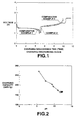
- charging/discharging curve of the batteries to be evaluated using hydrogen lithium titanate according to Example 2 Comparative Examples 1 and 2 were shown in FIG. 1 .
- Example 1 Process pH Charging Capacity (mAh/g)
- Example 2 Process Using Distilled Water + Process Using Acetic Acid 9.2 171
- Example 2 Process Using Distilled Water + Process Using Acetic Acid 8.0 200
- Example 3 Process Using Distilled Water + Process Using Acetic Acid 5.6 271 Comparative Example 1 No Process 12.0 165 Comparative Example 2 Only Process Using Distilled Water 11.6 168
- the battery according to Example 2 containing hydrogen lithium titanate obtained by subjecting lithium titanate to both of the cleaning process and the acid process enables longer charging/discharging time to be realized as compared with the battery according to Comparative Example 1 and subjected to no process and the battery according to Comparative Example 2 subjected to only the cleaning process.
- the batteries according to Examples 1 to 3 have a charging capacity which is considerably larger than the theoretical value (175 mAh/g).
- definition of the pH of hydrogen lithium titanate can be used as a parameter with which the charging capacity can be estimated.
- FIG. 2 shows the relationship between the pH of the lithium titanate (hydrogen lithium titanate) and the charging capacity. A fact can be understood that the charging capacity is rapidly enlarged when the pH is made to be 12.0 or smaller. It is preferable that the pH is 5.6 to 11.2.
- Ammonia water the concentration of which was 6.01 mole/litter, in a quantity of 8.988 was admitted into a 25-litter glass reaction vessel. While the ammonia water was being stirred and the solution was being cooled with ice in such a manner that the temperature of the solution was kept to be 10°C to 20°C, 9.01-litter titanium tetrachloride having a concentration of 1.25 mole/litter was dispersively added for 1.5 hours. The concentration of free ammonia at the moment of time when the addition was completed was 0.5 mole/litter. The concentration of the solid portions was 50 g/litter in TiO 2 terms. The pH was 8.3.
- Matured slurry was admitted into a 25-litter autoclave made of stainless steel. While the slurry was being stirred, the slurry was subjected to a hydrothermal process at a temperature of 190°C for 4 hours. The viscosity of the slurry subjected to the hydrothermal process was raised to 2140 cp at 25 °C.
- lithium titanate hydrate Li 1.33 Ti 1.66 O 4 ⁇ H 2 O
- Lithium titanate hydrate obtained in the step (1-2) was pulverized, and then the pulverized material was admitted into a baking container made of quartz so as to be fired at 550°C for 3 hours in the atmosphere. Thus, lithium titanate (sample A) was obtained.
- Example A2 A process similar to that according to Example 4 was performed except for a process in which 10 wt% acetic acid solution in a quantity of 133 ml was collectively added and the solution was caused to react at 60°C for one hour in place of the process (2) according to Example 4 in which 67 ml of 10 wt% acetic acid solution was collectively added and the solution was caused to react at the temperature of 25°C for one hour.
- hydrogen lithium titanate (sample A2) was obtained.
- the pH was 9.3.
- Example A3 A process similar to that according to Example 4 was performed except for a process in which 10 wt% acetic acid solution in a quantity of 200 ml was collectively added and the solution was caused to react at 60°C for one hour in place of the process (2) according to Example 4 in which 67 ml of 10 wt% acetic acid solution was collectively added and the solution was caused to react at the temperature of 25°C for one hour.
- hydrogen lithium titanate (sample A3) was obtained.
- the pH was 8.0.
- Example A4 A process similar to that according to Example 4 was performed except for a process in which 20 wt% acetic acid solution in a quantity of 167 ml was collectively added and the solution was caused to react at 60°C for one hour in place of the process (2) according to Example 4 in which 67 ml of 10 wt% acetic acid solution was collectively added and the solution was caused to react at the temperature of 25 °C for one hour.
- hydrogen lithium titanate (sample A4) was obtained.
- the pH was 7.8.
- Example A5 A process similar to that according to Example 4 was performed except for a process in which 40 wt% acetic acid solution in a quantity of 167 ml was collectively added and the solution was caused to react at 60°C for one hour in place of the process (2) according to Example 4 in which 67 ml of 10 wt% acetic acid solution was collectively added and the solution was caused to react at the temperature of 25°C for one hour.
- hydrogen lithium titanate (sample A5) was obtained.
- the pH was 7.6.
- Example A6 A process similar to that according to Example 4 was performed except for a process in which 5 mole/litter hydrochloric acid solution in a quantity of 167 ml was dispersively added by spending one hour and the solution was caused to react at 60°C for one hour in place of the process (2) according to Example 4 in which 67 ml of 10 wt% acetic acid solution was collectively added and the solution was caused to react at the temperature of 25°C for one hour. Thus, hydrogen lithium titanate (sample A6) was obtained. The pH was 7.4.
- Example A7 A process similar to that according to Example 4 was performed except for a process in which 5 mole/litter hydrochloric acid solution in a quantity of 200 ml was dispersively added for one hour and the solution was caused to react at 60°C for one hour in place of the process (2) according to Example 4 in which 67 ml of 10 wt% acetic acid solution was collectively added and the solution was caused to react at 25°C for one hour.
- hydrogen lithium titanate (sample A7) was obtained.
- the pH was 5.6.
- Lithium titanate which was sample A obtained in the process (1) according to Example 4 was employed as a sample according to a comparative example.
- the pH was 11.6.
- Example B2 A process similar to that according to Example 11 was performed except for a process in which 20 wt% acetic acid solution in a quantity of 167 ml was collectively added so as to be caused to react at 60°C for one hour in place of the process (2) according to Example 11 in which 10 wt% acetic acid solution in a quantity of 133 ml was collectively added so as to be caused to react at 60°C for one hour.
- hydrogen lithium titanate (sample B2) was obtained.
- the pH was 8.2.
- Example 11 A process similar to that according to Example 11 was performed except for a process in which 5 mole/litter hydrochloric acid solution in a quantity of 178 ml was collectively added so as to be caused to react at 60°C for one hour in place of the process (2) according to Example 11 in which 10 wt% acetic acid solution in a quantity of 133 ml was collectively added so as to be caused to react at 60°C for one hour.
- hydrogen lithium titanate (sample B3) was obtained.
- the pH was 7.5.
- Lithium titanate which was sample B obtained in the process (1) according to Example 11 was employed as a sample according to a comparative example.
- the pH was 12.3.
- Titanium oxide hydrate (C-II trade name of Ishihara), the weight of which was 500 g in TiO 2 terms, was admitted into a 3-litter plastic beaker so that slurry was prepared. Then, 3.00 mole/litter lithium hydroxide in a quantity of 1.815 litters was added, followed by stirring the solution at ambient temperatures for 4 hours. The slurry was evaporated to dryness at 150°C in the atmosphere. The dry cake was ground, and then fired at 700°C in the atmosphere for 3 hours. Thus, lithium titanate (sample C) was obtained.
- Example C2 A process similar to that according to Example 14 was performed except for a process in which 5 mole/litter hydrochloric acid solution in a quantity of 86 ml was dispersively added for one hour and the solution was caused to react at 60°C for one hour in place of the process (2) according to Example 14 in which 133 ml of 10 wt% acetic acid solution was collectively added and the solution was caused to react at the temperature of 60°C for one hour. Thus, hydrogen lithium titanate (sample C2) was obtained. The pH was 8.3.
- Hydrogen lithium titanate which was sample C obtained in the process (1) according to Example 14 was employed as a comparative example.
- the pH was 11.5.
- the chemical compositions Li and Ti of samples A1 to A7, B1 to B3, C1, C2 and A to C according to Examples 4 to 15 and Comparative Examples 3 to 6 respectively were detected by chemical analysis.
- the largest particle size was read by electron micrograph.
- the specific surface area and an amount of voids were measured by using BELLSOAP 28 manufactured by Nihon Bell.
- the H (proton) substitution quantity was obtained by TG-DTA thermal analysis as follows: in a TG-DTA curve, reduction in a quantity caused from an endothermic reaction occurring by dint of removal of protons as water was observed at positions adjacent to 213°C and 277°C to correspond to protons of sites B and A of the spinel structure. The foregoing reduction in quantity was used to calculate the proton substitution quantity.
- the proton substitution quantity calculated by the above-mentioned method accurately corresponds to the residue of Li previously detected by the chemical analysis.
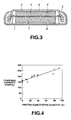
- FIG. 3 is an overall structural view showing a non-aqueous electrolyte battery for use in the evaluation.
- the powder mix was charged into an electrode collector 8 in the form of a net made of stainless steel (SUS304), followed by compression-molding the powder mix to have an outer diameter of 15 mm and a thickness of 0.2 mm so that pellet 7 was manufactured.
- the pellet 7 was dried in a vacuum at 120°C for 2 hours.
- metal lithium 3 which was used to form a counter electrode and which had a thickness of 1.0 mm was punched by a circular cutter having an outer diameter of 16 mm, and then crimped to a cup 2.
- Each of the thus-manufactured coin type batteries was charged with a constant electric current of 1 mA at ambient temperatures to a level of 2.5 V. Then, the batteries were discharged to a level of 1.0 V. The charging/discharging capacities were measured.
- Example 2 Results of confirmation of the largest particle size, the specific surface area, the amount of voids and the charging capacity of the coin type battery comprising the counter electrode made of metal lithium were shown in FIGS. 2 and 4 .
- Table 2 Examples Samples Chemical Compositions Largest Particle Sizes ⁇ m Comparative Example 3 A Li 1.5 Ti 1.65 O 4 0.1-0.2 Example 4 A1 H 0.14 Li 1.24 Ti 1.66 O 4 0.1-0.2 Example 5 A2 H 0.32 Li 1.8 Ti 1.65 O 4 0.1-0.2 Example 6 A3 H 0.40 Li 0.96 Ti 1.66 O 4 0.1-0.2 Example 7 A4 H 0.43 Li 0.88 Ti 1.67 O 4 0.1-0.2 Example 8 A5 H 0.54 Li 0.80 Ti 1.67 O 4 0.1-0.2 Example 9 A6 H 1.09 Li 0.16 Ti 1.68 O4 0.1-0.2 Example 10 A7 H 1.28 Li 0.02 Ti 1.67 O 4 0.1-0.2 Comparative Example 4 B Li 1.43 Ti 1.65 O 4 0.13-0.2 Example 11 B1 H 0.16 Li 1.14 Ti 1.67 O 4 0.
- Example 14 C1 H 0.19 L i1.16 Ti 1.66 O 4 0.2-0.4
- Example 15 C2 H 0.53 Li 0.75 Ti 1.68 O 4 0.2-0.4
- Comparative Example 6 D Li 1.17 Ti 1.81 O 4 0.5-1.0 Examples Specific Surface Areas m 2 /g Amounts of Voids ml/g Charging Capacities mAh/g pH Comparative Example 3 63.0 0.43 163 11.6
- Example 4 62.2 0.48 175 11.2
- Example 6 57.2 0.43 204 8.0
- Example 7 56.7 0.50 212 7.8
- Example 8 52.8 0.56 215 7.6
- Example 9 60.2 0.48 264 7.4
- Example 10 62.2 0.43 271 5.6 Comparative Example 4 26.4 0.18 158 12.3
- Example 11 29.1 0.20 171 9.2
- Example 12 31.4 0.21 200 8.2
- Example 13 32.5 0.20 221 7.5
- Comparative Example 5 6.1 0.03 145 11.5
- the examples A1 to A7 subjected to the proton substitution according to the present invention had charging/discharging capacities in an ascending order as A ⁇ A1 ⁇ A2 ⁇ A3 ⁇ A4 ⁇ A5 ⁇ A6 ⁇ A7.
- examples 1 to B7 had charging/discharging capacities in an ascending order as B ⁇ B 1 ⁇ B2 ⁇ B3.
- examples C to C2 have charging/discharging capacities in an ascending order as C ⁇ C1 ⁇ C2. A fact was confirmed that a great reflection was made on the charging capacity in proportion to the proton substitution quantity.
- Comparative Example 6 resulted in a specific surface area of 0.9 m 2 /g which was 1/6 of that realized by Comparative Example 3. Moreover, a charging capacity of 83 mAh/g which was about 50 % was realized. Therefore, a great influence of the baking temperature on the charging capacity was confirmed.
- the proton substitution quantity and the charging capacity have a proportional relationship. That is, the charging capacity is enlarged in proportion to the proton substitution quantity.
- the specific surface area is enlarged in inverse proportion to the firing temperature in the order as A (550°C) > B (625°C) > C (700°C).
- the reaction area can be enlarged, causing the charging capacity to be enlarged.
- proton substitution quantity according to the present invention satisfies a proton substitution region expressed by the general formula H x Li y-x Ti z O 4 (where y ⁇ x > 0, 0.8 ⁇ y ⁇ 2.7 and 1.3 ⁇ z ⁇ 2.2).
- the foregoing conditions is a preferred condition for use as the material according to the present invention as a material for a battery.
Landscapes
- Chemical & Material Sciences (AREA)
- General Chemical & Material Sciences (AREA)
- Electrochemistry (AREA)
- Chemical Kinetics & Catalysis (AREA)
- Inorganic Chemistry (AREA)
- Engineering & Computer Science (AREA)
- Organic Chemistry (AREA)
- Manufacturing & Machinery (AREA)
- Life Sciences & Earth Sciences (AREA)
- Geology (AREA)
- General Life Sciences & Earth Sciences (AREA)
- Environmental & Geological Engineering (AREA)
- Materials Engineering (AREA)
- Crystallography & Structural Chemistry (AREA)
- Inorganic Compounds Of Heavy Metals (AREA)
- Battery Electrode And Active Subsutance (AREA)
- Photoreceptors In Electrophotography (AREA)
- Secondary Cells (AREA)
Abstract
Description
- The present invention relates to hydrogen lithium titanate prepared by substituting protons for a portion of lithium thereof and a manufacturing method therefor.
- In recent years, the advance of electronic technology has realized an improvement in the performance, size reduction and portable structures of a variety of electronic apparatuses. Also secondary batteries for use as the power sources for the electronic apparatuses must have high performance and reduced sizes. Also secondary batteries for use as the power sources for the electronic apparatuses must have high performance and reduced sizes.
- As a new secondary battery which is capable of satisfying the foregoing requirements, a non-aqueous electrolyte secondary battery is expected to be employed. In particular, lithium-ion secondary batteries, which are able to charge and discharge lithium-ion, have energetically been developed and put into practical use.
- A positive-electrode active material for the foregoing battery has mainly been any one of vanadium pentoxide, manganese oxide, lithium cobaltate acid, lithium nickelate acid and spinel type lithium manganate. The negative electrode is made of a carbon material, such as graphite. Thus, a high-voltage and high-energy-density battery has been put into practical use.
- A battery of the type made of the above-mentioned materials, however, is unfit for use in a low voltage region not higher than 3 V.
- It can be considered that reduction in the voltage required for each of the apparatuses will furthermore be attempted because of the advancement of the technology for developing the electronic apparatuses and reduction in the voltage required to operate ICs.
- Under the foregoing circumstances, a battery incorporating a negative electrode containing spinel type lithium titanate has been combined with a solar cell so as to be put into practical use as a power source for a watch which is operated at a voltage of about 1.5 V. The future trend of the above-mentioned combination in the market has received attention (refer to "Lithium-Ion Titanate Secondary Battery" Document No. N03-04, New Material, August 1996).
- The above-mentioned battery system has an excellent cycle characteristic, over discharge resistance and a preservation characteristic. It can be considered that requirements for development of batteries having larger charging/discharging capacities will be imposed if 1.5 V batteries will be used more widely.
- Hitherto, the characteristics of titanium oxide which is a raw material of lithium titanate for forming a positive and negative electrode of a non-aqueous electrolyte secondary battery as an active material exert a considerable influence on the characteristics of the battery. Therefore, research and development have energetically been reported.
- Titanium oxide which is the raw material has some structure of brookite, rutile, anatase and so forth. A consideration is made that anatase titanium oxide is an advantageous raw material because of further excellent charging/discharging performance and a satisfactory cycle characteristic of the battery made from it.
- As a known lithium compound advantageous as the material of the lithium-ion secondary battery, lithium titanate is known which is formed into any one of Li2.67Ti1.33O4, LiTi2O4, Li1.33Ti1.66O4, Li1.44 Ti1.71O4, Li0.8Ti2.2O4 and the like. Among the foregoing lithium compounds, Li1.33Ti1.66O4 has attracted attention because of its large charging/discharging capacity.
- To obtain lithium titanate, a method has been employed in which a mixture of titanium oxide and a lithium compound is subjected to dry heat treatment at temperatures of 700°C to 1600°C (refer to Japanese Patent Laid-Open No.
6-275263 - Thus-obtained mission lithium titanate Li1.33Ti1.66O4 has a theoretical charging/discharging capacity of 175 mAh/g in one electronic reaction. However, materials commercially available at present have a charging/discharging capacity of about 130 mAh/g to about 150 mAh/g in 0.75 electronic reaction to 1.0 electronic reaction. That is, the value is excessively smaller than the theoretic capacity (refer to Electrochemistry, p.p. 870 to 875, vol. 62, No. 9 (1994)).
-
FR 2 663 021 - In recent years, notebook personal computers, portable CD players, MD players and so forth have widely been used. Therefore, secondary batteries, which are mounted as the power sources of the foregoing apparatuses, are considerably required. Moreover, size reduction causes a requirement for a longer operating time and longer lifetime to arise. Therefore, a material having a large charging/discharging capacity is required considerably.
- This is achieved by the hydrogene lithium titanate of
claim 1 and the method of its production ofclaim 2. - Inventors of the present invention have investigated a variety of materials to obtain a material having a satisfactorily large charging/discharging capacity. As a result, hydrogen lithium titanate obtained by substituting protons for lithium ions of lithium titanate has a charging/discharging capacity which is enlarged in proportion to pH, that is, proton substitution quantity x. Moreover, a material having a structure in which voids are formed in the particles enables the charging/discharging capacity to furthermore be enlarged. Thus, the present invention has been achieved.
- That is, hydrogen lithium titanate according to the present invention is characterized in that pH is 11.2 or smaller and expressed by a general formula HxLiy-xTizO4 (where y ≥ x > 0, 0.8 ≤ y ≤ 2.7 and 1.3 ≤ z ≤ 2.2).
- The hydrogen lithium titanate can be prepared by processing lithium titanate with an acid.
- That is, a method of preparing hydrogen lithium titanate according to the present invention has the steps of bringing lithium titanate expressed by a general formula LiyTizO4 (where 0.8 ≤ y ≤ 2.7 and 1.3 ≤ z ≤ 2.2) into contact with an acid to substitute protons for lithium ions so that hydrogen lithium titanate expressed by the general formula HxLiy-xTizO4 (where y ≥ x > 0, 0.8 ≤ y ≤ 2.7 and 1.3 ≤ z ≤ 2.2) is prepared.
- It is preferable that the pH of the hydrogen lithium titanate subjected to the acid process is 7.5 to 11.2 because the pH is one parameter for adjusting the charging/discharging performance.
- Hydrogen lithium titanate according to the present invention may be employed as a material for forming the positive electrode and negative electrode of a lithium-ion secondary battery set to a low potential not higher than 3 V. That is, hydrogen lithium titanate has a capacity which is considerably larger than the theoretical charging/discharging capacity of lithium titanate.
- The cause that a material having a capacity considerably larger than the theoretical charging/discharging capacity can be prepared by dint of an effect of the proton substitution process will now be described. Basically, lithium titanate has a defect spinel structure. Voids in the defect portions have been charged with doped lithium ions supplied from a lithium source disposed at a counter electrode. Therefore, the capacity is usually not larger than a capacity of 175 mAh/g which is a theoretical capacity in one electronic reaction. However, lithium titanate subjected to the proton substitution process has a structure that protons are substituted for a portion of lithium which constitutes crystal lattices. Therefore, lithium and protons are exchanged for each other. Thus, voids into which lithium ions can be introduced can be created in crystal lattices of sites A and B which are basically limited voids. As a result of the above-mentioned action, it can be estimated that a material having a charging/discharging capacity which is considerably larger than the theoretical capacity can be obtained.
- Hydrogen lithium titanate according to the present invention enables an amount of voids into which lithium ions can be introduced to be enlarged because a characteristic that a large specific surface area can be realized (the reaction area can be enlarged) in inverse proportion to the firing temperatures is used and the proton substitution process is performed. Therefore, the capacity can be enlarged to be considerably larger than 175 mAh/g which is the theoretical charging/discharging capacity of lithium titanate in one electronic reaction. Therefore, a novel material is realized as compared with conventional lithium titanate materials. Thus, a significant industrial advantage can be obtained from the present invention.
-
-
FIG. 1 is a graph showing the characteristic of the difference in charging/discharging curves caused from a fact whether or not an acid process is performed; -
FIG. 2 is a graph showing dependency of the charging/discharging capacity of hydrogen lithium titanate on pH; -
FIG. 3 is a schematic structure of a coin-type battery employed to evaluate the characteristics; and -
FIG. 4 is a graph showing dependency of the charging/discharging capacity on a proton substitution ratio. - The pH of lithium titanate realized after an acid process, that is, the pH of obtained hydrogen lithium titanate can be used as a parameter for adjusting the charging/discharging capacity of hydrogen lithium titanate.
- Specifically, it is preferable that the pH of the hydrogen lithium titanate, which can be prepared by the acid process, is smaller than 11.6, more preferably not greater than 11.2
- The pH of hydrogen lithium titanate is measured as follows.
- Initially, 30 g of hydrogen lithium titanate is introduced into 50 ml of distilled water, followed by boiling a solution at a temperature of 100°C for 5 minutes. After the solution has been cooled, water into which hydrogen lithium titanate has been introduced is filtered with filtering paper. The pH of obtained filtrate is measured by a pH meter at temperatures of 20°C or lower.
- When hydrogen lithium titanate has the pH, which is measured as described above and which satisfies the above-mentioned range, a significant charging/discharging performance of a battery can be realized. The reason for this lies in that the pH realized after the acid process has been performed is able to serve as one parameter for adjusting the charging/discharging performance, as described above. That is, the proton substitution quantity is enlarged in proportion to the concentration in the acid process. As a result, the pH is shifted to the acid side. If the concentration in the acid process is low, an alkaline pH is realized. Thus, the proton substitution quantity is reduced.
- When the pH satisfies a certain specific range, hydrogen lithium titanate has a crystal structure advantageous for charging/discharging, that is, a crystal structure having many spaces into which lithium can be introduced.
- The range of the pH according to the present invention is estimated to be one of indexes indicating a fact that the crystal structure advantageous for charging/discharging has been formed. Therefore, use of hydrogen lithium titanate having the above-mentioned pH as the material for forming the negative electrode enables an excellent charging/discharging performance to be obtained. Note that further preferred pH range for hydrogen lithium titanate is 5.6 to 11.2.
- The pH has a close relationship with proton substitution of lithium titanate. Therefore, hydrogen lithium titanate according to the present invention is considered to be lithium titanate subjected to proton substitution.
- In view of the foregoing, hydrogen lithium titanate according to the present invention is a compound expressed by a general formula HxLiy-xTizO4. When hydrogen lithium titanate is used, hydrogen lithium titanate in a single phase may be used or mixture of hydrogen lithium titanate and titanium oxide may be used.
- The values of y and z in the above-mentioned general formula are 0.8 ≤ y ≤ 2.7 and 1.3 ≤ z ≤ 2.2, respectively. The proton substitution quantity x satisfies a range y ≤ x > 0, more preferably 0.9y ≥ x ≥ 0.05y and most preferably 0.8y ≥ x ≥ 0. ly. A material in which protons have been substituted for all of lithium ions has a composition expressed as y = x which is included in the scope of hydrogen lithium titanate according to the present invention. If the proton substitution quantity x is smaller than the above-mentioned range, the charging/discharging capacity cannot satisfactorily be enlarged.
- The hydrogen lithium titanate according to the present invention is formed into particles. In the foregoing case, the shape of the particle is not limited a specific shape. A variety of shapes including the particle shape and a plate-like shape may be employed. The hydrogen lithium titanate has voids in the particles thereof because the charging/discharging capacity can furthermore be enlarged.
- The existence of the voids can be confirmed by measuring the amount of voids. If the amount of the voids is 0.005 ml/g or greater, existence of voids in the particles can be confirmed. A preferred range for the amount of voids is 0.01 ml/g to 1.5 ml/g, more preferably 0.01 ml/g to 0.7 ml/g. When a laminate structure of particles is employed, a large quantity of voids can be formed in the layers. Hydrogen lithium titanate according to the present invention has a size controlled to be formed into a fine particle shape.
- The particle size satisfies a range from 0.05 µm to 50 µm in viewpoints of easiness in use as powder and realizing a satisfactory characteristic of the battery, more preferably a range from 0.05 µm to 10 µm and most preferably a range from 0.1 µm to 1 µm.
- The specific surface area satisfies a range from 0.01 m2/g to 300 m2/g, more preferably 0.1 m2/g to 150 m2/g, most preferably 0.5 m2/g to 100 m2/g.
- A manufacturing method according to the present invention has the steps of bringing lithium titanate expressed by general formula LiyTizO4 (where 0.8 ≤ y ≤ 2.7 and 1.3 ≤ z ≤ 2.2) into contact with an acid to substitute protons for lithium ions so that hydrogen lithium titanate expressed by the general formula HxLiyTizO4 (where y ≥ x > 0, 0.8 ≤ y ≤ 2.7 and 1.3 ≤ z ≤ 2.2) is prepared.
- Lithium titanate and the acid can be brought into contact with each other by, for example, suspending lithium titanate in a solvent, such as water, alcohol, cellosolve, methylethylketone, xylene or toluene and by adding the acid. The acid may be an inorganic acid, such as hydrochloric acid, nitric acid or sulfuric acid, or an organic acid, such as acetic acid or formic acid without any limitation. It is preferable that acetic acid, hydrochloric acid or nitric acid is employed.
- Lithium titanate for use in the manufacturing method according to the present invention is expressed by the general formula LiyTizO4. The values of y and z satisfy 0.8 ≤ y ≤ 2.7 and 1.3 ≤ z ≤ 2.2 respectively. Compositions can be for example, Li2.67Ti1.33O4, LiTi2O4, Li1.33Ti1.66O4, Li1.44Ti1.71O4, Li0.8Ti2.22O4. . The shape of particle may be any one of a variety of shapes including a particle shape and a plate-like shape. The particle shape of lithium titanate causes the particle shape of hydrogen lithium titanate to be formed.
- To obtain lithium titanate, a method is herein disclosed with which a mixture of titanium oxide and a lithium compound is subjected to heat treatment at temperatures of 500°C to 900°C so as to prepare granular lithium titanate. Another method (2) is employed which comprises a first step in which a titanium compound and an ammonia compound are caused to react with each other in an aqueous solution to obtain a titanate compound; a second step in which the titanate compound and a lithium compound are caused to react with each other in an aqueous solution to obtain lithium titanate hydrate; and a third step in which the lithium titanate hydrate is subjected to heat treatment. Thus, plate-like lithium titanate can be prepared. The foregoing method (1) is a good method because lithium titanate can easily prepared with a low cost. A preferred heat treatment range is 600°C to 800°C, more preferably 650°C to 750°C.
- The method (2) is used in the inventive method because obtained lithium titanate has particles, the size and shape of which are controlled, and enables hydrogen lithium titanate having voids in the particles thereof to be obtained.
- In the foregoing method (1), the titanium oxide is any one of a variety of titanium oxides, such as anatase titanium oxide, rutile titanium oxide, amorphous titanium oxide, metatitanic acid or orthotitanic acid, titanate hydroxide, hydrous titanium oxide and hydrate titanium oxide. The lithium compound may be any one of lithium hydroxide, lithium carbonate, lithium nitrate and lithium sulfate. To prepare a mixture of titanium oxide and the lithium compound, any one of the following method may be employed: a method by which titanium oxide and the lithium compound are simply mixed with each other by a dry method; a method by which the materials are mixed in an aqueous solution, such as water or water-alcohol, and the mixture is dried; or a method by which the lithium compound is added to slurry of titanium oxide suspended in the aqueous solution followed by evaporating to dryness and extinguishing the material.
- The first step of the method (2) is a step for causing the titanium compound and the ammonia compound to react with each other in the aqueous solution to obtain the titanate compound. The titanate compound is a material having a structure that ammonium ions or the like are substituted for a portion of orthotitanic acid or protons of orthotitanic acid. The titanium compound may be an inorganic titanium compound, such as titanium sulfate, titanyl sulfate or titanium chloride, or an organic titanium compound, such as titanium alkoxide. In particular, it is preferable that titanium chloride is employed which is able to reduce an amount of impurities in hydrogen lithium titanate. The ammonia compound may be ammonia water, ammonium carbonate, ammonium sulfate or ammonium nitrate. If an alkali metal compound, such as a sodium compound or a potassium compound, is employed in place of the ammonia compound, sodium or potassium elements remain in the obtained titanium compound. Thus, calcination among particles takes place when the following heating and dehydration processes are performed. In this case, sintering takes place among particles when a following heating and dehydration process is performed. Thus, sizes and shapes of particles undesirably become nonuniform.
- The aqueous solution may be water or water-alcohol. When the titanium compound and the ammonium compound are mixed with each other in the aqueous solution, the reaction proceeds. Thus, a titanate compound which is a compound having a structure in which ammonium ions are substituted for orthotitanic acid (H4TiO4) or its protons and expressed as H4-n (NH4)n TiO4 can be obtained. An amount of substitution of ammonium ion in H4-n (NH4)n TiO4 can arbitrarily be changed by adjusting conditions including the concentration of ammonium ions, that of free hydroxyl groups, that of hydrogen ions and reaction temperatures. The particle size of the obtained titanate compound exerts an influence upon the particle size of lithium titanate which will be obtained in a following step. Therefore, the first step is an important step. To prepare the titanate compound in the form of fine particles and to prepare lithium titanate in the form of fine particles, the reaction temperature is set to be 0°C to 50°C, preferably 5°C to 40°C, and more preferably 10°C to 30°C.
- The thus-obtained titanate compound is filtered, washed with water, cleaned with an acid and dried, as necessary so as to be subjected to the following process in the second step.
- The second step is a step in which the titanate compound and the lithium compound obtained in the first step are caused to react in an aqueous solution so that lithium titanate hydrate is obtained. The lithium compound may be a water-soluble lithium compound which is exemplified by lithium hydroxide, lithium carbonate, lithium nitrate and lithium sulfate. When the lithium compound and the titanate compound are mixed with each other in an aqueous solution, the reaction proceeds. The reaction temperature is 50°C or higher, preferable 100°C or higher, more preferably 100°C to 250°C and most preferably 130°C to 200°C. When the reaction is performed in the above-mentioned temperature range, lithium titanate hydrate having excellent crystallinity can be obtained.
- When the reaction is performed at temperatures not lower than 100°C, it is preferable that the lithium compound and the titanate compound are admitted into an autoclave, followed by subjecting the materials to a hydrothermal process under saturated vapor or under pressure. As a result of the hydrothermal process, lithium titanate hydrate having voids in the particles thereof can be obtained.
- The thus-obtained lithium titanate hydrate is filtered, and then washed and dried, as necessary. The drying temperature may be an arbitrary level which must be lower than a temperature at which lithium titanate hydrate discharges crystal water. It is preferable that the temperature is 30°C to 200°C.
- The third step is a step in which lithium titanate hydrate obtained in the second step is subjected to heat treatment so that lithium titanate expressed by the general formula LiyTizO4 (where 0.8 ≤ y ≤ 2.7 and 1.3 ≤ z ≤ 2.2) is obtained. The temperature in the heat treatment must be not lower than the temperature at which lithium titanate hydrate discharges crystal water. Although the temperature is considered to vary depending on the composition of lithium titanate hydrate and the quantity of crystal water, it is about 200°C or higher.
- The temperature is about 200°C to about 800°C to obtain lithium titanate having voids. It is preferable that the temperature is 250°C to 700°C to obtain lithium titanate having many voids, more preferably 350°C to 650°C. to obtain close lithium titanate, the heat treatment must be performed at temperatures not lower than 800 °C. If the heat treatment is performed at 1300°C or higher, lithium titanate in which particles are greatly sintered can be obtained.
- The above-mentioned hydrogen lithium titanate may be employed as an active material for a battery. When a counter electrode is made of a material to which lithium can be doped and dedoped, a battery having a large charging/discharging capacity can be manufactured. That is, hydrogen lithium titanate according to the present invention is used as a material for forming a positive electrode and an active material for a negative electrode. Thus, a capacity considerably larger than the theoretical capacity of the active material can be realized. As a result, the charging/discharging capacity of a conventional battery can considerably be enlarged.
- Specific examples of the present invention will now be described such that results of experiments are described. As a matter of course, the present invention is not limited to the foregoing examples.
- Initially, lithium titanate subjected to the acid process was investigated from a viewpoint of pH.
- Initially, saturated water solution of LiOH was mixed with anatase type TiO2 (purity 99.8 %) in such a manner that a Li atomic ratio RLi/Ti was 1.10 Then, the mixture was pulverized in a mortar. Then, powder obtained by the pulverization process was baked at 800°C for 8 hours in an oxygen atmosphere so that lithium titanate Li4/3Ti5/3O4 was prepared. Then, obtained lithium titanate was filtered with a 75-mesh filter, after which lithium titanate allowed to pass through the filter was washed with distilled water. Then, lithium titanate was subjected to an acid process using 1.5 wt% acetic acid solution. Then, the lithium titanate subjected to the foregoing process was dried at a temperature of 120°C for 8 hours so that hydrogen lithium titanate was obtained.
- The pH of the obtained hydrogen lithium titanate was measured as follows.
- Initially, 30 g of hydrogen lithium titanate was admitted into 50 ml of distilled water, followed by boiling the material at 100°C for 5 minutes. After the material was cooled, water into which hydrogen lithium titanate was admitted was filtered with filter paper. The pH of obtained supernatant was measured by a pH meter at a temperature of 20°C or lower. As a result, the pH was 9.2.
- Hydrogen lithium titanate was obtained similarly to Example 1 except for the concentration of acetic acid for use in the acid process. The pH of each of the obtained materials was 8.0 and 5.6, respectively.
- A firing process was performed so that lithium titanate was prepared similarly to Example 1. Then, non-processed lithium titanate was employed as a comparative example. The pH of the material was 12.0.
- A firing process was performed so that lithium titanate was prepared similarly to Example 1. Then, lithium titanate was washed with distilled water. Thus, a material according to a comparative example was obtained similarly to Example 1 except for the acid process using acetic acid being omitted. The pH of the obtained material was 11.6.
- The obtained materials were employed to manufacture coin batteries to be evaluated.
- Each of the coin batteries to be evaluated was structured such that an outer can, which accommodated negative-electrode pellet and a collector, and an outer cup in which a counter electrode was accommodated, were stacked through a separator. Then, the outer ends of the outer can and the outer cup were caulked through a gasket.
- The coin battery to be evaluated was manufactured as follows.
- Initially, 90 parts by weight of the material (Li4/3Ti5/3O4) according to each of the examples and the comparative examples, 5 parts by weight of graphite which served as a conductive material and 5 parts by weight of polyvinylidene fluoride PVdF serving as a binder were added to one another. Then, the material was kneaded and dispersed in a mortar. Then, n-methylpyrolidone in a small quantity was successively added so that a negative electrode mix in the form of slurry was prepared.
- The negative electrode mix was dried at a temperature of 120°C for 2 hours, and then pulverized in a mortar so that powder mix was obtained. The powder mix was charged into an electrode collector in the form of a net made of stainless steel (SUS304), followed by compression-molding the powder mix to have an outer diameter of 15.5 mm and a thickness of 0.2 mm. Then, the molded material was dried in a vacuum at a temperature of 120°C for 2 hours. Thus, negative electrode pellet was prepared.
- Then, metal lithium which was used to form the counter electrode and which had a thickness of 1.0 mm was punched by a circular cutter having an outer diameter of 16.5 mm, and then crimped to the outer cup. Note that a sealing gasket made of polypropylene was attached to the outer cup.
- The separator in the form of a fine-porous polypropylene film having a predetermined size realized by punching and a thickness of 50 µm was placed on the metal lithium crimped to the outer cup. Then, an electrolyte obtained by, at a ratio of 1 mole/l, dissolving LiPF6 in a solvent in which propylene carbonate and methylethyl carbonate were mixed with each other at a volume ratio of 50:50 was dripped from an upper portion. Then, the negative electrode pellet prepared in the previous step was placed on the separator. Then, the outer can was placed on the separator, followed by performing caulking and closely sealing the outer ends. Thus, the coin battery to be evaluated was manufactured, the coin battery having an outer diameter of 20 mm and a height of 1.6 mm. Note that the outer can was manufactured by nickel-plating a can made of stainless steel (SUS304). A theoretical charging capacity of each of the manufactured batteries was 175 mAh/g.
- The batteries were charged with a constant electric current of 1 mA at ambient temperatures to a level of 2.5 V. Then, the batteries were discharged to a level of 1.0 V. The charging capacities in the foregoing charging/discharging process were shown in Table 1. As representative examples, charging/discharging curve of the batteries to be evaluated using hydrogen lithium titanate according to Example 2, Comparative Examples 1 and 2 were shown in
FIG. 1 .Table 1 Process pH Charging Capacity
(mAh/g)Example 1 Process Using Distilled Water + Process Using Acetic Acid 9.2 171 Example 2 Process Using Distilled Water + Process Using Acetic Acid 8.0 200 Example 3 Process Using Distilled Water + Process Using Acetic Acid 5.6 271 Comparative Example 1 No Process 12.0 165 Comparative Example 2 Only Process Using Distilled Water 11.6 168 - As can be understood from
FIG. 1 , the battery according to Example 2 containing hydrogen lithium titanate obtained by subjecting lithium titanate to both of the cleaning process and the acid process enables longer charging/discharging time to be realized as compared with the battery according to Comparative Example 1 and subjected to no process and the battery according to Comparative Example 2 subjected to only the cleaning process. - As shown in Table 1, the batteries according to Examples 1 to 3 have a charging capacity which is considerably larger than the theoretical value (175 mAh/g).
- Thus, definition of the pH of hydrogen lithium titanate can be used as a parameter with which the charging capacity can be estimated.
-
FIG. 2 shows the relationship between the pH of the lithium titanate (hydrogen lithium titanate) and the charging capacity. A fact can be understood that the charging capacity is rapidly enlarged when the pH is made to be 12.0 or smaller. It is preferable that the pH is 5.6 to 11.2. - A fact was found from the above-mentioned experiments that acid process of lithium titanate causes the pH to be changed which exerts an influence on the characteristic.
- In this experiment, the performance was investigated which was realized by dint of substitution of protons caused by the acid process.
- Ammonia water, the concentration of which was 6.01 mole/litter, in a quantity of 8.988 was admitted into a 25-litter glass reaction vessel. While the ammonia water was being stirred and the solution was being cooled with ice in such a manner that the temperature of the solution was kept to be 10°C to 20°C, 9.01-litter titanium tetrachloride having a concentration of 1.25 mole/litter was dispersively added for 1.5 hours. The concentration of free ammonia at the moment of time when the addition was completed was 0.5 mole/litter. The concentration of the solid portions was 50 g/litter in TiO2 terms. The pH was 8.3.
- After the solution was aged for one hour, hydrochloride solution in a quantity of 1.3 liters and having a concentration of 5 mole/litter was dispersively added for 1 hour so that the pH was made to be 4. Then, the pH was maintained at 4 and the solution was matured for one hour. To maintain the pH at 4 during the maturation, 5 mole/litter hydrochloride solution in a quantity of 0.42 litters was dispersively added. After the maturation process was completed, the solution was filtered and washed with water. Thus, titanate compound was obtained.
- Pure water was added to the titanate compound obtained in the process (1-1), and then the solution was stirred and dispersed by a large-size mixer. Thus, water dispersion solution in a quantity of 17 liters was obtained. The concentration of solid portions in the water dispersion solution was 45.38 g/litter in TiO2 terms. The pH was 6.7. Then, water dispersion solution in a quantity of 13.882 liters and pure water in a quantity of 0.118 liters were admitted into a 25-litter glass reaction vessel. While the solution was being stirred and the solution was being cooled with ice in such a manner that the temperature of the solution was made to be 10°C to 20°C, 2.01 mole/litter lithium hydroxide solution in a quantity of 4.00 liters was dispersively added for one hour. Then, the solution was matured for one hour. The concentration of the solid portions after the addition process was 35 g/litter in TiO2 terms. The molar ratio Li/Ti was 1.02, and the pH was 11.8.
- Matured slurry was admitted into a 25-litter autoclave made of stainless steel. While the slurry was being stirred, the slurry was subjected to a hydrothermal process at a temperature of 190°C for 4 hours. The viscosity of the slurry subjected to the hydrothermal process was raised to 2140 cp at 25 °C.
- Then, the slurry subjected to the hydrothermal process was filtered, and then it was not cleaned. The slurry was dried at a temperature of 110°C so that lithium titanate hydrate (Li1.33Ti1.66O4·H2O) was obtained.
- Lithium titanate hydrate obtained in the step (1-2) was pulverized, and then the pulverized material was admitted into a baking container made of quartz so as to be fired at 550°C for 3 hours in the atmosphere. Thus, lithium titanate (sample A) was obtained.
- Pure water in a quantity of 500 ml and 100g lithium titanate which was sample A were admitted into a 1-litter glass reaction vessel. While the solution was being stirred, 67 ml of 10 wt% acetic acid solution was collectively added so as to be caused to react at 25°C for one hour. Then, the solution was filtered and washed, and then the solution was dried in the atmosphere at a temperature of 110°C for 3 hours. Thus, hydrogen lithium titanate (sample A1) was obtained. The pH was 11.2.
- A process similar to that according to Example 4 was performed except for a process in which 10 wt% acetic acid solution in a quantity of 133 ml was collectively added and the solution was caused to react at 60°C for one hour in place of the process (2) according to Example 4 in which 67 ml of 10 wt% acetic acid solution was collectively added and the solution was caused to react at the temperature of 25°C for one hour. Thus, hydrogen lithium titanate (sample A2) was obtained. The pH was 9.3.
- A process similar to that according to Example 4 was performed except for a process in which 10 wt% acetic acid solution in a quantity of 200 ml was collectively added and the solution was caused to react at 60°C for one hour in place of the process (2) according to Example 4 in which 67 ml of 10 wt% acetic acid solution was collectively added and the solution was caused to react at the temperature of 25°C for one hour. Thus, hydrogen lithium titanate (sample A3) was obtained. The pH was 8.0.
- A process similar to that according to Example 4 was performed except for a process in which 20 wt% acetic acid solution in a quantity of 167 ml was collectively added and the solution was caused to react at 60°C for one hour in place of the process (2) according to Example 4 in which 67 ml of 10 wt% acetic acid solution was collectively added and the solution was caused to react at the temperature of 25 °C for one hour. Thus, hydrogen lithium titanate (sample A4) was obtained. The pH was 7.8.
- A process similar to that according to Example 4 was performed except for a process in which 40 wt% acetic acid solution in a quantity of 167 ml was collectively added and the solution was caused to react at 60°C for one hour in place of the process (2) according to Example 4 in which 67 ml of 10 wt% acetic acid solution was collectively added and the solution was caused to react at the temperature of 25°C for one hour. Thus, hydrogen lithium titanate (sample A5) was obtained. The pH was 7.6.
- A process similar to that according to Example 4 was performed except for a process in which 5 mole/litter hydrochloric acid solution in a quantity of 167 ml was dispersively added by spending one hour and the solution was caused to react at 60°C for one hour in place of the process (2) according to Example 4 in which 67 ml of 10 wt% acetic acid solution was collectively added and the solution was caused to react at the temperature of 25°C for one hour. Thus, hydrogen lithium titanate (sample A6) was obtained. The pH was 7.4.
- A process similar to that according to Example 4 was performed except for a process in which 5 mole/litter hydrochloric acid solution in a quantity of 200 ml was dispersively added for one hour and the solution was caused to react at 60°C for one hour in place of the process (2) according to Example 4 in which 67 ml of 10 wt% acetic acid solution was collectively added and the solution was caused to react at 25°C for one hour. Thus, hydrogen lithium titanate (sample A7) was obtained. The pH was 5.6.
- Lithium titanate which was sample A obtained in the process (1) according to Example 4 was employed as a sample according to a comparative example. The pH was 11.6.
- A process similar to that according to Example 1 was performed except for a process in which firing was performed at 625°C for 3 hours in place of the process (1-3) according to Example 1 in which firing was performed at 550°C for 3 hours. Thus, lithium titanate (sample B) was obtained.
- 500 mls of pure water and 100gs of lithium titanate which was sample B were admitted into a 1-litter glass reaction vessel. While the solution was being stirred, 133 ml of 10 wt% acetic acid solution was collectively added so as to be caused to react at 60°C for one hour. Then, the solution was filtered, washed and dried in the atmosphere at 110°C for 3 hours. Thus, hydrogen lithium titanate (sample B) was obtained. The pH was 9.2.
- A process similar to that according to Example 11 was performed except for a process in which 20 wt% acetic acid solution in a quantity of 167 ml was collectively added so as to be caused to react at 60°C for one hour in place of the process (2) according to Example 11 in which 10 wt% acetic acid solution in a quantity of 133 ml was collectively added so as to be caused to react at 60°C for one hour. Thus, hydrogen lithium titanate (sample B2) was obtained. The pH was 8.2.
- A process similar to that according to Example 11 was performed except for a process in which 5 mole/litter hydrochloric acid solution in a quantity of 178 ml was collectively added so as to be caused to react at 60°C for one hour in place of the process (2) according to Example 11 in which 10 wt% acetic acid solution in a quantity of 133 ml was collectively added so as to be caused to react at 60°C for one hour. Thus, hydrogen lithium titanate (sample B3) was obtained. The pH was 7.5.
- Lithium titanate which was sample B obtained in the process (1) according to Example 11 was employed as a sample according to a comparative example. The pH was 12.3.
- Titanium oxide hydrate (C-II trade name of Ishihara), the weight of which was 500 g in TiO2 terms, was admitted into a 3-litter plastic beaker so that slurry was prepared. Then, 3.00 mole/litter lithium hydroxide in a quantity of 1.815 litters was added, followed by stirring the solution at ambient temperatures for 4 hours. The slurry was evaporated to dryness at 150°C in the atmosphere. The dry cake was ground, and then fired at 700°C in the atmosphere for 3 hours. Thus, lithium titanate (sample C) was obtained.
- Pure water in a quantity of 500 ml and 100g lithium titanate which was sample C were admitted into a 1-litter glass reaction vessel. While the solution was being stirred, 133 ml of 10 wt% acetic acid solution was collectively added so as to be caused to react at 60°C for one hour. Then, the solution was filtered and then dried in the atmosphere at a temperature of 110°C for 3 hours. Thus, hydrogen lithium titanate (sample C1) was obtained. The pH was 8.9.
- A process similar to that according to Example 14 was performed except for a process in which 5 mole/litter hydrochloric acid solution in a quantity of 86 ml was dispersively added for one hour and the solution was caused to react at 60°C for one hour in place of the process (2) according to Example 14 in which 133 ml of 10 wt% acetic acid solution was collectively added and the solution was caused to react at the temperature of 60°C for one hour. Thus, hydrogen lithium titanate (sample C2) was obtained. The pH was 8.3.
- Hydrogen lithium titanate which was sample C obtained in the process (1) according to Example 14 was employed as a comparative example. The pH was 11.5.
- A process similar to that according to Example was performed except for firing was performed at 810°C for 3 hours in place of the process according to Example 4 in which firing was performed at 550°C for 3 hours. Thus, lithium titanate (sample D) was obtained. The pH was 3.7.
- The chemical compositions Li and Ti of samples A1 to A7, B1 to B3, C1, C2 and A to C according to Examples 4 to 15 and Comparative Examples 3 to 6 respectively were detected by chemical analysis. The largest particle size was read by electron micrograph. The specific surface area and an amount of voids were measured by using BELLSOAP 28 manufactured by Nihon Bell. The H (proton) substitution quantity was obtained by TG-DTA thermal analysis as follows: in a TG-DTA curve, reduction in a quantity caused from an endothermic reaction occurring by dint of removal of protons as water was observed at positions adjacent to 213°C and 277°C to correspond to protons of sites B and A of the spinel structure. The foregoing reduction in quantity was used to calculate the proton substitution quantity. The proton substitution quantity calculated by the above-mentioned method accurately corresponds to the residue of Li previously detected by the chemical analysis.
- The charging/discharging performance of each of the batteries manufactured by using the lithium titanate samples A1 to A7, B1 to B3, C1 and C2 and A to C according to Examples 4 to 15 and Comparative Examples 3 to 6 was measured.
FIG. 3 is an overall structural view showing a non-aqueous electrolyte battery for use in the evaluation. - The coin batteries manufactured by using the materials according to the examples and the comparative examples will now be described in detail.
- Initially, 5 parts by weight of graphite which was a conductive material and 5 parts by weight of polyvinylidene fluoride serving as a binder were added to 90 parts by weight of hydrogen lithium titanate serving as the active material. The mixture was kneaded and dispersed in a mortar. Then, NMP in a small quantity was successively added so that a mix in the form of slurry was prepared. The mix was dried at a temperature of 120°C for 2 hours, and then pulverized in a mortar so that dry powder mix was obtained. The powder mix was charged into an
electrode collector 8 in the form of a net made of stainless steel (SUS304), followed by compression-molding the powder mix to have an outer diameter of 15 mm and a thickness of 0.2 mm so thatpellet 7 was manufactured. Thepellet 7 was dried in a vacuum at 120°C for 2 hours. - Then,
metal lithium 3 which was used to form a counter electrode and which had a thickness of 1.0 mm was punched by a circular cutter having an outer diameter of 16 mm, and then crimped to acup 2. Aseparator 6 in the form of a fine-porous polypropylene film having a predetermined size realized by punching and a thickness of 25 µm was placed on themetal lithium 3 such that theseparator 6 was inserted into a structure in which apolypropylene sealing gasket 5 was attached to thecup 2. Then, an electrolyte obtained by, at a ratio of 1 mole/l, dissolving LiPF6 in a solvent in which propylene carbonate (PC), ethylene carbonate (EC) and 1,2 dimethoxyethane (DME) were mixed in the same quantities. The electrolyte was dripped. - Then, the
pellet 7 was placed, and then acan 1 composed of two layers and manufactured by nickel-plating stainless steel (SUS304) was placed to cover the structure. The sealing opening was caulked so as to be sealed. Thus, a coin type non-aqueous electrolyte secondary battery having an outer diameter of 20 mm and a height of 1.6 mm was manufactured. - Each of the thus-manufactured coin type batteries was charged with a constant electric current of 1 mA at ambient temperatures to a level of 2.5 V. Then, the batteries were discharged to a level of 1.0 V. The charging/discharging capacities were measured.
- Results of confirmation of the largest particle size, the specific surface area, the amount of voids and the charging capacity of the coin type battery comprising the counter electrode made of metal lithium were shown in
FIGS. 2 and4 .Table 2 Examples Samples Chemical Compositions Largest Particle Sizes µm Comparative Example 3 A Li1.5Ti1.65O4 0.1-0.2 Example 4 A1 H0.14Li1.24Ti1.66O4 0.1-0.2 Example 5 A2 H0.32Li1.8Ti1.65O4 0.1-0.2 Example 6 A3 H0.40Li0.96Ti1.66O4 0.1-0.2 Example 7 A4 H0.43Li0.88Ti1.67O4 0.1-0.2 Example 8 A5 H0.54Li0.80Ti1.67O4 0.1-0.2 Example 9 A6 H1.09Li0.16Ti1.68O4 0.1-0.2 Example 10 A7 H1.28Li0.02Ti1.67O4 0.1-0.2 Comparative Example 4 B Li1.43Ti1.65O4 0.13-0.2 Example 11 B1 H0.16Li1.14Ti1.67O4 0.13-0.2 Example 12 B2 H0.35Li0.97Ti1.6O4 0.13-0.2 Example 13 B3 H1.05L1.18Ti1.69O4 0.13-0.2 Comparative Example 5 C Li1.44Ti1.65O4 0.2-0.4 Example 14 C1 H0.19Li1.16Ti1.66O4 0.2-0.4 Example 15 C2 H0.53Li0.75Ti1.68O4 0.2-0.4 Comparative Example 6 D Li1.17Ti1.81O4 0.5-1.0 Examples Specific Surface Areas m 2/g Amounts of Voids ml/g Charging Capacities mAh/g pH Comparative Example 3 63.0 0.43 163 11.6 Example 4 62.2 0.48 175 11.2 Example 5 59.3 0.49 193 9.3 Example 6 57.2 0.43 204 8.0 Example 7 56.7 0.50 212 7.8 Example 8 52.8 0.56 215 7.6 Example 9 60.2 0.48 264 7.4 Example 10 62.2 0.43 271 5.6 Comparative Example 4 26.4 0.18 158 12.3 Example 11 29.1 0.20 171 9.2 Example 12 31.4 0.21 200 8.2 Example 13 32.5 0.20 221 7.5 Comparative Example 5 6.1 0.03 145 11.5 Example 14 6.6 0.02 151 8.9 Example 15 7.9 0.05 204 8.3 Comparative Example 6 0.9 0.01 83 3.7 - The basic conditions of the experiments of the comparative examples and the examples and shown in Table 2 were such that sample A was fired at a temperature of 550°C in the atmosphere for 3 hours, sample B was fired at a temperature of 625°C for 3 hours and sample C was fired at 700°C for 3 hours. After the lithium titanate was fired, the water and acid processes were performed so that the proton substitution quantity was changed.
- As can be understood from Table 2, a comparison was made with the charging capacity of about 150 mAh/g in one electronic reaction of commercial lithium titanate to form the 1.5 V lithium-ion secondary battery. On the other hand, Comparative Example 3 which was not subjected to the proton substitution realized a considerably large charging capacity of 160 mAh/g or greater.
- The examples A1 to A7 subjected to the proton substitution according to the present invention had charging/discharging capacities in an ascending order as A < A1 < A2 < A3 < A4 < A5 < A6 < A7. Similarly, examples 1 to B7 had charging/discharging capacities in an ascending order as B <
B 1 < B2 < B3. Also examples C to C2 have charging/discharging capacities in an ascending order as C < C1 < C2. A fact was confirmed that a great reflection was made on the charging capacity in proportion to the proton substitution quantity. - To evaluate influences exerted by the temperature, a charging capacity of lithium titanate fired at 800°C was shown in the portion of Comparative Example 6.
- Comparative Example 6 resulted in a specific surface area of 0.9 m2/g which was 1/6 of that realized by Comparative Example 3. Moreover, a charging capacity of 83 mAh/g which was about 50 % was realized. Therefore, a great influence of the baking temperature on the charging capacity was confirmed.
- As shown in
FIG. 4 , a fact can be confirmed that the proton substitution quantity and the charging capacity have a proportional relationship. That is, the charging capacity is enlarged in proportion to the proton substitution quantity. Thus, a satisfactory effect can be obtained when lithium titanate is subjected to the proton substitution. The specific surface area is enlarged in inverse proportion to the firing temperature in the order as A (550°C) > B (625°C) > C (700°C). Thus, the reaction area can be enlarged, causing the charging capacity to be enlarged. When an appropriate combination with a condition under which the proton substitution quantity can be enlarged is employed, the effect of the present invention can furthermore be improved even under a low firing condition. - Although a greater charging capacity can be expected in proportion to the proton substitution quantity, control of the proton substitution quantity by the water and acid processes cannot easily be performed. Moreover, a fact has been confirmed in the examples of the present invention that the charging capacity disperses greatly in proportion to the proton substitution quantity. Therefore, it is preferable that proton substitution quantity according to the present invention satisfies a proton substitution region expressed by the general formula HxLiy-xTizO4 (where y ≥ x > 0, 0.8 ≤ y ≤ 2.7 and 1.3 ≤ z ≤ 2.2). The foregoing conditions is a preferred condition for use as the material according to the present invention as a material for a battery.
Claims (3)
- Hydrogen lithium titanate comprising a composition expressed by general formula HxLiy-xTizO4 (where y ≥ x > 0, 0.8 ≥ y s 2.7 and 1.3 s z s 2.2), wherein the hydrogen lithium titanate is formed into particles and structured to have voids in the particles, a largest particle size is 0.05 µm to 50 µm, and the specific surface area is 0.01 m2/g to 300 m2/g.
- A method of manufacturing hydrogen lithium titanate according to claim 1 comprising the steps of:a first step for causing a titanium compound and an ammonia compound to react with each other in an aqueous solution so that a titanate compound is prepared;a second step for subjecting the titanate compound and a lithium compound to a hydrothermal process in an aqueous solution so that a lithium titanate hydrate is prepared;a third step for subjecting lithium titanate hydrate to heat treatment performed in a temperature range from 200°C to 800 °C so that lithium titanate expressed by general formula LiyTizO4 (where 0.8 s y ≥ 2.7 and 1.3 ≤ z s 2.2) is prepared,bringing the lithium titanate into contact with an acid; andsubstituting protons for lithium ions so that hydrogen lithium titanate expressed by general formula HxLiy.xTizO4 (where y ≥ x > 0. 0.8 s y s 2.7 and 1.3 ≤ z ≤ 2.2) is prepared.
- The method of manufacturing hydrogen lithium titanate according to claim 2, wherein the acid is acetic acid.
Applications Claiming Priority (3)
| Application Number | Priority Date | Filing Date | Title |
|---|---|---|---|
| JP19017697 | 1997-07-15 | ||
| JP19017697 | 1997-07-15 | ||
| PCT/JP1998/003184 WO1999003784A1 (en) | 1997-07-15 | 1998-07-15 | Lithium hydrogentitanates and process for the preparation thereof |
Publications (3)
| Publication Number | Publication Date |
|---|---|
| EP0937684A1 EP0937684A1 (en) | 1999-08-25 |
| EP0937684A4 EP0937684A4 (en) | 2007-12-26 |
| EP0937684B1 true EP0937684B1 (en) | 2011-05-04 |
Family
ID=16253717
Family Applications (2)
| Application Number | Title | Priority Date | Filing Date |
|---|---|---|---|
| EP98932536A Expired - Lifetime EP0937684B1 (en) | 1997-07-15 | 1998-07-15 | Lithium hydrogentitanates and process for the preparation thereof |
| EP98932537A Expired - Lifetime EP0938148B1 (en) | 1997-07-15 | 1998-07-15 | Non-aqueous electrolyte secondary cell |
Family Applications After (1)
| Application Number | Title | Priority Date | Filing Date |
|---|---|---|---|
| EP98932537A Expired - Lifetime EP0938148B1 (en) | 1997-07-15 | 1998-07-15 | Non-aqueous electrolyte secondary cell |
Country Status (8)
| Country | Link |
|---|---|
| US (2) | US6139815A (en) |
| EP (2) | EP0937684B1 (en) |
| JP (2) | JP4016429B2 (en) |
| KR (2) | KR100522061B1 (en) |
| CN (2) | CN1126716C (en) |
| DE (2) | DE69842254D1 (en) |
| TW (1) | TW381357B (en) |
| WO (2) | WO1999003784A1 (en) |
Families Citing this family (65)
| Publication number | Priority date | Publication date | Assignee | Title |
|---|---|---|---|---|
| JP4642960B2 (en) * | 2000-01-26 | 2011-03-02 | 東邦チタニウム株式会社 | Method for producing lithium titanate |
| US6645673B2 (en) * | 1999-02-16 | 2003-11-11 | Toho Titanium Co., Ltd. | Process for producing lithium titanate and lithium ion battery and negative electrode therein |
| JP4540167B2 (en) * | 1999-02-16 | 2010-09-08 | 東邦チタニウム株式会社 | Method for producing lithium titanate |
| JP4642959B2 (en) * | 2000-01-26 | 2011-03-02 | 東邦チタニウム株式会社 | Method for producing lithium titanate |
| CA2327370A1 (en) * | 2000-12-05 | 2002-06-05 | Hydro-Quebec | New method of manufacturing pure li4ti5o12 from the ternary compound tix-liy-carbon: effect of carbon on the synthesis and conductivity of the electrode |
| US7211350B2 (en) * | 2001-01-29 | 2007-05-01 | Rutgers University Foundation | Nanostructure lithium titanate electrode for high cycle rate rechargeable electrochemical cell |
| CA2454324C (en) * | 2001-07-20 | 2012-01-03 | Altair Nanomaterials Inc. | Process for making lithium titanate |
| EP1282180A1 (en) * | 2001-07-31 | 2003-02-05 | Xoliox SA | Process for producing Li4Ti5O12 and electrode materials |
| RU2208573C1 (en) * | 2002-01-23 | 2003-07-20 | Институт структурной макрокинетики и проблем материаловедения РАН | Titanium hydride production process |
| WO2003076338A1 (en) * | 2002-03-08 | 2003-09-18 | Altair Nanomaterials Inc. | Process for making nono-sized and sub-micron-sized lithium-transition metal oxides |
| US20040053136A1 (en) * | 2002-09-13 | 2004-03-18 | Bauman William C. | Lithium carbide composition, cathode, battery and process |
| US7041239B2 (en) * | 2003-04-03 | 2006-05-09 | Valence Technology, Inc. | Electrodes comprising mixed active particles |
| JP4061648B2 (en) | 2003-04-11 | 2008-03-19 | ソニー株式会社 | Positive electrode active material for nonaqueous electrolyte secondary battery and nonaqueous electrolyte secondary battery using the same |
| DE602004001349T2 (en) * | 2003-05-09 | 2007-05-10 | Umicore | NEGATIVE ELECTRODE FOR LITHIUM BATTERIES |
| JP3795886B2 (en) * | 2003-11-20 | 2006-07-12 | Tdk株式会社 | Lithium ion secondary battery charging method, charging device and power supply device |
| JP3769291B2 (en) | 2004-03-31 | 2006-04-19 | 株式会社東芝 | Non-aqueous electrolyte battery |
| US9065145B2 (en) | 2004-10-29 | 2015-06-23 | Medtronic, Inc. | Lithium-ion battery |
| US7641992B2 (en) | 2004-10-29 | 2010-01-05 | Medtronic, Inc. | Medical device having lithium-ion battery |
| US7582387B2 (en) * | 2004-10-29 | 2009-09-01 | Medtronic, Inc. | Lithium-ion battery |
| US7337010B2 (en) * | 2004-10-29 | 2008-02-26 | Medtronic, Inc. | Medical device having lithium-ion battery |
| US9077022B2 (en) | 2004-10-29 | 2015-07-07 | Medtronic, Inc. | Lithium-ion battery |
| US8105714B2 (en) | 2004-10-29 | 2012-01-31 | Medtronic, Inc. | Lithium-ion battery |
| US8980453B2 (en) | 2008-04-30 | 2015-03-17 | Medtronic, Inc. | Formation process for lithium-ion batteries |
| CN101048898B (en) | 2004-10-29 | 2012-02-01 | 麦德托尼克公司 | Lithium-ion batteries and medical devices |
| US7563541B2 (en) | 2004-10-29 | 2009-07-21 | Medtronic, Inc. | Lithium-ion battery |
| US7927742B2 (en) | 2004-10-29 | 2011-04-19 | Medtronic, Inc. | Negative-limited lithium-ion battery |
| KR101326118B1 (en) * | 2004-10-29 | 2013-11-06 | 메드트로닉 인코포레이티드 | Method of charging lithium-ion battery |
| US7662509B2 (en) | 2004-10-29 | 2010-02-16 | Medtronic, Inc. | Lithium-ion battery |
| US7682745B2 (en) | 2004-10-29 | 2010-03-23 | Medtronic, Inc. | Medical device having lithium-ion battery |
| JP2007018883A (en) * | 2005-07-07 | 2007-01-25 | Toshiba Corp | Negative electrode active material, non-aqueous electrolyte battery and battery pack |
| KR20080063511A (en) * | 2005-10-21 | 2008-07-04 | 알타이어나노 인코포레이티드 | Lithium ion batteries |
| JP4878861B2 (en) * | 2006-02-15 | 2012-02-15 | 三洋電機株式会社 | Non-aqueous electrolyte battery |
| US8168330B2 (en) * | 2006-04-11 | 2012-05-01 | Enerdel, Inc. | Lithium titanate cell with reduced gassing |
| US7541016B2 (en) * | 2006-04-11 | 2009-06-02 | Enerdel, Inc. | Lithium titanate and method of forming the same |
| US7820137B2 (en) | 2006-08-04 | 2010-10-26 | Enerdel, Inc. | Lithium titanate and method of forming the same |
| US7820327B2 (en) * | 2006-04-11 | 2010-10-26 | Enerdel, Inc. | Lithium titanate and lithium cells and batteries including the same |
| KR20090129500A (en) * | 2007-03-30 | 2009-12-16 | 알타이어나노 인코포레이티드 | Method for preparing a lithium ion cell |
| WO2009057722A1 (en) * | 2007-11-01 | 2009-05-07 | Agc Seimi Chemical Co., Ltd. | Process for production of positive electrode active material for lithium ion secondary battery |
| PL2358640T3 (en) * | 2008-11-04 | 2017-11-30 | Sachtleben Pigments Oy | Process of preparing alkali metal titanates |
| JP5594663B2 (en) * | 2009-06-25 | 2014-09-24 | 独立行政法人産業技術総合研究所 | Alkali metal titanate compound, method for producing the same, electrode active material containing the alkali metal titanate compound, and electricity storage device using the electrode active material |
| RU2431603C2 (en) * | 2009-10-28 | 2011-10-20 | Институт химии твердого тела УрО РАН | Method of producing metatitanic acid and sorbent for extracting actinide elements |
| CN101740809A (en) * | 2009-12-29 | 2010-06-16 | 奇瑞汽车股份有限公司 | Large-capacity power lithium battery and preparation method thereof |
| KR20130080019A (en) * | 2010-05-21 | 2013-07-11 | 이 아이 듀폰 디 네모아 앤드 캄파니 | Process for making titanium compounds |
| JP5784961B2 (en) * | 2011-04-28 | 2015-09-24 | 国立大学法人高知大学 | Method for producing coated active material |
| WO2012147856A1 (en) * | 2011-04-28 | 2012-11-01 | 石原産業株式会社 | Titanium raw material for lithium titanate production and method for producing lithium titanate using same |
| JP2012238444A (en) * | 2011-05-11 | 2012-12-06 | Seiko Epson Corp | Solid polyelectrolyte, method for manufacturing the same, and lithium ion secondary battery |
| JP5919942B2 (en) * | 2011-06-02 | 2016-05-18 | 日産自動車株式会社 | Positive electrode active material, electrode manufacturing method, and electrode |
| KR101328988B1 (en) | 2011-06-30 | 2013-11-13 | 삼성에스디아이 주식회사 | Active material for negative electrode, negative electrode comprising the same, lithium secondary battery and preparation method thereof |
| US9287580B2 (en) | 2011-07-27 | 2016-03-15 | Medtronic, Inc. | Battery with auxiliary electrode |
| FR2983190B1 (en) * | 2011-11-28 | 2014-04-11 | Renault Sa | OBTAINING A MATERIAL BASED ON LI4TI5O12 WITH GRINDING IN THE PRESENCE OF CARBON |
| JP5686378B2 (en) * | 2011-12-07 | 2015-03-18 | 株式会社豊田自動織機 | Hydrogen-containing lithium silicate compound and method for producing the same, and positive electrode active material for non-aqueous electrolyte secondary battery, positive electrode for non-aqueous electrolyte secondary battery, non-aqueous electrolyte secondary battery, and vehicle |
| US20130149560A1 (en) | 2011-12-09 | 2013-06-13 | Medtronic, Inc. | Auxiliary electrode for lithium-ion battery |
| CN102616835B (en) * | 2012-03-31 | 2014-10-29 | 陕西科技大学 | Preparation method of negative electrode materials of flower-ball-shaped lithium battery |
| US9825292B2 (en) | 2012-10-10 | 2017-11-21 | Hydro-Quebec | Layered and spinel lithium titanates and processes for preparing the same |
| JP6099991B2 (en) * | 2013-01-22 | 2017-03-22 | 株式会社東芝 | Negative electrode and non-aqueous electrolyte battery |
| JP6370531B2 (en) * | 2013-03-22 | 2018-08-08 | 大阪瓦斯株式会社 | Rod-like titanium-based structure for power storage device, method for producing the same, and electrode active material, electrode active material layer, electrode, and power storage device using the titanium-based structure |
| WO2014155408A1 (en) * | 2013-03-25 | 2014-10-02 | 株式会社豊田自動織機 | Hydrogen-containing lithium silicate compound, process for producing same, positive active material for nonaqueous-electrolyte secondary battery, positive electrode for nonaqueous-electrolyte secondary battery, and nonaqueous-electrolyte secondary battery |
| CN103682296B (en) * | 2013-08-16 | 2015-12-09 | 东莞上海大学纳米技术研究院 | Preparation method of high-specific-capacity nanoscale lithium titanate material |
| KR101751574B1 (en) | 2014-09-30 | 2017-06-27 | 주식회사 엘지화학 | Negative active material for rechargeable lithium battery, method for preparing same, and rechargeable lithium battery comprising same |
| JP6016866B2 (en) * | 2014-10-07 | 2016-10-26 | サチトレベン ピグメンツ オーワイ | Method for producing lithium titanate compound |
| CN104900861B (en) * | 2015-04-02 | 2017-03-01 | 清华大学 | A kind of lithium hydrogentitanate Li H Ti O material and preparation method thereof |
| CN107910590A (en) * | 2017-11-24 | 2018-04-13 | 杨彬 | A kind of environmentally friendly lithium battery electrolytes |
| DE102018211178A1 (en) | 2018-07-06 | 2020-01-09 | Robert Bosch Gmbh | Process for doping H2081Ti12O25 with metal ions and using the doped H2Ti12O25 |
| JP7217514B2 (en) * | 2019-01-23 | 2023-02-03 | 国立研究開発法人産業技術総合研究所 | Titanium oxide, method for producing titanium oxide, and lithium secondary battery using electrode active material containing titanium oxide |
| JP7387564B2 (en) * | 2020-09-16 | 2023-11-28 | 株式会社東芝 | Secondary batteries, battery packs, vehicle and stationary power supplies |
Family Cites Families (17)
| Publication number | Priority date | Publication date | Assignee | Title |
|---|---|---|---|---|
| JPS58172869A (en) * | 1982-04-05 | 1983-10-11 | Nippon Telegr & Teleph Corp <Ntt> | Secondary battery |
| FR2663021B1 (en) * | 1990-06-11 | 1992-09-11 | Centre Nat Rech Scient | PROCESS FOR THE PREPARATION OF THIN LAYERS OF TRANSITION METAL OXIDES. |
| FR2663037A1 (en) * | 1990-06-11 | 1991-12-13 | Centre Nat Rech Scient | NEW ELECTROCHROMIC MATERIALS AND PROCESS FOR PREPARING THE SAME. |
| US5180574A (en) * | 1990-07-23 | 1993-01-19 | Moli Energy (1990) Limited | Hydrides of lithiated nickel dioxide and secondary cells prepared therefrom |
| JP2529479B2 (en) * | 1991-03-25 | 1996-08-28 | 松下電器産業株式会社 | Negative electrode for non-aqueous electrolyte secondary battery |
| GB9121912D0 (en) * | 1991-10-16 | 1991-11-27 | Atomic Energy Authority Uk | Titanium dioxide-based material |
| JPH0668867A (en) * | 1992-08-21 | 1994-03-11 | Central Res Inst Of Electric Power Ind | Negative electrode of lithium secondary battery |
| JP3502118B2 (en) * | 1993-03-17 | 2004-03-02 | 松下電器産業株式会社 | Method for producing lithium secondary battery and negative electrode thereof |
| JPH0714581A (en) * | 1993-06-25 | 1995-01-17 | Fuji Photo Film Co Ltd | Non-aqueous secondary battery |
| ZA94750B (en) * | 1993-09-02 | 1994-09-29 | Technology Finance Corp | Electrochemical cell |
| JPH07288124A (en) * | 1994-04-15 | 1995-10-31 | Haibaru:Kk | Nonaqueous electrolyte secondary battery |
| JPH08180875A (en) * | 1994-12-24 | 1996-07-12 | Aichi Steel Works Ltd | Lithium secondary battery |
| JP3197779B2 (en) * | 1995-03-27 | 2001-08-13 | 三洋電機株式会社 | Lithium battery |
| JPH09219215A (en) * | 1996-02-07 | 1997-08-19 | Japan Storage Battery Co Ltd | Lithium ion battery |
| JP3894614B2 (en) * | 1996-03-18 | 2007-03-22 | 石原産業株式会社 | Method for producing lithium titanate |
| JPH1027626A (en) * | 1996-07-09 | 1998-01-27 | Matsushita Electric Ind Co Ltd | Lithium secondary battery |
| US5766796A (en) * | 1997-05-06 | 1998-06-16 | Eic Laboratories, Inc. | Passivation-free solid state battery |
-
1998
- 1998-07-15 DE DE69842254T patent/DE69842254D1/en not_active Expired - Lifetime
- 1998-07-15 EP EP98932536A patent/EP0937684B1/en not_active Expired - Lifetime
- 1998-07-15 US US09/254,828 patent/US6139815A/en not_active Expired - Lifetime
- 1998-07-15 KR KR10-1999-7002141A patent/KR100522061B1/en not_active Expired - Fee Related
- 1998-07-15 DE DE69839438T patent/DE69839438D1/en not_active Expired - Lifetime
- 1998-07-15 CN CN98801152A patent/CN1126716C/en not_active Expired - Fee Related
- 1998-07-15 WO PCT/JP1998/003184 patent/WO1999003784A1/en not_active Ceased
- 1998-07-15 CN CNB98801162XA patent/CN1155134C/en not_active Expired - Fee Related
- 1998-07-15 JP JP50691399A patent/JP4016429B2/en not_active Expired - Fee Related
- 1998-07-15 WO PCT/JP1998/003185 patent/WO1999004442A1/en not_active Ceased
- 1998-07-15 US US09/254,838 patent/US6120938A/en not_active Expired - Lifetime
- 1998-07-15 EP EP98932537A patent/EP0938148B1/en not_active Expired - Lifetime
- 1998-07-15 KR KR10-1999-7002140A patent/KR100518706B1/en not_active Expired - Fee Related
- 1998-07-15 JP JP50691299A patent/JP4022265B2/en not_active Expired - Fee Related
- 1998-07-29 TW TW087112498A patent/TW381357B/en not_active IP Right Cessation
Also Published As
| Publication number | Publication date |
|---|---|
| EP0938148B1 (en) | 2008-05-07 |
| KR20000068551A (en) | 2000-11-25 |
| WO1999003784A1 (en) | 1999-01-28 |
| WO1999004442A1 (en) | 1999-01-28 |
| DE69842254D1 (en) | 2011-06-16 |
| JP4022265B2 (en) | 2007-12-12 |
| CN1236351A (en) | 1999-11-24 |
| CN1236492A (en) | 1999-11-24 |
| KR20000068552A (en) | 2000-11-25 |
| EP0938148A1 (en) | 1999-08-25 |
| EP0937684A1 (en) | 1999-08-25 |
| CN1126716C (en) | 2003-11-05 |
| JP4016429B2 (en) | 2007-12-05 |
| EP0937684A4 (en) | 2007-12-26 |
| TW381357B (en) | 2000-02-01 |
| CN1155134C (en) | 2004-06-23 |
| KR100522061B1 (en) | 2005-10-18 |
| EP0938148A4 (en) | 2007-02-14 |
| US6120938A (en) | 2000-09-19 |
| DE69839438D1 (en) | 2008-06-19 |
| US6139815A (en) | 2000-10-31 |
| KR100518706B1 (en) | 2005-10-05 |
Similar Documents
| Publication | Publication Date | Title |
|---|---|---|
| EP0937684B1 (en) | Lithium hydrogentitanates and process for the preparation thereof | |
| CA2314950C (en) | Lithium manganate, process for producing the same, and lithium battery using the same | |
| EP0589294B1 (en) | Nonaqueous secondary battery | |
| JPWO1999003784A1 (en) | Lithium hydrogen titanate and its manufacturing method | |
| JP2903469B1 (en) | Method for producing anode material for lithium ion battery | |
| JPWO1999004442A1 (en) | Nonaqueous electrolyte secondary battery | |
| JP4845244B2 (en) | Lithium battery | |
| US5496664A (en) | Process for producing a positive electrode for lithium secondary batteries | |
| CA3195690A1 (en) | Method of recovering high nickel content cathode material from recycled lithium ion and nickel metal hydride batteries | |
| JP2002151078A (en) | Positive electrode active material for non-aqueous electrolyte secondary battery and its manufacturing process | |
| KR20230056668A (en) | Positive electrode active material for lithium secondary battery, positive electrode for lithium secondary battery and lithium secondary battery | |
| JP2020166931A (en) | Positive electrode active material for lithium ion secondary batteries and its manufacturing method | |
| JP4558229B2 (en) | Lithium titanate, method for producing the same, and use thereof | |
| JPH06275274A (en) | Nonaqueous battery | |
| CN120188285A (en) | Positive electrode active material for lithium ion secondary battery, lithium ion secondary battery | |
| JP2004175609A (en) | Lithium cobalt oxide used for positive electrode of lithium ion battery, method for producing the same, and lithium ion battery | |
| CA2129716A1 (en) | Process for producing a positive electrode for lithium secondary batteries | |
| JP3219352B2 (en) | Non-aqueous electrolyte secondary battery | |
| CN120129962A (en) | Positive electrode active material for lithium ion secondary battery, lithium ion secondary battery | |
| JPH04345759A (en) | Non-aqueous solvent secondary battery | |
| JPH06310145A (en) | Manufacture of nickel acid lithium for lithium secondary battery | |
| JP5830842B2 (en) | Method for producing lithium titanate particle powder and non-aqueous electrolyte secondary battery | |
| JPH0831407A (en) | Non-aqueous electrolyte secondary battery | |
| TW512133B (en) | Lithium hydrogentitanates and process for the preparation thereof | |
| KR102957369B1 (en) | Positive electrode active material particles for lithium secondary batteries, positive electrode for lithium secondary batteries and lithium secondary batteries |
Legal Events
| Date | Code | Title | Description |
|---|---|---|---|
| PUAI | Public reference made under article 153(3) epc to a published international application that has entered the european phase |
Free format text: ORIGINAL CODE: 0009012 |
|
| 17P | Request for examination filed |
Effective date: 19990312 |
|
| AK | Designated contracting states |
Kind code of ref document: A1 Designated state(s): DE FR GB |
|
| RIN1 | Information on inventor provided before grant (corrected) |
Inventor name: SUITA, TOKUO ISHIHARA SANGYO KAISHA, LTD. Inventor name: KOGA, HIROMI ISHIHARA SANGYO KAISHA, LTD. Inventor name: NAGAMINE, MASAYUKI-SONY ENERGYTEC INC. Inventor name: ATSUMI, YOSHINORI-SONY ENERGYTEC INC. |
|
| A4 | Supplementary search report drawn up and despatched |
Effective date: 20071122 |
|
| 17Q | First examination report despatched |
Effective date: 20080721 |
|
| GRAP | Despatch of communication of intention to grant a patent |
Free format text: ORIGINAL CODE: EPIDOSNIGR1 |
|
| GRAS | Grant fee paid |
Free format text: ORIGINAL CODE: EPIDOSNIGR3 |
|
| GRAA | (expected) grant |
Free format text: ORIGINAL CODE: 0009210 |
|
| RAP1 | Party data changed (applicant data changed or rights of an application transferred) |
Owner name: ISHIHARA SANGYO KAISHA, LTD. Owner name: SONY CORPORATION |
|
| AK | Designated contracting states |
Kind code of ref document: B1 Designated state(s): DE FR GB |
|
| REG | Reference to a national code |
Ref country code: GB Ref legal event code: FG4D |
|
| REF | Corresponds to: |
Ref document number: 69842254 Country of ref document: DE Date of ref document: 20110616 Kind code of ref document: P |
|
| REG | Reference to a national code |
Ref country code: DE Ref legal event code: R096 Ref document number: 69842254 Country of ref document: DE Effective date: 20110616 |
|
| PLBE | No opposition filed within time limit |
Free format text: ORIGINAL CODE: 0009261 |
|
| STAA | Information on the status of an ep patent application or granted ep patent |
Free format text: STATUS: NO OPPOSITION FILED WITHIN TIME LIMIT |
|
| 26N | No opposition filed |
Effective date: 20120207 |
|
| REG | Reference to a national code |
Ref country code: DE Ref legal event code: R097 Ref document number: 69842254 Country of ref document: DE Effective date: 20120207 |
|
| PGFP | Annual fee paid to national office [announced via postgrant information from national office to epo] |
Ref country code: DE Payment date: 20140721 Year of fee payment: 17 |
|
| PGFP | Annual fee paid to national office [announced via postgrant information from national office to epo] |
Ref country code: FR Payment date: 20140721 Year of fee payment: 17 Ref country code: GB Payment date: 20140721 Year of fee payment: 17 |
|
| REG | Reference to a national code |
Ref country code: DE Ref legal event code: R119 Ref document number: 69842254 Country of ref document: DE |
|
| GBPC | Gb: european patent ceased through non-payment of renewal fee |
Effective date: 20150715 |
|
| PG25 | Lapsed in a contracting state [announced via postgrant information from national office to epo] |
Ref country code: GB Free format text: LAPSE BECAUSE OF NON-PAYMENT OF DUE FEES Effective date: 20150715 Ref country code: DE Free format text: LAPSE BECAUSE OF NON-PAYMENT OF DUE FEES Effective date: 20160202 |
|
| REG | Reference to a national code |
Ref country code: FR Ref legal event code: ST Effective date: 20160331 |
|
| PG25 | Lapsed in a contracting state [announced via postgrant information from national office to epo] |
Ref country code: FR Free format text: LAPSE BECAUSE OF NON-PAYMENT OF DUE FEES Effective date: 20150731 |