EP0935921B1 - Edible film and method - Google Patents
Edible film and method Download PDFInfo
- Publication number
- EP0935921B1 EP0935921B1 EP99300128A EP99300128A EP0935921B1 EP 0935921 B1 EP0935921 B1 EP 0935921B1 EP 99300128 A EP99300128 A EP 99300128A EP 99300128 A EP99300128 A EP 99300128A EP 0935921 B1 EP0935921 B1 EP 0935921B1
- Authority
- EP
- European Patent Office
- Prior art keywords
- film
- agar
- gelatin
- konjac flour
- konjac
- Prior art date
- Legal status (The legal status is an assumption and is not a legal conclusion. Google has not performed a legal analysis and makes no representation as to the accuracy of the status listed.)
- Expired - Lifetime
Links
- 238000000034 method Methods 0.000 title claims abstract description 30
- 235000001206 Amorphophallus rivieri Nutrition 0.000 claims abstract description 74
- 229920002752 Konjac Polymers 0.000 claims abstract description 74
- 239000000252 konjac Substances 0.000 claims abstract description 73
- 235000010485 konjac Nutrition 0.000 claims abstract description 73
- 108010010803 Gelatin Proteins 0.000 claims abstract description 55
- 229920000159 gelatin Polymers 0.000 claims abstract description 55
- 235000019322 gelatine Nutrition 0.000 claims abstract description 55
- 235000011852 gelatine desserts Nutrition 0.000 claims abstract description 55
- 239000000203 mixture Substances 0.000 claims abstract description 55
- 229920001817 Agar Polymers 0.000 claims abstract description 54
- 235000013312 flour Nutrition 0.000 claims abstract description 54
- 239000008273 gelatin Substances 0.000 claims abstract description 54
- XLYOFNOQVPJJNP-UHFFFAOYSA-N water Substances O XLYOFNOQVPJJNP-UHFFFAOYSA-N 0.000 claims abstract description 54
- 239000008272 agar Substances 0.000 claims abstract description 52
- 150000003839 salts Chemical class 0.000 claims abstract description 26
- 238000005406 washing Methods 0.000 claims abstract description 6
- 241001312219 Amorphophallus konjac Species 0.000 claims abstract 16
- 235000010419 agar Nutrition 0.000 claims description 52
- 239000007787 solid Substances 0.000 claims description 23
- 238000001035 drying Methods 0.000 claims description 14
- 239000004014 plasticizer Substances 0.000 claims description 13
- HEMHJVSKTPXQMS-UHFFFAOYSA-M Sodium hydroxide Chemical compound [OH-].[Na+] HEMHJVSKTPXQMS-UHFFFAOYSA-M 0.000 claims description 12
- 238000002156 mixing Methods 0.000 claims description 11
- 239000012266 salt solution Substances 0.000 claims description 11
- 229920005862 polyol Polymers 0.000 claims description 6
- 150000003077 polyols Chemical class 0.000 claims description 6
- 238000010992 reflux Methods 0.000 claims description 6
- 238000005266 casting Methods 0.000 claims description 5
- 230000007935 neutral effect Effects 0.000 claims description 5
- 229920006395 saturated elastomer Polymers 0.000 claims description 4
- 239000012047 saturated solution Substances 0.000 claims description 2
- PEDCQBHIVMGVHV-UHFFFAOYSA-N Glycerine Chemical compound OCC(O)CO PEDCQBHIVMGVHV-UHFFFAOYSA-N 0.000 abstract description 37
- 235000011187 glycerol Nutrition 0.000 abstract description 18
- 150000004676 glycans Chemical class 0.000 abstract description 16
- 229920001282 polysaccharide Polymers 0.000 abstract description 16
- 239000005017 polysaccharide Substances 0.000 abstract description 16
- 102000004169 proteins and genes Human genes 0.000 abstract description 13
- 108090000623 proteins and genes Proteins 0.000 abstract description 13
- 239000000843 powder Substances 0.000 abstract description 8
- 239000000470 constituent Substances 0.000 abstract description 4
- 230000000850 deacetylating effect Effects 0.000 abstract description 3
- 230000006196 deacetylation Effects 0.000 abstract description 2
- 238000003381 deacetylation reaction Methods 0.000 abstract description 2
- 244000247812 Amorphophallus rivieri Species 0.000 description 58
- 102000008186 Collagen Human genes 0.000 description 33
- 108010035532 Collagen Proteins 0.000 description 33
- 229920001436 collagen Polymers 0.000 description 33
- 239000000499 gel Substances 0.000 description 23
- 239000000243 solution Substances 0.000 description 16
- 235000013305 food Nutrition 0.000 description 13
- 235000018102 proteins Nutrition 0.000 description 12
- LUEWUZLMQUOBSB-FSKGGBMCSA-N (2s,3s,4s,5s,6r)-2-[(2r,3s,4r,5r,6s)-6-[(2r,3s,4r,5s,6s)-4,5-dihydroxy-2-(hydroxymethyl)-6-[(2r,4r,5s,6r)-4,5,6-trihydroxy-2-(hydroxymethyl)oxan-3-yl]oxyoxan-3-yl]oxy-4,5-dihydroxy-2-(hydroxymethyl)oxan-3-yl]oxy-6-(hydroxymethyl)oxane-3,4,5-triol Chemical compound O[C@H]1[C@@H](O)[C@H](O)[C@@H](CO)O[C@H]1O[C@@H]1[C@@H](CO)O[C@@H](O[C@@H]2[C@H](O[C@@H](OC3[C@H](O[C@@H](O)[C@@H](O)[C@H]3O)CO)[C@@H](O)[C@H]2O)CO)[C@H](O)[C@H]1O LUEWUZLMQUOBSB-FSKGGBMCSA-N 0.000 description 11
- 229920002581 Glucomannan Polymers 0.000 description 11
- 229940046240 glucomannan Drugs 0.000 description 11
- 229920000642 polymer Polymers 0.000 description 10
- 239000000463 material Substances 0.000 description 9
- 238000012545 processing Methods 0.000 description 8
- 238000012360 testing method Methods 0.000 description 8
- 235000013580 sausages Nutrition 0.000 description 7
- 238000004090 dissolution Methods 0.000 description 6
- 238000000576 coating method Methods 0.000 description 5
- 108010076119 Caseins Proteins 0.000 description 4
- FAPWRFPIFSIZLT-UHFFFAOYSA-M Sodium chloride Chemical compound [Na+].[Cl-] FAPWRFPIFSIZLT-UHFFFAOYSA-M 0.000 description 4
- 241000209140 Triticum Species 0.000 description 4
- 235000021307 Triticum Nutrition 0.000 description 4
- 235000010418 carrageenan Nutrition 0.000 description 4
- 239000000679 carrageenan Substances 0.000 description 4
- 229920001525 carrageenan Polymers 0.000 description 4
- 229940113118 carrageenan Drugs 0.000 description 4
- 239000005018 casein Substances 0.000 description 4
- BECPQYXYKAMYBN-UHFFFAOYSA-N casein, tech. Chemical compound NCCCCC(C(O)=O)N=C(O)C(CC(O)=O)N=C(O)C(CCC(O)=N)N=C(O)C(CC(C)C)N=C(O)C(CCC(O)=O)N=C(O)C(CC(O)=O)N=C(O)C(CCC(O)=O)N=C(O)C(C(C)O)N=C(O)C(CCC(O)=N)N=C(O)C(CCC(O)=N)N=C(O)C(CCC(O)=N)N=C(O)C(CCC(O)=O)N=C(O)C(CCC(O)=O)N=C(O)C(COP(O)(O)=O)N=C(O)C(CCC(O)=N)N=C(O)C(N)CC1=CC=CC=C1 BECPQYXYKAMYBN-UHFFFAOYSA-N 0.000 description 4
- 235000021240 caseins Nutrition 0.000 description 4
- 238000001816 cooling Methods 0.000 description 4
- 238000001125 extrusion Methods 0.000 description 4
- 238000004519 manufacturing process Methods 0.000 description 4
- 230000000704 physical effect Effects 0.000 description 4
- UHVMMEOXYDMDKI-JKYCWFKZSA-L zinc;1-(5-cyanopyridin-2-yl)-3-[(1s,2s)-2-(6-fluoro-2-hydroxy-3-propanoylphenyl)cyclopropyl]urea;diacetate Chemical compound [Zn+2].CC([O-])=O.CC([O-])=O.CCC(=O)C1=CC=C(F)C([C@H]2[C@H](C2)NC(=O)NC=2N=CC(=CC=2)C#N)=C1O UHVMMEOXYDMDKI-JKYCWFKZSA-L 0.000 description 4
- 108010082495 Dietary Plant Proteins Proteins 0.000 description 3
- 240000008042 Zea mays Species 0.000 description 3
- 235000005824 Zea mays ssp. parviglumis Nutrition 0.000 description 3
- 235000002017 Zea mays subsp mays Nutrition 0.000 description 3
- -1 carrageenan) Chemical class 0.000 description 3
- 239000011248 coating agent Substances 0.000 description 3
- 235000005822 corn Nutrition 0.000 description 3
- 150000002632 lipids Chemical class 0.000 description 3
- 230000007246 mechanism Effects 0.000 description 3
- 239000003921 oil Substances 0.000 description 3
- 229920002959 polymer blend Polymers 0.000 description 3
- 230000008569 process Effects 0.000 description 3
- 230000032258 transport Effects 0.000 description 3
- 239000001993 wax Substances 0.000 description 3
- 244000105624 Arachis hypogaea Species 0.000 description 2
- 241000206672 Gelidium Species 0.000 description 2
- 235000010469 Glycine max Nutrition 0.000 description 2
- 108010073771 Soybean Proteins Proteins 0.000 description 2
- 238000009835 boiling Methods 0.000 description 2
- 238000004132 cross linking Methods 0.000 description 2
- 239000003431 cross linking reagent Substances 0.000 description 2
- 235000014113 dietary fatty acids Nutrition 0.000 description 2
- 230000000694 effects Effects 0.000 description 2
- 239000000194 fatty acid Substances 0.000 description 2
- 229930195729 fatty acid Natural products 0.000 description 2
- 238000001879 gelation Methods 0.000 description 2
- 238000010438 heat treatment Methods 0.000 description 2
- 229910052739 hydrogen Inorganic materials 0.000 description 2
- 239000001257 hydrogen Substances 0.000 description 2
- 239000004615 ingredient Substances 0.000 description 2
- 238000009533 lab test Methods 0.000 description 2
- 239000011159 matrix material Substances 0.000 description 2
- 235000013372 meat Nutrition 0.000 description 2
- 235000020232 peanut Nutrition 0.000 description 2
- 239000011780 sodium chloride Substances 0.000 description 2
- 238000003756 stirring Methods 0.000 description 2
- FHVDTGUDJYJELY-UHFFFAOYSA-N 6-{[2-carboxy-4,5-dihydroxy-6-(phosphanyloxy)oxan-3-yl]oxy}-4,5-dihydroxy-3-phosphanyloxane-2-carboxylic acid Chemical compound O1C(C(O)=O)C(P)C(O)C(O)C1OC1C(C(O)=O)OC(OP)C(O)C1O FHVDTGUDJYJELY-UHFFFAOYSA-N 0.000 description 1
- 108010088751 Albumins Proteins 0.000 description 1
- 102000009027 Albumins Human genes 0.000 description 1
- 235000017060 Arachis glabrata Nutrition 0.000 description 1
- 235000010777 Arachis hypogaea Nutrition 0.000 description 1
- 235000018262 Arachis monticola Nutrition 0.000 description 1
- 241001474374 Blennius Species 0.000 description 1
- 208000003643 Callosities Diseases 0.000 description 1
- 239000004971 Cross linker Substances 0.000 description 1
- FBPFZTCFMRRESA-FSIIMWSLSA-N D-Glucitol Natural products OC[C@H](O)[C@H](O)[C@@H](O)[C@H](O)CO FBPFZTCFMRRESA-FSIIMWSLSA-N 0.000 description 1
- FBPFZTCFMRRESA-JGWLITMVSA-N D-glucitol Chemical compound OC[C@H](O)[C@@H](O)[C@H](O)[C@H](O)CO FBPFZTCFMRRESA-JGWLITMVSA-N 0.000 description 1
- 241000196324 Embryophyta Species 0.000 description 1
- 108010068370 Glutens Proteins 0.000 description 1
- 244000068988 Glycine max Species 0.000 description 1
- 206010020649 Hyperkeratosis Diseases 0.000 description 1
- 108010076876 Keratins Proteins 0.000 description 1
- 102000011782 Keratins Human genes 0.000 description 1
- 108010011756 Milk Proteins Proteins 0.000 description 1
- 102000014171 Milk Proteins Human genes 0.000 description 1
- 108010058846 Ovalbumin Proteins 0.000 description 1
- 239000002202 Polyethylene glycol Substances 0.000 description 1
- 108010009736 Protein Hydrolysates Proteins 0.000 description 1
- 239000004902 Softening Agent Substances 0.000 description 1
- 229920002472 Starch Polymers 0.000 description 1
- 229920008262 Thermoplastic starch Polymers 0.000 description 1
- 108010046377 Whey Proteins Proteins 0.000 description 1
- 229920002494 Zein Polymers 0.000 description 1
- 229940072056 alginate Drugs 0.000 description 1
- 235000010443 alginic acid Nutrition 0.000 description 1
- 229920000615 alginic acid Polymers 0.000 description 1
- 229910052783 alkali metal Inorganic materials 0.000 description 1
- DIZPMCHEQGEION-UHFFFAOYSA-H aluminium sulfate (anhydrous) Chemical compound [Al+3].[Al+3].[O-]S([O-])(=O)=O.[O-]S([O-])(=O)=O.[O-]S([O-])(=O)=O DIZPMCHEQGEION-UHFFFAOYSA-H 0.000 description 1
- 235000013871 bee wax Nutrition 0.000 description 1
- 239000012166 beeswax Substances 0.000 description 1
- 239000001913 cellulose Substances 0.000 description 1
- 229920002678 cellulose Polymers 0.000 description 1
- 238000010382 chemical cross-linking Methods 0.000 description 1
- 238000006243 chemical reaction Methods 0.000 description 1
- 239000000084 colloidal system Substances 0.000 description 1
- 238000013036 cure process Methods 0.000 description 1
- 230000007423 decrease Effects 0.000 description 1
- 239000008157 edible vegetable oil Substances 0.000 description 1
- 238000009956 embroidering Methods 0.000 description 1
- 238000001704 evaporation Methods 0.000 description 1
- 230000008020 evaporation Effects 0.000 description 1
- 150000002191 fatty alcohols Chemical class 0.000 description 1
- 239000011888 foil Substances 0.000 description 1
- 230000037406 food intake Effects 0.000 description 1
- 125000002485 formyl group Chemical class [H]C(*)=O 0.000 description 1
- 235000021312 gluten Nutrition 0.000 description 1
- 230000002209 hydrophobic effect Effects 0.000 description 1
- 238000011065 in-situ storage Methods 0.000 description 1
- 238000010348 incorporation Methods 0.000 description 1
- 230000001678 irradiating effect Effects 0.000 description 1
- 238000002844 melting Methods 0.000 description 1
- 235000021239 milk protein Nutrition 0.000 description 1
- 210000003205 muscle Anatomy 0.000 description 1
- 229940092253 ovalbumin Drugs 0.000 description 1
- 238000004806 packaging method and process Methods 0.000 description 1
- 239000012188 paraffin wax Substances 0.000 description 1
- 239000001814 pectin Substances 0.000 description 1
- 235000010987 pectin Nutrition 0.000 description 1
- 229920001277 pectin Polymers 0.000 description 1
- 229960000292 pectin Drugs 0.000 description 1
- 229920001223 polyethylene glycol Polymers 0.000 description 1
- 235000015277 pork Nutrition 0.000 description 1
- 239000000047 product Substances 0.000 description 1
- 239000003531 protein hydrolysate Substances 0.000 description 1
- 230000009103 reabsorption Effects 0.000 description 1
- 238000000518 rheometry Methods 0.000 description 1
- 238000002791 soaking Methods 0.000 description 1
- 239000000600 sorbitol Substances 0.000 description 1
- 229940001941 soy protein Drugs 0.000 description 1
- 235000019710 soybean protein Nutrition 0.000 description 1
- 235000019698 starch Nutrition 0.000 description 1
- 239000004628 starch-based polymer Substances 0.000 description 1
- 238000003860 storage Methods 0.000 description 1
- 239000000126 substance Substances 0.000 description 1
- 150000005846 sugar alcohols Polymers 0.000 description 1
- 238000010998 test method Methods 0.000 description 1
- 150000003626 triacylglycerols Chemical class 0.000 description 1
- 235000021119 whey protein Nutrition 0.000 description 1
- 239000005019 zein Substances 0.000 description 1
- 229940093612 zein Drugs 0.000 description 1
Images
Classifications
-
- A—HUMAN NECESSITIES
- A22—BUTCHERING; MEAT TREATMENT; PROCESSING POULTRY OR FISH
- A22C—PROCESSING MEAT, POULTRY, OR FISH
- A22C13/00—Sausage casings
- A22C13/0013—Chemical composition of synthetic sausage casings
- A22C13/0016—Chemical composition of synthetic sausage casings based on proteins, e.g. collagen
-
- A—HUMAN NECESSITIES
- A22—BUTCHERING; MEAT TREATMENT; PROCESSING POULTRY OR FISH
- A22C—PROCESSING MEAT, POULTRY, OR FISH
- A22C13/00—Sausage casings
- A22C13/0013—Chemical composition of synthetic sausage casings
-
- A—HUMAN NECESSITIES
- A22—BUTCHERING; MEAT TREATMENT; PROCESSING POULTRY OR FISH
- A22C—PROCESSING MEAT, POULTRY, OR FISH
- A22C13/00—Sausage casings
- A22C2013/002—Sausage casings made by extrusion
- A22C2013/0023—Sausage casings made by extrusion coextruded together with the food product
Definitions
- the present invention relates to edible films. Films according to the invention can serve as replacements for collagen. More particularly, the present invention provides a stand-alone edible film having sufficient wet strength to function as a collagen replacement in the production of sausages and the like.
- Collagen commonly is used as an edible film in some food processing applications.
- collagen casings are used in the packaging of various kinds of sausages such as in the stuffing of fresh pork sausages and the like.
- Collagen also can be coextruded with the sausage such that a collagen casing is formed directly on the sausage product.
- collagen sheets are used to wrap whole meat muscles, such as whole hams, for processing and storage.
- Collagen used in sausage production generally is consumed with the food product as opposed to cellulose casings, for example, which are removed prior to the ingestion of the sausage.
- edible films are made from a variety of polysaccharides, vegetable proteins and lipids.
- Various polysaccharides used in edible films include alginate, pectin, carrageenan and starches among others.
- Proteins, other than collagen, used in making films or coatings for foodstuffs include gelatin (derived from collagen), casein and albumin and various vegetable proteins such as wheat and com gluten and soy.
- Lipid films primarily employed as coatings, include fatty acid glycerides and various waxes such as paraffin and beeswax.
- US-A-3687661 describes an edible vegetable protein casing comprising a protein derived from corn, peanuts, wheat or soy beans which is extruded, coagulated and formed by contact with, for example, aluminum sulfate or an aldehyde.
- US-A-5084307 discloses a film composed of a water soluble polysaccharide (such as carrageenan), a polyhydric alcohol and water disposed on a sub film composed of an alkali metal salt of casein, soybean protein and gelatin.
- a water soluble polysaccharide such as carrageenan
- US-A-5543164 discloses forming a coating on a food product, the coating being a denatured protein selected from milk proteins, whey proteins, casein, wheat proteins, soy proteins, ovalbumin, corn zein, peanut proteins and keratin; lipids selected from fatty acid esters, fatty alcohols, waxes, monoglyerides and triglycerides; and a plasticizer selected from glycerol, sorbitol and polyethylene glycol.
- a denatured protein selected from milk proteins, whey proteins, casein, wheat proteins, soy proteins, ovalbumin, corn zein, peanut proteins and keratin
- lipids selected from fatty acid esters, fatty alcohols, waxes, monoglyerides and triglycerides
- a plasticizer selected from glycerol, sorbitol and polyethylene glycol.
- WO-A-92/01394 discloses a film which is a blend of an edible protein and an edible polysaccharide, the film being coated with an edible hydrophobic material such as an edible oil or wax.
- Glucomannan may be described as a polysaccharide derived from the corns of the Amorphophallus konjac plant which has been put to a wide variety of uses. For example, it is used as a food source in the Orient.
- the FMC Corporation provides a purified glucomannan or konjac flour under the trademark NUTRICOL®.
- Literature provided by FMC describes a method for forming a film of the NUTRICOL® konjac flour.
- US-A-5695800 in one embodiment, describes a method of casting a glucomannan film directly onto a food product.
- the method in particular, involves casting a solution of the konjac flour onto the surface of the food, deacetylating the solution with a saturated salt solution with a pH other than neutral to form an insoluble gel, drying the salt-containing gel to form a film and then washing the salt from the film and redrying it.
- a stand-alone film is formed by a similar method only using a sac-free konjac flour.
- EP-A-0273069 discloses a composition for use in making an edible film comprising a mixture of glucomannan, a second polysaccharide and glycerine.
- EP-A-0709039 discloses forming a film from a thermoplastic starch mixed with a protein, preferably gelatin, casein or wheat protein and a crosslinking agent.
- the film of the present invention is a ternary combination or polymer comprising konjac flour (glucomannan), agar and gelatin.
- konjac flour has been used to form a film wherein a solution of the flour is cast then deacetylated to coagulate the konjac and then dried.
- the process was most useful in a coextrusion process wherein the film is formed in situ on a food product. This is because the sac-containing konjac flour commercially available from the FMC Corporation under the trademark NUTRICOL® was not able to form a stand-alone film. For purposes of a stand-alone film, the flour had to be further refined to remove the sac.
- the commercially available konjac flour may be used.
- the konjac flour is present as a majority component and functions as the basic film forming medium in the ternary polymer system of the invention.
- the konjac component after it is deacetylated, is insoluble in water which is an essential film property.
- a second component of the film is agar.
- Agar or agar-agar is a seaweed extract having the ability to form strong gels. It is soluble in boiling water and forms gels at low concentrations.
- the gels formed by agar are unique in that gelation occurs at temperatures below the gel-melting temperature. For example, an agar gel formed by cooling and congealing an agar solution, can be reheated to well above the gelling temperature before reliquification occurs.
- agar forms a gel at temperatures higher than konjac, it is an important component of the film.
- the agar is first to gel as the ternary mixture cools. This gelation is sufficient to provide some coherency or "body" to the mixture.
- the agar forms a matrix for holding the other components as the mixture cools and then is reheated to dry the mixture.
- the agar forms at least 22% by weight of the three components and may be included in equal parts with the konjac.
- the third component is gelatin.
- the gelatin preferably, is present in minor amounts and usually less than the amount of agar.
- the gelatin is a protein constituent which adds strength to the film structure.
- One possible theory as to the function of the gelatin in the ternary system is that it provides a crosslinking mechanism that holds the gelatin molecules to each other and to the polysaccharide molecules of the konjac and agar. For example, it is speculated that there is hydrogen bonding between the gelatin and the polysaccharide molecules.
- the agar first sets up as a gel which provides a matrix to hold the other components.
- the konjac flour is thought to gel and subsequent curing deacetylates the konjac such that the entire ternary system is rendered water insoluble to provide a self supporting film having wet strength properties at least equal to those of collagen.
- the gelatin is thought to provide a crosslinking mechanism to hold the components together.
- the insoluble mixture in the film preferably is, by weight 42.5 to 60% konjac flour, 22 to 42.5% agar and 15 to 25% gelatin.
- konjac flour is the majority component and that the amount of agar is greater than the amount of gelatin.
- the two polysaccharide polymers, konjac flour and agar, and the protein polymer, gelatin are mixed together as dry powders.
- the proportions are generally 42.5 to 60 wt.% konjac flour, 22 to 42.5 wt.% agar and 15 to 25 wt.% gelatin with a target or preferred blend being a 48:32:20 ratio of konjac:agar:gelatin.
- the blend is mixed with water under reflux until total dissolution occurs. It is preferred that enough of the dry blend is added to the hot water to provide a total solids content of at least 3 wt.%. A higher solids content of 10 to 12 wt.% is preferred with 14 to 16 wt.% appearing to be an upper limit due to equipment limitations and the difficulty of solublizing the mixture.
- a softening agent such as glycerine may be added.
- the solution then is cast or extruded as a film onto a support surface and is allowed to cool.
- the agar component causes the solution to set up into a firm gel.
- the gel then is dried to a total moisture content, preferably of about 6 to 7 wt.%. This causes the gel structure to collapse which decreases the spacing between the polymer molecules and allows hydrogen bonding to occur between molecules. At this point, it also speculated that a mechanical bonding occurs by means of the collagen folds in the gelatin and by the intertwining of molecules.
- the resulting structure is a dry intermediate film which then is cured by further processing.
- Curing the film is accomplished by contacting the dry intermediate film with a salt-containing bath at a pH other than neutral. While the salt bath rehydrates the dry intermediate film, the concentration of the salt limits the amount of rehydration. The pH of the bath deacetylates the konjac making it insoluble. The film, now insoluble and partly hydrated, is dried a second time to complete the cure process. The dried film then is washed to remove salt and is dipped in a plasticizing solution such as a 2 to 5% glycerine solution. The glycerine softens the film and provides flexibility when the film is dried. Accordingly, the washed and glycerine-containing film is dried a third time to about 5 to 12 wt.% moisture to provide the edible, self-supporting film of the present invention.
- a film formed in this fashion is found to have properties which make it a suitable replacement for collagen in certain applications.
- a collagen replacement film useful for food processing applications should be edible and water insoluble.
- the film also should have physical properties at least comparable to commercial collagen films.
- one commercial collagen sheet has an average wet tensile strength of about 0.7 kg/mm 2 and an elongation to break of about 55%.
- the tensile strength is the average of the machine direction (MD) and transverse direction (TD) tensile strength or (MD + TD) /2.
- a commercial collagen casing as made by several manufactures has an average wet tensile strength of about 0.8 kg/mm 2 and an elongation at break of 48%.
- a self-supporting film comprising a cured water insoluble mixture of konjac flour, agar and gelatin, said film including a polyol plasticizer and water.
- the film comprises 40 to 70 wt.% of the water insoluble mixture; 20 to 40 wt.% of the plasticizer; and 5 to 12 wt.% of water.
- the water insoluble mixture comprises:
- the konjac flour and agar are in the weight ratio of 50:50 to 70:30.
- the konjac flour in the film is deacetylated.
- the konjac flour, agar and gelatin are in the weight ratio of 48:32:20.
- the film has an average rewet machine direction (MD) and transverse direction (TD) tensile strength (MD+TD)/2 of at least 0.7 kg/mm 2 .
- the film has a rewet percent elongation at break of at least 55%.
- the gelatin comprises at least 10 wt.% of the mixture and the konjac flour comprises at least 50 wt.% of the total amount of konjac flour and agar, the film containing up to 40 wt.% of a polyol plasticizer and 5 to 12 wt.% water and having an average rewet machine direction and transverse direction tensile strength of a least 0.7 kg/mm 2 .
- the cured mixture comprises 42.5 to 60 wt.% konjac flour, 22 to 42.5 wt.% agar and 15 to 25 wt.% gelatin.
- a water insoluble self supporting film comprising the steps of:
- the dry blending combines 42.5 to 60 wt.% konjac flour, 22 to 42.5 wt.% agar and 15 to 25 wt.% gelatin.
- a dough which has a solids content of 3 to 20 wt.%.
- the dough has a solids content of 10 to 20 wt.%.
- the drying of the sheet reduces its moisture content to below 7 wt.%.
- the dry blending of konjac flour, agar and gelatin is in the weight ratio of 48:32:20.
- the salt solution is a saturated solution of NaCl at a high or alkaline pH.
- the salt solution contains 26 wt.% NaCl and 0.5 wt.% NaOH.
- a film disclosed herein may be characterized in one aspect as a self-supporting edible film comprising a water insoluble mixture of konjac flour, agar and gelatin; a polyol plasticizer; and water
- a self-supporting edible film comprising:
- the method of the present invention may be characterized by the steps of:
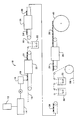
- the sole figure is a schematic representation showing steps of an example of a process for forming a stand-alone edible film according to the invention by a method in accordance with the method of the present invention.
- the figure shows a system generally indicated at 10.
- the system includes a powder mixer 12 for blending the dry ingredients of the film composition namely, konjac flour (glucomannan) agar and gelatin.
- This dry powder mixture then is fed to a steam heated reactor 14 having a plough-type stirrer.
- the dry powder is mixed with water and glycerine until the powder mixture is dissolved.
- the preferred sequence generally, is to start by heating the water in the reactor to about 45°C. Then the powdered polymer blend is dispersed by sifting it into the water. The temperature is raised to reflux the mixture and the stirrer operated until there is complete dissolution of the polymer blend.
- the solution which may have a dough-like consistency, is pumped to a slot die 16. While tubular extrusion is possible, the present invention is described in the context of sheet extrusion. Accordingly, the solution fed to the die 16 is extruded onto a conveyor support web 18 and gels to form a layer 19 about 0.25 to 1.5 mm thick. The support web transports the gel through an initial drier 20.
- the gel is dried to form an uncured intermediate film 21.
- the support then transports the uncured film through a deacetylating bath 22.
- This bath is a concentrated salt solution having a high pH.
- a preferred bath concentration is a 26% NaCI solution with 0.5% NaOH to increase the pH.
- the high pH causes deacetylation of the konjac and the concentrated salt solution acts to limit the reabsorption of water by the gel.
- the uncured film is rehydrated and the konjac is deacetylated and rendered insoluble so the extrusion now forms a rehydrated salt-containing and water-insoluble film 24 on the conveyor support web 18. Also, in the bath, some of the glycerine which was added in the stirrer 14 is washed from the film.
- the support web 18 next carries the salt-containing film 24 through a second drier 26 which dries down the film to complete the cure and form a dried salt-containing film 28.
- the support web transports the dry salt-containing film 28 through a wash tub 30 where salt is washed from the film and then through a tank 32 containing an aqueous plasticizer such as a 5% glycerine solution.
- an aqueous plasticizer such as a 5% glycerine solution.
- the film 34 now rehydrated and plasticized is removed from the support web 18.
- the film now is dried a third time in drier 36 which lowers the total moisture content to 5 to 12 wt. % of total weight.
- This cured, plasticized film, as indicated at 38, is then wound on a reel 40 for use or further processing such as, for example, printing, irradiating, coating and conversion to individual sheets or tubes.
- the powder blend of polymers comprise by weight 6.72 parts konjac, 4.48 parts agar and 2.8 parts gelatin. These polymers are dry blended and sifted into stirred water which is heated to reflux at 100°C for one hour. Glycerine is added to facilitate mixing and dissolution of the powders. A doughy paste having a solid content of 14 wt.% is produced in the stirrer and this material is extruded. The extruded material is dried to bring the solids and glycerine content up to about 79 wt.%. The material then is exposed to the salt solution which deacetylates the konjac flour, rehydrates the extruded material and washes out the glycerine.
- the deacetylated material which contains salt from the salt bath, is dried a second time to increase the solids content to about 94 wt.%, the weight ratio of polymer-to-salt in the dried material being about 63:37.
- a second washing step removes the salt.
- the resulting salt and glycerine-free film is then plasticized by contacting with a 5% glycerine solution and dried a third time to provide a film comprising by weight about 59% solids, 35% glycerine and 6% water wherein the solids content comprises konjac, agar and gelatin in a weight ratio of about 48:32:20.
- Tests were performed to establish various parameters of the present invention.
- the test method used to prepare films was similar to the method described above. However, the method was modified as noted below to accommodate laboratory scale.
- the test materials included a konjac flour GP312 sold by FMC Corporation under the trademark NUTRICOL®.
- the manufacturing trade literature identifies GP312 as being a general purpose gelling combination of konjac and carrageenan. It is believed the carrageenan is a minor constituent to improve the rheology of konjac solutions and otherwise does not contribute to the physical properties of the film of the present invention.
- the agar used was CAS#9002-18-0 obtained from Colony Industries.
- Various gelatins were used including a Knox gelatin, Leiner Davis type 250B and an IPC Protein Colloid Ag 4380. The latter is not a food grade so it is used for lab testing only.
- the Ag 4380 gelatin is identified by the manufacturer as a collagen protein hydrolysate which is soluble in water.
- test films were made in the laboratory tests. In the laboratory tests, mixing was done in a beaker placed in an oil bath for heating. The general procedure followed to make the test films was as follows:
- the film, as prepared above, is tested for tensile strength and percent elongation at break both dry and rewetted.
- dry tensile strength and percent elongation the samples are equilibrated in a 50% relative humidity environment and tested immediately. The sample also is tested and rewet after soaking in water for up to 30 minutes. Samples to be tested are cut to a size measuring 25.4 mm wide by 50 to 75 mm long and are tested on an Instron having its jaws set 25.4 mm apart and its crosshead speed set at 50.8 mm/min.
- the wet tensile strength should be at least 0.6 kg/mm 2 or better with 0.7 kg/mm 2 or better being preferred.
- gelatin up to about 10 wt.% does not seem to have an effect. Adding 15 to 25 wt.% gelatin improves the properties of the ternary polymer whereas 40 wt.% (Sample 9) reduces the wet tensile strength by up to one-half or more over samples having less gelatin. It also is clear that as the total solids content increases, the film properties improve.
- test results confirm that increasing the solids content to 10 wt.% or more provides a stand-alone film having an average wet tensile (MD+TD) / 2 and percent elongation properties which meet or exceed those of collagen (0.7kg/mm 2 and 55%) for both wet and dry samples.
- Sample 17, with 20 wt.% solids had poorer properties than Sample 16 with 12 wt.% solids.
- this might be due to equipment limitations in that this sample did not appear fully dissolved and gave a granular film on extrusion.
- the cast gel and the wet film are fragile and should be supported until after curing and drying. As a result, full support of the gel and wet film, up to final drying, is preferred.
- gelatin into the konjac:agar mix in amounts of about 10 to less than 40 wt.% contribute to the wet tensile strength of the film. Such wet tensile strength is important for use of the film in meat processing applications.
- the film is a ternary system
- a major component is the polysaccharide blend including konjac flour (glucomannan).
- konjac should preferably be at least 50 wt.% of the remaining 60 to 90 wt.% polysaccharide blend.
- the konjac:agar weight ratios varied from 50:50 to 70:30.
- the film properties as described are obtained without exposing the film to chemical crosslinking agents. This is important as many chemical crosslinkers are not approved for direct food contact.
- the present invention accomplishes its intended objects in providing a stand-alone edible film having tensile and elongation properties comparable to collagen films.
Landscapes
- Life Sciences & Earth Sciences (AREA)
- Engineering & Computer Science (AREA)
- Wood Science & Technology (AREA)
- Zoology (AREA)
- Food Science & Technology (AREA)
- General Preparation And Processing Of Foods (AREA)
- Jellies, Jams, And Syrups (AREA)
- Preparation Of Fruits And Vegetables (AREA)
- Processing Of Meat And Fish (AREA)
- Edible Seaweed (AREA)
- Formation And Processing Of Food Products (AREA)
- Noodles (AREA)
- Materials For Medical Uses (AREA)
Applications Claiming Priority (2)
| Application Number | Priority Date | Filing Date | Title |
|---|---|---|---|
| US24654 | 1998-02-17 | ||
| US09/024,654 US5962053A (en) | 1998-02-17 | 1998-02-17 | Edible film and method |
Publications (2)
| Publication Number | Publication Date |
|---|---|
| EP0935921A1 EP0935921A1 (en) | 1999-08-18 |
| EP0935921B1 true EP0935921B1 (en) | 2003-06-18 |
Family
ID=21821718
Family Applications (1)
| Application Number | Title | Priority Date | Filing Date |
|---|---|---|---|
| EP99300128A Expired - Lifetime EP0935921B1 (en) | 1998-02-17 | 1999-01-08 | Edible film and method |
Country Status (8)
| Country | Link |
|---|---|
| US (1) | US5962053A (enExample) |
| EP (1) | EP0935921B1 (enExample) |
| JP (1) | JP3103799B2 (enExample) |
| AT (1) | ATE242974T1 (enExample) |
| CZ (1) | CZ50599A3 (enExample) |
| DE (1) | DE69908834T2 (enExample) |
| ES (1) | ES2196719T3 (enExample) |
| ZA (1) | ZA99143B (enExample) |
Families Citing this family (42)
| Publication number | Priority date | Publication date | Assignee | Title |
|---|---|---|---|---|
| CA2271361A1 (en) * | 1999-05-07 | 2000-11-07 | Peter Taylor | Edible casing film formulation |
| US6783790B1 (en) * | 2000-05-19 | 2004-08-31 | Hershey Foods Corporation | Process utilizing agar-agar in a high temperature, short time processing of high solids confectionery products |
| US6586590B1 (en) * | 2000-07-03 | 2003-07-01 | Marine Bioproducts International | Clarified hydrocolloids of undiminished properties and method of producing same |
| US7408057B2 (en) * | 2000-07-03 | 2008-08-05 | Marine Bioproducts Intenational | Clarified hydrocolloids of undiminished properties and method of producing same |
| WO2003026624A1 (en) | 2001-09-28 | 2003-04-03 | Mcneil-Ppc, Inc. | Modified release dosage forms |
| US20030229158A1 (en) * | 2001-09-28 | 2003-12-11 | Chen Jen Chi | Polymer composition and dosage forms comprising the same |
| US7838026B2 (en) | 2001-09-28 | 2010-11-23 | Mcneil-Ppc, Inc. | Burst-release polymer composition and dosage forms comprising the same |
| US7122143B2 (en) | 2001-09-28 | 2006-10-17 | Mcneil-Ppc, Inc. | Methods for manufacturing dosage forms |
| WO2003041504A1 (en) * | 2001-11-14 | 2003-05-22 | Townsend Engineering Company | A gel for creating a coating for extruded sausage comprised of starch and an edible vegetable based material |
| US6949256B2 (en) * | 2002-01-18 | 2005-09-27 | Banner Pharmacaps, Inc. | Non-gelatin capsule shell formulation |
| US7887838B2 (en) * | 2002-01-18 | 2011-02-15 | Banner Pharmacaps, Inc. | Non-gelatin film and method and apparatus for producing same |
| US20040043134A1 (en) * | 2002-08-27 | 2004-03-04 | Corriveau Christine Leclair | Rolled edible thin film products and methods of making same |
| US20040111275A1 (en) * | 2002-11-15 | 2004-06-10 | Kroll David B. | Methods for marketing and generating revenue from edible thin films |
| US20040096569A1 (en) * | 2002-11-15 | 2004-05-20 | Barkalow David G. | Edible film products and methods of making same |
| US20040156794A1 (en) * | 2003-02-11 | 2004-08-12 | Barkalow David G. | Bioerodible and bioadhesive confectionery products and methods of making same |
| WO2004091528A2 (en) * | 2003-04-14 | 2004-10-28 | Fmc Corporation | Delivery systems of homogeneous thermoreversible alginate films |
| US20040241294A1 (en) * | 2003-05-31 | 2004-12-02 | Barabolak Roman M. | Edible films including aspartame and methods of making same |
| JP4300573B2 (ja) * | 2003-08-29 | 2009-07-22 | 株式会社ニチレイフーズ | フィルム形成方法および該方法を用いて形成されたフィルム並びに固着防止方法 |
| CN102669810B (zh) | 2003-11-07 | 2014-11-05 | 美国无烟烟草有限责任公司 | 烟草组合物 |
| US8627828B2 (en) | 2003-11-07 | 2014-01-14 | U.S. Smokeless Tobacco Company Llc | Tobacco compositions |
| DE602005001881T2 (de) * | 2004-04-15 | 2008-04-24 | Reg Toronto MacQuarrie | Essbare Filmüberzugzusammensetzung für Lebensmittelherstellung |
| US20050287106A1 (en) * | 2004-06-22 | 2005-12-29 | Jean-Yves Legendre | Method for shaving with at least one anhydrous film, use of at least one anhydrous film for the preparation of a shaving product, and shaving kits |
| US7442396B2 (en) * | 2004-07-30 | 2008-10-28 | General Mills Marketing, Inc. | Dough compositions having a moisture barrier, and related methods |
| US20070031542A1 (en) * | 2005-08-09 | 2007-02-08 | Harry Chu | Encased food product and process for producing the same |
| ES2303446B1 (es) * | 2006-07-03 | 2009-07-28 | Viscofan, S.A. | Producto masticable y/o comestible para mascotas y animales. |
| US20090280221A1 (en) | 2008-05-07 | 2009-11-12 | Reg Macquarrie | Vegetable casing film and method for production of tubular sausage casings |
| EP2482668B1 (en) * | 2009-10-02 | 2018-06-27 | Living Cell Research Inc. | Vegetable casing film |
| CN103190460B (zh) * | 2012-01-10 | 2015-10-28 | 中粮营养健康研究院有限公司 | 干燥设备 |
| PH12014000076B1 (en) | 2013-07-01 | 2024-01-10 | Priscila F Kimes | Improved processes in the preparation of coconut meat based composition and films |
| US9392814B2 (en) | 2014-06-06 | 2016-07-19 | Nicholas J. Singer | Delivery system for drinks |
| USD773313S1 (en) | 2015-06-23 | 2016-12-06 | Nicholas J. Singer | Package |
| CN106359574A (zh) * | 2016-08-25 | 2017-02-01 | 安徽省唐骏重工机械有限责任公司 | 一种小麦处理装置 |
| CN107897355A (zh) * | 2017-12-15 | 2018-04-13 | 柳州飞升鹏科技有限公司 | 一种水果保鲜剂的制备方法 |
| EP3704946A1 (en) * | 2019-03-07 | 2020-09-09 | Viscofan, S.A. | Edible tubular food casings and method for their production |
| JP2020163134A (ja) * | 2019-03-29 | 2020-10-08 | 伊那食品工業株式会社 | 可食性飲食用具 |
| EP3732980A1 (en) | 2019-04-30 | 2020-11-04 | Viscofan, S.A. | Edible film and method for its manufacturing |
| KR102802923B1 (ko) * | 2019-06-21 | 2025-05-08 | 한국식품연구원 | 간장게장을 이용한 필름형 간장소스 및 이의 제조방법 |
| JP7420373B2 (ja) * | 2019-12-10 | 2024-01-23 | アスザックフーズ株式会社 | こんにゃく食品およびその製造方法 |
| KR102136050B1 (ko) * | 2020-04-21 | 2020-07-20 | 김호민 | 생분해 경화성 조성물 및 이를 이용한 구조체 |
| CA3134985C (en) | 2020-10-30 | 2024-02-20 | Viskase Companies, Inc. | Edible cellulosic casings and compositions, and methods of formation |
| KR20240097923A (ko) * | 2021-11-05 | 2024-06-27 | 젬플라 리미티드 | 식물성 단백질-폴리사카라이드 필름 |
| CN119684646B (zh) * | 2024-11-05 | 2026-05-01 | 福州大学 | 一种魔芋葡甘聚糖基疏水生物质薄膜的制备方法 |
Family Cites Families (23)
| Publication number | Priority date | Publication date | Assignee | Title |
|---|---|---|---|---|
| GB544416A (en) * | 1940-10-05 | 1942-04-13 | Georg Jelinek | A process for the production of artificial skins for sausages, in particular, salame |
| FR933138A (fr) * | 1946-08-31 | 1948-04-12 | Procédé de fabrication de boyaux artificiels pour la charcuterie | |
| NL258156A (enExample) * | 1959-12-01 | |||
| FR1333576A (fr) * | 1962-09-14 | 1963-07-26 | Procédé de fabrication de boyaux artificiels et produits conformes à ceux obtenuspar le présent procédé ou procédé similaire | |
| US3687661A (en) | 1969-12-01 | 1972-08-29 | Xerox Corp | Color electrophotographic process |
| FI772054A7 (enExample) * | 1976-07-02 | 1978-01-03 | Union Carbide Corp | |
| US4375481A (en) * | 1980-07-18 | 1983-03-01 | Nippon Carbide Kogyo Kabushiki Kaisha | Process for production of roe-like multilayer spherical structure |
| EP0243151B1 (en) * | 1986-04-22 | 1992-12-16 | Ajinomoto Co., Inc. | Modified microbially-produced cellulose gel and complex thereof with animal cell |
| US4851394A (en) * | 1986-12-30 | 1989-07-25 | Uni Colloid Kabushiki Kaisha | Glucomannan/polyhydric alcohol composition and film prepared therefrom |
| JP2668378B2 (ja) | 1988-03-18 | 1997-10-27 | 孝一 西本 | 難燃化植物繊維成形物の製造方法 |
| US5690981A (en) * | 1988-08-23 | 1997-11-25 | Ajinomoto Co., Inc. | Low calorie foodstuff, aqueous paste composition, as well as production process thereof |
| JPH02245148A (ja) * | 1989-03-17 | 1990-09-28 | Unie Koroido Kk | グルコマンナンの凝固方法及びこれに用いる組成物 |
| US5089307A (en) * | 1989-05-23 | 1992-02-18 | Mitsubishi Rayon Co., Ltd. | Edible film and method of making same |
| US5308636A (en) * | 1989-06-22 | 1994-05-03 | Fmc Corporation | Thickened and gelled systems based on starch and glucomannan |
| GB9016340D0 (en) | 1990-07-25 | 1990-09-12 | Devro Inc | Moisture barrier film |
| JPH04372627A (ja) * | 1991-06-20 | 1992-12-25 | Mitsubishi Rayon Co Ltd | 多糖フィルム |
| US5279658A (en) * | 1991-09-19 | 1994-01-18 | David Aung | Composition suitable for forming into shaped articles, process for preparing the composition, process for preparing shaped articles using the composition, and shaped articles so-formed |
| JPH05148388A (ja) * | 1991-11-29 | 1993-06-15 | Mitsubishi Rayon Co Ltd | 多糖フイルム |
| CA2115592C (en) * | 1994-02-14 | 1998-09-22 | Kumiko Kimura | Production of glucomannan sponge |
| US5543164A (en) | 1994-06-17 | 1996-08-06 | The Regents Of The University Of California | Water-insoluble protein-based edible barrier coatings and films |
| EP0709039A1 (de) | 1994-10-29 | 1996-05-01 | Weener Plastik GmbH & Co. KG | Rollerauftragvorrichtung |
| US5622740A (en) * | 1994-11-14 | 1997-04-22 | Devro Limited | Method for preparing edible casings and compositions thereof |
| US5695800A (en) * | 1996-03-13 | 1997-12-09 | Viskase Corporation | Method of preparing a food product encased in a glucomannan film |
-
1998
- 1998-02-17 US US09/024,654 patent/US5962053A/en not_active Expired - Lifetime
-
1999
- 1999-01-08 EP EP99300128A patent/EP0935921B1/en not_active Expired - Lifetime
- 1999-01-08 DE DE69908834T patent/DE69908834T2/de not_active Expired - Fee Related
- 1999-01-08 AT AT99300128T patent/ATE242974T1/de not_active IP Right Cessation
- 1999-01-08 ES ES99300128T patent/ES2196719T3/es not_active Expired - Lifetime
- 1999-01-08 ZA ZA9900143A patent/ZA99143B/xx unknown
- 1999-02-15 CZ CZ99505A patent/CZ50599A3/cs unknown
- 1999-02-17 JP JP11038426A patent/JP3103799B2/ja not_active Expired - Fee Related
Also Published As
| Publication number | Publication date |
|---|---|
| EP0935921A1 (en) | 1999-08-18 |
| JPH11313619A (ja) | 1999-11-16 |
| DE69908834T2 (de) | 2004-05-13 |
| ES2196719T3 (es) | 2003-12-16 |
| CZ50599A3 (cs) | 1999-09-15 |
| JP3103799B2 (ja) | 2000-10-30 |
| ATE242974T1 (de) | 2003-07-15 |
| US5962053A (en) | 1999-10-05 |
| ZA99143B (en) | 1999-07-08 |
| DE69908834D1 (de) | 2003-07-24 |
Similar Documents
| Publication | Publication Date | Title |
|---|---|---|
| US5962053A (en) | Edible film and method | |
| Cuq et al. | Proteins as agricultural polymers for packaging production | |
| US3857977A (en) | Food flavor pellets with wheat flour, soy flour and buttermilk base | |
| US4275084A (en) | Formed food product of microfibrillar protein and process for the production thereof | |
| JP2005506389A (ja) | カラギーナン及びカラギーナン生成物の製造 | |
| US4994285A (en) | Edible body and process for preparation thereof | |
| CA2195694C (en) | Method of preparing a food product encased in a glucomannan film | |
| BRPI0805636B1 (pt) | Concentrado de colágeno, seu processo de produção e seu uso | |
| AU778728B2 (en) | Sago fluidity starch and use thereof | |
| WO1992001394A1 (en) | Moisture barrier film | |
| CN116584525A (zh) | 可食用的膜 | |
| JPH02245148A (ja) | グルコマンナンの凝固方法及びこれに用いる組成物 | |
| WO2021193072A1 (ja) | コンニャクゲル及びその製造方法並びに該コンニャクゲルを用いたエビ様食品及びエビ様真空凍結乾燥食品の製造方法 | |
| US4061787A (en) | Collagen compositions having crosslinking agent incorporated therein and the method of preparing the same | |
| HK1052840A1 (zh) | 油炸方便麵及其製造方法 | |
| PT910961E (pt) | Extrusão de proteínas hidrolisadas | |
| JP7075429B2 (ja) | エビ様真空凍結乾燥食品の製造方法 | |
| CN114867358B (zh) | 明胶组合物、其制备方法及其用途 | |
| JP7075428B2 (ja) | エビ様真空凍結乾燥食品の製造方法 | |
| CN116491538A (zh) | 可食用的管状食品包衣 | |
| KR950012609B1 (ko) | 해초류를 이용한 국수의 제조방법 | |
| JPH0155869B2 (enExample) | ||
| WO2001045917A1 (en) | Tubular films formed from cellulose/protein blends | |
| JP7075430B2 (ja) | コンニャクゲル及びその製造方法並びにコンニャクゲルを用いたエビ様食品及びその製造方法 | |
| JPS62138145A (ja) | フイルム形成能を持つカゼイン素材 |
Legal Events
| Date | Code | Title | Description |
|---|---|---|---|
| PUAI | Public reference made under article 153(3) epc to a published international application that has entered the european phase |
Free format text: ORIGINAL CODE: 0009012 |
|
| AK | Designated contracting states |
Kind code of ref document: A1 Designated state(s): AT BE DE ES FR GB |
|
| AX | Request for extension of the european patent |
Free format text: AL;LT;LV;MK;RO;SI |
|
| 17P | Request for examination filed |
Effective date: 20000218 |
|
| AKX | Designation fees paid |
Free format text: AT BE DE ES FR GB |
|
| 17Q | First examination report despatched |
Effective date: 20020705 |
|
| GRAH | Despatch of communication of intention to grant a patent |
Free format text: ORIGINAL CODE: EPIDOS IGRA |
|
| GRAH | Despatch of communication of intention to grant a patent |
Free format text: ORIGINAL CODE: EPIDOS IGRA |
|
| GRAA | (expected) grant |
Free format text: ORIGINAL CODE: 0009210 |
|
| RAP1 | Party data changed (applicant data changed or rights of an application transferred) |
Owner name: VISKASE CORPORATION |
|
| AK | Designated contracting states |
Designated state(s): AT BE DE ES FR GB |
|
| PG25 | Lapsed in a contracting state [announced via postgrant information from national office to epo] |
Ref country code: AT Free format text: LAPSE BECAUSE OF FAILURE TO SUBMIT A TRANSLATION OF THE DESCRIPTION OR TO PAY THE FEE WITHIN THE PRESCRIBED TIME-LIMIT Effective date: 20030618 |
|
| REG | Reference to a national code |
Ref country code: GB Ref legal event code: FG4D |
|
| REF | Corresponds to: |
Ref document number: 69908834 Country of ref document: DE Date of ref document: 20030724 Kind code of ref document: P |
|
| REG | Reference to a national code |
Ref country code: ES Ref legal event code: FG2A Ref document number: 2196719 Country of ref document: ES Kind code of ref document: T3 |
|
| PLBE | No opposition filed within time limit |
Free format text: ORIGINAL CODE: 0009261 |
|
| STAA | Information on the status of an ep patent application or granted ep patent |
Free format text: STATUS: NO OPPOSITION FILED WITHIN TIME LIMIT |
|
| ET | Fr: translation filed | ||
| 26N | No opposition filed |
Effective date: 20040319 |
|
| PGFP | Annual fee paid to national office [announced via postgrant information from national office to epo] |
Ref country code: GB Payment date: 20070125 Year of fee payment: 9 |
|
| PGFP | Annual fee paid to national office [announced via postgrant information from national office to epo] |
Ref country code: ES Payment date: 20070126 Year of fee payment: 9 |
|
| PGFP | Annual fee paid to national office [announced via postgrant information from national office to epo] |
Ref country code: DE Payment date: 20070228 Year of fee payment: 9 |
|
| PGFP | Annual fee paid to national office [announced via postgrant information from national office to epo] |
Ref country code: BE Payment date: 20070301 Year of fee payment: 9 |
|
| PGFP | Annual fee paid to national office [announced via postgrant information from national office to epo] |
Ref country code: FR Payment date: 20070117 Year of fee payment: 9 |
|
| BERE | Be: lapsed |
Owner name: *VISKASE CORP. Effective date: 20080131 |
|
| GBPC | Gb: european patent ceased through non-payment of renewal fee |
Effective date: 20080108 |
|
| PG25 | Lapsed in a contracting state [announced via postgrant information from national office to epo] |
Ref country code: DE Free format text: LAPSE BECAUSE OF NON-PAYMENT OF DUE FEES Effective date: 20080801 |
|
| REG | Reference to a national code |
Ref country code: FR Ref legal event code: ST Effective date: 20081029 |
|
| PG25 | Lapsed in a contracting state [announced via postgrant information from national office to epo] |
Ref country code: GB Free format text: LAPSE BECAUSE OF NON-PAYMENT OF DUE FEES Effective date: 20080108 |
|
| PG25 | Lapsed in a contracting state [announced via postgrant information from national office to epo] |
Ref country code: BE Free format text: LAPSE BECAUSE OF NON-PAYMENT OF DUE FEES Effective date: 20080131 |
|
| REG | Reference to a national code |
Ref country code: ES Ref legal event code: FD2A Effective date: 20080109 |
|
| PG25 | Lapsed in a contracting state [announced via postgrant information from national office to epo] |
Ref country code: FR Free format text: LAPSE BECAUSE OF NON-PAYMENT OF DUE FEES Effective date: 20080131 |
|
| PG25 | Lapsed in a contracting state [announced via postgrant information from national office to epo] |
Ref country code: ES Free format text: LAPSE BECAUSE OF NON-PAYMENT OF DUE FEES Effective date: 20080109 |