EP0931487A2 - Kindertrage - Google Patents
Kindertrage Download PDFInfo
- Publication number
- EP0931487A2 EP0931487A2 EP99300582A EP99300582A EP0931487A2 EP 0931487 A2 EP0931487 A2 EP 0931487A2 EP 99300582 A EP99300582 A EP 99300582A EP 99300582 A EP99300582 A EP 99300582A EP 0931487 A2 EP0931487 A2 EP 0931487A2
- Authority
- EP
- European Patent Office
- Prior art keywords
- head
- baby
- head support
- carrier
- guard
- Prior art date
- Legal status (The legal status is an assumption and is not a legal conclusion. Google has not performed a legal analysis and makes no representation as to the accuracy of the status listed.)
- Withdrawn
Links
- 230000000474 nursing effect Effects 0.000 claims description 23
- 230000035939 shock Effects 0.000 claims description 21
- 239000002250 absorbent Substances 0.000 claims description 7
- 239000011148 porous material Substances 0.000 claims description 6
- 210000001015 abdomen Anatomy 0.000 claims description 4
- 238000000034 method Methods 0.000 description 7
- 210000001624 hip Anatomy 0.000 description 6
- 239000000853 adhesive Substances 0.000 description 2
- 230000001070 adhesive effect Effects 0.000 description 2
- 239000004744 fabric Substances 0.000 description 2
- 210000002414 leg Anatomy 0.000 description 2
- 239000000463 material Substances 0.000 description 2
- 238000012986 modification Methods 0.000 description 2
- 230000004048 modification Effects 0.000 description 2
- 239000004698 Polyethylene Substances 0.000 description 1
- 229920005830 Polyurethane Foam Polymers 0.000 description 1
- 230000003187 abdominal effect Effects 0.000 description 1
- 239000000969 carrier Substances 0.000 description 1
- 239000006260 foam Substances 0.000 description 1
- 230000005484 gravity Effects 0.000 description 1
- 210000004394 hip joint Anatomy 0.000 description 1
- -1 polyethylene Polymers 0.000 description 1
- 229920000573 polyethylene Polymers 0.000 description 1
- 239000011496 polyurethane foam Substances 0.000 description 1
Images



Classifications
-
- A—HUMAN NECESSITIES
- A47—FURNITURE; DOMESTIC ARTICLES OR APPLIANCES; COFFEE MILLS; SPICE MILLS; SUCTION CLEANERS IN GENERAL
- A47D—FURNITURE SPECIALLY ADAPTED FOR CHILDREN
- A47D13/00—Other nursery furniture
- A47D13/02—Baby-carriers; Carry-cots
-
- A—HUMAN NECESSITIES
- A47—FURNITURE; DOMESTIC ARTICLES OR APPLIANCES; COFFEE MILLS; SPICE MILLS; SUCTION CLEANERS IN GENERAL
- A47D—FURNITURE SPECIALLY ADAPTED FOR CHILDREN
- A47D13/00—Other nursery furniture
- A47D13/02—Baby-carriers; Carry-cots
- A47D13/025—Baby-carriers; Carry-cots for carrying children in seated position
-
- A—HUMAN NECESSITIES
- A47—FURNITURE; DOMESTIC ARTICLES OR APPLIANCES; COFFEE MILLS; SPICE MILLS; SUCTION CLEANERS IN GENERAL
- A47D—FURNITURE SPECIALLY ADAPTED FOR CHILDREN
- A47D15/00—Accessories for children's furniture, e.g. safety belts or baby-bottle holders
Definitions
- the present invention relates to a baby carrier for carrying a baby while holding it therein and also relates to a head support for a baby carrier for supporting a baby's head.
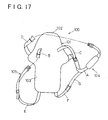
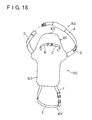
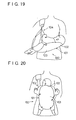
- a baby carrier with the functions of both lateral and longitudinal support is generally used, as shown in Figures 17-20. These figures show the same baby carrier that can be used for lateral support of a baby, as shown in Figures 17 and 19, and for longitudinal support of a baby, as shown in Figures 18 and 20, by changing the connections of each belt.
- This baby carrier 100 has a carrier body 101, where a headrest portion 102 and a backrest portion 103 for holding a baby's head and back, respectively, are integrally formed in continuation.
- the carrier body 101 is fitted with the belts A-G.
- the tip of the belt C is fastened onto the belt A via a snap fastener and the buckle at the tip of the belt G is engaged with the buckle at the tip of the belt F. Then, the buckle at the tip of the belt A is engaged with the buckle at the tip of the belt D to compose the shoulder belt 104.
- a baby is placed on the carrier body 101 and the shoulder belt 104 is placed in an angle onto one shoulder of a nursing person (see Figure 19). Then, the belt E is wound around the hip of the nursing person and the buckle at the tip of the belt E is engaged with the buckle at the tip of the belt B to compose the waist belt 105 for holding the carrier body 101 on the hip of the nursing person.
- the tip of the belt G is fastened onto the belt A via a snap fastener and the buckle at the tip of the belt A is engaged with the buckle at the tip of the belt D to compose the shoulder belt 104'.
- the buckles of the belts B and C are engaged with each other for holding a baby on the carrier body 101.
- the shoulder belt 104' is placed at an angle onto one shoulder of a nursing person (see Figure 20).
- the belt E is wound around the nursing person's hip and the buckle at the tip of the belt E is engaged with the buckle at the tip of the belt F to compose the waist belt 105' for holding the carrier body 101 on the hip of the nursing person.
- the conventional baby carrier is used either for lateral support or longitudinal support by changing the fastening conditions of the multiple belts, and the belt changing operation between lateral support and longitudinal support is very complex and troublesome. Furthermore, when a baby is supported sideways, as shown in Figure 19, it is merely placed on the carrier body 101, and thus, it may fall down.
- the present invention is directed to solving the above-mentioned problems.
- One object of the present invention is to offer a baby carrier with a very simple changing operation between lateral support and longitudinal support, which can securely prevent a baby from falling down from a baby's head side.
- Another object of the present invention is to offer a baby carrier with a very simple changing operation between lateral support and longitudinal support, which can securely prevent a baby from falling down from both a baby's head side and a baby's leg side when it is supported sideways.
- Yet another object of the current invention is to offer a baby carrier or a head support for a baby carrier, where a baby's head can be effectively protected from the impact load.
- a further object of the current invention is to offer a head support for a baby carrier, which can securely prevent a baby from falling down from a baby's head side.
- the present invention provides a baby carrier for supporting and carrying a baby therein and also provides a head support for a baby carrier for supporting a baby' head.
- a baby carrier comprises a carrier body for receiving a baby, a head support provided at the carrier body for supporting a baby's head, and a head guard provided at the end of the head support for protecting the top portion of a baby's head.
- the head guard is standable toward the top portion of a baby's head.
- a baby carrier comprises a carrier body having a front cover portion, a narrow crotch cover portion and a back cover portion, which are integrally formed in continuation, for supporting a baby's abdomen, crotch, and back, respectively.
- the front cover portion is folded toward the back cover portion and the crotch cover portion is formed in a bag-form.
- a baby carrier further comprises a shoulder belt provided at the carrier body, a head support provided at the back cover portion for supporting a baby's head, and a head guard provided at the end of the head support for protecting the top portion of a baby's head.
- the head guard is standable toward the top portion of a baby's head.
- a baby carrier comprises a carrier body having a front cover portion, a narrow crotch cover portion and a back cover portion, which are integrally formed in continuation, for supporting a baby's abdomen, crotch, and back, respectively.
- a pair of shoulder belts are provided at the opposite ends of the back cover portion.
- a baby carrier includes first buckles provided at the distal ends of the shoulder belts via first belt members, and second buckles provided at the opposite ends of the front cover portion via second belt members. The second buckles are releasably engagable with the first buckles. Hook members are provided at the opposite ends of the front cover portion via third belt members. At least a pair of annular members are provided at the back cover portion.
- the annular members are releasably engagable with the hook members.
- a head support is provided at the back cover portion for supporting a baby's head.
- a head guard is provided at the end of the head support for protecting the top portion of a baby's head. The head guard is standable toward the top portion of a baby's head.
- a fourth embodiment provides a baby carrier according to the first to third embodiments, wherein the head support is releasably engagable with the carrier body or the back cover portion.
- a fifth embodiment provides a baby carrier according to the first to third embodiments, wherein a belt piece is provided at the outside of the head support for guiding a nursing person's hand.
- a sixth embodiment provides a baby carrier according to the first to third embodiments, wherein the head guard is fixed onto the back side of the head support via a substantially convexly or concavely curved surface, and the head guard stands up and keeps standing when it is folded toward the baby's head side of the head support.
- a seventh embodiment provides a baby carrier according to the first to third embodiments, wherein the head guard is detachably fitted onto the head support.
- the head guard keeps standing toward the baby's head side of the head support, or the head guard is fitted onto the back side of the head support via a substantially convexly or concavely curved surface and the head guard stands up and keeps standing when it is folded toward the baby's head side of the head support.
- An eighth embodiment provides a baby carrier according to the first to third embodiments, wherein the head guard comprises a first sweat-absorbent cushioning member placed at the side of the top portion of a baby's head, a second cushioning member placed outside the first cushioning member for absorbing outside impacts, and a core member inserted therebetween.
- a ninth embodiment provides a baby carrier according to the first to third embodiments, wherein at least either the head support or the head guard incorporates the air cushioning structure.
- the air cushioning structure comprises an air reservoir forming predetermined space region, and a shock absorbing portion surrounding the air reservoir for absorbing the outside impact by leaking the air in the air reservoir at the time of deformation of the air reservoir due to the outside impact.
- a tenth embodiment provides a baby carrier according to the ninth embodiment, wherein the shock absorbing portion includes a by-pass port communicating with the air reservoir.
- An eleventh embodiment provides a baby carrier according to the ninth embodiment, wherein the shock absorbing portion includes a notch communicating with the air reservoir.
- a twelfth embodiment provides a baby carrier according to the ninth embodiment, wherein the shock absorbing portion is composed of porous material.
- a thirteenth embodiment provides a baby carrier according to the first to third embodiments, wherein at least either the head support or the head guard incorporates the air cushioning structure.
- the air cushioning structure comprises a first cushioning member having a plurality of first through holes, and a second and a third cushioning members at the opposite sides of the first cushioning member having a plurality of second and third through holes, respectively.
- the second and third through holes without facing each other, communicate with the first through holes.
- a head support for a baby carrier comprises a head support body for supporting a baby's head, which is releasably engagable with the baby carrier, and a head guard provided at the end of the head support body for protecting the top portion of a baby's head.
- the head guard is standable toward the top portion of a baby's head.
- a fifteenth embodiment provides a head support according to the fourteenth embodiment, wherein a belt piece is provided at the outside of the head support body for guiding a nursing person's hand.
- a sixteenth embodiment provides a head support according to the fourteenth embodiment, wherein the head guard is fixed onto the back side of the head support body via a substantially convexly or concavely curved surface.
- the head guard stands up and keeps standing when it is folded toward the baby's head side of the head support body.
- a seventeenth embodiment provides a head support according to the fourteenth embodiment, wherein the head guard is detachably fitted onto the head support body.
- the head guard keeps standing toward the baby's head side of the head support body, or the head guard is fitted onto the back side of the head support body via a substantially convexly or concavely curved surface.
- the head guard stands up and keeps standing when it is folded toward the baby's head side of the head support body.
- An eighteenth embodiment provides a head support according to the fourteenth embodiment, wherein the head guard comprises a first sweat-absorbent cushioning member placed at the side of the top portion of a baby's head, a second cushioning member placed outside the first cushioning member for absorbing outside impacts, and a core member inserted therebetween.
- a nineteenth embodiment provides a head support according to the fourteenth embodiment, wherein at least either the head support body or the head guard incorporates the air cushioning structure.
- the air cushioning structure comprises an air reservoir forming predetermined space region, and a shock absorbing portion surrounding the air reservoir for absorbing the outside impact by leaking the air in the air reservoir at the time of deformation of the air reservoir due to the outside impact.
- a twentieth embodiment provides a head support according to the nineteenth embodiment, wherein the shock absorbing portion includes a by-pass port communicating with the air reservoir.
- a twenty-first embodiment provides a head support according to the nineteenth embodiment, wherein the shock absorbing portion includes a notch communicating with the air reservoir.
- a twenty-second embodiment provides a head support according to the nineteenth embodiment, wherein the shock absorbing portion is composed of porous material.
- a twenty-third embodiment provides a head support according to the fourteenth embodiment, wherein at least either the head support body or the head guard incorporates the air cushioning structure.
- the air cushioning structure comprises a first cushioning member having a plurality of first through holes, and a second and a third cushioning members at the opposite sides of the first cushioning member having a plurality of second and third through holes, respectively.
- the second and third through holes without facing each other, communicate with the first through holes.
- the baby carrier of a first invention When using the baby carrier of a first invention, first, a baby is received and supported in the carrier body. Then, the head guard is raised up. In this case, the baby carrier is used as a lateral support type. At this time, the rear portion of a baby's head is supported by the head support and the top portion of a baby's head is protected by the head guard. The head guard in this standing condition can prevent a baby from falling down from the upper portion of the baby carrier.
- the head guard when using the baby carrier as a longitudinal support type, the head guard is placed in the unstanding position. That is to say, the head guard is folded toward the back side of the head support, or the head guard is removed from the head support. At this time, the back portion of a baby's head is supported by the head support.
- the head guard is placed in the standing position.
- the head guard that was folded toward the back side of the head support is raised up, or the head guard that was removed from the head support is fitted to the head support and raised up.
- the head guard that was in the standing position is folded toward the back side of the head support, or the head guard is removed from the head support.
- the switching operation between the longitudinal support type and the lateral support type can be performed with very ease by operating the head guard, and a baby can be prevented from falling down from the upper portion of the baby carrier when it is supported sideways.
- a baby is placed on the carrier body.
- the front cover portion is folded toward the baby's torso and the crotch cover portion is formed in a bag form. Thereby, the baby carrier is assembled.
- the bag-formed crotch cover portion holds the baby's crotch firmly and a baby can be prevented from falling down from the lower portion of the baby carrier while the baby carrier is being used.
- the shoulder belts are placed on one shoulder of a nursing person with the head guard at the end of the head support in the standing position.
- the back portion of a baby's head is supported by the head support and the top portion of a baby's head is protected by the head guard.
- the head guard in this standing condition can prevent the baby from falling down from the upper portion of the baby carrier.
- the head guard when using the baby carrier as a longitudinal support type, the head guard is placed in the unstanding position. In other words, the head guard is folded back toward the back side of the head support, or the head guard is removed from the head support. In this condition, the shoulder belts are cross-hung on a nursing person's shoulders. At this time, the back portion of a baby's head is supported by the head support.
- the only procedure to take is simply raise up the head guard that was folded toward the back side, or fit the removed head guard to the head support and raise it up.
- the only procedure to take is simply fold the head guard in the standing position toward the back side of the head support, or remove the head guard from the head support.
- the shoulder belts can be used as they are by changing their placements on the nursing person's shoulders.
- the switching operation between the longitudinal support type and the lateral support type can be performed with very ease by operating the head guard, and a baby can be protected from falling down from the upper and lower portions of the baby carrier when it is held laterally or sideways.
- a baby is placed on the carrier body.
- the front cover portion is folded toward the baby's torso and the hook members beside the front cover portion are engaged with the corresponding annular members on the back cover portion.
- the crotch cover portion is formed in a bag-form to hold the baby's crotch.
- first buckles of the shoulder belts are engaged with the second buckles beside the front cover portion to assemble the baby carrier.
- the bag-formed crotch cover portion holds the baby's crotch firmly and it can protect the baby from falling down from the lower portion of the baby carrier while the baby carrier is being used.
- the shoulder belts are bundled and placed on one shoulder of a nursing person with the head guard at the end of the head support in the standing position.
- the back portion of a baby's head is supported by the head support and the top portion of a baby's head is protected by the head guard.
- the head guard in this standing condition can prevent the baby from falling down from the upper portion of the baby carrier.
- the head guard at the end of the head support is folded toward the back side of the head support, or the head guard is removed from the head support. In this condition, the shoulder belts are cross-hung on the nursing person's shoulders. At this time, the back portion of a baby's head is supported by the head support.
- the only procedure to take is simply raise up the head guard that was folded toward the back side of the head support, or fit the removed head guard to the head support and raise it up.
- the only procedure to take is simply fold the standing head guard toward the back side of the head support, or remove the head guard from the head support.
- the shoulder belts can be used as they are by changing their placements on the nursing person's shoulders.
- the switching operation between the lateral support type and the longitudinal support type can be performed with very ease by operating the head guard, and a baby can be protected from falling down from the upper and lower portions of the baby carrier when it is held laterally or sideways.
- the head support may be provided detachably on the carrier body or the back cover portion, and a belt piece for guiding a nursing person's hand may be provided at the outside of the head support.
- the head guard is fixed onto the back side of the head support by substantially convexly or concavely curved surface, and the head guard stands up and keeps standing position when it is folded toward the baby's head side of the head support. Thereby, the top portion of a baby's head can be protected by this standing head guard when a baby is supported sideways.
- the head guard may be releasably engagable with the head support.
- the head guard is fitted onto the head support when the head guard is needed at the time of lateral supporting.
- the head guard At the time of fitting the head guard onto the head support, the head guard is kept standing toward the baby's head side of the head support.
- the head guard is attached on the back side of the head support via a substantially convexly or concavely curved surface, and the head guard stands up and keeps standing when it is folded toward the baby's head side of the head support.
- the head guard includes a first sweat-absorbent cushioning member placed at the side of the top portion of a baby's head, a second cushioning member for absorbing outside impacts, which is placed outside the first cushioning member, and the core member inserted therebetween.
- the head support or the head guard preferably has the air cushioning structure.
- the air cushioning structure may incorporate an air reservoir forming the predetermined space region and a shock absorbing portion, which surrounds the air reservoir and absorbs the outside impact by leaking the air in the air reservoir when the air reservoir deforms by the outside impact.
- the shock absorbing portion may preferably have a by-pass port or a notch that communicates with the air reservoir, or may be composed of porous material.
- the air cushioning structure may incorporate a first cushioning member having a plurality of first through holes, and second and third cushioning members at both sides of the first cushioning member having a plurality of second and third through holes, respectively.
- the second and third through holes without opposing each other, communicate with the first through holes.
- the head support can be used as a lateral support type by raising up the head guard at the end of the head support. At this time, the rear portion of a baby's head is supported by the head support and the top portion of a baby's head is protected by the head guard.
- the head guard in this standing condition can prevent a baby from falling down from the upper portion of the baby carrier.
- the head guard when using the head support as a longitudinal support type, the head guard is placed in the unstanding position. In other words, the head guard is folded toward the back side of the head support, or the head guard is removed from the head support. At this time, the back portion of a baby's head is supported by the head support.
- the head guard is placed in the standing position.
- the head guard that was folded toward the back side of the head support is raised up, or the head guard that was removed from the head support is fitted to the head support and raised up.
- the head guard is folded toward the back side of the head support, or the head guard is removed from the head support.
- the switching operation between the longitudinal support type and the lateral support type can be performed with very ease by operating the head guard, and a baby can be prevented from falling down from the baby's head side when it is supported sideways.
- a belt piece for guiding a nursing person's hand may be provided at the outside of the head support.
- the head guard is fixed onto the back side of the head support body via a substantially convexly or concavely curved surface, and the head guard stands up and keeps its standing position when it is folded toward the baby's head side of the head support body. Thereby, the top portion of the baby's head can be protected by this standing head guard when the baby is supported sideways.
- the head guard may be releasably engagable with the head support body.
- the head guard is fitted to the head support body when the head guard is needed at the time of lateral supporting.
- the head guard At the time of fitting the head guard onto the head support body, the head guard is kept standing toward the baby's head side of the head support body.
- the head guard is fitted onto the back side of the head support body via a substantially convexly or concavely curved surface, and the head guard stands up and keeps its standing position by being folded toward the baby's head side of the head support body.
- the head guard includes a first sweat-absorbent cushioning member placed at the side of the top portion of a baby's head, a second cushioning member for absorbing outside impacts, which is placed outside the first cushioning member, and the core member inserted therebetween.
- the head support body or the head guard preferably has the air cushioning structure.
- the air cushioning structure may incorporate an air reservoir forming the predetermined space region and a shock absorbing portion.
- the shock absorbing portion surrounds the air reservoir and absorbs the outside impact by leaking the air in the air reservoir when the air reservoir deforms by the outside impact.
- the shock absorbing portion may preferably have a by-pass port or a notch that communicates with the air reservoir, or may be composed of porous material.
- the air cushioning structure may incorporate a first cushioning member having a plurality of first through holes, and second and third cushioning members at both sides of the first cushioning member having a plurality of second and third through holes, respectively.
- the second and third through holes without facing each other, communicate with the first through holes .
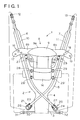
- a baby carrier 1 includes a carrier body 2 having a front cover portion 3, a narrow crotch cover portion 4, and a back cover portion 5 for respectively supporting abdominal, crotch and back portion of a baby.
- the cover portions 3, 4, 5 are integrally formed in continuation.
- the proximal ends of the shoulder belts 6, 7 are connected to the opposite ends of the back cover portion 5.
- Upward extending belt members 10, 11 are sewn onto the shoulder belts 6, 7.
- the belt members 10, 11 run over the distal ends of the shoulder belts 6, 7 and extend upward further, and one-touch buckles 12, 13 are attached to the tips of the belt members 10, 11.
- the belt members 10, 11 extend downward along the opposite ends of the back cover portion 5 and intersect with each other at the central part of the crotch cover portion 4 and extend downward further below the front cover portion 3.
- the belt members 10, 11 in the carrier body 2 are sewn onto the carrier body 2.
- the belt members 10, 11 may not be necessarily placed inside the carrier body 2.
- Cover-equipped buckles 20, 21 are attached to the bottom ends of the belt members 10, 11.
- the buckles 20, 21 are composed of one-touch buckles 22, 23, which can detachably engage with the one-touch buckles 12, 13, respectively, and covers 24, 25 with opening and shutting function which cover the operating parts of the one-touch buckles 22, 23.
- Laterally extending belt members 30 are connected to the lower part of the front cover portion 3.
- the hook members 31, 32 are attached to the ends of the belt members 30.
- the hook members 31, 32 are able to detachably engage with pairs of D-shaped annular members 28, 29 or 28', 29' attached to the opposite sides of a pocket 14 on the back cover portion 5.
- the annular members 28, 29 are utilized mainly for the use of a lateral support type of a baby carrier 1, and the annular members 28', 29' are utilized mainly for the use of a longitudinal support type of a baby carrier 1.
- the number of annular members is not limited to this embodiment and multiple pairs of annular members for both lateral and longitudinal holding may be provided.
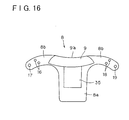
- the head support 8 for supporting a baby's head is provided on the upper end of the back cover portion 5.
- the head support 8 comprises a head support body 8a and band-like portions 8b extending laterally from the opposite ends of the head support 8a.
- the lower part of the head support body 8a is inserted into the pocket 14 on the back cover portion 5 and is detachably attached to the adhesive cloth (or surface fastener) inside the pocket 14.
- a belt piece 35 is provided on the head support body 8a for guiding a nursing person's hand when the baby carrier 1 is used as a lateral support type.
- Snap fasteners 16, 17 and 18, 19 are respectively attached on the ends of the band-like portions 8b.
- the snap fasteners 16, 17 can be detachably engagable with the snap fasteners 26, 27 fitted on the shoulder belt 6, and the snap fasteners 18, 19 can be detachably engagable with the snap fasteners 28, 29 fitted on the shoulder belt 7.
- the snap fasteners 26-29 may be provided at opposite ends of the upper portion of the back cover portion 5.
- a head guard 9 which is generally semicircular in shape is provided on the upper portion of the head support 8 for protecting the top portion of a baby's head.
- the convexly curved surface 9a at the top portion of the head guard 9 is sewn onto the top portion of the head support 8.
- the sewn surface of the head guard 9 is curved convexly.
- this convexly curved surface 9a is not necessarily a strict curved surface and may be polygonal in shape.
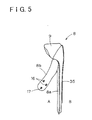
- Figures 3-5 are the side views of the head support 8.
- a side A or the left side of the head support body 8a is a baby's side where a baby's head is placed
- a side B is the back side of the head support 8.
- Figure 3 shows the condition where the head guard 9 is folded toward the back side of the head support 8
- Figure 5 shows the condition where the head guard 9 is folded toward the baby's side and raised up
- Figure 4 shows the condition where the head guard 9 is placed at the intermediate position between the above-mentioned two positions.
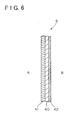
- Figure 6 shows the cross-sectional view of the head guard 9.
- the side A in Figure 6 shows the inside or the side where the top portion of a baby's head is placed with the head guard 9 raised up (see Figure 5), and the side B shows the opposite side to side A or the outside of the head guard 9.
- the head guard 9 comprises a hard, plate-like core member 40.
- a first sweat-absorbent cushioning member 41 is placed on the side A and a second cushioning member 42 for absorbing outside impacts is placed on the side B.
- the cushioning members 41, 42 may be composed of the same materials.
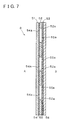
- the head support 8, as shown in Figure 7, comprises a five-layer structure.
- This five-layer structure is composed of cushioning members 51, 52, 53 made of polyurethane foam, for instance, for absorbing comparatively small impacts, and cushioning members 54, 55, which may be made of polyethylene foam, for instance, for absorbing comparatively large impacts and which is placed between cushioning members 51, 52, 53.
- a core member 56 is placed outside the cushioning member 53.
- a baby's head By adopting such a five-layer structure, a baby's head can be softly supported and effectively protected from various impacts from the outside.
- the air cushioning structure is provided inside the head support 8.
- This air cushioning structure is comprised of a plurality of the through holes 52a formed in the cushioning member 52, and a plurality of smaller through holes 54a, 55a formed in the cushioning members 54, 55, correspondingly to each of the through holes 52a on the cushioning member 52.
- the through holes 54a and 55a communicate with each other via the through holes 52a of the cushioning member 52, but they do not face each other.
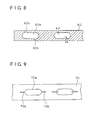
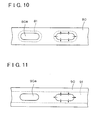
- FIG. 8-11 structures shown in Figures 8-11 may be employed as an air cushioning structure for the head support 8.
- FIG. 8-11 structures shown in Figures 8-11 may be employed as an air cushioning structure for the head support 8.
- cushioning members 60, 70, 80, 90 are respectively used as a cushioning member where cushioning members 52, 54, 55 in Figure 7 are formed integrally with each other.
- a plurality of air reservoirs 60a are provided inside the cushioning member 60, and a pair of through holes 60b communicating with each of the air reservoirs 60a are formed. Additionally, in the embodiment shown in Figure 9, a plurality of air reservoirs 70a are provided inside the cushioning member 70, and a pair of notches 70b are formed at the opposite sides of each of the air reservoirs 70.
- a plurality of air reservoirs 80a are provided inside the cushioning member 80, and a porous member 81 is placed annually around each of the air reservoirs 80a.
- a plurality of air reservoirs 90a are provided inside the cushioning member 90, and a porous member 91 is placed in a band-form around the air reservoirs 90a.
- air cushioning structures shown in Figures 7-11 may also be employed for the head guard 9.
- the snap fasteners 16-19 on the band-like portion 8b of the head support 8 are engaged with the snap fasteners 26-29 on the shoulder belts 6, 7, in advance. In this condition, a baby is placed on the carrier body 2 (or on the side shown in Figure 2).
- the front cover portion 3 is folded toward a baby's torso, and the hook members 31, 32 at the opposite ends of the belt member 30 are engaged with the corresponding annular members 28, 29 or 28', 29' on the back cover portion 5.
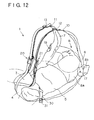
- the crotch cover portion 4 is formed in a bag-form which works for supporting a baby's crotch (see Figure 12), and thus, a baby can be protected from falling down from the lower portion of the baby carrier 1.
- the hook members 31, 32 are engaged with the annular members 28, 29 on the upper position of the back cover portion 5.
- the crotch opening of a baby can be enlarged, and thus, a baby can be held in the carrier body 2 without hurting the hip joint of a baby when it is held longitudinally.
- the hook members 31, 32 are engaged with the annular members 28', 29' on the lower position of the back cover portion 5.
- the center of gravity of a baby can be placed at the lower portion in the bag-form carrier body 2.
- a baby can be steadily supported in the carrier body 2.
- the one-touch buckles 12, 13 on the shoulder belts 6, 7 are engaged with the cover-equipped buckles 20, 21 beside the front cover portion 3.
- the one-touch buckles 12, 13 are engaged with the one-touch buckles 22, 23 with the covers 24, 25 open, and then, the covers 24, 25 are closed.
- the baby carrier 1 is assembled and a baby is held in the baby carrier 1 (see Fig 12).
- the shoulder belts 6, 7 are hung on the shoulders of a nursing person P (see Figure 13). At this time, the back portion of a baby's head is supported by the head support 8.
- the one-touch buckle 12 on the shoulder belt 6 is engaged with the cover-equipped buckle 20 beside the front cover portion 3, and the one-touch buckle 13 on the shoulder belt 7 is engaged with the cover-equipped buckle 21 beside the front cover portion 3, which differs from the condition shown in Figure 12.
- the shoulder belts 6, 7 are formed into a cross-hung condition.
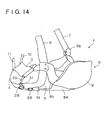
- the head guard when using the baby carrier 1 as a lateral support type, from the condition shown in Figure 12, the head guard is folded toward the baby's side and raised up (see Figures 3-5). At this time, as mentioned above, the sewn surface of the head guard 9 is curved convexly, which enables the head guard 9 to keep standing condition as shown in Figures 5 and 14.
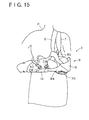
- the shoulder belts 6, 7 are bundled and placed on one shoulder of the nursing person P (see Figure 15).
- the back portion of a baby's head is supported by the head support 8 and the top portion of a baby's head is protected by the head guard 9.
- the head guard 9 in this standing condition can prevent a baby from falling down from the upper portion of the baby carrier 1.
- a nursing person P may support a baby's head from the lower portion of the head support 8 with his/her hand inside the belt portion 35.
- the shoulder belts 6, 7 can be used as they are by changing their placements on the nursing person's shoulder.
- a head guard 9 has a convexly curved surface 9a at its upper end, which is joined to the upper end of the head support 8 by stitching.
- a head guard 9 may have a concavely curved surface 9'a at its upper end, which may be joined to the concavely curved surface of the head support 8 by stitching.
- the head guard 9 can be kept in the standing condition when it is folded toward a baby's side.
- the same reference numerals as ones in the above-mentioned embodiment indicate the same or equivalent portions to the above-mentioned embodiments.
- the concavely curved surface 9'a may be polygonal in shape.
- the head guard 9 is fixed to the head support 8.
- the present invention is not limited to this embodiment.
- the head guard 9 may be releasably engagable with the head support 8 by detachably engaging members, such as snap fasteners, adhesive cloth and the like. In this case, at the time of fitting the head guard 9 onto the head support 8, the head guard 9 may be attached on the baby's head side of the head support 8 as the head guard 9 is kept standing. When the head guard 9 is not needed it may be detached from the head support 8.
- the head guard 9 may be attached on the back side of the head support 8 via a substantially convexly or concavely curved surface. In this case, similarly to the above-mentioned embodiments, the head guard 9 stands up and keeps standing when it is folded back toward the baby's head side of the head support 8.
- the present invention can be applied to the baby carrier shown in Figures 17-20 having a carrier body without a front cover portion and a crotch cover portion.
- a head support which is similar to the head support in the above-mentioned embodiment may be attached to the headrest portion 102 of the carrier body 101.
- a carrier body is preferable where a crotch cover portion is formed in a bag-form by assembling the carrier body, or where a crotch cover portion is formed in a bag-form in advance, in other words, a carrier body is a bag-form type.
- the present invention can be applied to other various kinds of baby carriers.
Landscapes
- Health & Medical Sciences (AREA)
- General Health & Medical Sciences (AREA)
- Pediatric Medicine (AREA)
- Carriages For Children, Sleds, And Other Hand-Operated Vehicles (AREA)
- Buckles (AREA)
- Orthopedics, Nursing, And Contraception (AREA)
- Professional, Industrial, Or Sporting Protective Garments (AREA)
- Portable Outdoor Equipment (AREA)
Applications Claiming Priority (4)
| Application Number | Priority Date | Filing Date | Title |
|---|---|---|---|
| JP3055698 | 1998-01-28 | ||
| JP3055698 | 1998-01-28 | ||
| JP36590098A JP4138982B2 (ja) | 1998-01-28 | 1998-12-24 | ベビーキャリアおよびベビーキャリア用ヘッドサポート |
| JP36590098 | 1998-12-24 |
Publications (2)
| Publication Number | Publication Date |
|---|---|
| EP0931487A2 true EP0931487A2 (de) | 1999-07-28 |
| EP0931487A3 EP0931487A3 (de) | 2001-08-08 |
Family
ID=26368937
Family Applications (1)
| Application Number | Title | Priority Date | Filing Date |
|---|---|---|---|
| EP99300582A Withdrawn EP0931487A3 (de) | 1998-01-28 | 1999-01-28 | Kindertrage |
Country Status (6)
| Country | Link |
|---|---|
| US (1) | US6257468B1 (de) |
| EP (1) | EP0931487A3 (de) |
| JP (1) | JP4138982B2 (de) |
| KR (1) | KR100327849B1 (de) |
| CN (1) | CN1119966C (de) |
| TW (1) | TW385240B (de) |
Cited By (5)
| Publication number | Priority date | Publication date | Assignee | Title |
|---|---|---|---|---|
| EP1175858A3 (de) * | 2000-07-27 | 2002-11-06 | HTS HANS TORGERSEN & SONN A/S | Tragevorrichtung für Kinder |
| GB2436735A (en) * | 2006-03-31 | 2007-10-03 | Combi Co | Baby carrier |
| WO2009084057A1 (en) * | 2008-01-02 | 2009-07-09 | Raffaella Abbate | Baby holder with convertible structure |
| EP3673770A1 (de) * | 2018-12-28 | 2020-07-01 | The Boppy Company, LLC | Babytrage mit bändern |
| KR20240134662A (ko) * | 2023-03-02 | 2024-09-10 | 차복희 | 아기띠의 등 지지대 폭 조절구조 |
Families Citing this family (42)
| Publication number | Priority date | Publication date | Assignee | Title |
|---|---|---|---|---|
| US7322498B2 (en) | 2003-09-10 | 2008-01-29 | The Ergo Baby Carrier, Inc. | Baby carrier |
| CN101433414B (zh) * | 2003-10-20 | 2011-12-28 | 康贝株式会社 | 婴儿背带 |
| TW200538076A (en) * | 2004-02-17 | 2005-12-01 | Combi Corp | Infant carrier |
| JP2005270176A (ja) * | 2004-03-23 | 2005-10-06 | Aprica Kassai Inc | 子守帯 |
| JP4391347B2 (ja) * | 2004-07-12 | 2009-12-24 | アップリカ・チルドレンズプロダクツ株式会社 | 子守帯 |
| JP2007215551A (ja) * | 2004-08-30 | 2007-08-30 | Nippon Eitekkusu Kk | ベビーキャリア |
| SE528184C2 (sv) * | 2005-03-10 | 2006-09-19 | Baby Bjoern Ab | Barnbärsele |
| CN101534781A (zh) * | 2005-06-27 | 2009-09-16 | 伽利特·吉伯 | 婴儿和幼童背带 |
| JP4772498B2 (ja) * | 2005-09-21 | 2011-09-14 | アップリカ・チルドレンズプロダクツ株式会社 | スリング式子守帯 |
| JP2007089883A (ja) * | 2005-09-29 | 2007-04-12 | Lucky Kogyo Kk | ベビースリング |
| US9179758B2 (en) * | 2005-12-16 | 2015-11-10 | Kolcraft Enterprises, Inc. | Child carriers and methods for operating the same |
| US20080087694A1 (en) * | 2006-10-12 | 2008-04-17 | Audra Meng | Hands-free baby carrier |
| US9386863B1 (en) | 2010-06-18 | 2016-07-12 | Boba Inc. | Child carrier and methods of use |
| US9314111B2 (en) | 2012-09-21 | 2016-04-19 | BityBean LLC | Convertible child carrier |
| CN105377085B (zh) | 2013-03-13 | 2018-06-19 | 爱歌宝宝背带有限公司 | 儿童载具 |
| DE202013010298U1 (de) * | 2013-11-15 | 2013-12-16 | Lewon Schaarschmidt | Kleinkind- und Babytrage und Verlängerungselement zur Verwendung als Bestandteil einer Kleinkind- und Babytrage |
| KR101828820B1 (ko) * | 2014-10-30 | 2018-02-19 | 한국생산기술연구원 | 하중분산형 하네스 |
| WO2016068609A2 (ko) * | 2014-10-30 | 2016-05-06 | 한국생산기술연구원 | 하중분산형 하네스 |
| US9314113B1 (en) | 2015-01-15 | 2016-04-19 | Lisbeth Hals Lehan | Child carrier having adjustable seat coupling |
| CN108697246B (zh) | 2015-10-30 | 2021-11-23 | 爱歌宝宝背带有限公司 | 可调节的儿童背袋 |
| WO2017117493A1 (en) | 2015-12-31 | 2017-07-06 | Cummings Kimberly | Infant carrier |
| WO2018081603A1 (en) | 2016-10-28 | 2018-05-03 | The Ergo Baby Carrier, Inc. | Adjustable child carrier with multiple carry orientations |
| US10264894B2 (en) | 2017-02-10 | 2019-04-23 | The Boppy Company, Llc | Baby carrier system |
| USD844973S1 (en) | 2017-02-10 | 2019-04-09 | The Boppy Company, Llc | Baby carrier |
| US11389011B2 (en) | 2017-02-10 | 2022-07-19 | The Boppy Company, Llc | Newborn carrier |
| US10555620B2 (en) | 2017-02-10 | 2020-02-11 | The Boppy Company, Llc | Baby carrier with ties |
| US10264895B2 (en) | 2017-02-22 | 2019-04-23 | Kolcraft Enterprises, Inc. | Adjustable child carriers |
| WO2018236412A1 (en) * | 2017-06-23 | 2018-12-27 | Cummings Kimberly | Multifunctional infant carrier |
| US11272791B2 (en) * | 2018-10-15 | 2022-03-15 | Angelique N. Warner | Multiple position baby carrier |
| CN110384365A (zh) | 2018-04-19 | 2019-10-29 | 明门瑞士股份有限公司 | 抱婴带 |
| US11026519B2 (en) | 2018-04-19 | 2021-06-08 | Wonderland Switzerland Ag | Child carrier |
| EP3886653B1 (de) | 2018-11-26 | 2024-08-28 | The Ergo Baby Carrier, Inc. | Verstellbare kindertragevorrichtung mit erhöhter bewegungsfreiheit |
| USD882244S1 (en) | 2018-12-28 | 2020-04-28 | The Boppy Company, Llc | Baby carrier with ties |
| USD910309S1 (en) | 2019-07-24 | 2021-02-16 | The Boppy Company, Llc | Component for baby carrier |
| USD1041875S1 (en) | 2020-06-19 | 2024-09-17 | The ERGO Baby Corrier Inc. | Child carrier |
| EP4292479A1 (de) | 2020-06-19 | 2023-12-20 | The Ergo Baby Carrier, Inc. | Einstellbare kindertrage mit mehreren tragausrichtungen |
| USD1024541S1 (en) | 2020-06-19 | 2024-04-30 | The Ergo Baby Carrier, Inc. | Child carrier |
| USD971589S1 (en) * | 2020-11-02 | 2022-12-06 | Jiang Jin | Baby carrier |
| USD975431S1 (en) * | 2020-12-18 | 2023-01-17 | Wonderland Switzerland Ag | Infant carrier |
| USD1010305S1 (en) * | 2020-12-18 | 2024-01-09 | The Ergo Baby Carrier, Inc. | Child carrier |
| WO2022204580A1 (en) * | 2021-03-25 | 2022-09-29 | Nemy Llc | Harnessed frameless cradles |
| CN120792939A (zh) * | 2021-10-22 | 2025-10-17 | 明门瑞士股份有限公司 | 护头装置及幼儿载具 |
Family Cites Families (10)
| Publication number | Priority date | Publication date | Assignee | Title |
|---|---|---|---|---|
| US2628358A (en) * | 1949-11-04 | 1953-02-17 | Josette M Neils | Baby carrier |
| US4923104A (en) * | 1987-10-27 | 1990-05-08 | Doris Rice | Child carrier and protector |
| US5071047A (en) | 1990-06-04 | 1991-12-10 | Claire Cordisco | Baby carrier |
| US5205451A (en) | 1992-01-27 | 1993-04-27 | Manzer Donna S | Infant carrier |
| US5246152A (en) | 1992-07-10 | 1993-09-21 | Dotseth Junice A | Baby carrier with head support |
| US5224229A (en) * | 1992-09-11 | 1993-07-06 | Smith Dale A | Infant protective device for use in vehicles |
| GB9317832D0 (en) * | 1993-08-27 | 1993-10-13 | Mercia Safety Centre Ltd | Baby protector |
| JPH08150051A (ja) | 1994-09-28 | 1996-06-11 | Aprica Kassai Inc | 乳幼児キャリア |
| JP3523387B2 (ja) | 1995-09-13 | 2004-04-26 | アップリカ▲葛▼西株式会社 | 乳幼児キャリア |
| KR100257802B1 (ko) * | 1997-02-17 | 2000-06-01 | 갓사이 겐조 | 베이비 캐리어 |
-
1998
- 1998-12-24 JP JP36590098A patent/JP4138982B2/ja not_active Expired - Fee Related
-
1999
- 1999-01-26 KR KR1019990002344A patent/KR100327849B1/ko not_active Expired - Fee Related
- 1999-01-28 TW TW088101295A patent/TW385240B/zh not_active IP Right Cessation
- 1999-01-28 US US09/239,465 patent/US6257468B1/en not_active Expired - Fee Related
- 1999-01-28 EP EP99300582A patent/EP0931487A3/de not_active Withdrawn
- 1999-01-28 CN CN99101706A patent/CN1119966C/zh not_active Expired - Fee Related
Non-Patent Citations (1)
| Title |
|---|
| None |
Cited By (7)
| Publication number | Priority date | Publication date | Assignee | Title |
|---|---|---|---|---|
| EP1175858A3 (de) * | 2000-07-27 | 2002-11-06 | HTS HANS TORGERSEN & SONN A/S | Tragevorrichtung für Kinder |
| GB2436735A (en) * | 2006-03-31 | 2007-10-03 | Combi Co | Baby carrier |
| GB2436735B (en) * | 2006-03-31 | 2011-05-18 | Combi Co | Baby carrier |
| TWI549632B (zh) * | 2006-03-31 | 2016-09-21 | 康貝股份有限公司 | 幼兒背負裝置 |
| WO2009084057A1 (en) * | 2008-01-02 | 2009-07-09 | Raffaella Abbate | Baby holder with convertible structure |
| EP3673770A1 (de) * | 2018-12-28 | 2020-07-01 | The Boppy Company, LLC | Babytrage mit bändern |
| KR20240134662A (ko) * | 2023-03-02 | 2024-09-10 | 차복희 | 아기띠의 등 지지대 폭 조절구조 |
Also Published As
| Publication number | Publication date |
|---|---|
| KR19990068121A (ko) | 1999-08-25 |
| JP4138982B2 (ja) | 2008-08-27 |
| US6257468B1 (en) | 2001-07-10 |
| TW385240B (en) | 2000-03-21 |
| CN1119966C (zh) | 2003-09-03 |
| JPH11276311A (ja) | 1999-10-12 |
| EP0931487A3 (de) | 2001-08-08 |
| CN1224594A (zh) | 1999-08-04 |
| KR100327849B1 (ko) | 2002-03-09 |
Similar Documents
| Publication | Publication Date | Title |
|---|---|---|
| EP0931487A2 (de) | Kindertrage | |
| US6045018A (en) | Baby carrier | |
| EP1616510B1 (de) | Kindertrage | |
| EP2421413B1 (de) | Kindertrage | |
| US6327726B1 (en) | Baby diaper-changing pad for use in a motor vehicle | |
| US4655502A (en) | Multi-adjustable cushion for a shopping cart | |
| US4436233A (en) | Baby carrier | |
| US5795030A (en) | Abdomen-protective adapter for seat belts | |
| KR20060047603A (ko) | 아기 보호대 | |
| JP2001137082A (ja) | 対面・前向きだっこ兼用ベビーキャリア | |
| KR20060050629A (ko) | 후드 부착 아기띠 | |
| US20050236874A1 (en) | Automobile pet bed construction | |
| EP2459032A1 (de) | Babytragehilfe | |
| US9565951B2 (en) | Small child and baby carrier and extension element for the use as a part of a small child and baby carrier | |
| EP0704183A2 (de) | Kinderträger | |
| US6082826A (en) | Patient support system | |
| KR20060105446A (ko) | 유아 보호띠 | |
| AU2018327402A1 (en) | Carrying device for babies or small children | |
| EP1986527A2 (de) | Tragetasche | |
| JP3135804U (ja) | 救命用つなぎズボン | |
| JP2002253394A (ja) | 頭部サポート部材付ベビーキャリア | |
| JP3523386B2 (ja) | 乳幼児キャリア用ヘッドサポートおよび乳幼児キャリア | |
| CN113395919A (zh) | 婴儿背带 | |
| KR102291058B1 (ko) | 등받이로 휴대하는 탈부착이 용이한 쿠션 | |
| KR200346812Y1 (ko) | 유아용 포대기 |
Legal Events
| Date | Code | Title | Description |
|---|---|---|---|
| PUAI | Public reference made under article 153(3) epc to a published international application that has entered the european phase |
Free format text: ORIGINAL CODE: 0009012 |
|
| AK | Designated contracting states |
Kind code of ref document: A2 Designated state(s): DE FR GB IT |
|
| AX | Request for extension of the european patent |
Free format text: AL;LT;LV;MK;RO;SI |
|
| RIC1 | Information provided on ipc code assigned before grant |
Free format text: 7A 47D 13/02 A, 7A 47D 15/00 B |
|
| PUAL | Search report despatched |
Free format text: ORIGINAL CODE: 0009013 |
|
| AK | Designated contracting states |
Kind code of ref document: A3 Designated state(s): AT BE CH CY DE DK ES FI FR GB GR IE IT LI LU MC NL PT SE |
|
| AX | Request for extension of the european patent |
Free format text: AL;LT;LV;MK;RO;SI |
|
| 17P | Request for examination filed |
Effective date: 20020205 |
|
| AKX | Designation fees paid |
Free format text: DE FR GB IT |
|
| 17Q | First examination report despatched |
Effective date: 20050217 |
|
| STAA | Information on the status of an ep patent application or granted ep patent |
Free format text: STATUS: THE APPLICATION IS DEEMED TO BE WITHDRAWN |
|
| 18D | Application deemed to be withdrawn |
Effective date: 20050628 |