EP0929708B1 - Verfahren zur herstellung eines spinnvlieses aus thermobondierten, gekräuselten bikomponentenfasern - Google Patents
Verfahren zur herstellung eines spinnvlieses aus thermobondierten, gekräuselten bikomponentenfasern Download PDFInfo
- Publication number
- EP0929708B1 EP0929708B1 EP98947325A EP98947325A EP0929708B1 EP 0929708 B1 EP0929708 B1 EP 0929708B1 EP 98947325 A EP98947325 A EP 98947325A EP 98947325 A EP98947325 A EP 98947325A EP 0929708 B1 EP0929708 B1 EP 0929708B1
- Authority
- EP
- European Patent Office
- Prior art keywords
- fibres
- thermobonded
- fibers
- bicomponent
- bicomponent fibers
- Prior art date
- Legal status (The legal status is an assumption and is not a legal conclusion. Google has not performed a legal analysis and makes no representation as to the accuracy of the status listed.)
- Expired - Lifetime
Links
Images

Classifications
-
- D—TEXTILES; PAPER
- D04—BRAIDING; LACE-MAKING; KNITTING; TRIMMINGS; NON-WOVEN FABRICS
- D04H—MAKING TEXTILE FABRICS, e.g. FROM FIBRES OR FILAMENTARY MATERIAL; FABRICS MADE BY SUCH PROCESSES OR APPARATUS, e.g. FELTS, NON-WOVEN FABRICS; COTTON-WOOL; WADDING ; NON-WOVEN FABRICS FROM STAPLE FIBRES, FILAMENTS OR YARNS, BONDED WITH AT LEAST ONE WEB-LIKE MATERIAL DURING THEIR CONSOLIDATION
- D04H3/00—Non-woven fabrics formed wholly or mainly of yarns or like filamentary material of substantial length
- D04H3/005—Synthetic yarns or filaments
- D04H3/007—Addition polymers
-
- D—TEXTILES; PAPER
- D01—NATURAL OR MAN-MADE THREADS OR FIBRES; SPINNING
- D01F—CHEMICAL FEATURES IN THE MANUFACTURE OF ARTIFICIAL FILAMENTS, THREADS, FIBRES, BRISTLES OR RIBBONS; APPARATUS SPECIALLY ADAPTED FOR THE MANUFACTURE OF CARBON FILAMENTS
- D01F8/00—Conjugated, i.e. bi- or multicomponent, artificial filaments or the like; Manufacture thereof
- D01F8/04—Conjugated, i.e. bi- or multicomponent, artificial filaments or the like; Manufacture thereof from synthetic polymers
- D01F8/06—Conjugated, i.e. bi- or multicomponent, artificial filaments or the like; Manufacture thereof from synthetic polymers with at least one polyolefin as constituent
-
- D—TEXTILES; PAPER
- D01—NATURAL OR MAN-MADE THREADS OR FIBRES; SPINNING
- D01F—CHEMICAL FEATURES IN THE MANUFACTURE OF ARTIFICIAL FILAMENTS, THREADS, FIBRES, BRISTLES OR RIBBONS; APPARATUS SPECIALLY ADAPTED FOR THE MANUFACTURE OF CARBON FILAMENTS
- D01F8/00—Conjugated, i.e. bi- or multicomponent, artificial filaments or the like; Manufacture thereof
- D01F8/04—Conjugated, i.e. bi- or multicomponent, artificial filaments or the like; Manufacture thereof from synthetic polymers
- D01F8/14—Conjugated, i.e. bi- or multicomponent, artificial filaments or the like; Manufacture thereof from synthetic polymers with at least one polyester as constituent
-
- D—TEXTILES; PAPER
- D04—BRAIDING; LACE-MAKING; KNITTING; TRIMMINGS; NON-WOVEN FABRICS
- D04H—MAKING TEXTILE FABRICS, e.g. FROM FIBRES OR FILAMENTARY MATERIAL; FABRICS MADE BY SUCH PROCESSES OR APPARATUS, e.g. FELTS, NON-WOVEN FABRICS; COTTON-WOOL; WADDING ; NON-WOVEN FABRICS FROM STAPLE FIBRES, FILAMENTS OR YARNS, BONDED WITH AT LEAST ONE WEB-LIKE MATERIAL DURING THEIR CONSOLIDATION
- D04H1/00—Non-woven fabrics formed wholly or mainly of staple fibres or like relatively short fibres
- D04H1/40—Non-woven fabrics formed wholly or mainly of staple fibres or like relatively short fibres from fleeces or layers composed of fibres without existing or potential cohesive properties
- D04H1/42—Non-woven fabrics formed wholly or mainly of staple fibres or like relatively short fibres from fleeces or layers composed of fibres without existing or potential cohesive properties characterised by the use of certain kinds of fibres insofar as this use has no preponderant influence on the consolidation of the fleece
- D04H1/4282—Addition polymers
- D04H1/4291—Olefin series
-
- D—TEXTILES; PAPER
- D04—BRAIDING; LACE-MAKING; KNITTING; TRIMMINGS; NON-WOVEN FABRICS
- D04H—MAKING TEXTILE FABRICS, e.g. FROM FIBRES OR FILAMENTARY MATERIAL; FABRICS MADE BY SUCH PROCESSES OR APPARATUS, e.g. FELTS, NON-WOVEN FABRICS; COTTON-WOOL; WADDING ; NON-WOVEN FABRICS FROM STAPLE FIBRES, FILAMENTS OR YARNS, BONDED WITH AT LEAST ONE WEB-LIKE MATERIAL DURING THEIR CONSOLIDATION
- D04H1/00—Non-woven fabrics formed wholly or mainly of staple fibres or like relatively short fibres
- D04H1/40—Non-woven fabrics formed wholly or mainly of staple fibres or like relatively short fibres from fleeces or layers composed of fibres without existing or potential cohesive properties
- D04H1/42—Non-woven fabrics formed wholly or mainly of staple fibres or like relatively short fibres from fleeces or layers composed of fibres without existing or potential cohesive properties characterised by the use of certain kinds of fibres insofar as this use has no preponderant influence on the consolidation of the fleece
- D04H1/4326—Condensation or reaction polymers
- D04H1/435—Polyesters
-
- D—TEXTILES; PAPER
- D04—BRAIDING; LACE-MAKING; KNITTING; TRIMMINGS; NON-WOVEN FABRICS
- D04H—MAKING TEXTILE FABRICS, e.g. FROM FIBRES OR FILAMENTARY MATERIAL; FABRICS MADE BY SUCH PROCESSES OR APPARATUS, e.g. FELTS, NON-WOVEN FABRICS; COTTON-WOOL; WADDING ; NON-WOVEN FABRICS FROM STAPLE FIBRES, FILAMENTS OR YARNS, BONDED WITH AT LEAST ONE WEB-LIKE MATERIAL DURING THEIR CONSOLIDATION
- D04H1/00—Non-woven fabrics formed wholly or mainly of staple fibres or like relatively short fibres
- D04H1/40—Non-woven fabrics formed wholly or mainly of staple fibres or like relatively short fibres from fleeces or layers composed of fibres without existing or potential cohesive properties
- D04H1/42—Non-woven fabrics formed wholly or mainly of staple fibres or like relatively short fibres from fleeces or layers composed of fibres without existing or potential cohesive properties characterised by the use of certain kinds of fibres insofar as this use has no preponderant influence on the consolidation of the fleece
- D04H1/4382—Stretched reticular film fibres; Composite fibres; Mixed fibres; Ultrafine fibres; Fibres for artificial leather
- D04H1/43825—Composite fibres
- D04H1/43828—Composite fibres sheath-core
-
- D—TEXTILES; PAPER
- D04—BRAIDING; LACE-MAKING; KNITTING; TRIMMINGS; NON-WOVEN FABRICS
- D04H—MAKING TEXTILE FABRICS, e.g. FROM FIBRES OR FILAMENTARY MATERIAL; FABRICS MADE BY SUCH PROCESSES OR APPARATUS, e.g. FELTS, NON-WOVEN FABRICS; COTTON-WOOL; WADDING ; NON-WOVEN FABRICS FROM STAPLE FIBRES, FILAMENTS OR YARNS, BONDED WITH AT LEAST ONE WEB-LIKE MATERIAL DURING THEIR CONSOLIDATION
- D04H1/00—Non-woven fabrics formed wholly or mainly of staple fibres or like relatively short fibres
- D04H1/40—Non-woven fabrics formed wholly or mainly of staple fibres or like relatively short fibres from fleeces or layers composed of fibres without existing or potential cohesive properties
- D04H1/42—Non-woven fabrics formed wholly or mainly of staple fibres or like relatively short fibres from fleeces or layers composed of fibres without existing or potential cohesive properties characterised by the use of certain kinds of fibres insofar as this use has no preponderant influence on the consolidation of the fleece
- D04H1/4382—Stretched reticular film fibres; Composite fibres; Mixed fibres; Ultrafine fibres; Fibres for artificial leather
- D04H1/43825—Composite fibres
- D04H1/43832—Composite fibres side-by-side
-
- D—TEXTILES; PAPER
- D04—BRAIDING; LACE-MAKING; KNITTING; TRIMMINGS; NON-WOVEN FABRICS
- D04H—MAKING TEXTILE FABRICS, e.g. FROM FIBRES OR FILAMENTARY MATERIAL; FABRICS MADE BY SUCH PROCESSES OR APPARATUS, e.g. FELTS, NON-WOVEN FABRICS; COTTON-WOOL; WADDING ; NON-WOVEN FABRICS FROM STAPLE FIBRES, FILAMENTS OR YARNS, BONDED WITH AT LEAST ONE WEB-LIKE MATERIAL DURING THEIR CONSOLIDATION
- D04H1/00—Non-woven fabrics formed wholly or mainly of staple fibres or like relatively short fibres
- D04H1/40—Non-woven fabrics formed wholly or mainly of staple fibres or like relatively short fibres from fleeces or layers composed of fibres without existing or potential cohesive properties
- D04H1/42—Non-woven fabrics formed wholly or mainly of staple fibres or like relatively short fibres from fleeces or layers composed of fibres without existing or potential cohesive properties characterised by the use of certain kinds of fibres insofar as this use has no preponderant influence on the consolidation of the fleece
- D04H1/4391—Non-woven fabrics formed wholly or mainly of staple fibres or like relatively short fibres from fleeces or layers composed of fibres without existing or potential cohesive properties characterised by the use of certain kinds of fibres insofar as this use has no preponderant influence on the consolidation of the fleece characterised by the shape of the fibres
- D04H1/43914—Non-woven fabrics formed wholly or mainly of staple fibres or like relatively short fibres from fleeces or layers composed of fibres without existing or potential cohesive properties characterised by the use of certain kinds of fibres insofar as this use has no preponderant influence on the consolidation of the fleece characterised by the shape of the fibres hollow fibres
-
- D—TEXTILES; PAPER
- D04—BRAIDING; LACE-MAKING; KNITTING; TRIMMINGS; NON-WOVEN FABRICS
- D04H—MAKING TEXTILE FABRICS, e.g. FROM FIBRES OR FILAMENTARY MATERIAL; FABRICS MADE BY SUCH PROCESSES OR APPARATUS, e.g. FELTS, NON-WOVEN FABRICS; COTTON-WOOL; WADDING ; NON-WOVEN FABRICS FROM STAPLE FIBRES, FILAMENTS OR YARNS, BONDED WITH AT LEAST ONE WEB-LIKE MATERIAL DURING THEIR CONSOLIDATION
- D04H1/00—Non-woven fabrics formed wholly or mainly of staple fibres or like relatively short fibres
- D04H1/40—Non-woven fabrics formed wholly or mainly of staple fibres or like relatively short fibres from fleeces or layers composed of fibres without existing or potential cohesive properties
- D04H1/42—Non-woven fabrics formed wholly or mainly of staple fibres or like relatively short fibres from fleeces or layers composed of fibres without existing or potential cohesive properties characterised by the use of certain kinds of fibres insofar as this use has no preponderant influence on the consolidation of the fleece
- D04H1/4391—Non-woven fabrics formed wholly or mainly of staple fibres or like relatively short fibres from fleeces or layers composed of fibres without existing or potential cohesive properties characterised by the use of certain kinds of fibres insofar as this use has no preponderant influence on the consolidation of the fleece characterised by the shape of the fibres
- D04H1/43918—Non-woven fabrics formed wholly or mainly of staple fibres or like relatively short fibres from fleeces or layers composed of fibres without existing or potential cohesive properties characterised by the use of certain kinds of fibres insofar as this use has no preponderant influence on the consolidation of the fleece characterised by the shape of the fibres nonlinear fibres, e.g. crimped or coiled fibres
-
- D—TEXTILES; PAPER
- D04—BRAIDING; LACE-MAKING; KNITTING; TRIMMINGS; NON-WOVEN FABRICS
- D04H—MAKING TEXTILE FABRICS, e.g. FROM FIBRES OR FILAMENTARY MATERIAL; FABRICS MADE BY SUCH PROCESSES OR APPARATUS, e.g. FELTS, NON-WOVEN FABRICS; COTTON-WOOL; WADDING ; NON-WOVEN FABRICS FROM STAPLE FIBRES, FILAMENTS OR YARNS, BONDED WITH AT LEAST ONE WEB-LIKE MATERIAL DURING THEIR CONSOLIDATION
- D04H1/00—Non-woven fabrics formed wholly or mainly of staple fibres or like relatively short fibres
- D04H1/40—Non-woven fabrics formed wholly or mainly of staple fibres or like relatively short fibres from fleeces or layers composed of fibres without existing or potential cohesive properties
- D04H1/54—Non-woven fabrics formed wholly or mainly of staple fibres or like relatively short fibres from fleeces or layers composed of fibres without existing or potential cohesive properties by welding together the fibres, e.g. by partially melting or dissolving
-
- D—TEXTILES; PAPER
- D04—BRAIDING; LACE-MAKING; KNITTING; TRIMMINGS; NON-WOVEN FABRICS
- D04H—MAKING TEXTILE FABRICS, e.g. FROM FIBRES OR FILAMENTARY MATERIAL; FABRICS MADE BY SUCH PROCESSES OR APPARATUS, e.g. FELTS, NON-WOVEN FABRICS; COTTON-WOOL; WADDING ; NON-WOVEN FABRICS FROM STAPLE FIBRES, FILAMENTS OR YARNS, BONDED WITH AT LEAST ONE WEB-LIKE MATERIAL DURING THEIR CONSOLIDATION
- D04H1/00—Non-woven fabrics formed wholly or mainly of staple fibres or like relatively short fibres
- D04H1/40—Non-woven fabrics formed wholly or mainly of staple fibres or like relatively short fibres from fleeces or layers composed of fibres without existing or potential cohesive properties
- D04H1/54—Non-woven fabrics formed wholly or mainly of staple fibres or like relatively short fibres from fleeces or layers composed of fibres without existing or potential cohesive properties by welding together the fibres, e.g. by partially melting or dissolving
- D04H1/541—Composite fibres, e.g. sheath-core, sea-island or side-by-side; Mixed fibres
- D04H1/5412—Composite fibres, e.g. sheath-core, sea-island or side-by-side; Mixed fibres sheath-core
-
- D—TEXTILES; PAPER
- D04—BRAIDING; LACE-MAKING; KNITTING; TRIMMINGS; NON-WOVEN FABRICS
- D04H—MAKING TEXTILE FABRICS, e.g. FROM FIBRES OR FILAMENTARY MATERIAL; FABRICS MADE BY SUCH PROCESSES OR APPARATUS, e.g. FELTS, NON-WOVEN FABRICS; COTTON-WOOL; WADDING ; NON-WOVEN FABRICS FROM STAPLE FIBRES, FILAMENTS OR YARNS, BONDED WITH AT LEAST ONE WEB-LIKE MATERIAL DURING THEIR CONSOLIDATION
- D04H1/00—Non-woven fabrics formed wholly or mainly of staple fibres or like relatively short fibres
- D04H1/40—Non-woven fabrics formed wholly or mainly of staple fibres or like relatively short fibres from fleeces or layers composed of fibres without existing or potential cohesive properties
- D04H1/54—Non-woven fabrics formed wholly or mainly of staple fibres or like relatively short fibres from fleeces or layers composed of fibres without existing or potential cohesive properties by welding together the fibres, e.g. by partially melting or dissolving
- D04H1/541—Composite fibres, e.g. sheath-core, sea-island or side-by-side; Mixed fibres
- D04H1/5414—Composite fibres, e.g. sheath-core, sea-island or side-by-side; Mixed fibres side-by-side
-
- D—TEXTILES; PAPER
- D04—BRAIDING; LACE-MAKING; KNITTING; TRIMMINGS; NON-WOVEN FABRICS
- D04H—MAKING TEXTILE FABRICS, e.g. FROM FIBRES OR FILAMENTARY MATERIAL; FABRICS MADE BY SUCH PROCESSES OR APPARATUS, e.g. FELTS, NON-WOVEN FABRICS; COTTON-WOOL; WADDING ; NON-WOVEN FABRICS FROM STAPLE FIBRES, FILAMENTS OR YARNS, BONDED WITH AT LEAST ONE WEB-LIKE MATERIAL DURING THEIR CONSOLIDATION
- D04H1/00—Non-woven fabrics formed wholly or mainly of staple fibres or like relatively short fibres
- D04H1/40—Non-woven fabrics formed wholly or mainly of staple fibres or like relatively short fibres from fleeces or layers composed of fibres without existing or potential cohesive properties
- D04H1/54—Non-woven fabrics formed wholly or mainly of staple fibres or like relatively short fibres from fleeces or layers composed of fibres without existing or potential cohesive properties by welding together the fibres, e.g. by partially melting or dissolving
- D04H1/542—Adhesive fibres
- D04H1/544—Olefin series
-
- D—TEXTILES; PAPER
- D04—BRAIDING; LACE-MAKING; KNITTING; TRIMMINGS; NON-WOVEN FABRICS
- D04H—MAKING TEXTILE FABRICS, e.g. FROM FIBRES OR FILAMENTARY MATERIAL; FABRICS MADE BY SUCH PROCESSES OR APPARATUS, e.g. FELTS, NON-WOVEN FABRICS; COTTON-WOOL; WADDING ; NON-WOVEN FABRICS FROM STAPLE FIBRES, FILAMENTS OR YARNS, BONDED WITH AT LEAST ONE WEB-LIKE MATERIAL DURING THEIR CONSOLIDATION
- D04H13/00—Other non-woven fabrics
-
- D—TEXTILES; PAPER
- D04—BRAIDING; LACE-MAKING; KNITTING; TRIMMINGS; NON-WOVEN FABRICS
- D04H—MAKING TEXTILE FABRICS, e.g. FROM FIBRES OR FILAMENTARY MATERIAL; FABRICS MADE BY SUCH PROCESSES OR APPARATUS, e.g. FELTS, NON-WOVEN FABRICS; COTTON-WOOL; WADDING ; NON-WOVEN FABRICS FROM STAPLE FIBRES, FILAMENTS OR YARNS, BONDED WITH AT LEAST ONE WEB-LIKE MATERIAL DURING THEIR CONSOLIDATION
- D04H3/00—Non-woven fabrics formed wholly or mainly of yarns or like filamentary material of substantial length
- D04H3/016—Non-woven fabrics formed wholly or mainly of yarns or like filamentary material of substantial length characterised by the fineness
-
- D—TEXTILES; PAPER
- D04—BRAIDING; LACE-MAKING; KNITTING; TRIMMINGS; NON-WOVEN FABRICS
- D04H—MAKING TEXTILE FABRICS, e.g. FROM FIBRES OR FILAMENTARY MATERIAL; FABRICS MADE BY SUCH PROCESSES OR APPARATUS, e.g. FELTS, NON-WOVEN FABRICS; COTTON-WOOL; WADDING ; NON-WOVEN FABRICS FROM STAPLE FIBRES, FILAMENTS OR YARNS, BONDED WITH AT LEAST ONE WEB-LIKE MATERIAL DURING THEIR CONSOLIDATION
- D04H3/00—Non-woven fabrics formed wholly or mainly of yarns or like filamentary material of substantial length
- D04H3/02—Non-woven fabrics formed wholly or mainly of yarns or like filamentary material of substantial length characterised by the method of forming fleeces or layers, e.g. reorientation of yarns or filaments
- D04H3/03—Non-woven fabrics formed wholly or mainly of yarns or like filamentary material of substantial length characterised by the method of forming fleeces or layers, e.g. reorientation of yarns or filaments at random
- D04H3/033—Non-woven fabrics formed wholly or mainly of yarns or like filamentary material of substantial length characterised by the method of forming fleeces or layers, e.g. reorientation of yarns or filaments at random reorientation immediately after yarn or filament formation
-
- D—TEXTILES; PAPER
- D04—BRAIDING; LACE-MAKING; KNITTING; TRIMMINGS; NON-WOVEN FABRICS
- D04H—MAKING TEXTILE FABRICS, e.g. FROM FIBRES OR FILAMENTARY MATERIAL; FABRICS MADE BY SUCH PROCESSES OR APPARATUS, e.g. FELTS, NON-WOVEN FABRICS; COTTON-WOOL; WADDING ; NON-WOVEN FABRICS FROM STAPLE FIBRES, FILAMENTS OR YARNS, BONDED WITH AT LEAST ONE WEB-LIKE MATERIAL DURING THEIR CONSOLIDATION
- D04H3/00—Non-woven fabrics formed wholly or mainly of yarns or like filamentary material of substantial length
- D04H3/02—Non-woven fabrics formed wholly or mainly of yarns or like filamentary material of substantial length characterised by the method of forming fleeces or layers, e.g. reorientation of yarns or filaments
- D04H3/07—Non-woven fabrics formed wholly or mainly of yarns or like filamentary material of substantial length characterised by the method of forming fleeces or layers, e.g. reorientation of yarns or filaments otherwise than in a plane, e.g. in a tubular way
- D04H3/073—Hollow cylinder shaped
-
- D—TEXTILES; PAPER
- D04—BRAIDING; LACE-MAKING; KNITTING; TRIMMINGS; NON-WOVEN FABRICS
- D04H—MAKING TEXTILE FABRICS, e.g. FROM FIBRES OR FILAMENTARY MATERIAL; FABRICS MADE BY SUCH PROCESSES OR APPARATUS, e.g. FELTS, NON-WOVEN FABRICS; COTTON-WOOL; WADDING ; NON-WOVEN FABRICS FROM STAPLE FIBRES, FILAMENTS OR YARNS, BONDED WITH AT LEAST ONE WEB-LIKE MATERIAL DURING THEIR CONSOLIDATION
- D04H3/00—Non-woven fabrics formed wholly or mainly of yarns or like filamentary material of substantial length
- D04H3/08—Non-woven fabrics formed wholly or mainly of yarns or like filamentary material of substantial length characterised by the method of strengthening or consolidating
- D04H3/14—Non-woven fabrics formed wholly or mainly of yarns or like filamentary material of substantial length characterised by the method of strengthening or consolidating with bonds between thermoplastic yarns or filaments produced by welding
- D04H3/147—Composite yarns or filaments
-
- D—TEXTILES; PAPER
- D04—BRAIDING; LACE-MAKING; KNITTING; TRIMMINGS; NON-WOVEN FABRICS
- D04H—MAKING TEXTILE FABRICS, e.g. FROM FIBRES OR FILAMENTARY MATERIAL; FABRICS MADE BY SUCH PROCESSES OR APPARATUS, e.g. FELTS, NON-WOVEN FABRICS; COTTON-WOOL; WADDING ; NON-WOVEN FABRICS FROM STAPLE FIBRES, FILAMENTS OR YARNS, BONDED WITH AT LEAST ONE WEB-LIKE MATERIAL DURING THEIR CONSOLIDATION
- D04H3/00—Non-woven fabrics formed wholly or mainly of yarns or like filamentary material of substantial length
- D04H3/08—Non-woven fabrics formed wholly or mainly of yarns or like filamentary material of substantial length characterised by the method of strengthening or consolidating
- D04H3/16—Non-woven fabrics formed wholly or mainly of yarns or like filamentary material of substantial length characterised by the method of strengthening or consolidating with bonds between thermoplastic filaments produced in association with filament formation, e.g. immediately following extrusion
-
- Y—GENERAL TAGGING OF NEW TECHNOLOGICAL DEVELOPMENTS; GENERAL TAGGING OF CROSS-SECTIONAL TECHNOLOGIES SPANNING OVER SEVERAL SECTIONS OF THE IPC; TECHNICAL SUBJECTS COVERED BY FORMER USPC CROSS-REFERENCE ART COLLECTIONS [XRACs] AND DIGESTS
- Y10—TECHNICAL SUBJECTS COVERED BY FORMER USPC
- Y10T—TECHNICAL SUBJECTS COVERED BY FORMER US CLASSIFICATION
- Y10T428/00—Stock material or miscellaneous articles
- Y10T428/249921—Web or sheet containing structurally defined element or component
- Y10T428/249924—Noninterengaged fiber-containing paper-free web or sheet which is not of specified porosity
- Y10T428/24994—Fiber embedded in or on the surface of a polymeric matrix
-
- Y—GENERAL TAGGING OF NEW TECHNOLOGICAL DEVELOPMENTS; GENERAL TAGGING OF CROSS-SECTIONAL TECHNOLOGIES SPANNING OVER SEVERAL SECTIONS OF THE IPC; TECHNICAL SUBJECTS COVERED BY FORMER USPC CROSS-REFERENCE ART COLLECTIONS [XRACs] AND DIGESTS
- Y10—TECHNICAL SUBJECTS COVERED BY FORMER USPC
- Y10T—TECHNICAL SUBJECTS COVERED BY FORMER US CLASSIFICATION
- Y10T442/00—Fabric [woven, knitted, or nonwoven textile or cloth, etc.]
- Y10T442/60—Nonwoven fabric [i.e., nonwoven strand or fiber material]
- Y10T442/659—Including an additional nonwoven fabric
-
- Y—GENERAL TAGGING OF NEW TECHNOLOGICAL DEVELOPMENTS; GENERAL TAGGING OF CROSS-SECTIONAL TECHNOLOGIES SPANNING OVER SEVERAL SECTIONS OF THE IPC; TECHNICAL SUBJECTS COVERED BY FORMER USPC CROSS-REFERENCE ART COLLECTIONS [XRACs] AND DIGESTS
- Y10—TECHNICAL SUBJECTS COVERED BY FORMER USPC
- Y10T—TECHNICAL SUBJECTS COVERED BY FORMER US CLASSIFICATION
- Y10T442/00—Fabric [woven, knitted, or nonwoven textile or cloth, etc.]
- Y10T442/60—Nonwoven fabric [i.e., nonwoven strand or fiber material]
- Y10T442/659—Including an additional nonwoven fabric
- Y10T442/66—Additional nonwoven fabric is a spun-bonded fabric
Definitions
- the invention relates to a method for producing a Spunbonded fabric made of thermobonded crimped bicomponent fibers, the bicomponent fibers each consisting of two plastic Materials with different properties exist.
- the object of the invention is a method of the aforementioned Kind to provide by the spunbonded from thermobonded crimped bicomponent fibers are created can, which are voluminous and by which targeted influence the properties of the fleece with regard to strength, Porosity, crimp of the single fiber and final weight taken can be. If necessary, water resistance should also be the nonwovens created by the process by the process be influenceable.
- the bicomponent fibers each consisting of two plastic Materials with different properties exist, in a first step, the two plastic ones Materials spun fibers are uncrimped and stretched, in a second step on a screen belt filed and thermobonded and in a third step the bicomponent fibers of the nonwoven obtained Longitudinal and / or transverse stretching and thermal treatment curled.
- a larger volume is particularly advantageous if the fleece resulting from the process according to the invention used as an acquisition layer in diapers or sanitary napkins becomes.
- this is with bicomponent fibers of the side-by-side type.
- Process with bicomponent fibers with an eccentric core carried out.
- Another embodiment of the invention provides that the process with segmented hollow bicomponent fibers is performed, with adjacent segments of each fiber different materials.
- the fibers of the fleece are drawn and thermally treated such that the fibers curling and fibrillating.
- a fleece obtained in this way has the same basis weight a significantly lower porosity, which is reflected in a higher water resistance of the fleece.
- the fibers consist of two polypropylene granules be spun, with a first polypropylene granules one Viscosity range MFI from 16 to 35 and the second polypropylene granulate has a viscosity range MFI which 8 to 10 points below the MFI viscosity range of the first Polypropylene granules.
- the fibers consist of two different ones Polyolefins or from a polyolefin and from PET can be spun.
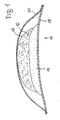
- FIG. 1 shows an application example in the form of a diaper 10 for the use of one from the method according to the invention resulting spunbond 12 shown.
- the side-by-side type hollow fiber 22 consists of two cylinder jacket halves 24 and 26 made of plastic Materials with different properties. So there is the cylinder jacket half 24 made of polypropylene of the viscosity range MFI 16 to 35, whereas the cylinder jacket half 26 consists of a polypropylene, the viscosity range MFI 8 to 10 points below the viscosity range MFI of the polypropylene of the cylinder jacket half 24 lies.
- the fleece 12 obtained in this way can now be in the diaper 10 placed a core 14, used as an acquisition layer 16 become.
- This acquisition layer 16 serves a spatial Separation between the core absorbing the body fluid 14 and the coverstock 20 attached to the organism. That is, the acquisition layer 16 serves to prevent liquid accumulated in core 14 from re-entering Contact with the body surface of an organism to be treated can get there because the coverstock 20 is usually like this must be kept porous that it is not possible to use it as to lay out semipermeable structures. A leak from the core 14 stored liquid is finally through a film 18, which is connected to the cover stock 20, prevented.
- the material of the cover stick 20 can be one according to the invention Process produced spunbonded can be used for its production shown in Fig. 3 bicomponent fibers 28 with a jacket 30 and an eccentric core 32 be used.
- One made with such fibers 28 Spunbond is suitable for use as a coverstock 20, because it then has a very soft feel and is kind to the skin is.
- a spunbonded fabric is to emerge from the method according to the invention, which has good water resistance for the production of this fleece shown in Fig. 4 fibers 34 used.
- the cross section of this shown in Fig. 4 Fiber 34 consists of individual segments 36 and 38, with adjacent ones Segments 36, 38 from different raw materials consist, for example, of polypropylene with different Viscosity ranges MFI, made of polyolefins such as PP and PE in the different phases or from a combination of PET with a polyolefin.
- MFI Viscosity ranges
Landscapes
- Engineering & Computer Science (AREA)
- Textile Engineering (AREA)
- Chemical & Material Sciences (AREA)
- Chemical Kinetics & Catalysis (AREA)
- General Chemical & Material Sciences (AREA)
- Nonwoven Fabrics (AREA)
- Absorbent Articles And Supports Therefor (AREA)
- Multicomponent Fibers (AREA)
- Spinning Methods And Devices For Manufacturing Artificial Fibers (AREA)
- Organic Low-Molecular-Weight Compounds And Preparation Thereof (AREA)
- Treatment Of Fiber Materials (AREA)
Description
- Fig. 1
- einen Querschnitt durch eine Windel mit einem nach dem erfindungsgemäßen Verfahren hergestellten Acquisitionlayer,
- Fig. 2
- einen Querschnitt durch eine Bikomponentenfaser des Side-by-Side-Typs,
- Fig. 3
- einen Querschnitt durch eine Bikomponentenfaser mit exzentrischem Kern, und
- Fig. 4
- einen Querschnitt durch eine segmentierte Hohl-Bikomponentenfaser.
Claims (8)
- Verfahren zur Herstellung eines Spinnvlieses aus thermobondierten gekräuselten Bikomponentenfasern, wobei die Bikomponentenfasern jeweils aus zwei plastischen Materialien mit unterschiedlichen Eigenschaften bestehen, bei demdadurch gekennzeichnet, daßin einem ersten Schritt die aus den zwei plastischen Materialien ersponnenen Fasern (22; 28; 34) ungekräuselt abgezogen und verstreckt werden,in einem zweiten Schritt die Fasern (22; 28; 34) auf einem Siebband abgelegt und thermobondiert werden,in einem dritten Schritt die Bikomponentenfasern des gewonnenen Vlieses durch Längs- und/oder Querstreckung und thermische Behandlung gekräuselt werden.
- Verfahren nach Anspruch 1, dadurch gekennzeichnet, daß das Verfahren mit Bikomponentenfasern (22) des Side-by-Side-Typs durchgeführt wird.
- Verfahren nach Anspruch 1, dadurch gekennzeichnet, daß das Verfahren mit Bikomponentenfasern (28) mit exzentrischem Kern (32) durchgeführt wird.
- Verfahren nach Anspruch 1, dadurch gekennzeichnet, daß das Verfahren mit segmentierten Hohl-Bikomponentenfasern (34) durchgeführt wird, wobei benachbarte Segmente (36, 38) jeder Faser (34) aus unterschiedlichen Materialien bestehen.
- Verfahren nach Anspruch 4, dadurch gekennzeichnet, daß die Fasern (34) des Vlieses durch Längs- und/oder Querstrekkung und thermische Behandlung gekräuselt und fibrilliert werden.
- Verfahren nach einem der Ansprüche 1 - 5, dadurch gekennzeichnet, daß die Fasern (22; 28; 34) aus zwei Polypropylen-Granulaten ersponnen werden, wobei ein erstes Polypropylen-Granulat einen Viskositätsbereich MFI von 16 bis 35 und das zweite Propylen-Granulat einen Viskositätsbereich MFI aufweist, welcher 8 bis 10 Punkte unter dem Viskositätsbereich MFI des ersten Polypropylen-Granulats liegt.
- Verfahren nach einem der Ansprüche 1 - 5, dadurch gekennzeichnet, daß die Fasern (22; 28; 34) aus zwei unterschiedlichen Polyolefinen ersponnen werden.
- Verfahren nach einem der Ansprüche 1 - 5, dadurch gekennzeichnet, daß die Fasern (22; 28; 34) aus einem Polyolefin und aus PET ersponnen werden.
Applications Claiming Priority (3)
| Application Number | Priority Date | Filing Date | Title |
|---|---|---|---|
| DE19733493 | 1997-08-01 | ||
| DE19733493A DE19733493C2 (de) | 1997-08-01 | 1997-08-01 | Verfahren zur Herstellung eines Spinnvlieses aus thermobondierten gekräuselten Bikomponentenfasern |
| PCT/DE1998/002083 WO1999006621A1 (de) | 1997-08-01 | 1998-07-21 | Verfahren zur herstellung eines spinnvlieses aus thermobondierten gekräuselten bikomponentenfasern |
Publications (2)
| Publication Number | Publication Date |
|---|---|
| EP0929708A1 EP0929708A1 (de) | 1999-07-21 |
| EP0929708B1 true EP0929708B1 (de) | 2002-06-12 |
Family
ID=7837818
Family Applications (1)
| Application Number | Title | Priority Date | Filing Date |
|---|---|---|---|
| EP98947325A Expired - Lifetime EP0929708B1 (de) | 1997-08-01 | 1998-07-21 | Verfahren zur herstellung eines spinnvlieses aus thermobondierten, gekräuselten bikomponentenfasern |
Country Status (8)
| Country | Link |
|---|---|
| US (2) | US6312545B1 (de) |
| EP (1) | EP0929708B1 (de) |
| JP (1) | JP2001501266A (de) |
| AT (1) | ATE219178T1 (de) |
| DE (2) | DE19733493C2 (de) |
| DK (1) | DK0929708T3 (de) |
| ES (1) | ES2177055T3 (de) |
| WO (1) | WO1999006621A1 (de) |
Families Citing this family (18)
| Publication number | Priority date | Publication date | Assignee | Title |
|---|---|---|---|---|
| US6642429B1 (en) * | 1999-06-30 | 2003-11-04 | Kimberly-Clark Worldwide, Inc. | Personal care articles with reduced polymer fibers |
| US6964931B2 (en) * | 2000-03-03 | 2005-11-15 | Polymer Group, Inc. | Method of making continuous filament web with statistical filament distribution |
| DE10022292C2 (de) * | 2000-05-09 | 2002-03-28 | Sebastian Sommer | Verfahren zur Herstellung eines Vliesstoffes |
| US6896843B2 (en) * | 2002-08-30 | 2005-05-24 | Kimberly-Clark Worldwide, Inc. | Method of making a web which is extensible in at least one direction |
| US6881375B2 (en) | 2002-08-30 | 2005-04-19 | Kimberly-Clark Worldwide, Inc. | Method of forming a 3-dimensional fiber into a web |
| CA2503049A1 (en) * | 2002-10-24 | 2004-05-06 | Advanced Design Concept Gmbh | Elastomeric multicomponent fibers, nonwoven webs and nonwoven fabrics |
| US20040201125A1 (en) * | 2003-04-14 | 2004-10-14 | Nordson Corporation | Method of forming high-loft spunbond non-woven webs and product formed thereby |
| US20040203309A1 (en) * | 2003-04-14 | 2004-10-14 | Nordson Corporation | High-loft spunbond non-woven webs and method of forming same |
| US7438777B2 (en) * | 2005-04-01 | 2008-10-21 | North Carolina State University | Lightweight high-tensile, high-tear strength bicomponent nonwoven fabrics |
| US7883772B2 (en) * | 2005-06-24 | 2011-02-08 | North Carolina State University | High strength, durable fabrics produced by fibrillating multilobal fibers |
| ES2570965T3 (es) * | 2005-06-24 | 2016-05-23 | Univ North Carolina State | Tejidos de micro y nanofibras duraderos, de alta resistencia, producidos fibrilando islas bicomponentes en el mar de fibras |
| US20130143019A1 (en) * | 2011-12-01 | 2013-06-06 | 3M Innovative Properties Company | Method of making coiled-filament nonwoven web and articles |
| US9763837B2 (en) | 2011-12-01 | 2017-09-19 | Sca Hygiene Products Ab | Absorbent article having fluid flow control member |
| US9498384B2 (en) | 2011-12-01 | 2016-11-22 | Leigh E. Wood | Assembled intermediate comprising staple fiber nonwoven web and articles |
| US10058808B2 (en) | 2012-10-22 | 2018-08-28 | Cummins Filtration Ip, Inc. | Composite filter media utilizing bicomponent fibers |
| US11319131B2 (en) | 2012-11-15 | 2022-05-03 | Bemis Company, Inc. | Sterilization pouch |
| US10351305B2 (en) | 2015-11-23 | 2019-07-16 | Amcor Flexibles, Inc. | Package seal having a fibrous breathable material |
| US12258692B2 (en) * | 2022-03-01 | 2025-03-25 | Elc Management Llc | Cosmetic sheet masks for improved product delivery |
Family Cites Families (16)
| Publication number | Priority date | Publication date | Assignee | Title |
|---|---|---|---|---|
| GB1213441A (en) | 1968-01-04 | 1970-11-25 | Celanese Corp | Improvements in fibrous products |
| US4551378A (en) | 1984-07-11 | 1985-11-05 | Minnesota Mining And Manufacturing Company | Nonwoven thermal insulating stretch fabric and method for producing same |
| WO1988009838A1 (fr) | 1987-06-10 | 1988-12-15 | Kanebo, Ltd. | Tissu etirable dans le sens de la longueur et dans le sens de la largeur et procede de production |
| JP2772532B2 (ja) * | 1989-01-18 | 1998-07-02 | 大和紡績株式会社 | 伸縮性不織布 |
| JP2849919B2 (ja) * | 1989-04-06 | 1999-01-27 | チッソ株式会社 | 嵩高不織布の製造方法 |
| JP2682130B2 (ja) * | 1989-04-25 | 1997-11-26 | 三井石油化学工業株式会社 | 柔軟な長繊維不織布 |
| JP2910862B2 (ja) | 1990-05-01 | 1999-06-23 | チッソ株式会社 | ポリオレフイン系伸縮性不織布及びその製造方法 |
| JP2741113B2 (ja) * | 1991-04-24 | 1998-04-15 | ユニチカ株式会社 | 伸縮性不織布の製造方法 |
| JP2741122B2 (ja) * | 1991-10-28 | 1998-04-15 | ユニチカ株式会社 | 伸縮性嵩高長繊維不織布及びその製造方法 |
| US5382400A (en) | 1992-08-21 | 1995-01-17 | Kimberly-Clark Corporation | Nonwoven multicomponent polymeric fabric and method for making same |
| US5593778A (en) * | 1993-09-09 | 1997-01-14 | Kanebo, Ltd. | Biodegradable copolyester, molded article produced therefrom and process for producing the molded article |
| TW293049B (de) * | 1995-03-08 | 1996-12-11 | Unitika Ltd | |
| US5662978A (en) * | 1995-09-01 | 1997-09-02 | Kimberly-Clark Worldwide, Inc. | Protective cover fabric including nonwovens |
| CN1311113C (zh) * | 1996-05-14 | 2007-04-18 | 东丽株式会社 | 自然分解性纤维及其制品 |
| JP3657700B2 (ja) * | 1996-06-18 | 2005-06-08 | 新日本石油化学株式会社 | カサ高性不織布の製造方法 |
| TW339377B (en) * | 1996-09-30 | 1998-09-01 | Mitsui Petroleum Chemicals Ind | Flexible nonwoven fabric and laminate thereof |
-
1997
- 1997-08-01 DE DE19733493A patent/DE19733493C2/de not_active Expired - Fee Related
-
1998
- 1998-07-21 ES ES98947325T patent/ES2177055T3/es not_active Expired - Lifetime
- 1998-07-21 AT AT98947325T patent/ATE219178T1/de not_active IP Right Cessation
- 1998-07-21 DE DE59804410T patent/DE59804410D1/de not_active Expired - Lifetime
- 1998-07-21 US US09/269,556 patent/US6312545B1/en not_active Expired - Lifetime
- 1998-07-21 DK DK98947325T patent/DK0929708T3/da active
- 1998-07-21 WO PCT/DE1998/002083 patent/WO1999006621A1/de not_active Ceased
- 1998-07-21 EP EP98947325A patent/EP0929708B1/de not_active Expired - Lifetime
- 1998-07-21 JP JP51037999A patent/JP2001501266A/ja active Pending
-
2001
- 2001-08-03 US US09/920,647 patent/US6632313B2/en not_active Expired - Lifetime
Also Published As
| Publication number | Publication date |
|---|---|
| DE19733493C2 (de) | 1999-05-12 |
| JP2001501266A (ja) | 2001-01-30 |
| US6312545B1 (en) | 2001-11-06 |
| DE59804410D1 (de) | 2002-07-18 |
| DE19733493A1 (de) | 1999-02-04 |
| EP0929708A1 (de) | 1999-07-21 |
| US20020100541A1 (en) | 2002-08-01 |
| DK0929708T3 (da) | 2002-10-07 |
| WO1999006621A1 (de) | 1999-02-11 |
| ATE219178T1 (de) | 2002-06-15 |
| ES2177055T3 (es) | 2002-12-01 |
| US6632313B2 (en) | 2003-10-14 |
Similar Documents
| Publication | Publication Date | Title |
|---|---|---|
| DE19733493C2 (de) | Verfahren zur Herstellung eines Spinnvlieses aus thermobondierten gekräuselten Bikomponentenfasern | |
| DE60012235T2 (de) | Vliesstoff mit stabilisierten filamentbündeln | |
| DE69529768T2 (de) | Verfahren und herstellung zur hydroverwirrung von vliesstoffen | |
| DE69316358T2 (de) | Verfahren zum herstellen eines als oberste lage eines absorbierenden einmalartikels geeigneten materials sowie entsprechendes material | |
| DE19581616B4 (de) | Perforierte, gebundene Vliesbahn, sowie Verfahren zur Herstellung einer perforierten, gebundenen Vliesbahn | |
| DE69212169T2 (de) | Verbundvliesstoff und sein Herstellungsverfahren | |
| DE68916981T2 (de) | Bauschiger, verstärkter Vliesstoff. | |
| DE69216170T2 (de) | Saubere trockene Deckschicht aus genadeltem Verbundstoff | |
| DE69527431T2 (de) | Deckschicht für absorbierende artikel | |
| DE69721816T3 (de) | Wischtücher aus punktungebundenen vliessroffen | |
| DE69314895T2 (de) | Verfahren zur Herstellung eines Mehrkomponenten-Polymer-Vliesstoffes | |
| DE69930655T2 (de) | Vliesstoff und filmlaminat mit verbesserter reissfestigkeit und zugehöriges herstellungsverfahren | |
| DE68914936T2 (de) | Elastische Vliesstoffe und Verfahren zur Herstellung derselben. | |
| EP3715517B1 (de) | Verfahren zur herstellung eines vlieslaminates und vlieslaminat | |
| DE3521374A1 (de) | Verfahren zum herstellen eines folienverbundes und danach hergestellter folienverbund | |
| DE2110344A1 (de) | Nichtgewebtes Material sowie Verfahren und Vorrichtung zu seiner Herstellung | |
| DE1492362A1 (de) | Bandagierungs- oder Verbandmaterial | |
| DE2303328A1 (de) | Nichtgewebte bahn | |
| DE3586931T2 (de) | Nichtgewobene verflochtene stoffbahn mit oberflaechig enthaltenden thermoplastischen fasern und verfahren zur herstellung derselben. | |
| EP1554420A2 (de) | Vliesmaterial mit elastischen eigenschaften, verfahren zu seiner herstellung und vorrichtung zur durchführung des verfahrens | |
| DE3634139C2 (de) | Mehrlagen-Vliesstoff | |
| EP1988202B1 (de) | Vliesstoffüberzug mit niedrigem Reibungskoeffizienten für die Frauenhygiene, insbesondere für Tampons, oder für medizinische Zwecke, sowie damit versehene Artikel | |
| DE69711636T2 (de) | Stabile bahn mit erhöhter dehnbarkeit und herstellungsverfahren | |
| DE60021184T2 (de) | Dehnbarer vliesstoff | |
| DE3544523A1 (de) | Verfahren zur herstellung von bikomponentenfasern, daraus hergestellte fasern und deren verwendung |
Legal Events
| Date | Code | Title | Description |
|---|---|---|---|
| PUAI | Public reference made under article 153(3) epc to a published international application that has entered the european phase |
Free format text: ORIGINAL CODE: 0009012 |
|
| 17P | Request for examination filed |
Effective date: 19990201 |
|
| AK | Designated contracting states |
Kind code of ref document: A1 Designated state(s): AT BE CH DE DK ES FI FR GB GR IE IT LI NL PT SE |
|
| GRAG | Despatch of communication of intention to grant |
Free format text: ORIGINAL CODE: EPIDOS AGRA |
|
| GRAG | Despatch of communication of intention to grant |
Free format text: ORIGINAL CODE: EPIDOS AGRA |
|
| GRAH | Despatch of communication of intention to grant a patent |
Free format text: ORIGINAL CODE: EPIDOS IGRA |
|
| 17Q | First examination report despatched |
Effective date: 20011127 |
|
| GRAH | Despatch of communication of intention to grant a patent |
Free format text: ORIGINAL CODE: EPIDOS IGRA |
|
| GRAA | (expected) grant |
Free format text: ORIGINAL CODE: 0009210 |
|
| AK | Designated contracting states |
Kind code of ref document: B1 Designated state(s): AT BE CH DE DK ES FI FR GB GR IE IT LI NL PT SE |
|
| PG25 | Lapsed in a contracting state [announced via postgrant information from national office to epo] |
Ref country code: NL Free format text: LAPSE BECAUSE OF FAILURE TO SUBMIT A TRANSLATION OF THE DESCRIPTION OR TO PAY THE FEE WITHIN THE PRESCRIBED TIME-LIMIT Effective date: 20020612 Ref country code: IE Free format text: LAPSE BECAUSE OF FAILURE TO SUBMIT A TRANSLATION OF THE DESCRIPTION OR TO PAY THE FEE WITHIN THE PRESCRIBED TIME-LIMIT Effective date: 20020612 Ref country code: GR Free format text: LAPSE BECAUSE OF FAILURE TO SUBMIT A TRANSLATION OF THE DESCRIPTION OR TO PAY THE FEE WITHIN THE PRESCRIBED TIME-LIMIT Effective date: 20020612 Ref country code: GB Free format text: LAPSE BECAUSE OF FAILURE TO SUBMIT A TRANSLATION OF THE DESCRIPTION OR TO PAY THE FEE WITHIN THE PRESCRIBED TIME-LIMIT Effective date: 20020612 Ref country code: FI Free format text: LAPSE BECAUSE OF FAILURE TO SUBMIT A TRANSLATION OF THE DESCRIPTION OR TO PAY THE FEE WITHIN THE PRESCRIBED TIME-LIMIT Effective date: 20020612 |
|
| REF | Corresponds to: |
Ref document number: 219178 Country of ref document: AT Date of ref document: 20020615 Kind code of ref document: T |
|
| REG | Reference to a national code |
Ref country code: GB Ref legal event code: FG4D Free format text: NOT ENGLISH |
|
| REG | Reference to a national code |
Ref country code: CH Ref legal event code: EP |
|
| REF | Corresponds to: |
Ref document number: 59804410 Country of ref document: DE Date of ref document: 20020718 |
|
| PG25 | Lapsed in a contracting state [announced via postgrant information from national office to epo] |
Ref country code: AT Free format text: LAPSE BECAUSE OF NON-PAYMENT OF DUE FEES Effective date: 20020721 |
|
| REG | Reference to a national code |
Ref country code: IE Ref legal event code: FG4D Free format text: GERMAN |
|
| PG25 | Lapsed in a contracting state [announced via postgrant information from national office to epo] |
Ref country code: LI Free format text: LAPSE BECAUSE OF NON-PAYMENT OF DUE FEES Effective date: 20020731 Ref country code: CH Free format text: LAPSE BECAUSE OF NON-PAYMENT OF DUE FEES Effective date: 20020731 Ref country code: BE Free format text: LAPSE BECAUSE OF NON-PAYMENT OF DUE FEES Effective date: 20020731 |
|
| PG25 | Lapsed in a contracting state [announced via postgrant information from national office to epo] |
Ref country code: SE Free format text: LAPSE BECAUSE OF FAILURE TO SUBMIT A TRANSLATION OF THE DESCRIPTION OR TO PAY THE FEE WITHIN THE PRESCRIBED TIME-LIMIT Effective date: 20020912 |
|
| PG25 | Lapsed in a contracting state [announced via postgrant information from national office to epo] |
Ref country code: PT Free format text: LAPSE BECAUSE OF FAILURE TO SUBMIT A TRANSLATION OF THE DESCRIPTION OR TO PAY THE FEE WITHIN THE PRESCRIBED TIME-LIMIT Effective date: 20020916 |
|
| ET | Fr: translation filed | ||
| REG | Reference to a national code |
Ref country code: DK Ref legal event code: T3 |
|
| NLV1 | Nl: lapsed or annulled due to failure to fulfill the requirements of art. 29p and 29m of the patents act | ||
| REG | Reference to a national code |
Ref country code: ES Ref legal event code: FG2A Ref document number: 2177055 Country of ref document: ES Kind code of ref document: T3 |
|
| GBV | Gb: ep patent (uk) treated as always having been void in accordance with gb section 77(7)/1977 [no translation filed] |
Effective date: 20020612 |
|
| BERE | Be: lapsed |
Owner name: *COROVIN G.M.B.H. Effective date: 20020731 |
|
| REG | Reference to a national code |
Ref country code: CH Ref legal event code: PL |
|
| REG | Reference to a national code |
Ref country code: IE Ref legal event code: FD4D Ref document number: 0929708E Country of ref document: IE |
|
| PLBE | No opposition filed within time limit |
Free format text: ORIGINAL CODE: 0009261 |
|
| STAA | Information on the status of an ep patent application or granted ep patent |
Free format text: STATUS: NO OPPOSITION FILED WITHIN TIME LIMIT |
|
| 26N | No opposition filed |
Effective date: 20030313 |
|
| REG | Reference to a national code |
Ref country code: DE Ref legal event code: R082 Ref document number: 59804410 Country of ref document: DE Representative=s name: THOEMEN UND KOLLEGEN, DE |
|
| REG | Reference to a national code |
Ref country code: DE Ref legal event code: R082 Ref document number: 59804410 Country of ref document: DE Representative=s name: HERZOG FIESSER & PARTNER PATENTANWAELTE PARTG , DE Effective date: 20120709 Ref country code: DE Ref legal event code: R082 Ref document number: 59804410 Country of ref document: DE Effective date: 20120709 Ref country code: DE Ref legal event code: R081 Ref document number: 59804410 Country of ref document: DE Owner name: FITESA GERMANY GMBH, DE Free format text: FORMER OWNER: FIBERWEB COROVIN GMBH, 31224 PEINE, DE Effective date: 20120709 Ref country code: DE Ref legal event code: R081 Ref document number: 59804410 Country of ref document: DE Owner name: FIBERWEB HOLDINGS LTD., GB Free format text: FORMER OWNER: FIBERWEB COROVIN GMBH, 31224 PEINE, DE Effective date: 20120709 |
|
| REG | Reference to a national code |
Ref country code: DE Ref legal event code: R082 Ref document number: 59804410 Country of ref document: DE Representative=s name: HERZOG FIESSER & PARTNER PATENTANWAELTE PARTG , DE Ref country code: DE Ref legal event code: R082 Ref document number: 59804410 Country of ref document: DE |
|
| REG | Reference to a national code |
Ref country code: DE Ref legal event code: R082 Ref document number: 59804410 Country of ref document: DE Representative=s name: HERZOG FIESSER & PARTNER PATENTANWAELTE PARTG , DE |
|
| REG | Reference to a national code |
Ref country code: DE Ref legal event code: R082 Ref document number: 59804410 Country of ref document: DE Effective date: 20141217 Ref document number: 59804410 Effective date: 20130807 Ref country code: DE Ref legal event code: R082 Ref document number: 59804410 Country of ref document: DE Representative=s name: HERZOG FIESSER & PARTNER PATENTANWAELTE PARTG , DE Effective date: 20141217 Ref country code: DE Ref legal event code: R082 Country of ref document: DE Representative=s name: HERZOG FIESSER & PARTNER PATENTANWAELTE PARTG , DE Ref country code: DE Ref legal event code: R082 Ref document number: 59804410 Country of ref document: DE Effective date: 20150122 Ref country code: DE Ref legal event code: R081 Ref document number: 59804410 Country of ref document: DE Owner name: FITESA GERMANY GMBH, DE Free format text: FORMER OWNER: FIBERWEB HOLDINGS LTD., RICHMOND ON THAMES, GB Effective date: 20141217 |
|
| REG | Reference to a national code |
Ref country code: FR Ref legal event code: PLFP Year of fee payment: 19 |
|
| REG | Reference to a national code |
Ref country code: FR Ref legal event code: PLFP Year of fee payment: 20 |
|
| PGFP | Annual fee paid to national office [announced via postgrant information from national office to epo] |
Ref country code: ES Payment date: 20170801 Year of fee payment: 20 Ref country code: IT Payment date: 20170720 Year of fee payment: 20 Ref country code: FR Payment date: 20170714 Year of fee payment: 20 Ref country code: DE Payment date: 20170731 Year of fee payment: 20 |
|
| PGFP | Annual fee paid to national office [announced via postgrant information from national office to epo] |
Ref country code: DK Payment date: 20170711 Year of fee payment: 20 |
|
| REG | Reference to a national code |
Ref country code: DE Ref legal event code: R071 Ref document number: 59804410 Country of ref document: DE |
|
| REG | Reference to a national code |
Ref country code: DK Ref legal event code: EUP Effective date: 20180721 |
|
| REG | Reference to a national code |
Ref country code: ES Ref legal event code: FD2A Effective date: 20200721 |
|
| PG25 | Lapsed in a contracting state [announced via postgrant information from national office to epo] |
Ref country code: ES Free format text: LAPSE BECAUSE OF EXPIRATION OF PROTECTION Effective date: 20180722 |