EP0927732B1 - Herstellung von Polytetrahydrofuran mit endständigen Hydroxylgruppen unter Verwendung von Ionenaustauschern - Google Patents
Herstellung von Polytetrahydrofuran mit endständigen Hydroxylgruppen unter Verwendung von Ionenaustauschern Download PDFInfo
- Publication number
- EP0927732B1 EP0927732B1 EP98124438A EP98124438A EP0927732B1 EP 0927732 B1 EP0927732 B1 EP 0927732B1 EP 98124438 A EP98124438 A EP 98124438A EP 98124438 A EP98124438 A EP 98124438A EP 0927732 B1 EP0927732 B1 EP 0927732B1
- Authority
- EP
- European Patent Office
- Prior art keywords
- ion exchanger
- ion
- sodium
- exchanger
- pthf
- Prior art date
- Legal status (The legal status is an assumption and is not a legal conclusion. Google has not performed a legal analysis and makes no representation as to the accuracy of the status listed.)
- Expired - Lifetime
Links
- 125000002887 hydroxy group Chemical group [H]O* 0.000 title claims abstract description 11
- 238000000034 method Methods 0.000 title claims description 26
- 229920000909 polytetrahydrofuran Polymers 0.000 claims abstract description 43
- 239000011734 sodium Substances 0.000 claims abstract description 23
- 229910052708 sodium Inorganic materials 0.000 claims abstract description 21
- DGAQECJNVWCQMB-PUAWFVPOSA-M Ilexoside XXIX Chemical compound C[C@@H]1CC[C@@]2(CC[C@@]3(C(=CC[C@H]4[C@]3(CC[C@@H]5[C@@]4(CC[C@@H](C5(C)C)OS(=O)(=O)[O-])C)C)[C@@H]2[C@]1(C)O)C)C(=O)O[C@H]6[C@@H]([C@H]([C@@H]([C@H](O6)CO)O)O)O.[Na+] DGAQECJNVWCQMB-PUAWFVPOSA-M 0.000 claims abstract description 19
- 239000003054 catalyst Substances 0.000 claims abstract description 15
- XLYOFNOQVPJJNP-UHFFFAOYSA-N water Substances O XLYOFNOQVPJJNP-UHFFFAOYSA-N 0.000 claims abstract description 13
- 229920000642 polymer Polymers 0.000 claims abstract description 9
- 238000004519 manufacturing process Methods 0.000 claims abstract description 7
- 230000003197 catalytic effect Effects 0.000 claims abstract description 5
- 125000004423 acyloxy group Chemical group 0.000 claims abstract description 4
- 150000002500 ions Chemical class 0.000 claims description 57
- 238000005809 transesterification reaction Methods 0.000 claims description 12
- 239000003456 ion exchange resin Substances 0.000 claims description 11
- 229920003303 ion-exchange polymer Polymers 0.000 claims description 11
- NWUYHJFMYQTDRP-UHFFFAOYSA-N 1,2-bis(ethenyl)benzene;1-ethenyl-2-ethylbenzene;styrene Chemical compound C=CC1=CC=CC=C1.CCC1=CC=CC=C1C=C.C=CC1=CC=CC=C1C=C NWUYHJFMYQTDRP-UHFFFAOYSA-N 0.000 claims description 10
- 150000001768 cations Chemical class 0.000 claims description 7
- 230000002378 acidificating effect Effects 0.000 claims description 6
- 239000002253 acid Substances 0.000 claims description 5
- 150000001298 alcohols Chemical class 0.000 claims description 4
- 229910052500 inorganic mineral Inorganic materials 0.000 claims description 3
- 239000011707 mineral Substances 0.000 claims description 3
- -1 sodium cations Chemical class 0.000 claims description 3
- 238000005342 ion exchange Methods 0.000 abstract description 7
- 238000000926 separation method Methods 0.000 abstract description 5
- 150000002148 esters Chemical group 0.000 abstract description 3
- LFQSCWFLJHTTHZ-UHFFFAOYSA-N Ethanol Chemical compound CCO LFQSCWFLJHTTHZ-UHFFFAOYSA-N 0.000 abstract description 2
- 239000000463 material Substances 0.000 abstract description 2
- FKNQFGJONOIPTF-UHFFFAOYSA-N Sodium cation Chemical compound [Na+] FKNQFGJONOIPTF-UHFFFAOYSA-N 0.000 abstract 1
- OKKJLVBELUTLKV-UHFFFAOYSA-N Methanol Chemical compound OC OKKJLVBELUTLKV-UHFFFAOYSA-N 0.000 description 24
- 239000011347 resin Substances 0.000 description 24
- 229920005989 resin Polymers 0.000 description 24
- WQDUMFSSJAZKTM-UHFFFAOYSA-N Sodium methoxide Chemical compound [Na+].[O-]C WQDUMFSSJAZKTM-UHFFFAOYSA-N 0.000 description 10
- QAOWNCQODCNURD-UHFFFAOYSA-N Sulfuric acid Chemical compound OS(O)(=O)=O QAOWNCQODCNURD-UHFFFAOYSA-N 0.000 description 10
- 230000008929 regeneration Effects 0.000 description 10
- 238000011069 regeneration method Methods 0.000 description 10
- NBIIXXVUZAFLBC-UHFFFAOYSA-N Phosphoric acid Chemical compound OP(O)(O)=O NBIIXXVUZAFLBC-UHFFFAOYSA-N 0.000 description 8
- 229920005862 polyol Polymers 0.000 description 7
- 150000003077 polyols Chemical class 0.000 description 7
- HEMHJVSKTPXQMS-UHFFFAOYSA-M Sodium hydroxide Chemical compound [OH-].[Na+] HEMHJVSKTPXQMS-UHFFFAOYSA-M 0.000 description 6
- 238000011068 loading method Methods 0.000 description 5
- IJGRMHOSHXDMSA-UHFFFAOYSA-N Atomic nitrogen Chemical compound N#N IJGRMHOSHXDMSA-UHFFFAOYSA-N 0.000 description 4
- 229910000147 aluminium phosphate Inorganic materials 0.000 description 4
- 239000002244 precipitate Substances 0.000 description 3
- 239000000047 product Substances 0.000 description 3
- 238000012360 testing method Methods 0.000 description 3
- 238000005406 washing Methods 0.000 description 3
- RTZKZFJDLAIYFH-UHFFFAOYSA-N Diethyl ether Chemical compound CCOCC RTZKZFJDLAIYFH-UHFFFAOYSA-N 0.000 description 2
- CSNNHWWHGAXBCP-UHFFFAOYSA-L Magnesium sulfate Chemical compound [Mg+2].[O-][S+2]([O-])([O-])[O-] CSNNHWWHGAXBCP-UHFFFAOYSA-L 0.000 description 2
- WYURNTSHIVDZCO-UHFFFAOYSA-N Tetrahydrofuran Chemical compound C1CCOC1 WYURNTSHIVDZCO-UHFFFAOYSA-N 0.000 description 2
- 238000004132 cross linking Methods 0.000 description 2
- 238000010494 dissociation reaction Methods 0.000 description 2
- 230000005593 dissociations Effects 0.000 description 2
- 239000000839 emulsion Substances 0.000 description 2
- 125000000524 functional group Chemical group 0.000 description 2
- 239000011521 glass Substances 0.000 description 2
- 238000011835 investigation Methods 0.000 description 2
- 239000007788 liquid Substances 0.000 description 2
- 159000000003 magnesium salts Chemical class 0.000 description 2
- 235000010755 mineral Nutrition 0.000 description 2
- 229910052757 nitrogen Inorganic materials 0.000 description 2
- BASFCYQUMIYNBI-UHFFFAOYSA-N platinum Chemical compound [Pt] BASFCYQUMIYNBI-UHFFFAOYSA-N 0.000 description 2
- 238000001556 precipitation Methods 0.000 description 2
- 238000002360 preparation method Methods 0.000 description 2
- 229910001415 sodium ion Inorganic materials 0.000 description 2
- 125000000542 sulfonic acid group Chemical group 0.000 description 2
- DNIAPMSPPWPWGF-GSVOUGTGSA-N (R)-(-)-Propylene glycol Chemical compound C[C@@H](O)CO DNIAPMSPPWPWGF-GSVOUGTGSA-N 0.000 description 1
- 239000004793 Polystyrene Substances 0.000 description 1
- PMZURENOXWZQFD-UHFFFAOYSA-L Sodium Sulfate Chemical compound [Na+].[Na+].[O-]S([O-])(=O)=O PMZURENOXWZQFD-UHFFFAOYSA-L 0.000 description 1
- 238000003916 acid precipitation Methods 0.000 description 1
- 125000003158 alcohol group Chemical group 0.000 description 1
- 239000012736 aqueous medium Substances 0.000 description 1
- 238000007630 basic procedure Methods 0.000 description 1
- 125000002091 cationic group Chemical group 0.000 description 1
- 238000006243 chemical reaction Methods 0.000 description 1
- 239000006103 coloring component Substances 0.000 description 1
- 230000000052 comparative effect Effects 0.000 description 1
- 238000005260 corrosion Methods 0.000 description 1
- 230000007797 corrosion Effects 0.000 description 1
- BNIILDVGGAEEIG-UHFFFAOYSA-L disodium hydrogen phosphate Chemical class [Na+].[Na+].OP([O-])([O-])=O BNIILDVGGAEEIG-UHFFFAOYSA-L 0.000 description 1
- 239000012153 distilled water Substances 0.000 description 1
- 238000002474 experimental method Methods 0.000 description 1
- 238000001914 filtration Methods 0.000 description 1
- 239000012530 fluid Substances 0.000 description 1
- 230000007062 hydrolysis Effects 0.000 description 1
- 238000006460 hydrolysis reaction Methods 0.000 description 1
- 239000003999 initiator Substances 0.000 description 1
- 229910052943 magnesium sulfate Inorganic materials 0.000 description 1
- 235000019341 magnesium sulphate Nutrition 0.000 description 1
- JESHZQPNPCJVNG-UHFFFAOYSA-L magnesium;sulfite Chemical compound [Mg+2].[O-]S([O-])=O JESHZQPNPCJVNG-UHFFFAOYSA-L 0.000 description 1
- 239000000203 mixture Substances 0.000 description 1
- 125000001997 phenyl group Chemical group [H]C1=C([H])C([H])=C(*)C([H])=C1[H] 0.000 description 1
- 229910052697 platinum Inorganic materials 0.000 description 1
- 229920002223 polystyrene Polymers 0.000 description 1
- 239000004810 polytetrafluoroethylene Substances 0.000 description 1
- 229920001343 polytetrafluoroethylene Polymers 0.000 description 1
- 239000012429 reaction media Substances 0.000 description 1
- 230000000717 retained effect Effects 0.000 description 1
- 229920006395 saturated elastomer Polymers 0.000 description 1
- 238000005029 sieve analysis Methods 0.000 description 1
- 239000010802 sludge Substances 0.000 description 1
- 229910052938 sodium sulfate Inorganic materials 0.000 description 1
- 235000011152 sodium sulphate Nutrition 0.000 description 1
- 125000001273 sulfonato group Chemical group [O-]S(*)(=O)=O 0.000 description 1
- YLQBMQCUIZJEEH-UHFFFAOYSA-N tetrahydrofuran Natural products C=1C=COC=1 YLQBMQCUIZJEEH-UHFFFAOYSA-N 0.000 description 1
- 239000005341 toughened glass Substances 0.000 description 1
Classifications
-
- C—CHEMISTRY; METALLURGY
- C08—ORGANIC MACROMOLECULAR COMPOUNDS; THEIR PREPARATION OR CHEMICAL WORKING-UP; COMPOSITIONS BASED THEREON
- C08G—MACROMOLECULAR COMPOUNDS OBTAINED OTHERWISE THAN BY REACTIONS ONLY INVOLVING UNSATURATED CARBON-TO-CARBON BONDS
- C08G65/00—Macromolecular compounds obtained by reactions forming an ether link in the main chain of the macromolecule
- C08G65/02—Macromolecular compounds obtained by reactions forming an ether link in the main chain of the macromolecule from cyclic ethers by opening of the heterocyclic ring
- C08G65/32—Polymers modified by chemical after-treatment
- C08G65/329—Polymers modified by chemical after-treatment with organic compounds
- C08G65/331—Polymers modified by chemical after-treatment with organic compounds containing oxygen
- C08G65/3311—Polymers modified by chemical after-treatment with organic compounds containing oxygen containing a hydroxy group
-
- B—PERFORMING OPERATIONS; TRANSPORTING
- B01—PHYSICAL OR CHEMICAL PROCESSES OR APPARATUS IN GENERAL
- B01J—CHEMICAL OR PHYSICAL PROCESSES, e.g. CATALYSIS OR COLLOID CHEMISTRY; THEIR RELEVANT APPARATUS
- B01J39/00—Cation exchange; Use of material as cation exchangers; Treatment of material for improving the cation exchange properties
- B01J39/04—Processes using organic exchangers
- B01J39/05—Processes using organic exchangers in the strongly acidic form
-
- B—PERFORMING OPERATIONS; TRANSPORTING
- B01—PHYSICAL OR CHEMICAL PROCESSES OR APPARATUS IN GENERAL
- B01J—CHEMICAL OR PHYSICAL PROCESSES, e.g. CATALYSIS OR COLLOID CHEMISTRY; THEIR RELEVANT APPARATUS
- B01J47/00—Ion-exchange processes in general; Apparatus therefor
- B01J47/02—Column or bed processes
- B01J47/026—Column or bed processes using columns or beds of different ion exchange materials in series
-
- B—PERFORMING OPERATIONS; TRANSPORTING
- B01—PHYSICAL OR CHEMICAL PROCESSES OR APPARATUS IN GENERAL
- B01J—CHEMICAL OR PHYSICAL PROCESSES, e.g. CATALYSIS OR COLLOID CHEMISTRY; THEIR RELEVANT APPARATUS
- B01J49/00—Regeneration or reactivation of ion-exchangers; Apparatus therefor
- B01J49/05—Regeneration or reactivation of ion-exchangers; Apparatus therefor of fixed beds
- B01J49/06—Regeneration or reactivation of ion-exchangers; Apparatus therefor of fixed beds containing cationic exchangers
-
- C—CHEMISTRY; METALLURGY
- C08—ORGANIC MACROMOLECULAR COMPOUNDS; THEIR PREPARATION OR CHEMICAL WORKING-UP; COMPOSITIONS BASED THEREON
- C08G—MACROMOLECULAR COMPOUNDS OBTAINED OTHERWISE THAN BY REACTIONS ONLY INVOLVING UNSATURATED CARBON-TO-CARBON BONDS
- C08G65/00—Macromolecular compounds obtained by reactions forming an ether link in the main chain of the macromolecule
- C08G65/02—Macromolecular compounds obtained by reactions forming an ether link in the main chain of the macromolecule from cyclic ethers by opening of the heterocyclic ring
- C08G65/04—Macromolecular compounds obtained by reactions forming an ether link in the main chain of the macromolecule from cyclic ethers by opening of the heterocyclic ring from cyclic ethers only
- C08G65/06—Cyclic ethers having no atoms other than carbon and hydrogen outside the ring
- C08G65/16—Cyclic ethers having four or more ring atoms
- C08G65/20—Tetrahydrofuran
Definitions
- the invention relates to a process for the preparation of hydroxyl-containing polymers, especially for the production of polytetrahydrofuran with terminal hydroxyl groups, from the corresponding acyloxy group-containing polymers by transesterification with Alcohols in the presence of a sodium-containing catalyst.
- PTHF polytetrahydrofuran with terminal hydroxyl groups
- a first step receives a polytetramethylene ether, the end groups of the initiator system and Reaction medium are determined. These end groups in the primary polymer obtained must then be converted into alcohol functions.
- the method involves the transesterification initiated by alkaline catalysts with lower Alcohols. Sodium methylate is known to be an effective transesterification catalyst. After the transesterification, this must be from the sodium methylate added as a catalyst sodium is removed from the PTHF solution.
- US-A-5,410,093 discloses a process in which the catalyst-containing polyol a magnesium salt such as magnesium sulfate or magnesium sulfite is mixed. This mixture is then dehydrated and then the now insoluble Form present catalyst separated from the catalyst-free polyol. By using an excess of magnesium salt, it should be ensured that the catalyst is removed completely.
- a magnesium salt such as magnesium sulfate or magnesium sulfite
- the present invention was therefore Task to provide a process in which after the transesterification the sodium originating from the catalyst with as little effort as possible can be removed.
- This object is achieved by a process for the preparation of hydroxyl groups Polymers, in particular for the production of polytetrahydrofuran terminal hydroxyl groups, from the corresponding acyloxy groups Polymers by transesterification with alcohols in the presence of a sodium-containing catalyst by adding the polytetrahydrofuran solution the transesterification to separate the sodium cations in the presence of a catalytic amount of water passed directly through at least one ion exchanger becomes.
- the functional groups of the ion exchange resin which are capable of exchanging and give off H + ions are sulfonic acid groups bonded to an organic polymeric backbone via benzene rings. These groups are practically completely dissociated in aqueous media, so that H + ions can easily be exchanged for other cations. In contrast, the degree of dissociation is only low in methanolic solution. It was recognized that sodium methylate must first be hydrolyzed in methanol and sodium ions.
- the catalytic amount of water provided according to the invention serves this purpose. It has been shown that the reaction rate is decisively influenced by the water content, which in turn depends on the degree of dissociation of the sulfonic acid groups and the sodium hydroxide, which is formed from the hydrolysis of the sodium methylate in methanol and sodium hydroxide solution.
- a Fixed bed ion exchanger used.
- This can be a gel-like, strongly acidic Be a cation exchanger.
- it can also contain a macroporous, highly cross-linked resin Form of a strongly acidic cation exchanger can be used.
- At least two ion exchangers connected in series are used.
- only the first ion exchanger is loaded until the Na + concentration of the polytetrahydrofuran solution has reached a predetermined maximum value after passing through the ion exchanger. After this maximum value has been reached, the outflow of the first ion exchanger is fed to the second ion exchanger until approximately the breakthrough of the ion exchange resin of the first ion exchanger takes place.
- This procedure has the advantage that the first ion exchanger can be loaded until its capacity limit is reached. This makes the process even more efficient and cost-effective.
- the residual sodium content can be Values of 1 ppm or less, preferably 0.5 or 0.3 ppm, can be reduced.
- this will be Process continued with the second ion exchanger. In this respect, this occurs to the Place the first ion exchanger until it reaches the predetermined maximum value is reached. Then this is the first ion exchanger again with one further ion exchanger connected in series to ensure that the first ion exchanger can be loaded up to its capacity limit without at to the PTHF solution to the predetermined maximum sodium concentration exceed.
- the decommissioned ion exchangers are then removed using diluted mineral acid regenerated again and can then be used for the process Sodium separation is available again. This makes it quasi-continuous Procedure management possible.
- PTHF includes all possible PTHF settings, for example as PTHF 650, PTHF 1000 and PTHF 2000 are available, the number being for the middle one Molecular weight stands. It has been shown to be very advantageous that the required Time spent converting PTHF's production facility to a specific one Molecular weight on a PTHF with a different molecular weight very much is lower than in the previously conventional process via phosphoric acid precipitation.
- the first ion exchanger is loaded until the sodium concentration in the Expiration of the ion exchanger is measured, increases to values ⁇ 1 ppm. It is ensure that until the predetermined maximum value of 1 ppm is reached there is still sufficient time to connect this first ion exchanger in series to ensure with a second ion exchanger.
- the first ion exchanger expires the second ion exchanger, which at this point is sodium-depleted PTHF is filled.
- An increase in the conductivity of the from the The first ion exchanger running product shows the beginning of the breakthrough of the Resin of the ion exchanger.
- the first ion exchanger is taken out of operation when the conductivity at Outflow of this ion exchanger rose to 10% of the conductivity of the feed was. It has been shown that decommissioning at higher conductivities Working capacity increased only slightly.
- the capacity limit of the first ion exchanger If the capacity limit of the first ion exchanger is reached, it will be replaced by the Feed of the PTHF solution is separated, so that the downstream second ion exchanger now takes the place of the first ion exchanger. That in the first ion exchanger PTHF still contained is displaced with methanol and added to the feed buffer Ion exchange stage returned.
- the ion exchange bed has been washed product-free with methanol, is that still retained in the bed of the fixed bed of the ion exchanger Liquid displaced with nitrogen. This liquid is both PTHF and contains sodium, which is why it is also returned to the feed buffer.
- the ion exchanger bed is now filled with distilled water, deaerated and free of methanol washed to with subsequent regeneration, which with sulfuric acid is carried out, a precipitation of sodium sulfate, the fixed bed and / or the Avoid clogging resin pads.
- the regeneration of the ion exchange resin takes place with dilute mineral acid, for example with dilute sulfuric acid. In practice it was a 5% dilute sulfuric acid. The success in regeneration is not up the use of 5% sulfuric acid or on the use of sulfuric acid as such limited.
- the resin is distilled with Washed water free of acid and displaced the wash water with nitrogen, if possible add a little water to the process. Remaining in the swollen resin Water is therefore removed by washing with methanol.
- the ion exchanger After the ion exchanger has been regenerated in this way, it will Ion exchange bed filled with transesterified PTHF solution from the feed buffer. Excess PTHF solution and displaced methanol are in the feed buffer recycled. To get a PTHF solution from the outlet of the ion exchanger obtained that does not exceed the predetermined maximum value, the methanol displaced from the ion exchange bed. The volume flow corresponds to the Loading the bed during the loading sequence.
- the ion exchange bed is used for both loading and regeneration laminar flow.
- the methanolic, sodium-containing PTHF solution obtained during the transesterification becomes via a gear pump and a piston counter into one with the ion exchanger filled, double-walled tempered glass column promoted.
- the glass column has one Diameter of 30 mm.
- the inlet quantity is fixed and via the control loop Piston counter ⁇ -> gear pump kept constant.
- Flows through the PTHF solution the ion exchange bed with a volume flow of about 2100 ml / h, which was 3.3 bed volumes (based on resin volume) per hour and one Corresponds to empty pipe speed of 3m / h, and is thereby of sodium ions freed.
- the conductivity and pH of the column outlet are monitored online and registered.
- the column drain is collected fractionally to the sodium content and to be able to determine the quality characteristics of the product off-line.
- a continuous operation in compliance with the previously determined maximum sodium concentration of less than 1 ppm becomes due to the alternating operation of two identical Columns and the control of the feed pump via the conductivity of the column drain allows.
- Those required for the regeneration of the respective ion exchanger Washing and regeneration solutions are in a separately controllable feed unit provided.
- the load data of the test columns agree with that of the Operating column.
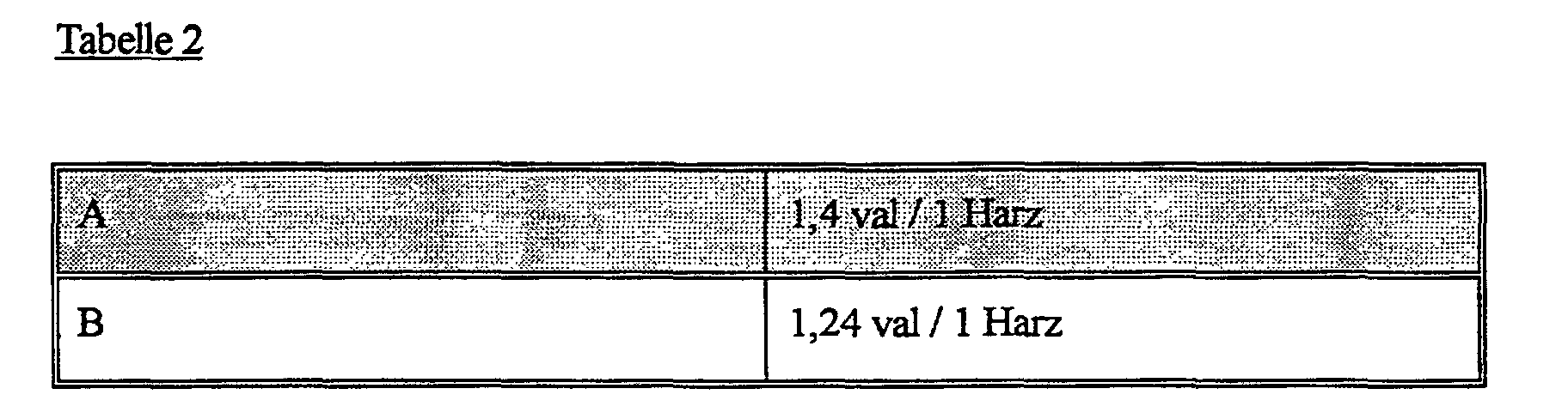
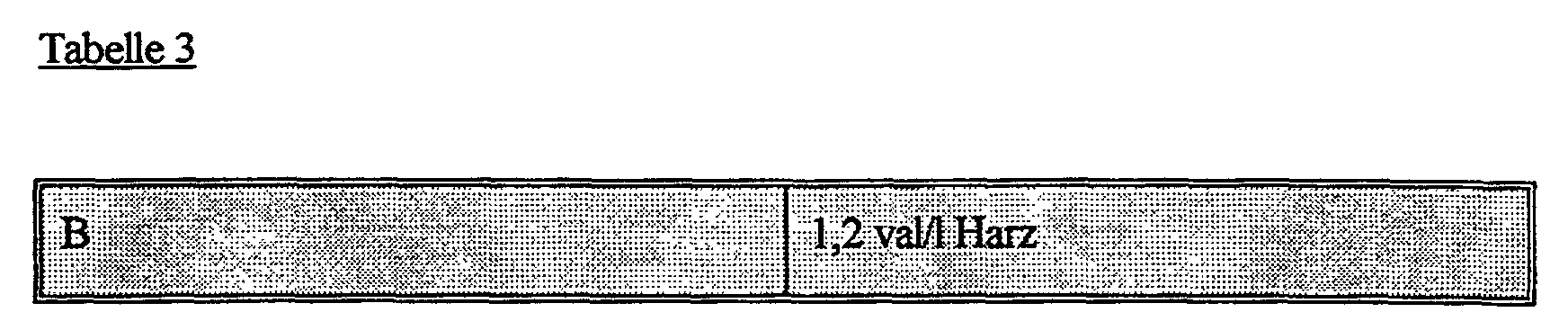
- a gel-shaped strongly acidic ion exchanger was examined and a macroporous one highly cross-linked resin based on polystyrene with sulfonate groups as functional Group.
- the gel-like strongly acidic ion exchange resin is referred to as A and the macroporous highly cross-linked ion exchange resin with B.
- resin A shows less due to the lack of cross-linking Strength and is chemically less stable, but has a higher capacity than that Mechanically and chemically resistant resin B, which has a high degree of cross-linking having.
- the hydroxyl number, pH value, ester number, Color number and acid number determined.
- the hydroxyl number and the ester number remained unchanged.
- all values were within the permissible limits and were for the Color number even fallen below. That means the PTHF does not come with additional coloring components from the respective ion exchange resin and / or Regeneration and washing fluids were burdened, but was even decolorized.
Landscapes
- Chemical & Material Sciences (AREA)
- Organic Chemistry (AREA)
- Chemical Kinetics & Catalysis (AREA)
- Health & Medical Sciences (AREA)
- Medicinal Chemistry (AREA)
- Polymers & Plastics (AREA)
- General Chemical & Material Sciences (AREA)
- Polyethers (AREA)
- Organic Low-Molecular-Weight Compounds And Preparation Thereof (AREA)
- Addition Polymer Or Copolymer, Post-Treatments, Or Chemical Modifications (AREA)
- Saccharide Compounds (AREA)
Description
Selbst nach einer Verweildauer von mehr als 24 Stunden ist für die Abtrennung des Fällproduktes aus der PTHF-Lösung noch eine zweistufige Filtration über Filter großer Feinheit erforderlich. Die Filter müssen häufig gewechselt werden, was manuell geschieht und daher aufwendig ist, und der Filterrückstand muß entsorgt werden. Außerdem ist es in größeren Zeitabständen erforderlich, den in den Apparaturen abgelagerten Schlamm manuell zu entfernen.
Die zum Austausch befähigten, H+-Ionen abgebenden funktionellen Gruppen des Ionenaustauscherharzes sind an ein organisches polymeres Grundgerüst über Benzolringe gebundene Sulfonsäurengruppen. In wässrigen Medien sind diese Gruppen praktisch vollständig dissoziert, so daß H+-Ionen einfach gegen andere Kationen ausgetauscht werden können. Im Gegensatz dazu ist in methanolischer Lösung der Dissoziationsgrad nur gering. Es wurde erkannt, daß Natriummethylat zunächst in Methanol und Natriumionen hydrolysiert werden muß. Hierzu dient die erfindungsgemäß vorgesehene katalytische Menge Wasser. Es hat sich gezeigt, daß die Reaktionsgeschwindigkeit vom Wassergehalt entscheidend beinflußt wird, wobei dieser wiederum vom Dissoziationsgrad der Sulfonsäuregruppen und des Natriumhydroxids, das sich aus der Hydrolyse des Natriummethylats in Methanol und Natriumlauge bildet, abhängig ist.

Claims (7)
- Verfahren zur Herstellung hydroxylgruppenhaltiger Polymere, insbesondere zur Herstellung von Polytetrahydrofuran mit endständigen Hydroxylgruppen, aus den entsprechenden acyloxygruppenhaltigen Polymeren durch Umesterung mit Alkoholen in Gegenwart eines natriumhaltigen Katalysators, bei dem die Polytetrahydrofuran-Lösung im Anschluß an die Umesterung zur Abtrennung der Natrium-Kationen in Gegenwart einer katalytischen Menge Wasser direkt durch zumindest einen Ionenaustauscher geleitet wird.
- Verfahren nach Anspruch 1, dadurch gekennzeichnet, daß ein Ionenaustauscher-Festbett verwendet wird.
- Verfahren nach Anspruch 1 oder 2, dadurch gekennzeichnet, daß ein gelförmiger, starksaurer Kationenaustauscher verwendet wird.
- Verfahren nach Anspruch 1 oder 2, dadurch gekennzeichnet, daß als Ionenaustauscher ein makroporös hochvernetzter starksaurer Kationenaustauscher verwendet wird.
- Verfahren nach einem der Ansprüche 1 bis 4, dadurch gekennzeichnet, daß zumindest zwei hintereinandergeschaltete Ionenaustauscher verwendet werden, wobei zunächst nur der erste Ionenaustauscher beladen wird, bis die Na+-Konzentration der Polytetrahydrofuran-Lösung nach Durchlaufen des Ionenaustauschers einen vorherbestimmten Höchstwert erreicht, und wobei nach Erreichen des Höchstwertes beide Ionenaustauscher bis in etwa zum Durchbruch des Ionenaustauscherharzes des ersten Ionenaustauschers gemeinsam verwendet werden.
- Verfahren nach Anspruch 5, dadurch gekennzeichnet, daß der vorherbestimmte Höchstwert der Na+-Konzentration < 1 ppm beträgt.
- Verfahren nach einem der Ansprüche 1 bis 6, dadurch gekennzeichnet, daß das Ionenaustauscherharz mit verdünnter Mineralsäure regeneriert wird.
Applications Claiming Priority (2)
| Application Number | Priority Date | Filing Date | Title |
|---|---|---|---|
| DE19758296A DE19758296A1 (de) | 1997-12-31 | 1997-12-31 | Herstellung von Polytetrahydrofuran mit endständigen Hydroxylgruppen unter Verwendung von Ionenaustauschern |
| DE19758296 | 1997-12-31 |
Publications (3)
| Publication Number | Publication Date |
|---|---|
| EP0927732A2 EP0927732A2 (de) | 1999-07-07 |
| EP0927732A3 EP0927732A3 (de) | 2002-01-16 |
| EP0927732B1 true EP0927732B1 (de) | 2003-10-08 |
Family
ID=7853620
Family Applications (1)
| Application Number | Title | Priority Date | Filing Date |
|---|---|---|---|
| EP98124438A Expired - Lifetime EP0927732B1 (de) | 1997-12-31 | 1998-12-22 | Herstellung von Polytetrahydrofuran mit endständigen Hydroxylgruppen unter Verwendung von Ionenaustauschern |
Country Status (7)
| Country | Link |
|---|---|
| US (1) | US6037381A (de) |
| EP (1) | EP0927732B1 (de) |
| JP (1) | JPH11255885A (de) |
| KR (1) | KR100545594B1 (de) |
| AT (1) | ATE251651T1 (de) |
| DE (2) | DE19758296A1 (de) |
| ES (1) | ES2209047T3 (de) |
Families Citing this family (19)
| Publication number | Priority date | Publication date | Assignee | Title |
|---|---|---|---|---|
| DE19817113A1 (de) * | 1998-04-17 | 1999-10-21 | Basf Ag | Herstellung von Polytetrahydrofuran mit endständigen Hydroxylgruppen durch Wechsel von kontinuierlicher und disperser Phase |
| DE10112116A1 (de) * | 2001-03-14 | 2002-09-19 | Basf Ag | Verfahren zur Herstellung von Polyetherolen mit definiertem CPR-Wert |
| DE10140949A1 (de) * | 2001-08-21 | 2003-03-06 | Basf Ag | Verfahren zur Herstellung einer alkoholischen Lösung von Polytetrahydrofuran mit endständigen OH-Gruppen |
| DE10330721A1 (de) | 2003-07-08 | 2005-01-27 | Basf Ag | Verfahren zur Gewinnung von Oligomeren des Polytetrahydrofurans oder der Tetrahydrofuran-Copolymere |
| DE102004058888A1 (de) | 2004-12-06 | 2006-06-08 | Basf Ag | Verfahren zur Herstellung von N,N-Dimethylacetamid (DMAC) |
| DE102004058887A1 (de) | 2004-12-06 | 2006-06-08 | Basf Ag | Verfahren zur Herstellung von N,N-Dimethylacetamid (DMAC) |
| DE102004058886A1 (de) | 2004-12-06 | 2006-06-08 | Basf Ag | Verfahren zur Herstellung von N,N-Dimethylacetamid (DMAC) |
| US8308363B2 (en) | 2006-05-23 | 2012-11-13 | Kraft Foods Global Brands Llc | Package integrity indicator for container closure |
| US8408792B2 (en) | 2007-03-30 | 2013-04-02 | Kraft Foods Global Brands Llc | Package integrity indicating closure |
| GB0819200D0 (en) | 2008-10-20 | 2008-11-26 | Cadbury Holdings Ltd | Packaging |
| KR20110092326A (ko) * | 2008-11-27 | 2011-08-17 | 바스프 에스이 | 증류에 의한 분리 장치 |
| CN102887995B (zh) | 2011-07-19 | 2016-08-03 | 因温斯特技术公司 | 聚醚多元醇过滤中的改进的产物回收方法 |
| CN102887996B (zh) | 2011-07-19 | 2016-03-16 | 因温斯特技术公司 | 聚醚多元醇过滤中的聚合物回收方法 |
| EP2864392A4 (de) * | 2012-06-22 | 2015-12-23 | Invista Technologies Srl | Verbesserter alkanolyseprozess und verfahren zur trennung von katalysatoren aus einem produktgemisch und vorrichtung dafür |
| JP6337415B2 (ja) * | 2013-03-01 | 2018-06-06 | 三菱ケミカル株式会社 | ポリアルキレンエーテルグリコールの製造方法 |
| US20160208042A1 (en) | 2013-10-01 | 2016-07-21 | Basf Se | Multi-component epoxy resin composition |
| EP3069789B1 (de) * | 2015-03-19 | 2017-10-04 | Evonik Degussa GmbH | Verfahren zur abtrennung von kationen aus einem isophoronnitril-produktgemisch |
| CN110193221B (zh) * | 2019-05-20 | 2021-11-09 | 中国石化长城能源化工(宁夏)有限公司 | 一种清洗聚四氢呋喃装置板框压滤机滤布的方法 |
| US12515212B2 (en) | 2022-10-12 | 2026-01-06 | Covestro Llc | Processes for purifying polyether polyols using ion exchange resins |
Family Cites Families (2)
| Publication number | Priority date | Publication date | Assignee | Title |
|---|---|---|---|---|
| US4985551A (en) * | 1988-12-29 | 1991-01-15 | Basf Corporation | Process for purification of catalysts from polyols using ion exchange resins |
| US5410093A (en) * | 1994-02-17 | 1995-04-25 | E. I. Du Pont De Nemours And Company | Method for removing transesterification catalyst from polyether polyols |
-
1997
- 1997-12-31 DE DE19758296A patent/DE19758296A1/de not_active Withdrawn
-
1998
- 1998-11-13 KR KR1019980048705A patent/KR100545594B1/ko not_active Expired - Lifetime
- 1998-12-22 AT AT98124438T patent/ATE251651T1/de not_active IP Right Cessation
- 1998-12-22 DE DE59809861T patent/DE59809861D1/de not_active Expired - Lifetime
- 1998-12-22 EP EP98124438A patent/EP0927732B1/de not_active Expired - Lifetime
- 1998-12-22 ES ES98124438T patent/ES2209047T3/es not_active Expired - Lifetime
- 1998-12-25 JP JP10369373A patent/JPH11255885A/ja active Pending
- 1998-12-28 US US09/220,776 patent/US6037381A/en not_active Expired - Lifetime
Also Published As
| Publication number | Publication date |
|---|---|
| EP0927732A3 (de) | 2002-01-16 |
| KR100545594B1 (ko) | 2006-04-14 |
| KR19990062572A (ko) | 1999-07-26 |
| DE19758296A1 (de) | 1999-07-01 |
| EP0927732A2 (de) | 1999-07-07 |
| ATE251651T1 (de) | 2003-10-15 |
| DE59809861D1 (de) | 2003-11-20 |
| ES2209047T3 (es) | 2004-06-16 |
| US6037381A (en) | 2000-03-14 |
| JPH11255885A (ja) | 1999-09-21 |
Similar Documents
| Publication | Publication Date | Title |
|---|---|---|
| EP0927732A2 (de) | Herstellung von Polytetrahydrofuran mit endständigen Hydroxylgruppen unter Verwendung von Ionenaustauschern | |
| DE3520006C2 (de) | Wasseraufbereitungsverfahren | |
| EP1209125B1 (de) | Verfahren zur Rückgewinnung von fluorierten Alkansäuren aus Abwässern | |
| DE69725584T2 (de) | Filterschicht und deren verwendung zur reinigung einer fotoresistzusammensetzung | |
| DE69802781T2 (de) | Verfahren zur physikalish-chemischen behandlung von wasser, insbesondere von für den verbrauch bestimmtem oberflächenwasser | |
| DE69723577T2 (de) | Reinigungsverfahren ionischer polymeren | |
| DE69012508T2 (de) | Verfahren zum Entfernen von Sulfationen aus wässrigen Alkalimetallchloridlösungen. | |
| DE69503476T2 (de) | Verfahren zur entfernung von umesterungskatalysatoren aus polyethenpolyolen | |
| DE69017907T2 (de) | Reinigung von wasserstoffperoxyd. | |
| DE69817937T2 (de) | Beladene Ionenaustauscherharze, deren Herstellung und Verwendungen | |
| DE19635291B4 (de) | Verfahren zur Herstellung von Polyether | |
| EP0209789A2 (de) | Verfahren zum Beseitigen von Verunreinigungen aus Gemischen von Wasser mit mit Wasser mischbaren Lösungsmitteln | |
| DE3528598A1 (de) | Verfahren zur reinigung und entsorgung von russ- und asche-haltigen abwaessern | |
| EP0589977B2 (de) | Verfahren und vorrichtung zur synthese von butindiol | |
| DE60006595T2 (de) | Verfahren zur Entfernung von Metallen aus einer Zitronensäure enthaltenden Reinigungslösung | |
| DE60317652T2 (de) | Verfahren zur Reinigung von Polyetherpolyolen | |
| EP0038009B1 (de) | Verfahren zur Herstellung von hydroxylgruppenhaltigen Polymeren | |
| DE60113464T2 (de) | Verfahren zum entionisieren und klären des in einer funkenerosionsmaschine verwendeten wässrigen mediums und bei dem verfahren verwendetes produkt | |
| DE2510309A1 (de) | Verfahren und anlage zur trennung von substanzgemischen | |
| EP1423453B1 (de) | Verfahren zur herstellung einer alkoholischen lösung von polytetrahydrofuran mit endständigen oh-gruppen | |
| DE69007027T2 (de) | Verfahren zur abwasserbehandlung. | |
| EP0158269B1 (de) | Verfahren zur Bereitung und Reinigung wässriger Calciumhydroxid-Lösungen | |
| DE3880196T2 (de) | Verfahren zur mineralsalzentziehung aus zucker enthaltenden loesungen. | |
| DE3109524A1 (de) | Verfahren zur aufbereitung von feinguthaltigen abwaessern | |
| DE69405256T2 (de) | Verfahren zur Herstellung von Dicyclopentenyloxyethanol |
Legal Events
| Date | Code | Title | Description |
|---|---|---|---|
| PUAI | Public reference made under article 153(3) epc to a published international application that has entered the european phase |
Free format text: ORIGINAL CODE: 0009012 |
|
| AK | Designated contracting states |
Kind code of ref document: A2 Designated state(s): AT BE CH CY DE DK ES FI FR GB GR IE IT LI LU MC NL PT SE Kind code of ref document: A2 Designated state(s): AT BE CH DE ES FR GB IT LI NL |
|
| AX | Request for extension of the european patent |
Free format text: AL;LT;LV;MK;RO;SI |
|
| PUAL | Search report despatched |
Free format text: ORIGINAL CODE: 0009013 |
|
| RIC1 | Information provided on ipc code assigned before grant |
Free format text: 7C 08G 65/20 A, 7B 01J 39/04 B, 7B 01J 49/00 B, 7C 08F 6/08 B, 7C 08G 65/30 B, 7C 08J 5/20 B |
|
| AK | Designated contracting states |
Kind code of ref document: A3 Designated state(s): AT BE CH CY DE DK ES FI FR GB GR IE IT LI LU MC NL PT SE |
|
| AX | Request for extension of the european patent |
Free format text: AL;LT;LV;MK;RO;SI |
|
| 17P | Request for examination filed |
Effective date: 20020711 |
|
| AKX | Designation fees paid |
Free format text: AT BE CH DE ES FR GB IT LI NL |
|
| 17Q | First examination report despatched |
Effective date: 20021022 |
|
| GRAH | Despatch of communication of intention to grant a patent |
Free format text: ORIGINAL CODE: EPIDOS IGRA |
|
| GRAS | Grant fee paid |
Free format text: ORIGINAL CODE: EPIDOSNIGR3 |
|
| GRAA | (expected) grant |
Free format text: ORIGINAL CODE: 0009210 |
|
| AK | Designated contracting states |
Kind code of ref document: B1 Designated state(s): AT BE CH DE ES FR GB IT LI NL |
|
| REG | Reference to a national code |
Ref country code: GB Ref legal event code: FG4D Free format text: NOT ENGLISH |
|
| REG | Reference to a national code |
Ref country code: CH Ref legal event code: EP |
|
| REG | Reference to a national code |
Ref country code: IE Ref legal event code: FG4D Free format text: GERMAN |
|
| REF | Corresponds to: |
Ref document number: 59809861 Country of ref document: DE Date of ref document: 20031120 Kind code of ref document: P |
|
| GBT | Gb: translation of ep patent filed (gb section 77(6)(a)/1977) |
Effective date: 20031117 |
|
| REG | Reference to a national code |
Ref country code: ES Ref legal event code: FG2A Ref document number: 2209047 Country of ref document: ES Kind code of ref document: T3 |
|
| REG | Reference to a national code |
Ref country code: IE Ref legal event code: FD4D |
|
| ET | Fr: translation filed | ||
| PLBE | No opposition filed within time limit |
Free format text: ORIGINAL CODE: 0009261 |
|
| STAA | Information on the status of an ep patent application or granted ep patent |
Free format text: STATUS: NO OPPOSITION FILED WITHIN TIME LIMIT |
|
| 26N | No opposition filed |
Effective date: 20040709 |
|
| PGFP | Annual fee paid to national office [announced via postgrant information from national office to epo] |
Ref country code: FR Payment date: 20041208 Year of fee payment: 7 |
|
| PGFP | Annual fee paid to national office [announced via postgrant information from national office to epo] |
Ref country code: AT Payment date: 20041213 Year of fee payment: 7 |
|
| PGFP | Annual fee paid to national office [announced via postgrant information from national office to epo] |
Ref country code: ES Payment date: 20041229 Year of fee payment: 7 Ref country code: CH Payment date: 20041229 Year of fee payment: 7 |
|
| PG25 | Lapsed in a contracting state [announced via postgrant information from national office to epo] |
Ref country code: AT Free format text: LAPSE BECAUSE OF NON-PAYMENT OF DUE FEES Effective date: 20051222 |
|
| PG25 | Lapsed in a contracting state [announced via postgrant information from national office to epo] |
Ref country code: ES Free format text: LAPSE BECAUSE OF NON-PAYMENT OF DUE FEES Effective date: 20051223 |
|
| PG25 | Lapsed in a contracting state [announced via postgrant information from national office to epo] |
Ref country code: LI Free format text: LAPSE BECAUSE OF NON-PAYMENT OF DUE FEES Effective date: 20051231 Ref country code: CH Free format text: LAPSE BECAUSE OF NON-PAYMENT OF DUE FEES Effective date: 20051231 |
|
| REG | Reference to a national code |
Ref country code: CH Ref legal event code: PL |
|
| PG25 | Lapsed in a contracting state [announced via postgrant information from national office to epo] |
Ref country code: FR Free format text: LAPSE BECAUSE OF NON-PAYMENT OF DUE FEES Effective date: 20060831 |
|
| REG | Reference to a national code |
Ref country code: FR Ref legal event code: ST Effective date: 20060831 |
|
| REG | Reference to a national code |
Ref country code: ES Ref legal event code: FD2A Effective date: 20051223 |
|
| PGFP | Annual fee paid to national office [announced via postgrant information from national office to epo] |
Ref country code: NL Payment date: 20081203 Year of fee payment: 11 |
|
| PGFP | Annual fee paid to national office [announced via postgrant information from national office to epo] |
Ref country code: IT Payment date: 20081223 Year of fee payment: 11 |
|
| PGFP | Annual fee paid to national office [announced via postgrant information from national office to epo] |
Ref country code: GB Payment date: 20081217 Year of fee payment: 11 |
|
| PGFP | Annual fee paid to national office [announced via postgrant information from national office to epo] |
Ref country code: BE Payment date: 20090119 Year of fee payment: 11 |
|
| BERE | Be: lapsed |
Owner name: *BASF A.G. Effective date: 20091231 |
|
| REG | Reference to a national code |
Ref country code: NL Ref legal event code: V1 Effective date: 20100701 |
|
| GBPC | Gb: european patent ceased through non-payment of renewal fee |
Effective date: 20091222 |
|
| PG25 | Lapsed in a contracting state [announced via postgrant information from national office to epo] |
Ref country code: NL Free format text: LAPSE BECAUSE OF NON-PAYMENT OF DUE FEES Effective date: 20100701 Ref country code: BE Free format text: LAPSE BECAUSE OF NON-PAYMENT OF DUE FEES Effective date: 20091231 |
|
| PG25 | Lapsed in a contracting state [announced via postgrant information from national office to epo] |
Ref country code: GB Free format text: LAPSE BECAUSE OF NON-PAYMENT OF DUE FEES Effective date: 20091222 |
|
| PG25 | Lapsed in a contracting state [announced via postgrant information from national office to epo] |
Ref country code: IT Free format text: LAPSE BECAUSE OF NON-PAYMENT OF DUE FEES Effective date: 20091222 |
|
| PGFP | Annual fee paid to national office [announced via postgrant information from national office to epo] |
Ref country code: DE Payment date: 20180228 Year of fee payment: 20 |
|
| REG | Reference to a national code |
Ref country code: DE Ref legal event code: R071 Ref document number: 59809861 Country of ref document: DE |