EP0924976B1 - Zusammenstellung für synthetische samen - Google Patents
Zusammenstellung für synthetische samen Download PDFInfo
- Publication number
- EP0924976B1 EP0924976B1 EP97934395A EP97934395A EP0924976B1 EP 0924976 B1 EP0924976 B1 EP 0924976B1 EP 97934395 A EP97934395 A EP 97934395A EP 97934395 A EP97934395 A EP 97934395A EP 0924976 B1 EP0924976 B1 EP 0924976B1
- Authority
- EP
- European Patent Office
- Prior art keywords
- water
- synthetic seed
- seed
- synthetic
- matrix
- Prior art date
- Legal status (The legal status is an assumption and is not a legal conclusion. Google has not performed a legal analysis and makes no representation as to the accuracy of the status listed.)
- Expired - Lifetime
Links
Images



Classifications
-
- A—HUMAN NECESSITIES
- A01—AGRICULTURE; FORESTRY; ANIMAL HUSBANDRY; HUNTING; TRAPPING; FISHING
- A01H—NEW PLANTS OR NON-TRANSGENIC PROCESSES FOR OBTAINING THEM; PLANT REPRODUCTION BY TISSUE CULTURE TECHNIQUES
- A01H4/00—Plant reproduction by tissue culture techniques ; Tissue culture techniques therefor
- A01H4/005—Methods for micropropagation; Vegetative plant propagation using cell or tissue culture techniques
- A01H4/006—Encapsulated embryos for plant reproduction, e.g. artificial seeds
Definitions
- This invention relates generally to plant reproduction, and in particular to a synthetic seed and a method for the manufacture thereof.
- Synthetic seeds generally include a plant propagule, embedded in various supporting materials.
- a plant propagule is understood herein to be any plant tissue which is capable of developing into a complete plant when subject to suitable conditions, including somatic embryos, zygotic embryos, germ-line tissue and the like.
- a synthetic seed comprising, a plant propagule capable of producing an entire plant, and an encapsulating material including a finely divided substantially biologically and chemically inert filler, a binder and water, the synthetic seed having a prescribed/selected water activity, such that propagule viability is maintained and germination will occur when exposed to germination permissive conditions, and to provide sufficient mechanical strength/hardness for use with mechanical seeding devices.
- a method for the manufacture of a synthetic seed comprising
- a finely divided material, biologically and chemically inert towards materials it is in contact with including clays, minerals, and some botanical materials, e.g. silica, kaolin and cellulose.
- a material or condition causing the adhesion of filler particles to one another and to plant tissue surfaces examples include polymers with or without cross-linking agents, ionic solutes, temperature, pH.
- Specific materials include hydrated gels, e.g. sodium alginate, and other similar materials such as those described in USP 4,777,762.
- filler e.g. silica
- binder e.g. sodium alginate
- a divalent cation e.g. calcium
- a material which adsorbs or absorbs water also called a sorptive agent or a drying agent..
- the process used to transfer synthetic seed from a storage container to a planting medium The process used to transfer synthetic seed from a storage container to a planting medium.
- aqueous dispersion including silica in the range of 30% (i.e., 0.01 parts alginate, 0.3 parts silica, 0.69 parts water. If beads of equivalent volume were prepared and dried, our bead would have about 19.4 times the mass of the Timbert et al. formulation.
- the patent of Redenbaugh (US Patent 4,777,762) describes a propagule - e.g. a range of 0 to 99 % relative humidity - encapsulated in a gel and dried below 99.9% of saturation. No filler is present. The saturation level is presumably the maximum water holding capacity of the gel. This would include all levels of hydration from wet gel to dry solid. According to the present invention, the level of hydration is adjusted to result in a predetermined water activity, which is within the range that is compatible with the propagule.
- the water activity range may be specific to each propagule type or source.
- Our process comprises a means to determine the water activity required by the propagule, a means for providing the required water activity in the artificial seed, and a means for controlling the rate at which the water activity is adjusted.
- the advantages are that the water activity is optimized for storage stability of the synthetic seed, and the procedure can be adapted to the specific propagule.
- We are not aware of any disclosures in which the optimal water activity is related to the water content of an encapsulating material.
- silica or other suitable fillers described herein, provides a bead of adequate size, shape, and mass for the required handling characteristics.
- Silica was selected as one example of a filler having negligible water absorbing property: that is, at high water activity, the matrix bead has low water content.
- fillers have been used as a means to retain size, shape and mass in a formulation that is also designed to retain the necessary water activity/content for viability of embryos. Most often fillers have not been used and the coated embryos have lacked the desired size, mass, or shape for use as seed substitutes when dehydrated.
- the formulation permits dehydration to a water content at which water activity may be high (e.g., 97% RH) but the corresponding water content is low (e.g., ca. 4.5% water [water/dry matter]).
- the result is a bead which has the handling characteristics of a natural seed (hard and dry feel) but provides a water activity sufficiently high for survival of the propagule, without sufficient free water for germination to occur.
- We are not aware of disclosures in which the water content of synthetic seed is adjusted by controlled rates or increments to a final water activity which will prevent germination, retain viability, while at the same time produce a hard, seed-like structure (e.g. appropriate size, shape and mass).
- Figure 1 is intended to clarify the preceding text by illustrating water sorption.
- the amount of water bound to a surface depends on the water activity to which it is equilibrated (% RH being a measure of water activity).
- % RH being a measure of water activity.
- % RH being a measure of water activity.
- free water will be held by capillation.
- the relationship between the mass of water adsorbed, and water activity, is illustrated in Figure 1. The curve shown is the moisture sorption isotherm.
- the shape of the curve, the RH at which the critical point occurs, and the specific water content at each humidity, are specific to each material.
- the surfaces represent the surface of silica particles and alginate within a synthetic seed matrix.
- the synthetic seed matrix is a porous aggregate of silica particles, bound together with a small amount of alginate (for example, 1 part alginate to 30 parts silica) and water. Due to the low water sorption capacity of silica, the synthetic seed matrix only binds an amount of water equal to approximately 4.5% of its own weight, at 97% RH.
- the fully reconstituted gel (e.g., if the synthetic seed were placed in water and allowed to equilibrate) contains an amount of water that is approximately 220% of the dry weight of the bead.
- Prior disclosures consist of procedures which do not readily separate, or control, the characteristics of rate of water removal and final water activity of synthetic seeds. Precise control over the rate of water removal and over the final water activity is achieved with our method.
- Our method of dehydration can be used to incrementally reduce water potential at desired time intervals over a desired period of time. Direct contact of the hydrated (freshly prepared synthetic seed) with drying agent results in rapid transfer of water, but the mass of water transferred is precisely limited by the mass of drying agent used. Adjustment to a desired water activity by our method can be attained within about 30 minutes.
- the formulation permits rapid transfer of water and nutrients to the embryo, when synthetic seed are placed on a suitable medium.
- the formulation readily rehydrates, equilibrating with the water activity of the medium, and allows sufficient diffusion of nutrients from the medium to the embryo to permit germination.
- the final water content of the synthetic seed will correspond to a water activity at which the embryos will_be germinable when placed under germination-permissive conditions. This water activity is determined by experiment for each variety of embryo used in the synthetic seed.
- This final water content is achieved by using an amount of drying agent determined through a calculation from the moisture sorption property of the desiccant, the moisture desorption property of the matrix and embryo, and the water content of the synthetic seed before drying.
- the synthetic seed is placed either with or separate from the desiccant, in a water vapor impermeable container to prevent gain or loss of water from the environment.
- the synthetic seed is germinated by delivery to a germination medium which supplies the water, nutrient, and temperature requirements of the embryo. These requirements are determined by experiment for each variety of propagule used. It will be appreciated by those skilled in the art that the requirement for nutrients in the germination medium may be replaced by inclusion of nutrients in the synthetic seed.
- alginate encapsulation techniques were adopted as the preferred method for forming an artificial seed matrix.
- a fine powder of amorphous silica was selected to serve as an inert filler, to provide adequate mass for an artificial seed.
- Proportions of silica (the basic matrix material) and alginate binding agent e.g. alginic acid, sodium salt, medium viscosity, Sigma Chemical Company, cat. no. A-2033 were investigated to obtain a suspension with suitable flow characteristics for bead (synthetic seed) formation by calcium complexation (i.e. by calcium chloride) or other sources of divalent cation, and for appropriate size and mass of the resulting bead.
- the appropriate concentration of alginate was first determined using graded amounts of alginate in 40% (w/w) suspensions of silica; the effect of silica concentration was then assessed using 1% alginate.
- the proportions of silica and alginate in each sample are tabulated in Table 1 below, with a description of the resulting bead forming characteristics. Beads were formed by dripping the suspensions from a syringe (standard Luer connector served as aperture for drop formation) from a height of 5 cm into stirring, 50 ml CaCl 2 . Sample No.
- Dispersion Composition (w/w) Description Alginate Silica Dispersion Beads 1 2.00 40 Viscous, poor flowability Beads with a long "tail” were formed 2 1.00 40 Good flowability Nearly spherical beads with a "tail” 3 0.50 40 Low viscosity, flowable Ellipsoidal to cylindrical beads formed; smooth surface. 4 0.25 40 Thin, rapid flowing Large, irregular (puckered) beads formed 5 1.00 50 High viscosity; very poor flowability Beads with a long "tail” formed. 6 1.00 40 Flowable, somewhat viscous Sub-spheroidal beads with smooth surface 7 1.00 30 Good flowability Uniform, spherical beads with smooth surface 8 1.00 20 Good flowability Slightly sub-spheroidal beads with smooth surface
- the water activity required for retention of embryo viability with storage at 20°C was determined by storing embryos under graded water activities (as described above) for 30 days. Germinability was assessed by placing the embryos on a standard germination agar medium. Embryos were observed for viability (defined as greening and size increase) after 6 weeks incubation. The results are shown in Figure 3.
- the matrix In order for the synthetic seed matrix to be compatible with the embryos, the matrix must meet the water activity requirements of the embryo. Sufficient dewatering of the matrix to provide acceptable handling characteristics (hardness) for use in nursery seeding equipment is also required. The moisture sorption and desorption of the selected synseed composition (1:30 mass:mass alginate:silica) at 97% RH was therefore recorded.
- Dewatering of synthetic seeds was accomplished by exposing the wet beads to a desiccant. The purpose was to develop a scaleable procedure in which the rate and extent of water removal could be controlled. Knowledge of the moisture sorption property of the drying agent is required.
- Cellulose powder is provided as one example of a suitable desiccant. Other desiccants can be used, for example silica gel.
- the MSI for the cellulose powder is presented in Figure 5.
- the amount of cellulose required to dry a known mass of synthetic seed matrix to the water activity desired may be calculated as described above.
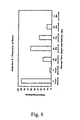
- Prototype synthetic seeds were prepared with interior spruce somatic embryos and a matrix composed of silica and alginate (1:30 alginate:silica mass:mass). The water activity of the synthetic seeds was adjusted to approximately 97% RH by contact with silica gel. The synthetic seeds were stored at about 20°C in sealed containers; samples were tested for germinability at approximately 2 week intervals by placing the synthetic seed on a germination agar medium. The embryos were examined after 6 weeks incubation on the germination medium: the observed characteristics of the synthetic seeds are presented in Figures 7, 8 and 9.
- the data demonstrate that a high percentage of the encapsulated and dried embryos are viable for at least 52 days under 20°C storage.
Landscapes
- Life Sciences & Earth Sciences (AREA)
- Developmental Biology & Embryology (AREA)
- Engineering & Computer Science (AREA)
- Biotechnology (AREA)
- Cell Biology (AREA)
- Botany (AREA)
- Environmental Sciences (AREA)
- Pretreatment Of Seeds And Plants (AREA)
- Organic Low-Molecular-Weight Compounds And Preparation Thereof (AREA)
- Agricultural Chemicals And Associated Chemicals (AREA)
Claims (23)
- Künstlicher Samen umfassend ein Pflanzenfortpflanzungspartikel, das in der Lage ist, eine ganze Pflanze zu erzeugen, und ein Einbettmaterial einschließlich eines feinteiligen, im wesentlichen biologisch und chemisch inerten Füllstoffes, eines Bindemittels und Wasser, dadurch gekennzeichnet, dass das Einbettmaterial in Form einer Matrix vorliegt, die Siliciumdioxid in einer Menge von 95 bis 99 Gew.-%, ein wasserlösliches Harz-Bindemittel in einer Menge von 1 bis 5 Gew.-%, bezogen auf das Gesamttrockengewicht der Matrix, und Wasser umfasst, wobei der künstliche Samen eine Wasseraktivität aufweist, die als relative Feuchtigkeit in Prozent ausgedrückt wird und in einem Bereich eingestellt wird, der mit dem Pflanzenfortpflanzungspartikel verträglich ist, so dass die Lebensfähigkeit des Fortpflanzungspartikels beibehalten wird und Keimung stattfindet, wenn er die Keimung zulassenden Bedingungen ausgesetzt wird, und eine ausreichende mechanische Festigkeit/Härte zur Verwendung mit mechanischen Saatgeräten bereitgestellt wird.
- Künstlicher Samen nach Anspruch 1, worin das Bindemittel ein geeignetes hydratisiertes Gel ist.
- Künstlicher Samen nach Anspruch 2, worin das Bindemittel Natriumalginat mit mittlerer Viskosität ist, das mit einem zweiwertigen Kation komplexiert ist.
- Künstlicher Samen nach Anspruch 3, worin das zweiwertige Kation Calcium ist, das von Calciumchlorid geliefert wird.
- Künstlicher Samen nach Anspruch 3, worin der Füllstoff Siliciumdioxid mit einer Teilchengrößenverteilung von etwa 80 Gew.-% zwischen 1 und 5 Mikron im Durchmesser ist.
- Künstlicher Samen nach Anspruch 5, worin das Siliciumdioxid in einer Menge von etwa 96,7 Gew.-% vorhanden ist und das Alginat in einer Menge von etwa 3,3 Gew.-% vorhanden ist.
- Künstlicher Samen nach Anspruch 1, worin das Pflanzenfortpflanzungspartikel ein Embryo ist.
- Künstlicher Samen nach Anspruch 5, worin die Matrix zusätzlich für die Keimung erforderliche Pflanzennährstoffe umfasst.
- Künstlicher Samen nach Anspruch 1, worin das Pflanzenfortpflanzungspartikel ein ganzer Samen oder ein zygotischer Embryo ist, der aus einem ganzen Samen präpariert worden ist.
- Künstlicher Samen nach Anspruch 8, wobei die Matrix zusätzlich Sucrose in einer Menge von etwa 1,1 Gew.-%, bezogen auf das Trockengewicht der Matrix, und Maltodextrin/Mais-Stärkezuckersirup-Feststoffe in einer Menge von etwa 4,3 Gew.-%, bezogen auf das Trockengewicht der Matrix, umfasst.
- Künstlicher Samen nach Anspruch 1, worin die Wasseraktivität auf einen Bereich von 0 bis 99% relative Feuchtigkeit eingestellt ist.
- Verfahren zur Herstellung eines künstlichen Samens umfassend(a) Bereitstellen eines Pflanzenfortpflanzungspartikels, das in der Lage ist, eine ganze Pflanze zu erzeugen, gekennzeichnet durch(b) Einbetten des Pflanzenfortpflanzungspartikels in ein Material in Form einer Matrix umfassend Siliciumdioxid in einer Menge von 95 bis 99 Gew.-%, ein wasserlösliches Harz-Bindemittel in einer Menge von 1 bis 5 Gew.-%, bezogen auf das Gesamttrockengewicht der Matrix, und Wasser und(c) Einstellen des Wassergehalts des künstlichen Samens zur Bereitstellung einer Wasseraktivität, ausgedrückt als relative Feuchtigkeit in Prozent, in einem Bereich, der mit dem Pflanzenfortpflanzungspartikel verträglich ist, so dass die Lebensfähigkeit des Fortpflanzungspartikels aufrechterhalten bleibt und Keimung stattfindet, wenn er die Keimung zulassenden Bedingungen ausgesetzt wird, und eine ausreichende mechanische Festigkeit/Härte zur Verwendung mit mechanischen Saatgeräten bereitgestellt wird.
- Verfahren nach Anspruch 12, worin in Schritt (c) der Wassergehalt des Pflanzenfortpflanzungspartikels durch Trocknen eingestellt wird.
- Verfahren nach Anspruch 12, worin die Wasseraktivität des Pflanzenfortpflanzungspartikels, ausgedrückt als relative Feuchtigkeit, auf einen mit dem Fortpflanzungspartikel als verträglich bestimmten Bereich von 0% bis 99% eingestellt wird, um eine harte, Trockensamen-ähnliche Struktur bereitzustellen.
- Verfahren nach Anspruch 13, worin die Trocknung durch Einwirken eines Trockenmittels erfolgt.
- Verfahren nach Anspruch 15, worin die Einwirkung des Trockenmittels über Zeitinkremente erfolgt, um eine vorbeschriebene Geschwindigkeit der Dehydratisierung zu ergeben, um die Einstellungsgeschwindigkeit der Wasseraktivität zu steuern.
- Verfahren nach Anspruch 14, worin die Wasseraktivität durch Einwirkung eines Trockenmittels eingestellt wird, dessen Menge nach folgender Beziehung bestimmt wird:nach folgendem abgeschätzt:Md = Masse des erforderlichen TrockenmittelsFWs = Gewicht des zu trocknenden künstlichen Samens vor TrocknungDWs = Trockengewicht des künstlichen Samens, der zu trocknen ist (durch Trocknen einer Probe des künstlichen Samens auf ein konstantes Gewicht bei 105°C abgeschätzt).DWe = Trockengewicht des Embryos (der Embryonen), der (die) in dem künstlichen Samen enthalten ist (sind), der zu trocknen ist.Zahl der Embryonen, von denen bekannt ist, dass sie in dem zu trocknenden künstlichen Samen vorliegen.(i) Trockengewicht einer Probe von Embryonen(ii) Zahl von Embryonen in der getrockneten Probea = Masse (g) von Wasser, das von 1 g Trockenmittel gebunden wird, das auf die Endwasseraktivität für den künstlichen Samen equilibriert ist. Bestimmt aus der Feuchtigkeitssorptionsisotherme des Trockenmittels.b = Masse (g) von Wasser, das von 1 g Embryonen bei der Endwasseraktivität für den künstlichen Samen gebunden wird, bestimmt aus der Feuchtigkeitsdesorptionsisotherme der Embryonen.c = Masse (g) von Wasser, das von 1 g der Matrix bei der Endwasseraktivität für den künstlichen Samen gebunden wird, bestimmt aus der Feuchtigkeitsdesorptionsisotherme der Matrix.
- Verfahren nach Anspruch 12, worin in Schritt (b) das Einbettmaterial in Form einer wässrigen Matrix von Kügelchen vorliegt, die durch Eintropfen einer wässrigen Dispersion von Siliciumdioxid und Bindemittel in eine wässrige Lösung eines zweiwertigen Kations gebildet wird.
- Verfahren nach Anspruch 18, worin in Schritt (b) das Bindemittel Natriumalginat mit mittlerer Viskosität ist, das mit Calciumchlorid komplexiert ist.
- Verfahren nach Anspruch 19, worin der Füllstoff Siliciumdioxid mit einer Teilchengrößenverteilung von etwa 80 Gew.-% zwischen 1 und 5 Mikron im Durchmesser ist.
- Verfahren nach Anspruch 12, worin das Pflanzenfortpflanzungspartikel ein Embryo ist.
- Verfahren nach Anspruch 15, worin das Trockenmittel ausgewählt ist aus der Gruppe bestehend aus Cellulosepulver und Silicagel.
- Verfahren nach Anspruch 12, worin das Pflanzenfortpflanzungspartikel ein ganzer Samen oder ein zygotischer Embryo, der aus dem ganzen Samen präpariert wurde, ist.
Applications Claiming Priority (3)
| Application Number | Priority Date | Filing Date | Title |
|---|---|---|---|
| US08/692,949 US5737872A (en) | 1996-08-07 | 1996-08-07 | Formulation for synthetic seed |
| US692949 | 1996-08-07 | ||
| PCT/CA1997/000552 WO1998005192A1 (en) | 1996-08-07 | 1997-08-07 | Formulation for synthetic seed |
Publications (2)
| Publication Number | Publication Date |
|---|---|
| EP0924976A1 EP0924976A1 (de) | 1999-06-30 |
| EP0924976B1 true EP0924976B1 (de) | 2003-07-02 |
Family
ID=24782720
Family Applications (1)
| Application Number | Title | Priority Date | Filing Date |
|---|---|---|---|
| EP97934395A Expired - Lifetime EP0924976B1 (de) | 1996-08-07 | 1997-08-07 | Zusammenstellung für synthetische samen |
Country Status (8)
| Country | Link |
|---|---|
| US (1) | US5737872A (de) |
| EP (1) | EP0924976B1 (de) |
| AU (1) | AU724769B2 (de) |
| CA (1) | CA2262102A1 (de) |
| DE (1) | DE69723275D1 (de) |
| DK (1) | DK0924976T3 (de) |
| NZ (1) | NZ333939A (de) |
| WO (1) | WO1998005192A1 (de) |
Families Citing this family (4)
| Publication number | Priority date | Publication date | Assignee | Title |
|---|---|---|---|---|
| US20050256001A1 (en) * | 2003-10-14 | 2005-11-17 | Global Protein Products, Inc. | Method for treating crops to enhance plant performance |
| US11032968B2 (en) | 2015-04-01 | 2021-06-15 | Blue Marble Scientific, Llc | Device for delivering plant seeds |
| CN104798498B (zh) * | 2015-04-29 | 2016-08-17 | 广西大学 | 一种杉木人工种子的制备方法 |
| WO2020205764A1 (en) | 2019-04-02 | 2020-10-08 | Corn Products Development, Inc. | Aflatoxin biocontrol composition |
Family Cites Families (8)
| Publication number | Priority date | Publication date | Assignee | Title |
|---|---|---|---|---|
| US4562663A (en) * | 1982-10-12 | 1986-01-07 | Plant Genetics, Inc. | Analogs of botanic seed |
| JPS61501007A (ja) * | 1984-01-13 | 1986-05-22 | プラント・ジェネティクス・インコ−ポレ−テッド | ハイドロゲルカプセルの被覆 |
| US4777762A (en) * | 1986-01-07 | 1988-10-18 | Plant Genetics, Inc. | Desiccated analogs of botanic seed |
| JP2553147B2 (ja) * | 1988-05-02 | 1996-11-13 | 麒麟麦酒株式会社 | 糖類の徐放性粒子、その製造法および利用 |
| JPH0231624A (ja) * | 1988-07-21 | 1990-02-01 | Noboru Kaimori | 人工種子の製造方法 |
| US5093130A (en) * | 1989-09-26 | 1992-03-03 | Plant Genetics | Powder coated hydrogel capsules |
| US5427593A (en) * | 1990-10-26 | 1995-06-27 | Weyerhaeuser Company | Analogs of botanic seed |
| WO1993003609A1 (fr) * | 1991-08-20 | 1993-03-04 | Kirin Beer Kabushiki Kaisha | Semence artificielle auto-dehiscente |
-
1996
- 1996-08-07 US US08/692,949 patent/US5737872A/en not_active Expired - Fee Related
-
1997
- 1997-08-07 WO PCT/CA1997/000552 patent/WO1998005192A1/en not_active Ceased
- 1997-08-07 NZ NZ333939A patent/NZ333939A/xx unknown
- 1997-08-07 CA CA002262102A patent/CA2262102A1/en not_active Abandoned
- 1997-08-07 DK DK97934395T patent/DK0924976T3/da active
- 1997-08-07 EP EP97934395A patent/EP0924976B1/de not_active Expired - Lifetime
- 1997-08-07 DE DE69723275T patent/DE69723275D1/de not_active Expired - Lifetime
- 1997-08-07 AU AU37638/97A patent/AU724769B2/en not_active Ceased
Also Published As
| Publication number | Publication date |
|---|---|
| AU724769B2 (en) | 2000-09-28 |
| WO1998005192A1 (en) | 1998-02-12 |
| EP0924976A1 (de) | 1999-06-30 |
| CA2262102A1 (en) | 1998-02-12 |
| DK0924976T3 (da) | 2003-10-20 |
| AU3763897A (en) | 1998-02-25 |
| US5737872A (en) | 1998-04-14 |
| NZ333939A (en) | 2000-09-29 |
| DE69723275D1 (de) | 2003-08-07 |
Similar Documents
| Publication | Publication Date | Title |
|---|---|---|
| US3905152A (en) | Coated seeds | |
| AU591235B2 (en) | Desiccated analogs of botanic seed | |
| US4780987A (en) | Method for the preparation of hydrated, pregerminated seeds in gel capsules | |
| Teng et al. | Agarose hydrogel composite supports microgreen cultivation with enhanced porosity and continuous water supply under terrestrial and microgravitational conditions | |
| TWI676413B (zh) | 經粒化種子 | |
| US7921598B2 (en) | Gel-coated seed | |
| SK283839B6 (sk) | Spôsob predĺženia skladovateľnosti aktivovaných nevyklíčených semien | |
| CN105813453A (zh) | 播种单元及其用途 | |
| EP1063881A1 (de) | Reifen von somatischen embryonen | |
| US5737872A (en) | Formulation for synthetic seed | |
| Sakamoto et al. | Delivery systems for tissue culture by encapsulation | |
| JPH11123024A (ja) | 肥料培地 | |
| Hermann et al. | Formalin-casein enhances water absorbency of calcium alginate beads and activity of encapsulated Metarhizium brunneum and Saccharomyces cerevisiae | |
| EP1166614B1 (de) | Verfahren zum Verhindern von gestörtem Keimen oder Wachstum von Planzen | |
| CN1315366C (zh) | 凝胶包衣种子 | |
| Pill et al. | Matric and osmotic priming of Echinacea purpurea (L.) Moench seeds | |
| Timbert et al. | Physico‐chemical properties of the encapsulation matrix and germination of carrot somatic embryos | |
| JP2000228902A (ja) | 種子のコート材およびコート種子 | |
| US20070000169A1 (en) | Method to improve plant somatic embryo germination from manufactured seed | |
| Pill | Granular gels as growth media for tomato seedlings | |
| JP2017018075A (ja) | 人工土壌培地用固化剤、及び人工土壌培地の調製方法 | |
| JPH01218516A (ja) | 水稲稚苗の育生方法 | |
| JP2579128B2 (ja) | ゲル状給水剤 | |
| JP3919970B2 (ja) | 種子のコート材およびコート種子 | |
| AU2003259579B2 (en) | Maturation of Somatic Embryos |
Legal Events
| Date | Code | Title | Description |
|---|---|---|---|
| PUAI | Public reference made under article 153(3) epc to a published international application that has entered the european phase |
Free format text: ORIGINAL CODE: 0009012 |
|
| 17P | Request for examination filed |
Effective date: 19990301 |
|
| AK | Designated contracting states |
Kind code of ref document: A1 Designated state(s): BE DE DK ES FI FR GB IE IT LU NL PT SE |
|
| RIN1 | Information on inventor provided before grant (corrected) |
Inventor name: DUNSTAN, DAVID, I. Inventor name: CARRIER, DANIELLE, JULIE Inventor name: CUNNINGHAM, JAMES, E. |
|
| GRAG | Despatch of communication of intention to grant |
Free format text: ORIGINAL CODE: EPIDOS AGRA |
|
| 17Q | First examination report despatched |
Effective date: 20020227 |
|
| GRAG | Despatch of communication of intention to grant |
Free format text: ORIGINAL CODE: EPIDOS AGRA |
|
| GRAH | Despatch of communication of intention to grant a patent |
Free format text: ORIGINAL CODE: EPIDOS IGRA |
|
| GRAH | Despatch of communication of intention to grant a patent |
Free format text: ORIGINAL CODE: EPIDOS IGRA |
|
| GRAA | (expected) grant |
Free format text: ORIGINAL CODE: 0009210 |
|
| AK | Designated contracting states |
Designated state(s): BE DE DK ES FI FR GB IE IT LU NL PT SE |
|
| PG25 | Lapsed in a contracting state [announced via postgrant information from national office to epo] |
Ref country code: NL Free format text: LAPSE BECAUSE OF FAILURE TO SUBMIT A TRANSLATION OF THE DESCRIPTION OR TO PAY THE FEE WITHIN THE PRESCRIBED TIME-LIMIT Effective date: 20030702 Ref country code: IT Free format text: LAPSE BECAUSE OF FAILURE TO SUBMIT A TRANSLATION OF THE DESCRIPTION OR TO PAY THE FEE WITHIN THE PRE;WARNING: LAPSES OF ITALIAN PATENTS WITH EFFECTIVE DATE BEFORE 2007 MAY HAVE OCCURRED AT ANY TIME BEFORE 2007. THE CORRECT EFFECTIVE DATE MAY BE DIFFERENT FROM THE ONE RECORDED.SCRIBED TIME-LIMIT Effective date: 20030702 Ref country code: FR Free format text: LAPSE BECAUSE OF FAILURE TO SUBMIT A TRANSLATION OF THE DESCRIPTION OR TO PAY THE FEE WITHIN THE PRESCRIBED TIME-LIMIT Effective date: 20030702 Ref country code: BE Free format text: LAPSE BECAUSE OF FAILURE TO SUBMIT A TRANSLATION OF THE DESCRIPTION OR TO PAY THE FEE WITHIN THE PRESCRIBED TIME-LIMIT Effective date: 20030702 |
|
| REG | Reference to a national code |
Ref country code: GB Ref legal event code: FG4D |
|
| REG | Reference to a national code |
Ref country code: IE Ref legal event code: FG4D |
|
| PG25 | Lapsed in a contracting state [announced via postgrant information from national office to epo] |
Ref country code: LU Free format text: LAPSE BECAUSE OF NON-PAYMENT OF DUE FEES Effective date: 20030807 Ref country code: IE Free format text: LAPSE BECAUSE OF NON-PAYMENT OF DUE FEES Effective date: 20030807 |
|
| REF | Corresponds to: |
Ref document number: 69723275 Country of ref document: DE Date of ref document: 20030807 Kind code of ref document: P |
|
| PGFP | Annual fee paid to national office [announced via postgrant information from national office to epo] |
Ref country code: GB Payment date: 20030924 Year of fee payment: 7 |
|
| PGFP | Annual fee paid to national office [announced via postgrant information from national office to epo] |
Ref country code: SE Payment date: 20030926 Year of fee payment: 7 |
|
| PGFP | Annual fee paid to national office [announced via postgrant information from national office to epo] |
Ref country code: FI Payment date: 20030929 Year of fee payment: 7 Ref country code: DK Payment date: 20030929 Year of fee payment: 7 |
|
| PG25 | Lapsed in a contracting state [announced via postgrant information from national office to epo] |
Ref country code: PT Free format text: LAPSE BECAUSE OF FAILURE TO SUBMIT A TRANSLATION OF THE DESCRIPTION OR TO PAY THE FEE WITHIN THE PRESCRIBED TIME-LIMIT Effective date: 20031002 |
|
| PG25 | Lapsed in a contracting state [announced via postgrant information from national office to epo] |
Ref country code: DE Free format text: LAPSE BECAUSE OF FAILURE TO SUBMIT A TRANSLATION OF THE DESCRIPTION OR TO PAY THE FEE WITHIN THE PRESCRIBED TIME-LIMIT Effective date: 20031003 |
|
| PG25 | Lapsed in a contracting state [announced via postgrant information from national office to epo] |
Ref country code: ES Free format text: LAPSE BECAUSE OF FAILURE TO SUBMIT A TRANSLATION OF THE DESCRIPTION OR TO PAY THE FEE WITHIN THE PRESCRIBED TIME-LIMIT Effective date: 20031013 |
|
| REG | Reference to a national code |
Ref country code: SE Ref legal event code: TRGR |
|
| NLV1 | Nl: lapsed or annulled due to failure to fulfill the requirements of art. 29p and 29m of the patents act | ||
| PLBE | No opposition filed within time limit |
Free format text: ORIGINAL CODE: 0009261 |
|
| STAA | Information on the status of an ep patent application or granted ep patent |
Free format text: STATUS: NO OPPOSITION FILED WITHIN TIME LIMIT |
|
| REG | Reference to a national code |
Ref country code: IE Ref legal event code: MM4A |
|
| 26N | No opposition filed |
Effective date: 20040405 |
|
| EN | Fr: translation not filed | ||
| PG25 | Lapsed in a contracting state [announced via postgrant information from national office to epo] |
Ref country code: GB Free format text: LAPSE BECAUSE OF NON-PAYMENT OF DUE FEES Effective date: 20040807 Ref country code: FI Free format text: LAPSE BECAUSE OF NON-PAYMENT OF DUE FEES Effective date: 20040807 |
|
| PG25 | Lapsed in a contracting state [announced via postgrant information from national office to epo] |
Ref country code: SE Free format text: LAPSE BECAUSE OF NON-PAYMENT OF DUE FEES Effective date: 20040808 |
|
| PG25 | Lapsed in a contracting state [announced via postgrant information from national office to epo] |
Ref country code: DK Free format text: LAPSE BECAUSE OF NON-PAYMENT OF DUE FEES Effective date: 20040831 |
|
| EUG | Se: european patent has lapsed | ||
| GBPC | Gb: european patent ceased through non-payment of renewal fee |
Effective date: 20040807 |
|
| REG | Reference to a national code |
Ref country code: DK Ref legal event code: EBP |