EP0923842B1 - System for preventing electronic memory tampering - Google Patents
System for preventing electronic memory tampering Download PDFInfo
- Publication number
- EP0923842B1 EP0923842B1 EP97939691A EP97939691A EP0923842B1 EP 0923842 B1 EP0923842 B1 EP 0923842B1 EP 97939691 A EP97939691 A EP 97939691A EP 97939691 A EP97939691 A EP 97939691A EP 0923842 B1 EP0923842 B1 EP 0923842B1
- Authority
- EP
- European Patent Office
- Prior art keywords
- hash value
- memory
- electronic device
- hash
- audit
- Prior art date
- Legal status (The legal status is an assumption and is not a legal conclusion. Google has not performed a legal analysis and makes no representation as to the accuracy of the status listed.)
- Expired - Lifetime
Links
Images





Classifications
-
- G—PHYSICS
- G06—COMPUTING OR CALCULATING; COUNTING
- G06F—ELECTRIC DIGITAL DATA PROCESSING
- G06F21/00—Security arrangements for protecting computers, components thereof, programs or data against unauthorised activity
- G06F21/50—Monitoring users, programs or devices to maintain the integrity of platforms, e.g. of processors, firmware or operating systems
- G06F21/55—Detecting local intrusion or implementing counter-measures
- G06F21/56—Computer malware detection or handling, e.g. anti-virus arrangements
- G06F21/562—Static detection
- G06F21/565—Static detection by checking file integrity
-
- H—ELECTRICITY
- H04—ELECTRIC COMMUNICATION TECHNIQUE
- H04L—TRANSMISSION OF DIGITAL INFORMATION, e.g. TELEGRAPHIC COMMUNICATION
- H04L63/00—Network architectures or network communication protocols for network security
- H04L63/12—Applying verification of the received information
- H04L63/123—Applying verification of the received information received data contents, e.g. message integrity
-
- H—ELECTRICITY
- H04—ELECTRIC COMMUNICATION TECHNIQUE
- H04L—TRANSMISSION OF DIGITAL INFORMATION, e.g. TELEGRAPHIC COMMUNICATION
- H04L9/00—Cryptographic mechanisms or cryptographic arrangements for secret or secure communications; Network security protocols
- H04L9/06—Cryptographic mechanisms or cryptographic arrangements for secret or secure communications; Network security protocols the encryption apparatus using shift registers or memories for block-wise or stream coding, e.g. DES systems or RC4; Hash functions; Pseudorandom sequence generators
- H04L9/0643—Hash functions, e.g. MD5, SHA, HMAC or f9 MAC
-
- H—ELECTRICITY
- H04—ELECTRIC COMMUNICATION TECHNIQUE
- H04L—TRANSMISSION OF DIGITAL INFORMATION, e.g. TELEGRAPHIC COMMUNICATION
- H04L9/00—Cryptographic mechanisms or cryptographic arrangements for secret or secure communications; Network security protocols
- H04L9/32—Cryptographic mechanisms or cryptographic arrangements for secret or secure communications; Network security protocols including means for verifying the identity or authority of a user of the system or for message authentication, e.g. authorization, entity authentication, data integrity or data verification, non-repudiation, key authentication or verification of credentials
- H04L9/3236—Cryptographic mechanisms or cryptographic arrangements for secret or secure communications; Network security protocols including means for verifying the identity or authority of a user of the system or for message authentication, e.g. authorization, entity authentication, data integrity or data verification, non-repudiation, key authentication or verification of credentials using cryptographic hash functions
- H04L9/3239—Cryptographic mechanisms or cryptographic arrangements for secret or secure communications; Network security protocols including means for verifying the identity or authority of a user of the system or for message authentication, e.g. authorization, entity authentication, data integrity or data verification, non-repudiation, key authentication or verification of credentials using cryptographic hash functions involving non-keyed hash functions, e.g. modification detection codes [MDCs], MD5, SHA or RIPEMD
-
- H—ELECTRICITY
- H04—ELECTRIC COMMUNICATION TECHNIQUE
- H04L—TRANSMISSION OF DIGITAL INFORMATION, e.g. TELEGRAPHIC COMMUNICATION
- H04L9/00—Cryptographic mechanisms or cryptographic arrangements for secret or secure communications; Network security protocols
- H04L9/32—Cryptographic mechanisms or cryptographic arrangements for secret or secure communications; Network security protocols including means for verifying the identity or authority of a user of the system or for message authentication, e.g. authorization, entity authentication, data integrity or data verification, non-repudiation, key authentication or verification of credentials
- H04L9/3247—Cryptographic mechanisms or cryptographic arrangements for secret or secure communications; Network security protocols including means for verifying the identity or authority of a user of the system or for message authentication, e.g. authorization, entity authentication, data integrity or data verification, non-repudiation, key authentication or verification of credentials involving digital signatures
-
- H—ELECTRICITY
- H04—ELECTRIC COMMUNICATION TECHNIQUE
- H04L—TRANSMISSION OF DIGITAL INFORMATION, e.g. TELEGRAPHIC COMMUNICATION
- H04L9/00—Cryptographic mechanisms or cryptographic arrangements for secret or secure communications; Network security protocols
- H04L9/32—Cryptographic mechanisms or cryptographic arrangements for secret or secure communications; Network security protocols including means for verifying the identity or authority of a user of the system or for message authentication, e.g. authorization, entity authentication, data integrity or data verification, non-repudiation, key authentication or verification of credentials
- H04L9/3271—Cryptographic mechanisms or cryptographic arrangements for secret or secure communications; Network security protocols including means for verifying the identity or authority of a user of the system or for message authentication, e.g. authorization, entity authentication, data integrity or data verification, non-repudiation, key authentication or verification of credentials using challenge-response
-
- H—ELECTRICITY
- H04—ELECTRIC COMMUNICATION TECHNIQUE
- H04W—WIRELESS COMMUNICATION NETWORKS
- H04W12/00—Security arrangements; Authentication; Protecting privacy or anonymity
- H04W12/10—Integrity
-
- H—ELECTRICITY
- H04—ELECTRIC COMMUNICATION TECHNIQUE
- H04W—WIRELESS COMMUNICATION NETWORKS
- H04W12/00—Security arrangements; Authentication; Protecting privacy or anonymity
- H04W12/12—Detection or prevention of fraud
- H04W12/126—Anti-theft arrangements, e.g. protection against subscriber identity module [SIM] cloning
-
- H—ELECTRICITY
- H04—ELECTRIC COMMUNICATION TECHNIQUE
- H04L—TRANSMISSION OF DIGITAL INFORMATION, e.g. TELEGRAPHIC COMMUNICATION
- H04L2209/00—Additional information or applications relating to cryptographic mechanisms or cryptographic arrangements for secret or secure communication H04L9/00
- H04L2209/80—Wireless
-
- H—ELECTRICITY
- H04—ELECTRIC COMMUNICATION TECHNIQUE
- H04L—TRANSMISSION OF DIGITAL INFORMATION, e.g. TELEGRAPHIC COMMUNICATION
- H04L63/00—Network architectures or network communication protocols for network security
- H04L63/08—Network architectures or network communication protocols for network security for authentication of entities
- H04L63/0823—Network architectures or network communication protocols for network security for authentication of entities using certificates
-
- H—ELECTRICITY
- H04—ELECTRIC COMMUNICATION TECHNIQUE
- H04W—WIRELESS COMMUNICATION NETWORKS
- H04W12/00—Security arrangements; Authentication; Protecting privacy or anonymity
- H04W12/06—Authentication
-
- H—ELECTRICITY
- H04—ELECTRIC COMMUNICATION TECHNIQUE
- H04W—WIRELESS COMMUNICATION NETWORKS
- H04W12/00—Security arrangements; Authentication; Protecting privacy or anonymity
- H04W12/60—Context-dependent security
- H04W12/69—Identity-dependent
- H04W12/71—Hardware identity
-
- H—ELECTRICITY
- H04—ELECTRIC COMMUNICATION TECHNIQUE
- H04W—WIRELESS COMMUNICATION NETWORKS
- H04W88/00—Devices specially adapted for wireless communication networks, e.g. terminals, base stations or access point devices
- H04W88/02—Terminal devices
Definitions
- the invention relates to a system for preventing electronic memory manipulation, and in particular, to methods and apparatuses for preventing unauthorized manipulation of desirably secure memory contents in an electronic device.
- the invention disclosed herein relates to any electronic device whose memory contents are to be maintained in a secure or preferably unaltered state. Such a requirement may be necessitated by security reasons, such as preventing fraudulent manipulation of a cellular telephone memory, or for the purposes maintaining the integrity of electronic device operation in critical applications such as aircraft control or medical instrument operation.
- exemplary aspects of the invention are set out in the context of a system and method for securing one or more electronic memories within a cellular telephone.
- a system that permits access to, and manipulation of, one or more electronic memories in an electronic device, by use of a data transfer device that undergoes an authentication process before being permitted to access an electronic memory.
- FIG. 1 A simplified layout of a cellular communications system is depicted in Figure 1.
- Mobile telephones M1-M10 communicate with the fixed part of a public switched network by transmitting radio signals to, and receiving radio signals from, cellular base stations B1-B10.
- the cellular base stations B1-B10 are, in turn, connected to the public switched network via a Mobile Switching Center (MSC).
- MSC Mobile Switching Center
- Each base station B1-B 10 transmits signals within a corresponding area, or "cell" C1-C10.
- an idealized arrangement of base stations are organized so that the cells substantially cover an area in which mobile telephone communication ordinarily occurs (e.g., a metropolitan area), with a minimum amount of overlap.
- the mobile telephone When a user activates a mobile telephone within a cell, the mobile telephone transmits a signal indicating the mobile telephone's presence to the cell's base station.
- the mobile telephone transmits the signal, which may include its ESN, in a designated set-up channel that is continuously monitored by each base station.
- the base station receives the mobile telephone's signal, it registers the mobile telephone's presence within the cell. This process can be repeated periodically so that the mobile telephone is appropriately registered in the event that it moves into another cell.
- a telephone company central office recognizes the number as a mobile telephone and forwards the call to the MSC.
- the MSC sends a paging message to certain base stations based on the dialed mobile telephone number and current registration information.
- One or more of the base stations transmits a page on its set-up channel.
- the dialed mobile telephone recognizes its identification on the set-up channel, and responds to the base station page.
- the mobile telephone also follows an instruction to tune to an assigned voice channel and then initiates ringing.
- a signaling tone is transmitted to the base station, and both sides release the voice channel.
- a central office exchange can identify a particular subscriber to be billed for use of a telephone set by the communication line to which it is physically attached.
- fraudulent use of a subscriber's account typically requires that a physical connection be made to the subscriber's line. This presents a risk of discovery to a would-be fraudulent user.
- ESN electronic serial number
- the Mobile Identification Number identifies a subscriber, while the ESN identifies the actual hardware being used by the subscriber. Accordingly, it is expected that the MIN corresponding to a particular ESN can, due to subscribers purchasing new equipment, change over time.
- the MIN is a 34-bit binary number derived from a 10-digit directory telephone number, while the ESN is a 32-bit binary number that uniquely identifies a mobile telephone.
- the ESN is typically set by the mobile telephone manufacturer.
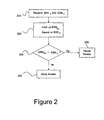
- a conventional authentication method utilized in setting up communications in, for example, the Advanced Mobile Phone System (AMPS), is illustrated by the flowchart depicted in Figure 2.
- a base station receives both an ESN and a MIN from the mobile telephone at block 200. These identification codes are designated ESN m and MIN m to indicate that they are received from the mobile telephone.
- the base station retrieves an ESN sys which corresponds to MIN m from a system memory. ESN sys is then compared with ESN m at block 204. If the two serial numbers are the same, the flow proceeds to block 206 and system access is permitted. Otherwise, system access is denied at block 208.
- U.S. Patent No. 5,386,486 which describes a method of registering an identification number in a personal communication terminal with a service carrier.
- EP 0 583 100 A describes a number assignment module setting system for a portable telephone set in which illegal setting of a number assignment module in the portable telephone is prevented.
- each mobile telephone is associated with a unique secret key that is stored both in the mobile telephone and in a database in the network.
- An algorithm which is unique to the system, is stored in each mobile telephone and in desired network nodes.
- the network calculates an "expected" response based on the same challenge and network-stored secret key.
- the network receives the mobile telephone's calculated response. and compares the mobile telephone's calculated response with the network's calculated response. If a mismatch occurs, appropriate actions will take place, e.g., access is denied or a warning flag is set.
- a method for carrying out an authentication check between a base station and a mobile telephone in a mobile radio system is set out in U.S. Patent No. 5,282,250 to P. Dent et al.
- a cellular telephone's software is reprogrammed with so that it can use several MIN/ESN pairs in a practice called "tumbling."
- a cellular telephone programmed with a tumbling routine randomly scrolls through and selects a MIN/ESN pair to initiate a call.
- the MIN/ESN pairs are invalidated.
- the tumbling routine When an invalid MIN/ESN pair is encountered when attempting to make a call, the tumbling routine simply cancels that MIN/ESN pair and continues scrolling until a valid MIN/ESN pair is found. After all of the MIN/ESN pairs programmed into the cellular telephone are invalidated, the telephone user typically returns to the cloner to have a new set of MIN/ESN pairs programmed into the cellular telephone.
- FIG. 3 depicts a block diagram of a conventional cellular telephone memory and processor arrangement.
- a controller 300 communicates with a ROM or flash program memory 320, an EEPROM 310, and a random access memory (RAM) 330, using a memory bus 308.
- the program memory 320 is a nonvolatile read/write memory that is used to store the majority of code used for general operation of the cellular telephone.
- the EEPROM 310 is used to store the MIN/ESN pair 314 and 316, and user profile information 312 (e.g., speed dialing numbers) and the RAM is used for read/write scratchpad memory.
- Cloners have been known to monitor messaging between the memories and the controller 300 to gather information that is used to bypass or modify information stored in the flash memory 320 or the EEPROM 310.
- One such technique involves removing the original EEPROM 310 containing the ESN 314 and replacing it. Following its removal, the EEPROM is studied to decipher its contents. The deciphered contents are then used to program a replacement EEPROM with a misappropriated ESN/MIN pair from a valid user's account.
- This technique may be attractive to the cloner if he or she only wants to change one ESN at one time. But the technique is labor intensive and poorly skilled cloners may damage printed circuits if not extremely careful.
- a large step in cloning sophistication involves analyzing a telephone's microprocessor program code and rewriting one or more sections of the code to transmit a fraudulent identity (ESN/MIN pair) to a cellular base station.
- ESN/MIN pair a fraudulent identity
- This often involves reverse engineering portions of the telephone hardware design, and requires significant understanding of imbedded software design.
- the obvious advantage of this method is that once the modification is complete, the telephone can be reprogrammed with a new identity as often as desired.
- the most sophisticated attacks combine alterations of the cellular telephone's microprocessor code as described above, in combination with hardware modification.
- One example of this technique uses a so-called "shadow memory" to avoid detection by conventional memory validation routines which only execute during the boot-up process when the cellular telephone is first turned on.
- the boot-up process is carried out pursuant to a small portion of boot code 304 contained in the controller 300 (see Figure 3)
- the boot-up process configures the cellular telephone into an in-service condition and sets a program counter in the microprocessor 301 to an appropriate location in the flash memory 320.
- the controller 300 may illuminate an LED 318 (or other equivalent signal) indicating to a user that the telephone is in service.
- a cloner can monitor a connection 306 between the controller 300 and the LED 318 to subvert the execution of normal operating code in the flash memory 320 as described in more detail as follows.
- the flash memory 320 contained in a typical modem cellular telephone has an addressable capacity of 512K.
- a cloner may remove the flash memory 320, and replace it with a 1024K shadow memory 322 after copying the contents of the original flash memory 320 into the first 512K of the 1024K shadow memory 322.
- the cloner may then monitor a signal available in the telephone which indicates the boot process is complete (such as the LED signal 306) in order to switch all future program memory accesses to the shadow memory 322. Thereafter the cellular telephone operates in accordance with instructions found in the, shadow memory 322 which memory can be programmed to contain tumbling routine code and corresponding MIN/ESN pairs.
- WO 91/09484 describes a security technique in which access to memory areas in a mobile ratio telephone is allowed only by CPU instructions fetched from a ROM.
- FR 2 681 965 describes a system for protecting a memory against being written to upon the occurrence of certain events.
- Other systems for preventing fraudulent use and/or tampering are described in U.S. Patents No. 5,046,082 which describes a remote accessing system for cellular telephones which hinders unauthorized access and tampering with cellular telephone programming and No. 5,442,645 which describes checking the integrity of a program or data in which a signature calculated by the processing circuits of a portable object is compared to an original message signature.
- the present ability of a manufacturer or its factory authorized service representatives to program cellular telephones makes it easy to replace cellular telephones that are not operating properly. For example, if a subscriber's cellular telephone is not operating properly, the subscriber can obtain a new unit from a factory authorized representative and have it programmed to contain the same electronic "personality" of the old unit.
- the electronic personality of a cellular telephone includes not only the ESN, but also the user profile and a substantial amount of information programmed into the unit by the subscriber such as personal and/or business telephone numbers. Repair/replacement programs and the technology to make quick and easy ESN and other memory changes to cellular telephones have been developed at the insistence of cellular service providers who do not want their subscribers to be inconvenienced by defective terminals.
- ⁇ 22.919 may have on the cellular industry's ability to upgrade systems is demonstrated as follows.
- ⁇ 22.919 in its present form
- neither a manufacturer, a manufacturer's authorized service representative nor a cellular carrier will be able to make such software changes.
- the only way a carrier will be able to offer a subscriber a system enhancement will be to require the subscriber to purchase a new cellular telephone.
- security is achieved by periodically auditing electronic memory contents in an electronic device to ensure that the contents have not been tampered with.
- the audit involves performing a hash calculation over selected contents of the electronic memory to derive an audit hash value, or audit signature, of such contents.
- the audit hash value is compared with a valid hash value previously derived from authentic memory contents.
- the valid hash value is preferably stored in an encrypted form within an electronic memory and decrypted only for purposes of comparison.
- a disparity between the audit hash value and the valid hash value indicates memory tampering, wherefore an electronic device containing the electronic memory is rendered inoperative.
- a controller 400 controls operation of a cellular telephone (see, e.g., reference 1204 in Figure 12).
- the controller 400 operates in conjunction with a flash program memory 420, an electronically erasable programmable read only memory (EEPROM) 410, and a random access memory (RAM) 408.
- the controller 400 includes a microprocessor 402 and an internal read-only memory (IROM) 403.
- the IROM 403 contains boot code 404, hashing code 405, authentication code 409, and a public encryption key 406.
- the controller 400 also contains a protected static random access memory (PSRAM) 407, an interrupt controller 421, and hardware-based timers 401 for initiating periodic hash calculations by the microprocessor 402 on selected memory contents.
- PSRAM protected static random access memory
- the EEPROM 410 includes user profile data 412, an ESN 414, a MIN 416, and a signed/unsigned valid hash value pair 418. Instruction code involved with the general operation of the cellular telephone is contained in the flash program memory 420.
- the RAM memory 408 is used as a scratchpad for operations which are part of the normal cellular telephone call processing. Operations involving sensitive data, hash value calculations and authentication processes are preferably carried out in conjunction with the PSRAM 407.
- the controller 400 communicates with the flash program memory 420, the RAM 408 and the EEPROM 410 via memory bus 424.
- FIG. 5 A process for telephone power-up and memory validation for the system depicted in Figure 4, according to an exemplary embodiment of the invention, is illustrated in Figure 5.
- boot code 404 within the IROM 403 is executed by the microprocessor 402 to initialize the controller (block 500).
- Hash code 405 contained in the IROM 403 is then run to perform an audit hash value calculation over selected contents of the flash program memory 420 and the ESN value 414 stored in EEPROM 410 (block 502).
- the controller then authenticates the signed valid hash value pair 418 stored in the EEPROM 410 (block 504). This may involve authenticating the signed valid hash value by processing it with a public key 406 and then comparing the result with the unsigned hash value.
- the authenticated hash value is then stored in PSRAM 407 (block 506).
- the audit hash valve derived at block 502 is then compared with the authenticated hash valve derived at block 504 (block 508). If the two hash values match, a microprocessor program counter is set to an appropriate location in the flash memory 420, and a periodic hash value calculation process is enabled (block 510), whereafter the cellular telephone begins normal operation (block 512). If the hash values do not match at block 508, the system is put into an infinite loop (block 514), or is otherwise disabled. The forgoing process prevents a cloner from substituting either a modified program in flash memory or a modified ESN in EEPROM 410, as doing so would cause a hash value mismatch, thereby rendering the telephone inoperable.
- periodic hash value processing can take place in response to the expiration of a timer, or in response to other system events.
- a periodic hash calculation is initiated in response to expiration of a hardware-based timer 401 which causes a non-maskable interrupt (NMI) to be generated.
- NMI non-maskable interrupt
- An NMI is a hardware-oriented interrupt that cannot be "masked" out by software processes. Consequently, a cloner cannot configure shadow code that is designed to disregard an NMI.
- a regular interrupt is also a hardware interrupt that must compete with other regular interrupts from normal cellular telephone events to gain access to microprocessor resources.
- a regular interrupt is acknowledged and processed when it becomes the highest priority interrupt requesting service.
- a non-maskable interrupt causes the microprocessor to immediately retrieve the contents of a next flash or EEPROM memory location scheduled for inclusion in the periodic hash calculation and store it in PSRAM.
- the NMI is preferably a short, top priority variety of interrupt that causes negligible effect on the microprocessor tasks that may be active when the NMI occurs.
- a second, lower priority standard interrupt also is generated by the hardware-based timers 401 which requests service to complete the current segment of the hash value calculation based on the memory byte previously captured by the NMI routine.
- This task may be deferred, as required for normal call processing tasks, for a predefined maximum time (T) before the hardware timer expires and disables the telephone.
- T maximum time
- the maximum time (T) is chosen to be adequate for any legitimate call processing to be completed, the hash calculation segment to be finished, and the hardware timer to be reset to the beginning of its countdown cycle before it expires.
- the strategy of using two types of interrupts to periodically complete a segment of the hash value calculation avoids any degradation in system response while assuring the security check cannot be bypassed by clone software residing in shadow flash memory.
- FIG. 6 A flow diagram depicting an exemplary periodic hash value calculation process in accordance with the invention is illustrated in Figure 6.
- both a NMI and a regular interrupt is generated at block 604 when the T1 counter in hardware timer 401 expires (block 602).
- the system disables or queues regular interrupts for a brief period of time during which the next byte in flash or EEPROM memory required for the hash calculation is copied to PSRAM (block 606). Control is then returned to the task executing when the NMI occurred (block 608).
- the normal interrupt from the hardware-based timer 401 also is serviced (block 610) and a segment of the hash calculation is completed based on the memory byte previously stored in PSRAM (block 616). If the hash value calculation is not yet complete, the hardware-based timers (T1 & T2) 401 are reset to their initial values (block 624) and normal telephone operation continues (block 600) until the next expiration of timer T1. If the timer T2 should expire (block 612) before the regular interrupt is serviced (block 610) the telephone is disabled (block 614). The default expiration of timer T2 (unless the regular interrupt is correctly serviced) prevents a cloner from disabling the periodic hash calculation.
- This periodic piecemeal calculation of the hash value continues until the audit hash value calculation is completed (block 618).
- the previously authenticated hash value is then fetched from PSRAM and compared to the audit hash value (block 620). If there is a match, the hardware-based timers 401 are reset (block 624) and the telephone continues to operate normally (block 600). If there is a mismatch, the system is disabled (block 622), e.g., by placing the microprocessor 402 into a halt condition.
- the selected contents of the cellular telephone memory over which the hash calculation is performed preferably include contents from the flash memory 420 and the ESN within the EEPROM 414. This prevents a cloner from physically removing or modifying either the flash memory or EEPROM and replacing them with a reprogrammed device containing a modified ESN and/or program code designed to defraud the cellular carrier. It is preferable that the memory contents selected, and the hash value calculation used, render the telephone inoperable from modification of even one bit of memory included in the hash value calculation.
- a cellular telephone can be programmed in a secure manner using a data transfer device.
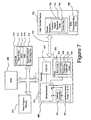
- An exemplary data transfer device in accordance with the invention is shown in Figure 7.
- the reference numbers of the controller 400, its contents, and related memories are identical to the figure references of figure 4.
- the exemplary data transfer device 750 includes a secure microprocessor 752, which contains a private encryption key 754 that corresponds to a public encryption key 406 in the IROM 403 in the controller 400.
- the secure microprocessor 752 communicates with the cellular telephone controller 400 via an interface 758.
- the interface 758 can be a wired serial connection, such as an RS-232 link, a wireless infrared interface, or an RF interface, such as the main antenna of a cellular telephone (not shown), or another antenna within the cellular telephone
- FIG. 8 illustrates an exemplary process for authenticating the data transfer device 750.
- the telephone is brought into an operating condition preferably using the fraud prevention process previously described with respect to Figure 5.
- the secure processor 752 sends a programming request message to the controller 400 along with a random number (Rand1) generated by the secure microprocessor 752 (block 802).
- the controller 400 sends a random number challenge code (Rand2) to the secure microprocessor 752 (block 804).
- the secure microprocessor 752 then generates a challenge response based on Rand1, Rand2, and the private key 754 (block 806).
- the challenge response is then returned to the controller 400 (block 808).
- the challenge response is processed by the controller 400 using Rand1, Rand2, and the public key 406 (block 810).
- the processed challenge response is then authenticated by comparing its value with Rand2 (block 812). If the challenge response decrypts properly (e.g., Rand2), the authenticity of the data transfer device is verified and the telephone enters into a programming mode (block 814). Thereafter the data transfer device 750 can access the various memories in the cellular telephone and/or download new flash memory 420 contents.
- a failure count is incremented (block 816).
- the failure count is checked to see if a predetermined number (maxcount) has been reached (block 818).
- the failure count takes into consideration that the data transfer device 750 may be communicating with the controller 400 over a noisy medium. Any resulting transmission errors may result in authentication failure. Hence, it is preferable to provide the data transfer device 750 with more than one chance to put the cellular telephone into a programming mode. In an exemplary embodiment a maxcount of fifty was determined to be suitable.
- a message is sent to the data transfer device 750 indicating that an authentication failure has occurred (block 822). Upon receiving such an indication, the authentication process is restarted at block 802. If the predetermined number of attempts has been reached, the telephone is put into an inoperable condition and a message can be displayed indicating to a user that the telephone must be returned for authorized service.
- the controller 400 within the telephone initiates a new hash calculation that includes, for example, the revised contents of flash memory 420 and the ESN 414.
- the resulting hash value is sent to the data transfer device 750 for a digital signature using the private key 754.
- the signed hash value is then returned to the controller 400 for storage in the EEPROM 410, along with an unsigned version of the same hash value.
- the ESN can be reprogrammed, but for security reasons, ESN programming is preferably done at the factory level, rather than by authorized factory representatives. Programming of an ESN can occur in two situations: initial ESN programming during manufacturing, and reprogramming an existing ESN.
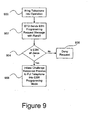
- An initial ESN can be programmed using a data transfer device similar to that of Figure 7. The initial ESN programming process is described below with respect to Figure 9.
- the telephone is brought into an operating condition (see Figure 5).
- the secure processor 752 sends an ESN programming request message to the controller 400 along with a random number (Rand1) (block 902).
- the controller 400 performs a check to determine whether the ESN within the telephone is all zeros which is always the case for a newly manufactured telephone (block 904). If the ESN is not all zeros, the ESN programming mode request is denied (block 906). If the ESN is all zeros, a challenge-response process substantially similar to that set-out in steps-804 through 820 of Figure 8 is initiated (see block 908). Following successful authentication of the data transfer device 750, a new ESN can be downloaded into the EEPROM 410.
- the controller 400 After the data transfer device 750 has completed downloading the ESN into the EEPROM 410, the controller 400 initiates a new hash calculation that includes the new ESN 414. The resulting hash value is sent to the data transfer device 750 for a digital signature using the private key 754. The signed hash value 418 is then returned-to the controller 400 for storage in the EEPROM 410, along with an unsigned version of the same hash value.
- An existing ESN also can be reprogrammed.
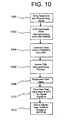
- the ESN reprogramming process is preferably done only at the factory and not by local authorized factory representatives. Added security is provided by utilizing a set of microprocessor instructions, available only at the factory, that are loaded into a telephone for the purpose of changing an ESN previously programmed into the telephone. The process can be carried out using a data transfer device similar that shown in Figure 7 and is described below with respect to Figure 10.
- a factory data transfer device 750 contains ESN reprogramming code 756 that can be downloaded into the PSRAM memory 407 of the cellular telephone to facilitate ESN reprogramming. Having put the system into programming mode, the ESN reprogramming code 756 is downloaded into the PSRAM 407 (block 1002). In executing the ESN reprogramming code 756, the controller 400 zeroes the existing ESN (block 1004) and initiates the ESN reprogramming process (block 1006).
- the controller 400 After the data transfer device 750 has completed entry of the new ESN into the EEPROM 410, the controller 400 initiates a new hash calculation that includes the new ESN 414 (block 1008). The resulting hash value is sent to the data transfer device 750 for a digital signature using the private key 754 (block 1010). The signed hash value 418 is then returned to the controller 400 for storage in the EEPROM 410 along with an unsigned version of the same hash value (block 1012).
- Hash value calculation and digital signature in exemplary embodiments of the present invention are carried out using one-way hashing functions and a private/public key authentication scheme.
- a one-way hash function is used to derive the hash value representative of memory contents within the cellular telephone.
- the public/private key system is used to provide security for the valid hash value stored in EEPROM and authenticate a data transfer device or programmer attempting to manipulate memory in the cellular telephone.
- One-way hashing is known to those skilled in the art, and is described, for example, in U.S. Patent No. 5,343,527 to Moore.
- a one-way hash function is a function that is simple to compute in a forward direction, but difficult to compute in a reverse direction.
- a one-way hash function, H( M ) operates on an arbitrary-length input, M , which in exemplary embodiments of the present invention is comprised of selected electronic memory contents.
- the hash function performed on M returns a fixed-length hash value, h (see Equation 1).
- h H ( M )
- the aim of the one-way hash is to provide a unique signature, or fingerprint of M.
- a secure one-way hash function is performed on selected contents of a cellular telephone memory to produce an audit hash value. The audit hash value is compared to a valid hash value previously produced by performing the one-way hash function on the selected memory contents from memory that is known to be authentic.
- a message digest algorithm such as MD5
- the MD5 algorithm produces an N-bit hash, or message digest, of the input message (i.e., the selected memory contents).
- the MD5 algorithm is very sensitive in that a change in a single bit in the selected contents statistically results in half of the hash value bits changing.
- the MD5 algorithm also is known for its speed and simplicity. Speed is an important consideration in that the time demands placed on the cellular telephone's microprocessor cannot be so great so as to unacceptably interfere with ordinary system processes.
- the MD5 algorithm also is suitable because it can be performed on an incremental basis thereby allowing interruption of the hash process so that a regular microprocessor task can be addressed before hashing is resumed.
- the MD5 algorithm is well suited for use in conventional microprocessor architectures.
- Other one-way hash algorithms that can be used in accordance with embodiments of the present invention include, but are not limited to: Snerfu, H-Hash, MD2, MD4, Secure Hash Algorithm (SHA), and HAVAL.
- Public key algorithms use two keys, one publicly available and one privately held (secret) for tasks such encrypting and decrypting messages, message authentication, and digital signatures.
- the keys can be utilized in different ways to achieve different goals. For example, if the aim is to keep a message secret, the private key should be kept secure by a recipient so only the recipient can decrypt messages. In such a case, the encryption key can be publicly known and known to be associated with a particular potential recipient. Although the sender can be assured of information secrecy in this process, the recipient cannot be assured of sender authenticity.
- Public key algorithms operate based on mathematical trapdoor functions which make it computationally unfeasible to deduce the private key from the public key.
- security depends on the difficulty of factoring the product of two large prime numbers. Key selection begins with the selection of two large prime numbers p and q , which, multiplied together, produce a large number n .
- n p q
- Equation gives the RSA encryption process
- Equation 6 gives the decryption process.
- C M e ( mod n )
- M C d ( mod n )
- Equation 3 An adversary able to factor n could use Equation 3 to determine the modulus, F , and then determine the private key, d , from Equation 4, given the public key e. Nevertheless, as noted above, n is usually so large as to make such factoring impractical. More details on the RSA algorithm can be found in U.S. Patent No. 4,405,829 to Rivest et al.
- the Fiat-Shamir (FS) algorithm or a variant thereof, is utilized (reference is made to U.S. Patent No. 4,748,668 whose contents are incorporated entirely herein by reference).
- the FS algorithm is adapted to implement an authentication and digital signature scheme which is well suited to the limited computational capabilities of typical cellular telephones.
- the FS algorithm is different from previous schemes, such as RSA, in that the FS algorithm uses factors based on the difficulty of finding the inverse of a quadratic residue ( v i ) modulo n . More specifically, the FS scheme involves selecting a number n that is the product of two large prime numbers that are preferably between 512 and 1064 bits in length.
- a public key ( v ): v 1 , v 2 ,... v k , and a private key ( s ): s 1 , s 2 ,...s k , are generated such that s i sqrt(1/ v i )mod n .
- the difficulty in finding the inverses (1/ v i )mod n within the context of the foregoing equation can be shown to be equivalent to the difficulty of finding the factors of the prime number n .
- the algorithm executes much more quickly than other schemes.
- the FS scheme has been found to outperform the RSA scheme in that a FS calculation requires only 1% to 4% of the modular multiplication's normally needed to complete the necessary authentication computations. This corresponds to authentication of the signed hash value at a speed that is up to two orders of magnitude quicker than using a RSA scheme to perform the same task. Consequently, data transfer device authentication and periodic audit hash value comparison can be performed considerably faster using a FS scheme than using a RSA scheme.
- controller hardware within a cellular telephone has security features that prevent a cloner from determining the contents of secure memory or otherwise by-passing the security schemes previously described.
- Figure 11 depicts controller hardware, external memories, and details of a memory/address bus structure. Except for the chip select logic 1122 and the security logic 1124, the function and operation of elements in the controller are the same as described for Figure 4.
- the chip select logic 1122 decodes addresses on the microprocessor address bus 1102 to provide hardware select signals for memory components and hardware devices connected to the bus 1102. For example, any time an address appears on the address bus 1102 which is assigned to the IROM memory 403, an IROM chip select (CS) is enabled.
- CS IROM chip select
- the security logic 1124 functions to detect attempts to access the contents of PSRAM 407 or to reset the hardware-based timers 401 using microprocessor instruction code stored in a memory device other than the IROM memory 403. For example, a read or write instruction located in the flash memory 420 with a target address of a memory location in PSRAM 407 will be detected as an illegal operation. Any illegal access attempt results in the microprocessor being forced into a halt state which requires a complete power reset of the cellular telephone to resume normal operation.
- All legitimate code located in the IROM memory 403 (boot code, hash code, public key code, and authentication code) is preferably bracketed by instructions which cause the security mode to be set at the beginning of a routine and cleared when leaving the routine.
- a software interrupt instruction (commonly available in modem microprocessors) is placed at the beginning of each routine in IROM 403 to switch the microprocessor 402 into a supervisory mode and cause a microprocessor hardware signal SPVR to become active. Since the IROM 403 chip select signal will be active at that time, the security mode S will be set. Executing a return instruction at the end of the software routine cancels the security mode.
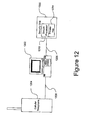
- the data transfer device comprises a factory-supplied security unit that can be used in combination with a general purpose Computer.
- An exemplary arrangement is depicted in Figure 12.
- a security unit 1200 is attached to an I/O port of a PC 1202 via a standard connector 1206.
- a second port on the PC 1202 is used in conjunction with a second standard connector 1208, such as an RS-232, cable or infrared link, to interface with a cellular telephone 1204.
- the processes illustrated in Figure 8 can be performed using the arrangement depicted in Figure 12 to carry out the cellular telephone reprogramming process.
- An authorized factory service representative having a standard PC and a security unit 1200 is equipped to reprogram telephones.
- An existing cellular telephone can be provided with field programming capability that is secure against attacks which do not involve gaining access to the internal printed circuit card assembly. This level of protection is very effective against the most common methods of cloning attacks in which memory contents within the telephone are modified using test commands accessible through an external telephone connector. This can be done by upgrading a current cellular telephone to use the Data Transfer Device (DTD) authentication procedure described in Figure 8 prior to granting access to the field programming commands.
- DTD Data Transfer Device
Landscapes
- Engineering & Computer Science (AREA)
- Computer Security & Cryptography (AREA)
- Computer Networks & Wireless Communication (AREA)
- Signal Processing (AREA)
- Computer Hardware Design (AREA)
- General Engineering & Computer Science (AREA)
- Software Systems (AREA)
- Theoretical Computer Science (AREA)
- Health & Medical Sciences (AREA)
- Virology (AREA)
- Physics & Mathematics (AREA)
- General Physics & Mathematics (AREA)
- General Health & Medical Sciences (AREA)
- Computing Systems (AREA)
- Power Engineering (AREA)
- Mobile Radio Communication Systems (AREA)
- Storage Device Security (AREA)
- Telephone Function (AREA)
Applications Claiming Priority (3)
| Application Number | Priority Date | Filing Date | Title |
|---|---|---|---|
| US08/706,574 US6026293A (en) | 1996-09-05 | 1996-09-05 | System for preventing electronic memory tampering |
| US706574 | 1996-09-05 | ||
| PCT/US1997/015311 WO1998010611A2 (en) | 1996-09-05 | 1997-09-05 | System for preventing electronic memory tampering |
Publications (2)
| Publication Number | Publication Date |
|---|---|
| EP0923842A2 EP0923842A2 (en) | 1999-06-23 |
| EP0923842B1 true EP0923842B1 (en) | 2006-06-07 |
Family
ID=24838185
Family Applications (1)
| Application Number | Title | Priority Date | Filing Date |
|---|---|---|---|
| EP97939691A Expired - Lifetime EP0923842B1 (en) | 1996-09-05 | 1997-09-05 | System for preventing electronic memory tampering |
Country Status (12)
| Country | Link |
|---|---|
| US (1) | US6026293A (enExample) |
| EP (1) | EP0923842B1 (enExample) |
| JP (5) | JP4050322B2 (enExample) |
| KR (1) | KR100492840B1 (enExample) |
| CN (2) | CN1126398C (enExample) |
| AU (1) | AU734212B2 (enExample) |
| BR (1) | BRPI9712007B1 (enExample) |
| DE (1) | DE69736065T2 (enExample) |
| EE (1) | EE9900084A (enExample) |
| ES (1) | ES2262189T3 (enExample) |
| PL (1) | PL332050A1 (enExample) |
| WO (1) | WO1998010611A2 (enExample) |
Families Citing this family (192)
| Publication number | Priority date | Publication date | Assignee | Title |
|---|---|---|---|---|
| US7747243B2 (en) | 1992-03-24 | 2010-06-29 | Boatwright John T | Call security system |
| US5974311A (en) | 1995-10-30 | 1999-10-26 | At&T Wireless Services Inc. | Method and apparatus for storing activation data in a cellular telephone |
| US6748209B2 (en) * | 1995-10-30 | 2004-06-08 | At&T Wireless Services, Inc. | Method and apparatus for storing activation data in a cellular telephone |
| US6097939A (en) * | 1997-07-11 | 2000-08-01 | Compaq Computer Corporation | Method and apparatus for event data maintenance per MIN/ESN pair in a mobile telephone system |
| GB2328843B (en) * | 1997-08-29 | 2002-08-14 | Nokia Mobile Phones Ltd | A system for remotely accessing data stored in a radiotelephone |
| US6230002B1 (en) * | 1997-11-19 | 2001-05-08 | Telefonaktiebolaget L M Ericsson (Publ) | Method, and associated apparatus, for selectively permitting access by a mobile terminal to a packet data network |
| GB2339044B (en) | 1998-03-02 | 2003-06-04 | Lexar Media Inc | Flash memory card with enhanced operating mode detection and user-friendly interfacing system |
| US6182162B1 (en) | 1998-03-02 | 2001-01-30 | Lexar Media, Inc. | Externally coupled compact flash memory card that configures itself one of a plurality of appropriate operating protocol modes of a host computer |
| US6223290B1 (en) * | 1998-05-07 | 2001-04-24 | Intel Corporation | Method and apparatus for preventing the fraudulent use of a cellular telephone |
| US6263445B1 (en) * | 1998-06-30 | 2001-07-17 | Emc Corporation | Method and apparatus for authenticating connections to a storage system coupled to a network |
| US7756986B2 (en) * | 1998-06-30 | 2010-07-13 | Emc Corporation | Method and apparatus for providing data management for a storage system coupled to a network |
| US6665530B1 (en) * | 1998-07-31 | 2003-12-16 | Qualcomm Incorporated | System and method for preventing replay attacks in wireless communication |
| US7110984B1 (en) * | 1998-08-13 | 2006-09-19 | International Business Machines Corporation | Updating usage conditions in lieu of download digital rights management protected content |
| WO2000018162A1 (en) * | 1998-09-18 | 2000-03-30 | Qualcomm Incorporated | Method and apparatus for authenticating embedded software in a remote unit over a communications channel |
| US6460138B1 (en) * | 1998-10-05 | 2002-10-01 | Flashpoint Technology, Inc. | User authentication for portable electronic devices using asymmetrical cryptography |
| US6829712B1 (en) * | 1998-10-27 | 2004-12-07 | Sprint Communications Company L.P. | Object-based security system |
| US6901457B1 (en) | 1998-11-04 | 2005-05-31 | Sandisk Corporation | Multiple mode communications system |
| US6363396B1 (en) * | 1998-12-21 | 2002-03-26 | Oracle Corporation | Object hashing with incremental changes |
| JP3219064B2 (ja) * | 1998-12-28 | 2001-10-15 | インターナショナル・ビジネス・マシーンズ・コーポレーション | デジタルデータ認証システム |
| US6802006B1 (en) * | 1999-01-15 | 2004-10-05 | Macrovision Corporation | System and method of verifying the authenticity of dynamically connectable executable images |
| KR20010101824A (ko) * | 1999-02-09 | 2001-11-14 | 밀러 럿셀 비 | 특정 전화번호부 엔트리 |
| US6370380B1 (en) * | 1999-02-17 | 2002-04-09 | Telefonaktiebolaget Lm Ericsson (Publ) | Method for secure handover |
| DE19911221B4 (de) * | 1999-03-12 | 2005-10-27 | T-Mobile Deutschland Gmbh | Verfahren zur Verteilung von Schlüsseln an Teilnehmer von Kommunikationsnetzen |
| US7103574B1 (en) * | 1999-03-27 | 2006-09-05 | Microsoft Corporation | Enforcement architecture and method for digital rights management |
| FI991134A7 (fi) * | 1999-05-18 | 2000-11-19 | Smarttrust Systems Oy | Ohjelmiston testaus |
| US6502614B1 (en) * | 1999-05-25 | 2003-01-07 | Silverbrook Research Pty Ltd | Printed media transverse binder |
| EP1063589A1 (en) * | 1999-06-25 | 2000-12-27 | TELEFONAKTIEBOLAGET L M ERICSSON (publ) | Device for processing data and corresponding method |
| US7650504B2 (en) * | 1999-07-22 | 2010-01-19 | Macrovision Corporation | System and method of verifying the authenticity of dynamically connectable executable images |
| US7343351B1 (en) | 1999-08-31 | 2008-03-11 | American Express Travel Related Services Company, Inc. | Methods and apparatus for conducting electronic transactions |
| US6708049B1 (en) * | 1999-09-28 | 2004-03-16 | Nellcor Puritan Bennett Incorporated | Sensor with signature of data relating to sensor |
| US6587680B1 (en) * | 1999-11-23 | 2003-07-01 | Nokia Corporation | Transfer of security association during a mobile terminal handover |
| IL133584A (en) * | 1999-12-19 | 2010-02-17 | Enco Tone Ltd | Method for the acoustic encodification of dynamic identification codes |
| US6973570B1 (en) * | 1999-12-31 | 2005-12-06 | Western Digital Ventures, Inc. | Integrated circuit comprising encryption circuitry selectively enabled by verifying a device |
| JP4921670B2 (ja) * | 2000-01-24 | 2012-04-25 | マイクロ・モーション・インコーポレーテッド | ホスト・システムから遠隔位置の信号調整装置を不正操作するのを防止するシステム |
| US6529906B1 (en) | 2000-01-28 | 2003-03-04 | Oracle Corporation | Techniques for DLM optimization with re-mastering events |
| US6751616B1 (en) | 2000-01-28 | 2004-06-15 | Oracle International Corp. | Techniques for DLM optimization with re-mapping responsibility for lock management |
| US6920454B1 (en) | 2000-01-28 | 2005-07-19 | Oracle International Corporation | Techniques for DLM optimization with transferring lock information |
| US7246120B2 (en) | 2000-01-28 | 2007-07-17 | Oracle International Corporation | Techniques for achieving higher availability of resources during reconfiguration of a cluster |
| US7751600B2 (en) * | 2000-04-18 | 2010-07-06 | Semiconductor Energy Laboratory Co., Ltd. | System and method for identifying an individual |
| EP1659758A1 (en) * | 2000-04-26 | 2006-05-24 | Semiconductor Energy Laboratory Co., Ltd. | A communication method for identifying an individual by means of biological information |
| AU2001267459A1 (en) | 2000-05-23 | 2001-12-03 | Actineon Inc. | Programmable communicator |
| US6681304B1 (en) * | 2000-06-30 | 2004-01-20 | Intel Corporation | Method and device for providing hidden storage in non-volatile memory |
| US6721843B1 (en) | 2000-07-07 | 2004-04-13 | Lexar Media, Inc. | Flash memory architecture implementing simultaneously programmable multiple flash memory banks that are host compatible |
| JP3639194B2 (ja) * | 2000-07-27 | 2005-04-20 | 富士通株式会社 | 機種変更装置および機種変更方法ならびに機種変更プログラムを記録した記録媒体 |
| FR2812510B1 (fr) * | 2000-07-28 | 2004-03-19 | Sagem | Procede d'exploitation d'un terminal de telephonie cellulaire et terminal pour la mise en oeuvre du procede |
| US7155559B1 (en) | 2000-08-25 | 2006-12-26 | Lexar Media, Inc. | Flash memory architecture with separate storage of overhead and user data |
| US6618584B1 (en) | 2000-08-30 | 2003-09-09 | Telefonaktiebolaget Lm Ericsson (Publ) | Terminal authentication procedure timing for data calls |
| US6772274B1 (en) | 2000-09-13 | 2004-08-03 | Lexar Media, Inc. | Flash memory system and method implementing LBA to PBA correlation within flash memory array |
| US7043636B2 (en) * | 2000-09-26 | 2006-05-09 | Telefonaktiebolaget Lm Ericsson (Publ) | Data integrity mechanisms for static and dynamic data |
| US20030159047A1 (en) * | 2000-09-26 | 2003-08-21 | Telefonaktiebolaget L M Ericsson (Publ) | Method of securing and exposing a logotype in an electronic device |
| US7058806B2 (en) * | 2000-10-17 | 2006-06-06 | Telefonaktiebolaget Lm Ericsson (Publ) | Method and apparatus for secure leveled access control |
| GB2369205B (en) * | 2000-11-17 | 2005-02-02 | Personal Data Prot System Ltd | Personal data device and protection system and method for storing and protecting personal data |
| US7260636B2 (en) | 2000-12-22 | 2007-08-21 | Emc Corporation | Method and apparatus for preventing unauthorized access by a network device |
| US7668315B2 (en) * | 2001-01-05 | 2010-02-23 | Qualcomm Incorporated | Local authentication of mobile subscribers outside their home systems |
| US7036023B2 (en) * | 2001-01-19 | 2006-04-25 | Microsoft Corporation | Systems and methods for detecting tampering of a computer system by calculating a boot signature |
| AU2001237019A1 (en) * | 2001-02-13 | 2002-08-28 | Qualcomm Incorporated | Method and apparatus for authenticating embedded software in a remote unit over a communications channel |
| US7188243B2 (en) * | 2001-02-16 | 2007-03-06 | Microsoft Corporation | System and method for over the air configuration security |
| CA2441010A1 (en) * | 2001-03-16 | 2002-09-26 | Qualcomm Incorporated | Method and apparatus for providing secure processing and data storage for a wireless communication device |
| US7047405B2 (en) * | 2001-04-05 | 2006-05-16 | Qualcomm, Inc. | Method and apparatus for providing secure processing and data storage for a wireless communication device |
| US6804752B2 (en) * | 2001-04-02 | 2004-10-12 | Delphi Technologies, Inc. | Event data protection method for a flash programmable microprocessor-based control module |
| US20020147918A1 (en) | 2001-04-05 | 2002-10-10 | Osthoff Harro R. | System and method for securing information in memory |
| US7099663B2 (en) | 2001-05-31 | 2006-08-29 | Qualcomm Inc. | Safe application distribution and execution in a wireless environment |
| FI114416B (fi) * | 2001-06-15 | 2004-10-15 | Nokia Corp | Menetelmä elektroniikkalaitteen varmistamiseksi, varmistusjärjestelmä ja elektroniikkalaite |
| KR20030002376A (ko) * | 2001-06-29 | 2003-01-09 | 세이프다임 주식회사 | 공개키 기반 인증을 위한 키관리 시스템 |
| FI115356B (fi) * | 2001-06-29 | 2005-04-15 | Nokia Corp | Menetelmä audiovisuaalisen informaation käsittelemiseksi elektroniikkalaitteessa, järjestelmä ja elektroniikkalaite |
| DE10131575A1 (de) * | 2001-07-02 | 2003-01-16 | Bosch Gmbh Robert | Verfahren zum Schutz eines Mikrorechner-Systems gegen Manipulation von in einer Speicheranordnung des Mikrorechner-Systems gespeicherten Daten |
| US7383432B1 (en) * | 2001-07-09 | 2008-06-03 | Advanced Micro Devices, Inc. | Software modem with hidden authentication commands |
| KR100813944B1 (ko) * | 2001-07-11 | 2008-03-14 | 삼성전자주식회사 | 디지털 권리 운영을 수행하기 위하여 휴대용 기기와컴퓨터 사이의 통신을 제어하는 방법 |
| FI115257B (fi) * | 2001-08-07 | 2005-03-31 | Nokia Corp | Menetelmä informaation käsittelemiseksi elektroniikkalaitteessa, järjestelmä, elektroniikkalaite ja suoritinlohko |
| KR100401135B1 (ko) * | 2001-09-13 | 2003-10-10 | 주식회사 한국전산개발 | 데이터 보안 시스템 |
| US20030059049A1 (en) * | 2001-09-24 | 2003-03-27 | Mihm Thomas J. | Method and apparatus for secure mobile transaction |
| US20030061488A1 (en) * | 2001-09-25 | 2003-03-27 | Michael Huebler | Cloning protection for electronic equipment |
| US7404202B2 (en) * | 2001-11-21 | 2008-07-22 | Line 6, Inc. | System, device, and method for providing secure electronic commerce transactions |
| WO2003071853A2 (en) * | 2002-02-22 | 2003-09-04 | Lexar Media, Inc. | Removable memory media with integral indicator light |
| US20030182561A1 (en) * | 2002-03-25 | 2003-09-25 | International Business Machines Corporation | Tamper detection mechanism for a personal computer and a method of use thereof |
| US7840803B2 (en) | 2002-04-16 | 2010-11-23 | Massachusetts Institute Of Technology | Authentication of integrated circuits |
| US7338443B1 (en) | 2002-04-29 | 2008-03-04 | Tucker Peter L | Secure patient data recorder for recording monitored vital sign data |
| US7054613B2 (en) * | 2002-05-03 | 2006-05-30 | Telefonaktiebolaget Lm Ericsson (Publ) | SIM card to mobile device interface protection method and system |
| GB0211644D0 (en) | 2002-05-21 | 2002-07-03 | Wesby Philip B | System and method for remote asset management |
| US11337047B1 (en) | 2002-05-21 | 2022-05-17 | M2M Solutions Llc | System and method for remote asset management |
| GB0212318D0 (en) * | 2002-05-28 | 2002-07-10 | Symbian Ltd | Tamper evident removable media storing executable code |
| US20030226040A1 (en) * | 2002-06-03 | 2003-12-04 | International Business Machines Corporation | Controlling access to data stored on a storage device of a trusted computing platform system |
| US20040003265A1 (en) * | 2002-06-26 | 2004-01-01 | International Business Machines Corporation | Secure method for BIOS flash data update |
| JP4576100B2 (ja) * | 2002-07-30 | 2010-11-04 | 富士通株式会社 | 情報再生装置、セキュアモジュールおよび情報再生方法 |
| EP1795993B1 (en) * | 2002-07-30 | 2018-02-28 | Fujitsu Limited | Method and apparatus for reproducing information using a security module |
| US7320642B2 (en) * | 2002-09-06 | 2008-01-22 | Wms Gaming Inc. | Security of gaming software |
| WO2004025896A1 (en) * | 2002-09-16 | 2004-03-25 | Telefonaktiebolaget Lm Ericsson (Publ) | Loading data onto an electronic device |
| US20040078536A1 (en) * | 2002-10-22 | 2004-04-22 | Tai-Ming Chen | Authentication mechanism integrated with random access memory and method of use |
| DE60224590T2 (de) * | 2002-11-08 | 2009-01-15 | Nokia Corp. | Software-integritätstest bei einem mobiltelefon |
| US7370212B2 (en) | 2003-02-25 | 2008-05-06 | Microsoft Corporation | Issuing a publisher use license off-line in a digital rights management (DRM) system |
| DE10311249A1 (de) * | 2003-03-14 | 2004-09-23 | Robert Bosch Gmbh | Mikroprozessorsystem und Verfahren zum Erfassen des Austauschs von Bausteinen des Systems |
| KR100568228B1 (ko) * | 2003-05-20 | 2006-04-07 | 삼성전자주식회사 | 고유번호를 이용한 프로그램 탬퍼 방지 방법과 난독처리된 프로그램 업그레이드 방법, 상기 방법을 위한 장치 |
| US7857702B2 (en) * | 2003-07-25 | 2010-12-28 | Futurelogic, Inc. | Method and apparatus for changing firmware in a gaming printer |
| US7100205B2 (en) * | 2003-10-22 | 2006-08-29 | The United States Of America As Represented By The Secretary Of The Navy | Secure attention instruction central processing unit and system architecture |
| US7379952B2 (en) * | 2004-01-30 | 2008-05-27 | Oracle International Corporation | Techniques for multiple window resource remastering among nodes of a cluster |
| US7882361B2 (en) * | 2004-02-05 | 2011-02-01 | Oracle America, Inc. | Method and system for accepting a pass code |
| US7401234B2 (en) * | 2004-03-01 | 2008-07-15 | Freescale Semiconductor, Inc. | Autonomous memory checker for runtime security assurance and method therefore |
| KR100575767B1 (ko) | 2004-03-05 | 2006-05-03 | 엘지전자 주식회사 | 이동 통신 단말기의 장치번호 저장 방법 |
| US8548429B2 (en) * | 2004-03-08 | 2013-10-01 | Rafi Nehushtan | Cellular device security apparatus and method |
| US20060242406A1 (en) | 2005-04-22 | 2006-10-26 | Microsoft Corporation | Protected computing environment |
| US7331063B2 (en) * | 2004-04-30 | 2008-02-12 | Microsoft Corporation | Method and system for limiting software updates |
| US7644239B2 (en) | 2004-05-03 | 2010-01-05 | Microsoft Corporation | Non-volatile memory cache performance improvement |
| US7584366B2 (en) * | 2004-07-08 | 2009-09-01 | At&T Intellectual Property I, L.P. | Methods, systems and computer program products for detecting tampering of electronic equipment based on constrained time to obtain computational result |
| GB2416956B (en) * | 2004-07-29 | 2007-09-19 | Nec Technologies | Method of testing integrity of a mobile radio communications device and related apparatus |
| US20060035631A1 (en) * | 2004-08-13 | 2006-02-16 | Christopher White | Wireless device service activation from the wireless device |
| US7734926B2 (en) * | 2004-08-27 | 2010-06-08 | Microsoft Corporation | System and method for applying security to memory reads and writes |
| US7653802B2 (en) * | 2004-08-27 | 2010-01-26 | Microsoft Corporation | System and method for using address lines to control memory usage |
| US7356668B2 (en) * | 2004-08-27 | 2008-04-08 | Microsoft Corporation | System and method for using address bits to form an index into secure memory |
| US7444523B2 (en) | 2004-08-27 | 2008-10-28 | Microsoft Corporation | System and method for using address bits to signal security attributes of data in the address space |
| US7822993B2 (en) * | 2004-08-27 | 2010-10-26 | Microsoft Corporation | System and method for using address bits to affect encryption |
| DE102004043211A1 (de) * | 2004-09-03 | 2006-03-09 | Biotronik Crm Patent Ag | Vorrichtung und Verfahren zum Betreiben eines mobilen Kommunikationsgerätes |
| JP2006072935A (ja) * | 2004-09-06 | 2006-03-16 | Fujitsu Ltd | 半導体装置及びデータ書き込み制御方法 |
| KR20070074617A (ko) * | 2004-10-11 | 2007-07-12 | 텔레호낙티에볼라게트 엘엠 에릭슨(피유비엘) | 데이터 로드 방법, 데이터 처리 장치, 데이터 항목의무결성 보호 방법 및 데이터 항목의 무결성 검증 방법 |
| US8627086B2 (en) * | 2004-10-11 | 2014-01-07 | Telefonaktiebolaget Lm Ericsson (Publ) | Secure loading and storing of data in a data processing device |
| US8347078B2 (en) | 2004-10-18 | 2013-01-01 | Microsoft Corporation | Device certificate individualization |
| US7490197B2 (en) | 2004-10-21 | 2009-02-10 | Microsoft Corporation | Using external memory devices to improve system performance |
| US20060089917A1 (en) * | 2004-10-22 | 2006-04-27 | Microsoft Corporation | License synchronization |
| WO2006053304A2 (en) * | 2004-11-12 | 2006-05-18 | Pufco, Inc. | Volatile device keys and applications thereof |
| US8464348B2 (en) * | 2004-11-15 | 2013-06-11 | Microsoft Corporation | Isolated computing environment anchored into CPU and motherboard |
| US8336085B2 (en) * | 2004-11-15 | 2012-12-18 | Microsoft Corporation | Tuning product policy using observed evidence of customer behavior |
| US8176564B2 (en) * | 2004-11-15 | 2012-05-08 | Microsoft Corporation | Special PC mode entered upon detection of undesired state |
| KR100654446B1 (ko) | 2004-12-09 | 2006-12-06 | 삼성전자주식회사 | 보안 부팅 장치 및 방법 |
| US20060200469A1 (en) * | 2005-03-02 | 2006-09-07 | Lakshminarayanan Chidambaran | Global session identifiers in a multi-node system |
| US7822995B2 (en) * | 2005-03-03 | 2010-10-26 | Seagate Technology Llc | Apparatus and method for protecting diagnostic ports of secure devices |
| US8438645B2 (en) | 2005-04-27 | 2013-05-07 | Microsoft Corporation | Secure clock with grace periods |
| US7209990B2 (en) * | 2005-04-05 | 2007-04-24 | Oracle International Corporation | Maintain fairness of resource allocation in a multi-node environment |
| US8725646B2 (en) * | 2005-04-15 | 2014-05-13 | Microsoft Corporation | Output protection levels |
| US9436804B2 (en) * | 2005-04-22 | 2016-09-06 | Microsoft Technology Licensing, Llc | Establishing a unique session key using a hardware functionality scan |
| US9363481B2 (en) | 2005-04-22 | 2016-06-07 | Microsoft Technology Licensing, Llc | Protected media pipeline |
| EP1877947A4 (en) * | 2005-05-05 | 2009-11-25 | Certicom Corp | AUTHENTICATION OF RETROINSTALLATION ON A MICROLOGICIEL |
| US20060265758A1 (en) * | 2005-05-20 | 2006-11-23 | Microsoft Corporation | Extensible media rights |
| WO2006129654A1 (ja) * | 2005-06-01 | 2006-12-07 | Matsushita Electric Industrial Co., Ltd. | 電子機器、更新サーバ装置、鍵更新装置 |
| US8353046B2 (en) * | 2005-06-08 | 2013-01-08 | Microsoft Corporation | System and method for delivery of a modular operating system |
| US7363564B2 (en) * | 2005-07-15 | 2008-04-22 | Seagate Technology Llc | Method and apparatus for securing communications ports in an electronic device |
| JP4568196B2 (ja) * | 2005-09-01 | 2010-10-27 | 株式会社東芝 | プロセッサ、コンピュータシステムおよび認証方法 |
| US20070050622A1 (en) * | 2005-09-01 | 2007-03-01 | Rager Kent D | Method, system and apparatus for prevention of flash IC replacement hacking attack |
| KR100740658B1 (ko) * | 2005-10-20 | 2007-07-19 | 프롬투정보통신(주) | 다형성 및 탬퍼방지 지원 암호처리방법 및 암호모듈 |
| US8914557B2 (en) | 2005-12-16 | 2014-12-16 | Microsoft Corporation | Optimizing write and wear performance for a memory |
| CN100437502C (zh) * | 2005-12-30 | 2008-11-26 | 联想(北京)有限公司 | 基于安全芯片的防病毒方法 |
| JP5248328B2 (ja) | 2006-01-24 | 2013-07-31 | ヴェラヨ インク | 信号発生器をベースとした装置セキュリティ |
| US8126507B2 (en) | 2006-03-22 | 2012-02-28 | British Telecommunications Public Limited Company | Communications device monitoring |
| EP2033132A4 (en) * | 2006-06-23 | 2010-09-08 | Semiconductor Energy Lab | PERSONAL DATA MANAGEMENT SYSTEM AND NON-VOLATILE MEMORY CARD |
| US7957532B2 (en) * | 2006-06-23 | 2011-06-07 | Microsoft Corporation | Data protection for a mobile device |
| KR100800073B1 (ko) * | 2006-07-10 | 2008-01-31 | 엘지전자 주식회사 | 이동통신 단말기 및 그 공개키 갱신방법 |
| JP5049288B2 (ja) * | 2006-11-09 | 2012-10-17 | パナソニック株式会社 | 改竄検出システム、改竄検出方法、改竄検出プログラム、記録媒体、集積回路、認証情報生成装置及び改竄検出装置 |
| US8356178B2 (en) * | 2006-11-13 | 2013-01-15 | Seagate Technology Llc | Method and apparatus for authenticated data storage |
| DE102007007481A1 (de) * | 2007-02-15 | 2008-08-21 | Giesecke & Devrient Gmbh | Verfahren zur Analyse einer Softwarekonfiguration eines tragbaren Datenträgers |
| US20100153716A1 (en) * | 2007-04-10 | 2010-06-17 | Kirihata Yasuhiro | System and method of managing files and mobile terminal device |
| CN101542496B (zh) * | 2007-09-19 | 2012-09-05 | 美国威诚股份有限公司 | 利用物理不可克隆功能的身份验证 |
| KR20090037712A (ko) * | 2007-10-12 | 2009-04-16 | 삼성전자주식회사 | 보안 부트-업되는 전자 장치, 그것의 해쉬값 계산 방법 및부트-업 방법 |
| US8468366B2 (en) * | 2008-03-24 | 2013-06-18 | Qualcomm Incorporated | Method for securely storing a programmable identifier in a communication station |
| US9141776B2 (en) | 2008-04-30 | 2015-09-22 | Telefonaktiebolaget Lm Ericsson (Publ) | Method and apparatus for secure hardware analysis |
| US9032151B2 (en) | 2008-09-15 | 2015-05-12 | Microsoft Technology Licensing, Llc | Method and system for ensuring reliability of cache data and metadata subsequent to a reboot |
| US7953774B2 (en) | 2008-09-19 | 2011-05-31 | Microsoft Corporation | Aggregation of write traffic to a data store |
| TWI498827B (zh) * | 2008-11-21 | 2015-09-01 | Verayo Inc | 非連網射頻辨識裝置物理不可複製功能之鑑認技術 |
| US8401521B2 (en) * | 2008-11-25 | 2013-03-19 | Broadcom Corporation | Enabling remote and anonymous control of mobile and portable multimedia devices for security, tracking and recovery |
| JP5208797B2 (ja) * | 2009-02-12 | 2013-06-12 | 中国電力株式会社 | 整数の暗号化及び復号化方法 |
| JP5208796B2 (ja) * | 2009-02-12 | 2013-06-12 | 中国電力株式会社 | 整数の暗号化及び復号化方法 |
| US8839458B2 (en) * | 2009-05-12 | 2014-09-16 | Nokia Corporation | Method, apparatus, and computer program for providing application security |
| US8811615B2 (en) * | 2009-08-05 | 2014-08-19 | Verayo, Inc. | Index-based coding with a pseudo-random source |
| US8468186B2 (en) * | 2009-08-05 | 2013-06-18 | Verayo, Inc. | Combination of values from a pseudo-random source |
| CN101673250B (zh) * | 2009-09-18 | 2012-02-08 | 中兴通讯股份有限公司 | 一种手机存储器中代码/数据的保护方法及装置 |
| DE102010002472A1 (de) * | 2010-03-01 | 2011-09-01 | Robert Bosch Gmbh | Verfahren zum Verifizieren eines Speicherblocks eines nicht-flüchtigen Speichers |
| US8484451B2 (en) * | 2010-03-11 | 2013-07-09 | St-Ericsson Sa | Method and apparatus for software boot revocation |
| US9641606B2 (en) | 2010-06-22 | 2017-05-02 | Blackberry Limited | Peer to peer secure synchronization between handheld devices |
| CA2745975C (en) | 2010-07-09 | 2016-02-23 | Research In Motion Limited | Utilization of a microcode interpreter built in to a processor |
| WO2012003591A1 (en) * | 2010-07-09 | 2012-01-12 | Research In Motion Limited | Microcode-based challenge/response process |
| TWI496161B (zh) * | 2010-08-06 | 2015-08-11 | Phison Electronics Corp | 記憶體識別碼產生方法、管理方法、控制器與儲存系統 |
| CN102375943B (zh) * | 2010-08-16 | 2015-06-10 | 群联电子股份有限公司 | 识别码产生方法与存储器管理方法、控制器及储存系统 |
| JP2012058991A (ja) * | 2010-09-08 | 2012-03-22 | Fujitsu Toshiba Mobile Communications Ltd | 情報処理装置 |
| CN102073824B (zh) * | 2011-01-12 | 2014-06-04 | 深圳昂楷科技有限公司 | 一种加密文档唯一标识的生成和更新的方法 |
| US8630411B2 (en) * | 2011-02-17 | 2014-01-14 | Infineon Technologies Ag | Systems and methods for device and data authentication |
| US8938621B2 (en) * | 2011-11-18 | 2015-01-20 | Qualcomm Incorporated | Computing device integrity protection |
| KR101368949B1 (ko) * | 2012-07-20 | 2014-03-03 | 주식회사 안랩 | 공격코드 실행 사전 차단 방법 및 공격코드 실행 사전 차단 장치 |
| US20140043059A1 (en) * | 2012-08-10 | 2014-02-13 | Microsemi Soc Corp. | Secure digest for pld configuration data |
| CN102880838A (zh) * | 2012-09-04 | 2013-01-16 | 深圳市芯海科技有限公司 | 电子设备的检测方法及装置 |
| US10032029B2 (en) | 2014-07-14 | 2018-07-24 | Lenovo (Singapore) Pte. Ltd. | Verifying integrity of backup file in a multiple operating system environment |
| EP3262782B1 (en) * | 2015-02-25 | 2022-07-27 | Private Machines Inc. | Anti-tamper system |
| CN104866779B (zh) * | 2015-04-07 | 2018-05-11 | 福建师范大学 | 一种控制电子文件生命周期及安全删除的方法及系统 |
| JP6601491B2 (ja) | 2015-05-20 | 2019-11-06 | 富士通株式会社 | プログラム検証方法、検証プログラム、及び情報処理装置 |
| KR102316279B1 (ko) | 2015-10-19 | 2021-10-22 | 삼성전자주식회사 | 비휘발성 메모리 장치 및 이를 포함하는 에스에스디 |
| KR102466412B1 (ko) * | 2016-01-14 | 2022-11-15 | 삼성전자주식회사 | 스토리지 장치 및 스토리지 장치의 동작 방법 |
| US11366905B2 (en) * | 2016-07-04 | 2022-06-21 | Sew-Eurodrive Gmbh & Co. Kg | Security device and method for operating a system |
| DE102017111939A1 (de) * | 2017-05-31 | 2018-12-06 | Krohne Messtechnik Gmbh | Verfahren zur sicheren Kommunikation mit einem Feldgerät der Prozessmesstechnik und ein entsprechendes Feldmessgerät der Prozessmesstechnik |
| US10467439B2 (en) * | 2017-07-05 | 2019-11-05 | Dell Products, L.P. | Detecting tampering of memory contents in an information handling system |
| US11074324B2 (en) | 2018-09-05 | 2021-07-27 | International Business Machines Corporation | Preventing software application tampering |
| US11163912B2 (en) * | 2019-03-25 | 2021-11-02 | Micron Technology, Inc. | Data attestation in memory |
| US11436315B2 (en) * | 2019-08-15 | 2022-09-06 | Nuvoton Technology Corporation | Forced self authentication |
| CN111008389B (zh) * | 2019-12-05 | 2020-10-20 | 成都星时代宇航科技有限公司 | 基于卫星中文件系统的数据处理方法及装置 |
| US11520940B2 (en) | 2020-06-21 | 2022-12-06 | Nuvoton Technology Corporation | Secured communication by monitoring bus transactions using selectively delayed clock signal |
| CN114691341B (zh) * | 2022-04-18 | 2025-06-03 | 北京自如信息科技有限公司 | 一种基于CocoaPods的打包任务处理方法、装置和电子设备 |
| CN115378671A (zh) * | 2022-08-09 | 2022-11-22 | 中国电子信息产业集团有限公司第六研究所 | 一种工程文件的可信检测系统、方法、设备以及存储介质 |
Family Cites Families (32)
| Publication number | Priority date | Publication date | Assignee | Title |
|---|---|---|---|---|
| US4405829A (en) * | 1977-12-14 | 1983-09-20 | Massachusetts Institute Of Technology | Cryptographic communications system and method |
| US4748668A (en) * | 1986-07-09 | 1988-05-31 | Yeda Research And Development Company Limited | Method, apparatus and article for identification and signature |
| US5224160A (en) * | 1987-02-23 | 1993-06-29 | Siemens Nixdorf Informationssysteme Ag | Process for securing and for checking the integrity of the secured programs |
| US4811377A (en) * | 1987-07-31 | 1989-03-07 | Motorola, Inc. | Secure transfer of radio specific data |
| US5442645A (en) * | 1989-06-06 | 1995-08-15 | Bull Cp8 | Method for checking the integrity of a program or data, and apparatus for implementing this method |
| JPH0388051A (ja) * | 1989-08-31 | 1991-04-12 | Nec Corp | 主記憶監視方式 |
| DK624489A (da) * | 1989-12-11 | 1991-06-12 | Cetelco As | Sikkerhedskredsloeb til mobiltelefon samt en fremgangsmaade ved brug af kredsloebet |
| JPH03237253A (ja) * | 1990-02-09 | 1991-10-23 | Nippondenso Co Ltd | 自動車用制御装置 |
| JP2830302B2 (ja) * | 1990-02-15 | 1998-12-02 | 株式会社デンソー | 自動車用制御装置 |
| US5390245A (en) * | 1990-03-09 | 1995-02-14 | Telefonaktiebolaget L M Ericsson | Method of carrying out an authentication check between a base station and a mobile station in a mobile radio system |
| US5046082A (en) * | 1990-05-02 | 1991-09-03 | Gte Mobile Communications Service Corporation | Remote accessing system for cellular telephones |
| US5142579A (en) * | 1991-01-29 | 1992-08-25 | Anderson Walter M | Public key cryptographic system and method |
| US5237612A (en) * | 1991-03-29 | 1993-08-17 | Ericsson Ge Mobile Communications Inc. | Cellular verification and validation system |
| JPH052535A (ja) * | 1991-06-26 | 1993-01-08 | Hitachi Ltd | 半導体記憶装置 |
| JPH0553919A (ja) * | 1991-08-26 | 1993-03-05 | Fujitsu Ltd | メモリ異常アクセス防止方法 |
| US5153919A (en) * | 1991-09-13 | 1992-10-06 | At&T Bell Laboratories | Service provision authentication protocol |
| US5204902A (en) * | 1991-09-13 | 1993-04-20 | At&T Bell Laboratories | Cellular telephony authentication arrangement |
| CA2097308A1 (en) * | 1991-10-01 | 1993-04-02 | Terrie Frane | Memory write protection method and apparatus |
| US5442706A (en) * | 1992-02-27 | 1995-08-15 | Hughes Aircraft Company | Secure mobile storage |
| JPH05265866A (ja) * | 1992-03-19 | 1993-10-15 | Csk Corp | 外部romのセキュリティシステム |
| JPH05327582A (ja) * | 1992-05-19 | 1993-12-10 | Fujitsu Ltd | 携帯電話機のプログラムメモリ書き替え方式 |
| JP2973723B2 (ja) * | 1992-07-30 | 1999-11-08 | 日本電気株式会社 | 携帯電話機の加入者情報設定方式 |
| JPH0697931A (ja) * | 1992-09-14 | 1994-04-08 | Fujitsu Ltd | パーソナル通信端末登録制御方式 |
| JPH06223041A (ja) * | 1993-01-22 | 1994-08-12 | Fujitsu Ltd | 広域環境利用者認証方式 |
| US5551073A (en) * | 1993-02-25 | 1996-08-27 | Ericsson Inc. | Authentication key entry in cellular radio system |
| JP3115157B2 (ja) * | 1993-06-29 | 2000-12-04 | 三菱電機株式会社 | ソフトウェア配布サービス方式 |
| US5384847A (en) * | 1993-10-01 | 1995-01-24 | Advanced Micro Devices, Inc. | Method and apparatus for protecting cordless telephone account authentication information |
| US5343527A (en) * | 1993-10-27 | 1994-08-30 | International Business Machines Corporation | Hybrid encryption method and system for protecting reusable software components |
| JP3052244B2 (ja) * | 1993-11-10 | 2000-06-12 | 富士通株式会社 | 移動通信システムにおける移動機の登録方法とicカードの登録方法、及びそれらを実現するための移動機、icカード、及びicカード挿入型移動機 |
| US5606315A (en) * | 1994-12-12 | 1997-02-25 | Delco Electronics Corp. | Security method for protecting electronically stored data |
| CN1146814A (zh) * | 1995-02-08 | 1997-04-02 | 世嘉企业股份有限公司 | 具有安全检查功能的信息处理装置 |
| US5737701A (en) * | 1995-10-03 | 1998-04-07 | At&T Corp. | Automatic authentication system |
-
1996
- 1996-09-05 US US08/706,574 patent/US6026293A/en not_active Expired - Lifetime
-
1997
- 1997-09-05 DE DE69736065T patent/DE69736065T2/de not_active Expired - Lifetime
- 1997-09-05 ES ES97939691T patent/ES2262189T3/es not_active Expired - Lifetime
- 1997-09-05 BR BRPI9712007A patent/BRPI9712007B1/pt active IP Right Grant
- 1997-09-05 CN CN97199389A patent/CN1126398C/zh not_active Expired - Lifetime
- 1997-09-05 EP EP97939691A patent/EP0923842B1/en not_active Expired - Lifetime
- 1997-09-05 KR KR10-1999-7001850A patent/KR100492840B1/ko not_active Expired - Lifetime
- 1997-09-05 PL PL97332050A patent/PL332050A1/xx unknown
- 1997-09-05 AU AU41722/97A patent/AU734212B2/en not_active Expired
- 1997-09-05 EE EEP199900084A patent/EE9900084A/xx unknown
- 1997-09-05 JP JP51277098A patent/JP4050322B2/ja not_active Expired - Lifetime
- 1997-09-05 WO PCT/US1997/015311 patent/WO1998010611A2/en not_active Ceased
-
2003
- 2003-01-17 CN CN03102720A patent/CN1446015A/zh active Pending
-
2007
- 2007-04-16 JP JP2007107618A patent/JP2007293847A/ja active Pending
- 2007-10-09 JP JP2007263735A patent/JP4777957B2/ja not_active Expired - Lifetime
-
2011
- 2011-01-17 JP JP2011007295A patent/JP4955818B2/ja not_active Expired - Lifetime
- 2011-06-03 JP JP2011125634A patent/JP4917681B2/ja not_active Expired - Lifetime
Also Published As
| Publication number | Publication date |
|---|---|
| WO1998010611A2 (en) | 1998-03-12 |
| PL332050A1 (en) | 1999-08-16 |
| JP2011170841A (ja) | 2011-09-01 |
| KR20000068467A (ko) | 2000-11-25 |
| JP4917681B2 (ja) | 2012-04-18 |
| JP2011238246A (ja) | 2011-11-24 |
| CN1446015A (zh) | 2003-10-01 |
| BRPI9712007B1 (pt) | 2017-06-06 |
| JP2001500293A (ja) | 2001-01-09 |
| HK1021104A1 (en) | 2000-05-26 |
| KR100492840B1 (ko) | 2005-06-07 |
| EE9900084A (et) | 1999-10-15 |
| JP4955818B2 (ja) | 2012-06-20 |
| EP0923842A2 (en) | 1999-06-23 |
| AU4172297A (en) | 1998-03-26 |
| BR9712007A (pt) | 1999-08-24 |
| ES2262189T3 (es) | 2006-11-16 |
| JP2008112443A (ja) | 2008-05-15 |
| JP2007293847A (ja) | 2007-11-08 |
| CN1126398C (zh) | 2003-10-29 |
| DE69736065D1 (de) | 2006-07-20 |
| CN1235743A (zh) | 1999-11-17 |
| JP4050322B2 (ja) | 2008-02-20 |
| US6026293A (en) | 2000-02-15 |
| WO1998010611A3 (en) | 1998-07-09 |
| JP4777957B2 (ja) | 2011-09-21 |
| DE69736065T2 (de) | 2007-01-04 |
| AU734212B2 (en) | 2001-06-07 |
Similar Documents
| Publication | Publication Date | Title |
|---|---|---|
| US6026293A (en) | System for preventing electronic memory tampering | |
| US7886355B2 (en) | Subsidy lock enabled handset device with asymmetric verification unlocking control and method thereof | |
| US7539868B2 (en) | Run-time firmware authentication | |
| JP4912879B2 (ja) | プロセッサの保護された資源へのアクセスに対するセキュリティ保護方法 | |
| CA2450844C (en) | A method for securing an electronic device, a security system and an electronic device | |
| JP5052349B2 (ja) | モバイル端末内の設定パラメータの更新方法 | |
| EP1325401B1 (en) | System for protecting static and dynamic data against unauthorised manipulation | |
| US20080003980A1 (en) | Subsidy-controlled handset device via a sim card using asymmetric verification and method thereof | |
| EP2078272B1 (en) | Protecting secret information in a programmed electronic device | |
| KR100780362B1 (ko) | 휴대용 단말기에서 소프트웨어 다운로드 방법 및 장치 | |
| HK1021104B (en) | System for preventing electronic memory tampering | |
| AU5418201A (en) | System for preventing electronic memory tampering | |
| HK1059525A (en) | System for preventing electronic memory tampering | |
| KR20050003842A (ko) | Cdma 단말기 복제 방지 시스템 및 방법 | |
| MXPA99002040A (en) | System for preventing electronic memory tampering |
Legal Events
| Date | Code | Title | Description |
|---|---|---|---|
| PUAI | Public reference made under article 153(3) epc to a published international application that has entered the european phase |
Free format text: ORIGINAL CODE: 0009012 |
|
| 17P | Request for examination filed |
Effective date: 19990310 |
|
| AK | Designated contracting states |
Kind code of ref document: A2 Designated state(s): BE DE DK ES FI FR GB GR IT SE |
|
| RAP1 | Party data changed (applicant data changed or rights of an application transferred) |
Owner name: ERICSSON INC. |
|
| 17Q | First examination report despatched |
Effective date: 20040204 |
|
| GRAP | Despatch of communication of intention to grant a patent |
Free format text: ORIGINAL CODE: EPIDOSNIGR1 |
|
| GRAS | Grant fee paid |
Free format text: ORIGINAL CODE: EPIDOSNIGR3 |
|
| GRAA | (expected) grant |
Free format text: ORIGINAL CODE: 0009210 |
|
| AK | Designated contracting states |
Kind code of ref document: B1 Designated state(s): BE DE DK ES FI FR GB GR IT SE |
|
| PG25 | Lapsed in a contracting state [announced via postgrant information from national office to epo] |
Ref country code: FI Free format text: LAPSE BECAUSE OF FAILURE TO SUBMIT A TRANSLATION OF THE DESCRIPTION OR TO PAY THE FEE WITHIN THE PRESCRIBED TIME-LIMIT Effective date: 20060607 Ref country code: BE Free format text: LAPSE BECAUSE OF FAILURE TO SUBMIT A TRANSLATION OF THE DESCRIPTION OR TO PAY THE FEE WITHIN THE PRESCRIBED TIME-LIMIT Effective date: 20060607 |
|
| REG | Reference to a national code |
Ref country code: GB Ref legal event code: FG4D |
|
| REF | Corresponds to: |
Ref document number: 69736065 Country of ref document: DE Date of ref document: 20060720 Kind code of ref document: P |
|
| PG25 | Lapsed in a contracting state [announced via postgrant information from national office to epo] |
Ref country code: DK Free format text: LAPSE BECAUSE OF FAILURE TO SUBMIT A TRANSLATION OF THE DESCRIPTION OR TO PAY THE FEE WITHIN THE PRESCRIBED TIME-LIMIT Effective date: 20060907 |
|
| REG | Reference to a national code |
Ref country code: SE Ref legal event code: TRGR |
|
| REG | Reference to a national code |
Ref country code: HK Ref legal event code: GR Ref document number: 1021104 Country of ref document: HK |
|
| REG | Reference to a national code |
Ref country code: GB Ref legal event code: 732E |
|
| REG | Reference to a national code |
Ref country code: ES Ref legal event code: FG2A Ref document number: 2262189 Country of ref document: ES Kind code of ref document: T3 |
|
| ET | Fr: translation filed | ||
| PLBE | No opposition filed within time limit |
Free format text: ORIGINAL CODE: 0009261 |
|
| STAA | Information on the status of an ep patent application or granted ep patent |
Free format text: STATUS: NO OPPOSITION FILED WITHIN TIME LIMIT |
|
| 26N | No opposition filed |
Effective date: 20070308 |
|
| REG | Reference to a national code |
Ref country code: FR Ref legal event code: TP |
|
| REG | Reference to a national code |
Ref country code: ES Ref legal event code: PC2A |
|
| PG25 | Lapsed in a contracting state [announced via postgrant information from national office to epo] |
Ref country code: GR Free format text: LAPSE BECAUSE OF FAILURE TO SUBMIT A TRANSLATION OF THE DESCRIPTION OR TO PAY THE FEE WITHIN THE PRESCRIBED TIME-LIMIT Effective date: 20060908 |
|
| REG | Reference to a national code |
Ref country code: FR Ref legal event code: PLFP Year of fee payment: 20 |
|
| PGFP | Annual fee paid to national office [announced via postgrant information from national office to epo] |
Ref country code: GB Payment date: 20160927 Year of fee payment: 20 |
|
| PGFP | Annual fee paid to national office [announced via postgrant information from national office to epo] |
Ref country code: SE Payment date: 20160928 Year of fee payment: 20 Ref country code: FR Payment date: 20160926 Year of fee payment: 20 |
|
| PGFP | Annual fee paid to national office [announced via postgrant information from national office to epo] |
Ref country code: ES Payment date: 20160926 Year of fee payment: 20 |
|
| PGFP | Annual fee paid to national office [announced via postgrant information from national office to epo] |
Ref country code: DE Payment date: 20160928 Year of fee payment: 20 |
|
| PGFP | Annual fee paid to national office [announced via postgrant information from national office to epo] |
Ref country code: IT Payment date: 20160923 Year of fee payment: 20 |
|
| REG | Reference to a national code |
Ref country code: DE Ref legal event code: R071 Ref document number: 69736065 Country of ref document: DE |
|
| REG | Reference to a national code |
Ref country code: GB Ref legal event code: PE20 Expiry date: 20170904 |
|
| REG | Reference to a national code |
Ref country code: SE Ref legal event code: EUG |
|
| PG25 | Lapsed in a contracting state [announced via postgrant information from national office to epo] |
Ref country code: GB Free format text: LAPSE BECAUSE OF EXPIRATION OF PROTECTION Effective date: 20170904 |
|
| REG | Reference to a national code |
Ref country code: ES Ref legal event code: FD2A Effective date: 20171227 |
|
| PG25 | Lapsed in a contracting state [announced via postgrant information from national office to epo] |
Ref country code: ES Free format text: LAPSE BECAUSE OF EXPIRATION OF PROTECTION Effective date: 20170906 |