EP0919558B1 - Silantranderivate, Verfahren zu deren Herstellung, Haftvermittler, und Siliconzusammensetzungen - Google Patents
Silantranderivate, Verfahren zu deren Herstellung, Haftvermittler, und Siliconzusammensetzungen Download PDFInfo
- Publication number
- EP0919558B1 EP0919558B1 EP98122658A EP98122658A EP0919558B1 EP 0919558 B1 EP0919558 B1 EP 0919558B1 EP 98122658 A EP98122658 A EP 98122658A EP 98122658 A EP98122658 A EP 98122658A EP 0919558 B1 EP0919558 B1 EP 0919558B1
- Authority
- EP
- European Patent Office
- Prior art keywords
- group
- compound
- iii
- silatrane derivative
- amine
- Prior art date
- Legal status (The legal status is an assumption and is not a legal conclusion. Google has not performed a legal analysis and makes no representation as to the accuracy of the status listed.)
- Expired - Lifetime
Links
- XBRVPWBNRAPVCC-UHFFFAOYSA-N 4,6,11-trioxa-1-aza-5$l^{3}-silabicyclo[3.3.3]undecane Chemical class C1CO[Si]2OCCN1CCO2 XBRVPWBNRAPVCC-UHFFFAOYSA-N 0.000 title claims description 53
- 239000000203 mixture Substances 0.000 title claims description 46
- 238000000034 method Methods 0.000 title claims description 21
- 229920001296 polysiloxane Polymers 0.000 title claims description 21
- 239000002318 adhesion promoter Substances 0.000 title claims description 20
- 238000004519 manufacturing process Methods 0.000 title description 5
- 150000001875 compounds Chemical class 0.000 claims description 48
- -1 amine compound Chemical class 0.000 claims description 30
- QGZKDVFQNNGYKY-UHFFFAOYSA-N Ammonia Chemical compound N QGZKDVFQNNGYKY-UHFFFAOYSA-N 0.000 claims description 29
- 238000006243 chemical reaction Methods 0.000 claims description 19
- 239000004593 Epoxy Substances 0.000 claims description 15
- 229910021529 ammonia Inorganic materials 0.000 claims description 14
- 125000000217 alkyl group Chemical group 0.000 claims description 11
- LFQSCWFLJHTTHZ-UHFFFAOYSA-N Ethanol Chemical compound CCO LFQSCWFLJHTTHZ-UHFFFAOYSA-N 0.000 claims description 10
- 125000003545 alkoxy group Chemical group 0.000 claims description 9
- 125000004435 hydrogen atom Chemical group [H]* 0.000 claims description 9
- 125000003342 alkenyl group Chemical group 0.000 claims description 8
- 125000005452 alkenyloxyalkyl group Chemical group 0.000 claims description 8
- 125000005041 acyloxyalkyl group Chemical group 0.000 claims description 6
- 150000001412 amines Chemical class 0.000 claims description 6
- 125000004103 aminoalkyl group Chemical group 0.000 claims description 6
- 125000005417 glycidoxyalkyl group Chemical group 0.000 claims description 6
- 125000001188 haloalkyl group Chemical group 0.000 claims description 6
- 238000006459 hydrosilylation reaction Methods 0.000 claims description 6
- 125000002947 alkylene group Chemical group 0.000 claims description 5
- 125000000008 (C1-C10) alkyl group Chemical group 0.000 claims description 3
- 238000006482 condensation reaction Methods 0.000 claims description 3
- 239000004721 Polyphenylene oxide Substances 0.000 claims description 2
- 239000003822 epoxy resin Substances 0.000 claims description 2
- 229920000647 polyepoxide Polymers 0.000 claims description 2
- 229920000570 polyether Polymers 0.000 claims description 2
- 239000005077 polysulfide Substances 0.000 claims description 2
- 229920001021 polysulfide Polymers 0.000 claims description 2
- 150000008117 polysulfides Polymers 0.000 claims description 2
- 229920003225 polyurethane elastomer Polymers 0.000 claims description 2
- 229920005749 polyurethane resin Polymers 0.000 claims description 2
- 239000011342 resin composition Substances 0.000 claims description 2
- 229920006337 unsaturated polyester resin Polymers 0.000 claims description 2
- 125000001183 hydrocarbyl group Chemical group 0.000 claims 2
- 125000004432 carbon atom Chemical group C* 0.000 claims 1
- OKKJLVBELUTLKV-UHFFFAOYSA-N Methanol Chemical compound OC OKKJLVBELUTLKV-UHFFFAOYSA-N 0.000 description 30
- 239000007788 liquid Substances 0.000 description 12
- 229920005989 resin Polymers 0.000 description 10
- 239000011347 resin Substances 0.000 description 10
- 238000010992 reflux Methods 0.000 description 9
- 238000005481 NMR spectroscopy Methods 0.000 description 8
- 238000004458 analytical method Methods 0.000 description 8
- 239000000758 substrate Substances 0.000 description 8
- 229920002379 silicone rubber Polymers 0.000 description 6
- 239000004945 silicone rubber Substances 0.000 description 6
- 229910052751 metal Inorganic materials 0.000 description 5
- 239000002184 metal Substances 0.000 description 5
- 125000002496 methyl group Chemical group [H]C([H])([H])* 0.000 description 5
- BFXIKLCIZHOAAZ-UHFFFAOYSA-N methyltrimethoxysilane Chemical compound CO[Si](C)(OC)OC BFXIKLCIZHOAAZ-UHFFFAOYSA-N 0.000 description 5
- STMDPCBYJCIZOD-UHFFFAOYSA-N 2-(2,4-dinitroanilino)-4-methylpentanoic acid Chemical compound CC(C)CC(C(O)=O)NC1=CC=C([N+]([O-])=O)C=C1[N+]([O-])=O STMDPCBYJCIZOD-UHFFFAOYSA-N 0.000 description 4
- 125000003903 2-propenyl group Chemical group [H]C([*])([H])C([H])=C([H])[H] 0.000 description 4
- 238000009835 boiling Methods 0.000 description 4
- 230000000052 comparative effect Effects 0.000 description 4
- 230000002349 favourable effect Effects 0.000 description 4
- 150000002430 hydrocarbons Chemical group 0.000 description 4
- 239000002994 raw material Substances 0.000 description 4
- 239000011541 reaction mixture Substances 0.000 description 4
- HZAXFHJVJLSVMW-UHFFFAOYSA-N 2-Aminoethan-1-ol Chemical compound NCCO HZAXFHJVJLSVMW-UHFFFAOYSA-N 0.000 description 3
- CSCPPACGZOOCGX-UHFFFAOYSA-N Acetone Chemical compound CC(C)=O CSCPPACGZOOCGX-UHFFFAOYSA-N 0.000 description 3
- 0 CCC(*)C*N Chemical compound CCC(*)C*N 0.000 description 3
- RTZKZFJDLAIYFH-UHFFFAOYSA-N Diethyl ether Chemical compound CCOCC RTZKZFJDLAIYFH-UHFFFAOYSA-N 0.000 description 3
- XEKOWRVHYACXOJ-UHFFFAOYSA-N Ethyl acetate Chemical compound CCOC(C)=O XEKOWRVHYACXOJ-UHFFFAOYSA-N 0.000 description 3
- YXFVVABEGXRONW-UHFFFAOYSA-N Toluene Chemical compound CC1=CC=CC=C1 YXFVVABEGXRONW-UHFFFAOYSA-N 0.000 description 3
- 239000006227 byproduct Substances 0.000 description 3
- NKSJNEHGWDZZQF-UHFFFAOYSA-N ethenyl(trimethoxy)silane Chemical compound CO[Si](OC)(OC)C=C NKSJNEHGWDZZQF-UHFFFAOYSA-N 0.000 description 3
- 125000001495 ethyl group Chemical group [H]C([H])([H])C([H])([H])* 0.000 description 3
- 150000002739 metals Chemical class 0.000 description 3
- 238000000465 moulding Methods 0.000 description 3
- VLKZOEOYAKHREP-UHFFFAOYSA-N n-Hexane Chemical compound CCCCCC VLKZOEOYAKHREP-UHFFFAOYSA-N 0.000 description 3
- 125000001436 propyl group Chemical group [H]C([*])([H])C([H])([H])C([H])([H])[H] 0.000 description 3
- SJECZPVISLOESU-UHFFFAOYSA-N 3-trimethoxysilylpropan-1-amine Chemical compound CO[Si](OC)(OC)CCCN SJECZPVISLOESU-UHFFFAOYSA-N 0.000 description 2
- XDLMVUHYZWKMMD-UHFFFAOYSA-N 3-trimethoxysilylpropyl 2-methylprop-2-enoate Chemical compound CO[Si](OC)(OC)CCCOC(=O)C(C)=C XDLMVUHYZWKMMD-UHFFFAOYSA-N 0.000 description 2
- KFZMGEQAYNKOFK-UHFFFAOYSA-N Isopropanol Chemical compound CC(C)O KFZMGEQAYNKOFK-UHFFFAOYSA-N 0.000 description 2
- IMNFDUFMRHMDMM-UHFFFAOYSA-N N-Heptane Chemical compound CCCCCCC IMNFDUFMRHMDMM-UHFFFAOYSA-N 0.000 description 2
- WYURNTSHIVDZCO-UHFFFAOYSA-N Tetrahydrofuran Chemical compound C1CCOC1 WYURNTSHIVDZCO-UHFFFAOYSA-N 0.000 description 2
- 125000004369 butenyl group Chemical group C(=CCC)* 0.000 description 2
- 125000000484 butyl group Chemical group [H]C([*])([H])C([H])([H])C([H])([H])C([H])([H])[H] 0.000 description 2
- 125000000113 cyclohexyl group Chemical group [H]C1([H])C([H])([H])C([H])([H])C([H])(*)C([H])([H])C1([H])[H] 0.000 description 2
- 125000001511 cyclopentyl group Chemical group [H]C1([H])C([H])([H])C([H])([H])C([H])(*)C1([H])[H] 0.000 description 2
- 238000004821 distillation Methods 0.000 description 2
- 239000011521 glass Substances 0.000 description 2
- 238000010438 heat treatment Methods 0.000 description 2
- FFUAGWLWBBFQJT-UHFFFAOYSA-N hexamethyldisilazane Chemical compound C[Si](C)(C)N[Si](C)(C)C FFUAGWLWBBFQJT-UHFFFAOYSA-N 0.000 description 2
- 125000006038 hexenyl group Chemical group 0.000 description 2
- MLFHJEHSLIIPHL-UHFFFAOYSA-N isoamyl acetate Chemical compound CC(C)CCOC(C)=O MLFHJEHSLIIPHL-UHFFFAOYSA-N 0.000 description 2
- 125000000959 isobutyl group Chemical group [H]C([H])([H])C([H])(C([H])([H])[H])C([H])([H])* 0.000 description 2
- 125000001449 isopropyl group Chemical group [H]C([H])([H])C([H])(*)C([H])([H])[H] 0.000 description 2
- 239000000463 material Substances 0.000 description 2
- PHQOGHDTIVQXHL-UHFFFAOYSA-N n'-(3-trimethoxysilylpropyl)ethane-1,2-diamine Chemical compound CO[Si](OC)(OC)CCCNCCN PHQOGHDTIVQXHL-UHFFFAOYSA-N 0.000 description 2
- 239000003960 organic solvent Substances 0.000 description 2
- 125000001147 pentyl group Chemical group C(CCCC)* 0.000 description 2
- 125000001997 phenyl group Chemical group [H]C1=C([H])C([H])=C(*)C([H])=C1[H] 0.000 description 2
- BASFCYQUMIYNBI-UHFFFAOYSA-N platinum Chemical compound [Pt] BASFCYQUMIYNBI-UHFFFAOYSA-N 0.000 description 2
- 239000000047 product Substances 0.000 description 2
- 230000035484 reaction time Effects 0.000 description 2
- 239000003352 sequestering agent Substances 0.000 description 2
- BPSIOYPQMFLKFR-UHFFFAOYSA-N trimethoxy-[3-(oxiran-2-ylmethoxy)propyl]silane Chemical compound CO[Si](OC)(OC)CCCOCC1CO1 BPSIOYPQMFLKFR-UHFFFAOYSA-N 0.000 description 2
- WYTZZXDRDKSJID-UHFFFAOYSA-N (3-aminopropyl)triethoxysilane Chemical compound CCO[Si](OCC)(OCC)CCCN WYTZZXDRDKSJID-UHFFFAOYSA-N 0.000 description 1
- HXKKHQJGJAFBHI-UHFFFAOYSA-N 1-aminopropan-2-ol Chemical compound CC(O)CN HXKKHQJGJAFBHI-UHFFFAOYSA-N 0.000 description 1
- MLFIYYDKLNZLAO-UHFFFAOYSA-N 2-aminoethane-1,1-diol Chemical compound NCC(O)O MLFIYYDKLNZLAO-UHFFFAOYSA-N 0.000 description 1
- 125000000094 2-phenylethyl group Chemical group [H]C1=C([H])C([H])=C(C([H])=C1[H])C([H])([H])C([H])([H])* 0.000 description 1
- MQSZOZMNAJHVML-UHFFFAOYSA-N 3-phenylbut-1-yn-1-ol Chemical compound OC#CC(C)C1=CC=CC=C1 MQSZOZMNAJHVML-UHFFFAOYSA-N 0.000 description 1
- AQGFUIIAUXHFHC-WAYWQWQTSA-N CC/C=C\CCONOC(CC)=O Chemical compound CC/C=C\CCONOC(CC)=O AQGFUIIAUXHFHC-WAYWQWQTSA-N 0.000 description 1
- NTIZESTWPVYFNL-UHFFFAOYSA-N Methyl isobutyl ketone Chemical compound CC(C)CC(C)=O NTIZESTWPVYFNL-UHFFFAOYSA-N 0.000 description 1
- UIHCLUNTQKBZGK-UHFFFAOYSA-N Methyl isobutyl ketone Natural products CCC(C)C(C)=O UIHCLUNTQKBZGK-UHFFFAOYSA-N 0.000 description 1
- CTQNGGLPUBDAKN-UHFFFAOYSA-N O-Xylene Chemical compound CC1=CC=CC=C1C CTQNGGLPUBDAKN-UHFFFAOYSA-N 0.000 description 1
- VYPSYNLAJGMNEJ-UHFFFAOYSA-N Silicium dioxide Chemical compound O=[Si]=O VYPSYNLAJGMNEJ-UHFFFAOYSA-N 0.000 description 1
- XUIMIQQOPSSXEZ-UHFFFAOYSA-N Silicon Chemical group [Si] XUIMIQQOPSSXEZ-UHFFFAOYSA-N 0.000 description 1
- BOTDANWDWHJENH-UHFFFAOYSA-N Tetraethyl orthosilicate Chemical compound CCO[Si](OCC)(OCC)OCC BOTDANWDWHJENH-UHFFFAOYSA-N 0.000 description 1
- QYKIQEUNHZKYBP-UHFFFAOYSA-N Vinyl ether Chemical group C=COC=C QYKIQEUNHZKYBP-UHFFFAOYSA-N 0.000 description 1
- QTBSBXVTEAMEQO-UHFFFAOYSA-N acetic acid Substances CC(O)=O QTBSBXVTEAMEQO-UHFFFAOYSA-N 0.000 description 1
- NIXOWILDQLNWCW-UHFFFAOYSA-N acrylic acid group Chemical group C(C=C)(=O)O NIXOWILDQLNWCW-UHFFFAOYSA-N 0.000 description 1
- 238000007259 addition reaction Methods 0.000 description 1
- 239000000654 additive Substances 0.000 description 1
- 230000000996 additive effect Effects 0.000 description 1
- 230000001070 adhesive effect Effects 0.000 description 1
- 150000001298 alcohols Chemical class 0.000 description 1
- 150000001338 aliphatic hydrocarbons Chemical class 0.000 description 1
- 239000004411 aluminium Substances 0.000 description 1
- 229910052782 aluminium Inorganic materials 0.000 description 1
- XAGFODPZIPBFFR-UHFFFAOYSA-N aluminium Chemical compound [Al] XAGFODPZIPBFFR-UHFFFAOYSA-N 0.000 description 1
- 125000003277 amino group Chemical group 0.000 description 1
- 150000004945 aromatic hydrocarbons Chemical class 0.000 description 1
- 125000003710 aryl alkyl group Chemical group 0.000 description 1
- 125000003118 aryl group Chemical group 0.000 description 1
- 125000001797 benzyl group Chemical group [H]C1=C([H])C([H])=C(C([H])=C1[H])C([H])([H])* 0.000 description 1
- 239000003054 catalyst Substances 0.000 description 1
- 238000010538 cationic polymerization reaction Methods 0.000 description 1
- 239000000919 ceramic Substances 0.000 description 1
- 239000007795 chemical reaction product Substances 0.000 description 1
- 125000004218 chloromethyl group Chemical group [H]C([H])(Cl)* 0.000 description 1
- 238000000576 coating method Methods 0.000 description 1
- 238000009833 condensation Methods 0.000 description 1
- 230000005494 condensation Effects 0.000 description 1
- 229920001577 copolymer Polymers 0.000 description 1
- 238000006297 dehydration reaction Methods 0.000 description 1
- 238000006356 dehydrogenation reaction Methods 0.000 description 1
- 229960004132 diethyl ether Drugs 0.000 description 1
- 239000004205 dimethyl polysiloxane Substances 0.000 description 1
- 235000013870 dimethyl polysiloxane Nutrition 0.000 description 1
- 230000003292 diminished effect Effects 0.000 description 1
- 230000000694 effects Effects 0.000 description 1
- 125000003700 epoxy group Chemical group 0.000 description 1
- 150000002148 esters Chemical class 0.000 description 1
- FWDBOZPQNFPOLF-UHFFFAOYSA-N ethenyl(triethoxy)silane Chemical compound CCO[Si](OCC)(OCC)C=C FWDBOZPQNFPOLF-UHFFFAOYSA-N 0.000 description 1
- 150000002170 ethers Chemical class 0.000 description 1
- 229940052303 ethers for general anesthesia Drugs 0.000 description 1
- 125000001301 ethoxy group Chemical group [H]C([H])([H])C([H])([H])O* 0.000 description 1
- 239000012467 final product Substances 0.000 description 1
- 229910021485 fumed silica Inorganic materials 0.000 description 1
- 230000002209 hydrophobic effect Effects 0.000 description 1
- 229940117955 isoamyl acetate Drugs 0.000 description 1
- 150000002576 ketones Chemical class 0.000 description 1
- 125000000956 methoxy group Chemical group [H]C([H])([H])O* 0.000 description 1
- 125000001570 methylene group Chemical group [H]C([H])([*:1])[*:2] 0.000 description 1
- TVMXDCGIABBOFY-UHFFFAOYSA-N octane Chemical compound CCCCCCCC TVMXDCGIABBOFY-UHFFFAOYSA-N 0.000 description 1
- 125000002255 pentenyl group Chemical group C(=CCCC)* 0.000 description 1
- 239000005011 phenolic resin Substances 0.000 description 1
- 239000004033 plastic Substances 0.000 description 1
- 229920003023 plastic Polymers 0.000 description 1
- 229910052697 platinum Inorganic materials 0.000 description 1
- 229920000435 poly(dimethylsiloxane) Polymers 0.000 description 1
- 229920001707 polybutylene terephthalate Polymers 0.000 description 1
- 229920005668 polycarbonate resin Polymers 0.000 description 1
- 239000004431 polycarbonate resin Substances 0.000 description 1
- 125000002572 propoxy group Chemical group [*]OC([H])([H])C(C([H])([H])[H])([H])[H] 0.000 description 1
- WGYKZJWCGVVSQN-UHFFFAOYSA-N propylamine Chemical group CCCN WGYKZJWCGVVSQN-UHFFFAOYSA-N 0.000 description 1
- QQONPFPTGQHPMA-UHFFFAOYSA-N propylene Natural products CC=C QQONPFPTGQHPMA-UHFFFAOYSA-N 0.000 description 1
- 125000004805 propylene group Chemical group [H]C([H])([H])C([H])([*:1])C([H])([H])[*:2] 0.000 description 1
- 238000007348 radical reaction Methods 0.000 description 1
- 229910001220 stainless steel Inorganic materials 0.000 description 1
- 239000010935 stainless steel Substances 0.000 description 1
- YLQBMQCUIZJEEH-UHFFFAOYSA-N tetrahydrofuran Natural products C=1C=COC=1 YLQBMQCUIZJEEH-UHFFFAOYSA-N 0.000 description 1
- LFQCEHFDDXELDD-UHFFFAOYSA-N tetramethyl orthosilicate Chemical compound CO[Si](OC)(OC)OC LFQCEHFDDXELDD-UHFFFAOYSA-N 0.000 description 1
- 125000003944 tolyl group Chemical group 0.000 description 1
- CPUDPFPXCZDNGI-UHFFFAOYSA-N triethoxy(methyl)silane Chemical compound CCO[Si](C)(OCC)OCC CPUDPFPXCZDNGI-UHFFFAOYSA-N 0.000 description 1
- JBYXACURRYATNJ-UHFFFAOYSA-N trimethoxy(1-trimethoxysilylhexyl)silane Chemical compound CCCCCC([Si](OC)(OC)OC)[Si](OC)(OC)OC JBYXACURRYATNJ-UHFFFAOYSA-N 0.000 description 1
- WGUISIBZFQKBPC-UHFFFAOYSA-N trimethoxy(1-trimethoxysilylpropyl)silane Chemical compound CO[Si](OC)(OC)C(CC)[Si](OC)(OC)OC WGUISIBZFQKBPC-UHFFFAOYSA-N 0.000 description 1
- JLGNHOJUQFHYEZ-UHFFFAOYSA-N trimethoxy(3,3,3-trifluoropropyl)silane Chemical compound CO[Si](OC)(OC)CCC(F)(F)F JLGNHOJUQFHYEZ-UHFFFAOYSA-N 0.000 description 1
- ZNOCGWVLWPVKAO-UHFFFAOYSA-N trimethoxy(phenyl)silane Chemical compound CO[Si](OC)(OC)C1=CC=CC=C1 ZNOCGWVLWPVKAO-UHFFFAOYSA-N 0.000 description 1
- LFRDHGNFBLIJIY-UHFFFAOYSA-N trimethoxy(prop-2-enyl)silane Chemical compound CO[Si](OC)(OC)CC=C LFRDHGNFBLIJIY-UHFFFAOYSA-N 0.000 description 1
- 125000000391 vinyl group Chemical group [H]C([*])=C([H])[H] 0.000 description 1
- 229920002554 vinyl polymer Polymers 0.000 description 1
- 239000008096 xylene Substances 0.000 description 1
- 125000005023 xylyl group Chemical group 0.000 description 1
Classifications
-
- C—CHEMISTRY; METALLURGY
- C08—ORGANIC MACROMOLECULAR COMPOUNDS; THEIR PREPARATION OR CHEMICAL WORKING-UP; COMPOSITIONS BASED THEREON
- C08K—Use of inorganic or non-macromolecular organic substances as compounding ingredients
- C08K5/00—Use of organic ingredients
- C08K5/54—Silicon-containing compounds
- C08K5/549—Silicon-containing compounds containing silicon in a ring
-
- C—CHEMISTRY; METALLURGY
- C07—ORGANIC CHEMISTRY
- C07F—ACYCLIC, CARBOCYCLIC OR HETEROCYCLIC COMPOUNDS CONTAINING ELEMENTS OTHER THAN CARBON, HYDROGEN, HALOGEN, OXYGEN, NITROGEN, SULFUR, SELENIUM OR TELLURIUM
- C07F7/00—Compounds containing elements of Groups 4 or 14 of the Periodic Table
- C07F7/02—Silicon compounds
- C07F7/08—Compounds having one or more C—Si linkages
- C07F7/18—Compounds having one or more C—Si linkages as well as one or more C—O—Si linkages
- C07F7/1804—Compounds having Si-O-C linkages
Definitions
- the present invention relates to a silatrane derivative, a method for manufacturing the same, an adhesion promoter comprising the silatrane derivative, and a curable silicone composition containing the adhesion promoter that exhibits specific adhesion to organic resins.
- a silatrane compound expressed by the general formula: in which R is a methyl group, a phenyl group, a methoxy group, or an ethoxy group is known from U.S. Patent 2,953,545 and JP-A 61-69781. But, when these silatrane compounds are added to a curable silicone composition, the product does not exhibit good adhesion.
- the present invention is the result of research for a novel silatrane derivative that would be useful as an adhesion promoter.
- an object of the present invention is to provide a novel silatrane derivative, an efficient method for its manufacture, an adhesion promoter composed therefrom, and a curable silicone composition containing this adhesion promoter which exhibits specific adhesion to organic resins.
- the present invention is a silatrane derivative having the formula: wherein each R 1 is independently a hydrogen atom or an alkyl group; each R 2 is independently selected from the group consisting of a hydrogen atom, an alkyl group, and an alkenyloxyalkyl group having the formula: -R 4 -O-R 5 wherein R 4 is an alkylene group and R 5 is an alkenyl group, with the proviso that at least one R 2 is an akenyloxyalkyl group; and each R 3 is independently selected from the group consisting of a monovalent hydrocarbon group, a C 1 to C 10 alkoxy group, a glycidoxyalkyl group, an oxiranylalkyl group, an acyloxyalkyl group, a haloalkyl group, and an aminoalkyl group.
- the present invention is further directed to a method of preparing the above silatrane derivative, to an adhesion promoter comprising said silatrane, and to a curable silicone composition containing the same.
- each R 1 is independently a hydrogen atom or an alkyl group.
- alkyl group of R 1 include methyl, ethyl, propyl, butyl, pentyl, isopropyl, isobutyl, cyclopentyl, and cyclohexyl. It is particularly favorable for R 1 to be a hydrogen atom or a methyl group.
- Each R 2 is independently selected from the group consisting of a hydrogen atom, an alkyl group, and an alkenyloxyalkyl group expressed by the general formula: ⁇ R 4 ⁇ O ⁇ R 5 with the proviso that at least one R 2 group is an alkenyloxyalkyl group.
- Examples of the alkyl group of R 2 are the same as those listed for R 1 .
- R 4 in the formula is an alkylene group, examples of which include methylene, ethylene, methylmethylene. and propylene, with methylene being preferred.
- R 5 is an alkenyl group, examples of which include vinyl, allyl, butenyl, pentenyl, and hexenyl, with a C 3 to C 10 alkenyl group being preferable, and an allyl group being particularly favorable.
- Examples of the alkenyloxyalkyl group of R 2 include an allyloxymethyl group and an allyloxypropyl group.
- Each R 3 is independently selected from the group consisting of substituted or unsubstituted monovalent hydrocarbon groups, C 1 to C 10 alkoxy groups, glycidoxyalkyl groups, oxiranylalkyl groups, acyloxyalkyl groups, haloalkyl groups, and aminoalkyl groups.
- Examples of the monovalent hydrocarbon group of R 3 include alkyl groups such as methyl, ethyl, propyl, butyl, pentyl, isopropyl, isobutyl, cyclopentyl, and cyclohexyl; alkenyl groups such as viny, allyl, butenyl, and hexenyl; aryl groups such as phenyl, tolyl, and xylyl; aralkyl groups such as benzyl and phenethyl; and haloalkyl groups such as chloromethyl, 3-chloropropyl, and 3,3,3-trifluoropropyl; examples of the alkoxy group of R 3 include methoxy, ethoxy, and propoxy; examples of the glycidoxyalkyl group of R 3 include 3-glycidoxypropyl.
- the oxiranylalkyl group or R 3 includes 4-oxiranylbutyl or an 8-oxiranyloctyl.
- Examples of the acyloxyalkyl group of R 3 are selected from acetoxypropyl and 3-methacryloxypropyl.
- the aminoalkyl group of R 3 consists of 3-aminopropyl or N-(2-aminoethyl)-3-aminopropyl.
- the method of preparing our silatrane derivative comprises reacting an epoxy compound having the formula: and an alkoxysilane compound having the formula: R 3 Si(OR 6 ) 3 with a compound selected from ammonia or an amine compound having the formula: NH y (CR 1 2 CR 1 2 OH) (3-y) wherein each R 1 is independently a hydrogen atom or an alkyl group, each R 3 is independently selected from the group consisting of a monovalent hydrocarbon group, a C 1 to C 10 alkoxy group, a glycidoxyalkyl group, an oxiranylalkyl group, an acyloxyalkyl group, a haloalkyl group, and an aminoalkyl group; R 4 is an alkylene group; R 5 is an alkenyl group; R 6 is a C 1 to C 10 alkyl group; and y is 1 or 2.
- the epoxy compound is a raw material for forming the skeleton of the above-mentioned silatrane derivative, and it is also a raw material for introducing alkenyloxyalkyl groups into molecules of said derivative.
- R 1 , R 4 , and R 5 are as defined above.
- R 5 is a C 3 to C 10 alkenyl group, and more preferably R 5 is an allyl group.
- Examples of preferred epoxy compounds are allyl glycidyl ether or butenyl glycidyl ether.
- the alkoxysilane is also raw material for forming the silatrane derivative of the present invention.
- R 3 in the alkoxysilane is as defined above.
- R 6 is a C 1 to C 10 alkyl group, examples of which include methyl, ethyl, and propyl.
- this alkoxysilane compound examples include tetramethoxysilane, tetraethoxysilane, methyltrimethoxysilane, methyltriethoxysilane, vinyltrimethoxysilane, vinyltriethoxysilane, phenyltrimethoxysilane, 3-methacryloxypropyltrimethoxysilane, 3,3,3-trifluoropropyltrimethoxysilane, nonafluorobutylethyltrimethoxysilane, 3-aminopropyltrimethoxysilane, 3-aminopropyltriethoxysilane, and N-(2-aminoethyl)-3-aminopropyltrimethoxysilane.
- the ammonia or amine compound is a raw material for the silatrane derivative of the present invention.
- R 1 in the amine compound is as defined above and y is 1 or 2.
- Examples of this amine compound include 2-hydroxyethylamine, 2,2'-dihydroxyethylamine, and 2-hydroxy-2-methyl-ethylamine.
- the reaction is conducted under conditions in the presence of ammonia and the epoxy compound is used in amounts of 2 to 20 moles, preferably 3 to 15 moles, per mole of ammonia.
- the alkoxysilane compound is added in an amount of 0.5 to 50 moles per mole of ammonia, with a range of 1 to 20 moles being preferable.
- the alkoxysilane compound be used in the stoichiometric amount, or in excess, with respect to the ammonia.
- the generation of by-products is also suppressed if the alkoxysilane compound is used in an excess amount to the extent that the reaction does not slow down. However, excess alkoxysilane compound will possibly remain behind.
- This unreacted alkoxysilane is then separated and recovered from our silatrane derivative by distillation, or the like, following the reaction.
- This reaction can also be conducted while ammonia gas is blown into a mixture of the epoxy compound and the alkoxysilane compound. When such a reaction is conducted in an open system, part of the ammonia will not react and instead will be released outside the system. Therefore, ammonia must be used in an excess amount corresponding to this loss.
- the epoxy compound is preferably used in an amount of 0.5 to 10 moles, and more preferably 0.8 to 5 moles, per mole of amine. If y in the amine compound is 2. then the epoxy compound is preferably used in an amount of 1.5 to 20 moles, and more preferably 1.8 to 10 moles, with an amount of 2 mole being particularly favorable.
- the amount in which the alkoxysilane compound is added is preferably 0.5 to 50 moles, and more preferably 1 to 20 moles, per mole of the amine compound.
- the alkoxysilane compound be used in the stoichiometric amount, or in excess, with respect to the amine compound.
- the generation of by-products is also suppressed if the alkoxysilane compound is used in an excess amount to the extend that the reaction does not slow down.
- excess alkoxysilane compound will possibly remain behind.
- the unreacted alkoxysilane compound is then separately and recovered from our silatrane derivative as needed by distillation, or the like, following the reaction.
- an organic solvent is optional, but they can be used and include aliphatic hydrocarbons such as; hexane, heptane, and octane; aromatic hydrocarbons such as toluene or xylene; alcohols such as methanol, ethanol and isopropanol; ketones such as acetone or methyl isobutyl ketone other; ethers such as diethylether or tetrahydrofuran; esters such as ethyl acetate or isoamyl acetate.
- aliphatic hydrocarbons such as; hexane, heptane, and octane
- aromatic hydrocarbons such as toluene or xylene
- alcohols such as methanol, ethanol and isopropanol
- ketones such as acetone or methyl isobutyl ketone other
- ethers such as diethylether or tetrahydrofuran
- esters
- methanol or ethanol in particular will allow the reaction time to be shortened, and our claimed silatrane derivative to have an even better yield.
- alcohol it is preferable to use an alcohol having the same number of carbons as the silicon-bonded alkoxy groups in the initial alkoxysilane compound so that the alkoxy groups bonded to silicon atoms will undergo an alkoxy group exchange reaction during the above reaction.
- the reaction is markedly shorter, and the yield of our silatrane derivative is increased, by conducting the reaction at the reflux temperature of said alcohol.
- the silatrane derivative of the present invention used, for example, to impart adhesive properties to silicone other curable compositions that are cured by condensation reaction, hydrosilylation reaction, UV rays and high-energy rays.
- Other curable compositions are represented by alkoxysilane-modified polyether-based compositions, polyurethane resin and rubber compositions, epoxy resin compositions, polysulfide resin compositions, and unsaturated polyester resin compositions.
- Our silatrane can also be used as a primer which increases the adhesion of the above curable compositions when applied to the surface of metal, glass, plastic, or similar substrates.
- Our silatrane derivative is particularly useful with silicone and other curable compositions cured by condensation, hydrosilylation, UV rays or other high-energy rays.
- the adhesion promoter of our invention may be composed solely of the above-mentioned silatrane derivative, or it may be a mixture of said derivative with a known adhesion promoter and/or a known organic solvent.
- silatrane derivative When our silatrane derivative is used with a known adhesion promoter, it loses its specific adhesion with respect to organic resins; but it displays good adhesion with respect to a variety of materials, such as organic resins, metals, and ceramics.
- adhesion promoters which are used with our silatrane derivative include methyltrimethoxysilane, vinyltrimethoxysilane, allyltrimethoxysilane, 3-methacryloxypropyltrimethoxysilane, 3-glycidoxypropyltrimethoxysilane, 3-aminopropyltrimethoxysilane, N-(2-aminoethyl)-3-aminopropyltrimethoxysilane, bis(trimethoxysilyl)propane, and bis(trimethoxysilyl)hexane.
- the amino group-containing alkoxysilane or epoxy compound remaining unreacted through the process of manufacturing our silatrane derivative, as well as any other reaction products, may be left in the final product.
- the silatrane derivative content is typically at least 10 wt%, with at least 50 wt% being preferable, and at least 70 wt% being most preferred. The reason for this is that the adhesion promotion effect will be diminished if our silatrane derivative content is below this stated range.
- the silatrane derivative of this invention is also conveniently included in any curable composition.
- the curable silicone composition of our invention is characterized by containing the claimed silatrane derivative.
- Examples of curable silicone compositions containing this derivative include compositions cured by a condensation reaction such as a dealcoholization reaction, a dehydration reaction, a dehydrogenation reaction, a deoxime reaction, a de-acetic acid reaction, or a de-acetone reaction; compositions cured by hydrosilylation reactions; and silicone compositions cured by high-energy rays. These latter reactions include those involving a mercapto-vinyl addition reaction, an acrylic group radical reaction, or a cationic polymerization reaction for epoxy groups or vinyl ether groups.
- a silicone composition cured by a hydrosilylation reaction is particularly favorable.
- the curable silicone composition of the present invention has a variety of uses, including molding, since is contains a silatrane derivative. More particularly, it displays specific adhesion with respect to organic resins. Accordingly, our curable compositions are conveniently utilized as a production material in cast molding. For example, in the case of an integrated molded article of cured silicone and an organic resin, the silicone adheres well to the organic resin but does not stick to the metal of the mold.
- This transparent liquid was subjected to 29 Si-nuclear magnetic resonance analysis and 13 C-nuclear magnetic resonance analysis, which confirmed that the silatrane derivative expressed by the following formula had been produced: The content of this silatrane derivative was over 90 wt%.
- This transparent liquid was termed an adhesion promoter.
- This transparent liquid was subjected to 29 Si-nuclear magnetic resonance analysis and 13 C-nuclear magnetic resonance analysis, which confirmed that the silatrane derivative expressed by the following formula had been produced.
- the content of this silatrane derivative was over 90 wt%.
- This transparent liquid was termed an adhesion promoter.
- This transparent liquid was subjected to 29 Si-nuclear magnetic resonance analysis and 13 C-nuclear magnetic resonance analysis, which confirmed that the silatrane derivative expressed by the following formula had been produced.
- the content of this silatrane derivative was over 90 wt%.
- This transparent liquid was termed an adhesion promoter.
- a curable silicone composition was prepared as follows.
- a dimethylpolysiloxane sequestering agent terminated at both ends of the molecular chain with dimethylvinylsiloxy groups; fumed silica, whose surface had been rendered hydrophobic by hexamethyldisilazane; a dimethylsiloxane/methylhydrodienesiloxane copolymer sequestering agent, terminated at both ends of the molecular chain with trimethylmethoxy groups; phenylbutynol; and a platinum-based catalyst were uniformly mixed to prepare a hydrosilylation reaction-curable silicone composition.
- the adhesion promoters prepared in Examples I to 3 and Comparative Example 1 were each blended in an amount of 1 wt% into this curable silicone composition to prepare four types of a curable silicone composition.
- a curable silicone composition not containing any of the claimed adhesion promoters, was separately prepared. These latter curable silicone compositions were used to coat the surfaces of the substrates shown in Table 1, after which the coatings were cured by being heated for 30 minutes in a 120°C circulating hot air oven. The cured products thus obtained were in a rubbery form.
- the claimed silatrane derivative of this invention is a novel compound, and our method of preparing said silatrane is efficient. Moreover, the adhesion promoter which contains this novel silatrane, and the curable composition containing the silatrane derivative all display specific adhesion with respect to organic resins and at the same time poor adhesion to other substrates like metals and glass. The capability to give selective adhesion property (good adhesion to organic resins and poor adhesion to metals) to a silicone rubber when used as an additive makes the silatrane derivatives according to the present invention especially useful in molding applications.
Landscapes
- Chemical & Material Sciences (AREA)
- Organic Chemistry (AREA)
- Health & Medical Sciences (AREA)
- Chemical Kinetics & Catalysis (AREA)
- Medicinal Chemistry (AREA)
- Polymers & Plastics (AREA)
Claims (16)
- Silatranderivat, das eine Verbindung mit der Formelenthält, worin jedes R1 unabhängig voneinander ein Wasserstoffatom oder eine Alkylgruppe ist, jedes R2 unabhängig voneinander ausgewählt ist aus der Gruppe, bestehend aus einem wasserstoffatom, einer Alkylgruppe und einer Alkenyloxyalkylgruppe mit der allgemeinen Formel:

- Verfahren zur Herstellung des Silatranderivats nach Anspruch 1, wobei dieses Verfahren die Schritte des Umsetzens von
(i) einer Epoxyverbindung mit der Formel:und (ii) einer Alkoxysilanverbindung mit der Formel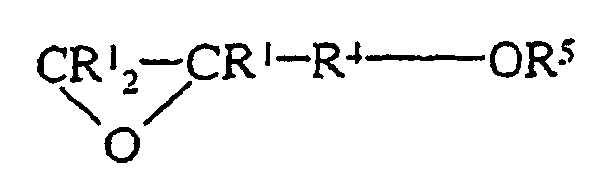
- Verfahren nach Anspruch 2, worin Verbindung (iii) Ammoniak ist und die Epoxyverbindung in einer Menge von 2 bis 20 mol pro mol Ammoniak verwendet wird.
- Verfahren nach Anspruch 2, worin Verbindung (iii) ein Amin ist, y gleich 1 ist und die Epoxyverbindung in einer Menge von 0,5 bis 10 mol pro mol Amin verwendet wird.
- Verfahren nach Anspruch 2, worin Verbindung (iii) ein Amin ist, y gleich 2 ist und die Epoxyverbindung in einer Menge von 1,5 bis 20 mol pro mol Amin verwendet wird.
- Verfahren nach Anspruch 2, worin die Alkoxysilanverbindung in einer wenigstens stöchiometrischen Menge in bezug auf Verbindung (iii) verwendet wird.
- Verfahren nach Anspruch 6, worin Verbindung (iii) Ammoniak ist und die Alkoxysilanverbindung in einer Menge von 0,5 bis 50 mol pro mol Ammoniak verwendet wird.
- Verfahren nach Anspruch 6, worin Verbindung (iii) ein Amin ist und die Alkoxysilanverbindung in einer Menge von 0,5 bis 50 mol pro mol Aminverbindung verwendet wird.
- Verfahren nach Anspruch 6, worin die Alkoxysilanverbindung in stöchiometrischem Überschuss in bezug auf Verbindung (iii) verwendet wird, wobei dieses Verfahren weiterhin den Schritt des Abtrennens von nichtumgesetzter Alkoxysilanverbindung von dem Silatranderivat umfasst.
- Verfahren nach einem der Ansprüche 2 bis 9, wobei die Reaktion bei einer Temperatur von nicht mehr als 100°C durchgeführt wird.
- Verfahren nach einem der Ansprüche 2 bis 10, wobei die Reaktion in Gegenwart eines Alkohols mit derselben Anzahl an Kohlenstoffatomen wie R6 in Verbindung (ii) durchgeführt wird.
- Verwendung des Silatranderivats nach Anspruch 1 als Haftvermittler.
- Härtbare Zusammensetzung, enthaltend das Silatranderivat nach Anspruch 1.
- Härtbare Zusammensetzung nach Anspruch 13, wobei das Silatranderivat nach Anspruch 1 in einer Menge von 0,01 bis 20 Gew.-%, bezogen auf das Gesamtgewicht dieser Zusammensetzung, vorhanden ist.
- Härtbare Zusammensetzung nach Anspruch 13, wobei diese härtbare Zusammensetzung ausgewählt ist aus Siliconzusammensetzungen und anderen härtbaren Zusammensetzungen, die durch Kondensationsreaktion, Hydrosilylierungsreaktion, UV-Strahlen oder Strahlen hoher Energie gehärtet werden.
- Härtbare Zusammensetzung nach Anspruch 15, wobei diese anderen härtbaren Zusammensetzungen ausgewählt sind aus Zusammensetzungen auf alkoxysilanmodifizierter Polyetherbasis, Polyurethanharz- und Kautschukzusammensetzungen, Epoxyharzzusammensetzungen. Polysulfidharzzusammensetzungen und ungesättigten Polyesterharzzusammensetzungen.
Applications Claiming Priority (3)
| Application Number | Priority Date | Filing Date | Title |
|---|---|---|---|
| JP34429797 | 1997-11-28 | ||
| JP34429797 | 1997-11-28 | ||
| JP344297/97 | 1997-11-28 |
Publications (3)
| Publication Number | Publication Date |
|---|---|
| EP0919558A2 EP0919558A2 (de) | 1999-06-02 |
| EP0919558A3 EP0919558A3 (de) | 1999-10-27 |
| EP0919558B1 true EP0919558B1 (de) | 2002-09-11 |
Family
ID=18368156
Family Applications (1)
| Application Number | Title | Priority Date | Filing Date |
|---|---|---|---|
| EP98122658A Expired - Lifetime EP0919558B1 (de) | 1997-11-28 | 1998-11-30 | Silantranderivate, Verfahren zu deren Herstellung, Haftvermittler, und Siliconzusammensetzungen |
Country Status (3)
| Country | Link |
|---|---|
| US (1) | US5945555A (de) |
| EP (1) | EP0919558B1 (de) |
| DE (1) | DE69807822T2 (de) |
Families Citing this family (26)
| Publication number | Priority date | Publication date | Assignee | Title |
|---|---|---|---|---|
| JP2000198929A (ja) * | 1998-10-30 | 2000-07-18 | Dow Corning Toray Silicone Co Ltd | 複合成形用シリコーンゴム組成物 |
| JP2000265063A (ja) * | 1999-03-16 | 2000-09-26 | Dow Corning Toray Silicone Co Ltd | シリコーンゴム組成物 |
| JP2000302977A (ja) * | 1999-04-16 | 2000-10-31 | Dow Corning Toray Silicone Co Ltd | シリコーンゴム組成物 |
| JP2001019933A (ja) * | 1999-07-09 | 2001-01-23 | Dow Corning Toray Silicone Co Ltd | シリコーン系接着性シート、およびその製造方法 |
| US6284861B1 (en) * | 1999-12-13 | 2001-09-04 | Dow Corning Toray Silicone, Ltd. | Silicone rubber composition |
| JP2001261963A (ja) * | 2000-03-17 | 2001-09-26 | Dow Corning Toray Silicone Co Ltd | シリコーンゴム組成物 |
| ATE335770T1 (de) * | 2001-12-18 | 2006-09-15 | Dow Corning Toray Silicone | Photohärtbare organische polymerzusammensetzung |
| WO2005010598A2 (en) * | 2003-07-24 | 2005-02-03 | E Ink Corporation | Electro-optic displays |
| DE102005038794A1 (de) | 2005-08-17 | 2007-02-22 | Degussa Ag | Kautschukmischungen |
| TW200716710A (en) * | 2005-09-30 | 2007-05-01 | Dow Corning Toray Co Ltd | Multi-component room-temperature curable silicone rubber composition |
| FR2927334B1 (fr) * | 2008-02-11 | 2010-02-19 | Saint Gobain Isover | Composition d'encollage hybride inorganique-organique pour laine minerale et produits isolants obtenus |
| TWI582101B (zh) * | 2013-03-28 | 2017-05-11 | 國立中正大學 | 固定金屬於基材表面之方法 |
| CN104177837B (zh) * | 2014-08-06 | 2016-08-17 | 绵阳惠利电子材料有限公司 | 增粘剂及其制备方法、加成型有机硅橡胶及其制备方法 |
| US10980236B2 (en) | 2014-11-04 | 2021-04-20 | Allied Bioscience, Inc. | Broad spectrum antimicrobial coatings comprising combinations of organosilanes |
| US10993441B2 (en) | 2014-11-04 | 2021-05-04 | Allied Bioscience, Inc. | Antimicrobial coatings comprising organosilane homopolymers |
| US10258046B2 (en) | 2014-11-04 | 2019-04-16 | Allied Bioscience, Inc. | Antimicrobial coatings comprising quaternary silanes |
| RU2673524C1 (ru) | 2015-02-11 | 2018-11-27 | Эллайд Байосайнс, Инк. | Противомикробное покрытие и способ его формирования |
| US20170086312A1 (en) * | 2015-09-17 | 2017-03-23 | Syed Taymur Ahmad | Process for protecting an electronic device by selective deposition of polymer coatings |
| DE102015224436A1 (de) | 2015-12-07 | 2017-06-08 | Evonik Degussa Gmbh | Kautschukmischungen |
| US20180083662A1 (en) * | 2016-09-16 | 2018-03-22 | Syed Taymur Ahmad | Process for protecting an electronic device by selective deposition of polymer coatings |
| CN106947428B (zh) * | 2017-02-19 | 2020-06-05 | 肇庆皓明有机硅材料有限公司 | 一种双组分有机硅灌封胶及其制备方法 |
| US11208518B2 (en) | 2018-12-11 | 2021-12-28 | The Goodyear Tire & Rubber Company | Functionalized polymer, rubber composition and pneumatic tire |
| CN109796926B (zh) * | 2019-01-25 | 2021-06-01 | 杭州福斯特应用材料股份有限公司 | 一种光伏组件用耐湿热硅酮结构胶 |
| JP7144775B2 (ja) * | 2019-07-17 | 2022-09-30 | 信越化学工業株式会社 | 紫外線硬化型オルガノポリシロキサン組成物 |
| KR20230135211A (ko) | 2022-03-15 | 2023-09-25 | 미소로이 주식회사 | 퍼플루오로폴리에테르계 변성 실라트란 화합물을 포함하는 표면 처리제 및 이를 이용한 코팅층 형성 방법 |
| PL248502B1 (pl) * | 2023-04-18 | 2025-12-22 | Univ Im Adama Mickiewicza W Poznaniu | Silatrany, sposób ich otrzymywania oraz zastosowanie jako silanowe środki sprzęgające do wytwarzania gumowych kompozytów |
Family Cites Families (8)
| Publication number | Priority date | Publication date | Assignee | Title |
|---|---|---|---|---|
| US3133108A (en) * | 1958-07-29 | 1964-05-12 | Westinghouse Electric Corp | Nitrogen coordinated silicon compounds |
| US2953545A (en) * | 1958-11-18 | 1960-09-20 | Westinghouse Electric Corp | Process for curing glycidyl polyethers and products produced thereby |
| US3032576A (en) * | 1961-02-20 | 1962-05-01 | Union Carbide Corp | N-substituted derivatives of aminoalkylsilanes |
| DE1253196B (de) * | 1961-06-29 | 1967-10-26 | Behrens Friedrich Joh | Mit Druckluft betriebenes Geraet zum Eintreiben von Befestigungsmitteln wie Klammern, Naegeln u. dgl. |
| US4048206A (en) * | 1975-04-22 | 1977-09-13 | Mikhail Grigorievich Voronkov | Process for the production of 1-organylsilatranes and carbofunctional derivatives thereof |
| DE2542534C3 (de) * | 1975-09-24 | 1979-08-02 | Deutsche Gold- Und Silber-Scheideanstalt Vormals Roessler, 6000 Frankfurt | Verfahren zur Herstellung von schwefelhaltigen Organosiliciumverbindungen |
| DE2712866C3 (de) * | 1977-03-24 | 1980-04-30 | Deutsche Gold- Und Silber-Scheideanstalt Vormals Roessler, 6000 Frankfurt | Verfahren zum Herstellen von schwefelhaltigen Organosiliciumverbindungen |
| JPS6169781A (ja) * | 1984-09-13 | 1986-04-10 | Nitto Kasei Kk | トリ有機錫シラトラン誘導体の製造法 |
-
1998
- 1998-11-19 US US09/195,814 patent/US5945555A/en not_active Expired - Lifetime
- 1998-11-30 DE DE69807822T patent/DE69807822T2/de not_active Expired - Fee Related
- 1998-11-30 EP EP98122658A patent/EP0919558B1/de not_active Expired - Lifetime
Also Published As
| Publication number | Publication date |
|---|---|
| EP0919558A2 (de) | 1999-06-02 |
| US5945555A (en) | 1999-08-31 |
| DE69807822T2 (de) | 2003-04-30 |
| DE69807822D1 (de) | 2002-10-17 |
| EP0919558A3 (de) | 1999-10-27 |
Similar Documents
| Publication | Publication Date | Title |
|---|---|---|
| EP0919558B1 (de) | Silantranderivate, Verfahren zu deren Herstellung, Haftvermittler, und Siliconzusammensetzungen | |
| JP3831481B2 (ja) | カルバシラトラン誘導体、その製造方法、接着促進剤、および硬化性シリコーン組成物 | |
| EP3505569B1 (de) | Bei raumtemperatur härtbare, organopolysiloxanentalkoholisierungszusammensetzung und durch ein gehärtetes produkt davon abgedichteter artikel | |
| JP4187843B2 (ja) | シラトラン誘導体、その製造方法、接着促進剤、および硬化性シリコーン組成物 | |
| KR101868158B1 (ko) | 무수 숙신산기 함유 환상 오르가노실록산, 그의 제조 방법, 오르가노실록산 조성물 및 열경화성 수지 조성물 | |
| US5527932A (en) | Curable organopolysiloxane composition containing novel adhesion promoter | |
| EP0530496B1 (de) | Organosiliziumverbindungen und Verfahren zu ihrer Herstellung | |
| EP1002834A1 (de) | Silikonelastomerzusammensetzung zur Herstellung eines Verbundwerkstoffes | |
| US5936110A (en) | Silatrane derivative and curable silicone composition containing same | |
| JP3859851B2 (ja) | 接着促進剤および硬化性シリコーン組成物 | |
| KR0163961B1 (ko) | 접착성 조성물 및 그의 경화물 | |
| EP0591622B1 (de) | Bei Umgebungstemperatur härtbare Organopolysiloxanzusammensetzungen | |
| JPS6131461A (ja) | 室温硬化性オルガノシロキサン組成物 | |
| US20240409775A1 (en) | Room temperature-curable organopolysiloxane composition, adhesive, sealing agent, and coating agent | |
| US7053233B2 (en) | Silane compound having at least two protected functional groups and method for preparing the same | |
| EP0982349A2 (de) | Adhäsionsfördernde Organosilikon-Zusammensetzungen | |
| DE60014737T2 (de) | Phenolfunktionelle Organosilikonverbindungen und Verfahren zu deren Herstellung | |
| JP2000265063A (ja) | シリコーンゴム組成物 | |
| KR20200103559A (ko) | 유기 규소 화합물, 그 제조 방법 및 경화성 조성물 | |
| US6284861B1 (en) | Silicone rubber composition | |
| JPH07138535A (ja) | 接着促進剤 | |
| WO2023234084A1 (ja) | 二成分型室温硬化性オルガノポリシロキサン組成物及び該組成物を含有する各種物品 | |
| CA2287706A1 (en) | Silicone rubber composition for composite molding |
Legal Events
| Date | Code | Title | Description |
|---|---|---|---|
| PUAI | Public reference made under article 153(3) epc to a published international application that has entered the european phase |
Free format text: ORIGINAL CODE: 0009012 |
|
| AK | Designated contracting states |
Kind code of ref document: A2 Designated state(s): DE FR GB IT |
|
| AX | Request for extension of the european patent |
Free format text: AL;LT;LV;MK;RO;SI |
|
| PUAL | Search report despatched |
Free format text: ORIGINAL CODE: 0009013 |
|
| AK | Designated contracting states |
Kind code of ref document: A3 Designated state(s): AT BE CH CY DE DK ES FI FR GB GR IE IT LI LU MC NL PT SE |
|
| AX | Request for extension of the european patent |
Free format text: AL;LT;LV;MK;RO;SI |
|
| 17P | Request for examination filed |
Effective date: 20000126 |
|
| AKX | Designation fees paid |
Free format text: DE FR GB IT |
|
| GRAG | Despatch of communication of intention to grant |
Free format text: ORIGINAL CODE: EPIDOS AGRA |
|
| 17Q | First examination report despatched |
Effective date: 20011213 |
|
| GRAG | Despatch of communication of intention to grant |
Free format text: ORIGINAL CODE: EPIDOS AGRA |
|
| GRAG | Despatch of communication of intention to grant |
Free format text: ORIGINAL CODE: EPIDOS AGRA |
|
| GRAH | Despatch of communication of intention to grant a patent |
Free format text: ORIGINAL CODE: EPIDOS IGRA |
|
| GRAH | Despatch of communication of intention to grant a patent |
Free format text: ORIGINAL CODE: EPIDOS IGRA |
|
| GRAA | (expected) grant |
Free format text: ORIGINAL CODE: 0009210 |
|
| AK | Designated contracting states |
Kind code of ref document: B1 Designated state(s): DE FR GB IT |
|
| REG | Reference to a national code |
Ref country code: GB Ref legal event code: FG4D |
|
| REF | Corresponds to: |
Ref document number: 69807822 Country of ref document: DE Date of ref document: 20021017 |
|
| ET | Fr: translation filed | ||
| PLBE | No opposition filed within time limit |
Free format text: ORIGINAL CODE: 0009261 |
|
| STAA | Information on the status of an ep patent application or granted ep patent |
Free format text: STATUS: NO OPPOSITION FILED WITHIN TIME LIMIT |
|
| 26N | No opposition filed |
Effective date: 20030612 |
|
| PGFP | Annual fee paid to national office [announced via postgrant information from national office to epo] |
Ref country code: DE Payment date: 20071122 Year of fee payment: 10 |
|
| PGFP | Annual fee paid to national office [announced via postgrant information from national office to epo] |
Ref country code: IT Payment date: 20071123 Year of fee payment: 10 |
|
| PGFP | Annual fee paid to national office [announced via postgrant information from national office to epo] |
Ref country code: GB Payment date: 20071128 Year of fee payment: 10 Ref country code: FR Payment date: 20071108 Year of fee payment: 10 |
|
| GBPC | Gb: european patent ceased through non-payment of renewal fee |
Effective date: 20081130 |
|
| PG25 | Lapsed in a contracting state [announced via postgrant information from national office to epo] |
Ref country code: IT Free format text: LAPSE BECAUSE OF NON-PAYMENT OF DUE FEES Effective date: 20081130 |
|
| REG | Reference to a national code |
Ref country code: FR Ref legal event code: ST Effective date: 20090731 |
|
| PG25 | Lapsed in a contracting state [announced via postgrant information from national office to epo] |
Ref country code: DE Free format text: LAPSE BECAUSE OF NON-PAYMENT OF DUE FEES Effective date: 20090603 |
|
| PG25 | Lapsed in a contracting state [announced via postgrant information from national office to epo] |
Ref country code: GB Free format text: LAPSE BECAUSE OF NON-PAYMENT OF DUE FEES Effective date: 20081130 |
|
| PG25 | Lapsed in a contracting state [announced via postgrant information from national office to epo] |
Ref country code: FR Free format text: LAPSE BECAUSE OF NON-PAYMENT OF DUE FEES Effective date: 20081130 |