EP0916619B1 - Anorganisches, poröses, partikuläres Material - Google Patents
Anorganisches, poröses, partikuläres Material Download PDFInfo
- Publication number
- EP0916619B1 EP0916619B1 EP98308907A EP98308907A EP0916619B1 EP 0916619 B1 EP0916619 B1 EP 0916619B1 EP 98308907 A EP98308907 A EP 98308907A EP 98308907 A EP98308907 A EP 98308907A EP 0916619 B1 EP0916619 B1 EP 0916619B1
- Authority
- EP
- European Patent Office
- Prior art keywords
- particulate
- aluminosilicate material
- product
- flash
- leaching
- Prior art date
- Legal status (The legal status is an assumption and is not a legal conclusion. Google has not performed a legal analysis and makes no representation as to the accuracy of the status listed.)
- Expired - Lifetime
Links
- 239000011236 particulate material Substances 0.000 title claims abstract description 13
- 239000000463 material Substances 0.000 claims abstract description 73
- 238000000034 method Methods 0.000 claims abstract description 52
- 229910000323 aluminium silicate Inorganic materials 0.000 claims abstract description 47
- HNPSIPDUKPIQMN-UHFFFAOYSA-N dioxosilane;oxo(oxoalumanyloxy)alumane Chemical compound O=[Si]=O.O=[Al]O[Al]=O HNPSIPDUKPIQMN-UHFFFAOYSA-N 0.000 claims abstract description 46
- 238000002386 leaching Methods 0.000 claims abstract description 35
- 239000004411 aluminium Substances 0.000 claims abstract description 22
- XAGFODPZIPBFFR-UHFFFAOYSA-N aluminium Chemical compound [Al] XAGFODPZIPBFFR-UHFFFAOYSA-N 0.000 claims abstract description 22
- 229910052782 aluminium Inorganic materials 0.000 claims abstract description 22
- 239000003795 chemical substances by application Substances 0.000 claims abstract description 14
- 239000002253 acid Substances 0.000 claims description 32
- 239000002245 particle Substances 0.000 claims description 32
- 238000001354 calcination Methods 0.000 claims description 28
- NLYAJNPCOHFWQQ-UHFFFAOYSA-N kaolin Chemical compound O.O.O=[Al]O[Si](=O)O[Si](=O)O[Al]=O NLYAJNPCOHFWQQ-UHFFFAOYSA-N 0.000 claims description 25
- XLYOFNOQVPJJNP-UHFFFAOYSA-N water Substances O XLYOFNOQVPJJNP-UHFFFAOYSA-N 0.000 claims description 19
- 239000011148 porous material Substances 0.000 claims description 18
- 239000005995 Aluminium silicate Substances 0.000 claims description 15
- 235000012211 aluminium silicate Nutrition 0.000 claims description 15
- 230000008569 process Effects 0.000 claims description 15
- 239000004927 clay Substances 0.000 claims description 13
- 229910052500 inorganic mineral Inorganic materials 0.000 claims description 12
- 239000011707 mineral Substances 0.000 claims description 12
- 238000009826 distribution Methods 0.000 claims description 11
- 238000010438 heat treatment Methods 0.000 claims description 11
- 229920000642 polymer Polymers 0.000 claims description 7
- 230000015572 biosynthetic process Effects 0.000 claims description 6
- 239000007788 liquid Substances 0.000 claims description 5
- 239000000126 substance Substances 0.000 claims description 5
- 230000005484 gravity Effects 0.000 claims description 4
- 239000003973 paint Substances 0.000 claims description 3
- 229910021647 smectite Inorganic materials 0.000 claims description 3
- 239000002594 sorbent Substances 0.000 claims description 3
- 239000000725 suspension Substances 0.000 claims description 3
- 238000005406 washing Methods 0.000 claims description 3
- 239000007900 aqueous suspension Substances 0.000 claims description 2
- 239000002738 chelating agent Substances 0.000 claims description 2
- 238000013270 controlled release Methods 0.000 claims description 2
- 150000007524 organic acids Chemical class 0.000 claims description 2
- 239000011347 resin Substances 0.000 claims description 2
- 229920005989 resin Polymers 0.000 claims description 2
- 239000000565 sealant Substances 0.000 claims description 2
- 238000000926 separation method Methods 0.000 claims description 2
- 238000003860 storage Methods 0.000 claims description 2
- 239000012815 thermoplastic material Substances 0.000 claims description 2
- 150000007513 acids Chemical class 0.000 claims 1
- 235000005985 organic acids Nutrition 0.000 claims 1
- 239000000047 product Substances 0.000 description 48
- 239000000945 filler Substances 0.000 description 23
- 239000012530 fluid Substances 0.000 description 7
- 230000008901 benefit Effects 0.000 description 6
- 239000007789 gas Substances 0.000 description 6
- 238000012545 processing Methods 0.000 description 5
- VTYYLEPIZMXCLO-UHFFFAOYSA-L Calcium carbonate Chemical compound [Ca+2].[O-]C([O-])=O VTYYLEPIZMXCLO-UHFFFAOYSA-L 0.000 description 4
- QAOWNCQODCNURD-UHFFFAOYSA-N Sulfuric acid Chemical compound OS(O)(=O)=O QAOWNCQODCNURD-UHFFFAOYSA-N 0.000 description 4
- GWEVSGVZZGPLCZ-UHFFFAOYSA-N Titan oxide Chemical compound O=[Ti]=O GWEVSGVZZGPLCZ-UHFFFAOYSA-N 0.000 description 4
- 239000002734 clay mineral Substances 0.000 description 4
- 230000000694 effects Effects 0.000 description 4
- 230000014759 maintenance of location Effects 0.000 description 4
- 239000000049 pigment Substances 0.000 description 4
- 238000010008 shearing Methods 0.000 description 4
- KRKNYBCHXYNGOX-UHFFFAOYSA-N citric acid Chemical compound OC(=O)CC(O)(C(O)=O)CC(O)=O KRKNYBCHXYNGOX-UHFFFAOYSA-N 0.000 description 3
- 230000000052 comparative effect Effects 0.000 description 3
- 238000010790 dilution Methods 0.000 description 3
- 239000012895 dilution Substances 0.000 description 3
- 230000006872 improvement Effects 0.000 description 3
- 238000011835 investigation Methods 0.000 description 3
- 239000011859 microparticle Substances 0.000 description 3
- 239000003921 oil Substances 0.000 description 3
- 235000019198 oils Nutrition 0.000 description 3
- 239000000243 solution Substances 0.000 description 3
- 238000001179 sorption measurement Methods 0.000 description 3
- 239000001117 sulphuric acid Substances 0.000 description 3
- 235000011149 sulphuric acid Nutrition 0.000 description 3
- IJGRMHOSHXDMSA-UHFFFAOYSA-N Atomic nitrogen Chemical compound N#N IJGRMHOSHXDMSA-UHFFFAOYSA-N 0.000 description 2
- 239000004606 Fillers/Extenders Substances 0.000 description 2
- NBIIXXVUZAFLBC-UHFFFAOYSA-N Phosphoric acid Chemical compound OP(O)(O)=O NBIIXXVUZAFLBC-UHFFFAOYSA-N 0.000 description 2
- 239000010427 ball clay Substances 0.000 description 2
- 229910000019 calcium carbonate Inorganic materials 0.000 description 2
- 238000006243 chemical reaction Methods 0.000 description 2
- 239000008199 coating composition Substances 0.000 description 2
- 239000013078 crystal Substances 0.000 description 2
- 230000008014 freezing Effects 0.000 description 2
- 238000007710 freezing Methods 0.000 description 2
- BDAGIHXWWSANSR-UHFFFAOYSA-N methanoic acid Natural products OC=O BDAGIHXWWSANSR-UHFFFAOYSA-N 0.000 description 2
- 239000012071 phase Substances 0.000 description 2
- 238000004062 sedimentation Methods 0.000 description 2
- 238000007652 sheet-forming process Methods 0.000 description 2
- VYPSYNLAJGMNEJ-UHFFFAOYSA-N silicon dioxide Inorganic materials O=[Si]=O VYPSYNLAJGMNEJ-UHFFFAOYSA-N 0.000 description 2
- 229910001220 stainless steel Inorganic materials 0.000 description 2
- 239000010935 stainless steel Substances 0.000 description 2
- 239000007858 starting material Substances 0.000 description 2
- 239000004408 titanium dioxide Substances 0.000 description 2
- 239000012463 white pigment Substances 0.000 description 2
- OSWFIVFLDKOXQC-UHFFFAOYSA-N 4-(3-methoxyphenyl)aniline Chemical compound COC1=CC=CC(C=2C=CC(N)=CC=2)=C1 OSWFIVFLDKOXQC-UHFFFAOYSA-N 0.000 description 1
- 238000004438 BET method Methods 0.000 description 1
- KCXVZYZYPLLWCC-UHFFFAOYSA-N EDTA Chemical compound OC(=O)CN(CC(O)=O)CCN(CC(O)=O)CC(O)=O KCXVZYZYPLLWCC-UHFFFAOYSA-N 0.000 description 1
- 241000196324 Embryophyta Species 0.000 description 1
- VEXZGXHMUGYJMC-UHFFFAOYSA-N Hydrochloric acid Chemical compound Cl VEXZGXHMUGYJMC-UHFFFAOYSA-N 0.000 description 1
- GRYLNZFGIOXLOG-UHFFFAOYSA-N Nitric acid Chemical compound O[N+]([O-])=O GRYLNZFGIOXLOG-UHFFFAOYSA-N 0.000 description 1
- 238000010306 acid treatment Methods 0.000 description 1
- 239000000654 additive Substances 0.000 description 1
- 230000000996 additive effect Effects 0.000 description 1
- 238000013019 agitation Methods 0.000 description 1
- 229910000147 aluminium phosphate Inorganic materials 0.000 description 1
- HPTYUNKZVDYXLP-UHFFFAOYSA-N aluminum;trihydroxy(trihydroxysilyloxy)silane;hydrate Chemical compound O.[Al].[Al].O[Si](O)(O)O[Si](O)(O)O HPTYUNKZVDYXLP-UHFFFAOYSA-N 0.000 description 1
- 238000004458 analytical method Methods 0.000 description 1
- 239000003963 antioxidant agent Substances 0.000 description 1
- 239000007864 aqueous solution Substances 0.000 description 1
- 230000004888 barrier function Effects 0.000 description 1
- 230000009286 beneficial effect Effects 0.000 description 1
- 239000000440 bentonite Substances 0.000 description 1
- 229910000278 bentonite Inorganic materials 0.000 description 1
- SVPXDRXYRYOSEX-UHFFFAOYSA-N bentoquatam Chemical compound O.O=[Si]=O.O=[Al]O[Al]=O SVPXDRXYRYOSEX-UHFFFAOYSA-N 0.000 description 1
- 239000003139 biocide Substances 0.000 description 1
- 238000006555 catalytic reaction Methods 0.000 description 1
- 125000002091 cationic group Chemical group 0.000 description 1
- -1 china clays Substances 0.000 description 1
- 239000000701 coagulant Substances 0.000 description 1
- 239000011248 coating agent Substances 0.000 description 1
- 238000000576 coating method Methods 0.000 description 1
- 230000001419 dependent effect Effects 0.000 description 1
- 238000013461 design Methods 0.000 description 1
- GUJOJGAPFQRJSV-UHFFFAOYSA-N dialuminum;dioxosilane;oxygen(2-);hydrate Chemical compound O.[O-2].[O-2].[O-2].[Al+3].[Al+3].O=[Si]=O.O=[Si]=O.O=[Si]=O.O=[Si]=O GUJOJGAPFQRJSV-UHFFFAOYSA-N 0.000 description 1
- 229910001649 dickite Inorganic materials 0.000 description 1
- 238000009792 diffusion process Methods 0.000 description 1
- 235000012489 doughnuts Nutrition 0.000 description 1
- 238000001035 drying Methods 0.000 description 1
- 230000002708 enhancing effect Effects 0.000 description 1
- 239000010433 feldspar Substances 0.000 description 1
- 239000000835 fiber Substances 0.000 description 1
- 238000001914 filtration Methods 0.000 description 1
- 239000012467 final product Substances 0.000 description 1
- 235000019253 formic acid Nutrition 0.000 description 1
- 239000000446 fuel Substances 0.000 description 1
- 239000007792 gaseous phase Substances 0.000 description 1
- 229910052621 halloysite Inorganic materials 0.000 description 1
- 229910000271 hectorite Inorganic materials 0.000 description 1
- KWLMIXQRALPRBC-UHFFFAOYSA-L hectorite Chemical compound [Li+].[OH-].[OH-].[Na+].[Mg+2].O1[Si]2([O-])O[Si]1([O-])O[Si]([O-])(O1)O[Si]1([O-])O2 KWLMIXQRALPRBC-UHFFFAOYSA-L 0.000 description 1
- 238000007654 immersion Methods 0.000 description 1
- 239000012535 impurity Substances 0.000 description 1
- 239000004615 ingredient Substances 0.000 description 1
- 229910010272 inorganic material Inorganic materials 0.000 description 1
- 239000011147 inorganic material Substances 0.000 description 1
- 229920005610 lignin Polymers 0.000 description 1
- 235000021388 linseed oil Nutrition 0.000 description 1
- 239000000944 linseed oil Substances 0.000 description 1
- 239000007791 liquid phase Substances 0.000 description 1
- 238000004519 manufacturing process Methods 0.000 description 1
- 238000005259 measurement Methods 0.000 description 1
- 239000012229 microporous material Substances 0.000 description 1
- 239000012764 mineral filler Substances 0.000 description 1
- 239000000203 mixture Substances 0.000 description 1
- 229910052901 montmorillonite Inorganic materials 0.000 description 1
- 229910017604 nitric acid Inorganic materials 0.000 description 1
- 229910052757 nitrogen Inorganic materials 0.000 description 1
- 239000002304 perfume Substances 0.000 description 1
- 239000003016 pheromone Substances 0.000 description 1
- 229920002401 polyacrylamide Polymers 0.000 description 1
- 229920000098 polyolefin Polymers 0.000 description 1
- 238000001556 precipitation Methods 0.000 description 1
- 238000007639 printing Methods 0.000 description 1
- 238000003908 quality control method Methods 0.000 description 1
- 239000010453 quartz Substances 0.000 description 1
- 230000005855 radiation Effects 0.000 description 1
- 239000011541 reaction mixture Substances 0.000 description 1
- 230000035484 reaction time Effects 0.000 description 1
- 230000009257 reactivity Effects 0.000 description 1
- 238000011084 recovery Methods 0.000 description 1
- 238000010992 reflux Methods 0.000 description 1
- 229910000275 saponite Inorganic materials 0.000 description 1
- 239000002002 slurry Substances 0.000 description 1
- GCLGEJMYGQKIIW-UHFFFAOYSA-H sodium hexametaphosphate Chemical compound [Na]OP1(=O)OP(=O)(O[Na])OP(=O)(O[Na])OP(=O)(O[Na])OP(=O)(O[Na])OP(=O)(O[Na])O1 GCLGEJMYGQKIIW-UHFFFAOYSA-H 0.000 description 1
- 239000007787 solid Substances 0.000 description 1
- 239000007790 solid phase Substances 0.000 description 1
- 238000007711 solidification Methods 0.000 description 1
- 230000008023 solidification Effects 0.000 description 1
- 241000894007 species Species 0.000 description 1
- 238000003756 stirring Methods 0.000 description 1
- 230000001629 suppression Effects 0.000 description 1
- 238000001757 thermogravimetry curve Methods 0.000 description 1
- 238000012546 transfer Methods 0.000 description 1
- 238000003828 vacuum filtration Methods 0.000 description 1
Images
Classifications
-
- B—PERFORMING OPERATIONS; TRANSPORTING
- B01—PHYSICAL OR CHEMICAL PROCESSES OR APPARATUS IN GENERAL
- B01J—CHEMICAL OR PHYSICAL PROCESSES, e.g. CATALYSIS OR COLLOID CHEMISTRY; THEIR RELEVANT APPARATUS
- B01J20/00—Solid sorbent compositions or filter aid compositions; Sorbents for chromatography; Processes for preparing, regenerating or reactivating thereof
- B01J20/02—Solid sorbent compositions or filter aid compositions; Sorbents for chromatography; Processes for preparing, regenerating or reactivating thereof comprising inorganic material
- B01J20/10—Solid sorbent compositions or filter aid compositions; Sorbents for chromatography; Processes for preparing, regenerating or reactivating thereof comprising inorganic material comprising silica or silicate
- B01J20/12—Naturally occurring clays or bleaching earth
-
- C—CHEMISTRY; METALLURGY
- C01—INORGANIC CHEMISTRY
- C01B—NON-METALLIC ELEMENTS; COMPOUNDS THEREOF; METALLOIDS OR COMPOUNDS THEREOF NOT COVERED BY SUBCLASS C01C
- C01B33/00—Silicon; Compounds thereof
- C01B33/20—Silicates
- C01B33/36—Silicates having base-exchange properties but not having molecular sieve properties
- C01B33/38—Layered base-exchange silicates, e.g. clays, micas or alkali metal silicates of kenyaite or magadiite type
- C01B33/40—Clays
-
- C—CHEMISTRY; METALLURGY
- C08—ORGANIC MACROMOLECULAR COMPOUNDS; THEIR PREPARATION OR CHEMICAL WORKING-UP; COMPOSITIONS BASED THEREON
- C08K—Use of inorganic or non-macromolecular organic substances as compounding ingredients
- C08K9/00—Use of pretreated ingredients
- C08K9/02—Ingredients treated with inorganic substances
-
- C—CHEMISTRY; METALLURGY
- C09—DYES; PAINTS; POLISHES; NATURAL RESINS; ADHESIVES; COMPOSITIONS NOT OTHERWISE PROVIDED FOR; APPLICATIONS OF MATERIALS NOT OTHERWISE PROVIDED FOR
- C09D—COATING COMPOSITIONS, e.g. PAINTS, VARNISHES OR LACQUERS; FILLING PASTES; CHEMICAL PAINT OR INK REMOVERS; INKS; CORRECTING FLUIDS; WOODSTAINS; PASTES OR SOLIDS FOR COLOURING OR PRINTING; USE OF MATERIALS THEREFOR
- C09D7/00—Features of coating compositions, not provided for in group C09D5/00; Processes for incorporating ingredients in coating compositions
- C09D7/40—Additives
- C09D7/60—Additives non-macromolecular
- C09D7/61—Additives non-macromolecular inorganic
-
- C—CHEMISTRY; METALLURGY
- C09—DYES; PAINTS; POLISHES; NATURAL RESINS; ADHESIVES; COMPOSITIONS NOT OTHERWISE PROVIDED FOR; APPLICATIONS OF MATERIALS NOT OTHERWISE PROVIDED FOR
- C09D—COATING COMPOSITIONS, e.g. PAINTS, VARNISHES OR LACQUERS; FILLING PASTES; CHEMICAL PAINT OR INK REMOVERS; INKS; CORRECTING FLUIDS; WOODSTAINS; PASTES OR SOLIDS FOR COLOURING OR PRINTING; USE OF MATERIALS THEREFOR
- C09D7/00—Features of coating compositions, not provided for in group C09D5/00; Processes for incorporating ingredients in coating compositions
- C09D7/40—Additives
- C09D7/66—Additives characterised by particle size
- C09D7/68—Particle size between 100-1000 nm
-
- C—CHEMISTRY; METALLURGY
- C09—DYES; PAINTS; POLISHES; NATURAL RESINS; ADHESIVES; COMPOSITIONS NOT OTHERWISE PROVIDED FOR; APPLICATIONS OF MATERIALS NOT OTHERWISE PROVIDED FOR
- C09D—COATING COMPOSITIONS, e.g. PAINTS, VARNISHES OR LACQUERS; FILLING PASTES; CHEMICAL PAINT OR INK REMOVERS; INKS; CORRECTING FLUIDS; WOODSTAINS; PASTES OR SOLIDS FOR COLOURING OR PRINTING; USE OF MATERIALS THEREFOR
- C09D7/00—Features of coating compositions, not provided for in group C09D5/00; Processes for incorporating ingredients in coating compositions
- C09D7/40—Additives
- C09D7/66—Additives characterised by particle size
- C09D7/69—Particle size larger than 1000 nm
-
- D—TEXTILES; PAPER
- D21—PAPER-MAKING; PRODUCTION OF CELLULOSE
- D21H—PULP COMPOSITIONS; PREPARATION THEREOF NOT COVERED BY SUBCLASSES D21C OR D21D; IMPREGNATING OR COATING OF PAPER; TREATMENT OF FINISHED PAPER NOT COVERED BY CLASS B31 OR SUBCLASS D21G; PAPER NOT OTHERWISE PROVIDED FOR
- D21H17/00—Non-fibrous material added to the pulp, characterised by its constitution; Paper-impregnating material characterised by its constitution
- D21H17/63—Inorganic compounds
- D21H17/67—Water-insoluble compounds, e.g. fillers, pigments
- D21H17/68—Water-insoluble compounds, e.g. fillers, pigments siliceous, e.g. clays
-
- C—CHEMISTRY; METALLURGY
- C08—ORGANIC MACROMOLECULAR COMPOUNDS; THEIR PREPARATION OR CHEMICAL WORKING-UP; COMPOSITIONS BASED THEREON
- C08K—Use of inorganic or non-macromolecular organic substances as compounding ingredients
- C08K7/00—Use of ingredients characterised by shape
- C08K7/22—Expanded, porous or hollow particles
- C08K7/24—Expanded, porous or hollow particles inorganic
- C08K7/26—Silicon- containing compounds
Definitions
- the present invention relates to porous inorganic particulate material and the production and use of such material.
- the present invention relates to porous inorganic material comprising an aluminosilicate, eg derived from a clay mineral.
- Acid leaching of aluminosilicate particulate materials, eg clays, which have been calcined are known from various prior patent specifications, eg GB2120571B.
- the materials to which the acid leaching step is applied in the methods described in these prior art references are materials such as metakaolin produced by conventional calcining procedures.
- the present invention is concerned with application of acid leaching to an aluminosilicate particulate material which has been calcined in an unconventional way selected to give unexpected product benefits described hereinafter following the acid leaching step.
- a method of producing a porous inorganic particulate material which comprises treating a particulate aluminosilicate material with a leaching agent which chemically reacts with or solubilises aluminium and thereby leaches aluminium from the aluminosilicate material, wherein the particulate aluminosilicate material is a particulate hydrous aluminosilicate material which has been flash calcined.
- the hydrous aluminosilicate material may comprise a clay mineral, eg of the kandite and/or smectite types.
- Clay minerals of the kandite type include kaolin-containing minerals such as china clays, ball clays, fire clays, dickite, nacrite and halloysite.
- Clay minerals of the smectite type include bentonite and other montmorillonite-containing materials, hectorite and saponite.
- Hydrous kaolin and kaolin-containing materials eg materials containing at least 90% by weight kaolin, desirably at least 96% by weight kaolin are preferred as the aluminosilicate material.
- a flash calcined particulate material is one which has been calcined extremely rapidly, eg by calcining for a period of less than 0.5 seconds, often less than 0.1 second. Preferred methods for the flash calcination of aluminosilicate particulate material are described hereinafter.
- water is driven off by the rapid heating.
- the rate of heating the hydrated aluminosilicate particulate material is,such that the rate of expansion of the water vapour formed is greater than the rate of diffusion of the water vapour through the crystal structure of the particles.
- the rate of heating the particles in the flash calcining is such that the temperature of the material is raised at a rate greater than 10 3 Celsius degrees per second, eg at least 5 x 10 3 Celsius degrees per second, in some cases at least 10 4 Celsius degrees per second.
- the conditions of the flash calcining process are such that at least a portion, preferably at least 90% by weight, desirably at least 96% by weight of the flash calcined particulate material produced comprises metakaolin.
- the blistering effect does not occur in conventional calcining processes, generally known as 'soak calcining', because the material is heated over a substantial period of time, eg many seconds or minutes and the rate of heating is not sufficiently rapid. Aluminium is far easier to leach from metakaolin than from kaolin. This is because the chemical environment of the aluminium is altered by the collapse of the long range order within the crystal brought about by calcination making it much more reactive.
- the aluminosilicate material and calcining temperatures used are suitable to form mainly, preferably essentially, metakaolin as the flash calcined product.
- the maximum temperature to which the particles are heated in the method according to the first aspect of the present invention will depend upon the particular aluminosilicate material employed in the flash calcination process. Generally, heating temperatures will be in the range 300°C to 1200°C.
- the particles of the material may be heated to a maximum temperature in the range of from 400°C to 950°C, especially from 500°C to 750°C for a starting material containing at least 90% by weight kaolin.
- the voids described above produced by flash calcining provide internal sites from which a network of channels and pores can be readily formed by the leaching step in the method according to the first aspect of the present invention.
- the product obtained by the leaching step can therefore have a microstructure which is different from that obtained by acid leaching aluminosilicates produced by calcining in the conventional way, ie by 'soak calcining' as referred to above.
- material produced by the method of the first aspect of the present invention can have:
- the particulate product obtained following the leaching step may have a high external and internal surface area, eg greater than 200m. 2 g -1 (N 2 BET) using in the leaching step flash calcined clay produced by calcining clay containing at least 90% by weight kaolin.
- the surface area may be at least 220m 2 .g -1 , in some cases at least 250m 2 . g -1 .
- the hydrous aluminosilicate material which is flash calcined for use in the method according to the first aspect of the present invention may be processed by well known procedures prior to flash calcination, eg to remove undesirable impurities present in the mineral form and to provide a suitable particle size distribution.
- Purifying the material may conveniently involve removing sources of fuel (eg lignin present in ball clay) or fluxing agents (eg quartz and feldspar) which may interfere with the calcined product, eg by forming a glassy phase with metakaolin.
- the particle size distribution may be selected to suit the final product application.
- the particle size distribution of the hydrous aluminosilicate material which is subjected to flash calcining may be such that at least 50% by weight of the particles thereof have an esd (equivalent spherical diameter measured in a well known way by sedimentation, eg using a SEDIGRAPHTM 5100 machine as supplied by Micromeritics Corporation, USA) less than 2 ⁇ m.
- the d 50 value of the material, ie the particle size value possessed by 50% by weight of the particles may conveniently be from 0.5 ⁇ m to 10 ⁇ m, eg 1 ⁇ m to 3 ⁇ m, especially from 1.5 ⁇ m to 2.5 ⁇ m.
- the particle size distribution of the hydrous aluminosilicate material which is flash calcined will determine (and be similar to) to particle size distribution of the eventual product obtained following flash calcination and acid leaching.
- the flash calcination may advantageously be carried out in a furnace in which a toroidal fluid flow heating zone is established.
- Furnaces of the toroidal fluid flow kind are known per se. Such furnaces are described for example in USP4479920 and W098/03256 and are commercially available under the trade mark TORBED from Torftech Ltd, Mortimer, England, and its licensees.
- a hot gas is passed through gaps between angled blades or vanes in a ring of blades or vanes provided in the operational chamber of the furnace.
- the blade ring is formed in an annular gap between the wall of the chamber and a central block, eg an upwardly pointing conical portion, located on the axis of the chamber. Gas flow is caused to follow a rotary path in a doughnut shaped region around the block and in individual swirls within the rotary path. This ensures efficient heat transfer to material, eg particulate material, to be heated in the gas flow.
- calcined material By use of a furnace of the toroidal fluid flow heating zone kind, calcined material can be produced in which voids having a more uniform size and spatial distribution than those produced by other flash calcination methods.
- the treatment with a leaching agent may comprise immersion of flash calcined particulate aluminosilicate material in a suitable leaching agent comprising an acid-containing medium.
- the acid-containing medium may comprise an aqueous solution of an acid which dissolves aluminium.
- the acid may comprise a strong mineral acid, eg sulphuric, hydrochloric, nitric or phosphoric acid although it could alternatively comprise an organic acid such as formic acid or citric acid.
- the leaching agent may alternatively or in addition include an aluminium chelating agent such as EDTA.
- the treatment may be carried out using an elevated temperature, eg in the range 30°C to 100°C, especially in the range 50°C to 90°C.
- the elevated temperature may initially be achieved by the exothermic addition of a concentrated mineral acid solution to an aqueous suspension of the flash calcined aluminosilicate material.
- the acid concentration in the medium employed for acid leaching is in the range 0.5M (ie about 5% concentration) to 10M (ie about 98% concentration).
- a beneficial acid leaching medium is sulphuric acid having a concentration of from 1M to 3M.
- a dilute 1M to 3M acid solution, eg of sulphuric acid may conveniently be prepared by dilution in water of a quantity of concentrated acid, eg 10M acid solution.
- the water to which the acid is added to dilute preferably contains the flash calcined aluminosilicate material to be treated whereby the heat of dilution initially energises the dealuminising reaction by raising the temperature of the reaction mixture. The temperature may be maintained by the exothermic nature of the leaching reaction.
- Agitation and/or stirring may be applied to assist treatment by the leaching step.
- the leaching agent it is not necessary in the leaching step in the method according to the first aspect of the present invention for all of the aluminium present in the aluminosilicate material to be dissolved by the leaching agent.
- the primary requirement is for the agent to attack the aluminosilicate structure to form closed or open channels or pores extending from the voids produced from flash calcination whereby the porosity of the aluminosilicate particle structure is increased and the surface area of the particles is also increased.
- at least 60% by weight, desirably at least 70% by weight of the aluminium is removed.
- the length of time over which the aluminosilicate material is exposed to the leaching agent will depend upon the particular agent used, its concentration and other process conditions employed, eg temperature. We have found that a reaction time of between 1 and 2 hours is typically required to achieve the required surface area as illustrated in the Examples hereinafter.
- the particulate product may be separated from the leaching medium in a known way, eg by filtration, eg vacuum filtration. Thereafter the product may be washed with clean water and may be dried or suspended in clean water for delivery to a user. It is desirable that the temperature of the product is kept elevated, eg greater than 50°C, preferably 60°C or more, during the separation and washing and drying steps. Preferably, copious quantities of hot water (eg having a temperature of at least 60°C) are employed during washing. These procedures prevent the precipitation of aluminium-containing species.
- a product comprising a particulate inorganic aluminosilicate material comprising particles of a flash calcined hydrous aluminosilicate material containing internal voids produced from the rapid heating of water contained in the aluminosilicate material during the flash calcining and etched channels or pores extending from or between the voids produced by an aluminium leaching process subsequent to formation of the voids.
- the product according to the second aspect may be produced by the method according to the first aspect as described hereinbefore.
- the product according to the second aspect of the present invention may have a low specific gravity eg equal to or less than 2.2, desirably equal to or less than 2.1, and a high surface area, eg greater than 200m 2 .g -1 , preferably equal to or greater than 220m 2 .g -1 , in some cases at least 250m 2 .g -1 .
- the product may comprise a white pigment material.
- the product according to the second aspect may have a particle size distribution such that the d 50 value is in the range 0.5 ⁇ m to 3 ⁇ m and preferably such that at least 50 per cent by weight of the particles thereof have an esd less than 2 ⁇ m.
- the pores of the particulate product according to the second aspect of the present invention may be measured by the known technique of thermoporometry and, as so measured, may show an average internal pore diameter of from 1nm to 10nm, especially 3nm to 8nm.
- the product according to the second aspect may be used in various applications in which there is required a fine inorganic particulate material, especially a white pigment filler or extender material, having a high degree of porosity and low specific gravity and/or a high particulate surface area.
- a fine inorganic particulate material especially a white pigment filler or extender material, having a high degree of porosity and low specific gravity and/or a high particulate surface area.
- the high surface area and porous structure of the particles of the product according to the second aspect makes the product particularly attractive for in the following specific applications:
- a high molecular weight flocculant polymer eg a cationic acrylamide polymer
- a lower molecular weight coagulant polymer is added to a paper making pulp stream, usually containing conventional mineral fillers, prior to a shearing stage.
- a sample of mineral particles is added to the stream after the shearing stage (which may be the last shearing stage prior to formation of a paper sheet from the pulp stream).
- the mineral particles enhance the performances of the polymer as an aid to promote good retention, drainage and formation in the paper sheet forming process in a known manner. This known procedure is described for example in EP235893B.
- the product is employed as the mineral particles after the shearing stage before which the flocculant polymer is added.
- the product has the benefit of high particulate surface area which is attractive for this application.
- the product according to the second aspect of the invention is used as a speciality filler pigment in paper making (usually added to the pulp stream at an earlier stage of processing than the retention microparticle mineral particles described earlier) it may offer one or more of the following further benefits in the paper making process:
- Flash calcined clay consisting essentially of metakaolin particles was prepared by calcining in a TORBEDTM furnace a high purity kaolin particulate product having a particle size distribution such that d 50 for the product (as measured by sedimentation) was about 2 ⁇ m.
- the FCC had a surface area measured by the N 2 adsorption BET method of 25m 2 .g -1 . After the treatment the surface area had been increased to 250m 2 .g -1 .
- the form of the N 2 adsorption isotherm indicates a microporous material has been produced.
- Thermoporometry is a calorimetric procedure which can be used to measure the pore size distribution, pore volume and surface area of porous materials. It is described for example in 'Thermoporometry as a new tool in analysing mesoporous MCM-41 materials' by K R Kloestra, H W Zandbergen, M A van Koten, H van Bekkum Catalysis Letters 33 (1995) 145-156.
- Thermoporometry is based on the fact that the conditions of equilibrium of the solid, liquid and gaseous phases of a pure substance depend on the curvature of the solid-liquid interface.
- the solid-liquid curvature is strongly dependent on the dimensions of the pores.
- thermoporometry trace for an acid-etched FCC prepared as described in Example 1 was produced.
- the data was collected on a Perkin-Elmer Series 7 DSC at a scanning rate of 0.5°C.min -1 .
- the average diameter of the pores for the acid-etched FCC material given by thermoporometry is about 51 ⁇ (5.lnm).
- An acid leached FCC was prepared as described in Example 1.
- aliquots of the acid of the acid-containing suspension were taken and the amount of aluminium present in the acid was measured by conventional laboratory analytical techniques. This amount in each case was taken to be a measure of the aluminium leached from the particulate FCC material.
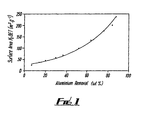
- the surface area of the particulate FCC material was measured by nitrogen BET. The two results obtained for each stage were plotted graphically and the graph obtained, which is shown as Figure 1, shows the correlation between product particulate surface area and extent of aluminium removal.
- Example 2 Various samples of particulate FCC products produced in the manner described in Example 1 were investigated for oil sorbency using a well known procedure according to a British standard. The uptake of a linseed oil using each product was measured.
- Example 1 A study was carried out to investigate the use of the product of Example 1 in newsprint. Handsheets were made according to standard TAPPI procedures using a standard newsprint fibre slurry and a retention aid chemical TRP 954 (Calgon Corporation) representing a standard newsprint furnish. 4% by weight of the investigated filler product was employed in the furnish. Various other commercially available conventionally calcined clays were investigated in a similar manner. Also, the flash calcined clay produced in Example 1 prior to the acid leaching step and a commercially available synthetic high surface area alumihosilicate material were also included in the comparative investigation. A summary of the filler materials included in the comparative investigation is as given in Table 2 as follows.
- COF tangent represents a measure of the coefficient of friction of each handsheet incorporating the filler under investigation.
- Filler 7 embodying the present invention shows the best combination of properties measured. In particular, it shows a high brightness, high tensile index and high coefficient of friction as well as acceptable opacity scatter, ink strike through and show through.
- Filler 5 shows a slightly better coefficient of friction than Filler 7 but overall has a combination of properties not as good as Filler 7 and is in any case a very expensive product because it is synthetic (ie not derived from natural mineral sources). It is possible for Filler 7 to be produced and sold more cheaply than Filler 5.
Landscapes
- Chemical & Material Sciences (AREA)
- Organic Chemistry (AREA)
- Engineering & Computer Science (AREA)
- Life Sciences & Earth Sciences (AREA)
- Inorganic Chemistry (AREA)
- Materials Engineering (AREA)
- Wood Science & Technology (AREA)
- Dispersion Chemistry (AREA)
- Nanotechnology (AREA)
- Chemical Kinetics & Catalysis (AREA)
- Analytical Chemistry (AREA)
- Geochemistry & Mineralogy (AREA)
- Health & Medical Sciences (AREA)
- Medicinal Chemistry (AREA)
- Polymers & Plastics (AREA)
- Silicates, Zeolites, And Molecular Sieves (AREA)
- Pigments, Carbon Blacks, Or Wood Stains (AREA)
- Glass Compositions (AREA)
- Paper (AREA)
- Sealing Material Composition (AREA)
- Compositions Of Macromolecular Compounds (AREA)
- Paints Or Removers (AREA)
Claims (18)
- Verfahren zur Herstellung eines porösen anorganischen Teilchenmaterials, umfassend das Behandeln eines Alumosilikat-Teilchenmaterials mit einem Laugemittel, das mit Aluminium chemisch reagiert oder es löslich macht und dadurch das Aluminium aus dem Alumosilikatmaterial herauslöst, wobei das Alumosilikat-Teilchenmaterial ein flash-gebranntes wasserhaltiges Alumosilikat-Teilchenmaterial ist.
- Verfahren nach Anspruch 1, wobei das flash-gebrannte Alumosilikatmaterial einen Kandit- und/oder Smektit-Ton umfasst.
- Verfahren nach Anspruch 2, wobei das flash-gebrannte Alumosilikatmaterial ein Material aus mindestens 90 Gew.% Kaolin umfasst.
- Verfahren nach einem der Ansprüche 1 bis 3, wobei das Alumosilikatmaterial in einem Verfahren flashgebrannt wird, bei dem das Material derart auf eine Maximaltemperatur erwärmt wird, dass die Temperatur des Materials mit einer Geschwindigkeit von mindestens 5 x 10³ °C pro sec beim Erwärmen steigt.
- Verfahren nach einem der vorhergehenden Ansprüche, wobei mindestens 90 Gew.% des durch Flash-Brennen erhaltenen Alumosilikatmaterials Metakaolin ist.
- Verfahren nach Anspruch 5, wobei das flash-gebrannte wasserhaltige Alumosilikatmaterial mindestens 90 Gew.% Kaolin umfasst und die beim Flash-Brennverfahren auf das Material einwirkende Maximaltemperaturvon 500 bis 950°C reicht.
- Verfahren nach einem der vorhergehenden Ansprüche, wobei das Laugemittel ausgewählt ist aus Mineralsäuren, organischen Säuren und Aluminium-Chelatbildnern.
- Verfahren nach einem der vorhergehenden Ansprüche, wobei der Laugeschritt bei einer Temperatur im Bereich von 30 bis 100°C erfolgt.
- Verfahren nach Anspruch 8, wobei zu Beginn die Temperatur einer wässrigen Suspension des durch Laugung zu behandelnden flash-gebrannten Alumosilikatmaterials durch Zugabe einer konzentrierten Mineralsäure zur Suspension erhöht wird.
- Verfahren nach einem der vorhergehenden Ansprüche, wobei das durch Laugung des flash-gebrannten Alumosilikatmaterials erhaltene Teilchenprodukt aus dem Laugemedium getrennt und in Wasser gewaschen wird.
- Verfahren nach Anspruch 10, wobei die Temperatur des Teilchenprodukts derart gehalten wird, dass sie bei den Trenn- und Waschschritten nicht unter 50°C fällt.
- Teilchenprodukt, umfassend ein anorganisches Alumosilikat-Teilchenmaterial, das Teilchen aus einem flash-gebrannten wasserhaltigen Alumosilikatmaterial umfasst, das im Inneren Blasen enthält, welche beim raschen Erhitzen des im Alumosilikatmaterial enthaltenen Wassers beim Flashbrennen entstehen, sowie Ätzkanäle oder Poren, die von den Blasen ausgehen oder sich zwischen diesen erstrecken und die durch ein nach der Blasenbildung erfolgendes Laugeverfahren erhalten werden.
- Teilchenprodukt nach Anspruch 12, erhalten durch ein Verfahren nach einem der Ansprüche 1 bis 11.
- Teilchenprodukt nach Anspruch 12 oder 13, dessen Oberfläche mindestens 200 m2 · g-1 ist.
- Teilchenprodukt nach Anspruch 12, 13 oder 14, dessen Teilchengrößenverteilung derart ist, dass der d50-Wert der Verteilung von 0,5 bis 3 um reicht.
- Teilchenprodukt nach einem der Ansprüche 12 bis 15, wobei der mittlere Innendurchmesser der Poren der Produktteilchen von 1 bis 10 nm reicht.
- Teilchenprodukt nach einem der Ansprüche 12 bis 16, wobei die spezifische Dichte des Produkts 2,2 oder weniger ist.
- Verwendung eines Teilchenprodukts nach einem der Ansprüche 12 bis 17 in einem Produkt, ausgewählt aus Thermoplastmaterialien, Farben, Harzen, Dichtungsmitteln und anderen Produkten auf Polymerbasis, thermisch bedrucktem Kopierpapier, beschichtetem Papier, Zeitungspapier und anderem Papier oder ähnlichen Produkten, Gas und flüssigen Sorptionsmedien und chemischen Lagerungsmedien und Medien für eine gesteuerte Freisetzung.
Applications Claiming Priority (2)
| Application Number | Priority Date | Filing Date | Title |
|---|---|---|---|
| GBGB9723818.2A GB9723818D0 (en) | 1997-11-12 | 1997-11-12 | Porous inorganic particulate material |
| GB9723818 | 1997-11-12 |
Publications (3)
| Publication Number | Publication Date |
|---|---|
| EP0916619A1 EP0916619A1 (de) | 1999-05-19 |
| EP0916619B1 true EP0916619B1 (de) | 2003-09-03 |
| EP0916619B2 EP0916619B2 (de) | 2007-01-03 |
Family
ID=10821906
Family Applications (2)
| Application Number | Title | Priority Date | Filing Date |
|---|---|---|---|
| EP98308907A Expired - Lifetime EP0916619B2 (de) | 1997-11-12 | 1998-10-30 | Anorganisches, poröses, partikuläres Material |
| EP98954589A Expired - Lifetime EP0951442B1 (de) | 1997-11-12 | 1998-11-12 | Behandlung von mineralpartikel |
Family Applications After (1)
| Application Number | Title | Priority Date | Filing Date |
|---|---|---|---|
| EP98954589A Expired - Lifetime EP0951442B1 (de) | 1997-11-12 | 1998-11-12 | Behandlung von mineralpartikel |
Country Status (11)
| Country | Link |
|---|---|
| US (2) | US6136740A (de) |
| EP (2) | EP0916619B2 (de) |
| JP (1) | JPH11263679A (de) |
| CN (1) | CN1225911A (de) |
| AT (1) | ATE248769T1 (de) |
| AU (2) | AU9052398A (de) |
| BR (1) | BR9806469A (de) |
| DE (2) | DE69817732T3 (de) |
| GB (1) | GB9723818D0 (de) |
| WO (1) | WO1999024360A1 (de) |
| ZA (1) | ZA9810310B (de) |
Families Citing this family (30)
| Publication number | Priority date | Publication date | Assignee | Title |
|---|---|---|---|---|
| EP1199338A3 (de) | 2000-10-17 | 2004-01-21 | Imerys Kaolin, Inc. | Kalcinierte Kaolinpigmente mit verbesserten physikalischen und anwendungstechnischen Eigenschaften, ihre Herstellung und Verwendung |
| GB0026173D0 (en) * | 2000-10-26 | 2000-12-13 | Imerys Minerals Ltd | Processing of inorganic particulate materials |
| KR20030010024A (ko) * | 2001-07-25 | 2003-02-05 | 엘지.필립스 엘시디 주식회사 | 제올라이트를 포함하는 액정표시장치용 실런트 |
| GB0209355D0 (en) | 2002-04-24 | 2002-06-05 | Imerys Minerals Ltd | An opacified polymer composition |
| ES2731584T3 (es) * | 2002-12-02 | 2019-11-18 | Imerys Pigments Inc | Suspensiones de caolín calcinado, de partícula grande, de alto contenido de sólidos |
| CN1697787A (zh) | 2003-03-19 | 2005-11-16 | 英默里斯高岭土公司 | 粒度分布很窄的煅烧高岭土 |
| WO2005020685A2 (en) * | 2003-08-29 | 2005-03-10 | Luzenac America, Inc. | Composition and method for crop protection |
| JP4436644B2 (ja) * | 2003-09-24 | 2010-03-24 | サンケイ化学株式会社 | 徐放性フェロモン製剤 |
| US20070123629A1 (en) * | 2004-02-06 | 2007-05-31 | Sare Edward J | Post-addition of white minerals for modifications of optical film properties |
| EP1747179A1 (de) | 2004-05-03 | 2007-01-31 | Imerys Pigments, Inc. | Verfahren zur calcinierung von teilchenförmigem material |
| DE102004059283B4 (de) * | 2004-11-25 | 2009-03-12 | Bene_Fit Gmbh | Füllstoff für die Herstellung von Papier, Herstellungsverfahren hierfür und seine Verwendung |
| GB0505967D0 (en) * | 2005-03-23 | 2005-04-27 | Imerys Minerals Ltd | Infrared absorbing polymer compositions and films |
| EP1951411B1 (de) * | 2005-10-21 | 2018-03-28 | Calix Pty Ltd. | System und verfahren zur verarbeitung mittels calcinierungs-/carbonatisierungszyklen |
| GB0606080D0 (en) * | 2006-03-27 | 2006-05-03 | Imerys Minerals Ltd | Method for producing particulate calcium carbonate |
| EP2004319B8 (de) | 2006-03-31 | 2015-07-22 | Calix Ltd | System und verfahren zur calcinierung von mineralien |
| US7776954B2 (en) * | 2008-01-30 | 2010-08-17 | Millenium Inorganic Chemicals, Inc. | Photocatalytic coating compositions |
| EP2429949A2 (de) * | 2009-05-08 | 2012-03-21 | Michael Tsapatsis | Molekularsiebmembranen und wärmebehandlungsverfahren zur herstellung davon |
| DE102010061456B4 (de) * | 2010-12-21 | 2013-11-07 | Liapor Gmbh & Co. Kg | Verfahren zum Herstellen einer Baustoffzusammensetzung und ein Bindemittel für eine Baustoffmischung |
| US10093849B2 (en) | 2012-06-04 | 2018-10-09 | Imerys Oilfield Minerals, Inc. | Proppants and anti-flowback additives comprising flash calcined clay, methods of manufacture, and methods of use |
| CN108883034B (zh) | 2016-04-08 | 2022-06-07 | 伊梅里斯矿物有限公司 | 高岭土作为遮光剂的用途 |
| US20180244535A1 (en) * | 2017-02-24 | 2018-08-30 | BWXT Isotope Technology Group, Inc. | Titanium-molybdate and method for making the same |
| US11363709B2 (en) | 2017-02-24 | 2022-06-14 | BWXT Isotope Technology Group, Inc. | Irradiation targets for the production of radioisotopes |
| EP3470050A1 (de) | 2017-10-10 | 2019-04-17 | Imertech Sas | Verwendung von kalziniertem kaolin als mattierungsmittel |
| FR3082732A1 (fr) * | 2018-06-25 | 2019-12-27 | Imertech | Emulsions de type pickering |
| CN109907368B (zh) * | 2019-03-01 | 2021-10-01 | 江西中烟工业有限责任公司 | 活性纳米陶瓷固体香珠的制备方法及其在卷烟滤棒的应用 |
| CN111847468B (zh) * | 2020-07-29 | 2022-04-22 | 东北大学 | 煤系高岭土多段悬浮煅烧生产高白度煅烧高岭土的方法 |
| DE102021106294A1 (de) | 2021-03-16 | 2022-09-22 | Stephan Schmidt Kg | Verwendung von kalzinierten vulkanischen Ausgangsgesteinen als Zementbestandteil |
| CN113214616B (zh) * | 2021-06-15 | 2022-07-12 | 万华化学(宁波)有限公司 | 一种应用于食品接触领域的低气味生物可降解pla合金及其制备方法 |
| DE102023001707A1 (de) | 2023-04-27 | 2024-10-31 | LASSELSBERGER Group GmbH | Als zusatzstoff für baustoffe einsetzbares material |
| WO2024223828A1 (de) | 2023-04-27 | 2024-10-31 | LASSELSBERGER Group GmbH | Verfahren zur nasschemischen änderung einer silikatstruktur, dessen reaktionsprodukt nebst anwendung und entsprechendes reaktorsystem |
Family Cites Families (10)
| Publication number | Priority date | Publication date | Assignee | Title |
|---|---|---|---|---|
| FR2030738A5 (en) * | 1969-12-01 | 1970-11-13 | Engelhard Min & Chem | Brightening kaolin clay |
| US3733391A (en) * | 1971-11-01 | 1973-05-15 | Nl Industries Inc | Process of preparing high silica faujasite |
| US4381948A (en) * | 1979-07-26 | 1983-05-03 | Anglo-American Clays Corporation | Anhydrous kaolin clay pigment and method of preparation |
| DE3036874A1 (de) * | 1979-10-01 | 1981-04-09 | English Clays Lovering Pochin & Co. Ltd., St. Austell, Cornwall | Fuellstoff fuer elastomere |
| US4479920A (en) * | 1981-06-29 | 1984-10-30 | Torftech Limited | Apparatus for processing matter in a turbulent mass of particulate material |
| NL8301731A (nl) * | 1982-05-21 | 1983-12-16 | Grace W R & Co | Katalysator en katalysatordrager, werkwijze voor de bereiding daarvan, alsmede werkwijze voor het kraken van koolwaterstoffen onder toepassing van deze katalysator. |
| US5011534A (en) | 1990-02-14 | 1991-04-30 | Engelhard Corporation | Calcined kaolin clay filler pigment for enhancing opacity and printing properties of newsprint and mechanical papers |
| US5397754A (en) * | 1993-10-21 | 1995-03-14 | Impex | Method of brightening kaolin clay by thermal oxidative decarboxylation of organic contaminants |
| US5551975A (en) * | 1994-06-23 | 1996-09-03 | J. M. Huber Corporation | Structured pigment compositions, methods for preparation and use |
| US6139313A (en) * | 1996-07-23 | 2000-10-31 | Mortimer Technology Holdings Limited | Furnace having toroidal fluid flow heating zone |
-
1997
- 1997-11-12 GB GBGB9723818.2A patent/GB9723818D0/en not_active Ceased
-
1998
- 1998-10-30 DE DE69817732T patent/DE69817732T3/de not_active Expired - Lifetime
- 1998-10-30 AT AT98308907T patent/ATE248769T1/de not_active IP Right Cessation
- 1998-10-30 EP EP98308907A patent/EP0916619B2/de not_active Expired - Lifetime
- 1998-11-04 AU AU90523/98A patent/AU9052398A/en not_active Abandoned
- 1998-11-06 JP JP10315702A patent/JPH11263679A/ja active Pending
- 1998-11-09 US US09/188,848 patent/US6136740A/en not_active Expired - Fee Related
- 1998-11-11 ZA ZA9810310A patent/ZA9810310B/xx unknown
- 1998-11-12 DE DE69829273T patent/DE69829273T2/de not_active Expired - Lifetime
- 1998-11-12 CN CN98123395A patent/CN1225911A/zh active Pending
- 1998-11-12 EP EP98954589A patent/EP0951442B1/de not_active Expired - Lifetime
- 1998-11-12 AU AU11647/99A patent/AU1164799A/en not_active Abandoned
- 1998-11-12 US US09/341,507 patent/US6334894B1/en not_active Expired - Fee Related
- 1998-11-12 BR BR9806469-0A patent/BR9806469A/pt not_active Application Discontinuation
- 1998-11-12 WO PCT/GB1998/003426 patent/WO1999024360A1/en not_active Ceased
Also Published As
| Publication number | Publication date |
|---|---|
| DE69817732T3 (de) | 2007-05-16 |
| EP0951442B1 (de) | 2005-03-09 |
| DE69817732T2 (de) | 2004-07-15 |
| ATE248769T1 (de) | 2003-09-15 |
| CN1225911A (zh) | 1999-08-18 |
| ZA9810310B (en) | 1999-06-28 |
| WO1999024360A1 (en) | 1999-05-20 |
| DE69817732D1 (de) | 2003-10-09 |
| DE69829273D1 (de) | 2005-04-14 |
| DE69829273T2 (de) | 2005-07-28 |
| US6136740A (en) | 2000-10-24 |
| GB9723818D0 (en) | 1998-01-07 |
| JPH11263679A (ja) | 1999-09-28 |
| BR9806469A (pt) | 1999-12-07 |
| EP0951442A1 (de) | 1999-10-27 |
| EP0916619A1 (de) | 1999-05-19 |
| AU9052398A (en) | 1999-06-03 |
| AU1164799A (en) | 1999-05-31 |
| US6334894B1 (en) | 2002-01-01 |
| EP0916619B2 (de) | 2007-01-03 |
Similar Documents
| Publication | Publication Date | Title |
|---|---|---|
| EP0916619B1 (de) | Anorganisches, poröses, partikuläres Material | |
| KR0144448B1 (ko) | 탄산칼슘 침전물의 제조방법 | |
| KR101094545B1 (ko) | 경질 탄산칼슘, 그 제조방법 및 그것을 사용한 제지 충전용 전료 | |
| US9944798B2 (en) | Composite of inorganic and/or organic microparticles and nano-dolomite particles | |
| US5595717A (en) | Controlled precipitation of amorphous silica from geothermal fluids or other aqueous media containing silicic acid | |
| KR20140027510A (ko) | 소수화 처리된 탄산칼슘 입자 | |
| Singh et al. | Fabrication of nano-silica from agricultural residue and their application | |
| RU2007141650A (ru) | Осажденный кальциево-карбонатный пигмент, особенно применимый в качестве покрытия для бумаги, предназначенной для краскоструйного печатания | |
| JP5279271B2 (ja) | 超微細含水カオリン顔料、前記顔料の製造方法そして前記顔料を光沢塗料配合で用いる方法 | |
| KR20100098689A (ko) | 인산화 표면 및 알칼리 토류 탄산염 나노 입자를 갖는 무기 미세입자의 복합재 | |
| TW200540113A (en) | Silica-based sols and their production and use | |
| KR20200137102A (ko) | 육각 판상 알루미나 단결정 입자 및 그 제조방법 | |
| KR101400787B1 (ko) | 슬래그로부터 회수한 실리카겔을 이용한 소수성 에어로겔의 제조방법 및 이로부터 제조된 에어로겔 | |
| JP2004100088A (ja) | 製紙スラッジからの填料の製造方法およびこれを充填した紙 | |
| US5151124A (en) | Method for forming aggregated kaolin pigment | |
| JPH024452A (ja) | ゼオライト性触媒の製造方法 | |
| BRPI0513048B1 (pt) | método para o processamento de caulim | |
| US3328125A (en) | Reactive selectively sorptive silica materials and process of producing them | |
| EP1255791B1 (de) | Zusammengesetzte pigmente enthaltend in situ gefälltem calciumcarbonat | |
| EP1961862B1 (de) | Papierherstellung mit modifizierten Kieselsolen als Mikropartikel | |
| US3437441A (en) | Process of producing highly porous and reactive silica materials | |
| JP4571367B2 (ja) | メソ孔担持炭酸カルシウム、その製造方法及びそれを用いた塗工紙 | |
| JP2003071404A (ja) | 新規多孔性粒体 | |
| AU706819B2 (en) | Improved pitch control agent | |
| EP0681559A1 (de) | Amorphe kieselsäure, ihre herstellung und verwendung |
Legal Events
| Date | Code | Title | Description |
|---|---|---|---|
| PUAI | Public reference made under article 153(3) epc to a published international application that has entered the european phase |
Free format text: ORIGINAL CODE: 0009012 |
|
| 17P | Request for examination filed |
Effective date: 19981030 |
|
| AK | Designated contracting states |
Kind code of ref document: A1 Designated state(s): AT DE DK ES FR GB GR |
|
| AX | Request for extension of the european patent |
Free format text: AL;LT;LV;MK;RO;SI |
|
| AKX | Designation fees paid |
Free format text: AT DE DK ES FR GB GR |
|
| GRAG | Despatch of communication of intention to grant |
Free format text: ORIGINAL CODE: EPIDOS AGRA |
|
| 17Q | First examination report despatched |
Effective date: 20011005 |
|
| GRAG | Despatch of communication of intention to grant |
Free format text: ORIGINAL CODE: EPIDOS AGRA |
|
| GRAH | Despatch of communication of intention to grant a patent |
Free format text: ORIGINAL CODE: EPIDOS IGRA |
|
| RAP1 | Party data changed (applicant data changed or rights of an application transferred) |
Owner name: IMERYS MINERALS LIMITED |
|
| GRAH | Despatch of communication of intention to grant a patent |
Free format text: ORIGINAL CODE: EPIDOS IGRA |
|
| GRAA | (expected) grant |
Free format text: ORIGINAL CODE: 0009210 |
|
| AK | Designated contracting states |
Kind code of ref document: B1 Designated state(s): AT DE DK ES FR GB GR |
|
| PG25 | Lapsed in a contracting state [announced via postgrant information from national office to epo] |
Ref country code: AT Free format text: LAPSE BECAUSE OF FAILURE TO SUBMIT A TRANSLATION OF THE DESCRIPTION OR TO PAY THE FEE WITHIN THE PRESCRIBED TIME-LIMIT Effective date: 20030903 |
|
| REG | Reference to a national code |
Ref country code: GB Ref legal event code: FG4D |
|
| REF | Corresponds to: |
Ref document number: 69817732 Country of ref document: DE Date of ref document: 20031009 Kind code of ref document: P |
|
| PG25 | Lapsed in a contracting state [announced via postgrant information from national office to epo] |
Ref country code: GR Free format text: LAPSE BECAUSE OF FAILURE TO SUBMIT A TRANSLATION OF THE DESCRIPTION OR TO PAY THE FEE WITHIN THE PRESCRIBED TIME-LIMIT Effective date: 20031203 Ref country code: DK Free format text: LAPSE BECAUSE OF FAILURE TO SUBMIT A TRANSLATION OF THE DESCRIPTION OR TO PAY THE FEE WITHIN THE PRESCRIBED TIME-LIMIT Effective date: 20031203 |
|
| PG25 | Lapsed in a contracting state [announced via postgrant information from national office to epo] |
Ref country code: ES Free format text: LAPSE BECAUSE OF FAILURE TO SUBMIT A TRANSLATION OF THE DESCRIPTION OR TO PAY THE FEE WITHIN THE PRESCRIBED TIME-LIMIT Effective date: 20031214 |
|
| ET | Fr: translation filed | ||
| PLBQ | Unpublished change to opponent data |
Free format text: ORIGINAL CODE: EPIDOS OPPO |
|
| PLBI | Opposition filed |
Free format text: ORIGINAL CODE: 0009260 |
|
| PLAX | Notice of opposition and request to file observation + time limit sent |
Free format text: ORIGINAL CODE: EPIDOSNOBS2 |
|
| 26 | Opposition filed |
Opponent name: AKZO NOBEL N.V. Effective date: 20040525 |
|
| PLAX | Notice of opposition and request to file observation + time limit sent |
Free format text: ORIGINAL CODE: EPIDOSNOBS2 |
|
| PLBB | Reply of patent proprietor to notice(s) of opposition received |
Free format text: ORIGINAL CODE: EPIDOSNOBS3 |
|
| PLAB | Opposition data, opponent's data or that of the opponent's representative modified |
Free format text: ORIGINAL CODE: 0009299OPPO |
|
| PUAH | Patent maintained in amended form |
Free format text: ORIGINAL CODE: 0009272 |
|
| STAA | Information on the status of an ep patent application or granted ep patent |
Free format text: STATUS: PATENT MAINTAINED AS AMENDED |
|
| 27A | Patent maintained in amended form |
Effective date: 20070103 |
|
| AK | Designated contracting states |
Kind code of ref document: B2 Designated state(s): AT DE DK ES FR GB GR |
|
| REG | Reference to a national code |
Ref country code: ES Ref legal event code: FD2A Effective date: 20031031 |
|
| ET3 | Fr: translation filed ** decision concerning opposition | ||
| REG | Reference to a national code |
Ref country code: DE Ref legal event code: R082 Ref document number: 69817732 Country of ref document: DE Representative=s name: HASELTINE LAKE LLP, DE |
|
| REG | Reference to a national code |
Ref country code: FR Ref legal event code: PLFP Year of fee payment: 18 |
|
| REG | Reference to a national code |
Ref country code: FR Ref legal event code: PLFP Year of fee payment: 19 |
|
| REG | Reference to a national code |
Ref country code: FR Ref legal event code: PLFP Year of fee payment: 20 |
|
| PGFP | Annual fee paid to national office [announced via postgrant information from national office to epo] |
Ref country code: DE Payment date: 20171027 Year of fee payment: 20 Ref country code: FR Payment date: 20171025 Year of fee payment: 20 |
|
| PGFP | Annual fee paid to national office [announced via postgrant information from national office to epo] |
Ref country code: GB Payment date: 20171027 Year of fee payment: 20 |
|
| REG | Reference to a national code |
Ref country code: DE Ref legal event code: R071 Ref document number: 69817732 Country of ref document: DE |
|
| REG | Reference to a national code |
Ref country code: GB Ref legal event code: PE20 Expiry date: 20181029 |
|
| PG25 | Lapsed in a contracting state [announced via postgrant information from national office to epo] |
Ref country code: GB Free format text: LAPSE BECAUSE OF EXPIRATION OF PROTECTION Effective date: 20181029 |