EP0906856B2 - Sliding caliper disc brake - Google Patents
Sliding caliper disc brake Download PDFInfo
- Publication number
- EP0906856B2 EP0906856B2 EP98118564A EP98118564A EP0906856B2 EP 0906856 B2 EP0906856 B2 EP 0906856B2 EP 98118564 A EP98118564 A EP 98118564A EP 98118564 A EP98118564 A EP 98118564A EP 0906856 B2 EP0906856 B2 EP 0906856B2
- Authority
- EP
- European Patent Office
- Prior art keywords
- carrier
- brake
- disc
- sliding calliper
- reaction
- Prior art date
- Legal status (The legal status is an assumption and is not a legal conclusion. Google has not performed a legal analysis and makes no representation as to the accuracy of the status listed.)
- Expired - Lifetime
Links
- 238000006243 chemical reaction Methods 0.000 claims description 14
- 238000006073 displacement reaction Methods 0.000 claims description 5
- 230000004323 axial length Effects 0.000 claims description 3
- 238000009434 installation Methods 0.000 description 3
- 238000010276 construction Methods 0.000 description 2
- 230000008878 coupling Effects 0.000 description 2
- 238000010168 coupling process Methods 0.000 description 2
- 238000005859 coupling reaction Methods 0.000 description 2
Images

Classifications
-
- F—MECHANICAL ENGINEERING; LIGHTING; HEATING; WEAPONS; BLASTING
- F16—ENGINEERING ELEMENTS AND UNITS; GENERAL MEASURES FOR PRODUCING AND MAINTAINING EFFECTIVE FUNCTIONING OF MACHINES OR INSTALLATIONS; THERMAL INSULATION IN GENERAL
- F16D—COUPLINGS FOR TRANSMITTING ROTATION; CLUTCHES; BRAKES
- F16D55/00—Brakes with substantially-radial braking surfaces pressed together in axial direction, e.g. disc brakes
- F16D55/02—Brakes with substantially-radial braking surfaces pressed together in axial direction, e.g. disc brakes with axially-movable discs or pads pressed against axially-located rotating members
- F16D55/22—Brakes with substantially-radial braking surfaces pressed together in axial direction, e.g. disc brakes with axially-movable discs or pads pressed against axially-located rotating members by clamping an axially-located rotating disc between movable braking members, e.g. movable brake discs or brake pads
- F16D55/224—Brakes with substantially-radial braking surfaces pressed together in axial direction, e.g. disc brakes with axially-movable discs or pads pressed against axially-located rotating members by clamping an axially-located rotating disc between movable braking members, e.g. movable brake discs or brake pads with a common actuating member for the braking members
-
- B—PERFORMING OPERATIONS; TRANSPORTING
- B60—VEHICLES IN GENERAL
- B60T—VEHICLE BRAKE CONTROL SYSTEMS OR PARTS THEREOF; BRAKE CONTROL SYSTEMS OR PARTS THEREOF, IN GENERAL; ARRANGEMENT OF BRAKING ELEMENTS ON VEHICLES IN GENERAL; PORTABLE DEVICES FOR PREVENTING UNWANTED MOVEMENT OF VEHICLES; VEHICLE MODIFICATIONS TO FACILITATE COOLING OF BRAKES
- B60T1/00—Arrangements of braking elements, i.e. of those parts where braking effect occurs specially for vehicles
- B60T1/02—Arrangements of braking elements, i.e. of those parts where braking effect occurs specially for vehicles acting by retarding wheels
- B60T1/06—Arrangements of braking elements, i.e. of those parts where braking effect occurs specially for vehicles acting by retarding wheels acting otherwise than on tread, e.g. employing rim, drum, disc, or transmission or on double wheels
- B60T1/065—Arrangements of braking elements, i.e. of those parts where braking effect occurs specially for vehicles acting by retarding wheels acting otherwise than on tread, e.g. employing rim, drum, disc, or transmission or on double wheels employing disc
-
- F—MECHANICAL ENGINEERING; LIGHTING; HEATING; WEAPONS; BLASTING
- F16—ENGINEERING ELEMENTS AND UNITS; GENERAL MEASURES FOR PRODUCING AND MAINTAINING EFFECTIVE FUNCTIONING OF MACHINES OR INSTALLATIONS; THERMAL INSULATION IN GENERAL
- F16D—COUPLINGS FOR TRANSMITTING ROTATION; CLUTCHES; BRAKES
- F16D65/00—Parts or details
- F16D65/02—Braking members; Mounting thereof
- F16D65/12—Discs; Drums for disc brakes
-
- F—MECHANICAL ENGINEERING; LIGHTING; HEATING; WEAPONS; BLASTING
- F16—ENGINEERING ELEMENTS AND UNITS; GENERAL MEASURES FOR PRODUCING AND MAINTAINING EFFECTIVE FUNCTIONING OF MACHINES OR INSTALLATIONS; THERMAL INSULATION IN GENERAL
- F16D—COUPLINGS FOR TRANSMITTING ROTATION; CLUTCHES; BRAKES
- F16D55/00—Brakes with substantially-radial braking surfaces pressed together in axial direction, e.g. disc brakes
- F16D2055/0004—Parts or details of disc brakes
- F16D2055/0008—Brake supports
-
- F—MECHANICAL ENGINEERING; LIGHTING; HEATING; WEAPONS; BLASTING
- F16—ENGINEERING ELEMENTS AND UNITS; GENERAL MEASURES FOR PRODUCING AND MAINTAINING EFFECTIVE FUNCTIONING OF MACHINES OR INSTALLATIONS; THERMAL INSULATION IN GENERAL
- F16D—COUPLINGS FOR TRANSMITTING ROTATION; CLUTCHES; BRAKES
- F16D55/00—Brakes with substantially-radial braking surfaces pressed together in axial direction, e.g. disc brakes
- F16D2055/0004—Parts or details of disc brakes
- F16D2055/0016—Brake calipers
-
- F—MECHANICAL ENGINEERING; LIGHTING; HEATING; WEAPONS; BLASTING
- F16—ENGINEERING ELEMENTS AND UNITS; GENERAL MEASURES FOR PRODUCING AND MAINTAINING EFFECTIVE FUNCTIONING OF MACHINES OR INSTALLATIONS; THERMAL INSULATION IN GENERAL
- F16D—COUPLINGS FOR TRANSMITTING ROTATION; CLUTCHES; BRAKES
- F16D55/00—Brakes with substantially-radial braking surfaces pressed together in axial direction, e.g. disc brakes
- F16D2055/0004—Parts or details of disc brakes
- F16D2055/007—Pins holding the braking members
-
- F—MECHANICAL ENGINEERING; LIGHTING; HEATING; WEAPONS; BLASTING
- F16—ENGINEERING ELEMENTS AND UNITS; GENERAL MEASURES FOR PRODUCING AND MAINTAINING EFFECTIVE FUNCTIONING OF MACHINES OR INSTALLATIONS; THERMAL INSULATION IN GENERAL
- F16D—COUPLINGS FOR TRANSMITTING ROTATION; CLUTCHES; BRAKES
- F16D65/00—Parts or details
- F16D65/02—Braking members; Mounting thereof
- F16D2065/13—Parts or details of discs or drums
- F16D2065/1304—Structure
- F16D2065/1308—Structure one-part
-
- F—MECHANICAL ENGINEERING; LIGHTING; HEATING; WEAPONS; BLASTING
- F16—ENGINEERING ELEMENTS AND UNITS; GENERAL MEASURES FOR PRODUCING AND MAINTAINING EFFECTIVE FUNCTIONING OF MACHINES OR INSTALLATIONS; THERMAL INSULATION IN GENERAL
- F16D—COUPLINGS FOR TRANSMITTING ROTATION; CLUTCHES; BRAKES
- F16D65/00—Parts or details
- F16D65/02—Braking members; Mounting thereof
- F16D2065/13—Parts or details of discs or drums
- F16D2065/1304—Structure
- F16D2065/1328—Structure internal cavities, e.g. cooling channels
Definitions
- a sliding calliper disc brake for a land vehicle comprising a brake disc, a slide caliper, a carrier, an actuation side brake shoe, and a reaction side brake shoe, the carrier being held immovable with respect to the axle of the land vehicle, the brake disc being rotatably supported relative to the axle, and assembly / disassembly slidable with respect to the support in the direction of the axis, the sliding caliper has two legs, namely one which lies on the actuation side of the brake disc, and one which lies on the reaction side of the brake disc, the carrier extends axially from the actuation side to the reaction side of the brake disc carrier on the reaction side has a clear width, which is dimensioned so that the brake disc passes through during axial displacement for assembly / disassembly, and the carrier has guides on which the sliding caliper is slidably guided.
- the EP-A1-665 387 shows the construction of a sliding caliper disc brake and its attachment to an axle 1.
- the two saddle legs overlap U-shaped a brake disc 12 to press the both sides of the brake disc in guide shafts of a slide caliper support 14 mounted and supported brake shoes 17 against the brake disc.
- the slide carrier 14 in turn is bolted to a support flange 13 attached to the axle 1.
- the slide carrier for closed-surface guidance of the brake shoes is closed, ie that he frame-like the brake disc fully engages, see. also EP-A1-665 387 , Page 2, lines 55 and 56.
- the two known brakes described above are each commercial vehicle brakes, which accordingly have a comparatively large weight. Also, their individual components have a significant weight, which is why any additional step is considered disadvantageous.
- the DE-A-39 10 969 also shows a sliding caliper disc brake for cars. Also in this brake, arms 36 and 37 engage behind the brake disc. As further examples of brakes of this type are to call the US-A-5,297,659 , the DE-A-43 34 839 and the US-A-5,103,939 ,
- the DE-C2-29 19 548 shows a sliding calliper disc brake of the type mentioned.
- a reaction-side brake shoe grooves 33L and 33R, in the guide rails 30L and 30R of a carrier 11 engage.
- the reaction-side brake shoe is fixed in the radial direction on the carrier. If the brake disc to be changed, not only the sliding calliper must be lifted in the radial direction, but it must also be at least the reaction-side brake shoe are withdrawn in the axial direction of the carrier. Only then is the brake disc free so that it can be removed from the reaction side.
- the invention is based on the object, the sliding caliper disc brake after the DE-C2-29 19 548 in such a way that - even with regard to the very cramped installation conditions in wheel bearings - the amount of work for mounting / dismounting the brake disc is minimized.
- the sliding saddle and not the carrier for radial fixing of the reaction-side brake shoe is used. Therefore, no separate steps are required to dismantle the reaction-side brake shoe. Rather, the lifting of the sliding caliper - and thus the brake shoe fixed thereto - from the carrier to the brake disc for assembly / disassembly of the reaction side exposes sufficient.
- the carrier has two arms which extend axially from the actuation side to the reaction side and on its brake disc facing side first support surfaces for sliding guidance and support of the sliding saddle, and that the sliding rests with an outer contour on the support surfaces.
- the two arms of the wearer cooperate with the sliding saddle so that they can absorb the braking forces (at least in part).
- the reaction-side brake shoe will not shift in the axial direction with respect to the sliding caliper during braking.
- the reaction-side brake shoe therefore preferably supports in the tangential direction on the sliding saddle according to the invention.
- reaction-side and the actuation-side brake shoes are simply "plugged” into the cut-out, which makes their assembly / disassembly particularly easy.
- boundaries of the cutout serve as second support surfaces for the reaction-side brake shoe.
- the cutout and thus the support of the reaction-side brake shoe in the radial direction is open.
- the cutout also receives the operating side brake shoe, and the third support surfaces will have a radially open configuration.
- a retaining device is preferably provided which fixes the actuating-side brake shoe and the reaction-side brake shoe in the radial direction on the sliding saddle. This only one component must be solved to release both brake shoes.
- the sliding caliper disc brake on a shoulder on the sliding caliper or on the carrier which engages behind a corresponding contour on the carrier or on the sliding caliper and thereby locks the sliding caliper in the radial direction on the carrier, wherein the axial length of the neck or the Contour is such that the sliding caliper can be unlocked by axial displacement.
- Such a lock which should advantageously be provided at least on the brake disk inlet side, serves to guide the sliding saddle when re-attachment to the carrier.
- a particularly simple way of locking the sliding caliper on the carrier is achieved, for example in accordance with a bayonet closure.
- the guides according to the invention are preferably arranged on the approach or the contour.
- the carrier may be permanently connected to the axle. But it can also be releasably attached to the axle.
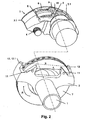
- FIGS. 1 and 2 show an axis 1 with a rigidly secured thereto carrier 2 and a sliding caliper 3, to the axial guide along the brake axis attached to the carrier guide pins 4 are used.
- the sliding saddle 3 is U-shaped, with an actuation side Saddle leg 5 carries a tension and acts against an operating side brake shoe 8.
- a brake disc 7 is mounted with a diameter D, the direction of rotation R is indicated by an arrow.
- both brake shoes 8, 9 are held by means of a releasable from the sliding saddle 3 holding means 10 such that they are fixed in the axial direction of the brake disc 7 movable, but with respect to other directions of the said holding means 10.
- the carrier 2 has on the actuation side two arms with supporting surfaces 11 which do not extend beyond the outer contour of the brake disk 7 in the radial direction.
- the distance A of the support surfaces 11 corresponds to the width of the actuation side brake shoe 8.
- the support surfaces are used for lateral support of the brake shoe 8 and thus to initiate the braking forces in the carrier 2.
- the reaction side extending in the radial direction two arms with support surfaces 12.
- the two arms are - seen in axial projection - arranged outside the brake disc contour.
- the distance B of the support surfaces from each other corresponds to the width C of the reaction-side saddle leg 6.
- the support surfaces in turn serve to initiate braking forces in the carrier 2, which are transmitted from the reaction-side brake shoe 9 on the sliding caliper 3.
- the reaction-side brake shoe 9 can transmit the braking forces to the sliding caliper 3, it is laterally supported on the sliding caliper 3.
- the support surfaces 3.3 are formed by boundaries of the section 3.1.
- the section 3.1 has a width E, which corresponds to the width of the reaction-side brake shoe 9.
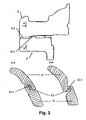
- an axial guidance of the carrier 2 in the area of the reaction-side support surface 12.1 overlaps a region 3.2 of the reaction-side saddle leg 6.
- the overlapping sections of the reaction-side saddle leg 6 on the one hand and the carrier 2 On the other hand, in its axial length are dimensioned such that the sliding saddle 3 can be locked or unlocked by axial displacement relative to the carrier 2.
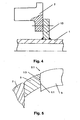
- Fig. 4 shows an embodiment in which the carrier 2 is releasably secured to a welded to the axis 1 flange 13.
- screws can be used, for example.
- the reaction-side free access to the brake disk 7 can be realized with only a few work steps. Nevertheless, a uniform guidance of the sliding caliper 3 and the brake shoes 8, 9 with respect to the carrier 2 is ensured.
- the dismantling is carried out as follows: After the wheel rim, the wheel hub, etc. have been removed from the axis 1 in a conventional manner, the guide pin 4 are first released from the carrier 2 to remove the brake disc 7. Thereafter, the sliding calliper 3 with the brake shoes 8, 9 fastened thereto by the holding means 10 can be raised radially from the carrier 2 in a single step over the diameter D of the brake disk 7. If, in addition, there is a coupling according to FIG.
- the sliding saddle 3 must first be displaced in the axial direction until the locking in the radial direction is released. In order to allow the axial displacement of the sliding saddle 3, space must be created in the interior of the sliding saddle 3 accordingly.
- the brake shoes in the axial direction
- the removal takes place from the carrier 2 as previously described. Due to the now freely accessible opening area between the support surfaces 12, the brake disk 7 can be deducted from the axle without further part removal.
Landscapes
- Engineering & Computer Science (AREA)
- General Engineering & Computer Science (AREA)
- Mechanical Engineering (AREA)
- Transportation (AREA)
- Braking Arrangements (AREA)
Description
Gleitsattel-Scheibenbremse für ein Landfahrzeug, mit einer Bremsscheibe, einem Gleitsattel, einem Träger, einer betätigungsseitigen Bremsbacke und einer reaktionsseitigen Bremsbacke, wobei der Träger unbeweglich bezüglich der Achse des Landfahrzeugs gehalten ist, die Bremsscheibe drehbar bezüglich der Achse gehalten ist und zur Montage/Demontage bezüglich des Trägers in Richtung der Achse verschieblich ist, der Gleitsattel zwei Schenkel hat, nämlich einen, der auf der Betätigungsseite der Bremsscheibe liegt, und einen, der auf der Reaktionsseite der Bremsscheibe liegt, der Träger sich axial von der Betätigungsseite zur Reaktionsseite der Bremsscheibe erstreckt, der Träger auf der Reaktionsseite eine lichte Weite hat, die derart bemessen ist, daß die Bremsscheibe beim Axialverschieben zur Montage/Demontage hindurchpaßt, und der Träger Führungen aufweist, auf denen der Gleitsattel gleitend geführt ist.A sliding calliper disc brake for a land vehicle, comprising a brake disc, a slide caliper, a carrier, an actuation side brake shoe, and a reaction side brake shoe, the carrier being held immovable with respect to the axle of the land vehicle, the brake disc being rotatably supported relative to the axle, and assembly / disassembly slidable with respect to the support in the direction of the axis, the sliding caliper has two legs, namely one which lies on the actuation side of the brake disc, and one which lies on the reaction side of the brake disc, the carrier extends axially from the actuation side to the reaction side of the brake disc carrier on the reaction side has a clear width, which is dimensioned so that the brake disc passes through during axial displacement for assembly / disassembly, and the carrier has guides on which the sliding caliper is slidably guided.
Die
Bei Gleitsattel-Scheibenbremsen dieser Bauart gestaltet sich der Wechsel der Bremsscheibe als sehr umständlich, weil der die Bremsscheibe voll umgreifende Gleitsattelträger ein Entfernen der Bremsscheibe in Richtung der Reaktionsseite der Bremse, die hier die Radfelgenseite ist, nicht ermöglicht. Um dies nach dem Abbau der Radfelge zu realisieren, wird in der
Nachteilig bei dieser Lösung ist es zum einen, daß mehrere Befestigungsschrauben zu entfernen sind. Ferner liegt der Schwenkpunkt um die genannte Befestigungsschraube über dem Außendurchmesser der Bremsscheibe und weit oberhalb der Rotationskontur des Bremssattels im Bereich der Radfelge. Wenngleich diese Lösung mithin zwar für eine ganz spezielle Achsenkonstruktion mit dem für diese Ausführung zur Verfügung stehenden Einbauraum einsetzbar ist, ist sie jedoch allgemein nicht brauchbar. Denn sowohl die axialen als auch die radialen Platzverhältnisse im Bereich der Radführung mit der Bremsenbefestigung sind im allgemeinen derart beengt, daß entweder die Radfelge selbst oder andere Fahrzeugteile beim Verschwenken an den Tragflansch anschlagen könnten.The disadvantage of this solution, on the one hand, that a plurality of mounting screws are to be removed. Further, the pivot point is about the said fastening screw on the outer diameter of the brake disc and far above the rotational contour of the caliper in the region of the wheel rim. Although this solution is therefore indeed applicable to a very specific axis design with the available installation space for this design, but it is generally not useful. Because both the axial and the radial space in the wheel guide with the brake mounting are generally so cramped that either the wheel rim yourself or other parts of the vehicle could hit the flange when pivoting.
Aus der
Bei den beiden oben beschriebenen bekannten Bremsen handelt es sich jeweils um Nutzfahrzeugbremsen, die ein dementsprechend vergleichsweise großes Gewicht haben. Auch haben ihre einzelnen Bauteile ein erhebliches Gewicht, weshalb jeder zusätzliche Arbeitsschritt als nachteilig anzusehen ist.The two known brakes described above are each commercial vehicle brakes, which accordingly have a comparatively large weight. Also, their individual components have a significant weight, which is why any additional step is considered disadvantageous.
Aus der
Die
Die
Der Erfindung liegt die Aufgabe zugrunde, die Gleitsattel-Scheibenbremse nach der
Erfindungsgemäß wird die gestellte Aufgabe durch eine Scheibenbremse nach Ansprüch 1 gelöst.According to the invention this object is achieved by a disc brake according to
Mit anderen Worten dient erfindungsgemäß der Gleitsattel und nicht der Träger zur Radialfestlegung der reaktionsseitigen Bremsbacke. Daher sind auch keine eigenen Arbeitsschritte erforderlich, um die reaktionsseitige Bremsbacke zu demontieren. Vielmehr genügt das Abheben des Gleitsattels - und damit der daran festgelegten Bremsbacke - von dem Träger um die Bremsscheibe für die Montage/Demontage von der Reaktionsseite her freizulegen.In other words, according to the invention, the sliding saddle and not the carrier for radial fixing of the reaction-side brake shoe is used. Therefore, no separate steps are required to dismantle the reaction-side brake shoe. Rather, the lifting of the sliding caliper - and thus the brake shoe fixed thereto - from the carrier to the brake disc for assembly / disassembly of the reaction side exposes sufficient.
Erfindungsgemäß bevorzugt ist vorgesehen, daß der Träger zwei Arme aufweist, die sich axial von der Betätigungsseite zur Reaktionsseite erstrecken und auf ihrer bremsscheibenzugewandten Seite erste Stützflächen zur gleitenden Führung und Abstützung des Gleitsattels aufweisen, und daß der Gleitsattel mit einer Außenkontur an den Stützflächen anliegt. Mithin wirken die beiden Arme des Trägers derart mit dem Gleitsattel zusammen, daß sie die Bremskräfte (zumindest teilweise) aufnehmen können.According to the invention it is preferably provided that the carrier has two arms which extend axially from the actuation side to the reaction side and on its brake disc facing side first support surfaces for sliding guidance and support of the sliding saddle, and that the sliding rests with an outer contour on the support surfaces. Thus, the two arms of the wearer cooperate with the sliding saddle so that they can absorb the braking forces (at least in part).
Die reaktionsseitige Bremsbacke wird sich beim Bremsen nicht in Axialrichtung bezüglich des Gleitsattels verschieben. Erfindungsgemäß stützt sich die reaktionsseitige Bremsbacke daher erfindungsgemäß bevorzugt in Tangentialrichtung an dem Gleitsattel ab. Durch diese Ausgestaltung wird erreicht, daß der Gleitsattel und die reaktionsseitige Bremsbacke noch weiter zu einer als Ganzes von dem Träger abnehmbaren Baueinheit zusammenwachsen. Darüber hinaus muß beim Einbau der Baueinheit aus reaktionsseitiger Bremsbacke und Gleitsattel nicht darauf geachtet werden, daß die reaktionsseitige Bremsbacke auch korrekt auf einer etwaig an dem Träger vorhandenen Führung sitzt. Vielmehr ist eine solche Führung am Träger im Hinblick auf die Abstützung der reaktionsseitigen Bremsbacke an dem Gleitsattel entbehrlich.The reaction-side brake shoe will not shift in the axial direction with respect to the sliding caliper during braking. According to the invention, the reaction-side brake shoe therefore preferably supports in the tangential direction on the sliding saddle according to the invention. By this configuration it is achieved that the sliding caliper and the reaction-side brake shoe grow together even further to a unit which can be removed as a whole from the carrier. In addition, care must be taken during installation of the assembly of reaction-side brake shoe and sliding saddle that the reaction-side brake shoe is also correctly seated on any existing on the carrier guide. Rather, such guidance on the carrier with regard to the support of the reaction-side brake shoe on the sliding caliper is dispensable.
Die reaktionsseitige und die betätigüngseitige Bremsbacke sind einfach in den Ausschnitt "eingesteckt", was ihre Montage/Demontage besonders einfach macht.The reaction-side and the actuation-side brake shoes are simply "plugged" into the cut-out, which makes their assembly / disassembly particularly easy.
Als den Gesamtaufbau weiter vereinfachend wird es erfindungsgemäß bevorzugt, daß Begrenzungen des Ausschnitts als zweite Stützflächen für die reaktionsseitige Bremsbacke dienen. Mit anderen Worten ist der Ausschnitt und damit die Abstützung der reaktionsseitigen Bremsbacke in Radialrichtung offen.Further simplifying the overall construction, it is preferred according to the invention that boundaries of the cutout serve as second support surfaces for the reaction-side brake shoe. In other words, the cutout and thus the support of the reaction-side brake shoe in the radial direction is open.
Insbesondere dann, wenn der Ausschnitt auch die betätigungsseitige Bremsbacke aufnimmt, werden auch die dritten Stützflächen eine in Radialrichtung offene Ausgestaltung haben.In particular, when the cutout also receives the operating side brake shoe, and the third support surfaces will have a radially open configuration.
Erfindungsgemäß bevorzugt ist eine Halteeinrichtung vorgesehen, die die betätigungsseitige Bremsbacke und die reaktionsseitige Bremsbacke in Radialrichtung an dem Gleitsattel festlegt. Damit muß nur ein Bauteil gelöst werden, um beide Bremsbacken freizugeben.According to the invention, a retaining device is preferably provided which fixes the actuating-side brake shoe and the reaction-side brake shoe in the radial direction on the sliding saddle. This only one component must be solved to release both brake shoes.
Erfindungsgemäß bevorzugt weist die Gleitsattel-Scheibenbremse einen Ansatz an dem Gleitsattel oder an dem Träger auf, der eine entsprechende Kontur an dem Träger bzw. an dem Gleitsattel hintergreift und dadurch den Gleitsattel in Radialrichtung an dem Träger verriegelt, wobei die axiale Länge des Ansatzes oder der Kontur derart ist, daß der Gleitsattel durch Axialverschiebung entriegelt werden kann.According to the invention, the sliding caliper disc brake on a shoulder on the sliding caliper or on the carrier, which engages behind a corresponding contour on the carrier or on the sliding caliper and thereby locks the sliding caliper in the radial direction on the carrier, wherein the axial length of the neck or the Contour is such that the sliding caliper can be unlocked by axial displacement.
Eine solche Verriegelung, die vorteilhafterweise zumindest auf der Bremsscheibeneinlaufseite vorgesehen sein sollte, dient der Führung des Gleitsattels beim Wiederanbau an den Träger. Damit wird - etwa entsprechend einem Bajonettverschluß - eine besonders einfache Möglichkeit der Verriegelung des Gleitsattels an dem Träger erreicht.Such a lock, which should advantageously be provided at least on the brake disk inlet side, serves to guide the sliding saddle when re-attachment to the carrier. Thus, a particularly simple way of locking the sliding caliper on the carrier is achieved, for example in accordance with a bayonet closure.
Vorteilhafterweise sind die Führungen erfindungsgemäß bevorzugt an dem Ansatz oder der Kontur angeordnet.Advantageously, the guides according to the invention are preferably arranged on the approach or the contour.
Erfindungsgemäß kann der Träger unlösbar mit der Achse verbunden sein. Er kann aber auch lösbar an der Achse angebracht sein.According to the invention, the carrier may be permanently connected to the axle. But it can also be releasably attached to the axle.
Im folgenden ist die Erfindung anhand bevorzugter Ausführungsbeispiele unter Bezugnahme die beiliegende Zeichnung mit weiteren Einzelheiten näher erläutert. Dabei zeigen
- Fig. 1 eine schematische Darstellung mit Blickrichtung auf die Reaktionsseite der Bremse, die hier die Felgenseite ist,
- Fig. 2 eine schematische Darstellung mit Blickrichtung auf die Betätigungsseite der Bremse,
- Fig. 3 den Kopplungsbereich zwischen dem Gleitsattel und dem Träger,
- Fig. 4 ein weiteres Ausführungsbeispiel, bei dem der Träger an einem Tragflansch der Achse befestigt ist und
- Fig. 5 eine Schnittansicht, die die Abstützung Bremsbelag/Sattel/Träger schematisch darstellt.
- 1 is a schematic view looking towards the reaction side of the brake, which is the rim side,
- 2 is a schematic view looking towards the actuating side of the brake,
- 3 shows the coupling region between the sliding caliper and the carrier,
- Fig. 4 shows another embodiment in which the carrier is attached to a support flange of the axle and
- Fig. 5 is a sectional view schematically illustrating the support brake pad / saddle / carrier.
Die Fig. 1 und 2 zeigen eine Achse 1 mit einem daran starr befestigten Träger 2 und einem Gleitsattel 3, zu dessen Axialführung entlang der Bremsenachse am Träger befestigte Führungsbolzen 4 dienen. Der Gleitsattel 3 ist U-förmig ausgebildet, wobei ein betätigungsseitiger Sattelschenkel 5 eine Zuspannung trägt und gegen eine betätigungsseitige Bremsbacke 8 wirkt. Ein reaktionsseitiger Sattelschenkel 6 hingegen, der bei diesem Ausführungsbeispiel in Richtung der Radfelge zeigt, wirkt gegen eine reaktionsseitige Bremsbacke 9 und weist eine Breite C auf. Zwischen den Sattelschenkeln und dem Bremsbacken ist eine Bremsscheibe 7 mit einem Durchmesser D gelagert, deren Drehrichtung R durch einen Pfeil angedeutet ist.1 and 2 show an
In einem Ausschnitt 3.1 des Gleitsattels 3 sind beide Bremsbacken 8, 9 mittels eines von dem Gleitsattel 3 lösbaren Haltemittels 10 derart gehalten, daß sie zwar in Axialrichtung der Bremsscheibe 7 beweglich, jedoch bezüglich anderer Richtungen von dem genannten Haltemittel 10 festgelegt sind.In a section 3.1 of the sliding
Der Träger 2 weist betätigungsseitig zwei sich in Radialrichtung nicht über die Außenkontur der Bremsscheibe 7 hinaus erstreckende Arme mit Stützflächen 11 auf. Der Abstand A der Stützflächen 11 entspricht der Breite der betätigungsseitigen Bremsbacke 8. Die Stützflächen dienen zur seitlichen Abstützung der Bremsbacke 8 und damit zur Einleitung der Bremskräfte in den Träger 2. Reaktionsseitig erstrecken sich in Radialrichtung zwei Arme mit Stützflächen 12. Die beiden Arme sind - in Axialprojektion gesehen - außerhalb der Bremsscheibenkontur angeordnet. Der Abstand B der Stützflächen voneinander entspricht der Breite C des reaktionsseitigen Sattelschenkels 6. Die Stützflächen dienen wiederum der Einleitung von Bremskräften in den Träger 2, die von der reaktionsseitigen Bremsbacke 9 auf den Gleitsattel 3 übertragen werden. Damit die reaktionsseitige Bremsbacke 9 die Bremskräfte auf den Gleitsattel 3 übertragen kann, ist sie seitlich an dem Gleitsattel 3 abgestützt. Dazu dienen Stützflächen 9.1 an der reaktionsseitigen Bremsbacke 9 und Stützflächen 3.3 an dem Gleitsattel 3. Die Stützflächen 3.3 sind von Begrenzungen des Ausschnitts 3.1 gebildet. Aus diesem Grunde hat der Ausschnitt 3.1 eine Breite E, die der Breite der reaktionsseitigen Bremsbacke 9 entspricht.The
Um den Gleitsattel 3 in Radialrichtung auswärts festzulegen, übergreift gemäß Fig. 3 zumindest auf einer Bremsscheibeneinlaufseite eine Axialführung des Trägers 2 im Bereich der reaktionsseitigen Stützfläche 12.1 einem Bereich 3.2 des reaktionsseitigen Sattelschenkels 6. Die einander übergreifenden Abschnitte des reaktionsseitigen Sattelschenkels 6 einerseits und des Trägers 2 andererseits sind in ihrer axialen Länge derart bemessen, daß der Gleitsattel 3 durch AxialVerschiebung bezüglich des Trägers 2 ver- bzw. entriegelt werden kann.In order to fix the sliding
Fig. 4 zeigt eine Ausführung, bei der der Träger 2 an einem an der Achse 1 angeschweißten Tragflansch 13 lösbar befestigt ist. Zur Befestigung können beispielsweise Schrauben dienen.Fig. 4 shows an embodiment in which the
Mit der erfindungsgemäßen Ausgestaltung ist der reaktionsseitig freie Zugang zur Bremsscheibe 7 mit wenigen Arbeitsschritten realisierbar. Trotzdem ist eine gleichmäßige Führung des Gleitsattels 3 und der Bremsbacken 8, 9 bezüglich des Trägers 2 gewährleistet. Die Demontage erfolgt folgendermaßen: Nachdem in herkömmlicher Weise die Radfelge, die Radnabe etc. von der Achse 1 entfernt worden sind, werden zum Ausbau der Bremsscheibe 7 zunächst die Führungsbolzen 4 von dem Träger 2 gelöst. Danach kann der Gleitsattel 3 mit den daran durch die Haltemittel 10 befestigten Bremsbacken 8, 9 in einem einzigen Arbeitsschritt über den Durchmesser D der Bremsscheibe 7 radial von dem Träger 2 abgehoben werden. Ist zusätzlich eine Kopplung nach Fig. 3 vorhanden, muß der Gleitsattel 3 lediglich zunächst in Axialrichtung verschoben werden, bis die Verriegelung in Radialrichtung aufgehoben ist. Um die Axialverschiebung des Gleitsattels 3 zu ermöglichen, muß im Inneren des Gleitsattels 3 entsprechend Platz geschaffen werden. Dazu können beispielsweise die Bremsbacken (in Axialrichtung) auseinandergefahren werden. Danach erfolgt das Abnehmen von dem Träger 2 wie vorher beschrieben. Durch den jetzt frei zugänglichen Öffnungsbereich zwischen den Stützflächen 12 kann die Bremsscheibe 7 ohne weiteren Teileabbau von der Achse abgezogen werden.With the embodiment according to the invention, the reaction-side free access to the
Die in der vorstehenden Beschreibung, den Ansprüchen sowie der Zeichnung offenbarten Merkmale der Erfindung können sowohl einzeln als auch in beliebigen Kombinationen zur Verwirklichung der Erfindung in ihren verschiedenen Ausführungsformen wesentlich sein.The features of the invention disclosed in the foregoing description, claims and drawings may be essential both individually and in any combination for practicing the invention in its various embodiments.
Claims (9)
- Sliding calliper disc brake for a road vehicle, comprising a brake disc (7), a sliding calliper (3), a carrier (2), an actuating-side brake shoe (8) and a reaction-side brake shoe (9), in which the carrier (2) is fixed relative to an axle (1) of the road vehicle, the brake disc (7) is rotatable relative to the axle (1) and is displaceable relative to the carrier (2) in the direction of the axle (1) for mounting/removal, the sliding calliper (3) has two legs (5, 6), one (5) situated on the actuating side of the brake disc (7) and one (6) situated on the reaction side of the brake disc (7), the sliding calliper (3) has a cut-out (3.1) open in the radial direction for receiving the reaction-side and actuating-side brake shoes (8, 9), the carrier (2) extends axially from the actuating side to the reaction side of the brake disc (7), the carrier (2) has a clear width on the reaction side such that the brake disc (7) passes through when it is axially displaced for mounting/removal, the carrier (2) has guides (4) on which the sliding calliper (3) is slidably guided and the reaction-side brake shoe (9) is fixed to the sliding calliper (3) in the radial direction and can be lifted from the carrier (2) together with the sliding calliper (3) in the radial direction beyond the outer circumference of the brake disc (7), characterised in that the actuating-side brake shoe (8) is slidably supported on third supporting surfaces (11) on the carrier (2).
- Sliding calliper disc brake according to claim 1, characterised in that the carrier (2) has two arms extending axially from the actuating side to the reaction side and provided on their sides directed towards the brake disc with first supporting surfaces (12) for the slidable guiding and support of the sliding calliper (3) and the sliding calliper (3) bears against the supporting surfaces (12) by means of its outer contour (3.2).
- Sliding calliper disc brake according to claim 1 or claim 2, characterised in that the reaction-side brake shoe (9) is supported on the sliding calliper (3) in the tangential direction.
- Sliding calliper disc brake according to one of the preceding claims, characterised in that sides (3.3) of the cut-out (3.1) serve as second supporting surfaces for the reaction-side brake shoe (9).
- Sliding calliper disc brake according to one of the preceding claims, characterised in that a holding device (10) fixes the actuating-side brake shoe (8) and the reaction-side brake shoe (9) to the sliding calliper (3) in the radial direction.
- Sliding calliper disc brake according to one of the preceding claims, characterised by a step (12.1) on the sliding calliper (3) or on the carrier (2) which engages behind a corresponding contour (3.2) on the carrier (2) or on the sliding calliper (3) and thus locks the sliding calliper (3) to the carrier in the radial direction, the axial length of the step (12.1) or of the contour (3.2) being such that the sliding calliper (3) can be released by means of axial displacement.
- Sliding calliper disc brake according to claim 6, characterised in that the guides (12) are arranged on the step (12.1) or on the contour.
- Sliding calliper disc brake according to one of the preceding claims, characterised in that the carrier (2) is permanently connected to the axle (1).
- Sliding calliper disc brake according to one of claims 1 to 7, characterised in that the carrier (2) is removably mounted on the axle (1).
Applications Claiming Priority (2)
| Application Number | Priority Date | Filing Date | Title |
|---|---|---|---|
| DE19743538A DE19743538A1 (en) | 1997-10-01 | 1997-10-01 | Sliding caliper disc brake |
| DE19743538 | 1997-10-01 |
Publications (4)
| Publication Number | Publication Date |
|---|---|
| EP0906856A2 EP0906856A2 (en) | 1999-04-07 |
| EP0906856A3 EP0906856A3 (en) | 2001-11-07 |
| EP0906856B1 EP0906856B1 (en) | 2003-07-30 |
| EP0906856B2 true EP0906856B2 (en) | 2007-08-22 |
Family
ID=7844372
Family Applications (1)
| Application Number | Title | Priority Date | Filing Date |
|---|---|---|---|
| EP98118564A Expired - Lifetime EP0906856B2 (en) | 1997-10-01 | 1998-10-01 | Sliding caliper disc brake |
Country Status (2)
| Country | Link |
|---|---|
| EP (1) | EP0906856B2 (en) |
| DE (2) | DE19743538A1 (en) |
Families Citing this family (12)
| Publication number | Priority date | Publication date | Assignee | Title |
|---|---|---|---|---|
| DE19823034C1 (en) * | 1998-05-22 | 1999-12-02 | Wabco Perrot Bremsen Gmbh | Disc brake for a land vehicle |
| DE19857074B4 (en) * | 1998-12-10 | 2009-08-06 | Knorr-Bremse Systeme für Nutzfahrzeuge GmbH | Pneumatic disc brake and brake carrier |
| US6820884B2 (en) | 2001-08-29 | 2004-11-23 | Meritor Heavy Vehicle Braking Systems | Integrated axle adaptor and spring seat for a vehicle suspension system |
| US20030042082A1 (en) * | 2001-08-29 | 2003-03-06 | Mccann Denis John | Vehicle axle assembly having a brake carrier secured directly to the axle |
| DE10241157A1 (en) * | 2002-09-05 | 2004-03-25 | Wabco Perrot Bremsen Gmbh | disc brake |
| DE102004009123B4 (en) | 2004-03-01 | 2007-06-14 | Wabco Radbremsen Gmbh | disc brake |
| GB0414108D0 (en) | 2004-06-24 | 2004-07-28 | Meritor Heavy Vehicle Braking | A brake assembly |
| DE102006002569A1 (en) * | 2006-01-18 | 2007-07-19 | Bpw Bergische Achsen Kg | disc brake |
| DE102007024578B3 (en) * | 2007-05-25 | 2008-11-06 | Wabco Radbremsen Gmbh | Disk brake for commercial vehicle, has rim sided brake pad decoupled from brake carrier in radial direction of brake disk, and rail is provided at rim-sided side piece of brake caliper for supporting rim-sided brake pad in radial direction |
| EP2651747B2 (en) | 2010-12-15 | 2024-05-29 | Volvo Lastvagnar AB | Steering knuckle and vehicle comprising a steering knuckle |
| DE202013101406U1 (en) | 2013-04-02 | 2013-05-06 | Haldex Brake Products Ab | disc brake |
| DE102020114659A1 (en) | 2020-06-02 | 2021-12-02 | Mann+Hummel Gmbh | Brake caliper device, disc brake assembly, use of a brake caliper device and method for radial retention of air |
Citations (7)
| Publication number | Priority date | Publication date | Assignee | Title |
|---|---|---|---|---|
| GB2014674A (en) † | 1978-02-20 | 1979-08-30 | Teves Gmbh Alfred | Floating-Caliper Disc Brake |
| US4319668A (en) † | 1979-12-26 | 1982-03-16 | Eaton Corporation | Push-pull caliper |
| US4418798A (en) † | 1980-09-29 | 1983-12-06 | The Bendix Corporation | Disc brake with wedge pins |
| US4440267A (en) † | 1981-10-26 | 1984-04-03 | Kelsey Hayes Company | Disc brake |
| US4560036A (en) † | 1983-01-12 | 1985-12-24 | Societe Anonyme D.B.A. | Disc brake |
| US4596318A (en) † | 1983-12-09 | 1986-06-24 | Ford Motor Company | Split shell caliper pin assembly and disc brake |
| US4609078A (en) † | 1983-11-30 | 1986-09-02 | Allied Corporation | Spring entrapment of split wedge floatation device |
Family Cites Families (8)
| Publication number | Priority date | Publication date | Assignee | Title |
|---|---|---|---|---|
| DE2804808C3 (en) | 1978-02-04 | 1988-09-29 | Alfred Teves Gmbh, 6000 Frankfurt | Brake shoe holder for a partially lined disc brake, in particular for motor vehicles |
| US4200173A (en) | 1978-08-01 | 1980-04-29 | Kelsey-Hayes Company | Sliding caliper disc brake |
| DE3910969C2 (en) * | 1989-04-05 | 1994-09-01 | Teves Gmbh Alfred | Part-pad disc brake |
| AR245274A1 (en) * | 1989-08-11 | 1993-12-30 | Lucas Ind Plc | Spot-type disc brake |
| DE4027563A1 (en) * | 1990-08-31 | 1992-03-05 | Teves Gmbh Alfred | FLOATING SADDLE AND BRAKE PAD FOR PARTIAL DISC BRAKES |
| DE4036272A1 (en) | 1990-11-14 | 1992-05-21 | Perrot Bremse Gmbh Deutsche | Saddle type disc brake with brake support - has brake disco around which grip two arms of brake saddle, with hydraulic or mechanical control |
| DE4334839A1 (en) * | 1993-10-13 | 1995-04-20 | Teves Gmbh Alfred | Floating-caliper disc brake |
| DE59501737D1 (en) | 1994-02-01 | 1998-05-07 | Bpw Bergische Achsen Kg | Disc brake |
-
1997
- 1997-10-01 DE DE19743538A patent/DE19743538A1/en not_active Withdrawn
-
1998
- 1998-10-01 DE DE59809144T patent/DE59809144D1/en not_active Expired - Lifetime
- 1998-10-01 EP EP98118564A patent/EP0906856B2/en not_active Expired - Lifetime
Patent Citations (7)
| Publication number | Priority date | Publication date | Assignee | Title |
|---|---|---|---|---|
| GB2014674A (en) † | 1978-02-20 | 1979-08-30 | Teves Gmbh Alfred | Floating-Caliper Disc Brake |
| US4319668A (en) † | 1979-12-26 | 1982-03-16 | Eaton Corporation | Push-pull caliper |
| US4418798A (en) † | 1980-09-29 | 1983-12-06 | The Bendix Corporation | Disc brake with wedge pins |
| US4440267A (en) † | 1981-10-26 | 1984-04-03 | Kelsey Hayes Company | Disc brake |
| US4560036A (en) † | 1983-01-12 | 1985-12-24 | Societe Anonyme D.B.A. | Disc brake |
| US4609078A (en) † | 1983-11-30 | 1986-09-02 | Allied Corporation | Spring entrapment of split wedge floatation device |
| US4596318A (en) † | 1983-12-09 | 1986-06-24 | Ford Motor Company | Split shell caliper pin assembly and disc brake |
Also Published As
| Publication number | Publication date |
|---|---|
| EP0906856A3 (en) | 2001-11-07 |
| DE59809144D1 (en) | 2003-09-04 |
| EP0906856B1 (en) | 2003-07-30 |
| DE19743538A1 (en) | 1999-04-08 |
| EP0906856A2 (en) | 1999-04-07 |
Similar Documents
| Publication | Publication Date | Title |
|---|---|---|
| EP0906856B1 (en) | Sliding caliper disc brake | |
| EP0344671B1 (en) | Attachment device for a variable pitch prop fan blade | |
| DE10260597B4 (en) | Brake mechanism for a disc brake | |
| EP1053147A1 (en) | Wheel hub with integrated planetary gear and multiple disc brake | |
| EP3926129B1 (en) | Chain lock | |
| DE3504055A1 (en) | CONSTRUCTION DRUM FOR TIRES | |
| EP1424216B1 (en) | Means for releasably fixing an auxiliary wheel to the wheel of a vehicle | |
| EP1214158B1 (en) | Device for raising and withdrawing a back-up roll bearing unit | |
| CH658501A5 (en) | DISC BRAKE. | |
| DE2520768A1 (en) | DISC BRAKE AS WELL AS METHOD OF ASSEMBLY OF THE SAME | |
| EP0636217B1 (en) | Process for producing a brake disc for a disc brake | |
| EP1069334B1 (en) | Retainer element for disc brake pads | |
| DE102004050349B4 (en) | Commercial vehicle disc brake | |
| DE19822606C1 (en) | Brake for motor vehicle wheel | |
| DE3509277C2 (en) | ||
| EP0703130A2 (en) | Arrangement for support of a wheel rim | |
| DE19823034C1 (en) | Disc brake for a land vehicle | |
| DE10361148A1 (en) | Adjustment device for generating a two-sided rotary motion | |
| DE4402960C2 (en) | Disc brake | |
| EP0959259A2 (en) | Disc brake for a land craft | |
| DE202018105328U1 (en) | Bicycle trailer or stroller and system of a bicycle trailer or stroller with a disc brake | |
| DE2315134A1 (en) | RAILWAY WHEEL WITH BRAKE RING SEGMENTS | |
| DE2352751A1 (en) | DEVICE FOR FASTENING A WHEEL ON THE AXLE OF A TRACTOR | |
| DE2855702C2 (en) | Disc brakes for vehicles | |
| DE3403971C2 (en) |
Legal Events
| Date | Code | Title | Description |
|---|---|---|---|
| PUAI | Public reference made under article 153(3) epc to a published international application that has entered the european phase |
Free format text: ORIGINAL CODE: 0009012 |
|
| AK | Designated contracting states |
Kind code of ref document: A2 Designated state(s): AT BE CH CY DE DK ES FI FR GB GR IE IT LI LU MC NL PT SE Kind code of ref document: A2 Designated state(s): DE GB SE |
|
| AX | Request for extension of the european patent |
Free format text: AL;LT;LV;MK;RO;SI |
|
| PUAL | Search report despatched |
Free format text: ORIGINAL CODE: 0009013 |
|
| AK | Designated contracting states |
Kind code of ref document: A3 Designated state(s): AT BE CH CY DE DK ES FI FR GB GR IE IT LI LU MC NL PT SE |
|
| AX | Request for extension of the european patent |
Free format text: AL;LT;LV;MK;RO;SI |
|
| 17P | Request for examination filed |
Effective date: 20020506 |
|
| AKX | Designation fees paid |
Free format text: DE GB SE |
|
| 17Q | First examination report despatched |
Effective date: 20020701 |
|
| GRAH | Despatch of communication of intention to grant a patent |
Free format text: ORIGINAL CODE: EPIDOS IGRA |
|
| GRAH | Despatch of communication of intention to grant a patent |
Free format text: ORIGINAL CODE: EPIDOS IGRA |
|
| GRAA | (expected) grant |
Free format text: ORIGINAL CODE: 0009210 |
|
| AK | Designated contracting states |
Designated state(s): DE GB SE |
|
| REG | Reference to a national code |
Ref country code: GB Ref legal event code: FG4D Free format text: NOT ENGLISH |
|
| GBT | Gb: translation of ep patent filed (gb section 77(6)(a)/1977) |
Effective date: 20030730 |
|
| REF | Corresponds to: |
Ref document number: 59809144 Country of ref document: DE Date of ref document: 20030904 Kind code of ref document: P |
|
| REG | Reference to a national code |
Ref country code: SE Ref legal event code: TRGR |
|
| PLBQ | Unpublished change to opponent data |
Free format text: ORIGINAL CODE: EPIDOS OPPO |
|
| PLBI | Opposition filed |
Free format text: ORIGINAL CODE: 0009260 |
|
| PLAX | Notice of opposition and request to file observation + time limit sent |
Free format text: ORIGINAL CODE: EPIDOSNOBS2 |
|
| 26 | Opposition filed |
Opponent name: MICHAEL STANLEY MICHAEL STANLEY & CO Effective date: 20040430 |
|
| PLAX | Notice of opposition and request to file observation + time limit sent |
Free format text: ORIGINAL CODE: EPIDOSNOBS2 |
|
| PLBB | Reply of patent proprietor to notice(s) of opposition received |
Free format text: ORIGINAL CODE: EPIDOSNOBS3 |
|
| PUAH | Patent maintained in amended form |
Free format text: ORIGINAL CODE: 0009272 |
|
| STAA | Information on the status of an ep patent application or granted ep patent |
Free format text: STATUS: PATENT MAINTAINED AS AMENDED |
|
| 27A | Patent maintained in amended form |
Effective date: 20070822 |
|
| AK | Designated contracting states |
Kind code of ref document: B2 Designated state(s): DE GB SE |
|
| REG | Reference to a national code |
Ref country code: SE Ref legal event code: RPEO |
|
| GBTA | Gb: translation of amended ep patent filed (gb section 77(6)(b)/1977) | ||
| PGFP | Annual fee paid to national office [announced via postgrant information from national office to epo] |
Ref country code: GB Payment date: 20101022 Year of fee payment: 13 |
|
| PGFP | Annual fee paid to national office [announced via postgrant information from national office to epo] |
Ref country code: SE Payment date: 20111026 Year of fee payment: 14 |
|
| PGFP | Annual fee paid to national office [announced via postgrant information from national office to epo] |
Ref country code: DE Payment date: 20111223 Year of fee payment: 14 |
|
| GBPC | Gb: european patent ceased through non-payment of renewal fee |
Effective date: 20121001 |
|
| PG25 | Lapsed in a contracting state [announced via postgrant information from national office to epo] |
Ref country code: DE Free format text: LAPSE BECAUSE OF NON-PAYMENT OF DUE FEES Effective date: 20130501 Ref country code: SE Free format text: LAPSE BECAUSE OF NON-PAYMENT OF DUE FEES Effective date: 20121002 Ref country code: GB Free format text: LAPSE BECAUSE OF NON-PAYMENT OF DUE FEES Effective date: 20121001 |
|
| REG | Reference to a national code |
Ref country code: DE Ref legal event code: R119 Ref document number: 59809144 Country of ref document: DE Effective date: 20130501 |