EP0903221A2 - Film de polyester orienté biaxialement, procédé de sa fabrication et application du même dans l'emballage alimentaire - Google Patents
Film de polyester orienté biaxialement, procédé de sa fabrication et application du même dans l'emballage alimentaire Download PDFInfo
- Publication number
- EP0903221A2 EP0903221A2 EP98117902A EP98117902A EP0903221A2 EP 0903221 A2 EP0903221 A2 EP 0903221A2 EP 98117902 A EP98117902 A EP 98117902A EP 98117902 A EP98117902 A EP 98117902A EP 0903221 A2 EP0903221 A2 EP 0903221A2
- Authority
- EP
- European Patent Office
- Prior art keywords
- layer
- film
- polyester film
- film according
- log
- Prior art date
- Legal status (The legal status is an assumption and is not a legal conclusion. Google has not performed a legal analysis and makes no representation as to the accuracy of the status listed.)
- Granted
Links
- 229920006267 polyester film Polymers 0.000 title claims abstract description 44
- 238000004519 manufacturing process Methods 0.000 title claims abstract description 23
- 238000000034 method Methods 0.000 title claims description 33
- 230000008569 process Effects 0.000 title claims description 18
- 238000004806 packaging method and process Methods 0.000 title claims description 14
- 235000013305 food Nutrition 0.000 title claims description 7
- 230000004888 barrier function Effects 0.000 claims abstract description 58
- QVGXLLKOCUKJST-UHFFFAOYSA-N atomic oxygen Chemical compound [O] QVGXLLKOCUKJST-UHFFFAOYSA-N 0.000 claims abstract description 36
- 229910052760 oxygen Inorganic materials 0.000 claims abstract description 36
- 239000001301 oxygen Substances 0.000 claims abstract description 36
- 239000002245 particle Substances 0.000 claims description 60
- 239000011888 foil Substances 0.000 claims description 18
- 239000000203 mixture Substances 0.000 claims description 16
- 229920000728 polyester Polymers 0.000 claims description 16
- 239000000155 melt Substances 0.000 claims description 5
- 238000001125 extrusion Methods 0.000 claims description 4
- 229920001169 thermoplastic Polymers 0.000 claims description 4
- 239000004416 thermosoftening plastic Substances 0.000 claims description 4
- 230000002596 correlated effect Effects 0.000 claims description 3
- 230000000875 corresponding effect Effects 0.000 claims description 3
- 239000000945 filler Substances 0.000 claims description 2
- 238000001816 cooling Methods 0.000 claims 1
- 230000009477 glass transition Effects 0.000 claims 1
- 238000012545 processing Methods 0.000 abstract description 19
- 239000000463 material Substances 0.000 abstract description 16
- 230000003287 optical effect Effects 0.000 abstract description 14
- 238000000576 coating method Methods 0.000 abstract description 9
- 239000011248 coating agent Substances 0.000 abstract description 7
- 238000001465 metallisation Methods 0.000 abstract description 7
- 239000010410 layer Substances 0.000 description 205
- 239000010408 film Substances 0.000 description 171
- -1 polyethylene Polymers 0.000 description 37
- 229920000139 polyethylene terephthalate Polymers 0.000 description 30
- 239000005020 polyethylene terephthalate Substances 0.000 description 29
- LYCAIKOWRPUZTN-UHFFFAOYSA-N Ethylene glycol Chemical compound OCCO LYCAIKOWRPUZTN-UHFFFAOYSA-N 0.000 description 24
- 229920000642 polymer Polymers 0.000 description 20
- 239000000049 pigment Substances 0.000 description 18
- 238000005809 transesterification reaction Methods 0.000 description 15
- 239000003054 catalyst Substances 0.000 description 14
- 229910052751 metal Inorganic materials 0.000 description 14
- 239000002184 metal Substances 0.000 description 14
- 239000002994 raw material Substances 0.000 description 13
- 238000012876 topography Methods 0.000 description 13
- 229910052782 aluminium Inorganic materials 0.000 description 12
- XAGFODPZIPBFFR-UHFFFAOYSA-N aluminium Chemical compound [Al] XAGFODPZIPBFFR-UHFFFAOYSA-N 0.000 description 12
- 239000000758 substrate Substances 0.000 description 12
- 239000003795 chemical substances by application Substances 0.000 description 11
- KKEYFWRCBNTPAC-UHFFFAOYSA-N Terephthalic acid Chemical compound OC(=O)C1=CC=C(C(O)=O)C=C1 KKEYFWRCBNTPAC-UHFFFAOYSA-N 0.000 description 10
- 230000006872 improvement Effects 0.000 description 10
- 239000004594 Masterbatch (MB) Substances 0.000 description 9
- GWEVSGVZZGPLCZ-UHFFFAOYSA-N Titan oxide Chemical compound O=[Ti]=O GWEVSGVZZGPLCZ-UHFFFAOYSA-N 0.000 description 9
- 230000000052 comparative effect Effects 0.000 description 9
- 238000009826 distribution Methods 0.000 description 9
- 230000000694 effects Effects 0.000 description 7
- 239000011164 primary particle Substances 0.000 description 7
- VYPSYNLAJGMNEJ-UHFFFAOYSA-N Silicium dioxide Chemical compound O=[Si]=O VYPSYNLAJGMNEJ-UHFFFAOYSA-N 0.000 description 6
- 239000000654 additive Substances 0.000 description 6
- 239000011575 calcium Substances 0.000 description 6
- 150000001991 dicarboxylic acids Chemical class 0.000 description 6
- 239000011572 manganese Substances 0.000 description 6
- 238000005259 measurement Methods 0.000 description 6
- 230000035699 permeability Effects 0.000 description 6
- 229910002021 Aerosil® TT 600 Inorganic materials 0.000 description 5
- OKTJSMMVPCPJKN-UHFFFAOYSA-N Carbon Chemical compound [C] OKTJSMMVPCPJKN-UHFFFAOYSA-N 0.000 description 5
- 230000000903 blocking effect Effects 0.000 description 5
- 239000011777 magnesium Substances 0.000 description 5
- 229910004298 SiO 2 Inorganic materials 0.000 description 4
- 229910010413 TiO 2 Inorganic materials 0.000 description 4
- 239000007789 gas Substances 0.000 description 4
- 239000000543 intermediate Substances 0.000 description 4
- 229910052749 magnesium Inorganic materials 0.000 description 4
- RXOHFPCZGPKIRD-UHFFFAOYSA-N naphthalene-2,6-dicarboxylic acid Chemical compound C1=C(C(O)=O)C=CC2=CC(C(=O)O)=CC=C21 RXOHFPCZGPKIRD-UHFFFAOYSA-N 0.000 description 4
- 239000002861 polymer material Substances 0.000 description 4
- 239000002904 solvent Substances 0.000 description 4
- 230000003746 surface roughness Effects 0.000 description 4
- 239000004408 titanium dioxide Substances 0.000 description 4
- 241001295925 Gegenes Species 0.000 description 3
- FYYHWMGAXLPEAU-UHFFFAOYSA-N Magnesium Chemical compound [Mg] FYYHWMGAXLPEAU-UHFFFAOYSA-N 0.000 description 3
- 229910052791 calcium Inorganic materials 0.000 description 3
- MTHSVFCYNBDYFN-UHFFFAOYSA-N diethylene glycol Chemical compound OCCOCCO MTHSVFCYNBDYFN-UHFFFAOYSA-N 0.000 description 3
- 150000002009 diols Chemical class 0.000 description 3
- 239000010419 fine particle Substances 0.000 description 3
- 238000010191 image analysis Methods 0.000 description 3
- 239000010954 inorganic particle Substances 0.000 description 3
- 150000002696 manganese Chemical class 0.000 description 3
- 230000019612 pigmentation Effects 0.000 description 3
- 239000002985 plastic film Substances 0.000 description 3
- 229920006255 plastic film Polymers 0.000 description 3
- 238000006068 polycondensation reaction Methods 0.000 description 3
- 238000007789 sealing Methods 0.000 description 3
- 230000003068 static effect Effects 0.000 description 3
- NEQFBGHQPUXOFH-UHFFFAOYSA-N 4-(4-carboxyphenyl)benzoic acid Chemical compound C1=CC(C(=O)O)=CC=C1C1=CC=C(C(O)=O)C=C1 NEQFBGHQPUXOFH-UHFFFAOYSA-N 0.000 description 2
- OYPRJOBELJOOCE-UHFFFAOYSA-N Calcium Chemical compound [Ca] OYPRJOBELJOOCE-UHFFFAOYSA-N 0.000 description 2
- VTYYLEPIZMXCLO-UHFFFAOYSA-L Calcium carbonate Chemical compound [Ca+2].[O-]C([O-])=O VTYYLEPIZMXCLO-UHFFFAOYSA-L 0.000 description 2
- 241000196324 Embryophyta Species 0.000 description 2
- 229920000219 Ethylene vinyl alcohol Polymers 0.000 description 2
- NBIIXXVUZAFLBC-UHFFFAOYSA-N Phosphoric acid Chemical compound OP(O)(O)=O NBIIXXVUZAFLBC-UHFFFAOYSA-N 0.000 description 2
- XUIMIQQOPSSXEZ-UHFFFAOYSA-N Silicon Chemical compound [Si] XUIMIQQOPSSXEZ-UHFFFAOYSA-N 0.000 description 2
- HCHKCACWOHOZIP-UHFFFAOYSA-N Zinc Chemical compound [Zn] HCHKCACWOHOZIP-UHFFFAOYSA-N 0.000 description 2
- 230000000996 additive effect Effects 0.000 description 2
- ADCOVFLJGNWWNZ-UHFFFAOYSA-N antimony trioxide Chemical compound O=[Sb]O[Sb]=O ADCOVFLJGNWWNZ-UHFFFAOYSA-N 0.000 description 2
- TZCXTZWJZNENPQ-UHFFFAOYSA-L barium sulfate Chemical compound [Ba+2].[O-]S([O-])(=O)=O TZCXTZWJZNENPQ-UHFFFAOYSA-L 0.000 description 2
- OSGAYBCDTDRGGQ-UHFFFAOYSA-L calcium sulfate Chemical compound [Ca+2].[O-]S([O-])(=O)=O OSGAYBCDTDRGGQ-UHFFFAOYSA-L 0.000 description 2
- 125000004432 carbon atom Chemical group C* 0.000 description 2
- 239000002131 composite material Substances 0.000 description 2
- JXTHNDFMNIQAHM-UHFFFAOYSA-N dichloroacetic acid Chemical compound OC(=O)C(Cl)Cl JXTHNDFMNIQAHM-UHFFFAOYSA-N 0.000 description 2
- 239000006185 dispersion Substances 0.000 description 2
- 238000006073 displacement reaction Methods 0.000 description 2
- 238000002474 experimental method Methods 0.000 description 2
- 239000008187 granular material Substances 0.000 description 2
- PQXKHYXIUOZZFA-UHFFFAOYSA-M lithium fluoride Chemical compound [Li+].[F-] PQXKHYXIUOZZFA-UHFFFAOYSA-M 0.000 description 2
- 239000000314 lubricant Substances 0.000 description 2
- 239000011104 metalized film Substances 0.000 description 2
- KYTZHLUVELPASH-UHFFFAOYSA-N naphthalene-1,2-dicarboxylic acid Chemical compound C1=CC=CC2=C(C(O)=O)C(C(=O)O)=CC=C21 KYTZHLUVELPASH-UHFFFAOYSA-N 0.000 description 2
- 239000011146 organic particle Substances 0.000 description 2
- 229920002959 polymer blend Polymers 0.000 description 2
- 239000002244 precipitate Substances 0.000 description 2
- YPFDHNVEDLHUCE-UHFFFAOYSA-N propane-1,3-diol Chemical compound OCCCO YPFDHNVEDLHUCE-UHFFFAOYSA-N 0.000 description 2
- 238000001878 scanning electron micrograph Methods 0.000 description 2
- 229910052710 silicon Inorganic materials 0.000 description 2
- 239000010703 silicon Substances 0.000 description 2
- 239000002356 single layer Substances 0.000 description 2
- 239000007787 solid Substances 0.000 description 2
- 239000003381 stabilizer Substances 0.000 description 2
- 238000003860 storage Methods 0.000 description 2
- 239000000126 substance Substances 0.000 description 2
- 229920005992 thermoplastic resin Polymers 0.000 description 2
- 238000007740 vapor deposition Methods 0.000 description 2
- 238000009834 vaporization Methods 0.000 description 2
- 230000008016 vaporization Effects 0.000 description 2
- XLYOFNOQVPJJNP-UHFFFAOYSA-N water Chemical compound O XLYOFNOQVPJJNP-UHFFFAOYSA-N 0.000 description 2
- 238000004804 winding Methods 0.000 description 2
- 229910052725 zinc Inorganic materials 0.000 description 2
- 239000011701 zinc Substances 0.000 description 2
- PXGZQGDTEZPERC-UHFFFAOYSA-N 1,4-cyclohexanedicarboxylic acid Chemical compound OC(=O)C1CCC(C(O)=O)CC1 PXGZQGDTEZPERC-UHFFFAOYSA-N 0.000 description 1
- MMINFSMURORWKH-UHFFFAOYSA-N 3,6-dioxabicyclo[6.2.2]dodeca-1(10),8,11-triene-2,7-dione Chemical group O=C1OCCOC(=O)C2=CC=C1C=C2 MMINFSMURORWKH-UHFFFAOYSA-N 0.000 description 1
- VPWNQTHUCYMVMZ-UHFFFAOYSA-N 4,4'-sulfonyldiphenol Chemical class C1=CC(O)=CC=C1S(=O)(=O)C1=CC=C(O)C=C1 VPWNQTHUCYMVMZ-UHFFFAOYSA-N 0.000 description 1
- NIXOWILDQLNWCW-UHFFFAOYSA-M Acrylate Chemical compound [O-]C(=O)C=C NIXOWILDQLNWCW-UHFFFAOYSA-M 0.000 description 1
- 239000005995 Aluminium silicate Substances 0.000 description 1
- 229930185605 Bisphenol Natural products 0.000 description 1
- 229920002799 BoPET Polymers 0.000 description 1
- 229920001634 Copolyester Polymers 0.000 description 1
- WHXSMMKQMYFTQS-UHFFFAOYSA-N Lithium Chemical compound [Li] WHXSMMKQMYFTQS-UHFFFAOYSA-N 0.000 description 1
- OFOBLEOULBTSOW-UHFFFAOYSA-N Malonic acid Chemical compound OC(=O)CC(O)=O OFOBLEOULBTSOW-UHFFFAOYSA-N 0.000 description 1
- ALQSHHUCVQOPAS-UHFFFAOYSA-N Pentane-1,5-diol Chemical compound OCCCCCO ALQSHHUCVQOPAS-UHFFFAOYSA-N 0.000 description 1
- 241000170793 Phalaris canariensis Species 0.000 description 1
- 239000004952 Polyamide Substances 0.000 description 1
- 239000004698 Polyethylene Substances 0.000 description 1
- 239000004743 Polypropylene Substances 0.000 description 1
- 239000004793 Polystyrene Substances 0.000 description 1
- 229920001328 Polyvinylidene chloride Polymers 0.000 description 1
- 238000005299 abrasion Methods 0.000 description 1
- 239000002253 acid Substances 0.000 description 1
- 150000007513 acids Chemical class 0.000 description 1
- 239000012790 adhesive layer Substances 0.000 description 1
- 150000001335 aliphatic alkanes Chemical class 0.000 description 1
- 125000001931 aliphatic group Chemical group 0.000 description 1
- PNEYBMLMFCGWSK-UHFFFAOYSA-N aluminium oxide Inorganic materials [O-2].[O-2].[O-2].[Al+3].[Al+3] PNEYBMLMFCGWSK-UHFFFAOYSA-N 0.000 description 1
- 229910000147 aluminium phosphate Inorganic materials 0.000 description 1
- 235000012211 aluminium silicate Nutrition 0.000 description 1
- 238000010420 art technique Methods 0.000 description 1
- 125000003118 aryl group Chemical group 0.000 description 1
- 229910052788 barium Inorganic materials 0.000 description 1
- DSAJWYNOEDNPEQ-UHFFFAOYSA-N barium atom Chemical compound [Ba] DSAJWYNOEDNPEQ-UHFFFAOYSA-N 0.000 description 1
- AYJRCSIUFZENHW-DEQYMQKBSA-L barium(2+);oxomethanediolate Chemical compound [Ba+2].[O-][14C]([O-])=O AYJRCSIUFZENHW-DEQYMQKBSA-L 0.000 description 1
- 239000011324 bead Substances 0.000 description 1
- 230000008901 benefit Effects 0.000 description 1
- 229920006378 biaxially oriented polypropylene Polymers 0.000 description 1
- 239000011127 biaxially oriented polypropylene Substances 0.000 description 1
- 230000005540 biological transmission Effects 0.000 description 1
- 229910000019 calcium carbonate Inorganic materials 0.000 description 1
- 239000001506 calcium phosphate Substances 0.000 description 1
- 229910000389 calcium phosphate Inorganic materials 0.000 description 1
- 235000011010 calcium phosphates Nutrition 0.000 description 1
- 239000006229 carbon black Substances 0.000 description 1
- 235000014171 carbonated beverage Nutrition 0.000 description 1
- 239000011111 cardboard Substances 0.000 description 1
- 230000001427 coherent effect Effects 0.000 description 1
- 238000009833 condensation Methods 0.000 description 1
- 230000005494 condensation Effects 0.000 description 1
- 239000000356 contaminant Substances 0.000 description 1
- 229920001577 copolymer Polymers 0.000 description 1
- QYQADNCHXSEGJT-UHFFFAOYSA-N cyclohexane-1,1-dicarboxylate;hydron Chemical class OC(=O)C1(C(O)=O)CCCCC1 QYQADNCHXSEGJT-UHFFFAOYSA-N 0.000 description 1
- PDXRQENMIVHKPI-UHFFFAOYSA-N cyclohexane-1,1-diol Chemical class OC1(O)CCCCC1 PDXRQENMIVHKPI-UHFFFAOYSA-N 0.000 description 1
- VKONPUDBRVKQLM-UHFFFAOYSA-N cyclohexane-1,4-diol Chemical compound OC1CCC(O)CC1 VKONPUDBRVKQLM-UHFFFAOYSA-N 0.000 description 1
- 229960005215 dichloroacetic acid Drugs 0.000 description 1
- 230000009977 dual effect Effects 0.000 description 1
- 229920001971 elastomer Polymers 0.000 description 1
- 238000010894 electron beam technology Methods 0.000 description 1
- 238000004049 embossing Methods 0.000 description 1
- 230000032050 esterification Effects 0.000 description 1
- 238000005886 esterification reaction Methods 0.000 description 1
- 239000004715 ethylene vinyl alcohol Substances 0.000 description 1
- 238000011049 filling Methods 0.000 description 1
- 239000000796 flavoring agent Substances 0.000 description 1
- 235000013355 food flavoring agent Nutrition 0.000 description 1
- 239000011521 glass Substances 0.000 description 1
- PCHJSUWPFVWCPO-UHFFFAOYSA-N gold Chemical compound [Au] PCHJSUWPFVWCPO-UHFFFAOYSA-N 0.000 description 1
- 239000010931 gold Substances 0.000 description 1
- 229910052737 gold Inorganic materials 0.000 description 1
- 238000009998 heat setting Methods 0.000 description 1
- XXMIOPMDWAUFGU-UHFFFAOYSA-N hexane-1,6-diol Chemical compound OCCCCCCO XXMIOPMDWAUFGU-UHFFFAOYSA-N 0.000 description 1
- 229920001519 homopolymer Polymers 0.000 description 1
- 238000003703 image analysis method Methods 0.000 description 1
- 238000011835 investigation Methods 0.000 description 1
- NLYAJNPCOHFWQQ-UHFFFAOYSA-N kaolin Chemical compound O.O.O=[Al]O[Si](=O)O[Si](=O)O[Al]=O NLYAJNPCOHFWQQ-UHFFFAOYSA-N 0.000 description 1
- 239000004922 lacquer Substances 0.000 description 1
- 239000002346 layers by function Substances 0.000 description 1
- 229910052744 lithium Inorganic materials 0.000 description 1
- 229910001386 lithium phosphate Inorganic materials 0.000 description 1
- 239000002932 luster Substances 0.000 description 1
- ZLNQQNXFFQJAID-UHFFFAOYSA-L magnesium carbonate Chemical compound [Mg+2].[O-]C([O-])=O ZLNQQNXFFQJAID-UHFFFAOYSA-L 0.000 description 1
- 229910000021 magnesium carbonate Inorganic materials 0.000 description 1
- 239000001095 magnesium carbonate Substances 0.000 description 1
- GVALZJMUIHGIMD-UHFFFAOYSA-H magnesium phosphate Chemical compound [Mg+2].[Mg+2].[Mg+2].[O-]P([O-])([O-])=O.[O-]P([O-])([O-])=O GVALZJMUIHGIMD-UHFFFAOYSA-H 0.000 description 1
- 239000004137 magnesium phosphate Substances 0.000 description 1
- 229910000157 magnesium phosphate Inorganic materials 0.000 description 1
- 229960002261 magnesium phosphate Drugs 0.000 description 1
- 235000010994 magnesium phosphates Nutrition 0.000 description 1
- 229910052748 manganese Inorganic materials 0.000 description 1
- 238000000691 measurement method Methods 0.000 description 1
- 230000008018 melting Effects 0.000 description 1
- 238000002844 melting Methods 0.000 description 1
- 239000011140 metalized polyester Substances 0.000 description 1
- 239000000178 monomer Substances 0.000 description 1
- 238000000879 optical micrograph Methods 0.000 description 1
- TWNQGVIAIRXVLR-UHFFFAOYSA-N oxo(oxoalumanyloxy)alumane Chemical compound O=[Al]O[Al]=O TWNQGVIAIRXVLR-UHFFFAOYSA-N 0.000 description 1
- 239000012785 packaging film Substances 0.000 description 1
- 229920006280 packaging film Polymers 0.000 description 1
- 239000005022 packaging material Substances 0.000 description 1
- 235000021485 packed food Nutrition 0.000 description 1
- 239000000123 paper Substances 0.000 description 1
- 230000000737 periodic effect Effects 0.000 description 1
- 150000003014 phosphoric acid esters Chemical class 0.000 description 1
- 150000003018 phosphorus compounds Chemical class 0.000 description 1
- XNGIFLGASWRNHJ-UHFFFAOYSA-N phthalic acid Chemical class OC(=O)C1=CC=CC=C1C(O)=O XNGIFLGASWRNHJ-UHFFFAOYSA-N 0.000 description 1
- 230000000704 physical effect Effects 0.000 description 1
- 229920003023 plastic Polymers 0.000 description 1
- 239000004033 plastic Substances 0.000 description 1
- 229920002647 polyamide Polymers 0.000 description 1
- 229920000573 polyethylene Polymers 0.000 description 1
- 238000006116 polymerization reaction Methods 0.000 description 1
- 229920001155 polypropylene Polymers 0.000 description 1
- 229920001296 polysiloxane Polymers 0.000 description 1
- 229920002223 polystyrene Polymers 0.000 description 1
- 239000005033 polyvinylidene chloride Substances 0.000 description 1
- 239000000047 product Substances 0.000 description 1
- 230000000717 retained effect Effects 0.000 description 1
- 238000005096 rolling process Methods 0.000 description 1
- 239000005060 rubber Substances 0.000 description 1
- 229920002050 silicone resin Polymers 0.000 description 1
- 229910052709 silver Inorganic materials 0.000 description 1
- 239000004332 silver Substances 0.000 description 1
- 235000011888 snacks Nutrition 0.000 description 1
- 239000007790 solid phase Substances 0.000 description 1
- 238000004544 sputter deposition Methods 0.000 description 1
- 238000007619 statistical method Methods 0.000 description 1
- 238000003756 stirring Methods 0.000 description 1
- 239000002344 surface layer Substances 0.000 description 1
- 239000000454 talc Substances 0.000 description 1
- 229910052623 talc Inorganic materials 0.000 description 1
- KKEYFWRCBNTPAC-UHFFFAOYSA-L terephthalate(2-) Chemical compound [O-]C(=O)C1=CC=C(C([O-])=O)C=C1 KKEYFWRCBNTPAC-UHFFFAOYSA-L 0.000 description 1
- 150000003504 terephthalic acids Chemical class 0.000 description 1
- 238000012360 testing method Methods 0.000 description 1
- 150000003608 titanium Chemical class 0.000 description 1
- QORWJWZARLRLPR-UHFFFAOYSA-H tricalcium bis(phosphate) Chemical compound [Ca+2].[Ca+2].[Ca+2].[O-]P([O-])([O-])=O.[O-]P([O-])([O-])=O QORWJWZARLRLPR-UHFFFAOYSA-H 0.000 description 1
- TWQULNDIKKJZPH-UHFFFAOYSA-K trilithium;phosphate Chemical compound [Li+].[Li+].[Li+].[O-]P([O-])([O-])=O TWQULNDIKKJZPH-UHFFFAOYSA-K 0.000 description 1
- 238000009461 vacuum packaging Methods 0.000 description 1
- 239000002966 varnish Substances 0.000 description 1
Images


Classifications
-
- B—PERFORMING OPERATIONS; TRANSPORTING
- B32—LAYERED PRODUCTS
- B32B—LAYERED PRODUCTS, i.e. PRODUCTS BUILT-UP OF STRATA OF FLAT OR NON-FLAT, e.g. CELLULAR OR HONEYCOMB, FORM
- B32B27/00—Layered products comprising a layer of synthetic resin
- B32B27/18—Layered products comprising a layer of synthetic resin characterised by the use of special additives
- B32B27/20—Layered products comprising a layer of synthetic resin characterised by the use of special additives using fillers, pigments, thixotroping agents
-
- B—PERFORMING OPERATIONS; TRANSPORTING
- B32—LAYERED PRODUCTS
- B32B—LAYERED PRODUCTS, i.e. PRODUCTS BUILT-UP OF STRATA OF FLAT OR NON-FLAT, e.g. CELLULAR OR HONEYCOMB, FORM
- B32B3/00—Layered products comprising a layer with external or internal discontinuities or unevennesses, or a layer of non-planar shape; Layered products comprising a layer having particular features of form
- B32B3/26—Layered products comprising a layer with external or internal discontinuities or unevennesses, or a layer of non-planar shape; Layered products comprising a layer having particular features of form characterised by a particular shape of the outline of the cross-section of a continuous layer; characterised by a layer with cavities or internal voids ; characterised by an apertured layer
- B32B3/30—Layered products comprising a layer with external or internal discontinuities or unevennesses, or a layer of non-planar shape; Layered products comprising a layer having particular features of form characterised by a particular shape of the outline of the cross-section of a continuous layer; characterised by a layer with cavities or internal voids ; characterised by an apertured layer characterised by a layer formed with recesses or projections, e.g. hollows, grooves, protuberances, ribs
-
- B—PERFORMING OPERATIONS; TRANSPORTING
- B32—LAYERED PRODUCTS
- B32B—LAYERED PRODUCTS, i.e. PRODUCTS BUILT-UP OF STRATA OF FLAT OR NON-FLAT, e.g. CELLULAR OR HONEYCOMB, FORM
- B32B27/00—Layered products comprising a layer of synthetic resin
- B32B27/06—Layered products comprising a layer of synthetic resin as the main or only constituent of a layer, which is next to another layer of the same or of a different material
- B32B27/08—Layered products comprising a layer of synthetic resin as the main or only constituent of a layer, which is next to another layer of the same or of a different material of synthetic resin
-
- B—PERFORMING OPERATIONS; TRANSPORTING
- B32—LAYERED PRODUCTS
- B32B—LAYERED PRODUCTS, i.e. PRODUCTS BUILT-UP OF STRATA OF FLAT OR NON-FLAT, e.g. CELLULAR OR HONEYCOMB, FORM
- B32B27/00—Layered products comprising a layer of synthetic resin
- B32B27/18—Layered products comprising a layer of synthetic resin characterised by the use of special additives
-
- B—PERFORMING OPERATIONS; TRANSPORTING
- B32—LAYERED PRODUCTS
- B32B—LAYERED PRODUCTS, i.e. PRODUCTS BUILT-UP OF STRATA OF FLAT OR NON-FLAT, e.g. CELLULAR OR HONEYCOMB, FORM
- B32B27/00—Layered products comprising a layer of synthetic resin
- B32B27/36—Layered products comprising a layer of synthetic resin comprising polyesters
-
- B—PERFORMING OPERATIONS; TRANSPORTING
- B32—LAYERED PRODUCTS
- B32B—LAYERED PRODUCTS, i.e. PRODUCTS BUILT-UP OF STRATA OF FLAT OR NON-FLAT, e.g. CELLULAR OR HONEYCOMB, FORM
- B32B37/00—Methods or apparatus for laminating, e.g. by curing or by ultrasonic bonding
- B32B37/08—Methods or apparatus for laminating, e.g. by curing or by ultrasonic bonding characterised by the cooling method
-
- B—PERFORMING OPERATIONS; TRANSPORTING
- B32—LAYERED PRODUCTS
- B32B—LAYERED PRODUCTS, i.e. PRODUCTS BUILT-UP OF STRATA OF FLAT OR NON-FLAT, e.g. CELLULAR OR HONEYCOMB, FORM
- B32B37/00—Methods or apparatus for laminating, e.g. by curing or by ultrasonic bonding
- B32B37/14—Methods or apparatus for laminating, e.g. by curing or by ultrasonic bonding characterised by the properties of the layers
- B32B37/15—Methods or apparatus for laminating, e.g. by curing or by ultrasonic bonding characterised by the properties of the layers with at least one layer being manufactured and immediately laminated before reaching its stable state, e.g. in which a layer is extruded and laminated while in semi-molten state
- B32B37/153—Methods or apparatus for laminating, e.g. by curing or by ultrasonic bonding characterised by the properties of the layers with at least one layer being manufactured and immediately laminated before reaching its stable state, e.g. in which a layer is extruded and laminated while in semi-molten state at least one layer is extruded and immediately laminated while in semi-molten state
-
- B—PERFORMING OPERATIONS; TRANSPORTING
- B32—LAYERED PRODUCTS
- B32B—LAYERED PRODUCTS, i.e. PRODUCTS BUILT-UP OF STRATA OF FLAT OR NON-FLAT, e.g. CELLULAR OR HONEYCOMB, FORM
- B32B7/00—Layered products characterised by the relation between layers; Layered products characterised by the relative orientation of features between layers, or by the relative values of a measurable parameter between layers, i.e. products comprising layers having different physical, chemical or physicochemical properties; Layered products characterised by the interconnection of layers
- B32B7/02—Physical, chemical or physicochemical properties
- B32B7/027—Thermal properties
-
- B—PERFORMING OPERATIONS; TRANSPORTING
- B29—WORKING OF PLASTICS; WORKING OF SUBSTANCES IN A PLASTIC STATE IN GENERAL
- B29K—INDEXING SCHEME ASSOCIATED WITH SUBCLASSES B29B, B29C OR B29D, RELATING TO MOULDING MATERIALS OR TO MATERIALS FOR MOULDS, REINFORCEMENTS, FILLERS OR PREFORMED PARTS, e.g. INSERTS
- B29K2995/00—Properties of moulding materials, reinforcements, fillers, preformed parts or moulds
- B29K2995/0037—Other properties
- B29K2995/0072—Roughness, e.g. anti-slip
-
- B—PERFORMING OPERATIONS; TRANSPORTING
- B32—LAYERED PRODUCTS
- B32B—LAYERED PRODUCTS, i.e. PRODUCTS BUILT-UP OF STRATA OF FLAT OR NON-FLAT, e.g. CELLULAR OR HONEYCOMB, FORM
- B32B38/00—Ancillary operations in connection with laminating processes
- B32B2038/0052—Other operations not otherwise provided for
- B32B2038/0076—Curing, vulcanising, cross-linking
-
- B—PERFORMING OPERATIONS; TRANSPORTING
- B32—LAYERED PRODUCTS
- B32B—LAYERED PRODUCTS, i.e. PRODUCTS BUILT-UP OF STRATA OF FLAT OR NON-FLAT, e.g. CELLULAR OR HONEYCOMB, FORM
- B32B2264/00—Composition or properties of particles which form a particulate layer or are present as additives
- B32B2264/10—Inorganic particles
-
- B—PERFORMING OPERATIONS; TRANSPORTING
- B32—LAYERED PRODUCTS
- B32B—LAYERED PRODUCTS, i.e. PRODUCTS BUILT-UP OF STRATA OF FLAT OR NON-FLAT, e.g. CELLULAR OR HONEYCOMB, FORM
- B32B2307/00—Properties of the layers or laminate
- B32B2307/50—Properties of the layers or laminate having particular mechanical properties
- B32B2307/514—Oriented
- B32B2307/518—Oriented bi-axially
-
- B—PERFORMING OPERATIONS; TRANSPORTING
- B32—LAYERED PRODUCTS
- B32B—LAYERED PRODUCTS, i.e. PRODUCTS BUILT-UP OF STRATA OF FLAT OR NON-FLAT, e.g. CELLULAR OR HONEYCOMB, FORM
- B32B2307/00—Properties of the layers or laminate
- B32B2307/70—Other properties
- B32B2307/724—Permeability to gases, adsorption
- B32B2307/7242—Non-permeable
- B32B2307/7244—Oxygen barrier
-
- B—PERFORMING OPERATIONS; TRANSPORTING
- B32—LAYERED PRODUCTS
- B32B—LAYERED PRODUCTS, i.e. PRODUCTS BUILT-UP OF STRATA OF FLAT OR NON-FLAT, e.g. CELLULAR OR HONEYCOMB, FORM
- B32B2367/00—Polyesters, e.g. PET, i.e. polyethylene terephthalate
-
- B—PERFORMING OPERATIONS; TRANSPORTING
- B32—LAYERED PRODUCTS
- B32B—LAYERED PRODUCTS, i.e. PRODUCTS BUILT-UP OF STRATA OF FLAT OR NON-FLAT, e.g. CELLULAR OR HONEYCOMB, FORM
- B32B2439/00—Containers; Receptacles
- B32B2439/70—Food packaging
-
- Y—GENERAL TAGGING OF NEW TECHNOLOGICAL DEVELOPMENTS; GENERAL TAGGING OF CROSS-SECTIONAL TECHNOLOGIES SPANNING OVER SEVERAL SECTIONS OF THE IPC; TECHNICAL SUBJECTS COVERED BY FORMER USPC CROSS-REFERENCE ART COLLECTIONS [XRACs] AND DIGESTS
- Y10—TECHNICAL SUBJECTS COVERED BY FORMER USPC
- Y10T—TECHNICAL SUBJECTS COVERED BY FORMER US CLASSIFICATION
- Y10T428/00—Stock material or miscellaneous articles
- Y10T428/24—Structurally defined web or sheet [e.g., overall dimension, etc.]
- Y10T428/24355—Continuous and nonuniform or irregular surface on layer or component [e.g., roofing, etc.]
-
- Y—GENERAL TAGGING OF NEW TECHNOLOGICAL DEVELOPMENTS; GENERAL TAGGING OF CROSS-SECTIONAL TECHNOLOGIES SPANNING OVER SEVERAL SECTIONS OF THE IPC; TECHNICAL SUBJECTS COVERED BY FORMER USPC CROSS-REFERENCE ART COLLECTIONS [XRACs] AND DIGESTS
- Y10—TECHNICAL SUBJECTS COVERED BY FORMER USPC
- Y10T—TECHNICAL SUBJECTS COVERED BY FORMER US CLASSIFICATION
- Y10T428/00—Stock material or miscellaneous articles
- Y10T428/24—Structurally defined web or sheet [e.g., overall dimension, etc.]
- Y10T428/24942—Structurally defined web or sheet [e.g., overall dimension, etc.] including components having same physical characteristic in differing degree
- Y10T428/2495—Thickness [relative or absolute]
- Y10T428/24967—Absolute thicknesses specified
- Y10T428/24975—No layer or component greater than 5 mils thick
-
- Y—GENERAL TAGGING OF NEW TECHNOLOGICAL DEVELOPMENTS; GENERAL TAGGING OF CROSS-SECTIONAL TECHNOLOGIES SPANNING OVER SEVERAL SECTIONS OF THE IPC; TECHNICAL SUBJECTS COVERED BY FORMER USPC CROSS-REFERENCE ART COLLECTIONS [XRACs] AND DIGESTS
- Y10—TECHNICAL SUBJECTS COVERED BY FORMER USPC
- Y10T—TECHNICAL SUBJECTS COVERED BY FORMER US CLASSIFICATION
- Y10T428/00—Stock material or miscellaneous articles
- Y10T428/26—Web or sheet containing structurally defined element or component, the element or component having a specified physical dimension
- Y10T428/263—Coating layer not in excess of 5 mils thick or equivalent
- Y10T428/264—Up to 3 mils
- Y10T428/265—1 mil or less
-
- Y—GENERAL TAGGING OF NEW TECHNOLOGICAL DEVELOPMENTS; GENERAL TAGGING OF CROSS-SECTIONAL TECHNOLOGIES SPANNING OVER SEVERAL SECTIONS OF THE IPC; TECHNICAL SUBJECTS COVERED BY FORMER USPC CROSS-REFERENCE ART COLLECTIONS [XRACs] AND DIGESTS
- Y10—TECHNICAL SUBJECTS COVERED BY FORMER USPC
- Y10T—TECHNICAL SUBJECTS COVERED BY FORMER US CLASSIFICATION
- Y10T428/00—Stock material or miscellaneous articles
- Y10T428/31504—Composite [nonstructural laminate]
- Y10T428/31678—Of metal
-
- Y—GENERAL TAGGING OF NEW TECHNOLOGICAL DEVELOPMENTS; GENERAL TAGGING OF CROSS-SECTIONAL TECHNOLOGIES SPANNING OVER SEVERAL SECTIONS OF THE IPC; TECHNICAL SUBJECTS COVERED BY FORMER USPC CROSS-REFERENCE ART COLLECTIONS [XRACs] AND DIGESTS
- Y10—TECHNICAL SUBJECTS COVERED BY FORMER USPC
- Y10T—TECHNICAL SUBJECTS COVERED BY FORMER US CLASSIFICATION
- Y10T428/00—Stock material or miscellaneous articles
- Y10T428/31504—Composite [nonstructural laminate]
- Y10T428/31678—Of metal
- Y10T428/31681—Next to polyester, polyamide or polyimide [e.g., alkyd, glue, or nylon, etc.]
-
- Y—GENERAL TAGGING OF NEW TECHNOLOGICAL DEVELOPMENTS; GENERAL TAGGING OF CROSS-SECTIONAL TECHNOLOGIES SPANNING OVER SEVERAL SECTIONS OF THE IPC; TECHNICAL SUBJECTS COVERED BY FORMER USPC CROSS-REFERENCE ART COLLECTIONS [XRACs] AND DIGESTS
- Y10—TECHNICAL SUBJECTS COVERED BY FORMER USPC
- Y10T—TECHNICAL SUBJECTS COVERED BY FORMER US CLASSIFICATION
- Y10T428/00—Stock material or miscellaneous articles
- Y10T428/31504—Composite [nonstructural laminate]
- Y10T428/31786—Of polyester [e.g., alkyd, etc.]
Definitions
- the invention relates to a biaxially oriented polyester film with very good optical properties Properties and good processing behavior after their metallization or a high oxygen barrier after being coated with oxidic materials has, built up from at least one base layer B and at least one this base layer applied layer A, this layer A defining one Number of surveys with a defined height and a defined diameter having.
- the invention further relates to a method for producing the Foil and its use.
- Biaxially oriented polyester films are used in the packaging or in the industrial sector mainly used where their advantageous properties, i.e. a good Optics, high mechanical strength, a good locking effect, especially against Gases, good dimensional stability under heat and excellent Flatness are needed.
- the optical properties of the polyester films especially the To improve gloss and the haze of the film, while the processability of the film remains good. It is also desirable to have the barrier properties of polyester films to improve e.g. to get into new applications.
- the prior art shows how the optical properties, in particular the gloss and haze of biaxially oriented polyester films can be improved can.
- EP-A-0 514 129 describes a transparent multilayer film which includes a Primary layer substrate made of polymer material comprising at least one has a secondary layer of polymer material on its surfaces, the glass beads and silica particles in certain concentrations and in certain size distributions having.
- the secondary layer can be on one or both sides of the Primary layer substrate can be arranged.
- EP 0 604 057 describes a transparent multilayer film which includes a Primary layer substrate made of polymer material which is substantially free of Fill which has a secondary layer on at least one of its surfaces Has polymer material that acts as a filler silicone resin in a concentration of 100 to Contains 1000 ppm and has an average particle diameter of 1.5 to 12.5 microns.
- a disadvantage of the silicone particles is that they are comparatively expensive and not an acceptable solution for the packaging market. Also tend Films equipped with such pigments are easier to telescope when wrapped. Also in this step there are no indications of how the topography of such a film for the simultaneous improvement of gloss and Oxygen barrier should be set.
- food packaging is required to have a high barrier effect against gases, water vapor and aromatic substances (synonymous with low permeability or low permeation).
- a common method of producing such packaging is to vapor-coat or metallize the plastic films used for this with aluminum in a high vacuum.
- Another common method is to coat the foils with oxidic materials (eg SiO x or Al x O y ). These are essentially transparent coatings.
- the barrier effect against the above-mentioned substances essentially depends on the type of polymer in the film and the quality of the barrier layers applied. This means that metallized, biaxially oriented polyester films have a very high barrier effect against gases such as oxygen and flavoring agents. Across from You can get water vapor with metallized, biaxially oriented polypropylene films.
- polyester films with a vapor-deposited aluminum layer or with applied oxide layers are used as packaging material, then they are in usually part of a multilayer film composite (laminate). Out of it loot can be z. B. on a vertical tubular bag, form, fill and fill the sealing machine (vffs). The prey are on their inside (i.e. on the side facing the filling material), the sealing layer usually consists of polyethylene or polypropylene.
- the film composite has the following typical structure on: polyester layer / aluminum or Oxide layer / adhesive layer / sealing layer. With a thickness of the laminate of about 50 to 150 ⁇ m, the metal or oxide layer is only 10 to 80 nm thick. This very thin one Functional layer is already sufficient to provide adequate light protection and very good To achieve barrier properties.
- the oxygen barrier or the oxygen permeability is usually not measured on the laminate or the packaging itself, but on the metallized polyester film.
- the oxygen permeability (equal to permeation) of the metallized film must not exceed 2 cm 3 / m 2 bar d, but in particular not exceed 1.5 cm 3 / m 2 bar d.
- the packaging industry will be calling for an even higher barrier, with permeation values of the metallized or oxide-coated films of significantly less than 1.0 cm 3 / m 2 bar d being sought.
- TiO 2 particles anatase
- TiO 2 and CaCO 3 particles in a weight fraction of 0.1 to 0.5% or 0.1 to 0.3%.
- the diameter of the TiO 2 particles is between 0.1 and 0.5 ⁇ m.
- log y -8.0 x + 4.34, y> 10 not be crossed.
- x ( ⁇ m) means a distance in the height direction from a standard level and y the number of elevations (number / mm 2 ) if the elevations are intersected at a height of x.
- the distribution of the surveys is determined using a standard roughness measuring device.
- the teaching of this document improves the processing properties of the film, the step does not convey a teaching for improving the whole, the cloudiness and the barrier properties of the film. There is also no indication in the step of how the topography of such a film should be adjusted for the simultaneous improvement of gloss and oxygen barrier.
- the surface of this film is formed by a plurality of protrusions / protrusions that are created by the relationship -11.4 x + 4 ⁇ log y ⁇ -10.0 x +5 y> 30, x> 0.05 ⁇ m to be discribed.
- x ( ⁇ m) means a distance in the vertical direction from a standard level and y the number of elevations (number / mm 2 ) if the elevations are intersected at a height of x.
- the distribution of the surveys is measured as in EP-A-0 124 291.
- films are also known which are distinguished by that their two surfaces are differently rough (dual surface).
- This Films are particularly suitable for magnetic recording media and draw differ essentially from different topographies (e.g. surface A smooth, surface B rough).
- surface A smooth, surface B rough e.g. surface A smooth, surface B rough.
- these steps Processing properties of the film improved, but not the optical properties.
- these writings do not convey any teaching for improvement the barrier properties of the film.
- DE-A-16 94 404 describes a laminate with a plurality of layers of an oriented crystallizable thermoplastic film, in which at least one of the outer layers contains an additive.
- the additives are customary inert inorganic or organic particles which, in the case of inert particles such as SiO 2, are added to the outer layers in a concentration of 1 to 25% by weight.
- the particle size is 2 to 20 ⁇ m.
- the laminates can, for example, be metallized with aluminum for decorative purposes or used for magnetic tapes.
- a disadvantage of the film is that the surface A tends to block, so that a there is no good processing of the film.
- a lesson to improve the Gloss, the cloudiness and the inherent shadow of the film is not in the script shown. Also, there is no evidence in the scriptures as to how Topography of such a film for the simultaneous improvement of gloss and Oxygen barrier should be set.
- a disadvantage of the film is that the surface A tends to block, so that a there is no good processing of the film.
- a lesson to improve the Gloss, the cloudiness and the inherent shadow of the film is not in the script shown. There is also no evidence in the scriptures of how the topography such a film for the simultaneous improvement of gloss and oxygen barrier should be set.
- EP-B-0 088 635 describes a coextruded biaxially oriented polyester film at least two layers, one of which is layer A of thermoplastic resin and a layer B containing thermoplastic resin and fine particles.
- the disadvantage of this film surface is that it is against itself and against blocks certain other surfaces (e.g. rubber rollers).
- the film cannot be Process economically, especially when metallizing in a vacuum Film due to the high tendency to block tearing, which with great economic Damage can be connected.
- the film is not in the sense of the task to be solved suitable.
- the clouding of the film is in need of improvement.
- polyesters are particularly suitable, especially those made from ethylene glycol and terephthalic acid or from ethylene glycol, terephthalic acid and naphthalene-2,6-dicarboxylic acid.
- polyamides, ethylene-vinyl alcohol copolymers (EVOH) and polyvinylidene chloride can also be used advantageously.
- 5,506,014 describes a copolyester composed of (a) 45 to 85 mol% of terephthalic acid, (b) 10 to 40 mol% of naphthalenedicarboxylic acid and (c) 5 to 15 mol% of a dicarboxylic acid with 2 to 8 Carbon atoms and (d) ethylene glycol (the molar percentages relate to the total proportion of dicarboxylic acids).
- This polyester is said to be characterized by improved barrier properties against gases. It is used among other things for the production of bottles or containers as well as foils of different thickness.
- a disadvantage of the raw materials mentioned is that they are significantly more expensive than polyethylene terephthalate (PET) or are unsuitable for use in food packaging or are not officially approved.
- the object of the present invention was now to provide a coextruded, biaxially oriented To provide polyester film, which is characterized by very good optical properties distinguished, i.e. a low turbidity and especially a high one Gloss, at least one film surface (hereinafter referred to as film surface A) having.
- film surface A Such a surface A would be e.g. particularly advantageous for one Suitable for printing or for a metallization.
- the high gloss of the film transfers on the print and on the metal layer and thus ensures a particularly brilliant Appearance of the packaging. This applies both to the printing of the film in the Counter printing as well as front printing.
- stamping foils in which the metal layer from the polyester film on a support e.g. Cardboard, paper or Plastic is transferred, the high metallic luster is retained on the carrier and gives the embossing a special advertising effect.
- the gloss of the film surface A should be greater than 180 and the haze of the film should be less than 1.5.
- the surface of side A should be such that it is not blocks against itself (blocking takes place if the coefficient of friction is greater than 1 is or in the case of friction force measurement in the friction force-displacement curve measurement points of discontinuity occur).
- the surface of the other side is said to have a coefficient of friction have less than 0.5.
- low oxygen permeation means that less than 0.5 cm 3 of oxygen per square meter and per day should diffuse through the metallized or oxidically coated film when air is subjected to a pressure of 1 bar.
- the film is said to have the same properties as the known packaging films of this type be at least equivalent. For example, it should be simple and inexpensive Have it manufactured and work well on conventional machines leave (i.e., e.g. not block).
- Elevations / protrusions in the sense of the present invention are tapered Understand elevations / protrusions that protrude from the planar film surface.
- Internal particles are catalyst residues that are used in the production of polyester raw materials remain in the raw material.
- Inert particles are understood to mean particles which are additive to the raw material, e.g. at its manufacture are added.
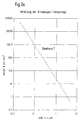
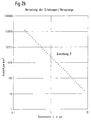
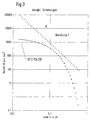
- the number of elevations / projections N per mm 2 of film surface A must be below a certain numerical value according to equations (1) and (2). This numerical value is clearly defined by the right-hand sides of equations (1) and (2) depending on the height h and the diameter d of the elevations / protrusions.
- Biaxially oriented polyester films described by the above equation are characterized by a comparatively small number of elevations / projections the layer A. to be metallized or oxidically coated out.
- the number of elevations / protrusions is in the range h ⁇ 0.5 ⁇ m, especially in Range h ⁇ 0.4 ⁇ m and especially in the range h ⁇ 0.3 ⁇ m significantly less than it is known in the art.
- the barrier is good in the present sense, if the density of the protrusions / protrusions is large (FIG. 1b), the barrier is bad in the present sense.
- the graph also shows that the R a value has in principle no influence on the barrier properties.
- a smooth film e.g. R a ⁇ 10 nm
- R a ⁇ 10 nm can have a very poor barrier if the number of elevations / protrusions N / mm 2 is greater than calculated according to equations (1) and (2).
- the surface / surface layer contains a large number of fine particles which, however, make no significant contribution to the amount of the R a value.
- the R a values have no practical significance for the barrier properties, the R a values are of practical importance for the processing of the film according to the invention.
- the R a value is greater than 6 nm, preferably greater than 8 nm and particularly preferably greater than 10 nm.
- the R a values of the film surface A according to the invention are not greater than 100 nm, advantageously less than 80 nm and in particular advantageously less than 70 nm.
- the processing, in particular the winding of the film becomes problematic. If the R a values of the film surface according to the invention are greater than 100 nm, the abrasion resistance of this surface becomes worse.
- the oxygen permeation is greater than 0.5 cm 3 / m 2 bar d, which is undesirable according to the task at hand. Furthermore, the gloss of this film surface (in the unmetallized or uncoated state) is then no longer as high as is also desired in accordance with the present task.
- the layer A according to the invention has very few elevations / projections N per surface unit.
- the metallized or oxidically coated film is distinguished by a particularly good oxygen barrier.
- the permeation values of the metallized or oxidically coated film are less than 0.45 cm 3 / m 2 bar d in the preferred embodiment and less than 0.40 cm 3 / m 2 bar d in the particularly preferred embodiment.
- the gloss of this page also takes on extremely high values. The gloss of this film side (in the unmetallized or uncoated state) is greater than 200 in the particularly preferred embodiment.
- the film has at least two layers. It then comprises layers a layer B and the layer A according to the invention.
- the two layers A and C form the outer layers A and C.
- the base layer B of the film preferably consists of at least 90% by weight of a thermoplastic polyester.
- polyesters which are composed of at least 90 mol%, preferably at least 95 mol% Ethylene glycol and terephthalic acid units or from ethylene glycol and naphthalene-2,6-dicarboxylic acid units consist.
- the remaining monomer units come from other aliphatic, cycloaliphatic or aromatic diols or dicarboxylic acids, as they can also occur in layer A (or layer C).
- Suitable other aliphatic diols are, for example, diethylene glycol, triethylene glycol, aliphatic glycols of the general formula HO- (CH 2 ) n -OH, where n represents an integer from 3 to 6 (in particular propane-1,3-diol, butane-1,4) -diol pentane-1,5-diol and hexane-1,6-diol) or branched aliphatic glycols with up to 6 carbon atoms.
- cyclohexanediols in particular cyclohexane-1,4-diol
- cyclohexanediols in particular cyclohexane-1,4-diol
- Suitable other aromatic diols correspond, for example, to the formula HO-C 6 H 4 -XC 6 H 4 -OH, where X is -CH 2 -, -C (CH 3 ) 2 -, -C (CF 3 ) 2 -, -O -, -S- or -SO 2 - stands.
- bisphenols of the formula HO-C 6 H 4 -C 6 H 4 -OH are also very suitable.
- aromatic dicarboxylic acids are preferably benzenedicarboxylic acids, naphthalenedicarboxylic acids (for example naphthalene-1,4- or 1,6-dicarboxylic acid), biphenyl-x, x'-dicarboxylic acids (in particular biphenyl-4,4'-dicarboxylic acid), diphenylacetylene-x, x ' -dicarboxylic acids (especially diphenylacetylene-4,4'-dicarboxylic acid) or stilbene-x, x'-dicarboxylic acids.
- naphthalenedicarboxylic acids for example naphthalene-1,4- or 1,6-dicarboxylic acid
- biphenyl-x, x'-dicarboxylic acids in particular biphenyl-4,4'-dicarboxylic acid
- diphenylacetylene-x, x ' -dicarboxylic acids especially diphenylacetylene
- cyclohexanedicarboxylic acids (in particular cyclohexane-1,4-dicarboxylic acid) should be mentioned.
- aliphatic dicarboxylic acids the (C 3 -C 19 ) alkanedioic acids are particularly suitable, the alkane fraction being straight-chain or branched.
- the polyester can be produced by the transesterification process.
- dicarboxylic acid esters and diols which are mixed with the usual transesterification catalysts, such as zinc, calcium, lithium, magnesium and manganese salts, be implemented.
- the intermediates then become general in the presence conventional polycondensation catalysts, such as antimony trioxide or titanium salts, polycondensed.
- Production can also be carried out using the direct esterification process take place in the presence of polycondensation catalysts. Here you go directly from the dicarboxylic acids and the diols.
- transesterification catalysts have proven to be particularly suitable are used in which only a few and / or only small Elevations / projections are generated on layer A of the film. Are preferred especially magnesium and manganese salts. These transesterification catalysts are preferred in the production of the base raw material, particularly preferred but used in the manufacture of the raw material for layer A.
- concentrations of the transesterification catalysts given here refer to Raw materials for layer A according to the invention, in which no additional inert Particles are used. When inert particles are added, it is expedient the content of internal particles is reduced.
- layer A can also contain other materials be, in which case layer A is preferably composed of a mixture of polymers, one Copolymers or a homopolymer, which ethylene-2,6-naphthalate units and contain ethylene terephthalate units. Up to 10 mol% of the polymers can consist of further comonomers (see above).
- the polymers for choose the base layer and the other layer (s) so that the viscosities do not distinguish too much from the respective polymer melts. In the other case is with additional elevations / protrusions, with flow disturbances or with streaking to count on the finished slide.
- SV value modified solvent viscosity
- solution viscosity For commercially available polyethylene terephthalates are suitable for the production of biaxially oriented films, the SV values are in the range from 600 to 1000.
- the base layer and the other layer (s) can additionally conventional additives such as For example, stabilizers and / or antiblocking agents. You will be expedient to that Polymer or the polymer mixture added before melting.
- Stabilizers are, for example, phosphorus compounds, such as phosphoric acid or Phosphoric acid ester used.
- Typical antiblocking agents are inorganic and / or organic particles, for example calcium carbonate, amorphous silica, talc, magnesium carbonate, barium carbonate, calcium sulfate, barium sulfate, Lithium phosphate, calcium phosphate, magnesium phosphate, aluminum oxide, LiF, calcium, barium, zinc or manganese salts of the dicarboxylic acids used, Carbon black, titanium dioxide, kaolin or cross-linked polystyrene or acrylate particles.
- the particles can be the individual Layers in the respective advantageous concentrations, e.g. as a glycolic dispersion added during polycondensation or via masterbatches during extrusion become. Pigment concentrations from 0 to 5 have proven particularly suitable Wt .-% proven A detailed description of the antiblocking agents that can be used can be found, for example, in EP-A-0 602 964.
- Layer A according to the invention is generally filled only slightly or not at all with inert pigments to satisfy equations (1) to (2).
- concentration of the inert particles in layer A is between 0 and 0.08% by weight, preferably between 0 and 0.065% by weight, in particular between 0 and 0.05% by weight and very preferably between 0 and 0, 04% by weight and depends essentially on the size of the particles used.
- Preferred particles are SiO 2 in colloidal and in chain-like form. In principle, the particle diameters of the particles used are not restricted.
- inert particles are not added to layer A, e.g. through a suitable selection and concentration of the catalysts in the Transesterification or polymerization reaction can be ensured by the forming precipitates a blocking of the surface A against itself avoided can be.
- the pigment diameter and the pigment concentration for the other layer make sure that the pigmentation in these layers and the layer thicknesses of these layers is chosen so that equations (1) to (5) are not violated.
- the pigmentation of the individual layers which do not concern layer A can then be very different and depends essentially on the film structure (Layer structure) and the requirements of the film with regard to achieving the other optical properties (turbidity) and the manufacturing and processing behavior.
- the base layer B it is the preferred three-layer film with the base layer B and the two outer layers A and C, so is in the base layer B.
- Particle concentration preferably lower than in the second top layer C. Die Pigmentation in the base layer B should be chosen so that it does not sustainable on the number of surveys / projections N in the invention Top layer affects.
- the particle concentration between 0 and 0.06 wt .-%, preferably between 0 and 0.04% by weight, in particular between 0 and 0.03% by weight and entirely are preferably between 0 and 0.02% by weight.
- the particle diameter of the used In principle, particles are not restricted, but are particles with a average diameter of greater than 1 micron is particularly preferred.
- layer A being more than 50%, in particular more than 65% and particularly preferably more than 80% of the total thickness of the film layer B can be more pigmented (higher pigment concentration) than in the other case, in which the layer thickness of layer A is comparable is small ( ⁇ 50%).
- the polyester film according to the invention is in a particularly preferred embodiment three layers and then contains another layer C.
- the two layers A and C then form the cover layers A and C.
- Structure, thickness and composition the second cover layer C can be independent of the one already present Cover layer A can be selected, the second cover layer also being the same mentioned polymers or polymer mixtures can contain, but not with that of the first cover layer must be identical.
- the second top layer can also contain other common top layer polymers.
- This second top layer contains generally more pigments (i.e. higher pigment concentrations) than the first invention Top layer A.
- the pigment concentration in this second top layer is between 0.02 and 0.4%, advantageously between 0.025 and 0.3%, in particular between 0.03 and 0.2% and very particularly preferably between 0.035 and 0.15%. It is e.g.
- the pigment type (s), the pigment concentration (s) and the Particle concentration / s and the layer thickness ratios selected so that a good appearance, as well as good manufacturability and processability of the film is given.
- the R a value is between 30 and 90 nm and in particular between 35 and 80 nm.
- the static / sliding friction F C of this layer against itself is less than 0.45 and in particular less than 0.40.
- an intermediate layer This can in turn consist of those for the base layers described polymers exist. In a particularly preferred embodiment it consists of the polyester used for the base layer. It can too contain the usual additives described.
- the thickness of the intermediate layer is in generally larger than 0.3 ⁇ m and is preferably in the range from 0.5 to 15 ⁇ m, in particular in the range from 1.0 to 10 ⁇ m and very particularly preferably in the range from 1.0 to 5 ⁇ m.
- the thickness of the cover layer (s) A (and C) is generally greater than 0.1 ⁇ m and is generally in the range from 0.2 to 3.0 ⁇ m, advantageously in the range from 0.2 to 2.5 ⁇ m, in particular in the range from 0.3 to 2 ⁇ m and very particularly preferred in the range from 0.3 to 1.5 ⁇ m, the outer layers A and C being equal to or can be of different thickness.
- the total thickness of the polyester film according to the invention can be within wide limits vary and depends on the intended use. she is 4 to 50 microns, especially 5 to 45 microns, preferably 6 to 40 microns, the Layer B has a share of preferably about 5 to 90% of the total thickness.
- top layer (s) A and C) are appropriate Granules of polyethylene terephthalate fed to one or two extruders.
- the Materials are melted and extruded at around 300 ° C.
- the polymers for the base layer are expediently via a further extruder fed. Any foreign objects or contaminants can be removed from the Filter off the polymer melt before extrusion.
- the melts are then in one Multi-layer nozzle formed into flat melt films and layered on top of each other. Subsequently, the multilayer film with the help of a chill roll and optionally stripped further rollers and solidified.
- Biaxial stretching is generally carried out sequentially. Doing so preferably first in the longitudinal direction (i.e. in the machine direction) and then in Cross direction (i.e. perpendicular to the machine direction) stretched. This leads to a Orientation of the molecular chains.
- the stretching in the longitudinal direction can be done with the help two running at different speeds depending on the desired stretching ratio Carry out rolling. A corresponding one is generally used for transverse stretching Tenter frame.
- the temperature at which the drawing is carried out can be in a relative vary widely and depends on the desired properties of the Foil.
- the longitudinal stretch ratio is generally in Range from 2.5: 1 to 6: 1, preferably from 3: 1 to 5.5: 1.
- the transverse stretch ratio is generally in the range from 3.0: 1 to 5.0: 1, preferably from 3.5: 1 to 4.5: 1.
- Before the transverse stretching can one or both surface (s) of the film according to the known Coat the process in-line.
- the in-line coating can be, for example, one improved adhesion of the metal layer or any applied printing ink, but also to improve the antistatic behavior or processing behavior to serve.
- the film In the subsequent heat setting, the film is held at about 0.1 to 10 s Temperature kept from 150 to 250 ° C. Then the film is in the usual Way wrapped up.
- the biaxially stretched and heat-set polyester film can be printed or before applying the metallic or oxidic layer on one or both Side (s) corona or flame treated.
- the treatment intensity is like this chosen that the surface tension of the film is generally above 45 mN / m.
- metal or oxide layers are applied on common industrial plants.
- Metal layers made of aluminum are common by vapor deposition in conventional metallizers (shuttle method). In the case of oxidic layers, there are also electron beam processes or sputtering proven.
- the process parameters of the plant at Apply the metal layer or the oxide layer on the foils correspond the standard conditions.
- the metallization of the foils is preferably carried out in such a way that the optical density of the metallized films in the usual range of approx. 2.2 to 2.8.
- the oxide layer is applied to the film in such a way that that the layer thickness of the oxide layer is preferably in the range from 30 to 100 nm.
- the web speed of the film to be coated is all Settings usually between 5 and 20 m / s.
- the film can be coated or be corona or flame pretreated.
- Typical coatings are adhesion-promoting, antistatic, slip-improving or dehesive layers. It makes sense these additional layers over internal coating using aqueous dispersions before Apply transverse stretching to the film.
- the Metal layer preferably made of aluminum. But other materials are also suitable, which can be applied in the form of a thin, coherent layer. In particular, e.g. Silicon suitable, which in comparison to aluminum transparent barrier layer results.
- the oxide layer preferably consists of Oxides of elements of II., III. or IV. Main group of the periodic table, in particular Oxides of magnesium, aluminum or silicon. Become general those metallic or oxidic materials used, which with reduced Pressure or vacuum can be applied.
- the thickness of the applied Layer is generally 10 to 100 nm.
- An advantage of the invention is that the manufacturing costs of the invention Film are comparable to those according to the prior art.
- the other processing and use-relevant properties of the invention Films remain essentially unchanged or are even improved.
- the film is ideal for packaging light and / or air sensitive Food and luxury goods. It is particularly suitable for the production of Vacuum packaging for coffee, in particular ground coffee.
- the film according to the invention is characterized by a high gloss, especially a high gloss of the film surface A, and by a low Cloudiness. Furthermore, the film has an excellent oxygen barrier, after being metallized on the film surface A or with oxidic materials has been coated. It also has good winding and processing behavior.
- the gloss of the film surface A is greater than 180. In a preferred embodiment the gloss of this page is more than 190 and in a particularly preferred Embodiment more than 200. This film surface is therefore suitable especially for printing or for metallization. The high gloss of the film is transferred to the print or the applied metal layer and thus gives the Foil the desired advertising effect.
- the haze of the film is less than 1.5. In a preferred embodiment the haze of the film is less than 1.3 and in a particularly preferred embodiment less than 1.0. Due to the low cloudiness of the film, the film is suitable not only for packaging but also e.g. for reprographic applications or for "glazing" applications.
- the film has an oxygen barrier of less than 0.5 gm -2 d -1 bar -1 , preferably less than 0.45 gm -2 d -1 bar -1 and particularly preferably less than 0.4 gm -2 d -1 bar -1 after it has been metallized on the film surface A or coated with oxidic materials.
- the coefficient of friction on the side opposite the A side is less than 0.5. In a preferred one Embodiment, the coefficient of friction of the film there is less than 0.45 and in a particularly preferred embodiment less than 0.4.
- Table 1 summarizes the most important film properties according to the invention.
- the Macbeth TD-904 densitometer from Macbeth (Division of Kollmorgen Instruments Corp.) was used to measure the optical density.
- the oxygen barrier on the metallized foils was measured using an OX-TRAN 2/20 from Mocon Modern Controls (USA) according to DIN 53 380, part 3.
- SV solvent viscosity
- the friction was determined according to DIN 53 375.
- the friction was 14 days after Production measured. Blocking takes place when the coefficient of friction is greater than 1 or in the case of friction force measurement in the friction force-displacement curve measurement of points of discontinuity occur.
- the surface tension was measured using the so-called ink method (DIN 53 364) certainly.
- the haze of the film was measured according to ASTM-D 1003-52.
- the turbidity measurement according to Hölz was determined in accordance with ASTM-D 1003-52, but for utilization the optimal measuring range measured on four superimposed foil layers and a 1 ° slit was used instead of a 4E pinhole
- the gloss was determined in accordance with DIN 67 530.
- the reflector value was measured as optical parameter for the surface of a film. Based on the standards ASTM-D 523-78 and ISO 2813 the angle of incidence was set at 20 ° or 60 °. A ray of light strikes the flat test surface at the set angle of incidence reflected or scattered by this. Those striking the photoelectronic receiver Light rays are displayed as a proportional electrical quantity.
- the measured value is dimensionless and must be specified with the angle of incidence.
- foil samples are placed flat on a sample holder. Then they are vapor deposited at an angle ⁇ with a thin metal layer (eg made of silver).
- ⁇ is the angle between the sample surface and the direction of propagation of the metal vapor.
- This oblique vaporization creates a shadow on the antiblocking agent particles. Since the shadows are not yet electrically conductive, the sample can then be vaporized with a second metal (eg gold), the metal vapor hitting the sample surface perpendicularly.
- a second metal eg gold
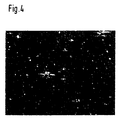
- the sample surfaces thus prepared are examined in a scanning electron microscope (REM) pictured.
- the shadows of the antiblocking agent particles are due to the material contrast visible.
- the sample is oriented in the SEM so that the shadows are parallel to the lower edge of the image (x direction).
- SEM images are taken and transferred to an image analysis system. With this image analysis system now the lengths of the shadows (in the x direction) and their maximum extent in the y direction (parallel to the vertical edge of the picture).
- the diameter D of the antiblocking agent particles at the level of the sample surface is equal to the maximum extent of the shadows d in the y direction.
- the roughness R a of the film was determined in accordance with DIN 4768 with a cut-off of 0.25 mm.
- Polyethylene terephthalate chips (made by the transesterification process with Mn as transesterification catalyst, Mn concentration: 100 ppm) and were at 160 ° C a residual moisture of below 50 ppm dried and the extruder for the base layer B fed.
- chips made of polyethylene terephthalate (produced via the transesterification process with Mn as the transesterification catalyst, Mn concentration: 100 ppm), the corresponding Table 2 are pigmented, also at 160 ° C to a residual moisture of dried below 50 ppm and the respective extruders for the outer layers A and C fed.
- Top layer A mixture of:
- Top layer C mixture of:
- the film is characterized by very good optical properties and by a good one Processing behavior (see Table 3).
- the film After production of the film (according to this example 1 and all the following examples) it was placed on the A-side in an industrial metallizer with aluminum Vacuum vaporized.
- the coating speed was 8 m / s and the optical Density 2.6.
- the film had the required high oxygen barrier.
- the film structure and the achieved Properties of films produced in this way are shown in Tables 2 and 3.
- Figure 6 shows the covering layer A using the method described on pages 31/32 measured distributions for the elevations / protrusions N.
- Example 2 In a similar manner to that in Example 1, coextrusion followed by gradual Orientation in the longitudinal and transverse directions using a transparent three-layer film ABC structure and a total thickness of 12 microns. Compared to example 1 only top layer A was changed.
- Top layer A mixture of:
- Example 2 In a similar manner to that in Example 1, coextrusion followed by gradual Orientation in the longitudinal and transverse directions using a transparent three-layer film ABC structure and a total thickness of 12 microns. Compared to example 1 only top layer A was changed.
- Top layer A mixture of:
- Example 2 In a similar manner to that in Example 1, coextrusion followed by gradual Orientation in the longitudinal and transverse directions using a transparent three-layer film ABC structure and a total thickness of 12 microns. Compared to example 1 only top layer A was changed.
- Top layer A mixture of:
- Example 2 In a similar manner to that in Example 1, coextrusion followed by gradual Orientation in the longitudinal and transverse directions using a transparent three-layer film ABC structure and a total thickness of 12 microns. Compared to example 1 only top layer A was changed.
- Top layer A mixture of:
- Example 2 In a similar manner to that in Example 1, coextrusion followed by gradual Orientation in the longitudinal and transverse directions using a transparent three-layer film ABC structure and a total thickness of 12 microns. Compared to example 1 only top layer A was changed.
- Top layer A mixture of:
- the polyester raw material for the top layer A was also via the transesterification process Ca produced as a transesterification catalyst, the Ca concentration being 200 ppm.
- Example 1 The process conditions for all layers were chosen as in Example 1. Although no inert pigments were added to the top layer A and the base layer B. , the surface of the cover layer A contains elevations / protrusions. This stir among other things of the precipitates of the transesterification catalyst and fluctuations in the Manufacturing process of the raw material and the film.
- Example 2 In a similar manner to that in Example 1, coextrusion followed by gradual Orientation in the longitudinal and transverse directions using a transparent three-layer film ABC structure and a total thickness of 12 microns. Compared to example 1 cover layers A and C were changed.
- Top layer A mixture of:
- Top layer C mixture of:
- Example 7 In a similar manner as in Example 7, by coextrusion and subsequent stepwise Orientation in the longitudinal and transverse directions using a transparent three-layer film ABC structure and a total thickness of 12 microns. Compared to example 1 top layer A was changed.
- Top layer A mixture of:
- Example 1 from EP-A-0 514 129 was reworked. The gloss of the film is not satisfactory. The metallized version with a thickness of 12 ⁇ m did not meet the requirements Barrier values.
- Example 1 from EP-A-0 604 057 was reworked.
- the gloss of the film is not satisfactory.
- the metallized version with a thickness of 12 ⁇ m did not meet the requirements Barrier values.
- the film provides for use in the packaging market not an economical solution.
- Example 1 from EP-A-0 124 291 was reworked.
- Example 1 from EP-A-0 490 665 was reworked.
- Example 1 from DE-A-16 94 404 was reworked.
- Example 15 from EP-A-0 061 769 was reworked.
- Example 1 from EP-B-0 088 635 was reworked.
Landscapes
- Physics & Mathematics (AREA)
- Thermal Sciences (AREA)
- Laminated Bodies (AREA)
- Packages (AREA)
- Wrappers (AREA)
- Extrusion Moulding Of Plastics Or The Like (AREA)
- Shaping By String And By Release Of Stress In Plastics And The Like (AREA)
Applications Claiming Priority (2)
| Application Number | Priority Date | Filing Date | Title |
|---|---|---|---|
| DE19741877A DE19741877A1 (de) | 1997-09-23 | 1997-09-23 | Biaxial orientierte Polyesterfolie, Verfahren zu ihrer Herstellung und ihre Verwendung |
| DE19741877 | 1997-09-23 |
Publications (3)
| Publication Number | Publication Date |
|---|---|
| EP0903221A2 true EP0903221A2 (fr) | 1999-03-24 |
| EP0903221A3 EP0903221A3 (fr) | 2000-10-04 |
| EP0903221B1 EP0903221B1 (fr) | 2009-03-25 |
Family
ID=7843295
Family Applications (1)
| Application Number | Title | Priority Date | Filing Date |
|---|---|---|---|
| EP98117902A Expired - Lifetime EP0903221B1 (fr) | 1997-09-23 | 1998-09-22 | Film de polyester orienté biaxialement, procédé de sa fabrication et application du même dans l'emballage alimentaire |
Country Status (5)
| Country | Link |
|---|---|
| US (1) | US6528144B2 (fr) |
| EP (1) | EP0903221B1 (fr) |
| JP (1) | JP4389279B2 (fr) |
| KR (1) | KR100597817B1 (fr) |
| DE (2) | DE19741877A1 (fr) |
Cited By (7)
| Publication number | Priority date | Publication date | Assignee | Title |
|---|---|---|---|---|
| EP1410903A1 (fr) * | 2002-10-14 | 2004-04-21 | Mitsubishi Polyester Film GmbH | Film de polyester stratifié orienté biaxialement, méthode pour sa production et son utilisation |
| EP1410904A1 (fr) * | 2002-10-14 | 2004-04-21 | Mitsubishi Polyester Film GmbH | Film de polyester stratifié orienté biaxialement, méthode pour sa production et son utilisation |
| EP1410905A1 (fr) * | 2002-10-14 | 2004-04-21 | Mitsubishi Polyester Film GmbH | Film de polyester stratifié orienté biaxialement, méthode pour sa production et son utilisation |
| US7094465B2 (en) | 2003-01-20 | 2006-08-22 | Mitsubishi Polyester Film Gmbh | Multilayer, transparent, biaxially oriented polyester film, process for its production and its use |
| KR100787368B1 (ko) * | 1999-07-05 | 2007-12-24 | 미쯔비시 폴리에스테르 필름 게엠베하 | 이축 연신 다층 폴리에스테르 필름 및 자기 기록 매체 |
| CN104302479A (zh) * | 2011-11-17 | 2015-01-21 | 杜邦泰吉恩胶卷美国有限公司 | 具有牢固金属层附着性的金属化不透明膜 |
| EP3569646A1 (fr) | 2018-05-14 | 2019-11-20 | Mitsubishi Polyester Film GmbH | Feuille blanche en polyester orientée biaxialement à coefficient de friction élevé |
Families Citing this family (19)
| Publication number | Priority date | Publication date | Assignee | Title |
|---|---|---|---|---|
| DE50009959D1 (de) * | 1999-05-10 | 2005-05-12 | Mitsubishi Polyester Film Gmbh | Weisse, UV-stabilisierte Folie aus einem kristallisierbaren Thermoplast |
| JP2002187231A (ja) * | 2000-10-13 | 2002-07-02 | Dainippon Printing Co Ltd | バリア性フィルムおよびその製造法 |
| DE10227440A1 (de) * | 2002-06-20 | 2004-01-08 | Mitsubishi Polyester Film Gmbh | Mehrschichtige, transparente, Folie aus PET und PEN mit mindestens einer funktionellen Außenschicht zur Herstellung von Verbundverpackungen mit UV-Schutz |
| DE10227439A1 (de) * | 2002-06-20 | 2004-01-08 | Mitsubishi Polyester Film Gmbh | Transparente Folie aus PET und PEN mit UV-Schutz, Verfahren zu ihrer Herstellung und Verwendung in Verpackungen mit verlängerter Lebensdauer |
| US7655291B2 (en) * | 2003-10-14 | 2010-02-02 | Toray Plastics (America), Inc. | Smooth co-extruded polyester film including talc and method for preparing same |
| US7815996B2 (en) * | 2003-10-14 | 2010-10-19 | Toray Plastics (America), Inc. | Low gloss and low haze laminated polyester film including talc and method for preparing same |
| DE102004061389A1 (de) * | 2004-12-21 | 2006-06-22 | Mitsubishi Polyester Film Gmbh | Biaxial orientierte Polyesterfolie, die Siliziumdioxid und Titandioxid enthält |
| US20070134470A1 (en) * | 2005-12-09 | 2007-06-14 | Martin Jesberger | Multilayer, white, biaxially oriented polyester film |
| JP5061522B2 (ja) * | 2006-07-28 | 2012-10-31 | 東洋紡績株式会社 | ポリエステル系樹脂積層フィルム |
| JP4524718B2 (ja) * | 2008-08-08 | 2010-08-18 | 東洋紡績株式会社 | 熱収縮性ポリエステル系フィルム |
| US9284108B2 (en) | 2009-02-23 | 2016-03-15 | Graphic Packaging International, Inc. | Plasma treated susceptor films |
| US20100213191A1 (en) * | 2009-02-23 | 2010-08-26 | Middleton Scott W | Low Crystallinity Susceptor Films |
| US20110011854A1 (en) * | 2009-02-23 | 2011-01-20 | Middleton Scott W | Low crystallinity susceptor films |
| US8474368B2 (en) * | 2009-05-13 | 2013-07-02 | Curwood, Inc. | Mineral composite beverage brewing cup and cartridge |
| JP6005005B2 (ja) * | 2013-07-23 | 2016-10-12 | 富士フイルム株式会社 | 二軸延伸ポリエステルフィルム及びその製造方法 |
| WO2017010306A1 (fr) * | 2015-07-10 | 2017-01-19 | 東洋紡株式会社 | Film de polyester contenant des cavités et procédé de production de celui-ci |
| JP6353016B2 (ja) * | 2016-03-14 | 2018-07-04 | 住友化学株式会社 | 樹脂フィルムの製造方法および偏光フィルムの製造方法 |
| US20200156306A1 (en) * | 2017-08-07 | 2020-05-21 | 3M Innovative Properties Company | Oriented thermally conductive dielectric film |
| JP7583356B2 (ja) * | 2019-09-02 | 2024-11-14 | 東洋紡株式会社 | 二軸配向ポリエステルフィルム |
Family Cites Families (51)
| Publication number | Priority date | Publication date | Assignee | Title |
|---|---|---|---|---|
| US3515626A (en) | 1965-02-22 | 1970-06-02 | Ici Ltd | Thermoplastic laminates having improved surface properties |
| US3958064A (en) | 1971-06-21 | 1976-05-18 | Minnesota Mining And Manufacturing Company | Magnetic recording tape |
| US4042569A (en) | 1974-08-05 | 1977-08-16 | E. I. Du Pont De Nemours And Company | Heat-setting process for polyester film |
| GB1589926A (en) | 1977-03-25 | 1981-05-20 | Bexford Ltd | Coated films |
| JPS57123050A (en) | 1980-12-01 | 1982-07-31 | Toray Industries | Polyester composite film |
| EP0035835B1 (fr) | 1980-03-12 | 1984-03-14 | Imperial Chemical Industries Plc | Stratifié de feuilles en polyester |
| NL8101408A (nl) | 1981-03-23 | 1982-10-18 | Philips Nv | Elektrische inrichting voorzien van tenminste een lagedrukkwikdampontladingsbuis. |
| DE3368806D1 (en) | 1982-03-10 | 1987-02-05 | Toray Industries | Laminated film and magnetic recording medium made therewith |
| US4539389A (en) | 1983-03-30 | 1985-09-03 | Teijin Limited | Biaxially oriented polyester film |
| FR2548958B1 (fr) | 1983-07-13 | 1986-03-21 | Rhone Poulenc Films | Films polyesters composites |
| US4493872A (en) | 1983-12-05 | 1985-01-15 | American Hoechst Corporation | Polyester film coated with metal adhesion promoting copolyester |
| IT1229054B (it) | 1984-06-22 | 1991-07-17 | Esseci S R L Societa Costruzio | Metodo fisico per trattare le superfici di laminati plastici poliolefinici, politetrafluorcetilenici, cartoni e fogli metallici come alluminio e banda stagnata, mediante una fiamma prodotta dalla combustione di una miscela di aria con idrocarburi gassosi arricchita con ossigeno, metalli alcalini, vapore di acqua e/o ionizzata |
| DE3751849T2 (de) | 1986-03-07 | 1996-11-28 | Nippon Catalytic Chem Ind | Verfahren zur Verbesserung des Gleitvermögens von Polyesterfolie |
| US5236680A (en) | 1987-01-20 | 1993-08-17 | Mizusawa Industrial Chemicals, Ltd. | Preparation of amorphous silica-alumina particles by acid-treating spherical P-type zeolite particles crystallized from a sodium aluminosilicate gel |
| JPS63182212A (ja) | 1987-01-20 | 1988-07-27 | Mizusawa Ind Chem Ltd | 非晶質シリカ乃至シリカアルミナ球状粒子及びその製法 |
| US5236683A (en) | 1987-01-20 | 1993-08-17 | Mizusawa Industrial Chemicals, Ltd. | Amorphous silica spherical particles |
| BR8707774A (pt) | 1987-06-17 | 1989-10-03 | Du Pont | Sistema para o uso de secundarias sincronicas de um motor linear na tiragem biaxial de peliculas de plastico |
| JP2517293B2 (ja) | 1987-06-25 | 1996-07-24 | メクト株式会社 | 細胞、組織修復剤 |
| CA2002369C (fr) * | 1988-11-08 | 2000-10-31 | Mikio Hashimoto | Copolyester, composition de polyester a teneur de copolyester, et stratifie de polyester a couche fait de copolyester ou de la composition de polyester |
| DE3842820A1 (de) | 1988-12-20 | 1990-06-28 | Basf Ag | Verfahren zur herstellung von stabilen wasser-in-oel-emulsionen von hydrolysierten polymerisaten von n-vinylamiden und ihre verwendung |
| FR2640984B1 (fr) | 1988-12-28 | 1992-09-11 | Rhone Poulenc Films | |
| DE69023351T2 (de) | 1989-01-11 | 1996-04-04 | Toray Industries | Biaxial orientierter Polyesterfilm. |
| US5093064A (en) | 1989-06-13 | 1992-03-03 | Diafoil Company, Ltd. | Low-shrinkage polyester film and preparation thereof |
| JP2528215B2 (ja) | 1990-12-13 | 1996-08-28 | 帝人株式会社 | 磁気記録媒体用二軸配向ポリエステルフイルム |
| US5336079A (en) | 1991-03-06 | 1994-08-09 | Toray Industries, Inc. | Biaxially oriented laminated film comprising particles in a specific ratio of particle density |
| GB9110590D0 (en) | 1991-05-16 | 1991-07-03 | Ici Plc | Polymeric film |
| GB9110902D0 (en) | 1991-05-21 | 1991-07-10 | Ici Plc | Polymeric film |
| WO1993016864A1 (fr) | 1992-02-25 | 1993-09-02 | Toray Industries, Inc. | Feuille stratifiee et orientee biaxialement de polyester |
| EP0798112B1 (fr) | 1992-07-22 | 2003-09-17 | Teijin Limited | Film multicouche en polyester à orientation biaxiale, adapté à être adhéré à une toile métallique |
| WO1994013481A1 (fr) | 1992-12-09 | 1994-06-23 | Hoechst Aktiengesellschaft | Film de copolyester oriente biaxialement revetu d'une premiere couche de polymeres d'acetate de vinyle |
| WO1994013476A1 (fr) | 1992-12-09 | 1994-06-23 | Hoechst Aktiengesellschaft | Film de copolyester recouvert d'une couche primaire de polymeres acryliques |
| JP2989080B2 (ja) | 1992-12-17 | 1999-12-13 | 帝人株式会社 | 磁気記録媒体用積層ポリエステルフイルム |
| EP0604057A1 (fr) | 1992-12-23 | 1994-06-29 | Imperial Chemical Industries Plc | Film polymère |
| EP0609060B1 (fr) | 1993-01-27 | 1997-05-07 | Teijin Limited | Film de polyester strabifié orienté biaxialement et milieu d'enrégistrement magnétique utilisant ce film comme base |
| US5372879A (en) | 1993-02-22 | 1994-12-13 | Teijin Limited | Biaxially oriented polyester film |
| DE4306155A1 (de) | 1993-02-27 | 1994-09-01 | Hoechst Ag | Transparente, nicht siegelfähige orientierte Polyolefin-Mehrschichtfolie, Verfahren zu ihrer Herstellung und ihre Verwendung |
| US5626942A (en) * | 1993-05-05 | 1997-05-06 | Toray Industries, Inc. | Polyester film and process for producing the same |
| JP3125272B2 (ja) | 1993-09-24 | 2001-01-15 | 新東工業株式会社 | 鋳物砂再生装置 |
| EP0685509B1 (fr) | 1993-12-10 | 2001-02-28 | Teijin Limited | Film transparent permettant de former une couche de revetement sur une boite metallique |
| US5618609A (en) | 1993-12-22 | 1997-04-08 | Teijin Limited | Biaxially oriented film of polyethylene-2,6-naphthalenedicarboxylate |
| US5656356A (en) | 1994-01-11 | 1997-08-12 | Teijin Limited | Biaxially oriented laminated polyester film |
| US5429785A (en) | 1994-03-01 | 1995-07-04 | E. I. Du Pont De Nemours And Company | Method of making biaxially oriented thermoplastic films |
| US5464690A (en) | 1994-04-04 | 1995-11-07 | Novavision, Inc. | Holographic document and method for forming |
| JPH083679A (ja) | 1994-06-14 | 1996-01-09 | Nippon Steel Corp | 成形性及び疲労特性に優れた耐熱軟化性を有する熱延高強度鋼板並びにその製造方法 |
| JPH08104064A (ja) | 1994-10-05 | 1996-04-23 | Diafoil Co Ltd | 昇華型感熱転写用ポリエステルフィルム |
| US5506014A (en) | 1995-09-01 | 1996-04-09 | Eastman Chemical Company | Pet copolyesters containing succinic and naphthalenedicarboxylic acid moieties having improved barrier properties |
| JPH09141797A (ja) * | 1995-11-17 | 1997-06-03 | Toray Ind Inc | 二軸配向積層ポリエステルフィルム |
| EP0826478B2 (fr) | 1996-08-30 | 2006-10-04 | Mitsubishi Polyester Film Corporation | Procédé pour la production d'une composition polyester |
| WO1998013415A1 (fr) | 1996-09-24 | 1998-04-02 | Mitsubishi Polyester Film Gmbh | Feuille de pet a orientation biaxiale presentant des proprietes mecaniques et de retrait ameliorees a utiliser pour des condensateurs a feuilles aptes au montage en surface, et procede de production de cette feuille |
| DE19723468A1 (de) * | 1997-06-04 | 1998-12-10 | Hoechst Diafoil Gmbh | Biaxial orientierte Polyesterfolie mit hoher Sauerstoffbarriere, Verfahren zu ihrer Herstellung und ihre Verwendung |
| DE19849661A1 (de) * | 1998-10-29 | 2000-05-04 | Mitsubishi Polyester Film Gmbh | Koextrudierte, biaxial orientierte Polyesterfolie für die Metallisierung, Verfahren zu ihrer Herstellung und ihre Verwendung |
-
1997
- 1997-09-23 DE DE19741877A patent/DE19741877A1/de not_active Withdrawn
-
1998
- 1998-09-21 JP JP30469198A patent/JP4389279B2/ja not_active Expired - Lifetime
- 1998-09-22 EP EP98117902A patent/EP0903221B1/fr not_active Expired - Lifetime
- 1998-09-22 DE DE59814356T patent/DE59814356D1/de not_active Expired - Lifetime
- 1998-09-23 KR KR1019980039349A patent/KR100597817B1/ko not_active Expired - Fee Related
-
2001
- 2001-02-09 US US09/779,623 patent/US6528144B2/en not_active Expired - Fee Related
Cited By (11)
| Publication number | Priority date | Publication date | Assignee | Title |
|---|---|---|---|---|
| KR100787368B1 (ko) * | 1999-07-05 | 2007-12-24 | 미쯔비시 폴리에스테르 필름 게엠베하 | 이축 연신 다층 폴리에스테르 필름 및 자기 기록 매체 |
| EP1410903A1 (fr) * | 2002-10-14 | 2004-04-21 | Mitsubishi Polyester Film GmbH | Film de polyester stratifié orienté biaxialement, méthode pour sa production et son utilisation |
| EP1410904A1 (fr) * | 2002-10-14 | 2004-04-21 | Mitsubishi Polyester Film GmbH | Film de polyester stratifié orienté biaxialement, méthode pour sa production et son utilisation |
| EP1410905A1 (fr) * | 2002-10-14 | 2004-04-21 | Mitsubishi Polyester Film GmbH | Film de polyester stratifié orienté biaxialement, méthode pour sa production et son utilisation |
| US6962740B2 (en) | 2002-10-14 | 2005-11-08 | Mitsubishi Polyester Film Gmbh | Multilayer, biaxially oriented polyester film, process for its production and its use |
| US6974621B2 (en) | 2002-10-14 | 2005-12-13 | Mitsubishi Polyester Film Gmbh | Multilayer, biaxially oriented polyester film, process for its production and its use |
| US6984437B2 (en) | 2002-10-14 | 2006-01-10 | Mitsubishi Polyester Film Gmbh | Multilayer, biaxially oriented polyester film, process for its production and its use |
| US7094465B2 (en) | 2003-01-20 | 2006-08-22 | Mitsubishi Polyester Film Gmbh | Multilayer, transparent, biaxially oriented polyester film, process for its production and its use |
| CN104302479A (zh) * | 2011-11-17 | 2015-01-21 | 杜邦泰吉恩胶卷美国有限公司 | 具有牢固金属层附着性的金属化不透明膜 |
| EP3569646A1 (fr) | 2018-05-14 | 2019-11-20 | Mitsubishi Polyester Film GmbH | Feuille blanche en polyester orientée biaxialement à coefficient de friction élevé |
| US10940667B2 (en) | 2018-05-14 | 2021-03-09 | Mitsubishi Polyester Film Gmbh | Biaxially oriented matt polyester film with increased coefficient of friction |
Also Published As
| Publication number | Publication date |
|---|---|
| EP0903221A3 (fr) | 2000-10-04 |
| KR100597817B1 (ko) | 2006-12-15 |
| US6528144B2 (en) | 2003-03-04 |
| US20010044009A1 (en) | 2001-11-22 |
| KR19990030044A (ko) | 1999-04-26 |
| DE19741877A1 (de) | 1999-03-25 |
| DE59814356D1 (de) | 2009-05-07 |
| JP4389279B2 (ja) | 2009-12-24 |
| JPH11221894A (ja) | 1999-08-17 |
| EP0903221B1 (fr) | 2009-03-25 |
Similar Documents
| Publication | Publication Date | Title |
|---|---|---|
| EP0903222B1 (fr) | Film de polyester stratifié orienté biaxialement, méthode pour sa production et son utilisation | |
| EP0903221B1 (fr) | Film de polyester orienté biaxialement, procédé de sa fabrication et application du même dans l'emballage alimentaire | |
| EP0882577B1 (fr) | Film de polyester orienté biaxialement ayant des bonnes propriétés de barrière à l'oxygène, son procédé de fabrication et son utilisation | |
| EP1197327B1 (fr) | Film de polyester, mat, au moins sur une face et à orientation biaxiale | |
| EP1138480B1 (fr) | Film de polyester scellable, orienté biaxialement | |
| EP0952176B1 (fr) | Film de polyester stratifié orienté biaxialement, son procédé de fabrication et son utilisation | |
| EP1176005B1 (fr) | Film composite multicouches de polyester transparent et orienté biaxialement | |
| EP0997269B1 (fr) | Feuille en polyester, coextrudée et orientée biaxialement pour métallisation, méthode pour sa production et son utilisation | |
| DE10051082A1 (de) | Matte, koextrudierte, biaxial orientierte Polyesterfolie | |
| DE19720505A1 (de) | Biaxial orientierte Polyesterfolie mit hoher Sauerstoffbarriere, Verfahren zu deren Herstellung und Verwendung | |
| EP1442876B1 (fr) | Feuille en polyester biaxialement orientée présentant une surface mate et des propriétés de rétraction caractéristiques, son procédé de fabrication et utilisation | |
| EP1234848B1 (fr) | Film de polyester transparent orienté biaxialement | |
| EP1380414A1 (fr) | Feuille polyester multicouche, transparente, scellable à chaud et orientée biaxialement, ainsi que son procédé de fabrication et son utilisation | |
| EP0952175B1 (fr) | Film de polyester mono-couche orienté biaxialement, son procédé de fabrication et son utilisation | |
| EP0945263A2 (fr) | Film en polyester avec une topographie adaptée pour son utilisation, méthode de fabrication et son utilisation | |
| EP1380415A1 (fr) | Film en polyester multicouche, métallisé ou recouvert de céramique, scellable et orienté biaxiallement ainsi que son procédé de fabrication et son utilisation | |
| EP1410903B1 (fr) | Film de polyester stratifié orienté biaxialement, méthode pour sa production et son utilisation | |
| EP1236568B1 (fr) | Film en polyester multicouche, transparent et orienté biaxialement | |
| EP1055515B1 (fr) | Système d'emballage multiple contenant une feuille scellable en polyester | |
| EP1219413B1 (fr) | Feuille de polyester scellable, mate sur une face, à orientation biaxiale | |
| EP3584079A1 (fr) | Emballage transparent thermoformable de polyester doté d'une feuille inférieure et d'une feuille supérieure, son procédé de fabrication et son utilisation | |
| DE10152141A1 (de) | Matte, biaxial orientiertge Polyesterfolie, Verfahren zu ihrer Herstellung und ihre Verwendung | |
| EP1176163A2 (fr) | Film de polyester transparent et orienté biaxialement |
Legal Events
| Date | Code | Title | Description |
|---|---|---|---|
| PUAI | Public reference made under article 153(3) epc to a published international application that has entered the european phase |
Free format text: ORIGINAL CODE: 0009012 |
|
| AK | Designated contracting states |
Kind code of ref document: A2 Designated state(s): DE FR GB IT LU NL |
|
| AX | Request for extension of the european patent |
Free format text: AL;LT;LV;MK;RO;SI |
|
| PUAL | Search report despatched |
Free format text: ORIGINAL CODE: 0009013 |
|
| AK | Designated contracting states |
Kind code of ref document: A3 Designated state(s): AT BE CH CY DE DK ES FI FR GB GR IE IT LI LU MC NL PT SE |
|
| AX | Request for extension of the european patent |
Free format text: AL;LT;LV;MK;RO;SI |
|
| 17P | Request for examination filed |
Effective date: 20010404 |
|
| AKX | Designation fees paid |
Free format text: DE FR GB IT LU NL |
|
| RAP1 | Party data changed (applicant data changed or rights of an application transferred) |
Owner name: MITSUBISHI POLYESTER FILM GMBH |
|
| 17Q | First examination report despatched |
Effective date: 20030729 |
|
| RIN1 | Information on inventor provided before grant (corrected) |
Inventor name: ROTH, WERNER Inventor name: HILKERT, GOTTFRIED Inventor name: PEIFFER, HERBERT |
|
| RAP1 | Party data changed (applicant data changed or rights of an application transferred) |
Owner name: MITSUBISHI POLYESTER FILM GMBH |
|
| GRAP | Despatch of communication of intention to grant a patent |
Free format text: ORIGINAL CODE: EPIDOSNIGR1 |
|
| GRAS | Grant fee paid |
Free format text: ORIGINAL CODE: EPIDOSNIGR3 |
|
| GRAA | (expected) grant |
Free format text: ORIGINAL CODE: 0009210 |
|
| AK | Designated contracting states |
Kind code of ref document: B1 Designated state(s): DE FR GB IT LU NL |
|
| REG | Reference to a national code |
Ref country code: GB Ref legal event code: FG4D Free format text: NOT ENGLISH |
|
| REF | Corresponds to: |
Ref document number: 59814356 Country of ref document: DE Date of ref document: 20090507 Kind code of ref document: P |
|
| NLV1 | Nl: lapsed or annulled due to failure to fulfill the requirements of art. 29p and 29m of the patents act | ||
| PG25 | Lapsed in a contracting state [announced via postgrant information from national office to epo] |
Ref country code: NL Free format text: LAPSE BECAUSE OF FAILURE TO SUBMIT A TRANSLATION OF THE DESCRIPTION OR TO PAY THE FEE WITHIN THE PRESCRIBED TIME-LIMIT Effective date: 20090325 |
|
| PLBE | No opposition filed within time limit |
Free format text: ORIGINAL CODE: 0009261 |
|
| STAA | Information on the status of an ep patent application or granted ep patent |
Free format text: STATUS: NO OPPOSITION FILED WITHIN TIME LIMIT |
|
| 26N | No opposition filed |
Effective date: 20091229 |
|
| PGFP | Annual fee paid to national office [announced via postgrant information from national office to epo] |
Ref country code: IT Payment date: 20100927 Year of fee payment: 13 |
|
| PGFP | Annual fee paid to national office [announced via postgrant information from national office to epo] |
Ref country code: LU Payment date: 20110920 Year of fee payment: 14 |
|
| PGFP | Annual fee paid to national office [announced via postgrant information from national office to epo] |
Ref country code: GB Payment date: 20110919 Year of fee payment: 14 Ref country code: DE Payment date: 20110919 Year of fee payment: 14 Ref country code: FR Payment date: 20110928 Year of fee payment: 14 |
|
| GBPC | Gb: european patent ceased through non-payment of renewal fee |
Effective date: 20120922 |
|
| REG | Reference to a national code |
Ref country code: FR Ref legal event code: ST Effective date: 20130531 |
|
| REG | Reference to a national code |
Ref country code: DE Ref legal event code: R119 Ref document number: 59814356 Country of ref document: DE Effective date: 20130403 |
|
| PG25 | Lapsed in a contracting state [announced via postgrant information from national office to epo] |
Ref country code: GB Free format text: LAPSE BECAUSE OF NON-PAYMENT OF DUE FEES Effective date: 20120922 Ref country code: DE Free format text: LAPSE BECAUSE OF NON-PAYMENT OF DUE FEES Effective date: 20130403 |
|
| PG25 | Lapsed in a contracting state [announced via postgrant information from national office to epo] |
Ref country code: IT Free format text: LAPSE BECAUSE OF NON-PAYMENT OF DUE FEES Effective date: 20120922 Ref country code: FR Free format text: LAPSE BECAUSE OF NON-PAYMENT OF DUE FEES Effective date: 20121001 |
|
| PG25 | Lapsed in a contracting state [announced via postgrant information from national office to epo] |
Ref country code: LU Free format text: LAPSE BECAUSE OF NON-PAYMENT OF DUE FEES Effective date: 20120922 |