EP0903221A2 - Biaxially oriented laminated polyester film, process for its manufacture and use of it for the packaging of food - Google Patents
Biaxially oriented laminated polyester film, process for its manufacture and use of it for the packaging of food Download PDFInfo
- Publication number
- EP0903221A2 EP0903221A2 EP98117902A EP98117902A EP0903221A2 EP 0903221 A2 EP0903221 A2 EP 0903221A2 EP 98117902 A EP98117902 A EP 98117902A EP 98117902 A EP98117902 A EP 98117902A EP 0903221 A2 EP0903221 A2 EP 0903221A2
- Authority
- EP
- European Patent Office
- Prior art keywords
- layer
- film
- polyester film
- film according
- log
- Prior art date
- Legal status (The legal status is an assumption and is not a legal conclusion. Google has not performed a legal analysis and makes no representation as to the accuracy of the status listed.)
- Granted
Links
- 229920006267 polyester film Polymers 0.000 title claims abstract description 44
- 238000004519 manufacturing process Methods 0.000 title claims abstract description 23
- 238000000034 method Methods 0.000 title claims description 33
- 230000008569 process Effects 0.000 title claims description 18
- 238000004806 packaging method and process Methods 0.000 title claims description 14
- 235000013305 food Nutrition 0.000 title claims description 7
- 230000004888 barrier function Effects 0.000 claims abstract description 58
- QVGXLLKOCUKJST-UHFFFAOYSA-N atomic oxygen Chemical compound [O] QVGXLLKOCUKJST-UHFFFAOYSA-N 0.000 claims abstract description 36
- 229910052760 oxygen Inorganic materials 0.000 claims abstract description 36
- 239000001301 oxygen Substances 0.000 claims abstract description 36
- 239000002245 particle Substances 0.000 claims description 60
- 239000011888 foil Substances 0.000 claims description 18
- 239000000203 mixture Substances 0.000 claims description 16
- 229920000728 polyester Polymers 0.000 claims description 16
- 239000000155 melt Substances 0.000 claims description 5
- 238000001125 extrusion Methods 0.000 claims description 4
- 229920001169 thermoplastic Polymers 0.000 claims description 4
- 239000004416 thermosoftening plastic Substances 0.000 claims description 4
- 230000002596 correlated effect Effects 0.000 claims description 3
- 230000000875 corresponding effect Effects 0.000 claims description 3
- 239000000945 filler Substances 0.000 claims description 2
- 238000001816 cooling Methods 0.000 claims 1
- 230000009477 glass transition Effects 0.000 claims 1
- 238000012545 processing Methods 0.000 abstract description 19
- 239000000463 material Substances 0.000 abstract description 16
- 230000003287 optical effect Effects 0.000 abstract description 14
- 238000000576 coating method Methods 0.000 abstract description 9
- 239000011248 coating agent Substances 0.000 abstract description 7
- 238000001465 metallisation Methods 0.000 abstract description 7
- 239000010410 layer Substances 0.000 description 205
- 239000010408 film Substances 0.000 description 171
- -1 polyethylene Polymers 0.000 description 37
- 229920000139 polyethylene terephthalate Polymers 0.000 description 30
- 239000005020 polyethylene terephthalate Substances 0.000 description 29
- LYCAIKOWRPUZTN-UHFFFAOYSA-N Ethylene glycol Chemical compound OCCO LYCAIKOWRPUZTN-UHFFFAOYSA-N 0.000 description 24
- 229920000642 polymer Polymers 0.000 description 20
- 239000000049 pigment Substances 0.000 description 18
- 238000005809 transesterification reaction Methods 0.000 description 15
- 239000003054 catalyst Substances 0.000 description 14
- 229910052751 metal Inorganic materials 0.000 description 14
- 239000002184 metal Substances 0.000 description 14
- 239000002994 raw material Substances 0.000 description 13
- 238000012876 topography Methods 0.000 description 13
- 229910052782 aluminium Inorganic materials 0.000 description 12
- XAGFODPZIPBFFR-UHFFFAOYSA-N aluminium Chemical compound [Al] XAGFODPZIPBFFR-UHFFFAOYSA-N 0.000 description 12
- 239000000758 substrate Substances 0.000 description 12
- 239000003795 chemical substances by application Substances 0.000 description 11
- KKEYFWRCBNTPAC-UHFFFAOYSA-N Terephthalic acid Chemical compound OC(=O)C1=CC=C(C(O)=O)C=C1 KKEYFWRCBNTPAC-UHFFFAOYSA-N 0.000 description 10
- 230000006872 improvement Effects 0.000 description 10
- 239000004594 Masterbatch (MB) Substances 0.000 description 9
- GWEVSGVZZGPLCZ-UHFFFAOYSA-N Titan oxide Chemical compound O=[Ti]=O GWEVSGVZZGPLCZ-UHFFFAOYSA-N 0.000 description 9
- 230000000052 comparative effect Effects 0.000 description 9
- 238000009826 distribution Methods 0.000 description 9
- 230000000694 effects Effects 0.000 description 7
- 239000011164 primary particle Substances 0.000 description 7
- VYPSYNLAJGMNEJ-UHFFFAOYSA-N Silicium dioxide Chemical compound O=[Si]=O VYPSYNLAJGMNEJ-UHFFFAOYSA-N 0.000 description 6
- 239000000654 additive Substances 0.000 description 6
- 239000011575 calcium Substances 0.000 description 6
- 150000001991 dicarboxylic acids Chemical class 0.000 description 6
- 239000011572 manganese Substances 0.000 description 6
- 238000005259 measurement Methods 0.000 description 6
- 230000035699 permeability Effects 0.000 description 6
- 229910002021 Aerosil® TT 600 Inorganic materials 0.000 description 5
- OKTJSMMVPCPJKN-UHFFFAOYSA-N Carbon Chemical compound [C] OKTJSMMVPCPJKN-UHFFFAOYSA-N 0.000 description 5
- 230000000903 blocking effect Effects 0.000 description 5
- 239000011777 magnesium Substances 0.000 description 5
- 229910004298 SiO 2 Inorganic materials 0.000 description 4
- 229910010413 TiO 2 Inorganic materials 0.000 description 4
- 239000007789 gas Substances 0.000 description 4
- 239000000543 intermediate Substances 0.000 description 4
- 229910052749 magnesium Inorganic materials 0.000 description 4
- RXOHFPCZGPKIRD-UHFFFAOYSA-N naphthalene-2,6-dicarboxylic acid Chemical compound C1=C(C(O)=O)C=CC2=CC(C(=O)O)=CC=C21 RXOHFPCZGPKIRD-UHFFFAOYSA-N 0.000 description 4
- 239000002861 polymer material Substances 0.000 description 4
- 239000002904 solvent Substances 0.000 description 4
- 230000003746 surface roughness Effects 0.000 description 4
- 239000004408 titanium dioxide Substances 0.000 description 4
- 241001295925 Gegenes Species 0.000 description 3
- FYYHWMGAXLPEAU-UHFFFAOYSA-N Magnesium Chemical compound [Mg] FYYHWMGAXLPEAU-UHFFFAOYSA-N 0.000 description 3
- 229910052791 calcium Inorganic materials 0.000 description 3
- MTHSVFCYNBDYFN-UHFFFAOYSA-N diethylene glycol Chemical compound OCCOCCO MTHSVFCYNBDYFN-UHFFFAOYSA-N 0.000 description 3
- 150000002009 diols Chemical class 0.000 description 3
- 239000010419 fine particle Substances 0.000 description 3
- 238000010191 image analysis Methods 0.000 description 3
- 239000010954 inorganic particle Substances 0.000 description 3
- 150000002696 manganese Chemical class 0.000 description 3
- 230000019612 pigmentation Effects 0.000 description 3
- 239000002985 plastic film Substances 0.000 description 3
- 229920006255 plastic film Polymers 0.000 description 3
- 238000006068 polycondensation reaction Methods 0.000 description 3
- 238000007789 sealing Methods 0.000 description 3
- 230000003068 static effect Effects 0.000 description 3
- NEQFBGHQPUXOFH-UHFFFAOYSA-N 4-(4-carboxyphenyl)benzoic acid Chemical compound C1=CC(C(=O)O)=CC=C1C1=CC=C(C(O)=O)C=C1 NEQFBGHQPUXOFH-UHFFFAOYSA-N 0.000 description 2
- OYPRJOBELJOOCE-UHFFFAOYSA-N Calcium Chemical compound [Ca] OYPRJOBELJOOCE-UHFFFAOYSA-N 0.000 description 2
- VTYYLEPIZMXCLO-UHFFFAOYSA-L Calcium carbonate Chemical compound [Ca+2].[O-]C([O-])=O VTYYLEPIZMXCLO-UHFFFAOYSA-L 0.000 description 2
- 241000196324 Embryophyta Species 0.000 description 2
- 229920000219 Ethylene vinyl alcohol Polymers 0.000 description 2
- NBIIXXVUZAFLBC-UHFFFAOYSA-N Phosphoric acid Chemical compound OP(O)(O)=O NBIIXXVUZAFLBC-UHFFFAOYSA-N 0.000 description 2
- XUIMIQQOPSSXEZ-UHFFFAOYSA-N Silicon Chemical compound [Si] XUIMIQQOPSSXEZ-UHFFFAOYSA-N 0.000 description 2
- HCHKCACWOHOZIP-UHFFFAOYSA-N Zinc Chemical compound [Zn] HCHKCACWOHOZIP-UHFFFAOYSA-N 0.000 description 2
- 230000000996 additive effect Effects 0.000 description 2
- ADCOVFLJGNWWNZ-UHFFFAOYSA-N antimony trioxide Chemical compound O=[Sb]O[Sb]=O ADCOVFLJGNWWNZ-UHFFFAOYSA-N 0.000 description 2
- TZCXTZWJZNENPQ-UHFFFAOYSA-L barium sulfate Chemical compound [Ba+2].[O-]S([O-])(=O)=O TZCXTZWJZNENPQ-UHFFFAOYSA-L 0.000 description 2
- OSGAYBCDTDRGGQ-UHFFFAOYSA-L calcium sulfate Chemical compound [Ca+2].[O-]S([O-])(=O)=O OSGAYBCDTDRGGQ-UHFFFAOYSA-L 0.000 description 2
- 125000004432 carbon atom Chemical group C* 0.000 description 2
- 239000002131 composite material Substances 0.000 description 2
- JXTHNDFMNIQAHM-UHFFFAOYSA-N dichloroacetic acid Chemical compound OC(=O)C(Cl)Cl JXTHNDFMNIQAHM-UHFFFAOYSA-N 0.000 description 2
- 239000006185 dispersion Substances 0.000 description 2
- 238000006073 displacement reaction Methods 0.000 description 2
- 238000002474 experimental method Methods 0.000 description 2
- 239000008187 granular material Substances 0.000 description 2
- PQXKHYXIUOZZFA-UHFFFAOYSA-M lithium fluoride Chemical compound [Li+].[F-] PQXKHYXIUOZZFA-UHFFFAOYSA-M 0.000 description 2
- 239000000314 lubricant Substances 0.000 description 2
- 239000011104 metalized film Substances 0.000 description 2
- KYTZHLUVELPASH-UHFFFAOYSA-N naphthalene-1,2-dicarboxylic acid Chemical compound C1=CC=CC2=C(C(O)=O)C(C(=O)O)=CC=C21 KYTZHLUVELPASH-UHFFFAOYSA-N 0.000 description 2
- 239000011146 organic particle Substances 0.000 description 2
- 229920002959 polymer blend Polymers 0.000 description 2
- 239000002244 precipitate Substances 0.000 description 2
- YPFDHNVEDLHUCE-UHFFFAOYSA-N propane-1,3-diol Chemical compound OCCCO YPFDHNVEDLHUCE-UHFFFAOYSA-N 0.000 description 2
- 238000001878 scanning electron micrograph Methods 0.000 description 2
- 229910052710 silicon Inorganic materials 0.000 description 2
- 239000010703 silicon Substances 0.000 description 2
- 239000002356 single layer Substances 0.000 description 2
- 239000007787 solid Substances 0.000 description 2
- 239000003381 stabilizer Substances 0.000 description 2
- 238000003860 storage Methods 0.000 description 2
- 239000000126 substance Substances 0.000 description 2
- 229920005992 thermoplastic resin Polymers 0.000 description 2
- 238000007740 vapor deposition Methods 0.000 description 2
- 238000009834 vaporization Methods 0.000 description 2
- 230000008016 vaporization Effects 0.000 description 2
- XLYOFNOQVPJJNP-UHFFFAOYSA-N water Chemical compound O XLYOFNOQVPJJNP-UHFFFAOYSA-N 0.000 description 2
- 238000004804 winding Methods 0.000 description 2
- 229910052725 zinc Inorganic materials 0.000 description 2
- 239000011701 zinc Substances 0.000 description 2
- PXGZQGDTEZPERC-UHFFFAOYSA-N 1,4-cyclohexanedicarboxylic acid Chemical compound OC(=O)C1CCC(C(O)=O)CC1 PXGZQGDTEZPERC-UHFFFAOYSA-N 0.000 description 1
- MMINFSMURORWKH-UHFFFAOYSA-N 3,6-dioxabicyclo[6.2.2]dodeca-1(10),8,11-triene-2,7-dione Chemical group O=C1OCCOC(=O)C2=CC=C1C=C2 MMINFSMURORWKH-UHFFFAOYSA-N 0.000 description 1
- VPWNQTHUCYMVMZ-UHFFFAOYSA-N 4,4'-sulfonyldiphenol Chemical class C1=CC(O)=CC=C1S(=O)(=O)C1=CC=C(O)C=C1 VPWNQTHUCYMVMZ-UHFFFAOYSA-N 0.000 description 1
- NIXOWILDQLNWCW-UHFFFAOYSA-M Acrylate Chemical compound [O-]C(=O)C=C NIXOWILDQLNWCW-UHFFFAOYSA-M 0.000 description 1
- 239000005995 Aluminium silicate Substances 0.000 description 1
- 229930185605 Bisphenol Natural products 0.000 description 1
- 229920002799 BoPET Polymers 0.000 description 1
- 229920001634 Copolyester Polymers 0.000 description 1
- WHXSMMKQMYFTQS-UHFFFAOYSA-N Lithium Chemical compound [Li] WHXSMMKQMYFTQS-UHFFFAOYSA-N 0.000 description 1
- OFOBLEOULBTSOW-UHFFFAOYSA-N Malonic acid Chemical compound OC(=O)CC(O)=O OFOBLEOULBTSOW-UHFFFAOYSA-N 0.000 description 1
- ALQSHHUCVQOPAS-UHFFFAOYSA-N Pentane-1,5-diol Chemical compound OCCCCCO ALQSHHUCVQOPAS-UHFFFAOYSA-N 0.000 description 1
- 241000170793 Phalaris canariensis Species 0.000 description 1
- 239000004952 Polyamide Substances 0.000 description 1
- 239000004698 Polyethylene Substances 0.000 description 1
- 239000004743 Polypropylene Substances 0.000 description 1
- 239000004793 Polystyrene Substances 0.000 description 1
- 229920001328 Polyvinylidene chloride Polymers 0.000 description 1
- 238000005299 abrasion Methods 0.000 description 1
- 239000002253 acid Substances 0.000 description 1
- 150000007513 acids Chemical class 0.000 description 1
- 239000012790 adhesive layer Substances 0.000 description 1
- 150000001335 aliphatic alkanes Chemical class 0.000 description 1
- 125000001931 aliphatic group Chemical group 0.000 description 1
- PNEYBMLMFCGWSK-UHFFFAOYSA-N aluminium oxide Inorganic materials [O-2].[O-2].[O-2].[Al+3].[Al+3] PNEYBMLMFCGWSK-UHFFFAOYSA-N 0.000 description 1
- 229910000147 aluminium phosphate Inorganic materials 0.000 description 1
- 235000012211 aluminium silicate Nutrition 0.000 description 1
- 238000010420 art technique Methods 0.000 description 1
- 125000003118 aryl group Chemical group 0.000 description 1
- 229910052788 barium Inorganic materials 0.000 description 1
- DSAJWYNOEDNPEQ-UHFFFAOYSA-N barium atom Chemical compound [Ba] DSAJWYNOEDNPEQ-UHFFFAOYSA-N 0.000 description 1
- AYJRCSIUFZENHW-DEQYMQKBSA-L barium(2+);oxomethanediolate Chemical compound [Ba+2].[O-][14C]([O-])=O AYJRCSIUFZENHW-DEQYMQKBSA-L 0.000 description 1
- 239000011324 bead Substances 0.000 description 1
- 230000008901 benefit Effects 0.000 description 1
- 229920006378 biaxially oriented polypropylene Polymers 0.000 description 1
- 239000011127 biaxially oriented polypropylene Substances 0.000 description 1
- 230000005540 biological transmission Effects 0.000 description 1
- 229910000019 calcium carbonate Inorganic materials 0.000 description 1
- 239000001506 calcium phosphate Substances 0.000 description 1
- 229910000389 calcium phosphate Inorganic materials 0.000 description 1
- 235000011010 calcium phosphates Nutrition 0.000 description 1
- 239000006229 carbon black Substances 0.000 description 1
- 235000014171 carbonated beverage Nutrition 0.000 description 1
- 239000011111 cardboard Substances 0.000 description 1
- 230000001427 coherent effect Effects 0.000 description 1
- 238000009833 condensation Methods 0.000 description 1
- 230000005494 condensation Effects 0.000 description 1
- 239000000356 contaminant Substances 0.000 description 1
- 229920001577 copolymer Polymers 0.000 description 1
- QYQADNCHXSEGJT-UHFFFAOYSA-N cyclohexane-1,1-dicarboxylate;hydron Chemical class OC(=O)C1(C(O)=O)CCCCC1 QYQADNCHXSEGJT-UHFFFAOYSA-N 0.000 description 1
- PDXRQENMIVHKPI-UHFFFAOYSA-N cyclohexane-1,1-diol Chemical class OC1(O)CCCCC1 PDXRQENMIVHKPI-UHFFFAOYSA-N 0.000 description 1
- VKONPUDBRVKQLM-UHFFFAOYSA-N cyclohexane-1,4-diol Chemical compound OC1CCC(O)CC1 VKONPUDBRVKQLM-UHFFFAOYSA-N 0.000 description 1
- 229960005215 dichloroacetic acid Drugs 0.000 description 1
- 230000009977 dual effect Effects 0.000 description 1
- 229920001971 elastomer Polymers 0.000 description 1
- 238000010894 electron beam technology Methods 0.000 description 1
- 238000004049 embossing Methods 0.000 description 1
- 230000032050 esterification Effects 0.000 description 1
- 238000005886 esterification reaction Methods 0.000 description 1
- 239000004715 ethylene vinyl alcohol Substances 0.000 description 1
- 238000011049 filling Methods 0.000 description 1
- 239000000796 flavoring agent Substances 0.000 description 1
- 235000013355 food flavoring agent Nutrition 0.000 description 1
- 239000011521 glass Substances 0.000 description 1
- PCHJSUWPFVWCPO-UHFFFAOYSA-N gold Chemical compound [Au] PCHJSUWPFVWCPO-UHFFFAOYSA-N 0.000 description 1
- 239000010931 gold Substances 0.000 description 1
- 229910052737 gold Inorganic materials 0.000 description 1
- 238000009998 heat setting Methods 0.000 description 1
- XXMIOPMDWAUFGU-UHFFFAOYSA-N hexane-1,6-diol Chemical compound OCCCCCCO XXMIOPMDWAUFGU-UHFFFAOYSA-N 0.000 description 1
- 229920001519 homopolymer Polymers 0.000 description 1
- 238000003703 image analysis method Methods 0.000 description 1
- 238000011835 investigation Methods 0.000 description 1
- NLYAJNPCOHFWQQ-UHFFFAOYSA-N kaolin Chemical compound O.O.O=[Al]O[Si](=O)O[Si](=O)O[Al]=O NLYAJNPCOHFWQQ-UHFFFAOYSA-N 0.000 description 1
- 239000004922 lacquer Substances 0.000 description 1
- 239000002346 layers by function Substances 0.000 description 1
- 229910052744 lithium Inorganic materials 0.000 description 1
- 229910001386 lithium phosphate Inorganic materials 0.000 description 1
- 239000002932 luster Substances 0.000 description 1
- ZLNQQNXFFQJAID-UHFFFAOYSA-L magnesium carbonate Chemical compound [Mg+2].[O-]C([O-])=O ZLNQQNXFFQJAID-UHFFFAOYSA-L 0.000 description 1
- 229910000021 magnesium carbonate Inorganic materials 0.000 description 1
- 239000001095 magnesium carbonate Substances 0.000 description 1
- GVALZJMUIHGIMD-UHFFFAOYSA-H magnesium phosphate Chemical compound [Mg+2].[Mg+2].[Mg+2].[O-]P([O-])([O-])=O.[O-]P([O-])([O-])=O GVALZJMUIHGIMD-UHFFFAOYSA-H 0.000 description 1
- 239000004137 magnesium phosphate Substances 0.000 description 1
- 229910000157 magnesium phosphate Inorganic materials 0.000 description 1
- 229960002261 magnesium phosphate Drugs 0.000 description 1
- 235000010994 magnesium phosphates Nutrition 0.000 description 1
- 229910052748 manganese Inorganic materials 0.000 description 1
- 238000000691 measurement method Methods 0.000 description 1
- 230000008018 melting Effects 0.000 description 1
- 238000002844 melting Methods 0.000 description 1
- 239000011140 metalized polyester Substances 0.000 description 1
- 239000000178 monomer Substances 0.000 description 1
- 238000000879 optical micrograph Methods 0.000 description 1
- TWNQGVIAIRXVLR-UHFFFAOYSA-N oxo(oxoalumanyloxy)alumane Chemical compound O=[Al]O[Al]=O TWNQGVIAIRXVLR-UHFFFAOYSA-N 0.000 description 1
- 239000012785 packaging film Substances 0.000 description 1
- 229920006280 packaging film Polymers 0.000 description 1
- 239000005022 packaging material Substances 0.000 description 1
- 235000021485 packed food Nutrition 0.000 description 1
- 239000000123 paper Substances 0.000 description 1
- 230000000737 periodic effect Effects 0.000 description 1
- 150000003014 phosphoric acid esters Chemical class 0.000 description 1
- 150000003018 phosphorus compounds Chemical class 0.000 description 1
- XNGIFLGASWRNHJ-UHFFFAOYSA-N phthalic acid Chemical class OC(=O)C1=CC=CC=C1C(O)=O XNGIFLGASWRNHJ-UHFFFAOYSA-N 0.000 description 1
- 230000000704 physical effect Effects 0.000 description 1
- 229920003023 plastic Polymers 0.000 description 1
- 239000004033 plastic Substances 0.000 description 1
- 229920002647 polyamide Polymers 0.000 description 1
- 229920000573 polyethylene Polymers 0.000 description 1
- 238000006116 polymerization reaction Methods 0.000 description 1
- 229920001155 polypropylene Polymers 0.000 description 1
- 229920001296 polysiloxane Polymers 0.000 description 1
- 229920002223 polystyrene Polymers 0.000 description 1
- 239000005033 polyvinylidene chloride Substances 0.000 description 1
- 239000000047 product Substances 0.000 description 1
- 230000000717 retained effect Effects 0.000 description 1
- 238000005096 rolling process Methods 0.000 description 1
- 239000005060 rubber Substances 0.000 description 1
- 229920002050 silicone resin Polymers 0.000 description 1
- 229910052709 silver Inorganic materials 0.000 description 1
- 239000004332 silver Substances 0.000 description 1
- 235000011888 snacks Nutrition 0.000 description 1
- 239000007790 solid phase Substances 0.000 description 1
- 238000004544 sputter deposition Methods 0.000 description 1
- 238000007619 statistical method Methods 0.000 description 1
- 238000003756 stirring Methods 0.000 description 1
- 239000002344 surface layer Substances 0.000 description 1
- 239000000454 talc Substances 0.000 description 1
- 229910052623 talc Inorganic materials 0.000 description 1
- KKEYFWRCBNTPAC-UHFFFAOYSA-L terephthalate(2-) Chemical compound [O-]C(=O)C1=CC=C(C([O-])=O)C=C1 KKEYFWRCBNTPAC-UHFFFAOYSA-L 0.000 description 1
- 150000003504 terephthalic acids Chemical class 0.000 description 1
- 238000012360 testing method Methods 0.000 description 1
- 150000003608 titanium Chemical class 0.000 description 1
- QORWJWZARLRLPR-UHFFFAOYSA-H tricalcium bis(phosphate) Chemical compound [Ca+2].[Ca+2].[Ca+2].[O-]P([O-])([O-])=O.[O-]P([O-])([O-])=O QORWJWZARLRLPR-UHFFFAOYSA-H 0.000 description 1
- TWQULNDIKKJZPH-UHFFFAOYSA-K trilithium;phosphate Chemical compound [Li+].[Li+].[Li+].[O-]P([O-])([O-])=O TWQULNDIKKJZPH-UHFFFAOYSA-K 0.000 description 1
- 238000009461 vacuum packaging Methods 0.000 description 1
- 239000002966 varnish Substances 0.000 description 1
Images


Classifications
-
- B—PERFORMING OPERATIONS; TRANSPORTING
- B32—LAYERED PRODUCTS
- B32B—LAYERED PRODUCTS, i.e. PRODUCTS BUILT-UP OF STRATA OF FLAT OR NON-FLAT, e.g. CELLULAR OR HONEYCOMB, FORM
- B32B27/00—Layered products comprising a layer of synthetic resin
- B32B27/18—Layered products comprising a layer of synthetic resin characterised by the use of special additives
- B32B27/20—Layered products comprising a layer of synthetic resin characterised by the use of special additives using fillers, pigments, thixotroping agents
-
- B—PERFORMING OPERATIONS; TRANSPORTING
- B32—LAYERED PRODUCTS
- B32B—LAYERED PRODUCTS, i.e. PRODUCTS BUILT-UP OF STRATA OF FLAT OR NON-FLAT, e.g. CELLULAR OR HONEYCOMB, FORM
- B32B3/00—Layered products comprising a layer with external or internal discontinuities or unevennesses, or a layer of non-planar shape; Layered products comprising a layer having particular features of form
- B32B3/26—Layered products comprising a layer with external or internal discontinuities or unevennesses, or a layer of non-planar shape; Layered products comprising a layer having particular features of form characterised by a particular shape of the outline of the cross-section of a continuous layer; characterised by a layer with cavities or internal voids ; characterised by an apertured layer
- B32B3/30—Layered products comprising a layer with external or internal discontinuities or unevennesses, or a layer of non-planar shape; Layered products comprising a layer having particular features of form characterised by a particular shape of the outline of the cross-section of a continuous layer; characterised by a layer with cavities or internal voids ; characterised by an apertured layer characterised by a layer formed with recesses or projections, e.g. hollows, grooves, protuberances, ribs
-
- B—PERFORMING OPERATIONS; TRANSPORTING
- B32—LAYERED PRODUCTS
- B32B—LAYERED PRODUCTS, i.e. PRODUCTS BUILT-UP OF STRATA OF FLAT OR NON-FLAT, e.g. CELLULAR OR HONEYCOMB, FORM
- B32B27/00—Layered products comprising a layer of synthetic resin
- B32B27/06—Layered products comprising a layer of synthetic resin as the main or only constituent of a layer, which is next to another layer of the same or of a different material
- B32B27/08—Layered products comprising a layer of synthetic resin as the main or only constituent of a layer, which is next to another layer of the same or of a different material of synthetic resin
-
- B—PERFORMING OPERATIONS; TRANSPORTING
- B32—LAYERED PRODUCTS
- B32B—LAYERED PRODUCTS, i.e. PRODUCTS BUILT-UP OF STRATA OF FLAT OR NON-FLAT, e.g. CELLULAR OR HONEYCOMB, FORM
- B32B27/00—Layered products comprising a layer of synthetic resin
- B32B27/18—Layered products comprising a layer of synthetic resin characterised by the use of special additives
-
- B—PERFORMING OPERATIONS; TRANSPORTING
- B32—LAYERED PRODUCTS
- B32B—LAYERED PRODUCTS, i.e. PRODUCTS BUILT-UP OF STRATA OF FLAT OR NON-FLAT, e.g. CELLULAR OR HONEYCOMB, FORM
- B32B27/00—Layered products comprising a layer of synthetic resin
- B32B27/36—Layered products comprising a layer of synthetic resin comprising polyesters
-
- B—PERFORMING OPERATIONS; TRANSPORTING
- B32—LAYERED PRODUCTS
- B32B—LAYERED PRODUCTS, i.e. PRODUCTS BUILT-UP OF STRATA OF FLAT OR NON-FLAT, e.g. CELLULAR OR HONEYCOMB, FORM
- B32B37/00—Methods or apparatus for laminating, e.g. by curing or by ultrasonic bonding
- B32B37/08—Methods or apparatus for laminating, e.g. by curing or by ultrasonic bonding characterised by the cooling method
-
- B—PERFORMING OPERATIONS; TRANSPORTING
- B32—LAYERED PRODUCTS
- B32B—LAYERED PRODUCTS, i.e. PRODUCTS BUILT-UP OF STRATA OF FLAT OR NON-FLAT, e.g. CELLULAR OR HONEYCOMB, FORM
- B32B37/00—Methods or apparatus for laminating, e.g. by curing or by ultrasonic bonding
- B32B37/14—Methods or apparatus for laminating, e.g. by curing or by ultrasonic bonding characterised by the properties of the layers
- B32B37/15—Methods or apparatus for laminating, e.g. by curing or by ultrasonic bonding characterised by the properties of the layers with at least one layer being manufactured and immediately laminated before reaching its stable state, e.g. in which a layer is extruded and laminated while in semi-molten state
- B32B37/153—Methods or apparatus for laminating, e.g. by curing or by ultrasonic bonding characterised by the properties of the layers with at least one layer being manufactured and immediately laminated before reaching its stable state, e.g. in which a layer is extruded and laminated while in semi-molten state at least one layer is extruded and immediately laminated while in semi-molten state
-
- B—PERFORMING OPERATIONS; TRANSPORTING
- B32—LAYERED PRODUCTS
- B32B—LAYERED PRODUCTS, i.e. PRODUCTS BUILT-UP OF STRATA OF FLAT OR NON-FLAT, e.g. CELLULAR OR HONEYCOMB, FORM
- B32B7/00—Layered products characterised by the relation between layers; Layered products characterised by the relative orientation of features between layers, or by the relative values of a measurable parameter between layers, i.e. products comprising layers having different physical, chemical or physicochemical properties; Layered products characterised by the interconnection of layers
- B32B7/02—Physical, chemical or physicochemical properties
- B32B7/027—Thermal properties
-
- B—PERFORMING OPERATIONS; TRANSPORTING
- B29—WORKING OF PLASTICS; WORKING OF SUBSTANCES IN A PLASTIC STATE IN GENERAL
- B29K—INDEXING SCHEME ASSOCIATED WITH SUBCLASSES B29B, B29C OR B29D, RELATING TO MOULDING MATERIALS OR TO MATERIALS FOR MOULDS, REINFORCEMENTS, FILLERS OR PREFORMED PARTS, e.g. INSERTS
- B29K2995/00—Properties of moulding materials, reinforcements, fillers, preformed parts or moulds
- B29K2995/0037—Other properties
- B29K2995/0072—Roughness, e.g. anti-slip
-
- B—PERFORMING OPERATIONS; TRANSPORTING
- B32—LAYERED PRODUCTS
- B32B—LAYERED PRODUCTS, i.e. PRODUCTS BUILT-UP OF STRATA OF FLAT OR NON-FLAT, e.g. CELLULAR OR HONEYCOMB, FORM
- B32B38/00—Ancillary operations in connection with laminating processes
- B32B2038/0052—Other operations not otherwise provided for
- B32B2038/0076—Curing, vulcanising, cross-linking
-
- B—PERFORMING OPERATIONS; TRANSPORTING
- B32—LAYERED PRODUCTS
- B32B—LAYERED PRODUCTS, i.e. PRODUCTS BUILT-UP OF STRATA OF FLAT OR NON-FLAT, e.g. CELLULAR OR HONEYCOMB, FORM
- B32B2264/00—Composition or properties of particles which form a particulate layer or are present as additives
- B32B2264/10—Inorganic particles
-
- B—PERFORMING OPERATIONS; TRANSPORTING
- B32—LAYERED PRODUCTS
- B32B—LAYERED PRODUCTS, i.e. PRODUCTS BUILT-UP OF STRATA OF FLAT OR NON-FLAT, e.g. CELLULAR OR HONEYCOMB, FORM
- B32B2307/00—Properties of the layers or laminate
- B32B2307/50—Properties of the layers or laminate having particular mechanical properties
- B32B2307/514—Oriented
- B32B2307/518—Oriented bi-axially
-
- B—PERFORMING OPERATIONS; TRANSPORTING
- B32—LAYERED PRODUCTS
- B32B—LAYERED PRODUCTS, i.e. PRODUCTS BUILT-UP OF STRATA OF FLAT OR NON-FLAT, e.g. CELLULAR OR HONEYCOMB, FORM
- B32B2307/00—Properties of the layers or laminate
- B32B2307/70—Other properties
- B32B2307/724—Permeability to gases, adsorption
- B32B2307/7242—Non-permeable
- B32B2307/7244—Oxygen barrier
-
- B—PERFORMING OPERATIONS; TRANSPORTING
- B32—LAYERED PRODUCTS
- B32B—LAYERED PRODUCTS, i.e. PRODUCTS BUILT-UP OF STRATA OF FLAT OR NON-FLAT, e.g. CELLULAR OR HONEYCOMB, FORM
- B32B2367/00—Polyesters, e.g. PET, i.e. polyethylene terephthalate
-
- B—PERFORMING OPERATIONS; TRANSPORTING
- B32—LAYERED PRODUCTS
- B32B—LAYERED PRODUCTS, i.e. PRODUCTS BUILT-UP OF STRATA OF FLAT OR NON-FLAT, e.g. CELLULAR OR HONEYCOMB, FORM
- B32B2439/00—Containers; Receptacles
- B32B2439/70—Food packaging
-
- Y—GENERAL TAGGING OF NEW TECHNOLOGICAL DEVELOPMENTS; GENERAL TAGGING OF CROSS-SECTIONAL TECHNOLOGIES SPANNING OVER SEVERAL SECTIONS OF THE IPC; TECHNICAL SUBJECTS COVERED BY FORMER USPC CROSS-REFERENCE ART COLLECTIONS [XRACs] AND DIGESTS
- Y10—TECHNICAL SUBJECTS COVERED BY FORMER USPC
- Y10T—TECHNICAL SUBJECTS COVERED BY FORMER US CLASSIFICATION
- Y10T428/00—Stock material or miscellaneous articles
- Y10T428/24—Structurally defined web or sheet [e.g., overall dimension, etc.]
- Y10T428/24355—Continuous and nonuniform or irregular surface on layer or component [e.g., roofing, etc.]
-
- Y—GENERAL TAGGING OF NEW TECHNOLOGICAL DEVELOPMENTS; GENERAL TAGGING OF CROSS-SECTIONAL TECHNOLOGIES SPANNING OVER SEVERAL SECTIONS OF THE IPC; TECHNICAL SUBJECTS COVERED BY FORMER USPC CROSS-REFERENCE ART COLLECTIONS [XRACs] AND DIGESTS
- Y10—TECHNICAL SUBJECTS COVERED BY FORMER USPC
- Y10T—TECHNICAL SUBJECTS COVERED BY FORMER US CLASSIFICATION
- Y10T428/00—Stock material or miscellaneous articles
- Y10T428/24—Structurally defined web or sheet [e.g., overall dimension, etc.]
- Y10T428/24942—Structurally defined web or sheet [e.g., overall dimension, etc.] including components having same physical characteristic in differing degree
- Y10T428/2495—Thickness [relative or absolute]
- Y10T428/24967—Absolute thicknesses specified
- Y10T428/24975—No layer or component greater than 5 mils thick
-
- Y—GENERAL TAGGING OF NEW TECHNOLOGICAL DEVELOPMENTS; GENERAL TAGGING OF CROSS-SECTIONAL TECHNOLOGIES SPANNING OVER SEVERAL SECTIONS OF THE IPC; TECHNICAL SUBJECTS COVERED BY FORMER USPC CROSS-REFERENCE ART COLLECTIONS [XRACs] AND DIGESTS
- Y10—TECHNICAL SUBJECTS COVERED BY FORMER USPC
- Y10T—TECHNICAL SUBJECTS COVERED BY FORMER US CLASSIFICATION
- Y10T428/00—Stock material or miscellaneous articles
- Y10T428/26—Web or sheet containing structurally defined element or component, the element or component having a specified physical dimension
- Y10T428/263—Coating layer not in excess of 5 mils thick or equivalent
- Y10T428/264—Up to 3 mils
- Y10T428/265—1 mil or less
-
- Y—GENERAL TAGGING OF NEW TECHNOLOGICAL DEVELOPMENTS; GENERAL TAGGING OF CROSS-SECTIONAL TECHNOLOGIES SPANNING OVER SEVERAL SECTIONS OF THE IPC; TECHNICAL SUBJECTS COVERED BY FORMER USPC CROSS-REFERENCE ART COLLECTIONS [XRACs] AND DIGESTS
- Y10—TECHNICAL SUBJECTS COVERED BY FORMER USPC
- Y10T—TECHNICAL SUBJECTS COVERED BY FORMER US CLASSIFICATION
- Y10T428/00—Stock material or miscellaneous articles
- Y10T428/31504—Composite [nonstructural laminate]
- Y10T428/31678—Of metal
-
- Y—GENERAL TAGGING OF NEW TECHNOLOGICAL DEVELOPMENTS; GENERAL TAGGING OF CROSS-SECTIONAL TECHNOLOGIES SPANNING OVER SEVERAL SECTIONS OF THE IPC; TECHNICAL SUBJECTS COVERED BY FORMER USPC CROSS-REFERENCE ART COLLECTIONS [XRACs] AND DIGESTS
- Y10—TECHNICAL SUBJECTS COVERED BY FORMER USPC
- Y10T—TECHNICAL SUBJECTS COVERED BY FORMER US CLASSIFICATION
- Y10T428/00—Stock material or miscellaneous articles
- Y10T428/31504—Composite [nonstructural laminate]
- Y10T428/31678—Of metal
- Y10T428/31681—Next to polyester, polyamide or polyimide [e.g., alkyd, glue, or nylon, etc.]
-
- Y—GENERAL TAGGING OF NEW TECHNOLOGICAL DEVELOPMENTS; GENERAL TAGGING OF CROSS-SECTIONAL TECHNOLOGIES SPANNING OVER SEVERAL SECTIONS OF THE IPC; TECHNICAL SUBJECTS COVERED BY FORMER USPC CROSS-REFERENCE ART COLLECTIONS [XRACs] AND DIGESTS
- Y10—TECHNICAL SUBJECTS COVERED BY FORMER USPC
- Y10T—TECHNICAL SUBJECTS COVERED BY FORMER US CLASSIFICATION
- Y10T428/00—Stock material or miscellaneous articles
- Y10T428/31504—Composite [nonstructural laminate]
- Y10T428/31786—Of polyester [e.g., alkyd, etc.]
Definitions
- the invention relates to a biaxially oriented polyester film with very good optical properties Properties and good processing behavior after their metallization or a high oxygen barrier after being coated with oxidic materials has, built up from at least one base layer B and at least one this base layer applied layer A, this layer A defining one Number of surveys with a defined height and a defined diameter having.
- the invention further relates to a method for producing the Foil and its use.
- Biaxially oriented polyester films are used in the packaging or in the industrial sector mainly used where their advantageous properties, i.e. a good Optics, high mechanical strength, a good locking effect, especially against Gases, good dimensional stability under heat and excellent Flatness are needed.
- the optical properties of the polyester films especially the To improve gloss and the haze of the film, while the processability of the film remains good. It is also desirable to have the barrier properties of polyester films to improve e.g. to get into new applications.
- the prior art shows how the optical properties, in particular the gloss and haze of biaxially oriented polyester films can be improved can.
- EP-A-0 514 129 describes a transparent multilayer film which includes a Primary layer substrate made of polymer material comprising at least one has a secondary layer of polymer material on its surfaces, the glass beads and silica particles in certain concentrations and in certain size distributions having.
- the secondary layer can be on one or both sides of the Primary layer substrate can be arranged.
- EP 0 604 057 describes a transparent multilayer film which includes a Primary layer substrate made of polymer material which is substantially free of Fill which has a secondary layer on at least one of its surfaces Has polymer material that acts as a filler silicone resin in a concentration of 100 to Contains 1000 ppm and has an average particle diameter of 1.5 to 12.5 microns.
- a disadvantage of the silicone particles is that they are comparatively expensive and not an acceptable solution for the packaging market. Also tend Films equipped with such pigments are easier to telescope when wrapped. Also in this step there are no indications of how the topography of such a film for the simultaneous improvement of gloss and Oxygen barrier should be set.
- food packaging is required to have a high barrier effect against gases, water vapor and aromatic substances (synonymous with low permeability or low permeation).
- a common method of producing such packaging is to vapor-coat or metallize the plastic films used for this with aluminum in a high vacuum.
- Another common method is to coat the foils with oxidic materials (eg SiO x or Al x O y ). These are essentially transparent coatings.
- the barrier effect against the above-mentioned substances essentially depends on the type of polymer in the film and the quality of the barrier layers applied. This means that metallized, biaxially oriented polyester films have a very high barrier effect against gases such as oxygen and flavoring agents. Across from You can get water vapor with metallized, biaxially oriented polypropylene films.
- polyester films with a vapor-deposited aluminum layer or with applied oxide layers are used as packaging material, then they are in usually part of a multilayer film composite (laminate). Out of it loot can be z. B. on a vertical tubular bag, form, fill and fill the sealing machine (vffs). The prey are on their inside (i.e. on the side facing the filling material), the sealing layer usually consists of polyethylene or polypropylene.
- the film composite has the following typical structure on: polyester layer / aluminum or Oxide layer / adhesive layer / sealing layer. With a thickness of the laminate of about 50 to 150 ⁇ m, the metal or oxide layer is only 10 to 80 nm thick. This very thin one Functional layer is already sufficient to provide adequate light protection and very good To achieve barrier properties.
- the oxygen barrier or the oxygen permeability is usually not measured on the laminate or the packaging itself, but on the metallized polyester film.
- the oxygen permeability (equal to permeation) of the metallized film must not exceed 2 cm 3 / m 2 bar d, but in particular not exceed 1.5 cm 3 / m 2 bar d.
- the packaging industry will be calling for an even higher barrier, with permeation values of the metallized or oxide-coated films of significantly less than 1.0 cm 3 / m 2 bar d being sought.
- TiO 2 particles anatase
- TiO 2 and CaCO 3 particles in a weight fraction of 0.1 to 0.5% or 0.1 to 0.3%.
- the diameter of the TiO 2 particles is between 0.1 and 0.5 ⁇ m.
- log y -8.0 x + 4.34, y> 10 not be crossed.
- x ( ⁇ m) means a distance in the height direction from a standard level and y the number of elevations (number / mm 2 ) if the elevations are intersected at a height of x.
- the distribution of the surveys is determined using a standard roughness measuring device.
- the teaching of this document improves the processing properties of the film, the step does not convey a teaching for improving the whole, the cloudiness and the barrier properties of the film. There is also no indication in the step of how the topography of such a film should be adjusted for the simultaneous improvement of gloss and oxygen barrier.
- the surface of this film is formed by a plurality of protrusions / protrusions that are created by the relationship -11.4 x + 4 ⁇ log y ⁇ -10.0 x +5 y> 30, x> 0.05 ⁇ m to be discribed.
- x ( ⁇ m) means a distance in the vertical direction from a standard level and y the number of elevations (number / mm 2 ) if the elevations are intersected at a height of x.
- the distribution of the surveys is measured as in EP-A-0 124 291.
- films are also known which are distinguished by that their two surfaces are differently rough (dual surface).
- This Films are particularly suitable for magnetic recording media and draw differ essentially from different topographies (e.g. surface A smooth, surface B rough).
- surface A smooth, surface B rough e.g. surface A smooth, surface B rough.
- these steps Processing properties of the film improved, but not the optical properties.
- these writings do not convey any teaching for improvement the barrier properties of the film.
- DE-A-16 94 404 describes a laminate with a plurality of layers of an oriented crystallizable thermoplastic film, in which at least one of the outer layers contains an additive.
- the additives are customary inert inorganic or organic particles which, in the case of inert particles such as SiO 2, are added to the outer layers in a concentration of 1 to 25% by weight.
- the particle size is 2 to 20 ⁇ m.
- the laminates can, for example, be metallized with aluminum for decorative purposes or used for magnetic tapes.
- a disadvantage of the film is that the surface A tends to block, so that a there is no good processing of the film.
- a lesson to improve the Gloss, the cloudiness and the inherent shadow of the film is not in the script shown. Also, there is no evidence in the scriptures as to how Topography of such a film for the simultaneous improvement of gloss and Oxygen barrier should be set.
- a disadvantage of the film is that the surface A tends to block, so that a there is no good processing of the film.
- a lesson to improve the Gloss, the cloudiness and the inherent shadow of the film is not in the script shown. There is also no evidence in the scriptures of how the topography such a film for the simultaneous improvement of gloss and oxygen barrier should be set.
- EP-B-0 088 635 describes a coextruded biaxially oriented polyester film at least two layers, one of which is layer A of thermoplastic resin and a layer B containing thermoplastic resin and fine particles.
- the disadvantage of this film surface is that it is against itself and against blocks certain other surfaces (e.g. rubber rollers).
- the film cannot be Process economically, especially when metallizing in a vacuum Film due to the high tendency to block tearing, which with great economic Damage can be connected.
- the film is not in the sense of the task to be solved suitable.
- the clouding of the film is in need of improvement.
- polyesters are particularly suitable, especially those made from ethylene glycol and terephthalic acid or from ethylene glycol, terephthalic acid and naphthalene-2,6-dicarboxylic acid.
- polyamides, ethylene-vinyl alcohol copolymers (EVOH) and polyvinylidene chloride can also be used advantageously.
- 5,506,014 describes a copolyester composed of (a) 45 to 85 mol% of terephthalic acid, (b) 10 to 40 mol% of naphthalenedicarboxylic acid and (c) 5 to 15 mol% of a dicarboxylic acid with 2 to 8 Carbon atoms and (d) ethylene glycol (the molar percentages relate to the total proportion of dicarboxylic acids).
- This polyester is said to be characterized by improved barrier properties against gases. It is used among other things for the production of bottles or containers as well as foils of different thickness.
- a disadvantage of the raw materials mentioned is that they are significantly more expensive than polyethylene terephthalate (PET) or are unsuitable for use in food packaging or are not officially approved.
- the object of the present invention was now to provide a coextruded, biaxially oriented To provide polyester film, which is characterized by very good optical properties distinguished, i.e. a low turbidity and especially a high one Gloss, at least one film surface (hereinafter referred to as film surface A) having.
- film surface A Such a surface A would be e.g. particularly advantageous for one Suitable for printing or for a metallization.
- the high gloss of the film transfers on the print and on the metal layer and thus ensures a particularly brilliant Appearance of the packaging. This applies both to the printing of the film in the Counter printing as well as front printing.
- stamping foils in which the metal layer from the polyester film on a support e.g. Cardboard, paper or Plastic is transferred, the high metallic luster is retained on the carrier and gives the embossing a special advertising effect.
- the gloss of the film surface A should be greater than 180 and the haze of the film should be less than 1.5.
- the surface of side A should be such that it is not blocks against itself (blocking takes place if the coefficient of friction is greater than 1 is or in the case of friction force measurement in the friction force-displacement curve measurement points of discontinuity occur).
- the surface of the other side is said to have a coefficient of friction have less than 0.5.
- low oxygen permeation means that less than 0.5 cm 3 of oxygen per square meter and per day should diffuse through the metallized or oxidically coated film when air is subjected to a pressure of 1 bar.
- the film is said to have the same properties as the known packaging films of this type be at least equivalent. For example, it should be simple and inexpensive Have it manufactured and work well on conventional machines leave (i.e., e.g. not block).
- Elevations / protrusions in the sense of the present invention are tapered Understand elevations / protrusions that protrude from the planar film surface.
- Internal particles are catalyst residues that are used in the production of polyester raw materials remain in the raw material.
- Inert particles are understood to mean particles which are additive to the raw material, e.g. at its manufacture are added.
- the number of elevations / projections N per mm 2 of film surface A must be below a certain numerical value according to equations (1) and (2). This numerical value is clearly defined by the right-hand sides of equations (1) and (2) depending on the height h and the diameter d of the elevations / protrusions.
- Biaxially oriented polyester films described by the above equation are characterized by a comparatively small number of elevations / projections the layer A. to be metallized or oxidically coated out.
- the number of elevations / protrusions is in the range h ⁇ 0.5 ⁇ m, especially in Range h ⁇ 0.4 ⁇ m and especially in the range h ⁇ 0.3 ⁇ m significantly less than it is known in the art.
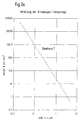
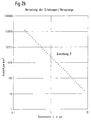
- the barrier is good in the present sense, if the density of the protrusions / protrusions is large (FIG. 1b), the barrier is bad in the present sense.
- the graph also shows that the R a value has in principle no influence on the barrier properties.
- a smooth film e.g. R a ⁇ 10 nm
- R a ⁇ 10 nm can have a very poor barrier if the number of elevations / protrusions N / mm 2 is greater than calculated according to equations (1) and (2).
- the surface / surface layer contains a large number of fine particles which, however, make no significant contribution to the amount of the R a value.
- the R a values have no practical significance for the barrier properties, the R a values are of practical importance for the processing of the film according to the invention.
- the R a value is greater than 6 nm, preferably greater than 8 nm and particularly preferably greater than 10 nm.
- the R a values of the film surface A according to the invention are not greater than 100 nm, advantageously less than 80 nm and in particular advantageously less than 70 nm.
- the processing, in particular the winding of the film becomes problematic. If the R a values of the film surface according to the invention are greater than 100 nm, the abrasion resistance of this surface becomes worse.
- the oxygen permeation is greater than 0.5 cm 3 / m 2 bar d, which is undesirable according to the task at hand. Furthermore, the gloss of this film surface (in the unmetallized or uncoated state) is then no longer as high as is also desired in accordance with the present task.
- the layer A according to the invention has very few elevations / projections N per surface unit.
- the metallized or oxidically coated film is distinguished by a particularly good oxygen barrier.
- the permeation values of the metallized or oxidically coated film are less than 0.45 cm 3 / m 2 bar d in the preferred embodiment and less than 0.40 cm 3 / m 2 bar d in the particularly preferred embodiment.
- the gloss of this page also takes on extremely high values. The gloss of this film side (in the unmetallized or uncoated state) is greater than 200 in the particularly preferred embodiment.
- the film has at least two layers. It then comprises layers a layer B and the layer A according to the invention.
- the two layers A and C form the outer layers A and C.
- the base layer B of the film preferably consists of at least 90% by weight of a thermoplastic polyester.
- polyesters which are composed of at least 90 mol%, preferably at least 95 mol% Ethylene glycol and terephthalic acid units or from ethylene glycol and naphthalene-2,6-dicarboxylic acid units consist.
- the remaining monomer units come from other aliphatic, cycloaliphatic or aromatic diols or dicarboxylic acids, as they can also occur in layer A (or layer C).
- Suitable other aliphatic diols are, for example, diethylene glycol, triethylene glycol, aliphatic glycols of the general formula HO- (CH 2 ) n -OH, where n represents an integer from 3 to 6 (in particular propane-1,3-diol, butane-1,4) -diol pentane-1,5-diol and hexane-1,6-diol) or branched aliphatic glycols with up to 6 carbon atoms.
- cyclohexanediols in particular cyclohexane-1,4-diol
- cyclohexanediols in particular cyclohexane-1,4-diol
- Suitable other aromatic diols correspond, for example, to the formula HO-C 6 H 4 -XC 6 H 4 -OH, where X is -CH 2 -, -C (CH 3 ) 2 -, -C (CF 3 ) 2 -, -O -, -S- or -SO 2 - stands.
- bisphenols of the formula HO-C 6 H 4 -C 6 H 4 -OH are also very suitable.
- aromatic dicarboxylic acids are preferably benzenedicarboxylic acids, naphthalenedicarboxylic acids (for example naphthalene-1,4- or 1,6-dicarboxylic acid), biphenyl-x, x'-dicarboxylic acids (in particular biphenyl-4,4'-dicarboxylic acid), diphenylacetylene-x, x ' -dicarboxylic acids (especially diphenylacetylene-4,4'-dicarboxylic acid) or stilbene-x, x'-dicarboxylic acids.
- naphthalenedicarboxylic acids for example naphthalene-1,4- or 1,6-dicarboxylic acid
- biphenyl-x, x'-dicarboxylic acids in particular biphenyl-4,4'-dicarboxylic acid
- diphenylacetylene-x, x ' -dicarboxylic acids especially diphenylacetylene
- cyclohexanedicarboxylic acids (in particular cyclohexane-1,4-dicarboxylic acid) should be mentioned.
- aliphatic dicarboxylic acids the (C 3 -C 19 ) alkanedioic acids are particularly suitable, the alkane fraction being straight-chain or branched.
- the polyester can be produced by the transesterification process.
- dicarboxylic acid esters and diols which are mixed with the usual transesterification catalysts, such as zinc, calcium, lithium, magnesium and manganese salts, be implemented.
- the intermediates then become general in the presence conventional polycondensation catalysts, such as antimony trioxide or titanium salts, polycondensed.
- Production can also be carried out using the direct esterification process take place in the presence of polycondensation catalysts. Here you go directly from the dicarboxylic acids and the diols.
- transesterification catalysts have proven to be particularly suitable are used in which only a few and / or only small Elevations / projections are generated on layer A of the film. Are preferred especially magnesium and manganese salts. These transesterification catalysts are preferred in the production of the base raw material, particularly preferred but used in the manufacture of the raw material for layer A.
- concentrations of the transesterification catalysts given here refer to Raw materials for layer A according to the invention, in which no additional inert Particles are used. When inert particles are added, it is expedient the content of internal particles is reduced.
- layer A can also contain other materials be, in which case layer A is preferably composed of a mixture of polymers, one Copolymers or a homopolymer, which ethylene-2,6-naphthalate units and contain ethylene terephthalate units. Up to 10 mol% of the polymers can consist of further comonomers (see above).
- the polymers for choose the base layer and the other layer (s) so that the viscosities do not distinguish too much from the respective polymer melts. In the other case is with additional elevations / protrusions, with flow disturbances or with streaking to count on the finished slide.
- SV value modified solvent viscosity
- solution viscosity For commercially available polyethylene terephthalates are suitable for the production of biaxially oriented films, the SV values are in the range from 600 to 1000.
- the base layer and the other layer (s) can additionally conventional additives such as For example, stabilizers and / or antiblocking agents. You will be expedient to that Polymer or the polymer mixture added before melting.
- Stabilizers are, for example, phosphorus compounds, such as phosphoric acid or Phosphoric acid ester used.
- Typical antiblocking agents are inorganic and / or organic particles, for example calcium carbonate, amorphous silica, talc, magnesium carbonate, barium carbonate, calcium sulfate, barium sulfate, Lithium phosphate, calcium phosphate, magnesium phosphate, aluminum oxide, LiF, calcium, barium, zinc or manganese salts of the dicarboxylic acids used, Carbon black, titanium dioxide, kaolin or cross-linked polystyrene or acrylate particles.
- the particles can be the individual Layers in the respective advantageous concentrations, e.g. as a glycolic dispersion added during polycondensation or via masterbatches during extrusion become. Pigment concentrations from 0 to 5 have proven particularly suitable Wt .-% proven A detailed description of the antiblocking agents that can be used can be found, for example, in EP-A-0 602 964.
- Layer A according to the invention is generally filled only slightly or not at all with inert pigments to satisfy equations (1) to (2).
- concentration of the inert particles in layer A is between 0 and 0.08% by weight, preferably between 0 and 0.065% by weight, in particular between 0 and 0.05% by weight and very preferably between 0 and 0, 04% by weight and depends essentially on the size of the particles used.
- Preferred particles are SiO 2 in colloidal and in chain-like form. In principle, the particle diameters of the particles used are not restricted.
- inert particles are not added to layer A, e.g. through a suitable selection and concentration of the catalysts in the Transesterification or polymerization reaction can be ensured by the forming precipitates a blocking of the surface A against itself avoided can be.
- the pigment diameter and the pigment concentration for the other layer make sure that the pigmentation in these layers and the layer thicknesses of these layers is chosen so that equations (1) to (5) are not violated.
- the pigmentation of the individual layers which do not concern layer A can then be very different and depends essentially on the film structure (Layer structure) and the requirements of the film with regard to achieving the other optical properties (turbidity) and the manufacturing and processing behavior.
- the base layer B it is the preferred three-layer film with the base layer B and the two outer layers A and C, so is in the base layer B.
- Particle concentration preferably lower than in the second top layer C. Die Pigmentation in the base layer B should be chosen so that it does not sustainable on the number of surveys / projections N in the invention Top layer affects.
- the particle concentration between 0 and 0.06 wt .-%, preferably between 0 and 0.04% by weight, in particular between 0 and 0.03% by weight and entirely are preferably between 0 and 0.02% by weight.
- the particle diameter of the used In principle, particles are not restricted, but are particles with a average diameter of greater than 1 micron is particularly preferred.
- layer A being more than 50%, in particular more than 65% and particularly preferably more than 80% of the total thickness of the film layer B can be more pigmented (higher pigment concentration) than in the other case, in which the layer thickness of layer A is comparable is small ( ⁇ 50%).
- the polyester film according to the invention is in a particularly preferred embodiment three layers and then contains another layer C.
- the two layers A and C then form the cover layers A and C.
- Structure, thickness and composition the second cover layer C can be independent of the one already present Cover layer A can be selected, the second cover layer also being the same mentioned polymers or polymer mixtures can contain, but not with that of the first cover layer must be identical.
- the second top layer can also contain other common top layer polymers.
- This second top layer contains generally more pigments (i.e. higher pigment concentrations) than the first invention Top layer A.
- the pigment concentration in this second top layer is between 0.02 and 0.4%, advantageously between 0.025 and 0.3%, in particular between 0.03 and 0.2% and very particularly preferably between 0.035 and 0.15%. It is e.g.
- the pigment type (s), the pigment concentration (s) and the Particle concentration / s and the layer thickness ratios selected so that a good appearance, as well as good manufacturability and processability of the film is given.
- the R a value is between 30 and 90 nm and in particular between 35 and 80 nm.
- the static / sliding friction F C of this layer against itself is less than 0.45 and in particular less than 0.40.
- an intermediate layer This can in turn consist of those for the base layers described polymers exist. In a particularly preferred embodiment it consists of the polyester used for the base layer. It can too contain the usual additives described.
- the thickness of the intermediate layer is in generally larger than 0.3 ⁇ m and is preferably in the range from 0.5 to 15 ⁇ m, in particular in the range from 1.0 to 10 ⁇ m and very particularly preferably in the range from 1.0 to 5 ⁇ m.
- the thickness of the cover layer (s) A (and C) is generally greater than 0.1 ⁇ m and is generally in the range from 0.2 to 3.0 ⁇ m, advantageously in the range from 0.2 to 2.5 ⁇ m, in particular in the range from 0.3 to 2 ⁇ m and very particularly preferred in the range from 0.3 to 1.5 ⁇ m, the outer layers A and C being equal to or can be of different thickness.
- the total thickness of the polyester film according to the invention can be within wide limits vary and depends on the intended use. she is 4 to 50 microns, especially 5 to 45 microns, preferably 6 to 40 microns, the Layer B has a share of preferably about 5 to 90% of the total thickness.
- top layer (s) A and C) are appropriate Granules of polyethylene terephthalate fed to one or two extruders.
- the Materials are melted and extruded at around 300 ° C.
- the polymers for the base layer are expediently via a further extruder fed. Any foreign objects or contaminants can be removed from the Filter off the polymer melt before extrusion.
- the melts are then in one Multi-layer nozzle formed into flat melt films and layered on top of each other. Subsequently, the multilayer film with the help of a chill roll and optionally stripped further rollers and solidified.
- Biaxial stretching is generally carried out sequentially. Doing so preferably first in the longitudinal direction (i.e. in the machine direction) and then in Cross direction (i.e. perpendicular to the machine direction) stretched. This leads to a Orientation of the molecular chains.
- the stretching in the longitudinal direction can be done with the help two running at different speeds depending on the desired stretching ratio Carry out rolling. A corresponding one is generally used for transverse stretching Tenter frame.
- the temperature at which the drawing is carried out can be in a relative vary widely and depends on the desired properties of the Foil.
- the longitudinal stretch ratio is generally in Range from 2.5: 1 to 6: 1, preferably from 3: 1 to 5.5: 1.
- the transverse stretch ratio is generally in the range from 3.0: 1 to 5.0: 1, preferably from 3.5: 1 to 4.5: 1.
- Before the transverse stretching can one or both surface (s) of the film according to the known Coat the process in-line.
- the in-line coating can be, for example, one improved adhesion of the metal layer or any applied printing ink, but also to improve the antistatic behavior or processing behavior to serve.
- the film In the subsequent heat setting, the film is held at about 0.1 to 10 s Temperature kept from 150 to 250 ° C. Then the film is in the usual Way wrapped up.
- the biaxially stretched and heat-set polyester film can be printed or before applying the metallic or oxidic layer on one or both Side (s) corona or flame treated.
- the treatment intensity is like this chosen that the surface tension of the film is generally above 45 mN / m.
- metal or oxide layers are applied on common industrial plants.
- Metal layers made of aluminum are common by vapor deposition in conventional metallizers (shuttle method). In the case of oxidic layers, there are also electron beam processes or sputtering proven.
- the process parameters of the plant at Apply the metal layer or the oxide layer on the foils correspond the standard conditions.
- the metallization of the foils is preferably carried out in such a way that the optical density of the metallized films in the usual range of approx. 2.2 to 2.8.
- the oxide layer is applied to the film in such a way that that the layer thickness of the oxide layer is preferably in the range from 30 to 100 nm.
- the web speed of the film to be coated is all Settings usually between 5 and 20 m / s.
- the film can be coated or be corona or flame pretreated.
- Typical coatings are adhesion-promoting, antistatic, slip-improving or dehesive layers. It makes sense these additional layers over internal coating using aqueous dispersions before Apply transverse stretching to the film.
- the Metal layer preferably made of aluminum. But other materials are also suitable, which can be applied in the form of a thin, coherent layer. In particular, e.g. Silicon suitable, which in comparison to aluminum transparent barrier layer results.
- the oxide layer preferably consists of Oxides of elements of II., III. or IV. Main group of the periodic table, in particular Oxides of magnesium, aluminum or silicon. Become general those metallic or oxidic materials used, which with reduced Pressure or vacuum can be applied.
- the thickness of the applied Layer is generally 10 to 100 nm.
- An advantage of the invention is that the manufacturing costs of the invention Film are comparable to those according to the prior art.
- the other processing and use-relevant properties of the invention Films remain essentially unchanged or are even improved.
- the film is ideal for packaging light and / or air sensitive Food and luxury goods. It is particularly suitable for the production of Vacuum packaging for coffee, in particular ground coffee.
- the film according to the invention is characterized by a high gloss, especially a high gloss of the film surface A, and by a low Cloudiness. Furthermore, the film has an excellent oxygen barrier, after being metallized on the film surface A or with oxidic materials has been coated. It also has good winding and processing behavior.
- the gloss of the film surface A is greater than 180. In a preferred embodiment the gloss of this page is more than 190 and in a particularly preferred Embodiment more than 200. This film surface is therefore suitable especially for printing or for metallization. The high gloss of the film is transferred to the print or the applied metal layer and thus gives the Foil the desired advertising effect.
- the haze of the film is less than 1.5. In a preferred embodiment the haze of the film is less than 1.3 and in a particularly preferred embodiment less than 1.0. Due to the low cloudiness of the film, the film is suitable not only for packaging but also e.g. for reprographic applications or for "glazing" applications.
- the film has an oxygen barrier of less than 0.5 gm -2 d -1 bar -1 , preferably less than 0.45 gm -2 d -1 bar -1 and particularly preferably less than 0.4 gm -2 d -1 bar -1 after it has been metallized on the film surface A or coated with oxidic materials.
- the coefficient of friction on the side opposite the A side is less than 0.5. In a preferred one Embodiment, the coefficient of friction of the film there is less than 0.45 and in a particularly preferred embodiment less than 0.4.
- Table 1 summarizes the most important film properties according to the invention.
- the Macbeth TD-904 densitometer from Macbeth (Division of Kollmorgen Instruments Corp.) was used to measure the optical density.
- the oxygen barrier on the metallized foils was measured using an OX-TRAN 2/20 from Mocon Modern Controls (USA) according to DIN 53 380, part 3.
- SV solvent viscosity
- the friction was determined according to DIN 53 375.
- the friction was 14 days after Production measured. Blocking takes place when the coefficient of friction is greater than 1 or in the case of friction force measurement in the friction force-displacement curve measurement of points of discontinuity occur.
- the surface tension was measured using the so-called ink method (DIN 53 364) certainly.
- the haze of the film was measured according to ASTM-D 1003-52.
- the turbidity measurement according to Hölz was determined in accordance with ASTM-D 1003-52, but for utilization the optimal measuring range measured on four superimposed foil layers and a 1 ° slit was used instead of a 4E pinhole
- the gloss was determined in accordance with DIN 67 530.
- the reflector value was measured as optical parameter for the surface of a film. Based on the standards ASTM-D 523-78 and ISO 2813 the angle of incidence was set at 20 ° or 60 °. A ray of light strikes the flat test surface at the set angle of incidence reflected or scattered by this. Those striking the photoelectronic receiver Light rays are displayed as a proportional electrical quantity.
- the measured value is dimensionless and must be specified with the angle of incidence.
- foil samples are placed flat on a sample holder. Then they are vapor deposited at an angle ⁇ with a thin metal layer (eg made of silver).
- ⁇ is the angle between the sample surface and the direction of propagation of the metal vapor.
- This oblique vaporization creates a shadow on the antiblocking agent particles. Since the shadows are not yet electrically conductive, the sample can then be vaporized with a second metal (eg gold), the metal vapor hitting the sample surface perpendicularly.
- a second metal eg gold
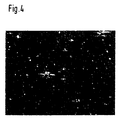
- the sample surfaces thus prepared are examined in a scanning electron microscope (REM) pictured.
- the shadows of the antiblocking agent particles are due to the material contrast visible.
- the sample is oriented in the SEM so that the shadows are parallel to the lower edge of the image (x direction).
- SEM images are taken and transferred to an image analysis system. With this image analysis system now the lengths of the shadows (in the x direction) and their maximum extent in the y direction (parallel to the vertical edge of the picture).
- the diameter D of the antiblocking agent particles at the level of the sample surface is equal to the maximum extent of the shadows d in the y direction.
- the roughness R a of the film was determined in accordance with DIN 4768 with a cut-off of 0.25 mm.
- Polyethylene terephthalate chips (made by the transesterification process with Mn as transesterification catalyst, Mn concentration: 100 ppm) and were at 160 ° C a residual moisture of below 50 ppm dried and the extruder for the base layer B fed.
- chips made of polyethylene terephthalate (produced via the transesterification process with Mn as the transesterification catalyst, Mn concentration: 100 ppm), the corresponding Table 2 are pigmented, also at 160 ° C to a residual moisture of dried below 50 ppm and the respective extruders for the outer layers A and C fed.
- Top layer A mixture of:
- Top layer C mixture of:
- the film is characterized by very good optical properties and by a good one Processing behavior (see Table 3).
- the film After production of the film (according to this example 1 and all the following examples) it was placed on the A-side in an industrial metallizer with aluminum Vacuum vaporized.
- the coating speed was 8 m / s and the optical Density 2.6.
- the film had the required high oxygen barrier.
- the film structure and the achieved Properties of films produced in this way are shown in Tables 2 and 3.
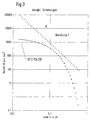
- Figure 6 shows the covering layer A using the method described on pages 31/32 measured distributions for the elevations / protrusions N.
- Example 2 In a similar manner to that in Example 1, coextrusion followed by gradual Orientation in the longitudinal and transverse directions using a transparent three-layer film ABC structure and a total thickness of 12 microns. Compared to example 1 only top layer A was changed.
- Top layer A mixture of:
- Example 2 In a similar manner to that in Example 1, coextrusion followed by gradual Orientation in the longitudinal and transverse directions using a transparent three-layer film ABC structure and a total thickness of 12 microns. Compared to example 1 only top layer A was changed.
- Top layer A mixture of:
- Example 2 In a similar manner to that in Example 1, coextrusion followed by gradual Orientation in the longitudinal and transverse directions using a transparent three-layer film ABC structure and a total thickness of 12 microns. Compared to example 1 only top layer A was changed.
- Top layer A mixture of:
- Example 2 In a similar manner to that in Example 1, coextrusion followed by gradual Orientation in the longitudinal and transverse directions using a transparent three-layer film ABC structure and a total thickness of 12 microns. Compared to example 1 only top layer A was changed.
- Top layer A mixture of:
- Example 2 In a similar manner to that in Example 1, coextrusion followed by gradual Orientation in the longitudinal and transverse directions using a transparent three-layer film ABC structure and a total thickness of 12 microns. Compared to example 1 only top layer A was changed.
- Top layer A mixture of:
- the polyester raw material for the top layer A was also via the transesterification process Ca produced as a transesterification catalyst, the Ca concentration being 200 ppm.
- Example 1 The process conditions for all layers were chosen as in Example 1. Although no inert pigments were added to the top layer A and the base layer B. , the surface of the cover layer A contains elevations / protrusions. This stir among other things of the precipitates of the transesterification catalyst and fluctuations in the Manufacturing process of the raw material and the film.
- Example 2 In a similar manner to that in Example 1, coextrusion followed by gradual Orientation in the longitudinal and transverse directions using a transparent three-layer film ABC structure and a total thickness of 12 microns. Compared to example 1 cover layers A and C were changed.
- Top layer A mixture of:
- Top layer C mixture of:
- Example 7 In a similar manner as in Example 7, by coextrusion and subsequent stepwise Orientation in the longitudinal and transverse directions using a transparent three-layer film ABC structure and a total thickness of 12 microns. Compared to example 1 top layer A was changed.
- Top layer A mixture of:
- Example 1 from EP-A-0 514 129 was reworked. The gloss of the film is not satisfactory. The metallized version with a thickness of 12 ⁇ m did not meet the requirements Barrier values.
- Example 1 from EP-A-0 604 057 was reworked.
- the gloss of the film is not satisfactory.
- the metallized version with a thickness of 12 ⁇ m did not meet the requirements Barrier values.
- the film provides for use in the packaging market not an economical solution.
- Example 1 from EP-A-0 124 291 was reworked.
- Example 1 from EP-A-0 490 665 was reworked.
- Example 1 from DE-A-16 94 404 was reworked.
- Example 15 from EP-A-0 061 769 was reworked.
- Example 1 from EP-B-0 088 635 was reworked.
Landscapes
- Physics & Mathematics (AREA)
- Thermal Sciences (AREA)
- Laminated Bodies (AREA)
- Extrusion Moulding Of Plastics Or The Like (AREA)
- Shaping By String And By Release Of Stress In Plastics And The Like (AREA)
- Packages (AREA)
- Wrappers (AREA)
Abstract
Die Erfindung betrifft eine biaxial orientierte Polyesterfolie mit sehr guten optischen Eigenschaften und gutem Verarbeitungsverhalten, die nach ihrer Metallisierung oder nach ihrer Beschichtung mit oxidischen Materialien eine hohe Sauerstoffbarriere aufweist, aufgebaut aus mindestens einer Basisschicht B und mindestens einer auf dieser Basisschicht aufgebrachten Schicht A, wobei diese Schicht A eine definierte Anzahl von Erhebungen mit einer definierten Höhe und einem definierten Durchmesser aufweist. Die Erfindung betrifft weiterhin ein Verfahren zur Herstellung der Folie und ihre Verwendung.The invention relates to a biaxially oriented polyester film with very good optical properties and good processing behavior, which after its metallization or after its coating with oxidic materials has a high oxygen barrier, composed of at least one base layer B and at least one layer A applied to this base layer, these being Layer A has a defined number of elevations with a defined height and a defined diameter. The invention further relates to a method for producing the film and its use.
Description
Die Erfindung betrifft eine biaxial orientierte Polyesterfolie mit sehr guten optischen Eigenschaften und gutem Verarbeitungsverhalten, die nach ihrer Metallisierung oder nach ihrer Beschichtung mit oxidischen Materialien eine hohe Sauerstoffbarriere aufweist, aufgebaut aus mindestens einer Basisschicht B und mindestens einer auf dieser Basisschicht aufgebrachten Schicht A, wobei diese Schicht A eine definierte Anzahl von Erhebungen mit einer definierten Höhe und einem definierten Durchmesser aufweist. Die Erfindung betrifft weiterhin ein Verfahren zur Herstellung der Folie und ihre Verwendung.The invention relates to a biaxially oriented polyester film with very good optical properties Properties and good processing behavior after their metallization or a high oxygen barrier after being coated with oxidic materials has, built up from at least one base layer B and at least one this base layer applied layer A, this layer A defining one Number of surveys with a defined height and a defined diameter having. The invention further relates to a method for producing the Foil and its use.
Biaxial orientierte Polyesterfolien werden im Verpackungs- oder im industriellen Sektor hauptsächlich dort verwendet, wo ihre vorteilhaften Eigenschaften, d.h. eine gute Optik, hohe mechanische Festigkeiten, eine gute Sperrwirkung, insbesondere gegenüber Gasen, eine gute Dimensionsstabilität in der Wärme und eine ausgezeichnete Planlage benötigt werden.Biaxially oriented polyester films are used in the packaging or in the industrial sector mainly used where their advantageous properties, i.e. a good Optics, high mechanical strength, a good locking effect, especially against Gases, good dimensional stability under heat and excellent Flatness are needed.
Für die meisten Anwendungszecke ist es z.B. aus werbewirksamen Gründen weiterhin wünschenswert, die optischen Eigenschaften der Polyesterfolien, insbesondere den Glanz und die Folientrübung, bei weiterhin guter Verarbeitbarkeit der Folie, zu verbessern. Ebenfalls wünschenswert ist es, die Barriereeigenschaften von Polyesterfolien zu verbessern, um z.B. in neue Anwendungen zu gelangen.For most applications it is e.g. for advertising reasons desirable, the optical properties of the polyester films, especially the To improve gloss and the haze of the film, while the processability of the film remains good. It is also desirable to have the barrier properties of polyester films to improve e.g. to get into new applications.
Im Stand der Technik wird dargestellt, wie die optischen Eigenschaften, insbesondere der Glanz und die Trübung, biaxial orientierter Polyesterfolien verbessert werden können.The prior art shows how the optical properties, in particular the gloss and haze of biaxially oriented polyester films can be improved can.
In der EP-A-0 514 129 wird eine transparente Mehrschichtfolie beschrieben, die ein Primärschicht-Substrat aus Polymermaterial umfaßt, welches mindestens auf einer seiner Oberflächen eine Sekundärschicht aus Polymermaterial besitzt, die Glasperlen und Siliciumdioxidpartikel in bestimmten Konzentrationen und in bestimmten Größenverteilungen aufweist. Die Sekundärschicht kann auf einer bzw. auf beiden Seiten des Primärschicht-Substrates angeordnet sein. Mit der Folie werden die Trübung und die Verarbeitungseigenschaften verbessert, eine Lehre zur Verbesserung des Glanzes und der Barriereeigenschaften der Folie vermittelt die Schrift jedoch nicht. Auch finden sich in der Schrift keinerlei Hinweise darauf, wie die Topographie einer solchen Folie für die gleichzeitige Verbesserung von Glanz und Sauerstoffbarriere eingestellt werden soll.EP-A-0 514 129 describes a transparent multilayer film which includes a Primary layer substrate made of polymer material comprising at least one has a secondary layer of polymer material on its surfaces, the glass beads and silica particles in certain concentrations and in certain size distributions having. The secondary layer can be on one or both sides of the Primary layer substrate can be arranged. With the film, the turbidity and the Improved processing properties, a lesson to improve the gloss and the barrier properties of the film do not convey the writing. Find too there are no indications in the script as to the topography of such a film can be set for the simultaneous improvement of gloss and oxygen barrier should.
In der EP 0 604 057 wird eine transparente Mehrschichtfolie beschrieben, die ein Primärschicht-Substrat aus Polymermaterial umfaßt, die im wesentlichen frei ist von Füllern, welches mindestens auf einer seiner Oberflächen eine Sekundärschicht aus Polymermaterial besitzt, die als Füller Silikon-Harz in einer Konzentration von 100 bis 1000 ppm enthält und einen mittleren Partikeldurchmesser von 1,5 bis 12,5 µm aufweist. Nachteilig an den Silikon-Partikeln ist, daß diese vergleichsweise teuer sind und für den Verpackungsmarkt keine akzeptable Lösung darstellen. Außerdem neigen Folien, die mit solchen Pigmenten ausgerüstet sind, beim Wickeln leichter zum Teleskopieren. Ebenfalls finden sich auch in dieser Schritt keinerlei Hinweise darauf, wie die Topographie einer solchen Folie für die gleichzeitige Verbesserung von Glanz und Sauerstoffbarriere eingestellt werden soll.EP 0 604 057 describes a transparent multilayer film which includes a Primary layer substrate made of polymer material which is substantially free of Fill which has a secondary layer on at least one of its surfaces Has polymer material that acts as a filler silicone resin in a concentration of 100 to Contains 1000 ppm and has an average particle diameter of 1.5 to 12.5 microns. A disadvantage of the silicone particles is that they are comparatively expensive and not an acceptable solution for the packaging market. Also tend Films equipped with such pigments are easier to telescope when wrapped. Also in this step there are no indications of how the topography of such a film for the simultaneous improvement of gloss and Oxygen barrier should be set.
In vielen Fällen wird bei Lebensmittelverpackungen eine hohe Sperrwirkung gegenüber Gasen, Wasserdampf und Aromastoffen verlangt (gleichbedeutend mit einer geringen Durchlässigkeit oder geringen Permeation). Ein gängiges Verfahren, solche Verpackungen herzustellen, besteht darin, die dafür verwendeten Kunststoffolien mit Aluminium im Hochvakuum zu bedampfen bzw. zu metallisieren. Weitere gängige Verfahren bestehen darin, die Folien mit oxidischen Materialien (z.B. SiOx, oder AlxOy) zu beschichten. Hierbei handelt es sich im wesentlichen um transparente Beschichtungen. In many cases, food packaging is required to have a high barrier effect against gases, water vapor and aromatic substances (synonymous with low permeability or low permeation). A common method of producing such packaging is to vapor-coat or metallize the plastic films used for this with aluminum in a high vacuum. Another common method is to coat the foils with oxidic materials (eg SiO x or Al x O y ). These are essentially transparent coatings.
Die Sperrwirkung gegenüber den oben genannten Stoffen hängt im wesentlichen von der Art der Polymeren in der Folie und der Güte der aufgebrachten Sperrschichten ab. So wird mit metallisierten, biaxial orientierten Polyesterfolien eine sehr hohe Sperrwirkung gegenüber Gasen, wie Sauerstoff und Aromastoffen, erzielt. Gegenüber Wasserdampf erreicht man sie mit metallisierten, biaxial orientierten Polypropylenfolien.The barrier effect against the above-mentioned substances essentially depends on the type of polymer in the film and the quality of the barrier layers applied. This means that metallized, biaxially oriented polyester films have a very high barrier effect against gases such as oxygen and flavoring agents. Across from You can get water vapor with metallized, biaxially oriented polypropylene films.
Aufgrund ihrer guten Sperreigenschaften werden mit metallisierten oder oxidisch beschichteten Folien insbesondere Lebens- und Genußmittel verpackt, bei denen durch lange Lager- oder Transportzeiten die Gefahr besteht, daß im Falle einer nicht ausreichenden Barriere die verpackten Lebensmittel verderben, ranzig werden oder an Geschmack verlieren, beispielsweise bei Kaffee, fetthaltigen Snacks (Nüssen, Chips u.a.) oder kohlensäurehaltigen Getränken (in Standbeuteln; engl.: pouches).Because of their good barrier properties, they can be metallized or oxidized coated films, in particular food and luxury goods packed, in which due to long storage or transport times there is a risk that in the event of a failure sufficient barrier spoil the packaged food, go rancid or on Lose taste, for example with coffee, fatty snacks (nuts, chips etc.) or carbonated drinks (in pouches).
Sollen Polyesterfolien mit einer aufgedampften Aluminiumschicht oder mit aufgebrachten oxidischen Schichten als Verpackungsmaterial verwendet werden, dann sind sie in der Regel Bestandteil eines mehrschichtigen Folienverbunds (Laminat). Daraus hergestellte Beute lassen sich z. B. auf einer vertikalen Schlauchbeutel-, Form-, Füll und Verschließmaschine (vffs) füllen. Die Beute werden auf ihrer Innenseite (d.h. auf der dem Füllgut zugewandten Seite) gesiegelt, wobei die Siegelschicht in der Regel aus Polyethylen oder Polypropylen besteht. Der Folienverbund weist dabei den folgenden typischen Aufbau auf: Polyesterschicht/Aluminium- oder Oxidschicht/Kleberschicht/Siegelschicht. Bei einer Dicke des Laminats von etwa 50 bis 150 µm ist die Metall-oder Oxidschicht nur 10 bis 80 nm dick. Diese sehr dünne Funktionsschicht genügt bereits, um einen ausreichenden Lichtschutz und sehr gute Barriereeigenschaften zu erreichen.Should polyester films with a vapor-deposited aluminum layer or with applied oxide layers are used as packaging material, then they are in usually part of a multilayer film composite (laminate). Out of it loot can be z. B. on a vertical tubular bag, form, fill and fill the sealing machine (vffs). The prey are on their inside (i.e. on the side facing the filling material), the sealing layer usually consists of polyethylene or polypropylene. The film composite has the following typical structure on: polyester layer / aluminum or Oxide layer / adhesive layer / sealing layer. With a thickness of the laminate of about 50 to 150 µm, the metal or oxide layer is only 10 to 80 nm thick. This very thin one Functional layer is already sufficient to provide adequate light protection and very good To achieve barrier properties.
Die Sauerstoffbarriere bzw. die Sauerstoffdurchlässigkeit wird in der Regel nicht an dem Laminat oder der Verpackung selbst, sondern an der metallisierten Polyesterfolie gemessen. Um die Qualität der Lebens- oder Genußmittel auch bei längeren Lagerzeiten zu gewährleisten, darf die Sauerstoffdurchlässigkeit (gleich Permeation) der metallisierten Folie nicht mehr als 2 cm3/m2 bar d, insbesondere aber nicht mehr als 1,5 cm3/m2 bar d betragen. Zukünftig geht die Forderung der Verpackungsindustrie in Richtung einer noch weiter erhöhten Barriere, wobei Permeationswerte der metallisierten oder oxidisch beschichteten Folien von deutlich weniger als 1,0 cm3/m2 bar d angestrebt werden.The oxygen barrier or the oxygen permeability is usually not measured on the laminate or the packaging itself, but on the metallized polyester film. In order to guarantee the quality of the foodstuffs or luxury foods even with long storage times, the oxygen permeability (equal to permeation) of the metallized film must not exceed 2 cm 3 / m 2 bar d, but in particular not exceed 1.5 cm 3 / m 2 bar d. In the future, the packaging industry will be calling for an even higher barrier, with permeation values of the metallized or oxide-coated films of significantly less than 1.0 cm 3 / m 2 bar d being sought.
Nach dem Stand der Technik ist es weder hinreichend bekannt, worauf die Barrierewirkung von metallisierten oder oxidisch beschichteten Polyesterfolien im einzelnen beruht noch wie diese entscheidend zu verbessern ist. Wichtige Einflußgrößen sind offensichtlich die Substratoberfläche, die Art des Substratpolymers sowie dessen Morphologie. Allgemein wird davon ausgegangen, daß glatte Substratoberflächen bessere Barriereeigenschaften ergeben.According to the prior art, it is neither well known what the barrier effect is of metallized or oxidically coated polyester films in detail is still based on how this can be decisively improved. Important influencing factors are obviously the substrate surface, the type of substrate polymer and its Morphology. It is generally assumed that smooth substrate surfaces result in better barrier properties.
In "Thin Solids Films" 204 (1991), S. 203-216, wurde hierzu von Weiss u.a. der Einfluß der Rauhigkeit einer Substratschicht auf die Permeation untersucht. Dazu wurden Polyesterfolien mit Lack beschichtet, der in unterschiedlichen Konzentrationen Titandioxidpartikel enthielt. In den beschriebenen Experimenten wurde die Konzentration an Titandioxidpartikel im Lack zwischen 2 und 20 Gew.-% variiert. Die Rauhigkeit Ra der gecoateten Substratoberfläche konnte mit dieser Methode von 43 nm (unlackierte und lackierte Folie, ohne Titandioxid) bis 124 nm variiert werden. In seinen Experimenten ergaben sich mit steigender Rauhigkeit (steigendem TiO2 -Anteil) der lackierten Oberfläche eindeutig höhere Sauerstoffdurchlässigkeiten nach dem Aluminiumbedampfen. Der allerdings größte Sprung in der Sauerstoffdurchlässigkeit wurde für die lackierte Folie (0 Gew.-%) gegenüber der unlackierten Folie festgestellt. In beiden Fällen war die Rauhigkeit der Substratoberfläche jedoch gleich groß. Allein durch das Lackieren der Folie verschlechterte sich die Barriere von ca. 0,43 cm3/m2 d bar (plain film) auf ca. 19 cm3/m2 d bar (lackierte Folie). Eine weitere Unsicherheit hinsichtlich der Übertragbarkeit dieser Lehre auf kommerzielle Produkte entsteht dadurch, daß die Aluminiumschicht mittels Laborverdampfer aufgebracht wurde. Hierbei werden im Vergleich zum Industriemetallisierer wesentlich niedrige Permeationswerte erreicht, und der Einfluß der Substratoberfläche auf die Barriereeigenschaffen wird verschmiert.In "Thin Solids Films" 204 (1991), pp. 203-216, Weiss investigated the influence of the roughness of a substrate layer on permeation. For this purpose, polyester films were coated with varnish, which contained titanium dioxide particles in different concentrations. In the experiments described, the concentration of titanium dioxide particles in the lacquer was varied between 2 and 20% by weight. With this method , the roughness R a of the coated substrate surface could be varied from 43 nm (unpainted and lacquered foil, without titanium dioxide) to 124 nm. In his experiments, the increasing roughness (increasing TiO 2 content) of the painted surface resulted in clearly higher oxygen permeability after aluminum vapor deposition. However, the largest jump in oxygen permeability was found for the coated film (0% by weight) compared to the unpainted film. In both cases, however, the roughness of the substrate surface was the same. Simply by coating the film, the barrier deteriorated from approx. 0.43 cm 3 / m 2 d bar (plain film) to approx. 19 cm 3 / m 2 d bar (coated film). A further uncertainty regarding the transferability of this teaching to commercial products arises from the fact that the aluminum layer was applied by means of a laboratory evaporator. Compared to industrial metallizers, the permeation values are significantly lower and the influence of the substrate surface on the barrier properties is smeared.
Weitere detaillierte Untersuchungsergebnisse über den Einfluß der Substratoberfläche von Polyesterfolien auf die Barriereeigenschaften sind in der Dissertation von H. Utz (Technische Universität München 1995: "Barriereeigenschaften aluminiumbedampfter Kunststoffolien") zu finden.Further detailed investigation results on the influence of the substrate surface of polyester films on the barrier properties are described in the dissertation by H. Utz (Technical University of Munich 1995: "Barrier properties of aluminum vaporized Plastic films ").
Nach den Untersuchungen von Utz (S. 66, ff) besteht zwischen der Oberflächenrauhigkeit (Mittenrauhigkeit Ra) der PET-Folie und der Sauerstoffbarriere kein unmittelbarer Zusammenhang. Die als besonders glatt hervorgehobene Videofolie mit einem Mittenrauhigkeitswert von Ra = 22 nm hat z.B. mit 1,3 cm3/m2 bar d eine mit der viel rauheren PET II-Folie (Ra = 220 nm) vergleichbare Sauerstoffdurchlässigkeit von 1,2 cm3/m2 bar d.According to the studies by Utz (p. 66, ff), there is no direct connection between the surface roughness (center roughness R a ) of the PET film and the oxygen barrier. The video film highlighted as particularly smooth with an average roughness value of R a = 22 nm has, for example at 1.3 cm 3 / m 2 bar d, an oxygen permeability of 1.2 comparable to that of the much rougher PET II film (R a = 220 nm) cm 3 / m 2 bar d.
Die EP-A-0 124 291 beschreibt eine einschichtige, biaxial orientierte Polyesterfolie für
magnetische Aufzeichnungsbänder, die durch folgende Oberflächeneigenschaften
gekennzeichnet ist
Diese Eigenschaften werden durch Einsatz von TiO2-Partikeln (Anatas) oder TiO2- und
CaCO3-Partikeln in einem Gewichtsanteil von 0,1 bis 0,5 % bzw. 0,1 bis 0,3 % erzeugt.
Der Durchmesser der TiO2-Partikeln liegt zwischen 0,1 und 0,5 µm. Die Oberfläche
dieser Folie wird durch eine Vielzahl von Erhebungen/Vorsprünge gebildet, die einer
Verteilung derart gehorchen, daß der Graph, der durch die folgende Beziehung
beschrieben werden
Die EP-A-0 490 665 A1 beschreibt eine einschichtige, biaxial orientierte Polyesterfolie
für magnetische Aufzeichnungsbänder, die
Die Oberfläche dieser Folie wird durch eine Vielzahl von Erhebungen/Vorsprünge
gebildet, die durch die Beziehung
Nach dem Stand der Technik sind weiterhin Folien bekannt, die sich dadurch auszeichnen, daß ihre beiden Oberflächen unterschiedlich rauh sind (dual surface). Diese Folien sind insbesondere für magnetische Aufzeichnungsmedien geeignet und zeichnen sich im wesentlichen durch unterschiedliche Topographien aus (z.B. Oberfläche A glatt, Oberfläche B rauh). Im allgemeinen werden mit der Lehre dieser Schritten die Verarbeitungseigenschaften der Folie verbessert, nicht aber die optischen Eigenschaften. Insbesondere aber vermitteln diese Schriften keine Lehre zur Verbesserung der Barriereeigenschaften der Folie.According to the prior art, films are also known which are distinguished by that their two surfaces are differently rough (dual surface). This Films are particularly suitable for magnetic recording media and draw differ essentially from different topographies (e.g. surface A smooth, surface B rough). In general, with the teaching of these steps Processing properties of the film improved, but not the optical properties. In particular, however, these writings do not convey any teaching for improvement the barrier properties of the film.
Die DE-A-16 94 404 beschreibt einen Schichtstoff mit einer Mehrzahl von Schichten eines orientierten kristallisierbaren thermoplastischen Filmes, worin mindestens eine der äußeren Schichten einen Zusatz enthält. Die Zusätze sind übliche inerte anorganische oder organische Partikel, die im Falle von inerten Partikeln wie SiO2 in einer Konzentration von 1 bis 25 Gew.-% den äußeren Schichten zugegeben werden. Die Teilchengröße beträgt dabei 2 bis 20 µm. Die Schichtstoffe können z.B. für dekorative Zwecke mit Aluminium metallisiert oder für Magnetbänder verwendet werden. Mit der Lehre dieser Schrift können zwar die Verarbeitungseigenschaften und die Trübung der Folie verbessert werden, eine Lehre zur Verbesserung des Glanzes und der Barriereeigenschaften der Folie vermittelt die Schritt jedoch nicht. Auch finden sich in der Schritt keinerlei Hinweise darauf, wie die Topographie einer solchen Folie für die gleichzeitige Verbesserung von Glanz und Sauerstoffbarriere eingestellt werden soll.DE-A-16 94 404 describes a laminate with a plurality of layers of an oriented crystallizable thermoplastic film, in which at least one of the outer layers contains an additive. The additives are customary inert inorganic or organic particles which, in the case of inert particles such as SiO 2, are added to the outer layers in a concentration of 1 to 25% by weight. The particle size is 2 to 20 µm. The laminates can, for example, be metallized with aluminum for decorative purposes or used for magnetic tapes. Although the teaching of this document can improve the processing properties and the haze of the film, the step does not teach a teaching to improve the gloss and the barrier properties of the film. There is also no indication in the step of how the topography of such a film should be adjusted for the simultaneous improvement of gloss and oxygen barrier.
Die DE-A-22 30 970 beschreibt ein magnetisches Aufzeichnungsmedium, das aus
einer biaxial orientierten Polyesterfolie und einer dünnen magnetischen metallischen
Schicht auf der Oberfläche A der Polyesterfolie zusammengesetzt ist. Die Folie ist
dadurch gekennzeichnet, daß sie
Nachteilig an der Folie ist, daß die Oberfläche A zum Verblocken neigt, so daß eine gute Verarbeitung der Folie nicht gegeben ist. Eine Lehre zur Verbesserung des Glanzes, der Trübung und der Barriereeigenschatten der Folie wird in der Schrift nicht aufgezeigt. Auch finden sich in der Schrift wiederum keinerlei Hinweise darauf, wie die Topographie einer solchen Folie für die gleichzeitige Verbesserung von Glanz und Sauerstoffbarriere eingestellt werden soll.A disadvantage of the film is that the surface A tends to block, so that a there is no good processing of the film. A lesson to improve the Gloss, the cloudiness and the inherent shadow of the film is not in the script shown. Also, there is no evidence in the scriptures as to how Topography of such a film for the simultaneous improvement of gloss and Oxygen barrier should be set.
Die EP-B-0 061 769 beschreibt ein magnetisches Aufzeichnungsmedium, das aus
einer biaxial orientierten Polyestenfolie und einer dünnen magnetischen metallischen
Schicht auf der Oberfläche A der Polyesterfolie zusammengesetzt ist. Gegebenenfalls
ist auf der anderen Oberfläche B der Polyesterfolie noch eine Schmiermittelschicht
vorhanden. Die Folie ist dadurch gekennzeichnet, daß die beschichtete Oberfläche A
Nachteilig an der Folie ist, daß die Oberfläche A zum Verblocken neigt, so daß eine gute Verarbeitung der Folie nicht gegeben ist. Eine Lehre zur Verbesserung des Glanzes, der Trübung und der Barriereeigenschatten der Folie wird in der Schrift nicht aufgezeigt. Auch finden sich in der Schrift keinerlei Hinweise darauf, wie die Topographie einer solchen Folie für die gleichzeitige Verbesserung von Glanz und Sauerstoffbarriere eingestellt werden soll.A disadvantage of the film is that the surface A tends to block, so that a there is no good processing of the film. A lesson to improve the Gloss, the cloudiness and the inherent shadow of the film is not in the script shown. There is also no evidence in the scriptures of how the topography such a film for the simultaneous improvement of gloss and oxygen barrier should be set.
Die EP-B-0 088 635 beschreibt eine coextrudierte biaxial orientierte Polyesterfolie mit wenigstens zwei Schichten, von denen eine Schicht A aus thermoplastischem Harz besteht, und einer Schicht B, die thermoplastisches Harz und feine Teilchen enthält. EP-B-0 088 635 describes a coextruded biaxially oriented polyester film at least two layers, one of which is layer A of thermoplastic resin and a layer B containing thermoplastic resin and fine particles.
Die Folie ist dadurch gekennzeichnet, daß die Obenflächenrauhigkeit Ra der äußeren
Oberfläche der Schicht A kleiner als 5 nm ist und die äußere Oberfläche der Schicht B
entweder
Nachteilig an dieser Folieoberfläche ist, daß sie gegen sich selbst und gegenüber bestimmte andere Oberflächen (z.B. Gummiwalzen) blockt. Die Folie läßt sich nicht wirtschaftlich verarbeiten, insbesondere beim Metallisieren im Vakuum neigt diese Folie infolge der hohen Blockneigung zu Abrissen, was mit großem wirtschaftlichen Schaden verbunden sein kann. Die Folie ist im Sinne der zu lösenden Aufgabe nicht geeignet. Außerdem ist die Trübung der Folie verbesserungsbedürftig.The disadvantage of this film surface is that it is against itself and against blocks certain other surfaces (e.g. rubber rollers). The film cannot be Process economically, especially when metallizing in a vacuum Film due to the high tendency to block tearing, which with great economic Damage can be connected. The film is not in the sense of the task to be solved suitable. In addition, the clouding of the film is in need of improvement.
Die EP-B-0 502 745 beschreibt eine coextrudierte biaxial orientierte Polyesterfolie mit
wenigstens drei Schichten, von denen eine äußere Schicht A
Durch Anwendung der Lehre dieser Schrift wird insbesondere das Verarbeitungsverhalten der Folie verbessert. Eine Lehre zur Verbesserung des Glanzes, der Trübung und der Barriereeigenschaften der Folie wird in der Schrift nicht aufgezeigt. Auch finden sich in der Schrift keinerlei Hinweise darauf, wie die Topographie einer solchen Folie für die gleichzeitige Verbesserung von Glanz und Sauerstoffbarriere eingestellt werden soll.By applying the teaching of this document, the processing behavior in particular the film improved. A lesson to improve the gloss, the cloudiness and the barrier properties of the film is not shown in the document. Also there are no indications in the Scriptures as to the topography of such Film set for the simultaneous improvement of gloss and oxygen barrier shall be.
Weiterhin ist bekannt, daß sich durch eine besondere Auswahl der Polymere für die als Substrat dienende Folie die Sauerstoffbarriere verbessern läßt (Schricker, G.: Metallisierte Kunststoffolien für höherwertige Verpackungen. In: ICI 5th International Metallising Symposium 1986, Cannes). Besonders geeignet sind beispielsweise Polyester, speziell solche aus Ethylenglykol und Terephthalsäure oder aus Ethylenglykol, Terephthalsäure und Naphthalin-2,6-dicarbonsäure. Daneben sind auch Polyamide, Ethylen-Vinylalkohol-Copolymere (EVOH) und Polyvinylidenchlorid vorteilhaft verwendbar. So beschreibt beispielsweise die US-A 5 506 014 einen Copolyester aus (a) 45 bis 85 mol-% Terephthalsäure, (b) 10 bis 40 mol-% Naphthalindicarbonsäure und (c) 5 bis 15 mol-% einer Dicarbonsäure mit 2 bis 8 Kohlenstoffatomen und (d) Ethylenglykol (die Molprozente beziehen sich auf den Gesamtanteil an Dicarbonsäuren). Dieser Polyester soll sich durch verbesserte Barriereeigenschatten gegenüber Gasen auszeichnen. Verwendet wird er u.a. für die Herstellung von Flaschen oder Behältern sowie von Folien unterschiedlicher Stärke. Nachteilig an den genannten Rohstoffen ist, daß sie gegenüber Polyethylenterephthalat (PET) deutlich teurer oder für die Anwendung in der Lebensmittelverpackung ungeeignet bzw. nicht amtlich zugelassen sind.It is also known that it is possible to improve the oxygen barrier by a special selection of the polymers for serving as a substrate film (Schricker, G .: Metallized plastic films for high-quality packaging. In: ICI 5 th International Symposium metal Ising, 1986, Cannes). For example, polyesters are particularly suitable, especially those made from ethylene glycol and terephthalic acid or from ethylene glycol, terephthalic acid and naphthalene-2,6-dicarboxylic acid. In addition, polyamides, ethylene-vinyl alcohol copolymers (EVOH) and polyvinylidene chloride can also be used advantageously. For example, US Pat. No. 5,506,014 describes a copolyester composed of (a) 45 to 85 mol% of terephthalic acid, (b) 10 to 40 mol% of naphthalenedicarboxylic acid and (c) 5 to 15 mol% of a dicarboxylic acid with 2 to 8 Carbon atoms and (d) ethylene glycol (the molar percentages relate to the total proportion of dicarboxylic acids). This polyester is said to be characterized by improved barrier properties against gases. It is used among other things for the production of bottles or containers as well as foils of different thickness. A disadvantage of the raw materials mentioned is that they are significantly more expensive than polyethylene terephthalate (PET) or are unsuitable for use in food packaging or are not officially approved.
Aufgabe der vorliegenden Erfindung war es nun, eine coextrudierte, biaxial orientierte Polyesterfolie zur Verfügung zu stellen, die sich durch sehr gute optische Eigenschaften auszeichnet, d.h. eine geringe Trübung und insbesondere einen hohen Glanz, zumindest einer Folienoberfläche (im folgenden mit Folienoberfläche A bezeichnet) aufweist. Eine solche Oberfläche A wäre z.B. besonders vorteilhaft für eine Bedruckung oder für eine Metallisierung geeignet. Der hohe Glanz der Folie überträgt sich auf den Druck und auf die Metallschicht und sorgt somit für ein besonders brillantes Aussehen der Verpackung. Dies gilt sowohl für die Bedruckung der Folie im Konterdruck als auch im Frontaldruck. Bei der Herstellung von Prägefolien, bei denen die Metallschicht von der Polyesterfolie auf einen Träger aus z.B. Pappe, Papier oder Kunststoff transferiert wird, bleibt der hohe metallische Glanz auf dem Träger erhalten und gibt dem Prägedruck ein besonderes werbewirksames Erscheinungsbild.The object of the present invention was now to provide a coextruded, biaxially oriented To provide polyester film, which is characterized by very good optical properties distinguished, i.e. a low turbidity and especially a high one Gloss, at least one film surface (hereinafter referred to as film surface A) having. Such a surface A would be e.g. particularly advantageous for one Suitable for printing or for a metallization. The high gloss of the film transfers on the print and on the metal layer and thus ensures a particularly brilliant Appearance of the packaging. This applies both to the printing of the film in the Counter printing as well as front printing. In the manufacture of stamping foils, in which the metal layer from the polyester film on a support e.g. Cardboard, paper or Plastic is transferred, the high metallic luster is retained on the carrier and gives the embossing a special advertising effect.
Gleichzeitig soll die Folie nach einer Metallisierung oder nach einer Beschichtung mit oxidischen Materialien der Oberfläche A eine hohe Sauerstoffbarriere aufweisen. Darüber hinaus soll sie sich durch eine gute Herstellbarkeit und Verarbeitbarkeit auszeichnen. Zusammengefaßt bestand die Aufgabe darin, eine Folie mit folgender Merkmalkombination zur Verfügung zu stellen:
- hoher Glanz, insbesondere der Folienoberfläche A
- geringe Trübung
- geringe Sauerstoffpermeation der Folie nach Metallisierung oder nach Beschichtung mit oxidischen Materialien der Folienoberfläche A
- geringe Reibungskoeffizienten (kein Blocken der Folie gegen sich selbst).
- high gloss, especially on the film surface A
- low turbidity
- low oxygen permeation of the film after metallization or after coating with oxidic materials on the film surface A
- low coefficient of friction (no blocking of the film against itself).
Der Glanz der Folienoberfläche A soll größer als 180 und die Trübung der Folie soll kleiner als 1,5 sein. Die Oberfläche der Seite A sollte so beschaffen sein, daß sie nicht gegen sich selbst blockt (ein Verblocken findet statt, wenn der Reibwert größer als 1 ist oder bei der Reibkraftmessung in der Reibkraft-Weg-Verlauf Messung Unstetigkeitsstellen auftreten). Die Oberfläche der anderen Seite soll einen Reibungskoeffizienten aufweisen, der kleiner als 0,5 ist.The gloss of the film surface A should be greater than 180 and the haze of the film should be less than 1.5. The surface of side A should be such that it is not blocks against itself (blocking takes place if the coefficient of friction is greater than 1 is or in the case of friction force measurement in the friction force-displacement curve measurement points of discontinuity occur). The surface of the other side is said to have a coefficient of friction have less than 0.5.
Geringe Sauerstoffpermeation bedeutet im vorliegenden Fall, daß durch die metallisierte oder die oxidisch beschichtete Folie weniger als 0,5 cm3 Sauerstoff pro Quadratmeter und pro Tag diffundieren sollen, wenn Luft mit einem Druck von 1 bar darauf lastet.In the present case, low oxygen permeation means that less than 0.5 cm 3 of oxygen per square meter and per day should diffuse through the metallized or oxidically coated film when air is subjected to a pressure of 1 bar.
Die Folie soll den bekannten Verpackungsfolien dieser Art in den übrigen Eigenschaften mindestens gleichwertig sein. Sie soll sich beispielsweise einfach und preiswert herstellen lassen, sowie auf den herkömmlichen Maschinen gut verarbeiten lassen (d.h., z.B. nicht Blocken). The film is said to have the same properties as the known packaging films of this type be at least equivalent. For example, it should be simple and inexpensive Have it manufactured and work well on conventional machines leave (i.e., e.g. not block).
Gelöst wird die Aufgabe durch eine coextrudierte, biaxial orientierte Polyesterfolie mit
einer Basisschicht B, die zu mindestens 80 Gew.-% aus einem thermoplastischen
Polyester besteht und einer oder mehreren weiteren Schichten, wobei mindestens eine
äußere Schicht A interne und/oder inerte Partikel enthält und wobei diese äußere
Schicht eine Anzahl von Erhebungen/Vorsprüngen N pro mm2 Folienoberfläche
aufweist, die mit ihren jeweiligen Höhen h und Durchmesser d über folgende Gleichungen
korreliert sind
Unter Erhebungen/Vorsprünge im Sinne der vorliegenden Erfindung werden kegelige Erhebungen/Vorsprünge verstanden, die aus der planaren Folienoberfläche hervorragen.Elevations / protrusions in the sense of the present invention are tapered Understand elevations / protrusions that protrude from the planar film surface.
Unter internen Partikeln werden Katalysatorrückstände verstanden, die bei der Polyesterrohstoffherstellung im Rohstoff verbleiben.Internal particles are catalyst residues that are used in the production of polyester raw materials remain in the raw material.
Unter inerten Partikeln werden Partikel verstanden, die dem Rohstoff additiv, z.B. bei dessen Herstellung dazugegeben werden.Inert particles are understood to mean particles which are additive to the raw material, e.g. at its manufacture are added.
Zur Erzielung hoher Sauerstoffbarrieren metallisierter oder oxidisch beschichteter Folien gemäß Aufgabenstellung muß entsprechend den Gleichungen (1) und (2) die Anzahl an Erhebungen/Vorsprüngen N pro mm2 Folienoberfläche A unterhalb einem bestimmten Zahlenwert liegen. Dieser Zahlenwert ist durch die rechten Seiten der Gleichungen (1) und (2) in Abhängigkeit der Höhe h und dem Durchmesser d der Erhebungen/Vorsprünge eindeutig festgelegt. In order to achieve high oxygen barriers of metallized or oxidically coated films according to the task, the number of elevations / projections N per mm 2 of film surface A must be below a certain numerical value according to equations (1) and (2). This numerical value is clearly defined by the right-hand sides of equations (1) and (2) depending on the height h and the diameter d of the elevations / protrusions.
Biaxial orientierte Polyesterfolien, die durch obige Gleichung beschrieben werden, zeichnen sich durch eine vergleichsweise geringe Anzahl von Erhebungen/Vorsprüngen der zu metallisierenden oder oxidisch zu beschichtenden Schicht A aus. Die Anzahl an Erhebungen/Vorsprünge ist im Bereich h < 0,5 µm, besonders im Bereich h < 0,4 µm und ganz besonders im Bereich h < 0,3 µm deutlich geringer als es nach dem Stand der Technik bekannt ist.Biaxially oriented polyester films described by the above equation are characterized by a comparatively small number of elevations / projections the layer A. to be metallized or oxidically coated out. The number of elevations / protrusions is in the range h <0.5 µm, especially in Range h <0.4 µm and especially in the range h <0.3 µm significantly less than it is known in the art.
Entscheidend für die Erzielung von hohen Sauerstoffbarrieren metallisierter oder
oxidisch beschichteter Folien sind damit nicht niedrige Rauhigkeitswerte Ra oder Rz,
sondern vielmehr eine geringe Dichte an Erhebungen/Vorsprüngen N/mm2 auf der
Oberfläche A. In Figur 1 ist ein schematischer Vergleich zwischen Oberflächen
wiedergegeben, die sich
Parameter in der Darstellung ist der mittlere Rauhigkeitswert Ra, der nach der folgenden
Formel berechnet wurde
Ist die Dichte der Erhebungen/Vorsprünge N/mm2 klein (Figur 1a), so ist die Barriere im vorliegendem Sinne gut, ist die Dichte der Erhebungen/Vorsprünge dagegen groß (Figur 1b), so ist die Barriere im vorliegendem Sinne schlecht. Aus der Graphik geht weiterhin hervor, daß der Ra-Wert prinzipiell ohne Einfluß auf die Barriereeigenschaften ist. Eine glatte Folie (z. B. Ra < 10 nm) kann dabei eine sehr schlechte Barriere aufweisen, sofern die Anzahl der Erhebungen/Vorsprünge N/mm2 größer ist als nach den Gleichungen (1) und (2) berechnet. In diesem Fall enthält die Oberfläche/Oberflächenschicht sehr viele feine Partikel, die zum Betrag vom Ra-Wert jedoch keinen nennenswerten Beitrag liefern. Eine solche Oberfläche ist für die Erzielung hoher Barrierewerte denkbar ungeeignet. Für die Erzielung hoher Barrierewerte sehr gut geeignet sind dagegen Folienoberflächen, die vergleichsweise wenige Erhebungen/Vorsprünge N pro Flächeneinheit der Schicht A aufweisen. Dabei ist es eher von untergeordneter Bedeutung, ob die Erhebungen/Vorsprünge von großen Partikeln/Teilchen oder von kleinen Partikeln/Teilchen hervorgerufen werden.If the density of the protrusions / protrusions N / mm 2 is small (FIG. 1a), the barrier is good in the present sense, if the density of the protrusions / protrusions is large (FIG. 1b), the barrier is bad in the present sense. The graph also shows that the R a value has in principle no influence on the barrier properties. A smooth film (e.g. R a <10 nm) can have a very poor barrier if the number of elevations / protrusions N / mm 2 is greater than calculated according to equations (1) and (2). In this case, the surface / surface layer contains a large number of fine particles which, however, make no significant contribution to the amount of the R a value. Such a surface is extremely unsuitable for achieving high barrier values. In contrast, film surfaces which have comparatively few elevations / projections N per unit area of layer A are very well suited for achieving high barrier values. It is of secondary importance whether the elevations / protrusions are caused by large particles / particles or by small particles / particles.
Während die Ra -Werte für die Barriereeigenschaften keine praktische Bedeutung haben, so sind die Ra -Werte für die Verarbeitung der erfindungsgemäßen Folie von praktischer Bedeutung. Auf der erfindungsgemäßen Folienoberfläche A mit verbesserter Verarbeitbarkeit ist der Ra-Wert größer als 6 nm, bevorzugt größer als 8 nm und besonders bevorzugt größer als 10 nm.While the R a values have no practical significance for the barrier properties, the R a values are of practical importance for the processing of the film according to the invention. On the film surface A according to the invention with improved processability, the R a value is greater than 6 nm, preferably greater than 8 nm and particularly preferably greater than 10 nm.
Die Ra-Werte der erfindungsgemäßen Folienoberfläche A sind nicht größer als 100 nm, vorteilhaft kleiner als 80 nm und insbesondere vorteilhaft kleiner als 70 nm.The R a values of the film surface A according to the invention are not greater than 100 nm, advantageously less than 80 nm and in particular advantageously less than 70 nm.
Sind die Ra-Werte der erfindungsgemäßen Folienoberfläche kleiner als 6 nm, so wird die Verarbeitung, insbesondere die Wicklung der Folie problematisch. Sind die Ra-Werte der erfindungsgemäßen Folienoberfläche größer als 100 nm, so wird die Abriebfestigkeit dieser Oberfläche schlechter.If the R a values of the film surface according to the invention are less than 6 nm, the processing, in particular the winding of the film, becomes problematic. If the R a values of the film surface according to the invention are greater than 100 nm, the abrasion resistance of this surface becomes worse.
Ist die auf die Fläche normierte Anzahl an Erhebungen N auf der zu metallisierenden oder oxidisch zu beschichtenden Schicht A der Folie größer als die rechten Seiten der Gleichungen (1) oder (2), so ist die Sauerstoffpermeation größer als 0,5 cm3/m2 bar d, was gemäß der vorliegenden Aufgabenstellung unerwünscht ist. Weiterhin ist der Glanz dieser Folienoberfläche (im unmetallisierten bzw. nicht beschichteten Zustand) dann nicht mehr so hoch, wie es gemäß der vorliegenden Aufgabenstellung ebenfalls gewünscht ist. If the number of elevations N normalized to the area on the layer A of the film to be metallized or oxidically coated is greater than the right-hand sides of equations (1) or (2), the oxygen permeation is greater than 0.5 cm 3 / m 2 bar d, which is undesirable according to the task at hand. Furthermore, the gloss of this film surface (in the unmetallized or uncoated state) is then no longer as high as is also desired in accordance with the present task.
In einer bevorzugten Ausführungsform der erfindungsgemäßen Folie besitzt die Konstante Ah der vorgenannten Gleichung (1) den Wert Ah = 1,18 und in einer besonders bevorzugten Ausführungsform den Wert Ah = 1,0. In einer ebenfalls bevorzugten Ausführungsform der erfindungsgemäßen Folie besitzt die Konstante Bh der vorgenannten Gleichung (1) den Wert Bh = 2,2 und in einer besonders bevorzugten Ausführungsform den Wert Bh = 2,1.In a preferred embodiment of the film according to the invention, the constant A h of the aforementioned equation (1) has the value A h = 1.18 and in a particularly preferred embodiment the value A h = 1.0. In a likewise preferred embodiment of the film according to the invention, the constant B h of the aforementioned equation (1) has the value B h = 2.2 and in a particularly preferred embodiment the value B h = 2.1.
In einer bevorzugten Ausführungsform der erfindungsgemäßen Folie besitzt die Konstante Ad der vorgenannten Gleichung (2) den Wert Ad = 3,0 und in einer besonders bevorzugten Ausführungsform den Wert Ad = 2,6. In einer ebenfalls bevorzugten Ausführungsform besitzt die Konstante Bd der vorgenannten Gleichung (2) den Wert Bd = 2,3 und in einer besonders bevorzugten Ausführungsform den Wert Bd = 2,2.In a preferred embodiment of the film according to the invention, the constant A d of the aforementioned equation (2) has the value A d = 3.0 and in a particularly preferred embodiment the value A d = 2.6. In a likewise preferred embodiment, the constant B d of the aforementioned equation (2) has the value B d = 2.3 and in a particularly preferred embodiment the value B d = 2.2.
In den bevorzugten und den besonders bevorzugten Ausführungsformen hat die erfindungsgemäße Schicht A ausgesprochen wenig Erhebungen/Vorsprünge N pro Oberflächeneinheit. Die metallisierte oder oxidisch beschichtete Folie zeichnet sich in diesem Fall durch eine besonders gute Sauerstoffbarriere aus. Die Permeationswerte der metallisierten oder oxidisch beschichteten Folie sind in der bevorzugten Ausführungsform kleiner als 0,45 cm3/m2 bar d und in der besonders bevorzugten Ausführungsform kleiner als 0,40 cm3/m2 bar d. Ebenfalls nimmt der Glanz dieser Seite dann ausgesprochen hohe Werte an. Der Glanz dieser Folienseite (im unmetallisierten bzw. im nicht beschichteten Zustand) ist in der besonders bevorzugten Ausführungsform größer als 200.In the preferred and the particularly preferred embodiments, the layer A according to the invention has very few elevations / projections N per surface unit. In this case, the metallized or oxidically coated film is distinguished by a particularly good oxygen barrier. The permeation values of the metallized or oxidically coated film are less than 0.45 cm 3 / m 2 bar d in the preferred embodiment and less than 0.40 cm 3 / m 2 bar d in the particularly preferred embodiment. The gloss of this page also takes on extremely high values. The gloss of this film side (in the unmetallized or uncoated state) is greater than 200 in the particularly preferred embodiment.
In Figur 2 sind die Gleichungen (1) und (2) graphisch dargestellt. In doppelt logarithmischer Darstellung sind beide Beziehungen Geraden, die durch die angegebenen numerischen Werte beschrieben werden.The equations (1) and (2) are shown graphically in FIG. In double logarithmic Representation, both relationships are given by the straight lines numerical values can be described.
Zu den Gleichungen (1) und (2) ähnliche Beziehungen werden nach dem Stand der Technik in den vorgenannten Schriften EP-A-0 124 291 und EP-A-0 490 665 angegeben. In diesen Schriften werden jedoch - wie bereits erwähnt - Folien beansprucht, mit ausgezeichneten Gleiteigenschaften, hervorgerufen durch viele sehr kleine Erhebungen ("...excellent slipperness of the polyester film of this invention is simultaneously achieved by the presence of the many very minute protusions" (page 7)), die viele inerte feine Partikel enthält ("contains many inert solid fine particles" (page 9), was bei den erfindungsgemäßen Folien gerade nicht der Fall ist.Relationships similar to equations (1) and (2) are established according to the prior art Technique specified in the aforementioned documents EP-A-0 124 291 and EP-A-0 490 665. In these documents, however, as already mentioned, foils are claimed with excellent sliding properties, caused by many very small elevations ("... excellent slipperness of the polyester film of this invention is simultaneously achieved by the presence of the many very minute protusions "(page 7)), the many contains many inert solid fine particles (page 9), which at the films of the invention is not the case.
Außerdem unterscheidet sich das nach dem Stand der Technik angewandte Meßverfahren deutlich von dem in dieser Anmeldung benutzten Meßverfahren (vgl. Beschreibung des Meßverfahrens auf Seiten 31/32). Dementsprechend können auch die Topographien der Folienoberflächen unterschiedlich sein, wie aus dem Vergleich der Graphen (Figur 3) und aus den Vergleichsbeispielen hervorgeht. Zur weiteren Veranschaulichung der Unterschiede zwischen den Meßverfahren und den daraus resultierenden Unterschieden in der Topographie der Folien ist in Figur 4 eine lichtmikroskopische Aufnahme (DIC, Differentiell Interference Contrast) an einer Polyesterfolie dargestellt. Dabei handelt es sich um eine Auflichtaufnahme einer mit Pigmenten gefüllten Polyesterfolie. Bei der hier (erfindungsgemäß) verwendeten Methode werden, wie auf Seiten 31/32 beschrieben, sämtliche Erhebungen/Vorsprünge mittels Rasterelektronenmikroskop aufgenommen und mit einem Bildanalyseverfahren ausgewertet. Demgegenüber wird bei dem Meßverfahren nach dem Stand der Technik eine Nadel benutzt, mit der die Oberfläche in einem bestimmten Abstand abgetastet wird. Die Nadel hinterläßt geradlinige Spuren, wie im Bild zu erkennen sind. Weiterhin zeigt das Bild deutlich, daß bei dieser Methode
- nur wenige Pigmente erfaßt werden und
- die Pigmente nur zufällig getroffen werden.
- only a few pigments are detected and
- the pigments are only hit accidentally.
Das Verfahren nach dem Stand der Technik ist damit nicht reproduzierbar und führt zu falschen Aussagen. The method according to the prior art is therefore not reproducible and leads to false statements.
Anhand der Vergleichsbeispiele wird quantitativ aufgezeigt, daß die vorliegenden erfindungsgemäßen Folien im Vergleich zum Stand der Technik deutlich verschiedene Oberflächentopographien aufweisen.Using the comparative examples it is shown quantitatively that the present Films according to the invention are significantly different compared to the prior art Have surface topographies.
Die Unteransprüche geben bevorzugte Ausführungsformen der Erfindung an, welche nachstehend zusätzlich erläutert werden.The subclaims indicate preferred embodiments of the invention, which are also explained below.
Erfindungsgemäß ist die Folie zumindest zweischichtig. Sie umfaßt dann als Schichten eine Schicht B und die erfindungsgemäße Schicht A. In einer bevorzugten Ausführungsform der Erfindung ist die Folie dreischichtig aufgebaut und weist auf der einen Seite der Schicht B (=Basisschicht) die Schicht A und auf der anderen Seite der Schicht B eine weitere Schicht C aus Polyethylenterephthalat auf, die die für die Herstellung und Verarbeitung der Folie förderlichen Pigmente enthält. In diesem Fall bilden die beiden Schichten A und C die Deckschichten A und C.According to the invention, the film has at least two layers. It then comprises layers a layer B and the layer A according to the invention. In a preferred embodiment According to the invention, the film is constructed in three layers and has one Side of layer B (= base layer) layer A and on the other side of Layer B has another layer C made of polyethylene terephthalate, which for the Production and processing of the film containing pigments. In this case the two layers A and C form the outer layers A and C.
Für die Materialien der verschiedenen Schichten können prinzipiell verschiedene Rohstoffe verwendet werden. Es ist jedoch bevorzugt, die einzelnen Schichten auf Basis von Polyesterrohstoffen herzustellen.In principle, different materials can be used for the different layers Raw materials are used. However, it is preferred to apply the individual layers Manufacture base of polyester raw materials.
Die Basisschicht B der Folie besteht bevorzugt zu mindestens 90 Gew.-% aus einem thermoplastischen Polyester. Dafür geeignet sind Polyester aus Ethylenglykol und Terephthalsäure (= Polyethylenterephthalat, PET), aus Ethylenglykol und Naphthalin-2,6-dicarbonsäure (= Polyethylen-2,6-naphthalat, PEN), aus 1,4-Bis-hydroximethylcyclohexan und Terephthalsäure [= Poly(1,4-cyclohexandimethylenterephthalat, PCDT) sowie aus Ethylenglykol, Naphthalin-2,6-dicarbonsäure und Biphenyl-4,4'-dicarbonsäure (= Polyethylen-2,6-naphthalatbibenzoat, PENBB). Besonders bevorzugt sind Polyester, die zu mindestens 90 mol-%, bevorzugt mindestens 95 mol-%, aus Ethylenglykol- und Terephthalsäure-Einheiten oder aus Ethylenglykol- und Naphthalin-2,6-dicarbonsäure-Einheiten bestehen. Die restlichen Monomereinheiten stammen aus anderen aliphatischen, cycloaliphatischen oder aromatischen Diolen bzw. Dicarbonsäuren, wie sie auch in der Schicht A (oder der Schicht C) vorkommen können. The base layer B of the film preferably consists of at least 90% by weight of a thermoplastic polyester. Polyesters made of ethylene glycol and are suitable for this Terephthalic acid (= polyethylene terephthalate, PET), from ethylene glycol and naphthalene-2,6-dicarboxylic acid (= Polyethylene-2,6-naphthalate, PEN), from 1,4-bis-hydroximethylcyclohexane and terephthalic acid [= poly (1,4-cyclohexanedimethylene terephthalate, PCDT) and from ethylene glycol, naphthalene-2,6-dicarboxylic acid and biphenyl-4,4'-dicarboxylic acid (= Polyethylene-2,6-naphthalate bibenzoate, PENBB). Particularly preferred are polyesters which are composed of at least 90 mol%, preferably at least 95 mol% Ethylene glycol and terephthalic acid units or from ethylene glycol and naphthalene-2,6-dicarboxylic acid units consist. The remaining monomer units come from other aliphatic, cycloaliphatic or aromatic diols or dicarboxylic acids, as they can also occur in layer A (or layer C).
Geeignete andere aliphatische Diole sind beispielsweise Diethylenglykol, Triethylenglykol, aliphatische Glykole der allgemeinen Formel HO-(CH2)n-OH, wobei n eine ganze Zahl von 3 bis 6 darstellt (insbesondere Propan-1,3-diol, Butan-1,4-diol Pentan-1,5-diol und Hexan-1,6-diol) oder verzweigte aliphatische Glykole mit bis zu 6 Kohlenstoff-Atomen. Von den cycloaliphatischen Diolen sind Cyclohexandiole (insbesondere Cyclohexan-1,4-diol) zu nennen. Geeignete andere aromatische Diole entsprechen beispielsweise der Formel HO-C6H4-X-C6H4-OH, wobei X für -CH2-, -C(CH3)2-, -C(CF3)2-, -O-, -S- oder -SO2- steht. Daneben sind auch Bisphenole der Formel HO-C6H4-C6H4-OH gut geeignet.Suitable other aliphatic diols are, for example, diethylene glycol, triethylene glycol, aliphatic glycols of the general formula HO- (CH 2 ) n -OH, where n represents an integer from 3 to 6 (in particular propane-1,3-diol, butane-1,4) -diol pentane-1,5-diol and hexane-1,6-diol) or branched aliphatic glycols with up to 6 carbon atoms. Of the cycloaliphatic diols, cyclohexanediols (in particular cyclohexane-1,4-diol) may be mentioned. Suitable other aromatic diols correspond, for example, to the formula HO-C 6 H 4 -XC 6 H 4 -OH, where X is -CH 2 -, -C (CH 3 ) 2 -, -C (CF 3 ) 2 -, -O -, -S- or -SO 2 - stands. In addition, bisphenols of the formula HO-C 6 H 4 -C 6 H 4 -OH are also very suitable.
Andere aromatische Dicarbonsäuren sind bevorzugt Benzoldicarbonsäuren, Naphthalindicarbonsäuren (beispielsweise Naphthalin-1,4- oder 1,6-dicarbonsäure), Biphenyl-x,x'-dicarbonsäuren (insbesondere Biphenyl-4,4'-dicarbonsäure), Diphenylacetylen-x,x'-dicarbonsäuren (insbesondere Diphenylacetylen-4,4'-dicarbonsäure) oder Stilben-x,x'-dicarbonsäuren. Von den cycloaliphatischen Dicarbonsäuren sind Cyclohexandicarbonsäuren (insbesondere Cyclohexan-1,4-dicarbonsäure) zu nennen. Von den aliphatischen Dicarbonsäuren sind die (C3-C19) Alkandisäuren besonders geeignet, wobei der Alkanteil geradkettig oder verzweigt sein kann.Other aromatic dicarboxylic acids are preferably benzenedicarboxylic acids, naphthalenedicarboxylic acids (for example naphthalene-1,4- or 1,6-dicarboxylic acid), biphenyl-x, x'-dicarboxylic acids (in particular biphenyl-4,4'-dicarboxylic acid), diphenylacetylene-x, x ' -dicarboxylic acids (especially diphenylacetylene-4,4'-dicarboxylic acid) or stilbene-x, x'-dicarboxylic acids. Of the cycloaliphatic dicarboxylic acids, cyclohexanedicarboxylic acids (in particular cyclohexane-1,4-dicarboxylic acid) should be mentioned. Of the aliphatic dicarboxylic acids, the (C 3 -C 19 ) alkanedioic acids are particularly suitable, the alkane fraction being straight-chain or branched.
Die Herstellung der Polyester kann nach dem Umesterungsverfahren erfolgen. Dabei geht man von Dicarbonsäureestern und Diolen aus, die mit den üblichen Umesterungskatalysatoren, wie Zink-, Calcium-, Lithium-, Magnesium- und Mangan-Salzen, umgesetzt werden. Die Zwischenprodukte werden dann in Gegenwart allgemein üblicher Polykondensationskatalysatoren, wie Antimontrioxid oder Titan-Salzen, polykondensiert. Die Herstellung kann ebenso gut nach dem Direktveresterungsverfahren in Gegenwart von Polykondensationskatalysatoren erfolgen. Dabei geht man direkt von den Dicarbonsäuren und den Diolen aus.The polyester can be produced by the transesterification process. Here one starts from dicarboxylic acid esters and diols, which are mixed with the usual transesterification catalysts, such as zinc, calcium, lithium, magnesium and manganese salts, be implemented. The intermediates then become general in the presence conventional polycondensation catalysts, such as antimony trioxide or titanium salts, polycondensed. Production can also be carried out using the direct esterification process take place in the presence of polycondensation catalysts. Here you go directly from the dicarboxylic acids and the diols.
Als besonders geeignet haben sich solche Verfahren erwiesen, bei denen Umesterungskatalysatoren eingesetzt werden, bei denen nur wenige und/oder nur kleine Erhebungen/Vorsprünge auf der Schicht A der Folie erzeugt werden. Bevorzugt sind hierbei insbesondere Magnesium- und Mangan- Salze. Diese Umesterungskatalysatoren werden bevorzugt bei der Herstellung des Basisrohstoffes, besonders bevorzugt aber bei der Herstellung des Rohstoffes für die Schicht A verwendet.Processes in which transesterification catalysts have proven to be particularly suitable are used in which only a few and / or only small Elevations / projections are generated on layer A of the film. Are preferred especially magnesium and manganese salts. These transesterification catalysts are preferred in the production of the base raw material, particularly preferred but used in the manufacture of the raw material for layer A.
Folien mit der geforderten Topographie (Gleichungen (1) und (2)) werden erhalten, wenn Rohstoffe (insbesondere für die erfindungsgemäße Schicht A) eingesetzt werden, die z.B. unter Verwendung von Mn-, Mg- oder Ca- Umesterungskatalysatoren verwendet werden, bei denen der Mn-Gehalt im Bereich von 50 bis 200 ppm oder der Mg-Gehalt im Bereich von 100 bis 300 ppm oder der Ca-Gehalt im Bereich von 50 bis 300 ppm liegt. Hierdurch werden interne Partikel erzeugt, die zu Folien mit der erfindungsgemäßen Oberfläche führen. Es sind aber auch andere Umesterungskatalysatoren einsetzbar.Slides with the required topography (equations (1) and (2)) are obtained if raw materials (in particular for layer A according to the invention) are used, e.g. using Mn, Mg or Ca transesterification catalysts are used in which the Mn content is in the range from 50 to 200 ppm or Mg content in the range of 100 to 300 ppm or the Ca content in the range of 50 to 300 ppm. As a result, internal particles are generated which form films with the inventive Surface. But there are also other transesterification catalysts applicable.
Die hier angegeben Konzentrationen der Umesterungskatalysatoren beziehen sich auf Rohstoffe für die erfindungsgemäße Schicht A, bei der keine zusätzliche inerten Partikel eingesetzt werden. Bei Zusatz von inerten Partikeln wird zweckmäßigerweise der Gehalt an internen Partikeln reduziert.The concentrations of the transesterification catalysts given here refer to Raw materials for layer A according to the invention, in which no additional inert Particles are used. When inert particles are added, it is expedient the content of internal particles is reduced.
Für die Schicht A können prinzipiell die gleichen Polymere verwendet werden, wie für die Basisschicht. Daneben können in der Schicht A auch andere Materialien enthalten sein, wobei dann die Schicht A bevorzugt aus einem Gemisch von Polymeren, einem Copolymeren oder einem Homopolymeren besteht, welches Ethylen-2,6-naphthalat-Einheiten und Ethylen-terephthalat-Einheiten enthalten. Bis zu 10 Mol-% der Polymere können aus weitere Comonomeren (s.o.) bestehen.In principle, the same polymers can be used for layer A as for the base layer. In addition, layer A can also contain other materials be, in which case layer A is preferably composed of a mixture of polymers, one Copolymers or a homopolymer, which ethylene-2,6-naphthalate units and contain ethylene terephthalate units. Up to 10 mol% of the polymers can consist of further comonomers (see above).
Für die andere Schicht (Deckschicht C) oder für eventuell vorhandene Zwischenschichten können prinzipiell die gleichen Polymere verwendet werden, wie zuvor für die Basisschicht und die Schicht A beschrieben.For the other layer (top layer C) or for any intermediate layers In principle, the same polymers can be used as before for the base layer and layer A are described.
Für die Verarbeitung der Polymere hat es sich als günstig erwiesen, die Polymere für die Basisschicht und die andere(n) Schicht(en) so zu wählen, daß sich die Viskositäten der jeweiligen Polymerschmelzen nicht zu sehr unterscheiden. Im anderen Fall ist mit zusätzlichen Erhebungen/Vorsprüngen, mit Fließstörungen oder mit Streifenbildung auf der fertigen Folie zu rechnen. Für die Beschreibung der Viskositätsbereiche der beiden Schmelzen wird eine modifizierte Lösungsmittelviskosität (SV-Wert oder "solution viscosity") verwendet. Für handelsübliche Polyethylenterephthalate, die sich zur Herstellung von biaxial orientierten Folien eignen, liegen die SV-Werte im Bereich von 600 bis 1000. Um eine einwandfreie Qualität der Folie im Sinne der vorliegenden Erfindung zu gewährleisten, sollte der SV-Wert der Polymeren für die Schichten A oder C im Bereich von 500 bis 1200 bevorzugt im Bereich von 550 bis 1150, insbesondere bevorzugt im Bereich von 600 bis 1000 liegen. Falls notwendig, kann an den jeweiligen Granulaten eine Festphasenkondensation durchgeführt werden, um die benötigten SV-Werte der Materialien einzustellen. Die SV-Werte der Polymerschmelzen für Basis- und die andere(n) Schicht(en) sollten sich um nicht mehr als 200, vorzugsweise nicht mehr als 150, insbesondere aber nicht mehr als 100 Einheiten unterscheiden.It has proven to be advantageous for the processing of the polymers, the polymers for choose the base layer and the other layer (s) so that the viscosities do not distinguish too much from the respective polymer melts. In the other case is with additional elevations / protrusions, with flow disturbances or with streaking to count on the finished slide. For the description of the viscosity ranges of the Both melts have a modified solvent viscosity (SV value or "solution viscosity") is used. For commercially available polyethylene terephthalates are suitable for the production of biaxially oriented films, the SV values are in the range from 600 to 1000. To ensure perfect quality of the film in the sense of the present To ensure invention, the SV value of the polymers for layers A or C in the range from 500 to 1200, preferably in the range from 550 to 1150, in particular are preferably in the range from 600 to 1000. If necessary, the respective Solid phase condensation granules are carried out to obtain the required Set SV values of the materials. The SV values of the polymer melts for base and the other layer (s) should not be more than 200, preferably not distinguish more than 150, but in particular not more than 100 units.
Die Basisschicht und die andere(n) Schicht(en) können zusätzlich übliche Additive, wie bspw. Stabilisatoren und/oder Antiblockmittel, enthalten. Sie werden zweckmäßig dem Polymer bzw. der Polymermischung bereits vor dem Aufschmelzen zugesetzt. Als Stabilisatoren werden beispielsweise Phosphorverbindungen, wie Phosphorsäure oder Phosphorsäureester, eingesetzt.The base layer and the other layer (s) can additionally conventional additives such as For example, stabilizers and / or antiblocking agents. You will be expedient to that Polymer or the polymer mixture added before melting. As Stabilizers are, for example, phosphorus compounds, such as phosphoric acid or Phosphoric acid ester used.
Typische Antiblockmittel (in diesem Zusammenhang auch als Pigmente bezeichnet) sind anorganische und/oder organische Partikel, beispielsweise Calciumcarbonat, amorphe Kieselsäure, Talk, Magnesiumcarbonat, Bariumcarbonat, Calciumsulfat, Bariumsulfat, Lithiumphosphat, Calciumphosphat, Magnesiumphosphat, Aluminiumoxid, LiF, Calcium-, Barium-, Zink- oder Mangan-Salze der eingesetzten Dicarbonsäuren, Ruß, Titandioxid, Kaolin oder vernetzte Polystyrol- oder Arcrylat-Partikel.Typical antiblocking agents (also referred to as pigments in this context) are inorganic and / or organic particles, for example calcium carbonate, amorphous silica, talc, magnesium carbonate, barium carbonate, calcium sulfate, barium sulfate, Lithium phosphate, calcium phosphate, magnesium phosphate, aluminum oxide, LiF, calcium, barium, zinc or manganese salts of the dicarboxylic acids used, Carbon black, titanium dioxide, kaolin or cross-linked polystyrene or acrylate particles.
Als Additive können auch Mischungen von zwei und mehr verschiedenen Antiblockmitten oder Mischungen von Antiblockmitteln gleicher Zusammensetzung, aber unterschiedlicher Partikelgröße gewählt werden. Die Partikel können den einzelnen Schichten in den jeweils vorteilhatten Konzentrationen, z.B. als glykolische Dispersion während der Polykondensation oder über Masterbatche bei der Extrusion zugegeben werden. Als besonders geeignet haben sich Pigmentkonzentrationen von 0 bis 5 Gew.-% erwiesen Eine detaillierte Beschreibung der einsetzbaren Antiblockmittel findet sich beispielsweise in der EP-A-0 602 964.Mixtures of two or more different antiblocking agents can also be used as additives or mixtures of antiblocking agents of the same composition, but different particle size can be selected. The particles can be the individual Layers in the respective advantageous concentrations, e.g. as a glycolic dispersion added during polycondensation or via masterbatches during extrusion become. Pigment concentrations from 0 to 5 have proven particularly suitable Wt .-% proven A detailed description of the antiblocking agents that can be used can be found, for example, in EP-A-0 602 964.
Die erfindungsgemäße Schicht A wird zu Erfüllung der Gleichungen (1) bis (2) im allgemeinen nur wenig oder überhaupt nicht mit inerten Pigmenten gefüllt. Die Konzentration der inerten Partikeln in der Schicht A liegt zwischen 0 und 0,08 Gew.-%, vorzugsweise zwischen 0 und 0,065 Gew.-%, insbesondere zwischen 0 und 0,05 Gew.-% und ganz bevorzugt zwischen 0 und 0,04 Gew.-% und richtet sich im wesentlichen nach der Größe der eingesetzten Partikeln. Bevorzugte Partikel sind SiO2 in kolloidaler und in kettenartiger Form. Die Partikeldurchmesser der eingesetzten Teilchen sind prinzipiell nicht eingeschränkt. Für die Lösung der Aufgabe hat es sich jedoch als günstig erwiesen, Teilchen mit einem mittleren Primärpartikeldurchmesser von kleiner als 60 nm, bevorzugt kleiner als 55 nm und besonders bevorzugt kleiner als 50 nm und/oder Teilchen mit einem mittleren Primärpartikeldurchmesser von größer als 1 µm, bevorzugt größer als 1,5 µm und besonders bevorzugt größer als 2 µm zu verwenden.Layer A according to the invention is generally filled only slightly or not at all with inert pigments to satisfy equations (1) to (2). The concentration of the inert particles in layer A is between 0 and 0.08% by weight, preferably between 0 and 0.065% by weight, in particular between 0 and 0.05% by weight and very preferably between 0 and 0, 04% by weight and depends essentially on the size of the particles used. Preferred particles are SiO 2 in colloidal and in chain-like form. In principle, the particle diameters of the particles used are not restricted. To solve the problem, however, it has proven to be advantageous to use particles with an average primary particle diameter of less than 60 nm, preferably less than 55 nm and particularly preferably less than 50 nm and / or particles with an average primary particle diameter of greater than 1 μm, preferably larger than 1.5 µm and particularly preferably larger than 2 µm.
In dem Falle, wo der Schicht A keine inerten Partikel zugegeben werden, sollte z.B. durch eine geeignete Auswahl und Konzentration der Katalysatoren bei der Umesterungs- oder Polymerisationsreaktion sichergestellt werden, daß durch die sich bildenden Präzipitate ein Verblocken der Oberfläche A gegen sich selbst vermieden werden kann.In the case where inert particles are not added to layer A, e.g. through a suitable selection and concentration of the catalysts in the Transesterification or polymerization reaction can be ensured by the forming precipitates a blocking of the surface A against itself avoided can be.
Bei der Auswahl der Pigmente, dem Pigmentdurchmesser und der Pigmentkonzentration für die andere(n) Schicht(en) (z.B. der Schicht B bei einer zweischichtigen Folie oder der Basisschicht B und der Deckschicht C bei einer dreischichtigen Folie) ist darauf zu achten, daß die Pigmentierung in diesen Schichten und die Schichtstärken dieser Schichten so gewählt wird, daß die Gleichungen (1) bis (5) nicht verletzt werden.When choosing the pigments, the pigment diameter and the pigment concentration for the other layer (s) (e.g. layer B for a two-layer film or the base layer B and the cover layer C in the case of a three-layer film) make sure that the pigmentation in these layers and the layer thicknesses of these layers is chosen so that equations (1) to (5) are not violated.
Die Pigmentierung der einzelnen, die Schicht A nicht betreffende Schichten kann danach sehr verschieden sein und richtet sich im wesentlichen nach dem Folienaufbau (Schichtaufbau) und den Anforderungen der Folie hinsichtlich Erzielung der weiteren optischen Eigenschaften (Trübung) und dem Herstellungs- und Verarbeitungsverhalten.The pigmentation of the individual layers which do not concern layer A can then be very different and depends essentially on the film structure (Layer structure) and the requirements of the film with regard to achieving the other optical properties (turbidity) and the manufacturing and processing behavior.
Handelt es sich beispielsweise um die bevorzugte dreischichtige Folie mit der Basisschicht B und den beiden Deckschichten A und C, so ist in der Basisschicht B die Partikelkonzentration vorzugsweise niedriger als in der zweiten Deckschicht C. Die Pigmentierung in der Basisschicht B sollte so gewählt werden, daß sie sich nicht nachhaltig auf die Anzahl der Erhebungen/Vorsprünge N in der erfindungsgemäßen Deckschicht auswirkt. Bei einer dreischichtigen Folie vom genannten Typ wird in der Basisschicht B die Partikelkonzentration zwischen 0 und 0,06 Gew.-%, vorzugsweise zwischen 0 und 0,04 Gew.-%, insbesondere zwischen 0 und 0,03 Gew.-% und ganz bevorzugt zwischen 0 und 0,02 Gew.-% liegen. Der Partikeldurchmesser der eingesetzten Teilchen ist prinzipiell nicht eingeschränkt, jedoch sind Teilchen mit einem mittleren Durchmesser von größer 1 µm besonders bevorzugt.For example, it is the preferred three-layer film with the base layer B and the two outer layers A and C, so is in the base layer B. Particle concentration preferably lower than in the second top layer C. Die Pigmentation in the base layer B should be chosen so that it does not sustainable on the number of surveys / projections N in the invention Top layer affects. With a three-layer film of the type mentioned in the Base layer B the particle concentration between 0 and 0.06 wt .-%, preferably between 0 and 0.04% by weight, in particular between 0 and 0.03% by weight and entirely are preferably between 0 and 0.02% by weight. The particle diameter of the used In principle, particles are not restricted, but are particles with a average diameter of greater than 1 micron is particularly preferred.
Ist die Folie zweischichtig aufgebaut, wobei die Schicht A mehr als 50 %, insbesondere mehr als 65 % und besonders bevorzugt mehr als 80 % der Gesamtdicke der Folie ausmacht, so kann die Schicht B durchaus stärker pigmentiert (höhere Pigmentkonzentration) werden als im anderen Fall, bei dem die Schichtdicke der Schicht A vergleichbar klein ist (< 50 %).If the film has a two-layer structure, layer A being more than 50%, in particular more than 65% and particularly preferably more than 80% of the total thickness of the film layer B can be more pigmented (higher pigment concentration) than in the other case, in which the layer thickness of layer A is comparable is small (<50%).
Die erfindungsgemäße Polyesterfolie ist in einer besonders bevorzugten Ausführungsform dreischichtig aufgebaut und enthält dann noch eine Schicht C. Die beiden Schichten A und C bilden dann die Deckschichten A und C. Aufbau, Dicke und Zusammensetzung der zweiten Deckschicht C können unabhängig von der bereits vorhandenen Deckschicht A gewählt werden, wobei die zweite Deckschicht ebenfalls die bereits genannten Polymere oder Polymermischungen enthalten kann, welche aber nicht mit der der ersten Deckschicht identisch sein müssen. Die zweite Deckschicht kann auch andere gängige Deckschichtpolymere enthalten. Diese zweite Deckschicht enthält im allgemeinen mehr Pigmente (d.h. höhere Pigmentkonzentrationen) als die erste erfindungsgemäße Deckschicht A. Die Pigmentkonzentration in dieser zweiten Deckschicht liegt zwischen 0,02 und 0,4 %, vorteilhaft zwischen 0,025 und 0,3 %, insbesondere zwischen 0,03 und 0,2 % und ganz besonders bevorzugt zwischen 0,035 und 0,15%. Sie richtet sich z.B. nach dem gewünschten Verarbeitungsverhalten der Folie. Vorzugsweise wird/werden die Pigmentart/en, die Pigmentkonzentration/en und die Partikelkonzentration/en als auch die Schichtdickenverhältnisse so gewählt, daß eine gute Optik, sowie eine gute Herstellbarkeit und Verarbeitbarkeit der Folie gegeben ist.The polyester film according to the invention is in a particularly preferred embodiment three layers and then contains another layer C. The two layers A and C then form the cover layers A and C. Structure, thickness and composition the second cover layer C can be independent of the one already present Cover layer A can be selected, the second cover layer also being the same mentioned polymers or polymer mixtures can contain, but not with that of the first cover layer must be identical. The second top layer can also contain other common top layer polymers. This second top layer contains generally more pigments (i.e. higher pigment concentrations) than the first invention Top layer A. The pigment concentration in this second top layer is between 0.02 and 0.4%, advantageously between 0.025 and 0.3%, in particular between 0.03 and 0.2% and very particularly preferably between 0.035 and 0.15%. It is e.g. according to the desired processing behavior of the film. Preferably will the pigment type (s), the pigment concentration (s) and the Particle concentration / s and the layer thickness ratios selected so that a good appearance, as well as good manufacturability and processability of the film is given.
Es hat sich als günstig erwiesen, die Herstellbarkeit und die Verarbeitbarkeit der Folie
durch die folgenden Parameter der Seite C zu beschreiben
Vorteilhaft ist es, wenn die Folie so ausgebildet ist, daß auf dieser der erfindungsgemäßen
Deckschicht gegenüberliegenden Oberfläche C (oder B, bei einer zweischichtigen
Folie)
In einer bevorzugten Ausführungsform liegt der Ra-Wert zwischen 30 und 90 nm und insbesondere zwischen 35 und 80 nm.In a preferred embodiment, the R a value is between 30 and 90 nm and in particular between 35 and 80 nm.
In einer bevorzugten Ausführungsform ist die Haft-/Gleitreibung FC dieser Schicht gegen sich selbst kleiner als 0,45 und insbesondere kleiner als 0,40.In a preferred embodiment, the static / sliding friction F C of this layer against itself is less than 0.45 and in particular less than 0.40.
In einer bevorzugten Ausführungsform besitzen die Konstanten Ah2 bis Bh2 der Gleichung (3) die Werte Ah2 = - 0,523, Bh2 = 3,523, Ah3 = 2,300 und Bh3 = 2,3, in einer besonders bevorzugten Ausführungsform die Werte Ah2 =0,00, Bh2 = 3,300, Ah3 = 2,000 und Bh3 = 2,400 und ganz besonders bevorzugt die Werte Ah2 = 1,420, Bh2 = 2,500, Ah3 = 2,000 und Bh3 = 3,000.In a preferred embodiment, the constants A h2 to B h2 of the equation (3) have the values A h2 = - 0.523, B h2 = 3.523, A h3 = 2.300 and B h3 = 2.3, in a particularly preferred embodiment the values A h2 = 0.00, B h2 = 3.300, A h3 = 2.000 and B h3 = 2.400 and very particularly preferably the values A h2 = 1.420, B h2 = 2.500, A h3 = 2.000 and B h3 = 3.000.
In einer bevorzugten Ausführungsform besitzen die Konstanten Ad2 bis Bd3 der Gleichung (4) die Werte Ad2 = 2,00, Bd2 = 3,630, Ad3 = 4,40 und Bd3 = 2,70, in einer bevorzugten Ausführungsform die Werte Ad2 = 2,400, Bd2 = 3,720, Ad3 = 4,000 und Bd3 = 2,600 und ganz besonders bevorzugt die Werte Ad2 = 3,400, Bd2 = 2,400, Ad3 = 4,000 und Bd3 = 3,300.In a preferred embodiment, the constants A d2 to B d3 of the equation (4) have the values A d2 = 2.00, B d2 = 3.630, A d3 = 4.40 and B d3 = 2.70, in a preferred embodiment that Values A d2 = 2,400, B d2 = 3,720, A d3 = 4,000 and B d3 = 2,600 and very particularly preferably the values A d2 = 3,400, B d2 = 2,400, A d3 = 4,000 and B d3 = 3,300.
Zwischen der Basisschicht und den Deckschicht(en) kann sich gegebenenfalls noch eine Zwischenschicht befinden. Diese kann wiederum aus den für die Basisschichten beschriebenen Polymeren bestehen. In einer besonders bevorzugten Ausführungsform besteht sie aus dem für die Basisschicht verwendeten Polyester. Sie kann auch die beschriebenen üblichen Additive enthalten. Die Dicke der Zwischenschicht ist im allgemeinen größer als 0,3 µm und liegt vorzugsweise im Bereich von 0,5 bis 15 µm, insbesondere im Bereich von 1,0 bis 10 µm und ganz besonders bevorzugt im Bereich von 1,0 bis 5 µm.If necessary, there may still be between the base layer and the cover layer (s) an intermediate layer. This can in turn consist of those for the base layers described polymers exist. In a particularly preferred embodiment it consists of the polyester used for the base layer. It can too contain the usual additives described. The thickness of the intermediate layer is in generally larger than 0.3 μm and is preferably in the range from 0.5 to 15 μm, in particular in the range from 1.0 to 10 μm and very particularly preferably in the range from 1.0 to 5 µm.
Bei der besonders vorteilhaften dreischichtigen Ausführungsform der erfindungsgemäßen Folie ist die Dicke der Deckschicht(en) A (und C) im allgemeinen größer als 0,1 µm und liegt allgemein im Bereich von 0,2 bis 3,0 µm, vorteilhaft im Bereich von 0,2 bis 2,5 µm, insbesondere im Bereich von 0,3 bis 2 µm und ganz besonders bevorzugt im Bereich von 0,3 bis 1,5 µm, wobei die Deckschichten A und C gleich oder verschieden dick sein können.In the particularly advantageous three-layer embodiment of the invention The thickness of the cover layer (s) A (and C) is generally greater than 0.1 µm and is generally in the range from 0.2 to 3.0 µm, advantageously in the range from 0.2 to 2.5 µm, in particular in the range from 0.3 to 2 µm and very particularly preferred in the range from 0.3 to 1.5 µm, the outer layers A and C being equal to or can be of different thickness.
Die Gesamtdicke der erfindungsgemäßen Polyesterfolie kann innerhalb weiter Grenzen variieren und richtet sich nach dem beabsichtigten Verwendungszweck. Sie beträgt 4 bis 50 µm, insbesondere 5 bis 45 µm, vorzugsweise 6 bis 40 µm, wobei die Schicht B einen Anteil von vorzugsweise etwa 5 bis 90 % an der Gesamtdicke hat.The total thickness of the polyester film according to the invention can be within wide limits vary and depends on the intended use. she is 4 to 50 microns, especially 5 to 45 microns, preferably 6 to 40 microns, the Layer B has a share of preferably about 5 to 90% of the total thickness.
Zur Herstellung der Schichten A und C (Deckschicht/en A und C) werden zweckmäßig Granulate aus Polyethylenterephthalat einem bzw. zwei Extrudern zugeführt. Die Materialien werden bei etwa 300 °C aufgeschmolzen und extrudiert.To produce layers A and C (top layer (s) A and C) are appropriate Granules of polyethylene terephthalate fed to one or two extruders. The Materials are melted and extruded at around 300 ° C.
Die Polymere für die Basisschicht werden zweckmäßig über einen weiteren Extruder zugeführt. Etwa vorhandene Fremdkörper oder Verunreinigungen lassen sich aus der Polymerschmelze vor der Extrusion abfiltrieren. Die Schmelzen werden dann in einer Mehrschichtdüse zu flachen Schmelzefilmen ausgeformt und übereinander geschichtet. Anschließend wird der Mehrschichtfilm mit Hilfe einer Kühlwalze und gegebenenfalls weiteren Walzen abgezogen und verfestigt.The polymers for the base layer are expediently via a further extruder fed. Any foreign objects or contaminants can be removed from the Filter off the polymer melt before extrusion. The melts are then in one Multi-layer nozzle formed into flat melt films and layered on top of each other. Subsequently, the multilayer film with the help of a chill roll and optionally stripped further rollers and solidified.
Die biaxiale Verstreckung wird im allgemeinen sequentiell durchgeführt. Dabei wird vorzugsweise erst in Längsrichtung (d.h. in Maschinenrichtung) und anschließend in Querrichtung (d.h. senkrecht zur Maschinenrichtung) verstreckt. Dies führt zu einer Orientierung der Molekülketten. Das Verstrecken in Längsrichtung läßt sich mit Hilfe zweier entsprechend dem angestrebten Streckverhältnis verschieden schnell laufenden Walzen durchführen. Zum Querverstrecken benutzt man allgemein einen entsprechenden Kluppenrahmen.Biaxial stretching is generally carried out sequentially. Doing so preferably first in the longitudinal direction (i.e. in the machine direction) and then in Cross direction (i.e. perpendicular to the machine direction) stretched. This leads to a Orientation of the molecular chains. The stretching in the longitudinal direction can be done with the help two running at different speeds depending on the desired stretching ratio Carry out rolling. A corresponding one is generally used for transverse stretching Tenter frame.
Die Temperatur, bei der die Verstreckung durchgeführt wird, kann in einem relativ großen Bereich variieren und richtet sich nach den gewünschten Eigenschaften der Folie. Im allgemeinen wird die Längsstreckung bei 80 bis 130 °C und die Querstreckung bei 90 bis 150 °C durchgeführt. Das Längsstreckverhältnis liegt allgemein im Bereich von 2,5:1 bis 6:1, bevorzugt von 3:1 bis 5,5:1. Das Querstreckverhältnis liegt allgemein im Bereich von 3,0:1 bis 5,0:1, bevorzugt von 3,5:1 bis 4,5:1. Vor der Querstreckung kann man eine oder beide Oberfläche(n) der Folie nach den bekannten Verfahren in-line beschichten. Die In-Line-Beschichtung kann beispielsweise zu einer verbesserten Haftung der Metallschicht oder einer eventuell aufgebrachten Druckfarbe, aber auch zur Verbesserung des antistatischen Verhaltens oder des Verarbeitungsverhaltens dienen.The temperature at which the drawing is carried out can be in a relative vary widely and depends on the desired properties of the Foil. In general, the longitudinal stretching at 80 to 130 ° C and the transverse stretching carried out at 90 to 150 ° C. The longitudinal stretch ratio is generally in Range from 2.5: 1 to 6: 1, preferably from 3: 1 to 5.5: 1. The transverse stretch ratio is generally in the range from 3.0: 1 to 5.0: 1, preferably from 3.5: 1 to 4.5: 1. Before the transverse stretching can one or both surface (s) of the film according to the known Coat the process in-line. The in-line coating can be, for example, one improved adhesion of the metal layer or any applied printing ink, but also to improve the antistatic behavior or processing behavior to serve.
Bei der nachfolgenden Thermofixierung wird die Folie etwa 0,1 bis 10 s lang bei einer Temperatur von 150 bis 250 °C gehalten. Anschließend wird die Folie in üblicher Weise aufgewickelt.In the subsequent heat setting, the film is held at about 0.1 to 10 s Temperature kept from 150 to 250 ° C. Then the film is in the usual Way wrapped up.
Die biaxial verstreckte und thermofixierte Polyesterfolie kann vor der Bedruckung oder vor dem Aufbringen der metallischen oder oxidischen Schicht auf einer oder beiden Seite(n) corona- oder flammbehandelt werden. Die Behandlungsintensität ist so gewählt, daß die Oberflächenspannung der Folie im allgemeinen über 45 mN/m liegt.The biaxially stretched and heat-set polyester film can be printed or before applying the metallic or oxidic layer on one or both Side (s) corona or flame treated. The treatment intensity is like this chosen that the surface tension of the film is generally above 45 mN / m.
Sofern erwünscht, erfolgt das Aufbringen von Metall- oder oxidischen Schichten erfolgt auf üblichen industriellen Anlagen. Metallschichten aus Aluminium werden üblicherweise durch Bedampfen in herkömmlichen Metallisierern (Schiffchenmethode) hergestellt. Bei oxidischen Schichten haben sich daneben insbesondere Elektronenstrahlverfahren oder Aufsputtern bewährt. Die Verfahrensparameter der Anlage beim Aufbringen der Metallschicht bzw. der oxidischen Schicht auf die Folien entsprechen den Standardbedingungen. Die Metallisierung der Folien wird vorzugsweise so durchgeführt, daß die optische Dichte der metallisierten Folien im üblichen Bereich von ca. 2,2 bis 2,8 liegt. Das Aufbringen der oxidischen Schicht auf die Folie wird so durchgeführt, daß die Schichtstärke der Oxidschicht vorzugsweise im Bereich von 30 bis 100 nm liegt. Die Bahngeschwindigkeit der zu beschichtenden Folie liegt bei allen Einstellungen üblicherweise zwischen 5 und 20 m/s.If desired, metal or oxide layers are applied on common industrial plants. Metal layers made of aluminum are common by vapor deposition in conventional metallizers (shuttle method). In the case of oxidic layers, there are also electron beam processes or sputtering proven. The process parameters of the plant at Apply the metal layer or the oxide layer on the foils correspond the standard conditions. The metallization of the foils is preferably carried out in such a way that the optical density of the metallized films in the usual range of approx. 2.2 to 2.8. The oxide layer is applied to the film in such a way that that the layer thickness of the oxide layer is preferably in the range from 30 to 100 nm. The web speed of the film to be coated is all Settings usually between 5 and 20 m / s.
Zur Einstellung weiterer gewünschter Eigenschaften kann die Folie beschichtet oder corona- bzw. flammvorbehandelt sein. Typische Beschichtungen sind haftvermittelnde, antistatisch, schlupfverbessernd oder dehäsiv wirkende Schichten. Es bietet sich an, diese zusätzlichen Schichten über inne coating mittels wäßriger Dispersionen vor der Querverstreckung auf die Folie aufzubringen.To set other desired properties, the film can be coated or be corona or flame pretreated. Typical coatings are adhesion-promoting, antistatic, slip-improving or dehesive layers. It makes sense these additional layers over internal coating using aqueous dispersions before Apply transverse stretching to the film.
Bei einer Metallisierung der Folie auf der erfindungsgemäßen Schicht A besteht die Metallschicht bevorzugt aus Aluminium. Doch sind auch andere Materialien geeignet, die sich in Form einer dünnen, zusammenhängenden Schicht aufbringen lassen. Insbesondere ist z.B. Silizium geeignet, welches im Vergleich zu Aluminium eine transparente Barriereschicht ergibt. Die oxidische Schicht besteht bevorzugt aus Oxiden von Elementen der II., III. oder IV. Hauptgruppe des Periodensystems, insbesondere Oxiden des Magnesiums, Aluminiums oder Siliciums. Allgemein werden solche metallischen oder oxidischen Materialien verwendet, die bei vermindertem Druck bzw. im Vakuum aufgebracht werden können. Die Dicke der aufgebrachten Schicht beträgt allgemein 10 bis 100 nm.If the film is metallized on the layer A according to the invention, the Metal layer preferably made of aluminum. But other materials are also suitable, which can be applied in the form of a thin, coherent layer. In particular, e.g. Silicon suitable, which in comparison to aluminum transparent barrier layer results. The oxide layer preferably consists of Oxides of elements of II., III. or IV. Main group of the periodic table, in particular Oxides of magnesium, aluminum or silicon. Become general those metallic or oxidic materials used, which with reduced Pressure or vacuum can be applied. The thickness of the applied Layer is generally 10 to 100 nm.
Ein Vorteil der Erfindung besteht darin, daß die Herstellungskosten der erfindungsgemäßen Folie vergleichbar sind mit denjenigen nach dem Stand der Technik. Die sonstigen verarbeitungs- und gebrauchsrelevanten Eigenschaften der erfindungsgemäßen Folie bleiben im wesentlichen unverändert oder sind sogar verbessert. Daneben ist bei der Herstellung der Folie gewährleistet, daß das Regenerat in einer Konzentration von 20 bis 50 Gew.-%, bezogen auf das Gesamtgewicht der Folie, wieder verwendet werden kann, ohne daß dabei die physikalischen Eigenschaften der Folie nennenswert negativ beeinflußt werden. An advantage of the invention is that the manufacturing costs of the invention Film are comparable to those according to the prior art. The other processing and use-relevant properties of the invention Films remain essentially unchanged or are even improved. In addition, it is ensured in the production of the film that the regrind in one Concentration of 20 to 50% by weight, based on the total weight of the film, can be used again without losing the physical properties of the Significantly negatively influenced film.
Die Folie eignet sich hervorragend zur Verpackung von licht- und/oder luftempfindlichen Nahrungs- und Genußmitteln. Speziell geeignet ist sie zur Herstellung von Vakuumverpackungen für Kaffee, insbesondere gemahlenem Kaffee.The film is ideal for packaging light and / or air sensitive Food and luxury goods. It is particularly suitable for the production of Vacuum packaging for coffee, in particular ground coffee.
Zusammengefaßt zeichnet sich die erfindungsgemäße Folie durch einen hohen Glanz, insbesondere einen hohen Glanz der Folienoberfläche A, und durch eine niedrige Trübung aus. Desweiteren besitzt die Folie eine hervorragende Sauerstoffbarriere, nachdem sie auf der Folienoberfläche A metallisiert oder mit oxidischen Materialien beschichtet worden ist. Außerdem besitzt sie ein gutes Wickel- und Verarbeitungsverhalten.In summary, the film according to the invention is characterized by a high gloss, especially a high gloss of the film surface A, and by a low Cloudiness. Furthermore, the film has an excellent oxygen barrier, after being metallized on the film surface A or with oxidic materials has been coated. It also has good winding and processing behavior.
Der Glanz der Folienoberfläche A ist größer als 180. In einer bevorzugten Ausführungsform beträgt der Glanz dieser Seite mehr als 190 und in einer besonders bevorzugten Ausführungsform mehr als 200. Diese Folienoberfläche eignet sich daher insbesondere für die Bedruckung oder für die Metallisierung. Der hohe Glanz der Folie überträgt sich auf den Druck oder die aufgebrachte Metallschicht und verleiht somit der Folie das gewollte werbewirksame Aussehen.The gloss of the film surface A is greater than 180. In a preferred embodiment the gloss of this page is more than 190 and in a particularly preferred Embodiment more than 200. This film surface is therefore suitable especially for printing or for metallization. The high gloss of the film is transferred to the print or the applied metal layer and thus gives the Foil the desired advertising effect.
Die Trübung der Folie ist kleiner als 1,5. In einer bevorzugten Ausführungsform beträgt die Trübung der Folie weniger als 1,3 und in einer besonders bevorzugten Ausführungsform weniger als 1,0. Durch die geringe Trübung der Folie eignet sich die Folie nicht nur für die Verpackung sondern auch z.B. für reprographische Anwendungen oder für "glazing"-Anwendungen.The haze of the film is less than 1.5. In a preferred embodiment the haze of the film is less than 1.3 and in a particularly preferred embodiment less than 1.0. Due to the low cloudiness of the film, the film is suitable not only for packaging but also e.g. for reprographic applications or for "glazing" applications.
Die Folie besitzt eine Sauerstoffbarriere von kleiner als 0,5 g m-2 d-1 bar-1, vorzugsweise kleiner als 0,45 g m-2 d-1 bar-1 und besonders bevorzugt kleiner als 0,4 g m-2 d-1 bar-1, nachdem sie auf der Folienoberfläche A metallisiert oder mit oxidischen Materialien beschichtet worden ist.The film has an oxygen barrier of less than 0.5 gm -2 d -1 bar -1 , preferably less than 0.45 gm -2 d -1 bar -1 and particularly preferably less than 0.4 gm -2 d -1 bar -1 after it has been metallized on the film surface A or coated with oxidic materials.
Auf der Folienoberfläche A findet kein Verblocken statt. Der Reibungskoeffizient auf der zur A-Seite gegenüberliegenden Seite ist kleiner als 0,5. In einer bevorzugten Ausführungsform beträgt der Reibungskoeffizient der Folie dort weniger als 0,45 und in einer besonders bevorzugten Ausführungsform weniger als 0,4.No blocking takes place on the film surface A. The coefficient of friction on the side opposite the A side is less than 0.5. In a preferred one Embodiment, the coefficient of friction of the film there is less than 0.45 and in a particularly preferred embodiment less than 0.4.
Die nachstehende Tabelle (Tabelle 1) faßt die wichtigsten erfindungsgemäßen Folieneigenschaften
noch einmal zusammen.

Zur Charakterisierung der Rohstoffe und der Folien wurden die folgenden Methoden benutzt:The following methods were used to characterize the raw materials and the foils used:
Zur Messung der optischen Dichte wurde das Densitometer Macbeth TD-904 von Macbeth
(Division of Kollmorgen Instruments Corp.) eingesetzt. Die optische Dichte ist
definiert als
Die Messung der Sauerstoffbarriere an den metallisierten Folien erfolgte mit einem OX-TRAN 2/20 von Mocon Modern Controls (USA) entsprechend DIN 53 380, Teil 3.The oxygen barrier on the metallized foils was measured using an OX-TRAN 2/20 from Mocon Modern Controls (USA) according to DIN 53 380, part 3.
Zur Bestimmung des SV-Wertes (SV = solvent viscosity) wurde eine Polyester-Probe in einem Lösungsmittel (Dichloressigsäure) gelöst. Die Viskosität dieser Lösung sowie die Viskosität des reinen Lösungsmittels wurden in einem Ubbelohde-Viskosimeter gemessen. Aus den beiden Werten wurde der Quotient ermittelt, davon 1,000 abgezogen und dieser Wert mit 1000 multipliziert. Das Resultat war der SV-Wert ("solution viscosity").To determine the SV value (SV = solvent viscosity), a polyester sample in dissolved in a solvent (dichloroacetic acid). The viscosity of this solution as well as the The viscosity of the pure solvent was measured in an Ubbelohde viscometer. The quotient was determined from the two values, 1,000 of which was subtracted and this value multiplied by 1000. The result was the SV value ("solution viscosity").
Die Reibung wurde nach DIN 53 375 bestimmt. Die Reibung wurde 14 Tage nach der Produktion gemessen. Ein Verblocken findet statt, wenn der Reibwert größer als 1 ist oder bei der Reibkraftmessung in der Reibkraft-Weg-Verlauf Messung Unstetigkeitsstellen auftreten.The friction was determined according to DIN 53 375. The friction was 14 days after Production measured. Blocking takes place when the coefficient of friction is greater than 1 or in the case of friction force measurement in the friction force-displacement curve measurement of points of discontinuity occur.
Die Oberflächenspannung wurde mittels der sogenannten Tintenmethode (DIN 53 364) bestimmt. The surface tension was measured using the so-called ink method (DIN 53 364) certainly.
Die Trübung der Folie wurde nach ASTM-D 1003-52 gemessen. Die Trübungsmessung nach Hölz wurde in Anlehnung an ASTM-D 1003-52 bestimmt, wobei jedoch zur Ausnutzung des optimalen Meßbereichs an vier übereinanderliegenden Folienlagen gemessen und anstelle einer 4E-Lochblende eine 1°-Spaltblende eingesetzt wurde`The haze of the film was measured according to ASTM-D 1003-52. The turbidity measurement according to Hölz was determined in accordance with ASTM-D 1003-52, but for utilization the optimal measuring range measured on four superimposed foil layers and a 1 ° slit was used instead of a 4E pinhole
Der Glanz wurde nach DIN 67 530 bestimmt. Gemessen wurde der Reflektorwert als optische Kenngröße für die Oberfläche einer Folie. Angelehnt an die Normen ASTM-D 523-78 und ISO 2813 wurde der Einstrahlwinkel mit 20° oder 60° eingestellt. Ein Lichtstrahl trifft unter dem eingestellten Einstrahlwinkel auf die ebene Prüffläche und werden von dieser reflektiert bzw. gestreut. Die auf den photoelektronischen Empfänger auffallenden Lichtstrahlen werden als proportionale elektrische Größe angezeigt. Der Meßwert ist dimensionslos und muß mit dem Einstrahlwinkel angegeben werden.The gloss was determined in accordance with DIN 67 530. The reflector value was measured as optical parameter for the surface of a film. Based on the standards ASTM-D 523-78 and ISO 2813 the angle of incidence was set at 20 ° or 60 °. A ray of light strikes the flat test surface at the set angle of incidence reflected or scattered by this. Those striking the photoelectronic receiver Light rays are displayed as a proportional electrical quantity. The measured value is dimensionless and must be specified with the angle of incidence.
Die Bestimmung der Größenverteilung von Antiblockmittelteilchen (Korngrößenverteilung) auf Folienoberflächen erfolgt mit einem Rasterelektronenmikroskop (z.B. DSM 982 Gemini, Fa. Leo GmbH (Zeiss)) in Verbindung mit einem Bildanalysensystem. Die gewählten Vergrößerungen waren in allen Fällen 1700 fach.The determination of the size distribution of antiblocking agent particles (particle size distribution) a scanning electron microscope (e.g. DSM 982 Gemini, Leo GmbH (Zeiss)) in connection with an image analysis system. The chosen In all cases, enlargements were 1700 times.
Für diese Messungen werden Folienproben flach auf einen Probenhalter aufgebracht.
Anschließend werden diese unter einem Winkel α mit einer dünnen Metallschicht (z.B.
aus Silber) schräg bedampft. Dabei ist α der Winkel zwischen Probenoberfläche und der
Ausbreitungsrichtung des Metalldampfes. Durch diese Schrägbedampfung entsteht an
den Antiblockmittelteilchen ein Schattenwurf. Da die Schatten noch nicht elektrisch
leitfähig sind, kann die Probe anschließend noch mit einem zweiten Metall (z.B. Gold)
bedampft werden, wobei der Metalldampf dabei senkrecht auf die Probenoberfläche
auftrifft.
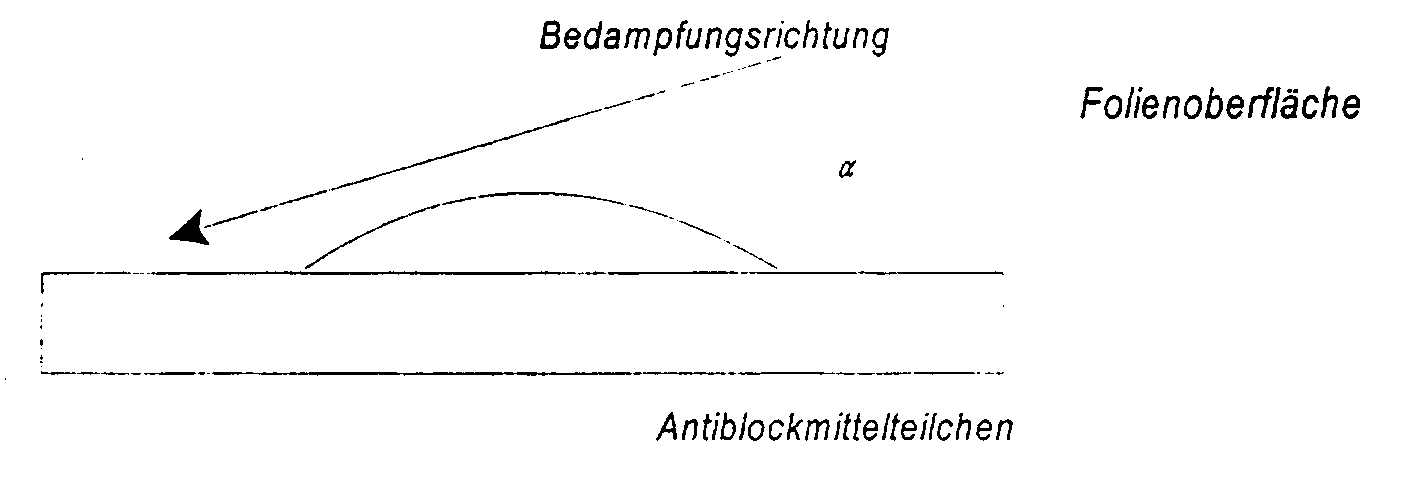
Die so präparierten Probenoberflächen werden in einem Rasterelektronenmikroskop (REM) abgebildet. Die Schatten der Antiblockmittelteilchen sind infolge des Materialkontrastes sichtbar. Die Probe wird im REM so orientiert, daß die Schatten parallel zum unteren Bildrand (x-Richtung) verlaufen. In dieser Einstellung werden REM-Bilder angefertigt und in ein Bildanalysesystem übertragen. Mit diesem Bildanalysesystem werden nun die Längen der Schatten (in x-Richtung) und ihre maximale Ausdehnung in y-Richtung (parallel zum senkrechten Bildrand) vermessen.The sample surfaces thus prepared are examined in a scanning electron microscope (REM) pictured. The shadows of the antiblocking agent particles are due to the material contrast visible. The sample is oriented in the SEM so that the shadows are parallel to the lower edge of the image (x direction). In this setting, SEM images are taken and transferred to an image analysis system. With this image analysis system now the lengths of the shadows (in the x direction) and their maximum extent in the y direction (parallel to the vertical edge of the picture).
Der Durchmesser D der Antiblockmittelteilchen in Höhe der Probenoberfläche ist gleich
der maximalen Ausdehnung der Schatten d in y-Richtung. Die Höhe der Antiblockmittelteilchen,
gemessen ab der Folienoberfläche errechnet sich aus dem Bedampfungswinkel
α und der Schattenlänge L und unter Kenntnis der für die REM-Abbildung gewählten
Vergrößerung V zu:
Um eine genügend hohe statistische Sicherheit zu erreichen, werden einige tausend Antiblockmittelteilchen vermessen. Für die Durchmesser und Höhen der Teilchen werden dann mit Hilfe der bekannten statistischen Methoden Häufigkeitsverteilungen erstellt. Für den Teilchendurchmesser D wird dazu eine Klassenbreite von 0,2 µm und für die Teilchenhöhe h eine Klassenbreite von 0,05 µm gewählt. In order to achieve a sufficiently high statistical certainty, a few thousand Measure antiblocking agent particles. For the diameter and height of the particles then frequency distributions are created using the known statistical methods. For the particle diameter D becomes a class width of 0.2 µm and for the particle height h selected a class width of 0.05 µm.
Die Rauhigkeit Ra der Folie wurde nach DIN 4768 bei einem Cut-off von 0,25 mm bestimmt.The roughness R a of the film was determined in accordance with DIN 4768 with a cut-off of 0.25 mm.
Chips aus Polyethylenterephthalat (hergestellt über das Umesterungsverfahren mit Mn als Umesterungskatalysator, Mn-Konzentration: 100 ppm) und wurden bei 160 °C auf eine Restfeuchte von unterhalb 50 ppm getrocknet und dem Extruder für die Basisschicht B zugeführt.Polyethylene terephthalate chips (made by the transesterification process with Mn as transesterification catalyst, Mn concentration: 100 ppm) and were at 160 ° C a residual moisture of below 50 ppm dried and the extruder for the base layer B fed.
Daneben wurden Chips aus Polyethylenterephthalat (hergestellt über das Umesterungsverfahren mit Mn als Umesterungskatalysator, Mn-Konzentration: 100 ppm), die entsprechend Tabelle 2 pigmentiert sind, ebenfalls bei 160 °C auf eine Restfeuchte von unterhalb 50 ppm getrocknet und den jeweiligen Extrudern für die Deckschichten A und C zugeführt.In addition, chips made of polyethylene terephthalate (produced via the transesterification process with Mn as the transesterification catalyst, Mn concentration: 100 ppm), the corresponding Table 2 are pigmented, also at 160 ° C to a residual moisture of dried below 50 ppm and the respective extruders for the outer layers A and C fed.
Es wurde durch Coextrusion und anschließende stufenweise Orientierung in Längs- und Querrichtung eine transparente dreischichtige Folie mit ABC-Aufbau und einer Gesamtdicke von 12 µm hergestellt. Die Dicke der jeweiligen Schichten ist der Tabelle 2 zu entnehmen.It was made by coextrusion and subsequent gradual orientation in longitudinal and Transversely, a transparent three-layer film with ABC structure and a total thickness of 12 µm. The thickness of the respective layers is shown in Table 2 remove.
- 94,0 Gew.-%94.0% by weight
- Polyethylenterephthalat mit einem SV-Wert von 800Polyethylene terephthalate with an SV value of 800
- 6,00 Gew.-%6.00% by weight
- Masterbatch aus 99,0 Gew.-% Polyethylenterephthalat (SV-Wert von 800) und 0,5 Gew.-% Sylobloc® 44 H (kolloidales SiO2 der Fa. Grace) und 0,5 Gew.-% Aerosil® TT 600 (kettenartiges SiO2 der Fa. Degussa)Masterbatch made from 99.0% by weight of polyethylene terephthalate (SV value of 800) and 0.5% by weight of Sylobloc® 44 H (colloidal SiO 2 from Grace) and 0.5% by weight of Aerosil® TT 600 (chain-like SiO 2 from Degussa)
- 100,0 Gew.-%100.0% by weight
- Polyethylenterephthalat mit einem SV-Wert von 800Polyethylene terephthalate with an SV value of 800
- 84,0 Gew.-%84.0% by weight
- Polyethylenterephthalat mit einem SV-Wert von 800Polyethylene terephthalate with an SV value of 800
- 16,0 Gew-%16.0% by weight
- Masterbatch aus 99,0 Gew`-% Polyethylenterephthalat und 0,5 Gew.-% Sylobloc 44 H (Fa. Grace) und 0,5 Gew.-% Aerosil TT 600 (Fa. Degussa)Masterbatch made from 99.0% by weight polyethylene terephthalate and 0.5 % By weight of Sylobloc 44 H (Grace) and 0.5% by weight of Aerosil TT 600 (Degussa)
Die Herstellungsbedingungen in den einzelnen Verfahrensschritten waren:
Die Folie zeichnet sich durch sehr gute optische Eigenschaften und durch ein gutes Verarbeitungsverhalten aus (vgl. Tabelle 3).The film is characterized by very good optical properties and by a good one Processing behavior (see Table 3).
Nach Herstellung der Folie (nach diesem Beispiel 1 und allen folgenden Beispielen) wurde diese auf der A-Seite in einem industriellen Metallisierer mit Aluminium unter Vakuum bedampft. Die Beschichtungsgeschwindigkeit betrug 8 m/s und die optische Dichte 2,6. After production of the film (according to this example 1 and all the following examples) it was placed on the A-side in an industrial metallizer with aluminum Vacuum vaporized. The coating speed was 8 m / s and the optical Density 2.6.
Die Folie hatte die geforderte hohe Sauerstoffbarriere. Der Folienaufbau und die erzielten Eigenschaften derart hergestellter Folien sind in den Tabellen 2 und 3 dargestellt. Figur 6 zeigt für die Deckschicht A die mittels der auf Seiten 31/32 beschriebenen Methode gemessenen Verteilungen für die Erhebungen/Vorsprünge N.The film had the required high oxygen barrier. The film structure and the achieved Properties of films produced in this way are shown in Tables 2 and 3. Figure 6 shows the covering layer A using the method described on pages 31/32 measured distributions for the elevations / protrusions N.
In ähnlicher Weise wie in Beispiel 1 wurde durch Coextrusion und anschließende stufenweise Orientierung in Längs- und Querrichtung eine transparente dreischichtige Folie mit ABC-Aufbau und einer Gesamtdicke von 12 µm hergestellt. Im Vergleich zu Beispiel 1 wurde nur die Deckschicht A geändert.In a similar manner to that in Example 1, coextrusion followed by gradual Orientation in the longitudinal and transverse directions using a transparent three-layer film ABC structure and a total thickness of 12 microns. Compared to example 1 only top layer A was changed.
- 98,0 Gew.-%98.0% by weight
- Polyethylenterephthalat mit einem SV-Wert von 800Polyethylene terephthalate with an SV value of 800
- 2,00 Gew.-%2.00% by weight
- Masterbatch aus 99,0 Gew.-% Polyethylenterephthalat (SV-Wert von 800) und 0,5 Gew.-% Sylobloc 44 H (Fa. Grace) und 0,5 Gew.-% Aerosil TT 600 (Fa. Degussa)Masterbatch made from 99.0% by weight of polyethylene terephthalate (SV value of 800) and 0.5% by weight of Sylobloc 44 H (Grace) and 0.5% by weight Aerosil TT 600 (Degussa)
Die Verfahrensbedingungen waren für alle Schichten wie in Beispiel 1 gewählt.The process conditions for all layers were chosen as in Example 1.
In ähnlicher Weise wie in Beispiel 1 wurde durch Coextrusion und anschließende stufenweise Orientierung in Längs- und Querrichtung eine transparente dreischichtige Folie mit ABC-Aufbau und einer Gesamtdicke von 12 µm hergestellt. Im Vergleich zu Beispiel 1 wurde nur die Deckschicht A geändert.In a similar manner to that in Example 1, coextrusion followed by gradual Orientation in the longitudinal and transverse directions using a transparent three-layer film ABC structure and a total thickness of 12 microns. Compared to example 1 only top layer A was changed.
- 99,0 Gew.-%99.0% by weight
- Polyethylenterephthalat mit einem SV-Wert von 800 Polyethylene terephthalate with an SV value of 800
- 1,00 Gew.-%1.00% by weight
- Masterbatch aus 99,0 Gew.-% Polyethylenterephthalat (SV-Wert von 800) und 0,5 Gew.-% Sylobloc 44 H (Fa. Grace) und 0,5 Gew.-% Aerosil TT 600 (Fa. Degussa)Masterbatch made from 99.0% by weight of polyethylene terephthalate (SV value of 800) and 0.5% by weight of Sylobloc 44 H (Grace) and 0.5% by weight Aerosil TT 600 (Degussa)
Die Verfahrensbedingungen waren für alle Schichten wie in Beispiel 1 gewählt.The process conditions for all layers were chosen as in Example 1.
In ähnlicher Weise wie in Beispiel 1 wurde durch Coextrusion und anschließende stufenweise Orientierung in Längs- und Querrichtung eine transparente dreischichtige Folie mit ABC-Aufbau und einer Gesamtdicke von 12 µm hergestellt. Im Vergleich zu Beispiel 1 wurde nur die Deckschicht A geändert.In a similar manner to that in Example 1, coextrusion followed by gradual Orientation in the longitudinal and transverse directions using a transparent three-layer film ABC structure and a total thickness of 12 microns. Compared to example 1 only top layer A was changed.
- 98,0 Gew.-%98.0% by weight
- Polyethylenterephthalat mit einem SV-Wert von 800Polyethylene terephthalate with an SV value of 800
- 2,00 Gew.-%2.00% by weight
- Masterbatch aus 99,75 Gew.-% Polyethylenterephthalat (SV-Wert von 800) und 0,25 Gew`-% Aerosil TT 600 (Fa. Degussa)Masterbatch made from 99.75% by weight of polyethylene terephthalate (SV value of 800) and 0.25% by weight Aerosil TT 600 (Degussa)
Die Verfahrensbedingungen waren für alle Schichten wie in Beispiel 1 gewählt.The process conditions for all layers were chosen as in Example 1.
In ähnlicher Weise wie in Beispiel 1 wurde durch Coextrusion und anschließende stufenweise Orientierung in Längs- und Querrichtung eine transparente dreischichtige Folie mit ABC-Aufbau und einer Gesamtdicke von 12 µm hergestellt. Im Vergleich zu Beispiel 1 wurde nur die Deckschicht A geändert.In a similar manner to that in Example 1, coextrusion followed by gradual Orientation in the longitudinal and transverse directions using a transparent three-layer film ABC structure and a total thickness of 12 microns. Compared to example 1 only top layer A was changed.
- 98,0 Gew.-%98.0% by weight
- Polyethylenterephthalat mit einem SV-Wert von 800Polyethylene terephthalate with an SV value of 800
- 2,00 Gew.-%2.00% by weight
- Masterbatch aus 99,75 Gew.-% Polyethylenterephthalat (SV-Wert von 800) und 0,25 Gew.-% Sylobloc 44 H (Fa. Grace)Masterbatch made from 99.75% by weight of polyethylene terephthalate (SV value of 800) and 0.25% by weight of Sylobloc 44 H (Grace)
Die Verfahrensbedingungen waren für alle Schichten wie in Beispiel 1 gewählt.The process conditions for all layers were chosen as in Example 1.
In ähnlicher Weise wie in Beispiel 1 wurde durch Coextrusion und anschließende stufenweise Orientierung in Längs- und Querrichtung eine transparente dreischichtige Folie mit ABC-Aufbau und einer Gesamtdicke von 12 µm hergestellt. Im Vergleich zu Beispiel 1 wurde nur die Deckschicht A geändert.In a similar manner to that in Example 1, coextrusion followed by gradual Orientation in the longitudinal and transverse directions using a transparent three-layer film ABC structure and a total thickness of 12 microns. Compared to example 1 only top layer A was changed.
- 100,0 Gew.-%100.0% by weight
- Polyethylenterephthalat mit einem SV-Wert von 800Polyethylene terephthalate with an SV value of 800
Der Polyesterrohstoff für die Deckschicht A wurde über das Umesterungsvenfahren mit Ca als Umesterungskatalysator hergestellt, wobei die Ca-Konzentration 200 ppm betrug.The polyester raw material for the top layer A was also via the transesterification process Ca produced as a transesterification catalyst, the Ca concentration being 200 ppm.
Die Verfahrensbedingungen waren für alle Schichten wie in Beispiel 1 gewählt. Obwohl der Deckschicht A und der Basisschicht B additiv keine inerten Pigmente zugegeben wurden, enthält die Oberfläche der Deckschicht A Erhebungen / Vorsprünge. Diese rühren u.a. von den Präzipitaten des Umesterungskatalysators und Schwankungen im Herstellungsprozeß des Rohstoffes und der Folie her.The process conditions for all layers were chosen as in Example 1. Although no inert pigments were added to the top layer A and the base layer B. , the surface of the cover layer A contains elevations / protrusions. This stir among other things of the precipitates of the transesterification catalyst and fluctuations in the Manufacturing process of the raw material and the film.
In ähnlicher Weise wie in Beispiel 1 wurde durch Coextrusion und anschließende stufenweise Orientierung in Längs- und Querrichtung eine transparente dreischichtige Folie mit ABC-Aufbau und einer Gesamtdicke von 12 µm hergestellt. Im Vergleich zu Beispiel 1 wurden die Deckschichten A und C geändert.In a similar manner to that in Example 1, coextrusion followed by gradual Orientation in the longitudinal and transverse directions using a transparent three-layer film ABC structure and a total thickness of 12 microns. Compared to example 1 cover layers A and C were changed.
- 98,0 Gew.-%98.0% by weight
- Polyethylenterephthalat mit einem SV-Wert von 800Polyethylene terephthalate with an SV value of 800
- 2,00 Gew.-%2.00% by weight
- Masterbatch aus 99,0 Gew.-% Polyethylenterephthalat (SV-Wert von 800) und 1,0 Gew.-% Sylobloc 44 H (Fa. Grace)Masterbatch made from 99.0% by weight of polyethylene terephthalate (SV value of 800) and 1.0% by weight of Sylobloc 44 H (Grace)
- 90,0 Gew.-%90.0% by weight
- Polyethylenterephthalat mit einem SV-Wert von 800Polyethylene terephthalate with an SV value of 800
- 10,0 Gew.-%10.0% by weight
- Masterbatch aus 99,0 Gew.-% Polyethylenterephthalat (SV-Wert von 800) und 1,0 Gew.-% Sylobloc 44 H (Fa. Grace)Masterbatch made from 99.0% by weight of polyethylene terephthalate (SV value of 800) and 1.0% by weight of Sylobloc 44 H (Grace)
In ähnlicher Weise wie in Beispiel 7 wurde durch Coextrusion und anschließende stufenweise Orientierung in Längs- und Querrichtung eine transparente dreischichtige Folie mit ABC-Aufbau und einer Gesamtdicke von 12 µm hergestellt. Im Vergleich zu Beispiel 1 wurde die Deckschicht A geändert.In a similar manner as in Example 7, by coextrusion and subsequent stepwise Orientation in the longitudinal and transverse directions using a transparent three-layer film ABC structure and a total thickness of 12 microns. Compared to example 1 top layer A was changed.
- 91,0 Gew.-%91.0% by weight
- Polyethylenterephthalat mit einem SV-Wert von 800Polyethylene terephthalate with an SV value of 800
- 1,00 Gew.-%1.00% by weight
- Masterbatch aus 99,0 Gew.-% Polyethylenterephthalat (SV-Wert von 800) und 1,0 Gew.-% Sylobloc 44 H (Fa. Grace)Masterbatch made from 99.0% by weight of polyethylene terephthalate (SV value of 800) and 1.0% by weight of Sylobloc 44 H (Grace)
Es wurde das Beispiel 1 aus der EP-A-0 514 129 nachgearbeitet` Der Glanz der Folie ist nicht zufriedenstellend. Die metallisierte Variante in 12 µm Dicke hat nicht die geforderten Barrierewerte.Example 1 from EP-A-0 514 129 was reworked. The gloss of the film is not satisfactory. The metallized version with a thickness of 12 µm did not meet the requirements Barrier values.
Es wurde das Beispiel 1 aus der EP-A-0 604 057 nachgearbeitet. Der Glanz der Folie ist nicht zufriedenstellend. Die metallisierte Variante in 12 µm Dicke hat nicht die geforderten Barrierewerte. Außerdem stellt die Folie hinsichtlich Verwendung im Verpackungsmarkt keine wirtschaftliche Lösung dar.Example 1 from EP-A-0 604 057 was reworked. The gloss of the film is not satisfactory. The metallized version with a thickness of 12 µm did not meet the requirements Barrier values. In addition, the film provides for use in the packaging market not an economical solution.
Es wurde das Beispiel 1 aus der EP-A-0 124 291 nachgearbeitet.Example 1 from EP-A-0 124 291 was reworked.
Es wurde das Beispiel 1 aus der EP-A-0 490 665 nachgearbeitet.Example 1 from EP-A-0 490 665 was reworked.
Es wurde das Beispiel 1 aus der DE-A-16 94 404 nachgearbeitet.Example 1 from DE-A-16 94 404 was reworked.
Es wurde das Beispiel 15 aus der EP-A-0 061 769 nachgearbeitet.Example 15 from EP-A-0 061 769 was reworked.
Es wurde das Beispiel 1 aus der EP-B-0 088 635 nachgearbeitet.
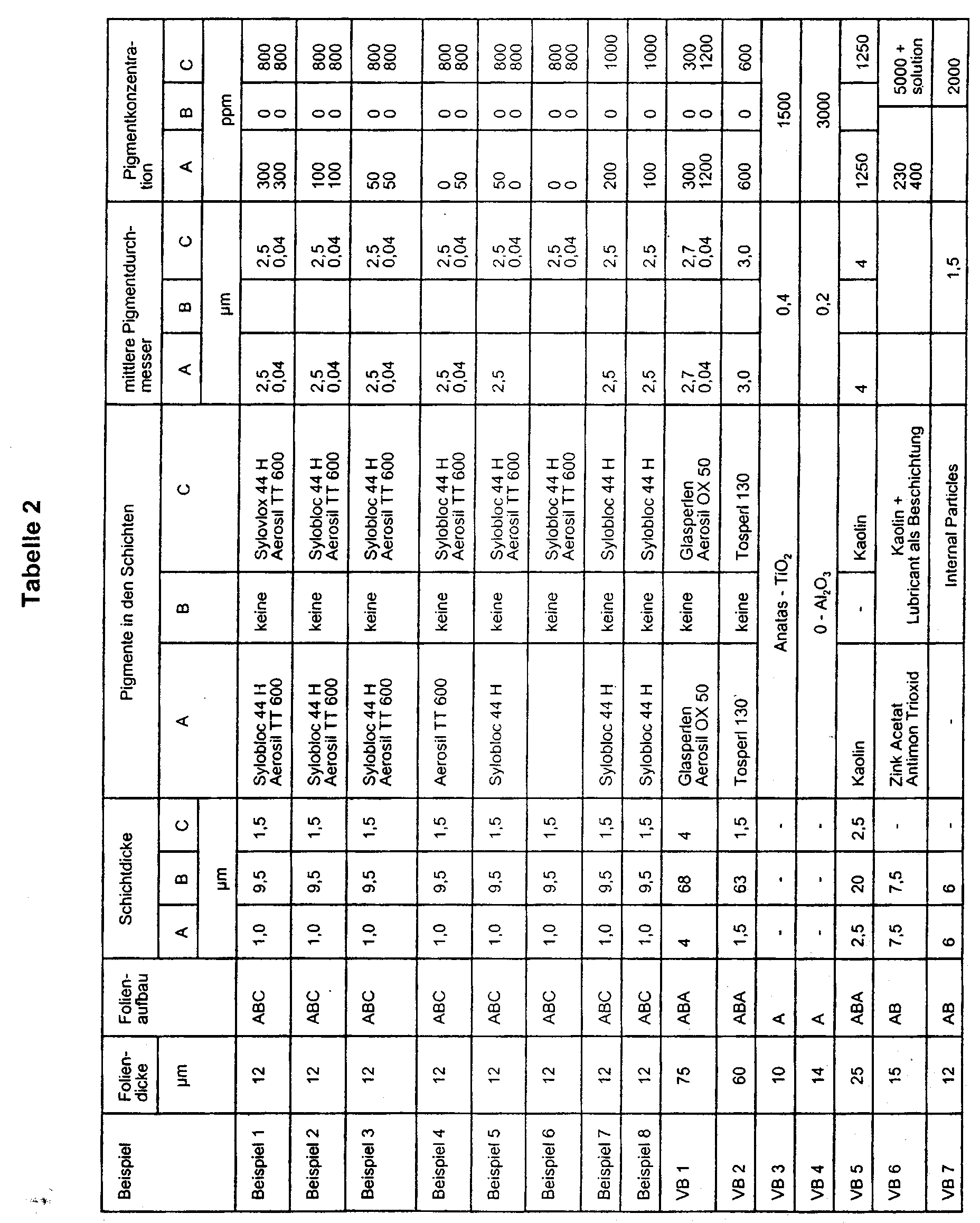
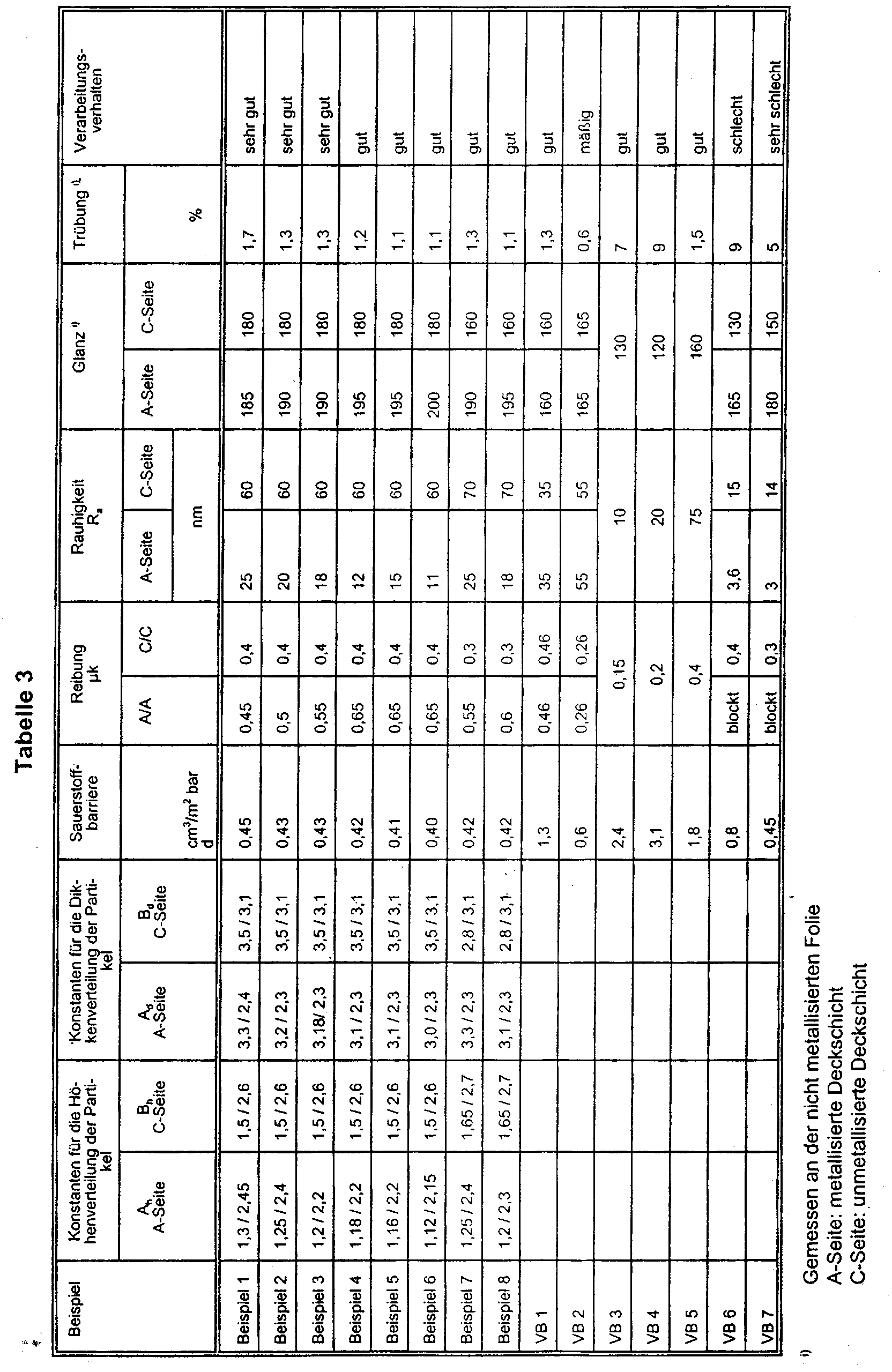
Claims (15)
Applications Claiming Priority (2)
| Application Number | Priority Date | Filing Date | Title |
|---|---|---|---|
| DE19741877A DE19741877A1 (en) | 1997-09-23 | 1997-09-23 | Biaxially oriented polyester film, process for its production and its use |
| DE19741877 | 1997-09-23 |
Publications (3)
| Publication Number | Publication Date |
|---|---|
| EP0903221A2 true EP0903221A2 (en) | 1999-03-24 |
| EP0903221A3 EP0903221A3 (en) | 2000-10-04 |
| EP0903221B1 EP0903221B1 (en) | 2009-03-25 |
Family
ID=7843295
Family Applications (1)
| Application Number | Title | Priority Date | Filing Date |
|---|---|---|---|
| EP98117902A Expired - Lifetime EP0903221B1 (en) | 1997-09-23 | 1998-09-22 | Biaxially oriented laminated polyester film, process for its manufacture and use of it for the packaging of food |
Country Status (5)
| Country | Link |
|---|---|
| US (1) | US6528144B2 (en) |
| EP (1) | EP0903221B1 (en) |
| JP (1) | JP4389279B2 (en) |
| KR (1) | KR100597817B1 (en) |
| DE (2) | DE19741877A1 (en) |
Cited By (7)
| Publication number | Priority date | Publication date | Assignee | Title |
|---|---|---|---|---|
| EP1410903A1 (en) * | 2002-10-14 | 2004-04-21 | Mitsubishi Polyester Film GmbH | Multilayered biaxially oriented polyester film, method of its preparation and its use |
| EP1410904A1 (en) * | 2002-10-14 | 2004-04-21 | Mitsubishi Polyester Film GmbH | Multilayered biaxially oriented polyester film, method of its preparation and its use |
| EP1410905A1 (en) * | 2002-10-14 | 2004-04-21 | Mitsubishi Polyester Film GmbH | Multilayered biaxially oriented polyester film, method of its preparation and its use |
| US7094465B2 (en) | 2003-01-20 | 2006-08-22 | Mitsubishi Polyester Film Gmbh | Multilayer, transparent, biaxially oriented polyester film, process for its production and its use |
| KR100787368B1 (en) * | 1999-07-05 | 2007-12-24 | 미쯔비시 폴리에스테르 필름 게엠베하 | Multilayer, biaxially oriented polyester film and a magnetic recording medium |
| CN104302479A (en) * | 2011-11-17 | 2015-01-21 | 杜邦泰吉恩胶卷美国有限公司 | Metallized opaque films with robust metal layer attachment |
| EP3569646A1 (en) | 2018-05-14 | 2019-11-20 | Mitsubishi Polyester Film GmbH | Mat, biaxial polyester film with increased friction coefficient |
Families Citing this family (19)
| Publication number | Priority date | Publication date | Assignee | Title |
|---|---|---|---|---|
| EP1052269B2 (en) * | 1999-05-10 | 2008-11-05 | Mitsubishi Polyester Film GmbH | White UV stabilised sheet made of a crystallisable thermoplast |
| JP2002187231A (en) * | 2000-10-13 | 2002-07-02 | Dainippon Printing Co Ltd | Barrier film and method for producing the same |
| DE10227439A1 (en) * | 2002-06-20 | 2004-01-08 | Mitsubishi Polyester Film Gmbh | Transparent film made of PET and PEN with UV protection, process for their production and use in packaging with an extended service life |
| DE10227440A1 (en) * | 2002-06-20 | 2004-01-08 | Mitsubishi Polyester Film Gmbh | Multi-layer, transparent, film made of PET and PEN with at least one functional outer layer for the production of composite packaging with UV protection |
| US7815996B2 (en) * | 2003-10-14 | 2010-10-19 | Toray Plastics (America), Inc. | Low gloss and low haze laminated polyester film including talc and method for preparing same |
| US7655291B2 (en) * | 2003-10-14 | 2010-02-02 | Toray Plastics (America), Inc. | Smooth co-extruded polyester film including talc and method for preparing same |
| DE102004061389A1 (en) * | 2004-12-21 | 2006-06-22 | Mitsubishi Polyester Film Gmbh | Biaxially oriented polyester film containing silica and titania |
| US20070134470A1 (en) * | 2005-12-09 | 2007-06-14 | Martin Jesberger | Multilayer, white, biaxially oriented polyester film |
| JP5061522B2 (en) * | 2006-07-28 | 2012-10-31 | 東洋紡績株式会社 | Polyester resin laminated film |
| JP4524718B2 (en) * | 2008-08-08 | 2010-08-18 | 東洋紡績株式会社 | Heat-shrinkable polyester film |
| US9284108B2 (en) | 2009-02-23 | 2016-03-15 | Graphic Packaging International, Inc. | Plasma treated susceptor films |
| US20110011854A1 (en) * | 2009-02-23 | 2011-01-20 | Middleton Scott W | Low crystallinity susceptor films |
| JP5636380B2 (en) * | 2009-02-23 | 2014-12-03 | グラフィック パッケージング インターナショナル インコーポレイテッド | Low crystallinity susceptor film |
| US8474368B2 (en) * | 2009-05-13 | 2013-07-02 | Curwood, Inc. | Mineral composite beverage brewing cup and cartridge |
| JP6005005B2 (en) * | 2013-07-23 | 2016-10-12 | 富士フイルム株式会社 | Biaxially stretched polyester film and method for producing the same |
| CN107835745B (en) * | 2015-07-10 | 2019-11-12 | 东洋纺株式会社 | Polyester film containing voids and process for producing the same |
| JP6353016B2 (en) * | 2016-03-14 | 2018-07-04 | 住友化学株式会社 | Method for producing resin film and method for producing polarizing film |
| CN110997767A (en) * | 2017-08-07 | 2020-04-10 | 3M创新有限公司 | Oriented thermally conductive dielectric film |
| JP7583356B2 (en) * | 2019-09-02 | 2024-11-14 | 東洋紡株式会社 | Biaxially oriented polyester film |
Family Cites Families (51)
| Publication number | Priority date | Publication date | Assignee | Title |
|---|---|---|---|---|
| US3515626A (en) | 1965-02-22 | 1970-06-02 | Ici Ltd | Thermoplastic laminates having improved surface properties |
| US3958064A (en) | 1971-06-21 | 1976-05-18 | Minnesota Mining And Manufacturing Company | Magnetic recording tape |
| US4042569A (en) | 1974-08-05 | 1977-08-16 | E. I. Du Pont De Nemours And Company | Heat-setting process for polyester film |
| GB1589926A (en) | 1977-03-25 | 1981-05-20 | Bexford Ltd | Coated films |
| JPS57123050A (en) | 1980-12-01 | 1982-07-31 | Toray Industries | Polyester composite film |
| DE3162562D1 (en) | 1980-03-12 | 1984-04-19 | Ici Plc | Polyester film composites |
| NL8101408A (en) | 1981-03-23 | 1982-10-18 | Philips Nv | ELECTRICAL DEVICE WITH AT LEAST A LOW-PRESSURE MERCURY VAPOR DISCHARGE TUBE. |
| DE3368806D1 (en) | 1982-03-10 | 1987-02-05 | Toray Industries | Laminated film and magnetic recording medium made therewith |
| US4539389A (en) | 1983-03-30 | 1985-09-03 | Teijin Limited | Biaxially oriented polyester film |
| FR2548958B1 (en) | 1983-07-13 | 1986-03-21 | Rhone Poulenc Films | COMPOSITE POLYESTER FILMS |
| US4493872A (en) | 1983-12-05 | 1985-01-15 | American Hoechst Corporation | Polyester film coated with metal adhesion promoting copolyester |
| IT1229054B (en) | 1984-06-22 | 1991-07-17 | Esseci S R L Societa Costruzio | PHYSICAL METHOD FOR TREATING THE SURFACES OF POLYOLEFINIC, POLYTETRAFLUORCETHYLENE PLASTIC LAMINATES, CARDBOARDS AND METAL SHEETS SUCH AS ALUMINUM AND WATERPROOF BAND, BY MEANS OF A FLAME PRODUCED BY COMBUSTION OF AN ALCOHOLIC HYDROGEN-BASED HYDROGEN-BASED OIL IONIZED |
| EP0236945B1 (en) | 1986-03-07 | 1993-03-03 | Nippon Shokubai Co., Ltd. | Monodispersed glycol suspension of fine inorganic oxide particles having excellent dispersion stability and method of improving the slipperiness of polyester film using the monodispersed suspension |
| JPS63182212A (en) | 1987-01-20 | 1988-07-27 | Mizusawa Ind Chem Ltd | Spherical particle of amorphous silica or silica-alumina and their production |
| US5236680A (en) | 1987-01-20 | 1993-08-17 | Mizusawa Industrial Chemicals, Ltd. | Preparation of amorphous silica-alumina particles by acid-treating spherical P-type zeolite particles crystallized from a sodium aluminosilicate gel |
| US5236683A (en) | 1987-01-20 | 1993-08-17 | Mizusawa Industrial Chemicals, Ltd. | Amorphous silica spherical particles |
| AU593677B2 (en) | 1987-06-17 | 1990-02-15 | E.I. Du Pont De Nemours And Company | System for using synchronous secondaries of a linear motor to biaxially draw plastic films |
| JP2517293B2 (en) | 1987-06-25 | 1996-07-24 | メクト株式会社 | Cell and tissue repair agent |
| CA2002369C (en) * | 1988-11-08 | 2000-10-31 | Mikio Hashimoto | Copolyester, polyester composition containing the copolyester, and polyester laminated structure having layer composed of the copolyester or the polyester composition |
| DE3842820A1 (en) | 1988-12-20 | 1990-06-28 | Basf Ag | METHOD FOR PRODUCING STABLE WATER-IN-OEL EMULSIONS OF HYDROLYSED POLYMERISATES OF N-VINYLAMIDES AND THE USE THEREOF |
| FR2640984B1 (en) | 1988-12-28 | 1992-09-11 | Rhone Poulenc Films | |
| DE69023351T2 (en) | 1989-01-11 | 1996-04-04 | Toray Industries | Biaxially oriented polyester film. |
| US5093064A (en) | 1989-06-13 | 1992-03-03 | Diafoil Company, Ltd. | Low-shrinkage polyester film and preparation thereof |
| JP2528215B2 (en) | 1990-12-13 | 1996-08-28 | 帝人株式会社 | Biaxially oriented polyester film for magnetic recording media |
| US5336079A (en) | 1991-03-06 | 1994-08-09 | Toray Industries, Inc. | Biaxially oriented laminated film comprising particles in a specific ratio of particle density |
| GB9110590D0 (en) | 1991-05-16 | 1991-07-03 | Ici Plc | Polymeric film |
| GB9110902D0 (en) | 1991-05-21 | 1991-07-10 | Ici Plc | Polymeric film |
| EP0581970B1 (en) | 1992-02-25 | 1998-08-26 | Toray Industries, Inc. | Biaxially oriented, laminated polyester film |
| EP0580404B1 (en) | 1992-07-22 | 1999-09-15 | Teijin Limited | Biaxially oriented laminated polyester film for use as film to be bonded onto metal sheet |
| EP0674591A4 (en) | 1992-12-09 | 1996-02-28 | Hoechst Ag | BIAXIALLY ORIENTED COPOLYESTER FILM COATED WITH A FIRST LAYER OF VINYL ACETATE POLYMERS. |
| EP0671994A4 (en) | 1992-12-09 | 1995-11-08 | Hoechst Ag | COPOLYESTER FILM PRIMED WITH ACRYLIC POLYMERS. |
| JP2989080B2 (en) | 1992-12-17 | 1999-12-13 | 帝人株式会社 | Laminated polyester film for magnetic recording media |
| EP0604057A1 (en) | 1992-12-23 | 1994-06-29 | Imperial Chemical Industries Plc | Polymeric film |
| DE69402995T2 (en) | 1993-01-27 | 1998-01-02 | Teijin Ltd | Biaxially oriented multilayer film made of polyester and magnetic recording medium with the same base film |
| US5372879A (en) | 1993-02-22 | 1994-12-13 | Teijin Limited | Biaxially oriented polyester film |
| DE4306155A1 (en) | 1993-02-27 | 1994-09-01 | Hoechst Ag | Transparent, non-sealable oriented polyolefin multilayer film, process for its production and its use |
| US5626942A (en) * | 1993-05-05 | 1997-05-06 | Toray Industries, Inc. | Polyester film and process for producing the same |
| JP3125272B2 (en) | 1993-09-24 | 2001-01-15 | 新東工業株式会社 | Foundry sand recycling equipment |
| WO1995015993A1 (en) | 1993-12-10 | 1995-06-15 | Teijin Limited | Transparent film for lamination coating of metallic can |
| DE69424518T2 (en) | 1993-12-22 | 2001-02-08 | Teijin Ltd., Osaka | Biaxially oriented film made of polyethylene-2,6-naphthalenedicarboxylate |
| US5656356A (en) | 1994-01-11 | 1997-08-12 | Teijin Limited | Biaxially oriented laminated polyester film |
| US5429785A (en) | 1994-03-01 | 1995-07-04 | E. I. Du Pont De Nemours And Company | Method of making biaxially oriented thermoplastic films |
| US5464690A (en) | 1994-04-04 | 1995-11-07 | Novavision, Inc. | Holographic document and method for forming |
| JPH083679A (en) | 1994-06-14 | 1996-01-09 | Nippon Steel Corp | Hot-rolled high-strength steel sheet having excellent heat formability and softening property, which is excellent in formability and fatigue characteristics, and a method for producing the same |
| JPH08104064A (en) | 1994-10-05 | 1996-04-23 | Diafoil Co Ltd | Sublimable thermal transfer polyester film |
| US5506014A (en) | 1995-09-01 | 1996-04-09 | Eastman Chemical Company | Pet copolyesters containing succinic and naphthalenedicarboxylic acid moieties having improved barrier properties |
| JPH09141797A (en) * | 1995-11-17 | 1997-06-03 | Toray Ind Inc | Biaxially oriented laminated polyester film |
| EP1213123B1 (en) | 1996-08-30 | 2005-11-16 | Mitsubishi Polyester Film Corporation | Process for producing polyester composition |
| DE59710735D1 (en) | 1996-09-24 | 2003-10-16 | Mitsubishi Polyester Film Gmbh | BIAXIAL-ORIENTED PET FILM WITH IMPROVED MECHANICAL AND SHRINKABLE PROPERTIES TO USE FOR SMD-CAPABLE FILM CAPACITORS AND METHOD FOR PRODUCING THIS FILM |
| DE19723468A1 (en) * | 1997-06-04 | 1998-12-10 | Hoechst Diafoil Gmbh | Biaxially oriented polyester film with a high oxygen barrier, process for its production and its use |
| DE19849661A1 (en) * | 1998-10-29 | 2000-05-04 | Mitsubishi Polyester Film Gmbh | Coextruded, biaxially oriented polyester film for metallization, process for its production and its use |
-
1997
- 1997-09-23 DE DE19741877A patent/DE19741877A1/en not_active Withdrawn
-
1998
- 1998-09-21 JP JP30469198A patent/JP4389279B2/en not_active Expired - Lifetime
- 1998-09-22 EP EP98117902A patent/EP0903221B1/en not_active Expired - Lifetime
- 1998-09-22 DE DE59814356T patent/DE59814356D1/en not_active Expired - Lifetime
- 1998-09-23 KR KR1019980039349A patent/KR100597817B1/en not_active Expired - Fee Related
-
2001
- 2001-02-09 US US09/779,623 patent/US6528144B2/en not_active Expired - Fee Related
Cited By (11)
| Publication number | Priority date | Publication date | Assignee | Title |
|---|---|---|---|---|
| KR100787368B1 (en) * | 1999-07-05 | 2007-12-24 | 미쯔비시 폴리에스테르 필름 게엠베하 | Multilayer, biaxially oriented polyester film and a magnetic recording medium |
| EP1410903A1 (en) * | 2002-10-14 | 2004-04-21 | Mitsubishi Polyester Film GmbH | Multilayered biaxially oriented polyester film, method of its preparation and its use |
| EP1410904A1 (en) * | 2002-10-14 | 2004-04-21 | Mitsubishi Polyester Film GmbH | Multilayered biaxially oriented polyester film, method of its preparation and its use |
| EP1410905A1 (en) * | 2002-10-14 | 2004-04-21 | Mitsubishi Polyester Film GmbH | Multilayered biaxially oriented polyester film, method of its preparation and its use |
| US6962740B2 (en) | 2002-10-14 | 2005-11-08 | Mitsubishi Polyester Film Gmbh | Multilayer, biaxially oriented polyester film, process for its production and its use |
| US6974621B2 (en) | 2002-10-14 | 2005-12-13 | Mitsubishi Polyester Film Gmbh | Multilayer, biaxially oriented polyester film, process for its production and its use |
| US6984437B2 (en) | 2002-10-14 | 2006-01-10 | Mitsubishi Polyester Film Gmbh | Multilayer, biaxially oriented polyester film, process for its production and its use |
| US7094465B2 (en) | 2003-01-20 | 2006-08-22 | Mitsubishi Polyester Film Gmbh | Multilayer, transparent, biaxially oriented polyester film, process for its production and its use |
| CN104302479A (en) * | 2011-11-17 | 2015-01-21 | 杜邦泰吉恩胶卷美国有限公司 | Metallized opaque films with robust metal layer attachment |
| EP3569646A1 (en) | 2018-05-14 | 2019-11-20 | Mitsubishi Polyester Film GmbH | Mat, biaxial polyester film with increased friction coefficient |
| US10940667B2 (en) | 2018-05-14 | 2021-03-09 | Mitsubishi Polyester Film Gmbh | Biaxially oriented matt polyester film with increased coefficient of friction |
Also Published As
| Publication number | Publication date |
|---|---|
| JPH11221894A (en) | 1999-08-17 |
| DE19741877A1 (en) | 1999-03-25 |
| DE59814356D1 (en) | 2009-05-07 |
| EP0903221B1 (en) | 2009-03-25 |
| US20010044009A1 (en) | 2001-11-22 |
| US6528144B2 (en) | 2003-03-04 |
| KR19990030044A (en) | 1999-04-26 |
| KR100597817B1 (en) | 2006-12-15 |
| JP4389279B2 (en) | 2009-12-24 |
| EP0903221A3 (en) | 2000-10-04 |
Similar Documents
| Publication | Publication Date | Title |
|---|---|---|
| EP0903222B1 (en) | Multilayer, biaxially oriented polyester film, method for its production and its use | |
| EP0903221B1 (en) | Biaxially oriented laminated polyester film, process for its manufacture and use of it for the packaging of food | |
| EP0882577B1 (en) | Biaxially oriented polyester film having good oxygen barrier properties, method for producing the same and its use | |
| EP1197327B1 (en) | Coextruded, at least one-sided mat, biaxially oriented polyester film | |
| EP1138480B1 (en) | Biaxially oriented sealable polyester film | |
| EP0952176B1 (en) | Multilayer, biaxially oriented polyester film, process for its manufacture and its use | |
| EP1176005B1 (en) | Multilayered, transparent, biaxially oriented polyester film | |
| EP0997269B1 (en) | Coextruded, biaxially oriented, polyester film for metallisation, method for its production and its use | |
| DE10051082A1 (en) | Matt, coextruded, biaxially oriented polyester film | |
| DE19720505A1 (en) | Biaxially oriented polyester film with high oxygen barrier, process for its production and use | |
| EP1442876B1 (en) | Biaxially oriented polyesterfoil exhibiting one matt side and caracteristic shrinking properties, its method of making and its use | |
| EP1234848B1 (en) | Transparent biaxially oriented polyesterfilm | |
| EP1380414A1 (en) | Multilayered transparent heat-sealable biaxially oriented polyester foil, its method of making and use | |
| EP0952175B1 (en) | Mono-layered, biaxially oriented polyester film, process for its manufacture and its use | |
| EP0945263A2 (en) | Polyester film with surface topography matched to the intended use, the use of the film and process for its production | |
| EP1380415A1 (en) | Multilayered, metallised or ceramic-coated, sealable, biaxially oriented polyester film, process for its manufacture and its use | |
| EP1410903B1 (en) | Multilayered biaxially oriented polyester film, method of its preparation and its use | |
| EP1236568B1 (en) | Multilayer transparent, biaxially oriented polyester film | |
| EP1055515B1 (en) | Multi-unit pack system containing a sealable polyester film | |
| EP1219413B1 (en) | Unilaterally mat, sealable, biaxially oriented polyester film | |
| DE10152141A1 (en) | Matt, biaxially oriented polyester film, process for its production and its use | |
| EP1176163A2 (en) | Transparent, biaxially oriented polyester film |
Legal Events
| Date | Code | Title | Description |
|---|---|---|---|
| PUAI | Public reference made under article 153(3) epc to a published international application that has entered the european phase |
Free format text: ORIGINAL CODE: 0009012 |
|
| AK | Designated contracting states |
Kind code of ref document: A2 Designated state(s): DE FR GB IT LU NL |
|
| AX | Request for extension of the european patent |
Free format text: AL;LT;LV;MK;RO;SI |
|
| PUAL | Search report despatched |
Free format text: ORIGINAL CODE: 0009013 |
|
| AK | Designated contracting states |
Kind code of ref document: A3 Designated state(s): AT BE CH CY DE DK ES FI FR GB GR IE IT LI LU MC NL PT SE |
|
| AX | Request for extension of the european patent |
Free format text: AL;LT;LV;MK;RO;SI |
|
| 17P | Request for examination filed |
Effective date: 20010404 |
|
| AKX | Designation fees paid |
Free format text: DE FR GB IT LU NL |
|
| RAP1 | Party data changed (applicant data changed or rights of an application transferred) |
Owner name: MITSUBISHI POLYESTER FILM GMBH |
|
| 17Q | First examination report despatched |
Effective date: 20030729 |
|
| RIN1 | Information on inventor provided before grant (corrected) |
Inventor name: ROTH, WERNER Inventor name: HILKERT, GOTTFRIED Inventor name: PEIFFER, HERBERT |
|
| RAP1 | Party data changed (applicant data changed or rights of an application transferred) |
Owner name: MITSUBISHI POLYESTER FILM GMBH |
|
| GRAP | Despatch of communication of intention to grant a patent |
Free format text: ORIGINAL CODE: EPIDOSNIGR1 |
|
| GRAS | Grant fee paid |
Free format text: ORIGINAL CODE: EPIDOSNIGR3 |
|
| GRAA | (expected) grant |
Free format text: ORIGINAL CODE: 0009210 |
|
| AK | Designated contracting states |
Kind code of ref document: B1 Designated state(s): DE FR GB IT LU NL |
|
| REG | Reference to a national code |
Ref country code: GB Ref legal event code: FG4D Free format text: NOT ENGLISH |
|
| REF | Corresponds to: |
Ref document number: 59814356 Country of ref document: DE Date of ref document: 20090507 Kind code of ref document: P |
|
| NLV1 | Nl: lapsed or annulled due to failure to fulfill the requirements of art. 29p and 29m of the patents act | ||
| PG25 | Lapsed in a contracting state [announced via postgrant information from national office to epo] |
Ref country code: NL Free format text: LAPSE BECAUSE OF FAILURE TO SUBMIT A TRANSLATION OF THE DESCRIPTION OR TO PAY THE FEE WITHIN THE PRESCRIBED TIME-LIMIT Effective date: 20090325 |
|
| PLBE | No opposition filed within time limit |
Free format text: ORIGINAL CODE: 0009261 |
|
| STAA | Information on the status of an ep patent application or granted ep patent |
Free format text: STATUS: NO OPPOSITION FILED WITHIN TIME LIMIT |
|
| 26N | No opposition filed |
Effective date: 20091229 |
|
| PGFP | Annual fee paid to national office [announced via postgrant information from national office to epo] |
Ref country code: IT Payment date: 20100927 Year of fee payment: 13 |
|
| PGFP | Annual fee paid to national office [announced via postgrant information from national office to epo] |
Ref country code: LU Payment date: 20110920 Year of fee payment: 14 |
|
| PGFP | Annual fee paid to national office [announced via postgrant information from national office to epo] |
Ref country code: GB Payment date: 20110919 Year of fee payment: 14 Ref country code: DE Payment date: 20110919 Year of fee payment: 14 Ref country code: FR Payment date: 20110928 Year of fee payment: 14 |
|
| GBPC | Gb: european patent ceased through non-payment of renewal fee |
Effective date: 20120922 |
|
| REG | Reference to a national code |
Ref country code: FR Ref legal event code: ST Effective date: 20130531 |
|
| REG | Reference to a national code |
Ref country code: DE Ref legal event code: R119 Ref document number: 59814356 Country of ref document: DE Effective date: 20130403 |
|
| PG25 | Lapsed in a contracting state [announced via postgrant information from national office to epo] |
Ref country code: GB Free format text: LAPSE BECAUSE OF NON-PAYMENT OF DUE FEES Effective date: 20120922 Ref country code: DE Free format text: LAPSE BECAUSE OF NON-PAYMENT OF DUE FEES Effective date: 20130403 |
|
| PG25 | Lapsed in a contracting state [announced via postgrant information from national office to epo] |
Ref country code: IT Free format text: LAPSE BECAUSE OF NON-PAYMENT OF DUE FEES Effective date: 20120922 Ref country code: FR Free format text: LAPSE BECAUSE OF NON-PAYMENT OF DUE FEES Effective date: 20121001 |
|
| PG25 | Lapsed in a contracting state [announced via postgrant information from national office to epo] |
Ref country code: LU Free format text: LAPSE BECAUSE OF NON-PAYMENT OF DUE FEES Effective date: 20120922 |