EP0898943A2 - Dentalprothetikteil - Google Patents
Dentalprothetikteil Download PDFInfo
- Publication number
- EP0898943A2 EP0898943A2 EP98115890A EP98115890A EP0898943A2 EP 0898943 A2 EP0898943 A2 EP 0898943A2 EP 98115890 A EP98115890 A EP 98115890A EP 98115890 A EP98115890 A EP 98115890A EP 0898943 A2 EP0898943 A2 EP 0898943A2
- Authority
- EP
- European Patent Office
- Prior art keywords
- dental
- prosthetic part
- prosthetic
- implant
- part according
- Prior art date
- Legal status (The legal status is an assumption and is not a legal conclusion. Google has not performed a legal analysis and makes no representation as to the accuracy of the status listed.)
- Granted
Links
- 239000007943 implant Substances 0.000 claims abstract description 56
- 229910052751 metal Inorganic materials 0.000 claims abstract description 20
- 239000002184 metal Substances 0.000 claims abstract description 20
- 239000004053 dental implant Substances 0.000 claims abstract description 12
- PCHJSUWPFVWCPO-UHFFFAOYSA-N gold Chemical compound [Au] PCHJSUWPFVWCPO-UHFFFAOYSA-N 0.000 claims abstract description 10
- 239000010931 gold Substances 0.000 claims abstract description 10
- 229910052737 gold Inorganic materials 0.000 claims abstract description 10
- 229910001020 Au alloy Inorganic materials 0.000 claims abstract description 6
- 239000003353 gold alloy Substances 0.000 claims abstract description 6
- 238000000034 method Methods 0.000 claims description 9
- 239000010970 precious metal Substances 0.000 claims description 8
- 229910000923 precious metal alloy Inorganic materials 0.000 claims description 5
- 239000011248 coating agent Substances 0.000 claims description 4
- 238000000576 coating method Methods 0.000 claims description 4
- 238000004070 electrodeposition Methods 0.000 claims description 2
- 238000010276 construction Methods 0.000 description 8
- 238000004519 manufacturing process Methods 0.000 description 7
- 239000000919 ceramic Substances 0.000 description 6
- 239000010410 layer Substances 0.000 description 5
- 238000000151 deposition Methods 0.000 description 4
- 230000008021 deposition Effects 0.000 description 4
- 238000004026 adhesive bonding Methods 0.000 description 3
- 239000000853 adhesive Substances 0.000 description 2
- 230000001070 adhesive effect Effects 0.000 description 2
- 239000003479 dental cement Substances 0.000 description 2
- 238000005323 electroforming Methods 0.000 description 2
- 238000003801 milling Methods 0.000 description 2
- 238000012545 processing Methods 0.000 description 2
- 238000007493 shaping process Methods 0.000 description 2
- 229910000831 Steel Inorganic materials 0.000 description 1
- RTAQQCXQSZGOHL-UHFFFAOYSA-N Titanium Chemical compound [Ti] RTAQQCXQSZGOHL-UHFFFAOYSA-N 0.000 description 1
- 230000006978 adaptation Effects 0.000 description 1
- 239000012790 adhesive layer Substances 0.000 description 1
- 210000000988 bone and bone Anatomy 0.000 description 1
- 238000005266 casting Methods 0.000 description 1
- 230000007423 decrease Effects 0.000 description 1
- 230000001419 dependent effect Effects 0.000 description 1
- 238000011161 development Methods 0.000 description 1
- 230000000694 effects Effects 0.000 description 1
- 238000005516 engineering process Methods 0.000 description 1
- 230000002349 favourable effect Effects 0.000 description 1
- 238000010304 firing Methods 0.000 description 1
- 238000003780 insertion Methods 0.000 description 1
- 230000037431 insertion Effects 0.000 description 1
- 238000009434 installation Methods 0.000 description 1
- 230000001788 irregular Effects 0.000 description 1
- 239000000314 lubricant Substances 0.000 description 1
- 238000012423 maintenance Methods 0.000 description 1
- 239000011505 plaster Substances 0.000 description 1
- 239000006223 plastic coating Substances 0.000 description 1
- 238000005476 soldering Methods 0.000 description 1
- 125000006850 spacer group Chemical group 0.000 description 1
- 239000010959 steel Substances 0.000 description 1
- 239000010936 titanium Substances 0.000 description 1
- 229910052719 titanium Inorganic materials 0.000 description 1
- 238000012549 training Methods 0.000 description 1
Images
Classifications
-
- A—HUMAN NECESSITIES
- A61—MEDICAL OR VETERINARY SCIENCE; HYGIENE
- A61C—DENTISTRY; APPARATUS OR METHODS FOR ORAL OR DENTAL HYGIENE
- A61C8/00—Means to be fixed to the jaw-bone for consolidating natural teeth or for fixing dental prostheses thereon; Dental implants; Implanting tools
- A61C8/0048—Connecting the upper structure to the implant, e.g. bridging bars
Definitions
- the invention relates to a cap-like dental prosthetic part made of metal, a set of components for a dental implant system, that contains dental prosthetic parts, as well as a Process for the production of dental prosthetic parts.
- the invention therefore has as its object the described To avoid disadvantages of the prior art. Accordingly is said to be largely in dental implants tension-free fit and sufficient maintenance of a optimal holding force can be guaranteed.
- the invention wants in particular a removable implant denture Make available pre-made components such as the abovementioned implant abutment parts of a dental implant system operate largely without further processing can.
- a dental prosthetic part Metal which is designed in the manner of a cap and as prefabricated part in its shape and dimensions largely on a prefabricated structural part of a dental Implant system is adapted.
- This dental prosthetic item follows from claim 1. Preferred embodiments are described in dependent claims 2 to 10. The wording all claims are hereby incorporated by reference Content of this description made.
- prefabricated has the meaning in the invention, that the corresponding parts, i.e. the invention Dental prosthetic part and the corresponding implant abutment not individually by the dentist or dental technician are manufactured or processed, but (industrial) prefabricated, i.e. are made up. This has the key The advantage of being possible in many cases Use of the implant abutment without further processing by a dentist / dental technician an appropriately prefabricated Standard part in the form of a metal cap is available. This makes the corresponding steps individual Production of such a metal cap for a reworked Body part saved.
- implant abutment parts mentioned are the usual components with the associated implants after their insertion into the jawbone.
- implant abutments are usually also called Spacer sleeves or distance posts are designated and are from different companies in different shapes and sizes by default individually or together with other components offered by implant systems.
- the structural parts mentioned can in particular in the invention at least partially the shape of a cylinder or one Have a cone, with any combination as well possible are.
- the construction parts mentioned can also already be industrially prefabricated and in the shape of a ground abutment tooth.
- the mounting part can have an ellipsoidal, irregular cross-section. In this context, the relevant prospectuses of the various manufacturers.
- the (cone) angle lies usually between 0 ° and 8 °, where cone angle between 0.5 ° to 4 ° and again from 2.5 ° to 3 ° are preferred. Also cone angles between 0 ° and 2 °, in particular 0.3 ° to 2 ° are particularly cheap.
- the dimensions of the dental prosthetic part are preferably basal in diameter 1 mm to 10 mm, preferably 3 mm to 6.5 mm, coronal in diameter 1 mm to 10 mm, preferably 3 mm to 5 mm, and in height 1 mm to 10 mm, preferably approx. 3 mm to 8 mm.
- the wall thickness of the dental prosthetic part lies with the invention preferably between 100 microns and 500 microns, with a Range between 200 microns and 300 microns is preferred.
- the dental prosthetic part according to the invention is preferred made of a precious metal or a precious metal alloy built up.
- Precious metals are for use in dental technology known to be particularly suitable. From the precious metals in turn is the use of gold or gold alloys prefers. Due to its ductility, the Use of gold is a particularly advantageous combination of Realize the prosthetic part with the abutment.
- the dental prosthetic part according to the invention on at least one of its surfaces, preferably on the inner surface of the "cap", another coating.
- This Coating can be made of a plastic or another preferably thin, metal layer, for example to maintain or improve the sliding effect of the Metal cap when applied to the body part serves.
- the dental prosthetic part can also be made of made of a metal such as titanium or steel and attached to it Inner or outer surface (preferably on both surfaces) with a precious metal coating, especially galvanic deposited gold or a gold alloy. So the "cap” stands over this precious metal layer Body part or superstructure in contact.
- the dental prosthetic part according to the invention is on its outer surface, preferably insoluble, with a prosthetic Superstructure connected, i.e. it forms together with the superstructure, which usually consists of one Metal frame and a ceramic or plastic coating consists of the actual dentures.
- a prosthetic Superstructure connected, i.e. it forms together with the superstructure, which usually consists of one Metal frame and a ceramic or plastic coating consists of the actual dentures.
- the Connection of the dental prosthetic part with the superstructure usually by gluing using a conventional one Dental adhesive.
- the dental prosthetic parts according to the invention because of their excellent fit with the corresponding one Implant build-up part an excellent tension-free Seat between the superstructure and its through the Implant and the implant abutment formed substructure.
- the holding force between the dental prosthetic part and the implant abutment can also take into account the cone angle, Cone height, scope and other shape of the prefabricated Abutment part adjusted or varied -
- the dental prosthetic part also takes on the function of a metallic one Lubricant and causes constant holding or Peeling forces that ensure a good and tension-free fit prosthetic restoration, i.e. the superstructure on the Ensure body and, if necessary, good removability the prosthetic restoration by the dentist or enable the patient. It finds a largely frictionless one Sliding the dental prosthetic part on the mounting part by a kind of "capillary suction" instead.
- the dental prosthetic parts according to the invention Manufacturing inaccuracies due to the superstructure of impression taking, model making, thermal warping by pouring the metal substructure or firing the applied one Ceramic etc. compensated. Such interference or friction contacts can flow through plastic flow without disadvantage Loss of friction can be compensated.
- a prefabricated dental prosthetic part in the invention together with a prefabricated implant abutment can be used without complex adjustments to the implant component and an individual production of the "cap" are required for this machined component.
- the dental prosthetic parts according to the invention are normally so used as a prefabricated part in the mouth of the patient on a corresponding prefabricated implant abutment are attached and on this dental prosthetic part directly in the patient's mouth made prosthetic restoration, for example a Metal / ceramic crown or bridge is attached.
- This Fixing is usually done with a suitable conventional one Dental adhesives are made using an insoluble tension-free Connection with optimal fit between the Cap outer surface and the inner surface of the prosthetic Supply is established. But it is also possible that Perform gluing outside the mouth on the master model.
- Both parts of dental prosthetics can be separated from each other be separated if the peel force is greater than the adhesive force of the dental prosthetic part on the implant abutment is.
- the adhesive force in the invention be varied accordingly so that universally stuck or removable dentures can be.
- the invention further includes a set of components for a dental implant system that has at least one of the described dental prosthetic parts according to the invention.
- a dental implant system that has at least one of the described dental prosthetic parts according to the invention.
- these dental prosthetic parts there is preferably at least one of these dental prosthetic parts and at least one of these parts Corresponding prefabricated implant attachment part available.
- Further preferred sets according to the invention consist of an implant, associated implant abutment and to the abutment adapted dental prosthetic part according to the invention, where appropriate other common components or accessories of a dental Implant systems, such as common intermediate parts or screws.
- the invention includes a method of manufacture a cap-like dental prosthetic part made of metal.
- a method of manufacture a cap-like dental prosthetic part made of metal.
- the dental prosthetic part the model of a prefabricated implant abutment or preferably formed directly on the body itself, wherein the so-called electroforming, i.e. galvanic deposition, is preferred.
- the shaping or the deposition of the Dental prosthetic part takes place in a manner known per se Way, with corresponding intermediate layers, for example to make the model conductive or to remove the Part of the model or body part after shaping, provided could be.
- the dental prosthetic part from a precious metal or a precious metal alloy, especially gold or one Gold alloy, made.
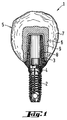
- the implant denture 1 according to FIG. 1 has a screw implant 2 and an associated implant abutment part 3. Abutment part 3 and implant 2 are screw 4 connected with each other.
- a superstructure 5 which in the present case as a metal / ceramic construction is present and from a cast metal frame 6 and one fired ceramic facing 7 is formed.
- a metal / ceramic construction is present and from a cast metal frame 6 and one fired ceramic facing 7 is formed.
- ceramic veneer Plastic facing can be provided.
- the superstructure 5 is in accordance with the invention
- Dental prosthetic part 8 (in Fig. 1 as a thick black line shown), which has the shape of a cap and preferably is produced by electrodeposition, with With the help of an adhesive layer 9 permanently connected.
- the dental prosthetic part 8 sits on the implant mounting part 3 and is as a prefabricated part in shape and dimensions of the Body part 3 adapted. Due to the good setting of the dental prosthetic part 8 becomes a good fit of the superstructure overall 5 reached with a correspondingly high holding force. Possibly. existing manufacturing inaccuracies of the superstructure and thereby occurring tensions, like already described, balanced. This will make those already mentioned Achieved advantages in the invention.
- FIG. 1 Fastening between implant 2 and implant abutment part 3 is not restrictive for the invention. So between Implant 2 and build-up part 3 basically all usual Fastening types are used, i.e. for example at Screw connections with hexagon socket, hexagon socket, Inside octagon, outside octagon.
Landscapes
- Health & Medical Sciences (AREA)
- Oral & Maxillofacial Surgery (AREA)
- Orthopedic Medicine & Surgery (AREA)
- Dentistry (AREA)
- Epidemiology (AREA)
- Life Sciences & Earth Sciences (AREA)
- Animal Behavior & Ethology (AREA)
- General Health & Medical Sciences (AREA)
- Public Health (AREA)
- Veterinary Medicine (AREA)
- Dental Prosthetics (AREA)
- Dental Preparations (AREA)
Abstract
Description
- Fig. 1
- eine Schnittansicht durch einen Implantat-Zahnersatz, bei dem ein erfindungsgemäßes Dentalprothetikteil zum Einsatz kommt,
Claims (15)
- Kappenartiges Dentalprothetikteil aus Metall, dadurch gekennzeichnet, daß es als vorgefertigtes Teil bezüglich Form und Abmessungen weitgehend an ein vorgefertigtes Aufbauteil eines dentalen Implantat-Systems angepaßt ist.
- Prothetikteil nach Anspruch 1, dadurch gekennzeichnet, daß das Aufbauteil mindestens teilweise zylinderförmig und/oder konusförmig ist.
- Prothetikteil nach Anspruch 2, dadurch gekennzeichnet, daß der Konuswinkel zwischen 0° bis 8°, vorzugsweise 0,5° bis 4°, insbesondere 2,5° bis 3°, beträgt.
- Prothetikteil nach einem der vorhergehenden Ansprüche, dadurch gekennzeichnet, daß die Abmessungen des Prothetikteils basal im Durchmesser 1 mm bis 10 mm, vorzugsweise 3 mm bis 6,5 mm, coronal im Durchmesser 1 mm bis 10 mm, vorzugsweise 3 mm bis 5 mm, und in der Höhe 1 mm bis 10 mm, vorzugsweise ca. 3 mm bis 8 mm, betragen.
- Prothetikteil nach einem der vorhergehenden Ansprüche, dadurch gekennzeichnet, daß seine Wandstärke zwischen 100 µm und 500 µm, vorzugsweise zwischen 200 µm und 300 µm, beträgt.
- Prothetikteil nach einem der vorhergehenden Ansprüche, dadurch gekennzeichnet, daß es aus einem Edelmetall oder einer Edelmetalllegierung aufgebaut ist.
- Prothetikteil nach Anspruch 6, dadurch gekennzeichnet, daß es aus Gold oder einer Goldlegierung aufgebaut ist.
- Prothetikteil nach einem der vorhergehenden Ansprüche, dadurch gekennzeichnet, daß es durch galvanische Abscheidung gefertigt ist.
- Prothetikteil nach einem der vorhergehenden Ansprüche, dadurch gekennzeichnet, daß es an mindestens einer seiner Flächen, vorzugsweise an seiner Innenfläche, eine Beschichtung besitzt.
- Prothetikteil nach einem der vorhergehenden Ansprüche, dadurch gekennzeichnet, daß es an seiner Außenfläche, vorzugsweise unlösbar, mit einer prothetischen Suprakonstruktion verbunden ist.
- Set von Komponenten für ein dentales Implantat-System, dadurch gekennzeichnet, daß es mindestens ein Dentalprothetikteil nach einem der Ansprüche 1 bis 10 aufweist.
- Set nach Anspruch 11, dadurch gekennzeichnet, daß es mindestens aufweist: ein Dentalprothetikteil nach einem der Ansprüche 1 bis 10 und ein vorgefertigtes Aufbauteil eines dentalen Implantat-Systems, an das das Dentalprothetikteil in Form und Abmessungen angepaßt ist.
- Set nach Anspruch 11 oder Anspruch 12 bestehend aus Implantatteil, Aufbauteil und Dentalprothetikteil nach einem der Ansprüche 1 bis 10 sowie ggf. weiteren üblichen Komponenten und/oder Zubehörteilen eines dentalen Implantat-Systems.
- Verfahren zur Herstellung eines kappenartigen Dentalprothetikteils aus Metall, bei dem das Dentalprothetikteil auf dem Modell eines vorgefertigten Aufbauteils eines dentalen Implantat-Systems oder vorzugsweise direkt auf dem Aufbauteil geformt, insbesondere galvanisch abgeschieden wird.
- Verfahren nach Anspruch 14, dadurch gekennzeichnet, daß das Dentalprothetikteil aus einem Edelmetall oder einer Edelmetalllegierung, vorzugsweise aus Gold oder einer Goldlegierung, hergestellt wird.
Applications Claiming Priority (2)
| Application Number | Priority Date | Filing Date | Title |
|---|---|---|---|
| DE19736863A DE19736863A1 (de) | 1997-08-23 | 1997-08-23 | Dentalprothetikteil |
| DE19736863 | 1997-08-23 |
Publications (3)
| Publication Number | Publication Date |
|---|---|
| EP0898943A2 true EP0898943A2 (de) | 1999-03-03 |
| EP0898943A3 EP0898943A3 (de) | 2000-01-26 |
| EP0898943B1 EP0898943B1 (de) | 2003-11-12 |
Family
ID=7840030
Family Applications (1)
| Application Number | Title | Priority Date | Filing Date |
|---|---|---|---|
| EP98115890A Revoked EP0898943B1 (de) | 1997-08-23 | 1998-08-24 | Dentalprothetikteil |
Country Status (4)
| Country | Link |
|---|---|
| EP (1) | EP0898943B1 (de) |
| AT (1) | ATE253874T1 (de) |
| DE (2) | DE19736863A1 (de) |
| ES (1) | ES2210629T3 (de) |
Families Citing this family (1)
| Publication number | Priority date | Publication date | Assignee | Title |
|---|---|---|---|---|
| DE20005515U1 (de) | 2000-03-27 | 2001-02-15 | Roterring, Chr., Dipl.-Ing., 48683 Ahaus | Zahnbefestigungselement zwecks Wiederverwendung oder Recycling gebrauchten Zahnersatzes auf Zahnimplantaten |
Family Cites Families (8)
| Publication number | Priority date | Publication date | Assignee | Title |
|---|---|---|---|---|
| SE457769B (sv) * | 1987-06-12 | 1989-01-30 | Nobelpharma Ab | Distansorgan foer tandimplantat |
| DE8717235U1 (de) * | 1987-10-27 | 1988-05-19 | Heil, Hans, Dr.Med.Dent. | Zahnimplantat mit genormten und schraubbaren Primär- und Sekundärteleskopen |
| US4850873A (en) * | 1988-04-04 | 1989-07-25 | Implant Innovations, Inc. | Prosthodontic restoration components |
| DE8905499U1 (de) * | 1988-07-01 | 1989-09-07 | Nobelpharma AB, Göteborg | Verankerungsvorrichtung für Zahnprothesen |
| DE3839837A1 (de) * | 1988-11-25 | 1990-05-31 | Lauks Nikola | Vorrichtung zur befestigung eines zahnersatzes an einem menschlichen kiefer |
| DE3919792A1 (de) * | 1989-06-16 | 1990-12-20 | Hornig Wolfgang | Verfahren zur herstellung metallischer zahnersatzteile |
| DE4039979A1 (de) * | 1990-12-14 | 1992-06-17 | Roland Dr Med Dr Me Streckbein | Konfektioniertes doppelkronensystem als halteelement bei implantatgetragenem zahnersatz |
| DE4141128C2 (de) * | 1991-12-13 | 2002-09-05 | Koerber Karlheinz | Kompensationskonus zur Verankerung von Zahnersatz |
-
1997
- 1997-08-23 DE DE19736863A patent/DE19736863A1/de not_active Withdrawn
-
1998
- 1998-08-24 AT AT98115890T patent/ATE253874T1/de not_active IP Right Cessation
- 1998-08-24 DE DE59810140T patent/DE59810140D1/de not_active Expired - Lifetime
- 1998-08-24 ES ES98115890T patent/ES2210629T3/es not_active Expired - Lifetime
- 1998-08-24 EP EP98115890A patent/EP0898943B1/de not_active Revoked
Non-Patent Citations (1)
| Title |
|---|
| None |
Also Published As
| Publication number | Publication date |
|---|---|
| EP0898943A3 (de) | 2000-01-26 |
| ES2210629T3 (es) | 2004-07-01 |
| ATE253874T1 (de) | 2003-11-15 |
| EP0898943B1 (de) | 2003-11-12 |
| DE59810140D1 (de) | 2003-12-18 |
| DE19736863A1 (de) | 1999-03-04 |
Similar Documents
| Publication | Publication Date | Title |
|---|---|---|
| EP1062916B2 (de) | Verfahren zur Herstellung eines individuell gefertigten, implantatgestützten Zahnersatzes und Verfahren zur Herstellung eines Zahnersatzteiles, insbesondere aus beliebigen, auch biokompatiblen Werkstoffen und insbesondere mit Hilfe der CAD-CAM-Fräs- und Schleif-Technik | |
| EP0808608B1 (de) | Prothetischer Aufbaupfosten für Zahnimplantate | |
| EP0814724B1 (de) | Verbindungsanordnung eines dentalimplantats mit einem konus-sekundärteil | |
| DE102012201092B4 (de) | Zahntechnisches Implantatsystem | |
| EP2005915B1 (de) | Dentalimplantat | |
| AT11791U1 (de) | System mit herausnehmbarem zahnersatz | |
| DE69923685T2 (de) | Zahnmedizinische implantats-komponente | |
| DE3873962T2 (de) | Zahnbruecke und verfahren und mittel zu ihrer herstellung. | |
| DE4407993C2 (de) | Dentalimplantat | |
| DE69109849T2 (de) | Auf Implantaten befestigte Zahnprothese. | |
| DE19647489C2 (de) | Zweiteiliges dentales Implantat mit aufgalvanisierter Metallschicht | |
| EP0803232B1 (de) | Halteelement für einen herausnehmbaren Zahnersatz | |
| DE202008007189U1 (de) | Abutment für ein Schraubimplantat in einem Kieferknochen | |
| EP0898943B1 (de) | Dentalprothetikteil | |
| DE102007025164A1 (de) | Verfahren und Vorrichtungen zum Erstellen eines Modells eines Patientengebisses | |
| DE19956424B4 (de) | Zahntechnische Horizontalschraube | |
| DE10337462B4 (de) | Verbindungsvorrichtung | |
| DE4120132C2 (de) | Zahnersatz | |
| DE19929441C2 (de) | Künstliche Zahnkrone und Verfahren zu ihrer Herstellung | |
| DE102023111945B3 (de) | Zahnprothese und Verfahren zur Herstellung einer Zahnprothese | |
| DE102013102412B4 (de) | Verfahren zum Herstellen einer Teleskopprothese | |
| DE29820971U1 (de) | Industriell gefertigte zahnfarbene Vollkeramikringe als transgingivaler Fertigungsbestandteil gängiger Dentalimplantate | |
| EP0664106A2 (de) | System zur Restauration zerstörter Zähne | |
| DE3711207C2 (de) | ||
| DE19835778A1 (de) | Verankerung für herausnehmbaren Zahnersatz an Kronen oder Brücken |
Legal Events
| Date | Code | Title | Description |
|---|---|---|---|
| PUAI | Public reference made under article 153(3) epc to a published international application that has entered the european phase |
Free format text: ORIGINAL CODE: 0009012 |
|
| AK | Designated contracting states |
Kind code of ref document: A2 Designated state(s): AT BE CH DE ES FR GB GR IT LI NL SE |
|
| AX | Request for extension of the european patent |
Free format text: AL;LT;LV;MK;RO;SI |
|
| PUAL | Search report despatched |
Free format text: ORIGINAL CODE: 0009013 |
|
| AK | Designated contracting states |
Kind code of ref document: A3 Designated state(s): AT BE CH CY DE DK ES FI FR GB GR IE IT LI LU MC NL PT SE |
|
| AX | Request for extension of the european patent |
Free format text: AL;LT;LV;MK;RO;SI |
|
| 17P | Request for examination filed |
Effective date: 20000722 |
|
| AKX | Designation fees paid |
Free format text: AT BE CH DE ES FR GB GR IT LI NL SE |
|
| RAP1 | Party data changed (applicant data changed or rights of an application transferred) |
Owner name: WIELAND DENTAL + TECHNIK GMBH & CO. KG |
|
| 17Q | First examination report despatched |
Effective date: 20020424 |
|
| GRAH | Despatch of communication of intention to grant a patent |
Free format text: ORIGINAL CODE: EPIDOS IGRA |
|
| GRAS | Grant fee paid |
Free format text: ORIGINAL CODE: EPIDOSNIGR3 |
|
| GRAA | (expected) grant |
Free format text: ORIGINAL CODE: 0009210 |
|
| AK | Designated contracting states |
Kind code of ref document: B1 Designated state(s): AT BE CH DE ES FR GB GR IT LI NL SE |
|
| REG | Reference to a national code |
Ref country code: GB Ref legal event code: FG4D Free format text: NOT ENGLISH |
|
| REG | Reference to a national code |
Ref country code: CH Ref legal event code: EP |
|
| REG | Reference to a national code |
Ref country code: SE Ref legal event code: TRGR |
|
| REG | Reference to a national code |
Ref country code: CH Ref legal event code: NV Representative=s name: WERNER BRUDERER PATENTANWALT |
|
| REF | Corresponds to: |
Ref document number: 59810140 Country of ref document: DE Date of ref document: 20031218 Kind code of ref document: P |
|
| GBT | Gb: translation of ep patent filed (gb section 77(6)(a)/1977) |
Effective date: 20031216 |
|
| REG | Reference to a national code |
Ref country code: GR Ref legal event code: EP Ref document number: 20040400368 Country of ref document: GR |
|
| REG | Reference to a national code |
Ref country code: ES Ref legal event code: FG2A Ref document number: 2210629 Country of ref document: ES Kind code of ref document: T3 |
|
| ET | Fr: translation filed | ||
| PLBI | Opposition filed |
Free format text: ORIGINAL CODE: 0009260 |
|
| PLBQ | Unpublished change to opponent data |
Free format text: ORIGINAL CODE: EPIDOS OPPO |
|
| PG25 | Lapsed in a contracting state [announced via postgrant information from national office to epo] |
Ref country code: GB Free format text: LAPSE BECAUSE OF NON-PAYMENT OF DUE FEES Effective date: 20040824 |
|
| PGFP | Annual fee paid to national office [announced via postgrant information from national office to epo] |
Ref country code: CH Payment date: 20040824 Year of fee payment: 7 Ref country code: AT Payment date: 20040824 Year of fee payment: 7 |
|
| PG25 | Lapsed in a contracting state [announced via postgrant information from national office to epo] |
Ref country code: SE Free format text: LAPSE BECAUSE OF NON-PAYMENT OF DUE FEES Effective date: 20040825 Ref country code: ES Free format text: LAPSE BECAUSE OF NON-PAYMENT OF DUE FEES Effective date: 20040825 |
|
| PG25 | Lapsed in a contracting state [announced via postgrant information from national office to epo] |
Ref country code: BE Free format text: LAPSE BECAUSE OF NON-PAYMENT OF DUE FEES Effective date: 20040831 |
|
| PLAX | Notice of opposition and request to file observation + time limit sent |
Free format text: ORIGINAL CODE: EPIDOSNOBS2 |
|
| PGFP | Annual fee paid to national office [announced via postgrant information from national office to epo] |
Ref country code: DE Payment date: 20040917 Year of fee payment: 7 |
|
| 26 | Opposition filed |
Opponent name: 1. DENTALES SERVICE ZENTRUM GMBH & CO.KG Effective date: 20040812 |
|
| NLR1 | Nl: opposition has been filed with the epo |
Opponent name: 1. DENTALES SERVICE ZENTRUM GMBH & CO. KG |
|
| PLAX | Notice of opposition and request to file observation + time limit sent |
Free format text: ORIGINAL CODE: EPIDOSNOBS2 |
|
| BERE | Be: lapsed |
Owner name: *WIELAND DENTAL + TECHNIK G.M.B.H. & CO. K.G. Effective date: 20040831 |
|
| PG25 | Lapsed in a contracting state [announced via postgrant information from national office to epo] |
Ref country code: NL Free format text: LAPSE BECAUSE OF NON-PAYMENT OF DUE FEES Effective date: 20050301 |
|
| PG25 | Lapsed in a contracting state [announced via postgrant information from national office to epo] |
Ref country code: GR Free format text: LAPSE BECAUSE OF NON-PAYMENT OF DUE FEES Effective date: 20050303 |
|
| EUG | Se: european patent has lapsed | ||
| PLAX | Notice of opposition and request to file observation + time limit sent |
Free format text: ORIGINAL CODE: EPIDOSNOBS2 |
|
| GBPC | Gb: european patent ceased through non-payment of renewal fee |
Effective date: 20040824 |
|
| PG25 | Lapsed in a contracting state [announced via postgrant information from national office to epo] |
Ref country code: FR Free format text: LAPSE BECAUSE OF NON-PAYMENT OF DUE FEES Effective date: 20050429 |
|
| NLV4 | Nl: lapsed or anulled due to non-payment of the annual fee |
Effective date: 20050301 |
|
| REG | Reference to a national code |
Ref country code: FR Ref legal event code: ST |
|
| PG25 | Lapsed in a contracting state [announced via postgrant information from national office to epo] |
Ref country code: IT Free format text: LAPSE BECAUSE OF NON-PAYMENT OF DUE FEES Effective date: 20050824 |
|
| PG25 | Lapsed in a contracting state [announced via postgrant information from national office to epo] |
Ref country code: DE Free format text: LAPSE BECAUSE OF THE APPLICANT RENOUNCES Effective date: 20050829 |
|
| RDAF | Communication despatched that patent is revoked |
Free format text: ORIGINAL CODE: EPIDOSNREV1 |
|
| REG | Reference to a national code |
Ref country code: ES Ref legal event code: FD2A Effective date: 20040825 |
|
| RDAG | Patent revoked |
Free format text: ORIGINAL CODE: 0009271 |
|
| STAA | Information on the status of an ep patent application or granted ep patent |
Free format text: STATUS: PATENT REVOKED |
|
| 27W | Patent revoked |
Effective date: 20050922 |
|
| REG | Reference to a national code |
Ref country code: CH Ref legal event code: PL |
|
| BERE | Be: lapsed |
Owner name: *WIELAND DENTAL + TECHNIK G.M.B.H. & CO. K.G. Effective date: 20040831 |