EP0897407B1 - Polyimides sulfones, membranes et dispositif de pile a combustible - Google Patents
Polyimides sulfones, membranes et dispositif de pile a combustible Download PDFInfo
- Publication number
- EP0897407B1 EP0897407B1 EP97923143A EP97923143A EP0897407B1 EP 0897407 B1 EP0897407 B1 EP 0897407B1 EP 97923143 A EP97923143 A EP 97923143A EP 97923143 A EP97923143 A EP 97923143A EP 0897407 B1 EP0897407 B1 EP 0897407B1
- Authority
- EP
- European Patent Office
- Prior art keywords
- group
- atoms
- chosen
- groups
- alkyl
- Prior art date
- Legal status (The legal status is an assumption and is not a legal conclusion. Google has not performed a legal analysis and makes no representation as to the accuracy of the status listed.)
- Expired - Lifetime
Links
- 239000012528 membrane Substances 0.000 title claims description 70
- 239000004642 Polyimide Substances 0.000 title claims description 64
- 229920001721 polyimide Polymers 0.000 title claims description 64
- 239000000446 fuel Substances 0.000 title claims description 18
- 229920000642 polymer Polymers 0.000 claims description 42
- UHOVQNZJYSORNB-UHFFFAOYSA-N Benzene Chemical compound C1=CC=CC=C1 UHOVQNZJYSORNB-UHFFFAOYSA-N 0.000 claims description 39
- 125000000217 alkyl group Chemical group 0.000 claims description 31
- 125000001997 phenyl group Chemical group [H]C1=C([H])C([H])=C(*)C([H])=C1[H] 0.000 claims description 24
- 125000000623 heterocyclic group Chemical group 0.000 claims description 20
- 125000004432 carbon atom Chemical group C* 0.000 claims description 19
- 125000003545 alkoxy group Chemical group 0.000 claims description 18
- 125000005843 halogen group Chemical group 0.000 claims description 18
- 125000001424 substituent group Chemical group 0.000 claims description 18
- OKTJSMMVPCPJKN-UHFFFAOYSA-N Carbon Chemical group [C] OKTJSMMVPCPJKN-UHFFFAOYSA-N 0.000 claims description 16
- 229910052760 oxygen Inorganic materials 0.000 claims description 16
- 125000003118 aryl group Chemical group 0.000 claims description 15
- 125000004429 atom Chemical group 0.000 claims description 15
- 239000001301 oxygen Substances 0.000 claims description 11
- 229910052731 fluorine Inorganic materials 0.000 claims description 10
- 229910052717 sulfur Inorganic materials 0.000 claims description 10
- 229910052794 bromium Inorganic materials 0.000 claims description 9
- 229910052801 chlorine Inorganic materials 0.000 claims description 9
- 125000005842 heteroatom Chemical group 0.000 claims description 9
- 229910052757 nitrogen Inorganic materials 0.000 claims description 8
- 229910052799 carbon Inorganic materials 0.000 claims description 7
- 229910052740 iodine Inorganic materials 0.000 claims description 7
- 125000001624 naphthyl group Chemical group 0.000 claims description 6
- 229910052736 halogen Inorganic materials 0.000 claims description 5
- 150000002367 halogens Chemical class 0.000 claims description 5
- 125000005462 imide group Chemical group 0.000 claims description 4
- 125000002887 hydroxy group Chemical group [H]O* 0.000 claims description 3
- 125000006551 perfluoro alkylene group Chemical group 0.000 claims description 3
- USIUVYZYUHIAEV-UHFFFAOYSA-N diphenyl ether Chemical group C=1C=CC=CC=1OC1=CC=CC=C1 USIUVYZYUHIAEV-UHFFFAOYSA-N 0.000 claims description 2
- 125000006840 diphenylmethane group Chemical group 0.000 claims description 2
- 125000005010 perfluoroalkyl group Chemical group 0.000 claims description 2
- WOWFGZLCKNNPIV-UHFFFAOYSA-N 3-phenylbenzene-1,2-disulfonic acid Chemical group OS(=O)(=O)C1=CC=CC(C=2C=CC=CC=2)=C1S(O)(=O)=O WOWFGZLCKNNPIV-UHFFFAOYSA-N 0.000 claims 3
- BDHFUVZGWQCTTF-UHFFFAOYSA-N sulfonic acid Chemical group OS(=O)=O BDHFUVZGWQCTTF-UHFFFAOYSA-N 0.000 claims 2
- 239000002253 acid Substances 0.000 description 34
- OKKJLVBELUTLKV-UHFFFAOYSA-N Methanol Chemical compound OC OKKJLVBELUTLKV-UHFFFAOYSA-N 0.000 description 21
- ISWSIDIOOBJBQZ-UHFFFAOYSA-N phenol group Chemical group C1(=CC=CC=C1)O ISWSIDIOOBJBQZ-UHFFFAOYSA-N 0.000 description 19
- 210000004027 cell Anatomy 0.000 description 17
- PAYRUJLWNCNPSJ-UHFFFAOYSA-N Aniline Chemical compound NC1=CC=CC=C1 PAYRUJLWNCNPSJ-UHFFFAOYSA-N 0.000 description 16
- 229920000557 Nafion® Polymers 0.000 description 15
- UFWIBTONFRDIAS-UHFFFAOYSA-N Naphthalene Chemical compound C1=CC=CC2=CC=CC=C21 UFWIBTONFRDIAS-UHFFFAOYSA-N 0.000 description 14
- 150000004985 diamines Chemical class 0.000 description 13
- 239000002904 solvent Substances 0.000 description 13
- 238000000034 method Methods 0.000 description 12
- QVGXLLKOCUKJST-UHFFFAOYSA-N atomic oxygen Chemical compound [O] QVGXLLKOCUKJST-UHFFFAOYSA-N 0.000 description 11
- 238000005342 ion exchange Methods 0.000 description 11
- RLSSMJSEOOYNOY-UHFFFAOYSA-N m-methyl-PhOH Natural products CC1=CC=CC(O)=C1 RLSSMJSEOOYNOY-UHFFFAOYSA-N 0.000 description 10
- 239000010408 film Substances 0.000 description 9
- 238000002360 preparation method Methods 0.000 description 9
- GTDPSWPPOUPBNX-UHFFFAOYSA-N ac1mqpva Chemical compound CC12C(=O)OC(=O)C1(C)C1(C)C2(C)C(=O)OC1=O GTDPSWPPOUPBNX-UHFFFAOYSA-N 0.000 description 8
- 239000001257 hydrogen Substances 0.000 description 8
- 229910052739 hydrogen Inorganic materials 0.000 description 8
- 239000000203 mixture Substances 0.000 description 8
- UFHFLCQGNIYNRP-UHFFFAOYSA-N Hydrogen Chemical compound [H][H] UFHFLCQGNIYNRP-UHFFFAOYSA-N 0.000 description 7
- 238000010586 diagram Methods 0.000 description 7
- 125000006159 dianhydride group Chemical group 0.000 description 7
- KYQCOXFCLRTKLS-UHFFFAOYSA-N Pyrazine Chemical compound C1=CN=CC=N1 KYQCOXFCLRTKLS-UHFFFAOYSA-N 0.000 description 6
- YTPLMLYBLZKORZ-UHFFFAOYSA-N Thiophene Chemical compound C=1C=CSC=1 YTPLMLYBLZKORZ-UHFFFAOYSA-N 0.000 description 6
- 239000003153 chemical reaction reagent Substances 0.000 description 6
- 150000001875 compounds Chemical class 0.000 description 6
- ZUOUZKKEUPVFJK-UHFFFAOYSA-N diphenyl Chemical compound C1=CC=CC=C1C1=CC=CC=C1 ZUOUZKKEUPVFJK-UHFFFAOYSA-N 0.000 description 6
- 150000002431 hydrogen Chemical class 0.000 description 6
- 238000004519 manufacturing process Methods 0.000 description 6
- 230000003647 oxidation Effects 0.000 description 6
- 238000007254 oxidation reaction Methods 0.000 description 6
- YNPNZTXNASCQKK-UHFFFAOYSA-N phenanthrene Chemical compound C1=CC=C2C3=CC=CC=C3C=CC2=C1 YNPNZTXNASCQKK-UHFFFAOYSA-N 0.000 description 6
- 239000000126 substance Substances 0.000 description 6
- 230000015572 biosynthetic process Effects 0.000 description 5
- 238000002485 combustion reaction Methods 0.000 description 5
- 229920001577 copolymer Polymers 0.000 description 5
- 229940082150 encore Drugs 0.000 description 5
- 125000001495 ethyl group Chemical group [H]C([H])([H])C([H])([H])* 0.000 description 5
- 125000001449 isopropyl group Chemical group [H]C([H])([H])C([H])(*)C([H])([H])[H] 0.000 description 5
- 125000002496 methyl group Chemical group [H]C([H])([H])* 0.000 description 5
- BASFCYQUMIYNBI-UHFFFAOYSA-N platinum Chemical compound [Pt] BASFCYQUMIYNBI-UHFFFAOYSA-N 0.000 description 5
- 239000000047 product Substances 0.000 description 5
- 238000003756 stirring Methods 0.000 description 5
- 238000003786 synthesis reaction Methods 0.000 description 5
- WXNZTHHGJRFXKQ-UHFFFAOYSA-N 4-chlorophenol Chemical compound OC1=CC=C(Cl)C=C1 WXNZTHHGJRFXKQ-UHFFFAOYSA-N 0.000 description 4
- 0 Cc1ccc(*c2ccc(C)c(*)c2)cc1C Chemical compound Cc1ccc(*c2ccc(C)c(*)c2)cc1C 0.000 description 4
- YLQBMQCUIZJEEH-UHFFFAOYSA-N Furan Chemical compound C=1C=COC=1 YLQBMQCUIZJEEH-UHFFFAOYSA-N 0.000 description 4
- 239000004952 Polyamide Substances 0.000 description 4
- JUJWROOIHBZHMG-UHFFFAOYSA-N Pyridine Chemical compound C1=CC=NC=C1 JUJWROOIHBZHMG-UHFFFAOYSA-N 0.000 description 4
- SMWDFEZZVXVKRB-UHFFFAOYSA-N Quinoline Chemical compound N1=CC=CC2=CC=CC=C21 SMWDFEZZVXVKRB-UHFFFAOYSA-N 0.000 description 4
- 125000002947 alkylene group Chemical group 0.000 description 4
- 150000008064 anhydrides Chemical class 0.000 description 4
- ZVSKZLHKADLHSD-UHFFFAOYSA-N benzanilide Chemical compound C=1C=CC=CC=1C(=O)NC1=CC=CC=C1 ZVSKZLHKADLHSD-UHFFFAOYSA-N 0.000 description 4
- VPUGDVKSAQVFFS-UHFFFAOYSA-N coronene Chemical compound C1=C(C2=C34)C=CC3=CC=C(C=C3)C4=C4C3=CC=C(C=C3)C4=C2C3=C1 VPUGDVKSAQVFFS-UHFFFAOYSA-N 0.000 description 4
- 238000011161 development Methods 0.000 description 4
- 230000018109 developmental process Effects 0.000 description 4
- 238000010438 heat treatment Methods 0.000 description 4
- 230000010287 polarization Effects 0.000 description 4
- 229920002647 polyamide Polymers 0.000 description 4
- XSCHRSMBECNVNS-UHFFFAOYSA-N quinoxaline Chemical compound N1=CC=NC2=CC=CC=C21 XSCHRSMBECNVNS-UHFFFAOYSA-N 0.000 description 4
- 239000007787 solid Substances 0.000 description 4
- XLYOFNOQVPJJNP-UHFFFAOYSA-N water Substances O XLYOFNOQVPJJNP-UHFFFAOYSA-N 0.000 description 4
- QQGYZOYWNCKGEK-UHFFFAOYSA-N 5-[(1,3-dioxo-2-benzofuran-5-yl)oxy]-2-benzofuran-1,3-dione Chemical compound C1=C2C(=O)OC(=O)C2=CC(OC=2C=C3C(=O)OC(C3=CC=2)=O)=C1 QQGYZOYWNCKGEK-UHFFFAOYSA-N 0.000 description 3
- WFDIJRYMOXRFFG-UHFFFAOYSA-N Acetic anhydride Chemical compound CC(=O)OC(C)=O WFDIJRYMOXRFFG-UHFFFAOYSA-N 0.000 description 3
- IJGRMHOSHXDMSA-UHFFFAOYSA-N Atomic nitrogen Chemical compound N#N IJGRMHOSHXDMSA-UHFFFAOYSA-N 0.000 description 3
- ZMXDDKWLCZADIW-UHFFFAOYSA-N N,N-Dimethylformamide Chemical compound CN(C)C=O ZMXDDKWLCZADIW-UHFFFAOYSA-N 0.000 description 3
- MWUXSHHQAYIFBG-UHFFFAOYSA-N Nitric oxide Chemical compound O=[N] MWUXSHHQAYIFBG-UHFFFAOYSA-N 0.000 description 3
- PCNDJXKNXGMECE-UHFFFAOYSA-N Phenazine Natural products C1=CC=CC2=NC3=CC=CC=C3N=C21 PCNDJXKNXGMECE-UHFFFAOYSA-N 0.000 description 3
- 238000005903 acid hydrolysis reaction Methods 0.000 description 3
- -1 aromatic tetracarboxylic acids Chemical class 0.000 description 3
- HFACYLZERDEVSX-UHFFFAOYSA-N benzidine Chemical compound C1=CC(N)=CC=C1C1=CC=C(N)C=C1 HFACYLZERDEVSX-UHFFFAOYSA-N 0.000 description 3
- 235000010290 biphenyl Nutrition 0.000 description 3
- 238000006243 chemical reaction Methods 0.000 description 3
- 238000009833 condensation Methods 0.000 description 3
- 230000005494 condensation Effects 0.000 description 3
- 238000001816 cooling Methods 0.000 description 3
- 238000001914 filtration Methods 0.000 description 3
- 229940090668 parachlorophenol Drugs 0.000 description 3
- 125000002080 perylenyl group Chemical group C1(=CC=C2C=CC=C3C4=CC=CC5=CC=CC(C1=C23)=C45)* 0.000 description 3
- CSHWQDPOILHKBI-UHFFFAOYSA-N peryrene Natural products C1=CC(C2=CC=CC=3C2=C2C=CC=3)=C3C2=CC=CC3=C1 CSHWQDPOILHKBI-UHFFFAOYSA-N 0.000 description 3
- 239000011541 reaction mixture Substances 0.000 description 3
- 125000000542 sulfonic acid group Chemical group 0.000 description 3
- 239000010409 thin film Substances 0.000 description 3
- 229930192474 thiophene Natural products 0.000 description 3
- GOJFAKBEASOYNM-UHFFFAOYSA-N 2-(2-aminophenoxy)aniline Chemical compound NC1=CC=CC=C1OC1=CC=CC=C1N GOJFAKBEASOYNM-UHFFFAOYSA-N 0.000 description 2
- OHKOAJUTRVTYSW-UHFFFAOYSA-N 2-[(2-aminophenyl)methyl]aniline Chemical compound NC1=CC=CC=C1CC1=CC=CC=C1N OHKOAJUTRVTYSW-UHFFFAOYSA-N 0.000 description 2
- UXGVMFHEKMGWMA-UHFFFAOYSA-N 2-benzofuran Chemical compound C1=CC=CC2=COC=C21 UXGVMFHEKMGWMA-UHFFFAOYSA-N 0.000 description 2
- HORNXRXVQWOLPJ-UHFFFAOYSA-N 3-chlorophenol Chemical compound OC1=CC=CC(Cl)=C1 HORNXRXVQWOLPJ-UHFFFAOYSA-N 0.000 description 2
- YBRVSVVVWCFQMG-UHFFFAOYSA-N 4,4'-diaminodiphenylmethane Chemical compound C1=CC(N)=CC=C1CC1=CC=C(N)C=C1 YBRVSVVVWCFQMG-UHFFFAOYSA-N 0.000 description 2
- 229920000049 Carbon (fiber) Polymers 0.000 description 2
- RYGMFSIKBFXOCR-UHFFFAOYSA-N Copper Chemical compound [Cu] RYGMFSIKBFXOCR-UHFFFAOYSA-N 0.000 description 2
- LFQSCWFLJHTTHZ-UHFFFAOYSA-N Ethanol Chemical compound CCO LFQSCWFLJHTTHZ-UHFFFAOYSA-N 0.000 description 2
- PPBRXRYQALVLMV-UHFFFAOYSA-N Styrene Chemical compound C=CC1=CC=CC=C1 PPBRXRYQALVLMV-UHFFFAOYSA-N 0.000 description 2
- 230000006978 adaptation Effects 0.000 description 2
- 125000001118 alkylidene group Chemical group 0.000 description 2
- GCAIEATUVJFSMC-UHFFFAOYSA-N benzene-1,2,3,4-tetracarboxylic acid Chemical compound OC(=O)C1=CC=C(C(O)=O)C(C(O)=O)=C1C(O)=O GCAIEATUVJFSMC-UHFFFAOYSA-N 0.000 description 2
- 239000004305 biphenyl Substances 0.000 description 2
- JBNSLZKJTWZXEB-UHFFFAOYSA-N bis(2-aminophenyl)methanol Chemical compound NC1=CC=CC=C1C(O)C1=CC=CC=C1N JBNSLZKJTWZXEB-UHFFFAOYSA-N 0.000 description 2
- 238000005266 casting Methods 0.000 description 2
- 238000005341 cation exchange Methods 0.000 description 2
- 150000001768 cations Chemical class 0.000 description 2
- 230000000052 comparative effect Effects 0.000 description 2
- 238000006482 condensation reaction Methods 0.000 description 2
- 229910052802 copper Inorganic materials 0.000 description 2
- 239000010949 copper Substances 0.000 description 2
- 150000001896 cresols Chemical class 0.000 description 2
- DELUNUNQVWNZKQ-UHFFFAOYSA-N cyclohexa-2,4-dien-1-ylidenemethanone Chemical compound O=C=C1CC=CC=C1 DELUNUNQVWNZKQ-UHFFFAOYSA-N 0.000 description 2
- 150000005690 diesters Chemical class 0.000 description 2
- 238000009826 distribution Methods 0.000 description 2
- 239000007789 gas Substances 0.000 description 2
- 239000011521 glass Substances 0.000 description 2
- 229910002804 graphite Inorganic materials 0.000 description 2
- 239000010439 graphite Substances 0.000 description 2
- 150000003949 imides Chemical class 0.000 description 2
- 239000012035 limiting reagent Substances 0.000 description 2
- 230000007774 longterm Effects 0.000 description 2
- VNWKTOKETHGBQD-UHFFFAOYSA-N methane Chemical compound C VNWKTOKETHGBQD-UHFFFAOYSA-N 0.000 description 2
- 125000000956 methoxy group Chemical group [H]C([H])([H])O* 0.000 description 2
- 239000000178 monomer Substances 0.000 description 2
- OLAPPGSPBNVTRF-UHFFFAOYSA-N naphthalene-1,4,5,8-tetracarboxylic acid Chemical compound C1=CC(C(O)=O)=C2C(C(=O)O)=CC=C(C(O)=O)C2=C1C(O)=O OLAPPGSPBNVTRF-UHFFFAOYSA-N 0.000 description 2
- IWDCLRJOBJJRNH-UHFFFAOYSA-N p-cresol Chemical compound CC1=CC=C(O)C=C1 IWDCLRJOBJJRNH-UHFFFAOYSA-N 0.000 description 2
- 229920001568 phenolic resin Polymers 0.000 description 2
- 238000006068 polycondensation reaction Methods 0.000 description 2
- 125000003367 polycyclic group Chemical group 0.000 description 2
- 238000006116 polymerization reaction Methods 0.000 description 2
- 239000002244 precipitate Substances 0.000 description 2
- UMJSCPRVCHMLSP-UHFFFAOYSA-N pyridine Natural products COC1=CC=CN=C1 UMJSCPRVCHMLSP-UHFFFAOYSA-N 0.000 description 2
- 239000002994 raw material Substances 0.000 description 2
- 229920005989 resin Polymers 0.000 description 2
- 239000011347 resin Substances 0.000 description 2
- 229920006159 sulfonated polyamide Polymers 0.000 description 2
- 238000009423 ventilation Methods 0.000 description 2
- RZTDESRVPFKCBH-UHFFFAOYSA-N 1-methyl-4-(4-methylphenyl)benzene Chemical compound C1=CC(C)=CC=C1C1=CC=C(C)C=C1 RZTDESRVPFKCBH-UHFFFAOYSA-N 0.000 description 1
- KGRVJHAUYBGFFP-UHFFFAOYSA-N 2,2'-Methylenebis(4-methyl-6-tert-butylphenol) Chemical compound CC(C)(C)C1=CC(C)=CC(CC=2C(=C(C=C(C)C=2)C(C)(C)C)O)=C1O KGRVJHAUYBGFFP-UHFFFAOYSA-N 0.000 description 1
- HEAHMJLHQCESBZ-UHFFFAOYSA-N 2,5-diaminobenzenesulfonic acid Chemical compound NC1=CC=C(N)C(S(O)(=O)=O)=C1 HEAHMJLHQCESBZ-UHFFFAOYSA-N 0.000 description 1
- MYEWQUYMRFSJHT-UHFFFAOYSA-N 2-(2-aminophenyl)sulfonylaniline Chemical compound NC1=CC=CC=C1S(=O)(=O)C1=CC=CC=C1N MYEWQUYMRFSJHT-UHFFFAOYSA-N 0.000 description 1
- FAHYHHQGCMFODX-UHFFFAOYSA-N 2-[(2-amino-6-methylphenyl)methyl]-3-methylaniline Chemical compound CC1=CC=CC(N)=C1CC1=C(C)C=CC=C1N FAHYHHQGCMFODX-UHFFFAOYSA-N 0.000 description 1
- KBKNKFIRGXQLDB-UHFFFAOYSA-N 2-fluoroethenylbenzene Chemical compound FC=CC1=CC=CC=C1 KBKNKFIRGXQLDB-UHFFFAOYSA-N 0.000 description 1
- QTWJRLJHJPIABL-UHFFFAOYSA-N 2-methylphenol;3-methylphenol;4-methylphenol Chemical compound CC1=CC=C(O)C=C1.CC1=CC=CC(O)=C1.CC1=CC=CC=C1O QTWJRLJHJPIABL-UHFFFAOYSA-N 0.000 description 1
- 125000003903 2-propenyl group Chemical group [H]C([*])([H])C([H])=C([H])[H] 0.000 description 1
- CROFKKWKPANQKX-UHFFFAOYSA-N 3-[(3-aminophenyl)-dimethylsilyl]aniline Chemical compound C=1C=CC(N)=CC=1[Si](C)(C)C1=CC=CC(N)=C1 CROFKKWKPANQKX-UHFFFAOYSA-N 0.000 description 1
- AQWXXDRVTLBFLW-UHFFFAOYSA-N 4-[(3,4-dicarboxyphenyl)carbamoyl]phthalic acid Chemical compound C1=C(C(O)=O)C(C(=O)O)=CC=C1NC(=O)C1=CC=C(C(O)=O)C(C(O)=O)=C1 AQWXXDRVTLBFLW-UHFFFAOYSA-N 0.000 description 1
- WWJAZKZLSDRAIV-UHFFFAOYSA-N 4-fluoro-2-benzofuran-1,3-dione Chemical class FC1=CC=CC2=C1C(=O)OC2=O WWJAZKZLSDRAIV-UHFFFAOYSA-N 0.000 description 1
- MNMBBKUCGYVWFQ-UHFFFAOYSA-N C(C1=C(C=CC=C1C(C)C)N)C1=C(C=CC=C1C(C)C)N Chemical compound C(C1=C(C=CC=C1C(C)C)N)C1=C(C=CC=C1C(C)C)N MNMBBKUCGYVWFQ-UHFFFAOYSA-N 0.000 description 1
- CTMYJGJOVBCXKQ-UHFFFAOYSA-N Cc(cc1)ccc1OC1CCCCC1 Chemical compound Cc(cc1)ccc1OC1CCCCC1 CTMYJGJOVBCXKQ-UHFFFAOYSA-N 0.000 description 1
- BTFWJAUZPQUVNZ-UHFFFAOYSA-N Cc1cccc(Cc2cccc(C)c2)c1 Chemical compound Cc1cccc(Cc2cccc(C)c2)c1 BTFWJAUZPQUVNZ-UHFFFAOYSA-N 0.000 description 1
- YBVVZAUPXVMZLD-UHFFFAOYSA-N FC(C1=C(C=CC=C1)N)(C1=C(C=CC=C1)N)F Chemical compound FC(C1=C(C=CC=C1)N)(C1=C(C=CC=C1)N)F YBVVZAUPXVMZLD-UHFFFAOYSA-N 0.000 description 1
- 229920002449 FKM Polymers 0.000 description 1
- YCKRFDGAMUMZLT-UHFFFAOYSA-N Fluorine atom Chemical compound [F] YCKRFDGAMUMZLT-UHFFFAOYSA-N 0.000 description 1
- FXHOOIRPVKKKFG-UHFFFAOYSA-N N,N-Dimethylacetamide Chemical compound CN(C)C(C)=O FXHOOIRPVKKKFG-UHFFFAOYSA-N 0.000 description 1
- SECXISVLQFMRJM-UHFFFAOYSA-N N-Methylpyrrolidone Chemical compound CN1CCCC1=O SECXISVLQFMRJM-UHFFFAOYSA-N 0.000 description 1
- DMBHHRLKUKUOEG-UHFFFAOYSA-N N-phenyl aniline Natural products C=1C=CC=CC=1NC1=CC=CC=C1 DMBHHRLKUKUOEG-UHFFFAOYSA-N 0.000 description 1
- GRSMWKLPSNHDHA-UHFFFAOYSA-N Naphthalic anhydride Chemical compound C1=CC(C(=O)OC2=O)=C3C2=CC=CC3=C1 GRSMWKLPSNHDHA-UHFFFAOYSA-N 0.000 description 1
- CTQNGGLPUBDAKN-UHFFFAOYSA-N O-Xylene Chemical compound CC1=CC=CC=C1C CTQNGGLPUBDAKN-UHFFFAOYSA-N 0.000 description 1
- NBIIXXVUZAFLBC-UHFFFAOYSA-N Phosphoric acid Chemical group OP(O)(O)=O NBIIXXVUZAFLBC-UHFFFAOYSA-N 0.000 description 1
- 241000897276 Termes Species 0.000 description 1
- 240000008042 Zea mays Species 0.000 description 1
- LPQOADBMXVRBNX-UHFFFAOYSA-N ac1ldcw0 Chemical compound Cl.C1CN(C)CCN1C1=C(F)C=C2C(=O)C(C(O)=O)=CN3CCSC1=C32 LPQOADBMXVRBNX-UHFFFAOYSA-N 0.000 description 1
- 150000001408 amides Chemical class 0.000 description 1
- 125000003277 amino group Chemical group 0.000 description 1
- 238000013459 approach Methods 0.000 description 1
- 239000003849 aromatic solvent Substances 0.000 description 1
- GSEZYWGNEACOIW-UHFFFAOYSA-N bis(2-aminophenyl)methanone Chemical compound NC1=CC=CC=C1C(=O)C1=CC=CC=C1N GSEZYWGNEACOIW-UHFFFAOYSA-N 0.000 description 1
- 125000000484 butyl group Chemical group [H]C([*])([H])C([H])([H])C([H])([H])C([H])([H])[H] 0.000 description 1
- 239000003795 chemical substances by application Substances 0.000 description 1
- 238000007334 copolymerization reaction Methods 0.000 description 1
- 229930003836 cresol Natural products 0.000 description 1
- 230000007423 decrease Effects 0.000 description 1
- 230000003247 decreasing effect Effects 0.000 description 1
- 238000006297 dehydration reaction Methods 0.000 description 1
- 230000006326 desulfonation Effects 0.000 description 1
- 238000005869 desulfonation reaction Methods 0.000 description 1
- 230000006866 deterioration Effects 0.000 description 1
- MTHSVFCYNBDYFN-UHFFFAOYSA-N diethylene glycol Chemical compound OCCOCCO MTHSVFCYNBDYFN-UHFFFAOYSA-N 0.000 description 1
- UBHZUDXTHNMNLD-UHFFFAOYSA-N dimethylsilane Chemical compound C[SiH2]C UBHZUDXTHNMNLD-UHFFFAOYSA-N 0.000 description 1
- 229920001971 elastomer Polymers 0.000 description 1
- 239000000806 elastomer Substances 0.000 description 1
- 238000002474 experimental method Methods 0.000 description 1
- 239000012467 final product Substances 0.000 description 1
- 239000011737 fluorine Substances 0.000 description 1
- 229920002313 fluoropolymer Polymers 0.000 description 1
- 239000004811 fluoropolymer Substances 0.000 description 1
- SLGWESQGEUXWJQ-UHFFFAOYSA-N formaldehyde;phenol Chemical compound O=C.OC1=CC=CC=C1 SLGWESQGEUXWJQ-UHFFFAOYSA-N 0.000 description 1
- 239000002803 fossil fuel Substances 0.000 description 1
- 229930195733 hydrocarbon Natural products 0.000 description 1
- 150000002430 hydrocarbons Chemical class 0.000 description 1
- 230000007062 hydrolysis Effects 0.000 description 1
- 238000006460 hydrolysis reaction Methods 0.000 description 1
- 239000011261 inert gas Substances 0.000 description 1
- 229920000831 ionic polymer Polymers 0.000 description 1
- 150000002500 ions Chemical class 0.000 description 1
- 239000002184 metal Substances 0.000 description 1
- 229910052751 metal Inorganic materials 0.000 description 1
- 239000002923 metal particle Substances 0.000 description 1
- 238000002156 mixing Methods 0.000 description 1
- MZYHMUONCNKCHE-UHFFFAOYSA-N naphthalene-1,2,3,4-tetracarboxylic acid Chemical compound C1=CC=CC2=C(C(O)=O)C(C(=O)O)=C(C(O)=O)C(C(O)=O)=C21 MZYHMUONCNKCHE-UHFFFAOYSA-N 0.000 description 1
- DOBFTMLCEYUAQC-UHFFFAOYSA-N naphthalene-2,3,6,7-tetracarboxylic acid Chemical compound OC(=O)C1=C(C(O)=O)C=C2C=C(C(O)=O)C(C(=O)O)=CC2=C1 DOBFTMLCEYUAQC-UHFFFAOYSA-N 0.000 description 1
- 150000002790 naphthalenes Chemical class 0.000 description 1
- 229910000510 noble metal Inorganic materials 0.000 description 1
- 125000000486 o-cresyl group Chemical group [H]C1=C([H])C(O*)=C(C([H])=C1[H])C([H])([H])[H] 0.000 description 1
- 238000005457 optimization Methods 0.000 description 1
- 239000007800 oxidant agent Substances 0.000 description 1
- 230000001590 oxidative effect Effects 0.000 description 1
- 150000004965 peroxy acids Chemical class 0.000 description 1
- 239000005011 phenolic resin Substances 0.000 description 1
- 150000002989 phenols Chemical group 0.000 description 1
- 229910052697 platinum Inorganic materials 0.000 description 1
- 239000003880 polar aprotic solvent Substances 0.000 description 1
- 229920001643 poly(ether ketone) Polymers 0.000 description 1
- 229920001467 poly(styrenesulfonates) Polymers 0.000 description 1
- 229920006393 polyether sulfone Polymers 0.000 description 1
- 239000005518 polymer electrolyte Substances 0.000 description 1
- 229920005597 polymer membrane Polymers 0.000 description 1
- 229920006389 polyphenyl polymer Polymers 0.000 description 1
- 239000000376 reactant Substances 0.000 description 1
- 239000012429 reaction media Substances 0.000 description 1
- 230000001105 regulatory effect Effects 0.000 description 1
- 238000007363 ring formation reaction Methods 0.000 description 1
- 239000000523 sample Substances 0.000 description 1
- 239000007784 solid electrolyte Substances 0.000 description 1
- 239000011877 solvent mixture Substances 0.000 description 1
- 239000007858 starting material Substances 0.000 description 1
- 238000006277 sulfonation reaction Methods 0.000 description 1
- 125000006158 tetracarboxylic acid group Chemical group 0.000 description 1
- 150000000000 tetracarboxylic acids Chemical class 0.000 description 1
- 238000012546 transfer Methods 0.000 description 1
- 239000008096 xylene Substances 0.000 description 1
Images


Classifications
-
- C—CHEMISTRY; METALLURGY
- C08—ORGANIC MACROMOLECULAR COMPOUNDS; THEIR PREPARATION OR CHEMICAL WORKING-UP; COMPOSITIONS BASED THEREON
- C08J—WORKING-UP; GENERAL PROCESSES OF COMPOUNDING; AFTER-TREATMENT NOT COVERED BY SUBCLASSES C08B, C08C, C08F, C08G or C08H
- C08J5/00—Manufacture of articles or shaped materials containing macromolecular substances
- C08J5/20—Manufacture of shaped structures of ion-exchange resins
- C08J5/22—Films, membranes or diaphragms
- C08J5/2206—Films, membranes or diaphragms based on organic and/or inorganic macromolecular compounds
- C08J5/2218—Synthetic macromolecular compounds
- C08J5/2256—Synthetic macromolecular compounds based on macromolecular compounds obtained by reactions other than those involving carbon-to-carbon bonds, e.g. obtained by polycondensation
-
- C—CHEMISTRY; METALLURGY
- C08—ORGANIC MACROMOLECULAR COMPOUNDS; THEIR PREPARATION OR CHEMICAL WORKING-UP; COMPOSITIONS BASED THEREON
- C08G—MACROMOLECULAR COMPOUNDS OBTAINED OTHERWISE THAN BY REACTIONS ONLY INVOLVING UNSATURATED CARBON-TO-CARBON BONDS
- C08G73/00—Macromolecular compounds obtained by reactions forming a linkage containing nitrogen with or without oxygen or carbon in the main chain of the macromolecule, not provided for in groups C08G12/00 - C08G71/00
- C08G73/06—Polycondensates having nitrogen-containing heterocyclic rings in the main chain of the macromolecule
- C08G73/10—Polyimides; Polyester-imides; Polyamide-imides; Polyamide acids or similar polyimide precursors
-
- C—CHEMISTRY; METALLURGY
- C08—ORGANIC MACROMOLECULAR COMPOUNDS; THEIR PREPARATION OR CHEMICAL WORKING-UP; COMPOSITIONS BASED THEREON
- C08G—MACROMOLECULAR COMPOUNDS OBTAINED OTHERWISE THAN BY REACTIONS ONLY INVOLVING UNSATURATED CARBON-TO-CARBON BONDS
- C08G73/00—Macromolecular compounds obtained by reactions forming a linkage containing nitrogen with or without oxygen or carbon in the main chain of the macromolecule, not provided for in groups C08G12/00 - C08G71/00
- C08G73/06—Polycondensates having nitrogen-containing heterocyclic rings in the main chain of the macromolecule
- C08G73/10—Polyimides; Polyester-imides; Polyamide-imides; Polyamide acids or similar polyimide precursors
- C08G73/1042—Copolyimides derived from at least two different tetracarboxylic compounds or two different diamino compounds
-
- H—ELECTRICITY
- H01—ELECTRIC ELEMENTS
- H01M—PROCESSES OR MEANS, e.g. BATTERIES, FOR THE DIRECT CONVERSION OF CHEMICAL ENERGY INTO ELECTRICAL ENERGY
- H01M8/00—Fuel cells; Manufacture thereof
- H01M8/10—Fuel cells with solid electrolytes
- H01M8/1016—Fuel cells with solid electrolytes characterised by the electrolyte material
- H01M8/1018—Polymeric electrolyte materials
- H01M8/102—Polymeric electrolyte materials characterised by the chemical structure of the main chain of the ion-conducting polymer
- H01M8/1027—Polymeric electrolyte materials characterised by the chemical structure of the main chain of the ion-conducting polymer having carbon, oxygen and other atoms, e.g. sulfonated polyethersulfones [S-PES]
-
- H—ELECTRICITY
- H01—ELECTRIC ELEMENTS
- H01M—PROCESSES OR MEANS, e.g. BATTERIES, FOR THE DIRECT CONVERSION OF CHEMICAL ENERGY INTO ELECTRICAL ENERGY
- H01M8/00—Fuel cells; Manufacture thereof
- H01M8/10—Fuel cells with solid electrolytes
- H01M8/1016—Fuel cells with solid electrolytes characterised by the electrolyte material
- H01M8/1018—Polymeric electrolyte materials
- H01M8/102—Polymeric electrolyte materials characterised by the chemical structure of the main chain of the ion-conducting polymer
- H01M8/103—Polymeric electrolyte materials characterised by the chemical structure of the main chain of the ion-conducting polymer having nitrogen, e.g. sulfonated polybenzimidazoles [S-PBI], polybenzimidazoles with phosphoric acid, sulfonated polyamides [S-PA] or sulfonated polyphosphazenes [S-PPh]
-
- C—CHEMISTRY; METALLURGY
- C08—ORGANIC MACROMOLECULAR COMPOUNDS; THEIR PREPARATION OR CHEMICAL WORKING-UP; COMPOSITIONS BASED THEREON
- C08J—WORKING-UP; GENERAL PROCESSES OF COMPOUNDING; AFTER-TREATMENT NOT COVERED BY SUBCLASSES C08B, C08C, C08F, C08G or C08H
- C08J2379/00—Characterised by the use of macromolecular compounds obtained by reactions forming in the main chain of the macromolecule a linkage containing nitrogen with or without oxygen, or carbon only, not provided for in groups C08J2361/00 - C08J2377/00
- C08J2379/04—Polycondensates having nitrogen-containing heterocyclic rings in the main chain; Polyhydrazides; Polyamide acids or similar polyimide precursors
- C08J2379/08—Polyimides; Polyester-imides; Polyamide-imides; Polyamide acids or similar polyimide precursors
-
- Y—GENERAL TAGGING OF NEW TECHNOLOGICAL DEVELOPMENTS; GENERAL TAGGING OF CROSS-SECTIONAL TECHNOLOGIES SPANNING OVER SEVERAL SECTIONS OF THE IPC; TECHNICAL SUBJECTS COVERED BY FORMER USPC CROSS-REFERENCE ART COLLECTIONS [XRACs] AND DIGESTS
- Y02—TECHNOLOGIES OR APPLICATIONS FOR MITIGATION OR ADAPTATION AGAINST CLIMATE CHANGE
- Y02E—REDUCTION OF GREENHOUSE GAS [GHG] EMISSIONS, RELATED TO ENERGY GENERATION, TRANSMISSION OR DISTRIBUTION
- Y02E60/00—Enabling technologies; Technologies with a potential or indirect contribution to GHG emissions mitigation
- Y02E60/30—Hydrogen technology
- Y02E60/50—Fuel cells
Definitions
- the present invention relates to sulfonated polyamides which find in particular their application in the preparation of membranes ion exchangers in particular by the manufacture of fuel cells.
- the ion-exchange type membrane formed by a solid polymer electrolyte (1) is used to separate the anode compartment (2) where fuel oxidation occurs, such as hydrogen H 2 (4) according to the diagram. : 2H 2 ⁇ 4H + + 4 e ; the cathode compartment (3) where the oxidant such as oxygen O 2 (5) is reduced according to the diagram: O 2 + 4H + + 4 e ⁇ H 2 O with production of water (6), while the anode and the cathode are connected by an external circuit (10).
- the anode (7) and the cathode (8) are essentially consisting of a porous support, by example in carbon on which are deposited noble metal particles such as platinum.
- the membrane and electrode assembly is a very thin assembly with a thickness of the order of millimeter and each electrode is powered by the rear, using a grooved plate, by the gases.
- a very important point is to maintain the membrane in an optimal state of humidity, to ensure maximum conductivity.
- the role of the membrane is twofold. It is for her, on the one hand to be the ionic polymer allowing the transfer (9) from the anode to the cathode of hydrated protons H 3 O + , and on the other hand to maintain in its compartment each of the oxygen and hydrogen gas.
- the polymer constituting the membrane must therefore fulfill a number of relative conditions to its mechanical, physico-chemical and electric.
- the polymer must first be able give thin films, from 50 to 100 micrometers, dense, flawless. Mechanical properties, module tensile strength, ductility, must make it compatible with assembly operations comprising for example clamping between frames metallic.
- the polymer must have good stability thermal to hydrolysis and present good resistance to reduction and oxidation up to 100 ° C. This stability is assessed in terms of variation of ionic resistance, and in terms of variation of mechanical properties.
- the polymer must finally have a strong ionic conductivity, this conductivity is provided by strong acid groups such as phosphoric acid groups, but above all sulfonic linked to the polymer chain. Thereby, these polymers will generally be defined by their equivalent mass, i.e. by the weight of polymer in grams per acid equivalent.
- the best systems currently developed are capable of providing a specific power of 1 W.cm -2 , a current density of 4 A.cm -2 for 0.5 Volts.
- the membranes prepared with these products are inexpensive but lack stability sufficient hydrogen at 50-60 ° C for applications long term.
- copolymers including the main chain linear is perfluorinated and whose side chain carries a sulfonic acid group.
- Nafion®-type polymers are obtained by copolymerization of two fluorinated monomers, one of which carries the SO 3 H group.
- a second route for obtaining perfluorinated membranes has been explored in GG Scherer's documents: Chimia, 48 (1994), p. 127-137; and of T. Monose et al: US Pat. No. 4,605,685. This involves grafting onto fluoropolymers of styrene or fluoro styrene monomers which are then sulfonated. These membranes, however, have properties similar to those of fluorinated copolymers.
- the object of the present invention is to provide a polymer that meets all needs cited above.
- the invention further aims to provide membranes comprising or prepared with this polymer and a fuel cell device comprising these membranes.
- the groups Ar 1 and Ar 2 may be the same or different and each represents a divalent group comprising at least one optionally substituted carbonated aromatic ring having from 6 to 10 carbon atoms and / or an optionally substituted aromatic heterocycle having from 5 to 10 atoms and comprising one or more heteroatoms chosen from S, N and O; at least one of said aromatic carbon rings and / or heterocycle of Ar 2 being further substituted by at least one sulfonic acid group.
- the recurring pattern (In) is repeated k times and the repeating pattern (Im) is repeated k times, j and k being two whole numbers.
- j represents a number integer from 1 to 200, more preferably from 4 to 60
- k represents an integer from 1 to 300, preferably from 4 to 120.
- the copolymer according to the invention can, depending on the position of the two patterns that compose it be defined as a block, alternating, or statistical.
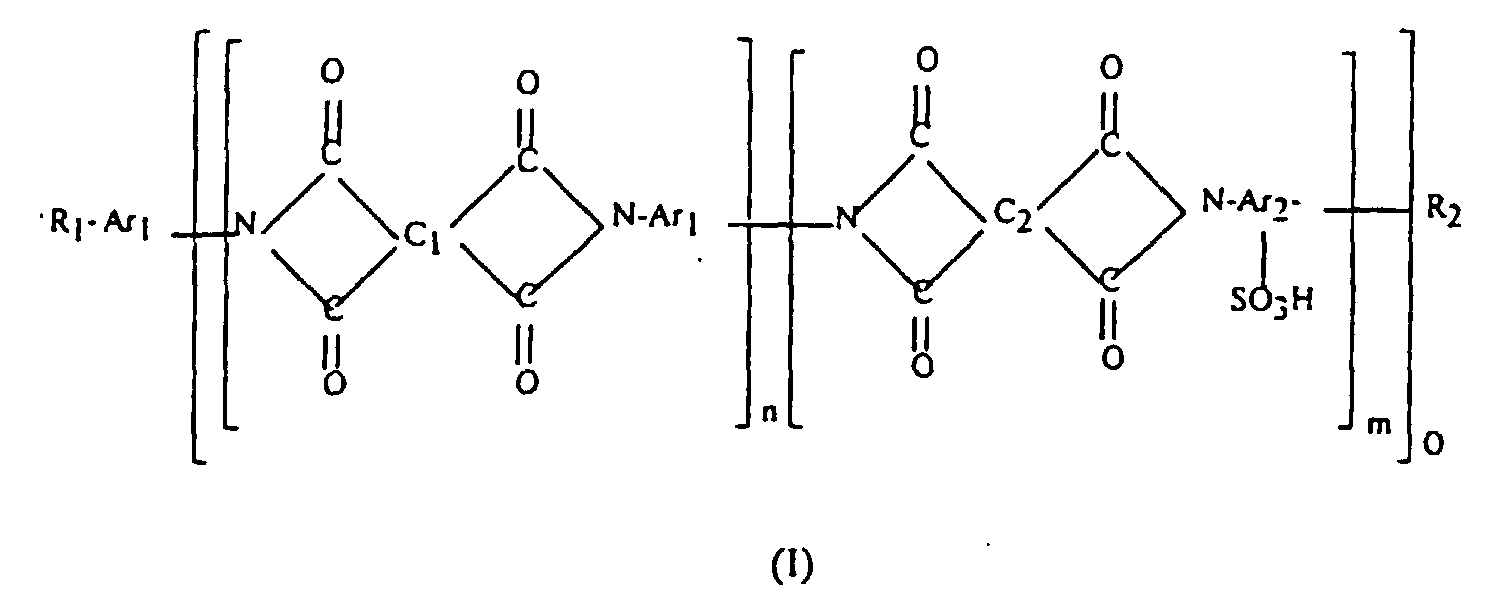
- the polyimide according to the invention which can be defined as a sulfonated copolyimide however preferably corresponds to the following general formula (I): in which C 1 , C 2 , Ar 1 and Ar 2 have the meaning already given above and where each of the groups R 1 and R 2 represents NH 2 or a group of formula where C 3 is a divalent group comprising at least one optionally substituted aromatic carbon ring having 6 to 10 carbon atoms and / or an optionally substituted aromatic heterocycle having 5 to 10 atoms and comprising one or more heteroatoms chosen from S, N and O, C 3 forming with the neighboring imide group a ring with 5 or 6 atoms.
- the molecular weight of the polyimide according to the invention is generally from 10,000 to 100,000, from preferably from 20,000 to 80,000.
- the equivalent molecular weight of polyimide according to the invention is preferably from 400 to 2500, more preferably 500 to 1200.
- the numbers m and n (j and k) will be chosen closely so that the weight equivalent molecular range from 400 to 2500, from preferably still from 500 to 1200 molecular weight equivalent having been defined above.
- heterocyclic polymers and in particular the polyimides can make it possible to obtain films thanks to to their synthesis in two stages.
- heterocyclic polymers are used for example for applications aeronautics and space which require excellent mechanical properties and good resistance to oxidation. These applications are very far from area of this application
- the specific copolymers according to the invention can be easily put under the form of thick films or membranes adequate.
- the polymers according to the invention have a very high ion exchange capacity greater than 0.4 meq / g, for example 0.8 to 2.5 meq / g, which is greater than the ion exchange capacity of polymers of the prior art which generally does not reach maximum than 0.9 to 1.2 meq / g.
- the membranes comprising the polymers according to the invention also have great stability thermal, for example at high acid hydrolysis temperature, i.e. for the most stable up to a temperature of up to example 100 ° C, for a long period which may reach for example 5000 hours.
- the membranes according to the invention have excellent resistance to reduction and oxidation.
- the polyimides have not been mentioned or suggested by any implementation in this area, on the other hand the specific polyimides according to the invention have mechanical, physico-chemical and electrical properties superior to those of polymers of the prior art as demonstrated below.
- the polyimides according to the invention are prepared so simple, using proven processes industrial and from raw materials available and low cost. Therefore, the membranes obtained as well as fuel cells including these membranes also see their price greatly decreased.
- C 1 and C 2 may be identical or different and each represent, for example, a benzene ring optionally substituted, by one or two substituent (s) chosen from the alkyl and alkoxy groups of 1 to 10 C and the halogen atoms; or several benzene rings optionally substituted by one or more substituent (s) chosen from alkyl and alkoxy groups of 1 to 10 C and halogen atoms, for example from 2 to 4 rings, linked together by a simple bond or by a divalent group.
- C 1 and C 2 may also each represent a condensed polycyclic carbon group optionally substituted by one or more substituent (s) chosen from alkyl and alkoxy groups from 1 to 10 C and halogen atoms, comprising for example 2 to 5 benzene rings chosen for example from naphthalene, phenanthrene, coronene, perylene, etc.
- substituent chosen from alkyl and alkoxy groups from 1 to 10 C and halogen atoms, comprising for example 2 to 5 benzene rings chosen for example from naphthalene, phenanthrene, coronene, perylene, etc.
- C 1 and C 2 may also represent a heterocycle or a condensed heterocycle, of aromatic nature such as thiophene, pyrazine, pyridine, furan, quinoline, quinoxaline, isobenzofuran, this heterocycle being optionally substituted by one or more substituents chosen from allyl groups (for example methyl, ethyl, isopropyl, etc.) and alkoxy from 1 to 10 C, and the halogen atoms (F, Cl, Br, I).
- allyl groups for example methyl, ethyl, isopropyl, etc.
- alkoxy from 1 to 10 C
- halogen atoms F, Cl, Br, I
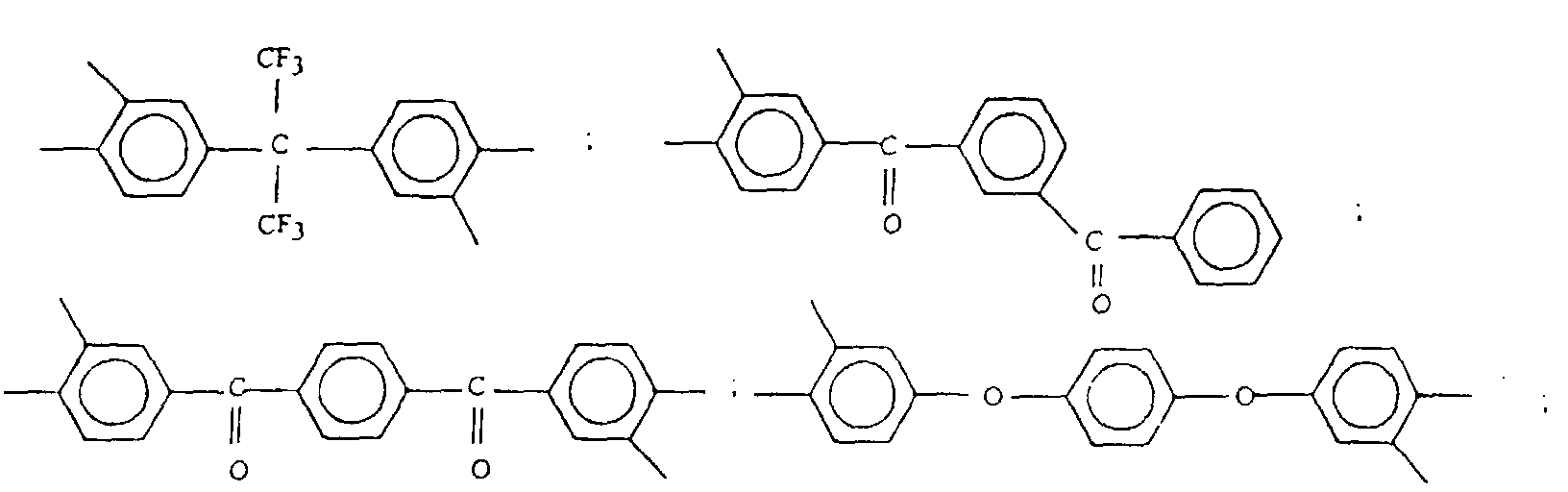
- C 1 is a benzene ring and C 2 a set of two benzene rings linked together by an oxygen bridge; or C 1 is constituted by benzene rings, more preferably by two benzene rings linked together by one or more perfluoroalkylene group (s) and C 2 is constituted by benzene rings, more preferably by two linked benzene rings by one or more divalent perfluoroalkyl (s) or perfluoroalkylene (s) group (s); or C 1 is a benzene ring and C 2 is a naphthalene ring; or C 1 and C 2 are both naphthalene rings.
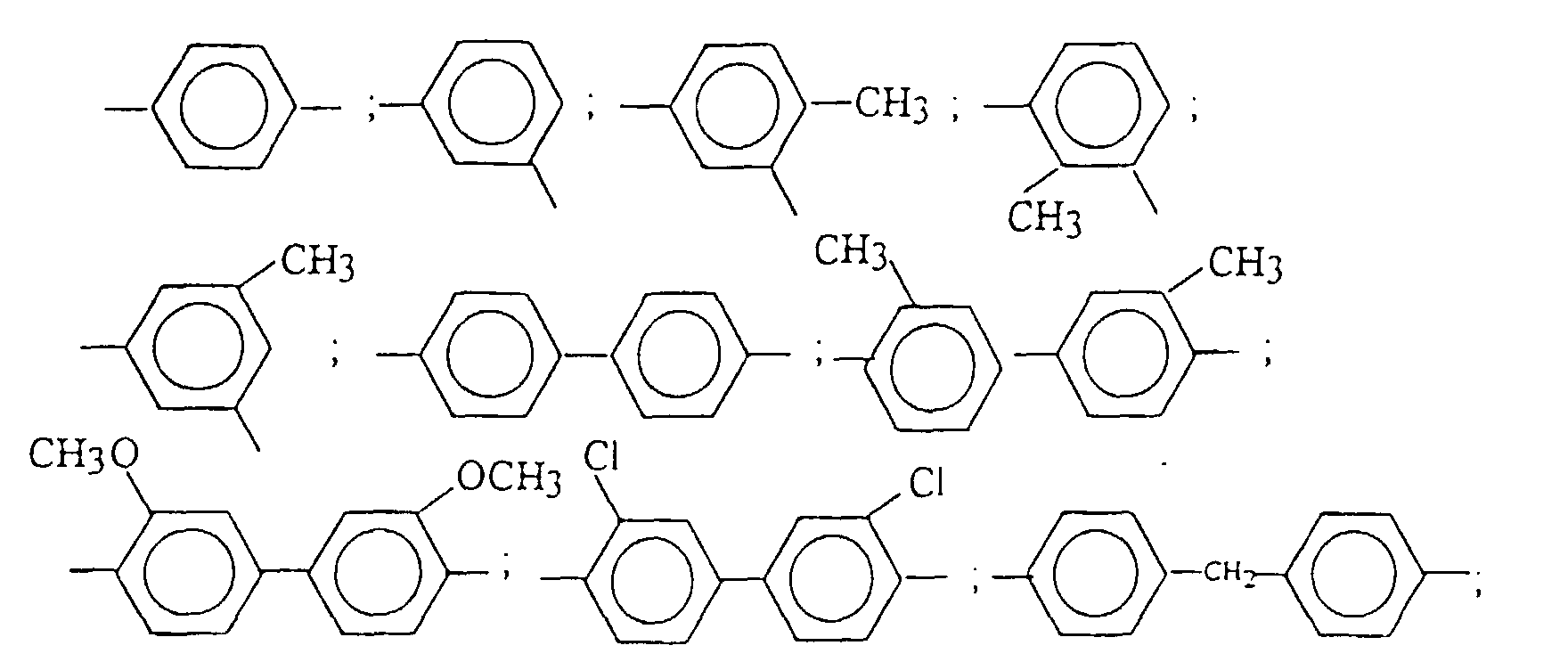
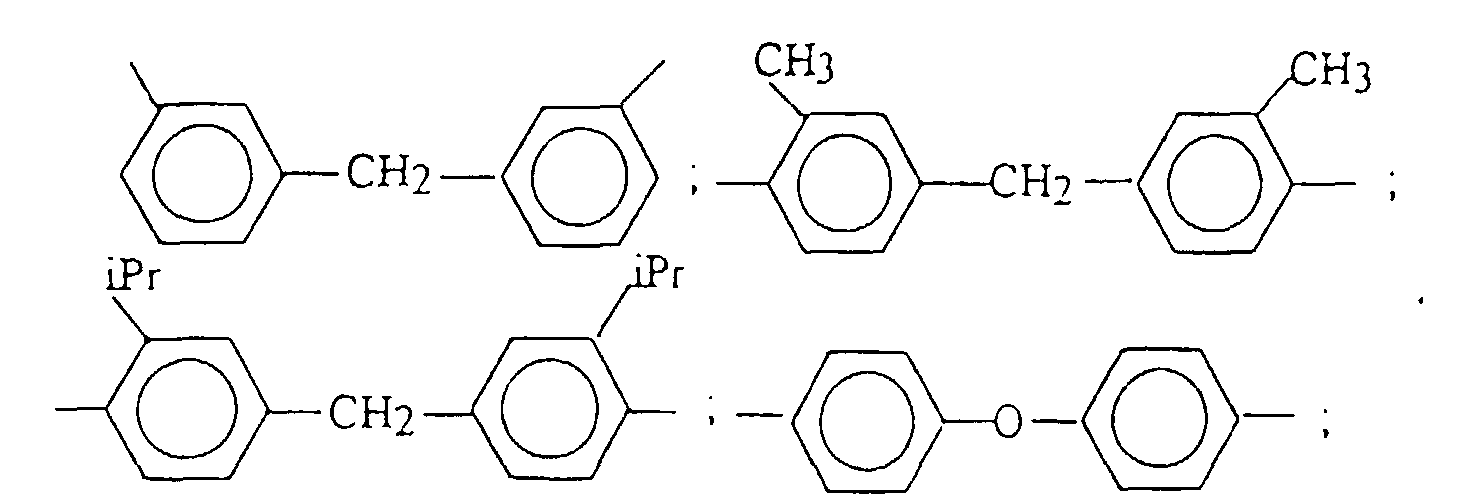
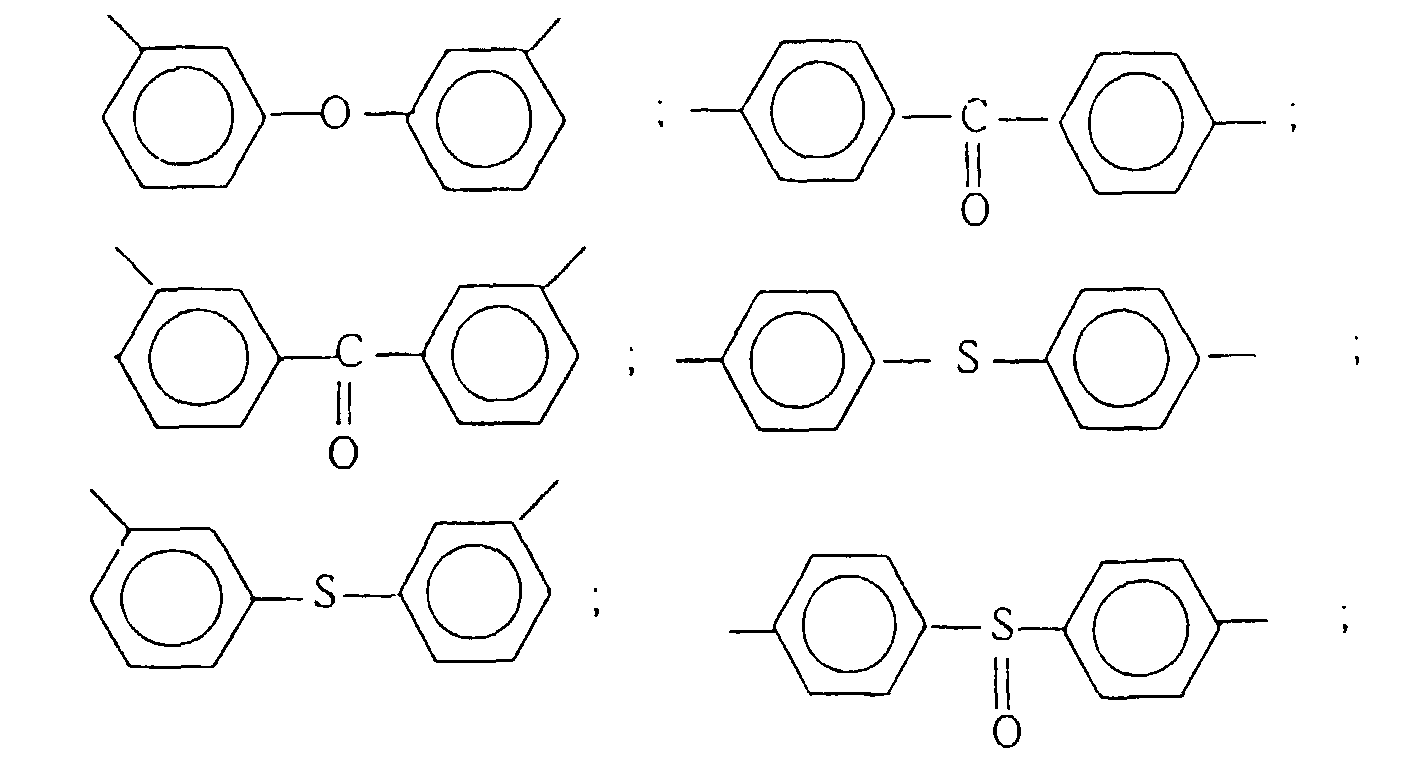
- Ar 1 and Ar 2 may be the same or different and each represents for example a divalent benzene ring with meta or para linkage; optionally substituted with one or more substituents chosen from alkyl and alkoxy groups from 1 to 10 C such as methyl, ethyl, isopropyl, butyl, methoxy, etc. and halogen atoms; or several benzene rings optionally substituted by one or more substituents chosen from alkyl and alkoxy groups from 1 to 10C and halogen atoms, for example from 2 to 5 rings, linked together by a single bond or by a divalent group.
- Ar 1 and Ar 2 may also each represent a condensed polycyclic carbon group optionally substituted by one or more substituent (s) chosen from alkyl and alkoxy groups from 1 to 10 C and halogen atoms, comprising for example 2 to 5 benzene rings, chosen for example from naphthalene, phenanthrene, coronene, perylene, etc.
- substituent chosen from alkyl and alkoxy groups from 1 to 10 C and halogen atoms, comprising for example 2 to 5 benzene rings, chosen for example from naphthalene, phenanthrene, coronene, perylene, etc.
- Ar 1 and Ar 2 can also represent a heterocycle or a condensed heterocycle of aromatic nature, for example thiophene, pyrazine, pyridine, furan, quinoline, quinoxaline, isobenzofuran, this heterocycle being optionally substituted by one or more chosen substituent (s) from alkyl and alkoxy groups from 1 to 10 C, for example methyl, ethyl, isopropyl, methoxy, and halogen atoms (F, Cl, Br, I).
- substituent s
- alkyl and alkoxy groups from 1 to 10 C, for example methyl, ethyl, isopropyl, methoxy, and halogen atoms (F, Cl, Br, I).
- At least one of the rings of Ar 2 for example benzene or polyphenyl or other is further substituted by one or more sulfonic acid group (s).
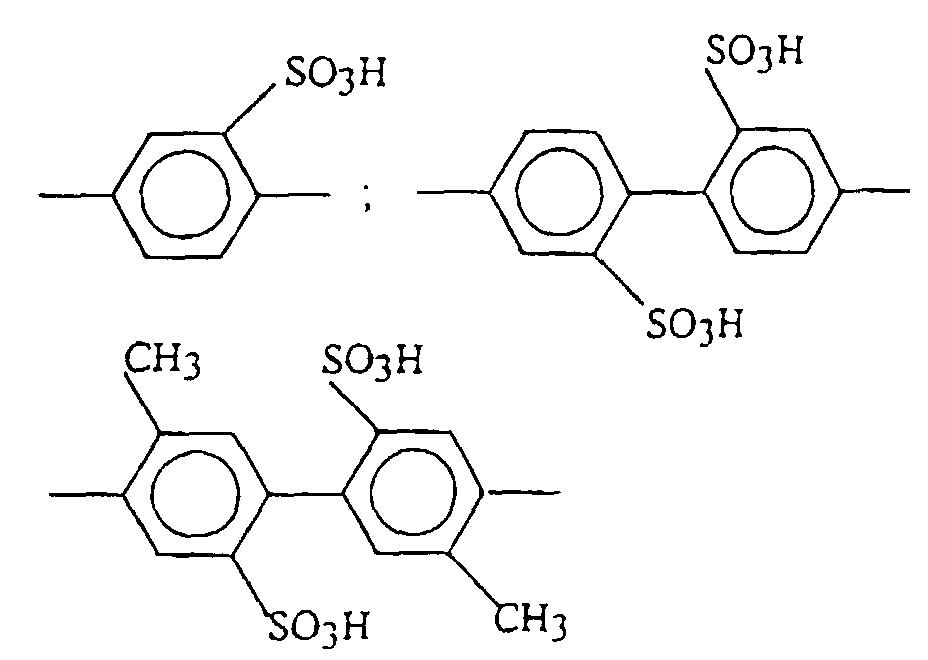
- the preferred polyimides are those in which Ar 1 is a diphenylmethane group and Ar 2 is a biphenyl disulfonic group; or Ar 1 is a benzene group, and Ar 2 a biphenyl-disulfonic group; or Ar 1 is a diphenyl ether group, and Ar 2 is a biphenyl disulfonic group.
- C 3 is for example a benzene or naphthalene ring optionally substituted with one or more substituent (s) chosen from alkyl and alkoxy groups from 1 to 10 C and halogen atoms.
- Ar 2 groups mention may also be made of any of the Ar 1 groups mentioned above, further carrying one or more SO 3 H group (s) on its cycle (s) and / or heterocycle (s) .
- the polyimides object of the invention can be obtained by all methods known to man of the profession for the preparation of polyimides in general.
- polyimides according to the invention can be prepared by processes which derive from the processes mentioned above or by other methods which can be implemented for the synthesis of polyimides.
- the polymers prepared, and by way consequently the membranes obtained from these relatively low cost polymers from order for example by a factor of 10, which is significantly lower than the membranes of the prior art currently used in particular in batteries with combustible.
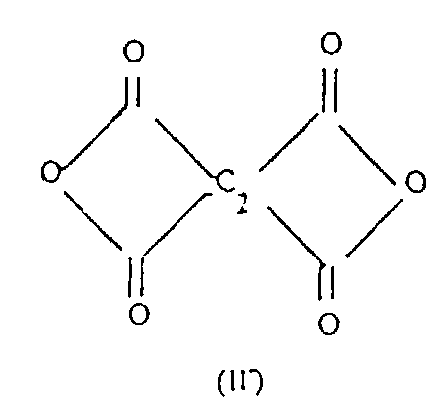
- the dianhydrides of aromatic tetracarboxylic acids following: benzene tetracarboxylic acid-1,2,3,4, benzene tetracarboxylic acid-1,2,4,5, acid biphenyl-1,1'tetracarboxylic-2,3 ', 5', 6 'acid biphenyl-1,1'tetracarboxylic-3,3 ', 4,4', acid biphenyl-1,1'tetracarboxylic-2,2 ', 3,3', acid terphenyl-1,1 ', 1 "tetracarboxylic-2', 3 ', 5', 6 ', naphthalene tetracarboxylic acid-1,2,5,6, acid 2,3,6,7 naphthalene tetracarboxylic acid 1,2,4,5-tetracarboxylic naphthalene, acid 1,4,5,8-tetracarboxylic naphthalene, perylene
- the dianhydrides of general formula (II ') where C 2 has the meaning already given above can be chosen from the same compounds mentioned above for the dianhydrides of formula (II).
- biprimary diamines of formula (III) H 2 N-Ar 1 -NH 2 where Ar 1 has the meaning already given above and which can be used in the preparation of the polyimides of the invention mention may be made of: example, benzenediamine-1,3, benzenediamine-1,4, 6-methyl benzenediamine-1,3, 2-methylbenzenediamine-1,3, methyl-5 benzenediamine-1,3, diamino-4, 4 'biphenyl-1,1', diamino-4,4 'dimethyl-3,3' biphenyl-1,1 ', diamino-4,4' dimethoxy-3,3 'biphenyl-1,1', diamino-4,4 'dichloro-3,3' biphenyl-1,1 ', methylenebis (benzeneamine) -4,4', methylenebis (benzeneamine) -3.3 ', methylenebis (3-methylbenzeneamine) - 4.4 ',
- the condensation of dianhydrides on diamines can be done, in the context of the invention, with or without chain limiting agent.
- an agent chain limiter preferably of the anhydride type, because it avoids the presence at the end of the chain polymer of an easily oxidizable amine group.
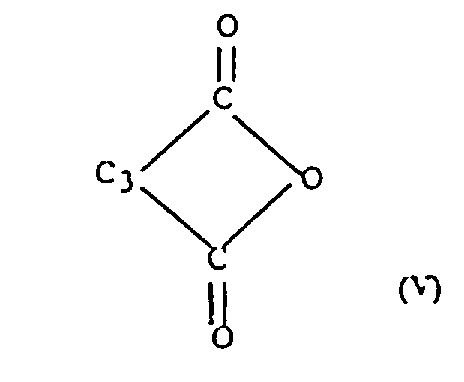
- anhydrides of formula (V) are phthalic and 3-fluorophthalic anhydrides, Naphthalene-1,8-dicarboxylic anhydride ....
- the polyimide itself is synthesized according to the following diagram given by way of example for the first type of recurring motif
- the solvent can be any suitable solvent known to those skilled in the art as suitable for polycondensation reaction of a dianhydride and a diamine.
- the solvent is a polar aprotic solvent chosen by example among dimethylformamide, the dimethylacetamide, N-methylpyrrolidone, alone or as mixed with, for example, aromatic solvents such as than xylene or solvents of the glycol ether type.
- the solvent can also be a solvent for phenolic type, that is, it is chosen by example among phenol, phenols substituted by a or several halogens (Cl, I, Br, F), cresols (o-, m-, and p-cresol), cresols substituted by a halogen (Cl, I, Br, F) and mixtures thereof.
- Preferred solvents will consist of m-cresol and a mixture of para-chloro-phenol or meta-chlorophenol and phenol, for example in proportions of 20% phenol and 80% para or metachlorophenol.
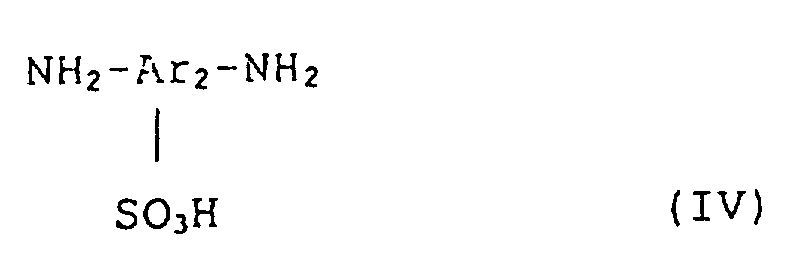
- reagents By reagents is meant the compounds (II), (III), (II ') (IV) and possibly (V) already described above. We can for example start by doing react, as reagents initially present in mixing a dianhydride (II) and / or a dianhydride (II ') with a sulfonated diamine (IV), then add then the second diamine (III).
- the condensation reaction of the 1st step is carried out in the solvent generally from the ordinary temperature, for example 20-25 ° C and it forms the intermediate polyamide-acid or prepolymer.
- the intermediate acid polyamide obtained can be used for example to prepare a film by example by casting; the solvent is then evaporated at a temperature of 50 to 150 ° C to give a polyamide final acid and the polyimide according to the invention is obtained in accordance with the second step either by heat treatment at a temperature below 250 ° C (i.e. below the temperature of desulfonation) or by chemical dehydration in using acetic anhydride.
- Another preferred alternative is to heat the starting solution comprising in a first case all reagents at a temperature for example from 120 to 200 ° C for a period of example from 6 to 72 hours.
- the starting solution can, as we have already mentioned above, do understand in a second case, that part of the reagents necessary for the preparation of the final polyimide, for example the mixture starting may only include the compounds (II) and / or (II '), and (IV).
- this mixture we wear this mixture at a temperature for example of 120 to 200 ° C for a duration for example from 6 to 72 hours, then we leave cool the mixture down to a temperature example from 20 to 50 ° C and the rest of the reactants are added for example the compounds (III) and (II).
- the polymerization is stopped by cooling the solution for example to the ambient temperature. Then pour, preferably slowly the solution for example under very strong stirring in a container containing for example methanol or ethanol.
- the generally fibrous solid which precipitate is separated for example by filtration and is then preferably washed once or more times example with a sufficient amount for example of methanol.
- the polymer obtained is then dried preferably at a temperature of 50 to 120 ° C for example in a forced ventilation oven for a period sufficient.
- the present invention also has for object a film or membrane comprising polyimide sulfonated described above.
- Films or membranes can be prepared in a conventional manner, for example by casting, that is to say that the polymer according to the invention is put in solution in a suitable solvent such as cresol or phenol and then poured onto a flat surface such than a glass plate and then dried to form a film with a thickness for example of 5 to 200 ⁇ m.
- a suitable solvent such as cresol or phenol
- the present invention also has for object a fuel cell device comprising one or more membranes comprising the polyamide sulfonated according to the invention.
- the membrane Due to its excellent properties mechanical, the membrane can undergo without deterioration the constraints (tightening, etc.) linked to mounting in such a device.
- the fuel cell can for example correspond to the diagram already given in FIG. 1, that is to say that the membrane according to the invention is placed in (1) between two electrodes (11) for example in platinized carbon fabric (or treated with another metal noble), preferably impregnated with a compound such as Nafion® or the polyimide itself, for the purpose to have a volume electrode.
- two electrodes (11) for example in platinized carbon fabric (or treated with another metal noble), preferably impregnated with a compound such as Nafion® or the polyimide itself, for the purpose to have a volume electrode.
- This set can then be arranged by example between two impregnated waterproof graphite plates resins, which, on the one hand, ensure the distribution hydrogen (4) or other, anode side (7), and other part, oxygen (5) cathode side (8).
- the stack may also include means (not shown) for regulating the temperature such as copper plates thermostatically controlled by single-cell heating pencils or heat exchangers module heat, and means to regulate the battery operation and connected to the circuit exterior (10): these means are constituted for example by flow, temperature and flow regulators pressure, and an electronic charge to regulate the current.
- the temperature of the battery is generally maintained between 50 and 80 ° C. and under these conditions, it produces for example a current of 0.25 A / cm 2 with a voltage of 0.6V and this over a very long period which can reach up to '' at 3000 hours, which demonstrates the excellent thermal and other stability properties of the membrane and its excellent electrical properties by comparison with the membranes of the prior art, for example in National (0.25 A / cm 2 ; 0, 7 V; 5000 hours).
- the polycondensation reaction is carried out in a 500 cm 3 glass reactor equipped with an anchor stirring system, an inlet for inert gas such as nitrogen and a thermometric probe.
- a thermostatically controlled oil bath is used to regulate the temperature of the reaction medium.
- the reactor is loaded with 250 g of m-cresol and 10 g (0.029 mole) of 4.4 'acid diamino- [1,1'-biphenyl] -2,2'-disulfonic. Then we introduced 30 g (0.096 mole) of 5,5'-oxy-bis- (1,3-isobenzofurandione).
- This reaction mixture is brought to a temperature of 180 ° C for 4 hours. During this period, the viscosity of the medium increases gradually.
- reaction mixture is then stopped while Now stir and let cool reaction mixture up to a temperature of about 50 ° C.
- the polymerization is stopped by cooling the solution to temperature ambient, then pouring it slowly under very strong stirring in a container containing two liters of methanol.
- the fibrous solid which precipitates is isolated by filtration and washed twice with two liters of methanol.
- the polymer thus obtained is then dried in a forced ventilation oven at 120 ° C for about six hours.
- Example 1 The method of Example 1 is used for prepare a sulfonated polyimide by reacting in 220 g m-cresol, 33.5 g (0.108 mole) 5,5'-oxy-bis (1,3-isobenzofurandione), 7.5 g (0.021 mole) of acid 4.4 'diamino- [1,1'-biphenyl] -2,2'disulfonic and 17.25 g of 4,4'-methylene bis-benzene-amine.
- the polymer obtained has a capacity ion exchange of 0.8 meq / g.
- Example 1 The method of Example 1 is used for prepare a sulfonated polyimide by reacting in 300 g m-cresol as solvent, 45 g (0.145 mole) of 5,5'-oxy-bis- (1,3-isobenzofurandione), 16.2 g (0.043 mole) 4.4 'diamino-5.5' acid dimethyl- [1,1'-biphenyl] -2,2'disulfonic and 20.25 g (0.102 mole) of 4.4 'methylene-bis-benzene-amine.
- the polymer thus obtained has a ion exchange capacity of 1.14 meq / g.
- Example 1 The reaction setup described in Example 1 is used for the preparation of a sulfonated polyimide.
- the reactor is loaded with a mixture of solvents composed of 210 g of phenol and 140 g of para-chlorophenol.
- the reaction mixture is heated to 150 ° C for five hours.
- the fibrous solid which forms is isolated by filtration and treated twice with 500 cm 3 of methanol.
- the polymer thus obtained is dried under vacuum at 120 ° C for six hours.
- Example 4 The method of Example 4 is used to prepare a sulfonated polyimide by reacting in a solvent mixture composed of 180 g of phenol and 140 g parachlorophenol, 8.32 g (0.0242 mole) of 4.4 'acid diamino- [1,1'-biphenyl] -2,2'disulfonic, 12.975 g (0.048 mole) of dianhydride 1,4,5,8 naphthalene-tetracarboxylic acid and 8.08 g (0.024 mole) of 4.4 '- [2,2,2-trifluoro (1-trifluoromethyl) -ethylidene] -benzene-amine.
- a solvent mixture composed of 180 g of phenol and 140 g parachlorophenol, 8.32 g (0.0242 mole) of 4.4 'acid diamino- [1,1'-biphenyl] -2,2'disulfonic, 12.975 g (0.0
- the polymer obtained has a capacity ion exchange of 1.73 meq / g.
- This example illustrates how the films of sulfonated polyimide according to the present invention can be used to prepare membranes isolating anode and cathode compartments from a battery to fuel capable of operating on hydrogen and oxygen at the cathode.
- a sulfonated polyamide membrane according to the invention (prepared from the polymer of Example 1) with an ion exchange capacity of 1.15 meq / g of thickness 80 ⁇ m, is placed between two electrodes of carbon fabric platinized (0.35 mg Pt / cm 2 ) and impregnated with Nafion® (0.8 mg / cm 2 ).
- This set is then inserted between two graphite plates which, on the one hand, ensure the distribution of hydrogen on the anode side and oxygen cathode side, and on the other hand provide conductivity electric.
- An electronic charge makes it possible to regulate battery operation in voltage or current.
- the experiment is carried out at a temperature of 50 ° C. with an oxygen and hydrogen pressure equal to 4 bars.
- the phthalic type sulfonated polyimide membrane according to the invention makes it possible to obtain a current intensity of 500 mA / cm 2 for a voltage between 300 and 400 mV.
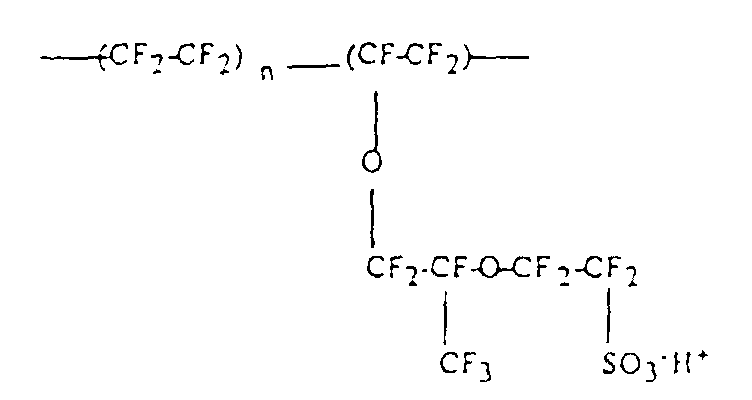
- a Nafion®117 polymer membrane with the following structure is used as a reference and it is tested under the same conditions as those defined in Example 6 for the phthalic type sulfonated polyimide membrane according to the invention.
- Figure 2 which represents the curves of polarization obtained on the one hand with the membrane according to the invention (solid line) and on the other hand with the Nafion®117 reference membrane (dotted lines) highlights performance equivalent or even superior obtained with the membrane according to the invention.
- the cell is put into operation at a temperature maintained at 50 ° C. and a stable current of 150 mA / cm 2 is measured for a voltage of 400 mV, for more than 400 hours.
- a type of sulfonated polyimide membrane phthalic according to the invention (polymer of Example 1) with an ion exchange capacity of 1.15 meq / g is installed in a battery according to example 6.
- the cell is put into operation at a temperature maintained at 70 ° C and a voltage of 600 mV is measured, for a current of 200 mA / cm 2 which gradually decreases by 1.2 mV per hour.
- a type of sulfonated polyimide membrane naphthalene according to the invention (polymer of the example 4) of thickness 170 ⁇ m, having an exchange capacity ionic of 1.28 meq / g, is placed in a pile according to Example 6.
- the cell is put into operation at a temperature maintained at 70 ° C. and a current of 1 A / cm 2 is measured with a voltage of 0.4 V.
- a Nafion®117 membrane is placed in the same battery and is tested under the same conditions of operation than those defined in Example 10 for the membrane of sulfonated polyimide of naphthalene type according to the invention.
- Figure 3 which presents the curves of polarization obtained on the one hand with the membrane according to the invention (solid line) and on the other hand with the Nafion®117 reference membrane (dotted lines) highlights performance equivalent or even superior, obtained with the membrane according to the invention.
- a membrane of sulfonated polyimide of fluorinated naphthalene type (polymer of Example 5) whose thickness is 150 ⁇ m is placed in a cell according to Example 6.
- the cell is put into operation at a temperature maintained at 70 ° C. , and a voltage of 650 mV is measured for a current of 250 mA / cm 2 which remains stable for more than 2500 hours.
- This example again demonstrates the superior durability qualities of polymers according to the invention, namely up to several thousands of hours, which is consistent with a application, for example in an electric vehicle where a durability of about 3000 hours is requested.
Landscapes
- Chemical & Material Sciences (AREA)
- Chemical Kinetics & Catalysis (AREA)
- Engineering & Computer Science (AREA)
- Manufacturing & Machinery (AREA)
- Medicinal Chemistry (AREA)
- Polymers & Plastics (AREA)
- Organic Chemistry (AREA)
- Health & Medical Sciences (AREA)
- Sustainable Development (AREA)
- Life Sciences & Earth Sciences (AREA)
- Crystallography & Structural Chemistry (AREA)
- Sustainable Energy (AREA)
- Electrochemistry (AREA)
- General Chemical & Material Sciences (AREA)
- Inorganic Chemistry (AREA)
- Materials Engineering (AREA)
- Macromolecular Compounds Obtained By Forming Nitrogen-Containing Linkages In General (AREA)
- Compositions Of Macromolecular Compounds (AREA)
- Manufacture Of Macromolecular Shaped Articles (AREA)
- Separation Using Semi-Permeable Membranes (AREA)
- Polymers With Sulfur, Phosphorus Or Metals In The Main Chain (AREA)
Description
- la première repose sur le souci d'éviter la pollution causée par les moteurs à combustion interne. Il est en effet clair que toutes les améliorations que l'on peut escompter par une meilleure maítrise de la combustion éviteront difficilement tout rejet d'oxyde d'azote, d'hydrocarbures imbrûlés, et de composés oxygénés.
- la deuxième raison, pour un plus long terme, est la recherche de moteurs utilisant un combustible autre que les combustibles fossiles dont on sait qu'ils ne sont pas éternels.
- chaíne principale totalement perfluorée
- branchement portant un groupe sulfonique
- poids équivalent entre 800 et 1200
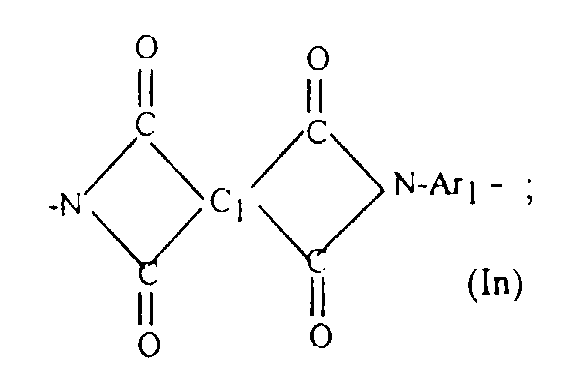

- les groupes C1 et C2 peuvent être identiques ou différents et représentent chacun un groupe tétravalent comprenant au moins un cycle aromatique carboné éventuellement substitué ayant de 6 à 10 atomes de carbone et/ou un hétérocycle à caractère aromatique éventuellement substitué ayant de 5 à 10 atomes et comprenant un ou plusieurs hétéroatomes choisis parmi S, N et O ; C1 et C2 formant chacun avec les groupes imides voisins des cycles à 5 ou 6 atomes.


C3 formant avec le groupe imide voisin un cycle à 5 ou 6 atomes.
- m représente un nombre entier de préférence de 1 à 20, de préférence encore de 2 à 10 ;
- n représente un nombre entier de préférence de 1 à 30, de préférence encore de 2 à 20 .
- o représente un nombre entier de préférence de 1 à 10, de préférence encore de 2 à 6.
- la figure 1 représente schématiquement une pile à combustible et son assemblage électrode-membrane-électrode.
- La figure 2 représente un graphique avec en ordonnée la tension exprimée en mV et en abscisse la densité de courant exprimée en A/cm2 dans lequel sont portées les courbes de polarisation obtenues avec des électrodes "E-TEK" non collées (0,35 mg de Pt/cm2 et 0,8 mg de Nafion®/cm2) et respectivement, une membrane en Nafion®117 (courbe en traits pointillés), et une membrane en polyimide phtalique de la présente invention (courbe en trait plein), la température de fonctionnement de la pile de 50°C et les pressions de H2 et de O2 étant de 4 bars.
- la figure 3 est un graphique analogue à celui de la figure 2, mais les courbes de polarisation sont celles obtenues d'une part avec une membrane en Nafion®117 (courbe en traits pointillés), et d'autre part avec une membrane en polyimide naphtalénique ce la présente invention (courbe en trait plein), et la température de fonctionnement de la pile est de 70°C.
- un groupe divalent dérivé d'un groupe alkyle linéaire ou ramifié (par exemple un groupe alkylidène ou alkylène) de 1 à 10 C éventuellement substitué, de préférence sur le même carbone, par un ou plusieurs halogènes choisis parmi F, Cl, Br et I et/ou par un ou plusieurs groupes hydroxyle(s), de préférence encore ledit groupe divalent est un groupe divalent dérivé d'un groupe alkyle perfluoré, par exemple alkylène perfluoré.
- un hétéroatome choisi parmi O, S ;
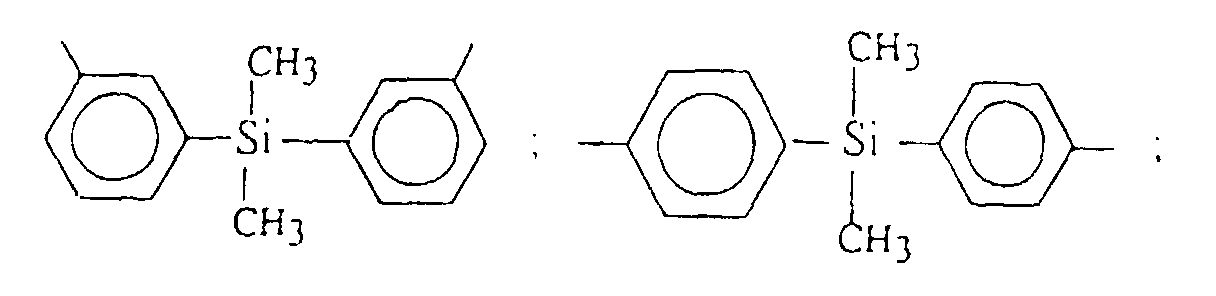
- un groupe
un groupe
 un groupe
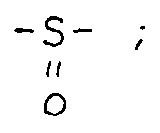 un groupe
 un groupe
 un groupe
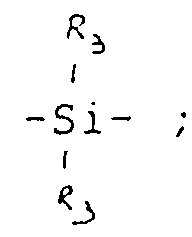 où R3 est choisi parmi les groupes alkyles de 1 à 10 C tels que méthyle, éthyle, isopropyle, etc.
- un groupe divalent dérivé d'un groupe alkyle linéaire ou ramifié (par exemple un groupe alkylidène ou alkylène) de 1 à 10 C éventuellement substitué, de préférence sur le même carbone par un ou plusieurs halogènes choisis parmi F, Cl, Br et I et/ou par un ou plusieurs groupes hydroxyle(s), de préférence encore ledit groupe divalent est un groupe divalent dérivé d'un groupe alkyle perfluoré, par exemple alkylène perfluoré.
- un hétéroatome choisi parmi O, S ;
- un groupe
un groupe
 un groupe
 un groupe
 un groupe
 un groupe
 où R3 est choisi parmi les groupes alkyles de 1 à 10 C tels que méthyle, éthyle, isopropyle, etc.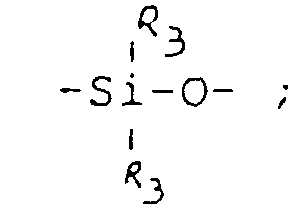










- réaction d'un dianhydride et d'une diamine,
- réaction d'un diacide diester et d'une diamine,

- ou selon le schéma ci-dessous pour le
deuxième type de motif récurrent des polyimides selon
l'invention :



- hydrogène, alcools tels que méthanol, à l'anode ;
- oxygène, air, à la cathode.
Claims (16)
- Polymère sulfoné caractérisé en ce qu'il comprend des motifs récurrents de formule (In)et des motifs récurrents de formule (Im)
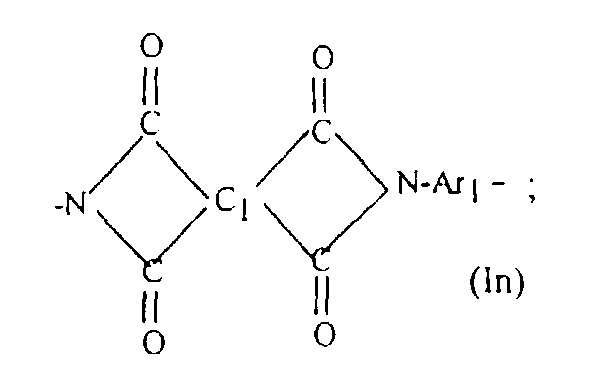 dans lesquelles :
 les groupes C1 et C2 peuvent être identiques ou différents et représentent chacun un groupe tétravalent comprenant au moins un cycle aromatique carboné éventuellement substitué ayant de 6 à 10 atomes de carbone et/ou un hétérocycle à caractère aromatique éventuellement substitué ayant de 5 à 10 atomes et comprenant un ou plusieurs hétéroatomes choisis parmi S, N et O ; C1 et C2 formant chacun avec les groupes imides voisins des cycles à 5 ou 6 atomes.Les groupes Ar1 et Ar2 peuvent être identiques ou différents et représentent chacun un groupe divalent comprenant au moins un cycle aromatique carboné éventuellement substitué ayant de 6 à 10 atomes de carbone et/ou un hétérocycle à caractère aromatique éventuellement substitué ayant de 5 à 10 atomes et comprenant un ou plusieurs hétéroatomes choisis parmi S, N et O ; au moins un desdits cycles aromatiques carbonés et/ou hétérocycle de Ar2 étant en outre substitué par au moins un groupe acide sulfonique .
 - Polyimide sulfoné selon la revendication 1, caractérisé en ce qu'il répond à la formule générale suivante (I) :dans laquelle C1, C2, Ar1 et Ar2 ont la signification déjà donnée ci-dessus et où chacun des groupes R1 et R2 représente NH2 ou un groupe de formule
 où C3 est un groupe divalent comprenant au moins un cycle aromatique carboné éventuellement substitué ayant de 6 à 10 atomes de carbone et/ou un hétérocycle à caractère aromatique éventuellement substitué ayant de 5 à 10 atomes et comprenant un ou plusieurs hétéroatomes choisis parmi S, N et O ;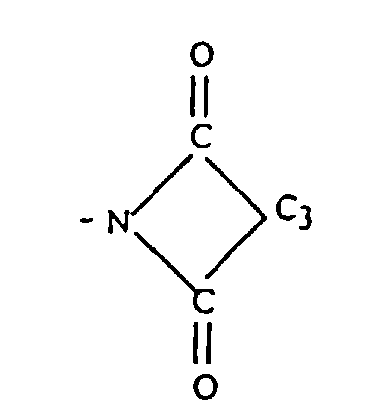
C3 formant avec le groupe imide voisin un cycle à 5 ou 6 atomes; et dans laquelle m représente un nombre entier de 1 à 20, n représente un nombre entier de 1 à 30, et o représente un nombre entier de 1 à 10. - Polyimide selon la revendication 2, caractérisé en ce que les nombres m et n sont choisis de telle sorte que le poids moléculaire équivalent défini par le poids de polymère en gramme par équivalent acide sulfonique soit de 500 à 2500.
- Polyimide selon la revendication 1 ou la revendication 2, caractérisé en ce que son poids moléculaire est de 10 000 à 100 000.
- Polyimide selon la revendication 1 ou la revendication 2, caractérisé en ce que dans les formules (In), (Im) et (I), C1 et C2 peuvent être identiques ou différents et représentent chacun, un cycle benzénique éventuellement substitué, par un ou deux substituant(s) choisi(s) parmi les groupes alkyles et alkoxy de 1 à 10 C et les atomes d'halogène ; ou plusieurs cycles benzéniques éventuellement substitués par un ou plusieurs substituant(s) choisi(s) parmi les groupes alkyles et alkoxy de 1 à 10 C et les atomes d'halogène, reliés entre eux par une simple liaison ou par un groupe divalent.C1 et C2 peuvent également chacun représenter un groupe carboné polycyclique condensé éventuellement substitué par un ou plusieurs substituant(s) choisi(s) parmi les groupes alkyles et alkoxy de 1 à 10 C et les atomes d'halogène,C1 et C2 peuvent aussi représenter un hétérocycle ou un hétérocycle condensé, à caractère aromatique, cet hétérocycle étant éventuellement substitué par un ou plusieurs substituants choisis parmi les groupes alkyles et alkoxy de 1 à 10 C, et les atomes d'halogènes.Ar1 et Ar2 peuvent être identiques ou différents et représentent chacun par exemple un cycle benzénique divalent à attachement meta, ou para ; éventuellement substitué par un ou plusieurs substituants choisis parmi les groupes alkyles et alkoxy de 1 à 10 C et les atomes d'halogène ; ou plusieurs cycles benzéniques éventuellement substitués par un ou plusieurs substituants choisis parmi les groupes alkyles et alkoxy de 1 à 10 C et les atomes d'halogène , reliés entre eux par une simple liaison ou par un groupe divalent.Ar1 et Ar2 peuvent également chacun représenter un groupe carboné polycyclique condensé éventuellement substitué par un ou plusieurs substituant(s) choisi(s) parmi les groupes alkyles et alkoxy de 1 à 10 C et les atomes d'halogène,Ar1 et Ar2 peuvent aussi représenter un hétérocycle ou un hétérocycle condensé, à caractère aromatique, cet hétérocycle étant éventuellement substitué par un ou plusieurs substituant(s) choisi(s) parmi les groupes alkyles et alkoxy de 1 à 10 C, et les atomes d'halogènes.
- Polyimide selon la revendication 2, caractérisé en ce que C3 est un cycle benzénique ou naphtalénique éventuellement substitué par un ou plusieurs substituant(s) choisi(s) parmi les groupes alkyles et alkoxy de 1 à 10 C et les atomes d'halogène.
- Polyimide selon la revendication 5, caractérisé en ce que ledit groupe divalent est choisi parmi :un groupe divalent dérivé d'un groupe alkyle linéaire ou ramifié de 1 à 10 C éventuellement substitué, par un ou plusieurs halogènes choisis parmi F, Cl, Br et I et/ou par un ou plusieurs groupes hydroxyle(s).un hétéroatome choisi parmi O, S ;un groupeun groupe
 un groupe
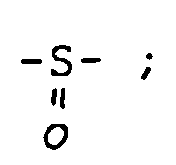 un groupe
 un groupe
 un groupe
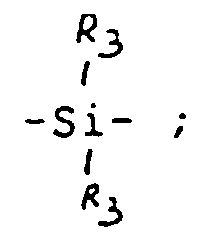 où R3 est choisi parmi les groupes alkyles de 1 à 10 C.
- Polyimide selon la revendication 5, caractérisé en ce que C1 est un cycle benzénique et C2 est un ensemble de deux cycles benzéniques reliés entre eux par un pont oxygène.
- Polyimide selon la revendication 5, caractérisé en ce que C1 est constitué par des cycles benzéniques reliés par un ou des groupe(s) perfluoroalkylène(s) et C2 est constitué par des cycles benzéniques reliés par un ou des groupe(s) perfluoroalkyle(s) divalents ou perfluoroalkylène(s).
- Polyimide selon la revendication 5, caractérisé en ce que C1 est un cycle benzénique et C2 est un cycle naphtalénique.
- Polyimide selon la revendication 5, caractérisé en ce que C1 et C2 sont tous deux des cycles naphtaléniques.
- Polyimide selon la revendication 5, caractérisé en ce que Ar1 est un groupe diphénylméthane et Ar2 est un groupe biphényl-disulfonique.
- Polyimide selon la revendication 5, caractérisé en ce que Ar1 est un groupe benzénique et Ar2 un groupe biphényl-disulfonique.
- Polyimide selon la revendication 5, caractérisé en ce que Ar1 est un groupe diphényléther et Ar2 est un groupe biphényl-disulfonique.
- Membrane comprenant un polyimide selon la revendication 1 ou la revendication 2.
- Dispositif de pile à combustible comprenant au moins une membrane selon la revendication 15.
Applications Claiming Priority (3)
| Application Number | Priority Date | Filing Date | Title |
|---|---|---|---|
| FR9605707A FR2748485B1 (fr) | 1996-05-07 | 1996-05-07 | Polyimides sulfones, membranes preparees avec ceux-ci, et dispositif de pile a combustible comprenant ces membranes |
| FR9605707 | 1996-05-07 | ||
| PCT/FR1997/000804 WO1997042253A1 (fr) | 1996-05-07 | 1997-05-06 | Polyimides sulfones, membranes et dispositif de pile a combustible |
Publications (2)
| Publication Number | Publication Date |
|---|---|
| EP0897407A1 EP0897407A1 (fr) | 1999-02-24 |
| EP0897407B1 true EP0897407B1 (fr) | 2000-08-30 |
Family
ID=9491919
Family Applications (1)
| Application Number | Title | Priority Date | Filing Date |
|---|---|---|---|
| EP97923143A Expired - Lifetime EP0897407B1 (fr) | 1996-05-07 | 1997-05-06 | Polyimides sulfones, membranes et dispositif de pile a combustible |
Country Status (7)
| Country | Link |
|---|---|
| US (3) | US6245881B1 (fr) |
| EP (1) | EP0897407B1 (fr) |
| JP (1) | JP3725170B2 (fr) |
| CA (1) | CA2254086C (fr) |
| DE (1) | DE69702975T2 (fr) |
| FR (1) | FR2748485B1 (fr) |
| WO (1) | WO1997042253A1 (fr) |
Families Citing this family (56)
| Publication number | Priority date | Publication date | Assignee | Title |
|---|---|---|---|---|
| US6248469B1 (en) | 1997-08-29 | 2001-06-19 | Foster-Miller, Inc. | Composite solid polymer electrolyte membranes |
| CA2343184C (fr) | 1998-09-11 | 2010-06-29 | Victrex Manufacturing Limited | Polymeres echangeurs d'ions |
| GB9819706D0 (en) * | 1998-09-11 | 1998-11-04 | Victrex Mfg Ltd | Sulphonated polymers |
| EP1145149B1 (fr) | 1998-11-13 | 2005-04-06 | Cellomics, Inc. | Procedes et systeme de collection et de stockage efficaces de donnees experimentales |
| FR2789912B1 (fr) * | 1999-02-18 | 2002-12-20 | Commissariat Energie Atomique | Procede et dispositif de separation a membranes semi-permeables en polyimides sulfones |
| US6586561B1 (en) | 1999-02-18 | 2003-07-01 | Case Western Reserve University | Rigid rod ion conducting copolymers |
| WO2001019896A1 (fr) * | 1999-09-10 | 2001-03-22 | Victrex Manufacturing Limited | Membranes composites echangeuses d'ions |
| FR2799198B1 (fr) * | 1999-10-04 | 2002-05-03 | Commissariat Energie Atomique | Polymides sulfones, membranes preparees avec ceux-ci et dispositif de pile a combustible comportant ces membranes |
| JP4806836B2 (ja) * | 1999-12-22 | 2011-11-02 | 大日本印刷株式会社 | 高耐熱性コーティング用組成物、有機溶媒可溶性ポリイミド、高耐熱性被膜及びその製造方法 |
| US7356416B2 (en) | 2000-01-25 | 2008-04-08 | Cellomics, Inc. | Method and system for automated inference creation of physico-chemical interaction knowledge from databases of co-occurrence data |
| FR2805927B1 (fr) * | 2000-03-03 | 2002-04-12 | Commissariat Energie Atomique | Procede de preparation d'assemblages electrodes-membrane-et electrode-membraneelectrode, assemblage ainsi obtenus, et dispositif de pile combustible comprenant ces assemblages |
| FR2810794A1 (fr) * | 2000-06-26 | 2001-12-28 | Sorapec | Association d'electrodes et de membrane comportant des conducteurs protoniques |
| US6768982B1 (en) | 2000-09-06 | 2004-07-27 | Cellomics, Inc. | Method and system for creating and using knowledge patterns |
| JP3607862B2 (ja) | 2000-09-29 | 2005-01-05 | 株式会社日立製作所 | 燃料電池 |
| JP2002105200A (ja) * | 2000-09-29 | 2002-04-10 | Kanegafuchi Chem Ind Co Ltd | 直接アルコール型燃料電池用プロトン伝導性膜およびそれを使用した直接アルコール型燃料電池。 |
| JP2002121281A (ja) * | 2000-10-18 | 2002-04-23 | Kanegafuchi Chem Ind Co Ltd | ポリアミック酸共重合体、ポリイミド共重合体及びポリイミドフィルムの製造方法。 |
| FR2818791A1 (fr) * | 2000-12-08 | 2002-06-28 | Commissariat Energie Atomique | Membrane conductrice ionique organique pour pile a combustible et son procede de fabrication |
| WO2003018669A1 (fr) * | 2001-08-22 | 2003-03-06 | Hanyang Hak Won Co., Ltd. | Films de polyimide sulfone reticules |
| JP2003068327A (ja) * | 2001-08-28 | 2003-03-07 | Kanegafuchi Chem Ind Co Ltd | 燃料電池用膜 |
| JP3561250B2 (ja) * | 2001-09-21 | 2004-09-02 | 株式会社日立製作所 | 燃料電池 |
| TWI236486B (en) * | 2001-10-10 | 2005-07-21 | Mitsui Chemicals Inc | Crosslinkable aromatic resin having protonic acid group, and ion conductive polymer membrane, binder and fuel cell using the resin |
| US20030131731A1 (en) * | 2001-12-20 | 2003-07-17 | Koros William J. | Crosslinked and crosslinkable hollow fiber mixed matrix membrane and method of making same |
| KR100449788B1 (ko) * | 2002-02-23 | 2004-09-22 | 학교법인연세대학교 | 고분자 전해질 연료 전지용 술폰화 폴리이미드 제조방법및 이를 이용한 전해질막의 제조방법 |
| US6881820B1 (en) * | 2002-05-13 | 2005-04-19 | The United States Of America As Represented By The Administrator Of The National Aeronautics And Space Administration | Rod-coil block polyimide copolymers |
| US6740728B2 (en) * | 2002-05-24 | 2004-05-25 | Praxair Technology, Inc. | Methods for the preparation of polyesters, poly(ester amide)s and poly(ester imide)s and uses of the materials obtained therefrom |
| KR100464317B1 (ko) * | 2002-07-06 | 2005-01-03 | 삼성에스디아이 주식회사 | 측쇄사슬에 산기를 갖는 양성자전도성 고분자, 상기 고분자를 이용한 고분자막 및 이를 이용한 연료전지 |
| EP1420037B8 (fr) * | 2002-11-12 | 2006-08-09 | Gkss-Forschungszentrum Geesthacht Gmbh | Membrane avec conductivité ionique pour applications électrochimiques |
| US7018445B2 (en) * | 2002-12-02 | 2006-03-28 | L'air Liquide, Societe Anonyme A Directoire Et Conseil De Surveillance Pour L'etude Et L'exploitation Des Procedes Georges Claude | Polyimide blends for gas separation membranes |
| US7211203B2 (en) | 2003-02-04 | 2007-05-01 | Honda Motor Co., Ltd. | Polymer electrolyte, proton conductive membrane and membrane-electrode assembly |
| US7022810B1 (en) * | 2003-05-09 | 2006-04-04 | Sandia Corporation | Proton exchange membrane materials for the advancement of direct methanol fuel-cell technology |
| KR100514753B1 (ko) * | 2003-07-03 | 2005-09-14 | 삼성전자주식회사 | 나프탈렌 테트라카르복실산 디이미드계 고분자 및 이를포함하는 전자사진 감광체, 전자사진 카트리지, 전자사진드럼 및 전자사진 화상형성장치 |
| US7183370B2 (en) | 2003-09-11 | 2007-02-27 | Toyota Technical Center Usa, Inc | Phosphonic-acid grafted hybrid inorganic-organic proton electrolyte membranes (PEMs) |
| US7576165B2 (en) * | 2004-01-27 | 2009-08-18 | Georgia Institute Of Technology | Heterocycle grafted monomers and related polymers and hybrid inorganic-organic polymer membranes |
| KR100682861B1 (ko) | 2004-02-17 | 2007-02-15 | 삼성에스디아이 주식회사 | 측쇄 말단에 술폰산기를 가지는 폴리이미드, 이의 제조 방법 및 이를 포함하는 고분자 전해질과 연료 전지 |
| US7527673B2 (en) * | 2004-03-26 | 2009-05-05 | L'air Liquide, Societe Anonyme A Directoire Et Conseil De Surveillance Pour L'etude Et L'exploitation Des Procedes Georges Claude | Polyimide based mixed matrix composite membranes |
| US20050268782A1 (en) * | 2004-03-26 | 2005-12-08 | Kulkarni Sudhir S | Novel polyimide based mixed matrix membranes |
| US7375176B2 (en) * | 2004-03-31 | 2008-05-20 | Litt Morton H | Liquid crystal poly(phenylene sulfonic acids) |
| US7148314B2 (en) * | 2004-07-07 | 2006-12-12 | General Electric Company | Process for preparation of functionalized polyimides |
| KR100657740B1 (ko) * | 2004-12-22 | 2006-12-14 | 주식회사 엘지화학 | 브랜치된 술폰화 멀티 블록 공중합체 및 이를 이용한전해질막 |
| EP2355218B1 (fr) | 2005-03-04 | 2012-10-03 | Ube Industries, Ltd. | Nouvel électrolyte polymère, composition d'électrolytes polymères, membrane à électrolytes et leur procédé de production et utilisation |
| JP5093870B2 (ja) | 2005-07-07 | 2012-12-12 | 富士フイルム株式会社 | 固体電解質複層フィルムの製造方法 |
| US20070112170A1 (en) * | 2005-11-16 | 2007-05-17 | General Electric Company | Benzimidazole-containing sulfonated polyimides |
| WO2007094561A1 (fr) * | 2006-02-17 | 2007-08-23 | Cheil Industries Inc. | Membrane électrolytique à poids moléculaire élevé pour pile à combustible, et ensemble membrane-électrode et pile à combustible associés |
| JP2010510370A (ja) | 2006-11-22 | 2010-04-02 | グワンジュ・インスティテュート・オブ・サイエンス・アンド・テクノロジー | 末端に架橋構造を形成するスルホン化ポリ(アリーレンエーテル)共重合体、その製造方法、及びそれを利用した高分子電解質膜 |
| US8603698B2 (en) | 2007-04-02 | 2013-12-10 | Shin-Etsu Chemical Co., Ltd. | Electrolyte for fuel cell, electrolyte membrane for fuel cell, binder for fuel cell, membrane electrode assembly for fuel cell, and fuel cell |
| CN101225166B (zh) * | 2007-12-14 | 2010-12-08 | 哈尔滨工业大学 | 一种含噁唑环的磺化萘型聚酰亚胺及其质子交换膜的制备 |
| JP5557430B2 (ja) * | 2008-04-11 | 2014-07-23 | 日東電工株式会社 | プロトン伝導性高分子電解質膜およびその製造方法ならびにそれを用いた膜−電極接合体および高分子電解質型燃料電池 |
| US8563194B2 (en) * | 2008-05-08 | 2013-10-22 | Nitto Denko Corporation | Electrolyte membrane for polymer electrolyte fuel cell and method of manufacturing the same |
| JP2008280541A (ja) * | 2008-06-23 | 2008-11-20 | Dainippon Printing Co Ltd | 帯電防止性樹脂組成物、その形成物、及び成形方法 |
| JP5627198B2 (ja) * | 2009-05-27 | 2014-11-19 | 日東電工株式会社 | プロトン伝導性高分子電解質膜とそれを用いた膜−電極接合体および高分子電解質型燃料電池 |
| KR101267904B1 (ko) | 2010-11-26 | 2013-05-27 | 한국화학연구원 | 술폰화된 방향족 단량체의 개선된 정제방법 |
| EP2692775B1 (fr) | 2011-03-30 | 2015-04-08 | Nitto Denko Corporation | Polyimide, membrane électrolytique à polymère de polyimide, ensemble électrodes à membrane, et pile à combustible à polymère solide |
| WO2012132441A1 (fr) | 2011-03-30 | 2012-10-04 | 日東電工株式会社 | Polyimide, membrane électrolytique à polymère de polyimide, ensemble électrodes à membrane, et pile à combustible à polymère solide |
| CN102382303B (zh) * | 2011-08-16 | 2013-07-17 | 中国科学院宁波材料技术与工程研究所 | 无色透明的聚酰亚胺树脂材料及其制备方法 |
| JP2016519397A (ja) | 2013-04-29 | 2016-06-30 | エルジー・ケム・リミテッド | 高分子電解質膜、高分子電解質膜を含む膜電極接合体および膜電極接合体を含む燃料電池 |
| KR101727369B1 (ko) | 2013-11-26 | 2017-04-14 | 주식회사 엘지화학 | 고분자 전해질막, 고분자 전해질막을 포함하는 막 전극 접합체 및 막 전극 접합체를 포함하는 연료전지 |
Family Cites Families (7)
| Publication number | Priority date | Publication date | Assignee | Title |
|---|---|---|---|---|
| JPS5624007A (en) * | 1979-08-06 | 1981-03-07 | Nitto Electric Ind Co Ltd | Selective permeable membrane |
| US4574144A (en) * | 1984-12-17 | 1986-03-04 | General Electric Company | Sulfonated polyimides and polyamic acids and method for their preparation |
| US5074891A (en) * | 1989-07-27 | 1991-12-24 | Hoechst Celanese Corp. | Method of gas separation and membranes therefor |
| EP0473541A3 (en) * | 1990-08-17 | 1992-05-27 | Ciba-Geigy Ag | Process for enrichment or separation, copolyamide and copolyimidamide and their use |
| US5618334A (en) * | 1995-06-30 | 1997-04-08 | Praxair Technology, Inc. | Sulfonated polyimide gas separation membranes |
| US5725633A (en) * | 1995-06-30 | 1998-03-10 | Praxair Technology, Inc. | Sulfonated polyimide gas separation membranes |
| US6248469B1 (en) * | 1997-08-29 | 2001-06-19 | Foster-Miller, Inc. | Composite solid polymer electrolyte membranes |
-
1996
- 1996-05-07 FR FR9605707A patent/FR2748485B1/fr not_active Expired - Fee Related
-
1997
- 1997-05-06 JP JP53959797A patent/JP3725170B2/ja not_active Expired - Fee Related
- 1997-05-06 DE DE69702975T patent/DE69702975T2/de not_active Expired - Fee Related
- 1997-05-06 EP EP97923143A patent/EP0897407B1/fr not_active Expired - Lifetime
- 1997-05-06 CA CA002254086A patent/CA2254086C/fr not_active Expired - Fee Related
- 1997-05-06 WO PCT/FR1997/000804 patent/WO1997042253A1/fr not_active Ceased
- 1997-05-06 US US09/171,203 patent/US6245881B1/en not_active Expired - Fee Related
-
2001
- 2001-04-20 US US09/838,306 patent/US6376129B2/en not_active Expired - Fee Related
- 2001-04-20 US US09/838,307 patent/US6425944B2/en not_active Expired - Fee Related
Also Published As
| Publication number | Publication date |
|---|---|
| DE69702975T2 (de) | 2001-03-22 |
| JP2000510511A (ja) | 2000-08-15 |
| US6425944B2 (en) | 2002-07-30 |
| DE69702975D1 (de) | 2000-10-05 |
| CA2254086C (fr) | 2007-01-09 |
| US20010020082A1 (en) | 2001-09-06 |
| US6376129B2 (en) | 2002-04-23 |
| WO1997042253A1 (fr) | 1997-11-13 |
| US6245881B1 (en) | 2001-06-12 |
| CA2254086A1 (fr) | 1997-11-13 |
| JP3725170B2 (ja) | 2005-12-07 |
| FR2748485A1 (fr) | 1997-11-14 |
| US20010019787A1 (en) | 2001-09-06 |
| EP0897407A1 (fr) | 1999-02-24 |
| FR2748485B1 (fr) | 1998-08-07 |
Similar Documents
| Publication | Publication Date | Title |
|---|---|---|
| CA2254086C (fr) | Polyimides sulfones, membranes preparees avec ceux-ci, et dispositif de pile a combustible comprenant ces membranes | |
| JP5642453B2 (ja) | リン酸ドープ電解質膜およびその製造方法並びにそれを含む燃料電池 | |
| FR2843399A1 (fr) | Polymeres de type polyphenylenes, leur procede de preparation, membranes et dispositif de pile a combustible comprenant ces membranes | |
| JP3995991B2 (ja) | プロトン酸基含有熱架橋性樹脂およびその熱架橋物 | |
| JP3703016B2 (ja) | 高分子電解質膜及びその製造方法 | |
| JP4210659B2 (ja) | 側鎖末端にスルホン酸基を有するポリイミド及びこれを採用した高分子電解質と燃料電池 | |
| KR100449788B1 (ko) | 고분자 전해질 연료 전지용 술폰화 폴리이미드 제조방법및 이를 이용한 전해질막의 제조방법 | |
| EP1230291B1 (fr) | Polyimides sulfones, membranes preparees avec ceux-ci et dispositif de pile a combustible comportant ces membranes | |
| EP1156869A1 (fr) | Procede et dispositif de separation a membranes semi-permeables en polyimides sulfones | |
| EP1343835A1 (fr) | Membrane conductrice ionique organique pour pile a combustible et son procede de fabrication | |
| WO2004016665A2 (fr) | Polymeres fluores | |
| JP4554541B2 (ja) | プロトン伝導性電解質及び燃料電池 | |
| JP2003338298A (ja) | プロトン酸基含有ポリイミド前駆体ワニスおよびプロトン酸基含有架橋ポリイミド | |
| JP4813218B2 (ja) | プロトン伝導性電解質及び燃料電池 | |
| EP2805372B1 (fr) | Procede de preparation d'une membrane echangeuse de protons pour pile a combustible par coulee evaporation | |
| KR101342598B1 (ko) | 프로톤 전도성 고분자 전해질 및 이를 채용한 연료전지 | |
| KR20040048140A (ko) | 연료전지용 고기능성 술폰화 폴리이미드계 전해질막 제조 | |
| KR100784999B1 (ko) | 프로톤 전도성 전해질 및 이를 포함하는 연료전지 | |
| JP2004269657A (ja) | フッ素化ポリイミド樹脂及びその製造方法、フッ素化ポリイミド電解質膜及びその溶液、並びに燃料電池 |
Legal Events
| Date | Code | Title | Description |
|---|---|---|---|
| PUAI | Public reference made under article 153(3) epc to a published international application that has entered the european phase |
Free format text: ORIGINAL CODE: 0009012 |
|
| 17P | Request for examination filed |
Effective date: 19981013 |
|
| AK | Designated contracting states |
Kind code of ref document: A1 Designated state(s): DE GB IT NL |
|
| 17Q | First examination report despatched |
Effective date: 19990309 |
|
| GRAG | Despatch of communication of intention to grant |
Free format text: ORIGINAL CODE: EPIDOS AGRA |
|
| GRAG | Despatch of communication of intention to grant |
Free format text: ORIGINAL CODE: EPIDOS AGRA |
|
| GRAG | Despatch of communication of intention to grant |
Free format text: ORIGINAL CODE: EPIDOS AGRA |
|
| GRAH | Despatch of communication of intention to grant a patent |
Free format text: ORIGINAL CODE: EPIDOS IGRA |
|
| GRAH | Despatch of communication of intention to grant a patent |
Free format text: ORIGINAL CODE: EPIDOS IGRA |
|
| GRAA | (expected) grant |
Free format text: ORIGINAL CODE: 0009210 |
|
| AK | Designated contracting states |
Kind code of ref document: B1 Designated state(s): DE GB IT NL |
|
| REF | Corresponds to: |
Ref document number: 69702975 Country of ref document: DE Date of ref document: 20001005 |
|
| ITF | It: translation for a ep patent filed | ||
| GBT | Gb: translation of ep patent filed (gb section 77(6)(a)/1977) |
Effective date: 20001102 |
|
| PLBE | No opposition filed within time limit |
Free format text: ORIGINAL CODE: 0009261 |
|
| STAA | Information on the status of an ep patent application or granted ep patent |
Free format text: STATUS: NO OPPOSITION FILED WITHIN TIME LIMIT |
|
| 26N | No opposition filed | ||
| REG | Reference to a national code |
Ref country code: GB Ref legal event code: IF02 |
|
| PGFP | Annual fee paid to national office [announced via postgrant information from national office to epo] |
Ref country code: NL Payment date: 20080501 Year of fee payment: 12 |
|
| PGFP | Annual fee paid to national office [announced via postgrant information from national office to epo] |
Ref country code: IT Payment date: 20090527 Year of fee payment: 13 Ref country code: DE Payment date: 20090525 Year of fee payment: 13 |
|
| PGFP | Annual fee paid to national office [announced via postgrant information from national office to epo] |
Ref country code: GB Payment date: 20090522 Year of fee payment: 13 |
|
| NLV4 | Nl: lapsed or anulled due to non-payment of the annual fee |
Effective date: 20091201 |
|
| PG25 | Lapsed in a contracting state [announced via postgrant information from national office to epo] |
Ref country code: NL Free format text: LAPSE BECAUSE OF NON-PAYMENT OF DUE FEES Effective date: 20091201 |
|
| GBPC | Gb: european patent ceased through non-payment of renewal fee |
Effective date: 20100506 |
|
| PG25 | Lapsed in a contracting state [announced via postgrant information from national office to epo] |
Ref country code: IT Free format text: LAPSE BECAUSE OF NON-PAYMENT OF DUE FEES Effective date: 20100506 |
|
| PG25 | Lapsed in a contracting state [announced via postgrant information from national office to epo] |
Ref country code: DE Free format text: LAPSE BECAUSE OF NON-PAYMENT OF DUE FEES Effective date: 20101201 |
|
| PG25 | Lapsed in a contracting state [announced via postgrant information from national office to epo] |
Ref country code: GB Free format text: LAPSE BECAUSE OF NON-PAYMENT OF DUE FEES Effective date: 20100506 |