EP0895515B1 - Continuous process for the production of poly(1-alkenes) - Google Patents
Continuous process for the production of poly(1-alkenes) Download PDFInfo
- Publication number
- EP0895515B1 EP0895515B1 EP96942043A EP96942043A EP0895515B1 EP 0895515 B1 EP0895515 B1 EP 0895515B1 EP 96942043 A EP96942043 A EP 96942043A EP 96942043 A EP96942043 A EP 96942043A EP 0895515 B1 EP0895515 B1 EP 0895515B1
- Authority
- EP
- European Patent Office
- Prior art keywords
- reactor
- reaction mixture
- catalyst
- monomer
- inherent viscosity
- Prior art date
- Legal status (The legal status is an assumption and is not a legal conclusion. Google has not performed a legal analysis and makes no representation as to the accuracy of the status listed.)
- Expired - Lifetime
Links
- 238000010924 continuous production Methods 0.000 title claims description 4
- 238000004519 manufacturing process Methods 0.000 title description 7
- 239000003054 catalyst Substances 0.000 claims description 163
- 239000011541 reaction mixture Substances 0.000 claims description 126
- 239000000178 monomer Substances 0.000 claims description 102
- 238000006243 chemical reaction Methods 0.000 claims description 65
- 238000000034 method Methods 0.000 claims description 58
- 230000008569 process Effects 0.000 claims description 37
- 238000006116 polymerization reaction Methods 0.000 claims description 31
- 239000004711 α-olefin Substances 0.000 claims description 25
- 239000007788 liquid Substances 0.000 claims description 23
- 229920013639 polyalphaolefin Polymers 0.000 claims description 16
- UFHFLCQGNIYNRP-UHFFFAOYSA-N Hydrogen Chemical compound [H][H] UFHFLCQGNIYNRP-UHFFFAOYSA-N 0.000 claims description 9
- 230000008859 change Effects 0.000 claims description 9
- 239000012968 metallocene catalyst Substances 0.000 claims description 9
- 239000001257 hydrogen Substances 0.000 claims description 8
- 229910052739 hydrogen Inorganic materials 0.000 claims description 8
- 238000002156 mixing Methods 0.000 claims description 8
- 125000002524 organometallic group Chemical group 0.000 claims description 3
- 150000004291 polyenes Chemical class 0.000 claims description 2
- 229910052723 transition metal Inorganic materials 0.000 claims 2
- 150000003624 transition metals Chemical class 0.000 claims 2
- 229920000642 polymer Polymers 0.000 description 95
- KWKAKUADMBZCLK-UHFFFAOYSA-N 1-octene Chemical compound CCCCCCC=C KWKAKUADMBZCLK-UHFFFAOYSA-N 0.000 description 76
- LIKMAJRDDDTEIG-UHFFFAOYSA-N 1-hexene Chemical compound CCCCC=C LIKMAJRDDDTEIG-UHFFFAOYSA-N 0.000 description 41
- TVMXDCGIABBOFY-UHFFFAOYSA-N n-Octanol Natural products CCCCCCCC TVMXDCGIABBOFY-UHFFFAOYSA-N 0.000 description 38
- 239000000725 suspension Substances 0.000 description 31
- 239000000203 mixture Substances 0.000 description 28
- VLKZOEOYAKHREP-UHFFFAOYSA-N n-Hexane Chemical compound CCCCCC VLKZOEOYAKHREP-UHFFFAOYSA-N 0.000 description 27
- 239000000047 product Substances 0.000 description 27
- 239000000463 material Substances 0.000 description 26
- 239000000523 sample Substances 0.000 description 23
- -1 poly(1-octene) Polymers 0.000 description 21
- XLYOFNOQVPJJNP-UHFFFAOYSA-N water Chemical compound O XLYOFNOQVPJJNP-UHFFFAOYSA-N 0.000 description 21
- 229910001868 water Inorganic materials 0.000 description 21
- IMNFDUFMRHMDMM-UHFFFAOYSA-N N-Heptane Chemical compound CCCCCCC IMNFDUFMRHMDMM-UHFFFAOYSA-N 0.000 description 20
- 238000010791 quenching Methods 0.000 description 20
- VOITXYVAKOUIBA-UHFFFAOYSA-N triethylaluminium Chemical compound CC[Al](CC)CC VOITXYVAKOUIBA-UHFFFAOYSA-N 0.000 description 19
- 238000012986 modification Methods 0.000 description 18
- 230000004048 modification Effects 0.000 description 18
- 239000002904 solvent Substances 0.000 description 18
- 230000003068 static effect Effects 0.000 description 15
- 238000000746 purification Methods 0.000 description 13
- 238000013461 design Methods 0.000 description 12
- 229910001220 stainless steel Inorganic materials 0.000 description 12
- 239000010935 stainless steel Substances 0.000 description 11
- 238000012546 transfer Methods 0.000 description 11
- QVGXLLKOCUKJST-UHFFFAOYSA-N atomic oxygen Chemical compound [O] QVGXLLKOCUKJST-UHFFFAOYSA-N 0.000 description 9
- 238000009826 distribution Methods 0.000 description 9
- 239000001301 oxygen Substances 0.000 description 9
- 229910052760 oxygen Inorganic materials 0.000 description 9
- 230000007246 mechanism Effects 0.000 description 7
- QQONPFPTGQHPMA-UHFFFAOYSA-N propylene Natural products CC=C QQONPFPTGQHPMA-UHFFFAOYSA-N 0.000 description 7
- 125000004805 propylene group Chemical group [H]C([H])([H])C([H])([*:1])C([H])([H])[*:2] 0.000 description 7
- YXFVVABEGXRONW-UHFFFAOYSA-N Toluene Chemical compound CC1=CC=CC=C1 YXFVVABEGXRONW-UHFFFAOYSA-N 0.000 description 6
- 230000010006 flight Effects 0.000 description 6
- 239000012530 fluid Substances 0.000 description 6
- 239000004820 Pressure-sensitive adhesive Substances 0.000 description 5
- 238000007792 addition Methods 0.000 description 5
- 239000003795 chemical substances by application Substances 0.000 description 5
- 229920001577 copolymer Polymers 0.000 description 5
- 239000007789 gas Substances 0.000 description 5
- 239000011521 glass Substances 0.000 description 5
- 230000002572 peristaltic effect Effects 0.000 description 5
- XWJBRBSPAODJER-UHFFFAOYSA-N 1,7-octadiene Chemical compound C=CCCCCC=C XWJBRBSPAODJER-UHFFFAOYSA-N 0.000 description 4
- WSSSPWUEQFSQQG-UHFFFAOYSA-N 4-methyl-1-pentene Chemical compound CC(C)CC=C WSSSPWUEQFSQQG-UHFFFAOYSA-N 0.000 description 4
- IJGRMHOSHXDMSA-UHFFFAOYSA-N Atomic nitrogen Chemical compound N#N IJGRMHOSHXDMSA-UHFFFAOYSA-N 0.000 description 4
- KFZMGEQAYNKOFK-UHFFFAOYSA-N Isopropanol Chemical compound CC(C)O KFZMGEQAYNKOFK-UHFFFAOYSA-N 0.000 description 4
- 229910003074 TiCl4 Inorganic materials 0.000 description 4
- 229910045601 alloy Inorganic materials 0.000 description 4
- 239000000956 alloy Substances 0.000 description 4
- 239000013529 heat transfer fluid Substances 0.000 description 4
- 230000002829 reductive effect Effects 0.000 description 4
- 239000002002 slurry Substances 0.000 description 4
- 239000007787 solid Substances 0.000 description 4
- 239000003017 thermal stabilizer Substances 0.000 description 4
- XJDNKRIXUMDJCW-UHFFFAOYSA-J titanium tetrachloride Chemical compound Cl[Ti](Cl)(Cl)Cl XJDNKRIXUMDJCW-UHFFFAOYSA-J 0.000 description 4
- VXNZUUAINFGPBY-UHFFFAOYSA-N 1-Butene Chemical compound CCC=C VXNZUUAINFGPBY-UHFFFAOYSA-N 0.000 description 3
- VGGSQFUCUMXWEO-UHFFFAOYSA-N Ethene Chemical compound C=C VGGSQFUCUMXWEO-UHFFFAOYSA-N 0.000 description 3
- 239000005977 Ethylene Substances 0.000 description 3
- 150000001336 alkenes Chemical class 0.000 description 3
- 238000009472 formulation Methods 0.000 description 3
- 239000007791 liquid phase Substances 0.000 description 3
- 238000005259 measurement Methods 0.000 description 3
- 239000002808 molecular sieve Substances 0.000 description 3
- 150000002989 phenols Chemical class 0.000 description 3
- 230000000171 quenching effect Effects 0.000 description 3
- URGAHOPLAPQHLN-UHFFFAOYSA-N sodium aluminosilicate Chemical compound [Na+].[Al+3].[O-][Si]([O-])=O.[O-][Si]([O-])=O URGAHOPLAPQHLN-UHFFFAOYSA-N 0.000 description 3
- 239000003381 stabilizer Substances 0.000 description 3
- YONPGGFAJWQGJC-UHFFFAOYSA-K titanium(iii) chloride Chemical compound Cl[Ti](Cl)Cl YONPGGFAJWQGJC-UHFFFAOYSA-K 0.000 description 3
- 150000003623 transition metal compounds Chemical class 0.000 description 3
- JBVMSEMQJGGOFR-FNORWQNLSA-N (4e)-4-methylhexa-1,4-diene Chemical compound C\C=C(/C)CC=C JBVMSEMQJGGOFR-FNORWQNLSA-N 0.000 description 2
- VSQLAQKFRFTMNS-UHFFFAOYSA-N 5-methylhexa-1,4-diene Chemical compound CC(C)=CCC=C VSQLAQKFRFTMNS-UHFFFAOYSA-N 0.000 description 2
- CSCPPACGZOOCGX-UHFFFAOYSA-N Acetone Chemical compound CC(C)=O CSCPPACGZOOCGX-UHFFFAOYSA-N 0.000 description 2
- TWRXJAOTZQYOKJ-UHFFFAOYSA-L Magnesium chloride Chemical compound [Mg+2].[Cl-].[Cl-] TWRXJAOTZQYOKJ-UHFFFAOYSA-L 0.000 description 2
- 239000004743 Polypropylene Substances 0.000 description 2
- 229910000831 Steel Inorganic materials 0.000 description 2
- 229910010062 TiCl3 Inorganic materials 0.000 description 2
- 239000002671 adjuvant Substances 0.000 description 2
- 150000001298 alcohols Chemical class 0.000 description 2
- 150000001335 aliphatic alkanes Chemical class 0.000 description 2
- 150000001412 amines Chemical class 0.000 description 2
- 239000003963 antioxidant agent Substances 0.000 description 2
- 230000008901 benefit Effects 0.000 description 2
- 238000009835 boiling Methods 0.000 description 2
- 239000012986 chain transfer agent Substances 0.000 description 2
- 239000007795 chemical reaction product Substances 0.000 description 2
- 150000001875 compounds Chemical class 0.000 description 2
- 238000010276 construction Methods 0.000 description 2
- 238000005260 corrosion Methods 0.000 description 2
- 230000007797 corrosion Effects 0.000 description 2
- 230000003247 decreasing effect Effects 0.000 description 2
- 239000002274 desiccant Substances 0.000 description 2
- 150000001993 dienes Chemical class 0.000 description 2
- 238000004821 distillation Methods 0.000 description 2
- 239000002360 explosive Substances 0.000 description 2
- 239000010408 film Substances 0.000 description 2
- 229920001519 homopolymer Polymers 0.000 description 2
- 239000011261 inert gas Substances 0.000 description 2
- 238000002955 isolation Methods 0.000 description 2
- 150000002576 ketones Chemical class 0.000 description 2
- 229910052757 nitrogen Inorganic materials 0.000 description 2
- VJHGSLHHMIELQD-UHFFFAOYSA-N nona-1,8-diene Chemical compound C=CCCCCCC=C VJHGSLHHMIELQD-UHFFFAOYSA-N 0.000 description 2
- JRZJOMJEPLMPRA-UHFFFAOYSA-N olefin Natural products CCCCCCCC=C JRZJOMJEPLMPRA-UHFFFAOYSA-N 0.000 description 2
- 230000010355 oscillation Effects 0.000 description 2
- 230000036961 partial effect Effects 0.000 description 2
- YWAKXRMUMFPDSH-UHFFFAOYSA-N pentene Chemical compound CCCC=C YWAKXRMUMFPDSH-UHFFFAOYSA-N 0.000 description 2
- 229920000515 polycarbonate Polymers 0.000 description 2
- 239000004417 polycarbonate Substances 0.000 description 2
- 229920001155 polypropylene Polymers 0.000 description 2
- 239000004810 polytetrafluoroethylene Substances 0.000 description 2
- 229920001343 polytetrafluoroethylene Polymers 0.000 description 2
- 239000000843 powder Substances 0.000 description 2
- 238000002360 preparation method Methods 0.000 description 2
- 238000012545 processing Methods 0.000 description 2
- 238000005086 pumping Methods 0.000 description 2
- 230000000630 rising effect Effects 0.000 description 2
- 239000010959 steel Substances 0.000 description 2
- 239000000126 substance Substances 0.000 description 2
- XMRSTLBCBDIKFI-UHFFFAOYSA-N tetradeca-1,13-diene Chemical compound C=CCCCCCCCCCCC=C XMRSTLBCBDIKFI-UHFFFAOYSA-N 0.000 description 2
- 239000010936 titanium Substances 0.000 description 2
- DOGRYWZHOBYUMD-BQYQJAHWSA-N (4E)-5-methylhepta-1,4-diene Chemical compound CC\C(C)=C\CC=C DOGRYWZHOBYUMD-BQYQJAHWSA-N 0.000 description 1
- NZXFAMRCCGUQGQ-BQYQJAHWSA-N (4e)-4-methylhepta-1,4-diene Chemical compound CC\C=C(/C)CC=C NZXFAMRCCGUQGQ-BQYQJAHWSA-N 0.000 description 1
- TVEFFNLPYIEDLS-VQHVLOKHSA-N (4e)-deca-1,4,9-triene Chemical compound C=CCCC\C=C\CC=C TVEFFNLPYIEDLS-VQHVLOKHSA-N 0.000 description 1
- BUAQSUJYSBQTHA-BQYQJAHWSA-N (4e)-octa-1,4,7-triene Chemical compound C=CC\C=C\CC=C BUAQSUJYSBQTHA-BQYQJAHWSA-N 0.000 description 1
- GMGYODAMPOELNZ-MDZDMXLPSA-N (5e)-deca-1,5,9-triene Chemical compound C=CCC\C=C\CCC=C GMGYODAMPOELNZ-MDZDMXLPSA-N 0.000 description 1
- VOSLXTGMYNYCPW-UHFFFAOYSA-N 1,10-Undecadiene Chemical compound C=CCCCCCCCC=C VOSLXTGMYNYCPW-UHFFFAOYSA-N 0.000 description 1
- BPHFKBMQSYYNGQ-UHFFFAOYSA-N 1,12-Tridecadiene Chemical compound C=CCCCCCCCCCC=C BPHFKBMQSYYNGQ-UHFFFAOYSA-N 0.000 description 1
- CMAOLVNGLTWICC-UHFFFAOYSA-N 2-fluoro-5-methylbenzonitrile Chemical compound CC1=CC=C(F)C(C#N)=C1 CMAOLVNGLTWICC-UHFFFAOYSA-N 0.000 description 1
- YPVPQMCSLFDIKA-UHFFFAOYSA-N 3-ethylpent-1-ene Chemical compound CCC(CC)C=C YPVPQMCSLFDIKA-UHFFFAOYSA-N 0.000 description 1
- RITONZMLZWYPHW-UHFFFAOYSA-N 3-methylhex-1-ene Chemical compound CCCC(C)C=C RITONZMLZWYPHW-UHFFFAOYSA-N 0.000 description 1
- LDTAOIUHUHHCMU-UHFFFAOYSA-N 3-methylpent-1-ene Chemical compound CCC(C)C=C LDTAOIUHUHHCMU-UHFFFAOYSA-N 0.000 description 1
- AHZPYLAZRVPKIB-UHFFFAOYSA-N 4,5-dimethylhexa-1,4-diene Chemical compound CC(C)=C(C)CC=C AHZPYLAZRVPKIB-UHFFFAOYSA-N 0.000 description 1
- KSJOQAXIIGDYGV-UHFFFAOYSA-N 4-ethylhepta-1,4-diene Chemical compound CCC=C(CC)CC=C KSJOQAXIIGDYGV-UHFFFAOYSA-N 0.000 description 1
- BOCMEYDNTRRDGN-UHFFFAOYSA-N 4-ethylhexa-1,4-diene Chemical compound CCC(=CC)CC=C BOCMEYDNTRRDGN-UHFFFAOYSA-N 0.000 description 1
- YRJNKFONIFEXAQ-UHFFFAOYSA-N 4-ethylocta-1,4-diene Chemical compound CCCC=C(CC)CC=C YRJNKFONIFEXAQ-UHFFFAOYSA-N 0.000 description 1
- SUWJESCICIOQHO-UHFFFAOYSA-N 4-methylhex-1-ene Chemical compound CCC(C)CC=C SUWJESCICIOQHO-UHFFFAOYSA-N 0.000 description 1
- WHYLFTSFYNXJTQ-UHFFFAOYSA-N 4-propyldeca-1,4-diene Chemical compound CCCCCC=C(CCC)CC=C WHYLFTSFYNXJTQ-UHFFFAOYSA-N 0.000 description 1
- RKUREQAWWXZZER-UHFFFAOYSA-N 5-methylocta-1,4-diene Chemical compound CCCC(C)=CCC=C RKUREQAWWXZZER-UHFFFAOYSA-N 0.000 description 1
- RURJJBCHSMJLJT-UHFFFAOYSA-N 9-ethenyl-9h-fluorene Chemical group C1=CC=C2C(C=C)C3=CC=CC=C3C2=C1 RURJJBCHSMJLJT-UHFFFAOYSA-N 0.000 description 1
- 229910000669 Chrome steel Inorganic materials 0.000 description 1
- 229910000760 Hardened steel Inorganic materials 0.000 description 1
- 239000004831 Hot glue Substances 0.000 description 1
- ISWSIDIOOBJBQZ-UHFFFAOYSA-N Phenol Chemical compound OC1=CC=CC=C1 ISWSIDIOOBJBQZ-UHFFFAOYSA-N 0.000 description 1
- 239000004698 Polyethylene Substances 0.000 description 1
- VYPSYNLAJGMNEJ-UHFFFAOYSA-N Silicium dioxide Chemical compound O=[Si]=O VYPSYNLAJGMNEJ-UHFFFAOYSA-N 0.000 description 1
- 229910007928 ZrCl2 Inorganic materials 0.000 description 1
- 239000000654 additive Substances 0.000 description 1
- 230000002411 adverse Effects 0.000 description 1
- 238000007605 air drying Methods 0.000 description 1
- 230000004075 alteration Effects 0.000 description 1
- PNEYBMLMFCGWSK-UHFFFAOYSA-N aluminium oxide Inorganic materials [O-2].[O-2].[O-2].[Al+3].[Al+3] PNEYBMLMFCGWSK-UHFFFAOYSA-N 0.000 description 1
- 230000003078 antioxidant effect Effects 0.000 description 1
- 239000011324 bead Substances 0.000 description 1
- 230000005540 biological transmission Effects 0.000 description 1
- IAQRGUVFOMOMEM-UHFFFAOYSA-N butene Natural products CC=CC IAQRGUVFOMOMEM-UHFFFAOYSA-N 0.000 description 1
- CJZGTCYPCWQAJB-UHFFFAOYSA-L calcium stearate Chemical compound [Ca+2].CCCCCCCCCCCCCCCCCC([O-])=O.CCCCCCCCCCCCCCCCCC([O-])=O CJZGTCYPCWQAJB-UHFFFAOYSA-L 0.000 description 1
- 235000013539 calcium stearate Nutrition 0.000 description 1
- 239000008116 calcium stearate Substances 0.000 description 1
- 125000004432 carbon atom Chemical group C* 0.000 description 1
- 230000015556 catabolic process Effects 0.000 description 1
- 230000003197 catalytic effect Effects 0.000 description 1
- 238000006555 catalytic reaction Methods 0.000 description 1
- 238000011109 contamination Methods 0.000 description 1
- 238000011437 continuous method Methods 0.000 description 1
- 238000001816 cooling Methods 0.000 description 1
- 150000004696 coordination complex Chemical class 0.000 description 1
- 150000001879 copper Chemical class 0.000 description 1
- 238000001723 curing Methods 0.000 description 1
- 125000004122 cyclic group Chemical group 0.000 description 1
- 238000013016 damping Methods 0.000 description 1
- TVEFFNLPYIEDLS-UHFFFAOYSA-N deca-1,4,9-triene Chemical compound C=CCCCC=CCC=C TVEFFNLPYIEDLS-UHFFFAOYSA-N 0.000 description 1
- NLDGJRWPPOSWLC-UHFFFAOYSA-N deca-1,9-diene Chemical compound C=CCCCCCCC=C NLDGJRWPPOSWLC-UHFFFAOYSA-N 0.000 description 1
- 238000006731 degradation reaction Methods 0.000 description 1
- 239000008367 deionised water Substances 0.000 description 1
- 229910021641 deionized water Inorganic materials 0.000 description 1
- 230000003111 delayed effect Effects 0.000 description 1
- 230000001419 dependent effect Effects 0.000 description 1
- YNLAOSYQHBDIKW-UHFFFAOYSA-M diethylaluminium chloride Chemical compound CC[Al](Cl)CC YNLAOSYQHBDIKW-UHFFFAOYSA-M 0.000 description 1
- 238000007865 diluting Methods 0.000 description 1
- 239000003085 diluting agent Substances 0.000 description 1
- IYPLTVKTLDQUGG-UHFFFAOYSA-N dodeca-1,11-diene Chemical compound C=CCCCCCCCCC=C IYPLTVKTLDQUGG-UHFFFAOYSA-N 0.000 description 1
- 238000001035 drying Methods 0.000 description 1
- 229920001971 elastomer Polymers 0.000 description 1
- 239000000806 elastomer Substances 0.000 description 1
- 238000005485 electric heating Methods 0.000 description 1
- 230000008030 elimination Effects 0.000 description 1
- 238000003379 elimination reaction Methods 0.000 description 1
- 150000002148 esters Chemical class 0.000 description 1
- 238000004880 explosion Methods 0.000 description 1
- 238000001125 extrusion Methods 0.000 description 1
- 239000000945 filler Substances 0.000 description 1
- 238000011049 filling Methods 0.000 description 1
- 239000012467 final product Substances 0.000 description 1
- 229920001973 fluoroelastomer Polymers 0.000 description 1
- 125000004836 hexamethylene group Chemical class [H]C([H])([*:2])C([H])([H])C([H])([H])C([H])([H])C([H])([H])C([H])([H])[*:1] 0.000 description 1
- 238000007757 hot melt coating Methods 0.000 description 1
- 238000005304 joining Methods 0.000 description 1
- 230000033001 locomotion Effects 0.000 description 1
- 230000007774 longterm Effects 0.000 description 1
- 231100000053 low toxicity Toxicity 0.000 description 1
- 229910001629 magnesium chloride Inorganic materials 0.000 description 1
- 230000000873 masking effect Effects 0.000 description 1
- 229910052751 metal Inorganic materials 0.000 description 1
- 239000002184 metal Substances 0.000 description 1
- 229910001092 metal group alloy Inorganic materials 0.000 description 1
- 150000002739 metals Chemical class 0.000 description 1
- CPOFMOWDMVWCLF-UHFFFAOYSA-N methyl(oxo)alumane Chemical compound C[Al]=O CPOFMOWDMVWCLF-UHFFFAOYSA-N 0.000 description 1
- 230000005012 migration Effects 0.000 description 1
- 238000013508 migration Methods 0.000 description 1
- 239000002480 mineral oil Substances 0.000 description 1
- 235000010446 mineral oil Nutrition 0.000 description 1
- WSAGCWXPEGFIRX-UHFFFAOYSA-N octadeca-1,9,17-triene Chemical compound C=CCCCCCCC=CCCCCCCC=C WSAGCWXPEGFIRX-UHFFFAOYSA-N 0.000 description 1
- 239000003921 oil Substances 0.000 description 1
- 238000005457 optimization Methods 0.000 description 1
- 230000001590 oxidative effect Effects 0.000 description 1
- 238000004806 packaging method and process Methods 0.000 description 1
- 239000002245 particle Substances 0.000 description 1
- AQSJGOWTSHOLKH-UHFFFAOYSA-N phosphite(3-) Chemical class [O-]P([O-])[O-] AQSJGOWTSHOLKH-UHFFFAOYSA-N 0.000 description 1
- 239000000049 pigment Substances 0.000 description 1
- 239000004014 plasticizer Substances 0.000 description 1
- 229920000573 polyethylene Polymers 0.000 description 1
- 229920002959 polymer blend Polymers 0.000 description 1
- 229920000098 polyolefin Polymers 0.000 description 1
- 229920005606 polypropylene copolymer Polymers 0.000 description 1
- 230000000750 progressive effect Effects 0.000 description 1
- XTUSEBKMEQERQV-UHFFFAOYSA-N propan-2-ol;hydrate Chemical compound O.CC(C)O XTUSEBKMEQERQV-UHFFFAOYSA-N 0.000 description 1
- 238000003847 radiation curing Methods 0.000 description 1
- 239000000376 reactant Substances 0.000 description 1
- 230000035484 reaction time Effects 0.000 description 1
- 230000004044 response Effects 0.000 description 1
- 239000011369 resultant mixture Substances 0.000 description 1
- 230000002000 scavenging effect Effects 0.000 description 1
- 238000007790 scraping Methods 0.000 description 1
- 238000000926 separation method Methods 0.000 description 1
- 239000000741 silica gel Substances 0.000 description 1
- 229910002027 silica gel Inorganic materials 0.000 description 1
- 230000003381 solubilizing effect Effects 0.000 description 1
- 238000003756 stirring Methods 0.000 description 1
- 238000003860 storage Methods 0.000 description 1
- 238000013517 stratification Methods 0.000 description 1
- 238000006467 substitution reaction Methods 0.000 description 1
- 239000000758 substrate Substances 0.000 description 1
- 238000005496 tempering Methods 0.000 description 1
- 150000003505 terpenes Chemical class 0.000 description 1
- 235000007586 terpenes Nutrition 0.000 description 1
- 229920001897 terpolymer Polymers 0.000 description 1
- 239000010409 thin film Substances 0.000 description 1
- 239000005341 toughened glass Substances 0.000 description 1
- 150000005671 trienes Chemical class 0.000 description 1
- MCULRUJILOGHCJ-UHFFFAOYSA-N triisobutylaluminium Chemical compound CC(C)C[Al](CC(C)C)CC(C)C MCULRUJILOGHCJ-UHFFFAOYSA-N 0.000 description 1
- 238000013022 venting Methods 0.000 description 1
- 239000002699 waste material Substances 0.000 description 1
- 239000001993 wax Substances 0.000 description 1
Images
Classifications
-
- B—PERFORMING OPERATIONS; TRANSPORTING
- B01—PHYSICAL OR CHEMICAL PROCESSES OR APPARATUS IN GENERAL
- B01J—CHEMICAL OR PHYSICAL PROCESSES, e.g. CATALYSIS OR COLLOID CHEMISTRY; THEIR RELEVANT APPARATUS
- B01J19/00—Chemical, physical or physico-chemical processes in general; Their relevant apparatus
- B01J19/18—Stationary reactors having moving elements inside
- B01J19/20—Stationary reactors having moving elements inside in the form of helices, e.g. screw reactors
-
- B—PERFORMING OPERATIONS; TRANSPORTING
- B01—PHYSICAL OR CHEMICAL PROCESSES OR APPARATUS IN GENERAL
- B01J—CHEMICAL OR PHYSICAL PROCESSES, e.g. CATALYSIS OR COLLOID CHEMISTRY; THEIR RELEVANT APPARATUS
- B01J19/00—Chemical, physical or physico-chemical processes in general; Their relevant apparatus
- B01J19/18—Stationary reactors having moving elements inside
- B01J19/1812—Tubular reactors
-
- B—PERFORMING OPERATIONS; TRANSPORTING
- B01—PHYSICAL OR CHEMICAL PROCESSES OR APPARATUS IN GENERAL
- B01J—CHEMICAL OR PHYSICAL PROCESSES, e.g. CATALYSIS OR COLLOID CHEMISTRY; THEIR RELEVANT APPARATUS
- B01J19/00—Chemical, physical or physico-chemical processes in general; Their relevant apparatus
- B01J19/24—Stationary reactors without moving elements inside
- B01J19/2415—Tubular reactors
-
- C—CHEMISTRY; METALLURGY
- C08—ORGANIC MACROMOLECULAR COMPOUNDS; THEIR PREPARATION OR CHEMICAL WORKING-UP; COMPOSITIONS BASED THEREON
- C08F—MACROMOLECULAR COMPOUNDS OBTAINED BY REACTIONS ONLY INVOLVING CARBON-TO-CARBON UNSATURATED BONDS
- C08F110/00—Homopolymers of unsaturated aliphatic hydrocarbons having only one carbon-to-carbon double bond
- C08F110/14—Monomers containing five or more carbon atoms
-
- B—PERFORMING OPERATIONS; TRANSPORTING
- B01—PHYSICAL OR CHEMICAL PROCESSES OR APPARATUS IN GENERAL
- B01J—CHEMICAL OR PHYSICAL PROCESSES, e.g. CATALYSIS OR COLLOID CHEMISTRY; THEIR RELEVANT APPARATUS
- B01J2219/00—Chemical, physical or physico-chemical processes in general; Their relevant apparatus
- B01J2219/00002—Chemical plants
- B01J2219/00027—Process aspects
- B01J2219/00033—Continuous processes
-
- B—PERFORMING OPERATIONS; TRANSPORTING
- B01—PHYSICAL OR CHEMICAL PROCESSES OR APPARATUS IN GENERAL
- B01J—CHEMICAL OR PHYSICAL PROCESSES, e.g. CATALYSIS OR COLLOID CHEMISTRY; THEIR RELEVANT APPARATUS
- B01J2219/00—Chemical, physical or physico-chemical processes in general; Their relevant apparatus
- B01J2219/00002—Chemical plants
- B01J2219/00027—Process aspects
- B01J2219/0004—Processes in series
-
- B—PERFORMING OPERATIONS; TRANSPORTING
- B01—PHYSICAL OR CHEMICAL PROCESSES OR APPARATUS IN GENERAL
- B01J—CHEMICAL OR PHYSICAL PROCESSES, e.g. CATALYSIS OR COLLOID CHEMISTRY; THEIR RELEVANT APPARATUS
- B01J2219/00—Chemical, physical or physico-chemical processes in general; Their relevant apparatus
- B01J2219/00049—Controlling or regulating processes
- B01J2219/00051—Controlling the temperature
Definitions
- the present invention relates to a continuous process for polymerization of 1-alkenes.
- the inherent viscosity of the polymer product remains centered around a targeted inherent viscosity value.
- PSA pressure sensitive adhesives
- precise and predictable control over various mechanical and process properties is desirable so that the materials can be tailored for specific, highly demanding end use applications such as packaging tapes, medical tapes, masking tapes, and vibration damping materials. These applications require a proper balance of properties, and this balance changes with each end use.
- poly( ⁇ -olefin) PSA compositions via ZN catalysis include U.S. Patent Nos. 3,542,717 (mixtures of polyolefin copolymers derived from olefin monomers with different molecular weights), 3,954,697 and 4,178,272 (hot-melt adhesives derived from copolymers of propylene and C 6 to C 10 ⁇ -olefins), and 4,288,358 (compositions containing, inter alia, terpolymers of propylene, 1-butene/1-pentene, and C 6 to C 10 ⁇ -olefins).
- Chain transfer agents especially hydrogen because of its cost and availability, have been used to control the MW of polymers including poly( ⁇ -olefins).
- many chain transfer agents are pyrophoric and/or explosive and, therefore, present significant safety and handling challenges.
- control of the MW of the poly( ⁇ -olefins) is complicated by the degree that the chain transfer agent (especially when a gas such as hydrogen is used) is able to mix with the reaction mixture.
- That which has not been described previously is a continuous method of producing poly( ⁇ -olefins) that provides consistent control over MW of the resulting polymer without using a chain transfer agent such as hydrogen gas.
- the present invention provides a process for the continuous production of a poly( ⁇ -olefin) having a targeted inherent viscosity (I.V.) comprising the steps:
- the process of the present invention requires that the temperature profile of the reactor be controllable over time and that the reaction mixture be impelled in a relatively plug flow manner through the reactor. This allows the reaction mixture in the reactor at a given time to pass through the same reaction conditions as those encountered by previous and subsequent reaction mixture portions as they pass through the reaction zone (i.e., the portion of the reaction system where the bulk of polymerization occurs).
- the reactor can be a stirred tubular reactor (STR), an extruder, a static mixer, or any other type of reactor in which a reaction mixture can move therethrough in an essentially plug flow manner. Combinations of these types of reactors are also possible. Regardless of the type of reactor chosen, the temperature of the reactor must be controllable to the extent that the reaction mixture in the reaction zone at time t 1 can experience essentially the same temperature profile as the reaction mixture at some other time t 2 . These two characteristics -- plug flow and temperature profile control -- are believed to be that which allows the MW of the polymer product (as measured by its I.V.) to remain centered around a targeted value, which value can be changed in a controlled manner so as to produce polymer with an I.V. that differs from that of the original target. STRs, static mixers, and extruders are useful because they provide for essentially plug flow of the reaction mixture and can be configured such that good temperature control can be attained.
- STRs, static mixers, and extruders are useful because
- the process of the present invention allows for the production of poly( ⁇ -olefin) where the MW of the polymer product (as measured by its I.V.) can be tailored to match one or more targeted MWs. This does not mean that the process of the present invention consistently provides for a narrow MW distribution. That feature is dependent primarily on the type of catalyst system used, with multi-site catalysts (e.g., ZN systems) generally providing wider MW distributions and single-site catalysts (e.g., metallocene catalyst systems) generally providing narrower MW distributions.
- multi-site catalysts e.g., ZN systems
- single-site catalysts e.g., metallocene catalyst systems
- the process of the present invention provides consistent control over the location of the peak of the MW distribution curve.
- the process of the present invention provides, over time, control over where the peak of the MW distribution curve is located.
- the process of the present invention allows such a polymer to be made.
- Poly(1 -octene) exiting a reactor used in the process of the present invention at time t 1 will have an I.V.
- the targeted I.V. value can be changed while the polymerization process is ongoing by changing one or more of the temperature profile, a catalyst system component, and/or the amount(s) of the catalyst system components (especially the amount of cocatalyst when one is used).
- the I.V. of the polymer product reaches the changed target I.V. value, the I.V. of the polymer remains centered around this new target value.
- "on the fly" changes to the desired polymer product can be accomplished.
- Control over the location of the peak of the MW curve is important because of the performance characteristics imparted to the polymer product through this feature.
- having all of the polymer possess an I.V. very near the desired value of, e.g., 2.1 dL/g i.e., having all the polymer with nearly the same MW distribution
- polymers having I.V.'s of, for example, 0.6, 1.7, 2.6, and 3.4 dL/g have been blended to provide an overall I.V. of 2.1.
- Blending polymers with different I.V.'s can result in a polymer blend with an overall I.V. of a desired value but also having significant fractions with I.V.'s too low to crosslink satisfactorily (during subsequent curing) and other fractions with I.V.'s that are too high to allow the blend to be handled and processed readily.
- the process of the present invention can be used to prepare poly(1-alkenes) with target I.V.'s ranging from about 0.6 to about 4.5 dL/g.
- Poly(1-alkenes) at the high end of this range have heretofore been difficult to prepare because of processing and handling problems. This versatility is very valuable, especially when considered along with the aforementioned control over polymer I.V.
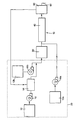
- FIG. 1 is a schematic representation of a reaction system useful for carrying out the polymerization process of the present invention.
- reaction system 10 includes reaction mixture delivery system 20, optional heat exchanger 30, reactor 40, optional devolatization mechanism 50, and outlet 60.
- reaction mixture delivery system 20 includes reaction mixture delivery system 20, optional heat exchanger 30, reactor 40, optional devolatization mechanism 50, and outlet 60.
- Each of these individual elements is known in the art, and none individually are the subject of this invention. Rather, the manner these elements are combined and controlled provide, consistently over time, control over the MW distribution of the polymer produced by the described process. This control advantage is accomplished without the use of any gaseous hydrogen control feed.
- Reaction mixture delivery system 20 comprises component feed supply units 12, 12a, and 12b, purification unit 14, and pumps 16, 16a, and 16b.
- the material fed into the reactor includes, at a minimum, one or more 1-alkene monomers and a catalyst system, which generally includes a catalyst component and a cocatalyst component although some single component catalyst systems are known.
- a catalyst system which generally includes a catalyst component and a cocatalyst component although some single component catalyst systems are known.
- this reaction mixture Prior to entering the reaction zone, this reaction mixture is stored, purified, and delivered to the reactor. Monomer, catalyst, and cocatalyst are stored in component feed supply units 12, 12a, and 12b, respectively.
- the catalyst and cocatalyst components can be stored together, or the cocatalyst can be stored along with the monomer.
- supply unit 12b can be omitted.
- a number of feed supply units 12, 12a, and 12b can be present in reaction system 10. By having all but one of, for example, catalyst feed supply units 12a closed off, one type of catalyst can be used; then, if desired, that unit 12a can be closed and another unit 12a (containing a different catalyst) can be opened.
- Such constructions and their operations are within the capabilities of one of ordinary skill in the art.
- At least one 1-alkene that is a liquid or can be liquified at a temperature of about 20° to about 100°C and a pressure no greater than about 1000 kPa (i.e., about 130 psig) is present in the reaction mixture.
- Those ⁇ -olefins that are liquids or are easily liquified under these conditions include straight chain C 4 -C 24 ⁇ -olefins, and branched C 6 -C 24 ⁇ -olefins such as, for example, 4-methyl-1-pentene, 3-methyl-1-hexene, 4-methyl-1-hexene, 3-methyl-1-pentene, and 3-ethyl-1-pentene.
- Preferred among such monomers are those that are liquids at 20° to 80°C and atmospheric pressure such as, for example, straight chain C 5 -C 18 ⁇ -olefins and 4-methyl-1-pentene.
- preferred monomers are those that polymerize to a non-crystalline polymer, specifically C 5 -C 12 ⁇ -olefins, more preferably C 6 -C 10 ⁇ -olefins.
- preferred monomers include C 12 -C 24 ⁇ -olefins.
- copolymerizable monomers include, for example, polyenes such as C 6 -C 14 ⁇ , ⁇ -dienes, branched dienes, conjugated dienes, trienes, terpenes, cyclic dienes, and alkenyl norbornenes of the formula where m is an integer from 1 to 18; gaseous ⁇ -olefins that cannot be liquified under the previously stated conditions (e.g., ethylene and propylene); and ⁇ -olefins that are waxes or solids at the previously stated conditions but that can be liquified at temperatures up to about 150°C (e.g., C 24 -C 40 ⁇ -olefins).
- polyenes such as C 6 -C 14 ⁇ , ⁇ -dienes, branched dienes, conjugated dienes, trienes, terpenes, cyclic dienes, and alkenyl norbornenes of the formula where m is an integer from 1 to 18
- Suitable ⁇ , ⁇ -polyene containing at least 8 carbon atoms are 1,7-octadiene, 1,8-nonadiene, 1,9-decadiene, 1,10-undecadiene, 1,11-dodecadiene, 1,12-tridecadiene, 1,13-tetradecadiene, 1,4,9-decatriene, 1,5,9-decatriene, 1,6,9-decatriene, 1,5,9,13,17-octadecapentadiene, 1,9,17-octadecatriene, 1,4,7-octatriene and the like.
- 1,7-octadiene and 1,13-tetradecadiene are particularly preferred.
- Examples of branched 1,4-dienes are 4-methyl-1,4-hexadiene, 5-methyl-1,4-hexadiene, 4-ethyl-1,4-hexadiene, 4,5-dimethyl-1,4-hexadiene, 4-methyl-1,4-heptadiene, 4-ethyl-1,4-heptadiene, 5-methyl-1,4-heptadiene, 4-ethyl-1,4-octadiene, 5-methyl-1,4-octadiene and 4-n-propyl-1,4-decadiene.
- 4-methyl-1,4-hexadiene and 5-methyl-1,4-hexadiene are particularly preferred.
- Copolymerizable monomers can be present in amounts ranging up to about 99% (by wt.), especially where lower alkenese are used, preferably up to about 95% (by wt.), more preferably up to about 50% (by wt.).
- 1-alkenes that polymerize to a polymer product that is soluble in the reaction mixture is preferred.
- poly(1-hexene) and poly(1-octene) are soluble in 1-hexene and 1-octene, respectively. These types of monomer-polymer combinations are preferred.
- all components of the reaction mixture be liquids or substantially dissolved in one or more liquid components (at the reaction conditions) is preferred.
- the reaction mixture can include one or more solvents.
- the monomer(s) can be delivered to the reactor in one or more solvents (e.g., liquid alkanes); however, the presence of solvent can lead to increased polymer isolation/purification steps.
- solvents e.g., liquid alkanes
- the reactor feed also contains some type of catalyst system.
- a common catalyst system is a ZN catalyst system, which involves a transition metal compound or complex (e.g., TiCl 3 or TiCl 4 ) and an organometallic cocatalyst.
- Useful ZN catalysts include, for example, AkzoTM Titanium Trichloride AA series catalysts (Akzo Chemicals Inc.; Chicago, IL) and LynxTM catalyst (Catalyst Resources Inc., Houston, TX).
- Useful ZN cocatalysts include, for example, triethylaluminum, diethylaluminum chloride, triisobutyl aluminum, and ethylaluminum sesquichloride.
- ZN catalysts are well known to those of ordinary skill in the art and are not the subject of this invention. Their use is summarized in Odian, “Principles of Polymerization,” (2d ed.), Ch. 8.4 (J. Wiley & Sons, New York, 1981). For a more detailed discussion, see Boor, “Ziegler-Natta Catalysts and Polymerizations,” Ch. 19 (Academic Press, New York, 1979).
- Supported ZN catalysts i.e., a traditional transition metal compound bound to an inorganic substrate
- TiCl 4 supported on MgCl 2 powder is commercially available as LynxTM 715 (Catalyst Resources Inc.). Because such supported ZN catalysts often are more active (on a weight basis) than regular ZN catalysts, lesser amounts can be used.
- Such supported catalysts also can be used as the catalyst system in the process of the present invention.
- Metallocene catalyst systems (which include single-component systems and systems that require a cocatalyst) have come to be recognized as a second broad class of viable catalysts for ⁇ -olefins. They too can be used as the catalyst system in the process of the present invention. As with ZN catalysts, metallocene catalyst systems themselves are not the subject of this invention; rather, they are known to the skilled artisan. Various metallocene catalysts are described in U.S. Patent Nos. 5,296,433, 5,436,305, 5,416,177, 4,530,914, 4,808,561, and 4,892,851.
- One or more solvents or monomers can be used to aid in solubilizing the catalyst and/or cocatalyst or diluting one or both so as to improve metering accuracy.
- a liquid alkane such as hexane or heptane can be used as a solvent.
- Mixing the catalyst components with monomer helps to limit the amount of non-reactive components present in reaction system 10 which, in turn, simplifies isolation/purification of the ultimate polymer product.
- reaction mixtures In addition to the necessary reaction mixture components, other compounds that can modify the properties of the polymer product can be introduced into the reactor. For example, one or more of preformed polymers, inert tackifiers, chain transfer agents, pigments, and fillers can be added to the reaction mixture.
- the monomer(s) is/are impelled from feed supply 12 to purification unit 14 via pump 16.
- catalyst and cocatalyst are fed directly to reactor 40 by pumps 16a and 16b.
- ZN and most metallocene catalysts are notoriously sensitive to a variety of deactivating species including, inter alia, H 2 O and O 2 . Therefore, scrupulous care must be taken to exclude such species from the monomer(s), solvents, and any additives. This is done by purification unit 14.
- Preferred purification methods include sparging the monomer(s) with an inert gas (e.g., N 2 ) and passing the combined stream of the monomer(s) and any solvent to be used in the catalyst and/or cocatalyst solutions through one or more purification columns. Such columns are packed with particles that selectively remove dissolved species. For example, molecular sieves and a variety of desiccants can remove H 2 O while activated copper can remove O 2 from fluids coming into contact therewith. Those skilled in the art are aware of the importance of removal of H 2 O and O 2 from reaction mixture components as well as numerous ways of accomplishing the same.
- an inert gas e.g., N 2
- the monomer(s) stream exiting purification unit 14 preferably has H 2 O and O 2 concentrations below about 100 parts per million (ppm), most preferably at or below 1 ppm.
- Oxygen levels in the combined stream can be measured with, for example, a liquid-phase O 2 sensor (such as are available from, e.g., Orbisphere Laboratories; Geneva, Switzerland), which monitors the partial pressure of O 2 in equilibrium with the liquid components.
- Water levels in the combined stream can be measured with a liquid-phase H 2 O sensor (such as are available from Panametrics Inc.; Waltham, MA).
- Catalyst, cocatalyst, and monomer(s) are then mixed at the inlet of reactor 40 or are introduced through separate inlets and mixed at some point downstream from the inlet end of reactor 40.
- the reaction mixture components are impelled from component feed supply units 12, 12a, and 12b by pumps 16, 16a, and 16b, respectively.
- a pressure feed i.e., a pressurized tank with a control valve
- the components preferably are impelled by pump mechanisms.
- pump designs can be useful in the present invention as long as the pump seal is sufficient to exclude oxygen, water, and similar catalyst deactivating materials out of feed supply units 12, 12a, and 12b.
- Examples of potentially useful pumps include gear pumps, diaphragm pumps, centrifugal pumps, piston pumps, and peristaltic pumps.
- Certain catalyst systems are delivered to reactor 40 in the form of a slurry. Such catalyst systems can settle in feed supply unit 12a and in pump 16a unless care is taken. A mechanism to keep the catalyst system well mixed in feed supply unit 12a is preferred. Examples include multiple agitator blades and a pump-around loop. Alternatively, if thermodynamically feasible and compatible with the end use of the polymer, a thicker fluid (e.g., mineral oil) can be used as the slurrying fluid. Additionally, such catalyst systems preferably are impelled to reactor 40 by means of pump 16a that can easily handle slurries, examples of which include peristaltic and diaphragm pumps.
- pump 16a can easily handle slurries, examples of which include peristaltic and diaphragm pumps.
- the tubing used to transport the reaction mixture components to reactor 40 must be capable of handling high pressure and of essentially excluding those materials capable of deactivating the catalyst and/or cocatalyst being used.
- the tubing must be capable of substantially excluding water and oxygen.
- Useful tubing materials include stainless steel, polypropylene, polyethylene, and polytetrafluoroethylene.
- a peristaltic pump is used as one of pumps 16, 16a, and 16b, the tubing therefor preferably is a fluoroelastomer.
- the rate at which pumps 16, 16a, and 16b impel the reaction mixture components to reactor 40 can be adjusted so that the residence time of the reaction mixture in reactor 40 is at or near a desired level.
- Typical residence times for 10 and 20 L STRs range from as low as five minutes up to about 60 minutes, preferably from about 10 minutes to about 50 minutes, more preferably from about 20 to about 40 minutes, most preferably about 30 minutes. Thirty minutes has been found to allow the catalyst concentration to be maintained at a relatively low level while allowing a sufficient flow of reaction mixture such that a large amount of solvent does not have to be added (for heat transfer purposes).
- monomer feed rate ranges from about 3 L/hour to 120 L/hour or more; catalyst feed rate is maintained such that the catalyst concentration (when the catalyst is a ZN system) in reactor 40 is between about 2 to about 600 ppm and the catalyst concentration in the polymer product is preferably below about 150 ppm, more preferably below about 100 ppm; and cocatalyst feed rate is such that its molar concentration relative to the catalyst is maintained between about 1.5:1 to about 1000:1.
- feed rates and reaction mixture component concentrations can vary with reactor type and degree of polymerization desired.
- Reactor 40 can be any type of reactor design that allows for essentially plug flow of the reaction mixture as well as temperature control. Common examples include STRs, extruders, and static mixers, each of which is discussed separately below. Also, the type of reactor used should be such that the residence time thereof is no more than about 300 minutes, preferably no more than about 60 minutes, more preferably no more than about 45 minutes, most preferably no more than about 30 minutes. Lower residence times can result in less waste during changeover (i.e., a change in the type of monomer or catalyst being used, the ratio of monomers, the amount(s) of catalyst and/or cocatalyst, the targeted I.V., etc.) and substantially reduced response time to process condition changes.
- changeover i.e., a change in the type of monomer or catalyst being used, the ratio of monomers, the amount(s) of catalyst and/or cocatalyst, the targeted I.V., etc.
- reactor 40 Prior to being used in the process of the present invention, reactor 40 preferably is sweetened. Commonly, sweetening is accomplished by filling reactor 40 with a dilute solution of a cocatalyst and allowing it to stand for, e.g., about 24 hours. Thereafter, a gaseous sparge can be used during the removal of the sweetening mixture.
- Reaction mixture components are delivered from purification unit 14 and the catalyst feed storage unit 12a to reactor 40 by means of pressure created by pumps 16, 16a, and 16b. Before reaching reactor 40, the reaction mixture components optionally can pass through heat exchanger 30.
- Optional heat exchanger 30 is used where reactor 40 is to be run at a temperature above or below that which the reaction mixture components have been kept prior to being introduced into reactor 40.
- the reaction mixture preferably enters the first section of reactor 40 at or near 50°C.
- optional heat exchanger 30 can be a preheater that raises the temperature of the combined reaction mixture components (i.e., the reaction mixture) to approximately that of the first section of reactor 40.
- Reactor 40 can be surrounded by a jacket containing a circulating heat transfer fluid (e.g., water, steam, liquid nitrogen, etc.) which serves as the means to remove heat from or add heat to reactor 40 and the contents thereof.
- a circulating heat transfer fluid e.g., water, steam, liquid nitrogen, etc.
- temperature sensing devices e.g., thermometers and/or thermocouples
- the temperature and circulation rate of the heat transfer fluid contained in the jacket can be adjusted manually or automatically (e.g., by means of a computer controlled mechanism).
- reactor 40 can be enclosed by a shroud. Between the exterior of reactor 40 and the shroud is maintained an environment that effectively prevents ignition of any flammable or combustible materials that might be present in or near reaction system 10.
- a shroud and the environment permitted thereby
- general purpose electrical devices e.g., standard heaters and motors
- Such general purpose devices often are more conducive to maintaining a temperature profile or producing essentially plug flow than are devices with higher safety ratings.
- each section of reactor 40 can be maintained at the same (or nearly the same) set temperature, thus ensuring that the reaction mixture encounters a steady temperature profile. Cyclic temperature profiles also are possible. Alternatively, each successive section of reactor 40 can be maintained at a temperature higher (or lower) that the previous section, thus ensuring that the reaction mixture encounters a rising (or falling) temperature profile. Because rate and degree of polymerization depend in part on temperature, the properties of the polymer product can be tailored simply by modifying the temperature profile that the reaction mixture encounters.
- the temperature profile can be changed by changing the temperature of one or more sections. Changing the temperature profile is one way to change the targeted I.V., as discussed previously.
- an essential feature of reactor 40 is the capability to impel, from the input end of reactor 40 to its output end, in an essentially plug flow manner a reaction mixture contained therein.
- essentially plug flow is meant that eddies and dead spots, where reaction mixture can be delayed in its path through reactor 40, and short circuits to the reactor outlet, which allow the reaction mixture to pass too quickly through reactor 40, are virtually nonexistent. This means that a given segment of a reaction mixture continues down the length of reactor 40 with about the same velocity profile as a segment traveling therethrough either earlier or later.
- STRs, extruders, and static mixers all are capable of essentially plug flow.
- the manner in which a reaction mixture is impelled through reactor 40 can be by an external means such as a pressure feed (e.g., a pump) or by an internal means (e.g., a screw in an extruder). Plug flow can be assisted by lateral mixing means (e.g., radial paddles in an STR).
- a pressure feed e.g., a pump
- an internal means e.g., a screw in an extruder
- Plug flow can be assisted by lateral mixing means (e.g., radial paddles in an STR).
- the process of the present invention allows for the production of a poly( ⁇ -olefin) having a targeted I.V. ( ⁇ 0.2 dL/g) within about five residence times of the reactor, preferably within about four residence times of the reactor, more preferably within about three residence times of the reactor, most preferably within about two residence times of the reactor. If, during a particular polymerization, one wishes to change the targeted I.V., the process of the present invention allows for a poly( ⁇ -olefin) with the changed targeted I.V. to be made ( ⁇ 0.2 dL/g) within five residence times, preferably four residence times, more preferably three residence times of the reactor, most preferably two residence times of the reactor, measured from the time the targeted I.V. was changed.
- the I.V. and composition of the polymer product can be measured in real time using devices such as, for example, an on-line refractometer or viscometer. (Although refractometers do not directly measure I.V., their outputs can be used to determine percent conversion, which can be used to determine I.V. once the solution viscosity of the polymer product has been determined.)
- a preferred embodiment of reactor 40 is a stirred tubular reactor (STR), which consists of a series of cylinders joined together so as to form a tube. Down the center of this tube, a shaft having a plurality of paddles radiating therefrom extends along the primary axis of the tube. (Each cylinder can be jacketed as described previously.) As an external drive causes the shaft to rotate, the paddles stir the reaction mixture and assist in heat transfer. In addition, the paddles can be designed such that they assist the pumps and/or pressure head feed systems in propelling the reaction mixture through the tube.
- STRs stirred tubular reactor
- the tube can have a volume ranging from a fraction of a liter to several hundred liters or more depending on the number and radii of the cylinders used.
- the cylinders can be made of glass, tempered glass, various stainless steels, glass-lined steel, or any other material that is nonreactive with a reaction mixture passing therethrough, can exclude potential catalyst deactivating materials (e.g., atmospheric O 2 and H 2 O) from the interior reaction zone, can transfer heat, and can withstand elevated pressure.
- Preferred materials include 316 L stainless steel and low coefficient of expansion-type glass (e.g., PyrexTM glass, available from Corning Glass Works; Corning, NY).
- the cylinders can be joined by means of various types of gaskets and flanges.
- the tube can be horizontal or angled, it preferably is angled upward from its input end to its output end so as to ensure that any inert gas in the STR can escape through the outlet.
- the shaft can be made from a variety of inert metals, preferably stainless steel. Where a ZN catalyst system is to be used in the STR, the shaft preferably is made from a corrosion resistant stainless steel (e.g., 316 L stainless steel). This is because certain ZN catalyst materials (e.g., TiCl 4 ) can create HCl during use.
- a corrosion resistant stainless steel e.g., 316 L stainless steel. This is because certain ZN catalyst materials (e.g., TiCl 4 ) can create HCl during use.
- the shaft can be cooled (if desired). This can be accomplished by running a heat transfer fluid such as water through it.
- the paddles can be designed so as to minimize reaction mixture build-up on the paddles and shaft. Build-up often occurs in stagnant regions, which are normally located on the walls of the tube or on the downstream surfaces of paddles, and can result in reduced heat transfer and plugging of the STR. Because STRs are cleaned less frequently than batch reactors (and because long term continuous operation is desirable), build-up can result in a loss of residence time. Ridding an STR of build-up can result in a loss of production time, the introduction of solvents into the STR can deactivate catalyst during future runs, etc. Build-up and the problems resulting therefrom can be minimized by proper paddle design.
- paddle design can involve the use of cylindrical and/or streamlined designs as well as providing for narrower wall clearances toward the outer end of the STR. (See the Examples section for a description of a preferred type of paddle configuration.)
- Use of paddles with flexible tips can assist in scraping the walls of the tube.
- build-up can be minimized by periodically alternating the direction of paddle rotation. Direction can be alternated every few seconds or minutes (or whatever time frame seems to best inhibit build-up with a particular reaction mixture).
- STRs can convert up to about 100% of monomers in a reaction mixture to polymer. Those polymers that are typically useful in PSA formulations can be made at conversions up to about 35%. Therefore, if an STR is used by itself as reactor 40, a means to recycle unreacted monomer is preferably included (see also discussion infra).
- monomer(s) and any solvents present in the reaction mixture have boiling points that differ significantly. This can assist in separating the monomer(s) from the solvent so that neat monomer(s) can be recycled back to purification unit 14. Actual separation of monomer(s) from any solvent and/or quench solution (see discussion infra) can be accomplished by a variety of distillation methods. Recaptured solvent can be recycled or disposed of, as desired.
- the gaseous comonomer is introduced near the inlet for the other reaction mixture components. Elevated feed pressure is desirable to ensure good solubility of the gaseous comonomer in the liquid monomer. Nevertheless, an arrangement where the liquid reaction mixture fills only the majority of the STR -- leaving a gaseous over-layer -- is possible as long as the paddles are designed such that they repeatedly wipe up a liquid film into the gaseous over-layer.
- the tube of STR preferably is made from a very strong material (e.g., stainless steel) so as to withstand the elevated pressure necessary to assure solubility of the gaseous monomer.
- reactor 40 Another preferred embodiment of reactor 40 is an extruder.
- Extruders are broadly classified as single screw and multi-screw, with twin screw being the dominant version of the latter.
- Multi-screw extruders can be further classified according to the relative direction of the screws, i.e., counter-rotating (where the screws rotate in opposite directions) and co-rotating (where the screws turn in the same direction).
- Counter-rotating twin-screw extruders can be further subclassified according to the manner in which the flights (i.e., the grooves) of the two extruders interact.
- Extruders are commonly available in a variety of sizes, with screw diameters ranging up to about 135 mm. (Even larger versions might be available on a special order basis.) Modular units also are available.
- the length of the extruder barrel preferably is of sufficient length to allow for significant conversion to polymer. In practice, a length-to-diameter ratio of 60:1 (with a screw speed of 50 rpm, which can provide a residence time of about 8.5 minutes) has been found to allow for approximately 95% conversion at 50°C at about 40-45 ppm Ti catalyst and for approximately 95% conversion at 100°C at about 10 ppm Ti catalyst.
- extruder barrels and screws are made from metal alloys (e.g., high chrome steel alloy) with a variety of hardness levels and resistances to corrosion available.
- the screw(s) is/are made from an alloy that is slightly softer than that used in the barrel.
- a cooling solution e.g., chilled water or chilled acetone
- the screw(s) is/are typically driven by one or more motors.
- the motor(s) and the oil pump for the transmission preferably are manufactured so as to be explosion proof, are located away from the extruder in a purged cabinet, or are used in the shrouded system discussed previously.
- the screw configuration can be customized simply by joining various sections.
- large flight advance elements i.e., a fast pitch
- a slow pitch can be used to limit the speed at which reaction mixture proceeds through the extruder.
- a section with a counterflight screw design can be used. Such sections can be alternated with "regular" flight sections to give good pumping while increasing the amount of reaction mixture in the extruder at any given time. Substantially equivalent combinations will be readily apparent to those skilled in the art.
- temperature control of each of the sections is available.
- a heat transfer fluid e.g., chilled water
- the temperature of the fluid can be controlled by an automatic electric heating devices.
- a pressure feed is used. This is accomplished with aforementioned pumps 16, 16a, and 16b or with a simple pressurized feed tank. Where an extruder is used as the second half of an STR-extruder combination (see discussion below), reaction mixture exiting the STR is sufficiently viscous to not require being pressurized.
- a port can be included in the barrel so as to allow a vacuum to be applied to the interior of the extruder.
- a multiple start screw segment preferably a triple start screw segment, is used so as to minimize the amount of reaction mixture in a given flight (i.e., to prevent polymer product from plugging the vacuum port(s)). This type of vacuum can assist in removing unreacted monomer from the reaction mixture.
- inlet ports can be included in the barrel of the extruder. Through these inlets can be introduced one or more copolymerizable monomers (either liquid or gas) and/or adjuvants such as calcium stearate, which can assist in scavenging any HCl produced during the polymerization process. (The use of gaseous comonomers is discussed in more detail infra .)
- residence times can vary from about 60 seconds (at screw speeds of 400 rpm) to about 45 minutes (at screw speeds of 10 rpm).
- the broad range oftimes just specified can be raised or lowered by those skilled in the art through manipulation of internal volume.
- conversion to polymer typically will be less than about 20% whereas, in the latter case, conversion will be nearly 100%.
- an interim speed e.g., 50 rpm normally is used so as to obtain a residence time between about five and ten minutes.
- the range of possible I.V.'s for polymers made in an extruder can extend from 0.6 to about 4.5 dL/g, although polymers with I.V.'s in the range of about 1 to about 4 dL/g are easier to make and process.
- a particular I.V. within this range is obtained by judicious selection of temperature and identity and/or concentration of catalyst system components, which capability is well within that possessed by one of ordinary skill in the art.
- gaseous comonomer preferably is introduced into the extruder near the entry port for the liquid monomer.
- the gaseous monomer feed preferably is not begun until after some of the liquid monomer has been introduced and allowed to react to form a "polymer plug", which acts to keep the gaseous monomer from venting out the outlet or the vacuum port.
- the partial pressure of the gaseous monomer within the extruder is maintained at a level sufficiently high to keep the gaseous monomer soluble in the liquid monomer.
- mer units derived from one or more gaseous monomers can range up to about 30%, although even higher percentages of mer units derived from gaseous monomers are believed to be possible in an optimized system.
- Preferred gaseous monomers include ethylene and propylene.
- the quench solution or compound (if used) is added near the end of the screw(s), preferably just before the vacuum port if one is used.
- Traditional quenching agents can be used. These include water, alcohols, ketones, amines, etc.
- certain materials that traditionally have been used as stabilizers e.g., hindered phenols
- the quench material preferably is soluble in the reaction mixture (due to the fact that the catalyst sites are in the reaction mixture).
- reactor 40 is a combination system where the output of an STR is pumped into the front end of an extruder.
- a combination system can take the moderately converted reaction mixture exiting an STR and allow for further conversion in an extruder. Because the reaction mixture being fed into the extruder is already fairly viscous, the need for a pressurized feed (discussed previously with respect to extruders) is eliminated.
- the STR output is fed to the extruder through a heated line, preferably one that is very short (e.g., up to about three feet)
- Catalyst levels used in an STR typically are lower than those used in an extruder because of the lower conversion levels generally achieved in STRs. Therefore, additional catalyst system components preferably are added to the reaction mixture prior to its entry into the extruder. This allows for very high conversions.
- the material exiting the output end thereof is fairly viscous (i.e., between about 20,000 and several million centipoise).
- a pump can assist in propelling the exiting reaction mixture.
- progressive cavity and/or gear pumps have been found to work well for this purpose.
- a static mixer can be used as reactor 40.
- Static mixers comprise a tube, similar to that used in an STR, with a serious of twisted, stationary blades mounted at various angles throughout the length of the tube. Each section of blades splits and rotates the reaction mixture passing thereby.
- care must be taken to ensure that the catalyst slurry does not settle at the inlet. If that happens, polymerization can occur too quickly, thus plugging the entrance to the static mixer.
- STRs, extruders, and static mixers have been mentioned as examples of useful designs for reactor 40. They are meant to be merely illustrative. Other designs with insubstantial differences (e.g., those that allow for essentially plug flow and temperature control) are within the scope of the present invention when used as reactor 40.
- the target I.V. of the polymer can be changed during a particular polymerization. Should a new target I.V. become desirable during a polymerization run, the process of the present invention allows such a change to be realized within a relatively short amount of time.
- changes in the identity of one or more catalyst system components or in the amount(s) of the catalyst system component(s) can change the I.V. of the polymer product. For example, by increasing the amount of cocatalyst in a ZN catalyst system during a given polymerization, the I.V. of the polymer product can be decreased to a lower targeted I.V.. This lower I.V. material will be within 0.2 dL/g, preferably 0.15 dL/g, more preferably 0.1 dL/g, most preferably 0.05 dL/g of the new targeted I.V. within five residence times of the reactor.
- a quench solution is added to the reaction mixture soon after it exits reactor 40. (Quenching in an extruder was discussed previously.) This can be accomplished by blending the reaction mixture and quench feeds through a simple T-pipe arrangement. To ensure thorough mixing of the two feeds, the combined feed can be fed into another mixer (e.g., a static mixer).
- a static mixer e.g., a static mixer
- thermal stabilizer e.g., high temperature devolatilization of the reaction mixture or hot-melt coating of the polymer
- thermal stabilizers including hindered phenols and phosphites, are widely used in the industry. Whichever stabilizer is used preferably is soluble in the monomer and polymer; otherwise, a solvent will be necessary as a delivery mechanism.
- devolatization mechanism 50 where the polymer product is to be used in pure form (i.e., not mixed with monomer), unreacted monomer can to be stripped out of the reaction mixture by devolatization mechanism 50.
- devolatization mechanism 50 An extruder with the aforementioned vacuum port(s) is used, a separate devolatilization step is unnecessary.
- devolatilization processes include, but are not limited to, vacuum tray drying on, for example, silicone-lined sheets; wiped film and thin film evaporators (where the I.V. of the polymer is not too high); steam stripping; extrusion through a spinneret; and air drying.
- a preferred type of devolatilization mechanism 50 is a Discotherm BTM high viscosity processor (List AG; Acton, MA).
- Discotherm BTM high viscosity processor List AG; Acton, MA.
- Other manufacturers such as Krauss-Maffei Corp. (Florence, KY) and Hosokawa-Bepex (Minneapolis, MN) make similar processors. These types of processors have been found to be efficient in separating polymer product from the remainder of the quenched reaction mixture. If desired, such processors can be maintained at below ambient pressures so that reduced temperatures can be used. Use of reduced pressures permit the recapture of very volatile components without extensive degradation of the polymer.
- reaction mixture i.e., monomer(s), solvent(s), and any quench solution that was used
- quench solution i.e., any quench solution that was used
- the latter option requires that, once condensed, they be separated from each other. This commonly is done by means of distillation; thus, the use of monomer(s) with boiling points that differ significantly from those of the solvent(s) and/or quench solution is preferred.
- Recycled monomer passes through purification unit 14 prior to being reintroduced into reactor 40.
- the polymer product Once the polymer product has been isolated from the remainder of the reaction mixture, it can be collected directly from outlet 60 in a desired container.
- Low I.V. polymers can be collected in drums, whereas higher I.V. polymers can be collected in silicone-lined boxes. (Higher I.V. materials tend to harden into blocks once cooled to ambient temperatures.)
- I.V. measurements are summed and divided by the number of data points to give a mean I.V.
- the 10 L capacity STR consisted of five approximately equal PyrexTM cylinders, each with an outside diameter of 7.62 cm, an inside diameter of 6.99 cm, and a length of 57.2 cm. These were joined together with bored, grooved stainless steel disks.
- the STR was closed off at both ends with stainless steel disks, and the cylindrical sections were enclosed with polycarbonate jackets (0.32 cm thick, 52.1 cm long) equipped with individual temperature sensing devices extending into the interior of the cylindrical sections. These temperature sensing devices permitted the temperature of the reaction mixture in each section to be monitored and adjusted up or down (as necessary) to a set point by varying the amount of steam and/or water flowing into the jacketed sections.
- Extending through the center of the joined cylinders was a 1.27 cm diameter stainless steel shaft suspended along the cylinder axis by three shaft alignment pins extending from each of the end caps and attached to a circular bushing surrounding the shaft in the plane of each bored end cap.
- To the shaft was affixed, via set screws, 43 detachable stainless steel paddles with approximately 3.2 cm between each paddle.
- the paddles consisted of cylinders with a 1.27 cm hole cut through the center of the cylinder perpendicular to the cylinder axis, rectangles with the long end perpendicular to the shaft axis and bent so that the center of the rectangle was wrapped halfway around the shaft, or similarly bent rectangles with smaller windows cut from each end.
- the cylindrical paddles were 1.9 cm in diameter and 2.5 cm long thus providing a clearance from the inner wall of the glass cylinder of approximately 1.0 cm.
- the rectangular paddles were 1.9 mm thick and 4.1 cm wide and 4.8 cm long in reactor sections 1 and 2 (with a resulting clearance of 1.4 cm) or 5.1 cm wide and 5.7 cm long in reactor sections 3 and 4 (with a resulting clearance of 0.6 cm).
- the rectangular paddles with windows were 5.1 cm wide and 5.7 cm long (with a resulting clearance of 0.6 cm).
- Rectangular paddles with a length of 5.7 cm and width varying between 1.3 cm and 2.5 cm were used near the bored end caps to avoid collision with the .
- the paddle configuration used was as follows: in section 1, six cylindrical paddles followed by four rectangular paddles; in section 2, eight rectangular paddles; in section 3, nine rectangular paddles; in section 4, four rectangular paddles followed by four rectangular paddles with windows; and in section 5, one rectangular paddle followed by seven rectangular paddles with windows.
- the shaft was attached to a 2.2 kW variable speed motor and driven at approximately 250 rpm. The direction of the shaft reversed about every minute.
- the construction of the 20 L capacity STR was similar to the 10 L capacity STR with minor exceptions.
- Each section had an outside diameter of 10.2 cm and an inside diameter of 8.9 cm.
- the polycarbonate jacket surrounding each section was 0.64 cm thick.
- a total of 45 paddles were used with a space between paddles ranging from 1.9 cm in section 1, to 2.5 cm in sections 2 and 3, to 3.2 cm in sections 4 and 5.
- the paddle dimensions also were different.
- the cylindrical paddles were 1.9 cm in diameter and 7.0 cm long, the providing a clearance from the inner wall of the glass cylinder of approximately 1.0 cm.
- the rectangular paddles were 1.9 mm thick and 4.1 cm wide and 7.0 cm long in sections 1, 2, and 3 (with a resulting clearance of 1.0 cm).
- the rectangular paddles with windows had windows 3.8 cm wide and 2.5 cm long, were also 1.9 mm thick, and were 5.1 cm wide and 8.7 cm long (with a resulting clearance of 0.1 cm). Rectangular paddles with a length of 7.0 cm and a width 2.9 cm were used near the bored end caps to avoid collision with the shaft alignment pins.
- the paddle configuration used was as follows: in section 1, ten cylindrical paddles followed by three rectangular paddles; in section 2, nine rectangular paddles; in section 3, nine rectangular paddles; in section 4, seven rectangular paddles with windows; and, in section 5, seven rectangular paddles with windows.
- the extruder used was a modular (16 section) intermeshing, counter rotating, twin-screw model (Leistritz AG; Nuremberg, Germany) fitted with a N 2 -purged plenum.
- Intermeshing screw elements on two shafts were configured with fast pitch elements at the beginning of the shafts which tapered to slow pitch elements thereafter.
- adjuvants such as a quenching solution, antioxidants, and the like
- the screw configuration at the addition point used faster pitch elements to permit volume additions.
- the screw configuration at the removal point used triple start screw elements to reduce the reaction mixture volume in the slots of the screws so the reaction mixture would not plug the vacuum ports placed over the triple start screw elements to move the volatile components.
- the diameter of the screw was 50 mm with a length-to-diameter ratio of 60.
- the screws were made from a high alloy, chrome-hardened steel and fitted into water-cooled barrels made from a high alloy, nitrided steel.
- a catalyst - cocatalyst solution was prepared from 0.75 g [1,2-bis(9-fluorenyl-ethylene)]ZrCl 2 (using the method of H.G. Alt et al., J. Organometal. Chem., 472 , 113 (1994)) in 93.3 mL methylaluminoxane (Albemarle Chem. Co., Baton Rouge, LA) and stirred at room temperature for about 30 minutes. This solution was diluted with 1 L dry, O 2 -free toluene.
- Purified 1-octene was preheated to approximately 55°C. Heated monomer (at a rate of 234.0 g/min) and the toluene-diluted catalyst - cocatalyst solution (at 308 kPa pressure and a rate of 5.2 g/min) were pumped into the 10 L capacity STR. A color change was observed when the catalyst - cocatalyst solution contacted the monomer.
- the temperature of the reaction mixture in each of the five reactor sections was maintained at about 55°C. Residence time of the reaction mixture in the STR was about 30 minutes. As the reaction mixture exited the STR, it was combined with a 95:5 isopropanol - deionized water quench solution flowing through a T-pipe connector at a rate of 8 g/min.
- the quenched mixture i.e., reaction mixture combined with quench solution
- quench solution was passed into a 46 cm KenicsTM Static Mixer (Chemineer, Inc.; North Andover, MA) with 1.9 cm stainless steel static mixing elements (i.e., an interlocking segment that channels fluid in a spiral path) so as to thoroughly mix the two components and deactivate any remaining active catalyst.
- Volatile components e.g., unreacted monomer and quench solution
- Volatile components were removed by placing each sample in a vacuum oven, set at a temperature of approximately 65°C and a pressure of approximately 10 mm Hg, for about 60 minutes.
- the I.V. of the polyoctene was determined in a Size 50 Cannon-Fenske Solution Viscometer (Cole-Parmer Instrument Co.; Niles, IL), using a 0.1 g/dL solution of polymer in toluene at 25°C. The data from these measurements are shown in Table 1.
- the mean I.V. was 0.58 ⁇ 0.04 dL/g (95% confidence) with a standard deviation of 0.04. This shows that the I.V. of polyoctene made in an STR with a metallocene catalyst can be kept fairly stable over time when the reaction mixture temperature is kept relatively constant.
- Polyoctene was prepared according to the procedure of Example 1 with some modifications.
- the temperature of the reaction mixture in each section of the STR was maintained at approximately 70°C. The reaction was continued for 240 minutes. Samples of the quenched reaction mixture were taken every 30 minutes beginning 60 minutes after the onset of reaction.
- the mean I.V. was 0.95 ⁇ 0.16 dL/g (95% confidence) with a standard deviation of 0.15. This shows that the I.V. of a low MW polyoctene made in an STR with a supported ZN catalyst can be kept fairly stable over time when the reaction mixture temperature is kept relatively constant.
- Polyoctene was prepared in a 20 L capacity STR according to the procedure of Example 2 with some modifications.
- Purified 1-octene was fed at a rate of 435.9 g/min.
- the cocatalyst solution was AlEt 3 - heptane and 1-octene in a ratio of 38:1000.
- the catalyst suspension was LynxTM 715 catalyst and purified 1-octene in a ratio of 5.9:10,000, which was fed into the STR at a rate of 25.3 g/min. Samples of the quenched reaction mixture were taken every 30 minutes beginning 80 minutes after the onset of reaction.
- the mean I.V. was 1.30 ⁇ 0.08 dL/g (95% confidence) with a standard deviation of 0.08. This shows that the I.V. of polyoctene made in an STR with a supported ZN catalyst can be kept fairly stable over time when the reaction mixture temperature is kept relatively constant.
- Polyhexene was prepared according to the procedure of Example 3 with some modifications, including the substitution of 1-hexene for 1-octene.
- the cocatalyst solution was a 73:100 mixture of a 25% AlEt 3 -heptane in purified 1-hexene.
- the catalyst suspension was a 123.3:10,000 mixture of a 123.3:10,000 mixture of LynxTM 900, a 19.6% solids slurry of unsupported TiCl 3 in hexane (Catalyst Resources Inc.) and additional hexane.
- the mean I.V. was 2.37 ⁇ 0.02 dL/g (95% confidence) with a standard deviation of 0.05. This shows that the I.V. of polyhexene made in an STR with an unsupported ZN catalyst can be kept fairly stable over time when the reaction mixture temperature is kept relatively constant.
- Polyoctene was prepared according to the procedure of Example 3 with minor modifications.
- the cocatalyst solution was AlEt 3 - heptane and purified 1-octene in a ratio of 247:1000, and the catalyst suspension was LynxTM 900 catalyst and hexane in a ratio of 73.1:10,000.
- the mean I.V. was 2.54 dL/g with a standard deviation of 0.06. This shows that the I.V. of polyoctene made in an STR with an unsupported ZN catalyst can be kept fairly stable over time when the reaction mixture temperature is kept relatively constant.
- Polyoctene was prepared according to the procedure of Example 5 with some modifications.
- the ratio of AlEt 3 - heptane to purified 1-octene in the cocatalyst stream was 86:1000, and the ratio of LynxTM 900 catalyst to hexane in the catalyst mixture was 62.6:10,000.
- Purified 1-octene was fed at a rate of 435.9 g/min, and cocatalyst solution was fed at a rate of 8.63 g/min.
- the reaction was continued for 250 minutes, and six samples of the quenched reaction mixture were taken at thirty minute intervals.
- the mean I.V. was 3.08 ⁇ 0.07 dL/g (95% confidence) with a standard deviation of 0.06. This shows that the I.V. of polyoctene made in an STR with an unsupported ZN catalyst can be kept fairly stable over time when the reaction mixture temperature increased in a uniform, controlled manner (here, from 40° to 70°C).
- Polyoctene was prepared according to the procedure of Example 5 with some modifications.
- the cocatalyst solution was AlEt 3 - heptane and purified 1-octene in a ratio of 22:1000, and the catalyst suspension was LynxTM 900 catalyst and hexane in a ratio of 56.3:10,000.
- Purified 1-octene was fed at a rate of 435.9 g/min, and cocatalyst solution was fed at a rate of 13.41 g/min.
- the reaction was continued for 250 minutes, and eight samples were taken at different times beginning 53 minutes after the run began.
- the mean I.V. was 3.43 ⁇ 0.07 dL/g (95% confidence) with a standard deviation of 0.08 This shows that the I.V. of a relatively high MW polyoctene made in an STR with an unsupported ZN catalyst can be kept fairly stable over time when the reaction mixture temperature is kept relatively constant.
- Polyoctene was prepared according to the procedure of Example 2 with some modifications.
- a cocatalyst solution of 25% solids AlEt 3 - heptane and purified 1-octene was mixed in a ratio of 21:1000, and the catalyst suspension was LynxTM 900 catalyst and hexane in a ratio of 58.4:10,000.
- the preheat temperature and the five zone temperatures were all approximately 40°C.
- reaction was continued for 280 minutes. Six samples of the quenched reaction mixture were taken at different times beginning 60 minutes after the onset of reaction.
- the mean I.V. was 4.70 ⁇ 0,15 dL/g (95% confidence) with a standard deviation of 0.12. This shows that the I.V. of a high MW polyoctene made in an STR with an unsupported ZN catalyst can be kept fairly stable over time when the reaction mixture temperature is kept relatively constant.
- Polyoctene was prepared according to the procedure of Example 2 with certain modifications, including an extruder being used in place of a 10 L STR.
- the cocatalyst solution was AlEt 3 - heptane and purified 1-octene in a ratio of 12.9:1000, and the catalyst suspension was LynxTM 715 catalyst and purified 1-octene in a ratio of 79.7:10,000.
- Purified 1-octene at a rate of 138.8 g/min
- cocatalyst solution at a rate of 24.0 g/min
- catalyst suspension at a rate of 41.9 g/min
- the catalyst suspension was pumped to the first section using a peristaltic pump.
- Twin inlets were used such that the monomer - cocatalyst solution and the catalyst suspension met above the screw elements in that section.
- the temperature of each zone of the extruder was set at approximately 45°C, and temperature probes in the extruder sections showed that the temperature of the reaction mixture was controlled at or near the set points.
- the extruder screw speed was set at 51 rpm, which gave an approximate residence time of 8.5 minutes. No quench solution was used.
- reaction was continued for 215 minutes, and samples were taken at various times beginning 85 minutes after the onset of reaction.
- the mean I.V. was 1.68 ⁇ 0.04 dL/g (95% confidence) with a standard deviation of 0.03. This shows that the I.V. of polyoctene made in an extruder with a supported ZN catalyst can be kept fairly stable over time when the reaction mixture temperature is kept relatively constant.
- Polyoctene was prepared according to the procedure of Example 9 with minor modifications.
- the cocatalyst solution was AlEt 3 - heptane and purified 1-octene in a ratio of 2.3:1000, and the catalyst suspension was LynxTM 715 catalyst and purified 1-octene in a ratio of 26.8:1,000.
- Purified 1-octene (at a rate of 25.6 g/min), cocatalyst solution (at a rate of 49.1 g/min), and catalyst suspension (at a rate of 48.1 g/min) were fed into the extruder.
- each section of the extruder was maintained at approximately 50°C, except section 14, which was maintained at 85°C, and section 15, which was maintained at 170°C.
- the screw configuration on the shafts comprised both fast pitch and slow pitch screw elements.
- a vacuum port was installed over the last section, and a gear pump was used to pump the extrudate.
- Stabilizer solution composed of IrganoxTM 1076 antioxidant (Ciba-Geigy Corp.; Greensboro, NC) and purified 1-octene in a ratio of 137.3:1000, was fed at a rate of 5 g/min into the penultimate zone. Most of the volatile components were removed through the vacuum port.
- reaction was continued for 208 minutes, and samples were taken at various times beginning 49 minutes after the onset of reaction.
- the mean I.V. was 2.94 ⁇ 0,15 dL/g (95% confidence) with a standard deviation of 0.15. This shows that the I.V. of polyoctene made in an extruder with a supported ZN catalyst can be kept fairly stable over time when the reaction mixture temperature is kept relatively constant except for the last two zones.
- Polyhexene was prepared according to the procedure of Example 9 with minor modifications, including the use of 1-hexene instead of 1-octene as both the monomer feed and diluent for the cocatalyst solution and catalyst suspension.
- the cocatalyst solution was AlEt 3 - heptane and purified 1-hexene in a ratio of 10.2:1000, and the catalyst suspension was LynxTM 715 catalyst and purified 1-hexene in a ratio of 62.8:10,000.
- Purified 1-hexene at a rate of 92.5 g/min
- cocatalyst solution at a rate of 22.4 g/min
- catalyst suspension at a rate of 39.3 g/min
- the extruder screw speed was set at 40 rpm, which gave an approximate residence time of 10.7 minutes.
- the reaction was continued for 235 minutes, and samples were taken at various times beginning 21 minutes after the onset of reaction.
- the mean I.V. was 1.58 ⁇ 0.05 dL/g (95% confidence) with a standard deviation of 0.08. This shows that the I.V. of polyhexene made in an extruder with a supported ZN catalyst can be kept fairly stable over time when the reaction mixture temperature is kept relatively constant.
- Polyhexene was prepared according to the procedure of Example 11 with some modifications.
- the cocatalyst solution was AlEt 3 - heptane and purified 1-hexene in a ratio of 8.6:1000, and the catalyst suspension was LynxTM 715 catalyst and purified 1-hexene in a ratio of 70.7:10,000.
- Purified 1-octene at a rate of 99.3 g/min
- cocatalyst solution at a rate of 19.9 g/min
- catalyst suspension at a rate of 34.9 g/min
- the mean I.V. was 2.44 ⁇ 0.12 dL/g (95% confidence) with a standard deviation of 0.11. This shows that the I.V. of polyhexene made in an extruder with a supported ZN catalyst can be kept fairly stable over time when the reaction mixture temperature is kept relatively constant.
- Polyhexene was prepared according to the procedure of Example 12 with some modifications.
- the cocatalyst solution was AlEt 3 - heptane and purified 1-hexene in a ratio of 8.4:1000, and the catalyst suspension was LynxTM 715 catalyst and purified 1-hexene in a ratio of 83.2:10,000.
- the temperature of each zone of the extruder was maintained at approximately 40°C. The reaction was continued for 300 minutes, and samples were taken at various times beginning 43 minutes after the onset of reaction.
- the mean I.V. was 2.67 ⁇ 0.08 dL/g (95% confidence) with a standard deviation of 0.08. This shows that the I.V. of polyhexene made in an extruder with a supported ZN catalyst can be kept fairly stable over time when the reaction mixture temperature is kept relatively constant.
- Copoly(octene-propylene) was prepared according to the procedure of Example 9 with minor modifications.
- the monomer feed consisted of a 90:10 mixture of purified 1-octene and purified liquid propylene (Matheson Gas Products, Inc.; Montgomeryville, PA) that had been passed through a MathesonTM Gas Purifier Model 6406A (Matheson Gas Prods.) to reduce the water and oxygen concentrations to less than 1 ppm.
- the propylene was added under pressure (above 618 kPa so as to be maintained as a liquid) to a cylinder containing purified 1-octene, and both were shaken in the cylinder for approximately one minute to form a monomer mixture.
- the cocatalyst solution was AlEt 3 - heptane and purified 1-octene in a ratio of 6.9:1000, and the catalyst suspension was LynxTM 715 catalyst and purified 1-octene in a ratio of 42.4:10,000.
- Purified 1-octene (at a rate of 27.6 g/min), cocatalyst solution (at a rate of 26.9 g/min), and catalyst suspension (at a rate of 47.1 g/min) were fed into the extruder for approximately 20 minutes, set at a screw speed of 25 rpm (which gave an approximate residence time of 17.1 minutes), until a polymer plug was formed in the extruder.
- Purified 1-octene feed was then replaced with purified monomer mixture at the same feed rate.
- the temperature of each zone of the extruder was maintained at approximately 30°C.
- the reaction was run continued 136 minutes, and samples were taken at various times beginning 34 minutes after the onset of reaction.
- the mean I.V. was 2.93 ⁇ 0.15 dL/g (95% confidence) with a standard deviation of 0.09. This shows that the I.V. of copoly(octene-propylene) made in an extruder with a supported ZN catalyst can be kept fairly stable over time when the reactor reaction mixture temperature is kept relatively constant.
- Polyhexene was prepared according to the procedure of Example 11 with some modifications.
- the exiting reaction mixture was immediately conveyed via a flexible hose connection, into the first zone of an extruder along with additional cocatalyst solution, consisting of AlEt 3 - heptane and purified 1-hexene in a ratio of 46.7:1000 (at a rate of 22.4 g/min) and additional catalyst suspension, consisting of LynxTM 715 catalyst and purified 1-hexene in a ratio of 80.6:10,000 (at a rate of 37.9 g/min).
- the temperature of each section of the extruder was maintained at approximately 45°C.
- the extruder screw speed was set at 51 rpm, which gave an approximate residence time of 8.4 minutes.
- the mean I.V. was 1.07 ⁇ 0.04 dL/g (95% confidence) with a standard deviation of 0.03. This shows that the I.V. of polyhexene made in an STR - extruder combination can be kept fairly stable over time when the reaction mixture temperature of both the STR and extruder are kept relatively constant.
- Copoly(octene-hexene) was prepared substantially according to the procedure of Example 2 with minor modifications.
- the monomer feed consisted of a purified 1-octene monomer feed fed into the first section and a purified 1-hexene monomer feed fed into the downstream end of the second section.
- the cocatalyst solution was 25% AlEt 3 - heptane and purified 1-hexene monomer in a ratio of 121:1000, and the catalyst suspension was LynxTM 900 catalyst and hexane in a ratio of 61.4:10,000.
- Purified 1-hexene monomer (at a rate of 170.9 g/min), purified 1-octene monomer (at a rate of 56.9 g/min), cocatalyst solution (at a rate of 12.6 g/min), and the catalyst suspension (at a rate of 25.8 g/min) were fed into the STR.
- the preheat temperature and the five section temperatures were all controlled to approximately 55°C.
- the reaction was continued for 150 minutes, and samples of the quenched reaction mixture were taken at five different times beginning 45 minutes after the onset of reaction.
- the mean I.V. was 2.32 ⁇ 0.05 dL/g (95% confidence) with a standard deviation of 0.08. This shows that the I.V. of the copoly(octene-hexene) can be kept fairly stable over time when the reaction mixture temperature is kept relatively constant.
- Copoly(octene-propylene) copolymer was prepared substantially according to the procedure of Example 15 with minor modifications.
- the monomer feed consisted of a 81.8:18.2 mixture of purified 1-octene monomer and purified liquid propylene monomer.
- the cocatalyst solution was AlEt 3 - heptane, purified 1-octene monomer, and polypropylene monomer in a ratio of 0.9:83.1:16.0 and the catalyst suspension was LynxTM 715 catalyst and purified 1-octene monomer in a ratio of 42.6:10,000.
- the purified monomer mixture at a rate of 20.9 g/min
- the cocatalyst solution at a rate of 33.2 g/min
- the catalyst suspension at a rate of 46.9 g/min
- reaction was continued for 136 minutes, and samples were taken at various times beginning 34 minutes after the onset of reaction.
- the mean I.V. was 1.35 ⁇ 0.05 dL/g (95% confidence) with a standard deviation of 0.05. This shows that the I.V. of the copoly(octene-propylene) copolymer can be kept fairly stable over time when the reaction mixture temperature is kept relatively constant.
- Polyoctene was prepared substantially according to the procedure of Example 8 with minor modifications.
- the monomer feed consisted of a purified 1-octene monomer fed into the first section.
- the cocatalyst solution was 25% AlEt 3 - heptane and purified 1-octene monomer in a ratio of 31:1000
- the catalyst suspension was LynxTM 900 catalyst and hexane in a ratio of 26.0:10,000.
- the preheat temperature and the five zone temperatures were all approximately 70°C.
- the flow rates of the monomer, cocatalyst solution, catalyst suspension, and quench solution were 193.1 g/min, 17.9 g/min, 27.5 g/min and 10 g/min, respectively.
- the reaction was continued for 125 minutes during which six samples of the quenched reaction mixture were taken at different times beginning 50 minutes after the onset of reaction.
- the monomer flow rate was increased to 202.0 g/min, and the cocatalyst flow rate was decreased to 8.9 g/min.
- the reaction was continued for an additional 110 minutes until 235 minutes had elapsed since the onset of reaction. Eight samples of the quenched mixture were taken at different times over the 110 minutes. Because the residence time of the reactor was 30 minutes, samples taken up to 155 minutes after onset of reaction were of polymer from the first set of conditions and samples taken after 155 minutes were of polymer from the second set of conditions.
- the mean I.V. of the first eight samples was 2.43 ⁇ 0.05 dL/g (95% confidence) with a standard deviation of 0.06.
- the initial targeted I.V. was 2.4 dL/g.
- the mean I.V. of the last six samples was 3.06 ⁇ 0.14 dL/g (95% confidence) with a standard deviation of 0.13.
- the second targeted I.V. was 3.1 dL/g.
- STRs and extruders can be used to make homo- and copolymers (from 1-alkenes) with predetermined I.V.'s (i.e., MWs).
- I.V.'s i.e., MWs.
- the examples can be summarized as follows: Example No. Targeted I.V. Monomer Catalyst Reactor Temp.
Landscapes
- Chemical & Material Sciences (AREA)
- Chemical Kinetics & Catalysis (AREA)
- Organic Chemistry (AREA)
- Health & Medical Sciences (AREA)
- Medicinal Chemistry (AREA)
- Polymers & Plastics (AREA)
- Polymerisation Methods In General (AREA)
- Addition Polymer Or Copolymer, Post-Treatments, Or Chemical Modifications (AREA)
Applications Claiming Priority (3)
| Application Number | Priority Date | Filing Date | Title |
|---|---|---|---|
| US644611 | 1991-01-22 | ||
| US08/644,611 US5644007A (en) | 1996-04-26 | 1996-04-26 | Continuous process for the production of poly(1-alkenes) |
| PCT/US1996/018776 WO1997041162A1 (en) | 1996-04-26 | 1996-11-21 | Continuous process for the production of poly(1-alkenes) |
Publications (2)
| Publication Number | Publication Date |
|---|---|
| EP0895515A1 EP0895515A1 (en) | 1999-02-10 |
| EP0895515B1 true EP0895515B1 (en) | 2000-09-13 |
Family
ID=24585632
Family Applications (1)
| Application Number | Title | Priority Date | Filing Date |
|---|---|---|---|
| EP96942043A Expired - Lifetime EP0895515B1 (en) | 1996-04-26 | 1996-11-21 | Continuous process for the production of poly(1-alkenes) |
Country Status (9)
| Country | Link |
|---|---|
| US (1) | US5644007A (enExample) |
| EP (1) | EP0895515B1 (enExample) |
| JP (1) | JP3856840B2 (enExample) |
| KR (1) | KR20000028539A (enExample) |
| CN (1) | CN1217000A (enExample) |
| AU (1) | AU1122297A (enExample) |
| CA (1) | CA2253709A1 (enExample) |
| DE (1) | DE69610338T2 (enExample) |
| WO (1) | WO1997041162A1 (enExample) |
Families Citing this family (41)
| Publication number | Priority date | Publication date | Assignee | Title |
|---|---|---|---|---|
| US6015779A (en) | 1996-03-19 | 2000-01-18 | Energy & Environmental International, L.C. | Methods for forming amorphous ultra-high molecular weight polyalphaolefin drag reducing agents |
| JP3836228B2 (ja) * | 1996-12-26 | 2006-10-25 | 三井化学株式会社 | 分離流による重合方法 |
| US6177190B1 (en) | 1998-05-29 | 2001-01-23 | 3M Innovative Properties Company | Radiation curable poly(1-alkene) based pressure-sensitive adhesives |
| US6160086A (en) * | 1998-07-30 | 2000-12-12 | 3M Innovative Properties Company | Process for removing impurities from polymers |
| US6176957B1 (en) | 1999-03-15 | 2001-01-23 | 3M Innovative Properties Company | Method of removing temporary tape from a laminated assembly with a coversheet |
| US6306983B1 (en) | 1999-05-14 | 2001-10-23 | 3M Innovative Properties Company | Ziegler-Natta polymerization of alpha-olefins in the presence of non-polymerizing olefins |
| JP4151058B2 (ja) * | 1999-05-27 | 2008-09-17 | Jsr株式会社 | ポリアミック酸、ポリイミド、液晶配向剤および液晶表示素子 |
| US6448353B1 (en) | 2000-02-08 | 2002-09-10 | 3M Innovative Properties Company | Continuous process for the production of controlled architecture materials |
| US6632872B1 (en) | 2000-09-19 | 2003-10-14 | 3M Innovative Properties Company | Adhesive compositions including self-assembling molecules, adhesives, articles, and methods |
| US6544643B1 (en) | 2000-09-26 | 2003-04-08 | 3M Innovative Properties Company | Pressure sensitive adhesive comprising poly(1-alkene) elastomer and multifunctional (meth)acrylate, articles prepared therefrom and a method of making |
| JP4495846B2 (ja) * | 2000-10-19 | 2010-07-07 | 日本ポリプロ株式会社 | α−オレフィンの重合方法 |
| US6815011B2 (en) | 2000-11-27 | 2004-11-09 | Energy & Environmental International, L.C. | Alpha olefin monomer partitioning agents for drag reducing agents and methods of forming drag reducing agents using alpha olefin monomer partitioning agents |
| EP1351998B1 (en) | 2001-01-16 | 2010-02-24 | BETA Technologie AG | Methods for forming amorphous ultra-high molecular weight polyolefins for use as drag reducing agents |
| US7514263B2 (en) * | 2001-04-02 | 2009-04-07 | 3M Innovative Properties Company | Continuous process for the production of combinatorial libraries of materials |
| US6617020B2 (en) | 2001-04-04 | 2003-09-09 | 3M Innovative Properties Company | Hot melt processable pressure sensitive adhesive comprising organophilic clay plate-like particles, a method of making, and articles made therefrom |
| US7012046B2 (en) * | 2001-06-08 | 2006-03-14 | Eaton Gerald B | Drag reducing agent slurries having alfol alcohols and processes for forming drag reducing agent slurries having alfol alcohols |
| RU2297877C2 (ru) | 2001-06-13 | 2007-04-27 | Энерджи Энд Энвиронментал Интернэшнл, Л.К. | Реакторы для полимеризации в объеме и способы такой полимеризации |
| CN1329110C (zh) * | 2001-09-26 | 2007-08-01 | 伊内奥斯美国公司 | 一体化的化工工艺控制 |
| US6962946B2 (en) | 2001-11-21 | 2005-11-08 | 3M Innovative Properties Company | Nanoparticles having a rutile-like crystalline phase and method of preparing same |
| WO2003046054A2 (en) * | 2001-11-29 | 2003-06-05 | Parallel Solutions, Inc. | Copolymer libraries and production and use thereof |
| US6686026B2 (en) | 2002-04-08 | 2004-02-03 | 3M Innovative Properties Company | Micro-channeled protective film |
| US7157283B2 (en) * | 2002-08-02 | 2007-01-02 | 3M Innovative Properties Company | Continuous process for the production of combinatorial libraries of modified materials |
| US6903173B2 (en) * | 2002-08-02 | 2005-06-07 | 3M Innovative Properties Co. | Fluorinated polymers |
| US7632916B2 (en) * | 2002-08-02 | 2009-12-15 | 3M Innovative Properties Company | Process to modify polymeric materials and resulting compositions |
| WO2004040283A2 (en) * | 2002-10-28 | 2004-05-13 | Bp Corporation North America Inc. | Control of a polymerization process |
| US6716935B1 (en) | 2002-12-19 | 2004-04-06 | 3M Innovative Properties Company | Continuous process for the production of controlled architecture materials under high solids loading conditions |
| US6969490B2 (en) * | 2003-06-26 | 2005-11-29 | 3M Innovative Properties Company | Device for the continuous process for the production of controlled architecture materials |
| US6842288B1 (en) | 2003-10-30 | 2005-01-11 | 3M Innovative Properties Company | Multilayer optical adhesives and articles |
| JP4116529B2 (ja) * | 2003-12-01 | 2008-07-09 | 日東電工株式会社 | 素練りゴムの製造方法 |
| EP1660231B1 (en) * | 2004-02-13 | 2007-04-18 | Total Petrochemicals Research Feluy | Method and apparatus for preparing and supplying catalyst slurry to a polymerisation reactor |
| DE102005031114A1 (de) | 2005-07-04 | 2007-01-18 | Basf Ag | Verwendung einer Vorrichtung zur Zugabe mindestens eines Zusatzstoffes in einen Reaktorinnenraum |
| EP2382247B1 (en) * | 2009-01-23 | 2012-10-24 | Evonik Oxeno GmbH | Pe mib slurry polymerization |
| CN102190832B (zh) * | 2010-03-12 | 2013-06-12 | 青岛科技大学 | 聚1-丁烯弹性体材料的制备方法 |
| EP2885363B1 (en) | 2012-08-14 | 2018-02-07 | 3M Innovative Properties Company | Adhesives comprising grafted isobutylene copolymer |
| CN105664830B (zh) * | 2016-02-04 | 2017-12-12 | 河南心连心化肥有限公司 | 一体化管式反应装置及其反应方法 |
| WO2019166936A1 (en) | 2018-02-28 | 2019-09-06 | 3M Innovative Properties Company | Coextruded polymeric article and method of making the same |
| EP3758912B1 (en) | 2018-02-28 | 2025-06-04 | 3M Innovative Properties Company | Coextruded polymeric article and method of making the same |
| EP3902885A4 (en) | 2018-12-28 | 2022-09-21 | Saint-Gobain Performance Plastics Corporation | ADHESIVE COMPOSITIONS AND METHODS OF MAKING THEREOF |
| WO2020139673A1 (en) | 2018-12-28 | 2020-07-02 | Saint-Gobain Performance Plastics Corporation | Adhesive composition and methods of forming the same |
| US20210094253A1 (en) * | 2019-09-27 | 2021-04-01 | Saint-Gobain Performance Plastics Corporation | Multilayer tube and method for making same |
| CN114524894B (zh) * | 2022-02-22 | 2023-07-25 | 拓烯科技(衢州)有限公司 | 一种聚4-甲基-1-戊烯的制备方法 |
Family Cites Families (18)
| Publication number | Priority date | Publication date | Assignee | Title |
|---|---|---|---|---|
| US2894824A (en) * | 1955-02-11 | 1959-07-14 | Phillips Petroleum Co | Polymerization apparatus |
| US3074922A (en) * | 1958-07-21 | 1963-01-22 | Phillips Petroleum Co | Polymerization process and apparatus |
| DE1594063A1 (de) * | 1965-08-27 | 1970-07-09 | Johnson & Johnson | Druckempfindliche selbstklebende Folien und Baender |
| CH496791A (de) * | 1967-03-08 | 1970-09-30 | Geigy Ag J R | Klebstoffmassen |
| DE2436259A1 (de) * | 1974-07-27 | 1976-02-12 | Erdoelchemie Gmbh | Verfahren zur substanzpolymerisation von alpha-olefinen |
| US3954697A (en) * | 1975-03-31 | 1976-05-04 | Eastman Kodak Company | Poly(higher-1-olefin-co-propylene) copolymers as hot-melt, pressure-sensitive adhesives |
| US4071325A (en) * | 1976-08-16 | 1978-01-31 | National Distillers And Chemical Corporation | Ethylene polymerization reactor |
| US4178272A (en) * | 1977-03-02 | 1979-12-11 | Eastman Kodak Company | Hot-melt adhesvies for bonding polyethylene |
| US4288358A (en) * | 1979-08-30 | 1981-09-08 | Eastman Kodak Company | Blends of propylene/1-butene or 1-pentene/higher α-olefin copolymers, compatible tackifying resins and plasticizing oils useful as hot-melt, pressure-sensitive adhesives |
| US4482687A (en) * | 1979-10-26 | 1984-11-13 | Union Carbide Corporation | Preparation of low-density ethylene copolymers in fluid bed reactor |
| JPS57101A (en) * | 1980-06-04 | 1982-01-05 | Mitsui Petrochem Ind Ltd | Method and apparatus for polymerization |
| US4530914A (en) * | 1983-06-06 | 1985-07-23 | Exxon Research & Engineering Co. | Process and catalyst for producing polyethylene having a broad molecular weight distribution |
| US4792595A (en) * | 1983-06-15 | 1988-12-20 | Exxon Research & Engineering Co. | Narrow MWD alpha-olefin copolymers |
| US4808561A (en) * | 1985-06-21 | 1989-02-28 | Exxon Chemical Patents Inc. | Supported polymerization catalyst |
| US4892851A (en) * | 1988-07-15 | 1990-01-09 | Fina Technology, Inc. | Process and catalyst for producing syndiotactic polyolefins |
| US5436305A (en) * | 1991-05-09 | 1995-07-25 | Phillips Petroleum Company | Organometallic fluorenyl compounds, preparation, and use |
| US5296433A (en) * | 1992-04-14 | 1994-03-22 | Minnesota Mining And Manufacturing Company | Tris(pentafluorophenyl)borane complexes and catalysts derived therefrom |
| US5521263A (en) * | 1994-10-18 | 1996-05-28 | Eastman Chemical Company | Catalysts and synthesis of high molecular weight amorphous polyolefins and recovery thereof |
-
1996
- 1996-04-26 US US08/644,611 patent/US5644007A/en not_active Expired - Lifetime
- 1996-11-21 DE DE69610338T patent/DE69610338T2/de not_active Expired - Lifetime
- 1996-11-21 JP JP53884897A patent/JP3856840B2/ja not_active Expired - Lifetime
- 1996-11-21 CN CN96180267A patent/CN1217000A/zh active Pending
- 1996-11-21 CA CA002253709A patent/CA2253709A1/en not_active Abandoned
- 1996-11-21 WO PCT/US1996/018776 patent/WO1997041162A1/en not_active Ceased
- 1996-11-21 KR KR1019980708564A patent/KR20000028539A/ko not_active Withdrawn
- 1996-11-21 EP EP96942043A patent/EP0895515B1/en not_active Expired - Lifetime
- 1996-11-21 AU AU11222/97A patent/AU1122297A/en not_active Abandoned
Also Published As
| Publication number | Publication date |
|---|---|
| DE69610338D1 (de) | 2000-10-19 |
| US5644007A (en) | 1997-07-01 |
| WO1997041162A1 (en) | 1997-11-06 |
| KR20000028539A (ko) | 2000-05-25 |
| JP3856840B2 (ja) | 2006-12-13 |
| AU1122297A (en) | 1997-11-19 |
| EP0895515A1 (en) | 1999-02-10 |
| CA2253709A1 (en) | 1997-11-06 |
| JP2000509095A (ja) | 2000-07-18 |
| CN1217000A (zh) | 1999-05-19 |
| DE69610338T2 (de) | 2001-05-31 |
Similar Documents
| Publication | Publication Date | Title |
|---|---|---|
| US5644007A (en) | Continuous process for the production of poly(1-alkenes) | |
| US6319996B1 (en) | Polymerization process using a dual shear mixing element | |
| AU694830B2 (en) | Method for preventing fouling in polymerization reactors | |
| KR101412845B1 (ko) | 무수 무용매 중합체의 제조 방법 | |
| WO2001058962A1 (en) | Continuous process for the production of controlled architecture materials | |
| US4845178A (en) | Polymerization process | |
| US4384089A (en) | Low temperature polymerization process | |
| US11291973B2 (en) | Reactor and method for continuous polymerization | |
| US3513145A (en) | Continuous mass polymerization processes | |
| JP2001192415A (ja) | 長鎖枝分かれを有するオレフィンポリマーの製造法 | |
| WO2002081079A2 (en) | A continuous process for the production of combinatorial libraries of materials | |
| WO2004060927A1 (en) | Continuous process for the production of controlled architecture materials under high solids loading conditions | |
| EA011774B1 (ru) | Способ полимеризации в суспензионной фазе и реактор для его осуществления | |
| US4058654A (en) | Process for the bulk polymerization of α-olefins | |
| US5372418A (en) | Back mix drag-flow apparatus | |
| EP4251312A1 (en) | Catalyst feed system | |
| US5656718A (en) | Process for the continuous manufacture of poly-ε-caprolactones | |
| EA017776B1 (ru) | Способ полимеризации в суспензионной фазе и реакторная система | |
| CN1856357B (zh) | 在具有变直径的回路反应器内进行烯烃聚合反应的方法 | |
| AU2932900A (en) | Isobutene polymerisation process | |
| WO2026068653A1 (en) | Enhanced downstream recovery of olefin polymers from polymer solution | |
| CS200486B2 (cs) | Způsob kontinuální polymerace a zařízení k jeho provádění |
Legal Events
| Date | Code | Title | Description |
|---|---|---|---|
| PUAI | Public reference made under article 153(3) epc to a published international application that has entered the european phase |
Free format text: ORIGINAL CODE: 0009012 |
|
| 17P | Request for examination filed |
Effective date: 19981029 |
|
| AK | Designated contracting states |
Kind code of ref document: A1 Designated state(s): DE FR GB IT |
|
| 17Q | First examination report despatched |
Effective date: 19990215 |
|
| GRAG | Despatch of communication of intention to grant |
Free format text: ORIGINAL CODE: EPIDOS AGRA |
|
| GRAG | Despatch of communication of intention to grant |
Free format text: ORIGINAL CODE: EPIDOS AGRA |
|
| GRAG | Despatch of communication of intention to grant |
Free format text: ORIGINAL CODE: EPIDOS AGRA |
|
| GRAH | Despatch of communication of intention to grant a patent |
Free format text: ORIGINAL CODE: EPIDOS IGRA |
|
| GRAH | Despatch of communication of intention to grant a patent |
Free format text: ORIGINAL CODE: EPIDOS IGRA |
|
| GRAA | (expected) grant |
Free format text: ORIGINAL CODE: 0009210 |
|
| AK | Designated contracting states |
Kind code of ref document: B1 Designated state(s): DE FR GB IT |
|
| REF | Corresponds to: |
Ref document number: 69610338 Country of ref document: DE Date of ref document: 20001019 |
|
| ET | Fr: translation filed | ||
| ITF | It: translation for a ep patent filed | ||
| PLBE | No opposition filed within time limit |
Free format text: ORIGINAL CODE: 0009261 |
|
| STAA | Information on the status of an ep patent application or granted ep patent |
Free format text: STATUS: NO OPPOSITION FILED WITHIN TIME LIMIT |
|
| 26N | No opposition filed | ||
| REG | Reference to a national code |
Ref country code: GB Ref legal event code: IF02 |
|
| PGFP | Annual fee paid to national office [announced via postgrant information from national office to epo] |
Ref country code: IT Payment date: 20061130 Year of fee payment: 11 |
|
| PGFP | Annual fee paid to national office [announced via postgrant information from national office to epo] |
Ref country code: GB Payment date: 20071128 Year of fee payment: 12 Ref country code: FR Payment date: 20071119 Year of fee payment: 12 |
|
| GBPC | Gb: european patent ceased through non-payment of renewal fee |
Effective date: 20081121 |
|
| PG25 | Lapsed in a contracting state [announced via postgrant information from national office to epo] |
Ref country code: IT Free format text: LAPSE BECAUSE OF NON-PAYMENT OF DUE FEES Effective date: 20071121 |
|
| REG | Reference to a national code |
Ref country code: FR Ref legal event code: ST Effective date: 20090731 |
|
| PG25 | Lapsed in a contracting state [announced via postgrant information from national office to epo] |
Ref country code: GB Free format text: LAPSE BECAUSE OF NON-PAYMENT OF DUE FEES Effective date: 20081121 |
|
| PGFP | Annual fee paid to national office [announced via postgrant information from national office to epo] |
Ref country code: DE Payment date: 20101117 Year of fee payment: 15 |
|
| PG25 | Lapsed in a contracting state [announced via postgrant information from national office to epo] |
Ref country code: FR Free format text: LAPSE BECAUSE OF NON-PAYMENT OF DUE FEES Effective date: 20081130 |
|
| REG | Reference to a national code |
Ref country code: DE Ref legal event code: R119 Ref document number: 69610338 Country of ref document: DE Effective date: 20130601 |
|
| PG25 | Lapsed in a contracting state [announced via postgrant information from national office to epo] |
Ref country code: DE Free format text: LAPSE BECAUSE OF NON-PAYMENT OF DUE FEES Effective date: 20130601 |