EP0895387A1 - Erkennung des Übertragungsmodus eines DVB-Signales - Google Patents
Erkennung des Übertragungsmodus eines DVB-Signales Download PDFInfo
- Publication number
- EP0895387A1 EP0895387A1 EP97112929A EP97112929A EP0895387A1 EP 0895387 A1 EP0895387 A1 EP 0895387A1 EP 97112929 A EP97112929 A EP 97112929A EP 97112929 A EP97112929 A EP 97112929A EP 0895387 A1 EP0895387 A1 EP 0895387A1
- Authority
- EP
- European Patent Office
- Prior art keywords
- correlation
- afc
- fft
- rough
- synchronization
- Prior art date
- Legal status (The legal status is an assumption and is not a legal conclusion. Google has not performed a legal analysis and makes no representation as to the accuracy of the status listed.)
- Withdrawn
Links
Images
Classifications
-
- H—ELECTRICITY
- H04—ELECTRIC COMMUNICATION TECHNIQUE
- H04N—PICTORIAL COMMUNICATION, e.g. TELEVISION
- H04N21/00—Selective content distribution, e.g. interactive television or video on demand [VOD]
- H04N21/40—Client devices specifically adapted for the reception of or interaction with content, e.g. set-top-box [STB]; Operations thereof
- H04N21/43—Processing of content or additional data, e.g. demultiplexing additional data from a digital video stream; Elementary client operations, e.g. monitoring of home network or synchronising decoder's clock; Client middleware
- H04N21/438—Interfacing the downstream path of the transmission network originating from a server, e.g. retrieving encoded video stream packets from an IP network
- H04N21/4382—Demodulation or channel decoding, e.g. QPSK demodulation
-
- H—ELECTRICITY
- H04—ELECTRIC COMMUNICATION TECHNIQUE
- H04L—TRANSMISSION OF DIGITAL INFORMATION, e.g. TELEGRAPHIC COMMUNICATION
- H04L27/00—Modulated-carrier systems
- H04L27/26—Systems using multi-frequency codes
- H04L27/2601—Multicarrier modulation systems
- H04L27/2647—Arrangements specific to the receiver only
- H04L27/2655—Synchronisation arrangements
- H04L27/2657—Carrier synchronisation
-
- H—ELECTRICITY
- H04—ELECTRIC COMMUNICATION TECHNIQUE
- H04L—TRANSMISSION OF DIGITAL INFORMATION, e.g. TELEGRAPHIC COMMUNICATION
- H04L27/00—Modulated-carrier systems
- H04L27/26—Systems using multi-frequency codes
- H04L27/2601—Multicarrier modulation systems
- H04L27/2647—Arrangements specific to the receiver only
- H04L27/2655—Synchronisation arrangements
- H04L27/2662—Symbol synchronisation
-
- H—ELECTRICITY
- H04—ELECTRIC COMMUNICATION TECHNIQUE
- H04L—TRANSMISSION OF DIGITAL INFORMATION, e.g. TELEGRAPHIC COMMUNICATION
- H04L27/00—Modulated-carrier systems
- H04L27/26—Systems using multi-frequency codes
- H04L27/2601—Multicarrier modulation systems
- H04L27/2647—Arrangements specific to the receiver only
- H04L27/2655—Synchronisation arrangements
- H04L27/2662—Symbol synchronisation
- H04L27/2665—Fine synchronisation, e.g. by positioning the FFT window
-
- H—ELECTRICITY
- H04—ELECTRIC COMMUNICATION TECHNIQUE
- H04N—PICTORIAL COMMUNICATION, e.g. TELEVISION
- H04N21/00—Selective content distribution, e.g. interactive television or video on demand [VOD]
- H04N21/20—Servers specifically adapted for the distribution of content, e.g. VOD servers; Operations thereof
- H04N21/23—Processing of content or additional data; Elementary server operations; Server middleware
- H04N21/238—Interfacing the downstream path of the transmission network, e.g. adapting the transmission rate of a video stream to network bandwidth; Processing of multiplex streams
- H04N21/2383—Channel coding or modulation of digital bit-stream, e.g. QPSK modulation
-
- H—ELECTRICITY
- H04—ELECTRIC COMMUNICATION TECHNIQUE
- H04H—BROADCAST COMMUNICATION
- H04H20/00—Arrangements for broadcast or for distribution combined with broadcast
- H04H20/65—Arrangements characterised by transmission systems for broadcast
- H04H20/71—Wireless systems
- H04H20/72—Wireless systems of terrestrial networks
Definitions
- the invention relates to a method and a receiver for the reception of multicarrier digital signals.
- Modulation types such as OFDM, QPSK and QAM can be used for the terrestrial transmission of digital television and radio signals (hereinafter generally referred to as radio signals).
- broadcast signals are DVB (digital video broadcast), HDTV-T (hierarchical digital television transmission) and DAB (digital audio broadcast).
- the basic principles of the DVB system are specified in ETS 300 744.
- the data of the digital radio signals are arranged in two-dimensional (time and frequency, hereinafter referred to as 'temporal spectral') frames or frames, which have a time length of T F and in the case of ETS 300 744 consist of 68 OFDM symbols. Four frames form a super frame.
- 'temporal spectral' time and frequency
- the symbols of duration T s are formed from 1705 carriers (2K mode) or from 6817 carriers (8K mode) with different frequencies.
- the 2K mode is particularly suitable for single transmitters and small SFN networks (single frequency network) with limited transmitter spacing.
- the 8K mode can be used for individual transmitters and for small and large SFN networks.
- the symbols have a time length of T s with a useful part of length T u and a guard interval of length ⁇ .
- the guard interval is formed by a cyclical continuation of the useful part and is arranged in time before it. All symbols contain data and reference information. Each symbol can be viewed as a group of cells, with one cell corresponding to each carrier.
- the frames contain scattered pilots, continuous pilot signals and TPS carriers or pilots (transmission parameter signaling). These are, for example, in ETS 300 744, March 1997, in chapters 4.4. to 4.6.
- the pilot cells or carriers contain reference information, the transmitted value of which is known to the recipient.
- the continuous pilot signals can coincide with every fourth symbol with a scattered pilot cell.
- the value or content of the scattered and continuous pilot signals is derived, for example, from a pseudo-random binary sequence w k for each of the transmitted carriers k.
- the sequence w k can also determine the start phase of the TPS carrier information.
- the pilot cells or carriers can be used on the receiver side for frame synchronization, frequency synchronization, time synchronization, channel estimation and transmission mode identification. Whether and how these options are used by the recipient is up to the recipient manufacturer. A corresponding system for use with DAB is described in EP-A-0 786 889.
- the invention has for its object an improved Method of tuning when receiving multicarrier digital signals or to check system conformity to specify such received digital signals. This task is solved by the method specified in claim 1.
- the invention is based on the further object of a receiver to indicate the application of the method according to the invention. This object is achieved by the specified in claim 13 Receiver solved.
- a rough time synchronization is first combined with a mode detection and possibly additionally a rough AFC (automatic frequency correction) both when searching for and identifying received signals and during their constant monitoring.
- the time signal is correlated with the time signal shifted by a useful symbol length T u .
- This correlation can be carried out several times, for example five times per data frame.
- signal samples with different lengths T u are used in accordance with the respective mode, and the resultant correlation result maxima is then used to infer the current mode (for example 2K or 8K mode). If there is no usable correlation result maximum, the correlation steps can be repeated.
- the guard interval used is determined from the distance and / or the amplitude of the maxima, taking into account the mode, and a scanning window is subsequently positioned. This can be done by setting a counter that is synchronous with the symbol sequence (T u + ⁇ ) and that outputs a time window with duration T u . This time window is also referred to below as the sampling window or FFT window. A base oscillator used and thus the position of the window are readjusted in later steps via a fine-time synchronization.
- the Invention in general a Fourier transform or another transformation that is a frequency spectral Allows display from the time domain to the frequency domain, are used. From the signal thus converted become pilot cells according to the intended arrangement scheme taken and with the values provided according to the specification correlated. According to the specification, e.g. in 2K mode 45 Positions and with 8K mode 177 positions of the spectrum continuous pilot signals. Become a correlation e.g. in 2K mode ⁇ 16 such sets (over ⁇ 16 carrier spacing) and in 8K mode ⁇ 64 such sets (over ⁇ 64 carrier spacing) used.
- the Frequency shift of the baseband signal can be determined. This The result is used to roughly correct the frequency, e.g. by means of a multiplier M arranged in front of the FFT part used so that the frequency deviation in further steps is less than ⁇ 1/2 beam spacing.
- next frequency evaluation can take place after a larger distance, e.g. can be used for the purpose of synchronization control A total of 3 to 6 such evaluations were carried out per frame to the computational effort in a reasonable order of magnitude to keep.
- the intermediate value or more precise value of the deviation determined in this way is already taken into account in the frequency correction described above.
- the coarse frequency setting with better accuracy than ⁇ 1/2 carrier spacing (-F s / 2 ⁇ f ⁇ F s / 2) is the prerequisite for the subsequent takeover of the AFG function by the so-called fine control.
- the achieved accuracy can be determined after a rough adjustment by checking the frequency again. In this case, the result should be -F s / 3 ⁇ f ⁇ F s / 3rd be.
- a ratio is (in each case) formed from the determined value of the maximum (or center value in the case of the time correlation) and the average value that does not correspond to the maximum or to the center area associated other partial correlation results.
- a range of length T u can be selected from the results of the time correlation, the maximum not necessarily having to be in the middle.
- An area with a length of ⁇ 1/2 guard interval length should be left out in the average value calculation.
- the center of the center area can be determined, for example, by determining the points at -6dB and calculating a central position.
- the entire range of ⁇ 16 individual steps (in 2K mode) or ⁇ 64 individual steps (in 8K mode) is used, for example, to evaluate the correlation partial results determined over frequency.
- the main maximum can lie outside the center and there can be secondary maxima with a greater distance. Secondary lines may also exist in the area of ⁇ F s around the main maximum, but these are to be counted as the main maximum and due to a deviation of the signal position from the grid F s in the size of -F s / 2 ⁇ ⁇ f ⁇ F s / 2nd arise.
- the average value C av is calculated, for example, as the root mean square of all partial correlation results that do not belong to the main maximum or central area: the range l 1 +1 to l 2 -1 relates to the recessed part.
- the sum of the squares of the real and imaginary parts can also be formed instead of the amount. From a practical point of view, further simplifications are possible, for example, when changing the formula and changing the minimum values accordingly, instead of dividing and calculating the square root, multiplications can be carried out, ie squaring the maximum values and multiplying by the divisor used in the formula. Under favorable signal conditions and lower demands on the quality of the statement, it may be sufficient to calculate only the simple mean.
- a reception signal is generated during the Looking for or trying to receive a certain signal or during ongoing reception as "system-compliant” or “available” or “not system-compliant” or “not available” featured.
- the tests carried out result in a high degree of certainty, or the probability of a false statement is extremely low. This means that the next steps can be targeted. If the result is negative (ie no system conformity), it is no longer necessary, for example, to initiate decoding of the signal in order to check the conformity again. This can save a lot of time in signal search processes and thus avoid unnecessary waiting times for the user of the receiver.
- the further decoding of the signal is either initiated during the search process or during a reception test or the search process is continued or the information “not available” is output during the reception test.
- Fine AFC can now be continued respectively. For this, e.g. ongoing the phase changes of the continuous pilot signals between two successive ones Symbols determined individually, the results averaged, a frequency deviation from the end result determined in this way calculated and with this a frequency correction of the signal before the FFT. Symbolically one after the other determined final results or frequency deviations can advantageously be summarized over several symbols and be filtered.
- a frame synchronization and a time-fine synchronization can then be carried out or sampling clock adjustment. This happens e.g. through a temporal evaluation (pulse response) of the 'scattered pilots' and corresponding readjustment of the sampling clock reference oscillator, where (again) expediently a plurality of values which follow one another in time be summarized and filtered.
- a control or warning signal is output to the other parts of the receiver, so that under certain Conditions - eg failure of some symbols - appropriate measures can be initiated, such as "freezing" the last acceptable picture and / or muting the audio channel.
- An advantage of the invention is that security is significantly increased in signal identification and identification at the earliest possible point within the Signal decoding at the receiving end and thus also at the earliest possible stage Time occurs so that no unnecessary playback interruptions must be initiated. On the other hand but there is an absolutely necessary interruption fast. Unacceptable faults such as of the Failure or incorrect decoding of some or even all pixel blocks of an image or loud or abrupt Noise in the sound can be largely avoided.
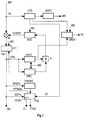
- a rough synchronization is first carried out for the digital input signal INP in coarse time synchronization means CTS.
- the time signal is correlated with the time signal shifted by a useful symbol length T u , for example twice to five times per data frame.
- samples with different lengths T u are used in accordance with the respective mode, and on the basis of the resulting, filtered or averaged correlation result maxima, MDET is then used in mode detector means to determine the currently available mode MO (for example 2K or 8K). Mode) closed, eg by comparing the maxima with a stored threshold. MDET outputs a corresponding mode information MO. If there is no usable correlation result maximum, the correlation steps can be repeated in CTS.
- the guard interval used is determined in CTS from the distance between the correlation maxima, taking into account the mode, and a scanning window is subsequently positioned, for example by once setting a counter in CTS that is synchronous with the symbol sequence (T u + ⁇ ), which outputs a time window with duration T u , for example by means of a start signal ST, which is fed to time-fine synchronization means FTS.
- the position of the sampling window FFTWIN and the sampling clock are readjusted in FTS by means of a base oscillator VCX0 used here.
- the input signal INP consisting of an I and Q component is multiplied in a multiplier M by a frequency correction signal FCORR originating from an oscillator NCO.
- the M output signal selected with FFTWIN is converted into the frequency domain in Fast Fourier transform means FFT and ultimately forms the output signal OU consisting of an I and Q component.
- FFT Fast Fourier transform
- OU consisting of an I and Q component.
- a rough AFC can be carried out by rough AFC means CAFC.
- the intended continuous pilot signals CPIL of the current symbol of a data frame are taken from the output signal of FFT and correlated in CAFC with a fixed scheme (45 positions in 2K mode, 177 positions in 8K mode), namely over ⁇ 16 shifts in 2K Mode or ⁇ 64 shifts in 8K mode.
- the type of correlation is chosen according to MO.
- QREV also receives the MO mode information.
- the QREV output signal RC then controls corresponding parts of the receiver. After positioning the scanning window and / or reaching ⁇ f ⁇ D max , the above-mentioned conditions are checked at certain time intervals for the purpose of checking the synchronization. If, for example, the result is 2 to 10 times negative, the system is restarted with the rough time synchronization in CTS.
- the received signal is identified in the receiver as "system-compliant” or “available” or “non-system-compliant” or “not available”.
- the further decoding of the signal is initiated during the search process or during a reception test or the search process is continued or the information “not available” is output during the reception test.
- a fine AFC can now be carried out.
- the phase change of the continuous pilot signals CPIL from symbol to symbol is determined and averaged over all pilot signals CPIL (45 in 2K mode, 177 in 8K mode).
- a frame synchronization and a Fine time synchronization or sampling clock adjustment This is done by evaluating the output signal from FFT TPS pilot cells taken from TPSPIL, in a TPS decoder TPSDEC can be decoded. Its output signal is also the time-fine synchronization means FTS supplied and causes a corresponding readjustment of the basic oscillator VCX0 for obtaining the sampling clock CL and a Correction of the position of the FFTWIN scanning window.
- the beginning of the frame (FTS output signal FTSO) and the position of the 'scattered pilots' is generated using the sync sequence of the TPS pilot cells determined by correlation.
- the sampling clock CL is supplied to all circuit parts shown in Fig. 1.
- the 'scattered pilots' can be interpolated in time in FTS so that every third carrier can be regarded as a 'scattered pilot'.
- the impulse response is determined on the basis of the 'scattered pilots' interpolated over time with the aid of a division by the specified 'scattered pilots' setpoints and an inverse FFT. Then the deviation of the center of the impulse response from a desired position desired for optimal reception is determined. This process is advantageously repeated 3 to 7 times per frame. The result is advantageously filtered in blocks and then further used.
- the sampling clock reference oscillator VCX0 is adjusted in FTS from the size and direction of the deviation determined in this way. This readjustment can also be carried out by means of the oscillator NCO and multiplier M.
- NCO can contain a digital PLL.
- the invention can be used in DVB receivers or in receivers for comparable digital signals are used, e.g. also in DAB receivers.
- the specified numerical values are then changed accordingly and the individual synchronization or Review steps will be updated to those in the frame transferred reference or synchronization data adapted.
- the DAB receiver will then replace the one described here Coarse AFC correlation method (basis is continuous Pilot signals) that described in EP-A-0 786 889 Procedure (based on CAZAC symbols).
- the qualitative Evaluation of the correlation results achieved is essentially identical.
- the evaluations according to the invention are particularly advantageous in combined receivers (DAB and DVB-T or digital and analog).
Landscapes
- Engineering & Computer Science (AREA)
- Signal Processing (AREA)
- Computer Networks & Wireless Communication (AREA)
- Multimedia (AREA)
- Circuits Of Receivers In General (AREA)
- Synchronisation In Digital Transmission Systems (AREA)
- Digital Transmission Methods That Use Modulated Carrier Waves (AREA)
Priority Applications (6)
| Application Number | Priority Date | Filing Date | Title |
|---|---|---|---|
| EP97112929A EP0895387A1 (de) | 1997-07-28 | 1997-07-28 | Erkennung des Übertragungsmodus eines DVB-Signales |
| US09/110,085 US6330293B1 (en) | 1997-07-28 | 1998-07-02 | Method for receiving multicarrier digital signals |
| CN98115461A CN1133280C (zh) | 1997-07-28 | 1998-07-08 | 接收多载波数字信号的方法和接收机 |
| DE69826387T DE69826387T2 (de) | 1997-07-28 | 1998-07-15 | Symboltaktsynchronisierung und Moduserfassung für Mehrträgersignale |
| EP98113172A EP0895388B1 (en) | 1997-07-28 | 1998-07-15 | Symbol synchronisation and mode detection for multicarrier signals |
| JP20376698A JP4143174B2 (ja) | 1997-07-28 | 1998-07-17 | 多重搬送波ディジタル信号を受信する方法及び受信機 |
Applications Claiming Priority (1)
| Application Number | Priority Date | Filing Date | Title |
|---|---|---|---|
| EP97112929A EP0895387A1 (de) | 1997-07-28 | 1997-07-28 | Erkennung des Übertragungsmodus eines DVB-Signales |
Publications (1)
| Publication Number | Publication Date |
|---|---|
| EP0895387A1 true EP0895387A1 (de) | 1999-02-03 |
Family
ID=8227127
Family Applications (1)
| Application Number | Title | Priority Date | Filing Date |
|---|---|---|---|
| EP97112929A Withdrawn EP0895387A1 (de) | 1997-07-28 | 1997-07-28 | Erkennung des Übertragungsmodus eines DVB-Signales |
Country Status (5)
| Country | Link |
|---|---|
| US (1) | US6330293B1 (https=) |
| EP (1) | EP0895387A1 (https=) |
| JP (1) | JP4143174B2 (https=) |
| CN (1) | CN1133280C (https=) |
| DE (1) | DE69826387T2 (https=) |
Cited By (19)
| Publication number | Priority date | Publication date | Assignee | Title |
|---|---|---|---|---|
| GB2340000A (en) * | 1998-07-02 | 2000-02-09 | Lsi Logic Corp | Storing digital video braodcast signals |
| WO2001003397A1 (en) * | 1999-07-01 | 2001-01-11 | Telefonaktiebolaget Lm Ericsson (Publ) | Synchronization and detection of modulation type |
| WO2004038989A2 (en) | 2002-10-25 | 2004-05-06 | Qualcomm Incorporated | Data detection and demodulation for wireless communication systems |
| EP1919151A1 (en) * | 2006-11-02 | 2008-05-07 | MediaTek Inc. | System, apparatus, and method for processing a received orthogonal frequency division multiplexing signal |
| US7986742B2 (en) | 2002-10-25 | 2011-07-26 | Qualcomm Incorporated | Pilots for MIMO communication system |
| US8134976B2 (en) | 2002-10-25 | 2012-03-13 | Qualcomm Incorporated | Channel calibration for a time division duplexed communication system |
| US8145179B2 (en) | 2002-10-25 | 2012-03-27 | Qualcomm Incorporated | Data detection and demodulation for wireless communication systems |
| US8169944B2 (en) | 2002-10-25 | 2012-05-01 | Qualcomm Incorporated | Random access for wireless multiple-access communication systems |
| US8194770B2 (en) | 2002-08-27 | 2012-06-05 | Qualcomm Incorporated | Coded MIMO systems with selective channel inversion applied per eigenmode |
| US8203978B2 (en) | 2002-10-25 | 2012-06-19 | Qualcomm Incorporated | Multi-mode terminal in a wireless MIMO system |
| US8208364B2 (en) | 2002-10-25 | 2012-06-26 | Qualcomm Incorporated | MIMO system with multiple spatial multiplexing modes |
| US8218609B2 (en) | 2002-10-25 | 2012-07-10 | Qualcomm Incorporated | Closed-loop rate control for a multi-channel communication system |
| US8320301B2 (en) | 2002-10-25 | 2012-11-27 | Qualcomm Incorporated | MIMO WLAN system |
| US8358714B2 (en) | 2005-06-16 | 2013-01-22 | Qualcomm Incorporated | Coding and modulation for multiple data streams in a communication system |
| US8570988B2 (en) | 2002-10-25 | 2013-10-29 | Qualcomm Incorporated | Channel calibration for a time division duplexed communication system |
| US8855226B2 (en) | 2005-05-12 | 2014-10-07 | Qualcomm Incorporated | Rate selection with margin sharing |
| US8873365B2 (en) | 2002-10-25 | 2014-10-28 | Qualcomm Incorporated | Transmit diversity processing for a multi-antenna communication system |
| US9154274B2 (en) | 2002-10-25 | 2015-10-06 | Qualcomm Incorporated | OFDM communication system with multiple OFDM symbol sizes |
| US9876609B2 (en) | 2003-12-01 | 2018-01-23 | Qualcomm Incorporated | Method and apparatus for providing an efficient control channel structure in a wireless communication system |
Families Citing this family (39)
| Publication number | Priority date | Publication date | Assignee | Title |
|---|---|---|---|---|
| EP2154854B1 (en) | 1998-01-06 | 2012-03-07 | Mosaid Technologies Incorporated | Multicarrier modulation system with variable symbol rates |
| FR2790344B1 (fr) * | 1999-02-26 | 2001-05-18 | St Microelectronics Sa | Demodulateur cofdm avec compensation de deplacement de fenetre d'analyse fft |
| WO2000054445A1 (en) * | 1999-03-10 | 2000-09-14 | Sony Corporation | Digital broadcast receiver |
| US7952511B1 (en) | 1999-04-07 | 2011-05-31 | Geer James L | Method and apparatus for the detection of objects using electromagnetic wave attenuation patterns |
| US6871180B1 (en) * | 1999-05-25 | 2005-03-22 | Arbitron Inc. | Decoding of information in audio signals |
| EP1119122A3 (en) * | 2000-01-20 | 2005-01-19 | Matsushita Electric Industrial Co., Ltd. | Digital broadcast transmission method, broadcast transmitter for transmitting digital broadcast signals and broadcast receiver for receiving said digital broadcast signals |
| DE10005287A1 (de) * | 2000-02-07 | 2001-08-09 | Rohde & Schwarz | Verfahren zum Bestimmen der Restträgerleistung bei einem nach dem DVB-T-Standard im 8K-Modus QAM-modulierten Multiträgersignal |
| FR2835136A1 (fr) * | 2002-01-22 | 2003-07-25 | St Microelectronics Sa | Demodulateur cofdm a positionnement optimal de fenetre d'analyse fft |
| UA86191C2 (uk) * | 2002-10-25 | 2009-04-10 | Квелкомм Инкорпорейтед | Калібрування каналу для комунікаційної системи з дуплексним зв'язком та часовим розділенням каналу |
| US7319659B2 (en) * | 2003-04-24 | 2008-01-15 | Silicon Integrated System Corp. | OFDM receiver, mode detector therefor, and method for processing OFDM signals |
| US20040223449A1 (en) * | 2003-05-08 | 2004-11-11 | Yih-Ming Tsuie | Mode detection for OFDM signals |
| KR100555722B1 (ko) * | 2003-05-20 | 2006-03-03 | 삼성전자주식회사 | 다중 반송파 수신 시스템의 정수배 주파수 옵셋 추정 장치및 그의 정수배 주파수 옵셋 추정방법 |
| JP4359176B2 (ja) * | 2003-07-30 | 2009-11-04 | パナソニック株式会社 | フレーム同期検出回路、フレーム同期検出方法、制御情報検出回路、制御情報復号方法、受信装置 |
| DE602004029754D1 (de) * | 2003-12-08 | 2010-12-09 | Panasonic Corp | Demodulator und Demodulationsmethode und integrierter Schaltkreis des Demodulators |
| US7336732B1 (en) * | 2004-07-28 | 2008-02-26 | L-3 Communications Titan Corporation | Carrier frequency detection for signal acquisition |
| CN100452862C (zh) * | 2006-04-24 | 2009-01-14 | 上海交通大学 | 适用于数字电视地面广播传输的传输模式判别方法 |
| US7684313B2 (en) * | 2007-03-30 | 2010-03-23 | Zoran Corporation | System and method for FFT window timing synchronization for an orthogonal frequency-division multiplexed data stream |
| US7903750B2 (en) * | 2007-09-11 | 2011-03-08 | Zoran Corporation | System and method for determining transmission parameters in an orthogonal frequency-division multiplexed data stream |
| US8280901B2 (en) * | 2008-01-03 | 2012-10-02 | Masterfile Corporation | Method and system for displaying search results |
| US8081690B2 (en) * | 2008-01-11 | 2011-12-20 | Qualcomm Incorporated | OFDM channel estimation |
| US20090316053A1 (en) * | 2008-06-18 | 2009-12-24 | Advanced Micro Devices, Inc. | Mobile digital television demodulation circuit and method |
| CN102422635B (zh) * | 2009-05-14 | 2014-11-19 | 皇家飞利浦电子股份有限公司 | 存在频率偏移情况下dvb-t/h传输的鲁棒感测 |
| ES2452170T3 (es) * | 2009-05-14 | 2014-03-31 | Koninklijke Philips N.V. | Detección robusta de transmisiones de DVD-T/H |
| CN101895312B (zh) * | 2010-06-17 | 2013-09-04 | 华亚微电子(上海)有限公司 | 伪随机码序列相位捕获的方法及捕获装置 |
| US9111580B2 (en) * | 2011-09-23 | 2015-08-18 | Harman International Industries, Incorporated | Time alignment of recorded audio signals |
| EP2587797A1 (en) * | 2011-10-24 | 2013-05-01 | Mediatek Inc. | Channel scan apparatus and channel scan method for co-scanning different television signals in selected radio frequency channel |
| US20140270024A1 (en) * | 2013-03-14 | 2014-09-18 | Nokia Corporation | Apparatus and method for detection of time tracking failure |
| US9277519B1 (en) * | 2015-03-13 | 2016-03-01 | Intel IP Corporation | Method for performing mobile communications and mobile terminal device |
| US9819456B1 (en) * | 2016-10-17 | 2017-11-14 | Seagate Technology Llc | Preamble detection and frequency offset determination |
| US10164760B1 (en) | 2016-10-18 | 2018-12-25 | Seagate Technology Llc | Timing excursion recovery |
| US10152457B1 (en) | 2016-10-25 | 2018-12-11 | Seagate Technology Llc | Target parameter adaptation |
| US10277718B1 (en) | 2016-11-22 | 2019-04-30 | Seagate Technology Llc | Preamble defect detection and mitigation |
| US10084553B1 (en) | 2016-12-22 | 2018-09-25 | Seagate Technology Llc | Iterative recovery from baseline or timing disturbances |
| US9979573B1 (en) | 2016-12-23 | 2018-05-22 | Seagate Technology Llc | Position error signal burst demodulation |
| US9954537B1 (en) | 2016-12-23 | 2018-04-24 | Seagate Technology Llc | Wide frequency range clock generation with phase interpolation |
| US9998136B1 (en) | 2017-02-17 | 2018-06-12 | Seagate Technology Llc | Loop consistency using multiple channel estimates |
| US10382166B1 (en) | 2017-02-22 | 2019-08-13 | Seagate Technology Llc | Constrained receiver parameter optimization |
| US9928854B1 (en) | 2017-05-03 | 2018-03-27 | Seagate Technology Llc | MISO equalization with ADC averaging |
| KR102110538B1 (ko) * | 2018-02-28 | 2020-05-13 | 엘지전자 주식회사 | 신호 처리 장치 및 이를 구비하는 영상표시장치 |
Citations (6)
| Publication number | Priority date | Publication date | Assignee | Title |
|---|---|---|---|---|
| EP0562422A1 (en) * | 1992-03-24 | 1993-09-29 | General Instrument Corporation Of Delaware | QAM receiver with means for detecting constellation size |
| DE4403408C1 (de) * | 1994-02-04 | 1995-02-23 | Grundig Emv | Verfahren zur Erkennung eines Übertragungs-Modes |
| EP0653858A2 (en) * | 1993-11-16 | 1995-05-17 | Kabushiki Kaisha Toshiba | OFDM Synchronization demodulation circuit |
| WO1997007620A1 (en) * | 1995-08-16 | 1997-02-27 | Philips Electronics N.V. | Transmission system with improved symbol processing |
| WO1997026742A1 (fr) * | 1996-01-18 | 1997-07-24 | France Telecom | Synchronisation de symboles multiporteurs |
| EP0786889A1 (en) * | 1996-02-02 | 1997-07-30 | Deutsche Thomson-Brandt Gmbh | Method for the reception of multicarrier signals and related apparatus |
Family Cites Families (6)
| Publication number | Priority date | Publication date | Assignee | Title |
|---|---|---|---|---|
| SG44771A1 (en) * | 1991-02-28 | 1997-12-19 | Philips Electronics Nv | System for broadcasting and receiving digital data receiver and transmitter for use in such system |
| JP2731722B2 (ja) * | 1994-05-26 | 1998-03-25 | 日本電気株式会社 | クロック周波数自動制御方式及びそれに用いる送信装置と受信装置 |
| US5627863A (en) * | 1994-07-15 | 1997-05-06 | Amati Communications Corporation | Frame synchronization in multicarrier transmission systems |
| US6137847A (en) * | 1997-05-02 | 2000-10-24 | Lsi Logic Corporation | Demodulating digital video broadcast signals |
| US6058101A (en) * | 1997-06-11 | 2000-05-02 | Industrial Technology Research Institute | Synchronization method and system for a digital receiver |
| US6134284A (en) * | 1998-04-20 | 2000-10-17 | International Business Machines Corporation | Circuit and method for receiving system clock signals |
-
1997
- 1997-07-28 EP EP97112929A patent/EP0895387A1/de not_active Withdrawn
-
1998
- 1998-07-02 US US09/110,085 patent/US6330293B1/en not_active Expired - Lifetime
- 1998-07-08 CN CN98115461A patent/CN1133280C/zh not_active Expired - Fee Related
- 1998-07-15 DE DE69826387T patent/DE69826387T2/de not_active Expired - Lifetime
- 1998-07-17 JP JP20376698A patent/JP4143174B2/ja not_active Expired - Fee Related
Patent Citations (6)
| Publication number | Priority date | Publication date | Assignee | Title |
|---|---|---|---|---|
| EP0562422A1 (en) * | 1992-03-24 | 1993-09-29 | General Instrument Corporation Of Delaware | QAM receiver with means for detecting constellation size |
| EP0653858A2 (en) * | 1993-11-16 | 1995-05-17 | Kabushiki Kaisha Toshiba | OFDM Synchronization demodulation circuit |
| DE4403408C1 (de) * | 1994-02-04 | 1995-02-23 | Grundig Emv | Verfahren zur Erkennung eines Übertragungs-Modes |
| WO1997007620A1 (en) * | 1995-08-16 | 1997-02-27 | Philips Electronics N.V. | Transmission system with improved symbol processing |
| WO1997026742A1 (fr) * | 1996-01-18 | 1997-07-24 | France Telecom | Synchronisation de symboles multiporteurs |
| EP0786889A1 (en) * | 1996-02-02 | 1997-07-30 | Deutsche Thomson-Brandt Gmbh | Method for the reception of multicarrier signals and related apparatus |
Cited By (39)
| Publication number | Priority date | Publication date | Assignee | Title |
|---|---|---|---|---|
| GB2340000B (en) * | 1998-07-02 | 2003-06-18 | Lsi Logic Corp | Storing digital video braodcast signals |
| GB2340000A (en) * | 1998-07-02 | 2000-02-09 | Lsi Logic Corp | Storing digital video braodcast signals |
| WO2001003397A1 (en) * | 1999-07-01 | 2001-01-11 | Telefonaktiebolaget Lm Ericsson (Publ) | Synchronization and detection of modulation type |
| US6463107B1 (en) | 1999-07-01 | 2002-10-08 | Telefonaktiebolaget Lm Ericsson (Publ) | Methods and apparatuses for synchronization and modulation type detection |
| US8194770B2 (en) | 2002-08-27 | 2012-06-05 | Qualcomm Incorporated | Coded MIMO systems with selective channel inversion applied per eigenmode |
| US8355313B2 (en) | 2002-10-25 | 2013-01-15 | Qualcomm Incorporated | MIMO system with multiple spatial multiplexing modes |
| US8570988B2 (en) | 2002-10-25 | 2013-10-29 | Qualcomm Incorporated | Channel calibration for a time division duplexed communication system |
| AU2003285112B2 (en) * | 2002-10-25 | 2009-04-02 | Qualcomm Incorporated | Data detection and demodulation for wireless communication systems |
| US7986742B2 (en) | 2002-10-25 | 2011-07-26 | Qualcomm Incorporated | Pilots for MIMO communication system |
| US8134976B2 (en) | 2002-10-25 | 2012-03-13 | Qualcomm Incorporated | Channel calibration for a time division duplexed communication system |
| US8145179B2 (en) | 2002-10-25 | 2012-03-27 | Qualcomm Incorporated | Data detection and demodulation for wireless communication systems |
| US8169944B2 (en) | 2002-10-25 | 2012-05-01 | Qualcomm Incorporated | Random access for wireless multiple-access communication systems |
| US8170513B2 (en) | 2002-10-25 | 2012-05-01 | Qualcomm Incorporated | Data detection and demodulation for wireless communication systems |
| WO2004038989A3 (en) * | 2002-10-25 | 2004-07-08 | Qualcomm Inc | Data detection and demodulation for wireless communication systems |
| US8203978B2 (en) | 2002-10-25 | 2012-06-19 | Qualcomm Incorporated | Multi-mode terminal in a wireless MIMO system |
| US8208364B2 (en) | 2002-10-25 | 2012-06-26 | Qualcomm Incorporated | MIMO system with multiple spatial multiplexing modes |
| US8218609B2 (en) | 2002-10-25 | 2012-07-10 | Qualcomm Incorporated | Closed-loop rate control for a multi-channel communication system |
| US8320301B2 (en) | 2002-10-25 | 2012-11-27 | Qualcomm Incorporated | MIMO WLAN system |
| WO2004038989A2 (en) | 2002-10-25 | 2004-05-06 | Qualcomm Incorporated | Data detection and demodulation for wireless communication systems |
| US10382106B2 (en) | 2002-10-25 | 2019-08-13 | Qualcomm Incorporated | Pilots for MIMO communication systems |
| US8462643B2 (en) | 2002-10-25 | 2013-06-11 | Qualcomm Incorporated | MIMO WLAN system |
| US8483188B2 (en) | 2002-10-25 | 2013-07-09 | Qualcomm Incorporated | MIMO system with multiple spatial multiplexing modes |
| US9967005B2 (en) | 2002-10-25 | 2018-05-08 | Qualcomm Incorporated | Pilots for MIMO communication systems |
| US8711763B2 (en) | 2002-10-25 | 2014-04-29 | Qualcomm Incorporated | Random access for wireless multiple-access communication systems |
| US8750151B2 (en) | 2002-10-25 | 2014-06-10 | Qualcomm Incorporated | Channel calibration for a time division duplexed communication system |
| US9312935B2 (en) | 2002-10-25 | 2016-04-12 | Qualcomm Incorporated | Pilots for MIMO communication systems |
| US8873365B2 (en) | 2002-10-25 | 2014-10-28 | Qualcomm Incorporated | Transmit diversity processing for a multi-antenna communication system |
| US8913529B2 (en) | 2002-10-25 | 2014-12-16 | Qualcomm Incorporated | MIMO WLAN system |
| US8934329B2 (en) | 2002-10-25 | 2015-01-13 | Qualcomm Incorporated | Transmit diversity processing for a multi-antenna communication system |
| US9013974B2 (en) | 2002-10-25 | 2015-04-21 | Qualcomm Incorporated | MIMO WLAN system |
| US9031097B2 (en) | 2002-10-25 | 2015-05-12 | Qualcomm Incorporated | MIMO system with multiple spatial multiplexing modes |
| US9048892B2 (en) | 2002-10-25 | 2015-06-02 | Qualcomm Incorporated | MIMO system with multiple spatial multiplexing modes |
| US9154274B2 (en) | 2002-10-25 | 2015-10-06 | Qualcomm Incorporated | OFDM communication system with multiple OFDM symbol sizes |
| US9240871B2 (en) | 2002-10-25 | 2016-01-19 | Qualcomm Incorporated | MIMO WLAN system |
| US9876609B2 (en) | 2003-12-01 | 2018-01-23 | Qualcomm Incorporated | Method and apparatus for providing an efficient control channel structure in a wireless communication system |
| US10742358B2 (en) | 2003-12-01 | 2020-08-11 | Qualcomm Incorporated | Method and apparatus for providing an efficient control channel structure in a wireless communication system |
| US8855226B2 (en) | 2005-05-12 | 2014-10-07 | Qualcomm Incorporated | Rate selection with margin sharing |
| US8358714B2 (en) | 2005-06-16 | 2013-01-22 | Qualcomm Incorporated | Coding and modulation for multiple data streams in a communication system |
| EP1919151A1 (en) * | 2006-11-02 | 2008-05-07 | MediaTek Inc. | System, apparatus, and method for processing a received orthogonal frequency division multiplexing signal |
Also Published As
| Publication number | Publication date |
|---|---|
| US6330293B1 (en) | 2001-12-11 |
| CN1206966A (zh) | 1999-02-03 |
| DE69826387D1 (de) | 2004-10-28 |
| CN1133280C (zh) | 2003-12-31 |
| JP4143174B2 (ja) | 2008-09-03 |
| DE69826387T2 (de) | 2005-03-24 |
| JPH1174863A (ja) | 1999-03-16 |
Similar Documents
| Publication | Publication Date | Title |
|---|---|---|
| EP0895387A1 (de) | Erkennung des Übertragungsmodus eines DVB-Signales | |
| DE69728383T2 (de) | Verfahren und Apparat für Zeitsynchronisierung in einem Empfänger für ein Mehrträgersignal | |
| DE69730283T2 (de) | Verfahren und einrichtung zur gemeinsamen schätzung von frequenzverschiebungen und synchronisierung in einem mehrträgermodulationssystem | |
| DE69727792T2 (de) | Synchronisierung von Rahmen, Symboltakt und Träger in Mehrträgerempfängern | |
| DE69924804T2 (de) | Ofdm (orthogonale frequenzmultiplexierung)-empfänger | |
| DE69334130T2 (de) | Verfahren und System für die Erfassung von Audiorundfunkabschnitten | |
| DE60216400T2 (de) | Verfahren und Gerät zur Rauschimpulsdetektion, Demodulator-Betriebsverfahren, Demodulator und Radioempfänger | |
| DE69632812T2 (de) | Uebertragungssystem mit verbesserter symbolverarbeitung | |
| DE69928985T2 (de) | Empfänger für digitalen Tonrundfunk und Abstimmungsverfahren dafür | |
| DE69835254T2 (de) | Empfangseinrichtungen und Empfangsverfahren | |
| DE60015644T2 (de) | Mehrträgerempfänger mit Rauschenerfassung und Frequenzreglung | |
| EP1125377B1 (de) | Verfahren zum verarbeiten von durch ein mehrantennensystem gleichzeitig empfangenen ofdm-signalen | |
| DE19721864A1 (de) | Digitaler Rundsendeempfänger | |
| EP2037593A2 (de) | Antennendiversityanlage für den relativ breitbandigen Funkempfang in Fahrzeugen | |
| EP0546614A1 (de) | Mobilfunkempfänger dessen verbesserte Anfangssysnchronisation mit einer Feststation durch Frequenzschätzung mittels Impulserkennung erreicht wird | |
| DE10112773A1 (de) | Verfahren zur Frequenz- und Zeit-Synchronisation eines OFDM-Empfängers | |
| DE69703016T2 (de) | Verfahren und Schaltungsanordung zur Synchronisation eines OFDM-Empfängers | |
| DE69802212T2 (de) | Grobe frequenzsynchronisierung in mehrträgersystemen | |
| DE69937016T2 (de) | Rundfunkempfänger für den digitalen Tonrundfunk, mit einem System um kurzfristig eine Rahmensynchronisation zu erreichen in der Anwesenheit von Rauschen | |
| DE3220073C1 (de) | Verfahren zur Feststellung,Erfassung und Unterscheidung von innerhalb eines bestimmten Frequenzbereichs unabhaengig voneinander auftretenden Funksendungen | |
| DE19925925B4 (de) | Verfahren zur Übertragung von Funksignalen und Empfänger zum Empfang von Funksignalen | |
| DE60219474T2 (de) | Frequenzkorrektion für ein mehrträgersystem | |
| DE60201162T2 (de) | Verfahren und Vorrichtung zur OFDM- (orthogonale Frequenzmultiplexierung) Demodulation | |
| EP1929675B1 (de) | Übertragung eines datenstroms mittels ofdm-symbolen auf zwei trägerfrequenzen mit überlappenden superrahmen von kommensurabeler zeitdauer | |
| DE69507601T2 (de) | Digitale rundfunksysteme fur lokale übertragungen |
Legal Events
| Date | Code | Title | Description |
|---|---|---|---|
| PUAI | Public reference made under article 153(3) epc to a published international application that has entered the european phase |
Free format text: ORIGINAL CODE: 0009012 |
|
| AK | Designated contracting states |
Kind code of ref document: A1 Designated state(s): AT BE CH DE DK ES FI FR GB GR IE IT LI LU MC NL PT SE |
|
| AKX | Designation fees paid | ||
| STAA | Information on the status of an ep patent application or granted ep patent |
Free format text: STATUS: THE APPLICATION IS DEEMED TO BE WITHDRAWN |
|
| 18D | Application deemed to be withdrawn |
Effective date: 20010201 |
|
| REG | Reference to a national code |
Ref country code: DE Ref legal event code: 8566 |