EP0890128B1 - Polarized illumination system for lcd projector - Google Patents
Polarized illumination system for lcd projector Download PDFInfo
- Publication number
- EP0890128B1 EP0890128B1 EP97919891A EP97919891A EP0890128B1 EP 0890128 B1 EP0890128 B1 EP 0890128B1 EP 97919891 A EP97919891 A EP 97919891A EP 97919891 A EP97919891 A EP 97919891A EP 0890128 B1 EP0890128 B1 EP 0890128B1
- Authority
- EP
- European Patent Office
- Prior art keywords
- microprismatic
- light
- beams
- exit
- reflectorized
- Prior art date
- Legal status (The legal status is an assumption and is not a legal conclusion. Google has not performed a legal analysis and makes no representation as to the accuracy of the status listed.)
- Expired - Lifetime
Links
- 238000005286 illumination Methods 0.000 title claims abstract description 21
- 230000010287 polarization Effects 0.000 claims abstract description 29
- 230000006835 compression Effects 0.000 claims description 30
- 238000007906 compression Methods 0.000 claims description 30
- 239000006185 dispersion Substances 0.000 claims description 14
- 102220047090 rs6152 Human genes 0.000 description 11
- 238000010586 diagram Methods 0.000 description 7
- 230000003287 optical effect Effects 0.000 description 7
- 230000010354 integration Effects 0.000 description 5
- 238000005215 recombination Methods 0.000 description 5
- 230000006798 recombination Effects 0.000 description 5
- 239000004973 liquid crystal related substance Substances 0.000 description 4
- 238000006243 chemical reaction Methods 0.000 description 3
- 238000000034 method Methods 0.000 description 3
- 229920002972 Acrylic fiber Polymers 0.000 description 2
- 239000005331 crown glasses (windows) Substances 0.000 description 2
- 230000009977 dual effect Effects 0.000 description 2
- 230000000694 effects Effects 0.000 description 2
- 239000011521 glass Substances 0.000 description 2
- 238000012986 modification Methods 0.000 description 2
- 230000004048 modification Effects 0.000 description 2
- 238000004064 recycling Methods 0.000 description 2
- 238000007493 shaping process Methods 0.000 description 2
- 238000010561 standard procedure Methods 0.000 description 2
- BWVLLEHUUJBZMR-UHFFFAOYSA-N 2,4-dibromo-1-phenylbenzene Chemical compound BrC1=CC(Br)=CC=C1C1=CC=CC=C1 BWVLLEHUUJBZMR-UHFFFAOYSA-N 0.000 description 1
- NIXOWILDQLNWCW-UHFFFAOYSA-N acrylic acid group Chemical group C(C=C)(=O)O NIXOWILDQLNWCW-UHFFFAOYSA-N 0.000 description 1
- 238000005452 bending Methods 0.000 description 1
- 238000000576 coating method Methods 0.000 description 1
- 230000007812 deficiency Effects 0.000 description 1
- 238000005516 engineering process Methods 0.000 description 1
- 229910052736 halogen Inorganic materials 0.000 description 1
- 238000005065 mining Methods 0.000 description 1
- 238000000926 separation method Methods 0.000 description 1
Images






Classifications
-
- G—PHYSICS
- G02—OPTICS
- G02B—OPTICAL ELEMENTS, SYSTEMS OR APPARATUS
- G02B27/00—Optical systems or apparatus not provided for by any of the groups G02B1/00 - G02B26/00, G02B30/00
- G02B27/28—Optical systems or apparatus not provided for by any of the groups G02B1/00 - G02B26/00, G02B30/00 for polarising
- G02B27/283—Optical systems or apparatus not provided for by any of the groups G02B1/00 - G02B26/00, G02B30/00 for polarising used for beam splitting or combining
-
- G—PHYSICS
- G02—OPTICS
- G02B—OPTICAL ELEMENTS, SYSTEMS OR APPARATUS
- G02B27/00—Optical systems or apparatus not provided for by any of the groups G02B1/00 - G02B26/00, G02B30/00
- G02B27/28—Optical systems or apparatus not provided for by any of the groups G02B1/00 - G02B26/00, G02B30/00 for polarising
-
- G—PHYSICS
- G02—OPTICS
- G02F—OPTICAL DEVICES OR ARRANGEMENTS FOR THE CONTROL OF LIGHT BY MODIFICATION OF THE OPTICAL PROPERTIES OF THE MEDIA OF THE ELEMENTS INVOLVED THEREIN; NON-LINEAR OPTICS; FREQUENCY-CHANGING OF LIGHT; OPTICAL LOGIC ELEMENTS; OPTICAL ANALOGUE/DIGITAL CONVERTERS
- G02F1/00—Devices or arrangements for the control of the intensity, colour, phase, polarisation or direction of light arriving from an independent light source, e.g. switching, gating or modulating; Non-linear optics
- G02F1/01—Devices or arrangements for the control of the intensity, colour, phase, polarisation or direction of light arriving from an independent light source, e.g. switching, gating or modulating; Non-linear optics for the control of the intensity, phase, polarisation or colour
- G02F1/13—Devices or arrangements for the control of the intensity, colour, phase, polarisation or direction of light arriving from an independent light source, e.g. switching, gating or modulating; Non-linear optics for the control of the intensity, phase, polarisation or colour based on liquid crystals, e.g. single liquid crystal display cells
- G02F1/133—Constructional arrangements; Operation of liquid crystal cells; Circuit arrangements
- G02F1/1333—Constructional arrangements; Manufacturing methods
- G02F1/1335—Structural association of cells with optical devices, e.g. polarisers or reflectors
- G02F1/133528—Polarisers
- G02F1/133536—Reflective polarizers
-
- G—PHYSICS
- G02—OPTICS
- G02F—OPTICAL DEVICES OR ARRANGEMENTS FOR THE CONTROL OF LIGHT BY MODIFICATION OF THE OPTICAL PROPERTIES OF THE MEDIA OF THE ELEMENTS INVOLVED THEREIN; NON-LINEAR OPTICS; FREQUENCY-CHANGING OF LIGHT; OPTICAL LOGIC ELEMENTS; OPTICAL ANALOGUE/DIGITAL CONVERTERS
- G02F1/00—Devices or arrangements for the control of the intensity, colour, phase, polarisation or direction of light arriving from an independent light source, e.g. switching, gating or modulating; Non-linear optics
- G02F1/01—Devices or arrangements for the control of the intensity, colour, phase, polarisation or direction of light arriving from an independent light source, e.g. switching, gating or modulating; Non-linear optics for the control of the intensity, phase, polarisation or colour
- G02F1/13—Devices or arrangements for the control of the intensity, colour, phase, polarisation or direction of light arriving from an independent light source, e.g. switching, gating or modulating; Non-linear optics for the control of the intensity, phase, polarisation or colour based on liquid crystals, e.g. single liquid crystal display cells
- G02F1/133—Constructional arrangements; Operation of liquid crystal cells; Circuit arrangements
- G02F1/1333—Constructional arrangements; Manufacturing methods
- G02F1/1335—Structural association of cells with optical devices, e.g. polarisers or reflectors
- G02F1/133528—Polarisers
- G02F1/13355—Polarising beam splitters [PBS]
-
- G—PHYSICS
- G02—OPTICS
- G02F—OPTICAL DEVICES OR ARRANGEMENTS FOR THE CONTROL OF LIGHT BY MODIFICATION OF THE OPTICAL PROPERTIES OF THE MEDIA OF THE ELEMENTS INVOLVED THEREIN; NON-LINEAR OPTICS; FREQUENCY-CHANGING OF LIGHT; OPTICAL LOGIC ELEMENTS; OPTICAL ANALOGUE/DIGITAL CONVERTERS
- G02F1/00—Devices or arrangements for the control of the intensity, colour, phase, polarisation or direction of light arriving from an independent light source, e.g. switching, gating or modulating; Non-linear optics
- G02F1/01—Devices or arrangements for the control of the intensity, colour, phase, polarisation or direction of light arriving from an independent light source, e.g. switching, gating or modulating; Non-linear optics for the control of the intensity, phase, polarisation or colour
- G02F1/13—Devices or arrangements for the control of the intensity, colour, phase, polarisation or direction of light arriving from an independent light source, e.g. switching, gating or modulating; Non-linear optics for the control of the intensity, phase, polarisation or colour based on liquid crystals, e.g. single liquid crystal display cells
- G02F1/133—Constructional arrangements; Operation of liquid crystal cells; Circuit arrangements
- G02F1/1333—Constructional arrangements; Manufacturing methods
- G02F1/1335—Structural association of cells with optical devices, e.g. polarisers or reflectors
- G02F1/1336—Illuminating devices
- G02F1/13362—Illuminating devices providing polarized light, e.g. by converting a polarisation component into another one
Definitions
- the present invention generally relates to optical illumination systems, and more particularly to a polarized illumination system having a novel spatial integrator, including variations for controlling aspect ratio, the system being suited for use with electronic projection displays, particularly of the liquid crystal display type.
- Polarized light has been traditionally produced by an absorbing polarizer or a polarizing beam splitter (PBS) cube.
- PBS polarizing beam splitter
- Japanese Patent Application (Kokai) No. 61-122626 describes a polarizing illumination device, that spatially integrates the separated beams at the LCD plane by means of a pair of wedge prisms.
- the device uses a light source 1, collimator 2, PBS cube 3, right angle prism 4, half-wave retarder 5 , wedge prisms 6 and 7 , LCD panel 8 , and projection lens 9 .
- the wedge prisms There must be a considerable distance between the wedge prisms and the LCD, since the beams are converging, and the incidence angle on the LCD must be kept small, which unduly restricts use of the device.
- U.S. Patent Nos. 4,913,529 and 4,969,730 describe converting polarized light projection illumination systems using polarizing plates or a PBS cube, combining the separated beams at the LCD with steering prisms.
- U.S. Patent No. 5,381,278 uses converging and diverging lenses to redirect the separated beams to the LCD panel.
- Japanese Patent Application (Kokai) No. 71-99185 uses dual polarizing beam splitters, achieving a beam of oblong cross-section, but with no spatial recombination of the separate beams.
- European Patent Application No. 615,148 achieves polarization conversion and spatial recombination by recycling light backwards to the light source reflector, as does European Patent Application No.
- U.S. Patent No. 5,181,054 achieves spatial recombination of the separated beams by sending the beams through the LCD in opposite directions, as does U.S. Patent No. 5,428,469 (also assigned to 3M).
- U.S. Patent No. 5,446,510 achieves a common collimation angle for the separate beams, but without any spatial integration.
- U.S. Patent Nos. 5,042,921 and 5,124,841 describe polarization converters with spatial integration achieved by refracting microprisms.
- the polarization converter described in European Patent Application No. 463,500 preserves the aspect ratio of the original beam, but requires the use of two LCD's, and European Patent Application No. 456,427 matches the beam size to the LCD panel by the use of back reflections from a lamp reflector having a rectangular exit aperture.
- the efficiency of these systems is limited by the complexity of the optics, quality of the reflectance coatings, degree of spatial recombination and beam shaping, and high chromatic dispersion of the refracting elements.
- US 5 359 455 describes a polarization forming optical device comprising a light source, a polarization beam splitter, a half-wave plate, two mirrors and two prism formed plates.
- the light beam from the light source is split in two light beams by means of the beam splitter.
- One of the two light beams is rotated at 90° on the half-wave plate.
- the two beams are separately reflected by the two mirrors to the prism formed plate.
- the two beams are bent by the prism formed plate and thereafter partially reflected from the mirror to the second prism formed plate which is again bending the light beams.
- Spatial integration of the separate beams is important since the separated beams usually differ in intensity and color temperature. Collimation of the beam incident on the LCD is important, since most displays of this type work best with a common and low incidence angle of the illuminating light. Also, collimated light can be more efficiently focused by a field lens to the projection lens. Beam shaping is important to transmit maximum light through the rectangular aperture of the LCD. Lastly, compactness is desirable to reduce the size of the projector unit. None of the foregoing systems provides optimum performance in all of these areas.
- the present invention provides a polarized illumination system particularly suited for an LCD projector, the system generally comprising a light source, means for collimating light from the source into an entrance beam, means for separating the entrance beam into a first beam having a first polarization state, and a second beam having a second polarization state, retarder means for converting said first beam from said first polarization state to said second polarization state, means for spatially integrating said first and second beams to create a collimated, exit beam having an aspect ratio, and means for changing the aspect ratio of said exit beam.
- the integrating means preferably comprises a spatial integrator cell having a first microprismatic element with a planar surface and a surface of prismatic grooves opposite said planar surface, and a second microprismatic element with another planar surface and another surface of prismatic grooves opposite the other planar surface and facing said surface of prismatic grooves on said first microprismatic element, there further being first and second, generally opposed reflecting surfaces adjacent first and second sides, respectively, of the second microprismatic element.
- the means for separating the light may comprise a polarizing beam splitter (PBS) which creates the first and second beams, and the PBS may be adapted to direct the first and second beams to first and second reflectorized wedge prisms, respectively.
- the spatial integrator cell has an exit element which is combined with a first beam compression element, and a second beam compression element is positioned adjacent the first beam compression element to achieve the changed aspect ratio.
- the first beam compression element may be a positive cylinder Fresnel lens, and the second beam compression element a negative cylinder lens:
- the first beam compression element may be a first microprismatic element, and the second beam compression element a second microprismatic element positioned at an oblique angle with respect to the first microprismatic element.
- the means for changing the aspect ratio of the exit beam may further be designed to additionally cause the exit beam to deviate by approximately 90°.
- the current invention avoids many of the deficiencies of the prior art, by producing a converted secondary beam of collimated polarized light, and spatially recombining this beam with the primary beam using total internally reflective linear microprisms, preserving the polarization and collimation with minimal chromatic dispersion.
- the aspect ratio of the spatially integrated beam is then efficiently converted to match the format of an LCD panel. There is no requirement for any back-reflection or recycling of the beam in the direction of the light source, and the single collimated beam passing through the LCD panel can be more efficiently focused to the projection lens.
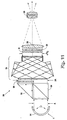
- System 10 is particularly adapted for use with a liquid crystal display (LCD) projector, and the combination generally comprises a light source or lamp 12, a collimator or parabolic reflector 14, means 16 for separating p- and s-polarized light, taking the form of a polarizing beam splitter (PBS), mean 18 for redirecting one of the polarized beams (in this case, the reflected beam) parallel with the other polarized beam (the transmitted beam), taking the form of a right angle prism reflector, a half-wave retarder plate 20, a spatial integrator cell 22, an analyzer 24, an LCD panel 26, and a projection lens 28.
- Embodiment 10 is a single-panel, transmissive LCD projector, but those skilled in the art will appreciate that the general principle can be extended to color and pseudo-color transmissive LCD projectors using multiple panels, as well as reflective LCD light valve projectors.
- Randomly polarized light from light source 12 is collimated by parabolic reflector 14 (or some other means) and enters PBS cube 16 .
- the p-polarized light is transmitted and the reflected s-polarized light is turned 90° by right angle reflecting prism 18, where it is then converted to p-polarized light by half-wave ( ⁇ /2) retarder plate 20.
- the adjacent and spatially separated collimated light beams enter the microprismatic spatial integrator cell 22 where they are spatially integrated and exit as a single collimated polarized beam.
- Components 12-18 are individually known in the prior art and nearly any conventional components will suffice. Therefore, in embodiment 10 , the primary novelty resides in spatial integrator 22 .
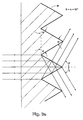
- FIG. 3 shows spatial integrator cell 22.
- Each adjacent entrance beam is equally deviated by the first microprismatic element 32, which consists of a series of 60° equilateral linear microprisms 34 (see Figure 3a).
- Half of the light passes directly to a second, oppositely disposed microprismatic element 36 .
- the other half of the light is reflected off side mirrors 38 and 40, where it then passes to the opposite microprismatic element 36.
- both beams exit the cell as a spatially integrated and collimated beam.
- the spatial integrator cell length L A tan( ⁇ /6), where A is the half-height of the cell (see Figure 2), and light rays entering the center of cell 22 exit at the edge of the cell.
- TIR total internal reflection
- One standard method of aspect ratio conversion that preserves the direction of the light beam is by the use of positive and negative cylinder lenses 42 and 44, respectively, as shown in Figure 4.
- a novel variation of this method is used in the current invention by forming a positive cylinder Fresnel lens 46 in the exit surface of the spatial integrator cell 48, as shown if Figure 5.
- the negative cylinder lens 50 can be continuous or of the Fresnel type.
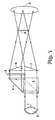
- Another standard method of converting aspect ratio, or anamorphic beam compression uses a pair of identical prisms as shown in Figure 6.
- the chromatic dispersion of the first prism 52 is canceled by the opposite dispersion of the second prism 54, and the direction of the collimated light is preserved.
- a similar effect may be achieved in the current invention by forming the first element as a series of linear microprisms on the exit element 56 of a spatial integrator cell 58.
- a second linear microprismatic element 60 is then set at an oblique angle ⁇ equal to the ray deviation of the first element, as shown in Figure 7.
- ⁇ 40.52°
- ⁇ 35.25°
- FIG. 9 utilizes a reflective wedge prism 66 .
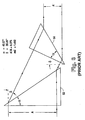
- Figure 10 shows a spatial integrator 70 where anamorphic beam compression and spatial integration of dual incoming beams has been performed using reflecting wedge prisms 72 and 74, and auxiliary planar side mirrors 76 and 78.
- the prism deviation angle ⁇ is 60°
- the entrance angle for the 60° linear microprismatic elements 80 and 82 is 60°.
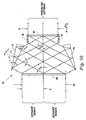
- Figure 12 shows a polarization converter 86 that uses two reflecting prisms 88 and 90 and a single 60° microprismatic element 92 to spatially integrate the two beams and convert the aspect ratio.
- Collimated light enters a polarization beam splitter 94 where the p-polarized light is transmitted and s-polarized light is reflected and converted to p-polarized light by the half-wave retarder 96.
- the two beams enter reflecting prisms at a 45° entrance angle, are compressed by a factor C, and exit the prisms at an angle of 60°. There is a 75° deviation angle ⁇ between the input and exit beams of the reflecting prism.
- the compressed beams are then spatially integrated into a single collimated polarized beam by the 60° microprismatic element.
- a single panel LCD projection system was constructed as an optical breadboard to evaluate components of the current invention.
- a broadband 450-680 nm PBS cube (Melles Griot #03 PBB 007). produced a transmitted p-polarized beam and a reflected s-polarized beam.
- a 45° uncoated prism (Edmund Scientific #32531) deviated the reflected beam 90° by total internal reflection to be adjacent to the transmitted beam.
- the s-polarized beam was converted to a p-polarized beam by a half-wave retarder sheet (Polaroid #605208).
- a VGA compatible 1.3" diagonal monochrome LCD module (Seiko Epson #P13VM115/125), with an analyzer on the exit side, was illuminated by the collimated and polarized light beam exiting the wedge prism.
- a plano-convex field lens focused the light from the LCD module into a 3" focal length, f/2.5 coated anastigmat projection lens (JML Optical Industries).
- JML Optical Industries coated anastigmat projection lens
Landscapes
- Physics & Mathematics (AREA)
- General Physics & Mathematics (AREA)
- Optics & Photonics (AREA)
- Liquid Crystal (AREA)
- Polarising Elements (AREA)
- Video Image Reproduction Devices For Color Tv Systems (AREA)
Applications Claiming Priority (3)
| Application Number | Priority Date | Filing Date | Title |
|---|---|---|---|
| US625030 | 1996-03-29 | ||
| US08/625,030 US5995284A (en) | 1996-03-29 | 1996-03-29 | Polarized illumination system for LCD projector |
| PCT/US1997/004565 WO1997037266A1 (en) | 1996-03-29 | 1997-03-17 | Polarized illumination system for lcd projector |
Publications (2)
| Publication Number | Publication Date |
|---|---|
| EP0890128A1 EP0890128A1 (en) | 1999-01-13 |
| EP0890128B1 true EP0890128B1 (en) | 2002-06-05 |
Family
ID=24504296
Family Applications (1)
| Application Number | Title | Priority Date | Filing Date |
|---|---|---|---|
| EP97919891A Expired - Lifetime EP0890128B1 (en) | 1996-03-29 | 1997-03-17 | Polarized illumination system for lcd projector |
Country Status (11)
| Country | Link |
|---|---|
| US (1) | US5995284A (enExample) |
| EP (1) | EP0890128B1 (enExample) |
| JP (1) | JP2001501317A (enExample) |
| KR (1) | KR100456492B1 (enExample) |
| CN (1) | CN1214775A (enExample) |
| AU (1) | AU2421697A (enExample) |
| CA (1) | CA2247435A1 (enExample) |
| DE (1) | DE69713081T2 (enExample) |
| ES (1) | ES2175397T3 (enExample) |
| TW (1) | TW307832B (enExample) |
| WO (1) | WO1997037266A1 (enExample) |
Families Citing this family (28)
| Publication number | Priority date | Publication date | Assignee | Title |
|---|---|---|---|---|
| EP0916221A2 (en) * | 1997-01-10 | 1999-05-19 | Koninklijke Philips Electronics N.V. | Illumination system for an image projection device |
| US6587269B2 (en) * | 2000-08-24 | 2003-07-01 | Cogent Light Technologies Inc. | Polarization recovery system for projection displays |
| US7710669B2 (en) * | 2000-08-24 | 2010-05-04 | Wavien, Inc. | Etendue efficient combination of multiple light sources |
| KR100571909B1 (ko) * | 2000-09-21 | 2006-04-17 | 삼성전자주식회사 | 화상투사장치 |
| US6739723B1 (en) | 2001-12-07 | 2004-05-25 | Delta Electronics, Inc. | Polarization recapture system for liquid crystal-based data projectors |
| US20030112511A1 (en) * | 2001-12-19 | 2003-06-19 | Koninklijke Philips Electronics N.V. | Polarization conversion method for liquid crystal displays |
| US6646806B1 (en) * | 2002-05-17 | 2003-11-11 | Infocus Corporation | Polarized light source system with dual optical paths |
| US20050174641A1 (en) * | 2002-11-26 | 2005-08-11 | Jds Uniphase Corporation | Polarization conversion light integrator |
| JP2004214073A (ja) * | 2003-01-07 | 2004-07-29 | Honda Motor Co Ltd | 告知灯 |
| US20040207774A1 (en) * | 2003-04-17 | 2004-10-21 | Gothard David L. | Illumination apparatus for LCD/organic displays |
| US20050041288A1 (en) * | 2003-08-19 | 2005-02-24 | Liao Liu Liang | Polarization conversion module and polarization conversion method thereof |
| DE10361559A1 (de) * | 2003-12-19 | 2005-07-14 | Carl Zeiss Jena Gmbh | Projektionsanordnung |
| DE602005008394D1 (de) * | 2004-03-11 | 2008-09-04 | Thomson Licensing | Mehrfach-lampenbeleuchtungssystem mit polarisationswiederherstellung und integration |
| US20080129964A1 (en) * | 2006-11-30 | 2008-06-05 | Upstream Engineering Oy | Beam shaping component and method |
| TW200839292A (en) * | 2006-11-30 | 2008-10-01 | Upstream Engineering Oy | Beam shaping method and apparatus |
| JP2007192841A (ja) * | 2007-04-24 | 2007-08-02 | Fujifilm Corp | 全反射減衰を利用した測定方法および測定装置 |
| JP5110979B2 (ja) * | 2007-06-26 | 2012-12-26 | キヤノン株式会社 | 照明光学系およびそれを用いた投射型表示装置 |
| US8905547B2 (en) * | 2010-01-04 | 2014-12-09 | Elbit Systems Of America, Llc | System and method for efficiently delivering rays from a light source to create an image |
| TWI418917B (zh) * | 2010-10-15 | 2013-12-11 | Young Optics Inc | 投影裝置 |
| EP2936220B1 (en) | 2013-03-13 | 2022-11-16 | ImagineOptix Corporation | Polarization conversion systems with geometric phase holograms |
| CN103644487A (zh) * | 2013-12-30 | 2014-03-19 | 北京理工大学 | 一种基于自由曲面透镜的led跑道中线灯光学系统 |
| US9778475B2 (en) * | 2014-11-06 | 2017-10-03 | The United States of America as represesnted by the Secretary of the Air Forice | Universal polarization converter |
| JP6393014B2 (ja) | 2015-08-05 | 2018-09-19 | スペクトラム オプティクス インコーポレイティド | ウェッジ形平面レンズ及び画像処理方法 |
| CN106405933B (zh) | 2016-10-31 | 2019-08-13 | 京东方科技集团股份有限公司 | 背光模组和液晶显示装置 |
| US10620348B2 (en) * | 2016-12-09 | 2020-04-14 | Lumenflow | Lower index-gap corrective wedge prism |
| CN114200756B (zh) * | 2020-09-18 | 2023-04-18 | 中强光电股份有限公司 | 照明系统及投影装置 |
| CN114200760A (zh) * | 2021-11-05 | 2022-03-18 | 杭州中科极光科技有限公司 | 一种激光显示光源系统及激光显示设备 |
| JP2024030405A (ja) * | 2022-08-24 | 2024-03-07 | セイコーエプソン株式会社 | プロジェクター |
Family Cites Families (24)
| Publication number | Priority date | Publication date | Assignee | Title |
|---|---|---|---|---|
| DE152212C (enExample) * | ||||
| US3743380A (en) * | 1972-01-31 | 1973-07-03 | Us Navy | Polarized light source for underwater use |
| DD152212A1 (de) * | 1980-07-15 | 1981-11-18 | Volkmar Norkus | Optisches system zur umwandlung der polarisation von licht |
| JPH061303B2 (ja) * | 1984-11-20 | 1994-01-05 | ソニー株式会社 | 偏光照明装置 |
| NL8802517A (nl) * | 1988-10-13 | 1990-05-01 | Philips Nv | Beeldprojektie-inrichting. |
| US5042921A (en) * | 1988-10-25 | 1991-08-27 | Casio Computer Co., Ltd. | Liquid crystal display apparatus |
| US4913529A (en) * | 1988-12-27 | 1990-04-03 | North American Philips Corp. | Illumination system for an LCD display system |
| EP0422661A3 (en) * | 1989-10-13 | 1992-07-01 | Mitsubishi Rayon Co., Ltd | Polarization forming optical device and polarization beam splitter |
| DE69028497T2 (de) * | 1989-12-20 | 1997-02-06 | Canon Kk | Polarisierendes Beleuchtungsgerät |
| EP0460241B1 (en) * | 1989-12-26 | 1996-03-13 | Mitsubishi Rayon Co., Ltd. | Optical apparatus for generating polarized light |
| JP2828297B2 (ja) * | 1990-01-19 | 1998-11-25 | 旭光学工業株式会社 | 反射型プロジェクター |
| FR2660448B1 (fr) * | 1990-04-03 | 1992-06-05 | Thomson Csf | Dispositif de projection d'images. |
| EP0456427B1 (en) * | 1990-05-08 | 1998-01-28 | Canon Kabushiki Kaisha | Polarization converting apparatus |
| JP3126368B2 (ja) * | 1990-06-22 | 2001-01-22 | 株式会社日立製作所 | 画像縮小拡大投影装置 |
| FR2665773B1 (fr) * | 1990-08-10 | 1993-08-20 | Thomson Csf | Dispositif de projection d'images utilisant deux composantes orthogonales de polarisation de la lumiere. |
| US5381278A (en) * | 1991-05-07 | 1995-01-10 | Canon Kabushiki Kaisha | Polarization conversion unit, polarization illumination apparatus provided with the unit, and projector provided with the apparatus |
| JPH05241103A (ja) * | 1992-02-21 | 1993-09-21 | Nec Corp | 投射型液晶表示装置 |
| EP0573905A1 (en) * | 1992-06-08 | 1993-12-15 | Minnesota Mining And Manufacturing Company | Retroreflecting polarizer for presentation systems |
| US5347433A (en) * | 1992-06-11 | 1994-09-13 | Sedlmayr Steven R | Collimated beam of light and systems and methods for implementation thereof |
| DE4307178C2 (de) * | 1993-03-08 | 1996-09-19 | Lueder Ernst | Vorrichtung und Verfahren zur Polarisation von Licht |
| US5428469A (en) * | 1993-11-16 | 1995-06-27 | Minnesota Mining And Manufacturing Company | Liquid crystal display projection systems employing polarizing beam splitters and passing light through display cell from both directions |
| JPH07199185A (ja) * | 1993-12-27 | 1995-08-04 | Nec Corp | 投写型液晶表示装置 |
| WO1996005534A1 (en) * | 1994-08-09 | 1996-02-22 | Philips Electronics N.V. | Illumination system for supplying a polarized radiation beam, and image projection device comprising such an illumination system |
| US5504544A (en) * | 1994-11-23 | 1996-04-02 | Minnesota Mining And Manufacturing Company | Projector with multiple lamp light source |
-
1996
- 1996-03-29 US US08/625,030 patent/US5995284A/en not_active Expired - Fee Related
- 1996-04-22 TW TW085104786A patent/TW307832B/zh active
-
1997
- 1997-03-17 CA CA002247435A patent/CA2247435A1/en not_active Abandoned
- 1997-03-17 AU AU24216/97A patent/AU2421697A/en not_active Abandoned
- 1997-03-17 CN CN97193360A patent/CN1214775A/zh active Pending
- 1997-03-17 WO PCT/US1997/004565 patent/WO1997037266A1/en not_active Ceased
- 1997-03-17 EP EP97919891A patent/EP0890128B1/en not_active Expired - Lifetime
- 1997-03-17 KR KR10-1998-0707698A patent/KR100456492B1/ko not_active Expired - Fee Related
- 1997-03-17 DE DE69713081T patent/DE69713081T2/de not_active Expired - Fee Related
- 1997-03-17 ES ES97919891T patent/ES2175397T3/es not_active Expired - Lifetime
- 1997-03-17 JP JP09535322A patent/JP2001501317A/ja not_active Ceased
Also Published As
| Publication number | Publication date |
|---|---|
| KR100456492B1 (ko) | 2005-01-15 |
| EP0890128A1 (en) | 1999-01-13 |
| US5995284A (en) | 1999-11-30 |
| WO1997037266A1 (en) | 1997-10-09 |
| JP2001501317A (ja) | 2001-01-30 |
| AU2421697A (en) | 1997-10-22 |
| DE69713081D1 (de) | 2002-07-11 |
| TW307832B (en) | 1997-06-11 |
| CA2247435A1 (en) | 1997-10-09 |
| KR20000005070A (ko) | 2000-01-25 |
| DE69713081T2 (de) | 2003-01-23 |
| ES2175397T3 (es) | 2002-11-16 |
| CN1214775A (zh) | 1999-04-21 |
Similar Documents
| Publication | Publication Date | Title |
|---|---|---|
| EP0890128B1 (en) | Polarized illumination system for lcd projector | |
| US6406149B2 (en) | Illuminating apparatus and projecting apparatus | |
| US5278680A (en) | Projection type liquid crystal display system and method of polarized light component projection | |
| US5940149A (en) | Planar polarizer for LCD projectors | |
| US5896232A (en) | Highly efficient and compact frontlighting for polarization-based reflection light valves | |
| US5884991A (en) | LCD projection system with polarization doubler | |
| US6310713B2 (en) | Optical system for miniature personal displays using reflective light valves | |
| US5973833A (en) | High efficiency polarizing converter | |
| JP2001215613A (ja) | プロジェクタ | |
| EP0997768A2 (en) | Illumination device and projection type display apparatus | |
| JPH08271854A (ja) | 光源の像を投写する装置 | |
| US5911489A (en) | Optical lighting system | |
| US5900973A (en) | Optical polarization device and projection system of liquid crystal valve type utilizing such a device | |
| US6987618B2 (en) | Polarization converting device, illumination optical system and projector | |
| US6803972B1 (en) | Polarization conversion system | |
| JPH06289387A (ja) | 照明光学系及び投写型表示装置 | |
| JP2002258212A (ja) | プロジェクター用照明装置 | |
| US5890786A (en) | Projection apparatus | |
| US20040190149A1 (en) | Image projection system and polarizing beam splitter | |
| JPH07239473A (ja) | 投写型液晶表示装置 | |
| KR100335437B1 (ko) | 반사형 프로젝트장치 | |
| KR20010054283A (ko) | 2 램프를 이용한 액정 프로젝터의 광학계 | |
| JP3591026B2 (ja) | 照明装置及びそれを用いた投写型表示装置 | |
| JPH1010467A (ja) | 投影表示装置 | |
| JPH06202041A (ja) | 偏光照明装置および投射型表示装置 |
Legal Events
| Date | Code | Title | Description |
|---|---|---|---|
| PUAI | Public reference made under article 153(3) epc to a published international application that has entered the european phase |
Free format text: ORIGINAL CODE: 0009012 |
|
| 17P | Request for examination filed |
Effective date: 19980902 |
|
| AK | Designated contracting states |
Kind code of ref document: A1 Designated state(s): DE ES FR GB IT |
|
| 17Q | First examination report despatched |
Effective date: 19991227 |
|
| GRAG | Despatch of communication of intention to grant |
Free format text: ORIGINAL CODE: EPIDOS AGRA |
|
| GRAG | Despatch of communication of intention to grant |
Free format text: ORIGINAL CODE: EPIDOS AGRA |
|
| GRAH | Despatch of communication of intention to grant a patent |
Free format text: ORIGINAL CODE: EPIDOS IGRA |
|
| GRAH | Despatch of communication of intention to grant a patent |
Free format text: ORIGINAL CODE: EPIDOS IGRA |
|
| GRAA | (expected) grant |
Free format text: ORIGINAL CODE: 0009210 |
|
| AK | Designated contracting states |
Kind code of ref document: B1 Designated state(s): DE ES FR GB IT |
|
| REG | Reference to a national code |
Ref country code: GB Ref legal event code: FG4D |
|
| REF | Corresponds to: |
Ref document number: 69713081 Country of ref document: DE Date of ref document: 20020711 |
|
| ET | Fr: translation filed | ||
| REG | Reference to a national code |
Ref country code: ES Ref legal event code: FG2A Ref document number: 2175397 Country of ref document: ES Kind code of ref document: T3 |
|
| PLBE | No opposition filed within time limit |
Free format text: ORIGINAL CODE: 0009261 |
|
| STAA | Information on the status of an ep patent application or granted ep patent |
Free format text: STATUS: NO OPPOSITION FILED WITHIN TIME LIMIT |
|
| 26N | No opposition filed |
Effective date: 20030306 |
|
| PGFP | Annual fee paid to national office [announced via postgrant information from national office to epo] |
Ref country code: ES Payment date: 20060327 Year of fee payment: 10 |
|
| PGFP | Annual fee paid to national office [announced via postgrant information from national office to epo] |
Ref country code: IT Payment date: 20060331 Year of fee payment: 10 |
|
| PGFP | Annual fee paid to national office [announced via postgrant information from national office to epo] |
Ref country code: GB Payment date: 20080327 Year of fee payment: 12 |
|
| REG | Reference to a national code |
Ref country code: ES Ref legal event code: FD2A Effective date: 20070319 |
|
| PG25 | Lapsed in a contracting state [announced via postgrant information from national office to epo] |
Ref country code: ES Free format text: LAPSE BECAUSE OF NON-PAYMENT OF DUE FEES Effective date: 20070319 |
|
| PGFP | Annual fee paid to national office [announced via postgrant information from national office to epo] |
Ref country code: FR Payment date: 20080317 Year of fee payment: 12 Ref country code: DE Payment date: 20080430 Year of fee payment: 12 |
|
| PG25 | Lapsed in a contracting state [announced via postgrant information from national office to epo] |
Ref country code: IT Free format text: LAPSE BECAUSE OF NON-PAYMENT OF DUE FEES Effective date: 20070317 |
|
| GBPC | Gb: european patent ceased through non-payment of renewal fee |
Effective date: 20090317 |
|
| REG | Reference to a national code |
Ref country code: FR Ref legal event code: ST Effective date: 20091130 |
|
| PG25 | Lapsed in a contracting state [announced via postgrant information from national office to epo] |
Ref country code: DE Free format text: LAPSE BECAUSE OF NON-PAYMENT OF DUE FEES Effective date: 20091001 |
|
| PG25 | Lapsed in a contracting state [announced via postgrant information from national office to epo] |
Ref country code: GB Free format text: LAPSE BECAUSE OF NON-PAYMENT OF DUE FEES Effective date: 20090317 Ref country code: FR Free format text: LAPSE BECAUSE OF NON-PAYMENT OF DUE FEES Effective date: 20091123 |