EP0885614A2 - Verfahren zur ex vivo-Immunisierung mittels heterologer intakter bispezifischer und/oder trispezifischer Antikörper - Google Patents
Verfahren zur ex vivo-Immunisierung mittels heterologer intakter bispezifischer und/oder trispezifischer Antikörper Download PDFInfo
- Publication number
- EP0885614A2 EP0885614A2 EP98110972A EP98110972A EP0885614A2 EP 0885614 A2 EP0885614 A2 EP 0885614A2 EP 98110972 A EP98110972 A EP 98110972A EP 98110972 A EP98110972 A EP 98110972A EP 0885614 A2 EP0885614 A2 EP 0885614A2
- Authority
- EP
- European Patent Office
- Prior art keywords
- human
- tumor
- cells
- igg3
- hinge
- Prior art date
- Legal status (The legal status is an assumption and is not a legal conclusion. Google has not performed a legal analysis and makes no representation as to the accuracy of the status listed.)
- Granted
Links
Images



Classifications
-
- A—HUMAN NECESSITIES
- A61—MEDICAL OR VETERINARY SCIENCE; HYGIENE
- A61K—PREPARATIONS FOR MEDICAL, DENTAL OR TOILETRY PURPOSES
- A61K35/00—Medicinal preparations containing materials or reaction products thereof with undetermined constitution
- A61K35/12—Materials from mammals; Compositions comprising non-specified tissues or cells; Compositions comprising non-embryonic stem cells; Genetically modified cells
- A61K35/13—Tumour cells, irrespective of tissue of origin
-
- A—HUMAN NECESSITIES
- A61—MEDICAL OR VETERINARY SCIENCE; HYGIENE
- A61K—PREPARATIONS FOR MEDICAL, DENTAL OR TOILETRY PURPOSES
- A61K35/00—Medicinal preparations containing materials or reaction products thereof with undetermined constitution
- A61K35/12—Materials from mammals; Compositions comprising non-specified tissues or cells; Compositions comprising non-embryonic stem cells; Genetically modified cells
- A61K35/14—Blood; Artificial blood
- A61K35/17—Lymphocytes; B-cells; T-cells; Natural killer cells; Interferon-activated or cytokine-activated lymphocytes
-
- A—HUMAN NECESSITIES
- A61—MEDICAL OR VETERINARY SCIENCE; HYGIENE
- A61K—PREPARATIONS FOR MEDICAL, DENTAL OR TOILETRY PURPOSES
- A61K39/00—Medicinal preparations containing antigens or antibodies
- A61K39/0005—Vertebrate antigens
- A61K39/0011—Cancer antigens
-
- A—HUMAN NECESSITIES
- A61—MEDICAL OR VETERINARY SCIENCE; HYGIENE
- A61K—PREPARATIONS FOR MEDICAL, DENTAL OR TOILETRY PURPOSES
- A61K41/00—Medicinal preparations obtained by treating materials with wave energy or particle radiation ; Therapies using these preparations
- A61K41/10—Inactivation or decontamination of a medicinal preparation prior to administration to an animal or a person
- A61K41/17—Inactivation or decontamination of a medicinal preparation prior to administration to an animal or a person by ultraviolet [UV] or infrared [IR] light, X-rays or gamma rays
-
- A—HUMAN NECESSITIES
- A61—MEDICAL OR VETERINARY SCIENCE; HYGIENE
- A61P—SPECIFIC THERAPEUTIC ACTIVITY OF CHEMICAL COMPOUNDS OR MEDICINAL PREPARATIONS
- A61P35/00—Antineoplastic agents
-
- A—HUMAN NECESSITIES
- A61—MEDICAL OR VETERINARY SCIENCE; HYGIENE
- A61P—SPECIFIC THERAPEUTIC ACTIVITY OF CHEMICAL COMPOUNDS OR MEDICINAL PREPARATIONS
- A61P37/00—Drugs for immunological or allergic disorders
- A61P37/02—Immunomodulators
- A61P37/04—Immunostimulants
-
- C—CHEMISTRY; METALLURGY
- C07—ORGANIC CHEMISTRY
- C07K—PEPTIDES
- C07K16/00—Immunoglobulins [IG], e.g. monoclonal or polyclonal antibodies
- C07K16/18—Immunoglobulins [IG], e.g. monoclonal or polyclonal antibodies against material from animals or humans
- C07K16/28—Immunoglobulins [IG], e.g. monoclonal or polyclonal antibodies against material from animals or humans against receptors, cell surface antigens or cell surface determinants
- C07K16/2803—Immunoglobulins [IG], e.g. monoclonal or polyclonal antibodies against material from animals or humans against receptors, cell surface antigens or cell surface determinants against the immunoglobulin superfamily
- C07K16/2809—Immunoglobulins [IG], e.g. monoclonal or polyclonal antibodies against material from animals or humans against receptors, cell surface antigens or cell surface determinants against the immunoglobulin superfamily against the T-cell receptor (TcR)-CD3 complex
-
- C—CHEMISTRY; METALLURGY
- C07—ORGANIC CHEMISTRY
- C07K—PEPTIDES
- C07K16/00—Immunoglobulins [IG], e.g. monoclonal or polyclonal antibodies
- C07K16/18—Immunoglobulins [IG], e.g. monoclonal or polyclonal antibodies against material from animals or humans
- C07K16/28—Immunoglobulins [IG], e.g. monoclonal or polyclonal antibodies against material from animals or humans against receptors, cell surface antigens or cell surface determinants
- C07K16/30—Immunoglobulins [IG], e.g. monoclonal or polyclonal antibodies against material from animals or humans against receptors, cell surface antigens or cell surface determinants from tumour cells
-
- C—CHEMISTRY; METALLURGY
- C07—ORGANIC CHEMISTRY
- C07K—PEPTIDES
- C07K2319/00—Fusion polypeptide
Definitions
- the invention relates to a method for ex vivo immunization using heterologous, intact bispecific and / or trispecific Antibodies and uses of the products of this method for the prophylaxis and therapy of tumor diseases, in particular to induce tumor immunity.
- breast cancer is at Top cancer statistics for women in Germany. Fewer than a third of women with lymph node involvement when diagnosed live 10 years without relapse.
- T cell-redirecting bispecific antibodies used for tumor therapy. These bind with you Low binding to a T cell receptor complex and with that second binding arm to a tumor associated antigen on a Tumor cell. The resulting activation of the T cell and the spatial proximity of the tumor cell becomes the latter through apoptosis induction or cytokines such as TNF- ⁇ or perforin destroyed.
- the end product of the method according to the invention is a pharmaceutical one Preparation containing tumor cells and antibodies.
- this tumor cell preparation is used for prophylaxis and treatment of tumor diseases used to tumor immunity, preferably long-term tumor immunity to reach.
- autologous tumor cells with heterologous treated bispecific and / or trispecific antibodies and the tumor cell composition thus obtained is used in the patient or in animals from which the autologous tumor cells are isolated were reinfused.
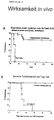
- Example 2 described here shows that a long-lasting Tumor immunity is attainable.
- the performed in mice Investigations and the results obtained in this way can also be transferred to people. It is assumed, that a multi-year and thus a long-lasting tumor immunity can be achieved by the method according to the invention.
- a tumor cell is understood to mean any cell the normal function by one or more mutations lost or changed and multiply uncontrollably can.
- the tumor immunity achievable according to the invention is characterized in that that in an organism the body's immune system is activated against the autologous tumor in such a way that it too permanent destruction and / or control of the autologous Tumor is coming.
- any type of tumors that can be treated under the definition given above falls.
- treatable are epithelial tumors, adenocarcinomas, colon carcinomas, breast carcinomas, Ovarian cancer, lung cancer and ear, nose and / or Ear tumors.
- Non-epithelial can also be treated Tumors such as leukemia and lymphoma.
- Can still be treated are virus-induced tumors, for example liver tumors or cervical cancer.
- tumor cell preparations get back in the form of pharmaceutical preparations administered to the patient.
- heterologous intact bispecific and / or trispecific antibodies are used. These become ex vivo with tumor cells previously taken from a patient (autologous Tumor cells) brought into contact. To survive the tumor cells after preventing reinfusion, the tumor cells before contacting the antibodies in a known manner Treated in such a way, for example by radiation. The tumor cells become heterologous after irradiation with the intact bispecific and / or trispecific antibodies incubated. Not any antibodies can be used according to the invention, but these must be intact, i.e. you need a functional Fc part and they must be heterologous in nature be, i.e. the antibodies are then from heavy immunoglobulin chains different subclasses (combinations, also fragments) and / or origin (species).
- bispecific and / or trispecific antibodies are used, which are able to target the Fc receptor positive cell activate.
- the expression of cytokines and / or co-stimulatory antigens initiated or increased.
- the trispecific antibodies bind to the Fc receptor positive cells are preferred, for example, via the Fc receptor from Fc receptor positive cells or via other antigens on Fc receptor positive cells (antigen-presenting Cells), e.g. the mannose receptor.
- heterologous bispecific that can be used according to the invention and / or trispecific antibodies are known in part, in part, however, they are also mentioned in the previous application described for the first time.
- An example of a bsAk is the anti-CD3 X anti-epcam antibody, which is used in epithelial Tumors such as breast cancer are used.
- the autologous tumor cells are included the intact heterologous bispecific and / or trispecific Antibodies for a period of 10 minutes to 5 hours or 10 minutes to 3 hours or further preferred for a period of about 15 minutes to 2 hours, further preferred for a period of 15 minutes to 1 hour.
- the tumor cells then loaded with the antibodies become then prepared for reinfusion.
- the autologous tumor cells also for a period of about 10 minutes to 5 hours, preferably for a period of 15 minutes to 2 hours and further preferred for a period of 15 minutes to 1 Hour, incubated so that the autologous tumor cells with the antibodies be loaded.
- PBMC peripheral blood mononucleated cells
- the autologous tumor cells can be used in a further procedure directly with the bispecific and / or trispecific Antibodies and with the patient's blood cells, preferred the mononuclear cells from the peripheral blood to be brought. This causes a variety of immune cells already “primed” against the tumor ex vivo. Subsequently these are reinfused into the patient. Through long-term incubation will also internalize the antibodies and their degradation is achieved.
- T cells Both in the short-term and in the long-term incubation T cells are attached to the tumor cells by means of the Tumor cells immobilized intact bispecific and / or trispecific antibody redirected; finds at the same time binding of Fc receptor positive cells to the Fc part of the bispecific and / or trispecific antibody Reinfusion instead.
- the Fc receptor becomes positive cells immobilized by binding to the Fc parts of (on the T cell or tumor cell) intact bispecific antibodies activated.
- tumor cells treated with the antibodies not only applied once to the patient, but optionally can also be administered several times.
- MHC 1 is upregulated on the tumor cell, as well activation of the intracellular processing machinery (Proteasome complex) due to the release of cytokines (such as e.g. INF- ⁇ and TNF- ⁇ ) in the immediate vicinity of the tumor cell.
- cytokines such as e.g. INF- ⁇ and TNF- ⁇
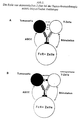
- the cytokines are mediated due to bispecific antibodies Activation of T cells and accessory cells released (see Fig. 1 and 3). I.e. through the intact bsAk not only are tumor cells destroyed or phagocytosed, but indirectly their tumor immunity also increased.
- Activation of the Fc receptor positive cell by the bsAk is of the subclass or the subclass combination of the bsAk dependent.
- bsAk of the subclass combination mouse-IgG2a / rat-IgG2b able to bind positive cells to Fc receptor and to activate this at the same time, which leads to upregulation or re-education (expression) of costimulatory Antigens such as CD40, CD80 or CD86, on the cell surface of these cells leads.
- bsAk are the subclass combination Mouse IgG1 / IgG2b is able to positive for Fc receptors Binding cells (1), but apparently can not in Activate comparable measure (2).
- the T cell with a binding arm e.g. on CD3 or CD2
- costimulatory signals from the, to the Fc part of the bsAk bound Fc receptor positive cell, transmitted to the T cell will. I.e. only the combination of activation of the T cell via a binding arm of the bsAk and the simultaneous Transmission of costimulatory signals from the Fc receptor positive cell on the T cell, leads to efficient T cell activation (Fig.1A).
- Tumor-specific T cells that respond the tumor cell has been insufficiently activated and is anergic can also after the ex vivo pretreatment according to the invention can be reactivated (Fig. 1B).
- Tumor-specific CD4 cells Another important aspect in inducing tumor immunity is the possible phagocytosis, processing and presentation of tumor components by those introduced by the bsAk and activated accessory cells (monocytes / macrophages, dendritic cells and NK “natural killer” cells).
- bsAk and activated accessory cells monocytes / macrophages, dendritic cells and NK "natural killer” cells.
- Tumor-specific CD4 cells also play play an important role in the induction of a humoral Immune response in connection with T-B cell cooperation.
- Bispecific and trispecific antibodies can be used with a Low binding to the T cell receptor complex of the T cell with which second arm to bind to tumor-associated antigens on the tumor cell tie. They activate T cells by releasing them of cytokines or apoptosis-mediating mechanisms Destroy tumor cells.
- T cells as part of activation with bispecific Antibodies tumor-specific antigens via their receptor recognize and thereby initiated a permanent immunization (Fig. 1B). Intact is of particular importance Fc part of the bispecific or trispecific antibody, which binds to accessory cells such as e.g.
- TTLs cytotoxic T cells
- the tumor cells with the antibodies in the short-term and in the long-term incubation process over a period of 10 Minutes to 5 hours, preferably up to 3 hours, further preferred to 2 hours, and more preferably 15 minutes to Incubated for 1 hour.
- the incubation is preferably carried out at a temperature of 4 ° C to 25 ° C, particularly preferably at 4 ° C to 10 ° C. Incubation is preferred in a sterile environment in buffered saline at a neutral pH carried out. The short-term incubation then takes place immediately reinfusion in the patient.
- the tumor cells are preferably used in an amount of 10 7 to 10 9 cells, further preferably in an amount of approx. 10 8 cells.
- the mononuclear cells from the peripheral blood are preferably added in an amount of approximately 10 8 to 10 10 cells.
- incubation conditions which can be determined by laboratory tests (for example changes in the number of cells and duration of the incubation).
- the autologous tumor cells are used to post-reinfusion to prevent further survival of the tumor cells for example irradiated.
- ⁇ -rays are used which are used, for example, in a dose strength of 50 to 100 Gy will.
- the antibodies used according to the invention are preferred for Reactivation of anergic, tumor-specific T cells capable. Furthermore, they are for the induction of tumor-reactive Complement-binding antibodies and thus for induction a humoral immune response.
- the Fc receptor positive Cells have at least one Fc ⁇ receptor I, II or III on.
- Antibodies which can be used according to the invention are for binding to monocytes, Macrophages, dendritic cells, "natural killer” cells (NK cells) and / or activated neutrophils as Fc ⁇ receptor 1 positive cells enabled.
- the antibodies which can be used according to the invention cause the Expression of CD40, CD80, CD86, ICAM-1 and / or LFA-3 as costimulatory Antigens and / or the secretion of cytokines initiated or increased by the Fc receptor positive cell becomes.
- the cytokines are preferably IL-1, IL-2, IL-4, IL-6, IL-8, IL-12 and / or TNF- ⁇ .
- Binding to the T cell is preferably via the T cell receptor complex the T cell.
- the trispecific antibodies which can be used according to the invention have at least one T cell binding arm, one tumor cell binding arm and a cell that binds to the Fc receptor Low binding.
- This last-mentioned binding arm can be a anti-Fc receptor binding arm or a mannose receptor binding arm be.
- the bispecific antibody is preferably a heterologous intact Rat / mouse bispecific antibody.
- Greenwood et. al. describe the possibility of exchanging individual immunoglobulin domains (eg CH2) using suitable cloning techniques.
- This provides the technology to produce new antibody combinations, as described by way of example in claim 9, for example: human- (VH-CH1, VL-CL) -human IgG4- (hinge) -human IgG4 (N-terminal region of CH2) - human IgG3 * (C-terminal region of CH2:> amino acid position 251) -human IgG3 * (CH3).
- human IgG4 to produce the bispecific antibody: human IgG4 / human- (VH-CH1, VL-CL) -human IgG4- (hinge) -human IgG4 (N-terminal region of CH2) -human IgG3 * (C-terminal region of CH2:> amino acid position 251) - human IgG3 * (CH3) is by simple cell fusion, as in Lindhofer et al. (J. Immunol. 155: 219, 1995).
- the antibodies which can be used according to the invention are preferably monoclonal, chimeric, recombinant, synthetic, semisynthetic or chemically modified intact antibodies with, for example, Fv, Fab, scFv or F (ab) 2 fragments.
- Antibodies or derivatives or fragments of are preferred People used or those who are changed in such a way that they are suitable for use in humans (so-called "humanized antibodies”) (see e.g. Shalaby et al., J. Exp. Med. 175: 217 (1992); Mocikat et al., Transplantation 57 (1994), 405).
- the production of the various types of antibodies mentioned above and fragments are familiar to the person skilled in the art.
- the production monoclonal antibodies which originate preferably in Mammals, e.g. Human, rat, mouse, rabbit or goat, have, can be done using conventional methods such as e.g. in Köhler and Milstein (Nature 256 (1975), 495), in Harlow and Lane (Antibodies, A Laboratory Manual (1988) Cold Spring Harbor) or in Galfré (Meth. Enzymol. 73 (1981), 3) are.
- bispecific antibodies possible by using recombinant DNA technology, but also through the so-called hybrid hybridoma fusion technology (see e.g. Milstein et al., Nature 305 (1983), 537).
- hybridoma cell lines each with one of the antibodies produce desired specificities, fused and recombinant Identifies and isolates cell lines that have antibodies produce both specificities.
- the problem underlying the invention can be solved both by bispecific as well as trispecific antibodies are solved, provided that they have the properties characterized in claim 1 and Have effects.
- the following is the production of antibodies described with two and three specificities.
- the Provision of such bispecific and trispecific Antibody belongs to the state of the art, and to such Literature describing manufacturing techniques becomes full here referred to in terms of content.
- Antibodies with three specificities, so-called trispecific antibodies, by means of which the problem on which the invention is based can also be solved, can be prepared, for example, in such a way that a third antigen binding site with a further specificity, for example in the form of one of the heavy Ig chains of a bispecific antibody of a "single chain variable fragment" (scFv).
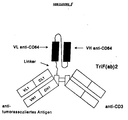
- trispecific F (ab) 2 constructs can be made by replacing the CH2-CH3 regions of the heavy chain of a specificity of a bispecific antibody with an scFv with a third specificity, while the CH2-CH3 regions of the heavy chain of the other specificity, for example by inserting a stop codon (at the end of the "hinge” region) into the coding gene, for example by means of homologous recombination (see Fig. 5).
- bispecific antibodies are made up of two antibody half-molecules (one H and one L immunoglobulin chain), the each represent specificity, composed, and also have an Fc part, like normal antibodies with the well-known effector functions. You are preferred made by Quadrom technology. This manufacturing process is described by way of example in DE-A-44 19 399. On this document, also regarding a definition of the bispecific Antibody becomes full for full disclosure Referred. Of course there are others too Manufacturing process can be used as long as they are according to the invention necessary intact bispecific antibodies of the lead definition above.
- bispecific antibodies in sufficient Amount produced.
- bispecific antibodies The invention has been described above and will be more particular below using bispecific antibodies. To the The place of the bispecific antibodies is a matter of course but also trispecific antibodies can be used as long as they have the conditions.
- IV intravenously.
- H-LAc78 is a cell line that was established from a hypopharyngeal carcinoma and expresses epcam to a high degree (own FACS data). Using H-Lac78 and peripheral mononuclear cells (PBMC) from voluntary donors, the generation of allogeneic cytotoxic T-lymphocytes was demonstrated. For this, constant amounts of H-Lac78 (2 ⁇ 10 4 ) were incubated with different amounts of PBMCs in the presence (10 ng) or in the absence of a bsAk (anti-epcam X anti-CD3). After a period of seven days, the PBMCs were removed and analyzed in the flow cytometer. At the same time, the number of H-Lac78 tumor cells was determined.
- PBMC peripheral mononuclear cells
- the activation of the T cells can be observed microscopically on the cluster formation, the proliferation can be confirmed by the incorporation of radioactive thymidine.
- the remaining tumor cells are detected microscopically and via the epithelial marker epcam, which is not expressed on peripheral blood cells.
- the H-Lac78 cells were completely lysed in the presence of the bsAk, ie no epcam-positive cells were detectable in the flow cytometer after seven days. These data were confirmed by the microscopic impression. Without bsAk, however, a complete lawn of H-Lac78 cells could be seen in the wells and epcam positive cells were detectable in the FACS.
- IL-2 Induction of the IL-2 mRNA upon addition of the bsAk could then be confirmed by RT-PCR bsAk was clearly superior to the parent parent antibodies (Fig. 3). This observation is important in that IL-2 has been described as an antitumoral cytokine, a systemic dose in appropriate concentration however, its toxicity is only possible to a limited extent. The danger of However, toxicity is related to the local production of IL-2, such as for example, it is not induced by intact bsAk given.
Landscapes
- Health & Medical Sciences (AREA)
- Life Sciences & Earth Sciences (AREA)
- Immunology (AREA)
- Chemical & Material Sciences (AREA)
- General Health & Medical Sciences (AREA)
- Medicinal Chemistry (AREA)
- Organic Chemistry (AREA)
- Veterinary Medicine (AREA)
- Public Health (AREA)
- Cell Biology (AREA)
- Animal Behavior & Ethology (AREA)
- Pharmacology & Pharmacy (AREA)
- Epidemiology (AREA)
- Engineering & Computer Science (AREA)
- Biomedical Technology (AREA)
- Virology (AREA)
- Genetics & Genomics (AREA)
- Zoology (AREA)
- Developmental Biology & Embryology (AREA)
- Proteomics, Peptides & Aminoacids (AREA)
- Molecular Biology (AREA)
- Biotechnology (AREA)
- Biochemistry (AREA)
- Biophysics (AREA)
- Mycology (AREA)
- Nuclear Medicine, Radiotherapy & Molecular Imaging (AREA)
- Oncology (AREA)
- Hematology (AREA)
- Microbiology (AREA)
- Chemical Kinetics & Catalysis (AREA)
- General Chemical & Material Sciences (AREA)
- Bioinformatics & Cheminformatics (AREA)
- Medicines Containing Antibodies Or Antigens For Use As Internal Diagnostic Agents (AREA)
- Medicines Containing Material From Animals Or Micro-Organisms (AREA)
- Preparation Of Compounds By Using Micro-Organisms (AREA)
- Micro-Organisms Or Cultivation Processes Thereof (AREA)
- Peptides Or Proteins (AREA)
- Medicines That Contain Protein Lipid Enzymes And Other Medicines (AREA)
Abstract
- α -
- Binden an eine T-Zelle;
- β -
- Binden an zumindest ein Antigen auf einer Tumorzelle;
- γ -
- Binden durch ihren Fc-Teil (bei bispezifischen Antikörpern) oder durch eine dritte Spezifität (bei trispezifischen Antikörpern) an Fc-Rezeptor positive Zellen.
Description
- Es sind hohe Antikörper-Dosen notwendig;
- es können gravierende Nebenwirkungen auftreten;
- durch den Tumorbindungsarm können die Antikörper bei in vivo-Applikation auch an Normalgewebe binden.
- α -
- Binden an eine T-Zelle;
- β -
- Binden an zumindest ein Antigen auf einer Tumorzelle;
- γ -
- Binden durch ihren Fc-Teil (bei bispezifischen Antikörpern) oder durch eine dritte Spezifität (bei trispezifischen Antikörpern) an Fc-Rezeptor positive Zellen.
- ein anti-CD3 X anti-Tumor-assoziiertes Antigen- und/oder anti-CD4 X anti-Tumor-assoziiertes Antigen- und/oder anti-CD5 X anti-Tumor-assoziiertes Antigen- und/oder anti-CD6 X anti-Tumor-assoziiertes Antigen- und/oder anti-CD8 X anti-Tumor-assoziiertes Antigen- und/oder anti-CD2 X anti-Tumor-assoziiertes Antigen- und/oder anti-CD28 X anti-Tumor-assoziiertes Antigen- und/oder anti-CD44 X anti-Tumor-assoziiertes Antigen-Antikörper ist.
- ein anti-CD3 X anti-Tumor-assoziiertes Antigen- und/oder anti-CD4 X anti-Tumor-assoziiertes Antigen- und/oder anti-CD5 X anti-Tumor-assoziiertes Antigen- und/oder anti-CD6 X anti-Tumor-assoziiertes Antigen- und/oder anti-CD8 X anti-Tumor-assoziiertes Antigen- und/oder anti-CD2 X anti-Tumor-assoziiertes Antigen- und/oder anti-CD28 X anti-Tumor-assoziiertes Antigen- und/oder anti-CD44 X anti-Tumor-assoziiertes Antigen-Antikörper.
-S-S(G4S)nD-I-Linker
an eine der schweren Ketten gebunden sein (S = Serin, G = Glycin, D = Aspartat, I = Isoleucin).
Weitere Vorteile von intakten bsAk mit der Fähigkeit zur Redirektion von T-Zellen gegenüber den o.g. bsF(ab')2 Fragmenten sind im einzelnen:
- Abb. 1:
- Die Rolle akzessorischer Zellen bei der Tumor-Immuntherapie mittels bispezifischer Antikörper
- Abb. 2:
- Zerstörung von Tumorzellen nach Gabe von bispezifischen Antikörpern, nachgewiesen im Durchflußzytometer
- Abb. 3:
- Induktion von Zytokinen durch intakte bispezifische Antikörper nur nicht aber durch parentale Antikörper
- Abb. 4:
- Wirksamkeit des erfindungsgemäßen Verfahrens in vivo
- Abb. 5:
- Trispezifische F(ab)2-Antikörper
- Abb. 6:
- Trispezifischer scFv-Antikörper
Claims (26)
- Verfahren zur ex vivo-Immunisierung von Mensch und Tier mit den nachfolgenden Schritten:a) Isolierung autologer Tumorzellen;b) Behandeln der Tumorzellen, um ihr Überleben nach Reinfusion zu verhindern;c) Inkubation der so behandelten Tumorzellen mit intakten heterologen bispezifischen und/oder trispezifischen Antikörpern, die die nachfolgenden Eigenschaften aufweisen:
- α -
- Binden an eine T-Zelle;
- β -
- Binden an zumindest ein Antigen auf einer Tumorzelle;
- γ -
- Binden durch ihren Fc-Teil (bei bispezifischen Antikörpern) oder durch eine dritte Spezifität (bei trispezifischen Antikörpern) an Fc-Rezeptor positive Zellen.
- Verfahren nach Anspruch 1,
dadurch gekennzeichnet, daß
die Antikörper so ausgewählt werden, daß sie zur Bindung Fc-Rezeptor positive Zellen befähigt sind, die einen Fcγ-Rezeptor I, II oder III aufweisen. - Verfahren nach Anspruch 2,
dadurch gekennzeichnet, daß
die Antikörper zur Bindung an Monozyten, Makrophagen, dendritische Zellen, "Natural Killer"-Zellen (NK-Zellen) und/oder aktivierte neutrophile Zellen als Fcγ-Rezeptor I positive Zellen befähigt sind. - Verfahren nach einem oder mehreren der vorhergehenden Ansprüche,
dadurch gekennzeichnet, daß
die Antikörper zur Induktion von tumorreaktiven Komplement-bindenden Antikörpern und damit zur Induktion einer humoralen Immunantwort befähigt sind. - Verfahren nach einem oder mehreren der vorhergehenden Ansprüche,
dadurch gekennzeichnet, daß
die Antikörper so ausgewählt werden, daß sie über CD2, CD3, CD4, CD5, CD6, CD8, CD28 und/oder CD44 an die T-Zellen binden. - Verfahren nach einem oder mehreren der vorhergehenden Ansprüche,
dadurch gekennzeichnet, daß
die Antikörper so ausgewählt werden, daß nach ihrer Bindung an die Fc-Rezeptor positiven Zellen die Expression von CD40, CD80, CD86, ICAM-1 und/oder LFA-3 als kostimulatorische Antigene und/oder die Sekretion von Zytokinen durch die Fc-Rezeptor positive Zelle initiiert oder erhöht wird. - Verfahren nach Anspruch 6,
dadurch gekennzeichnet, daß
die Antikörper so ausgewählt werden, daß die Sekretion von IL-1, IL-2, IL-4, IL-6, IL-8, IL-12 als Zytokine und/oder von TNF-α erhöht wird. - Verfahren nach einem oder mehreren der vorhergehenden Ansprüche,
dadurch gekennzeichnet, daß
der bispezifische Antikörper so ausgewählt wird, daß er ein anti-CD3 X anti-Tumor-assoziiertes Antigen- und/oder anti-CD4 X anti-Tumor-assoziiertes Antigen- und/oder anti-CD5 X anti-Tumor-assoziiertes Antigen- und/oder anti-CD6 X anti-Tumor-assoziiertes Antigen- und/oder anti-CD8 X anti-Tumor-assoziiertes Antigen- und/oder anti-CD2 X anti-Tumor-assoziiertes Antigen- und/oder anti-CD28 X anti-Tumor-assoziiertes Antigen- und/oder anti-CD44 X anti-Tumor-assoziiertes Antigen-Antikörper ist. - Verfahren nach einem oder mehreren der vorhergehenden Ansprüche,
dadurch gekennzeichnet, daß
der bispezifische Antikörper aus einer oder mehreren der nachfolgenden Isotykombinationen ausgewählt wird:Ratte-IgG2b/Maus-IgG2a,Ratte-IgG2b/Maus-IgG2b,Ratte-IgG2b/Maus-IgG3,Ratte-IgG2b/Human-IgG1,Ratte-IgG2b/Human-IgG2,Ratte-IgG2b/Human-IgG3[orientaler Allotyp G3m(st) = Bindung an Protein A],Ratte-IgG2b/Human-IgG4,Ratte-IgG2b/Ratte-IgG2c,Maus-IgG2a/Human-IgG3[kaukasische Allotypen G3m(b+g) = keine Bindung an Protein A, im folgenden mit * gekennzeichnet]Maus-IgG2a/Maus-[VH-CH1,VL-CL]-Human-IgG1-[Hinge]-Human-IgG3*-[CH2-CH3]Maus-IgG2a/Ratte-[VH-CH1,VL-CL]-Human-IgG1-[Hinge]-Human-IgG3*-[CH2-CH3]Maus-IgG2a/Human-[VH-CH1,VL-CL]-Human-IgG1-[Hinge]-Human-IgG3*-[CH2-CH3]Maus-[VH-CH1,VL-CL]-Human-IgG1/Ratte-[VH-CH1,VL-CL]-Human-IgG1-[Hinge]-Human-IgG3*-[CH2-CH3]Maus-[VH-CH1,VL-CL]-Human-IgG4/Ratte-[VH-CH1,VL-CL]-Human-IgG4-[Hinge]-Human-IgG4[N-terminale Region von CH2]-Human-IgG3*[C-terminale Region von CH2: > AS-Position 251]-Human- IgG3*[CH3]Ratte-IgG2b/Maus-[VH-CH1,VL-CL]-Human-IgG1-[Hinge-CH2-CH3]Ratte-IgG2b/Maus-[VH-CH1,VL-CL]-Human-IgG2-[Hinge-CH2-CH3]Ratte-IgG2b/Maus-[VH-CH1,VL-CL]-Human-IgG3-[Hinge-CH2-CH3, orientaler Allotyp]Ratte-IgG2b/Maus-[VH-CH1,VL-CL]-Human-IgG4-[Hinge-CH2-CH3]Human-IgG1/Human-[VH-CH1,VL-CL]-Human-IgG1-[Hinge]-Human-IgG3*-[CH2-CH3]Human-IgG1/Ratte-[VH-CH1,VL-CL]-Human-IgG1-[Hinge]-Human-IgG4[N-terminale Region von CH2]-Human-IgG3*[C-terminale Region von CH2 : > AS-Position 251]-Human-IgG3*[CH3]Human-IgG1/Maus-[VH-CH1,VL-CL]-Human-IgG1-[Hinge]-Human-IgG4[N-terminale Region von CH2]-Human-IgG3*[C-terminale Region von CH2 : > AS-Position 251]-Human-IgG3*[CH3]Human-IgG1/Ratte-[VH-CH1,VL-CL]-Human-IgG1-[Hinge]-Human-IgG2[N-terminale Region von CH2]-Human-IgG3*[C-terminale Region von CH2 : > AS-Position 251]-Human-IgG3*[CH3]Human-IgG1/Maus-[VH-CH1,VL-CL]-Human-IgG1-[Hinge]-Human-IgG2[N-terminale Region von CH2]-Human-IgG3*[C-terminale Region von CH2 : > AS-Position 251]-Human-IgG3*[CH3]Human-IgG1/Ratte-[VH-CH1,VL-CL]-Human-IgG1-[Hinge]-Human-IgG3*-[CH2-CH3]Human-IgG1/Maus-[VH-CH1,VL-CL]-Human-IgG1-[Hinge]-Human-IgG3*-[CH2-CH3]Human-IgG2/Human-[VH-CH1,VL-CL]-Human-IgG2-[Hinge]-Human-IgG3*-[CH2-CH3]Human-IgG4/Human-[VH-CH1,VL-CL]-Human-IgG4-[Hinge]-Human-IgG3*-[CH2-CH3]Human-IgG4/Human-[VH-CH1,VL-CL]-Human-IgG4-[Hinge]-Human-IgG4[N-terminale Region von CH2]-Human-IgG3*[C-terminale Region von CH2 : > AS-Position 251]-Human-IgG3*[CH3]Maus-IgG2b/Ratte-[VH-CH1,VL-CL]-Human-IgG1-[Hinge]-Human-IgG3*-[CH2-CH3]Maus-IgG2b/Human-[VH-CH1,VL-CL]-Human-IgG1-[Hinge]-Human-IgG3*-[CH2-CH3]Maus-IgG2b/Maus-[VH-CH1,VL-CL]-Human-IgG1-[Hinge]-Human-IgG3*-[CH2-CH3]Maus-[VH-CH1,VL-CL]-Human-IgG4/Ratte-[VH-CH1,VL-CL]-Human-IgG4-[Hinge]-Human-IgG4-[CH2]-Human-IgG3*-[CH3]HumanIgG1/Ratte[VH-CH1,VL-CL]-Human-IgG1[Hinge]-Human-IgG4-[CH2]-HumanIgG3*[CH3]HumanIgG1/Maus[VH-CH1,VL-CL]-Human-IgG1[Hinge]-Human-IgG4-[CH2]-Human-IgG3*[CH3]Human-IgG4/Human[VH-CH1,VL-CL]-Human-IgG4-[Hinge]-Human-IgG4-[CH2]-HumanIgG3*-[CH3] - Verfahren nach einem oder mehreren der vorhergehenden Ansprüche,
dadurch gekennzeichnet, daß
der bispezifische Antikörper aus einem heterologen Ratte/Maus bispezifischen Antikörper ausgewählt wird. - Verfahren nach einem oder mehreren der vorhergehenden Ansprüche,
dadurch gekennzeichnet, daß
der trispezifische Antikörper einen T-Zell-Bindungsarm, einen Tumorzell-Bindungsarm und eine dritte Spezifität zur Bindung an Fc-Rezeptor positive Zellen besitzt. - Verfahren nach Anspruch 11,
dadurch gekennzeichnet, daß
der trispezifische Antikörper so ausgewählt wird, daß er ein anti-CD3 X anti-Tumor-assoziiertes Antigen- und/oder anti-CD4 X anti-Tumor-assoziiertes Antigen- und/oder anti-CD5 X anti-Tumor-assoziiertes Antigen- und/oder anti-CD6 X anti-Tumor-assoziiertes Antigen- und/oder anti-CD8 X anti-Tumor-assoziiertes Antigen- und/oder anti-CD2 X anti-Tumor-assoziiertes Antigen- und/oder anti-CD28 X anti-Tumor-assoziiertes Antigen- und/oder anti-CD44 X anti-Tumor-assoziiertes Antigen-Antikörper ist. - Verfahren nach einem oder mehreren der vorhergehenden Ansprüche,
dadurch gekennzeichnet, daß
im Schritt c) nach Inkubation der Tumorzellen mit intakten heterologen bispezifischen und/oder trispezifischen Antikörpern die mit den Antikörpern beladenen Tumorzellen zur Reinfusion vorbereitet werden (Kurzzeitinkubation). - Verfahren nach einem oder mehreren der Ansprüche 1 bis 12,
dadurch gekennzeichnet, daß
im Schritt c) die Inkubation der Tumorzellen mit den Antikörpern zusammen mit mononukleären Zellen aus dem peripheren Blut (PBMC = peripheral blood mononucleated cells) erfolgt oder nach Inkubation der Tumorzellen mit den Antikörpern die mononukleären Zellen zugegeben werden und die Inkubation fortgesetzt wird (Langzeitinkubation). - Verfahren nach Anspruch 13 oder 14,
dadurch gekennzeichnet, daß
die Tumorzellen mit den Antikörpern für einen Zeitraum von 10 Minuten bis 5 Stunden inkubiert werden. - Verfahren nach Anspruch 15,
dadurch gekennzeichnet, daß
die Inkubation der Tumorzellen mit den Antikörpern für einen Zeitraum von 15 bis 120 Minuten, bevorzugt 15 bis 60 Minuten, erfolgt. - Verfahren nach einem oder mehreren der vorhergehenden Ansprüche 14 bis 16,
dadurch gekennzeichnet, daß die mononukleären Zellen aus dem peripheren Blut zusammen mit den Tumorzellen und den Antikörpern für einen Zeitraum von 1 bis 14 Tagen, bevorzugt 3 bis 10 Tagen und weiterhin bevorzugt 6 bis 10 Tagen inkubiert werden. - Verfahren nach einem oder mehreren der vorhergehenden Ansprüche,
dadurch gekennzeichnet, daß
die mononukleären Zellen aus dem peripheren Blut in einer Menge von ca. 108 bis 1010 Zellen zugegeben werden. - Verfahren nach einem oder mehreren der vorhergehenden Ansprüche,
dadurch gekennzeichnet, daß
die Tumorzellen in einer Menge von 107 bis 109 Zellen, bevorzugt ca. 108 Zellen, zugegeben werden. - Verfahren nach einem oder mehreren der vorhergehenden Ansprüche,
dadurch gekennzeichnet, daß
die bispezifischen und/oder trispezifischen Antikörper in einer Menge von 2 bis 100 µg, bevorzugter 5 bis 70 µg, insbesondere bevorzugt 5 bis 50 µg zugegeben werden. - Verfahren nach einem oder mehreren der vorhergehenden Ansprüche,
dadurch gekennzeichnet, daß
die Behandlung der Tumorzellen im Schritt b durch Bestrahlung, bevorzugt durch γ-Bestrahlung, weiterhin bevorzugt in einer Dosisstärke von 50 bis 100 Gy, oder durch chemi sche Substanzen, bevorzugt Mitomycin C, erfolgt. - Verfahren nach einem oder mehreren der vorhergehenden Ansprüche, dadurch gekennzeichnet, daß die intakten heterologen bispezifischen und/oder trispezifischen Antikörper so ausgewählt werden, daß sie zur Aktivierung Fc-Rezeptorpositiver Zelle befähigt sind, wodurch die Expression von Cytokinen und/oder co-stimulatorischen Antigenen initiiert oder erhöht wird.
- Verwendung der nach einem Verfahren nach einem oder mehreren der vorhergehenden Ansprüche hergestellten Tumorzellpräparate zur Herstellung eines Arzneimittels zur Prophylaxe und Behandlung von Tumorerkrankungen.
- Verwendung nach Anspruch 23 zur Induktion einer Tumorimmunität.
- Verwendung der nach einem Verfahren nach einem oder mehreren der vorhergehenden Ansprüche hergestellten Tumorzellpräparate zur Herstellung eines Arzneimittels zur Reinfusion in den Patienten oder das Tier, aus dem die autologen Tumorzellen entnommen wurden.
- Pharmazeutische Zubereitung, enthaltend das nach einem Verfahren nach einem oder mehreren der vorhergehenden Ansprüche erhältliche Tumorzellpräparat, wahlweise zusammen mit weiteren, an sich üblichen Hilfs- und/oder Trägerstoffen.
Applications Claiming Priority (2)
| Application Number | Priority Date | Filing Date | Title |
|---|---|---|---|
| DE19725586 | 1997-06-17 | ||
| DE19725586A DE19725586C2 (de) | 1997-06-17 | 1997-06-17 | Verfahren zur Herstellung von Zellpräparaten zur Immunisierung mittels heterologer intakter bispezifischer und/oder trispezifischer Antikörper |
Publications (3)
| Publication Number | Publication Date |
|---|---|
| EP0885614A2 true EP0885614A2 (de) | 1998-12-23 |
| EP0885614A3 EP0885614A3 (de) | 1999-01-13 |
| EP0885614B1 EP0885614B1 (de) | 2000-09-27 |
Family
ID=7832736
Family Applications (1)
| Application Number | Title | Priority Date | Filing Date |
|---|---|---|---|
| EP98110972A Expired - Lifetime EP0885614B1 (de) | 1997-06-17 | 1998-06-16 | Verfahren zur ex vivo-Immunisierung mittels heterologer intakter bispezifischer und/oder trispezifischer Antikörper |
Country Status (6)
| Country | Link |
|---|---|
| US (2) | US7018632B2 (de) |
| EP (1) | EP0885614B1 (de) |
| JP (2) | JP4145995B2 (de) |
| AT (1) | ATE196607T1 (de) |
| DE (2) | DE19725586C2 (de) |
| DK (1) | DK0885614T3 (de) |
Cited By (7)
| Publication number | Priority date | Publication date | Assignee | Title |
|---|---|---|---|---|
| WO2000018435A1 (de) * | 1998-09-25 | 2000-04-06 | Horst Lindhofer | Verwendung von tumorzellen zeitversetzt in kombination mit intakten antikörpern zur immunisierung |
| US6805869B2 (en) | 1996-06-12 | 2004-10-19 | Shanghai Cp Guojian Pharmaceutical Co., Ltd. | Cellular vaccines and immunotherapeutics and methods for their preparation |
| EP1666500A1 (de) * | 2004-12-01 | 2006-06-07 | Trion Pharma Gmbh | Verwendung trifunktionaler Antikörper zur Risikoreduzierung von GvHD in einer allogenetischen anti-Tumor Zelltherapie |
| CN1294148C (zh) * | 2001-04-11 | 2007-01-10 | 中国科学院遗传与发育生物学研究所 | 环状单链三特异抗体 |
| US8066989B2 (en) | 2004-11-30 | 2011-11-29 | Trion Pharma Gmbh | Method of treating tumor growth and metastasis by using trifunctional antibodies to reduce the risk for GvHD in allogeneic antitumor cell therapy |
| EP2524699A1 (de) * | 2011-05-17 | 2012-11-21 | Trion Research GmbH | Impfstoffzubereitung mit trifunktionalen Antikörpern mit Antigenimmunogenität verbessernden Eigenschaften |
| WO2012156430A1 (en) * | 2011-05-17 | 2012-11-22 | Trion Research Gmbh | Vaccine preparation containing trifunctional antibodies with antigen immunogenicity enhancer properties |
Families Citing this family (59)
| Publication number | Priority date | Publication date | Assignee | Title |
|---|---|---|---|---|
| DE19725586C2 (de) * | 1997-06-17 | 1999-06-24 | Gsf Forschungszentrum Umwelt | Verfahren zur Herstellung von Zellpräparaten zur Immunisierung mittels heterologer intakter bispezifischer und/oder trispezifischer Antikörper |
| DE10043437A1 (de) * | 2000-09-04 | 2002-03-28 | Horst Lindhofer | Verwendung von trifunktionellen bispezifischen und trispezifischen Antikörpern zur Behandlung von malignem Aszites |
| WO2004092195A2 (en) * | 2003-04-09 | 2004-10-28 | Administrators Of The Tulane Educational Fund | Dendritic cell binding proteins and uses thereof |
| AU2003271174A1 (en) * | 2003-10-10 | 2005-04-27 | Chugai Seiyaku Kabushiki Kaisha | Double specific antibodies substituting for functional protein |
| AU2003271186A1 (en) * | 2003-10-14 | 2005-04-27 | Chugai Seiyaku Kabushiki Kaisha | Double specific antibodies substituting for functional protein |
| US8076459B2 (en) * | 2003-10-16 | 2011-12-13 | Micromet Ag | Multispecfic deimmunized CD3-binders |
| KR101374454B1 (ko) | 2005-03-31 | 2014-03-17 | 추가이 세이야쿠 가부시키가이샤 | 회합제어에 의한 폴리펩티드 제조방법 |
| EP2824183B1 (de) * | 2005-04-08 | 2020-07-29 | Chugai Seiyaku Kabushiki Kaisha | Verfahren zur Herstellung bispezifischer Antikörper |
| CA2606081C (en) | 2005-04-26 | 2013-09-17 | Markus M. Heiss | Combination of the application of antibodies for immunostimulation together with glucocorticoids |
| US8007796B2 (en) * | 2005-12-16 | 2011-08-30 | Micromet Ag | Means and methods for the treatment of tumorous diseases |
| EP1820513A1 (de) * | 2006-02-15 | 2007-08-22 | Trion Pharma Gmbh | Zerstörung von Tumorzellen, welche tumor-assoziierte Zielantigene mit niedrigem bis mittlerem Niveau exprimieren, mittels trifunktionaler bispezifischer Antikörper |
| EP4793360A2 (de) | 2006-03-31 | 2026-08-19 | Chugai Seiyaku Kabushiki Kaisha | Verfahren zur kontrolle der blut-pharmazeutizität von antikörpern |
| JP5144499B2 (ja) | 2006-03-31 | 2013-02-13 | 中外製薬株式会社 | 二重特異性抗体を精製するための抗体改変方法 |
| NZ601583A (en) * | 2007-05-21 | 2013-08-30 | Bristol Myers Squibb Co | Novel rabbit antibody humanization methods and humanized rabbit antibodies |
| US8178101B2 (en) | 2007-05-21 | 2012-05-15 | Alderbio Holdings Inc. | Use of anti-IL-6 antibodies having specific binding properties to treat cachexia |
| US8062864B2 (en) | 2007-05-21 | 2011-11-22 | Alderbio Holdings Llc | Nucleic acids encoding antibodies to IL-6, and recombinant production of anti-IL-6 antibodies |
| DK2164514T3 (en) * | 2007-05-21 | 2017-02-27 | Alderbio Holdings Llc | Antibodies to IL-6 and its use |
| US20090238825A1 (en) * | 2007-05-21 | 2009-09-24 | Kovacevich Brian R | Novel rabbit antibody humanization methods and humanized rabbit antibodies |
| US8404235B2 (en) | 2007-05-21 | 2013-03-26 | Alderbio Holdings Llc | Antagonists of IL-6 to raise albumin and/or lower CRP |
| US7906117B2 (en) | 2007-05-21 | 2011-03-15 | Alderbio Holdings Llc | Antagonists of IL-6 to prevent or treat cachexia, weakness, fatigue, and/or fever |
| US8252286B2 (en) | 2007-05-21 | 2012-08-28 | Alderbio Holdings Llc | Antagonists of IL-6 to prevent or treat thrombosis |
| US9701747B2 (en) | 2007-05-21 | 2017-07-11 | Alderbio Holdings Llc | Method of improving patient survivability and quality of life by anti-IL-6 antibody administration |
| EP2033657A1 (de) * | 2007-09-04 | 2009-03-11 | Trion Pharma Gmbh | Intraoperative trifunktionale Antikörper-Applikation zur Prophylaxe intraperitonealer Tumorzelldissemination |
| EP3127921A1 (de) | 2007-09-26 | 2017-02-08 | Chugai Seiyaku Kabushiki Kaisha | Verfahren zur modifizierung eines isoelektrischen punkts eines antikörpers über aminosäuresubstition in cdr |
| US8420089B2 (en) | 2008-11-25 | 2013-04-16 | Alderbio Holdings Llc | Antagonists of IL-6 to raise albumin and/or lower CRP |
| US9452227B2 (en) | 2008-11-25 | 2016-09-27 | Alderbio Holdings Llc | Methods of treating or diagnosing conditions associated with elevated IL-6 using anti-IL-6 antibodies or fragments |
| US8337847B2 (en) | 2008-11-25 | 2012-12-25 | Alderbio Holdings Llc | Methods of treating anemia using anti-IL-6 antibodies |
| US8323649B2 (en) * | 2008-11-25 | 2012-12-04 | Alderbio Holdings Llc | Antibodies to IL-6 and use thereof |
| US8992920B2 (en) | 2008-11-25 | 2015-03-31 | Alderbio Holdings Llc | Anti-IL-6 antibodies for the treatment of arthritis |
| US9212223B2 (en) | 2008-11-25 | 2015-12-15 | Alderbio Holdings Llc | Antagonists of IL-6 to prevent or treat thrombosis |
| EP2241576A1 (de) | 2009-04-17 | 2010-10-20 | Trion Pharma Gmbh | Verwendung trifunktionaler bispezifischer Antikörper zur Behandlung von mit CD133+-/EpCAM+-Krebsstammzellen assoziierten Tumoren |
| TWI507525B (zh) * | 2009-06-26 | 2015-11-11 | Regeneron Pharma | 具天然免疫球蛋白形式之易分離的雙專一性抗體 |
| US9775921B2 (en) | 2009-11-24 | 2017-10-03 | Alderbio Holdings Llc | Subcutaneously administrable composition containing anti-IL-6 antibody |
| EP2504032A4 (de) | 2009-11-24 | 2013-06-19 | Alderbio Holdings Llc | Antagonisten von il-6 zur thromboseverhinderung oder -behandlung |
| JP2012025694A (ja) * | 2010-07-23 | 2012-02-09 | Asahi Kasei Kuraray Medical Co Ltd | 癌治療剤 |
| CN105859889B (zh) | 2010-11-17 | 2020-01-07 | 中外制药株式会社 | 具有代替凝血因子viii的功能的功能的多特异性抗原结合分子 |
| US8992908B2 (en) | 2010-11-23 | 2015-03-31 | Alderbio Holdings Llc | Anti-IL-6 antibodies for the treatment of oral mucositis |
| EP2754458B1 (de) * | 2011-07-12 | 2017-02-01 | Sorin Group Italia S.r.l. | Doppelkammer-blutreservoir |
| CA2911946A1 (en) * | 2013-05-10 | 2014-11-13 | Numab Ag | Bispecific constructs and their use in the treatment of various diseases |
| CA2925256C (en) | 2013-09-27 | 2023-08-15 | Chugai Seiyaku Kabushiki Kaisha | Method for producing polypeptide heteromultimer |
| US10647768B2 (en) | 2014-05-29 | 2020-05-12 | Macrogenics, Inc. | Multi-chain polypeptide-containing tri-specific binding molecules |
| AR101262A1 (es) | 2014-07-26 | 2016-12-07 | Regeneron Pharma | Plataforma de purificación para anticuerpos biespecíficos |
| TWI701435B (zh) | 2014-09-26 | 2020-08-11 | 日商中外製藥股份有限公司 | 測定fviii的反應性之方法 |
| MA40764A (fr) | 2014-09-26 | 2017-08-01 | Chugai Pharmaceutical Co Ltd | Agent thérapeutique induisant une cytotoxicité |
| TWI700300B (zh) | 2014-09-26 | 2020-08-01 | 日商中外製藥股份有限公司 | 中和具有第viii凝血因子(fviii)機能替代活性的物質之抗體 |
| JP7082484B2 (ja) | 2015-04-01 | 2022-06-08 | 中外製薬株式会社 | ポリペプチド異種多量体の製造方法 |
| US20200270363A1 (en) | 2015-12-25 | 2020-08-27 | Chugai Seiyaku Kabushiki Kaisha | Antibody having enhanced activity, and method for modifying same |
| SG11201803989WA (en) | 2015-12-28 | 2018-06-28 | Chugai Pharmaceutical Co Ltd | Method for promoting efficiency of purification of fc region-containing polypeptide |
| AU2017255077B2 (en) | 2016-04-28 | 2024-05-16 | Chugai Seiyaku Kabushiki Kaisha | Antibody-containing preparation |
| CA3027018A1 (en) | 2016-07-29 | 2018-02-01 | Chugai Seiyaku Kabushiki Kaisha | Bispecific antibody exhibiting increased alternative fviii-cofactor-function activity |
| US11352438B2 (en) | 2016-09-06 | 2022-06-07 | Chugai Seiyaku Kabushiki Kaisha | Methods of using a bispecific antibody that recognizes coagulation factor IX and/or activated coagulation factor IX and coagulation factor X and/or activated coagulation factor X |
| JP7209298B2 (ja) | 2017-03-31 | 2023-01-20 | 公立大学法人奈良県立医科大学 | 血液凝固第viii因子の機能を代替する多重特異性抗原結合分子を含有する、血液凝固第ix因子異常症の予防および/または治療に用いられる医薬組成物 |
| CA3071236A1 (en) | 2017-09-29 | 2019-04-04 | Chugai Seiyaku Kabushiki Kaisha | Multispecific antigen-binding molecule having blood coagulation factor viii (fviii) cofactor function-substituting activity, and pharmaceutical formulation containing said moleculeas active ingredient |
| KR20260090008A (ko) | 2017-11-01 | 2026-06-16 | 추가이 세이야쿠 가부시키가이샤 | 생물 활성이 저하된 항체 배리언트 및 아이소폼 |
| CN121591910A (zh) * | 2017-11-21 | 2026-03-03 | 诺华股份有限公司 | 针对肿瘤相关抗原的三特异性结合分子及其用途 |
| EP3569617A1 (de) * | 2018-05-18 | 2019-11-20 | Trion Research GmbH | Pharmazeutisches präparat zur verwendung in der behandlung von epstein-barr-virus-positiven patienten mit krankheiten im zusammenhang mit dem reaktivierungsphänomen |
| WO2020176880A1 (en) * | 2019-02-28 | 2020-09-03 | University Of Virginia Patent Foundation | Induction of highly efficacious anti-tumor and immune modulating activity: cell-free off the shelf therapeutic modality |
| UY38701A (es) | 2019-05-21 | 2020-12-31 | Novartis Ag | Moléculas de unión a cd19, conjugados, composiciones que las comprenden y usos de las mismas |
| AU2020279224B2 (en) | 2019-05-21 | 2024-12-05 | Novartis Ag | Trispecific binding molecules against BCMA and uses thereof |
Family Cites Families (8)
| Publication number | Priority date | Publication date | Assignee | Title |
|---|---|---|---|---|
| US4828991A (en) * | 1984-01-31 | 1989-05-09 | Akzo N.V. | Tumor specific monoclonal antibodies |
| US6071517A (en) * | 1986-07-07 | 2000-06-06 | Medarex, Inc. | Bispecific heteroantibodies with dual effector functions |
| US4844893A (en) * | 1986-10-07 | 1989-07-04 | Scripps Clinic And Research Foundation | EX vivo effector cell activation for target cell killing |
| DE4407538C1 (de) * | 1994-03-07 | 1995-02-23 | Deutsches Krebsforsch | Bindungsreagens für Zell-Oberflächenprotein und Effektorzelle |
| US6410690B1 (en) * | 1995-06-07 | 2002-06-25 | Medarex, Inc. | Therapeutic compounds comprised of anti-Fc receptor antibodies |
| DE19649223C2 (de) * | 1996-09-03 | 1998-07-30 | Gsf Forschungszentrum Umwelt | Zerstörung von kontaminierenden Tumorzellen in Stammzelltransplantaten mit bispezifischen Antikörpern |
| DK0826695T3 (da) | 1996-09-03 | 2002-04-15 | Gsf Forschungszentrum Umwelt | Tilintetgørelse af kontaminerende tumorceller i stamcelletransplantater med bispecifikke antistoffer |
| DE19725586C2 (de) * | 1997-06-17 | 1999-06-24 | Gsf Forschungszentrum Umwelt | Verfahren zur Herstellung von Zellpräparaten zur Immunisierung mittels heterologer intakter bispezifischer und/oder trispezifischer Antikörper |
-
1997
- 1997-06-17 DE DE19725586A patent/DE19725586C2/de not_active Expired - Fee Related
-
1998
- 1998-06-15 US US09/094,921 patent/US7018632B2/en not_active Expired - Fee Related
- 1998-06-16 DE DE59800285T patent/DE59800285D1/de not_active Expired - Lifetime
- 1998-06-16 EP EP98110972A patent/EP0885614B1/de not_active Expired - Lifetime
- 1998-06-16 DK DK98110972T patent/DK0885614T3/da active
- 1998-06-16 AT AT98110972T patent/ATE196607T1/de active
- 1998-06-17 JP JP17038998A patent/JP4145995B2/ja not_active Expired - Fee Related
-
2005
- 2005-07-20 US US11/186,136 patent/US8012470B2/en not_active Expired - Fee Related
-
2008
- 2008-03-13 JP JP2008064726A patent/JP2008189678A/ja active Pending
Cited By (8)
| Publication number | Priority date | Publication date | Assignee | Title |
|---|---|---|---|---|
| US6805869B2 (en) | 1996-06-12 | 2004-10-19 | Shanghai Cp Guojian Pharmaceutical Co., Ltd. | Cellular vaccines and immunotherapeutics and methods for their preparation |
| WO2000018435A1 (de) * | 1998-09-25 | 2000-04-06 | Horst Lindhofer | Verwendung von tumorzellen zeitversetzt in kombination mit intakten antikörpern zur immunisierung |
| CN1294148C (zh) * | 2001-04-11 | 2007-01-10 | 中国科学院遗传与发育生物学研究所 | 环状单链三特异抗体 |
| US8066989B2 (en) | 2004-11-30 | 2011-11-29 | Trion Pharma Gmbh | Method of treating tumor growth and metastasis by using trifunctional antibodies to reduce the risk for GvHD in allogeneic antitumor cell therapy |
| EP1666500A1 (de) * | 2004-12-01 | 2006-06-07 | Trion Pharma Gmbh | Verwendung trifunktionaler Antikörper zur Risikoreduzierung von GvHD in einer allogenetischen anti-Tumor Zelltherapie |
| EP2524699A1 (de) * | 2011-05-17 | 2012-11-21 | Trion Research GmbH | Impfstoffzubereitung mit trifunktionalen Antikörpern mit Antigenimmunogenität verbessernden Eigenschaften |
| WO2012156430A1 (en) * | 2011-05-17 | 2012-11-22 | Trion Research Gmbh | Vaccine preparation containing trifunctional antibodies with antigen immunogenicity enhancer properties |
| US9750806B2 (en) | 2011-05-17 | 2017-09-05 | Trion Research Gmbh | Vaccine preparation containing trifunctional antibodies with antigen immunogenicity enhancer properties |
Also Published As
| Publication number | Publication date |
|---|---|
| US20050255110A1 (en) | 2005-11-17 |
| ATE196607T1 (de) | 2000-10-15 |
| JP4145995B2 (ja) | 2008-09-03 |
| DK0885614T3 (da) | 2000-12-04 |
| HK1017270A1 (en) | 1999-11-19 |
| DE59800285D1 (de) | 2000-11-02 |
| JPH1171288A (ja) | 1999-03-16 |
| US8012470B2 (en) | 2011-09-06 |
| US20020009430A1 (en) | 2002-01-24 |
| EP0885614B1 (de) | 2000-09-27 |
| JP2008189678A (ja) | 2008-08-21 |
| US7018632B2 (en) | 2006-03-28 |
| DE19725586A1 (de) | 1998-12-24 |
| DE19725586C2 (de) | 1999-06-24 |
| EP0885614A3 (de) | 1999-01-13 |
Similar Documents
| Publication | Publication Date | Title |
|---|---|---|
| EP0885614B1 (de) | Verfahren zur ex vivo-Immunisierung mittels heterologer intakter bispezifischer und/oder trispezifischer Antikörper | |
| EP0826696B1 (de) | Verwendung bi-und trispezifischer Antikörper zur Induktion einer Tumorimmunität | |
| EP1115427B1 (de) | Verwendung von tumorzellen zeitversetzt in kombination mit intakten antikörpern zur immunisierung | |
| EP1315520B1 (de) | Verwendung von trifunktionellen bispezifischen und trispezifischen antikörpern zur behandlung von malignem aszites | |
| EP2192921B1 (de) | Intraoperative trifunktionale antikörper-applikation zur prophylaxe intraperitonealer tumorzelldissemination | |
| DE60313859T2 (de) | Induktion der anti-tumor-ctl-immunität durch in-vivo-aktivierung von 4-1bb und/oder cd40 | |
| EP1444268B1 (de) | Bispezifisches anti-cd28 antikörper-molekül | |
| DE69125735T2 (de) | Verfahren zur Aktivierung der zytolytischen Wirkung von Lymphozyten unter Verwendung von anti-CD28-Antikörper | |
| EP1303540B1 (de) | Multispezifisches reagenz zur selektiven stimulierung von zelloberflächenrezeptoren | |
| DE69504955T2 (de) | Immunstimulierende monoklonale antikörper | |
| DE69909459T2 (de) | Cd19xcd3 spezifische polypeptide und deren verwendung | |
| WO2000018806A1 (de) | Bispezifische und trispezifische antikörper, die spezifisch mit induzierbaren oberflächenantigenen als operationelle zielstrukturen reagieren | |
| EP1600460B1 (de) | Verwendung einer an CD28 bindenden Wirksubstanz zur Herstellung einer pharmazeutischen Zusammensetzung zur Behandlung von B-CLL | |
| DE69433820T2 (de) | Verwendung von löslichen oligomerischen cd40 liganden oder monoklonalen antikörpern zur herstellung eines arzneimitells zur vorbeugung oder behandlung von neoplastischen krankheiten | |
| EP1600164A2 (de) | Verwendung einer an CD28 bindenden Wirksubstanz zur Herstellung einer Pharmazeutischen Zusammensetzung mit dosisabhängiger Wirkung | |
| DE19859110A1 (de) | Bispezifische und trispezifische Antikörper, die spezifisch mit induzierbaren Oberflächenantigenen als operationelle Zielstrukturen reagieren | |
| DE19710497C2 (de) | Verwendung Bi- und trispezifische Antikörper zur Induktion einer Tumorimmunität | |
| EP0825256B1 (de) | Hybridzelle und deren Verwendung zur Herstellung eines Arzneimittels zur Induktion einer Tumorimmunität | |
| EP0978559B1 (de) | Induktion einer Tumorimmunität durch Redirektion von Tumorzellen gegen Antigen-präsentierende Zellen |
Legal Events
| Date | Code | Title | Description |
|---|---|---|---|
| PUAI | Public reference made under article 153(3) epc to a published international application that has entered the european phase |
Free format text: ORIGINAL CODE: 0009012 |
|
| PUAL | Search report despatched |
Free format text: ORIGINAL CODE: 0009013 |
|
| AK | Designated contracting states |
Kind code of ref document: A2 Designated state(s): AT BE CH DE DK ES FI FR GB GR IE IT LI LU MC NL PT SE |
|
| AX | Request for extension of the european patent |
Free format text: AL;LT;LV;MK;RO;SI |
|
| AK | Designated contracting states |
Kind code of ref document: A3 Designated state(s): AT BE CH CY DE DK ES FI FR GB GR IE IT LI LU MC NL PT SE |
|
| AX | Request for extension of the european patent |
Free format text: AL;LT;LV;MK;RO;SI |
|
| 17P | Request for examination filed |
Effective date: 19990219 |
|
| 17Q | First examination report despatched |
Effective date: 19990504 |
|
| AKX | Designation fees paid |
Free format text: AT BE CH DE DK ES FI FR GB GR IE IT LI LU MC NL PT SE |
|
| GRAG | Despatch of communication of intention to grant |
Free format text: ORIGINAL CODE: EPIDOS AGRA |
|
| GRAG | Despatch of communication of intention to grant |
Free format text: ORIGINAL CODE: EPIDOS AGRA |
|
| GRAH | Despatch of communication of intention to grant a patent |
Free format text: ORIGINAL CODE: EPIDOS IGRA |
|
| RIC1 | Information provided on ipc code assigned before grant |
Free format text: 7A 61K 39/395 A, 7A 61K 45/00 B |
|
| GRAH | Despatch of communication of intention to grant a patent |
Free format text: ORIGINAL CODE: EPIDOS IGRA |
|
| GRAA | (expected) grant |
Free format text: ORIGINAL CODE: 0009210 |
|
| AK | Designated contracting states |
Kind code of ref document: B1 Designated state(s): AT BE CH DE DK ES FI FR GB GR IE IT LI LU MC NL PT SE |
|
| PG25 | Lapsed in a contracting state [announced via postgrant information from national office to epo] |
Ref country code: ES Free format text: THE PATENT HAS BEEN ANNULLED BY A DECISION OF A NATIONAL AUTHORITY Effective date: 20000927 |
|
| REF | Corresponds to: |
Ref document number: 196607 Country of ref document: AT Date of ref document: 20001015 Kind code of ref document: T |
|
| REG | Reference to a national code |
Ref country code: CH Ref legal event code: NV Representative=s name: HEPP, WENGER & RYFFEL AG Ref country code: CH Ref legal event code: EP |
|
| REG | Reference to a national code |
Ref country code: IE Ref legal event code: FG4D Free format text: GERMAN |
|
| REF | Corresponds to: |
Ref document number: 59800285 Country of ref document: DE Date of ref document: 20001102 |
|
| REG | Reference to a national code |
Ref country code: DK Ref legal event code: T3 |
|
| ITF | It: translation for a ep patent filed | ||
| PG25 | Lapsed in a contracting state [announced via postgrant information from national office to epo] |
Ref country code: PT Free format text: LAPSE BECAUSE OF FAILURE TO SUBMIT A TRANSLATION OF THE DESCRIPTION OR TO PAY THE FEE WITHIN THE PRESCRIBED TIME-LIMIT Effective date: 20001227 |
|
| PG25 | Lapsed in a contracting state [announced via postgrant information from national office to epo] |
Ref country code: GR Free format text: LAPSE BECAUSE OF FAILURE TO SUBMIT A TRANSLATION OF THE DESCRIPTION OR TO PAY THE FEE WITHIN THE PRESCRIBED TIME-LIMIT Effective date: 20001229 |
|
| ET | Fr: translation filed | ||
| GBT | Gb: translation of ep patent filed (gb section 77(6)(a)/1977) |
Effective date: 20010123 |
|
| PG25 | Lapsed in a contracting state [announced via postgrant information from national office to epo] |
Ref country code: LU Free format text: LAPSE BECAUSE OF NON-PAYMENT OF DUE FEES Effective date: 20010616 |
|
| PG25 | Lapsed in a contracting state [announced via postgrant information from national office to epo] |
Ref country code: MC Free format text: LAPSE BECAUSE OF NON-PAYMENT OF DUE FEES Effective date: 20010630 |
|
| PLBE | No opposition filed within time limit |
Free format text: ORIGINAL CODE: 0009261 |
|
| STAA | Information on the status of an ep patent application or granted ep patent |
Free format text: STATUS: NO OPPOSITION FILED WITHIN TIME LIMIT |
|
| 26N | No opposition filed | ||
| REG | Reference to a national code |
Ref country code: GB Ref legal event code: IF02 |
|
| REG | Reference to a national code |
Ref country code: FR Ref legal event code: PLFP Year of fee payment: 18 |
|
| PGFP | Annual fee paid to national office [announced via postgrant information from national office to epo] |
Ref country code: GB Payment date: 20150618 Year of fee payment: 18 Ref country code: FI Payment date: 20150619 Year of fee payment: 18 Ref country code: DK Payment date: 20150618 Year of fee payment: 18 Ref country code: SE Payment date: 20150618 Year of fee payment: 18 Ref country code: CH Payment date: 20150618 Year of fee payment: 18 |
|
| PGFP | Annual fee paid to national office [announced via postgrant information from national office to epo] |
Ref country code: IE Payment date: 20150618 Year of fee payment: 18 Ref country code: BE Payment date: 20150618 Year of fee payment: 18 Ref country code: IT Payment date: 20150622 Year of fee payment: 18 Ref country code: AT Payment date: 20150619 Year of fee payment: 18 Ref country code: FR Payment date: 20150619 Year of fee payment: 18 Ref country code: NL Payment date: 20150618 Year of fee payment: 18 |
|
| PGFP | Annual fee paid to national office [announced via postgrant information from national office to epo] |
Ref country code: DE Payment date: 20150630 Year of fee payment: 18 |
|
| PG25 | Lapsed in a contracting state [announced via postgrant information from national office to epo] |
Ref country code: BE Free format text: LAPSE BECAUSE OF NON-PAYMENT OF DUE FEES Effective date: 20160630 |
|
| REG | Reference to a national code |
Ref country code: DE Ref legal event code: R119 Ref document number: 59800285 Country of ref document: DE |
|
| REG | Reference to a national code |
Ref country code: DK Ref legal event code: EBP Effective date: 20160630 |
|
| PG25 | Lapsed in a contracting state [announced via postgrant information from national office to epo] |
Ref country code: FI Free format text: LAPSE BECAUSE OF NON-PAYMENT OF DUE FEES Effective date: 20160616 |
|
| REG | Reference to a national code |
Ref country code: CH Ref legal event code: PL Ref country code: SE Ref legal event code: EUG |
|
| REG | Reference to a national code |
Ref country code: NL Ref legal event code: MM Effective date: 20160701 |
|
| REG | Reference to a national code |
Ref country code: AT Ref legal event code: MM01 Ref document number: 196607 Country of ref document: AT Kind code of ref document: T Effective date: 20160616 |
|
| PG25 | Lapsed in a contracting state [announced via postgrant information from national office to epo] |
Ref country code: SE Free format text: LAPSE BECAUSE OF NON-PAYMENT OF DUE FEES Effective date: 20160617 |
|
| GBPC | Gb: european patent ceased through non-payment of renewal fee |
Effective date: 20160616 |
|
| REG | Reference to a national code |
Ref country code: IE Ref legal event code: MM4A |
|
| REG | Reference to a national code |
Ref country code: FR Ref legal event code: ST Effective date: 20170228 |
|
| PG25 | Lapsed in a contracting state [announced via postgrant information from national office to epo] |
Ref country code: DE Free format text: LAPSE BECAUSE OF NON-PAYMENT OF DUE FEES Effective date: 20170103 Ref country code: CH Free format text: LAPSE BECAUSE OF NON-PAYMENT OF DUE FEES Effective date: 20160630 Ref country code: FR Free format text: LAPSE BECAUSE OF NON-PAYMENT OF DUE FEES Effective date: 20160630 Ref country code: LI Free format text: LAPSE BECAUSE OF NON-PAYMENT OF DUE FEES Effective date: 20160630 |
|
| PG25 | Lapsed in a contracting state [announced via postgrant information from national office to epo] |
Ref country code: AT Free format text: LAPSE BECAUSE OF NON-PAYMENT OF DUE FEES Effective date: 20160616 Ref country code: GB Free format text: LAPSE BECAUSE OF NON-PAYMENT OF DUE FEES Effective date: 20160616 Ref country code: NL Free format text: LAPSE BECAUSE OF NON-PAYMENT OF DUE FEES Effective date: 20160701 Ref country code: IE Free format text: LAPSE BECAUSE OF NON-PAYMENT OF DUE FEES Effective date: 20160616 |
|
| PG25 | Lapsed in a contracting state [announced via postgrant information from national office to epo] |
Ref country code: IT Free format text: LAPSE BECAUSE OF NON-PAYMENT OF DUE FEES Effective date: 20160616 |
|
| PG25 | Lapsed in a contracting state [announced via postgrant information from national office to epo] |
Ref country code: DK Free format text: LAPSE BECAUSE OF NON-PAYMENT OF DUE FEES Effective date: 20160630 |