EP0879839B1 - Polymialcopolymer, Formteile aus Polymialcopolymer sowie ein Verfahren zu deren Herstellung - Google Patents
Polymialcopolymer, Formteile aus Polymialcopolymer sowie ein Verfahren zu deren Herstellung Download PDFInfo
- Publication number
- EP0879839B1 EP0879839B1 EP97108876A EP97108876A EP0879839B1 EP 0879839 B1 EP0879839 B1 EP 0879839B1 EP 97108876 A EP97108876 A EP 97108876A EP 97108876 A EP97108876 A EP 97108876A EP 0879839 B1 EP0879839 B1 EP 0879839B1
- Authority
- EP
- European Patent Office
- Prior art keywords
- mole
- aromatic diamine
- polyimide copolymer
- diamine compound
- dianhydride
- Prior art date
- Legal status (The legal status is an assumption and is not a legal conclusion. Google has not performed a legal analysis and makes no representation as to the accuracy of the status listed.)
- Expired - Lifetime
Links
- 0 Nc1ccc(*c(cc2)ccc2N)cc1 Chemical compound Nc1ccc(*c(cc2)ccc2N)cc1 0.000 description 1
Classifications
-
- C—CHEMISTRY; METALLURGY
- C08—ORGANIC MACROMOLECULAR COMPOUNDS; THEIR PREPARATION OR CHEMICAL WORKING-UP; COMPOSITIONS BASED THEREON
- C08G—MACROMOLECULAR COMPOUNDS OBTAINED OTHERWISE THAN BY REACTIONS ONLY INVOLVING UNSATURATED CARBON-TO-CARBON BONDS
- C08G73/00—Macromolecular compounds obtained by reactions forming a linkage containing nitrogen with or without oxygen or carbon in the main chain of the macromolecule, not provided for in groups C08G12/00 - C08G71/00
- C08G73/06—Polycondensates having nitrogen-containing heterocyclic rings in the main chain of the macromolecule
- C08G73/10—Polyimides; Polyester-imides; Polyamide-imides; Polyamide acids or similar polyimide precursors
- C08G73/1042—Copolyimides derived from at least two different tetracarboxylic compounds or two different diamino compounds
-
- C—CHEMISTRY; METALLURGY
- C08—ORGANIC MACROMOLECULAR COMPOUNDS; THEIR PREPARATION OR CHEMICAL WORKING-UP; COMPOSITIONS BASED THEREON
- C08G—MACROMOLECULAR COMPOUNDS OBTAINED OTHERWISE THAN BY REACTIONS ONLY INVOLVING UNSATURATED CARBON-TO-CARBON BONDS
- C08G73/00—Macromolecular compounds obtained by reactions forming a linkage containing nitrogen with or without oxygen or carbon in the main chain of the macromolecule, not provided for in groups C08G12/00 - C08G71/00
- C08G73/06—Polycondensates having nitrogen-containing heterocyclic rings in the main chain of the macromolecule
- C08G73/10—Polyimides; Polyester-imides; Polyamide-imides; Polyamide acids or similar polyimide precursors
- C08G73/1046—Polyimides containing oxygen in the form of ether bonds in the main chain
-
- C—CHEMISTRY; METALLURGY
- C08—ORGANIC MACROMOLECULAR COMPOUNDS; THEIR PREPARATION OR CHEMICAL WORKING-UP; COMPOSITIONS BASED THEREON
- C08G—MACROMOLECULAR COMPOUNDS OBTAINED OTHERWISE THAN BY REACTIONS ONLY INVOLVING UNSATURATED CARBON-TO-CARBON BONDS
- C08G73/00—Macromolecular compounds obtained by reactions forming a linkage containing nitrogen with or without oxygen or carbon in the main chain of the macromolecule, not provided for in groups C08G12/00 - C08G71/00
- C08G73/06—Polycondensates having nitrogen-containing heterocyclic rings in the main chain of the macromolecule
- C08G73/10—Polyimides; Polyester-imides; Polyamide-imides; Polyamide acids or similar polyimide precursors
- C08G73/1067—Wholly aromatic polyimides, i.e. having both tetracarboxylic and diamino moieties aromatically bound
-
- H—ELECTRICITY
- H05—ELECTRIC TECHNIQUES NOT OTHERWISE PROVIDED FOR
- H05K—PRINTED CIRCUITS; CASINGS OR CONSTRUCTIONAL DETAILS OF ELECTRIC APPARATUS; MANUFACTURE OF ASSEMBLAGES OF ELECTRICAL COMPONENTS
- H05K1/00—Printed circuits
- H05K1/02—Details
- H05K1/03—Use of materials for the substrate
- H05K1/0313—Organic insulating material
- H05K1/032—Organic insulating material consisting of one material
- H05K1/0346—Organic insulating material consisting of one material containing N
Definitions
- the present invention relates to a polyimide copolymer that has high elasticity, low thermal expansion equivalent to that of metal and low water absorption, polyimide copolymer resin molded products and their preparation.
- a polyimide obtained by the polycondensation of pyromellitic dianhydride and 4,4'-diaminodiphenyl ether is used for electrical parts employed in high temperature environments because it has excellent heat resistance and electrical insulating properties. Films of this polyimide are also used for flexible printed substrates due to their dimensional stability. They have also recently been used as base films for TAB (tape automated bonding) tape used to mount IC and LSI where higher processability and precision are required. In addition, high modulus of elasticity, low thermal expansion equivalent to that of metal and low moisture absorption are required as properties of the polyimide.
- TAB tape automated bonding
- Sho 60-210629, Sho 64-16832, Sho 64-16833, Sho 64-16834, Hei 1-131241 and Hei 1-131242 disclose examples of three-component polyimides of pyromellitic dianhydride, 4,4'-diaminodiphenyl ether, and p-phenylenediamine that use p-phenylenediamine in combination with the 4,4'-diaminodiphenyl ether as the diamine component to increase the modulus.
- Examples of other four-component polyimides are disclosed in: Japanese Kokai Patent No. 7-41558 where the resin comprises 3,3',4,4'-benzophenone tetracarboxylic dianhydride, pyromellitic dianhydride, p-phenylenediamine and 4,4'-bis(4-aminophenoxy) biphenyl; Japanese Kokai Patent No. 2-175772 where the polyimide comprises 3,3',4,4'-biphenyltetracarboxylic dianhydride, pyromellitic dianhydride, p-phenylenediamine and diaminophenyl ether; European Patent No.
- the four-component polyimide of Japanese Kokai Patent No. Hei 5-25273 has satisfactory modulus and thermal expansiveness for use in TAB applications but the water absorption remains a major problem.
- the object of the present invention is to provide a polyimide copolymer that has high modulus, low thermal expansion equivalent to that of metal and low water absorption, polyimide copolymer resin molded products and their preparation.
- the present invention provides a polyimide copolymer and polyimide copolymer resin molded product, comprising a block polyimide component formed from a rigid aromatic diamine compound and an aromatic tetracarboxylic acid compound; and a random polyimide copolymer component formed from a flexible aromatic diamine compound and at least two different aromatic tetracarboxylic acid compounds, wherein said rigid aromatic diamine compound comprises 12 mole % to 30 mole % of the total aromatic diamine component and is represented by formula (I), wherein X is a monovalent substituent selected from hydrogen, halogen, carboxyl, lower alkyl and lower alkoxy groups, wherein alkyl or alkoxy contains from 1 to 4 carbon atoms; and said flexible aromatic diamine compound comprises 70 mole % to 88 mole % of the total aromatic diamine compound and is represented by formula (II), wherein X and Y are monovalent substituents selected from hydrogen, halogen, carboxyl, lower alkyl and lower alkoxy
- the present invention also provides a process for preparing a polyimide copolymer and a polyimide copolymer resin molded product which comprises
- the block polyimide component of the polyimide copolymer of the present invention has a repeating polyimide molecular chain formed from a rigid aromatic diamine compound as defined above and an aromatic tetracarboxylic acid compound, obtained by formation in the first stage of polymerization.
- the random polyimide copolymer component is formed by reacting a flexible aromatic diamine compound as defined above and at least two different aromatic tetracarboxylic acid compounds in the second stage of polymerization.
- the polyimide copolymer is formed by molecular bonding of the block polyimide component and the random polyimide copolymer block polyimide component and has excellent properties such as high modulus, low thermal expansion equivalent to that of metal and low water absorption.
- phenylenediamine compounds as the rigid aromatic diamine compound represented by formula (I) is preferred to increase the modulus of the molded products obtained.
- p-Phenylenediamine is especially preferred.
- Aromatic diamine compounds containing no substituents other than amino groups as represented by the formula (III) are preferred among the flexible aromatic diamine compounds represented by formula (II) for increasing the formability of the molded products obtained: wherein A is bivalent connecting group selected from -O-, -S-, -CO-, -SO-, -SO 2 -and -CH 2 -.
- A is bivalent connecting group selected from -O-, -S-, -CO-, -SO-, -SO 2 -and -CH 2 -.
- 4,4'-diaminodiphenyl ether is especially preferred.
- pyromellitic acid compounds include pyromellitic acid and the dianhydride thereof
- 3,3',4,4'-biphenyltetracarboxylic acid compounds include 3,3',4,4'-biphenyltetracarboxylic acid and the dianhydride thereof
- 3,3',4,4'-benzophenonetetracarboxylic acid compounds include 3,3',4,4'-benzophenonetetracarboxylic acid and the dianhydride thereof.
- pyromellitic acid or dianhydride comprises from 50 mole % to 80 mole % and 3,3',4,4'-biphenyltetracarboxylic acid or dianhydride and/or 3,3',4,4'-benzophenonetetracarboxylic acid or dianhydride comprise from 20 mole % to 50 mole % of the total amount of the aromatic tetracarboxylic acid component.
- the vapor permeability of the polyimide copolymer obtained deteriorates, air bubbles develop on the surface of the molded product, and the adhesive strength of the molded product decreases, which is undesirable, when the proportion of 3,3',4,4'-biphenyltetracarboxylic acid or dianhydride and/or 3,3', 4,4'-benzophenonetetra-carboxylic acid or dianhydride is more than 50 mole %.
- the 3,3',4,4'-biphenyltetracarboxylic acid or dianhydride and 3,3',4,4'-benzophenonetetracarboxylic acid or dianhydride may be used individually or in combination.
- the process for preparing the polyimide copolymer of the present invention comprises first forming the block polyimide component in the first stage of polymerization by mixing one type of aromatic tetracarboxylic acid compound in a ratio of from 90 mole % to not more than 100 mole % in relation to the rigid aromatic diamine compound for at least 1 hour in an organic solvent that is nonreactive to the reactants.
- aromatic tetracarboxylic acid or dianhydride (A) is added and stirring continued for at least 1 hour.
- Aromatic tetracarboxylic acid or dianhydride (B; A ⁇ B) is then added in a quantity such that the total amount of aromatic tetracarboxylic acid component and the total amount of aromatic diamine component are basically equimolar and stirred for 1 hour in the second stage of polymerization to form the random polyimide copolymer component.
- Polyamide acid copolymer solution which is a precursor is first obtained by this polymerization sequence.
- Polyamide acid copolymer solution formed by molecular bonding of the block polyamide acid polymer component and the random polyamide acid copolymer component formed respectively in the first and second stages of the polymerization conducted consecutively with an excess of aromatic diamine component, is obtained.
- the desired polyimide copolymer can be obtained by cyclization and solvent removal from the polyamide acid copolymer solution.
- Pyromellitic acid or dianhydride, 3,3',4,4'-biphenyltetracarboxylic acid or dianhydride and 3,3',4,4'-benzophenonetetracarboxylic acid or dianhydride may be used individually as aromatic tetracarboxylic acids in the first stage of the polymerization process.
- the use of pyromellitic acid or dianhydride is preferred to increase the modulus of the polyimide copolymer molded products obtained.
- the aromatic diamine component a rigid aromatic diamine compound is used as the aromatic diamine component.
- Any combination of pyromellitic acid or dianhydride, 3,3',4,4'-biphenyltetracarboxylic acid or dianhydride and 3,3',4,4'-benzophenonetetracarboxylic acid or dianhydride is preferably used as the aromatic tetracarboxylic acid component in the second stage of polymerization.
- Use of a combination of pyromellitic acid or dianhydride and 3,3',4,4'-biphenyltetracarboxylic acid or dianhydride is preferred to increase the modulus of the polyimide copolymer molded products obtained.
- the aromatic diamine component a flexible aromatic diamine compound is used as the aromatic diamine component.
- the polyamide acid copolymer obtained by the process can be converted into polyimide copolymer by cyclization by either chemical ring closure by dehydration using a dehydrating agent and catalyst or thermal ring closure by thermal dehydration.
- chemical ring closure is preferred for increasing the modulus and lowering the thermal expansion coefficient of the polyimide copolymer resin products obtained and for imparting the chemical etching property necessary for TAB use.
- the dehydrating agent used in the chemical ring closure include aliphatic acid anhydrides such as acetic anhydride and aromatic acid anhydrides such as phthalic anhydride. These can be used individually or in combination.
- catalysts include heterocyclic tertiary amines such as pyridine, picoline and quinoline, aliphatic tertiary amines such as triethylamine and aromatic tertiary amines such as N,N-dimethylaniline. These can be used individually or in mixtures.
- PPD means p-phenylenediamine
- ODA means 4,4'-diaminodiphenyl ether
- PMDA means pyromellitic dianhydride
- BPDA means 3,3',4,4'-biphenyltetracarboxylic dianhydride
- BTDA means, 3,3',4,4'-benzophenonetetracarboxylic dianhydride
- DMAC means N,N-dimethylacetamide.
- DMAC (239.1 g) was placed in a 500 ml flask.
- PPD (1.870 g, 0.0173 mole) and PMDA (3.659 g, 0.0168 mole) of PMDA were added and reacted for 1 hour at ambient temperature and pressure.
- ODA (25.398 g, 0.1268 mole) was then introduced and stirred until homogeneous.
- BPDA (8.481 g, 0.0288 mole) was then added and reacted for 1 hour.
- PMDA (21.491 g, 0.0985 mole) was added next and reacted for 1 hour to form a polyamide acid copolymer solution.
- the molar ratios of the raw materials used in this polymerization are shown in Table 1.
- the total weight of the solids fraction was 60.9 g.
- the polyamide acid copolymer solution (15 g) was spread on a 125 ⁇ m thick polyester film.
- the coated film was then spun for 1 minute at 2500 rpm on a 1H-360S spin coater made by Mikasa.
- the polyimide gel film was peeled away from the polyester film and the gel film was fixed in a support frame. After heat drying for 20 minutes at 300°C, then for 5 minutes at 400°C, the film was removed from the support frame to provide an approximately 25 ⁇ m thick polyimide copolymer film.
- Table 1 The results of evaluating the properties of this film are shown in Table 1.
- Polyamide acid copolymer solutions containing aromatic diamine components and aromatic tetracarboxylic acid components in the proportions shown in Table 1 were prepared by the same procedure as described in Example 1.
- Polyimide copolymer films were prepared by the same procedure as in Example 1 and were evaluated with the results shown in Table 1.
- DMAC (239.1 g) was placed in a 500 ml flask. PPD, ODA, BPDA and PMDA were added in order and reacted for 2 hours at ambient temperature and pressure to form a polyamide acid copolymer solution. The amounts of each material added in this polymerization were as shown in Table 2. The total solids fraction weight was 60.9 g.
- the polyimide copolymer film was prepared from this polyamide acid copolymer solution by the same procedure as in Example 1. The film was evaluated and the results are shown in Table 2.
- Example 1 2 3 4 5 6 Addition order and molar ratio PPD 12 PPD 12 PPD 12 PPD 12 PPD 20 PPD 20 PMDA 11.6 PMDA 11.6 PMDA 11.6 PMDA 19.4 PMDA 20 ODA 88 ODA 88 ODA 88 ODA 80 ODA 80 BPDA 20 BPDA 30 BPDA 40 BPDA 50 BPDA 20 BPDA 40 PMDA 68.4 PMDA 58.4 PMDA 48.4 PMDA 38.4 PMDA 60.6 PMDA 40 Modulus (kg/mm 2 ) 488 496 471 516 485 545 Thermal expansion coefficient (ppm/°C) 21.0 20.0 23.0 22.8 18.7 18.0 Water absorption (%) 2.2 2.0 1.7 1.6 2.4 1.8 Example 7 8 9 10 11 12 Addition order and molar ratio PPD 25 PPD 25 PPD 30 PPD 30 PPD 25 PPD 25 PMDA 24.3 PMDA 24.3 PMDA 29.1 PMDA 29.1 PMDA 24.3 PMDA 24.3 ODA 75 O
Landscapes
- Chemical & Material Sciences (AREA)
- Health & Medical Sciences (AREA)
- Chemical Kinetics & Catalysis (AREA)
- Medicinal Chemistry (AREA)
- Polymers & Plastics (AREA)
- Organic Chemistry (AREA)
- Macromolecular Compounds Obtained By Forming Nitrogen-Containing Linkages In General (AREA)
Claims (16)
- Polyimidcopolymer, umfassend:wobei die starre aromatische Diaminverbindung 12 Mol-% bis 30 Mol-% der gesamten aromatischen Diaminkomponente umfaßt und durch Formel (I) dargestellt wird,eine Blockpolyimidkomponente, erzeugt aus einer starren aromatischen Diaminverbindung und einer aromatischen Tetracarbonsäureverbindung; undeine statistische Polyimidcopolymerkomponente, erzeugt aus einer flexiblen aromatischen Diaminverbindung und mindestens zwei unterschiedlichen aromatischen Tetracarbonsäureverbindungen,wobei X ein einwertiger Substituent ist, ausgewählt aus Wasserstoff, Halogen, Carboxyl-, Niederalkyl- und Niederalkoxygruppen, wobei Alkyl oder Alkoxy von 1 bis 4 Kohlenstoffatome enthält; und
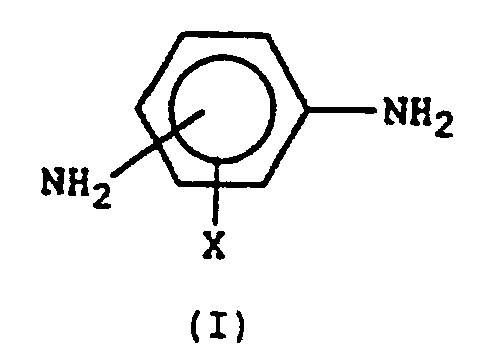
die flexible aromatische Diaminverbindung 70 Mol-% bis 88 Mol-% der gesamten aromatischen Diaminverbindung umfaßt und durch Formel (II) dargestellt wird,wobei X und Y einwertige Substituenten sind, ausgewählt aus Wasserstoff, Halogen, Carboxyl-, Niederalkyl- und Niederalkoxygruppen, X und Y die gleichen oder verschiedene Substituenten sein können und A eine zweiwertige Verbindungsgruppe ist, ausgewählt aus -O-, -S-, -CO-, -SO-, -SO2- und -CH2-, wobei Alkyl oder Alkoxy von 1 bis 4 Kohlenstoffatome enthält.
- Polyimidcopolymer nach Anspruch 1, wobei in Formel (I) X Wasserstoff ist.
- Polyimidcopolymer nach Anspruch 2, wobei die starre aromatische Diaminverbindung p-Phenylendiamin ist.
- Polyimidcopolymer nach Anspruch 1, wobei die flexible aromatische Diaminverbindung ein Diamin ist, dargestellt durch Formel (III)wobei A eine zweiwertige Verbindungsgruppe ist, ausgewählt aus -O-, -S-, -CO-, -SO-, -SO2- und -CH2-.

- Polyimidcopolymer nach Anspruch 4, wobei die flexible aromatische Diaminverbindung 4,4'-Diaminodiphenylether ist.
- Polyimidcopolymer nach Anspruch 1, wobei die aromatische Tetracarbonsäureverbindung Pyromellitsäure oder -dianhydrid, 3,3',4,4'-Biphenyltetracarbonsäure oder -dianhydrid oder 3,3',4,4'-Benzophenontetracarbonsäure oder -dianhydrid umfaßt.
- Polyimidcopolymer nach Anspruch 6, wobei die Pyromellitsäure oder das -dianhydrid von 50 Mol-% bis 80 Mol-% der gesamten aromatischen Tetracarbonsäurekomponente umfaßt und die 3,3',4,4'-Biphenyltetracarbonsäure oder das -dianhydrid und/oder die 3,3',4,4'-Benzophenontetracarbonsäure oder das -dianhydrid von 20 Mol-% bis 50 Mol-% der gesamten aromatischen Tetracarbonsäurekomponente umfassen.
- Verfahren zur Herstellung eines Polyimidcopolymers, umfassend:(1) Mischen einer starren aromatischen Diaminverbindung und einer aromatischen Tetracarbonsäureverbindung in einem organischen Lösungsmittel, das nichtreaktionsfähig mit den Reaktanten ist, so daß das Verhältnis der aromatischen Tetracarbonsäureverbindung zu der starren aromatischen Diaminverbindung von 90 Mol-% bis zu nicht mehr als 100 Mol-% beträgt, wobei die starre aromatische Diaminverbindung 12 Mol-% bis 30 Mol-% der gesamten aromatischen Diaminkomponente umfaßt und durch Formel (I) dargestellt wirdwobei X ein einwertiger Substituent ist, ausgewählt aus Wasserstoff, Halogen, Carboxyl-, Niederalkyl- und Niederalkoxygruppen, wobei Alkyl oder Alkoxy von 1 bis 4 Kohlenstoffatome enthält;
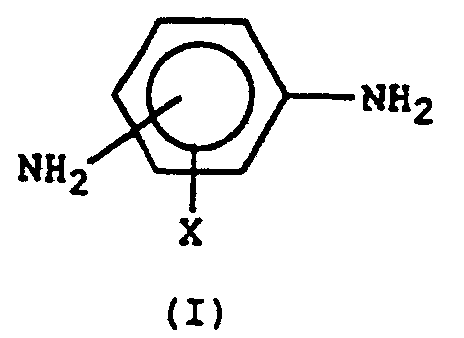 (2) Hinzufügen einer flexiblen aromatischen Diaminverbindung, wobei die flexible aromatische Diaminverbindung 70 Mol-% bis 88 Mol-% der gesamten aromatischen Diaminverbindung umfaßt und durch Formel (II) dargestellt wird,wobei X und Y einwertige Substituenten sind, ausgewählt aus Wasserstoff, Halogen, Carboxyl-, Niederalkyl- und Niederalkoxygruppen, X und Y die gleichen oder verschiedene Substituenten sein können und A eine zweiwertige Verbindungsgruppe ist, ausgewählt aus -O-, -S-, -CO-, -SO-, -SO2- und -CH2-, wobei Alkyl oder Alkoxy von 1 bis 4 Kohlenstoffatome enthält;
 (3) Hinzufügen einer aromatischen Tetracarbonsäureverbindung (A) und einer aromatischen Tetracarbonsäureverbindung (B; A ≠ B) in einer derartigen Menge, daß die gesamte aromatische Tetracarbonsäurekomponente und die gesamte aromatische Diaminkomponente äquimolar sind, und Rühren für eine zur Vervollständigung der Reaktion notwendige Zeit; und(4) Cyclisieren und Entfernen des Lösungsmittels aus der Polyamidsäurecopolymerlösung.
 - Verfahren zur Herstellung des Polyimidcopolymers nach Anspruch 8, wobei die Cyclisierung durch chemische Cyclisierung unter Verwendung eines Cyclisierungskatalysators und eines Dehydratisierungsmittels durchgeführt wird.
- Formteil aus Polyimidcopolymerharz, hergestellt durch Formen eines Polyimidcopolymers nach Anspruch 1.
- Formteil aus Polyimidcopolymerharz nach Anspruch 10, wobei das Formteil eine Folie ist.
- Verfahren zur Herstellung eines Formteils aus Polyimidcopolymerharz, umfassend:(1) Mischen einer starren aromatischen Diaminverbindung und einer aromatischen Tetracarbonsäureverbindung in einem organischen Lösungsmittel, das nichtreaktionsfähig mit den Reaktanten ist, so daß das Verhältnis von aromatischer Tetracarbonsäureverbindung zu der starren aromatischen Diaminverbindung von 90 Mol-% bis zu nicht mehr als 100 Mol-% beträgt, wobei die starre aromatische Diaminverbindung 12 Mol-% bis 30 Mol-% der gesamten aromatischen Diaminkomponente umfaßt und durch Formel (I) dargestellt wird,wobei X ein einwertiger Substituent ist, ausgewählt aus Wasserstoff, Halogen, Carboxyl-, Niederalkyl- und Niederalkoxygruppen, wobei Alkyl oder Alkoxy von 1 bis 4 Kohlenstoffatome enthält;
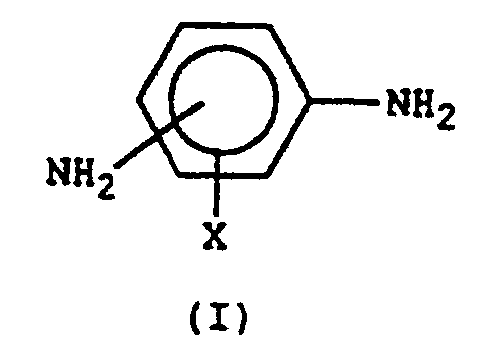 (2) Hinzufügen einer flexiblen aromatischen Diaminverbindung, und die flexible aromatische Diaminverbindung umfaßt 70 Mol-% bis 88 Mol-% der gesamten aromatischen Diaminverbindung und wird durch Formel (II) dargestellt,wobei X und Y einwertige Substituenten sind, ausgewählt aus Wasserstoff, Halogen, Carboxyl-, Niederalkyl- und Niederalkoxygruppen, X und Y die gleichen oder verschiedene Substituenten sein können und A eine zweiwertige Verbindungsgruppe ist, ausgewählt aus -O-, -S-, -CO-, -SO-, -SO2- und -CH2-, wobei Alkyl oder Alkoxy von 1 bis 4 Kohlenstoffatome enthält;
 (3) Hinzufügen einer aromatischen Tetracarbonsäureverbindung (A) und Hinzufügen einer aromatischen Tetracarbonsäureverbindung (B; A ≠ B) in einer derartigen Menge, daß die gesamte aromatische Tetracarbonsäurekomponente und die gesamte aromatische Diaminkomponente äquimolar sind, und Rühren für eine zur Vervollständigung der Reaktion notwendige Zeit; und(4) Cyclisieren und Entfernen des Lösungsmittels nach dem Formen der Polyamidsäurecopolymerlösung.
 - Verfahren zur Herstellung des Formteils aus Polyimidcopolymerharz nach Anspruch 12, wobei das Formteil eine Folie ist.
- Verfahren zur Herstellung des Formteils aus Polyimidcopolymerharz nach Anspruch 13, wobei die Cyclisierung durch chemische Cyclisierung unter Verwendung eines Cyclisierungskatalysators und eines Dehydratisierungsmittels durchgeführt wird.
- Polyimidcopolymer nach Anspruch 1, umfassend eine Blockpolyimidkomponente, erzeugt aus Pyromellitsäuredianhydrid und p-Phenylendiamin, und eine statistische Polyimidcopolymerkomponente, erzeugt aus Pyromellitsäuredianhydrid, 3,3',4,4'-Biphenyltetracarbonsäuredianhydrid und 4,4'-Diaminodiphenylether.
- Polyimidcopolymer nach Anspruch 1, umfassend eine Blockpolyimidkomponente, erzeugt aus Pyromellitsäuredianhydrid und p-Phenylendiamin, und eine statistische Polyimidcopolymerkomponente, erzeugt aus Pyromellitsäuredianhydrid, 3,3',4,4'-Benzophenontetracarbonsäuredianhydrid und 4,4'-Diaminodiphenylether.
Applications Claiming Priority (2)
| Application Number | Priority Date | Filing Date | Title |
|---|---|---|---|
| US08/859,899 US5859171A (en) | 1997-05-21 | 1997-05-21 | Polyimide copolymer, polyimide copolymer resin molded products and their preparation |
| US859899 | 1997-05-21 |
Publications (2)
| Publication Number | Publication Date |
|---|---|
| EP0879839A1 EP0879839A1 (de) | 1998-11-25 |
| EP0879839B1 true EP0879839B1 (de) | 2002-01-23 |
Family
ID=25332001
Family Applications (1)
| Application Number | Title | Priority Date | Filing Date |
|---|---|---|---|
| EP97108876A Expired - Lifetime EP0879839B1 (de) | 1997-05-21 | 1997-06-03 | Polymialcopolymer, Formteile aus Polymialcopolymer sowie ein Verfahren zu deren Herstellung |
Country Status (3)
| Country | Link |
|---|---|
| US (1) | US5859171A (de) |
| EP (1) | EP0879839B1 (de) |
| DE (1) | DE69710048T2 (de) |
Cited By (1)
| Publication number | Priority date | Publication date | Assignee | Title |
|---|---|---|---|---|
| CN108047978A (zh) * | 2013-05-31 | 2018-05-18 | 株式会社钟化 | 绝缘包覆材料及其制造方法、绝缘缆线及其制造方法 |
Families Citing this family (28)
| Publication number | Priority date | Publication date | Assignee | Title |
|---|---|---|---|---|
| US6277495B1 (en) | 1997-07-18 | 2001-08-21 | E. I. Du Pont De Nemours And Company | Polyimide film, a method for its manufacture and a polyimide film containing metal laminated plate |
| US6359107B1 (en) | 2000-05-18 | 2002-03-19 | The United States Of America As Represented By The Administrator, National Aeronautics And Space Administration | Composition of and method for making high performance resins for infusion and transfer molding processes |
| ATE340208T1 (de) * | 1999-05-18 | 2006-10-15 | Nasa | Zusammensetzung und verfahren zur herstellung von hochleistungsharzen für infusions und transfer- spritz verfahren |
| JP2001274145A (ja) * | 2000-03-24 | 2001-10-05 | Mitsubishi Electric Corp | 液体原料気化装置、半導体装置および半導体装置の製造方法 |
| EP1236756A4 (de) * | 2000-08-11 | 2004-06-30 | Mitsui Chemicals Inc | Neues polyimid und dieses enthaltendes schaltungssubstrat |
| US6548179B2 (en) * | 2000-08-24 | 2003-04-15 | Dupont-Toray Co., Ltd. | Polyimide film, method of manufacture, and metal interconnect board with polyimide film substrate |
| EP1523512B1 (de) * | 2002-07-22 | 2019-12-25 | Aspen Aerogels Inc. | Polyimid-aerogele, kohlenstoff-aerogele, und metallkarbid-aerogele und verfarhen zur herstellung |
| US20040132900A1 (en) * | 2003-01-08 | 2004-07-08 | International Business Machines Corporation | Polyimide compositions and use thereof in ceramic product defect repair |
| GB0709033D0 (en) | 2007-05-11 | 2007-06-20 | 3M Innovative Properties Co | Melt-Processible fluoropolymers having long-chain branches, Methods of preparing them and uses thereof |
| US20090171063A1 (en) * | 2007-12-21 | 2009-07-02 | Tadashi Ishibashi | Polyimide film and methods relating thereto |
| KR101444694B1 (ko) * | 2009-05-25 | 2014-10-01 | 에스케이이노베이션 주식회사 | 연성금속박적층체 및 이의 제조방법 |
| WO2012011970A1 (en) * | 2010-07-23 | 2012-01-26 | E. I. Du Pont De Nemours And Company | Matte finish polyimide films and methods relating thereto |
| US8574720B2 (en) * | 2009-08-03 | 2013-11-05 | E.I. Du Pont De Nemours & Company | Matte finish polyimide films and methods relating thereto |
| US11203192B2 (en) | 2009-08-03 | 2021-12-21 | E I Du Pont De Nemours And Company | Matte finish polyimide films and methods relating thereto |
| US9631054B2 (en) | 2010-07-23 | 2017-04-25 | E I Du Pont De Nemours And Company | Matte finish polyimide films and methods relating thereto |
| US9926415B2 (en) | 2010-08-05 | 2018-03-27 | E I Du Pont De Nemours And Company | Matte finish polyimide films and methods relating thereto |
| US8541107B2 (en) * | 2009-08-13 | 2013-09-24 | E. I. Du Pont De Nemours And Company | Pigmented polyimide films and methods relating thereto |
| US8772997B2 (en) | 2010-09-13 | 2014-07-08 | Baker Hughes Incorporated | Electrical submersible pump system having high temperature slot, end bell and phase-to-phase insulation |
| JP5362752B2 (ja) * | 2011-01-26 | 2013-12-11 | Jfeケミカル株式会社 | ポリアミド酸組成物、ポリイミドおよびポリイミドフィルムならびにそれらの製造方法 |
| US9641163B2 (en) * | 2014-05-28 | 2017-05-02 | Cree, Inc. | Bandwidth limiting methods for GaN power transistors |
| WO2016084662A1 (ja) | 2014-11-27 | 2016-06-02 | 株式会社カネカ | 耐摩耗性の優れる絶縁被覆材料 |
| CN110066620B (zh) | 2014-11-27 | 2021-06-15 | 株式会社钟化 | 耐磨耗性优越的绝缘包覆材料 |
| CN106810692B (zh) * | 2015-12-02 | 2020-02-11 | 株洲时代新材料科技股份有限公司 | 聚酰胺酸溶液的制备方法和聚酰亚胺薄膜 |
| CN106905527A (zh) * | 2017-03-01 | 2017-06-30 | 江阴骏友电子股份有限公司 | 低cte、高粘结性的新型双向拉伸聚酰亚胺薄膜的生产工艺 |
| CA3131698A1 (en) | 2019-02-27 | 2020-09-03 | Aspen Aerogels, Inc. | Carbon aerogel-based electrode materials and methods of manufacture thereof |
| JP7696883B2 (ja) | 2019-03-22 | 2025-06-23 | アスペン エアロゲルズ,インコーポレイティド | リチウム空気電池用カーボンエアロゲル系カソード |
| EP3941612A4 (de) | 2019-03-22 | 2023-04-19 | Aspen Aerogels Inc. | Auf kohlenstoffaerogel basierende kathoden für lithium-schwefel-batterien |
| US12381221B2 (en) | 2020-12-30 | 2025-08-05 | Aspen Aerogels, Inc. | Fibrous carbon aerogels coated with nano-thin silicon as lithium battery anodes |
Family Cites Families (16)
| Publication number | Priority date | Publication date | Assignee | Title |
|---|---|---|---|---|
| US4535105A (en) * | 1983-03-08 | 1985-08-13 | Ube Industries, Ltd. | Wholly aromatic polyamic acid solution composition |
| JPS59164328A (ja) * | 1983-03-08 | 1984-09-17 | Ube Ind Ltd | 芳香族ポリアミツク酸溶液組成物 |
| JPS61111359A (ja) * | 1984-11-06 | 1986-05-29 | Ube Ind Ltd | ポリイミド膜 |
| DE3789296T2 (de) * | 1986-11-29 | 1994-10-13 | Kanegafuchi Chemical Ind | Polyimid mit Formstabilität beim Erhitzen. |
| JP2744786B2 (ja) * | 1987-01-20 | 1998-04-28 | 鐘淵化学工業株式会社 | 熱的寸法安定性にすぐれたポリイミド及びそれに用いるポリアミド酸 |
| US4779872A (en) * | 1987-02-17 | 1988-10-25 | Bisbee David A | Golf swing alignment device |
| JPS6416834A (en) * | 1987-07-10 | 1989-01-20 | Kanegafuchi Chemical Ind | Polyamic acid copolymer, polyimide copolymer therefrom and production thereof |
| JPS6416833A (en) * | 1987-07-10 | 1989-01-20 | Kanegafuchi Chemical Ind | Polyamic acid copolymer, polyimide copolymer therefrom and production thereof |
| JPS6416832A (en) * | 1987-07-10 | 1989-01-20 | Kanegafuchi Chemical Ind | Production of polyamic acid copolymer |
| JPH02175772A (ja) * | 1988-12-28 | 1990-07-09 | Sumitomo Bakelite Co Ltd | フレキシブルプリント回路用基板の製造方法 |
| JP3001061B2 (ja) * | 1990-04-20 | 2000-01-17 | 住友ベークライト株式会社 | 低線膨張率耐熱性フィルムおよびその製造方法 |
| US5166308A (en) * | 1990-04-30 | 1992-11-24 | E. I. Du Pont De Nemours And Company | Copolyimide film with improved properties |
| US5196500A (en) * | 1990-12-17 | 1993-03-23 | E. I. Du Pont De Nemours And Company | Tetrapolyimide film containing benzophenone tetracarboxylic dianhydride |
| JPH06210629A (ja) * | 1991-01-31 | 1994-08-02 | Mitsui Toatsu Chem Inc | ポリイミド樹脂ペレットの製造押出方法 |
| JP3048690B2 (ja) * | 1991-07-18 | 2000-06-05 | 鐘淵化学工業株式会社 | ポリイミドフィルムの製造方法 |
| JPH0741558A (ja) * | 1993-07-31 | 1995-02-10 | Kanegafuchi Chem Ind Co Ltd | ポリイミド樹脂及びポリイミドフィルム |
-
1997
- 1997-05-21 US US08/859,899 patent/US5859171A/en not_active Expired - Lifetime
- 1997-06-03 DE DE69710048T patent/DE69710048T2/de not_active Expired - Fee Related
- 1997-06-03 EP EP97108876A patent/EP0879839B1/de not_active Expired - Lifetime
Cited By (1)
| Publication number | Priority date | Publication date | Assignee | Title |
|---|---|---|---|---|
| CN108047978A (zh) * | 2013-05-31 | 2018-05-18 | 株式会社钟化 | 绝缘包覆材料及其制造方法、绝缘缆线及其制造方法 |
Also Published As
| Publication number | Publication date |
|---|---|
| US5859171A (en) | 1999-01-12 |
| EP0879839A1 (de) | 1998-11-25 |
| DE69710048D1 (de) | 2002-03-14 |
| DE69710048T2 (de) | 2002-08-01 |
Similar Documents
| Publication | Publication Date | Title |
|---|---|---|
| US5859171A (en) | Polyimide copolymer, polyimide copolymer resin molded products and their preparation | |
| US6320019B1 (en) | Method for the preparation of polyamic acid and polyimide | |
| KR0159287B1 (ko) | 실록산 변성 폴리이미드 수지의 제조방법 | |
| EP0276405A2 (de) | Polyimid mit Formstabilität beim Erhitzen | |
| JP3712164B2 (ja) | ポリイミド組成物及びそれからなるtab用テープとフレキシブルプリント基板 | |
| JP4009918B2 (ja) | ポリイミドフィルム、その製造方法およびそれを基材とした金属積層板 | |
| JPH1036506A (ja) | 新規なポリイミド組成物及びポリイミドフィルム | |
| EP0892004B1 (de) | Polyimidfolie, ein Verfahren zu ihrer Herstellung, und eine mit Metallfolie verbundene Polyimidfolie | |
| JP3687044B2 (ja) | 共重合ポリイミドフィルムおよびその製造方法 | |
| US6068932A (en) | Thermosetting resin composition | |
| JP3048703B2 (ja) | ポリアミック酸共重合体及びそれからなるポリイミドフィルム | |
| US6031068A (en) | Polyimide composition and base tape for TAB carrier tape and flexible printed circuit board made from said composition | |
| JP2004285364A (ja) | フレキシブルプリント基板用ベースフィルム、tab用キャリアテープに用いられるポリイミドフィルム | |
| JP2910796B2 (ja) | ポリアミック酸共重合体及びそれからなるポリイミドフィルム並びにそれらの製造方法 | |
| JPS60203638A (ja) | ポリイミドフイルム | |
| JP3676073B2 (ja) | ポリイミドフィルムとその製造方法 | |
| JP2831867B2 (ja) | ポリアミック酸共重合体、それからなるポリイミド共重合体、ポリイミドフィルム、並びにそれらの製造方法 | |
| JP3456256B2 (ja) | ポリイミド共重合体及びその製造方法 | |
| JP4017034B2 (ja) | 新規なポリイミドフィルム | |
| US5003037A (en) | Polyamide, polyimide, and polyamide-imide polymers and copolymers using 3, 5-diamino-t-butylbenzene | |
| JP3022625B2 (ja) | ポリアミック酸共重合体、それからなるポリイミド共重合体、及びポリイミドフィルム、並びにそれらの製造方法 | |
| JP3375346B2 (ja) | ポリアミド酸とポリイミドフィルム及びそれらの製造方法 | |
| JP3299777B2 (ja) | ポリイミドフィルム及びその製造方法 | |
| JP3463111B2 (ja) | 新規な共重合体とその製造方法 | |
| US4946934A (en) | Polyamide from 3,5-diamino-t-butylbenzene |
Legal Events
| Date | Code | Title | Description |
|---|---|---|---|
| PUAI | Public reference made under article 153(3) epc to a published international application that has entered the european phase |
Free format text: ORIGINAL CODE: 0009012 |
|
| AK | Designated contracting states |
Kind code of ref document: A1 Designated state(s): DE FR GB |
|
| 17P | Request for examination filed |
Effective date: 19990105 |
|
| 17Q | First examination report despatched |
Effective date: 19990210 |
|
| AKX | Designation fees paid |
Free format text: DE FR GB |
|
| GRAG | Despatch of communication of intention to grant |
Free format text: ORIGINAL CODE: EPIDOS AGRA |
|
| GRAG | Despatch of communication of intention to grant |
Free format text: ORIGINAL CODE: EPIDOS AGRA |
|
| GRAH | Despatch of communication of intention to grant a patent |
Free format text: ORIGINAL CODE: EPIDOS IGRA |
|
| GRAH | Despatch of communication of intention to grant a patent |
Free format text: ORIGINAL CODE: EPIDOS IGRA |
|
| GRAA | (expected) grant |
Free format text: ORIGINAL CODE: 0009210 |
|
| REG | Reference to a national code |
Ref country code: GB Ref legal event code: IF02 |
|
| AK | Designated contracting states |
Kind code of ref document: B1 Designated state(s): DE FR GB |
|
| REF | Corresponds to: |
Ref document number: 69710048 Country of ref document: DE Date of ref document: 20020314 |
|
| PLBE | No opposition filed within time limit |
Free format text: ORIGINAL CODE: 0009261 |
|
| STAA | Information on the status of an ep patent application or granted ep patent |
Free format text: STATUS: NO OPPOSITION FILED WITHIN TIME LIMIT |
|
| 26N | No opposition filed | ||
| PGFP | Annual fee paid to national office [announced via postgrant information from national office to epo] |
Ref country code: GB Payment date: 20060531 Year of fee payment: 10 |
|
| PGFP | Annual fee paid to national office [announced via postgrant information from national office to epo] |
Ref country code: FR Payment date: 20060608 Year of fee payment: 10 |
|
| GBPC | Gb: european patent ceased through non-payment of renewal fee |
Effective date: 20070603 |
|
| REG | Reference to a national code |
Ref country code: FR Ref legal event code: ST Effective date: 20080229 |
|
| PG25 | Lapsed in a contracting state [announced via postgrant information from national office to epo] |
Ref country code: GB Free format text: LAPSE BECAUSE OF NON-PAYMENT OF DUE FEES Effective date: 20070603 |
|
| PG25 | Lapsed in a contracting state [announced via postgrant information from national office to epo] |
Ref country code: FR Free format text: LAPSE BECAUSE OF NON-PAYMENT OF DUE FEES Effective date: 20070702 |
|
| PGFP | Annual fee paid to national office [announced via postgrant information from national office to epo] |
Ref country code: DE Payment date: 20080612 Year of fee payment: 12 |
|
| PG25 | Lapsed in a contracting state [announced via postgrant information from national office to epo] |
Ref country code: DE Free format text: LAPSE BECAUSE OF NON-PAYMENT OF DUE FEES Effective date: 20100101 |