EP0870386B1 - Verfahren und mikrocomputersystem zur automatischen, sicheren und direkten datenübertragung - Google Patents
Verfahren und mikrocomputersystem zur automatischen, sicheren und direkten datenübertragung Download PDFInfo
- Publication number
- EP0870386B1 EP0870386B1 EP96946223A EP96946223A EP0870386B1 EP 0870386 B1 EP0870386 B1 EP 0870386B1 EP 96946223 A EP96946223 A EP 96946223A EP 96946223 A EP96946223 A EP 96946223A EP 0870386 B1 EP0870386 B1 EP 0870386B1
- Authority
- EP
- European Patent Office
- Prior art keywords
- data
- computer system
- micro computer
- microcomputer system
- predeterminable
- Prior art date
- Legal status (The legal status is an assumption and is not a legal conclusion. Google has not performed a legal analysis and makes no representation as to the accuracy of the status listed.)
- Expired - Lifetime
Links
Images


Classifications
-
- H—ELECTRICITY
- H04—ELECTRIC COMMUNICATION TECHNIQUE
- H04N—PICTORIAL COMMUNICATION, e.g. TELEVISION
- H04N21/00—Selective content distribution, e.g. interactive television or video on demand [VOD]
- H04N21/40—Client devices specifically adapted for the reception of or interaction with content, e.g. set-top-box [STB]; Operations thereof
- H04N21/47—End-user applications
- H04N21/478—Supplemental services, e.g. displaying phone caller identification, shopping application
- H04N21/4786—Supplemental services, e.g. displaying phone caller identification, shopping application e-mailing
-
- H—ELECTRICITY
- H04—ELECTRIC COMMUNICATION TECHNIQUE
- H04L—TRANSMISSION OF DIGITAL INFORMATION, e.g. TELEGRAPHIC COMMUNICATION
- H04L51/00—User-to-user messaging in packet-switching networks, transmitted according to store-and-forward or real-time protocols, e.g. e-mail
-
- H—ELECTRICITY
- H04—ELECTRIC COMMUNICATION TECHNIQUE
- H04M—TELEPHONIC COMMUNICATION
- H04M11/00—Telephonic communication systems specially adapted for combination with other electrical systems
- H04M11/06—Simultaneous speech and data transmission, e.g. telegraphic transmission over the same conductors
-
- H—ELECTRICITY
- H04—ELECTRIC COMMUNICATION TECHNIQUE
- H04L—TRANSMISSION OF DIGITAL INFORMATION, e.g. TELEGRAPHIC COMMUNICATION
- H04L51/00—User-to-user messaging in packet-switching networks, transmitted according to store-and-forward or real-time protocols, e.g. e-mail
- H04L51/21—Monitoring or handling of messages
- H04L51/224—Monitoring or handling of messages providing notification on incoming messages, e.g. pushed notifications of received messages
Definitions
- the invention relates to a method and a microcomputer system for automatic, secure and direct data transfer.
- the disadvantage is that, in contrast to the fax or Telephone traffic a direct delivery of electronic Mail to the user of a device (e.g. user of a PC over the Internet) is only possible with great effort. So is a direct and automatic data transfer between a transmitter terminal and a receiver terminal very cumbersome, since both terminals or a central computer as Buffer must be turned on, and certain Programs for controlling the data exchange on the switched on Computers.
- Today's electronic mail is e.g. on so-called “Service Provider” instructed to be constantly operational "Relay stations” for the transmission of electronic Provide mail.
- Electronic mail is used in the known processes a "Senderpostamt" and a worldwide network of Computer intermediate stations to a "recipient post office” sent, which in contrast to the actual device of the Recipient, is constantly in operation. They are also located Post offices not in the immediate sphere of influence of the end user. At this post office, the electronic mail is up to the recipient, who is sitting on a terminal, picks it up, whereby the recipient either inquires regularly at the post office must or he himself initiates measures. Although the actual transmission of electronic mail takes only seconds urgent mail cannot take this way today be sent as the sender does not know if and when the actual recipient will pick up the mail.
- the end user still has no fully automatic, simple, direct, reliable and secure data transmission between a sender terminal and a receiver terminal, as known from telephone or fax connections is available.
- a fax can e.g. today in no time at all a phone line sent directly to a recipient be printed out without the recipient's intervention becomes.
- the sender also receives feedback on the proper delivery of the fax to the recipient.
- the well-known transmission methods of electronic mail don't have these advantages. For this reason, too the fax added importance even though sending Faxing is generally slower than sending electronic ones Post Office.
- Data is used for both telephone calls and faxes directly from an end user on the transmitter side transmit an end user on the receiving end without the sender or recipient uses the services of third parties would have to take.
- EP 0 671 831 A1 describes a device for receiving of data known to a terminal, such as a data processing or a data playback device should be. Go data when the end device is switched off on, the device moves the terminal via a control signal ready for operation. The data will be there cached at least until operational readiness is made.
- the disadvantage is that the Setup only with a view to generating the operational readiness the terminal works. Furthermore be the disadvantages of the existing electronic mail transmission not resolved by this facility.
- WO-A-93/20647 relates to a microcomputer system which is connected between a data line and a terminal.
- this microcomputer system should cache outgoing data and a conversion perform between different data formats. Also
- This publication cannot take any special safety precautions be removed.
- US-A-5 379 349 relates to a communication system in the incoming data at a terminal is then checked whether they have been fully transferred. Doing so a log file that creates a kind of receipt serves for the received data. Furthermore the teaching of this document contains no means for Increase data security.
- the present Invention based on the object, a method and a device for direct information transmission to create between two devices, in which one device before receiving unwanted or dangerous data is particularly protected to ensure the security of data transmission and to increase the terminal.
- this object is achieved by a method with the features of claim 1 and by a microcomputer system solved with the features of claim 16.
- the method according to the invention enables direct Data transfer between two end devices (e.g. PC one End user) of a data transmission link.
- a direct one Data transfer here means data from an end user be transferred directly to another end user, without e.g. use the services of a provider must be taken.
- a microcomputer system according to the invention is directly assigned to the receiver device, the second terminal, the microcomputer system being connected simultaneously to the terminal and a data line (for example a telephone line) or only to a data line.
- the terminal for example a laptop
- the microcomputer system acts as a kind of "answering machine" for the terminal.
- the microcomputer system according to the invention is an autonomous unit that can receive, send, save or edit data regardless of the operating state of the terminal devices.
- End devices are usually computers or Computer systems understood that are in the immediate access area the end user.
- On the second terminal are in addition to the microcomputer system according to the invention, Monitors, printers, hard drives, optical storage media or other peripheral devices can be connected.
- Monitors, printers, hard drives, optical storage media or other peripheral devices can be connected.
- As a data transmission network the public telephone network in particular used, which increases availability and costs lowers.
- the microcomputer system according to the invention is the terminal devices directly assigned, such as an answering machine Phone is assigned directly.
- the microcomputer system receives or processes data regardless of the operating state of the assigned terminal. Even if e.g. the end device of the Receiver is turned off, data can be sent directly from it assigned microcomputer system received fully automatically or edited.
- the terminal does not have to be constantly physically connected to the associated microcomputer system be what especially for those widespread today mobile devices is important.
- the microcomputer system receives or processes data regardless of the operating status of the assigned terminals. Even if e.g. for energy-saving reasons the terminal one Sender or receiver is switched off, data from the directly assigned microcomputer system fully automatically received, edited or sent.
- the end devices also do not have to be constantly associated with them Microcomputer system to be physically connected, which in particular for the mobile devices from Meaning is.
- a predeterminable takes place in the microcomputer system Processing of the data intended for the end device. Storage in the microcomputer system is always then necessary if the data to be sent is not immediately sent to the Data transmission network can or should be sent or the received data should only be collected, because the assigned receiver terminal is not ready to accept is or the data transmission speed over the data transmission network is considerably slower than between the microcomputer system and the associated terminal.
- the buffer capacity, the microcomputer system associated with the terminal, storage through a "post office" within the data transmission network makes redundant.
- the method according to the invention is a direct data transfer from a transmitter to a receiver possible without another instance, such as e.g. a service provider, for data processing or data storage necessary is.
- On the part of the sender and receiver are no special measures for data transmission, such as. an interaction with a mail server, necessary.
- the microcomputer system according to the invention is compatible with those currently in use Data transmission process, so electronic mail too can be received by a service provider.
- the invention Process some special process steps. So at the recipient terminal, the second terminal, incoming data from a microcomputer system according to predeterminable Checked criteria.
- the Reading the data into the microcomputer system the data connection, via which the microcomputer system receives the data has interrupted. Only after termination of the data connection the data stands for a transfer to the end device ready. So there is never a direct connection between the terminal and the data line. So it is e.g. hackers who have an existing data connection Want to gain access to the device, impossible to manipulate to be carried out on the terminal.
- Microcomputer system read data only after the interruption according to predeterminable processing methods and / or processed second predetermined criteria. Through the two-stage review or processing, as a lock principle for data, one becomes essential increased data security for the end device achieved.
- Procedures are incoming to the microcomputer system Data originating from a predeterminable sender either rejected or accepted.
- the sender can be recognized by his phone number, for example. On this way e.g. the receipt of unwanted Ads are suppressed.
- Decryption is also possible in the second check or verification of an electronic Signature. Only with a positive result the second check (e.g. decryption successful, electronic signature in order) the data will be sent to transmit the terminal assigned to the microcomputer system.
- the second review is a review the data read into the microcomputer system on computer viruses. This prevents dangerous under certain circumstances Data to that assigned to the microcomputer system End device.
- the microcomputer system advantageously compresses data, decompressed, encrypted or decrypted.
- Data compression is the amount that goes over the data line data to be transferred significantly reduced, what the transmission time and thus the costs are reduced. Through data compression is also within the microcomputer system less space used. Will data from the microcomputer system accessed so they can be automatically decompressed if e.g. the accessing agency does not have any Decompression options.
- encryption of data sent over a data line data security is significantly increased, what of great importance especially in business dealings is.
- the Microcomputer system received data according to priorities processed. For this purpose, certain data with priority information, such as. with a hint "Hurry! or "confidential", Mistake.
- the procedure is direct access from the data line to the Terminal impossible because this is due to the assigned microcomputer system becomes impossible. Through this lock-lock principle it is impossible for an unauthorized person to make a continuous Data connection between the data line and the terminal manufactures.
- the procedure is that of the first terminal outgoing data with a name (e.g. login name) and provide a phone number as an address.
- a name e.g. login name
- This type of addressing must be used by the senders of electronic mail does not remember a variety of addresses, but can use the phone numbers they know as Use addresses.
- the microcomputer system automatically sends one Message when it receives data.
- Such an automatic sent message can in particular in a receipt exist for the received data.
- Remote processing is advantageously carried out in the microcomputer system stored data via the data line. Furthermore, it is advantageous to the mode of operation to control the microcomputer system via a remote control. It is therefore possible without commissioning a terminal e.g. not only those stored in the microcomputer system Edit data, but also automatic To influence processing by the microcomputer system. This is of great importance when a user not in the immediate vicinity of his end device for a long time and the associated microcomputer system. Here it is particularly advantageous that only one predeterminable Part of the data stored in the microcomputer system processed or is forwarded. In this way it is e.g. possible to get an overview of the to get data stored in a microcomputer system to only the most important or only the short electronic ones Mail to a remote user to transmit the assigned terminal.
- the microcomputer system advantageously registers the receipt sender of data predeterminable, initiates automatically a call back to the sender to verify it. Only after successful verification of the sender the data is transferred to the microcomputer system. By verifying the sender address, security becomes improved in data transmission.
- an embodiment of the inventive method by a display and / or an acoustic signal generator of the microcomputer system displayed when data is read into the microcomputer system become. This allows a user to switch off Terminal recognize whether data is sent to the microcomputer system is assigned to the end device that was sent.
- a microcomputer system for automatic and direct data transmission has at least a first one Interface via which it can be connected to a terminal is. This is via at least a second interface Microcomputer system connectable to a data line. As A telephone network is used in particular for the data line.
- the microcomputer system has at least one processor system to control the function and at least one storage element for storing operating software, programs and data on.
- the microcomputer system also has via a display and / or an acoustic signal generator for those received by the microcomputer system or information sent or that in the microcomputer system stored information. This allows the data transfer completely independent of the directly assigned computer be monitored.
- microcomputer system Unlike a computer with different peripherals, is the microcomputer system as a compact unit executable, its processor system flexibly programmable is. Furthermore, the microcomputer system has none large energy consumers (e.g. monitor).
- a microcomputer system according to the invention especially as an intelligent, autonomous unit in the method according to the invention used for data transmission become. It is in the inventive idea that the microcomputer system within another device, such as. a fax machine on the same phone line connected; a telephone, an answering machine or a modem is installed.
- the device according to the invention also has checking means with which a first review of the incoming data made according to predetermined criteria can be and means by which the data line can be interrupted. By these means the Data security greatly improved.
- the device according to the invention has Interruption means with which the connection between the Data line and the microcomputer system automatically interrupted can be. Also has the invention Microcomputer system via processing means with which the processing data read into the microcomputer system according to predeterminable processing methods and / or can be subjected to second predeterminable criteria. This is a direct access from the data line the microcomputer system through to the immediately assigned Terminal impossible.
- the microcomputer system has checking means predeterminable for rejecting or accepting incoming data Sender. In this way, an undesirable Data transmission to that assigned to the microcomputer system Terminal can be prevented. This serves among other things protection from computer viruses in data.
- the microcomputer system according to the invention has a particular advantage Machining means with those in the microcomputer system stored data checked for computer viruses can be. Through this additional review, the Data security further increased.
- the microcomputer system advantageously has processing means for compression, decompression, encryption, Decrypt or convert data to.
- the microcomputer system can be independent from the terminal assigned to it, the ones to be sent and the edit received data.
- the microcomputer system advantageously has Means that are automatically predeterminable or from the microcomputer system send self-generated messages. So can e.g. Receipts for electronic mail automatically be sent without the microcomputer system assigned terminal or a system within the data transmission network is involved.
- an inventive Microcomputer system conversion means for various Transmission protocols and / or data formats, in particular for fax, voice and / or image data.
- Microcomputer system has means to get outgoing data with a name (e.g. login name) and a telephone number to be provided as an address so that the addressing of the outgoing data is possible in a particularly simple manner.
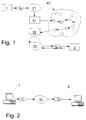
- Fig. 1 is the previously common method of transmission represented by electronic mail. Under electronic Swiss Post will send data e.g. in binary, text, image, Understand sound or video formats.
- the electronic mail is between a first terminal 1 and a second terminal 2 transmitted.
- Terminal 1 As an illustration the first one works in the example chosen here Terminal 1 as a transmitter, the second terminal 2 as a receiver.
- the sender and receiver are the Terminals understood at the ends of a data transmission route. In principle, it is possible that the role of Transmitter 1 and the receiver 2 are interchanged or even send both terminals 1, 2 data simultaneously receive.
- transmitter 1 and receiver 2 are personal computers with the usually connected peripheral devices like printer and monitor.
- Transmitter 1 and receiver 2 are each via transmission devices 1a, 2a, e.g. Modems, with the telephone network 21, 22 connected.
- the electronic mail in the previous procedure cannot be transmitted directly from transmitter 1 to receiver 2
- the phone number of a so-called Service providers are chosen from the Sender Post Office 31 operates.
- the sender post office 31 be constantly ready, which one considerable monitoring effort and thus cost means. After establishing the connection to the sender post office 31, the electronic mail is sent to the sender post office 31 transfer.
- the electronic mail to worldwide network 40 transmit that from an unmistakable large number of networked computers.
- the exact one The path taken by electronic mail is not clear fixed.
- electronic Mail within the worldwide 40 network on various Computers which is not only the Electronic mail duration increased, but also to contributes to a deterioration in data security because at interim storage always increases the risk of unauthorized persons There is access to the electronic mail.
- the receiver 2 becomes electronic after the arrival Post not informed at his post office.
- The is one of the most serious disadvantages of the Internet today.
- the recipient must take 2 separate measures to collect the mail initiate - always without knowing whether mail at all has been received for him. In this exchange process There is no direct, uninterrupted electronic mail and secure data transmission from transmitter 1 to receiver 2nd
- Sender 1 and receiver 2 are in this example Personal computers (end devices) at the ends of one Data transmission path, with the usually connected Peripheral devices such as printer and monitor. It lies but in the spirit of the invention that even computers in local (in-house) computer networks as transmitter 1 or Receiver 2 can be used.
- the transmitter 1 has a first microcomputer system 11, a second microcomputer system 12 directly to the receiver 2 assigned, i.e. both transmitter 1 and receiver 2 have immediate access to each of them as end users associated microcomputer systems 11, 12.
- the first microcomputer system 11 assigned to the transmitter 1 need not be constantly connected to the transmitter 1, but only if data is exchanged with transmitter 1 should. Sending can e.g. autonomous depending on Priorities of transmitter 1 and / or time-controlled Use of cheap telephone tariffs.
- the second microcomputer system assigned to the receiver 2 12 need not be permanently connected to the receiver 2, but it can e.g. also receive electronic mail, if the receiver 2 is not connected or not ready to receive is. If the receiver 2 is ready to receive and connected, reports the microcomputer system 12 to the receiver 2 that it wants to send data because e.g. electronic Post has been received. The receiver 2 then fetches the data immediately or at a later date.
- the microcomputer systems 11, 12 are therefore autonomous, all the time with the telephone network 20 connected devices that are in the spatial Arranged near the transmitter 1 or the receiver 2 are. In any case, the user of the transmitter 1 or Receiver 2 without access to the third party access assigned microcomputer systems 11, 12.
- the microcomputer systems 11, 12 have their own processor systems 90, power supplies 100 and memory elements 80 (see Fig. 3) so that they are completely independent of the operating state of the transmitter 1 or receiver assigned to them 2 are. For example, a receiver 2 can completely be decoupled from the second microcomputer system 12, being incoming electronic mail from the second microcomputer system 12 is saved and edited. An intermediate storage within the data transmission network (e.g. recipient post office 32 in Fig. 1) is therefore unnecessary.
- a description of functions of the method according to the invention is related to the processor system 90 of the microcomputer system 11, 12 given.
- the microcomputer system selects at a predeterminable point in time 11, which is assigned to the transmitter 1, which in the Address given recipient's phone number 2 and provides thus a data connection to the microcomputer system 12 of the Receiver 2 ago.
- a predeterminable point in time 11 which is assigned to the transmitter 1, which in the Address given recipient's phone number 2 and provides thus a data connection to the microcomputer system 12 of the Receiver 2 ago.
- a parameter exchange takes place between the microcomputer systems 11, 12 instead.
- the receiving microcomputer system 12 compares the Address details with a predeterminable list.
- In this List are saved addresses that are rejected (negative list) or be accepted (positive list).
- the negative list serves to make the transfer undesirable to avoid electronic mail.
- the positive list allows that only a limited group of users can transfer data to a terminal 1, 2 is allowed. Both measures serve to increase security against computer viruses, e.g. can also infect text files. Incoming Data are only from senders listed in the positive list assumed so that all other data already at the beginning of the connection establishment are rejected and the connection is separated.
- the name and telephone information that a transmitter 1 enters on its terminal are contained in a parameter block.
- the information about the time zone and the transmission time are used to ensure that data transfers are only permitted at certain times.
- the information about the parameter block itself is used for data security during data transmission.
- the data block that is transferred during the parameter exchange between the microcomputer systems 11, 12 has the following structure: Data size [byte] Data content 2nd Length of the parameter block 15 CountryCode-CityCode-PhoneNumber 15 Surname 1 Time zone 4th Airtime 2nd Checksum for the parameter block
- the instruction set includes the commands "Receive data" and "Cancel connection". In alternative embodiments, especially in a remote control, this command set can also be used Include commands.
- the data are then sent directly, error-free and directly to the end user transferred without caching by a central computer takes place.
- An end user within one larger local computer network e.g. local area network (LAN)
- LAN local area network
- a header of the electronic mail contains information by means of which the receiving microcomputer system 12 controls the further processing of the data.
- the header of the electronic mail contains information about the size of the mail and about the type (eg compressed, encrypted, etc.).
- the header also has information about the priority, so that the incoming data from the microcomputer system can be sorted according to priority.
- the header also contains information about the time zone and a time stamp so that the receipt of the mail can be clearly determined.
- the header also contains information about itself so that the integrity of the transmitted data can be checked.
- the header of the transmitted electronic mail has the following structure: Data size [byte] Data description 2nd Size of the header 4th Electronic mail size 1 Type of electronic mail 1 Priority labeling 1 Time zone 4th Time stamp 2nd Checksum of the header
- microcomputer system 12 If the microcomputer system 12 receives an electronic mail item, will send an automatic receipt sent the sender 1 of the electronic mail, so that there is immediate feedback that the electronic mail Received correctly at receiver 2, i.e. in which Microcomputer system 12, which is assigned to the receiver 2.
- microcomputer systems are used to further increase security 11, 12 about programs to review the incoming data on viruses.
- microcomputer systems 11, 12 have one Program that allows the receipt of data from certain Senders is registered and a callback to The sender of the data takes place. The recall ensures that it is not by accident that there is a faulty connection.
- the sender of the data is e.g. by verified a comparison with the positive or negative lists. Only when the verification has shown that the Data from the user of the receiver terminal 2 also permitted are, a data connection is established so that the data can be transferred.
- the microcomputer system 12 is assigned to the receiver terminal 2, the data after verification, independently at the sender of the data picks up. Also a sender of data who is abusive serve the address of a sender on a positive list would have been unsuccessful in the recall process.
- the sender is identified via the telephone number, to which the sender's computer is connected.
- the receiver terminal 2 complete control over all data received, what the Data security increased significantly.
- a microcomputer system 11, 12 In the example shown in Fig. 2, the invention Transfer of electronic mail between two terminals, namely between a transmitter 1 to one Receiver 2 described, both immediately a microcomputer system 11, 12 is assigned. It is part of the inventive idea that also several microcomputer systems 11, 12 a transmitter terminal 1 or receiver terminal 2 are assigned. Furthermore extends the inventive idea also applies to such data transfers, in which only one terminal 1, 2 an inventive Microcomputer system 11, 12 is assigned. So that is the method according to the invention compatible with the usual today Data transmission method. It is essential that at least with one of the participants in the data exchange Terminals 1, 2 a decoupling between the operating state and data exchange or data processing is possible.
- microcomputer systems 11, 12 constantly for data transmission ready for use, they can also be used for remote control from other systems, e.g. a heater, or an anti-theft device used with the microcomputer systems 11, 12 is connected. So can certain signals, in particular electronic mail in plain text, to be sent to a microcomputer system 11, 12 to turn a heater on or off.
- microcomputer systems 11, 12 can also send data, are messages from connected systems transferable directly to others. E.g. in a heating system, connected to the microcomputer system 11, 12 is an error, so a notification can automatically be sent to a maintenance company. Is a Anti-theft device connected to the microcomputer system 11, 12, so the police can automatically when the alarm is triggered to be informed.
- the state of the system in question can be queried. So can a maintenance company e.g. via the microcomputer system 11, 12 request a status report of the heating system from which an error message was received.
- FIG. 3 shows the structure of a microcomputer system according to the invention 11, 12 shown schematically.
- the microcomputer system 12 referred to here Not shown receiver 2 is assigned. That the Microcomputer system 11 assigned to transmitter 1 is in principle identical in construction, so that a microcomputer system 11, 12 both for Reception as well as for sending data can be used. Both Operations can be done simultaneously when for transmission the ISDN method is used.
- the microcomputer system 12 has interfaces 50, 51, 52 for connection to that not shown here Receiver and the telephone network, also not shown 20th
- the circuit of the microcomputer system 12 exists in principle from four electronic assemblies 60, 70, 80, 90, the connected to each other and to the interfaces 50, 51, 52 are.
- An autonomous power supply 100 to the microcomputer system 12 is shown schematically.
- the power supply consists on the one hand of a connection to a normal one Power grid, on the other hand from a battery system that the Power supply in case of transportation or one Ensures network interruption. Are inside the device no large electricity consumers are provided, so that a typical Device microcomputer system 12 a line intake from 0.1 to 1 W.
- the microcomputer system is via a first interface 50 12 with the receiver 2 and via a second interface 51 connected to the telephone network 20. Over a third interface 53 an external modem can be connected.
- the first interface 50 of type RS232 is with a Computer interface 60 connected to the data transmission between the receiver 2 and the microcomputer system 12 controls and monitors.
- the first interface 50 can be as SCSI, infrared, Radio or parallel interface.
- In the Control of data exchange is e.g. the XModem protocol used.
- a memory element 80 is with a processor system 90 connected.
- processor system 90 In the case shown are in the storage element Read / write memory chips (RAM) with 4 MB memory capacity to disposal. Slots for possible memory expansions are provided.
- RAM Read / write memory chips
- Slots for possible memory expansions are provided.
- alternative versions can e.g. also hard drives or floppy drives as additional memory elements 80 can be used. It lies in the inventive idea that possibly external storage media can be connected to the microcomputer system 12, which in particular is advantageous for extremely large amounts of data.
- Processor system 90 controls the function of the microcomputer system 12, being an operating system within the microcomputer system 12 is stored.
- the operating system is multitasking capable, allowing multiple data transfers are possible at the same time.
- Processor system 90 is shown in FIG programmable in a high-level language. In alternative embodiments can also have multiple parallel connections to the Data transmission network and / or assigned terminals provided his.
- the programming of the microcomputer system 12 can be done via the assigned terminal 2 take place. Also about one here remote control, not shown, e.g. by phone or remote computer, programming can be carried out. There is a remote control for security reasons possibly only part of the microcomputer system 12 programmable.
- the functionality of the microcomputer system 12 can by Various programs stored in the memory element 80 Requirements are adjusted. In particular, the existing data transmission procedures or offers from Service providers can be used. So the microcomputer system 12 received data from a transmitter 1 who is not has an associated microcomputer system 11.
- Programs for data compression are in the microcomputer system or data decompression, for data encryption or Data decryption and stored for data conversion, that of the processor system 90 according to the respective Requirements are used. Through these programs the data in the microcomputer system 12 can be completely regardless of the operating state or even the existence of the assigned receiver 2 are processed.
- the microcomputer system 12 is a so-called "Firewall computer" can be used, which is a great protection for the assigned terminal 2 offers. Direct access from the telephone line 20 to the assigned terminal 2 or other computers connected to it by the microcomputer system 12 is not possible.
- the microcomputer system 12 thus functions as a kind Lock, in which incoming data first only in the microcomputer system 12 arrive.
- Fig. 4 is the flow of this "lock principle" for that Microcomputer system 12 shown. If data from one Transmit data line 20 to microcomputer system 12, this is how the sender address is checked in a first step of the data determined. The first check can, however also affect a code word and other criteria. Located the sender is not on a negative list, so the data is stored in the microcomputer system 12. Located the sender address is on a negative list, so they rejected the attempted entry of the data from the microcomputer system 12 is logged.
- the control programs of the microcomputer system 12 are in a ROM or EPROM stored so that reprogramming to penetrate the microcomputer system 12 impossible is.
- sorting criteria e.g. Size of incoming electronic mail, sender, date or subject used become. This means, for example, that particularly large electronic ones can be used Mail items rejected by the microcomputer system 12 become.
- a list of senders is saved, whose electronic mail is easily passed through.
- the microcomputer system 12 automatically replies to the sender sent in which reports about the failure to deliver becomes. Under certain circumstances, an alternate address specified. In other cases, electronic mail can be deleted automatically.
- the microcomputer system 12 has the possibility of Data that identifies the sender or recipient priority to provide. So you can set a sending priority when certain data is sent to the telephone line 20 should be transferred. So data can be saved immediately or be sent at a predeterminable point in time. For example the microcomputer system 12 can automatically be the cheapest Determine time for a data transfer, see above that certain data at particularly favorable telephone tariffs be sent. Can send data to a specific sender but also be collected over a period of time and then sent at a particularly affordable rate at once become. This is especially true when sending electronic Post across multiple time zones of great use.
- the Processing incoming electronic mail efficiently be designed.
- certain senders of electronic mail generally has a high priority marking received a special importance to the recipient 2 signal.
- the microcomputer system 12 also has means to monitor data transmission costs. So they will each incurred costs of outgoing electronic Post saved so that always up-to-date information about the actually incurred costs of the data transmission is present.
- the cost can also be determined by certain Categories such as certain send addresses or times, be broken down. On request or at predetermined At times, the cost data can be sent to the administrator of the electronic mail system.
- the processor system 90 is with an ISDN controller 70 connected to the transfer of data to the telephone line 20 monitors and controls.
- the control of the ISDN controller 70 takes place via CAPI.
- Alternative embodiments of the microcomputer system 12 have a modem or a combination of ISDN connection and modem.
- the Data transmission to the telephone line 20 takes place via the second interface 51, which is connected to the ISDN controller 70 is.
- the processor 90 is also one Interface controller 61 with the third interface 52 connected via which an external modem can be connected.
- the invention is not limited in its execution the preferred embodiments given above. Rather, a number of variants are conceivable, which of the inventive method and the microcomputer system Use also with fundamentally different types do.
Landscapes
- Engineering & Computer Science (AREA)
- Signal Processing (AREA)
- Computer Networks & Wireless Communication (AREA)
- Multimedia (AREA)
- Information Transfer Between Computers (AREA)
- Communication Control (AREA)
- Computer And Data Communications (AREA)
- Telephonic Communication Services (AREA)
- Hardware Redundancy (AREA)
- Alarm Systems (AREA)
- Selective Calling Equipment (AREA)
Applications Claiming Priority (3)
| Application Number | Priority Date | Filing Date | Title |
|---|---|---|---|
| DE19549307 | 1995-12-29 | ||
| DE19549307 | 1995-12-29 | ||
| PCT/DE1996/002489 WO1997024825A2 (de) | 1995-12-29 | 1996-12-20 | Verfahren und mikrocomputersystem zur automatischen, sicheren und direkten datenübertragung |
Publications (2)
| Publication Number | Publication Date |
|---|---|
| EP0870386A2 EP0870386A2 (de) | 1998-10-14 |
| EP0870386B1 true EP0870386B1 (de) | 2000-04-12 |
Family
ID=7781755
Family Applications (1)
| Application Number | Title | Priority Date | Filing Date |
|---|---|---|---|
| EP96946223A Expired - Lifetime EP0870386B1 (de) | 1995-12-29 | 1996-12-20 | Verfahren und mikrocomputersystem zur automatischen, sicheren und direkten datenübertragung |
Country Status (14)
| Country | Link |
|---|---|
| US (1) | US6058168A (ca) |
| EP (1) | EP0870386B1 (ca) |
| JP (1) | JP2000515332A (ca) |
| CN (1) | CN1097915C (ca) |
| AT (1) | ATE191819T1 (ca) |
| AU (1) | AU714679B2 (ca) |
| BR (1) | BR9612392A (ca) |
| DE (2) | DE59604971D1 (ca) |
| ES (1) | ES2147402T3 (ca) |
| IN (1) | IN191594B (ca) |
| NO (1) | NO982983L (ca) |
| PL (1) | PL182423B1 (ca) |
| RU (1) | RU2170494C2 (ca) |
| WO (1) | WO1997024825A2 (ca) |
Cited By (1)
| Publication number | Priority date | Publication date | Assignee | Title |
|---|---|---|---|---|
| DE102008049584A1 (de) * | 2007-09-30 | 2009-04-02 | Lenovo (Singapore) Pte. Ltd. | Verfahren und Anordnungen zur Durchführung von zusätzlicher Mail-Übertragung oder Verwaltung |
Families Citing this family (96)
| Publication number | Priority date | Publication date | Assignee | Title |
|---|---|---|---|---|
| US7127741B2 (en) | 1998-11-03 | 2006-10-24 | Tumbleweed Communications Corp. | Method and system for e-mail message transmission |
| US7162738B2 (en) | 1998-11-03 | 2007-01-09 | Tumbleweed Communications Corp. | E-mail firewall with stored key encryption/decryption |
| CA2301147C (en) | 1997-07-24 | 2010-07-13 | Worldtalk Corporation | E-mail firewall with stored key encryption/decryption |
| US6199102B1 (en) | 1997-08-26 | 2001-03-06 | Christopher Alan Cobb | Method and system for filtering electronic messages |
| US6112227A (en) | 1998-08-06 | 2000-08-29 | Heiner; Jeffrey Nelson | Filter-in method for reducing junk e-mail |
| DE19838253C2 (de) * | 1998-08-22 | 2001-01-18 | Inst Telematik E V | Datenverbindung zwischen zwei Rechnern und Verfahren zur Datenübertragung zwischen zwei Rechnern |
| US6684248B1 (en) * | 1999-05-03 | 2004-01-27 | Certifiedmail.Com, Inc. | Method of transferring data from a sender to a recipient during which a unique account for the recipient is automatically created if the account does not previously exist |
| US6983350B1 (en) | 1999-08-31 | 2006-01-03 | Intel Corporation | SDRAM controller for parallel processor architecture |
| US6668317B1 (en) * | 1999-08-31 | 2003-12-23 | Intel Corporation | Microengine for parallel processor architecture |
| US6427196B1 (en) * | 1999-08-31 | 2002-07-30 | Intel Corporation | SRAM controller for parallel processor architecture including address and command queue and arbiter |
| US6606704B1 (en) * | 1999-08-31 | 2003-08-12 | Intel Corporation | Parallel multithreaded processor with plural microengines executing multiple threads each microengine having loadable microcode |
| CA2386558C (en) | 1999-09-01 | 2010-03-09 | Intel Corporation | Register set used in multithreaded parallel processor architecture |
| US7546444B1 (en) | 1999-09-01 | 2009-06-09 | Intel Corporation | Register set used in multithreaded parallel processor architecture |
| US7191309B1 (en) | 1999-09-01 | 2007-03-13 | Intel Corporation | Double shift instruction for micro engine used in multithreaded parallel processor architecture |
| US6532509B1 (en) | 1999-12-22 | 2003-03-11 | Intel Corporation | Arbitrating command requests in a parallel multi-threaded processing system |
| US6694380B1 (en) | 1999-12-27 | 2004-02-17 | Intel Corporation | Mapping requests from a processing unit that uses memory-mapped input-output space |
| US6307789B1 (en) * | 1999-12-28 | 2001-10-23 | Intel Corporation | Scratchpad memory |
| US6631430B1 (en) * | 1999-12-28 | 2003-10-07 | Intel Corporation | Optimizations to receive packet status from fifo bus |
| US6625654B1 (en) * | 1999-12-28 | 2003-09-23 | Intel Corporation | Thread signaling in multi-threaded network processor |
| US7620702B1 (en) * | 1999-12-28 | 2009-11-17 | Intel Corporation | Providing real-time control data for a network processor |
| US6661794B1 (en) | 1999-12-29 | 2003-12-09 | Intel Corporation | Method and apparatus for gigabit packet assignment for multithreaded packet processing |
| US6952824B1 (en) | 1999-12-30 | 2005-10-04 | Intel Corporation | Multi-threaded sequenced receive for fast network port stream of packets |
| US6584522B1 (en) * | 1999-12-30 | 2003-06-24 | Intel Corporation | Communication between processors |
| US6976095B1 (en) | 1999-12-30 | 2005-12-13 | Intel Corporation | Port blocking technique for maintaining receive packet ordering for a multiple ethernet port switch |
| US7480706B1 (en) | 1999-12-30 | 2009-01-20 | Intel Corporation | Multi-threaded round-robin receive for fast network port |
| US6631462B1 (en) * | 2000-01-05 | 2003-10-07 | Intel Corporation | Memory shared between processing threads |
| US7017187B1 (en) | 2000-06-20 | 2006-03-21 | Citigroup Global Markets, Inc. | Method and system for file blocking in an electronic messaging system |
| US7505935B2 (en) * | 2000-06-21 | 2009-03-17 | Chikka Pte Ltd | Trading and auction system, and methods for the authentication of buyers and sellers and for the transmission of trading instructions in a trading and auction system |
| US8447967B1 (en) | 2000-06-29 | 2013-05-21 | Datamotion, Inc. | Controlled message distribution |
| US7681018B2 (en) | 2000-08-31 | 2010-03-16 | Intel Corporation | Method and apparatus for providing large register address space while maximizing cycletime performance for a multi-threaded register file set |
| AU2001290591A1 (en) * | 2000-09-01 | 2002-03-13 | Ikimbo, Inc. | System and method for transferring files |
| JP2002223483A (ja) * | 2000-11-09 | 2002-08-09 | Yamatake Corp | 遠隔管理システム |
| US7020871B2 (en) | 2000-12-21 | 2006-03-28 | Intel Corporation | Breakpoint method for parallel hardware threads in multithreaded processor |
| US7487505B2 (en) | 2001-08-27 | 2009-02-03 | Intel Corporation | Multithreaded microprocessor with register allocation based on number of active threads |
| US6868476B2 (en) | 2001-08-27 | 2005-03-15 | Intel Corporation | Software controlled content addressable memory in a general purpose execution datapath |
| US7225281B2 (en) | 2001-08-27 | 2007-05-29 | Intel Corporation | Multiprocessor infrastructure for providing flexible bandwidth allocation via multiple instantiations of separate data buses, control buses and support mechanisms |
| US7216204B2 (en) | 2001-08-27 | 2007-05-08 | Intel Corporation | Mechanism for providing early coherency detection to enable high performance memory updates in a latency sensitive multithreaded environment |
| US7126952B2 (en) * | 2001-09-28 | 2006-10-24 | Intel Corporation | Multiprotocol decapsulation/encapsulation control structure and packet protocol conversion method |
| US7158964B2 (en) | 2001-12-12 | 2007-01-02 | Intel Corporation | Queue management |
| US7107413B2 (en) | 2001-12-17 | 2006-09-12 | Intel Corporation | Write queue descriptor count instruction for high speed queuing |
| US7269179B2 (en) | 2001-12-18 | 2007-09-11 | Intel Corporation | Control mechanisms for enqueue and dequeue operations in a pipelined network processor |
| US7895239B2 (en) | 2002-01-04 | 2011-02-22 | Intel Corporation | Queue arrays in network devices |
| US7181573B2 (en) | 2002-01-07 | 2007-02-20 | Intel Corporation | Queue array caching in network devices |
| US6934951B2 (en) | 2002-01-17 | 2005-08-23 | Intel Corporation | Parallel processor with functional pipeline providing programming engines by supporting multiple contexts and critical section |
| US7610451B2 (en) | 2002-01-25 | 2009-10-27 | Intel Corporation | Data transfer mechanism using unidirectional pull bus and push bus |
| US7181594B2 (en) | 2002-01-25 | 2007-02-20 | Intel Corporation | Context pipelines |
| US7149226B2 (en) | 2002-02-01 | 2006-12-12 | Intel Corporation | Processing data packets |
| WO2003069480A1 (fr) * | 2002-02-14 | 2003-08-21 | Fujitsu Limited | Programme et procede de controle de stockage de donnees |
| IL164143A0 (en) * | 2002-03-25 | 2005-12-18 | Data Quality Solutions Inc | Method and system for enterprise business process management |
| US7437724B2 (en) | 2002-04-03 | 2008-10-14 | Intel Corporation | Registers for data transfers |
| US7471688B2 (en) | 2002-06-18 | 2008-12-30 | Intel Corporation | Scheduling system for transmission of cells to ATM virtual circuits and DSL ports |
| US7516182B2 (en) | 2002-06-18 | 2009-04-07 | Aol Llc | Practical techniques for reducing unsolicited electronic messages by identifying sender's addresses |
| US7337275B2 (en) | 2002-08-13 | 2008-02-26 | Intel Corporation | Free list and ring data structure management |
| US7352769B2 (en) | 2002-09-12 | 2008-04-01 | Intel Corporation | Multiple calendar schedule reservation structure and method |
| US7433307B2 (en) | 2002-11-05 | 2008-10-07 | Intel Corporation | Flow control in a network environment |
| US6941438B2 (en) | 2003-01-10 | 2005-09-06 | Intel Corporation | Memory interleaving |
| US7249162B2 (en) * | 2003-02-25 | 2007-07-24 | Microsoft Corporation | Adaptive junk message filtering system |
| US7219148B2 (en) * | 2003-03-03 | 2007-05-15 | Microsoft Corporation | Feedback loop for spam prevention |
| US20050091319A1 (en) * | 2003-10-09 | 2005-04-28 | Kirsch Steven T. | Database for receiving, storing and compiling information about email messages |
| US7366761B2 (en) * | 2003-10-09 | 2008-04-29 | Abaca Technology Corporation | Method for creating a whitelist for processing e-mails |
| US20050091320A1 (en) * | 2003-10-09 | 2005-04-28 | Kirsch Steven T. | Method and system for categorizing and processing e-mails |
| US7206814B2 (en) * | 2003-10-09 | 2007-04-17 | Propel Software Corporation | Method and system for categorizing and processing e-mails |
| US20040177120A1 (en) * | 2003-03-07 | 2004-09-09 | Kirsch Steven T. | Method for filtering e-mail messages |
| US20050080857A1 (en) * | 2003-10-09 | 2005-04-14 | Kirsch Steven T. | Method and system for categorizing and processing e-mails |
| US7676580B2 (en) * | 2003-03-27 | 2010-03-09 | Microsoft Corporation | Message delivery with configurable assurances and features between two endpoints |
| US7693952B2 (en) * | 2003-03-27 | 2010-04-06 | Microsoft Corporation | Availability and scalability in a messaging system in a manner transparent to the application |
| US7290033B1 (en) | 2003-04-18 | 2007-10-30 | America Online, Inc. | Sorting electronic messages using attributes of the sender address |
| US7590695B2 (en) | 2003-05-09 | 2009-09-15 | Aol Llc | Managing electronic messages |
| US7443836B2 (en) | 2003-06-16 | 2008-10-28 | Intel Corporation | Processing a data packet |
| US7627635B1 (en) | 2003-07-28 | 2009-12-01 | Aol Llc | Managing self-addressed electronic messages |
| US9338026B2 (en) | 2003-09-22 | 2016-05-10 | Axway Inc. | Delay technique in e-mail filtering system |
| JP3888348B2 (ja) * | 2003-11-25 | 2007-02-28 | ソニー株式会社 | 情報提供システム、再生装置および方法、情報提供装置および方法、記録媒体、並びにプログラム |
| WO2005062843A2 (en) | 2003-12-19 | 2005-07-14 | America On Line, Inc | Community messaging lists for authorization to deliver electronic messages |
| US7213099B2 (en) * | 2003-12-30 | 2007-05-01 | Intel Corporation | Method and apparatus utilizing non-uniformly distributed DRAM configurations and to detect in-range memory address matches |
| US7469292B2 (en) | 2004-02-11 | 2008-12-23 | Aol Llc | Managing electronic messages using contact information |
| US7271721B2 (en) * | 2004-05-28 | 2007-09-18 | Lockheed Martin Corporation | Protected distribution system |
| DE102004034902B3 (de) * | 2004-07-19 | 2005-09-08 | Adrian Degwert | Datentransfermodul zum Durchschleusen von Daten zwischen zwei voneinander getrennten Netzwerken |
| MX2007001149A (es) * | 2004-08-05 | 2007-04-19 | Sony Ericsson Mobile Comm Ab | Almacenamiento compacto de codigo de programa en terminales moviles. |
| EP2157759B1 (en) * | 2004-09-07 | 2013-01-09 | Research In Motion Limited | System and method for updating message trust status |
| US7353257B2 (en) * | 2004-11-19 | 2008-04-01 | Microsoft Corporation | System and method for disaster recovery and management of an email system |
| KR101049133B1 (ko) * | 2005-01-21 | 2011-07-15 | 엘지전자 주식회사 | 기록매체, 기록매체의 재생방법과 재생장치 |
| US7529937B2 (en) * | 2005-03-07 | 2009-05-05 | Microsoft Corporation | System and method for establishing that a server and a correspondent have compatible secure email |
| CN1863175B (zh) * | 2006-02-25 | 2010-08-25 | 华为技术有限公司 | 一种呈现业务接入装置,呈现业务系统及发布和获取呈现信息的方法 |
| US7818264B2 (en) | 2006-06-19 | 2010-10-19 | Visa U.S.A. Inc. | Track data encryption |
| BRPI0713622A2 (pt) * | 2006-06-19 | 2012-10-16 | Visa Usa Inc | métado para seguramente fornecer número de conta primário associado com um dispositivo de consumidor portátil, dispositivo de consumidor portátil, meio legìvel por computador, e, servidor |
| JP4926590B2 (ja) * | 2006-07-28 | 2012-05-09 | 本田技研工業株式会社 | 情報装置および情報システム |
| DE102006045280A1 (de) * | 2006-09-22 | 2008-04-03 | Claas Selbstfahrende Erntemaschinen Gmbh | Vorrichtung und Verfahren zur Koordination eines Maschinenparks |
| US7797743B2 (en) * | 2007-02-26 | 2010-09-14 | Microsoft Corporation | File conversion in restricted process |
| US7739169B2 (en) | 2007-06-25 | 2010-06-15 | Visa U.S.A. Inc. | Restricting access to compromised account information |
| JP4750761B2 (ja) * | 2007-07-23 | 2011-08-17 | 日本電信電話株式会社 | 接続制御システム、接続制御方法、接続制御プログラムおよび中継装置 |
| TW201008234A (en) * | 2008-08-12 | 2010-02-16 | Acer Inc | Energy-saving method for handheld Internet accessing device, the handheld Internet accessing device, and the real-time message system |
| CA2760878A1 (en) * | 2009-05-05 | 2010-11-11 | Koninklijke Philips Electronics N.V. | Method for securing communications in a wireless network, and resource-restricted device therefor |
| DE102012216430A1 (de) | 2012-09-14 | 2014-03-20 | Siemens Aktiengesellschaft | Eingabe von ETCS-Daten in ein Schienenfahrzeug |
| WO2016160957A1 (en) | 2015-03-31 | 2016-10-06 | Donaldson Willie L | Secure dynamic address resolution and communication system, method, and device |
| US10110580B2 (en) * | 2015-03-31 | 2018-10-23 | Willie L. Donaldson | Secure dynamic address resolution and communication system, method, and device |
| US10616177B2 (en) | 2015-03-31 | 2020-04-07 | Willie L. Donaldson | Secure dynamic address resolution and communication system, method, and device |
Family Cites Families (9)
| Publication number | Priority date | Publication date | Assignee | Title |
|---|---|---|---|---|
| RU2030838C1 (ru) * | 1988-03-18 | 1995-03-10 | Институт проблем управления РАН | Способ автоматической коммутации в сети связи и система для его осуществления |
| GB8911740D0 (en) * | 1989-05-22 | 1989-07-05 | Hatton Leslie | Apparatus for fowarding a message by way of a communications link |
| GB8918553D0 (en) * | 1989-08-15 | 1989-09-27 | Digital Equipment Int | Message control system |
| JP2944710B2 (ja) * | 1990-06-25 | 1999-09-06 | 日本電信電話株式会社 | メッセージ通信システム |
| US5115326A (en) * | 1990-06-26 | 1992-05-19 | Hewlett Packard Company | Method of encoding an e-mail address in a fax message and routing the fax message to a destination on a network |
| US5379340A (en) * | 1991-08-02 | 1995-01-03 | Betterprize Limited | Text communication system |
| GB9207186D0 (en) * | 1992-04-01 | 1992-05-13 | Moss Christopher | Data communication device |
| CH685656A5 (de) * | 1994-03-07 | 1995-08-31 | Martignoni Electronics Ag | Einrichtung zum Empfang von Daten. |
| SE502849C2 (sv) * | 1994-03-14 | 1996-01-29 | Jan Dahlin | Elektronisk enhet för lagring och tömmning av elektronisk post och telefaxmeddelanden |
-
1996
- 1996-12-20 WO PCT/DE1996/002489 patent/WO1997024825A2/de not_active Ceased
- 1996-12-20 ES ES96946223T patent/ES2147402T3/es not_active Expired - Lifetime
- 1996-12-20 EP EP96946223A patent/EP0870386B1/de not_active Expired - Lifetime
- 1996-12-20 RU RU98114838/09A patent/RU2170494C2/ru not_active IP Right Cessation
- 1996-12-20 BR BR9612392-3A patent/BR9612392A/pt not_active Application Discontinuation
- 1996-12-20 AU AU19220/97A patent/AU714679B2/en not_active Ceased
- 1996-12-20 US US09/101,082 patent/US6058168A/en not_active Expired - Fee Related
- 1996-12-20 CN CN96199804A patent/CN1097915C/zh not_active Expired - Fee Related
- 1996-12-20 PL PL96327630A patent/PL182423B1/pl not_active IP Right Cessation
- 1996-12-20 AT AT96946223T patent/ATE191819T1/de not_active IP Right Cessation
- 1996-12-20 JP JP09523974A patent/JP2000515332A/ja not_active Ceased
- 1996-12-20 DE DE59604971T patent/DE59604971D1/de not_active Expired - Lifetime
- 1996-12-20 DE DE19681186T patent/DE19681186D2/de not_active Expired - Fee Related
- 1996-12-30 IN IN2262CA1996 patent/IN191594B/en unknown
-
1998
- 1998-06-26 NO NO982983A patent/NO982983L/no not_active Application Discontinuation
Cited By (3)
| Publication number | Priority date | Publication date | Assignee | Title |
|---|---|---|---|---|
| DE102008049584A1 (de) * | 2007-09-30 | 2009-04-02 | Lenovo (Singapore) Pte. Ltd. | Verfahren und Anordnungen zur Durchführung von zusätzlicher Mail-Übertragung oder Verwaltung |
| US8707327B2 (en) | 2007-09-30 | 2014-04-22 | Lenovo (Singapore) Pte. Ltd. | Methods and arrangements for effecting supplementary mail transfer or management |
| DE102008049584B4 (de) * | 2007-09-30 | 2016-06-02 | Lenovo (Singapore) Pte. Ltd. | Verfahren und Anordnungen zur Durchführung von zusätzlicher Mail-Übertragung oder Verwaltung |
Also Published As
| Publication number | Publication date |
|---|---|
| AU714679B2 (en) | 2000-01-06 |
| NO982983L (no) | 1998-08-27 |
| AU1922097A (en) | 1997-07-28 |
| ATE191819T1 (de) | 2000-04-15 |
| BR9612392A (pt) | 2000-02-01 |
| EP0870386A2 (de) | 1998-10-14 |
| US6058168A (en) | 2000-05-02 |
| NO982983D0 (no) | 1998-06-26 |
| WO1997024825A3 (de) | 1997-08-28 |
| WO1997024825A2 (de) | 1997-07-10 |
| DE19681186D2 (de) | 1999-03-11 |
| CN1097915C (zh) | 2003-01-01 |
| PL327630A1 (en) | 1998-12-21 |
| PL182423B1 (pl) | 2001-12-31 |
| JP2000515332A (ja) | 2000-11-14 |
| ES2147402T3 (es) | 2000-09-01 |
| IN191594B (ca) | 2003-12-06 |
| RU2170494C2 (ru) | 2001-07-10 |
| CN1208527A (zh) | 1999-02-17 |
| DE59604971D1 (de) | 2000-05-18 |
Similar Documents
| Publication | Publication Date | Title |
|---|---|---|
| EP0870386B1 (de) | Verfahren und mikrocomputersystem zur automatischen, sicheren und direkten datenübertragung | |
| DE69935339T2 (de) | Protokoll für sofortige Nachrichtenübermittlung | |
| EP1358742B1 (de) | Verfahren zur nachrichtenversendung aus einem mms-system und einrichtung hierfür | |
| DE69822236T2 (de) | Übertragungsvorrichtung mit Relaisfunktion und Relaisverfahren | |
| DE10064627B4 (de) | Verfahren und System für die Verarbeitung von E-Mail-Nachrichten in einem Datenübertragungssystem | |
| DE19952527C2 (de) | Verfahren und Transaktionsinterface zum gesicherten Datenaustausch zwischen unterscheidbaren Netzen | |
| DE69824306T2 (de) | System und verfahren zur weiterleitung von elektronischer post | |
| DE10354906B4 (de) | Interaktive Zweiweg-Kollaboration in Prozeßsteuerungsanlagen | |
| DE69902786T2 (de) | Universelles benachrichtigungssystem | |
| EP1131717A1 (de) | System und verfahren zur fernwartung und/oder ferndiagnose eines automatisierungssystems mittels e-mail | |
| WO2002025875A1 (de) | Verfahren und system zum informationsaustausch zwischen kommunikationsnetzen | |
| EP1138162A1 (de) | Verfahren zur übertragung von kurznachrichten | |
| EP1574031B1 (de) | Multimedianachrichtenzentrum und telekommunikationsgerät zum zugreifen auf hinterlegte multimedianachrichten | |
| DE10056823A1 (de) | Verfahren zur Durchführung eines Dienstes zur automatischen Übermittlung von Paketdaten sowie Kommunikationsnetz, Informationsrechner und Programmmodul dafür | |
| DE69732130T2 (de) | Fax-an-e-mail-kommunikationssystem mit lokaler schnittstelle | |
| DE10296327T5 (de) | System für das Verbinden eines entfernten Servers mit einem Kurznachrichtenserverzentrum (SMSC) über das Internet | |
| DE3507479A1 (de) | Anordnung fuer die weitergabe von an zentraler stelle empfangenen fernkopien | |
| EP1493295B1 (de) | Verfahren zur bertragung von daten, insbesondere mit multim edialen inhalten, in einem mobilfunknetz | |
| EP1563652A1 (de) | Zugriffsbenachrichtigung eines absenders einer elektronischen nachricht | |
| WO2004021663A1 (de) | Verfahren sowie vorrichtung zur datenquellenspezifischen kennzeichnung von push-nutzdaten | |
| DE102015205664A1 (de) | System und Verfahren zur Bearbeitung elektronischer Nachrichten | |
| DE19757770C2 (de) | Signalsystem | |
| DE60304972T2 (de) | Verfahren und System zur Übertragung einer Multimedia-Nachricht und ein Vordergrundserver | |
| EP1265408A1 (de) | System und Verfahren zum Verteilen von Nachrichten | |
| DE69804477T2 (de) | Verfahren zur datenübertragung und endgeräte zur durchführung des verfahrens |
Legal Events
| Date | Code | Title | Description |
|---|---|---|---|
| PUAI | Public reference made under article 153(3) epc to a published international application that has entered the european phase |
Free format text: ORIGINAL CODE: 0009012 |
|
| 17P | Request for examination filed |
Effective date: 19980723 |
|
| AK | Designated contracting states |
Kind code of ref document: A2 Designated state(s): AT BE CH DE DK ES FI FR GB IT LI NL SE |
|
| GRAG | Despatch of communication of intention to grant |
Free format text: ORIGINAL CODE: EPIDOS AGRA |
|
| 17Q | First examination report despatched |
Effective date: 19990721 |
|
| GRAG | Despatch of communication of intention to grant |
Free format text: ORIGINAL CODE: EPIDOS AGRA |
|
| GRAH | Despatch of communication of intention to grant a patent |
Free format text: ORIGINAL CODE: EPIDOS IGRA |
|
| GRAH | Despatch of communication of intention to grant a patent |
Free format text: ORIGINAL CODE: EPIDOS IGRA |
|
| GRAA | (expected) grant |
Free format text: ORIGINAL CODE: 0009210 |
|
| AK | Designated contracting states |
Kind code of ref document: B1 Designated state(s): AT BE CH DE DK ES FI FR GB IT LI NL SE |
|
| PG25 | Lapsed in a contracting state [announced via postgrant information from national office to epo] |
Ref country code: NL Free format text: LAPSE BECAUSE OF FAILURE TO SUBMIT A TRANSLATION OF THE DESCRIPTION OR TO PAY THE FEE WITHIN THE PRESCRIBED TIME-LIMIT Effective date: 20000412 Ref country code: FI Free format text: LAPSE BECAUSE OF FAILURE TO SUBMIT A TRANSLATION OF THE DESCRIPTION OR TO PAY THE FEE WITHIN THE PRESCRIBED TIME-LIMIT Effective date: 20000412 |
|
| REF | Corresponds to: |
Ref document number: 191819 Country of ref document: AT Date of ref document: 20000415 Kind code of ref document: T |
|
| REG | Reference to a national code |
Ref country code: CH Ref legal event code: EP |
|
| REF | Corresponds to: |
Ref document number: 59604971 Country of ref document: DE Date of ref document: 20000518 |
|
| REG | Reference to a national code |
Ref country code: CH Ref legal event code: NV Representative=s name: PATENTBUERO PAUL ROSENICH |
|
| ITF | It: translation for a ep patent filed | ||
| PG25 | Lapsed in a contracting state [announced via postgrant information from national office to epo] |
Ref country code: SE Free format text: LAPSE BECAUSE OF FAILURE TO SUBMIT A TRANSLATION OF THE DESCRIPTION OR TO PAY THE FEE WITHIN THE PRESCRIBED TIME-LIMIT Effective date: 20000712 Ref country code: DK Free format text: LAPSE BECAUSE OF FAILURE TO SUBMIT A TRANSLATION OF THE DESCRIPTION OR TO PAY THE FEE WITHIN THE PRESCRIBED TIME-LIMIT Effective date: 20000712 |
|
| ET | Fr: translation filed | ||
| GBT | Gb: translation of ep patent filed (gb section 77(6)(a)/1977) |
Effective date: 20000711 |
|
| NLV1 | Nl: lapsed or annulled due to failure to fulfill the requirements of art. 29p and 29m of the patents act | ||
| REG | Reference to a national code |
Ref country code: ES Ref legal event code: FG2A Ref document number: 2147402 Country of ref document: ES Kind code of ref document: T3 |
|
| PLBE | No opposition filed within time limit |
Free format text: ORIGINAL CODE: 0009261 |
|
| STAA | Information on the status of an ep patent application or granted ep patent |
Free format text: STATUS: NO OPPOSITION FILED WITHIN TIME LIMIT |
|
| 26N | No opposition filed | ||
| REG | Reference to a national code |
Ref country code: GB Ref legal event code: IF02 |
|
| PGFP | Annual fee paid to national office [announced via postgrant information from national office to epo] |
Ref country code: GB Payment date: 20041207 Year of fee payment: 9 |
|
| PGFP | Annual fee paid to national office [announced via postgrant information from national office to epo] |
Ref country code: FR Payment date: 20041221 Year of fee payment: 9 |
|
| PGFP | Annual fee paid to national office [announced via postgrant information from national office to epo] |
Ref country code: AT Payment date: 20041227 Year of fee payment: 9 |
|
| PGFP | Annual fee paid to national office [announced via postgrant information from national office to epo] |
Ref country code: ES Payment date: 20041228 Year of fee payment: 9 |
|
| PGFP | Annual fee paid to national office [announced via postgrant information from national office to epo] |
Ref country code: BE Payment date: 20050112 Year of fee payment: 9 |
|
| PG25 | Lapsed in a contracting state [announced via postgrant information from national office to epo] |
Ref country code: IT Free format text: LAPSE BECAUSE OF NON-PAYMENT OF DUE FEES Effective date: 20051220 Ref country code: AT Free format text: LAPSE BECAUSE OF NON-PAYMENT OF DUE FEES Effective date: 20051220 |
|
| PG25 | Lapsed in a contracting state [announced via postgrant information from national office to epo] |
Ref country code: ES Free format text: LAPSE BECAUSE OF NON-PAYMENT OF DUE FEES Effective date: 20051221 |
|
| PG25 | Lapsed in a contracting state [announced via postgrant information from national office to epo] |
Ref country code: BE Free format text: LAPSE BECAUSE OF NON-PAYMENT OF DUE FEES Effective date: 20051231 |
|
| GBPC | Gb: european patent ceased through non-payment of renewal fee |
Effective date: 20051220 |
|
| PG25 | Lapsed in a contracting state [announced via postgrant information from national office to epo] |
Ref country code: FR Free format text: LAPSE BECAUSE OF NON-PAYMENT OF DUE FEES Effective date: 20060831 |
|
| REG | Reference to a national code |
Ref country code: FR Ref legal event code: ST Effective date: 20060831 |
|
| REG | Reference to a national code |
Ref country code: ES Ref legal event code: FD2A Effective date: 20051221 |
|
| BERE | Be: lapsed |
Owner name: *TIXI.COM G.M.B.H. TELECOMMUNICATION SYSTEMS Effective date: 20051231 |
|
| PGFP | Annual fee paid to national office [announced via postgrant information from national office to epo] |
Ref country code: CH Payment date: 20071219 Year of fee payment: 12 |
|
| REG | Reference to a national code |
Ref country code: CH Ref legal event code: PL |
|
| PG25 | Lapsed in a contracting state [announced via postgrant information from national office to epo] |
Ref country code: LI Free format text: LAPSE BECAUSE OF NON-PAYMENT OF DUE FEES Effective date: 20081231 Ref country code: CH Free format text: LAPSE BECAUSE OF NON-PAYMENT OF DUE FEES Effective date: 20081231 |
|
| PGFP | Annual fee paid to national office [announced via postgrant information from national office to epo] |
Ref country code: DE Payment date: 20091217 Year of fee payment: 14 |
|
| REG | Reference to a national code |
Ref country code: DE Ref legal event code: R119 Ref document number: 59604971 Country of ref document: DE Effective date: 20110701 |
|
| PG25 | Lapsed in a contracting state [announced via postgrant information from national office to epo] |
Ref country code: DE Free format text: LAPSE BECAUSE OF NON-PAYMENT OF DUE FEES Effective date: 20110701 |