EP0868421B1 - Verfahren zur herstellung von (meth)acrylsäureestern - Google Patents
Verfahren zur herstellung von (meth)acrylsäureestern Download PDFInfo
- Publication number
- EP0868421B1 EP0868421B1 EP96945721A EP96945721A EP0868421B1 EP 0868421 B1 EP0868421 B1 EP 0868421B1 EP 96945721 A EP96945721 A EP 96945721A EP 96945721 A EP96945721 A EP 96945721A EP 0868421 B1 EP0868421 B1 EP 0868421B1
- Authority
- EP
- European Patent Office
- Prior art keywords
- formula
- reaction
- acrylic
- catalyst
- meth
- Prior art date
- Legal status (The legal status is an assumption and is not a legal conclusion. Google has not performed a legal analysis and makes no representation as to the accuracy of the status listed.)
- Expired - Lifetime
Links
- 238000000034 method Methods 0.000 title claims abstract description 22
- 238000002360 preparation method Methods 0.000 title claims abstract description 10
- CERQOIWHTDAKMF-UHFFFAOYSA-N Methacrylic acid Chemical class CC(=C)C(O)=O CERQOIWHTDAKMF-UHFFFAOYSA-N 0.000 title abstract 3
- 239000003054 catalyst Substances 0.000 claims abstract description 27
- 238000006243 chemical reaction Methods 0.000 claims abstract description 26
- AXCZMVOFGPJBDE-UHFFFAOYSA-L calcium dihydroxide Chemical compound [OH-].[OH-].[Ca+2] AXCZMVOFGPJBDE-UHFFFAOYSA-L 0.000 claims abstract description 10
- 229910001861 calcium hydroxide Inorganic materials 0.000 claims abstract description 10
- 239000000920 calcium hydroxide Substances 0.000 claims abstract description 10
- 239000011541 reaction mixture Substances 0.000 claims abstract description 10
- 125000004432 carbon atom Chemical group C* 0.000 claims abstract description 9
- 125000002947 alkylene group Chemical group 0.000 claims abstract description 5
- NIXOWILDQLNWCW-UHFFFAOYSA-N acrylic acid group Chemical group C(C=C)(=O)O NIXOWILDQLNWCW-UHFFFAOYSA-N 0.000 claims description 15
- 150000001875 compounds Chemical class 0.000 claims description 15
- VVQNEPGJFQJSBK-UHFFFAOYSA-N Methyl methacrylate Chemical compound COC(=O)C(C)=C VVQNEPGJFQJSBK-UHFFFAOYSA-N 0.000 claims description 12
- -1 acrylic ester Chemical class 0.000 claims description 11
- 238000005809 transesterification reaction Methods 0.000 claims description 9
- 125000005395 methacrylic acid group Chemical group 0.000 claims description 7
- HBAIZGPCSAAFSU-UHFFFAOYSA-N 1-(2-hydroxyethyl)imidazolidin-2-one Chemical compound OCCN1CCNC1=O HBAIZGPCSAAFSU-UHFFFAOYSA-N 0.000 claims description 5
- JHPBZFOKBAGZBL-UHFFFAOYSA-N (3-hydroxy-2,2,4-trimethylpentyl) 2-methylprop-2-enoate Chemical compound CC(C)C(O)C(C)(C)COC(=O)C(C)=C JHPBZFOKBAGZBL-UHFFFAOYSA-N 0.000 claims description 4
- LFQSCWFLJHTTHZ-UHFFFAOYSA-N Ethanol Chemical compound CCO LFQSCWFLJHTTHZ-UHFFFAOYSA-N 0.000 claims description 3
- 150000002391 heterocyclic compounds Chemical class 0.000 claims description 3
- 239000001257 hydrogen Substances 0.000 claims description 3
- 229910052739 hydrogen Inorganic materials 0.000 claims description 3
- 125000002496 methyl group Chemical group [H]C([H])([H])* 0.000 claims description 3
- 125000004435 hydrogen atom Chemical group [H]* 0.000 claims 1
- 238000001914 filtration Methods 0.000 abstract description 4
- 150000001298 alcohols Chemical class 0.000 abstract description 3
- 230000003197 catalytic effect Effects 0.000 abstract description 3
- 125000000217 alkyl group Chemical group 0.000 abstract 1
- 235000011116 calcium hydroxide Nutrition 0.000 abstract 1
- 239000000203 mixture Substances 0.000 description 9
- 150000002148 esters Chemical class 0.000 description 6
- 239000000047 product Substances 0.000 description 6
- XLYOFNOQVPJJNP-UHFFFAOYSA-N water Substances O XLYOFNOQVPJJNP-UHFFFAOYSA-N 0.000 description 6
- 239000011575 calcium Substances 0.000 description 5
- 229940043430 calcium compound Drugs 0.000 description 5
- 150000001674 calcium compounds Chemical class 0.000 description 5
- 125000005397 methacrylic acid ester group Chemical group 0.000 description 5
- 238000004587 chromatography analysis Methods 0.000 description 4
- 239000007789 gas Substances 0.000 description 4
- 230000035484 reaction time Effects 0.000 description 4
- GAWIXWVDTYZWAW-UHFFFAOYSA-N C[CH]O Chemical group C[CH]O GAWIXWVDTYZWAW-UHFFFAOYSA-N 0.000 description 3
- OYPRJOBELJOOCE-UHFFFAOYSA-N Calcium Chemical compound [Ca] OYPRJOBELJOOCE-UHFFFAOYSA-N 0.000 description 3
- WSFSSNUMVMOOMR-UHFFFAOYSA-N Formaldehyde Chemical compound O=C WSFSSNUMVMOOMR-UHFFFAOYSA-N 0.000 description 3
- YXFVVABEGXRONW-UHFFFAOYSA-N Toluene Chemical compound CC1=CC=CC=C1 YXFVVABEGXRONW-UHFFFAOYSA-N 0.000 description 3
- 238000009835 boiling Methods 0.000 description 3
- 229910052791 calcium Inorganic materials 0.000 description 3
- 239000007795 chemical reaction product Substances 0.000 description 3
- 229910052751 metal Inorganic materials 0.000 description 3
- 239000002184 metal Substances 0.000 description 3
- 210000002741 palatine tonsil Anatomy 0.000 description 3
- 238000006116 polymerization reaction Methods 0.000 description 3
- 238000010992 reflux Methods 0.000 description 3
- 238000000926 separation method Methods 0.000 description 3
- WJFKNYWRSNBZNX-UHFFFAOYSA-N 10H-phenothiazine Chemical compound C1=CC=C2NC3=CC=CC=C3SC2=C1 WJFKNYWRSNBZNX-UHFFFAOYSA-N 0.000 description 2
- SOGAXMICEFXMKE-UHFFFAOYSA-N Butylmethacrylate Chemical compound CCCCOC(=O)C(C)=C SOGAXMICEFXMKE-UHFFFAOYSA-N 0.000 description 2
- UFHFLCQGNIYNRP-UHFFFAOYSA-N Hydrogen Chemical compound [H][H] UFHFLCQGNIYNRP-UHFFFAOYSA-N 0.000 description 2
- XEEYBQQBJWHFJM-UHFFFAOYSA-N Iron Chemical compound [Fe] XEEYBQQBJWHFJM-UHFFFAOYSA-N 0.000 description 2
- RTAQQCXQSZGOHL-UHFFFAOYSA-N Titanium Chemical compound [Ti] RTAQQCXQSZGOHL-UHFFFAOYSA-N 0.000 description 2
- 238000006136 alcoholysis reaction Methods 0.000 description 2
- 239000002585 base Substances 0.000 description 2
- 230000015572 biosynthetic process Effects 0.000 description 2
- 239000006185 dispersion Substances 0.000 description 2
- NLFBCYMMUAKCPC-KQQUZDAGSA-N ethyl (e)-3-[3-amino-2-cyano-1-[(e)-3-ethoxy-3-oxoprop-1-enyl]sulfanyl-3-oxoprop-1-enyl]sulfanylprop-2-enoate Chemical compound CCOC(=O)\C=C\SC(=C(C#N)C(N)=O)S\C=C\C(=O)OCC NLFBCYMMUAKCPC-KQQUZDAGSA-N 0.000 description 2
- 239000003112 inhibitor Substances 0.000 description 2
- IJGRMHOSHXDMSA-UHFFFAOYSA-N nitrogen Substances N#N IJGRMHOSHXDMSA-UHFFFAOYSA-N 0.000 description 2
- 229910052757 nitrogen Inorganic materials 0.000 description 2
- QJGQUHMNIGDVPM-UHFFFAOYSA-N nitrogen group Chemical group [N] QJGQUHMNIGDVPM-UHFFFAOYSA-N 0.000 description 2
- NWVVVBRKAWDGAB-UHFFFAOYSA-N p-methoxyphenol Chemical compound COC1=CC=C(O)C=C1 NWVVVBRKAWDGAB-UHFFFAOYSA-N 0.000 description 2
- 229950000688 phenothiazine Drugs 0.000 description 2
- 229920000642 polymer Polymers 0.000 description 2
- 239000000376 reactant Substances 0.000 description 2
- 239000007858 starting material Substances 0.000 description 2
- 239000010936 titanium Substances 0.000 description 2
- 229910052719 titanium Inorganic materials 0.000 description 2
- SMZOUWXMTYCWNB-UHFFFAOYSA-N 2-(2-methoxy-5-methylphenyl)ethanamine Chemical compound COC1=CC=C(C)C=C1CCN SMZOUWXMTYCWNB-UHFFFAOYSA-N 0.000 description 1
- DPBJAVGHACCNRL-UHFFFAOYSA-N 2-(dimethylamino)ethyl prop-2-enoate Chemical compound CN(C)CCOC(=O)C=C DPBJAVGHACCNRL-UHFFFAOYSA-N 0.000 description 1
- RUMACXVDVNRZJZ-UHFFFAOYSA-N 2-methylpropyl 2-methylprop-2-enoate Chemical compound CC(C)COC(=O)C(C)=C RUMACXVDVNRZJZ-UHFFFAOYSA-N 0.000 description 1
- KYARBIJYVGJZLB-UHFFFAOYSA-N 7-amino-4-hydroxy-2-naphthalenesulfonic acid Chemical compound OC1=CC(S(O)(=O)=O)=CC2=CC(N)=CC=C21 KYARBIJYVGJZLB-UHFFFAOYSA-N 0.000 description 1
- XDTMQSROBMDMFD-UHFFFAOYSA-N Cyclohexane Chemical compound C1CCCCC1 XDTMQSROBMDMFD-UHFFFAOYSA-N 0.000 description 1
- CERQOIWHTDAKMF-UHFFFAOYSA-M Methacrylate Chemical compound CC(=C)C([O-])=O CERQOIWHTDAKMF-UHFFFAOYSA-M 0.000 description 1
- 238000006845 Michael addition reaction Methods 0.000 description 1
- 229910010413 TiO 2 Inorganic materials 0.000 description 1
- XSQUKJJJFZCRTK-UHFFFAOYSA-N Urea Chemical compound NC(N)=O XSQUKJJJFZCRTK-UHFFFAOYSA-N 0.000 description 1
- HCHKCACWOHOZIP-UHFFFAOYSA-N Zinc Chemical compound [Zn] HCHKCACWOHOZIP-UHFFFAOYSA-N 0.000 description 1
- QCWXUUIWCKQGHC-UHFFFAOYSA-N Zirconium Chemical compound [Zr] QCWXUUIWCKQGHC-UHFFFAOYSA-N 0.000 description 1
- CLBRCZAHAHECKY-UHFFFAOYSA-N [Co].[Pt] Chemical compound [Co].[Pt] CLBRCZAHAHECKY-UHFFFAOYSA-N 0.000 description 1
- 239000002253 acid Substances 0.000 description 1
- 150000001252 acrylic acid derivatives Chemical class 0.000 description 1
- 125000005396 acrylic acid ester group Chemical group 0.000 description 1
- 238000007259 addition reaction Methods 0.000 description 1
- 239000003513 alkali Substances 0.000 description 1
- 229910052783 alkali metal Inorganic materials 0.000 description 1
- 150000001340 alkali metals Chemical class 0.000 description 1
- 229910052784 alkaline earth metal Inorganic materials 0.000 description 1
- 150000001341 alkaline earth metal compounds Chemical class 0.000 description 1
- 238000010640 amide synthesis reaction Methods 0.000 description 1
- LHIJANUOQQMGNT-UHFFFAOYSA-N aminoethylethanolamine Chemical compound NCCNCCO LHIJANUOQQMGNT-UHFFFAOYSA-N 0.000 description 1
- 230000000844 anti-bacterial effect Effects 0.000 description 1
- QVGXLLKOCUKJST-UHFFFAOYSA-N atomic oxygen Chemical compound [O] QVGXLLKOCUKJST-UHFFFAOYSA-N 0.000 description 1
- RQPZNWPYLFFXCP-UHFFFAOYSA-L barium dihydroxide Chemical compound [OH-].[OH-].[Ba+2] RQPZNWPYLFFXCP-UHFFFAOYSA-L 0.000 description 1
- 229910001863 barium hydroxide Inorganic materials 0.000 description 1
- 230000001588 bifunctional effect Effects 0.000 description 1
- 239000011230 binding agent Substances 0.000 description 1
- CQEYYJKEWSMYFG-UHFFFAOYSA-N butyl acrylate Chemical compound CCCCOC(=O)C=C CQEYYJKEWSMYFG-UHFFFAOYSA-N 0.000 description 1
- 239000004202 carbamide Substances 0.000 description 1
- 229910052799 carbon Inorganic materials 0.000 description 1
- 150000004649 carbonic acid derivatives Chemical class 0.000 description 1
- 150000001735 carboxylic acids Chemical class 0.000 description 1
- 238000006555 catalytic reaction Methods 0.000 description 1
- 238000005119 centrifugation Methods 0.000 description 1
- 239000013522 chelant Substances 0.000 description 1
- 239000003795 chemical substances by application Substances 0.000 description 1
- 229920001577 copolymer Polymers 0.000 description 1
- 238000004132 cross linking Methods 0.000 description 1
- 238000004821 distillation Methods 0.000 description 1
- 238000009826 distribution Methods 0.000 description 1
- 238000001035 drying Methods 0.000 description 1
- SUPCQIBBMFXVTL-UHFFFAOYSA-N ethyl 2-methylprop-2-enoate Chemical compound CCOC(=O)C(C)=C SUPCQIBBMFXVTL-UHFFFAOYSA-N 0.000 description 1
- 239000000706 filtrate Substances 0.000 description 1
- 125000000623 heterocyclic group Chemical group 0.000 description 1
- 150000003840 hydrochlorides Chemical class 0.000 description 1
- 150000004679 hydroxides Chemical class 0.000 description 1
- 125000002768 hydroxyalkyl group Chemical group 0.000 description 1
- YAMHXTCMCPHKLN-UHFFFAOYSA-N imidazolidin-2-one Chemical compound O=C1NCCN1 YAMHXTCMCPHKLN-UHFFFAOYSA-N 0.000 description 1
- 125000005462 imide group Chemical group 0.000 description 1
- 239000012442 inert solvent Substances 0.000 description 1
- 229910052742 iron Inorganic materials 0.000 description 1
- 125000001449 isopropyl group Chemical group [H]C([H])([H])C([H])(*)C([H])([H])[H] 0.000 description 1
- 239000010985 leather Substances 0.000 description 1
- 229910052749 magnesium Inorganic materials 0.000 description 1
- 239000011777 magnesium Substances 0.000 description 1
- 238000004519 manufacturing process Methods 0.000 description 1
- 238000010907 mechanical stirring Methods 0.000 description 1
- 150000002739 metals Chemical class 0.000 description 1
- VHRYZQNGTZXDNX-UHFFFAOYSA-N methacryloyl chloride Chemical compound CC(=C)C(Cl)=O VHRYZQNGTZXDNX-UHFFFAOYSA-N 0.000 description 1
- ZMVHTLOQSTVDFE-UHFFFAOYSA-N methanol;methyl 2-methylprop-2-enoate Chemical compound OC.COC(=O)C(C)=C ZMVHTLOQSTVDFE-UHFFFAOYSA-N 0.000 description 1
- CBRYXXULGFRTCG-UHFFFAOYSA-N methyl 2-methylprop-2-enoate;hydrate Chemical compound O.COC(=O)C(C)=C CBRYXXULGFRTCG-UHFFFAOYSA-N 0.000 description 1
- 239000000178 monomer Substances 0.000 description 1
- 239000001301 oxygen Substances 0.000 description 1
- 229910052760 oxygen Inorganic materials 0.000 description 1
- 239000003973 paint Substances 0.000 description 1
- 239000000843 powder Substances 0.000 description 1
- 239000002243 precursor Substances 0.000 description 1
- 238000011085 pressure filtration Methods 0.000 description 1
- PNXMTCDJUBJHQJ-UHFFFAOYSA-N propyl prop-2-enoate Chemical compound CCCOC(=O)C=C PNXMTCDJUBJHQJ-UHFFFAOYSA-N 0.000 description 1
- 125000001567 quinoxalinyl group Chemical class N1=C(C=NC2=CC=CC=C12)* 0.000 description 1
- 239000002516 radical scavenger Substances 0.000 description 1
- 229920005989 resin Polymers 0.000 description 1
- 239000011347 resin Substances 0.000 description 1
- 150000003839 salts Chemical class 0.000 description 1
- 239000012265 solid product Substances 0.000 description 1
- 238000003756 stirring Methods 0.000 description 1
- 239000000126 substance Substances 0.000 description 1
- 238000003786 synthesis reaction Methods 0.000 description 1
- 229920001187 thermosetting polymer Polymers 0.000 description 1
- 125000000391 vinyl group Chemical group [H]C([*])=C([H])[H] 0.000 description 1
- 229920002554 vinyl polymer Polymers 0.000 description 1
- 238000010626 work up procedure Methods 0.000 description 1
- 229910052725 zinc Inorganic materials 0.000 description 1
- 239000011701 zinc Substances 0.000 description 1
- 229910052726 zirconium Inorganic materials 0.000 description 1
Classifications
-
- C—CHEMISTRY; METALLURGY
- C07—ORGANIC CHEMISTRY
- C07D—HETEROCYCLIC COMPOUNDS
- C07D233/00—Heterocyclic compounds containing 1,3-diazole or hydrogenated 1,3-diazole rings, not condensed with other rings
- C07D233/04—Heterocyclic compounds containing 1,3-diazole or hydrogenated 1,3-diazole rings, not condensed with other rings having one double bond between ring members or between a ring member and a non-ring member
- C07D233/28—Heterocyclic compounds containing 1,3-diazole or hydrogenated 1,3-diazole rings, not condensed with other rings having one double bond between ring members or between a ring member and a non-ring member with hetero atoms or with carbon atoms having three bonds to hetero atoms with at the most one bond to halogen, e.g. ester or nitrile radicals, directly attached to ring carbon atoms
- C07D233/30—Oxygen or sulfur atoms
- C07D233/32—One oxygen atom
Definitions
- the present invention relates to a new and improved process for the preparation of acrylic or methacrylic acid esters of the formula in which R 1 is hydrogen or a methyl group and A and B are unbranched or branched alkylene groups having 2 to 5 carbon atoms.
- EP 0619309 and EP 0650962 describe processes for the preparation of alkylimidazolidone (meth) acrylates. The reactions are carried out in EP 0619309 in the presence of catalysts selected from the chelates of calcium with 1,3-dicarbonyl compounds. EP 0650962 catalyses with a magnesium alkoxide.
- diorganotin oxide compounds are claimed as transesterification catalysts for the transesterification of acrylic and methacrylic esters with hydroxialkylimidazolidin-2-ones to give compounds of the formula I.
- the reaction can also be carried out in the presence of mixtures of alkali metal / alkaline earth metal compounds, which are used essentially as oxides, hydroxides, carbonates and / or as salts of carboxylic acids, according to German Patent Application P 42 17 124.5.
- the alkali / alkaline earth compounds present as catalysts can be separated without addition of water.
- the amount of catalytically active compound mixtures is 0.01-10% by weight, based on the reaction mixture.
- DE-OS 3013927 (BASF) describes a polymer-analogous reaction with approximately 100,000 ppm calcium hydroxide as catalyst.
- DE 2238208 describes the transesterification of bactericidal quinoxaline derivatives under calcium hydroxide or barium hydroxide catalysis.
- the invention had the object of finding a catalytic process for the preparation of acrylic or methacrylic acid esters of formula I by mecanicalse of (meth) acrylic acid alkyl esters with Hydroxialkylimidazolidin-2-ones, which proceeds with good reaction rate in the range of Endumestimi, and in which the catalyst used can be separated from the reaction mixture without the addition of water and optionally reused as such.
- reaction can be surprisingly advantageously carried out with calcium hydroxide in an amount of less than 250 ppm, based on the total amount of the reaction mixture.
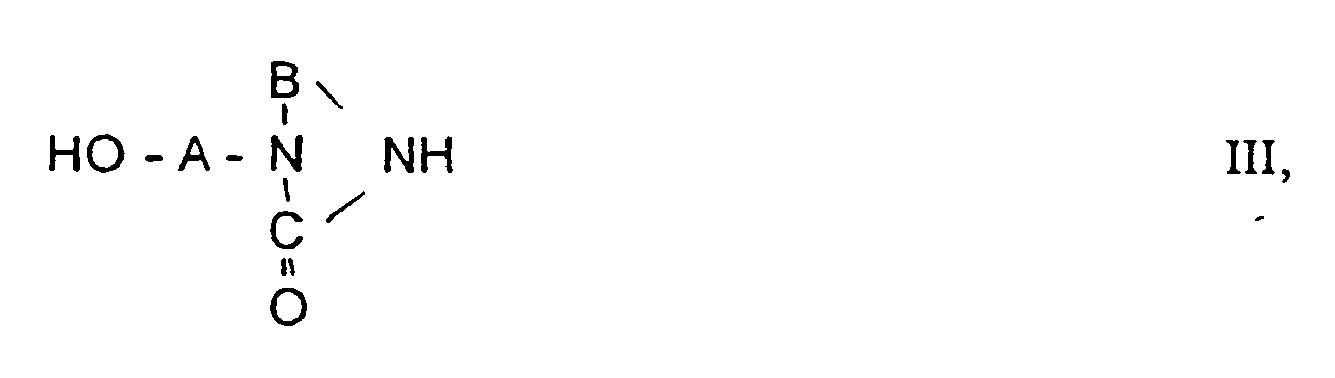
- the invention relates to a process for the preparation of (meth) acrylic esters of the formula I. in which R 1 is hydrogen or a methyl group and A and B are unbranched or branched alkylene groups having 2 to 5 C atoms, by reacting an acrylic acid ester or methacrylic acid ester of the formula II in which R 1 has the abovementioned meaning and R 2 has the meaning of an alkyl radical having 1 to 4 C atoms, with a heterocyclic compound of the formula III wherein A and B have the abovementioned meaning which is characterized in that the reaction of an ester corresponding to the formula II with a heterocyclic compound of the formula III to an acrylic or methacrylic ester of the formula I in the presence of a catalyst containing calcium hydroxide is performed ,
- a particular advantage of the novel process is that high conversions are achieved and that without the addition of water (we add tonsil) the calcium-containing catalyst system which is substantially quantitatively slurried in the reaction mixture, e.g. can be separated by filtration. As an aid for the separation of dissolved catalyst proportions Tonsil® is used. (Supplier: Südchemie AG)
- Compounds of the formula I are valuable comonomers and are used, for example, in the preparation of polymer dispersions of vinyl monomers, which are mainly used as binders, e.g. in paints, or to be used as leather auxiliaries.
- Comonomers of the formula I give copolymers a desired hydrophilicity and can function in thermosetting resins with their imide group as a formaldehyde scavenger.
- the process according to the invention gives process products of the formula I which are free of charge and with high-quality removal processes, directly e.g. as a solution in the acrylic or methacrylic II, for use as comonomers, especially in the production of dispersion polymers, can be used.
- the compounds I can also be prepared as solid products by the present process, for. B. by concentration from the solution.
- acrylic or methacrylic acid esters of the formula II are used in which R 2 is an alkyl radical having 1 to 4 carbon atoms.
- R 2 is an alkyl radical having 1 to 4 carbon atoms.
- examples include propyl acrylate, n-butyl acrylate, ethyl methacrylate, i-propyl methacrylate, i-butyl methacrylate, n-butyl methacrylate and especially methyl methacrylate.
- Suitable starting materials of the formula III are those compounds in which A or B is a branched or unbranched alkylene group having 2 to 5 carbon atoms, for example - (CH 2 ) 2 -, - (CH 2 ) 3 -, - (CH 2 ) 4 -, -CH 2 CH (CH 3 ) CH 2 -, -CH 2 C (CH 3 ) 2 CH 2 -.
- the ring member number of the heterocycle is preferably 5 and 6.
- Particularly advantageous as compound III 1- (2-hydroxyethyl) -imidazolidin-2-one, the z. B. well after the US-PS 3,254,075 and technically from aminoethylethanolamine and urea can be produced used.
- the divalent calcium compounds such as calcium hydroxide, calcium alcoholates, may be mentioned.
- the calcium compounds forming the catalyst or the catalyst system are expediently used in catalytic amounts, generally of not more than 250 ppm, based on the sum of the reactants II and III.
- the use of the catalysts in fine distribution z. B. in powder or in fine crystalline form is carried out at temperatures between 30 and 180 degrees C, especially between 50 and 130 degrees C, in the presence of not more than 250 ppm of the calcium compound, calculated on the weight of the reaction mixture, carried out.
- polymerization inhibitors such as, for example, phenothiazine, hydroquinone monomethyl ether and in particular oxygen.
- the reaction can take place under atmospheric pressure, underpressure or overpressure. It can be discontinuous or continuous.
- the starting materials II and III are, for example, heated to boiling together in the presence of calcium compounds and the distilled-off alcohol R 2 OH, optionally in the form of its azeotrope, is distilled off continuously with the ester II.
- the reaction times are in the range of about 2 to 10 hours. It is also possible to carry out the reaction in the presence of an inert solvent, for example toluene or cyclohexane, but this is normally unnecessary.
- excess monomeric ester II can be completely or partially removed by distillation.
- the dispersed catalyst is usually removed by filtration, advantageously before distilling off the usually excess monomeric ester II. However, the separation can also take place only after partial or complete removal of excess monomeric ester II.
- the catalyst recovered in filtered form can then, if appropriate after drying, be used again in further alcoholysis mixtures.
- the mixture is cooled by about 10 ° C, added 0.35 g of calcium hydroxide and the azeotropic distillate equivalent mass methyl methacrylate.
- the mixture is again heated to boiling and distilled off the resulting methyl methacrylate methanol azeotrope at a reflux ratio of 2: 1 up to a maximum head temperature of 70 ° C, later at a reflux ratio of 10: 1 until reaching a constant head temperature (99 ° C) ,
- the reaction is complete after 6 h.
- the batch is cooled to 80 ° C and adjusted by addition of methyl methacrylate to a total mass of 1742 g to a 25% solution of the product in methyl methacrylate.
- Example 2 Carrying out as in Example 2 but using 0.28 g (200 ppm based on total weight) of calcium hydroxide. Reaction time: 6.0 h.
- the product has the following composition by gas chromatographic analysis: methyl methacrylate: 71.3% Hydroxethylethylenharnstoff: 1.6% Methacryloyloxyethylethylenharnstoff: 25.1% N- (methacryloyloxyethyl) -N '- (methacryloyl) ethylene urea: 0.7%
Landscapes
- Chemical & Material Sciences (AREA)
- Organic Chemistry (AREA)
- Low-Molecular Organic Synthesis Reactions Using Catalysts (AREA)
- Organic Low-Molecular-Weight Compounds And Preparation Thereof (AREA)
- Catalysts (AREA)
Description
- Die vorliegende Erfindung betrifft ein neues und verbessertes Verfahren zur Herstellung von Acryl- oder Methacrylsäureestern der Formel

- Verbindungen der Formel I lassen sich nach dem in der US-Patentschrift 2 871 223 beschriebenen Verfahren durch Umsetzung von Acryl- oder Methacrylsäurechlorid mit Hydroxialkylimidazolidin-2-onen in Gegenwart tertiärer Stickstoffbasen, wobei stöchiometrische Mengen der Hydrochloride der tertiären Stickstoffbasen mit anfallen, erhalten.
- In EP 0619309 und EP 0650962 werden Verfahren zur Herstellung von Alkylimidazolidon (Meth)acrylaten beschrieben. Die Umsetzungen erfolgen in EP 0619309 in Gegenwart von Katalysatoren, die unter den Chelaten von Calcium mit 1,3-Dicarbonylverbindungen ausgewählt sind. In EP 0650962 wird mit einem Magnesiumalkoholat katalysiert.
- Hamamoto et al. (Chemical Abstracts, vol.84, no. 20, 17. Mai 1976) beschreiben die Synthese von 2-(Dimethylamino)ethylacrylat bzw. - methacrylat in Gegenwart von Ca(OH)2 oder CaO.
- Bei dem aus der EP 0 236 994 A1 bekannten Verfahren zur Herstellung von Acryl- und Methacrylestern der Formel I werden Acryl- oder Methacrylsäureester mit 1-(Hydroxialkyl)-imidazolidin-2-onen in Gegenwart von Titanalkoholaten oder Chelatverbindungen der Metalle Titan, Zirkonium, Eisen und Zink mit 1,3-Dicarbonylverbindungen als Umesterungskatalysatoren umgesetzt.
- In den EP-A 0 433 135 und EP-A 0 453 638 werden für die Umesterung von Acryl- und Methacrylestern mit Hydroxialkylimidazolidin-2-onen zu Verbindungen der Formel I Diorganozinnoxid-Verbindungen als Umesterungs-Katalysatoren beansprucht.
- In der Regel muß aus den Ansätzen nach Beendigung der Umsetzung der Metallkatalysator abgetrennt werden. Dies geschieht vorteilhaft, so z.B. bei Verwendung von Tetraalkyltitanaten oder von Dialkylzinnoxiden, durch Zusetzen von Wasser. Aus den Titanaten entstehen dabei Metall(hydr)oxide, wie z.B. TiO2, die beispielsweise durch Filtrieren oder Zentrifugieren abgetrennt werden. Diese hydrolysierten Umesterungs-katalysatoren können nach Abtrennung nicht mehr als solche erneut eingesetzt werden.
Die Dialkylzinnoxide lassen sich durch den Wasserzusatz zwar als solche wieder abtrennen und als Umesterungskatalysatoren erneut einsetzen. Jedoch muß dazu eine relativ große Wassermenge zunächst eingebracht werden, die dann wieder aus dem Reaktionsprodukt entfernt werden muß. Die Umsetzung kann nach der deutschen Patentanmeldung P 42 17 124.5 auch in Gegenwart von Gemischen von Alkali-/Erdalkalimetallverbindungen, die im wesentlichen als Oxide, Hydroxide, Carbonate und/oder als Salze von Carbonsäuren eingesetzt werden, durchgeführt werden. Die als Katalysatoren vorhandenen Alkali-/ErdalkaliVerbindungen sind ohne Zusetzen von Wasser abtrennbar. Die Menge an katalytisch aktiven Verbindungsgemischen beträgt 0,01 - 10 Gew.-%, bezogen auf das Reaktionsgemisch. - Trotz der vorteilhaft hohen Reaktionsgeschwindigkeit, die mit Alkali-Erdalkali-Katalysatoren erreicht wird, stagnieren diese Systeme nach einem ca. 80 %igen Hydroxialkylimidazolidin-2-on-Umsatz, so daß der Restalkoholgehalt im Umsetzungsgemisch relativ hoch ist. Auch die Bildung von N-(Methacryloyloxiethyl)-N'-(methacryloyl)ethylenharnstoff einer bifunktionellen Methacryl- und damit bei Polymerisationen vemetzend wirkenden Verbindung, ist mit ca. 10 % der Umesterungsverbindungen sehr hoch und ist zu niedrigeren Anteilen verbesserungsbedürftig.
- DE-OS 3013927 (BASF) beschreibt eine polymeranaloge Reaktion mit ungefähr 100 000 ppm Calciumhydroxid als Katalysator.
- DE 2238208 beschreibt die Umesterung von bakteriziden Chinoxalinderivaten unter Calciumhydroxid- oder Bariumhydroxidkatalyse.
- Der Erfindung lag die Aufgabe zugrunde, ein katalytisches Verfahren zur Herstellung von Acryl- oder Methacrylsäureestern der Formel I durch Alkoholyse von (Meth)acrylsäurealkylestern mit Hydroxialkylimidazolidin-2-onen zu finden, das mit guter Reaktionsgeschwindigkeit auch im Bereich der Endumesterung abläuft, und bei dem der verwendete Katalysator ohne die Zugabe von Wasser aus dem Reaktionsgemisch abgetrennt und gegebenenfalls als solcher wieder eingesetzt werden kann.
- Es wurde nun gefunden, daß die Umsetzung überraschenderweise vorteilhaft mit Calciumhydroxid in einer Menge von weniger als 250 ppm, bezogen auf die Gesamtmenge des Reaktionsansatzes durchgeführt werden kann.
- Die Erfindung betrifft ein Verfahren zur Herstellung von (Meth)acrylester der Formel I


- Ein besonderer Vorteil des neuen Verfahrens ist, daß hohe Umsätze erreicht werden, und daß ohne Zugabe von Wasser (wir setzen Tonsil zu) das calciumhaltige Katalysatorsystem, das weitgehend quantitativ in dem Reaktionsgemisch aufgeschlämmt ist, z.B. durch Filtration abgetrennt werden kann. Als Hilfsmittel zur Abtrennung von gelösten Katalysatoranteilen wird Tonsil® eingesetzt. (Lieferant: Südchemie AG)
- Verbindungen der Formel I sind wertvolle Comonomere und werden beispielsweise bei der Herstellung von Polymerdispersionen aus Vinylmonomeren eingesetzt, die vor allem als Bindemittel z.B. in Lacken, oder als Lederhilfsmittel Verwendung finden. Comonomere der Formel I verleihen Copolymerisaten eine gewünschte Hydrophilie und können in wärmehärtbaren Harzen mit ihrer Imidgruppe als Formaldehydfänger fungieren.
- Der Erfolg des erfindungsgemäßen Verfahrens ist überraschend, da aufgrund der Bifunktionalitäten von I und III bei deren Umsetzung in weiteren Reaktionen, wie Additionsreaktionen analog einer Michaeladdition an die Doppelbindung, oder in einer Amidbildung durch Reaktion des Acryl- oder Methacrylesters der Formel I mit der NH-Gruppierung einer Verbindung der Formel III in Gegenwart des Katalysators zu rechnen war. Die erfindungsgemäße Umsetzung von Acryl- und Methacrylestern der Formel II mit den Alkoholen der Formel III verläuft sehr selektiv zu Verbindungen der Formel I.
- Nach dem erfindungsgemäßen Verfahren werden Verfahrensprodukte der Formel I erhalten, die ohne preislich und qualitativ belastende Abtrennverfahren, unmittelbar z.B. als Lösung in dem Acryl- bzw. Methacrylester II, für die Verwendung als Comonomere, vor allem bei der Herstellung von Dispersionspolymerisaten, eingesetzt werden können. Die Verbindungen I können nach dem vorliegenden Verfahren auch als Festprodukte hergestellt werden, z. B. durch Einengen aus der Lösung.
- Für die Herstellung der Verbindungen I nach dem erfindungsgemäßen Verfahren werden Acryl- oder Methacrylsäureester der Formel II verwendet, in denen R2 ein Alkylrest mit 1 bis 4 Kohlen-stoffatomen bedeutet. Beispielsweise seien dazu Propylacrylat, n-Butylacrylat, Ethylmethacrylat, i-Propylmethacrylat, i-Butylmethacrylat, n-Butylmethacrylat und vor allem Methylmethacrylat genannt.
- Als Ausgangsstoffe der Formel III kommen solche Verbindungen in Frage, in denen A oder B eine verzweigte oder unverzweigte Alkylengruppe mit 2 bis 5 Kohlenstoffatomen darstellt, z.B. -(CH2)2-, -(CH2)3-, -(CH2)4-, -CH2CH(CH3)CH2-, -CH2C(CH3)2CH2-. Die Ringgliederzahl des Heterocyclus beträgt vorzugsweise 5 und 6. Besonders vorteilhaft wird als Verbindung III 1-(2-Hydroxiethyl)-imidazolidin-2-on, das z. B. nach der US-PS 3 254 075 gut und technisch aus Aminoethylethanolamin und Harnstoff herstellbar ist, verwendet.
- Als Calciumverbindungen, die dem Reaktionssystem als Katalysatoren bzw. katalysatorbildende Vorläufer zugesetzt werden, seien die zweiwertigen Calciumverbindungen, wie beispielsweise Calciumhydroxid, Calciumalkoholate, genannt.
- Die den Katalysator bzw. das Katalysatorsystem bildenden Calciumverbindungen werden zweckmäßig in katalytischen Mengen, im allgemeinen von nicht mehr als 250 ppm bezogen auf die Summe der Reaktionspartner II und III angewendet. Eine hohe Selektivität an Produkt I mit R1 = CH3, A und B = -(CH2)2- wird z.B. mit 250 ppm Ca(OH)2 bezogen auf die Gesamtansatzmenge bei der Umesterung von Methylmethacrylat mit der dazu entsprechenden Verbindung III erreicht.
- Vorteilhafterweise geschieht die Verwendung der Katalysatoren in feiner Verteilung z. B. in pulver- bzw. in feinkristalliner Form.
Die Umsetzung von Acrylestern und/oder Methacrylestern der Formel II mit den Alkoholen der Formel III (Alkoholyse) wird bei Temperaturen zwischen 30 und 180 Grad C, vor allem zwischen 50 und 130 Grad C, in Gegenwart von nicht mehr als 250 ppm der Calciumverbindung, berechnet auf das Gewicht des Reaktionsgemisches, durchgeführt. - Formal reagieren äquimolare Mengen der Reaktionspartner II und III zu den gewünschten Endprodukten I. In der Praxis hat es sich jedoch als zweckmäßig erwiesen, während der Umsetzung die Ausgangsester II stets im Überschuß zu halten. Sie werden in Mengen von 1 bis 20, vorzugsweise 2 bis 10, insbesondere 3 bis 6 Mol pro Mol III eingesetzt.
- Zur Vermeidung von Polymerisationsverlusten ist es zweckmäßig, die Umsetzung und Aufarbeitung des Reaktionsgemisches in Gegenwart von Polymerisationsinhibitoren wie z.B. Phenothiazin, Hydrochinonmonomethylether und insbesondere Sauerstoff, durchzuführen.
- Die Umsetzung kann unter Normaldruck, Unter- oder Überdruck ablaufen. Sie kann diskontinuierlich oder kontinuierlich erfolgen. Die Ausgangsstoffe II und III werden beispielsweise gemeinsam in Gegenwart von Calciumverbindungen zum Sieden erhitzt und dabei kontinuierlich der abgespaltene Alkohol R2OH, gegebenenfalls in Form seines Azeotrops mit dem Ester II abdestilliert. Je nach Reaktionstemperatur, Katalysator bzw. Katalysatormenge liegen die Umsetzungszeiten im Bereich von ca. 2 bis 10 Stunden. Es ist auch möglich, die Umsetzung in Gegenwart eines inerten Lösungsmittels, z.B. Toluol oder Cyclohexan, durchzuführen, was sich aber normalerweise erübrigt.
- Nach Beendigung der Umsetzung kann überschüssiger monomerer Ester II vollkommen oder teilweise durch Abdestillieren entfernt werden.
Der dispergierte Katalysator wird üblicherweise durch Filtration, vorteilhaft vor dem Abdestillieren des meist überschüssigen monomeren Esters II, entfernt. Die Abtrennung kann aber auch erst nach teilweiser oder vollständiger Entfernung von überschüssigem monomerem Ester II erfolgen. Der in abfiltrierter Form zurückgewonnene Katalysator kann dann, gegebenenfalls nach Trocknung, wieder in weiteren Alkoholyseansätzen eingesetzt werden. - Ein bevorzugtes Umsetzungsprodukt ist ein solches, das aus Methylmethacrylat und 1-(2-Hydroxiethyl)-imidazolidin-2-on (Hydroxyethylethylenharnstoff) entsteht und so der Formel I mit R1 = CH3, A = -(CH2)2- und B = -(CH2)2-entspricht.
- In einen 2 I-Rundkolben mit mechanischer Rührung, Lufteinleitung, Sumpftemperaturanzeige und aufgesetzter Füllkörperkolonne (⌀: 35 mm, Höhe 55 cm, 8 x 8 mm - Raschigringe) sowie automatischen Kolonnenkopf mit Rückfluß- und Destillatkühler gibt man 1100 g (11 mol) Methylmethacrylat, 286 g (2,2 mol) Hydroxyethylethylenharnstoff und als Inhibitoren 0,35 g Hydrochinonmonomethylether sowie 0,09 g Phenothiazin.
Man erhitzt zum Sieden und destilliert über die Kolonne zunächst ein Methylmethacrylat-Wasser-Azeotrop ab, bis die Kopf-temperatur 99 °C erreicht. Der Ansatz wird um ca. 10 °C abgekühlt, 0,35 g Calciumhydroxid und die dem Azeotropdestillat äquivalente Masse Methylmethacrylat zugegeben.
Erneut wird zum Sieden erhitzt und das entstehende Methylmethacrylat-Methanolazeotrop bei einem Rücklauf-verhältnis von 2 : 1 bis zu einer maximalen Kopftemperatur von 70 °C, später bei einem Rücklaufverhältnis von 10 : 1 bis zum Erreichen einer konstanten Kopftemperatur (99 °C) abdestilliert. Die Reaktion ist nach 6 h beendet. Der Ansatz wird auf 80 °C abgekühlt und durch Zugabe von Methylmethacrylat bis zu einer Gesamtmasse von 1742 g auf eine 25 %ige Lösung des Produkts in Methylmethacrylat eingestellt. Man gibt 3,5 g Tonsil L80FF® (Südchemie) hinzu und rührt 15 min nach. Anschließend kühlt man auf Raumtemperatur ab und klärt den Ansatz durch Druckfiltration (Seitz Druckfilter Ø = 14 cm; Filterschicht T 1000 (Seitz), p < 0,4 bar). Das Filtrat hat nach gaschromatographischer Analyse die folgende Zusammensetzung:Methylmethacrylat: 72,5 % Hydroxyethylethylenharnstoff: 1,4 % Methacryloyloxyethylethylenharnstoff: 23,7 % N-(Methacryloyloxyethyl)-N'-(methacryloyl)ethylenharnstoff:1,2 % - Durchführung wie Beispiel 1, aber unter Weglassen des Entwässerungsschritts. Reaktionszeit: 5,3 h. Das Produkt ist nach gaschromatographischer Analyse wie folgt zusammengesetzt:
Methylmethacrylat: 71,8 % Hydroxyethylethylenharnstoff: 1,7 % Methacryloyloxyethylethylenharnstoff: 24,0 % N-(Methacryloyloxyethyl)-N'-(methacryloyl)ethylenharnstoff: 1,2 % Platin-Cobalt-Farbzahl: 22 Säurezahl: 0,05 - Durchführung wie Beispiel 2, aber unter Verwendung von 0,55 g Calciumhydroxid. Reaktionszeit: 5,5 h. Das Produkt hat nach gaschromatographischer Analyse die folgende Zusammensetzung:
Methylmethacrylat: 70,5 % Hydroxyethylethylenharnstoff: 1,0 % Methacryloyloxyethylethylenharnstoff: 24,4 % N-(Methacryloyloxyethyl)-N'-(methacryloyl)ethylenhamstoff: 2,0 % - Durchführung wie in Beispiel 2, aber unter Verwendung von 0,28 g (200 ppm bez. auf Gesamteinwaage) Calciumhydroxid. Reaktionszeit: 6,0 h. Das Produkt hat nach gaschromatographischer Analyse die folgende Zusammensetzung:
Methylmethacrylat: 71,3 % Hydroxethylethylenharnstoff: 1,6 % Methacryloyloxyethylethylenharnstoff: 25,1 % N-(Methacryloyloxyethyl)-N'-(methacryloyl)ethylenharnstoff: 0,7 %
Claims (5)
- Verfahren zur Herstellung von (Meth)acrylestern der Formel I


- Verfahren nach Anspruch 1, dadurch gekennzeichnet, daß die Menge des Katalysatorsystems 1 ppm bis 250 ppm, bezogen auf das Reaktionsgemisch, beträgt.
- Verfahren nach dem Anspruch 2, dadurch gekennzeichnet, daß die Menge des Katalysatorsystems 10 bis 150 ppm, bezogen auf das Reaktionsgemisch, beträgt.
- Verfahren nach den Ansprüchen 1 bis 3, dadurch gekennzeichnet, daß die Umsetzung von Acryl- oder Methacrylestern der Formel II mit 1-(2-Hydroxiethyl)-imidazolidin-2-on (2-(Hydroxyethyl)ethylenharnstoff) durchgeführt wird.
- Verfahren nach den Ansprüchen 1 bis 4, dadurch gekennzeichnet, daß Methylmethacrylat als Verbindung der Formel II mit einem Alkohol der Formel III umgesetzt wird.
Applications Claiming Priority (3)
| Application Number | Priority Date | Filing Date | Title |
|---|---|---|---|
| DE19547099A DE19547099B4 (de) | 1995-12-16 | 1995-12-16 | Verfahren zur Herstellung von (Meth)acrylsäureestern |
| DE19547099 | 1995-12-16 | ||
| PCT/DE1996/002161 WO1997022592A1 (de) | 1995-12-16 | 1996-11-13 | Verfahren zur herstellung von (meth)acrylsäureestern |
Publications (2)
| Publication Number | Publication Date |
|---|---|
| EP0868421A1 EP0868421A1 (de) | 1998-10-07 |
| EP0868421B1 true EP0868421B1 (de) | 2006-08-02 |
Family
ID=7780364
Family Applications (1)
| Application Number | Title | Priority Date | Filing Date |
|---|---|---|---|
| EP96945721A Expired - Lifetime EP0868421B1 (de) | 1995-12-16 | 1996-11-13 | Verfahren zur herstellung von (meth)acrylsäureestern |
Country Status (11)
| Country | Link |
|---|---|
| US (1) | US6008371A (de) |
| EP (1) | EP0868421B1 (de) |
| JP (1) | JP4108751B2 (de) |
| KR (1) | KR100468269B1 (de) |
| AT (1) | ATE334970T1 (de) |
| AU (1) | AU717566B2 (de) |
| CZ (1) | CZ290781B6 (de) |
| DE (2) | DE19547099B4 (de) |
| ES (1) | ES2271960T3 (de) |
| MX (1) | MX205018B (de) |
| WO (1) | WO1997022592A1 (de) |
Cited By (1)
| Publication number | Priority date | Publication date | Assignee | Title |
|---|---|---|---|---|
| WO2011027070A1 (fr) * | 2009-09-07 | 2011-03-10 | Arkema France | Procede de preparation de (meth)acrylates d'alkylimidazolidone |
Families Citing this family (10)
| Publication number | Priority date | Publication date | Assignee | Title |
|---|---|---|---|---|
| AU2128002A (en) * | 2001-03-16 | 2002-09-19 | Rohm And Haas Company | Transesterification process |
| DE102005052931A1 (de) * | 2005-11-03 | 2007-05-10 | Basf Ag | Katalytisches Verfahren zur Herstellung von (Meth)acrylaten von N-hydroxyalkylierten Lactamen |
| WO2008098885A1 (de) | 2007-02-15 | 2008-08-21 | Basf Se | Katalytisches verfahren zur herstellung von (meth)acrylsäureestern von n-hydroxyalkylierten lactamen |
| KR101440654B1 (ko) | 2007-02-15 | 2014-09-19 | 바스프 에스이 | N-히드록시알킬화 락탐의 (메트)아크릴산 에스테르의 촉매적 제조 방법 |
| DE102007031470A1 (de) * | 2007-07-05 | 2009-01-08 | Evonik Röhm Gmbh | Verfahren zur Herstellung von (Meth)acrylaten |
| DE102008040221A1 (de) * | 2008-07-07 | 2010-01-14 | Evonik Röhm Gmbh | Verfahren zur Herstellung von (Meth)acrylsäureestern |
| CN102167682A (zh) * | 2011-02-14 | 2011-08-31 | 广东银洋树脂有限公司 | (甲基)丙烯酸亚乙基脲烷基酯单体及其制备方法 |
| WO2013137998A1 (en) * | 2012-03-15 | 2013-09-19 | Rohm And Haas Company | Transesterification process |
| US9145371B2 (en) * | 2013-06-11 | 2015-09-29 | Rhoda Operations | Process for the preparation of (meth)acrylic esters and derivatives |
| JP7337539B2 (ja) * | 2018-06-21 | 2023-09-04 | メディヴィル・アクチエボラーグ | 白血病療法のための塩基修飾シチジンヌクレオチド |
Family Cites Families (10)
| Publication number | Priority date | Publication date | Assignee | Title |
|---|---|---|---|---|
| NL278851A (de) * | 1961-05-25 | |||
| US3356653A (en) * | 1965-11-03 | 1967-12-05 | Desoto Inc | Copolymers containing heterocyclic unsaturated amino alcohols |
| US4777265A (en) * | 1986-03-11 | 1988-10-11 | Basf Aktiengesellschaft | Preparation of acrylates and methacrylates |
| US4845233A (en) * | 1987-09-11 | 1989-07-04 | Iprx, Inc. | Imidazolin-2-ones |
| FR2655987B1 (fr) * | 1989-12-15 | 1992-03-27 | Norsolor Sa | Procede de preparation de (meth)acrylate d'alkylimidazolidone. |
| DE4217124A1 (de) * | 1992-05-23 | 1993-11-25 | Roehm Gmbh | Verfahren zur Herstellung von endständig Stickstoffheterocyclus-substituiertem (Meth)acrylsäureester |
| FR2703682B1 (fr) * | 1993-04-06 | 1995-05-12 | Atochem Elf Sa | Procédé de préparation de (méth)acrylate(s) d'alkylimidazolidone. |
| FR2711653B1 (fr) * | 1993-10-27 | 1996-01-05 | Atochem Elf Sa | Procédé de préparation de (méth)acrylates d'alkylimidazolidone. |
| FR2727112B1 (fr) * | 1994-11-18 | 1996-12-20 | Atochem Elf Sa | Procede de preparation de (meth)acrylates d'alkylimidazolidone |
| FR2739854B1 (fr) * | 1995-10-17 | 1997-12-05 | Atochem Elf Sa | Procede de preparation de (meth)acrylates d'alkylimidazolidone |
-
1995
- 1995-12-16 DE DE19547099A patent/DE19547099B4/de not_active Expired - Fee Related
-
1996
- 1996-11-13 CZ CZ19981807A patent/CZ290781B6/cs not_active IP Right Cessation
- 1996-11-13 EP EP96945721A patent/EP0868421B1/de not_active Expired - Lifetime
- 1996-11-13 KR KR19980704530A patent/KR100468269B1/ko not_active Expired - Lifetime
- 1996-11-13 US US09/091,236 patent/US6008371A/en not_active Expired - Lifetime
- 1996-11-13 WO PCT/DE1996/002161 patent/WO1997022592A1/de not_active Ceased
- 1996-11-13 ES ES96945721T patent/ES2271960T3/es not_active Expired - Lifetime
- 1996-11-13 DE DE59611373T patent/DE59611373D1/de not_active Expired - Lifetime
- 1996-11-13 AT AT96945721T patent/ATE334970T1/de active
- 1996-11-13 JP JP52240697A patent/JP4108751B2/ja not_active Expired - Lifetime
- 1996-11-13 AU AU17655/97A patent/AU717566B2/en not_active Ceased
- 1996-11-13 MX MX9804649A patent/MX205018B/es unknown
Cited By (2)
| Publication number | Priority date | Publication date | Assignee | Title |
|---|---|---|---|---|
| WO2011027070A1 (fr) * | 2009-09-07 | 2011-03-10 | Arkema France | Procede de preparation de (meth)acrylates d'alkylimidazolidone |
| FR2949779A1 (fr) * | 2009-09-07 | 2011-03-11 | Arkema France | Procede de preparation de (meth)acrylates d'alkylimidazolidone |
Also Published As
| Publication number | Publication date |
|---|---|
| DE19547099B4 (de) | 2006-03-23 |
| DE19547099A1 (de) | 1997-06-19 |
| ES2271960T3 (es) | 2007-04-16 |
| MX205018B (es) | 2001-10-30 |
| WO1997022592A1 (de) | 1997-06-26 |
| US6008371A (en) | 1999-12-28 |
| AU717566B2 (en) | 2000-03-30 |
| ATE334970T1 (de) | 2006-08-15 |
| MX9804649A (es) | 1999-05-31 |
| KR100468269B1 (ko) | 2005-06-21 |
| EP0868421A1 (de) | 1998-10-07 |
| CZ180798A3 (cs) | 1998-09-16 |
| JP4108751B2 (ja) | 2008-06-25 |
| KR20000064422A (ko) | 2000-11-06 |
| CZ290781B6 (cs) | 2002-10-16 |
| AU1765597A (en) | 1997-07-14 |
| JP2000501743A (ja) | 2000-02-15 |
| DE59611373D1 (de) | 2006-09-14 |
Similar Documents
| Publication | Publication Date | Title |
|---|---|---|
| EP0236994B1 (de) | Verfahren zur Herstellung von Acryl- und Methycrylsäureestern | |
| EP0571851B1 (de) | Verfahren zur Herstellung von endständig Stickstoffheterocyclus-substituiertem (Meth)acrylsäureester | |
| EP1465859B1 (de) | Verfahren zur kontinuierlichen herstellung von alkyl(meth)acrylaten | |
| DE19547099B4 (de) | Verfahren zur Herstellung von (Meth)acrylsäureestern | |
| EP0874870B1 (de) | Verfahren zur herstellung von polyglycol(meth)acrylaten | |
| JP2776782B2 (ja) | アルキルイミダゾリドン(メタ)アクリレートの合成方法 | |
| EP1636168A1 (de) | Verfahren zur kontinuierlichen herstellung von alkylamino(meth)acrylamiden | |
| DE4010532A1 (de) | Verfahren zur herstellung von endstaendig heterocyclus-substituierten acryl- und methacrylsaeurealkylestern | |
| DE60220001T2 (de) | Verfahren zur Herstellung von (Meth)acrylaten von Alkylimidazolidonen | |
| EP1299345B1 (de) | Vefahren zur herstellung von aminoalkyl(meth)acrylaten | |
| DE4301673C2 (de) | Umesterungsverfahren zur Herstellung von endständig Stickstoffheterocyclussubstituiertem (Meth)acrylsäureester | |
| EP0380146B1 (de) | Verfahren zur Herstellung von N-omega-Hydroxyalkyl-, N-omega-Hydroxy-oxa-alkyl- und N-omega-Hydroxy-polyoxa-alkylcarbaminsäureestern | |
| EP1053995B1 (de) | Verfahren zur Herstellung von (Meth)acrylsäureestern | |
| EP0623590B1 (de) | Verfahren zur Herstellung von Alkalisalzen des Cyanacetons | |
| DE2107990A1 (de) | Verfahren zur Herstellung von Formyl nitrüdenvaten | |
| CA2240196C (en) | Process for the preparation of (meth)acrylic acid esters | |
| DE4137966A1 (de) | Verfahren zur gleichzeitigen herstellung eines alkylenglykols und eines dialkylcarbonats | |
| DE1965377C3 (de) | Verfahren zur Herstellung primärer oder sekundärer äthylenischer Alkohole | |
| KR20230038105A (ko) | 우레아 (메트)아크릴레이트의 원-포트 합성 | |
| DD229117A1 (de) | Verfahren zur herstellung von maleinsaeuredialkylestern | |
| DE19806398A1 (de) | Verfahren zur Herstellung von Aldehyden |
Legal Events
| Date | Code | Title | Description |
|---|---|---|---|
| PUAI | Public reference made under article 153(3) epc to a published international application that has entered the european phase |
Free format text: ORIGINAL CODE: 0009012 |
|
| 17P | Request for examination filed |
Effective date: 19980610 |
|
| AK | Designated contracting states |
Kind code of ref document: A1 Designated state(s): AT BE CH DE ES FR GB IT LI NL |
|
| RAP1 | Party data changed (applicant data changed or rights of an application transferred) |
Owner name: ROEHM GMBH & CO. KG |
|
| 17Q | First examination report despatched |
Effective date: 20020730 |
|
| GRAP | Despatch of communication of intention to grant a patent |
Free format text: ORIGINAL CODE: EPIDOSNIGR1 |
|
| GRAS | Grant fee paid |
Free format text: ORIGINAL CODE: EPIDOSNIGR3 |
|
| GRAA | (expected) grant |
Free format text: ORIGINAL CODE: 0009210 |
|
| AK | Designated contracting states |
Kind code of ref document: B1 Designated state(s): AT BE CH DE ES FR GB IT LI NL |
|
| PG25 | Lapsed in a contracting state [announced via postgrant information from national office to epo] |
Ref country code: IT Free format text: LAPSE BECAUSE OF FAILURE TO SUBMIT A TRANSLATION OF THE DESCRIPTION OR TO PAY THE FEE WITHIN THE PRESCRIBED TIME-LIMIT;WARNING: LAPSES OF ITALIAN PATENTS WITH EFFECTIVE DATE BEFORE 2007 MAY HAVE OCCURRED AT ANY TIME BEFORE 2007. THE CORRECT EFFECTIVE DATE MAY BE DIFFERENT FROM THE ONE RECORDED. Effective date: 20060802 |
|
| REG | Reference to a national code |
Ref country code: GB Ref legal event code: FG4D Free format text: NOT ENGLISH |
|
| RAP2 | Party data changed (patent owner data changed or rights of a patent transferred) |
Owner name: ROEHM GMBH |
|
| REG | Reference to a national code |
Ref country code: CH Ref legal event code: EP |
|
| REF | Corresponds to: |
Ref document number: 59611373 Country of ref document: DE Date of ref document: 20060914 Kind code of ref document: P |
|
| NLT2 | Nl: modifications (of names), taken from the european patent patent bulletin |
Owner name: ROEHM GMBH Effective date: 20060823 |
|
| GBT | Gb: translation of ep patent filed (gb section 77(6)(a)/1977) |
Effective date: 20061030 |
|
| ET | Fr: translation filed | ||
| REG | Reference to a national code |
Ref country code: ES Ref legal event code: FG2A Ref document number: 2271960 Country of ref document: ES Kind code of ref document: T3 |
|
| PLBE | No opposition filed within time limit |
Free format text: ORIGINAL CODE: 0009261 |
|
| STAA | Information on the status of an ep patent application or granted ep patent |
Free format text: STATUS: NO OPPOSITION FILED WITHIN TIME LIMIT |
|
| 26N | No opposition filed |
Effective date: 20070503 |
|
| REG | Reference to a national code |
Ref country code: CH Ref legal event code: PFA Owner name: EVONIK ROEHM GMBH Free format text: ROEHM GMBH#KIRSCHENALLEE#64293 DARMSTADT (DE) -TRANSFER TO- EVONIK ROEHM GMBH#KIRSCHENALLEE#64293 DARMSTADT (DE) |
|
| NLT1 | Nl: modifications of names registered in virtue of documents presented to the patent office pursuant to art. 16 a, paragraph 1 |
Owner name: EVONIK ROEHM GMBH |
|
| REG | Reference to a national code |
Ref country code: FR Ref legal event code: CD |
|
| PGFP | Annual fee paid to national office [announced via postgrant information from national office to epo] |
Ref country code: AT Payment date: 20101112 Year of fee payment: 15 |
|
| PGFP | Annual fee paid to national office [announced via postgrant information from national office to epo] |
Ref country code: CH Payment date: 20101123 Year of fee payment: 15 |
|
| REG | Reference to a national code |
Ref country code: CH Ref legal event code: PL |
|
| PG25 | Lapsed in a contracting state [announced via postgrant information from national office to epo] |
Ref country code: LI Free format text: LAPSE BECAUSE OF NON-PAYMENT OF DUE FEES Effective date: 20111130 Ref country code: CH Free format text: LAPSE BECAUSE OF NON-PAYMENT OF DUE FEES Effective date: 20111130 |
|
| REG | Reference to a national code |
Ref country code: AT Ref legal event code: MM01 Ref document number: 334970 Country of ref document: AT Kind code of ref document: T Effective date: 20111113 |
|
| PG25 | Lapsed in a contracting state [announced via postgrant information from national office to epo] |
Ref country code: AT Free format text: LAPSE BECAUSE OF NON-PAYMENT OF DUE FEES Effective date: 20111113 |
|
| PGFP | Annual fee paid to national office [announced via postgrant information from national office to epo] |
Ref country code: DE Payment date: 20131121 Year of fee payment: 18 Ref country code: FR Payment date: 20131120 Year of fee payment: 18 |
|
| PGFP | Annual fee paid to national office [announced via postgrant information from national office to epo] |
Ref country code: ES Payment date: 20131128 Year of fee payment: 18 Ref country code: BE Payment date: 20131121 Year of fee payment: 18 Ref country code: IT Payment date: 20131129 Year of fee payment: 18 Ref country code: NL Payment date: 20131121 Year of fee payment: 18 |
|
| REG | Reference to a national code |
Ref country code: DE Ref legal event code: R119 Ref document number: 59611373 Country of ref document: DE |
|
| REG | Reference to a national code |
Ref country code: NL Ref legal event code: V1 Effective date: 20150601 |
|
| PG25 | Lapsed in a contracting state [announced via postgrant information from national office to epo] |
Ref country code: BE Free format text: LAPSE BECAUSE OF NON-PAYMENT OF DUE FEES Effective date: 20141130 |
|
| REG | Reference to a national code |
Ref country code: FR Ref legal event code: ST Effective date: 20150731 |
|
| PG25 | Lapsed in a contracting state [announced via postgrant information from national office to epo] |
Ref country code: NL Free format text: LAPSE BECAUSE OF NON-PAYMENT OF DUE FEES Effective date: 20150601 |
|
| PG25 | Lapsed in a contracting state [announced via postgrant information from national office to epo] |
Ref country code: DE Free format text: LAPSE BECAUSE OF NON-PAYMENT OF DUE FEES Effective date: 20150602 |
|
| PG25 | Lapsed in a contracting state [announced via postgrant information from national office to epo] |
Ref country code: FR Free format text: LAPSE BECAUSE OF NON-PAYMENT OF DUE FEES Effective date: 20141201 |
|
| REG | Reference to a national code |
Ref country code: ES Ref legal event code: FD2A Effective date: 20151229 |
|
| PG25 | Lapsed in a contracting state [announced via postgrant information from national office to epo] |
Ref country code: IT Free format text: LAPSE BECAUSE OF NON-PAYMENT OF DUE FEES Effective date: 20141113 |
|
| PGFP | Annual fee paid to national office [announced via postgrant information from national office to epo] |
Ref country code: GB Payment date: 20151118 Year of fee payment: 20 |
|
| PG25 | Lapsed in a contracting state [announced via postgrant information from national office to epo] |
Ref country code: ES Free format text: LAPSE BECAUSE OF NON-PAYMENT OF DUE FEES Effective date: 20141114 |
|
| REG | Reference to a national code |
Ref country code: GB Ref legal event code: PE20 Expiry date: 20161112 |
|
| PG25 | Lapsed in a contracting state [announced via postgrant information from national office to epo] |
Ref country code: GB Free format text: LAPSE BECAUSE OF EXPIRATION OF PROTECTION Effective date: 20161112 |