EP0866052B1 - Verfahren zur Herstellung von 1-Amino-1-methyl-3(4)-amino-methylcyclohexan - Google Patents
Verfahren zur Herstellung von 1-Amino-1-methyl-3(4)-amino-methylcyclohexan Download PDFInfo
- Publication number
- EP0866052B1 EP0866052B1 EP98104139A EP98104139A EP0866052B1 EP 0866052 B1 EP0866052 B1 EP 0866052B1 EP 98104139 A EP98104139 A EP 98104139A EP 98104139 A EP98104139 A EP 98104139A EP 0866052 B1 EP0866052 B1 EP 0866052B1
- Authority
- EP
- European Patent Office
- Prior art keywords
- methyl
- amca
- reaction
- fmf
- formamido
- Prior art date
- Legal status (The legal status is an assumption and is not a legal conclusion. Google has not performed a legal analysis and makes no representation as to the accuracy of the status listed.)
- Expired - Lifetime
Links
- 238000000034 method Methods 0.000 title claims description 29
- 238000002360 preparation method Methods 0.000 title description 7
- QGZKDVFQNNGYKY-UHFFFAOYSA-N Ammonia Chemical compound N QGZKDVFQNNGYKY-UHFFFAOYSA-N 0.000 claims description 39
- 238000006243 chemical reaction Methods 0.000 claims description 39
- LELOWRISYMNNSU-UHFFFAOYSA-N hydrogen cyanide Chemical compound N#C LELOWRISYMNNSU-UHFFFAOYSA-N 0.000 claims description 22
- QAOWNCQODCNURD-UHFFFAOYSA-N Sulfuric acid Chemical compound OS(O)(=O)=O QAOWNCQODCNURD-UHFFFAOYSA-N 0.000 claims description 21
- 238000005984 hydrogenation reaction Methods 0.000 claims description 19
- 239000002904 solvent Substances 0.000 claims description 19
- 229910021529 ammonia Inorganic materials 0.000 claims description 18
- 238000000605 extraction Methods 0.000 claims description 18
- ZHNUHDYFZUAESO-UHFFFAOYSA-N Formamide Chemical compound NC=O ZHNUHDYFZUAESO-UHFFFAOYSA-N 0.000 claims description 16
- 238000004821 distillation Methods 0.000 claims description 12
- 239000003513 alkali Substances 0.000 claims description 11
- 238000001914 filtration Methods 0.000 claims description 10
- XLYOFNOQVPJJNP-UHFFFAOYSA-N water Substances O XLYOFNOQVPJJNP-UHFFFAOYSA-N 0.000 claims description 10
- 239000003054 catalyst Substances 0.000 claims description 9
- 239000011541 reaction mixture Substances 0.000 claims description 9
- 229910001860 alkaline earth metal hydroxide Inorganic materials 0.000 claims description 8
- BDAGIHXWWSANSR-UHFFFAOYSA-N Formic acid Chemical class OC=O BDAGIHXWWSANSR-UHFFFAOYSA-N 0.000 claims description 7
- 239000003795 chemical substances by application Substances 0.000 claims description 7
- 229910001854 alkali hydroxide Inorganic materials 0.000 claims description 6
- 150000001875 compounds Chemical class 0.000 claims description 6
- 150000004675 formic acid derivatives Chemical class 0.000 claims description 6
- 238000004508 fractional distillation Methods 0.000 claims description 6
- 238000003776 cleavage reaction Methods 0.000 claims description 5
- 230000007017 scission Effects 0.000 claims description 5
- -1 alkaline earth metal formate Chemical class 0.000 claims description 4
- 229910052784 alkaline earth metal Inorganic materials 0.000 claims description 4
- OSWFIVFLDKOXQC-UHFFFAOYSA-N 4-(3-methoxyphenyl)aniline Chemical compound COC1=CC=CC(C=2C=CC(N)=CC=2)=C1 OSWFIVFLDKOXQC-UHFFFAOYSA-N 0.000 claims description 3
- UGFAIRIUMAVXCW-UHFFFAOYSA-N Carbon monoxide Chemical compound [O+]#[C-] UGFAIRIUMAVXCW-UHFFFAOYSA-N 0.000 claims description 3
- 229910002091 carbon monoxide Inorganic materials 0.000 claims description 3
- 235000019253 formic acid Nutrition 0.000 claims description 3
- 238000005580 one pot reaction Methods 0.000 claims description 2
- GYDJEQRTZSCIOI-UHFFFAOYSA-N Tranexamic acid Chemical compound NCC1CCC(C(O)=O)CC1 GYDJEQRTZSCIOI-UHFFFAOYSA-N 0.000 claims 7
- 238000002425 crystallisation Methods 0.000 claims 3
- 230000022244 formylation Effects 0.000 claims 2
- 238000006170 formylation reaction Methods 0.000 claims 2
- NPXOKRUENSOPAO-UHFFFAOYSA-N Raney nickel Chemical compound [Al].[Ni] NPXOKRUENSOPAO-UHFFFAOYSA-N 0.000 claims 1
- 150000002148 esters Chemical class 0.000 claims 1
- 235000011149 sulphuric acid Nutrition 0.000 claims 1
- 239000001117 sulphuric acid Substances 0.000 claims 1
- AVKNGPAMCBSNSO-UHFFFAOYSA-N cyclohexylmethanamine Chemical compound NCC1CCCCC1 AVKNGPAMCBSNSO-UHFFFAOYSA-N 0.000 description 28
- BFNBIHQBYMNNAN-UHFFFAOYSA-N ammonium sulfate Chemical compound N.N.OS(O)(=O)=O BFNBIHQBYMNNAN-UHFFFAOYSA-N 0.000 description 18
- 229910052921 ammonium sulfate Inorganic materials 0.000 description 18
- 235000011130 ammonium sulphate Nutrition 0.000 description 18
- OKKJLVBELUTLKV-UHFFFAOYSA-N Methanol Chemical compound OC OKKJLVBELUTLKV-UHFFFAOYSA-N 0.000 description 15
- 239000000243 solution Substances 0.000 description 13
- YXFVVABEGXRONW-UHFFFAOYSA-N Toluene Chemical compound CC1=CC=CC=C1 YXFVVABEGXRONW-UHFFFAOYSA-N 0.000 description 12
- 239000000203 mixture Substances 0.000 description 11
- HEMHJVSKTPXQMS-UHFFFAOYSA-M Sodium hydroxide Chemical compound [OH-].[Na+] HEMHJVSKTPXQMS-UHFFFAOYSA-M 0.000 description 9
- 238000002955 isolation Methods 0.000 description 9
- UFHFLCQGNIYNRP-UHFFFAOYSA-N Hydrogen Chemical compound [H][H] UFHFLCQGNIYNRP-UHFFFAOYSA-N 0.000 description 8
- 229910052739 hydrogen Inorganic materials 0.000 description 8
- 239000001257 hydrogen Substances 0.000 description 8
- ZXEKIIBDNHEJCQ-UHFFFAOYSA-N isobutanol Chemical compound CC(C)CO ZXEKIIBDNHEJCQ-UHFFFAOYSA-N 0.000 description 8
- KWYUFKZDYYNOTN-UHFFFAOYSA-M Potassium hydroxide Chemical compound [OH-].[K+] KWYUFKZDYYNOTN-UHFFFAOYSA-M 0.000 description 6
- 230000002378 acidificating effect Effects 0.000 description 6
- TZIHFWKZFHZASV-UHFFFAOYSA-N methyl formate Chemical compound COC=O TZIHFWKZFHZASV-UHFFFAOYSA-N 0.000 description 6
- PXHVJJICTQNCMI-UHFFFAOYSA-N Nickel Chemical compound [Ni] PXHVJJICTQNCMI-UHFFFAOYSA-N 0.000 description 5
- 229910000564 Raney nickel Inorganic materials 0.000 description 5
- 239000006227 byproduct Substances 0.000 description 5
- 230000000052 comparative effect Effects 0.000 description 5
- 150000001340 alkali metals Chemical class 0.000 description 4
- USIUVYZYUHIAEV-UHFFFAOYSA-N diphenyl ether Chemical compound C=1C=CC=CC=1OC1=CC=CC=C1 USIUVYZYUHIAEV-UHFFFAOYSA-N 0.000 description 4
- 239000007789 gas Substances 0.000 description 4
- 239000002351 wastewater Substances 0.000 description 4
- ZWEHNKRNPOVVGH-UHFFFAOYSA-N 2-Butanone Chemical compound CCC(C)=O ZWEHNKRNPOVVGH-UHFFFAOYSA-N 0.000 description 3
- QPRQEDXDYOZYLA-UHFFFAOYSA-N 2-methylbutan-1-ol Chemical compound CCC(C)CO QPRQEDXDYOZYLA-UHFFFAOYSA-N 0.000 description 3
- NQMCONRMKQPZGQ-UHFFFAOYSA-N 2-methylcyclohexene-1-carbonitrile Chemical compound CC1=C(C#N)CCCC1 NQMCONRMKQPZGQ-UHFFFAOYSA-N 0.000 description 3
- NLXLAEXVIDQMFP-UHFFFAOYSA-N Ammonium chloride Substances [NH4+].[Cl-] NLXLAEXVIDQMFP-UHFFFAOYSA-N 0.000 description 3
- VHUUQVKOLVNVRT-UHFFFAOYSA-N Ammonium hydroxide Chemical compound [NH4+].[OH-] VHUUQVKOLVNVRT-UHFFFAOYSA-N 0.000 description 3
- YMWUJEATGCHHMB-UHFFFAOYSA-N Dichloromethane Chemical compound ClCCl YMWUJEATGCHHMB-UHFFFAOYSA-N 0.000 description 3
- 235000011114 ammonium hydroxide Nutrition 0.000 description 3
- QVGXLLKOCUKJST-UHFFFAOYSA-N atomic oxygen Chemical compound [O] QVGXLLKOCUKJST-UHFFFAOYSA-N 0.000 description 3
- 230000008025 crystallization Effects 0.000 description 3
- 238000001640 fractional crystallisation Methods 0.000 description 3
- 230000007062 hydrolysis Effects 0.000 description 3
- 238000006460 hydrolysis reaction Methods 0.000 description 3
- SYSQUGFVNFXIIT-UHFFFAOYSA-N n-[4-(1,3-benzoxazol-2-yl)phenyl]-4-nitrobenzenesulfonamide Chemical class C1=CC([N+](=O)[O-])=CC=C1S(=O)(=O)NC1=CC=C(C=2OC3=CC=CC=C3N=2)C=C1 SYSQUGFVNFXIIT-UHFFFAOYSA-N 0.000 description 3
- 229910052760 oxygen Inorganic materials 0.000 description 3
- 239000001301 oxygen Substances 0.000 description 3
- 239000000047 product Substances 0.000 description 3
- 150000003839 salts Chemical class 0.000 description 3
- 239000000126 substance Substances 0.000 description 3
- HEDRZPFGACZZDS-UHFFFAOYSA-N Chloroform Chemical compound ClC(Cl)Cl HEDRZPFGACZZDS-UHFFFAOYSA-N 0.000 description 2
- RRHGJUQNOFWUDK-UHFFFAOYSA-N Isoprene Chemical compound CC(=C)C=C RRHGJUQNOFWUDK-UHFFFAOYSA-N 0.000 description 2
- AMQJEAYHLZJPGS-UHFFFAOYSA-N N-Pentanol Chemical compound CCCCCO AMQJEAYHLZJPGS-UHFFFAOYSA-N 0.000 description 2
- FAPWRFPIFSIZLT-UHFFFAOYSA-M Sodium chloride Chemical compound [Na+].[Cl-] FAPWRFPIFSIZLT-UHFFFAOYSA-M 0.000 description 2
- NINIDFKCEFEMDL-UHFFFAOYSA-N Sulfur Chemical compound [S] NINIDFKCEFEMDL-UHFFFAOYSA-N 0.000 description 2
- RAHZWNYVWXNFOC-UHFFFAOYSA-N Sulphur dioxide Chemical compound O=S=O RAHZWNYVWXNFOC-UHFFFAOYSA-N 0.000 description 2
- 229910052783 alkali metal Inorganic materials 0.000 description 2
- 150000008044 alkali metal hydroxides Chemical class 0.000 description 2
- 229910000272 alkali metal oxide Inorganic materials 0.000 description 2
- 125000000217 alkyl group Chemical group 0.000 description 2
- 239000008346 aqueous phase Substances 0.000 description 2
- AXCZMVOFGPJBDE-UHFFFAOYSA-L calcium dihydroxide Chemical compound [OH-].[OH-].[Ca+2] AXCZMVOFGPJBDE-UHFFFAOYSA-L 0.000 description 2
- 239000000920 calcium hydroxide Substances 0.000 description 2
- 229910001861 calcium hydroxide Inorganic materials 0.000 description 2
- 239000007795 chemical reaction product Substances 0.000 description 2
- MVPPADPHJFYWMZ-UHFFFAOYSA-N chlorobenzene Chemical compound ClC1=CC=CC=C1 MVPPADPHJFYWMZ-UHFFFAOYSA-N 0.000 description 2
- 238000010790 dilution Methods 0.000 description 2
- 239000012895 dilution Substances 0.000 description 2
- 238000011067 equilibration Methods 0.000 description 2
- 238000004817 gas chromatography Methods 0.000 description 2
- XLYOFNOQVPJJNP-UHFFFAOYSA-M hydroxide Chemical compound [OH-] XLYOFNOQVPJJNP-UHFFFAOYSA-M 0.000 description 2
- 150000004679 hydroxides Chemical class 0.000 description 2
- 125000002887 hydroxy group Chemical group [H]O* 0.000 description 2
- 239000000543 intermediate Substances 0.000 description 2
- 239000013067 intermediate product Substances 0.000 description 2
- 238000004519 manufacturing process Methods 0.000 description 2
- 239000012071 phase Substances 0.000 description 2
- 239000007858 starting material Substances 0.000 description 2
- 229910052717 sulfur Inorganic materials 0.000 description 2
- 239000011593 sulfur Substances 0.000 description 2
- 238000010626 work up procedure Methods 0.000 description 2
- GQCZPFJGIXHZMB-UHFFFAOYSA-N 1-tert-Butoxy-2-propanol Chemical compound CC(O)COC(C)(C)C GQCZPFJGIXHZMB-UHFFFAOYSA-N 0.000 description 1
- WVYWICLMDOOCFB-UHFFFAOYSA-N 4-methyl-2-pentanol Chemical compound CC(C)CC(C)O WVYWICLMDOOCFB-UHFFFAOYSA-N 0.000 description 1
- NLHHRLWOUZZQLW-UHFFFAOYSA-N Acrylonitrile Chemical compound C=CC#N NLHHRLWOUZZQLW-UHFFFAOYSA-N 0.000 description 1
- BZLVMXJERCGZMT-UHFFFAOYSA-N Methyl tert-butyl ether Chemical compound COC(C)(C)C BZLVMXJERCGZMT-UHFFFAOYSA-N 0.000 description 1
- LRHPLDYGYMQRHN-UHFFFAOYSA-N N-Butanol Chemical compound CCCCO LRHPLDYGYMQRHN-UHFFFAOYSA-N 0.000 description 1
- 238000006434 Ritter amidation reaction Methods 0.000 description 1
- 239000004280 Sodium formate Substances 0.000 description 1
- 238000010521 absorption reaction Methods 0.000 description 1
- 239000002253 acid Substances 0.000 description 1
- 239000003929 acidic solution Substances 0.000 description 1
- 150000001298 alcohols Chemical class 0.000 description 1
- 238000005904 alkaline hydrolysis reaction Methods 0.000 description 1
- 239000012670 alkaline solution Substances 0.000 description 1
- VZTDIZULWFCMLS-UHFFFAOYSA-N ammonium formate Chemical compound [NH4+].[O-]C=O VZTDIZULWFCMLS-UHFFFAOYSA-N 0.000 description 1
- 150000003863 ammonium salts Chemical class 0.000 description 1
- 239000012736 aqueous medium Substances 0.000 description 1
- 238000009835 boiling Methods 0.000 description 1
- 238000009903 catalytic hydrogenation reaction Methods 0.000 description 1
- 150000008280 chlorinated hydrocarbons Chemical class 0.000 description 1
- 238000006352 cycloaddition reaction Methods 0.000 description 1
- HPXRVTGHNJAIIH-UHFFFAOYSA-N cyclohexanol Chemical compound OC1CCCCC1 HPXRVTGHNJAIIH-UHFFFAOYSA-N 0.000 description 1
- 238000007865 diluting Methods 0.000 description 1
- 238000006471 dimerization reaction Methods 0.000 description 1
- 230000008030 elimination Effects 0.000 description 1
- 238000003379 elimination reaction Methods 0.000 description 1
- 150000002170 ethers Chemical class 0.000 description 1
- 238000009413 insulation Methods 0.000 description 1
- 238000003402 intramolecular cyclocondensation reaction Methods 0.000 description 1
- 150000002576 ketones Chemical class 0.000 description 1
- 238000006386 neutralization reaction Methods 0.000 description 1
- 238000010992 reflux Methods 0.000 description 1
- 238000000926 separation method Methods 0.000 description 1
- HLBBKKJFGFRGMU-UHFFFAOYSA-M sodium formate Chemical compound [Na+].[O-]C=O HLBBKKJFGFRGMU-UHFFFAOYSA-M 0.000 description 1
- 235000019254 sodium formate Nutrition 0.000 description 1
- 238000003756 stirring Methods 0.000 description 1
- 239000002699 waste material Substances 0.000 description 1
Classifications
-
- C—CHEMISTRY; METALLURGY
- C07—ORGANIC CHEMISTRY
- C07C—ACYCLIC OR CARBOCYCLIC COMPOUNDS
- C07C209/00—Preparation of compounds containing amino groups bound to a carbon skeleton
- C07C209/62—Preparation of compounds containing amino groups bound to a carbon skeleton by cleaving carbon-to-nitrogen, sulfur-to-nitrogen, or phosphorus-to-nitrogen bonds, e.g. hydrolysis of amides, N-dealkylation of amines or quaternary ammonium compounds
-
- C—CHEMISTRY; METALLURGY
- C07—ORGANIC CHEMISTRY
- C07C—ACYCLIC OR CARBOCYCLIC COMPOUNDS
- C07C209/00—Preparation of compounds containing amino groups bound to a carbon skeleton
- C07C209/68—Preparation of compounds containing amino groups bound to a carbon skeleton from amines, by reactions not involving amino groups, e.g. reduction of unsaturated amines, aromatisation, or substitution of the carbon skeleton
-
- C—CHEMISTRY; METALLURGY
- C07—ORGANIC CHEMISTRY
- C07C—ACYCLIC OR CARBOCYCLIC COMPOUNDS
- C07C231/00—Preparation of carboxylic acid amides
- C07C231/10—Preparation of carboxylic acid amides from compounds not provided for in groups C07C231/02 - C07C231/08
-
- C—CHEMISTRY; METALLURGY
- C07—ORGANIC CHEMISTRY
- C07C—ACYCLIC OR CARBOCYCLIC COMPOUNDS
- C07C233/00—Carboxylic acid amides
- C07C233/01—Carboxylic acid amides having carbon atoms of carboxamide groups bound to hydrogen atoms or to acyclic carbon atoms
- C07C233/34—Carboxylic acid amides having carbon atoms of carboxamide groups bound to hydrogen atoms or to acyclic carbon atoms having the nitrogen atom of at least one of the carboxamide groups bound to a carbon atom of a hydrocarbon radical substituted by amino groups
- C07C233/41—Carboxylic acid amides having carbon atoms of carboxamide groups bound to hydrogen atoms or to acyclic carbon atoms having the nitrogen atom of at least one of the carboxamide groups bound to a carbon atom of a hydrocarbon radical substituted by amino groups with the substituted hydrocarbon radical bound to the nitrogen atom of the carboxamide group by a carbon atom of a ring other than a six-membered aromatic ring
-
- C—CHEMISTRY; METALLURGY
- C07—ORGANIC CHEMISTRY
- C07C—ACYCLIC OR CARBOCYCLIC COMPOUNDS
- C07C2601/00—Systems containing only non-condensed rings
- C07C2601/12—Systems containing only non-condensed rings with a six-membered ring
- C07C2601/14—The ring being saturated
Definitions
- the invention relates to a new process for the preparation of 1-amino-1-methyl-3 (4) -aminomethylcyclohexane (AMCA), the intermediate for the production of 1-isocyanato-1-methyl-3 (4) -isocyanatomethylcyclohexane (IMCI).
- AMCA 1-amino-1-methyl-3 (4) -aminomethylcyclohexane
- IMCI 1-isocyanato-1-methyl-3 (4) -isocyanatomethylcyclohexane
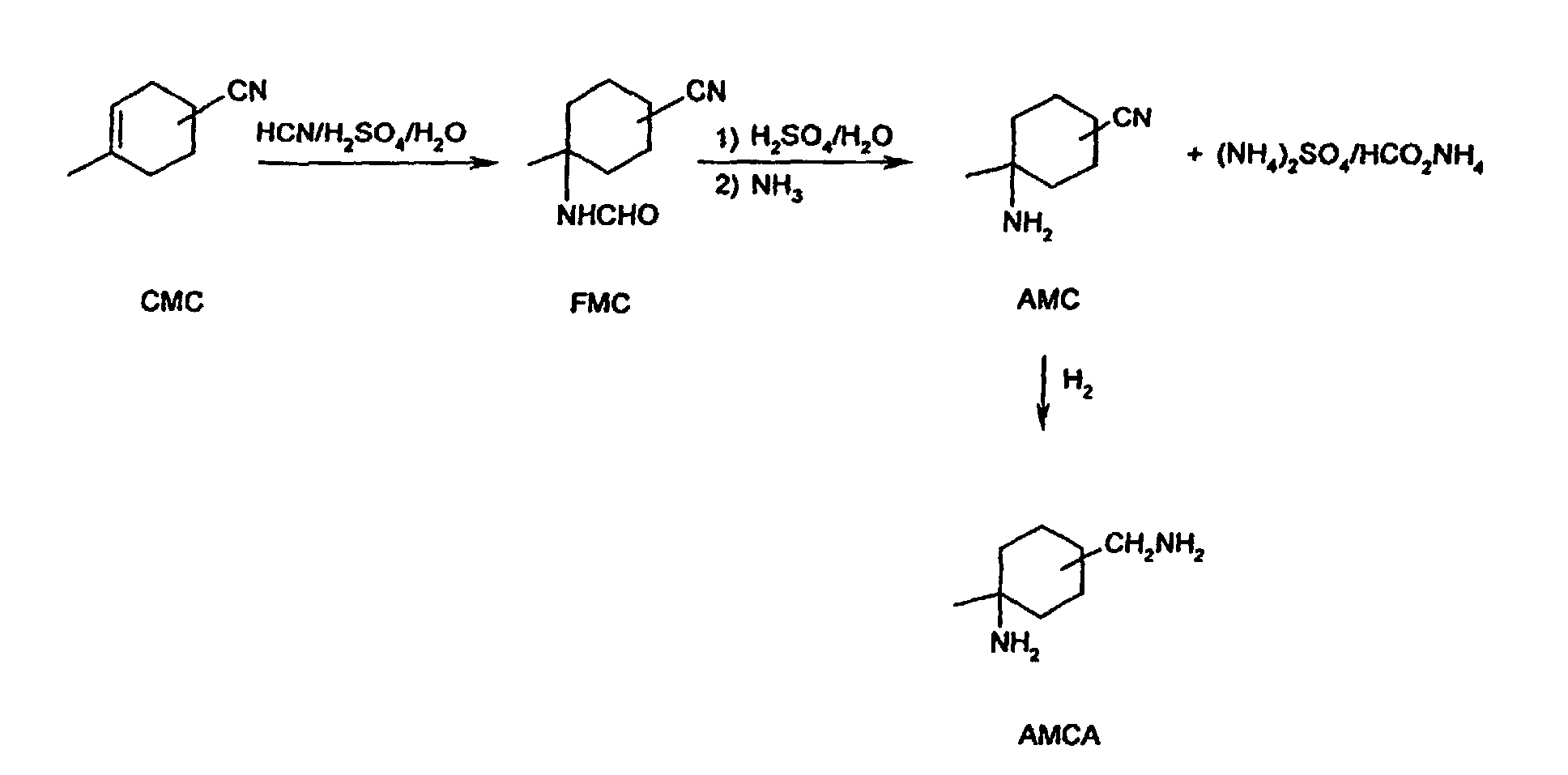
- DE-A 4 401 929 describes a process for the preparation of 1-amino-1-methyl-3 (4) -aminomethylcyclohexane (AMCA) which is characterized by the following reaction scheme.
- AMCA 1-amino-1-methyl-3 (4) -aminomethylcyclohexane
- Variant of the isolation of FMC from that occurring after the knight's reaction aqueous reaction mixture consists, if necessary, of this acidic mixture Neutralize dilution with water with ammonia so that the mixture Has ammonium sulfate content of about 20 to 70 wt .-% and then that extract the FMC present in the mixture with solvents.
- this Variant of the isolation of FMC due to the neutralization of the knight's reaction sulfuric acid used a significant amount of ammonium salts are formed, this is a technically relevant one Procedure, since the extraction in this case is also low Extractant amounts are particularly complete and therefore the for further work-up energy is reduced.
- reaction step is then 1-formamido-1-methyl-3 (4) -cyanocyclohexane (FMC) in acidic, aqueous medium to 1-amino-1-methyl-3 (4) -cyanocyclohexane (AMC) hydrolyzed.
- FMC 1-formamido-1-methyl-3 (4) -cyanocyclohexane
- AMC 1-amino-1-methyl-3 (4) -cyanocyclohexane
- Another method variant known from DE-A 4 401 929 consists in the Hydrolysis of 1-formamido-1-methyl-3 (4) -cyanocyclohexane (FMC) without previous Perform isolation with the sulfuric acid present in the Ritter reaction mixture.
- FMC 1-formamido-1-methyl-3 (4) -cyanocyclohexane
- a revision of the saline solution obtained after AMC extraction to recyclable ammonium sulfate is also associated with considerable costs, since even after distillation Removal of the extractant contained in the saline solution and after Format removal the ammonium sulfate solution obtained a chemical oxygen demand (COD) of 10g per liter.
- COD chemical oxygen demand
- 1-amino-1-methyl-3 (4) -cyanocyclohexane AMC
- 1-amino-1-methyl-3 (4) -aminomethylcyclohexane AMC
- 1-amino-1-methyl-3 (4) -aminomethylcyclohexane AMC
- 1-amino-1-methyl-3 (4) -aminomethylcyclohexane AMC
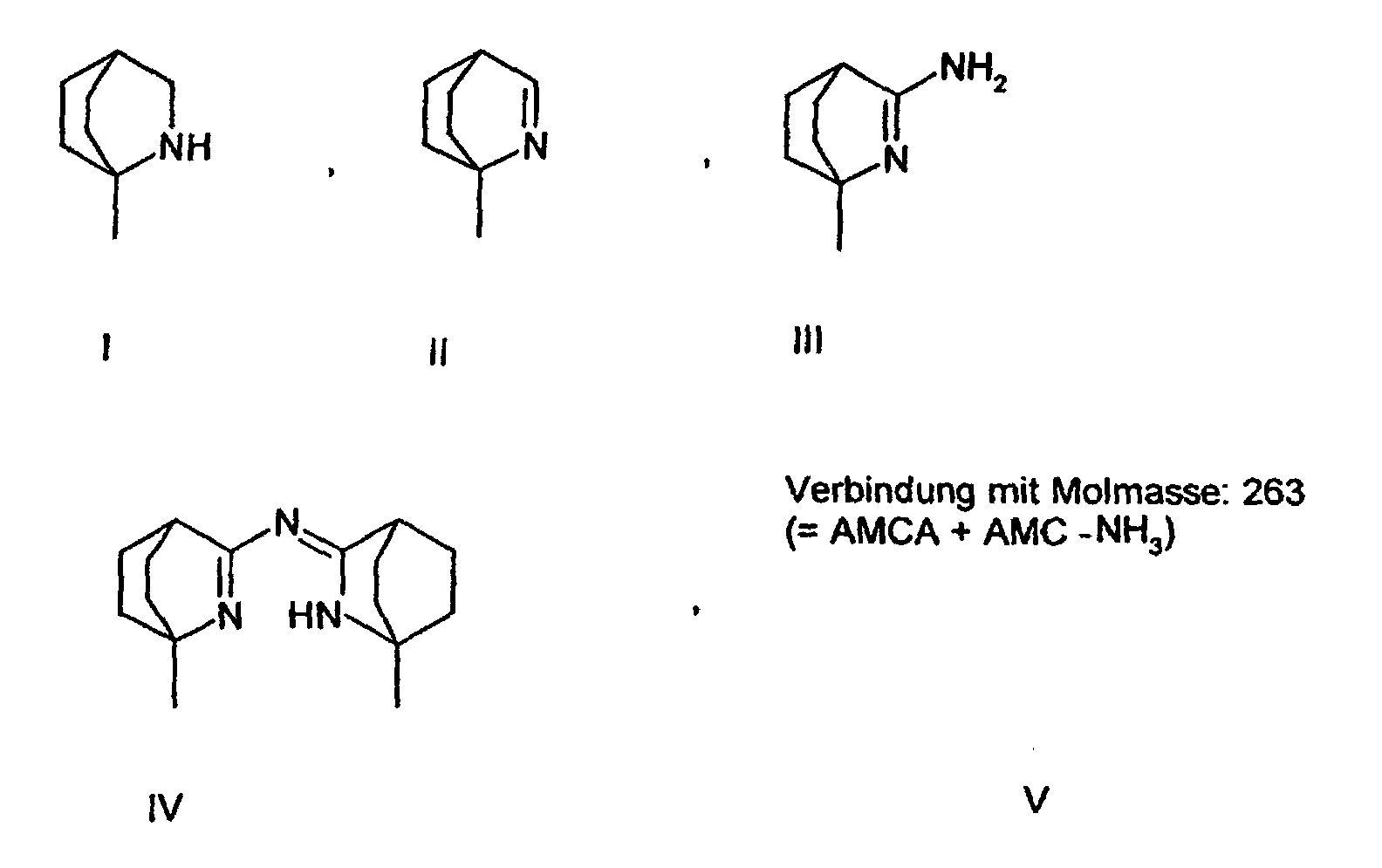
- 1-amino-1-methyl-3 (4) -aminomethylcyclohexane occurs by intramolecular cyclization and intermolecular dimerizations the by-products I, II, III, IV, V so that there is a loss of selectivity of approx. 20%.
- a process for the preparation of AMCA is also known from EP-A 0 153 561, after which starting from 4 (5) - aminomethyl-1-methylcyclohexene Addition of hydrocyanic acid, subsequent alkaline hydrolysis and final Distillation of the target compound in addition to a salt load to be disposed of and 4 (3) -aminomethyl-1-methylcycohexanol can be obtained as a by-product.
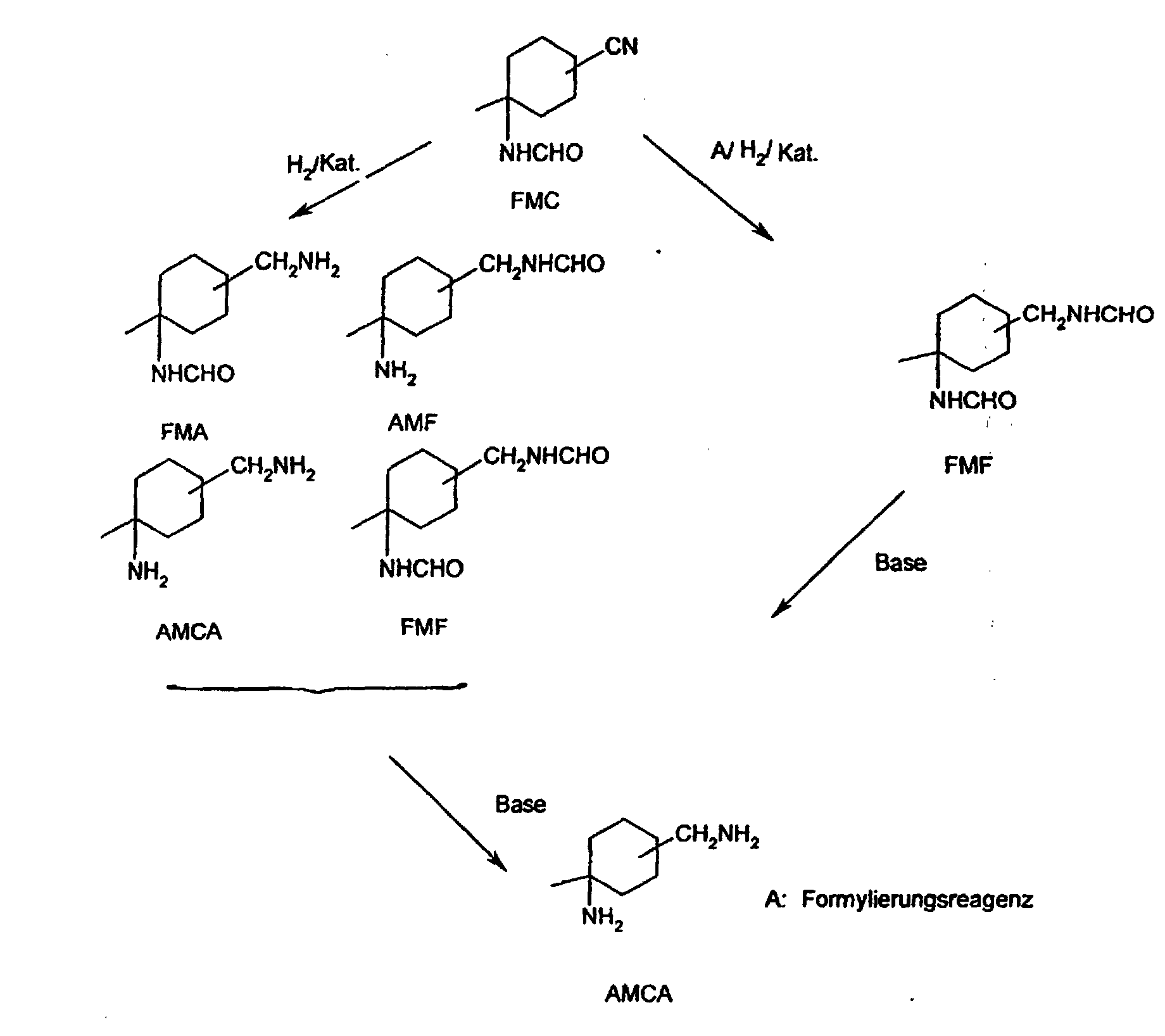
- This method is characterized in that the method described in DE-A 4 401 929 described method obtained 1-formamido-1-methyl-3 (4) -cyanocyclohexane (FMC) from the diluted with water and / or neutralized with ammonia
- FMC 1-formamido-1-methyl-3 (4) -cyanocyclohexane
- reaction products of the process according to the invention are by fractional distillation and / or crystallization and filtration received in pure form.
- As hydrogenation catalysts are catalysts from the group Ra-Ni, Ra-Co and / or Ra-Fe in an amount of 1-20 wt .-% based on FMC used.
- the Hydrogenation is carried out at temperatures from 50 ° C. to 200 ° C., preferably at temperatures from 60 ° C to 160 ° C and under a hydrogen pressure of 50 to 300 bar, preferred carried out under 70 to 200 bar.
- the hydrogenation can also be carried out in a suitable solvent, e.g. hydroxyalkanes Alkyl aromatics take place, the extracting agent used for FMC extraction is preferred.
- a suitable solvent e.g. hydroxyalkanes Alkyl aromatics take place, the extracting agent used for FMC extraction is preferred.
- the hydrogenation can be carried out batchwise or continuously be carried out.
- the alkaline cleavage in the second reaction stage from that in the first FMA and / or AMF and / or FMF obtained with alkali or Alkaline earth metal hydroxides are preferred at temperatures from 100 ° C to 300 ° C 120 ° C to 250 ° C carried out, the reaction also in a suitable solvent, in which the AMCA formed is soluble and the alkali or alkaline earth formates formed are insoluble, can be carried out.
- Suitable solvents are e.g. Toluene and diphenyl ether.
- Per mole of FMA and / or AMF are one to two moles of alkali hydroxide or 0.5 to one mole of alkaline earth hydroxide are used.
- Preferred alkali and alkaline earth hydroxides are sodium hydroxide, potassium hydroxide and calcium hydroxide.
- the alkaline cleavage in the second reaction stage from that in the first Stage obtained FMA and / or AMF and / or FMF with ammonia is added Temperatures from 100 ° C to 300 ° C, preferably at 120 ° C to 250 ° C, the reaction also in a suitable solvent such as e.g. hydroxyalkanes can be carried out.
- first and second reaction stages of the process according to the invention can perform in a one-pot reaction.
- hydrogenation catalysts are catalysts from the group Ra-Ni, Ra-Co and / or Ra-Fe in an amount of 1-20 wt .-% based on FMC used.
- the Hydrogenation is carried out at temperatures from 50 ° C. to 200 ° C., preferably at temperatures from 60 ° C to 160 ° C and under a hydrogen pressure of 50 to 300 bar, preferred carried out under 70-200 bar.
- Formamide, formamide, Alkyl formates and carbon monoxide are used, with methyl formate and Carbon monoxide are preferred.
- the hydrogenation can also be carried out in a suitable solvent, such as B. hydroxyalkanes, alkyl aromatics, which for FMC extraction serving extractant is preferred.
- the formylating agent can even serve as a solvent.
- the hydrogenation can be carried out batchwise or also run continuously.
- alkaline cleavage that occurs in the second reaction stage and that in the first Bisformamide (FMF) obtained in the reaction stage is preferred with alkali metal or Alkaline earth metal hydroxides at temperatures from 100 ° C to 300 ° C, preferably at 120 ° C up to 250 ° C, the reaction also in a suitable Solvent in which the AMCA formed is soluble and the alkali or Alkaline earth formates are insoluble, can be carried out.
- suitable Solvents are e.g. Toluene and diphenyl ether. Two to three moles are used per mole of FMF Alkali hydroxide or one to 1.5 moles of alkaline earth hydroxide used. Is preferred an excess of hydroxyl equivalents of 2 to 10 mol% is used.
- preferred Alkali and alkaline earth hydroxides are sodium hydroxide, potassium hydroxide and Calcium hydroxide.
- the isolation of the starting material FMC from the reaction mixture of the knight reaction of CMC and hydrocyanic acid is known. It is done by extraction aqueous, acidic reaction mixture, the sulfuric acid content after distillation Excess hydrocyanic acid, if necessary by diluting with water to about 10 - 70%, preferably 10 - 50%.
- Suitable solvents which are used for extraction are, for example chlorinated Hydrocarbons such as dichloromethane, chloroform, chlorobenzene, ethers such as e.g. t-butyl methyl ether or t-butyloxy-2-propanol, ketones such as e.g. B. methyl ethyl ketone, Alcohols such as n- and i-butanol, 1-pentanol, 2-methyl-1-butanol, 4-methyl-2-pentanol and cyclohexanol or mixtures of such solvents.
- chlorinated Hydrocarbons such as dichloromethane, chloroform, chlorobenzene
- ethers such as e.g. t-butyl methyl ether or t-butyloxy-2-propanol
- ketones such as e.g. B. methyl ethyl ketone
- Alcohols such as n- and i-butanol,
- the extractant can be separated from the FMC by distillation and be reused.
- the crude FMC obtained can, if necessary, by distillation getting cleaned; however, it is preferred to use the crude FMC of the subsequent hydrogenation feed directly.
- Another known (see above DE-A) variant of the isolation of FMC from the after the knight reaction aqueous reaction mixture consists in this acidic mixture, if necessary after dilution with water, with ammonia neutralize so that the mixture has an ammonium sulfate content of 20 to 70 % By weight and then the FMC present in the mixture Extract solvents.
- this variant of the isolation of FMC a significant amount of ammonium sulfate is formed, it is a technically relevant procedure, since the extraction in this case also with small amounts of extractant takes place particularly completely and thus the for the further work-up energies to be reduced. That at This variant of the FMC insulation contains ammonium sulfate-containing wastewater is characterized by a low COD value, so that it is inexpensive Ammonium sulfate can be isolated as a valuable product.
- AMCA can be phosgenated to IMCI in a manner known per se.
- all percentages relate to the weight.
- the comparative example shows that when isolating 1-amino-1-methyl-3 (4) -cyanocyclohexane (AMC) compared to the isolation of 1-formamido-1-methyl-3 (4) -cyanocyclohexane (FMC) an ammonium sulfate-containing wastewater with clearly results in a higher COD value, so that in the case of AMC isolation at further processing of this wastewater into recyclable ammonium sulfate there are significantly higher costs.
- AMC 1-amino-1-methyl-3 (4) -cyanocyclohexane
- FMC 1-formamido-1-methyl-3 (4) -cyanocyclohexane
- 157 g of crude 1-amino-1-methyl-3 (4) -cyanocyclohexane from Comparative Example 1 are in the presence of 200 g of methanol, 300 ml of ammonia and 9 g of Ra-Ni at one Hydrogen pressure of 100 bar and a temperature of 100 to 120 ° C hydrogenated.
- the catalyst is filtered and methanol and Removed ammonia by distillation.
- 146 g of crude 1-amino-1-methyl-3 (4) aminomethylcyclohexane remain with a content of. determined by gas chromatography 73.4%. Approximately 20% by weight is due to the sum of the compounds of the formulas I, II, III, IV and V.
- 210 g of crude 1-formamido-1-methyl-3 (4) -fonnamidomethylcyclohexane from Example 2 be in the presence of 300 g of toluene and 75 g of sodium hydroxide for six hours heated to 180 ° C. After filtration of the sodium formate formed and distillation of the toluene, a residue of 143 g of crude 1-amino-1-methyl-3 (4) -aminomethylcyclohexane remains with a gas chromatographically determined content of 85.9 %.
Landscapes
- Chemical & Material Sciences (AREA)
- Organic Chemistry (AREA)
- Chemical Kinetics & Catalysis (AREA)
- Organic Low-Molecular-Weight Compounds And Preparation Thereof (AREA)
- Low-Molecular Organic Synthesis Reactions Using Catalysts (AREA)
Description
Claims (9)
- Verfahren zur Herstellung von 1-Amino-1-methyl-3(4)-aminomethylcyclohexan (AMCA), ausgehend von 1-Formamido-1-methyl-3(4)-cyanocyclohexan (FMC), das in einer vorausgehenden Reaktionsstufe durch Umsetzung von 4(5)-Cyano-1-methylcyclohexen (CMC) mit Blausäure in Gegenwart von Schwefelsäure gebildet und nachfolgend aus der mit Wasser verdünnten und/oder mit Ammoniak neutralisierten Reaktionslösung durch Extraktion erhalten wurde, dadurch gekennzeichnet, dass mana) in einer ersten Reaktionsstufe FMC katalytisch zu 1-Formamido-1-methyl-3(4)-aminomethylcyclohexan (FMA) und/oder 1-Amino-1-methyl-3(4)-formamidomethylcyclohexan (AMF) und/oder 1-Formamido-1-methyl-3(4)-formamidomethylcyclohexan (FMF) und/oder AMCA hydriert undb) in einer zweiten Reaktionsstufe FMA und/oder AMF und/oder FMF mit Ammoniak oder Alkali bzw. Erdalkalihydroxiden zu AMCA und Formamid bzw. zu AMCA und Alkali- oder Erdalkaliformiat umsetzt undc) das erhaltene Reaktionsgemisch durch fraktionierte Destillation und/oder Kristallisation und Filtration in die Komponenten auftrennt.
- Verfahren gemäß Anspruch 1, dadurch gekennzeichnet, dass man als Hydrierkatalysator einen Katalysator aus der Gruppe Ra-Ni, Ra-Co und/oder Ra-Fe verwendet.
- Verfahren gemäß Anspruch 1, dadurch gekennzeichnet, dass man die Hydrierung in einem Lösungsmittel durchführt.
- Verfahren gemäß Anspruch 1, dadurch gekennzeichnet, dass man in der zweiten Reaktionsstufe Ammoniak als alkalische Verbindung verwendet und das hierbei erhaltene AMCA und Formamid durch fraktionierte Destillation auftrennt und ggf. nicht umgesetztes FMA und/oder AMF und/oder FMF in die Reaktionsstufe zurückführt.
- Verfahren gemäß Anspruch 1, dadurch gekennzeichnet, dass man in der zweiten Reaktionsstufe Alkali- und/oder Erdalkalihydroxide als alkalische Verbindung verwendet und die hierbei erhaltenen Formiatsalze und AMCA durch Kristallisation, Filtration und Destillation auftrennt und ggf. nicht umgesetztes FMA und/oder AMF und/oder FMF in die Reaktionsstufe zurückführt.
- Verfahren gemäß Anspruch 5, dadurch gekennzeichnet, dass man die zweite Reaktionsstufe in einem Lösungsmittel durchführt, in dem das gebildete AMCA löslich und die gebildeten Formiatsalze unlöslich sind.
- Verfahren gemäß Anspruch 1, dadurch gekennzeichnet, dass man die Hydrierung von FMC in Gegenwart eines Formylierungsmittels durchführt und das hierbei erhaltene 1-Formamido-1-methyl-3(4)-formamidomethylcyclohexan (FMF) in der zweiten Reaktionsstufe mit einer alkalischen Verbindung zu AMCA und zu einem Derivat der Ameisensäure umsetzt und das erhaltene Reaktionsgemisch durch fraktionierte Destillation und/oder Kristallisation und Filtration in die Komponenten auftrennt.
- Verfahren gemäß Anspruch 7, dadurch gekennzeichnet, dass man als Formylierungsmittel Formamid und/oder Ameisensäureester und/oder Kohlenmonoxid verwendet.
- Verfahren gemäß Anspruch 1, dadurch gekennzeichnet, dass man die Hydrierung von FMC und die alkalische Spaltung des gebildeten FMA und/oder AMF und/oder FMF in einer Eintopfreaktion ausführt.
Applications Claiming Priority (2)
| Application Number | Priority Date | Filing Date | Title |
|---|---|---|---|
| DE19711548 | 1997-03-20 | ||
| DE19711548A DE19711548A1 (de) | 1997-03-20 | 1997-03-20 | Verfahren zur Herstellung von 1-Amino-1-methyl-3(4)-aminomethylcyclohexan |
Publications (3)
| Publication Number | Publication Date |
|---|---|
| EP0866052A2 EP0866052A2 (de) | 1998-09-23 |
| EP0866052A3 EP0866052A3 (de) | 2000-04-26 |
| EP0866052B1 true EP0866052B1 (de) | 2002-11-20 |
Family
ID=7823962
Family Applications (1)
| Application Number | Title | Priority Date | Filing Date |
|---|---|---|---|
| EP98104139A Expired - Lifetime EP0866052B1 (de) | 1997-03-20 | 1998-03-09 | Verfahren zur Herstellung von 1-Amino-1-methyl-3(4)-amino-methylcyclohexan |
Country Status (5)
| Country | Link |
|---|---|
| US (1) | US5900507A (de) |
| EP (1) | EP0866052B1 (de) |
| JP (1) | JP4024919B2 (de) |
| CA (1) | CA2232503A1 (de) |
| DE (2) | DE19711548A1 (de) |
Family Cites Families (4)
| Publication number | Priority date | Publication date | Assignee | Title |
|---|---|---|---|---|
| DE3402623A1 (de) * | 1984-01-26 | 1985-08-01 | Bayer Ag, 5090 Leverkusen | Neue diisocyanate und ihre verwendung zur herstellung von polyurethankunststoffen |
| DE3507719A1 (de) * | 1985-03-05 | 1986-09-11 | Bayer Ag, 5090 Leverkusen | Isocyanuratgruppen aufweisende polyisocyanate, ein verfahren zu ihrer herstellung und ihre verwendung als isocyanatkomponente in polyurethanlacken |
| DE3928991A1 (de) * | 1989-09-01 | 1991-03-07 | Bayer Ag | Aminogruppen aufweisende copolymerisate, ein verfahren zu ihrer herstellung und ihre verwendung als bindemittel oder bindemittelkomponente |
| DE4401929A1 (de) * | 1994-01-24 | 1995-07-27 | Bayer Ag | Verfahren zur Herstellung von 1-Amino-1-methyl-3(4)-cyano-cyclohexan |
-
1997
- 1997-03-20 DE DE19711548A patent/DE19711548A1/de not_active Withdrawn
-
1998
- 1998-03-09 EP EP98104139A patent/EP0866052B1/de not_active Expired - Lifetime
- 1998-03-09 DE DE59806308T patent/DE59806308D1/de not_active Expired - Lifetime
- 1998-03-11 US US09/038,331 patent/US5900507A/en not_active Expired - Fee Related
- 1998-03-18 JP JP08824598A patent/JP4024919B2/ja not_active Expired - Fee Related
- 1998-03-19 CA CA002232503A patent/CA2232503A1/en not_active Abandoned
Also Published As
| Publication number | Publication date |
|---|---|
| US5900507A (en) | 1999-05-04 |
| EP0866052A2 (de) | 1998-09-23 |
| JPH10265447A (ja) | 1998-10-06 |
| JP4024919B2 (ja) | 2007-12-19 |
| DE19711548A1 (de) | 1998-09-24 |
| CA2232503A1 (en) | 1998-09-20 |
| EP0866052A3 (de) | 2000-04-26 |
| DE59806308D1 (de) | 2003-01-02 |
Similar Documents
| Publication | Publication Date | Title |
|---|---|---|
| DE69710092T2 (de) | Verfahren zur ununterbrochenen herstellung von neopentylglykol | |
| WO2012019714A1 (de) | Verfahren zur gewinnung von di-trimethylolpropan und mit trimethylolpropan angereicherten produktströmen aus den nebenströmen der trimethylolpropanherstellung | |
| EP0025843B1 (de) | Herstellung von Monoalkylethern von Hydroxyphenolen und deren Umwandlung zu Hydroxycumaranen | |
| DE69101337T2 (de) | Verfahren zur Herstellung von Anilin hoher Reinheit. | |
| DD152534A5 (de) | Verfahren zur herstellung von cyclohexanol und/oder cyclohexanone | |
| DE2945170A1 (de) | Verfahren zur herstellung von diaryl-p- phenylendiaminen | |
| DE3003730C2 (de) | ||
| EP0664285B1 (de) | Verfahren zur Herstellung von 1-Amino-1-methyl-3(4)-cyano-cyclohexan | |
| EP0866052A2 (de) | Verfahren zur Herstellung von 1-Amino-1-methyl-3(4)-amino-methylcyclohexan | |
| EP0105146A1 (de) | Verfahren zur Herstellung von Diaminen oder Diamingemischen | |
| DE60034446T2 (de) | Verfahren zur herstellung von tetrafluorbenzaldehyden und tetrafluorbenzolmethanolen | |
| CH495944A (de) | Verfahren zur Herstellung von a-Methyl-polycyclomethylaminen | |
| DE4301554C1 (de) | Verfahren zur Herstellung von Diethoxymethan | |
| EP0474057B1 (de) | Verfahren zur Herstellung von N-(2-Chlor-pyridin-5-yl-methyl)-ethylendiamin | |
| DE2702088C2 (de) | Verfahren zur Autoxidation eines Cycloalkanons zu dem entsprechenden Cycloalkan-1,2-dion | |
| DE3729471A1 (de) | Verfahren zur herstellung von guanin | |
| DE3636818C2 (de) | Verfahren zur Herstellung von Valpronsäure | |
| DE60317626T2 (de) | Verfahren zur herstellung von 2,5-bis(trifluormethyl)nitrobenzol | |
| DE3526510A1 (de) | Verfahren zur herstellung von 2,3-dihydro-7-aminobenzofuranen | |
| EP0036161B1 (de) | Verfahren zur Herstellung von Alkalisalzen des Phenylglycins | |
| EP0002807A1 (de) | Verfahren zur Herstellung von Alpha-Hydroxy-Beta,Beta-dimethyl-Gamma-butyrolacton | |
| DE2344386A1 (de) | Verfahren zur herstellung von hydrochinon | |
| EP0866055B1 (de) | Verfahren zur Herstellung von 1-Amino-1-methyl-3(4)-amino-methylcyclohexan | |
| DE102006041941A1 (de) | Verfahren zur Herstellung von 1,2-Diolen aus Carbonyl-Verbindungen | |
| DE1957259C3 (de) | Verfahren zur Herstellung von reinem 4-Amino- und 5-Aminoindan |
Legal Events
| Date | Code | Title | Description |
|---|---|---|---|
| PUAI | Public reference made under article 153(3) epc to a published international application that has entered the european phase |
Free format text: ORIGINAL CODE: 0009012 |
|
| AK | Designated contracting states |
Kind code of ref document: A2 Designated state(s): BE DE FR GB IT NL |
|
| AX | Request for extension of the european patent |
Free format text: AL;LT;LV;MK;RO;SI |
|
| PUAL | Search report despatched |
Free format text: ORIGINAL CODE: 0009013 |
|
| AK | Designated contracting states |
Kind code of ref document: A3 Designated state(s): AT BE CH DE DK ES FI FR GB GR IE IT LI LU MC NL PT SE |
|
| AX | Request for extension of the european patent |
Free format text: AL;LT;LV;MK;RO;SI |
|
| 17P | Request for examination filed |
Effective date: 20001026 |
|
| AKX | Designation fees paid |
Free format text: BE DE FR GB IT NL |
|
| 17Q | First examination report despatched |
Effective date: 20011122 |
|
| GRAG | Despatch of communication of intention to grant |
Free format text: ORIGINAL CODE: EPIDOS AGRA |
|
| GRAG | Despatch of communication of intention to grant |
Free format text: ORIGINAL CODE: EPIDOS AGRA |
|
| GRAH | Despatch of communication of intention to grant a patent |
Free format text: ORIGINAL CODE: EPIDOS IGRA |
|
| GRAH | Despatch of communication of intention to grant a patent |
Free format text: ORIGINAL CODE: EPIDOS IGRA |
|
| GRAA | (expected) grant |
Free format text: ORIGINAL CODE: 0009210 |
|
| AK | Designated contracting states |
Kind code of ref document: B1 Designated state(s): BE DE FR GB IT NL |
|
| REG | Reference to a national code |
Ref country code: GB Ref legal event code: FG4D Free format text: NOT ENGLISH |
|
| GBT | Gb: translation of ep patent filed (gb section 77(6)(a)/1977) |
Effective date: 20021120 |
|
| REF | Corresponds to: |
Ref document number: 59806308 Country of ref document: DE Date of ref document: 20030102 |
|
| ET | Fr: translation filed | ||
| PLBE | No opposition filed within time limit |
Free format text: ORIGINAL CODE: 0009261 |
|
| STAA | Information on the status of an ep patent application or granted ep patent |
Free format text: STATUS: NO OPPOSITION FILED WITHIN TIME LIMIT |
|
| 26N | No opposition filed |
Effective date: 20030821 |
|
| PGFP | Annual fee paid to national office [announced via postgrant information from national office to epo] |
Ref country code: GB Payment date: 20070307 Year of fee payment: 10 |
|
| PGFP | Annual fee paid to national office [announced via postgrant information from national office to epo] |
Ref country code: BE Payment date: 20070514 Year of fee payment: 10 |
|
| PGFP | Annual fee paid to national office [announced via postgrant information from national office to epo] |
Ref country code: IT Payment date: 20070529 Year of fee payment: 10 |
|
| PGFP | Annual fee paid to national office [announced via postgrant information from national office to epo] |
Ref country code: FR Payment date: 20070308 Year of fee payment: 10 |
|
| BERE | Be: lapsed |
Owner name: *BAYER A.G. Effective date: 20080331 |
|
| GBPC | Gb: european patent ceased through non-payment of renewal fee |
Effective date: 20080309 |
|
| REG | Reference to a national code |
Ref country code: FR Ref legal event code: ST Effective date: 20081125 |
|
| PG25 | Lapsed in a contracting state [announced via postgrant information from national office to epo] |
Ref country code: BE Free format text: LAPSE BECAUSE OF NON-PAYMENT OF DUE FEES Effective date: 20080331 |
|
| PG25 | Lapsed in a contracting state [announced via postgrant information from national office to epo] |
Ref country code: FR Free format text: LAPSE BECAUSE OF NON-PAYMENT OF DUE FEES Effective date: 20080331 |
|
| PG25 | Lapsed in a contracting state [announced via postgrant information from national office to epo] |
Ref country code: GB Free format text: LAPSE BECAUSE OF NON-PAYMENT OF DUE FEES Effective date: 20080309 |
|
| PG25 | Lapsed in a contracting state [announced via postgrant information from national office to epo] |
Ref country code: IT Free format text: LAPSE BECAUSE OF NON-PAYMENT OF DUE FEES Effective date: 20080309 |
|
| PGFP | Annual fee paid to national office [announced via postgrant information from national office to epo] |
Ref country code: NL Payment date: 20120322 Year of fee payment: 15 |
|
| REG | Reference to a national code |
Ref country code: NL Ref legal event code: V1 Effective date: 20131001 |
|
| PG25 | Lapsed in a contracting state [announced via postgrant information from national office to epo] |
Ref country code: NL Free format text: LAPSE BECAUSE OF NON-PAYMENT OF DUE FEES Effective date: 20131001 |
|
| REG | Reference to a national code |
Ref country code: DE Ref legal event code: R081 Ref document number: 59806308 Country of ref document: DE Owner name: BAYER INTELLECTUAL PROPERTY GMBH, DE Free format text: FORMER OWNER: BAYER MATERIALSCIENCE AKTIENGESELLSCHAFT, 51373 LEVERKUSEN, DE Effective date: 20140317 |
|
| PGFP | Annual fee paid to national office [announced via postgrant information from national office to epo] |
Ref country code: DE Payment date: 20140417 Year of fee payment: 17 |
|
| REG | Reference to a national code |
Ref country code: DE Ref legal event code: R119 Ref document number: 59806308 Country of ref document: DE |
|
| PG25 | Lapsed in a contracting state [announced via postgrant information from national office to epo] |
Ref country code: DE Free format text: LAPSE BECAUSE OF NON-PAYMENT OF DUE FEES Effective date: 20151001 |