EP0863802B1 - Article for collecting and transporting a sample to be analyzed and procedure for determining an analyte - Google Patents
Article for collecting and transporting a sample to be analyzed and procedure for determining an analyte Download PDFInfo
- Publication number
- EP0863802B1 EP0863802B1 EP96939913A EP96939913A EP0863802B1 EP 0863802 B1 EP0863802 B1 EP 0863802B1 EP 96939913 A EP96939913 A EP 96939913A EP 96939913 A EP96939913 A EP 96939913A EP 0863802 B1 EP0863802 B1 EP 0863802B1
- Authority
- EP
- European Patent Office
- Prior art keywords
- sample
- sample collecting
- envelope
- article according
- collecting element
- Prior art date
- Legal status (The legal status is an assumption and is not a legal conclusion. Google has not performed a legal analysis and makes no representation as to the accuracy of the status listed.)
- Expired - Lifetime
Links
Images


Classifications
-
- B—PERFORMING OPERATIONS; TRANSPORTING
- B01—PHYSICAL OR CHEMICAL PROCESSES OR APPARATUS IN GENERAL
- B01L—CHEMICAL OR PHYSICAL LABORATORY APPARATUS FOR GENERAL USE
- B01L3/00—Containers or dishes for laboratory use, e.g. laboratory glassware; Droppers
- B01L3/50—Containers for the purpose of retaining a material to be analysed, e.g. test tubes
- B01L3/505—Flexible containers without fluid transport within
-
- A—HUMAN NECESSITIES
- A61—MEDICAL OR VETERINARY SCIENCE; HYGIENE
- A61B—DIAGNOSIS; SURGERY; IDENTIFICATION
- A61B10/00—Instruments for taking body samples for diagnostic purposes; Other methods or instruments for diagnosis, e.g. for vaccination diagnosis, sex determination or ovulation-period determination; Throat striking implements
- A61B10/0096—Casings for storing test samples
-
- B—PERFORMING OPERATIONS; TRANSPORTING
- B01—PHYSICAL OR CHEMICAL PROCESSES OR APPARATUS IN GENERAL
- B01L—CHEMICAL OR PHYSICAL LABORATORY APPARATUS FOR GENERAL USE
- B01L3/00—Containers or dishes for laboratory use, e.g. laboratory glassware; Droppers
- B01L3/54—Labware with identification means
- B01L3/545—Labware with identification means for laboratory containers
-
- G—PHYSICS
- G01—MEASURING; TESTING
- G01N—INVESTIGATING OR ANALYSING MATERIALS BY DETERMINING THEIR CHEMICAL OR PHYSICAL PROPERTIES
- G01N33/00—Investigating or analysing materials by specific methods not covered by groups G01N1/00 - G01N31/00
- G01N33/48—Biological material, e.g. blood, urine; Haemocytometers
- G01N33/50—Chemical analysis of biological material, e.g. blood, urine; Testing involving biospecific ligand binding methods; Immunological testing
- G01N33/52—Use of compounds or compositions for colorimetric, spectrophotometric or fluorometric investigation, e.g. use of reagent paper and including single- and multilayer analytical elements
- G01N33/521—Single-layer analytical elements
-
- G—PHYSICS
- G01—MEASURING; TESTING
- G01N—INVESTIGATING OR ANALYSING MATERIALS BY DETERMINING THEIR CHEMICAL OR PHYSICAL PROPERTIES
- G01N1/00—Sampling; Preparing specimens for investigation
- G01N2001/002—Devices for supplying or distributing samples to an analysing apparatus
- G01N2001/005—Packages for mailing or similar transport of samples
-
- Y—GENERAL TAGGING OF NEW TECHNOLOGICAL DEVELOPMENTS; GENERAL TAGGING OF CROSS-SECTIONAL TECHNOLOGIES SPANNING OVER SEVERAL SECTIONS OF THE IPC; TECHNICAL SUBJECTS COVERED BY FORMER USPC CROSS-REFERENCE ART COLLECTIONS [XRACs] AND DIGESTS
- Y10—TECHNICAL SUBJECTS COVERED BY FORMER USPC
- Y10T—TECHNICAL SUBJECTS COVERED BY FORMER US CLASSIFICATION
- Y10T428/00—Stock material or miscellaneous articles
- Y10T428/24—Structurally defined web or sheet [e.g., overall dimension, etc.]
- Y10T428/24777—Edge feature
-
- Y—GENERAL TAGGING OF NEW TECHNOLOGICAL DEVELOPMENTS; GENERAL TAGGING OF CROSS-SECTIONAL TECHNOLOGIES SPANNING OVER SEVERAL SECTIONS OF THE IPC; TECHNICAL SUBJECTS COVERED BY FORMER USPC CROSS-REFERENCE ART COLLECTIONS [XRACs] AND DIGESTS
- Y10—TECHNICAL SUBJECTS COVERED BY FORMER USPC
- Y10T—TECHNICAL SUBJECTS COVERED BY FORMER US CLASSIFICATION
- Y10T428/00—Stock material or miscellaneous articles
- Y10T428/24—Structurally defined web or sheet [e.g., overall dimension, etc.]
- Y10T428/24802—Discontinuous or differential coating, impregnation or bond [e.g., artwork, printing, retouched photograph, etc.]
-
- Y—GENERAL TAGGING OF NEW TECHNOLOGICAL DEVELOPMENTS; GENERAL TAGGING OF CROSS-SECTIONAL TECHNOLOGIES SPANNING OVER SEVERAL SECTIONS OF THE IPC; TECHNICAL SUBJECTS COVERED BY FORMER USPC CROSS-REFERENCE ART COLLECTIONS [XRACs] AND DIGESTS
- Y10—TECHNICAL SUBJECTS COVERED BY FORMER USPC
- Y10T—TECHNICAL SUBJECTS COVERED BY FORMER US CLASSIFICATION
- Y10T428/00—Stock material or miscellaneous articles
- Y10T428/24—Structurally defined web or sheet [e.g., overall dimension, etc.]
- Y10T428/24802—Discontinuous or differential coating, impregnation or bond [e.g., artwork, printing, retouched photograph, etc.]
- Y10T428/24851—Intermediate layer is discontinuous or differential
- Y10T428/24868—Translucent outer layer
- Y10T428/24876—Intermediate layer contains particulate material [e.g., pigment, etc.]
-
- Y—GENERAL TAGGING OF NEW TECHNOLOGICAL DEVELOPMENTS; GENERAL TAGGING OF CROSS-SECTIONAL TECHNOLOGIES SPANNING OVER SEVERAL SECTIONS OF THE IPC; TECHNICAL SUBJECTS COVERED BY FORMER USPC CROSS-REFERENCE ART COLLECTIONS [XRACs] AND DIGESTS
- Y10—TECHNICAL SUBJECTS COVERED BY FORMER USPC
- Y10T—TECHNICAL SUBJECTS COVERED BY FORMER US CLASSIFICATION
- Y10T428/00—Stock material or miscellaneous articles
- Y10T428/31504—Composite [nonstructural laminate]
Definitions
- the invention relates to an article for collecting and transporting a sample to be analyzed, containing an absorbent matrix for soaking up a liquid sample, as well as a process for determining an analyte in which the liquid sample material that is suspected of containing an analyte to be determined is placed on an absorbent matrix, dried, then sent to a laboratory and tested there.
- sample collecting elements square cards of filter paper are known as sample collecting elements, onto which the whole blood to be tested is dropped and dried. Then these cards are placed in an envelope and sent to a laboratory where the dried blood samples are tested. To do this, a round part of the filter paper containing the blood is punched out and the analyte to be determined is eluted from it and then detected and measured according to known methods.
- Sample collecting elements of this type are known, for example as "Guthrie test cards,” which are used to collect, transport and analyze the blood of newborns.
- Corresponding cards are produced and marketed, for example by the companies Schleicher & Schüll, Dassel, Germany or Whatmann, Maidstone, England. One example of such a card is shown as an example in Fig.
- the previously known sample collecting elements consist of filter paper of cellulose.
- the disadvantage of this material is that the test substance is not uniformly distributed in the blood drop on the paper.
- the so-called chromatography effect causes the test substance to migrate more heavily to the edge of the drop and therefore not be distributed uniformly in the area of the dried drop.
- a part of the sample collecting area on which the blood is placed is stamped out and eluted. Because of the chromatography effect, the result that is obtained often depends on what part of the dried blood drop is stamped out and eluted.
- the absorption times are also very lot-dependent, i.e. sometimes a drop of blood is quickly absorbed, sometimes a blood drop of the same size is absorbed significantly more slowly. During slow absorption of the blood drop, it is possible that the blood drop can get smeared if the sample collecting element is not handled carefully.
- Another disadvantage of the previously known blood collecting cards of filter paper is that later elution of the sample material takes a long time, 40 minutes to 1 hour, as a rule.
- the filter papers of cellulose fibers used for the Guthrie test cards also absorb a relatively large quantity of humidity from the air. This can lead to significantly false positive values with certain analytes. For example, in the determination of HbA 1c , values can be found that are excessive by 100 to 200%.
- a blood collecting card which contains filter paper as absorbent matrix material.
- the filter paper is part of a sample collecting element which is connected to a so-called info part for receiving e.g. sample data.
- info part for receiving e.g. sample data.
- the sample collecting element can be removed from the info part in a predetermined size.
- WO 90/03927, DE-G 92 09 639.5 and GB-A 2 031 583 disclose sample collection devices which are especially suited for semi-solid sample material, e. g. stool samples.
- the sample collection devices of WO 90/03927, DE-G 92 09 639.5 and GB-A 2 031 583 contain sample collecting areas which are closed by a flap after sample application.
- An HbA 1c sample collecting element is known from Klin. Lab. 1993 / 39 , Pages 1080 to 1082, in which a cellulose base filter paper lies below the cut-out of a hydrophobic paper. A drop of blood is placed in the cut-out and dried. The test card is placed first in a plastic bag and the plastic bag with the sample collecting element is then placed in an envelope for sending to the laboratory. With the use of this and the sample collecting elements described above, there is always a danger of contamination because of the handling steps required of the patient and in the laboratory. Contamination can especially occur when the test card is slid into the plastic bag or the envelope and when the test card is taken out of the bag or envelope. In addition, storage of several components causes higher costs and more work than storing fewer components. This can lead to individual parts getting lost which may then be replaced by other parts that are available, but not optimally adapted to the task.
- the object of the invention was to prevent these disadvantages. This was done by the object of the invention, as it is designated in the patent claims.
- the object of the invention is an article for collecting, drying and transporting a liquid sample to be analyzed as defined in independent claim 1.
- the sample collecting element and the material that is used to package the sample collecting element consequently form a unit according to the invention.
- the limits of the sample collecting element are prepared in such a way that the sample collecting element can be separated from the envelope in a pre-determined manner. This can be effected by adding target breaking or tearing lines, along which the sample collecting element can be separated from the envelope. Such target breaking and/or tearing lines can be formed by appropriate perforations or by the fact that the envelope material has a thinner material cross section than the surrounding material. Perforations are especially preferred.
- the sample collecting element is that part of the article according to the invention that carries the sample collecting area with the absorbent matrix.
- the sample collecting area is that part of the absorbent matrix on which the liquid sample can be placed.
- the absorbent matrix is below a cut-out on the sample collecting element so that the sample can only get onto the absorbent matrix through this cut-out.
- the absorbent matrix is fastened to the back of the sample collecting element, most especially glued on, so that the base extends completely under the cut-out.
- the cut-out can have any conceivable shape. A round hole has proven to be especially preferred.
- the sample collecting area and thus the absorbent matrix consists of a material other than that of the sample collecting element.
- the absorbent matrix consists of absorbent fleece and the remaining part of the article according to the invention of paper or cardboard, which are preferably treated so that the liquid is not absorbed or absorbed only poorly.
- plastic can be considered for the envelope, or in general any material that fulfills the requirements of the invention. Basically, any envelope materials can be considered that correspond to the "Guidelines for the Shipment of Dried Blood Spot Specimens" of the U.S. Department of Health & Human Services dated May 1993.
- a fleece containing synthetic fibers has proven to be especially useful as an absorbent matrix.
- Fleeces such as described in US patent 5,118,609 as a carrier fleece for removably impregnated reagents have proven to be particularly suitable.
- a fleece is particularly preferred that has a) cellulose base fibers, b) polymer fibers of polyester and/or polyamide base and c) an organic binder containing OH and/or ester groups.
- fleece as described above have only very little hemolyzing effect, which prevents falsification of the measurements due to blood cell contents.
- Another advantage consists of the fact that a fleece according to the invention with synthetic fibers absorbs only relatively little humidity. This is also advantageous in determining correct quantitative analyte values.
- the properties, in particular absorption properties are hardly lot dependent, so better reproducible results can be achieved as was possible with the state of the art.
- the absorbent matrix of the article according to the invention can carry substances i.e. to increase wetting capability or for stabilizing the analyte to be determined.
- substances for stabilizing the analytes to be determined can be contained in or on the matrix.
- the matrix can be impregnated with the buffer of a specific pH value.
- the sample collecting element can have at least 1 label that can be used for sample identification.
- this label can have a bar code in which data, e.g. name of the patient, sex, analyte to be determined are keyed, or other characteristics that can be used to identify the sample.
- the sample collecting element has 2 labels with identical data. At least 1 label can be removed from the sample collecting element.
- the sample collecting element can also have a temperature and/or humidity sensor in order to recognize whether the sample was exposed to a damaging temperature and/or humidity influence before the analysis.
- a temperature and/or humidity sensor in order to recognize whether the sample was exposed to a damaging temperature and/or humidity influence before the analysis.
- Appropriate sensors can be found, for example, in the form of stick-on labels that use color changes to show what temperature and/or humidity the sample element was exposed.
- the area around the sample collecting area is designed so that it is visually striking. This can be done, for example, by using a noticeable color.
- a red mark in the form of a blood drop is applied at the location of the sample collecting element where the sample collecting area is located.
- the cut-out in the sample collecting element is located at the thickest point of this spot, which is made visible by the white sample collecting area of the matrix. If another liquid is to be applied to the sample collecting element, the sample collecting area can be marked by a pictogram of this other sample material.
- an inert material it is also possible to slightly raise the area surrounding the sample collecting area using an inert material, so that the probability of contact of the inside of the closed side of the envelope with the absorbent matrix of the sample collecting element and contamination of the closing flap is prevented still more.
- a plastic ring or cardboard that surrounds the sample collecting area can be used as inert material.
- the article according to the invention can be provided with adhesive to close the envelope.
- Adhesive can be present such a way that it is dry and becomes sticky by being moistened.
- the adhesive can also be covered with a strip that is easy to pull off and reveals the sticky adhesive after it is pulled off.
- the adhesive is applied to the back side of the closing flap of the envelope in such a way that when the envelope is closed, it comes in contact with the back side of the envelope outside the sample collecting element.
- the closing flap with a quasi-3-sided adhesive around the circumference so that the envelope can be closed on all sides.
- the envelope has perforations arranged parallel to and below the adhesive, most particularly preferred are two lines of perforations arranged in parallel which make it possible to separate the envelope at this point.
- one or two parallel lines with thinner material cross section can be used as target breaking and/or target tearing points.
- the target breaking and/or target tearing points offer the advantage that the closed envelope can be opened easily and without danger of contamination so that the sample collecting element is easily accessible and can be taken out
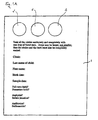
- Figs. 1A and 1B show a sample collecting element and envelope according to the state of the art.
- Figs. 2A and 2B show a particularly preferred article according to the invention.
- Fig. 1A shows a view of a Guthrie test card as state of the art sample collecting element.
- Fig. 1B shows a view of the back side of a standard commercial envelope for a letter, in which the Guthrie test card can be placed and sent
- Fig 2A shows a view of an article according to the invention that is open and ready to hold the sample.
- Fig. 2B shows a view of an article according to the invention, closed and ready for transport after the sample has been applied.
- Fig. 1A shows a Guthrie test card (1) that is used as a sample collecting element for the blood of newborns.
- the entire sample collecting element consists of the same filter paper material.
- the sample collecting areas (2) are marked by black circles on the white filter paper. Below the sample collecting areas (2) there are recommendations addressed to the person applying the sample.
- the remaining area on the test card (I) is for data to identify the clinic, the person giving the sample, the sample and possibly diseases and/or treatments of the person giving the sample.
- the Guthrie test card (1) is first packed in a plastic bag and then placed in a standard envelope for a letter (3), the back (4) of which is shown in Fig. 1B.
- the flap (5) of the back (4) is folded up and placed under the closing flap (6).
- Both flaps (5,6) are coated on the bottom with material that has an adhesive effect when brought into contact with the other. Therefore, the envelope (3) is closed with adhesive when the flap that is folded up (5) and the flap that is folded down (6) are pressed together. The envelope closed in this way is then sent to the testing laboratory.
- Fig. 2A shows an article according to the invention for collecting and transporting an HbA 1c sample.
- This analyte represents only a preferred example.
- Samples for determining other analytes can also be collected and transported with the article according to the invention. Basically this applies to all analytes that are brought into solution by corresponding elution agents and can then be measured in this solution. Basically these are all analytes that can also be determined using immunological test procedures. Without wanting to restrict the circle of possible analytes, those analytes should also be mentioned at this point that are used for detecting infectious diseases, e.g. virus antibodies or virus components for determination of hepatitis and HIV.
- infectious diseases e.g. virus antibodies or virus components for determination of hepatitis and HIV.
- the article according to the invention shown in Fig. 2A has the shape of an envelope (21) suitable for postal use. On the front side of the envelope, an address is preprinted or there is room to enter an address.
- the back (30) of the envelope (21) has the sample collecting element (24), on which there is space to enter the patient address and the treating physician or clinic.
- the sample collecting element (24) is marked with a perforated line (25) and limited from the rest of the article according to the invention surrounding it by this perforated line (25).
- the perforation (5) [sic] makes it easier later to take the sample collecting element (24) out in the laboratory.
- the sample collecting area (23) At a central point on the sample collecting element (24), there is the sample collecting area (23). It is designated with a round hole in the sample collecting element (24) and emphasized visually by a surrounding drop-shaped mark. Under the sample collecting area (23), there is an absorbent matrix (22), the contours of which are shown in dotted lines on Fig. 2A.
- the size of the sample collecting area (23) depends on the sample quantity needed for the analysis, which is applied to the absorbent matrix (22) and has to be collected there. As a rule, the sample collecting area (23) has a diameter from 5 to 20 mm.
- the matrix (22) placed below the sample collecting area accordingly has a rectangular or square shape, in which the edge lengths are about 5 to 20 mm larger than the greatest extension of the sample collecting area (23).
- a fleece with weight per surface area of about 60 g/m 2 is especially suitable as the absorbent matrix (22), which is produced in the following way.
- the process uses a oblique wire cloth machine (Voith, Heidenheim, Germany) as is used for paper production.
- the fibers suspended in water are pumped onto an oblique wire cloth. While the liquid flows off and/or is suctioned off using a vacuum, the fibers orient themselves on the surface of the wire cloth and are dried as fleece over a drying cylinder. Drying takes place at 125°C, until a final moisture of 0.5 - 1.5 weight-% is achieved.
- the suction and production speed are selected, at 2 m per minute, such that a material is made that has a weight per surface area of 60 g/m 2 .
- the sample collecting element (24) Beside the sample collecting area (23), the sample collecting element (24) has two sample identification labels (26) that contain data for sample identification in a bar code. At least one of the labels can be taken off. However, instead of two sample identification labels, it is also possible to use only one label with bar code. Preferably however, this one label is removable.
- the envelope material consists of thin cardboard that is coated on both sides with a water-repellant material.
- Figure 2B shows a view of the closed envelope.
- the liquid sample to be tested usually blood, but also other body fluids, e.g. urine, saliva or samples derived from the blood like plasma or serum are possible; is applied through the cut-out on the sample collecting element (24) onto the sample collecting area (23) of the absorbent matrix (22). If data are required for later identification of the sample, this data, e.g. patient address and name of the treating physician, can be noted on the sample collecting element (24) before or after the sample is applied.
- the envelope can then be closed.
- the adhesive (27) is either moistened or revealed by pulling off a protective film.
- the inside of the closing flap (29) with the adhesive (27) is brought into contact with the back (30) of the envelope (21) so that the sample collecting element (24) is covered by the closing flap (29) in such a way that the sample collecting area (23) is no longer accessible from the outside and contamination can be prevented during transport.
- the envelope closed in this way is sent to a laboratory where the envelope can be opened by a strip that can be pulled out of the envelope along the perforated lines (28) and the closing flap (29) can thus be folded up again.
- the sample collecting element (24) that is made accessible again in this way with the sample collecting area (23) and the matrix (22) containing the sample is then separated along the perforated line (25) from the back (30) of the envelope in the laboratory.
- a part of the matrix (22) that is then freely accessible in the sample collecting area (23) is removed in order to elute the analyte to be determined.
- a piece, usually a round piece of matrix (22) is removed in the area of the sample collecting area (23) using a hole punch.
- These punched samples are generally 3 to 8 mm, but they can be larger or smaller depending on the size of the sample collecting area (23) and the quantity of sample necessary to determine the analyte.
- At least one of the identification labels (26) is taken off the sample collecting element (24) and affixed to the vessel in which the part of the matrix (22) containing the sample is placed.
- elution and analyte determining measures are initiated, which are known to the person skilled in the art.
- the patient and/or the physician who takes the sample has fewer parts to store and the danger of losing a part is prevented. Because of this, it is also no longer necessary to replace lost parts with others that are less suitable but happen to be on hand. So, for example, the invention insures that an envelope is used that is of a quality such that it does not have a deleterious effect on the analyte in the sample.
Landscapes
- Health & Medical Sciences (AREA)
- Chemical & Material Sciences (AREA)
- Life Sciences & Earth Sciences (AREA)
- Hematology (AREA)
- Engineering & Computer Science (AREA)
- Molecular Biology (AREA)
- Biomedical Technology (AREA)
- Immunology (AREA)
- General Health & Medical Sciences (AREA)
- Analytical Chemistry (AREA)
- Chemical Kinetics & Catalysis (AREA)
- Clinical Laboratory Science (AREA)
- Pathology (AREA)
- Urology & Nephrology (AREA)
- Physics & Mathematics (AREA)
- Animal Behavior & Ethology (AREA)
- Biochemistry (AREA)
- Food Science & Technology (AREA)
- General Physics & Mathematics (AREA)
- Microbiology (AREA)
- Heart & Thoracic Surgery (AREA)
- Medical Informatics (AREA)
- Surgery (AREA)
- Medicinal Chemistry (AREA)
- Public Health (AREA)
- Veterinary Medicine (AREA)
- Cell Biology (AREA)
- Biotechnology (AREA)
- Investigating Or Analysing Biological Materials (AREA)
- Sampling And Sample Adjustment (AREA)
- Investigating Or Analyzing Non-Biological Materials By The Use Of Chemical Means (AREA)
Applications Claiming Priority (3)
| Application Number | Priority Date | Filing Date | Title |
|---|---|---|---|
| US754995P | 1995-11-27 | 1995-11-27 | |
| US7549P | 1995-11-27 | ||
| PCT/EP1996/005185 WO1997019754A1 (en) | 1995-11-27 | 1996-11-23 | Article for collecting and transporting a sample to be analyzed and procedure for determining an analyte |
Publications (2)
| Publication Number | Publication Date |
|---|---|
| EP0863802A1 EP0863802A1 (en) | 1998-09-16 |
| EP0863802B1 true EP0863802B1 (en) | 2003-04-02 |
Family
ID=21726839
Family Applications (1)
| Application Number | Title | Priority Date | Filing Date |
|---|---|---|---|
| EP96939913A Expired - Lifetime EP0863802B1 (en) | 1995-11-27 | 1996-11-23 | Article for collecting and transporting a sample to be analyzed and procedure for determining an analyte |
Country Status (9)
| Country | Link |
|---|---|
| US (1) | US5895704A (enExample) |
| EP (1) | EP0863802B1 (enExample) |
| JP (1) | JP2000514177A (enExample) |
| AU (1) | AU734423B2 (enExample) |
| CA (1) | CA2238763C (enExample) |
| DE (1) | DE69627182T2 (enExample) |
| ES (1) | ES2196189T3 (enExample) |
| MX (1) | MX9804086A (enExample) |
| WO (1) | WO1997019754A1 (enExample) |
Cited By (1)
| Publication number | Priority date | Publication date | Assignee | Title |
|---|---|---|---|---|
| DE102020117212A1 (de) | 2020-06-30 | 2021-12-30 | Marc Becker | Speicheltest zur Erkennung von Krankheitserregern |
Families Citing this family (33)
| Publication number | Priority date | Publication date | Assignee | Title |
|---|---|---|---|---|
| US6066464A (en) * | 1996-12-10 | 2000-05-23 | Diagnostic Systems Laboratories, Inc. | Immunoassay of IGF family of peptides, their binding proteins and related molecules in dried whole blood filter paper spots |
| US6265223B1 (en) * | 1997-05-28 | 2001-07-24 | Flexsite Diagnostics, Inc. | Diagnostic assay |
| US6177283B1 (en) | 1997-05-28 | 2001-01-23 | Flexsite Diagnostics, Inc. | Diagnostic assay |
| DE19758633C2 (de) * | 1997-09-11 | 2003-10-23 | Biopsytec Gmbh | Vorrichtung zur Entnahme von biologischen Proben |
| ES2146531B1 (es) * | 1998-01-13 | 2001-03-01 | Univ Granada | Kit de recogida de muestras para identificacion genetica del recien nacido y del neonato. |
| CA2353066A1 (en) * | 1998-12-29 | 2000-07-06 | Flexsite Diagnostics, Inc. | Remote site urine collection device and method of use |
| FR2792724B1 (fr) * | 1999-04-26 | 2001-05-25 | Biomerieux Sa | Dispositif de prelevement et de conservation d'un echantillon biologique et son procede de mise en oeuvre |
| ES2163356B1 (es) * | 1999-06-16 | 2003-04-16 | Univ Granada | Equipo autonomo para recogida, almacenamiento y envio de muestras bio logicas humanas, animales y vegetales. |
| US20030024331A1 (en) * | 2000-02-04 | 2003-02-06 | Hamilton Enterprises, Inc. | Sealable air sampling bag and method of sealing an air sampling bag |
| DE10058108A1 (de) * | 2000-11-23 | 2002-06-06 | Evotec Ag | Probenträger, Deckel für Probenträger und Verfahren zur Untersuchungsvorbereitung |
| JP2003108672A (ja) * | 2001-09-27 | 2003-04-11 | Eiken Chem Co Ltd | 新規な検診システム |
| JP4751566B2 (ja) | 2002-04-09 | 2011-08-17 | オリンパス株式会社 | 細胞培養システム、培養細胞照合装置および細胞培養装置 |
| US20040204661A1 (en) * | 2003-04-10 | 2004-10-14 | Epler Gary R. | Genomics home test kit |
| US20050104035A1 (en) * | 2003-11-13 | 2005-05-19 | Christopher Eaddy | Intelligent label for informing consumers of product quality criteria |
| EP1770399A4 (en) * | 2004-12-03 | 2012-03-14 | Arkray Inc | INSPECTION INSTRUMENT |
| ES2302488B1 (es) * | 2008-02-29 | 2009-04-01 | Components Sanitaris Engloba, S.L | Tarjetas de recepcion de muestras de sangre y envase esteril para uso neonatal. |
| US20100209019A1 (en) * | 2009-01-23 | 2010-08-19 | Confoy Robert E | Shipping package that converts into a backpack |
| ES2373288B1 (es) * | 2010-01-20 | 2012-10-30 | Universidad Del Pais Vasco | Dispositivo para la trazabilidad en tomas de muestras biológicas. |
| EP2375249B1 (en) * | 2010-04-09 | 2019-12-25 | F. Hoffmann-La Roche AG | Devices and process for separating plasma from a blood sample |
| US8294087B2 (en) | 2010-05-12 | 2012-10-23 | Advion, Inc. | Mechanical holder for surface analysis |
| US20130116597A1 (en) | 2011-11-04 | 2013-05-09 | Phenomenex, Inc. | Method and apparatus for acquiring blood for testing |
| GB2497731A (en) * | 2011-12-15 | 2013-06-26 | Sandwell And West Birmingham Hospials Nhs Trust | Folding sample collection device with drying facility |
| WO2013093024A1 (en) * | 2011-12-22 | 2013-06-27 | Dsm Ip Assets B.V. | Multilayered woven manufacture and use of the multilayer woven manufacture as carriers for dried matrix spot applications |
| ES2394277B1 (es) * | 2012-11-08 | 2013-11-13 | Hospital Sant Joan De Deu | Dispositivo de recogida, almacenamiento y transporte de muestras biológicas |
| US9913627B2 (en) * | 2013-01-29 | 2018-03-13 | Becton, Dickinson And Company | Specimen collection container having a fluid separation chamber |
| DE102013211918A1 (de) * | 2013-06-24 | 2014-12-24 | Euroimmun Medizinische Labordiagnostika Ag | Vorrichtung und Verfahren zur Aufbewahrung und zum Transport einer Körperflüssigkeitsprobe |
| US10071381B2 (en) | 2015-04-17 | 2018-09-11 | Neoteryx, Llc. | Method and apparatus for handling blood for testing |
| RU2616242C1 (ru) * | 2016-03-31 | 2017-04-13 | Общество с ограниченной ответственностью "Биологическая среда" | Устройство для сбора, хранения и транспортировки биологического материала живых организмов и растений |
| IT201600103909A1 (it) * | 2016-10-17 | 2018-04-17 | Marco Flavio Michele Vismara | Sistema e metodo di acquisizione, trasmissione ed elaborazione di dati ematochimici |
| WO2018155410A1 (ja) * | 2017-02-22 | 2018-08-30 | 公益財団法人ヒューマンサイエンス振興財団 | 乾燥血液試料保存基材 |
| JP6904561B2 (ja) * | 2017-02-22 | 2021-07-21 | 独立行政法人国立病院機構 | 乾燥血液試料保存基材 |
| WO2020032270A1 (ja) * | 2018-08-09 | 2020-02-13 | 公益財団法人ヒューマンサイエンス振興財団 | 乾燥血液試料保存基材 |
| US20230071731A1 (en) * | 2020-05-27 | 2023-03-09 | Fellow Health Inc. | Systems and methods for controlling and monitoring environmental conditions of a semen sample during transport |
Family Cites Families (7)
| Publication number | Priority date | Publication date | Assignee | Title |
|---|---|---|---|---|
| AT370312B (de) * | 1978-08-10 | 1983-03-25 | Roehm Gmbh | Testbriefe fuer stuhlproben |
| US4273741A (en) * | 1979-07-09 | 1981-06-16 | Levine Robert A | Device for obtaining stool samples |
| US4789629A (en) * | 1986-11-24 | 1988-12-06 | Smithkline Beckman Corporation | Method and device for collecting and testing for fecal occult blood |
| DE3802366A1 (de) * | 1988-01-27 | 1989-08-10 | Boehringer Mannheim Gmbh | Traegervlies fuer abloesbar impraegnierte reagenzien |
| US5182191A (en) * | 1988-10-14 | 1993-01-26 | Pacific Biotech, Inc. | Occult blood sampling device and assay |
| FI923220L (fi) * | 1992-07-14 | 1994-01-15 | Wallac Oy | Foerfarande och apparatur foer hantering av prov samt provuppsamlingssystem |
| DE9209639U1 (de) * | 1992-07-17 | 1992-09-24 | Transpapier GmbH + Co. KG, 4600 Dortmund | Träger zur Aufnahme und zum Transport von Proben |
-
1996
- 1996-11-23 DE DE1996627182 patent/DE69627182T2/de not_active Expired - Fee Related
- 1996-11-23 JP JP52015097A patent/JP2000514177A/ja not_active Ceased
- 1996-11-23 ES ES96939913T patent/ES2196189T3/es not_active Expired - Lifetime
- 1996-11-23 EP EP96939913A patent/EP0863802B1/en not_active Expired - Lifetime
- 1996-11-23 AU AU76973/96A patent/AU734423B2/en not_active Ceased
- 1996-11-23 WO PCT/EP1996/005185 patent/WO1997019754A1/en not_active Ceased
- 1996-11-23 CA CA 2238763 patent/CA2238763C/en not_active Expired - Fee Related
- 1996-11-27 US US08/757,374 patent/US5895704A/en not_active Expired - Fee Related
-
1998
- 1998-05-22 MX MX9804086A patent/MX9804086A/es unknown
Cited By (1)
| Publication number | Priority date | Publication date | Assignee | Title |
|---|---|---|---|---|
| DE102020117212A1 (de) | 2020-06-30 | 2021-12-30 | Marc Becker | Speicheltest zur Erkennung von Krankheitserregern |
Also Published As
| Publication number | Publication date |
|---|---|
| AU734423B2 (en) | 2001-06-14 |
| CA2238763A1 (en) | 1997-06-05 |
| AU7697396A (en) | 1997-06-19 |
| MX9804086A (es) | 1998-09-30 |
| DE69627182D1 (de) | 2003-05-08 |
| ES2196189T3 (es) | 2003-12-16 |
| US5895704A (en) | 1999-04-20 |
| DE69627182T2 (de) | 2004-03-04 |
| JP2000514177A (ja) | 2000-10-24 |
| EP0863802A1 (en) | 1998-09-16 |
| CA2238763C (en) | 2004-10-12 |
| WO1997019754A1 (en) | 1997-06-05 |
Similar Documents
| Publication | Publication Date | Title |
|---|---|---|
| AU734423B2 (en) | Article for collecting and transporting a sample to be analyzed and procedure for determining an analyte | |
| US5182191A (en) | Occult blood sampling device and assay | |
| US6036659A (en) | Collection device for biological samples and methods of use | |
| US6231815B1 (en) | Storage and transport system for sample material | |
| CA1309330C (en) | Method and device for collecting and testing for fecal occult blood | |
| US5520041A (en) | Humidity-indicating medical sample system and method | |
| US7488450B2 (en) | Analyte collection and detection devices | |
| CA2215346C (en) | Sample collection device | |
| JPH0354305B2 (enExample) | ||
| US20110053208A1 (en) | Biological sample identification system | |
| CA2179567C (en) | Element and system for collecting, transporting and storing sample material to be analyzed | |
| JP2007523337A (ja) | サンプリング装置、方法及びその使用 | |
| JPS60131463A (ja) | 簡易判定具 | |
| US5223405A (en) | Sampling by pressing between adsorbent and substrate surfaces | |
| US12097493B2 (en) | Kit including planar sample carrier with absorbent membrane layer and box | |
| EP0717283A2 (en) | Device and test kit for the detection of AIDS | |
| JP2002514306A (ja) | インビトロアレルギー診断のためのストリップテスト | |
| JPH055497Y2 (enExample) | ||
| JP3717936B6 (ja) | サンプル収集装置 | |
| AU700777B2 (en) | Sample collection device |
Legal Events
| Date | Code | Title | Description |
|---|---|---|---|
| PUAI | Public reference made under article 153(3) epc to a published international application that has entered the european phase |
Free format text: ORIGINAL CODE: 0009012 |
|
| 17P | Request for examination filed |
Effective date: 19980629 |
|
| AK | Designated contracting states |
Kind code of ref document: A1 Designated state(s): DE ES FR GB IT |
|
| 17Q | First examination report despatched |
Effective date: 19981228 |
|
| RAP3 | Party data changed (applicant data changed or rights of an application transferred) |
Owner name: BOEHRINGER MANNHEIM CORPORATION Owner name: ROCHE DIAGNOSTICS GMBH |
|
| RAP1 | Party data changed (applicant data changed or rights of an application transferred) |
Owner name: ROCHE DIAGNOSTICS CORPORATION Owner name: ROCHE DIAGNOSTICS GMBH |
|
| GRAH | Despatch of communication of intention to grant a patent |
Free format text: ORIGINAL CODE: EPIDOS IGRA |
|
| GRAH | Despatch of communication of intention to grant a patent |
Free format text: ORIGINAL CODE: EPIDOS IGRA |
|
| GRAA | (expected) grant |
Free format text: ORIGINAL CODE: 0009210 |
|
| AK | Designated contracting states |
Designated state(s): DE ES FR GB IT |
|
| REG | Reference to a national code |
Ref country code: GB Ref legal event code: FG4D |
|
| REF | Corresponds to: |
Ref document number: 69627182 Country of ref document: DE Date of ref document: 20030508 Kind code of ref document: P |
|
| ET | Fr: translation filed | ||
| REG | Reference to a national code |
Ref country code: ES Ref legal event code: FG2A Ref document number: 2196189 Country of ref document: ES Kind code of ref document: T3 |
|
| PLBE | No opposition filed within time limit |
Free format text: ORIGINAL CODE: 0009261 |
|
| STAA | Information on the status of an ep patent application or granted ep patent |
Free format text: STATUS: NO OPPOSITION FILED WITHIN TIME LIMIT |
|
| 26N | No opposition filed |
Effective date: 20040105 |
|
| PGFP | Annual fee paid to national office [announced via postgrant information from national office to epo] |
Ref country code: GB Payment date: 20041004 Year of fee payment: 9 |
|
| PGFP | Annual fee paid to national office [announced via postgrant information from national office to epo] |
Ref country code: FR Payment date: 20041105 Year of fee payment: 9 |
|
| PGFP | Annual fee paid to national office [announced via postgrant information from national office to epo] |
Ref country code: ES Payment date: 20041118 Year of fee payment: 9 |
|
| PGFP | Annual fee paid to national office [announced via postgrant information from national office to epo] |
Ref country code: DE Payment date: 20041130 Year of fee payment: 9 |
|
| PG25 | Lapsed in a contracting state [announced via postgrant information from national office to epo] |
Ref country code: IT Free format text: LAPSE BECAUSE OF NON-PAYMENT OF DUE FEES;WARNING: LAPSES OF ITALIAN PATENTS WITH EFFECTIVE DATE BEFORE 2007 MAY HAVE OCCURRED AT ANY TIME BEFORE 2007. THE CORRECT EFFECTIVE DATE MAY BE DIFFERENT FROM THE ONE RECORDED. Effective date: 20051123 Ref country code: GB Free format text: LAPSE BECAUSE OF NON-PAYMENT OF DUE FEES Effective date: 20051123 |
|
| PG25 | Lapsed in a contracting state [announced via postgrant information from national office to epo] |
Ref country code: ES Free format text: LAPSE BECAUSE OF NON-PAYMENT OF DUE FEES Effective date: 20051124 |
|
| PG25 | Lapsed in a contracting state [announced via postgrant information from national office to epo] |
Ref country code: DE Free format text: LAPSE BECAUSE OF NON-PAYMENT OF DUE FEES Effective date: 20060601 |
|
| GBPC | Gb: european patent ceased through non-payment of renewal fee |
Effective date: 20051123 |
|
| PG25 | Lapsed in a contracting state [announced via postgrant information from national office to epo] |
Ref country code: FR Free format text: LAPSE BECAUSE OF NON-PAYMENT OF DUE FEES Effective date: 20060731 |
|
| REG | Reference to a national code |
Ref country code: FR Ref legal event code: ST Effective date: 20060731 |
|
| REG | Reference to a national code |
Ref country code: ES Ref legal event code: FD2A Effective date: 20051124 |