EP0857797A1 - Verfahren zur zumindest teilweisen Goldbeschichtung eines Trägers - Google Patents
Verfahren zur zumindest teilweisen Goldbeschichtung eines Trägers Download PDFInfo
- Publication number
- EP0857797A1 EP0857797A1 EP97121803A EP97121803A EP0857797A1 EP 0857797 A1 EP0857797 A1 EP 0857797A1 EP 97121803 A EP97121803 A EP 97121803A EP 97121803 A EP97121803 A EP 97121803A EP 0857797 A1 EP0857797 A1 EP 0857797A1
- Authority
- EP
- European Patent Office
- Prior art keywords
- gold
- order
- electrolyte
- carrier
- potassium
- Prior art date
- Legal status (The legal status is an assumption and is not a legal conclusion. Google has not performed a legal analysis and makes no representation as to the accuracy of the status listed.)
- Granted
Links
Images
Classifications
-
- C—CHEMISTRY; METALLURGY
- C23—COATING METALLIC MATERIAL; COATING MATERIAL WITH METALLIC MATERIAL; CHEMICAL SURFACE TREATMENT; DIFFUSION TREATMENT OF METALLIC MATERIAL; COATING BY VACUUM EVAPORATION, BY SPUTTERING, BY ION IMPLANTATION OR BY CHEMICAL VAPOUR DEPOSITION, IN GENERAL; INHIBITING CORROSION OF METALLIC MATERIAL OR INCRUSTATION IN GENERAL
- C23C—COATING METALLIC MATERIAL; COATING MATERIAL WITH METALLIC MATERIAL; SURFACE TREATMENT OF METALLIC MATERIAL BY DIFFUSION INTO THE SURFACE, BY CHEMICAL CONVERSION OR SUBSTITUTION; COATING BY VACUUM EVAPORATION, BY SPUTTERING, BY ION IMPLANTATION OR BY CHEMICAL VAPOUR DEPOSITION, IN GENERAL
- C23C18/00—Chemical coating by decomposition of either liquid compounds or solutions of the coating forming compounds, without leaving reaction products of surface material in the coating; Contact plating
- C23C18/16—Chemical coating by decomposition of either liquid compounds or solutions of the coating forming compounds, without leaving reaction products of surface material in the coating; Contact plating by reduction or substitution, e.g. electroless plating
- C23C18/31—Coating with metals
- C23C18/42—Coating with noble metals
- C23C18/44—Coating with noble metals using reducing agents
-
- C—CHEMISTRY; METALLURGY
- C23—COATING METALLIC MATERIAL; COATING MATERIAL WITH METALLIC MATERIAL; CHEMICAL SURFACE TREATMENT; DIFFUSION TREATMENT OF METALLIC MATERIAL; COATING BY VACUUM EVAPORATION, BY SPUTTERING, BY ION IMPLANTATION OR BY CHEMICAL VAPOUR DEPOSITION, IN GENERAL; INHIBITING CORROSION OF METALLIC MATERIAL OR INCRUSTATION IN GENERAL
- C23C—COATING METALLIC MATERIAL; COATING MATERIAL WITH METALLIC MATERIAL; SURFACE TREATMENT OF METALLIC MATERIAL BY DIFFUSION INTO THE SURFACE, BY CHEMICAL CONVERSION OR SUBSTITUTION; COATING BY VACUUM EVAPORATION, BY SPUTTERING, BY ION IMPLANTATION OR BY CHEMICAL VAPOUR DEPOSITION, IN GENERAL
- C23C18/00—Chemical coating by decomposition of either liquid compounds or solutions of the coating forming compounds, without leaving reaction products of surface material in the coating; Contact plating
- C23C18/16—Chemical coating by decomposition of either liquid compounds or solutions of the coating forming compounds, without leaving reaction products of surface material in the coating; Contact plating by reduction or substitution, e.g. electroless plating
- C23C18/1601—Process or apparatus
- C23C18/1603—Process or apparatus coating on selected surface areas
- C23C18/1605—Process or apparatus coating on selected surface areas by masking
-
- H—ELECTRICITY
- H05—ELECTRIC TECHNIQUES NOT OTHERWISE PROVIDED FOR
- H05K—PRINTED CIRCUITS; CASINGS OR CONSTRUCTIONAL DETAILS OF ELECTRIC APPARATUS; MANUFACTURE OF ASSEMBLAGES OF ELECTRICAL COMPONENTS
- H05K3/00—Apparatus or processes for manufacturing printed circuits
- H05K3/22—Secondary treatment of printed circuits
- H05K3/24—Reinforcing of the conductive pattern
- H05K3/244—Finish plating of conductors, especially of copper conductors, e.g. for pads or lands
Definitions
- the invention relates to a method for at least partial gold plating a carrier with a base layer, with the first contact areas on the carrier, which have a gold layer, and second contact areas which are free from the are coated gold layer of the first contact surfaces are produced, wherein the second contact surfaces are first covered with a covering agent, wherein the carrier is placed in an exchange gold bath, whereby at first Contact surfaces a pre-gilding is formed, and being after the Removing the carrier from the replacement gold bath, the second contact areas covering masking agent can be removed.
- a very popular contacting method in electronics is the so-called "Bonding".
- electrical connections are made with gold or aluminum wires created for an electronic component implemented on the carrier, usually gold wires with a thickness of approx. 30 ⁇ or aluminum wires in a thickness of approx. 30 ⁇ (thin wire bonding) or 300 ⁇ (thick wire bonding) be used.
- the measures according to the invention are advantageous created a procedure that allows you to easily access one Carrier contact surfaces for both gold wires and for To provide aluminum wires. This is essentially due to the use of the reductive gold bath according to the invention, which is advantageous Has the property that on the base layer, in particular a chemical nickel layer, no gold deposition takes place, so that these layers for the Bonding with aluminum wire is available.
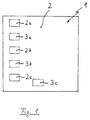
- the support shown in FIG. 1 and designated 1 has on its surface 1 'on a base layer, in particular a chemical nickel layer 2 the contact areas 2a-2c are to be applied, which are used for bonding gold wires serve and therefore a gold layer with a layer thickness of about 0.3 microns Gold.
- the carrier 1 also has contact surfaces 3a-3c ' that are used for the bonding of aluminum wires and therefore not of the Contact areas 2a - 2c forming gold layer may be covered.
- the One skilled in the art can see that the arrangement of the contact surfaces described 2a-2c, 3a-3c on the carrier 1 only to explain what is described below Process serves and in no case its applicability to other contact arrangements should exclude.
- the carrier 1 treated in this way is exchanged in a gold bath a pH value of preferably below 7.0 and a temperature of approx. There is 85 ° C, gold-plated, which in a manner known per se is a Pre-gold plating of the contact areas 2a-2c with a layer thickness of 0.03 to 0.1 ⁇ is generated.
- the adhesive tape, the paint or other covering means trained covers removed from the contact surfaces 3a-3c in a known manner.
- the in Exchange gold bath-covered contact areas 3a-3c thus have their original Keep the chemical nickel surface.
- the carrier 1 is introduced into a reductive gold bath which uses an electrolyte, in which case the chemical nickel layer is on the green layer of the carrier 1, in the case described here 2, there is no gold deposition.
- the electrolyte is composed as follows:
- the first component of the electrolyte is potassium, sodium or ammonium gold-I-cyanide or the corresponding gold-III-cyanide compounds in a range from 0.1 g / l to approximately 20 g / l gold, it being preferred that the gold content of the aforementioned compounds ranges from about 0.5 g / l to about 5 g / l.
- a second component of the electrolyte described is free potassium, sodium or ammonium cyanide in the order of about 0.1 g / l to 25 g / l, it being preferred that the proportion of the aforementioned free cyanides in the range from about 3 g / l to 6 g / l.
- the electrolyte has potassium, sodium or ammonium sulfite in one Of the order of about 0.1 g / l to 50 g / l, with it being preferred that the The content of the aforementioned sulfite is in the range of approximately 5 g / l to 15 g / l.
- the electrolyte has an aromatic (mono-, di- or tri-) nitro compound, for example 3,5-dinitrobenzoic acid, on the order of approximately 0.01 g / l to about 10 g / l, again it being preferred that the Concentration of the aforementioned acid in the range of approximately 0.05 to 1.0 g / l.
- aromatic (mono-, di- or tri-) nitro compound for example 3,5-dinitrobenzoic acid
- Another component of the electrolyte described is free alkali, the is preferably present as potassium or sodium hydroxide.
- concentration of the free alkali is of the order of about 1 g / l to 100 g / l, the Range of about 10 g / l to 25 g / l is preferred.
- Another component of the electrolyte are one or more complexing agents from the group of hydroxycarboxylic acids, phosphonic acids, nitriloacetic acids or ethylenediamine acetic acids on the order of about 1 g / L to 50 g / l with an optimum of 10 g / l to 30 g / l.
- the electrolyte described has one or more reducing agents from the group of boranes or boranates, the proportion of these Reducing agents on the order of about 0.1 g / l to 50 g / l with a Optimal from approx. 1 g / l to 10 g / l.
- an optional reaction accelerator preferably a water soluble thallium I compound be provided in the order of 0.1 mg / l to about 100 mg / l is added to the electrolyte, the preferred range of the aforementioned Compound ranges from about 1 mg / l to 20 mg / l.
- a temperature of approximately is used to carry out the reductive gold deposition 60 ° to 95 ° of the electrolyte and in particular the range from 75 ° to 85 ° C preferred.
- the carrier 1 is placed in this gold bath at a temperature of preferably Leave at 80 ° C until there is a layer thickness of approx. 0.3 ⁇ gold on the contact surfaces 2a-2c has deposited.
- the electrolyte described above has the advantageous property that in reductive gold bath on the chemical nickel layer 2, and thus also on the Contact layers 3a-3c no gold deposition occurs, the ones for aluminum bonding certain contact areas 3a-3c are not covered by the gold layer and are therefore unchanged even after this process step.
- the carrier 1 thus has contact layers 2a-2c which are thick for the Gold wire bonding have a suitable gold layer, and contact areas 3a-3c, which are not gold-plated, so that on the carrier 1 both aluminum and Gold wires can be bonded.
Landscapes
- Chemical & Material Sciences (AREA)
- General Chemical & Material Sciences (AREA)
- Chemical Kinetics & Catalysis (AREA)
- Engineering & Computer Science (AREA)
- Materials Engineering (AREA)
- Mechanical Engineering (AREA)
- Metallurgy (AREA)
- Organic Chemistry (AREA)
- Electroplating Methods And Accessories (AREA)
- Electroplating And Plating Baths Therefor (AREA)
- Chemically Coating (AREA)
Abstract
Description
- Figur 1
- eine Draufsicht auf ein Ausführungsbeispiel eines mit einer Chemisch-Nickel-Schicht überzogenen Trägers.
Der Elektrolyt weist als ersten Bestandteil Kalium-, Natrium- oder Ammoniumgold-I-cyanid bzw. die entsprechenden Gold-III-cyanidverbindungen in einer Größenordnung von 0,1 g/l bis ungefähr 20 g/l Gold auf, wobei bevorzugt wird, daß der Goldgehalt der vorgenannten Verbindungen im Bereich von ungefähr 0,5 g/l bis ungefähr 5 g/l liegt.
- 1,0 g/l Gold als freies Kaliumgold-I-cyanid,
- 5,0 g/l freies Kaliumcyanid,
- 50 g/l 1-Hydroxid-ethan-1.1-diphosphonsäure,
- 10 g/l Kaliumsulfit
- 0,2 g/l 3,5-Dinitrobenzoesäure,
- 22 g/l freies Kaliumhydroxid
- 5,0 g/l Dimethylaminboran,
Claims (16)
- Verfahren zur zumindest teilweisen Goldbeschichtung eines Trägers (1) mit einer Grundschicht (2), bei dem erste Kontaktflächen (2a-2c) auf dem Träger (1), die eine Goldschicht aufweisen, und zweite Kontaktflächen (3a-3c), die frei von der beschichteten Goldschicht der Kontaktflächen (2a-2c) sind, erzeugt werden, wobei die zweiten Kontaktflächen (3a-3c) zuerst mit einem Abdeckmittel abgedeckt werden, wobei der Träger (1) in ein Austausch-Goldbad eingebracht wird, und wodurch auf den ersten Kontaktflächen (2a-2c) eine Vorvergoldung ausgebildet wird, wobei nach der Entnahme des Trägers (1) aus dem Austausch-Goldbad die die zweiten Kontaktflächen (3a-3c) abdeckenden Abdeckmittel entfernt werden, dadurch gekennzeichnet, daß der Träger in ein Goldbad eingebracht wird, das einen Elektrolyten aufweist, bei dem auf der Grundschicht (2) des Trägers (1) keine Goldabscheidung erfolgt.
- Verfahren nach Anspruch 1, dadurch gekennzeichnet, daß als Grundschicht des Trägers (1) eine Chemisch-Nickel-Schicht (2) verwendet wird, und daß das Goldbad ein reduktives Goldbad ist.
- Verfahren nach Anspruch 2, dadurch gekennzeichnet, daß ein Elektrolyt für das reduktive Goldbad verwendet wird, derenthält.Kalium-, Natrium- oder Ammoniumgold-I-cyanid oder Gold-III-cyanidverbindungen in einer Größenordnung von ungefähr 0,1 g/l bis ungefähr 20 g/l,freies Kalium-, Natrium- oder Ammoniumcyanid in einer Größenordnung von ungefähr 0,1 g/l bis 25 g/l,Kalium-, Natrium- oder Ammoniumsulfit in einer Größenordnung von ungefähr 0,1 g/l bis ungefähr 50 g/l,einer aromatische Nitroverbindung in einer Größenordnung von ungefähr 0,1 g/l bis ungefähr 10 g/l,freies Alkali in einer Größenordnung von ungefähr 1 g/l bis ungefähr 100 g/l,einen oder mehrere Komplexbildner aus der Gruppe der Hydroxycarbonsäuren, Phosphonsäuren, Nitriloessigsäure oder Aethylendiaminessigsäuren in einer Größenordnung von ungefähr 1 g/l bis ungefähr 50 g/l,ein oder mehrere Reduktionsmittel aus der Gruppe der Borane oder Boranate in einer Größenordnung von 0,1 g/l bis 50 g/l
- Verfahren nach Anspruch 3, dadurch gekennzeichnet, daß der Elektrolyt ungefähr 0,5 g/l bis ungefähr 5 g/l Gold enthält.
- Verfahren nach einem der vorangehenden Ansprüche, dadurch gekennzeichnet, daß der Elektrolyt ungefähr 3,0 g/l bis ungefähr 6,0 g/l an freiem Kalium-, Natrium- oder Ammoniumcyanid enthält.
- Verfahren nach einem der vorangehenden Ansprüche, dadurch gekennzeichnet, daß der Elektrolyt Kalium-, Natrium- oder Ammoniumsulfit in der Größenordnung von ungefähr 5,0 gl bis ungefähr 15,0 g/l enthält.
- Vefahren nach einem der vorangehenden Ansprüche, dadurch gekennzeichnet, daß der Elektrolyt die aromatische Nitroverbindung in der Größenordnung von ungefähr 0,05 g/l bis ungefähr 1 g/l enthält.
- Verfahren nach einem der vorangehenden Ansprüche, dadurch gekennzeichnet, daß das freie Alkali als Kalium- oder Natriumhydroxid vorliegt.
- Verfahren nach einem der vorangehenden Ansprüche, dadurch gekennzeichnet, daß das freie Alkali in der Größenordnung von ungefähr 10 g/l bis ungefähr 25 g/l vorliegt.
- Verfahren nach einem der vorangehenden Ansprüche, dadurch gekennzeichnet, daß die Reduktionsmittel in der Größenordnung von ungefähr 1 g/l bis ungefähr 10 g/l vorliegen.
- Verfahren nach einem der vorangehenden Ansprüche, dadurch gekennzeichnet, daß dem Elektrolyt ein Reaktionsbeschleuniger zugesetzt ist.
- Verfahren nach einem der vorangehenden Ansprüche, dadurch gekennzeichnet, daß der Reaktionsbeschleuniger eine wasserlösliche Thallium-I-Verbindung ist.
- Verfahren nach einem der vorangehenden Ansprüche, dadurch gekennzeichnet, daß die Konzentration der wasserlöslichen Thallium-I-Verbindung in einer Größenordnung von ungefähr 0,1 mg/l bis ungefähr 100 mg/l und vorzugsweise im Bereich von ungefähr 1 mg/l bis 20 mg/l liegt.
- Verfahren nach einem der vorangehenden Ansprüche, dadurch gekennzeichnet, daß die aromatische Nitroverbindung eine mono-, di- oder tri-Nitroverbindung ist.
- Verfahren nach einem der vorangehenden Ansprüche, dadurch gekennzeichnet, daß die Nitroverbindung Dinitrobenzoesäure, insbesondere 3,5 Dinitrobenzoesäure, ist.
- Verfahren nach Anspruch 1, dadurch gekennzeichnet, daß der Träger nach der Behandlung in dem reduktiven Goldbad wiederum in das Austausch-Goldbad eingebracht wird, um auf den zweiten Flächen (3a-3c) eine dünne Goldschicht aufzubringen.
Applications Claiming Priority (4)
| Application Number | Priority Date | Filing Date | Title |
|---|---|---|---|
| DE19651899 | 1996-12-13 | ||
| DE19651899 | 1996-12-13 | ||
| DE19652991A DE19652991A1 (de) | 1996-12-13 | 1996-12-19 | Verfahren zur zumindest teilweisen Goldbeschichtung eines Trägers |
| DE19652991 | 1996-12-19 |
Publications (2)
| Publication Number | Publication Date |
|---|---|
| EP0857797A1 true EP0857797A1 (de) | 1998-08-12 |
| EP0857797B1 EP0857797B1 (de) | 2000-05-10 |
Family
ID=26032186
Family Applications (1)
| Application Number | Title | Priority Date | Filing Date |
|---|---|---|---|
| EP19970121803 Expired - Lifetime EP0857797B1 (de) | 1996-12-13 | 1997-12-11 | Verfahren zur zumindest teilweisen Goldbeschichtung eines Trägers |
Country Status (1)
| Country | Link |
|---|---|
| EP (1) | EP0857797B1 (de) |
-
1997
- 1997-12-11 EP EP19970121803 patent/EP0857797B1/de not_active Expired - Lifetime
Non-Patent Citations (1)
| Title |
|---|
| BAKOS: "Immersion Gold as a Sensitizer for Electroless Gold Plating. September 1972.", IBM TECHNICAL DISCLOSURE BULLETIN, vol. 15, no. 4, September 1972 (1972-09-01), NEW YORK, US, pages 1087, XP002062531 * |
Also Published As
| Publication number | Publication date |
|---|---|
| EP0857797B1 (de) | 2000-05-10 |
Similar Documents
| Publication | Publication Date | Title |
|---|---|---|
| DE68929282T2 (de) | Leitersubstrat, Filmträger, Halbleiteranordnung mit dem Filmträger und Montagestruktur mit der Halbleiteranordnung | |
| DE4292563C1 (de) | Verfahren zur Metallisierung von Substraten unter Verwendung einer Verarmungsreaktions-Metalloxid-Reduzierung | |
| DE69318894T2 (de) | Gehäuse einer elektronischen Vorrichtung mit einem metallischen Insert und Verfahren zur Oberflächenaufrauhung des Inserts | |
| DE2555826C2 (de) | Verfahren zur Herstellung einer im wesentlichen geordneten Legierung | |
| DE2032872B2 (de) | Verfahren zum Herstellen weichlötfähiger Kontakte zum Einbau von Halbleiterbauelementen in Gehäuse | |
| EP0841561B1 (de) | Verfahren zum Herstellen eines Sensors mit einer Metallelektrode in einer MOS-Anordnung | |
| DE1521436B2 (de) | Verfahren zum Herstellen von auf Isolierstofftrager aufgebrachte ge druckte Schaltungen oder dergleichen | |
| DE69115822T2 (de) | Verfahren zum Herstellen einer Halbleiteranordnung mit stromlosem Abscheiden von Metall | |
| EP0857797B1 (de) | Verfahren zur zumindest teilweisen Goldbeschichtung eines Trägers | |
| DE3151557C2 (de) | ||
| DE112019000957T5 (de) | Halbleiterelement und verfahren zur herstellung desselben | |
| DE2012110A1 (de) | Verfahren zum Herstellen einer Mehrlagenmetallisierung an elektrischen Bauelementen | |
| DE19745601C2 (de) | Lösung und Verfahren zum stromlosen Abscheiden von Goldschichten sowie Verwendung der Lösung | |
| DE19652991A1 (de) | Verfahren zur zumindest teilweisen Goldbeschichtung eines Trägers | |
| DE19631565A1 (de) | Verfahren zum Herstellen von Palladiumkontaktbumps auf Halbleiterschaltungsträgern | |
| DE1167726B (de) | Verfahren zur Herstellung von Kupferplattierungen auf begrenzten Flaechenbereichen keramischer Koerper | |
| EP0278413A2 (de) | Verfahren zur Herstellung einer Verbindung zwischen einem Bonddraht und einer Kontaktfläche bei hybriden Dickschicht-Schaltkreisen | |
| DE102012208681A1 (de) | Zinnbeschichtung, zugehöriges Kontaktelement und Verfahren zum Aufbringen einer Zinnbeschichtung | |
| EP0249834A2 (de) | Herstellung von Feinstrukturen für die Halbleiterkontaktierung | |
| DE112016007388T5 (de) | Halbleitereinrichtung und Verfahren zum Herstellen einer Halbleitereinrichtung | |
| EP0966045B1 (de) | Verfahren zum Herstellen einer Metallelektrode in einer Halbleiteranordnung mit einem MOS-Transistor | |
| DE112020001854T5 (de) | Halbleiterbauelement und Verfahren zu dessen Herstellung | |
| DE69533866T2 (de) | Leiterrahmen und Leiterrahmenmaterial | |
| DE19828846A1 (de) | Verfahren zum Beschichten eines Substrats | |
| DE69526200T2 (de) | Verfahren zur Verbindung eines Kontakt-Dünnfilmmagnetkopfelements mit einem Trägerbalken |
Legal Events
| Date | Code | Title | Description |
|---|---|---|---|
| PUAI | Public reference made under article 153(3) epc to a published international application that has entered the european phase |
Free format text: ORIGINAL CODE: 0009012 |
|
| 17P | Request for examination filed |
Effective date: 19980612 |
|
| AK | Designated contracting states |
Kind code of ref document: A1 Designated state(s): DE FR GB IT |
|
| AX | Request for extension of the european patent |
Free format text: AL;LT;LV;RO;SI |
|
| AKX | Designation fees paid |
Free format text: DE FR GB IT |
|
| RBV | Designated contracting states (corrected) |
Designated state(s): DE FR GB IT |
|
| GRAG | Despatch of communication of intention to grant |
Free format text: ORIGINAL CODE: EPIDOS AGRA |
|
| 17Q | First examination report despatched |
Effective date: 19990712 |
|
| GRAG | Despatch of communication of intention to grant |
Free format text: ORIGINAL CODE: EPIDOS AGRA |
|
| GRAG | Despatch of communication of intention to grant |
Free format text: ORIGINAL CODE: EPIDOS AGRA |
|
| GRAH | Despatch of communication of intention to grant a patent |
Free format text: ORIGINAL CODE: EPIDOS IGRA |
|
| RAP1 | Party data changed (applicant data changed or rights of an application transferred) |
Owner name: AMI DODUCO GMBH |
|
| GRAH | Despatch of communication of intention to grant a patent |
Free format text: ORIGINAL CODE: EPIDOS IGRA |
|
| GRAA | (expected) grant |
Free format text: ORIGINAL CODE: 0009210 |
|
| AK | Designated contracting states |
Kind code of ref document: B1 Designated state(s): DE FR GB IT |
|
| REF | Corresponds to: |
Ref document number: 59701645 Country of ref document: DE Date of ref document: 20000615 |
|
| ITF | It: translation for a ep patent filed | ||
| GBT | Gb: translation of ep patent filed (gb section 77(6)(a)/1977) |
Effective date: 20000808 |
|
| ET | Fr: translation filed | ||
| PLBE | No opposition filed within time limit |
Free format text: ORIGINAL CODE: 0009261 |
|
| STAA | Information on the status of an ep patent application or granted ep patent |
Free format text: STATUS: NO OPPOSITION FILED WITHIN TIME LIMIT |
|
| 26N | No opposition filed | ||
| REG | Reference to a national code |
Ref country code: GB Ref legal event code: IF02 |
|
| PGFP | Annual fee paid to national office [announced via postgrant information from national office to epo] |
Ref country code: GB Payment date: 20021122 Year of fee payment: 6 |
|
| PGFP | Annual fee paid to national office [announced via postgrant information from national office to epo] |
Ref country code: FR Payment date: 20021217 Year of fee payment: 6 |
|
| PG25 | Lapsed in a contracting state [announced via postgrant information from national office to epo] |
Ref country code: GB Free format text: LAPSE BECAUSE OF NON-PAYMENT OF DUE FEES Effective date: 20031211 |
|
| GBPC | Gb: european patent ceased through non-payment of renewal fee |
Effective date: 20031211 |
|
| PG25 | Lapsed in a contracting state [announced via postgrant information from national office to epo] |
Ref country code: FR Free format text: LAPSE BECAUSE OF NON-PAYMENT OF DUE FEES Effective date: 20040831 |
|
| REG | Reference to a national code |
Ref country code: FR Ref legal event code: ST |
|
| PGFP | Annual fee paid to national office [announced via postgrant information from national office to epo] |
Ref country code: DE Payment date: 20050128 Year of fee payment: 8 |
|
| PG25 | Lapsed in a contracting state [announced via postgrant information from national office to epo] |
Ref country code: IT Free format text: LAPSE BECAUSE OF NON-PAYMENT OF DUE FEES;WARNING: LAPSES OF ITALIAN PATENTS WITH EFFECTIVE DATE BEFORE 2007 MAY HAVE OCCURRED AT ANY TIME BEFORE 2007. THE CORRECT EFFECTIVE DATE MAY BE DIFFERENT FROM THE ONE RECORDED. Effective date: 20051211 |
|
| PG25 | Lapsed in a contracting state [announced via postgrant information from national office to epo] |
Ref country code: DE Free format text: LAPSE BECAUSE OF NON-PAYMENT OF DUE FEES Effective date: 20060701 |