Die vorliegende Erfindung betrifft ein Verfahren zur Herstellung
eines Peptidgemisches, das eine Vielzahl von einzelnen
Peptidsequenzen umfaßt, sowie ein Verfahren zur Herstellung
einer Polyhapten-Zusammensetzung unter Verwendung des Peptidgemisches.
Weiterhin betrifft die Erfindung die Verwendung des
Peptidgemisches bzw. der Polyhapten-Zusammensetzung in immunologischen
Tests.
Der Nachweis von Immunglobulinen in Körperflüssigkeiten, insbesondere
in Humanseren, wird zur Diagnostik von Infektionen
mit Mikroorganismen, insbesondere Viren, wie etwa HIV, Hepatitis-Viren,
etc. verwendet. Spezifische Immunglobuline in einer
zu untersuchenden Probe werden üblicherweise durch Reaktion
mit einem oder mehreren Antigenen, die mit den spezifischen
Immunglobulinen reagieren, nachgewiesen. Verfahren zur Bestimmung
von spezifischen Immunglobulinen in der Probeflüssigkeit
müssen sensitiv, zuverlässig, einfach und schnell sein.
In den letzten Jahren wurden dafür zunehmend Nachweissysteme
auf Basis nicht-radioaktiver Markierungsgruppen entwickelt,
bei denen das Vorhandensein eines Analyten z.B. eines spezifischen
Antikörpers in der untersuchten Probe mit Hilfe optischer
(z.B. Lumineszenz oder Fluoreszenz), NMR-aktiver oder
metallpräzipitierender Detektionssysteme bestimmt werden konnte.
EP-A-0 307 149 offenbart ein immunologisches Nachweisverfahren
nach dem Brückentest-Konzept. Dabei werden zwei rekombinante
Polypeptide als markiertes Antigen und als an eine Festphase
bindefähiges Antigen verwendet, wobei beide rekombinanten
Polypeptide den gleichen Epitopbereich umfassen, aber in unterschiedlichen
Organismen exprimiert werden, um die Spezifität
des Nachweises zu erhöhen. Dabei wird jeweils ein Polypeptid
mit festgelegter Struktur und nicht ein Polypeptidgemisch
eingesetzt.
Insbesondere auf dem Gebiet der Diagnostik von HIV-Infektionen
wurden in letzter Zeit große Anstrengungen unternommen.
EP-B-0 220 273 offenbart ein Verfahren zur Diagnose von HIV-Antikörpern,
wobei ein oder mehrere Peptide aus unterschiedlichen
kodierenden Regionen von HIV eingesetzt werden. Die Verwendung
eines Peptidgemisches umfassend eine Vielzahl statistisch
vorliegender Peptidsequenzen wird nicht vorgeschlagen.
US-A-5,221,610 beschreibt markierte Peptidantigene aus einem
Bereich des HIV-Virus. EP-A-0 379 949 offenbart biotinylierte
gp 41 und gp 32-HIV-Peptide. Die Verwendung von Peptidgemischen
in immunologischen Testverfahren wird jedoch auch darin
nicht beschrieben.
Die aus dem Stand der Technik bekannten immunologischen Nachweisverfahren
weisen erhebliche Schwächen auf. Insbesondere
findet man nur eine geringe Sensitivität, wenn zwischen dem zu
bestimmenden Antikörper und dem Antigen eine relativ geringe
Affinität vorliegt. Dies ist insbesondere bei einer erst seit
kurzem erfolgten Serokonversion und/oder beim Auftreten neuer
Subtypen eines infektiösen Mikroorganismus der Fall.
Die WO94/20521 beschreibt ein Verfahren zur Synthese von Peptidbibliotheken
auf einem Cellulose-Träger. An die wachsenden
Sequenzen werden an einigen Positionen Gemische von Aminosäuren
gekoppelt, wodurch Sequenz-Varianten erhalten werden. Die
Aminosäure-Gemische werden dabei in höchstens äquimolarer
Menge bezogen auf die Zahl der Peptidkopplungsstellen eingesetzt.
Nach jedem Kopplungsschritt unter Verwendung eines
Aminosäure-Gemisches werden Sequenzen, an die während des
Kopplungsschritts keine Aminosäure des Gemisches gebunden
wurde, durch Zugabe einer weiteren Aminosäure im Überschuß
abgesättigt, so daß alle Sequenzen die gleiche Länge aufweisen.
Durch die Zugabe dieser weiteren Aminosäure wird jedoch
keine statistische Verteilung der unterschiedlichen Peptidsequenzen
erhalten, da Sequenzen mit dieser Aminosäure verstärkt
vorliegen, während andere Sequenzen unterrepräsentiert sind.
Die Verwendung der Peptidbibliotheken als multiple Antigene in
Immunoassays wird in der WO 94/20521 nicht in Betracht gezogen.
Die Aufgabe der vorliegenden Erfindung war eine Verbesserung
von immunologischen Verfahren, durch die die Nachteile des
Standes der Technik zumindest teilweise beseitigt werden, und
durch die bei immunologischen Nachweisverfahren, insbesondere
bei erst seit kurzem erfolgten Serokonversionen und neuen
Mikroorganismen-Subtypen eine ausreichende Sensitivität erzielt
wird.
Die Aufgabe wird erfindungsgemäß gelöst durch ein Verfahren
zur Herstellung eines Peptidgemisches, worin man Peptide an
einer Festphase aus Aminosäurederivaten synthetisiert und an
mindestens einer Aminosäureposition für die Kopplungsreaktion
ein Gemisch von Derivaten unterschiedlicher Aminosäuren verwendet,
dadurch gekennzeichnet, daß nach jedem Kopplungsschritt,
in dem ein Gemisch von Derivaten unterschiedlicher
Aminosäuren eingesetzt wird, ein Reaktionsschritt durchgeführt
wird, um an Peptidsequenzen, an die im vorherigen Kopplungsschritt
keine Aminosäure gebunden worden ist, einen selektiven
Kettenabbruch zu bewirken, und das Peptidgemisch nach der
Synthese von der Festphase abgespalten wird.
Überraschenderweise wurde festgestellt, daß mit dem erfindungsgemäßen
Verfahren ein Peptidgemisch erhalten werden kann,
das eine wesentliche Verbesserung von immunologischen Tests
hinsichtlich der Subtypenerkennung, insbesondere bei Non-B-HIV-Subtypen
wie etwa Subtypen A, C und D ermöglicht. Weiterhin
erlaubt das erfindungsgemäße Verfahren die Synthese einer
Vielzahl unterschiedlicher Peptidantigene in einem einzigen
Ansatz. Darüber hinaus können auch neue Sequenzvarianten synthetisiert
werden, die die Erkennung von bisher unbekannten
Subtypen ermöglichen.
Bei der Kopplung in der Festphasen-Peptidsynthese wird üblicherweise
der 4 bis 10-fache Überschuß an derivatisierter
Aminosäure, bezogen auf die Zahl der Peptidkopplungsstellen,
verwendet. Bei der erfindungsgemäßen Verwendung eines Gemisches
von Aminosäurederivaten wird das Gemisch bevorzugt in
höchstens äquimolarer Menge bezogen auf die Zahl der Peptidkopplungsstellen
eingesetzt, d.h. die Gesamtmenge an Aminosäurederivaten
ist kleiner oder gleich der Zahl der Peptidkopplungsstellen.
Dadurch kann trotz der bekannten Reaktivitätsunterschiede
bei der Kopplung der einzelnen Aminosäurederivate
gewährleistet werden, daß alle Aminosäurederivate zu gleichen
Teilen abreagieren.
Weiterhin ist das erfindungsgemäße Verfahren dadurch gekennzeichnet,
daß nach jedem Kopplungsschritt, in dem ein Gemisch
aus Aminosäurederivaten eingesetzt wird, ein Reaktionsschritt
durchgeführt wird, um an Peptidsequenzen, an die im vorherigen
Kopplungsschritt keine Aminosäure gebunden worden ist, einen
selektiven Kettenabbruch zu bewirken. Dieser Abbruchschritt,
der z.B. durch Endcapping oder Abstoppen durchgeführt werden
kann, verhindert das Auftreten von kürzeren Sequenzen, die
entstehen können, wenn aufgrund unvollständiger Kopplung in
einem oder mehreren Kopplungsschritten keine Aminosäure an
eine Peptidsequenz gebunden wird. Ohne Abbruchschritt könnte
im nächsten Kopplungsschritt an die unvollständige Sequenz
wiederum eine Aminosäure gekoppelt werden und es würden Peptidsequenzen
synthetisiert werden, die lediglich um eine oder
um wenige Aminosäuren kürzer sind als die gewünschten Sequenzen.
Durch den Abbruchschritt wird eine weitere Kopplung an
unvollständige Sequenzen verhindert, die somit leicht von den
Sequenzen mit der gewünschten vollständigen Kettenlänge abgetrennt
werden können. Vorzugsweise wird für die Kettenabbruchreaktion
ein Säureanhydrid wie beispielsweise Essigsäureanhydrid
verwendet.
Nach Beendigung der Synthese kann das Peptidgemisch entsprechend
der Sequenzlänge nach an sich bekannten Verfahren, z.B.
über präparative HPLC aufgereinigt werden. Bevorzugt wird das
Peptidgemisch mit einer Einheitlichkeit der Kettenlänge von
größer als 95%, besonders bevorzugt von größer als 98% hergestellt.
Durch das erfindungsgemäße Verfahren wird ein Gemisch der
verschiedenen Peptidspezies erhalten, wobei die theoretisch
sich im Versuchsansatz befindlichen Peptidsequenzen auch tatsächlich
in einer Menge vorliegen, die möglichst nahe an der
statistischen Menge liegt. Im Gegensatz dazu wird in
WO94/20521 nach der Kopplungsreaktion mit einem Überschuß an
einer weiteren einzigen Aminosäure abgesättigt, wodurch ein
erhöhter Anteil an Sequenzen erzeugt wird, die diese weitere
Aminosäure an der entsprechenden Position aufweisen. Ein durch
das erfindungsgemäße Verfahren erhältliches Peptidgemisch, in
dem die einzelnen unterschiedlichen Peptidsequenzen möglichst
nahe bei der vorgegebenen statistischen Verteilung vorliegen,
ist besonders zur Verwendung in einem Immunoassay geeignet, da
alle theoretisch vorliegenden Sequenzen sich auch tatsächlich
in ausreichender Menge in dem Gemisch befinden.
Die Festphasensynthese der Peptide kann nach an sich bekannten
Verfahren durchgeführt werden wobei als Festphase besonders
bevorzugt ein Harz, beispielsweise Polystyrolharz, verwendet
wird.
Bei der Durchführung des erfindungsgemäßen Verfahrens wird man
üblicherweise von einer bestimmten Peptidsequenz ausgehen und
an mindestens einer Aminosäureposition zur Kopplung anstelle
eines einzigen Aminosäurederivats ein Gemisch aus mindestens
zwei Aminosäurederivaten verwenden. Auf diese Weise können
beliebige Variationen der Sequenz erhalten werden. Bevorzugt
werden Sequenzen synthetisiert, die einen immunologisch reaktiven
variablen Epitopbereich umfassen. Dieser Epitopbereich
kann beispielsweise von einem Pathogen, einem Autoantigen,
einem Tumorantigen oder einem Allergen stammen. Besonders
bevorzugt wird eine Sequenz mit einem viralen Epitopbereich
synthetisiert.
An die Positionen, an die ein Gemisch von Derivaten unterschiedlicher
Aminosäuren gekoppelt wird, kann ein Gemisch von
Aminosäuren ausgewählt aus bekannten Varianten des Epitopbereichs,
ein Gemisch von Aminosäuren ausgewählt aus bekannten
Varianten und willkürlich ausgewählten Aminosäuren oder/und
ein Gemisch von willkürlich ausgewählten Aminosäuren gekoppelt
werden.
Bei der Herstellung des Peptidgemisches werden bevorzugt an
denjenigen Positionen, die anhand von bekannten Subtypen-Varianten
als variabel bekannt sind, bei der Kopplung Gemische
aus Derivaten von unterschiedlichen Aminosäuren verwendet.
Es ist jedoch auch erfindungsgemäß möglich, neue Peptidsequenzen
herzustellen, indem die Positionen- oder/und das Aminosäuregemisch
zufällig ausgewählt werden.
Es ist bevorzugt, ein Peptidgemisch herzustellen, worin die
einzelnen Peptidsequenzen neben dem reaktiven Epitopbereich
bzw. Variationen davon einen Spacerbereich umfassen. Der Spacerbereich
ist vorzugsweise eine immunologisch inaktive Peptidsequenz
mit einer Länge von 1 bis 20, besonders bevorzugt
von 1 bis 10 Aminosäuren. Die Aminosäuren des Spacerbereichs
werden vorzugsweise ausgewählt aus der Gruppe bestehend aus
Glycin, β-Alanin, γ-Aminobuttersäure, ε-Aminocapronsäure und
Lysin. Der Spacerbereich ist vorzugsweise eine kontinuierliche
Abfolge von Aminosäuren am Aminoterminus oder/und Carboxyterminus
des Epitopbereichs.
Es können Peptidsequenzen beliebiger Länge gemäß dem erfindungsgemäßen
Verfahren hergestellt werden. Bevorzugt weisen
die synthetisch hergestellten Peptidsequenzen eine Länge von 6
bis 50 Aminosäuren auf.
Durch das erfindungsgemäße Verfahren werden vorzugsweise Peptidgemische
synthetisiert, die von einer Sequenz ausgehen, die
einen Epitopbereich aus pathogenen Organismen, z.B. Bakterien,
Viren und Protozoen oder aus Autoimmun-Antigenen umfaßt. Vorzugsweise
stammt der reaktive Epitopbereich aus viralen Antigenen,
z.B. den Aminosäuresequenzen von HIV-I, HIV-Subtyp 0,
HIV-II oder Hepatitis C-Virus (HCV).
Vorzugsweise wird als Sequenz ein HIV-I- bzw. HIV-II-Epitop
aus den Regionen gp32, gp41 und gp120 ausgewählt. HCV-Epitope
werden vorzugsweise aus der Core-Env-Region oder den Nicht-Strukturprotein-Regionen
NS3, NS4 oder NS5 ausgewählt.
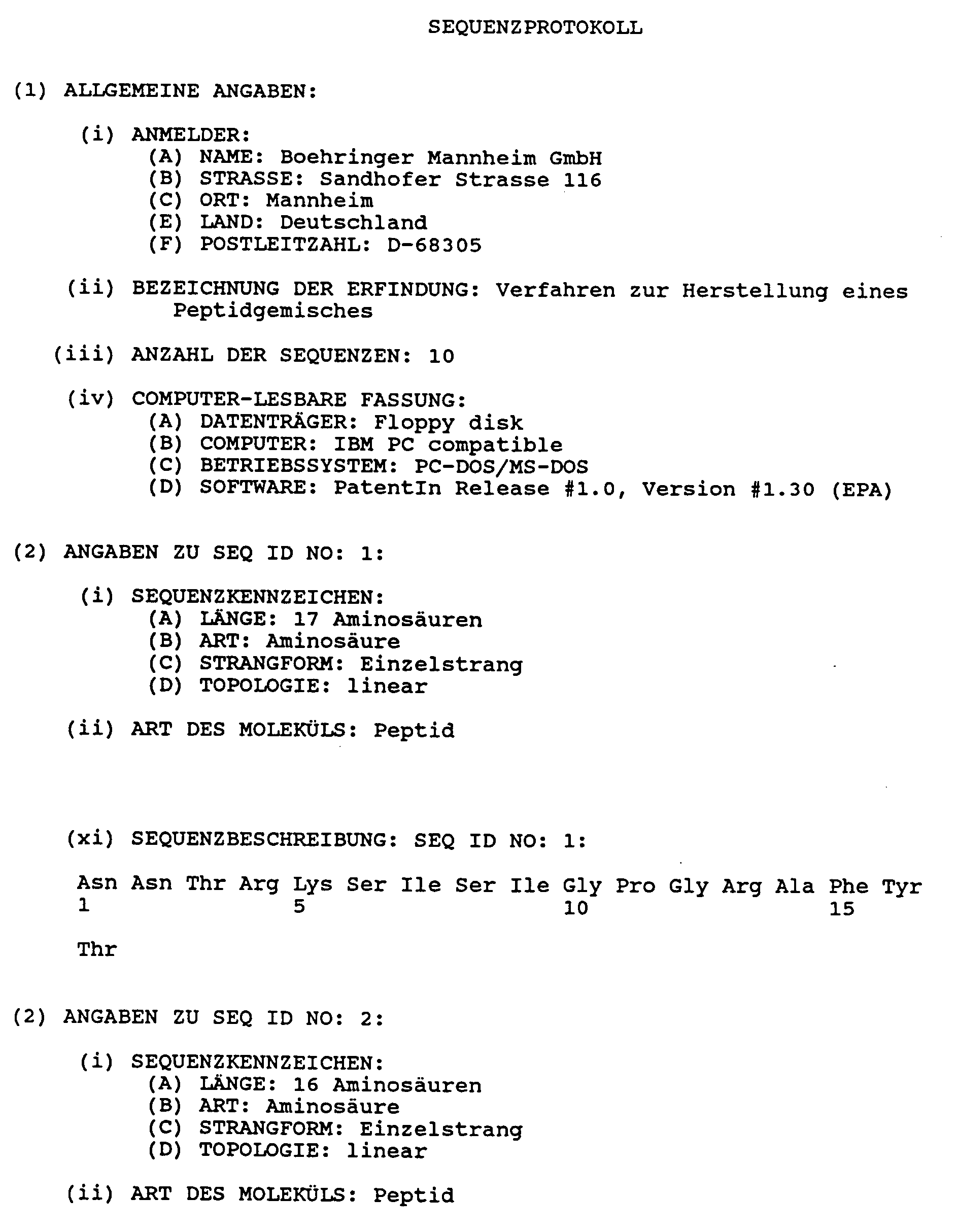
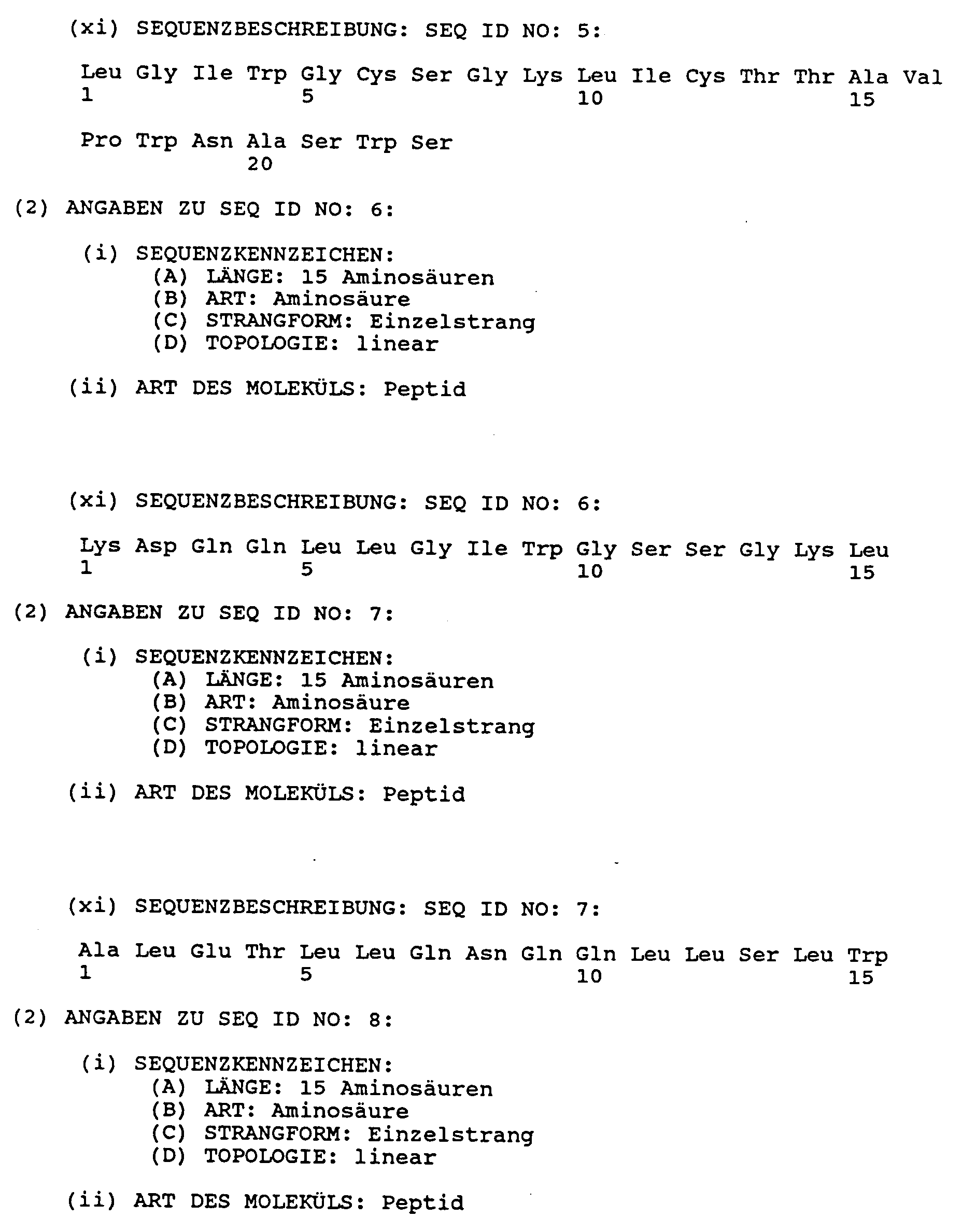
Besonders bevorzugt wird der Epitopbereich der Sequenz von
HIV-I, HIV-Subtyp 0- oder HIV-II-Aminosäuresequenzen ausgewählt
aus der Gruppe der Aminosäuresequenzen:

oder Teilsequenzen davon, die eine Länge von mindestens 6
Aminosäuren und vorzugsweise mindestens 8 Aminosäuren aufweisen.
Die Aminosäuresequenzen I bis III stammen aus der gp120-Region
von HIV-I, die Aminosäuresequenzen IV bis IX stammen
aus der gp41-Region von HIV-I und die Aminosäuresequenz X
stammt aus der gp32-Region von HIV-II. Die Sequenzen IV, VIII
und X erhalten jeweils zwei Cysteine, die vorzugsweise in Form
einer Disulfidbrücke vorliegen. Vorzugsweise enthalten die
Sequenzen einen N- oder/und C-terminalen Spacer, wie oben
definiert, der gegebenenfalls mindestens eine Markierung, S-,
Aktivierungs- oder Festphasenbindegruppe trägt, vorzugsweise
Biotin, ein Biotinanalogon, ein Metallchelat, wie etwa BPRu,
oder einen Cysteinrest. Gegebenenfalls können auch innerhalb
des Epitopbereichs liegende Lysinreste in markierter Form
vorliegen.
Besonders bevorzugt handelt es sich bei dem erfindungsgemäßen
Peptidgemisch um ein Gemisch aus Peptiden auf Basis der obigen
Aminosäuresequenzen (I) oder/und (II) oder auf Basis der Aminosäuresequenz
(IV) und Variationen davon.
Mit dem erfindungsgemäßen Verfahren können sowohl lineare und
cyclische als auch verzweigte Peptidsequenzen hergestellt
werden. Verzweigte Peptide werden bevorzugt dadurch hergestellt,
daß in die Peptidsequenzen Verzweigungsstellen eingebaut
werden. Solche Verzweigungsstellen können beispielsweise
innerhalb immunologisch nicht reaktiver Spacerabschnitte eingebaut
werden und aus tri- oder höherfunktionellen Linkermolekülen
bestehen. Geeignete trifunktionelle Linkermoleküle sind
beispielsweise trifunktionelle Aminosäuren, wie z.B. Lysin
oder Ornithin.
Anhand der Zahl der Verzweigungsstellen oder/und anhand der
Zahl der funktionellen Gruppen der Linkermoleküle kann der
Grad der Verzweigung festgelegt werden. Solche verzweigten
Peptidgemische werden auch als multimere Antigenzusammen-setzungen
bezeichnet und sind z.B. in der deutschen Patentanmeldung
DE 44 30 972 näher beschrieben.
Die Antigene der erfindungsgemäßen multimeren Antigen-zusammensetzungen
weisen bevorzugt die allgemeine Formel
P1{P2[P3(P4)t]s}r auf, wobei P1, P2, P3 und P4 Peptidsequenzen des
erfindungsgemäß hergestellten Peptidgemisches mit einer Länge
der von 6 bis 50 Aminosäuren bedeuten, wobei in den Antigenen
mindestens 2 Peptidsequenzen mit gleichen oder verschiedenen
immunologisch reaktiven Epitopbereichen vorliegen, r 1 oder 2
ist, s eine ganze Zahl von 0 bis 4 ist, und t eine ganze Zahl
von 0 bis 8 ist. Bevorzugt erhalten die Antigene mindestens
eine Verzweigunsstelle. Die Peptidgemische P1, P2, P3 und P4
umfassen dabei jeweils eine Vielzahl unterschiedlicher, statistisch
vorliegender Sequenzen, wodurch erfindungsgemäße multimere
Antigenzusammensetzungen eine Vielzahl unter-schiedlicher
multimerer Antigene umfassen und somit eine Vielzahl von Epitopbereichen
aufweisen.
Weiterhin können multimere Antigen-Zusammensetzungen auch
hergestellt werden, indem man jeweils mindestens zwei Peptide
eines erfindungsgemäßen Peptidgemisches kovalent miteinander
verknüpft. Dabei können mehrere Epitopbereiche kovalent über
Spacerbereiche miteinander gekoppelt werden. Vorzugsweise
erfolgt die Verknüpfung der Epitope mindestens teilweise über
trifunktionelle Linkermoleküle, so daß die Antigen-Zusammensetzung
mindestens eine Verzweigungsstelle und vorzugsweise
ein bis sieben Verzweigungsstellen umfaßt. Solche multimeren
Antigene bilden eine baumarige Struktur mit Verzweigungsstellen
und enthalten vorzugsweise immunologisch reaktive Epitopbereiche.
Die Peptide der erfindungsgemäßen Peptidgemische enthalten
vorzugsweise jeweils mindestens eine Markierungs-, Aktivierungs- oder Festphasenbindegruppe. Diese Gruppen können beispielsweise
selektiv an die Enden oder/und an reaktive Seitenketten
der Peptidsequenzen oder/und an Spacerabschnitte gekoppelt
werden.
Die Peptide des Peptidgemisches können mit allen bekannten
Markierungsgruppen, Aktivierungsgruppen oder Festphasenbindegruppen
gekoppelt werden. Bevorzugt wird mindestens eine Markierungsgruppe,
Aktivierungsgruppe oder Festphasenbindegruppe
an einen Spacerbereich der Peptide gekoppelt.
Als Markierungsgruppen können radioaktive oder nichtradioaktive
Markierungsgruppen verwendet werden, wobei nichtradioaktive
Markierungsgruppen bevorzugt sind. Die Markierungsgruppen
können direkt oder/und indirekt nachweisbar sein. Bei
einer indirekt nachweisbaren Markierung werden die Peptide mit
einer selbst nich direkt nachweisbaren Gruppe gekoppelt, z.B.
einer Biotin- oder Haptengruppe, die durch Reaktion mit einem
geeigneten Bindepartner (Streptavidin, Avidin bzw. Anti-Hapten-Antikörper),
der eine signalerzeugende Gruppe trägt, nachweisbar
ist.
Die Peptide können auch mit direkt nachweisbaren Markierungsgruppen
gekoppelt werden. Beispiele für solche direkt signalerzeugenden
Gruppen sind Chromogene (fluoreszierende oder
lumineszierende Gruppen, Farbstoffe), Enzyme, NMR-aktive Gruppen
oder Metallpartikel, die auf bekannte Weise an das Peptidgemisch
gekoppelt werden. Vorzugsweise ist die direkt nachweisbare
Markierungsgruppe ein durch Elektrochemolumineszenz
nachweisbares Metallchelat, ausgewählt aus der Gruppe bestehend
aus Ruthenium-, Rhenium-, Irridium- und Osmiumchelaten.
Geeignete Liganden sind beispielsweise aromatische heterozyklische
Polydentatliganden und bevorzugt Bipyridyl-, Bipyrazyl-,
Terpyridyl- und Phenanthrolylliganden. Besonders bevorzugt
ist Bispyridyl-Ruthenium (BPRu). Ein Verfahren zur Herstellung
von Metallchelat-markierten Peptiden ist beispielsweise
in der deutschen Patentanmeldung DE 44 30 998 A1 beschrieben.
Als Aktivierungsgruppen werden im allgemeinen solche Gruppen
verwendet, die eine chemische kovalente Kopplung des Peptids
an einen Bindepartner, z. B. ein Tragermolekül ermöglichen.
Beispiele für Aktivierungsgruppen sind SH-Gruppen, die durch
Cysteinreste in das Peptid eingeführt werden können. Diese SH-Gruppen
können mit SH-reaktiven Gruppen auf dem Träger, z.B.
Maleinimidgruppen, gekoppelt werden. Andererseits können auch
Maleinimidgruppen in das Peptid eingeführt werden, welche dann
mit SH-Gruppen des Trägers reagieren können. Weiterhin können
in das Peptid auch Aktivester, z.B. N-Hydroxysuccinimid eingeführt
werden, die mit NH2-Gruppen eines Trägers gekoppelt
werden können.
Als Festphasenbindegruppen werden in das Peptid vorzugsweise
solche Gruppen eingeführt, die ein hochaffine nicht-kovalente
Wechselwirkung mit einer Festphase eingehen. Beispiele für
geeignete Festphasenbindegruppen sind Haptene, die mit einer
Anti-Hapten-Antikörper-beschichteten Festphase gekoppelt werden
können. Bevorzugt als Festphasenbindegruppen sind Biotin
oder Biotinanaloga, wie z.B. Iminobiotin, Aminobiotin, Desthiobiotin,
die eine Kopplung an eine Streptavidin-beschichtete
Festphase erlauben.
Ein weiterer Gegenstand der vorliegenden Erfindung ist ein
durch das obige Verfahren erhältliche Peptidgemisch, in dem
die Peptide in freier Form vorliegen. Dieses Peptidgemisch
enthält mehrere Peptide, die vorzugsweise eine Länge von 6 bis
50 Aminosäuren aufweisen, und die jeweils an selektiv ausgewählten
Positionen mindestens eine Gruppe ausgewählt aus Markierungs-,
Aktivierungs- und Festphasenbindegruppen enthalten.
Noch ein weiterer Gegenstand der vorliegenden Erfindung ist
ein Peptidgemisch, das mehrere Peptide, die vorzugsweise eine
Länge von 6 bis 50 Aminosäuren aufweisen, enthält, wobei die
Peptide Varianten eines immunologisch reaktiven Epitopbereichs
darstellen und jeweils selektiv ausgewählten Positionen mindestens
eine Gruppe ausgewählt aus Markierungs- , Aktivierungs- und
Festphasenbindegruppen enthalten.
Dabei bedeutet das Vorhandensein der Markierungs-, Aktivierungs- und Festphasenbindegruppen an selektiv ausgewählten
Positionen, daß die Einführung dieser Gruppen gezielt durch
die chemische Synthese erfolgt. Die einzelnen Peptide des
Gemisches weisen vorzugsweise eine Sequenzhomologie von jeweils
mindestens 30% zu einer immunologisch reaktiven Basissequenz
auf, d. h. zu einer natürlich vorkommenden Peptidsequenz
eines Antigens, bzw. einer aus mehreren Subtypen ermittelten
Antigenkonsensussequenz auf. Das Peptidgemisch besteht bevorzugt
aus 2 bis 2000 einzelnen Spezies und besonders bevorzugt
aus mindestens 3, 4 oder 10 und aus höchstens 1000 einzelnen
Spezies. Das Peptidgemisch kann aber auch aus bis zu 1010 einzelnen
Spezies bestehen.
Das erfindungsgemäße Peptidgemisch umfaßt vorzugsweise einen
immunologisch reaktiven Epitopbereich oder Variationen davon,
der mit Antikörpern, z.B. aus Humanseren reagieren kann und
einen immunologisch nicht-reaktiven Spacerbereich, wobei der
Spacerbereich bevorzugt die mindestens eine Markierungsgruppe,
Aktivierungsgruppe oder Festphasenbindegruppe trägt. Vorzugsweise
ist der Spacerbereich am Aminoterminus der Peptide angeordnet
und hat eine Länge von 1 bis 20, besonders bevorzugt
von 1 bis 10 Aminosäuren. Der Epitopbereich wird vorzugsweise
aus viralen Epitopbereichen, insbesondere aus HIV-I, HIV-Subtyp
0 oder HIV-II einschließlich Varianten davon ausgewählt
und ist besonders bevorzugt eine der Aminosäuresequenzen (I)
bis (XI) oder eine Teilsequenz davon. Am meisten bevorzugt
stammen die Epitopbereiche aus gp41 oder gp120 von HIVI
oder/und HIV Subtyp O.
An die Peptide des Peptidgemisches ist weiterhin bevorzugt
mindestens eine Markierungsgruppe, mindestens eine Aktivierungsgruppe
oder mindestens eine Festphasebindegruppe gekoppelt.
Beispielsweise kann am Aminoterminus oder/und an Aminoseitengruppen
mindestens 1 Hapten gekoppelt sein. Weiterhin
können die Peptide des Peptidgemisches an ein Metallchelat wie
oben beschrieben oder an Biotin oder Biotinanaloga gekoppelt
sein.
Ein weiterer Gegenstand der Erfindung ist ein Verfahren zur
Herstellung einer Polyhapten-Zusammensetzung, dadurch gekennzeichnet,
daß man ein erfindungsgemäßes Peptidgemisch z. B.
über eine Aktivierungsgruppe mit einem Träger koppelt. Die
Zahl der Peptidsequenzen pro Träger beträgt größer 1 bis 100
und bevorzugt größer 1 bis 40. Es werden dabei Polyhaptene
gebildet, die eine große Variation von Epitopbereichen aufweisen.
Als Träger sind mit dem zu bestimmenden Antikörper
nicht reagierende Substanzen, insbesondere Makromoleküle geeignet,
an die die Epitopbereiche kovalent gekoppelt werden.
Beispiele für geeignete Träger sind Peptide, Polypeptide oder
synthetische Träger z.B. Dextrane. Beispiele für geeignete
Polypeptide sind Albumine, z.B. Rinderserum-Albumin, unspezifische
Immunglobuline, Immunglobulinfragmente, β-Galactosidase
und Polylysin. Bei der Verwendung eines inerten Trägers ist
darauf zu achten, daß er keine Kreuzreaktivität mit Antikörpern
in der Probenflüssigkeit zeigt.
Die Epitopbereiche werden vorzugsweise über einen bifunktionellen
Linker an reaktive Gruppen des Trägers, z.B. NH2- oder
SH-Gruppen gekoppelt. Vorzugsweise erfolgt die Kopplung über
NH2-Gruppen des Trägers. Ein geeignetes Verfahren zur Herstellung
von Polyhaptenen ist beispielsweise in der deutschen
Patentanmeldung DE 44 30 972 A1 beschrieben.
Die Anzahl der Markierungs- oder Festphasenbindegruppen der
Polyhaptene ist variabel, d.h. es können eine oder mehrere
Gruppen vorhanden sein. In manchen Ausführungsformen des erfindungsgemäßen
Verfahrens ist es bevorzugt, wenn mindestens
drei und besonders bevorzugt drei bis 20 Markierungs- oder
Festphasebindegruppen vorhanden sind. Die Festphasenbindegruppen
oder Markierungsgruppen können dabei sowohl an die Peptide
als auch direkt an den Träger gekoppelt sein.
Die erfindungsgemäß hergestellten Polyhapten-Zusammensetzungen
ermöglichen die Erkennung von Antikörpern verschiedenster
Subtypen in Serokonversionsproben, ohne daß man auf die Grenzen
der Wandbeladung des Probegefäßes stößt.
Ein weiterer Gegenstand der Erfindung ist deshalb eine Polyhapten-Zusammensetzung,
die durch das zuvor beschriebene Verfahren
erhältlich ist.
Noch ein weiterer Gegenstand der Erfindung ist eine Polyhapten-Zusammensetzung,
umfassend einen Träger und daran kovalent
gekoppelt ein Gemisch von Peptiden, wobei die Peptide Varianten
eines immunologisch reaktiven Epitopbereichs darstellen
und über eine selektiv ausgewählte Position mit dem Träger
gekoppelt sind.
Vorzugsweise enthält die Polyhaptenzusammensetzung 2 bis 2000
und besonders bevorzugt 3 bis 1000 einzelne Peptidspezies
gekoppelt an Trägermoleküle. Die Länge der Peptidsequenzen
beträgt vorzugsweise 6 bis 50 Aminosäuren.
Die Kopplung der Peptide kann über den N-Terminus, den C-Terminus
oder über reaktive Gruppen in der Seitenkette an den
Träger erfolgen. Eine Möglichkeit der Kopplung besteht darin,
die Trägermoleküle durch Reaktion mit bekannten Linkersubstanzen
(z.B. Maleinimidohexansäure, Maleinimido-propionsäure,
Maleinimidobenzoesäure) an einer NH2-Gruppe zu aktivieren und
ein SH-aktiviertes Peptidgemisch kovalent an den Träger zu
koppeln. Die Markierungs- oder Festphasenbindegruppen werden
üblicherweise in Form von Aktivestern an das Trägermolekül
oder/und an die Epitopbereich gekoppelt. Es sind aber auch
andere Kopplungsmöglichkeiten, z.B. über bifunktionelle Photolinker
denkbar (siehe z.B. deutsche Patentanmeldung DE 44 30
972).
Die Polyhaptene weisen bevorzugt die allgemeine Formel
(P-)nT(-L)m oder T(-P-Lm)n auf, wobei T einen Träger bedeutet,
P Peptidsequenzen des erfindungsgemäßen Peptidgemisches darstellt,
die kovalent an den Träger gekoppelt sind und L Markierungsgruppen
oder Festphasebindegruppen darstellt, die
kovalent an den Träger bzw. die Peptidsequenzen gekoppelt
sind, n eine Zahl von größer 1 bis 100, bevorzugt größer 1 bis
40 ist und m eine Zahl von 1 bis 10 ist, bevorzugt ≥ 2 ist.
Die erfindungsgemäßen Polyhapten-Zusammensetzungen umfassen
eine Vielzahl von unterschiedlichen Polyhaptenen, die die
Epitopbereiche der statistisch verteilten Sequenzen des Peptidgemisches
enthalten.
Die oben beschriebenen Peptidgemische, Polyhapten-Zusammensetzungen
und multimeren Antigen-Zusammensetzungen können erfindungsgemäß
als immunologisches Nachweisreagenz, insbesondere
zur Bestimmung von Antikörpern in einer Probenflüssigkeit
eingesetzt werden. Bevorzugt werden die Substanzen bei einem
immunologischen Verfahren im Brückentest, und besonders bevorzugt
als multiples Antigen zur Verbesserung der Subtypenerkennung
verwendet.
Weiterhin umfaßt die Erfindung ein Verfahren zur immunologischen
Bestimmung eines Analyten, insbesondere eines Antikörpers
in einer Probenflüssigkeit, das dadurch gekennzeichnet
ist, daß man die Probenflüssigkeit mit einem Peptidgemisch
oder/und einer Polyhapten-Zusammensetzung kontaktiert, wobei
das Peptidgemisch oder/und das Polyhapten Peptide umfaßt, die
spezifisch an den zu bestimmenden Analyten binden, und den
Analyten über die Bildung von Immunkomplexen qualitativ
oder/und quantitativ nachweist.
Die Menge des Peptidgemisches bzw. der Polyhaptenzusammensetzung
bei der Bestimmung des Analyten kann je nach Testformat
variiert werden. Die für ein Testformat optimale Einsatzmenge
ist mit einem repräsentativen Serenkollektiv ohne weiteres zu
ermitteln. Die verwendete Menge kann dabei der für ein Einzelantigen
verwendeten Menge entsprechen. In vielen Testformaten
sind jedoch erhöhte Einsatzmengen günstiger, z. B. eine Einsatzmenge,
die mindestens einen Faktor 5, z. B. einen Faktor
10 über der optimalen Einsatzmenge eines Einzelantigens liegt.
Die absolute Menge des Antigens hängt vom Testformat ab.
Noch ein weiterer Gegenstand der Erfindung betrifft ein Reagenz
zur immunologischen Bestimmung eines Analyten, insbesondere
eines Antikörpers, das dadurch gekennzeichnet ist, daß es
mindestens ein gegen den zu bestimmenden Analyten gerichtetes
Peptidgemisch oder/und Polyhapten umfaßt.
Die Erfindung wird durch die nachfolgenden Beispiele näher
beschrieben.
Beispiele:
Beispiel 1:
Biotinylierte, Bipyridyl-Ruthenium-gelabelte oder Thiol-aktivierte
Peptide
Unter dem Begriff Label werden in den folgenden Beispielen
Bipyridyl-Ruthenium-Komplexe sowie Biotin zusammengefaßt.
Weiterhin sind darunter allgemein Fluorophore, Chemiluminophore,
Chromophore, Enzyme, Radionucleotide sowie Partikel (z.B.
Magnetpartikel, Gold) zu verstehen. Als Spacer werden bei den
Peptiden stabilisierende und löslichkeitsvermittelnde Spacer,
die entweder Ladungen enthalten und/oder Wasserstoffbrücken
ausbilden können, eingesetzt. Zumeist handelt es sich um Kombination
aus natürlichen und/oder artifiziellen Aminosäure-Derivaten
(z.B. Kombination aus ε-Aminocapronsäure, β-Alanin,
γ-Aminobuttersäure und/oder Lysin). Als Epitop wird eine reaktive
Peptidsequenz oder ein Protein, das mit Humanseren-Antikörpern
reagiert bezeichnet Als Träger wird ein Protein (z.B.
RSA, β-Gal, div. IgGs) oder ein synthetischer Träger (z.B.
Aminodextran) verwendet.
Die entsprechenden Teilsequenzen der Aminosäuresequenz des
HIV-Virusproteins werden mittels Fluorenylmethyloxycarbonyl(Fmoc)-Festphasenpeptidsynthese
an einem Batch-Peptidsynthesizer,
z.B. von Applied Biosystems A431 oder A433, hergestellt.
Dazu werden folgende Fmoc-Aminosäurederivate verwendet:
| A | Fmoc-Ala-OH |
| C | Fmoc-Cys(Trt)-OH |
| D | Fmoc-Asp(tBu)-OH |
| E | Fmoc-Glu(tBu)-OH |
| F | Fmoc-Phe-OH |
| G | Fmoc-Gly-OH |
| H | Fmoc-His(Trt)-OH |
| I | Fmoc-Ile-OH |
| K | Fmoc-Lys(Boc)-OH |
| L | Fmoc-Leu-OH |
| M | Fmoc-Met-OH |
| N | Fmoc-Asn(Trt)-OH |
| Nle | Fmoc-Norleucin |
| P | Fmoc-Pro-OH |
| Q | Fmoc-Gln(Trt)-OH |
| R | Fmoc-Arg(Pmc)-OH |
| S | Fmoc-Ser(tBu)-OH |
| T | Fmoc-Thr(tBu)-OH |
| U | Fmoc-βAlanin |
| V | Fmoc-Val-OH |
| W | Fmoc-Trp-OH |
| X | Boc-Lys(Fmoc)-OH |
| Y | Fmoc-Tyr(tBu)-OH |
| Z | Fmoc-ε Aminocapronsäure |
Bei den jeweiligen Synthesezyklen werden verschiedene Mischungen
an Aminosäuren eingesetzt. Soll nur eine definierte Aminosäure
gekuppelt werden, verwendet man 4 Äquivalente an Fmoc-geschütztem
Aminosäurederivat, soll eine Mischung von Aminosäuren
gekuppelt werden wird nur die äquimolare Menge an Aminocarbonsäure
verwendet. Dies hat den Vorteil, daß alle Aminosäure
mit gleicher Wahrscheinlichkeit gekuppelt werden und so
eine repräsentative Mischung erhalten wird.
Bei cyclischen Peptiden wird die Aminosäure Methionin gegen
Norleucin ersetzt, um Oxidationsprodukte bei der Cyclisierung
des Loops zu vermeiden.
Die Aminosäuren oder Aminosäurederivate werden in N-Methylpyrrolidon
gelöst. Das Peptid wird an 400-500 mg 4-(2',4'-Dimethoxyphenyl-Fmoc-Aminomethyl)-Phenoxy-Harz
(Tetrahedron Letters
28 (1987), 2107) mit einer Beladung von 0,4 - 0,7 mmol/g
aufgebaut (JACS 95 (1973), 1328). Die Kupplungsreaktionen
werden bezüglich Fmoc-Aminosäurederivat mit 1 oder 4 Äquivalenten
Dicyclohexylcarbodiimid und 1 oder 4 Äquivaltenten N-Hydroxybenzotriazol
in Dimethylformamid als Reaktionsmedium
während 20 min durchgeführt. Nach jedem Kupplungsschritt werden
nicht abreagierte Aminogruppen mit Essigsäureanhydrid
gecapped. Anschließend wird die Fmoc-Gruppe mit 20 %igem Piperidin
in Dimethylformamid in 20 min abgespalten. Enthalten die
Peptide eine intramolekulare Disulfidbrücke, so wird die Fmoc-geschützte
Peptidsequenz vor der Spacersynthese mit Jod in
Hexofluorisopropanol (Kober et al., The Peptide Academic
Press, New York, 1981, Seiten 145-47) an der Festphase oxidiert.
Im Anschluß wird erneut die N-terminale Fmoc-Schutzgruppe
abgespalten und die Spacer-Aminosäuren sowie gegebenenfalls
der Label mit dem Standardverfahren gekuppelt.
Die Freisetzung des Peptides vom Syntheseharz und die Abspaltung
der säurelabilen Schutzgruppen erfolgt mit 20 ml Trifluoressigsäure,
0,5 ml Ethandithiol, 1 ml Thioanisol, 1,5 g
Phenol und 1 ml Wasser in 40 min bei Raumtemperatur. Die Reaktionslösung
wird anschließend mit 300 ml gekühltem Diisopropylether
versetzt und zur vollständigen Fällung des Peptides 40
min bei 0°C gehalten. Der intensiv gelb oder orange gefärbte
Niederschlag wird abfiltriert, mit Diisopropylether nachgewaschen,
mit wenig 50 %iger Essigsäure gelöst und lyophilisiert.
Vom erhaltene Rohmaterial werden mittels präparativer HPLC an
Delta-PAK RP C18 (Säule 50 x 300 mm, 100 Å, 15 µ) über einen
entsprechenden Gradienten (Eluent A: Wasser, 0,1 % Trifluoressigsäure,
Eluent B: Acetonitril, 0,1 % Trifluoressigsäure)
in ca. 120 min kürzere, acetylierte Abbruchsequenzen abgetrennt.
Die Identität des eluierten Materials wird mittels
HPLC-Massenspektrometrie geprüft.
In analoger Weise lassen sich auch multimere Antigene synthetisieren.
Beispiel 2:
Folgende Peptidgemische wurden unter Verwendung der angegebenen
Aminosäurederivate entsprechend Beispiel 1 hergestellt und
immunologisch bewertet.
Die immunologische Bewertung der Peptidgemische erfolgte analog
dem Boehringer Mannheim Enzymun-Test Anti-HIV1+2 (Boehringer
Mannheim GmbH, Kat.-Nr. 1 165062). Das Testprinzip war ein
Zweischritt-ELISA mit einer Streptavidin Festphase. Jedoch
wurde statt des biotinylierte Antigens eine erfindungsgemäße
Peptidmischung in der angegebenen Konzentration eingesetzt.
Die Messungen wurden an den Enzymun-Analyseautomaten ES22 oder
ES600 von Boehringer Mannheim durchgeführt.
a) Gemisch 1: Random-Peptid HIV,gp120 V3
| Bi |
Spacer |
N |
N |
T |
R |
K |
S |
I |
S |
I |
G |
P |
G |
R |
A |
F |
Y |
T |
| |
|
|
|
|
|
R |
|
|
|
|
|
|
|
Q |
V |
|
|
A |
| |
|
|
|
|
|
|
|
|
|
|
|
|
|
|
T |
| |
| |
| |
| |
| |
In der ersten Zeile ist die Aminosäuresequenz des Standardantigens 1 aus HIV gp120 V3 angegeben.
Die Spacersequenz ist XUZU. Das erhaltene Peptidgemisch umfaßt 24 unterschiedliche Peptidsequenzen.
b) Gemisch 2: Random-Peptid HIV,gp120 V3
| Bi |
Spacer |
N |
N |
T |
R |
K |
S |
I |
S |
I |
G |
P |
G |
R |
A |
F |
Y |
T |
| |
|
|
|
|
|
R |
R |
T |
H |
|
|
|
|
Q |
V |
|
|
A |
| |
|
|
|
|
|
Q |
|
V |
P |
|
|
|
|
|
T |
| |
| |
| |
| |
| |
In der ersten Zeile ist die Aminosäuresequenz des Standardantigens 1 aus HIV gp120 V3 angegeben.
Die Spacersequenz ist XUZU. Das erhaltene Peptidgemisch umfaßt 648 unterschiedliche Peptidsequenzen.
c) Gemisch 3: Random-Peptid HIV,gp41
| Bi |
Spacer |
A |
V |
E |
R |
Y |
L |
K |
D |
Q |
Q |
L |
L |
G |
I |
W |
| |
|
|
L |
|
S |
|
I |
R |
|
|
K |
F |
|
N |
L |
| |
|
|
|
|
|
|
|
Q |
| |
In der ersten Zeile ist die Aminosäuresequenz des Standardantigens 2 aus HIV gp41 angegeben. Die
Spacersequnez ist XUZU.Das erhaltene Peptidgemisch umfaßt 384 unterschiedliche Peptidsequenzen.
Die Ergebnisse mit den erfindungsgemäßen Peptidgemischen waren
wie folgt.
Bei einigen Seren verschiedener Subtypen ist bereits bei gleicher
Einsatzmenge die Erkennung durch das Peptidgemisch höher
als mit der B-Sequenz des Standardantigens 1 (Konsensussequenz
für Subtyp B).
| Serum | Subtyp | Standardantigen 1 | Gemisch 1 | Gemisch 2 |
| | | Einsatz 200 ng/ml | Einsatz 200 ng/ml | Einsatz 200 ng/ml |
| | | Signal in mE | Signal in mE | Signal in mE |
| Negativkontrolle | | 158 | 126 | 137 |
| Positivserum 1 | C | 2199 | 2417 | 2495 |
| Positivserum 2 | A | 1537 | 1572 | 1739 |
Bei anderen Seren wird bei einer Erhöhung der Einsatzmenge
eine Verbesserung des Testergebnisses durch Verwendung des
Gemisches gefunden.
| Serum | Subtyp | Standardantigen 1 | Gemisch 1 | Gemisch 2 |
| | | Einsatz 20 ng/ml | Einsatz 200 ng/ml | Einsatz 200 ng/ml |
| Negativkontrolle | | 158 | 126 | 137 |
| Positivserum 3 | B | 2037 | 2994 | 2640 |
| Positivserum 4 | B | 4932 | 4602 | 4968 |
| Positivserum 5 | B | 729 | 850 | 1054 |
| Positivserum 6 | B | 519 | 610 | 864 |
| Positivserum 7 | B | 3523 | 4289 | 3654 |
| Positivserum 8 | C | 703 | 2417 | 2495 |
| Positivserum 9 | C | 1290 | 1288 | 1852 |
| Positivserum 10 | A | 224 | 1572 | 1739 |
| Positivserum 11 | C | 336 | 1240 | 626 |
| Positivserum 12 | C | 511 | 1543 | 903 |
| Positivserum 13 | CA | 1939 | 2448 | 3092 |
| Positivserum 14 | D | 345 | 3799 | 3348 |
| Positivserum 15 | AC | 2236 | 4091 | 4275 |
Auch bei Standardantigen 2 (Konsensussequenz für Subtyp B) ist
die Erkennung durch das Peptidgemisch bereits bei gleichen
Einsatzmengen höher.
| Serum | Subtyp | Standardantigen 2 | Gemisch 3 |
| | | Einsatz 200 ng/ml | Einsatz 200 ng/ml |
| Signal in mE | Signal in mE |
| Negativkontrolle | | 105 | 110 |
| Positivserum 12 | C | 1877 | 2961 |
| Positivserum 15 | D | 123 | 1344 |
| Positivserum 16 | C | 291 | 1492 |
Bei anderen Seren muß die Einsatzmenge erhöht werden, um eine
Verbesserung durch das Peptidgemisch zu erreichen.
| Serum | Subtyp | Standardantigen 2 | Gemisch 3 |
| | | Einsatz 20 ng/ml | Einsatz 200 ng/ml |
| | | Signal in mE | Signal in mE |
| Negativkontrolle | | 100 | 110 |
| Positivserum 3 | B | 141 | 314 |
| Positivserum 4 | B | 254 | 1010 |
| Positivserum 5 | B | 3313 | 3613 |
| Positivserum 8 | C | 1173 | 1310 |
| Positivserum 11 | C | 340 | 2961 |
| Positivserum 12 | D | 187 | 283 |
| Positivserum 14 | D | 66 | 1344 |
| Positivserum 15 | AC | 116 | 1492 |
Für die Synthese der Polyhaptene (PH) werden die entsprechenden
Peptide mit einer reaktiven Mercaptofunktion, z.B. durch
Einführen von einem zusätzlichen Cystein, hergestellt. Das
Peptid kann dabei entweder N-,C-terminal oder auch beliebig in
der Sequenz mit einem sogenannten Linker modifiziert sein. Die
Synthese der entsprechenden Peptide erfolgt wie in Beispiel 1
beschrieben.
Für die Umsetzung zum Polyhapten wird der NH2-Gruppen-haltige
Träger zuerst mit dem entsprechenden Aktivester des Labels und
anschließend mit Maleinimidoalkyl-Gruppen, durch Behandlung
vorzugsweise mit Maleinimidohexyl- (MHS) oder Maleinimidopropyl-N-hydroxysuccinimidoester
(MPS), beladen. Dadurch werden
die Aminogruppen der ε-Aminoseitenkette von Lysinresten im
Protein z.T. mit Biotin, Digoxigenin oder Bipyridylruthenium
gelabelt und zum anderen Teil in Maleinimidgruppen umgewandelt.
Die Umsetzung des Trägers mit den Aktivestern erfolgt vorzugsweise
in 0,1 M Kaliumphosphatpuffer pH 7,0 - 8,5 und einer
Konzentration von 5-20 mg/ml innerhalb von 2-4 h bei Raumtemperatur.
Die niedermolekularen Bestandteile werden entweder
über Dialyse oder Gelchromatographie (AcA 202-Gel, Eluent 0,1
M Kaliumphosphatpuffer pH 7-8,5) abgetrennt.
In einem weiteren Schritt wird dann das Peptid oder die Peptidmischung
mit der reaktiven Mercaptofunktion an das MHS-modifizierte,
gelabelte Trägerprotein in 0,1 M Kaliumphosphatpuffer
pH 8,5 innerhalb von 6 h bei Raumtemperatur gekuppelt .
Nicht umgesetztes Peptid wird entweder mittels Dialyse oder
Gelchromatographie abgetrennt.
Die Polyhaptene können in Tests wie in Beispiel 2 beschrieben
eingesetzt werden.
Soll der Label direkt am Peptid sitzen, wird das Polyhapten
anlog synthetisiert, nur wird jetzt ein entsprechend gelabeltes,
SH-aktiviertes Peptid eingesetzt.