EP0847994B1 - Verfahren zur Herstellung gemischter Anhydride - Google Patents
Verfahren zur Herstellung gemischter Anhydride Download PDFInfo
- Publication number
- EP0847994B1 EP0847994B1 EP97121298A EP97121298A EP0847994B1 EP 0847994 B1 EP0847994 B1 EP 0847994B1 EP 97121298 A EP97121298 A EP 97121298A EP 97121298 A EP97121298 A EP 97121298A EP 0847994 B1 EP0847994 B1 EP 0847994B1
- Authority
- EP
- European Patent Office
- Prior art keywords
- acid
- amino
- formula
- process according
- converted
- Prior art date
- Legal status (The legal status is an assumption and is not a legal conclusion. Google has not performed a legal analysis and makes no representation as to the accuracy of the status listed.)
- Expired - Lifetime
Links
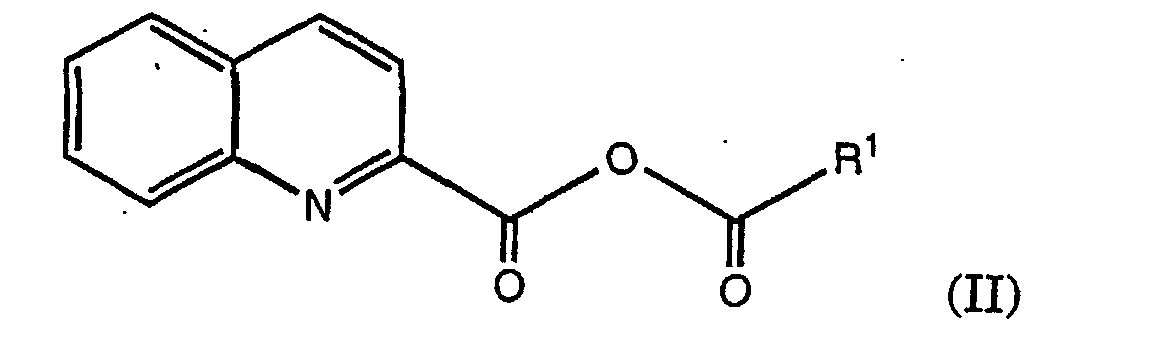
- 0 *C(OC(c1nc(cccc2)c2cc1)=O)=O Chemical compound *C(OC(c1nc(cccc2)c2cc1)=O)=O 0.000 description 3
Classifications
-
- C—CHEMISTRY; METALLURGY
- C07—ORGANIC CHEMISTRY
- C07D—HETEROCYCLIC COMPOUNDS
- C07D217/00—Heterocyclic compounds containing isoquinoline or hydrogenated isoquinoline ring systems
- C07D217/22—Heterocyclic compounds containing isoquinoline or hydrogenated isoquinoline ring systems with hetero atoms or with carbon atoms having three bonds to hetero atoms with at the most one bond to halogen, e.g. ester or nitrile radicals, directly attached to carbon atoms of the nitrogen-containing ring
- C07D217/24—Oxygen atoms
-
- C—CHEMISTRY; METALLURGY
- C07—ORGANIC CHEMISTRY
- C07C—ACYCLIC OR CARBOCYCLIC COMPOUNDS
- C07C271/00—Derivatives of carbamic acids, i.e. compounds containing any of the groups, the nitrogen atom not being part of nitro or nitroso groups
- C07C271/06—Esters of carbamic acids
- C07C271/08—Esters of carbamic acids having oxygen atoms of carbamate groups bound to acyclic carbon atoms
- C07C271/10—Esters of carbamic acids having oxygen atoms of carbamate groups bound to acyclic carbon atoms with the nitrogen atoms of the carbamate groups bound to hydrogen atoms or to acyclic carbon atoms
- C07C271/22—Esters of carbamic acids having oxygen atoms of carbamate groups bound to acyclic carbon atoms with the nitrogen atoms of the carbamate groups bound to hydrogen atoms or to acyclic carbon atoms to carbon atoms of hydrocarbon radicals substituted by carboxyl groups
-
- C—CHEMISTRY; METALLURGY
- C07—ORGANIC CHEMISTRY
- C07D—HETEROCYCLIC COMPOUNDS
- C07D211/00—Heterocyclic compounds containing hydrogenated pyridine rings, not condensed with other rings
- C07D211/04—Heterocyclic compounds containing hydrogenated pyridine rings, not condensed with other rings with only hydrogen or carbon atoms directly attached to the ring nitrogen atom
- C07D211/06—Heterocyclic compounds containing hydrogenated pyridine rings, not condensed with other rings with only hydrogen or carbon atoms directly attached to the ring nitrogen atom having no double bonds between ring members or between ring members and non-ring members
- C07D211/36—Heterocyclic compounds containing hydrogenated pyridine rings, not condensed with other rings with only hydrogen or carbon atoms directly attached to the ring nitrogen atom having no double bonds between ring members or between ring members and non-ring members with hetero atoms or with carbon atoms having three bonds to hetero atoms with at the most one bond to halogen, e.g. ester or nitrile radicals, directly attached to ring carbon atoms
- C07D211/40—Oxygen atoms
- C07D211/44—Oxygen atoms attached in position 4
- C07D211/46—Oxygen atoms attached in position 4 having a hydrogen atom as the second substituent in position 4
-
- C—CHEMISTRY; METALLURGY
- C07—ORGANIC CHEMISTRY
- C07D—HETEROCYCLIC COMPOUNDS
- C07D215/00—Heterocyclic compounds containing quinoline or hydrogenated quinoline ring systems
- C07D215/02—Heterocyclic compounds containing quinoline or hydrogenated quinoline ring systems having no bond between the ring nitrogen atom and a non-ring member or having only hydrogen atoms or carbon atoms directly attached to the ring nitrogen atom
- C07D215/16—Heterocyclic compounds containing quinoline or hydrogenated quinoline ring systems having no bond between the ring nitrogen atom and a non-ring member or having only hydrogen atoms or carbon atoms directly attached to the ring nitrogen atom with hetero atoms or with carbon atoms having three bonds to hetero atoms with at the most one bond to halogen, e.g. ester or nitrile radicals, directly attached to ring carbon atoms
- C07D215/48—Carbon atoms having three bonds to hetero atoms with at the most one bond to halogen
Definitions
- the present invention relates to an improved method of manufacture mixed anhydrides.
- mixed anhydrides is known per se and is based on the reaction of an acid with a reactive acid derivative, e.g. B. an acid halide or acid anhydride in the presence of a Auxiliary base.
- a reactive acid derivative e.g. B. an acid halide or acid anhydride in the presence of a Auxiliary base.
- the production of mixed anhydrides is for example from Bodansky in "Principles of Peptide Synthesis", 2nd ed., Springer-Verlag, Berlin, 1993, pages 21-29 and in "The Practice of Peptide Synthesis", 2nd ed., Springer Verlag, Berlin, 1994 and from Stelzel in Houben-Weyl, volume XV / 2, "Methods of Organic Chemistry:" Synthesis of Peptides ", Part II, have been described.
- Bodansky Describes the synthesis of mixed anhydrides with pivaloyl chloride for use in peptide synthesis.
- acid and auxiliary base are introduced and the acid chloride is added.
- the mixture is stirred for 2 hours at -5 ° C and then for 1 hour at room temperature.
- the procedure for the preparation of N ⁇ -benzyloxycarbonyl-N ⁇ -p-toluene-sulfonyl-L-lysylglycine-ethyl ester is analogous.
- Stelzel Describes the synthesis of N-benzyloxycarbonyl-lprolyl-L-leucylglycine ethyl ester based on the addition of isovaleroyl chloride to a mixture of Z-Pro-OH and triethylamine in toluene.
- the present invention comprises a process for the preparation of mixed anhydrides, characterized in that an auxiliary base is added to the mixture of acid and reactive acid derivative, wherein the acid is a carboxylic acid, the auxiliary base is a tertiary amine and the reactive acid derivative is an acid halide of an acid R. 1 is -COOH or an alkyl chloroformate, wherein R 1 is alkyl, cycloalkyl, heteroaryl or aryl.
- Carboxylic acids in question come within the scope of the present invention Carboxylic acids in question. It can be z. B. unsubstituted and substituted aliphatic, aromatic, aromatic-aliphatic, heteroaromatic or heteroaromatic-aliphatic carboxylic acids or protected aminocarboxylic acids, e.g. B. N-acylated aminocarboxylic acids, such as natural N-acylated ⁇ -amino acids with L configuration or corresponding non-natural with D configuration as well as the corresponding Racemates of L and D amino acids. In addition, homologues such amino acids are used, e.g. B.
- Substituted aromatic N-acylated ⁇ -amino acids e.g. B. substituted phenylalanine or phenylglycine can be used, which one or carry more of the following substituents - independently of one another can: alkyl, e.g. B. methyl, halogen, a protected hydroxy group, alkoxy, z. B. methoxy, alkanoyloxy, e.g. B. acetoxy, a protected amino or Alkylamino group, alkanoylamino, e.g. B.
- acetylamino or pivaloylamino Alkoxycarbonyl amino, z.
- benzene-fused phenylalanine or phenylglycine such as ⁇ -naphthylalanine, or hydrogenated phenylalanine or phenylglycine, such as Cyclohexylalanine or Cyclohexylglycine, a 5- or 6-membered cyclic benzene-fused N-acylated ⁇ -amino acid, e.g. Indoline-2-carboxylic acid or 1,2,3,4-tetrahydroisoquinoline-3-carboxylic acid in question.
- Carboxy group in the side chain in esterified or amidated form is present, e.g. B. as an alkyl ester group, such as methoxycarbonyl or t-butoxycarbonyl, or as a carbamoyl group, alkylcarbamoyl group, such as methylcarbamoyl, or as a dialkylcarbamoyl group, such as dimethylcarbamoyl, and in which the amino group of the side chain is in acylated form, e.g. B.
- alkyl ester group such as methoxycarbonyl or t-butoxycarbonyl
- alkylcarbamoyl group such as methylcarbamoyl
- dialkylcarbamoyl group such as dimethylcarbamoyl
- Alkanoylamino group such as acetylamino or pivaloylamino
- alkoxycarbonylamino group such as t-butoxycarbonylamino
- amino acids in which a carboxy group in the Side chain is present as an arylmethoxycarbonylamino group such as Benzyloxycarbonylamino
- a hydroxy group of the Side chain can be in etherified or esterified form, e.g. B. as Alkoxy group, such as methoxy, but also as an arylalkoxy group, such as Benzyloxy, or as a lower alkanoyloxy group, such as acetoxy.
- Suitable N-acyl groups are alkanoyl, such as acetyl or pivaloyl, alkoxycarbonyl, such as t-butoxycarbonyl, Arylalkoxycarbonyl, such as benzyloxycarbonyl.
- Suitable unsubstituted and substituted aliphatic, aromatic and aromatic aliphatic carboxylic acids can are propionic acid, isobutyric acid, (R) - and (S) -lactic acid as well the corresponding racemates, 2-phthalimidoxy-isobutyric acid, Benzoic acid, 3,4-dihydroxybenzoic acid, salicylic acid, 1-naphthoic acid, 2-naphthoic acid, Phenylacetic acid, p-hydroxyphenyl acetic acid, (S) - ⁇ - [(t-butylsulfonyl) methyl] hydrocinnamic acid and (S) - ⁇ - [[[1- (morpholinocarbonyl) -1-methylethyl] sulfonyl] methyl] hydrocinnamic acid.
- heteroaromatic or heteroaromatic-aliphatic carboxylic acids 2-pyridinecarboxylic acid, 3-pyridinecarboxylic acid, 4-pyridinecarboxylic acid, 5-chloro-2-pyridinecarboxylic acid, 2-pyrimidinecarboxylic acid, 4-pyrimidinecarboxylic acid, 2-quinolinecarboxylic acid, 3-quinolinecarboxylic acid, 2-pyridylacetic acid, 3-indolylacetic acid, 3- (3-indolyl) propionic acid, Isoquinoline-1-carboxylic acid and (4-imidazolyl) acetic acid to be named.
- suitable amino acids described above that optionally used in the form of their protected derivatives can, are glycine, alanine, valine, norvaline, leucine, isoleucine, Norleucine, serine, homoserine, threonine, methionine, cysteine, proline, trans-3 and trans-4-hydroxyproline, phenylalanine, tyrosine, 4-nitrophenylalanine, 4-aminophenylalanine, 4-chlorophenylalanine, ⁇ -phenylserine, phenylglycine, ⁇ -naphthylalanine, cyclohexylalanine, cyclohexylglycine, tryptophan, Indoline-2-carboxylic acid, 1,2,3,4-tetrahydroisoquinoline-3-carboxylic acid, Aspartic acid, asparagine, aminomalonic acid, Aminomalonic acid monoamide, glutamic acid, glutamic acid monobut
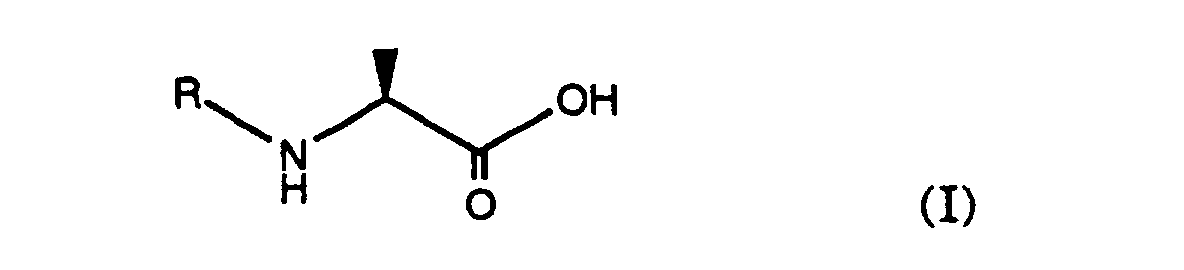
- Preferred carboxylic acids are quinoline-2-carboxylic acid and the protected aminocarboxylic acids of the formula I. where R is an amino protecting group.
- Particularly preferred carboxylic acids are quinolinecarboxylic acids and acids of the formula 1 in which R represents the benzyoxycarbonyl or the tert.butoxycarbonyl protective group, for example (S) -2-benzyloxycarbonylamino-propionic acid or (S) -2-tert-butyloxycarbonylaminopropionic acid.
- the acids described are commercially available or can be by reaction with reactive derivatives of the amino protecting groups produce.
- alkyl denotes cyclic, branched or straight-chain alkyl groups with 1-8, preferably 1-4 carbon atoms.
- aryl or “aromatics” alone or in combination refers to the phenyl or naphthyl group, optionally by one or more times by alkyl, e.g. B. methyl, halogen, a protected hydroxy group, alkoxy, e.g. B. methoxy, alkanoyloxy, e.g. B. Acetoxy, a protected amino or alkylamino group, alkanoylamino, z. B. acetylamino or pivaloylamino, alkoxycarbonylamino, e.g. B. t-butoxycarbonylamino, Arylmethoxycarbonylamino, e.g. benzyloxycarbonylamino, 9-fluorenylmethoxycarbonyl and / or nitro may be substituted. Substitution with alkyl or halogen is preferred, particularly preferred one with alkyl.
- cycloalkyl refers to cyclic alkyl groups preferably 3 to 8 carbon atoms.
- halogen denotes fluorine, chlorine, bromine and iodine.
- heteroaryl denotes an aromatic five- or six-membered ring that is selected from one or two heteroatoms May contain nitrogen, oxygen or suspended matter. Heteroaryl rings can have a substitution pattern as defined for "aryl”.
- amino protecting group refers to from the state protecting groups known in the art of the amino function, such as those used for Example used in peptide chemistry.
- Examples of such Amino protecting groups are the benzyoxycarbonyl or the tert.B utoxycarbonyl protecting group.
- Acid halides derived from the acid R 1 -COOH, where R 1 is alkyl, cycloalkyl, heteroaryl or aryl can be used as "reactive acid derivatives". Compounds in which R 1 is alkyl or aryl are preferred; Compounds in which R 1 is alkyl are particularly preferred.
- the corresponding acid halides (R 1 -C (O) Hal), in particular the chlorides (the acid chlorides R 1 -C (O) Cl), are preferred.
- 2-ethylbutyric acid chloride, cyclohexane carboxylic acid chloride, 2,2-dimethyl-propionic acid chloride (pivaloyl chloride) and isovaleroyl chloride are preferably used due to the steric and positive inductive effect.
- alkyl chloroformate z. B. ethyl chloroformate
- the particularly preferred reactive acid derivatives are pivaloyl chloride, Isovaleroyl chloride or ethyl chloroformate.
- the corresponding Halides are commercially available or by known methods produced.
- the corresponding acid chlorides are through Implementation of the acid with thionyl, phosphorus trichloride or Phosphorus pentachloride available.
- the mentioned chloroformic acid alkyl esters are commercially available or according to known Methods can be produced.
- Tertiary amines aliphatic and aromatic, used.
- N-methyl and N-ethylmorpholine and dialkylanilines, such as Dimethylaniline can be used.
- Triethylamine is preferred.
- the most preferred bases are tertiary amines such as N-ethylmorpholine, dimethylaniline, triethylamine or N, N, N ', N'-tetramethylethylene diamine, but especially triethylamine.
- Inert solvents such as tetrahydrofuran, Toluene, hexane, acetone, dioxane, preferably lower carboxylic acid esters such as Alkyl acetates, especially methyl, ethyl and isopropyl acetate, are used become.
- the reaction is advantageously under temperature control between -25 and + 25 ° C, preferably between 0 and + 5 ° C, performed.
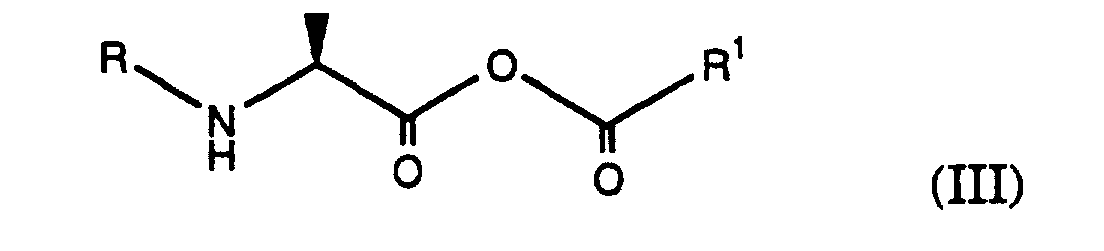
- the present invention thus also comprises a process for the preparation of an anhydride of the formula or where R is an amino protecting group and R 1 is alkyl, cycloalkyl, heteroaryl or aryl.
- R 1 is alkyl or aryl are preferred;
- the method described above is suitable for example for the Use in peptide synthesis and / or for pharmaceutical production effective substances or corresponding starting or intermediate products.
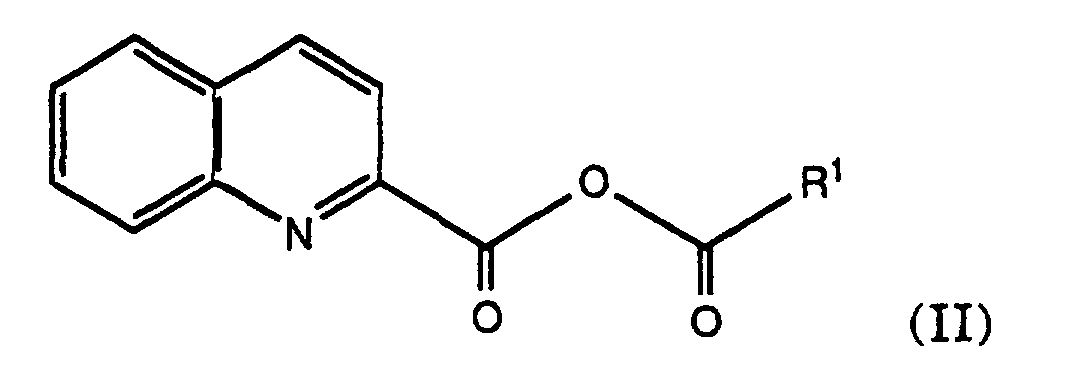
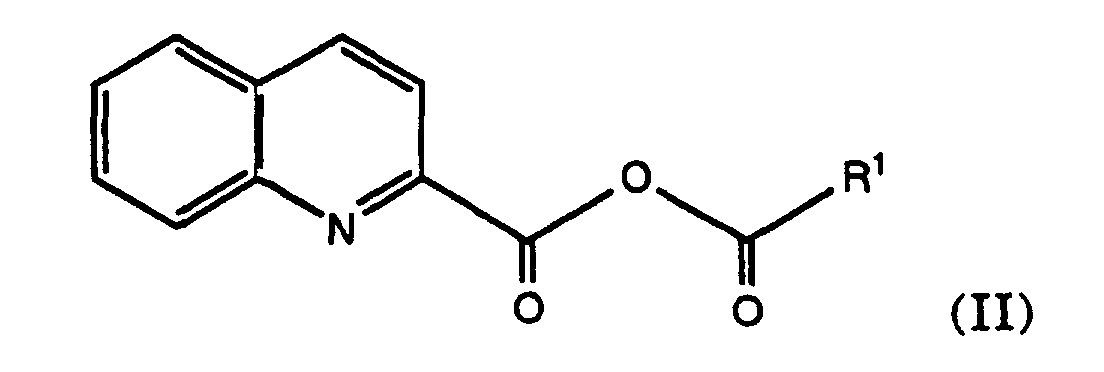
- the present invention thus comprises a process for the preparation of a mixed quinoline-2-carboxylic anhydride of the formula according to the described method, wherein R 1 is as defined above.
- Quinoline-2-carboxylic acid is reacted with the corresponding reactive acid derivative, ie preferably an acid halide which is derived from the corresponding acid R 1 -COOH.
- the corresponding acid chloride is preferred.
- the anhydride of formula (II) obtained can then for example to N- (2-quinolylcarbonyl) -L-asparagine (quinargine) Reaction with asparagine can be implemented.
- Quinargine is known per se and for example in European Patent Application No. 611774 described. It is a valuable intermediate for manufacturing pharmacologically active compounds. So quinargine like in example 7 of the European patent application mentioned in pharmacologically active compounds that are mainly transferred are suitable for the treatment of viral infections, in particular those infections, caused by HIV or other retroviruses.
- quinoline-2-carboxylic acid can be reacted with a reactive derivative of an acid R 1 -COOH, where R 1 is as defined above, for example with pivaloyl chloride, and an auxiliary base, e.g. B. triethylamine.
- R 1 is as defined above
- auxiliary base e.g. B. triethylamine.
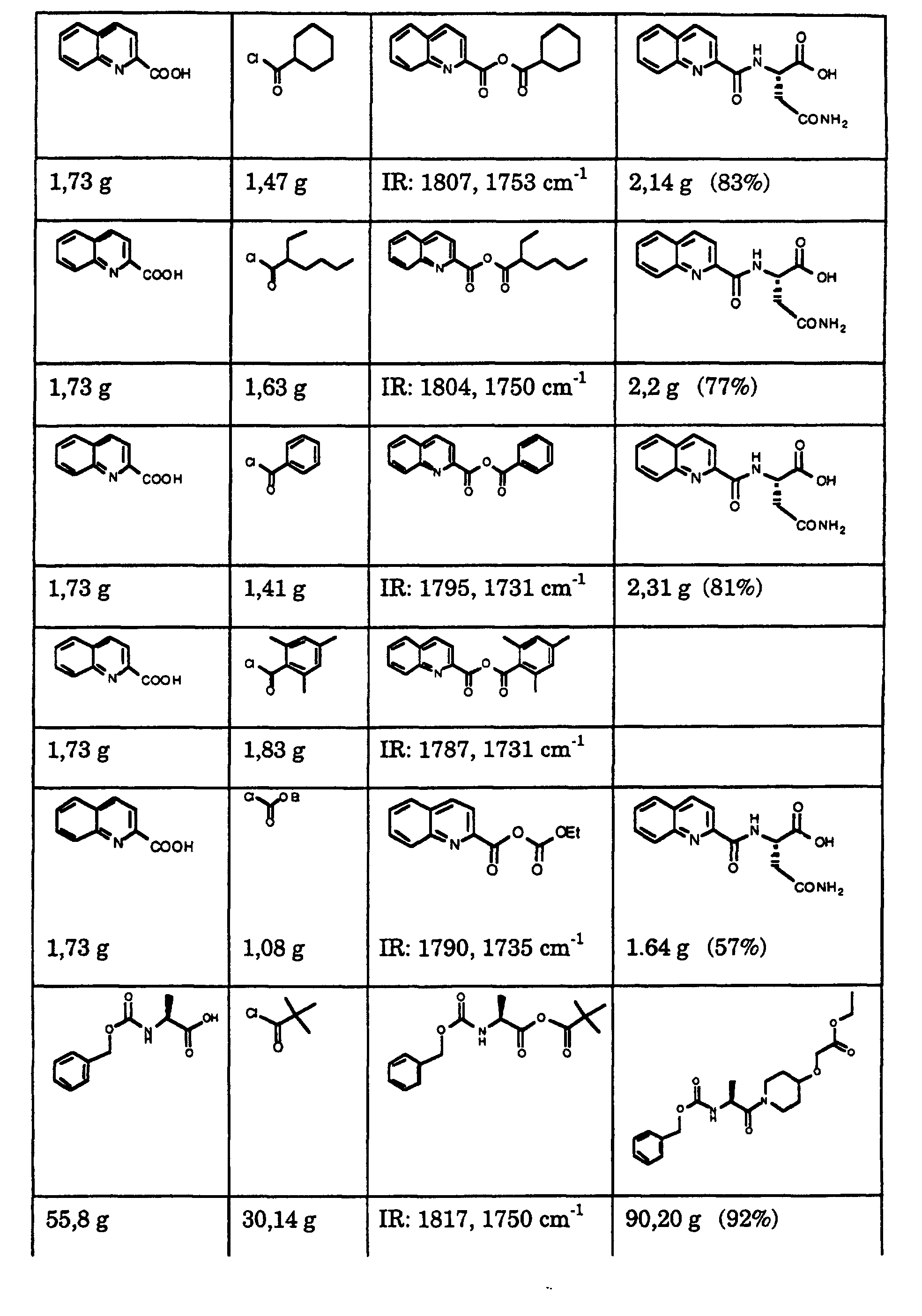
- This reaction which is described in detail in Example 1, provides the corresponding mixed anhydride, here z. B. 2,2-dimethylpropionic acid quinoline-2-carboxylic acid anhydride, which after isolation or also directly, without further purification, can be reacted with asparagine in an aqueous, alkaline solution to quinargine.
- reaction with asparagine preferably takes place in an aqueous NaOH / NaHCO 3 solution.
- N- (2-quinolylcarbonyl) -L-asparagine S-quinargine
- S-quinargine N- (2-quinolylcarbonyl) -L-asparagine
- the present invention furthermore comprises the manufacture of pharmaceuticals active substances.
- B. a carbodiimide and an N-hydroxy compound the N-hydroxy compound is present in a catalytic amount.
- the invention thus also includes a method for manufacturing of these connections.
- a method for manufacturing of these connections comprises in a first one Step the preparation of a mixed anhydride and its implementation to quinargine as described above.
- the mixed anhydride e.g. B. 2,2-dimethylpropionic acid-quinoline-2-carboxylic acid anhydride
- an auxiliary base e.g. B. triethylamine
- preferred Pivaloyl chloride can be obtained.
- the resulting mixed anhydride then becomes L- asparagine in alkaline solution to N- (2-quinolylcarbonyl) -L-asparagine implemented.
- an acid of the formula (I) with a reactive derivative of an acid R 1 -COOH to give an anhydride of the formula (III) to implement, wherein R is an amino protecting group as defined above and R 1 is alkyl, cycloalkyl, heteroaryl or aryl.
- R 1 is alkyl, cycloalkyl, heteroaryl or aryl.
- Processes are preferred in which compounds are used in which R 1 is alkyl or aryl; Compounds in which R 1 is alkyl are particularly preferred.
- the amino protective group can be a protective group known from the prior art, as is used, for example, in peptide chemistry. Examples of such amino protective groups are the benzyoxycarbonyl or the tert.butoxycarbonyl protective group.
- Amino protecting group of aminopropionic acid can be any act a suitable amino protecting group, preferred are Benzyloxycarbonyl and the tert-butyloxycarbonyl protecting group.
- the received mixed anhydrides (S) -2-benzyloxycarbonyl-aminopropionic acid-2,2-dimethylpropionic anhydride and (S) -2-tert-butoxycarbonylamino-propionic acid-2,2-dimethylpropionic acid anhydride can with (piperidin-4-yloxy) ethyl acetate, e.g. B. in one Potassium phosphate-buffered, aqueous ethyl acetate suspension implemented are obtained, whereby the above-mentioned intermediates are obtained.
- This Intermediates can become active pharmaceutical ingredients to be processed further.
- the process described above can be carried out as follows to prepare this substance:
- the protective groups of the intermediates described above can be split off and the amine obtained can be reacted with an appropriate acid chloride and then reacted with hydroxylamine to give the substance mentioned Benzyloxycarbonyl protective group by hydrogenation and the tert.-butoxycarbonyl protective group by acid from (S) - [1- (2-benzyloxycarbonylamino-propionyl) piperidin-4-yloxy] acetic acid ethyl ester and (S) - [1- (2-tert- butyloxycarbonylamino-propionyl) -piperidin-4 -yloxy] -acetate are split off.
- the released amine can then with 4-cyanobenzoic acid chloride, which can be prepared from thionyl chloride and 4-cyanobenzoic acid, and subsequently by reaction with hydroxylamine hydrochloride and triethylamine and working up in an acidic medium to give [Z] - (S) - [[1- [2 - [[4- (Amino-hydroximino-methyl) -benzoyl] amino] -1-oxopropyl] -4-piperidinyl] oxy] ethyl acetate according to Example 4.
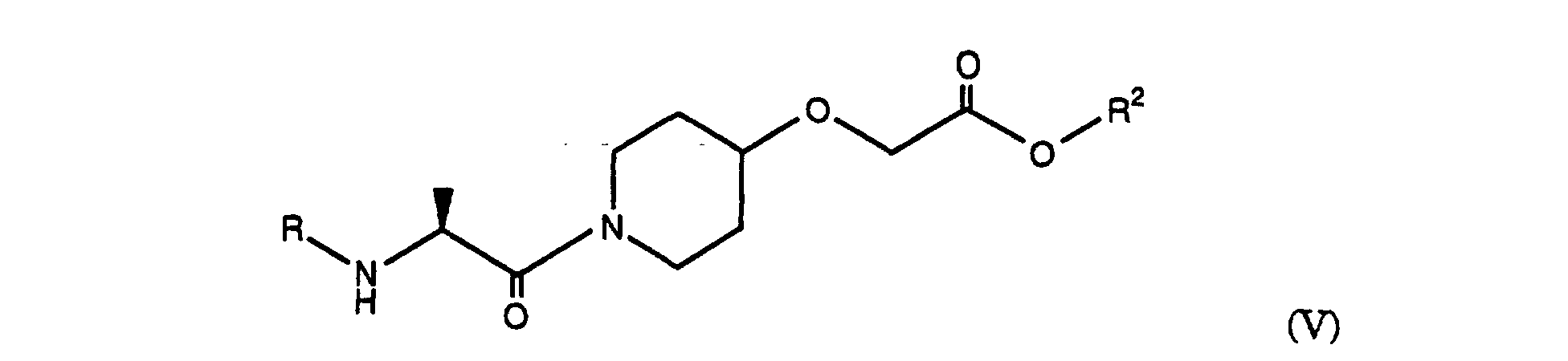
- the process according to the invention also relates to the preparation of [Z] - (S) - [[1- [2 - [[4- (amino-hydroximino-methyl) -benzoyl] amino] -1-oxopropyl] -4- piperidinyl] oxy] ethyl acetate, characterized in that in a first step a mixed anhydride is prepared as described above and by reaction with a compound of formula (IV), wherein R 2 represents an alkyl group, preferably ethyl or tert-butyl, is converted into an ester of the formula (V), where R and R 2 are as defined above.
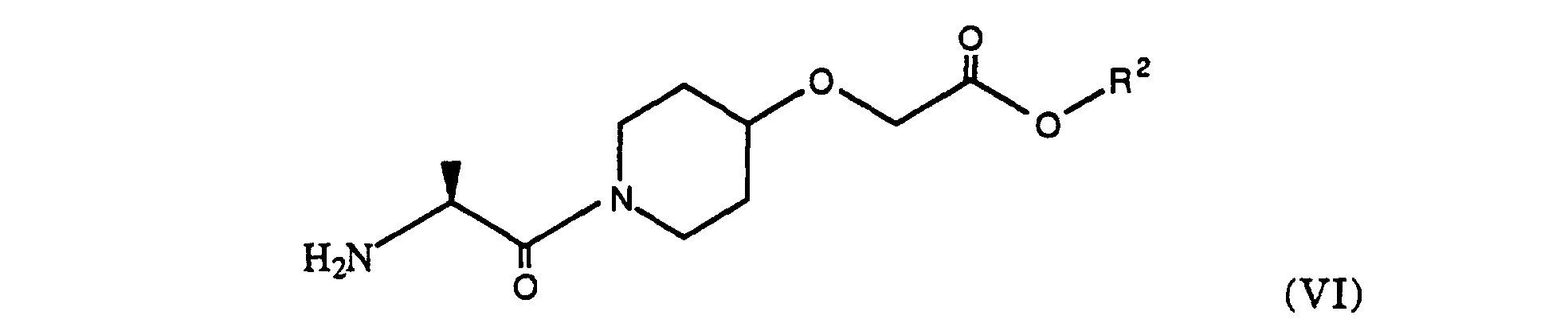
- the amino protecting group R can be split off and, if necessary, the group R 2 can be transesterified to the ethyl ester, the splitting off of the amino protecting group and the transesterification to the ethyl ester optionally depending on the protecting group used simultaneously, for. B. in the case of tert.
- Butyl protective group can take place by reaction with H 2 SO 4 / ethanol.
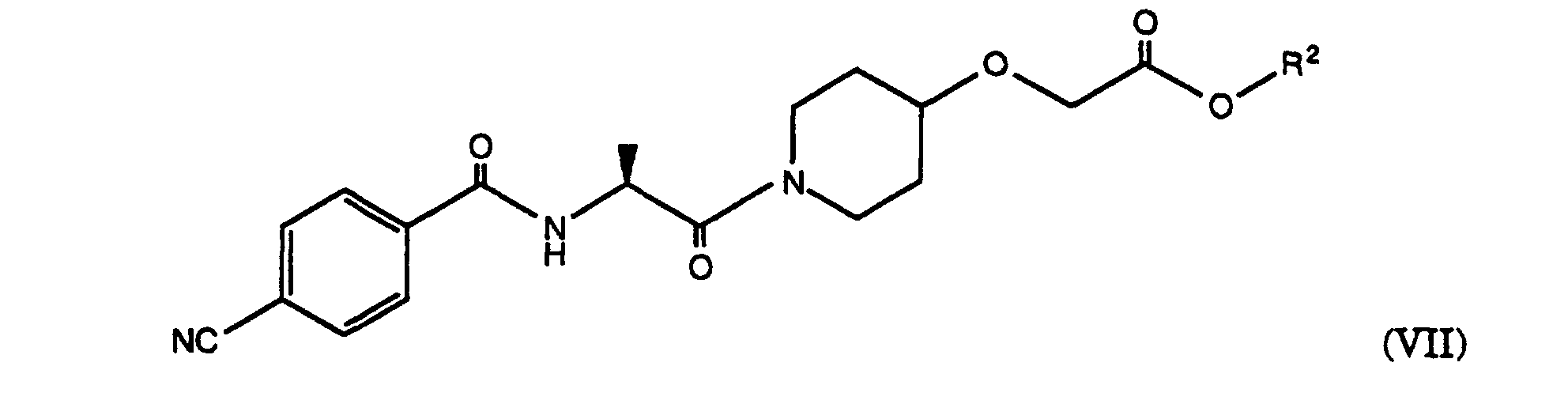
- the amine of the formula (VI) obtained can then where R 2 is as defined above, are reacted with 4-cyanobenzoic acid chloride to give the compound of the formula (VII), wherein the group R 2 is as defined above.
- R 2 is as defined above.
- the white suspension was filtered and the filter cake was washed with 100 ml of chilled (0-5 ° C) ethyl acetate (Fluka).
- the filtrates contained the resulting 2,2-dimethylpropionic acid-quinoline-2-carboxylic acid anhydride with the following substance characteristics: melting point: 47 ° C .; MS: [M + H] + 258; IR: 1750 cm -1 , 1775 cm -1 .
- the white precipitate was filtered off through a pre-cooled, sintered glass filter (G3) and the filter cake was washed with 140 ml of cold ethyl acetate (0 to 5 ° C.). 55.9 g (250 mmol) of piperidin-4-yloxy) ethyl acetate hydrochloride and 66.6 g of K 3 PO 4 .3H 2 O (250 mmol; Merck) were added to the combined filtrates, a pale yellow solution. 500 ml of deionized water were added to the white suspension at 5 to 10 ° C. under argon and vigorous stirring within 30 seconds, the temperature rising to 20 ° C. The colorless two-phase system was stirred at 20 to 25 ° C for 2 hours.
- the aqueous phase was separated and the organic phase washed with 500 ml of a 1 M sodium bicarbonate solution.
- the organic phase was dried over about 50 g of sodium sulfate, filtered and the filter cake was washed with about 100 ml of ethyl acetate.
- the combined filtrates were evaporated in a rotary evaporator at 50 ° / 20 mbar, with 85.5 g (95% by weight) of (S) - [1- (2-tert-butyloxycarbonylaminopropionyl) piperidin-4-yloxy] acetic acid ethyl ester as the crude product Form of a clear, yellowish oil resulted (HPLC analysis: 88.9% (area).
- the resulting filtrate was filtered through a pre-cooled glass filter (G3) and the filter cake was washed with a mixture of 140 ml of cold ethanol (0 to 5 ° C) and 35 ml of cold water (0 to 5 °); the product was then dried at 50 ° / 20 mbar to constant weight.
- the white crystals obtained (65.6 g; 68% by weight) were suspended in a mixture of 528 ml of ethanol and 132 ml of water and treated with 3.3 g of activated carbon (Norit SX-1). The black suspension was heated under heating and reflux for 15 minutes, cooled to 65 to 70 ° C and passed through a glass filter on a preheated funnel.
- the filtrates were stirred, a precipitate separating from 60 ° C.
- the white suspension was cooled to room temperature within three hours, then to 0 to 5 ° C. and, after stirring for one hour, filtered through a correspondingly pre-cooled sintered glass filter (G3).
Landscapes
- Chemical & Material Sciences (AREA)
- Organic Chemistry (AREA)
- Plural Heterocyclic Compounds (AREA)
- Pharmaceuticals Containing Other Organic And Inorganic Compounds (AREA)
- Organic Low-Molecular-Weight Compounds And Preparation Thereof (AREA)
- Hydrogenated Pyridines (AREA)
- Heterocyclic Carbon Compounds Containing A Hetero Ring Having Oxygen Or Sulfur (AREA)
- Quinoline Compounds (AREA)
- Peptides Or Proteins (AREA)
Description




Claims (10)
- Verfahren zur Herstellung gemischter Anhydride, dadurch gekennzeichnet, dass eine Hilfsbase zum Gemisch aus Säure und reaktivem Säurederivat gegeben wird, worin die Säure eine Carbonsäure ist, die Hilfsbase ein tertiäres Amin ist und das reaktive Säurederivat ein Säurehalogenid einer Säure R1-COOH oder ein Chlorameisensäurealkylester ist,
worin R1 Alkyl, Cycloalkyl, Heteroaryl oder Aryl ist. - Verfahren gemäss Anspruch 1, dadurch gekennzeichnet, dass das reaktive Säurederivat Pivaloylchlorid, Isovaleroylchlorid oder Chlorameisensäureethylester eingesetzt wird.
- Verfahren gemäss Anspruch 1, dadurch gekennzeichnet, dass als Säure eine Alkancarbonsäure oder eine geschützte Aminocarbonsäure eingesetzt wird.
- Verfahren gemäss einem der Ansprüche 1 bis 2, dadurch gekennzeichnet, das Chinolin-2-carbonsäure mit einem reaktiven Derivat einer Säure R1-COOH zu dem Chinolin-2-carbonsäureanhydrid der Formel (II)umgesetzt wird, wobei R1 Alkyl, Cycloalkyl, Heteroaryl oder Aryl ist.
- Verfahren gemäss Anspruch 4, dadurch gekennzeichnet, das das erhaltene Chinolin-2-carbonsäureanhydrid der Formel (II) mit Asparagin zu Chinargin umgesetzt wird.
- Verfahren gemäss Anspruch 5, dadurch gekennzeichnet, dass das Chinolin-2-carbonsäureanhydrid der Formel (II) mit L-Asparagin zu N-(2-Chinolylcarbonyl)-L-asparagin und anschliessend mit 2-[3(S)-Amino-2(R)-hydroxy-4-phenylbutyl]-N-tert.butyl-decahydro-(4aS,8aS)-isochinolin-3(S)carboxamid umgesetzt wird und gegebenenfalls das erhaltene N-t-Butyldecahydro-2-[2(R)-hydroxy-4-phenyl-3(S)-[[N-(2-chinolylcarbonyl)-Lasparaginyl]amino]butyl]-(4aS,8aS)-isochinolin-3(S)-carboxamid in ein pharmazeutisch geeignetes Salz oder in einen pharmazeutisch geeigneten Ester überführt wird.
- Verfahren gemäss einem der Ansprüche 1 bis 35 dadurch gekennzeichnet, das eine Säure der Formel (I)wobei R eine Aminoschutzgruppe darstellt, mit einem reaktiven Derivat einer Säure R1-COOH zu Anhydrid der Formel (III)
 umgesetzt wird, wobei R die oben angegebene Bedeutung besitzt und R1 Alkyl, Cycloalkyl, Heteroaryl oder Aryl ist.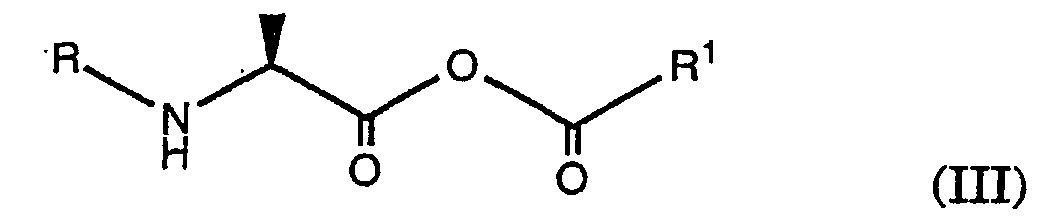
- Verfahren gemäss Anspruch 7 zur Herstellung von (S)-2-Benzyloxycarbonylamino-propionsäure-2,2-dimethyl-propionsäureanhydrid oder (S)-2-tert-Butoxycarbonylamino-propionsäure-2,2-dimethylpropionsäureanhydrid durch Umsetzung von (S)-2-Benzyloxy-carbonylaminopropionsäure oder (S)-2-tert-Butyloxycarbonylaminopropionsäure einem reaktiven Säurederivat der 2,2-Dimethyl-propionsäure.
- Verfahren gemäss Anspruch 7 oder 8, dadurch gekennzeichnet, dass das Anhydrida) durch Reaktion mit einer Verbindung der Formel (IV),wobei R2 eine Alkylgruppe darstellt,

zu einem Ester der Formel (V) umgesetzt wird,wobei R eine Aminoschutzgruppe darstellt, und R2 wie oben definiert ist, b) die Aminoschutzgruppe R abgespalten, undc) gegebenenfalls die Gruppe R2 zum Ethylester umgeestert wird, wobei die Reaktionsschritte b) und c) gegebenenfalls gleichzeitig stattfinden können und anschliessendd) das erhaltene Amin der Formel (VI)wobei R1 wie oben definiert ist, mit 4-Cyanobenzoesäurechlorid zu der Verbindung der Formel (VII) umgesetzt wird,
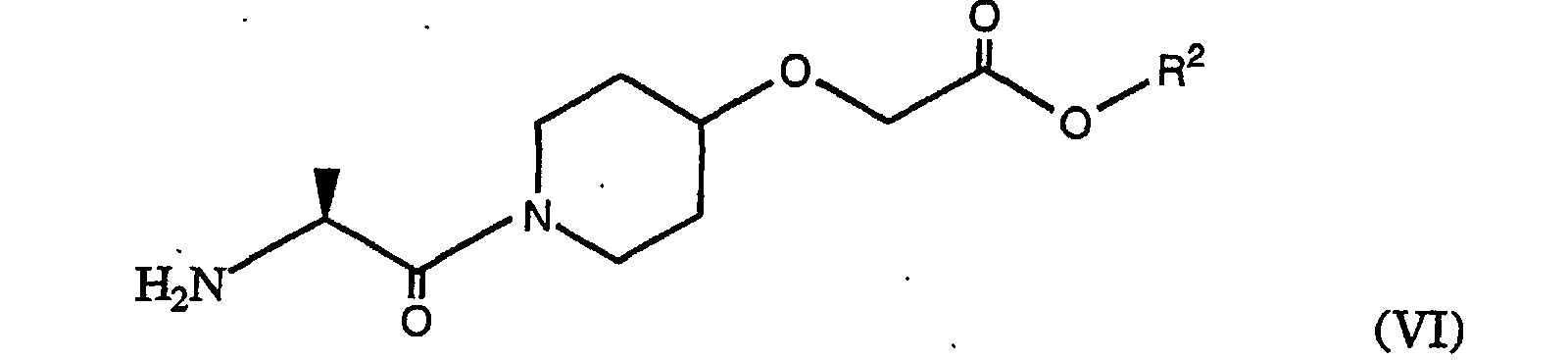 wobei die Gruppe R2 wie oben definiert ist, und anschliessend gegebenenfalls R2 zum Ethylester umgeestert wird, anschliessend
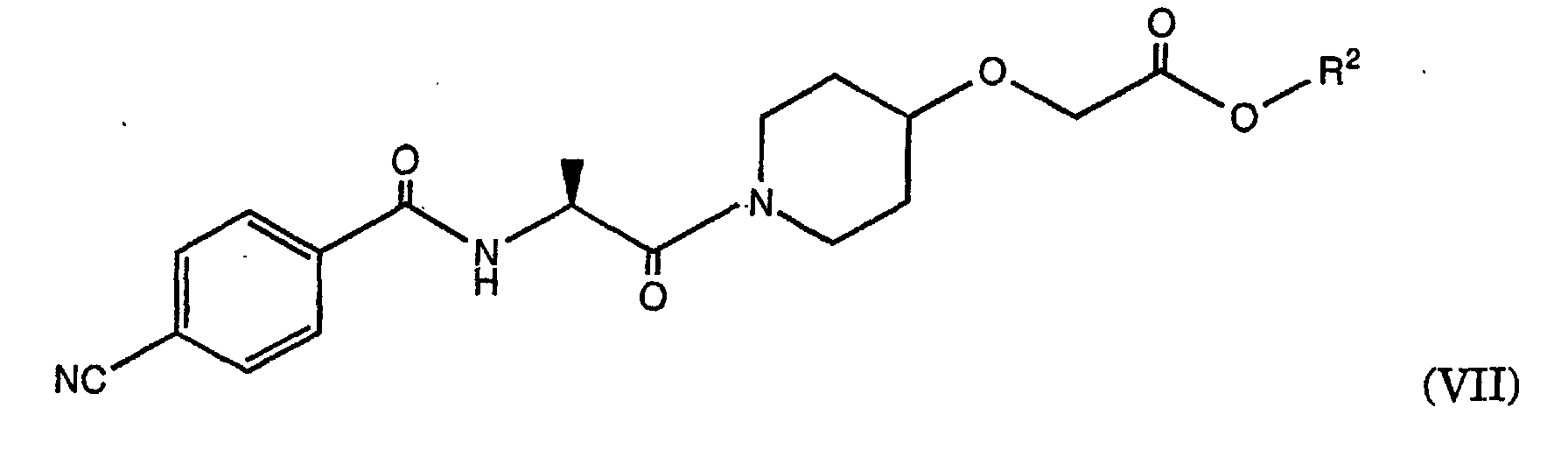 e) [Z]-(S)-[[1-[2-[[4-(Amino-hydroximino-methyl)-benzoyl]amino]-1-oxopropyl]-4-piperidinyl]oxy]essigsäureethylester durch Reaktion von Hydroxylaminhydrochlorid mit der Verbindung der Formel (VII) erhalten wird undf) der erhaltene [Z]-(S)-[[1-[2-[[4-(Amino-hydroximino-methyl)-benzoyl]amino]-1-oxopropyl]-4-piperidinyl]oxy]essigsäureethylester gegebenenfalls in ein pharmazeutisch geeignetes Salz überführt wird.
 - Verwendung eines Verfahrens gemäss einem der Ansprüche 1 bis 9 zur Herstellung von N-t-Butyl-decahydro-2-[2(R)-hydroxy-4-phenyl-3(S)-[[N-(2-chinolylcarbonyl)-L-asparaginyl] amino]butyl]-(4aS,8aS)-isochinolin-3(S)-carboxamid oder [Z]-(S)-[[1-[2-[[4-(Amino-Hydroximino-methyl)-benzoyl]amino]-1-oxopropyl]-4-piperidinyl]oxy]essigsäureethylester oder davon abgeleiteter Salze oder Ester.
Priority Applications (1)
| Application Number | Priority Date | Filing Date | Title |
|---|---|---|---|
| EP97121298A EP0847994B1 (de) | 1996-12-11 | 1997-12-04 | Verfahren zur Herstellung gemischter Anhydride |
Applications Claiming Priority (3)
| Application Number | Priority Date | Filing Date | Title |
|---|---|---|---|
| EP96119853 | 1996-12-11 | ||
| EP96119853 | 1996-12-11 | ||
| EP97121298A EP0847994B1 (de) | 1996-12-11 | 1997-12-04 | Verfahren zur Herstellung gemischter Anhydride |
Publications (2)
| Publication Number | Publication Date |
|---|---|
| EP0847994A1 EP0847994A1 (de) | 1998-06-17 |
| EP0847994B1 true EP0847994B1 (de) | 2003-04-09 |
Family
ID=8223484
Family Applications (1)
| Application Number | Title | Priority Date | Filing Date |
|---|---|---|---|
| EP97121298A Expired - Lifetime EP0847994B1 (de) | 1996-12-11 | 1997-12-04 | Verfahren zur Herstellung gemischter Anhydride |
Country Status (9)
| Country | Link |
|---|---|
| US (2) | US6489479B1 (de) |
| EP (1) | EP0847994B1 (de) |
| JP (1) | JP3020471B2 (de) |
| KR (1) | KR100269829B1 (de) |
| CN (1) | CN1073080C (de) |
| AT (1) | ATE236880T1 (de) |
| DE (1) | DE59709770D1 (de) |
| DK (1) | DK0847994T3 (de) |
| ES (1) | ES2194145T3 (de) |
Families Citing this family (11)
| Publication number | Priority date | Publication date | Assignee | Title |
|---|---|---|---|---|
| US6753431B2 (en) | 2000-06-02 | 2004-06-22 | Sumitomo Chemical Company Limited | Production of mixed acid anhydride and amide compound |
| JP2004003404A (ja) * | 2002-06-03 | 2004-01-08 | Hitachi Ltd | 電子制御式絞り弁装置、当該装置等に用いられる非接触式回転角度検出装置、ホール素子の信号処理装置。 |
| US7763587B2 (en) * | 2002-06-13 | 2010-07-27 | L'oreal S.A. | Derivative of glucose and of vitamin F, compositions comprising it, uses and preparation process |
| US7375012B2 (en) | 2005-02-28 | 2008-05-20 | Pavel Kornilovich | Method of forming multilayer film |
| EP2263999A4 (de) * | 2008-03-18 | 2012-11-07 | Mitsui Chemicals Agro Inc | Verfahren zur herstellung eines fluorhaltigen acylessigsäurederivats, verfahren zur herstellung eines fluorhaltigen pyrazolcarbonsäuresterderivats und verfahren zur herstellung eines fluorhaltigen pyrazolcarbonsäurederivats |
| WO2012117410A1 (en) * | 2011-03-02 | 2012-09-07 | Symed Labs Limited | A process for the preparation of n-[2-[(acetylthio) methyl]-1-oxo-3-phenylpropyl] glycine phenyl methyl ester and intermediates thereof |
| KR101278874B1 (ko) * | 2011-09-23 | 2013-06-26 | 주식회사 엔지켐생명과학 | 1-팔미토일-3-아세틸글리세롤의 제조방법 및 이를 이용한 1-팔미토일-2-리놀레오일-3-아세틸글리세롤의 제조방법 |
| US20150266803A1 (en) * | 2014-03-24 | 2015-09-24 | Enzychem Lifesciences Corporation | Method for preparing monoacetyglycerols and esters thereof |
| WO2019239879A1 (ja) * | 2018-06-15 | 2019-12-19 | 国立大学法人東京工業大学 | アミドの製造方法 |
| CN113474354A (zh) * | 2019-02-28 | 2021-10-01 | 国立大学法人东京工业大学 | 酰胺的制造方法 |
| CN114401978A (zh) * | 2019-09-25 | 2022-04-26 | 日产化学株式会社 | 肽化合物的制造方法 |
Family Cites Families (9)
| Publication number | Priority date | Publication date | Assignee | Title |
|---|---|---|---|---|
| JPS61197558A (ja) | 1985-02-25 | 1986-09-01 | Nippon Chemiphar Co Ltd | 新規なキナルジン酸アミド誘導体およびその製造法 |
| US4874558A (en) * | 1987-05-21 | 1989-10-17 | Indiana University Foundation | Polymer catalyzed synthesis of acid anhydrides |
| CA1340588C (en) | 1988-06-13 | 1999-06-08 | Balraj Krishan Handa | Amino acid derivatives |
| GB8927913D0 (en) | 1989-12-11 | 1990-02-14 | Hoffmann La Roche | Amino acid derivatives |
| DE59408292D1 (de) | 1993-02-19 | 1999-07-01 | Hoffmann La Roche | Racemisierungsfreie Herstellung von Amiden und Peptiden in Gegenwart katalytischer Mengen einer N-Hydroxy-Verbindung |
| US5455353A (en) | 1993-03-24 | 1995-10-03 | Hoffmann-La Roche Inc. | 4-(benzyl-2-oxo-oxazolidin-5 ylmethyl)N tertbutyl-decahydroisoquinoline-3-carboxamides |
| EP0738724B1 (de) | 1993-07-15 | 1998-11-04 | F. Hoffmann-La Roche Ag | Verfahren zur Herstellung eines N-tert.Butylamids |
| US5591885A (en) | 1994-09-23 | 1997-01-07 | Hoffman-La Roche Inc. | Process for the preparation of halogenated α-aminoketone compounds |
| US5523463A (en) | 1994-09-23 | 1996-06-04 | Hoffmann-La Roche Inc. | Method of producing halogenated and alpha-aminoalchohols |
-
1997
- 1997-12-04 AT AT97121298T patent/ATE236880T1/de active
- 1997-12-04 DE DE59709770T patent/DE59709770D1/de not_active Expired - Lifetime
- 1997-12-04 ES ES97121298T patent/ES2194145T3/es not_active Expired - Lifetime
- 1997-12-04 DK DK97121298T patent/DK0847994T3/da active
- 1997-12-04 EP EP97121298A patent/EP0847994B1/de not_active Expired - Lifetime
- 1997-12-09 JP JP9338963A patent/JP3020471B2/ja not_active Expired - Fee Related
- 1997-12-10 KR KR1019970067316A patent/KR100269829B1/ko not_active Expired - Fee Related
- 1997-12-10 CN CN97125365A patent/CN1073080C/zh not_active Expired - Fee Related
-
1999
- 1999-07-22 US US09/359,294 patent/US6489479B1/en not_active Expired - Lifetime
-
2001
- 2001-12-06 US US10/008,981 patent/US6562977B2/en not_active Expired - Lifetime
Non-Patent Citations (3)
| Title |
|---|
| Helv. Chim. Acta, 1994, 77, 575 - 578 * |
| Justus Liebigs Ann. Chem. 1937, 530, 34 - 45 * |
| Tetrahedron, 1984, 40, 4415 - 4424 * |
Also Published As
| Publication number | Publication date |
|---|---|
| ATE236880T1 (de) | 2003-04-15 |
| EP0847994A1 (de) | 1998-06-17 |
| JPH10175955A (ja) | 1998-06-30 |
| JP3020471B2 (ja) | 2000-03-15 |
| US6562977B2 (en) | 2003-05-13 |
| CN1073080C (zh) | 2001-10-17 |
| CN1184803A (zh) | 1998-06-17 |
| KR100269829B1 (ko) | 2000-10-16 |
| US6489479B1 (en) | 2002-12-03 |
| DK0847994T3 (da) | 2003-07-28 |
| DE59709770D1 (de) | 2003-05-15 |
| KR19980063985A (ko) | 1998-10-07 |
| ES2194145T3 (es) | 2003-11-16 |
| US20020077481A1 (en) | 2002-06-20 |
Similar Documents
| Publication | Publication Date | Title |
|---|---|---|
| DE69434977T2 (de) | HIV Protease Inhibitoren | |
| DE2947140C2 (de) | ||
| DE3687103T2 (de) | Verfahren zur herstellung von n-(1(s)-ethoxycarbonyl-3-phenylpropyl)-l-alanyl-l-proline. | |
| DD201782A5 (de) | Verfahren zur herstellung von octahydro-1-(omega-mercaptoalkanoyl)-1h-indol 2-carbonsaeure-verbindungen | |
| DD201887A5 (de) | Verfahren zur herstellung von 1-carboxyalkanoylindolin-2-carbonsaeuren | |
| EP0847994B1 (de) | Verfahren zur Herstellung gemischter Anhydride | |
| EP0344519A1 (de) | Substituierte 4-(Chinolin-2-yl-methoxy)phenyl-essigsäure-Derivate | |
| DE2801911A1 (de) | (acyl-)-mercaptoacylaminosaeurederivate, verfahren zu deren herstellung und ihre verwendung bei der bekaempfung von durch angiotensin bedingtem hochdruck | |
| DE2937779A1 (de) | Aminosaeurederivate und verfahren zu ihrer herstellung | |
| DE3210496A1 (de) | Neue derivate bicyclischer aminsaeuren, verfahren zu ihrer herstellung, diese enthaltende mittel und deren verwendung sowie neue bicyclische aminosaeuren als zwischenstufen und verfahren zu deren herstellung | |
| DE60225092T2 (de) | Ein Verfahren zur Herstellung von Perindopril, analogen Verbindungen dazu sowie Salzen davon unter Verwendung von 2,5-Dioxooxazolidin-Zwischenprodukten | |
| EP0611774B1 (de) | Racemisierungsfreie Herstellung von Amiden und Peptiden in Gegenwart katalytischer Mengen einer N-Hydroxy-Verbindung | |
| EP0519433A1 (de) | Verbindungen mit reninhemmenden Eigenschaften, Verfahren zu ihrer Herstellung und ihre Verwendung | |
| CH658455A5 (de) | Peptidderivate, verfahren zu deren herstellung und diese enthaltende arzneimittel. | |
| DE4001236A1 (de) | Neue peptide, verfahren zu ihrer herstellung und ihre verwendung als arzneimittel, insbesondere als arzneimittel gegen retroviren | |
| DE69201368T2 (de) | 1-(Alkoxybenzyl)piperazineamide, Verfahren zu deren Herstellung und diese enthaltende pharmazeutische Zusammensetzungen. | |
| DE60017374T2 (de) | Antibakterielle mittel | |
| EP0135182A2 (de) | Verfahren zur Herstellung von N-alkylierten Dipeptiden und deren Estern | |
| DE69603419T3 (de) | Verfahren zur Herstellung von optisch aktiven Amiden | |
| Zhao et al. | Facile syntheses of (2R, 3R)-(−)-and (2S, 3S)-(+)-chicoric acids | |
| CH619468A5 (de) | ||
| DE3841732A1 (de) | Dipeptid-derivate mit enzym-inhibitorischer wirkung | |
| EP0279350B1 (de) | Annelierte Azepinon- und Azocinon-Derivate, Verfahren zu ihrer Herstellung, diese enthaltende Mittel und ihre Verwendung, sowie Zwischenprodukte bei ihrer Herstellung | |
| EP0427160B1 (de) | Benzylselenobenzamide von Aminopyridinen und Picolylaminen | |
| DE2064061A1 (de) | Neue tuberkulostatisch wirkende alpha-aminoxy-carbonsaeureamid-derivate und verfahren zur herstellung derselben |
Legal Events
| Date | Code | Title | Description |
|---|---|---|---|
| PUAI | Public reference made under article 153(3) epc to a published international application that has entered the european phase |
Free format text: ORIGINAL CODE: 0009012 |
|
| AK | Designated contracting states |
Kind code of ref document: A1 Designated state(s): AT BE CH DE DK ES FR GB IE IT LI NL |
|
| AX | Request for extension of the european patent |
Free format text: AL;LT;LV;MK;RO;SI |
|
| 17P | Request for examination filed |
Effective date: 19980707 |
|
| AKX | Designation fees paid |
Free format text: AT BE CH DE DK ES FR GB IE IT LI NL |
|
| RBV | Designated contracting states (corrected) |
Designated state(s): AT BE CH DE DK ES FR GB IE IT LI NL |
|
| 17Q | First examination report despatched |
Effective date: 20000913 |
|
| GRAG | Despatch of communication of intention to grant |
Free format text: ORIGINAL CODE: EPIDOS AGRA |
|
| GRAG | Despatch of communication of intention to grant |
Free format text: ORIGINAL CODE: EPIDOS AGRA |
|
| GRAH | Despatch of communication of intention to grant a patent |
Free format text: ORIGINAL CODE: EPIDOS IGRA |
|
| GRAH | Despatch of communication of intention to grant a patent |
Free format text: ORIGINAL CODE: EPIDOS IGRA |
|
| GRAA | (expected) grant |
Free format text: ORIGINAL CODE: 0009210 |
|
| AK | Designated contracting states |
Designated state(s): AT BE CH DE DK ES FR GB IE IT LI NL |
|
| REG | Reference to a national code |
Ref country code: GB Ref legal event code: FG4D Free format text: NOT ENGLISH |
|
| REG | Reference to a national code |
Ref country code: CH Ref legal event code: EP |
|
| REG | Reference to a national code |
Ref country code: IE Ref legal event code: FG4D Free format text: GERMAN |
|
| REF | Corresponds to: |
Ref document number: 59709770 Country of ref document: DE Date of ref document: 20030515 Kind code of ref document: P |
|
| GBT | Gb: translation of ep patent filed (gb section 77(6)(a)/1977) |
Effective date: 20030520 |
|
| REG | Reference to a national code |
Ref country code: DK Ref legal event code: T3 |
|
| REG | Reference to a national code |
Ref country code: ES Ref legal event code: FG2A Ref document number: 2194145 Country of ref document: ES Kind code of ref document: T3 |
|
| ET | Fr: translation filed | ||
| PLBE | No opposition filed within time limit |
Free format text: ORIGINAL CODE: 0009261 |
|
| STAA | Information on the status of an ep patent application or granted ep patent |
Free format text: STATUS: NO OPPOSITION FILED WITHIN TIME LIMIT |
|
| 26N | No opposition filed |
Effective date: 20040112 |
|
| REG | Reference to a national code |
Ref country code: FR Ref legal event code: PLFP Year of fee payment: 19 |
|
| PGFP | Annual fee paid to national office [announced via postgrant information from national office to epo] |
Ref country code: DK Payment date: 20151124 Year of fee payment: 19 Ref country code: IE Payment date: 20151125 Year of fee payment: 19 Ref country code: CH Payment date: 20151026 Year of fee payment: 19 Ref country code: GB Payment date: 20151125 Year of fee payment: 19 |
|
| PGFP | Annual fee paid to national office [announced via postgrant information from national office to epo] |
Ref country code: ES Payment date: 20151217 Year of fee payment: 19 Ref country code: BE Payment date: 20151209 Year of fee payment: 19 Ref country code: AT Payment date: 20151124 Year of fee payment: 19 Ref country code: FR Payment date: 20151124 Year of fee payment: 19 Ref country code: NL Payment date: 20151207 Year of fee payment: 19 |
|
| PGFP | Annual fee paid to national office [announced via postgrant information from national office to epo] |
Ref country code: IT Payment date: 20151210 Year of fee payment: 19 Ref country code: DE Payment date: 20151230 Year of fee payment: 19 |
|
| PG25 | Lapsed in a contracting state [announced via postgrant information from national office to epo] |
Ref country code: BE Free format text: LAPSE BECAUSE OF NON-PAYMENT OF DUE FEES Effective date: 20161231 |
|
| REG | Reference to a national code |
Ref country code: DE Ref legal event code: R119 Ref document number: 59709770 Country of ref document: DE |
|
| REG | Reference to a national code |
Ref country code: CH Ref legal event code: PL Ref country code: DK Ref legal event code: EBP Effective date: 20161231 |
|
| REG | Reference to a national code |
Ref country code: NL Ref legal event code: MM Effective date: 20170101 |
|
| REG | Reference to a national code |
Ref country code: AT Ref legal event code: MM01 Ref document number: 236880 Country of ref document: AT Kind code of ref document: T Effective date: 20161204 |
|
| GBPC | Gb: european patent ceased through non-payment of renewal fee |
Effective date: 20161204 |
|
| PG25 | Lapsed in a contracting state [announced via postgrant information from national office to epo] |
Ref country code: NL Free format text: LAPSE BECAUSE OF NON-PAYMENT OF DUE FEES Effective date: 20170101 |
|
| REG | Reference to a national code |
Ref country code: FR Ref legal event code: ST Effective date: 20170831 |
|
| REG | Reference to a national code |
Ref country code: IE Ref legal event code: MM4A |
|
| PG25 | Lapsed in a contracting state [announced via postgrant information from national office to epo] |
Ref country code: LI Free format text: LAPSE BECAUSE OF NON-PAYMENT OF DUE FEES Effective date: 20161231 Ref country code: AT Free format text: LAPSE BECAUSE OF NON-PAYMENT OF DUE FEES Effective date: 20161204 Ref country code: FR Free format text: LAPSE BECAUSE OF NON-PAYMENT OF DUE FEES Effective date: 20170102 Ref country code: IT Free format text: LAPSE BECAUSE OF NON-PAYMENT OF DUE FEES Effective date: 20161204 Ref country code: CH Free format text: LAPSE BECAUSE OF NON-PAYMENT OF DUE FEES Effective date: 20161231 |
|
| PG25 | Lapsed in a contracting state [announced via postgrant information from national office to epo] |
Ref country code: DE Free format text: LAPSE BECAUSE OF NON-PAYMENT OF DUE FEES Effective date: 20170701 Ref country code: GB Free format text: LAPSE BECAUSE OF NON-PAYMENT OF DUE FEES Effective date: 20161204 Ref country code: IE Free format text: LAPSE BECAUSE OF NON-PAYMENT OF DUE FEES Effective date: 20161204 |
|
| PG25 | Lapsed in a contracting state [announced via postgrant information from national office to epo] |
Ref country code: DK Free format text: LAPSE BECAUSE OF NON-PAYMENT OF DUE FEES Effective date: 20161231 |
|
| REG | Reference to a national code |
Ref country code: BE Ref legal event code: MM Effective date: 20161231 |
|
| REG | Reference to a national code |
Ref country code: ES Ref legal event code: FD2A Effective date: 20180507 |
|
| PG25 | Lapsed in a contracting state [announced via postgrant information from national office to epo] |
Ref country code: ES Free format text: LAPSE BECAUSE OF FAILURE TO SUBMIT A TRANSLATION OF THE DESCRIPTION OR TO PAY THE FEE WITHIN THE PRESCRIBED TIME-LIMIT Effective date: 20030409 |
|
| PG25 | Lapsed in a contracting state [announced via postgrant information from national office to epo] |
Ref country code: ES Free format text: LAPSE BECAUSE OF FAILURE TO SUBMIT A TRANSLATION OF THE DESCRIPTION OR TO PAY THE FEE WITHIN THE PRESCRIBED TIME-LIMIT Effective date: 20161205 |
|
| RIC2 | Information provided on ipc code assigned after grant |
Ipc: C07C 51/56 20060101ALI19980401BHEP Ipc: C07C 271/22 20060101ALI19980401BHEP Ipc: C07D 215/48 20060101AFI19980401BHEP Ipc: C07D 211/46 20060101ALI19980401BHEP |