EP0846083B1 - Verfahren und vorrichtung zur aufbereitung von wasser aus einem biologischen abbauprozess - Google Patents
Verfahren und vorrichtung zur aufbereitung von wasser aus einem biologischen abbauprozess Download PDFInfo
- Publication number
- EP0846083B1 EP0846083B1 EP97916455A EP97916455A EP0846083B1 EP 0846083 B1 EP0846083 B1 EP 0846083B1 EP 97916455 A EP97916455 A EP 97916455A EP 97916455 A EP97916455 A EP 97916455A EP 0846083 B1 EP0846083 B1 EP 0846083B1
- Authority
- EP
- European Patent Office
- Prior art keywords
- water
- aerobic
- taken
- compounds
- nanofilter
- Prior art date
- Legal status (The legal status is an assumption and is not a legal conclusion. Google has not performed a legal analysis and makes no representation as to the accuracy of the status listed.)
- Expired - Lifetime
Links
- XLYOFNOQVPJJNP-UHFFFAOYSA-N water Substances O XLYOFNOQVPJJNP-UHFFFAOYSA-N 0.000 title claims abstract description 44
- 238000000034 method Methods 0.000 title claims abstract description 42
- 230000003197 catalytic effect Effects 0.000 claims description 17
- 238000001728 nano-filtration Methods 0.000 claims description 15
- 150000001875 compounds Chemical class 0.000 claims description 14
- 238000000108 ultra-filtration Methods 0.000 claims description 14
- 238000006243 chemical reaction Methods 0.000 claims description 12
- 230000004992 fission Effects 0.000 claims description 9
- 235000015097 nutrients Nutrition 0.000 claims description 7
- 239000000126 substance Substances 0.000 claims description 5
- 238000006731 degradation reaction Methods 0.000 abstract description 5
- 239000012465 retentate Substances 0.000 description 8
- 238000003776 cleavage reaction Methods 0.000 description 7
- 239000012466 permeate Substances 0.000 description 7
- 230000007017 scission Effects 0.000 description 7
- IJGRMHOSHXDMSA-UHFFFAOYSA-N Atomic nitrogen Chemical compound N#N IJGRMHOSHXDMSA-UHFFFAOYSA-N 0.000 description 6
- 238000006065 biodegradation reaction Methods 0.000 description 6
- 239000002699 waste material Substances 0.000 description 6
- 238000009264 composting Methods 0.000 description 5
- 230000002503 metabolic effect Effects 0.000 description 5
- 239000000047 product Substances 0.000 description 5
- 229910017464 nitrogen compound Inorganic materials 0.000 description 4
- 150000002830 nitrogen compounds Chemical class 0.000 description 4
- 230000015556 catabolic process Effects 0.000 description 3
- 230000006378 damage Effects 0.000 description 3
- 229910052757 nitrogen Inorganic materials 0.000 description 3
- OKTJSMMVPCPJKN-UHFFFAOYSA-N Carbon Chemical compound [C] OKTJSMMVPCPJKN-UHFFFAOYSA-N 0.000 description 2
- MHAJPDPJQMAIIY-UHFFFAOYSA-N Hydrogen peroxide Chemical compound OO MHAJPDPJQMAIIY-UHFFFAOYSA-N 0.000 description 2
- 229910052799 carbon Inorganic materials 0.000 description 2
- 150000001722 carbon compounds Chemical class 0.000 description 2
- 238000004140 cleaning Methods 0.000 description 2
- 238000011161 development Methods 0.000 description 2
- 230000018109 developmental process Effects 0.000 description 2
- 150000002430 hydrocarbons Chemical class 0.000 description 2
- 239000007788 liquid Substances 0.000 description 2
- 238000006385 ozonation reaction Methods 0.000 description 2
- 238000009423 ventilation Methods 0.000 description 2
- QGZKDVFQNNGYKY-UHFFFAOYSA-O Ammonium Chemical compound [NH4+] QGZKDVFQNNGYKY-UHFFFAOYSA-O 0.000 description 1
- 239000002028 Biomass Substances 0.000 description 1
- CBENFWSGALASAD-UHFFFAOYSA-N Ozone Chemical compound [O-][O+]=O CBENFWSGALASAD-UHFFFAOYSA-N 0.000 description 1
- 229910019142 PO4 Inorganic materials 0.000 description 1
- QVGXLLKOCUKJST-UHFFFAOYSA-N atomic oxygen Chemical compound [O] QVGXLLKOCUKJST-UHFFFAOYSA-N 0.000 description 1
- 239000010796 biological waste Substances 0.000 description 1
- 238000003421 catalytic decomposition reaction Methods 0.000 description 1
- 239000012141 concentrate Substances 0.000 description 1
- 238000009833 condensation Methods 0.000 description 1
- 230000005494 condensation Effects 0.000 description 1
- 239000007859 condensation product Substances 0.000 description 1
- 239000000356 contaminant Substances 0.000 description 1
- 238000001816 cooling Methods 0.000 description 1
- 230000000694 effects Effects 0.000 description 1
- 230000008030 elimination Effects 0.000 description 1
- 238000003379 elimination reaction Methods 0.000 description 1
- 238000005516 engineering process Methods 0.000 description 1
- 238000000855 fermentation Methods 0.000 description 1
- 230000004151 fermentation Effects 0.000 description 1
- 239000007789 gas Substances 0.000 description 1
- 230000014759 maintenance of location Effects 0.000 description 1
- 238000005259 measurement Methods 0.000 description 1
- 230000004060 metabolic process Effects 0.000 description 1
- 230000000813 microbial effect Effects 0.000 description 1
- 238000005065 mining Methods 0.000 description 1
- 230000007935 neutral effect Effects 0.000 description 1
- 230000003287 optical effect Effects 0.000 description 1
- 150000002894 organic compounds Chemical class 0.000 description 1
- 239000010815 organic waste Substances 0.000 description 1
- 239000001301 oxygen Substances 0.000 description 1
- 229910052760 oxygen Inorganic materials 0.000 description 1
- NBIIXXVUZAFLBC-UHFFFAOYSA-K phosphate Chemical compound [O-]P([O-])([O-])=O NBIIXXVUZAFLBC-UHFFFAOYSA-K 0.000 description 1
- 239000010452 phosphate Substances 0.000 description 1
- 238000000746 purification Methods 0.000 description 1
- 239000008213 purified water Substances 0.000 description 1
- 230000005855 radiation Effects 0.000 description 1
- 238000004064 recycling Methods 0.000 description 1
- 230000000717 retained effect Effects 0.000 description 1
- 238000000926 separation method Methods 0.000 description 1
- 230000006641 stabilisation Effects 0.000 description 1
- 238000011105 stabilization Methods 0.000 description 1
- 238000003756 stirring Methods 0.000 description 1
- 239000002351 wastewater Substances 0.000 description 1
Images
Classifications
-
- B—PERFORMING OPERATIONS; TRANSPORTING
- B01—PHYSICAL OR CHEMICAL PROCESSES OR APPARATUS IN GENERAL
- B01D—SEPARATION
- B01D61/00—Processes of separation using semi-permeable membranes, e.g. dialysis, osmosis or ultrafiltration; Apparatus, accessories or auxiliary operations specially adapted therefor
- B01D61/58—Multistep processes
-
- B—PERFORMING OPERATIONS; TRANSPORTING
- B01—PHYSICAL OR CHEMICAL PROCESSES OR APPARATUS IN GENERAL
- B01D—SEPARATION
- B01D61/00—Processes of separation using semi-permeable membranes, e.g. dialysis, osmosis or ultrafiltration; Apparatus, accessories or auxiliary operations specially adapted therefor
- B01D61/14—Ultrafiltration; Microfiltration
- B01D61/16—Feed pretreatment
-
- C—CHEMISTRY; METALLURGY
- C02—TREATMENT OF WATER, WASTE WATER, SEWAGE, OR SLUDGE
- C02F—TREATMENT OF WATER, WASTE WATER, SEWAGE, OR SLUDGE
- C02F9/00—Multistage treatment of water, waste water or sewage
-
- B—PERFORMING OPERATIONS; TRANSPORTING
- B01—PHYSICAL OR CHEMICAL PROCESSES OR APPARATUS IN GENERAL
- B01D—SEPARATION
- B01D2311/00—Details relating to membrane separation process operations and control
- B01D2311/04—Specific process operations in the feed stream; Feed pretreatment
-
- B—PERFORMING OPERATIONS; TRANSPORTING
- B01—PHYSICAL OR CHEMICAL PROCESSES OR APPARATUS IN GENERAL
- B01D—SEPARATION
- B01D61/00—Processes of separation using semi-permeable membranes, e.g. dialysis, osmosis or ultrafiltration; Apparatus, accessories or auxiliary operations specially adapted therefor
- B01D61/02—Reverse osmosis; Hyperfiltration ; Nanofiltration
- B01D61/027—Nanofiltration
-
- B—PERFORMING OPERATIONS; TRANSPORTING
- B01—PHYSICAL OR CHEMICAL PROCESSES OR APPARATUS IN GENERAL
- B01D—SEPARATION
- B01D61/00—Processes of separation using semi-permeable membranes, e.g. dialysis, osmosis or ultrafiltration; Apparatus, accessories or auxiliary operations specially adapted therefor
- B01D61/14—Ultrafiltration; Microfiltration
- B01D61/145—Ultrafiltration
-
- C—CHEMISTRY; METALLURGY
- C02—TREATMENT OF WATER, WASTE WATER, SEWAGE, OR SLUDGE
- C02F—TREATMENT OF WATER, WASTE WATER, SEWAGE, OR SLUDGE
- C02F1/00—Treatment of water, waste water, or sewage
- C02F1/30—Treatment of water, waste water, or sewage by irradiation
- C02F1/32—Treatment of water, waste water, or sewage by irradiation with ultraviolet light
-
- C—CHEMISTRY; METALLURGY
- C02—TREATMENT OF WATER, WASTE WATER, SEWAGE, OR SLUDGE
- C02F—TREATMENT OF WATER, WASTE WATER, SEWAGE, OR SLUDGE
- C02F1/00—Treatment of water, waste water, or sewage
- C02F1/44—Treatment of water, waste water, or sewage by dialysis, osmosis or reverse osmosis
- C02F1/442—Treatment of water, waste water, or sewage by dialysis, osmosis or reverse osmosis by nanofiltration
-
- C—CHEMISTRY; METALLURGY
- C02—TREATMENT OF WATER, WASTE WATER, SEWAGE, OR SLUDGE
- C02F—TREATMENT OF WATER, WASTE WATER, SEWAGE, OR SLUDGE
- C02F1/00—Treatment of water, waste water, or sewage
- C02F1/44—Treatment of water, waste water, or sewage by dialysis, osmosis or reverse osmosis
- C02F1/444—Treatment of water, waste water, or sewage by dialysis, osmosis or reverse osmosis by ultrafiltration or microfiltration
-
- C—CHEMISTRY; METALLURGY
- C02—TREATMENT OF WATER, WASTE WATER, SEWAGE, OR SLUDGE
- C02F—TREATMENT OF WATER, WASTE WATER, SEWAGE, OR SLUDGE
- C02F1/00—Treatment of water, waste water, or sewage
- C02F1/72—Treatment of water, waste water, or sewage by oxidation
- C02F1/722—Oxidation by peroxides
-
- C—CHEMISTRY; METALLURGY
- C02—TREATMENT OF WATER, WASTE WATER, SEWAGE, OR SLUDGE
- C02F—TREATMENT OF WATER, WASTE WATER, SEWAGE, OR SLUDGE
- C02F1/00—Treatment of water, waste water, or sewage
- C02F1/72—Treatment of water, waste water, or sewage by oxidation
- C02F1/78—Treatment of water, waste water, or sewage by oxidation with ozone
-
- C—CHEMISTRY; METALLURGY
- C02—TREATMENT OF WATER, WASTE WATER, SEWAGE, OR SLUDGE
- C02F—TREATMENT OF WATER, WASTE WATER, SEWAGE, OR SLUDGE
- C02F3/00—Biological treatment of water, waste water, or sewage
- C02F3/30—Aerobic and anaerobic processes
- C02F3/301—Aerobic and anaerobic treatment in the same reactor
-
- C—CHEMISTRY; METALLURGY
- C02—TREATMENT OF WATER, WASTE WATER, SEWAGE, OR SLUDGE
- C02F—TREATMENT OF WATER, WASTE WATER, SEWAGE, OR SLUDGE
- C02F3/00—Biological treatment of water, waste water, or sewage
- C02F3/30—Aerobic and anaerobic processes
- C02F3/302—Nitrification and denitrification treatment
Definitions
- the invention relates to a method for processing Water, namely condensate and / or leachate a biodegradation process, and a device for Implementation of such a procedure.
- the biodegradation process can take place in a closed and / or an open fermentation system.
- it is composting, preferably composting waste or waste materials, which contain organic components.
- the composting can be in a closed container with forced ventilation be performed.
- a biological stabilization process act in which substances, in particular waste, in a closed container with forced ventilation biological be stabilized.
- the biodegradation process But it can also be the process of rotting a post-rotting rent act.
- DE-A-44 12 890 describes a method for cleaning Water, especially condensate from a composting process, known in which the water is cleaned in a bioreactor becomes.
- the condensate from the composting process is first a biological purification by adding oxygen undergone in a high performance biology. After that are by ultrafiltration of the circulated water the new biomass and the permeate separated.
- this procedure can be used in certain applications cause the permeate from the leachate treatment is relatively high COD and that it has a relatively high nitrogen load leads.
- Patent Abstracts of Japan vol. 012, no. 299 (C-520), 15. August 1988 & JP 63 069598 A and Patent Abstracts of Japan vol. 096, no. 007, July 31, 1996 & JP 08 080499 disclose devices for treating organic Wastes involving aerobic-anaerobic treatment with ultrafiltration and Retentions are returned.
- the object of the invention is to simplify a method of the type specified at the outset and improve and an apparatus for performing such Procedure.
- the metabolic products released as a result of the biological metabolism in the biological degradation process are separated from the exhaust gas stream of the biological degradation process, in particular by condensation.
- the metabolic products are fed to a water treatment plant, in which the water is alternately brought into aerobic and anaerobic states.
- the special feature of the metabolic products or the condensable metabolic products (condensation products) is that due to the high heat content of the biologically formed water and due to the dissolved CO 2 with the changing pH value, nitrogen compounds are released which have to be prepared in an environmentally neutral manner. According to the invention, this is achieved in that the biological cleaning takes place in oxically / anoxically intermittent operation, wherein nitrification and denitrification nitrogen is released elementarily and can be discharged into the atmosphere.
- catalytic cleavage can be carried out by ozonation.
- other measures are also possible, for example treatment with H 2 O 2 (hydrogen peroxide) and / or irradiation with UV rays.
- a feature of the invention is ultrafiltration and nanofiltration to connect. So the water will ultrafiltered and nanofiltered after it is in the Changes in aerobic and anaerobic conditions have been brought is.
- Ultrafiltration makes the permeate stressful Components and components causing COD and BOD retained, that of "biology", ie the reaction container in which the Water alternately brought into aerobic and anaerobic states will be fed again.
- biology ie the reaction container in which the Water alternately brought into aerobic and anaerobic states will be fed again.
- nanofiltration can have this effect can be achieved even more intensely.
- the contaminants remain longer in the biodegradation area.
- Ultrafiltration makes long-chain, hard-to-decompose Carbon compounds and hydrocarbon compounds not fully filtered. These connections are however, as a carbon source for the breakdown of nitrogen compounds required. They are made by nanofiltration filtered or recorded and returned.
- the invention is further characterized in that that contained in the retentate of nanofiltration, poorly degradable compounds due to catalytic cleavage are destroyed and then the process in which the water alternately brought into aerobic and anaerobic conditions will be fed.
- nanofiltration are those from ultrafiltration not completely filtered long-chain, difficult to decompose Carbon compounds and hydrocarbon compounds detected. So that these connections are even better and more effective for breaking down harmful substances, in particular of nitrogen compounds are available they are first destroyed by catalytic fission or split and then fed to the mining process.
- the object underlying the invention is in a Device for performing the method according to the invention dissolved by a reaction vessel in which the water alternately brought into aerobic and anaerobic conditions can, as well a device for the destruction of poorly degradable compounds by catalytic fission an ultrafilter and a nanofilter and preferably one between the ultrafilter or filters and the Buffer container provided for nanofilters. It leads a line from the nanofilter to the device for destruction poorly degradable compounds through catalytic cleavage. This line separates the nanofiltration Retentate of the device for catalytic cleavage fed.
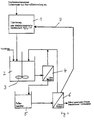
- the water treatment plant shown schematically in the single figure has a device 1 for destroying compounds that are difficult to decompose by catalytic cleavage, for example ozonation or H 2 O 2 treatment or UV radiation.
- the post-rotting seepage water originating from a biological degradation process and / or the seepage water from a residual waste treatment is fed to the device 1.
- the water treated by the device 1 is then passed into a reaction vessel 2 in which the water alternately brought into aerobic and anaerobic states becomes. Furthermore, (untreated) Condensate, preferably from a biodegradation process, be introduced.
- the reaction vessel 2 has one Stirring device 3.
- the retentate is in again the reaction vessel 2 is returned.
- the permeate is fed to a buffer container 5 and from there to a nanofilter 6 headed.
- the permeate of the nanofilter 6 runs as purified water or process water. It can also be used for a cooling circuit can be used.
- the retentate of the nanofilter 6 is fed to the reaction vessel 2. Instead of the retentate of the nanofilter 6 or a part thereof through line 7 of device 1 for the destruction of poorly degradable compounds by catalytic Cleavage are supplied.
- the method according to the invention opens up the possibility, in particular, of removing organic compounds which are more difficult to biodegrade safely and with greater efficiency than before, it being possible to check for purity by means of optical control.
- condensates and leachate from biological waste treatment plants can be processed.
- compounds which are difficult to decompose are first destroyed in the wastewater by catalytic decomposition (for example ozone, H 2 O 2 , UV).
- the water is then alternately brought into aerobic and anaerobic states for nitrogen elimination and then subjected to ultrafiltration and then nanofiltration.
- ultrafiltration and then nanofiltration After optically controlled separation of the permeate, missing nutrients are added to the concentrate or retentate fed into the biology.
- a buffer tank is provided between the ultrafiltration and the nanofiltration, through which the different outputs of the two systems are balanced.
Landscapes
- Engineering & Computer Science (AREA)
- Water Supply & Treatment (AREA)
- Chemical & Material Sciences (AREA)
- Chemical Kinetics & Catalysis (AREA)
- Hydrology & Water Resources (AREA)
- Environmental & Geological Engineering (AREA)
- Organic Chemistry (AREA)
- Life Sciences & Earth Sciences (AREA)
- Separation Using Semi-Permeable Membranes (AREA)
- Treatment Of Water By Oxidation Or Reduction (AREA)
- Physical Water Treatments (AREA)
- Biological Treatment Of Waste Water (AREA)
- Excavating Of Shafts Or Tunnels (AREA)
- Purification Treatments By Anaerobic Or Anaerobic And Aerobic Bacteria Or Animals (AREA)
- Preparation Of Compounds By Using Micro-Organisms (AREA)
- Removal Of Specific Substances (AREA)
Description
- einzige Fig.
- eine schematische Darstellung einer Wasseraufbereitungsanlage zur Durchführung des erfindungsgemäßen Verfahrens.
Claims (14)
- Verfahren zur Aufbereitung von Kondensat und/oder Sickerwasser aus einem biologischen Abbauprozeß,
dadurch gekennzeichnet,
daß das Wasser im Wechsel in aerobe und anaerobe Zustände gebracht wird, daß das Wasser anschließend ultrafiltriert wird, daß das Wasser nach der Ultrafiltration nanofiltriert wird, daß das bei der Ultrafiltration und/oder bei der Nanofiltration abgetrennte Retentat dem Prozeß, bei dem das Wasser im Wechsel in aerobe und anaerobe Zustände gebracht wird, zugeführt wird, und daß die im Retentat der Nanofiltration enthaltenen, schwer abbaubaren Verbindungen durch katalytische Spaltung zerstört werden und anschließend dem Prozeß, bei dem das Wasser im Wechsel in aerobe und anaerobe Zustände gebracht wird, zugeführt werden. - Verfahren nach Anspruch 1, dadurch gekennzeichnet, daß in dem Wasser zunächst schwer abbaubare Verbindungen durch katalytische Spaltung zerstört werden.
- Verfahren nach Anspruch 1 oder 2, dadurch gekennzeichnet, daß das Wasser nach der Ultrafiltration und vor der Nanofiltration in einen Pufferbehälter eingebracht wird.
- Verfahren nach einem der vorhergehenden Ansprüche, dadurch gekennzeichnet, daß dem Retentat Stoffe, insbesondere Nährstoffe, zugegeben werden.
- Vorrichtung zur Durchführung des Verfahrens nach einem der vorhergehenden Ansprüche
mit einem Reaktionsbehälter (2), in dem das Wasser im Wechsel in aerobe und anaerobe Zustände gebracht wird, einer Vorrichtung (1) zur Zerstörung schwer abbaubarer Verbindungen durch katalytische Spaltung, einer Leitung von der Vorrichtung (1) zum Reaktionsbehalter (2) einem Ultrafilter (4) und einem Nanofilter (6) die dem Reaktor (2) nachgeschaltet sind sowie einer Leitung (7) vom Nanofilter (6) zur Vorrichtung (1) zur Zerstörung schwer abbaubarer Verbindungen durch katalytische Spaltung. - Vorrichtung nach Anspruch 5, gekennzeichnet durch einen zwischen dem oder den Ultrafiltern (4) und dem oder den Nanofiltern (6) vorgesehenen Pufferbehälter (5).
- Verfahren nach Anspruch 6, dadurch gekennzeichnet, daß dem Retentat Stoffe, insbesondere Nährstoffe, zugegeben werden.
- Verfahren nach Anspruch 6 oder 7, dadurch gekennzeichnet, daß die im Retentat der Nanofiltration enthaltenen, schwer abbaubaren Verbindungen durch katalytische Spaltung zerstört werden und anschließend dem Prozeß, bei dem das Wasser im Wechsel in aerobe und anaerobe Zustände gebracht wird, zugeführt werden.
- Vorrichtung zur Durchführung des Verfahrens nach einem der vorhergehenden Ansprüche mit einem Reaktionsbehälter, in dem das Wasser im Wechsel in aerobe und anaerobe Zustände gebracht wird.
- Vorrichtung nach Anspruch 9, gekennzeichnet durch eine Vorrichtung zur Zerstörung schwer abbaubarer Verbindungen durch katalytische Spaltung.
- Vorrichtung nach Anspruch 9 oder 10, gekennzeichnet durch ein Ultrafilter.
- Vorrichtung nach einem der Ansprüche 9 bis 11, gekennzeichnet durch ein Nanofilter.
- Vorrichtung nach Anspruch 12, gekennzeichnet durch einen zwischen dem oder den Ultrafiltern und dem oder den Nanofiltern vorgesehenen Pufferbehälter.
- Vorrichtung nach Anspruch 12 oder 13, gekennzeichnet durch eine Leitung (7) vom Nanofilter (6) zur Vorrichtung (1) zur Zerstörung schwer abbaubarer Verbindungen durch katalytische Spaltung.
Applications Claiming Priority (3)
| Application Number | Priority Date | Filing Date | Title |
|---|---|---|---|
| DE19614214 | 1996-04-10 | ||
| DE19614214A DE19614214C2 (de) | 1996-04-10 | 1996-04-10 | Verfahren und Vorrichtung zur Aufbereitung von Wasser aus einem biologischen Abbauprozeß |
| PCT/EP1997/001754 WO1997037942A1 (de) | 1996-04-10 | 1997-04-09 | Verfahren und vorrichtung zur aufbereitung von wasser aus einem biologischen abbauprozess |
Publications (2)
| Publication Number | Publication Date |
|---|---|
| EP0846083A1 EP0846083A1 (de) | 1998-06-10 |
| EP0846083B1 true EP0846083B1 (de) | 2001-07-18 |
Family
ID=7790926
Family Applications (1)
| Application Number | Title | Priority Date | Filing Date |
|---|---|---|---|
| EP97916455A Expired - Lifetime EP0846083B1 (de) | 1996-04-10 | 1997-04-09 | Verfahren und vorrichtung zur aufbereitung von wasser aus einem biologischen abbauprozess |
Country Status (15)
| Country | Link |
|---|---|
| US (1) | US6113787A (de) |
| EP (1) | EP0846083B1 (de) |
| AT (1) | ATE203226T1 (de) |
| AU (1) | AU2510097A (de) |
| BR (1) | BR9706595A (de) |
| CA (1) | CA2224159A1 (de) |
| CZ (1) | CZ290076B6 (de) |
| DE (2) | DE19614214C2 (de) |
| DK (1) | DK0846083T3 (de) |
| ES (1) | ES2162270T3 (de) |
| GR (1) | GR3036927T3 (de) |
| NO (1) | NO975737L (de) |
| PL (1) | PL323932A1 (de) |
| PT (1) | PT846083E (de) |
| WO (1) | WO1997037942A1 (de) |
Families Citing this family (9)
| Publication number | Priority date | Publication date | Assignee | Title |
|---|---|---|---|---|
| NL1006753C2 (nl) * | 1997-08-08 | 1999-02-09 | Waterleiding Friesland Nv | Werkwijze voor het met behulp van een membraanfiltratie-eenheid ontkleuren van vloeistoffen, in het bijzonder grondwater, inrichting om te worden toegepast bij een dergelijke werkwijze, alsmede ontkleurd grondwater. |
| DE19807155C2 (de) * | 1998-02-20 | 2001-05-03 | Axiva Gmbh | Verfahren zur Reinigung von Abwasser durch Kombination einer homogenen katalytischen Oxidation mittels Wasserstoffperoxid mit einem Membrantrennverfahren |
| NL1008425C2 (nl) * | 1998-02-26 | 1999-08-30 | Waterleiding Friesland Nv | Werkwijze voor het behandelen van waterige stromen in een bioreactor en een ultrafiltratie-eenheid, alsmede een inrichting voor het behandelen van waterige stromen in een bioreactor en een ultrafiltratie-eenheid. |
| EP1216210A2 (de) * | 1999-09-02 | 2002-06-26 | Pall Corporation | Systeme und methode zur wasserbehandlung |
| KR100427651B1 (ko) * | 2001-08-02 | 2004-04-27 | 독고석 | 나노 생물막 반응조를 이용한 수처리 방법 |
| US6872313B1 (en) * | 2002-09-23 | 2005-03-29 | Agrimond Usa Corporation | Domestic wastewater treatment system |
| US20050023215A1 (en) * | 2003-07-29 | 2005-02-03 | Bare Richard E. | Periodic aeration in an activated sludge reactor for wastewater treatment |
| US8425782B2 (en) * | 2010-11-26 | 2013-04-23 | Ecolivegreen Corp. | Wastewater concentrator method and system |
| AT513378B1 (de) * | 2012-11-13 | 2014-04-15 | Univ Wien Tech | Selektive Abtrennung von Wasser bei gleichzeitiger Biomasse- und Medienkomponentenretention |
Family Cites Families (24)
| Publication number | Priority date | Publication date | Assignee | Title |
|---|---|---|---|---|
| US3824185A (en) * | 1972-09-05 | 1974-07-16 | Administrator Environmental Pr | Ammonia elimination system |
| US4160724A (en) * | 1976-11-12 | 1979-07-10 | Ontario Research Foundation | Waste water treatment |
| JPS6082191A (ja) * | 1983-10-14 | 1985-05-10 | Suido Kiko Kk | 微生物による汚水処理法及び装置 |
| GB2155003B (en) * | 1984-01-20 | 1987-12-31 | Nishihara Env San Res Co Ltd | Activated sludge method |
| JPS6154295A (ja) * | 1984-08-23 | 1986-03-18 | Nishihara Environ Sanit Res Corp | 汚水の脱窒・脱リン方法 |
| US4824563A (en) * | 1985-12-04 | 1989-04-25 | Kabushiki Kaisha Meidensha | Equipment for treating waste water |
| NL8600723A (nl) * | 1986-03-20 | 1987-10-16 | Pacques Bv | Werkwijze voor het zuiveren van afvalwater. |
| DE3762398D1 (de) * | 1986-06-16 | 1990-05-31 | Autoflug Gmbh | Hoehenverstellbare befestigungsvorrichtung fuer einen umlenk- oder befestigungsbeschlag. |
| JPS6351993A (ja) * | 1986-08-21 | 1988-03-05 | Kensetsusho Doboku Kenkyu Shocho | 有機性汚水処理方法 |
| JPS6369598A (ja) * | 1986-09-11 | 1988-03-29 | Ebara Infilco Co Ltd | リンを含有する有機性汚水の処理方法 |
| DE3709174A1 (de) * | 1987-03-20 | 1988-09-29 | Wehrle Werk Ag | Verfahren und vorrichtung zur biologischen reinigung von organisch belasteten abwaessern |
| JPS63302996A (ja) * | 1987-06-04 | 1988-12-09 | Ebara Infilco Co Ltd | 有機性汚水の処理方法 |
| DE3721981A1 (de) * | 1987-07-03 | 1989-01-12 | Norddeutsche Seekabelwerke Ag | Verfahren und vorrichtung zur beseitigung von verunreinigungen im boden |
| US4812237A (en) * | 1987-12-21 | 1989-03-14 | Bio Tech, Inc. | Water recycle system |
| DE3815271A1 (de) * | 1988-05-05 | 1989-11-16 | Sandoz Ag | Verfahren zur reinigung von industrieabwaessern |
| JP2609192B2 (ja) * | 1992-03-18 | 1997-05-14 | 株式会社荏原製作所 | 有機性汚水の生物学的脱リン硝化脱窒素処理方法 |
| US5228995A (en) * | 1992-04-23 | 1993-07-20 | Stover Enos L | Biochemically enhanced hybrid anaerobic reactor |
| US5605629A (en) * | 1992-08-03 | 1997-02-25 | Rogalla; Frank A. | Method for the removal of nutrients containing carbon, nitrogen and phosphorus |
| JPH06328099A (ja) * | 1993-05-21 | 1994-11-29 | Daiki Kk | 排水処理装置 |
| CN1068238C (zh) * | 1993-10-27 | 2001-07-11 | Crc废物处理及排污控制有限公司 | 从污水主管中回收水的方法和装置 |
| DE4412890A1 (de) * | 1994-04-14 | 1995-10-19 | Herhof Umwelttechnik Gmbh | Verfahren und Vorrichtung zur Reinigung von Wasser, insbesondere aus einem Kompostierungsprozeß |
| US5746920A (en) * | 1994-06-08 | 1998-05-05 | Fraunhofer-Gesellschaft Zur Foerder Der Angewandten Forschung E.V. | Process for purifying dairy wastewater |
| JP3552754B2 (ja) * | 1994-09-13 | 2004-08-11 | 株式会社クボタ | 有機性汚水の高度処理方法およびその装置 |
| US5536407A (en) * | 1995-02-21 | 1996-07-16 | I. Kruger, Inc. | Nitrification and denitrification wastewater treatment process |
-
1996
- 1996-04-10 DE DE19614214A patent/DE19614214C2/de not_active Expired - Fee Related
-
1997
- 1997-04-09 CA CA002224159A patent/CA2224159A1/en not_active Abandoned
- 1997-04-09 WO PCT/EP1997/001754 patent/WO1997037942A1/de not_active Ceased
- 1997-04-09 PL PL97323932A patent/PL323932A1/xx unknown
- 1997-04-09 AU AU25100/97A patent/AU2510097A/en not_active Abandoned
- 1997-04-09 BR BR9706595A patent/BR9706595A/pt unknown
- 1997-04-09 EP EP97916455A patent/EP0846083B1/de not_active Expired - Lifetime
- 1997-04-09 DE DE59704067T patent/DE59704067D1/de not_active Expired - Fee Related
- 1997-04-09 CZ CZ19973723A patent/CZ290076B6/cs not_active IP Right Cessation
- 1997-04-09 PT PT97916455T patent/PT846083E/pt unknown
- 1997-04-09 DK DK97916455T patent/DK0846083T3/da active
- 1997-04-09 US US08/973,803 patent/US6113787A/en not_active Expired - Fee Related
- 1997-04-09 AT AT97916455T patent/ATE203226T1/de not_active IP Right Cessation
- 1997-04-09 ES ES97916455T patent/ES2162270T3/es not_active Expired - Lifetime
- 1997-12-05 NO NO975737A patent/NO975737L/no not_active Application Discontinuation
-
2001
- 2001-10-18 GR GR20010401794T patent/GR3036927T3/el not_active IP Right Cessation
Also Published As
| Publication number | Publication date |
|---|---|
| DE19614214A1 (de) | 1997-10-16 |
| EP0846083A1 (de) | 1998-06-10 |
| ES2162270T3 (es) | 2001-12-16 |
| WO1997037942A1 (de) | 1997-10-16 |
| CA2224159A1 (en) | 1997-10-16 |
| NO975737D0 (no) | 1997-12-05 |
| US6113787A (en) | 2000-09-05 |
| CZ372397A3 (cs) | 1998-06-17 |
| AU2510097A (en) | 1997-10-29 |
| DE59704067D1 (de) | 2001-08-23 |
| PT846083E (pt) | 2001-11-30 |
| GR3036927T3 (en) | 2002-01-31 |
| BR9706595A (pt) | 1999-07-20 |
| CZ290076B6 (cs) | 2002-05-15 |
| ATE203226T1 (de) | 2001-08-15 |
| NO975737L (no) | 1997-12-05 |
| DK0846083T3 (da) | 2001-09-24 |
| PL323932A1 (en) | 1998-04-27 |
| DE19614214C2 (de) | 1998-01-29 |
Similar Documents
| Publication | Publication Date | Title |
|---|---|---|
| DE4324502B4 (de) | Oxidatives Abfallbehandlungsverfahren | |
| EP0503649B1 (de) | Verfahren und Vorrichtung zur biologischen Reinigung von mit biologisch schwer oder nicht abbaubaren Inhaltsstoffen organisch belasteten Abwässern | |
| SK60597A3 (en) | Wastewater treatment method and plant | |
| CA2072835A1 (en) | Water treatment method and apparatus therefor | |
| DE3131989A1 (de) | Verfahren und vorrichtung zur biologischen reinigung von abwasser | |
| EP2697173B1 (de) | Verfahren zur biologischen reinigung von kokereiabwasser | |
| DE2049919A1 (de) | Verfahren zur Gewinnung von Trinkwasser | |
| JP3227863B2 (ja) | 超純水の製造方法 | |
| WO1996009987A2 (de) | Verfahren und anlage zum biologischen abbau von schadstoffen im wasser | |
| EP0680931B1 (de) | Verfahren zur Behandlung eines organische Bestandteile enthaltenden Mediums | |
| DE19614214C2 (de) | Verfahren und Vorrichtung zur Aufbereitung von Wasser aus einem biologischen Abbauprozeß | |
| EP0019203B1 (de) | Verfahren und Vorrichtung zur Nitrifikation und Denitrifikation von Abwässern | |
| KR100955505B1 (ko) | 하폐수 처리 장치 및 그를 이용한 하폐수 처리 방법 | |
| JPH04235799A (ja) | 有機性廃水の処理方法及び装置 | |
| DE102008008029A1 (de) | Verfahren und Vorrichtung zur Reinigung von wässrigen Medien mit toxischen und/oder schwer abbaubaren organischen Inhaltsstoffen | |
| EP0087127B1 (de) | Verfahren und Vorrichtung zur biologischen Reinigung von phosphathaltigem Abwasser | |
| EP1230175B1 (de) | Verfahren zur behandlung von abwasser in einer biologischen kläranlage und dafür geeignete vorrichtung | |
| DE4204607C2 (de) | Verfahren und Vorrichtung zur biologischen Abwasserreinigung | |
| DE3917415A1 (de) | Verfahren zur reinigung von abwasser | |
| DE3310572A1 (de) | Verfahren und vorrichtung zur biologischen reinigung von abwasser | |
| EP0202626A2 (de) | Verfahren zur Reduzierung organischer Inhaltstoffe in Abfällen und/oder Abwässern | |
| DE19859665A1 (de) | Verfahren zur biologischen Behandlung hochnährstoffbelasteter Abwässer | |
| DE4213846C1 (en) | Redn. of nitrogen content of foul sludge - by passing sludge through alternating nitrification-denitrification stage between decomposition and water extn. | |
| CN1188463A (zh) | 生物降解过程渗流水的处理方法及其装置 | |
| JPH11510433A (ja) | 生分解プロセスからの水の処理方法及び装置 |
Legal Events
| Date | Code | Title | Description |
|---|---|---|---|
| PUAI | Public reference made under article 153(3) epc to a published international application that has entered the european phase |
Free format text: ORIGINAL CODE: 0009012 |
|
| 17P | Request for examination filed |
Effective date: 19971128 |
|
| AK | Designated contracting states |
Kind code of ref document: A1 Designated state(s): AT BE CH DE DK ES FI FR GB GR IE IT LI LU NL PT SE |
|
| 17Q | First examination report despatched |
Effective date: 19991022 |
|
| GRAG | Despatch of communication of intention to grant |
Free format text: ORIGINAL CODE: EPIDOS AGRA |
|
| GRAG | Despatch of communication of intention to grant |
Free format text: ORIGINAL CODE: EPIDOS AGRA |
|
| GRAH | Despatch of communication of intention to grant a patent |
Free format text: ORIGINAL CODE: EPIDOS IGRA |
|
| GRAH | Despatch of communication of intention to grant a patent |
Free format text: ORIGINAL CODE: EPIDOS IGRA |
|
| GRAA | (expected) grant |
Free format text: ORIGINAL CODE: 0009210 |
|
| AK | Designated contracting states |
Kind code of ref document: B1 Designated state(s): AT BE CH DE DK ES FI FR GB GR IE IT LI LU NL PT SE |
|
| REF | Corresponds to: |
Ref document number: 203226 Country of ref document: AT Date of ref document: 20010815 Kind code of ref document: T |
|
| REG | Reference to a national code |
Ref country code: CH Ref legal event code: EP |
|
| REG | Reference to a national code |
Ref country code: IE Ref legal event code: FG4D Free format text: GERMAN |
|
| REF | Corresponds to: |
Ref document number: 59704067 Country of ref document: DE Date of ref document: 20010823 |
|
| REG | Reference to a national code |
Ref country code: DK Ref legal event code: T3 |
|
| GBT | Gb: translation of ep patent filed (gb section 77(6)(a)/1977) |
Effective date: 20011003 |
|
| REG | Reference to a national code |
Ref country code: PT Ref legal event code: SC4A Free format text: AVAILABILITY OF NATIONAL TRANSLATION Effective date: 20010904 |
|
| REG | Reference to a national code |
Ref country code: ES Ref legal event code: FG2A Ref document number: 2162270 Country of ref document: ES Kind code of ref document: T3 |
|
| ET | Fr: translation filed | ||
| REG | Reference to a national code |
Ref country code: GB Ref legal event code: IF02 |
|
| REG | Reference to a national code |
Ref country code: CH Ref legal event code: NV Representative=s name: BOVARD AG PATENTANWAELTE Ref country code: GR Ref legal event code: EP Ref document number: 20010401794 Country of ref document: GR |
|
| PGFP | Annual fee paid to national office [announced via postgrant information from national office to epo] |
Ref country code: GB Payment date: 20020328 Year of fee payment: 6 Ref country code: GR Payment date: 20020328 Year of fee payment: 6 |
|
| PGFP | Annual fee paid to national office [announced via postgrant information from national office to epo] |
Ref country code: PT Payment date: 20020405 Year of fee payment: 6 |
|
| PGFP | Annual fee paid to national office [announced via postgrant information from national office to epo] |
Ref country code: ES Payment date: 20020410 Year of fee payment: 6 |
|
| PGFP | Annual fee paid to national office [announced via postgrant information from national office to epo] |
Ref country code: FI Payment date: 20020422 Year of fee payment: 6 |
|
| PGFP | Annual fee paid to national office [announced via postgrant information from national office to epo] |
Ref country code: FR Payment date: 20020423 Year of fee payment: 6 Ref country code: SE Payment date: 20020423 Year of fee payment: 6 |
|
| PGFP | Annual fee paid to national office [announced via postgrant information from national office to epo] |
Ref country code: DK Payment date: 20020425 Year of fee payment: 6 Ref country code: NL Payment date: 20020425 Year of fee payment: 6 Ref country code: LU Payment date: 20020425 Year of fee payment: 6 Ref country code: AT Payment date: 20020425 Year of fee payment: 6 |
|
| PGFP | Annual fee paid to national office [announced via postgrant information from national office to epo] |
Ref country code: IE Payment date: 20020429 Year of fee payment: 6 Ref country code: BE Payment date: 20020429 Year of fee payment: 6 |
|
| PGFP | Annual fee paid to national office [announced via postgrant information from national office to epo] |
Ref country code: DE Payment date: 20020430 Year of fee payment: 6 Ref country code: CH Payment date: 20020430 Year of fee payment: 6 |
|
| PLBE | No opposition filed within time limit |
Free format text: ORIGINAL CODE: 0009261 |
|
| STAA | Information on the status of an ep patent application or granted ep patent |
Free format text: STATUS: NO OPPOSITION FILED WITHIN TIME LIMIT |
|
| 26N | No opposition filed | ||
| PG25 | Lapsed in a contracting state [announced via postgrant information from national office to epo] |
Ref country code: LU Free format text: LAPSE BECAUSE OF NON-PAYMENT OF DUE FEES Effective date: 20030409 Ref country code: IE Free format text: LAPSE BECAUSE OF NON-PAYMENT OF DUE FEES Effective date: 20030409 Ref country code: GB Free format text: LAPSE BECAUSE OF NON-PAYMENT OF DUE FEES Effective date: 20030409 Ref country code: FI Free format text: LAPSE BECAUSE OF NON-PAYMENT OF DUE FEES Effective date: 20030409 Ref country code: AT Free format text: LAPSE BECAUSE OF NON-PAYMENT OF DUE FEES Effective date: 20030409 |
|
| PG25 | Lapsed in a contracting state [announced via postgrant information from national office to epo] |
Ref country code: SE Free format text: LAPSE BECAUSE OF NON-PAYMENT OF DUE FEES Effective date: 20030410 Ref country code: ES Free format text: LAPSE BECAUSE OF NON-PAYMENT OF DUE FEES Effective date: 20030410 |
|
| PG25 | Lapsed in a contracting state [announced via postgrant information from national office to epo] |
Ref country code: LI Free format text: LAPSE BECAUSE OF NON-PAYMENT OF DUE FEES Effective date: 20030430 Ref country code: DK Free format text: LAPSE BECAUSE OF NON-PAYMENT OF DUE FEES Effective date: 20030430 Ref country code: CH Free format text: LAPSE BECAUSE OF NON-PAYMENT OF DUE FEES Effective date: 20030430 Ref country code: BE Free format text: LAPSE BECAUSE OF NON-PAYMENT OF DUE FEES Effective date: 20030430 |
|
| BERE | Be: lapsed |
Owner name: *HERHOF UMWELTTECHNIK G.M.B.H. Effective date: 20030430 |
|
| PG25 | Lapsed in a contracting state [announced via postgrant information from national office to epo] |
Ref country code: PT Free format text: LAPSE BECAUSE OF NON-PAYMENT OF DUE FEES Effective date: 20031031 |
|
| PG25 | Lapsed in a contracting state [announced via postgrant information from national office to epo] |
Ref country code: NL Free format text: LAPSE BECAUSE OF NON-PAYMENT OF DUE FEES Effective date: 20031101 Ref country code: DE Free format text: LAPSE BECAUSE OF NON-PAYMENT OF DUE FEES Effective date: 20031101 |
|
| PG25 | Lapsed in a contracting state [announced via postgrant information from national office to epo] |
Ref country code: GR Free format text: LAPSE BECAUSE OF NON-PAYMENT OF DUE FEES Effective date: 20031104 |
|
| GBPC | Gb: european patent ceased through non-payment of renewal fee |
Effective date: 20030409 |
|
| NLV4 | Nl: lapsed or anulled due to non-payment of the annual fee |
Effective date: 20031101 |
|
| EUG | Se: european patent has lapsed | ||
| REG | Reference to a national code |
Ref country code: DK Ref legal event code: EBP |
|
| REG | Reference to a national code |
Ref country code: CH Ref legal event code: PL |
|
| PG25 | Lapsed in a contracting state [announced via postgrant information from national office to epo] |
Ref country code: FR Free format text: LAPSE BECAUSE OF NON-PAYMENT OF DUE FEES Effective date: 20031231 |
|
| REG | Reference to a national code |
Ref country code: FR Ref legal event code: ST Ref country code: PT Ref legal event code: MM4A Free format text: LAPSE DUE TO NON-PAYMENT OF FEES Effective date: 20031031 |
|
| REG | Reference to a national code |
Ref country code: IE Ref legal event code: MM4A |
|
| REG | Reference to a national code |
Ref country code: ES Ref legal event code: FD2A Effective date: 20030410 |
|
| PG25 | Lapsed in a contracting state [announced via postgrant information from national office to epo] |
Ref country code: IT Free format text: LAPSE BECAUSE OF NON-PAYMENT OF DUE FEES;WARNING: LAPSES OF ITALIAN PATENTS WITH EFFECTIVE DATE BEFORE 2007 MAY HAVE OCCURRED AT ANY TIME BEFORE 2007. THE CORRECT EFFECTIVE DATE MAY BE DIFFERENT FROM THE ONE RECORDED. Effective date: 20050409 |