EP0836626B1 - Hochfunktionalisierte polyurethane - Google Patents
Hochfunktionalisierte polyurethane Download PDFInfo
- Publication number
- EP0836626B1 EP0836626B1 EP96922019A EP96922019A EP0836626B1 EP 0836626 B1 EP0836626 B1 EP 0836626B1 EP 96922019 A EP96922019 A EP 96922019A EP 96922019 A EP96922019 A EP 96922019A EP 0836626 B1 EP0836626 B1 EP 0836626B1
- Authority
- EP
- European Patent Office
- Prior art keywords
- groups
- group
- nco
- functional groups
- reactive
- Prior art date
- Legal status (The legal status is an assumption and is not a legal conclusion. Google has not performed a legal analysis and makes no representation as to the accuracy of the status listed.)
- Expired - Lifetime
Links
- 229920002635 polyurethane Polymers 0.000 title claims abstract description 28
- 239000004814 polyurethane Substances 0.000 title claims abstract description 27
- 125000000524 functional group Chemical group 0.000 claims abstract description 17
- -1 aromatic diol Chemical class 0.000 claims description 26
- 238000004519 manufacturing process Methods 0.000 claims description 24
- 125000002887 hydroxy group Chemical group [H]O* 0.000 claims description 23
- 238000000034 method Methods 0.000 claims description 19
- 239000003999 initiator Substances 0.000 claims description 15
- 230000015572 biosynthetic process Effects 0.000 claims description 5
- 230000000903 blocking effect Effects 0.000 claims description 5
- 150000002923 oximes Chemical class 0.000 claims description 4
- XSTXAVWGXDQKEL-UHFFFAOYSA-N Trichloroethylene Chemical compound ClC=C(Cl)Cl XSTXAVWGXDQKEL-UHFFFAOYSA-N 0.000 claims description 3
- 125000001931 aliphatic group Chemical group 0.000 claims description 2
- QGZKDVFQNNGYKY-UHFFFAOYSA-N Ammonia Chemical compound N QGZKDVFQNNGYKY-UHFFFAOYSA-N 0.000 claims 2
- 125000003277 amino group Chemical group 0.000 claims 2
- PCHXZXKMYCGVFA-UHFFFAOYSA-N 1,3-diazetidine-2,4-dione Chemical compound O=C1NC(=O)N1 PCHXZXKMYCGVFA-UHFFFAOYSA-N 0.000 claims 1
- DJOWTWWHMWQATC-KYHIUUMWSA-N Karpoxanthin Natural products CC(=C/C=C/C=C(C)/C=C/C=C(C)/C=C/C1(O)C(C)(C)CC(O)CC1(C)O)C=CC=C(/C)C=CC2=C(C)CC(O)CC2(C)C DJOWTWWHMWQATC-KYHIUUMWSA-N 0.000 claims 1
- 238000006359 acetalization reaction Methods 0.000 claims 1
- 150000001412 amines Chemical class 0.000 claims 1
- 229910021529 ammonia Inorganic materials 0.000 claims 1
- 238000005907 ketalization reaction Methods 0.000 claims 1
- 150000005846 sugar alcohols Chemical class 0.000 claims 1
- YLQBMQCUIZJEEH-UHFFFAOYSA-N tetrahydrofuran Natural products C=1C=COC=1 YLQBMQCUIZJEEH-UHFFFAOYSA-N 0.000 claims 1
- XEKOWRVHYACXOJ-UHFFFAOYSA-N Ethyl acetate Chemical compound CCOC(C)=O XEKOWRVHYACXOJ-UHFFFAOYSA-N 0.000 description 42
- OKKJLVBELUTLKV-UHFFFAOYSA-N Methanol Chemical compound OC OKKJLVBELUTLKV-UHFFFAOYSA-N 0.000 description 42
- 239000000178 monomer Substances 0.000 description 40
- CSCPPACGZOOCGX-UHFFFAOYSA-N Acetone Chemical compound CC(C)=O CSCPPACGZOOCGX-UHFFFAOYSA-N 0.000 description 38
- 239000007795 chemical reaction product Substances 0.000 description 28
- 239000000412 dendrimer Substances 0.000 description 23
- 229920000736 dendritic polymer Polymers 0.000 description 23
- RTZKZFJDLAIYFH-UHFFFAOYSA-N Diethyl ether Chemical compound CCOCC RTZKZFJDLAIYFH-UHFFFAOYSA-N 0.000 description 22
- ZJCCRDAZUWHFQH-UHFFFAOYSA-N Trimethylolpropane Chemical compound CCC(CO)(CO)CO ZJCCRDAZUWHFQH-UHFFFAOYSA-N 0.000 description 21
- DVKJHBMWWAPEIU-UHFFFAOYSA-N toluene 2,4-diisocyanate Chemical compound CC1=CC=C(N=C=O)C=C1N=C=O DVKJHBMWWAPEIU-UHFFFAOYSA-N 0.000 description 21
- 238000006243 chemical reaction Methods 0.000 description 16
- PXAJQJMDEXJWFB-UHFFFAOYSA-N acetone oxime Chemical compound CC(C)=NO PXAJQJMDEXJWFB-UHFFFAOYSA-N 0.000 description 15
- 239000005057 Hexamethylene diisocyanate Substances 0.000 description 12
- CDBYLPFSWZWCQE-UHFFFAOYSA-L Sodium Carbonate Chemical compound [Na+].[Na+].[O-]C([O-])=O CDBYLPFSWZWCQE-UHFFFAOYSA-L 0.000 description 12
- 239000007787 solid Substances 0.000 description 12
- 239000003208 petroleum Substances 0.000 description 11
- VEXZGXHMUGYJMC-UHFFFAOYSA-N Hydrochloric acid Chemical compound Cl VEXZGXHMUGYJMC-UHFFFAOYSA-N 0.000 description 10
- XLYOFNOQVPJJNP-UHFFFAOYSA-N water Substances O XLYOFNOQVPJJNP-UHFFFAOYSA-N 0.000 description 10
- ZWEHNKRNPOVVGH-UHFFFAOYSA-N 2-Butanone Chemical compound CCC(C)=O ZWEHNKRNPOVVGH-UHFFFAOYSA-N 0.000 description 9
- IJGRMHOSHXDMSA-UHFFFAOYSA-N Atomic nitrogen Chemical compound N#N IJGRMHOSHXDMSA-UHFFFAOYSA-N 0.000 description 8
- PEDCQBHIVMGVHV-UHFFFAOYSA-N Glycerine Chemical compound OCC(O)CO PEDCQBHIVMGVHV-UHFFFAOYSA-N 0.000 description 8
- IQPQWNKOIGAROB-UHFFFAOYSA-N isocyanate group Chemical group [N-]=C=O IQPQWNKOIGAROB-UHFFFAOYSA-N 0.000 description 8
- 239000012299 nitrogen atmosphere Substances 0.000 description 7
- 238000002360 preparation method Methods 0.000 description 7
- 239000000047 product Substances 0.000 description 7
- MUBZPKHOEPUJKR-UHFFFAOYSA-N Oxalic acid Chemical compound OC(=O)C(O)=O MUBZPKHOEPUJKR-UHFFFAOYSA-N 0.000 description 6
- PMZURENOXWZQFD-UHFFFAOYSA-L Sodium Sulfate Chemical compound [Na+].[Na+].[O-]S([O-])(=O)=O PMZURENOXWZQFD-UHFFFAOYSA-L 0.000 description 6
- UKLDJPRMSDWDSL-UHFFFAOYSA-L [dibutyl(dodecanoyloxy)stannyl] dodecanoate Chemical compound CCCCCCCCCCCC(=O)O[Sn](CCCC)(CCCC)OC(=O)CCCCCCCCCCC UKLDJPRMSDWDSL-UHFFFAOYSA-L 0.000 description 6
- 229910000029 sodium carbonate Inorganic materials 0.000 description 6
- 229910052938 sodium sulfate Inorganic materials 0.000 description 6
- 235000011152 sodium sulphate Nutrition 0.000 description 6
- 150000001875 compounds Chemical class 0.000 description 5
- 239000012948 isocyanate Substances 0.000 description 5
- 239000012071 phase Substances 0.000 description 5
- ISWSIDIOOBJBQZ-UHFFFAOYSA-N Phenol Chemical compound OC1=CC=CC=C1 ISWSIDIOOBJBQZ-UHFFFAOYSA-N 0.000 description 4
- 235000011187 glycerol Nutrition 0.000 description 4
- 230000007062 hydrolysis Effects 0.000 description 4
- 238000006460 hydrolysis reaction Methods 0.000 description 4
- 238000002329 infrared spectrum Methods 0.000 description 4
- 150000002513 isocyanates Chemical class 0.000 description 4
- 238000002844 melting Methods 0.000 description 4
- 230000008018 melting Effects 0.000 description 4
- 229910052757 nitrogen Inorganic materials 0.000 description 4
- 239000002904 solvent Substances 0.000 description 4
- 238000003756 stirring Methods 0.000 description 4
- VTDOEFXTVHCAAM-UHFFFAOYSA-N 4-methylpent-3-ene-1,2,3-triol Chemical compound CC(C)=C(O)C(O)CO VTDOEFXTVHCAAM-UHFFFAOYSA-N 0.000 description 3
- 230000003213 activating effect Effects 0.000 description 3
- 230000004913 activation Effects 0.000 description 3
- ZBCBWPMODOFKDW-UHFFFAOYSA-N diethanolamine Chemical compound OCCNCCO ZBCBWPMODOFKDW-UHFFFAOYSA-N 0.000 description 3
- 125000005442 diisocyanate group Chemical group 0.000 description 3
- 239000000203 mixture Substances 0.000 description 3
- 229920000642 polymer Polymers 0.000 description 3
- 230000009257 reactivity Effects 0.000 description 3
- 238000003786 synthesis reaction Methods 0.000 description 3
- 229940008841 1,6-hexamethylene diisocyanate Drugs 0.000 description 2
- UPMLOUAZCHDJJD-UHFFFAOYSA-N 4,4'-Diphenylmethane Diisocyanate Chemical compound C1=CC(N=C=O)=CC=C1CC1=CC=C(N=C=O)C=C1 UPMLOUAZCHDJJD-UHFFFAOYSA-N 0.000 description 2
- LFQSCWFLJHTTHZ-UHFFFAOYSA-N Ethanol Chemical compound CCO LFQSCWFLJHTTHZ-UHFFFAOYSA-N 0.000 description 2
- VYPSYNLAJGMNEJ-UHFFFAOYSA-N Silicium dioxide Chemical compound O=[Si]=O VYPSYNLAJGMNEJ-UHFFFAOYSA-N 0.000 description 2
- WQDUMFSSJAZKTM-UHFFFAOYSA-N Sodium methoxide Chemical compound [Na+].[O-]C WQDUMFSSJAZKTM-UHFFFAOYSA-N 0.000 description 2
- 239000002253 acid Substances 0.000 description 2
- 239000008346 aqueous phase Substances 0.000 description 2
- 150000001540 azides Chemical class 0.000 description 2
- 239000002981 blocking agent Substances 0.000 description 2
- 239000003795 chemical substances by application Substances 0.000 description 2
- 238000012679 convergent method Methods 0.000 description 2
- 239000012975 dibutyltin dilaurate Substances 0.000 description 2
- KORSJDCBLAPZEQ-UHFFFAOYSA-N dicyclohexylmethane-4,4'-diisocyanate Chemical compound C1CC(N=C=O)CCC1CC1CCC(N=C=O)CC1 KORSJDCBLAPZEQ-UHFFFAOYSA-N 0.000 description 2
- 125000000532 dioxanyl group Chemical group 0.000 description 2
- 238000012678 divergent method Methods 0.000 description 2
- 238000000921 elemental analysis Methods 0.000 description 2
- 239000003480 eluent Substances 0.000 description 2
- RRAMGCGOFNQTLD-UHFFFAOYSA-N hexamethylene diisocyanate Chemical compound O=C=NCCCCCCN=C=O RRAMGCGOFNQTLD-UHFFFAOYSA-N 0.000 description 2
- AYLRODJJLADBOB-QMMMGPOBSA-N methyl (2s)-2,6-diisocyanatohexanoate Chemical compound COC(=O)[C@@H](N=C=O)CCCCN=C=O AYLRODJJLADBOB-QMMMGPOBSA-N 0.000 description 2
- 235000006408 oxalic acid Nutrition 0.000 description 2
- KJIFKLIQANRMOU-UHFFFAOYSA-N oxidanium;4-methylbenzenesulfonate Chemical compound O.CC1=CC=C(S(O)(=O)=O)C=C1 KJIFKLIQANRMOU-UHFFFAOYSA-N 0.000 description 2
- 239000011541 reaction mixture Substances 0.000 description 2
- 238000010992 reflux Methods 0.000 description 2
- 239000000741 silica gel Substances 0.000 description 2
- 229910002027 silica gel Inorganic materials 0.000 description 2
- MHYGQXWCZAYSLJ-UHFFFAOYSA-N tert-butyl-chloro-diphenylsilane Chemical compound C=1C=CC=CC=1[Si](Cl)(C(C)(C)C)C1=CC=CC=C1 MHYGQXWCZAYSLJ-UHFFFAOYSA-N 0.000 description 2
- RUELTTOHQODFPA-UHFFFAOYSA-N toluene 2,6-diisocyanate Chemical compound CC1=C(N=C=O)C=CC=C1N=C=O RUELTTOHQODFPA-UHFFFAOYSA-N 0.000 description 2
- JOYRKODLDBILNP-UHFFFAOYSA-N urethane group Chemical group NC(=O)OCC JOYRKODLDBILNP-UHFFFAOYSA-N 0.000 description 2
- AZYRZNIYJDKRHO-UHFFFAOYSA-N 1,3-bis(2-isocyanatopropan-2-yl)benzene Chemical compound O=C=NC(C)(C)C1=CC=CC(C(C)(C)N=C=O)=C1 AZYRZNIYJDKRHO-UHFFFAOYSA-N 0.000 description 1
- ALQLPWJFHRMHIU-UHFFFAOYSA-N 1,4-diisocyanatobenzene Chemical compound O=C=NC1=CC=C(N=C=O)C=C1 ALQLPWJFHRMHIU-UHFFFAOYSA-N 0.000 description 1
- SBJCUZQNHOLYMD-UHFFFAOYSA-N 1,5-Naphthalene diisocyanate Chemical compound C1=CC=C2C(N=C=O)=CC=CC2=C1N=C=O SBJCUZQNHOLYMD-UHFFFAOYSA-N 0.000 description 1
- AHBNSOZREBSAMG-UHFFFAOYSA-N 1,5-diisocyanato-2-methylpentane Chemical compound O=C=NCC(C)CCCN=C=O AHBNSOZREBSAMG-UHFFFAOYSA-N 0.000 description 1
- DWIHAOZQQZSSBB-UHFFFAOYSA-N 1-isocyanato-1-(2-isocyanatopropyl)cyclohexane Chemical compound O=C=NC(C)CC1(N=C=O)CCCCC1 DWIHAOZQQZSSBB-UHFFFAOYSA-N 0.000 description 1
- LFSYUSUFCBOHGU-UHFFFAOYSA-N 1-isocyanato-2-[(4-isocyanatophenyl)methyl]benzene Chemical compound C1=CC(N=C=O)=CC=C1CC1=CC=CC=C1N=C=O LFSYUSUFCBOHGU-UHFFFAOYSA-N 0.000 description 1
- DKPFZGUDAPQIHT-UHFFFAOYSA-N Butyl acetate Natural products CCCCOC(C)=O DKPFZGUDAPQIHT-UHFFFAOYSA-N 0.000 description 1
- 239000004971 Cross linker Substances 0.000 description 1
- 229920005830 Polyurethane Foam Polymers 0.000 description 1
- DHKHKXVYLBGOIT-UHFFFAOYSA-N acetaldehyde Diethyl Acetal Natural products CCOC(C)OCC DHKHKXVYLBGOIT-UHFFFAOYSA-N 0.000 description 1
- 125000002777 acetyl group Chemical class [H]C([H])([H])C(*)=O 0.000 description 1
- 150000001298 alcohols Chemical class 0.000 description 1
- 125000003118 aryl group Chemical group 0.000 description 1
- 238000009835 boiling Methods 0.000 description 1
- 239000003054 catalyst Substances 0.000 description 1
- 238000000576 coating method Methods 0.000 description 1
- 238000004440 column chromatography Methods 0.000 description 1
- 238000001816 cooling Methods 0.000 description 1
- 230000006735 deficit Effects 0.000 description 1
- 238000010586 diagram Methods 0.000 description 1
- 150000002009 diols Chemical class 0.000 description 1
- 238000004821 distillation Methods 0.000 description 1
- 238000009826 distribution Methods 0.000 description 1
- 239000002024 ethyl acetate extract Substances 0.000 description 1
- FUZZWVXGSFPDMH-UHFFFAOYSA-N hexanoic acid Chemical compound CCCCCC(O)=O FUZZWVXGSFPDMH-UHFFFAOYSA-N 0.000 description 1
- 238000005984 hydrogenation reaction Methods 0.000 description 1
- NIMLQBUJDJZYEJ-UHFFFAOYSA-N isophorone diisocyanate Chemical compound CC1(C)CC(N=C=O)CC(C)(CN=C=O)C1 NIMLQBUJDJZYEJ-UHFFFAOYSA-N 0.000 description 1
- 239000004922 lacquer Substances 0.000 description 1
- 239000007788 liquid Substances 0.000 description 1
- 125000000449 nitro group Chemical group [O-][N+](*)=O 0.000 description 1
- 239000012074 organic phase Substances 0.000 description 1
- 235000011837 pasties Nutrition 0.000 description 1
- 239000005056 polyisocyanate Substances 0.000 description 1
- 229920001228 polyisocyanate Polymers 0.000 description 1
- 239000011496 polyurethane foam Substances 0.000 description 1
- 125000002924 primary amino group Chemical group [H]N([H])* 0.000 description 1
- 125000006239 protecting group Chemical group 0.000 description 1
- 230000008707 rearrangement Effects 0.000 description 1
- 238000000926 separation method Methods 0.000 description 1
- 150000003384 small molecules Chemical class 0.000 description 1
- 239000007858 starting material Substances 0.000 description 1
- 238000003860 storage Methods 0.000 description 1
- PXQLVRUNWNTZOS-UHFFFAOYSA-N sulfanyl Chemical class [SH] PXQLVRUNWNTZOS-UHFFFAOYSA-N 0.000 description 1
- 239000010409 thin film Substances 0.000 description 1
Classifications
-
- C—CHEMISTRY; METALLURGY
- C08—ORGANIC MACROMOLECULAR COMPOUNDS; THEIR PREPARATION OR CHEMICAL WORKING-UP; COMPOSITIONS BASED THEREON
- C08G—MACROMOLECULAR COMPOUNDS OBTAINED OTHERWISE THAN BY REACTIONS ONLY INVOLVING UNSATURATED CARBON-TO-CARBON BONDS
- C08G83/00—Macromolecular compounds not provided for in groups C08G2/00 - C08G81/00
- C08G83/002—Dendritic macromolecules
- C08G83/003—Dendrimers
-
- C—CHEMISTRY; METALLURGY
- C08—ORGANIC MACROMOLECULAR COMPOUNDS; THEIR PREPARATION OR CHEMICAL WORKING-UP; COMPOSITIONS BASED THEREON
- C08G—MACROMOLECULAR COMPOUNDS OBTAINED OTHERWISE THAN BY REACTIONS ONLY INVOLVING UNSATURATED CARBON-TO-CARBON BONDS
- C08G18/00—Polymeric products of isocyanates or isothiocyanates
- C08G18/06—Polymeric products of isocyanates or isothiocyanates with compounds having active hydrogen
- C08G18/28—Polymeric products of isocyanates or isothiocyanates with compounds having active hydrogen characterised by the compounds used containing active hydrogen
- C08G18/2805—Compounds having only one group containing active hydrogen
- C08G18/2815—Monohydroxy compounds
- C08G18/282—Alkanols, cycloalkanols or arylalkanols including terpenealcohols
- C08G18/2825—Alkanols, cycloalkanols or arylalkanols including terpenealcohols having at least 6 carbon atoms
-
- C—CHEMISTRY; METALLURGY
- C08—ORGANIC MACROMOLECULAR COMPOUNDS; THEIR PREPARATION OR CHEMICAL WORKING-UP; COMPOSITIONS BASED THEREON
- C08G—MACROMOLECULAR COMPOUNDS OBTAINED OTHERWISE THAN BY REACTIONS ONLY INVOLVING UNSATURATED CARBON-TO-CARBON BONDS
- C08G18/00—Polymeric products of isocyanates or isothiocyanates
- C08G18/06—Polymeric products of isocyanates or isothiocyanates with compounds having active hydrogen
- C08G18/28—Polymeric products of isocyanates or isothiocyanates with compounds having active hydrogen characterised by the compounds used containing active hydrogen
- C08G18/30—Low-molecular-weight compounds
- C08G18/32—Polyhydroxy compounds; Polyamines; Hydroxyamines
- C08G18/3203—Polyhydroxy compounds
-
- C—CHEMISTRY; METALLURGY
- C08—ORGANIC MACROMOLECULAR COMPOUNDS; THEIR PREPARATION OR CHEMICAL WORKING-UP; COMPOSITIONS BASED THEREON
- C08G—MACROMOLECULAR COMPOUNDS OBTAINED OTHERWISE THAN BY REACTIONS ONLY INVOLVING UNSATURATED CARBON-TO-CARBON BONDS
- C08G18/00—Polymeric products of isocyanates or isothiocyanates
- C08G18/06—Polymeric products of isocyanates or isothiocyanates with compounds having active hydrogen
- C08G18/28—Polymeric products of isocyanates or isothiocyanates with compounds having active hydrogen characterised by the compounds used containing active hydrogen
- C08G18/30—Low-molecular-weight compounds
- C08G18/32—Polyhydroxy compounds; Polyamines; Hydroxyamines
- C08G18/3271—Hydroxyamines
- C08G18/3275—Hydroxyamines containing two hydroxy groups
-
- C—CHEMISTRY; METALLURGY
- C08—ORGANIC MACROMOLECULAR COMPOUNDS; THEIR PREPARATION OR CHEMICAL WORKING-UP; COMPOSITIONS BASED THEREON
- C08G—MACROMOLECULAR COMPOUNDS OBTAINED OTHERWISE THAN BY REACTIONS ONLY INVOLVING UNSATURATED CARBON-TO-CARBON BONDS
- C08G18/00—Polymeric products of isocyanates or isothiocyanates
- C08G18/06—Polymeric products of isocyanates or isothiocyanates with compounds having active hydrogen
- C08G18/70—Polymeric products of isocyanates or isothiocyanates with compounds having active hydrogen characterised by the isocyanates or isothiocyanates used
- C08G18/72—Polyisocyanates or polyisothiocyanates
- C08G18/80—Masked polyisocyanates
- C08G18/8061—Masked polyisocyanates masked with compounds having only one group containing active hydrogen
- C08G18/8064—Masked polyisocyanates masked with compounds having only one group containing active hydrogen with monohydroxy compounds
-
- C—CHEMISTRY; METALLURGY
- C08—ORGANIC MACROMOLECULAR COMPOUNDS; THEIR PREPARATION OR CHEMICAL WORKING-UP; COMPOSITIONS BASED THEREON
- C08G—MACROMOLECULAR COMPOUNDS OBTAINED OTHERWISE THAN BY REACTIONS ONLY INVOLVING UNSATURATED CARBON-TO-CARBON BONDS
- C08G18/00—Polymeric products of isocyanates or isothiocyanates
- C08G18/06—Polymeric products of isocyanates or isothiocyanates with compounds having active hydrogen
- C08G18/70—Polymeric products of isocyanates or isothiocyanates with compounds having active hydrogen characterised by the isocyanates or isothiocyanates used
- C08G18/72—Polyisocyanates or polyisothiocyanates
- C08G18/80—Masked polyisocyanates
- C08G18/8061—Masked polyisocyanates masked with compounds having only one group containing active hydrogen
- C08G18/807—Masked polyisocyanates masked with compounds having only one group containing active hydrogen with nitrogen containing compounds
- C08G18/8077—Oximes
-
- C—CHEMISTRY; METALLURGY
- C08—ORGANIC MACROMOLECULAR COMPOUNDS; THEIR PREPARATION OR CHEMICAL WORKING-UP; COMPOSITIONS BASED THEREON
- C08G—MACROMOLECULAR COMPOUNDS OBTAINED OTHERWISE THAN BY REACTIONS ONLY INVOLVING UNSATURATED CARBON-TO-CARBON BONDS
- C08G18/00—Polymeric products of isocyanates or isothiocyanates
- C08G18/06—Polymeric products of isocyanates or isothiocyanates with compounds having active hydrogen
- C08G18/83—Chemically modified polymers
- C08G18/831—Chemically modified polymers by oxygen-containing compounds inclusive of carbonic acid halogenides, carboxylic acid halogenides and epoxy halides
- C08G18/832—Chemically modified polymers by oxygen-containing compounds inclusive of carbonic acid halogenides, carboxylic acid halogenides and epoxy halides by water acting as hydrolizing agent
-
- C—CHEMISTRY; METALLURGY
- C09—DYES; PAINTS; POLISHES; NATURAL RESINS; ADHESIVES; COMPOSITIONS NOT OTHERWISE PROVIDED FOR; APPLICATIONS OF MATERIALS NOT OTHERWISE PROVIDED FOR
- C09D—COATING COMPOSITIONS, e.g. PAINTS, VARNISHES OR LACQUERS; FILLING PASTES; CHEMICAL PAINT OR INK REMOVERS; INKS; CORRECTING FLUIDS; WOODSTAINS; PASTES OR SOLIDS FOR COLOURING OR PRINTING; USE OF MATERIALS THEREFOR
- C09D201/00—Coating compositions based on unspecified macromolecular compounds
- C09D201/005—Dendritic macromolecules
Definitions
- the invention relates to highly functional, dendritic polyurethanes, their production and monomers for the production of such Polyurethanes.
- Dendrimers are three-dimensional, highly ordered, highly branched called oligomeric and polymeric compounds, starting from of small molecules, through a constantly repeating one Sequence of reactions arise. This creates ever higher branches, at the end of which there are functional groups, which in turn is the starting point for further branches are.
- the monomer used there has the structural formula
- the starting monomer is difficult to produce, because Acid azides decompose easily and with sometimes violent reactions, the urethane group is also made of isocyanate and phenolic Hydroxyl group not thermally stable.
- the object of the invention was to provide dendrimeric polyurethanes, that from easily accessible monomers by simple Process steps can be produced reproducibly.
- the task of producing dendrimeric polyurethanes became solved by reacting monomers with an NCO group and with n groups reactive with NCO or one with NCO reactive group and n NCO groups, being reactive with NCO Groups in particular mercapto, but preferably amino or Hydroxyl groups are and n are in the range from 2 to 5, in particular 2 to 4 and is particularly preferably 2 to 3.
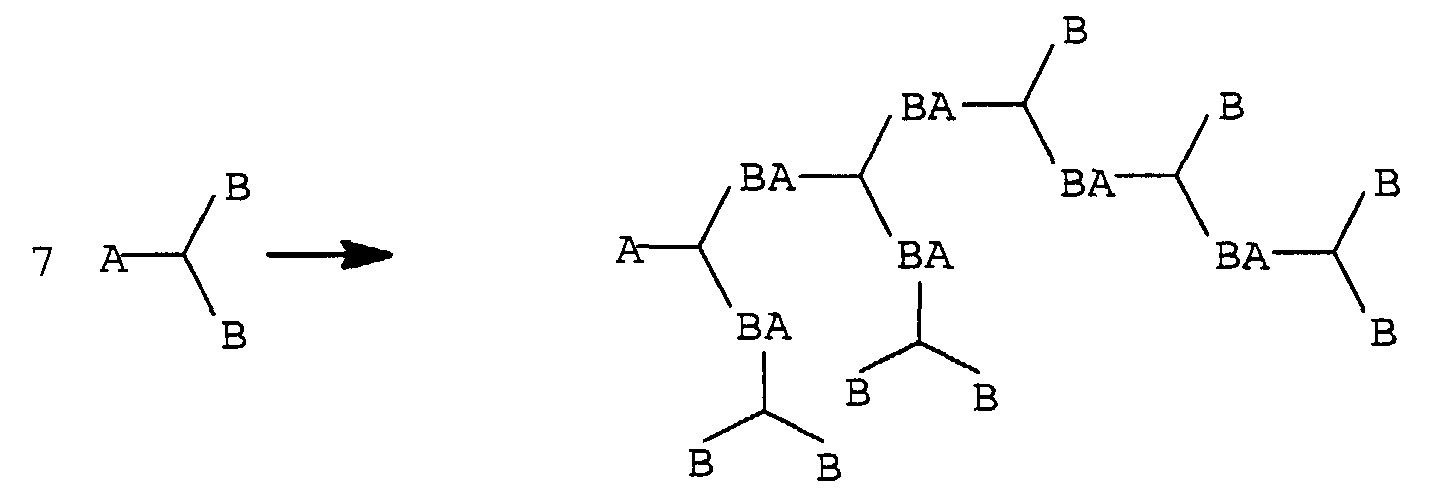
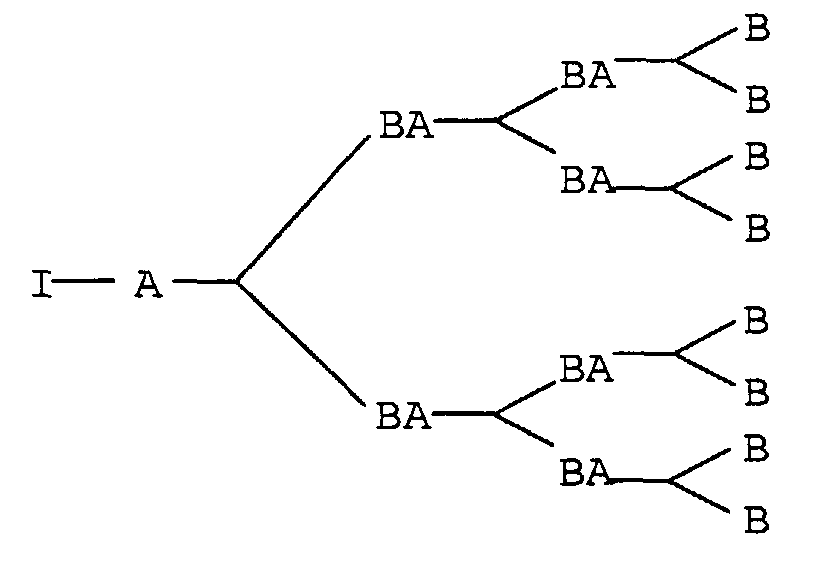
- dendrimeric polyurethanes starting from an initiator core, in defined reaction stages (generations) be built up like a bowl and have a defined molar mass have highly branched polyurethanes, however, randomly constructed are and have a molecular weight distribution.
- a and B can be a hydroxyl or isocyanate group, BA a urethane group and I the initiator core mean.
- I Functionality also attached several of the dendrimer branches shown become.
- one of the TDI's NCO groups is known per se Capped way. This can be done, for example, through uretdionization, Reaction with an oxime, a phenol or other suitable Blocking agents are made. Because of the different Reactivity of the two NCO groups is in the case of 2,4-TDI preferably blocks the 4-position NCO group.
- the free NCO group can be functional with at least 3 H Group-containing compound, for example trimethylolpropane, Glycerin or an alkanolamine, such as diethanolamine, implemented become.
- a molecule After the capping agent has been split off, a molecule also forms 2 hydroxyl groups and an NCO group that leads to dendrimeric polyurethanes can be implemented.
- compounds containing 3 H-functional groups can all aliphatic and aromatic di- or polyisocyanates to monomers with an NCO and at least 2 H functional Groups are implemented.
- Isocyanates are particularly suitable 2,4-tolylene diisocyanate (2,4-TDI), 2,6-tolylene diisocyanate (2,6-TDI), 2,4'-diphenylmethane diisocyanate (2,4'-MDI), 4,4'-diphenylmethane diisocyanate (4,4'-MDI), 1,5-naphthylene diisocyanate (NDI), 1,4-phenylene diisocyanate, 1,3-tetramethylxylylene diisocyanate (TMXDI), hydrogenated MDI (HMDI), isophorone diisocyanate (IPDI) 1,6-hexamethylene diisocyanate (HDI), 2-isocyanatopropylcyclohexyl isocyanate (IPCI), 2-butyl-2-ethyl-pentaethylene diisocyanate (BEPDI), lysine diisocyanate (LDI), 1,12-dodecyl di
- AB n monomers by capping at least one of the H-functional groups in a compound containing at least 2 H-functional groups and reacting the free H-functional groups with isocyanate groups.
- the capping can, for example, in the case of polyfunctional alcohols by acetal or ketal formation. So can for example two hydroxyl groups of trimethylolpropane or Glycerin capped by reaction with acetone and the free hydroxyl group be reacted with an isocyanate group.
- TMP trimethylolpropane
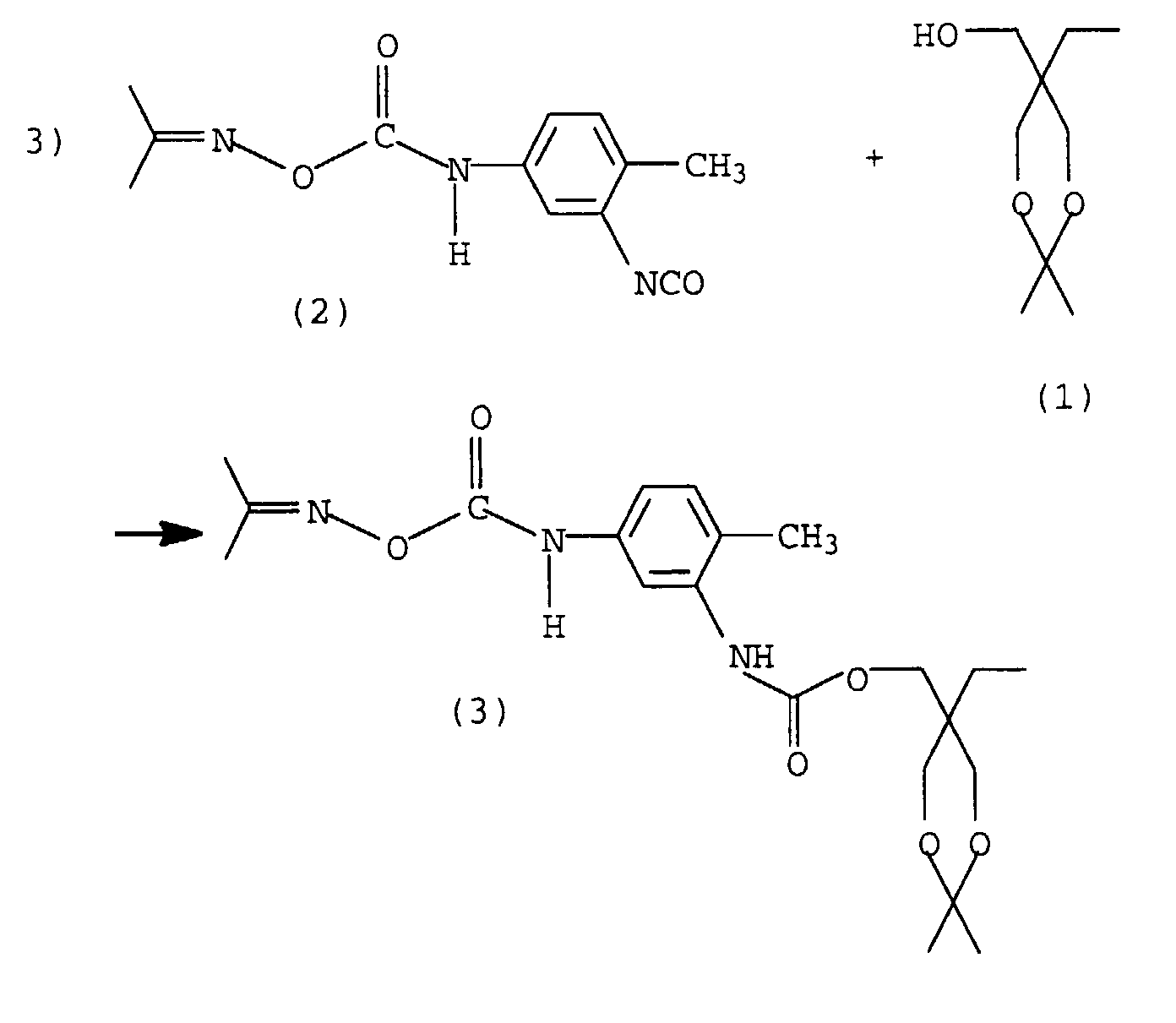
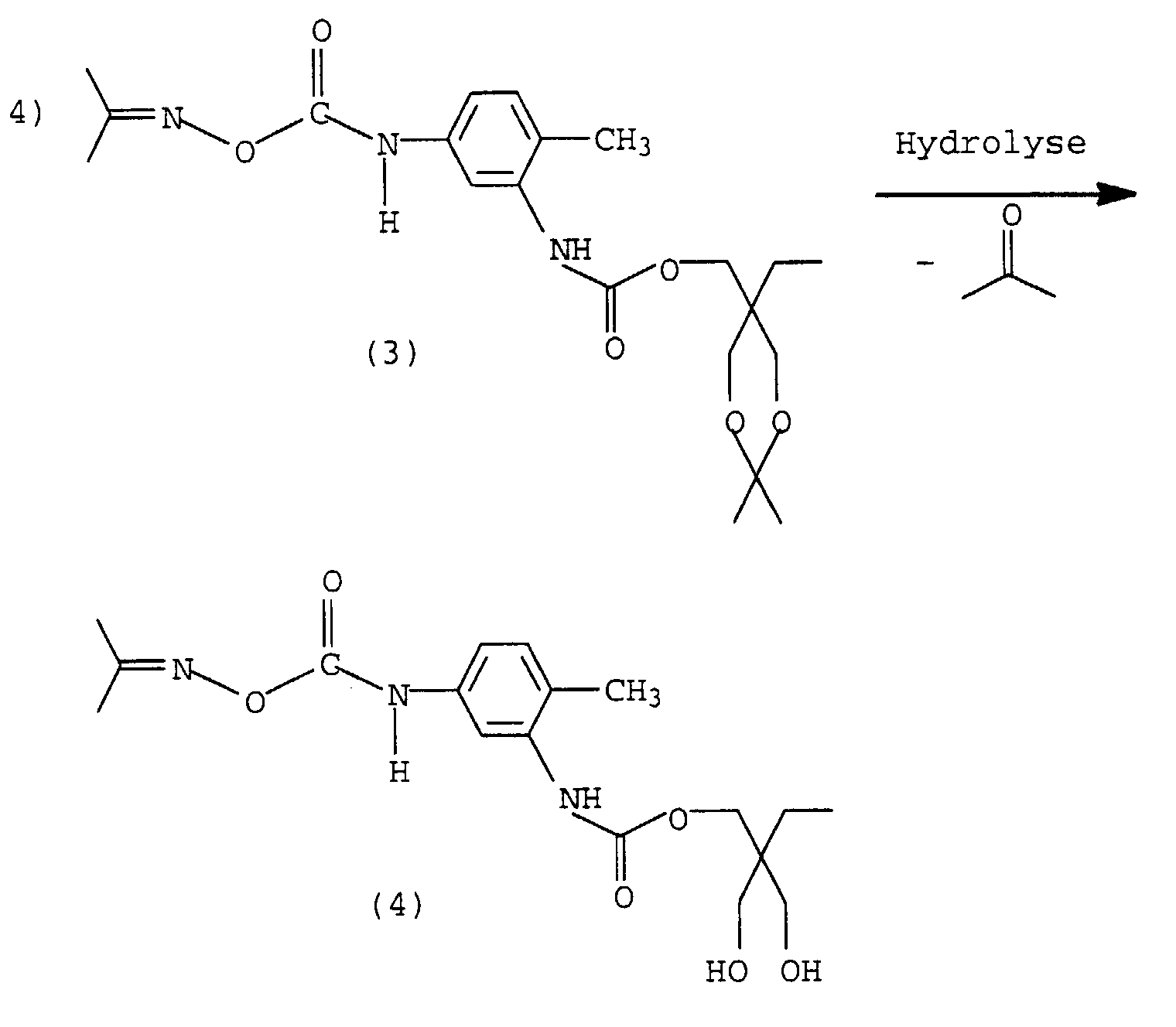
- first and second Step blocks an NCO group of 2,4-TDI with acetone oxime, it forms the monoisocyanate (2).
- the hydroxyl groups can be made accessible again by hydrolysis (4), a monomer is formed, which after release the isocyanate group to form highly branched or dendrimeric polyurethanes can be implemented.
- N-hydroxyalkyl-oxazolidine or dialkanolamine use as an alternative to a masked trimethylolpropane.
- N-hydroxyalkyl-oxazolidine or dialkanolamine use as an alternative to a masked trimethylolpropane.
- the NH group reacts preferentially with dialkanolamines, so that the OH groups are not capped can.
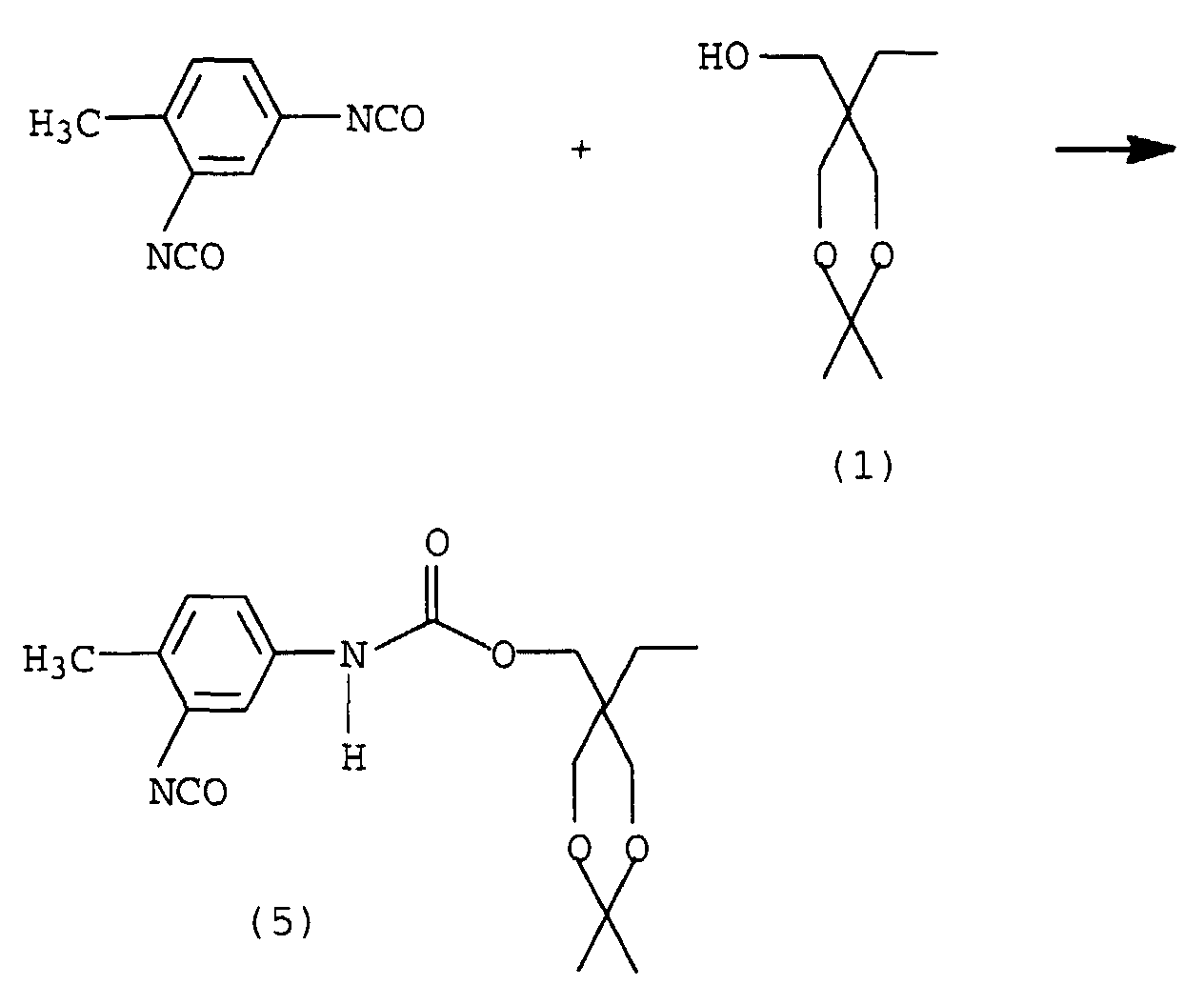
- An isomerically built monomer can be reacted with acetone capped TMP can be obtained with 2,4-TDI.
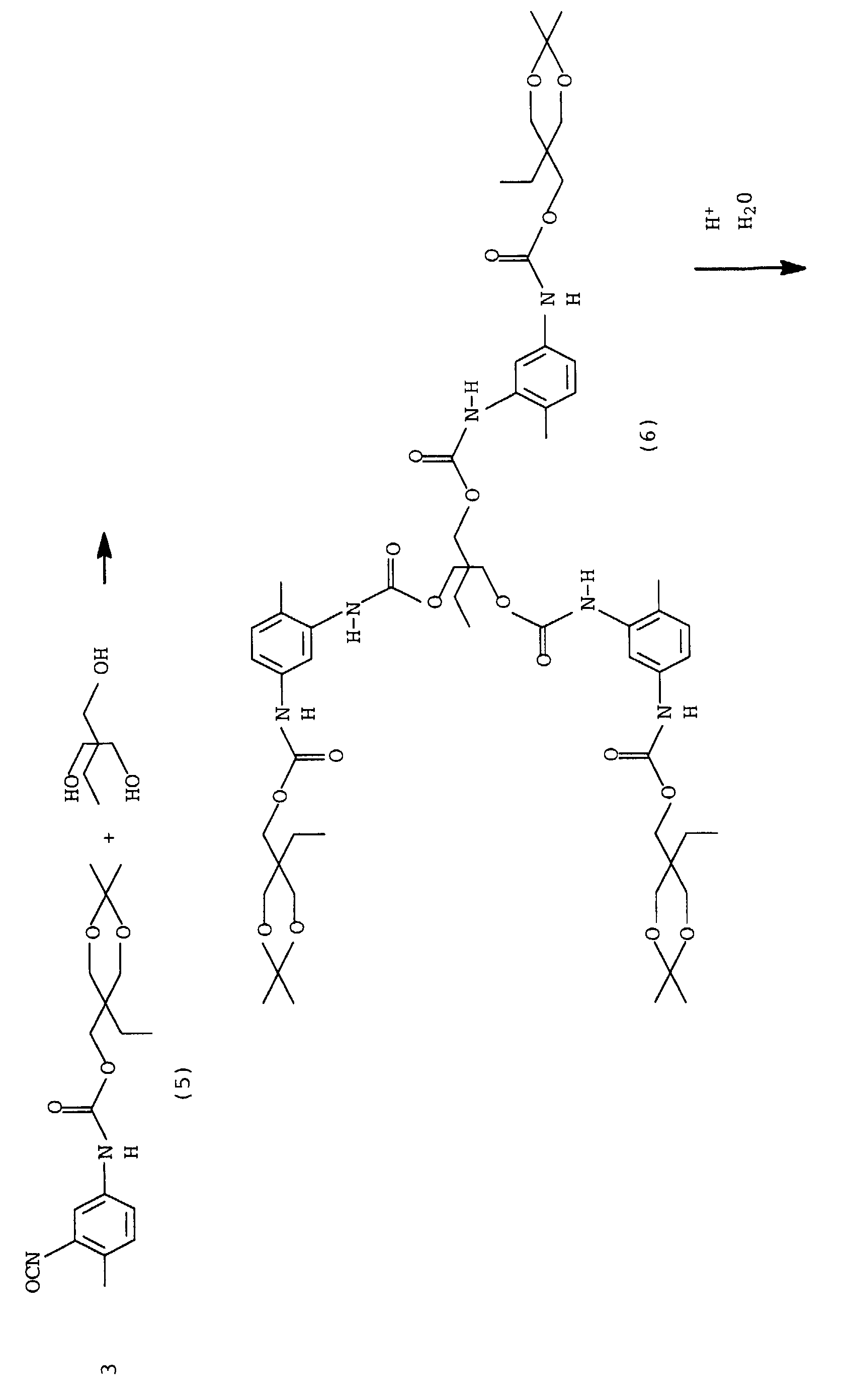
- the free NCO group in compound (5) should also be blocked after the reaction, for example with oxime, in order to enable hydrolysis of the dioxane ring without the monomers reacting with one another. After hydrolysis of the dioxane ring, an AB 2 monomer built up isomerically to (4) is obtained.
- the monomers capped in this way are at room temperature for weeks stable in storage.
- the functional groups of the monomers are activated to the Enable reaction.
- protective groups in the monomers be that the monomers only with the functional groups of Initiator core or the dendrimer and do not react with each other.
- the individual branches are first synthesized, which then coupled to an initiator core become.
- dendrimers with a defined structure advantageous, after the synthesis of each generation, the reaction product to isolate, clean and treat the product so treated to synthesize the next generation.
- the production the dendrimeric polyurethanes are advantageously carried out in solution using the above solvents can.
- the above-mentioned urethanization catalysts can be used to accelerate the reaction be used.
- a convergent structure of dendrimeric polyurethanes that is a synthesis of the branches, which are connected to an initiator core can be added in the same way.
- a monomer unit with two OH groups and one blocked NCO group can be used, for example molecule (4), and the monomer (5) is grafted on in generations.
- the attachment the other monomers are carried out as described above.
- the so synthesized Branches with the blocked hydroxyl groups can Activation of the NCO group of the starting monomer on an H-functional Initiator core. After activating the terminal hydroxyl groups, a dendrimer is formed which its structure is that produced by the divergent process Completely corresponds to dendrimers.
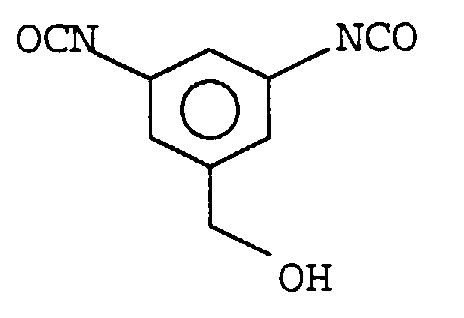
- this molecule can be coupled directly to an H-functional initiator core. After activation of the OH groups, a dendrimer of the O generation is obtained, to which the molecule (9) can in turn be attached. Furthermore, by blocking the free NCO group and then activating the hydroxyl groups, a monomer can be prepared which can be converted to dendrimeric polyurethanes in the same way as described.
- the dendrimeric polyurethanes can e.g. as highly functional Crosslinker for polyurethane lacquers and coatings or for polyurethane foams be used.
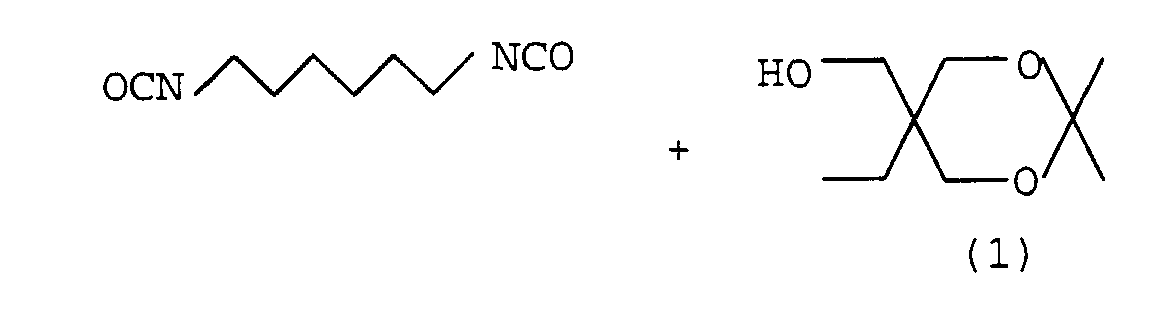
- the reaction product was a colorless liquid with a boiling point at 71 to 72 ° C (0.5 mbar).
- the yield was 254 g ⁇ 78%.
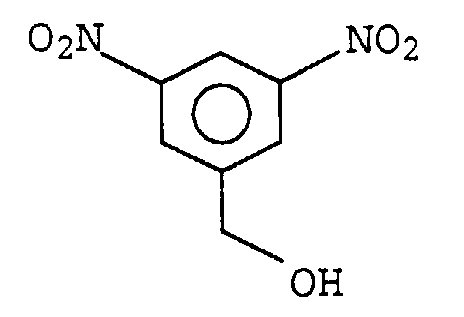
- the solution was evaporated at 35 ° C in a rotary evaporator Residue taken up in 80 ml of methanol, 5 ml of water and 1 ml 1 M hydrochloric acid added and the solution at room temperature over Left overnight. After that, an excess of sodium carbonate added, the solution filtered and the methanol in a rotary evaporator removed at 30 ° C. The aqueous residue was treated with ethyl acetate extracted, the ethyl acetate phase over Dried sodium sulfate and in a rotary evaporator at 30 ° C Dry rotates. The reaction product was a yellowish solid. The yield was 5.8 g.
- reaction product from Example 11 4.00 g of reaction product from Example 11 and 5.75 g of reaction product from Example 3 were dissolved in 70 ml of acetone, 3.5 ul di-n-butyltin dilaurate added and under a nitrogen atmosphere for 3 h 50 ° C stirred. Thereafter, there was no NCO band in the IR spectrum of the solution more available. The solution was rotated at 35 ° C in a rotary evaporator evaporated to dryness.
- the aqueous residue was extracted with ethyl acetate, the ethyl acetate phase is dried over sodium sulfate and evaporated to dryness in a rotary evaporator at 30 ° C.
- the reaction product was a yellowish solid.
- the yield was 0.6 g.
- Example 13 The procedure was as in Example 13, except that instead of the reaction product from Example 1 264 g (2 mol) of isopropylidene glycerol (Fluka AG) added.
- reaction product 100 g of reaction product from Example 13 and 50 mg of dibutyltin dilaurate were submitted and with stirring and nitrogen blanketing the equimolar amount of acetone oxime within 15 minutes, dissolved in dry acetone, added dropwise at room temperature and for one hour after the end of the dosing at room temperature touched. Then the acetone was on a rotary evaporator removed and the reaction product by means of column chromatography purified on silica gel with ethyl acetate as the eluent. The reaction product had a viscosity of 2140 mPas at 23 ° C.
- Example 15 The procedure was as in Example 15, except that instead of the reaction product from Example 13 100 g of reaction product from Example 17 were used.
- Example 17 The procedure was as in Example 17, except that 20 g of the reaction product from Example 19 were used instead of the reaction product from Example 18. Viscosity at 23 ° C: 4740 mPas
- a 0th generation dendrimer with capped hydroxyl groups was formed and the following parameters.
Landscapes
- Chemical & Material Sciences (AREA)
- Organic Chemistry (AREA)
- Health & Medical Sciences (AREA)
- Chemical Kinetics & Catalysis (AREA)
- Medicinal Chemistry (AREA)
- Polymers & Plastics (AREA)
- General Chemical & Material Sciences (AREA)
- Life Sciences & Earth Sciences (AREA)
- Engineering & Computer Science (AREA)
- Materials Engineering (AREA)
- Wood Science & Technology (AREA)
- Polyurethanes Or Polyureas (AREA)
- Organic Low-Molecular-Weight Compounds And Preparation Thereof (AREA)
- Addition Polymer Or Copolymer, Post-Treatments, Or Chemical Modifications (AREA)
- Compositions Of Macromolecular Compounds (AREA)
Description



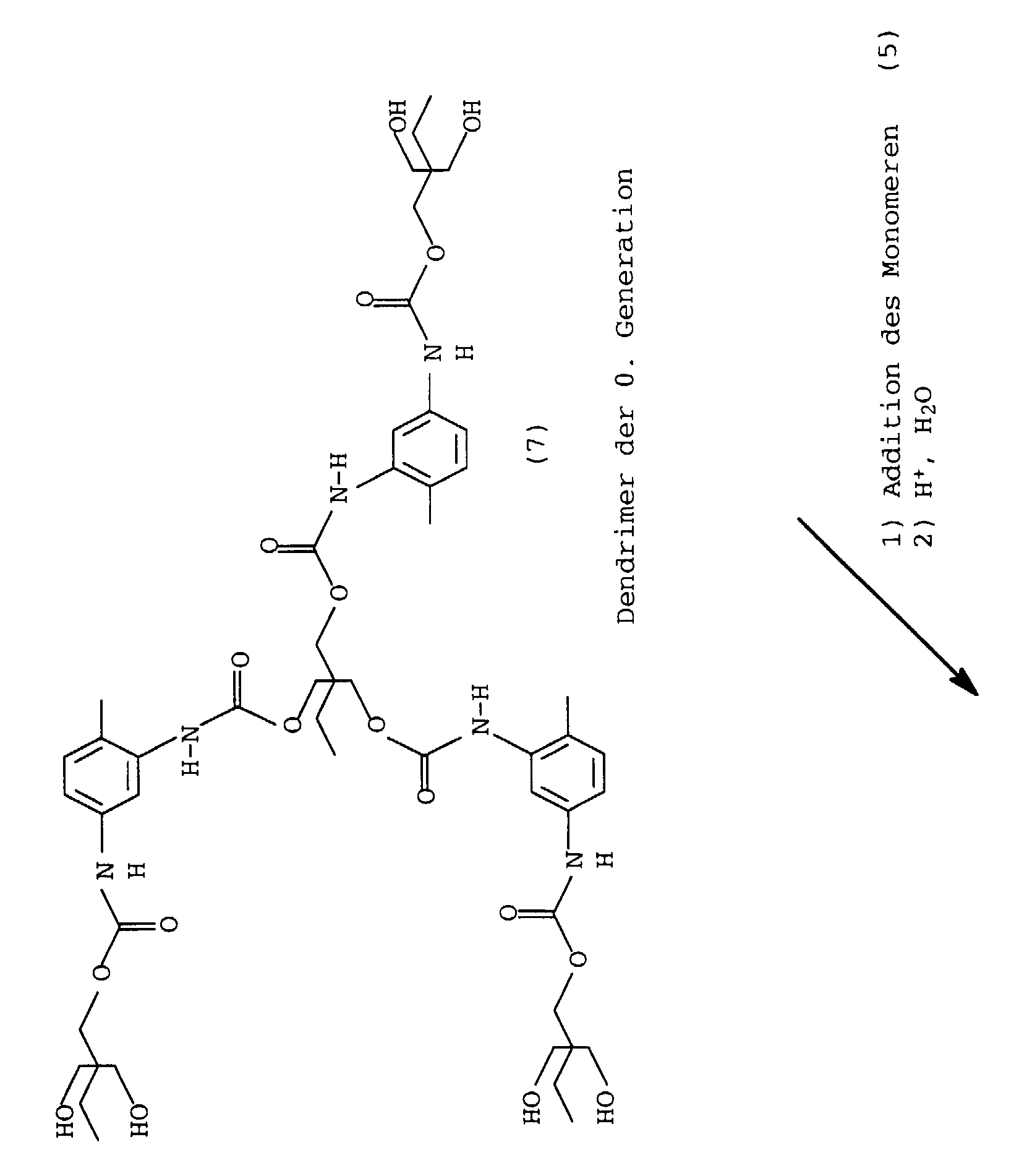



Viskosität bei 23°c: 1070 mPas
Viskosität bei 23°C: 4740 mPas
Claims (14)
- Verfahren zur Herstellung von hochfunktionalisierten dendritischen Polyurethanen, dadurch gekennzeichnet, daß man an einen Initiatorkern mit mindestens 2 funktionellen Gruppen B' an jede funktionelle Gruppe B' ein Molekül mit den funktionellen Gruppen A(B)n anlagert, wobei A eine NCO-Gruppe oder eine mit einer NCO-Gruppe reaktive Gruppe, B und B' eine NCO-Gruppe oder eine mit einer NCO-Gruppe reaktive Gruppe, A mit B und B' reaktiv und n eine natürliche Zahl und mindestens gleich 2 ist, wobei bei der Anlagerung die funktionellen Gruppen B des anzulagernden Moleküls in eine Form überführt werden, in der sie nicht mit A reagieren können, nach der Anlagerung die funktionellen Gruppen B wieder in die mit A reaktive Form überführt werden, in der gleichen Weise wiederum an jede reaktive Gruppe B ein Molekül mit den funktionellen
Gruppen A(B)n angelagert wird und so fortgefahren wird, bis die gewünschte Funktionalität erreicht oder eine Anlagerung weiterer Moleküle aus sterischen oder anderen Gründen nicht mehr möglich ist. - Verfahren nach Anspruch 1, dadurch gekennzeichnet, daß B und B' NCO-Gruppen sind.
- Verfahren nach Anspruch 2, dadurch gekennzeichnet, daß die NCO-Gruppen durch Blockierung in eine Form überführt werden, in der sie nicht mit den mit NCO-Gruppen reaktiven Gruppen reagieren können.
- Verfahren nach Anspruch 3, dadurch gekennzeichnet, daß die Blockierung durch Uretdionbildung erfolgt.
- Verfahren nach Anspruch 3, dadurch gekennzeichnet, daß die Blockierung mittels Oximen erfolgt.
- Verfahren nach Anspruch 1, dadurch gekennzeichnet, daß die funktionellen Gruppen B und B' mit NCO-Gruppen reaktive Gruppen sind.
- Verfahren nach Anspruch 6, dadurch gekennzeichnet, daß die funktionellen Gruppen B und B' Aminogruppen sind.
- Verfahren nach Anspruch 6, dadurch gekennzeichnet, daß die funktionellen Gruppen B und B' Hydroxylgruppen sind.
- Verfahren nach Anspruch 7, dadurch gekennzeichnet, daß als Initiatorkern Ammoniak oder ein mindestes 2-funktionelles Amin eingesetzt wird.
- Verfahren nach Anspruch 8, dadurch gekennzeichnet, daß als Initiatorkern ein aliphatisches, cycloaliphatisches oder aromatisches Diol, ein Triol, ein Tetrol oder ein Zuckeralkohol eingesetzt wird.
- Verfahren nach Anspruch 1, dadurch gekennzeichnet, daß die funktionellen Gruppen B H-funktionelle Gruppen sind.
- Verfahren nach Anspruch 11, dadurch gekennzeichnet, daß die funktionellen Gruppen B Aminogruppen sind.
- Verfahren nach Anspruch 11, dadurch gekennzeichnet, daß die funktionellen Gruppen B Hydroxylgruppen sind.
- Verfahren nach Anspruch 13, dadurch gekennzeichnet, daß die Blockierung der Gruppe B durch Ketalisierung oder Acetalisierung erfolgt.
Applications Claiming Priority (3)
| Application Number | Priority Date | Filing Date | Title |
|---|---|---|---|
| DE19524045A DE19524045A1 (de) | 1995-07-01 | 1995-07-01 | Hochfunktionalisierte Polyurethane |
| DE19524045 | 1995-07-01 | ||
| PCT/EP1996/002705 WO1997002304A1 (de) | 1995-07-01 | 1996-06-21 | Hochfunktionalisierte polyurethane |
Publications (2)
| Publication Number | Publication Date |
|---|---|
| EP0836626A1 EP0836626A1 (de) | 1998-04-22 |
| EP0836626B1 true EP0836626B1 (de) | 2000-01-26 |
Family
ID=7765785
Family Applications (1)
| Application Number | Title | Priority Date | Filing Date |
|---|---|---|---|
| EP96922019A Expired - Lifetime EP0836626B1 (de) | 1995-07-01 | 1996-06-21 | Hochfunktionalisierte polyurethane |
Country Status (7)
| Country | Link |
|---|---|
| US (1) | US5981684A (de) |
| EP (1) | EP0836626B1 (de) |
| JP (1) | JP3781432B2 (de) |
| AT (1) | ATE189237T1 (de) |
| DE (2) | DE19524045A1 (de) |
| ES (1) | ES2142593T3 (de) |
| WO (1) | WO1997002304A1 (de) |
Cited By (1)
| Publication number | Priority date | Publication date | Assignee | Title |
|---|---|---|---|---|
| CN110484190A (zh) * | 2019-09-05 | 2019-11-22 | 山西省应用化学研究所(有限公司) | 房车车身用无溶剂单组分湿固化聚氨酯胶粘剂及其制备方法 |
Families Citing this family (44)
| Publication number | Priority date | Publication date | Assignee | Title |
|---|---|---|---|---|
| US5885172A (en) | 1997-05-27 | 1999-03-23 | Acushnet Company | Multilayer golf ball with a thin thermoset outer layer |
| DE19611368C1 (de) * | 1996-03-22 | 1997-11-20 | Bayer Ag | Mischungen, enthaltend A) Reaktionsprodukte aus Isocyanaten mit NCO-reaktiven Silanen und B) Carbosilan-Dendrimere, ein Verfahren zur Herstellung von Pulverlacken aus den Mischungen und deren Verwendung |
| US5886127A (en) * | 1996-08-28 | 1999-03-23 | University Of South Florida | Combinatorial method of forming cascade polymer surfaces |
| NL1006097C2 (nl) * | 1997-05-21 | 1998-11-25 | Dsm Nv | Werkwijze voor het vervaardigen van een vertakt macromolecule, het vertakte macromolecule en toepassingen van het vertakte macromolecule. |
| US6812317B2 (en) * | 1997-05-27 | 2004-11-02 | Acushnet Company | Wound golf ball having cast polyurethane cover |
| DE19904444A1 (de) | 1999-02-04 | 2000-08-10 | Basf Ag | Dendrimere und hochverzweigte Polyurethane |
| DE19962272A1 (de) | 1999-12-23 | 2001-06-28 | Basf Ag | Isocyanatgruppen aufweisende Bausteine sowie ihre Verwendung zur Funktionalisierung oder Modifizierung von Verbindungen oder Oberflächen |
| DE10013187A1 (de) * | 2000-03-17 | 2001-10-11 | Basf Ag | Hochfunktionelle Polyisocyanata |
| DE10030869A1 (de) | 2000-06-23 | 2002-01-03 | Basf Ag | Mehrfunktionelle Polyisocyanat-Polyadditionsprodukte |
| ES2618322T3 (es) * | 2000-10-31 | 2017-06-21 | Basf Se | Tintas de impresión líquidas para la impresión en huecograbado y/o la impresión flexográfica con polímeros hiperramificados como aglutinante |
| ES2554105T3 (es) * | 2000-10-31 | 2015-12-16 | Basf Se | Uso de poliuretanos hiperramificados para la preparación de tintas de impresión |
| DE10111337A1 (de) * | 2001-03-08 | 2002-09-12 | Basf Ag | Verfahren zur Herstellung von MDI, insbesondere von 2.4'-MDI |
| DE10116767A1 (de) * | 2001-04-04 | 2002-10-10 | Basf Ag | Neue polymere Dispergieradditive mit hyperverzweigten Strukturen |
| JP4511075B2 (ja) * | 2001-04-23 | 2010-07-28 | レンゴー株式会社 | 含硫ウレタン系デンドリマー及びその製造方法 |
| DE10203058A1 (de) * | 2002-01-26 | 2003-07-31 | Bayer Ag | Dentritisch modifizierte Polyurethane |
| US7341972B2 (en) * | 2002-04-19 | 2008-03-11 | Jensen Anton W | Singlet oxygen catalysts including condensed carbon molecules |
| DE10218163A1 (de) * | 2002-04-23 | 2003-11-13 | Basf Ag | Aufzeichnungsflüssigkeiten, enthaltend Polyurethane mit hyperverzweigten Strukturen |
| AU2002950340A0 (en) | 2002-07-23 | 2002-09-12 | Commonwealth Scientific And Industrial Research Organisation | Biodegradable polyurethane/urea compositions |
| DE10249841A1 (de) * | 2002-10-25 | 2004-05-13 | Basf Ag | Verwendung von hyperverzweigten Polymeren, die Urethan- und/oder Harnstoffgruppen aufweisen, zur Modifizierung von Oberflächen |
| DE10318584A1 (de) * | 2003-04-24 | 2004-11-11 | Basf Ag | Hochverzweigte polymere Stabilisatoren |
| DE10322401A1 (de) | 2003-05-16 | 2004-12-02 | Basf Ag | Verfahren zur Herstellung von dendrimeren oder hyperverzweigten Polyurethanen |
| WO2005085312A1 (en) * | 2004-03-03 | 2005-09-15 | Commonwealth Scientific And Industrial Research Organisation | Biocompatible polymer compositions for dual or multistaged curing |
| DE102004046508A1 (de) * | 2004-09-23 | 2006-03-30 | Basf Ag | Wasserdispergierbare, hochfunktionelle Polyisocyanate |
| EP1814924A2 (de) | 2004-10-08 | 2007-08-08 | Firmenich Sa | Amphiphile sternblockcopolymere |
| JP5175109B2 (ja) | 2005-02-21 | 2013-04-03 | ビーエーエスエフ ソシエタス・ヨーロピア | 少なくとも1種の窒素原子含有ハイパーブランチポリマーを含む活性物質組成物 |
| DE102005018451B4 (de) * | 2005-04-20 | 2008-07-24 | Heraeus Kulzer Gmbh | Verwendung von dendritischen Verbindungen in Dentalmaterialien |
| EP1945690B1 (de) | 2005-09-20 | 2016-07-27 | Polynovo Biomaterials Pty Limited | Kettenverlängerungsmittel |
| JP2009544437A (ja) * | 2006-08-02 | 2009-12-17 | ポリィノボ バイオマテリアルズ ピーティワイ リミテッド | 生体適合性ポリマー組成物 |
| US8357767B2 (en) * | 2007-10-03 | 2013-01-22 | Polynovo Biomaterials Limited | High modulus polyurethane and polyurethane/urea compositions |
| DE102007049328A1 (de) | 2007-10-12 | 2009-04-16 | Evonik Degussa Gmbh | Verfahren zur Herstellung hyperverzweigter, dendritischer Polyurethane mittels reaktiver Extrusion |
| DE102007049587A1 (de) * | 2007-10-15 | 2009-04-16 | Evonik Degussa Gmbh | Hydrophilierte, hyperverzweigte Polyurethane |
| ES2648799T3 (es) | 2007-11-19 | 2018-01-08 | Basf Se | Uso de polímeros altamente ramificados en dispersiones de polímero para pinturas brillantes |
| US8309646B2 (en) | 2007-11-19 | 2012-11-13 | Basf Se | Use of highly-branched polymers for producing polymer dispersions with improved freeze/thaw stability |
| FR2929281B1 (fr) * | 2008-03-28 | 2011-03-11 | Polyrise | Modification de la chimie de surface d'especes macromoleculaires en presence d'une guanidine conjuguee |
| US8044140B2 (en) * | 2009-06-12 | 2011-10-25 | Toyota Motor Engineering & Manufacturing North America, Inc | Methods and compositions for pigmented self-stratifying coatings |
| AU2010261875B2 (en) | 2009-06-15 | 2016-02-11 | Basf Se | Microcapsules having highly branched polymers as cross-linking agents |
| ES2460944T3 (es) | 2010-01-20 | 2014-05-16 | Basf Se | Procedimiento para la preparación de una dispersión acuosa de polímero |
| US8722796B2 (en) | 2010-01-20 | 2014-05-13 | Basf Se | Process for preparing an aqueous polymer dispersion |
| KR20140001825A (ko) | 2010-09-01 | 2014-01-07 | 바스프 에스이 | 수성 제제를 위한 회합 증점제 |
| JP2014521797A (ja) | 2011-08-05 | 2014-08-28 | ビーエイエスエフ・ソシエタス・エウロパエア | 超分岐ポリマーに基づく会合性増粘剤 |
| WO2013021039A1 (en) | 2011-08-11 | 2013-02-14 | Basf Se | Microwave absorbing composition |
| WO2014044529A1 (en) | 2012-09-20 | 2014-03-27 | Basf Se | Hyperbranched phosphoric acid esters |
| JP7373109B2 (ja) * | 2017-04-28 | 2023-11-02 | 第一工業製薬株式会社 | ポリオール組成物、ポリウレタン樹脂形成性組成物、複合材料 |
| CN112209855A (zh) * | 2020-09-29 | 2021-01-12 | 杭州传化精细化工有限公司 | 具有反应活性基团的阳离子性亲水扩链剂及其制备方法 |
Family Cites Families (2)
| Publication number | Priority date | Publication date | Assignee | Title |
|---|---|---|---|---|
| US4507466A (en) * | 1983-01-07 | 1985-03-26 | The Dow Chemical Corporation | Dense star polymers having core, core branches, terminal groups |
| US5041516A (en) * | 1989-06-21 | 1991-08-20 | Cornell Research Foundation, Inc. | Dendritic molecules and method of production |
-
1995
- 1995-07-01 DE DE19524045A patent/DE19524045A1/de not_active Withdrawn
-
1996
- 1996-06-21 AT AT96922019T patent/ATE189237T1/de active
- 1996-06-21 JP JP50476197A patent/JP3781432B2/ja not_active Expired - Fee Related
- 1996-06-21 EP EP96922019A patent/EP0836626B1/de not_active Expired - Lifetime
- 1996-06-21 DE DE59604311T patent/DE59604311D1/de not_active Expired - Lifetime
- 1996-06-21 WO PCT/EP1996/002705 patent/WO1997002304A1/de not_active Ceased
- 1996-06-21 ES ES96922019T patent/ES2142593T3/es not_active Expired - Lifetime
- 1996-06-21 US US08/973,729 patent/US5981684A/en not_active Expired - Lifetime
Cited By (1)
| Publication number | Priority date | Publication date | Assignee | Title |
|---|---|---|---|---|
| CN110484190A (zh) * | 2019-09-05 | 2019-11-22 | 山西省应用化学研究所(有限公司) | 房车车身用无溶剂单组分湿固化聚氨酯胶粘剂及其制备方法 |
Also Published As
| Publication number | Publication date |
|---|---|
| ES2142593T3 (es) | 2000-04-16 |
| JPH11508630A (ja) | 1999-07-27 |
| US5981684A (en) | 1999-11-09 |
| EP0836626A1 (de) | 1998-04-22 |
| DE19524045A1 (de) | 1997-01-02 |
| ATE189237T1 (de) | 2000-02-15 |
| JP3781432B2 (ja) | 2006-05-31 |
| DE59604311D1 (de) | 2000-03-02 |
| WO1997002304A1 (de) | 1997-01-23 |
Similar Documents
| Publication | Publication Date | Title |
|---|---|---|
| EP0836626A1 (de) | Hochfunktionalisierte polyurethane | |
| EP1134246B1 (de) | Polyisocyanate | |
| EP1167413B1 (de) | Mehrfunktionelle Polyisocyanat-Polyadditionsprodukte | |
| EP1474461B1 (de) | Verfahren zur herstellung hochfunktioneller hochverzweigter polyharnstoffe | |
| DE19904444A1 (de) | Dendrimere und hochverzweigte Polyurethane | |
| DE2948419A1 (de) | Verfahren zur herstellung von polyaminen und deren verwendung in einem verfahren zur herstellung von polyurethankunststoffen | |
| DE1618394B2 (de) | Verfahren zur Herstellung von nicht-flüchtigen niedermolekularen, tertiäre Aminogruppen enthaltenden Mono- und Polyisocyanaten | |
| DE1174759B (de) | Verfahren zur Herstellung von Polyisocyanaten mit Biuretstruktur | |
| EP0071834B1 (de) | Verfahren zur Herstellung von Polyaminen und deren Verwendung zur Herstellung von Polyurethanen | |
| DE2040644A1 (de) | Neue aromatische Diamine,ein Verfahren zu ihrer Herstellung und ihre Verwendung zur Herstellung von Polyurethanen | |
| DE1932832A1 (de) | Neue Isocyanatverbindung einschliesslich eines neuen Amins und deren Verwendung zur Herstellung von Polyurethanen | |
| EP0001065B1 (de) | Cycloaminale, ein Verfahren zu ihrer Herstellung, sowie ihre Verwendung | |
| DE69913564T2 (de) | Modifizierte polyisocyanate | |
| DE1227003B (de) | Verfahren zur Herstellung von Polyisocyanaten mit Carbamylbiuret-Struktur | |
| EP0062823B1 (de) | Verfahren zur Herstellung von Harnstoff- und/oder Biuretgruppen aufweisenden aromatischen Polyisocyanaten und ihre Verwendung als Isocyanatkomponente bei der Herstellung von Polyurethankunststoffen | |
| DE1227004B (de) | Verfahren zur Herstellung von mehr als zweiwertigen Isocyanaten mit Biuretstruktur- bzw. Carbamylbiuretstruktur | |
| EP0079512B1 (de) | Verfahren zur Herstellung von Polyaminen aus N-Monoaryl-N',N'-dialkylharnstoff-Verbindungen und ihre Verwendung zum Aufbau von Polyurethanen | |
| EP0696580B1 (de) | Carbonat- und Urethangruppen aufweisende tertiäre Amine und ihre Verwendung als Katalysatoren bei der Herstellung von Polyurethankunststoffen | |
| DE2356213C2 (de) | Durch Ketimingruppen terminierte Prepolymere und Verfahren zu ihrer Herstellung | |
| EP0178525B1 (de) | Verfahren zur Herstellung höhermolekularer Aminoverbindungen mit vermindertem Monomeramingehalt, sowie deren Verwendung | |
| EP0191386B1 (de) | Harnstoff- sowie Ester- oder Amidgruppen aufweisende Polyhydroxyverbindungen, Verfahren zu ihrer Herstellung und ihre Verwendung | |
| DE3610198A1 (de) | Polyisocyanat-zubereitungen, ein verfahren zu ihrer herstellung und ihrer verwendung zur herstellung von polyurethan-kunststoffen oder als lufttrocknende beschichtungs- oder klebemittel | |
| EP0410214B1 (de) | Verfahren zur Herstellung N,N-disubstituierter Mono- und Oligourethane | |
| DE1145353B (de) | Verfahren zur Herstellung von homogenen Kunststoffen einschliesslich Flaechengebilden nach dem Isocyanat-Polyadditionsverfahren | |
| DE3609813A1 (de) | Verfahren zur herstellung n,n-disubstituierter mono- und oligourethane |
Legal Events
| Date | Code | Title | Description |
|---|---|---|---|
| PUAI | Public reference made under article 153(3) epc to a published international application that has entered the european phase |
Free format text: ORIGINAL CODE: 0009012 |
|
| 17P | Request for examination filed |
Effective date: 19971121 |
|
| AK | Designated contracting states |
Kind code of ref document: A1 Designated state(s): AT BE CH DE ES FR GB IT LI NL SE |
|
| 17Q | First examination report despatched |
Effective date: 19980716 |
|
| GRAG | Despatch of communication of intention to grant |
Free format text: ORIGINAL CODE: EPIDOS AGRA |
|
| GRAG | Despatch of communication of intention to grant |
Free format text: ORIGINAL CODE: EPIDOS AGRA |
|
| GRAH | Despatch of communication of intention to grant a patent |
Free format text: ORIGINAL CODE: EPIDOS IGRA |
|
| GRAH | Despatch of communication of intention to grant a patent |
Free format text: ORIGINAL CODE: EPIDOS IGRA |
|
| GRAA | (expected) grant |
Free format text: ORIGINAL CODE: 0009210 |
|
| AK | Designated contracting states |
Kind code of ref document: B1 Designated state(s): AT BE CH DE ES FR GB IT LI NL SE |
|
| REF | Corresponds to: |
Ref document number: 189237 Country of ref document: AT Date of ref document: 20000215 Kind code of ref document: T |
|
| REG | Reference to a national code |
Ref country code: CH Ref legal event code: EP |
|
| REF | Corresponds to: |
Ref document number: 59604311 Country of ref document: DE Date of ref document: 20000302 |
|
| ITF | It: translation for a ep patent filed | ||
| GBT | Gb: translation of ep patent filed (gb section 77(6)(a)/1977) |
Effective date: 20000320 |
|
| REG | Reference to a national code |
Ref country code: ES Ref legal event code: FG2A Ref document number: 2142593 Country of ref document: ES Kind code of ref document: T3 |
|
| ET | Fr: translation filed | ||
| PLBE | No opposition filed within time limit |
Free format text: ORIGINAL CODE: 0009261 |
|
| STAA | Information on the status of an ep patent application or granted ep patent |
Free format text: STATUS: NO OPPOSITION FILED WITHIN TIME LIMIT |
|
| 26N | No opposition filed | ||
| REG | Reference to a national code |
Ref country code: GB Ref legal event code: IF02 |
|
| PGFP | Annual fee paid to national office [announced via postgrant information from national office to epo] |
Ref country code: SE Payment date: 20090605 Year of fee payment: 14 |
|
| EUG | Se: european patent has lapsed | ||
| PGFP | Annual fee paid to national office [announced via postgrant information from national office to epo] |
Ref country code: CH Payment date: 20120629 Year of fee payment: 17 Ref country code: NL Payment date: 20120629 Year of fee payment: 17 |
|
| PGFP | Annual fee paid to national office [announced via postgrant information from national office to epo] |
Ref country code: GB Payment date: 20120629 Year of fee payment: 17 |
|
| PG25 | Lapsed in a contracting state [announced via postgrant information from national office to epo] |
Ref country code: SE Free format text: LAPSE BECAUSE OF NON-PAYMENT OF DUE FEES Effective date: 20100622 |
|
| PGFP | Annual fee paid to national office [announced via postgrant information from national office to epo] |
Ref country code: IT Payment date: 20120621 Year of fee payment: 17 |
|
| PGFP | Annual fee paid to national office [announced via postgrant information from national office to epo] |
Ref country code: BE Payment date: 20120726 Year of fee payment: 17 Ref country code: ES Payment date: 20120717 Year of fee payment: 17 Ref country code: FR Payment date: 20120720 Year of fee payment: 17 Ref country code: DE Payment date: 20120830 Year of fee payment: 17 |
|
| PGFP | Annual fee paid to national office [announced via postgrant information from national office to epo] |
Ref country code: AT Payment date: 20120626 Year of fee payment: 17 |
|
| BERE | Be: lapsed |
Owner name: *BASF A.G. Effective date: 20130630 |
|
| REG | Reference to a national code |
Ref country code: NL Ref legal event code: V1 Effective date: 20140101 |
|
| REG | Reference to a national code |
Ref country code: CH Ref legal event code: PL |
|
| REG | Reference to a national code |
Ref country code: AT Ref legal event code: MM01 Ref document number: 189237 Country of ref document: AT Kind code of ref document: T Effective date: 20130621 |
|
| GBPC | Gb: european patent ceased through non-payment of renewal fee |
Effective date: 20130621 |
|
| REG | Reference to a national code |
Ref country code: DE Ref legal event code: R119 Ref document number: 59604311 Country of ref document: DE Effective date: 20140101 |
|
| REG | Reference to a national code |
Ref country code: FR Ref legal event code: ST Effective date: 20140228 |
|
| PG25 | Lapsed in a contracting state [announced via postgrant information from national office to epo] |
Ref country code: BE Free format text: LAPSE BECAUSE OF NON-PAYMENT OF DUE FEES Effective date: 20130630 |
|
| PG25 | Lapsed in a contracting state [announced via postgrant information from national office to epo] |
Ref country code: GB Free format text: LAPSE BECAUSE OF NON-PAYMENT OF DUE FEES Effective date: 20130621 Ref country code: DE Free format text: LAPSE BECAUSE OF NON-PAYMENT OF DUE FEES Effective date: 20140101 Ref country code: LI Free format text: LAPSE BECAUSE OF NON-PAYMENT OF DUE FEES Effective date: 20130630 Ref country code: NL Free format text: LAPSE BECAUSE OF NON-PAYMENT OF DUE FEES Effective date: 20140101 Ref country code: CH Free format text: LAPSE BECAUSE OF NON-PAYMENT OF DUE FEES Effective date: 20130630 |
|
| PG25 | Lapsed in a contracting state [announced via postgrant information from national office to epo] |
Ref country code: FR Free format text: LAPSE BECAUSE OF NON-PAYMENT OF DUE FEES Effective date: 20130701 Ref country code: AT Free format text: LAPSE BECAUSE OF NON-PAYMENT OF DUE FEES Effective date: 20130621 Ref country code: IT Free format text: LAPSE BECAUSE OF NON-PAYMENT OF DUE FEES Effective date: 20130621 |
|
| REG | Reference to a national code |
Ref country code: ES Ref legal event code: FD2A Effective date: 20140708 |
|
| PG25 | Lapsed in a contracting state [announced via postgrant information from national office to epo] |
Ref country code: ES Free format text: LAPSE BECAUSE OF NON-PAYMENT OF DUE FEES Effective date: 20130622 |