EP0823218A1 - Verfahren zur Herstellung von Erszatzn von jungen Fischen und Extruder-Schneider zur Verarbeitung derselben - Google Patents
Verfahren zur Herstellung von Erszatzn von jungen Fischen und Extruder-Schneider zur Verarbeitung derselben Download PDFInfo
- Publication number
- EP0823218A1 EP0823218A1 EP96401765A EP96401765A EP0823218A1 EP 0823218 A1 EP0823218 A1 EP 0823218A1 EP 96401765 A EP96401765 A EP 96401765A EP 96401765 A EP96401765 A EP 96401765A EP 0823218 A1 EP0823218 A1 EP 0823218A1
- Authority
- EP
- European Patent Office
- Prior art keywords
- cutting
- compartment
- strip
- pasta
- support
- Prior art date
- Legal status (The legal status is an assumption and is not a legal conclusion. Google has not performed a legal analysis and makes no representation as to the accuracy of the status listed.)
- Ceased
Links
- 241000251468 Actinopterygii Species 0.000 title claims abstract description 19
- 238000005520 cutting process Methods 0.000 title claims description 53
- 238000004519 manufacturing process Methods 0.000 title claims description 12
- 239000004615 ingredient Substances 0.000 claims abstract description 14
- 238000001125 extrusion Methods 0.000 claims abstract description 13
- 150000003839 salts Chemical class 0.000 claims abstract description 12
- XLYOFNOQVPJJNP-UHFFFAOYSA-N water Substances O XLYOFNOQVPJJNP-UHFFFAOYSA-N 0.000 claims abstract description 12
- 235000000346 sugar Nutrition 0.000 claims abstract description 9
- 235000019465 surimi Nutrition 0.000 claims abstract description 9
- 229920002472 Starch Polymers 0.000 claims abstract description 8
- 239000008107 starch Substances 0.000 claims abstract description 8
- 235000019698 starch Nutrition 0.000 claims abstract description 8
- 102000009027 Albumins Human genes 0.000 claims abstract description 7
- 108010088751 Albumins Proteins 0.000 claims abstract description 7
- 238000004040 coloring Methods 0.000 claims abstract description 6
- 239000000796 flavoring agent Substances 0.000 claims abstract description 5
- 150000002306 glutamic acid derivatives Chemical class 0.000 claims abstract description 5
- 238000002156 mixing Methods 0.000 claims abstract description 5
- 239000003921 oil Substances 0.000 claims abstract description 4
- 235000013372 meat Nutrition 0.000 claims abstract 3
- 235000015927 pasta Nutrition 0.000 claims description 17
- 239000000284 extract Substances 0.000 claims description 9
- 230000006835 compression Effects 0.000 claims description 8
- 238000007906 compression Methods 0.000 claims description 8
- 238000000034 method Methods 0.000 claims description 6
- 238000001035 drying Methods 0.000 claims description 4
- 235000019634 flavors Nutrition 0.000 claims description 4
- 230000003247 decreasing effect Effects 0.000 claims description 3
- 238000004898 kneading Methods 0.000 claims description 3
- 235000019198 oils Nutrition 0.000 claims description 3
- 241001474374 Blennius Species 0.000 claims description 2
- 241000442132 Lactarius lactarius Species 0.000 claims description 2
- 241001609028 Micromesistius poutassou Species 0.000 claims description 2
- 241000237502 Ostreidae Species 0.000 claims description 2
- 230000003750 conditioning effect Effects 0.000 claims description 2
- 235000020636 oyster Nutrition 0.000 claims description 2
- 238000004806 packaging method and process Methods 0.000 claims description 2
- 229920001592 potato starch Polymers 0.000 claims description 2
- 239000000843 powder Substances 0.000 claims description 2
- 235000015112 vegetable and seed oil Nutrition 0.000 claims description 2
- 239000008158 vegetable oil Substances 0.000 claims description 2
- 238000002360 preparation method Methods 0.000 abstract description 9
- 239000003086 colorant Substances 0.000 abstract description 3
- 210000001015 abdomen Anatomy 0.000 description 3
- 239000000975 dye Substances 0.000 description 3
- 235000013305 food Nutrition 0.000 description 3
- 238000000638 solvent extraction Methods 0.000 description 3
- 229930182559 Natural dye Natural products 0.000 description 2
- 230000015572 biosynthetic process Effects 0.000 description 2
- 229940098363 cuttle fish ink Drugs 0.000 description 2
- 238000009434 installation Methods 0.000 description 2
- 239000000203 mixture Substances 0.000 description 2
- 239000000978 natural dye Substances 0.000 description 2
- 241000252073 Anguilliformes Species 0.000 description 1
- 241000624633 Belone belone Species 0.000 description 1
- 241000238366 Cephalopoda Species 0.000 description 1
- 241001313700 Gadus chalcogrammus Species 0.000 description 1
- WHUUTDBJXJRKMK-VKHMYHEASA-N L-glutamic acid Chemical compound OC(=O)[C@@H](N)CCC(O)=O WHUUTDBJXJRKMK-VKHMYHEASA-N 0.000 description 1
- 241000238371 Sepiidae Species 0.000 description 1
- 210000003323 beak Anatomy 0.000 description 1
- 238000005452 bending Methods 0.000 description 1
- 238000010411 cooking Methods 0.000 description 1
- 239000011521 glass Substances 0.000 description 1
- 229930195712 glutamate Natural products 0.000 description 1
- 238000012423 maintenance Methods 0.000 description 1
- 229930014626 natural product Natural products 0.000 description 1
- 230000000135 prohibitive effect Effects 0.000 description 1
- 230000000284 resting effect Effects 0.000 description 1
- 235000002639 sodium chloride Nutrition 0.000 description 1
- 241000894007 species Species 0.000 description 1
- 238000010408 sweeping Methods 0.000 description 1
- 238000005303 weighing Methods 0.000 description 1
Images

Classifications
-
- A—HUMAN NECESSITIES
- A23—FOODS OR FOODSTUFFS; TREATMENT THEREOF, NOT COVERED BY OTHER CLASSES
- A23L—FOODS, FOODSTUFFS OR NON-ALCOHOLIC BEVERAGES, NOT OTHERWISE PROVIDED FOR; PREPARATION OR TREATMENT THEREOF
- A23L17/00—Food-from-the-sea products; Fish products; Fish meal; Fish-egg substitutes; Preparation or treatment thereof
- A23L17/70—Comminuted, e.g. emulsified, fish products; Processed products therefrom such as pastes, reformed or compressed products
-
- A—HUMAN NECESSITIES
- A23—FOODS OR FOODSTUFFS; TREATMENT THEREOF, NOT COVERED BY OTHER CLASSES
- A23P—SHAPING OR WORKING OF FOODSTUFFS, NOT FULLY COVERED BY A SINGLE OTHER SUBCLASS
- A23P30/00—Shaping or working of foodstuffs characterised by the process or apparatus
- A23P30/20—Extruding
- A23P30/25—Co-extrusion of different foodstuffs
Definitions
- the present invention relates to the field of the preparation of food products imitating by their appearance, their smell and their taste, natural products. More particularly, the present invention aims to obtain an imitation of young fish such as fry, for example fry of garfish, or glass eels.
- the invention aims to obtain food products as close as possible to natural fry in all areas, so that the confusion between the two types of product is almost total.
- the invention is based on the formation of a multilayer strip by joint extrusion from several pastes, and on a "flexible” cutting of this strip.
- the subject of the invention is a process for preparing a substitute for young fish based on surimi and / or fish flesh, comprising a step of kneading this base with ingredients taken at least from starch albumin, l water l oil, extracts of flavor, sugar, salt, glutamates and colorants, characterized in that this step is repeated to obtain at least two pastes of different color and / or consistency by choice of additional ingredients and their proportions, in that this repeated first step is followed by a step of compacting the pasta to form a multi-layer strip, each layer consisting of a paste, the compacting being obtained by compression of the pasta, and d a step of repeatedly cutting said strip by sharp scanning with elastic support.
- the process implemented on a production line by suitable means is completed by a precooking step in salt water and heated to high temperature, for example at about 80 ° C., followed by a step of draining, then drying in an atmosphere d hot and stirred air, and a conditioning step.
- the invention also relates to an extruder which makes it possible to produce elongated elements similar to fry, from pasta based on surimi and / or fish flesh brought under pressure, for example under aqueous pressure in pipes of food.
- Such a machine hereinafter called cutting extruder, essentially comprises at least two compartments of extrusion arranged in series, in which the pasta delivered under pressure by pipes of feed from compression means, to form layers of dough.
- Each compartment has an outlet which communicates successively to the same containment box.
- This case of containment has a thickness which increases with each exit of compartment, to integrate a new layer of dough from this compartment so as to form a single strip of multilayer dough.
- the case has a bottom in the plane of which a cutout of elongated shape is swept, externally to the housing, by at least one sharp element.
- This cutting element comes into elastic support against the cutting plane to separate the multilayer strip into elements lying down.
- the shape of the cutout is adapted so that the elongated element have the desired shape, presenting the characteristics of the fish model to imitate, for example a rostrum or a rounded belly.
- the cutting extruder comprises a cylindrical support rotated about its axis, on which are arranged multiple cutting elements regularly distributed parallel to the axis of this support.
- the distance between l axis of rotation of the support and the cutting plane is adjusted so that the cutting elements come periodically, during the rotation of the support, in elastic support against the cutting.
- the speed of rotation of the support and the speed of extrusion are proportionally adapted so that the cut strip has a cross-section of circular or slightly flattened shape, depending on the reference model.
- the cutting extruder has two compartments d extrusion to provide two layers corresponding for example to the belly and back of the fry, the pasta being light gray and dark gray respectively by addition of a suitable dye, for example squid ink.
- the cutting extruder also has a special internal extrusion compartment, which enters the other compartments and passes through the exits of these compartments, until the exit of the last compartment up to the plan cutting.
- a different color paste is introduced under pressure in the internal compartment.
- This internal compartment allows to integrate a washer-shaped layer in the multilayer strip, and therefore in each cut element. This washer accounts for the eye of the fry.
- the containment box can be formed successively from partitioned rooms, each room connecting a compartment outlet on the cutting plane. This case may also have only one single room, without partitioning.
- the training step I is preceded by a kneading step a base of surimi and / or fish flesh.
- a base of surimi and / or fish flesh In this stage of mixing, it is planned to obtain two doughs by thoroughly mixing this base with ingredients taken from the following non-exhaustive list: starch, albumin, water, oil, flavor extracts, sugar, salt, glutamate and dyes. The ingredients and their proportions are chosen to obtain two pastes of color and consistency as close as possible to the fry we are trying to imitate.
- two doughs are prepared in two mixers, from blocks of thawed surimi, the temperature remaining, at all stages of the pasta production, between - 5 and + 8 ° C. Two pasta colors are obtained, one dark gray intended for the manufacture of the back of the fry, the other light gray intended for the manufacture of its belly.
- composition of these two different pasta not only for give a different color but also a different consistency, the dark gray dough being firmer and more elastic than the light gray dough.
- the difference in color is obtained by using a different dye or of the same color in different proportions in the two pastes, and the difference in consistency is obtained by varying the proportions of the different ingredients, including starch, albumin and glutamates.
- the pasta is then directed, without being mixed, into control hoppers of an elevated multiple entry extruder 1 on a frame 1a, placed at training station I. It is possible to provide also a third extruder inlet hopper to bring a other preparation based on cuttlefish ink, in order to coat the paste used for making the back of the fry from a thin black filament.
- the extruder 1 compacts the different doughs by joint compression in order to obtain a multilayer strip, the strip formed being cut out of the extruder. Repeated cutting is produced by sharp elements capable of sweeping the outlet of the extruder resting against it.
- An extruder cutting machine more particularly adapted to be used in this installation, is described below.
- the strip is thus cut into elements which are ejected, by the elastic force of the cutting elements, towards the pre-cooking station II.
- the fry-shaped elements are routed individually on a conveyor belt 2 which is bathed in water heated to a temperature can vary between 80 and 90 ° C.
- the water is salty, with a salt content varying between 2 and 10%, and the speed of the belt 2 is adjusted so that the products can stay a few minutes at this station, for example between one and four minutes.
- the precooked products are drained by passing over a mesh conveyor belt 2a, an air circulation at room temperature being performed above the carpet, using fans 3.
- the drained products obtained are routed, still on a conveyor belt 2b, under U.V. 4 lamps (diffusing an ultraviolet light).
- the atmosphere is bathed in air heated using ventilated hoods 5 arranged above the lamps U.V. 4.
- the fingerling substitutes are packaged in preformed trays, after weighing, to be preserved and sold, either in fresh products or in frozen products.
- the invention also provides a cutting and extruding machine making it possible in particular to give an imprint to the dough or pasta usually obtained from mixtures based on surimi, imprints which give the product an appearance as close as possible to the appearance of the fish which '' he seeks to imitate (coloring in realistic proportions, together forming an inseparable unit, area imitating the eye).
- a cutting and extruding machine making it possible in particular to give an imprint to the dough or pasta usually obtained from mixtures based on surimi, imprints which give the product an appearance as close as possible to the appearance of the fish which '' he seeks to imitate (coloring in realistic proportions, together forming an inseparable unit, area imitating the eye).
- Such a machine is particularly, but not exclusively, suitable for the preparation process and the production line which have just been described.
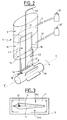
- FIG. 2 schematically illustrates a partially cut away view of an example of an extruder cutter according to the invention.
- the extruder cutter 6 consists of two control hoppers 7, 8, two extrusion compartments, respectively 9 and 10, arranged one after the other, supply pipes, respectively 11 and 12, between the hoppers and the compartments, compartment outlets, respectively 13 and 14, of a confinement box terminated by a flat cut-out bottom 16, of a cut-out 17 arranged in the flat bottom 16, d cutting elements 18, advantageously integral with a cylindrical support 19 rotated.
- Outings 13 and 14 of compartments 9 and 10 are rectangular in shape to provide successively a layer of dough, C1 then C2, in the housing of containment 15, with which it communicates by their exit to form a strip B.
- the housing 15 thus has a thickness which increases to each compartment exit, to integrate a new layer of dough.
- the dough layers are not in contact in the case and remain partitioned to the flat bottom of section 16 in separate chambers Ch1 and Ch2.
- Band B is thus formed of multiple but separate layers.
- a part P is fixed.
- the cutout is arranged 17. The position of part P is adjusted so that the pasta 20 and 20 ' from the containment box 15 can pass through the cutout 17 according to predetermined proportions, for example according to a thickness substantially equal.
- the cutting elements 18 come into elastic abutment against the plane of the cutout 17, that is to say that these cutting elements come against the cutting plane by bending slightly.
- the cylindrical support 19 of the cutting elements 18 is rotated around its axis X'X by motorized means (not shown).
- the cutting elements 18 are regularly distributed over the cylinder 19 and are detachably attached so they can be replaced.
- the distance between the axis of rotation X'X of the support 19 and the cutting plane 16 is adjusted so that the cutting elements 18 come successively in elastic support against the cutout 17 during the rotation of the support 19.
- the cutting extruder may comprise a substantially cylindrical internal extrusion compartment 21, which passes into the other compartments 9 and 10, and the outlets 13 and 14 of these compartments, up to the last compartment outlet or to the cutting plane 16 as shown.
- a paste of different color is introduced under aqueous pressure into the internal compartment 21, obtained from cuttlefish ink.
- This internal compartment has a circular section adapted to integrate into the multilayer dough strip a layer in the form of a filament between the two layers. This filament gives, during cutting by l cutting element 18, a disc-shaped trace, representing the imprint of the eye.
- FIG 3 shows, seen from the outside, the bottom of the cutout 16 in this alternative embodiment. On this view, it appears the part P with its cutout 17, the partitioning K between the chambers Ch1 and Ch2 of the containment box, and the circular end of compartment 21.
- the invention is not limited to the embodiments described and represented. It is for example possible to add a third serial compartment, containing an ink-based preparation of cuttlefish, the exit of which would be of thickness less than the exits of the two exit compartments described above. This third layer is arranged on the dark gray layer and used to coat the back of the substitute fry with a light black filament.
- the containment box can be designed in one room, without partitioning, so that each successive layer comes in contact with the strip formed of pasta already arranged in layers.
- a person skilled in the art can provide means for fixing the removable cutting piece P, so as to have other pieces of cutting in which other forms of cutting are provided. It is thus possible to modify the conformation of the products obtained so to imitate the shape of other fish.
- the sharp elements are means known to those skilled in the art, for example plastic of suitable elasticity.
Landscapes
- Engineering & Computer Science (AREA)
- Life Sciences & Earth Sciences (AREA)
- Chemical & Material Sciences (AREA)
- Food Science & Technology (AREA)
- Polymers & Plastics (AREA)
- Manufacturing & Machinery (AREA)
- Marine Sciences & Fisheries (AREA)
- Zoology (AREA)
- Health & Medical Sciences (AREA)
- Nutrition Science (AREA)
- Manufacturing And Processing Devices For Dough (AREA)
- Noodles (AREA)
Priority Applications (1)
| Application Number | Priority Date | Filing Date | Title |
|---|---|---|---|
| EP96401765A EP0823218A1 (de) | 1996-08-09 | 1996-08-09 | Verfahren zur Herstellung von Erszatzn von jungen Fischen und Extruder-Schneider zur Verarbeitung derselben |
Applications Claiming Priority (1)
| Application Number | Priority Date | Filing Date | Title |
|---|---|---|---|
| EP96401765A EP0823218A1 (de) | 1996-08-09 | 1996-08-09 | Verfahren zur Herstellung von Erszatzn von jungen Fischen und Extruder-Schneider zur Verarbeitung derselben |
Publications (1)
| Publication Number | Publication Date |
|---|---|
| EP0823218A1 true EP0823218A1 (de) | 1998-02-11 |
Family
ID=8225282
Family Applications (1)
| Application Number | Title | Priority Date | Filing Date |
|---|---|---|---|
| EP96401765A Ceased EP0823218A1 (de) | 1996-08-09 | 1996-08-09 | Verfahren zur Herstellung von Erszatzn von jungen Fischen und Extruder-Schneider zur Verarbeitung derselben |
Country Status (1)
| Country | Link |
|---|---|
| EP (1) | EP0823218A1 (de) |
Cited By (5)
| Publication number | Priority date | Publication date | Assignee | Title |
|---|---|---|---|---|
| ES2165805A1 (es) * | 2000-05-17 | 2002-03-16 | Tecnologia De Procesos Aliment | Sucedaneo de anchoa y procedimiento para su preparacion. |
| WO2004030473A1 (es) * | 2002-10-01 | 2004-04-15 | Consejo Superior De Investigaciones Científicas | Elaboración de un análogo a chanquete |
| WO2005036991A1 (es) * | 2003-10-20 | 2005-04-28 | Holdeker, S.L. | Máquina para la producción de analogo o sucedáneo de filete de anchoa a partir de surimi, su procedimiento de obtención y producto así obtenido |
| US7358192B2 (en) | 2004-04-08 | 2008-04-15 | Applied Materials, Inc. | Method and apparatus for in-situ film stack processing |
| FR2914151A1 (fr) * | 2007-03-28 | 2008-10-03 | Neptune Soc Par Actions Simpli | Procede de fabrication d'un batonnet de pate alimentaire, buse et installation de mise en oeuvre |
Citations (5)
| Publication number | Priority date | Publication date | Assignee | Title |
|---|---|---|---|---|
| US3764715A (en) * | 1972-02-04 | 1973-10-09 | Quaker Oats Co | Method of simultaneously extruding and coating a ready-to-eat cereal |
| GB2183439A (en) * | 1985-10-24 | 1987-06-10 | Kibun Kk | Textured proteinaceous food |
| EP0239203A2 (de) * | 1986-03-25 | 1987-09-30 | Kabushiki Kaisha Ikeuchi Tekkosho | Verfahren und Vorrichtung zum Herstellen eines Nahrungsproduktes |
| US4853239A (en) * | 1988-02-01 | 1989-08-01 | Jac Creative Foods, Inc. | Method for producing a fish slurry into edible products |
| EP0575233A1 (de) * | 1992-06-15 | 1993-12-22 | NEPTUNE Société Anonyme | Verfahren zur industriellenHerstellung eines Nahrungsmittels |
-
1996
- 1996-08-09 EP EP96401765A patent/EP0823218A1/de not_active Ceased
Patent Citations (5)
| Publication number | Priority date | Publication date | Assignee | Title |
|---|---|---|---|---|
| US3764715A (en) * | 1972-02-04 | 1973-10-09 | Quaker Oats Co | Method of simultaneously extruding and coating a ready-to-eat cereal |
| GB2183439A (en) * | 1985-10-24 | 1987-06-10 | Kibun Kk | Textured proteinaceous food |
| EP0239203A2 (de) * | 1986-03-25 | 1987-09-30 | Kabushiki Kaisha Ikeuchi Tekkosho | Verfahren und Vorrichtung zum Herstellen eines Nahrungsproduktes |
| US4853239A (en) * | 1988-02-01 | 1989-08-01 | Jac Creative Foods, Inc. | Method for producing a fish slurry into edible products |
| EP0575233A1 (de) * | 1992-06-15 | 1993-12-22 | NEPTUNE Société Anonyme | Verfahren zur industriellenHerstellung eines Nahrungsmittels |
Non-Patent Citations (1)
| Title |
|---|
| "Le surimi:la pâte à tout faire?", EQUINOXE, no. 5, - November 1985 (1985-11-01), NANTES FR, pages 36 - 39, XP002023191 * |
Cited By (6)
| Publication number | Priority date | Publication date | Assignee | Title |
|---|---|---|---|---|
| ES2165805A1 (es) * | 2000-05-17 | 2002-03-16 | Tecnologia De Procesos Aliment | Sucedaneo de anchoa y procedimiento para su preparacion. |
| WO2004030473A1 (es) * | 2002-10-01 | 2004-04-15 | Consejo Superior De Investigaciones Científicas | Elaboración de un análogo a chanquete |
| ES2204323A1 (es) * | 2002-10-01 | 2004-04-16 | Consejo Sup. De Investig. Cientificas. | Elaboracion de un analogo a chanquete. |
| WO2005036991A1 (es) * | 2003-10-20 | 2005-04-28 | Holdeker, S.L. | Máquina para la producción de analogo o sucedáneo de filete de anchoa a partir de surimi, su procedimiento de obtención y producto así obtenido |
| US7358192B2 (en) | 2004-04-08 | 2008-04-15 | Applied Materials, Inc. | Method and apparatus for in-situ film stack processing |
| FR2914151A1 (fr) * | 2007-03-28 | 2008-10-03 | Neptune Soc Par Actions Simpli | Procede de fabrication d'un batonnet de pate alimentaire, buse et installation de mise en oeuvre |
Similar Documents
| Publication | Publication Date | Title |
|---|---|---|
| RU2254000C2 (ru) | Пищевой продукт на основе рыбы, состоящий из пастообразного материала и волокнистого материала (варианты), способ и установка для его получения | |
| FR2803491A1 (fr) | Procede de coextrusion avec canules de coextrusion | |
| US4166138A (en) | Preparation of bacon-like meat analog | |
| EP0195702B1 (de) | Verfahren und Vorrichtung zur Herstellung eines Nahrungsmittels mit weichem Gefüge | |
| FR2559031A1 (fr) | Friandise a base de biscuit et procede de fabrication | |
| FI56923B (fi) | Foerfarande och apparat foer framstaellning av en baconliknande koettersaettning | |
| US20030008038A1 (en) | Frozen crustless sliced sandwich and method and apparatus for making same | |
| EP0210448B1 (de) | Verfahren zur Herstellung eines Nahrungsmittels auf Basis von pflanzlichen Proteinen | |
| WO2003099020A1 (fr) | Procede de fabrication d'un produit alimentaire a pate pliee, chaine industrielle de mise en oeuvre et produit obtenu | |
| EP0166748B1 (de) | Nahrungsmittelzubereitung für die herstellung oder dekoration von fleisch oder gleichartigen produkten | |
| EP0823218A1 (de) | Verfahren zur Herstellung von Erszatzn von jungen Fischen und Extruder-Schneider zur Verarbeitung derselben | |
| CA1085669A (fr) | Procede de fabrication de proteines texturees d'origine vegetale et leur utilisation | |
| CA2350866A1 (fr) | Cuisson combinee en continu microondes vapeur | |
| EP1166635A1 (de) | Mehrschichtiger Keks für gekühltes oder gefrorenes Lebensmittel | |
| US20060121169A1 (en) | Artistic pasta and method of making | |
| KR20000009635A (ko) | 가래떡에 내부충진물을 주입한 떡볶이 제조방법 및 장치 | |
| EP0366541B1 (de) | Verfahren zur Herstellung eines Nahrungsmittels auf der Basis von Milch-Ultrafiltrationsretentat und dieses Nahrungsmittel | |
| JPH0779665B2 (ja) | かに足肉状かまぼこ及びその製造方法 | |
| FR2743472A1 (fr) | Produit a base de pate laminee et/ou feuilletee et/ou extrudee et son procede de fabrication | |
| EP0734657A1 (de) | Nahrungsmittel und Verfahren zur Herstellung | |
| EP0888725B1 (de) | Verfahren und Vorrichtung zur Herstellung von ringförmigen Nahrungsmitteln | |
| EP0855139A2 (de) | Verfahren zur Herstellung eines Nahrungsmittelprodukts | |
| FR2693634A1 (fr) | Produit alimentaire notamment du type biscuit ou pâtisserie et son procédé de fabrication. | |
| JP2575334B2 (ja) | 揚げ菓子の製造方法 | |
| JPS581909B2 (ja) | 特殊かまぼこ製品の製造方法 |
Legal Events
| Date | Code | Title | Description |
|---|---|---|---|
| PUAI | Public reference made under article 153(3) epc to a published international application that has entered the european phase |
Free format text: ORIGINAL CODE: 0009012 |
|
| AK | Designated contracting states |
Kind code of ref document: A1 Designated state(s): ES FR IT PT |
|
| 17P | Request for examination filed |
Effective date: 19980806 |
|
| AKX | Designation fees paid |
Free format text: ES FR IT PT |
|
| RBV | Designated contracting states (corrected) |
Designated state(s): ES FR IT PT |
|
| GRAG | Despatch of communication of intention to grant |
Free format text: ORIGINAL CODE: EPIDOS AGRA |
|
| 17Q | First examination report despatched |
Effective date: 20010626 |
|
| STAA | Information on the status of an ep patent application or granted ep patent |
Free format text: STATUS: THE APPLICATION HAS BEEN REFUSED |
|
| 18R | Application refused |
Effective date: 20020222 |