EP0813576B1 - Epoxy-cyanate ester compositions - Google Patents
Epoxy-cyanate ester compositions Download PDFInfo
- Publication number
- EP0813576B1 EP0813576B1 EP96902686A EP96902686A EP0813576B1 EP 0813576 B1 EP0813576 B1 EP 0813576B1 EP 96902686 A EP96902686 A EP 96902686A EP 96902686 A EP96902686 A EP 96902686A EP 0813576 B1 EP0813576 B1 EP 0813576B1
- Authority
- EP
- European Patent Office
- Prior art keywords
- cyanate ester
- group
- carbon atoms
- bronsted acid
- initiator
- Prior art date
- Legal status (The legal status is an assumption and is not a legal conclusion. Google has not performed a legal analysis and makes no representation as to the accuracy of the status listed.)
- Expired - Lifetime
Links
- 239000000203 mixture Substances 0.000 title claims description 83
- 239000004643 cyanate ester Substances 0.000 title claims description 63
- 229920005989 resin Polymers 0.000 claims description 49
- 239000011347 resin Substances 0.000 claims description 49
- 125000004432 carbon atom Chemical group C* 0.000 claims description 31
- 239000007848 Bronsted acid Substances 0.000 claims description 28
- 239000004593 Epoxy Substances 0.000 claims description 25
- 238000013016 damping Methods 0.000 claims description 24
- 239000003999 initiator Substances 0.000 claims description 24
- 150000003077 polyols Chemical class 0.000 claims description 24
- 229920005862 polyol Polymers 0.000 claims description 23
- -1 -S- Chemical group 0.000 claims description 21
- 229920000647 polyepoxide Polymers 0.000 claims description 20
- 150000001875 compounds Chemical class 0.000 claims description 18
- 229920000642 polymer Polymers 0.000 claims description 17
- 239000002253 acid Substances 0.000 claims description 14
- 239000011353 cycloaliphatic epoxy resin Substances 0.000 claims description 14
- 239000003822 epoxy resin Substances 0.000 claims description 14
- 125000000217 alkyl group Chemical group 0.000 claims description 13
- 229910052739 hydrogen Inorganic materials 0.000 claims description 13
- 239000000853 adhesive Substances 0.000 claims description 11
- 230000001070 adhesive effect Effects 0.000 claims description 11
- 239000001257 hydrogen Substances 0.000 claims description 11
- 238000000034 method Methods 0.000 claims description 11
- 125000004435 hydrogen atom Chemical group [H]* 0.000 claims description 10
- 239000003381 stabilizer Substances 0.000 claims description 10
- 125000003118 aryl group Chemical class 0.000 claims description 9
- 150000003839 salts Chemical class 0.000 claims description 9
- 125000002887 hydroxy group Chemical group [H]O* 0.000 claims description 8
- 229910052787 antimony Inorganic materials 0.000 claims description 7
- WATWJIUSRGPENY-UHFFFAOYSA-N antimony atom Chemical compound [Sb] WATWJIUSRGPENY-UHFFFAOYSA-N 0.000 claims description 7
- 125000004185 ester group Chemical group 0.000 claims description 7
- 150000002148 esters Chemical class 0.000 claims description 7
- 150000004982 aromatic amines Chemical class 0.000 claims description 6
- LFQSCWFLJHTTHZ-UHFFFAOYSA-N Ethanol Chemical compound CCO LFQSCWFLJHTTHZ-UHFFFAOYSA-N 0.000 claims description 5
- 125000002877 alkyl aryl group Chemical group 0.000 claims description 5
- 239000000178 monomer Substances 0.000 claims description 5
- DNIAPMSPPWPWGF-GSVOUGTGSA-N (R)-(-)-Propylene glycol Chemical compound C[C@@H](O)CO DNIAPMSPPWPWGF-GSVOUGTGSA-N 0.000 claims description 4
- 125000004429 atom Chemical group 0.000 claims description 4
- 239000011230 binding agent Substances 0.000 claims description 4
- 238000006243 chemical reaction Methods 0.000 claims description 4
- 239000007788 liquid Substances 0.000 claims description 4
- 125000000962 organic group Chemical group 0.000 claims description 4
- 230000000379 polymerizing effect Effects 0.000 claims description 4
- 239000011253 protective coating Substances 0.000 claims description 4
- WVDDGKGOMKODPV-UHFFFAOYSA-N Benzyl alcohol Chemical compound OCC1=CC=CC=C1 WVDDGKGOMKODPV-UHFFFAOYSA-N 0.000 claims description 3
- 239000004721 Polyphenylene oxide Substances 0.000 claims description 3
- 239000003082 abrasive agent Substances 0.000 claims description 3
- BHEPBYXIRTUNPN-UHFFFAOYSA-N hydridophosphorus(.) (triplet) Chemical compound [PH] BHEPBYXIRTUNPN-UHFFFAOYSA-N 0.000 claims description 3
- 229910052757 nitrogen Inorganic materials 0.000 claims description 3
- 229920000570 polyether Polymers 0.000 claims description 3
- QGZKDVFQNNGYKY-UHFFFAOYSA-O Ammonium Chemical group [NH4+] QGZKDVFQNNGYKY-UHFFFAOYSA-O 0.000 claims description 2
- ZOXJGFHDIHLPTG-UHFFFAOYSA-N Boron Chemical compound [B] ZOXJGFHDIHLPTG-UHFFFAOYSA-N 0.000 claims description 2
- UFHFLCQGNIYNRP-UHFFFAOYSA-N Hydrogen Chemical compound [H][H] UFHFLCQGNIYNRP-UHFFFAOYSA-N 0.000 claims description 2
- 125000003342 alkenyl group Chemical group 0.000 claims description 2
- 125000002947 alkylene group Chemical group 0.000 claims description 2
- 229910052785 arsenic Inorganic materials 0.000 claims description 2
- RQNWIZPPADIBDY-UHFFFAOYSA-N arsenic atom Chemical compound [As] RQNWIZPPADIBDY-UHFFFAOYSA-N 0.000 claims description 2
- 229910052796 boron Inorganic materials 0.000 claims description 2
- 229910052794 bromium Inorganic materials 0.000 claims description 2
- 229910052801 chlorine Inorganic materials 0.000 claims description 2
- 230000000295 complement effect Effects 0.000 claims description 2
- 125000004122 cyclic group Chemical group 0.000 claims description 2
- 150000002443 hydroxylamines Chemical class 0.000 claims description 2
- 229910052740 iodine Inorganic materials 0.000 claims description 2
- 125000004433 nitrogen atom Chemical group N* 0.000 claims description 2
- 229920005906 polyester polyol Polymers 0.000 claims description 2
- 229920006395 saturated elastomer Polymers 0.000 claims description 2
- 239000000463 material Substances 0.000 description 24
- 239000003054 catalyst Substances 0.000 description 20
- 230000000052 comparative effect Effects 0.000 description 16
- 238000006116 polymerization reaction Methods 0.000 description 12
- 150000007513 acids Chemical class 0.000 description 10
- 238000000113 differential scanning calorimetry Methods 0.000 description 9
- 229910000831 Steel Inorganic materials 0.000 description 8
- XLJMAIOERFSOGZ-UHFFFAOYSA-M cyanate Chemical compound [O-]C#N XLJMAIOERFSOGZ-UHFFFAOYSA-M 0.000 description 8
- MTHSVFCYNBDYFN-UHFFFAOYSA-N diethylene glycol Chemical compound OCCOCCO MTHSVFCYNBDYFN-UHFFFAOYSA-N 0.000 description 8
- 229910052751 metal Inorganic materials 0.000 description 8
- 239000002184 metal Substances 0.000 description 8
- 239000010959 steel Substances 0.000 description 8
- 125000003700 epoxy group Chemical group 0.000 description 7
- 238000010438 heat treatment Methods 0.000 description 7
- 150000001412 amines Chemical group 0.000 description 6
- 150000001913 cyanates Chemical class 0.000 description 6
- 229920000909 polytetrahydrofuran Polymers 0.000 description 6
- PEDCQBHIVMGVHV-UHFFFAOYSA-N Glycerine Chemical compound OCC(O)CO PEDCQBHIVMGVHV-UHFFFAOYSA-N 0.000 description 5
- 238000010276 construction Methods 0.000 description 5
- LNEPOXFFQSENCJ-UHFFFAOYSA-N haloperidol Chemical compound C1CC(O)(C=2C=CC(Cl)=CC=2)CCN1CCCC(=O)C1=CC=C(F)C=C1 LNEPOXFFQSENCJ-UHFFFAOYSA-N 0.000 description 5
- 239000000047 product Substances 0.000 description 5
- PAYRUJLWNCNPSJ-UHFFFAOYSA-N Aniline Chemical compound NC1=CC=CC=C1 PAYRUJLWNCNPSJ-UHFFFAOYSA-N 0.000 description 4
- 238000004458 analytical method Methods 0.000 description 4
- QVGXLLKOCUKJST-UHFFFAOYSA-N atomic oxygen Chemical compound [O] QVGXLLKOCUKJST-UHFFFAOYSA-N 0.000 description 4
- 125000001797 benzyl group Chemical group [H]C1=C([H])C([H])=C(C([H])=C1[H])C([H])([H])* 0.000 description 4
- GYZLOYUZLJXAJU-UHFFFAOYSA-N diglycidyl ether Chemical class C1OC1COCC1CO1 GYZLOYUZLJXAJU-UHFFFAOYSA-N 0.000 description 4
- 125000003055 glycidyl group Chemical group C(C1CO1)* 0.000 description 4
- 229910052760 oxygen Inorganic materials 0.000 description 4
- 239000001301 oxygen Substances 0.000 description 4
- 229910021630 Antimony pentafluoride Inorganic materials 0.000 description 3
- 239000004970 Chain extender Substances 0.000 description 3
- KFZMGEQAYNKOFK-UHFFFAOYSA-N Isopropanol Chemical compound CC(C)O KFZMGEQAYNKOFK-UHFFFAOYSA-N 0.000 description 3
- 239000002841 Lewis acid Substances 0.000 description 3
- OKKJLVBELUTLKV-UHFFFAOYSA-N Methanol Chemical compound OC OKKJLVBELUTLKV-UHFFFAOYSA-N 0.000 description 3
- ZMANZCXQSJIPKH-UHFFFAOYSA-N Triethylamine Chemical compound CCN(CC)CC ZMANZCXQSJIPKH-UHFFFAOYSA-N 0.000 description 3
- 238000007171 acid catalysis Methods 0.000 description 3
- 238000000137 annealing Methods 0.000 description 3
- VBVBHWZYQGJZLR-UHFFFAOYSA-I antimony pentafluoride Chemical compound F[Sb](F)(F)(F)F VBVBHWZYQGJZLR-UHFFFAOYSA-I 0.000 description 3
- LMMDJMWIHPEQSJ-UHFFFAOYSA-N bis[(3-methyl-7-oxabicyclo[4.1.0]heptan-4-yl)methyl] hexanedioate Chemical compound C1C2OC2CC(C)C1COC(=O)CCCCC(=O)OCC1CC2OC2CC1C LMMDJMWIHPEQSJ-UHFFFAOYSA-N 0.000 description 3
- IISBACLAFKSPIT-UHFFFAOYSA-N bisphenol A Chemical compound C=1C=C(O)C=CC=1C(C)(C)C1=CC=C(O)C=C1 IISBACLAFKSPIT-UHFFFAOYSA-N 0.000 description 3
- 238000001816 cooling Methods 0.000 description 3
- 229920001577 copolymer Polymers 0.000 description 3
- 230000037029 cross reaction Effects 0.000 description 3
- 230000001351 cycling effect Effects 0.000 description 3
- HPNMFZURTQLUMO-UHFFFAOYSA-N diethylamine Chemical compound CCNCC HPNMFZURTQLUMO-UHFFFAOYSA-N 0.000 description 3
- 150000007517 lewis acids Chemical class 0.000 description 3
- 239000011572 manganese Substances 0.000 description 3
- 230000000737 periodic effect Effects 0.000 description 3
- 150000002989 phenols Chemical class 0.000 description 3
- 229920001721 polyimide Polymers 0.000 description 3
- 239000011342 resin composition Substances 0.000 description 3
- 239000011550 stock solution Substances 0.000 description 3
- PUPZLCDOIYMWBV-UHFFFAOYSA-N (+/-)-1,3-Butanediol Chemical compound CC(O)CCO PUPZLCDOIYMWBV-UHFFFAOYSA-N 0.000 description 2
- FOYHNROGBXVLLX-UHFFFAOYSA-N 2,6-diethylaniline Chemical compound CCC1=CC=CC(CC)=C1N FOYHNROGBXVLLX-UHFFFAOYSA-N 0.000 description 2
- MSXVEPNJUHWQHW-UHFFFAOYSA-N 2-methylbutan-2-ol Chemical compound CCC(C)(C)O MSXVEPNJUHWQHW-UHFFFAOYSA-N 0.000 description 2
- CMJLMPKFQPJDKP-UHFFFAOYSA-N 3-methylthiolane 1,1-dioxide Chemical compound CC1CCS(=O)(=O)C1 CMJLMPKFQPJDKP-UHFFFAOYSA-N 0.000 description 2
- XAYDWGMOPRHLEP-UHFFFAOYSA-N 6-ethenyl-7-oxabicyclo[4.1.0]heptane Chemical compound C1CCCC2OC21C=C XAYDWGMOPRHLEP-UHFFFAOYSA-N 0.000 description 2
- YXALYBMHAYZKAP-UHFFFAOYSA-N 7-oxabicyclo[4.1.0]heptan-4-ylmethyl 7-oxabicyclo[4.1.0]heptane-4-carboxylate Chemical compound C1CC2OC2CC1C(=O)OCC1CC2OC2CC1 YXALYBMHAYZKAP-UHFFFAOYSA-N 0.000 description 2
- NIXOWILDQLNWCW-UHFFFAOYSA-M Acrylate Chemical compound [O-]C(=O)C=C NIXOWILDQLNWCW-UHFFFAOYSA-M 0.000 description 2
- IJGRMHOSHXDMSA-UHFFFAOYSA-N Atomic nitrogen Chemical compound N#N IJGRMHOSHXDMSA-UHFFFAOYSA-N 0.000 description 2
- ROSDSFDQCJNGOL-UHFFFAOYSA-N Dimethylamine Chemical compound CNC ROSDSFDQCJNGOL-UHFFFAOYSA-N 0.000 description 2
- QUSNBJAOOMFDIB-UHFFFAOYSA-N Ethylamine Chemical compound CCN QUSNBJAOOMFDIB-UHFFFAOYSA-N 0.000 description 2
- BAVYZALUXZFZLV-UHFFFAOYSA-N Methylamine Chemical compound NC BAVYZALUXZFZLV-UHFFFAOYSA-N 0.000 description 2
- NBIIXXVUZAFLBC-UHFFFAOYSA-N Phosphoric acid Chemical compound OP(O)(O)=O NBIIXXVUZAFLBC-UHFFFAOYSA-N 0.000 description 2
- 229920003171 Poly (ethylene oxide) Polymers 0.000 description 2
- 239000004642 Polyimide Substances 0.000 description 2
- 208000032005 Spinocerebellar ataxia with axonal neuropathy type 2 Diseases 0.000 description 2
- DKGAVHZHDRPRBM-UHFFFAOYSA-N Tert-Butanol Chemical compound CC(C)(C)O DKGAVHZHDRPRBM-UHFFFAOYSA-N 0.000 description 2
- ZJCCRDAZUWHFQH-UHFFFAOYSA-N Trimethylolpropane Chemical compound CCC(CO)(CO)CO ZJCCRDAZUWHFQH-UHFFFAOYSA-N 0.000 description 2
- AHZMUXQJTGRNHT-UHFFFAOYSA-N [4-[2-(4-cyanatophenyl)propan-2-yl]phenyl] cyanate Chemical compound C=1C=C(OC#N)C=CC=1C(C)(C)C1=CC=C(OC#N)C=C1 AHZMUXQJTGRNHT-UHFFFAOYSA-N 0.000 description 2
- HYAOCWBXRFEHDV-UHFFFAOYSA-N [4-bis(4-cyanatophenoxy)phosphoryloxyphenyl] cyanate Chemical compound C=1C=C(OC#N)C=CC=1OP(OC=1C=CC(OC#N)=CC=1)(=O)OC1=CC=C(OC#N)C=C1 HYAOCWBXRFEHDV-UHFFFAOYSA-N 0.000 description 2
- 239000000654 additive Substances 0.000 description 2
- 230000000996 additive effect Effects 0.000 description 2
- 125000001931 aliphatic group Chemical group 0.000 description 2
- 125000003710 aryl alkyl group Chemical group 0.000 description 2
- 208000033361 autosomal recessive with axonal neuropathy 2 spinocerebellar ataxia Diseases 0.000 description 2
- 230000008901 benefit Effects 0.000 description 2
- 125000005605 benzo group Chemical group 0.000 description 2
- WERYXYBDKMZEQL-UHFFFAOYSA-N butane-1,4-diol Chemical compound OCCCCO WERYXYBDKMZEQL-UHFFFAOYSA-N 0.000 description 2
- 230000015556 catabolic process Effects 0.000 description 2
- 125000002091 cationic group Chemical group 0.000 description 2
- 150000001768 cations Chemical class 0.000 description 2
- 239000007795 chemical reaction product Substances 0.000 description 2
- 239000011248 coating agent Substances 0.000 description 2
- 238000000576 coating method Methods 0.000 description 2
- ZWAJLVLEBYIOTI-UHFFFAOYSA-N cyclohexene oxide Chemical compound C1CCCC2OC21 ZWAJLVLEBYIOTI-UHFFFAOYSA-N 0.000 description 2
- FWFSEYBSWVRWGL-UHFFFAOYSA-N cyclohexene oxide Natural products O=C1CCCC=C1 FWFSEYBSWVRWGL-UHFFFAOYSA-N 0.000 description 2
- 238000006731 degradation reaction Methods 0.000 description 2
- DMBHHRLKUKUOEG-UHFFFAOYSA-N diphenylamine Chemical compound C=1C=CC=CC=1NC1=CC=CC=C1 DMBHHRLKUKUOEG-UHFFFAOYSA-N 0.000 description 2
- 230000000694 effects Effects 0.000 description 2
- 230000001747 exhibiting effect Effects 0.000 description 2
- 238000009472 formulation Methods 0.000 description 2
- 235000011187 glycerol Nutrition 0.000 description 2
- 229910052736 halogen Inorganic materials 0.000 description 2
- 150000002367 halogens Chemical class 0.000 description 2
- XEEYBQQBJWHFJM-UHFFFAOYSA-N iron Substances [Fe] XEEYBQQBJWHFJM-UHFFFAOYSA-N 0.000 description 2
- 150000002739 metals Chemical class 0.000 description 2
- VNWKTOKETHGBQD-UHFFFAOYSA-N methane Chemical class C VNWKTOKETHGBQD-UHFFFAOYSA-N 0.000 description 2
- 125000002496 methyl group Chemical group [H]C([H])([H])* 0.000 description 2
- SLCVBVWXLSEKPL-UHFFFAOYSA-N neopentyl glycol Chemical compound OCC(C)(C)CO SLCVBVWXLSEKPL-UHFFFAOYSA-N 0.000 description 2
- 229920003986 novolac Polymers 0.000 description 2
- WXZMFSXDPGVJKK-UHFFFAOYSA-N pentaerythritol Chemical compound OCC(CO)(CO)CO WXZMFSXDPGVJKK-UHFFFAOYSA-N 0.000 description 2
- 229920001568 phenolic resin Polymers 0.000 description 2
- PAYRUJLWNCNPSJ-UHFFFAOYSA-O phenylazanium Chemical compound [NH3+]C1=CC=CC=C1 PAYRUJLWNCNPSJ-UHFFFAOYSA-O 0.000 description 2
- 229920000515 polycarbonate Polymers 0.000 description 2
- 239000004417 polycarbonate Substances 0.000 description 2
- 229920000139 polyethylene terephthalate Polymers 0.000 description 2
- 239000005020 polyethylene terephthalate Substances 0.000 description 2
- 238000002360 preparation method Methods 0.000 description 2
- 239000002904 solvent Substances 0.000 description 2
- 239000000126 substance Substances 0.000 description 2
- 229940124530 sulfonamide Drugs 0.000 description 2
- 229920005992 thermoplastic resin Polymers 0.000 description 2
- 229920001187 thermosetting polymer Polymers 0.000 description 2
- GETQZCLCWQTVFV-UHFFFAOYSA-N trimethylamine Chemical compound CN(C)C GETQZCLCWQTVFV-UHFFFAOYSA-N 0.000 description 2
- WMKLZBNHZFHSNP-UHFFFAOYSA-N $l^{1}-phosphanylphosphane Chemical compound P[P] WMKLZBNHZFHSNP-UHFFFAOYSA-N 0.000 description 1
- DNIAPMSPPWPWGF-VKHMYHEASA-N (+)-propylene glycol Chemical compound C[C@H](O)CO DNIAPMSPPWPWGF-VKHMYHEASA-N 0.000 description 1
- PYGFCFSLFFALAX-UHFFFAOYSA-N (2,5-ditert-butyl-4-cyanatophenyl) cyanate Chemical compound CC(C)(C)C1=CC(OC#N)=C(C(C)(C)C)C=C1OC#N PYGFCFSLFFALAX-UHFFFAOYSA-N 0.000 description 1
- IALZLVVOMYFDGE-UHFFFAOYSA-N (2-chloro-5-cyanatophenyl) cyanate Chemical compound ClC1=CC=C(OC#N)C=C1OC#N IALZLVVOMYFDGE-UHFFFAOYSA-N 0.000 description 1
- NGGIZAWDYJYQBS-UHFFFAOYSA-N (2-tert-butyl-4-cyanatophenyl) cyanate Chemical compound CC(C)(C)C1=CC(OC#N)=CC=C1OC#N NGGIZAWDYJYQBS-UHFFFAOYSA-N 0.000 description 1
- UFKLQICEQCIWNE-UHFFFAOYSA-N (3,5-dicyanatophenyl) cyanate Chemical compound N#COC1=CC(OC#N)=CC(OC#N)=C1 UFKLQICEQCIWNE-UHFFFAOYSA-N 0.000 description 1
- YDCUTCGACVVRIQ-UHFFFAOYSA-N (3,6-dicyanatonaphthalen-1-yl) cyanate Chemical compound N#COC1=CC(OC#N)=CC2=CC(OC#N)=CC=C21 YDCUTCGACVVRIQ-UHFFFAOYSA-N 0.000 description 1
- XSQMOWKODCDFPI-UHFFFAOYSA-N (3-cyanato-2,4-dimethylphenyl) cyanate Chemical compound CC1=CC=C(OC#N)C(C)=C1OC#N XSQMOWKODCDFPI-UHFFFAOYSA-N 0.000 description 1
- NZTBWEVKIDDAOM-UHFFFAOYSA-N (4-cyanato-2,3,5,6-tetramethylphenyl) cyanate Chemical compound CC1=C(C)C(OC#N)=C(C)C(C)=C1OC#N NZTBWEVKIDDAOM-UHFFFAOYSA-N 0.000 description 1
- GUGZCSAPOLLKNG-UHFFFAOYSA-N (4-cyanatophenyl) cyanate Chemical compound N#COC1=CC=C(OC#N)C=C1 GUGZCSAPOLLKNG-UHFFFAOYSA-N 0.000 description 1
- CCEFMUBVSUDRLG-KXUCPTDWSA-N (4R)-limonene 1,2-epoxide Natural products C1[C@H](C(=C)C)CC[C@@]2(C)O[C@H]21 CCEFMUBVSUDRLG-KXUCPTDWSA-N 0.000 description 1
- OFIWROJVVHYHLQ-UHFFFAOYSA-N (7-cyanatonaphthalen-2-yl) cyanate Chemical compound C1=CC(OC#N)=CC2=CC(OC#N)=CC=C21 OFIWROJVVHYHLQ-UHFFFAOYSA-N 0.000 description 1
- ORTVZLZNOYNASJ-UPHRSURJSA-N (z)-but-2-ene-1,4-diol Chemical compound OC\C=C/CO ORTVZLZNOYNASJ-UPHRSURJSA-N 0.000 description 1
- ZXMGHDIOOHOAAE-UHFFFAOYSA-N 1,1,1-trifluoro-n-(trifluoromethylsulfonyl)methanesulfonamide Chemical compound FC(F)(F)S(=O)(=O)NS(=O)(=O)C(F)(F)F ZXMGHDIOOHOAAE-UHFFFAOYSA-N 0.000 description 1
- GIMDPFBLSKQRNP-UHFFFAOYSA-N 1,1-diphenylethanol Chemical compound C=1C=CC=CC=1C(O)(C)C1=CC=CC=C1 GIMDPFBLSKQRNP-UHFFFAOYSA-N 0.000 description 1
- ZWVMLYRJXORSEP-UHFFFAOYSA-N 1,2,6-Hexanetriol Chemical compound OCCCCC(O)CO ZWVMLYRJXORSEP-UHFFFAOYSA-N 0.000 description 1
- YPFDHNVEDLHUCE-UHFFFAOYSA-N 1,3-propanediol Substances OCCCO YPFDHNVEDLHUCE-UHFFFAOYSA-N 0.000 description 1
- WEEGYLXZBRQIMU-UHFFFAOYSA-N 1,8-cineole Natural products C1CC2CCC1(C)OC2(C)C WEEGYLXZBRQIMU-UHFFFAOYSA-N 0.000 description 1
- BMVXCPBXGZKUPN-UHFFFAOYSA-N 1-hexanamine Chemical compound CCCCCCN BMVXCPBXGZKUPN-UHFFFAOYSA-N 0.000 description 1
- RRJUYQOFOMFVQS-UHFFFAOYSA-N 2,3,4-trichloroaniline Chemical compound NC1=CC=C(Cl)C(Cl)=C1Cl RRJUYQOFOMFVQS-UHFFFAOYSA-N 0.000 description 1
- NQFUSWIGRKFAHK-UHFFFAOYSA-N 2,3-epoxypinane Chemical compound CC12OC1CC1C(C)(C)C2C1 NQFUSWIGRKFAHK-UHFFFAOYSA-N 0.000 description 1
- BLDLRWQLBOJPEB-UHFFFAOYSA-N 2-(2-hydroxyphenyl)sulfanylphenol Chemical compound OC1=CC=CC=C1SC1=CC=CC=C1O BLDLRWQLBOJPEB-UHFFFAOYSA-N 0.000 description 1
- KUAUJXBLDYVELT-UHFFFAOYSA-N 2-[[2,2-dimethyl-3-(oxiran-2-ylmethoxy)propoxy]methyl]oxirane Chemical compound C1OC1COCC(C)(C)COCC1CO1 KUAUJXBLDYVELT-UHFFFAOYSA-N 0.000 description 1
- VNAWKNVDKFZFSU-UHFFFAOYSA-N 2-ethyl-2-methylpropane-1,3-diol Chemical compound CCC(C)(CO)CO VNAWKNVDKFZFSU-UHFFFAOYSA-N 0.000 description 1
- AJKXDPSHWRTFOZ-UHFFFAOYSA-N 2-ethylhexane-1,6-diol Chemical compound CCC(CO)CCCCO AJKXDPSHWRTFOZ-UHFFFAOYSA-N 0.000 description 1
- CMFPYSAYYUSFQC-UHFFFAOYSA-N 2-ethylpentane-1,3-diol Chemical compound CCC(O)C(CC)CO CMFPYSAYYUSFQC-UHFFFAOYSA-N 0.000 description 1
- UUKRGTVEQBMYMH-UHFFFAOYSA-N 2-methyl-1,3-diphenylpropan-2-ol Chemical compound C=1C=CC=CC=1CC(O)(C)CC1=CC=CC=C1 UUKRGTVEQBMYMH-UHFFFAOYSA-N 0.000 description 1
- WFRBDWRZVBPBDO-UHFFFAOYSA-N 2-methyl-2-pentanol Chemical compound CCCC(C)(C)O WFRBDWRZVBPBDO-UHFFFAOYSA-N 0.000 description 1
- KXJIIWGGVZEGBD-UHFFFAOYSA-N 2-methyl-n,n-bis(2-methylphenyl)aniline Chemical compound CC1=CC=CC=C1N(C=1C(=CC=CC=1)C)C1=CC=CC=C1C KXJIIWGGVZEGBD-UHFFFAOYSA-N 0.000 description 1
- KRIMXCDMVRMCTC-UHFFFAOYSA-N 2-methylhexan-2-ol Chemical compound CCCCC(C)(C)O KRIMXCDMVRMCTC-UHFFFAOYSA-N 0.000 description 1
- QWGRWMMWNDWRQN-UHFFFAOYSA-N 2-methylpropane-1,3-diol Chemical compound OCC(C)CO QWGRWMMWNDWRQN-UHFFFAOYSA-N 0.000 description 1
- ZXNBBWHRUSXUFZ-UHFFFAOYSA-N 3-methyl-2-pentanol Chemical compound CCC(C)C(C)O ZXNBBWHRUSXUFZ-UHFFFAOYSA-N 0.000 description 1
- OECTYKWYRCHAKR-UHFFFAOYSA-N 4-vinylcyclohexene dioxide Chemical compound C1OC1C1CC2OC2CC1 OECTYKWYRCHAKR-UHFFFAOYSA-N 0.000 description 1
- RBHIUNHSNSQJNG-UHFFFAOYSA-N 6-methyl-3-(2-methyloxiran-2-yl)-7-oxabicyclo[4.1.0]heptane Chemical compound C1CC2(C)OC2CC1C1(C)CO1 RBHIUNHSNSQJNG-UHFFFAOYSA-N 0.000 description 1
- 229910017049 AsF5 Inorganic materials 0.000 description 1
- 229910015900 BF3 Inorganic materials 0.000 description 1
- 229930185605 Bisphenol Natural products 0.000 description 1
- LSNNMFCWUKXFEE-UHFFFAOYSA-M Bisulfite Chemical compound OS([O-])=O LSNNMFCWUKXFEE-UHFFFAOYSA-M 0.000 description 1
- CPELXLSAUQHCOX-UHFFFAOYSA-M Bromide Chemical compound [Br-] CPELXLSAUQHCOX-UHFFFAOYSA-M 0.000 description 1
- VEXZGXHMUGYJMC-UHFFFAOYSA-M Chloride anion Chemical compound [Cl-] VEXZGXHMUGYJMC-UHFFFAOYSA-M 0.000 description 1
- VYZAMTAEIAYCRO-UHFFFAOYSA-N Chromium Chemical compound [Cr] VYZAMTAEIAYCRO-UHFFFAOYSA-N 0.000 description 1
- 229920000742 Cotton Polymers 0.000 description 1
- FBPFZTCFMRRESA-FSIIMWSLSA-N D-Glucitol Natural products OC[C@H](O)[C@H](O)[C@@H](O)[C@H](O)CO FBPFZTCFMRRESA-FSIIMWSLSA-N 0.000 description 1
- FBPFZTCFMRRESA-KVTDHHQDSA-N D-Mannitol Chemical compound OC[C@@H](O)[C@@H](O)[C@H](O)[C@H](O)CO FBPFZTCFMRRESA-KVTDHHQDSA-N 0.000 description 1
- FBPFZTCFMRRESA-JGWLITMVSA-N D-glucitol Chemical compound OC[C@H](O)[C@@H](O)[C@H](O)[C@H](O)CO FBPFZTCFMRRESA-JGWLITMVSA-N 0.000 description 1
- LYCAIKOWRPUZTN-UHFFFAOYSA-N Ethylene glycol Chemical compound OCCO LYCAIKOWRPUZTN-UHFFFAOYSA-N 0.000 description 1
- KRHYYFGTRYWZRS-UHFFFAOYSA-M Fluoride anion Chemical compound [F-] KRHYYFGTRYWZRS-UHFFFAOYSA-M 0.000 description 1
- 229910052688 Gadolinium Inorganic materials 0.000 description 1
- OAKJQQAXSVQMHS-UHFFFAOYSA-N Hydrazine Chemical compound NN OAKJQQAXSVQMHS-UHFFFAOYSA-N 0.000 description 1
- 229920002121 Hydroxyl-terminated polybutadiene Polymers 0.000 description 1
- CCEFMUBVSUDRLG-XNWIYYODSA-N Limonene-1,2-epoxide Chemical compound C1[C@H](C(=C)C)CCC2(C)OC21 CCEFMUBVSUDRLG-XNWIYYODSA-N 0.000 description 1
- 229930195725 Mannitol Natural products 0.000 description 1
- ZOKXTWBITQBERF-UHFFFAOYSA-N Molybdenum Chemical compound [Mo] ZOKXTWBITQBERF-UHFFFAOYSA-N 0.000 description 1
- NJPFXVJJYCDUCD-UHFFFAOYSA-N N,N-bis(3-chlorophenyl)hydroxylamine Chemical compound C=1C=CC(Cl)=CC=1N(O)C1=CC=CC(Cl)=C1 NJPFXVJJYCDUCD-UHFFFAOYSA-N 0.000 description 1
- IGFHQQFPSIBGKE-UHFFFAOYSA-N Nonylphenol Natural products CCCCCCCCCC1=CC=C(O)C=C1 IGFHQQFPSIBGKE-UHFFFAOYSA-N 0.000 description 1
- 229910021174 PF5 Inorganic materials 0.000 description 1
- ALQSHHUCVQOPAS-UHFFFAOYSA-N Pentane-1,5-diol Chemical compound OCCCCCO ALQSHHUCVQOPAS-UHFFFAOYSA-N 0.000 description 1
- 239000004698 Polyethylene Substances 0.000 description 1
- 239000004820 Pressure-sensitive adhesive Substances 0.000 description 1
- XUIMIQQOPSSXEZ-UHFFFAOYSA-N Silicon Chemical compound [Si] XUIMIQQOPSSXEZ-UHFFFAOYSA-N 0.000 description 1
- NINIDFKCEFEMDL-UHFFFAOYSA-N Sulfur Chemical compound [S] NINIDFKCEFEMDL-UHFFFAOYSA-N 0.000 description 1
- QAOWNCQODCNURD-UHFFFAOYSA-N Sulfuric acid Chemical compound OS(O)(=O)=O QAOWNCQODCNURD-UHFFFAOYSA-N 0.000 description 1
- UWHCKJMYHZGTIT-UHFFFAOYSA-N Tetraethylene glycol, Natural products OCCOCCOCCOCCO UWHCKJMYHZGTIT-UHFFFAOYSA-N 0.000 description 1
- RTAQQCXQSZGOHL-UHFFFAOYSA-N Titanium Chemical compound [Ti] RTAQQCXQSZGOHL-UHFFFAOYSA-N 0.000 description 1
- HCHKCACWOHOZIP-UHFFFAOYSA-N Zinc Chemical compound [Zn] HCHKCACWOHOZIP-UHFFFAOYSA-N 0.000 description 1
- QCWXUUIWCKQGHC-UHFFFAOYSA-N Zirconium Chemical compound [Zr] QCWXUUIWCKQGHC-UHFFFAOYSA-N 0.000 description 1
- WXVMBZDFEQHMFC-UHFFFAOYSA-N [2-chloro-4-[(3-chloro-4-cyanatophenyl)methyl]phenyl] cyanate Chemical compound C1=C(OC#N)C(Cl)=CC(CC=2C=C(Cl)C(OC#N)=CC=2)=C1 WXVMBZDFEQHMFC-UHFFFAOYSA-N 0.000 description 1
- TYOIYFCSNDZEKB-UHFFFAOYSA-N [4-(4-cyanato-3,5-dimethylphenyl)-2,6-dimethylphenyl] cyanate Chemical group CC1=C(OC#N)C(C)=CC(C=2C=C(C)C(OC#N)=C(C)C=2)=C1 TYOIYFCSNDZEKB-UHFFFAOYSA-N 0.000 description 1
- SPPHTMLVUBCBKQ-UHFFFAOYSA-N [4-(4-cyanatobenzoyl)phenyl] cyanate Chemical compound C=1C=C(OC#N)C=CC=1C(=O)C1=CC=C(OC#N)C=C1 SPPHTMLVUBCBKQ-UHFFFAOYSA-N 0.000 description 1
- HEJGXMCFSSDPOA-UHFFFAOYSA-N [4-(4-cyanatophenyl)phenyl] cyanate Chemical group C1=CC(OC#N)=CC=C1C1=CC=C(OC#N)C=C1 HEJGXMCFSSDPOA-UHFFFAOYSA-N 0.000 description 1
- CNUHQZDDTLOZRY-UHFFFAOYSA-N [4-(4-cyanatophenyl)sulfanylphenyl] cyanate Chemical compound C1=CC(OC#N)=CC=C1SC1=CC=C(OC#N)C=C1 CNUHQZDDTLOZRY-UHFFFAOYSA-N 0.000 description 1
- BUPOATPDNYBPMR-UHFFFAOYSA-N [4-(4-cyanatophenyl)sulfonylphenyl] cyanate Chemical compound C=1C=C(OC#N)C=CC=1S(=O)(=O)C1=CC=C(OC#N)C=C1 BUPOATPDNYBPMR-UHFFFAOYSA-N 0.000 description 1
- YIMQCDZDWXUDCA-UHFFFAOYSA-N [4-(hydroxymethyl)cyclohexyl]methanol Chemical compound OCC1CCC(CO)CC1 YIMQCDZDWXUDCA-UHFFFAOYSA-N 0.000 description 1
- BWVAOONFBYYRHY-UHFFFAOYSA-N [4-(hydroxymethyl)phenyl]methanol Chemical compound OCC1=CC=C(CO)C=C1 BWVAOONFBYYRHY-UHFFFAOYSA-N 0.000 description 1
- JNCRKOQSRHDNIO-UHFFFAOYSA-N [4-[(4-cyanato-3,5-dimethylphenyl)methyl]-2,6-dimethylphenyl] cyanate Chemical compound CC1=C(OC#N)C(C)=CC(CC=2C=C(C)C(OC#N)=C(C)C=2)=C1 JNCRKOQSRHDNIO-UHFFFAOYSA-N 0.000 description 1
- AUYQDAWLRQFANO-UHFFFAOYSA-N [4-[(4-cyanatophenyl)methyl]phenyl] cyanate Chemical compound C1=CC(OC#N)=CC=C1CC1=CC=C(OC#N)C=C1 AUYQDAWLRQFANO-UHFFFAOYSA-N 0.000 description 1
- SIZDMAYTWUINIG-UHFFFAOYSA-N [4-[1-(4-cyanatophenyl)ethyl]phenyl] cyanate Chemical compound C=1C=C(OC#N)C=CC=1C(C)C1=CC=C(OC#N)C=C1 SIZDMAYTWUINIG-UHFFFAOYSA-N 0.000 description 1
- LIQFULFVUWNTNN-UHFFFAOYSA-N [4-[2-(4-cyanatophenoxy)phenoxy]phenyl] cyanate Chemical compound C1=CC(OC#N)=CC=C1OC1=CC=CC=C1OC1=CC=C(OC#N)C=C1 LIQFULFVUWNTNN-UHFFFAOYSA-N 0.000 description 1
- INHGSGHLQLYYND-UHFFFAOYSA-N [4-[2-(4-cyanatophenyl)-1,1,1,3,3,3-hexafluoropropan-2-yl]phenyl] cyanate Chemical compound C=1C=C(OC#N)C=CC=1C(C(F)(F)F)(C(F)(F)F)C1=CC=C(OC#N)C=C1 INHGSGHLQLYYND-UHFFFAOYSA-N 0.000 description 1
- NJQVPRXMBXLWIZ-UHFFFAOYSA-N [6,6-dibromo-4-[2-(5,5-dibromo-4-cyanatocyclohexa-1,3-dien-1-yl)propan-2-yl]cyclohexa-1,3-dien-1-yl] cyanate Chemical compound C=1C=C(OC#N)C(Br)(Br)CC=1C(C)(C)C1=CC=C(OC#N)C(Br)(Br)C1 NJQVPRXMBXLWIZ-UHFFFAOYSA-N 0.000 description 1
- 230000009471 action Effects 0.000 description 1
- 125000004171 alkoxy aryl group Chemical group 0.000 description 1
- 125000003545 alkoxy group Chemical group 0.000 description 1
- 125000005233 alkylalcohol group Chemical group 0.000 description 1
- NQFUSWIGRKFAHK-BDNRQGISSA-N alpha-Pinene epoxide Natural products C([C@@H]1O[C@@]11C)[C@@H]2C(C)(C)[C@H]1C2 NQFUSWIGRKFAHK-BDNRQGISSA-N 0.000 description 1
- 229930006723 alpha-pinene oxide Natural products 0.000 description 1
- 230000004075 alteration Effects 0.000 description 1
- 229910052782 aluminium Inorganic materials 0.000 description 1
- XAGFODPZIPBFFR-UHFFFAOYSA-N aluminium Chemical compound [Al] XAGFODPZIPBFFR-UHFFFAOYSA-N 0.000 description 1
- 229910000147 aluminium phosphate Inorganic materials 0.000 description 1
- 125000003277 amino group Chemical group 0.000 description 1
- 150000001450 anions Chemical class 0.000 description 1
- 150000008430 aromatic amides Chemical class 0.000 description 1
- YBGKQGSCGDNZIB-UHFFFAOYSA-N arsenic pentafluoride Chemical compound F[As](F)(F)(F)F YBGKQGSCGDNZIB-UHFFFAOYSA-N 0.000 description 1
- MYIAPBDBTMDUDP-UHFFFAOYSA-N bis(trifluoromethylsulfonyl)methylsulfonyl-trifluoromethane Chemical compound FC(F)(F)S(=O)(=O)C(S(=O)(=O)C(F)(F)F)S(=O)(=O)C(F)(F)F MYIAPBDBTMDUDP-UHFFFAOYSA-N 0.000 description 1
- 229940106691 bisphenol a Drugs 0.000 description 1
- WTEOIRVLGSZEPR-UHFFFAOYSA-N boron trifluoride Chemical compound FB(F)F WTEOIRVLGSZEPR-UHFFFAOYSA-N 0.000 description 1
- 229910052792 caesium Inorganic materials 0.000 description 1
- TVFDJXOCXUVLDH-UHFFFAOYSA-N caesium atom Chemical compound [Cs] TVFDJXOCXUVLDH-UHFFFAOYSA-N 0.000 description 1
- 229910052799 carbon Inorganic materials 0.000 description 1
- 239000011951 cationic catalyst Substances 0.000 description 1
- 230000009920 chelation Effects 0.000 description 1
- 229910052804 chromium Inorganic materials 0.000 description 1
- 239000011651 chromium Substances 0.000 description 1
- 239000008199 coating composition Substances 0.000 description 1
- 238000009833 condensation Methods 0.000 description 1
- 238000006482 condensation reaction Methods 0.000 description 1
- XLJMAIOERFSOGZ-UHFFFAOYSA-N cyanic acid Chemical class OC#N XLJMAIOERFSOGZ-UHFFFAOYSA-N 0.000 description 1
- ATDGTVJJHBUTRL-UHFFFAOYSA-N cyanogen bromide Chemical compound BrC#N ATDGTVJJHBUTRL-UHFFFAOYSA-N 0.000 description 1
- 125000006165 cyclic alkyl group Chemical group 0.000 description 1
- VKONPUDBRVKQLM-UHFFFAOYSA-N cyclohexane-1,4-diol Chemical compound OC1CCC(O)CC1 VKONPUDBRVKQLM-UHFFFAOYSA-N 0.000 description 1
- 230000009849 deactivation Effects 0.000 description 1
- 230000003247 decreasing effect Effects 0.000 description 1
- CIYGMWIAXRMHQS-UHFFFAOYSA-N ditert-butyl oxalate Chemical compound CC(C)(C)OC(=O)C(=O)OC(C)(C)C CIYGMWIAXRMHQS-UHFFFAOYSA-N 0.000 description 1
- 230000032050 esterification Effects 0.000 description 1
- 238000005886 esterification reaction Methods 0.000 description 1
- 150000002170 ethers Chemical class 0.000 description 1
- SLGWESQGEUXWJQ-UHFFFAOYSA-N formaldehyde;phenol Chemical compound O=C.OC1=CC=CC=C1 SLGWESQGEUXWJQ-UHFFFAOYSA-N 0.000 description 1
- 125000000524 functional group Chemical group 0.000 description 1
- UIWYJDYFSGRHKR-UHFFFAOYSA-N gadolinium atom Chemical compound [Gd] UIWYJDYFSGRHKR-UHFFFAOYSA-N 0.000 description 1
- 229910052732 germanium Inorganic materials 0.000 description 1
- GNPVGFCGXDBREM-UHFFFAOYSA-N germanium atom Chemical compound [Ge] GNPVGFCGXDBREM-UHFFFAOYSA-N 0.000 description 1
- 125000003106 haloaryl group Chemical group 0.000 description 1
- 125000005842 heteroatom Chemical group 0.000 description 1
- XXMIOPMDWAUFGU-UHFFFAOYSA-N hexane-1,6-diol Chemical compound OCCCCCCO XXMIOPMDWAUFGU-UHFFFAOYSA-N 0.000 description 1
- XMBWDFGMSWQBCA-UHFFFAOYSA-N hydrogen iodide Chemical compound I XMBWDFGMSWQBCA-UHFFFAOYSA-N 0.000 description 1
- 150000002460 imidazoles Chemical class 0.000 description 1
- 229910052500 inorganic mineral Inorganic materials 0.000 description 1
- 229910052746 lanthanum Inorganic materials 0.000 description 1
- FZLIPJUXYLNCLC-UHFFFAOYSA-N lanthanum atom Chemical compound [La] FZLIPJUXYLNCLC-UHFFFAOYSA-N 0.000 description 1
- 239000011968 lewis acid catalyst Substances 0.000 description 1
- 230000000670 limiting effect Effects 0.000 description 1
- 239000012705 liquid precursor Substances 0.000 description 1
- QVXQYMZVJNYDNG-UHFFFAOYSA-N lithium;bis(trifluoromethylsulfonyl)methylsulfonyl-trifluoromethane Chemical compound [Li+].FC(F)(F)S(=O)(=O)[C-](S(=O)(=O)C(F)(F)F)S(=O)(=O)C(F)(F)F QVXQYMZVJNYDNG-UHFFFAOYSA-N 0.000 description 1
- WPBNNNQJVZRUHP-UHFFFAOYSA-L manganese(2+);methyl n-[[2-(methoxycarbonylcarbamothioylamino)phenyl]carbamothioyl]carbamate;n-[2-(sulfidocarbothioylamino)ethyl]carbamodithioate Chemical compound [Mn+2].[S-]C(=S)NCCNC([S-])=S.COC(=O)NC(=S)NC1=CC=CC=C1NC(=S)NC(=O)OC WPBNNNQJVZRUHP-UHFFFAOYSA-L 0.000 description 1
- 239000000594 mannitol Substances 0.000 description 1
- 235000010355 mannitol Nutrition 0.000 description 1
- 239000002905 metal composite material Substances 0.000 description 1
- 150000002736 metal compounds Chemical class 0.000 description 1
- 125000005525 methide group Chemical group 0.000 description 1
- 239000011707 mineral Substances 0.000 description 1
- 230000004048 modification Effects 0.000 description 1
- 238000012986 modification Methods 0.000 description 1
- 229910052750 molybdenum Inorganic materials 0.000 description 1
- 239000011733 molybdenum Substances 0.000 description 1
- DNIAPMSPPWPWGF-UHFFFAOYSA-N monopropylene glycol Natural products CC(O)CO DNIAPMSPPWPWGF-UHFFFAOYSA-N 0.000 description 1
- FYZKBPJFPUOUHT-UHFFFAOYSA-N n,n-bis(4-methylphenyl)hydroxylamine Chemical compound C1=CC(C)=CC=C1N(O)C1=CC=C(C)C=C1 FYZKBPJFPUOUHT-UHFFFAOYSA-N 0.000 description 1
- GXELTROTKVKZBQ-UHFFFAOYSA-N n,n-dibenzylhydroxylamine Chemical compound C=1C=CC=CC=1CN(O)CC1=CC=CC=C1 GXELTROTKVKZBQ-UHFFFAOYSA-N 0.000 description 1
- FMMQDMHSGNXJSQ-UHFFFAOYSA-N n,n-diphenylhydroxylamine Chemical compound C=1C=CC=CC=1N(O)C1=CC=CC=C1 FMMQDMHSGNXJSQ-UHFFFAOYSA-N 0.000 description 1
- 150000002825 nitriles Chemical class 0.000 description 1
- FJDUDHYHRVPMJZ-UHFFFAOYSA-N nonan-1-amine Chemical compound CCCCCCCCCN FJDUDHYHRVPMJZ-UHFFFAOYSA-N 0.000 description 1
- SNQQPOLDUKLAAF-UHFFFAOYSA-N nonylphenol Chemical compound CCCCCCCCCC1=CC=CC=C1O SNQQPOLDUKLAAF-UHFFFAOYSA-N 0.000 description 1
- 230000000269 nucleophilic effect Effects 0.000 description 1
- OEIJHBUUFURJLI-UHFFFAOYSA-N octane-1,8-diol Chemical compound OCCCCCCCCO OEIJHBUUFURJLI-UHFFFAOYSA-N 0.000 description 1
- XZZXKVYTWCYOQX-UHFFFAOYSA-J octanoate;tin(4+) Chemical compound [Sn+4].CCCCCCCC([O-])=O.CCCCCCCC([O-])=O.CCCCCCCC([O-])=O.CCCCCCCC([O-])=O XZZXKVYTWCYOQX-UHFFFAOYSA-J 0.000 description 1
- 230000009965 odorless effect Effects 0.000 description 1
- 125000002524 organometallic group Chemical group 0.000 description 1
- 230000036961 partial effect Effects 0.000 description 1
- 239000002245 particle Substances 0.000 description 1
- 239000005011 phenolic resin Substances 0.000 description 1
- XNQULTQRGBXLIA-UHFFFAOYSA-O phosphonic anhydride Chemical compound O[P+](O)=O XNQULTQRGBXLIA-UHFFFAOYSA-O 0.000 description 1
- OBCUTHMOOONNBS-UHFFFAOYSA-N phosphorus pentafluoride Chemical compound FP(F)(F)(F)F OBCUTHMOOONNBS-UHFFFAOYSA-N 0.000 description 1
- 229910052699 polonium Inorganic materials 0.000 description 1
- HZEBHPIOVYHPMT-UHFFFAOYSA-N polonium atom Chemical compound [Po] HZEBHPIOVYHPMT-UHFFFAOYSA-N 0.000 description 1
- 229920000090 poly(aryl ether) Polymers 0.000 description 1
- 229920002492 poly(sulfone) Polymers 0.000 description 1
- 229920000412 polyarylene Polymers 0.000 description 1
- 125000003367 polycyclic group Chemical group 0.000 description 1
- 229920001601 polyetherimide Polymers 0.000 description 1
- 229920002959 polymer blend Polymers 0.000 description 1
- 229920001451 polypropylene glycol Polymers 0.000 description 1
- 229920001296 polysiloxane Polymers 0.000 description 1
- 229920000166 polytrimethylene carbonate Polymers 0.000 description 1
- 230000002028 premature Effects 0.000 description 1
- 235000013772 propylene glycol Nutrition 0.000 description 1
- 229910052761 rare earth metal Inorganic materials 0.000 description 1
- 150000002910 rare earth metals Chemical class 0.000 description 1
- 230000000717 retained effect Effects 0.000 description 1
- 238000000926 separation method Methods 0.000 description 1
- 229910052710 silicon Inorganic materials 0.000 description 1
- 239000010703 silicon Substances 0.000 description 1
- WSFQLUVWDKCYSW-UHFFFAOYSA-M sodium;2-hydroxy-3-morpholin-4-ylpropane-1-sulfonate Chemical compound [Na+].[O-]S(=O)(=O)CC(O)CN1CCOCC1 WSFQLUVWDKCYSW-UHFFFAOYSA-M 0.000 description 1
- 239000000243 solution Substances 0.000 description 1
- 239000000600 sorbitol Substances 0.000 description 1
- 239000007858 starting material Substances 0.000 description 1
- 239000000758 substrate Substances 0.000 description 1
- FDDDEECHVMSUSB-UHFFFAOYSA-N sulfanilamide Chemical compound NC1=CC=C(S(N)(=O)=O)C=C1 FDDDEECHVMSUSB-UHFFFAOYSA-N 0.000 description 1
- 229910052717 sulfur Inorganic materials 0.000 description 1
- 239000011593 sulfur Substances 0.000 description 1
- 238000009864 tensile test Methods 0.000 description 1
- 150000003509 tertiary alcohols Chemical class 0.000 description 1
- 150000003512 tertiary amines Chemical class 0.000 description 1
- 238000012360 testing method Methods 0.000 description 1
- 239000012974 tin catalyst Substances 0.000 description 1
- 229910052719 titanium Inorganic materials 0.000 description 1
- 239000010936 titanium Substances 0.000 description 1
- 125000003944 tolyl group Chemical group 0.000 description 1
- ZIBGPFATKBEMQZ-UHFFFAOYSA-N triethylene glycol Chemical compound OCCOCCOCCO ZIBGPFATKBEMQZ-UHFFFAOYSA-N 0.000 description 1
- 238000005829 trimerization reaction Methods 0.000 description 1
- QXJQHYBHAIHNGG-UHFFFAOYSA-N trimethylolethane Chemical compound OCC(C)(CO)CO QXJQHYBHAIHNGG-UHFFFAOYSA-N 0.000 description 1
- ODHXBMXNKOYIBV-UHFFFAOYSA-N triphenylamine Chemical compound C1=CC=CC=C1N(C=1C=CC=CC=1)C1=CC=CC=C1 ODHXBMXNKOYIBV-UHFFFAOYSA-N 0.000 description 1
- 239000011701 zinc Substances 0.000 description 1
- 229910052725 zinc Inorganic materials 0.000 description 1
- 229910052726 zirconium Inorganic materials 0.000 description 1
Images
Classifications
-
- C—CHEMISTRY; METALLURGY
- C08—ORGANIC MACROMOLECULAR COMPOUNDS; THEIR PREPARATION OR CHEMICAL WORKING-UP; COMPOSITIONS BASED THEREON
- C08L—COMPOSITIONS OF MACROMOLECULAR COMPOUNDS
- C08L79/00—Compositions of macromolecular compounds obtained by reactions forming in the main chain of the macromolecule a linkage containing nitrogen with or without oxygen or carbon only, not provided for in groups C08L61/00 - C08L77/00
- C08L79/04—Polycondensates having nitrogen-containing heterocyclic rings in the main chain; Polyhydrazides; Polyamide acids or similar polyimide precursors
-
- C—CHEMISTRY; METALLURGY
- C08—ORGANIC MACROMOLECULAR COMPOUNDS; THEIR PREPARATION OR CHEMICAL WORKING-UP; COMPOSITIONS BASED THEREON
- C08G—MACROMOLECULAR COMPOUNDS OBTAINED OTHERWISE THAN BY REACTIONS ONLY INVOLVING UNSATURATED CARBON-TO-CARBON BONDS
- C08G73/00—Macromolecular compounds obtained by reactions forming a linkage containing nitrogen with or without oxygen or carbon in the main chain of the macromolecule, not provided for in groups C08G12/00 - C08G71/00
- C08G73/06—Polycondensates having nitrogen-containing heterocyclic rings in the main chain of the macromolecule
- C08G73/0622—Polycondensates containing six-membered rings, not condensed with other rings, with nitrogen atoms as the only ring hetero atoms
- C08G73/0638—Polycondensates containing six-membered rings, not condensed with other rings, with nitrogen atoms as the only ring hetero atoms with at least three nitrogen atoms in the ring
- C08G73/065—Preparatory processes
- C08G73/0655—Preparatory processes from polycyanurates
-
- C—CHEMISTRY; METALLURGY
- C08—ORGANIC MACROMOLECULAR COMPOUNDS; THEIR PREPARATION OR CHEMICAL WORKING-UP; COMPOSITIONS BASED THEREON
- C08G—MACROMOLECULAR COMPOUNDS OBTAINED OTHERWISE THAN BY REACTIONS ONLY INVOLVING UNSATURATED CARBON-TO-CARBON BONDS
- C08G59/00—Polycondensates containing more than one epoxy group per molecule; Macromolecules obtained by polymerising compounds containing more than one epoxy group per molecule using curing agents or catalysts which react with the epoxy groups
- C08G59/18—Macromolecules obtained by polymerising compounds containing more than one epoxy group per molecule using curing agents or catalysts which react with the epoxy groups ; e.g. general methods of curing
- C08G59/20—Macromolecules obtained by polymerising compounds containing more than one epoxy group per molecule using curing agents or catalysts which react with the epoxy groups ; e.g. general methods of curing characterised by the epoxy compounds used
- C08G59/22—Di-epoxy compounds
- C08G59/24—Di-epoxy compounds carbocyclic
-
- C—CHEMISTRY; METALLURGY
- C08—ORGANIC MACROMOLECULAR COMPOUNDS; THEIR PREPARATION OR CHEMICAL WORKING-UP; COMPOSITIONS BASED THEREON
- C08G—MACROMOLECULAR COMPOUNDS OBTAINED OTHERWISE THAN BY REACTIONS ONLY INVOLVING UNSATURATED CARBON-TO-CARBON BONDS
- C08G59/00—Polycondensates containing more than one epoxy group per molecule; Macromolecules obtained by polymerising compounds containing more than one epoxy group per molecule using curing agents or catalysts which react with the epoxy groups
- C08G59/18—Macromolecules obtained by polymerising compounds containing more than one epoxy group per molecule using curing agents or catalysts which react with the epoxy groups ; e.g. general methods of curing
- C08G59/40—Macromolecules obtained by polymerising compounds containing more than one epoxy group per molecule using curing agents or catalysts which react with the epoxy groups ; e.g. general methods of curing characterised by the curing agents used
- C08G59/4007—Curing agents not provided for by the groups C08G59/42 - C08G59/66
- C08G59/4014—Nitrogen containing compounds
-
- C—CHEMISTRY; METALLURGY
- C08—ORGANIC MACROMOLECULAR COMPOUNDS; THEIR PREPARATION OR CHEMICAL WORKING-UP; COMPOSITIONS BASED THEREON
- C08G—MACROMOLECULAR COMPOUNDS OBTAINED OTHERWISE THAN BY REACTIONS ONLY INVOLVING UNSATURATED CARBON-TO-CARBON BONDS
- C08G73/00—Macromolecular compounds obtained by reactions forming a linkage containing nitrogen with or without oxygen or carbon in the main chain of the macromolecule, not provided for in groups C08G12/00 - C08G71/00
- C08G73/06—Polycondensates having nitrogen-containing heterocyclic rings in the main chain of the macromolecule
-
- C—CHEMISTRY; METALLURGY
- C08—ORGANIC MACROMOLECULAR COMPOUNDS; THEIR PREPARATION OR CHEMICAL WORKING-UP; COMPOSITIONS BASED THEREON
- C08L—COMPOSITIONS OF MACROMOLECULAR COMPOUNDS
- C08L63/00—Compositions of epoxy resins; Compositions of derivatives of epoxy resins
-
- Y—GENERAL TAGGING OF NEW TECHNOLOGICAL DEVELOPMENTS; GENERAL TAGGING OF CROSS-SECTIONAL TECHNOLOGIES SPANNING OVER SEVERAL SECTIONS OF THE IPC; TECHNICAL SUBJECTS COVERED BY FORMER USPC CROSS-REFERENCE ART COLLECTIONS [XRACs] AND DIGESTS
- Y10—TECHNICAL SUBJECTS COVERED BY FORMER USPC
- Y10S—TECHNICAL SUBJECTS COVERED BY FORMER USPC CROSS-REFERENCE ART COLLECTIONS [XRACs] AND DIGESTS
- Y10S525/00—Synthetic resins or natural rubbers -- part of the class 520 series
- Y10S525/903—Interpenetrating network
Definitions
- This invention relates to mixed epoxy resin and cyanate ester resin compositions that can be cured to interpenetrating polymer networks (IPNs).
- IPNs provide high temperature stable vibration damping materials, adhesives, binders for abrasives, and protective coatings.
- IPNs have been disclosed.
- Energy-curable compositions comprising interpenetrating polymer networks of epoxy resins and acrylate resins have been described (see, for example, U.S. Patent Nos. 5,262,232 and 5,086,088) in which the compositions are stated to be useful as pressure sensitive adhesives and as vibration damping materials.
- the compositions have limited utility at higher temperatures.
- Cyanate esters which can be prepared by reacting polyhydric phenols with cyanogen bromide, as described in U.S. Patent No. 3,553,244, are thermosetting resins having high heat resistance and, at the same time, considerable brittleness. Interpenetrating polymer networks of cyanate ester resins and acrylate resins show considerably increased flexibility as well as resistance to moderately high temperature degradation. See, for example, U.S. Patent No. 5,331,018. However, industrial applications at temperatures exceeding 275°C. are becoming more common, and the need exists for materials that are both flexible and durable at these temperatures.
- Blends of cyanate ester resins and epoxy resins have been described.
- U.S. Patent Nos. 4,604,452, 4,785,075, 4,902,752, 4,983,683, 5,068,309, and 5,149,863 describe various blends of cyanate ester resins with glycidyl ethers of polyhydric phenols ('452 and '075) or with thermoplastic resins such as polysulfones, polyetherimides, polyarylethers, etc., terminated with epoxy groups ('752 and '683).
- Compositions of various morphologies and properties were obtained. Single polymer networks or polymer blends were obtained, but no interpenetrating polymer networks are disclosed.
- U.S. Patent No. 4,797,454 describes cyanate-functional oxazolinylpolysiloxanes useful for toughening resin systems such as epoxies and cyanates.
- Oligomeric epoxy-terminated siloxanes e.g., glycidyl ethers
- dicyanates e.g., glycidyl ethers
- cross- reaction of glycidyl ethers with cyanates is faster than self-condensation of the epoxy compounds, so that no interpenetrating polymer network is formed.
- U.S. Patent No. 4,956,393 describes heat curable cyanate adhesive compositions comprising a cyanate ester resin, an epoxy resin, and a catalyst effective to promote the elevated temperature cure of the composition. Both polysiloxyl and cycloaliphatic epoxy resins are disclosed, while tin catalysts, e.g., tin octanoate, are said to be preferred for the polymerizations (col. 7, lines 8-9). In Example 9, a non-Bronsted acid initiator is used in an uncured composition comprising cycloaliphatic epoxy, cyanate ester, and polyimide.
- U.S. Patent No. 5,043,411 describes a thermosetting cyanate ester resin containing an epoxy resin pre-condensed with an aromatic amine or aromatic amide.
- catalyst for the cyanate ester polymerization only a coordination metal compound soluble in nonylphenol is described.
- Catalysts for the epoxy condensation reaction include amine salts, imidazoles, tertiary amines or hindered phenols. Interpenetrating polymer networks are not disclosed.
- U.S. Patent No. 5,330,684 describes Z-axis conductive adhesive compositions comprising cyanate ester resins, film-forming thermoplastic resins, epoxy resins including cycloaliphatic epoxies, an organometallic catalyst, and conductive particles. No Bronsted acids are disclosed as catalysts.
- the present invention provides a polymerizable composition of matter comprising a cycloaliphatic epoxy resin, a cyanate ester resin, optionally a polyol, a Bronsted acid as initiator, and optionally a stabilizer for the initiator.
- the present invention can provide an interpenetrating polymer network (IPN) prepared from the above-described polymerizable composition.
- IPN interpenetrating polymer network
- a method of polymerizing monomers to provide an IPN comprising the step of polymerizing a miscible mixture of cycloaliphatic epoxy resin, a cyanate ester resin, optionally a polyol, and, as cationic initiator, a Bronsted acid, and optionally a stabilizer for the initiator, the energy for polymerization of the cycloaliphatic epoxy and cyanate ester resins being provided at temperatures differing by at least 20°C so as to sequentially polymerize the resins and provide an IPN.
- the initial temperature of cure for the cycloaliphatic epoxy and the higher temperature of cure for the cyanate ester resin depend on the curable composition and the curatives employed.
- a mixed cycloaliphatic epoxy resin and cyanate ester resin composition comprising a Bronsted acid as initiator when subjected to two different temperatures (at least 20°C apart) can be sequentially polymerized to provide an IPN which is stable at temperatures of at least 300°C for at least one hour.
- the IPNs are essentially free of epoxy-cyanate interreaction (cross-reaction) product. It has been found that the use of Bronsted acid as initiator provides an interpenetrating polymer network which is responsible for high temperature stability of the cured product.
- the present invention provides the art with useful vibration damping, adhesive, abrasive, and coating compositions which are stable to temperatures of at least 300°C for prolonged periods of time in the absence of oxygen. These materials exhibit stability over a broad range of temperatures. Surprisingly, brittleness typically associated with cyanate ester resins is not characteristic of the present invention IPNs. Rather, these IPNs are flexible and stable even at high temperatures (e.g., at least 300°C).
- compositions of the present invention offer environmentally desirable solventless processing.
- An added advantage is the sequential thermal cure of the components which can provide the cyanate ester-cycloaliphatic epoxies as either two-part liquid precursor or as a "B-staged" two-part composition.
- Another desirable feature of the components of the present invention is that they are essentially free of odor.
- the starting materials exhibit low vapor pressure because of their relatively high molecular weights.
- the present invention compositions can be processed under the ambient environment, e.g., in the presence of oxygen.
- the present invention IPNs can retain their flexibility at temperatures of at least 300°C for at least one hour. Such materials make particularly useful vibration damping materials.
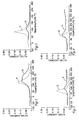
- FIG. 1 shows DMA (dynamic mechanical analysis) scans from -70 to 280°C for two compositions, A (comparative) and B (present invention).
- FIG. 2 shows DMA scans of a comparative composition comprising glycidyl epoxy resin C (non-annealed) and D (annealed).
- FIG. 3 shows DMA scans E and F from -70 to >250°C of comparative sample I .
- FIG. 4 shows DMA scans G (non-annealed) and H (annealed) from -70 to >250°C of comparative sample II .
- FIG. 5 shows DMA scans I (non-annealed), J (intermediate annealed), and K (fully annealed) from ⁇ 50 to >250°C for sample III , a composition within the present invention.
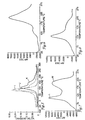
- FIG. 6 shows a DSC scan of the cure exotherm for a comparative composition.
- FIG. 7 shows a DSC scan of cure exotherms for a composition of the present invention.
- FIG. 8 shows a DSC scan of the cure exotherm of a comparative composition.
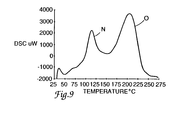
- FIG. 9 shows a DSC scan of cure exotherms for a composition of the present invention.
- compositions of the present invention provide vibration-damping, adhesive, abrasive binder, and coating materials exhibiting remarkably high temperature stability and utility over a broad range of temperatures.
- vibration damping materials comprising IPNs of the present invention are stable over a temperature range of 0 to at least 300°C.
- compositions of the present invention comprise resins which are cured in sequential fashion using a single catalyst, a Bronsted acid, which activates the epoxy resin component at a temperature preferably at or near room temperature, then activates cyanate trimerization into poly(triazines) at temperatures at least 20°C higher, preferably 50°C higher, and more preferably 50 to 100°C higher. It appears that Bronstead acids afford a much faster cycloaliphatic epoxy polymerization than cyanate ester polymerization at a specific temperature in the range of 0 to 150°C.
- the distinct separation in cure temperatures provides convenient processing and handling; the two-part system can be mixed and cured on site, or a "B-staged" film comprising at least partially cured cycloaliphatic epoxy resin and uncured cyanate ester can be prepared and easily transported to the work site where it can be cut or formed into a desired shape, applied between workpieces and thermally cured.
- the compositions of the invention are environmentally responsible, in that no solvents are used in any step of their formulation or use. Because the individual components are typically odorless, low vapor pressure liquids whose cures are unaffected by ambient oxygen, they can be handled and processed with only nominal precautions.
- Cyanate ester resins comprise cyanate ester compounds (monomers and oligomers) each having one or preferably two or more -OCN functional groups, and typically having a cyanate equivalent weight of from 50 to 500, preferably from 50 to 250. Molecular weight of the monomers and oligomers are typically from 150 to 2000. If the molecular weight is too low, the cyanate ester may have a crystalline structure which is difficult to dissolve. If the molecular weight is too high, the compatibility of the cyanate ester with other resins may be poor.
- compositions of the invention include one or more cyanate esters according to formulas I, II, III or IV.
- Formula I is represented by Q(OCN) p where p is an integer from 1 to 7, preferably from 2 to 7, and wherein Q comprises a mono-, di-, tri-, or tetra-substituted aromatic organic group comprising from 5 to 30 carbon atoms and zero to 5 aliphatic, cyclic aliphatic, or polycyclic aliphatic, mono-, di-, tri- or tetra-substituted organic groups comprising from 7 to 20 carbon atoms.
- Q may comprise 1 to 10 heteroatoms selected from the group consisting of non-peroxidic oxygen, sulfur, non-phosphino phosphorus, non-amino nitrogen, halogen, and silicon.
- Formula II is represented by where X is a single bond, a lower alkylene group having from 1 to 4 carbons, -S-, or an SO 2 group; and where each R 1 is independently hydrogen, an alkyl group having from one to three carbon atoms, or a cyanate group (-OC ⁇ N), with the proviso that at least one R 1 group is a cyanate group.
- each of the R 1 groups is either -H, methyl or a cyanate group, with at least two R 1 groups being cyanate groups.
- Formula III is represented by where n is a number from 0 to 5.
- Formula IV is represented by wherein each R 2 independently is wherein each R 3 is independently -H, a lower alkyl group having from 1 to 5 carbon atoms, or a cyanate ester group, and preferably is a hydrogen, methyl or a cyanate ester group, with the proviso that the R 3 s together comprise at least one cyanate ester group.
- Useful cyanate ester compounds include, but are not limited to the following:
- cyanic acid esters derived from phenolic resins e.g., as disclosed in U.S. Patent No. 3,962,184
- cyanated novolac resins derived from novolac e.g., as disclosed in U.S. Patent No. 4,022,755
- cyanated bis-phenol-type polycarbonate oligomers derived from bisphenol-type polycarbonate oligomers as disclosed in U.S. Patent No. 4,026,913, cyano-terminated polyarylene ethers as disclosed in U.S. Patent No. 3,595,900
- dicyanate esters free of ortho hydrogen atoms as disclosed in U.S. Patent No.
- Polycyanate compounds obtained by reacting a phenol-formaldehyde precondensate with a halogenated cyanide are also useful.
- cyanate ester resin compositions include low molecular weight (M n ) oligomers, e.g., from 250 to 5000, e.g., bisphenol-A dicyanates such as AroCyTM "B-30 Cyanate Ester Semisolid Resin”; low molecular weight oligomers of tetra o-methyl bis-phenol F dicyanates, such as "AroCyTM M-30 Cyanate Ester Semisolid Resin”; low molecular weight oligomers of thiodiphenol dicyanates, such as ArocyTM "T-30", all of which are commercially available from Ciba-Geigy Corp., Hawthorne, NY.
- M n low molecular weight oligomers
- Cycloaliphatic epoxy resins useful in the invention preferably are selected from 3,4-epoxycyclohexylmethyl-3,4-epoxycyclohexane carboxylate (ERL-4221), 2-(3,4-epoxy)cyclohexylmethyl-5,5'-spiro(3,4-epoxy)cyclohexane-m-dioxane (ERL-4234), and bis((4-methyl-7-oxabicyclo(4.1.0)hept-3-yl)methyl) adipate (ERL-4299), all of which are available from Union Carbide Corp., Tarrytown, NY.
- cycloaliphatic epoxies that are useful in the present invention include vinyl cyclohexene monoxide (Union Carbide Corp.), cyclohexene oxide (Aldrich Chemical Co., Milwaukee, WI), vinyl cyclohexene dioxide (ERL 4206TM, Union Carbide Corp.), and limonene oxide, limonene dioxide, and ⁇ -pinene oxide (these three being available from Elf Atochem, Philadelphia, PA).
- cycloaliphatic mono- and di-epoxy oligo-siloxanes which include ⁇ , ⁇ -di-(3,4-cyclohexene-2-ethyl) siloxanes, such as ⁇ , ⁇ -di-(3,4-cyclohexene-2-ethyl)-tetramethyl disiloxane, ⁇ , ⁇ -di(3,4-cyclohexene-2-ethyl)-hexamethyl trisiloxane, as well as a-3,4-cyclohexene-2-ethyl siloxanes, such as ⁇ -3,4-cyclohexene-2-ethyl pentamethyl disiloxane.
- epoxies can be prepared according to the method of Crivello et al., J. Poly. Sci., A: Poly. Chem. 28 , pp 479-503 (1990).
- compositions of the invention may include acyclic aliphatic, cycloaliphatic and oligomeric polyhydroxy compounds commonly known as polyols.
- Polyols are known in the art for their reaction with polyepoxy resins to form so-called "chain-extended” epoxies, wherein low- to medium-molecular weight copolymers are formed.
- chain-extended epoxy resins can add flexibility and resilience to compositions of the invention without compromising their thermal stability.
- Amine chain-extenders are preferably avoided in the present invention because significant amounts of amines (i.e., 10% weight percent or greater of the total composition) interfere with the action of the initiator.
- Polyols useful in the present invention preferably have two to five, more preferably two to four, hydroxyl groups.
- useful polyols include, but are not limited to, 1,2-ethanediol, 1,2-propanediol, 1,3-propanediol, 1,4-butanediol, 1,3-butanediol, 2-methyl-1,3-propanediol, 2,2-dimethyl-1,3-propanediol, and 2-ethyl-1,6-hexanediol, 1,5-pentanediol, 1,6-hexanediol, 1,8-octanediol, neopentyl glycol, glycerol, trimethylolpropane, 1,2,6-hexanetriol, trimethylolethane, pentaerythritol, quinitol, mannitol, diethylene glycol, triethylene glycol
- Useful higher molecular weight polyols include the polyethylene and polypropylene oxide polymers in the molecular weight range of 200 to 20,000 such as the CarbowaxTM polyethyleneoxide materials supplied by Union Carbide, Tarrytown, NY, caprolactone polyols in the molecular weight range of 200 to 5,000, such as the ToneTM polyol materials supplied by Union Carbide, polytetramethylene ether glycol in the molecular weight range of 200 to 4,000, such as the TerathaneTM materials supplied by Dupont (Wilmington, DE), hydroxyl terminated polybutadiene resins such as the Poly bdTM supplied by Elf Atochem, Philadelphia, PA, or equivalent materials supplied by other manufacturers.
- Polytetramethylene ether glycols such as Poly THF 250TM, Poly THf CD 1000TM, and Poly THF CD 2000TM, all available from BASF, Mount Olive, NJ, are particularly useful polyols. Polyether polyols and polyester polyols are particularly useful.
- the alcohol functional component can be present as a mixture of materials and comprises poly-hydroxyl containing materials.
- the compositions preferably comprises an amount sufficient to provide an epoxy to hydroxy weight ratio in the composition between 0.3:1 to 100:1, preferably between 0.5:1 to 2:1.
- the ratio of (epoxy resin plus optional polyol) to cyanate ester resin in the composition of the invention is in the weight percent range (40 to 80) to (60 to 20), preferably (50 to 65) to (50 to 35).
- Bronsted acid initiators useful in the present invention include any of the strong protic acids (i.e., proton donors) whose anions are sufficiently non-nucleophilic, nonbasic and nonreducing so as to prevent initiator deactivation and cationic chain termination.
- the conjugate base of such acids typically has a pK a of zero or less.
- Useful Bronsted acids of the invention include:
- Suitable electron donating groups include hydroxyl group, branched straight chain or cyclic alkyl or alkoxy groups having up to 18 carbon atoms and amine groups.
- the substituted pentafluoroantimonic acid can have the formula HSbF 5 X, wherein X is halogen, hydroxy, or -OR 13 , wherein OR 13 is the residue of an aliphatic or aromatic alcohol preferably having a molecular weight (Mn) of 32 to at least 100,000, and a primary or secondary hydroxyl functionality of at least 1, preferably at least 2.
- the most preferred alcohol is diethylene glycol, i.e., the most preferred -OR 13 group is 2-(2-hydroxyethoxy)ethoxy, and the most preferred example of this class of catalysts is the equimolar reaction product of antimony pentafluoride, diethylene glycol (DEG) and 2,6-diethylaniline (DEA).
- the initiator can be present in the range of 0.1 to 10 percent by weight of the polymerizable composition, preferably 0.5 to 5 percent.
- an effective amount of an aromatic amine as stabilizer (less than 10 weight percent, preferably 0.1 to 8 weight percent based on the total composition) can be used with the catalyst to inhibit premature curing.
- High temperature stable resins of the invention are prepared generally by admixture of a cyanate ester resin, cycloaliphatic epoxy resin, preferably a polyether polyol, and a suitable Bronsted acid.
- the mixture can be spread on a suitable heat-resistant release liner, then cured at 90 - 150°C, preferably 100 - 125°C, for 1-15 minutes, preferably 5-8 minutes.
- the resultant film is a flexible, tough sheet that can be cut or shaped, then applied between workpieces that are to be bonded together. Subsequent heating, preferably at temperatures above 200°C, cures the cyanate ester component and produces, in this embodiment, a temperature-resistant vibration-damping bond.
- a curable mixture may be cast into a preferred shape or into a cavity, then heated to cure the composition in place. Heating can be carried out in a single continuous operation or in two distinct steps, separated in time.
- the initiator provides for independent polymerization of the cycloaliphatic epoxy resin and the cyanate ester resin.
- a tough, high-temperature protective coating may be prepared by heating a composition of the invention that has been applied directly on a substrate.
- the present invention IPNs provide ultra high temperature damping materials, high temperature adhesives, binders for use in high temperature abrasives, and high temperature protective coatings.
- IPN there are two intermeshed components, each highly crosslinked, and not swellable by solvents.
- the polymerizable composition of the present invention can be provided as a kit comprising a two-part composition, a first part comprising a cycloaliphatic epoxy resin and a cyanate ester resin, and a second part comprising a Bronsted acid initiator and optionally a polyol.
- LAC means a mixture comprising a 1:1:2.93 weight-to-weight ratio of SbF 5 :diethylene glycol (DEG) and 2,6-diethylaniline (DEA), as stabilizer, the preparation of which is described in U.S. Patent No. 4,503,211, example 1.
- sample A A second aliquot (sample A) was taken and mixed with one part (relative to the weight of the aliquot) of dicyclopentadienyl iron antimony hexafluoride (Cp 2 FeSbF 6 , a Lewis acid initiator), 40% by weight in 3-methyltetrahydrothiophene-1,1-dioxide (3-methyl sulfolane, available from Aldrich).
- Samples A and B were knife-coated between 0.050 mm silicone-release-coated polyethylene terephthalate sheets and the sandwich construction was heated in a convection oven at 125°C for 7 minutes such that the resin mixture formed a flexible free-standing film.
- the release liners were removed and a sample of the resin film was cut into a 51 x 12.5 mm coupon which was sandwiched between two 0.25 mm thick steel coupons of the same size as the resin film coupon and analyzed by dynamic mechanical analysis (DMA) in a constrained layer geometry using a Seiko Instruments DMS 110 Rheometer using a 20 mm flexure fixture. Samples A and B were annealed for two hours at 260°C. DMA tracings of tan delta values of the two samples are shown in FIG. 1. This trial shows that Lewis acid catalysis afforded a single-phase morphology exhibiting a narrow temperature range where tan delta ⁇ 0.06, thus limiting its utility as a vibration damping material.
- DMA dynamic mechanical analysis
- Tan delta indicates the vibration damping efficiency of a material. Tan delta values of 0.06 are accepted in the art as a minimum for adequate damping for such a metal-polymer-metal composite.
- the LAC initiator can be replaced by an equivalent number of moles of HC(SO 2 CF 3 ) 3 or HN(SO 2 CF 3 ) 2 to provide compositions having desirable properties within the present invention.
- Cyanate ester resin QUARTEX 7187 can be used instead of B-30 to provide a composition having desirable properties within the present invention.
- the mixture was coated via a Meyer bar apparatus (#28) onto a 0.20 mm (8 mil) thick steel sheet and immediately covered with a second steel sheet to form a sandwich.
- the sandwich construction was heated at 150°C in a convection oven for 10 minutes, and then a coupon of 51 x 12 mm was cut from the sandwich, then annealed in a convection oven at 260°C for two hours and cooled.
- the sample was processed in a DMA rheometer (as in Example 1) four times by ramping from ambient temperature to 250°C at 5°C per minute, cooling rapidly with liquid nitrogen, then cycling twice from -40°C to 250°C at the same heating rate and holding at that temperature for 20 minutes, then cycling over the same range and holding for 50 minutes, then recording the tan delta from ambient at 275°C.
- the results are shown in FIG. 2. It is clear that the resin had lost essentially all of its vibration damping ability by the time the fourth scan is taken.
- scan C of FIG. 2 represents data before annealing and scan D data was after annealing at 250°C for the combined total of 90 minutes. The data show poor thermal stability as indicated by scan D. In scan D there were no thermal ranges having tan delta values of 0.06 or above.
- a stock solution of two parts B-30 cyanate ester resin available from Ciba-Geigy, Ardsley, NY
- one part bis((4-methyl-7-oxabicyclo[4.1.0]hept-3-yl)methyl) adipate available as ERL-4299 from Union Carbide Corp., Tarrytwon, NY
- polytetrahydrofuran polyol PolyTHF CD 1000TM polyol chain extender, BASF, Mount Olive, NY
- Cure times and temperatures were varied according to the relative effectiveness of the catalyst in order to obtain approximately the same degree of cure for each sample.
- the "B-staged” films were removed from the liners and a piece approximately 5 cm x 1.3 cm was cut from each and laminated by hand between two 0.20 mm thick steel shims of similar dimensions.
- Each of the sandwich constructions was subjected to dynamic mechanical analysis (DMA) using a Seiko DMS-100 instrument equipped with a 20 mm flexure fixture, using the temperature cycling regimen shown in Table 2.
- DMA dynamic mechanical analysis
- the "B-staged” samples continued to cure and were deemed to be largely cured by the end of the 30-minute (scan 2) hold at 260°C. Tangent delta vs. temperature data are shown in FIGS.
- Scan E represents non-annealed material
- scan F represents the same sample which was annealed through eight scan cycles as shown in Table 2. The data show that comparative annealed sample I exhibited poor thermal stability.
- Scan G (sample II , from Table 1, scan procedure 4) represents non-annealed material and scan H (sample II , from Table 1, scan procedure 8) represents the same sample which was annealed through eight scan cycles as shown in Table 2. Both scans of sample II show narrow ranges for damping utility.
- Scans J (sample III , from Table 1, scan procedure 6) and K (sample III , from Table 1, scan procedure 8) show excellent thermal stability. Both scans show broadened damping utility of sample III .
- Scan I (sample III , from Table 1, scan procedure 4) represents a non-annealed sample. Scans I, J, and K relate to the same sample ( III ).
- the Figures also show superior high-temperature stability of the IPN system of the present invention, since damping ability was retained after repeated exposure to temperatures in excess of 300°C.
- the area under the curve having tan ⁇ values equal to or greater than 0.06 remained essentially constant in FIG. 5 but decreased significantly for FIGS. 3 and 4.
- a stock solution containing 30 g of 2 parts of bisphenol-A dicyanate (B-30 cyanate ester resin), 2 parts bis((4-methyl-7-oxabicyclo[4.1.0]hept-3-yl)methyl) adipate (ERL-4299), polytetramethylene ether glycol (PolyTHF CD 1000) polyol chain extender was prepared and stirred with 1.5 g LAC catalyst system until a uniform color was attained. The mixture was divided, with one portion coated onto steel stock (see below) and one portion coated between two KaptonTM polyimide films (see below).
- LAC the same number of moles of any of anilinium C(SO 2 CF 3 ) 3 , lithium tris(trifluoromethylsulfonyl) methide and di(tert-butyl)oxalate, or dibenzylhydroxylammonium hexafluoroantimonate can be used as initiator to provide compositions having desirable properties within the present invention.
- a portion of the mixture above was coated onto a 15 x 30 cm coupon of 0.02 cm thick steel shim stock that had been previously cleaned with isopropyl alcohol, using an RDS 50 Meyer Rod coater.
- a second piece of previously-washed steel, of identical dimensions, was placed over the coated sheet, and the sandwich assembly was heated in an oven at 125°C for 30 minutes. After cooling to room temperature, a 2.54 cm wide strip was cut from the laminated construction. The strip was placed in the jaws of an Instron tensile testing apparatus (Model No. 1122) to determine its peel strength. The cross-head speed was 25.4 cm/minute. T-peel adhesive strength was 112 N/dm (2800 g/cm).
- Example 5 Comparison of Cure Profiles of glycidyl epoxy/cyanate ester (comparative) and cycloaliphatic epoxy/cyanate ester compositions.
- Example 2 An aliquot of the mixture of Example 2 (comparative) was separated (prior to coating) for DSC (differential scanning calorimetry) analysis, shown in FIG. 6 (comparative).
- the instrument used was a Seiko DSC Analyzer, Model. No. DSC220C. The sample was heated at 10°C per minute.
- the scan of FIG. 6 shows that the cure exotherms of the glycidyl epoxy resin and cyanate ester resin almost completely coincide. The scan indicates that a substantial amount of the product is a copolymer of cyanate ester and glycidyl epoxy.
- the mixture was subjected to DSC analysis using the instrument and conditions described above for DSC analysis.
- the scan is shown in FIG. 7 and the two distinct peaks are designated L and M.
- Lower temperature peak L is associated with cycloaliphatic epoxy polymerization
- higher temperature peak M represents the exotherm of the cyanate ester polymerization.
- Scan of FIG. 8 shows that when a Lewis acid was present as an initiator, the cure exotherm of cycloaliphatic epoxy resin was not distinct from that of the cyanate ester resin.
- the scan indicates that a substantial amount of product was a copolymer of cyanate ester and epoxy.
- the scan of FIG. 9 shows two distinct peaks, designated N and O. Lower temperature peak N is associated with cycloaliphatic epoxy polymerization, and higher temperature peak O represents the exotherm of the cyanate ester polymerization.
Landscapes
- Chemical & Material Sciences (AREA)
- Health & Medical Sciences (AREA)
- Chemical Kinetics & Catalysis (AREA)
- Medicinal Chemistry (AREA)
- Polymers & Plastics (AREA)
- Organic Chemistry (AREA)
- Macromolecular Compounds Obtained By Forming Nitrogen-Containing Linkages In General (AREA)
- Adhesives Or Adhesive Processes (AREA)
- Compositions Of Macromolecular Compounds (AREA)
- Epoxy Resins (AREA)
Applications Claiming Priority (3)
| Application Number | Priority Date | Filing Date | Title |
|---|---|---|---|
| US398230 | 1995-03-03 | ||
| US08/398,230 US5494981A (en) | 1995-03-03 | 1995-03-03 | Epoxy-cyanate ester compositions that form interpenetrating networks via a Bronsted acid |
| PCT/US1996/000544 WO1996027640A1 (en) | 1995-03-03 | 1996-01-16 | Epoxy-cyanate ester compositions |
Publications (2)
| Publication Number | Publication Date |
|---|---|
| EP0813576A1 EP0813576A1 (en) | 1997-12-29 |
| EP0813576B1 true EP0813576B1 (en) | 2000-03-22 |
Family
ID=23574540
Family Applications (1)
| Application Number | Title | Priority Date | Filing Date |
|---|---|---|---|
| EP96902686A Expired - Lifetime EP0813576B1 (en) | 1995-03-03 | 1996-01-16 | Epoxy-cyanate ester compositions |
Country Status (9)
| Country | Link |
|---|---|
| US (1) | US5494981A (enExample) |
| EP (1) | EP0813576B1 (enExample) |
| JP (1) | JP3749940B2 (enExample) |
| KR (1) | KR100416574B1 (enExample) |
| AU (1) | AU4699996A (enExample) |
| BR (1) | BR9607691A (enExample) |
| CA (1) | CA2213333A1 (enExample) |
| DE (1) | DE69607328T2 (enExample) |
| WO (1) | WO1996027640A1 (enExample) |
Families Citing this family (44)
| Publication number | Priority date | Publication date | Assignee | Title |
|---|---|---|---|---|
| US5780581A (en) * | 1995-10-27 | 1998-07-14 | Hughes Aircraft Company | Plateable structural adhesive for cyanate ester composites |
| US5912316A (en) * | 1996-11-08 | 1999-06-15 | Johnson Matthey, Inc. | Flexible interpenetrating networks formed by epoxy-cyanate ester compositions via a polyamide |
| US6248827B1 (en) | 1997-12-22 | 2001-06-19 | Bridgestone Corporation | Centipede polymers and preparation and application in rubber compositions |
| US6204354B1 (en) | 1998-05-06 | 2001-03-20 | Bridgestone Corporation | Soft compounds derived from polypropylene grafted disubstituted ethylene- maleimide copolymers |
| US6248825B1 (en) | 1998-05-06 | 2001-06-19 | Bridgestone Corporation | Gels derived from extending grafted centipede polymers and polypropylene |
| US6207763B1 (en) | 1998-06-12 | 2001-03-27 | Bridgestone Corporation | Application of disubstituted ethylene-maleimide copolymers in rubber compounds |
| US6184292B1 (en) | 1998-10-05 | 2001-02-06 | Bridgestone Corporation | Soft gel polymers for high temperature use |
| US6133354A (en) * | 1998-11-17 | 2000-10-17 | Bridgestone Corporation | Copolymers as additives in thermoplastic elastomer gels |
| US6191217B1 (en) | 1998-11-17 | 2001-02-20 | Bridgestone Corporation | Gels derived from polypropylene grafted alkyl vinylether-maleimide copolymers |
| US6251994B1 (en) | 1999-02-18 | 2001-06-26 | Bridgestone Corporation | Elastomeric compositions for damping |
| US6407165B1 (en) | 1999-02-18 | 2002-06-18 | Bridgestone Corporation | Elastomeric compositions for damping |
| US6407166B1 (en) | 1999-02-18 | 2002-06-18 | Bridgestone Corporation | Elastomeric compositions for damping |
| US6268427B1 (en) | 1999-02-18 | 2001-07-31 | Bridgestone Corporation | Elastomeric compositions for damping |
| US6228939B1 (en) | 1999-05-19 | 2001-05-08 | Bridgestone Corporation | Thermoreversible gels comprising near gelation polymers |
| US6565969B1 (en) | 1999-10-21 | 2003-05-20 | 3M Innovative Properties Company | Adhesive article |
| US6569494B1 (en) * | 2000-05-09 | 2003-05-27 | 3M Innovative Properties Company | Method and apparatus for making particle-embedded webs |
| US6350800B1 (en) | 2000-06-05 | 2002-02-26 | Bridgestone Corporation | Soft polymer gel |
| US6417259B1 (en) | 2000-06-05 | 2002-07-09 | Bridgestone Corporation | Polyalkylene grafted centipede polymers |
| US6384134B1 (en) | 2000-06-05 | 2002-05-07 | Bridgestone Corporation | Poly(alkenyl-co-maleimide) and maleated polyalkylene grafted with grafting agent, and epoxy polymer |
| US6476117B1 (en) | 2000-06-05 | 2002-11-05 | Bridgestone Corporation | Grafted near-gelation polymers having high damping properties |
| US6353054B1 (en) | 2000-07-31 | 2002-03-05 | Bridgestone Corporation | Alkenyl-co-maleimide/diene rubber copolymers and applications |
| US6630535B1 (en) | 2000-08-18 | 2003-10-07 | Bridgestone Corporation | Rubber compositions & vulcanizates including comb polymers |
| US6359064B1 (en) | 2000-09-08 | 2002-03-19 | Bridgestone Corporation | Compound of polyester and polyalkylene grafted comb polymer |
| US6709738B2 (en) | 2001-10-15 | 2004-03-23 | 3M Innovative Properties Company | Coated substrate with energy curable cyanate resin |
| CN100478378C (zh) * | 2001-10-19 | 2009-04-15 | 隆萨股份公司 | 可固化的氰酸酯组合物 |
| DE50211891D1 (de) | 2001-10-19 | 2008-04-24 | Lonza Ag | Härtbare cyanat-zusammensetzungen |
| US20030129438A1 (en) * | 2001-12-14 | 2003-07-10 | Becker Kevin Harris | Dual cure B-stageable adhesive for die attach |
| US6833629B2 (en) * | 2001-12-14 | 2004-12-21 | National Starch And Chemical Investment Holding Corporation | Dual cure B-stageable underfill for wafer level |
| EP1557449A1 (en) * | 2004-01-22 | 2005-07-27 | 3M Innovative Properties Company | Adhesive tape for structural bonding |
| EP1650279B1 (en) * | 2004-10-19 | 2009-05-27 | 3M Innovative Properties Company | Adhesive article having core/sheath structure |
| EP1710286A1 (en) * | 2005-04-04 | 2006-10-11 | 3M Innovative Properties Company | Reinforcement Pad |
| GB2431374A (en) * | 2005-10-20 | 2007-04-25 | 3M Innovative Properties Co | Adhesive pad comprising fibrous layer of metal and polymeric fibers |
| ES2483944T3 (es) | 2007-12-28 | 2014-08-08 | Bridgestone Corporation | Interpolímeros que contienen unidades méricas de isobutileno y dieno |
| DE102009003132A1 (de) * | 2009-05-15 | 2010-11-18 | Robert Bosch Gmbh | Kunststoffformmasse sowie Verfahren zu deren Herstellung |
| US20120043493A1 (en) * | 2010-08-19 | 2012-02-23 | Basf Se | Sound deadener composition with emulsion polymer and fluorinated compound |
| US9879163B2 (en) | 2014-06-06 | 2018-01-30 | General Electric Company | Composition for bonding windings or core laminates in an electrical machine, and associated method |
| US9911521B2 (en) | 2014-06-06 | 2018-03-06 | General Electric Company | Curable composition for electrical machine, and associated method |
| JP6659964B2 (ja) * | 2014-12-08 | 2020-03-04 | 株式会社スリーボンド | 熱硬化性樹脂組成物 |
| DE102014019207A1 (de) | 2014-12-19 | 2016-06-23 | Airbus Defence and Space GmbH | Hochtemperaturbeständige Duromere auf der Grundlage von Naphthalin-basierten Epoxidharzen und Cyanatestern sowie Verbesserung der Schlagzähigkeit |
| EP3112419B1 (de) | 2015-06-30 | 2020-11-18 | Airbus Defence and Space GmbH | Flammefeste und hochtemperaturbeständige duromere auf der grundlage von naphthalin-basierten epoxidharzen und cyanatestern |
| WO2017040883A1 (en) | 2015-09-04 | 2017-03-09 | Carbon, Inc. | Cyanate ester dual cure resins for additive manufacturing |
| EP3719090A1 (en) * | 2019-04-02 | 2020-10-07 | 3M Innovative Properties Company | Elastic one-part structural adhesive tape |
| WO2020219885A1 (en) | 2019-04-26 | 2020-10-29 | Stepan Company | Polyol-epoxide polymers for nvh damping applications |
| CN110437569B (zh) * | 2019-08-09 | 2021-03-02 | 株洲飞鹿高新材料技术股份有限公司 | 一种具有互穿网络结构的阻尼乳液及其制备方法 |
Family Cites Families (25)
| Publication number | Priority date | Publication date | Assignee | Title |
|---|---|---|---|---|
| DE1248668B (de) * | 1963-02-16 | 1967-08-31 | Farbenfabriken Bayer Aktienge Seilschaft Leverkusen | Verfahren zur Herstellung von aromatischen Cyansaureestern |
| NL7300007A (enExample) * | 1973-01-02 | 1974-07-04 | ||
| US3907706A (en) * | 1973-07-06 | 1975-09-23 | Minnesota Mining & Mfg | Latent catalyst systems for cationically polymerizable materials |
| US4049861A (en) * | 1975-03-07 | 1977-09-20 | Minnesota Mining And Manufacturing Company | Abrasion resistant coatings |
| US4544704A (en) * | 1983-07-27 | 1985-10-01 | The Dow Chemical Company | Polymeric cyanate compositions |
| US4558078A (en) * | 1983-08-01 | 1985-12-10 | American Cyanamid Company | Curable epoxy resin compositions |
| US4503211A (en) * | 1984-05-31 | 1985-03-05 | Minnesota Mining And Manufacturing Co. | Epoxy resin curing agent, process and composition |
| US4604452A (en) * | 1985-10-21 | 1986-08-05 | Celanese Corporation | Metal carboxylate/alkylphenol curing catalyst for polycyanate esters of polyhydric phenols |
| US4785075A (en) * | 1987-07-27 | 1988-11-15 | Interez, Inc. | Metal acetylacetonate/alkylphenol curing catalyst for polycyanate esters of polyhydric phenols |
| US4797454A (en) * | 1987-09-24 | 1989-01-10 | Basf Corporation | Curable resin systems containing cyanate ester functional oxazolinylpolysiloxanes |
| US4983683A (en) * | 1987-10-05 | 1991-01-08 | Hi-Tek Polymers, Inc. | Polycyanate esters of polyhydric phenols blended with thermoplastic polymers |
| US4902752A (en) * | 1987-10-05 | 1990-02-20 | Hi-Tek Polymers, Inc. | Polycyanate esters of polyhydric phenols blended with thermoplastic polymers |
| US5215860A (en) * | 1988-08-19 | 1993-06-01 | Minnesota Mining And Manufacturing Company | Energy-curable cyanate compositions |
| US4956393A (en) * | 1988-08-29 | 1990-09-11 | Basf Aktiengesellschaft | Structures exhibiting improved transmission of ultrahigh frequency electromagnetic radiation and structural materials which allow their construction |
| US5086088A (en) * | 1989-03-09 | 1992-02-04 | Minnesota Mining And Manufacturing Company | Epoxy-acrylate blend pressure-sensitive thermosetting adhesives |
| EP0441047B1 (en) * | 1990-01-19 | 1996-06-05 | Minnesota Mining And Manufacturing Company | Thermosettable composition |
| US5089440A (en) * | 1990-03-14 | 1992-02-18 | International Business Machines Corporation | Solder interconnection structure and process for making |
| US5068309A (en) * | 1990-03-29 | 1991-11-26 | Hi-Tek Polymers, Inc. | Low temperature curable dicyanate ester of dihydric phenol composition |
| US5149863A (en) * | 1990-03-29 | 1992-09-22 | Hi-Tek Polymers, Inc. | Low temperature curable dicyanate esters of dihydric phenols |
| US5043411A (en) * | 1990-05-14 | 1991-08-27 | Nova Petrochemicals Inc. | Cyanate ester resin composition containing an epoxy/aromatic adduct |
| JP3231814B2 (ja) * | 1991-07-12 | 2001-11-26 | ミネソタ マイニング アンド マニュファクチャリング カンパニー | 異方性導電膜 |
| US5194930A (en) * | 1991-09-16 | 1993-03-16 | International Business Machines | Dielectric composition and solder interconnection structure for its use |
| US5262232A (en) * | 1992-01-22 | 1993-11-16 | Minnesota Mining And Manufacturing Company | Vibration damping constructions using acrylate-containing damping materials |
| US5331018A (en) * | 1992-08-26 | 1994-07-19 | Three Bond Co., Ltd. | Bimodal cured intermixed polymeric networks which are stable at high temperature |
| US5350635A (en) * | 1992-12-22 | 1994-09-27 | Minnesota Mining And Manufacturing Company | Cyanate resin adhesive for polyimide film |
-
1995
- 1995-03-03 US US08/398,230 patent/US5494981A/en not_active Expired - Lifetime
-
1996
- 1996-01-16 BR BR9607691A patent/BR9607691A/pt not_active Application Discontinuation
- 1996-01-16 JP JP52683996A patent/JP3749940B2/ja not_active Expired - Fee Related
- 1996-01-16 DE DE69607328T patent/DE69607328T2/de not_active Expired - Fee Related
- 1996-01-16 CA CA002213333A patent/CA2213333A1/en not_active Abandoned
- 1996-01-16 KR KR1019970706107A patent/KR100416574B1/ko not_active Expired - Fee Related
- 1996-01-16 WO PCT/US1996/000544 patent/WO1996027640A1/en not_active Ceased
- 1996-01-16 AU AU46999/96A patent/AU4699996A/en not_active Abandoned
- 1996-01-16 EP EP96902686A patent/EP0813576B1/en not_active Expired - Lifetime
Also Published As
| Publication number | Publication date |
|---|---|
| CA2213333A1 (en) | 1996-09-12 |
| KR19980702700A (ko) | 1998-08-05 |
| JPH11501075A (ja) | 1999-01-26 |
| JP3749940B2 (ja) | 2006-03-01 |
| EP0813576A1 (en) | 1997-12-29 |
| WO1996027640A1 (en) | 1996-09-12 |
| DE69607328D1 (de) | 2000-04-27 |
| DE69607328T2 (de) | 2000-07-27 |
| BR9607691A (pt) | 1998-07-07 |
| US5494981A (en) | 1996-02-27 |
| AU4699996A (en) | 1996-09-23 |
| KR100416574B1 (ko) | 2004-06-23 |
Similar Documents
| Publication | Publication Date | Title |
|---|---|---|
| US5494981A (en) | Epoxy-cyanate ester compositions that form interpenetrating networks via a Bronsted acid | |
| JP6279588B2 (ja) | ポリベンゾオキサジン組成物 | |
| KR101728571B1 (ko) | 폴리벤족사진 조성물 | |
| JP6444376B2 (ja) | ポリ(ベンゾオキサジン)を調製するための方法 | |
| KR101951266B1 (ko) | 벤족사진의 아민/에폭시 경화 | |
| JP2017095705A (ja) | 硬化性組成物、物品、硬化方法及びタックフリー反応生成物 | |
| EP2691466A1 (en) | Curable composition, article, method of curing, and reaction product | |
| US5242755A (en) | High temperature adhesive | |
| JP2016506447A (ja) | ベンゾオキサジン、及び、酸形成過酸化物触媒、を含む重合性組成物、物品、及び方法 | |
| EP3058013B1 (en) | Benzoxazine polymerization | |
| EP0758351B1 (en) | Energy polymerizable compositions, homopolymers and copolymers of oxazolines | |
| US20190169370A1 (en) | Benzoxazine composition | |
| US5350635A (en) | Cyanate resin adhesive for polyimide film | |
| WO1993005122A1 (en) | Adhesive film | |
| JPH05301948A (ja) | 熱硬化性樹脂組成物 |
Legal Events
| Date | Code | Title | Description |
|---|---|---|---|
| PUAI | Public reference made under article 153(3) epc to a published international application that has entered the european phase |
Free format text: ORIGINAL CODE: 0009012 |
|
| 17P | Request for examination filed |
Effective date: 19970917 |
|
| AK | Designated contracting states |
Kind code of ref document: A1 Designated state(s): DE FR GB IT |
|
| 17Q | First examination report despatched |
Effective date: 19980113 |
|
| GRAG | Despatch of communication of intention to grant |
Free format text: ORIGINAL CODE: EPIDOS AGRA |
|
| GRAG | Despatch of communication of intention to grant |
Free format text: ORIGINAL CODE: EPIDOS AGRA |
|
| GRAG | Despatch of communication of intention to grant |
Free format text: ORIGINAL CODE: EPIDOS AGRA |
|
| GRAH | Despatch of communication of intention to grant a patent |
Free format text: ORIGINAL CODE: EPIDOS IGRA |
|
| GRAH | Despatch of communication of intention to grant a patent |
Free format text: ORIGINAL CODE: EPIDOS IGRA |
|
| GRAH | Despatch of communication of intention to grant a patent |
Free format text: ORIGINAL CODE: EPIDOS IGRA |
|
| GRAA | (expected) grant |
Free format text: ORIGINAL CODE: 0009210 |
|
| AK | Designated contracting states |
Kind code of ref document: B1 Designated state(s): DE FR GB IT |
|
| REF | Corresponds to: |
Ref document number: 69607328 Country of ref document: DE Date of ref document: 20000427 |
|
| ITF | It: translation for a ep patent filed | ||
| ET | Fr: translation filed | ||
| PLBE | No opposition filed within time limit |
Free format text: ORIGINAL CODE: 0009261 |
|
| STAA | Information on the status of an ep patent application or granted ep patent |
Free format text: STATUS: NO OPPOSITION FILED WITHIN TIME LIMIT |
|
| 26N | No opposition filed | ||
| REG | Reference to a national code |
Ref country code: GB Ref legal event code: IF02 |
|
| PGFP | Annual fee paid to national office [announced via postgrant information from national office to epo] |
Ref country code: FR Payment date: 20060117 Year of fee payment: 11 |
|
| PGFP | Annual fee paid to national office [announced via postgrant information from national office to epo] |
Ref country code: IT Payment date: 20060131 Year of fee payment: 11 |
|
| PGFP | Annual fee paid to national office [announced via postgrant information from national office to epo] |
Ref country code: DE Payment date: 20060228 Year of fee payment: 11 |
|
| PG25 | Lapsed in a contracting state [announced via postgrant information from national office to epo] |
Ref country code: DE Free format text: LAPSE BECAUSE OF NON-PAYMENT OF DUE FEES Effective date: 20070801 |
|
| GBPC | Gb: european patent ceased through non-payment of renewal fee |
Effective date: 20070116 |
|
| REG | Reference to a national code |
Ref country code: FR Ref legal event code: ST Effective date: 20070930 |
|
| PG25 | Lapsed in a contracting state [announced via postgrant information from national office to epo] |
Ref country code: GB Free format text: LAPSE BECAUSE OF NON-PAYMENT OF DUE FEES Effective date: 20070116 |
|
| PG25 | Lapsed in a contracting state [announced via postgrant information from national office to epo] |
Ref country code: FR Free format text: LAPSE BECAUSE OF NON-PAYMENT OF DUE FEES Effective date: 20070131 |
|
| PGFP | Annual fee paid to national office [announced via postgrant information from national office to epo] |
Ref country code: GB Payment date: 20060113 Year of fee payment: 11 |
|
| PG25 | Lapsed in a contracting state [announced via postgrant information from national office to epo] |
Ref country code: IT Free format text: LAPSE BECAUSE OF NON-PAYMENT OF DUE FEES Effective date: 20070116 |