EP0808028A1 - Pulsmodulationsverfahren, pulsmodulator und pulsdemodulator - Google Patents
Pulsmodulationsverfahren, pulsmodulator und pulsdemodulator Download PDFInfo
- Publication number
- EP0808028A1 EP0808028A1 EP96935379A EP96935379A EP0808028A1 EP 0808028 A1 EP0808028 A1 EP 0808028A1 EP 96935379 A EP96935379 A EP 96935379A EP 96935379 A EP96935379 A EP 96935379A EP 0808028 A1 EP0808028 A1 EP 0808028A1
- Authority
- EP
- European Patent Office
- Prior art keywords
- pulse
- signal
- bit data
- transitions
- time intervals
- Prior art date
- Legal status (The legal status is an assumption and is not a legal conclusion. Google has not performed a legal analysis and makes no representation as to the accuracy of the status listed.)
- Granted
Links
Images




Classifications
-
- H—ELECTRICITY
- H03—ELECTRONIC CIRCUITRY
- H03M—CODING; DECODING; CODE CONVERSION IN GENERAL
- H03M5/00—Conversion of the form of the representation of individual digits
- H03M5/02—Conversion to or from representation by pulses
- H03M5/04—Conversion to or from representation by pulses the pulses having two levels
- H03M5/14—Code representation, e.g. transition, for a given bit cell depending on the information in one or more adjacent bit cells, e.g. delay modulation code, double density code
- H03M5/145—Conversion to or from block codes or representations thereof
-
- H—ELECTRICITY
- H04—ELECTRIC COMMUNICATION TECHNIQUE
- H04L—TRANSMISSION OF DIGITAL INFORMATION, e.g. TELEGRAPHIC COMMUNICATION
- H04L25/00—Baseband systems
- H04L25/38—Synchronous or start-stop systems, e.g. for Baudot code
- H04L25/40—Transmitting circuits; Receiving circuits
- H04L25/49—Transmitting circuits; Receiving circuits using code conversion at the transmitter; using predistortion; using insertion of idle bits for obtaining a desired frequency spectrum; using three or more amplitude levels ; Baseband coding techniques specific to data transmission systems
- H04L25/4902—Pulse width modulation; Pulse position modulation
-
- H—ELECTRICITY
- H04—ELECTRIC COMMUNICATION TECHNIQUE
- H04L—TRANSMISSION OF DIGITAL INFORMATION, e.g. TELEGRAPHIC COMMUNICATION
- H04L25/00—Baseband systems
- H04L25/38—Synchronous or start-stop systems, e.g. for Baudot code
- H04L25/40—Transmitting circuits; Receiving circuits
- H04L25/49—Transmitting circuits; Receiving circuits using code conversion at the transmitter; using predistortion; using insertion of idle bits for obtaining a desired frequency spectrum; using three or more amplitude levels ; Baseband coding techniques specific to data transmission systems
- H04L25/4906—Transmitting circuits; Receiving circuits using code conversion at the transmitter; using predistortion; using insertion of idle bits for obtaining a desired frequency spectrum; using three or more amplitude levels ; Baseband coding techniques specific to data transmission systems using binary codes
Definitions
- the present invention relates to a method and equipment for modulating an input signal composed of bit data into a pulse signal, and pulse demodulating equipment.
- pulse modulating methods of this kind pulse amplitude modulation (PAM), pulse width modulation (PWM) and pulse phase modulation (PPM) methods which change the pulse amplitude, pulse width and pulse position of the pulse wave used as a carrier, respectively, in accordance with bit data.
- PAM pulse amplitude modulation
- PWM pulse width modulation
- PPM pulse phase modulation
- the pulse amplitude modulation (PAM) which represents bit data by light intensity, in particular, has a problem with its reliability; therefore, the pulse width modulation (PWM) or pulse phase modulation (PPM) has been used in combination with other modulation methods.
- PWM pulse width modulation
- PPM pulse phase modulation
- the ASK system represents 1-bit data by a pulse signal of a waveform of the same duration as that of the data, and hence it permits transmission of data in large quantities and is suitable for high-speed data transmission.
- the pulse width of the pulse signal (a) modulated by the NRZ modulation varies under the influence of frequency characteristics of the light emitting element, the light receiving element and the modem circuit and the transmission line used, the pulse width of the demodulated pulse signal does not always become the same as the pulse width of the modulated signal.
- each bit data of the digital data is preceded by a pulse of a width T and the subsequent pulse quiescent period is represented by a time interval T or 3T, depending on whether the bit data is "0" or "1" and the thus converted pulse signal (c) is used as a modulating wave for the ASK modulation of the burst signal.
- Fig. 13(d) represents a plurality of bit data based on the position of respective leading edges of a pulse signal (d) so as to exclude the influence of pulse width variations and raise the transmission rate.
- SIR system a plurality of bit data are divided into words each composed of 2-bit data and the leading edge or phase of a pulse of the width T is changed within a time interval 4T of the 2-bit data in accordance with its four kinds of states.
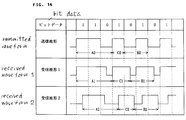
- the present invention is intended to solve the problems mentioned above and, based on the fact that while in Fig. 14 the pulse width C 0 in the received waveform differs from the width in the transmitted waveform, the time intervals A 0 and B 0 between the pulse leading edges and between the trailing edges remain substantially unchanged, the invention offers a pulse modulation method which represents bit data by the two kinds of time intervals A 0 , B 0 , increases the coding efficiency and permits demodulation free from the influence of the transmission system used.
- Another object of the present invention is to provide a pulse modulating method which permits high-speed transmission of bit data, pulse modulating equipment therefor and pulse demodulating equipment.
- Another object of the present invention is to provide a pulse modulating method which is low in the level of redundancy and hence is high in coding efficiency and permits high-speed transmission.
- Another object of the present invention is to provide a pulse modulating method which permits reduction of the frame transmission period for the transmission of bit data in its entirety.
- Still another object of the present invention is to provide a pulse modulating method which allows ease in detecting an error during modulation and easy demodulation and, even if a transit signal is applied by noise or the like during demodulation of the current word, prevents it from affecting the demodulation of other words.
- the input signal is divided into words each composed of n-bit data (n being a positive integer equal to or greater than 2); time intervals i m and j m (m being a positive integer starting with 1) are combined to form at least 2 n or more transmission codes; all states of the n-bit data are made to correspond to the transmission codes, respectively; in accordance with the transmission code corresponding to the state of the bit data for each word, the input signal is converted into pulse unit signals which have the time interval i m between (2m-1)th and (2m+1)th transitions and the time interval j m between (2m)th and (2m+2)th transitions; and the pulse unit signals thus converted in word units are concatenated into a modulated pulse signal.
- the one of the time intervals i m and j m between transitions of the pulse unit signal converted for each word represents the time interval between respective leading edges of the pulse unit signal and the other the time interval between its respective trailing edges.
- the pulse width of the pulse unit signal varies under the influence of frequency characteristics of the light emitting element, the light receiving element and the modem circuit, but since each rise or fall of the pulse unit signal is affected under the same condition, the pulse signal that represents respective states of the bit data by the time intervals between the leading edges and between the trailing edges can be demodulated without being affected by the above-mentioned frequency characteristics.
- the state of the n-bit data is represented by both of the time intervals between the leading edges and between the trailing edges of the pulse unit signal, redundancy is eliminated and the coding efficiency is increased, permitting high-speed transmission of bit data.
- the first transition of each pulse unit signal is the last transition of the immediately preceding pulse unit signal.
- the first transition of the pulse unit signal of each word may be a rise or fall of the pulse. That is, the current pulse unit signal can be concatenated with the immediately preceding pulse unit signal, using the last transition of the latter as the first transition of the former, whether it is a rise or fall of the pulse. Since the last transition of the immediately preceding pulse unit signal can be used to concatenate therewith the current pulse unit signal, the frame transmission period for transmitting the entire bit data can be shortened.
- the input signal is divided in units of words each composed of 2-bit data, time intervals i 1 and j 1 are selected from 2T and 3T, T being a unit time interval, the time intervals i 1 and j 1 are combined into four different transmission codes, and the input signal is converted into pulse unit signals, each having the time intervals i 1 and j 1 between first and third transitions and between second and fourth transitions, respectively.
- the four states of the 2-bit data can be made to correspond to the four transmission codes which are combinations of the time intervals 2T and 3T.
- the time intervals i 1 and j 1 between the first and third transitions of the pulse unit signal and between its second and fourth transitions are either 2T or 3T, and letting the pulse width be represented by T, the duration of the pulse unit signal is 3T or 4T.
- the period for transmitting all of the bit data can be reduced.
- the input signal is divided in units of words each composed of 4-bit data, time intervals i 1 and j 1 are selected from 2T, 2.5T, 3T and 3.5T, T being a unit time interval, the time intervals i 1 and j 1 are combined into 16 different transmission codes, and the input signal is converted into pulse unit signals, each having the time intervals i 1 and j 1 between its first and third transitions and between its second and fourth transitions, respectively.
- 16 kinds of states of the 4-bit data can be made to correspond to the 16 kinds of transmission codes which are combinations of 2T, 2.5T, 3T and 3.5T.
- the time intervals i 1 and j 1 between the first and third transitions of the pulse unit signal and between its second and fourth transitions are any one of 2T, 2.5T, 3T and 3.5T, and letting the pulse width be represented by T, the duration of each pulse unit signal is in the range of 3T to 4.5T.
- the period for transmitting all of the bit data in the can be reduced.
- the unit time interval T is the data width of 1-bit data.
- the time interval F between first and last transitions of each pulse unit signal is constant.
- the duration F of each pulse unit signal is constant, the period for transmitting all of the bit data is also constant, allowing ease in detecting a demodulation error. Further, since the modulated signal can be demodulated into bit data of each word at the time intervals F, the demodulation is easy and, even if a transit signal is applied by noise or the like, it does not affect the demodulation of other words.
- NRZ signals 2 n kinds of NRZ signals are assumed which were NRZ modulated by (n+2) pieces of bit data whose most and least significant bits are "1s" in common to them but whose intermediate bits differ from one another, and time intervals between (2m-1)th and (2m+1)th transitions and between its (2m)th and (2m+2)th transitions of each NRZ signal are combinations of the time intervals i m and j m and the time interval F is used as the duration of NRZ signal which were NRZ modulated by (n+2) pieces of bit data.
- the 2 n kinds of NRZ signals are pulse signals that correspond to all different data of the intermediate n-bit data.
- the NRZ signals have the time interval between transitions at their opposite ends defined by the time interval of the (n+2) bit data but differ in the intermediate pulse waveform and in the combination of time intervals between their odd-numbered transitions and between their even-numbered transitions.
- the combinations of these time intervals by the combinations of the time intervals i m and j m , it is possible to obtain 2 n kinds of transmission codes which provide pulse unit signals of the fixed duration F.
- Pulse modulating equipment comprises: a serial-parallel converter which divides a serial input signal composed of a plurality of bit data in steps of n bits (n being a positive integer equal to or greater than 2) and outputs the input signal as n-bit parallel data; an encoded table storage circuit which obtains at least 2 n kinds of different transmission codes by combining time intervals i m and j m (m being a positive integer beginning with 1) and wherein pulse codes which has time intervals between (2m-1)th and (2m+1)th transitions and between (2m)th and (2m+2)th transitions of pulse unit signals defined by i m and j m , respectively, in accordance with the transmission codes are stored in correspondence with respective states of n-bit parallel data; an encoder circuit which reads out the pulse code corresponding to the n-bit parallel data from the encoded table storage circuit and outputs it; a pulse signal generator which generates pulse unit signals from the pulse codes and outputs them serially; and a
- a plurality of bit data are divided by the serial-parallel converter into n-bit parallel data.
- the encoder circuit supplies the pulse signal generator with pulse codes corresponding to the states of n-bit parallel data. Based on the pulse codes, the pulse signal generator serially outputs pulse unit signals which has the time intervals between odd-numbered transitions and between even-numbered transitions defined as i m and j m , respectively.
- the pulse output circuit outputs the pulse signal into which the pulse unit signals are concatenated.
- bit data of the n-bit parallel data is represented by the time intervals between trailing edges of the pulse unit signal and between its leading edges, and even if the pulse width changes under the influence of the state of transmission, it is possible to output a pulse signal free from a demodulation error.
- Pulse demodulating equipment comprises: a transition detecting circuit which divides an input pulse signal every fixed number K of transitions and, for each pulse unit signal defined by the K transitions, repeatedly detects the time intervals i m and j m between the (2m-1)th (m being a positive integer beginning with 1) and (2m+1)th transitions and between the (2m)th and (2m+2)th transitions; a decoded table storage circuit wherein at least 2 n (n being a positive integer equal to or greater than 2) different combinations of time intervals i m and j m (m being a positive integer in the range of 1 to k) are stored in correspondence with respective states of the n-bit data; a decoder circuit which reads out the n-bit data from the decoded table storage circuit corresponding to the combination of the time intervals i m and j m detected by the transition detecting circuit and outputs it as n-bit parallel data; and a parallel-serial converter which convert
- the input pulse signal is divided every fixed number K of transitions.
- the number K is set to be equal to the number of inversions of the pulse unit signal converted from the n-bit data, the input pulse signal is divided into pulse unit signals.
- the transition detecting circuit detects, for each pulse unit signal, the time intervals i m and j m between its odd-numbered transitions and between its even-numbered transitions.
- the decoder circuit reads out the n-bit data from the decoded table storage circuit corresponding to the combination of the time intervals i m and j m and outputs it as n-bit parallel data.
- the n-bit parallel data are converted by the parallel-serial converter into a serial signal of n-bit data, which is concatenated with a serial signal of n-bit data similarly demodulated from the immediately preceding pulse unit signal, obtaining an output signal composed of plural bit data.
- bit data can be demodulated from the pulse signal representing the plural bit data by the time intervals between the trailing edges and between leading edges, and even if the pulse width changes under the influence of the state of transmission, no demodulation error will arise.
- the pulse unit signals converted from the n-bit data have different durations, it is possible to divide the input pulse signal into pulse unit signals by adjusting the number K of transitions and demodulate the pulse signal for each pulse unit signal.
- Pulse demodulating equipment comprises: a transition detecting circuit which divides an input pulse signal at fixed time intervals F and, for each pulse unit signal defined by the duration F, detects time intervals i m and j m between (2m-1)th (m being a positive integer beginning with 1) and (2m+1)th transitions and between (2m)th and (2m+2)th transitions; a decoded table storage circuit wherein at least 2 n (n being a positive integer equal to or greater than 2) different combinations of time intervals i m and j m (m being a positive integer in the range of 1 to k) are stored in correspondence with respective states of the n-bit data; a decoder circuit which reads out the n-bit data from the decoded table storage circuit corresponding to the combination of the time intervals i m and j m detected by the transition detecting circuit and outputs it as n-bit parallel data; and a parallel-serial converter which converts each n-bit
- the input pulse signal is divided at fixed time intervals F.
- the duration F is set to be equal to the duration of each pulse unit signal converted from the n-bit data
- the input pulse signal is divided into pulse unit signals.
- the transition detecting circuit detects, for each pulse unit signal, the time intervals i m and j m between its odd-numbered transitions and between its even-numbered transitions.
- the decoder circuit reads out the n-bit data from the decoded table storage circuit corresponding to the combination of the time intervals i m and j m and outputs it as n-bit parallel data.
- n-bit parallel data are converted by the parallel-serial converter into a serial signal of n-bit data, which is concatenated with a serial signal of n-bit data similarly demodulated from the immediately preceding pulse unit signal, obtaining an output signal composed of plural bit data.
- bit data can be demodulated from the pulse signal representing the plural bit data by the time intervals between the trailing edges and between leading edges, and even if the pulse width changes under the influence of the state of transmission, no demodulation error will arise.
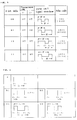
- Fig. 1 shows four kinds of states of two-bit data and the relationships between the four kinds of states and transmission and pulse codes corresponding thereto.
- an input signal composed of plural bit data is divided into words of two-bit data and pulse modulation is carried out for each two-bit data to obtain a pulse unit signal.
- each two-bit data assumes one of four different states and transmission codes (i 1 , j 1 ) which are four kinds of combinations of time intervals 2T and 3T are each assigned to one of the four states.
- the transmission code i 1 represents the time interval between first and third transitions and j 1 the time interval between second and fourth transitions.
- Reference character T denotes a unit time interval, which is equal to the minimum pulse width and the minimum pulse quiescent time of the pulse unit signal.
- the pulse code which forms the pulse unit signal is "1101."
- the time interval between the first and third transitions r 1 and r 3 is determined based on the transmission code i 1 (a).
- the transmission codes i 1 and j 1 are compared and when j 1 ⁇ i 1 , a point in time which is the unit time T behind the first transition r 1 is set as the point of second transition r 2 (b1).
- a point in time which is behind the second transition r 2 by the time corresponding to the transmission code j1 is set as the point of fourth transition r 4 ; thus, a pulse unit signal is obtained which transits its level at these four points in time (c1).
- a point in time which is ahead of the fourth transition r 4 by the time corresponding to the transmission code j 1 is set as the point of second transition r 2 ; thus, a pulse unit signal is obtained which transits its level at these four points in time (c2).
- the two-bit data forming each word is converted into one of four kinds of pulse unit signals each composed of three or four bits.
- the pulse modulating method according to this embodiment will hereinafter be referred to as a two-bit variable length system.
- the pulse unit signals thus converted in word units are concatenated into a sequence of pulse signals.
- the pulse unit signals are concatenated using the last transition (the fourth transition r4 in this embodiment) of the immediately preceding pulse unit signal as the first transition r1 of the immediately following pulse unit signal.
- the pulse unit signals of odd-numbered words rise at the points of first transitions r1 as shown in Figs. 1 and 2
- the pulse unit signals of even-numbered words concatenated with them fall at the points of first transitions r1
- their pulse waveforms are opposite in level to those shown in Figs. 1 and 2 and their pulse codes are also opposite to those shown therein.
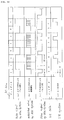
- Figs. 5(d) and 6(b) show the waveforms of pulse signals converted using the two-bit variable length system according to the present invention, Fig. 5 showing the waveform with the unit time T (the minimum pulse width of the pulse signal) set at half the data width of the input signal and Fig. 6 the waveform with the unit time T set at a value equal to the data width of the input signal.
- the pulse signal converted by the two bit variable length system is 30-bit pulse signal, and as is evident from Fig. 5, its transmission period is about twice longer than in the case of the NRZ modulation (a) but about half that in the case of the PPM modulation (b) and a little shorter than in the case of the SIR system.
- Fig. 3 is a block diagram illustrating the configuration of pulse modulating equipment 1 according to the present invention, which will be described as being applied to the conversion of the input signal into a pulse signal by the above-described two-bit variable length system.
- a serial input signal composed of plural bit data is input into a serial-parallel converter 3 via a buffer 2.
- the buffer 2 temporarily stores the serial input signal and outputs it as the serial-parallel conversion proceeds in the serial-parallel converter 3.
- the serial-parallel converter 3 converts the serial input signal from the buffer 3 into parallel data in word units of two-bit data for input into an encoder 4.
- the encoder 4 is provided with an encoded table storage circuit 4a wherein the respective states of two-bit data and the pulse codes, such as shown in Fig. 1, are stored in correspondence with each other.
- the pulse codes based on the transmission codes i 1 and j 1 corresponding to the two-bit data, each form a pulse unit signal which has the time interval i 1 between odd-numbered transitions and the time interval j 1 between even-numbered transit positions.
- the encoder 4 reads out the pulse codes corresponding to the two-bit parallel data inputted thereto from the encoded table storage, circuit 4a and provides them to a parallel-serial converter 5 that serves as a pulse signal generator.
- the pulse code of the immediately subsequent even-numbered word is inverted and the falling edge of the preceding pulse unit signal is used as the first transition of the pulse unit signal immediately subsequent thereto.
- Reference numeral 30 denotes a timing generator connected between the output of the encoder 4 and the input of the serial-parallel converter 3, for controlling the output from the serial-parallel converter 3 in accordance with the pulse code output state of the encoder 4. That is, the pulse codes that are output from the encoder 4 are codes of different lengths of three and four bits and when the four-bit pulse code is output, the output timing of the serial-parallel converter 3 is delayed by one bit.
- the parallel-serial converter 5 Based on the pulse codes, the parallel-serial converter 5 generates pulse unit signals and serially applies them to a transmitter circuit 6.
- the transmitter circuit 6 is provided with a pulse output circuit, by which the pulse unit signals output in word units are concatenated into a serial converted pulse signal.
- the transmitter circuit 6 is further provided with an infrared-emitting circuit which emits infrared rays according to the pulse signal; the infrared rays containing the serial converted pulse signal are emitted to pulse demodulating equipment 7.
- Fig. 4 is a block diagram of the pulse demodulating equipment 7 which receives the infrared rays containing the pulse signal and demodulates it into a plurality of bit data.
- the infrared rays containing the pulse signal are subjected to photoelectric conversion and then waveform shaped into a pulse signal.
- the output of the receiver circuit 8 is connected to a rise detector 9 and a fall detector 10 for detecting the rise and fall of the pulse signal which is output from the receiver circuit 8.
- the rise detector 9 Upon detection of the rise of the pulse signal, the rise detector 9 applies the rise detection signal to a first counter 11 connected to the output thereof.
- the first counter 11 always counts clock signals from a clock generator 12 and, when supplied with the rise detection signal, provides the current count value as a first count value UC to a decoder 13, while at the same time it resets its count value to zero and resumes counting the clock signals. That is, the first count value UC from the first counter 11 represents the time interval between two successive rising or leading edges of the pulse signal.
- the fall detector 9 upon detection of the fall of the pulse signal, applies the fall detection signal to a second counter 14 connected to the output thereof.
- the second counter 14 always counts the clock signals from the clock generator 12 as is the case with the first counter 11 and, when supplied with the fall detection signal, provides the current count value as a second count value DC to the decoder 13, while at the same time it resets its count value to zero and resumes counting the clock signals.
- the second count value DC from the second counter 14 represents the time interval between two successive trailing or falling edges of the pulse signal.
- the decoder 13 is provided with a decoded table storage circuit 13a wherein combinations of transmission codes, each composed of the time intervals i 1 and j 1 between the first and third transitions r 1 and r 3 and between the second and fourth transitions r 2 and r 4 , are stored in correspondence with the respective states of the two-bit data.
- the correspondence between the combinations of the transmission codes i 1 and j 1 and the two-bit data in the decoded table storage circuit 13a is the same as the correspondence between the transmission codes i 1 and j 1 and the two-bit data in the encoded table storage circuit 4a of the pulse modulating equipment 1 (see Fig. 1).
- the decoder 13 detects the combination of the transmission codes i 1 and j 1 from the first and second count values UC and DC and reads out the two-bit data corresponding to the detected combination of the transmission codes from the decoded table storage circuit 13a.
- the decoder 13 detects the combination of the transmission codes i 1 and j 1 for each pulse unit signal converted from the two-bit data.
- the pulse unit signal In the case of pulse modulation by the two-bit variable length system, the pulse unit signal have four transitions and the first and fourth transitions are common to the pulse unit signals immediately preceding and succeeding the current one. Accordingly, the pulse signal can be split into pulse unit signals every third transitions.
- the first and second count values UC and DC are alternately input into the decoder 13.
- this point in time is regarded as the time when the pulse unit signals are concatenated and the first and second count values UC and DC input in this period between concatenated points are used to obtain transmission codes i 1 and j 1 of the pulse unit signal of this period.
- the count value input second in the above period represents the time interval between the first and third transitions of the pulse unit signal, that is, the transmission code i 1
- the count value input third in the above period represents the time interval between the second and fourth transitions of the pulse unit signal, that is, the transmission code j 1 .
- the transmission codes i 1 and j 1 are derived from these count values.
- the transmission codes i1 and j1 can be obtained from first and second count values UC1 and DC2, respectively. Assuming that the period of the clock signal from the clock generator 12 is 1/16 the unit time T of the pulse signal, the count value for the unit time T is 16, so that if the first count value UC1 is within 48 ⁇ 3, the transmission code i1 is 3T. Similarly, if the second count value DC2 is within 32 ⁇ 3, the transmission code j1 is 2T.
- the two-bit data corresponding to the combination (3T,2T) of the transmission codes i 1 and j 1 is "1,0," (as shwon in fig. 1) the two-bit data is fed as two-bit parallel data to a parallel-serial converter 15.
- the transmission codes i 1 and j 1 of the second pulse unit signal are derived from the second and first count values DC3 and UC3, respectively. Since the second and first count values DC3 and UC3 are both within 48 ⁇ 3, the transmission codes i 1 and j 1 are (3T,3T), then the corresponding two-bit data "1,1" is readout, and two-bit parallel data "1,1" is fed to the parallel-serial converter 15.
- the parallel-serial converter 15 converts the parallel data, output in units of two bits from the decoder 13, into serial signals and provides them to a buffer 16, which concatenates the serial signals and outputs them as a demodulated signal composed of a plurality of bits.
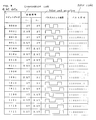
- Fig. 8 is a table explanatory of a pulse modulating method according to another embodiment of the present invention, showing 16 kinds of states of four-bit data and the relationships between them and the transmission codes i 1 ,j 1 and pulse codes corresponding thereto.
- an input signal composed of plural bit data is divided into words of four-bit data, which are each converted into a pulse unit signal of three through five bits according to the state of the four-bit data.
- the pulse modulating method according to this embodiment will hereinafter be called a four-bit variable length system.
- the number of data states of the 4-bit data is 16, 16 combinations of 2T, 2.5T, 3T and 3.5T corresponding to the respective data states are assigned to the transmission codes i 1 and j 1 .
- the transmission codes i 1 and j 1 need not always be integral multiples of the unit time T.
- the corresponding transmission codes i 1 and j 1 are 2.5T and 3T.
- the pulse unit signal that is generated based on such transmission codes has the time interval 2.5T between its first and third transitions r 1 and r 3 and the time interval 2T between its second and fourth transitions r2 and r 4 , and the pulse code for generating the pulse unit signal is "11000111.”
- No description will be given of the method for generating the pulse unit signals based on the transmission codes since it is the same as that described previously with reference to Fig. 2.
- the pulse unit signal is not a rectangular wave composed of integral bits, 1-bit pulse unit signal is represented by a 2-bit pulse code for the sake of convenience.
- the pulse unit signals are concatenated using the fourth transition r4 of the immediately preceding one of them as the first transition of the immediately succeeding pulse unit signal as is the case with the afore-mentioned 2-bit modulating system. Accordingly, the first inversion r1 of the pulse unit signal of an even-numbered word is the fall of the pulse, so that the pulse waveform is opposite in level to that shown in fig. 8 and the pulse code is also opposite.
- Figs. 5(e) and 6(c) show waveforms of the pulse signals converted by the 4-bit variable length system.
- the pulse modulating equipment 1 of Fig. 3 can be used in the 4-bit variable length system, by using an arrangement in which the serial-parallel converter 3 divides the input signal into words of 4-bit data and outputs 4-bit parallel data and the relationships between the bit data and the pulse codes shown in Fig. 8 are stored in the encoded table storage circuit 4a.
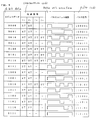
- Fig. 9 is a table explanatory of a pulse modulating method according to further another embodiment of the present invention, showing 16 kinds of states of 4-bit data and the relationships thereto of transmission codes i 1 , i 2 , j 1 , j 2 and pulse codes.
- the input signal composed of plural bit data is divided into words of 4-bit data, each of which is converted into a 6-bit pulse unit signal of fixed length based on the state of the divided 4-bit data.
- the pulse modulating method according to this embodiment will hereinafter be referred to as a 4-bit fixed length system.
- the transmission code i2 represents the time interval between third and fifth transition of the pulse unit signal and the transmission code j2 the time interval between its fourth and sixth transitions.
- the 16 kinds of pulse unit signals are all 6 bits long, and as compared with the above-described variable length system, the number of transitions is six in the case of representing the 4-bit data including the transmission codes i2 and j2.
- NRZ signals which were NRZ-modulated by 6-bit data.
- the transmission codes are gained from the time intervals between leading edges and between trailing edges of the NRZ signals.
- NRZ signals 16 kinds are assumed which were NRZ-modulated by 16 variant kinds of 6-bit data whose most and least significant bits MSB and LSB are "1s" and whose intermediate bits are variant 4-bit data. Since the NRZ signals have their most and least significant bits formed by NRZ modulated versions of bit data "1," the pulse unit signal have rising and trailing edges at their first and sixth bits but each has one of 16 variant kinds of different intermediate waveforms.
- the pulse units signals based on the transmission codes have a fixed 6-bit length.
- the pulse unit signal converted from an even-numbered word has its waveform inverted and is concatenated with the intermediately preceding and succeeding pulse unit signals, using the transitions at the concatenations in common to them.
- Figs. 5(f) and 6(d) show waveforms of pulse signals converted by the 4-bit fixed length system.
- the 4-bit fixed length system permits high-speed transmission as compared with the PPM and SIR systems, and since the pulse unit signals are fixed at 6 bits, demodulation is easier than in the cases of the 2-bit and 4-bit variable length systems of the present invention. Further, even if an error arises in one word during its demodulation, it does not affect the pulse unit signals of other words, and hence it does not constitute an error over the entire demodulation.
- Figs. 10 and 11 illustrate in block form pulse modulating equipment 17 and pulse demodulating equipment 18 that are used in the 4-bit fixed length system.
- the pulse modulating equipment and the pulse demodulating equipment are substantially identical in construction with those 1 and 7 described previously in respect of Figs. 3 and 4; the same parts are identified by the same reference numerals and no description will be repeated.
- a serial-parallel converter 19 of the pulse modulating equipment 17 divides the serial input signal from the buffer 4 into words of 4-bit data and outputs 4-bit parallel data to an encoder circuit 20.
- the encoder circuit 20 reads out the pulse codes corresponding to the 4-bit parallel data from an encoded table storage circuit 20a having stored therein 4-bit data and pulse codes in correspondence with each other as shown in Fig. 9, the pulse code thus read out being fed to the parallel-serial converter 5.
- This pulse code is to form the pulse unit signal of the waveform shown in Fig. 9 based on the transmission codes i 1 , i 2 , j 1 , j 2 corresponding to the state of the 4-bit data, and since the pulse unit signals have the 6-bit fixed length, the pulse codes that are output are all 6 bits long. Consequently, the timing generator 30 in the pulse modulating equipment 1 of the variable length system is unnecessary.
- the pulse demodulating equipment 18 is provided with a third counter 21 which is supplied with the rise detection signal and the fall detection signal from the rise detector 9 and the fall detector 10.
- the third counter 21 begins to count clock signals at the start of the pulse unit signal and, upon each reception of the rise or fall detection signal, outputs the count value at that time as a third count value BC to a decoder circuit 22, thereby notifying the termination of the pulse unit signal.
- the decoder circuit 22 applies a reset signal to the third counter 21 at the start of the pulse unit signal (that is also the termination of the immediately preceding pulse unit signal) to cause the third counter to start counting the clock signals and, upon each input thereto of the third count value BC for each transition of the pulse signal, compared the third count value BC with the fixed time interval F (corresponding to 6 bits) and, when the third count value BC indicates nearly equal to the time interval of 6 bits, regards the transition at that time as the end of the pulse unit signal. Since the position of termination of the pulse unit signal is also used as the position of start of the immediately succeeding pulse unit signal, the decoder circuit applied the reset signal again to the third counter 21 to cause it to begin counting the clock signals.
- the decoder circuit 22 is provided with a decoded table storage circuit 22a wherein there are stored the transmission codes i 1 , i 2 , j 1 , j 2 and respective states of the 4-bit data in correspondence with each other as shown in Fig. 9.
- the transmission codes are detected from the pulse unit signal divided into each word by the above-described method and the 4-bit data corresponding to the transmission codes is read out from the decoded table storage circuit 22a. Then the 4-bit data is fed as parallel data to the parallel-serial converter 15.
- the decoder circuit 22 makes a comparison between the third count value BC which is output from the third counter 21 upon each transition of the pulse signal and the 6-bit duration.
- the period of the clock signal from the clock generator 12 is 1/16 the unit time or duration T of the pulse signal
- the third count value BC represents the time interval between the start of the pulse unit signal and its transition at the time when the third count value BC is output, and at the end of the pulse unit signal, the pulse unit signal transits its level, so that when the third count value BC is within 96 ⁇ 3, the transition at that time can be regarded as the end of the pulse unit signal.
- one of third count values BC11, BC12 and BC13 are input upon each transition of the pulse signal; since the third count value BC13 is within 96 ⁇ 3, the transition r4 is regarded as the end of the first pulse unit signal.
- third count values BC31, ..., BC34, BC35 are input; since the third count value BC35 is within 96 ⁇ 3, the transition r6 is regarded as the end of the third pulse unit signal.
- the count value input second from the first counter 11 or second counter 14 during the period of each pulse unit signal represents the time interval between first and third transitions, that is, the transmission code i 1 ; similarly, the count value input third represents the transmission code j 1 , the count value input fourth the transmission code i 2 and the count value input fifth the transmission code j 2 .
- the transmission codes i 1 , i 2 , j 1 , j 2 contained in each pulse unit signal are detected from these count values UC and DC.
- the transmission code i 1 is represented by the second count value DC3 and the transmission code j 1 by the first count value UC3, and since the second and first count values DC3 and UC3 are within 64 ⁇ 3 and within 80 ⁇ 3, respectively, the transmission codes i 1 and j 1 of the second pulse unit signal are (4T,5T).
- the transmission codes i 1 , j 1 , i 2 , j 2 of the third pulse unit signal are (3T,3T,2T,2T) since the transmission code i 1 is represented by the first count value UC4, the transmission code j 1 by the second count value DC5, the transmission code i 2 by the first count value UC5 and the transmission code j 2 by the second count value DC6.
- the 4-bit data whose transmission codes i 1 and j 1 correspond to the combination (4t,5T) is "0,0,0,1" as shown in Fig. 9 and this 4-bit data is read out of the decoded table storage circuit 22a and fed as 4-bit parallel data to the parallel-serial converter 15.
- the 4-bit data whose transmission codes i 1 , j 1 , i 2 , j 2 correspond to the combination (3T,3T,2T,2T) is "0,0,1,0” as shown in Fig. 9 and this 4-bit data is read out of the decoded table storage circuit 22a and it is similarly fed as 4-bit parallel data to the parallel serial converter 15.
- each pulse unit signal is used as the first transition of the immediately succeeding pulse unit signal to concatenate the pulse unit signal
- their transitions need not always be used in common.
- an odd-numbered transition can always be defined as the rise of the pulse signal and an even numbered transition as the fall of the pulse signal, so that the transmission codes i and j can be represented by combinations of the time intervals between leading edges and between railing edges of the pulse unit signal.
- the unit time T is used as the minimum pulse width of the pulse unit signal and as the minimum pulse quiescent time, the invention is not limited specifically thereto.
- the frame transmission time for the converted pulse signal can be changed as desired.
- the correspondence between respective states of bit data of each word and the transmission codes are not limited specifically to those shown in the drawings but other correspondence can be used as long as they have a one-to-one correspondence.
- the intermediate 4-bit data of the 6-bit data assumed to obtain combinations of transmission codes are made to correspond to the 4-bit data divided for each word so that they match each other, but the both bit data need not always to match each other.
- the pulse modulating method, pulse modulating equipment and pulse demodulating equipment according to the present invention are suitable for use in optical communication system that employ infrared rays or similar rays of light as carriers.
Landscapes
- Engineering & Computer Science (AREA)
- Physics & Mathematics (AREA)
- Spectroscopy & Molecular Physics (AREA)
- Computer Networks & Wireless Communication (AREA)
- Signal Processing (AREA)
- Theoretical Computer Science (AREA)
- Dc Digital Transmission (AREA)
- Digital Transmission Methods That Use Modulated Carrier Waves (AREA)
Applications Claiming Priority (3)
| Application Number | Priority Date | Filing Date | Title |
|---|---|---|---|
| JP303304/95 | 1995-10-30 | ||
| JP30330495A JP3406440B2 (ja) | 1995-10-30 | 1995-10-30 | パルス変調方法とパルス変調装置及びパルス復調装置 |
| PCT/JP1996/003040 WO1997016889A1 (fr) | 1995-10-30 | 1996-10-21 | Procede de modulation d'impulsions, modulateur d'impulsions et demodulateur d'impulsions |
Publications (3)
| Publication Number | Publication Date |
|---|---|
| EP0808028A1 true EP0808028A1 (de) | 1997-11-19 |
| EP0808028A4 EP0808028A4 (de) | 2001-10-04 |
| EP0808028B1 EP0808028B1 (de) | 2010-09-22 |
Family
ID=17919351
Family Applications (1)
| Application Number | Title | Priority Date | Filing Date |
|---|---|---|---|
| EP96935379A Expired - Lifetime EP0808028B1 (de) | 1995-10-30 | 1996-10-21 | Pulsmodulationsverfahren, pulsmodulator und pulsdemodulator |
Country Status (6)
| Country | Link |
|---|---|
| US (1) | US6064697A (de) |
| EP (1) | EP0808028B1 (de) |
| JP (1) | JP3406440B2 (de) |
| DE (1) | DE69638263D1 (de) |
| TW (1) | TW302580B (de) |
| WO (1) | WO1997016889A1 (de) |
Cited By (6)
| Publication number | Priority date | Publication date | Assignee | Title |
|---|---|---|---|---|
| WO2001097395A3 (en) * | 2000-06-12 | 2002-06-06 | Time Domain Corp | A method and apparatus for applying codes having predefined properties |
| WO2007007409A1 (ja) | 2005-07-14 | 2007-01-18 | Fujitsu Limited | データ復号方法及び,これを適用するデータ復号装置 |
| EP1673914A4 (de) * | 2003-10-10 | 2007-12-19 | Atmel Corp | Zweiphasen-impulsmodulations-codiererschaltung |
| EP1732280A4 (de) * | 2004-03-30 | 2008-04-02 | Sanyo Electric Co | Netzwerksystem |
| CN103377550A (zh) * | 2012-04-13 | 2013-10-30 | 技嘉科技股份有限公司 | 红外线讯号的复合译码方法及其装置 |
| CN101751768B (zh) * | 2008-12-09 | 2015-06-17 | 晨星软件研发(深圳)有限公司 | 译码方法及其装置 |
Families Citing this family (30)
| Publication number | Priority date | Publication date | Assignee | Title |
|---|---|---|---|---|
| JP3459339B2 (ja) * | 1997-07-03 | 2003-10-20 | 株式会社リコー | Ppm方式を採用する変調回路、復調回路及び変復調回路システム |
| US5963595A (en) * | 1997-09-08 | 1999-10-05 | Tut Systems, Inc. | Method and apparatus for encoding and decoding a bit sequence for transmission over POTS wiring |
| US6678321B1 (en) | 1998-09-15 | 2004-01-13 | Tut Systems, Inc. | Method and apparatus for transmitting and receiving a symbol over pots wiring using a multi-cycle waveform |
| KR100340423B1 (ko) * | 1999-07-28 | 2002-06-12 | 이형도 | 트랙볼을 장착한 무선키보드의 데이터 송신방법 |
| US20030193924A1 (en) * | 1999-09-10 | 2003-10-16 | Stephan Gehring | Medium access control protocol for centralized wireless network communication management |
| US20040090983A1 (en) * | 1999-09-10 | 2004-05-13 | Gehring Stephan W. | Apparatus and method for managing variable-sized data slots within a time division multiple access frame |
| US7023833B1 (en) | 1999-09-10 | 2006-04-04 | Pulse-Link, Inc. | Baseband wireless network for isochronous communication |
| US7370006B2 (en) * | 1999-10-27 | 2008-05-06 | Ebay, Inc. | Method and apparatus for listing goods for sale |
| US7088795B1 (en) * | 1999-11-03 | 2006-08-08 | Pulse-Link, Inc. | Ultra wide band base band receiver |
| US6952456B1 (en) | 2000-06-21 | 2005-10-04 | Pulse-Link, Inc. | Ultra wide band transmitter |
| US6970448B1 (en) * | 2000-06-21 | 2005-11-29 | Pulse-Link, Inc. | Wireless TDMA system and method for network communications |
| US6512799B2 (en) | 2001-02-06 | 2003-01-28 | University Of South Alabama | Digital communication system and method for increased bit rates |
| KR20030069530A (ko) * | 2002-02-21 | 2003-08-27 | 한국과학기술원 | 적외선 펄스폭변조 구동방식을 이용한 위치 감지시스템 및방법 |
| JP3973630B2 (ja) * | 2004-01-20 | 2007-09-12 | シャープ株式会社 | データ伝送装置およびデータ伝送方法 |
| CZ302463B6 (cs) * | 2004-11-22 | 2011-06-01 | Microrisc S. R. O. | Zpusob kódování a/nebo dekódování binárních dat pro jejich bezdrátový prenos, zejména pro radiove prenášená data, a zarízení k provádení tohoto zpusobu |
| US7551670B2 (en) * | 2005-07-15 | 2009-06-23 | Git Japan, Inc. | UWB communication device and UWB communication method |
| JP2007306336A (ja) * | 2006-05-11 | 2007-11-22 | Seiko Epson Corp | データ通信システム、データ通信方法及びプログラム |
| DE102007053811A1 (de) * | 2007-11-12 | 2009-05-14 | Robert Bosch Gmbh | Verfahren zum Übertragen von Daten |
| JP5483170B2 (ja) * | 2008-09-30 | 2014-05-07 | Tdk株式会社 | デジタル信号伝送装置及びデジタル信号伝送方法 |
| CN101789173B (zh) * | 2010-03-12 | 2013-03-13 | 北京东方广视科技股份有限公司 | 一种学习波形的方法和装置 |
| US9875209B2 (en) * | 2013-05-06 | 2018-01-23 | Qualcomm Incorporated | Synchronous data-link throughput enhancement technique based on data signal duty-cycle and phase modulation/demodulation |
| FR3029661B1 (fr) * | 2014-12-04 | 2016-12-09 | Stmicroelectronics Rousset | Procedes de transmission et de reception d'un signal binaire sur un lien serie, en particulier pour la detection de la vitesse de transmission, et dispositifs correspondants |
| CN106549729B (zh) * | 2015-09-21 | 2020-09-15 | 天地融科技股份有限公司 | 数据发送方法和装置及数据接收方法和装置 |
| US10673477B2 (en) * | 2015-10-21 | 2020-06-02 | Tendyron Corporation | Communication device, adapter device, communication system |
| WO2017193309A1 (zh) * | 2016-05-11 | 2017-11-16 | 华为技术有限公司 | 数据处理方法、装置和系统 |
| US10565156B1 (en) * | 2018-11-15 | 2020-02-18 | Nxp B.V. | Wired-data bus transmission using signal transition coding |
| US10630314B1 (en) * | 2019-06-18 | 2020-04-21 | Nxp B.V. | Method and system for asynchronous serialization of multiple serial communication signals |
| US11902062B2 (en) | 2019-12-23 | 2024-02-13 | Intel Corporation | Apparatus and method for transmitting a bit in addition to a plurality of payload data symbols of a communication protocol, and apparatus and method for decoding a data signal |
| US11561601B2 (en) | 2020-06-05 | 2023-01-24 | Apple Inc. | Method for performing system and power management over a serial data communication interface |
| JP2024092688A (ja) | 2022-12-26 | 2024-07-08 | キヤノン株式会社 | データキャリア装置、通信システム及び交換ユニット |
Family Cites Families (9)
| Publication number | Priority date | Publication date | Assignee | Title |
|---|---|---|---|---|
| US3701111A (en) * | 1971-02-08 | 1972-10-24 | Ibm | Method of and apparatus for decoding variable-length codes having length-indicating prefixes |
| DE3140431C2 (de) * | 1980-10-13 | 1986-09-25 | Hitachi, Ltd., Tokio/Tokyo | Demodulatorschaltung zum Demodulieren eines modulierten Digitalsignals |
| JPS5990448A (ja) * | 1982-11-16 | 1984-05-24 | Toshiba Corp | 復調方式 |
| JPS63200630A (ja) * | 1987-02-17 | 1988-08-18 | Nec Corp | 光送受信器 |
| JPH03207115A (ja) * | 1990-01-10 | 1991-09-10 | Otari Kk | Pwm信号の復調方式 |
| US5185766A (en) * | 1990-04-24 | 1993-02-09 | Samsung Electronics Co., Ltd. | Apparatus and method for decoding biphase-coded data |
| JP3034000B2 (ja) * | 1990-09-21 | 2000-04-17 | 日立マクセル株式会社 | 変調回路,復調回路および変復調回路 |
| JP3136742B2 (ja) * | 1992-02-14 | 2001-02-19 | 日産自動車株式会社 | 通信装置 |
| JP3153084B2 (ja) * | 1994-11-15 | 2001-04-03 | エスエムケイ株式会社 | パルス変調方法 |
-
1995
- 1995-10-30 JP JP30330495A patent/JP3406440B2/ja not_active Expired - Lifetime
-
1996
- 1996-01-27 TW TW085101007A patent/TW302580B/zh not_active IP Right Cessation
- 1996-10-21 EP EP96935379A patent/EP0808028B1/de not_active Expired - Lifetime
- 1996-10-21 WO PCT/JP1996/003040 patent/WO1997016889A1/ja not_active Ceased
- 1996-10-21 US US08/860,569 patent/US6064697A/en not_active Expired - Fee Related
- 1996-10-21 DE DE69638263T patent/DE69638263D1/de not_active Expired - Lifetime
Non-Patent Citations (2)
| Title |
|---|
| No further relevant documents disclosed * |
| See also references of WO9716889A1 * |
Cited By (7)
| Publication number | Priority date | Publication date | Assignee | Title |
|---|---|---|---|---|
| WO2001097395A3 (en) * | 2000-06-12 | 2002-06-06 | Time Domain Corp | A method and apparatus for applying codes having predefined properties |
| EP1673914A4 (de) * | 2003-10-10 | 2007-12-19 | Atmel Corp | Zweiphasen-impulsmodulations-codiererschaltung |
| EP1732280A4 (de) * | 2004-03-30 | 2008-04-02 | Sanyo Electric Co | Netzwerksystem |
| WO2007007409A1 (ja) | 2005-07-14 | 2007-01-18 | Fujitsu Limited | データ復号方法及び,これを適用するデータ復号装置 |
| EP1903687A4 (de) * | 2005-07-14 | 2013-05-22 | Fujitsu Ltd | Datendecodierungsverfahren und datendecodierungseinrichtung damit |
| CN101751768B (zh) * | 2008-12-09 | 2015-06-17 | 晨星软件研发(深圳)有限公司 | 译码方法及其装置 |
| CN103377550A (zh) * | 2012-04-13 | 2013-10-30 | 技嘉科技股份有限公司 | 红外线讯号的复合译码方法及其装置 |
Also Published As
| Publication number | Publication date |
|---|---|
| TW302580B (en) | 1997-04-11 |
| DE69638263D1 (de) | 2010-11-04 |
| US6064697A (en) | 2000-05-16 |
| EP0808028A4 (de) | 2001-10-04 |
| EP0808028B1 (de) | 2010-09-22 |
| JP3406440B2 (ja) | 2003-05-12 |
| JPH09130254A (ja) | 1997-05-16 |
| WO1997016889A1 (fr) | 1997-05-09 |
Similar Documents
| Publication | Publication Date | Title |
|---|---|---|
| US6064697A (en) | Pulse modulating method, pulse modulating equipment and pulse demodulating equipment | |
| US5640160A (en) | Pulse modulation method | |
| US5315299A (en) | Multiplex data communicating apparatus applicable to automotive vehicle | |
| EP0323606B1 (de) | Dekodierverfahren und Vorrichtung mit Auslöschungsdetektion für Mehrpegelübertragungssysteme | |
| KR930000453B1 (ko) | 디지틀변조장치와 복조장치 | |
| US4528550A (en) | Method and apparatus for code conversion of binary of multilevel signals | |
| EP1126619B1 (de) | Signalmodulationsverfahren und Signaldemodulationsverfahren | |
| US4547890A (en) | Apparatus and method for forming d.c. free codes | |
| BG105877A (bg) | Метод за преобразуване на поток от битове данни на двоичен информационен сигнал в поток от битове данни на ограничен двоичен канален сигнал, устройство за кодиране, сигнал съдържащ поток от битове данни на ограничен двоичен канален сигнал , носител на запис и устройство за декодиране | |
| CA1231176A (en) | Group coding system for serial data transmission | |
| US5633632A (en) | Data conversion method and apparatus imbedding pilot signal into converted data and reducing error propagation between datawords | |
| US4613860A (en) | Coder-decoder for purged binary block codes | |
| US4549167A (en) | Method of encoding and decoding binary data | |
| US6577684B1 (en) | Transmission/reception method and device where information is encoded and decoded according to rules defined based on a relation between a previously-generated multilevel code and a currently generated multilevel | |
| US6531968B2 (en) | Digital data modulating method and apparatus and modulated data recording medium using the same | |
| JP2002539706A (ja) | 変換がパリティ反転であるようなnビット・ソースワードから対応するmビット・チャネルワードへのエンコーディング及びその逆を行うデコーディング | |
| US6456667B2 (en) | Method of coding signal for digital optical communication having spectrum which attains zero level at prescribed frequency within main lobe band, baseband transmitter or ask transmitter using such method, and baseband receiver or ask receiver decoding signal coded by such method | |
| JPS6333818B2 (de) | ||
| RU2215369C1 (ru) | Способ кодирования цифровых сигналов | |
| US7912143B1 (en) | Biphase multiple level communications | |
| JPH08204573A (ja) | 符号変換方法 | |
| JPS62615B2 (de) | ||
| JP3769384B2 (ja) | ディジタル光通信用信号の符号化方法、ベースバンド光送信装置、ベースバンド光受信装置、ask光送信装置、及びask光受信装置 | |
| KR100356898B1 (ko) | 베이스밴드코드 | |
| JPS6184124A (ja) | デイジタル変調器 |
Legal Events
| Date | Code | Title | Description |
|---|---|---|---|
| PUAI | Public reference made under article 153(3) epc to a published international application that has entered the european phase |
Free format text: ORIGINAL CODE: 0009012 |
|
| AK | Designated contracting states |
Kind code of ref document: A1 Designated state(s): DE FR GB |
|
| 17P | Request for examination filed |
Effective date: 19971017 |
|
| A4 | Supplementary search report drawn up and despatched |
Effective date: 20010817 |
|
| AK | Designated contracting states |
Kind code of ref document: A4 Designated state(s): DE FR GB |
|
| 17Q | First examination report despatched |
Effective date: 20030314 |
|
| GRAP | Despatch of communication of intention to grant a patent |
Free format text: ORIGINAL CODE: EPIDOSNIGR1 |
|
| GRAS | Grant fee paid |
Free format text: ORIGINAL CODE: EPIDOSNIGR3 |
|
| GRAA | (expected) grant |
Free format text: ORIGINAL CODE: 0009210 |
|
| AK | Designated contracting states |
Kind code of ref document: B1 Designated state(s): DE FR GB |
|
| REG | Reference to a national code |
Ref country code: GB Ref legal event code: FG4D |
|
| REF | Corresponds to: |
Ref document number: 69638263 Country of ref document: DE Date of ref document: 20101104 Kind code of ref document: P |
|
| PG25 | Lapsed in a contracting state [announced via postgrant information from national office to epo] |
Ref country code: FR Free format text: LAPSE BECAUSE OF NON-PAYMENT OF DUE FEES Effective date: 20101122 |
|
| PLBE | No opposition filed within time limit |
Free format text: ORIGINAL CODE: 0009261 |
|
| REG | Reference to a national code |
Ref country code: FR Ref legal event code: ST Effective date: 20110630 |
|
| STAA | Information on the status of an ep patent application or granted ep patent |
Free format text: STATUS: NO OPPOSITION FILED WITHIN TIME LIMIT |
|
| GBPC | Gb: european patent ceased through non-payment of renewal fee |
Effective date: 20101222 |
|
| 26N | No opposition filed |
Effective date: 20110623 |
|
| REG | Reference to a national code |
Ref country code: DE Ref legal event code: R119 Ref document number: 69638263 Country of ref document: DE Effective date: 20110502 |
|
| PG25 | Lapsed in a contracting state [announced via postgrant information from national office to epo] |
Ref country code: GB Free format text: LAPSE BECAUSE OF NON-PAYMENT OF DUE FEES Effective date: 20101222 |
|
| PG25 | Lapsed in a contracting state [announced via postgrant information from national office to epo] |
Ref country code: DE Free format text: LAPSE BECAUSE OF NON-PAYMENT OF DUE FEES Effective date: 20110502 |