EP0807817B1 - Vielseitiger ionenempfindlicher fühler - Google Patents
Vielseitiger ionenempfindlicher fühler Download PDFInfo
- Publication number
- EP0807817B1 EP0807817B1 EP95942802A EP95942802A EP0807817B1 EP 0807817 B1 EP0807817 B1 EP 0807817B1 EP 95942802 A EP95942802 A EP 95942802A EP 95942802 A EP95942802 A EP 95942802A EP 0807817 B1 EP0807817 B1 EP 0807817B1
- Authority
- EP
- European Patent Office
- Prior art keywords
- sensor
- electrolyte
- housing tube
- reference electrode
- electrode
- Prior art date
- Legal status (The legal status is an assumption and is not a legal conclusion. Google has not performed a legal analysis and makes no representation as to the accuracy of the status listed.)
- Expired - Lifetime
Links
- 239000003792 electrolyte Substances 0.000 claims description 49
- 239000000463 material Substances 0.000 claims description 37
- 238000005259 measurement Methods 0.000 claims description 35
- 239000007788 liquid Substances 0.000 claims description 30
- 239000007787 solid Substances 0.000 claims description 28
- 238000007789 sealing Methods 0.000 claims description 15
- 239000004020 conductor Substances 0.000 claims description 10
- 239000012528 membrane Substances 0.000 claims description 10
- 239000000203 mixture Substances 0.000 claims description 10
- HRPVXLWXLXDGHG-UHFFFAOYSA-N Acrylamide Chemical compound NC(=O)C=C HRPVXLWXLXDGHG-UHFFFAOYSA-N 0.000 claims description 9
- 239000000178 monomer Substances 0.000 claims description 7
- 239000013013 elastic material Substances 0.000 claims description 3
- 239000003999 initiator Substances 0.000 claims description 3
- 150000002500 ions Chemical class 0.000 description 33
- 239000011521 glass Substances 0.000 description 20
- 238000013461 design Methods 0.000 description 18
- 238000012544 monitoring process Methods 0.000 description 17
- 239000007784 solid electrolyte Substances 0.000 description 10
- 230000000694 effects Effects 0.000 description 8
- 238000000034 method Methods 0.000 description 8
- 238000004659 sterilization and disinfection Methods 0.000 description 8
- 229920001971 elastomer Polymers 0.000 description 7
- 230000008569 process Effects 0.000 description 7
- 229910052739 hydrogen Inorganic materials 0.000 description 5
- 239000001257 hydrogen Substances 0.000 description 5
- 239000011244 liquid electrolyte Substances 0.000 description 5
- 238000001139 pH measurement Methods 0.000 description 5
- 239000003795 chemical substances by application Substances 0.000 description 4
- 230000007613 environmental effect Effects 0.000 description 4
- 239000000945 filler Substances 0.000 description 4
- -1 hydrogen ions Chemical class 0.000 description 4
- 239000004033 plastic Substances 0.000 description 4
- BASFCYQUMIYNBI-UHFFFAOYSA-N platinum Chemical compound [Pt] BASFCYQUMIYNBI-UHFFFAOYSA-N 0.000 description 4
- 230000027756 respiratory electron transport chain Effects 0.000 description 4
- WCUXLLCKKVVCTQ-UHFFFAOYSA-M Potassium chloride Chemical class [Cl-].[K+] WCUXLLCKKVVCTQ-UHFFFAOYSA-M 0.000 description 3
- 238000012423 maintenance Methods 0.000 description 3
- 239000000523 sample Substances 0.000 description 3
- AUNGANRZJHBGPY-SCRDCRAPSA-N Riboflavin Chemical compound OC[C@@H](O)[C@@H](O)[C@@H](O)CN1C=2C=C(C)C(C)=CC=2N=C2C1=NC(=O)NC2=O AUNGANRZJHBGPY-SCRDCRAPSA-N 0.000 description 2
- 229910021607 Silver chloride Inorganic materials 0.000 description 2
- 239000012530 fluid Substances 0.000 description 2
- 239000011245 gel electrolyte Substances 0.000 description 2
- 239000003292 glue Substances 0.000 description 2
- 239000011159 matrix material Substances 0.000 description 2
- 229910052751 metal Inorganic materials 0.000 description 2
- 239000002184 metal Substances 0.000 description 2
- 229910000510 noble metal Inorganic materials 0.000 description 2
- 235000015097 nutrients Nutrition 0.000 description 2
- 229910052697 platinum Inorganic materials 0.000 description 2
- 229920000642 polymer Polymers 0.000 description 2
- 150000003839 salts Chemical class 0.000 description 2
- HKZLPVFGJNLROG-UHFFFAOYSA-M silver monochloride Chemical compound [Cl-].[Ag+] HKZLPVFGJNLROG-UHFFFAOYSA-M 0.000 description 2
- 239000000243 solution Substances 0.000 description 2
- 239000000126 substance Substances 0.000 description 2
- 238000012360 testing method Methods 0.000 description 2
- XLYOFNOQVPJJNP-UHFFFAOYSA-N water Substances O XLYOFNOQVPJJNP-UHFFFAOYSA-N 0.000 description 2
- AUNGANRZJHBGPY-UHFFFAOYSA-N D-Lyxoflavin Natural products OCC(O)C(O)C(O)CN1C=2C=C(C)C(C)=CC=2N=C2C1=NC(=O)NC2=O AUNGANRZJHBGPY-UHFFFAOYSA-N 0.000 description 1
- 239000004593 Epoxy Substances 0.000 description 1
- PXGOKWXKJXAPGV-UHFFFAOYSA-N Fluorine Chemical compound FF PXGOKWXKJXAPGV-UHFFFAOYSA-N 0.000 description 1
- UFHFLCQGNIYNRP-UHFFFAOYSA-N Hydrogen Chemical compound [H][H] UFHFLCQGNIYNRP-UHFFFAOYSA-N 0.000 description 1
- 239000004793 Polystyrene Substances 0.000 description 1
- 230000004308 accommodation Effects 0.000 description 1
- 238000004458 analytical method Methods 0.000 description 1
- 239000010425 asbestos Substances 0.000 description 1
- 230000003115 biocidal effect Effects 0.000 description 1
- 239000007853 buffer solution Substances 0.000 description 1
- 239000000919 ceramic Substances 0.000 description 1
- 229910010293 ceramic material Inorganic materials 0.000 description 1
- 230000008859 change Effects 0.000 description 1
- 229910052729 chemical element Inorganic materials 0.000 description 1
- 238000001311 chemical methods and process Methods 0.000 description 1
- WIIZWVCIJKGZOK-RKDXNWHRSA-N chloramphenicol Chemical compound ClC(Cl)C(=O)N[C@H](CO)[C@H](O)C1=CC=C([N+]([O-])=O)C=C1 WIIZWVCIJKGZOK-RKDXNWHRSA-N 0.000 description 1
- 229960005091 chloramphenicol Drugs 0.000 description 1
- 230000001419 dependent effect Effects 0.000 description 1
- 239000003822 epoxy resin Substances 0.000 description 1
- 238000011156 evaluation Methods 0.000 description 1
- 238000002474 experimental method Methods 0.000 description 1
- 238000000855 fermentation Methods 0.000 description 1
- 230000004151 fermentation Effects 0.000 description 1
- 238000011049 filling Methods 0.000 description 1
- 229910052731 fluorine Inorganic materials 0.000 description 1
- 239000011737 fluorine Substances 0.000 description 1
- PCHJSUWPFVWCPO-UHFFFAOYSA-N gold Chemical compound [Au] PCHJSUWPFVWCPO-UHFFFAOYSA-N 0.000 description 1
- 229910052737 gold Inorganic materials 0.000 description 1
- 239000010931 gold Substances 0.000 description 1
- 230000005484 gravity Effects 0.000 description 1
- 239000003673 groundwater Substances 0.000 description 1
- 150000002431 hydrogen Chemical class 0.000 description 1
- GPRLSGONYQIRFK-UHFFFAOYSA-N hydron Chemical compound [H+] GPRLSGONYQIRFK-UHFFFAOYSA-N 0.000 description 1
- 238000007654 immersion Methods 0.000 description 1
- 230000001788 irregular Effects 0.000 description 1
- 238000002955 isolation Methods 0.000 description 1
- 238000011545 laboratory measurement Methods 0.000 description 1
- 238000004519 manufacturing process Methods 0.000 description 1
- 238000012986 modification Methods 0.000 description 1
- 230000004048 modification Effects 0.000 description 1
- 239000008239 natural water Substances 0.000 description 1
- 229920001230 polyarylate Polymers 0.000 description 1
- 229920000647 polyepoxide Polymers 0.000 description 1
- 229920001296 polysiloxane Polymers 0.000 description 1
- 229920002223 polystyrene Polymers 0.000 description 1
- 239000005373 porous glass Substances 0.000 description 1
- 235000011164 potassium chloride Nutrition 0.000 description 1
- 239000001103 potassium chloride Substances 0.000 description 1
- 238000002360 preparation method Methods 0.000 description 1
- 238000006479 redox reaction Methods 0.000 description 1
- 229920005989 resin Polymers 0.000 description 1
- 239000011347 resin Substances 0.000 description 1
- 229960002477 riboflavin Drugs 0.000 description 1
- 235000019192 riboflavin Nutrition 0.000 description 1
- 239000002151 riboflavin Substances 0.000 description 1
- 229910052895 riebeckite Inorganic materials 0.000 description 1
- 229920006395 saturated elastomer Polymers 0.000 description 1
- 239000012047 saturated solution Substances 0.000 description 1
- 239000010865 sewage Substances 0.000 description 1
- 229910001415 sodium ion Inorganic materials 0.000 description 1
- 238000003786 synthesis reaction Methods 0.000 description 1
- 238000012546 transfer Methods 0.000 description 1
Images


Classifications
-
- G—PHYSICS
- G01—MEASURING; TESTING
- G01N—INVESTIGATING OR ANALYSING MATERIALS BY DETERMINING THEIR CHEMICAL OR PHYSICAL PROPERTIES
- G01N27/00—Investigating or analysing materials by the use of electric, electrochemical, or magnetic means
- G01N27/26—Investigating or analysing materials by the use of electric, electrochemical, or magnetic means by investigating electrochemical variables; by using electrolysis or electrophoresis
- G01N27/28—Electrolytic cell components
- G01N27/30—Electrodes, e.g. test electrodes; Half-cells
- G01N27/333—Ion-selective electrodes or membranes
-
- G—PHYSICS
- G01—MEASURING; TESTING
- G01N—INVESTIGATING OR ANALYSING MATERIALS BY DETERMINING THEIR CHEMICAL OR PHYSICAL PROPERTIES
- G01N27/00—Investigating or analysing materials by the use of electric, electrochemical, or magnetic means
- G01N27/26—Investigating or analysing materials by the use of electric, electrochemical, or magnetic means by investigating electrochemical variables; by using electrolysis or electrophoresis
- G01N27/403—Cells and electrode assemblies
- G01N27/4035—Combination of a single ion-sensing electrode and a single reference electrode
Definitions
- Sensors intended for redox potential monitoring are widely employed at present.
- a sensor with a reference electrode filled with gel electrolyte and an indicator electrode with a platinum or gold sensing element have been described in a booklet titled "PH/Redox Measurement in Chemical Processes. pH-Electrodes. Industrial Probes. Sensors", published by Ingold Messtechnik AG, CH-8902 Urdorf/Switzerland, 1990, p. 16.
- this device comprises an integral, monolithic glass design which is only operational in a predefined spatial position and is not intended for harsh conditions.
- Another known ion-selective sensor (the US' Foxboro Company booklet, "pH/ORP/ISE Sensors B71 pH Series," The Foxboro Company, Foxboro MA 02035-2099, 1993, p. 1) was designed for fluorine and hydrogen ion activity monitoring and is suitable for redox potential monitoring applications.
- This sensor incorporates a plastic housing tube where a detachable indicator electrode is rigidly fixed in addition to a reference electrode that has a hollow body filled with liquid or gel electrolyte containing a solid dispersed material which forms a spatial structure that is freely movable inside the reference electrode.
- An indicator electrode filled with liquid electrolyte, together with a solid ion-selective sensor, are installed into the housing tube for ion activity monitoring, and an indicator electrode with a platinum sensing element is inserted into the housing tube for redox potential monitoring.
- the proposed invention is built around the design of a multipurpose ion-selective sensor in an embodiment that would eliminate electrolyte movements inside the electrodes and its entry into the analysed liquid thereby making a functional in any spatial position, critical operating environments, and under any ion composition and redox potential.
- the proposed ion-selective sensor employs electrodes which are essentially immune to gravity and enable any spatial position for normal operation.
- This design eliminates electrode damage at high temperatures (around 200°C) high pressures (around 5 MPa), zero-gravity conditions and low temperatures of some -60°C, thereby ensuring full operability in extreme conditions.
- the design eliminates the electrolyte entry from the reference electrode and thus greatly extends the useful service life of the claimed sensor.
- This sensor design enables its application for redox potential measurements in analysed liquids with no regard to sensor spatial position and operating environment.
- the said rigid link of the spatial structure is achieved by a solid dispersed material of the reference electrode electrolyte, in quantity sufficient for 5 - 30 wt.% concentrations whereby the said material contains acrylamide and NN 1 -methylemebisacrylamide monomers in proportions of 5 - 35 weight parts of acrylamide per one weight part of NN 1 -methylemebisacrylamide as well as a monomer polymerisation initiator;
- the second solid dispersed material is present in the internal electrolyte, in quantities suitable for 0.1 - 5 wt.% concentrations and with a similar composition to the solid dispersed material of the electrolyte contained in the reference electrode body.
- the sealed sensor housing tube design and reliability improvements as well as easier sensor maintenance, assembly and disassembly for electrode replacement are achieved by means of the first sensor sealing member enabling the detachable fixing of electrodes within the housing tube;
- the first sealing member can accommodate at least one sealing element made of an elastic O-ring positioned on the external surface of a side wall of each electrode;
- the sensor housing tube can be made hollow with removable inert-material filler therein, fixed in the housing by the second sealing member; holes are made in the filler in the latter case which are essentially parallel to the housing tube's longitudinal axis, and the electrodes are rigidly fixed in these holes where each filler comprises a cylinder member with external surface fitting the internal surface of the sensor housing tube, while the second seal having at least one sealing element comprising an elastic O-ring securely positioned on the external surface of the filler side wall.
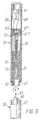
- Each electrode (3, 4) is electrically connected by a wire (8, 8 1 ) to the measurement transmitter (not shown in the drawing).
- This electric connection comprises current terminal wires (9, 9 1 ) connected at one end with detachable contact sockets (10, 10 1 ) to conductors (8, 8 1 ) of related electrodes (3, 4) and at another end to a socket (11) of the measurement transmitter cable connector.
- the sensor has a hollow holder (12) for positioning it in the analysed liquid zone.
- a tubular intermediate member (13) is installed between the housing tube (1) and the holder (12) for extension of the housing (1), where the said member (13) is tightly fixed on the housing tube (1) and the holder (12), with the latter having a mounting nut (14).
- Annular grooves (15) are made on the external surfaces of the housing tube (1) and the intermediate member (13), the said grooves have elastic O-rings (16) and a thread connector (17).
- the sensor can optionally have two, three or more intermediate members (13) with different lengths, or no such members at all.
- the sensor housing tube (1), the holder (12) and the intermediate member (13) comprise an encapsulated, collapsible assembly which eliminates entry of the analysed liquid therein, whatever the external conditions exist.
- the electrodes (3, 4) are retractably mounted in the housing tube (1) and can be quickly replaced as required.
- salt solubility would be lower and would hamper the measurement accuracy.
- the indicator electrode (3) of the proposed sensor can employ any known indicator electrode design featuring a solid-state, ion-selective membrane with a solid electrolyte, or any known indicator electrode with a solid member which is sensitive to electron transfer into redox processes.
- the senor employs a device (35) for protection of the envelope (33 1 ) from mechanical damage, where the said device could comprise a slotted collar fixed on the housing tube (1) of the sensor by a threaded connector (36) in the envelope (33 1 ) zone.
- the spatial structure (41) is rigidly linked with the internal surface of the envelope (39), with the potential-forming semi-element (21) and the connecting member (42), while the external surface of the envelope (39) is rigidly linked with the spatial structure (30) of electrolyte (29) present in the interior (45) of the reference electrode (37) body (38), where the said interior (45) is also rigidly linked with internal surface (31 1 ) of its body (38) and its connecting member (22).
- the collar (61) of the connecting member (59) has external thread (65) and a sealing member comprising optionally a rubber O-ring, while the second part (57) of the housing (55) is rigidly fixed thereon by means of the said thread (65) and is sealed relatively to the first part (56) by a rubber O-ring.
- the electric conductor wire (63) of the indicator electrode (60) is connected to the contact socket (10) switched to the measurement transmitter cable.
- the proposed sensor is immersed into the analysed liquid in its portion where the indicator system (33), a sensing member of the indicator electrode (3, 47, 60) and a connecting member of the reference electrode (4, 37, 48 and 59) are mounted.
- the resultant solid-state indicator electrode (3,47 and 60) potential is proportional to activity logarithm of the analysed ion.
- the reference electrode (4, 37, 48 and 59) generates the potential which is not dependent on analysed liquid composition. Transfer of salt ions from the reference electrode (4, 37, 48 and 59) electrolyte (29, 40) that is saturated by this salt closes the electric circuit through the analysed liquid whereby the potential drop is directly proportional to an analysed ion activity logarithm.
- Replacement indicator and reference electrodes offer simple replacements during functional changes such as its customisation for activity measurements on individual ions or redox potential, or in case of electrode (indicator or reference) failures. Solid electrolytes in the indicator electrodes and the specified electrolyte for reference electrodes will maintain normal electrode operation in any position, under elevated temperatures and pressures as well as at temperatures below -0°C and zero-gravity conditions.
Landscapes
- Chemical & Material Sciences (AREA)
- Life Sciences & Earth Sciences (AREA)
- Health & Medical Sciences (AREA)
- General Physics & Mathematics (AREA)
- Pathology (AREA)
- Electrochemistry (AREA)
- Physics & Mathematics (AREA)
- Analytical Chemistry (AREA)
- Biochemistry (AREA)
- General Health & Medical Sciences (AREA)
- Molecular Biology (AREA)
- Immunology (AREA)
- Chemical Kinetics & Catalysis (AREA)
- Investigating Or Analysing Materials By The Use Of Chemical Reactions (AREA)
- Investigating Or Analyzing Materials By The Use Of Electric Means (AREA)
- Nitrogen And Oxygen Or Sulfur-Condensed Heterocyclic Ring Systems (AREA)
- Conductive Materials (AREA)
- Other Investigation Or Analysis Of Materials By Electrical Means (AREA)
- Pharmaceuticals Containing Other Organic And Inorganic Compounds (AREA)
- Carbon And Carbon Compounds (AREA)
Claims (16)
- lonenempfindlicher Mehrzwecksensor, umfassend ein Gehäuserohr (1, 45, 55), in welchem eine lösbare Indikatorelektrode (3, 47, 60) und eine Referenzelektrode (4, 37, 48, 59) an einem Meßsender fixiert und mit diesem elektrisch verbunden sind, von denen die Indikatorelektrode eine Festkörper-Sensormembran aufweist, die in die analysierte Flüssigkeit einzutauchen ist, und die Referenzelektrode (4, 37, 48, 59) einen Hohlkörper (20, 38, 56) mit Elektrolyt (29) aufweist, gefüllt mit einem dispergierten Feststoffmaterial, das eine räumliche Struktur (30) in dem Elektrolyten (29) bildet, einem potentialbildenden Halbelement (21) und einem Verbindungselement (22) zum Verbinden des Elektrolyten mit der analysierten Flüssigkeit, dadurch gekennzeichnet, daß der Referenzelektrodenkörper (20, 38) eine Innenfläche (31') aufweist, wobei die räumliche Struktur (30) starr mit dieser Innenfläche (31') und mit dem Verbindungselement (22) verbunden ist, und das dispergierte Feststoffmaterial des Elektrolyten (29) in dem Körper (20, 38) der Referenzelektrode (4, 37) in einer Menge zwischen 5 und 30 Gew.-% enthalten ist, wobei dieses Material Acrylamid-Monomere und NN1-methylen-bisacrylamid in Verhältnissen von 5 bis 35 Gewichtsteilen Acrylamid pro einem Gewichtsteil NN1-methylen-bisacrylamid sowie einen Monomer-Polymerisationsinitiator enthält.
- Sensor nach Anspruch 1, dadurch gekennzeichnet, daß die räumliche Struktur (30) starr mit dem potentialbildenden Halbelement (21) verbunden ist, welches sich in einem Raum (28) des hohlen Körpers (20) befindet und mit dem Meßsender durch einen elektrischen Leiter (8) verbunden ist.
- Sensor nach Anspruch 1, dadurch gekennzeichnet, daß die Referenzelektrode (37) einen internen Hohlkörper (39) aufweist, der das potentialbildende Halbelement (21) sowie einen internen Elektrolyten (40) mit einem zweiten, eine zweite räumliche Struktur (41) bildenden dispergierten Feststoffmaterial enthält, wobei der Hohlkörper außerdem ein zweites Verbindungselement (42) aufweist, das in Berührung steht mit dem sich im Inneren des Körpers (38) der Referenzelektrode (37) befindlichen Elektrolyten (29), der Hohlkörper (39) eine Außenfläche aufweist, mit der die räumliche Struktur (30) des sich im Inneren des Körpers der Referenzelektrode (37) befindlichen Elektrolyten (29) starr verbunden ist, und eine Innenfläche besitzt, mit der die zweite räumliche Struktur (31) starr verbunden ist, wobei letztere außerdem mit dem potentialbildenden Halbelement (21) und dem zweiten Verbindungselement (42) verbunden ist.
- Sensor nach Anspruch 3, dadurch gekennzeichnet, daß das zweite dispergierte Feststoffmaterial in dem inneren Elektrolyten (40) in einer Menge von 0,1 bis 5 Gew.-% vorhanden ist und eine Zusammensetzung ähnlich derjenigen des dispergierten Feststoffmaterials des in dem Körper (38) der Referenzelektrode (37) befindlichen Elektrolyten (29) aufweist.
- Sensor nach Anspruch 1, gekennzeichnet durch eine erste Dichtungseinrichtung zum lösbaren Verbinden der Elektroden (3, 4) mit dem Gehäuserohr (1).
- Sensor nach Anspruch 5, dadurch gekennzeichnet, daß die erste Dichtungseinrichtung mindestens ein dichtendes O-Ringelement (5) aus elastischem Material aufweist, angeordnet an der Außenfläche der jeweiligen Seitenwand (6, 7) jeder Elektrode (3, 4).
- Sensor nach Anspruch 1, dadurch gekennzeichnet, daß das Gehäuserohr (45) einen lösbaren Einsatz (46) aus inertem Material beinhaltet, mit Hilfe eines zweiten Dichtungselements in dem Gehäuserohr (45) fixiert, wobei der Einsatz (46) Löcher aufweist, die im wesentlichen parallel zu einer Längsachse des Gehäuserohrs (45) verläuft, und die Elektroden (3, 47, 48) in diesen Löchern abgedichtet sind.
- Ionensensor nach Anspruch 7, dadurch gekennzeichnet, daß der Einsatz (46) ein Zylinderelement mit einer Außenfläche aufweist, die in eine Innenfläche des Gehäuserohrs (45) paßt.
- Ionensensor nach Anspruch 7, dadurch gekennzeichnet, daß das zweite Dichtungselement mindestens einen dichtenden O-Ring (51) aus elastischem Material enthält, der an einer Außenfläche des Einsatzes (46) befestigt ist.
- Sensor nach Anspruch 1, dadurch gekennzeichnet, daß das Sensor-Gehäuserohr (55) ein erstes und ein zweites anschließbares Element (56, 57) aufweist, die fluchtend und getrennt voneinander fixiert sind, wobei die Referenzelektrode (59) starr an dem ersten anschließbaren Element (56) fixiert ist, und mindestens eine Indikatorelektrode (60) starr an dem zweiten anschließbaren Element (57) befestigt ist.
- Sensor nach Anspruch 1, dadurch gekennzeichnet, daß die elektrische Verbindung der Elektroden (3, 4) mit dem Meßsender Stromanschlußdrähte (9, 9') aufweist, die an einem Ende durch abnehmbare Kontaktbuchsen. (10, 10') mit Leitern (8, 8') zugehöriger Elektroden (3, 4) und an dem anderen Ende mit einer Buchse (11) eines Meßsender-Kabelverbinders verbunden sind.
- Sensor nach Anspruch 1, gekennzeichnet durch einen Widerstands-Temperaturdetektor (RTD) (18), der elektrisch mit dem Meßsender verbunden ist.
- Sensor nach Anspruch 12, dadurch gekennzeichnet, daß der RTD (18) sich außerhalb des Sensors in der Nähe der Elektroden (3, 4) befindet.
- Sensor nach Anspruch 12, dadurch gekennzeichnet, daß der RTD (18) im Inneren des Sensors gelagert ist.
- Sensor nach Anspruch 1, dadurch gekennzeichnet, daß das Gehäuserohr (1) einen Halter (12) zum Fixieren des in die analysierte Flüssigkeitszone eingeführten Sensors aufweist, wobei der Halter mit dem Gehäuserohr (1) durch einen Schraubverbinder (17) verbunden und ihm durch elastische Elemente (16) abgedichtet ist, welche sich in dem Gehäuserohr (1) des Sensors in einem Verbindungsbereich des Halters (12) ausgebildeten Nuten befinden.
- Sensor nach Anspruch 15, gekennzeichnet durch mindestens ein Zwischenelement (13), welches fest zwischen dem Gehäuserohr (1) und dem Halter (12) angeordnet ist.
Applications Claiming Priority (3)
| Application Number | Priority Date | Filing Date | Title |
|---|---|---|---|
| RU94043082 | 1994-12-15 | ||
| RU94043082/25A RU2117281C1 (ru) | 1994-12-15 | 1994-12-15 | Универсальный комбинированный ионоселективный датчик (варианты) |
| PCT/RU1995/000272 WO1996018889A1 (en) | 1994-12-15 | 1995-12-14 | Universal ion-selective meter |
Publications (3)
| Publication Number | Publication Date |
|---|---|
| EP0807817A1 EP0807817A1 (de) | 1997-11-19 |
| EP0807817A4 EP0807817A4 (de) | 2000-03-15 |
| EP0807817B1 true EP0807817B1 (de) | 2002-09-25 |
Family
ID=20162948
Family Applications (1)
| Application Number | Title | Priority Date | Filing Date |
|---|---|---|---|
| EP95942802A Expired - Lifetime EP0807817B1 (de) | 1994-12-15 | 1995-12-14 | Vielseitiger ionenempfindlicher fühler |
Country Status (7)
| Country | Link |
|---|---|
| US (1) | US6322680B1 (de) |
| EP (1) | EP0807817B1 (de) |
| JP (1) | JPH10510917A (de) |
| KR (1) | KR980700567A (de) |
| DE (1) | DE69528381D1 (de) |
| RU (1) | RU2117281C1 (de) |
| WO (1) | WO1996018889A1 (de) |
Families Citing this family (15)
| Publication number | Priority date | Publication date | Assignee | Title |
|---|---|---|---|---|
| US6398931B1 (en) * | 2000-01-31 | 2002-06-04 | Phoenix Electrode Company | Combination ion-selective electrode with a replaceable sensing membrane |
| DE50015505D1 (de) | 2000-02-10 | 2009-02-12 | Hamilton Bonaduz Ag | Polymerelektrolyt |
| US6454274B2 (en) * | 2000-03-27 | 2002-09-24 | Praxair Technology, Inc. | Joint assembly for joining a ceramic membrane to a tube sheet |
| DE10243930A1 (de) * | 2002-03-08 | 2003-09-25 | Conducta Endress & Hauser | Vorrichtung zur Messung und Regelung des pH-Wertes eines Mediums |
| US20050040038A1 (en) * | 2003-04-02 | 2005-02-24 | Larry Berger | Diagnostic electro-chemical reference half cell |
| GB0423929D0 (en) * | 2004-10-27 | 2004-12-01 | Well Cow Ltd | Ionic activity monitoring device |
| US7967963B2 (en) * | 2005-04-08 | 2011-06-28 | Hach Lange Gmbh | Wastewater analysis sensor cartridge |
| CN101175992B (zh) * | 2005-06-09 | 2012-02-15 | 罗斯蒙德分析公司 | 具有流动液体接界的电化学电池和参比电池 |
| US7837847B2 (en) * | 2006-10-02 | 2010-11-23 | Rosenmount Analytical Inc. | High purity water pH sensor with shielded flowing liquid junction |
| JP4908173B2 (ja) * | 2006-12-06 | 2012-04-04 | 株式会社東芝 | イオン選択性電極、イオン選択性電極モジュール、及びイオン選択性電極の製造方法 |
| RU2370759C1 (ru) * | 2008-05-13 | 2009-10-20 | Общество с ограниченной ответственностью "Ситекрим" | Электрохимический детектор для исследования жидкости сложного солевого и химического состава |
| US9362600B2 (en) * | 2013-09-11 | 2016-06-07 | King Fahd University Of Petroleum And Minerals | Cell with reusable and disposable assemblies for simultaneous electrochemical and EPR measurements |
| DE102016120581A1 (de) | 2016-10-27 | 2018-05-03 | Endress+Hauser Conducta Gmbh+Co. Kg | Messsonde und Verfahren zum, insbesondere im Wesentlichen gasblasenfreien, Befüllen eines Sondeninnenraums einer Messsonde |
| PL247856B1 (pl) * | 2018-01-16 | 2025-09-08 | Edward Reszke | Czujnik galwaniczny stopnia fizycznej obróbki cieczy przed i po procesie obróbki |
| DE102019116287A1 (de) * | 2019-06-14 | 2020-12-17 | Endress+Hauser Conducta Gmbh+Co. Kg | Potentiometrische Sonde |
Family Cites Families (17)
| Publication number | Priority date | Publication date | Assignee | Title |
|---|---|---|---|---|
| US3652439A (en) * | 1969-02-28 | 1972-03-28 | Niversity Of California The | Appratus for measuring ph in high-pressure environments |
| US3997420A (en) * | 1971-03-18 | 1976-12-14 | Beckman Instruments, Inc. | Automatic analyzer |
| US3856649A (en) | 1973-03-16 | 1974-12-24 | Miles Lab | Solid state electrode |
| US4018661A (en) * | 1975-09-04 | 1977-04-19 | Robertshaw Controls Company | Instrument sensor assembly |
| US4154660A (en) * | 1977-08-30 | 1979-05-15 | Delphian Corporation | Method and apparatus for monitoring sulfide in well drilling mud |
| JPS55165262U (de) * | 1979-05-16 | 1980-11-27 | ||
| AT363062B (de) * | 1980-01-11 | 1981-07-10 | List Hans | Elektrochemische referenzelektrode zur potentiometrischen messung von ionenkonzentrationen |
| US4328082A (en) | 1980-06-26 | 1982-05-04 | Beckman Instruments, Inc. | Solid state ion-sensitive electrode and method of making said electrode |
| DK158244C (da) * | 1982-03-15 | 1990-09-10 | Radiometer As | Ionselektiv maaleelektrode og fremgangsmaade til fremstilling af denne elektrode |
| JPS58204363A (ja) | 1982-05-24 | 1983-11-29 | Kuraray Co Ltd | 液絡式比較電極 |
| NL8300057A (nl) | 1983-01-07 | 1984-08-01 | Cordis Europ | Elektrochemische halfcel. |
| CH661128A5 (de) * | 1983-09-07 | 1987-06-30 | Proton Ag | Messsonde zu potentiometrischer messung von ionenkonzentrationen, verfahren zu deren herstellung und ihre verwendung. |
| DE3789898T2 (de) * | 1986-07-10 | 1994-09-08 | Terumo Corp | Referenzelektrode. |
| DE8906234U1 (de) * | 1989-05-20 | 1989-07-06 | Neukum Elektronik GmbH, 7541 Straubenhardt | pH-Meßkette mit nullpunktstabilisierter, selbstreinigender Bezugselektrode |
| GB9118300D0 (en) * | 1991-08-24 | 1991-10-09 | Kodak Ltd | Reference half-cell electrode |
| JP3186363B2 (ja) * | 1993-08-05 | 2001-07-11 | 日本特殊陶業株式会社 | イオン電極 |
| US5830338A (en) * | 1996-03-01 | 1998-11-03 | Orion Research Inc. | Combination ISE and solutions therefor |
-
1994
- 1994-12-15 RU RU94043082/25A patent/RU2117281C1/ru not_active IP Right Cessation
-
1995
- 1995-12-14 WO PCT/RU1995/000272 patent/WO1996018889A1/ru not_active Ceased
- 1995-12-14 US US08/849,251 patent/US6322680B1/en not_active Expired - Fee Related
- 1995-12-14 KR KR1019970704034A patent/KR980700567A/ko not_active Abandoned
- 1995-12-14 EP EP95942802A patent/EP0807817B1/de not_active Expired - Lifetime
- 1995-12-14 DE DE69528381T patent/DE69528381D1/de not_active Expired - Lifetime
- 1995-12-14 JP JP8518654A patent/JPH10510917A/ja active Pending
Also Published As
| Publication number | Publication date |
|---|---|
| WO1996018889A1 (en) | 1996-06-20 |
| DE69528381D1 (de) | 2002-10-31 |
| RU2117281C1 (ru) | 1998-08-10 |
| US6322680B1 (en) | 2001-11-27 |
| RU94043082A (ru) | 1996-10-20 |
| KR980700567A (ko) | 1998-03-30 |
| EP0807817A4 (de) | 2000-03-15 |
| EP0807817A1 (de) | 1997-11-19 |
| JPH10510917A (ja) | 1998-10-20 |
Similar Documents
| Publication | Publication Date | Title |
|---|---|---|
| EP0807817B1 (de) | Vielseitiger ionenempfindlicher fühler | |
| US9506893B2 (en) | Potentiometric probe for measuring a measured variable of a medium in a container | |
| CN102565165B (zh) | 电位传感器和用于启动电位传感器的方法 | |
| US20110048971A1 (en) | Robust potentiometric sensor | |
| JP6503186B2 (ja) | 検体感知装置 | |
| CN102590532B (zh) | 用于测量装置启动的方法 | |
| US8900441B2 (en) | Ionic probe | |
| US6495012B1 (en) | Sensor for electrometric measurement | |
| EP3472608B1 (de) | Messprobe für chlorionen, redoxpotential und ph | |
| US4818366A (en) | Long life reference electrode | |
| CN115326904A (zh) | 传感器装置和将该装置投入运行的方法 | |
| US4981567A (en) | Lithium-salt reference half-cell for potentiometric determinations | |
| EP1690083A2 (de) | Selbstkondensierender ph-sensor | |
| EP2215465B1 (de) | Ionensonde | |
| US8038868B2 (en) | Micro PH electrode (reference electrode) | |
| CN212622373U (zh) | 一种小型双盐桥复合pH电极 | |
| Cummings et al. | Chemical analysis: electrochemical techniques | |
| Whitfield | Multicell Assemblies for Studying Ion‐Selective Electrodes at High Pressures | |
| US20260023043A1 (en) | Single-rod measuring cell and sensor containing the single-rod measuring cell for sterile applications | |
| US12540911B2 (en) | Auto-calibration pH sensor | |
| US8398835B2 (en) | Unitary ionic probe | |
| RU164491U1 (ru) | Устройство для измерения рн с ионоселективными электродами | |
| CN117355745A (zh) | 高压力的一次性使用的电化学分析传感器 | |
| RU6629U1 (ru) | Ионометрический экспресс-анализатор для контроля пищевых продуктов | |
| GB2267348A (en) | Electrochemical oxygen sensor |
Legal Events
| Date | Code | Title | Description |
|---|---|---|---|
| PUAI | Public reference made under article 153(3) epc to a published international application that has entered the european phase |
Free format text: ORIGINAL CODE: 0009012 |
|
| 17P | Request for examination filed |
Effective date: 19970915 |
|
| AK | Designated contracting states |
Kind code of ref document: A1 Designated state(s): CH DE DK FR GB IT LI NL |
|
| A4 | Supplementary search report drawn up and despatched |
Effective date: 20000127 |
|
| AK | Designated contracting states |
Kind code of ref document: A4 Designated state(s): CH DE DK FR GB IT LI NL |
|
| 17Q | First examination report despatched |
Effective date: 20000718 |
|
| GRAG | Despatch of communication of intention to grant |
Free format text: ORIGINAL CODE: EPIDOS AGRA |
|
| GRAG | Despatch of communication of intention to grant |
Free format text: ORIGINAL CODE: EPIDOS AGRA |
|
| GRAH | Despatch of communication of intention to grant a patent |
Free format text: ORIGINAL CODE: EPIDOS IGRA |
|
| GRAH | Despatch of communication of intention to grant a patent |
Free format text: ORIGINAL CODE: EPIDOS IGRA |
|
| GRAA | (expected) grant |
Free format text: ORIGINAL CODE: 0009210 |
|
| AK | Designated contracting states |
Kind code of ref document: B1 Designated state(s): CH DE DK FR GB IT LI NL |
|
| PG25 | Lapsed in a contracting state [announced via postgrant information from national office to epo] |
Ref country code: NL Free format text: LAPSE BECAUSE OF FAILURE TO SUBMIT A TRANSLATION OF THE DESCRIPTION OR TO PAY THE FEE WITHIN THE PRESCRIBED TIME-LIMIT Effective date: 20020925 Ref country code: LI Free format text: LAPSE BECAUSE OF FAILURE TO SUBMIT A TRANSLATION OF THE DESCRIPTION OR TO PAY THE FEE WITHIN THE PRESCRIBED TIME-LIMIT Effective date: 20020925 Ref country code: IT Free format text: LAPSE BECAUSE OF FAILURE TO SUBMIT A TRANSLATION OF THE DESCRIPTION OR TO PAY THE FEE WITHIN THE PRESCRIBED TIME-LIMIT;WARNING: LAPSES OF ITALIAN PATENTS WITH EFFECTIVE DATE BEFORE 2007 MAY HAVE OCCURRED AT ANY TIME BEFORE 2007. THE CORRECT EFFECTIVE DATE MAY BE DIFFERENT FROM THE ONE RECORDED. Effective date: 20020925 Ref country code: FR Free format text: LAPSE BECAUSE OF FAILURE TO SUBMIT A TRANSLATION OF THE DESCRIPTION OR TO PAY THE FEE WITHIN THE PRESCRIBED TIME-LIMIT Effective date: 20020925 Ref country code: CH Free format text: LAPSE BECAUSE OF FAILURE TO SUBMIT A TRANSLATION OF THE DESCRIPTION OR TO PAY THE FEE WITHIN THE PRESCRIBED TIME-LIMIT Effective date: 20020925 |
|
| REG | Reference to a national code |
Ref country code: GB Ref legal event code: FG4D |
|
| REG | Reference to a national code |
Ref country code: CH Ref legal event code: EP |
|
| REF | Corresponds to: |
Ref document number: 69528381 Country of ref document: DE Date of ref document: 20021031 |
|
| RAP2 | Party data changed (patent owner data changed or rights of a patent transferred) |
Owner name: ADVANCED BIOSENSORS |
|
| PG25 | Lapsed in a contracting state [announced via postgrant information from national office to epo] |
Ref country code: GB Free format text: LAPSE BECAUSE OF NON-PAYMENT OF DUE FEES Effective date: 20021225 Ref country code: DK Free format text: LAPSE BECAUSE OF FAILURE TO SUBMIT A TRANSLATION OF THE DESCRIPTION OR TO PAY THE FEE WITHIN THE PRESCRIBED TIME-LIMIT Effective date: 20021225 |
|
| PG25 | Lapsed in a contracting state [announced via postgrant information from national office to epo] |
Ref country code: DE Free format text: LAPSE BECAUSE OF FAILURE TO SUBMIT A TRANSLATION OF THE DESCRIPTION OR TO PAY THE FEE WITHIN THE PRESCRIBED TIME-LIMIT Effective date: 20021228 |
|
| NLT2 | Nl: modifications (of names), taken from the european patent patent bulletin |
Owner name: ADVANCED BIOSENSORS |
|
| NLV1 | Nl: lapsed or annulled due to failure to fulfill the requirements of art. 29p and 29m of the patents act | ||
| REG | Reference to a national code |
Ref country code: CH Ref legal event code: PL |
|
| EN | Fr: translation not filed | ||
| PLBE | No opposition filed within time limit |
Free format text: ORIGINAL CODE: 0009261 |
|
| STAA | Information on the status of an ep patent application or granted ep patent |
Free format text: STATUS: NO OPPOSITION FILED WITHIN TIME LIMIT |
|
| GBPC | Gb: european patent ceased through non-payment of renewal fee |
Effective date: 20021225 |
|
| 26N | No opposition filed |
Effective date: 20030626 |