EP0807517B1 - Mehrschichtfolie und Verfahren zur Herstellung einer falznahtlosen Dose die diese verwendet - Google Patents
Mehrschichtfolie und Verfahren zur Herstellung einer falznahtlosen Dose die diese verwendet Download PDFInfo
- Publication number
- EP0807517B1 EP0807517B1 EP19970107097 EP97107097A EP0807517B1 EP 0807517 B1 EP0807517 B1 EP 0807517B1 EP 19970107097 EP19970107097 EP 19970107097 EP 97107097 A EP97107097 A EP 97107097A EP 0807517 B1 EP0807517 B1 EP 0807517B1
- Authority
- EP
- European Patent Office
- Prior art keywords
- layer
- polyester
- laminate
- ironing
- film
- Prior art date
- Legal status (The legal status is an assumption and is not a legal conclusion. Google has not performed a legal analysis and makes no representation as to the accuracy of the status listed.)
- Expired - Lifetime
Links
- 238000000034 method Methods 0.000 title claims description 26
- 230000008569 process Effects 0.000 title claims description 11
- 239000010410 layer Substances 0.000 claims description 145
- 238000010409 ironing Methods 0.000 claims description 88
- 229910052751 metal Inorganic materials 0.000 claims description 62
- 239000002184 metal Substances 0.000 claims description 62
- 229920005989 resin Polymers 0.000 claims description 47
- 239000011347 resin Substances 0.000 claims description 47
- 239000003086 colorant Substances 0.000 claims description 44
- 239000002344 surface layer Substances 0.000 claims description 44
- GWEVSGVZZGPLCZ-UHFFFAOYSA-N Titan oxide Chemical compound O=[Ti]=O GWEVSGVZZGPLCZ-UHFFFAOYSA-N 0.000 claims description 38
- 239000005001 laminate film Substances 0.000 claims description 36
- 239000002245 particle Substances 0.000 claims description 32
- 230000015572 biosynthetic process Effects 0.000 claims description 31
- 229920000728 polyester Polymers 0.000 claims description 26
- 239000004408 titanium dioxide Substances 0.000 claims description 18
- 238000002844 melting Methods 0.000 claims description 17
- 230000008018 melting Effects 0.000 claims description 17
- 229920005992 thermoplastic resin Polymers 0.000 claims description 11
- LLLVZDVNHNWSDS-UHFFFAOYSA-N 4-methylidene-3,5-dioxabicyclo[5.2.2]undeca-1(9),7,10-triene-2,6-dione Chemical compound C1(C2=CC=C(C(=O)OC(=C)O1)C=C2)=O LLLVZDVNHNWSDS-UHFFFAOYSA-N 0.000 claims description 5
- 150000002148 esters Chemical group 0.000 claims description 5
- LZFNKJKBRGFWDU-UHFFFAOYSA-N 3,6-dioxabicyclo[6.3.1]dodeca-1(12),8,10-triene-2,7-dione Chemical compound O=C1OCCOC(=O)C2=CC=CC1=C2 LZFNKJKBRGFWDU-UHFFFAOYSA-N 0.000 claims description 3
- WSQZNZLOZXSBHA-UHFFFAOYSA-N 3,8-dioxabicyclo[8.2.2]tetradeca-1(12),10,13-triene-2,9-dione Chemical compound O=C1OCCCCOC(=O)C2=CC=C1C=C2 WSQZNZLOZXSBHA-UHFFFAOYSA-N 0.000 claims description 3
- ZVSXNPBSZYQDKJ-UHFFFAOYSA-N 3,8-dioxabicyclo[8.3.1]tetradeca-1(14),10,12-triene-2,9-dione Chemical compound O=C1OCCCCOC(=O)C2=CC=CC1=C2 ZVSXNPBSZYQDKJ-UHFFFAOYSA-N 0.000 claims description 3
- UHPJWJRERDJHOJ-UHFFFAOYSA-N ethene;naphthalene-1-carboxylic acid Chemical compound C=C.C1=CC=C2C(C(=O)O)=CC=CC2=C1 UHPJWJRERDJHOJ-UHFFFAOYSA-N 0.000 claims description 3
- 239000002585 base Substances 0.000 description 29
- 229910000831 Steel Inorganic materials 0.000 description 24
- 239000010959 steel Substances 0.000 description 24
- 238000012360 testing method Methods 0.000 description 21
- 238000005299 abrasion Methods 0.000 description 20
- -1 acryl Chemical group 0.000 description 18
- 238000010030 laminating Methods 0.000 description 18
- 229920001577 copolymer Polymers 0.000 description 15
- QQVIHTHCMHWDBS-UHFFFAOYSA-N isophthalic acid Chemical compound OC(=O)C1=CC=CC(C(O)=O)=C1 QQVIHTHCMHWDBS-UHFFFAOYSA-N 0.000 description 15
- 238000010438 heat treatment Methods 0.000 description 14
- 229920000139 polyethylene terephthalate Polymers 0.000 description 14
- 239000005020 polyethylene terephthalate Substances 0.000 description 14
- 238000005260 corrosion Methods 0.000 description 13
- 230000007797 corrosion Effects 0.000 description 13
- 238000013459 approach Methods 0.000 description 10
- 238000011156 evaluation Methods 0.000 description 10
- 239000000758 substrate Substances 0.000 description 9
- LYCAIKOWRPUZTN-UHFFFAOYSA-N Ethylene glycol Chemical compound OCCO LYCAIKOWRPUZTN-UHFFFAOYSA-N 0.000 description 8
- 239000000853 adhesive Substances 0.000 description 8
- 239000002987 primer (paints) Substances 0.000 description 8
- VYZAMTAEIAYCRO-UHFFFAOYSA-N Chromium Chemical compound [Cr] VYZAMTAEIAYCRO-UHFFFAOYSA-N 0.000 description 7
- KKEYFWRCBNTPAC-UHFFFAOYSA-N Terephthalic acid Chemical compound OC(=O)C1=CC=C(C(O)=O)C=C1 KKEYFWRCBNTPAC-UHFFFAOYSA-N 0.000 description 7
- 230000001070 adhesive effect Effects 0.000 description 7
- KRVSOGSZCMJSLX-UHFFFAOYSA-L chromic acid Substances O[Cr](O)(=O)=O KRVSOGSZCMJSLX-UHFFFAOYSA-L 0.000 description 7
- 229910052804 chromium Inorganic materials 0.000 description 7
- 239000011651 chromium Substances 0.000 description 7
- AWJWCTOOIBYHON-UHFFFAOYSA-N furo[3,4-b]pyrazine-5,7-dione Chemical compound C1=CN=C2C(=O)OC(=O)C2=N1 AWJWCTOOIBYHON-UHFFFAOYSA-N 0.000 description 7
- 229920006267 polyester film Polymers 0.000 description 7
- 230000005856 abnormality Effects 0.000 description 6
- 229910052782 aluminium Inorganic materials 0.000 description 6
- XAGFODPZIPBFFR-UHFFFAOYSA-N aluminium Chemical compound [Al] XAGFODPZIPBFFR-UHFFFAOYSA-N 0.000 description 6
- 239000011248 coating agent Substances 0.000 description 6
- 238000000576 coating method Methods 0.000 description 6
- 238000001816 cooling Methods 0.000 description 6
- 238000004519 manufacturing process Methods 0.000 description 6
- 239000000314 lubricant Substances 0.000 description 5
- 239000000203 mixture Substances 0.000 description 5
- 239000000049 pigment Substances 0.000 description 5
- 238000007747 plating Methods 0.000 description 5
- WERYXYBDKMZEQL-UHFFFAOYSA-N butane-1,4-diol Chemical compound OCCCCO WERYXYBDKMZEQL-UHFFFAOYSA-N 0.000 description 4
- 238000005259 measurement Methods 0.000 description 4
- 238000011282 treatment Methods 0.000 description 4
- XLYOFNOQVPJJNP-UHFFFAOYSA-N water Substances O XLYOFNOQVPJJNP-UHFFFAOYSA-N 0.000 description 4
- 229910000838 Al alloy Inorganic materials 0.000 description 3
- 229920001634 Copolyester Polymers 0.000 description 3
- DNIAPMSPPWPWGF-UHFFFAOYSA-N Propylene glycol Chemical compound CC(O)CO DNIAPMSPPWPWGF-UHFFFAOYSA-N 0.000 description 3
- 239000002253 acid Substances 0.000 description 3
- XCJYREBRNVKWGJ-UHFFFAOYSA-N copper(II) phthalocyanine Chemical compound [Cu+2].C12=CC=CC=C2C(N=C2[N-]C(C3=CC=CC=C32)=N2)=NC1=NC([C]1C=CC=CC1=1)=NC=1N=C1[C]3C=CC=CC3=C2[N-]1 XCJYREBRNVKWGJ-UHFFFAOYSA-N 0.000 description 3
- 230000032798 delamination Effects 0.000 description 3
- MTHSVFCYNBDYFN-UHFFFAOYSA-N diethylene glycol Chemical compound OCCOCCO MTHSVFCYNBDYFN-UHFFFAOYSA-N 0.000 description 3
- 239000000463 material Substances 0.000 description 3
- 229920003207 poly(ethylene-2,6-naphthalate) Polymers 0.000 description 3
- 239000011112 polyethylene naphthalate Substances 0.000 description 3
- 230000009467 reduction Effects 0.000 description 3
- 238000003860 storage Methods 0.000 description 3
- 239000005029 tin-free steel Substances 0.000 description 3
- 239000005028 tinplate Substances 0.000 description 3
- 229910052725 zinc Inorganic materials 0.000 description 3
- 239000011701 zinc Substances 0.000 description 3
- QPFMBZIOSGYJDE-UHFFFAOYSA-N 1,1,2,2-tetrachloroethane Chemical compound ClC(Cl)C(Cl)Cl QPFMBZIOSGYJDE-UHFFFAOYSA-N 0.000 description 2
- OSNILPMOSNGHLC-UHFFFAOYSA-N 1-[4-methoxy-3-(piperidin-1-ylmethyl)phenyl]ethanone Chemical compound COC1=CC=C(C(C)=O)C=C1CN1CCCCC1 OSNILPMOSNGHLC-UHFFFAOYSA-N 0.000 description 2
- OKTJSMMVPCPJKN-UHFFFAOYSA-N Carbon Chemical group [C] OKTJSMMVPCPJKN-UHFFFAOYSA-N 0.000 description 2
- 239000004593 Epoxy Substances 0.000 description 2
- XEEYBQQBJWHFJM-UHFFFAOYSA-N Iron Chemical compound [Fe] XEEYBQQBJWHFJM-UHFFFAOYSA-N 0.000 description 2
- UQSXHKLRYXJYBZ-UHFFFAOYSA-N Iron oxide Chemical compound [Fe]=O UQSXHKLRYXJYBZ-UHFFFAOYSA-N 0.000 description 2
- PXHVJJICTQNCMI-UHFFFAOYSA-N Nickel Chemical compound [Ni] PXHVJJICTQNCMI-UHFFFAOYSA-N 0.000 description 2
- NBIIXXVUZAFLBC-UHFFFAOYSA-N Phosphoric acid Chemical compound OP(O)(O)=O NBIIXXVUZAFLBC-UHFFFAOYSA-N 0.000 description 2
- ATJFFYVFTNAWJD-UHFFFAOYSA-N Tin Chemical compound [Sn] ATJFFYVFTNAWJD-UHFFFAOYSA-N 0.000 description 2
- WGLPBDUCMAPZCE-UHFFFAOYSA-N Trioxochromium Chemical compound O=[Cr](=O)=O WGLPBDUCMAPZCE-UHFFFAOYSA-N 0.000 description 2
- HCHKCACWOHOZIP-UHFFFAOYSA-N Zinc Chemical compound [Zn] HCHKCACWOHOZIP-UHFFFAOYSA-N 0.000 description 2
- WNLRTRBMVRJNCN-UHFFFAOYSA-N adipic acid Chemical compound OC(=O)CCCCC(O)=O WNLRTRBMVRJNCN-UHFFFAOYSA-N 0.000 description 2
- RGCKGOZRHPZPFP-UHFFFAOYSA-N alizarin Chemical compound C1=CC=C2C(=O)C3=C(O)C(O)=CC=C3C(=O)C2=C1 RGCKGOZRHPZPFP-UHFFFAOYSA-N 0.000 description 2
- 238000005452 bending Methods 0.000 description 2
- 230000008901 benefit Effects 0.000 description 2
- 238000009924 canning Methods 0.000 description 2
- 229910000423 chromium oxide Inorganic materials 0.000 description 2
- 238000010276 construction Methods 0.000 description 2
- 239000000498 cooling water Substances 0.000 description 2
- 238000003851 corona treatment Methods 0.000 description 2
- 150000002009 diols Chemical class 0.000 description 2
- 239000003822 epoxy resin Substances 0.000 description 2
- ISWSIDIOOBJBQZ-UHFFFAOYSA-N phenol group Chemical group C1(=CC=CC=C1)O ISWSIDIOOBJBQZ-UHFFFAOYSA-N 0.000 description 2
- 229920000647 polyepoxide Polymers 0.000 description 2
- 229920001225 polyester resin Polymers 0.000 description 2
- 239000004645 polyester resin Substances 0.000 description 2
- 238000007639 printing Methods 0.000 description 2
- CXMXRPHRNRROMY-UHFFFAOYSA-N sebacic acid Chemical compound OC(=O)CCCCCCCCC(O)=O CXMXRPHRNRROMY-UHFFFAOYSA-N 0.000 description 2
- 238000004381 surface treatment Methods 0.000 description 2
- OGIDPMRJRNCKJF-UHFFFAOYSA-N titanium oxide Inorganic materials [Ti]=O OGIDPMRJRNCKJF-UHFFFAOYSA-N 0.000 description 2
- 239000002966 varnish Substances 0.000 description 2
- PXGZQGDTEZPERC-UHFFFAOYSA-N 1,4-cyclohexanedicarboxylic acid Chemical compound OC(=O)C1CCC(C(O)=O)CC1 PXGZQGDTEZPERC-UHFFFAOYSA-N 0.000 description 1
- FWLHAQYOFMQTHQ-UHFFFAOYSA-N 2-N-[8-[[8-(4-aminoanilino)-10-phenylphenazin-10-ium-2-yl]amino]-10-phenylphenazin-10-ium-2-yl]-8-N,10-diphenylphenazin-10-ium-2,8-diamine hydroxy-oxido-dioxochromium Chemical compound O[Cr]([O-])(=O)=O.O[Cr]([O-])(=O)=O.O[Cr]([O-])(=O)=O.Nc1ccc(Nc2ccc3nc4ccc(Nc5ccc6nc7ccc(Nc8ccc9nc%10ccc(Nc%11ccccc%11)cc%10[n+](-c%10ccccc%10)c9c8)cc7[n+](-c7ccccc7)c6c5)cc4[n+](-c4ccccc4)c3c2)cc1 FWLHAQYOFMQTHQ-UHFFFAOYSA-N 0.000 description 1
- JFMYRCRXYIIGBB-UHFFFAOYSA-N 2-[(2,4-dichlorophenyl)diazenyl]-n-[4-[4-[[2-[(2,4-dichlorophenyl)diazenyl]-3-oxobutanoyl]amino]-3-methylphenyl]-2-methylphenyl]-3-oxobutanamide Chemical compound C=1C=C(C=2C=C(C)C(NC(=O)C(N=NC=3C(=CC(Cl)=CC=3)Cl)C(C)=O)=CC=2)C=C(C)C=1NC(=O)C(C(=O)C)N=NC1=CC=C(Cl)C=C1Cl JFMYRCRXYIIGBB-UHFFFAOYSA-N 0.000 description 1
- QTSNFLIDNYOATQ-UHFFFAOYSA-N 2-[(4-chloro-2-nitrophenyl)diazenyl]-n-(2-chlorophenyl)-3-oxobutanamide Chemical compound C=1C=CC=C(Cl)C=1NC(=O)C(C(=O)C)N=NC1=CC=C(Cl)C=C1[N+]([O-])=O QTSNFLIDNYOATQ-UHFFFAOYSA-N 0.000 description 1
- DWDURZSYQTXVIN-UHFFFAOYSA-N 4-[(4-aminophenyl)-(4-methyliminocyclohexa-2,5-dien-1-ylidene)methyl]aniline Chemical compound C1=CC(=NC)C=CC1=C(C=1C=CC(N)=CC=1)C1=CC=C(N)C=C1 DWDURZSYQTXVIN-UHFFFAOYSA-N 0.000 description 1
- LVOJOIBIVGEQBP-UHFFFAOYSA-N 4-[[2-chloro-4-[3-chloro-4-[(5-hydroxy-3-methyl-1-phenylpyrazol-4-yl)diazenyl]phenyl]phenyl]diazenyl]-5-methyl-2-phenylpyrazol-3-ol Chemical compound CC1=NN(C(O)=C1N=NC1=CC=C(C=C1Cl)C1=CC(Cl)=C(C=C1)N=NC1=C(O)N(N=C1C)C1=CC=CC=C1)C1=CC=CC=C1 LVOJOIBIVGEQBP-UHFFFAOYSA-N 0.000 description 1
- REEFSLKDEDEWAO-UHFFFAOYSA-N Chloraniformethan Chemical compound ClC1=CC=C(NC(NC=O)C(Cl)(Cl)Cl)C=C1Cl REEFSLKDEDEWAO-UHFFFAOYSA-N 0.000 description 1
- IAYPIBMASNFSPL-UHFFFAOYSA-N Ethylene oxide Chemical compound C1CO1 IAYPIBMASNFSPL-UHFFFAOYSA-N 0.000 description 1
- 239000004606 Fillers/Extenders Substances 0.000 description 1
- VYPSYNLAJGMNEJ-UHFFFAOYSA-N Silicium dioxide Chemical compound O=[Si]=O VYPSYNLAJGMNEJ-UHFFFAOYSA-N 0.000 description 1
- 238000002441 X-ray diffraction Methods 0.000 description 1
- 239000005083 Zinc sulfide Substances 0.000 description 1
- ORLQHILJRHBSAY-UHFFFAOYSA-N [1-(hydroxymethyl)cyclohexyl]methanol Chemical compound OCC1(CO)CCCCC1 ORLQHILJRHBSAY-UHFFFAOYSA-N 0.000 description 1
- AUNAPVYQLLNFOI-UHFFFAOYSA-L [Pb++].[Pb++].[Pb++].[O-]S([O-])(=O)=O.[O-][Cr]([O-])(=O)=O.[O-][Mo]([O-])(=O)=O Chemical compound [Pb++].[Pb++].[Pb++].[O-]S([O-])(=O)=O.[O-][Cr]([O-])(=O)=O.[O-][Mo]([O-])(=O)=O AUNAPVYQLLNFOI-UHFFFAOYSA-L 0.000 description 1
- FDQWLVPLQXKOKC-UHFFFAOYSA-N [S-2].[Cd+2].[K+] Chemical compound [S-2].[Cd+2].[K+] FDQWLVPLQXKOKC-UHFFFAOYSA-N 0.000 description 1
- HZEWFHLRYVTOIW-UHFFFAOYSA-N [Ti].[Ni] Chemical compound [Ti].[Ni] HZEWFHLRYVTOIW-UHFFFAOYSA-N 0.000 description 1
- 239000006230 acetylene black Substances 0.000 description 1
- 239000001361 adipic acid Substances 0.000 description 1
- 235000011037 adipic acid Nutrition 0.000 description 1
- 230000032683 aging Effects 0.000 description 1
- PNEYBMLMFCGWSK-UHFFFAOYSA-N aluminium oxide Inorganic materials [O-2].[O-2].[O-2].[Al+3].[Al+3] PNEYBMLMFCGWSK-UHFFFAOYSA-N 0.000 description 1
- 229910000147 aluminium phosphate Inorganic materials 0.000 description 1
- 238000000137 annealing Methods 0.000 description 1
- GHPGOEFPKIHBNM-UHFFFAOYSA-N antimony(3+);oxygen(2-) Chemical compound [O-2].[O-2].[O-2].[Sb+3].[Sb+3] GHPGOEFPKIHBNM-UHFFFAOYSA-N 0.000 description 1
- 239000002216 antistatic agent Substances 0.000 description 1
- UHHXUPJJDHEMGX-UHFFFAOYSA-K azanium;manganese(3+);phosphonato phosphate Chemical compound [NH4+].[Mn+3].[O-]P([O-])(=O)OP([O-])([O-])=O UHHXUPJJDHEMGX-UHFFFAOYSA-K 0.000 description 1
- TZCXTZWJZNENPQ-UHFFFAOYSA-L barium sulfate Chemical compound [Ba+2].[O-]S([O-])(=O)=O TZCXTZWJZNENPQ-UHFFFAOYSA-L 0.000 description 1
- HEQCHSSPWMWXBH-UHFFFAOYSA-L barium(2+) 1-[(2-carboxyphenyl)diazenyl]naphthalen-2-olate Chemical compound [Ba++].Oc1ccc2ccccc2c1N=Nc1ccccc1C([O-])=O.Oc1ccc2ccccc2c1N=Nc1ccccc1C([O-])=O HEQCHSSPWMWXBH-UHFFFAOYSA-L 0.000 description 1
- AYJRCSIUFZENHW-DEQYMQKBSA-L barium(2+);oxomethanediolate Chemical compound [Ba+2].[O-][14C]([O-])=O AYJRCSIUFZENHW-DEQYMQKBSA-L 0.000 description 1
- 230000005540 biological transmission Effects 0.000 description 1
- IISBACLAFKSPIT-UHFFFAOYSA-N bisphenol A Chemical compound C=1C=C(O)C=CC=1C(C)(C)C1=CC=C(O)C=C1 IISBACLAFKSPIT-UHFFFAOYSA-N 0.000 description 1
- 238000007664 blowing Methods 0.000 description 1
- 239000001055 blue pigment Substances 0.000 description 1
- 229910052793 cadmium Inorganic materials 0.000 description 1
- BDOSMKKIYDKNTQ-UHFFFAOYSA-N cadmium atom Chemical compound [Cd] BDOSMKKIYDKNTQ-UHFFFAOYSA-N 0.000 description 1
- CJOBVZJTOIVNNF-UHFFFAOYSA-N cadmium sulfide Chemical compound [Cd]=S CJOBVZJTOIVNNF-UHFFFAOYSA-N 0.000 description 1
- 159000000007 calcium salts Chemical class 0.000 description 1
- 229910052799 carbon Inorganic materials 0.000 description 1
- HBHZKFOUIUMKHV-UHFFFAOYSA-N chembl1982121 Chemical compound OC1=CC=C2C=CC=CC2=C1N=NC1=CC=C([N+]([O-])=O)C=C1[N+]([O-])=O HBHZKFOUIUMKHV-UHFFFAOYSA-N 0.000 description 1
- GTRGJJDVSJFNTE-UHFFFAOYSA-N chembl2009633 Chemical compound OC1=CC=C2C=C(S(O)(=O)=O)C=CC2=C1N=NC1=CC=CC=C1 GTRGJJDVSJFNTE-UHFFFAOYSA-N 0.000 description 1
- PZTQVMXMKVTIRC-UHFFFAOYSA-L chembl2028348 Chemical compound [Ca+2].[O-]S(=O)(=O)C1=CC(C)=CC=C1N=NC1=C(O)C(C([O-])=O)=CC2=CC=CC=C12 PZTQVMXMKVTIRC-UHFFFAOYSA-L 0.000 description 1
- ZLFVRXUOSPRRKQ-UHFFFAOYSA-N chembl2138372 Chemical compound [O-][N+](=O)C1=CC(C)=CC=C1N=NC1=C(O)C=CC2=CC=CC=C12 ZLFVRXUOSPRRKQ-UHFFFAOYSA-N 0.000 description 1
- 239000003795 chemical substances by application Substances 0.000 description 1
- 239000004927 clay Substances 0.000 description 1
- 239000011247 coating layer Substances 0.000 description 1
- 239000010941 cobalt Substances 0.000 description 1
- 229910017052 cobalt Inorganic materials 0.000 description 1
- GUTLYIVDDKVIGB-UHFFFAOYSA-N cobalt atom Chemical compound [Co] GUTLYIVDDKVIGB-UHFFFAOYSA-N 0.000 description 1
- 239000010960 cold rolled steel Substances 0.000 description 1
- 238000005097 cold rolling Methods 0.000 description 1
- 238000013329 compounding Methods 0.000 description 1
- 238000007796 conventional method Methods 0.000 description 1
- 239000002826 coolant Substances 0.000 description 1
- 229910052802 copper Inorganic materials 0.000 description 1
- 239000013078 crystal Substances 0.000 description 1
- 238000002425 crystallisation Methods 0.000 description 1
- 230000008025 crystallization Effects 0.000 description 1
- 230000002950 deficient Effects 0.000 description 1
- WMYWOWFOOVUPFY-UHFFFAOYSA-L dihydroxy(dioxo)chromium;phosphoric acid Chemical compound OP(O)(O)=O.O[Cr](O)(=O)=O WMYWOWFOOVUPFY-UHFFFAOYSA-L 0.000 description 1
- VAPILSUCBNPFBS-UHFFFAOYSA-L disodium 2-oxido-5-[[4-[(4-sulfophenyl)diazenyl]phenyl]diazenyl]benzoate Chemical compound [Na+].[Na+].Oc1ccc(cc1C([O-])=O)N=Nc1ccc(cc1)N=Nc1ccc(cc1)S([O-])(=O)=O VAPILSUCBNPFBS-UHFFFAOYSA-L 0.000 description 1
- 239000006185 dispersion Substances 0.000 description 1
- 239000000428 dust Substances 0.000 description 1
- SEACYXSIPDVVMV-UHFFFAOYSA-L eosin Y Chemical compound [Na+].[Na+].[O-]C(=O)C1=CC=CC=C1C1=C2C=C(Br)C(=O)C(Br)=C2OC2=C(Br)C([O-])=C(Br)C=C21 SEACYXSIPDVVMV-UHFFFAOYSA-L 0.000 description 1
- PLYDMIIYRWUYBP-UHFFFAOYSA-N ethyl 4-[[2-chloro-4-[3-chloro-4-[(3-ethoxycarbonyl-5-oxo-1-phenyl-4h-pyrazol-4-yl)diazenyl]phenyl]phenyl]diazenyl]-5-oxo-1-phenyl-4h-pyrazole-3-carboxylate Chemical compound CCOC(=O)C1=NN(C=2C=CC=CC=2)C(=O)C1N=NC(C(=C1)Cl)=CC=C1C(C=C1Cl)=CC=C1N=NC(C(=N1)C(=O)OCC)C(=O)N1C1=CC=CC=C1 PLYDMIIYRWUYBP-UHFFFAOYSA-N 0.000 description 1
- 238000001704 evaporation Methods 0.000 description 1
- 235000012438 extruded product Nutrition 0.000 description 1
- 238000007765 extrusion coating Methods 0.000 description 1
- 239000003925 fat Substances 0.000 description 1
- 239000000945 filler Substances 0.000 description 1
- 238000009472 formulation Methods 0.000 description 1
- 239000001056 green pigment Substances 0.000 description 1
- HTENFZMEHKCNMD-UHFFFAOYSA-N helio brilliant orange rk Chemical compound C1=CC=C2C(=O)C(C=C3Br)=C4C5=C2C1=C(Br)C=C5C(=O)C1=CC=CC3=C14 HTENFZMEHKCNMD-UHFFFAOYSA-N 0.000 description 1
- XXMIOPMDWAUFGU-UHFFFAOYSA-N hexane-1,6-diol Chemical compound OCCCCCCO XXMIOPMDWAUFGU-UHFFFAOYSA-N 0.000 description 1
- WGCNASOHLSPBMP-UHFFFAOYSA-N hydroxyacetaldehyde Natural products OCC=O WGCNASOHLSPBMP-UHFFFAOYSA-N 0.000 description 1
- 230000001771 impaired effect Effects 0.000 description 1
- 235000019239 indanthrene blue RS Nutrition 0.000 description 1
- UHOKSCJSTAHBSO-UHFFFAOYSA-N indanthrone blue Chemical compound C1=CC=C2C(=O)C3=CC=C4NC5=C6C(=O)C7=CC=CC=C7C(=O)C6=CC=C5NC4=C3C(=O)C2=C1 UHOKSCJSTAHBSO-UHFFFAOYSA-N 0.000 description 1
- 230000006698 induction Effects 0.000 description 1
- 229910052500 inorganic mineral Inorganic materials 0.000 description 1
- 229910052742 iron Inorganic materials 0.000 description 1
- DCYOBGZUOMKFPA-UHFFFAOYSA-N iron(2+);iron(3+);octadecacyanide Chemical compound [Fe+2].[Fe+2].[Fe+2].[Fe+3].[Fe+3].[Fe+3].[Fe+3].N#[C-].N#[C-].N#[C-].N#[C-].N#[C-].N#[C-].N#[C-].N#[C-].N#[C-].N#[C-].N#[C-].N#[C-].N#[C-].N#[C-].N#[C-].N#[C-].N#[C-].N#[C-] DCYOBGZUOMKFPA-UHFFFAOYSA-N 0.000 description 1
- JEIPFZHSYJVQDO-UHFFFAOYSA-N iron(III) oxide Inorganic materials O=[Fe]O[Fe]=O JEIPFZHSYJVQDO-UHFFFAOYSA-N 0.000 description 1
- 238000003475 lamination Methods 0.000 description 1
- 239000006233 lamp black Substances 0.000 description 1
- MOUPNEIJQCETIW-UHFFFAOYSA-N lead chromate Chemical compound [Pb+2].[O-][Cr]([O-])(=O)=O MOUPNEIJQCETIW-UHFFFAOYSA-N 0.000 description 1
- 235000010187 litholrubine BK Nutrition 0.000 description 1
- 238000005461 lubrication Methods 0.000 description 1
- 229940107698 malachite green Drugs 0.000 description 1
- FDZZZRQASAIRJF-UHFFFAOYSA-M malachite green Chemical compound [Cl-].C1=CC(N(C)C)=CC=C1C(C=1C=CC=CC=1)=C1C=CC(=[N+](C)C)C=C1 FDZZZRQASAIRJF-UHFFFAOYSA-M 0.000 description 1
- 239000011572 manganese Substances 0.000 description 1
- 230000007246 mechanism Effects 0.000 description 1
- WSFSSNUMVMOOMR-NJFSPNSNSA-N methanone Chemical compound O=[14CH2] WSFSSNUMVMOOMR-NJFSPNSNSA-N 0.000 description 1
- 239000011707 mineral Substances 0.000 description 1
- 239000012046 mixed solvent Substances 0.000 description 1
- 238000012986 modification Methods 0.000 description 1
- 230000004048 modification Effects 0.000 description 1
- VENDXQNWODZJGB-UHFFFAOYSA-N n-(4-amino-5-methoxy-2-methylphenyl)benzamide Chemical compound C1=C(N)C(OC)=CC(NC(=O)C=2C=CC=CC=2)=C1C VENDXQNWODZJGB-UHFFFAOYSA-N 0.000 description 1
- RXOHFPCZGPKIRD-UHFFFAOYSA-N naphthalene-2,6-dicarboxylic acid Chemical compound C1=C(C(O)=O)C=CC2=CC(C(=O)O)=CC=C21 RXOHFPCZGPKIRD-UHFFFAOYSA-N 0.000 description 1
- CTIQLGJVGNGFEW-UHFFFAOYSA-L naphthol yellow S Chemical compound [Na+].[Na+].C1=C(S([O-])(=O)=O)C=C2C([O-])=C([N+]([O-])=O)C=C([N+]([O-])=O)C2=C1 CTIQLGJVGNGFEW-UHFFFAOYSA-L 0.000 description 1
- SLCVBVWXLSEKPL-UHFFFAOYSA-N neopentyl glycol Chemical compound OCC(C)(C)CO SLCVBVWXLSEKPL-UHFFFAOYSA-N 0.000 description 1
- 229910052759 nickel Inorganic materials 0.000 description 1
- 229910001000 nickel titanium Inorganic materials 0.000 description 1
- 239000003921 oil Substances 0.000 description 1
- 239000001053 orange pigment Substances 0.000 description 1
- 239000003973 paint Substances 0.000 description 1
- 235000012736 patent blue V Nutrition 0.000 description 1
- 230000002093 peripheral effect Effects 0.000 description 1
- 239000005011 phenolic resin Substances 0.000 description 1
- 150000002989 phenols Chemical class 0.000 description 1
- 238000009832 plasma treatment Methods 0.000 description 1
- 229920000767 polyaniline Polymers 0.000 description 1
- 229920001707 polybutylene terephthalate Polymers 0.000 description 1
- 229960003351 prussian blue Drugs 0.000 description 1
- 239000013225 prussian blue Substances 0.000 description 1
- 238000010791 quenching Methods 0.000 description 1
- 230000000171 quenching effect Effects 0.000 description 1
- 235000012752 quinoline yellow Nutrition 0.000 description 1
- 229940051201 quinoline yellow Drugs 0.000 description 1
- 239000004172 quinoline yellow Substances 0.000 description 1
- IZMJMCDDWKSTTK-UHFFFAOYSA-N quinoline yellow Chemical compound C1=CC=CC2=NC(C3C(C4=CC=CC=C4C3=O)=O)=CC=C21 IZMJMCDDWKSTTK-UHFFFAOYSA-N 0.000 description 1
- 239000001054 red pigment Substances 0.000 description 1
- PYWVYCXTNDRMGF-UHFFFAOYSA-N rhodamine B Chemical compound [Cl-].C=12C=CC(=[N+](CC)CC)C=C2OC2=CC(N(CC)CC)=CC=C2C=1C1=CC=CC=C1C(O)=O PYWVYCXTNDRMGF-UHFFFAOYSA-N 0.000 description 1
- 238000004826 seaming Methods 0.000 description 1
- 239000002356 single layer Substances 0.000 description 1
- VVNRQZDDMYBBJY-UHFFFAOYSA-M sodium 1-[(1-sulfonaphthalen-2-yl)diazenyl]naphthalen-2-olate Chemical compound [Na+].C1=CC=CC2=C(S([O-])(=O)=O)C(N=NC3=C4C=CC=CC4=CC=C3O)=CC=C21 VVNRQZDDMYBBJY-UHFFFAOYSA-M 0.000 description 1
- 230000006641 stabilisation Effects 0.000 description 1
- 238000011105 stabilization Methods 0.000 description 1
- 239000000454 talc Substances 0.000 description 1
- 229910052623 talc Inorganic materials 0.000 description 1
- 238000005496 tempering Methods 0.000 description 1
- 229920002803 thermoplastic polyurethane Polymers 0.000 description 1
- ZIBGPFATKBEMQZ-UHFFFAOYSA-N triethylene glycol Chemical compound OCCOCCOCCO ZIBGPFATKBEMQZ-UHFFFAOYSA-N 0.000 description 1
- RBKBGHZMNFTKRE-UHFFFAOYSA-K trisodium 2-[(2-oxido-3-sulfo-6-sulfonatonaphthalen-1-yl)diazenyl]benzoate Chemical compound C1=CC=C(C(=C1)C(=O)[O-])N=NC2=C3C=CC(=CC3=CC(=C2[O-])S(=O)(=O)O)S(=O)(=O)[O-].[Na+].[Na+].[Na+] RBKBGHZMNFTKRE-UHFFFAOYSA-K 0.000 description 1
- UJMBCXLDXJUMFB-UHFFFAOYSA-K trisodium;5-oxo-1-(4-sulfonatophenyl)-4-[(4-sulfonatophenyl)diazenyl]-4h-pyrazole-3-carboxylate Chemical compound [Na+].[Na+].[Na+].[O-]C(=O)C1=NN(C=2C=CC(=CC=2)S([O-])(=O)=O)C(=O)C1N=NC1=CC=C(S([O-])(=O)=O)C=C1 UJMBCXLDXJUMFB-UHFFFAOYSA-K 0.000 description 1
- UONOETXJSWQNOL-UHFFFAOYSA-N tungsten carbide Chemical compound [W+]#[C-] UONOETXJSWQNOL-UHFFFAOYSA-N 0.000 description 1
- UGCDBQWJXSAYIL-UHFFFAOYSA-N vat blue 6 Chemical compound O=C1C2=CC=CC=C2C(=O)C(C=C2Cl)=C1C1=C2NC2=C(C(=O)C=3C(=CC=CC=3)C3=O)C3=CC(Cl)=C2N1 UGCDBQWJXSAYIL-UHFFFAOYSA-N 0.000 description 1
- 125000000391 vinyl group Chemical group [H]C([*])=C([H])[H] 0.000 description 1
- 229920002554 vinyl polymer Polymers 0.000 description 1
- 239000001993 wax Substances 0.000 description 1
- 239000012463 white pigment Substances 0.000 description 1
- 230000003245 working effect Effects 0.000 description 1
- 230000037303 wrinkles Effects 0.000 description 1
- 239000001052 yellow pigment Substances 0.000 description 1
- 229910052984 zinc sulfide Inorganic materials 0.000 description 1
- NDKWCCLKSWNDBG-UHFFFAOYSA-N zinc;dioxido(dioxo)chromium Chemical compound [Zn+2].[O-][Cr]([O-])(=O)=O NDKWCCLKSWNDBG-UHFFFAOYSA-N 0.000 description 1
- DRDVZXDWVBGGMH-UHFFFAOYSA-N zinc;sulfide Chemical compound [S-2].[Zn+2] DRDVZXDWVBGGMH-UHFFFAOYSA-N 0.000 description 1
Images


Classifications
-
- B—PERFORMING OPERATIONS; TRANSPORTING
- B32—LAYERED PRODUCTS
- B32B—LAYERED PRODUCTS, i.e. PRODUCTS BUILT-UP OF STRATA OF FLAT OR NON-FLAT, e.g. CELLULAR OR HONEYCOMB, FORM
- B32B15/00—Layered products comprising a layer of metal
- B32B15/04—Layered products comprising a layer of metal comprising metal as the main or only constituent of a layer, which is next to another layer of the same or of a different material
- B32B15/08—Layered products comprising a layer of metal comprising metal as the main or only constituent of a layer, which is next to another layer of the same or of a different material of synthetic resin
- B32B15/09—Layered products comprising a layer of metal comprising metal as the main or only constituent of a layer, which is next to another layer of the same or of a different material of synthetic resin comprising polyesters
-
- B—PERFORMING OPERATIONS; TRANSPORTING
- B32—LAYERED PRODUCTS
- B32B—LAYERED PRODUCTS, i.e. PRODUCTS BUILT-UP OF STRATA OF FLAT OR NON-FLAT, e.g. CELLULAR OR HONEYCOMB, FORM
- B32B1/00—Layered products having a non-planar shape
-
- B—PERFORMING OPERATIONS; TRANSPORTING
- B32—LAYERED PRODUCTS
- B32B—LAYERED PRODUCTS, i.e. PRODUCTS BUILT-UP OF STRATA OF FLAT OR NON-FLAT, e.g. CELLULAR OR HONEYCOMB, FORM
- B32B15/00—Layered products comprising a layer of metal
- B32B15/04—Layered products comprising a layer of metal comprising metal as the main or only constituent of a layer, which is next to another layer of the same or of a different material
- B32B15/08—Layered products comprising a layer of metal comprising metal as the main or only constituent of a layer, which is next to another layer of the same or of a different material of synthetic resin
-
- B—PERFORMING OPERATIONS; TRANSPORTING
- B32—LAYERED PRODUCTS
- B32B—LAYERED PRODUCTS, i.e. PRODUCTS BUILT-UP OF STRATA OF FLAT OR NON-FLAT, e.g. CELLULAR OR HONEYCOMB, FORM
- B32B27/00—Layered products comprising a layer of synthetic resin
- B32B27/06—Layered products comprising a layer of synthetic resin as the main or only constituent of a layer, which is next to another layer of the same or of a different material
- B32B27/08—Layered products comprising a layer of synthetic resin as the main or only constituent of a layer, which is next to another layer of the same or of a different material of synthetic resin
-
- B—PERFORMING OPERATIONS; TRANSPORTING
- B32—LAYERED PRODUCTS
- B32B—LAYERED PRODUCTS, i.e. PRODUCTS BUILT-UP OF STRATA OF FLAT OR NON-FLAT, e.g. CELLULAR OR HONEYCOMB, FORM
- B32B27/00—Layered products comprising a layer of synthetic resin
- B32B27/18—Layered products comprising a layer of synthetic resin characterised by the use of special additives
-
- B—PERFORMING OPERATIONS; TRANSPORTING
- B32—LAYERED PRODUCTS
- B32B—LAYERED PRODUCTS, i.e. PRODUCTS BUILT-UP OF STRATA OF FLAT OR NON-FLAT, e.g. CELLULAR OR HONEYCOMB, FORM
- B32B27/00—Layered products comprising a layer of synthetic resin
- B32B27/36—Layered products comprising a layer of synthetic resin comprising polyesters
-
- B—PERFORMING OPERATIONS; TRANSPORTING
- B32—LAYERED PRODUCTS
- B32B—LAYERED PRODUCTS, i.e. PRODUCTS BUILT-UP OF STRATA OF FLAT OR NON-FLAT, e.g. CELLULAR OR HONEYCOMB, FORM
- B32B2309/00—Parameters for the laminating or treatment process; Apparatus details
- B32B2309/08—Dimensions, e.g. volume
- B32B2309/10—Dimensions, e.g. volume linear, e.g. length, distance, width
- B32B2309/105—Thickness
-
- B—PERFORMING OPERATIONS; TRANSPORTING
- B32—LAYERED PRODUCTS
- B32B—LAYERED PRODUCTS, i.e. PRODUCTS BUILT-UP OF STRATA OF FLAT OR NON-FLAT, e.g. CELLULAR OR HONEYCOMB, FORM
- B32B2367/00—Polyesters, e.g. PET, i.e. polyethylene terephthalate
-
- B—PERFORMING OPERATIONS; TRANSPORTING
- B32—LAYERED PRODUCTS
- B32B—LAYERED PRODUCTS, i.e. PRODUCTS BUILT-UP OF STRATA OF FLAT OR NON-FLAT, e.g. CELLULAR OR HONEYCOMB, FORM
- B32B2439/00—Containers; Receptacles
- B32B2439/40—Closed containers
- B32B2439/66—Cans, tins
-
- Y—GENERAL TAGGING OF NEW TECHNOLOGICAL DEVELOPMENTS; GENERAL TAGGING OF CROSS-SECTIONAL TECHNOLOGIES SPANNING OVER SEVERAL SECTIONS OF THE IPC; TECHNICAL SUBJECTS COVERED BY FORMER USPC CROSS-REFERENCE ART COLLECTIONS [XRACs] AND DIGESTS
- Y10—TECHNICAL SUBJECTS COVERED BY FORMER USPC
- Y10T—TECHNICAL SUBJECTS COVERED BY FORMER US CLASSIFICATION
- Y10T428/00—Stock material or miscellaneous articles
- Y10T428/24—Structurally defined web or sheet [e.g., overall dimension, etc.]
- Y10T428/24802—Discontinuous or differential coating, impregnation or bond [e.g., artwork, printing, retouched photograph, etc.]
- Y10T428/24851—Intermediate layer is discontinuous or differential
- Y10T428/24868—Translucent outer layer
- Y10T428/24876—Intermediate layer contains particulate material [e.g., pigment, etc.]
-
- Y—GENERAL TAGGING OF NEW TECHNOLOGICAL DEVELOPMENTS; GENERAL TAGGING OF CROSS-SECTIONAL TECHNOLOGIES SPANNING OVER SEVERAL SECTIONS OF THE IPC; TECHNICAL SUBJECTS COVERED BY FORMER USPC CROSS-REFERENCE ART COLLECTIONS [XRACs] AND DIGESTS
- Y10—TECHNICAL SUBJECTS COVERED BY FORMER USPC
- Y10T—TECHNICAL SUBJECTS COVERED BY FORMER US CLASSIFICATION
- Y10T428/00—Stock material or miscellaneous articles
- Y10T428/24—Structurally defined web or sheet [e.g., overall dimension, etc.]
- Y10T428/24802—Discontinuous or differential coating, impregnation or bond [e.g., artwork, printing, retouched photograph, etc.]
- Y10T428/24893—Discontinuous or differential coating, impregnation or bond [e.g., artwork, printing, retouched photograph, etc.] including particulate material
- Y10T428/24901—Discontinuous or differential coating, impregnation or bond [e.g., artwork, printing, retouched photograph, etc.] including particulate material including coloring matter
-
- Y—GENERAL TAGGING OF NEW TECHNOLOGICAL DEVELOPMENTS; GENERAL TAGGING OF CROSS-SECTIONAL TECHNOLOGIES SPANNING OVER SEVERAL SECTIONS OF THE IPC; TECHNICAL SUBJECTS COVERED BY FORMER USPC CROSS-REFERENCE ART COLLECTIONS [XRACs] AND DIGESTS
- Y10—TECHNICAL SUBJECTS COVERED BY FORMER USPC
- Y10T—TECHNICAL SUBJECTS COVERED BY FORMER US CLASSIFICATION
- Y10T428/00—Stock material or miscellaneous articles
- Y10T428/31504—Composite [nonstructural laminate]
- Y10T428/31678—Of metal
- Y10T428/31681—Next to polyester, polyamide or polyimide [e.g., alkyd, glue, or nylon, etc.]
Definitions
- the present invention relates to a laminate sheet for canning having a laminate film layer and a process for making a seamless can using the laminate sheet. More specifically, the present invention relates to a laminate sheet for canning, which not only reduces working tool abrasion but also shaving of the film layer, and further provides a coated seamless can having an excellent outer face hiding property, and to a process for making a seamless can using the laminate sheet.
- a side seamless can be produced, according to a conventional method, by subjecting a metal blank such as an aluminum plate, a tin plate or a tin-free steel plate to at least one drawing stage.
- the drawing stage is conducted between a drawing die and a punch to form a cup comprising a barrel portion free of seams on the side surface thereof and a bottom portion integrally connected to the barrel portion which is also free of seams.
- the barrel portion may be subjected to ironing between an ironing punch and a die to reduce the thickness of the barrel portion of the container.
- JP-B As used herein means an "examined Japanese patent publication”
- Methods for coating an organic film onto the side seamless can include a method of applying an organic paint onto a formed can which is a common and widely used technique and, in addition, a method of laminating a resin film onto a metal blank before a can is formed.
- JP-B-59-34580 describes a product obtained by laminating a polyester film derived from terephthalic acid and tetramethylene glycol onto a metal blank.
- the use of a metal sheet coated with a vinyl organosol, epoxy, phenolic, polyester or acryl resin is known.
- JP-B-U-6-16739 (the term "JP-B-U” as used herein means an "examined Japanese utility model publication") and JP-B-U-6-16740 describe a seamless can comprising a laminate of a clear polyester-base molecular orientated film layer/adhesive/surface treated steel plate/adhesive/titanium dioxide-containing polyester-base molecular orientated film/printed ink layer/finishing varnish layer in this order from the inner side to the outer side of the can.
- a seamless can comprising a laminate of clear polyester-base molecular orientated film layer/adhesive/surface treated aluminum alloy plate/adhesive/ titanium dioxide-containing polyester-base molecular orientated film/printed ink layer/finishing varnish layer, respectively.
- JP-A-6-39980 (the term "JP-A" as used herein means an "unexamined published Japanese patent application”) describes a polyester film for use in laminating and forming metal sheets, obtained by laminating a specific copolymer polyester layer containing 1 wt% or less of a lubricant having an average particle size of 2.5 ⁇ m or less and a specific copolymer polyester layer containing from 5 to 30 wt% of a filler having an average particle size of 2.5 ⁇ m or less.
- JP-A-8-3334 describes a metal sheet laminated white polyester film having a Young's modulus of from 50 to 350 kg/mm 2 , obtained by laminating a layer comprising polyester (III) mainly consisting of ethylene terephthalate having a melting point of from 150 to 230 °C on a layer which comprises a mixture of polyester (I) containing 20 mol% or more of a cyclohexylenedimethylene terephthalate unit and polyester (II) mainly consisting of ethylene terephthalate in a weight ratio of from 100:0 to 10:90 and containing from 15 to 50 wt% of a coloring agent.
- the titanium dioxide-containing polyester-base molecularly orientated film layer arranged on the outer face of a seamless can is advantageous in that it covers the chromium surface treated layer to accentuate the printed ink layer, provides good transmission of a blank holder force on drawing-redrawing to prevent generation of wrinkles on the can barrel, and helps to prevent rusting.
- the following problems still need to be overcome.
- the content of the coloring agent particles such as titanium dioxide must be increased.
- the coloring agent particle content is increased, a problem arises in that the outer layer resin film is shaved, or the forming tools are abraded on drawing formation or ironing formation. This tendency becomes more pronounced as the can barrel portion is thinned to a greater extent so as to save materials or lighten the weight.
- the ironing ring is made from a carbide material such as tungsten carbide, and even the carbide material may form a break on the order of several microns after forming a large number of cans. If a tool bears such a break, the seamless can may have a bottom recession, the formed can may not be smoothly stripped from the punch, or the barrel may be broken.
- carbide material such as tungsten carbide
- the can In the process of making a can using a resin laminate sheet, the can is generally filled with contents without rinsing the can barrel after formation. If the film is shaved as described above, the metal can not only has an impaired appearance, but also the film dust may disadvantageously mix with the can contents.
- Another object of the present invention is to provide a process for making a can using the above described laminate sheet.
- thermoplastic resin layer comprises a laminate film layer comprising a polyester-base resin intermediate layer (A) containing coloring agent particles in an amount of more than 30 wt%, a polyester-base resin outer surface layer (B) and a polyester-base resin backing layer (C), the outer surface layer (B) and the backing layer (C) each containing coloring agent particles in an amount of 20 wt% or less and in an amount less than that contained in the intermediate layer (A).
- the present invention provides a process for making a seamless can comprising a barrel portion having an outer face and an inner face and a can bottom portion, which comprises providing a laminate comprising a metal sheet and a thermoplastic resin layer provided on the surface of the metal sheet, the thermoplastic resin layer comprising a laminate film layer comprising a polyester-base resin intermediate layer (A) containing coloring agent particles in an amount of more than 30 wt%, a polyester-base resin outer surface layer (B) and a polyester-base resin backing layer (C), the outer surface layer (B) and the backing layer (C) each containing coloring agent particles in an amount of 20 wt% or less and in an amount less than that contained in the intermediate layer (A), and subjecting the laminate to draw-ironing formation between a punch and a die such that the laminate film is arranged on at least the outer face of the can, wherein the draw-ironing comprises reducing the thickness of the can barrel to a thickness of 10 to 70 % of the laminate sheet and ironing at an ironing ratio of 2 to 60
- Fig. 1 shows one example of a cross-section structure of the laminate for can-making according to the present invention.
- the laminate sheet 1 comprises a metal substrate 2 and a laminate resin layer 3 adhering to the surface of the metal substrate, which is arranged on the outer face of a container. Another resin layer 4 is adhered and provided on the surface of the metal substrate, which constitutes the inner surface of a container.
- the laminate resin layer 3 comprises an intermediate layer (A) 5, an outer surface layer (B) 6 and a backing layer (C) 7.
- the above-described film layer may also be provided on the side of the metal substrate to be arranged on the inner surface of a container.
- Fig. 2 shows another example of a cross-section structure of the laminate for can-making according to the present invention.
- the metal substrate 2, the laminate resin layer 3 and the other resin layer 4 constituting the laminate sheet 1 are the same as in the case of Fig. 1.
- the laminate resin layer 3 and the other resin layer 4 are adhered to the metal substrate through an adhesion primer layer 8 and an adhesion primer layer 9, respectively.
- the intermediate layer (A) 5 comprises a polyester-base resin containing coloring agent particles in an amount of more than 30 wt%.
- the outer surface layer (B) 6 and the backing layer (C) 7 each comprises a polyester-resin containing coloring agent particles in an amount of 20 wt% or less and at the same time, in an amount (including 0) less than that contained in the intermediate layer (A).
- the polyester-base resin coating layer to be arranged on the outer face of a can is a laminate film layer comprising an intermediate layer (A), a outer surface layer (B) and a backing layer (C).
- the intermediate layer (A) contains coloring agent particles in an amount of more than 30 wt % to thereby enhance its hiding power
- the outer surface layer (B) contains coloring agent particles in a small amount of 20 wt% or less and at the same time, in an amount less than that contained in the intermediate layer (A).
- the backing layer (C) contains a coloring agent in an amount less than that contained in the intermediate layer (A).
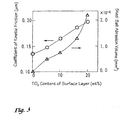
- Fig. 3 shows the results of a model kinetic friction test (which is described in detail below) on resin-coated metal sheets, more specifically, the relationship between the titanium dioxide content of the outer surface layer and the coefficient of kinetic friction or the steel ball abrasion volume of the coated surface.
- the film is shaved to a larger extent. This is one of the reasons why the coloring agent particle content of the outer surface layer (B) is set to 20 wt% or less.
- Example 7 When a laminate sheet obtained by laminating a film comprising a sole polyester layer containing a constant amount of titanium dioxide (content: 25 wt%) is subjected to draw-ironing formation, bottom recession or stripping failure occurs after can formation, and in practice, flaws are generated on the ironing ring.
- Example 12 when a laminate sheet having a two-layer structure of a lower layer and an upper layer, where the lower layer contains a large amount of titanium dioxide (content: 35 wt%) and the upper layer contains titanium dioxide in a small amount is subjected to draw-ironing formation, and when the filled can is subjected to a denting test, the film layer is peeled off and under-film corrosion (UFC) is generated during storage.
- the laminate sheet using the above-described three-layer film is completely free either of peeling or the generation of UFC. This is considered to occur because the backing layer (C) having a small coloring agent content exhibits excellent adhesion to the metal substrate and also acts as a cushioning layer.
- this multi-layer film has a symmetric or nearly symmetric constitution and therefore, the film can be easily formed, laminated on a metal without causing any distortion, and laminated and adhered with a good working property. Furthermore, because the film is laminated with little distortion and the outer surface layer (B) and the backing layer (C) prevent an excessive increase in working force, the ironing formability can be improved and the can making rate can be increased.
- various surface-treated steel plates and light metal sheets such as aluminum can be used as the metal sheet.
- the surface-treated steel plate for use in the present invention includes those obtained by annealing a cold-rolled steel plate, subjecting it to secondary cold rolling, and applying thereon one or more surface treatments such as zinc plating, tin plating, nickel plating, treatment with an electrolytic chromic acid and treatment with chromic acid.
- a preferred example of the surface-treated steel plate is a steel plate treated with electrolytic chromic acid, and more preferred is a steel plate having a treated surface which comprises from 10 to 200 mg/m 2 of a metal chromium layer and from 1 to 50 mg/m 2 (in terms of metal chromium) of a chromium oxide layer. This steel plate has excellent coating adhesion and corrosion resistance in combination.
- the surface-treated steel plate is a hard tin plate having a tin plating amount of from 0.5 to 11.2 g/m 2 .
- This tin plate is preferably treated with chromic acid or treated with chromic acid-phosphoric acid to provide a chromium amount in terms of metal chromium of from 1 to 30 mg/m 2 .
- Still another example is an aluminum-coated steel plate subjected to aluminum plating or aluminum press-adhesion.
- the light metal sheet includes an aluminum plate and an aluminum alloy plate.
- the aluminum alloy plate having excellent corrosion resistance and workability has a composition such that Mn is from 0.2 to 1.5 wt%, Mg is from 0.8 to 5 wt%, Zn is from 0.25 to 0.3 wt% and Cu is from 0.15 to 0.25 wt% with the balance being Al.
- the light metal sheet is also preferably treated with chromic acid or treated with chromic acid/phosphoric acid to provide a chromium amount in terms of metal chromium of from 20 to 300 mg/m 2 .
- the blank thickness of the metal sheet namely, the thickness (tB) of the can bottom portion, varies depending upon the kind of the metal or the use or size of the container.
- the thickness (tB) in general is preferably from 0.10 to 0.50 mm and more preferably, in the case of a surface-treated steel plate, from 0.10 to 0.30 mm and in the case of a light metal sheet, from 0.15 to 0.40 mm.
- the laminate film for use in the present invention comprises at least three layers of an intermediate layer (A), an outer surface layer (B) and a backing layer (C), and may have any construction as long as the intermediate layer (A) contains 30 wt% or more of a coloring agent, the outer surface layer (B) and the backing layer (C) each contains 20 wt% or less of a coloring agent, and the amount of the coloring agent contained in the outer surface layer and in the backing layer each is less than that contained in the intermediate layer.
- Suitable examples of the coloring agent (pigment) include the followings.
- barite powder barium carbonate, clay, white carbon, talc and alumina white.
- the particle size of the coloring agent is preferably from 0.1 to 2.5 ⁇ m, more preferably from 0.1 to 2.0 ⁇ m. If the particle size is too large, the draw-ironing workability tends to worsen, whereas if the particle size is too small, the hiding power tends to decrease.
- the coloring agent particularly preferred for achieving the objectives of the present invention is titanium dioxide, preferably rutile-type or anatase-type titanium dioxide. These are white and have a large hiding power.
- the polyester-base resin is preferably polyester mainly comprising at least one ester unit selected from the group consisting of ethylene terephthalate, ethylene isophthalate, butylene terephthalate, butylene isophthalate and ethylene naphthalate, in view of draw-ironing workability, mechanical strength, corrosion resistance and heat durability.
- This polyester may be a homopolyester, a copolyester comprising at least one of the above-described ester units and at least one other ester unit, or a polyester blend of two or more of these polyesters.
- the laminate films constituting an intermediate layer (A), an outer surface layer (B) and a backing layer (C) may be common with or different from each other.
- the polyester constituting the intermediate layer (A) may be a polyester having a relatively low melting point so as to facilitate dispersion of the coloring agent
- the polyester constituting the outer surface layer (B) may be a polyester having a relatively high melting point to impart heat durability.
- the polyester constituting the backing layer (C) may be a heat-adhesive polyester having a relatively low melting point.
- the polyester-base resin for the outer surface layer (B) preferably has a melting point of from 180 to 270 °C, more preferably from 200 to 270 °C, in view of heat durability of the container and the mechanical property and workability of the film layer.
- the polyester-base resin for use in the present invention is preferably a homopolyester or copolyester derived from a dibasic acid mainly comprising a terephthalic acid and a diol mainly comprising ethylene glycol.
- dibasic acid examples include, in addition to terephthalic acid, isophthalic acid, P- ⁇ -oxyethoxybenzoic acid, naphthalene-2,6-dicarboxylic acid, diphenoxyethane-4,4'-dicarboxylic acid, 5-sodium sulfoisophthalic acid, hexahydroterephthalic acid, adipic acid and sebacic acid.
- diol component examples include, in addition to ethylene glycol, glycol components such as propylene glycol, 1,4-butanediol, neopentyl glycol, 1,6-hexylene glycol, diethylene glycol, triethylene glycol, cyclohexanedimethanol and an ethylene oxide adduct of bisphenol A.
- glycol components such as propylene glycol, 1,4-butanediol, neopentyl glycol, 1,6-hexylene glycol, diethylene glycol, triethylene glycol, cyclohexanedimethanol and an ethylene oxide adduct of bisphenol A.
- the above-described homopolyester or copolyester must have a molecular weight in a range which allows for film formation and preferably has an intrinsic viscosity (n) measured using a phenol/tetrachloroethane mixed solvent of from 0.5 to 1.5, preferably from 0.6 to 1.5.
- the intermediate layer (A) has a coloring agent particle content of 30 to 70 wt%
- the outer surface layer (B) and the backing layer (C) each has a coloring agent particle content of from 0 to 18 wt%, more preferably from 0 to 15 wt%, and at the same time, the outer surface layer (B) and the backing layer (C) have a coloring agent content that is less than that of the intermediate layer (A).
- the coloring agent content of the intermediate layer (A) is lower than the above-described range, the advantage of the present invention such that the draw-ironing formability is improved while maintaining high hiding power may be lost, whereas if it is higher than the above-described range, problems such as breaking of the film layer may readily occur during draw-ironing formation. Furthermore, if the coloring agent concentration in the outer surface layer (B) or the backing layer (C) is higher than the above-described range, tool abrasion may increase or adhesion to the metal may be reduced.
- the thickness ratio of the intermediate layer (A) to the outer surface layer (B) or the backing layer (C) is preferably from 2:1 to 100:1, more preferably from 5:1 to 100:1. If the thickness ratio of the intermediate layer (A) is smaller than the above-described range, the hiding power tends to be considerably deficient, whereas if the thickness ratio of the outer surface layer (B) or the backing layer (C) is smaller than the above-described range, tool abrasion tends to increase and adhesion to the metal tends to decrease.
- the thickness of the laminate film as a whole is preferably from 2 to 50 ⁇ m, more preferably from 5 to 50 ⁇ m. If the thickness is less than the above-described range, the corrosion resistance is not satisfactory, whereas if it exceeds the above-described range, the draw-ironing property tends to decrease.
- the polyester-base laminate film is preferably biaxially stretched, but an unstretched film may also be used.
- the degree of biaxial orientation may be verified by an X-ray diffraction method, a polarized fluorometric method, a birefringence method or a density gradient piping method.
- the degree of biaxial stretching of the film is preferably such that the degree of crystallization by the density method is approximately from 10 to 50%.
- Known compounding agents for films various antistatic agents and lubricants may be added to the polyester-base laminate film according to a known formulation.
- the surface of the biaxially stretched polyester laminate film in general is preferably subjected to a corona discharge treatment.
- the corona discharge treatment is preferably carried out to the extent that the wet tension is 44 dyne/cm or more.
- the film may be subjected to known surface treatments for improving adhesion such as plasma treatment or flame treatment, or to a coating treatment for improving adhesion with a urethane resin or a modified polyester resin.
- the other resin layer provided on the can inner surface side may contain a coloring agent, if desired, however, the same polyester-base film as above can be used.
- This film may either be a single layer film or a laminate film.
- the polyester-metal laminate sheet for use in the present invention may be produced by heat bonding a polyester-base laminate film to a metal through the backing layer (C). Another method may also be used, where a polyester having the above-described laminate structure is melt-extruded through a multilayer multiple die and the extruded product is coated on a metal substrate.
- Fig. 4 is a view explaining a method for producing a polyester-metal laminate sheet.
- a metal sheet 2 is heated by a heating roller 10 in heating zone 10' at a temperature (T1) in the vicinity of the melting point (Tm) of the polyester, and then fed between laminating rollers 11 and 11.
- T1 temperature in the vicinity of the melting point (Tm) of the polyester
- Tm melting point
- the polyester multilayer film 12 to be arranged on the can outer surface side is unwound from the feeding roller 13 and fed between laminating rollers 11 and 11.
- the polyester-base film 14 to be arranged on the can inner surface side is unwound from the feeding roller 15 and fed between laminating rollers 11 and 11, presenting a positional relation of sandwitching the metal sheet 2.
- the laminating rollers 11 and 11 are kept at a temperature (T2) slightly lower than that of the heating roller 10 to heat-bond the polyester films onto both surfaces of the metal sheet 2.
- T2 a temperature slightly lower than that of the heating roller 10 to heat-bond the polyester films onto both surfaces of the metal sheet 2.
- a water tank is provided containing cooling water 17 for quenching the laminate 16 thus formed.
- a guide roller 18 for guiding the laminate is disposed in the water tank.
- a gap 19 in a predetermined distance is formed, and a heat-reserving mechanism 20 is provided in the gap 19 to maintain a constant temperature range (T3), to thereby accelerating adhesion.
- the heating temperature (T1) of the metal sheet is generally from (Tm - 50 °C) to (Tm + 100 °C), preferably from (Tm - 50°C) to (Tm + 50 °C).
- the temperature (T2) of the laminating rollers 11 is suitably from (T1 - 300 °C) to (T1 - 10 °C), preferably from (T1 - 250 °C) to (T1 - 50 °C).
- the heat-reserving temperature (T3) based on the temperature T2 of laminating rollers 11, 11 is from (T2 + 5 °C) to (T2 - 50 °C), preferably, in the case of a biaxially stretched film, from (the film heat set temperature) to (Tm - 5 °C), and in the case of an unstretched film, from (Tg + 5 °C) to Tm.
- the reserving time at the temperature T2 is suitably from 0.1 to 10 seconds, preferably from 0.1 to 3 seconds.
- the adhesive primer provided, if desired, between the polyester film and the metal blank provides excellent adhesion to both the metal blank and to the film.
- Representative examples of the primer coating having excellent adhesion and corrosion resistance include a phenol-epoxy based coating comprising a resol-type phenolaldehyde resin derived from various phenols and formaldehyde, and a bisphenol-type epoxy resin.
- the adhesive primer layer in general preferably has a thickness of from 0.01 to 10 ⁇ m.
- the adhesive primer layer may be applied to the metal blank or may be applied to the polyester film prior to forming the laminate.
- the seamless can of the present invention is produced by drawing/deep-drawing the above-described laminate polyester-metal laminate sheet between a punch and a die to form it into a cup having a bottom, and bend-elongating and ironing the cup at the deep-drawing stage to reduce the thickness of the side wall portion of the cup.
- This draw-ironing imparts an appropriate uniaxial orientation to the film layer on the can barrel.
- a polyester laminate film layer having excellent corrosion resistance and excellent adhesion is formed on the side wall portion of the seamless can.
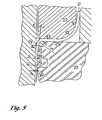
- the draw-ironing formation of the laminate sheet is conducted by the following means. That is, as shown in Fig. 5, a pre-drawn cup 21 formed from a coated metal sheet is held by an annular holding member 22 inserted in the cup and a redraw-ironing die 23 disposed beneath the member. Concentric with the holding member 22 and the redraw-ironing die 23, a redraw-ironing punch 24 is provided removably in or out of the holding member 22. The redraw-ironing punch 24 and the redraw-ironing die 23 are moved relative to each other so as to be in mesh with one another.
- the redraw-ironing die 23 has a plane part 25 at the upper portion, a working corner part 26 having a small radius of curvature at the periphery of the plane part, a tapered approach part 27 having a diameter which increases downwardly on the periphery connected to the working corner part, and a cylindrical land part for ironing (ironing part) 29 connected to the approach part through a small curvature part 28.
- a reverse-tapered recess 30 is provided at the lower part of the land part 29.
- the side wall portion of the pre-drawn cup 21 is vertically bent inward of the diameter upon passing through the outer peripheral surface 31 of the annular holding member 22 and the curvature corner part 32 thereof, bent nearly vertically in the axial direction at the working corner part 26 of the redrawing die 23 upon passing through the part defined by an annular bottom surface 33 of the annular holding member 22 and the plane part 25 of the redrawing die 23, and formed into a deep-drawn cup having a size smaller than that of the pre-drawn cup 21.
- the portion opposite the side in contact with the corner part 26 is elongated by bending deformation.
- the portion in contact with the working corner part is elongated by return deformation after leaving the working corner part, to thereby achieve a reduction in the thickness of the side wall portion by bend-elongating.
- the outer surface of the side wall portion reduced in thickness by the bend-elongation comes into contact with the approach part 27 having a small taper angle having a diameter which gradually increases. While leaving the inner surface in the free state, the side wall part is guided into the ironing part 29.
- the travel of the side wall portion passing through the approach part is a pre-stage of the ironing subsequent thereto, where the bent-elongated laminate sheet is stabilized and the size of the side wall portion is slightly contracted to prepare for ironing. More specifically, immediately after bend-elongation, the laminate sheet is in an instable state. That is, the laminate sheet is sensitive to vibration due to the bend-elongation and also the inside of the film is distorted. Accordingly, smooth ironing cannot be achieved if the laminate is immediately subjected to ironing.
- the outer surface side of the side wall portion is placed into contact with the approach part 27 to contract the diameter and lay the inner surface side in the free state. This terminates the influence of vibration and relaxes heterogenous distortion within the film. As a result, smooth ironing can be achieved.
- the side wall portion after passing through the approach part 27 is introduced into the clearance between the land part for ironing (ironing part) 29 and the redraw-ironing punch 24, and rolled to a thickness defined by the clearance (C1).
- the final thickness C1 of the side wall portion is set to be from 10 to 70%, preferably from 10 to 65%, of the original thickness (t) of the laminate.
- the bend-elongation accounts for an amount of from 40 to 98%, preferably from 40 to 95% of the reduction in thickness, and the ironing accounts for the remaining, that is, from 2 to 60%, preferably from 5 to 60% of the reduction in thickness.
- the small curvature part 28 at the introduction side of the ironing part effectively fixes the starting point of ironing to thereby smoothly introduce the laminate into the ironing part 29.
- the reverse-tapered recess 30 at the lower part of the land part 29 prevents an excessive increase in the working force.
- the radius of curvature (Rd) of the curvature corner part 26 in the redraw-ironing die 23 is preferably 2.9 times or less, more preferably 2.5 times or less the thickness (t) of the laminate to provide effective bend-elongation.
- the laminate may be broken if the radius of curvature is too small.
- the radius of curvature is preferably 1 times or more, more preferably 1.2 times or more the thickness (t) of the laminate.
- the approach angle ⁇ (half of the taper angle) of the tapered approach part 27 is preferably from 1 to 8°, more preferably from 1.5 to 5.0°. If the angle of the approach part is less than the above-described range, the relaxation of orientation in the polyester film layer or stabilization before ironing is insufficient, whereas if the angle of the approach part exceeds the above-described range, the bend-elongation is non-uniform (return deformation is insufficient) to cause cracks or peeling of the film.
- the radius of curvature (Ri) of the small curvature part 28 is preferably from 0.3 to 20 times the thickness (t) of the laminate to effectively fix the ironing starting point. However, if the radius of curvature is excessively small, the laminate may be broken.
- the clearance between the land part 29 for ironing and the redraw-ironing punch 24 is in the range as described above, and the land length L in general is preferably from 0.5 to 3 mm, more preferably from 0.7 to 1.5 mm. If the length exceeds the above-described range, the working force tends to excessively increase, whereas if L is less than the above-described range, the return after ironing work is large and sometimes causes disadvantageous results.
- the polyester layer on the surface imparts sufficiently high lubrication performance.
- a lubricating agent selected from various fats and oils or waxes may be coated in a small amount.
- An aqueous coolant (including that used for cooling the work) may be used, but this is not preferred in view of maintaining a simple operation.
- the temperature at the time of redraw-ironing work (the can temperature immediately after completion of the production) is preferably from room temperature to the melting point (Tm) of the resin. Accordingly, the tools are preferably heated or cooled as needed.
- the container after the drawing formation can subsequently be subjected to heat treatment at least in one stage.
- the heat treatment is conducted for various purposes and mainly for removing the distortion remaining in the film generated due to working, for evaporating the lubricating agent used at the time of working from the surface, and for dry-hardening the printing ink printed on the surface.
- the heat treatment may use a known heating apparatus such as an infrared heater, a hot blast circulating furnace or an induction heating apparatus.
- the heat treatment may be conducted in one stage or in two or more stages.
- the heat treatment temperature is suitably from 180 to 270 °C.
- the heat treatment time is generally on the order of from 1 second to 10 minutes.
- the container after heat treatment may be abruptly cooled or may be left standing to cool. More specifically, in the case of a film or a laminate sheet, an abrupt cooling operation is easy. However, in the case of a container, the abrupt cooling operation on an industrial scale is difficult because the container has a three dimensional shape and a large heat capacity due to the metal. However, in the present invention, even if an abrupt cooling operation is not applied, the crystal growth is suppressed and excellent properties can be achieved in combination.
- An abrupt cooling means such as cold air blowing or cold water sprinkling may be used, if desired.
- the can thus obtained may be subjected, if desired, to one-stage or multi-stage neck-in working and to flange working, and if desired, further to post-working such as panel working of the barrel wall portion, to produce a can for double-seaming.
- the thickness (%) of the can side wall portion to the thickness of blank is obtained by the formula: t 1 / t 0 ⁇ 100
- a kinetic friction test is performed.
- a steel ball is contacted with the side to be arranged on the outer surface layer of the laminate sheet.
- the ball slides in a circle with a diameter of 149.5 mm at a rate of 60 rotations/min, and is shifted about 0.45 mm toward one direction per one rotation to continuously scan a new position of laminate sheet surface.
- the load W applied to the steel ball is 506.7 g.
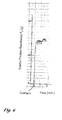
- the kinetic friction resistance F k (g) is measured when the scanning is performed for 1 minute and 40 seconds.
- a measurement example of the kinetic friction resistance is shown in Fig. 6.
- the model kinetic friction test the coefficient of kinetic friction, the abrasion amount of the steel ball and shaving of the film surface, described below, are evaluated. The measurement is performed at room temperature.
- the abrasion trace of the steel ball subjected to the model kinetic friction test is measured, and the abrasion volume of steel ball is approximated.
- the surface of the film subjected to the model kinetic friction test is observed through a microscope, and the state of shaved film is evaluated as ⁇ , ⁇ or ⁇ .
- the degree of shaving is evaluated according to the following criteria:
- the practical range is o.
- the temperature of the can immediately after the draw-ironing formation is measured by a Thermovision 870 manufactured by AGEMA, and the temperature thus measured is used as the temperature of the can thus produced.
- the can is stored at a relative humidity of 80% and a temperature of 37°C, and the state of the can after 3 months is examined.
- the resulting laminate was immediately cooled with water to obtain a laminate metal sheet.
- a wax-base lubricant was applied to both surfaces of the laminate metal sheet, and the metal sheet was punched into a circular blank having a diameter of 166 mm to obtain a shallow-drawn cup.
- the thus-obtained shallow-drawn cup was redrawn and ironed to obtain a deep-drawn and ironed cup.
- the deep-drawn cup thus obtained had the following properties: Cup size 60 mm Cup height 128 mm Thickness of can side wall portion to blank thickness 65 % Ironing ratio 12 %
- the resulting deep-drawn and ironed cup was domed in a customary manner, and then heat treated at 215 °C. After being left to cool, the cup was trimmed, printed on the outer curved surface thereof, dried to complete the printing step, necked and flanged to obtain a 350 g-volume seamless can.
- the can temperature immediately after deep-drawing and ironing formation was measured by the Thermovision and found to be 95 °C.
- the surface of the laminate sheet to be arranged on the outer surface of the container was subjected to a model kinetic friction test as described above. As a result, shaving of small to medium degree was observed, but no cracks were formed in the film. The evaluation result was good, and the sheet was evaluated as falling within the practical use range.
- a 350 g-volume seamless can was obtained in the same manner as in Example 1, except for using the biaxially stretched isophthalic acid copolymer polyethylene terephthalate laminate film as shown in the row of Example 2 in Table 1, on the surface to be arranged on the outer face.
- the can temperature immediately after deep-drawing and ironing formation was 90 °C.
- the surface of the laminate sheet to be arranged on the outer face of the container was subjected to a model kinetic friction test as described above. As a result, the degree of shaving was small. The evaluation result was good, and the sheet was evaluated as falling within the practical use range.
- a 350 g-volume seamless can was obtained in the same manner as in Example 1, except for using the biaxially stretched isophthalic acid copolymer polyethylene terephthalate laminate film as shown in the row of Example 3 in Table 1, on the surface to be arranged on the outer face, and changing the sheet temperature to 240 °C.
- the can temperature immediately after deep-drawing and ironing formation was 90 °C.
- the surface of the laminate sheet to be arranged on the outer face of the container was subjected to a model kinetic friction test as described above. As a result, the degree of shaving was small, the evaluation result was good, and the sheet was evaluated as falling within the practical use range.
- a laminate sheet was obtained in the same manner as in Example 1, except that the blank thickness was 0.280 mm, the biaxially stretched isophthalic acid copolymer laminate film, shown in the row of Example 4 in Table 1, was used on the surface to be arranged on the outer face, a biaxially stretched isophthalic acid copolymer film containing 30 wt% of polybutylene terephthalate having a melting point of 235 °C was used on the surface to be arranged on the inner face, and the sheet temperature and the laminating roller temperature were changed to 245 °C and 120 °C, respectively.
- the resulting laminate sheet was punched into a circular sheet having a diameter of 162 mm to obtain a shallow-drawn cup.
- the thus-obtained shallow-drawn cup was redrawn and ironed to obtain a cup.
- the deep-drawn cup thus obtained had the following properties: Cup size 52 mm Cup height 135 mm Thickness of can side wall portion to blank thickness 75 % Ironing ratio 10 %
- Example 2 the cup was worked in the same manner as in Example 1 to obtain a 250 g-volume seamless can.
- the can temperature immediately after deep-drawing and ironing formation was 110 °C.
- the surface of the laminate sheet to be arranged on the outer face of the container was subjected to a model kinetic friction test as described above. As a result, shaving of small to medium degree was generated, but the evaluation result was good and the sheet was evaluated as falling within the practical use range.
- a laminate sheet was obtained in the same manner as in Example 1, except that the blank thickness was 0.240 mm, a biaxially stretched polyethylene naphthalate ⁇ polyethylene terephthalate copolymer laminate film, as shown in the row of Example 5 in Table 1, was used on the surface to be arranged on the outer face, a biaxially stretched polyethylene naphthalate polyethylene terephthalate copolymer film having a melting point of 250 °C was used on the surface to be arranged on the inner face, and the sheet temperature and the laminating roller temperature were changed to 280°C and 160°C, respectively.
- the resulting laminate sheet was punched into a circular sheet having a diameter of 143 mm to obtain a shallow-drawn cup.
- the thus-obtained shallow-drawn cup was redrawn and ironed to obtain a cup.
- the deep-drawn cup thus obtained had the following properties: Cup size 52 mm Cup height 112 mm Thickness of can side wall portion to blank thickness 73 % Iron ratio 13 %
- This deep-drawn can was worked in the same manner as in Example 1, except for applying doming for negative pressure cans and changing the heat treatment temperature after doming to 245 °C to obtain a 200 g-volume seamless can.
- the can temperature immediately after deep-drawing and ironing formation was 125 °C.
- the surface of the laminate sheet to be arranged on the outer face of the container was subjected to a model kinetic friction test as described above. As a result, the degree of shaving was small, the evaluation result was good, and the sheet was evaluated as falling within the practical use range.
- a 350 g-volume seamless can was obtained in the same manner as in Example 1, except that the laminate sheet was obtained by co-extrusion coating of the isophthalic acid copolymer polyethylene terephthalate laminate resin structure shown in the row of Example 6 in Table 1, and an isophthalic acid copolymer polyethylene terephthalate resin having a thickness of 30 ⁇ m and a melting point of 225 °C on the surfaces to be arranged on the outer face and the inner face, respectively.
- the can temperature immediately after deep-drawing and ironing formation was 95 °C.
- the surface of the laminate sheet to be arranged on the outer face of the container was subjected to a model kinetic friction test as described above. As a result, shaving of small to medium degree was generated but no cracks were formed in the film. The evaluation result was good, and the sheet was evaluated as falling within the practical use range.
- a 350 g-volume seamless can was obtained in the same manner as in Example 1, except for using the biaxially stretched isophthalic acid copolymer polyethylene terephthalate laminate film shown in the row of Example 7 in Table 1, on the surface to be arranged on the outer face.
- the can temperature immediately after the deep-drawing and ironing formation was 90 °C.
- the surface of the laminate sheet to be arranged on the outer face of the container was subjected to a model kinetic friction test as described above.
- the film was shaved to a great extent, and cracks or raptures were formed in the film. Accordingly, the sheet was evaluated as not being suitable for practical use.
- a 350 g-volume seamless can was obtained in the same manner as in Example 1, except for using the biaxially stretched isophthalic acid copolymer polyethylene terephthalate laminate film shown in the row of Example 8 in Table 1, on the surface to be arranged on the outer face.
- the can temperature immediately after the deep-drawing and ironing formation was 80 °C.
- the surface of the laminate sheet to be arranged on the outer face of the container was subjected to a model kinetic friction test as described above.
- the film was shaved to a great extent, and cracks or raptures were formed in the film. Accordingly, the sheet was evaluated as not being suitable for practical use.
- a 250 g-volume seamless can was obtained in the same manner as in Example 4, except for using the biaxially stretched isophthalic acid copolymer polyethylene terephthalate laminate film shown in the row of Example 9 in Table 1, on the surface to be arranged on the outer face, and changing the ironing ratio to 1%.
- the can temperature immediately after the deep-drawing and ironing was 160 °C.
- a 250 g-volume seamless can was produced in the same manner as in Example 4, except for using the biaxially stretched isophthalic acid copolymer polyethylene terephthalate laminate film shown in the row of Example 10 in Table 1, on the surface to be arranged on the outer face, and applying heat to control the tool temperature so that the can temperature immediately after formation was 270 °C.
- a 200 g-volume seamless can was produced in the same manner as in Example 5, except for using the biaxially stretched polyethylene naphthalate ⁇ polyethylene terephthalate copolymer laminate film shown in the row of Example 11 in Table 1, on the surface to be arranged on the outer face, and controlling the tool temperature by cooling so that the can temperature immediately after formation was 10 °C.
- a 350 g-volume seamless can was obtained in the same manner as in Example 1, except for using the biaxially stretched isophthalic acid copolymer polyethylene terephthalate laminate film shown in the row of Example 12 in Table 1, on the surface to be arranged on the outer face.
- a laminate sheet comprising a metal sheet and a thermoplastic resin layer provided on the surface of the metal sheet.
- the thermoplastic resin layer comprises a laminate film layer comprising a polyester-base resin intermediate layer (A) containing 10 wt% or more of coloring agent particles, a polyester-base resin outer surface layer (B) and a polyester-base resin backing layer (C).
- the outer surface layer (B) and the backing layer (C) each contains said coloring agent particles in an amount of 20 wt% or less and in an amount less than that contained in said intermediate layer (A).
- the laminate sheet is subjected to draw-ironing formation. In making cans, tool abrasion and particularly abrasion of the ironing ring reduced, film shaving is prevented, and a coated seamless can having an excellent hiding property, adhesion and corrosion resistance is efficiently produced.
Landscapes
- Engineering & Computer Science (AREA)
- Mechanical Engineering (AREA)
- Laminated Bodies (AREA)
- Rigid Containers With Two Or More Constituent Elements (AREA)
Claims (11)
- Laminat für die Dosenherstellung, umfassend ein Metallblech (2) und eine auf der Oberfläche des Metallblechs (2) vorgesehene Schicht aus einem thermoplastischen Harz, wobei die Schicht aus dem thermoplastischen Harz folgendes aufweist:- eine Laminatfolienschicht (3; 5, 6, 7), die eine Zwischenschicht (A) aus einem auf Polyester basierenden Harz aufweist, das Partikel eines färbenden Mittels in einer Menge von mehr als 30 Gew.-% enthält,- eine Außenschicht (B) aus einem auf Polyester basierenden Harz und- eine Trägerschicht (C) aus einem auf Polyester basierenden Harz,wobei die Außenschichten (B) und die Trägerschicht (C) die Partikel eines färbenden Mittels jeweils in einer Menge von 20 Gew.-% oder weniger und in einer geringeren Menge enthalten, als sie in der Zwischenschicht (A) enthalten ist.
- Laminat nach Anspruch 1,
wobei die Zwischenschicht (A) Partikel eines färbenden Mittels in einer Menge von mehr als 30 bis 70 Gew.-% enthält, und wobei die Außenschicht (B) und die Trägerschicht (C) Partikel eines färbenden Mittels jeweils in einer Menge von 0 bis 18 Gew.-% enthalten. - Laminat nach Anspruch 1 oder 2,
wobei die Partikel des färbenden Mittels Titandioxid aufweisen. - Laminat nach einem der Ansprüche 1 bis 3,
wobei das Verhältnis der Dicke der Zwischenschicht (A) zu der der Außenschicht (B) oder der Trägerschicht (C) im Bereich von 2:1 bis 100:1 liegt. - Laminat nach einem der Ansprüche 1 bis 4,
wobei die Laminatfolie eine Dicke von 2 µm bis 50 µm aufweist. - Laminat nach einem der Ansprüche 1 bis 5,
wobei das auf Polyester basierende Harz ein Polyester ist, der hauptsächlich zumindest eine Estereinheit aufweist, die aus der Gruppe ausgewählt ist, die aus Ethylenterephthalat, Ethylenisophthalat, Butylenterephthalat, Butylenisophthalat und Ethylennaphthalat besteht. - Laminat nach einem der Ansprüche 1 bis 6,
wobei das auf Polyester basierende Harz der Außenschicht (B) einen Schmelzpunkt im Bereich von 180 °C bis 270 °C hat. - Laminat nach einem der Ansprüche 1 bis 7,
wobei die Laminatfolienschicht (3; 5, 6, 7) aus der Zwischenschicht (5, A), der Außenschicht (6, B) und der Trägerschicht (7, C) besteht. - Verfahren zur Herstellung einer nahtlosen Dose, die einen Bereich in Form eines trommelförmigen Körpers mit einer Außenseite und einer Innenseite und einen Bodenbereich der Dose aufweist, das folgendes aufweist:Bereitstellen eines Laminats, das ein Metallblech (2) und eine auf der Oberfläche des Metallblechs (2) vorgesehene Schicht aus einem thermoplastischen Harz aufweist, wobei die Schicht aus dem thermoplastischen Harz eine Laminatfolienschicht (3; 5, 6, 7) aufweist, die folgendes aufweist:wobei die Außenschicht (B) und die Trägerschicht (C) die Partikel eines färbenden Mittels jeweils in einer Menge 20 Gew.-% oder weniger und in einer geringeren Menge enthalten, als sie in der Zwischenschicht (A) enthalten ist, und- eine Zwischenschicht (A) aus einem auf Polyester basierenden Harz, die Partikel eines färbenden Mittels in einer Menge von mehr als 30 Gew.-% enthält,- eine Außenschicht (B) aus einem auf Polyester basierenden Harz und- eine Trägerschicht (C) aus einem auf Polyester basierenden Harz,
wobei das Laminat einem Tiefziehvorgang zwischen einem Stempel und einer Form ausgesetzt wird, so daß die Laminatfolie zumindest auf der Außenseite der Dose angeordnet wird,
wobei das Tiefziehen eine Verringerung der Dicke des trommelförmigen Dosenkörpers auf eine Dicke von 10 bis 70 % der Laminatfolie und das Tiefziehen bei einem Ziehverhältnis von 2 bis 60 % umfaßt. - Verfahren nach Anspruch 9,
wobei das Tiefziehen beinhaltet, daß die Temperatur des trommelförmigen Dosenkörpers unmittelbar nach der Erzeugung bei einer Temperatur von üblicher Raumtemperatur bis zu einer Temperatur gehalten wird, die 5 °C unter dem Schmelzpunkt des Harzes der Schicht aus dem thermoplastischen Harz liegt. - Verfahren nach Anspruch 9 oder 10,
wobei die Laminatfolienschicht (3; 5, 6, 7) aus der Zwischenschicht (A), der Außenschicht (B) und der Trägerschicht (C) besteht.
Applications Claiming Priority (3)
| Application Number | Priority Date | Filing Date | Title |
|---|---|---|---|
| JP11086896 | 1996-05-01 | ||
| JP110868/96 | 1996-05-01 | ||
| JP11086896A JP3146973B2 (ja) | 1996-05-01 | 1996-05-01 | ラミネート板及びこれを用いた製缶方法 |
Publications (3)
| Publication Number | Publication Date |
|---|---|
| EP0807517A2 EP0807517A2 (de) | 1997-11-19 |
| EP0807517A3 EP0807517A3 (de) | 2000-10-25 |
| EP0807517B1 true EP0807517B1 (de) | 2006-11-08 |
Family
ID=14546733
Family Applications (1)
| Application Number | Title | Priority Date | Filing Date |
|---|---|---|---|
| EP19970107097 Expired - Lifetime EP0807517B1 (de) | 1996-05-01 | 1997-04-29 | Mehrschichtfolie und Verfahren zur Herstellung einer falznahtlosen Dose die diese verwendet |
Country Status (5)
| Country | Link |
|---|---|
| US (1) | US6025056A (de) |
| EP (1) | EP0807517B1 (de) |
| JP (1) | JP3146973B2 (de) |
| KR (1) | KR100222354B1 (de) |
| DE (1) | DE69736912T2 (de) |
Cited By (3)
| Publication number | Priority date | Publication date | Assignee | Title |
|---|---|---|---|---|
| EP4006087A4 (de) * | 2019-07-31 | 2023-08-09 | Toyobo Co., Ltd. | Biaxial ausgerichtete polyesterfolie |
| US12479992B2 (en) | 2021-02-03 | 2025-11-25 | Toyobo Co., Ltd. | Biaxially oriented polyester film and production method therefor |
| US12655259B2 (en) | 2021-02-03 | 2026-06-16 | Toyobo Co., Ltd. | Biaxially oriented polyester film and production method therefor |
Families Citing this family (23)
| Publication number | Priority date | Publication date | Assignee | Title |
|---|---|---|---|---|
| WO1998017471A1 (fr) * | 1996-10-18 | 1998-04-30 | Teijin Limited | Film polyester blanc stratifie et destine a une stratification |
| JP4343383B2 (ja) * | 2000-03-02 | 2009-10-14 | 東洋製罐株式会社 | 樹脂被覆シームレス缶 |
| TW539614B (en) * | 2000-06-06 | 2003-07-01 | Matsushita Electric Works Ltd | Laminate |
| TWI235128B (en) * | 2001-06-25 | 2005-07-01 | Toyo Seikan Kaisha Ltd | Resin-coated seamless can |
| EP1449883A1 (de) * | 2003-02-18 | 2004-08-25 | Corus Technology BV | Verpackungslagen aus Polymer mit besseren Trenneigenschaften |
| JP4677723B2 (ja) * | 2003-02-20 | 2011-04-27 | 東レ株式会社 | 金属板貼合せ用ポリエステルフィルム |
| RU2336173C2 (ru) * | 2003-03-28 | 2008-10-20 | Корус Стал Б.В. | Листовой материал для штамповки, металлический контейнер, выполненный из такого листового материала, и способ изготовления листового материала |
| US7359282B2 (en) * | 2003-05-16 | 2008-04-15 | Schlumberger Technology Corporation | Methods and apparatus of source control for borehole seismic |
| JP2005144876A (ja) * | 2003-11-17 | 2005-06-09 | Toyo Kohan Co Ltd | 多層樹脂フィルム、樹脂被覆金属板、多層樹脂フィルムの製造方法、および樹脂被覆金属板の製造方法 |
| EP1757439B1 (de) * | 2004-05-31 | 2016-07-06 | JFE Steel Corporation | Mit harz beschichtete metallplatte |
| EP1688188B1 (de) * | 2005-02-02 | 2012-04-11 | Toyo Kohan Co., Ltd. | Mit Polyester beschichtetes Metallblech sowie daraus geformte Metalldosen |
| DK1908583T3 (en) | 2005-07-28 | 2015-11-09 | Jfe Steel Corp | The resin-coated metal sheet |
| KR101207759B1 (ko) * | 2005-10-19 | 2012-12-03 | 도요 세이칸 가부시키가이샤 | 이지 오픈 뚜껑 |
| US20070134470A1 (en) * | 2005-12-09 | 2007-06-14 | Martin Jesberger | Multilayer, white, biaxially oriented polyester film |
| JP5110486B2 (ja) * | 2007-04-23 | 2012-12-26 | 新日鐵住金株式会社 | プレコート金属板 |
| US20120297621A1 (en) * | 2011-05-23 | 2012-11-29 | Kuo Ming C | Method of manufacturing water heater jacket |
| US9506152B2 (en) * | 2011-08-31 | 2016-11-29 | Jfe Steel Corporation | Resin coated metal sheet |
| WO2013101605A1 (en) | 2011-12-27 | 2013-07-04 | Dts Llc | Bass enhancement system |
| JP6484173B2 (ja) * | 2013-07-22 | 2019-03-13 | 東洋鋼鈑株式会社 | 有機樹脂被覆金属板、その製造方法、その有機樹脂被覆金属板を加工して成る金属缶、及び、缶蓋 |
| US10576712B2 (en) * | 2015-03-26 | 2020-03-03 | Jfe Steel Corporation | Resin-coated metal sheet for container |
| NZ734932A (en) * | 2015-03-31 | 2018-08-31 | Jfe Steel Corp | Laminated metal sheet for container |
| JP6583880B2 (ja) * | 2015-06-16 | 2019-10-02 | 東洋鋼鈑株式会社 | ポリエステル樹脂被覆金属板およびそれを用いた容器 |
| DE102016205913A1 (de) * | 2016-04-08 | 2017-10-12 | Mitsubishi Polyester Film Gmbh | Biaxial orientierte Polyesterfolie für die Metalllaminierung |
Family Cites Families (8)
| Publication number | Priority date | Publication date | Assignee | Title |
|---|---|---|---|---|
| JPS5610451A (en) * | 1979-07-05 | 1981-02-02 | Toray Industries | Resin coated metallic plate for vessel |
| GB8724239D0 (en) * | 1987-10-15 | 1987-11-18 | Metal Box Plc | Laminated metal sheet |
| JP3055278B2 (ja) * | 1991-12-27 | 2000-06-26 | 三菱化学ポリエステルフィルム株式会社 | 二軸配向積層ポリエステルフィルム |
| EP0580404B1 (de) * | 1992-07-22 | 1999-09-15 | Teijin Limited | Biaxial orentierter, mehrschichtiger Polyesterfilm, geeignet zum Kleben auf Metallblech |
| TW300241B (de) * | 1993-08-10 | 1997-03-11 | Toyo Boseki | |
| GB9519673D0 (en) * | 1995-09-27 | 1995-11-29 | Ici Plc | Composite sheet |
| US6610378B1 (en) * | 1995-10-02 | 2003-08-26 | Toray Industries, Inc. | Biaxially oriented polyester film to be formed into containers |
| US6150012A (en) * | 1996-10-23 | 2000-11-21 | Unitika Ltd. | White film to be laminated to metal surface and method of producing same |
-
1996
- 1996-05-01 JP JP11086896A patent/JP3146973B2/ja not_active Expired - Lifetime
-
1997
- 1997-04-24 KR KR1019970015246A patent/KR100222354B1/ko not_active Expired - Fee Related
- 1997-04-29 DE DE1997636912 patent/DE69736912T2/de not_active Expired - Lifetime
- 1997-04-29 EP EP19970107097 patent/EP0807517B1/de not_active Expired - Lifetime
- 1997-04-29 US US08/848,656 patent/US6025056A/en not_active Expired - Lifetime
Cited By (4)
| Publication number | Priority date | Publication date | Assignee | Title |
|---|---|---|---|---|
| EP4006087A4 (de) * | 2019-07-31 | 2023-08-09 | Toyobo Co., Ltd. | Biaxial ausgerichtete polyesterfolie |
| US12473408B2 (en) | 2019-07-31 | 2025-11-18 | Toyobo Co., Ltd. | Biaxially oriented polyester film |
| US12479992B2 (en) | 2021-02-03 | 2025-11-25 | Toyobo Co., Ltd. | Biaxially oriented polyester film and production method therefor |
| US12655259B2 (en) | 2021-02-03 | 2026-06-16 | Toyobo Co., Ltd. | Biaxially oriented polyester film and production method therefor |
Also Published As
| Publication number | Publication date |
|---|---|
| US6025056A (en) | 2000-02-15 |
| KR970073959A (ko) | 1997-12-10 |
| JP3146973B2 (ja) | 2001-03-19 |
| KR100222354B1 (ko) | 1999-10-01 |
| EP0807517A2 (de) | 1997-11-19 |
| EP0807517A3 (de) | 2000-10-25 |
| DE69736912D1 (de) | 2006-12-21 |
| JPH09295374A (ja) | 1997-11-18 |
| DE69736912T2 (de) | 2007-06-14 |
Similar Documents
| Publication | Publication Date | Title |
|---|---|---|
| US6025056A (en) | Laminate sheet and process for making a seamless can using the same | |
| US5137762A (en) | Laminated metal plate for drawn can, and drawn can prepared therefrom | |
| EP0666124B1 (de) | Falznahtlose Dose und sein Herstellungsverfahren | |
| US5300335A (en) | Laminated draw-formed container having excellent shock resistance and process for producing the same | |
| KR100204181B1 (ko) | 박육화 드로잉 캔 제조 방법 | |
| US5753328A (en) | Polyester-metal laminated sheet and seamless cans using the same | |
| US11407203B2 (en) | Resin-coated metal sheet for container | |
| US5803301A (en) | Seamless can and process for making the same | |
| EP0731031B1 (de) | Falznahtlose Dose | |
| US5653357A (en) | Laminated draw-formed container having excellent flavor-retentivity and shock resistance | |
| DE69328163T2 (de) | Beschichtete Metallplatte für Dosen und daraus hergestellte falznactlose Dozen | |
| JP3381137B2 (ja) | 被覆アルミニウムシームレス缶 | |
| JP3262031B2 (ja) | 積層体及びそれを用いた容器 | |
| EP4147794A1 (de) | Dosenbehälter | |
| EP1607426B1 (de) | Folie für laminat und diese enthaltendes laminat | |
| JP4366730B2 (ja) | 製缶用積層体及びシームレス缶 | |
| JP3807037B2 (ja) | 押出ラミネート法及びこの方法により得られる製缶用ラミネート | |
| JP3291686B2 (ja) | ラミネート板及びこれを用いたシームレス缶 | |
| JP2874582B2 (ja) | 積層体及びそれを用いた容器 | |
| JP2002347169A (ja) | ラミネート板及びそれを用いた被覆シームレス缶 | |
| JPH10119183A (ja) | 積層体及びそれを用いた容器 | |
| JP2002347168A (ja) | ラミネート板及びそれを用いた被覆シームレス缶 | |
| EP0826493B1 (de) | Laminat und daraus hergestellter Behälter | |
| JPH11216805A (ja) | 積層体及びそれを用いた容器 | |
| JPH10235794A (ja) | 製缶用積層体及びシームレス缶 |
Legal Events
| Date | Code | Title | Description |
|---|---|---|---|
| PUAI | Public reference made under article 153(3) epc to a published international application that has entered the european phase |
Free format text: ORIGINAL CODE: 0009012 |
|
| AK | Designated contracting states |
Kind code of ref document: A2 Designated state(s): DE FR GB |
|
| PUAL | Search report despatched |
Free format text: ORIGINAL CODE: 0009013 |
|
| RIC1 | Information provided on ipc code assigned before grant |
Free format text: 7B 32B 15/08 A, 7B 32B 27/36 B |
|
| AK | Designated contracting states |
Kind code of ref document: A3 Designated state(s): DE FR GB |
|
| 17P | Request for examination filed |
Effective date: 20010110 |
|
| 17Q | First examination report despatched |
Effective date: 20030612 |
|
| GRAP | Despatch of communication of intention to grant a patent |
Free format text: ORIGINAL CODE: EPIDOSNIGR1 |
|
| GRAS | Grant fee paid |
Free format text: ORIGINAL CODE: EPIDOSNIGR3 |
|
| GRAA | (expected) grant |
Free format text: ORIGINAL CODE: 0009210 |
|
| AK | Designated contracting states |
Kind code of ref document: B1 Designated state(s): DE FR GB |
|
| REG | Reference to a national code |
Ref country code: GB Ref legal event code: FG4D |
|
| REF | Corresponds to: |
Ref document number: 69736912 Country of ref document: DE Date of ref document: 20061221 Kind code of ref document: P |
|
| ET | Fr: translation filed | ||
| PLBE | No opposition filed within time limit |
Free format text: ORIGINAL CODE: 0009261 |
|
| STAA | Information on the status of an ep patent application or granted ep patent |
Free format text: STATUS: NO OPPOSITION FILED WITHIN TIME LIMIT |
|
| 26N | No opposition filed |
Effective date: 20070809 |
|
| REG | Reference to a national code |
Ref country code: FR Ref legal event code: PLFP Year of fee payment: 19 |
|
| REG | Reference to a national code |
Ref country code: FR Ref legal event code: PLFP Year of fee payment: 20 |
|
| PGFP | Annual fee paid to national office [announced via postgrant information from national office to epo] |
Ref country code: GB Payment date: 20160421 Year of fee payment: 20 Ref country code: DE Payment date: 20160421 Year of fee payment: 20 |
|
| PGFP | Annual fee paid to national office [announced via postgrant information from national office to epo] |
Ref country code: FR Payment date: 20160421 Year of fee payment: 20 |
|
| REG | Reference to a national code |
Ref country code: DE Ref legal event code: R071 Ref document number: 69736912 Country of ref document: DE |
|
| REG | Reference to a national code |
Ref country code: GB Ref legal event code: PE20 Expiry date: 20170428 |
|
| PG25 | Lapsed in a contracting state [announced via postgrant information from national office to epo] |
Ref country code: GB Free format text: LAPSE BECAUSE OF EXPIRATION OF PROTECTION Effective date: 20170428 |