EP0806575A1 - Befestigunganordnung - Google Patents
Befestigunganordnung Download PDFInfo
- Publication number
- EP0806575A1 EP0806575A1 EP97106667A EP97106667A EP0806575A1 EP 0806575 A1 EP0806575 A1 EP 0806575A1 EP 97106667 A EP97106667 A EP 97106667A EP 97106667 A EP97106667 A EP 97106667A EP 0806575 A1 EP0806575 A1 EP 0806575A1
- Authority
- EP
- European Patent Office
- Prior art keywords
- component
- holes
- clamping
- groove
- elements
- Prior art date
- Legal status (The legal status is an assumption and is not a legal conclusion. Google has not performed a legal analysis and makes no representation as to the accuracy of the status listed.)
- Granted
Links
- 125000006850 spacer group Chemical group 0.000 claims description 16
- 230000000295 complement effect Effects 0.000 claims description 4
- 210000000078 claw Anatomy 0.000 claims description 2
- 238000010276 construction Methods 0.000 description 5
- 229910000831 Steel Inorganic materials 0.000 description 3
- 230000000712 assembly Effects 0.000 description 3
- 238000000429 assembly Methods 0.000 description 3
- 239000010959 steel Substances 0.000 description 3
- XAGFODPZIPBFFR-UHFFFAOYSA-N aluminium Chemical compound [Al] XAGFODPZIPBFFR-UHFFFAOYSA-N 0.000 description 2
- 229910052782 aluminium Inorganic materials 0.000 description 2
- 238000005253 cladding Methods 0.000 description 1
- 238000009434 installation Methods 0.000 description 1
- 230000003993 interaction Effects 0.000 description 1
- 230000000284 resting effect Effects 0.000 description 1
- 239000002344 surface layer Substances 0.000 description 1
Images
Classifications
-
- H—ELECTRICITY
- H02—GENERATION; CONVERSION OR DISTRIBUTION OF ELECTRIC POWER
- H02B—BOARDS, SUBSTATIONS OR SWITCHING ARRANGEMENTS FOR THE SUPPLY OR DISTRIBUTION OF ELECTRIC POWER
- H02B1/00—Frameworks, boards, panels, desks, casings; Details of substations or switching arrangements
- H02B1/26—Casings; Parts thereof or accessories therefor
- H02B1/30—Cabinet-type casings; Parts thereof or accessories therefor
- H02B1/32—Mounting of devices therein
-
- F—MECHANICAL ENGINEERING; LIGHTING; HEATING; WEAPONS; BLASTING
- F16—ENGINEERING ELEMENTS AND UNITS; GENERAL MEASURES FOR PRODUCING AND MAINTAINING EFFECTIVE FUNCTIONING OF MACHINES OR INSTALLATIONS; THERMAL INSULATION IN GENERAL
- F16B—DEVICES FOR FASTENING OR SECURING CONSTRUCTIONAL ELEMENTS OR MACHINE PARTS TOGETHER, e.g. NAILS, BOLTS, CIRCLIPS, CLAMPS, CLIPS OR WEDGES; JOINTS OR JOINTING
- F16B5/00—Joining sheets or plates, e.g. panels, to one another or to strips or bars parallel to them
- F16B5/07—Joining sheets or plates, e.g. panels, to one another or to strips or bars parallel to them by means of multiple interengaging protrusions on the surfaces, e.g. hooks, coils
-
- F—MECHANICAL ENGINEERING; LIGHTING; HEATING; WEAPONS; BLASTING
- F16—ENGINEERING ELEMENTS AND UNITS; GENERAL MEASURES FOR PRODUCING AND MAINTAINING EFFECTIVE FUNCTIONING OF MACHINES OR INSTALLATIONS; THERMAL INSULATION IN GENERAL
- F16B—DEVICES FOR FASTENING OR SECURING CONSTRUCTIONAL ELEMENTS OR MACHINE PARTS TOGETHER, e.g. NAILS, BOLTS, CIRCLIPS, CLAMPS, CLIPS OR WEDGES; JOINTS OR JOINTING
- F16B7/00—Connections of rods or tubes, e.g. of non-circular section, mutually, including resilient connections
- F16B7/22—Connections of rods or tubes, e.g. of non-circular section, mutually, including resilient connections using hooks or like elements
-
- F—MECHANICAL ENGINEERING; LIGHTING; HEATING; WEAPONS; BLASTING
- F16—ENGINEERING ELEMENTS AND UNITS; GENERAL MEASURES FOR PRODUCING AND MAINTAINING EFFECTIVE FUNCTIONING OF MACHINES OR INSTALLATIONS; THERMAL INSULATION IN GENERAL
- F16B—DEVICES FOR FASTENING OR SECURING CONSTRUCTIONAL ELEMENTS OR MACHINE PARTS TOGETHER, e.g. NAILS, BOLTS, CIRCLIPS, CLAMPS, CLIPS OR WEDGES; JOINTS OR JOINTING
- F16B2200/00—Constructional details of connections not covered for in other groups of this subclass
- F16B2200/69—Redundant disconnection blocking means
Definitions
- the invention relates to a fastening arrangement according to the preamble of claim 1.
- housings and cabinets for example equipment cabinets based on the 19 "system, vertically and horizontally arranged components, usually cut to length, are connected to form a frame structure and provided with cladding parts.
- Rail-like components for example telescopic rails, are arranged to accommodate printer and keyboard modules and similar devices or electrical or electronic assemblies.
- fastening has generally been carried out using fastening screws which interact with appropriately designed nuts in the bores or T-slots of the spar profiles.
- the assembly of the rail-like components, flat sheets and similar components takes up a lot of time, which is disadvantageously noticeable when building and converting an equipment cabinet, a frame and the like.
- the object of the invention is to create a fastening arrangement which, with an extraordinarily simple structure, enables a structural or component to be fastened to another component quickly.
- the invention is based on the basic idea of connecting two components to one another via a clamping bracket and to achieve the clamping bracket by means of clamping elements which are integrated in at least one component and are preferably formed on the edge.
- the clamping elements and spacer elements interact with a groove, in particular a T-groove, or with a row of holes which has alternating openings, preferably elongated holes and round holes, and are designed such that a rear grip, in particular at the edges of the elongated holes, and a System, preferably in the area of the round holes, or in the groove is reached.
- Clamping of the component to be fastened is achieved via the engaging clamping elements and the spacing elements resting on or in openings, which, in particular when the component to be fastened oppositely jamming, does not require any additional fastening elements for secure and stable mounting.
- Another advantage is that an extremely rapid fixing is possible, since only the edge integrally formed clamping and spacer elements inserted in the respective row of holes or T-groove or brought into contact and o clamped by a subsequent pivoting about the 90th A structural part clamped on one side still has a pivoting range in the fastening position, which is approximately up to 10 o . As soon as a component is jammed with rows of holes in rows of holes and / or T-slots in the adjacent profiles, there is no longer any such play, but safe and stable jamming and clamping between the two profiles.
- the fastening arrangement it is particularly advantageous to connect at least one component of the fastening arrangement according to the invention to a further component or structural part, for example a telescopic rail, and thereby a particularly efficient fastening of the telescopic rail to a component and in particular to a profile spar which has at least one row of holes or a groove or also has at least one row of holes and at least one T-groove.
- the structural part to be fastened for example the telescopic rail, connects, in particular screwed, the component of the fastening arrangement that has the clamping and holding elements.
- the telescopic rail or also a side wall or other assemblies can be fixed to the profile spar particularly quickly and without further aids.
- the component to be fastened lies almost on the surface that has the row of holes or groove and thus runs almost at right angles to the profile surface.
- the clamping elements are angled and hook-like for a grip on recesses, holes, bores and the like, in particular on the elongated holes.
- the spacing or positioning elements are small, e.g. with an angle of inclination of approximately 10 degrees, bent and rounded at the ends for an installation in the round holes.
- a rear grip can also be realized in the round holes and a positive fit in the elongated holes.
- the interaction of the engaging clamping hooks and the adjoining spacer elements or the spacer elements accommodated in the round holes is essential for jamming the component to be fastened.
- An alternating arrangement of the clamping hooks and spacer elements or of the elongated holes and round holes is particularly advantageous for a press fit and a positive and non-positive connection of two components, the latter being designed in particular as circular bores.
- a preferred embodiment of the quick fastening according to the invention provides two round holes which are delimited by an upper and a lower elongated hole.
- two spacer elements are delimited by an upper and lower clamping hook on an associated component to be fastened.
- the grid dimensions of the holes in the row of holes and the clamping and spacing elements are matched to one another.
- first component 2 which is a vertical profile spar of a device cabinet
- second component 4 which serves as a fastening element for a construction element 14 to be fastened, for example for a telescopic rail, and with the component 2 is to be connected.
- the vertical profile spar 2 which is made, for example, of aluminum or steel, has a row of holes 3 composed of elongated holes 5 and round holes 7 arranged in a grid, two round holes 7 being formed between an upper and an elongated hole 5.
- the round holes 7 are circular holes.
- a rail-like fastening element is fastened to the profile spar 2 as a second component 4, to which the construction element 14 shown only as a cutout is fastened, for example by means of fastening screws (not shown), and which has an edge region 11 with integrated clamping elements 6 and spacing elements 8. 1 shows that the clamping elements 6 and spacers 8 of the fastening element 4 are complementary to the two different types of holes 5, 7 of the vertical profile spar 2 and have the same pitch as the holes 5, 7 of the vertical profile 2.
- Clamping hooks 6 are formed as clamping elements, which are designed to be angled twice for engaging behind the elongated hole 5 and for contacting a rear edge region 15 of the elongated hole 5 (see also FIGS. 2 and 3).
- tongue-shaped spacer elements 8 are formed which, together with the clamping hooks 6, cause a clamping holder of the edge region 11 due to their arrangement and angling or beveling.
- the component 4 of the fastening arrangement according to the invention which serves as a fastening element for further components and structural elements 14, is produced from a steel sheet with a wall thickness of 2.0 mm.
- the wall thickness of the first component for example a vertical spar, can be 1.9 mm when using an aluminum profile and 1.5 mm when using a steel profile.
- FIG. 2 From Fig. 2 the clamp bracket and the quick fastener can be seen.
- the dash-dotted lines represent a fastening element as a second component 4 in a position in which the clamping elements 6 have not yet or only partially been inserted into the elongated holes 5 of the profile spar as the first component 2 and the spacer elements 8 have not yet been end-positioned, but on the outer edge of the round holes 7 are supported.
- the clamping position of the second component 4 to be fastened and the arrangement of a clamping element 6 and a spacing element 8 in the clamping position are shown with solid lines and dashed lines.
- the second component 4 has integrally arranged clamping hooks 6 and spacing elements 8 on an edge region 11.
- the clamping hooks 6 are bent at right angles at the edge region 11 and provided with a clamping leg 16 which is inclined inwards and ensures the rear grip and an abutment on a rear edge region 15 of an elongated hole 5.
- the vertical dimensions of the clamping hook 6 are coordinated with those of the elongated hole 5.
- a spacing element 8 below the clamping hook 6 lies with little engagement in the round hole 7 and is supported with an end face 18 on an inner edge region 17 of the round hole 7.
- the spacer 8 is slightly bevelled on the edge region 11.
- An angle of inclination ⁇ can be approximately 10 degrees.
- FIG. 3 Analogously to FIG. 2, a clamp holder of a fastening element as component 4 with an edge region 11 is shown in FIG. 3. Identical features have been given the same features.
- the second component 4 which is provided for fastening a construction element 14 shown only in FIG. 1, is not fastened in a row of holes, but in a T-groove 9 of a first component 2.
- the first component 2 has at least one T-groove and at the same time at least one row of holes 3.
- a clamping leg 16 of the clamping hook 6 lies against an inner side 21 of a groove leg and is guided through a slot 19 of the T-groove 9 for this purpose.
- the spacer element 8 lies against an inner edge region 17 of the slot 19 of the T-groove 9.
- the spacer elements 8 are substantially shorter than the clamping hook 6 and, by means of a defined abutment or support, ensure an exact arrangement and positioning of the clamping elements 6 in a row of holes 3 or a T-slot 9.
- the clamping hook 6 can be provided on the clamping leg 16 and in particular on its end region with small, pointed projections which claw into the surface layer.
- the fastening arrangement according to the invention with a first and a second component can be used for fast and easy-to-assemble fastening of various assemblies and structural parts and is particularly suitable for fastening rail-like components, such as telescopic rails, in a cabinet or frame system.
Landscapes
- Engineering & Computer Science (AREA)
- General Engineering & Computer Science (AREA)
- Mechanical Engineering (AREA)
- Power Engineering (AREA)
- Connection Of Plates (AREA)
- Dowels (AREA)
- Materials For Medical Uses (AREA)
- Orthopedics, Nursing, And Contraception (AREA)
- Assembled Shelves (AREA)
- Furniture Connections (AREA)
- Mutual Connection Of Rods And Tubes (AREA)
- Rod-Shaped Construction Members (AREA)
- Clamps And Clips (AREA)
Abstract
Description
- Die Erfindung betrifft eine Befestigungsanordnung gemäß dem Oberbegriff des Anspruchs 1.
- Zum Aufbau von Gestellen, Gehäusen und Schränken, beispielsweise von Geräteschränken nach dem 19"-System, werden vertikal und horizontal angeordnete Bauteile, in der Regel abgelängte Profilholme, zu einer Rahmenkonstruktion verbunden und mit Verkleidungsteilen versehen.
- Zur Aufnahme von Drucker- und Tastatureinschüben und ähnlichen Geräten oder elektrischen oder elektronischen Baugruppen werden schienenartige Bauteile, beispielsweise Teleskopschienen, angeordnet. Die Befestigung erfolgt bisher in der Regel mit Befestigungsschrauben, welche mit entsprechend ausgebildeten Muttern in den Bohrungen oder T-Nuten der Holmenprofile zusammenwirken. Die Montage der schienenartigen Bauteile, Flachbleche und ähnlichen Bauteile ist mit einem Zeitaufwand verbunden, der sich beim Aufbau und Umbau eines Geräteschrankes, eines Gestelles und dergleichen nachteilig bemerkbar macht.
- Der Erfindung liegt die Aufgabe zugrunde, eine Befestigungsanordnung zu schaffen, welche bei einem außerordentlich einfachen Aufbau eine Schnellbefestigung eines Konstruktions- oder Bauteils an einem anderen Bauteil ermöglicht.
- Erfindungsgemäß wird die Aufgabe durch die kennzeichnenden Merkmale des Anspruchs 1 gelöst. Vorteilhafte und zweckmässige Ausgestaltungen sind in den Unteransprüchen und in der Figurenbeschreibung enthalten.
- Die Erfindung basiert auf dem Grundgedanken, zwei Bauteile miteinander über eine Klemmhalterung zu verbinden und die Klemmhalterung durch Klemmelemente zu erreichen, welche in wenigstens einem Bauteil integriert angeordnet und bevorzugt randseitig angeformt sind. Die Klemmelemente sowie Abstandselemente wirken mit einer Nut, insbesondere einer T-Nut, oder mit einer Lochreihe zusammen, welche alternierende Öffnungen, vorzugsweise Langlöcher und Rundlöcher, aufweist, und sind derart ausgebildet, daß ein Hintergriff, insbesondere an den Rändern der Langlöcher, und eine Anlage, bevorzugt im Bereich der Rundlöcher, bzw. in der Nut erreicht wird. Über die hintergreifenden Klemmelemente und die an oder in Öffnungen anliegenden Abstandselemente wird eine Verklemmung des zu befestigenden Bauteils erreicht, welche insbesondere bei einer einander gegenüberliegenden Verklemmung des zu befestigenden Bauteils keine weiteren zusätzlichen Befestigungselemente für eine sichere und stabile Halterung erfordert.
- Ein weiterer Vorteil besteht darin, daß eine außerordentlich schnelle Befestigung möglich ist, da lediglich die randseitig angeformten Klemm- und Abstandselemente in die jeweilige Lochreihe oder T-Nut eingeführt bzw. zur Anlage gebracht werden und durch ein nachfolgendes Verschwenken um etwa 90o verklemmt werden. Ein einseitig eingeklemmtes Konstruktionsteil weist in Befestigungsposition noch einen Schwenkbereich auf, welcher etwa bis 10o beträgt. Sobald ein Bauteil mit beiden Randbereichen in Lochreihen und/ oder T-Nuten der angrenzenden Profile verklemmt ist, ist ein derartiges Spiel nicht mehr vorhanden, sondern eine sichere und stabile Verklemmung und Einspannung zwischen den zwei Profilen gegeben.
- Es ist besonders vorteilhaft, wenigstens ein Bauteil der erfindungsgemäßen Befestigungsanordnung mit einem weiteren Bauteil oder Konstruktionsteil, beispielsweise einer Teleskopschiene, zu verbinden, und dadurch eine besonders effiziente Befestigung der Teleskopschiene an einem Bauteil und insbesondere an einem Profilholm, welcher wenigstens eine Lochreihe oder eine Nut oder auch wenigstens eine Lochreihe und wenigstens eine T-Nut aufweist, zu erreichen. Bevorzugt ist mit dem zu befestigenden Konstruktionsteil, beispielsweise der Teleskopschiene, das die Klemm- und Halteelemente aufweisende Bauteil der Befestigungsanordnung verbunden, insbesondere verschraubt. Wenn als zweites Bauteil ein Profilholm eingesetzt wird, kann die Teleskopschiene oder auch eine Seitenwand oder eine sonstige Baugruppen besonders rasch und ohne weitere Hilfsmittel an dem Profilholm fixiert werden.
- In Befestigungsstellung liegt das zu befestigende Bauteil nahezu an der Fläche, welche die Lochreihe oder Nut aufweist, an und verläuft somit nahezu rechtwinklig zu der Profilfläche.
- In einer bevorzugten Ausbildung sind die Klemmelemente abgewinkelt und hakenartig für einen Hintergriff an Ausnehmungen, Löchern, Bohrungen und dergleichen, insbesondere an den Langlöchern, ausgebildet. Die Abstands- oder Positionierelemente sind gering, z.B. mit einem Neigungswinkel von etwa 10 Grad, abgebogen und endseitig abgerundet für eine Anlage in den Rundlöchern ausgebildet.
- Prinzipiell kann ein Hintergriff auch in den Rundlöchern und eine formschlüssige Aufnahme in den Langlöchern realisiert werden. Wesentlich ist das Zusammenwirken der hintergreifenden Klemmhaken und der anliegenden bzw. in den Rundlöchern aufgenommenen Abstandselemente für ein Verklemmen des zu befestigenden Bauteils.
- Besonders vorteilhaft für einen Klemmsitz und eine form- und kraftschlüssige Verbindung von zwei Bauteilen ist eine alternierende Anordnung der Klemmhaken und Abstandselemente bzw. der Langlöcher und Rundlöcher, wobei letztere insbesondere als kreisrunde Bohrungen ausgebildet sind.
- Eine bevorzugte Ausbildung der erfindungsgemäßen Schnellbefestigung sieht zwei Rundlöcher vor, welche von einem oberen und einem unteren Langloch begrenzt werden. Entsprechend sind an einem zugehörigen zu befestigenden Bauteil zwei Abstandselemente von einem oberen und unteren Klemmhaken begrenzt. Die Rastermaße der Löcher der Lochreihe und der Klemm- und Abstandselemente sind einander angepaßt.
- Die Erfindung wird nachstehend anhand einer Zeichnung weiter erläutert; in dieser zeigen in einer stark schematisierten Darstellung
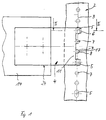
- Fig. 1
- eine Ansicht einer zur Befestigung eines Konstruktionselementes eingesetzten erfindungsgemäßen Befestigungsanordnung;
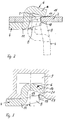
- Fig. 2
- einen Schnitt nach Linie II-II gemäß Fig. 1, jedoch ohne Konstruktionselement und
- Fig. 3
- einen Schnitt durch eine Befestigungsanordnung analog zur Fig. 2, jedoch in einer T-Nut.
- Fig. 1 zeigt als Beispiel für eine erfindungsgemäße Befestigungsanordnung ausschnittsweise ein erstes Bauteil 2, welches ein vertikaler Profilholm eines Geräteschrankes ist, und ein zweites Bauteil 4, welches als ein Befestigungselement für ein zu befestigendes Kontruktionslement 14, beispielsweise für eine Teleskopschiene, dient und mit dem Bauteil 2 zu verbinden ist. Der vertikale Profilholm 2, der beispielsweise aus Aluminium oder aus Stahl gefertigt ist, weist eine Lochreihe 3 aus rasterartig angeordneten Langlöchern 5 und Rundlöchern 7 auf, wobei zwischen einem oberen und unter Langloch 5 jeweils zwei Rundlöcher 7 ausgebildet sind. Bei den Rundlöchern 7 handelt es sich um kreisrunde Bohrungen.
- An dem Profilholm 2 wird als zweites Bauteil 4 ein schienenartiges Befestigungselement befestigt, an welchem das nur als Ausschnitt dargestellte Konstruktionselement 14, zum Beispiel über Befestigungsschrauben (nicht dargestellt), befestigt ist und welches einen Randbereich 11 mit integrierten Klemmelementen 6 und Abstandselementen 8 aufweist. Die Ansicht gemäß Fig. 1 verdeutlicht, daß die Klemmelemente 6 und Abstandselemente 8 des Befestigungselementes 4 komplementär zu den zwei verschiedenen Locharten 5, 7 des vertikalen Profilholms 2 ausgebildet sind und das gleiche Rastermaß wie die Löcher 5, 7 des Vertikalprofils 2 aufweisen.
- Als Klemmelemente sind Klemmhaken 6 angeformt, welche zum Hintergreifen des Langlochs 5 und zur Anlage an einem rückseitigen Randbereich 15 des Langlochs 5 zweifach abgewinkelt ausgebildet sind (siehe auch Fig. 2 und Fig. 3).
- Zur Positionierung im Bereich eines Rundlochs 7, insbesondere mit gleichzeitiger Anlage an einem inneren Randbereich 17 des Rundlochs 7, sind zungenartig ausgebildete Abstandselemente 8 ausgebildet, welche zusammen mit den Klemmhaken 6 aufgrund ihrer Anordnung und Abwinklung bzw. Abschrägung eine Klemmhalterung des Randbereichs 11 bewirken.
- Es liegt im Rahmen der Erfindung, abweichende Lochreihen auszubilden und entsprechende Klemm- und Abstandselemente vorzusehen. Auch liegt es im Rahmen der Erfindung, wenn lediglich ein Rundloch oder aber mehr als zwei Rundlöcher zwischen zwei Langlöchern ausgebildet oder weitere alternierende Anordnungen unterschiedlicher Löcher vorgesehen sind, welche mit komplementär ausgebildeten Klemm- und Positionierelementen 6,8 zusammenwirken.
- Bevorzugt ist das als Befestigungselement für weitere Bauteile und Konstruktionselemente 14 dienende Bauteil 4 der erfindungsgemäßen Befestigungsanordnung aus einem Stahlblech mit einer Wandstärke von 2,0 mm hergestellt. Die Wandstärke des ersten Bauteils, beispielsweise eines Vertikalholms, kann bei Verwendung eines Aluminiumprofils 1,9 mm und bei Verwendung eines Stahl-Profils 1,5 mm betragen.
- Aus Fig. 2 sind die Klemmhalterung und die Schnellbefestigung zu ersehen. Die strichpunktierten Linien geben ein Befestigungselement als zweites Bauteil 4 in einer Position wieder, in welcher die Klemmelemente 6 noch nicht oder nur teilweise in die Langlöcher 5 des Profilholms als erstem Bauteil 2 eingeführt und die Abstandselemente 8 noch nicht endpositioniert sind, sondern am Außenrand der Rundlöcher 7 abgestützt sind. Mit durchgezogenen Linien und strichlierten Linien sind die Klemmposition des zu befestigenden zweiten Bauteils 4 und die Anordnung eines Klemmelementes 6 und eines Abstandselementes 8 in der Klemmposition dargestellt.
- Das zweite Bauteil 4 weist integriert angeordnete Klemmhaken 6 und Abstandselemente 8 an einem Randbereich 11 auf. Die Klemmhaken 6 sind an dem Randbereich 11 rechtwinklig abgebogen und mit einem Klemmschenkel 16 versehen, welcher nach innen geneigt ist und den Hintergriff und eine Anlage an einem rückseitigen Randbereich 15 eines Langlochs 5 gewährleistet. Die vertikalen Abmessungen des Klemmhakens 6 sind mit denen des Langlochs 5 abgestimmt. Ein Abstandslement 8 unterhalb des Klemmhakens 6 liegt mit geringem Eingriff in dem Rundloch 7 an und ist mit einer Stirnseite 18 an einem inneren Randbereich 17 des Rundlochs 7 abgestützt. Das Abstandselement 8 ist leicht abgeschrägt am Randbereich 11 ausgebildet. Ein Neigungswinkel α kann etwa 10 Grad betragen.
- Analog zur Fig. 2 ist in Fig. 3 eine Klemmhalterung eines Befestigungselementes als Bauteil 4 mit einem Randbereich 11 dargestellt. Gleiche Merkmale wurden mit identischen Bezugszeichen versehen. Das zweite Bauteil 4, welches zur Befestigung eines nur in Figur 1 dargestellten Konstruktionselementes 14 vorgesehen ist, wird jedoch im Gegensatz zum Beispiel gemäß Fig. 1 und 2 nicht in einer Lochreihe, sondern in einer T-Nut 9 eines ersten Bauteils 2 befestigt. Für eine variable Befestigung ist es vorteilhaft, wenn das erste Bauteil 2 wenigstens eine T-Nut und gleichzeitig wenigstens eine Lochreihe 3 aufweist.
- Ein Klemmschenkel 16 des Klemmhakens 6 liegt an einer Innenseite 21 eines Nutschenkels an und wird zu diesem Zweck durch einen Schlitz 19 der T-Nut 9 geführt. Das Abstandselement 8 liegt an einem inneren Randbereich 17 des Schlitzes 19 der T-Nut 9 an.
- Die Abstandselemente 8 sind, wie die Figuren zeigen, wesentlich kürzer ausgebildet als der Klemmhaken 6 und sichern durch eine definierte An- oder Auflage eine genaue Anordnung und Positionierung der Klemmelemente 6 in einer Lochreihe 3 oder einer T-Nut 9.
- Der Klemmhaken 6 kann an dem Klemmschenkel 16 und insbesondere an dessen endseitigem Bereich mit kleinen, spitzen Fortsätzen versehen sein, welche sich in die Oberflächenschicht einkrallen.
- Die erfindungsgemäße Befestigungsanordnung mit einem ersten und zweiten Bauteil ist zur schnellen und montagefreundlichen Befestigung diverser Baugruppen und Konstruktionsteile einsetzbar und insbesondere zur Befestigung schienenartiger Bauteile, wie Teleskopschienen, in einem Schrank- oder Gestellsystem geeignet.
Claims (10)
- Befestigungsanordnung mit einem ersten Bauteil (2), welches wenigstens eine Langlochöffnung aufweist, und einem zweiten Bauteil (4), welches an dem ersten Bauteil (2) mit wenigstens einem Befestigungselement fixierbar ist,
dadurch gekennzeichnet,
daß das erste Bauteil (2) als wenigstens eine Langlochöffnung eine Lochreihe (3) aus alternierend angeordneten Langlöchern (5) und Rundlöchern (7) und/oder eine Nut (9) aufweist und
daß am zweiten Bauteil (4) Klemmelemente (6) als Befestigungselemente für eine Klemmhalterung sowie Abstandselemente (8) zur Anlage im Bereich der Langlöcher (5), Rundlöcher (7) oder der Nut (9) des ersten Bauteils (2) randseitig angeordnet sind. - Befestigungsanordnung nach Anspruch 1,
dadurch gekennzeichnet,
daß die Klemmelemente (6) für einen Hintergriff der Langlöcher (5) oder der Nut (9) und die Abstandselemente (8) für eine Anlage an oder eine partielle Aufnahme in den Rundlöchern (7) oder in der Nut (9) ausgebildet sind. - Befestigungsanordnung nach Anspruch 1 oder 2,
dadurch gekennzeichnet,
daß das erste Bauteil (2) ein Profilholm ist und daß als Lochreihe (3) eine rasterartige Anordnung von wenigstens einem Rundloch (7) und einem unteren und oberen Langloch (5) und als Nut eine T-Nut (9) vorgesehen ist. - Befestigungsanordnung nach einem der vorhergehenden Ansprüche,
dadurch gekennzeichnet,
daß das zweite Bauteil (4) in ein Konstruktionsteil (14) integriert oder an diesem befestigt ist und wenigstens einen Randbereich (11) mit Klemmelementen (6) und den Abstandselementen (8) aufweist, welche komplementär zu der Lochreihe (3) des ersten Bauteils (2) ausgebildet sind. - Befestigunganordnugn nach einem der vorhergehenden Ansprüche,
dadurch gekennzeichnet,
daß das zweite Bauteil (4) in ein Flachblech oder eine Profilschiene als Konstruktionsteil (14) integriert oder an diesen befestigt ist, wobei das zweite Bauteil (4) jeweils mit nach außen gerichteten Klemmelementen (6) und Abstandselementen (8) an einem randseitigen Befestigungsbereich (24) des Konstruktionsteils (14) angeordnet ist. - Befestigungsanordnung nach Anspruch 4 oder 5,
dadurch gekennzeichnet,
daß zur Befestigung eines Konstruktionsteils (14) jeweils ein zweites Bauteil (4) an zwei einander gegenüberliegenden Befestigungsbereichen (24) des Konstruktionsteils (14) insbesondere über Schraubverbindungen befestigt ist. - Befestigungsanordnung nach einem der vorhergehenden Ansprüche,
dadurch gekennzeichnet,
daß das zweite Bauteil (4) als Klemmelemente Klemmhaken (6) aufweist, welche zum Hintergreifen eines Langloches (5) oder einer Nut (9) ausgebildet sind, und daß die Abstandselemente (8) zungenförmig und zur formschlüssigen Anlage an oder in einem Rundloch (7) oder einem Schlitz (19) der Nut (9) ausgebildet sind. - Befestigungsanordnung nach Anspruch 7,
dadurch gekennzeichnet,
daß die Klemmhaken (6) durch eine zweifache Abwinklung gebildet sind und jeweils mit einem endseitigen abgeschrägten Klemmschenkel (16) an einem rückseitigen Randbereich (15) der Langlöcher (5) oder einer Innenseite (21) der Nut (9) anliegen und
daß die Abstandselemente (8), welche endseitig komplementär zu den Rundlöchern (7) oder zum Nutschlitz (19) ausgebildet sind, in Richtung Klemmhaken (6) abgebogen sind und in Klemmposition an einem äußeren oder inneren Randbereich (17) der Rundlöcher (7) oder des Nutschlitzes (19) anliegen. - Befestigungsanordnung nach Anspruch 7 oder 8,
dadurch gekennzeichnet,
daß wenigstens die Klemmhaken (6) im Bereich ihrer Klemmschenkel (16) mit spitzen Fortsätzen versehen sind, die sich in das erste Bauteil (2) einkrallen. - Befestigungsanordnung nach einem der vorhergehenden Ansprüche,
dadurch gekennzeichnet,
daß das zweite Bauteil (4) in einer nahezu rechtwinkligen Anordnung in die Lochreihe (3) oder in die Nut (9) des ersten Bauteils (2) einführbar und nach einer etwa 90o-Drehung durch ein Hintergreifen und einen Eingriff in eine Klemmstellung bringbar ist.
Applications Claiming Priority (2)
| Application Number | Priority Date | Filing Date | Title |
|---|---|---|---|
| DE19618127A DE19618127C1 (de) | 1996-05-06 | 1996-05-06 | Befestigungsanordnung |
| DE19618127 | 1996-05-06 |
Publications (2)
| Publication Number | Publication Date |
|---|---|
| EP0806575A1 true EP0806575A1 (de) | 1997-11-12 |
| EP0806575B1 EP0806575B1 (de) | 1999-12-01 |
Family
ID=7793467
Family Applications (1)
| Application Number | Title | Priority Date | Filing Date |
|---|---|---|---|
| EP97106667A Expired - Lifetime EP0806575B1 (de) | 1996-05-06 | 1997-04-22 | Befestigungsanordnung |
Country Status (5)
| Country | Link |
|---|---|
| US (1) | US5931426A (de) |
| EP (1) | EP0806575B1 (de) |
| JP (1) | JPH1057159A (de) |
| AT (1) | ATE187229T1 (de) |
| DE (2) | DE19618127C1 (de) |
Families Citing this family (11)
| Publication number | Priority date | Publication date | Assignee | Title |
|---|---|---|---|---|
| US6253898B1 (en) * | 1998-07-02 | 2001-07-03 | O'brien Daniel F. | Equipment loading plank |
| TW453621U (en) * | 1999-06-08 | 2001-09-01 | Hon Hai Prec Ind Co Ltd | Structure for combining stopping sheet and carrying seat |
| DE10007470C2 (de) * | 2000-02-18 | 2002-06-20 | Rittal Gmbh & Co Kg | Schaltschrank |
| DE10119994B4 (de) * | 2001-04-23 | 2009-04-09 | Dorma Gmbh + Co. Kg | Klemmhalter |
| US6732866B2 (en) * | 2002-04-24 | 2004-05-11 | East Industries, Ltd. | Combination shelf and display unit |
| US7029143B2 (en) * | 2002-10-22 | 2006-04-18 | Ceilings Plus | Light cove |
| EP2302850A1 (de) * | 2003-04-30 | 2011-03-30 | Analog Devices, Inc. | Signalisolator, der Mikrotransformer benutzt |
| US8713889B2 (en) * | 2011-01-14 | 2014-05-06 | Ronald Buttner | Anchor bracket and method of mounting anchor bracket |
| US20120260549A1 (en) * | 2011-04-14 | 2012-10-18 | Nielsen Bainbridge | Picture frame wall bracket |
| CN103580592A (zh) * | 2012-08-09 | 2014-02-12 | 富昱能源科技(昆山)有限公司 | 支架结构 |
| CN108061088A (zh) * | 2017-12-12 | 2018-05-22 | 无锡优耐特能源科技有限公司 | 一种支架连接件 |
Citations (5)
| Publication number | Priority date | Publication date | Assignee | Title |
|---|---|---|---|---|
| DE2161889A1 (de) * | 1971-12-14 | 1973-06-20 | Geb Posselt Ursula Schaefer | Steck- und riegelverbindung |
| DE9110389U1 (de) * | 1991-08-22 | 1992-12-17 | Klöckner-Moeller GmbH, 5300 Bonn | Tragvorrichtung für Schalt- und Steuergeräte |
| EP0534578A1 (de) * | 1991-09-26 | 1993-03-31 | Siemens Aktiengesellschaft | Traganordnung für elektrische Geräte |
| EP0557213A1 (de) * | 1992-02-21 | 1993-08-25 | Schneider Electric Sa | Vorrichtung zur Verbindung von zwei steifen Platten |
| EP0668644A1 (de) * | 1994-02-17 | 1995-08-23 | Schneider Electric Sa | Elektrische trägerplatte Installationsvorrichtung mit einem Anschlussflansch |
Family Cites Families (14)
| Publication number | Priority date | Publication date | Assignee | Title |
|---|---|---|---|---|
| US3248079A (en) * | 1963-12-30 | 1966-04-26 | Clark Equipment Co | Angularly adjustable shelf bracket |
| US3272345A (en) * | 1965-01-11 | 1966-09-13 | Brad Mar Corp | Cloth bolt holder and rack |
| US3353684A (en) * | 1965-10-22 | 1967-11-21 | Chesley Ind Inc | Shelf structure |
| GB1222488A (en) * | 1969-09-11 | 1971-02-17 | Basil Zachariou | Improvements in shelving assemblies |
| US4204480A (en) * | 1975-07-30 | 1980-05-27 | The Mead Corporation | Shelving system |
| US4378925A (en) * | 1981-03-10 | 1983-04-05 | Lingo Manufacturing Company | T-Bracket shelf assembly |
| ZA822552B (en) * | 1981-04-22 | 1983-03-30 | Dexion Comino Int Ltd | Framework connection means |
| US4553725A (en) * | 1982-02-25 | 1985-11-19 | Vargo William R | Steel shelving mounting clip and shelving structure |
| US5277393A (en) * | 1989-03-10 | 1994-01-11 | Mccalla/Lackey Corporation | Shelving unit |
| US5265740A (en) * | 1991-12-23 | 1993-11-30 | The Winsford Corporation | Adjustable storage apparatus for computer media |
| FR2720792B1 (fr) * | 1993-12-23 | 1996-07-12 | Alplast Sarl | Dispositif pour la fixation d'ustensiles et d'outils sur un support perforé. |
| US5477971A (en) * | 1994-04-29 | 1995-12-26 | L&P Property Management Company | Gondola rack modular stacking system |
| US5538213A (en) * | 1994-09-21 | 1996-07-23 | Brown Office Systems, Inc. | Bracket for shelving, furniture and the like |
| US5575444A (en) * | 1995-03-16 | 1996-11-19 | Otema; Martin | Adjustable shelf bracket |
-
1996
- 1996-05-06 DE DE19618127A patent/DE19618127C1/de not_active Expired - Fee Related
-
1997
- 1997-04-22 EP EP97106667A patent/EP0806575B1/de not_active Expired - Lifetime
- 1997-04-22 AT AT97106667T patent/ATE187229T1/de not_active IP Right Cessation
- 1997-04-22 DE DE59700784T patent/DE59700784D1/de not_active Expired - Fee Related
- 1997-05-06 US US08/851,890 patent/US5931426A/en not_active Expired - Fee Related
- 1997-05-06 JP JP9115853A patent/JPH1057159A/ja not_active Withdrawn
Patent Citations (5)
| Publication number | Priority date | Publication date | Assignee | Title |
|---|---|---|---|---|
| DE2161889A1 (de) * | 1971-12-14 | 1973-06-20 | Geb Posselt Ursula Schaefer | Steck- und riegelverbindung |
| DE9110389U1 (de) * | 1991-08-22 | 1992-12-17 | Klöckner-Moeller GmbH, 5300 Bonn | Tragvorrichtung für Schalt- und Steuergeräte |
| EP0534578A1 (de) * | 1991-09-26 | 1993-03-31 | Siemens Aktiengesellschaft | Traganordnung für elektrische Geräte |
| EP0557213A1 (de) * | 1992-02-21 | 1993-08-25 | Schneider Electric Sa | Vorrichtung zur Verbindung von zwei steifen Platten |
| EP0668644A1 (de) * | 1994-02-17 | 1995-08-23 | Schneider Electric Sa | Elektrische trägerplatte Installationsvorrichtung mit einem Anschlussflansch |
Also Published As
| Publication number | Publication date |
|---|---|
| EP0806575B1 (de) | 1999-12-01 |
| US5931426A (en) | 1999-08-03 |
| ATE187229T1 (de) | 1999-12-15 |
| DE19618127C1 (de) | 1997-10-09 |
| JPH1057159A (ja) | 1998-03-03 |
| DE59700784D1 (de) | 2000-01-05 |
Similar Documents
| Publication | Publication Date | Title |
|---|---|---|
| EP3763035B1 (de) | Endklemme zur befestigung eines gerahmten pv-moduls | |
| EP0452256B1 (de) | Eckverbindung zweier Profile mit C-förmigem Anschluss mittels eines Eckverbinders und Winkelstück zur Herstellung der Verbindung | |
| EP0686316B1 (de) | Schrank | |
| EP0602314A1 (de) | Anordnung zur federelastischen Lagesicherung von Befestigungsmitteln in Ausnehmungen | |
| EP1070923A2 (de) | Vorrichtung zur Befestigung von Solarmodulen | |
| DE3513384A1 (de) | Profilsystem zum bau von montageeinrichtungen, stuetzkonstruktionen und transportbaendern | |
| DE102007018212B4 (de) | Befestigungseinrichtung für an einem Gestellaufbau anzuordnende Rahmenbauteile, insbesondere Solarmodule | |
| EP0806575B1 (de) | Befestigungsanordnung | |
| EP1840315B1 (de) | Rahmenkonstruktion | |
| DE2164991A1 (de) | Ankerschiene | |
| EP0579578A1 (de) | Anschlussplatte an einem Traggestell | |
| EP0935500B1 (de) | Wand für die kabine einer lackieranlage | |
| EP3721100B1 (de) | Verbindungsanordnung | |
| EP0335857B1 (de) | Verbindung zwischen mindestens zwei Profilen oder profilierten Blechen | |
| DE69925404T2 (de) | Metallische Verbindungsvorrichtung und Beschlagteile dafür | |
| DE102009017164A1 (de) | Haltevorrichtung | |
| DE2707718A1 (de) | Aus platten zusammengesetzte unterdecke | |
| WO2006092156A1 (de) | Wandelement | |
| EP0593871B1 (de) | Leuchtenanordnung mit hinter- und/oder nebeneinander angeordneten Leuchtenkörpern | |
| DE9405831U1 (de) | Halteelement für Fachböden | |
| EP0542007B1 (de) | Vorrichtung zum mittelbaren Verbinden von Konstruktionsprofilen und/oder vergleichbarer Teile, insbesondere für flexible Montagesysteme | |
| DE4301634C2 (de) | Rahmengestell aus Rahmenschenkeln für einen Schaltschrank | |
| EP3720790B1 (de) | Transportvorrichtung | |
| DE7230142U (de) | Anordnung für elektronische Einschubsysteme | |
| EP0229332B1 (de) | Profilstütze mit aufbiegbaren Zungen |
Legal Events
| Date | Code | Title | Description |
|---|---|---|---|
| PUAI | Public reference made under article 153(3) epc to a published international application that has entered the european phase |
Free format text: ORIGINAL CODE: 0009012 |
|
| AK | Designated contracting states |
Kind code of ref document: A1 Designated state(s): AT BE CH DE DK ES FR GB IT LI NL SE |
|
| 17P | Request for examination filed |
Effective date: 19971013 |
|
| 17Q | First examination report despatched |
Effective date: 19980702 |
|
| GRAG | Despatch of communication of intention to grant |
Free format text: ORIGINAL CODE: EPIDOS AGRA |
|
| GRAG | Despatch of communication of intention to grant |
Free format text: ORIGINAL CODE: EPIDOS AGRA |
|
| GRAH | Despatch of communication of intention to grant a patent |
Free format text: ORIGINAL CODE: EPIDOS IGRA |
|
| GRAH | Despatch of communication of intention to grant a patent |
Free format text: ORIGINAL CODE: EPIDOS IGRA |
|
| GRAA | (expected) grant |
Free format text: ORIGINAL CODE: 0009210 |
|
| AK | Designated contracting states |
Kind code of ref document: B1 Designated state(s): AT BE CH DE DK ES FR GB IT LI NL SE |
|
| PG25 | Lapsed in a contracting state [announced via postgrant information from national office to epo] |
Ref country code: SE Free format text: THE PATENT HAS BEEN ANNULLED BY A DECISION OF A NATIONAL AUTHORITY Effective date: 19991201 Ref country code: NL Free format text: LAPSE BECAUSE OF FAILURE TO SUBMIT A TRANSLATION OF THE DESCRIPTION OR TO PAY THE FEE WITHIN THE PRESCRIBED TIME-LIMIT Effective date: 19991201 Ref country code: IT Free format text: LAPSE BECAUSE OF FAILURE TO SUBMIT A TRANSLATION OF THE DESCRIPTION OR TO PAY THE FEE WITHIN THE PRESCRIBED TIME-LIMIT;WARNING: LAPSES OF ITALIAN PATENTS WITH EFFECTIVE DATE BEFORE 2007 MAY HAVE OCCURRED AT ANY TIME BEFORE 2007. THE CORRECT EFFECTIVE DATE MAY BE DIFFERENT FROM THE ONE RECORDED. Effective date: 19991201 Ref country code: GB Free format text: LAPSE BECAUSE OF FAILURE TO SUBMIT A TRANSLATION OF THE DESCRIPTION OR TO PAY THE FEE WITHIN THE PRESCRIBED TIME-LIMIT Effective date: 19991201 Ref country code: FR Free format text: LAPSE BECAUSE OF FAILURE TO SUBMIT A TRANSLATION OF THE DESCRIPTION OR TO PAY THE FEE WITHIN THE PRESCRIBED TIME-LIMIT Effective date: 19991201 Ref country code: ES Free format text: THE PATENT HAS BEEN ANNULLED BY A DECISION OF A NATIONAL AUTHORITY Effective date: 19991201 |
|
| REF | Corresponds to: |
Ref document number: 187229 Country of ref document: AT Date of ref document: 19991215 Kind code of ref document: T |
|
| REG | Reference to a national code |
Ref country code: CH Ref legal event code: EP |
|
| REF | Corresponds to: |
Ref document number: 59700784 Country of ref document: DE Date of ref document: 20000105 |
|
| PG25 | Lapsed in a contracting state [announced via postgrant information from national office to epo] |
Ref country code: DK Free format text: LAPSE BECAUSE OF FAILURE TO SUBMIT A TRANSLATION OF THE DESCRIPTION OR TO PAY THE FEE WITHIN THE PRESCRIBED TIME-LIMIT Effective date: 20000301 |
|
| PG25 | Lapsed in a contracting state [announced via postgrant information from national office to epo] |
Ref country code: AT Free format text: LAPSE BECAUSE OF NON-PAYMENT OF DUE FEES Effective date: 20000422 |
|
| EN | Fr: translation not filed | ||
| PG25 | Lapsed in a contracting state [announced via postgrant information from national office to epo] |
Ref country code: BE Free format text: LAPSE BECAUSE OF NON-PAYMENT OF DUE FEES Effective date: 20000430 |
|
| NLV1 | Nl: lapsed or annulled due to failure to fulfill the requirements of art. 29p and 29m of the patents act | ||
| GBV | Gb: ep patent (uk) treated as always having been void in accordance with gb section 77(7)/1977 [no translation filed] |
Effective date: 19991201 |
|
| PLBE | No opposition filed within time limit |
Free format text: ORIGINAL CODE: 0009261 |
|
| STAA | Information on the status of an ep patent application or granted ep patent |
Free format text: STATUS: NO OPPOSITION FILED WITHIN TIME LIMIT |
|
| BERE | Be: lapsed |
Owner name: KNURR-MECHANIK FUR DIE ELEKTRONIK A.G. Effective date: 20000430 |
|
| 26N | No opposition filed | ||
| PG25 | Lapsed in a contracting state [announced via postgrant information from national office to epo] |
Ref country code: LI Free format text: LAPSE BECAUSE OF NON-PAYMENT OF DUE FEES Effective date: 20010521 Ref country code: CH Free format text: LAPSE BECAUSE OF NON-PAYMENT OF DUE FEES Effective date: 20010521 |
|
| REG | Reference to a national code |
Ref country code: CH Ref legal event code: PL |
|
| PGFP | Annual fee paid to national office [announced via postgrant information from national office to epo] |
Ref country code: DE Payment date: 20020429 Year of fee payment: 6 |
|
| PG25 | Lapsed in a contracting state [announced via postgrant information from national office to epo] |
Ref country code: DE Free format text: LAPSE BECAUSE OF NON-PAYMENT OF DUE FEES Effective date: 20031101 |