EP0804445B1 - Diarylethylen-metallogenderivate, verfahren zu deren herstellung und diese enthaltende arzneizusammensetzungen - Google Patents
Diarylethylen-metallogenderivate, verfahren zu deren herstellung und diese enthaltende arzneizusammensetzungen Download PDFInfo
- Publication number
- EP0804445B1 EP0804445B1 EP95934197A EP95934197A EP0804445B1 EP 0804445 B1 EP0804445 B1 EP 0804445B1 EP 95934197 A EP95934197 A EP 95934197A EP 95934197 A EP95934197 A EP 95934197A EP 0804445 B1 EP0804445 B1 EP 0804445B1
- Authority
- EP
- European Patent Office
- Prior art keywords
- group
- compound
- formula
- atom
- phenyl
- Prior art date
- Legal status (The legal status is an assumption and is not a legal conclusion. Google has not performed a legal analysis and makes no representation as to the accuracy of the status listed.)
- Expired - Lifetime
Links
- 238000002360 preparation method Methods 0.000 title claims description 26
- 238000000034 method Methods 0.000 title claims description 21
- 239000008194 pharmaceutical composition Substances 0.000 title claims description 3
- 150000001875 compounds Chemical class 0.000 claims description 79
- 125000004429 atom Chemical group 0.000 claims description 32
- 125000005843 halogen group Chemical group 0.000 claims description 30
- XEEYBQQBJWHFJM-UHFFFAOYSA-N Iron Chemical compound [Fe] XEEYBQQBJWHFJM-UHFFFAOYSA-N 0.000 claims description 28
- 125000001997 phenyl group Chemical group [H]C1=C([H])C([H])=C(*)C([H])=C1[H] 0.000 claims description 25
- LFQSCWFLJHTTHZ-UHFFFAOYSA-N Ethanol Chemical compound CCO LFQSCWFLJHTTHZ-UHFFFAOYSA-N 0.000 claims description 24
- WKBOTKDWSSQWDR-UHFFFAOYSA-N Bromine atom Chemical compound [Br] WKBOTKDWSSQWDR-UHFFFAOYSA-N 0.000 claims description 23
- 125000000217 alkyl group Chemical group 0.000 claims description 21
- 125000004435 hydrogen atom Chemical group [H]* 0.000 claims description 21
- 229910052751 metal Inorganic materials 0.000 claims description 19
- 239000002184 metal Substances 0.000 claims description 19
- ZAMOUSCENKQFHK-UHFFFAOYSA-N Chlorine atom Chemical compound [Cl] ZAMOUSCENKQFHK-UHFFFAOYSA-N 0.000 claims description 15
- KJTLSVCANCCWHF-UHFFFAOYSA-N Ruthenium Chemical compound [Ru] KJTLSVCANCCWHF-UHFFFAOYSA-N 0.000 claims description 15
- 229910052762 osmium Inorganic materials 0.000 claims description 15
- SYQBFIAQOQZEGI-UHFFFAOYSA-N osmium atom Chemical compound [Os] SYQBFIAQOQZEGI-UHFFFAOYSA-N 0.000 claims description 15
- 230000008569 process Effects 0.000 claims description 15
- OKTJSMMVPCPJKN-UHFFFAOYSA-N Carbon Chemical compound [C] OKTJSMMVPCPJKN-UHFFFAOYSA-N 0.000 claims description 14
- 229910052799 carbon Inorganic materials 0.000 claims description 14
- ZSWFCLXCOIISFI-UHFFFAOYSA-N endo-cyclopentadiene Natural products C1C=CC=C1 ZSWFCLXCOIISFI-UHFFFAOYSA-N 0.000 claims description 14
- FMZDTWIMDUWOIP-UHFFFAOYSA-N CN(CCOC1=CC=C(C=C1)C(=C(CC)[C-]1C=CC=C1)C1=CC=C(C=C1)O)C.[CH-]1C=CC=C1.[Fe+2] Chemical compound CN(CCOC1=CC=C(C=C1)C(=C(CC)[C-]1C=CC=C1)C1=CC=C(C=C1)O)C.[CH-]1C=CC=C1.[Fe+2] FMZDTWIMDUWOIP-UHFFFAOYSA-N 0.000 claims description 13
- GDTBXPJZTBHREO-UHFFFAOYSA-N bromine Substances BrBr GDTBXPJZTBHREO-UHFFFAOYSA-N 0.000 claims description 13
- 229910052801 chlorine Inorganic materials 0.000 claims description 13
- 125000002887 hydroxy group Chemical group [H]O* 0.000 claims description 13
- 125000002496 methyl group Chemical group [H]C([H])([H])* 0.000 claims description 13
- 230000015572 biosynthetic process Effects 0.000 claims description 12
- 125000001495 ethyl group Chemical group [H]C([H])([H])C([H])([H])* 0.000 claims description 12
- 229910052742 iron Inorganic materials 0.000 claims description 12
- 125000003545 alkoxy group Chemical group 0.000 claims description 11
- 229910052794 bromium Inorganic materials 0.000 claims description 11
- 239000000460 chlorine Substances 0.000 claims description 11
- PNDPGZBMCMUPRI-UHFFFAOYSA-N iodine Chemical compound II PNDPGZBMCMUPRI-UHFFFAOYSA-N 0.000 claims description 11
- 150000003839 salts Chemical class 0.000 claims description 11
- 125000002603 chloroethyl group Chemical group [H]C([*])([H])C([H])([H])Cl 0.000 claims description 10
- -1 cyclopentadienyl anion Chemical class 0.000 claims description 10
- 229910052707 ruthenium Inorganic materials 0.000 claims description 10
- VEXZGXHMUGYJMC-UHFFFAOYSA-N Hydrochloric acid Chemical compound Cl VEXZGXHMUGYJMC-UHFFFAOYSA-N 0.000 claims description 9
- 239000002253 acid Substances 0.000 claims description 9
- 238000006297 dehydration reaction Methods 0.000 claims description 8
- 150000002148 esters Chemical class 0.000 claims description 7
- ZOKXTWBITQBERF-UHFFFAOYSA-N Molybdenum Chemical compound [Mo] ZOKXTWBITQBERF-UHFFFAOYSA-N 0.000 claims description 6
- RTAQQCXQSZGOHL-UHFFFAOYSA-N Titanium Chemical compound [Ti] RTAQQCXQSZGOHL-UHFFFAOYSA-N 0.000 claims description 6
- 238000005804 alkylation reaction Methods 0.000 claims description 6
- 229910052735 hafnium Inorganic materials 0.000 claims description 6
- VBJZVLUMGGDVMO-UHFFFAOYSA-N hafnium atom Chemical compound [Hf] VBJZVLUMGGDVMO-UHFFFAOYSA-N 0.000 claims description 6
- 229910052757 nitrogen Inorganic materials 0.000 claims description 6
- 150000002902 organometallic compounds Chemical class 0.000 claims description 6
- 229910052720 vanadium Inorganic materials 0.000 claims description 6
- GPPXJZIENCGNKB-UHFFFAOYSA-N vanadium Chemical compound [V]#[V] GPPXJZIENCGNKB-UHFFFAOYSA-N 0.000 claims description 6
- ZCYVEMRRCGMTRW-UHFFFAOYSA-N 7553-56-2 Chemical compound [I] ZCYVEMRRCGMTRW-UHFFFAOYSA-N 0.000 claims description 5
- 230000000259 anti-tumor effect Effects 0.000 claims description 5
- 125000000623 heterocyclic group Chemical group 0.000 claims description 5
- 229910052740 iodine Inorganic materials 0.000 claims description 5
- 125000004433 nitrogen atom Chemical group N* 0.000 claims description 5
- 125000004169 (C1-C6) alkyl group Chemical group 0.000 claims description 4
- 238000007259 addition reaction Methods 0.000 claims description 4
- 229910052729 chemical element Inorganic materials 0.000 claims description 4
- 125000001309 chloro group Chemical group Cl* 0.000 claims description 4
- 239000003814 drug Substances 0.000 claims description 4
- 239000003446 ligand Substances 0.000 claims description 4
- 229910052750 molybdenum Inorganic materials 0.000 claims description 4
- 239000011733 molybdenum Substances 0.000 claims description 4
- 230000000737 periodic effect Effects 0.000 claims description 4
- 238000000926 separation method Methods 0.000 claims description 4
- 239000010936 titanium Substances 0.000 claims description 4
- 229910052719 titanium Inorganic materials 0.000 claims description 4
- NGNBDVOYPDDBFK-UHFFFAOYSA-N 2-[2,4-di(pentan-2-yl)phenoxy]acetyl chloride Chemical compound CCCC(C)C1=CC=C(OCC(Cl)=O)C(C(C)CCC)=C1 NGNBDVOYPDDBFK-UHFFFAOYSA-N 0.000 claims description 3
- RYGMFSIKBFXOCR-UHFFFAOYSA-N Copper Chemical group [Cu] RYGMFSIKBFXOCR-UHFFFAOYSA-N 0.000 claims description 3
- 238000005893 bromination reaction Methods 0.000 claims description 3
- RCTYPNKXASFOBE-UHFFFAOYSA-M chloromercury Chemical group [Hg]Cl RCTYPNKXASFOBE-UHFFFAOYSA-M 0.000 claims description 3
- 125000000058 cyclopentadienyl group Chemical group C1(=CC=CC1)* 0.000 claims description 3
- 238000010520 demethylation reaction Methods 0.000 claims description 3
- 230000032050 esterification Effects 0.000 claims description 3
- 238000005886 esterification reaction Methods 0.000 claims description 3
- 239000011630 iodine Substances 0.000 claims description 3
- 229910052744 lithium Inorganic materials 0.000 claims description 3
- QDRKDTQENPPHOJ-UHFFFAOYSA-N sodium ethoxide Chemical compound [Na+].CC[O-] QDRKDTQENPPHOJ-UHFFFAOYSA-N 0.000 claims description 3
- XHLHPRDBBAGVEG-UHFFFAOYSA-N 1-tetralone Chemical compound C1=CC=C2C(=O)CCCC2=C1 XHLHPRDBBAGVEG-UHFFFAOYSA-N 0.000 claims description 2
- JXDMWKKLRWAIJV-UHFFFAOYSA-N CN(CCOC1=CC=C(C=C1)C(=C(CC)[C-]1C=CC=C1)C1=CC=CC=C1)C.[CH-]1C=CC=C1.[Fe+2] Chemical compound CN(CCOC1=CC=C(C=C1)C(=C(CC)[C-]1C=CC=C1)C1=CC=CC=C1)C.[CH-]1C=CC=C1.[Fe+2] JXDMWKKLRWAIJV-UHFFFAOYSA-N 0.000 claims description 2
- 238000005859 coupling reaction Methods 0.000 claims description 2
- 150000002641 lithium Chemical group 0.000 claims description 2
- 238000004519 manufacturing process Methods 0.000 claims description 2
- 125000000956 methoxy group Chemical group [H]C([H])([H])O* 0.000 claims description 2
- 150000002900 organolithium compounds Chemical class 0.000 claims 3
- 150000002901 organomagnesium compounds Chemical class 0.000 claims 3
- 229910052758 niobium Inorganic materials 0.000 claims 2
- 239000010955 niobium Substances 0.000 claims 2
- GUCVJGMIXFAOAE-UHFFFAOYSA-N niobium atom Chemical compound [Nb] GUCVJGMIXFAOAE-UHFFFAOYSA-N 0.000 claims 2
- WQMAANNAZKNUDL-UHFFFAOYSA-N 2-dimethylaminoethyl chloride Chemical compound CN(C)CCCl WQMAANNAZKNUDL-UHFFFAOYSA-N 0.000 claims 1
- MKRVHLWAVKJBFN-UHFFFAOYSA-N diphenylzinc Chemical compound C=1C=CC=CC=1[Zn]C1=CC=CC=C1 MKRVHLWAVKJBFN-UHFFFAOYSA-N 0.000 claims 1
- RTZKZFJDLAIYFH-UHFFFAOYSA-N Diethyl ether Chemical compound CCOCC RTZKZFJDLAIYFH-UHFFFAOYSA-N 0.000 description 26
- NKANXQFJJICGDU-QPLCGJKRSA-N Tamoxifen Chemical compound C=1C=CC=CC=1C(/CC)=C(C=1C=CC(OCCN(C)C)=CC=1)/C1=CC=CC=C1 NKANXQFJJICGDU-QPLCGJKRSA-N 0.000 description 20
- 239000000203 mixture Substances 0.000 description 18
- IAZDPXIOMUYVGZ-UHFFFAOYSA-N Dimethylsulphoxide Chemical compound CS(C)=O IAZDPXIOMUYVGZ-UHFFFAOYSA-N 0.000 description 16
- CSNNHWWHGAXBCP-UHFFFAOYSA-L Magnesium sulfate Chemical compound [Mg+2].[O-][S+2]([O-])([O-])[O-] CSNNHWWHGAXBCP-UHFFFAOYSA-L 0.000 description 14
- 239000000047 product Substances 0.000 description 10
- 229960001603 tamoxifen Drugs 0.000 description 10
- YMWUJEATGCHHMB-UHFFFAOYSA-N Dichloromethane Chemical compound ClCCl YMWUJEATGCHHMB-UHFFFAOYSA-N 0.000 description 9
- XLYOFNOQVPJJNP-UHFFFAOYSA-N water Substances O XLYOFNOQVPJJNP-UHFFFAOYSA-N 0.000 description 9
- 239000000126 substance Substances 0.000 description 8
- 210000004027 cell Anatomy 0.000 description 7
- 229910052943 magnesium sulfate Inorganic materials 0.000 description 7
- 235000019341 magnesium sulphate Nutrition 0.000 description 7
- 206010006187 Breast cancer Diseases 0.000 description 6
- 208000026310 Breast neoplasm Diseases 0.000 description 6
- OFBQJSOFQDEBGM-UHFFFAOYSA-N Pentane Chemical compound CCCCC OFBQJSOFQDEBGM-UHFFFAOYSA-N 0.000 description 6
- 230000001833 anti-estrogenic effect Effects 0.000 description 6
- 238000003756 stirring Methods 0.000 description 6
- JCXJVPUVTGWSNB-UHFFFAOYSA-N Nitrogen dioxide Chemical compound O=[N]=O JCXJVPUVTGWSNB-UHFFFAOYSA-N 0.000 description 5
- 230000009471 action Effects 0.000 description 5
- 239000003480 eluent Substances 0.000 description 5
- 229940082150 encore Drugs 0.000 description 5
- 239000012429 reaction media Substances 0.000 description 5
- 238000010992 reflux Methods 0.000 description 5
- 239000002904 solvent Substances 0.000 description 5
- 0 CCCCC*C1(*C(CC)(CC(C)C)C2CCCCC2)CCCC1 Chemical compound CCCCC*C1(*C(CC)(CC(C)C)C2CCCCC2)CCCC1 0.000 description 4
- 206010028980 Neoplasm Diseases 0.000 description 4
- VYPSYNLAJGMNEJ-UHFFFAOYSA-N Silicium dioxide Chemical compound O=[Si]=O VYPSYNLAJGMNEJ-UHFFFAOYSA-N 0.000 description 4
- 239000012043 crude product Substances 0.000 description 4
- 229940011871 estrogen Drugs 0.000 description 4
- 239000000262 estrogen Substances 0.000 description 4
- 239000000328 estrogen antagonist Substances 0.000 description 4
- 239000012074 organic phase Substances 0.000 description 4
- LPNYRYFBWFDTMA-UHFFFAOYSA-N potassium tert-butoxide Chemical compound [K+].CC(C)(C)[O-] LPNYRYFBWFDTMA-UHFFFAOYSA-N 0.000 description 4
- 239000000741 silica gel Substances 0.000 description 4
- 229910002027 silica gel Inorganic materials 0.000 description 4
- 238000006467 substitution reaction Methods 0.000 description 4
- IJGRMHOSHXDMSA-UHFFFAOYSA-N Atomic nitrogen Chemical compound N#N IJGRMHOSHXDMSA-UHFFFAOYSA-N 0.000 description 3
- DGAQECJNVWCQMB-PUAWFVPOSA-M Ilexoside XXIX Chemical compound C[C@@H]1CC[C@@]2(CC[C@@]3(C(=CC[C@H]4[C@]3(CC[C@@H]5[C@@]4(CC[C@@H](C5(C)C)OS(=O)(=O)[O-])C)C)[C@@H]2[C@]1(C)O)C)C(=O)O[C@H]6[C@@H]([C@H]([C@@H]([C@H](O6)CO)O)O)O.[Na+] DGAQECJNVWCQMB-PUAWFVPOSA-M 0.000 description 3
- 230000029936 alkylation Effects 0.000 description 3
- 239000012300 argon atmosphere Substances 0.000 description 3
- 125000004432 carbon atom Chemical group C* 0.000 description 3
- XYYTZRRKPCAYNL-UHFFFAOYSA-N cyclopenta-1,3-diene ethyl 2-cyclopenta-1,4-dien-1-ylbutanoate iron(2+) Chemical compound [Fe++].c1cc[cH-]c1.CCOC(=O)C(CC)[c-]1cccc1 XYYTZRRKPCAYNL-UHFFFAOYSA-N 0.000 description 3
- MOUVOWJUMAKBBM-UHFFFAOYSA-N cyclopenta-1,3-diene;2-cyclopenta-1,3-dien-1-ylacetic acid;iron(2+) Chemical compound [Fe+2].C=1C=C[CH-]C=1.OC(=O)CC1=CC=C[CH-]1 MOUVOWJUMAKBBM-UHFFFAOYSA-N 0.000 description 3
- 230000001472 cytotoxic effect Effects 0.000 description 3
- 230000001419 dependent effect Effects 0.000 description 3
- 230000001076 estrogenic effect Effects 0.000 description 3
- 239000005457 ice water Substances 0.000 description 3
- 238000011534 incubation Methods 0.000 description 3
- VMGAPWLDMVPYIA-HIDZBRGKSA-N n'-amino-n-iminomethanimidamide Chemical compound N\N=C\N=N VMGAPWLDMVPYIA-HIDZBRGKSA-N 0.000 description 3
- VLKZOEOYAKHREP-UHFFFAOYSA-N n-Hexane Chemical compound CCCCCC VLKZOEOYAKHREP-UHFFFAOYSA-N 0.000 description 3
- 125000002734 organomagnesium group Chemical group 0.000 description 3
- 239000012071 phase Substances 0.000 description 3
- BOLDJAUMGUJJKM-LSDHHAIUSA-N renifolin D Natural products CC(=C)[C@@H]1Cc2c(O)c(O)ccc2[C@H]1CC(=O)c3ccc(O)cc3O BOLDJAUMGUJJKM-LSDHHAIUSA-N 0.000 description 3
- 239000011734 sodium Substances 0.000 description 3
- 229910052708 sodium Inorganic materials 0.000 description 3
- 239000011701 zinc Substances 0.000 description 3
- HEDRZPFGACZZDS-UHFFFAOYSA-N Chloroform Chemical compound ClC(Cl)Cl HEDRZPFGACZZDS-UHFFFAOYSA-N 0.000 description 2
- MZRVEZGGRBJDDB-UHFFFAOYSA-N N-Butyllithium Chemical compound [Li]CCCC MZRVEZGGRBJDDB-UHFFFAOYSA-N 0.000 description 2
- ZLMJMSJWJFRBEC-UHFFFAOYSA-N Potassium Chemical compound [K] ZLMJMSJWJFRBEC-UHFFFAOYSA-N 0.000 description 2
- JUJWROOIHBZHMG-UHFFFAOYSA-N Pyridine Chemical compound C1=CC=NC=C1 JUJWROOIHBZHMG-UHFFFAOYSA-N 0.000 description 2
- FAPWRFPIFSIZLT-UHFFFAOYSA-M Sodium chloride Chemical compound [Na+].[Cl-] FAPWRFPIFSIZLT-UHFFFAOYSA-M 0.000 description 2
- 150000001450 anions Chemical class 0.000 description 2
- 229940046836 anti-estrogen Drugs 0.000 description 2
- 238000006243 chemical reaction Methods 0.000 description 2
- 238000001816 cooling Methods 0.000 description 2
- 239000013078 crystal Substances 0.000 description 2
- RROONOYTDQMVTI-UHFFFAOYSA-N cyclopenta-1,3-diene 1-[2-cyclopenta-2,4-dien-1-yl-1-(4-methoxyphenyl)but-1-enyl]-4-methoxybenzene iron(2+) Chemical compound [Fe++].c1cc[cH-]c1.CCC(=C(c1ccc(OC)cc1)c1ccc(OC)cc1)[c-]1cccc1 RROONOYTDQMVTI-UHFFFAOYSA-N 0.000 description 2
- YOZPMMPLGHPENC-UHFFFAOYSA-N cyclopenta-1,3-diene 4-[2-cyclopenta-2,4-dien-1-yl-1-(4-hydroxyphenyl)but-1-enyl]phenol iron(2+) Chemical compound [Fe++].c1cc[cH-]c1.CCC(=C(c1ccc(O)cc1)c1ccc(O)cc1)[c-]1cccc1 YOZPMMPLGHPENC-UHFFFAOYSA-N 0.000 description 2
- 231100000135 cytotoxicity Toxicity 0.000 description 2
- 230000018044 dehydration Effects 0.000 description 2
- 125000002147 dimethylamino group Chemical group [H]C([H])([H])N(*)C([H])([H])[H] 0.000 description 2
- 230000000694 effects Effects 0.000 description 2
- 238000001704 evaporation Methods 0.000 description 2
- 230000008020 evaporation Effects 0.000 description 2
- 238000001640 fractional crystallisation Methods 0.000 description 2
- 229910052739 hydrogen Inorganic materials 0.000 description 2
- 230000002401 inhibitory effect Effects 0.000 description 2
- HVTICUPFWKNHNG-UHFFFAOYSA-N iodoethane Chemical compound CCI HVTICUPFWKNHNG-UHFFFAOYSA-N 0.000 description 2
- 238000002844 melting Methods 0.000 description 2
- 230000008018 melting Effects 0.000 description 2
- 125000001979 organolithium group Chemical group 0.000 description 2
- 239000011591 potassium Substances 0.000 description 2
- 229910052700 potassium Inorganic materials 0.000 description 2
- NNFCIKHAZHQZJG-UHFFFAOYSA-N potassium cyanide Chemical compound [K+].N#[C-] NNFCIKHAZHQZJG-UHFFFAOYSA-N 0.000 description 2
- FYSNRJHAOHDILO-UHFFFAOYSA-N thionyl chloride Chemical compound ClS(Cl)=O FYSNRJHAOHDILO-UHFFFAOYSA-N 0.000 description 2
- PJANXHGTPQOBST-VAWYXSNFSA-N trans-stilbene Chemical compound C=1C=CC=CC=1/C=C/C1=CC=CC=C1 PJANXHGTPQOBST-VAWYXSNFSA-N 0.000 description 2
- 229910052725 zinc Inorganic materials 0.000 description 2
- 125000006273 (C1-C3) alkyl group Chemical group 0.000 description 1
- SYSZENVIJHPFNL-UHFFFAOYSA-N (alpha-D-mannosyl)7-beta-D-mannosyl-diacetylchitobiosyl-L-asparagine, isoform B (protein) Chemical compound COC1=CC=C(I)C=C1 SYSZENVIJHPFNL-UHFFFAOYSA-N 0.000 description 1
- LQLJZSJKRYTKTP-UHFFFAOYSA-N 2-dimethylaminoethyl chloride hydrochloride Chemical compound Cl.CN(C)CCCl LQLJZSJKRYTKTP-UHFFFAOYSA-N 0.000 description 1
- BMYNFMYTOJXKLE-UHFFFAOYSA-N 3-azaniumyl-2-hydroxypropanoate Chemical compound NCC(O)C(O)=O BMYNFMYTOJXKLE-UHFFFAOYSA-N 0.000 description 1
- 108091003079 Bovine Serum Albumin Proteins 0.000 description 1
- 241000282461 Canis lupus Species 0.000 description 1
- 108010085330 Estradiol Receptors Proteins 0.000 description 1
- 102100038595 Estrogen receptor Human genes 0.000 description 1
- PXGOKWXKJXAPGV-UHFFFAOYSA-N Fluorine Chemical compound FF PXGOKWXKJXAPGV-UHFFFAOYSA-N 0.000 description 1
- WHXSMMKQMYFTQS-UHFFFAOYSA-N Lithium Chemical compound [Li] WHXSMMKQMYFTQS-UHFFFAOYSA-N 0.000 description 1
- JEYWNNAZDLFBFF-UHFFFAOYSA-N Nafoxidine Chemical compound C1CC2=CC(OC)=CC=C2C(C=2C=CC(OCCN3CCCC3)=CC=2)=C1C1=CC=CC=C1 JEYWNNAZDLFBFF-UHFFFAOYSA-N 0.000 description 1
- FXTTXRHGRZVUAG-UHFFFAOYSA-N P.Cl.Cl.Cl.Cl.Cl Chemical compound P.Cl.Cl.Cl.Cl.Cl FXTTXRHGRZVUAG-UHFFFAOYSA-N 0.000 description 1
- 208000002151 Pleural effusion Diseases 0.000 description 1
- HCHKCACWOHOZIP-UHFFFAOYSA-N Zinc Chemical compound [Zn] HCHKCACWOHOZIP-UHFFFAOYSA-N 0.000 description 1
- LKBREHQHCVRNFR-UHFFFAOYSA-K [B+3].[Br-].[Br-].[Br-] Chemical compound [B+3].[Br-].[Br-].[Br-] LKBREHQHCVRNFR-UHFFFAOYSA-K 0.000 description 1
- QKNDAUTYSODFJV-UHFFFAOYSA-N [dimethyl-(trimethylsilylamino)silyl]methane;sodium Chemical compound [Na].C[Si](C)(C)N[Si](C)(C)C QKNDAUTYSODFJV-UHFFFAOYSA-N 0.000 description 1
- 150000007513 acids Chemical class 0.000 description 1
- 239000004480 active ingredient Substances 0.000 description 1
- 239000000654 additive Substances 0.000 description 1
- 238000009098 adjuvant therapy Methods 0.000 description 1
- 230000002152 alkylating effect Effects 0.000 description 1
- 230000003698 anagen phase Effects 0.000 description 1
- 238000004458 analytical method Methods 0.000 description 1
- 239000002246 antineoplastic agent Substances 0.000 description 1
- 229940041181 antineoplastic drug Drugs 0.000 description 1
- 239000008346 aqueous phase Substances 0.000 description 1
- 239000012298 atmosphere Substances 0.000 description 1
- 235000010290 biphenyl Nutrition 0.000 description 1
- 239000004305 biphenyl Substances 0.000 description 1
- 210000000481 breast Anatomy 0.000 description 1
- 201000008274 breast adenocarcinoma Diseases 0.000 description 1
- 125000000484 butyl group Chemical group [H]C([*])([H])C([H])([H])C([H])([H])C([H])([H])[H] 0.000 description 1
- 201000011510 cancer Diseases 0.000 description 1
- 229910002091 carbon monoxide Inorganic materials 0.000 description 1
- 150000001768 cations Chemical class 0.000 description 1
- 238000004113 cell culture Methods 0.000 description 1
- 238000012512 characterization method Methods 0.000 description 1
- 239000003153 chemical reaction reagent Substances 0.000 description 1
- 230000000536 complexating effect Effects 0.000 description 1
- KRHOUGAQUGCCJI-UHFFFAOYSA-N cyclopenta-1,3-diene-1-carboxylic acid Chemical compound OC(=O)C1=CC=CC1 KRHOUGAQUGCCJI-UHFFFAOYSA-N 0.000 description 1
- JIXIGMAACRMMNM-UHFFFAOYSA-M cyclopenta-1,3-diene;cyclopenta-1,3-dien-1-ylmethyl(trimethyl)azanium;iron(2+);iodide Chemical compound [Fe+2].[I-].C=1C=C[CH-]C=1.C[N+](C)(C)C[C-]1C=CC=C1 JIXIGMAACRMMNM-UHFFFAOYSA-M 0.000 description 1
- 230000001085 cytostatic effect Effects 0.000 description 1
- 231100000433 cytotoxic Toxicity 0.000 description 1
- 230000003013 cytotoxicity Effects 0.000 description 1
- 231100000263 cytotoxicity test Toxicity 0.000 description 1
- RGLYKWWBQGJZGM-ISLYRVAYSA-N diethylstilbestrol Chemical compound C=1C=C(O)C=CC=1C(/CC)=C(\CC)C1=CC=C(O)C=C1 RGLYKWWBQGJZGM-ISLYRVAYSA-N 0.000 description 1
- 229960000452 diethylstilbestrol Drugs 0.000 description 1
- 229940079593 drug Drugs 0.000 description 1
- 208000023965 endometrium neoplasm Diseases 0.000 description 1
- 239000012894 fetal calf serum Substances 0.000 description 1
- 238000001914 filtration Methods 0.000 description 1
- 229910052731 fluorine Inorganic materials 0.000 description 1
- 239000011737 fluorine Substances 0.000 description 1
- 229910052736 halogen Inorganic materials 0.000 description 1
- 150000002367 halogens Chemical class 0.000 description 1
- 229940088597 hormone Drugs 0.000 description 1
- 239000005556 hormone Substances 0.000 description 1
- 210000005260 human cell Anatomy 0.000 description 1
- 239000000411 inducer Substances 0.000 description 1
- 230000000977 initiatory effect Effects 0.000 description 1
- 125000000959 isobutyl group Chemical group [H]C([H])([H])C([H])(C([H])([H])[H])C([H])([H])* 0.000 description 1
- 238000006317 isomerization reaction Methods 0.000 description 1
- 125000003253 isopropoxy group Chemical group [H]C([H])([H])C([H])(O*)C([H])([H])[H] 0.000 description 1
- 125000001449 isopropyl group Chemical group [H]C([H])([H])C([H])(*)C([H])([H])[H] 0.000 description 1
- SYSQUGFVNFXIIT-UHFFFAOYSA-N n-[4-(1,3-benzoxazol-2-yl)phenyl]-4-nitrobenzenesulfonamide Chemical class C1=CC([N+](=O)[O-])=CC=C1S(=O)(=O)NC1=CC=C(C=2OC3=CC=CC=C3N=2)C=C1 SYSQUGFVNFXIIT-UHFFFAOYSA-N 0.000 description 1
- 229950002366 nafoxidine Drugs 0.000 description 1
- 229940127234 oral contraceptive Drugs 0.000 description 1
- 239000003539 oral contraceptive agent Substances 0.000 description 1
- 230000016087 ovulation Effects 0.000 description 1
- 230000007170 pathology Effects 0.000 description 1
- 239000000546 pharmaceutical excipient Substances 0.000 description 1
- 230000000144 pharmacologic effect Effects 0.000 description 1
- ZUOUZKKEUPVFJK-UHFFFAOYSA-N phenylbenzene Natural products C1=CC=CC=C1C1=CC=CC=C1 ZUOUZKKEUPVFJK-UHFFFAOYSA-N 0.000 description 1
- 238000005375 photometry Methods 0.000 description 1
- 230000002035 prolonged effect Effects 0.000 description 1
- 125000001436 propyl group Chemical group [H]C([*])([H])C([H])([H])C([H])([H])[H] 0.000 description 1
- 238000000425 proton nuclear magnetic resonance spectrum Methods 0.000 description 1
- UMJSCPRVCHMLSP-UHFFFAOYSA-N pyridine Natural products COC1=CC=CN=C1 UMJSCPRVCHMLSP-UHFFFAOYSA-N 0.000 description 1
- 239000011780 sodium chloride Substances 0.000 description 1
- 239000007787 solid Substances 0.000 description 1
- 230000000638 stimulation Effects 0.000 description 1
- QAOWNCQODCNURD-UHFFFAOYSA-N sulfuric acid Substances OS(O)(=O)=O QAOWNCQODCNURD-UHFFFAOYSA-N 0.000 description 1
- 230000004083 survival effect Effects 0.000 description 1
- 238000003786 synthesis reaction Methods 0.000 description 1
- 238000004809 thin layer chromatography Methods 0.000 description 1
- PJANXHGTPQOBST-UHFFFAOYSA-N trans-Stilbene Natural products C=1C=CC=CC=1C=CC1=CC=CC=C1 PJANXHGTPQOBST-UHFFFAOYSA-N 0.000 description 1
- UCPYLLCMEDAXFR-UHFFFAOYSA-N triphosgene Chemical compound ClC(Cl)(Cl)OC(=O)OC(Cl)(Cl)Cl UCPYLLCMEDAXFR-UHFFFAOYSA-N 0.000 description 1
- 230000002476 tumorcidal effect Effects 0.000 description 1
- 230000002229 tumoristatic effect Effects 0.000 description 1
- 230000035899 viability Effects 0.000 description 1
Images

Classifications
-
- C—CHEMISTRY; METALLURGY
- C07—ORGANIC CHEMISTRY
- C07F—ACYCLIC, CARBOCYCLIC OR HETEROCYCLIC COMPOUNDS CONTAINING ELEMENTS OTHER THAN CARBON, HYDROGEN, HALOGEN, OXYGEN, NITROGEN, SULFUR, SELENIUM OR TELLURIUM
- C07F17/00—Metallocenes
-
- A—HUMAN NECESSITIES
- A61—MEDICAL OR VETERINARY SCIENCE; HYGIENE
- A61P—SPECIFIC THERAPEUTIC ACTIVITY OF CHEMICAL COMPOUNDS OR MEDICINAL PREPARATIONS
- A61P35/00—Antineoplastic agents
-
- C—CHEMISTRY; METALLURGY
- C07—ORGANIC CHEMISTRY
- C07F—ACYCLIC, CARBOCYCLIC OR HETEROCYCLIC COMPOUNDS CONTAINING ELEMENTS OTHER THAN CARBON, HYDROGEN, HALOGEN, OXYGEN, NITROGEN, SULFUR, SELENIUM OR TELLURIUM
- C07F17/00—Metallocenes
- C07F17/02—Metallocenes of metals of Groups 8, 9 or 10 of the Periodic Table
Definitions
- the present invention relates to metallocene derivatives of diarylethylene, their methods of preparation as well as compositions pharmaceuticals containing said derivatives.
- Certain classes of derivatives of triarylethylene have representatives who, such as tamoxifen or nafoxidine, combine with low estrogenic properties of the properties marked antiestrogens that are the basis of their use as oral contraceptives (RAY et al., J. Med. Chem., 1994, 37, 696), as inducers of ovulation and especially as anti-tumor (JORDAN and MURPHY, Endocr. Rev., 1990, 11, 578; DORE et al., J. Med. Chem, 1992, 35, 573; KYM et al., J. Med. Chem., 1993, 36, 3910).
- tamoxifen is widely used as adjuvant therapy in the control of breast cancers responding positively to the analysis of estradiol receptors. This molecule has an effect positive on patient survival and is otherwise well tolerated.
- tamoxifen As the action of tamoxifen is tumoristatic rather than tumoricidal, its use in this indication generally justifies a prolonged administration during which some develop resistance to treatment (WOLF and JORDAN, Breast Cancer Res. Treat., 1993, 27, 27). AT extreme, some breast and endometrial tumors eventually develop by stimulation to tamoxifen.
- C 1 to C 6 alkyl designates any alkyl group having not more than 6 carbon atoms, linear or branched, such as for example methyl, ethyl, propyl, butyl, isopropyl or isobutyl.
- C 1 to C 3 alkyl denotes any alkyl group having not more than 3 carbon atoms, linear or branched.
- C 1 to C 3 alkoxy the present Application aims to designate any alkoxy group having not more than 3 carbon atoms such as for example a methoxy, ethoxy, propoxy or isopropoxy group.
- heterocyclic group containing a nitrogen atom means a nitrogen heterocycle does comprising no more than 6 atoms in the ring as by example an N-piperidino, N-morpholino or N-pyrrolidino group.
- Halogen means chlorine, fluorine, bromine or iodine.
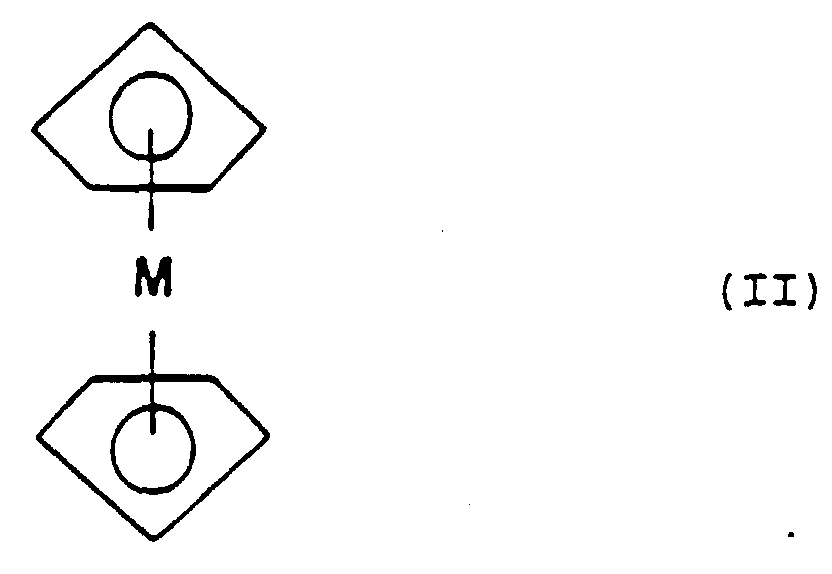
- the metallocene group corresponds to the general formula (II): in which M represents a metallic atom from group VIII of the Periodic Table of chemical elements, said atom possibly being in an oxidized form.
- trans isomers will designate the compounds of formula (Ia) having the following configuration: in which the group R 3 and the metallocene group are in the "trans” position with respect to each other on either side of the olefinic bond
- cis isomers will designate the metallocene compounds having the following configuration: in which the group R 3 and the metallocene group are in the "cis” position with respect to each other on either side of the olefinic bond.
- M represents an atom of iron and the corresponding metallocene compound is 1- [4- (2-dimethylaminoethoxy) phenyl] -1- (4-hydroxyphenyl) -2-ferrocenyl-1-butene.
- the metallocene compound is the "trans" isomer of 1- [4- (2-dimethylaminoethoxy) phenyl] -1- (4-hydroxyphenyl) -2-ferrocenyl-1-butene.
- M represents an iron atom and the corresponding metallocene compound is 1- [4- (2-dimethylaminoethoxy) phenyl] -1-phenyl-2-ferrocenyl-1-butene.
- R 6 represents a hydrogen atom or a C 1 to C 3 alkyl group.
- the compounds of general formula (IV) can be prepared according to the procedures that have been proposed in the Prior Art for the synthesis of antioestrogens triarylethylenics (Cur. Med. Chem., 1994, 1, 61-104).
- a metal salt of cyclopentadienyl suitable for the implementation of step a) of this process is represented by the cyclopentadienate of sodium.
- the strong base useful for the implementation of step b) can for example be NaH or NaNH 2 .
- Dehydration of the intermediate alcohol can advantageously be carried out by the action of a strong acid such as hydrochloric acid.
- the demethylation reaction can advantageously be carried out by the action of tribromide boron in the presence of a suitable solvent such as by example dichloromethane.
- this process comprises beforehand the preparation of the metallocene ester of formula (V) by esterification of the acid corresponding metallocenylacetic followed by a reaction of carbon alkylation in position ⁇ of the ring metallocenyl of said ester.
- Esterification of metallocenylacetic acid can be achieved with a strong base such as potassium tert-butoxide (t-BuOK).
- a strong base such as potassium tert-butoxide (t-BuOK).
- a suitable alkylating reagent is represented by iodoethane.
- This alkylation is advantageously carried out in the presence of a strong base such as for example t-BuOK or hexamethyldisilazane sodium or potassium and a solvent suitable, for example dimethyl sulfoxide (DMSO).
- a strong base such as for example t-BuOK or hexamethyldisilazane sodium or potassium
- a solvent suitable for example dimethyl sulfoxide (DMSO).
- Metallocenylacetic acid can be prepared according to the method described in the literature (LEDNICER and al., J. Org. Chem., 1958, 23, 653) which consists in making react metallocenylmethyl-trimethyl ammonium iodide with potassium cyanide to get the corresponding metallocenylacetonitrile then to hydrolyze this last.
- the method of specific preparation of the compounds of formula (I-a1) further includes a step of separating the isomers "cis” and “trans” of these compounds.
- This separation can advantageously be produced by fractional crystallization. It is, however, it is possible to use other techniques of Prior Art such as for example a thin layer chromatography using an eluent appropriate.
- Metallocenic acid chloride can be obtained by the action of trichloride or pentachloride phosphorus or thionyl chloride or even triphosgene on metallocenyl-2-butanoic acid corresponding.
- Dehydration of the intermediate alcohol can be achieved by the action of a strong acid such as hydrochloric acid.
- the bromination reaction to which it is subjected the compound of formula (VIII) can be produced with hydrobromic acid in the presence of a suitable solvent like for example pyridine.
- the products of general formula (I) and their addition salts with acids acceptable from the point of pharmacological view can be administered to humans in as medicines, alone or in the form of pharmaceutical compositions which allow a enteral or parenteral application and which contain, as an active ingredient, an effective dose of at least one product of formula (I) or an acid addition salt of a such compound, with in addition, excipients and additives harmless caught among those ordinarily used in pharmacies.
- a sodium ethanolate solution is first prepared by reacting 0.120 g (5.2 mmol) of sodium with 20 ml of ethanol. Then added to this solution 0.450 g (1.06 mmol) of 1,1-Bis- (4-hydroxyphenyl) -2-ferrocenyl-1-butene dissolved in 10 ml of ethanol. After 1 hour of stirring at 80 ° C., 0.302 g (2.1 mmol) of 2-dimethyl-aminoethyl hydrochloride chloride is added and the mixture is heated at reflux for 3 hours. The solution is then allowed to cool to room temperature. It is hydrolyzed with 100 ml of water and the product is extracted with ether (4 times 50 ml).
- the mixture of the two isomers previously obtained is dissolved in an ether / hexane mixture (5: 1) and the solution obtained is left in a refrigerator for 1 night.
- the melting points of the "trans” isomers and “cis” were determined using a Kofler bench. They are respectively 93-94 ° C for the "trans” isomer and 181 ° C for the "cis” isomer.
- the viability cell cultures was determined using the test called "MTT" consisting in adding 20 ⁇ l to each well of a solution containing 5 mg of (dimethyl-4,5-thiazol-2-yl) diphenyl-2,5-tetrazolium bromide (MTT) in 1 ml of PBS buffer, and incubate the plates for 1 hour at 37 ° C in atmospheric conditions identical to those defined above.
- MTT is metabolized in living cells to a blue compound insoluble (formazan).
- the wells are washed with PBS to remove MTT and residual formazan crystals are taken up in 1 ml of DMSO.
- concentration of formazan for each well is read by photometry at a wavelength of 550 nm and compared to a control corresponding to medium incubated in presence of MTT but in the absence of cells.
- Figures 1A and 1B show the results cytoxicity tests performed respectively with the "cis” isomer ( Figure 1A) and the “trans” isomer ( Figure 1B) 1- [4- (2-dimethylaminoethoxy) phenyl] -1- (4-hydroxyphenyl) -2-ferrocenyl-1-butene on the two lines above indicated. These results are expressed as fractions of surviving cells as a function doses of the test compound.
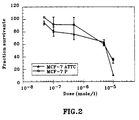
- Figure 2 shows the results obtained by performing the same tests and in the same conditions with tamoxifen.
- Table 1 below presents the inhibitory doses 50 (IC 50 ) expressed in moles and calculated on the points of Figures 1A, 1B and 2 between 5.10 -7 and 10 -5 moles / 1.
Landscapes
- Chemical & Material Sciences (AREA)
- Organic Chemistry (AREA)
- Health & Medical Sciences (AREA)
- Life Sciences & Earth Sciences (AREA)
- General Health & Medical Sciences (AREA)
- Medicinal Chemistry (AREA)
- Nuclear Medicine, Radiotherapy & Molecular Imaging (AREA)
- Pharmacology & Pharmacy (AREA)
- Chemical Kinetics & Catalysis (AREA)
- Animal Behavior & Ethology (AREA)
- General Chemical & Material Sciences (AREA)
- Public Health (AREA)
- Veterinary Medicine (AREA)
- Organic Low-Molecular-Weight Compounds And Preparation Thereof (AREA)
- Pharmaceuticals Containing Other Organic And Inorganic Compounds (AREA)
- Acyclic And Carbocyclic Compounds In Medicinal Compositions (AREA)
- Steroid Compounds (AREA)
Claims (19)
- Verbindungen der allgemeinen Formel (I):worin:
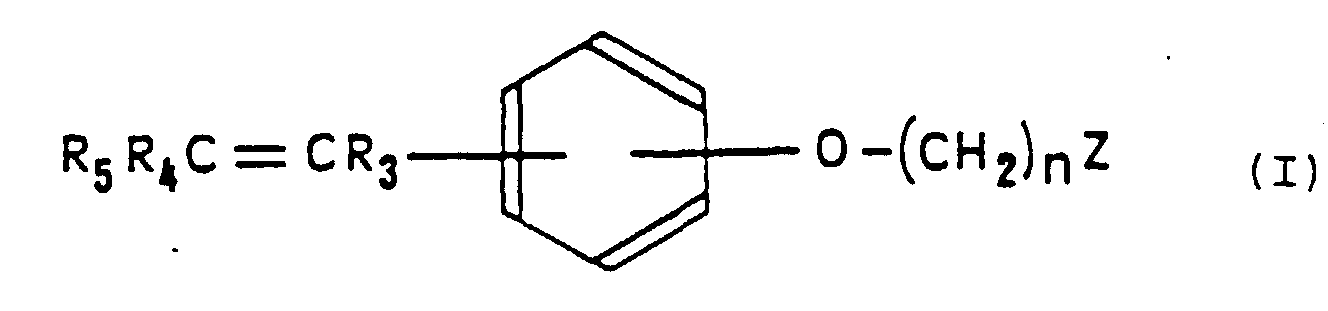 sich die Gruppe -O(CH2)nZ in der Meta- oder Paraposition bezüglich der Gruppe -CR3=CR4R5 befindet,n für eine ganze Zahl zwischen 2 und 10 steht,Z für einen basischen oder polaren Liganden steht, ausgewählt aus den Gruppen -NR1R2, worin R1 und R2, die identisch oder verschieden sind, für eine gegebenenfalls durch ein oder mehrere Halogenatome substituierte C1-C6-Alkylgruppe stehen, den heterocyclischen Gruppen, die ein Stickstoffatom enthalten, oder den Gruppen -OR1, -SR1, -SOR1 oder-SO2R1, in denen R1 die gleiche Bedeutung wie zuvor hat, und worin:in allen ihren stereoisomeren Formen sowie ihre Salze.entweder R3 für eine Phenylgruppe steht, die gegebenenfalls durch ein oder mehrere Wasserstoffatome oder Halogenatome oder Hydroxylgruppen oder C1-C3-Alkyl- oder Alkoxygruppen substituiert ist, und R5 für eine Metallocengruppe steht, während R4 für ein Wasserstoffatom oder ein Halogenatom oder eine NO2-Gruppe oder eine Chlorethylgruppe oder eine CN-Gruppe oder auch eine C1-C3-Alkylgruppe, deren terminales Kohlenstoffatom gegebenenfalls mit dem Kohlenstoffatom in der Position 2 der Phenylgruppe von R3 verbunden sein kann, steht,oder R3 für eine Metallocengruppe steht und R5 für eine Phenylgruppe steht, die gegebenenfalls durch ein oder mehrere Wasserstoffatome oder Halogenatome oder Hydroxylgruppen oder C1-C3-Alkyl- oder Alkoxygruppen substituiert ist, während R4 für ein Wasserstoffatom oder ein Halogenatom oder eine NO2-Gruppe oder eine Chlorethylgruppe oder eine CN-Gruppe oder eine C1-C3-Alkylgruppe steht,
 - Verbindungen nach Anspruch 1, dadurch gekennzeichnet , daß die Metallocengruppe der allgemeinen Formel (II) entspricht:in der M für ein Metallatom der Gruppe VIII des Periodensystems der Elemente steht, wobei dieses Atom gegebenenfalls in einer oxidierten Form vorliegen kann.
- Verbindungen nach Anspruch 1, dadurch gekennzeichnet , daß die Metallocengruppe der allgemeinen Formel (III) entspricht:worin:
 M für ein Metallatom, ausgewählt aus Titan, Vanadium, Niob, Hafnium oder Molybdän, steht,X für ein Halogenatom, ausgewählt aus Chlor, Brom oder Iod, steht.
 - Verbindungen nach Anspruch 1 oder Anspruch 2, dadurch gekennzeichnet, daß sie der speziellen Formel (I-a) entsprechen:worin:
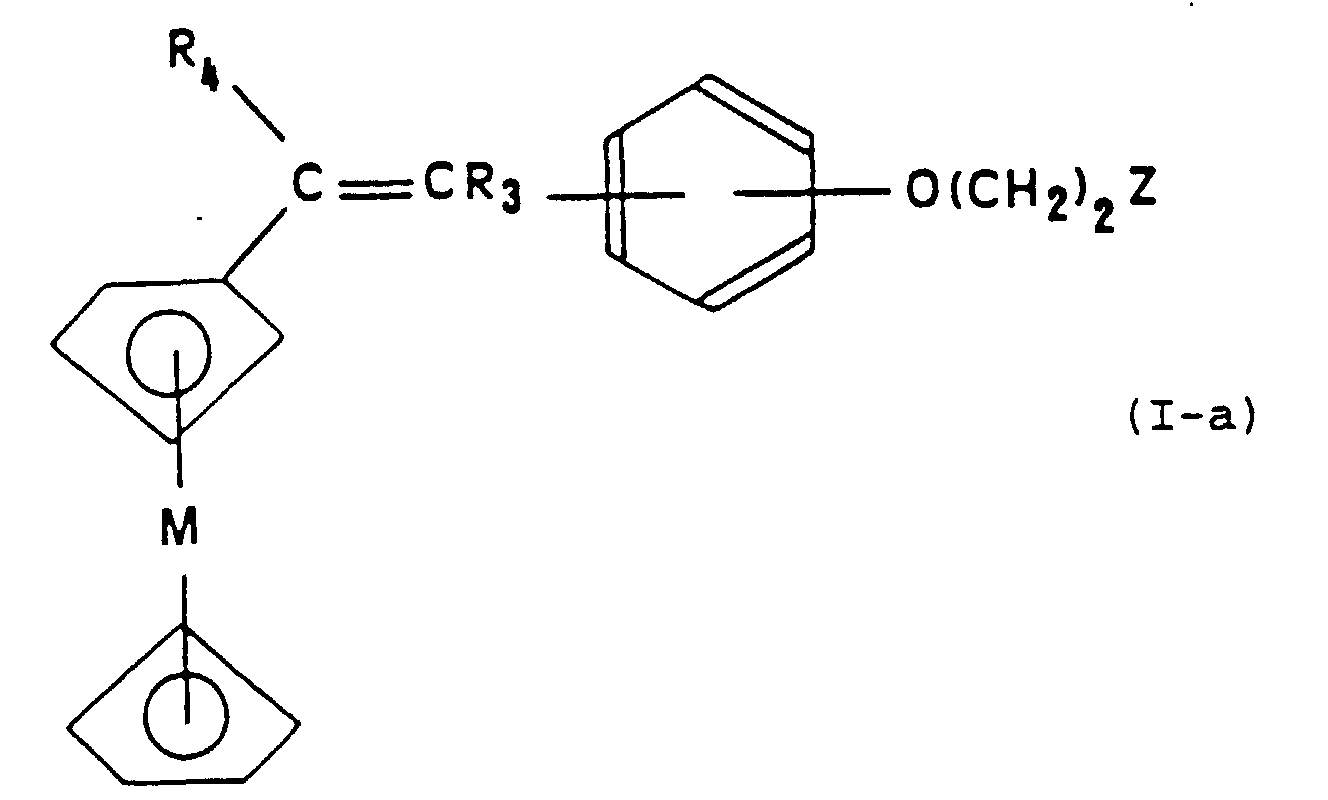 sich die Gruppe -O(CH2)2Z in der Paraposition bezüglich der Gruppe -CR3=CR4R5 befindet,Z für eine Gruppe -NR1R2 steht, in der R1 und R2, die identisch oder verschieden sind, für eine Methylgruppe oder eine Ethylgruppe stehen, oder Z für eine N-Pyrrolidinogruppe steht,R3 für eine Phenylgruppe steht, die gegebenenfalls durch eine Hydroxylgruppe oder eine Methoxygruppe substituiert ist,R4 für ein Wasserstoffatom oder ein Halogenatom oder eine NO2-Gruppe oder eine Chlorethylgruppe oder eine CN-Gruppe oder auch eine Ethylgruppe steht, undM für ein Metallatom, ausgewählt aus Eisen, Ruthenium oder Osmium, steht, das gegebenenfalls in seiner oxidierten Form vorliegt.
 - Verbindungen nach Anspruch 4, dadurch gekennzeichnet , daß R1 und R2 für eine Methylgruppe stehen, R3 für eine Phenylgruppe steht, die in der Paraposition durch eine Hydroxylgruppe substituiert ist, und R4 für eine Ethylgruppe steht, wobei diese Verbindungen der speziellen Formel (I-a1) entsprechen.
- Verbindung nach Anspruch 5, dadurch gekennzeichnet , daß sie 1-[4-(2-Dimethylaminoethoxy)-phenyl]-1-(4-hydroxyphenyl)-2-ferrocenyl-1-buten ist.
- Verbindung nach Anspruch 6, dadurch gekennzeichnet , daß sie das trans-Isomere von 1-[4-(2-Dimethylaminoethoxy)phenyl]-1-(4-hydroxyphenyl)-2-ferrocenyl-1-buten ist.
- Verbindungen nach Anspruch 4, dadurch gekennzeichnet , daß R1 und R2 für eine Methylgruppe stehen, R3 für eine Phenylgruppe steht und R4 für eine Ethylgruppe steht, wobei diese Verbindungen der speziellen Formel (I-a2) entsprechen.
- Verbindung nach Anspruch 8, dadurch gekennzeichnet , daß sie 1-[4-(2-Dimethylaminoethoxy)-phenyl]-1-phenyl-2-ferrocenyl-1-buten ist.
- Verbindungen nach Anspruch 1 oder Anspruch 2, dadurch gekennzeichnet, daß:sich die Gruppe -O(CH2)nZ in der Paraposition bezüglich der Gruppe -CR3=CR4R5 befindet,n gleich 2 ist und Z für eine N-Pyrrolidiongruppe steht, R3 für eine Phenylgruppe steht, die in der Paraposition durch eine Hydroxyl- oder C1-C3-Alkoxygruppe substituiert ist, während R4 für eine C2-Alkylgruppe steht, deren terminales Kohlenstoffatom mit dem Kohlenstoffatom in Position 2 der Phenylgruppe von R3 verbunden ist,M für ein Metallatom, ausgewählt aus Eisen, Ruthenium oder Osmium, steht, das gegebenenfalls in seiner oxidierten Form vorliegt,wobei diese Verbindungen der speziellen Formel (I-b) entsprechen.
- Verfahren zur Herstellung einer Verbindung nach einem der Ansprüche 1 bis 10, dadurch gekennzeichnet, daß :oder mit einer metallorganischen Verbindung der Formel: Cp-M-Xm, in der Cp und X die gleiche Bedeutung wie zuvor haben, M ein Metallatom, ausgewählt aus Titan, Vanadium, Niob, Hafnium oder Molybdän, ist, und m eine ganze Zahl gleich 3 oder 4 ist.a) man eine Verbindung der allgemeinen Formel (IV) umsetzt:worin:
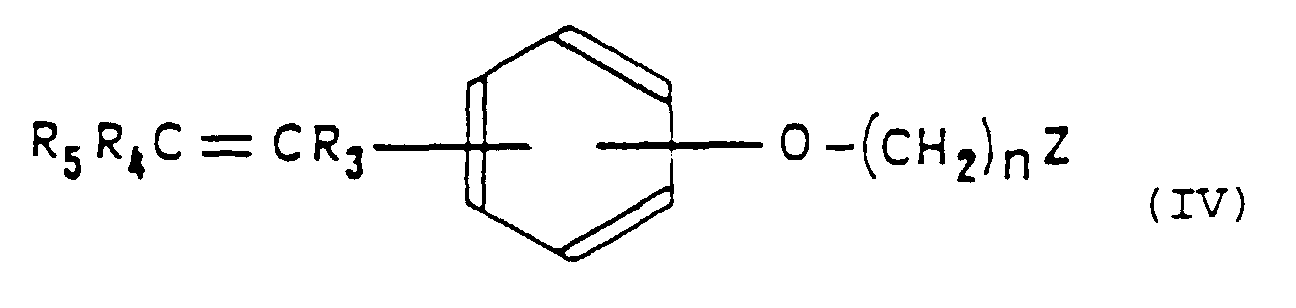 sich die Gruppe -O(CH2)nZ in der Meta- oder Paraposition bezüglich der Gruppe -CR3=CR4R5 befindet,n für eine ganze Zahl zwischen 2 und 10 steht,Z für einen basischen oder polaren Liganden steht, ausgewählt aus den Gruppen -NR1R2, worin R1 und R2, die identisch oder verschieden sind, für eine gegebenenfalls durch ein oder mehrere Halogenatome substituierte C1-C6-Alkylgruppe stehen, den heterocyclischen Gruppen, die ein Stickstoffatom enthalten, oder den Gruppen -OR1, -SR1, -SOR1 oder -SO2R1, in denen R1 die gleiche Bedeutung wie zuvor hat, und worin:mit einem Metallsalz des Cyclopentadiens, um die Substitution des Bromatoms durch eine Cyclopentadienylgruppe zu erreichen;entweder R3 für eine Phenylgruppe steht, die gegebenenfalls durch ein oder mehrere Wasserstoffatome oder Halogenatome oder Hydroxylgruppen oder C1-C3-Alkyl- oder Alkoxygruppen substituiert ist, und R5 für ein Bromatom steht, während R4 für ein Wasserstoffatom oder ein Halogenatom oder eine NO2-Gruppe oder eine Chlorethylgruppe oder eine CN-Gruppe oder auch eine C1-C3-Alkylgruppe, deren terminales Kohlenstoffatom gegebenenfalls mit dem Kohlenstoffatom in der Position 2 der Phenylgruppe von R3 verbunden sein kann, steht,oder R3 für ein Bromatom steht und R5 für eine Phenylgruppe steht, die gegebenenfalls durch ein oder mehrere Wasserstoffatome oder Halogenatome oder Hydroxylgruppen oder C1-C3-Alkyl- oder Alkoxygruppen substituiert ist, während R4 für ein Wasserstoffatom oder ein Halogenatom oder eine NO2-Gruppe oder eine Chlorethylgruppe oder eine CN-Gruppe oder eine C1-C3-Alkylgruppe steht,b) man die in Schritt a) erhaltene Verbindung mit einer starken Base reagieren läßt, um die Bildung eines Cyclopentadienylanions zu ereichen,c) man die in Schritt b) erhaltene Verbindung reagieren läßt mit einer metallorganischen Verbindung der Formel: Cp-M-(CO)2-X, in der Cp für eine Cyclopentadiengruppe steht, M für ein Metallatom der Gruppe VIII des Periodensystems der Elemente steht und X für ein Halogenatom, ausgewählt aus Chlor, Brom oder Iod, steht,
 - Verfahren zur Herstellung einer Verbindung der speziellen Formel (I-a1) nach einem der Ansprüche 5 bis 7, dadurch gekennzeichnet, daß:a) man einen Metallocenester der Formel (V):worin M für ein Metallatom, ausgewählt aus Eisen, Ruthenium oder Osmium, steht, einer Additionsreaktion mit der Organolithiumverbindung CH3-O-C6H4-Li oder einer Organomagnesiumverbindung der Formel: CH3-O-C6H4-MgX, in der X für ein Chlor-, Brom- oder Iodatom steht, unterwirft, die zur Bildung eines intermediären Alkohols führt, gefolgt von einer Dehydratisierungsreaktion des genannten Alkohols,
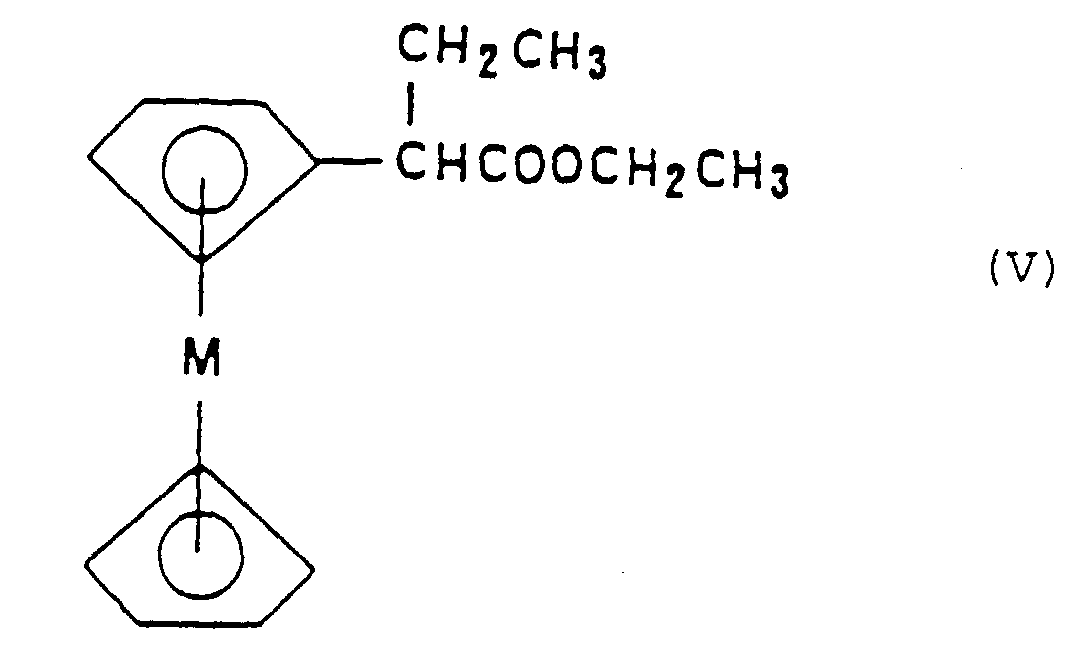 b) man die in Schritt a) erhaltene Verbindung einer Demethylierungsreaktion unterwirft,c) man die in Schritt b) erhaltene Verbindung einer Alkylierungsreaktion durch Natriumethanolat und das Hydrochlorid des 1-Chlor-2-dimethylaminoethans unterwirft.
 - Herstellungsverfahren nach Anspruch 12, dadurch gekennzeichnet , daß es die vorherige Darstellung des Metallocenesters der Formel (V) durch Veresterung der entsprechenden Metallocenylessigsäure, gefolgt von einer Alkylierungsreaktion des Kohlenstoffatoms in der α-Position des Metallocenylcyclus des genannten Esters, umfaßt.
- Herstellungsverfahren nach Anspruch 12 oder Anspruch 13, dadurch gekennzeichnet, daß es zusätzlich einen Schritt zur Trennung der cis- und trans-Isomeren der erhaltenen Verbindung der speziellen Formel (I-a1) umfaßt.
- Verfahren zur Herstellung der Verbindungen der speziellen Formel (I-a2) nach Anspruch 8 oder Anspruch 9, dadurch gekennzeichnet, daß:a) man ein Chlorid einer Metallocensäure der Formel (VI) :worin M für ein Metallatom, ausgewählt aus Eisen, Ruthenium oder Osmium, steht, mit Diphenylzink umsetzt, um die Substitution des Chloratoms durch eine Phenylgruppe zu erhalten,
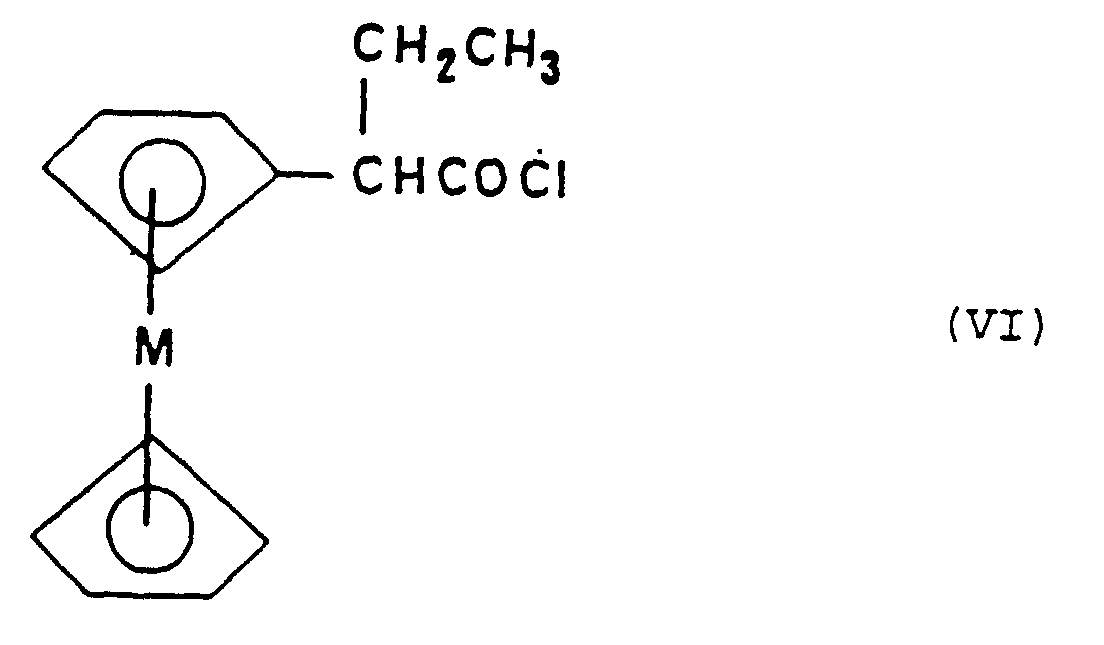 b) man die in Schritt a) erhaltene Verbindung einer Additionsreaktion mit der Organolithiumverbindung (CH3)2-N-(CH2)2-O-C6H4-Li oder einer Organomagnesiumverbindung der Formel: (CH3)2-N-(CH2)2-O-C6H4-MgX, in der X für ein Halogenatom, ausgewählt aus Chlor, Brom oder Iod, steht, unterwirft, die zur Bildung eines intermediären Alkohols führt, gefolgt von einer Dehydratisierungsreaktion des genannten Alkohols.
 - Herstellungsverfahren nach Anspruch 15, dadurch gekennzeichnet , daß es außerdem einen Schritt zur Trennung der cis- und trans-Isomeren der erhaltenen Verbindung der speziellen Formel (I-a2) umfaßt.
- Verfahren zur Herstellung einer Verbindung der speziellen Formel (I-b) nach Anspruch 10, dadurch gekennzeichnet , daß:a) man ein Tetralon der Formel (VII):worin R6 für ein Wasserstoffatom oder eine C1-C3-Alkylgruppe steht, mit der Organolithiumverbindung
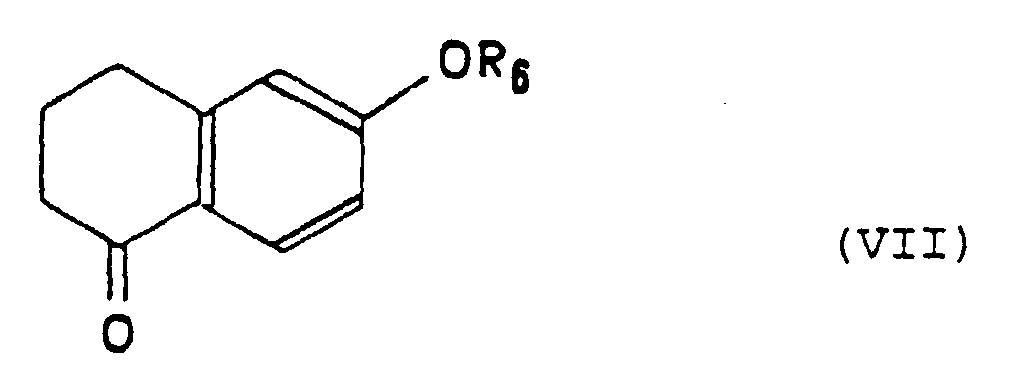 oder einer Organomagnesiumverbindung der Formel:
 in der X für ein Halogenatom, ausgewählt aus Chlor, Brom oder Iod, steht, umsetzt, was zur Bildung eines intermediären Alkohols führt, gefolgt von einer Dehydratisierungsreaktion des genannten Alkohols,
 b) man die in Schritt a) erhaltene Verbindung einer Bromierungsreaktion unterwirft, um die Verbindung der Formel (VIII) zu erhalten:
 c) man die so erhaltene Verbindung der Formel (VIII) einer Kupplungsreaktion mit einer Organometallverbindung der Formel: Cp-M-(C5H4)-Y, in der Cp für eine Cyclopentadienylgruppe steht, M für ein Metallatom, ausgewählt aus Eisen, Ruthenium oder Osmium, steht, und Y für ein Lithiumatom, ein Kupferatom, eine SnBu3-Gruppe oder eine HgCl-Gruppe steht, unterwirft.
 - Pharmazeutische Zusammensetzung, dadurch gekennzeichnet, daß sie mindestens eine der Verbindungen der Formel (I) nach einem der Ansprüche 1 bis 10 oder eines ihrer Salze enthält, gegebenenfalls mit einem pharmazeutisch annehmbaren Träger.
- Verwendung einer Verbindung der Formel (I) oder eines ihrer Salze nach einem der Ansprüche 1 bis 10 zur Herstellung eines Antitumormedikaments.
Applications Claiming Priority (3)
| Application Number | Priority Date | Filing Date | Title |
|---|---|---|---|
| FR9412151A FR2725720B1 (fr) | 1994-10-12 | 1994-10-12 | Derives metalloceniques du diarylethylene, leurs procedes de preparation et compositions pharmaceutiques contenant lesdits derives |
| FR9412151 | 1994-10-12 | ||
| PCT/FR1995/001323 WO1996011935A1 (fr) | 1994-10-12 | 1995-10-11 | Derives metalloceniques du diarylethylene, leurs procedes de preparation et compositions pharmaceutiques contenant lesdits derives |
Publications (2)
| Publication Number | Publication Date |
|---|---|
| EP0804445A1 EP0804445A1 (de) | 1997-11-05 |
| EP0804445B1 true EP0804445B1 (de) | 2000-03-01 |
Family
ID=9467773
Family Applications (1)
| Application Number | Title | Priority Date | Filing Date |
|---|---|---|---|
| EP95934197A Expired - Lifetime EP0804445B1 (de) | 1994-10-12 | 1995-10-11 | Diarylethylen-metallogenderivate, verfahren zu deren herstellung und diese enthaltende arzneizusammensetzungen |
Country Status (11)
| Country | Link |
|---|---|
| EP (1) | EP0804445B1 (de) |
| JP (1) | JPH10511641A (de) |
| KR (1) | KR100383847B1 (de) |
| AU (1) | AU685006B2 (de) |
| BR (1) | BR9509314A (de) |
| CA (1) | CA2202169A1 (de) |
| DE (1) | DE69515341T2 (de) |
| ES (1) | ES2145926T3 (de) |
| FR (1) | FR2725720B1 (de) |
| MX (1) | MX9702671A (de) |
| WO (1) | WO1996011935A1 (de) |
Families Citing this family (7)
| Publication number | Priority date | Publication date | Assignee | Title |
|---|---|---|---|---|
| US5863911A (en) * | 1994-10-12 | 1999-01-26 | Modelisation Et Mise Au Point De Molecules Medicinales | Diarylethylene metallocene derivatives, their processes of preparation and pharmaceutical compositions containing said derivatives |
| RU2131249C1 (ru) * | 1998-11-12 | 1999-06-10 | Антипов Борис Геннадиевич | Способ лечения онкологических заболеваний и иммунодефицитных состояний магнитоактивными органическими соединениями железа и иммуностимулирующее и противоопухолевое средство на их основе |
| RU2132187C1 (ru) * | 1998-11-12 | 1999-06-27 | Антипов Борис Геннадиевич | Способ лечения заболеваний кожи и слизистых оболочек и магнитоактивное органическое соединение железа, используемое в нем |
| US6800776B1 (en) * | 2003-09-23 | 2004-10-05 | Chung-Shan Institute Of Science & Technology | Method for the preparation of ferrocenyl substituted styrene |
| FR2872814A1 (fr) * | 2004-07-08 | 2006-01-13 | Gerard Jouen | Utilisation de derives organometalliques de polyphenols ethylene pour la preparation d'un medicament |
| DE102008004100A1 (de) | 2008-01-11 | 2009-07-16 | Westfälische Wilhelms-Universität Münster Körperschaft des öffentlichen Rechts | Metallocenophane als Cytostatika |
| CN109081856B (zh) * | 2018-09-29 | 2021-05-11 | 陕西科技大学 | 一种4-二茂铁基-6-芳基-2-氨基嘧啶类化合物及其制备方法 |
Family Cites Families (2)
| Publication number | Priority date | Publication date | Assignee | Title |
|---|---|---|---|---|
| DE2623486C2 (de) * | 1976-05-26 | 1982-12-30 | Hoechst Ag, 6000 Frankfurt | 3.5.5-Trimethylhexanoyl-ferrocen, Verfahren zu seiner Herstellung und pharmazeutische Präparate |
| DE3404443A1 (de) * | 1984-02-08 | 1985-08-08 | Hartmut Prof. Dr. 1000 Berlin Köpf | Metallicenium-salze und deren verwendung als cytostatica bei der krebsbekaempfung |
-
1994
- 1994-10-12 FR FR9412151A patent/FR2725720B1/fr not_active Expired - Fee Related
-
1995
- 1995-10-11 DE DE69515341T patent/DE69515341T2/de not_active Expired - Fee Related
- 1995-10-11 EP EP95934197A patent/EP0804445B1/de not_active Expired - Lifetime
- 1995-10-11 WO PCT/FR1995/001323 patent/WO1996011935A1/fr not_active Ceased
- 1995-10-11 MX MX9702671A patent/MX9702671A/es not_active Application Discontinuation
- 1995-10-11 KR KR1019970702399A patent/KR100383847B1/ko not_active Expired - Fee Related
- 1995-10-11 AU AU36582/95A patent/AU685006B2/en not_active Ceased
- 1995-10-11 ES ES95934197T patent/ES2145926T3/es not_active Expired - Lifetime
- 1995-10-11 BR BR9509314A patent/BR9509314A/pt not_active IP Right Cessation
- 1995-10-11 CA CA002202169A patent/CA2202169A1/fr not_active Abandoned
- 1995-10-11 JP JP8512980A patent/JPH10511641A/ja not_active Withdrawn
Also Published As
| Publication number | Publication date |
|---|---|
| WO1996011935A1 (fr) | 1996-04-25 |
| FR2725720B1 (fr) | 1997-01-03 |
| DE69515341T2 (de) | 2000-10-19 |
| AU685006B2 (en) | 1998-01-08 |
| BR9509314A (pt) | 1998-01-27 |
| MX9702671A (es) | 1998-02-28 |
| EP0804445A1 (de) | 1997-11-05 |
| JPH10511641A (ja) | 1998-11-10 |
| KR100383847B1 (ko) | 2003-07-22 |
| CA2202169A1 (fr) | 1996-04-25 |
| ES2145926T3 (es) | 2000-07-16 |
| FR2725720A1 (fr) | 1996-04-19 |
| DE69515341D1 (de) | 2000-04-06 |
| AU3658295A (en) | 1996-05-06 |
Similar Documents
| Publication | Publication Date | Title |
|---|---|---|
| JPS6089474A (ja) | モルフイナン誘導体,その製造方法,及び該化合物を含有する抗腫瘍剤 | |
| BE851310A (fr) | Nouveaux derives de la tetrahydro-equinocandine b | |
| FR2501686A1 (fr) | Nouveaux derives de 3,4-dihydro-5h-2,3-benzodiazepine, procede pour les preparer et medicaments les contenant | |
| LU86435A1 (fr) | Nouveaux derives du morphinane et de la morphine,leur preparation,leur application comme medicaments et les compositions pharmaceutiques les contenant | |
| EP0148167B1 (de) | Quinolinderivate, Verfahren zu ihrer Herstellung und sie enthaltende pharmazeutische Mittel | |
| FR2663328A1 (fr) | Derives d'hexahydroazepines, un procede pour leur preparation et compositions pharmaceutiques les contenant. | |
| WO1994027949A1 (fr) | Nouveaux derives de l'hydroxybiphenyle, leur preparation et les compositions pharmaceutiques qui les contiennent | |
| EP0804445A1 (de) | Diarylethylen-metallogenderivate, verfahren zu deren herstellung und diese enthaltende arzneizusammensetzungen | |
| BE1000039A4 (fr) | Nouvelles 8 alpha-acylamino-ergolines, leur preparation et leur utilisation comme medicaments. | |
| JP2588977B2 (ja) | ベンゼン誘導体、その調製およびこれを含有する薬学的組成物 | |
| MC1175A1 (fr) | Derives polyeniques | |
| FR2933405A1 (fr) | Derives ferroceniques a activite anticancereuse | |
| MC1357A1 (fr) | Derives de 2,3-indoledione | |
| FR2551063A1 (fr) | Nouveaux dimethyl-2,5 pyrroles, leur procede de preparation et leur application en therapeutique | |
| MXPA97002671A (es) | Derivados metalocenicos de diariletileno, metodosde preparacion y composiciones farmaceuticas que contienen estos derivados | |
| US5863911A (en) | Diarylethylene metallocene derivatives, their processes of preparation and pharmaceutical compositions containing said derivatives | |
| EP0433167B1 (de) | Piperidinderivate, Verfahren zur Herstellung sowie diese enthaltende pharmazeutische Präparate | |
| FR2587333A1 (fr) | Nouveaux ethers allyliques bicycliques, leur preparation et leur utilisation comme anti-fongiques et fongicides | |
| US5397802A (en) | Gem-dichlorocyclopropanes as antitumor agents | |
| CA1076117A (fr) | Procede d'obtention de nouveaux ethers aryliques et les produits en resultant | |
| EP0027759B1 (de) | Spiro-Derivate, Verfahren zu ihrer Herstellung und sie enthaltende Arzneimittel | |
| EP1560825A1 (de) | Neue 2,3-dihydro-4(1h)-pyridinonderivate, verfahren zu ihrer herstellung und diese enthaltende pharmazeutische zusammensetzungen | |
| EP0151052B1 (de) | Aminoäthylimidazole, pharmazeutische Zusammensetzungen die sie enthalten und Verfahren zu ihrer Herstellung | |
| FR2602228A1 (en) | New phenoxyisobutyric acids, their derivatives and processes for producing them | |
| EP0518769B1 (de) | Benzoesäureethanolaminesterderivate, Verfahren zu ihrer Herstellung und diese enthaltende pharmazeutische Zusammensetzungen |
Legal Events
| Date | Code | Title | Description |
|---|---|---|---|
| PUAI | Public reference made under article 153(3) epc to a published international application that has entered the european phase |
Free format text: ORIGINAL CODE: 0009012 |
|
| 17P | Request for examination filed |
Effective date: 19970423 |
|
| AK | Designated contracting states |
Kind code of ref document: A1 Designated state(s): BE CH DE ES FR GB IT LI NL SE |
|
| 17Q | First examination report despatched |
Effective date: 19981015 |
|
| GRAG | Despatch of communication of intention to grant |
Free format text: ORIGINAL CODE: EPIDOS AGRA |
|
| GRAG | Despatch of communication of intention to grant |
Free format text: ORIGINAL CODE: EPIDOS AGRA |
|
| GRAH | Despatch of communication of intention to grant a patent |
Free format text: ORIGINAL CODE: EPIDOS IGRA |
|
| GRAH | Despatch of communication of intention to grant a patent |
Free format text: ORIGINAL CODE: EPIDOS IGRA |
|
| GRAA | (expected) grant |
Free format text: ORIGINAL CODE: 0009210 |
|
| AK | Designated contracting states |
Kind code of ref document: B1 Designated state(s): BE CH DE ES FR GB IT LI NL SE |
|
| REG | Reference to a national code |
Ref country code: CH Ref legal event code: EP |
|
| REF | Corresponds to: |
Ref document number: 69515341 Country of ref document: DE Date of ref document: 20000406 |
|
| REG | Reference to a national code |
Ref country code: CH Ref legal event code: NV Representative=s name: RITSCHER & SEIFERT |
|
| ITF | It: translation for a ep patent filed | ||
| K2C1 | Correction of patent specification (title page) published |
Effective date: 20000301 |
|
| GBT | Gb: translation of ep patent filed (gb section 77(6)(a)/1977) |
Effective date: 20000602 |
|
| REG | Reference to a national code |
Ref country code: ES Ref legal event code: FG2A Ref document number: 2145926 Country of ref document: ES Kind code of ref document: T3 |
|
| EN | Fr: translation not filed | ||
| EN4 | Fr: notification of non filing translation in an earlier bopi is erroneous | ||
| PLBE | No opposition filed within time limit |
Free format text: ORIGINAL CODE: 0009261 |
|
| STAA | Information on the status of an ep patent application or granted ep patent |
Free format text: STATUS: NO OPPOSITION FILED WITHIN TIME LIMIT |
|
| 26N | No opposition filed | ||
| REG | Reference to a national code |
Ref country code: GB Ref legal event code: IF02 |
|
| PGFP | Annual fee paid to national office [announced via postgrant information from national office to epo] |
Ref country code: ES Payment date: 20040916 Year of fee payment: 10 |
|
| PGFP | Annual fee paid to national office [announced via postgrant information from national office to epo] |
Ref country code: FR Payment date: 20040929 Year of fee payment: 10 |
|
| PGFP | Annual fee paid to national office [announced via postgrant information from national office to epo] |
Ref country code: GB Payment date: 20041006 Year of fee payment: 10 |
|
| PGFP | Annual fee paid to national office [announced via postgrant information from national office to epo] |
Ref country code: NL Payment date: 20041007 Year of fee payment: 10 |
|
| PGFP | Annual fee paid to national office [announced via postgrant information from national office to epo] |
Ref country code: DE Payment date: 20041008 Year of fee payment: 10 |
|
| PGFP | Annual fee paid to national office [announced via postgrant information from national office to epo] |
Ref country code: SE Payment date: 20041020 Year of fee payment: 10 |
|
| PGFP | Annual fee paid to national office [announced via postgrant information from national office to epo] |
Ref country code: CH Payment date: 20041029 Year of fee payment: 10 |
|
| PGFP | Annual fee paid to national office [announced via postgrant information from national office to epo] |
Ref country code: BE Payment date: 20041117 Year of fee payment: 10 |
|
| PG25 | Lapsed in a contracting state [announced via postgrant information from national office to epo] |
Ref country code: IT Free format text: LAPSE BECAUSE OF NON-PAYMENT OF DUE FEES;WARNING: LAPSES OF ITALIAN PATENTS WITH EFFECTIVE DATE BEFORE 2007 MAY HAVE OCCURRED AT ANY TIME BEFORE 2007. THE CORRECT EFFECTIVE DATE MAY BE DIFFERENT FROM THE ONE RECORDED. Effective date: 20051011 Ref country code: GB Free format text: LAPSE BECAUSE OF NON-PAYMENT OF DUE FEES Effective date: 20051011 |
|
| PG25 | Lapsed in a contracting state [announced via postgrant information from national office to epo] |
Ref country code: SE Free format text: LAPSE BECAUSE OF NON-PAYMENT OF DUE FEES Effective date: 20051012 |
|
| PG25 | Lapsed in a contracting state [announced via postgrant information from national office to epo] |
Ref country code: ES Free format text: LAPSE BECAUSE OF NON-PAYMENT OF DUE FEES Effective date: 20051013 |
|
| PG25 | Lapsed in a contracting state [announced via postgrant information from national office to epo] |
Ref country code: LI Free format text: LAPSE BECAUSE OF NON-PAYMENT OF DUE FEES Effective date: 20051031 Ref country code: CH Free format text: LAPSE BECAUSE OF NON-PAYMENT OF DUE FEES Effective date: 20051031 Ref country code: BE Free format text: LAPSE BECAUSE OF NON-PAYMENT OF DUE FEES Effective date: 20051031 |
|
| PG25 | Lapsed in a contracting state [announced via postgrant information from national office to epo] |
Ref country code: NL Free format text: LAPSE BECAUSE OF NON-PAYMENT OF DUE FEES Effective date: 20060501 |
|
| PG25 | Lapsed in a contracting state [announced via postgrant information from national office to epo] |
Ref country code: DE Free format text: LAPSE BECAUSE OF NON-PAYMENT OF DUE FEES Effective date: 20060503 |
|
| REG | Reference to a national code |
Ref country code: CH Ref legal event code: PL |
|
| EUG | Se: european patent has lapsed | ||
| GBPC | Gb: european patent ceased through non-payment of renewal fee |
Effective date: 20051011 |
|
| PG25 | Lapsed in a contracting state [announced via postgrant information from national office to epo] |
Ref country code: FR Free format text: LAPSE BECAUSE OF NON-PAYMENT OF DUE FEES Effective date: 20060630 |
|
| NLV4 | Nl: lapsed or anulled due to non-payment of the annual fee |
Effective date: 20060501 |
|
| REG | Reference to a national code |
Ref country code: FR Ref legal event code: ST Effective date: 20060630 |
|
| REG | Reference to a national code |
Ref country code: ES Ref legal event code: FD2A Effective date: 20051013 |
|
| BERE | Be: lapsed |
Owner name: *MODELISATION ET MISE AU POINT DE MOLECULES MEDICA Effective date: 20051031 |