EP0804019A2 - Schaltung zur Begrenzung des Strahlstroms einer Bildröhre - Google Patents
Schaltung zur Begrenzung des Strahlstroms einer Bildröhre Download PDFInfo
- Publication number
- EP0804019A2 EP0804019A2 EP97106150A EP97106150A EP0804019A2 EP 0804019 A2 EP0804019 A2 EP 0804019A2 EP 97106150 A EP97106150 A EP 97106150A EP 97106150 A EP97106150 A EP 97106150A EP 0804019 A2 EP0804019 A2 EP 0804019A2
- Authority
- EP
- European Patent Office
- Prior art keywords
- beam current
- resistor
- transformer
- circuit
- circuit according
- Prior art date
- Legal status (The legal status is an assumption and is not a legal conclusion. Google has not performed a legal analysis and makes no representation as to the accuracy of the status listed.)
- Granted
Links
Images

Classifications
-
- H—ELECTRICITY
- H04—ELECTRIC COMMUNICATION TECHNIQUE
- H04N—PICTORIAL COMMUNICATION, e.g. TELEVISION
- H04N5/00—Details of television systems
- H04N5/66—Transforming electric information into light information
- H04N5/68—Circuit details for cathode-ray display tubes
-
- H—ELECTRICITY
- H04—ELECTRIC COMMUNICATION TECHNIQUE
- H04N—PICTORIAL COMMUNICATION, e.g. TELEVISION
- H04N3/00—Scanning details of television systems; Combination thereof with generation of supply voltages
- H04N3/10—Scanning details of television systems; Combination thereof with generation of supply voltages by means not exclusively optical-mechanical
- H04N3/16—Scanning details of television systems; Combination thereof with generation of supply voltages by means not exclusively optical-mechanical by deflecting electron beam in cathode-ray tube, e.g. scanning corrections
- H04N3/20—Prevention of damage to cathode-ray tubes in the event of failure of scanning
Definitions
- the invention relates to a circuit for limiting the beam current of a picture tube in a television receiver according to the preamble of claim 1.
- the limiting value is set so that it lies above the beam current with which the picture tube may be subjected to continuous operation without being damaged.
- the long-term average is always below this maximum limitation of the beam current, since there are also dark scenes in which the limitation is not effective. Continuous operation with active beam current limitation is theoretically possible.
- An extreme load case must be taken into account when dimensioning the beam current limiting circuit. This occurs, for example, if the television receiver is operated at an ambient temperature of + 40 ° C for several hours with a completely white picture under extremely poor cooling conditions, such as on a shelf. Even in this extreme load case, the limit values for the high-voltage transformer must not be exceeded.
- the mentioned extreme load case occurs in practice with a device very rarely or never. The need for its consideration in the Dimensioning the beam current limitation, however, limits the scope for the maximum permissible beam current for normal moving images. In other words: If the extreme load case mentioned did not exist with certainty, a higher beam current could be permitted with normal moving images and thus a brighter image could be achieved.
- the invention has for its object to enable a higher beam current for white image areas and thus a brighter image, without the high voltage transformer being endangered in the extreme case mentioned.
- This object is achieved by the invention specified in claim 1.
- Advantageous developments of the invention are specified in the subclaims.
- the invention thus consists in that the transformer contains a temperature sensor, which acts above a certain temperature on the control circuit for the jet current in the sense of a reduction in the jet current.
- the invention is based on the following findings and considerations.
- the extreme load case mentioned cannot be ruled out in practice and must be taken into account when dimensioning the beam current limiting circuit.
- a danger or destruction of the transformer is only possible through an increased temperature of the transformer. Therefore, the temperature of the high-voltage transformer is monitored according to the invention. If the temperature of the transformer and thus also that of the rectifier diodes exceeds a certain value, the beam current is regulated back in the sense of a control loop so that a permissible temperature on the transformer of e.g. 100 °.
- the solution according to the invention has several advantages. There is an imminent danger to the high-voltage transformer in an extreme load case due to the temperature monitoring is recognized and captured, a higher beam current can be permitted for normal operation with moving images and thus a brighter image can be achieved without there being any danger to the transformer.
- the high-voltage transformer remains protected by the temperature control in all cases. In particular, the rectifier diodes cannot reach an inadmissibly high temperature and the core of the transformer cannot reach saturation. If necessary, the high-voltage transformer can be made smaller and cheaper.
- the measure according to the invention requires only a few components, for example a temperature-dependent resistor, an ohmic resistor and a diode.
- the device itself becomes practically indestructible, even if, in extreme cases, it is operated at + 40 ° C ambient temperature under poor cooling conditions for a number of hours with a completely white picture.
- the brightness is reduced in the extreme case mentioned.
- this is practically not a disadvantage, since in the extreme case of stress mentioned there is no normal picture anyway, the change in brightness is noticeably slow with suitable dimensioning and this case usually only rarely or never occurs with a particular device.
- the circuit controlled by the temperature sensor is preferably dimensioned such that it does not respond to long-term beam current behavior due to moving images with normal average brightness.
- the temperature sensor is preferably formed by a temperature-dependent resistor, a so-called NTC or PTC resistor. Such resistors are commercially available and inexpensive.
- the temperature sensor in the form of a temperature-dependent resistor is preferably cast into a plastic body together with the coil former, the windings and the rectifier diodes. The ends of the resistor are connected to two terminals of the transformer. It has been shown that with this solution, the temperature of the resistor with sufficient accuracy and time constant of the temperature of the Rectifier diodes follow. The temperature at the temperature-dependent resistor is therefore a real measure of the temperature of the rectifier diodes.
- the temperature-dependent resistance is close to the core of the transformer. This also ensures that the temperature of the resistor follows the temperature of the rectifier diodes with sufficient accuracy and speed.
- This arrangement has the advantage that the core is at ground potential, ie not in the high-voltage range, and thus there are no insulation problems with the temperature-dependent resistor.
- the resistance can also be between the core and a printed circuit board carrying the transformer.
- the arrangement is such that the heat from the core is transferred as well as possible to the resistor, but as little as possible to the printed circuit board and the conductor tracks contained on it.
- the temperature dependent resistance can also be in a recess such as a notch on a surface of the core.
- the thermal contact between the core and the resistor can be improved further by the core being in direct contact with the resistor at approximately 180 ° the circumference thereof.
- the temperature-dependent resistor can also be embedded in a plastic body which is enclosed between the core and the printed circuit board.
- the temperature sensor preferably forms part of a network which is connected via a threshold circuit to a control terminal of a picture tube control circuit which influences the beam current.
- the series connection of the temperature-dependent resistor and a further ohmic resistor is between an operating voltage and earth, and the center point of the series connection is over a Diode connected to the control terminal influencing the beam current.
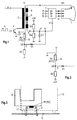
- Fig. 1 shows the high voltage transformer Tr, which supplies the high voltage UH for the picture tube 1 of a television receiver.
- the primary winding 2 of the transformer Tr is connected to the operating voltage + UB and to ground via a switching transistor 4 actuated periodically by the switching voltage 3.
- the high-voltage winding 5 is designed as a diode split winding with a plurality of high-voltage rectifier diodes 6.
- the control signals R, G, B are fed to the picture tube 1 via the video output amplifier 7 and control the beam currents is in the picture tube 1.
- a circuit for limiting the beam current is provided with the resistors R3 and R4 and the capacitor C1.
- the resistors R3 and R4 form a voltage divider with the filter capacitor C1.
- the resistor R3 is connected to the operating voltage + U2 and acts as a current source. If the beam current flowing through resistor R4 is zero, only a current of + U2 flows through resistor R3 into resistor R4 and generates a voltage U4 at point b.
- the high-voltage winding 5 takes over part of the current through the resistor R3 and thereby reduces the voltage across the resistor R3 to lower or even negative values.
- the voltage U4 is the correcting variable for the Beam current limitation applied to the control terminal a of the video amplifier 7. The circuit described so far is known.
- the resistor R2 lies closely on the ferrite core 8 of the transformer Tr.
- the voltage divider consisting of the resistors R1, R2 thus supplies a voltage which is dependent on the respective temperature of the ferrite core 8.
- the voltage U3 is greater than the voltage U4, so that the point c is decoupled from the point b by the blocked diode D1.
- R2 becomes less resistive, so that the voltage U3 drops.
- the voltage U3 finally becomes lower than the voltage U4 and thus the diode D1 conducts. Then a part of the current coming from the resistor R3 flows through the conductive diode D1 and no longer through the high-voltage winding 5. This means that the threshold value of the beam current limiter slowly decreases and thus the transmitted power is reduced as desired. This is a closed loop, the losses in the ferrite core 8 being reduced together with the transmitted power and the temperature being regulated and stabilized to an absolute value which is no longer dangerous for the transformer.
- the voltage divider consisting of the resistors R1 and R2 determines the point at which the beam current limitation controlled by the temperature of the transformer Tr becomes active.
- FIG. 2 shows a modification of the circuit according to FIG. 1.
- the resistor R1 is designed as an NTC resistor and is arranged on the ferrite core 8.
- the mode of operation is practically the same as in FIG. 1.
- the resistance R1 becomes more high-resistance, so that, as in FIG. 1, the voltage U3 at point c decreases and finally the diode D1 becomes conductive above a certain temperature and triggers the beam current limitation.
- FIG. 3 shows the arrangement of the resistor R1 according to FIG. 2 or R1 according to FIG. 2 on the ferrite core 8.
- the resistor R1 or R2 is embedded in a plastic body 9 which lies between the lower edge of the ferrite core 8 and the printed circuit board 10 and is held by the bracket 11.
- the housing of the high-voltage transformer Tr is symbolically indicated by the plastic body 12.
- the temperature-dependent resistor R1 or R2 is also cast into the plastic body 12, into which the coil former, the primary winding 2 arranged thereon, the secondary winding 6 and, if appropriate, additional windings and the high-voltage rectifier diodes are also cast.
- the ends of the resistor R1 or R2 are connected with two additional connection pins 20 which engage in corresponding conductor tracks on the printed circuit board 10 and effect the switching of the resistor R1 or R2 according to FIG. 1 or 2.
- the plastic body 12, which represents the actual housing of the transformer, furthermore contains a large number of connection pins 21 for the primary winding, the high-voltage winding and, if appropriate, further additional windings.
- connection pins 21 are also connected to corresponding conductor tracks on the underside of the printed circuit board 10. This arrangement of the resistor R1 or R2 in the casting compound of the plastic body 12 without immediate contact with the core 8 also ensures that the resistor R1 or R2 follows the temperature of the high-voltage rectifier diodes cast into the plastic body 12 with sufficient accuracy and time constant.
- FIG. 5 shows a simplified block diagram of the picture tube control circuit of the television receiver, which contains the solution according to the invention according to FIGS. 1 to 4.
- the high voltage stage 13, which includes the transformer Tr, delivers the High voltage UH for the picture tube 1, the information IT about the temperature of the ferrite core 8 and the information Iis about the respective value of the beam current is to the interface circuit 14.
- the circuit 14 supplies the manipulated variable Bis for the beam current limitation to the video processor 7, the supplies the control signals R, G, B to the picture tube 1.
- the signals R, G, B are fed to the video processor 7 from a known signal processing circuit.
- the microprocessor 15 supplies control signals for the contrast K and the brightness H to the processor 7.
- the line 16 shown in dotted lines can optionally also be used, since the control loop can be closed via the microprocessor 15. This is also able to control the beam current by adjusting the contrast and brightness, as is generally done within the video processor 7.
Landscapes
- Engineering & Computer Science (AREA)
- Multimedia (AREA)
- Signal Processing (AREA)
- Details Of Television Scanning (AREA)
- Transforming Electric Information Into Light Information (AREA)
- Processing Of Color Television Signals (AREA)
Abstract
Description
- Die Erfindung geht aus von einer Schaltung zur Begrenzung des Strahlstroms einer Bildröhre in einem Fernsehempfänger gemäß dem Oberbegriff des Anspruchs 1.
- In einem Fernsehempfänger ist es bekannt und notwendig, zum Schutz der Bildröhre und des Hochspannungstransformators den in der Bildröhre fließenden Strahlstrom zu begrenzen. Bei einem zu hohen Strahlstrom über einen längeren Zeitraum ist die garantierte Lebensdauer der Bildröhre gefährdet, während im Hochspannungstransformator insbesondere die zusammen mit den Wicklungen vergossenen Hochspannungsgleichrichterdioden durch eine zu hohe Temperatur zerstört werden können.
- Bei Schaltungen zur Begrenzungen des Strahlstroms ist im allgemeinen nur eine Begrenzerfunktion wirksam. Um kurzzeitig auftretende weiße Bildstellen mit ausreichender Helligkeit darzustellen, wird der Begrenzungswert so eingestellt, daß er oberhalb des Strahlstroms liegt, mit dem die Bildröhre im Dauerbetrieb belastet werden darf, ohne Schaden zu nehmen. Im Normalbetrieb mit bewegten Bildern liegt der Langzeitmittelwert (long term average) immer unterhalb dieser Maximalbegrenzung des Strahstroms, da es zwischendurch auch dunkle Szenen gibt, in der die Begrenzung nicht wirksam ist. Ein Dauerbetrieb mit aktiver Strahlstrombegrenzung ist jedoch theoretisch möglich.
- Bei der Bemessung der Strahlstrom-Begrenzungsschaltung muß ein extremer Belastungsfall berücksichtigt werden. Dieser tritt z.B. auf, wenn der Fernsehempfänger bei einer Umgebungstemeperatur von +40°C über mehrere Stunden mit vollkommen weißem Bild unter extrem schlechten Kühlungsbedingungen wie z.B. in einem Regal betrieben wird. Auch in diesem extremen Belastungsfall dürfen die Grenzwerte für den Hochspannungstransformator nicht überschritten werden. Der genannte extreme Belastungsfall tritt zwar in der Praxis bei einem Gerät sehr selten oder sogar niemals auf. Die Notwendigkeit seiner Berücksichtigung in der Bemessung der Strahlstrombegrenzung engt jedoch den Spielraum für den maximal zulässigen Strahlstrom bei normalen bewegten Bildern ein. Mit anderen Worten: Wenn es den genannten extremen Belastungsfall mit Sicherheit nicht gäbe, könnte bei normalen bewegten Bildern ein höherer Strahlstrom zugelassen und somit ein helleres Bild erzielt werden.
- Der Erfindung liegt die Aufgabe zugrunde, einen höheren Strahlstrom für weiße Bildstellen und somit ein helleres Bild zu ermöglichen, ohne daß dadurch in dem genannten extremen Belastungsfall der Hochspannungstransformator gefährdet ist. Diese Aufgabe wird durch die im Anspruch 1 angegebene Erfindung gelöst. Vorteilhafte Weiterbildungen der Erfindung sind in den Unteransprüchen angegeben.
- Die Erfindung besteht somit darin, daß der Transformator einen Temperaturfühler enthält, der oberhalb einer bestimmten Temperatur auf die Steuerschaltung für den Strahlstrom im Sinne einer Verringerung des Strahlstroms einwirkt.
- Die Erfindung beruht auf folgenden Erkenntnissen und Überlegungen. Der genannte extreme Belastungsfall läßt sich in der Praxis nicht ausschließen und muß bei der Bemessung der Strahlstrom-Begrenzungsschaltung berücksichtigt werden. Eine Gefährdung oder Zerstörung des Transformators ist aber einzig durch eine erhöhte Temperatur des Transformators möglich. Daher wird erfindungsgemäß die Temperatur des Hochspannungstransformators überwacht. Wenn die Temperatur des Transformators und damit auch die der Gleichrichterdioden einen bestimmten Wert überschreitet, wird der Strahlstrom im Sinne einer Regelschleife so zurückgeregelt, daß sich auch während des extremen Belastungsfalls eine zulässige Temperatur am Transformator von z.B. 100° einstellt.
- Die erfindungsgemäß Lösung hat mehrere Vorteile. Da eine bevorstehende Gefährdung des Hochspannungstransformators in einem extremen Belastungsfall durch die Temperaturüberwachung erkannt und aufgefangen wird, kann für den Normalbetrieb mit bewegten Bildern ein höherer Strahlstrom zugelassen und somit ein helleres Bild erzielt werden, ohne daß für den Transformator eine Gefahr besteht. Der Hochspannungstransformator bleibt durch die Temperaturkontrolle in allen Fällen geschützt. Insbesondere können die Gleichrichterdioden keine unzulässig hohe Temeperatur erreichen und der Kern des Transformators nicht in die Sättigung gelangen. Gegebenenfalls kann der Hochspannungstransformator kleiner und billiger aufgebaut sein. Die erfindungsgemäße Maßnahme erfordert nur wenige Bauteile, z.B. einen temperaturabhängigen Widerstand, einen ohmschen Widerstand und eine Diode. Das Gerät selbst wird praktisch unzerstörbar, selbst wenn es im extremen Fall bei +40°C Umgebungstemperatur unter schlechten Kühlbedingungen über eine Vielzahl von Stunden mit einem vollständig weißen Bild betrieben wird. Die Helligkeit wird in dem genannten extremen Belastungsfall verringert. Das ist aber praktisch kein Nachteil, da bei dem genannten extremen Belastungsfall ohnehin kein normales Bild vorliegt, die Änderung der Helligkeit bei geeigneter Bemessung unmerkbar langsam erfolgt und dieser Fall bei einem bestimmten Gerät in der Regel nur selten oder niemals auftritt.
- Die von dem Temperaturfühler gesteuerte Schaltung ist vorzugsweise so bemessen, daß sie bei einem Langzeit-Strahlstromverhalten aufgrund von bewegten Bildern mit normaler durchschnittlicher Helligkeit nicht anspricht. Der Temperaturfühler wird vorzugsweise durch einen temperaturabhängigen Widerstand, einen sogenannten NTC- oder PTC-Widerstand, gebildet. Derartige Widerstände sind handelsüblich und preiswert. Vorzugsweise wird der Temperaturfühler in Form eines temperaturabhängigen Widerstandes zusammen mit dem Spulenkörper, den Wicklungen und den Gleichrichterdioden in einen Kunststoffkörper eingegossen. Die Enden des Widerstandes sind dabei mit zwei Anschlußklemmen des Transformators verbunden. Es hat sich gezeigt, daß bei dieser Lösung die Temperatur des Widerstandes mit ausreichender Genauigkeit und Zeitkonstante der Temperatur der Gleichrichterdioden folgt. Die Temperatur an dem temperaturabhängigen Widerstand ist also ein echtes Maß für die Temperatur der Gleichrichterdioden.
- Bei einer anderen Ausführungsform der Erfindung liegt der temperaturabhängige Widerstand eng an dem Kern des Transformators an. Auch dadurch wird erreicht, daß die Temperatur des Widerstandes genügend genau und schnell der Temperatur der Gleichrichterdioden folgt. Diese Anordnung hat den Vorteil, daß der Kernn spannungsmäßig auf Erdpotential, also nicht im Hochspannungsbereich liegt und somit keine Isolationsprobleme bei dem temperaturabhängigen Widerstand entstehen.
- Der Widerstand kann auch zwischen dem Kern und einer den Transformator tragenden gedruckten Leiterplatte liegen. Dabei ist die Anordnung so getroffen, daß die Wärme von dem Kern möglichst gut auf den Widerstand, aber möglichst wenig auf die gedruckte Leiterplatte und die darauf enthaltenen Leiterbahnen übertragen wird.
- Der temperaturabhängige Widerstand kann auch in einer Aussparung wie einer Kerbe an einer Oberfläche des Kerns liegen. Dadurch kann der Wärmekontakt zwischen dem Kern und dem Widerstand noch verbessert werden, indem der Kern mit dem Widerstand etwa über 180° dessen Umfang unmittelbar in Berührung steht. Der temperaturabhängige Widerstand kann auch in einen Kunststoffkörper eingebettet sein, der zwischen dem Kern und der Leiterplatte eingefaßt ist.
- Vorzugsweise bildet der Temperaturfühler Teil eines Netzwerkes, das über eine Schwellwertschaltung mit einer den Strahlstrom beeinflussenden Steuerklemme einer Bildröhren-Ansteuerschaltung verbunden ist. Bei einer Ausführungsform liegt die Reihenschaltung des temperaturabhängigen Widerstandes und eines weiteren ohmschen Widerstandes zwischen einer Betriebsspannung und Erde, und der Mittelpunkt der Reihenschaltung ist über eine Diode mit der den Strahlstrom beeinflussenden Steuerklemme verbunden.
- Die Erfindung wird im folgenden anhand der Zeichnung erläutert. Darin zeigen
- Fig. 1
- ein Beispiel einer erfindungsgemäßen Schaltung,
- Fig. 2
- eine Abwandlung der Schaltung nach Fig. 1,
- Fig. 3
- eine konstruktive Lösung für die Anbringung des Temperaturfühlers an dem Hochspannungstransformator,
- Fig. 4
- eine andere Anordnung des Temperaturfühlers an dem Transformator und
- Fig. 5
- ein die erfindungsgemäße Schaltung beinhaltendes Blockschaltbild.
- Fig. 1 zeigt den Hochspannungstransformator Tr, der die Hochspannung UH für die Bildröhre 1 eines Fernsehempfängers liefert. Die Primärwicklung 2 des Transformators Tr ist mit der Betriebsspannung +UB und über einen durch die Schaltspannung 3 periodisch betätigten Schalttransistor 4 mit Erde verbunden. Die Hochspannungswicklung 5 ist als Diodensplitwicklung mit mehreren Hochspannungsgleichrichterdioden 6 ausgebildet. Die Steuersignale R,G,B werden der Bildröhre 1 über die Video-Endverstärker 7 zugeführt und steuern die Strahlströme is in der Bildröhre 1.
- Zusätzlich ist eine Schaltung zur Begrenzung des Strahlstromes is mit den Widerständen R3 und R4 sowie dem Kondensator C1 vorgesehen. Die Widerstände R3 und R4 bilden einen Spannungsteiler mit dem Siebkondensator C1. Der Widerstand R3 ist an die Betriebsspannung +U2 angeschlossen und wirkt als Stromquelle. Wenn der über den Widerstand R4 fließende Strahlstrom is null ist, fließt nur ein Strom von +U2 über den Widerstand R3 in den Widerstand R4 und erzeugt am Punkt b eine Spannung U4. Die Hochspannungswicklung 5 übernimmt einen Teil des Stromes durch den Widerstand R3 und verringert dadurch die Spannung über dem Widerstand R3 auf niedrigere oder sogar negative Werte. Die Spannung U4 ist als Stellgröße für die Strahlstrombegrenzung an die Steuerklemme a der Videoverstärker 7 angelegt. Die soweit beschriebene Schaltung ist bekannt.
- Zusätzlich sind jetzt die Reihenschaltung aus dem PTC-Widerstand R2 und dem Widerstand R1 zwischen der Betriebsspannung +U1 und Erde sowie die Diode D1 vorgesehen. Der Widerstand R2 liegt eng an dem Ferritkern 8 des Transformator Tr an. Der Spannungsteiler aus den Widerständen R1, R2 liefert somit eine Spannung, die von der jeweiligen Temperatur des Ferritkerns 8 abhängig ist. Unter normalen Bedingungen, also bei Vorliegen eines bewegten normalen Fernsehbildes, ist die Spannung U3 größer als die Spannung U4, so daß der Punkt c durch die gesperrte Diode D1 von dem Punkt b entkoppelt ist. Wenn die Temperatur des Transformators Tr, somit auch die Temperatur des Ferritkerns 8 und des Widerstandes R2 steigt, wird R2 niederohmiger, so daß die Spannung U3 abfällt. Wenn eine bestimmte Temperatur überschritten wird, wird schließlich die Spannung U3 kleiner als die Spannung U4 und somit die Diode D1 leitend. Dann fließt ein Teil des vom Widerstand R3 kommenden Stromes über die leitende Diode D1 und nicht mehr durch die Hochspannungswicklung 5. Das bedeutet, daß der Schwellwert des Strahlstrombegrenzers langsam abnimmt und somit die übertragene Leistung in erwünschter Weise verringert wird. Es handelt sich dabei um eine geschlossene Schleife, wobei die Verluste im Ferritkern 8 zusammen mit der übertragenen Leistung verringert werden und die Temperatur auf einen absoluten, für den Transformator nicht mehr gefährlichen Wert herabgeregelt und stabilisiert wird. Der Spannungsteiler aus den Widerständen R1 und R2 bestimmt den Punkt, in dem die von der Temperatur des Transformators Tr gesteuerte Strahlstrombegrenzung aktiv wird.
- Fig. 2 zeigt eine Abwandlung der Schaltung nach Fig. 1. Anstelle des PTC-Widerstandes R2 ist der Widerstand R1 als NTC-Widerstand ausgebildet und an dem Ferritkern 8 angeordnet. Die Wirkungsweise ist praktisch die gleiche wie in Fig. 1. Wenn die Temperatur des Ferritkerns 8 steigt, wird der Widerstand R1 hochohmigiger, so daß wie in Fig. 1 die Spannung U3 am Punkt c sinkt und schließlich oberhalb einer bestimmten Temperatur die Diode D1 leitend wird und die Strahlstrombegrenzung auslöst.
- Fig. 3 zeigt die Anordnung des Widerstandes R1 gemäß Fig. 2 oder R1 gemäß Fig. 2 an dem Ferritkern 8. Der Widerstand R1 oder R2 ist in einen Kunststoffkörper 9 eingebettet, der zwischen der Unterkante des Ferritkerns 8 und der gedruckten Leiterplatte 10 liegt und von der Klammer 11 gehalten wird. Das Gehäuse des Hochspannungstransformators Tr ist symbolisch durch den Kunststoffkörper 12 angedeutet.
- In Fig. 4 ist der temperaturabhängige Widerstand R1 oder R2 mit in den Kunststoffkörper 12 eingegossen, in den auch der Spulenkörper, die darauf angeordnete Primärwicklung 2, die Sekundärwicklung 6 und gegebenenfalls Zusatzwicklungen sowie die Hochsspannungsleichrichterdioden eigegossen sind. Die Enden des Widerstandes R1 oder R2 sind mit zwei zusätzlichen Anschlußpins 20 vebunden, die in entsprechende Leiterbahnen auf der gedruckten Leiterplatte 10 eingreifen und die Schaltung des Widerstandes R1 oder R2 gemäß Fig. 1 oder 2 bewirken. Der Kunststoffkörper 12, der das eigentliche Gehäuse des Transformators darstellt, enthält weiterhin eine Vielzahl von Anschlußpins 21 für die Primärwicklung die Hochspannungswicklung sowie gegebenenfalls weitere Zusatzwicklungen. Die Anschlußpins 21 sind ebenfalls mit entsprechenden Leiterbahnen auf der Unterseite der Leiterplatte 10 verbunden. Diese Anordnung des Widerstandes R1 oder R2 in der Vergußmasse des Kunstoffkörpers 12 ohne ummittelbare Anlage an dem Kern 8 gewährleistet ebenfalls, daß der Widerstand R1 oder R2 mit ausreichender Genauigkeit und Zeitkonstante der Temperatur der in den Kunststoffkörper 12 eingegossenen Hochspannungsgleichrichterfdioden folgt.
- Fig. 5 zeigt ein vereinfachtes Blockschaltbild der Bildröhren-Steuerschaltung des Fernsehempfängers, das die erfindungsgemäße Lösung gemäß Fig. 1 bis 4 beinhaltet. Die Hochspannungstufe 13, die unter anderem den Tranformator Tr beinhaltet, liefert die Hochspannung UH für die Bildröhre 1, die Information IT über die Temperatur des Ferritkerns 8 und die Information Iis über den jeweiligen Wert des Strahlstroms is an die Interface-Schaltung 14. Die Schaltung 14 liefert die Stellgröße Bis für die Strahlstrombegrenzung an den Videoprozessor 7, der die Steuersignale R,G,B an die Bildröhre 1 liefert. Die Signale R,G,B werden dem Videoprozessor 7 von einer bekannten Signalverarbeitungsschaltung zugeführt. Der Mikroprozessor 15 liefert Steuersignale für den Kontrast K und die Helligkeit H an den Prozessor 7. Die punktiert dargestellte Leitung 16 kann wahlweise zusätzlich angewendet werden, da die Regelschleife über den Mikroprozessor 15 geschlossen sein kann. Dieser ist ebenfalls in der Lage, den Strahlstrom durch Einstellung von Kontrast und Helligkeit zu steuern, wie dieses im allgemeinen innerhalb des Videoprozessors 7 erfolgt.
Claims (11)
- Schaltung zur Begrenzung des Strahlstroms einer Bildröhre (1) in einem Fernsehempfänger mit einem die Hochspannung (UH) für die Bildröhre (1) liefernden Transformator (Tr) und einer Strahlstrom-Steuerschaltung (7), an deren Steuerklemme (a) eine vom Strahlstom (is) abhängige Spannung angelegt ist, dadurch gekennzeichnet, daß der Transformator (Tr) einen Temperaturfühler (R1, R2) enthält, der oberhalb einer bestimmten Temperatur auf die Steuerschaltung (7) im Sinne einer Verringerung des Strahlstroms (is) einwirkt.
- Schaltung nach Anspruch 1, dadurch gekennzeichnet, daß die von dem Temperaturfühler (R1, R2) gesteuerte Schaltung so bemessen ist, daß sie bei einem Langzeit-Strahlstromverhalten aufgrund von bewegten Bildern mit normaler durchschnittlicher Helligkeit nicht anspricht.
- Schaltung nach Anspruch 1, dadurch gekennzeichnet, daß der Temperaturfühler durch einen temperaturabhängigen Widerstand (R1, R2) gebildet ist.
- Schaltung nach Anspruch 1, , dadurch gekennzeichnet, daß der Temperaturfühler zusammen mit dem Spulenkörper, den Wicklungen (2, 5) und den Hochspannungsgleichrichterdioden (6) des Transformators (Tr) in einen Kunststoffkörper (12) eingegeossen ist.
- Schaltung nach Anspruch 4, , dadurch gekennzeichnet, daß die Anschlüsse des Temperaturfühlers mit Anschlußpins des Hochspannungstransformator (Tr) verbunden sind.
- Schaltung nach Anspruch 3, dadurch gekennzeichnet, daß der Widerstand (R1, R2) eng an dem Kern (8) des Transformators (Tr) anliegt.
- Schaltung nach Anspruch 3, dadurch gekennzeichnet, daß der Widerstand (R1, R2) zwischen dem Kern (8) und einer den Transformator (Tr) tragenden Leiterplatte (10) liegt.
- Schaltung nach Anspruch 3, dadurch gekennzeichnet, daß der Widerstand (R1, R2) in einer Aussparung an einer Oberfläche des Kerns (8) liegt.
- Schaltung nach Anspruch 3, dadurch gekennzeichnet, daß der Widerstand (R1, R2) in einen Kunststoffkörper (9) eingebettet ist, derzwischen dem Kern (8) und der Leiterplatte (10) eingefaßt ist.
- Schaltung nach Anspruch 1, dadurch gekennzeichnet, daß der Temperaturfühler (R1, R2) Teil eines Netzwerkes ist, das über eine Schwellwertschaltung (D1) mit einer den Strahlstrom (is) beeinflussenden Steuerklemme (a) einer Bildröhren-Ansteuerschaltung (7) verbunden ist.
- Schaltung nach Anspruch 10, dadurch gekennzeichnet, daß die Reihenschaltung des temperaturabhängigen Wiederstandes (R1) und eines weiteren Widerstands (R2) zwischen einer Betriebsspannung (+U1) und Erde liegt und der Mittelpunkt (c) der Reihenschaltung (R1, R2) über eine Diode (D1) mit der den Strahlstrom (is) beeinflussenden Steuerklemme (a) verbunden ist.
Applications Claiming Priority (2)
| Application Number | Priority Date | Filing Date | Title |
|---|---|---|---|
| DE19616272A DE19616272A1 (de) | 1996-04-24 | 1996-04-24 | Schaltung zur Begrenzung des Strahlstroms einer Bildröhre |
| DE19616272 | 1996-04-24 |
Publications (3)
| Publication Number | Publication Date |
|---|---|
| EP0804019A2 true EP0804019A2 (de) | 1997-10-29 |
| EP0804019A3 EP0804019A3 (de) | 1997-11-19 |
| EP0804019B1 EP0804019B1 (de) | 2002-07-24 |
Family
ID=7792246
Family Applications (1)
| Application Number | Title | Priority Date | Filing Date |
|---|---|---|---|
| EP97106150A Expired - Lifetime EP0804019B1 (de) | 1996-04-24 | 1997-04-15 | Schaltung zur Begrenzung des Strahlstroms einer Bildröhre |
Country Status (5)
| Country | Link |
|---|---|
| US (1) | US6040664A (de) |
| EP (1) | EP0804019B1 (de) |
| JP (1) | JPH1070693A (de) |
| CN (1) | CN1160951C (de) |
| DE (2) | DE19616272A1 (de) |
Families Citing this family (4)
| Publication number | Priority date | Publication date | Assignee | Title |
|---|---|---|---|---|
| JP3833843B2 (ja) * | 1999-04-06 | 2006-10-18 | Necディスプレイソリューションズ株式会社 | 画像補正方法及び画像補正装置並びに陰極線管ディスプレイ装置 |
| US6636265B1 (en) * | 2000-01-21 | 2003-10-21 | Thomson Licensing S.A. | Focus flutter prevention in TV receivers and monitors |
| KR20040068680A (ko) * | 2003-01-27 | 2004-08-02 | 삼성전자주식회사 | 고압 변압기 |
| KR20080079449A (ko) | 2007-02-27 | 2008-09-01 | 삼성전자주식회사 | 영상 디스플레이장치 및 영상 디스플레이장치에서의 과전류제어방법 |
Family Cites Families (6)
| Publication number | Priority date | Publication date | Assignee | Title |
|---|---|---|---|---|
| JPS5630985B2 (de) * | 1973-10-16 | 1981-07-18 | ||
| US4042858A (en) * | 1976-07-08 | 1977-08-16 | Gte Sylvania Incorporated | Television receiver protection circuit |
| US4126816A (en) * | 1977-05-13 | 1978-11-21 | Rca Corporation | High voltage protection circuit |
| US4645988A (en) * | 1985-12-11 | 1987-02-24 | Zenith Electronics Corporation | Temperature compensated drive circuit for CRT G2 grid |
| US4945414A (en) * | 1988-05-12 | 1990-07-31 | Rca Licensing Corporation | Compensator for temperature-induced black level drift for use in a television receiver |
| JPH04134973A (ja) * | 1990-09-26 | 1992-05-08 | Mitsubishi Electric Corp | フライバックトランスの発煙防止装置 |
-
1996
- 1996-04-24 DE DE19616272A patent/DE19616272A1/de not_active Withdrawn
-
1997
- 1997-03-24 CN CNB971030855A patent/CN1160951C/zh not_active Expired - Fee Related
- 1997-04-15 DE DE59707761T patent/DE59707761D1/de not_active Expired - Fee Related
- 1997-04-15 EP EP97106150A patent/EP0804019B1/de not_active Expired - Lifetime
- 1997-04-22 JP JP9103740A patent/JPH1070693A/ja active Pending
-
1998
- 1998-02-25 US US08/999,879 patent/US6040664A/en not_active Expired - Fee Related
Also Published As
| Publication number | Publication date |
|---|---|
| CN1171695A (zh) | 1998-01-28 |
| JPH1070693A (ja) | 1998-03-10 |
| EP0804019B1 (de) | 2002-07-24 |
| DE59707761D1 (de) | 2002-08-29 |
| DE19616272A1 (de) | 1997-10-30 |
| EP0804019A3 (de) | 1997-11-19 |
| US6040664A (en) | 2000-03-21 |
| CN1160951C (zh) | 2004-08-04 |
Similar Documents
| Publication | Publication Date | Title |
|---|---|---|
| DE2834678C2 (de) | Schaltungsanordnung mit Kurzschlußschutz | |
| EP0804019B1 (de) | Schaltung zur Begrenzung des Strahlstroms einer Bildröhre | |
| DE69838973T2 (de) | Schwachstromüberwachung durch "low-side" getriebenen DMOS mittels Modulierung seines inneren Widerstands | |
| DE2700274A1 (de) | Stromversorgungseinrichtung fuer bildverstaerker | |
| DE3510798C2 (de) | ||
| DE1137795B (de) | Elektrisches Schutzrelais | |
| DE2107554B1 (de) | Verfahren und Schaltungsanordnung zur Verstärkung von Fernsehsignalen | |
| DE3723579C1 (de) | Laengsspannungsregler | |
| DE3705184C2 (de) | ||
| EP0018598A1 (de) | Schaltungsanordnung zur Begrenzung des Schaltstroms in einem aus einem Durchflussstromwandler, einem Schalthalbleiter, einer Schutzinduktivität und einer Überstromabschaltung in Serienschaltung gebildeten Stromkreis | |
| DE3000595C2 (de) | ||
| DE2930216C2 (de) | ||
| DE2840115A1 (de) | Schaltanordnung fuer eine elektromagnetische fokussier-bildaufnahmeroehre | |
| DE1914427A1 (de) | Verstaerker fuer die Ablenkstufe einer Kathodenstrahlroehre | |
| EP3794701B1 (de) | Schaltungsanordnung zum schutz einer elektronischen baugruppe | |
| DE3891380C2 (de) | Verstärker mit vier Transistoren, die in einer Brückenschaltung miteinander verbunden sind | |
| DE2115379C3 (de) | Ablenkstufe für einen Fernsehempfänger | |
| DE1168962B (de) | Schaltungsanordnung zur Vermeidung einer UEberlastung eines Schalttransistors | |
| DE3726244C2 (de) | Schaltungsanordnung zur Überwachung der Leistung einer Laserdiode | |
| DE2733006B2 (de) | Temperaturwächter | |
| DE1093407B (de) | Schaltungsanordnung mit einer Bildaufnahmeroehre vom Vidikontyp | |
| DE3024721A1 (de) | Gleichspannungsumrichter zur erzeugung mehrerer ausgangsspannungen | |
| DE19709681A1 (de) | Schaltung zur Überwachung des Strahlstroms in einer Farbildröhre | |
| DE1563633C3 (de) | Stromversorgungsschaltung | |
| DE19833968A1 (de) | Integrierte Reglervorrichtung |
Legal Events
| Date | Code | Title | Description |
|---|---|---|---|
| PUAI | Public reference made under article 153(3) epc to a published international application that has entered the european phase |
Free format text: ORIGINAL CODE: 0009012 |
|
| PUAL | Search report despatched |
Free format text: ORIGINAL CODE: 0009013 |
|
| AK | Designated contracting states |
Kind code of ref document: A2 Designated state(s): DE FR GB IT |
|
| AK | Designated contracting states |
Kind code of ref document: A3 Designated state(s): DE FR GB IT |
|
| 17P | Request for examination filed |
Effective date: 19980505 |
|
| 17Q | First examination report despatched |
Effective date: 20000120 |
|
| GRAG | Despatch of communication of intention to grant |
Free format text: ORIGINAL CODE: EPIDOS AGRA |
|
| GRAG | Despatch of communication of intention to grant |
Free format text: ORIGINAL CODE: EPIDOS AGRA |
|
| GRAH | Despatch of communication of intention to grant a patent |
Free format text: ORIGINAL CODE: EPIDOS IGRA |
|
| GRAH | Despatch of communication of intention to grant a patent |
Free format text: ORIGINAL CODE: EPIDOS IGRA |
|
| GRAA | (expected) grant |
Free format text: ORIGINAL CODE: 0009210 |
|
| AK | Designated contracting states |
Kind code of ref document: B1 Designated state(s): DE FR GB IT |
|
| REG | Reference to a national code |
Ref country code: GB Ref legal event code: FG4D Free format text: NOT ENGLISH |
|
| GBT | Gb: translation of ep patent filed (gb section 77(6)(a)/1977) |
Effective date: 20020725 |
|
| REG | Reference to a national code |
Ref country code: GB Ref legal event code: 746 Effective date: 20020807 |
|
| REF | Corresponds to: |
Ref document number: 59707761 Country of ref document: DE Date of ref document: 20020829 |
|
| ET | Fr: translation filed | ||
| REG | Reference to a national code |
Ref country code: FR Ref legal event code: D6 |
|
| PLBE | No opposition filed within time limit |
Free format text: ORIGINAL CODE: 0009261 |
|
| STAA | Information on the status of an ep patent application or granted ep patent |
Free format text: STATUS: NO OPPOSITION FILED WITHIN TIME LIMIT |
|
| 26N | No opposition filed |
Effective date: 20030425 |
|
| PGFP | Annual fee paid to national office [announced via postgrant information from national office to epo] |
Ref country code: GB Payment date: 20080326 Year of fee payment: 12 |
|
| PGFP | Annual fee paid to national office [announced via postgrant information from national office to epo] |
Ref country code: IT Payment date: 20090427 Year of fee payment: 13 Ref country code: DE Payment date: 20090423 Year of fee payment: 13 |
|
| GBPC | Gb: european patent ceased through non-payment of renewal fee |
Effective date: 20090415 |
|
| REG | Reference to a national code |
Ref country code: FR Ref legal event code: ST Effective date: 20091231 |
|
| PG25 | Lapsed in a contracting state [announced via postgrant information from national office to epo] |
Ref country code: GB Free format text: LAPSE BECAUSE OF NON-PAYMENT OF DUE FEES Effective date: 20090415 Ref country code: FR Free format text: LAPSE BECAUSE OF NON-PAYMENT OF DUE FEES Effective date: 20091222 |
|
| PGFP | Annual fee paid to national office [announced via postgrant information from national office to epo] |
Ref country code: FR Payment date: 20080425 Year of fee payment: 12 |
|
| PG25 | Lapsed in a contracting state [announced via postgrant information from national office to epo] |
Ref country code: DE Free format text: LAPSE BECAUSE OF NON-PAYMENT OF DUE FEES Effective date: 20101103 |
|
| PG25 | Lapsed in a contracting state [announced via postgrant information from national office to epo] |
Ref country code: IT Free format text: LAPSE BECAUSE OF NON-PAYMENT OF DUE FEES Effective date: 20100415 |