EP0803082B1 - Verarbeitung monochromer photographischer silberhalogenidmaterialien - Google Patents
Verarbeitung monochromer photographischer silberhalogenidmaterialien Download PDFInfo
- Publication number
- EP0803082B1 EP0803082B1 EP95938507A EP95938507A EP0803082B1 EP 0803082 B1 EP0803082 B1 EP 0803082B1 EP 95938507 A EP95938507 A EP 95938507A EP 95938507 A EP95938507 A EP 95938507A EP 0803082 B1 EP0803082 B1 EP 0803082B1
- Authority
- EP
- European Patent Office
- Prior art keywords
- compound
- formula
- agent
- developing
- developing solution
- Prior art date
- Legal status (The legal status is an assumption and is not a legal conclusion. Google has not performed a legal analysis and makes no representation as to the accuracy of the status listed.)
- Expired - Lifetime
Links
Classifications
-
- G—PHYSICS
- G03—PHOTOGRAPHY; CINEMATOGRAPHY; ANALOGOUS TECHNIQUES USING WAVES OTHER THAN OPTICAL WAVES; ELECTROGRAPHY; HOLOGRAPHY
- G03C—PHOTOSENSITIVE MATERIALS FOR PHOTOGRAPHIC PURPOSES; PHOTOGRAPHIC PROCESSES, e.g. CINE, X-RAY, COLOUR, STEREO-PHOTOGRAPHIC PROCESSES; AUXILIARY PROCESSES IN PHOTOGRAPHY
- G03C5/00—Photographic processes or agents therefor; Regeneration of such processing agents
- G03C5/26—Processes using silver-salt-containing photosensitive materials or agents therefor
- G03C5/29—Development processes or agents therefor
- G03C5/305—Additives other than developers
-
- G—PHYSICS
- G03—PHOTOGRAPHY; CINEMATOGRAPHY; ANALOGOUS TECHNIQUES USING WAVES OTHER THAN OPTICAL WAVES; ELECTROGRAPHY; HOLOGRAPHY
- G03C—PHOTOSENSITIVE MATERIALS FOR PHOTOGRAPHIC PURPOSES; PHOTOGRAPHIC PROCESSES, e.g. CINE, X-RAY, COLOUR, STEREO-PHOTOGRAPHIC PROCESSES; AUXILIARY PROCESSES IN PHOTOGRAPHY
- G03C5/00—Photographic processes or agents therefor; Regeneration of such processing agents
- G03C5/26—Processes using silver-salt-containing photosensitive materials or agents therefor
- G03C5/29—Development processes or agents therefor
- G03C5/30—Developers
Definitions
- the temperature of the solutions in such machines is 30°C or above.
- a certain concentration of fixed-out silver builds up in the fixing solution. Processing conditions of this type tend to promote physical development fog.
- This physical development fog is thought to be caused by some developing solution still in the active state, being carried over into the fixing solution on the print material. This causes some fixed out silver which is in solution in the fixing bath to be developed into metallic silver which then is deposited on the print being processed.
- Various developing solution stabilizers have been tried to prevent this physical development fog but most are ineffective or have other deleterious effects. For instance, one or two which lessen physical development fog also cause bronzing of the print material which is highly undesirable.
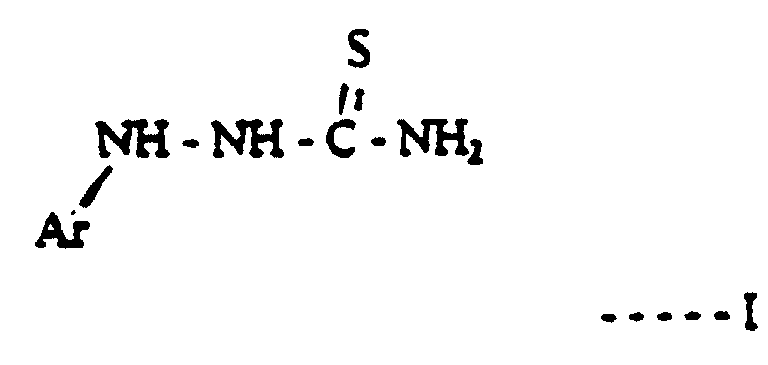
- a method of processing silver halide photographic material in a processing machine using a developing solution which comprises either a hydroquinone type developing agent or a reductone type developing agent, together with an electron transfer agent as an auxiliary developing agent, and with at least one basic compound the anion of which is carbonate, sulphite or hydroxide, and a compound of formula I:- where Ar is an aromatic ring or heterocyclic aromatic ring which is optionally substituted.
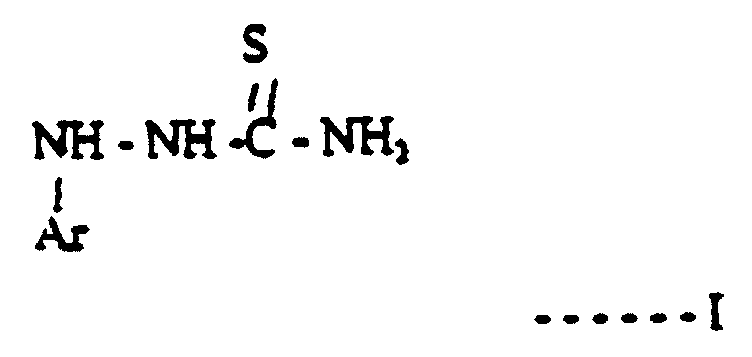
- the method of the present invention is of particular use when the photographic material is print material which when it is processed is fed from the tank containing the developing solution to a tank containing the fixer solution without any intermediate washing step. Therefore according to this aspect of the present invention there is provided a method of processing silver halide print material in a roller transport processing apparatus using a developing solution at a temperature of at least 30°C and wherein the print material is fed out of the developing solution straight into a fixing solution, the developing solution comprising either a hydroquinone type developing agent or a reductone developing agent, together with an electron transfer agent as an auxiliary developing agent, and with at least one basic compound the anion of which is carbonate, sulphite or hydroxide, there being present in the developing solution a compound of formula I:- where Ar is an aromatic or heterocyclic aromatic ring which may be substituted.
- Suitable substituent groups comprise sulphonic acid groups and salts thereof, carboxylic acid groups and salts thereof, halide for example fluoride or chloride, lower alkyl such as methyl or ethyl, lower alkoxy for example methoxy, or sulphonamide or carboxamide groups.
- Compounds of formula I are compounds which may be prepared by known methods, and in particular by reaction between substituted phenyl hydrazine compounds and potassium thiocyanate.
- the aromatic ring is a phenyl ring.
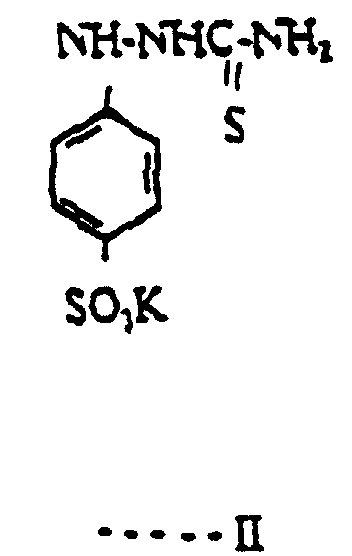
- the compound of formula I has the formula II:- It has been found that if the compound of formula I is present at a concentration of between 0.02 to 0.5g/litre in the developing solution the physical development of silver on to the print material is greatly reduced.
- the compound of formula II is hereinafter referred to as Compound A.
- An alternative method of providing a developing solution containing a compound of formula I is to use a precursor compound which breaks down in the developer solution to give the compound of formula I in an active form.
- a precursor compound which breaks down in the developer solution to give the compound of formula I in an active form.
- An example of such a precursor compound is the compound of formula III:- which is hereinafter referred to as Compound B.
- Y in formula IV is preferably a cyclic amine for example morpholine or piperidine.
- An example of a particularly useful reductone of formula IV is the compound of formula VI:- This compound has the trivial name of piperidino-hexose reductone.
- Preferred ascorbates of general formula IV for use in the developer solution include L-ascorbic acid. D-isoascorbic acid and L-erythroascorbic acid. Salts of such compounds may also be used.
- hydroquinone type developing agent hydroquinone itself or a substituted hydroquinone such as chloro-hydroquinone which acts as a developing agent.
- the amount of reductone developing agent or hydroquinone developing agent present in the working strength photographic developing solution is from 5 to 15g litre.
- electron transfer agent a compound which acts synergistically with a reductone or hydroquinone type developing agent to provide an active relatively long lasting developing combination.
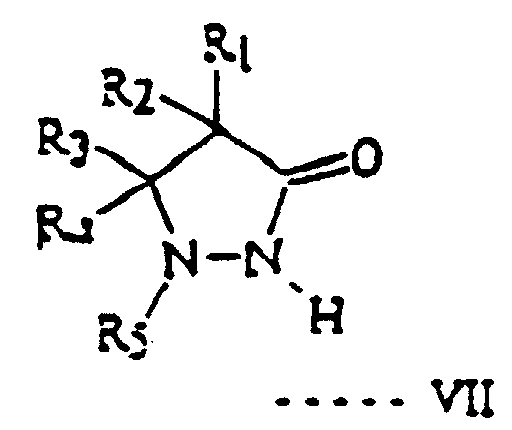
- a large number are known from the patent literature but in practice the two most commonly used ones are amino-phenols such as p-methylaminophenol which is known commercially as Metol and pyrazolidinone compounds of general formula VII - in which R 5 is an aromatic ring, R 1 and R 2 are hydrogen, lower alkyl, or hydroxy alkyl, and R 3 and R 4 are hydrogen, lower alkyl or phenyl.
- lower alkyl is meant an alkyl group with up to 3 carbon atoms.
- R 5 is phenyl or a substituted phenyl such as 4-methyl phenyl or 4-chloro-phenyl.
- a particularly preferred compound for use in the developing solution of this aspect of the present invention is 1-phenyl-4-methyl-4- hydroxymethyl pyrazolid-3-one which is hereinafter referred to as compound C.
- the amount of electron transfer agent present in the working strength developing solution is from 0.2 to 1.5g/litre.
- the preferred pH of the working strength developing solution is from 10 to 11.
- salts of both sulphite and carbonate the sulphite as a basic compound, as an anti-oxidant and as a development accelerator (noted in USP 5098819) and the carbonate as a basic compound and as a buffer in the developing solution when in use.
- Sufficient sulphite, carbonate and hydroxide should be present to correct the pH of the working solution to between 10 and 11.
- At least one metal complexing agent is present in the developing solution.
- a particularly suitable compound is diethylenetriamine pentacetic acid (DTPA).
- Suitable metal complexing agents include phosphonic acids such as 1-hydroxyethylidene 1,1-diphosphonic acid, diethylenetriamine penta (methylenephosphonic acid), ethylene diamine tetra (methylene phosphonic acid) and alkali metal salts thereof.
- An alkali metal bromide may be present in the developing solution as a stabiliser or antifoggant.
- the developing solution used in the method of this invention relates to either a concentrated developing solution which requires dilution with water to prepare a working strength solution or to a working strength developing solution. It also relates to powder developing compositions which are required to be dissolved in water.
- Example I of US 3615512 there is described the processing of photographic material which comprises certain compounds including phenyl thiosemicarbazide. These compounds when present on the photographic material are said to counteract the inhibition of dissolving speed in the potassium thiocyanate containing monobath.
- Developer 1 formulated with benzotriazole resulted in high density marks at the edges of the sheet, as well as an uneven fog density across the whole of the sheet.
- Developer 1 formulated with phenyl mercapto tetrazole gave a less pronounced edge density and a lower level of fog but was still unacceptable.
- Developer 1 formulated with compound A gave complete freedom from edge density or fog and was totally acceptable, despite being processed in a way that was expected to produce physical development fog.
- the amount chosen for the three anti-foggants is a function of their activity. If 0.2gl -1 of phenyl mercaptotetrazole or benzotriazole had been used there would have been no development of the image. On the other hand 0.2gl -1 of compound A is the preferred amount.
- Example 1 Each developer was used to process silver halide photographic print material as described in Example 1. Results obtained were very similar to those seen in Example 1 with only compound A giving a completely acceptable result.
- Examples 1 and 2 gave a clear visual demonstration of the benefits of compound A, it was not possible to quantify these benefits because of the random nature of physical development fog under such circumstances.
- physical development fog was induced by carry over of active developer into fixer solutions on the processed paper.
- physical development fog was induced in the examples which follow by deliberate contamination of developer solution with fixer. Although less common than carry over of developer into fixer, such accidental contamination is not unknown, with similar deleterious consequences.
- Developer 4 had the same formulation but in addition contained 0.2gl -1 of compound A. (invention)
- Developer 5 to 15 were formulated as developer 3 but in addition had the following compounds added:
- concentrations used were molar equivalents to 0.2gl -1 of compound A.
- Fixer I This is hereinafter referred to as Fixer I.
- Developer 16 was prepared as Developer 3 but was not contaminated with fixer I. (invention)
- Developer 4 containing compound A, and the inventive Developers 12 and 15 are the least sensitive to the effects of fixer contamination. Indeed in the case of developer 12 the effect is almost eliminated when compared with the uncontaminated developer 16.
- Developers 4 and 15 have very similar effects, as would be expected as the active species is the same in each developer.
- Each test strip was mounted, emulsion side out, in a cylindrical perspex sample holder 14cm in diameter. This was placed in a desiccator and rested on a perforated plate. Beneath this plate, at the bottom of the desiccator, was a petri dish containing 10g of potassium chloride added to 20cm 3 of saturated potassium chloride solution. On top of the perforated plate, between the plate and the sample holder was a 16cm 2 piece of chromotography paper moistened with 80 ⁇ l of 4.8% w/v hydrogen peroxide solution. The desiccator was sealed with a lid containing a small electrically driven fan such that the atmosphere in the desiccator was agitated.
- the sealed desiccator was placed in an oven which had been preheated to 50°C, and the fan was run for 1 hour.
- the apparatus was left in the oven for a further 17 hours incubation before being removed and the test strips withdrawn.
- a ready to use silver halide developing solution was prepared as detailed in Example 2.
- 3 x 1L portions of this developer were prepared: To the first was added 0.01gl -1 phenyl mercapto tetrazole (comparative) To the second was added 0.04gl -1 benzotriazole (comparative) To the third was added 0.2gl -1 compound A (invention)
- Each developer was used to process silver halide photographic print material as described in Example 4.
Landscapes
- Physics & Mathematics (AREA)
- General Physics & Mathematics (AREA)
- Silver Salt Photography Or Processing Solution Therefor (AREA)
Claims (15)
- Verfahren zur Verarbeitung von photographischem Silberhalogenidmaterial in einer Verarbeitungsmaschine unter Verwendung einer Entwicklungslösung, die entweder einen Entwickler vom Hydrochinon-Typ oder einen Entwickler vom Redukton-Typ, einen Elektronenüberträger als Hilfsentwickler, mindestens eine basische Verbindung mit Carbonat, Sulfit oder Hydroxid als Anion und eine Verbindung der Formel I:worin Ar für einen gegebenenfalls substituierten aromatischen oder heterocyclischen aromatischen Ring steht, enthält.
- Verfahren nach Anspruch 1 zur Verarbeitung von Silberhalogenidprintmaterial in einem Walzentransport-Verarbeitungsgerät unter Verwendung einer Entwicklungslösung bei einer Temperatur von mindestens 30°C, bei dem man das Printmaterial aus der Entwicklungslösung direkt einer Fixierlösung zuführt, wobei die Entwicklungslösung entweder einen Entwickler vom Hydrochinon-Typ oder einen Entwickler vom Redukton-Typ, einen Elektronenüberträger als Hilfsentwickler und mindestens eine basische Verbindung mit Carbonat, Sulfit oder Hydroxid als Anion enthält und in der Entwicklungslösung eine Verbindung der Formel I:worin Ar für einen gegebenenfalls substituierten aromatischen oder heterocyclischen aromatischen Ring steht, vorliegt.
- Verfahren nach Anspruch 1 oder 2, bei dem man eine Verbindung der Formel I, in welcher Ar für einen Phenylring steht, einsetzt.
- Verfahren nach Anspruch 1 oder 2, bei der man als Verbindung der Formel I eine Verbindung mit der Formel II:einsetzt.
- Verfahren nach Anspruch 1 oder 2, bei dem man die Verbindung der Formel I in einer Konzentration von 0,02 bis 0,5 g/Liter einsetzt.
- Verfahren nach Anspruch 1 oder 2, bei dem man als Entwickler vom Redukton-Typ Redukton selbst, Dihydroxyaceton, Tetramethylreduktinsäure oder ein Ascorbat der allgemeinen Formel IV:oder Alkalimetallsalze davon, worin R für eine hydroxylierte Alkylgruppe steht, oder Verbindungen der allgemeinen Formel V:
 worin X für die zur Vervollständigung eines Ringsystems erforderlichen Atome und Y für eine sekundäre Aminogruppe steht, einsetzt.
- Verfahren nach Anspruch 6, bei dem man als Ascorbat-Entwickler der Formel IV L-Ascorbinsäure, D-Isoascorbinsäure oder L-Erythroascorbinsäure oder ein Salz eines derartigen Ascorbats einsetzt.
- Verfahren nach Anspruch 1 oder 2, bei dem man den Entwickler vom Redukton-Typ oder den Entwickler vom Hydrochinon-Typ in der photographischen Entwicklungslösung mit Arbeitskonzentration in einer Menge von 5 bis 15 g/Liter einsetzt.
- Verfahren nach Anspruch 1 oder 2, bei dem man als Elektronenüberträger p-Methylaminophenol oder eine Pyrazolidinon-Verbindung der allgemeinen Formel VI:worin R5 für einen aromatischen Ring, R1 und R2 für Wasserstoff, Niederalkyl oder Hydroxyalkyl und R3 und R4 für Wasserstoff, Niederalkyl oder Phenyl stehen, einsetzt.
- Verfahren nach Anspruch 9, wobei R5 in Formel VII für Phenyl oder substituiertes Phenyl steht.
- Verfahren nach Anspruch 1 oder 2, bei dem man als Elektronenüberträger 1-Phenyl-4-methyl-4-hydroxymethylpyrazolid-3-on einsetzt.
- Verfahren nach Anspruch 1 oder 2, bei dem man den Elektronenüberträger in der Entwicklungslösung mit Arbeitskonzentration in einer Konzentration von 0,2 bis 1,5 g/Liter einsetzt.
- Verfahren nach Anspruch 1 oder 2, bei dem man sowohl Sulfit- als auch Carbonatsalze einsetzt.
- Verfahren nach Anspruch 1 oder 2, bei dem man in der Entwicklungslösung einen Metallkomplexbildner einsetzt.
- Verfahren nach Anspruch 13, bei dem man als Metallkomplexbildner Diethylentriaminpentaessigsäure einsetzt.
Applications Claiming Priority (3)
| Application Number | Priority Date | Filing Date | Title |
|---|---|---|---|
| GB9500624 | 1995-01-12 | ||
| GBGB9500624.3A GB9500624D0 (en) | 1995-01-12 | 1995-01-12 | Method of processing photographic silver halide material |
| PCT/GB1995/002796 WO1996021886A1 (en) | 1995-01-12 | 1995-11-30 | Processing of monochrome photographic silver halide print material |
Publications (2)
| Publication Number | Publication Date |
|---|---|
| EP0803082A1 EP0803082A1 (de) | 1997-10-29 |
| EP0803082B1 true EP0803082B1 (de) | 1999-05-26 |
Family
ID=10767959
Family Applications (1)
| Application Number | Title | Priority Date | Filing Date |
|---|---|---|---|
| EP95938507A Expired - Lifetime EP0803082B1 (de) | 1995-01-12 | 1995-11-30 | Verarbeitung monochromer photographischer silberhalogenidmaterialien |
Country Status (6)
| Country | Link |
|---|---|
| US (1) | US5770351A (de) |
| EP (1) | EP0803082B1 (de) |
| JP (1) | JPH10512062A (de) |
| DE (1) | DE69509924D1 (de) |
| GB (1) | GB9500624D0 (de) |
| WO (1) | WO1996021886A1 (de) |
Families Citing this family (1)
| Publication number | Priority date | Publication date | Assignee | Title |
|---|---|---|---|---|
| GB9509757D0 (en) * | 1995-05-13 | 1995-07-05 | Ilford Ltd | Toning of photographic print material |
Family Cites Families (5)
| Publication number | Priority date | Publication date | Assignee | Title |
|---|---|---|---|---|
| FR1578037A (de) * | 1968-05-07 | 1969-08-14 | ||
| JPS522433A (en) * | 1975-06-23 | 1977-01-10 | Fuji Photo Film Co Ltd | Single bath color element silver branching liquid |
| IT1188549B (it) * | 1986-02-07 | 1988-01-14 | Minnesota Mining & Mfg | Procedimento per la formazione di immagini negative ad alto contrasto ed elemento fotografico agli alogenuri d'argento |
| SU1325397A1 (ru) * | 1986-03-06 | 1987-07-23 | Ленинградский Филиал Всесоюзного Государственного Научно-Исследовательского Института Химико-Фотографической Промышленности | Про витель дл фотоматериалов пр мого почернени |
| US4975354A (en) * | 1988-10-11 | 1990-12-04 | Eastman Kodak Company | Photographic element comprising an ethyleneoxy-substituted amino compound and process adapted to provide high constrast development |
-
1995
- 1995-01-12 GB GBGB9500624.3A patent/GB9500624D0/en active Pending
- 1995-11-30 DE DE69509924T patent/DE69509924D1/de not_active Expired - Lifetime
- 1995-11-30 US US08/860,737 patent/US5770351A/en not_active Expired - Fee Related
- 1995-11-30 EP EP95938507A patent/EP0803082B1/de not_active Expired - Lifetime
- 1995-11-30 JP JP8521495A patent/JPH10512062A/ja active Pending
- 1995-11-30 WO PCT/GB1995/002796 patent/WO1996021886A1/en not_active Ceased
Also Published As
| Publication number | Publication date |
|---|---|
| JPH10512062A (ja) | 1998-11-17 |
| US5770351A (en) | 1998-06-23 |
| DE69509924D1 (de) | 1999-07-01 |
| EP0803082A1 (de) | 1997-10-29 |
| GB9500624D0 (en) | 1995-03-01 |
| WO1996021886A1 (en) | 1996-07-18 |
Similar Documents
| Publication | Publication Date | Title |
|---|---|---|
| US4046571A (en) | Processing solution for use as photographic developer bath and replenisher therefor | |
| EP0738400B1 (de) | Photographische entwicklerzusammensetzung ohne hydrochinon und verarbeitungsverfahren | |
| JPS6318729B2 (de) | ||
| EP0743557B1 (de) | Tönen von photographischen Abdruckmaterialien | |
| EP0071344B1 (de) | Stabiler photographischer Entwickler und Regenerator dafür | |
| CA1264976A (en) | Developer compositions for silver halide photographic materials | |
| US5770351A (en) | Processing of monochrome photographic silver halide print material | |
| US4741991A (en) | Stable photographic developer and replenisher therefor | |
| US5534396A (en) | Rinse composition for photographic paper containing alkyl ether sulfate and biocide, and method of use | |
| EP0263168A1 (de) | Photographische zusammensetzungen zum bleichfixieren. | |
| JPH1069037A (ja) | メルカプトチアジアゾールグリセロールプロポキシレート及びそれを含んでなる写真現像組成物 | |
| US3578453A (en) | Color photographic processing with water soluble amines and salts thereof | |
| DE69515939T2 (de) | Verfahren zur Verarbeitung eines photographischen lichtempfindlichen Silberhalogenidmaterials | |
| JPS624703B2 (de) | ||
| US5830626A (en) | Photographic developing composition containing anti-sludging agent and use thereof | |
| JP3030589B2 (ja) | 黒白ハロゲン化銀写真感光材料用処理剤、黒白ハロゲン化銀写真感光材料用現像剤及びハロゲン化銀写真感光材料用定着剤 | |
| JPH0830867B2 (ja) | 得られる色素画像の保存性が良好で液中の硫化が防止される写真用処理液 | |
| JP3143639B2 (ja) | ハロゲン化銀写真感光材料の処理方法 | |
| US6541191B2 (en) | Photographic processing solutions | |
| JPH0245175B2 (ja) | Harogenkaginshashinkankozairyonoshorihoho | |
| ATE223075T1 (de) | Verarbeitungsverfahren für ein lichtempfindliches,photographisches silberhalogenidfarbmaterial | |
| JPS61295553A (ja) | ハロゲン化銀黒白写真感光材料の処理方法 | |
| JPH0764249A (ja) | ハロゲン化銀写真感光材料の処理方法及び処理液 | |
| JPH08272055A (ja) | ハロゲン化銀感光材料の処理方法 | |
| JPS62178960A (ja) | 写真用発色現像剤組成物 |
Legal Events
| Date | Code | Title | Description |
|---|---|---|---|
| PUAI | Public reference made under article 153(3) epc to a published international application that has entered the european phase |
Free format text: ORIGINAL CODE: 0009012 |
|
| 17P | Request for examination filed |
Effective date: 19970527 |
|
| AK | Designated contracting states |
Kind code of ref document: A1 Designated state(s): BE CH DE FR GB |
|
| GRAG | Despatch of communication of intention to grant |
Free format text: ORIGINAL CODE: EPIDOS AGRA |
|
| GRAG | Despatch of communication of intention to grant |
Free format text: ORIGINAL CODE: EPIDOS AGRA |
|
| GRAH | Despatch of communication of intention to grant a patent |
Free format text: ORIGINAL CODE: EPIDOS IGRA |
|
| 17Q | First examination report despatched |
Effective date: 19980708 |
|
| GRAH | Despatch of communication of intention to grant a patent |
Free format text: ORIGINAL CODE: EPIDOS IGRA |
|
| GRAA | (expected) grant |
Free format text: ORIGINAL CODE: 0009210 |
|
| AK | Designated contracting states |
Kind code of ref document: B1 Designated state(s): BE CH DE FR GB LI |
|
| PG25 | Lapsed in a contracting state [announced via postgrant information from national office to epo] |
Ref country code: LI Free format text: LAPSE BECAUSE OF FAILURE TO SUBMIT A TRANSLATION OF THE DESCRIPTION OR TO PAY THE FEE WITHIN THE PRESCRIBED TIME-LIMIT Effective date: 19990526 Ref country code: FR Free format text: LAPSE BECAUSE OF FAILURE TO SUBMIT A TRANSLATION OF THE DESCRIPTION OR TO PAY THE FEE WITHIN THE PRESCRIBED TIME-LIMIT Effective date: 19990526 Ref country code: CH Free format text: LAPSE BECAUSE OF FAILURE TO SUBMIT A TRANSLATION OF THE DESCRIPTION OR TO PAY THE FEE WITHIN THE PRESCRIBED TIME-LIMIT Effective date: 19990526 Ref country code: BE Free format text: LAPSE BECAUSE OF FAILURE TO SUBMIT A TRANSLATION OF THE DESCRIPTION OR TO PAY THE FEE WITHIN THE PRESCRIBED TIME-LIMIT Effective date: 19990526 |
|
| REG | Reference to a national code |
Ref country code: CH Ref legal event code: EP |
|
| REF | Corresponds to: |
Ref document number: 69509924 Country of ref document: DE Date of ref document: 19990701 |
|
| PG25 | Lapsed in a contracting state [announced via postgrant information from national office to epo] |
Ref country code: DE Free format text: LAPSE BECAUSE OF FAILURE TO SUBMIT A TRANSLATION OF THE DESCRIPTION OR TO PAY THE FEE WITHIN THE PRESCRIBED TIME-LIMIT Effective date: 19990827 |
|
| EN | Fr: translation not filed | ||
| PGFP | Annual fee paid to national office [announced via postgrant information from national office to epo] |
Ref country code: BE Payment date: 19991122 Year of fee payment: 5 |
|
| REG | Reference to a national code |
Ref country code: CH Ref legal event code: PL |
|
| RBV | Designated contracting states (corrected) |
Designated state(s): BE CH DE FR GB LI |
|
| PLBE | No opposition filed within time limit |
Free format text: ORIGINAL CODE: 0009261 |
|
| STAA | Information on the status of an ep patent application or granted ep patent |
Free format text: STATUS: NO OPPOSITION FILED WITHIN TIME LIMIT |
|
| 26N | No opposition filed | ||
| REG | Reference to a national code |
Ref country code: GB Ref legal event code: IF02 |
|
| PGFP | Annual fee paid to national office [announced via postgrant information from national office to epo] |
Ref country code: GB Payment date: 20031015 Year of fee payment: 9 |
|
| PG25 | Lapsed in a contracting state [announced via postgrant information from national office to epo] |
Ref country code: GB Free format text: LAPSE BECAUSE OF NON-PAYMENT OF DUE FEES Effective date: 20041130 |
|
| GBPC | Gb: european patent ceased through non-payment of renewal fee |
Effective date: 20041130 |