EP0802217B1 - Agent adhésif pour polymères vulcanisables et renforcements metalliques - Google Patents
Agent adhésif pour polymères vulcanisables et renforcements metalliques Download PDFInfo
- Publication number
- EP0802217B1 EP0802217B1 EP97106115A EP97106115A EP0802217B1 EP 0802217 B1 EP0802217 B1 EP 0802217B1 EP 97106115 A EP97106115 A EP 97106115A EP 97106115 A EP97106115 A EP 97106115A EP 0802217 B1 EP0802217 B1 EP 0802217B1
- Authority
- EP
- European Patent Office
- Prior art keywords
- substance
- adhesion
- adhesion promoter
- metallic
- metallic reinforcement
- Prior art date
- Legal status (The legal status is an assumption and is not a legal conclusion. Google has not performed a legal analysis and makes no representation as to the accuracy of the status listed.)
- Expired - Lifetime
Links
- 230000002787 reinforcement Effects 0.000 title claims abstract description 38
- 229920000642 polymer Polymers 0.000 title claims abstract description 31
- 239000007767 bonding agent Substances 0.000 title description 4
- 125000003118 aryl group Chemical group 0.000 claims abstract description 15
- 239000002131 composite material Substances 0.000 claims abstract description 12
- 125000001072 heteroaryl group Chemical group 0.000 claims abstract description 10
- 239000000126 substance Substances 0.000 claims description 47
- YTPLMLYBLZKORZ-UHFFFAOYSA-N Thiophene Chemical group C=1C=CSC=1 YTPLMLYBLZKORZ-UHFFFAOYSA-N 0.000 claims description 28
- 239000002318 adhesion promoter Substances 0.000 claims description 28
- 229930192474 thiophene Natural products 0.000 claims description 14
- 125000001424 substituent group Chemical group 0.000 claims description 11
- NINIDFKCEFEMDL-UHFFFAOYSA-N Sulfur Chemical compound [S] NINIDFKCEFEMDL-UHFFFAOYSA-N 0.000 claims description 7
- 238000000034 method Methods 0.000 claims description 7
- 238000004070 electrodeposition Methods 0.000 claims description 6
- 230000000694 effects Effects 0.000 claims description 3
- 125000003178 carboxy group Chemical group [H]OC(*)=O 0.000 claims 4
- 239000005864 Sulphur Substances 0.000 claims 1
- 238000010574 gas phase reaction Methods 0.000 claims 1
- 125000000217 alkyl group Chemical group 0.000 abstract description 2
- 239000007822 coupling agent Substances 0.000 abstract 2
- 125000000896 monocarboxylic acid group Chemical group 0.000 abstract 1
- PPDADIYYMSXQJK-UHFFFAOYSA-N trichlorosilicon Chemical compound Cl[Si](Cl)Cl PPDADIYYMSXQJK-UHFFFAOYSA-N 0.000 abstract 1
- 229920001971 elastomer Polymers 0.000 description 31
- 239000005060 rubber Substances 0.000 description 29
- 229910000831 Steel Inorganic materials 0.000 description 18
- 239000010959 steel Substances 0.000 description 18
- 239000000853 adhesive Substances 0.000 description 16
- 239000000203 mixture Substances 0.000 description 16
- 230000001070 adhesive effect Effects 0.000 description 14
- 150000001875 compounds Chemical class 0.000 description 12
- 239000010410 layer Substances 0.000 description 8
- 229910052751 metal Inorganic materials 0.000 description 8
- 239000002184 metal Substances 0.000 description 8
- 229910001369 Brass Inorganic materials 0.000 description 6
- YXFVVABEGXRONW-UHFFFAOYSA-N Toluene Chemical compound CC1=CC=CC=C1 YXFVVABEGXRONW-UHFFFAOYSA-N 0.000 description 6
- 239000010951 brass Substances 0.000 description 6
- 238000004519 manufacturing process Methods 0.000 description 6
- 229910052717 sulfur Inorganic materials 0.000 description 6
- 239000011593 sulfur Substances 0.000 description 6
- 239000000047 product Substances 0.000 description 5
- 238000001179 sorption measurement Methods 0.000 description 5
- 229920002725 thermoplastic elastomer Polymers 0.000 description 5
- 238000004073 vulcanization Methods 0.000 description 5
- 239000011324 bead Substances 0.000 description 4
- BASFCYQUMIYNBI-UHFFFAOYSA-N platinum Chemical compound [Pt] BASFCYQUMIYNBI-UHFFFAOYSA-N 0.000 description 4
- WEVYAHXRMPXWCK-UHFFFAOYSA-N Acetonitrile Chemical compound CC#N WEVYAHXRMPXWCK-UHFFFAOYSA-N 0.000 description 3
- UHOVQNZJYSORNB-UHFFFAOYSA-N Benzene Chemical compound C1=CC=CC=C1 UHOVQNZJYSORNB-UHFFFAOYSA-N 0.000 description 3
- 230000032683 aging Effects 0.000 description 3
- 229910044991 metal oxide Inorganic materials 0.000 description 3
- SQGYOTSLMSWVJD-UHFFFAOYSA-N silver nitrate Substances [Ag+].[O-]N(=O)=O SQGYOTSLMSWVJD-UHFFFAOYSA-N 0.000 description 3
- 150000003573 thiols Chemical class 0.000 description 3
- RMVRSNDYEFQCLF-UHFFFAOYSA-N thiophenol Chemical compound SC1=CC=CC=C1 RMVRSNDYEFQCLF-UHFFFAOYSA-N 0.000 description 3
- PAYRUJLWNCNPSJ-UHFFFAOYSA-N Aniline Chemical compound NC1=CC=CC=C1 PAYRUJLWNCNPSJ-UHFFFAOYSA-N 0.000 description 2
- 244000043261 Hevea brasiliensis Species 0.000 description 2
- XEEYBQQBJWHFJM-UHFFFAOYSA-N Iron Chemical compound [Fe] XEEYBQQBJWHFJM-UHFFFAOYSA-N 0.000 description 2
- UQSXHKLRYXJYBZ-UHFFFAOYSA-N Iron oxide Chemical compound [Fe]=O UQSXHKLRYXJYBZ-UHFFFAOYSA-N 0.000 description 2
- RRHGJUQNOFWUDK-UHFFFAOYSA-N Isoprene Chemical compound CC(=C)C=C RRHGJUQNOFWUDK-UHFFFAOYSA-N 0.000 description 2
- PXHVJJICTQNCMI-UHFFFAOYSA-N Nickel Chemical compound [Ni] PXHVJJICTQNCMI-UHFFFAOYSA-N 0.000 description 2
- KAESVJOAVNADME-UHFFFAOYSA-N Pyrrole Chemical compound C=1C=CNC=1 KAESVJOAVNADME-UHFFFAOYSA-N 0.000 description 2
- PPBRXRYQALVLMV-UHFFFAOYSA-N Styrene Chemical compound C=CC1=CC=CC=C1 PPBRXRYQALVLMV-UHFFFAOYSA-N 0.000 description 2
- UENWRTRMUIOCKN-UHFFFAOYSA-N benzyl thiol Chemical compound SCC1=CC=CC=C1 UENWRTRMUIOCKN-UHFFFAOYSA-N 0.000 description 2
- 230000015572 biosynthetic process Effects 0.000 description 2
- 238000000576 coating method Methods 0.000 description 2
- 239000007859 condensation product Substances 0.000 description 2
- 229920001577 copolymer Polymers 0.000 description 2
- 238000005260 corrosion Methods 0.000 description 2
- 230000007797 corrosion Effects 0.000 description 2
- 238000001035 drying Methods 0.000 description 2
- 239000000806 elastomer Substances 0.000 description 2
- 230000002349 favourable effect Effects 0.000 description 2
- 125000004435 hydrogen atom Chemical group [H]* 0.000 description 2
- 150000004706 metal oxides Chemical class 0.000 description 2
- 229920003052 natural elastomer Polymers 0.000 description 2
- 229920001194 natural rubber Polymers 0.000 description 2
- 150000002978 peroxides Chemical class 0.000 description 2
- 229910052697 platinum Inorganic materials 0.000 description 2
- 229910001961 silver nitrate Inorganic materials 0.000 description 2
- 239000007787 solid Substances 0.000 description 2
- 239000000758 substrate Substances 0.000 description 2
- QZZBJCFNHPYNKO-UHFFFAOYSA-N 1-Phenylethane-1-thiol Chemical compound CC(S)C1=CC=CC=C1 QZZBJCFNHPYNKO-UHFFFAOYSA-N 0.000 description 1
- DGXAGETVRDOQFP-UHFFFAOYSA-N 2,6-dihydroxybenzaldehyde Chemical compound OC1=CC=CC(O)=C1C=O DGXAGETVRDOQFP-UHFFFAOYSA-N 0.000 description 1
- ORNUPNRNNSVZTC-UHFFFAOYSA-N 2-vinylthiophene Chemical compound C=CC1=CC=CS1 ORNUPNRNNSVZTC-UHFFFAOYSA-N 0.000 description 1
- OKTJSMMVPCPJKN-UHFFFAOYSA-N Carbon Chemical compound [C] OKTJSMMVPCPJKN-UHFFFAOYSA-N 0.000 description 1
- VEXZGXHMUGYJMC-UHFFFAOYSA-M Chloride anion Chemical compound [Cl-] VEXZGXHMUGYJMC-UHFFFAOYSA-M 0.000 description 1
- RYGMFSIKBFXOCR-UHFFFAOYSA-N Copper Chemical compound [Cu] RYGMFSIKBFXOCR-UHFFFAOYSA-N 0.000 description 1
- 229910000990 Ni alloy Inorganic materials 0.000 description 1
- 229920000459 Nitrile rubber Polymers 0.000 description 1
- 239000005062 Polybutadiene Substances 0.000 description 1
- 239000006087 Silane Coupling Agent Substances 0.000 description 1
- BQCADISMDOOEFD-UHFFFAOYSA-N Silver Chemical compound [Ag] BQCADISMDOOEFD-UHFFFAOYSA-N 0.000 description 1
- RTAQQCXQSZGOHL-UHFFFAOYSA-N Titanium Chemical compound [Ti] RTAQQCXQSZGOHL-UHFFFAOYSA-N 0.000 description 1
- HCHKCACWOHOZIP-UHFFFAOYSA-N Zinc Chemical compound [Zn] HCHKCACWOHOZIP-UHFFFAOYSA-N 0.000 description 1
- 229910001297 Zn alloy Inorganic materials 0.000 description 1
- HSSJULAPNNGXFW-UHFFFAOYSA-N [Co].[Zn] Chemical compound [Co].[Zn] HSSJULAPNNGXFW-UHFFFAOYSA-N 0.000 description 1
- 230000006978 adaptation Effects 0.000 description 1
- 230000001476 alcoholic effect Effects 0.000 description 1
- 125000005376 alkyl siloxane group Chemical group 0.000 description 1
- 229910045601 alloy Inorganic materials 0.000 description 1
- 239000000956 alloy Substances 0.000 description 1
- 229910052782 aluminium Inorganic materials 0.000 description 1
- XAGFODPZIPBFFR-UHFFFAOYSA-N aluminium Chemical compound [Al] XAGFODPZIPBFFR-UHFFFAOYSA-N 0.000 description 1
- PNEYBMLMFCGWSK-UHFFFAOYSA-N aluminium oxide Inorganic materials [O-2].[O-2].[O-2].[Al+3].[Al+3] PNEYBMLMFCGWSK-UHFFFAOYSA-N 0.000 description 1
- 150000001408 amides Chemical class 0.000 description 1
- 230000001588 bifunctional effect Effects 0.000 description 1
- 229920005549 butyl rubber Polymers 0.000 description 1
- 238000003490 calendering Methods 0.000 description 1
- 229910052799 carbon Inorganic materials 0.000 description 1
- 239000003795 chemical substances by application Substances 0.000 description 1
- 239000011248 coating agent Substances 0.000 description 1
- 150000001868 cobalt Chemical class 0.000 description 1
- 238000013329 compounding Methods 0.000 description 1
- 229910052802 copper Inorganic materials 0.000 description 1
- 239000010949 copper Substances 0.000 description 1
- 239000013078 crystal Substances 0.000 description 1
- 238000000151 deposition Methods 0.000 description 1
- 230000008021 deposition Effects 0.000 description 1
- 230000000881 depressing effect Effects 0.000 description 1
- 238000011161 development Methods 0.000 description 1
- 230000018109 developmental process Effects 0.000 description 1
- 238000010586 diagram Methods 0.000 description 1
- 230000008030 elimination Effects 0.000 description 1
- 238000003379 elimination reaction Methods 0.000 description 1
- 125000001495 ethyl group Chemical group [H]C([H])([H])C([H])([H])* 0.000 description 1
- 229920001973 fluoroelastomer Polymers 0.000 description 1
- 239000007789 gas Substances 0.000 description 1
- UQEAIHBTYFGYIE-UHFFFAOYSA-N hexamethyldisiloxane Chemical compound C[Si](C)(C)O[Si](C)(C)C UQEAIHBTYFGYIE-UHFFFAOYSA-N 0.000 description 1
- 239000011229 interlayer Substances 0.000 description 1
- 229910052742 iron Inorganic materials 0.000 description 1
- 230000005923 long-lasting effect Effects 0.000 description 1
- 150000002739 metals Chemical class 0.000 description 1
- 125000002496 methyl group Chemical group [H]C([H])([H])* 0.000 description 1
- 229910052759 nickel Inorganic materials 0.000 description 1
- QELJHCBNGDEXLD-UHFFFAOYSA-N nickel zinc Chemical compound [Ni].[Zn] QELJHCBNGDEXLD-UHFFFAOYSA-N 0.000 description 1
- -1 organic acid chlorides Chemical class 0.000 description 1
- 150000007524 organic acids Chemical class 0.000 description 1
- 239000003960 organic solvent Substances 0.000 description 1
- 230000000737 periodic effect Effects 0.000 description 1
- 229920002857 polybutadiene Polymers 0.000 description 1
- 125000001436 propyl group Chemical group [H]C([*])([H])C([H])([H])C([H])([H])[H] 0.000 description 1
- 229910052709 silver Inorganic materials 0.000 description 1
- 239000004332 silver Substances 0.000 description 1
- 239000002904 solvent Substances 0.000 description 1
- 125000006850 spacer group Chemical group 0.000 description 1
- 230000002269 spontaneous effect Effects 0.000 description 1
- 238000005728 strengthening Methods 0.000 description 1
- 229920003048 styrene butadiene rubber Polymers 0.000 description 1
- 238000010059 sulfur vulcanization Methods 0.000 description 1
- 125000003396 thiol group Chemical group [H]S* 0.000 description 1
- 239000010936 titanium Substances 0.000 description 1
- 229910052719 titanium Inorganic materials 0.000 description 1
- 230000002110 toxicologic effect Effects 0.000 description 1
- 231100000027 toxicology Toxicity 0.000 description 1
- 239000011573 trace mineral Substances 0.000 description 1
- 235000013619 trace mineral Nutrition 0.000 description 1
- DWAWYEUJUWLESO-UHFFFAOYSA-N trichloromethylsilane Chemical compound [SiH3]C(Cl)(Cl)Cl DWAWYEUJUWLESO-UHFFFAOYSA-N 0.000 description 1
- 238000005406 washing Methods 0.000 description 1
- XLYOFNOQVPJJNP-UHFFFAOYSA-N water Substances O XLYOFNOQVPJJNP-UHFFFAOYSA-N 0.000 description 1
- 229910052727 yttrium Inorganic materials 0.000 description 1
- 229910052725 zinc Inorganic materials 0.000 description 1
- 239000011701 zinc Substances 0.000 description 1
Images

Classifications
-
- C—CHEMISTRY; METALLURGY
- C08—ORGANIC MACROMOLECULAR COMPOUNDS; THEIR PREPARATION OR CHEMICAL WORKING-UP; COMPOSITIONS BASED THEREON
- C08J—WORKING-UP; GENERAL PROCESSES OF COMPOUNDING; AFTER-TREATMENT NOT COVERED BY SUBCLASSES C08B, C08C, C08F, C08G or C08H
- C08J5/00—Manufacture of articles or shaped materials containing macromolecular substances
- C08J5/04—Reinforcing macromolecular compounds with loose or coherent fibrous material
- C08J5/06—Reinforcing macromolecular compounds with loose or coherent fibrous material using pretreated fibrous materials
-
- B—PERFORMING OPERATIONS; TRANSPORTING
- B60—VEHICLES IN GENERAL
- B60C—VEHICLE TYRES; TYRE INFLATION; TYRE CHANGING; CONNECTING VALVES TO INFLATABLE ELASTIC BODIES IN GENERAL; DEVICES OR ARRANGEMENTS RELATED TO TYRES
- B60C9/00—Reinforcements or ply arrangement of pneumatic tyres
- B60C9/0007—Reinforcements made of metallic elements, e.g. cords, yarns, filaments or fibres made from metal
-
- C—CHEMISTRY; METALLURGY
- C07—ORGANIC CHEMISTRY
- C07C—ACYCLIC OR CARBOCYCLIC COMPOUNDS
- C07C323/00—Thiols, sulfides, hydropolysulfides or polysulfides substituted by halogen, oxygen or nitrogen atoms, or by sulfur atoms not being part of thio groups
- C07C323/10—Thiols, sulfides, hydropolysulfides or polysulfides substituted by halogen, oxygen or nitrogen atoms, or by sulfur atoms not being part of thio groups containing thio groups and singly-bound oxygen atoms bound to the same carbon skeleton
- C07C323/11—Thiols, sulfides, hydropolysulfides or polysulfides substituted by halogen, oxygen or nitrogen atoms, or by sulfur atoms not being part of thio groups containing thio groups and singly-bound oxygen atoms bound to the same carbon skeleton having the sulfur atoms of the thio groups bound to acyclic carbon atoms of the carbon skeleton
- C07C323/16—Thiols, sulfides, hydropolysulfides or polysulfides substituted by halogen, oxygen or nitrogen atoms, or by sulfur atoms not being part of thio groups containing thio groups and singly-bound oxygen atoms bound to the same carbon skeleton having the sulfur atoms of the thio groups bound to acyclic carbon atoms of the carbon skeleton the carbon skeleton containing six-membered aromatic rings
-
- C—CHEMISTRY; METALLURGY
- C07—ORGANIC CHEMISTRY
- C07F—ACYCLIC, CARBOCYCLIC OR HETEROCYCLIC COMPOUNDS CONTAINING ELEMENTS OTHER THAN CARBON, HYDROGEN, HALOGEN, OXYGEN, NITROGEN, SULFUR, SELENIUM OR TELLURIUM
- C07F7/00—Compounds containing elements of Groups 4 or 14 of the Periodic Table
- C07F7/02—Silicon compounds
- C07F7/08—Compounds having one or more C—Si linkages
- C07F7/12—Organo silicon halides
-
- C—CHEMISTRY; METALLURGY
- C07—ORGANIC CHEMISTRY
- C07F—ACYCLIC, CARBOCYCLIC OR HETEROCYCLIC COMPOUNDS CONTAINING ELEMENTS OTHER THAN CARBON, HYDROGEN, HALOGEN, OXYGEN, NITROGEN, SULFUR, SELENIUM OR TELLURIUM
- C07F7/00—Compounds containing elements of Groups 4 or 14 of the Periodic Table
- C07F7/02—Silicon compounds
- C07F7/08—Compounds having one or more C—Si linkages
- C07F7/18—Compounds having one or more C—Si linkages as well as one or more C—O—Si linkages
- C07F7/1804—Compounds having Si-O-C linkages
-
- C—CHEMISTRY; METALLURGY
- C08—ORGANIC MACROMOLECULAR COMPOUNDS; THEIR PREPARATION OR CHEMICAL WORKING-UP; COMPOSITIONS BASED THEREON
- C08K—Use of inorganic or non-macromolecular organic substances as compounding ingredients
- C08K9/00—Use of pretreated ingredients
- C08K9/04—Ingredients treated with organic substances
-
- C—CHEMISTRY; METALLURGY
- C08—ORGANIC MACROMOLECULAR COMPOUNDS; THEIR PREPARATION OR CHEMICAL WORKING-UP; COMPOSITIONS BASED THEREON
- C08K—Use of inorganic or non-macromolecular organic substances as compounding ingredients
- C08K9/00—Use of pretreated ingredients
- C08K9/04—Ingredients treated with organic substances
- C08K9/06—Ingredients treated with organic substances with silicon-containing compounds
-
- C—CHEMISTRY; METALLURGY
- C08—ORGANIC MACROMOLECULAR COMPOUNDS; THEIR PREPARATION OR CHEMICAL WORKING-UP; COMPOSITIONS BASED THEREON
- C08J—WORKING-UP; GENERAL PROCESSES OF COMPOUNDING; AFTER-TREATMENT NOT COVERED BY SUBCLASSES C08B, C08C, C08F, C08G or C08H
- C08J2321/00—Characterised by the use of unspecified rubbers
Definitions
- the invention relates to a primer substance for better adhesion between a vulcanizable polymer and a metallic strength carrier, the Use of a primer substance for better adhesion between a vulcanizable polymer, metallic reinforcement for adhesion vulcanizable polymer and a vulcanizable polymer composite, a Adhesive substance and a metallic reinforcement.
- metallic reinforcements generally steel cord
- zinc-cobalt or zinc-nickel alloys EP 536 545
- the brass layer or zinc alloy serves to produce a mechanical interlocking with the rubber compound during vulcanization by forming an intermediate layer.
- a disadvantage lies in the fact that the intermediate layer does not cover the metallic reinforcement (steel cord) at all points, so that these points represent weak points of adhesion.
- JP 06/279 732 A discloses a primer composition for improving the adhesion between peroxide cross-linked fluororubber and metal containing silane coupling agents.
- a variation of the rubber composition but affects the properties of the rubber product, so that they can not be optimally adjusted.
- the need to achieve a durable and stable adhesion to the steel cord therefore limits the freedom to optimize other desirable compounding properties.
- the invention is based on the object, an improved adhesion between To produce rubber and metallic reinforcements, the procedural can be achieved cheaply.
- the invention is based on the finding that the above-mentioned class of compounds through the functionality X a large adsorption to metallic surfaces and simultaneously by the functionality Y during vulcanization of the Rubber is made a covalent bond to this.
- This bifunctional class of compounds as adhesion promoter is a strong liability of the Rubber on the metal reinforcement allows.
- X-functionalities Due to the above-mentioned X-functionalities adsorption becomes a strong Bonded to the metallic or metal oxide surface achieved.
- metallic Substrates can conventional pure metals such.
- aluminum in particular also the elements of the subgroups of the periodic table (eg platinum, titanium, Silver, copper, nickel, zinc, iron), alloys such.
- steel brass, as well Metal oxides, such as.
- alumina, iron oxide are used.
- the Adhesion agent has a thiol group (-SH) as X, the most favorable Case forms a covalent bond to the metal surface. It was found that Especially with these compounds a largely spontaneous adsorption on the metallic surface occurs, resulting in a monomolecular covering of the metallic surface leads.
- -SH thiol group
- R alkyl radical, fluorinated alkyl radical, alkyl radical or fluorinated alkyl radical with or without amide grouping therebetween
- spacer alkyl radical, fluorinated alkyl radical, alkyl radical or fluorinated alkyl radical with or without amide grouping therebetween
- the chain length of R can be varied.
- the mechanical stability (chain mobility) of the bond is influenced, so that an optimal adaptation to the type of metallic surface or by variation of m can be made of the vulcanizable polymer.
- Preferred is a -CH 2 - or -CF 2 group with n, m ⁇ 12, thereby obtaining an optimal adhesion.
- aromatic and / or heteroaromatic systems conventional compounds can be used from the literature, in particular oligophenyls and oligothiophenes. In this case, up to 6 aromatic units, preferably up to 3, are present.
- substituents on this aromatic and / or heteroaromatic system which are significantly electron depressing, such as.
- the NH 2 grouping or OCH 3 grouping or else electron-withdrawing substituents such.
- the CN grouping or the NO 2 grouping may in turn have influence on the bond to the metallic surface or to the vulcanizable polymer.
- Ar at this point, also benzene, aniline or pyrrole may be mentioned.
- Adhesion substance can, as already general for the aromatic and / or mentioned heteroaromatic system, also provided with suitable substituents be.
- the thiophene ring can be bound directly to R here. It is also possible, the thiophene ring with or without suitable substituents to an already to connect existing aromatic system.
- the thiophene has in particular for the thiophene as an "attachment method" to an already existing aromatic system proven the method of electrode position. at This electrochemical process is believed to be the thiophene under the Influence of an electrical voltage electrons are withdrawn.
- the resulting Thiophene radical is able to undergo elimination of a hydrogen proton to connect to the already existing aromatic system. Because the tension, the is needed to wrest an electron from the thiophene is relatively low the thiophene for attachment to an already existing aromatic system by electrodeposition ("grafting") particularly suitable. In principle, however, you can also other system, z. As well as other monomeric or oligomeric building blocks, means tied to this procedure.
- the adhesion promoter substance according to the invention has a functionality Y which makes it possible to form a covalent bond with the vulcanizable polymer.
- Y can z.
- the functionality Y can be chosen such that it comes to a firm bond between the polymer and adhesion promoter during vulcanization and thus also to the reinforcement.
- vulcanizable polymers both elastomers and thermoplastic elastomers can be used.
- elastomers z For example, natural rubber, styrene-butadiene rubber, butadiene rubber, butyl rubber, acrylonitrile-butadiene rubber, ethylene-propylene-diene copolymer or ethylene-propylene copolymer can be used.
- the thermoplastic elastomer polymers known in the art may be used.
- the adhesion promoter according to the invention By applying the adhesion promoter according to the invention to the metallic reinforcement, it is possible to produce an excellent bond at least between the elastomeric block of the thermoplastic elastomer and the bonding agent on its funtionality Y. It is already achieved such a sufficient adhesion between the thermoplastic elastomer and the strength member. It is possible to activate the vulcanization by sulfur or by peroxides. In particular in the case of sulfur vulcanization, the functionality Y of the adhesion-promoting substance must have double or triple bonds in order to be able to bond with the polymer.
- the adhesion promoter substance in an organic solvent is present, and the metallic strength member is pulled through this solution (Dip process).
- the primer substance already all functionalities (X, Y) that are liable to both the Strength and the vulcanizable polymer are required to have.
- the with the Adhesive substance coated metallic Reinforcements can then be vulcanized with a vulcanizable Polymer are coated and then vulcanization be subjected.
- the dip solution to add a primer substance that does not yet have the complete structure of the invention
- Adhesive agent has, so that the metallic Reinforcements first with the awarded him Functionality (X) of the adhesion promoter substance at least is covered. Then then z. B. by Electrodeposition of the remaining structural part of the Adhesive substance at least with the functionality (Y) the already adhering to the metallic strength member part the adhesion promoter substance. After that, how can already mentioned, the vulcanizable polymer applied and vulcanized.
- Adhesive substance which is usually a monomolecular Covering the primer on the metallic Strength carrier is sufficient, it is achieved that little of This substance is needed to support the strength completely covered, so that by using the Adhesion promoter according to the invention also a cheaper Production of a metal-reinforced rubber product possible is.
- the building blocks R and Ar as well as n and m it is possible to use the functionalities X and Y like that to act, that a variation of the bond strengths of the Adhesive agent to the metallic strength carrier or is guaranteed to vulcanizable polymer.
- a variation of the bond strengths of the Adhesive agent to the metallic strength carrier or is guaranteed to vulcanizable polymer As a result, can use various metallic reinforcement with various vulcanizable polymers are coated, which have excellent adhesion between each other.
- Adhesion promoter can even apply a separate adhesive mixture be waived.
- the adhesion promoter according to the invention can be used for all Rubber products with metallic reinforcements are reinforced, are used, such. B. for conveyor belts, Air springs, belts, hoses and especially for Vehicle tires. In the latter, in which wire cores (im general solid rubber tires and pneumatic tires) and / or Belt layers and / or carcass made of steel have been through the use of the primer particular advantages.
- wire cores im general solid rubber tires and pneumatic tires
- the individual Rubber compounds are optimally matched to each other, so that it now also according to the invention z. B. is possible, the Apply tread compound directly to the belt. Consequently the tire can be made cheaper and be optimized at the same time in its running properties. Of Further, the tire has a longer life.
- thiophenol Phhenylmethanethiol, phenylethanethiol, etc.
- Alkylsilicon chloride such as. B. trichloromethylsilane
- Alkyl siloxanes such as. Hexamethyldisiloxane or organic Acid (or organic acid chlorides are used Concentration of the thiol in the solvent toluene is e.g. 0.1 molar.
- step 2 unnecessary thiol from the steel cord with e.g. washed off an alcoholic solution and in step 3 subjected to a drying process at about 60 ° C.
- Adhesive substance by a covalent Sulfur binding on the metal (steel cord) adheres.
- Electrode position step 4 will now be the part of Adhesive substance (Y) to the previously located Building block of the adhesion promoter substance on the reinforcement bound.
- the treated steel cord in a Three-electrode cell in which the 0.1 molar bath solution Thiophene (e.g., vinyl thiophene in acetonitrile), guided, wherein the steel cord is poled as one of these.
- Thiophene e.g., vinyl thiophene in acetonitrile
- Another electrode is used as reference (Silver / silver nitrate electrode) and as a working electrode Platinum crystal.
- the voltage goes from 0 to 0.75 V in 500 mV increased per second increments.
- the thiophene is torn off an electron and the remaining one Thiophene radical is capable of attaching itself to the first building block the bonding agent, which is already on the Reinforcement (steel cord) is under abstraction of a Hydrogen atom accumulate, the mechanism of the Addition is not yet clear.
- Step 4 After the electrode position (step 4) is followed by another washing process (step 5) with eg water and a drying process (step 6) at about 60 ° C. Steps 4 to 6 can also be omitted if a sufficiently reactive adhesion promoter substance can already be applied to the steel cord by means of the dip process (step 1).
- the X and Y functionality must already be present on the adhesion promoter substance.
- the following compounds are suitable:
- step 7 After coating the steel cord with the Adhesive substance follows step 7, namely the application the unvulcanized rubber layer. It's all in one Calender the adhesive cord covered steel cord and is coated with a calendered rubber sheet (e.g. Natural rubber mixture).
- This composite of steel cord, Adhesion substance and rubber plate can in one next processing step 8 for the respective Product production continues to be processed.
- the composite could represent the belt package that during tire building on the Carcass ply is launched. In the further tire production On the belt package is the unvulcanized tread applied. After finishing the green tire is this placed in the vulcanizing press and at elevated pressure and temperature vulcanized.
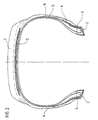
- FIG. 2 shows a pneumatic vehicle tire with a tread 1, metallic bead core 2 located in the bead area 3, a bead reinforcement 4, a carcass 5, side walls 6 and a metallic belt 7.
- the bead core 2 and the belt 7 are generally made of metallic reinforcements.
- the carcass 5 can be made of steel cord.
- tires are used for trucks.
- tires can be produced more cheaply, since it can be dispensed with an additional adhesive mixture for metallic reinforcement.
- the individual rubber mixtures can be better matched to each other, so that the running properties of the tire can be optimized. Due to the good adhesion between metallic Reinforcements and rubber corrosion problems are largely avoided, so that the tire withstands higher mechanical loads and thus has a longer life.
Landscapes
- Chemical & Material Sciences (AREA)
- Organic Chemistry (AREA)
- Polymers & Plastics (AREA)
- Engineering & Computer Science (AREA)
- Health & Medical Sciences (AREA)
- Chemical Kinetics & Catalysis (AREA)
- Medicinal Chemistry (AREA)
- Materials Engineering (AREA)
- Manufacturing & Machinery (AREA)
- Mechanical Engineering (AREA)
- Adhesives Or Adhesive Processes (AREA)
- Manufacture Of Macromolecular Shaped Articles (AREA)
- Tires In General (AREA)
- Polymers With Sulfur, Phosphorus Or Metals In The Main Chain (AREA)
- Laminated Bodies (AREA)
- Compositions Of Macromolecular Compounds (AREA)
Claims (14)
- Substance promotrice d'adhérence pour la meilleure adhérence entre un polymère vulcanisable et un renfort métallique, caractérisée en ce que la substance promotrice d'adhérence présente la structure suivante :
- X :
- -SH ; -Si(Cl)3 ; -Si[R1(Cl)2] ; -Si(OR1)3 ;
-Si[R1(OR1)2], -COOH ; -COCl,
R1 représentant un radical alkyle (ramifié ou non ramifié) et - R :
- -CH2- ; -CF2- ; -CH2-CO-NH-CH2- ;
-CF2-CO-NH-CF2- ; -CH2-CO-NH-CF2- ;
-CF2-CO-NH-CH2-
avec 0≤n, m≤16 et - Ar
- représente un système contenant un groupe thiophène
avec ou sans substituant,
avec 0 < i ≤ 6, et - Y
- représente un radical insaturé.
- Substance promotrice d'adhérence selon la revendication 1, caractérisée en ce que X est un groupe SH.
- Substance promotrice d'adhérence selon la revendication 1 ou 2, caractérisée en ce qu'au moins une partie du système (Ar) contenant un groupe thiophène est appliquée par électrodéposition de composants monomères ou oligomères.
- Substance promotrice d'adhérence selon au moins une des revendications précédentes, caractérisée en ce que le substituant sur le système (Ar) contenant un groupe thiophène présente une activité de donneur ou d'accepteur d'électrons.
- Utilisation d'une substance ayant la structure suivante :
- X :
- -SH ; -Si(Cl)3; -Si[R1(Cl)2]; -Si(OR1)3;
-Si[R1(OR1)2], -COOH ; -COCl,
R1 représentant un radical alkyle (ramifié ou non ramifié) et - R :
- -CH2- ; -CF2- ; -CH2-CO-NH-CH2- ;
-CF2-CO-NH-CF2-; -CH2-CO-NH-CF2- ;
-CF2-CO-NH-CH2-
avec 0≤n,m≤16 et - Ar :
- représente un système aromatique et/ou
hétéroaromatique avec ou sans substituant,
avec 0<i≤6, et - Y :
- représente un radical insaturé,
- Utilisation selon la revendication 5, caractérisée en ce que X dans la substance est un groupe SH.
- Utilisation selon la revendication 5 ou 6, caractérisée en ce que le système aromatique et/ou hétéroaromatique (Ar) dans la substance est un système contenant un groupe thiophène.
- Utilisation selon au moins une des revendications 5 à 7, caractérisée en ce que le substituant sur le système aromatique et/ou hétéroaromatique (Ar) dans la substance présente une activité de donneur ou d'accepteur d'électrons.
- Renfort métallique destiné à adhérer à un polymère vulcanisable, caractérisé en ce que le renfort est muni d'une substance ayant la structure suivante :
- X :
- -SH ; -Si(Cl)3 ; -Si[R1(Cl)2]; -Si(OR1)3;
-Si[R1(OR1)2], -COOH ; -COCl,
R1 représentant un radical alkyle (ramifié ou non ramifié) et - R :
- -CH2- ; -CF2- ; -CH2-CO-NH-CH2-;
-CF2-CO-NH-CF2- ; -CH2-CO-NH-CF2-;
-CF2-CO-NH-CH2-
avec 0≤n,m≤16 et - Ar :
- représente un système aromatique et/ou
hétéroaromatique avec ou sans substituant,
avec 0<i≤6, et - Y :
- représente un radical insaturé,
- Renfort métallique destiné à adhérer à un polymère vulcanisable selon la revendication 9, caractérisé en ce que la substance promotrice d'adhérence est appliquée sur le renfort métallique au moyen d'un processus de trempage.
- Renfort métallique destiné à adhérer à un polymère vulcanisable selon la revendication 9, caractérisé en ce que la substance promotrice d'adhérence est appliquée sur le renfort métallique par une réaction en phase gazeuse.
- Composite à base d'un polymère vulcanisable, d'une substance ayant la structure suivante :
- X :
- -SH ; -Si(Cl)3; -Si[R1(Cl)2]; -Si(OR1)3;
-Si[R1(OR1)2], -COOH ; -COCl,
R1 représentant un radical alkyle (ramifié ou non ramifié) et - R :
- -CH2- ; -CF2- ; -CH2-CO-NH-CH2- ;
-CF2-CO-NH-CF2- ; -CH2-CO-NH-CF2- ;
-CF2-CO-NH-CH2-
avec 0 ≤ n,m ≤ 16 et - Ar
- :représente un système contenant un groupe thiophène
avec ou sans substituant,
avec 0<i≤6, et - Y :
- représente un radical insaturé,
- Composite selon la revendication 9, caractérisé en ce que le polymère est vulcanisable au soufre.
- Composite selon la revendication 12 ou 13, caractérisé en ce que le composite représente la carcasse d'un pneumatique de véhicule.
Applications Claiming Priority (2)
| Application Number | Priority Date | Filing Date | Title |
|---|---|---|---|
| DE19615134A DE19615134C2 (de) | 1996-04-17 | 1996-04-17 | Haftvermittlersubstanz zwischen vulkanisierbarem Polymer und metallischem Festigkeitsträger, Verfahren zu deren Aufbringung sowie deren Verwendung |
| DE19615134 | 1996-04-17 |
Publications (3)
| Publication Number | Publication Date |
|---|---|
| EP0802217A2 EP0802217A2 (fr) | 1997-10-22 |
| EP0802217A3 EP0802217A3 (fr) | 1998-09-02 |
| EP0802217B1 true EP0802217B1 (fr) | 2005-02-02 |
Family
ID=7791515
Family Applications (1)
| Application Number | Title | Priority Date | Filing Date |
|---|---|---|---|
| EP97106115A Expired - Lifetime EP0802217B1 (fr) | 1996-04-17 | 1997-04-15 | Agent adhésif pour polymères vulcanisables et renforcements metalliques |
Country Status (6)
| Country | Link |
|---|---|
| US (1) | US6087519A (fr) |
| EP (1) | EP0802217B1 (fr) |
| JP (1) | JPH1072571A (fr) |
| AT (1) | ATE288456T1 (fr) |
| CZ (1) | CZ117897A3 (fr) |
| DE (2) | DE19615134C2 (fr) |
Families Citing this family (25)
| Publication number | Priority date | Publication date | Assignee | Title |
|---|---|---|---|---|
| US7071913B2 (en) | 1995-07-20 | 2006-07-04 | E Ink Corporation | Retroreflective electrophoretic displays and materials for making the same |
| US6839158B2 (en) | 1997-08-28 | 2005-01-04 | E Ink Corporation | Encapsulated electrophoretic displays having a monolayer of capsules and materials and methods for making the same |
| EP1025145A1 (fr) * | 1997-10-22 | 2000-08-09 | N.V. Bekaert S.A. | Systemes et procedes permettant d'accroitre l'adherence interfaciale entre une surface metallique et un milieu non metallique, et produits ainsi obtenus |
| JP4651193B2 (ja) | 1998-05-12 | 2011-03-16 | イー インク コーポレイション | ドローイングデバイス用途のためのマイクロカプセル化した電気泳動性の静電的にアドレスした媒体 |
| EP1137694A1 (fr) * | 1998-10-15 | 2001-10-04 | N.V. Bekaert S.A. | Element metallique de renfort et procedes d'enrobage associes |
| US6416861B1 (en) * | 1999-02-16 | 2002-07-09 | Northwestern University | Organosilicon compounds and uses thereof |
| US6842657B1 (en) | 1999-04-09 | 2005-01-11 | E Ink Corporation | Reactive formation of dielectric layers and protection of organic layers in organic semiconductor device fabrication |
| US7030412B1 (en) | 1999-05-05 | 2006-04-18 | E Ink Corporation | Minimally-patterned semiconductor devices for display applications |
| WO2001007961A1 (fr) | 1999-07-21 | 2001-02-01 | E Ink Corporation | Utilisation d'un condensateur de memorisation pour ameliorer la performance d'un affichage electronique matriciel actif |
| EP1208603A1 (fr) | 1999-08-31 | 2002-05-29 | E Ink Corporation | Transistor pour ecran a commande electronique |
| AU7094400A (en) | 1999-08-31 | 2001-03-26 | E-Ink Corporation | A solvent annealing process for forming a thin semiconductor film with advantageous properties |
| US6967640B2 (en) | 2001-07-27 | 2005-11-22 | E Ink Corporation | Microencapsulated electrophoretic display with integrated driver |
| DE10138126A1 (de) * | 2001-08-03 | 2003-02-27 | Henkel Kgaa | Bindemittelkomponente für Oberflächenbeschichtungsmittel mit verbesserten Hafteigenschaften |
| US6900851B2 (en) | 2002-02-08 | 2005-05-31 | E Ink Corporation | Electro-optic displays and optical systems for addressing such displays |
| US7081508B2 (en) * | 2004-06-25 | 2006-07-25 | Shin-Etsu Chemical Co., Ltd. | Primer composition |
| EP2277939B1 (fr) | 2005-03-24 | 2017-02-22 | Bridgestone Corporation | Compoundage d'une composition de caoutchouc renforcé à l'aide de silicium présentant un faible taux d'émission de VOC |
| JP4040067B2 (ja) * | 2005-06-01 | 2008-01-30 | 住友電工スチールワイヤー株式会社 | 環状同芯撚りビードコードおよびその製造方法 |
| US8501895B2 (en) * | 2007-05-23 | 2013-08-06 | Bridgestone Corporation | Method for making alkoxy-modified silsesquioxanes and amino alkoxy-modified silsesquioxanes |
| US7915368B2 (en) * | 2007-05-23 | 2011-03-29 | Bridgestone Corporation | Method for making alkoxy-modified silsesquioxanes |
| US8962746B2 (en) | 2007-12-27 | 2015-02-24 | Bridgestone Corporation | Methods of making blocked-mercapto alkoxy-modified silsesquioxane compounds |
| US8097674B2 (en) * | 2007-12-31 | 2012-01-17 | Bridgestone Corporation | Amino alkoxy-modified silsesquioxanes in silica-filled rubber with low volatile organic chemical evolution |
| US8794282B2 (en) | 2007-12-31 | 2014-08-05 | Bridgestone Corporation | Amino alkoxy-modified silsesquioxane adhesives for improved metal adhesion and metal adhesion retention to cured rubber |
| US8642691B2 (en) * | 2009-12-28 | 2014-02-04 | Bridgestone Corporation | Amino alkoxy-modified silsesquioxane adhesives for improved metal adhesion and metal adhesion retention to cured rubber |
| US11401440B2 (en) | 2014-12-31 | 2022-08-02 | Bridgestone Corporation | Amino alkoxy-modified silsesquioxane adhesives for adhering steel alloy to rubber |
| JP6510130B1 (ja) * | 2017-11-21 | 2019-05-08 | ニッタ株式会社 | 帯状ベルト、無端ベルト、及びその製造方法 |
Family Cites Families (20)
| Publication number | Priority date | Publication date | Assignee | Title |
|---|---|---|---|---|
| GB1177766A (en) * | 1966-10-27 | 1970-01-14 | Dunlop Co Ltd | Polymerization Catalysts for Episulphides |
| CH550154A (de) * | 1971-05-27 | 1974-06-14 | Givaudan & Cie Sa | Verfahren zur herstellung eines neuen riech- und/oder aromastoffes. |
| GB8401508D0 (en) * | 1984-01-20 | 1984-02-22 | Monsanto Europe Sa | Compounds useful as rubber/metal bonding promoters |
| JPS6153261A (ja) * | 1984-08-23 | 1986-03-17 | Japan Tobacco Inc | 分鎖状含硫化合物 |
| US5217807A (en) * | 1989-01-17 | 1993-06-08 | Uniroyal Chemical Company, Inc. | Metal acrylates as rubber-to-metal adhesion promoters |
| WO1990008170A1 (fr) * | 1989-01-17 | 1990-07-26 | Uniroyal Chemical Company, Inc. | Acrylates metalliques utilises en tant que promoteurs d'adhesion caoutchouc-sur-metal |
| GB8905009D0 (en) * | 1989-03-04 | 1989-04-19 | Sumitomo Rubber Ind | Method of bonding vulcanisable elastomer compositions to metals |
| JPH02281001A (ja) * | 1989-04-21 | 1990-11-16 | Ube Ind Ltd | 強化ゴム組成物及びその製造方法 |
| JP2760569B2 (ja) * | 1989-05-20 | 1998-06-04 | 旭シユエーベル株式会社 | 樹脂補強用無機繊維 |
| US5126385A (en) * | 1990-03-20 | 1992-06-30 | Uniroyal Chemical Company, Inc. | Chloropyrimidines and chlorotriazines as rubber-to-metal adhesion promoters |
| JP2530512B2 (ja) * | 1990-06-18 | 1996-09-04 | 信越化学工業株式会社 | 有機珪素化合物の製造方法 |
| IT1251401B (it) * | 1991-09-09 | 1995-05-09 | Pirelli | Filo metallico con doppio strato di rivestimento per il rinforzo di articoli in materiali elastomerici e articoli in materiali elastomerici rinforzati con detto filo. |
| JP3141958B2 (ja) * | 1992-02-28 | 2001-03-07 | ホーヤ株式会社 | 気体透過性重合体およびその製造方法 |
| JP3066175B2 (ja) * | 1992-03-30 | 2000-07-17 | サンスター技研株式会社 | 二液型ポリウレタン接着剤 |
| JPH06279732A (ja) * | 1993-01-29 | 1994-10-04 | Asahi Glass Co Ltd | フッ素ゴム接着用プライマー組成物 |
| JPH07171930A (ja) * | 1993-12-20 | 1995-07-11 | Bridgestone Corp | ゴム複合体及びその製造方法 |
| JP3682990B2 (ja) * | 1994-07-13 | 2005-08-17 | ジーイー東芝シリコーン株式会社 | 重合禁止剤の除去方法 |
| US5489701A (en) * | 1994-09-28 | 1996-02-06 | Osi Specialties, Inc. | Process for the preparation of silane polysulfides |
| US5466848A (en) * | 1994-09-28 | 1995-11-14 | Osi Specialties, Inc. | Process for the preparation of silane polysulfides |
| JPH08134356A (ja) * | 1994-11-11 | 1996-05-28 | Toray Dow Corning Silicone Co Ltd | 熱伝導性シリコーンゴムおよびその組成物 |
-
1996
- 1996-04-17 DE DE19615134A patent/DE19615134C2/de not_active Expired - Fee Related
-
1997
- 1997-04-15 DE DE59712189T patent/DE59712189D1/de not_active Expired - Fee Related
- 1997-04-15 AT AT97106115T patent/ATE288456T1/de not_active IP Right Cessation
- 1997-04-15 EP EP97106115A patent/EP0802217B1/fr not_active Expired - Lifetime
- 1997-04-16 US US08/834,415 patent/US6087519A/en not_active Expired - Fee Related
- 1997-04-17 JP JP9132726A patent/JPH1072571A/ja not_active Withdrawn
- 1997-04-17 CZ CZ971178A patent/CZ117897A3/cs unknown
Also Published As
| Publication number | Publication date |
|---|---|
| JPH1072571A (ja) | 1998-03-17 |
| ATE288456T1 (de) | 2005-02-15 |
| EP0802217A3 (fr) | 1998-09-02 |
| CZ117897A3 (en) | 1997-11-12 |
| DE19615134C2 (de) | 2003-04-17 |
| EP0802217A2 (fr) | 1997-10-22 |
| DE19615134A1 (de) | 1997-10-23 |
| US6087519A (en) | 2000-07-11 |
| DE59712189D1 (de) | 2005-03-10 |
Similar Documents
| Publication | Publication Date | Title |
|---|---|---|
| EP0802217B1 (fr) | Agent adhésif pour polymères vulcanisables et renforcements metalliques | |
| US7405010B2 (en) | Metal/rubber composite for tire | |
| DE2403636C3 (de) | Verfahren zur Verbesserung der Haftfähigkeit von vulkanisiertem Kautschuk | |
| DE3805086C2 (fr) | ||
| EP0344427A2 (fr) | Procédé pour lier chimiquement une composition à base de polyamides aliphatiques avec une composition à base d'un caoutchouc contenant des groupes carboxyliques et les produits obtenus | |
| DE3635121A1 (de) | Verfahren zur herstellung eines gummiartigen verbundmaterials | |
| FR2440426A1 (fr) | Pneumatique a fils d'armature en acier resistant a la chaleur et a l'humidite | |
| DE2230354B2 (de) | Metallteil zur haftenden Verbindung mit dem Gummi eines Gummi/Metall-Verbundkörpers | |
| DE69325827T2 (de) | Kautschuk-Kautschuk Verbundstruktur | |
| DE60315916T2 (de) | Endlose Elastomerraupenkette mit korrosionsbeständigen Kabeln | |
| DE19745281A1 (de) | Haftvermittlersubstanz zwischen vulkanisierbarem Polymer und metallischem Festigkeitsträger | |
| DE1811467A1 (de) | Verfahren zum Beschichten von strangfoermigen Gebilden mit Haftvermittlern fuer Kautschuk | |
| DE2832235B2 (de) | Verfahren zum direkten Verbinden von Kautschuk mit Metalloberflächen | |
| DE3603363C2 (fr) | ||
| DE602004012459T2 (de) | Reifen mit stollen | |
| DE1905967A1 (de) | Verfahren zum Verbinden von Kautschukmassen mit Metall | |
| DE10248085A1 (de) | Plasmapolymere Haftschichten | |
| DE2329001A1 (de) | Reifenlaufflaechen und deren herstellung | |
| DE3333538A1 (de) | Verfahren zum herstellen von ueberzuegen insbesondere fuer die runderneuerung und reparatur von kraftfahrzeugreifen | |
| JPH0234978B2 (fr) | ||
| EP2594414A1 (fr) | Support de fixation à gomme | |
| WO2016113240A1 (fr) | Promoteur d'adhésion permettant l'assemblage par liaison de matière d'un matériau organique polymère avec un substrat inorganique et procédé d'assemblage par liaison de matière d'un matériau organique polymère avec un substrat inorganique au moyen de ce promoteur d'adhésion | |
| DE2364193A1 (de) | Gummi-metall-haftverbindung | |
| KR100522576B1 (ko) | 타이어용 비드 와이어 코팅 고무 조성물 | |
| WO2003066302A1 (fr) | Procede de fabrication d'un accouplement d'arbres |
Legal Events
| Date | Code | Title | Description |
|---|---|---|---|
| PUAI | Public reference made under article 153(3) epc to a published international application that has entered the european phase |
Free format text: ORIGINAL CODE: 0009012 |
|
| AK | Designated contracting states |
Kind code of ref document: A2 Designated state(s): AT BE CH DE ES FR GB IT LI LU NL PT SE |
|
| PUAL | Search report despatched |
Free format text: ORIGINAL CODE: 0009013 |
|
| AK | Designated contracting states |
Kind code of ref document: A3 Designated state(s): AT BE CH DE ES FR GB IT LI LU NL PT SE |
|
| 17P | Request for examination filed |
Effective date: 19990302 |
|
| 17Q | First examination report despatched |
Effective date: 20030701 |
|
| GRAP | Despatch of communication of intention to grant a patent |
Free format text: ORIGINAL CODE: EPIDOSNIGR1 |
|
| GRAS | Grant fee paid |
Free format text: ORIGINAL CODE: EPIDOSNIGR3 |
|
| GRAA | (expected) grant |
Free format text: ORIGINAL CODE: 0009210 |
|
| AK | Designated contracting states |
Kind code of ref document: B1 Designated state(s): AT BE CH DE ES FR GB IT LI LU NL PT SE |
|
| PG25 | Lapsed in a contracting state [announced via postgrant information from national office to epo] |
Ref country code: NL Free format text: LAPSE BECAUSE OF FAILURE TO SUBMIT A TRANSLATION OF THE DESCRIPTION OR TO PAY THE FEE WITHIN THE PRESCRIBED TIME-LIMIT Effective date: 20050202 Ref country code: IT Free format text: LAPSE BECAUSE OF FAILURE TO SUBMIT A TRANSLATION OF THE DESCRIPTION OR TO PAY THE FEE WITHIN THE PRESCRIBED TIME-LIMIT;WARNING: LAPSES OF ITALIAN PATENTS WITH EFFECTIVE DATE BEFORE 2007 MAY HAVE OCCURRED AT ANY TIME BEFORE 2007. THE CORRECT EFFECTIVE DATE MAY BE DIFFERENT FROM THE ONE RECORDED. Effective date: 20050202 Ref country code: GB Free format text: LAPSE BECAUSE OF FAILURE TO SUBMIT A TRANSLATION OF THE DESCRIPTION OR TO PAY THE FEE WITHIN THE PRESCRIBED TIME-LIMIT Effective date: 20050202 |
|
| REG | Reference to a national code |
Ref country code: GB Ref legal event code: FG4D Free format text: NOT ENGLISH |
|
| REG | Reference to a national code |
Ref country code: CH Ref legal event code: EP |
|
| REF | Corresponds to: |
Ref document number: 59712189 Country of ref document: DE Date of ref document: 20050310 Kind code of ref document: P |
|
| PG25 | Lapsed in a contracting state [announced via postgrant information from national office to epo] |
Ref country code: LU Free format text: LAPSE BECAUSE OF NON-PAYMENT OF DUE FEES Effective date: 20050415 |
|
| PG25 | Lapsed in a contracting state [announced via postgrant information from national office to epo] |
Ref country code: LI Free format text: LAPSE BECAUSE OF NON-PAYMENT OF DUE FEES Effective date: 20050430 Ref country code: CH Free format text: LAPSE BECAUSE OF NON-PAYMENT OF DUE FEES Effective date: 20050430 |
|
| PG25 | Lapsed in a contracting state [announced via postgrant information from national office to epo] |
Ref country code: SE Free format text: LAPSE BECAUSE OF FAILURE TO SUBMIT A TRANSLATION OF THE DESCRIPTION OR TO PAY THE FEE WITHIN THE PRESCRIBED TIME-LIMIT Effective date: 20050502 |
|
| PG25 | Lapsed in a contracting state [announced via postgrant information from national office to epo] |
Ref country code: ES Free format text: LAPSE BECAUSE OF FAILURE TO SUBMIT A TRANSLATION OF THE DESCRIPTION OR TO PAY THE FEE WITHIN THE PRESCRIBED TIME-LIMIT Effective date: 20050513 |
|
| NLV1 | Nl: lapsed or annulled due to failure to fulfill the requirements of art. 29p and 29m of the patents act | ||
| GBV | Gb: ep patent (uk) treated as always having been void in accordance with gb section 77(7)/1977 [no translation filed] |
Effective date: 20050202 |
|
| PLBE | No opposition filed within time limit |
Free format text: ORIGINAL CODE: 0009261 |
|
| STAA | Information on the status of an ep patent application or granted ep patent |
Free format text: STATUS: NO OPPOSITION FILED WITHIN TIME LIMIT |
|
| REG | Reference to a national code |
Ref country code: CH Ref legal event code: PL |
|
| 26N | No opposition filed |
Effective date: 20051103 |
|
| ET | Fr: translation filed | ||
| PGFP | Annual fee paid to national office [announced via postgrant information from national office to epo] |
Ref country code: AT Payment date: 20070413 Year of fee payment: 11 |
|
| PGFP | Annual fee paid to national office [announced via postgrant information from national office to epo] |
Ref country code: BE Payment date: 20070502 Year of fee payment: 11 |
|
| PG25 | Lapsed in a contracting state [announced via postgrant information from national office to epo] |
Ref country code: PT Free format text: LAPSE BECAUSE OF NON-PAYMENT OF DUE FEES Effective date: 20050704 |
|
| PGFP | Annual fee paid to national office [announced via postgrant information from national office to epo] |
Ref country code: FR Payment date: 20070416 Year of fee payment: 11 |
|
| PGFP | Annual fee paid to national office [announced via postgrant information from national office to epo] |
Ref country code: DE Payment date: 20071217 Year of fee payment: 12 |
|
| BERE | Be: lapsed |
Owner name: *CONTINENTAL A.G. Effective date: 20080430 |
|
| REG | Reference to a national code |
Ref country code: FR Ref legal event code: ST Effective date: 20081231 |
|
| PG25 | Lapsed in a contracting state [announced via postgrant information from national office to epo] |
Ref country code: AT Free format text: LAPSE BECAUSE OF NON-PAYMENT OF DUE FEES Effective date: 20080415 |
|
| PG25 | Lapsed in a contracting state [announced via postgrant information from national office to epo] |
Ref country code: BE Free format text: LAPSE BECAUSE OF NON-PAYMENT OF DUE FEES Effective date: 20080430 |
|
| PG25 | Lapsed in a contracting state [announced via postgrant information from national office to epo] |
Ref country code: FR Free format text: LAPSE BECAUSE OF NON-PAYMENT OF DUE FEES Effective date: 20080430 |
|
| PG25 | Lapsed in a contracting state [announced via postgrant information from national office to epo] |
Ref country code: DE Free format text: LAPSE BECAUSE OF NON-PAYMENT OF DUE FEES Effective date: 20091103 |