EP0800544B1 - Reaktionssystem zur herstellung eines polyurethans, sowie verfahren zu dessen verwendung zum abdichten einer oberfläche - Google Patents
Reaktionssystem zur herstellung eines polyurethans, sowie verfahren zu dessen verwendung zum abdichten einer oberfläche Download PDFInfo
- Publication number
- EP0800544B1 EP0800544B1 EP95943881A EP95943881A EP0800544B1 EP 0800544 B1 EP0800544 B1 EP 0800544B1 EP 95943881 A EP95943881 A EP 95943881A EP 95943881 A EP95943881 A EP 95943881A EP 0800544 B1 EP0800544 B1 EP 0800544B1
- Authority
- EP
- European Patent Office
- Prior art keywords
- polyurethane
- bismuth
- reaction system
- catalyst
- mixture
- Prior art date
- Legal status (The legal status is an assumption and is not a legal conclusion. Google has not performed a legal analysis and makes no representation as to the accuracy of the status listed.)
- Expired - Lifetime
Links
- 239000004814 polyurethane Substances 0.000 title claims description 55
- 229920002635 polyurethane Polymers 0.000 title claims description 54
- 238000006243 chemical reaction Methods 0.000 title claims description 41
- 238000000034 method Methods 0.000 title claims description 19
- 239000003054 catalyst Substances 0.000 claims description 67
- 239000000203 mixture Substances 0.000 claims description 54
- 229920005862 polyol Polymers 0.000 claims description 46
- 150000003077 polyols Chemical class 0.000 claims description 45
- 239000012948 isocyanate Substances 0.000 claims description 37
- 150000002513 isocyanates Chemical class 0.000 claims description 34
- -1 mercaptan compound Chemical class 0.000 claims description 34
- 239000005056 polyisocyanate Substances 0.000 claims description 27
- 229920001228 polyisocyanate Polymers 0.000 claims description 26
- 229910052797 bismuth Inorganic materials 0.000 claims description 22
- 239000011541 reaction mixture Substances 0.000 claims description 19
- 239000011701 zinc Substances 0.000 claims description 19
- 229910052725 zinc Inorganic materials 0.000 claims description 18
- JCXGWMGPZLAOME-UHFFFAOYSA-N bismuth atom Chemical compound [Bi] JCXGWMGPZLAOME-UHFFFAOYSA-N 0.000 claims description 17
- 239000008139 complexing agent Substances 0.000 claims description 17
- 239000011521 glass Substances 0.000 claims description 16
- 238000006555 catalytic reaction Methods 0.000 claims description 14
- HCHKCACWOHOZIP-UHFFFAOYSA-N Zinc Chemical compound [Zn] HCHKCACWOHOZIP-UHFFFAOYSA-N 0.000 claims description 13
- 229910052751 metal Inorganic materials 0.000 claims description 12
- 239000002184 metal Substances 0.000 claims description 12
- 238000007789 sealing Methods 0.000 claims description 9
- UUEWCQRISZBELL-UHFFFAOYSA-N 3-trimethoxysilylpropane-1-thiol Chemical compound CO[Si](OC)(OC)CCCS UUEWCQRISZBELL-UHFFFAOYSA-N 0.000 claims description 8
- 239000000853 adhesive Substances 0.000 claims description 7
- 230000001070 adhesive effect Effects 0.000 claims description 7
- DGVVWUTYPXICAM-UHFFFAOYSA-N β‐Mercaptoethanol Chemical compound OCCS DGVVWUTYPXICAM-UHFFFAOYSA-N 0.000 claims description 7
- NSPSPMKCKIPQBH-UHFFFAOYSA-K bismuth;7,7-dimethyloctanoate Chemical compound [Bi+3].CC(C)(C)CCCCCC([O-])=O.CC(C)(C)CCCCCC([O-])=O.CC(C)(C)CCCCCC([O-])=O NSPSPMKCKIPQBH-UHFFFAOYSA-K 0.000 claims description 6
- VNTDZUDTQCZFKN-UHFFFAOYSA-L zinc 2,2-dimethyloctanoate Chemical compound [Zn++].CCCCCCC(C)(C)C([O-])=O.CCCCCCC(C)(C)C([O-])=O VNTDZUDTQCZFKN-UHFFFAOYSA-L 0.000 claims description 6
- 238000002156 mixing Methods 0.000 claims description 5
- PJUIMOJAAPLTRJ-UHFFFAOYSA-N monothioglycerol Chemical compound OCC(O)CS PJUIMOJAAPLTRJ-UHFFFAOYSA-N 0.000 claims description 5
- 150000001621 bismuth Chemical class 0.000 claims description 4
- 150000003839 salts Chemical class 0.000 claims description 4
- 229910000077 silane Inorganic materials 0.000 claims description 4
- 150000003751 zinc Chemical class 0.000 claims description 4
- 150000001356 alkyl thiols Chemical class 0.000 claims description 3
- 239000004588 polyurethane sealant Substances 0.000 claims description 3
- 229940035024 thioglycerol Drugs 0.000 claims description 3
- DNJIEGIFACGWOD-UHFFFAOYSA-N ethyl mercaptane Natural products CCS DNJIEGIFACGWOD-UHFFFAOYSA-N 0.000 claims description 2
- CBOIHMRHGLHBPB-UHFFFAOYSA-N hydroxymethyl Chemical compound O[CH2] CBOIHMRHGLHBPB-UHFFFAOYSA-N 0.000 claims description 2
- 230000002093 peripheral effect Effects 0.000 claims 7
- BLRPTPMANUNPDV-UHFFFAOYSA-N Silane Chemical compound [SiH4] BLRPTPMANUNPDV-UHFFFAOYSA-N 0.000 claims 1
- 239000000126 substance Substances 0.000 description 37
- 239000004721 Polyphenylene oxide Substances 0.000 description 20
- 229920000570 polyether Polymers 0.000 description 20
- 238000009472 formulation Methods 0.000 description 17
- WERYXYBDKMZEQL-UHFFFAOYSA-N butane-1,4-diol Chemical compound OCCCCO WERYXYBDKMZEQL-UHFFFAOYSA-N 0.000 description 14
- 230000006698 induction Effects 0.000 description 14
- 239000000463 material Substances 0.000 description 14
- 150000002009 diols Chemical class 0.000 description 13
- 239000000565 sealant Substances 0.000 description 13
- IJGRMHOSHXDMSA-UHFFFAOYSA-N Atomic nitrogen Chemical compound N#N IJGRMHOSHXDMSA-UHFFFAOYSA-N 0.000 description 12
- LSDPWZHWYPCBBB-UHFFFAOYSA-N Methanethiol Chemical class SC LSDPWZHWYPCBBB-UHFFFAOYSA-N 0.000 description 11
- 125000002887 hydroxy group Chemical group [H]O* 0.000 description 10
- 239000000376 reactant Substances 0.000 description 10
- 230000003197 catalytic effect Effects 0.000 description 9
- 238000000576 coating method Methods 0.000 description 9
- 150000001875 compounds Chemical class 0.000 description 8
- 238000001879 gelation Methods 0.000 description 8
- JOYRKODLDBILNP-UHFFFAOYSA-N Ethyl urethane Chemical compound CCOC(N)=O JOYRKODLDBILNP-UHFFFAOYSA-N 0.000 description 7
- 239000011248 coating agent Substances 0.000 description 7
- 239000000499 gel Substances 0.000 description 7
- 229920001451 polypropylene glycol Polymers 0.000 description 7
- 239000000523 sample Substances 0.000 description 7
- RWSOTUBLDIXVET-UHFFFAOYSA-N Dihydrogen sulfide Chemical class S RWSOTUBLDIXVET-UHFFFAOYSA-N 0.000 description 6
- 230000004913 activation Effects 0.000 description 6
- 238000013019 agitation Methods 0.000 description 6
- 150000001412 amines Chemical class 0.000 description 6
- IQPQWNKOIGAROB-UHFFFAOYSA-N isocyanate group Chemical group [N-]=C=O IQPQWNKOIGAROB-UHFFFAOYSA-N 0.000 description 6
- 229910021645 metal ion Inorganic materials 0.000 description 6
- 229910052757 nitrogen Inorganic materials 0.000 description 6
- 238000010926 purge Methods 0.000 description 6
- 125000003396 thiol group Chemical class [H]S* 0.000 description 6
- UPMLOUAZCHDJJD-UHFFFAOYSA-N 4,4'-Diphenylmethane Diisocyanate Chemical compound C1=CC(N=C=O)=CC=C1CC1=CC=C(N=C=O)C=C1 UPMLOUAZCHDJJD-UHFFFAOYSA-N 0.000 description 5
- NWIVYGKSHSJHEF-UHFFFAOYSA-N 4-[(4-amino-3,5-diethylphenyl)methyl]-2,6-diethylaniline Chemical class CCC1=C(N)C(CC)=CC(CC=2C=C(CC)C(N)=C(CC)C=2)=C1 NWIVYGKSHSJHEF-UHFFFAOYSA-N 0.000 description 5
- XSTXAVWGXDQKEL-UHFFFAOYSA-N Trichloroethylene Chemical compound ClC=C(Cl)Cl XSTXAVWGXDQKEL-UHFFFAOYSA-N 0.000 description 5
- 239000011888 foil Substances 0.000 description 5
- 125000005842 heteroatom Chemical group 0.000 description 5
- YXIWHUQXZSMYRE-UHFFFAOYSA-N 1,3-benzothiazole-2-thiol Chemical compound C1=CC=C2SC(S)=NC2=C1 YXIWHUQXZSMYRE-UHFFFAOYSA-N 0.000 description 4
- 239000004970 Chain extender Substances 0.000 description 4
- PEDCQBHIVMGVHV-UHFFFAOYSA-N Glycerine Chemical compound OCC(O)CO PEDCQBHIVMGVHV-UHFFFAOYSA-N 0.000 description 4
- SECXISVLQFMRJM-UHFFFAOYSA-N N-Methylpyrrolidone Chemical compound CN1CCCC1=O SECXISVLQFMRJM-UHFFFAOYSA-N 0.000 description 4
- VYPSYNLAJGMNEJ-UHFFFAOYSA-N Silicium dioxide Chemical compound O=[Si]=O VYPSYNLAJGMNEJ-UHFFFAOYSA-N 0.000 description 4
- 125000004432 carbon atom Chemical group C* 0.000 description 4
- 239000008199 coating composition Substances 0.000 description 4
- 239000000945 filler Substances 0.000 description 4
- 229920001684 low density polyethylene Polymers 0.000 description 4
- 239000004702 low-density polyethylene Substances 0.000 description 4
- 239000006069 physical mixture Substances 0.000 description 4
- 239000000049 pigment Substances 0.000 description 4
- 229920006267 polyester film Polymers 0.000 description 4
- 229920000642 polymer Polymers 0.000 description 4
- 239000002904 solvent Substances 0.000 description 4
- 239000000758 substrate Substances 0.000 description 4
- XLYOFNOQVPJJNP-UHFFFAOYSA-N water Chemical compound O XLYOFNOQVPJJNP-UHFFFAOYSA-N 0.000 description 4
- OKTJSMMVPCPJKN-UHFFFAOYSA-N Carbon Chemical compound [C] OKTJSMMVPCPJKN-UHFFFAOYSA-N 0.000 description 3
- YMWUJEATGCHHMB-UHFFFAOYSA-N Dichloromethane Chemical compound ClCCl YMWUJEATGCHHMB-UHFFFAOYSA-N 0.000 description 3
- DNIAPMSPPWPWGF-UHFFFAOYSA-N Propylene glycol Chemical compound CC(O)CO DNIAPMSPPWPWGF-UHFFFAOYSA-N 0.000 description 3
- WYURNTSHIVDZCO-UHFFFAOYSA-N Tetrahydrofuran Chemical compound C1CCOC1 WYURNTSHIVDZCO-UHFFFAOYSA-N 0.000 description 3
- YXFVVABEGXRONW-UHFFFAOYSA-N Toluene Chemical compound CC1=CC=CC=C1 YXFVVABEGXRONW-UHFFFAOYSA-N 0.000 description 3
- 239000002253 acid Substances 0.000 description 3
- 239000000654 additive Substances 0.000 description 3
- 229910052782 aluminium Inorganic materials 0.000 description 3
- XAGFODPZIPBFFR-UHFFFAOYSA-N aluminium Chemical compound [Al] XAGFODPZIPBFFR-UHFFFAOYSA-N 0.000 description 3
- 230000000694 effects Effects 0.000 description 3
- 239000002655 kraft paper Substances 0.000 description 3
- 239000007788 liquid Substances 0.000 description 3
- 229920000728 polyester Polymers 0.000 description 3
- 229920005906 polyester polyol Polymers 0.000 description 3
- 239000007787 solid Substances 0.000 description 3
- 150000003512 tertiary amines Chemical class 0.000 description 3
- 238000010998 test method Methods 0.000 description 3
- IBOFVQJTBBUKMU-UHFFFAOYSA-N 4,4'-methylene-bis-(2-chloroaniline) Chemical compound C1=C(Cl)C(N)=CC=C1CC1=CC=C(N)C(Cl)=C1 IBOFVQJTBBUKMU-UHFFFAOYSA-N 0.000 description 2
- 239000004215 Carbon black (E152) Substances 0.000 description 2
- LYCAIKOWRPUZTN-UHFFFAOYSA-N Ethylene glycol Chemical compound OCCO LYCAIKOWRPUZTN-UHFFFAOYSA-N 0.000 description 2
- QORUGOXNWQUALA-UHFFFAOYSA-N N=C=O.N=C=O.N=C=O.C1=CC=C(C(C2=CC=CC=C2)C2=CC=CC=C2)C=C1 Chemical compound N=C=O.N=C=O.N=C=O.C1=CC=C(C(C2=CC=CC=C2)C2=CC=CC=C2)C=C1 QORUGOXNWQUALA-UHFFFAOYSA-N 0.000 description 2
- 239000004698 Polyethylene Substances 0.000 description 2
- GWEVSGVZZGPLCZ-UHFFFAOYSA-N Titan oxide Chemical compound O=[Ti]=O GWEVSGVZZGPLCZ-UHFFFAOYSA-N 0.000 description 2
- ZJCCRDAZUWHFQH-UHFFFAOYSA-N Trimethylolpropane Chemical compound CCC(CO)(CO)CO ZJCCRDAZUWHFQH-UHFFFAOYSA-N 0.000 description 2
- XLOMVQKBTHCTTD-UHFFFAOYSA-N Zinc monoxide Chemical compound [Zn]=O XLOMVQKBTHCTTD-UHFFFAOYSA-N 0.000 description 2
- JOBBTVPTPXRUBP-UHFFFAOYSA-N [3-(3-sulfanylpropanoyloxy)-2,2-bis(3-sulfanylpropanoyloxymethyl)propyl] 3-sulfanylpropanoate Chemical compound SCCC(=O)OCC(COC(=O)CCS)(COC(=O)CCS)COC(=O)CCS JOBBTVPTPXRUBP-UHFFFAOYSA-N 0.000 description 2
- KXBFLNPZHXDQLV-UHFFFAOYSA-N [cyclohexyl(diisocyanato)methyl]cyclohexane Chemical compound C1CCCCC1C(N=C=O)(N=C=O)C1CCCCC1 KXBFLNPZHXDQLV-UHFFFAOYSA-N 0.000 description 2
- 239000012190 activator Substances 0.000 description 2
- 239000002671 adjuvant Substances 0.000 description 2
- 125000001931 aliphatic group Chemical group 0.000 description 2
- 238000013459 approach Methods 0.000 description 2
- 125000003118 aryl group Chemical group 0.000 description 2
- 125000004429 atom Chemical group 0.000 description 2
- 239000011324 bead Substances 0.000 description 2
- IISBACLAFKSPIT-UHFFFAOYSA-N bisphenol A Chemical compound C=1C=C(O)C=CC=1C(C)(C)C1=CC=C(O)C=C1 IISBACLAFKSPIT-UHFFFAOYSA-N 0.000 description 2
- 150000001735 carboxylic acids Chemical class 0.000 description 2
- 239000003795 chemical substances by application Substances 0.000 description 2
- 239000000539 dimer Substances 0.000 description 2
- 230000009977 dual effect Effects 0.000 description 2
- 238000005516 engineering process Methods 0.000 description 2
- 238000002474 experimental method Methods 0.000 description 2
- 229920002457 flexible plastic Polymers 0.000 description 2
- 239000006260 foam Substances 0.000 description 2
- 229910021485 fumed silica Inorganic materials 0.000 description 2
- 235000011187 glycerol Nutrition 0.000 description 2
- 229910002804 graphite Inorganic materials 0.000 description 2
- 239000010439 graphite Substances 0.000 description 2
- 238000010438 heat treatment Methods 0.000 description 2
- 229930195733 hydrocarbon Natural products 0.000 description 2
- 125000004435 hydrogen atom Chemical group [H]* 0.000 description 2
- 150000002440 hydroxy compounds Chemical class 0.000 description 2
- 230000008595 infiltration Effects 0.000 description 2
- 238000001764 infiltration Methods 0.000 description 2
- 239000003446 ligand Substances 0.000 description 2
- 238000004519 manufacturing process Methods 0.000 description 2
- 229920001179 medium density polyethylene Polymers 0.000 description 2
- 239000004701 medium-density polyethylene Substances 0.000 description 2
- 239000000178 monomer Substances 0.000 description 2
- 125000002524 organometallic group Chemical group 0.000 description 2
- 229920003023 plastic Polymers 0.000 description 2
- 239000004033 plastic Substances 0.000 description 2
- 239000004014 plasticizer Substances 0.000 description 2
- 239000004417 polycarbonate Substances 0.000 description 2
- 229920000515 polycarbonate Polymers 0.000 description 2
- 229920000573 polyethylene Polymers 0.000 description 2
- 239000000047 product Substances 0.000 description 2
- 230000001737 promoting effect Effects 0.000 description 2
- 150000004756 silanes Chemical class 0.000 description 2
- 241000894007 species Species 0.000 description 2
- 150000003606 tin compounds Chemical class 0.000 description 2
- 239000003981 vehicle Substances 0.000 description 2
- 238000009736 wetting Methods 0.000 description 2
- LFOXXKXKYHIANI-UHFFFAOYSA-L zinc;7,7-dimethyloctanoate Chemical class [Zn+2].CC(C)(C)CCCCCC([O-])=O.CC(C)(C)CCCCCC([O-])=O LFOXXKXKYHIANI-UHFFFAOYSA-L 0.000 description 2
- WMKLZBNHZFHSNP-UHFFFAOYSA-N $l^{1}-phosphanylphosphane Chemical compound P[P] WMKLZBNHZFHSNP-UHFFFAOYSA-N 0.000 description 1
- QXRRAZIZHCWBQY-UHFFFAOYSA-N 1,1-bis(isocyanatomethyl)cyclohexane Chemical compound O=C=NCC1(CN=C=O)CCCCC1 QXRRAZIZHCWBQY-UHFFFAOYSA-N 0.000 description 1
- FKTHNVSLHLHISI-UHFFFAOYSA-N 1,2-bis(isocyanatomethyl)benzene Chemical compound O=C=NCC1=CC=CC=C1CN=C=O FKTHNVSLHLHISI-UHFFFAOYSA-N 0.000 description 1
- YJTKZCDBKVTVBY-UHFFFAOYSA-N 1,3-Diphenylbenzene Chemical group C1=CC=CC=C1C1=CC=CC(C=2C=CC=CC=2)=C1 YJTKZCDBKVTVBY-UHFFFAOYSA-N 0.000 description 1
- YHMYGUUIMTVXNW-UHFFFAOYSA-N 1,3-dihydrobenzimidazole-2-thione Chemical compound C1=CC=C2NC(S)=NC2=C1 YHMYGUUIMTVXNW-UHFFFAOYSA-N 0.000 description 1
- 125000001989 1,3-phenylene group Chemical group [H]C1=C([H])C([*:1])=C([H])C([*:2])=C1[H] 0.000 description 1
- ALQLPWJFHRMHIU-UHFFFAOYSA-N 1,4-diisocyanatobenzene Chemical class O=C=NC1=CC=C(N=C=O)C=C1 ALQLPWJFHRMHIU-UHFFFAOYSA-N 0.000 description 1
- SBJCUZQNHOLYMD-UHFFFAOYSA-N 1,5-Naphthalene diisocyanate Chemical compound C1=CC=C2C(N=C=O)=CC=CC2=C1N=C=O SBJCUZQNHOLYMD-UHFFFAOYSA-N 0.000 description 1
- VZXPHDGHQXLXJC-UHFFFAOYSA-N 1,6-diisocyanato-5,6-dimethylheptane Chemical compound O=C=NC(C)(C)C(C)CCCCN=C=O VZXPHDGHQXLXJC-UHFFFAOYSA-N 0.000 description 1
- FKOMNQCOHKHUCP-UHFFFAOYSA-N 1-[n-(2-hydroxypropyl)anilino]propan-2-ol Chemical class CC(O)CN(CC(C)O)C1=CC=CC=C1 FKOMNQCOHKHUCP-UHFFFAOYSA-N 0.000 description 1
- ICLCCFKUSALICQ-UHFFFAOYSA-N 1-isocyanato-4-(4-isocyanato-3-methylphenyl)-2-methylbenzene Chemical compound C1=C(N=C=O)C(C)=CC(C=2C=C(C)C(N=C=O)=CC=2)=C1 ICLCCFKUSALICQ-UHFFFAOYSA-N 0.000 description 1
- SCBKKGZZWVHHOC-UHFFFAOYSA-N 2,2-bis(sulfanyl)propanoic acid Chemical compound CC(S)(S)C(O)=O SCBKKGZZWVHHOC-UHFFFAOYSA-N 0.000 description 1
- PISLZQACAJMAIO-UHFFFAOYSA-N 2,4-diethyl-6-methylbenzene-1,3-diamine Chemical compound CCC1=CC(C)=C(N)C(CC)=C1N PISLZQACAJMAIO-UHFFFAOYSA-N 0.000 description 1
- DVNPFNZTPMWRAX-UHFFFAOYSA-N 2-triethoxysilylethanethiol Chemical compound CCO[Si](CCS)(OCC)OCC DVNPFNZTPMWRAX-UHFFFAOYSA-N 0.000 description 1
- LOSLJXKHQKRRFN-UHFFFAOYSA-N 2-trimethoxysilylethanethiol Chemical compound CO[Si](OC)(OC)CCS LOSLJXKHQKRRFN-UHFFFAOYSA-N 0.000 description 1
- IKYAJDOSWUATPI-UHFFFAOYSA-N 3-[dimethoxy(methyl)silyl]propane-1-thiol Chemical compound CO[Si](C)(OC)CCCS IKYAJDOSWUATPI-UHFFFAOYSA-N 0.000 description 1
- BXIRTIBZBWYINA-UHFFFAOYSA-N 3-sulfanyl-2h-1,3,4-thiadiazole-2-thiol Chemical compound SC1SC=NN1S BXIRTIBZBWYINA-UHFFFAOYSA-N 0.000 description 1
- DCQBZYNUSLHVJC-UHFFFAOYSA-N 3-triethoxysilylpropane-1-thiol Chemical compound CCO[Si](OCC)(OCC)CCCS DCQBZYNUSLHVJC-UHFFFAOYSA-N 0.000 description 1
- UDQCDDZBBZNIFA-UHFFFAOYSA-N 4-methyl-1,3-dihydrobenzimidazole-2-thione Chemical compound CC1=CC=CC2=C1NC(=S)N2 UDQCDDZBBZNIFA-UHFFFAOYSA-N 0.000 description 1
- 239000004925 Acrylic resin Substances 0.000 description 1
- 229920000178 Acrylic resin Polymers 0.000 description 1
- BRLQWZUYTZBJKN-UHFFFAOYSA-N Epichlorohydrin Chemical compound ClCC1CO1 BRLQWZUYTZBJKN-UHFFFAOYSA-N 0.000 description 1
- IAYPIBMASNFSPL-UHFFFAOYSA-N Ethylene oxide Chemical compound C1CO1 IAYPIBMASNFSPL-UHFFFAOYSA-N 0.000 description 1
- PIICEJLVQHRZGT-UHFFFAOYSA-N Ethylenediamine Chemical compound NCCN PIICEJLVQHRZGT-UHFFFAOYSA-N 0.000 description 1
- 239000004606 Fillers/Extenders Substances 0.000 description 1
- 239000005057 Hexamethylene diisocyanate Substances 0.000 description 1
- OAKJQQAXSVQMHS-UHFFFAOYSA-N Hydrazine Chemical compound NN OAKJQQAXSVQMHS-UHFFFAOYSA-N 0.000 description 1
- UFHFLCQGNIYNRP-UHFFFAOYSA-N Hydrogen Chemical compound [H][H] UFHFLCQGNIYNRP-UHFFFAOYSA-N 0.000 description 1
- 239000005058 Isophorone diisocyanate Substances 0.000 description 1
- 239000004594 Masterbatch (MB) Substances 0.000 description 1
- 241001112258 Moca Species 0.000 description 1
- OMRDSWJXRLDPBB-UHFFFAOYSA-N N=C=O.N=C=O.C1CCCCC1 Chemical compound N=C=O.N=C=O.C1CCCCC1 OMRDSWJXRLDPBB-UHFFFAOYSA-N 0.000 description 1
- HDONYZHVZVCMLR-UHFFFAOYSA-N N=C=O.N=C=O.CC1CCCCC1 Chemical compound N=C=O.N=C=O.CC1CCCCC1 HDONYZHVZVCMLR-UHFFFAOYSA-N 0.000 description 1
- JTDWCIXOEPQECG-UHFFFAOYSA-N N=C=O.N=C=O.CCCCCC(C)(C)C Chemical compound N=C=O.N=C=O.CCCCCC(C)(C)C JTDWCIXOEPQECG-UHFFFAOYSA-N 0.000 description 1
- 229920000538 Poly[(phenyl isocyanate)-co-formaldehyde] Polymers 0.000 description 1
- 239000004952 Polyamide Substances 0.000 description 1
- 229920002396 Polyurea Polymers 0.000 description 1
- GOOHAUXETOMSMM-UHFFFAOYSA-N Propylene oxide Chemical compound CC1CO1 GOOHAUXETOMSMM-UHFFFAOYSA-N 0.000 description 1
- XUIMIQQOPSSXEZ-UHFFFAOYSA-N Silicon Chemical compound [Si] XUIMIQQOPSSXEZ-UHFFFAOYSA-N 0.000 description 1
- NINIDFKCEFEMDL-UHFFFAOYSA-N Sulfur Chemical compound [S] NINIDFKCEFEMDL-UHFFFAOYSA-N 0.000 description 1
- ATJFFYVFTNAWJD-UHFFFAOYSA-N Tin Chemical compound [Sn] ATJFFYVFTNAWJD-UHFFFAOYSA-N 0.000 description 1
- 241000287433 Turdus Species 0.000 description 1
- 230000002378 acidificating effect Effects 0.000 description 1
- 150000007513 acids Chemical class 0.000 description 1
- NIXOWILDQLNWCW-UHFFFAOYSA-N acrylic acid group Chemical group C(C=C)(=O)O NIXOWILDQLNWCW-UHFFFAOYSA-N 0.000 description 1
- 230000002411 adverse Effects 0.000 description 1
- 239000003513 alkali Chemical group 0.000 description 1
- 150000005325 alkali earth metal hydroxides Chemical group 0.000 description 1
- 150000008044 alkali metal hydroxides Chemical group 0.000 description 1
- 150000001408 amides Chemical class 0.000 description 1
- 150000004984 aromatic diamines Chemical class 0.000 description 1
- 125000003710 aryl alkyl group Chemical group 0.000 description 1
- QVGXLLKOCUKJST-UHFFFAOYSA-N atomic oxygen Chemical compound [O] QVGXLLKOCUKJST-UHFFFAOYSA-N 0.000 description 1
- 230000004888 barrier function Effects 0.000 description 1
- 150000001622 bismuth compounds Chemical class 0.000 description 1
- OHJMTUPIZMNBFR-UHFFFAOYSA-N biuret Chemical compound NC(=O)NC(N)=O OHJMTUPIZMNBFR-UHFFFAOYSA-N 0.000 description 1
- CDQSJQSWAWPGKG-UHFFFAOYSA-N butane-1,1-diol Chemical compound CCCC(O)O CDQSJQSWAWPGKG-UHFFFAOYSA-N 0.000 description 1
- 229910052799 carbon Inorganic materials 0.000 description 1
- 239000006229 carbon black Substances 0.000 description 1
- 150000004649 carbonic acid derivatives Chemical class 0.000 description 1
- 150000007942 carboxylates Chemical class 0.000 description 1
- 239000004359 castor oil Substances 0.000 description 1
- 235000019438 castor oil Nutrition 0.000 description 1
- 239000007795 chemical reaction product Substances 0.000 description 1
- 239000004927 clay Substances 0.000 description 1
- 230000000536 complexating effect Effects 0.000 description 1
- 229920001577 copolymer Polymers 0.000 description 1
- 230000007797 corrosion Effects 0.000 description 1
- 238000005260 corrosion Methods 0.000 description 1
- 239000003431 cross linking reagent Substances 0.000 description 1
- 125000004122 cyclic group Chemical group 0.000 description 1
- 230000006735 deficit Effects 0.000 description 1
- WMWXXXSCZVGQAR-UHFFFAOYSA-N dialuminum;oxygen(2-);hydrate Chemical class O.[O-2].[O-2].[O-2].[Al+3].[Al+3] WMWXXXSCZVGQAR-UHFFFAOYSA-N 0.000 description 1
- 150000004985 diamines Chemical class 0.000 description 1
- 125000005442 diisocyanate group Chemical group 0.000 description 1
- 125000000118 dimethyl group Chemical group [H]C([H])([H])* 0.000 description 1
- 230000003292 diminished effect Effects 0.000 description 1
- 239000002270 dispersing agent Substances 0.000 description 1
- 238000006073 displacement reaction Methods 0.000 description 1
- 230000007613 environmental effect Effects 0.000 description 1
- 239000000835 fiber Substances 0.000 description 1
- 239000002657 fibrous material Substances 0.000 description 1
- 239000003365 glass fiber Substances 0.000 description 1
- ZEMPKEQAKRGZGQ-XOQCFJPHSA-N glycerol triricinoleate Natural products CCCCCC[C@@H](O)CC=CCCCCCCCC(=O)OC[C@@H](COC(=O)CCCCCCCC=CC[C@@H](O)CCCCCC)OC(=O)CCCCCCCC=CC[C@H](O)CCCCCC ZEMPKEQAKRGZGQ-XOQCFJPHSA-N 0.000 description 1
- OXHDYFKENBXUEM-UHFFFAOYSA-N glyphosine Chemical compound OC(=O)CN(CP(O)(O)=O)CP(O)(O)=O OXHDYFKENBXUEM-UHFFFAOYSA-N 0.000 description 1
- 229910052736 halogen Inorganic materials 0.000 description 1
- 150000002367 halogens Chemical class 0.000 description 1
- 125000000623 heterocyclic group Chemical group 0.000 description 1
- RRAMGCGOFNQTLD-UHFFFAOYSA-N hexamethylene diisocyanate Chemical compound O=C=NCCCCCCN=C=O RRAMGCGOFNQTLD-UHFFFAOYSA-N 0.000 description 1
- ACCCMOQWYVYDOT-UHFFFAOYSA-N hexane-1,1-diol Chemical compound CCCCCC(O)O ACCCMOQWYVYDOT-UHFFFAOYSA-N 0.000 description 1
- 229910052739 hydrogen Inorganic materials 0.000 description 1
- 239000001257 hydrogen Substances 0.000 description 1
- WGCNASOHLSPBMP-UHFFFAOYSA-N hydroxyacetaldehyde Natural products OCC=O WGCNASOHLSPBMP-UHFFFAOYSA-N 0.000 description 1
- 239000003112 inhibitor Substances 0.000 description 1
- 230000002401 inhibitory effect Effects 0.000 description 1
- 230000005764 inhibitory process Effects 0.000 description 1
- 239000003999 initiator Substances 0.000 description 1
- 229910052500 inorganic mineral Inorganic materials 0.000 description 1
- 238000009413 insulation Methods 0.000 description 1
- ZFSLODLOARCGLH-UHFFFAOYSA-N isocyanuric acid Chemical compound OC1=NC(O)=NC(O)=N1 ZFSLODLOARCGLH-UHFFFAOYSA-N 0.000 description 1
- NIMLQBUJDJZYEJ-UHFFFAOYSA-N isophorone diisocyanate Chemical compound CC1(C)CC(N=C=O)CC(C)(CN=C=O)C1 NIMLQBUJDJZYEJ-UHFFFAOYSA-N 0.000 description 1
- CYPPCCJJKNISFK-UHFFFAOYSA-J kaolinite Chemical compound [OH-].[OH-].[OH-].[OH-].[Al+3].[Al+3].[O-][Si](=O)O[Si]([O-])=O CYPPCCJJKNISFK-UHFFFAOYSA-J 0.000 description 1
- 229910052622 kaolinite Inorganic materials 0.000 description 1
- 239000005001 laminate film Substances 0.000 description 1
- 239000002650 laminated plastic Substances 0.000 description 1
- 230000007246 mechanism Effects 0.000 description 1
- 239000012528 membrane Substances 0.000 description 1
- 150000002731 mercury compounds Chemical class 0.000 description 1
- AYLRODJJLADBOB-QMMMGPOBSA-N methyl (2s)-2,6-diisocyanatohexanoate Chemical compound COC(=O)[C@@H](N=C=O)CCCCN=C=O AYLRODJJLADBOB-QMMMGPOBSA-N 0.000 description 1
- 150000004702 methyl esters Chemical class 0.000 description 1
- 125000002496 methyl group Chemical group [H]C([H])([H])* 0.000 description 1
- 239000010445 mica Substances 0.000 description 1
- 229910052618 mica group Inorganic materials 0.000 description 1
- 239000004005 microsphere Substances 0.000 description 1
- 239000011707 mineral Substances 0.000 description 1
- 238000012986 modification Methods 0.000 description 1
- 230000004048 modification Effects 0.000 description 1
- QBYNWJVTTUAPCT-UHFFFAOYSA-N n,n'-bis(2-chlorophenyl)methanediamine Chemical class ClC1=CC=CC=C1NCNC1=CC=CC=C1Cl QBYNWJVTTUAPCT-UHFFFAOYSA-N 0.000 description 1
- 230000036963 noncompetitive effect Effects 0.000 description 1
- 150000007524 organic acids Chemical class 0.000 description 1
- 235000005985 organic acids Nutrition 0.000 description 1
- 150000002894 organic compounds Chemical class 0.000 description 1
- 229920000620 organic polymer Polymers 0.000 description 1
- 229910052760 oxygen Inorganic materials 0.000 description 1
- 239000001301 oxygen Substances 0.000 description 1
- 239000000123 paper Substances 0.000 description 1
- 239000013618 particulate matter Substances 0.000 description 1
- 150000004707 phenolate Chemical class 0.000 description 1
- 150000003003 phosphines Chemical group 0.000 description 1
- 229920002587 poly(1,3-butadiene) polymer Polymers 0.000 description 1
- 229920000233 poly(alkylene oxides) Polymers 0.000 description 1
- 229920002647 polyamide Polymers 0.000 description 1
- 238000006068 polycondensation reaction Methods 0.000 description 1
- 229920006149 polyester-amide block copolymer Polymers 0.000 description 1
- 238000006116 polymerization reaction Methods 0.000 description 1
- 229920006324 polyoxymethylene Polymers 0.000 description 1
- 235000013824 polyphenols Nutrition 0.000 description 1
- 229920006389 polyphenyl polymer Polymers 0.000 description 1
- 229920006295 polythiol Polymers 0.000 description 1
- 229920003226 polyurethane urea Polymers 0.000 description 1
- 230000002028 premature Effects 0.000 description 1
- 230000008569 process Effects 0.000 description 1
- 150000003254 radicals Chemical class 0.000 description 1
- 230000008439 repair process Effects 0.000 description 1
- 239000012260 resinous material Substances 0.000 description 1
- WBHHMMIMDMUBKC-XLNAKTSKSA-N ricinelaidic acid Chemical class CCCCCC[C@@H](O)C\C=C\CCCCCCCC(O)=O WBHHMMIMDMUBKC-XLNAKTSKSA-N 0.000 description 1
- 239000005394 sealing glass Substances 0.000 description 1
- 238000000926 separation method Methods 0.000 description 1
- 238000007493 shaping process Methods 0.000 description 1
- FZHAPNGMFPVSLP-UHFFFAOYSA-N silanamine Chemical class [SiH3]N FZHAPNGMFPVSLP-UHFFFAOYSA-N 0.000 description 1
- 150000004760 silicates Chemical class 0.000 description 1
- 229910052710 silicon Inorganic materials 0.000 description 1
- 239000010703 silicon Substances 0.000 description 1
- 239000000377 silicon dioxide Substances 0.000 description 1
- BPILDHPJSYVNAF-UHFFFAOYSA-M sodium;diiodomethanesulfonate Chemical compound [Na+].[O-]S(=O)(=O)C(I)I BPILDHPJSYVNAF-UHFFFAOYSA-M 0.000 description 1
- 235000015096 spirit Nutrition 0.000 description 1
- 230000003335 steric effect Effects 0.000 description 1
- 238000003860 storage Methods 0.000 description 1
- 229910052717 sulfur Inorganic materials 0.000 description 1
- 239000011593 sulfur Substances 0.000 description 1
- 239000002352 surface water Substances 0.000 description 1
- 239000004094 surface-active agent Substances 0.000 description 1
- 229920001059 synthetic polymer Polymers 0.000 description 1
- 239000000454 talc Substances 0.000 description 1
- 229910052623 talc Inorganic materials 0.000 description 1
- 230000002123 temporal effect Effects 0.000 description 1
- 238000012360 testing method Methods 0.000 description 1
- YLQBMQCUIZJEEH-UHFFFAOYSA-N tetrahydrofuran Natural products C=1C=COC=1 YLQBMQCUIZJEEH-UHFFFAOYSA-N 0.000 description 1
- 239000004408 titanium dioxide Substances 0.000 description 1
- 238000012546 transfer Methods 0.000 description 1
- RKBCYCFRFCNLTO-UHFFFAOYSA-N triisopropylamine Chemical class CC(C)N(C(C)C)C(C)C RKBCYCFRFCNLTO-UHFFFAOYSA-N 0.000 description 1
- 239000013638 trimer Substances 0.000 description 1
- 150000004072 triols Chemical class 0.000 description 1
- KGLSETWPYVUTQX-UHFFFAOYSA-N tris(4-isocyanatophenoxy)-sulfanylidene-$l^{5}-phosphane Chemical compound C1=CC(N=C=O)=CC=C1OP(=S)(OC=1C=CC(=CC=1)N=C=O)OC1=CC=C(N=C=O)C=C1 KGLSETWPYVUTQX-UHFFFAOYSA-N 0.000 description 1
- 150000003673 urethanes Chemical class 0.000 description 1
- 229920002554 vinyl polymer Polymers 0.000 description 1
- 239000010456 wollastonite Substances 0.000 description 1
- 229910052882 wollastonite Inorganic materials 0.000 description 1
- 238000004383 yellowing Methods 0.000 description 1
- 150000003752 zinc compounds Chemical class 0.000 description 1
- 239000011787 zinc oxide Substances 0.000 description 1
Images

Classifications
-
- C—CHEMISTRY; METALLURGY
- C08—ORGANIC MACROMOLECULAR COMPOUNDS; THEIR PREPARATION OR CHEMICAL WORKING-UP; COMPOSITIONS BASED THEREON
- C08G—MACROMOLECULAR COMPOUNDS OBTAINED OTHERWISE THAN BY REACTIONS ONLY INVOLVING UNSATURATED CARBON-TO-CARBON BONDS
- C08G18/00—Polymeric products of isocyanates or isothiocyanates
- C08G18/06—Polymeric products of isocyanates or isothiocyanates with compounds having active hydrogen
- C08G18/28—Polymeric products of isocyanates or isothiocyanates with compounds having active hydrogen characterised by the compounds used containing active hydrogen
- C08G18/40—High-molecular-weight compounds
- C08G18/48—Polyethers
- C08G18/4804—Two or more polyethers of different physical or chemical nature
-
- C—CHEMISTRY; METALLURGY
- C08—ORGANIC MACROMOLECULAR COMPOUNDS; THEIR PREPARATION OR CHEMICAL WORKING-UP; COMPOSITIONS BASED THEREON
- C08G—MACROMOLECULAR COMPOUNDS OBTAINED OTHERWISE THAN BY REACTIONS ONLY INVOLVING UNSATURATED CARBON-TO-CARBON BONDS
- C08G18/00—Polymeric products of isocyanates or isothiocyanates
- C08G18/06—Polymeric products of isocyanates or isothiocyanates with compounds having active hydrogen
- C08G18/08—Processes
-
- C—CHEMISTRY; METALLURGY
- C08—ORGANIC MACROMOLECULAR COMPOUNDS; THEIR PREPARATION OR CHEMICAL WORKING-UP; COMPOSITIONS BASED THEREON
- C08G—MACROMOLECULAR COMPOUNDS OBTAINED OTHERWISE THAN BY REACTIONS ONLY INVOLVING UNSATURATED CARBON-TO-CARBON BONDS
- C08G18/00—Polymeric products of isocyanates or isothiocyanates
- C08G18/06—Polymeric products of isocyanates or isothiocyanates with compounds having active hydrogen
- C08G18/08—Processes
- C08G18/0838—Manufacture of polymers in the presence of non-reactive compounds
- C08G18/0842—Manufacture of polymers in the presence of non-reactive compounds in the presence of liquid diluents
- C08G18/0847—Manufacture of polymers in the presence of non-reactive compounds in the presence of liquid diluents in the presence of solvents for the polymers
- C08G18/0852—Manufacture of polymers in the presence of non-reactive compounds in the presence of liquid diluents in the presence of solvents for the polymers the solvents being organic
-
- C—CHEMISTRY; METALLURGY
- C08—ORGANIC MACROMOLECULAR COMPOUNDS; THEIR PREPARATION OR CHEMICAL WORKING-UP; COMPOSITIONS BASED THEREON
- C08G—MACROMOLECULAR COMPOUNDS OBTAINED OTHERWISE THAN BY REACTIONS ONLY INVOLVING UNSATURATED CARBON-TO-CARBON BONDS
- C08G18/00—Polymeric products of isocyanates or isothiocyanates
- C08G18/06—Polymeric products of isocyanates or isothiocyanates with compounds having active hydrogen
- C08G18/08—Processes
- C08G18/089—Reaction retarding agents
-
- C—CHEMISTRY; METALLURGY
- C08—ORGANIC MACROMOLECULAR COMPOUNDS; THEIR PREPARATION OR CHEMICAL WORKING-UP; COMPOSITIONS BASED THEREON
- C08G—MACROMOLECULAR COMPOUNDS OBTAINED OTHERWISE THAN BY REACTIONS ONLY INVOLVING UNSATURATED CARBON-TO-CARBON BONDS
- C08G18/00—Polymeric products of isocyanates or isothiocyanates
- C08G18/06—Polymeric products of isocyanates or isothiocyanates with compounds having active hydrogen
- C08G18/08—Processes
- C08G18/10—Prepolymer processes involving reaction of isocyanates or isothiocyanates with compounds having active hydrogen in a first reaction step
- C08G18/12—Prepolymer processes involving reaction of isocyanates or isothiocyanates with compounds having active hydrogen in a first reaction step using two or more compounds having active hydrogen in the first polymerisation step
-
- C—CHEMISTRY; METALLURGY
- C08—ORGANIC MACROMOLECULAR COMPOUNDS; THEIR PREPARATION OR CHEMICAL WORKING-UP; COMPOSITIONS BASED THEREON
- C08G—MACROMOLECULAR COMPOUNDS OBTAINED OTHERWISE THAN BY REACTIONS ONLY INVOLVING UNSATURATED CARBON-TO-CARBON BONDS
- C08G18/00—Polymeric products of isocyanates or isothiocyanates
- C08G18/06—Polymeric products of isocyanates or isothiocyanates with compounds having active hydrogen
- C08G18/08—Processes
- C08G18/16—Catalysts
- C08G18/22—Catalysts containing metal compounds
-
- C—CHEMISTRY; METALLURGY
- C08—ORGANIC MACROMOLECULAR COMPOUNDS; THEIR PREPARATION OR CHEMICAL WORKING-UP; COMPOSITIONS BASED THEREON
- C08G—MACROMOLECULAR COMPOUNDS OBTAINED OTHERWISE THAN BY REACTIONS ONLY INVOLVING UNSATURATED CARBON-TO-CARBON BONDS
- C08G18/00—Polymeric products of isocyanates or isothiocyanates
- C08G18/06—Polymeric products of isocyanates or isothiocyanates with compounds having active hydrogen
- C08G18/28—Polymeric products of isocyanates or isothiocyanates with compounds having active hydrogen characterised by the compounds used containing active hydrogen
- C08G18/2805—Compounds having only one group containing active hydrogen
- C08G18/288—Compounds containing at least one heteroatom other than oxygen or nitrogen
-
- C—CHEMISTRY; METALLURGY
- C08—ORGANIC MACROMOLECULAR COMPOUNDS; THEIR PREPARATION OR CHEMICAL WORKING-UP; COMPOSITIONS BASED THEREON
- C08G—MACROMOLECULAR COMPOUNDS OBTAINED OTHERWISE THAN BY REACTIONS ONLY INVOLVING UNSATURATED CARBON-TO-CARBON BONDS
- C08G18/00—Polymeric products of isocyanates or isothiocyanates
- C08G18/06—Polymeric products of isocyanates or isothiocyanates with compounds having active hydrogen
- C08G18/28—Polymeric products of isocyanates or isothiocyanates with compounds having active hydrogen characterised by the compounds used containing active hydrogen
- C08G18/2805—Compounds having only one group containing active hydrogen
- C08G18/288—Compounds containing at least one heteroatom other than oxygen or nitrogen
- C08G18/289—Compounds containing at least one heteroatom other than oxygen or nitrogen containing silicon
-
- C—CHEMISTRY; METALLURGY
- C08—ORGANIC MACROMOLECULAR COMPOUNDS; THEIR PREPARATION OR CHEMICAL WORKING-UP; COMPOSITIONS BASED THEREON
- C08G—MACROMOLECULAR COMPOUNDS OBTAINED OTHERWISE THAN BY REACTIONS ONLY INVOLVING UNSATURATED CARBON-TO-CARBON BONDS
- C08G18/00—Polymeric products of isocyanates or isothiocyanates
- C08G18/06—Polymeric products of isocyanates or isothiocyanates with compounds having active hydrogen
- C08G18/28—Polymeric products of isocyanates or isothiocyanates with compounds having active hydrogen characterised by the compounds used containing active hydrogen
- C08G18/30—Low-molecular-weight compounds
- C08G18/38—Low-molecular-weight compounds having heteroatoms other than oxygen
- C08G18/3855—Low-molecular-weight compounds having heteroatoms other than oxygen having sulfur
- C08G18/3876—Low-molecular-weight compounds having heteroatoms other than oxygen having sulfur containing mercapto groups
-
- C—CHEMISTRY; METALLURGY
- C08—ORGANIC MACROMOLECULAR COMPOUNDS; THEIR PREPARATION OR CHEMICAL WORKING-UP; COMPOSITIONS BASED THEREON
- C08G—MACROMOLECULAR COMPOUNDS OBTAINED OTHERWISE THAN BY REACTIONS ONLY INVOLVING UNSATURATED CARBON-TO-CARBON BONDS
- C08G2190/00—Compositions for sealing or packing joints
Definitions
- This invention relates to a novel reaction system for producing a polyurethane including a unique catalyst system effective therefor.
- a reaction system finds use for example to form a sealant, coating or strip.
- polyurea-urethane compositions e.g., sealants, coatings, foams, and the like
- One pack includes the isocyanate-reactive components such as polyols, together, typically with a catalyst and other customary additives, while the second pack includes the polyisocyanate.
- the catalyst is separately packaged from the polyisocyanate in order to prevent premature gelation of the latter component.
- the two packs are normally mixed immediately prior to application of the coating.
- the hydroxyl groups of the polyol chemically react with the isocyanate groups of the polyisocyanate, ultimately leading to gelation.
- the reaction mixture rapidly loses its fluidity with an attendant pronounced increase in viscosity.
- the time associated with reaching the gelation point also is often referred to as the "potlife".
- An example of such an application is for the cure of a two-pack or part urethane adhesive composition, wherein a "pot-life" is desired during which the composition may be handled and/or applied to a substrate before it substantially cures.
- certain mercury compounds are known to be useful as latent catalysts, but their use is not desirable for environmental reasons.
- US Patent 4,788,083 which describes an activatable/ complexed catalyst system which provides an extended potlife yet is readily activatable with vaporous amine or heat.
- the catalyst is a complexed catalyst generally comprising the reaction product of a tin and/or bismuth polyurethane catalyst with a molar excess of a complexing agent selected from a mercapto or polyphenol compound.
- a complexing agent selected from a mercapto or polyphenol compound.
- the use of vaporous amine and/or heat activation methods to incite rapid cure may present problems on a commercial scale. For example, accurate dosage of the amine activator can be troublesome, which can adversely impact the appearance and resistance to yellowing.
- Use of heat activation requires an oven, which is impractical for operations involving large objects, such as installing and sealing a glass windshield into a car.
- Laid-Open Japanese patent application JP H1-213,382 (Sakada et al.), October 15, 1987, describes two component polyurethane adhesives wherein organic tin compounds are used in conjunction with multi-functional mercaptan compounds to delay the onset of cure and to provide "adaptability" (a period of workability) without undue lengthening of the adhesive hardening time.
- European Patent Application Publication No. 0 454 219 (October 30, 1991), describes a polyurethane system which is stated to eliminate the need for the amine or heat activation required in US Patent No. 4,788,083, by use of a polyol component having an acid value of about 5 or less.
- the publication describes polyurethane systems having extended potlifes of multiple hours.
- U.S. Patent No. 5,250,651 discloses a sealant composition useful for insulation displacement connector enclosures.
- the sealant composition in U.S. 5,250,651 is synthesized by a reaction between polyether species and isocyanate species, requiring a stoichiometric deficit of the isocyanate reactant, that results in a gel-like polymer which is lightly cross-linked through urethane linkages.
- Robins' four classes are: (1) metal ions which are good catalysts (e.g., In +3 , Tl +4 , Sn +2 ); (2) metal ions which exhibit fair catalytic activity (e.g., Zn +2 , Pb +2 , Bi +3 , Et 2 Bi + ); (3) metal ions which show a very low catalytic activity (e.g., Ca +2 , Co +2 , Cu +2 ); and (4) no catalytic activity (e.g., Li + , Na + , Al +3 ).
- metal ions which are good catalysts e.g., In +3 , Tl +4 , Sn +2
- metal ions which exhibit fair catalytic activity e.g., Zn +2 , Pb +2 , Bi +3 , Et 2 Bi +
- metal ions which show a very low catalytic activity e.g., Ca +2 , Co +2 , Cu +2
- no catalytic activity
- a glass sealant which controllably cures or gels at a time that falls inside a time span or window beginning several minutes after admixture of the polyurethane-forming components to within about an hour after admixture.
- a cure profile would provide reasonably ample time to apply and perform any necessary tooling and shaping of the sealing coating on the surface to be sealed before the reaction mixture sets-up to an extent precluding such manipulation, while avoiding unduly long open times to allow the vehicle to be returned to service or further handled as soon as possible.
- the period of time spanning from the mixture of the polyurethane-forming components to the gel time is often referred to as the open time or induction time.
- the present invention relates to a reaction system for producing a polyurethane, the catalyzed reaction mixture thereof involving a unique catalyst system therefor, and the cured polyurethane product derived therefrom.
- the novel reaction system for producing polyurethane meets specific temporal-related criteria of controlled onset of cure, but with rapid curing achieved shortly thereafter without the need for special activation procedures.
- a two-part reaction system for producing a polyurethane having an isocyanate index of at least 100 or greater in value from a catalyzed reaction mixture, and the polyurethane having a gel time between 5 and 60 minutes after admixture of said two parts, where the first and second parts, as two packs, are located in separate containers, respectively, which are effective to prevent contact between said first and second parts thereof until coating application is desired.
- This two-part reaction system includes:
- the mercaptan compound is selected from the group consisting of a mercaptoalkyl-alkoxy silane, a thioglycol, and an alkylthiol, and mixtures thereof.
- the bismuth/zinc polyurethane catalyst comprises a physical mixture of a bismuth salt and a zinc salt.
- the bismuth salt and zinc salt are organometallic catalytic compounds of bismuth and zinc, respectively.
- the reaction system of this invention preferably employs the polyisocyanate component and the polyol component in amounts providing an isocyanate index of from 105 to 150.
- the catalyzed systems show at least a fivefold increase in viscosity, in centipoise, within a time span (window) of less than 10 minutes, where the viscosity is measured using a Brookfield rheometer with a T-F spindle at 2 rpm in conjunction with a helipath at a temperature of 25°C and at approximately 50% relative humidity.
- These systems offer a highly useful controlled onset of cure together with a relatively rapid cure well-suited for applications such as windshield sealing.
- These systems also have wetting and tack properties compatible to the coating of a wide variety of different types of materials.
- polyurethane sealant there is a method of forming a polyurethane sealant on a surface using the aforesaid two-part reaction system and the catalyzed reaction mixture thereof.
- the polyurethane systems of the present invention are especially useful in sealing glass surfaces, such as glass windshields.
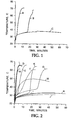
- Figure 1 shows cure profiles for polyol/isocyanate systems using different catalytic systems involving Bi, Bi/Zn and Zn polyuretnane catalysts each in combination with a mercaptan complexing agent.
- Figure 2 shows cure profiles for polyol/poly- isocyanate systems using different types of mercaptan complexing agents.
- Figure 3 shows cure profiles for polyol/polyisocyanate systems in different types and levels of solvent.
- the present invention in its broadest concept, provides a catalyzed reaction mixture for producing a polyurethane, which catalyzed reaction mixture comprises a particular polyol component, a polyisocyanate component, and a particular complexed polyurethane catalyst.
- sealants of this type are stored prior to use in such a fashion that the catalyst and the isocyanate are not in contact with one another or are introduced to the enclosure immediately upon formulation.
- Various approaches are known for such separation, e.g., using a two-part caulking-like gun which has the isocyanate component in one reservoir, and the polyol component, catalyst and mercaptan compound in a second reservoir.
- a two part plunger can be installed in the barrel portion of the caulk-like gun so that simultaneous ejection and mixture of the polyol and isocyanate compositions can be accomplished.
- the polyol (and catalyst and mercaptan compound) and polyisocyanate components can be conveniently packaged in separate dual compartments of a moisture-proof hermetically-sealed flexible plastic package.
- the separate compartments of the package are sealed, such as by heat sealing, after filling with the polyurethane-forming components, in a manner excluding all air from the compartment such that the volume of each compartment, as sealed, is the same as that of the polyurethane-forming materials filled therein.
- the dual compartments can be side-by-side and separated by a sealed membrane or wall of the flexible plastic located therebetween.
- the two-part bag can be formed of a three-ply laminate sheet material of polyester and polyethylene materials obtained under the tradename ScotchpakTM X29905 film commercially available from 3M, St. Paul, MN.
- This bag can be preformed of two superposed sheets of the ScotchpakTM film, the film being a three-ply laminate comprising a 0.5 mil (12.7 ⁇ m) medium density polyethylene film as an outer layer; a 0.5 mil (12.7 ⁇ m) polyester film as a middle layer; and a 3.5 mil (89 ⁇ m) low density polyethylene film as the innermost layer.
- the two sheets are heat sealed along a medial strip including a nonwoven strip material disposed in-between the two sheets at the site to be heat-sealed to form a ruptureable seal in-between the two compartments ultimately formed.
- a technique for forming a suitable two-part bag for this invention with a ruptureable seal therein is described in U.S. Patent No.
- the bag also is continuously heat sealed along its perimeter to seal the lateral side edges to form a compartment or pocket on each side of the medial ruptureable seal, except leaving one side of the formed compartment on each side ofthe ruptureable seal temporarily open until filled with a part of the reactant system.
- heat sealing methods and equipment used for sealing plastic bag materials that are common in the art can be suitably used.
- the filled compartment is heat sealed at the last unsealed side edge of the sheets for that compartment, such as by an automatically controlled air operated heating bar sealer obtained from Pack-Rite Machines, Franksville, WI., to exclude all air from the filled pocket, thus forming a sealed pocket volume equal to that of the amount of formulation added thereto.
- an automatically controlled air operated heating bar sealer obtained from Pack-Rite Machines, Franksville, WI.
- the second part of the reaction system of the invention is placed in the other side compartment of the bag located on the opposite side of the ruptureable seal, where the second compartment is formed in the same manner as first compartment, and then heat sealed to enclose the second part.
- the flexible package can be provided as a plastic/thin metal foil/plastic laminate with the metal foil representing the middle layer to prevent the contents of the package from being exposed to water and/or light before usage.
- the bag again is preformed of two superposed sheets of film, the film in this case being a three-ply laminate comprised ofa 1 mil (25.4 ⁇ m) polyester film as an outer layer; a 0.35 mil (8.9 ⁇ m) aluminum foil film (1145 type) as a middle layer; and a 3.0 mil (76.2 ⁇ m) low density polyethylene film as the innermost layer.
- bag again is preformed of two superposed sheets of film, the film in this case being a four-ply laminate comprised of a 25 lb.
- MG bleached kraft paper as an outermost layer
- a 1 mil (25.4 ⁇ m) polyester film immediately adjacent and beneath the kraft paper outermost layer
- a 0.5 mil (12.7 ⁇ m) aluminum foil film (1145 type) as the next layer
- a 0.3 mil (7.6 ⁇ m) low density polyethylene film as the innermost layer of the film used to construct the bag.
- the general procedure is that contents of the bag compartments can be released from the compartments by rupturing the middle seal to allow the contents of each side of the bag to intermingle; the bag is cut open at one end and the bag inserted into a chamber of a delivery device with the opened end oriented towards the outlet of the delivery device, such as a caulking gun; and the mixture discharged as a mixed coating stream onto a substrate.
- a retractible plunger mechanism can be used to force the mixed coating out of a nozzle part of the device located at the opposite end of the delivery device.
- Known types of barrel and plunger sealant and caulk delivery devices in the field generally can be used in this regard.
- the polyol component may comprise one polyol or a combination of different polyols.
- suitable polyols may be mentioned any of those utilizable for the production of polyurethanes.
- Such polyols are, in general, well known to those skilled in the art.
- Polyols useful in the invention typically are liquid or quasi-liquid polyols, with average functionality of from 1.5 or more, preferably a functionality of from 2 to 8, di-or trifunctional polyols being most preferred.
- Suitable polyols have a weight average molecular weight of about 400 to about 50,000, preferably from about 800 to 20,000.
- Suitable polyols include a wide variety of polyether, polyester, polyacrylic, polyvinyl, poly(epoxyester), polycarbonate, polyurethane and polyurea based polyols. These and other suitable polyols are well-known to those skilled in the art.
- suitable polyols may be selected from polyether polyols based on ethylene oxide, propylene oxide, butylene oxide, tetrahydrofuran, epichlorohydrin or mixtures thereof, ricinoleic acid derivatives, e.g., castor oil; polyester polyols, polyamide or polyesteramide polyols; tertiary amine containing polyols, e.g., ethoxylated or propoxylated amides or amines; polyalkadiene polyols derived from butadiene polymers or copolymers, and hydrogenated derivatives thereof; polyacetals, polycarbonates containing hydroxyl groups; polyhydroxyl (meth)acrylic resins, polythioether polyols, polymer polyols, and the like.
- suitable polyols are exemplified by EP 0454219, incorporated herein by reference, including certain polyester polyols and polyacrylic polyols.
- These suitable polyester polyols can be obtained, for instance, by the polycondensation of one or more di- and/or higher functional carboxylic acids with one or more di- and/or higher functional hydroxy compounds, optionally in combination with one or more monofunctional carboxylic acids and/or hydroxy compounds.
- the suitable acrylic polyols can be obtained, for instance, by the (co)polymerization of hydroxy-functional acrylic monomers with other ethylenically unsaturated comonomers in the presence of a free radical initiator.
- polyol component depends upon a number factors including, primarily, the other components of the reaction mixture and the desired end use. These and other factors are well-known to those skilled in the art, who can make the proper selection of the polyol component accordingly.
- the polyisocyanate component may comprise one polyisocyanate or a combination of different polyisocyanates.
- suitable polyisocyanates may be mentioned any of those utilizable for the production of polyurethanes.
- Such polyisocyanates are, in general, well known to those skilled in the art, and, for example, they are exemplified in U.S. 4,788,083 at column 8, line 63 through column 9, line 30.
- isocyanate also includes isocyanate-terminated prepolymers.
- Polyisocyanates may be linear or branched, aliphatic, cycloaliphatic, arylalkyl, heterocyclic or aromatic, or any combination of such polyisocyanates.
- the isocyanate component contains only one compound, it preferably is an aliphatic isocyanate.
- Particularly suitable polyisocyanates correspond to the formula Q(NCO) n in which n is an integer of from about 2 to about 4, and Q is selected from an aliphatic hydrocarbon radical containing from about 2 to about 100 carbon atoms, and zero to 50 heteroatoms; a cycloaliphatic hydrocarbon radical containing from 4 to 100 carbon atoms and zero to 50 heteroatoms; an aromatic hydrocarbon radical or heterocyclic aromatic radical containing from 6 to 15 carbon atoms and zero to 10 heteroatoms, and an arylalkyl hydrocarbon radical containing from 8 to 100 carbon atoms and zero to 50 heteroatoms.
- the heteroatoms that can be present in Q include non-peroxidic oxygen, sulfur, non-amino nitrogen, halogen, silicon, and non-phosphino phosphorus.
- Polyisocyanates preferably will have from about 2-4 isocyanate groups per molecule for use in the sealing/adhesive/coating composition of the present invention.
- Suitable polyisocyanates for use in the present invention include, for example, hexamethylene diisocyanate, 4,4'-toluene diisocyanate (TDI), diphenylmethane diisocyanate (MDI), polymethyl polyphenyl isocyanate (Polymeric MDI or PAPI), m- and p-phenylene diisocyanates, bitolylene diisocyanate, triphenylmethane triisocyanate, tris-(4-isocyanatophenyl)thiophosphate, cyclohexane diisocyanate (CHDI), bis-(isocyanatomethyl) cyclohexane (H 6 XDI), dicyclohexylmethane diisocyanate (H 12 MDI), trimethylhexane
- Aromatic and aliphatic polyisocyanate dimers, trimers, oligomers, polymers (including biuret and isocyanurate derivatives), and isocyanate functional prepolymers often are available as preformed packages and such packages are suitable for use in the present invention also.
- the ratio of isocyanate equivalents of the polyisocyanate cross-linking agents to the hydroxyl groups from the hydroxy resinous materials preferably should be greater than about 1:1 and can range from about 1.05:1 up to about 1.5:1. At least a slight excess of isocyanate is required in this invention to react with surface water (including water vapor) or water present in the polyol side of the system.
- the precise intended application of the sealing or coating composition often will dictate this ratio or isocyanate index. Therefore, the isocyanate index should be at least 100 or higher in value, preferably at least 105 to better ensure maintainance of adequate tensile and elongation properties. However, if the isocyanate index approaches about 150 or higher, the composition may be too rigid when cured to conform to the contours required.
- Suitable polyurethane catalysts for use with the present invention are complexed catalysts comprising a certain polyurethane metal catalyst complexed with a mercaptan compound.
- these complexed polyurethane catalysts may be described as zinc and bismuth polyurethane catalysts which have been complexed (blocked) by reaction with a molar excess of a complexing agent selected from mercaptan compounds.
- a wide variety of zinc and bismuth polyurethane catalysts are suitable for the combination, such bismuth neodecanoate and zinc neodecanoate.
- a catalyst is available as BICATTM 8 from Shephard Chemical, which comprises a physical mixture of bismuth neodecanoate and zinc neodecanoate made with approximately equal amounts by weight based on the weight amounts of the Bi and Zn.
- Suitable zinc and bismuth catalysts include salts of zinc and bismuth individually as any of organometallic chelates, alcoholates, phenolates, and salts of organic acids, tertiary amines, organic tin compounds, bicyclic amidines, aminosilanes, acidic metal salts of strong acids, tertiary phosphines, alkali and alkali earth metal hydroxides, and the like, and combinations thereof.
- the amount of polyurethane catalyst (uncomplexed) generally ranges from about 0.01 to about 0.5 wt %, based upon the combined weight (solids) of polyol component and polyisocyanate component. This amount, of course, can vary widely depending, for example, on the particular components, desired end use, curing conditions and other factors well-known and appreciable to those skilled in the art.
- the complexing agent is used in conjunction with the bismuth and zinc catalyst.
- the complexing agent for purposes of this invention, is a mercaptan compound. It is not precisely known what dynamics occur to make the bismuth/zinc/mercaptan catalytic mixture produce a latent catalyst for catalyzing the chemical reaction between an isocyanate compound and a isocyanate-reactive compound, polyols, to form a product containing at least one urethane linkage.
- the mercaptan compound displaces some or all of the ligands on the bismuth/zinc catalysts which inhibits the metal catalysts' ability to catalyze the hydroxyl/ isocyanate reaction.
- the isocyanate functionality is reactive with the catalyst system used in this invention.
- the mercaptan ligand reacts with the free isocyanate groups, forming thiocarbamic linkages. It is believed that once the mercapto groups have been consumed, the hydroxyl/isocyanate reaction then becomes the predominate reaction. These theorized dynamics would account for the induction period or delay in the cure of the polyurethane.
- mercaptopropyltrimethoxy silane gives an induction period which can vary from 5 to 20 minutes from sample to sample between polyurethane-forming systems of the same formulation. This difference, it is theorized, may be attributable by the ability of this compound to cyclize.
- the native noncyclic form of the compound gives the delay, while the cyclic form would not have the mercapto group available to complex/bond to the metal atom of the catalyst.
- Preferred mercaptans are those that are polyfunctional. By this, it is meant that the mercaptan compound has another group(s) in addition to the mercapto group(s) present which also can react with isocyanate.
- Examples of polyfunctional mercaptans useful in the present invention include mercaptoethanol, HSCH 2 CH 2 OH, thioglycerol, and HSCH 2 -CH(OH)CH 2 OH.
- the mercaptan compound is selected from the group consisting of a mercaptoalkyl-alkoxy silane, a thioglycol, and an alkylthiol.
- a mercaptoalkyl-alkoxy silane provides adhesion promotion, especially to glass surfaces, which is contributed by these materials in addition to their complexing effect on the catalyst.
- the mercaptoalkoxy silanes although effective for meeting the requirement of the invention relating to providing a gel time between 5 and 60 minutes, have been observed in some cases to impart a less consistent and predictable extent of delay between 5 and 60 minutes from sample to sample, all other things kept equal.
- the mercapto-alkylalkoxy silane can be selected from a gamma-mercaptopropyl-trimethoxysilane, a gamma-mercapto-propyltriethoxysilane, a gamma-mercaptopropyl-methyldimethoxy silane, a mercaptoethyltrimethoxysilane, and a beta-mercaptoethyltriethoxysilane.
- the complexed polyurethane catalysts of this invention are produced by reacting the polyurethane catalyst with a molar excess of the complexing agent. As long as this requirement is met, the complexing agent/catalyst ratio may otherwise vary widely. It is preferred, however, that the molar ratio of complexing agent to metal group of the catalyst ranges from about 2:1 to about 1000:1, more preferably from about 10:1 to about 100:1, and especially from about 10:1 to about 50:1.
- reaction rate may be accelerated, if desired, by the application of elevated temperatures; although no heat activation is required for the polyurethane-forming compositions of the present invention.
- the polyurethane-forming compositions of this invention additionally can optionally contain opacifying pigments and inert extenders such as, for example, titanium dioxide, zinc oxide, clays such as kaolinite clays, silica, talc, carbon or graphite (e.g. for conductive coatings), and the like.
- opacifying pigments and inert extenders such as, for example, titanium dioxide, zinc oxide, clays such as kaolinite clays, silica, talc, carbon or graphite (e.g. for conductive coatings), and the like.
- the coating compositions can contain tinctorial pigments, corrosion-inhibiting pigments, and a variety of agents typically found in coating compositions.
- additional additives include, for example, surfactants, flow or leveling agents, pigment dispersants, and the like.
- Fillers or combinations of fillers may also be present, such as glass or polymeric microspheres, glass fibers, graphite fibers, fibrous materials emanating from an organic polymer, carbon black, mica, aluminum oxide hydrates, various silicates or carbonates or clays, fumed silica and the like.
- the term "filler” is used herein to include all solid additives including particulate matter or fibrous matter, present in the composition.
- a fumed silica available under the trade name Cab-O-SilTM from Cabot, and "Wollastonite", a clay filler available from Nyco Chemicals, Inc., are illustrative of the above materials.
- chain extenders can be added and used to increase and tailor the polyurethane chain size.
- Useful chain extenders for the present invention include diols and diamines such as 4,4'-methylene bis(2-chloro-aniline)("MOCA”), butane diol, hexane diol, propylene glycol, bisphenol A, or polyalkylene oxide polyols with weight average molecular weights between 100 and 500.
- the chain extenders can also be triols such as glycerine, trimethylol propane, or propoxylated adducts of glycerine or trimethylol propane or amines like diethyltoluene diamine, ethylene diamine, substituted aromatic diamines, triisopropyl amine, 4,4'-methylene-bis-(2,6-diethylaniline), methylene bis(orthochloro-aniline), N,N-bis(2-hydroxypropyl)-aniline, and combinations thereof.
- Preferred chain extenders include 1,4-butane diol and 4,4'-methylene-bis-(2,6-diethylaniline), and combinations thereof.
- Cure profiles were determined using a Brookfield Programmable Rheometer (Model DV-III). The viscosities were determined in centipoise (cps) using the T-F spindle at 2 rpm in conjunction with the helipath at a temperature of 25°C and a relative humidity of approximately 50%. Both the viscosity and the temperature were measured versus time.
- the two parts of the polyurethane-forming reactants were released from the two compartments of a storage bag, described in more detail hereinafter, by rupturing an intervening temporary seal barrier formed between the two compartments, opening the bag by snipping an end, and squeezing the contents out of the bag into a mixing bowl, and then the contents were blended for 40 seconds in such a way that no air was whipped into the sample mixture.
- a Dixie® cup was a truncated conical shape with a diameter at the top (mouth) of approximately 5.5 cm, a heigth of approximately 6 cm, and a diameter at the bottom of approximately 3.8 cm.
- the T-F spindle and temperature probe were quickly inserted and the viscosity and temperature of the reation mixture were recorded as a function of time (inclusive of the above-mentioned 40 seconds of preblending). The viscosity was measured until the viscosity reached 10,000,000 cps. The temperature probe was removed after the exotherm has been reached.
- Table 1 summarizes the reagants and amounts (in grams) used in formulating each of Examples 4-6. Further, in Table 1, the meaning of other abbreviations used therein are as follows: "1,4-BDO” means 1,4-butanediol; “Bicat 8” means 50:50 mixture, by weight, of bismuth and zinc neodecanoates obtained from Shepherd Chemical Company; “Bicat Z” means zinc neodecanoate obtained from Shepherd Chemical Company; “Coscat 83” means bismuth neodecanoate obtained from CasChem Inc.
- Example 1 as Part A and Examples 4-6, respectively, as Part B, which had the formulations described above, were mixed together in amounts described herein providing an isocyanate index of 105.
- the two-part bag was formed of a three-ply laminate sheet material of polyester and polyethylene materials obtained under the tradename ScotchpakTM X29905 film commercially available from 3M, St. Paul, MN.
- This bag was preformed of two superposed sheets each of a three-ply laminate comprising a 0.5 mil (12.7 ⁇ m) medium density polyethylene film as an outer layer; a 0.5 mil (12.7 ⁇ m) polyester film as a middle layer; and a 3.5 mil (89 ⁇ m) low density polyethylene film as the innermost layer.
- the two sheets were heat sealed along a medial strip including a nonwoven strip material disposed in-between the two sheets at the site to be heat-sealed to form a ruptureable seal in-between the two compartments ultimately formed.
- the technique for forming the two part bag of this study with a ruptureable seal is described in U.S. Patent No. 3,074,544 to Bollmeier.
- the bag also was continuously heat sealed along its perimeter to seal the lateral side edges except leaving an end of each compartment temporarily open until filled with a part of the reactant system.
- Example 1 After filling a compartment with the 100 g of Example 1 formulation, the filled compartment was heat sealed at its end by an automatically controlled air operated heating bar sealer obtained from Pack-Rite Machines, Franksville, WI., to exclude all air from the filled pocket, thus forming a sealed pocket volume equal to that of the amount of formulation added thereto.
- an automatically controlled air operated heating bar sealer obtained from Pack-Rite Machines, Franksville, WI.
- Example 4 5 or 6 formulation was placed in the other side compartment ofthe bag located on the opposite side ofthe ruptureable seal and heat sealed in the same manner as first compartment.
- the filled bag was stored in a dessicator jar until opened.
- the cure profile for the packaged polyurethane-forming reactants was later determined using the above mentioned Test Methods procedure.
- Figure 1 graphically shows the results of this Study One.
- curve "A” represents the system using Bicat 8 as the catalyst
- curve “B” represents results for the system using Coscat 83 as the catalyst
- curve “C” represents the system using Bicat Z as the catalyst.
- the gelation points for the polyurethane systems summarized in Figure 1 are indicated as occurring at that portion of the curves, if any, characterized by a rapid rise in the mixture temperature as a function of the time parameter, viz. a rise of at least 25°C in the mixture and occurring within a time span less than 10 minutes or less.
- the catalyst used was obtained under the tradename BicatTM 8 from Shepherd Chemical Company, which catalyst was a physical mixture of bismuth neodecanoate and zinc neodecanoate made with approximately equal amounts by weight based on the weight amounts of the Bi and Zn.
- 100 g of the Example 2 formulation was placed in one side of a same type of bag as used in Study One, as described above, heat sealed in the same manner as described for Examples 4-6, and 76 g of one ofthe Example 7-17 formulations was placed in the other side of the bag and heat sealed.
- the cure profile was determined using the above mentioned procedure and Figure 2 graphically shows the results of this study.
- curve "D” represents the results for Example 7; curve "E” represents Example 8; curve “F” represents Example 9; curve "G” represents Example 10; curve “H” represents Example 11; curve “I” represents Example 12; curve “J” represents Example 13; curve “K” represents Example 14; curve “L” represents Example 15; curve “M” represents Example 16; and curve "N” represents Example 17.
- Examples 18-23 were prepared according to the following general procedure. To a 200 liter reaction vessel fitted with nitrogen purge was added 57.7 kg of a polyether triol with an average molecular weight of 2000 obtained under the trade name ARCOL 34-28 from ARCO Chemical Company, 57.8 kg of a polyether diol having an average molecular weight of 6000 obtained under the trade name ARCOL 24-32 from ARCO Chemical Company, 28.6 kg of a polyether diol having an average molecular weight of 1000 obtained under the trade name Poly G 55-112 from Olin Chemical Co., 10.2 kg of 1,4-butanediol, 8.26 kg of4,4'-methylene-bis-(2,6-diethylaniline) obtained under the trade name of Lonzacure M-DEA from Lonza Co., 670.0 g of 3-mercapto-1,2-propanediol obtained from Aldrich Chemical, and 290 g of catalyst Bicat
- NMP N-methylpyrrolidinone, obtained from Aldrich Chemical
- TOL means toluene, obtained from Aldrich Chemical
- MECL means methylene chloride, obtained from Aldrich Chemical
- MINSP means mineral spirits.
- Example 2 as Part A and Examples 18-23 as Part B were mixed together in such a way that the isocyanate index was 105.
- 100 g of the Example 2 formulation was placed in one side of a same type of bag as described for Study One above, heat sealed as in Study One, and 76 g of one of the Example 18-23 formulations was placed in the other side of the bag and heat sealed.
- the cure profile was determined using the above mentioned Test Methods procedure.
- Figure 3 graphically shows the results of this study.
- curve "O” represents Example 18
- curve "P” represents Example 19
- curve "Q” represents Example 20
- curve "R” represents Example 21
- curve "S” represents Example 22
- curve "T” represents Example 23.
- the gelation point for the various polyurethane systems corresponds to that portion of the respective curves, if any, characterized by an overall five-fold increase in the viscosity of the mixture as compared to the initial viscosity of the mixture.
- the systems show at least a five-fold increase in viscosity within a time span of less than 10 minutes indicating an advantageous controlled onset of cure and relatively rapid cure.
Landscapes
- Chemical & Material Sciences (AREA)
- Health & Medical Sciences (AREA)
- Chemical Kinetics & Catalysis (AREA)
- Medicinal Chemistry (AREA)
- Polymers & Plastics (AREA)
- Organic Chemistry (AREA)
- Engineering & Computer Science (AREA)
- Manufacturing & Machinery (AREA)
- Polyurethanes Or Polyureas (AREA)
- Sealing Material Composition (AREA)
- Adhesives Or Adhesive Processes (AREA)
Claims (10)
- Zweiteiliges Reaktionssystem zur Herstellung eines Polyurethans mit einem Isocyanatindex von wenigstens 100 und mit einer Gelzeit zwischen 5 und 60 Minuten nach dem Mischen der zwei Teile, umfassend einen ersten und einen zweiten Teil aufbewahrt in einem getrennten ersten beziehungsweise zweiten Behälter, die wirksam zur Verhinderung des Kontaktes zwischen dem ersten und zweiten Teil sind, wobei(a) der erste Teil eine Polyisocyanatkomponente umfaßt,(b) der zweite Teil(i) eine Polyolkomponente;(ii) einen Polyurethankatalysator, umfassend einen Bismuth/Zink-Polyurethankatalysator; und(iii) einen molaren Überschuß eines Komplexbildners für den Polyurethankatalysator umfaßt, wobei der Komplexbildner eine Mercaptanverbindung ist.
- Zweiteiliges Reaktionssystem gemäß Anspruch 1, wobei die Mercaptanverbindung aus der Gruppe, bestehend aus einem Mercaptoalkylalkoxysilan, einem Thioglycol und einem Alkylthiol oder der Gruppe. bestehend aus Mercaptoethanol, HSCH2CH2OH, Thioglycerin, HSCH2CH(OH)CH2OH und 3-Mercaptopropyltrimethoxysilan, ausgewählt wird.
- Zweiteiliges Reaktionssystem gemäß Anspruch 1 oder 2, wobei ein molares Verhältnis der Mercaptanverbindung zum Gesamtmetall des Polyurethankatalysators 2:1 bis 1.000:1 beträgt.
- Zweiteiliges Reaktionssystem eines der voranstehenden Ansprüche, wobei der Bismuth/Zink-Poluurethankatalysator ein Gemisch aus einem Bismuthsalz und einem Zinksalz umfaßt.
- Zweiteiliges Reaktionssystem gemäß Anspruch 4, wobei das Bismuthsalz Bismuthneodecanoat umfaßt und das Zinksalz Zinkneodecanoat umfaßt.
- Zweiteiliges Reaktionssystem gemäß Anspruch 5, wobei das Bismuthneodecanoat und das Zinkneodecanoat in ungefähr gleichen Gewichtsmengen, basierend auf der Metallmenge in jedem Salz, zusammengegeben werden.
- Zweiteiliges Reaktionssystem eines der voranstehenden Ansprüche, wobei die Polyisocyanatkomponente und die Polyolkomponente in Mengen vorliegen, die einen Isocyanatindex von 105 bis 150 bereitstellen.
- Katalysiertes Reaktionsgemisch zur Herstellung eines Polyurethans mit einem Isocyanatindex von wenigstens 100, umfassend ein Gemisch aus den zwei Teilen gemäß einem der voranstehenden Ansprüche.
- Verfahren zur Erzeugung eines Polyurethanabdichtmittels und/oder Klebstoffs auf einer Obertläche, umfassend die Schritte des:(a) Mischen des ersten beziehungsweise zweiten Teils eines der Ansprüche 1 bis 8 bei einer Temperatur zwischen -5°C und 40°C zur Bereitstellung eines katalysierten Reaktionsgemisches;(b) Aufbringung des katalysierten Reaktionsgemisches auf eine Oberfläche bei einer Umgebungstemperatur zwischen -5°C und 40°C bevor das Gemisch eine Gelzeit erreicht, wobei die Gelzeit zwischen 5 und 60 Minuter nach Schritt (a) auftritt;(c) das katalysierte Reaktionsgemisch die Gelzeit erreichen lassen, bei einer Umgebungstemperatur von -5°C bis 40°C zur Erzeugung eines vernetzten Polyurethans mit einem Isocyanatindex von wenigstens 100 und das an die Oberfläche gebunden ist.
- Verfahren gemäß Anspruch 9, wobei das katalysierte Reaktionsgemisch zur Befestigung und Abdichtung einer gekrümmten Glasscheibe auf einer Haltevorrichtung verwendet wird;wobei die gekrümmte Glasscheibe gegenüberstehende Hauptoberflächen hat, die ein kontinuierliches äußeres peripheres Seitenteil dazwischen definieren;wobei die Haltevorrichtung eine steife Haltevorrichtung mit einer Aussparung ist und eine Öffnung vollständig einschließt;wobei die Haltevorrichtung einen kontinuierlichen inneren peripheren Teil einschließt, der eine Öffnung definiert und ein Profil mit einer Aussparung aufweist, das geeignet ist, das kontinuierliche äußere periphere Seitenteil der gekrümmten Glasscheibe im Eingriff aufzunehmen und zu halten;wobei das katalysierte Reaktionsgemisch auf ein mit einer Aussparung versehenes Teil des kontinuierlichen inneren peripheren Teils oder des kontinuierlichen äußeren peripheren Seitenteils der gekrümmten Glasscheibe bei einer Umgebungstemperatur zwischen -5°C und 40°C aufgebracht wird, bevor das Gemisch eine Gelzeit erreicht;wobei die Gelzeit zwischen 5 und 60 Minuten auftritt;wobei die gekrümmte Glasscheibe derart positioniert ist, daß das kontinuierliche äußere periphere Seitenteil der gekrümmten Glasscheibe in dem mit einer Aussparung versehenen Teil des kontinuierlichen inneren peripheren Teils der Haltevorrichtung im Eingriff aufgenommen ist; undworauf man das katalysierte Reaktionsgemisch bei einer Umgebungstemperatur von -5°C bis 40°C die Gelzeit erreichen läßt, wobei ein vernetztes Polyurethan mit einem Isocyanatindex von wenigstens 100 gebildet wird und die gekrümmte Glasscheibe wirksam an die Haltevorrichtung befestigt und mit ihr abgedichtet wird.
Applications Claiming Priority (3)
| Application Number | Priority Date | Filing Date | Title |
|---|---|---|---|
| US366308 | 1994-12-29 | ||
| US08/366,308 US5587448A (en) | 1994-12-29 | 1994-12-29 | Reaction system for producing a polyurethane and method of using same to seal a surface |
| PCT/US1995/016516 WO1996020967A1 (en) | 1994-12-29 | 1995-12-20 | Reaction system for producing a polyurethane and method of using same to seal a surface |
Publications (2)
| Publication Number | Publication Date |
|---|---|
| EP0800544A1 EP0800544A1 (de) | 1997-10-15 |
| EP0800544B1 true EP0800544B1 (de) | 1998-09-16 |
Family
ID=23442494
Family Applications (1)
| Application Number | Title | Priority Date | Filing Date |
|---|---|---|---|
| EP95943881A Expired - Lifetime EP0800544B1 (de) | 1994-12-29 | 1995-12-20 | Reaktionssystem zur herstellung eines polyurethans, sowie verfahren zu dessen verwendung zum abdichten einer oberfläche |
Country Status (8)
| Country | Link |
|---|---|
| US (1) | US5587448A (de) |
| EP (1) | EP0800544B1 (de) |
| JP (1) | JPH10511727A (de) |
| CN (1) | CN1082967C (de) |
| BR (1) | BR9510469A (de) |
| CA (1) | CA2206324A1 (de) |
| DE (1) | DE69504871T2 (de) |
| WO (1) | WO1996020967A1 (de) |
Cited By (4)
| Publication number | Priority date | Publication date | Assignee | Title |
|---|---|---|---|---|
| CN102391454A (zh) * | 2011-09-09 | 2012-03-28 | 北京高盟新材料股份有限公司 | 挤出复合用聚氨酯粘合剂的制备方法 |
| US12187836B2 (en) | 2018-12-21 | 2025-01-07 | Sika Technology Ag | Two-component polyurethane casting compound with adjustable pot life |
| US12234366B2 (en) | 2018-12-21 | 2025-02-25 | Sika Technology Ag | Method for the 3D printing of two-component polyurethane compositions |
| EP4606831A1 (de) * | 2024-02-23 | 2025-08-27 | Sika Technology AG | Schnellhärtende zweikomponentige polyurethanzusammensetzung mit langer topfzeit |
Families Citing this family (48)
| Publication number | Priority date | Publication date | Assignee | Title |
|---|---|---|---|---|
| US6678311B2 (en) | 1996-05-28 | 2004-01-13 | Qualcomm Incorporated | High data CDMA wireless communication system using variable sized channel codes |
| US5908912A (en) * | 1996-09-06 | 1999-06-01 | Ppg Industries Ohio, Inc. | Electrodepositable coating composition containing bismuth and amino acid materials and electrodeposition method |
| US5976669A (en) * | 1996-12-20 | 1999-11-02 | 3M Innovative Properties Company | Retroreflective article having launderably durable bead-bond |
| US6545117B1 (en) | 1997-08-07 | 2003-04-08 | Akzo Noble N.V. | Sprayable coating compositions comprising an oxazolidine functional compound, an isocyanate functional compound, and a compound selected from a mercapto and a sulfonic acid functional compound |
| US5952053A (en) * | 1997-09-26 | 1999-09-14 | Willamette Valley Company | Process for producing filled polyurethane elastomers |
| US6258918B1 (en) | 1998-04-22 | 2001-07-10 | 3M Innovative Properties Company | Flexible polyurethane material |
| US6353057B1 (en) | 1999-02-10 | 2002-03-05 | King Industries, Inc. | Catalyzing cationic resin and blocked polyisocyanate with bismuth carboxylate |
| US6190524B1 (en) | 1999-03-26 | 2001-02-20 | Ppg Industries Ohio, Inc. | Organosulfur bismuth compounds and their use in electrodepositable coating compositions |
| US6100361A (en) * | 1999-04-30 | 2000-08-08 | Spalding Sports Worldwide, Inc. | Golf ball top coating containing an aromatic/aliphatic polyisocyanate copolymer |
| JP3696447B2 (ja) * | 1999-09-01 | 2005-09-21 | サンスター技研株式会社 | 二液型ポリウレタン系シーリング材 |
| US6486090B1 (en) * | 1999-11-04 | 2002-11-26 | 3M Innovative Properties Company | Initiator/hydroxide and initiator/alkoxide complexes, systems comprising the complexes, and polymerized compositions made therewith |
| DE10142296C1 (de) | 2001-08-29 | 2003-02-13 | Bayer Ag | Polyurethanelastomere, Verfahren zu ihrer Herstellung und ihre Verwendung |
| US7005477B1 (en) | 2002-05-16 | 2006-02-28 | Mcp Industries, Inc. | Moisture-curing polyurethane material having a long gel time |
| US6809150B1 (en) | 2002-11-14 | 2004-10-26 | Rust Bullet, Llc | Method of protecting surfaces from corrosion |
| US6872767B1 (en) | 2002-11-14 | 2005-03-29 | Rust Bullett, Llc | Method of protecting surfaces with aluminum flaked composition |
| US20040198900A1 (en) * | 2003-04-04 | 2004-10-07 | Construction Research & Technology Gmbh | Two part polyurethane sealant composition with low modulus and good paintability |
| EP1602676A1 (de) | 2004-06-01 | 2005-12-07 | SOLVAY (Société Anonyme) | Katalysatorzusammensetzungen |
| US7485729B2 (en) | 2004-08-12 | 2009-02-03 | King Industries, Inc. | Organometallic compositions and coating compositions |
| US20060160978A1 (en) * | 2005-01-20 | 2006-07-20 | Gupta Laxmi C | Flame retardant systems, and related methods and uses |
| JP4760045B2 (ja) * | 2005-02-16 | 2011-08-31 | 横浜ゴム株式会社 | 2液型ポリウレタンシーリング材組成物 |
| US20070043198A1 (en) * | 2005-08-17 | 2007-02-22 | Construction Research & Technology Gmbh | Paintable two-component polyurethane sealant |
| US8609579B2 (en) * | 2006-10-26 | 2013-12-17 | Ashland Licensing And Intellectual Property Llc | Composition capable of radiation activated catalysis and radiation curable urethane containing the composition |
| DE102006055739A1 (de) * | 2006-11-25 | 2008-05-29 | Bayer Materialscience Ag | Abformmassen |
| DE102008054940A1 (de) | 2007-12-21 | 2009-07-02 | Gt Elektrotechnische Produkte Gmbh | Neue Polyurethan-Vergussmassen und Verfahren zu ihrer Herstellung |
| US8932497B2 (en) | 2008-03-13 | 2015-01-13 | Laxmi C. Gupta | Fire retardant coatings and bodies, and methods of use |
| EP2358805B1 (de) * | 2008-12-08 | 2016-09-21 | 3M Innovative Properties Company | Halogenfreie flammschutzmittel für epoxidharzsysteme |
| WO2011093466A1 (ja) * | 2010-01-29 | 2011-08-04 | 東ソー株式会社 | 金属複核錯体からなるブロック剤解離触媒及びその用途 |
| CA2816739C (en) * | 2010-11-04 | 2019-08-06 | Basf Se | Process for producing aerogels or xerogels |
| EP2683767A1 (de) | 2011-03-06 | 2014-01-15 | King Industries, Inc. | Zusammensetzungen eines metallamidinkomplexes und einer zweiten verbindung, diese enthaltende beschichtungszusammensetzungen |
| PT2740750T (pt) * | 2012-12-05 | 2017-11-21 | 3M Innovative Properties Co | Adesivos à base de poliuretano |
| JP6464732B2 (ja) * | 2014-12-25 | 2019-02-06 | Dic株式会社 | 2液型非乾燥型接着剤用ポリイソシアネート組成物、2液型非乾燥型接着剤用ポリオール組成物、非乾燥型接着剤、及び積層フィルム |
| WO2016114876A1 (en) * | 2015-01-13 | 2016-07-21 | The Shepherd Chemical Company | Novel polyurethane curatives |
| WO2016158319A1 (ja) * | 2015-03-27 | 2016-10-06 | 日東化成株式会社 | 電着塗料組成物、電着塗料組成物用触媒 |
| RU2689313C1 (ru) | 2015-06-15 | 2019-05-27 | БАСФ Коатингс ГмбХ | Полиуретановые композиции материалов покрытий и их применение для производства многослойных красочных систем |
| JP6124370B2 (ja) * | 2015-09-29 | 2017-05-10 | 大日本塗料株式会社 | 2液型塗料組成物及びその塗装物 |
| WO2019002538A1 (de) * | 2017-06-30 | 2019-01-03 | Sika Technology Ag | Zweikomponentige polyurethanzusammensetzung mit einstellbarer topfzeit |
| WO2019210098A1 (en) * | 2018-04-25 | 2019-10-31 | Northwestern University | Urethane exchange catalysts and methods for reprocessing cross-linked polyurethanes |
| JP7125829B2 (ja) * | 2018-09-20 | 2022-08-25 | 株式会社ネオス | ウレタン(メタ)アクリレートの製造方法 |
| FR3094717B1 (fr) * | 2019-04-04 | 2021-10-01 | Bostik Sa | Procédé de préparation de composition réticulable |
| WO2020219663A1 (en) | 2019-04-23 | 2020-10-29 | Northwestern University | Urethane exchange catalysts and methods for reprocessing cross-linked polyurethane foams |
| WO2021037606A1 (en) | 2019-08-23 | 2021-03-04 | Basf Coatings Gmbh | Coating material system comprising a mercapto group-containing compound |
| EP4127008A1 (de) | 2020-03-25 | 2023-02-08 | Sika Technology AG | Zweikomponentige polyurethanzusammensetzung mit hoher hydrophobie und einstellbarer topfzeit |
| JP7740884B2 (ja) * | 2021-03-08 | 2025-09-17 | ハリマ化成株式会社 | 二液硬化型コーティング剤及び多層膜 |
| WO2023042735A1 (ja) * | 2021-09-16 | 2023-03-23 | Dic株式会社 | 接着剤、積層体、包装材 |
| CN117897463A (zh) * | 2021-09-16 | 2024-04-16 | Dic株式会社 | 氨基甲酸酯预聚物的制造方法 |
| WO2025125375A1 (en) * | 2023-12-12 | 2025-06-19 | Borchers Gmbh | Catalyst composition and coating compositions comprising the same |
| WO2025234951A1 (en) * | 2024-05-10 | 2025-11-13 | EGE Kimya San. ve Tic. A.S. | Process for the production of polyurethane catalyst |
| CN121227273A (zh) * | 2025-12-02 | 2025-12-30 | 杭州之江有机硅化工有限公司 | 一种双组分聚氨酯结构胶及其制备方法和应用 |
Family Cites Families (6)
| Publication number | Priority date | Publication date | Assignee | Title |
|---|---|---|---|---|
| NL246564A (de) * | 1958-12-22 | |||
| US4788083A (en) * | 1986-03-27 | 1988-11-29 | Ashland Oil, Inc. | Tin or bismuth complex catalysts and trigger cure of coatings therewith |
| JPH01213382A (ja) * | 1987-10-15 | 1989-08-28 | Mitsui Toatsu Chem Inc | 接着剤 |
| US5011902A (en) * | 1989-11-01 | 1991-04-30 | Georgia-Pacific Resins, Inc. | Co-catalyst system for preparing polyurethane based plywood-patch compositions |
| EP0454219A1 (de) * | 1990-04-24 | 1991-10-30 | Akzo N.V. | Polyurethanreaktionsmischungen sowie Beschichtungszusammensetzungen daraus |
| US5250651A (en) * | 1992-10-30 | 1993-10-05 | Minnesota Mining And Manufacturing Company | Crosslinked polyether polyol sealant |
-
1994
- 1994-12-29 US US08/366,308 patent/US5587448A/en not_active Expired - Fee Related
-
1995
- 1995-12-20 JP JP8521048A patent/JPH10511727A/ja not_active Ceased
- 1995-12-20 CN CN95197085A patent/CN1082967C/zh not_active Expired - Fee Related
- 1995-12-20 EP EP95943881A patent/EP0800544B1/de not_active Expired - Lifetime
- 1995-12-20 DE DE69504871T patent/DE69504871T2/de not_active Expired - Fee Related
- 1995-12-20 CA CA002206324A patent/CA2206324A1/en not_active Abandoned
- 1995-12-20 WO PCT/US1995/016516 patent/WO1996020967A1/en not_active Ceased
- 1995-12-20 BR BR9510469A patent/BR9510469A/pt not_active IP Right Cessation
Cited By (6)
| Publication number | Priority date | Publication date | Assignee | Title |
|---|---|---|---|---|
| CN102391454A (zh) * | 2011-09-09 | 2012-03-28 | 北京高盟新材料股份有限公司 | 挤出复合用聚氨酯粘合剂的制备方法 |
| CN102391454B (zh) * | 2011-09-09 | 2013-12-18 | 北京高盟新材料股份有限公司 | 挤出复合用聚氨酯粘合剂的制备方法 |
| US12187836B2 (en) | 2018-12-21 | 2025-01-07 | Sika Technology Ag | Two-component polyurethane casting compound with adjustable pot life |
| US12234366B2 (en) | 2018-12-21 | 2025-02-25 | Sika Technology Ag | Method for the 3D printing of two-component polyurethane compositions |
| EP4606831A1 (de) * | 2024-02-23 | 2025-08-27 | Sika Technology AG | Schnellhärtende zweikomponentige polyurethanzusammensetzung mit langer topfzeit |
| WO2025176885A1 (en) * | 2024-02-23 | 2025-08-28 | Sika Technology Ag | Fast-curing two-component polyurethane composition with long pot life |
Also Published As
| Publication number | Publication date |
|---|---|
| JPH10511727A (ja) | 1998-11-10 |
| BR9510469A (pt) | 1998-05-26 |
| WO1996020967A1 (en) | 1996-07-11 |
| DE69504871D1 (de) | 1998-10-22 |
| CN1171123A (zh) | 1998-01-21 |
| HK1004678A1 (en) | 1998-12-04 |
| CN1082967C (zh) | 2002-04-17 |
| EP0800544A1 (de) | 1997-10-15 |
| US5587448A (en) | 1996-12-24 |
| DE69504871T2 (de) | 1999-05-12 |
| CA2206324A1 (en) | 1996-07-11 |
Similar Documents
| Publication | Publication Date | Title |
|---|---|---|
| US5587448A (en) | Reaction system for producing a polyurethane and method of using same to seal a surface | |
| KR940005871B1 (ko) | 수분 경화 폴리우레탄 중합체의 제조 및 사용방법 | |
| AU695750B2 (en) | Two-part moisture curable polyurethane adhesive | |
| US5623044A (en) | Polyurethane sealant compositions | |
| US5852137A (en) | Polyurethane sealant compositions | |
| AU724913B2 (en) | One-part curable polyurethane adhesive | |
| EP1517971B1 (de) | Auf silanen basierende feuchtigkeitsvernetzende schmelzkleber | |
| US4687533A (en) | Bonding method employing moisture curable polyurethane polymers | |
| US5852103A (en) | Two-part moisture curable polyurethane adhesive | |
| JP2004506075A (ja) | 一液型湿分硬化性ポリウレタン接着剤 | |
| AU663136B2 (en) | Moisture curable compositions and method of curing moisture curable compositions | |
| CN108391435B (zh) | 高分子量疏水多元醇 | |
| EP0632077A2 (de) | Feuchtigkeitshärtender Polyurethan-Klebstoff | |
| JP2020536136A (ja) | シラン化アクリルポリオールに基づくコーティングにプライマーレスで結合するイソシアネート官能性接着剤 | |
| WO2025111782A1 (en) | Two-component polyurethane adhesive with hydrophobic prepolymer for moisture resistance | |
| EP0485008B1 (de) | Vernetzbare in der Wärme schmelzende Zusammensetzung | |
| HK1004678B (en) | Reaction system for producing a polyurethane and method of using same to seal a surface | |
| EP4522700A1 (de) | Zweikomponenten-polyurethanklebstoffzusammensetzung | |
| WO2025102232A1 (en) | Thermally conductive two-component polyurethane adhesive exhibiting cohesive failure on aluminum alloys | |
| CA2210285C (en) | Two-part moisture curable polyurethane adhesive | |
| WO1996015170A1 (en) | Moisture curable polyolefinic adhesive | |
| MXPA97005289A (en) | Adhesive of curable polyurethane of moisture in dospar |
Legal Events
| Date | Code | Title | Description |
|---|---|---|---|
| PUAI | Public reference made under article 153(3) epc to a published international application that has entered the european phase |
Free format text: ORIGINAL CODE: 0009012 |
|
| 17P | Request for examination filed |
Effective date: 19970722 |
|
| AK | Designated contracting states |
Kind code of ref document: A1 Designated state(s): DE FR GB IT |
|
| GRAG | Despatch of communication of intention to grant |
Free format text: ORIGINAL CODE: EPIDOS AGRA |
|
| 17Q | First examination report despatched |
Effective date: 19971024 |
|
| GRAG | Despatch of communication of intention to grant |
Free format text: ORIGINAL CODE: EPIDOS AGRA |
|
| GRAG | Despatch of communication of intention to grant |
Free format text: ORIGINAL CODE: EPIDOS AGRA |
|
| GRAH | Despatch of communication of intention to grant a patent |
Free format text: ORIGINAL CODE: EPIDOS IGRA |
|
| GRAH | Despatch of communication of intention to grant a patent |
Free format text: ORIGINAL CODE: EPIDOS IGRA |
|
| GRAA | (expected) grant |
Free format text: ORIGINAL CODE: 0009210 |
|
| AK | Designated contracting states |
Kind code of ref document: B1 Designated state(s): DE FR GB IT |
|
| REF | Corresponds to: |
Ref document number: 69504871 Country of ref document: DE Date of ref document: 19981022 |
|
| ET | Fr: translation filed | ||
| PLBE | No opposition filed within time limit |
Free format text: ORIGINAL CODE: 0009261 |
|
| STAA | Information on the status of an ep patent application or granted ep patent |
Free format text: STATUS: NO OPPOSITION FILED WITHIN TIME LIMIT |
|
| 26N | No opposition filed | ||
| REG | Reference to a national code |
Ref country code: GB Ref legal event code: IF02 |
|
| PGFP | Annual fee paid to national office [announced via postgrant information from national office to epo] |
Ref country code: GB Payment date: 20031217 Year of fee payment: 9 |
|
| PGFP | Annual fee paid to national office [announced via postgrant information from national office to epo] |
Ref country code: FR Payment date: 20031218 Year of fee payment: 9 |
|
| PGFP | Annual fee paid to national office [announced via postgrant information from national office to epo] |
Ref country code: DE Payment date: 20040202 Year of fee payment: 9 |
|
| PG25 | Lapsed in a contracting state [announced via postgrant information from national office to epo] |
Ref country code: GB Free format text: LAPSE BECAUSE OF NON-PAYMENT OF DUE FEES Effective date: 20041220 |
|
| PG25 | Lapsed in a contracting state [announced via postgrant information from national office to epo] |
Ref country code: DE Free format text: LAPSE BECAUSE OF NON-PAYMENT OF DUE FEES Effective date: 20050701 |
|
| GBPC | Gb: european patent ceased through non-payment of renewal fee |
Effective date: 20041220 |
|
| PG25 | Lapsed in a contracting state [announced via postgrant information from national office to epo] |
Ref country code: FR Free format text: LAPSE BECAUSE OF NON-PAYMENT OF DUE FEES Effective date: 20050831 |
|
| REG | Reference to a national code |
Ref country code: FR Ref legal event code: ST |
|
| PG25 | Lapsed in a contracting state [announced via postgrant information from national office to epo] |
Ref country code: IT Free format text: LAPSE BECAUSE OF NON-PAYMENT OF DUE FEES Effective date: 20051220 |