EP0799819A1 - Dimethyl-(3-aryl-but-3-enyl)-amin-verbindungen mit analgetischer Wirkung - Google Patents
Dimethyl-(3-aryl-but-3-enyl)-amin-verbindungen mit analgetischer Wirkung Download PDFInfo
- Publication number
- EP0799819A1 EP0799819A1 EP97102923A EP97102923A EP0799819A1 EP 0799819 A1 EP0799819 A1 EP 0799819A1 EP 97102923 A EP97102923 A EP 97102923A EP 97102923 A EP97102923 A EP 97102923A EP 0799819 A1 EP0799819 A1 EP 0799819A1
- Authority
- EP
- European Patent Office
- Prior art keywords
- alkyl
- hydrochloride
- proviso
- enyl
- formula
- Prior art date
- Legal status (The legal status is an assumption and is not a legal conclusion. Google has not performed a legal analysis and makes no representation as to the accuracy of the status listed.)
- Granted
Links
- 230000000202 analgesic effect Effects 0.000 title claims description 7
- 150000001412 amines Chemical class 0.000 title description 2
- 125000000217 alkyl group Chemical group 0.000 claims abstract description 104
- 229910052801 chlorine Inorganic materials 0.000 claims abstract description 32
- 229910052731 fluorine Inorganic materials 0.000 claims abstract description 30
- 125000000051 benzyloxy group Chemical group [H]C1=C([H])C([H])=C(C([H])=C1[H])C([H])([H])O* 0.000 claims abstract description 27
- HBAQYPYDRFILMT-UHFFFAOYSA-N 8-[3-(1-cyclopropylpyrazol-4-yl)-1H-pyrazolo[4,3-d]pyrimidin-5-yl]-3-methyl-3,8-diazabicyclo[3.2.1]octan-2-one Chemical class C1(CC1)N1N=CC(=C1)C1=NNC2=C1N=C(N=C2)N1C2C(N(CC1CC2)C)=O HBAQYPYDRFILMT-UHFFFAOYSA-N 0.000 claims abstract description 16
- 125000001997 phenyl group Chemical group [H]C1=C([H])C([H])=C(*)C([H])=C1[H] 0.000 claims abstract description 6
- 150000003839 salts Chemical class 0.000 claims abstract description 5
- 125000004076 pyridyl group Chemical group 0.000 claims abstract description 3
- 125000001544 thienyl group Chemical group 0.000 claims abstract description 3
- -1 amine compounds Chemical class 0.000 claims description 36
- 229910052739 hydrogen Inorganic materials 0.000 claims description 33
- 229910052799 carbon Inorganic materials 0.000 claims description 32
- 150000001875 compounds Chemical class 0.000 claims description 31
- 238000002360 preparation method Methods 0.000 claims description 12
- 239000003814 drug Substances 0.000 claims description 9
- 125000006552 (C3-C8) cycloalkyl group Chemical group 0.000 claims description 8
- SIPUZPBQZHNSDW-UHFFFAOYSA-N bis(2-methylpropyl)aluminum Chemical compound CC(C)C[Al]CC(C)C SIPUZPBQZHNSDW-UHFFFAOYSA-N 0.000 claims description 7
- 239000004480 active ingredient Substances 0.000 claims description 6
- YUCFVHQCAFKDQG-UHFFFAOYSA-N fluoromethane Chemical compound F[CH] YUCFVHQCAFKDQG-UHFFFAOYSA-N 0.000 claims description 6
- 238000000034 method Methods 0.000 claims description 5
- 239000002253 acid Substances 0.000 claims description 4
- 150000007513 acids Chemical class 0.000 claims description 4
- PXBRQCKWGAHEHS-UHFFFAOYSA-N dichlorodifluoromethane Chemical compound FC(F)(Cl)Cl PXBRQCKWGAHEHS-UHFFFAOYSA-N 0.000 claims description 4
- 150000003509 tertiary alcohols Chemical class 0.000 claims description 3
- 150000002902 organometallic compounds Chemical class 0.000 claims description 2
- 125000004104 aryloxy group Chemical group 0.000 abstract description 2
- 125000003545 alkoxy group Chemical group 0.000 abstract 4
- 125000002023 trifluoromethyl group Chemical group FC(F)(F)* 0.000 abstract 3
- 125000000753 cycloalkyl group Chemical group 0.000 abstract 2
- 108010081348 HRT1 protein Hairy Proteins 0.000 abstract 1
- 102100021881 Hairy/enhancer-of-split related with YRPW motif protein 1 Human genes 0.000 abstract 1
- 125000005708 carbonyloxy group Chemical group [*:2]OC([*:1])=O 0.000 abstract 1
- 125000001028 difluoromethyl group Chemical group [H]C(F)(F)* 0.000 abstract 1
- 125000004005 formimidoyl group Chemical group [H]\N=C(/[H])* 0.000 abstract 1
- 125000004573 morpholin-4-yl group Chemical group N1(CCOCC1)* 0.000 abstract 1
- 125000000335 thiazolyl group Chemical group 0.000 abstract 1
- 125000000876 trifluoromethoxy group Chemical group FC(F)(F)O* 0.000 abstract 1
- OKKJLVBELUTLKV-UHFFFAOYSA-N Methanol Chemical compound OC OKKJLVBELUTLKV-UHFFFAOYSA-N 0.000 description 120
- VEXZGXHMUGYJMC-UHFFFAOYSA-N Hydrochloric acid Chemical compound Cl VEXZGXHMUGYJMC-UHFFFAOYSA-N 0.000 description 118
- YMWUJEATGCHHMB-UHFFFAOYSA-N Dichloromethane Chemical compound ClCCl YMWUJEATGCHHMB-UHFFFAOYSA-N 0.000 description 87
- 239000002585 base Substances 0.000 description 51
- RTZKZFJDLAIYFH-UHFFFAOYSA-N Diethyl ether Chemical compound CCOCC RTZKZFJDLAIYFH-UHFFFAOYSA-N 0.000 description 46
- 238000002844 melting Methods 0.000 description 44
- 230000008018 melting Effects 0.000 description 44
- HEMHJVSKTPXQMS-UHFFFAOYSA-M Sodium hydroxide Chemical compound [OH-].[Na+] HEMHJVSKTPXQMS-UHFFFAOYSA-M 0.000 description 36
- 239000000243 solution Substances 0.000 description 36
- IJOOHPMOJXWVHK-UHFFFAOYSA-N chlorotrimethylsilane Chemical compound C[Si](C)(C)Cl IJOOHPMOJXWVHK-UHFFFAOYSA-N 0.000 description 34
- BDAGIHXWWSANSR-UHFFFAOYSA-N methanoic acid Natural products OC=O BDAGIHXWWSANSR-UHFFFAOYSA-N 0.000 description 34
- CSCPPACGZOOCGX-UHFFFAOYSA-N Acetone Chemical compound CC(C)=O CSCPPACGZOOCGX-UHFFFAOYSA-N 0.000 description 27
- XLYOFNOQVPJJNP-UHFFFAOYSA-N water Substances O XLYOFNOQVPJJNP-UHFFFAOYSA-N 0.000 description 23
- WYURNTSHIVDZCO-UHFFFAOYSA-N Tetrahydrofuran Chemical compound C1CCOC1 WYURNTSHIVDZCO-UHFFFAOYSA-N 0.000 description 18
- 239000002904 solvent Substances 0.000 description 18
- OSWFIVFLDKOXQC-UHFFFAOYSA-N 4-(3-methoxyphenyl)aniline Chemical compound COC1=CC=CC(C=2C=CC(N)=CC=2)=C1 OSWFIVFLDKOXQC-UHFFFAOYSA-N 0.000 description 17
- 235000019253 formic acid Nutrition 0.000 description 17
- 239000005051 trimethylchlorosilane Substances 0.000 description 17
- ZWEHNKRNPOVVGH-UHFFFAOYSA-N 2-Butanone Chemical compound CCC(C)=O ZWEHNKRNPOVVGH-UHFFFAOYSA-N 0.000 description 15
- XEKOWRVHYACXOJ-UHFFFAOYSA-N Ethyl acetate Chemical compound CCOC(C)=O XEKOWRVHYACXOJ-UHFFFAOYSA-N 0.000 description 15
- YXFVVABEGXRONW-UHFFFAOYSA-N Toluene Chemical compound CC1=CC=CC=C1 YXFVVABEGXRONW-UHFFFAOYSA-N 0.000 description 15
- VYPSYNLAJGMNEJ-UHFFFAOYSA-N Silicium dioxide Chemical compound O=[Si]=O VYPSYNLAJGMNEJ-UHFFFAOYSA-N 0.000 description 14
- 239000000741 silica gel Substances 0.000 description 14
- 229910002027 silica gel Inorganic materials 0.000 description 14
- 238000006243 chemical reaction Methods 0.000 description 13
- 238000004821 distillation Methods 0.000 description 13
- 238000010828 elution Methods 0.000 description 12
- 239000000203 mixture Substances 0.000 description 11
- LFQSCWFLJHTTHZ-UHFFFAOYSA-N Ethanol Chemical compound CCO LFQSCWFLJHTTHZ-UHFFFAOYSA-N 0.000 description 10
- UIIMBOGNXHQVGW-UHFFFAOYSA-M Sodium bicarbonate Chemical compound [Na+].OC([O-])=O UIIMBOGNXHQVGW-UHFFFAOYSA-M 0.000 description 10
- ZAFNJMIOTHYJRJ-UHFFFAOYSA-N Diisopropyl ether Chemical compound CC(C)OC(C)C ZAFNJMIOTHYJRJ-UHFFFAOYSA-N 0.000 description 9
- VLKZOEOYAKHREP-UHFFFAOYSA-N n-Hexane Chemical compound CCCCCC VLKZOEOYAKHREP-UHFFFAOYSA-N 0.000 description 9
- YLQBMQCUIZJEEH-UHFFFAOYSA-N tetrahydrofuran Natural products C=1C=COC=1 YLQBMQCUIZJEEH-UHFFFAOYSA-N 0.000 description 9
- QTBSBXVTEAMEQO-UHFFFAOYSA-N Acetic acid Chemical compound CC(O)=O QTBSBXVTEAMEQO-UHFFFAOYSA-N 0.000 description 8
- 208000002193 Pain Diseases 0.000 description 8
- 150000003840 hydrochlorides Chemical class 0.000 description 8
- 239000012074 organic phase Substances 0.000 description 8
- TVYLLZQTGLZFBW-ZBFHGGJFSA-N (R,R)-tramadol Chemical compound COC1=CC=CC([C@]2(O)[C@H](CCCC2)CN(C)C)=C1 TVYLLZQTGLZFBW-ZBFHGGJFSA-N 0.000 description 7
- MZRVEZGGRBJDDB-UHFFFAOYSA-N N-Butyllithium Chemical compound [Li]CCCC MZRVEZGGRBJDDB-UHFFFAOYSA-N 0.000 description 6
- 230000036407 pain Effects 0.000 description 6
- 238000010992 reflux Methods 0.000 description 6
- 229960004380 tramadol Drugs 0.000 description 6
- TVYLLZQTGLZFBW-GOEBONIOSA-N tramadol Natural products COC1=CC=CC([C@@]2(O)[C@@H](CCCC2)CN(C)C)=C1 TVYLLZQTGLZFBW-GOEBONIOSA-N 0.000 description 6
- AFRVLDCUUKXBNT-UUASQNMZSA-N (z)-3-(4-methoxyphenyl)-n,n,2-trimethylpent-3-en-1-amine Chemical compound COC1=CC=C(C(=C/C)\C(C)CN(C)C)C=C1 AFRVLDCUUKXBNT-UUASQNMZSA-N 0.000 description 5
- 238000004296 chiral HPLC Methods 0.000 description 5
- 238000001816 cooling Methods 0.000 description 5
- 239000012043 crude product Substances 0.000 description 5
- IQDGSYLLQPDQDV-UHFFFAOYSA-N dimethylazanium;chloride Chemical compound Cl.CNC IQDGSYLLQPDQDV-UHFFFAOYSA-N 0.000 description 5
- 229910000030 sodium bicarbonate Inorganic materials 0.000 description 5
- 235000017557 sodium bicarbonate Nutrition 0.000 description 5
- 239000000126 substance Substances 0.000 description 5
- 238000012360 testing method Methods 0.000 description 5
- QVWGKOYVOZJNRJ-UHFFFAOYSA-N 1-(dimethylamino)-2-methylpentan-3-one Chemical compound CCC(=O)C(C)CN(C)C QVWGKOYVOZJNRJ-UHFFFAOYSA-N 0.000 description 4
- RLQZIECDMISZHS-UHFFFAOYSA-N 2-phenylcyclohexa-2,5-diene-1,4-dione Chemical compound O=C1C=CC(=O)C(C=2C=CC=CC=2)=C1 RLQZIECDMISZHS-UHFFFAOYSA-N 0.000 description 4
- 241000699666 Mus <mouse, genus> Species 0.000 description 4
- ISWSIDIOOBJBQZ-UHFFFAOYSA-N Phenol Chemical compound OC1=CC=CC=C1 ISWSIDIOOBJBQZ-UHFFFAOYSA-N 0.000 description 4
- 125000000118 dimethyl group Chemical group [H]C([H])([H])* 0.000 description 4
- 238000001035 drying Methods 0.000 description 4
- 230000000694 effects Effects 0.000 description 4
- 239000005457 ice water Substances 0.000 description 4
- 239000011541 reaction mixture Substances 0.000 description 4
- PLDWAJLZAAHOGG-UHFFFAOYSA-N 1-bromo-3-methoxybenzene Chemical compound COC1=CC=CC(Br)=C1 PLDWAJLZAAHOGG-UHFFFAOYSA-N 0.000 description 3
- QDHLEFBSGUGHCL-UHFFFAOYSA-N 2-[(dimethylamino)methyl]cyclohexan-1-one Chemical compound CN(C)CC1CCCCC1=O QDHLEFBSGUGHCL-UHFFFAOYSA-N 0.000 description 3
- RUFSZLYNACSUDL-UHFFFAOYSA-N 3-(3-methoxyphenyl)-n,n,2,4-tetramethylpent-3-en-1-amine Chemical compound COC1=CC=CC(C(C(C)CN(C)C)=C(C)C)=C1 RUFSZLYNACSUDL-UHFFFAOYSA-N 0.000 description 3
- 241001465754 Metazoa Species 0.000 description 3
- MUBZPKHOEPUJKR-UHFFFAOYSA-N Oxalic acid Chemical compound OC(=O)C(O)=O MUBZPKHOEPUJKR-UHFFFAOYSA-N 0.000 description 3
- PMZURENOXWZQFD-UHFFFAOYSA-L Sodium Sulfate Chemical compound [Na+].[Na+].[O-]S([O-])(=O)=O PMZURENOXWZQFD-UHFFFAOYSA-L 0.000 description 3
- ZMANZCXQSJIPKH-UHFFFAOYSA-N Triethylamine Chemical compound CCN(CC)CC ZMANZCXQSJIPKH-UHFFFAOYSA-N 0.000 description 3
- 229960000583 acetic acid Drugs 0.000 description 3
- 229940035676 analgesics Drugs 0.000 description 3
- 239000000730 antalgic agent Substances 0.000 description 3
- 239000008346 aqueous phase Substances 0.000 description 3
- 125000003118 aryl group Chemical group 0.000 description 3
- KRKNYBCHXYNGOX-UHFFFAOYSA-N citric acid Chemical compound OC(=O)CC(O)(C(O)=O)CC(O)=O KRKNYBCHXYNGOX-UHFFFAOYSA-N 0.000 description 3
- 229940005483 opioid analgesics Drugs 0.000 description 3
- 238000005191 phase separation Methods 0.000 description 3
- 229910052938 sodium sulfate Inorganic materials 0.000 description 3
- 235000011152 sodium sulphate Nutrition 0.000 description 3
- JHKJGWJFBYPMCY-UUASQNMZSA-N (z)-3-(3-methoxyphenyl)-n,n,2-trimethylpent-3-en-1-amine Chemical compound COC1=CC=CC(C(=C/C)\C(C)CN(C)C)=C1 JHKJGWJFBYPMCY-UUASQNMZSA-N 0.000 description 2
- HCLSGFYURMCBFL-RZNTYIFUSA-N (z)-3-[3-(difluoromethyl)phenyl]-n,n,2-trimethylpent-3-en-1-amine Chemical compound CN(C)CC(C)/C(=C/C)C1=CC=CC(C(F)F)=C1 HCLSGFYURMCBFL-RZNTYIFUSA-N 0.000 description 2
- PAAZPARNPHGIKF-UHFFFAOYSA-N 1,2-dibromoethane Chemical compound BrCCBr PAAZPARNPHGIKF-UHFFFAOYSA-N 0.000 description 2
- PZNRRUTVGXCKFC-UHFFFAOYSA-N 1-(dimethylamino)-3-(3-methoxyphenyl)-2-methylpentan-3-ol Chemical compound CN(C)CC(C)C(O)(CC)C1=CC=CC(OC)=C1 PZNRRUTVGXCKFC-UHFFFAOYSA-N 0.000 description 2
- XLQSXGGDTHANLN-UHFFFAOYSA-N 1-bromo-4-(trifluoromethyl)benzene Chemical compound FC(F)(F)C1=CC=C(Br)C=C1 XLQSXGGDTHANLN-UHFFFAOYSA-N 0.000 description 2
- YHCVGGJYRMYIGG-UHFFFAOYSA-N 3-(dimethylamino)-1-(3-methoxyphenyl)-2-methylpropan-1-one Chemical compound COC1=CC=CC(C(=O)C(C)CN(C)C)=C1 YHCVGGJYRMYIGG-UHFFFAOYSA-N 0.000 description 2
- ICMRARPEXQPGCP-TZMCWYRMSA-N 3-[(3r,6s)-6-[(dimethylamino)methyl]-3-methylcyclohexen-1-yl]phenol Chemical compound C[C@@H]1CC[C@H](CN(C)C)C(C=2C=C(O)C=CC=2)=C1 ICMRARPEXQPGCP-TZMCWYRMSA-N 0.000 description 2
- ICMRARPEXQPGCP-JSGCOSHPSA-N 3-[(3s,6r)-6-[(dimethylamino)methyl]-3-methylcyclohexen-1-yl]phenol Chemical compound C[C@H]1CC[C@@H](CN(C)C)C(C=2C=C(O)C=CC=2)=C1 ICMRARPEXQPGCP-JSGCOSHPSA-N 0.000 description 2
- VIBKCCHMNVUCEA-UHFFFAOYSA-N 3-[3-(difluoromethyl)phenyl]-1-(dimethylamino)-2-methylpentan-3-ol Chemical compound CN(C)CC(C)C(O)(CC)C1=CC=CC(C(F)F)=C1 VIBKCCHMNVUCEA-UHFFFAOYSA-N 0.000 description 2
- FNZOPROZXFSESG-UHFFFAOYSA-N 3-[5-(dimethylamino)-2,4-dimethylpent-2-en-3-yl]phenol Chemical compound CN(C)CC(C)C(=C(C)C)C1=CC=CC(O)=C1 FNZOPROZXFSESG-UHFFFAOYSA-N 0.000 description 2
- UJBOOUHRTQVGRU-UHFFFAOYSA-N 3-methylcyclohexan-1-one Chemical compound CC1CCCC(=O)C1 UJBOOUHRTQVGRU-UHFFFAOYSA-N 0.000 description 2
- RPIPIDFQPSTYLH-RZNTYIFUSA-N 4-[(z)-5-(dimethylamino)-4-methylpent-2-en-3-yl]phenol Chemical compound CN(C)CC(C)/C(=C/C)C1=CC=C(O)C=C1 RPIPIDFQPSTYLH-RZNTYIFUSA-N 0.000 description 2
- NLXLAEXVIDQMFP-UHFFFAOYSA-N Ammonia chloride Chemical compound [NH4+].[Cl-] NLXLAEXVIDQMFP-UHFFFAOYSA-N 0.000 description 2
- OKTJSMMVPCPJKN-UHFFFAOYSA-N Carbon Chemical compound [C] OKTJSMMVPCPJKN-UHFFFAOYSA-N 0.000 description 2
- 208000000094 Chronic Pain Diseases 0.000 description 2
- 206010012335 Dependence Diseases 0.000 description 2
- VZCYOOQTPOCHFL-OWOJBTEDSA-N Fumaric acid Chemical compound OC(=O)\C=C\C(O)=O VZCYOOQTPOCHFL-OWOJBTEDSA-N 0.000 description 2
- AFVFQIVMOAPDHO-UHFFFAOYSA-N Methanesulfonic acid Chemical compound CS(O)(=O)=O AFVFQIVMOAPDHO-UHFFFAOYSA-N 0.000 description 2
- UWJUQVWARXYRCG-HIFRSBDPSA-N O-Desmethyltramadol Chemical compound CN(C)C[C@H]1CCCC[C@]1(O)C1=CC=CC(O)=C1 UWJUQVWARXYRCG-HIFRSBDPSA-N 0.000 description 2
- KDLHZDBZIXYQEI-UHFFFAOYSA-N Palladium Chemical compound [Pd] KDLHZDBZIXYQEI-UHFFFAOYSA-N 0.000 description 2
- CDBYLPFSWZWCQE-UHFFFAOYSA-L Sodium Carbonate Chemical compound [Na+].[Na+].[O-]C([O-])=O CDBYLPFSWZWCQE-UHFFFAOYSA-L 0.000 description 2
- QAOWNCQODCNURD-UHFFFAOYSA-N Sulfuric acid Chemical compound OS(O)(=O)=O QAOWNCQODCNURD-UHFFFAOYSA-N 0.000 description 2
- 230000036592 analgesia Effects 0.000 description 2
- 239000007864 aqueous solution Substances 0.000 description 2
- 230000015572 biosynthetic process Effects 0.000 description 2
- 239000003153 chemical reaction reagent Substances 0.000 description 2
- 230000001684 chronic effect Effects 0.000 description 2
- CSJLBAMHHLJAAS-UHFFFAOYSA-N diethylaminosulfur trifluoride Chemical compound CCN(CC)S(F)(F)F CSJLBAMHHLJAAS-UHFFFAOYSA-N 0.000 description 2
- IJKVHSBPTUYDLN-UHFFFAOYSA-N dihydroxy(oxo)silane Chemical compound O[Si](O)=O IJKVHSBPTUYDLN-UHFFFAOYSA-N 0.000 description 2
- 229940079593 drug Drugs 0.000 description 2
- 125000002887 hydroxy group Chemical group [H]O* 0.000 description 2
- 238000001990 intravenous administration Methods 0.000 description 2
- 238000011835 investigation Methods 0.000 description 2
- INQOMBQAUSQDDS-UHFFFAOYSA-N iodomethane Chemical compound IC INQOMBQAUSQDDS-UHFFFAOYSA-N 0.000 description 2
- JVTAAEKCZFNVCJ-UHFFFAOYSA-N lactic acid Chemical compound CC(O)C(O)=O JVTAAEKCZFNVCJ-UHFFFAOYSA-N 0.000 description 2
- 150000002900 organolithium compounds Chemical class 0.000 description 2
- 230000000144 pharmacologic effect Effects 0.000 description 2
- BASFCYQUMIYNBI-UHFFFAOYSA-N platinum Chemical compound [Pt] BASFCYQUMIYNBI-UHFFFAOYSA-N 0.000 description 2
- 238000003756 stirring Methods 0.000 description 2
- 230000000699 topical effect Effects 0.000 description 2
- 125000000391 vinyl group Chemical group [H]C([*])=C([H])[H] 0.000 description 2
- 229920002554 vinyl polymer Polymers 0.000 description 2
- PPFLDVARPZCOIW-LXZKKBNFSA-N (1r,2r,5s)-2-[(dimethylamino)methyl]-1-(3-methoxyphenyl)-5-methylcyclohexan-1-ol Chemical compound COC1=CC=CC([C@]2(O)[C@H](CC[C@H](C)C2)CN(C)C)=C1 PPFLDVARPZCOIW-LXZKKBNFSA-N 0.000 description 1
- PPFLDVARPZCOIW-UKPHBRMFSA-N (1s,2s,5r)-2-[(dimethylamino)methyl]-1-(3-methoxyphenyl)-5-methylcyclohexan-1-ol Chemical compound COC1=CC=CC([C@@]2(O)[C@@H](CC[C@@H](C)C2)CN(C)C)=C1 PPFLDVARPZCOIW-UKPHBRMFSA-N 0.000 description 1
- QBYIENPQHBMVBV-HFEGYEGKSA-N (2R)-2-hydroxy-2-phenylacetic acid Chemical compound O[C@@H](C(O)=O)c1ccccc1.O[C@@H](C(O)=O)c1ccccc1 QBYIENPQHBMVBV-HFEGYEGKSA-N 0.000 description 1
- PPKXEPBICJTCRU-XMZRARIVSA-N (R,R)-tramadol hydrochloride Chemical compound Cl.COC1=CC=CC([C@]2(O)[C@H](CCCC2)CN(C)C)=C1 PPKXEPBICJTCRU-XMZRARIVSA-N 0.000 description 1
- MDCFQUKKHAJXKI-LZYBPNLTSA-N (e)-3-(3-methoxyphenyl)-n,n,2-trimethylhex-3-en-1-amine Chemical compound CN(C)CC(C)\C(=C/CC)C1=CC=CC(OC)=C1 MDCFQUKKHAJXKI-LZYBPNLTSA-N 0.000 description 1
- JHKJGWJFBYPMCY-GIDUJCDVSA-N (e)-3-(3-methoxyphenyl)-n,n,2-trimethylpent-3-en-1-amine Chemical compound COC1=CC=CC(C(=C\C)\C(C)CN(C)C)=C1 JHKJGWJFBYPMCY-GIDUJCDVSA-N 0.000 description 1
- MFMBQRRCHLLMJE-UHFFFAOYSA-N 1-(2-methoxyphenyl)cyclohexan-1-ol Chemical compound COC1=CC=CC=C1C1(O)CCCCC1 MFMBQRRCHLLMJE-UHFFFAOYSA-N 0.000 description 1
- BBTXSBPZBKNEDB-UHFFFAOYSA-N 1-(dimethylamino)-2,4-dimethylpentan-3-one Chemical compound CC(C)C(=O)C(C)CN(C)C BBTXSBPZBKNEDB-UHFFFAOYSA-N 0.000 description 1
- BKNOMAJQYQFHKK-UHFFFAOYSA-N 1-(dimethylamino)-2-methyl-3-(3-methylphenyl)pentan-3-ol Chemical compound CN(C)CC(C)C(O)(CC)C1=CC=CC(C)=C1 BKNOMAJQYQFHKK-UHFFFAOYSA-N 0.000 description 1
- BUNWHLKALDXQSL-UHFFFAOYSA-N 1-(dimethylamino)-3-(3-methoxyphenyl)-2,4-dimethylpentan-3-ol Chemical compound COC1=CC=CC(C(O)(C(C)C)C(C)CN(C)C)=C1 BUNWHLKALDXQSL-UHFFFAOYSA-N 0.000 description 1
- PEUBDHMCKFQJKD-UHFFFAOYSA-N 1-(dimethylamino)-3-(3-methoxyphenyl)-2-methylhexan-3-ol Chemical compound CN(C)CC(C)C(O)(CCC)C1=CC=CC(OC)=C1 PEUBDHMCKFQJKD-UHFFFAOYSA-N 0.000 description 1
- XLRHHPLIYLSNDW-UHFFFAOYSA-N 1-(dimethylamino)-3-(4-methoxyphenyl)-2-methylpentan-3-ol Chemical compound CN(C)CC(C)C(O)(CC)C1=CC=C(OC)C=C1 XLRHHPLIYLSNDW-UHFFFAOYSA-N 0.000 description 1
- CDTLJXKFAIZUNA-ZFWWWQNUSA-N 1-[(1r,4s)-2-(3-methoxyphenyl)-4-methylcyclohex-2-en-1-yl]-n,n-dimethylmethanamine Chemical compound COC1=CC=CC(C=2[C@@H](CC[C@H](C)C=2)CN(C)C)=C1 CDTLJXKFAIZUNA-ZFWWWQNUSA-N 0.000 description 1
- CDTLJXKFAIZUNA-UKRRQHHQSA-N 1-[(1s,4r)-2-(3-methoxyphenyl)-4-methylcyclohex-2-en-1-yl]-n,n-dimethylmethanamine Chemical compound COC1=CC=CC(C=2[C@H](CC[C@@H](C)C=2)CN(C)C)=C1 CDTLJXKFAIZUNA-UKRRQHHQSA-N 0.000 description 1
- HTDQSWDEWGSAMN-UHFFFAOYSA-N 1-bromo-2-methoxybenzene Chemical compound COC1=CC=CC=C1Br HTDQSWDEWGSAMN-UHFFFAOYSA-N 0.000 description 1
- UJHIUQWUSQZMOL-UHFFFAOYSA-N 1-bromo-3-(difluoromethyl)benzene Chemical compound FC(F)C1=CC=CC(Br)=C1 UJHIUQWUSQZMOL-UHFFFAOYSA-N 0.000 description 1
- WJIFKOVZNJTSGO-UHFFFAOYSA-N 1-bromo-3-methylbenzene Chemical compound CC1=CC=CC(Br)=C1 WJIFKOVZNJTSGO-UHFFFAOYSA-N 0.000 description 1
- CYNYIHKIEHGYOZ-UHFFFAOYSA-N 1-bromopropane Chemical compound CCCBr CYNYIHKIEHGYOZ-UHFFFAOYSA-N 0.000 description 1
- FUAQNIUTKIWBGX-LBPRGKRZSA-N 2-[(6r)-6-[(dimethylamino)methyl]cyclohexen-1-yl]phenol Chemical compound CN(C)C[C@@H]1CCCC=C1C1=CC=CC=C1O FUAQNIUTKIWBGX-LBPRGKRZSA-N 0.000 description 1
- FUAQNIUTKIWBGX-GFCCVEGCSA-N 2-[(6s)-6-[(dimethylamino)methyl]cyclohexen-1-yl]phenol Chemical compound CN(C)C[C@H]1CCCC=C1C1=CC=CC=C1O FUAQNIUTKIWBGX-GFCCVEGCSA-N 0.000 description 1
- BEDJHJNJAKUEAX-UHFFFAOYSA-N 2-[(dimethylamino)methyl]-1-(2-methyl-1-benzothiophen-4-yl)cyclohexan-1-ol Chemical compound CN(C)CC1CCCCC1(O)C1=CC=CC2=C1C=C(C)S2 BEDJHJNJAKUEAX-UHFFFAOYSA-N 0.000 description 1
- PPFLDVARPZCOIW-UHFFFAOYSA-N 2-[(dimethylamino)methyl]-1-(3-methoxyphenyl)-5-methylcyclohexan-1-ol Chemical compound COC1=CC=CC(C2(O)C(CCC(C)C2)CN(C)C)=C1 PPFLDVARPZCOIW-UHFFFAOYSA-N 0.000 description 1
- XIPDTKWDQMLZTK-UHFFFAOYSA-N 2-[(dimethylamino)methyl]-1-(3-methoxyphenyl)pentan-1-one Chemical compound CCCC(CN(C)C)C(=O)C1=CC=CC(OC)=C1 XIPDTKWDQMLZTK-UHFFFAOYSA-N 0.000 description 1
- AWMGSTAOZQMKNZ-UHFFFAOYSA-N 2-[(dimethylamino)methyl]-1-[4-(trifluoromethyl)phenyl]cyclohexan-1-ol Chemical compound CN(C)CC1CCCCC1(O)C1=CC=C(C(F)(F)F)C=C1 AWMGSTAOZQMKNZ-UHFFFAOYSA-N 0.000 description 1
- QBZARNKXJRINNB-UHFFFAOYSA-N 2-[(dimethylamino)methyl]-1-[4-(trifluoromethyl)phenyl]cyclopentan-1-ol Chemical compound CN(C)CC1CCCC1(O)C1=CC=C(C(F)(F)F)C=C1 QBZARNKXJRINNB-UHFFFAOYSA-N 0.000 description 1
- BMTMQWPMUWQAQR-UHFFFAOYSA-N 2-[(dimethylamino)methyl]-5-methylcyclohexan-1-one Chemical compound CC1CCC(CN(C)C)C(=O)C1 BMTMQWPMUWQAQR-UHFFFAOYSA-N 0.000 description 1
- QCHXYCFAPIOFIY-UHFFFAOYSA-N 2-[(dimethylamino)methyl]cyclopentan-1-one Chemical compound CN(C)CC1CCCC1=O QCHXYCFAPIOFIY-UHFFFAOYSA-N 0.000 description 1
- IRTWNMQCBYRUKT-UHFFFAOYSA-N 2-[1-(3-methoxyphenyl)ethenyl]-n,n-dimethylpentan-1-amine Chemical compound CCCC(CN(C)C)C(=C)C1=CC=CC(OC)=C1 IRTWNMQCBYRUKT-UHFFFAOYSA-N 0.000 description 1
- SESLPVSJYWCICB-UHFFFAOYSA-N 2-[2-[(dimethylamino)methyl]-1-hydroxycyclohexyl]phenol Chemical compound CN(C)CC1CCCCC1(O)C1=CC=CC=C1O SESLPVSJYWCICB-UHFFFAOYSA-N 0.000 description 1
- FUAQNIUTKIWBGX-UHFFFAOYSA-N 2-[6-[(dimethylamino)methyl]cyclohexen-1-yl]phenol Chemical compound CN(C)CC1CCCC=C1C1=CC=CC=C1O FUAQNIUTKIWBGX-UHFFFAOYSA-N 0.000 description 1
- LFAHDEVKBSAKEX-UHFFFAOYSA-N 2-acetylbenzoyl chloride Chemical compound CC(=O)C1=CC=CC=C1C(Cl)=O LFAHDEVKBSAKEX-UHFFFAOYSA-N 0.000 description 1
- UWJUQVWARXYRCG-DZGCQCFKSA-N 3-[(1s,2s)-2-[(dimethylamino)methyl]-1-hydroxycyclohexyl]phenol Chemical compound CN(C)C[C@@H]1CCCC[C@@]1(O)C1=CC=CC(O)=C1 UWJUQVWARXYRCG-DZGCQCFKSA-N 0.000 description 1
- XYCKBGKBVTXFAQ-ZDUSSCGKSA-N 3-[(6r)-6-[(dimethylamino)methyl]cyclohexen-1-yl]phenol Chemical compound CN(C)C[C@@H]1CCCC=C1C1=CC=CC(O)=C1 XYCKBGKBVTXFAQ-ZDUSSCGKSA-N 0.000 description 1
- XYCKBGKBVTXFAQ-CYBMUJFWSA-N 3-[(6s)-6-[(dimethylamino)methyl]cyclohexen-1-yl]phenol Chemical compound CN(C)C[C@H]1CCCC=C1C1=CC=CC(O)=C1 XYCKBGKBVTXFAQ-CYBMUJFWSA-N 0.000 description 1
- RBXPGSCMBMQJHR-UHFFFAOYSA-N 3-[(dimethylamino)methyl]-2-(3-methoxyphenyl)hexan-2-ol Chemical compound CCCC(CN(C)C)C(C)(O)C1=CC=CC(OC)=C1 RBXPGSCMBMQJHR-UHFFFAOYSA-N 0.000 description 1
- MCNLDMRFOWNVRH-VIZOYTHASA-N 3-[(e)-1-(dimethylamino)-2-methylhex-3-en-3-yl]phenol Chemical compound CN(C)CC(C)\C(=C/CC)C1=CC=CC(O)=C1 MCNLDMRFOWNVRH-VIZOYTHASA-N 0.000 description 1
- YRCCHTZYQVXUIV-LHHJGKSTSA-N 3-[(e)-5-(dimethylamino)-4-methylpent-2-en-3-yl]phenol Chemical compound CN(C)CC(C)\C(=C/C)C1=CC=CC(O)=C1 YRCCHTZYQVXUIV-LHHJGKSTSA-N 0.000 description 1
- YRCCHTZYQVXUIV-MUKINBEESA-N 3-[(e,4r)-5-(dimethylamino)-4-methylpent-2-en-3-yl]phenol Chemical compound CN(C)C[C@H](C)\C(=C/C)C1=CC=CC(O)=C1 YRCCHTZYQVXUIV-MUKINBEESA-N 0.000 description 1
- YRCCHTZYQVXUIV-LHDJSAJTSA-N 3-[(e,4s)-5-(dimethylamino)-4-methylpent-2-en-3-yl]phenol Chemical compound CN(C)C[C@@H](C)\C(=C/C)C1=CC=CC(O)=C1 YRCCHTZYQVXUIV-LHDJSAJTSA-N 0.000 description 1
- MCNLDMRFOWNVRH-CHHVJCJISA-N 3-[(z)-1-(dimethylamino)-2-methylhex-3-en-3-yl]phenol Chemical compound CN(C)CC(C)/C(=C/CC)C1=CC=CC(O)=C1 MCNLDMRFOWNVRH-CHHVJCJISA-N 0.000 description 1
- YRCCHTZYQVXUIV-RZNTYIFUSA-N 3-[(z)-5-(dimethylamino)-4-methylpent-2-en-3-yl]phenol Chemical compound CN(C)CC(C)/C(=C/C)C1=CC=CC(O)=C1 YRCCHTZYQVXUIV-RZNTYIFUSA-N 0.000 description 1
- YRCCHTZYQVXUIV-SBALOJEDSA-N 3-[(z,4s)-5-(dimethylamino)-4-methylpent-2-en-3-yl]phenol Chemical compound CN(C)C[C@@H](C)/C(=C/C)C1=CC=CC(O)=C1 YRCCHTZYQVXUIV-SBALOJEDSA-N 0.000 description 1
- UMTBGMDYYBKESP-UHFFFAOYSA-N 3-[4-(dimethylamino)-2-hydroxy-3-methylbutan-2-yl]phenol Chemical compound CN(C)CC(C)C(C)(O)C1=CC=CC(O)=C1 UMTBGMDYYBKESP-UHFFFAOYSA-N 0.000 description 1
- BMYNFMYTOJXKLE-UHFFFAOYSA-N 3-azaniumyl-2-hydroxypropanoate Chemical compound NCC(O)C(O)=O BMYNFMYTOJXKLE-UHFFFAOYSA-N 0.000 description 1
- SUISZCALMBHJQX-UHFFFAOYSA-N 3-bromobenzaldehyde Chemical compound BrC1=CC=CC(C=O)=C1 SUISZCALMBHJQX-UHFFFAOYSA-N 0.000 description 1
- YBYOJLGHTBBSOM-UHFFFAOYSA-N 4-(dimethylamino)-2-(3-methoxyphenyl)-3-methylbutan-2-ol Chemical compound COC1=CC=CC(C(C)(O)C(C)CN(C)C)=C1 YBYOJLGHTBBSOM-UHFFFAOYSA-N 0.000 description 1
- IZODSUFCILVMFN-UHFFFAOYSA-N 4-bromo-2-methyl-1-benzothiophene Chemical compound C1=CC=C2SC(C)=CC2=C1Br IZODSUFCILVMFN-UHFFFAOYSA-N 0.000 description 1
- QJPJQTDYNZXKQF-UHFFFAOYSA-N 4-bromoanisole Chemical compound COC1=CC=C(Br)C=C1 QJPJQTDYNZXKQF-UHFFFAOYSA-N 0.000 description 1
- DLONBEBENFLHPJ-DVZOWYKESA-N 6-[(z)-5-(dimethylamino)-4-methylpent-2-en-3-yl]naphthalen-2-ol Chemical compound C1=C(O)C=CC2=CC(C(\C(C)CN(C)C)=C/C)=CC=C21 DLONBEBENFLHPJ-DVZOWYKESA-N 0.000 description 1
- IJVTXHJJGSYHHK-UHFFFAOYSA-N 6-[1-(dimethylamino)-3-hydroxy-2-methylpentan-3-yl]naphthalen-2-ol Chemical compound C1=C(O)C=CC2=CC(C(O)(C(C)CN(C)C)CC)=CC=C21 IJVTXHJJGSYHHK-UHFFFAOYSA-N 0.000 description 1
- KXDHJXZQYSOELW-UHFFFAOYSA-M Carbamate Chemical compound NC([O-])=O KXDHJXZQYSOELW-UHFFFAOYSA-M 0.000 description 1
- BVKZGUZCCUSVTD-UHFFFAOYSA-L Carbonate Chemical compound [O-]C([O-])=O BVKZGUZCCUSVTD-UHFFFAOYSA-L 0.000 description 1
- 206010010774 Constipation Diseases 0.000 description 1
- RYGMFSIKBFXOCR-UHFFFAOYSA-N Copper Chemical compound [Cu] RYGMFSIKBFXOCR-UHFFFAOYSA-N 0.000 description 1
- FEWJPZIEWOKRBE-JCYAYHJZSA-N Dextrotartaric acid Chemical compound OC(=O)[C@H](O)[C@@H](O)C(O)=O FEWJPZIEWOKRBE-JCYAYHJZSA-N 0.000 description 1
- 230000005526 G1 to G0 transition Effects 0.000 description 1
- WHUUTDBJXJRKMK-UHFFFAOYSA-N Glutamic acid Natural products OC(=O)C(N)CCC(O)=O WHUUTDBJXJRKMK-UHFFFAOYSA-N 0.000 description 1
- UFHFLCQGNIYNRP-UHFFFAOYSA-N Hydrogen Chemical compound [H][H] UFHFLCQGNIYNRP-UHFFFAOYSA-N 0.000 description 1
- CKLJMWTZIZZHCS-REOHCLBHSA-N L-aspartic acid Chemical compound OC(=O)[C@@H](N)CC(O)=O CKLJMWTZIZZHCS-REOHCLBHSA-N 0.000 description 1
- WHUUTDBJXJRKMK-VKHMYHEASA-N L-glutamic acid Chemical compound OC(=O)[C@@H](N)CCC(O)=O WHUUTDBJXJRKMK-VKHMYHEASA-N 0.000 description 1
- WHXSMMKQMYFTQS-UHFFFAOYSA-N Lithium Chemical group [Li] WHXSMMKQMYFTQS-UHFFFAOYSA-N 0.000 description 1
- FYYHWMGAXLPEAU-UHFFFAOYSA-N Magnesium Chemical compound [Mg] FYYHWMGAXLPEAU-UHFFFAOYSA-N 0.000 description 1
- 238000011785 NMRI mouse Methods 0.000 description 1
- 229910019142 PO4 Inorganic materials 0.000 description 1
- 229930040373 Paraformaldehyde Natural products 0.000 description 1
- IWYDHOAUDWTVEP-UHFFFAOYSA-N R-2-phenyl-2-hydroxyacetic acid Natural products OC(=O)C(O)C1=CC=CC=C1 IWYDHOAUDWTVEP-UHFFFAOYSA-N 0.000 description 1
- 208000004756 Respiratory Insufficiency Diseases 0.000 description 1
- 206010038678 Respiratory depression Diseases 0.000 description 1
- KDYFGRWQOYBRFD-UHFFFAOYSA-N Succinic acid Natural products OC(=O)CCC(O)=O KDYFGRWQOYBRFD-UHFFFAOYSA-N 0.000 description 1
- FEWJPZIEWOKRBE-UHFFFAOYSA-N Tartaric acid Natural products [H+].[H+].[O-]C(=O)C(O)C(O)C([O-])=O FEWJPZIEWOKRBE-UHFFFAOYSA-N 0.000 description 1
- 206010047700 Vomiting Diseases 0.000 description 1
- 235000011054 acetic acid Nutrition 0.000 description 1
- 239000008186 active pharmaceutical agent Substances 0.000 description 1
- 239000013543 active substance Substances 0.000 description 1
- 125000001931 aliphatic group Chemical group 0.000 description 1
- 150000001447 alkali salts Chemical class 0.000 description 1
- 125000005233 alkylalcohol group Chemical group 0.000 description 1
- WNROFYMDJYEPJX-UHFFFAOYSA-K aluminium hydroxide Chemical compound [OH-].[OH-].[OH-].[Al+3] WNROFYMDJYEPJX-UHFFFAOYSA-K 0.000 description 1
- 235000019270 ammonium chloride Nutrition 0.000 description 1
- 150000004945 aromatic hydrocarbons Chemical class 0.000 description 1
- 235000003704 aspartic acid Nutrition 0.000 description 1
- OQFSQFPPLPISGP-UHFFFAOYSA-N beta-carboxyaspartic acid Natural products OC(=O)C(N)C(C(O)=O)C(O)=O OQFSQFPPLPISGP-UHFFFAOYSA-N 0.000 description 1
- 239000011230 binding agent Substances 0.000 description 1
- 230000033228 biological regulation Effects 0.000 description 1
- AZWXAPCAJCYGIA-UHFFFAOYSA-N bis(2-methylpropyl)alumane Chemical compound CC(C)C[AlH]CC(C)C AZWXAPCAJCYGIA-UHFFFAOYSA-N 0.000 description 1
- 229910052794 bromium Inorganic materials 0.000 description 1
- KDYFGRWQOYBRFD-NUQCWPJISA-N butanedioic acid Chemical compound O[14C](=O)CC[14C](O)=O KDYFGRWQOYBRFD-NUQCWPJISA-N 0.000 description 1
- 239000002775 capsule Substances 0.000 description 1
- 150000007942 carboxylates Chemical class 0.000 description 1
- 150000001732 carboxylic acid derivatives Chemical class 0.000 description 1
- 239000012876 carrier material Substances 0.000 description 1
- 239000003054 catalyst Substances 0.000 description 1
- 239000003795 chemical substances by application Substances 0.000 description 1
- ITVPBBDAZKBMRP-UHFFFAOYSA-N chloro-dioxido-oxo-$l^{5}-phosphane;hydron Chemical compound OP(O)(Cl)=O ITVPBBDAZKBMRP-UHFFFAOYSA-N 0.000 description 1
- 235000015165 citric acid Nutrition 0.000 description 1
- 238000004440 column chromatography Methods 0.000 description 1
- 230000008878 coupling Effects 0.000 description 1
- 238000010168 coupling process Methods 0.000 description 1
- 238000005859 coupling reaction Methods 0.000 description 1
- 238000006264 debenzylation reaction Methods 0.000 description 1
- 230000003111 delayed effect Effects 0.000 description 1
- 239000003085 diluting agent Substances 0.000 description 1
- XHFGWHUWQXTGAT-UHFFFAOYSA-N dimethylamine hydrochloride Natural products CNC(C)C XHFGWHUWQXTGAT-UHFFFAOYSA-N 0.000 description 1
- 201000010099 disease Diseases 0.000 description 1
- 208000037265 diseases, disorders, signs and symptoms Diseases 0.000 description 1
- 231100000673 dose–response relationship Toxicity 0.000 description 1
- 239000008298 dragée Substances 0.000 description 1
- 239000006196 drop Substances 0.000 description 1
- 239000000975 dye Substances 0.000 description 1
- 239000003480 eluent Substances 0.000 description 1
- 238000000605 extraction Methods 0.000 description 1
- 239000000945 filler Substances 0.000 description 1
- 235000011389 fruit/vegetable juice Nutrition 0.000 description 1
- 239000001530 fumaric acid Substances 0.000 description 1
- 235000011087 fumaric acid Nutrition 0.000 description 1
- 230000002496 gastric effect Effects 0.000 description 1
- 239000012362 glacial acetic acid Substances 0.000 description 1
- 239000004220 glutamic acid Substances 0.000 description 1
- 235000013922 glutamic acid Nutrition 0.000 description 1
- 239000008187 granular material Substances 0.000 description 1
- 229910052736 halogen Inorganic materials 0.000 description 1
- 150000002367 halogens Chemical class 0.000 description 1
- IXCSERBJSXMMFS-UHFFFAOYSA-N hcl hcl Chemical compound Cl.Cl IXCSERBJSXMMFS-UHFFFAOYSA-N 0.000 description 1
- 125000005553 heteroaryloxy group Chemical group 0.000 description 1
- 239000001257 hydrogen Substances 0.000 description 1
- 238000001727 in vivo Methods 0.000 description 1
- 208000015181 infectious disease Diseases 0.000 description 1
- 230000005764 inhibitory process Effects 0.000 description 1
- 238000007918 intramuscular administration Methods 0.000 description 1
- 238000007912 intraperitoneal administration Methods 0.000 description 1
- 239000012948 isocyanate Substances 0.000 description 1
- 239000004310 lactic acid Substances 0.000 description 1
- 235000014655 lactic acid Nutrition 0.000 description 1
- 229910052744 lithium Inorganic materials 0.000 description 1
- 229960002510 mandelic acid Drugs 0.000 description 1
- 239000000463 material Substances 0.000 description 1
- 239000002207 metabolite Substances 0.000 description 1
- 229940098779 methanesulfonic acid Drugs 0.000 description 1
- 125000000956 methoxy group Chemical group [H]C([H])([H])O* 0.000 description 1
- 238000002156 mixing Methods 0.000 description 1
- 210000004400 mucous membrane Anatomy 0.000 description 1
- FKTFSTRCEAJITM-GFCCVEGCSA-N n,n-dimethyl-1-[(1s)-2-[4-(trifluoromethyl)phenyl]cyclopent-2-en-1-yl]methanamine Chemical compound CN(C)C[C@H]1CCC=C1C1=CC=C(C(F)(F)F)C=C1 FKTFSTRCEAJITM-GFCCVEGCSA-N 0.000 description 1
- 235000006408 oxalic acid Nutrition 0.000 description 1
- 229940124641 pain reliever Drugs 0.000 description 1
- 229910052763 palladium Inorganic materials 0.000 description 1
- 229920002866 paraformaldehyde Polymers 0.000 description 1
- 230000035515 penetration Effects 0.000 description 1
- 239000000546 pharmaceutical excipient Substances 0.000 description 1
- NBIIXXVUZAFLBC-UHFFFAOYSA-K phosphate Chemical compound [O-]P([O-])([O-])=O NBIIXXVUZAFLBC-UHFFFAOYSA-K 0.000 description 1
- 239000010452 phosphate Substances 0.000 description 1
- 239000011505 plaster Substances 0.000 description 1
- 229910052697 platinum Inorganic materials 0.000 description 1
- 238000001556 precipitation Methods 0.000 description 1
- 238000001953 recrystallisation Methods 0.000 description 1
- 230000002829 reductive effect Effects 0.000 description 1
- 238000000611 regression analysis Methods 0.000 description 1
- 238000011160 research Methods 0.000 description 1
- 230000020341 sensory perception of pain Effects 0.000 description 1
- 238000000926 separation method Methods 0.000 description 1
- 229910000029 sodium carbonate Inorganic materials 0.000 description 1
- 239000007921 spray Substances 0.000 description 1
- 239000000725 suspension Substances 0.000 description 1
- 238000003786 synthesis reaction Methods 0.000 description 1
- 235000020357 syrup Nutrition 0.000 description 1
- 239000006188 syrup Substances 0.000 description 1
- 239000003826 tablet Substances 0.000 description 1
- 239000011975 tartaric acid Substances 0.000 description 1
- 235000002906 tartaric acid Nutrition 0.000 description 1
- 238000002560 therapeutic procedure Methods 0.000 description 1
- 229960003107 tramadol hydrochloride Drugs 0.000 description 1
- HTSABYAWKQAHBT-UHFFFAOYSA-N trans 3-methylcyclohexanol Natural products CC1CCCC(O)C1 HTSABYAWKQAHBT-UHFFFAOYSA-N 0.000 description 1
- VZCYOOQTPOCHFL-UHFFFAOYSA-N trans-butenedioic acid Natural products OC(=O)C=CC(O)=O VZCYOOQTPOCHFL-UHFFFAOYSA-N 0.000 description 1
- 238000005303 weighing Methods 0.000 description 1
Classifications
-
- C—CHEMISTRY; METALLURGY
- C07—ORGANIC CHEMISTRY
- C07D—HETEROCYCLIC COMPOUNDS
- C07D333/00—Heterocyclic compounds containing five-membered rings having one sulfur atom as the only ring hetero atom
- C07D333/50—Heterocyclic compounds containing five-membered rings having one sulfur atom as the only ring hetero atom condensed with carbocyclic rings or ring systems
- C07D333/52—Benzo[b]thiophenes; Hydrogenated benzo[b]thiophenes
- C07D333/54—Benzo[b]thiophenes; Hydrogenated benzo[b]thiophenes with only hydrogen atoms, hydrocarbon or substituted hydrocarbon radicals, directly attached to carbon atoms of the hetero ring
-
- A—HUMAN NECESSITIES
- A61—MEDICAL OR VETERINARY SCIENCE; HYGIENE
- A61P—SPECIFIC THERAPEUTIC ACTIVITY OF CHEMICAL COMPOUNDS OR MEDICINAL PREPARATIONS
- A61P25/00—Drugs for disorders of the nervous system
- A61P25/04—Centrally acting analgesics, e.g. opioids
-
- A—HUMAN NECESSITIES
- A61—MEDICAL OR VETERINARY SCIENCE; HYGIENE
- A61P—SPECIFIC THERAPEUTIC ACTIVITY OF CHEMICAL COMPOUNDS OR MEDICINAL PREPARATIONS
- A61P29/00—Non-central analgesic, antipyretic or antiinflammatory agents, e.g. antirheumatic agents; Non-steroidal antiinflammatory drugs [NSAID]
-
- A—HUMAN NECESSITIES
- A61—MEDICAL OR VETERINARY SCIENCE; HYGIENE
- A61P—SPECIFIC THERAPEUTIC ACTIVITY OF CHEMICAL COMPOUNDS OR MEDICINAL PREPARATIONS
- A61P43/00—Drugs for specific purposes, not provided for in groups A61P1/00-A61P41/00
-
- C—CHEMISTRY; METALLURGY
- C07—ORGANIC CHEMISTRY
- C07C—ACYCLIC OR CARBOCYCLIC COMPOUNDS
- C07C211/00—Compounds containing amino groups bound to a carbon skeleton
- C07C211/01—Compounds containing amino groups bound to a carbon skeleton having amino groups bound to acyclic carbon atoms
- C07C211/26—Compounds containing amino groups bound to a carbon skeleton having amino groups bound to acyclic carbon atoms of an unsaturated carbon skeleton containing at least one six-membered aromatic ring
- C07C211/28—Compounds containing amino groups bound to a carbon skeleton having amino groups bound to acyclic carbon atoms of an unsaturated carbon skeleton containing at least one six-membered aromatic ring having amino groups linked to the six-membered aromatic ring by unsaturated carbon chains
-
- C—CHEMISTRY; METALLURGY
- C07—ORGANIC CHEMISTRY
- C07C—ACYCLIC OR CARBOCYCLIC COMPOUNDS
- C07C211/00—Compounds containing amino groups bound to a carbon skeleton
- C07C211/01—Compounds containing amino groups bound to a carbon skeleton having amino groups bound to acyclic carbon atoms
- C07C211/26—Compounds containing amino groups bound to a carbon skeleton having amino groups bound to acyclic carbon atoms of an unsaturated carbon skeleton containing at least one six-membered aromatic ring
- C07C211/29—Compounds containing amino groups bound to a carbon skeleton having amino groups bound to acyclic carbon atoms of an unsaturated carbon skeleton containing at least one six-membered aromatic ring the carbon skeleton being further substituted by halogen atoms or by nitro or nitroso groups
-
- C—CHEMISTRY; METALLURGY
- C07—ORGANIC CHEMISTRY
- C07C—ACYCLIC OR CARBOCYCLIC COMPOUNDS
- C07C215/00—Compounds containing amino and hydroxy groups bound to the same carbon skeleton
- C07C215/46—Compounds containing amino and hydroxy groups bound to the same carbon skeleton having hydroxy groups bound to carbon atoms of at least one six-membered aromatic ring and amino groups bound to acyclic carbon atoms or to carbon atoms of rings other than six-membered aromatic rings of the same carbon skeleton
- C07C215/48—Compounds containing amino and hydroxy groups bound to the same carbon skeleton having hydroxy groups bound to carbon atoms of at least one six-membered aromatic ring and amino groups bound to acyclic carbon atoms or to carbon atoms of rings other than six-membered aromatic rings of the same carbon skeleton with amino groups linked to the six-membered aromatic ring, or to the condensed ring system containing that ring, by carbon chains not further substituted by hydroxy groups
- C07C215/54—Compounds containing amino and hydroxy groups bound to the same carbon skeleton having hydroxy groups bound to carbon atoms of at least one six-membered aromatic ring and amino groups bound to acyclic carbon atoms or to carbon atoms of rings other than six-membered aromatic rings of the same carbon skeleton with amino groups linked to the six-membered aromatic ring, or to the condensed ring system containing that ring, by carbon chains not further substituted by hydroxy groups linked by carbon chains having at least three carbon atoms between the amino groups and the six-membered aromatic ring or the condensed ring system containing that ring
-
- C—CHEMISTRY; METALLURGY
- C07—ORGANIC CHEMISTRY
- C07C—ACYCLIC OR CARBOCYCLIC COMPOUNDS
- C07C215/00—Compounds containing amino and hydroxy groups bound to the same carbon skeleton
- C07C215/46—Compounds containing amino and hydroxy groups bound to the same carbon skeleton having hydroxy groups bound to carbon atoms of at least one six-membered aromatic ring and amino groups bound to acyclic carbon atoms or to carbon atoms of rings other than six-membered aromatic rings of the same carbon skeleton
- C07C215/64—Compounds containing amino and hydroxy groups bound to the same carbon skeleton having hydroxy groups bound to carbon atoms of at least one six-membered aromatic ring and amino groups bound to acyclic carbon atoms or to carbon atoms of rings other than six-membered aromatic rings of the same carbon skeleton with rings other than six-membered aromatic rings being part of the carbon skeleton
-
- C—CHEMISTRY; METALLURGY
- C07—ORGANIC CHEMISTRY
- C07C—ACYCLIC OR CARBOCYCLIC COMPOUNDS
- C07C217/00—Compounds containing amino and etherified hydroxy groups bound to the same carbon skeleton
- C07C217/54—Compounds containing amino and etherified hydroxy groups bound to the same carbon skeleton having etherified hydroxy groups bound to carbon atoms of at least one six-membered aromatic ring and amino groups bound to acyclic carbon atoms or to carbon atoms of rings other than six-membered aromatic rings of the same carbon skeleton
- C07C217/56—Compounds containing amino and etherified hydroxy groups bound to the same carbon skeleton having etherified hydroxy groups bound to carbon atoms of at least one six-membered aromatic ring and amino groups bound to acyclic carbon atoms or to carbon atoms of rings other than six-membered aromatic rings of the same carbon skeleton with amino groups linked to the six-membered aromatic ring, or to the condensed ring system containing that ring, by carbon chains not further substituted by singly-bound oxygen atoms
- C07C217/62—Compounds containing amino and etherified hydroxy groups bound to the same carbon skeleton having etherified hydroxy groups bound to carbon atoms of at least one six-membered aromatic ring and amino groups bound to acyclic carbon atoms or to carbon atoms of rings other than six-membered aromatic rings of the same carbon skeleton with amino groups linked to the six-membered aromatic ring, or to the condensed ring system containing that ring, by carbon chains not further substituted by singly-bound oxygen atoms linked by carbon chains having at least three carbon atoms between the amino groups and the six-membered aromatic ring or the condensed ring system containing that ring
-
- C—CHEMISTRY; METALLURGY
- C07—ORGANIC CHEMISTRY
- C07C—ACYCLIC OR CARBOCYCLIC COMPOUNDS
- C07C217/00—Compounds containing amino and etherified hydroxy groups bound to the same carbon skeleton
- C07C217/54—Compounds containing amino and etherified hydroxy groups bound to the same carbon skeleton having etherified hydroxy groups bound to carbon atoms of at least one six-membered aromatic ring and amino groups bound to acyclic carbon atoms or to carbon atoms of rings other than six-membered aromatic rings of the same carbon skeleton
- C07C217/74—Compounds containing amino and etherified hydroxy groups bound to the same carbon skeleton having etherified hydroxy groups bound to carbon atoms of at least one six-membered aromatic ring and amino groups bound to acyclic carbon atoms or to carbon atoms of rings other than six-membered aromatic rings of the same carbon skeleton with rings other than six-membered aromatic rings being part of the carbon skeleton
-
- C—CHEMISTRY; METALLURGY
- C07—ORGANIC CHEMISTRY
- C07C—ACYCLIC OR CARBOCYCLIC COMPOUNDS
- C07C219/00—Compounds containing amino and esterified hydroxy groups bound to the same carbon skeleton
- C07C219/26—Compounds containing amino and esterified hydroxy groups bound to the same carbon skeleton having esterified hydroxy groups bound to carbon atoms of at least one six-membered aromatic ring and amino groups bound to acyclic carbon atoms or to carbon atoms of rings other than six-membered aromatic rings of the same carbon skeleton
- C07C219/28—Compounds containing amino and esterified hydroxy groups bound to the same carbon skeleton having esterified hydroxy groups bound to carbon atoms of at least one six-membered aromatic ring and amino groups bound to acyclic carbon atoms or to carbon atoms of rings other than six-membered aromatic rings of the same carbon skeleton having amino groups bound to acyclic carbon atoms of the carbon skeleton
-
- C—CHEMISTRY; METALLURGY
- C07—ORGANIC CHEMISTRY
- C07B—GENERAL METHODS OF ORGANIC CHEMISTRY; APPARATUS THEREFOR
- C07B2200/00—Indexing scheme relating to specific properties of organic compounds
- C07B2200/07—Optical isomers
-
- C—CHEMISTRY; METALLURGY
- C07—ORGANIC CHEMISTRY
- C07C—ACYCLIC OR CARBOCYCLIC COMPOUNDS
- C07C2601/00—Systems containing only non-condensed rings
- C07C2601/06—Systems containing only non-condensed rings with a five-membered ring
- C07C2601/10—Systems containing only non-condensed rings with a five-membered ring the ring being unsaturated
-
- C—CHEMISTRY; METALLURGY
- C07—ORGANIC CHEMISTRY
- C07C—ACYCLIC OR CARBOCYCLIC COMPOUNDS
- C07C2601/00—Systems containing only non-condensed rings
- C07C2601/12—Systems containing only non-condensed rings with a six-membered ring
- C07C2601/16—Systems containing only non-condensed rings with a six-membered ring the ring being unsaturated
Definitions
- the invention relates to dimethyl (3-aryl-but-3-enyl) amine compounds, processes for their preparation and the use of these compounds in medicaments.
- Opioids have been used as analgesics to treat pain for many years, although they do cause a number of side effects such as addiction and addiction, respiratory depression, gastrointestinal inhibition, and constipation. You can therefore only take special precautions such as special prescription regulations are given over a longer period or in higher doses (Goodman, Gilman, The Pharmacological Basis of Therapeutics, Pergamon Press, New York 1990).
- Tramadol is a racemate and consists of equal amounts of (+) - and (-) - enantiomer. In vivo, the active ingredient forms the metabolite O-desmethyl-tramadol, which is also present as a mixture of enantiomers.
- the object on which the invention is based was to develop analgesically active substances which are suitable for the treatment of severe pain without causing the side effects which are typical of opioids.
- the substances to be developed should not have the side effects that may occur during treatment with tramadol, such as nausea and vomiting.
- the invention accordingly relates to dimethyl (3-aryl-but-3-enyl) amine compounds of the formula I.
- R 1 is C 1-5 alkyl and R 2 is H or C 1-5 alkyl or R 1 and R 2 together - (CH 2 ) 2-4 -, - (CH 2 ) 2 -CHR 7 or -CH 2 -CHR 7 -CH 2 - represent
- R 3 is H or C 1-5 alkyl
- R 4 is H, OH, C 1-4 alkyl, OC 1-4 alkyl, O-benzyl, CF 3 , O-CF 3 , Cl, F or OR 8 means R 5 H, OH, C 1-4 alkyl, OC 1-4 alkyl, O-benzyl, CHF 2 , CF 3 , O-CF 3 , Cl , F or OR 8 and R 6 is H, OH, C 1-4 alkyl, OC 1-4 alkyl, O-benzyl, CF 3 , O-CF 3 ,
- R 1 is CH 3 or C 3 H are particularly suitable 7 and R 2 represent H, CH 3 or CH 2 CH 3 , or R 1 and R 2 together - (CH 2 ) 2-3 - or - (CH 2 ) 2 -CHR 7
- R 3 denotes H, CH 3 or CH 2 CH 3
- R 6 is H
- Dimethyl- (3-aryl-but-3-enyl) amine compounds with R 1 CH 3 and R 2 H or CH 3 or R 1 and R 2 together - (CH 2 ) 2-3 - or - (CH 2 ) 2 -CH (CH 3 ) -, R 3 H or CH 3 , R 4 H, R 5 OH or OR 8 , R 6 H and R 8 CO-C 6 H 4 -R 11 with R 11 OC (O ) CH 3 in the ortho position.
- R 1 is C 1-5 alkyl and R 2 is H or C 1-5 alkyl or R 1 and R 2 together represent - (CH 2 ) 2-4 -, - (CH 2 ) 2 -CHR 7 or -CH 2 -CHR 7 -CH 2 -, R 3 denotes H or C 1-5 alkyl
- R 4 is H, C 1-4 alkyl, OC 1-4 alkyl, O-benzyl, CF 3 , O-CF 3 , Cl or F
- R 5 is H, C 1-4 alkyl, OC 1- 4 alkyl, O-benzyl, CHF 2 , CF 3 , O-CF 3 , Cl or F
- R 6 is H, C 1-4 alkyl, OC 1-4 alkyl, O-benzyl, CF 3 , O -CF 3 , Cl or F, with the pro
- the reaction of a ⁇ -dimethylamine ketone with a Grignard compound of the formula III in which Z is MgCl, MgBr or MgJ, or with an organolithium compound of the formula III can be carried out in an aliphatic ether, for example diethyl ether and / or tetrahydrofuran, at temperatures between - 70 ° and + 60 ° C can be carried out.
- Implementation with a Grignard connection can be carried out with or without the addition of an entraining reagent, preferably 1,2-dibromoethane.
- Organolithium compounds of the formula III can be obtained by reacting a compound of the formula III in which Z is Cl, Br or J with, for example, an n-butyllithium / hexane solution by halogen / lithium exchange.
- the tertiary alcohols of the formula IV obtained can be dehydrated with acids, in particular formic acid or hydrochloric acid, at temperatures between 0 ° and 100 ° C.
- Another object of the invention is a process for the preparation of a dimethyl- (3-aryl-but-3-enyl) amine compound of the formula I in which R 1 is C 1-5 alkyl and R 2 is H or C 1-5 alkyl or R 1 and R 2 together are - (CH 2 ) 2-4 -, - (CH 2 ) 2 -CHR 7 or -CH 2 -CHR 7 -CH 2 -, R 3 is H or C 1-5 -alkyl , one of the radicals R 4 , R 5 or R 6 is OH and the other two radicals are H, R 7 is C 1-8 alkyl, C 3-8 cycloalkyl, OC 1-4 alkyl, O-benzyl, CF.
- reaction of a dimethyl (3-aryl-but-3-enyl) amine compound with diisobutyl aluminum hydride is usually carried out in an aromatic hydrocarbon, for example toluene, at a temperature between 60 ° and 130 ° C (Synthesis 1975 , 617; DE 24 09 990, DE 24 09 991; Chem. Abstr. 84 , 59862 (1974)).
- aromatic hydrocarbon for example toluene
- the reductive debenzylation of a compound of the formula I according to the invention in which one of the radicals R 4 , R 5 or R 6 is O-benzyl, can be carried out in the presence of platinum or palladium on a support material, for example activated carbon, in the presence of hydrogen in a solvent , for example acetic acid or C 1-4 alkyl alcohol, at pressures between 1 and 100 bar and temperatures between 20 ° and 100 ° C.
- a support material for example activated carbon
- Dimethyl- (3-aryl-but-3-enyl) amine compounds of the formula I in which OR 8 represents an ⁇ -aminocarboxylate group are obtained by reacting a corresponding dimethyl- [3- (hydroxy-phenyl) but-3-enyl ] amine compound of the formula I in which R 4 , R 5 and / or R 6 represent an OH group, with a corresponding 2-t-butoxycarbonylamino-carboxylic acid using triethylamine and coupling reagents, such as benzotriazol-1-yl-oxy-tripyrrolidinophosphonium hexafluorophosphate in a solvent, for example dichloromethane.
- a solvent for example dichloromethane.
- the compounds of formula I can be combined with physiologically compatible acids, for example hydrochloric acid, hydrobromic acid, sulfuric acid, methanesulfonic acid, formic acid, acetic acid, oxalic acid, succinic acid, tartaric acid, mandelic acid, fumaric acid, lactic acid, citric acid, glutamic acid and / or aspartic acid, in a manner known per se convert into their salts.
- Salt formation is preferably carried out in a solvent, for example diethyl ether, diisopropyl ether, alkyl acetate, acetone and / or 2-butanone.
- Trimethylchlorosilane in aqueous solution is also suitable for the preparation of the hydrochlorides.
- the compounds according to the invention have a pronounced analgesic effect and are toxicologically harmless. They are therefore suitable as active pharmaceutical ingredients. Accordingly, the subject of the invention is also the use of a dimethyl (3-aryl-but-3-enyl) amine compound of the formula I as an active ingredient in medicaments, preferably as an active ingredient in pain relievers.
- Medicaments according to the invention contain, in addition to at least one dimethyl- (3-aryl-but-3-enyl) amine compound of the formula I, carrier materials, fillers, solvents, diluents, dyes and / or binders.
- carrier materials for example on whether the drug is oral, intravenous, intraperitoneal, intradermal, intramuscular, intranasal, buccal or topical, for example on infections on the skin, on the mucous membranes or on the eyes to be applied.
- Preparations in the form of tablets, dragees, capsules, granules, drops, juices and syrups are suitable for oral administration, and solutions, suspensions, easily reconstitutable dry preparations and sprays are suitable for parenteral, topical and inhalative administration.
- Compounds according to the invention in a depot in dissolved form or in a plaster, optionally with the addition of agents which promote the main penetration, are examples of suitable percutaneous preparation forms.
- the compounds according to the invention can be released in a delayed manner from preparation forms which can be used orally or percutaneously.
- the amount of active ingredient to be administered to the patient varies depending on the weight of the patient, the type of application, the indication and the severity of the disease. 10 to 500 mg per kg of at least one dimethyl- (3-aryl-but-3-enyl) amine compound of the formula I are usually applied.
- the indication ether means diethyl ether.
- the reaction mixture was left to stand and then cooled again to a temperature between 5 ° C. and 10 ° C. After adding 300 ml of 20% by weight ammonium chloride solution, the mixture was diluted with 400 ml of ether. After phase separation, the mixture was extracted twice with ether, dried over sodium sulfate and the solvent was removed by distillation. The residue obtained was taken up in 3.2 l of 2-butanone and 120.60 g (1.11 mol) of trimethylchlorosilane and 20 ml of water were added. 121.5 g of hydrochloride (2) (38% of theory) with a melting point of 198-199 ° C. were obtained.
- hydrochloride (2) 200 g (0.69 mol) of hydrochloride (2) were dissolved in one liter of concentrated hydrochloric acid and left to stand at room temperature. The hydrochloric acid was removed by distillation in vacuo. The residue was dissolved in 1 liter of ice water and the pH was adjusted to 13 with 10 molar sodium hydroxide solution. After extraction with ether, drying of the organic phase and removal of the solvent by distillation, 162 g of crude product were obtained, which was purified by recrystallization. 79 g (42% of theory) of hydrochloride (1) with a melting point of 169-170 ° C. were obtained.
- the base was released from the hydrochloride (3), prepared according to Example 2, with dichloromethane / aqueous sodium hydrogen carbonate solution and, after the solution had dried, the dichloromethane was removed by distillation. 0.67 g (3.0 mmol) of the base obtained was dissolved in 7 ml of dry dichloromethane, and 0.6 g (3.24 mmol) of 2-acetyl-benzoyl chloride, dissolved in 3 ml of dry dichloromethane, were added at room temperature . After stirring for 20 hours at room temperature, 20 ml of sodium hydrogen carbonate solution were added to the reaction mixture and the aqueous phase was extracted twice with 10 ml of dichloromethane.
- the hydrochloride (7) was obtained in a yield of 79% of theory and a melting point of 203 ° C. from the base obtained in step 1 under the conditions given in Example 2.
- hydrochloride which was prepared according to Example 9, the hydrochloride ( 10) obtained in a yield of 36% with a melting point of 153 ° C.
- the base was released from (14), prepared according to Example 13, with dichloromethane / sodium hydroxide solution and, after the solution had dried, dichloromethane was removed by distillation. From the base thus obtained, the hydrochloride (17) was obtained in a yield of 86% of theory and a melting point of 214 ° C. under the conditions given in Example 2.
- the base was released from (15), prepared according to Example 13, with dichloromethane / sodium hydroxide solution and, after the solution had dried, dichloromethane was removed by distillation.
- the hydrochloride (18) was obtained from the base thus obtained under the conditions given in Example 2 in a yield of 86% of theory and a melting point of 120 ° -121 ° C.
- the hydrochloride (24) was obtained in a yield of 84% of theory and a melting point of 176-177 ° C. from the base obtained in step 1 under the conditions given in Example 2.
- the analgesic activity was in phenylquinone-induced writhing on the mouse, modified according to IC Hendershot, J. Forsaith, J. Pharmacol. Exp. Ther. 125 , 237-240 (1959).
- Male NMRI mice weighing 25-30 g were used for this.
- Groups of 10 animals per substance dose were given 10 minutes after intravenous administration of a compound according to the invention to 0.3 ml / mouse of a 0.02% strength aqueous solution of phenylquinone (phenylbenzoquinone, from Sigma, Deisenhofen; preparation of the solution with addition of 5% ethanol and Storage in a water bath at 45 ° C) applied intraperitoneally.
- the animals were placed individually in observation cages.
- the ED 50 values of the writhing reaction were calculated from the dose-dependent decrease in the writhing reactions compared to animal groups examined in parallel, to which no compounds according to the invention were applied, using regression analysis (evaluation program Martens EDV Service, Eckental).
- All investigated compounds according to the invention showed a pronounced analgesic effect, which was increased compared to tramadol.
Landscapes
- Chemical & Material Sciences (AREA)
- Organic Chemistry (AREA)
- Health & Medical Sciences (AREA)
- General Health & Medical Sciences (AREA)
- Veterinary Medicine (AREA)
- General Chemical & Material Sciences (AREA)
- Medicinal Chemistry (AREA)
- Nuclear Medicine, Radiotherapy & Molecular Imaging (AREA)
- Chemical Kinetics & Catalysis (AREA)
- Pharmacology & Pharmacy (AREA)
- Life Sciences & Earth Sciences (AREA)
- Animal Behavior & Ethology (AREA)
- Public Health (AREA)
- Engineering & Computer Science (AREA)
- Bioinformatics & Cheminformatics (AREA)
- Pain & Pain Management (AREA)
- Rheumatology (AREA)
- Biomedical Technology (AREA)
- Neurology (AREA)
- Neurosurgery (AREA)
- Organic Low-Molecular-Weight Compounds And Preparation Thereof (AREA)
- Acyclic And Carbocyclic Compounds In Medicinal Compositions (AREA)
- Pharmaceuticals Containing Other Organic And Inorganic Compounds (AREA)
- Nitrogen Condensed Heterocyclic Rings (AREA)
Abstract
Description
- Die Erfindung betrifft Dimethyl-(3-aryl-but-3-enyl)-aminverbindungen, Verfahren zu deren Herstellung sowie die Verwendung dieser Verbindungen in Arzneimitteln.
- Die Behandlung chronischer und nichtchronischer Schmerzzustände hat in der Medizin eine große Bedeutung. Zur Zeit besteht ein weltweiter Bedarf an zusätzlicher, nicht ausschließlich opioider, aber gut wirksamer Schmerztherapie. Der dringende Handlungsbedarf für eine patientengerechte und zielorientierte Behandlung chronischer und nicht chronischer Schmerzzustände, wobei hierunter die erfolgreiche und zufriedenstellende Schmerzbehandlung für den Patienten zu verstehen ist, dokumentiert sich in der großen Anzahl von wissenschaftlichen Arbeiten, die auf dem Gebiet der angewandten Analgetik sowie der Grundlagenforschung zur Nociception in letzter Zeit erschienen sind.
- Opioide werden seit vielen Jahren als Analgetika zur Schmerzbehandlung eingesetzt, obwohl sie eine Reihe von Nebenwirkungen, beispielsweise Sucht und Abhängigkeit, Atemdepression, gastro-intestinale Hemmwirkung und Obstipation, hervorrufen. Sie können daher nur unter besonderen Vorsichtsmaßnahmen wie z.B. speziellen Verordnungsvorschriften über einen längeren Zeitraum oder in höheren Dosierungen gegeben werden (Goodman, Gilman, The Pharmacological Basis of Therapeutics, Pergamon Press, New York 1990).
- Tramadolhydrochlorid - (1RS, 2RS)-2-Dimethylaminomethyl-1-(3-methoxy-phenyl)-cyclohexanol, Hydrochlorid - nimmt unter den zentralwirksamen Analgetika eine Sonderstellung ein, da dieser Wirkstoff eine starke Schmerzhemmung ohne die für Opioide bekannten Nebenwirkungen hervorruft (J. Pharmacol. Exptl. Ther. 267, 331 (1993)). Tramadol ist ein Racemat und besteht aus gleichen Mengen an (+)- und (-)-Enantiomer. In vivo bildet der Wirkstoff den Metaboliten O-Desmethyl-tramadol, der gleichfalls als Enantiomerengemisch vorliegt. Untersuchungen haben ergeben, daß sowohl die Enantiomeren von Tramadol als auch die Enantiomeren der Tramadolmetabolite an der analgetischen Wirkung beteiligt sind (J. Pharmacol. Exptl. Ther. 260, 275 (1992)).
- Die der Erfindung zugrundeliegende Aufgabe bestand in der Entwicklung von analgetisch wirksamen Substanzen, die sich zur Behandlung starker Schmerzen eignen, ohne die für Opioide typischen Nebenwirkungen hervorzurufen.
- Darüber hinaus sollten die zu entwickelnden Substanzen nicht die während der Behandlung mit Tramadol in manchen Fällen auftretenden Nebenwirkungen, beispielsweise Übelkeit und Erbrechen, besitzen.
- Es wurde gefunden, daß die an die zu entwickelnden Substanzen gestellten Anforderungen von bestimmten Dimethyl-(3-aryl-but-3-enyl)-aminen erfüllt werden. Diese Substanzen zeichnen sich durch eine ausgeprägte analgetische Wirkung aus, die im Vergleich zu Tramadol deutlich verstärkt ist.
- Gegenstand der Erfindung sind dementsprechend Dimethyl-(3-aryl-but-3-enyl)-aminverbindungen der Formel I

- Bevorzugte Dimethyl-(3-aryl-3-but-3-enyl)-aminverbindungen entsprechen der Formel I mit R1 C1-3-Alkyl und R2 H oder C1-3-Alkyl oder R1 und R2 zusammen -(CH2)2-4- oder -(CH2)2-CHR7, R3 H oder C1-3-Alkyl, R4 H, OH, CF3, Cl, F oder OR8, R5 H, OH, C1-4-Alkyl, O-C1-4-Alkyl, O-Benzyl, CHF2, CF3, Cl, F oder OR8 und R6 H, OH, O-C1-4-Alkyl, O-Benzyl, CF3, Cl, F oder OR8, mit der Maßgabe, daß zwei der Reste R4, R5 oder R6 H sind, oder R4 und R5 zusammen -CH=C(R9)-O- oder -CH=C(R9)-S-, mit der Maßgabe, daß R6 H ist, oder R5 und R6 zusammen -CH=CH-C(OR10)=CH-, mit der Maßgabe, daß R4 H ist, und R7 C1-4-Alkyl, CF3, Cl oder F. Besonders eignen sich Dimethyl-(3-aryl-but-3-enyl)-aminverbindungen der Formel I, in der R1 CH3 oder C3H7 und R2 H, CH3 oder CH2CH3 darstellen, oder R1 und R2 zusammen -(CH2)2-3- oder -(CH2)2-CHR7 bedeuten, R3 H, CH3 oder CH2CH3 bedeutet, R4 H oder OH, R5 H, OH, OCH3, CHF2 oder OR8 und R6 H, OH oder CF3 bedeuten, mit der Maßgabe, daß zwei der Reste R4, R5 oder R6 H sind, oder R4 und R5 zusammen -CH=C(CH3)-S- darstellen, mit der Maßgabe, daß R6 H ist, oder R5 und R6 zusammen -CH=CH-C(OH)=CH- bedeuten, mit der Maßgabe, daß R4 H ist, und R8 CO-C6H4-R11 mit R11 OC(O)-C1-3-Alkyl in ortho-Stellung darstellt. Insbesondere bevorzugt werden Dimethyl-(3-aryl-but-3-enyl)-aminverbindungen mit R1 CH3 und R2 H oder CH3 oder R1 und R2 zusammen -(CH2)2-3- oder -(CH2)2-CH(CH3)-, R3 H oder CH3, R4 H, R5 OH oder OR8, R6 H und R8 CO-C6H4-R11 mit R11 OC(O)CH3 in ortho-Stellung.
- Weiterer Erfindungsgegenstand ist ein Verfahren zur Herstellung von Dimethyl-(3-aryl-but-3-enyl)-aminverbindungen der Formel I, in der R1 C1-5-Alkyl ist und R2 H oder C1-5-Alkyl bedeutet oder R1 und R2 zusammen -(CH2)2-4-, -(CH2)2-CHR7 oder -CH2-CHR7-CH2- darstellen, R3 H oder C1-5-Alkyl bedeutet, R4 H, C1-4-Alkyl, O-C1-4-Alkyl, O-Benzyl, CF3, O-CF3, Cl oder F bedeutet, R5 H, C1-4-Alkyl, O-C1-4-Alkyl, O-Benzyl, CHF2, CF3, O-CF3, Cl oder F darstellt und R6 H, C1-4-Alkyl, O-C1-4-Alkyl, O-Benzyl, CF3, O-CF3, Cl oder F bedeutet, mit der Maßgabe, daß zwei der Reste R4, R5 oder R6 H sind, oder R4 und R5 zusammen -CH=C(R9)-O- oder -CH=C(R9)-S- bedeuten mit der Maßgabe, daß R6 H ist, oder R5 und R6 zusammen -CH=CH-C(OR10)=CH- bedeuten, mit der Maßgabe, daß R4 H ist, R7 C1-8-Alkyl, C3-8-Cycloalkyl, O-C1-4-Alkyl, O-Benzyl, CF3, Cl oder F bedeutet, R9 H oder C1-4-Alkyl und R10 H oder C1-3-Alkyl bedeuten, wobei die Verbindung der Formel I, in der R1 und R2 zusammen -(CH2)3- bedeuten, R3, R4 und R6 H sind und R5 OCH3 ist, ausgenommen ist, welches dadurch gekennzeichnet ist, daß man ein β-Dimethylaminoketon der Formel II
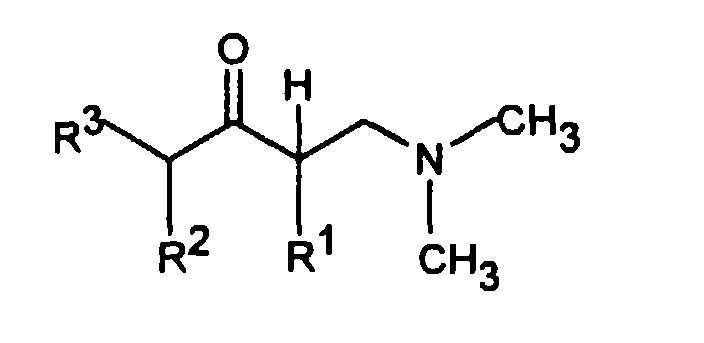


- Die Reaktion eine β-Dimethylaminketons mit einer Grignard-Verbindung der Formel III, in der Z MgCl, MgBr oder MgJ bedeutet, oder mit einer lithiumorganischen Verbindung der Formel III kann in einem aliphatischen Ether, beispielsweise Diethylether und/oder Tetrahydrofuran, bei Temperaturen zwischen -70° und +60° C durchgeführt werden. Die Umsetzung mit einer Grignard-Verbindung kann mit oder ohne Zusatz eines Mitführreagenzes, vorzugsweise 1,2-Dibromethan, erfolgen. Lithiumorganische Verbindungen der Formel III lassen sich durch Umsetzung einer Verbindung der Formel III, in der Z Cl, Br oder J bedeutet, mit beispielsweise einer n-Butyllithium/Hexan-Lösung durch Halogen/Lithiumaustausch erhalten.
- Die erhaltenen tertiären Alkohole der Formel IV lassen sich mit Säuren, insbesondere Ameisensäure oder Salzsäure, bei Temperaturen zwischen 0° und 100° C dehydratisieren.
- Weiterer Erfindungsgegenstand ist ein Verfahren zur Herstellung einer Dimethyl-(3-aryl-but-3-enyl)-aminverbindung der Formel I, in der R1 C1-5-Alkyl ist und R2 H oder C1-5-Alkyl bedeutet oder R1 und R2 zusammen -(CH2)2-4-, -(CH2)2-CHR7 oder -CH2-CHR7-CH2- bedeuten, R3 H oder C1-5-Alkyl bedeutet, einer der Reste R4, R5 oder R6 OH bedeutet und die anderen beiden Reste H sind, R7 C1-8-Alkyl, C3-8-Cycloalkyl, O-C1-4-Alkyl, O-Benzyl, CF3, Cl oder F bedeutet, welches dadurch gekennzeichnet ist, daß man eine Verbindung der Formel I, in der einer der Reste R4, R5 oder R6 O-CH3 bedeutet und die anderen beiden Reste H sind, mit Diisobutylaluminiumhydrid umsetzt oder eine Verbindung der Formel I, in der einer der Reste R4, R5 oder R6 O-Benzyl bedeutet und die anderen beiden Reste H sind, reduktiv debenzyliert.
- Die Umsetzung einer Dimethyl-(3-aryl-but-3-enyl)-aminverbindung mit Diisobutylaluminiumhydrid wird üblicherweise in einem aromatischen Kohlenwasserstoff, beispielsweise Toluol, bei einer Temperatur zwischen 60° und 130° C durchgeführt (Synthesis 1975, 617; DE 24 09 990, DE 24 09 991; Chem. Abstr. 84, 59862 (1974)).
- Die reduktive Debenzylierung einer erfindungsgemäßen Verbindung der Formel I, in der einer der Reste R4, R5 oder R6 O-Benzyl bedeutet, läßt sich in Gegenwart von Platin oder Paladium auf einem Trägermaterial, beispielsweise Aktivkohle, in Gegenwart von Wasserstoff in einem Lösungsmittel, beispielsweise Essigsäure oder C1-4-Alkylalkohol, bei Drücken zwischen 1 und 100 bar und Temperaturen zwischen 20° und 100° C durchführen.
- Dimethyl-(3-aryl-but-3-enyl)-aminverbindungen der allgemeinen Formel I, in der einer oder mehrere der Aromatensubstituenten R4, R5 und R6 OR8 bedeuten und OR8 eine Phosphat-, Carbonat-, Carbamat-, Carboxylat- oder Aryloxy- oder Heteroaryloxygruppe darstellt, lassen sich durch Umsetzung einer entsprechenden Dimethyl-[3-(hydroxy-phenyl)-but-3-enyl]-aminverbindung der Formel I, in der R4, R5 und/oder R6 eine OH-Gruppe bedeuten, in Form eines Alkalisalzes mit einem Dialkylchlorophosphat, mit einem Alkylchloroformiat, mit einem Aryl- oder Heteroarylisocyanat, mit einem Carbonsäurechlorid oder einem Aryl- oder Heteroarylhalogenid erhalten. Diese Umsetzungen werden üblicherweise in einem Lösungsmittel, beispielsweise Toluol, Dichlormethan, Diethylether und/oder Tetrahydrofuran bei Temperaturen zwischen -15° und +110° C durchgeführt (Drugs of the Future 16, 443 (1991); J. Med. Chem. 30, 2008 (1989) und 32, 2503 (1989); J. Org. Chem. 43, 4797 (1978); Tetrahedron Lett. 1977, 1571; J. Pharm. Sci. 57, 774 (1968)). Die Umsetzungen mit einem Aryl- oder Heteroarylhalogenid werden unter Zusatz von Kupferpulver und/oder einem Kupfer-I-halogenid als Katalysator durchgeführt.
- Dimethyl-(3-aryl-but-3-enyl)-aminverbindungen der Formel I, in der OR8 eine α-Aminocarboxylatgruppe darstellt, sind durch Umsetzung einer entsprechenden Dimethyl-[3-(hydroxy-phenyl)-but-3-enyl]-aminverbindung der Formel I, in der R4, R5 und/oder R6 eine OH-Gruppe bedeuten, mit einer entsprechenden 2-t-Butoxycarbonylamino-carbonsäure unter Verwendung von Triethylamin und Kupplungsreagenzien, wie Benzotriazol-1-yl-oxy-tripyrrolidinophosphoniumhexafluorophosphat in einem Lösungsmittel, beispielsweise Dichlormethan, erhältlich.
- Die Verbindungen der Formel I lassen sich mit physiologisch verträglichen Säuren, beispielsweise Salzsäure, Bromwasserstoffsäure, Schwefelsäure, Methansulfonsäure, Ameisensäure, Essigsäure, Oxalsäure, Bernsteinsäure, Weinsäure, Mandelsäure, Fumarsäure, Milchsäure, Zitronensäure, Glutaminsäure und/oder Asparaginsäure, in an sich bekannter Weise in ihre Salze überführen. Vorzugsweise wird die Salzbildung in einem Lösungsmittel, beispielsweise Diethylether, Diisopropylether, Essigsäurealkylester, Aceton und/oder 2-Butanon durchgeführt. Zur Herstellung der Hydrochloride eignet sich darüber hinaus Trimethylchlorsilan in wäßriger Lösung.
- Die erfindungsgemäßen Verbindungen haben eine ausgeprägte analgetische Wirkung und sind toxikologisch unbedenklich. Sie eignen sich daher als pharmazeutische Wirkstoffe. Dementsprechend ist Erfindungsgegenstand auch die Verwendung einer Dimethyl-(3-aryl-but-3-enyl)-aminverbindung der Formel I als Wirkstoff in Arzneimitteln, vorzugsweise als Wirkstoff in Schmerzmitteln.
- Erfindungsgemäße Arzneimittel enthalten neben mindestens einer Dimethyl-(3-aryl-but-3-enyl)-aminverbindung der Formel I Trägermaterialien, Füllstoffe, Lösungsmittel, Verdünnungsmittel, Farbstoffe und/oder Bindemittel. Die Auswahl der Hilfsstoffe sowie die einzusetzenden Mengen hängen davon ab, ob das Arzneimittel oral, intravenös, intraperitoneal, intradermal, intramuskulär, intranasal, buccal oder örtlich, zum Beispiel auf Infektionen an der Haut, an den Schleimhäuten oder an den Augen, appliziert werden soll. Für die orale Applikation eignen sich Zubereitungen in Form von Tabletten, Dragees, Kapseln, Granulaten, Tropfen, Säften und Sirupen, für die parenterale, topische und inhalative Applikation Lösungen, Suspensionen, leicht rekonstituierbare Trockenzubereitungen sowie Sprays. Erfindungsgemäße Verbindungen in einem Depot in gelöster Form oder in einem Pflaster, gegebenenfalls unter Zusatz von die Hauptpenetration fördernden Mitteln, sind Beispiele für geeignete perkutane Zubereitungsformen. Aus oral oder perkutan anwendbaren Zubereitungsformen können die erfindungsgemäßen Verbindungen verzögert freigesetzt werden.
- Die an den Patienten zu verabreichende Wirkstoffmenge variiert in Abhängigkeit vom Gewicht des Patienten, von der Applikationsart, der Indikation und dem Schweregrad der Erkrankung. Üblicherweise werden 10 bis 500 mg pro kg wenigstens einer Dimethyl-(3-aryl-but-3-enyl)-aminverbindung der Formel I appliziert.
- Die Angabe Ether bedeutet Diethylether.
- Als stationäre Phase für die Säulenchromatographie wurde Kieselgel 60 (0,040 - 0,063 mmm) der Firma E. Merck, Darmstadt, eingesetzt.
- Die dünnschicht-chromatographischen Untersuchungen wurden mit HPTLC-Fertigplatten, Kieselgel 60 F 254, der Firma E. Merck, Darmstadt, durchgeführt.
- Racemattrennungen wurden auf einer Chiracel OD Säule der Firma Daicel Chemical Industries, LTD durchgeführt.
- Die Mischungsverhältnisse der Laufmittel für alle chromatographischen Untersuchungen sind in Volumen/Volumen angegeben.
- 27,0 g (1,11 mol) Magnesiumspäne wurden in 150 ml Tetrahydrofuran gerührt und 207,6 g (1,11 mol) 1-Brom-3-methoxy-benzol, gelöst in 400 ml Tetrahydrofuran, zugetropft. Es wurde eine Stunde unter Rückfluß erhitzt und anschließend auf eine Temperatur zwischen 5° C und 10° C abgekühlt. Bei dieser Temperatur wurden 128,30 g (0,89 mol) (RS)-1-Dimethylamino-2-methyl-pentan-3-on, gelöst in 400 ml Tetrahydrofuran, zugetropft. Das Reaktionsgemisch wurde stehen gelassen und anschließend erneut auf eine Temperatur zwischen 5° C und 10° C abgekühlt. Nach Zugabe von 300 ml 20 gew.%iger Ammoniumchloridlösung wurde mit 400 ml Ether verdünnt. Nach Phasentrennung wurde zweimal mit Ether extrahiert, über Natriumsulfat getrocknet und das Lösungsmittel destillativ entfernt. Der erhaltene Rückstand wurde in 3,2 l 2-Butanon aufgenommen und mit 120,60 g (1,11 mol) Trimethylchlorsilan und 20 ml Wasser versetzt. Es wurden 121,5 g Hydrochlorid (2) (38 % der Theorie) mit einem Schmelzpunkt von 198 - 199° C erhalten.
- 200 g (0,69 mol) Hydrochlorid (2) wurden in einem Liter konzentrierter Salzsäure gelöst und bei Raumtemperatur stehengelassen. Die Salzsäure wurde im Vakuum destillativ entfernt. Der Rückstand wurde in 1 l Eiswasser gelöst und mit 10 molarer Natronlauge ein pH-Wert von 13 eingestellt. Nach Extraktion mit Ether, Trocknen der organischen Phase und destillativer Entfernung des Lösungsmittels wurden 162 g Rohprodukt erhalten, das durch umkristallisieren gereinigt wurde. Es wurden 79 g (42 % der Theorie) Hydrochlorid (1) mit einem Schmelzpunkt von 169 - 170° C erhalten.
- Zu 1,6 l 20-gew.%iger Diisobutylaluminiumhydrid-Lösung in Toluol wurden bei Raumtemperatur 182 g (Z)-(RS)-[3-(3-Methoxy-phenyl)-2-methyl-pent-3-enyl]-dimethylamin, gelöst in 360 ml Toluol, getropft. Anschließend wurde 11 Stunden unter Rückfluß erhitzt. Nach Abkühlen auf 0° C wurden 450 ml Ethanol unter Kühlung zugetropft. Anschließend wurde 15 Minuten gerührt und mit 1 l Toluol verdünnt. Danach wurden 450 ml eines Ethanol/Wasser-Gemisches (1 : 1) unter Kühlung zugetropft. Nach einstündigem Rühren bei Raumtemperatur wurde das ausgefallene Aluminiumhydroxid abgesaugt und aus der organischen Phase Lösungsmittel destillativ entfernt. Es wurden 167 g (97,6 % der Theorie) Rohbase erhalten, die in 1,67 l Aceton gelöst und mit 65 ml konzentrierter Salzsäure versetzt wurde. Es kristallisierten 152 g (76 % der Theorie) Hydrochlorid (3) mit einem Schmelzpunkt von 161 - 162° C aus.
- Aus dem nach Beispiel 2 erhaltenen Hydrochlorid (3) wurde mit Dichlormethan/wäßriger Natriumhydrogencarbonatlösung die Base freigesetzt. Nach dem Trocknen der Lösung wurde Dichlormethan im Vakuum abdestilliert. Das Racemat wurde dann auf einer chiralen HPLC-Säule getrennt. Aus den erhaltenen Enantiomeren wurden durch Umsetzung mit konzentrierter Salzsäure in Aceton die Hydrochloride mit einem Schmelzpunkt von 166 - 167° C isoliert.
- (+3):
- Ausbeute: 42 % der Theorie
[α]
- (-3):
- Ausbeute: 44 % der Theorie
[α]
- Aus dem Hydrochlorid (3), hergestellt nach Beispiel 2, wurde mit Dichlormethan/wäßriger Natriumhydrogencarbonat-Lösung die Base freigesetzt und nach dem Trocknen der Lösung das Dichlormethan destillativ entfernt. 0,67 g (3,0 mmol) der erhaltenen Base wurden in 7 ml trockenem Dichlormethan gelöst und bei Raumtemperatur mit 0,6 g (3,24 mmol) 2-Acetyl-benzoyl-chlorid, gelöst in 3 ml trockenem Dichlormethan, versetzt. Nach 20-stündigem Rühren bei Raumtemperatur wurde das Reaktionsgemisch mit 20 ml Natriumhydrogencarbonatlösung versetzt und die wäßrige Phase zweimal mit 10 ml Dichlormethan extrahiert. Die organischen Phasen wurden vereinigt und über Natriumsulfat getrocknet. Nach destillativer Entfernung des Lösungsmittels wurden 1,1 g Rohgemisch gewonnen, das auf eine Säule, gefüllt mit Kieselgel, gegeben wurde. Die Elution mit Ether ergab 0,68 g Base, aus der mit Trimethylchlorsilan/Wasser in Ether 0,68 g (54 % der Theorie) Hydrochlorid (4) mit einem Schmelzpunkt von 86 - 88° C erhalten wurden.
- 75 g (0,26 mol) (2RS,3RS)-1-Dimethylamino-3-(3-methoxyphenyl)-2-methyl-pentan-3-ol, Hydrochlorid (1) aus Beispiel 1 (Stufe 1) wurden in einem Liter konzentrierter Ameisensäure gelöst und zwei Stunden unter Rückfluß erhitzt. Anschließend wurde die Ameisensäure im Wasserstrahlvakuum abdestilliert, der Rückstand in Eiswasser aufgenommen und mit Natronlauge/Ether versetzt. Nach Trocknung der organischen Phase und destillativer Entfernung des Lösungsmittels wurden 60 g (98 % der Theorie) Rohbase erhalten ((Z)-Isomer (2) : (E)-Isomer (5) = 6 : 4). Die Rohbase wurde auf eine Säule, gefüllt mit Kieselgel, gegeben. Die Elution mit Diisopropylether/Methanol = 7 : 1 ergab 20 g Base, aus der mit Trimethylchlorsilan/Wasser in 2-Butanon 18,4 g (26 % der Theorie) Hydrochlorid (5) mit einem Schmelzpunkt von 139 - 140 °C erhalten wurden.
- Aus (5), hergestellt nach Beispiel 5, wurde mit Dichlormethan/Natronlauge die Base freigesetzt und nach dem Trocknen der Lösung Dichlormethan destillativ entfernt. Aus der erhaltenen Base wurde unter den in Beispiel 2 angegebenen Bedingungen das Hydrochlorid (6) in einer Ausbeute von 73 % der Theorie und einem Schmelzpunkt von 80° C erhalten.
- Aus nach Beispiel 6 erhaltenem Hydrochlorid (6) wurde mit Dichlormethan/wäßriger Natriumhydrogencarbonatlösung die Base freigesetzt. Nach dem Trocknen der Lösung wurde Dichlormethan im Vakuum abdestilliert. Das Racemat wurde dann auf einer chiralen HPLC-Säule getrennt. Aus den erhaltenen Enantiomeren wurden durch Umsetzung mit konzentrierter Salzsäure in Aceton die Hydrochloride mit einem Schmelzpunkt von 154 - 155° C isoliert.
- (+6):
- Ausbeute: 42 % der Theorie
[α]
- (-6):
- Ausbeute: 44 % der Theorie
[α]
- Ausgehend von (RS)-1-Dimethylamino-2-methyl-pentan-3-on und 1-Brom-4-methoxy-benzol wurde unter den in Beispiel 1 (1. Stufe) angegebenen Bedingungen (2RS, 3RS)-1-Dimethylamino-3-(4-methoxy-phenyl)-2-methyl-pentan-3-ol, Hydrochlorid in einer Ausbeute von 44 % und einem Schmelzpunkt von 188 - 189° C erhalten, das unter den in Beispiel 1 (2. Stufe) angegebenen Bedingungen mit konzentrierter Salzsäure in (Z)-(RS)-[3-(4-Methoxy-phenyl)-2-methyl-pent-3-enyl]-dimethylamin (8) überführt wurde. Verbindung (8) wurde als hellgelbes Öl in einer Ausbeute von 46 % erhalten.
- Aus der nach Stufe 1 erhaltenen Base wurde unter den in Beispiel 2 angegebenen Bedingungen das Hydrochlorid (7) in einer Ausbeute von 79 % der Theorie und einem Schmelzpunkt von 203° C erhalten.
- Ausgehend von (RS)-1-Dimethylamino-2-methyl-pentan-3-on und 3-Brom-toluol wurde unter den in Beispiel 1 (1. Stufe) angegebenen Bedingungen (2RS, 3RS)-1-Dimethylamin-2-methyl-3-(m-tolyl)-pentan-3-ol, Hydrochlorid in einer Ausbeute von 24 % und einem Schmelzpunkt von 154 - 155° C erhalten, das unter den in Beispiel 1 (2. Stufe) angegebenen Bedingungen mit konzentrierter Salzsäure in (Z)-(RS)-Dimethyl-(2-methyl-3-m-tolyl-pent-3-enyl)-amin, Hydrochlorid (9) überführt wurde. Verbindung (9) wurde in einer Ausbeute von 36 % (bezogen auf den eingesetzten Alkohol) mit einem Schmelzpunkt von 172° C erhalten.
- Ausgehend von (2RS, 3RS)-1-Dimethylamino-2-methyl-3-(m-tolyl)-pentan-3-ol, Hydrochlorid, welches nach Beispiel 9 hergestellt wurde, wurde unter den in Beispiel 5 angegebenen Bedingungen das Hydrochlorid (10) in einer Ausbeute von 36 % mit einem Schmelzpunkt von 153° C erhalten.
- 7,0 g (34 mmol) 1-Bromo-3-difluormethyl-benzol, hergestellt aus 3-Brombenzaldehyd und Diethylaminoschwefeltrifluorid gemäß Org. React. 35, 513 (1988), wurden in 110 ml trockenem Tetrahydrofuran gelöst und auf -75° C gekühlt. Nach Zugabe von 34 mmol 1,6-molarer n-Butyllithiumlösung in Hexan wurde eine Stunde bei -75° C gerührt. Anschließend wurden 4,8 g (34 mmol) (2RS)-1-Dimethylamino-2-methyl-pentan-3-on, gelöst in 15 ml trokkenem Tetrahydrofuran, zugetropft. Innerhalb von 2,5 Stunden wurde das Reaktionsgemisch auf Raumtemperatur erwärmt.
- Zur Aufarbeitung wurden unter Eisbadkühlung 65 ml 5 %-ige Salzsäure zugetropft, so daß die Innentemperatur 15° C nicht überstieg. Nach Phasentrennung wurde die organische Phase mit 40 ml 5 %-iger Salzsäure extrahiert. Die vereinigten wäßrigen Phasen wurden zweimal mit 50 ml Ether gewaschen. Zur Freisetzung der Base wurde mit konzentrierter Natronlauge versetzt und mit Dichlormethan extrahiert. Auf diese Weise wurden 7,8 g Rohprodukt erhalten , das auf eine Säule, gefüllt mit Kieselgel, gegeben wurde. Die Elution mit Essigsäureethylester/Methanol = 1 : 1 ergab 4,89 g Base, aus der mit Trimethylchlorsilan/Wasser in 2-Butanon 4,6 g (44 % der Theorie) Hydrochlorid (12) mit einem Schmelzpunkt von 194 - 195° C erhalten wurde.
- 10 g (32 mmol) (2RS, 3RS)-3-(3-Difluormethyl-phenyl)-1-dimethylamino-2-methyl-pentan-3-ol, Hydrochlorid (12) aus Stufe 1 wurden in 150 ml konzentrierter Ameisensäure gelöst und zwei Stunden unter Rückfluß erhitzt. Anschließend wurde die Ameisensäure im Wasserstrahlvakuum abdestilliert, der Rückstand in Eiswasser aufgenommen und mit Natronlauge/Ether versetzt. Nach Trocknung der organischen Phase und destillativer Entfernung des Lösungsmittels wurden 9,1 g (97 % der Theorie) Rohbase erhalten, die auf eine Säule, gefüllt mit Kieselgel, gegeben wurden. Die Elution mit Diisopropylether/Methanol = 7 : 1 ergab 3,0 g Base, aus der mit Trimethylchlorsilan/Wasser in 2-Butanon 2,3 g (24 % der Theorie) Hydrochlorid (11) mit einem Schmelzpunkt von 160 - 161° C erhalten wurden.
- Aus (1RS, 2RS)-6-(3-Dimethylamino-1-ethyl-1-hydroxy-2-methyl-propyl)-naphth-2-ol, Hydrochlorid, hergestellt gemäß Chirality 6, 389 (1994), wurde unter den in Beispiel 1 (2. Stufe) angegebenen Bedingungen das Hydrochlorid (13) in 39 %-iger Ausbeute mit einem Schmelzpunkt von 207 - 208° C erhalten.
- Ausgehend von (2RS)-3-Dimethylamino-1-(3-methoxy-phenyl)-2-methyl-propan-1-on und 1-Brom-propan wurde unter den in Beispiel 1 (1. Stufe) angegebenen Bedingungen unter Verwendung von Ether als Lösungsmittel das (2RS, 3SR)-1-Dimethylamino-3-(3-methoxy-phenyl)-2-methyl-hexan-3-ol, Hydrochlorid (16) in einer Ausbeute von 81 % mit einem Schmelzpunkt von 131 - 132° C erhalten. 30 g (0,1 mol) der Verbindung (16) wurden gemäß Beispiel 5 mit 450 ml konzentrierter Ameisensäure umgesetzt. Die auf diese Weise erhaltene Rohbase (28 g), bestehend aus einem (Z)/(E)-Isomerengemisch wurde auf eine Säule, gefüllt mit Kieselgel, gegeben. Die Elution mit Diisopropylether/Methanol = 7 : 1 ergab 7 g Base der (E)-Verbindung (14) und 17 g Base der (Z)-Verbindung (15). Die Basen wurden mit Trimethylchlorsilan/ Wasser in 2-Butanon in die Hydrochloride überführt.
- (14)
- Ausbeute: 5,9 g (21 % der Theorie)
Schmelzpunkt: 154° C - (15)
- Ausbeute: 15,8 g (56 % der Theorie)
Schmelzpunkt: 110 - 112° C - Aus (14), hergestellt nach Beispiel 13, wurde mit Dichlormethan/Natronlauge die Base freigesetzt und nach dem Trocknen der Lösung Dichlormethan destillativ entfernt. Aus der so erhaltenen Base wurde unter den in Beispiel 2 angegebenen Bedingungen das Hydrochlorid (17) in einer Ausbeute von 86 % der Theorie und einem Schmelzpunkt von 214° C erhalten.
- Aus (15), hergestellt nach Beispiel 13, wurde mit Dichlormethan/Natronlauge die Base freigesetzt und nach dem Trocknen der Lösung Dichlormethan destillativ entfernt. Aus der so erhaltenen Base wurde unter den in Beispiel 2 angegebenen Bedingungen das Hydrochlorid (18) in einer Ausbeute von 86 % der Theorie und einem Schmelzpunkt von 120 - 121° C erhalten.
- Ausgehend von (RS)-2-Dimethylaminomethyl-1-(3-methoxy-phenyl)-pentan-1-on und Methyliodid wurde unter den in Beispiel 1 (1. Stufe) angegebenen Bedingungen unter Verwendung von Ether als Lösungsmittel (2RS, 3SR)-3-Dimethylaminomethyl-2-(3-methoxy-phenyl)-hexan-2-ol, Hydrochlorid (20) in einer Ausbeute von 76 % mit einem Schmelzpunkt von 137 - 138° C erhalten. 30 g (0,1 mol) der Verbindung (20) wurden gemäß Beispiel 5 mit 300 ml konzentrierter Ameisensäure umgesetzt. Die erhaltene Rohbase wurde auf eine Säule, gefüllt mit Kieselgel, gegeben. Die Elution mit Diisopropylether/Methanol = 7 : 1 ergab 24 g Base, aus der mit Trimethylchlorsilan/Wasser in 2-Butanon 23,1 g (74 % der Theorie) Hydrochlorid (19) mit einem Schmelzpunkt von 120 - 121° C erhalten wurden.
- Ausgehend von (RS)-3-Dimethylamino-1-(3-methoxy-phenyl)-2-methyl-propan-1-on und Methyliodid wurde unter den in Beispiel 1 (1. Stufe) angegebenen Bedingungen unter Verwendung von Ether als Lösungsmittel (2RS, 3SR)-4-Dimethylamino-2-(3-methoxy-phenyl)-3-methyl-butan-2-ol, Hydrochlorid (23) in einer Ausbeute von 46 % mit einem Schmelzpunkt von 178 - 179° C erhalten. Aus (23) wurde mit Dichlormethan/Natronlauge die Base freigesetzt. Nach dem Trocknen der Lösung wurde Dichlormethan im Vakuum abdestilliert. 23,7 g (0,1 mol) der Base wurden gemäß Beispiel 2 mit Diisobutylaluminiumhydrid umgesetzt. Auf diese Weise konnten 18,5 g (71 % der Theorie) Hydrochlorid (22) mit einem Schmelzpunkt von 183 - 184° C erhalten werden.
- 10 g (37 mmol) Hydrochlorid (22) aus Stufe 1 wurden in 150 ml konzentrierter Ameisensäure gelöst und zwei Stunden unter Rückfluß erhitzt. Anschließend wurde die Ameisensäure im Wasserstrahlvakuum abdestilliert, der Rückstand in Eiswasser aufgenommen und mit Natronlauge/Ether versetzt. Nach Trocknung der organischen Phase und destillativer Entfernung des Lösungsmittels wurden 9,1 g Rohbase erhalten, aus der mit konzentrierter Salzsäure in Aceton 7,5 g (83 % der Theorie) Hydrochlorid (21) mit einem Schmelzpunkt von 228 - 230° C erhalten wurden.
- Ausgehend von (RS)-1-Dimethylamino-2,4-dimethyl-pentan-3-on und 1-Brom-3-methoxy-benzol wurde unter den in Beispiel 1 (1. Stufe) angegebenen Bedingungen (2RS, 3RS)-1-Dimethylamino-3-(3-methoxy-phenyl)-2,4-dimethyl-pentan-3-ol, Hydrochlorid (26) in einer Ausbeute von 44 % mit einem Schmelzpunkt von 180 - 181° C erhalten. 30 g (0,1 mol) der Verbindung (26) wurden gemäß Beispiel 5 mit 450 ml konzentrierter Ameisensäure umgesetzt. Die erhaltene Rohbase wurde auf eine Säule, gefüllt mit Kieselgel, gegeben. Die Elution mit Diisopropylether/Methanol = 7 : 1 ergab 19 g Base (77 % der Theorie) als hellgelbes viskoses Öl.
- Aus der nach Stufe 1 erhaltenen Base wurde unter den in Beispiel 2 angegebenen Bedingungen das Hydrochlorid (24) in einer Ausbeute von 84 % der Theorie und einem Schmelzpunkt von 176 - 177° C erhalten.
- (RS)-2-Dimethylaminomethyl-cyclopentanon und 1-Brom-4-trifluormethyl-benzol wurden unter den in Beispiel 1 (1. Stufe) angegebenen Bedingungen umgesetzt. 30 g des erhaltenen Rohproduktes wurden auf eine Säule, gefüllt mit Kieselgel, gegeben. Die Elution mit Essigsäureethylester/Methanol = 5 : 1 ergab 11,6 g Base, die mit Trimethylchlorsilan/Wasser in 2-Butanon in 12,0 g (21 % der Theorie) (1RS,2RS)-2-Dimethylaminomethyl-1-(4-trifluormethyl-phenyl)-cyclopentanol, Hydrochlorid (28) mit einem Schmelzpunkt von 213 - 214° C überführt wurden. 32,4 g (0,1 mol) des Hydrochlorids (28) wurden gemäß Beispiel 5 mit 450 ml konzentrierter Ameisensäure umgesetzt. Die erhaltene Rohbase wurde auf eine Säule, gefüllt mit Kieselgel, gegeben. Die Elution mit Diisopropylether/Methanol = 7 : 1 ergab 9,6 g Base, die mit Trimethylchlorsilan/Wasser in 2-Butanon in 8,9 g (29 % der Theorie Hydrochlorid (27) mit einem Schmelzpunkt von 219 - 220° C überführt wurden.
- Aus (27) wurde mit Dichlormethan/Natronlauge die Base freigesetzt. Nach dem Trocknen der Lösung wurde Dichlormethan im Vakuum abdestilliert. Das Racemat wurde dann auf einer chiralen HPLC-Säule getrennt. Aus den erhaltenen Enantiomeren wurden durch Umsetzung mit konzentrierter Salzsäure in Aceton die Hydrochloride mit einem Schmelzpunkt von 244 - 246° C hergestellt.
- (+27):
- Ausbeute: 42 % der Theorie
[α]
- (-27):
- Ausbeute: 44 % der Theorie
[α]
- Ausgehend von (RS)-2-Dimethylaminomethyl-cyclohexanon und 1-Brom-2-methoxy-benzol wurde unter den in Beispiel 1 (1. Stufe) angegebenen Bedingungen unter Verwendung von Ether als Lösungsmittel (1RS,2RS)-2-Dimethylaminomethyl-1-(2-methoxy-phenyl)-cyclohexanol, Hydrochlorid (30) in einer Ausbeute von 47 % erhalten. Aus (30) wurde mit Dichlormethan/Natronlauge die Base freigesetzt. Nach dem Trocknen der Lösung wurde Dichlormethan im Vakuum abdestilliert. 30,0 g (0,1 mol) der Base wurden gemäß Beispiel 2 mit Diisobutylaluminiumhydrid umgesetzt. Es wurden 22,7 g (78 % der Theorie) (1RS,2RS)-2-(2-Dimethylaminomethyl-1-hydroxy-cyclo-hexyl)-phenol, Hydrochlorid (31) mit einem Schmelzpunkt von 168 - 170° C erhalten. 28,6 g (0,1 mol) der Verbindung (31) wurden gemäß Beispiel 5 mit 450 ml konzentrierter Ameisensäure umgesetzt. Die erhaltene Rohbase wurde auf eine Säule, gefüllt mit Kieselgel, gegeben und mit Diisopropylether/Methanol = 7 : 1 eluiert. Es wurden 21 g Base gewonnen, aus der mit konzentrierter Salzsäure in Aceton 18,6 g (69 % der Theorie) Hydrochlorid (29) mit einem Schmelzpunkt von 168° C erhalten wurde.
- Aus (29) wurde mit Dichlormethan/wäßriger Natriumhydrogencarbonatlösung die Base freigesetzt. Nach dem Trocknen der Lösung wurde Dichlormethan im Vakuum abdestilliert. Das Racemat wurde dann auf einer chiralen HPLC-Säule getrennt. Aus den erhaltenen Enantiomeren wurden durch Umsetzung mit konzentrierter Salzsäure in Aceton die Hydrochloride mit einem Schmelzpunkt von 271 - 272° C isoliert.
- (+29):
- Ausbeute: 43 % der Theorie
[α]
- (-29):
- Ausbeute: 44 % der Theorie
[α]
- (RS)-2-Dimethylaminomethyl-cyclohexanon und 1-Brom-4-trifluormethyl-benzol wurden unter den in Beispiel 1 (1. Stufe) angegebenen Bedingungen umgesetzt. 30 g des Rohproduktes wurden auf eine Säule, gefüllt mit Kieselgel, gegeben. Die Elution mit Essigsäureethylester/Methanol = 5 : 1 ergab 18,9 g Base, die mit Trimethylchlorsilan/Wasser in 2-Butanon in 16,4 g (37 % der Theorie) (1RS,2RS)-2-Dimethylaminomethyl-1-(4-trifluormethyl-phenyl)-cyclohexanol, Hydrochlorid (33) mit einem Schmelzpunkt von 234° C überführt wurden. 33,7 g (0,1 mol) des Hydrochlorids (33) wurden gemäß Beispiel 5 mit 450 ml konzentrierter Ameisensäure umgesetzt. Die erhaltene Rohbase wurde auf eine Säule, gefüllt mit Kieselgel, gegeben und mit Diisopropylether/Methanol = 7 : 1 eluiert. Es wurden 12,3 g Base erhalten, die mit Trimethylchlorsilan/Wasser in 2-Butanon in 10,4 g (32,5 % der Theorie Hydrochlorid (32) mit einem Schmelzpunkt von 205 - 206 °C überführt wurden.
- (RS)-2-Dimethylaminomethyl-cyclohexanon und 4-Brom-2-methyl-benzo[b]thiophen wurden unter den in Beispiel 1 (1. Stufe) angegebenen Bedingungen unter Verwendung von Ether als Lösungsmittel und 1,2-Dibromethan als Mitführreagenz umgesetzt. 25 g des Rohproduktes wurden auf eine Säule, gefüllt mit Kieselgel, gegeben. Die Elution mit Essigsäureethylester/Methanol = 1 : 1 ergab 12,6 g Base, die mit Trimethylchlorsilan/Wasser in 2-Butanon in 10,4 g (29 % der Theorie) (1RS,2RS)-2-Dimethylaminomethyl-1-(2-methyl-benzo[b]thiophen-4-yl)-cyclohexanol, Hydrochlorid (35) mit einem Schmelzpunkt von 204° C überführt wurden. 34,0 g (0,1 mol) des Hydrochlorids (35) wurden gemäß Beispiel 5 mit 450 ml konzentrierter Ameisensäure umgesetzt. Die auf diese Weise erhaltene Rohbase (28,4 g) wurde auf eine Säule, gefüllt mit Kieselgel, gegeben. Die Elution mit Ether ergab 17,5 g Base, die mit Trimethylchlorsilan/Wasser in 2-Butanon in 15,2 g (54,8 % der Theorie) Hydrochlorid (34) mit einem Schmelzpunkt von 179 - 182° C überführt wurden.
- 95 ml (750 mmol) 1-Brom-3-methoxy-benzol wurden in 425 ml trockenem Tetrahydrofuran gelöst und auf -75° C gekühlt. Nach Zugabe von 750 mmol 1,6 molarer n-Butyllithiumlösung in Hexan wurde eine Stunde bei -75° C gerührt. Anschließend wurden 82 g (484 mmol) (2RS,5SR)-2-Dimethylaminomethyl-5-methyl-cyclohexanon, hergestellt aus 3-Methylcyclohexanon, Dimethylaminhydrochlorid und Paraformaldehyd in Eisessig, gelöst in 120 ml trockenem Tetrahydrofuran, zugetropft. Innerhalb von 2,5 Stunden wurde das Reaktionsgemisch auf Raumtemperatur erwärmt.
- Zur Aufarbeitung wurden unter Eisbadkühlung 200 ml Wasser zugetropft, so daß die Innentemperatur 15° C nicht überstieg. Nach Phasentrennung wurde die wäßrige Phase dreimal mit 50 ml Essigsäureethylester extrahiert. Die vereinigten organischen Phasen wurden über Natriumsulfat getrocknet. Nach destillativer Entfernung des Lösungsmittels wurde der Rückstand in 700 ml Aceton gelöst und mit Trimethylchlorsilan/Wasser versetzt. Bei 4 - 5° C kristallisierten 67 g (48 % der Theorie) Hydrochlorid (37) mit einem Schmelzpunkt von 173 - 175° C aus.
- Aus (37) wurde mit Dichlormethan/Natronlauge die Base freigesetzt. Nach dem Trocknen der Lösung wurde Dichlormethan im Vakuum abdestilliert. Das Racemat wurde dann auf der chiralen HPLC-Säule getrennt. Aus den erhaltenen Enantiomeren wurden durch Umsetzung mit Trimethylchlorsilan/Wasser in 2-Butanon die Hydrochloride mit einem Schmelzpunkt von 151 - 153° C isoliert.
- (+37):
- Ausbeute: 43 % der Theorie
[α]
- (-37):
- Ausbeute: 44 % der Theorie
[α]
- Die Methoxyverbindungen (-37) und (+37) aus der 2. Stufe wurden unter den in Beispiel 5 angegebenen Bedingungen in die Hydrochloride (+38) und (-38) in einer Ausbeute von 87 % der Theorie und mit einem Schmelzpunkt von 122 - 123° C überführt.
- Aus den nach Stufe 3 erhaltenen Basen wurden unter den in Beispiel 2 angegebenen Bedingungen durch Umsetzung mit Diisobutylaluminiumhydrid und anschließender Hydrochloridfällung mit Trimethylchlorsilan/Wasser in 2-Butanon die Hydrochloride (-36) und (+36) in einer Ausbeute von 79 % der Theorie und einem Schmelzpunkt von 131 - 133° C erhalten.
- (-36):
- [α]

- (+36):
- [α]

- 28,8 g (0,1 mol) (+)-(1R,2R)-3-(2-Dimethylaminomethyl-1-hydroxy-cyclohexyl)-phenol, Hydrochlorid wurden in 450 ml konzentrierter Ameisensäure gelöst und zwei Stunden unter Rückfluß erhitzt. Anschließend wurde die Ameisensäure im Wasserstrahlvakuum abdestilliert und aus dem Rückstand mit Dichlormethan/wäßriger Natriumcarbonatlösung die Base freigesetzt, aus der mit konzentrierter Salzsäure in Aceton 21,8 g (81,4 % der Theorie) Hydrochlorid (-39) mit einem Schmelzpunkt von 216 - 217° C erhalten wurden.
- (-39):
- [α]

- Unter den in Beispiel 26 angegebenen Bedingungen wurden aus 28,8 g (0,1 mol) (-)-(1S,2S)-3-(2-Dimethylaminomethyl-1-hydroxy-cyclohexyl)-phenol, Hydrochlorid 21,8 g (81,4 % der Theorie) Hydrochlorid (+39) mit einem Schmelzpunkt von 216 - 217° C erhalten.
- (+39):
- [α]

- Die analgetische Wirksamkeit wurde im Phenylchinon-induzierten Writhing an der Maus, modifiziert nach I.C. Hendershot, J. Forsaith, J. Pharmacol. Exp. Ther. 125, 237 - 240 (1959) untersucht. Dazu wurden männliche NMRI-Mäuse mit einem Gewicht von 25 - 30 g eingesetzt. Gruppen von 10 Tieren pro Substanzdosis wurden 10 Minuten nach intravenöser Gabe einer erfindungsgemäßen Verbindung 0,3 ml/Maus einer 0,02 %igen wäßrigen Lösung von Phenylchinon (Phenylbenzochinon, Fa. Sigma, Deisenhofen; Herstellung der Lösung unter Zusatz von 5 % Ethanol und Aufbewahrung im Wasserbad bei 45° C) intraperitoneal appliziert. Die Tiere wurden einzeln in Beobachtungskäfige gesetzt. Mittels eines Drucktastenzählers wurde die Anzahl der Schmerz-induzierten Streckbewegungen (sogenannte Writhingreaktionen = Durchdrücken des Körpers mit Abstrecken der Hinterextremitäten) 5 - 20 Minuten nach der Phenylchinon-Gabe ausgezählt.
- Aus der dosisabhängigen Abnahme der Writhingreaktionen im Vergleich zu parallel untersuchten Tiergruppen, denen keine erfindungsgemäße Verbindungen appliziert wurde, wurden mittels Regressionsanalyse (Auswerteprogramm Martens EDV Service, Eckental) die ED50-Werte der Writhingreaktion berechnet.
- Alle untersuchten erfindungsgemäßen Verbindungen zeigten eine ausgeprägte analgetische Wirkung, die im Vergleich zu Tramadol verstärkt war.
- Die Ergebnisse sind in der nachfolgenden Tabelle zusammengefaßt.
Tabelle Analgesieprüfung im Writhing-Test an der Maus erfindungsgemäße Verbindung hergestellt nach Beispiel ED50 (mg/kg) 2 1,37 3 (+)-Enantiomer 2,25 3 (-)-Enantiomer 0,98 4 1,64 12 0,97 13 2,96 15 1,33 18 2,07 20 (+)-Enantiomer 1,40 22 (-)-Enantiomer 2,12 24 1,35 25 (-)-Enantiomer 0,90 26 (-)-Enantiomer 1,04 27 (+)-Enantiomer 1,60 zum Vergleich: Tramadol 3,68
Claims (8)
- Dimethyl-(3-aryl-but-3-enyl)-aminverbindungen der Formel I
 R3 H oder C1-5-Alkyl bedeutet,R4 H, OH, C1-4-Alkyl, O-C1-4-Alkyl, O-Benzyl, CF3, O-CF3, Cl, F oder OR8 bedeutet,R5 H, OH, C1-4-Alkyl, O-C1-4-Alkyl, O-Benzyl, CHF2, CF3, O-CF3, Cl, F oder OR8 darstellt undR6 H, OH, C1-4-Alkyl, O-C1-4-Alkyl, O-Benzyl, CF3, O-CF3, Cl, F oder OR8 bedeutet,
mit der Maßgabe, daß zwei der Reste R4, R5 oder R6 H sind, oderR4 und R5 zusammen -CH=C(R9)-O- oder -CH=C(R9)-S-bedeuten, mit der Maßgabe, daß R6 H ist, oderR5 und R6 zusammen -CH=CH-C(OR10)=CH- bedeuten, mit der Maßgabe, daß R4 H ist,R7 C1-8-Alkyl, C3-8-Cycloalkyl, O-C1-4-Alkyl, O-Benzyl, CF3, Cl oder F bedeutet,R8 CO-C1-5-Alkyl, PO(O-C1-4-Alkyl)2, CO-C6H4-R11, CO(O-C1-5-Alkyl), CO-CHR12-NHR13, CO-NH-C6H3-(R14)2 oder eine unsubstituierte oder substituierte Pyridyl-, Thienyl-, Thiazoyl- oder Phenylgruppe bedeutet,R9 H oder C1-4-Alkyl bedeutet,R10 H oder C1-3-Alkyl bedeutet,R11 OC(O)-C1-3-Alkyl in ortho-Stellung oder CH2-N-(R15)2 in meta- oder para-Stellung, wobei R15 C1-4-Alkyl oder beide Reste R15 zusammen mit N den 4-Morpolino-Rest bilden, bedeutet,R12 und R13 gleich oder verschieden sind und H, C1-6-Alkyl oder C3-8-Cycloalkyl oder R12 und R13 zusammen -(CH2)3-8- bedeuten,R14 H, OH, C1-7-Alkyl, O-C1-7-Alkyl, Phenyl, O-Aryl, CF3, Cl oder F bedeutet, mit der Maßgabe, daß die beiden Reste R14 gleich oder verschieden sind,
in Form ihrer Basen und/oder Salze von physiologisch verträglichen Säuren,
als Enantiomere oder Racemate mit der Maßgabe, daß das Racemat der Verbindung der Formel I, in der R1 und R2 zusammen -(CH2)3- sind, R3, R4 und R6 H bedeuten und R5 OCH3 ist, ausgenommen ist. - Dimethyl-(3-aryl-but-3-enyl)-aminverbindungen gemäß Anspruch 1, dadurch gekennzeichnet, daßR1 C1-3-Alkyl ist und R2 H oder C1-3-Alkyl bedeutet, oder R1 und R2 zusammen -(CH2)2-4- oder -(CH2)2-CHR7 bedeuten,R3 H oder C1-3-Alkyl bedeutet,R4 H, OH, CF3, Cl, F oder OR8 bedeutet,R5 H, OH, C1-4-Alkyl, O-C1-4-Alkyl, O-Benzyl, CHF2, CF3, Cl, F oder OR8 darstellt undR6 H, OH, O-C1-4-Alkyl, O-Benzyl, CF3, Cl, F oder OR8 bedeutet,
mit der Maßgabe, daß zwei der Reste R4, R5 oder R6 H sind, oderR4 und R5 zusammen -CH=C(R9)-O- oder -CH=C(R9)-S-bedeuten, mit der Maßgabe, daß R6 H ist, oderR5 und R6 zusammen -CH=CH-C(OR10)=CH- bedeuten, mit der Maßgabe, daß R4 H ist, undR7 C1-4-Alkyl, CF3, Cl oder F bedeutet. - Dimethyl-(3-aryl-but-3-enyl)-aminverbindungen gemäß Anspruch 1 oder 2, dadurch gekennzeichnet, daßR1 CH3 oder C3H7 und R2 H, CH3 oder CH2CH3 darstellen, oder R1 und R2 zusammen -(CH2)2-3- oder -(CH2)2-CHR7 bedeuten,R3 H, CH3 oder CH2CH3 bedeutet,R4 H oder OH, R5 H, OH, OCH3, CHF2 oder OR8 und R6 H, OH oder CF3 bedeuten, mit der Maßgabe, daß zwei der Reste R4, R5 oder R6 H sind, oderR4 und R5 zusammen -CH=C(CH3)-S- darstellen, mit der Maßgabe, daß R6 H ist, oderR5 und R6 zusammen -CH=CH-C(OH)=CH- bedeuten, mit der Maßgabe, daß R4 H ist, undR8 CO-C6H4-R11 mit R11 OC(O)-C1-3-Alkyl in ortho-Stellung darstellt.
- Dimethyl-(3-aryl-but-3-enyl)-aminverbindungen gemäß einem oder mehreren Ansprüche 1 bis 3, dadurch gekennzeichnet, daßR1 CH3 und R2 H oder CH3 bedeuten oder R1 und R2 zusammen -(CH2)2-3- oder -(CH2)2-CH(CH3)- darstellen,R3 H oder CH3 bedeutet,R4 H ist, R5 OH oder OR8 bedeutet, R6 H ist, und R8 CO-C6H4-R11 mit R11 OC(O)-CH3 in ortho-Stellung bedeutet.
- Verfahren zur Herstellung einer Dimethyl-(3-aryl-but-3-enyl)-aminverbindung der Formel I
 R3 H oder C1-5-Alkyl bedeutet,R4 H, C1-4-Alkyl, O-C1-4-Alkyl, O-Benzyl, CF3, O-CF3, Cl oder F bedeutet,R5 H, C1-4-Alkyl, O-C1-4-Alkyl, O-Benzyl, CHF2, CF3, O-CF3, Cl oder F darstellt undR6 H, C1-4-Alkyl, O-C1-4-Alkyl, O-Benzyl, CF3, O-CF3, Cl oder F bedeutet,
mit der Maßgabe, daß zwei der Reste R4, R5 oder R6 H sind, oderR4 und R5 zusammen -CH=C(R9)-O- oder -CH=C(R9)-S-bedeuten mit der Maßgabe, daß R6 H ist, oderR5 und R6 zusammen -CH=CH-C(OR10)=CH- bedeuten, mit der Maßgabe, daß R4 H ist,R7 C1-8-Alkyl, C3-8-Cycloalkyl, O-C1-4-Alkyl, O-Benzyl, CF3, Cl oder F bedeutet,R9 H oder C1-4-Alkyl und R10 H oder C1-3-Alkyl bedeuten, wobei die Verbindung der Formel I, in der R1 und R2 zusammen -(CH2)3- bedeuten, R3, R4 und R6 H sind und R5 OCH3 ist, ausgenommen ist, dadurch gekennzeichnet, daß
man ein β-Dimethylaminoketon der Formel II


- Verfahren zur Herstellung einer Dimethyl-(3-aryl-but-3-enyl)-aminverbindung der Formel I
 R3 H oder C1-5-Alkyl bedeutet,
einer der Reste R4, R5 oder R6 OH bedeutet und die anderen beiden Reste H sind,R7 C1-8-Alkyl, C3-8-Cycloalkyl, O-C1-4-Alkyl, O-Benzyl, CF3, Cl oder F bedeutet,
dadurch gekennzeichnet, daß man eine Verbindung der Formel I, in der einer der Reste R4, R5 oder R6 O-CH3 bedeutet und die anderen beiden Reste H sind, mit Diisobutylaluminiumhydrid umsetzt oder eine Verbindung der Formel I, in der einer der Reste R4, R5 oder R6 O-Benzyl bedeutet und die anderen beiden Reste H sind, reduktiv debenzyliert. - Verwendung einer Dimethyl-(3-aryl-but-3-enyl)-aminverbindung der Formel I gemäß Anspruch 1 als Wirkstoff in einem Arzneimittel.
- Verwendung nach Anspruch 7, dadurch gekennzeichnet, daß das Arzneimittel ein Schmerzmittel ist.
Priority Applications (6)
| Application Number | Priority Date | Filing Date | Title |
|---|---|---|---|
| EP00116745A EP1069106B1 (de) | 1996-03-13 | 1997-02-22 | Dimethyl-(3-aryl-but-3-enyl)-amin-verbindungen mit analgetischer Wirkung |
| SI9730618T SI1069106T1 (en) | 1996-03-13 | 1997-02-22 | Dimethyl-(3-aryl-but-3-enyl) amine derivatives with analgesic activity |
| DK99119109T DK0983995T3 (da) | 1996-03-13 | 1997-02-22 | Dimethyl-(3-aryl-but-3-enyl)-aminforbindelser som farmaceutiske, aktive stoffer |
| SI9730428T SI0799819T1 (en) | 1996-03-13 | 1997-02-22 | 1-Dimethylaminomethyl 2-phenyl cycloalk-2-ene derivatives with analgesic activity |
| EP99119109A EP0983995B1 (de) | 1996-03-13 | 1997-02-22 | Dimethyl-(3-aryl-but-3-enyl)-aminverbindungen als pharmazeutische Wirkstoffe |
| EP99119108A EP0983994A3 (de) | 1996-03-13 | 1997-02-22 | Dimethyl-(3-aryl-but-3-enyl)-aminverbindungen als pharmazeutische Wirkstoffe |
Applications Claiming Priority (2)
| Application Number | Priority Date | Filing Date | Title |
|---|---|---|---|
| DE19609847A DE19609847A1 (de) | 1996-03-13 | 1996-03-13 | Dimethyl-(3-aryl-but-3-enyl)-aminverbindungen als pharmazeutische Wirkstoffe |
| DE19609847 | 1996-03-13 |
Related Child Applications (3)
| Application Number | Title | Priority Date | Filing Date |
|---|---|---|---|
| EP99119109A Division EP0983995B1 (de) | 1996-03-13 | 1997-02-22 | Dimethyl-(3-aryl-but-3-enyl)-aminverbindungen als pharmazeutische Wirkstoffe |
| EP99119108A Division EP0983994A3 (de) | 1996-03-13 | 1997-02-22 | Dimethyl-(3-aryl-but-3-enyl)-aminverbindungen als pharmazeutische Wirkstoffe |
| EP00116745A Division EP1069106B1 (de) | 1996-03-13 | 1997-02-22 | Dimethyl-(3-aryl-but-3-enyl)-amin-verbindungen mit analgetischer Wirkung |
Publications (2)
| Publication Number | Publication Date |
|---|---|
| EP0799819A1 true EP0799819A1 (de) | 1997-10-08 |
| EP0799819B1 EP0799819B1 (de) | 2002-09-11 |
Family
ID=7788151
Family Applications (4)
| Application Number | Title | Priority Date | Filing Date |
|---|---|---|---|
| EP97102923A Expired - Lifetime EP0799819B1 (de) | 1996-03-13 | 1997-02-22 | 1-Dimethylaminomethyl-2-phenyl-cycloalk-2-enverbindungen mit analgetischer Wirkung |
| EP00116745A Expired - Lifetime EP1069106B1 (de) | 1996-03-13 | 1997-02-22 | Dimethyl-(3-aryl-but-3-enyl)-amin-verbindungen mit analgetischer Wirkung |
| EP99119108A Withdrawn EP0983994A3 (de) | 1996-03-13 | 1997-02-22 | Dimethyl-(3-aryl-but-3-enyl)-aminverbindungen als pharmazeutische Wirkstoffe |
| EP99119109A Expired - Lifetime EP0983995B1 (de) | 1996-03-13 | 1997-02-22 | Dimethyl-(3-aryl-but-3-enyl)-aminverbindungen als pharmazeutische Wirkstoffe |
Family Applications After (3)
| Application Number | Title | Priority Date | Filing Date |
|---|---|---|---|
| EP00116745A Expired - Lifetime EP1069106B1 (de) | 1996-03-13 | 1997-02-22 | Dimethyl-(3-aryl-but-3-enyl)-amin-verbindungen mit analgetischer Wirkung |
| EP99119108A Withdrawn EP0983994A3 (de) | 1996-03-13 | 1997-02-22 | Dimethyl-(3-aryl-but-3-enyl)-aminverbindungen als pharmazeutische Wirkstoffe |
| EP99119109A Expired - Lifetime EP0983995B1 (de) | 1996-03-13 | 1997-02-22 | Dimethyl-(3-aryl-but-3-enyl)-aminverbindungen als pharmazeutische Wirkstoffe |
Country Status (27)
| Country | Link |
|---|---|
| US (1) | US5811582A (de) |
| EP (4) | EP0799819B1 (de) |
| JP (2) | JP4205182B2 (de) |
| KR (2) | KR100538662B1 (de) |
| CN (1) | CN1157366C (de) |
| AR (1) | AR008991A1 (de) |
| AT (3) | ATE258544T1 (de) |
| AU (1) | AU725430B2 (de) |
| BR (1) | BR9700369B1 (de) |
| CA (1) | CA2199679C (de) |
| CO (1) | CO4520279A1 (de) |
| CZ (1) | CZ293971B6 (de) |
| DE (4) | DE19609847A1 (de) |
| DK (3) | DK0983995T3 (de) |
| ES (3) | ES2183030T3 (de) |
| HU (1) | HU224819B1 (de) |
| IL (1) | IL120430A (de) |
| NO (1) | NO308294B1 (de) |
| NZ (1) | NZ314384A (de) |
| PE (1) | PE55798A1 (de) |
| PL (1) | PL186050B1 (de) |
| PT (3) | PT983995E (de) |
| RU (1) | RU2167146C2 (de) |
| SI (3) | SI1069106T1 (de) |
| SK (1) | SK284328B6 (de) |
| UA (1) | UA55373C2 (de) |
| ZA (1) | ZA972147B (de) |
Cited By (9)
| Publication number | Priority date | Publication date | Assignee | Title |
|---|---|---|---|---|
| EP0970949A1 (de) * | 1998-07-06 | 2000-01-12 | Grünenthal GmbH | Acridinderivate |
| DE10225315A1 (de) * | 2002-06-06 | 2003-12-24 | Gruenenthal Gmbh | Wirkstoffsalze und Ester von 1-Dimethylamino-3-(3-methoxy-phenyl)-2-methyl- pentan-3-ol und 3-(3-Dimethylamino-1-ethyl-1-hydroxy-2-methyl- propyl)-phenol |
| WO2004108658A1 (de) * | 2003-06-06 | 2004-12-16 | Grünenthal GmbH | Verfahren zur herstellung substituierter 3-aryl-butyl-aminverbindungen |
| WO2005000788A1 (de) * | 2003-06-23 | 2005-01-06 | Grünenthal GmbH | Verfahren zur dehydratisierung substituierter 4-dimethylamino-2-aryl-butan-2-ol-verbindungen und verfahren zur herstellung substituierter dimethyl-(3-aryl-butyl)-amin-verbindungen mittels heterogener katalyse |
| WO2008012047A1 (en) * | 2006-07-24 | 2008-01-31 | Grünenthal GmbH | Process for the preparation of (1r,2r)-3-(3-dimethylamino-1-ethyl-2-methyl-propyl)-phenol |
| EP1322592B2 (de) † | 2000-09-29 | 2009-06-17 | Grünenthal GmbH | Substituierte 1-aminobutan-3-ol-derivate |
| WO2012038974A1 (en) * | 2010-09-20 | 2012-03-29 | Ind-Swift Laboratories Limited | Process for preparing l-phenyl-3-dimethylaminopropane derivative |
| US8791300B2 (en) | 2005-11-02 | 2014-07-29 | Gruenenthal Gmbh | Process for preparing a substituted dimethyl-(3-arylbutyl)amine compound by homogeneous catalysis |
| US10160719B2 (en) | 2001-02-28 | 2018-12-25 | Grunenthal Gmbh | Pharmaceutical salts |
Families Citing this family (21)
| Publication number | Priority date | Publication date | Assignee | Title |
|---|---|---|---|---|
| DE4426245A1 (de) * | 1994-07-23 | 1996-02-22 | Gruenenthal Gmbh | 1-Phenyl-3-dimethylamino-propanverbindungen mit pharmakologischer Wirkung |
| DE19732928C2 (de) * | 1997-07-31 | 2000-05-18 | Gruenenthal Gmbh | Verwendung substituierter Imidazolidin-2,4-dion-Verbindungen als Schmerzmittel |
| ES2141688B1 (es) * | 1998-11-06 | 2001-02-01 | Vita Invest Sa | Nuevos esteres derivados de compuestos fenil-ciclohexil sustituidos. |
| DE10000311A1 (de) * | 2000-01-05 | 2001-07-12 | Gruenenthal Gmbh | Aminomethyl-Phonyl-Cyclohexanonderivate |
| DE10025948A1 (de) * | 2000-05-26 | 2001-11-29 | Gruenenthal Gmbh | Wirkstoffkombination |
| DE10049481A1 (de) * | 2000-09-29 | 2002-05-02 | Gruenenthal Gmbh | Substituierte C-Cyclohexylmethylamin-Derivate |
| DE10059413A1 (de) * | 2000-11-30 | 2002-06-20 | Gruenenthal Gmbh | Verwendung von substituierten 6-Dimethylaminomethyl-1-phenyl-cyclohexanverbindungen zur Therapie der Harninkontinenz |
| DE10059411A1 (de) * | 2000-11-30 | 2002-06-13 | Gruenenthal Gmbh | Verwendung von 6-Dimethylaminomethyl-1-phenyl-cyclohexanverbindungen zur Therapie der Harninkontinenz |
| JP4377585B2 (ja) | 2001-03-16 | 2009-12-02 | ディーエムアイ バイオサイエンシズ インコーポレイテッド | 射精遅延の方法 |
| DE10132747A1 (de) * | 2001-07-05 | 2003-01-23 | Gruenenthal Gmbh | Substituierte 1-Aryl-but-3-enylamin- und 1-Aryl-but-2-enylaminverbindungen |
| DE10146275A1 (de) | 2001-09-18 | 2003-04-24 | Gruenenthal Gmbh | Kombination ausgewählter Opioide mit Muscarin-Antagonisten zur Therapie der Harninkontinenz |
| PE20030527A1 (es) | 2001-10-24 | 2003-07-26 | Gruenenthal Chemie | Formulacion farmaceutica con liberacion retardada que contiene 3-(3-dimetilamino-1-etil-2-metil-propil) fenol o una sal farmaceuticamente aceptable del mismo y tabletas para administracion oral que la contienen |
| DE10224624A1 (de) * | 2002-05-30 | 2003-12-11 | Gruenenthal Gmbh | Metabolite und Prodrugs von 1-Dimethylamino-3-(3-methoxy-phenyl)-2-methyl-pentan-3-ol |
| DE10261091A1 (de) | 2002-12-20 | 2004-07-01 | Grünenthal GmbH | Gesättigte und ungesättigte Heteroarylcycloalkylmethyl-Amine |
| DE10315917A1 (de) * | 2003-04-08 | 2004-11-18 | Schwarz Pharma Ag | Hochreine Basen von 3,3-Diphenylpropylaminmonoestern |
| DE102004034619A1 (de) * | 2004-07-16 | 2006-02-23 | Grünenthal GmbH | Substituierte Aminoverbindungen als 5-HT/NA Uptakehemmer |
| DE102005033732B4 (de) | 2005-05-27 | 2014-02-13 | Grünenthal GmbH | Trennung stereoisomerer N,N-Dialkylamino-2-alkyl-3-hydroxy-3-phenyl-alkane |
| DE102005061429A1 (de) * | 2005-12-22 | 2007-06-28 | Grünenthal GmbH | Substituierte Oxazol-Derivate |
| BRPI0714671B8 (pt) * | 2006-07-24 | 2023-03-21 | Janssen Pharmaceutica Nv | Preparação de (2r,3r)-3-(3-metoxifenil)-n,n,2-trimetilpentanamina e compostos intermediários |
| CN101948397A (zh) * | 2010-09-07 | 2011-01-19 | 天津泰普药品科技发展有限公司 | 镇痛药他喷他多重要中间体的制备方法 |
| EP2674414A1 (de) | 2012-06-15 | 2013-12-18 | Siegfried AG | Verfahren zur Herstellung von 1-aryl-1-alkyl-3-dialkylaminopropan-Verbindungen |
Citations (4)
| Publication number | Priority date | Publication date | Assignee | Title |
|---|---|---|---|---|
| US3564100A (en) * | 1965-08-02 | 1971-02-16 | Gruenenthal Chemie | Basically substituted cycloalkene compounds as antitussive agents |
| US3652589A (en) * | 1967-07-27 | 1972-03-28 | Gruenenthal Chemie | 1-(m-substituted phenyl)-2-aminomethyl cyclohexanols |
| EP0176049A2 (de) * | 1984-09-28 | 1986-04-02 | Consiglio Nazionale Delle Ricerche | Aminoalkylnaphthalen-Derivate mit pharmakologischer Wirkung |
| EP0693475A1 (de) * | 1994-07-23 | 1996-01-24 | Grünenthal GmbH | 1-Phenyl-3-dimethylamino-propanverbindungen mit pharmakologischer Wirkung |
Family Cites Families (9)
| Publication number | Priority date | Publication date | Assignee | Title |
|---|---|---|---|---|
| US3978129A (en) * | 1972-01-28 | 1976-08-31 | A. H. Robins Company, Incorporated | Alkenyl- and alkanylamines |
| NL7403348A (de) * | 1973-03-19 | 1974-09-23 | ||
| DE2409990C2 (de) * | 1974-02-27 | 1982-11-25 | Siemens AG, 1000 Berlin und 8000 München | Meßwandler für Hochspannungsschaltanlagen mit Metallkapselung |
| GB1502635A (en) * | 1974-02-27 | 1978-03-01 | Schering Ag | Process for splitting steroid ethers |
| JPS598259B2 (ja) * | 1976-01-01 | 1984-02-23 | 武田薬品工業株式会社 | 新規シクロヘキセン誘導体 |
| US4173649A (en) * | 1978-02-27 | 1979-11-06 | E. R. Squibb & Sons, Inc. | 5-Phenyl-2,4-pentadien-1-amines and method for inhibiting prostaglandin dehydrogenase |
| FR2559765B1 (fr) * | 1984-02-16 | 1986-06-13 | Rhone Poulenc Sante | Nouveaux derives de la phenyl-3 propene-2 amine, leur preparation et les medicaments qui les contiennent |
| US5430044A (en) * | 1987-02-06 | 1995-07-04 | Fisons Corporation | Arylalkyl-amines and -amides having anticonvulsant and neuroprotective properties |
| SE9202218D0 (sv) * | 1992-07-22 | 1992-07-22 | Kabi Pharmacia Ab | Pharmacologically active alfa-(tertiary-aminomethyl)-benzenemethanol derivatives, pharmaceutical composition containing them, therapeutical use thereof and processes for their preparation |
-
1996
- 1996-03-13 DE DE19609847A patent/DE19609847A1/de not_active Withdrawn
-
1997
- 1997-02-22 EP EP97102923A patent/EP0799819B1/de not_active Expired - Lifetime
- 1997-02-22 DE DE59711477T patent/DE59711477D1/de not_active Expired - Lifetime
- 1997-02-22 PT PT99119109T patent/PT983995E/pt unknown
- 1997-02-22 DK DK99119109T patent/DK0983995T3/da active
- 1997-02-22 AT AT00116745T patent/ATE258544T1/de active
- 1997-02-22 ES ES97102923T patent/ES2183030T3/es not_active Expired - Lifetime
- 1997-02-22 SI SI9730618T patent/SI1069106T1/xx unknown
- 1997-02-22 AT AT99119109T patent/ATE263140T1/de active
- 1997-02-22 SI SI9730653T patent/SI0983995T1/xx unknown
- 1997-02-22 PT PT00116745T patent/PT1069106E/pt unknown
- 1997-02-22 DK DK97102923T patent/DK0799819T3/da active
- 1997-02-22 PT PT97102923T patent/PT799819E/pt unknown
- 1997-02-22 ES ES99119109T patent/ES2218924T3/es not_active Expired - Lifetime
- 1997-02-22 ES ES00116745T patent/ES2213526T3/es not_active Expired - Lifetime
- 1997-02-22 DE DE59711267T patent/DE59711267D1/de not_active Expired - Lifetime
- 1997-02-22 DE DE59708160T patent/DE59708160D1/de not_active Expired - Lifetime
- 1997-02-22 EP EP00116745A patent/EP1069106B1/de not_active Expired - Lifetime
- 1997-02-22 EP EP99119108A patent/EP0983994A3/de not_active Withdrawn
- 1997-02-22 EP EP99119109A patent/EP0983995B1/de not_active Expired - Lifetime
- 1997-02-22 DK DK00116745T patent/DK1069106T3/da active
- 1997-02-22 AT AT97102923T patent/ATE223888T1/de active
- 1997-02-22 SI SI9730428T patent/SI0799819T1/xx unknown
- 1997-03-07 BR BRPI9700369-7A patent/BR9700369B1/pt not_active IP Right Cessation
- 1997-03-07 PE PE1997000175A patent/PE55798A1/es not_active Application Discontinuation
- 1997-03-11 KR KR1019970008046A patent/KR100538662B1/ko not_active Expired - Fee Related
- 1997-03-11 CA CA002199679A patent/CA2199679C/en not_active Expired - Fee Related
- 1997-03-11 AR ARP970100969A patent/AR008991A1/es active IP Right Grant
- 1997-03-11 NZ NZ314384A patent/NZ314384A/xx unknown
- 1997-03-12 CZ CZ1997759A patent/CZ293971B6/cs not_active IP Right Cessation
- 1997-03-12 ZA ZA9702147A patent/ZA972147B/xx unknown
- 1997-03-12 SK SK321-97A patent/SK284328B6/sk not_active IP Right Cessation
- 1997-03-12 CN CNB971034877A patent/CN1157366C/zh not_active Expired - Fee Related
- 1997-03-12 PL PL97318922A patent/PL186050B1/pl not_active IP Right Cessation
- 1997-03-12 NO NO971137A patent/NO308294B1/no not_active IP Right Cessation
- 1997-03-12 US US08/820,377 patent/US5811582A/en not_active Expired - Lifetime
- 1997-03-12 IL IL12043097A patent/IL120430A/xx not_active IP Right Cessation
- 1997-03-12 RU RU97103580/04A patent/RU2167146C2/ru active
- 1997-03-12 JP JP05769597A patent/JP4205182B2/ja not_active Expired - Fee Related
- 1997-03-12 HU HU9700574A patent/HU224819B1/hu not_active IP Right Cessation
- 1997-03-12 CO CO97013358A patent/CO4520279A1/es unknown
- 1997-03-12 UA UA97031138A patent/UA55373C2/uk unknown
- 1997-03-12 AU AU16251/97A patent/AU725430B2/en not_active Ceased
-
2005
- 2005-06-03 KR KR1020050047916A patent/KR100602810B1/ko not_active Expired - Fee Related
-
2008
- 2008-03-17 JP JP2008066934A patent/JP4846750B2/ja not_active Expired - Fee Related
Patent Citations (4)
| Publication number | Priority date | Publication date | Assignee | Title |
|---|---|---|---|---|
| US3564100A (en) * | 1965-08-02 | 1971-02-16 | Gruenenthal Chemie | Basically substituted cycloalkene compounds as antitussive agents |
| US3652589A (en) * | 1967-07-27 | 1972-03-28 | Gruenenthal Chemie | 1-(m-substituted phenyl)-2-aminomethyl cyclohexanols |
| EP0176049A2 (de) * | 1984-09-28 | 1986-04-02 | Consiglio Nazionale Delle Ricerche | Aminoalkylnaphthalen-Derivate mit pharmakologischer Wirkung |
| EP0693475A1 (de) * | 1994-07-23 | 1996-01-24 | Grünenthal GmbH | 1-Phenyl-3-dimethylamino-propanverbindungen mit pharmakologischer Wirkung |
Non-Patent Citations (5)
| Title |
|---|
| CHEMICAL ABSTRACTS, vol. 54, no. 20, 25 October 1960, Columbus, Ohio, US; abstract no. 20963c, I. N. NAZAROV ET AL.: "Synthetic analgesic substances. XXX. Synthesis and study of p-methoxy- and p-chlorophenyldimethylaminopropanols and their esters" XP002031716 * |
| FLICK K ET AL: "UNTERSUCHUNGEN ZUR CHEMISCHEN STRUKTUR UND ANALGETISCHEN WIRKUNG VON PHENYLSUBSTITUIERTEN AMINOMETHYLCYCLOHEXANOLEN", ARZNEIMITTEL FORSCHUNG. DRUG RESEARCH, vol. 28, no. 1A, 1 January 1978 (1978-01-01), pages 107 - 113, XP000608150 * |
| IZVEST. AKAD. NAUK. S.S.S.R., OTDEL. KHIM. NAUK., 1960, pages 251 - 8 * |
| KATO, TAKESHI ET AL: "Synthesis and analgesic activity of cyclohexenylmethylamines and related compounds", CHEM. PHARM. BULL. (1984), 32(6), 2279-89, XP002031715 * |
| MAURER, H. ET AL: "Screening procedure for the detection of opioids, other potent analgesics and their metabolites in urine using a computerized gas chromatographic-mass spectrometric technique", FRESENIUS' Z. ANAL. CHEM. (1984), 317(1), 42-52, XP000672648 * |
Cited By (24)
| Publication number | Priority date | Publication date | Assignee | Title |
|---|---|---|---|---|
| EP0970949A1 (de) * | 1998-07-06 | 2000-01-12 | Grünenthal GmbH | Acridinderivate |
| US6077845A (en) * | 1998-07-06 | 2000-06-20 | Gruenenthal Gmbh | Acridin derivatives |
| US6274768B1 (en) | 1998-07-06 | 2001-08-14 | Gruenenthal Gmbh | Acridin derivatives |
| EP1369417A1 (de) * | 1998-07-06 | 2003-12-10 | Grünenthal GmbH | Acridinderivate |
| EP1322592B2 (de) † | 2000-09-29 | 2009-06-17 | Grünenthal GmbH | Substituierte 1-aminobutan-3-ol-derivate |
| US10160719B2 (en) | 2001-02-28 | 2018-12-25 | Grunenthal Gmbh | Pharmaceutical salts |
| DE10225315A1 (de) * | 2002-06-06 | 2003-12-24 | Gruenenthal Gmbh | Wirkstoffsalze und Ester von 1-Dimethylamino-3-(3-methoxy-phenyl)-2-methyl- pentan-3-ol und 3-(3-Dimethylamino-1-ethyl-1-hydroxy-2-methyl- propyl)-phenol |
| WO2004108658A1 (de) * | 2003-06-06 | 2004-12-16 | Grünenthal GmbH | Verfahren zur herstellung substituierter 3-aryl-butyl-aminverbindungen |
| US7417170B2 (en) | 2003-06-06 | 2008-08-26 | Gruenenthal Gmbh | Process for the preparation of substituted 3-aryl-butylamine compounds |
| WO2005000788A1 (de) * | 2003-06-23 | 2005-01-06 | Grünenthal GmbH | Verfahren zur dehydratisierung substituierter 4-dimethylamino-2-aryl-butan-2-ol-verbindungen und verfahren zur herstellung substituierter dimethyl-(3-aryl-butyl)-amin-verbindungen mittels heterogener katalyse |
| CN101774932B (zh) * | 2003-06-23 | 2013-10-30 | 格吕伦塔尔有限公司 | 制备取代二甲基-(3-芳基-丁基)-胺化合物的方法 |
| CN101774932A (zh) * | 2003-06-23 | 2010-07-14 | 格吕伦塔尔有限公司 | 制备取代二甲基-(3-芳基-丁基)-胺化合物的方法 |
| US8704002B2 (en) | 2003-06-23 | 2014-04-22 | Grünenthal GmbH | Process for the dehydration of substituted 4-dimethylamino-2-aryl-butan-2-ol compounds and process for the preparation of substituted dimethyl-(3-aryl-butyl)-amine compounds by heterogeneous catalysis |
| US8791300B2 (en) | 2005-11-02 | 2014-07-29 | Gruenenthal Gmbh | Process for preparing a substituted dimethyl-(3-arylbutyl)amine compound by homogeneous catalysis |
| US8877974B2 (en) | 2006-07-24 | 2014-11-04 | Grünenthal GmbH | Process for the preparation of (1R,2R)-3-(3-dimethylamino-1-ethyl-2-methylpropy1)-phenol |
| RU2466124C2 (ru) * | 2006-07-24 | 2012-11-10 | Грюненталь Гмбх | Способ получения (1r,2r)-3-(3-диметиламино-1-этил-2-метил-пропил)-фенола |
| EP2368871A1 (de) * | 2006-07-24 | 2011-09-28 | Grünenthal GmbH | Verfahren zur Herstellung von (1R,2R)-3-(3-dimethylamino-1-ethyl-2-methyl-propyl)-phenol |
| EP3210965A1 (de) * | 2006-07-24 | 2017-08-30 | Grünenthal GmbH | Verfahren zur herstellung von (1r,2r)-3-(3-dimethylamino-1-ethyl-2-methyl-propyl)-phenol |
| WO2008012047A1 (en) * | 2006-07-24 | 2008-01-31 | Grünenthal GmbH | Process for the preparation of (1r,2r)-3-(3-dimethylamino-1-ethyl-2-methyl-propyl)-phenol |
| EP3868739A1 (de) * | 2006-07-24 | 2021-08-25 | Grünenthal GmbH | Verfahren zur herstellung von (1r,2r)-3-(3-dimethylamino-1-ethyl-2-methyl-propyl)-phenol |
| EP3210965B1 (de) | 2006-07-24 | 2021-11-17 | Grünenthal GmbH | Verfahren zur herstellung von (1r,2r)-3-(3-dimethylamino-1-ethyl-2-methyl-propyl)-phenol |
| US11739049B2 (en) | 2006-07-24 | 2023-08-29 | Grünenthal GmbH | Process for the preparation of (1R,2R)-3-(3-dimethylamino-1-ethyl-2-methyl-propyl)-phenol |
| US8552219B2 (en) | 2010-09-20 | 2013-10-08 | Ind-Swift Laboratories Limited | Process for preparing L-phenyl-3-dimethylaminopropane derivative |
| WO2012038974A1 (en) * | 2010-09-20 | 2012-03-29 | Ind-Swift Laboratories Limited | Process for preparing l-phenyl-3-dimethylaminopropane derivative |
Also Published As
Similar Documents
| Publication | Publication Date | Title |
|---|---|---|
| EP0983995B1 (de) | Dimethyl-(3-aryl-but-3-enyl)-aminverbindungen als pharmazeutische Wirkstoffe | |
| EP0753506B1 (de) | 6-Dimethylaminomethyl-1-phenyl-cyclo-hexanverbindungen als pharmazeutische Wirkstoffe | |
| EP0693475B1 (de) | 1-Phenyl-3-dimethylamino-propanverbindungen mit pharmakologischer Wirkung | |
| EP1202953B1 (de) | Substituierte 2-dialkylaminoalkylbiphenyl-derivate | |
| EP0786450B1 (de) | Verfahren zur Herstellung der Enantiomeren von O-Demethyltramadol | |
| EP0780369A1 (de) | 1-Phenyl-2-dimethylaminomethyl-cyclohexan-1-olverbindungen als pharmazeutische Wirkstoffe | |
| EP1043306B1 (de) | 3-Amino-3-arylpropan-1-ol-Derivate, deren Herstellung und Verwendung | |
| US20040171615A1 (en) | Substituted 1-aryl-but-3-enylamine and 1-aryl-but-2-enylamine compounds | |
| MXPA97001865A (en) | Compounds of dimethyl- (3-aril-but-3-enil) -amino as active ingredients farmaceuti | |
| HK1026197B (en) | Pharmaceutically-active dimethyl-(3-aryl-but-3-enyl)-amine compounds | |
| HK1031864B (en) | Dimethyl-(3-aryl-but-3-enyl) amine derivatives with analgesic activity |
Legal Events
| Date | Code | Title | Description |
|---|---|---|---|
| PUAI | Public reference made under article 153(3) epc to a published international application that has entered the european phase |
Free format text: ORIGINAL CODE: 0009012 |
|
| 17P | Request for examination filed |
Effective date: 19970222 |
|
| AK | Designated contracting states |
Kind code of ref document: A1 Designated state(s): AT BE CH DE DK ES FI FR GB GR IE IT LI LU MC NL PT SE |
|
| AX | Request for extension of the european patent |
Free format text: LT PAYMENT 970222;LV PAYMENT 970222;SI PAYMENT 970222 |
|
| 17Q | First examination report despatched |
Effective date: 19990504 |
|
| RTI1 | Title (correction) |
Free format text: 1-DIMETHYLAMINOMETHYL 2-PHENYL CYCLOALK-2-ENE DERIVATIVES WITH ANALGESIC ACTIVITY |
|
| GRAG | Despatch of communication of intention to grant |
Free format text: ORIGINAL CODE: EPIDOS AGRA |
|
| GRAG | Despatch of communication of intention to grant |
Free format text: ORIGINAL CODE: EPIDOS AGRA |
|
| GRAG | Despatch of communication of intention to grant |
Free format text: ORIGINAL CODE: EPIDOS AGRA |
|
| GRAH | Despatch of communication of intention to grant a patent |
Free format text: ORIGINAL CODE: EPIDOS IGRA |
|
| GRAH | Despatch of communication of intention to grant a patent |
Free format text: ORIGINAL CODE: EPIDOS IGRA |
|
| GRAA | (expected) grant |
Free format text: ORIGINAL CODE: 0009210 |
|
| AK | Designated contracting states |
Kind code of ref document: B1 Designated state(s): AT BE CH DE DK ES FI FR GB GR IE IT LI LU MC NL PT SE |
|
| AX | Request for extension of the european patent |
Free format text: LT PAYMENT 19970222;LV PAYMENT 19970222;SI PAYMENT 19970222 |
|
| REF | Corresponds to: |
Ref document number: 223888 Country of ref document: AT Date of ref document: 20020915 Kind code of ref document: T |
|
| REG | Reference to a national code |
Ref country code: GB Ref legal event code: FG4D Free format text: NOT ENGLISH |
|
| REG | Reference to a national code |
Ref country code: CH Ref legal event code: NV Representative=s name: BRAUN & PARTNER PATENT-, MARKEN-, RECHTSANWAELTE Ref country code: CH Ref legal event code: EP |
|
| GBT | Gb: translation of ep patent filed (gb section 77(6)(a)/1977) |
Effective date: 20020911 |
|
| REG | Reference to a national code |
Ref country code: IE Ref legal event code: FG4D Free format text: GERMAN |
|
| REF | Corresponds to: |
Ref document number: 59708160 Country of ref document: DE Date of ref document: 20021017 |
|
| REG | Reference to a national code |
Ref country code: GR Ref legal event code: EP Ref document number: 20020403212 Country of ref document: GR |
|
| REG | Reference to a national code |
Ref country code: DK Ref legal event code: T3 |
|
| ET | Fr: translation filed | ||
| REG | Reference to a national code |
Ref country code: PT Ref legal event code: SC4A Free format text: AVAILABILITY OF NATIONAL TRANSLATION Effective date: 20021206 |
|
| REG | Reference to a national code |
Ref country code: ES Ref legal event code: FG2A Ref document number: 2183030 Country of ref document: ES Kind code of ref document: T3 |
|
| PLBE | No opposition filed within time limit |
Free format text: ORIGINAL CODE: 0009261 |
|
| STAA | Information on the status of an ep patent application or granted ep patent |
Free format text: STATUS: NO OPPOSITION FILED WITHIN TIME LIMIT |
|
| 26N | No opposition filed |
Effective date: 20030612 |
|
| REG | Reference to a national code |
Ref country code: SI Ref legal event code: IF |
|
| PGFP | Annual fee paid to national office [announced via postgrant information from national office to epo] |
Ref country code: MC Payment date: 20121231 Year of fee payment: 17 |
|
| PGFP | Annual fee paid to national office [announced via postgrant information from national office to epo] |
Ref country code: FI Payment date: 20130212 Year of fee payment: 17 Ref country code: DK Payment date: 20130212 Year of fee payment: 17 Ref country code: LU Payment date: 20130301 Year of fee payment: 17 Ref country code: SE Payment date: 20130212 Year of fee payment: 17 |
|
| PGFP | Annual fee paid to national office [announced via postgrant information from national office to epo] |
Ref country code: GR Payment date: 20130124 Year of fee payment: 17 |
|
| REG | Reference to a national code |
Ref country code: LT Ref legal event code: MM9D Effective date: 20140222 |
|
| REG | Reference to a national code |
Ref country code: DK Ref legal event code: EBP Effective date: 20140228 |
|
| PG25 | Lapsed in a contracting state [announced via postgrant information from national office to epo] |
Ref country code: MC Free format text: LAPSE BECAUSE OF NON-PAYMENT OF DUE FEES Effective date: 20140228 Ref country code: LU Free format text: LAPSE BECAUSE OF NON-PAYMENT OF DUE FEES Effective date: 20140222 |
|
| REG | Reference to a national code |
Ref country code: SE Ref legal event code: EUG |
|
| REG | Reference to a national code |
Ref country code: GR Ref legal event code: ML Ref document number: 20020403212 Country of ref document: GR Effective date: 20140903 |
|
| PG25 | Lapsed in a contracting state [announced via postgrant information from national office to epo] |
Ref country code: GR Free format text: LAPSE BECAUSE OF NON-PAYMENT OF DUE FEES Effective date: 20140903 Ref country code: FI Free format text: LAPSE BECAUSE OF NON-PAYMENT OF DUE FEES Effective date: 20140222 |
|
| PG25 | Lapsed in a contracting state [announced via postgrant information from national office to epo] |
Ref country code: SE Free format text: LAPSE BECAUSE OF NON-PAYMENT OF DUE FEES Effective date: 20140223 |
|
| PG25 | Lapsed in a contracting state [announced via postgrant information from national office to epo] |
Ref country code: DK Free format text: LAPSE BECAUSE OF NON-PAYMENT OF DUE FEES Effective date: 20140228 |
|
| REG | Reference to a national code |
Ref country code: FR Ref legal event code: PLFP Year of fee payment: 20 |
|
| PGFP | Annual fee paid to national office [announced via postgrant information from national office to epo] |
Ref country code: ES Payment date: 20160113 Year of fee payment: 20 Ref country code: CH Payment date: 20160211 Year of fee payment: 20 Ref country code: IT Payment date: 20160222 Year of fee payment: 20 Ref country code: DE Payment date: 20160229 Year of fee payment: 20 Ref country code: IE Payment date: 20160209 Year of fee payment: 20 |
|
| PGFP | Annual fee paid to national office [announced via postgrant information from national office to epo] |
Ref country code: NL Payment date: 20160210 Year of fee payment: 20 Ref country code: PT Payment date: 20160222 Year of fee payment: 20 Ref country code: BE Payment date: 20151223 Year of fee payment: 20 Ref country code: FR Payment date: 20160108 Year of fee payment: 20 Ref country code: AT Payment date: 20160125 Year of fee payment: 20 Ref country code: GB Payment date: 20160217 Year of fee payment: 20 |
|
| REG | Reference to a national code |
Ref country code: DE Ref legal event code: R071 Ref document number: 59708160 Country of ref document: DE Ref country code: NL Ref legal event code: MK Effective date: 20170221 |
|
| REG | Reference to a national code |
Ref country code: CH Ref legal event code: PL |
|
| REG | Reference to a national code |
Ref country code: GB Ref legal event code: PE20 Expiry date: 20170221 |
|
| REG | Reference to a national code |
Ref country code: IE Ref legal event code: MK9A |
|
| REG | Reference to a national code |
Ref country code: AT Ref legal event code: MK07 Ref document number: 223888 Country of ref document: AT Kind code of ref document: T Effective date: 20170222 |
|
| REG | Reference to a national code |
Ref country code: ES Ref legal event code: FD2A Effective date: 20170529 |
|
| PG25 | Lapsed in a contracting state [announced via postgrant information from national office to epo] |
Ref country code: PT Free format text: LAPSE BECAUSE OF EXPIRATION OF PROTECTION Effective date: 20170301 Ref country code: IE Free format text: LAPSE BECAUSE OF EXPIRATION OF PROTECTION Effective date: 20170222 Ref country code: GB Free format text: LAPSE BECAUSE OF EXPIRATION OF PROTECTION Effective date: 20170221 |
|
| PG25 | Lapsed in a contracting state [announced via postgrant information from national office to epo] |
Ref country code: ES Free format text: LAPSE BECAUSE OF EXPIRATION OF PROTECTION Effective date: 20170223 |