EP0796885A2 - Formkörpers mit selektiver Gasdurchlässigkeit, daraus hergestellte Folien, und Verfahren zur Herstellung davon - Google Patents
Formkörpers mit selektiver Gasdurchlässigkeit, daraus hergestellte Folien, und Verfahren zur Herstellung davon Download PDFInfo
- Publication number
- EP0796885A2 EP0796885A2 EP97301939A EP97301939A EP0796885A2 EP 0796885 A2 EP0796885 A2 EP 0796885A2 EP 97301939 A EP97301939 A EP 97301939A EP 97301939 A EP97301939 A EP 97301939A EP 0796885 A2 EP0796885 A2 EP 0796885A2
- Authority
- EP
- European Patent Office
- Prior art keywords
- film
- heat treatment
- molded product
- permeation rate
- weight
- Prior art date
- Legal status (The legal status is an assumption and is not a legal conclusion. Google has not performed a legal analysis and makes no representation as to the accuracy of the status listed.)
- Withdrawn
Links
- 230000035699 permeability Effects 0.000 title claims abstract description 53
- 238000000034 method Methods 0.000 title claims description 28
- 238000004519 manufacturing process Methods 0.000 title description 17
- 239000000047 product Substances 0.000 claims abstract description 111
- XLYOFNOQVPJJNP-UHFFFAOYSA-N water Substances O XLYOFNOQVPJJNP-UHFFFAOYSA-N 0.000 claims abstract description 77
- 229920002125 Sokalan® Polymers 0.000 claims abstract description 62
- -1 aliphatic diamine Chemical class 0.000 claims abstract description 42
- 239000004584 polyacrylic acid Substances 0.000 claims abstract description 29
- 238000002835 absorbance Methods 0.000 claims abstract description 21
- 125000003178 carboxy group Chemical group [H]OC(*)=O 0.000 claims abstract description 19
- 238000010828 elution Methods 0.000 claims abstract description 18
- 150000004985 diamines Chemical class 0.000 claims abstract description 15
- 238000010521 absorption reaction Methods 0.000 claims abstract description 13
- 239000007795 chemical reaction product Substances 0.000 claims abstract description 7
- 125000001570 methylene group Chemical group [H]C([H])([*:1])[*:2] 0.000 claims abstract description 6
- 239000007789 gas Substances 0.000 claims description 131
- CURLTUGMZLYLDI-UHFFFAOYSA-N Carbon dioxide Chemical compound O=C=O CURLTUGMZLYLDI-UHFFFAOYSA-N 0.000 claims description 109
- 238000010438 heat treatment Methods 0.000 claims description 78
- 229910002092 carbon dioxide Inorganic materials 0.000 claims description 61
- 239000000758 substrate Substances 0.000 claims description 51
- 239000001569 carbon dioxide Substances 0.000 claims description 48
- 239000011541 reaction mixture Substances 0.000 claims description 31
- MYMOFIZGZYHOMD-UHFFFAOYSA-N Dioxygen Chemical compound O=O MYMOFIZGZYHOMD-UHFFFAOYSA-N 0.000 claims description 28
- 229910001882 dioxygen Inorganic materials 0.000 claims description 28
- 125000001931 aliphatic group Chemical group 0.000 claims description 9
- 239000000463 material Substances 0.000 claims description 9
- 230000008569 process Effects 0.000 claims description 8
- 229920005992 thermoplastic resin Polymers 0.000 claims description 8
- 239000000203 mixture Substances 0.000 claims description 5
- RTWNYYOXLSILQN-UHFFFAOYSA-N methanediamine Chemical compound NCN RTWNYYOXLSILQN-UHFFFAOYSA-N 0.000 claims description 3
- WBHAUHHMPXBZCQ-UHFFFAOYSA-N 2-methoxy-6-methylphenol Chemical compound COC1=CC=CC(C)=C1O WBHAUHHMPXBZCQ-UHFFFAOYSA-N 0.000 claims description 2
- 238000000465 moulding Methods 0.000 claims description 2
- 229920001187 thermosetting polymer Polymers 0.000 claims description 2
- 239000002759 woven fabric Substances 0.000 claims description 2
- 239000011148 porous material Substances 0.000 claims 1
- 239000000376 reactant Substances 0.000 claims 1
- 230000000052 comparative effect Effects 0.000 description 26
- 239000010410 layer Substances 0.000 description 25
- PIICEJLVQHRZGT-UHFFFAOYSA-N Ethylenediamine Chemical compound NCCN PIICEJLVQHRZGT-UHFFFAOYSA-N 0.000 description 24
- 239000007864 aqueous solution Substances 0.000 description 19
- 239000000543 intermediate Substances 0.000 description 18
- 239000012528 membrane Substances 0.000 description 18
- 229910052782 aluminium Inorganic materials 0.000 description 17
- XAGFODPZIPBFFR-UHFFFAOYSA-N aluminium Chemical compound [Al] XAGFODPZIPBFFR-UHFFFAOYSA-N 0.000 description 17
- 235000013305 food Nutrition 0.000 description 14
- 239000000243 solution Substances 0.000 description 14
- 238000005259 measurement Methods 0.000 description 13
- 238000000576 coating method Methods 0.000 description 11
- 238000002791 soaking Methods 0.000 description 10
- 239000011248 coating agent Substances 0.000 description 9
- 239000007787 solid Substances 0.000 description 9
- 238000004806 packaging method and process Methods 0.000 description 8
- 150000001412 amines Chemical class 0.000 description 7
- 239000000523 sample Substances 0.000 description 7
- 238000000926 separation method Methods 0.000 description 6
- 235000013351 cheese Nutrition 0.000 description 5
- 239000005038 ethylene vinyl acetate Substances 0.000 description 5
- 230000014509 gene expression Effects 0.000 description 5
- 229920001200 poly(ethylene-vinyl acetate) Polymers 0.000 description 5
- 238000005033 Fourier transform infrared spectroscopy Methods 0.000 description 4
- 238000005481 NMR spectroscopy Methods 0.000 description 4
- 239000005022 packaging material Substances 0.000 description 4
- KIDHWZJUCRJVML-UHFFFAOYSA-N putrescine Chemical compound NCCCCN KIDHWZJUCRJVML-UHFFFAOYSA-N 0.000 description 4
- 238000012360 testing method Methods 0.000 description 4
- XFNJVJPLKCPIBV-UHFFFAOYSA-N trimethylenediamine Chemical compound NCCCN XFNJVJPLKCPIBV-UHFFFAOYSA-N 0.000 description 4
- SMZOUWXMTYCWNB-UHFFFAOYSA-N 2-(2-methoxy-5-methylphenyl)ethanamine Chemical compound COC1=CC=C(C)C=C1CCN SMZOUWXMTYCWNB-UHFFFAOYSA-N 0.000 description 3
- NIXOWILDQLNWCW-UHFFFAOYSA-N 2-Propenoic acid Natural products OC(=O)C=C NIXOWILDQLNWCW-UHFFFAOYSA-N 0.000 description 3
- 238000000862 absorption spectrum Methods 0.000 description 3
- 125000002723 alicyclic group Chemical group 0.000 description 3
- 125000002915 carbonyl group Chemical group [*:2]C([*:1])=O 0.000 description 3
- 238000002485 combustion reaction Methods 0.000 description 3
- 229920001577 copolymer Polymers 0.000 description 3
- 239000000178 monomer Substances 0.000 description 3
- 229920000098 polyolefin Polymers 0.000 description 3
- CWLKGDAVCFYWJK-UHFFFAOYSA-N 3-aminophenol Chemical compound NC1=CC=CC(O)=C1 CWLKGDAVCFYWJK-UHFFFAOYSA-N 0.000 description 2
- WSSSPWUEQFSQQG-UHFFFAOYSA-N 4-methyl-1-pentene Chemical compound CC(C)CC=C WSSSPWUEQFSQQG-UHFFFAOYSA-N 0.000 description 2
- OKTJSMMVPCPJKN-UHFFFAOYSA-N Carbon Chemical group [C] OKTJSMMVPCPJKN-UHFFFAOYSA-N 0.000 description 2
- LFQSCWFLJHTTHZ-UHFFFAOYSA-N Ethanol Chemical compound CCO LFQSCWFLJHTTHZ-UHFFFAOYSA-N 0.000 description 2
- VZCYOOQTPOCHFL-OWOJBTEDSA-N Fumaric acid Chemical compound OC(=O)\C=C\C(O)=O VZCYOOQTPOCHFL-OWOJBTEDSA-N 0.000 description 2
- 239000000853 adhesive Substances 0.000 description 2
- 230000001070 adhesive effect Effects 0.000 description 2
- QVGXLLKOCUKJST-UHFFFAOYSA-N atomic oxygen Chemical compound [O] QVGXLLKOCUKJST-UHFFFAOYSA-N 0.000 description 2
- 238000006243 chemical reaction Methods 0.000 description 2
- 238000004040 coloring Methods 0.000 description 2
- 150000001875 compounds Chemical class 0.000 description 2
- 238000000354 decomposition reaction Methods 0.000 description 2
- 230000007423 decrease Effects 0.000 description 2
- 238000007765 extrusion coating Methods 0.000 description 2
- 239000011888 foil Substances 0.000 description 2
- 238000007654 immersion Methods 0.000 description 2
- 238000003475 lamination Methods 0.000 description 2
- 229910052751 metal Inorganic materials 0.000 description 2
- 239000002184 metal Substances 0.000 description 2
- 239000001301 oxygen Substances 0.000 description 2
- 229910052760 oxygen Inorganic materials 0.000 description 2
- 239000012785 packaging film Substances 0.000 description 2
- 229920006280 packaging film Polymers 0.000 description 2
- 229920000642 polymer Polymers 0.000 description 2
- 238000012545 processing Methods 0.000 description 2
- 230000002035 prolonged effect Effects 0.000 description 2
- 238000001028 reflection method Methods 0.000 description 2
- 239000011877 solvent mixture Substances 0.000 description 2
- 239000000126 substance Substances 0.000 description 2
- PGAPATLGJSQQBU-UHFFFAOYSA-M thallium(i) bromide Chemical compound [Tl]Br PGAPATLGJSQQBU-UHFFFAOYSA-M 0.000 description 2
- VZCYOOQTPOCHFL-UHFFFAOYSA-N trans-butenedioic acid Natural products OC(=O)C=CC(O)=O VZCYOOQTPOCHFL-UHFFFAOYSA-N 0.000 description 2
- 230000004304 visual acuity Effects 0.000 description 2
- 238000001644 13C nuclear magnetic resonance spectroscopy Methods 0.000 description 1
- JKNCOURZONDCGV-UHFFFAOYSA-N 2-(dimethylamino)ethyl 2-methylprop-2-enoate Chemical compound CN(C)CCOC(=O)C(C)=C JKNCOURZONDCGV-UHFFFAOYSA-N 0.000 description 1
- WDQMWEYDKDCEHT-UHFFFAOYSA-N 2-ethylhexyl 2-methylprop-2-enoate Chemical compound CCCCC(CC)COC(=O)C(C)=C WDQMWEYDKDCEHT-UHFFFAOYSA-N 0.000 description 1
- 229940018563 3-aminophenol Drugs 0.000 description 1
- NLHHRLWOUZZQLW-UHFFFAOYSA-N Acrylonitrile Chemical compound C=CC#N NLHHRLWOUZZQLW-UHFFFAOYSA-N 0.000 description 1
- IJGRMHOSHXDMSA-UHFFFAOYSA-N Atomic nitrogen Chemical compound N#N IJGRMHOSHXDMSA-UHFFFAOYSA-N 0.000 description 1
- CERQOIWHTDAKMF-UHFFFAOYSA-N Methacrylic acid Chemical compound CC(=C)C(O)=O CERQOIWHTDAKMF-UHFFFAOYSA-N 0.000 description 1
- 229920002845 Poly(methacrylic acid) Polymers 0.000 description 1
- 239000004698 Polyethylene Substances 0.000 description 1
- 239000004793 Polystyrene Substances 0.000 description 1
- 239000004372 Polyvinyl alcohol Substances 0.000 description 1
- OFOBLEOULBTSOW-UHFFFAOYSA-N Propanedioic acid Natural products OC(=O)CC(O)=O OFOBLEOULBTSOW-UHFFFAOYSA-N 0.000 description 1
- 241000533293 Sesbania emerus Species 0.000 description 1
- RAHZWNYVWXNFOC-UHFFFAOYSA-N Sulphur dioxide Chemical group O=S=O RAHZWNYVWXNFOC-UHFFFAOYSA-N 0.000 description 1
- XTXRWKRVRITETP-UHFFFAOYSA-N Vinyl acetate Chemical compound CC(=O)OC=C XTXRWKRVRITETP-UHFFFAOYSA-N 0.000 description 1
- 150000008065 acid anhydrides Chemical class 0.000 description 1
- 239000012790 adhesive layer Substances 0.000 description 1
- 230000032683 aging Effects 0.000 description 1
- 150000001336 alkenes Chemical class 0.000 description 1
- 125000003277 amino group Chemical group 0.000 description 1
- 125000003118 aryl group Chemical group 0.000 description 1
- 230000005540 biological transmission Effects 0.000 description 1
- 230000015572 biosynthetic process Effects 0.000 description 1
- 125000004432 carbon atom Chemical group C* 0.000 description 1
- 150000001732 carboxylic acid derivatives Chemical class 0.000 description 1
- 150000001735 carboxylic acids Chemical class 0.000 description 1
- 238000005266 casting Methods 0.000 description 1
- 238000005341 cation exchange Methods 0.000 description 1
- 238000003889 chemical engineering Methods 0.000 description 1
- 239000011247 coating layer Substances 0.000 description 1
- 239000003086 colorant Substances 0.000 description 1
- 238000007334 copolymerization reaction Methods 0.000 description 1
- 238000003851 corona treatment Methods 0.000 description 1
- 238000011161 development Methods 0.000 description 1
- 230000018109 developmental process Effects 0.000 description 1
- 235000005911 diet Nutrition 0.000 description 1
- 230000037213 diet Effects 0.000 description 1
- ZBCBWPMODOFKDW-UHFFFAOYSA-N diethanolamine Chemical compound OCCNCCO ZBCBWPMODOFKDW-UHFFFAOYSA-N 0.000 description 1
- 229910001873 dinitrogen Inorganic materials 0.000 description 1
- 238000009820 dry lamination Methods 0.000 description 1
- 238000001035 drying Methods 0.000 description 1
- 230000000694 effects Effects 0.000 description 1
- 125000003916 ethylene diamine group Chemical group 0.000 description 1
- LYCAIKOWRPUZTN-UHFFFAOYSA-N ethylene glycol Natural products OCCO LYCAIKOWRPUZTN-UHFFFAOYSA-N 0.000 description 1
- 238000001704 evaporation Methods 0.000 description 1
- 230000008020 evaporation Effects 0.000 description 1
- 238000001125 extrusion Methods 0.000 description 1
- 239000000945 filler Substances 0.000 description 1
- 235000013611 frozen food Nutrition 0.000 description 1
- 239000001530 fumaric acid Substances 0.000 description 1
- 230000004927 fusion Effects 0.000 description 1
- 239000011521 glass Substances 0.000 description 1
- 229920001112 grafted polyolefin Polymers 0.000 description 1
- 239000012793 heat-sealing layer Substances 0.000 description 1
- 229920001519 homopolymer Polymers 0.000 description 1
- 150000001261 hydroxy acids Chemical class 0.000 description 1
- WGCNASOHLSPBMP-UHFFFAOYSA-N hydroxyacetaldehyde Natural products OCC=O WGCNASOHLSPBMP-UHFFFAOYSA-N 0.000 description 1
- 230000006872 improvement Effects 0.000 description 1
- 238000002329 infrared spectrum Methods 0.000 description 1
- 239000003014 ion exchange membrane Substances 0.000 description 1
- 229920000092 linear low density polyethylene Polymers 0.000 description 1
- 239000004707 linear low-density polyethylene Substances 0.000 description 1
- 239000007788 liquid Substances 0.000 description 1
- 239000000314 lubricant Substances 0.000 description 1
- VZCYOOQTPOCHFL-UPHRSURJSA-N maleic acid Chemical compound OC(=O)\C=C/C(O)=O VZCYOOQTPOCHFL-UPHRSURJSA-N 0.000 description 1
- 239000011976 maleic acid Substances 0.000 description 1
- 239000004570 mortar (masonry) Substances 0.000 description 1
- 239000003345 natural gas Substances 0.000 description 1
- 239000004745 nonwoven fabric Substances 0.000 description 1
- 238000000655 nuclear magnetic resonance spectrum Methods 0.000 description 1
- 235000021485 packed food Nutrition 0.000 description 1
- 230000000704 physical effect Effects 0.000 description 1
- 229920003023 plastic Polymers 0.000 description 1
- 239000004033 plastic Substances 0.000 description 1
- 229920000728 polyester Polymers 0.000 description 1
- 229920000573 polyethylene Polymers 0.000 description 1
- 229920005597 polymer membrane Polymers 0.000 description 1
- 229920002223 polystyrene Polymers 0.000 description 1
- 229920002451 polyvinyl alcohol Polymers 0.000 description 1
- 239000000843 powder Substances 0.000 description 1
- 230000009467 reduction Effects 0.000 description 1
- 229920005989 resin Polymers 0.000 description 1
- 239000011347 resin Substances 0.000 description 1
- 230000000717 retained effect Effects 0.000 description 1
- 230000002441 reversible effect Effects 0.000 description 1
- 238000005096 rolling process Methods 0.000 description 1
- 238000007789 sealing Methods 0.000 description 1
- 239000002904 solvent Substances 0.000 description 1
- 239000003381 stabilizer Substances 0.000 description 1
- 239000007858 starting material Substances 0.000 description 1
- 238000003756 stirring Methods 0.000 description 1
- 150000003512 tertiary amines Chemical class 0.000 description 1
- 238000010257 thawing Methods 0.000 description 1
Images

Classifications
-
- C—CHEMISTRY; METALLURGY
- C01—INORGANIC CHEMISTRY
- C01B—NON-METALLIC ELEMENTS; COMPOUNDS THEREOF; METALLOIDS OR COMPOUNDS THEREOF NOT COVERED BY SUBCLASS C01C
- C01B13/00—Oxygen; Ozone; Oxides or hydroxides in general
- C01B13/02—Preparation of oxygen
- C01B13/0229—Purification or separation processes
- C01B13/0248—Physical processing only
- C01B13/0251—Physical processing only by making use of membranes
-
- C—CHEMISTRY; METALLURGY
- C08—ORGANIC MACROMOLECULAR COMPOUNDS; THEIR PREPARATION OR CHEMICAL WORKING-UP; COMPOSITIONS BASED THEREON
- C08J—WORKING-UP; GENERAL PROCESSES OF COMPOUNDING; AFTER-TREATMENT NOT COVERED BY SUBCLASSES C08B, C08C, C08F, C08G or C08H
- C08J5/00—Manufacture of articles or shaped materials containing macromolecular substances
- C08J5/18—Manufacture of films or sheets
-
- A—HUMAN NECESSITIES
- A22—BUTCHERING; MEAT TREATMENT; PROCESSING POULTRY OR FISH
- A22C—PROCESSING MEAT, POULTRY, OR FISH
- A22C13/00—Sausage casings
- A22C13/0013—Chemical composition of synthetic sausage casings
-
- B—PERFORMING OPERATIONS; TRANSPORTING
- B01—PHYSICAL OR CHEMICAL PROCESSES OR APPARATUS IN GENERAL
- B01D—SEPARATION
- B01D53/00—Separation of gases or vapours; Recovering vapours of volatile solvents from gases; Chemical or biological purification of waste gases, e.g. engine exhaust gases, smoke, fumes, flue gases, aerosols
- B01D53/22—Separation of gases or vapours; Recovering vapours of volatile solvents from gases; Chemical or biological purification of waste gases, e.g. engine exhaust gases, smoke, fumes, flue gases, aerosols by diffusion
- B01D53/228—Separation of gases or vapours; Recovering vapours of volatile solvents from gases; Chemical or biological purification of waste gases, e.g. engine exhaust gases, smoke, fumes, flue gases, aerosols by diffusion characterised by specific membranes
-
- B—PERFORMING OPERATIONS; TRANSPORTING
- B01—PHYSICAL OR CHEMICAL PROCESSES OR APPARATUS IN GENERAL
- B01D—SEPARATION
- B01D67/00—Processes specially adapted for manufacturing semi-permeable membranes for separation processes or apparatus
- B01D67/0002—Organic membrane manufacture
-
- B—PERFORMING OPERATIONS; TRANSPORTING
- B01—PHYSICAL OR CHEMICAL PROCESSES OR APPARATUS IN GENERAL
- B01D—SEPARATION
- B01D71/00—Semi-permeable membranes for separation processes or apparatus characterised by the material; Manufacturing processes specially adapted therefor
- B01D71/06—Organic material
- B01D71/40—Polymers of unsaturated acids or derivatives thereof, e.g. salts, amides, imides, nitriles, anhydrides, esters
-
- B—PERFORMING OPERATIONS; TRANSPORTING
- B32—LAYERED PRODUCTS
- B32B—LAYERED PRODUCTS, i.e. PRODUCTS BUILT-UP OF STRATA OF FLAT OR NON-FLAT, e.g. CELLULAR OR HONEYCOMB, FORM
- B32B15/00—Layered products comprising a layer of metal
-
- B—PERFORMING OPERATIONS; TRANSPORTING
- B32—LAYERED PRODUCTS
- B32B—LAYERED PRODUCTS, i.e. PRODUCTS BUILT-UP OF STRATA OF FLAT OR NON-FLAT, e.g. CELLULAR OR HONEYCOMB, FORM
- B32B17/00—Layered products essentially comprising sheet glass, or glass, slag, or like fibres
- B32B17/02—Layered products essentially comprising sheet glass, or glass, slag, or like fibres in the form of fibres or filaments
-
- B—PERFORMING OPERATIONS; TRANSPORTING
- B32—LAYERED PRODUCTS
- B32B—LAYERED PRODUCTS, i.e. PRODUCTS BUILT-UP OF STRATA OF FLAT OR NON-FLAT, e.g. CELLULAR OR HONEYCOMB, FORM
- B32B27/00—Layered products comprising a layer of synthetic resin
-
- B—PERFORMING OPERATIONS; TRANSPORTING
- B32—LAYERED PRODUCTS
- B32B—LAYERED PRODUCTS, i.e. PRODUCTS BUILT-UP OF STRATA OF FLAT OR NON-FLAT, e.g. CELLULAR OR HONEYCOMB, FORM
- B32B29/00—Layered products comprising a layer of paper or cardboard
-
- C—CHEMISTRY; METALLURGY
- C08—ORGANIC MACROMOLECULAR COMPOUNDS; THEIR PREPARATION OR CHEMICAL WORKING-UP; COMPOSITIONS BASED THEREON
- C08F—MACROMOLECULAR COMPOUNDS OBTAINED BY REACTIONS ONLY INVOLVING CARBON-TO-CARBON UNSATURATED BONDS
- C08F8/00—Chemical modification by after-treatment
- C08F8/30—Introducing nitrogen atoms or nitrogen-containing groups
- C08F8/32—Introducing nitrogen atoms or nitrogen-containing groups by reaction with amines
-
- B—PERFORMING OPERATIONS; TRANSPORTING
- B01—PHYSICAL OR CHEMICAL PROCESSES OR APPARATUS IN GENERAL
- B01D—SEPARATION
- B01D2323/00—Details relating to membrane preparation
- B01D2323/08—Specific temperatures applied
-
- B—PERFORMING OPERATIONS; TRANSPORTING
- B01—PHYSICAL OR CHEMICAL PROCESSES OR APPARATUS IN GENERAL
- B01D—SEPARATION
- B01D2323/00—Details relating to membrane preparation
- B01D2323/12—Specific ratios of components used
-
- B—PERFORMING OPERATIONS; TRANSPORTING
- B01—PHYSICAL OR CHEMICAL PROCESSES OR APPARATUS IN GENERAL
- B01D—SEPARATION
- B01D2325/00—Details relating to properties of membranes
- B01D2325/20—Specific permeability or cut-off range
-
- C—CHEMISTRY; METALLURGY
- C08—ORGANIC MACROMOLECULAR COMPOUNDS; THEIR PREPARATION OR CHEMICAL WORKING-UP; COMPOSITIONS BASED THEREON
- C08J—WORKING-UP; GENERAL PROCESSES OF COMPOUNDING; AFTER-TREATMENT NOT COVERED BY SUBCLASSES C08B, C08C, C08F, C08G or C08H
- C08J2333/00—Characterised by the use of homopolymers or copolymers of compounds having one or more unsaturated aliphatic radicals, each having only one carbon-to-carbon double bond, and only one being terminated by only one carboxyl radical, or of salts, anhydrides, esters, amides, imides, or nitriles thereof; Derivatives of such polymers
- C08J2333/04—Characterised by the use of homopolymers or copolymers of compounds having one or more unsaturated aliphatic radicals, each having only one carbon-to-carbon double bond, and only one being terminated by only one carboxyl radical, or of salts, anhydrides, esters, amides, imides, or nitriles thereof; Derivatives of such polymers esters
- C08J2333/06—Characterised by the use of homopolymers or copolymers of compounds having one or more unsaturated aliphatic radicals, each having only one carbon-to-carbon double bond, and only one being terminated by only one carboxyl radical, or of salts, anhydrides, esters, amides, imides, or nitriles thereof; Derivatives of such polymers esters of esters containing only carbon, hydrogen, and oxygen, the oxygen atom being present only as part of the carboxyl radical
- C08J2333/08—Homopolymers or copolymers of acrylic acid esters
Definitions
- the present invention relates to a molded product, particularly in the form of film, having selective gas permeability which is formed from a reaction product of specified starting materials, as well as to a method of manufacturing such a molded product. More particularly, the invention relates to a molded product, e.g., a film, which is formed from a reaction product of a polyacrylic acid and an aliphatic diamine, and which has resistance to cold water and hot water (i.e., is only slightly soluble therein) as well as to a method of manufacturing such a molded product.
- the film of the present invention having selective gas permeability and obtained through a heat treatment under specific conditions is characterized by its high ratio of carbon dioxide gas permeation rate to oxygen gas permeation rate (CO 2 gas permeation rate/O 2 gas permeation rate), and also by its resistance to cold water and hot water.
- Techniques related to effective separation of carbon dioxide gas and materials for the separation are associated with techniques for separating the carbon dioxide gas present in an abundant volume of a gas, as is the case with separation of carbon dioxide gas from combustion exhaust gases generated from thermal power plants, or separation of carbon dioxide gas from natural gases.
- separator material which has excellent separation efficiency and which exhibits remarkable resistance, particularly resistance to hot water, in the environment in which it is used.
- Absorption methods have long been known, as methods for separating carbon dioxide gas.
- carbon dioxide gas is bound to or released from a variety of amines, making use of a reversible reaction between an amine and carbon dioxide gas.
- Japanese Patent Application Laid-Open (kokai) No. 5-222215 discloses a molded product for food packaging which is formed of a composition containing a polyvinyl alcohol resin and a compound selected from the group consisting of monomers of alkylene glycol and hydroxy acid and polymers of the monomers, the ratio of solubility of carbon dioxide gas to that of oxygen gas of the compound being not less than 30.
- the film obtained from the molded product is suitable for packaging food products that are apt to generate significant volumes of carbon dioxide gas and are easily degraded through contact with oxygen gas, e.g., cheese products, coffee beans, etc.
- packaging films have come to have increased uses under conditions in which the films are exposed to cold water, hot water, or high temperature steam, as is seen in the cases of packaging of food with a high water content, heat treatment of food packaged in a retort pouch, and thawing at high temperatures. Accordingly, there is a demand for packaging film which has resistance (resistance to cold water and hot water) under such environments of use without inviting a reduction in separation efficiency of carbon dioxide gas, from the viewpoint of maintaining quality of the contents of the package. Because, if an ordinary gas impermeable plastic bag is used in packaging such as cheese mentioned above, the packaging bag will swell up with generated carbon dioxide and the bag is likely to break. Further the quality of the cheese will be deteriorated. On the other hand, since oxygen accelerates the growth of molds and oxidizes the fat content of the cheese, packaging materials less permeable to oxygen gas have been desired for cheese packaging.
- the present inventors have conducted careful studies in an attempt to obtain a durable separator material which has excellent separating efficiency for carbon dioxide gas, leading to completion of the present invention.
- a general object of the present invention is to economically provide a molded product, such as a film, which has resistance against hot water (such resistance may be referred to below as water resistance or hot water resistance) and which has selective gas permeability as expressed by a high ratio of carbon dioxide gas permeation rate to oxygen gas permeation rate.
- a molded product such as film, having selective gas permeability which is formed from a reaction product of a polyacrylic acid and an aliphatic diamine, the molar ratio of said diamine with respect to the entirety of the carboxyl groups in said polyacrylic acid being between 0.2 and 2.0, wherein the absorbance ratio of N-H stretching vibration attributed to an amine salt having a maximum absorption wave number between 1,800 and 2,500 cm -1 to C-H deformation vibration attributed to a methylene group having a maximum absorption wave number between 1,430 and 1,480 cm -1 (N + -H/CH) is between 0.001 and 0.11.
- a molded product such as film, having selective gas permeability which is formed from a reaction product of a polyacrylic acid and an aliphatic diamine, the molar ratio of said diamine with respect to the entirety of the carboxyl groups in said polyacrylic acid being between 0.2 and 2.0, wherein the amount of elution of the molded product upon being soaked in 80°C water for 1 hour is less than 50 weight% based on the original weight of the molded product.
- a method for manufacturing the above-mentioned molded product, such as film, of the present invention comprising the steps of:
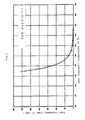
- Fig. 1 is a graph showing the relation of the heat treatment temperature and heat treatment time of the heat treatments performed in Example 1, wherein X-axis represents the heat treatment temperature (T: °C) and Y-axis represents the heat treatment time (Y: min).
- Fig. 2 is a graph showing the relation of the heat treatment temperature and heat treatment time which achieve the amount of elution of less than 50% based on the original weight after soaking in 80°C hot water for 1 hour, based on the heat treatments performed in Example 13 and Comparative Example 5, wherein X-axis represents the heat treatment temperature (T: °C) and Y-axis represents the heat treatment time (Y: second).
- molded product as used herein collectively refers to a product obtained by applying the reaction mixture of the present invention onto the surface of a substrate having an arbitrary shape, or by impregnating the surface of a substrate having an arbitrary shape with the reaction mixture.
- the term encompasses, for example, sheets, films, and sheets or films that have undergone further processing so as to have arbitrary shapes.
- the polyacrylic acids used for preparing the molded products, e.g., film, of the present invention having selective gas permeability are polyacrylic acids, polymethacrylic acids, or their mixtures which have 2 or more carboxyl groups in the molecule.
- preferred polyacrylic acids include homopolymers of acrylic acid or methacrylic acid, as well as copolymers of these monomers.
- the number average molecular weight of the polyacrylic acids (hereinafter simply referred to as average molecular weight) is between 1,500 and 500,000.
- the average molecular weight is 1,500 or greater, the resultant molded products, e.g., film, do not cause problems in film-forming properties or in stability of the shape of the membrane.
- the average molecular weight of 500,000 or smaller is preferred, in view of the facts that under this condition handling of the products, particularly films, during manufacture does not usually become problematic (when polyacrylic acids are used in the form of aqueous solutions, the viscosity of the solutions becomes high).
- the average molecular weight be between 50,000 and 450,000, and it is particularly preferred that the average molecular weight be between 70,000 and 300,000.
- the aliphatic diamines used in the present invention are not particularly limited.
- Examples of aliphatic diamines include, but are not limited to, aliphatic primary diamines, aliphatic secondary diamines, aliphatic tertiary diamines, alicyclic primary diamines, alicyclic secondary diamines, and alicyclic tertiary diamines.
- aliphatic primary diamines are preferred, with linear aliphatic primary diamines having an amino group at either end of the carbon chain being particularly preferred.
- the number of carbon atoms contained in the carbon chain (which may be branched) constituting an aliphatic primary diamine is preferably between 2 and 8 inclusive, and more preferably 2 and 4 inclusive.
- Specific examples of preferred aliphatic primary diamines include ethylene diamine, trimethylene diamine, and tetramethylene diamine.
- the aliphatic diamine is used in a molar ratio of 0.2 to 2.0 with respect to the entire carboxyl groups of the polyacrylic acids; i.e., the ratio of the mole number of the aliphatic diamine to the mole number of the entire carboxyl groups of the polyacrylic acid is 0.2-2.0.
- the molar ratio is less than 0.2, films that have intended selective gas permeability cannot be obtained.
- the molar ratio of less than 0.2 is not preferred in consideration of possible generation of insoluble matter (gel) in the reaction mixture when an aliphatic primary diamine is used as the aliphatic diamine.
- the molar ratio of the aliphatic diamine to the entirety of the carboxyl groups in the polyacrylic acid is preferably between 0.4 and 1.5, and more preferably between 0.4 and 1.2.
- the molded product preferably has the shape of a sheet because sheets realize full utilization of the selective gas permeability of the present invention.
- a sheet-shaped product is formed from a reaction mixture of predetermined amounts of the polyacrylic acid and the aliphatic diamine.
- the thus-formed sheet-shaped product is thermally treated at a temperature between 100 and 300°C, to thereby obtain a film.
- the polyacrylic acid is generally used after being dissolved or dispersed in water or in a solvent mixture of water and alcohol.
- a 3-45 weight % aqueous solution, more preferably a 5-30 weight % aqueous solution, of a polyacrylic acid is prepared, and to the resultant aqueous solution is added a predetermined amount of an aliphatic diamine, which is used as is or after being diluted with water or a water-alcohol solvent mixture.
- the reaction between the polyacrylic acid and the aliphatic diamine proceeds almost quantitatively at room temperature, to thereby yield a reaction mixture.
- the liquid containing the reaction mixture is cast or applied by way of coating onto a substrate such as other film or metal foil, and subsequently, the solvent such as water or alcohol is evaporated, to thereby obtain a sheet-shaped product.
- the film of the present invention having resistance to hot water can be obtained.
- an immersion method may be performed; i.e., the substrates may be first immersed in the reaction mixture, followed by evaporation of moisture and heat treatment.
- “having resistance” e.g. resistance to hot water
- the amount of elution after the product is soaked in 1.5 liters of 80°C hot water for 1 hour with stirring under conditions described below is less than 50 % of the original weight.
- Heat treatment is performed by holding in an atmosphere between 100 and 300°C a sheet-shaped product that has been applied with a reaction mixture and dried or an immersion-coated product that has been dried. If the heat treatment temperature is less than 100°C, films having resistance to hot water may not always be obtained. In addition, there arises the economical problem due to, for example, prolonged time for manufacturing. On the other hand, if the heat treatment temperature is in excess of 300°C, there is invited the risk of coloring or decomposition of the resultant film. In order to secure an excellent shape retainability of the resultant molded product such as a film, the heat treatment temperature is preferably between 110 and 290°C, and more preferably between 150 and 280°C from the viewpoints of ease of manufacture and economy.
- the upper limit of heat treatment time is determined so as not to invite coloring or decomposition of the resultant molded products such as a film, whereas the lower limit of the heat treatment time is determined so as not to impair the desired properties, productivity, and cost performance of the target products.
- the heat treatment time may be arbitrarily determined between such upper and lower limits.
- the heat treatment conditions as defined by the following expressions (a) and (b) are preferred: (a) Y ⁇ 9.1 x 10 25 T -10.8 (b) 100 ⁇ T ⁇ 300 wherein Y represents the time during which heat treatment is performed (minutes) and T represents the temperature at which heat treatment is performed (°C).
- preferred heat treatment comprises any of the following: 280°C x 20 seconds or more; 250°C x 1 minute or more; 230°C x 3 minutes or more, 200°C x 5 minutes or more; and 180°C x 40 minutes or more, in order to economically manufacture a film having intended properties.
- thermoforming a hot roll is also preferred (hot roll method).
- This method being characterized by its high processing speeds, requires a shorter heat treatment time, and therefore is preferred in consideration of improved productivity. It is preferred that the heat treatment satisfy the conditions of the following expressions (c) and (d).
- a temperature range of 150-280°C is preferred. In consideration of ease of manufacture and economy, a temperature range of 180-260°C is particularly preferred. In practice, heat treatment of 200°C x 30 seconds or more, 230°C x 5 seconds or more, or 250°C x 5 seconds or more is particularly preferred.
- the film is peeled from its substrate before use.
- the film is used as a layered product including a film having selective gas permeability and a substrate, the film is used without being peeled from the substrate.
- the material for forming the substrate of the layered product should be suitably selected in accordance with the purpose of use, etc.
- the reaction mixture of polyacrylic acid and aliphatic diamine may further contain a variety of stabilizers, lubricants, colorants, fillers, etc. as required, so long as the effect of the present invention is not impeded.
- the ratio of carbon dioxide gas permeation rate to oxygen gas permeation rate (CO 2 gas permeation rate/O 2 gas permeation rate) of the film having selective gas permeability according to the present invention is not less than 15, preferably not less than 20, and more preferably not less than 22, as measured at 23°C and a relative humidity of 80%. If the ratio is smaller than 15, efficiency for separating carbon dioxide gas is poor and is problematic in practice.
- the film of the invention preferably has a permeation rate ratio of 20 or greater, e.g. a permeation rate ratio of 22 or greater.
- the film having selective gas permeability according to the present invention exhibits durability in the presence of cold water, hot water, and in an environment of high temperature (about 50°C) and high humidity.
- the film of the invention is characterized by its resistance to water as defined herein.
- the durability and the resistance to water are obtained from the aforementioned heat treatment. It is considered that these properties are attributed to amide bonds formed in the reaction mixture during the heat treatment.
- an amine salt of the polyacrylic acid is formed.
- the amount of the produced amine salt decreases when the reaction mixture undergoes a heat treatment.
- the absorbance ratio must fall within the range of 0.001 to 0.11.
- the absorbance ratio is preferably between 0.005 and 0.105, and more preferably between 0.01 and 0.10.
- the resultant molded product e.g., film
- selective gas permeability is intended to refer to the ratio of carbon dioxide gas permeation rate to oxygen gas permeation rate (CO 2 gas permeation rate/O 2 gas permeation rate) of not less than 10 as measured at 23°C and a relative humidity of 80%.
- the gas permeation ratio is preferably not less than 15, and more preferably not less than 20.
- the formation of amide bonds during heat treatment may also be confirmed through NMR as evidenced by the presence of a shoulder or peak appearing in the range of 180 +/- 3 ppm, which is considered to be attributed to carbonyl carbons in amide bonds.
- the term "resistance to hot water" which expresses excellent property possessed by the film of the present invention is intended to mean that the amount of elution of the film upon being soaked in 80°C water for 1 hour is less than 50 weight%, preferably less than 40 weight%, based on the original weight of the film.
- the weight of the film after being soaked is 50 percent or more, preferably 60 percent or more, of the weight before being soaked. Since the amount of elution of the film after being soaked is less than 50 weight% under the conditions described above, the film is not vulnerable to damage when exposed to cold water, hot water, or high temperature steam. From the viewpoints of durability and advantages in practice, the amount of elution after soaking of the film is preferably less than 40 weight% under the conditions described above.
- the film h aving selective gas permeability according to the present invention may be used alone or in the form of a layered product including at least one layer of the film and a substrate.
- the substrate of the layered product is not particularly limited so long as the layered product itself has a ratio of carbon dioxide gas permeation rate to oxygen gas permeation rate of not less than 15, preferably 17, as measured at 23°C and a relative humidity of 80%.
- preferred materials for the substrate include thermoplastic resins, thermosetting resins, paper, woven fabrics, and metal foils. Specifically, there may be used synthetic paper, non-woven fabrics, porous membranes of a thermoplastic resin, molded products of a thermoplastic resin, stretched or unstretched films of a thermoplastic resin, and metallic porous membranes.
- the layer structure of the layered product is not particularly limited.
- Illustrative examples of the layer structure include a two-layered structure consisting of a layer of film having selective gas permeability and a substrate, and a three- or multilayered layer structure in which a substrate layer is placed on either side of a film layer having selective gas permeability.
- One preferred example is a multilayered structure constituted by two substrate layers that serve as the two outermost layers and at least one intermediate layer formed of film having selective gas permeability.
- Such a preferred structure include multilayered structures in which two substrate layers formed of a thermoplastic resin constitute two outermost layers, and a layer formed of the invention film constitutes at least one intermediate layer; and multilayered structures in which a substrate layer formed of paper constitutes one of the two outermost layers, another substrate layer formed of a thermoplastic resin constitutes the other outermost layer, and a layer formed of the invention film constitutes at least one intermediate layer.
- a heat-sealing layer which has conventionally been known may be provided on either side of a layered product, so as to permit fusion with another layered product or with another thermoplastic resin film. Moreover, there may be present a plurality of film layers having selective gas permeability. If necessary, an adhesive layer which will be described below may be interposed between two adjacent layers, arbitrary or specified. By forming a layered structure, strength during practical use, water repellency, and heat-sealing properties can be obtained.
- the thickness of the film having selective gas permeability according to the present invention prepared from a polyacrylic acid and an aliphatic diamine is not particularly limited. Generally, the thickness is between 0.5 and 1,000 micrometers, and preferably between 1 and 500 micrometers and more preferably between 1.5 and 300 micrometers. If the thickness of the film is less than 0.5 micrometers, not only is it difficult to control the film thickness, but also intended selective gas permeability may not be obtained. On the other hand, if the film thickness is excess of 1,000 micrometers, uniform films are difficult to obtain, and disadvantages in terms of economy such as prolonged manufacturing time will be incurred. When a coating film is formed on a substrate having a complicated shape, the same criteria are applied to the thickness of the film.
- the thickness of the entirety of a layered product of the present invention is between 20 micrometers and 10 mm, and preferably between 30 micrometers and 5 mm. If the thickness of the layered product is less than 20 micrometers, the product does not stably retain its shape, raising drawbacks such as weak strength during use. On the other hand, if the thickness is in excess of 10 mm, ease of manufacture and economical advantages are not secured.
- a layered product of the present invention is prepared by first subjecting a reaction mixture (generally in the form of an aqueous solution) of a polyacrylic acid and an aliphatic diamine to a film-forming process through use of a casting method, coating method, etc., or a kneading-extrusion method when the reaction mixture is not an aqueous solution, among which a coating method is particularly preferred, so as to obtain a film, and by subsequently affixing the film with a substrate through use of a dry lamination method or an extrusion coating lamination method.
- a reaction mixture generally in the form of an aqueous solution
- a polyacrylic acid and an aliphatic diamine to a film-forming process through use of a casting method, coating method, etc., or a kneading-extrusion method when the reaction mixture is not an aqueous solution, among which a coating method is particularly preferred, so as to obtain a film, and by subsequently affix
- adhesives and anchors including polyolefins obtained by graft-denaturing a polyolefin (linear low density polyethylene) with an unsaturated carboxylic acid such as maleic acid, fumaric acid, or acrylic acid, or an acid anhydride thereof; copolymers of these unsaturated carboxylic acids and olefins; mixtures of unmodified polyolefins and the aforementioned grafted polyolefins or copolymers, or polyesters having urethane bonds.
- polyolefins obtained by graft-denaturing a polyolefin (linear low density polyethylene) with an unsaturated carboxylic acid such as maleic acid, fumaric acid, or acrylic acid, or an acid anhydride thereof; copolymers of these unsaturated carboxylic acids and olefins; mixtures of unmodified polyolefins and the aforementioned grafted polyolefins or copolymers, or polyesters having ure
- the film having selective gas permeability provided by the present invention has a high ratio of CO 2 gas permeation rate to O 2 gas permeation rate and exhibits excellent durability (resistance to water) when exposed to cold water, hot water, or used in an environment of high temperature (about 50°C) and high humidity, it is industrially suitable for separating carbon dioxide gas from combustion exhaust gases containing carbon dioxide gas or from gases occurring in nature.
- the film of the present invention finds utility in the food industry, particularly for manufacturing packaging materials for foods with a high water content, foods that are apt to generate carbon dioxide gas, foods for retort use, and frozen foods.
- the oxygen gas permeation rate [cm 3 /(cm 2 x Mpa x s)] of a layered product was measured by use of an apparatus for measuring the oxygen gas permeation rate (Model Ox-tran 2/20 by Modern Control) at 23°C and relative humidity of 80%, in accordance with equation (1) below.
- the carbon dioxide gas permeation rate [cm 3 /(cm 2 x Mpa x s)] of a layered product was measured by use of an apparatus for measuring the carbon dioxide gas permeation rate (Model PERMATRANC-IV by Modern Control) at 23°C and relative humidity of 80%, in accordance with the following equation (1).
- 1/P(total) 1/P(film) + 1/P(sub)
- P(total) represents a gas permeation rate of an entirety of a layered product including a substrate and a film having selective gas permeability and formed thereon by way of coating
- P(film) represents a gas permeation rate of a film having selective gas permeability
- P(sub) represents a gas permeation rate of a substrate.
- Resistance to water was determined as follows. A test piece of a film having selective gas permeability according to the present invention (single-layered film) having a size of 10 cm x 10 cm was soaked for 1 hour in 1.5 liter of 80°C water placed in a 2-liter beaker, while being stirred with a magnetic stirrer equipped with a rotor of 55 mm in length and 6 mm in diameter at 150 rpm. Thereafter, the test piece was removed from the hot water and dried at 105°C for 1 hour, and the weight was measured. The amount of elution (weight%) indicative of the resistance to water was obtained from the equation (2) below.
- the amount of elution of the film having selective gas permeability from a layered product including a film having selective gas permeability and a substrate layer was obtained by first soaking a test piece of a layered film having a size of 10 cm x 10 cm for 1 hour in 1.5 liter of 80°C water placed in a 2-liter beaker, while being stirred with a magnetic stirrer equipped with a rotor of 55 mm in length and 6 mm in diameter at 150 rpm, removing the test piece from the hot water, drying it at 105°C for 1 hour, and measuring the weight. The weight of the substrate was subtracted from the weight values of the sample layered product before and after soaking. The amount of elution (weight%) was computed from the following representation (2).
- a 1 cm x 4 cm sample was cut from each layered product. Measurement was performed by use of an FT-IR(Fourier transform infrared spectrophotometer: Model FT-IR 8200, by Shimazu Seisakusho). The coating layer of each sample was brought into contact with a prism (KRS-5), and measurement was performed by a reflection method. The resolving power was 4 cm -1 , and the measurement was performed at 25°C.
- a single film layer of the present invention was dried in vacuo at 25°C for 48 hours. Subsequently, the dry film was ground in a mortar so as to obtain a powder sample. The sample (100 mg) was subjected to NMR (apparatus used: Model EX-270, by Nippon Denshi K.K.). The probe employed was for use with solid 13 C-NMR, and a CP-WEIGHT method was used with measurement performed at 25°C.
- PAA polyacrylic acid
- the polyacrylic acid (hereinafter abbreviated as PAA) employed in these examples was 25 weight% aqueous solution of PAA (by Wako Pure Chemical Industries, Ltd., average molecular weight 150,000), and the aliphatic diamine employed was ethylene diamine manufactured by Wako Pure Chemical Industries, Ltd.
- a 25 weight% aqueous PAA solution was diluted to 10 weight% with water.
- aqueous PAA solution 100 parts by weight in terms of a solid content
- ethylene diamine 66.7 parts by weight
- the aqueous solution containing the reaction mixture was applied by way of coating onto an aluminum sheet having a thickness of 50 micrometers (by Sun Aluminum Industries, Co.) with a mayer bar.
- the coated sheet was placed in a dryer and dried at 90°C for 20 minutes so as to evaporate moisture, to thereby obtain a layered intermediate having an aluminum sheet substrate and a sheet-shaped product (dry film) provided thereon, the sheet-shaped product being formed of a reaction mixture of PAA and ethylene diamine and having a thickness of 5 micrometers.
- a plurality of the thus-prepared intermediates were retained in a Gear oven for heat treatment of 280°C x 20 seconds, 250°C x 1 minute, 230°C x 3 minutes, 200°C x 5 minutes, 180°C x 40 minutes, 150°C x 4 hours, 130°C x 17 hours, or 110°C x 144 hours.
- eight different layered products, each having an aluminum sheet substrate and a film having selective gas permeability of the present invention superposed thereon, were obtained (thickness in total of each product: 55 micrometers) (Example 1).
- Comparative Example 1 comparative products were prepared (Comparative Example 1) by forming a layered intermediate having an aluminum sheet substrate employed in Example 1 and a sheet-shaped product (dry film without undergoing heat treatment) provided thereon, the sheet-shaped product being formed of a reaction mixture of PAA and ethylene diamine and having a thickness of 5 micrometers.
- the sheet-shaped product being formed of a reaction mixture of PAA and ethylene diamine and having a thickness of 5 micrometers.
- the thus-prepared intermediates one was not subjected to heat treatment, and the others were subjected to the following eight different heat treatments: 280°C x 10 seconds, 250°C x 30 seconds, 230°C x 1 minute, 200°C x 3 minutes, 180°C x 30 minutes, 150°C x 3 hours, 130°C x 13 hours, or 110°C x 100 hours.
- nine different layered products, each having an aluminum sheet substrate and a film for comparison superposed thereon were obtained (thickness in total of each specimen: 55 micro
- Example 1 From each of the thus-obtained 17 different layered films of Example 1 and Comparative Example 1, specimens each having a size of 10 cm x 10 cm were cut, and their resistance to water was assessed. The specimens were soaked in 80°C hot water for 1 hour. (Since the film was exfoliated from the aluminum sheet substrate soon after the start of soaking, the aluminum sheet was removed from the hot water.) Subsequently, the film was taken out of the hot water, dried at 105°C for 1 hour, the weight was measured, and the amount of elution (weight%) was computed. The results of assessment in terms of resistance to water and absorbance ratio (N + -H/CH) from the IR spectrum are shown in Table 1.
- heat treatment conditions for obtaining the film of the present invention i.e., the film having resistance to hot water are such that the heat treatment temperature is within the range of the aforementioned expression (b) : 100 ⁇ T ⁇ 300 and within the area above the above-mentioned curve (right-hand side of the curve); i.e., the area that satisfy the aforementioned expression (a): Y ⁇ 9.1 x 10 25 T -10.8 .
- Example 2 A thousand (1,000) parts by weight of the 10 weight% aqueous PAA solution employed in Example 1 were used in each of these examples (solid content: 100 parts by weight).
- ethylene diamine in different amounts: 41.7 parts by weight (Comparative Example 2), 166.7 parts by weight (Example 2), 333.3 parts by weight (Example 3), 583.3 parts by weight (Example 4), 833.3 weight parts (Example 5), 1250 parts by weight (Example 6), 1666.7 parts by weight (Example 7), and 1916.7 parts by weight (Comparative Example 3), so as to obtain the following different values of the molar ratio of ethylene diamine to the entire carboxyl groups of PAA: 0.05 (Comparative Example 2), 0.2 (Example 2), 0.4 (Example 3), 0.7 (Example 4), 0.9 (Example 5), 1.5 (Example 6), 2.0 (Example 7), and 2.3 (Comparative Example 3).
- Example 1 The procedure of Example 1 was repeated, to thereby obtain aqueous solutions each containing a reaction mixture.
- Each aqueous solution was applied by way of coating with a mayer bar onto poly 4-methyl-1-pentene film (hereinafter referred to as "PMP film,” TPX film manufactured by Mitsui Petrochemical Co., Ltd.) having a thickness of 40 micrometers and having been undergone corona discharge treatment.
- PMP film poly 4-methyl-1-pentene film
- TPX film poly 4-methyl-1-pentene film manufactured by Mitsui Petrochemical Co., Ltd.
- moisture was evaporated by use of a drier, to thereby obtain layered intermediates each having a PMP film substrate and a sheet-shaped product provided thereon, the sheet-shaped product being formed of a reaction mixture of PAA and ethylene diamine and having a thickness of 5 micrometers.
- the thus-prepared intermediates were subjected to a heat treatment of 200°C x 5 minutes by use of a Gear oven, so as to obtain layered products, each having a PMP film substrate and a film having selective gas permeability of the present invention or a comparative film superposed thereon (thickness in total of each product: 45 micrometers). Since the layered product of Comparative Example 3 had a considerably sticky coat surface and was problematic in use, this specimen was excluded, and the rest of the specimens were assessed in terms of selective gas permeability and resistance to water. That is, through measurement of the oxygen gas permeation rate and the carbon dioxide gas permeation rate of each layered product, the ratio of CO 2 gas permeation rate to O 2 gas permeation rate of the layered product was obtained.
- the ratio of CO 2 gas permeation rate to O 2 gas permeation rate was obtained.
- the resistance to water and absorbance ratio (N + -H/CH) by IR of each film of the present invention having selective gas permeability were measured. The results are shown in Table 2.
- the substrate PMP film (thickness: 40 micrometers) had an oxygen gas permeation rate of 41,325 cm 3 /cm 2 •MPa•s and carbon dioxide gas permeation rate of 156,750 cm 3 /cm 2 •MPa•s at 23°C and relative humidity of 80%.
- the 10 weight% aqueous PAA solution employed in Example 1 was used. To 1,000 parts by weight of the aqueous PAA solution (solid content: 100 parts by weight) were added an amine in such an amount to cause the molar ratio of the amine to the entire carboxyl groups of PAA to be 1.0.
- the 25 weight% aqueous PAA solution prepared in Example 1 was used. To 400 parts by weight of the solution (solid content: 100 parts by weight) were added 79.1 parts by weight of ethylene diamine so as to cause the molar ratio of ethylene diamine to the entire carboxyl groups of PAA to be 0.95. Subsequently, water (637.3 parts by weight) was added thereto so as to obtain a solution having a concentration of the total of PAA and ethylene diamine of 25 weight%. Similar to Example 1, an aqueous solution containing a reaction mixture was obtained.
- the resultant aqueous solution was applied onto paper having a thickness of 100 micrometers (manufactured by Furubayashi Shiko K.K.; thinly coated paper (relatively thick)), and moisture was evaporated by use of a drier, to thereby obtain a layered intermediate with a coating of a 2-micrometer-thick, sheet-shaped product formed from a reaction mixture of PAA and ethylene diamine.
- the thus-prepared intermediate was subjected to a heat treatment of 130°C x 18 hours, 150°C x 5 hours, or 180°C x 50 minutes by use of a Gear oven, so as to obtain three different layered products, each having a paper substrate and a film having selective gas permeability of the present invention.
- ethylene - vinyl acetate copolymer (hereinafter abbreviated as "EVA”; manufactured by Nippon Unikar, NUC, vinyl acetate content: 7.5 weight%) was laminated onto the surface of the film having selective gas permeability by an extrusion coating lamination method, to thereby obtain three kinds of layered products (structure: paper - film having selective gas permeability of the present invention - EVA; thickness: 100 micrometers - 2 micrometers - 20 micrometers) (Example 11).
- EVA ethylene - vinyl acetate copolymer
- Example 12 Similar to Example 11, the heat treatment was performed on the same type of PMP films (the thickness being changed to 20 micrometers) employed in Examples 2 through 7, as a replacement of the paper employed in Example 11, to thereby obtain three kinds of layered products (structure: PMP - film having selective gas permeability of the present invention - EVA; thickness: 20 micrometers - 2 micrometers - 20 micrometers) (Example 12).
- Example 12 For each layered product were determined the oxygen gas permeation rate, the carbon dioxide gas permeation rate, and the ratio of CO 2 gas permeation rate to O 2 gas permeation rate.
- the substrate PMP film (thickness: 20 micrometers) had an oxygen gas permeation rate of 82,650 cm 3 /cm 2 •MPa•s and carbon dioxide gas permeation rate of 313,500 cm 3 /cm 2 •MPa•s at 23°C and relative humidity of 80%.
- the EVA film (thickness: 20 micrometers) had an oxygen gas permeation rate of 13,000 cm 3 /cm 2 •MPa•s and carbon dioxide gas permeation rate of 54,000 cm 3 /cm 2 •MPa•s under the same measurement conditions.
- the 10 weight% aqueous PAA solution employed in Example 1 was used. To 1,000 parts by weight of the aqueous PAA solution (solid content: 100 parts by weight) were added 83.3 parts by weight of ethylene diamine as an aliphatic amine, so as to cause the molar ratio of the amine to the entire carboxyl groups of PAA to be 1.0. Similar to Example 1, an aqueous solution containing a reaction mixture was obtained.
- the resultant aqueous solution was applied by way of coating onto an aluminum sheet having a thickness of 50 micrometers (manufactured by Sun Aluminum Industries) by use of a mayer bar, and moisture was evaporated with a drier, to thereby obtain a layered intermediate having an aluminum sheet substrate and a sheet-shaped product provided thereon, the sheet-shaped product (dry film without undergoing heat treatment) being formed from a reaction mixture of PAA and ethylene diamine and having a thickness of 5 micrometers. Subsequently, the resultant layered intermediate was brought into contact with a hot roll for heat treatment, to thereby obtain a layered product having an aluminum sheet substrate and a film having selective gas permeability of the present invention superposed thereon.
- the thickness in total of the resultant layered product was 55 micrometers.
- the temperature of the hot roll and the contact time were respectively taken as the heat treatment temperature and the heat treatment time.
- the conditions of heat treatment were as follows: 180°C x 600 seconds, 200°C x 30, 40, 60, 180, and 300 seconds, 210°C x 10, 15, 20, and 60 seconds, 220°C x 5, 10, 15, 20, and 60 seconds, 230°C x 5, 10, 15, and 60 seconds, and 250°C x 5, 10, 15, and 60 seconds.
- 23 different kinds of layered products in which a film having selective gas permeability of the present invention was superposed on an aluminum sheet substrate were obtained. These layered products represent Example 13.
- Example 13 Through use of layered intermediates prepared in Example 13 having an aluminum sheet substrate and a sheet-shaped product (dry film without undergoing heat treatment) provided thereon, the sheet-shaped product being formed from a reaction mixture of PAA and ethylene diamine and having a thickness of 5 micrometers, the following 8 different specimens were obtained: (1) one specimen which was not subjected to heat treatment, and (2) seven specimens each of which was subjected to the following heat treatment: 180°C x 300 seconds, 200°C x 10 and 20 seconds, 210°C x 2 and 5 seconds, 220°C x 2 seconds, and 230°C x 2 seconds.
- eight different layered products, each having an aluminum sheet substrate and a film for comparison superposed thereon were obtained (thickness in total of each specimen: 55 micrometers) (Comparative Example 5).
- Example 13 and Comparative Example 5 From each of the thus-obtained 31 different layered films of Example 13 and Comparative Example 5, specimens each having a size of 10 cm x 10 cm were cut, and their resistance to water was assessed. The specimens were soaked in 80°C hot water for 1 hour. (Since the film was exfoliated from the aluminum sheet substrate soon after the start of soaking, the aluminum sheet substrate was removed from the hot water.) Subsequently, the film was taken out of the hot water, dried at 105°C for 1 hour, the weight was measured, and the amount of elution (weight%) was computed. The results of assessment in terms of resistance to water are shown in Table 5.
- each of the 31 different layered products that had not undergone assessment of resistance to water was cut a specimen having a size of 1 cm x 4 cm, and the specimen was subjected to an FT-IR measurement.
- the coating surface of each sample was brought into contact with a transmission medium, i.e., a prism (KRS-5), and measurement was performed by a reflection method.
- the resolving power was 4 cm -1 .
- heat treatment conditions for obtaining the film of the present invention i.e., the film having resistance to hot water, preferably satisfy the following expressions (c) and (d): (c) Y ⁇ 8.0 x 10 34 T -14.5 (d) 100 ⁇ T ⁇ 300 wherein Y represents the time during which heat treatment is performed (seconds) and T represents the temperature at which heat treatment is performed (°C).
- the 10 weight% aqueous PAA solution employed in Example 1 was used. To 1,000 parts by weight of the solution (solid content: 100 parts by weight) were added 83.3 parts by weight of ethylene diamine so as to cause the molar ratio of ethylene diamine to the entire carboxyl groups of PAA to be 1.0. Similar to Example 1, an aqueous solution containing a reaction mixture was obtained. The resultant aqueous solution was applied onto duplicated paper having a thickness of 85 micrometers (manufactured by Daishowa Paper Manufacturing Co., Ltd.) by use of a mayer bar.
- Example 2 moisture was evaporated with a drier, to thereby obtain a layered intermediate having a duplicated paper substrate and a sheet-shaped product provided thereon, the sheet-shaped product being formed from a reaction mixture of PAR and ethylene diamine, and having a thickness of 5 micrometers.
- the thus-prepared layered intermediate was brought into contact with a hot roll for heat treatment, to thereby obtain a layered product having a duplicated paper substrate and a film having selective gas permeability of the present invention (thickness in total: 90 micrometers).
- the temperature and time of the heat treatments performed are as follows: 180°C x 300 seconds (Comparative Example 7), 200°C x 20 seconds (Comparative Example 8), 200°C x 40 seconds (Example 14), 200°C x 60 seconds (Example 15), 200°C x 120 seconds (Example 16), 200°C x 300 seconds (Example 17), 210°C x 10 seconds (Example 18), 210°C x 20 seconds (Example 19), 210°C x 60 seconds (Example 20), 220°C x 10 seconds (Example 21), 220°C x 20 seconds (Example 22), 220°C x 60 seconds (Example 23), 230°C x 5 seconds (Example 24), 230°C x 10 seconds (Example 25), 230°C x 15 seconds (Example 26), 230°C x 40 seconds (Example 27), 230°C x 60 seconds (Example 28), 230°C x 180
- the film having selective gas permeability of the present invention has resistance to 80°C hot water, plus a high ratio of CO 2 gas permeation rate to oxygen gas permeation rate. Therefore, the film of the invention, either as a single film or in the form of a layered product including at least one film having selective gas permeability of the present invention and a substrate, is useful as a material for separating carbon dioxide gas from a mixed gas containing carbon dioxide gas particularly in an environment of high temperature and high humidity. Moreover, the film of the invention is useful as a packaging material for foods with a high water content, foods that are apt to generate carbon dioxide gas, foods that should be kept away from contact with oxygen, and packaged foods to be heated under high pressure and high humidity (e.g. foods packaged in a retort pouch). According to the present invention, films having selective gas permeability and suitable for the above uses are provided in an economical manner.
Landscapes
- Chemical & Material Sciences (AREA)
- Engineering & Computer Science (AREA)
- Chemical Kinetics & Catalysis (AREA)
- Organic Chemistry (AREA)
- Manufacturing & Machinery (AREA)
- Medicinal Chemistry (AREA)
- Polymers & Plastics (AREA)
- General Chemical & Material Sciences (AREA)
- Health & Medical Sciences (AREA)
- Analytical Chemistry (AREA)
- Life Sciences & Earth Sciences (AREA)
- Inorganic Chemistry (AREA)
- Wood Science & Technology (AREA)
- Zoology (AREA)
- Food Science & Technology (AREA)
- Materials Engineering (AREA)
- Oil, Petroleum & Natural Gas (AREA)
- Manufacture Of Macromolecular Shaped Articles (AREA)
- Laminated Bodies (AREA)
- Separation Using Semi-Permeable Membranes (AREA)
- Manufacture Of Porous Articles, And Recovery And Treatment Of Waste Products (AREA)
- Addition Polymer Or Copolymer, Post-Treatments, Or Chemical Modifications (AREA)
Applications Claiming Priority (4)
| Application Number | Priority Date | Filing Date | Title |
|---|---|---|---|
| JP93498/96 | 1996-03-22 | ||
| JP9349896 | 1996-03-22 | ||
| JP41612/97 | 1997-02-10 | ||
| JP9041612A JPH09316208A (ja) | 1996-03-22 | 1997-02-10 | 気体選択透過性を有する成形物、そのフイルムおよびその製造方法 |
Publications (2)
| Publication Number | Publication Date |
|---|---|
| EP0796885A2 true EP0796885A2 (de) | 1997-09-24 |
| EP0796885A3 EP0796885A3 (de) | 1998-03-11 |
Family
ID=26381256
Family Applications (1)
| Application Number | Title | Priority Date | Filing Date |
|---|---|---|---|
| EP97301939A Withdrawn EP0796885A3 (de) | 1996-03-22 | 1997-03-21 | Formkörpers mit selektiver Gasdurchlässigkeit, daraus hergestellte Folien, und Verfahren zur Herstellung davon |
Country Status (3)
| Country | Link |
|---|---|
| EP (1) | EP0796885A3 (de) |
| JP (1) | JPH09316208A (de) |
| KR (1) | KR19980069708A (de) |
Cited By (4)
| Publication number | Priority date | Publication date | Assignee | Title |
|---|---|---|---|---|
| CN103214607A (zh) * | 2013-05-02 | 2013-07-24 | 南昌航空大学 | 一种固体胺二氧化碳捕获剂的制备方法 |
| CN103224577A (zh) * | 2013-05-02 | 2013-07-31 | 南昌航空大学 | 一种固态的二氧化碳吸收剂及其制备方法 |
| CN103242469A (zh) * | 2013-05-24 | 2013-08-14 | 南昌航空大学 | 一种固体胺二氧化碳捕获剂的制备方法 |
| US9663677B2 (en) | 2010-09-07 | 2017-05-30 | Sun Chemical B.V. | Carbon dioxide barrier coating |
Families Citing this family (2)
| Publication number | Priority date | Publication date | Assignee | Title |
|---|---|---|---|---|
| JP4609179B2 (ja) * | 2004-05-14 | 2011-01-12 | 旭硝子株式会社 | 硬質発泡合成樹脂の製造方法 |
| JP6032781B2 (ja) * | 2011-06-29 | 2016-11-30 | 興人フィルム&ケミカルズ株式会社 | ガスバリア性フィルム及び製造方法 |
Family Cites Families (9)
| Publication number | Priority date | Publication date | Assignee | Title |
|---|---|---|---|---|
| US3617312A (en) * | 1968-07-18 | 1971-11-02 | Tee Pak Inc | Antimycotic overcoating treatment of cellulose sausage casing |
| JPS619403A (ja) * | 1984-06-22 | 1986-01-17 | Du Pont Mitsui Polychem Co Ltd | 配位イオン性エチレン系共重合体の製造法 |
| US4619973A (en) * | 1984-08-17 | 1986-10-28 | Advanced Glass Systems, Inc. | Ionomer resin films |
| DE3704563A1 (de) * | 1987-02-13 | 1988-08-25 | Roehm Gmbh | Verschweisste huelle aus acrylharz-beschichtetem, textilem flaechengebilde zur direkten umhuellung von lebensmitteln und verfahren zu ihrer herstellung |
| DE69230086T2 (de) * | 1991-07-26 | 2000-01-27 | Kureha Chemical Industry Co., Ltd. | Harzzusammensetzung und daraus hergestellte Verpackungsmaterialien für Lebensmittel |
| DE4237138A1 (de) * | 1992-08-28 | 1994-03-03 | Buertex Buerker & Co Gmbh | Faserverstärkte Folie |
| JP2811540B2 (ja) * | 1993-10-20 | 1998-10-15 | 呉羽化学工業株式会社 | ガスバリヤー性フィルム及びその製造方法 |
| DE69421063T2 (de) * | 1993-11-05 | 2000-03-02 | Elf Atochem S.A., Puteaux | Verpackung mit beschränkter sauerstoffdurchlässigkeit |
| GB9413619D0 (en) * | 1994-07-06 | 1994-08-24 | American Colloid Co | Method of increasing the size and/or absorption under load of super-absorbent polymers by surface cross-linking |
-
1997
- 1997-02-10 JP JP9041612A patent/JPH09316208A/ja active Pending
- 1997-03-11 KR KR1019970008084A patent/KR19980069708A/ko not_active Withdrawn
- 1997-03-21 EP EP97301939A patent/EP0796885A3/de not_active Withdrawn
Cited By (4)
| Publication number | Priority date | Publication date | Assignee | Title |
|---|---|---|---|---|
| US9663677B2 (en) | 2010-09-07 | 2017-05-30 | Sun Chemical B.V. | Carbon dioxide barrier coating |
| CN103214607A (zh) * | 2013-05-02 | 2013-07-24 | 南昌航空大学 | 一种固体胺二氧化碳捕获剂的制备方法 |
| CN103224577A (zh) * | 2013-05-02 | 2013-07-31 | 南昌航空大学 | 一种固态的二氧化碳吸收剂及其制备方法 |
| CN103242469A (zh) * | 2013-05-24 | 2013-08-14 | 南昌航空大学 | 一种固体胺二氧化碳捕获剂的制备方法 |
Also Published As
| Publication number | Publication date |
|---|---|
| KR19980069708A (ko) | 1998-10-26 |
| JPH09316208A (ja) | 1997-12-09 |
| EP0796885A3 (de) | 1998-03-11 |
Similar Documents
| Publication | Publication Date | Title |
|---|---|---|
| JP3801319B2 (ja) | 樹脂組成物及びそれからなるガスバリヤー性フィルム | |
| EP1561774B1 (de) | Folie und herstellungsverfahren dafür | |
| CN101678655B (zh) | 阻气性前体叠层体、阻气性叠层体及它们的制造方法 | |
| EP0665264A1 (de) | Gasundurchlässiger Schichtstoff und Verfahren zu seiner Herstellung | |
| EP1683825B1 (de) | Sehr feuchtigkeitsfester film und herstellungsverfahren dafür | |
| CN1200698A (zh) | 高温消毒包装用容器及树脂组合物与由此组合物而成的阻气性薄膜 | |
| EP0806448A2 (de) | Gassperrfolie aus Kunststoff | |
| EP1650020A1 (de) | Mehrlagiger gassperrenkörper | |
| KR20040037065A (ko) | 가스 배리어성 필름, 가스 배리어 코팅제 및 그들의 제조방법 | |
| EP0796885A2 (de) | Formkörpers mit selektiver Gasdurchlässigkeit, daraus hergestellte Folien, und Verfahren zur Herstellung davon | |
| JP2003171419A (ja) | ガスバリア性樹脂組成物及びこれから成形されるガスバリア性フィルム | |
| KR20080086489A (ko) | 친수성 복합 미세 다공막 및 그 제조 방법 | |
| JPH08193156A (ja) | 樹脂組成物およびそれから形成されたフィルム | |
| CA1071035A (en) | Gas-barrier coated films, sheets or foils and method of preparation | |
| JP2832876B2 (ja) | 複合蒸着フィルム及びその製造方法 | |
| EP0803349A2 (de) | Mit Kunststoff beschichtetes Papier und dieses benutzender Verpackungsbehälter | |
| EP1814933A2 (de) | Polymer-verpackungsfolie | |
| JPH10128923A (ja) | レトルト包装用容器および包装体、並びにレトルト方法 | |
| JPH0839718A (ja) | 複合蒸着フィルム及びその製造方法 | |
| US3387997A (en) | Vinylidene chloride-acrylate-acrylic acid copolymer, wax-containing coating composition, coated polyolefin, and method of coating | |
| CN103442598B (zh) | 食品包装应用的自组装聚合物膜 | |
| EP0787582B2 (de) | Verfahren zum Bedrucken und/oder Kaschieren einer metallisierten Polypropylenfolie und danach hergestellte Folie | |
| US3716511A (en) | Coating composition of an aqueous dispersion of copolymeric vinylidene chloride | |
| US3958065A (en) | Polyester film coated with a vinylidene chloride copolymer containing a linear polyester resin | |
| EP0329362B1 (de) | Fluorenthaltende Polymerverbindung und Verfahren zur Herstellung davon |
Legal Events
| Date | Code | Title | Description |
|---|---|---|---|
| PUAI | Public reference made under article 153(3) epc to a published international application that has entered the european phase |
Free format text: ORIGINAL CODE: 0009012 |
|
| AK | Designated contracting states |
Kind code of ref document: A2 Designated state(s): DE DK FR GB NL |
|
| PUAL | Search report despatched |
Free format text: ORIGINAL CODE: 0009013 |
|
| AK | Designated contracting states |
Kind code of ref document: A3 Designated state(s): DE DK FR GB NL |
|
| 17P | Request for examination filed |
Effective date: 19980904 |
|
| STAA | Information on the status of an ep patent application or granted ep patent |
Free format text: STATUS: THE APPLICATION IS DEEMED TO BE WITHDRAWN |
|
| 18D | Application deemed to be withdrawn |
Effective date: 20001003 |