EP0787754A2 - Blockierte aliphatische Diisocyanate oder Diisocyanat-Addukte - Google Patents
Blockierte aliphatische Diisocyanate oder Diisocyanat-Addukte Download PDFInfo
- Publication number
- EP0787754A2 EP0787754A2 EP96118883A EP96118883A EP0787754A2 EP 0787754 A2 EP0787754 A2 EP 0787754A2 EP 96118883 A EP96118883 A EP 96118883A EP 96118883 A EP96118883 A EP 96118883A EP 0787754 A2 EP0787754 A2 EP 0787754A2
- Authority
- EP
- European Patent Office
- Prior art keywords
- diisocyanate
- weight
- parts
- aliphatic diisocyanates
- groups
- Prior art date
- Legal status (The legal status is an assumption and is not a legal conclusion. Google has not performed a legal analysis and makes no representation as to the accuracy of the status listed.)
- Withdrawn
Links
- 150000001412 amines Chemical class 0.000 claims abstract description 24
- 239000000843 powder Substances 0.000 claims abstract description 23
- 239000004814 polyurethane Substances 0.000 claims abstract description 15
- 238000000576 coating method Methods 0.000 claims abstract description 13
- 239000003054 catalyst Substances 0.000 claims abstract description 8
- ZFSLODLOARCGLH-UHFFFAOYSA-N isocyanuric acid Chemical group OC1=NC(O)=NC(O)=N1 ZFSLODLOARCGLH-UHFFFAOYSA-N 0.000 claims abstract description 8
- 125000000217 alkyl group Chemical group 0.000 claims abstract description 7
- OHJMTUPIZMNBFR-UHFFFAOYSA-N biuret Chemical group NC(=O)NC(N)=O OHJMTUPIZMNBFR-UHFFFAOYSA-N 0.000 claims abstract description 7
- 239000000945 filler Substances 0.000 claims abstract description 5
- JOYRKODLDBILNP-UHFFFAOYSA-N Ethyl urethane Chemical group CCOC(N)=O JOYRKODLDBILNP-UHFFFAOYSA-N 0.000 claims abstract description 4
- 125000001931 aliphatic group Chemical group 0.000 claims abstract description 4
- 125000003710 aryl alkyl group Chemical group 0.000 claims abstract description 4
- 125000000753 cycloalkyl group Chemical group 0.000 claims abstract description 4
- 239000000049 pigment Substances 0.000 claims abstract description 4
- 125000001495 ethyl group Chemical group [H]C([H])([H])C([H])([H])* 0.000 claims abstract description 3
- 125000002496 methyl group Chemical group [H]C([H])([H])* 0.000 claims abstract description 3
- 238000002844 melting Methods 0.000 claims description 25
- 230000008018 melting Effects 0.000 claims description 25
- XBPCUCUWBYBCDP-UHFFFAOYSA-N Dicyclohexylamine Chemical compound C1CCCCC1NC1CCCCC1 XBPCUCUWBYBCDP-UHFFFAOYSA-N 0.000 claims description 18
- 125000005442 diisocyanate group Chemical group 0.000 claims description 13
- 125000002887 hydroxy group Chemical group [H]O* 0.000 claims description 11
- 239000000203 mixture Substances 0.000 claims description 11
- 150000003335 secondary amines Chemical class 0.000 claims description 11
- -1 isocyanate groups Amine Chemical class 0.000 claims description 9
- 239000003795 chemical substances by application Substances 0.000 claims description 8
- 229920000642 polymer Polymers 0.000 claims description 8
- 230000000903 blocking effect Effects 0.000 claims description 6
- 229920001228 polyisocyanate Polymers 0.000 claims description 6
- 229920002635 polyurethane Polymers 0.000 claims description 6
- 239000005056 polyisocyanate Substances 0.000 claims description 5
- SDGKUVSVPIIUCF-UHFFFAOYSA-N 2,6-dimethylpiperidine Chemical compound CC1CCCC(C)N1 SDGKUVSVPIIUCF-UHFFFAOYSA-N 0.000 claims description 4
- 238000009835 boiling Methods 0.000 claims description 4
- 125000004435 hydrogen atom Chemical class [H]* 0.000 claims description 4
- XDTMQSROBMDMFD-UHFFFAOYSA-N Cyclohexane Chemical compound C1CCCCC1 XDTMQSROBMDMFD-UHFFFAOYSA-N 0.000 claims description 3
- IQPQWNKOIGAROB-UHFFFAOYSA-N isocyanate group Chemical group [N-]=C=O IQPQWNKOIGAROB-UHFFFAOYSA-N 0.000 claims description 3
- DFPJRUKWEPYFJT-UHFFFAOYSA-N 1,5-diisocyanatopentane Chemical compound O=C=NCCCCCN=C=O DFPJRUKWEPYFJT-UHFFFAOYSA-N 0.000 claims description 2
- 239000001257 hydrogen Substances 0.000 claims description 2
- 229910052739 hydrogen Inorganic materials 0.000 claims description 2
- FUUUBHCENZGYJA-UHFFFAOYSA-N n-cyclopentylcyclopentanamine Chemical compound C1CCCC1NC1CCCC1 FUUUBHCENZGYJA-UHFFFAOYSA-N 0.000 claims description 2
- MTEWAFVECQBILW-UHFFFAOYSA-N n-tert-butylcyclohexanamine Chemical compound CC(C)(C)NC1CCCCC1 MTEWAFVECQBILW-UHFFFAOYSA-N 0.000 claims description 2
- 125000004430 oxygen atom Chemical group O* 0.000 claims description 2
- 125000001424 substituent group Chemical group 0.000 claims description 2
- 125000004836 hexamethylene group Chemical group [H]C([H])([*:2])C([H])([H])C([H])([H])C([H])([H])C([H])([H])C([H])([H])[*:1] 0.000 claims 2
- GFNDFCFPJQPVQL-UHFFFAOYSA-N 1,12-diisocyanatododecane Chemical compound O=C=NCCCCCCCCCCCCN=C=O GFNDFCFPJQPVQL-UHFFFAOYSA-N 0.000 claims 1
- 239000012948 isocyanate Substances 0.000 abstract description 6
- 239000011248 coating agent Substances 0.000 abstract description 2
- 238000003860 storage Methods 0.000 abstract description 2
- 125000000113 cyclohexyl group Chemical group [H]C1([H])C([H])([H])C([H])([H])C([H])(*)C([H])([H])C1([H])[H] 0.000 abstract 1
- 125000001261 isocyanato group Chemical group *N=C=O 0.000 description 32
- 239000007795 chemical reaction product Substances 0.000 description 22
- 239000011541 reaction mixture Substances 0.000 description 17
- 238000006243 chemical reaction Methods 0.000 description 16
- JBKVHLHDHHXQEQ-UHFFFAOYSA-N epsilon-caprolactam Chemical compound O=C1CCCCCN1 JBKVHLHDHHXQEQ-UHFFFAOYSA-N 0.000 description 15
- 239000005057 Hexamethylene diisocyanate Substances 0.000 description 14
- RRAMGCGOFNQTLD-UHFFFAOYSA-N hexamethylene diisocyanate Chemical compound O=C=NCCCCCCN=C=O RRAMGCGOFNQTLD-UHFFFAOYSA-N 0.000 description 14
- 150000001875 compounds Chemical class 0.000 description 8
- NIMLQBUJDJZYEJ-UHFFFAOYSA-N isophorone diisocyanate Chemical compound CC1(C)CC(N=C=O)CC(C)(CN=C=O)C1 NIMLQBUJDJZYEJ-UHFFFAOYSA-N 0.000 description 8
- 239000004848 polyfunctional curative Substances 0.000 description 8
- 229920005862 polyol Polymers 0.000 description 8
- 150000003077 polyols Chemical class 0.000 description 8
- 239000005058 Isophorone diisocyanate Substances 0.000 description 7
- UAOMVDZJSHZZME-UHFFFAOYSA-N diisopropylamine Chemical compound CC(C)NC(C)C UAOMVDZJSHZZME-UHFFFAOYSA-N 0.000 description 6
- 238000000034 method Methods 0.000 description 6
- 229920000728 polyester Polymers 0.000 description 6
- AHBNSOZREBSAMG-UHFFFAOYSA-N 1,5-diisocyanato-2-methylpentane Chemical compound O=C=NCC(C)CCCN=C=O AHBNSOZREBSAMG-UHFFFAOYSA-N 0.000 description 5
- 238000004519 manufacturing process Methods 0.000 description 5
- 239000000155 melt Substances 0.000 description 5
- VZXPHDGHQXLXJC-UHFFFAOYSA-N 1,6-diisocyanato-5,6-dimethylheptane Chemical compound O=C=NC(C)(C)C(C)CCCCN=C=O VZXPHDGHQXLXJC-UHFFFAOYSA-N 0.000 description 4
- ZJCCRDAZUWHFQH-UHFFFAOYSA-N Trimethylolpropane Chemical compound CCC(CO)(CO)CO ZJCCRDAZUWHFQH-UHFFFAOYSA-N 0.000 description 4
- WOZVHXUHUFLZGK-UHFFFAOYSA-N dimethyl terephthalate Chemical compound COC(=O)C1=CC=C(C(=O)OC)C=C1 WOZVHXUHUFLZGK-UHFFFAOYSA-N 0.000 description 4
- 239000000047 product Substances 0.000 description 4
- ZWEHNKRNPOVVGH-UHFFFAOYSA-N 2-Butanone Chemical compound CCC(C)=O ZWEHNKRNPOVVGH-UHFFFAOYSA-N 0.000 description 3
- CSCPPACGZOOCGX-UHFFFAOYSA-N Acetone Chemical compound CC(C)=O CSCPPACGZOOCGX-UHFFFAOYSA-N 0.000 description 3
- OKKJLVBELUTLKV-UHFFFAOYSA-N Methanol Chemical compound OC OKKJLVBELUTLKV-UHFFFAOYSA-N 0.000 description 3
- ZMXDDKWLCZADIW-UHFFFAOYSA-N N,N-Dimethylformamide Chemical compound CN(C)C=O ZMXDDKWLCZADIW-UHFFFAOYSA-N 0.000 description 3
- YXFVVABEGXRONW-UHFFFAOYSA-N Toluene Chemical compound CC1=CC=CC=C1 YXFVVABEGXRONW-UHFFFAOYSA-N 0.000 description 3
- MTHSVFCYNBDYFN-UHFFFAOYSA-N diethylene glycol Chemical compound OCCOCCO MTHSVFCYNBDYFN-UHFFFAOYSA-N 0.000 description 3
- 150000002513 isocyanates Chemical class 0.000 description 3
- 239000003973 paint Substances 0.000 description 3
- 229920005906 polyester polyol Polymers 0.000 description 3
- 239000000126 substance Substances 0.000 description 3
- ULJDCHKHOJHGBW-UHFFFAOYSA-N 1,8-diisocyanato-2,4-dimethyloctane Chemical compound O=C=NCC(C)CC(C)CCCCN=C=O ULJDCHKHOJHGBW-UHFFFAOYSA-N 0.000 description 2
- MIDIHVRZNKERPO-UHFFFAOYSA-N 1,9-diisocyanato-5-methylnonane Chemical compound O=C=NCCCCC(C)CCCCN=C=O MIDIHVRZNKERPO-UHFFFAOYSA-N 0.000 description 2
- OKKDHVXHNDLRQV-UHFFFAOYSA-N 6-[3-(6-isocyanatohexyl)-2,4-dioxo-1,3-diazetidin-1-yl]hexyl n-(6-isocyanatohexyl)carbamate Chemical compound O=C=NCCCCCCNC(=O)OCCCCCCN1C(=O)N(CCCCCCN=C=O)C1=O OKKDHVXHNDLRQV-UHFFFAOYSA-N 0.000 description 2
- 239000004925 Acrylic resin Substances 0.000 description 2
- 229920000178 Acrylic resin Polymers 0.000 description 2
- IAZDPXIOMUYVGZ-UHFFFAOYSA-N Dimethylsulphoxide Chemical compound CS(C)=O IAZDPXIOMUYVGZ-UHFFFAOYSA-N 0.000 description 2
- XEEYBQQBJWHFJM-UHFFFAOYSA-N Iron Chemical compound [Fe] XEEYBQQBJWHFJM-UHFFFAOYSA-N 0.000 description 2
- 239000004594 Masterbatch (MB) Substances 0.000 description 2
- WYURNTSHIVDZCO-UHFFFAOYSA-N Tetrahydrofuran Chemical compound C1CCOC1 WYURNTSHIVDZCO-UHFFFAOYSA-N 0.000 description 2
- 239000002981 blocking agent Substances 0.000 description 2
- 238000001816 cooling Methods 0.000 description 2
- JHIVVAPYMSGYDF-UHFFFAOYSA-N cyclohexanone Chemical compound O=C1CCCCC1 JHIVVAPYMSGYDF-UHFFFAOYSA-N 0.000 description 2
- BGTOWKSIORTVQH-UHFFFAOYSA-N cyclopentanone Chemical compound O=C1CCCC1 BGTOWKSIORTVQH-UHFFFAOYSA-N 0.000 description 2
- 229940043279 diisopropylamine Drugs 0.000 description 2
- SLCVBVWXLSEKPL-UHFFFAOYSA-N neopentyl glycol Chemical compound OCC(C)(C)CO SLCVBVWXLSEKPL-UHFFFAOYSA-N 0.000 description 2
- LQNUZADURLCDLV-UHFFFAOYSA-N nitrobenzene Chemical compound [O-][N+](=O)C1=CC=CC=C1 LQNUZADURLCDLV-UHFFFAOYSA-N 0.000 description 2
- 238000002360 preparation method Methods 0.000 description 2
- 238000005245 sintering Methods 0.000 description 2
- 239000007787 solid Substances 0.000 description 2
- 239000002904 solvent Substances 0.000 description 2
- 239000007921 spray Substances 0.000 description 2
- 238000005507 spraying Methods 0.000 description 2
- ZBBLRPRYYSJUCZ-GRHBHMESSA-L (z)-but-2-enedioate;dibutyltin(2+) Chemical compound [O-]C(=O)\C=C/C([O-])=O.CCCC[Sn+2]CCCC ZBBLRPRYYSJUCZ-GRHBHMESSA-L 0.000 description 1
- ATOUXIOKEJWULN-UHFFFAOYSA-N 1,6-diisocyanato-2,2,4-trimethylhexane Chemical compound O=C=NCCC(C)CC(C)(C)CN=C=O ATOUXIOKEJWULN-UHFFFAOYSA-N 0.000 description 1
- YOQVGIBXRRGAOX-UHFFFAOYSA-N 1-isocyanato-3-(isocyanatomethyl)pentane Chemical compound O=C=NCC(CC)CCN=C=O YOQVGIBXRRGAOX-UHFFFAOYSA-N 0.000 description 1
- GOXQRTZXKQZDDN-UHFFFAOYSA-N 2-Ethylhexyl acrylate Chemical compound CCCCC(CC)COC(=O)C=C GOXQRTZXKQZDDN-UHFFFAOYSA-N 0.000 description 1
- MDKHWJFKHDRFFZ-UHFFFAOYSA-N 3,5-dimethylmorpholine Chemical compound CC1COCC(C)N1 MDKHWJFKHDRFFZ-UHFFFAOYSA-N 0.000 description 1
- 101100116570 Caenorhabditis elegans cup-2 gene Proteins 0.000 description 1
- 239000004970 Chain extender Substances 0.000 description 1
- 101100116572 Drosophila melanogaster Der-1 gene Proteins 0.000 description 1
- UFHFLCQGNIYNRP-UHFFFAOYSA-N Hydrogen Chemical compound [H][H] UFHFLCQGNIYNRP-UHFFFAOYSA-N 0.000 description 1
- NTIZESTWPVYFNL-UHFFFAOYSA-N Methyl isobutyl ketone Chemical compound CC(C)CC(C)=O NTIZESTWPVYFNL-UHFFFAOYSA-N 0.000 description 1
- UIHCLUNTQKBZGK-UHFFFAOYSA-N Methyl isobutyl ketone Natural products CCC(C)C(C)=O UIHCLUNTQKBZGK-UHFFFAOYSA-N 0.000 description 1
- FXHOOIRPVKKKFG-UHFFFAOYSA-N N,N-Dimethylacetamide Chemical compound CN(C)C(C)=O FXHOOIRPVKKKFG-UHFFFAOYSA-N 0.000 description 1
- 241000170793 Phalaris canariensis Species 0.000 description 1
- 239000004721 Polyphenylene oxide Substances 0.000 description 1
- UKLDJPRMSDWDSL-UHFFFAOYSA-L [dibutyl(dodecanoyloxy)stannyl] dodecanoate Chemical compound CCCCCCCCCCCC(=O)O[Sn](CCCC)(CCCC)OC(=O)CCCCCCCCCCC UKLDJPRMSDWDSL-UHFFFAOYSA-L 0.000 description 1
- NIXOWILDQLNWCW-UHFFFAOYSA-N acrylic acid group Chemical group C(C=C)(=O)O NIXOWILDQLNWCW-UHFFFAOYSA-N 0.000 description 1
- 238000007605 air drying Methods 0.000 description 1
- 239000000010 aprotic solvent Substances 0.000 description 1
- KKEYFWRCBNTPAC-UHFFFAOYSA-N benzene-dicarboxylic acid Natural products OC(=O)C1=CC=C(C(O)=O)C=C1 KKEYFWRCBNTPAC-UHFFFAOYSA-N 0.000 description 1
- 230000015572 biosynthetic process Effects 0.000 description 1
- CQEYYJKEWSMYFG-UHFFFAOYSA-N butyl acrylate Chemical compound CCCCOC(=O)C=C CQEYYJKEWSMYFG-UHFFFAOYSA-N 0.000 description 1
- 229920001577 copolymer Polymers 0.000 description 1
- 238000004132 cross linking Methods 0.000 description 1
- 150000004292 cyclic ethers Chemical class 0.000 description 1
- JGFBRKRYDCGYKD-UHFFFAOYSA-N dibutyl(oxo)tin Chemical compound CCCC[Sn](=O)CCCC JGFBRKRYDCGYKD-UHFFFAOYSA-N 0.000 description 1
- 239000012975 dibutyltin dilaurate Substances 0.000 description 1
- 230000008030 elimination Effects 0.000 description 1
- 238000003379 elimination reaction Methods 0.000 description 1
- 238000001125 extrusion Methods 0.000 description 1
- 239000006260 foam Substances 0.000 description 1
- ACCCMOQWYVYDOT-UHFFFAOYSA-N hexane-1,1-diol Chemical compound CCCCCC(O)O ACCCMOQWYVYDOT-UHFFFAOYSA-N 0.000 description 1
- 229910052742 iron Inorganic materials 0.000 description 1
- 150000002576 ketones Chemical class 0.000 description 1
- 239000007788 liquid Substances 0.000 description 1
- 239000000463 material Substances 0.000 description 1
- 238000005259 measurement Methods 0.000 description 1
- 125000005474 octanoate group Chemical group 0.000 description 1
- 239000004033 plastic Substances 0.000 description 1
- 229920003023 plastic Polymers 0.000 description 1
- 239000004645 polyester resin Substances 0.000 description 1
- 229920001225 polyester resin Polymers 0.000 description 1
- 229920006149 polyester-amide block copolymer Polymers 0.000 description 1
- 229920000570 polyether Polymers 0.000 description 1
- 239000011527 polyurethane coating Substances 0.000 description 1
- 150000003242 quaternary ammonium salts Chemical class 0.000 description 1
- 150000003254 radicals Chemical class 0.000 description 1
- 230000035484 reaction time Effects 0.000 description 1
- 229920002545 silicone oil Polymers 0.000 description 1
- 238000007711 solidification Methods 0.000 description 1
- 230000008023 solidification Effects 0.000 description 1
- 230000006641 stabilisation Effects 0.000 description 1
- 238000011105 stabilization Methods 0.000 description 1
- 239000000758 substrate Substances 0.000 description 1
- YLQBMQCUIZJEEH-UHFFFAOYSA-N tetrahydrofuran Natural products C=1C=COC=1 YLQBMQCUIZJEEH-UHFFFAOYSA-N 0.000 description 1
- 229920001187 thermosetting polymer Polymers 0.000 description 1
- IMNIMPAHZVJRPE-UHFFFAOYSA-N triethylenediamine Chemical compound C1CN2CCN1CC2 IMNIMPAHZVJRPE-UHFFFAOYSA-N 0.000 description 1
- 238000005829 trimerization reaction Methods 0.000 description 1
- 239000012463 white pigment Substances 0.000 description 1
Classifications
-
- C—CHEMISTRY; METALLURGY
- C08—ORGANIC MACROMOLECULAR COMPOUNDS; THEIR PREPARATION OR CHEMICAL WORKING-UP; COMPOSITIONS BASED THEREON
- C08G—MACROMOLECULAR COMPOUNDS OBTAINED OTHERWISE THAN BY REACTIONS ONLY INVOLVING UNSATURATED CARBON-TO-CARBON BONDS
- C08G18/00—Polymeric products of isocyanates or isothiocyanates
- C08G18/06—Polymeric products of isocyanates or isothiocyanates with compounds having active hydrogen
- C08G18/70—Polymeric products of isocyanates or isothiocyanates with compounds having active hydrogen characterised by the isocyanates or isothiocyanates used
- C08G18/72—Polyisocyanates or polyisothiocyanates
- C08G18/80—Masked polyisocyanates
- C08G18/8061—Masked polyisocyanates masked with compounds having only one group containing active hydrogen
- C08G18/807—Masked polyisocyanates masked with compounds having only one group containing active hydrogen with nitrogen containing compounds
- C08G18/808—Monoamines
Definitions
- the present invention relates to new blocked aliphatic diisocyanates or diisocyanate adducts and to polyurethane powder coatings which can be produced therefrom.
- PUR powders whose rapid development began at the beginning of the 1970s, mostly consist of a ⁇ -caprolactam blocked polyisocyanate in combination with polyester resins containing hydroxyl groups. With this combination, powder coatings are achieved that almost match the flow properties of liquid paint systems and are equivalent in other properties.
- IPDI isophorone diisocyanate
- chain extenders for IPDI are polyols such as trimethylolpropane, 2.2.4-trimethylhexanediol-1.6 and diethylene glycol; in DE-OS 25 42 191 there are mixtures of di- and trifunctional polyols; in DE-OS 31 43 060 the chain extension of the IPDI takes place with aliphatic diamines.
- DE-OSS 27 35 497 and 28 42 641 describe reactive PUR powders which are characterized in that they contain an ⁇ -caprolactam blocked isocyanurate-containing IPDI adduct as the hardener.
- the object of the invention was therefore to provide new hardeners for PU powder coatings based on blocked aliphatic diisocyanates or their adducts.
- hardeners based on aliphatic diisocyanates or their adducts have the advantageous properties of the hardeners described in the above-mentioned DE-OSS (based on IPDI) if, instead of ⁇ -caprolactam as a blocking agent, sterically hindered secondary agents Amines are used.
- Suitable aliphatic diisocyanates for the purposes of the present invention are pentamethylene diisocyanate 1.5, hexamethylene diisocyanate 1.6, hexamethylene diisocyanate 1.5, 2-methylpentamethylene diisocyanate 1.5, 2-ethyl-tetramethylene diisocyanate 1.4 and any mixtures of these two isomers, p- and m-hexahydroxylylene diisocyanate Methylnonamethylene diisocyanate-1.9, 1.8-diisocyanato-2.4-dimethyl-octane and dodecamethylene diisocyanate-1.12.
- the aliphatic diisocyanates are reacted with the secondary sterically hindered amines without first increasing the molecular size.
- Suitable secondary amines for the purposes of the invention are, for example, dicyclohexylamine, t-butylcyclohexylamine, di- (3.5.5-trimethyl) -cyclohexylamine, di-cyclopentylamine, 2,6-dimethylpiperidine, 3,5-dimethylmorpholine, Di- (2.2.6.6-tetramethylpiperidyl) amine.
- the di- (2.2.6.6-tetramethylpiperidyl) amine is preferably used for blocking, since it remains predominantly in the paint film when baked and thus contributes to the UV stabilization of the coatings. Mixtures of the secondary amines mentioned can also be used according to the invention.
- the reaction of the aliphatic diisocyanates or their adducts (produced by increasing the molecular size) with the secondary sterically hindered amines can be carried out both in solution and in the substance. If the process is solvent-free, the secondary amine is metered into the diisocyanate heated to 70-140 ° C. in such a way that the temperature of the reaction mixture does not exceed 190 ° C. After the blocking agent addition has ended, the reaction mixture is kept in the melt for about an hour to complete the reaction. As already mentioned, the blocking can also be carried out in solvents. As a solvent for this reaction are of course only those that do not react with isocyanates, such as. B.
- ketones such as acetone, methyl ethyl ketone, methyl isobutyl ketone, cyclopentanone, cyclohexanone and the like.
- aromatics such as toluene, nitrobenzene, cyclic ethers such as tetrahydrofuran, and aprotic solvents such as dimethylformamide, dimethylacetamide, dimethyl sulfoxide, etc.
- the compounds according to the invention which can be obtained in this way are in general compounds of the molecular weight range 300-1600, preferably 350-1000. They have a melting range of 50-180 ° C., preferably 70-120 ° C.
- the aliphatic diisocyanate or diisocyanate adduct blocked with the secondary amines is further characterized by a content of isocyanate groups present in blocked form (calculated as NCO (42)) of 6-22% by weight, preferably 8-17% by weight , characterized.
- the products are particularly suitable as hardeners for Zerewitinoff active hydrogen atoms containing higher functional compounds.
- the process products lead above 120 ° C., preferably 130 ° C. 170 ° C, to systems that can be hardened to high quality plastics.
- the most important field of application for the compounds according to the invention is their use as hardeners for light-resistant polyurethane powder coatings.
- component a can be any polymer containing more than 2 OH groups, which melts at least at 70 ° C.
- polyether polyols polyether polyols, polyester amide polyols, polyurethane polyols, hydroxylated acrylic resins, etc., the OH groups of which are intended for crosslinking with the blocked aliphatic diisocyanates according to the invention.
- polyester polyols are particularly preferred in the context of the invention.
- Such polyester polyols must have a molecular weight between 1000-3000, preferably between 1500 and 2500, and an OH number of 30-240.
- Such polyester polyols are e.g. B. in DE-OSS 19 57 483, 25 42 191, 30 04 876 and 31 43 060 described.
- Catalysts can be added to increase the gelling rate of the thermosetting powder coating materials.
- Organotin compounds such as dibutyltin dilaurate, Sn (II) octoate, dibutyltin maleate etc. are used as catalysts.
- the amount of catalyst added is 0.1-5 parts by weight per 100 parts by weight of the polyester bearing hydroxyl groups.
- the isocyanate component is used for the production of PUR powder coatings with the suitable hydroxyl-containing polymer and optionally catalysts as well as pigments and conventional auxiliaries such as fillers and leveling agents, e.g. As silicone oil, acrylic resins, mixed and homogenized in the melt.
- suitable units such as. B. heatable kneaders, but preferably by extrusion, temperature limits of 130 to 140 ° C should not be exceeded.
- the extruded mass is ground to form the ready-to-spray powder.
- the application of the ready-to-spray powder to suitable substrates can be carried out by the known methods, such as. B.
- the coated workpieces are cured for 60 to 4 minutes at a temperature of 150 to 220 ° C, preferably 30 to 6 minutes at 160-200 ° C.
- the PUR powder coatings according to the invention are notable for excellent weathering and very good color fastness.
- TMDI trimethylhexamethylene diisocyanate
- TMDI Trimethyl cyclohexylamine
- Di- (3.5.5-trimethyl) cyclohexylamine was added dropwise within about 3 hours. After the amine addition had ended, the reaction mixture was kept at 110 ° C. for 1 hour continues to heat. The reaction mixture had a melting range of 63-70 ° C. and a blocked NCO content of 11.3%.
- Hexamethylene diisocyanate was 181 parts by weight at 110 ° C.
- Di- (3.5.5-trimethyl) cyclohexylamine was added dropwise so that the temperature of the reaction mixture did not exceed 120.degree. After the amine addition had ended, the mixture was further heated at 120 ° C. for about 1 hour.
- the reaction product had a melting range of 78-84 ° C and a blocked NCO content of 13.6%.
- Hexamethylene diisocyanate was 530 parts by weight in a manner analogous to the method described in Example 5.
- Di- (3.5.5-trimethyl) cyclohexylamine implemented.
- the reaction product had a melting range of 60-68 ° C and a blocked NCO content of 12.0%.
- Example 8 In an analogous manner to Example 8, 224 parts by weight. an isomer mixture of approx. 90% 5-methylnonamethylene diisocyanate and 10% 2,4-dimethyloctamethylene diisocyanate with 362 parts by weight. Dicyclohexylamine implemented. The reaction product had a melting range of 156-164 ° C. and a blocked NCO content of 14.3%; the amine content was below 0.1%.
- Example 10 240 parts by weight one according to the teaching of DE-OS 27 12 931, Example 10, isocyanato-isocyanurate of 2.2.4 (2.4.4) -trimethylhexamethylene diisocyanate produced with an NCO content of 17.5% was obtained with 181 parts by weight. Dicyclohexylamine reacted under the reaction conditions described in Example 11. The reaction product had a melting range of 107-112 ° C and a blocked NCO content of 9.9%.
- Example 1 made from 2-methylpentamethylene diisocyanate isocyanato isocyanurate with an NCO content of 19.8% was with 181 parts by weight Dicyclohexylamine implemented under the reaction conditions described in Example 11.
- the melting range of the reaction product was 99-103 ° C, the content of blocked NCO was 10.6%.
- Hexamethylene diisocyanate was 0.5 parts by weight at 80 ° C. of the commercially available quaternary ammonium salt Dabco® TMR.
- the temperature of the reaction mixture rose to 145 ° C. in about 5 minutes; the NCO content fell from 50 to 36.5%.
- the reaction mixture was then cooled to 80 ° C. and, under the reaction conditions described in Example 11, at 786 parts by weight.
- Dicyclohexylamine implemented.
- the reaction product had a melting range of 55-63 ° C and a blocked NCO content of 14.1%.
- Trimethylhexamethylene diisocyanate was mixed with 326 parts by weight.
- Dicyclohexylamine implemented under the reaction conditions described in Example 11.
- the reaction product had a melting range of 59-63 ° C and a blocked NCO content of 14.1% and a free NCO content of 1.5%.
- the melting range of the reaction product was 90 - 97 ° C; the blocked NCO content was 11%; the amine content was 5.2 mmol / g.
- terephthalic acid TS
- dimethyl terephthalate DMT
- hexanediol 1.6 HD
- neopentyl glycol NPG
- 1.4-dimethylolcyclohexane DMC
- trimethylol propane TMP
- the polyester is cooled to 200 ° C. and largely devoid of volatile components by applying a vacuum (1 mm Hg) within 30 to 45 minutes.
- the bottom product is stirred throughout the reaction time and a weak stream of N 2 is passed through the reaction mixture.
- the ground products - diisocyanate, polyester and leveling agent masterbatch - are mixed intimately, optionally with the white pigment and optionally fillers, in a pan mill and then homogenized in an extruder at 80 to 110 ° C. After cooling, the extrudate is broken and ground with a pin mill to a grain size ⁇ 100 microns.
- the powder thus produced is applied with an electrostatic powder spraying system at 60 KV to degreased, optionally pretreated, iron sheets and baked in a circulating air drying cabinet at temperatures between 150 and 180 ° C. for between 35 and 10 minutes.
- leveling agent - a commercially available copolymer of butyl acrylate and 2-ethylhexyl acrylate - are homogenized in the melt in the corresponding polyester and comminuted after solidification.
Landscapes
- Chemical & Material Sciences (AREA)
- Health & Medical Sciences (AREA)
- Chemical Kinetics & Catalysis (AREA)
- Medicinal Chemistry (AREA)
- Polymers & Plastics (AREA)
- Organic Chemistry (AREA)
- Polyurethanes Or Polyureas (AREA)
- Paints Or Removers (AREA)
Abstract
Blockierte aliphatische Diisocyanate oder Diisocyanat-Addukte, erhältlich durch Umsetzung von aliphatischen Diisocyanaten der allgemeinen Formel A) 1. OCN-R-NCO R:: C4-C12-Alkylen-Rest, der 1 - 3 Methyl- oder Ethylgruppen oder anstelle von 4 CH2-Gruppen einen Rest von Cyclohexan enthalten kann, 2. und/oder isocyanuratgruppen-, biuretgruppen-, urethangruppenhaltige Addukte von A 1, mit, B) sekundären Aminen, die einen Siedepunkt von 160 °C oder höher aufweisen, der allgemeinen Formel <IMAGE> worin R<1> und R<2> gleiche oder verschiedene Substituenten aus der Gruppe Wasserstoff, Alkyl, Cycloalkyl und Aralkyl bedeuten oder 2 R<1>, 2 R<2> oder R<1> und R<2> einen gemeinsamen Ring, der durch 1 - 4 Alkylgruppen substituiert sein kann, oder anstelle von einer CH2-Gruppe ein Sauerstoffatom oder eine -NH-Gruppe enthalten kann, bilden können, wobei die Diisocyanate und die sterisch gehinderten sekundären Amine in solchen Mengen eingesetzt werden, daß auf ein mol Isocyanat-Gruppen 0,5 - 1 mol, vorzugsweise 0,8 - 1 mol, sekundäres Amin kommen.
Description
- Die vorliegende Erfindung betrifft neue blockierte aliphatische Diisocyanate oder Diisocyanat-Addukte sowie daraus herstellbare Polyurethanpulverlacke.
- PUR-Pulver, deren stürmische Entwicklung anfangs der 70er Jahre einsetzte, bestehen zumeist aus einem ε-Caprolactam blockierten Polyisocyanat in Kombination mit Hydroxylgruppen enthaltenden Polyesterharzen. Mit dieser Kombination werden Pulverbeschichtungen erzielt, die nahezu die Verlaufseigenschaften von flüssigen Lacksystemen erreichen und in den übrigen Eigenschaften gleichwertig sind.
- Zur Herstellung von witterungsbeständigen Polyurethanbeschichtungen sind aus der Vielzahl von Polyisocyanaten nur die ε-Caprolactam-Addukte des Isophorondiisocyanats (IPDI) geeignet. ε-Caprolactam blockiertes IPDI schmilzt bei 53 - 55 °C. Infolge der niedrigen Schmelztemperatur backen die aus diesem blockierten IPDI hergestellten Pulver beim Lagern zusammen. Zur Erhöhung des Schmelzpunktes wird IPDI vor der ε-Caprolactam-Blockierung einer Kettenverlängerung mit einem Polyol (NCO:OH = 2:1) "unterworfen". In der DE-OS 21 05 777 werden als Kettenverlängerungsmittel für IPDI Polyole wie Trimethylolpropan, 2.2.4-Trimethylhexandiol-1.6 und Diethylenglykol genannt; in der DE-OS 25 42 191 sind es Gemische aus di- und trifunktionellen Polyolen; in der DE-OS 31 43 060 erfolgt die Kettenverlängerung des IPDI mit aliphatischen Diaminen. In den DE-OSS 27 35 497 und 28 42 641 werden reaktive PUR-Pulver beschrieben, die dadurch gekennzeichnet sind, daß sie als Harter ein ε-Caprolactam blockiertes isocyanurathaltiges IPDI-Addukt enthalten.
- Die Herstellung von PUR-Pulvern auf Basis von ε-Caprolactam blockierten aliphatischen Diisocyanaten bzw. deren isocyanuratgruppen-, biuretgruppen- und urethangruppenhaltigen Addukten war bis jetzt nicht möglich, da diese Verbindungen entweder nicht fest und daher nicht mahlbar sind oder zwar fest sind, wie dies beim ε-Caprolactam blockierten Hexamethylendiisocyanat der Fall ist, aber dafür im Gemisch mit dem Hydroxylgruppen enthaltenden Polyester mangelnde Lagerstabilität aufweisen.
- Aufgabe der Erfindung war es deshalb, neue Härter für PUR-Pulverlacke auf Basis von blockierten aliphatischen Diisocyanaten oder deren Addukten bereitzustellen.
- Überraschenderweise wurde gefunden, daß für PUR-Pulverlacke Härter auf Basis von aliphatischen Diisocyanaten oder deren Addukten die vorteilhaften Eigenschaften der in den oben aufgeführten DE-OSS beschriebenen Härter (auf IPDI-Basis) haben, wenn anstelle von ε-Caprolactam als Blockierungsmittel sterisch gehinderte sekundäre Amine eingesetzt werden.
- Gegenstand der Erfindung sind blockierte aliphatische Diisocyanate oder Diisocyanat-Addukte, erhältlich durch Umsetzung von aliphatischen Diisocyanaten der allgemeinen Formel
- A)
- 1. OCN-R-NCO
- R:
- C4-C12-Alkylen-Rest, der 1 - 3 Methyl- oder Ethylgruppen oder anstelle von 4 CH2-Gruppen einen Rest von Cyclohexan enthalten kann,
- 2. und/oder isocyanuratgruppen-, biuretgruppen-, urethangruppenhaltige Addukte von A 1,
- 1. OCN-R-NCO
- B) sekundären Aminen, die einen Siedepunkt von 160 °C oder höher aufweisen, der allgemeinen Formel

- Zur Herstellung der erfindungsgemäßen Verbindungen eignen sich nur solche sterisch gehinderten sekundären Amine, die einen Siedepunkt von mindestens 160 °C haben. So ist z. B. Diisopropylamin wegen seines niedrigen Siedepunktes zur Herstellung von PUR-Pulverhärtern nicht geeignet, da das bei der Härtung freigesetzte, leichtflüchtige Diisopropylamin zur Schaumbildung im Lackfilm führt.
- Geeignete aliphatische Diisocyanate im Sinne der vorliegenden Erfindung sind Pentamethylendiisocyanat-1.5, Hexamethylendiisocyanat-1.6, Hexamethylendiisocyanat-1.5, 2-Methylpentamethylendiisocyanat-1.5, 2-Ethyl-tetramethylendiisocyanat-1.4 sowie beliebige Gemische dieser beiden Isomeren, p- und m-Hexahydroxylylendiisocyanat, 5-Methylnonamethylendiisocyanat-1.9, 1.8-Diisocyanato-2.4-dimethyl-octan und Dodecamethylendiisocyanat-1.12.
- In der Regel werden zur Herstellung der erfindungsgemäßen Härter die aliphatischen Diisocyanate ohne vorherige Molekülvergrößerung mit den sekundären sterisch gehinderten Aminen umgesetzt. In manchen Fällen kann es allerdings durchaus vorteilhaft sein, das aliphatische Diisocyanat vor der Blockierung einer Umsetzung zur Molekülvergrößerung mit den in der Isocyanat-Chemie gebräuchlichen Kettenverlängerungsmitteln zu "unterwerfen", wie die für die Kettenverlängerung mit Polyolen in den DE-OSS 19 57 483, 21 05 777, 25 42 191, 30 04 876 (teilweise), für die Molekülvergrößerung der aliphatischen Diisocyanate durch Trimerisierung in den DE-OSS 28 39 133, 29 01 479, 31 51 855, und für die Molekülvergrößerung durch Biuretisierung in den DE-OSS 22 61 065 und 30 07 670 beschrieben wird.
- Geeignete sekundäre Amine im Sinne der Erfindung sind beispielsweise Dicyclohexylamin, t-Butylcyclohexylamin, Di-(3.5.5-trimethyl)-cyclohexylamin, Di-cyclopentylamin, 2.6-Dimethylpiperidin, 3.5-Dimethylmorpholin, Di-(2.2.6.6-tetramethylpiperidyl)amin. Bevorzugt wird das Di-(2.2.6.6-tetramethylpiperidyl)amin zur Blockierung eingesetzt, da es beim Einbrennen überwiegend im Lackfilm verbleibt und damit zur UV-Stabilisierung der Beschichtungen beiträgt. Es können auch Gemische der genannten sekundären Amine erfindungsgemäß eingesetzt werden.
- Die Umsetzung der aliphatischen Diisocyanate bzw. deren (durch Molekülvergrößerung hergestellten) Addukte mit den sekundären sterisch gehinderten Aminen kann sowohl in Lösung als auch in der Substanz durchgeführt werden. Wird lösemittelfrei gearbeitet, so wird dem auf 70 - 140 °C erhitzten Diisocyanat das sekundäre Amin so zudosiert, daß die Temperatur des Reaktionsgesisches nicht über 190 °C steigt. Nach Beendigung der Blockierungsmittelzugabe wird das Reaktionsgemisch zur Vervollständigung der Reaktion noch ca. eine Stunde in Schmelze gehalten. Die Blockierung kann, wie bereits erwähnt, auch in Lösemitteln durchgeführt werden. Als Lösemittel für diese Reaktion kommen natürlich nur solche in Frage, die mit Isocyanaten nicht reagieren, wie z. B. Ketone wie Aceton, Methylethylketon, Methylisobutylketon, Cyclopentanon, Cyclohexanon u. a. m., Aromaten wie Toluol, Nitrobenzol, cyclische Ether wie Tetrahydrofuran, sowie aprotische Lösemittel wie Dimethylformamid, Dimethylacetamid, Dimethylsulfoxid usw.
- Bei den so erhältlichen erfindungsgemäßen Verbindungen handelt es sich im allgemeinen um Verbindungen des Molgewichtsbereiches 300 - 1600, vorzugsweise 350 - 1000. Sie weisen einen Schmelzbereich von 50 - 180 °C, vorzugsweise 70 - 120 °C, auf. Das mit den sekundären Aminen blockierte aliphatische Diisocyanat bzw. Diisocyanat-Addukt ist weiter durch einen Gehalt an endständig in blockierter Form vorliegenden Isocyanatgruppen (berechnet als NCO (42)) von 6 - 22 Gew.-%, vorzugsweise 8 - 17 Gew.-%, charakterisiert.
- Die Produkte eignen sich insbesondere als Härter für Zerewitinoff aktive Wasserstoffatome aufweisende höherfunktionelle Verbindungen. In Kombination mit derartigen Zerewitinoff aktive H-Atome aufweisenden Verbindungen führen die Verfahrensprodukte oberhalb 120 °C, vorzugsweise 130 - 170 °C, zu zu hochwertigen Kunststoffen aushärtbaren Systemen. Das bedeutendste Anwendungsgebiet für die erfindungsgemäßen Verbindungen ist ihre Anwendung als Härter für lichtbeständige Polyurethan-Pulverbeschichtungen.
- Gegenstand der vorliegenden Erfindung sind demnach auch lagerstabile, in der Hitze härtbare Polyurethan-Pulverlacke auf Basis der erfindungsgemäßen blockierten aliphatischen Diisocyanate oder Diisocyanataddukte und OH-Gruppen aufweisende Polymere der folgenden Zusammensetzung:
- a) 100 Gew.-T. OH-Gruppen-haltiges Polymer
- b) 10 - 90 Gew.-T. blockiertes aliphatisches Polyisocyanat oder -addukt
- c) 0 - 160 Gew.-T. Pigmente
- d) 0 - 200 Gew.-T. übliche Füllstoffe
- e) 0 - 5 Gew.-T. Katalysator
- f) 0,5 - 5 Gew.-T. Verlaufsmittel
- Der Bestandteil a kann im Prinzip jedes mehr als 2 OH-Gruppen enthaltende Polymer sein, das mindestens bei 70 °C schmilzt. Hierbei handelt es sich um Polyetherpolyole, Polyesteramidpolyole, Polyurethanpolyole, hydroxylierte Acrylharze usw., deren OH-Gruppen für die Vernetzung mit den erfindungsgemäßen blockierten aliphatischen Diisocyanaten bestimmt sind. Besonders bevorzugt sind unter den zahlreichen Möglichkeiten für Hydroxylgruppen tragende Polymere im Rahmen der Erfindung Polyesterpolyole. Solche Polyesterpolyole müssen ein Molekulargewicht zwischen 1000 - 3000, vorzugsweise zwischen 1500 und 2500, und eine OH-Zahl von 30 - 240 haben. Solche Polyesterpolyole werden z. B. in den DE-OSS 19 57 483, 25 42 191, 30 04 876 und 31 43 060 beschrieben.
- Um die Geliergeschwindigkeit der hitzehärtbaren Pulverlacke zu erhöhen, kann man Katalysatoren zusetzen. Als Katalysatoren verwendet man Organozinnverbindungen wie Dibutylzinndilaurat, Sn(II)-octoat, Dibutylzinnmaleat usw. Die Menge an zugesetztem Katalysator beträgt 0,1 - 5 Gew.-Teile auf 100 Gew.-Teile des Hydroxylgruppen tragenden Polyesters.
- Die Isocyanatkomponente wird für die Herstellung von PUR-Pulverlacken mit dem geeigneten hydroxylgruppenhaltigen Polymeren und gegebenenfalls Katalysatoren sowie Pigmenten und üblichen Hilfsmitteln, wie Füllstoffen und Verlaufsmitteln, z. B. Siliconöl, Acrylatharzen, gemischt und in der Schmelze homogenisiert. Dies kann in geeigneten Aggregaten, wie z. B. beheizbaren Knetern, vorzugsweise jedoch durch Extrudieren, erfolgen, wobei Temperaturobergrenzen von 130 bis 140 °C nicht überschritten werden sollten. Die extrudierte Masse wird nach Abkühlen auf Raumtemperatur und nach geeigneter Zerkleinerung zum sprühfertigen Pulver vermahlen. Das Auftragen des sprühfertigen Pulvers auf geeignete Substrate kann nach den bekannten Verfahren, wie z. B. durch elektrostatisches Pulversprühen, Wirbelsintern, elektrostatisches Wirbelsintern, erfolgen. Nach dem Pulverauftrag werden die beschichteten Werkstücke zur Aushärtung 60 bis 4 Minuten auf eine Temperatur von 150 bis 220 °C, vorzugsweise 30 bis 6 Minuten bei 160 - 200 °C, erhitzt.
- Die erfindungsgemäßen PUR-Pulverlacke zeichnen sich durch hervorragende Witterungs- und sehr gute Farbbeständigkeit aus.
- Zu 210 Gew.-T. 2.2.4(2.4.4)-Trimethylhexamethylendiisocyanat (TMDI) wurden bei 100 °C 362 Gew.-T. Dicyclohexylamin so zugetropft, daß die Temperatur des Reaktionsgemisches nicht über 120 °C stieg. Nach erfolgter Dicyclohexylaminzugabe wurde zur Vervollständigung der Reaktion noch ca. 1 Stunde bei 120 °C weitererhitzt. Das so hergestellte Reaktionsprodukt hatte einen Schmelzbereich von 76 - 84 °C und einen Gehalt an blockiertem NCO von 14,6 %; der Amingehalt lag unter 0,1 %.
- Zu 210 Gew.-T. TMDI wurden bei 100 °C 530 Gew.-T. Di-(3.5.5-trimethyl)cyclohexylamin innerhalb von ca. 3 Stunden zugetropft. Nach Beendigung der Aminzugabe wurde das Reaktionsgemisch noch 1 Stunde bei 110 °C weitererhitzt. Das Reaktionsgemisch hatte einen Schmelzbereich von 63 - 70 °C und einen Gehalt an blockiertem NCO von 11,3 %.
- Zu 168 Gew.-T. 2-Methylpentamethylendiisocyanat wurden bei 100 °C 530 Gew.-T. Di-(3.5.5-trimethyl)-cyclohexylamin so zugetropft, daß die Temperatur nicht über 120 °C stieg. Nach Beendigung der Aminzugabe wurde das Reaktionsgemisch noch ca. 1 Stunde weitererhitzt. Das Reaktionsprodukt hatte einen Schmelzbereich von 56 - 65 °C und einen Gehalt an blockiertem NCO von 12,0 %.
- In analoger Weise zu dem im Beispiel 3 beschriebenen Verfahren wurden 168 Gew.-T. 2-Methylpentamethylendiisocyanat mit 226 Gew.-T. 2.6-Dimethylpiperidin umgesetzt. Das Reaktionsprodukt hatte einen Schmelzbereich von 48 - 53 °C und einen Gehalt an blockiertem NCO von 21,3 %.
- Zu 168 Gew.-T. Hexamethylendiisocyanat wurden bei 110 °C 181 Gew.-T. Dicyclohexylamin und 265 Gew.-T. Di-(3.5.5-trimethyl)cyclohexylamin so zugetropft, daß die Temperatur des Reaktionsgemisches nicht über 120 °C stieg. Nach Beendigung der Aminzugabe wurde noch ca. 1 Stunde bei 120 °C weitererhitzt. Das Reaktionsprodukt hatte einen Schmelzbereich von 78 - 84 °C und einen Gehalt an blockiertem NCO von 13,6 %.
- 168 Gew.-T. Hexamethylendiisocyanat wurden in analoger Weise zu dem im Beispiel 5 beschriebenen Verfahren mit 530 Gew.-T. Di-(3.5.5-trimethyl)cyclohexylamin umgesetzt. Das Reaktionsprodukt hatte einen Schmelzbereich von 60 - 68 °C und einen Gehalt an blockiertem NCO von 12.0 %.
- In analoger Weise zu dem im Beispiel 5 beschriebenen Verfahren wurden 168 Gew.-T. Hexamethylendiisocyanat mit 226 Gew.-T. 2.6-Dimethylpiperidin umgesetzt. Das Reaktionsprodukt hatte einen Schmelzbereich von 51 - 59 °C und einen Gehalt an blockiertem NCO von 21,3 %.
- Zu 168 Gew.-T. 2-Methylpentamethylendiisocyanat wurden bei 130 °C 362 Gew.-T. Dicyclohexylamin so zugetropft, daß während der Dicyclohexylaminzugabe die Temperatur des Reaktionsgemisches auf 190 °C anstieg. Das Reaktionsgemisch wurde ca. 5 Minuten bei dieser Temperatur gehalten und anschließend auf Raumtemperatur abgekühlt. Das Reaktionsprodukt hatte einen Schmelzbereich von 170 - 180 °C und einen Gehalt an blockiertem NCO von 15,8 %; der Amingehalt lag unter 0,1 %.
- In analoger Weise zu Beispiel 8 wurden 224 Gew.-T. eines Isomerengemisches aus ca. 90 % 5-Methylnonamethylendiisocyanat und 10 % 2.4-Dimethyloctamethylendiisocyanat mit 362 Gew.-T. Dicyclohexylamin umgesetzt. Das Reaktionsprodukt hatte einen Schmelzbereich von 156 - 164 °C und einen Gehalt an blockiertem NCO von 14,3 %; der Amingehalt lag unter 0,1 %.
- Zu 224 Gew.-T. eines Isomerengemisches aus ca. 90 % 5-Methylnonamethylendiisocyanat und 10 % 2.4-Dimethyloctamethylendiisocyanat wurden bei 100 °C 530 Gew.-T. Di-(3.5.5-trimethyl)-cyclohexylamin so zugetropft, daß die Temperatur des Reaktionsgemisches nicht über 120 °C stieg. Nach Beendigung der Aminzugabe wurde das Reaktionsgemisch zur Vervollständigung der Reaktion noch ca. 0,5 h bei 120 °C weitererhitzt. Das so hergestellte Reaktionsprodukt hatte einen Schmelzbereich von 54 - 61 °C und einen Gehalt an blockiertem NCO von 11,1 %.
- Zu 186,6 Gew.-T. eines im Handel unter der Bezeichnung DESMODUR N 3200 erhältlichen Biurets des Hexamethylendiisocyanats wurden bei 110 °C unter intensivem Rühren und Stickstoffabdeckung 181 Gew.-T. Dicyclohexylamin so zugetropft, daß die Temperatur des Reaktionsgemisches nicht über 130 °C stieg. Nach Beendigung der Dicyclohexylaminzugabe wurde das Reaktionsgemisch zur Vervollständigung der Reaktion noch ca. 0,5 h bei 130 °C weitererhitzt. Das so hergestellte Reaktionsprodukt hatte einen Schmelzbereich von 91 - 95 °C und einen Gehalt an blockiertem NCO von 11,5 %; der basische Amingehalt lag unter 0,1 %.
- 240 Gew.-T. eines nach der Lehre der DE-OS 27 12 931, Beispiel 10, hergestellten Isocyanatoisocyanurats des 2.2.4(2.4.4)-Trimethylhexamethylendiisocyanats mit einem NCO-Gehalt von 17,5 % wurden mit 181 Gew.-T. Dicyclohexylamin unter den im Beispiel 11 beschriebenen Reaktionsbedingungen zur Reaktion gebracht. Das Reaktionsprodukt hatte einen Schmelzbereich von 107 - 112 °C und einen Gehalt an blockiertem NCO von 9,9 %.
- 212,1 Gew.-T. eines gemäß der Lehre der DE-OS 31 51 855, Beispiel 1, aus 2-Methylpentamethylendiisocyanat hergestellten Isocyanatoisocyanurat mit einem NCO-Gehalt von 19,8 % wurden mit 181 Gew.-T. Dicyclohexylamin unter den im Beispiel 11 beschriebenen Reaktionsbedingungen umgesetzt. Der Schmelzbereich des Reaktionsproduktes lag bei 99 - 103 °C, der Gehalt von blockiertem NCO betrug 10,6 %.
- 190,9 Gew.-T. eines im Handel unter der Bezeichnung DESMODUR N 3300 erhältlichen Isocyanurats des Hexamethylendiisocyanats wurden mit 181 Gew.-T. Dicyclohexylamin unter den im Beispiel 11 beschriebenen Reaktionsbedingungen umgesetzt. Das Reaktionsprodukt hatte einen Schmelzbereich von 95 - 98 °C und einen Gehalt an blockiertem NCO von 11,2 %; der basische N-Gehalt lag unter 0,1 %.
- 195,3 Gew.-T. eines Reaktionsproduktes aus 4 Molen 2.2.4-Trimethylhexamethylendiisocyanat und 1 Mol Trimethylolpropan mit einem NCO-Gehalt von 21,5 % wurden unter den im Beispiel 11 angegebenen Reaktionsbedingungen mit 181 Gew.-T. Dicyclohexylamin umgesetzt. Das Reaktionsprodukt hatte einen Schmelzbereich von 84 - 87 °C und einen Gehalt an blockiertem NCO von 11,0 %.
- Zu 500 Gew.-T. Hexamethylendiisocyanat wurden bei 80 °C 0,5 Gew.-T. des im Handel erhältlichen quaternären Ammoniumsalzes Dabco® TMR gegeben. Die Temperatur des Reaktionsgemisches stieg innerhalb von ca. 5 Minuten auf 145 °C; der NCO-Gehalt fiel dabei von 50 auf 36,5 %. Danach wurde das Reaktionsgemisch auf 80 °C abgekühlt und unter den im Beispiel 11 beschriebenen Reaktionsbedingungen mit 786 Gew.-T. Dicyclohexylamin umgesetzt. Das Reaktionsprodukt hatte einen Schmelzbereich von 55 - 63 °C und einen Gehalt an blockiertem NCO von 14,1 %.
- 190,9 Gew.-T. eines im Handel unter der Bezeichnung DESMODUR N 3200 erhältlichen Biurets des Hexamethylendiisocyanats wurden mit 135,7 Gew.-T. Dicyclohexylamin unter den im Beispiel 11 beschriebenen Reaktionsbedingungen umgesetzt. Das Reaktionsprodukt hatte einen Schmelzbereich von 85 - 93 °C und einen Gehalt an blockiertem NCO von 9,6 %, an freiem NCO von 3,4 %.
- 186,6 Gew.-T. eines im Handel unter der Bezeichnung DESMODUR® N 3200 erhältlichen Biurets des Hexamethylendiisocyanats wurden mit 144,8 Gew.-T. Dicyclohexylamin unter den im Beispiel 11 beschriebenen Reaktionsbedingungen umgesetzt. Das Reaktionsprodukt hatte einen Schmelzbereich von 85 - 89 °C und einen Gehalt an blockiertem NCO von 10,1 %, an freiem NCO von 2,5 %.
- 210 Gew.-T. Trimethylhexamethylendiisocyanat wurden mit 326 Gew.-T. Dicyclohexylamin unter den im Beispiel 11 beschriebenen Reaktionsbedingungen umgesetzt. Das Reaktionsprodukt hatte einen Schmelzbereich von 59 - 63 °C und einen blockierten NCO-Gehalt von 14,1 % und einen freien NCO-Gehalt von 1,5 %.
- Bei der Blockierung mit Di-(2.2.6.6-tetramethylpiperidyl)-amin hat es sich als zweckmäßig erwiesen, in umgekehrter Reihenfolge (zu den Beispielen 1 - 19) vorzugehen.
- 295 Gew.-T. Di-(2.2.6.6-tetramethylpiperidyl)-amin wurden auf 120 °C erhitzt. Unter intensivem Rühren wurden 84 Gew.-T. Hexamethylendiisocyanat so zugetropft, daß die Temperatur der Reaktionsmischung nicht über 130 °C stieg. Nach Beendigung der Hexamethylendiisocyanatzugabe wurde das Reaktionsprodukt noch ca. 1 h bei 120 °C erhitzt.
- Der Schmelzbereich des Reaktionsprodukts lag bei 90 - 97 °C; der Gehalt an blockiertem NCO betrug 11 %; der Amingehalt betrug 5,2 mmol/g.
- In Analogie zum Beispiel 20 wurden 295 Gew.-T. Di-(2.2.6.6-tetramethylpiperidyl)-amin mit 193 Gew.-T. des Isocyanurats des Hexamethylendiisocyanats (Desmodur N 3300) umgesetzt.
- Das Reaktionsprodukt hatte folgende Kenndaten:
- Schmelzbereich °C:
- 104 - 110
- % NCO (blockiert):
- 8,6
- NH2 mmol/g :
- 4,1
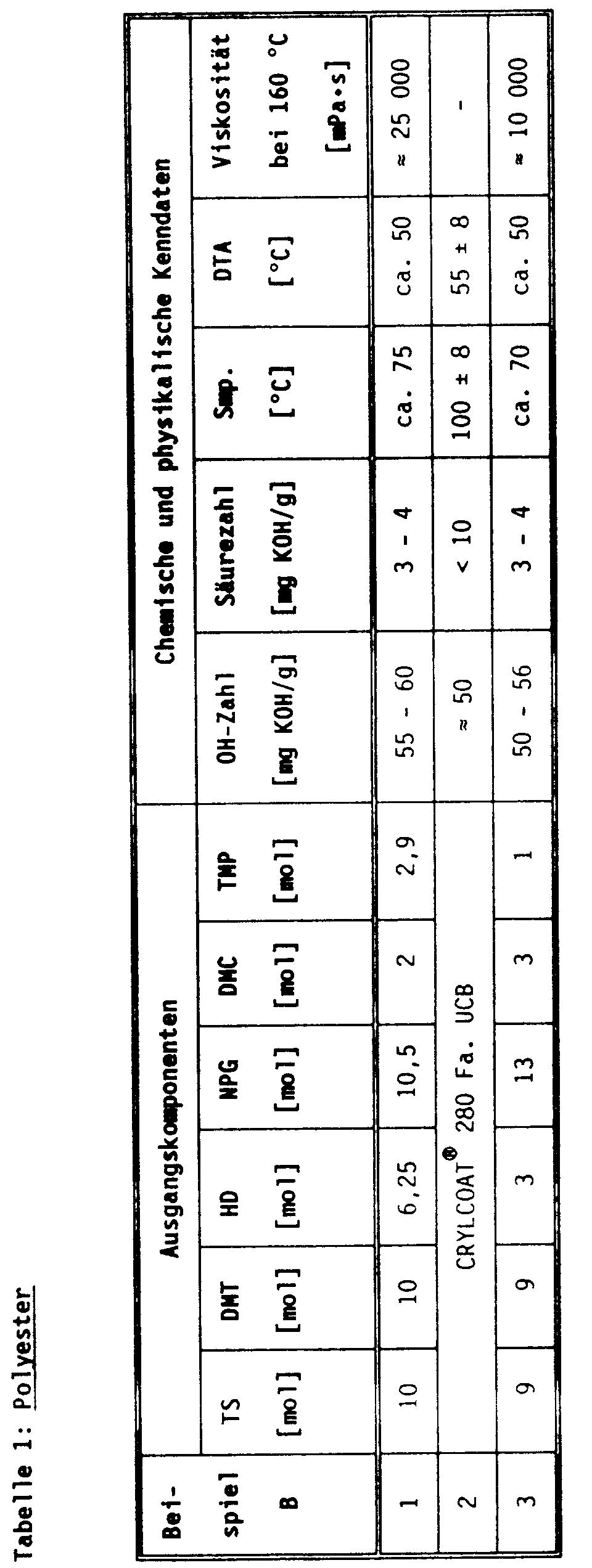
- Die Ausgangskomponenten - Terephthalsäure (TS), Dimethylterephthalat (DMT), Hexandiol-1.6 (HD), Neopentylglykol (NPG), 1.4-Dimethylolcyclohexan (DMC) und Trimethylolpropan (TMP) - werden in einen Reaktor gegeben und mit Hilfe eines Ölbades erwärmt. Nachdem die Stoffe zum größten Teil aufgeschmolzen sind, werden bei einer Temperatur von 160 °C 0,05 Gew.-% Di-n-butylzinnoxid als Katalysator zugesetzt. Die erste Methanolabspaltung tritt bei einer Temperatur von ca. 170 °C auf. Innerhalb 6 bis 8 Stunden wird die Temperatur auf 220 bis 230 °C erhöht und innerhalb weiterer 12 bis 15 Stunden die Reaktion zu Ende geführt. Der Polyester wird auf 200 °C abgekühlt und durch Anlegen von Vakuum (1 mm Hg) innerhalb 30 bis 45 Minuten weitgehend von flüchtigen Anteilen befreit. Während der gesamten Reaktionszeit wird das Sumpfprodukt gerührt und ein schwacher N2-Strom durch das Reaktionsgemisch geleitet.
- Folgende Tabelle gibt Polyesterzusammensetzungen und die entsprechenden physikalischen und chemischen Kenndaten wieder.
- Die gemahlenen Produkte - Diisocyanat, Polyester und Verlaufsmittel-Masterbatch - werden, gegebenenfalls mit dem Weißpigment und gegebenenfalls Füllstoffen, in einem Kollergang innig vermischt und anschließend im Extruder bei 80 bis 110 °C homogenisiert. Nach dem Erkalten wird das Extrudat gebrochen und mit einer Stiftsmühle auf eine Korngröße < 100 µm gemahlen. Das so hergestellte Pulver wird mit einer elektrostatischen Pulverspritzanlage bei 60 KV auf entfettete, gegebenenfalls vorbehandelte, Eisenbleche appliziert und in einem Umlufttrockenschrank bei Temperaturen zwischen 150 und 180 °C zwischen 35 und 10 Minuten eingebrannt.
- Es werden 10 Gew.-% des Verlaufsmittels - ein handelsübliches Copolymeres von Butylacrylat und 2-Ethylhexylacrylat - in dem entsprechenden Polyester in der Schmelze homogenisiert und nach dem Erstarren zerkleinert.
- Die Abkürzungen in den folgenden Tabellen bedeuten:
- SD
- = Schichtdicke in µm
- ET
- = Tiefung nach Erichsen in mm (DIN 53 156)
- GS
- = Gitterschnittprüfung (DIN 53 151)
- GG 60 °∢
- = Messung des Glanzes nach Gardner (ASTM-D 523)
- Imp. rev.
- = Impact reverse in g·m

Claims (9)
- Blockierte aliphatische Diisocyanate oder Diisocyanat-Addukte, erhältlich durch Umsetzung von aliphatischen Diisocyanaten der allgemeinen FormelA)1. OCN-R-NCOR: C4-C12-Alkylen-Rest, der 1 - 3 Methyl- oder Ethylgruppen oder anstelle von 4 CH2-Gruppen einen Rest von Cyclohexan enthalten kann,2. und/oder isocyanuratgruppen-, biuretgruppen-, urethangruppenhaltige Addukte von A 1,mitB) sekundären Aminen, die einen Siedepunkt von 160 °C oder höher aufweisen, der allgemeinen Formel

- Blockierte aliphatische Diisocyanate nach Anspruch 1,
dadurch gekennzeichnet,
daß auf ein mol Isocyanat-Gruppen 0,8 - 1 mol sekundäres Amin kommen. - Blockierte aliphatische Diisocyanate nach den Ansprüchen 1 bis 2,
dadurch gekennzeichnet,
daß Diisocyanate ausgewählt aus der Gruppe Pentamethylendiisocyanat, Hexamethylendiisocyanat-1.6, Hexamethylendiisocyanat-1.5, 2-Methylpentamethylendiisocyanat-1.5, 2-Ethyl-tetramethylendiisocyanat-1.4 sowie beliebige Gemische dieser beiden Isomeren, p- und m-Hexahydroxylylendiisocyanat, 5-Methylnonamethylendiisocyanat, 1.8-Diisocyanato-2.4-dimethyl-octan und Dodecamethylendiisocyanat, enthalten sind. - Blockierte aliphatische Diisocyanate nach den Ansprüchen 1 bis 3,
dadurch gekennzeichnet,
daß sekundäre Amine ausgewählt aus der Gruppe Dicyclohexylamin, t-Butylcyclohexylamin, Di-(3.5.5-trimethyl)-cyclohexylamin, Di-cyclopentylamin, 2.6-Dimethylpiperidin, 3.5-Dimethylmarpholin, Di-(2.2.6.6-tetramethylpiperidyl)amin, enthalten sind. - Blockierte aliphatische Diisocyanate nach den Ansprüchen 1 bis 4,
dadurch gekennzeichnet,
daß als Amin Di-(2.2.6.6-tetramethylpiperidyl)amin enthalten ist. - Blockierte aliphatische Diisocyanate nach den Ansprüchen 1 bis 5,
dadurch gekennzeichnet,
daß ein vor der Blockierung kettenverlängertes Diisocyanat enthalten ist. - Blockierte aliphatische Diisocyanate nach den Ansprüchen 1 bis 6,
dadurch gekennzeichnet,
daß sie ein Molgewicht von 300 bis 1 600 und einen Schmelzbereich von 50 bis 180 °C aufweisen. - Blockierte aliphatische Diisocyanate nach den Ansprüchen 1 bis 7,
dadurch gekennzeichnet,
daß sie einen Gehalt an blockierten endständigen NCO-Gruppen von 6 bis 22 Gew.-% aufweisen. - Lagerstabile, in der Hitze härtbare Polyurethan-Pulverlacke auf Basis der erfindungsgemäßen blockierten aliphatischen Diisocyanate oder Diisocyanataddukte und OH-Gruppen aufweisende Polymere der folgenden Zusammensetzung:a) 100 Gew.-T. OH-Gruppen-haltiges Polymerb) 10 - 90 Gew.-T. blockiertes aliphatisches Polyisocyanat oder -adduktc) 0 - 160 Gew.-T. Pigmented) 0 - 200 Gew.-T. übliche Füllstoffee) 0 - 5 Gew.-T. Katalysatorf) 0,5 - 5 Gew.-T. Verlaufsmittel
Applications Claiming Priority (2)
| Application Number | Priority Date | Filing Date | Title |
|---|---|---|---|
| DE1996103389 DE19603389A1 (de) | 1996-01-31 | 1996-01-31 | Blockierte aliphatische Diisocyanate oder Diisocyanat-Addukte |
| DE19603389 | 1996-01-31 |
Publications (1)
| Publication Number | Publication Date |
|---|---|
| EP0787754A2 true EP0787754A2 (de) | 1997-08-06 |
Family
ID=7784110
Family Applications (1)
| Application Number | Title | Priority Date | Filing Date |
|---|---|---|---|
| EP96118883A Withdrawn EP0787754A2 (de) | 1996-01-31 | 1996-11-26 | Blockierte aliphatische Diisocyanate oder Diisocyanat-Addukte |
Country Status (4)
| Country | Link |
|---|---|
| EP (1) | EP0787754A2 (de) |
| JP (1) | JPH09249731A (de) |
| CA (1) | CA2186089A1 (de) |
| DE (1) | DE19603389A1 (de) |
Cited By (3)
| Publication number | Priority date | Publication date | Assignee | Title |
|---|---|---|---|---|
| WO2004104065A1 (de) * | 2003-05-21 | 2004-12-02 | Bayer Materialscience Ag | Verfestigungsstabile blockierte polyisocyanate |
| EP1524284A3 (de) * | 2003-10-17 | 2007-11-14 | Bayer MaterialScience AG | Mit sekundären Aminen blockierte Polyisocyanate mit Biuretstruktur |
| WO2018130586A1 (de) | 2017-01-13 | 2018-07-19 | Covestro Deutschland Ag | Lösemittelarme beschichtungssysteme für textilien |
Families Citing this family (6)
| Publication number | Priority date | Publication date | Assignee | Title |
|---|---|---|---|---|
| US6784243B2 (en) | 2002-06-17 | 2004-08-31 | Bayer Aktiengesellschaft | Polyurethane-polyurea dispersions |
| JP5562267B2 (ja) * | 2010-02-08 | 2014-07-30 | 旭化成ケミカルズ株式会社 | ブロックポリイソシアネート組成物及びこれを含む塗料組成物 |
| KR101450985B1 (ko) * | 2010-02-08 | 2014-10-15 | 아사히 가세이 케미칼즈 가부시키가이샤 | 블록 폴리이소시아네이트 조성물 및 이것을 포함하는 도료 조성물 |
| JP5562271B2 (ja) * | 2010-06-04 | 2014-07-30 | 旭化成ケミカルズ株式会社 | ブロックポリイソシアネート組成物の製造方法 |
| JP6034726B2 (ja) * | 2013-03-06 | 2016-11-30 | 三井化学株式会社 | ブロックイソシアネート、塗料組成物およびブロックイソシアネートの製造方法 |
| JP2014172941A (ja) * | 2013-03-06 | 2014-09-22 | Mitsui Chemicals Inc | ブロックイソシアネートおよび塗料組成物 |
Citations (12)
| Publication number | Priority date | Publication date | Assignee | Title |
|---|---|---|---|---|
| DE1957483A1 (de) | 1969-11-15 | 1971-05-27 | Bayer Ag | Pulverfoermige UEberzugsmittel |
| DE2105777A1 (de) | 1971-02-08 | 1972-08-24 | Veba Chemie Ag | Pulverförmige Überzugsmasse |
| DE2261065A1 (de) | 1972-12-14 | 1974-06-27 | Basf Ag | Verfahren zur herstellung von biuretgruppenhaltigen polyisocyanaten |
| DE2542191A1 (de) | 1974-09-23 | 1976-04-01 | Ucb Sa | Maskierte polyisocyanate mit hoher reaktionsfaehigkeit, verfahren zu ihrer herstellung und ihre verwendung in hitzehaertbaren, pulverfoermigen massen |
| DE2712931A1 (de) | 1977-03-24 | 1978-09-28 | Veba Chemie Ag | Isocyanuratgruppen - und endstaendig- blockierte isocyanatgruppen - enthaltende verbindungen |
| DE2735497A1 (de) | 1977-08-06 | 1979-02-15 | Veba Chemie Ag | Pulverfoermige polyurethanlacke |
| DE2842641A1 (de) | 1978-09-29 | 1980-04-10 | Bayer Ag | Lackpolyisocyanat auf basis von modifiziertem 1-isocyanato-3,3,5-trimethyl-5-isocyanatomethyl-cyclohexan, ein verfahren zu seiner herstellung und seine verwendung in zweikomponenten-polyurethan-pulverlacken |
| DE2901479A1 (de) | 1979-01-16 | 1980-07-24 | Bayer Ag | Neue isocyanato-isocyanurate, ein verfahren zu ihrer herstellung, sowie ihre verwendung als isocyanatkomponente in polyurethan-lacken |
| DE3004876A1 (de) | 1980-02-09 | 1981-08-20 | Chemische Werke Hüls AG, 4370 Marl | Blockierte polyisocyanate mit hoher reaktionsfaehigkeit, ihre herstellung und verwendung |
| DE3007670A1 (de) | 1980-02-29 | 1981-09-17 | Aquanort Ingenieur Skirde + Co, 2110 Buchholz | Verfahren und vorrichtung zum reinigen von textilien |
| DE3143060A1 (de) | 1981-10-30 | 1983-05-11 | Chemische Werke Hüls AG, 4370 Marl | Pulverlacke auf der basis von blockierten isophorondiisocyanataddukten |
| DE3151855A1 (de) | 1981-12-30 | 1983-07-07 | Chemische Werke Hüls AG, 4370 Marl | Neue isocyanato-isocyanurate sowie ein verfahren zu deren herstellung |
-
1996
- 1996-01-31 DE DE1996103389 patent/DE19603389A1/de not_active Withdrawn
- 1996-09-20 CA CA 2186089 patent/CA2186089A1/en not_active Abandoned
- 1996-11-26 EP EP96118883A patent/EP0787754A2/de not_active Withdrawn
-
1997
- 1997-01-30 JP JP9017107A patent/JPH09249731A/ja not_active Withdrawn
Patent Citations (12)
| Publication number | Priority date | Publication date | Assignee | Title |
|---|---|---|---|---|
| DE1957483A1 (de) | 1969-11-15 | 1971-05-27 | Bayer Ag | Pulverfoermige UEberzugsmittel |
| DE2105777A1 (de) | 1971-02-08 | 1972-08-24 | Veba Chemie Ag | Pulverförmige Überzugsmasse |
| DE2261065A1 (de) | 1972-12-14 | 1974-06-27 | Basf Ag | Verfahren zur herstellung von biuretgruppenhaltigen polyisocyanaten |
| DE2542191A1 (de) | 1974-09-23 | 1976-04-01 | Ucb Sa | Maskierte polyisocyanate mit hoher reaktionsfaehigkeit, verfahren zu ihrer herstellung und ihre verwendung in hitzehaertbaren, pulverfoermigen massen |
| DE2712931A1 (de) | 1977-03-24 | 1978-09-28 | Veba Chemie Ag | Isocyanuratgruppen - und endstaendig- blockierte isocyanatgruppen - enthaltende verbindungen |
| DE2735497A1 (de) | 1977-08-06 | 1979-02-15 | Veba Chemie Ag | Pulverfoermige polyurethanlacke |
| DE2842641A1 (de) | 1978-09-29 | 1980-04-10 | Bayer Ag | Lackpolyisocyanat auf basis von modifiziertem 1-isocyanato-3,3,5-trimethyl-5-isocyanatomethyl-cyclohexan, ein verfahren zu seiner herstellung und seine verwendung in zweikomponenten-polyurethan-pulverlacken |
| DE2901479A1 (de) | 1979-01-16 | 1980-07-24 | Bayer Ag | Neue isocyanato-isocyanurate, ein verfahren zu ihrer herstellung, sowie ihre verwendung als isocyanatkomponente in polyurethan-lacken |
| DE3004876A1 (de) | 1980-02-09 | 1981-08-20 | Chemische Werke Hüls AG, 4370 Marl | Blockierte polyisocyanate mit hoher reaktionsfaehigkeit, ihre herstellung und verwendung |
| DE3007670A1 (de) | 1980-02-29 | 1981-09-17 | Aquanort Ingenieur Skirde + Co, 2110 Buchholz | Verfahren und vorrichtung zum reinigen von textilien |
| DE3143060A1 (de) | 1981-10-30 | 1983-05-11 | Chemische Werke Hüls AG, 4370 Marl | Pulverlacke auf der basis von blockierten isophorondiisocyanataddukten |
| DE3151855A1 (de) | 1981-12-30 | 1983-07-07 | Chemische Werke Hüls AG, 4370 Marl | Neue isocyanato-isocyanurate sowie ein verfahren zu deren herstellung |
Cited By (4)
| Publication number | Priority date | Publication date | Assignee | Title |
|---|---|---|---|---|
| WO2004104065A1 (de) * | 2003-05-21 | 2004-12-02 | Bayer Materialscience Ag | Verfestigungsstabile blockierte polyisocyanate |
| CN100344669C (zh) * | 2003-05-21 | 2007-10-24 | 拜尔材料科学股份公司 | 凝固稳定的封端多异氰酸酯 |
| EP1524284A3 (de) * | 2003-10-17 | 2007-11-14 | Bayer MaterialScience AG | Mit sekundären Aminen blockierte Polyisocyanate mit Biuretstruktur |
| WO2018130586A1 (de) | 2017-01-13 | 2018-07-19 | Covestro Deutschland Ag | Lösemittelarme beschichtungssysteme für textilien |
Also Published As
| Publication number | Publication date |
|---|---|
| DE19603389A1 (de) | 1997-08-07 |
| JPH09249731A (ja) | 1997-09-22 |
| CA2186089A1 (en) | 1997-08-01 |
Similar Documents
| Publication | Publication Date | Title |
|---|---|---|
| EP0045998B1 (de) | Verfahren zur Herstellung von abspaltfreien Polyurethan-Pulverlacken sowie die danach hergestellten Lacke | |
| EP1334987B1 (de) | Bei niedriger Temperatur härtbare feste uretdiongruppenhaltige Polyurethan-Pulverlackzusammensetzungen | |
| EP1475400A1 (de) | Bei niedriger Temperatur härtbare feste uretdiongruppenhaltige Polyurethan-Pulverlackzusammensetzungen | |
| EP0669354A1 (de) | Verfahren zur Herstellung von uretdiongruppenhaltigen Polyadditionsprodukten und deren Verwendung in Polyurethan-Lacksystemen | |
| EP1475399A1 (de) | Feste uretdiongruppenhaltige Polyurethan-Pulverlackzusammensetzungen bei niedriger Temperatur härtbar | |
| EP0178398B1 (de) | Lagerstabile Polyurethanharz-Pulverlacke | |
| EP0005230B1 (de) | Bindemittel für pulverförmige Überzugsmittel | |
| EP0669355A1 (de) | Verfahren zur Herstellung von blockierten Polyisocyanaten und deren Verwendung in Polyurethan-Lacksystemen | |
| EP0023626A1 (de) | Herstellung von freie NCO- und endständig mit Epsilon-Caprolactam blockierte NCO-Gruppen enthaltenden Isophorondiisocyanataddukten, sowie danach hergestellte Verbindungen | |
| DE19603389A1 (de) | Blockierte aliphatische Diisocyanate oder Diisocyanat-Addukte | |
| EP0317741B1 (de) | PUR-Pulverlacke für matte Überzüge | |
| DE3711374A1 (de) | Polyurethan-pulverlacke, die nach aushaertung eine matte oberflaeche ergeben | |
| EP0829499A1 (de) | Uretdiongruppenhaltige Polyisocyanate, ein Verfahren zu ihrer Herstellung sowie deren Verwendung | |
| EP0218040B1 (de) | Ganz oder teilweise mit Epsilon-Caprolactam blockiertes trans-Cyclohexan-1,4-diisocyanat, dessen Herstellung und Verwendung | |
| EP0839845B1 (de) | Blockierte Polyisocyanate mit eingebautem HALS-Stabilisator | |
| EP0999226A1 (de) | Feste, Triazingruppen aufweisende Polyurethanhärter, Verfahren zur Herstellung derartiger Verbindungen sowie deren Verwendung | |
| EP0829498A1 (de) | Uretdiongruppenhaltige Polyadditionsverbindungen, ein Verfahren zu ihrer Herstellung sowie deren Verwendung | |
| EP0538597A1 (de) | Blockierte höherfuntionelle Polyisocyanataddukte, ein Verfahren zu ihrer Herstellung sowie deren Verwendung | |
| EP0512213B1 (de) | Verfahren zur Herstellung eines blockierten Lackpolyisocyanats | |
| EP0799844B1 (de) | Verfahren zur Herstellung von in der Hitze härtbaren wetterstabilen Polyurethan-Pulverlacken sowie die danach erhaltenen Beschichtungen | |
| EP1362875A1 (de) | Bifunktionelle Polyadditionsverbindungen als Vernetzer für Polyurethan-Pulverlacke | |
| EP0780417A2 (de) | Hydroxyl- und uretdiongruppenhaltige Polyisocyanate | |
| EP0727452A1 (de) | Uretdiongruppenhaltige Polyisocyanate | |
| DE19730666A1 (de) | Uretdiongruppenhaltige Polyisocyanate mit eingebauten UV-Stabilisatoren | |
| DE19731392A1 (de) | Blockierte Polyisocyanate, ein Verfahren zu ihrer Herstellung sowie die daraus hergestellten PUR-Pulverlacke |
Legal Events
| Date | Code | Title | Description |
|---|---|---|---|
| PUAI | Public reference made under article 153(3) epc to a published international application that has entered the european phase |
Free format text: ORIGINAL CODE: 0009012 |
|
| AK | Designated contracting states |
Kind code of ref document: A2 Designated state(s): AT BE CH DE ES FR GB IT LI NL SE |
|
| STAA | Information on the status of an ep patent application or granted ep patent |
Free format text: STATUS: THE APPLICATION HAS BEEN WITHDRAWN |
|
| 18W | Application withdrawn |
Withdrawal date: 19980213 |