EP0774154B1 - Procede de traitement de milieux aqueux contenant des ions metalliques radioactifs - Google Patents
Procede de traitement de milieux aqueux contenant des ions metalliques radioactifs Download PDFInfo
- Publication number
- EP0774154B1 EP0774154B1 EP95927010A EP95927010A EP0774154B1 EP 0774154 B1 EP0774154 B1 EP 0774154B1 EP 95927010 A EP95927010 A EP 95927010A EP 95927010 A EP95927010 A EP 95927010A EP 0774154 B1 EP0774154 B1 EP 0774154B1
- Authority
- EP
- European Patent Office
- Prior art keywords
- petroleum coke
- fact
- coke granules
- treatment
- effluent
- Prior art date
- Legal status (The legal status is an assumption and is not a legal conclusion. Google has not performed a legal analysis and makes no representation as to the accuracy of the status listed.)
- Expired - Lifetime
Links
- 238000000034 method Methods 0.000 title claims description 42
- 230000002285 radioactive effect Effects 0.000 title claims description 29
- 239000012736 aqueous medium Substances 0.000 title claims description 14
- 229910021645 metal ion Inorganic materials 0.000 title claims description 12
- 230000000694 effects Effects 0.000 claims description 55
- 239000008187 granular material Substances 0.000 claims description 32
- 239000002006 petroleum coke Substances 0.000 claims description 27
- 238000011282 treatment Methods 0.000 claims description 27
- 239000003463 adsorbent Substances 0.000 claims description 17
- 239000002245 particle Substances 0.000 claims description 17
- KAESVJOAVNADME-UHFFFAOYSA-N Pyrrole Chemical compound C=1C=CNC=1 KAESVJOAVNADME-UHFFFAOYSA-N 0.000 claims description 11
- 238000005115 demineralization Methods 0.000 claims description 10
- BQCADISMDOOEFD-UHFFFAOYSA-N Silver Chemical compound [Ag] BQCADISMDOOEFD-UHFFFAOYSA-N 0.000 claims description 9
- 230000002328 demineralizing effect Effects 0.000 claims description 9
- 229910052709 silver Inorganic materials 0.000 claims description 9
- 229920000642 polymer Polymers 0.000 claims description 8
- 239000004332 silver Substances 0.000 claims description 8
- YTPLMLYBLZKORZ-UHFFFAOYSA-N Thiophene Chemical group C=1C=CSC=1 YTPLMLYBLZKORZ-UHFFFAOYSA-N 0.000 claims description 7
- 229910052782 aluminium Inorganic materials 0.000 claims description 7
- XAGFODPZIPBFFR-UHFFFAOYSA-N aluminium Chemical compound [Al] XAGFODPZIPBFFR-UHFFFAOYSA-N 0.000 claims description 7
- 150000002500 ions Chemical class 0.000 claims description 7
- OKTJSMMVPCPJKN-UHFFFAOYSA-N Carbon Chemical compound [C] OKTJSMMVPCPJKN-UHFFFAOYSA-N 0.000 claims description 6
- 229910052700 potassium Inorganic materials 0.000 claims description 6
- 239000011591 potassium Substances 0.000 claims description 6
- RTZKZFJDLAIYFH-UHFFFAOYSA-N Diethyl ether Chemical compound CCOCC RTZKZFJDLAIYFH-UHFFFAOYSA-N 0.000 claims description 5
- 239000004721 Polyphenylene oxide Substances 0.000 claims description 5
- ZLMJMSJWJFRBEC-UHFFFAOYSA-N Potassium Chemical compound [K] ZLMJMSJWJFRBEC-UHFFFAOYSA-N 0.000 claims description 5
- 229910052787 antimony Inorganic materials 0.000 claims description 5
- WATWJIUSRGPENY-UHFFFAOYSA-N antimony atom Chemical compound [Sb] WATWJIUSRGPENY-UHFFFAOYSA-N 0.000 claims description 5
- 229910052792 caesium Inorganic materials 0.000 claims description 5
- TVFDJXOCXUVLDH-UHFFFAOYSA-N caesium atom Chemical compound [Cs] TVFDJXOCXUVLDH-UHFFFAOYSA-N 0.000 claims description 5
- 229910017052 cobalt Inorganic materials 0.000 claims description 5
- 239000010941 cobalt Substances 0.000 claims description 5
- GUTLYIVDDKVIGB-UHFFFAOYSA-N cobalt atom Chemical compound [Co] GUTLYIVDDKVIGB-UHFFFAOYSA-N 0.000 claims description 5
- 229910002804 graphite Inorganic materials 0.000 claims description 5
- 239000010439 graphite Substances 0.000 claims description 5
- 229920000570 polyether Polymers 0.000 claims description 5
- 230000008929 regeneration Effects 0.000 claims description 5
- 238000011069 regeneration method Methods 0.000 claims description 5
- 229920001940 conductive polymer Polymers 0.000 claims description 4
- 125000000168 pyrrolyl group Chemical group 0.000 claims description 4
- 230000033228 biological regulation Effects 0.000 claims description 3
- 125000004433 nitrogen atom Chemical group N* 0.000 claims description 3
- 230000002378 acidificating effect Effects 0.000 claims description 2
- 238000010828 elution Methods 0.000 claims description 2
- 238000012856 packing Methods 0.000 claims 1
- XLYOFNOQVPJJNP-UHFFFAOYSA-N water Substances O XLYOFNOQVPJJNP-UHFFFAOYSA-N 0.000 description 15
- 238000009434 installation Methods 0.000 description 7
- 239000000178 monomer Substances 0.000 description 7
- 230000007423 decrease Effects 0.000 description 5
- 229910052751 metal Inorganic materials 0.000 description 5
- 239000002184 metal Substances 0.000 description 4
- 150000003839 salts Chemical class 0.000 description 4
- 239000002253 acid Substances 0.000 description 3
- 125000000623 heterocyclic group Chemical group 0.000 description 3
- 239000007788 liquid Substances 0.000 description 3
- 239000002901 radioactive waste Substances 0.000 description 3
- 239000000126 substance Substances 0.000 description 3
- -1 anionic tetraalkylammonium salts Chemical class 0.000 description 2
- 239000000571 coke Substances 0.000 description 2
- 239000012141 concentrate Substances 0.000 description 2
- 239000003792 electrolyte Substances 0.000 description 2
- 238000009713 electroplating Methods 0.000 description 2
- 238000001704 evaporation Methods 0.000 description 2
- 230000008020 evaporation Effects 0.000 description 2
- 238000001914 filtration Methods 0.000 description 2
- 230000014759 maintenance of location Effects 0.000 description 2
- 239000000463 material Substances 0.000 description 2
- 150000002739 metals Chemical class 0.000 description 2
- 239000000203 mixture Substances 0.000 description 2
- 238000011084 recovery Methods 0.000 description 2
- 230000001172 regenerating effect Effects 0.000 description 2
- 239000007787 solid Substances 0.000 description 2
- NWUYHJFMYQTDRP-UHFFFAOYSA-N 1,2-bis(ethenyl)benzene;1-ethenyl-2-ethylbenzene;styrene Chemical compound C=CC1=CC=CC=C1.CCC1=CC=CC=C1C=C.C=CC1=CC=CC=C1C=C NWUYHJFMYQTDRP-UHFFFAOYSA-N 0.000 description 1
- HIXDQWDOVZUNNA-UHFFFAOYSA-N 2-(3,4-dimethoxyphenyl)-5-hydroxy-7-methoxychromen-4-one Chemical compound C=1C(OC)=CC(O)=C(C(C=2)=O)C=1OC=2C1=CC=C(OC)C(OC)=C1 HIXDQWDOVZUNNA-UHFFFAOYSA-N 0.000 description 1
- GUTLYIVDDKVIGB-OUBTZVSYSA-N Cobalt-60 Chemical compound [60Co] GUTLYIVDDKVIGB-OUBTZVSYSA-N 0.000 description 1
- 239000004743 Polypropylene Substances 0.000 description 1
- QAOWNCQODCNURD-UHFFFAOYSA-L Sulfate Chemical compound [O-]S([O-])(=O)=O QAOWNCQODCNURD-UHFFFAOYSA-L 0.000 description 1
- 241001080024 Telles Species 0.000 description 1
- 239000003513 alkali Substances 0.000 description 1
- 239000004411 aluminium Substances 0.000 description 1
- 150000001450 anions Chemical class 0.000 description 1
- WATWJIUSRGPENY-NJFSPNSNSA-N antimony-124 Chemical compound [124Sb] WATWJIUSRGPENY-NJFSPNSNSA-N 0.000 description 1
- 239000002585 base Substances 0.000 description 1
- 229910052799 carbon Inorganic materials 0.000 description 1
- 125000004432 carbon atom Chemical group C* 0.000 description 1
- 150000001768 cations Chemical class 0.000 description 1
- TVFDJXOCXUVLDH-OUBTZVSYSA-N cesium-134 Chemical compound [134Cs] TVFDJXOCXUVLDH-OUBTZVSYSA-N 0.000 description 1
- TVFDJXOCXUVLDH-RNFDNDRNSA-N cesium-137 Chemical compound [137Cs] TVFDJXOCXUVLDH-RNFDNDRNSA-N 0.000 description 1
- GUTLYIVDDKVIGB-BJUDXGSMSA-N cobalt-58 Chemical compound [58Co] GUTLYIVDDKVIGB-BJUDXGSMSA-N 0.000 description 1
- 230000000295 complement effect Effects 0.000 description 1
- 230000000536 complexating effect Effects 0.000 description 1
- 230000001143 conditioned effect Effects 0.000 description 1
- 239000004020 conductor Substances 0.000 description 1
- 239000000498 cooling water Substances 0.000 description 1
- 239000008367 deionised water Substances 0.000 description 1
- 229910021641 deionized water Inorganic materials 0.000 description 1
- 238000001514 detection method Methods 0.000 description 1
- BUACSMWVFUNQET-UHFFFAOYSA-H dialuminum;trisulfate;hydrate Chemical compound O.[Al+3].[Al+3].[O-]S([O-])(=O)=O.[O-]S([O-])(=O)=O.[O-]S([O-])(=O)=O BUACSMWVFUNQET-UHFFFAOYSA-H 0.000 description 1
- 238000004070 electrodeposition Methods 0.000 description 1
- 238000005868 electrolysis reaction Methods 0.000 description 1
- 230000008030 elimination Effects 0.000 description 1
- 238000003379 elimination reaction Methods 0.000 description 1
- 125000001033 ether group Chemical group 0.000 description 1
- 238000005189 flocculation Methods 0.000 description 1
- 230000016615 flocculation Effects 0.000 description 1
- 238000001730 gamma-ray spectroscopy Methods 0.000 description 1
- 150000002391 heterocyclic compounds Chemical class 0.000 description 1
- 239000003456 ion exchange resin Substances 0.000 description 1
- 229920003303 ion-exchange polymer Polymers 0.000 description 1
- VNWKTOKETHGBQD-UHFFFAOYSA-N methane Chemical compound C VNWKTOKETHGBQD-UHFFFAOYSA-N 0.000 description 1
- 239000003960 organic solvent Substances 0.000 description 1
- 230000003647 oxidation Effects 0.000 description 1
- 238000007254 oxidation reaction Methods 0.000 description 1
- 238000005325 percolation Methods 0.000 description 1
- 239000003208 petroleum Substances 0.000 description 1
- 238000006116 polymerization reaction Methods 0.000 description 1
- 229920001155 polypropylene Polymers 0.000 description 1
- ZLMJMSJWJFRBEC-OUBTZVSYSA-N potassium-40 Chemical compound [40K] ZLMJMSJWJFRBEC-OUBTZVSYSA-N 0.000 description 1
- 238000000746 purification Methods 0.000 description 1
- 239000012857 radioactive material Substances 0.000 description 1
- 239000011347 resin Substances 0.000 description 1
- 229920005989 resin Polymers 0.000 description 1
- 238000000926 separation method Methods 0.000 description 1
- BQCADISMDOOEFD-NJFSPNSNSA-N silver-110 Chemical compound [110Ag] BQCADISMDOOEFD-NJFSPNSNSA-N 0.000 description 1
- 239000002904 solvent Substances 0.000 description 1
- 241000894007 species Species 0.000 description 1
- 238000006467 substitution reaction Methods 0.000 description 1
- 229910052717 sulfur Inorganic materials 0.000 description 1
- 125000004434 sulfur atom Chemical group 0.000 description 1
- 229930192474 thiophene Natural products 0.000 description 1
Images


Classifications
-
- G—PHYSICS
- G21—NUCLEAR PHYSICS; NUCLEAR ENGINEERING
- G21F—PROTECTION AGAINST X-RADIATION, GAMMA RADIATION, CORPUSCULAR RADIATION OR PARTICLE BOMBARDMENT; TREATING RADIOACTIVELY CONTAMINATED MATERIAL; DECONTAMINATION ARRANGEMENTS THEREFOR
- G21F9/00—Treating radioactively contaminated material; Decontamination arrangements therefor
- G21F9/04—Treating liquids
- G21F9/06—Processing
- G21F9/12—Processing by absorption; by adsorption; by ion-exchange
Definitions
- the subject of the invention is a method of treatment aqueous effluents such as those containing radioactive metal ions.
- the aqueous media intended to be treated by the process in accordance with the invention contain radioactive metal ions at a concentration of less than 10 -5 moles per liter in the case of radioactive cations; their radiochemical activity can reach 2500 MBq / t (megabecquerel per ton), or even more.
- the radioactive metal ions in question are in particular silver of atomic mass 110, cobalt 60, cobalt 58, cesium 137, cesium 134, potassium 40, antimony 124.
- the aqueous media of the genus in question are those which come from the technical fields implementing radioactive material.
- radioactive effluents from medical centers, research centers or even reactors nuclear.
- PWR type plants water reactor pressurized
- the cooling water from the circuit primary contains different radioactive metallic isotopes in solution.
- liquid effluents play an important role in processing procedures for possible storage or with a view to being brought into contact with the natural environment.
- non-active SER water is discharged into a sewer system designated by SEK, which means "collection of secondary circuit effluents"; it is kept in a SEK tank.
- Effluent received in SEK or KER tanks are analyzed from a radiochemical point of view in order to count all elements and radioelements.
- patent application FR 93 08789 filed by the Applicant on July 16, 1993 described among other things a purification and / or recovery process of metal ions contained in a solution, this process using a filter which uses a support material carbon-based conductor coated with conductive polymer including ethereal encryption cages, the solution percolating through this filter.
- the invention therefore aims to provide a method and an adsorbent element capable of reducing, in excellent economic conditions, the activity radiochemical of a radioactive effluent of the kind in question and in particular of those having already been treated in conventional demineralization installations, up to a value less than or equal to that from which said effluent can legally be rejected.
- the Applicant has the merit of having found that, surprisingly and unexpectedly it is possible not only to decrease the radiochemical activity of such aqueous effluent up to more radiochemical activities weaker than those generally obtained by means of processes according to the prior art but, moreover, to achieve this result in a simpler, more economical and more effective than in the prior art, as soon as one uses, in a treatment for the elimination of the radiochemical activity of said effluent, an element adsorbent based on petroleum coke granules; in in some cases it may be necessary to complete the aforementioned treatment by a second treatment by means of the filter described in patent application No. 93 08789.
- the result obtained using the adsorbent element made from petroleum coke granules is all the more surprising and unexpected that the coke granules of petroleum are neither known nor for their complexing properties metal ions in nuclear chemistry, nor for their adsorbent properties towards ions in question.
- the method according to the invention comprises a third step consisting of a regeneration of the filters used in the first and second steps using a elution solution of acidic pH, which provides an eluate concentrated in radioactive isotopes which is compatible with conventional effluent treatment systems and which is reintroduced in these conventional systems.
- adsorbent element based on petroleum coke granules
- good results are obtained with those used in the aluminum industry and in particular by the company ALUMINUM PECHINEY; these petroleum coke granules have, on the one hand, a particle size which is generally from 0.1 to 10, preferably from 1 to 7 and, more preferably still, from 2 to 5 mm; their specific surface is approximately 0.2 m 2 per 100 g.
- the filter according to the invention used in the first step of the process according to the invention is characterized by the fact that it comprises an element adsorbent based on petroleum coke granules; these petroleum coke granules are preferably contained in a tank equipped with an inlet and an outlet so to be able to ensure percolating flow of the liquid.
- This filter thus formed is particularly suitable for ion retention treatments radioactive metals contained in an aqueous medium or effluent of the genus in question.
- the particles are contained in a tank constituting a filter cartridge fitted, too, an inlet and an outlet for percolating flow liquid.
- This filter can, for example, be made up by a volume electrode on which the deposit of the encrypting polymer.
- PRIAM process the volume electrode used in the context of the industrial recovery process applied to metals (PRIAM process), developed by the Applicant and described in its patent FR 90 03952.
- polymers used are characterized by polymer chains containing a plurality of pyrrole or thiophene rings, where appropriate both at the same time and interconnected between them via 2,2 'bonds, on the one hand, and polyether chains corresponding in particular to the formulas with m equal to 3, 4 or 5, these chains being themselves linked by their own ends 3.3 ′ of these pyrrole or thiophene rings, or, in the case of pyrrole rings, to their nitrogen atoms.
- Electroplating is performed in the absence of any trace of metal in ionic form or which may be complexed and, advantageously, the electrolyte comprises anionic tetraalkylammonium salts.
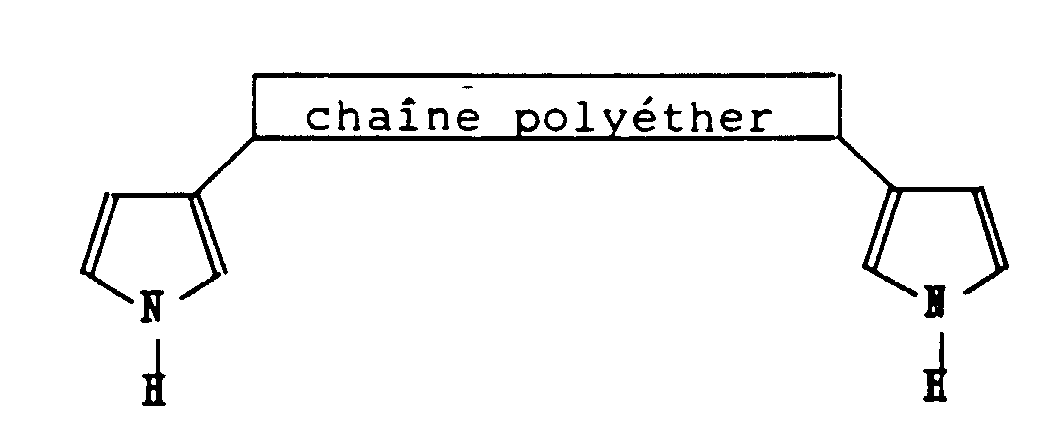
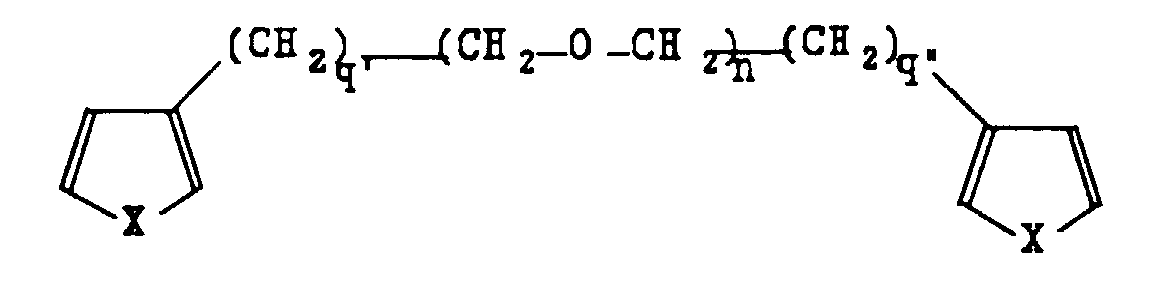
- the monomers from which the the above polymers consist of a polyether comprising at least minus three ether patterns and pyrrole patterns or thiophene linked to the ends of the chains of this polyether via, for each of these heterocyclic compounds, either of their carbon atoms in them 3.3 'positions of their heterocycles, that is, with relates more particularly to pyrrole groups, for example through their respective nitrogen atoms, the positions 2 and 2 'of these heterocycles being however free of all substitutions or at most substituted by easily removable groups (groups of protection for example).
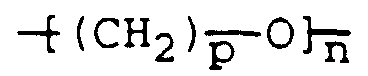
- the polyether chains entering into the constitution of the monomer are linear and contain ether units preferably of the type with p being an integer of 2 or 3 and n being an integer of 3 to 5, these chains being in ⁇ and in ⁇ with pyrrols or thiophene units.
- These monomers can carry an acid group, especially carboxylic or sulfonic, in the positions 3 'of their heterocyclic groups.
- They can be in the form of pyrrolylealcaline salt or thiophenyl-alkali, in particular of pyrrolyl salt or potassium thiophenyl.
- regeneration is carried out by percolating a dilute strong acid solution (pH close to 1).
- regeneration is carried out as described in the patent application FR 93 08789.
- the acid regenerating eluates containing a solution concentrated in radioactive ions can then be treated either in an evaporator or in a unit conventional demineralization since the concentration of the eluate in its various isotopes is compatible with the operating range of these conventional installations; in the latter case, it is necessary to fix the pH of the eluate to a value compatible with those which may exist in demineralization units.
- the radioactive effluent treatment process according to the present invention therefore comes in complement to conventional systems by evaporation and / or by demineralization.
- the process in accordance with the invention does not create short or radioactive waste middle term; it is therefore much more economical.
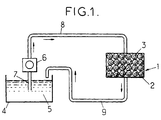
- a filter 1 according to the invention consisting by a polypropylene tank 2, which contains 100 g of petroleum coke granules 3; these granules have a particle size between 2 and 5 mm; these are the ones used by the ALUMINUM PECHINEY Company.
- the filter thus formed is placed in a circuit closed hydraulic system comprising a tank 4 which contains the effluent 5 to be treated and a hydraulic pump 6 intended to collect the radioactive effluent through line 7 and to route it through a pipe 8 to the filter 1; after passing through filter 1, the treated effluent is brought back to the reservoir 4 by a pipe 9.
- the effluent is circulated for 35 hours in the above circuit; three samples are taken with one frequency of approximately 5 minutes during the first fifteen minutes, then three more samples with frequency 15 minutes until the end of the first hour; of samples are then taken every 30 minutes until the fifteenth hour, then every hour until the end of the experience.
- the implementation of the first step of the process according to the invention makes it possible to reduce 95% the activity of a highly radioactive effluent; But the threshold of 10 MBq / t from which the effluent can be rejected, is not reached.
- the effluent is circulated as described in the example 1 and samples are taken every hour for the first five hours and then about every 8 p.m. until the end of the experience, i.e. 280th hour.
- this first stage of the process is particularly effective in this case for the retention of money since it reduces 99% of the effluent's silver activity.
- This effluent is subjected to the second stage of the method according to the invention using the installation of the Figure 1 in which the filter is constituted as the filter 1, with the difference that, this time, the adsorbent element consists of 100 g of granules of graphite covered by 5 grams of the polymer, the form is indicated at the top of page 17 of the request for patent FR 93 08789; the particle size of these granules is between 2 and 5 mm.
Landscapes
- Physics & Mathematics (AREA)
- Engineering & Computer Science (AREA)
- General Engineering & Computer Science (AREA)
- High Energy & Nuclear Physics (AREA)
- Solid-Sorbent Or Filter-Aiding Compositions (AREA)
- Water Treatment By Sorption (AREA)
Description
- dans une première éventualité, l'eau est polluée chimiquement et non active radiochimiquement (activité radio-chimique inférieure à 10 MBq/t, s'agissant ici d'une valeur imposée à l'E.D.F. en 1994 pour les rejets aqueux sortant des centrales nucléaires); elle est considérée comme un effluent "plancher" et est évacuée directement vers une enceinte KER, ce qui signifie "réservoir de contrôle avant rejet";
- dans une deuxième éventualité, l'eau est chargée radiochimiquement (activité radiochimique supérieure à 10 MBq/t) et non polluée chimiquement (la concentration en métaux est inférieure à 14 ppm); elle est considérée comme un effluent résiduaire et est traitée sur déminéraliseurs jusqu'à ce que l'activité radiochimique soit inférieure à 10 MBq/t; à ce moment, cet effluent est rejeté vers KER;
- dans une troisième éventualité, l'eau est polluée chimiquement et chargée radiochimiquement; elle est considérée comme un effluent chimique et est traitée sur évaporateurs, ce qui donne des distillats et des concentrats; les distillats qui sont dépourvus de sels métalliques et qui ont une activité radiochimique inférieure à 10 MBq/t sont évacués vers KER; les concentrats, considérés comme effluents solides, sont orientés vers un poste TES (Traitement des Effluents Solides) pour être enfûtés et stockés, par exemple à La Hague.
- soit on les stocke dans l'attente de la décroissance naturelle de l'activité due aux différents isotopes (par exemple, la durée de demi-vie de l'argent 110 est de 250 jours);
- soit on les renvoie sur l'unité d'évaporation; ce type de traitement est économiquement très pénalisant en raison de la faible activité de l'effluent traité, ce qui occasionne une perte en rendement de l'évaporateur;
- soit on les soumet à une séparation par floculation au sulfate d'aluminium suivie d'une filtration; toutefois, dans ce cas, la décroissance de l'activité radiochimique ne dépasse pas 70%.
- une première étape consistant à faire percoler le milieu aqueux à travers un premier filtre garni d'un élément adsorbant à base de granules de coke de pétrole et lorsqu'à l'issue de cette première étape l'activité radiochimique de l'effluent n'est pas abaissée en dessous de la valeur limite pour le rejet,
- une deuxième étape consistant à faire percoler le milieu aqueux ayant été soumis à la première étape à travers un deuxième filtre comportant un garnissage de particules conductrices, notamment de graphite enrobées par une couche de polymère conducteur comprenant des cages cryptantes éthérées, ce polymère étant notamment choisi parmi ceux visés par la demande de brevet FR 93 08789 déposée par la Demanderesse le 16 juillet 1993.
- de pouvoir être fabriqué facilement avec un bon prix de revient,
- d'être adapté à un fonctionnement journalier en continu,
- de présenter après utilisation une composition telle que son stockage peut être pris en charge par un organisme officiel responsable de la gestion des déchets radioactifs.




- si l'activité radiochimique concentrée au sein de ces filtres atteint la capacité maximale de stockage de ces filtres, ou
- si l'on souhaite déplacer cette activité.
| Activité à t = 0 (MBq/t) | Activité à t = 33 heures (MBq/t) | Rendement (%) | |
| Effluent | 1520 | 100 | 93 |
| Ag 110 | 345 | 30 | 91 |
| Co 58 | 20 | 0,7 | 97 |
| Co 60 | 74 | 2 | 97 |
| Activité à t = 0 (MBq/t) | Activité à t = 240 heures (MBq/t) | Rendement (%) | |
| Effluent | 634 | 9 | 98 |
| Ag 110 | 189 | 2,6 | 98 |
| Co 58 | 12 | 0,8 | 93 |
| Co 60 | 53 | 0,4 | 99 |
- Effluent 1520 MBq/t
- Ag 110 345 MBq/t
- Co 58 20 MBq/t
- Co 60 74 MBq/t.
- Effluent proprement dit 23 MBq/t
- Ag 110 7,7 MBq/t
- Co 58 1,2 MBq/t
- Co 60 1,4 MBq/t.
| Activité à t = 0 (MBq/t) | Activité à t = 43 heures (MBq/t) | Rendement (%) | |
| Effluent | 23 | 3.4 | 85 |
| Ag 110 | 7.7 | 0.4 | 95 |
| Co 58 | 1.2 | 0.9 | 25 |
| Co 60 | 1.4 | 0.9 | 36 |
Claims (25)
- Procédé de traitement de milieux aqueux ou effluents contenant des ions métalliques radioactifs, notamment d'argent, de cobalt, de potassium, de césium, d'antimoine, en vue d'amener la concentration en ces ions à une valeur inférieure à celle à partir de laquelle l'activité radiochimique des milieux aqueux ou effluents en question est inférieure à celle fixée par la réglementation et à partir de laquelle ils peuvent donc être rejetés, caractérisé par le fait qu'il comporte une première étape consistant à faire percoler le milieu aqueux à travers un premier filtre garni d'un élément adsorbant à base de granules de coke de pétrole.
- Procédé selon la revendication 1 de traitement de milieux aqueux ou effluents contenant des ions métalliques radioactifs, notamment d'argent, de cobalt, de potassium, de césium, d'antimoine, et ayant déjà été traités dans les installations conventionnelles de déminéralisation.
- Procédé de traitement selon l'une des revendications 1 ou 2, caractérisé par le fait que les granules de coke de pétrole présentent une granulométrie de 0,1 à 10 mm.
- Procédé de traitement selon l'une des revendications 1 ou 2, caractérisé par le fait que les granules de coke de pétrole présentent une granulométrie de 1 à 7 mm.
- Procédé de traitement selon l'une des revendications 1 ou 2, caractérisé par le fait que les granules de coke de pétrole présentent une granulométrie de 2 à 5 mm.
- Procédé de traitement selon l'une des revendications 3 à 5, caractérisé par le fait que les granules de coke de pétrole ont une surface spécifique de 0,2 m2 pour 100 g.
- Procédé de traitement selon l'une des revendications 1 à 6, caractérisé par le fait que les granules de coke de pétrole proviennent de l'industrie de l'aluminium.
- Procédé de traitement selon l'une des revendications 1 à 7, caractérisé par le fait qu'il comporte une deuxième étape consistant à faire percoler le milieu aqueux ayant été soumis à la première étape à travers un deuxième filtre comportant un garnissage de particules conductrices de graphite enrobées par une couche de polymère conducteur comprenant des cages cryptantes éthérées.
- Procédé de traiement selon l'une des revendications 1 à 8, caractérisé par le fait que le polymère conducteur comportant des cages cryptantes éthérées est choisi parmi ceux comportant des chaínes polymères contenant une pluralité de cycles pyrrole ou thiophène, le cas échéant les deux à la fois et interconnectés entre eux via des liaisons 2,2', d'une part, et des chaínes de polyéthers répondant en particulier aux formules -CH2 (CH2-OCH2)m CH2 avec m égal à 3, 4 ou 5, ces chaínes étant elles-mêmes liées par leurs propres extrémités 3,3' de ces cycles pyrrole ou thiophène, soit, dans le cas de cycles pyrrole, à leurs atomes d'azote.
- Procédé de traitement selon l'une des revendications 1 à 9, caractérisé par le fait qu'il comporte une troisième étape consistant en une régénération des filtres mis en oeuvre dans les première et deuxième étapes à l'aide d'une solution d'élution de pH acide, ce qui fournit un éluat concentré en isotopes radioactifs qui est compatible avec les systèmes conventionnels de traitement d'effluents et qui est réintroduit dans ces systèmes conventionnels.
- Utilisation de granules de coke de pétrole pour le traitement de milieux aqueux ou effluents contenant des ions métalliques radioactifs, notamment d'argent, de cobalt, de potassium, de césium, d'antimoine, en vue d'amener, par adsorption ou complexation sur lesdits granules de coke de pétrole, la concentration en ces ions à une valeur inférieure à celle à partir de laquelle l'activité radiochimique des milieux aqueux ou effluents en question est inférieure à celle fixée par la réglementation et à partir de laquelle ils peuvent donc être rejetés.
- Utilisation selon la revendication 11 de granules de coke de pétrole pour le traitement de milieux aqueux ou effluents contenant des ions métalliques radioactifs, notamment d'argent, de cobalt, de potassium, de césium, d'antimoine, et ayant déjà été traités dans les installations conventionnelles de déminéralisation.
- Utilisation selon l'une des revendications 11 et 12, de granules de coke de pétrole présentant une granulométrie de 0,1 à 10 mm.
- Utilisation selon l'une des revendications 11 et 12, de granules de coke de pétrole présentant une granulométrie de 1 à 7 mm.
- Utilisation selon l'une des revendications 11 et 12, de granules de coke de pétrole présentant une granulométrie de 2 à 5 mm.
- Utilisation selon l'une des revendications 13 à 15, de granules de coke de pétrole ayant une surface spécifique de 0,2 m2 pour 100 g.
- Utilisation selon l'une des revendications 11 à 16, de granules de coke de pétrole provenant de l'industrie de l'aluminium.
- Elément adsorbant à base de granules de coke de pétrole.
- Elément adsorbant selon la revendication 18, à base de granules de coke de pétrole présentant une granulométrie de 0,1 à 10 mm.
- Elément adsorbant selon la revendication 18, à base de granules de coke de pétrole présentant une granulométrie de 1 à 7 mm.
- Elément adsorbant selon la revendication 18, à base de granules de coke de pétrole présentant une granulométrie de 2 à 5 mm.
- Elément adsorbant selon l'une des revendications 19 à 21, caractérisé par le fait que les granules de coke de pétrole ont une surface spécifique de 0,2 m2 pour 100 g.
- Elément adsorbant selon l'une des revendications 18 à 22, caractérisé par le fait que les granules de coke de pétrole proviennent de l'industrie de l'aluminium.
- Filtre caractérisé par le fait qu'il comprend un élément adsorbant selon l'une des revendications 18 à 23.
- Procédé de traitement selon l'une des revendications 1 à 10, caractérisé par le fait qu'il comporte la mise en oeuvre, au niveau de la première étape, du filtre selon la revendication 24.
Applications Claiming Priority (3)
| Application Number | Priority Date | Filing Date | Title |
|---|---|---|---|
| FR9409644 | 1994-08-03 | ||
| FR9409644A FR2723363B1 (fr) | 1994-08-03 | 1994-08-03 | Procede de traitement de milieux aqueux contenant des ions metalliques radioactifs et element absorbant susceptible d'etre mis en oeuvre dans ce procede |
| PCT/FR1995/001040 WO1996004662A1 (fr) | 1994-08-03 | 1995-08-02 | Procede de traitement de milieux aqueux contenant des ions metalliques radioactifs |
Publications (2)
| Publication Number | Publication Date |
|---|---|
| EP0774154A1 EP0774154A1 (fr) | 1997-05-21 |
| EP0774154B1 true EP0774154B1 (fr) | 1999-10-13 |
Family
ID=9466044
Family Applications (1)
| Application Number | Title | Priority Date | Filing Date |
|---|---|---|---|
| EP95927010A Expired - Lifetime EP0774154B1 (fr) | 1994-08-03 | 1995-08-02 | Procede de traitement de milieux aqueux contenant des ions metalliques radioactifs |
Country Status (12)
| Country | Link |
|---|---|
| EP (1) | EP0774154B1 (fr) |
| JP (1) | JPH10504646A (fr) |
| AU (1) | AU3118195A (fr) |
| BG (1) | BG61957B1 (fr) |
| CA (1) | CA2196607A1 (fr) |
| DE (1) | DE69512785T2 (fr) |
| DK (1) | DK0774154T3 (fr) |
| FR (1) | FR2723363B1 (fr) |
| NO (1) | NO970418L (fr) |
| UA (1) | UA41411C2 (fr) |
| WO (1) | WO1996004662A1 (fr) |
| ZA (1) | ZA956495B (fr) |
Families Citing this family (1)
| Publication number | Priority date | Publication date | Assignee | Title |
|---|---|---|---|---|
| RU2560549C2 (ru) * | 2013-07-19 | 2015-08-20 | Общество С Ограниченной Ответственностью Центр Развития Стратегических Технологий "Новая Формула" | Средство для дезактивации почв, зараженных радиоактивными элементами |
Citations (1)
| Publication number | Priority date | Publication date | Assignee | Title |
|---|---|---|---|---|
| EP0449735A1 (fr) * | 1990-03-28 | 1991-10-02 | Electricite De France | Réacteur de dépollution électrolytique |
Family Cites Families (3)
| Publication number | Priority date | Publication date | Assignee | Title |
|---|---|---|---|---|
| DE1259840B (de) * | 1964-08-18 | 1968-02-01 | Guenter Von Hagel Dr Ing | Mittel zur Beseitigung radioaktiver Substanzen aus waesserigen Loesungen |
| JP2889967B2 (ja) * | 1990-04-25 | 1999-05-10 | 三菱原子燃料株式会社 | タンニンによる廃液処理方法 |
| JP3104919B2 (ja) * | 1991-08-07 | 2000-10-30 | 三菱原子燃料株式会社 | 加水分解型不溶性タンニンの製造方法及び該不溶性タンニンによる廃液処理方法 |
-
1994
- 1994-08-03 FR FR9409644A patent/FR2723363B1/fr not_active Expired - Fee Related
-
1995
- 1995-08-02 DK DK95927010T patent/DK0774154T3/da active
- 1995-08-02 EP EP95927010A patent/EP0774154B1/fr not_active Expired - Lifetime
- 1995-08-02 CA CA002196607A patent/CA2196607A1/fr not_active Abandoned
- 1995-08-02 DE DE69512785T patent/DE69512785T2/de not_active Expired - Fee Related
- 1995-08-02 UA UA97020448A patent/UA41411C2/uk unknown
- 1995-08-02 WO PCT/FR1995/001040 patent/WO1996004662A1/fr not_active Ceased
- 1995-08-02 AU AU31181/95A patent/AU3118195A/en not_active Abandoned
- 1995-08-02 JP JP8506265A patent/JPH10504646A/ja active Pending
- 1995-08-03 ZA ZA956495A patent/ZA956495B/xx unknown
-
1997
- 1997-01-31 BG BG101184A patent/BG61957B1/bg unknown
- 1997-01-31 NO NO970418A patent/NO970418L/no not_active Application Discontinuation
Patent Citations (1)
| Publication number | Priority date | Publication date | Assignee | Title |
|---|---|---|---|---|
| EP0449735A1 (fr) * | 1990-03-28 | 1991-10-02 | Electricite De France | Réacteur de dépollution électrolytique |
Also Published As
| Publication number | Publication date |
|---|---|
| BG101184A (en) | 1997-08-29 |
| NO970418D0 (no) | 1997-01-31 |
| DK0774154T3 (da) | 2000-04-17 |
| ZA956495B (en) | 1996-08-05 |
| DE69512785D1 (de) | 1999-11-18 |
| AU3118195A (en) | 1996-03-04 |
| FR2723363A1 (fr) | 1996-02-09 |
| NO970418L (no) | 1997-01-31 |
| WO1996004662A1 (fr) | 1996-02-15 |
| BG61957B1 (bg) | 1998-10-30 |
| CA2196607A1 (fr) | 1996-02-15 |
| DE69512785T2 (de) | 2000-06-21 |
| JPH10504646A (ja) | 1998-05-06 |
| EP0774154A1 (fr) | 1997-05-21 |
| UA41411C2 (uk) | 2001-09-17 |
| FR2723363B1 (fr) | 1996-11-22 |
Similar Documents
| Publication | Publication Date | Title |
|---|---|---|
| JP4943378B2 (ja) | 復水脱塩方法及び復水脱塩装置 | |
| RU2666415C1 (ru) | Способ и установка для извлечения радиоактивных нуклидов из отработанных смоляных материалов | |
| FR2560069A1 (fr) | Procede de traitement de solutions contenant du technetium | |
| FR2678104A1 (fr) | Procede d'extraction combinee transuraniens-strontium. | |
| JP4438988B2 (ja) | 放射性物質による汚染を除去するための電気化学的方法、そのシステム及び装置。 | |
| EP0789831B1 (fr) | Procede de decontamination | |
| FR2761804A1 (fr) | Procede de recuperation d'uranium et d'elements transuraniens dans du combustible nucleaire use | |
| CN101585565B (zh) | 冷凝水脱盐方法及冷凝水脱盐装置 | |
| CA2196607A1 (fr) | Procede de traitement de milieux aqueux contenant des ions metalliques radioactifs | |
| EP0505277B1 (fr) | Procédé pour séparer le fer et/ou le zirconium des actinides et/ou des lanthanides présents dans une solution aqueuse acide au moyen d'un propanediamide | |
| EP0691659B1 (fr) | Anode consommable, procédé d'électrodissolution appliqué à la décontamination d'effluents liquides faiblement radioactifs, et dispositif de mise en oeuvre de ce procédé | |
| FR2731717A1 (fr) | Procede d'oxydation electrochimique de am (vii) en am (vi), utilisable pour separer l'americium des solutions de retraitement de combustibles nucleaires uses | |
| JP2509654B2 (ja) | 化学除染廃液処理方法 | |
| JP5038232B2 (ja) | 復水脱塩方法及び復水脱塩装置 | |
| FR2708373A1 (fr) | Traitement de liquides radioactifs. | |
| JPS628237B2 (fr) | ||
| JP2569357B2 (ja) | 放射性ガドリニウム溶液中の放射性ユーロピウムの除去方法 | |
| CA2079177A1 (fr) | Installation electrochimique et procede de traitement d'effuents aqueux contenant un metal lourd | |
| JPS6145998A (ja) | 放射性廃液中の放射性ルテニウムを除去する方法 | |
| DE10002927A1 (de) | Verfahren zur Reinigung von strömenden Wässern | |
| JP3598798B2 (ja) | 混床式脱塩装置の再生方法 | |
| DE3208231A1 (de) | Verfahren und vorrichtung zum dekontaminieren von faekal- und radioaktive stoffe enthaltendem abwasser | |
| EP1299311A1 (fr) | Procede et dispositif de traitement d'effluents industriels en vue de l'elimination de la pollution organique et/ou minerale | |
| FR2642746A1 (en) | Process and device for the removal of organophosphorus products by electrochemical mineralisation of a nitric solution, capable of being employed in a process for extracting an actinide | |
| WO1995034079A1 (fr) | Procede de decontamination electrochimique de surfaces contaminees par voie radioactive de constituants metalliques d'installations nucleaires |
Legal Events
| Date | Code | Title | Description |
|---|---|---|---|
| PUAI | Public reference made under article 153(3) epc to a published international application that has entered the european phase |
Free format text: ORIGINAL CODE: 0009012 |
|
| 17P | Request for examination filed |
Effective date: 19970210 |
|
| AK | Designated contracting states |
Kind code of ref document: A1 Designated state(s): BE CH DE DK GB LI NL SE |
|
| 17Q | First examination report despatched |
Effective date: 19971216 |
|
| GRAG | Despatch of communication of intention to grant |
Free format text: ORIGINAL CODE: EPIDOS AGRA |
|
| GRAG | Despatch of communication of intention to grant |
Free format text: ORIGINAL CODE: EPIDOS AGRA |
|
| GRAG | Despatch of communication of intention to grant |
Free format text: ORIGINAL CODE: EPIDOS AGRA |
|
| GRAH | Despatch of communication of intention to grant a patent |
Free format text: ORIGINAL CODE: EPIDOS IGRA |
|
| GRAH | Despatch of communication of intention to grant a patent |
Free format text: ORIGINAL CODE: EPIDOS IGRA |
|
| GRAA | (expected) grant |
Free format text: ORIGINAL CODE: 0009210 |
|
| AK | Designated contracting states |
Kind code of ref document: B1 Designated state(s): BE CH DE DK GB LI NL SE |
|
| REG | Reference to a national code |
Ref country code: CH Ref legal event code: EP |
|
| REG | Reference to a national code |
Ref country code: CH Ref legal event code: NV Representative=s name: A. BRAUN, BRAUN, HERITIER, ESCHMANN AG PATENTANWAE |
|
| REF | Corresponds to: |
Ref document number: 69512785 Country of ref document: DE Date of ref document: 19991118 |
|
| GBT | Gb: translation of ep patent filed (gb section 77(6)(a)/1977) |
Effective date: 20000114 |
|
| REG | Reference to a national code |
Ref country code: DK Ref legal event code: T3 |
|
| PLBE | No opposition filed within time limit |
Free format text: ORIGINAL CODE: 0009261 |
|
| STAA | Information on the status of an ep patent application or granted ep patent |
Free format text: STATUS: NO OPPOSITION FILED WITHIN TIME LIMIT |
|
| 26N | No opposition filed | ||
| REG | Reference to a national code |
Ref country code: GB Ref legal event code: IF02 |
|
| PGFP | Annual fee paid to national office [announced via postgrant information from national office to epo] |
Ref country code: SE Payment date: 20050714 Year of fee payment: 11 Ref country code: NL Payment date: 20050714 Year of fee payment: 11 |
|
| PGFP | Annual fee paid to national office [announced via postgrant information from national office to epo] |
Ref country code: GB Payment date: 20050715 Year of fee payment: 11 |
|
| PGFP | Annual fee paid to national office [announced via postgrant information from national office to epo] |
Ref country code: DK Payment date: 20050721 Year of fee payment: 11 |
|
| PGFP | Annual fee paid to national office [announced via postgrant information from national office to epo] |
Ref country code: DE Payment date: 20050805 Year of fee payment: 11 |
|
| PGFP | Annual fee paid to national office [announced via postgrant information from national office to epo] |
Ref country code: CH Payment date: 20050809 Year of fee payment: 11 |
|
| PGFP | Annual fee paid to national office [announced via postgrant information from national office to epo] |
Ref country code: BE Payment date: 20050913 Year of fee payment: 11 |
|
| PG25 | Lapsed in a contracting state [announced via postgrant information from national office to epo] |
Ref country code: SE Free format text: LAPSE BECAUSE OF NON-PAYMENT OF DUE FEES Effective date: 20060803 |
|
| PG25 | Lapsed in a contracting state [announced via postgrant information from national office to epo] |
Ref country code: LI Free format text: LAPSE BECAUSE OF NON-PAYMENT OF DUE FEES Effective date: 20060831 Ref country code: DK Free format text: LAPSE BECAUSE OF NON-PAYMENT OF DUE FEES Effective date: 20060831 Ref country code: CH Free format text: LAPSE BECAUSE OF NON-PAYMENT OF DUE FEES Effective date: 20060831 Ref country code: BE Free format text: LAPSE BECAUSE OF NON-PAYMENT OF DUE FEES Effective date: 20060831 |
|
| PG25 | Lapsed in a contracting state [announced via postgrant information from national office to epo] |
Ref country code: NL Free format text: LAPSE BECAUSE OF NON-PAYMENT OF DUE FEES Effective date: 20070301 Ref country code: DE Free format text: LAPSE BECAUSE OF NON-PAYMENT OF DUE FEES Effective date: 20070301 |
|
| REG | Reference to a national code |
Ref country code: DK Ref legal event code: EBP |
|
| REG | Reference to a national code |
Ref country code: CH Ref legal event code: PL |
|
| EUG | Se: european patent has lapsed | ||
| GBPC | Gb: european patent ceased through non-payment of renewal fee |
Effective date: 20060802 |
|
| NLV4 | Nl: lapsed or anulled due to non-payment of the annual fee |
Effective date: 20070301 |
|
| PG25 | Lapsed in a contracting state [announced via postgrant information from national office to epo] |
Ref country code: GB Free format text: LAPSE BECAUSE OF NON-PAYMENT OF DUE FEES Effective date: 20060802 |
|
| BERE | Be: lapsed |
Owner name: *ELECTRICITE DE FRANCE SERVICE NATIONAL Effective date: 20060831 |