EP0767569B1 - Procédé et dispositif d'identification adaptative et annuleur d'écho adaptatif s'y rapportant - Google Patents
Procédé et dispositif d'identification adaptative et annuleur d'écho adaptatif s'y rapportant Download PDFInfo
- Publication number
- EP0767569B1 EP0767569B1 EP96401930A EP96401930A EP0767569B1 EP 0767569 B1 EP0767569 B1 EP 0767569B1 EP 96401930 A EP96401930 A EP 96401930A EP 96401930 A EP96401930 A EP 96401930A EP 0767569 B1 EP0767569 B1 EP 0767569B1
- Authority
- EP
- European Patent Office
- Prior art keywords
- signal
- input signal
- observation
- identification
- input
- Prior art date
- Legal status (The legal status is an assumption and is not a legal conclusion. Google has not performed a legal analysis and makes no representation as to the accuracy of the status listed.)
- Expired - Lifetime
Links
Images


Classifications
-
- H—ELECTRICITY
- H04—ELECTRIC COMMUNICATION TECHNIQUE
- H04R—LOUDSPEAKERS, MICROPHONES, GRAMOPHONE PICK-UPS OR LIKE ACOUSTIC ELECTROMECHANICAL TRANSDUCERS; ELECTRIC HEARING AIDS; PUBLIC ADDRESS SYSTEMS
- H04R3/00—Circuits for transducers
- H04R3/02—Circuits for transducers for preventing acoustic reaction, i.e. acoustic oscillatory feedback
-
- H—ELECTRICITY
- H04—ELECTRIC COMMUNICATION TECHNIQUE
- H04B—TRANSMISSION
- H04B3/00—Line transmission systems
- H04B3/02—Details
- H04B3/20—Reducing echo effects or singing; Opening or closing transmitting path; Conditioning for transmission in one direction or the other
- H04B3/23—Reducing echo effects or singing; Opening or closing transmitting path; Conditioning for transmission in one direction or the other using a replica of transmitted signal in the time domain, e.g. echo cancellers
-
- H—ELECTRICITY
- H04—ELECTRIC COMMUNICATION TECHNIQUE
- H04M—TELEPHONIC COMMUNICATION
- H04M9/00—Arrangements for interconnection not involving centralised switching
- H04M9/08—Two-way loud-speaking telephone systems with means for conditioning the signal, e.g. for suppressing echoes for one or both directions of traffic
- H04M9/082—Two-way loud-speaking telephone systems with means for conditioning the signal, e.g. for suppressing echoes for one or both directions of traffic using echo cancellers
-
- H—ELECTRICITY
- H04—ELECTRIC COMMUNICATION TECHNIQUE
- H04M—TELEPHONIC COMMUNICATION
- H04M9/00—Arrangements for interconnection not involving centralised switching
- H04M9/08—Two-way loud-speaking telephone systems with means for conditioning the signal, e.g. for suppressing echoes for one or both directions of traffic
- H04M9/085—Two-way loud-speaking telephone systems with means for conditioning the signal, e.g. for suppressing echoes for one or both directions of traffic using digital techniques
-
- H—ELECTRICITY
- H03—ELECTRONIC CIRCUITRY
- H03H—IMPEDANCE NETWORKS, e.g. RESONANT CIRCUITS; RESONATORS
- H03H21/00—Adaptive networks
- H03H21/0012—Digital adaptive filters
- H03H2021/007—Computation saving measures; Accelerating measures
- H03H2021/0076—Measures relating to the convergence time
- H03H2021/0078—Measures relating to the convergence time varying the step size
-
- H—ELECTRICITY
- H03—ELECTRONIC CIRCUITRY
- H03H—IMPEDANCE NETWORKS, e.g. RESONANT CIRCUITS; RESONATORS
- H03H21/00—Adaptive networks
- H03H21/0012—Digital adaptive filters
- H03H2021/0085—Applications
- H03H2021/0089—System identification, i.e. modeling
Definitions
- the present invention relates to a method and a adaptive system identification device and a Related adaptive echo canceller.
- ⁇ .,.> represents the scalar product between two vectors
- H L, t is a vector representing the impulse response of the identification filter of size L at time t
- ⁇ t is a normalized adaptation step
- X L, t (x t , x t-1 , ..., x t-L + 1 ) is the vector made up of the L last samples of the input signal x t
- y t is the current sample of the signal d 'observation
- ⁇ t is a forgetting factor
- f (.) is the function allowing to distinguish these different algorithms.
- An object of the present invention is to provide a such a solution.
- the invention thus proposes an adaptive identification method for estimating the response of a system to an input signal, in which the input signal is received on the one hand and an observation signal on the other hand a component is said response to the input signal, an error signal is determined by subtracting from the observation signal the input signal filtered by an identification filter with finite impulse response representative of the response of said system, and adapts the coefficients of the identification filter taking into account the input signal, the error signal and an adaptation step.
- P2 t / P1 t where a, c and d denote positive constants, P1 t denotes an estimate at the instant considered of the power of the input signal and P2 t denotes an estimate at the instant considered of the power of the observation signal or d 'a disturbance component of said observation signal.
- Expression (3) automatically adjusts the adaptation step ⁇ t to the noise conditions to which the system is subjected.
- the observation signal is given by the sum of the system output signal to be identified and the observation noise. If P2 t is the power of the observation signal, expression (3) makes it possible to obtain a value close to a / (c + d ⁇ ), where ⁇ is an upper bound of the module squared of the transfer function of the system to identify, when the power of the noise or disturbance is low compared to that of the input signal (and therefore compared to that of the output signal), and conversely a value all the closer to 0 as the noise level is high (the identification filter must be poorly adapted in the presence of significant noise).
- expression (3) provides a value ⁇ close to a / c when the noise or disturbance power is low compared to that of the input signal, and a value close 0 when the noise level is high.
- the constants a, c and d are chosen so that the range of variation of the adaptation step corresponds to the stability domain of the algorithm used.
- Expression (4) or (5) also makes it possible to automatically adjust the forget factor ⁇ t of the algorithm to the conditions of observation noise.
- this forgetting factor tends towards [1-a / ((c + d ⁇ ) ⁇ L)] (or towards [1-a / c ⁇ L]), when the noise power is low in front of that of the input signal, and vice versa towards 1 when the noise level increases.
- This last aspect can be explained by the unreliability of the estimators short-term energy in the presence of significant noise and therefore by the need to increase the memory of these estimators to exploit longer information term.
- Such a device can in particular be part of a adaptive echo canceller.
- An adaptive echo canceller remove from a return signal the echo components of a direct signal.
- the first entry of the device adaptive identification receives the direct signal as that input signal, while the second input receives the return signal.
- the error signal constitutes the echo canceller output.
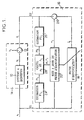
- FIG. 1 shows a system to be identified 10 to which a time-varying signal x t is applied.
- z t the response of system 10 to the input signal x t .
- the measurement of the response z t is inevitably accompanied by the addition of a disturbance component b t called observation noise.
- This observation noise b t can comprise noise strictly speaking (white noise or road noise for example), but also the useful signal.
- the component b t is called observation noise insofar as it disturbs the observation of the response z t .
- the adder 12 symbolizes in the figure the addition of the disturbance component b t , assumed to be additive, to the response z t .
- the measured observation signal y t is thus the response of a real system 14 including the system to be identified 10 and the adder 12.
- the adaptive identification device 16 receives the input signal x t on a first input E1, and the observation signal y t on a second input E2.
- the signals x t and y t are amplified, filtered and digitized at the input of the device 16 by conventional elements not shown.
- the adaptive identification device 16 comprises an identification filter 18 consisting of a programmable filter with finite impulse response.
- the coefficients of the identification filter 18 are adapted so that this filter is representative of the response of the system to be identified 10.
- the filter 18 receives the digitized input signal x t , and delivers an estimate z and t of the response z t of the system 10.
- a subtractor 20 subtracts this estimate z and t from the digitized observation signal y t to provide an error signal and. This error signal and can be seen as an estimate of the disturbance component b t .
- An identification filter updating unit 22 adapts the coefficients of the filter 18 on the basis of the input signal x t and the error signal and.
- the unit 22 takes into account for the adaptation an adaptation step ⁇ t , and / or a forgetting factor ⁇ t .
- the adaptation step ⁇ t and, where appropriate, the forgetting factor ⁇ t are variable as a function of the input signal and the observation signal.
- the adaptive identification device 16 comprises a unit 24 which calculates an estimate P1 t of the power of the input signal x t , and a unit 26 which calculates an estimate P2 t of the power of the observation signal y t , or the power of the disturbance component b t of the observation signal y t .
- a unit 28 calculates the adaptation step ⁇ t and, where appropriate, the forget factor ⁇ t as a function of the power estimates P1 t and P2 t , and supplies them to the unit 22 for updating the filter. Identification.
- ⁇ t 1 - ⁇ t ⁇
- ⁇ L denotes a positive constant equal to the product of a coefficient ⁇ by the length L, expressed in numbers of samples, of the impulse response of the identification filter 18 used.
- the identification filter updating unit 22 implements, for example, the normalized stochastic gradient algorithm (NLMS), the equations (1) and (2bis) of which were recalled in the introduction.
- NLMS normalized stochastic gradient algorithm
- variable adaptation step and / or the forgetting factor variable can also be used with various other adaptation algorithms that can be implemented by unit 22.
- Expression (9) or (9bis) can also be used
- the invention is also applicable with frequency algorithms, that is to say in which the signals are converted in the frequency domain (for example by Fourier transform ), filtered in the frequency domain by a programmable filter, then brought back in the time domain by inverse Fourier transform.
- the input signals x t correspond to frequency components of the original signal obtained by Fourier transform or filtering in sub-band
- the powers P1 t , P2 t represent the corresponding powers.
- the coefficients ⁇ t and / or ⁇ t thus obtained are generally different with respect to the different frequency components.
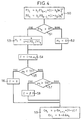
- FIG. 2 shows an adaptive echo canceller incorporating an adaptive identification device 16 of the type described with reference to FIG. 1.
- the echo canceller is associated with a hands-free telephone installation.
- the input signal x t is the direct signal intended for the loudspeaker 11 of the hands-free installation.
- the observation signal y t is the return signal collected by the microphone 13 of the hands-free installation.
- This observation signal y t includes echo components z t of the direct signal, and disturbance components b t which may include noise and speech emitted by the speaker.
- the system to be identified consists of the echo path (s) between the speaker 11 and the microphone 13.
- the adaptive identification system 16 includes a voice activity detector 30 which indicates whether the direct signal x t is vocally active or inactive. Such voice activity detectors are conventionally used in echo cancellers.
- the unit 22 does not update the identification filter 18 until the direct signal x t supports voice activity.
- the echo canceller above has the advantage of being relatively robust with respect to the phenomenon of double speech (case where the local speech is superimposed on the echo signal).
- the double talk situation leads to increasing the power estimate P2 t , and therefore to decreasing the value of the adaptation step ⁇ t .
- the automatic adjustment of the adaptation step ⁇ t thus makes it possible to limit the importance of the adaptation in a double talk situation, without it being essential to detect these double talk situations in particular. Laboratory tests were able to confirm the good performance of the echo canceller in a double talk situation.
- this echo canceller can be realized by programming a specialized processor for processing signal (DSP) as usual. It can also be realized by means of a dedicated integrated circuit (ASIC) to this application.
- DSP processing signal
- ASIC dedicated integrated circuit
- ERLE Echo Return Loss Enhancement
- the identification method and device adaptive according to the invention make it possible to improve the performance of adaptive identification systems in noisy environment.
- the technique presented solves the problem frequently posed by the choice of parameters for the control of these systems in environments including the noise characteristics vary over time.
- these environments frequently encountered in practice we can cite the variation of the noise level captured at inside a vehicle when its windows are open or closed or even when a vehicle crosses reverse.
- This device also allows to increase significantly the performance of these systems identification in double talk situation, which considerably simplifies control mechanisms associated with these identification systems.
- the method and the device adaptive identification according to the invention have been described in their application to echo cancellation acoustics in the context of radiocommunications with mobile, they can also be used in any adaptive identification system (channel equalization propagation, electric echo cancellation for the telephony, automatic process controls for management of production,).
- the plurality of fields of application of the invention described above only increases its major advantage, namely the very significant improvement performance of adaptive identification systems obtained by an automatic and adaptive device, and this at in environments with noise characteristics vary over time.
Landscapes
- Engineering & Computer Science (AREA)
- Signal Processing (AREA)
- Health & Medical Sciences (AREA)
- General Health & Medical Sciences (AREA)
- Otolaryngology (AREA)
- Physics & Mathematics (AREA)
- Acoustics & Sound (AREA)
- Computer Networks & Wireless Communication (AREA)
- Cable Transmission Systems, Equalization Of Radio And Reduction Of Echo (AREA)
- Filters That Use Time-Delay Elements (AREA)
- Soundproofing, Sound Blocking, And Sound Damping (AREA)
- Telephone Function (AREA)
Priority Applications (1)
| Application Number | Priority Date | Filing Date | Title |
|---|---|---|---|
| EP03020042A EP1401183B1 (fr) | 1995-09-13 | 1996-09-10 | Procédé et dispositif d'annulation d'echo |
Applications Claiming Priority (4)
| Application Number | Priority Date | Filing Date | Title |
|---|---|---|---|
| FR9510714A FR2738695B1 (fr) | 1995-09-13 | 1995-09-13 | Procede et dispositif d'identification adaptative et annuleur d'echo adaptatif incluant un tel dispositif |
| FR9510714 | 1995-09-13 | ||
| FR9605312 | 1996-04-26 | ||
| FR9605312A FR2748184B1 (fr) | 1996-04-26 | 1996-04-26 | Procede et dispositif d'annulation d'echo |
Related Child Applications (1)
| Application Number | Title | Priority Date | Filing Date |
|---|---|---|---|
| EP03020042A Division EP1401183B1 (fr) | 1995-09-13 | 1996-09-10 | Procédé et dispositif d'annulation d'echo |
Publications (2)
| Publication Number | Publication Date |
|---|---|
| EP0767569A1 EP0767569A1 (fr) | 1997-04-09 |
| EP0767569B1 true EP0767569B1 (fr) | 2004-08-04 |
Family
ID=26232201
Family Applications (2)
| Application Number | Title | Priority Date | Filing Date |
|---|---|---|---|
| EP96401930A Expired - Lifetime EP0767569B1 (fr) | 1995-09-13 | 1996-09-10 | Procédé et dispositif d'identification adaptative et annuleur d'écho adaptatif s'y rapportant |
| EP03020042A Expired - Lifetime EP1401183B1 (fr) | 1995-09-13 | 1996-09-10 | Procédé et dispositif d'annulation d'echo |
Family Applications After (1)
| Application Number | Title | Priority Date | Filing Date |
|---|---|---|---|
| EP03020042A Expired - Lifetime EP1401183B1 (fr) | 1995-09-13 | 1996-09-10 | Procédé et dispositif d'annulation d'echo |
Country Status (4)
| Country | Link |
|---|---|
| US (1) | US5734715A (enExample) |
| EP (2) | EP0767569B1 (enExample) |
| JP (1) | JP4101317B2 (enExample) |
| DE (2) | DE69634841T2 (enExample) |
Families Citing this family (25)
| Publication number | Priority date | Publication date | Assignee | Title |
|---|---|---|---|---|
| SE516835C2 (sv) * | 1995-02-15 | 2002-03-12 | Ericsson Telefon Ab L M | Ekosläckningsförfarande |
| US6192087B1 (en) | 1996-11-15 | 2001-02-20 | Conexant Systems, Inc. | Method and apparatus for spectral shaping in signal-point limited transmission systems |
| US6278744B1 (en) | 1996-11-15 | 2001-08-21 | Conexant Systems, Inc. | System for controlling and shaping the spectrum and redundancy of signal-point limited transmission |
| FR2764469B1 (fr) * | 1997-06-09 | 2002-07-12 | France Telecom | Procede et dispositif de traitement optimise d'un signal perturbateur lors d'une prise de son |
| JP3564974B2 (ja) * | 1997-11-07 | 2004-09-15 | 東海ゴム工業株式会社 | 周期性信号の適応制御方法 |
| US6570985B1 (en) * | 1998-01-09 | 2003-05-27 | Ericsson Inc. | Echo canceler adaptive filter optimization |
| US6381272B1 (en) * | 1998-03-24 | 2002-04-30 | Texas Instruments Incorporated | Multi-channel adaptive filtering |
| DE19831320A1 (de) * | 1998-07-13 | 2000-01-27 | Ericsson Telefon Ab L M | Digitales adaptives Filter und akustischer Echokompensator |
| FR2791492B1 (fr) * | 1999-03-26 | 2001-06-08 | France Telecom | Procede et dispositif d'identification adaptative, et annuleur d'echo adaptatif mettant en oeuvre un tel procede |
| FR2792146B1 (fr) * | 1999-04-07 | 2001-05-25 | Parrot Sa | Procede de suppression de l'echo acoustique d'un signal audio, notamment dans le signal capte par un microphone |
| US6694020B1 (en) * | 1999-09-14 | 2004-02-17 | Agere Systems, Inc. | Frequency domain stereophonic acoustic echo canceller utilizing non-linear transformations |
| DE10043064B4 (de) * | 2000-09-01 | 2004-07-08 | Dietmar Dr. Ruwisch | Verfahren und Vorrichtung zur Elimination von Lautsprecherinterferenzen aus Mikrofonsignalen |
| JP3707443B2 (ja) | 2002-03-28 | 2005-10-19 | 日本電気株式会社 | 適応忘却係数制御適応フィルタ、および忘却係数適応制御方法 |
| FR2841721B1 (fr) * | 2002-06-28 | 2004-08-20 | France Telecom | Dispositif de traitement d'echo pour systeme de communication de type monovoie ou multivoies |
| US7480595B2 (en) * | 2003-08-11 | 2009-01-20 | Japan Science And Technology Agency | System estimation method and program, recording medium, and system estimation device |
| US7046794B2 (en) * | 2003-12-12 | 2006-05-16 | Motorola, Inc. | Double talk activity detector and method for an echo canceler circuit |
| US7099458B2 (en) * | 2003-12-12 | 2006-08-29 | Motorola, Inc. | Downlink activity and double talk probability detector and method for an echo canceler circuit |
| JP4836032B2 (ja) * | 2004-01-29 | 2011-12-14 | エスティー‐エリクソン、ソシエテ、アノニム | 干渉のレベルにより制御されるステップサイズを伴うエコーキャンセラ |
| JP4573792B2 (ja) * | 2006-03-29 | 2010-11-04 | 富士通株式会社 | ユーザ認証システム、不正ユーザ判別方法、およびコンピュータプログラム |
| EP1940139B1 (fr) | 2006-12-28 | 2013-05-22 | France Telecom | Commande de filtres d'annulation d'écho |
| DE102009030353B3 (de) | 2009-06-22 | 2010-12-02 | Hofsaess, Marcel P. | Kappe für einen temperaturabhängigen Schalter sowie Verfahren zur Fertigung eines temperaturabhängigen Schalters |
| JP6389805B2 (ja) * | 2015-06-23 | 2018-09-12 | 日本電信電話株式会社 | 伝達系推定装置、その方法及びプログラム |
| CN109360580B (zh) * | 2018-12-11 | 2022-01-04 | 珠海一微半导体股份有限公司 | 一种基于语音识别的迭代去噪装置和清洁机器人 |
| CN113655280B (zh) * | 2021-08-13 | 2023-09-26 | 海南师范大学 | 一种在电动汽车动力电池连接时的绝缘阻值检测方法 |
| CN121643673B (zh) * | 2026-02-05 | 2026-05-05 | 西安智多晶微电子有限公司 | 基于Sigmoid变步长归一化的AGC方法及装置 |
Family Cites Families (11)
| Publication number | Priority date | Publication date | Assignee | Title |
|---|---|---|---|---|
| JPS5797262A (en) * | 1980-12-09 | 1982-06-16 | Nippon Telegr & Teleph Corp <Ntt> | Loud speaker telephone set system |
| US4591669A (en) * | 1984-09-26 | 1986-05-27 | At&T Bell Laboratories | Adaptive filter update gain normalization |
| CA1233925A (en) * | 1985-05-10 | 1988-03-08 | Gordon J. Reesor | Digital loudspeaking telephone |
| US4901346A (en) * | 1988-12-28 | 1990-02-13 | American Telephone And Telegraph Co. | Computer controlled speakerphone for adapting to a communication line |
| JPH04271622A (ja) * | 1991-02-27 | 1992-09-28 | Nec Corp | エコーキャンセラ |
| US5307405A (en) * | 1992-09-25 | 1994-04-26 | Qualcomm Incorporated | Network echo canceller |
| JP3477763B2 (ja) * | 1993-11-02 | 2003-12-10 | 富士通株式会社 | エコーキャンセラ |
| JP3008763B2 (ja) * | 1993-12-28 | 2000-02-14 | 日本電気株式会社 | 適応フィルタによるシステム同定の方法および装置 |
| US5606581A (en) * | 1994-03-17 | 1997-02-25 | Myers; Glen A. | Method and apparatus for the cancellation of interference in electrical systems |
| DE4430189A1 (de) * | 1994-08-25 | 1996-02-29 | Sel Alcatel Ag | Verfahren zur adaptiven Echokompensation |
| US5577116A (en) * | 1994-09-16 | 1996-11-19 | North Carolina State University | Apparatus and method for echo characterization of a communication channel |
-
1996
- 1996-08-29 US US08/705,529 patent/US5734715A/en not_active Expired - Lifetime
- 1996-09-10 EP EP96401930A patent/EP0767569B1/fr not_active Expired - Lifetime
- 1996-09-10 DE DE69634841T patent/DE69634841T2/de not_active Expired - Lifetime
- 1996-09-10 DE DE69633045T patent/DE69633045T2/de not_active Expired - Lifetime
- 1996-09-10 EP EP03020042A patent/EP1401183B1/fr not_active Expired - Lifetime
- 1996-09-13 JP JP24387296A patent/JP4101317B2/ja not_active Expired - Lifetime
Also Published As
| Publication number | Publication date |
|---|---|
| DE69633045T2 (de) | 2005-07-28 |
| US5734715A (en) | 1998-03-31 |
| EP1401183B1 (fr) | 2005-06-08 |
| DE69633045D1 (de) | 2004-09-09 |
| EP1401183A1 (fr) | 2004-03-24 |
| JPH09139696A (ja) | 1997-05-27 |
| DE69634841T2 (de) | 2006-03-23 |
| EP0767569A1 (fr) | 1997-04-09 |
| DE69634841D1 (de) | 2005-07-14 |
| JP4101317B2 (ja) | 2008-06-18 |
Similar Documents
| Publication | Publication Date | Title |
|---|---|---|
| EP0767569A1 (fr) | Procédé et dispositif d'identification adaptative et annuleur d'écho adaptatif s'y rapportant | |
| EP0666655B1 (fr) | Procédé et dispositif d'analyse d'un signal de retour et annuleur d'écho adaptatif en comportant application | |
| EP0748555B1 (fr) | Annuleur d'echo acoustique avec filtrage en sous-bandes | |
| FR2831717A1 (fr) | Methode et systeme d'elimination d'interference pour antenne multicapteur | |
| WO2007099222A1 (fr) | Procede de debruitage d'un signal audio | |
| EP0752181B1 (fr) | Annuleur d'echo acoustique a filtre adaptatif et passage dans le domaine frequentiel | |
| EP1096471B1 (en) | Method and means for a robust feature extraction for speech recognition | |
| JPWO2010035308A1 (ja) | エコー消去装置 | |
| WO2011051625A1 (fr) | Procede et dispositif d'annulation d'echo acoustique par tatouage audio | |
| EP2262216B1 (fr) | Procédé de détection d'une situation de double parole pour dispositif téléphonique "mains libres" | |
| EP1277372B1 (fr) | Systeme de reception pour antenne multicapteur | |
| KR100545832B1 (ko) | 간섭신호에 강인한 음향 반향 제거장치 | |
| WO2004004298A1 (fr) | Dispositifs de traitement d'echo pour systemes de communication de type monovoie ou multivoies | |
| FR2738695A1 (fr) | Procede et dispositif d'identification adaptative et annuleur d'echo adaptatif incluant un tel dispositif | |
| EP1655857B1 (fr) | Dispositif et procédé de détection d'une divergence d'un filtre adaptatif | |
| EP1155497B1 (fr) | Procede et systeme de traitement de signaux d'antenne | |
| FR2748184A1 (fr) | Procede et dispositif d'annulation d'echo | |
| FR2767941A1 (fr) | Suppresseur d'echo par transformation de sens et procede associe | |
| KR100431965B1 (ko) | 시변 적응알고리즘이 적용된 음향반향 제거장치 및 그 방법 | |
| EP0946036B1 (fr) | Détection d'activité vocale en présence d'une source parasite de signal sonore | |
| EP1902579B1 (fr) | Procede et dispositif de traitement d'echos forts, notamment dans des terminaux telephoniques en "mains libres" | |
| FR2792146A1 (fr) | Procede de suppression de l'echo acoustique d'un signal audio, notamment dans le signal capte par un microphone | |
| FR2799601A1 (fr) | Dispositif et procede d'annulation de bruit | |
| WO2006077005A2 (fr) | Dispositif d'annulation d'echo acoustique, procede et programme d'ordinateur correspondants |
Legal Events
| Date | Code | Title | Description |
|---|---|---|---|
| PUAI | Public reference made under article 153(3) epc to a published international application that has entered the european phase |
Free format text: ORIGINAL CODE: 0009012 |
|
| AK | Designated contracting states |
Kind code of ref document: A1 Designated state(s): DE GB IT |
|
| 17P | Request for examination filed |
Effective date: 19970503 |
|
| 17Q | First examination report despatched |
Effective date: 20020716 |
|
| GRAP | Despatch of communication of intention to grant a patent |
Free format text: ORIGINAL CODE: EPIDOSNIGR1 |
|
| GRAS | Grant fee paid |
Free format text: ORIGINAL CODE: EPIDOSNIGR3 |
|
| GRAA | (expected) grant |
Free format text: ORIGINAL CODE: 0009210 |
|
| AK | Designated contracting states |
Kind code of ref document: B1 Designated state(s): DE GB IT |
|
| REG | Reference to a national code |
Ref country code: GB Ref legal event code: FG4D Free format text: NOT ENGLISH |
|
| REF | Corresponds to: |
Ref document number: 69633045 Country of ref document: DE Date of ref document: 20040909 Kind code of ref document: P |
|
| GBT | Gb: translation of ep patent filed (gb section 77(6)(a)/1977) |
Effective date: 20041130 |
|
| PLBE | No opposition filed within time limit |
Free format text: ORIGINAL CODE: 0009261 |
|
| STAA | Information on the status of an ep patent application or granted ep patent |
Free format text: STATUS: NO OPPOSITION FILED WITHIN TIME LIMIT |
|
| 26N | No opposition filed |
Effective date: 20050506 |
|
| PGFP | Annual fee paid to national office [announced via postgrant information from national office to epo] |
Ref country code: GB Payment date: 20150825 Year of fee payment: 20 Ref country code: DE Payment date: 20150820 Year of fee payment: 20 |
|
| PGFP | Annual fee paid to national office [announced via postgrant information from national office to epo] |
Ref country code: IT Payment date: 20150828 Year of fee payment: 20 |
|
| REG | Reference to a national code |
Ref country code: DE Ref legal event code: R071 Ref document number: 69633045 Country of ref document: DE |
|
| REG | Reference to a national code |
Ref country code: GB Ref legal event code: PE20 Expiry date: 20160909 |
|
| PG25 | Lapsed in a contracting state [announced via postgrant information from national office to epo] |
Ref country code: GB Free format text: LAPSE BECAUSE OF EXPIRATION OF PROTECTION Effective date: 20160909 |