EP0764663A2 - Verfahren zur Verbesserung der elektrischen Leitfähigkeit eines Harzformkörpers, Verfahren zur Beschichtung eines Harzformkörpers, und Beschichtungszusammensetzung - Google Patents
Verfahren zur Verbesserung der elektrischen Leitfähigkeit eines Harzformkörpers, Verfahren zur Beschichtung eines Harzformkörpers, und Beschichtungszusammensetzung Download PDFInfo
- Publication number
- EP0764663A2 EP0764663A2 EP96306994A EP96306994A EP0764663A2 EP 0764663 A2 EP0764663 A2 EP 0764663A2 EP 96306994 A EP96306994 A EP 96306994A EP 96306994 A EP96306994 A EP 96306994A EP 0764663 A2 EP0764663 A2 EP 0764663A2
- Authority
- EP
- European Patent Office
- Prior art keywords
- coating
- resin
- molding
- corona discharge
- coating composition
- Prior art date
- Legal status (The legal status is an assumption and is not a legal conclusion. Google has not performed a legal analysis and makes no representation as to the accuracy of the status listed.)
- Withdrawn
Links
Images

Classifications
-
- H—ELECTRICITY
- H01—ELECTRIC ELEMENTS
- H01B—CABLES; CONDUCTORS; INSULATORS; SELECTION OF MATERIALS FOR THEIR CONDUCTIVE, INSULATING OR DIELECTRIC PROPERTIES
- H01B1/00—Conductors or conductive bodies characterised by the conductive materials; Selection of materials as conductors
- H01B1/06—Conductors or conductive bodies characterised by the conductive materials; Selection of materials as conductors mainly consisting of other non-metallic substances
- H01B1/12—Conductors or conductive bodies characterised by the conductive materials; Selection of materials as conductors mainly consisting of other non-metallic substances organic substances
-
- C—CHEMISTRY; METALLURGY
- C08—ORGANIC MACROMOLECULAR COMPOUNDS; THEIR PREPARATION OR CHEMICAL WORKING-UP; COMPOSITIONS BASED THEREON
- C08F—MACROMOLECULAR COMPOUNDS OBTAINED BY REACTIONS ONLY INVOLVING CARBON-TO-CARBON UNSATURATED BONDS
- C08F8/00—Chemical modification by after-treatment
- C08F8/30—Introducing nitrogen atoms or nitrogen-containing groups
-
- C—CHEMISTRY; METALLURGY
- C08—ORGANIC MACROMOLECULAR COMPOUNDS; THEIR PREPARATION OR CHEMICAL WORKING-UP; COMPOSITIONS BASED THEREON
- C08F—MACROMOLECULAR COMPOUNDS OBTAINED BY REACTIONS ONLY INVOLVING CARBON-TO-CARBON UNSATURATED BONDS
- C08F8/00—Chemical modification by after-treatment
- C08F8/44—Preparation of metal salts or ammonium salts
Definitions
- the present invention relates to a method of improving the electrical conductivity of a molding article of resin, a method of coating a molding article of resin, and a coating composition.
- the conventional method of coating a molding article of resin comprises coating an electrically conductive primer containing an inorganic conductive substance, e.g. conductive carbon black, graphite, or the like, on the surface of a polypropylene article to impart electrical conductivity to said surface and then carrying out electrostatic coating as described in JP-A-06165966.
- an electrically conductive primer containing an inorganic conductive substance e.g. conductive carbon black, graphite, or the like
- JP-A-06165966 an inorganic conductive substance such as carbon black or graphite must be added in a substantial amount in order that it may be evenly and thoroughly distributed in the surface of the polypropylene article. Therefore, the technology has drawbacks in terms of the dispersion stability of the electrically conductive substance and the cost of production.
- the plasma treatment must be a batch operation for low pressure, the method is not adaptable to continuous production and is poor in commercial productivity.
- the present invention has for its object to overcome the above-mentioned disadvantages of the prior art and provide a method of improving the electrical conductivity of a molding article of resin and a method of coating a molding article of resin with good productivity and without a primer containing an inorganic electrically conductive substance, as well as a coating composition for use in carrying said methods into practice.
- the inventors of the present invention discovered that by coating a primer containing a specific nitrogen-containing compound on the surface of a molding article of resin and subjecting the treated surface to corona discharge treatment, the electrical conductivity of the surface can be improved to be suitable for electrostatic coating, thus overcoming the above disadvantages.
- the present invention is directed, in a first aspect, to a method of improving the electrical conductivity of a molding article of resin through enhancement of surface conductivity which comprises a first step (step 1) of coating a molding article of resin with a coating composition essentially consisting of a film-forming component, a nitrogen-containing compound of general formula (1), and a solvent and a second step (step 2) of subjecting the coated surface to corona discharge treatment.
- the present invention is directed, in a second aspect, to a method of coating a molding article of resin which comprises said steps 1 and 2 and a third step (step 3) of carrying out electrostatic coating on the corona discharge-treated surface obtained in said step 2.
- the present invention is further directed to a coating composition
- a coating composition comprising a film-forming component, a nitrogen-containing compound of general formula (1), and a solvent, which finds application in the above-mentioned methods.
- R 1 -Y (1) wherein R 1 represents an alkyl or alkenyl group of 5-21 carbon atoms; Y represents R 2 and R 3 may be the same or different and each represents an alkyl group of 1-4 carbon atoms; m represents 2-3; R 4 represents -H or -CH 3 ; A represents -(CH 2 ) n - or where n represents 1-5.
- the present invention is particularly useful for the coating of materials which are intrinsically not suitable for electrostatic coating, such as polypropylene bumpers.
- R 1 represents an alkyl or alkenyl group of 5-21 carbon atoms, preferably a C 7-17 alkyl or alkenyl group, and for still better results, a C 9-15 alkyl or alkenyl group.
- the nitrogen-containing compound of general formula (1) includes a variety of amidoamines such as N,N-dimethylaminopropylhexanamide, N,N-diethylaminopropylhexanamide, N,N-diethylaminoethylhexanamide, N,N-dimethylaminopropyloctanamide, N,N-diethylaminopropyloctanamide, N,N-diethylaminoethyloctanamide, N,N-dibutylaminopropyloctanamide, N,N-dibutylaminoethyloctanamide, N,N-dimethylaminopropyldecanamide, N,N-dimethylaminoethyldecanamide, N,N-diethylaminopropyldecanamide, N,N-diethylaminoethyldecanamide, N,N-dibutylaminopropyldecanamide, N,
- the amidoamines mentioned above can be synthesized by reacting aliphatic monocarboxylic acids of 6-22 carbon atoms with N,N-dialkylaminoalkylamines such as N,N-dimethylaminopropylamine, N,N-dimethylaminoethylamine, N,N-diethylaminopropylamine, N,N-diethylaminoethylamine, N,N-dibutylaminopropylamine, N,N-dibutylaminoethylamine, etc.
- This reaction can be carried out by the conventional amidation procedure.
- this reaction proceeds under heating at 140-200°C.
- the progress of the reaction can be monitored by measuring the total amine value, tertiary amine value, and an acid value.
- the fatty acid esters mentioned above can be synthesized by reacting aliphatic monocarboxylic acids of 6-22 carbon atoms with N,N-dialkylaminoalcohols such as 2-dimethylaminoethanol, 2-diethylaminoethanol, 2-dibutylaminoethanol, 3-dimethylamino-1-propanol, 3-diethylamino-1-propanol, 3-dibutylamino-1-propanol, l-dimethylamino-2-propanol, l-diethylamino-2-propanol, l-dibutylamino-2-propanol, 4-dimethylamino-l-butanol, 6-dimethylamino-1-hexanol, 4-dimethylaminophenethyl alcohol, etc.
- This reaction can be carried out by the conventional esterification method.
- this reaction proceeds under heating at 140-230°C.
- the progress of the reaction can be
- the coating composition of the present invention contains a film-forming component.
- This film-forming component consists of a basic resin and a curing agent.
- the film-forming component is the very basic resin.
- the basic resin that can be used includes a variety of resins which are used in the conventional coatings, such as chlorinated polyolefin resin, acrylic acid resin, polyester resin, alkyd resin, epoxy resin, urethane resin, polyacrylate resin, etc. Particularly preferred are chlorinated polyolefins which are generally used in primers for bumpers.
- the curing agent that can be used includes polyfunctional compounds or resins, such as polyisocyanates, polyamines, melamine, polybasic acids, polyepoxides, etc.
- polyfunctional compounds or resins such as polyisocyanates, polyamines, melamine, polybasic acids, polyepoxides, etc.
- the basic resin is a self-crosslinking resin
- the basic resin itself contains a crosslinkable component as it is the case with polyacrylates, for instance.
- the coating composition of the present invention further contains a solvent.
- the kind of solvent is not limited. Thus, for example, the standard organic solvents or water can be employed.
- the proportion of the solvent in the coating composition is not so critical but is preferably selected from the range of 50-1,000 parts by weight to each 100 parts by weight of the film-forming component. If the proportion of the solvent is below the above-mentioned limit of 50 parts by weight, workability is sacrificed. On the other hand, if the upper limit of 1,000 parts by weight is exceeded, the solid fraction will be undesirably low.
- the coating composition of the present invention can be supplemented with a pigment, a catalyst and/or other additives where necessary. It is generally known that these additional components are used or not used depending on the form and objective of application. There is virtually no limitation on the kinds of said additives.
- the proportion of the nitrogen-containing compound of general formula (1) based on 100 parts by weight of the film-forming component is preferably 0.01-10 parts by weight, more preferably 0.05-7 parts by weight, and for still better results, 0.1-5 parts by weight. If the proportion is less than 0.01 part by weight, the coating layer on the resin article obtained will not have sufficient electrical conductivity. Any proportion exceeding 10 parts by weight would be further contributory to electrical conductivity but the resultant deterioration of physical properties of the coating and bleeding on the surface would virtually cancel the benefit.
- the composition can be produced by adding a nitrogen-containing compound of general formula (1), either as it is or as dissolved or dispersed in a solvent, in a suitable amount to a coating composition (hereinafter referred to as stock coating) which has no antistatic properties.
- stock coating a coating composition which has no antistatic properties.
- the coating composition can also be produced by adding said nitrogen-containing compound of general formula (1) simultaneously with the addition of said basic resin, curing agent, and other additives.
- Coating with the coating composition containing the nitrogen-containing compound of general formula (1) can be carried out by a known coating technique which may for example be spray coating, brush coating, dip coating, roll coating or casting. For the coating of automotive parts, spray coating and dip coating are preferred.
- the coating composition can be applied in any of the conventional application forms such as room temperature-curing, lacquer, heat-curing, organic solvent-borne, and water-borne coatings.
- the substrate article of resin may be pretreated before coating so as to improve the adhesion of the coating.
- the pretreatment that can be applied includes a variety of known pretreatments such as aqueous rinse, solvent rinse, flame treatment, corona discharge treatment, and low pressure plasma treatment.
- the coating thickness and drying conditions for molding articles of resin can be similar to those applicable to the stock coating. Taking a primer containing a chlorinated polyolefin and not containing a curing agent as an example, the coating thickness may be 5-15 ⁇ m and the drying conditions may be about 10 minutes at 50-80°C. The same conditions apply to the wet-on-wet coating system in which the top coat is applied to the primer coat while the latter is still wet. With the coating composition using an acrylic or polyester resin as the basic resin and a polyisocyanate as the curing agent, the coating thickness may be 20-40 ⁇ m and the drying conditions may be about 20-40 minutes at 80-90°C. As to the coating composition containing an acrylic or polyester resin as the basic resin and melamine as the curing agent, the coating thickness may be 20-40 ⁇ m and the drying conditions may be about 20-40 minutes at 100-120°C.
- the molding article of resin that can be used as the substrate includes articles of polyolefin resin [e.g. polyethylene, polypropylene, poly(ethylene-copropylene) rubber-containing polypropylene, etc.], ABS resin, acrylic resin, polyamide resin, poly(vinyl chloride) resin, polycarbonate resin, polyacetal resin, polystyrene resin, phenolic resin, etc., all of which have high surface resistivity.
- the molding article may be a metal, ceramic, or wooden article coated with any of said resin materials.
- Particularly preferred resins are polyolefin resins which are generally used for the manufacture of automotive parts.
- a molding article of resin produced by a process which comprises kneading an antistatic agent and other additives into the above-mentioned resin, molding the resulting compound, and optionally subjecting it to a surface treatment such as corona discharge treatment, low pressure plasma treatment, flame treatment or the like so as to adjust its surface resistivity to less than 10 13 ⁇ .
- the coating with the coating composition containing a nitrogen-containing compound of general formula (1) in step 1 may be carried out by the electrostatic coating method.
- the molding article of resin may be any of three-dimensional articles and two-dimensional articles such as film and sheet.
- the molding article of resin includes but is not limited to automotive parts and electrical appliance housings.
- the corona discharge treatment is carried out in such a manner that the corona produced by applying a high voltage between two electrical conductors at atmospheric pressure is contacted with the surface of the substrate (a molding article of resin).
- the conditions of this treatment need not be critically controlled only if a corona discharge takes place.
- the corona discharge treatment can be carried out at an application voltage of about 10-300 KV for 1-600 seconds.
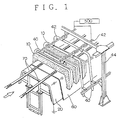
- a corona discharge equipment utilizing a high-voltage pulse typically as shown in Fig. 1 can be employed. Since this equipment utilizes the high-voltage pulse circuit shown in Fig. 2, sparking is seldom induced and the distance between electrodes can be increased to accommodate large-sized parts.
- Fig. 1 shows an external view of the corona discharge equipment.
- a generally U-shaped automotive bumper is used and the surface of this article is subjected to corona discharge treatment.
- a plurality of units of said article of resin 10 are caused to travel one after another on a roller conveyer 70 installed in the manner of a railroad track.
- the roller conveyer 70 made of insulating resin or the like, is disposed on a counter electrode 20.
- the counter electrode 20 comprises a plate member having a U-like cross-sectional configuration complementary to the bent portions of the molding article of resin 10, with its upper surface being covered with a dielectric cladding 60.
- each discharge electrode 40 Arranged over the track for the molding article of resin 10, a plurality of discharge electrodes 40 each comprising a narrow strip bended to have a U-like configuration with fixed spacings therebetween.
- the lower edge of each discharge electrode 40 is configured to be generally complementary to the top edge of the molding article of resin 10 and is substantially parallel to the surface of the counter electrode 20 with a clearance of about a fraction of one meter between them.
- the top of the discharge electrode 40 is supported by connecting metal strips 42 and electrically connected thereto.
- the discharge electrode 40 is removably secured to the connecting strip metals 42 by bolt means so that the pitch of discharge electrodes 40 can be changed as necessary. Both ends of the connecting metal strips 42 are secured to a frame 44.
- a high-voltage pulse generator 500 is connected to said connecting metal strips 42 via high-tension cables.
- the molding article of resin 10 is placed on the roller conveyer 70 disposed over the counter electrode 20, it is transported under the discharge electrodes 40. As, in this condition, a high-voltage pulse is applied between the discharge electrode 40 and the counter electrode 20, a corona discharge takes place to treat the surface of the molding article of resin 10.
- Fig. 2 shows the circuitry of the above corona discharge equipment.
- the resin article 10 is set on the counter electrode 20 through the dielectric cladding 60, with the discharge electrodes 40 being disposed overhead.
- the clearance W between the discharge electrode 40 and the counter electrode 20 is the electrode gap.
- the circuit connected to the discharge electrode 40 and counter electrode 20 includes a pulse generator 52 and a high-voltage source 50.
- the high-voltage source 50 may be any of known high-voltage sources which are capable of generating a necessary high voltage current from a low-voltage direct current source.
- the circuit constant and other conditions of the pulse generator 52 being set to the proper values, a high-voltage pulse showing the desired characteristics can be applied between the discharge electrode 40 and the counter electrode 20.
- the high-voltage pulse for this corona discharge treatment has a pulse width of not less than 1 ⁇ sec, an average electric field intensity [expressed by applied voltage (wave height) value/distance between discharge and counter electrodes] of 4-20 KV/cm, and a pulse frequency of not less than 10 pps, preferably 10-300 pps, as taught in JP-A-05339397.
- the treatment time may be 1-600 seconds.
- the work may be further coated with a coating composition containing a nitrogen-containing compound of general formula (1) and the resulting film be subjected to corona discharge treatment.
- This coating can be carried out by the electrostatic coating method, if desired.
- the electrostatic coating in step 3 comprises spraying and depositing a coating material having electrostatic charges on the corona discharge-treated coating layer obtained by step 2.
- This coating can be carried out by any known method, for example by means of an electric centrifugal air or airless atomization coating machine.
- the application voltage is about -30KV to -120KV.
- the coating material for use in this electrostatic coating procedure may be any of the conventional electrostatic coating materials such as the urethane, acrylic, alkyd, and melamine type coatings.
- molding articles of resin with greatly improved electrical conductivity can be manufactured using resins of low electrical conductivity with high productivity.
- the present invention enables electrostatic coating with high coating efficiency and production of molding articles of resin having an attractive appearance.
- the impact resistance of the coating is improved.
- the present invention therefore, is particularly useful for the production of automotive parts such as bumpers.
- Coating compositions each containing a nitrogen-containing compound of general formula (1) in a defined proportion were prepared according to the recipes shown in Table 1 and each coating composition was coated on a molding article of polypropylene resin (Mitsui Petrochemical Industries, Ltd., M-4800; 150 mm x 60 mm x 3 mm) which had been rinsed and degreased with isopropyl alcohol beforehand. After drying, the surface of the coated article of resin was subjected to corona discharge treatment to prepare a testpiece. Immediately then, the surface resistivity of the testpiece was measured and the coated condition was evaluated. In addition, the impact resistance of the coating was determined.
- polypropylene resin Mitsubishi Chemical Industries, Ltd., M-4800; 150 mm x 60 mm x 3 mm
- testpiece With the above testpiece grounded, it was electrostatically coated with a melamine coating (Nippon Bee Chemical, R-320) using a coating machine (Ransburg-Gema, ⁇ BEL30 ⁇ ) at a static voltage of -40KV, a reciprocation stroke of 400 mm, a spray distance of 300 mm, and a conveyer speed of 2.2 m/min. After 30 minutes of drying at 120°C, the coating thickness, coating efficiency, and adhesion were determined.
- Coating compositions each containing a nitrogen-containing compound of general formula (1) in a defined proportion were prepared according to the recipes shown in Table 3. Each of the coating compositions thus prepared was coated on an automotive polypropylene bumper (surface resistivity 1.0 x 10 16 ⁇ ) and, after drying, the coated surface was subjected to corona discharge treatment. Immediately then, the surface resistivity was measured and the condition of the coating was evaluated. The impact resistance of the coating was also measured.
- electrostatic coating was carried out with a melamine coating (Nippon Bee Chemical, R-320) using a coating machine (Ransburg-Gema, ⁇ BEL30 ⁇ ) at a static voltage of -40 KV, a reciprocation stroke of 400 mm, a spray distance of 300 mm, and a conveyer speed of 2.2 m/min. and drying was carried out at 120°C for 30 minutes. The coating thickness, coating efficiency, and adhesion were then determined.
- a coating composition containing a nitrogen-containing compound of general formula (1) in a defined proportion according to the recipe shown in Table 3 and an automotive polypropylene bumper contaning an additive(surface resistivity 5.2 x 10 11 ⁇ ) was electrostatically coated with the composition. After drying, the coated surface was subjected to corona discharge treatment and immediately then the surface resistivity was measured and the coat condition was evaluated. The impact resistance of the coating was also determined.
- the bumper used above was a bumper which had been molded from a polypropylene containing 0.5% of a nitrogen-containing compound of general formula (1) (F) (surface resistivity 3.1 x 10 15 ⁇ ), rinsed and degreased with isopropyl alcohol, and subjected to corona discharge treatment (S-2).
- F nitrogen-containing compound of general formula (1)
- a coating composition containing a nitrogen-containing compound of general formula (1) in a defined proportion according to the recipe shown in Table 3 was prepared and an automotive polypropylene bumper containing an additive (surface resistivity 4.5 x 10 11 ⁇ ) was electrostatically coated with the coating composition, dried, and subjected to corona discharge treatment. Immediately then, the surface resistivity was measured and the condition of the coating was evaluated. The impact resistance of the coating was also determined.
- the bumper used above was a bumper which had been molded from a polypropylene containing 0.5% of a nitrogen-containing compound of general formula (1) (I) (surface resistivity 3.1 x 10 15 ⁇ ) and subjected to corona discharge treatment (S-2).
- I nitrogen-containing compound of general formula (1)
Landscapes
- Chemical & Material Sciences (AREA)
- General Chemical & Material Sciences (AREA)
- Health & Medical Sciences (AREA)
- Chemical Kinetics & Catalysis (AREA)
- Medicinal Chemistry (AREA)
- Polymers & Plastics (AREA)
- Organic Chemistry (AREA)
- Physics & Mathematics (AREA)
- Spectroscopy & Molecular Physics (AREA)
- Application Of Or Painting With Fluid Materials (AREA)
- Coating Of Shaped Articles Made Of Macromolecular Substances (AREA)
- Treatments Of Macromolecular Shaped Articles (AREA)
Applications Claiming Priority (4)
| Application Number | Priority Date | Filing Date | Title |
|---|---|---|---|
| JP7245950A JPH0987403A (ja) | 1995-09-25 | 1995-09-25 | 樹脂成形体の導電性改良方法および樹脂製被塗物の製造方法 |
| JP245949/95 | 1995-09-25 | ||
| JP7245949A JPH0987548A (ja) | 1995-09-25 | 1995-09-25 | 帯電防止性塗料組成物 |
| JP245950/95 | 1995-09-25 |
Publications (2)
| Publication Number | Publication Date |
|---|---|
| EP0764663A2 true EP0764663A2 (de) | 1997-03-26 |
| EP0764663A3 EP0764663A3 (de) | 1998-12-09 |
Family
ID=26537491
Family Applications (1)
| Application Number | Title | Priority Date | Filing Date |
|---|---|---|---|
| EP96306994A Withdrawn EP0764663A3 (de) | 1995-09-25 | 1996-09-25 | Verfahren zur Verbesserung der elektrischen Leitfähigkeit eines Harzformkörpers, Verfahren zur Beschichtung eines Harzformkörpers, und Beschichtungszusammensetzung |
Country Status (2)
| Country | Link |
|---|---|
| US (1) | US5858472A (de) |
| EP (1) | EP0764663A3 (de) |
Cited By (2)
| Publication number | Priority date | Publication date | Assignee | Title |
|---|---|---|---|---|
| WO2001017486A3 (en) * | 1999-09-09 | 2001-05-10 | Carlo Ghisalberti | Deanol or derivatives for the treatment of skin impairements and baldness |
| US7049362B2 (en) | 1998-12-28 | 2006-05-23 | Osaka Gas Co.,Ltd. | Resin molded product |
Families Citing this family (4)
| Publication number | Priority date | Publication date | Assignee | Title |
|---|---|---|---|---|
| US6848173B2 (en) * | 1994-07-07 | 2005-02-01 | Tessera, Inc. | Microelectric packages having deformed bonded leads and methods therefor |
| JP2005223167A (ja) * | 2004-02-06 | 2005-08-18 | Shinko Electric Ind Co Ltd | 親水性処理方法及び配線パターンの形成方法 |
| US7897087B2 (en) * | 2004-05-05 | 2011-03-01 | Naughton David B | Method of manufacturing a molded article |
| WO2014035921A1 (en) * | 2012-08-27 | 2014-03-06 | Pcc Chemax, Inc. | Anti-static agent for polymer resins |
Family Cites Families (20)
| Publication number | Priority date | Publication date | Assignee | Title |
|---|---|---|---|---|
| GB764024A (en) * | 1954-01-18 | 1956-12-19 | American Cyanamid Co | Improvements relating to molding compositions and articles produced therefrom |
| NL296850A (de) * | 1962-08-20 | 1900-01-01 | ||
| BE639449A (de) * | 1962-11-02 | |||
| US3488307A (en) * | 1965-09-30 | 1970-01-06 | Du Pont | Coating compositions comprising mixtures of nitrogen-containing acrylic polymers |
| CH526611A (de) * | 1970-06-02 | 1972-08-15 | Sandoz Ag | Verfahren zur antistatischen Ausrüstung von polymeren Stoffen |
| JPS6036388B2 (ja) * | 1979-07-13 | 1985-08-20 | 東洋紡績株式会社 | 密着性の良好な包装材料 |
| JPS5721433A (en) * | 1980-07-15 | 1982-02-04 | Tokuyama Soda Co Ltd | Polypropylene film |
| NL8104230A (nl) * | 1980-09-16 | 1982-04-16 | Shinetsu Chemical Co | Werkwijze voor het wijzigen van de oppervlakte-eigenschappen van voorwerpen gevormd uit kunststoffen. |
| US4468412A (en) * | 1982-08-19 | 1984-08-28 | Sumitomo Chemical Company, Limited | Process for applying light- or radiation-curable resin composition to polyolefin moldings |
| US4588783A (en) * | 1983-12-16 | 1986-05-13 | Ppg Industries, Inc. | Amide-containing polyhydroxyethyl carbamates |
| US4604322A (en) * | 1985-08-06 | 1986-08-05 | Hercules Incorporated | Metallizable polypropylene film |
| DE3629167C1 (de) * | 1986-08-27 | 1991-11-28 | Goldschmidt Ag Th | Modifiziertes Polyethylen,Verfahren zu seiner Herstellung und Verwendung des modifizierten Polyethylens zur Verguetung der aeusseren Oberflaechen von Glasbehaeltern |
| US5186974A (en) * | 1988-08-16 | 1993-02-16 | Hoechst Aktiengesellschaft | Self-supporting sheet-like structure comprising a substrate and a coating, and a process for its production |
| JPH03101874A (ja) * | 1989-09-13 | 1991-04-26 | Kanto Auto Works Ltd | 樹脂成形体の導電性改良方法 |
| JPH03189129A (ja) * | 1989-12-19 | 1991-08-19 | Nippon Paint Co Ltd | コロナ放電処理装置 |
| DE69313211T2 (de) * | 1992-06-10 | 1998-01-29 | Mazda Motor | Verfahren und Vorrichtung zur Coronabehandlung |
| JPH06920A (ja) * | 1992-06-23 | 1994-01-11 | Sumitomo Bakelite Co Ltd | 防曇性積層フィルム |
| JPH07173308A (ja) * | 1993-12-17 | 1995-07-11 | Dai Ichi Kogyo Seiyaku Co Ltd | 樹脂成形体の導電性改良方法 |
| US5571472A (en) * | 1994-03-30 | 1996-11-05 | Dai-Ichi Kogyo Seiyaku Co., Ltd. | Method of improving the electrical conductivity of shaped resin articles and an electrostatic coating process |
| JPH08253606A (ja) * | 1995-03-15 | 1996-10-01 | Dai Ichi Kogyo Seiyaku Co Ltd | 樹脂成形体の導電性改良方法および静電塗装方法 |
-
1996
- 1996-09-20 US US08/717,736 patent/US5858472A/en not_active Expired - Fee Related
- 1996-09-25 EP EP96306994A patent/EP0764663A3/de not_active Withdrawn
Cited By (2)
| Publication number | Priority date | Publication date | Assignee | Title |
|---|---|---|---|---|
| US7049362B2 (en) | 1998-12-28 | 2006-05-23 | Osaka Gas Co.,Ltd. | Resin molded product |
| WO2001017486A3 (en) * | 1999-09-09 | 2001-05-10 | Carlo Ghisalberti | Deanol or derivatives for the treatment of skin impairements and baldness |
Also Published As
| Publication number | Publication date |
|---|---|
| EP0764663A3 (de) | 1998-12-09 |
| US5858472A (en) | 1999-01-12 |
Similar Documents
| Publication | Publication Date | Title |
|---|---|---|
| US5696196A (en) | EMI/RFI-shielding coating | |
| US6676820B2 (en) | Process for electrocoating metal blanks and coiled metal substrates | |
| US4207222A (en) | Aqueous coating agents, impregnating agents and adhesives | |
| EP0850109B1 (de) | Verfahren zur herstellung überzogener gegenstände | |
| EP0764663A2 (de) | Verfahren zur Verbesserung der elektrischen Leitfähigkeit eines Harzformkörpers, Verfahren zur Beschichtung eines Harzformkörpers, und Beschichtungszusammensetzung | |
| KR950700370A (ko) | 전기전도성 기판의 피복방법, 수성 전기침지 페인트, 교차결합된 중합체 미소입자의 수성분산액의 제조방법, 및 이 방법에 의해 제조된 분산액(process forl lacquering electroconductive substrates, aqueous electro-dipcoats, process for preparing an aqueous dispersion of crosslinked polymer microparticules and dispersions prepared according to this process) | |
| KR20050085560A (ko) | 분말 코팅 장치 및 분말 코팅 방법 | |
| US5262207A (en) | Method of electrostatically coating nonconductive panels | |
| EP0732706B1 (de) | Verfahren zur Verbesserung der elektrischen Leitfähigkeit eines Harzformkörpers und Verfahren zur elektrostatischen Beschichtung | |
| EP0675505B1 (de) | Verfahren zur Verbesserung der elektrischen Leitfähigkeit von Harzformkörpern und ein Verfahren zum elektrostatischen Beschichten | |
| BR8502882A (pt) | Procedimento para a obtencao de meios de revestimento,e processo para a pintura por eletrodeposicao catodica de substratos eletrocondutores | |
| US3898145A (en) | Process for applying contrasting coatings to a workpiece | |
| US6436260B1 (en) | Process for electrocoating bulk articles | |
| JPH0987403A (ja) | 樹脂成形体の導電性改良方法および樹脂製被塗物の製造方法 | |
| JP3315141B2 (ja) | プラスチツク部材の静電塗装方法 | |
| JPH10147748A (ja) | 静電塗装用導電性プライマー組成物及び静電塗装方法 | |
| JPS6351471B2 (de) | ||
| JPS61271059A (ja) | 樹脂部品の静電塗装方法 | |
| JPS61227869A (ja) | 樹脂製車体部品の静電塗装方法 | |
| JPH0995548A (ja) | 樹脂成形体の導電性改良方法および樹脂製被塗物の製造方法 | |
| JPS63312367A (ja) | 下塗り塗料組成物 | |
| JPH08311215A (ja) | 樹脂成形体の導電性改良方法および静電塗装方法 | |
| WO2001074954A1 (en) | Cathodic electrodeposition coating compositions and process for using same | |
| JPH07265788A (ja) | 樹脂成形体の静電塗装方法 | |
| JPH0354696B2 (de) |
Legal Events
| Date | Code | Title | Description |
|---|---|---|---|
| PUAI | Public reference made under article 153(3) epc to a published international application that has entered the european phase |
Free format text: ORIGINAL CODE: 0009012 |
|
| AK | Designated contracting states |
Kind code of ref document: A2 Designated state(s): DE FR GB |
|
| PUAL | Search report despatched |
Free format text: ORIGINAL CODE: 0009013 |
|
| AK | Designated contracting states |
Kind code of ref document: A3 Designated state(s): DE FR GB |
|
| 17P | Request for examination filed |
Effective date: 19990121 |
|
| 17Q | First examination report despatched |
Effective date: 19990407 |
|
| STAA | Information on the status of an ep patent application or granted ep patent |
Free format text: STATUS: THE APPLICATION IS DEEMED TO BE WITHDRAWN |
|
| 18D | Application deemed to be withdrawn |
Effective date: 20000111 |