EP0763402B1 - Verfahren und Vorrichtung zum Polieren von Halbleitersubstraten - Google Patents
Verfahren und Vorrichtung zum Polieren von Halbleitersubstraten Download PDFInfo
- Publication number
- EP0763402B1 EP0763402B1 EP96113864A EP96113864A EP0763402B1 EP 0763402 B1 EP0763402 B1 EP 0763402B1 EP 96113864 A EP96113864 A EP 96113864A EP 96113864 A EP96113864 A EP 96113864A EP 0763402 B1 EP0763402 B1 EP 0763402B1
- Authority
- EP
- European Patent Office
- Prior art keywords
- platen
- slurry
- polishing pad
- polishing
- semiconductor substrate
- Prior art date
- Legal status (The legal status is an assumption and is not a legal conclusion. Google has not performed a legal analysis and makes no representation as to the accuracy of the status listed.)
- Expired - Lifetime
Links
Images




Classifications
-
- B—PERFORMING OPERATIONS; TRANSPORTING
- B24—GRINDING; POLISHING
- B24B—MACHINES, DEVICES, OR PROCESSES FOR GRINDING OR POLISHING; DRESSING OR CONDITIONING OF ABRADING SURFACES; FEEDING OF GRINDING, POLISHING, OR LAPPING AGENTS
- B24B37/00—Lapping machines or devices; Accessories
- B24B37/04—Lapping machines or devices; Accessories designed for working plane surfaces
-
- B—PERFORMING OPERATIONS; TRANSPORTING
- B24—GRINDING; POLISHING
- B24B—MACHINES, DEVICES, OR PROCESSES FOR GRINDING OR POLISHING; DRESSING OR CONDITIONING OF ABRADING SURFACES; FEEDING OF GRINDING, POLISHING, OR LAPPING AGENTS
- B24B57/00—Devices for feeding, applying, grading or recovering grinding, polishing or lapping agents
- B24B57/02—Devices for feeding, applying, grading or recovering grinding, polishing or lapping agents for feeding of fluid, sprayed, pulverised, or liquefied grinding, polishing or lapping agents
Definitions
- the present invention relates to a method and apparatus for polishing a semiconductor substrate whereby chemical mechanical polishing (CMP) is performed with respect to a semiconductor substrate of silicon or the like to flatten a surface thereof.
- CMP chemical mechanical polishing
- CMP technology for polishing semiconductor substrates of silicon or the like has shown increasing tendencies toward single-wafer processing as the semiconductor substrates processed by CMP have had larger diameters on the order of 10 cm or more, resulting in an increased amount of slurry consumed per wafer.
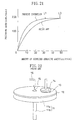
- FIG. 22 schematically shows the construction of the conventional polishing apparatus, in which is shown a platen 11 including: a substrate holder 11a made of a rigid material and having a flat surface; a rotary shaft 11b extending vertically downwardly from the back surface of the substrate holder 11a; and rotating means (not shown) for rotating the rotary shaft 11b.
- a polishing pad 12 To the top surface of the substrate holder 11a of the platen 11 is adhered a polishing pad 12.
- a substrate holding head 14 which holds and rotates a semiconductor substrate 13. The semiconductor substrate 13 is rotated and pressed against the polishing pad 12 on the platen 11 by the substrate holding head 14.
- a slurry 15 containing abrasive grains (extremely fine powder for polishing) is dropped in a prescribed amount from a slurry supply pipe 16 onto the polishing pad 12 so as to supply the abrasive grains to the space between the polishing pad 12 and the semiconductor substrate 13.
- the polishing pad 12 supplied with the slurry 15 is rotated by rotating the platen 11 and the semiconductor substrate 13 is pressed against the rotating polishing pad 12 by the substrate holding head 14 so that a surface of the semiconductor substrate 13 is polished.
- the polishing rate is increased at projecting portions of the semiconductor substrate 13 since their contact pressure with the polishing pad 12 is high.
- the polishing rate is reduced at recessed portions of the semiconductor substrate 13 since their contact pressure with the polishing pad 12 is low. Consequently, the surface of the semiconductor substrate 13 becomes less rugged and more smooth.
- the polishing rate increases with increases in the amount of supplied slurry 15 and eventually becomes constant when the amount of supplied slurry reaches a given value. Accordingly, the amount of slurry 15 normally supplied onto the polishing pad 12 is slightly larger than the given value with which the polishing rate becomes constant.
- the slurry 15 since the slurry 15 is supplied onto the rotating polishing pad 12 as described above, the slurry 15 is caused to flow to the peripheral portion of the polishing pad 12 by a centrifugal force accompanying the rotation of the platen 11.
- the polishing rate is reduced.
- the pressure for pressing the semiconductor substrate 13 against the polishing pad 12 should be increased.
- the increased pressure induces dishing or like phenomenon, which causes such a problem as the degradation of polishing properties.
- the slurry should constantly be supplied in an amount slightly larger than the given value with which the polishing rate becomes constant, so that the cost of the slurry accounts for a considerable proportion of the cost of polishing.
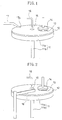
- FIG. 1 is a schematic perspective view of a polishing apparatus according to a first embodiment of the present invention, in which is shown a platen 11 including: a polishing-pad holder 11a made of a rigid material and having a flat surface; a rotary shaft 11b extending vertically downwardly from the back surface of the polishing-pad holder 11a; and rotating means (not shown) for rotating the rotary shaft 11b.
- a polishing pad 12 made of polyurethane or like material.
- a substrate holding head 14 which holds and rotates a semiconductor substrate 13.
- the semiconductor substrate 13 is rotated and pressed against the polishing pad 12 on the platen 11 by the substrate holding head 14.
- a slurry 15 containing abrasive grains is dropped in a prescribed amount from a slurry supply pipe 16 onto the polishing pad 12 and supplied to the space between the polishing pad 12 and the semiconductor substrate 13 by rotating the platen 11 and the substrate holding head 14.
- the first embodiment is characterized in that a compressed-air supply pipe 17 for ejecting a compressed air to the top surface of the polishing pad 12 is provided as slurry pushing means over the periphery of the polishing pad 12.
- An ejection hole 17a of the compressed-air supply pipe 17 is opened to face the center of rotation of the platen 11.
- the ejection hole 17a has a diameter of, e.g., about 3 mm and the flow speed of the compressed air ejected from the ejection hole 17a is set at about 5 m/second.
- the compressed air ejected from the ejection hole 17a of the compressed-air supply pipe 17 is supplied from the slurry supply pipe 16 to the top surface of the polishing pad 12 to push the slurry 15 directed to the peripheral portion by a centrifugal force accompanying the rotation of the platen 11 back to the central portion of the platen 11.
- the slurry 15 reciprocates between the central and peripheral portions of the platen 11 to equally provide the abrasive grains over the top surface of the semiconductor substrate 13.
- the diameter of the ejection hole 15a and the flow speed of the compressed air are not limited to the foregoing. Any diameter and any speed may be selected properly provided that the slurry 15 on the polishing pad 12 is pushed back to the central portion of the platen 11.
- the ejection hole 17a of the compressed-air supply pipe 17 is opened to face the center of rotation of the platen 11, it may face any direction provided that the gas ejected from the ejection hole 17a is capable of causing the slurry 15 on the polishing pad 12 to flow to the center of rotation of the platen 11.
- the number of ejection holes 17a of the compressed-air supply pipe 17 is not particularly limited. However, a plurality of, e.g., 5 or 6 ejection holes 17a are preferably provided.
- the first embodiment has used the compressed air as the gas to be ejected, similar effects are achieved by using any other gas.
- an inert gas such as a nitrogen gas is preferably ejected depending on the type of the slurry, since the inert gas exhibits chemical stability to the slurry.
- the slurry 15 contains the abrasive grains in the above first embodiment, the slurry 15 may be a liquid containing no abrasive grain. Any flowable slurry may be used extensively. The same shall apply to each of the embodiments which will be described below.
- FIGS. 2 and 3 schematically show the construction of a polishing apparatus according to a second embodiment of the present invention, of which FIG. 2 is a perspective view and FIG. 3 is a plan view.
- the second embodiment comprises: a platen 11; a polishing pad 12; a substrate holding head 14; and a slurry supply pipe 16, similarly to the first embodiment.
- a semiconductor substrate 13 is rotated and pressed against the polishing pad 12 on the platen 11.
- a slurry 15 is supplied in a prescribed amount from the slurry supply pipe 16 onto the polishing pad 12.
- the second embodiment is characterized in that a slat-like slurry pushing member 18 made of, e.g., polyurethane foam is provided as the slurry pushing means for pushing the slurry 15 to the central portion of the platen 11 by sliding over the polishing pad 12.
- the slurry pushing member 18 is fixed such that an inner portion 18a thereof in a radial direction of the platen 11 is positioned downstream (forward) of an outer portion 18b thereof in the radial direction of the platen 11 in the direction of rotation of the platen 11 during polishing.
- the slurry pushing member 18 is fixed such that the tangent L to the circle S centering around the center of rotation of the platen 11 and the slurry pushing member 18 intersect each other to form an angle of 120° therebetween.
- the slurry 15 supplied from the slurry supply pipe 16 onto the polishing pad 12 and caused to flow to the outside of the platen 11 by a centrifugal force accompanying the rotation of the platen 11 is returned to the central portion of the platen 11 by the surface of the slurry pushing member 18, evenly spread over the polishing pad 12, and supplied to the semiconductor substrate 13.
- the removal is promoted if the platen 11 is rotated in the direction opposite to the rotation of the platen 11 during polishing, since the cleaning liquid is brought in contact with the back surface of the slurry pushing member 18 by the rotation of the platen 11 in the opposite direction.
- the length and angle of the slurry pushing member 18 may be selected properly provided that the slurry pushing member 18 returns the slurry 15 on the polishing pad 12 to the central portion of the platen 11.
- the angle between the slurry pushing member 18 and a radius of the platen 11 is invariable in the second embodiment, the angle between the slurry pushing member 18 and a radius of the platen 11 may be variable such that the slurry 15 is returned efficiently to the central portion of the platen 11 depending on the viscosity of the slurry 15 and on the rotation speed of the platen 11.
- the slurry pushing member 18 Although the slurry pushing member 18 is fixed, it may be rotated in a direction relatively opposite to the rotation of the platen 11 during polishing. In this case, it is necessary to provide the slurry pushing member 18 of such a length in such a position as to prevent the slurry pushing member 18 from colliding with the substrate holding head 14. In the arrangement, the cleaning liquid supplied onto the polishing pad 12 can be removed efficiently by the back surface of the slurry pushing member 18.
- the material of the slurry pushing member 18 is not limited to polyurethane foam but any other material may be used instead. However, the use of a soft material such as one containing polyethylene, polypropylene, polystyrene, polyvinyl chloride, or Teflon as the main component or rubber such as butadiene rubber is particularly preferred, since the slurry pushing member 18 made of such a material is deformed to follow the surface configuration of the polishing pad 12, as shown in FIG. 4.
- the arrangement is preferred since it is free from powder resulting from the rubbing of the slurry pushing member 18 against the polishing pad 12.
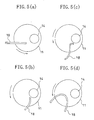
- FIGS. 5(a) to 5(d) and FIGS. 6(a) to 6(d) show variations of the slurry pushing member 18 in terms of the configuration and number thereof.
- the configuration and number of the slurry pushing members 18 are not limited but can be changed properly depending on the viscosity of the slurry 15 and the rotation speed of the platen 11.
- the slurry pushing member 18 may be curved such that the outer portion thereof in the radial direction of the platen 11 has the function of collecting the slurry 15 and that the inner portion thereof in the radial direction of the platen 11 has the function of pushing the collected slurry 15 toward the substrate holding head 14.
- the semiconductor substrate 13 is attached to the substrate holding head 14 with a face to be polished facing downward.
- the slurry 15 is supplied from the slurry supply pipe 16 onto a portion of the polishing pad 12 corresponding to the near-central portion of the platen 11, while the platen 11 and the substrate holding head 14 are rotated counterclockwise (CCW).
- CCW counterclockwise
- the slurry 15 is caused to flow to the peripheral portion of the polishing pad 12 by a centrifugal force accompanying the rotation of the platen 11 to be supplied to the interface between the semiconductor substrate 13 and the polishing pad 12.
- the slurry 15 on the polishing pad 12 tends to flow toward the outside of the polishing pad 12 due to the centrifugal force accompanying the rotation of the platen 11.
- the slurry 15 is brought in contact with the slurry pushing member 18 in one complete rotation of the platen 11 and returned to the central portion of the polishing pad 12 to be reused in the polishing of the semiconductor substrate 13.
- a cleaning liquid such as water is supplied onto the polishing pad 12 to clean the surface to be polished of the semiconductor substrate 13 and remove the slurry 15 from the top surface of the polishing pad 12.
- the platen 11 is rotated clockwise (CW) to remove the slurry remaining on the platen 11 and polishing pad 12.
- CW clockwise
- the timing of rotating the platen 11 and the substrate holding head 14 and the timing of supplying the slurry 15 can be changed as necessary provided that the slurry 15 is supplied prior to the rotation of the platen 11.
- the polishing effect by the slurry 15 remains substantially the same even when the platen 11 is continuously rotated CCW during the removal of the cleaning liquid, except for a slight reduction in the speed at which the cleaning liquid is removed.
- the slurry 15 may be supplied onto a portion other than the portion of the polishing pad 12 corresponding to the near-central portion of the platen 11 provided that it is interior to the outer end of the slurry pushing member 18.
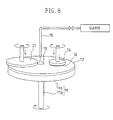
- FIG. 8 is a perspective view schematically showing the construction of the polishing apparatus according to a third embodiment of the present invention.
- the third embodiment comprises: a platen 11; a polishing pad 12; a substrate holding head 14; and a slurry supply pipe 16, similarly to the first embodiment.
- a semiconductor substrate 13 is rotated and pressed against the polishing pad 12 on the platen 11.
- a slurry 15 is supplied in a prescribed amount from the slurry supply pipe 16 onto the polishing pad 12.
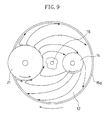
- the third embodiment is characterized in that a circular rotary member 21 as rotatable slurry pushing means is provided in close contact with or slightly spaced from the top surface of the polishing pad 12 on the side opposite to the substrate holding head 14.
- the diameter of the rotary member 21 is determined to be larger than the diameter of the substrate holding head 14.
- the rotary member 21 partially projects from the edge of the polishing pad 12.
- the rotary member 21 rotates in the direction opposite to the rotation of the platen 11 during polishing, while rotating in the same direction as the rotation of the platen 11 during the removal of the cleaning liquid or the like.
- the slurry 15 supplied from the slurry supply pipe 16 onto the polishing pad 12 and directed to the peripheral portion of the platen 11 by a centrifugal force accompanying the rotation of the platen 11 is brought in contact with the outer circumferential surface of the rotary member 21, returned to the central portion of the platen 11 along the outer circumferential surface of the rotary member 21, and evenly spread over the polishing pad 12 to be supplied to the semiconductor substrate 13.
- the arrow above the polishing pad 12 in FIG. 9 conceptually indicates the flow direction of the slurry 15 during polishing.
- the slurry 15 is formed into a swell 15a by the surface tension thereof on the peripheral portion of the polishing pad 12, the swell 15a is eventually pushed back to the central portion of the platen 11 during the rotation of the rotary member 21 since the rotary member 21 partially projects from the edge of the polishing pad 12.
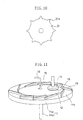
- the plan configuration of the rotary member 21 is not limited to a circle.
- the provision of projecting portions 21a on the outer circumferential surface of the rotary member 21 enhances the effect of pushing the slurry 15 back to the central portion of the platen 11 along the outer circumferential surface of the rotary member 21 rotating in the direction opposite to the rotation of the platen 11.
- the dedicated rotary member 21 is provided as the slurry pushing means in the third embodiment, a rotary member of the same configuration as that of the substrate holding head 14 may be provided in place of the dedicated rotary member 21.
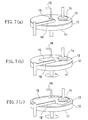
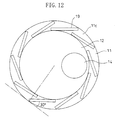
- FIGS. 11 and 12 schematically show the construction of a polishing apparatus according to a fourth embodiment of the present invention, of which FIG. 11 is a perspective view and FIG. 12 is a plan view.
- the fourth embodiment comprises: a platen 11; a polishing pad 12; a substrate holding head 14; and a slurry supply pipe 16, similarly to the first embodiment.
- a semiconductor substrate 13 is rotated and pressed against the polishing pad 12.
- a slurry 15 is supplied in a prescribed amount from the slurry supply pipe 16 onto the polishing pad 12.
- the fourth embodiment is characterized in that the diameter of the polishing pad 12 is smaller than that of the platen 11 so that the polishing pad 12 is disposed on the central portion of the platen 11.
- a plurality of slat-like slurry holding members 19 made of, e.g., polyvinyl chloride are provided as slurry holding means along the outer circumferential surface of the polishing pad 12 to hold the slurry 15 on the polishing pad 12.
- Each of the slurry holding members 19 has such a height that the top position thereof is higher in level than the top surface of the polishing pad 12 and is positioned so that the inner portion thereof in a radial direction of the platen 1 is downstream of the outer portion thereof in the radial direction of the platen 1 in the direction of rotation of the platen 1 during polishing. Specifically, the slurry holding member 19 is fixed so that an angle of about 30 degrees is formed between the slurry holding member 19 and a tangent to the outer circumferential surface of the polishing pad 12.
- the slurry pushing member 18 does not rotate in conjunction with the polishing pad 12 so that the slurry 15 is pushed back to the central portion of the platen 11.
- the slurry holding members 19 rotate in conjunction with the polishing pad 12 so that the slurry 15 is stored on the polishing pad 12.
- the slurry 15 supplied from the slurry supply pipe 16 onto the polishing pad 12 and directed to the peripheral portion of the platen 11 by a centrifugal force accompanying the rotation of the platen 11 changes its direction in collision with the slurry holding members 19 and is stored on the polishing pad 12. Consequently, the slurry 15 is evenly spread over the polishing pad 12 when it is supplied to the semiconductor substrate 13.
- the proper length and angle of the slurry holding member 19 can be selected such that the slurry 15 is held on the polishing pad 12. If any adjacent two of the holding members 19 are provided to overlap in the radial direction of the platen 11, the slurry 15 can be held more positively.
- the slurry holding member 19 may be provided on the polishing pad 12, not on the peripheral portion 11c of the platen 11.
- the material of the slurry holding members 19 is not limited to polyvinyl chloride. Any other material can be used instead, similarly to the second embodiment.
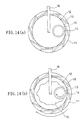
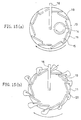
- FIGS. 13(a) to 13(d) show variations of the configuration, placement angle, and number of the slurry holding member 19.
- the configuration, placement angle, and number of the slurry holding member 19 are not particularly limited and can be varied properly depending on the viscosity of the slurry 15 and on the rotation speed of the platen 11. In other words, the slurry holding member 19 may be curved.
- the semiconductor substrate 13 is attached to the substrate holding head 14 with a surface to the polished facing downward and pressed against the polishing pad 12.
- the slurry 15 is supplied from the slurry supply pipe 16 onto a portion of the polishing pad 12 corresponding to the near-central portion of the platen 11, followed by the clockwise (CW) rotation of the platen 11 and substrate holding head 14.
- the slurry 15 flows toward the outside of the polishing pad 12 due to the centrifugal force accompanying the rotation of the platen 11 to be supplied to the interface between the semiconductor substrate 13 and the polishing pad 12.
- the slurry 15 on the polishing pad 12 tends to flow toward the outside of the polishing pad 12 due to the centrifugal force accompanying the rotation of the platen 11, comes into contact with the inner surface of each slurry holding member 19, flows upstream in the direction of rotation of the platen 11 (from the outer portion of each slurry holding member 19 in the radial direction of the polishing pad 12 to the inner portion of the slurry holding member 19 in the radial direction of the polishing pad 12) along the inner surface of the slurry holding member 19, and then moves to the outer portion of the subsequent slurry holding member 19 in the radial direction of the polishing pad 12.
- the slurry 15 is held on the polishing pad 12 and reused in the polishing of the semiconductor substrate 13.
- a cleaning liquid such as water is supplied onto the polishing pad 12 to clean the polished surface of the semiconductor substrate 13 and rinse the slurry 15 out of the top surface of polishing pad 12.
- the platen 11 is rotated counterclockwise (CCW) to remove the cleaning liquid or the like remaining on the platen 11 and on the polishing pad 12.
- CCW counterclockwise
- the cleaning liquid 20 exhibits a flowing movement in the direction opposite to the flowing movement of the slurry 15 described above as shown in FIG. 15(b), so that the cleaning liquid 20 is removed more efficiently than in the case where no slurry holding member 19 is provided.
- the platen 11 is rotated CW during the polishing of the semiconductor substrate 13 and CCW during the removal of the cleaning liquid 20, the platen 11 is rotated CCW during the polishing of the semiconductor substrate 13 and CW during the removal of the cleaning liquid 20 in the case where the orientation in which the slurry holding member 19 is placed is radially reversed.
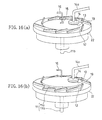
- FIG. 16(a) is a schematic perspective view of a polishing apparatus according to a fifth embodiment of the present invention.
- the fifth embodiment also comprises a platen 11, a polishing pad 12, a substrate holding head 14, and a slurry supply pipe 16, similarly to the first embodiment.
- a semiconductor substrate 13 is rotated and pressed against the polishing pad 12 on the platen 11.
- a slurry 15 is supplied in a prescribed amount from the slurry supply pipe 16 onto the polishing pad 12.
- FIG. 16(a) the drawing of a polishing-pad holder 11a of the platen 11 is omitted.
- the fifth embodiment is characterized in that a ring-shaped vertically movable member 22 moving vertically relative to the platen 11 and rotated by rotating means other than the rotating means for the platen 11 is provided on the outside of the polishing-pad holder 11a of the platen 11.
- a plurality of slat-like slurry holding members 19 having the same configuration as in the fourth embodiment is provided as the slurry holding means along the outer circumferential surface of the polishing pad 12 to hold the slurry 15 on the polishing pad 12.
- the slurry holding members 19 move vertically relative to the polishing pad 12 as the vertically movable member 22 moves vertically.
- the slurry holding member 19 is held such that the top position thereof becomes higher in level than the surface of the polishing pad 12 during polishing and that the top position thereof becomes lower in level than the surface of the polishing pad 12 during cleaning.
- the fifth embodiment is also characterized in that an arm 14a of the substrate holding head 14 performs a rotary movement over the surface of the polishing pad 12.
- the two-dimensional arrangement of the slurry holding members 19 is the same as in the fourth embodiment so that the slurry 15 supplied from the slurry supply pipe 16 onto the polishing pad 12 and directed to the peripheral portion of the platen 11 by the centrifugal force accompanying the rotation of the platen 11 changes its direction in collision with the slurry holding members 19 and is stored on the polishing pad 12. As a result, the slurry 15 is evenly spread over the polishing pad 12 before it is used in the polishing of the semiconductor substrate 13.
- the semiconductor substrate 13 is attached to the substrate holding head with a surface to be polished facing downward and pressed against the polishing pad 12.
- the slurry 15 is supplied from the slurry supply pipe 16 onto a portion of the polishing pad 12 corresponding to the near-central portion of the platen 11, followed by individual rotations of the platen 11 and the substrate holding head 14. As a result, the slurry 15 flows toward the outside of the polishing pad 12 due to a centrifugal force accompanying the rotation of the platen 11 and is supplied to the interface between the semiconductor substrate 13 and the polishing pad 12.
- the slurry 15 on the polishing pad 12 tends to flow toward the outside of the polishing pad 12 due to the centrifugal force accompanying the rotation of the platen 11, charges its flow direction in collision with the slurry holding member 19, is stored on the polishing pad 12, and evenly spread over the polishing pad 12 before it is used to polish the semiconductor substrate 13.
- the vertically movable member 22 is moved downward relative to the platen 11, as shown in FIG. 16(b).
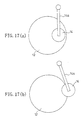
- the arm 14a of the substrate holding head 14 is rotated along the surface of the polishing pad 12 so that a part of the substrate holding head 14 and therefore a part of the semiconductor substrate 13 thrust out from the polishing pad 12. Consequently, the adhesion of the polishing pad 12 to the semiconductor substrate 13 is reduced to permit easy removal of the semiconductor substrate 13 from the polishing pad 12.
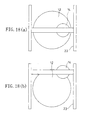
- FIGS. 18(a) and 18(b) show another structure in which the substrate holding head 14 is moved along the surface of the polishing pad 12.
- the substrate holding head 14 is held by a horizontal movable member 23 moving horizontally in parallel with the surface of the polishing pad 12.
- the vertically movable member 22 is moved downward relative to the platen 11 as shown in FIG. 16(b) and then the horizontal movable member 23 is moved horizontally as shown in FIGS. 18(a) and 18(b) to move the substrate holding head 14 along the surface of the polishing pad 12. Consequently, a part of the substrate holding head 14 and therefore a part of the semiconductor substrate 13 thrust out from the polishing pad 12, so that the semiconductor substrate 13 is removed easily from the top surface of the polishing pad 12.
- FIG. 19 schematically shows the plan configuration of a polishing apparatus according to a sixth embodiment of the present invention.
- the sixth embodiment also comprises a platen 11, a polishing pad 12, a substrate holding head 14, and a slurry supply pipe 16, similarly to the first embodiment.
- a semiconductor substrate 13 is rotated and pressed against the polishing pad 12 on the platen 11.
- a slurry 15 is supplied in a prescribed amount from the slurry supply pipe 16 onto the polishing pad 12.
- the drawing of a polishing-pad holder 11a of the platen 11 is omitted.
- the sixth embodiment is characterized in that a ring-shaped rotary member 24 rotated in a plane vertical to the surface of the polishing pad 12 by rotating means other than the rotating means for the platen 11 is provided outside the polishing-pad holder 11a of the platen 11.
- the drawing of a mechanism for rotating the rotary member 24 is omitted here.
- On the rotary member 24, a plurality of slat-like slurry holding members 19 having the same configuration as in the fourth embodiment are provided as the slurry holding means along the outer circumferential surface of the polishing pad 12 to hold the slurry 15 on the polishing pad 12.
- the slurry holding member 19 rotates relative to the polishing pad 12 with the rotation of the rotary member 24.
- the slurry holding member 19 is held so that the top position thereof becomes higher in level than the surface of the polishing pad 12 during polishing.
- An arm 14a of the substrate holding head 14 is provided to perform a rotary movement over the surface of the polishing pad 12, similarly to the fifth embodiment.
- the two-dimensional arrangement of the slurry holding member 19 is the same as in the fourth embodiment so that the slurry 15 supplied from the slurry supply pipe 16 and directed to the peripheral portion of the platen 11 by a centrifugal force accompanying the rotation of the platen 11 changes its direction in collision with the slurry holding member 19 and is stored on the polishing pad 12. As a result, the slurry 15 is evenly spread over the polishing pad 12 before it is used in the polishing of the semiconductor substrate 13.
- the slurry 15 is supplied from the slurry supply pipe 16 onto a portion of the polishing pad 12 corresponding to the near-central portion of the platen 11, while the platen 11 and the substrate holding head 14 are rotated individually.
- the slurry 15 flows toward the outside of the polishing pad 12 due to the centrifugal force accompanying the rotation of the platen 11 and is supplied to the interface between the semiconductor substrate 13 and the polishing pad 12.
- the slurry 15 on the polishing pad 12 tends to flow to the outside of the polishing pad 12 due to the centrifugal force accompanying the rotation of the platen 11 but changes its direction in collision with the slurry holding member 19 and is stored on the polishing pad 12.
- the slurry 15 is evenly spread over the polishing pad 12 before it is used in the polishing of the semiconductor substrate 13.
- the rotary member 24 is rotated in a plane vertical to the surface of the polishing pad 12, as shown in FIG. 20, and then the arm 14a of the substrate holding head 14 is rotated over the surface of the polishing pad 12 so that a part of the substrate holding head 14 and therefore a part of the semiconductor substrate 13 thrust out from the polishing pad 12, similarly to the fifth embodiment. Consequently, the adhesion of the polishing pad 12 to the semiconductor substrate 13 is reduced to permit easy removal of the semiconductor substrate 13 from the polishing pad 12.
- the substrate holding head 14 may be held by a horizontal movable member 23 moving horizontally in parallel with the surface of the polishing pad 12 so that a part of the substrate holding head 14 and therefore a part of the semiconductor substrate 13 thrust out from the polishing pad 12.
- FIG. 21 shows respective relationships between the amounts of supplied slurry and the polishing rates in the case where polishing is performed by using the polishing apparatus according to the individual embodiments of the present invention and in the case where polishing is performed by using the conventional polishing apparatus.
- the amount of supplied slurry required to maintain a sufficient polishing rate is L0 in the conventional embodiment
- the present invention requires L1, which is smaller than L0, to maintain a polishing rate on the same order as in the conventional embodiment.
Landscapes
- Engineering & Computer Science (AREA)
- Mechanical Engineering (AREA)
- Finish Polishing, Edge Sharpening, And Grinding By Specific Grinding Devices (AREA)
- Mechanical Treatment Of Semiconductor (AREA)
Claims (18)
- Eine Vorrichtung zum Polieren eines Halbleitersubstrats (13) mit:wobei die Poliermittelschiebeplatte (18) eine Schiebeplatte (18) ist, die über dem Polierelement (12) gehalten wird, um das Poliermittel (15), das durch die Zentrifugalkraft, die die Rotation der Platte (11) begleitet, damit in Kontakt gebracht wird, zu dem zentralen Teil der Platte (11) zu schieben;einer Platte (11), die eine flache Oberfläche (11a) hat und um eine Welle (11b), die senkrecht zu der Oberfläche (11a) angeordnet ist, rotiert;einem Polierelement (12), das auf der flachen Oberfläche (11a) der Platte (11) angeordnet ist;Poliermittelzuführungsmittel (16) zum Zuführen von Poliermittel (15) auf das Polierelement (12);Substrathaltemittel (14) zum Halten des Halbleitersubstrates (13) und um es gegen das Polierelement (12) zu drücken; undeiner Poliermittelschiebeplatte (18) zum Schieben des Poliermittels (15), das auf das Polierelement (12) zugeführt wird und durch eine Zentrifugalkraft, die die Rotation der Platte (11) begleitet, veranlasst wird, zu einem peripheren Teil der Platte (11) zu fließen, zu einem zentralen Teil der Platte (11);
wobei
die Schiebeplatte (18) so angeordnet ist, dass sie eine radiale Richtung auf der Platte (11) schneidet, so dass ein innerer Teil (18a) der Schiebeplatte (18) in der radialen Richtung der Platte (11) stromab in der Richtung der Rotation der Platte (11) während des Polierens von einem äußeren Teil (18b) der Schiebeplatte (18) in der radialen Richtung der Platte (11) ist. - Eine Vorrichtung zum Polieren eines Halbleitersubstrats nach Anspruch 1, wobei die Schiebeplatte (18) in einer Richtung entgegengesetzt zu der Rotation der Platte (11) während des Polierens rotierbar vorgesehen ist.
- Eine Vorrichtung zum Polieren eines Halbleitersubstrats (13) mit:wobei die Poliermittelschiebeplatte (18) eine Schiebeplatte (18) ist, die über dem Polierelement (12) gehalten wird, um das Poliermittel (15), das durch die Zentrifugalkraft, die die Rotation der Platte (11) begleitet, damit in Kontakt gebracht wird, zu dem zentralen Teil der Platte (11) zu schieben;einer Platte (11), die eine flache Oberfläche (11a) hat und um eine Welle (11b), die senkrecht zu der Oberfläche (11a) angeordnet ist, rotiert;einem Polierelement (12), das auf der flachen Oberfläche (11a) der Platte (11) angeordnet ist;Poliermittelzuführungsmittel (16) zum Zuführen von Poliermittel (15) auf das Polierelement (12);Substrathaltemittel (14) zum Halten des Halbleitersubstrates (13) und um es gegen das Polierelement (12) zu drücken; undeiner Poliermittelschiebeplatte (18) zum Schieben des Poliermittels (15), das auf das Polierelement (12) zugeführt wird und durch eine Zentrifugalkraft, die die Rotation der Platte (11) begleitet, veranlasst wird, zu einem peripheren Teil der Platte (11) zu fließen, zu einem zentralen Teil der Platte (11);
wobei
mehrere Schiebeplatten (18) entlang der Peripherie der Platte (11) beabstandet sind. - Vorrichtung zum Polieren eines Halbleitersubstrats (13) mit:miteiner Platte (11), die eine flache Oberfläche (11a) hat und um eine Welle (11b), die vertikal zu der flachen Oberfläche (11a) angeordnet ist, rotiert;einem Polierelement (12), das auf der flachen Oberfläche (11a) der Platte (11) angeordnet ist;Poliermittelzuführungsmittel (16) zum Zuführen von Poliermittel (15) auf das Polierelement (12);Substrathaltemittel (14) zum Halten des Halbleitersubstrats (13) und um es gegen das Polierelement (12) zu drücken;
Poliermittelschiebemittel (17) zum Schieben des Poliermittels (15), das auf das Polierelement (12) zugeführt wird und durch eine Zentrifugalkraft, die die Rotation der Platte (11) begleitet, veranlasst wird, zu einem peripheren Teil der Platte (11) zu fließen, zu einem zentralen Teil der Platte (11), wobei das Poliermittelschiebemittel (17) Gasausstoßmittel (17a) hat, um ein Gas zum Schieben des Poliermittlels (15) auf dem Polierelement (12) zu einem zentralen Teil der Platte (11) hin auszustoßen. - Vorrichtung zum Polieren eines Halbleitersubstrats nach Anspruch 4, wobei mehrere Gasausstoßmittel (17a) entlang der Peripherie der Platte (11) vorgesehen sind.
- Vorrichtung zum Polieren eines Halbleitersubstrats (13) mit:wobeieiner Platte (11), die eine flache Oberfläche (11a) hat und um eine Welle (11b), die vertikal zu der flachen Oberfläche (11a) angeordnet ist, rotiert;einem Polierelement (12), das auf der flachen Oberfläche (11a) der Platte (11) angeordnet ist;Poliermittelzuführungsmittel (16) um Poliermittel (15) auf das Polierelement (12) zuzuführen;Substrathaltemittel (14) zum Halten eines Halbleitersubstrats (13) und um es gegen das Polierelement (12) zu drücken;Poliermittelschiebemittel (21) zum Schieben des Poliermittels (15), das auf das Polierelement (12) zugeführt wird und durch eine Zentrifugalkraft, die die Rotation der Platte (11) begleitet, veranlasst wird, zu einem peripheren Teil der Platte (11) zu fließen, zu einem zentralen Teil der Platte (11), wobei das Poliermittelschiebemittel (21) ein Rotationselement (21) hat, das in Kontakt oder leicht beabstandet von der oberen Oberfläche des Polierelements (12) vorgesehen ist und in einer Richtung entgegengesetzt zu der Rotation der Platte (11) rotiert,
das Rotationselement (21) einen vorstehenden Teil auf der Außenumfangsoberfläche davon hat. - Vorrichtung zum Polieren eines Halbleitersubstrats (13) mit:wobeieiner Platte (11), die eine flache Oberfläche (11a) hat und um eine Welle (11b), die vertikal zu der flachen Oberfläche (11a) angeordnet ist, rotiert;einem Polierelement (12), das auf der flachen Oberfläche (11a) der Platte (11) angeordnet ist;Poliermittelzuführungsmittel (16) zum Zuführen von Poliermittel (15) auf das Polierelement (12);Substrathaltemittel (14) zum Halten eines Halbleitersubstrats (13) und um es gegen das Polierelement (12) zu drücken; undeinem Poliermittelhalteelement (19), das an dem Randteil der Platte (11) vorgesehen ist,
das Poliermittelhalteelement (19) so vorgesehen ist, dass ein innerer Teil des Poliermittelhalteelements (19) in einer radialen Richtung der Platte (11) stromab in der Richtung der Rotation der Platte (11) während des Polierens von einem äuβeren Teil des Poliermittelhalteelements (19) in der radialen Richtung der Platte (11) ist, so dass das Poliermittel (15), das auf das Polierelement (12) zugeführt wird und durch eine Zentrifugalkraft, die die Rotation der Platte (11) begleitet, veranlasst wird, zu einem peripheren Teil der Platte (11) zu fließen, auf dem Polierelement (12) gehalten wird. - Vorrichtung zum Polieren eines Halbleitersubstrats nach Anspruch 7, wobei mehrere Poliermittelhalteelemente (19) entlang der Peripherie der Platte (11) beabstandet sind.
- Vorrichtung zum Polieren eines Halbleitersubstrats nach Anspruch 8, wobei sich benachbarte von den mehreren Poliermittelhalteelementen (19) in der radialen Richtung der Platte (11) überlappen.
- Vorrichtung zum Polieren eines Halbleitersubstrats nach Anspruch 7, wobei das Poliermittelhalteelement (19) aufwärts, abwärts oder von dem Polierelement (12) auswärts beweglich vorgesehen ist, und
das Substrathaltemittel (14) in einer Ebene parallel zu dem Polierelement (12) beweglich ist, während es das Halbleitersubstrat (13) hält. - Verfahren zum Polieren eines Halbleitersubstrats mit:wobei die Schiebeplatte (18) über dem Polierelement (12) gehalten wird;einem Poliermittelzuführungsschritt, des Zuführens von Poliermittel (15) auf ein Polierelement (12), das auf einer flachen Oberfläche (11a) einer Platte (11), um eine Welle (11b), die vertikal zu der flachen Oberfläche (11a) angeordnet ist, rotierend angeordnet ist;einen Substratpolierschritt des Polierens eines Halbleitersubstrats (13) durch Drücken des Halbleitersubstrats (13) gegen das Polierelement (12);ein Poliermittelschiebeschritt des Schiebens des Poliermittels (15), das auf das Polierelement (12) zugeführt wird und durch eine Zentrifugalkraft, die die Rotation der Platte (11) begleitet, veranlasst wird, zu einem peripheren Teil der Platte (11) zu fließen, zu einem zentralen Teil der Platte (11), wobei der Poliermittelschiebeschritt einen Schritt des Schiebens des Poliermittels (15) auf dem Polierelement (12) zu dem zentralen Teil der Platte (11) mittels einer Schiebeplatte (18) beinhaltet;
wobei
der Poliermittelschiebeschritt einen Schritt des Schiebens des Poliermittels (15) auf dem Polierelement (12) zu dem zentralen Teil der Platte (11) beinhaltet und zwar mittels der Schiebeplatte (18), die so angeordnet ist, dass sie eine radiale Richtung auf der Platte so schneidet, dass ein innerer Teil (18a) der Schiebeplatte (18) in der radialen Richtung der Platte (11) stromab in der Richtung der Rotation der Platte (11) während des Polierens von einem äußeren Teil (18b) der Schiebeplatte (18) in der radialen Richtung der Platte (11) ist. - Verfahren zum Polieren eines Halbleitersubstrats mit:wobei die Schiebeplatte (18) über dem Polierelement (12) gehalten wird;einem Poliermittelzuführungsschritt, des Zuführens von Poliermittel (15) auf ein Polierelement (12), das auf einer flachen Oberfläche (11a) einer Platte (11), um eine Welle (11b), die vertikal zu der flachen Oberfläche (11a) angeordnet ist, rotierend angeordnet ist;einen Substratpolierschritt des Polierens eines Halbleitersubstrats (13) durch Drücken des Halbleitersubstrats (13) gegen das Polierelement (12);ein Poliermittelschiebeschritt des Schiebens des Poliermittels (15), das auf das Polierelement (12) zugeführt wird und durch eine Zentrifugalkraft, die die Rotation der Platte (11) begleitet, veranlasst wird, zu einem peripheren Teil der Platte (11) zu fließen, zu einem zentralen Teil der Platte (11), wobei der Poliermittelschiebeschritt einen Schritt des Schiebens des Poliermittels (15) auf dem Polierelement (12) zu dem zentralen Teil der Platte (11) mittels einer Schiebeplatte (18) beinhaltet;
wobei
das Verfahren weiterhin einen Reinigungsflüssigkeit-Entfemungsschritt des Entfemens einer Reinigungsflüssigkeit, die auf das Polierelement (12) zugeführt wird, durch Rotation der Platte (11) in einer zu der Rotation der Platte (11) während des Polierens entgegengesetzten Richtung, umfasst. - Verfahren zum Polieren eines Halbleitersubstrats mit:wobei es weiter einen Poliermittelschiebeschritt des Schiebens des Poliermittels (15), das auf das Polierelement (12) zugeführt wird und durch eine Zentrifugalkraft, die die Rotation der Platte (11) begleitet, veranlasst wird, zu einem peripheren Teil der Platte (11) zu fließen, zu einem zentralen Teil der Platte (11), gibt,einem Poliermittelzuführungsschritt, des Zuführens von Poliermittel (15) auf ein Polierelement (12), das auf einer flachen Oberfläche (11a) einer Platte (11), um eine Welle (11b), die vertikal zu der flachen Oberfläche (11a) angeordnet ist, rotierend angeordnet ist;einem Substratpolierschritt des Polierens eines Halbleitersubstrats (13), bei dem das Poliermittel (15) auf das Polierelement (12) zugeführt wird,
wobei der Poliermittelschiebeschritt den Schritt des Ausstoßens von Gas zu einem zentralen Teil der Platte (11) hin einschließt, um das Poliermittel (15) auf dem Polierelement (12) zu dem zentralen Teil der Platte (11) zu schieben. - Verfahren zum Polieren eines Halbleitersubstrats mit:wobeieinem Poliermittelzuführungsschritt des Zuführen eines Poliermittels (15) auf ein Polierelement (12), das auf einer flachen Oberfläche (11a) einer Platte (11) angeordnet ist und um eine Welle(11b), die vertikal zu der flachen Oberfläche (11a) angeordnet ist, rotiert wird;einem Substratpolierschritt des Polierens eines Halbleitersubstrats (13) durch Drücken des Halbleitersubstrats (13) gegen das Polierelement (12); undeinem Poliermittelhalteschritt des Haltens des Poliermittels (15), das auf das Polierelement (12) zugeführt wird und durch eine Zentrifugalkraft, die die Rotation der Platte (11) begleitet, veranlasst wird, zu einem peripheren Teil der Platte (11) zu fließen, auf dem Polierelement,
der Poliermittelhalteschritt mittels eines Poliermittelhalteelements (19) durchgeführt wird, das an einem Randteil der Platte (11) so befestigt ist, dass ein innerer Teil des Poliermittelhalteelements (19) in der radialen Richtung der Platte (11) stromab in der Richtung der Rotation der Platte (11) während des Polierens von einem äußeren Teil des Poliermittelhalteelements (19) in der radialen Richtung der Platte (11) ist. - Verfahren zum Polieren eines Halbleitersubstrats nach Anspruch 14, wobei der Poliermittelhalteschritt den Schritt des Haltens des Poliermittels (15) auf dem Polierelement (12) mittels mehrerer Poliermittelhalteelemente (19) beinhaltet, die entlang der Peripherie der Platte beabstandet sind.
- Verfahren zum Polieren eines Halbleitersubstrats nach Anspruch 15, wobei der Poliermittelhalteschritt den Schritt des Haltens des Poliermittels (15) auf dem Polierelement (12) mittels mehrerer Poliermittelhalteelemente (19) beinhaltet, wobei sich benachbarte Poliermittelhalteelemente in der radialen Richtung der Platte (11) überlappen.
- Verfahren zum Polieren eines Halbleitersubstrats nach Anspruch 14, weiterhin mit einem Reinigungsflüssigkeits-Entfemungsschritt des Entfernens einer Reinigungsflüssigkeit, die auf das Polierelement (12) zugeführt wird, durch Rotation der Platte (11) in einer Richtung entgegengesetzt zu der Rotation der Platte (11) während des Polierens.
- Verfahren zum Polieren eines Halbleitersubstrats nach Anspruch 14, weiterhin mit:einem Poliermittelhalteelement-Bewegungsschritt des Bewegens des Poliermittelhaltemittels (19) aufwärts, abwärts oder auswärts von dem Polierelement (12); undeinem Substratbewegungsschritt des Bewegens des Halbleitersubstrats (13) in einer Ebene parallel zu dem Polierelement (12), so dass sich wenigstens ein Teil des Halbleitersubstrats (13) von dem Polierelement (12) herausschiebt.
Applications Claiming Priority (3)
| Application Number | Priority Date | Filing Date | Title |
|---|---|---|---|
| JP23135595 | 1995-09-08 | ||
| JP23135595 | 1995-09-08 | ||
| JP231355/95 | 1995-09-08 |
Publications (2)
| Publication Number | Publication Date |
|---|---|
| EP0763402A1 EP0763402A1 (de) | 1997-03-19 |
| EP0763402B1 true EP0763402B1 (de) | 2002-01-30 |
Family
ID=16922329
Family Applications (1)
| Application Number | Title | Priority Date | Filing Date |
|---|---|---|---|
| EP96113864A Expired - Lifetime EP0763402B1 (de) | 1995-09-08 | 1996-08-29 | Verfahren und Vorrichtung zum Polieren von Halbleitersubstraten |
Country Status (4)
| Country | Link |
|---|---|
| US (1) | US5866480A (de) |
| EP (1) | EP0763402B1 (de) |
| KR (1) | KR970018240A (de) |
| DE (1) | DE69618882T2 (de) |
Families Citing this family (19)
| Publication number | Priority date | Publication date | Assignee | Title |
|---|---|---|---|---|
| JP2833552B2 (ja) * | 1995-10-19 | 1998-12-09 | 日本電気株式会社 | ウェハ研磨方法および研磨装置 |
| JPH10329011A (ja) | 1997-03-21 | 1998-12-15 | Canon Inc | 精密研磨装置及び方法 |
| US5921849A (en) * | 1997-06-04 | 1999-07-13 | Speedfam Corporation | Method and apparatus for distributing a polishing agent onto a polishing element |
| JP2000216120A (ja) * | 1999-01-27 | 2000-08-04 | Mitsubishi Electric Corp | 研磨装置およびこれを用いた半導体装置の製造方法 |
| US6429131B2 (en) * | 1999-03-18 | 2002-08-06 | Infineon Technologies Ag | CMP uniformity |
| JP2001138233A (ja) * | 1999-11-19 | 2001-05-22 | Sony Corp | 研磨装置、研磨方法および研磨工具の洗浄方法 |
| US6887132B2 (en) * | 2001-09-10 | 2005-05-03 | Multi Planar Technologies Incorporated | Slurry distributor for chemical mechanical polishing apparatus and method of using the same |
| JP4101609B2 (ja) * | 2001-12-07 | 2008-06-18 | 大日本スクリーン製造株式会社 | 基板処理方法 |
| JP2003324085A (ja) * | 2002-05-01 | 2003-11-14 | Mitsubishi Electric Corp | 半導体ウエハの研磨装置および研磨方法 |
| US7128803B2 (en) * | 2002-06-28 | 2006-10-31 | Lam Research Corporation | Integration of sensor based metrology into semiconductor processing tools |
| US7309618B2 (en) | 2002-06-28 | 2007-12-18 | Lam Research Corporation | Method and apparatus for real time metal film thickness measurement |
| JP2005271151A (ja) * | 2004-03-25 | 2005-10-06 | Toshiba Corp | 研磨装置及び研磨方法 |
| JP5298383B2 (ja) * | 2007-04-25 | 2013-09-25 | Esファイバービジョンズ株式会社 | 嵩高性、柔軟性に優れた熱接着性複合繊維及びこれを用いた繊維成形品 |
| KR101110268B1 (ko) * | 2010-04-30 | 2012-02-16 | 삼성전자주식회사 | 로터리 유니온을 구동하는 공압 공급관의 꼬임을 방지하는 화학 기계식 연마시스템 |
| TWI517935B (zh) * | 2013-04-16 | 2016-01-21 | 國立台灣科技大學 | 氣體添加硏磨液的供應系統及其方法 |
| JP6975078B2 (ja) | 2018-03-15 | 2021-12-01 | キオクシア株式会社 | 半導体製造装置および半導体装置の製造方法 |
| JP7083722B2 (ja) | 2018-08-06 | 2022-06-13 | 株式会社荏原製作所 | 研磨装置、及び、研磨方法 |
| JP7162465B2 (ja) | 2018-08-06 | 2022-10-28 | 株式会社荏原製作所 | 研磨装置、及び、研磨方法 |
| CN111113224B (zh) * | 2019-12-27 | 2020-11-27 | 绍兴圣万特热流道有限公司 | 一种热流道模具的自动化加工设备 |
Citations (1)
| Publication number | Priority date | Publication date | Assignee | Title |
|---|---|---|---|---|
| EP0763401A1 (de) * | 1995-08-24 | 1997-03-19 | Matsushita Electric Industrial Co., Ltd. | Verfahren und Vorrichtung zum Polieren von Halbleiterscheiben |
Family Cites Families (8)
| Publication number | Priority date | Publication date | Assignee | Title |
|---|---|---|---|---|
| US4910155A (en) * | 1988-10-28 | 1990-03-20 | International Business Machines Corporation | Wafer flood polishing |
| US5081051A (en) * | 1990-09-12 | 1992-01-14 | Intel Corporation | Method for conditioning the surface of a polishing pad |
| US5308438A (en) * | 1992-01-30 | 1994-05-03 | International Business Machines Corporation | Endpoint detection apparatus and method for chemical/mechanical polishing |
| US5216843A (en) * | 1992-09-24 | 1993-06-08 | Intel Corporation | Polishing pad conditioning apparatus for wafer planarization process |
| US5341602A (en) * | 1993-04-14 | 1994-08-30 | Williams International Corporation | Apparatus for improved slurry polishing |
| JP2903980B2 (ja) * | 1993-11-30 | 1999-06-14 | 信越半導体株式会社 | ウエーハの研磨方法および装置 |
| US5650039A (en) * | 1994-03-02 | 1997-07-22 | Applied Materials, Inc. | Chemical mechanical polishing apparatus with improved slurry distribution |
| US5527424A (en) * | 1995-01-30 | 1996-06-18 | Motorola, Inc. | Preconditioner for a polishing pad and method for using the same |
-
1996
- 1996-08-20 KR KR1019960034339A patent/KR970018240A/ko not_active Withdrawn
- 1996-08-26 US US08/697,509 patent/US5866480A/en not_active Expired - Lifetime
- 1996-08-29 EP EP96113864A patent/EP0763402B1/de not_active Expired - Lifetime
- 1996-08-29 DE DE69618882T patent/DE69618882T2/de not_active Expired - Lifetime
Patent Citations (1)
| Publication number | Priority date | Publication date | Assignee | Title |
|---|---|---|---|---|
| EP0763401A1 (de) * | 1995-08-24 | 1997-03-19 | Matsushita Electric Industrial Co., Ltd. | Verfahren und Vorrichtung zum Polieren von Halbleiterscheiben |
Also Published As
| Publication number | Publication date |
|---|---|
| DE69618882T2 (de) | 2002-07-11 |
| US5866480A (en) | 1999-02-02 |
| DE69618882D1 (de) | 2002-03-14 |
| EP0763402A1 (de) | 1997-03-19 |
| KR970018240A (ko) | 1997-04-30 |
Similar Documents
| Publication | Publication Date | Title |
|---|---|---|
| EP0763402B1 (de) | Verfahren und Vorrichtung zum Polieren von Halbleitersubstraten | |
| US5769697A (en) | Method and apparatus for polishing semiconductor substrate | |
| US5749771A (en) | Polishing apparatus for finishing semiconductor wafer at high polishing rate under economical running cost | |
| US9375825B2 (en) | Polishing pad conditioning system including suction | |
| US20020068516A1 (en) | Apparatus and method for controlled delivery of slurry to a region of a polishing device | |
| EP0764478A1 (de) | Verfahren und Vorrichtung für die Reinigung von Werkstücken | |
| US6364752B1 (en) | Method and apparatus for dressing polishing cloth | |
| US20040203325A1 (en) | Conditioner disk for use in chemical mechanical polishing | |
| US20100197204A1 (en) | Apparatuses and methods for conditioning polishing pads used in polishing micro-device workpieces | |
| JP2001018169A (ja) | 研磨装置 | |
| US6409579B1 (en) | Method and apparatus for conditioning a polish pad at the point of polish and for dispensing slurry at the point of polish | |
| US11890717B2 (en) | Polishing system with platen for substrate edge control | |
| US6343977B1 (en) | Multi-zone conditioner for chemical mechanical polishing system | |
| US6793565B1 (en) | Orbiting indexable belt polishing station for chemical mechanical polishing | |
| US10974366B2 (en) | Conditioning wheel for polishing pads | |
| US6813796B2 (en) | Apparatus and methods to clean copper contamination on wafer edge | |
| JP2983905B2 (ja) | 半導体基板の研磨方法及びその装置 | |
| JP3326841B2 (ja) | 研磨装置 | |
| WO2004059714A1 (ja) | 研磨装置及び半導体デバイスの製造方法 | |
| JPH10309661A (ja) | 半導体基板の研磨方法及びその装置 | |
| JP3692970B2 (ja) | 研磨パッド | |
| JP3646430B2 (ja) | 化学的機械研磨方法及び化学的機械研磨装置 | |
| WO1998012020A1 (en) | Methods and apparatus for uniform polishing of a workpiece | |
| EP0769350A1 (de) | Verfahren und Vorrichtung zum Abrichten von Poliertuch | |
| CN110744444B (zh) | 研磨垫及研磨装置 |
Legal Events
| Date | Code | Title | Description |
|---|---|---|---|
| PUAI | Public reference made under article 153(3) epc to a published international application that has entered the european phase |
Free format text: ORIGINAL CODE: 0009012 |
|
| AK | Designated contracting states |
Kind code of ref document: A1 Designated state(s): DE FR GB |
|
| 17P | Request for examination filed |
Effective date: 19970320 |
|
| 17Q | First examination report despatched |
Effective date: 19991026 |
|
| GRAG | Despatch of communication of intention to grant |
Free format text: ORIGINAL CODE: EPIDOS AGRA |
|
| GRAG | Despatch of communication of intention to grant |
Free format text: ORIGINAL CODE: EPIDOS AGRA |
|
| GRAH | Despatch of communication of intention to grant a patent |
Free format text: ORIGINAL CODE: EPIDOS IGRA |
|
| GRAH | Despatch of communication of intention to grant a patent |
Free format text: ORIGINAL CODE: EPIDOS IGRA |
|
| GRAA | (expected) grant |
Free format text: ORIGINAL CODE: 0009210 |
|
| REG | Reference to a national code |
Ref country code: GB Ref legal event code: IF02 |
|
| AK | Designated contracting states |
Kind code of ref document: B1 Designated state(s): DE FR GB |
|
| REF | Corresponds to: |
Ref document number: 69618882 Country of ref document: DE Date of ref document: 20020314 |
|
| ET | Fr: translation filed | ||
| PLBE | No opposition filed within time limit |
Free format text: ORIGINAL CODE: 0009261 |
|
| STAA | Information on the status of an ep patent application or granted ep patent |
Free format text: STATUS: NO OPPOSITION FILED WITHIN TIME LIMIT |
|
| 26N | No opposition filed | ||
| PGFP | Annual fee paid to national office [announced via postgrant information from national office to epo] |
Ref country code: FR Payment date: 20090814 Year of fee payment: 14 |
|
| PGFP | Annual fee paid to national office [announced via postgrant information from national office to epo] |
Ref country code: GB Payment date: 20090826 Year of fee payment: 14 Ref country code: DE Payment date: 20090827 Year of fee payment: 14 |
|
| GBPC | Gb: european patent ceased through non-payment of renewal fee |
Effective date: 20100829 |
|
| REG | Reference to a national code |
Ref country code: FR Ref legal event code: ST Effective date: 20110502 |
|
| REG | Reference to a national code |
Ref country code: DE Ref legal event code: R119 Ref document number: 69618882 Country of ref document: DE Effective date: 20110301 |
|
| PG25 | Lapsed in a contracting state [announced via postgrant information from national office to epo] |
Ref country code: DE Free format text: LAPSE BECAUSE OF NON-PAYMENT OF DUE FEES Effective date: 20110301 Ref country code: FR Free format text: LAPSE BECAUSE OF NON-PAYMENT OF DUE FEES Effective date: 20100831 |
|
| PG25 | Lapsed in a contracting state [announced via postgrant information from national office to epo] |
Ref country code: GB Free format text: LAPSE BECAUSE OF NON-PAYMENT OF DUE FEES Effective date: 20100829 |