EP0757698B1 - Cationische katalysatoren und verfahren zur verwendung derselben - Google Patents
Cationische katalysatoren und verfahren zur verwendung derselben Download PDFInfo
- Publication number
- EP0757698B1 EP0757698B1 EP95917752A EP95917752A EP0757698B1 EP 0757698 B1 EP0757698 B1 EP 0757698B1 EP 95917752 A EP95917752 A EP 95917752A EP 95917752 A EP95917752 A EP 95917752A EP 0757698 B1 EP0757698 B1 EP 0757698B1
- Authority
- EP
- European Patent Office
- Prior art keywords
- substituted
- cation
- polymerization
- hydrocarbyl
- radicals
- Prior art date
- Legal status (The legal status is an assumption and is not a legal conclusion. Google has not performed a legal analysis and makes no representation as to the accuracy of the status listed.)
- Expired - Lifetime
Links
- 239000003054 catalyst Substances 0.000 title claims description 87
- 238000000034 method Methods 0.000 title claims description 58
- 230000008569 process Effects 0.000 title claims description 35
- 239000011951 cationic catalyst Substances 0.000 title description 6
- 239000000178 monomer Substances 0.000 claims description 84
- -1 cyclopentadienyl transition metal cation Chemical class 0.000 claims description 81
- 150000001450 anions Chemical class 0.000 claims description 69
- 238000006116 polymerization reaction Methods 0.000 claims description 69
- 150000001768 cations Chemical class 0.000 claims description 61
- VQTUBCCKSQIDNK-UHFFFAOYSA-N Isobutene Chemical group CC(C)=C VQTUBCCKSQIDNK-UHFFFAOYSA-N 0.000 claims description 47
- 239000000203 mixture Substances 0.000 claims description 47
- 239000002904 solvent Substances 0.000 claims description 34
- 150000001336 alkenes Chemical class 0.000 claims description 32
- ZSWFCLXCOIISFI-UHFFFAOYSA-N endo-cyclopentadiene Natural products C1C=CC=C1 ZSWFCLXCOIISFI-UHFFFAOYSA-N 0.000 claims description 26
- 229910052739 hydrogen Inorganic materials 0.000 claims description 21
- 239000001257 hydrogen Substances 0.000 claims description 21
- 229910052723 transition metal Inorganic materials 0.000 claims description 21
- 229920000642 polymer Polymers 0.000 claims description 20
- 150000003254 radicals Chemical group 0.000 claims description 20
- 150000001875 compounds Chemical class 0.000 claims description 19
- 125000000058 cyclopentadienyl group Chemical group C1(=CC=CC1)* 0.000 claims description 19
- JRZJOMJEPLMPRA-UHFFFAOYSA-N olefin Natural products CCCCCCCC=C JRZJOMJEPLMPRA-UHFFFAOYSA-N 0.000 claims description 19
- 229910052751 metal Inorganic materials 0.000 claims description 18
- 239000002184 metal Substances 0.000 claims description 18
- 125000003118 aryl group Chemical group 0.000 claims description 17
- RRHGJUQNOFWUDK-UHFFFAOYSA-N Isoprene Chemical compound CC(=C)C=C RRHGJUQNOFWUDK-UHFFFAOYSA-N 0.000 claims description 16
- 229910052732 germanium Inorganic materials 0.000 claims description 13
- 125000001183 hydrocarbyl group Chemical group 0.000 claims description 12
- 229910052718 tin Inorganic materials 0.000 claims description 12
- 150000002431 hydrogen Chemical class 0.000 claims description 11
- 229920001577 copolymer Polymers 0.000 claims description 10
- 230000007935 neutral effect Effects 0.000 claims description 10
- UFHFLCQGNIYNRP-UHFFFAOYSA-N Hydrogen Chemical compound [H][H] UFHFLCQGNIYNRP-UHFFFAOYSA-N 0.000 claims description 9
- ATJFFYVFTNAWJD-UHFFFAOYSA-N Tin Chemical group [Sn] ATJFFYVFTNAWJD-UHFFFAOYSA-N 0.000 claims description 9
- 239000003446 ligand Substances 0.000 claims description 9
- 239000002516 radical scavenger Substances 0.000 claims description 9
- GNPVGFCGXDBREM-UHFFFAOYSA-N germanium atom Chemical group [Ge] GNPVGFCGXDBREM-UHFFFAOYSA-N 0.000 claims description 8
- 239000002798 polar solvent Substances 0.000 claims description 8
- 150000003624 transition metals Chemical class 0.000 claims description 8
- JLBJTVDPSNHSKJ-UHFFFAOYSA-N 4-Methylstyrene Chemical group CC1=CC=C(C=C)C=C1 JLBJTVDPSNHSKJ-UHFFFAOYSA-N 0.000 claims description 7
- 229910052736 halogen Inorganic materials 0.000 claims description 7
- 125000001424 substituent group Chemical group 0.000 claims description 7
- 229910052798 chalcogen Inorganic materials 0.000 claims description 6
- 238000004519 manufacturing process Methods 0.000 claims description 6
- 229910052696 pnictogen Inorganic materials 0.000 claims description 6
- 239000002879 Lewis base Substances 0.000 claims description 5
- 150000001993 dienes Chemical class 0.000 claims description 5
- 150000007527 lewis bases Chemical class 0.000 claims description 5
- 150000002738 metalloids Chemical class 0.000 claims description 5
- AQLBDEAOQUJAIE-UHFFFAOYSA-N 10-methylundec-1-ene Chemical compound CC(C)CCCCCCCC=C AQLBDEAOQUJAIE-UHFFFAOYSA-N 0.000 claims description 4
- WSSSPWUEQFSQQG-UHFFFAOYSA-N 4-methyl-1-pentene Chemical compound CC(C)CC=C WSSSPWUEQFSQQG-UHFFFAOYSA-N 0.000 claims description 4
- JIUFYGIESXPUPL-UHFFFAOYSA-N 5-methylhex-1-ene Chemical compound CC(C)CCC=C JIUFYGIESXPUPL-UHFFFAOYSA-N 0.000 claims description 4
- DFVOXRAAHOJJBN-UHFFFAOYSA-N 6-methylhept-1-ene Chemical compound CC(C)CCCC=C DFVOXRAAHOJJBN-UHFFFAOYSA-N 0.000 claims description 4
- DMFDIYIYBVPKNT-UHFFFAOYSA-N 8-methylnon-1-ene Chemical compound CC(C)CCCCCC=C DMFDIYIYBVPKNT-UHFFFAOYSA-N 0.000 claims description 4
- JGFZNNIVVJXRND-UHFFFAOYSA-N N,N-Diisopropylethylamine (DIPEA) Chemical compound CCN(C(C)C)C(C)C JGFZNNIVVJXRND-UHFFFAOYSA-N 0.000 claims description 4
- 229910052752 metalloid Inorganic materials 0.000 claims description 4
- JUHDUIDUEUEQND-UHFFFAOYSA-N methylium Chemical class [CH3+] JUHDUIDUEUEQND-UHFFFAOYSA-N 0.000 claims description 4
- OBAJXDYVZBHCGT-UHFFFAOYSA-N tris(pentafluorophenyl)borane Chemical compound FC1=C(F)C(F)=C(F)C(F)=C1B(C=1C(=C(F)C(F)=C(F)C=1F)F)C1=C(F)C(F)=C(F)C(F)=C1F OBAJXDYVZBHCGT-UHFFFAOYSA-N 0.000 claims description 4
- 229920006395 saturated elastomer Polymers 0.000 claims description 3
- 229910052719 titanium Inorganic materials 0.000 claims description 3
- 239000010936 titanium Substances 0.000 claims description 3
- GJFNRSDCSTVPCJ-UHFFFAOYSA-N 1,8-bis(dimethylamino)naphthalene Chemical compound C1=CC(N(C)C)=C2C(N(C)C)=CC=CC2=C1 GJFNRSDCSTVPCJ-UHFFFAOYSA-N 0.000 claims description 2
- UWKQJZCTQGMHKD-UHFFFAOYSA-N 2,6-di-tert-butylpyridine Chemical compound CC(C)(C)C1=CC=CC(C(C)(C)C)=N1 UWKQJZCTQGMHKD-UHFFFAOYSA-N 0.000 claims description 2
- HVHZEKKZMFRULH-UHFFFAOYSA-N 2,6-ditert-butyl-4-methylpyridine Chemical compound CC1=CC(C(C)(C)C)=NC(C(C)(C)C)=C1 HVHZEKKZMFRULH-UHFFFAOYSA-N 0.000 claims description 2
- RTAQQCXQSZGOHL-UHFFFAOYSA-N Titanium Chemical compound [Ti] RTAQQCXQSZGOHL-UHFFFAOYSA-N 0.000 claims description 2
- QCWXUUIWCKQGHC-UHFFFAOYSA-N Zirconium Chemical compound [Zr] QCWXUUIWCKQGHC-UHFFFAOYSA-N 0.000 claims description 2
- 150000004703 alkoxides Chemical class 0.000 claims description 2
- 150000001638 boron Chemical class 0.000 claims description 2
- 150000001787 chalcogens Chemical class 0.000 claims description 2
- 229910052735 hafnium Inorganic materials 0.000 claims description 2
- VBJZVLUMGGDVMO-UHFFFAOYSA-N hafnium atom Chemical compound [Hf] VBJZVLUMGGDVMO-UHFFFAOYSA-N 0.000 claims description 2
- 125000005842 heteroatom Chemical group 0.000 claims description 2
- 238000006467 substitution reaction Methods 0.000 claims description 2
- 229910052726 zirconium Inorganic materials 0.000 claims description 2
- YHQXBTXEYZIYOV-UHFFFAOYSA-N 3-methylbut-1-ene Chemical compound CC(C)C=C YHQXBTXEYZIYOV-UHFFFAOYSA-N 0.000 claims 1
- HPYIUKIBUJFXII-UHFFFAOYSA-N Cyclopentadienyl radical Chemical group [CH]1C=CC=C1 HPYIUKIBUJFXII-UHFFFAOYSA-N 0.000 claims 1
- YMWUJEATGCHHMB-UHFFFAOYSA-N Dichloromethane Chemical compound ClCCl YMWUJEATGCHHMB-UHFFFAOYSA-N 0.000 description 45
- 125000002091 cationic group Chemical group 0.000 description 27
- 238000006243 chemical reaction Methods 0.000 description 27
- UAEPNZWRGJTJPN-UHFFFAOYSA-N methylcyclohexane Chemical compound CC1CCCCC1 UAEPNZWRGJTJPN-UHFFFAOYSA-N 0.000 description 27
- VLKZOEOYAKHREP-UHFFFAOYSA-N n-Hexane Chemical class CCCCCC VLKZOEOYAKHREP-UHFFFAOYSA-N 0.000 description 27
- XLYOFNOQVPJJNP-UHFFFAOYSA-N water Substances O XLYOFNOQVPJJNP-UHFFFAOYSA-N 0.000 description 25
- 239000004698 Polyethylene Substances 0.000 description 18
- 238000010538 cationic polymerization reaction Methods 0.000 description 18
- ZOXJGFHDIHLPTG-UHFFFAOYSA-N Boron Chemical group [B] ZOXJGFHDIHLPTG-UHFFFAOYSA-N 0.000 description 17
- 229910052796 boron Inorganic materials 0.000 description 17
- OKKJLVBELUTLKV-UHFFFAOYSA-N Methanol Chemical compound OC OKKJLVBELUTLKV-UHFFFAOYSA-N 0.000 description 15
- 229920002367 Polyisobutene Polymers 0.000 description 15
- 125000000217 alkyl group Chemical group 0.000 description 15
- 230000000977 initiatory effect Effects 0.000 description 15
- 235000002639 sodium chloride Nutrition 0.000 description 15
- 238000005160 1H NMR spectroscopy Methods 0.000 description 14
- HEDRZPFGACZZDS-UHFFFAOYSA-N Chloroform Chemical compound ClC(Cl)Cl HEDRZPFGACZZDS-UHFFFAOYSA-N 0.000 description 14
- 239000002841 Lewis acid Substances 0.000 description 14
- YXFVVABEGXRONW-UHFFFAOYSA-N Toluene Natural products CC1=CC=CC=C1 YXFVVABEGXRONW-UHFFFAOYSA-N 0.000 description 14
- 125000001931 aliphatic group Chemical group 0.000 description 14
- MVPPADPHJFYWMZ-UHFFFAOYSA-N chlorobenzene Chemical compound ClC1=CC=CC=C1 MVPPADPHJFYWMZ-UHFFFAOYSA-N 0.000 description 14
- SCABQASLNUQUKD-UHFFFAOYSA-N silylium Chemical compound [SiH3+] SCABQASLNUQUKD-UHFFFAOYSA-N 0.000 description 14
- VGGSQFUCUMXWEO-UHFFFAOYSA-N Ethene Chemical compound C=C VGGSQFUCUMXWEO-UHFFFAOYSA-N 0.000 description 12
- 239000005977 Ethylene Substances 0.000 description 12
- 230000007246 mechanism Effects 0.000 description 12
- 239000003999 initiator Substances 0.000 description 11
- 150000007517 lewis acids Chemical class 0.000 description 11
- 229920000573 polyethylene Polymers 0.000 description 11
- CUNYTKVXYZYERK-UHFFFAOYSA-N 6-(2-prop-2-ynoxyphenyl)hexanoic acid Chemical compound OC(=O)CCCCCC1=CC=CC=C1OCC#C CUNYTKVXYZYERK-UHFFFAOYSA-N 0.000 description 10
- PPBRXRYQALVLMV-UHFFFAOYSA-N Styrene Chemical compound C=CC1=CC=CC=C1 PPBRXRYQALVLMV-UHFFFAOYSA-N 0.000 description 9
- 125000003710 aryl alkyl group Chemical group 0.000 description 8
- 150000003839 salts Chemical class 0.000 description 8
- MHNNAWXXUZQSNM-UHFFFAOYSA-N 2-methylbut-1-ene Chemical compound CCC(C)=C MHNNAWXXUZQSNM-UHFFFAOYSA-N 0.000 description 7
- 239000000243 solution Substances 0.000 description 7
- RTZKZFJDLAIYFH-UHFFFAOYSA-N Diethyl ether Chemical compound CCOCC RTZKZFJDLAIYFH-UHFFFAOYSA-N 0.000 description 6
- 230000015572 biosynthetic process Effects 0.000 description 6
- 239000006227 byproduct Substances 0.000 description 6
- LSXWFXONGKSEMY-UHFFFAOYSA-N di-tert-butyl peroxide Chemical compound CC(C)(C)OOC(C)(C)C LSXWFXONGKSEMY-UHFFFAOYSA-N 0.000 description 6
- 239000012969 di-tertiary-butyl peroxide Substances 0.000 description 6
- ZUOUZKKEUPVFJK-UHFFFAOYSA-N diphenyl Chemical compound C1=CC=CC=C1C1=CC=CC=C1 ZUOUZKKEUPVFJK-UHFFFAOYSA-N 0.000 description 6
- 125000002496 methyl group Chemical group [H]C([H])([H])* 0.000 description 6
- GYNNXHKOJHMOHS-UHFFFAOYSA-N methyl-cycloheptane Natural products CC1CCCCCC1 GYNNXHKOJHMOHS-UHFFFAOYSA-N 0.000 description 6
- 150000003623 transition metal compounds Chemical class 0.000 description 6
- LFQSCWFLJHTTHZ-UHFFFAOYSA-N Ethanol Chemical group CCO LFQSCWFLJHTTHZ-UHFFFAOYSA-N 0.000 description 5
- 229920001400 block copolymer Polymers 0.000 description 5
- UORVGPXVDQYIDP-UHFFFAOYSA-N borane Chemical class B UORVGPXVDQYIDP-UHFFFAOYSA-N 0.000 description 5
- 125000000484 butyl group Chemical group [H]C([*])([H])C([H])([H])C([H])([H])C([H])([H])[H] 0.000 description 5
- 150000002367 halogens Chemical class 0.000 description 5
- 229910003002 lithium salt Inorganic materials 0.000 description 5
- 159000000002 lithium salts Chemical class 0.000 description 5
- 125000001997 phenyl group Chemical group [H]C1=C([H])C([H])=C(*)C([H])=C1[H] 0.000 description 5
- 239000000047 product Substances 0.000 description 5
- IJGRMHOSHXDMSA-UHFFFAOYSA-N Atomic nitrogen Chemical compound N#N IJGRMHOSHXDMSA-UHFFFAOYSA-N 0.000 description 4
- SNRUBQQJIBEYMU-UHFFFAOYSA-N Dodecane Natural products CCCCCCCCCCCC SNRUBQQJIBEYMU-UHFFFAOYSA-N 0.000 description 4
- 125000001495 ethyl group Chemical group [H]C([H])([H])C([H])([H])* 0.000 description 4
- 238000000605 extraction Methods 0.000 description 4
- 210000000540 fraction c Anatomy 0.000 description 4
- 150000004820 halides Chemical class 0.000 description 4
- 238000011065 in-situ storage Methods 0.000 description 4
- 239000012454 non-polar solvent Substances 0.000 description 4
- 125000002347 octyl group Chemical group [H]C([*])([H])C([H])([H])C([H])([H])C([H])([H])C([H])([H])C([H])([H])C([H])([H])C([H])([H])[H] 0.000 description 4
- 125000001436 propyl group Chemical group [H]C([*])([H])C([H])([H])C([H])([H])[H] 0.000 description 4
- 238000003786 synthesis reaction Methods 0.000 description 4
- 125000005917 3-methylpentyl group Chemical group 0.000 description 3
- XEKOWRVHYACXOJ-UHFFFAOYSA-N Ethyl acetate Chemical compound CCOC(C)=O XEKOWRVHYACXOJ-UHFFFAOYSA-N 0.000 description 3
- 239000002253 acid Substances 0.000 description 3
- 238000004458 analytical method Methods 0.000 description 3
- 235000010290 biphenyl Nutrition 0.000 description 3
- 239000004305 biphenyl Substances 0.000 description 3
- 229910000085 borane Inorganic materials 0.000 description 3
- 125000004432 carbon atom Chemical group C* 0.000 description 3
- NEHMKBQYUWJMIP-UHFFFAOYSA-N chloromethane Chemical compound ClC NEHMKBQYUWJMIP-UHFFFAOYSA-N 0.000 description 3
- 125000002704 decyl group Chemical group [H]C([H])([H])C([H])([H])C([H])([H])C([H])([H])C([H])([H])C([H])([H])C([H])([H])C([H])([H])C([H])([H])C([H])([H])* 0.000 description 3
- 230000001419 dependent effect Effects 0.000 description 3
- 125000003438 dodecyl group Chemical group [H]C([H])([H])C([H])([H])C([H])([H])C([H])([H])C([H])([H])C([H])([H])C([H])([H])C([H])([H])C([H])([H])C([H])([H])C([H])([H])C([H])([H])* 0.000 description 3
- 150000002148 esters Chemical class 0.000 description 3
- 210000002196 fr. b Anatomy 0.000 description 3
- 239000012634 fragment Substances 0.000 description 3
- 125000000524 functional group Chemical group 0.000 description 3
- 125000004051 hexyl group Chemical group [H]C([H])([H])C([H])([H])C([H])([H])C([H])([H])C([H])([H])C([H])([H])* 0.000 description 3
- 150000004678 hydrides Chemical group 0.000 description 3
- 125000001400 nonyl group Chemical group [H]C([*])([H])C([H])([H])C([H])([H])C([H])([H])C([H])([H])C([H])([H])C([H])([H])C([H])([H])C([H])([H])[H] 0.000 description 3
- 125000000538 pentafluorophenyl group Chemical group FC1=C(F)C(F)=C(*)C(F)=C1F 0.000 description 3
- 125000001147 pentyl group Chemical group C(CCCC)* 0.000 description 3
- 239000002685 polymerization catalyst Substances 0.000 description 3
- 239000002243 precursor Substances 0.000 description 3
- 238000002360 preparation method Methods 0.000 description 3
- 238000000425 proton nuclear magnetic resonance spectrum Methods 0.000 description 3
- 241000894007 species Species 0.000 description 3
- 239000000126 substance Substances 0.000 description 3
- 125000005425 toluyl group Chemical group 0.000 description 3
- 125000005023 xylyl group Chemical group 0.000 description 3
- DNIAPMSPPWPWGF-GSVOUGTGSA-N (R)-(-)-Propylene glycol Chemical compound C[C@@H](O)CO DNIAPMSPPWPWGF-GSVOUGTGSA-N 0.000 description 2
- OZCMOJQQLBXBKI-UHFFFAOYSA-N 1-ethenoxy-2-methylpropane Chemical compound CC(C)COC=C OZCMOJQQLBXBKI-UHFFFAOYSA-N 0.000 description 2
- GQEZCXVZFLOKMC-UHFFFAOYSA-N 1-hexadecene Chemical compound CCCCCCCCCCCCCCC=C GQEZCXVZFLOKMC-UHFFFAOYSA-N 0.000 description 2
- HFDVRLIODXPAHB-UHFFFAOYSA-N 1-tetradecene Chemical compound CCCCCCCCCCCCC=C HFDVRLIODXPAHB-UHFFFAOYSA-N 0.000 description 2
- XGBWXISUZXYULS-UHFFFAOYSA-N 2,3-ditert-butylpyridine Chemical compound CC(C)(C)C1=CC=CN=C1C(C)(C)C XGBWXISUZXYULS-UHFFFAOYSA-N 0.000 description 2
- AFABGHUZZDYHJO-UHFFFAOYSA-N 2-Methylpentane Chemical compound CCCC(C)C AFABGHUZZDYHJO-UHFFFAOYSA-N 0.000 description 2
- WVDDGKGOMKODPV-UHFFFAOYSA-N Benzyl alcohol Chemical compound OCC1=CC=CC=C1 WVDDGKGOMKODPV-UHFFFAOYSA-N 0.000 description 2
- KAKZBPTYRLMSJV-UHFFFAOYSA-N Butadiene Chemical compound C=CC=C KAKZBPTYRLMSJV-UHFFFAOYSA-N 0.000 description 2
- WHXSMMKQMYFTQS-UHFFFAOYSA-N Lithium Chemical compound [Li] WHXSMMKQMYFTQS-UHFFFAOYSA-N 0.000 description 2
- IMNFDUFMRHMDMM-UHFFFAOYSA-N N-Heptane Chemical class CCCCCCC IMNFDUFMRHMDMM-UHFFFAOYSA-N 0.000 description 2
- ISWSIDIOOBJBQZ-UHFFFAOYSA-N Phenol Chemical compound OC1=CC=CC=C1 ISWSIDIOOBJBQZ-UHFFFAOYSA-N 0.000 description 2
- OAICVXFJPJFONN-UHFFFAOYSA-N Phosphorus Chemical compound [P] OAICVXFJPJFONN-UHFFFAOYSA-N 0.000 description 2
- 239000003513 alkali Substances 0.000 description 2
- 229910052784 alkaline earth metal Inorganic materials 0.000 description 2
- 125000000129 anionic group Chemical group 0.000 description 2
- 239000012683 anionic precursor Substances 0.000 description 2
- 230000008901 benefit Effects 0.000 description 2
- DBDNZCBRIPTLJF-UHFFFAOYSA-N boron(1-) monohydride Chemical compound [BH-] DBDNZCBRIPTLJF-UHFFFAOYSA-N 0.000 description 2
- QARVLSVVCXYDNA-UHFFFAOYSA-N bromobenzene Chemical compound BrC1=CC=CC=C1 QARVLSVVCXYDNA-UHFFFAOYSA-N 0.000 description 2
- 238000006555 catalytic reaction Methods 0.000 description 2
- 230000008859 change Effects 0.000 description 2
- 150000004696 coordination complex Chemical class 0.000 description 2
- 238000012718 coordination polymerization Methods 0.000 description 2
- IIEWJVIFRVWJOD-UHFFFAOYSA-N ethylcyclohexane Chemical compound CCC1CCCCC1 IIEWJVIFRVWJOD-UHFFFAOYSA-N 0.000 description 2
- 238000002474 experimental method Methods 0.000 description 2
- 210000003918 fraction a Anatomy 0.000 description 2
- 229930195733 hydrocarbon Natural products 0.000 description 2
- 150000002430 hydrocarbons Chemical class 0.000 description 2
- 230000001976 improved effect Effects 0.000 description 2
- 238000010348 incorporation Methods 0.000 description 2
- 229910052744 lithium Inorganic materials 0.000 description 2
- 238000010550 living polymerization reaction Methods 0.000 description 2
- 229910001507 metal halide Inorganic materials 0.000 description 2
- ZGEGCLOFRBLKSE-UHFFFAOYSA-N methylene hexane Natural products CCCCCC=C ZGEGCLOFRBLKSE-UHFFFAOYSA-N 0.000 description 2
- 229910052757 nitrogen Inorganic materials 0.000 description 2
- 230000000269 nucleophilic effect Effects 0.000 description 2
- 229910052698 phosphorus Inorganic materials 0.000 description 2
- 239000011574 phosphorus Substances 0.000 description 2
- BASFCYQUMIYNBI-UHFFFAOYSA-N platinum Chemical compound [Pt] BASFCYQUMIYNBI-UHFFFAOYSA-N 0.000 description 2
- 238000001556 precipitation Methods 0.000 description 2
- DEDZSLCZHWTGOR-UHFFFAOYSA-N propylcyclohexane Chemical compound CCCC1CCCCC1 DEDZSLCZHWTGOR-UHFFFAOYSA-N 0.000 description 2
- 239000002002 slurry Substances 0.000 description 2
- 239000004711 α-olefin Substances 0.000 description 2
- XLUANKPHXDIITK-UHFFFAOYSA-N (2,3,4,5,6-pentafluorophenyl)-tritylboron Chemical compound FC1=C(F)C(F)=C(F)C(F)=C1[B]C(C=1C=CC=CC=1)(C=1C=CC=CC=1)C1=CC=CC=C1 XLUANKPHXDIITK-UHFFFAOYSA-N 0.000 description 1
- 125000000008 (C1-C10) alkyl group Chemical group 0.000 description 1
- CRSBERNSMYQZNG-UHFFFAOYSA-N 1 -dodecene Natural products CCCCCCCCCCC=C CRSBERNSMYQZNG-UHFFFAOYSA-N 0.000 description 1
- VXNZUUAINFGPBY-UHFFFAOYSA-N 1-Butene Chemical compound CCC=C VXNZUUAINFGPBY-UHFFFAOYSA-N 0.000 description 1
- VFWCMGCRMGJXDK-UHFFFAOYSA-N 1-chlorobutane Chemical compound CCCCCl VFWCMGCRMGJXDK-UHFFFAOYSA-N 0.000 description 1
- LIKMAJRDDDTEIG-UHFFFAOYSA-N 1-hexene Chemical compound CCCCC=C LIKMAJRDDDTEIG-UHFFFAOYSA-N 0.000 description 1
- KWKAKUADMBZCLK-UHFFFAOYSA-N 1-octene Chemical compound CCCCCCC=C KWKAKUADMBZCLK-UHFFFAOYSA-N 0.000 description 1
- YPHWIAIHNIRRHU-UHFFFAOYSA-N 1-tert-butyl-3,5-bis(2-chloropropan-2-yl)benzene Chemical compound CC(C)(C)C1=CC(C(C)(C)Cl)=CC(C(C)(C)Cl)=C1 YPHWIAIHNIRRHU-UHFFFAOYSA-N 0.000 description 1
- WWUVJRULCWHUSA-UHFFFAOYSA-N 2-methyl-1-pentene Chemical compound CCCC(C)=C WWUVJRULCWHUSA-UHFFFAOYSA-N 0.000 description 1
- BDCFWIDZNLCTMF-UHFFFAOYSA-N 2-phenylpropan-2-ol Chemical compound CC(C)(O)C1=CC=CC=C1 BDCFWIDZNLCTMF-UHFFFAOYSA-N 0.000 description 1
- LDTAOIUHUHHCMU-UHFFFAOYSA-N 3-methylpent-1-ene Chemical compound CCC(C)C=C LDTAOIUHUHHCMU-UHFFFAOYSA-N 0.000 description 1
- VHYFNPMBLIVWCW-UHFFFAOYSA-N 4-Dimethylaminopyridine Chemical compound CN(C)C1=CC=NC=C1 VHYFNPMBLIVWCW-UHFFFAOYSA-N 0.000 description 1
- NBPGPQJFYXNFKN-UHFFFAOYSA-N 4-methyl-2-(4-methylpyridin-2-yl)pyridine Chemical compound CC1=CC=NC(C=2N=CC=C(C)C=2)=C1 NBPGPQJFYXNFKN-UHFFFAOYSA-N 0.000 description 1
- WEVYAHXRMPXWCK-UHFFFAOYSA-N Acetonitrile Chemical compound CC#N WEVYAHXRMPXWCK-UHFFFAOYSA-N 0.000 description 1
- SJAXPGAAUMJDAS-UHFFFAOYSA-N C1(=CC=CC=C1)C(C1=CC=CC=C1)(C1=CC=CC=C1)[B]C1=C(C(=C(C(=C1)F)F)F)F Chemical compound C1(=CC=CC=C1)C(C1=CC=CC=C1)(C1=CC=CC=C1)[B]C1=C(C(=C(C(=C1)F)F)F)F SJAXPGAAUMJDAS-UHFFFAOYSA-N 0.000 description 1
- 239000004215 Carbon black (E152) Substances 0.000 description 1
- VEXZGXHMUGYJMC-UHFFFAOYSA-M Chloride anion Chemical compound [Cl-] VEXZGXHMUGYJMC-UHFFFAOYSA-M 0.000 description 1
- 241000611421 Elia Species 0.000 description 1
- 239000004793 Polystyrene Substances 0.000 description 1
- XUIMIQQOPSSXEZ-UHFFFAOYSA-N Silicon Chemical compound [Si] XUIMIQQOPSSXEZ-UHFFFAOYSA-N 0.000 description 1
- FAPWRFPIFSIZLT-UHFFFAOYSA-M Sodium chloride Chemical compound [Na+].[Cl-] FAPWRFPIFSIZLT-UHFFFAOYSA-M 0.000 description 1
- NINIDFKCEFEMDL-UHFFFAOYSA-N Sulfur Chemical compound [S] NINIDFKCEFEMDL-UHFFFAOYSA-N 0.000 description 1
- 229920010524 Syndiotactic polystyrene Polymers 0.000 description 1
- PTFCDOFLOPIGGS-UHFFFAOYSA-N Zinc dication Chemical class [Zn+2] PTFCDOFLOPIGGS-UHFFFAOYSA-N 0.000 description 1
- DXQXWMYUGOTNGJ-UHFFFAOYSA-N [4-(trifluoromethyl)phenyl]boron Chemical compound [B]C1=CC=C(C(F)(F)F)C=C1 DXQXWMYUGOTNGJ-UHFFFAOYSA-N 0.000 description 1
- 230000009471 action Effects 0.000 description 1
- 230000003213 activating effect Effects 0.000 description 1
- 230000004913 activation Effects 0.000 description 1
- 238000012644 addition polymerization Methods 0.000 description 1
- 239000000654 additive Substances 0.000 description 1
- 230000000996 additive effect Effects 0.000 description 1
- 230000002411 adverse Effects 0.000 description 1
- 125000003158 alcohol group Chemical group 0.000 description 1
- 150000001298 alcohols Chemical class 0.000 description 1
- 125000005234 alkyl aluminium group Chemical group 0.000 description 1
- 125000000746 allylic group Chemical group 0.000 description 1
- 229910052782 aluminium Inorganic materials 0.000 description 1
- XAGFODPZIPBFFR-UHFFFAOYSA-N aluminium Chemical compound [Al] XAGFODPZIPBFFR-UHFFFAOYSA-N 0.000 description 1
- 150000001449 anionic compounds Chemical class 0.000 description 1
- YCOXTKKNXUZSKD-UHFFFAOYSA-N as-o-xylenol Natural products CC1=CC=C(O)C=C1C YCOXTKKNXUZSKD-UHFFFAOYSA-N 0.000 description 1
- 125000004429 atom Chemical group 0.000 description 1
- QVGXLLKOCUKJST-UHFFFAOYSA-N atomic oxygen Chemical compound [O] QVGXLLKOCUKJST-UHFFFAOYSA-N 0.000 description 1
- AQIHMSVIAGNIDM-UHFFFAOYSA-N benzoyl bromide Chemical compound BrC(=O)C1=CC=CC=C1 AQIHMSVIAGNIDM-UHFFFAOYSA-N 0.000 description 1
- LTVYTYLQCJEFTH-UHFFFAOYSA-N benzyl(dimethyl)silanylium Chemical compound C[Si+](C)CC1=CC=CC=C1 LTVYTYLQCJEFTH-UHFFFAOYSA-N 0.000 description 1
- 125000001743 benzylic group Chemical group 0.000 description 1
- TVBISCWBJBKUDP-UHFFFAOYSA-N borate Chemical compound [O-]B([O-])[O-].[O-]B([O-])[O-].[O-]B([O-])[O-].[O-]B([O-])[O-].[O-]B([O-])[O-].[O-]B([O-])[O-].[O-]B([O-])[O-].[O-]B([O-])[O-].[O-]B([O-])[O-].[O-]B([O-])[O-].[O-]B([O-])[O-].[O-]B([O-])[O-] TVBISCWBJBKUDP-UHFFFAOYSA-N 0.000 description 1
- 150000001639 boron compounds Chemical class 0.000 description 1
- 150000001649 bromium compounds Chemical class 0.000 description 1
- IAQRGUVFOMOMEM-UHFFFAOYSA-N butene Natural products CC=CC IAQRGUVFOMOMEM-UHFFFAOYSA-N 0.000 description 1
- 150000001735 carboxylic acids Chemical class 0.000 description 1
- 229920003118 cationic copolymer Polymers 0.000 description 1
- 150000008280 chlorinated hydrocarbons Chemical class 0.000 description 1
- NEHMKBQYUWJMIP-NJFSPNSNSA-N chloro(114C)methane Chemical compound [14CH3]Cl NEHMKBQYUWJMIP-NJFSPNSNSA-N 0.000 description 1
- HRYZWHHZPQKTII-UHFFFAOYSA-N chloroethane Chemical compound CCCl HRYZWHHZPQKTII-UHFFFAOYSA-N 0.000 description 1
- 238000011109 contamination Methods 0.000 description 1
- 239000012967 coordination catalyst Substances 0.000 description 1
- 239000013256 coordination polymer Substances 0.000 description 1
- 238000007334 copolymerization reaction Methods 0.000 description 1
- 125000004122 cyclic group Chemical group 0.000 description 1
- 125000000113 cyclohexyl group Chemical group [H]C1([H])C([H])([H])C([H])([H])C([H])(*)C([H])([H])C1([H])[H] 0.000 description 1
- IDASTKMEQGPVRR-UHFFFAOYSA-N cyclopenta-1,3-diene;zirconium(2+) Chemical class [Zr+2].C=1C=C[CH-]C=1.C=1C=C[CH-]C=1 IDASTKMEQGPVRR-UHFFFAOYSA-N 0.000 description 1
- 238000009826 distribution Methods 0.000 description 1
- 229940069096 dodecene Drugs 0.000 description 1
- 238000001035 drying Methods 0.000 description 1
- 230000009977 dual effect Effects 0.000 description 1
- 230000008030 elimination Effects 0.000 description 1
- 238000003379 elimination reaction Methods 0.000 description 1
- 150000002170 ethers Chemical class 0.000 description 1
- 229960003750 ethyl chloride Drugs 0.000 description 1
- 150000002290 germanium Chemical class 0.000 description 1
- PCHJSUWPFVWCPO-UHFFFAOYSA-N gold Chemical compound [Au] PCHJSUWPFVWCPO-UHFFFAOYSA-N 0.000 description 1
- 229910052737 gold Inorganic materials 0.000 description 1
- 239000010931 gold Substances 0.000 description 1
- 150000008282 halocarbons Chemical class 0.000 description 1
- 125000004435 hydrogen atom Chemical group [H]* 0.000 description 1
- 238000010952 in-situ formation Methods 0.000 description 1
- SNHMUERNLJLMHN-UHFFFAOYSA-N iodobenzene Chemical compound IC1=CC=CC=C1 SNHMUERNLJLMHN-UHFFFAOYSA-N 0.000 description 1
- 238000002955 isolation Methods 0.000 description 1
- 229910052745 lead Inorganic materials 0.000 description 1
- 229920002521 macromolecule Polymers 0.000 description 1
- 150000002736 metal compounds Chemical class 0.000 description 1
- 150000002737 metalloid compounds Chemical class 0.000 description 1
- 150000002739 metals Chemical class 0.000 description 1
- 229940050176 methyl chloride Drugs 0.000 description 1
- 229940073584 methylene chloride Drugs 0.000 description 1
- 238000002156 mixing Methods 0.000 description 1
- PYLWMHQQBFSUBP-UHFFFAOYSA-N monofluorobenzene Chemical compound FC1=CC=CC=C1 PYLWMHQQBFSUBP-UHFFFAOYSA-N 0.000 description 1
- AFFLGGQVNFXPEV-UHFFFAOYSA-N n-decene Natural products CCCCCCCCC=C AFFLGGQVNFXPEV-UHFFFAOYSA-N 0.000 description 1
- SNMVRZFUUCLYTO-UHFFFAOYSA-N n-propyl chloride Chemical compound CCCCl SNMVRZFUUCLYTO-UHFFFAOYSA-N 0.000 description 1
- CCCMONHAUSKTEQ-UHFFFAOYSA-N octadecene Natural products CCCCCCCCCCCCCCCCC=C CCCMONHAUSKTEQ-UHFFFAOYSA-N 0.000 description 1
- 150000007524 organic acids Chemical class 0.000 description 1
- 235000005985 organic acids Nutrition 0.000 description 1
- 150000002895 organic esters Chemical class 0.000 description 1
- 239000003960 organic solvent Substances 0.000 description 1
- 150000002902 organometallic compounds Chemical class 0.000 description 1
- 230000003647 oxidation Effects 0.000 description 1
- 238000007254 oxidation reaction Methods 0.000 description 1
- 230000001590 oxidative effect Effects 0.000 description 1
- 229910052760 oxygen Inorganic materials 0.000 description 1
- 239000001301 oxygen Substances 0.000 description 1
- 239000002245 particle Substances 0.000 description 1
- 125000002097 pentamethylcyclopentadienyl group Chemical group 0.000 description 1
- YWAKXRMUMFPDSH-UHFFFAOYSA-N pentene Chemical compound CCCC=C YWAKXRMUMFPDSH-UHFFFAOYSA-N 0.000 description 1
- 229910052697 platinum Inorganic materials 0.000 description 1
- 150000003063 pnictogens Chemical class 0.000 description 1
- 229920000314 poly p-methyl styrene Polymers 0.000 description 1
- 229920001195 polyisoprene Polymers 0.000 description 1
- 239000003505 polymerization initiator Substances 0.000 description 1
- 230000000379 polymerizing effect Effects 0.000 description 1
- 229920002223 polystyrene Polymers 0.000 description 1
- 230000001376 precipitating effect Effects 0.000 description 1
- QQONPFPTGQHPMA-UHFFFAOYSA-N propylene Natural products CC=C QQONPFPTGQHPMA-UHFFFAOYSA-N 0.000 description 1
- 125000004805 propylene group Chemical group [H]C([H])([H])C([H])([*:1])C([H])([H])[*:2] 0.000 description 1
- 238000010791 quenching Methods 0.000 description 1
- 230000000171 quenching effect Effects 0.000 description 1
- 239000000376 reactant Substances 0.000 description 1
- 229910052710 silicon Inorganic materials 0.000 description 1
- 239000010703 silicon Substances 0.000 description 1
- 150000003378 silver Chemical class 0.000 description 1
- 229910052709 silver Inorganic materials 0.000 description 1
- 239000004332 silver Substances 0.000 description 1
- 229910001494 silver tetrafluoroborate Inorganic materials 0.000 description 1
- 239000011780 sodium chloride Substances 0.000 description 1
- GGCZERPQGJTIQP-UHFFFAOYSA-N sodium;9,10-dioxoanthracene-2-sulfonic acid Chemical compound [Na+].C1=CC=C2C(=O)C3=CC(S(=O)(=O)O)=CC=C3C(=O)C2=C1 GGCZERPQGJTIQP-UHFFFAOYSA-N 0.000 description 1
- 238000000638 solvent extraction Methods 0.000 description 1
- 238000001228 spectrum Methods 0.000 description 1
- 230000000087 stabilizing effect Effects 0.000 description 1
- 238000003756 stirring Methods 0.000 description 1
- 229910052717 sulfur Inorganic materials 0.000 description 1
- 239000011593 sulfur Substances 0.000 description 1
- 230000008093 supporting effect Effects 0.000 description 1
- RKSOPLXZQNSWAS-UHFFFAOYSA-N tert-butyl bromide Chemical compound CC(C)(C)Br RKSOPLXZQNSWAS-UHFFFAOYSA-N 0.000 description 1
- CBEXUKLGQYMGOF-UHFFFAOYSA-N tetracos-11-ene Chemical compound CCCCCCCCCCCCC=CCCCCCCCCCC CBEXUKLGQYMGOF-UHFFFAOYSA-N 0.000 description 1
- 229940095068 tetradecene Drugs 0.000 description 1
- 150000003573 thiols Chemical class 0.000 description 1
- XJDNKRIXUMDJCW-UHFFFAOYSA-J titanium tetrachloride Chemical compound Cl[Ti](Cl)(Cl)Cl XJDNKRIXUMDJCW-UHFFFAOYSA-J 0.000 description 1
- FAQYAMRNWDIXMY-UHFFFAOYSA-N trichloroborane Chemical compound ClB(Cl)Cl FAQYAMRNWDIXMY-UHFFFAOYSA-N 0.000 description 1
- CXKQHHJKHZXXPZ-UHFFFAOYSA-N triethylsilanylium Chemical compound CC[Si+](CC)CC CXKQHHJKHZXXPZ-UHFFFAOYSA-N 0.000 description 1
- 230000001960 triggered effect Effects 0.000 description 1
- VOYMPSZBODLRKS-UHFFFAOYSA-N trimethylsilanylium Chemical compound C[Si+](C)C VOYMPSZBODLRKS-UHFFFAOYSA-N 0.000 description 1
- LZTRCELOJRDYMQ-UHFFFAOYSA-N triphenylmethanol Chemical compound C=1C=CC=CC=1C(C=1C=CC=CC=1)(O)C1=CC=CC=C1 LZTRCELOJRDYMQ-UHFFFAOYSA-N 0.000 description 1
- JBWKIWSBJXDJDT-UHFFFAOYSA-N triphenylmethyl chloride Chemical compound C=1C=CC=CC=1C(C=1C=CC=CC=1)(Cl)C1=CC=CC=C1 JBWKIWSBJXDJDT-UHFFFAOYSA-N 0.000 description 1
- 125000000391 vinyl group Chemical group [H]C([*])=C([H])[H] 0.000 description 1
- 229920002554 vinyl polymer Polymers 0.000 description 1
- 238000005406 washing Methods 0.000 description 1
- 239000003643 water by type Substances 0.000 description 1
- 229940006486 zinc cation Drugs 0.000 description 1
Images


Classifications
-
- C—CHEMISTRY; METALLURGY
- C08—ORGANIC MACROMOLECULAR COMPOUNDS; THEIR PREPARATION OR CHEMICAL WORKING-UP; COMPOSITIONS BASED THEREON
- C08F—MACROMOLECULAR COMPOUNDS OBTAINED BY REACTIONS ONLY INVOLVING CARBON-TO-CARBON UNSATURATED BONDS
- C08F10/00—Homopolymers and copolymers of unsaturated aliphatic hydrocarbons having only one carbon-to-carbon double bond
-
- C—CHEMISTRY; METALLURGY
- C08—ORGANIC MACROMOLECULAR COMPOUNDS; THEIR PREPARATION OR CHEMICAL WORKING-UP; COMPOSITIONS BASED THEREON
- C08F—MACROMOLECULAR COMPOUNDS OBTAINED BY REACTIONS ONLY INVOLVING CARBON-TO-CARBON UNSATURATED BONDS
- C08F10/00—Homopolymers and copolymers of unsaturated aliphatic hydrocarbons having only one carbon-to-carbon double bond
- C08F10/04—Monomers containing three or four carbon atoms
- C08F10/08—Butenes
- C08F10/10—Isobutene
-
- C—CHEMISTRY; METALLURGY
- C08—ORGANIC MACROMOLECULAR COMPOUNDS; THEIR PREPARATION OR CHEMICAL WORKING-UP; COMPOSITIONS BASED THEREON
- C08F—MACROMOLECULAR COMPOUNDS OBTAINED BY REACTIONS ONLY INVOLVING CARBON-TO-CARBON UNSATURATED BONDS
- C08F12/00—Homopolymers and copolymers of compounds having one or more unsaturated aliphatic radicals, each having only one carbon-to-carbon double bond, and at least one being terminated by an aromatic carbocyclic ring
- C08F12/02—Monomers containing only one unsaturated aliphatic radical
- C08F12/04—Monomers containing only one unsaturated aliphatic radical containing one ring
-
- C—CHEMISTRY; METALLURGY
- C08—ORGANIC MACROMOLECULAR COMPOUNDS; THEIR PREPARATION OR CHEMICAL WORKING-UP; COMPOSITIONS BASED THEREON
- C08F—MACROMOLECULAR COMPOUNDS OBTAINED BY REACTIONS ONLY INVOLVING CARBON-TO-CARBON UNSATURATED BONDS
- C08F4/00—Polymerisation catalysts
- C08F4/42—Metals; Metal hydrides; Metallo-organic compounds; Use thereof as catalyst precursors
- C08F4/44—Metals; Metal hydrides; Metallo-organic compounds; Use thereof as catalyst precursors selected from light metals, zinc, cadmium, mercury, copper, silver, gold, boron, gallium, indium, thallium, rare earths or actinides
- C08F4/60—Metals; Metal hydrides; Metallo-organic compounds; Use thereof as catalyst precursors selected from light metals, zinc, cadmium, mercury, copper, silver, gold, boron, gallium, indium, thallium, rare earths or actinides together with refractory metals, iron group metals, platinum group metals, manganese, rhenium technetium or compounds thereof
- C08F4/62—Refractory metals or compounds thereof
- C08F4/64—Titanium, zirconium, hafnium or compounds thereof
- C08F4/659—Component covered by group C08F4/64 containing a transition metal-carbon bond
- C08F4/6592—Component covered by group C08F4/64 containing a transition metal-carbon bond containing at least one cyclopentadienyl ring, condensed or not, e.g. an indenyl or a fluorenyl ring
-
- C—CHEMISTRY; METALLURGY
- C08—ORGANIC MACROMOLECULAR COMPOUNDS; THEIR PREPARATION OR CHEMICAL WORKING-UP; COMPOSITIONS BASED THEREON
- C08F—MACROMOLECULAR COMPOUNDS OBTAINED BY REACTIONS ONLY INVOLVING CARBON-TO-CARBON UNSATURATED BONDS
- C08F4/00—Polymerisation catalysts
- C08F4/42—Metals; Metal hydrides; Metallo-organic compounds; Use thereof as catalyst precursors
- C08F4/44—Metals; Metal hydrides; Metallo-organic compounds; Use thereof as catalyst precursors selected from light metals, zinc, cadmium, mercury, copper, silver, gold, boron, gallium, indium, thallium, rare earths or actinides
- C08F4/60—Metals; Metal hydrides; Metallo-organic compounds; Use thereof as catalyst precursors selected from light metals, zinc, cadmium, mercury, copper, silver, gold, boron, gallium, indium, thallium, rare earths or actinides together with refractory metals, iron group metals, platinum group metals, manganese, rhenium technetium or compounds thereof
- C08F4/62—Refractory metals or compounds thereof
- C08F4/64—Titanium, zirconium, hafnium or compounds thereof
- C08F4/659—Component covered by group C08F4/64 containing a transition metal-carbon bond
- C08F4/6592—Component covered by group C08F4/64 containing a transition metal-carbon bond containing at least one cyclopentadienyl ring, condensed or not, e.g. an indenyl or a fluorenyl ring
- C08F4/65922—Component covered by group C08F4/64 containing a transition metal-carbon bond containing at least one cyclopentadienyl ring, condensed or not, e.g. an indenyl or a fluorenyl ring containing at least two cyclopentadienyl rings, fused or not
- C08F4/65925—Component covered by group C08F4/64 containing a transition metal-carbon bond containing at least one cyclopentadienyl ring, condensed or not, e.g. an indenyl or a fluorenyl ring containing at least two cyclopentadienyl rings, fused or not two cyclopentadienyl rings being mutually non-bridged
-
- C—CHEMISTRY; METALLURGY
- C08—ORGANIC MACROMOLECULAR COMPOUNDS; THEIR PREPARATION OR CHEMICAL WORKING-UP; COMPOSITIONS BASED THEREON
- C08F—MACROMOLECULAR COMPOUNDS OBTAINED BY REACTIONS ONLY INVOLVING CARBON-TO-CARBON UNSATURATED BONDS
- C08F4/00—Polymerisation catalysts
- C08F4/42—Metals; Metal hydrides; Metallo-organic compounds; Use thereof as catalyst precursors
- C08F4/44—Metals; Metal hydrides; Metallo-organic compounds; Use thereof as catalyst precursors selected from light metals, zinc, cadmium, mercury, copper, silver, gold, boron, gallium, indium, thallium, rare earths or actinides
- C08F4/60—Metals; Metal hydrides; Metallo-organic compounds; Use thereof as catalyst precursors selected from light metals, zinc, cadmium, mercury, copper, silver, gold, boron, gallium, indium, thallium, rare earths or actinides together with refractory metals, iron group metals, platinum group metals, manganese, rhenium technetium or compounds thereof
- C08F4/62—Refractory metals or compounds thereof
- C08F4/64—Titanium, zirconium, hafnium or compounds thereof
- C08F4/659—Component covered by group C08F4/64 containing a transition metal-carbon bond
- C08F4/6592—Component covered by group C08F4/64 containing a transition metal-carbon bond containing at least one cyclopentadienyl ring, condensed or not, e.g. an indenyl or a fluorenyl ring
- C08F4/65922—Component covered by group C08F4/64 containing a transition metal-carbon bond containing at least one cyclopentadienyl ring, condensed or not, e.g. an indenyl or a fluorenyl ring containing at least two cyclopentadienyl rings, fused or not
- C08F4/65927—Component covered by group C08F4/64 containing a transition metal-carbon bond containing at least one cyclopentadienyl ring, condensed or not, e.g. an indenyl or a fluorenyl ring containing at least two cyclopentadienyl rings, fused or not two cyclopentadienyl rings being mutually bridged
Definitions
- This invention relates to a method for the cationic polymerization of geminally di-substituted olefins using catalysts comprising a cation and a compatible non-coordinating anion. This invention further relates to the use of complexes containing a compatible non-coordinating anion to initiate cationic polymerization.
- the cationic polymerization of olefins is typically conducted in the presence of catalyst systems comprising a Lewis acid, a tertiary alkyl initiator molecule containing a halogen, ester, ether, acid or alcohol group and occasionally an electron donor molecule such as ethyl acetate.
- catalyst systems comprising a Lewis acid, a tertiary alkyl initiator molecule containing a halogen, ester, ether, acid or alcohol group and occasionally an electron donor molecule such as ethyl acetate.
- the tertiary alkyl initiators used in these systems are used for living and non-living carbocationic catalysts and are typically represented by the formula: wherein R 1 , R 2 , and R 3 are a variety of alkyl or aromatic groups or combinations thereof, n is the number of initiator molecules and X is the functional group on which the Lewis acid affects a change to bring about the carbocationic initiating site.
- This group is typically a halogen, ester, ether, alcohol or acid group depending on the Lewis acid employed.
- One or two functional groups per initiator tend to lead to linear polymers while three or more tend to lead to star polymers.
- Catalyst systems based on halogens and/or alkyl containing Lewis acids such as boron trichloride and titanium tetrachloride, use various combinations of the above components and typically have similar process characteristics.
- Lewis acid concentrations typically must exceed the concentration of initiator sites by 16 to 40 times in order to achieve 100 percent conversion in 30 minutes (based upon a degree of polymerization equal to 890) at -75 to -80°C.
- Ionic catalysts for addition polymerization can also be prepared by oxidation of the metal centers of transition metal compounds by anionic pre-cursors containing metallic oxidizing groups along with the anion groups, see EP-A-0 495 375.
- a new catalyst system utilizing compatible non-coordinating anions in polar or non-polar solvent be produced that can polymerize olefins heretofore only polymerizable by cationic catalyst as well as typical monomers polymerized by coordination catalysis, preferably at nearly the same time.
- This invention relates in part to the discovery that a non-coordinating anion with certain cations form cationic polymerization catalyst systems.
- this invention further relates to the discovery that monomer and/or temperature and/or solvent choice can determine the reaction mechanism (coordination versus cationic) for catalyst systems comprising a cyclopentadienyl transition metal derivative and a compatible non-coordinating anion.
- a polymerization process for the production of polymers and copolymers of geminally di-substituted olefins comprising contacting, under polymerization conditions, in the presence of one or more solvents, at least one geminally di-substituted olefin selected from isobutylene, isopentene, isoheptene, isohexene, isooctene, isodecene and isododecene with a catalyst comprising,
- the present invention relates to a process for the production of a blend of a polymer of one or more coordination polymerizable monomers and a polymer of one or more cationically polymerizable geminally di-substituted olefin monomers comprising contacting a cyclopentadienyl transition metal cation with a compatible non-coordinating anion under polymerization conditions in one or more solvents with a coordination polymerizable monomer and a cationically polymerizable monomer.
- the present invention relates to a process to produce a polymer of a first geminally di-substituted olefin comprising contacting said first olefin under cationic polymerization conditions at a temperature between -50°C and 0°C in the presence of one or more solvents, with a catalyst system comprising a cation and a non-coordinating anion.
- This invention relates to a method for cationic polymerization which utilizes a catalyst composition comprising a reactive cation and a compatible non-coordinating anion.
- the catalyst composition comprising the compatible non-coordinating anion will include a reactive cation.
- a reactive cation is any cation that can react with an olefin to create a carbocationic polymerization site.
- a “compatible non-coordinating anion,” (“NCA”) is defined to be an anion which either does not coordinate the cation or which is only weakly coordinated to the cation thereby remaining sufficiently labile to be displaced by an olefin monomer. Further the phrase “compatible non-coordinating anion” specifically refers to an anion which when functioning as a stabilizing anion in the catalyst systems of this invention does not irreversibly transfer an anionic substituent or fragment thereof to the cation thereby forming a neutral byproduct or other neutral compound.
- Compatible non-coordinating anions are anions which are not degraded to neutrality when the initially formed complex decomposes. Preferred examples of such compatible non-coordinating anions include:
- This catalyst system can be used, among other things, for the cationic polymerization of olefins, especially traditional cationically polymerizable olefins, particularly geminally disubstituted olefins. Certain of these catalyst systems, those using metallocenes, can also be used to polymerize both cationically polymerizable monomers and typical coordination polymerizable monomers at nearly the same time in the same reactor or process.
- EP-A-0 500 944 and EP-A1-0 570 982 disclose in situ processes describing the reaction of alkyl aluminum compounds with dihalo-substituted metallocene compounds prior to or with the addition of activating anionic compounds.
- the neutral stable form is typically represented by the formula: wherein R 1 , R 2 , and R 3 are a variety of substituted or unsubstituted alkyl or aromatic groups or combinations thereof, n is the number of initiator molecules and is preferably greater than or equal to 1, even more preferably between 1 and 30, and X is the functional group on which the Lewis acid affects a change to bring about the carbocationic initiating site. This group is typically a halogen, ester, ether, alcohol or acid group depending on the Lewis acid employed.
- Catalyst systems utilized in this invention generally comprise two components: a reactive cation and a compatible non-coordinating anion.
- a preferred class of compatible non-coordinating anions includes chemically stable, non-nucleophilic substituted anionic complexes.
- Any metal or metalloid compound capable of forming an anionic complex which is resistant to irreversibly transferring a substituent or fragment to the cation to neutralize the cation to produce a neutral molecule may be used as the NCA.
- any metal or metalloid capable of forming a coordination complex which is stable in water may also be used or contained in a composition comprising the anion.
- Suitable metals include, but are not limited to aluminum, gold, platinum and the like.
- Suitable metalloids include, but are not limited to, boron, phosphorus, silicon and the like.
- NCAs may be represented by the following general formula: [(M') m+ Q 1 ...Q n ] d- wherein:
- Q 1 and Q 2 are the same or different aromatic or substituted-aromatic hydrocarbon radicals containing from about 6 to about 20 carbon atoms and may be linked to each other through a stable bridging group; and
- Q 3 and Q 4 are, independently, hydride radicals, hydrocarbyl and substituted-hydrocarbyl radicals, halocarbyl and substituted-halocarbyl radicals, hydrocarbyl- and halocarbyl-substituted organometalloid radicals, disubstituted pnictogen radicals, substituted chalcogen radicals and halide radicals, with the proviso that Q 3 and Q 4 will not be halide at the same time.
- boron components which may be used as NCAs are: tetra-valent boron compounds such as tetra(phenyl)boron, tetra(p-tolyl)boron, tetra(o-tolyl)boron, tetra(pentafluorophenyl)boron, tetra(o,p-dimethylphenyl)boron, tetra(m,m-dimethylphenyl)boron, (p-tri-fluoromethylphenyl)boron and the like.
- tetra-valent boron compounds such as tetra(phenyl)boron, tetra(p-tolyl)boron, tetra(o-tolyl)boron, tetra(pentafluorophenyl)boron, tetra(o,p-dimethylphenyl)boron, tetra(m,m-dimethylphenyl)boron, (p-
- Q is a simple hydrocarbyl such as methyl, butyl, cyclohexyl, or phenyl or where Q is a polymeric hydrocarbyl of indefinite chain length such as polystyrene, polyisoprene, or poly-paramethylstyrene.
- NCAs Another preferred class of NCAs is that class comprising those NCA containing a plurality of boron atoms, including boranes and carboranes.
- NCAs include:
- Borane and carborane complexes and salts of borane and carborane anions such as decaborane(14), 7,8-dicarbadecaborane(13), 2,7-dicarbaundecaborane(13), undecahydrido-7,8-dimethyl-7,8-dicarbaundecaborane, 6-carbadecaborate(12), 7-carbaundecaborate, 7,8-dicarbaudecaborate; and
- Metallaborane anions such as bis(nonahydrido-1,3-dicarbanonaborato)cobaltate(III), bis(undecahydrido-7,8-dicarbaundecaborato) ferrate(III), bis(undecahydrido-7,8-dicarbaundecaborato) cobaltate(III), bis(undecahydrido-7,8-dicarbaunaborato) nikelate(III), bis(nonahydrido-7,8-dimethyl-7,8-dicarbaundecaborato)ferrate(III), bis(tribromooctahydrido-7,8-dicarbaundecaborato)cobaltate(III), bis(undecahydridodicarbadodecaborato) cobaltate(III) and bis(undecahydrido-7-carbaundecaborato) cobaltate(III).
- NCA compositions most preferred for forming the catalyst system used in this process are those containing a tris-perfluorophenyl boron, tetrapentafluorphenyl boron anion and/or two or more tripentafluorophenyl boron anion groups covalently bond to a central atomic molecular or polymeric complex or particle.
- the NCA is combined with one or more reactive cations that are selected from different classes of cations and cation sources.
- Preferred cyclopentadienyl metal derivatives include compounds that are a mono-, bis- or tris- cyclopentadienyl derivative of a Group 4, 5 or 6 transition metal.
- Preferred compositions include mono-cyclopentadienyl (Mono-Cp) or biscyclopentadienyl (Bis-Cp) Group 4 transition metal compositions, particularly a zirconium, titanium and/or hafnium compositions.
- Preferred cyclopentadienyl derivatives that may be combined with non-coordinating anions are represented by the following formulae: (A-Cp)M + and wherein:
- R 1 , R 2 and R 3 are independently hydrogen, or a linear, branched or cyclic aromatic or aliphatic groups, preferably a C 1 to C 20 aromatic or aliphatic group, provided that only one of R 1 , R 2 or R 3 may be hydrogen. In a preferred embodiment none of R 1 , R 2 or R 3 are H.
- Preferred aromatics include phenyl, toluyl, xylyl, biphenyl and the like.
- Preferred aliphatics include methyl, ethyl, propyl, butyl, pentyl, hexyl, octyl, nonyl, decyl, dodecyl, 3-methylpentyl, 3,5,5-trimethylhexyl and the like.
- R 1 , R 2 and R 3 are phenyl groups
- the addition of an aliphatic or aromatic alcohol significantly enhances the polymerization of isobutylene.
- These cations may be derived from compounds such as Ph 3 CB(pfp) 4 .
- substituted silylium compositions preferably trisubstituted silylium compositions are combined with NCA's to polymerize monomers.
- Preferred silylium cations are those represented by the formula: wherein R 1 , R 2 and R 3 are independently hydrogen, a linear, aromatic or aliphatic group, provided that only one of R 1 , R 2 and R 3 is hydrogen, preferably none of R 1 , R 2 and R 3 is hydrogen.
- Preferred aromatics include phenyl, toluyl, xylyl, biphenyl and the like.
- Preferred aliphatics include methyl, ethyl, propyl, butyl, pentyl, hexyl, octyl, nonyl, decyl, dodecyl, 3-methylpentyl, 3,5,5-trimethylhexyl and the like.
- R 1 , R 2 and R 3 are C 1 to C 20 aromatic or aliphatic groups, with C 1 to C 8 alkyls being especially preferred.
- Preferred examples include trimethylsilylium, triethylsilylium, benzyl-dimethylsilylium, and the like.
- These cations may be prepared by the exchange of the hydride group of the R 1 R 2 R 3 Si-H with the NCA, such as Ph 3 C + B(pfp) 4 -yielding compositions such as R 1 R 2 R 3 SiB(pfp) 4 which in the appropriate solvent obtain the cation.
- a fourth source for the cation is any compound that will produce a proton when combined with the non-coordinating anion or a composition containing a non-coordinating anion.
- Protons may be generated from the reaction of a stable carbocation salt which contains a non-coordinating, non-nucleophilic anion with water, alcohol or phenol to produce the proton and the corresponding by-product, (either in the case of an alcohol or a phenol and alcohol in the case of water).
- Such reaction may be preferred in the event that the reaction of the carbocation salt is faster with the protonated additive as compared with its reaction with the olefin.
- Other proton generating reactants include thiols, carboxylic acids, and the like. Similar chemistries may be realized with silylium type catalysts.
- an aliphatic or aromatic alcohol may be added to inhibit the polymerization.
- Another method to generate a proton comprises combining a Group 1 or Group 2 metal cation, preferably lithium, with water, preferably in a wet, non-protic organic solvent, in the presence of a Lewis base that does not interfere with polymerization.
- a wet solvent is defined to be a hydrocarbon solvent partially or fully saturated with water. It has been observed that when a Lewis base, such as isobutylene, is present with the Group 1 or 2 metal cation and the water, a proton is generated.
- the non-coordinating anion is also present in the "wet" solvent such that active catalyst is generated when the Group 1 or 2 metal cation is added.
- Another preferred source for the cation is substituted germanium, tin or lead cations.
- Preferred examples include substances that are represented by the formula: wherein R 1 , R 2 and R 3 are independently hydrogen, or a linear, branched or cyclic aromatic or aliphatic groups, preferably a C 1 to C 20 aromatic or aliphatic group, provided that only one of R 1 , R 2 or R 3 may be hydrogen and M is germanium, tin or lead. In a preferred embodiment none of R 1 , R 2 or R 3 are H.
- Preferred aromatics include phenyl, toluyl, xylyl, biphenyl and the like.
- Preferred aliphatics include methyl, ethyl, propyl, butyl, pentyl, hexyl, octyl, nonyl, decyl, dodecyl, 3-methylpentyl, 3,5,5-trimethylhexyl and the like. These cations may be prepared by the exchange of the hydride group of the R 1 R 2 R 3 M-H with the NCA, such as Ph 3 C + B(pfp) 4 - .
- the Cp transition metal cations can be combined into an active catalyst in at least two ways.
- a first method is to combine a compound comprising the CpTm + with a second compound comprising the NCA which then react to form a byproduct and the active cation/anion compatible "non-coordinating" pair.
- the CpTm + compound may also be directly combined with the NCA to form the active catalyst system.
- the NCA is combined with the cation/cation source in ratios of 1 to 1, however ratios of 1 to 100 (CpTm + to NCA) also work in the practice of this invention.
- Active cationic catalysts can be prepared by reacting a transition metal compound with some neutral Lewis acids which upon reaction with a hydrolyzable ligand (X) of the transition metal compound forms an anion, such as ([B(C 6 F 5 ) 3 (X)] - ), which stabilizes the cationic transition metal species generated by the reaction.
- a hydrolyzable ligand (X) of the transition metal compound forms an anion, such as ([B(C 6 F 5 ) 3 (X)] - ), which stabilizes the cationic transition metal species generated by the reaction.
- Catalyst systems utilized in the process of this invention are those wherein the cation is a substituted carbon cation, a substituted silylium cation, a proton, a substituted germanium cation, a substituted zinc cation or a substituted lead cation with the preferred counterion being B(pfp) 3 R - or B(pfp) 4 - .
- the NCA is introduced into the solvent as a compound containing both the anion and the cation in the form of the active catalyst system.
- the active carbocationic catalyst complex which is formed and which can be represented by the formulae: and wherein each G is independently an aromatic or aliphatic group, preferably a C 1 to C 100 aliphatic group, and g is an integer representing the number of monomer units incorporated into the growing polymer chain, g is preferably a number greater than or equal to 1, preferably a number from 1 to 150,000.
- NCA- is any non-coordinating anion as described above. All other symbols are as defined above.
- a particular aspect of this invention is a process utilizing an active catalyst composition that polymerizes both cationically and by coordination mechanism.
- an active catalyst composition that polymerizes both cationically and by coordination mechanism.
- a portion of the active catalyst acts as cationic catalyst and polymerizes the cationic monomer
- a second portion of the catalyst acts a coordination catalyst and polymerizes coordination monomer
- a third portion of the catalyst does polymerizes both cationic monomer and coordination monomer to produce copolymers, preferably block copolymers.
- this invention provides the opportunity to provide intimate blends of polymers.
- a typical cationically polymerizable monomer such as isobutylene
- polar solvent at a temperature below zero °C with a cyclopentadienyl derivative of a group 4 transition metal and a non-coordinating anion
- a typical coordination monomer such as ethylene
- the active catalyst compositions utilized in this polymerization reaction can be represented by the formulae: ;and wherein B' is a polymer of one or more monomers selected from the group consisting of iso(C 4 to C 24 )olefins, such as isobutylene, isopentene, isoheptene, isohexane, isooctene, isodecene, and isododecene; and the like, NCA- is any non-coordinating anion as described above. All other symbols are as defined above.
- Generation oftrisubstituted carbocations and silylium cations may be performed before use in the polymerization or in situ. Pre-formation and isolation of the cation or the stable cation salts may be accomplished by reacting the alkali or alkaline earth metal salt of the non-coordinating anion with the corresponding halogen of the potential carbocation or silylium similarly to methods known in the art. Formation of the substituted carbocations or silylium in situ occurs in a similar manner to stable salts, but within the vessel and at the desired temperature of polymerization. The advantage of the latter procedure is that it is capable of producing carbocations or silylium cations otherwise too unstable to be handled by the first method. The cation or the precursor to the cation is typically used in 1 to 1 ratios with the NCA, however ratios of 1 to 100 (C + or Si + to NCA) also work in the practice of this invention.
- the anion may be combined with the cation by any method known to those of ordinary skill in the art.
- a composition containing the NCA fragment is first treated to produce the anion in the presence of the reactive cation or reactive cation source, i.e. the anion is activated.
- the NCA may be activated without the presence of the reactive cation or cation source which is subsequently introduced.
- a composition containing the anion and a composition containing the reactive cation are combined and allowed to react to form a byproduct, the NCA and the cation.
- the NCA is introduced into the solvent as a compound containing both the anion and the cation in the form of the active catalyst system.
- An active carbocationic catalyst complex is formed and can be represented by the formulae: wherein each G is independently a hydrocarbyl group, preferably a C 1 to C 100 aliphatic group, and g is a n integer representing the number of monomer units incorporated into the growing polymer chain, g is preferably a number greater than or equal to 1, preferably a number from 1 to 150,000.
- NCA- is any non-coordinating anion as described above. All other symbols are as defined above.
- Yet another catalyst complex is the active carbocationic catalyst complex which is formed and which can be represented by the formulae: wherein each G is independently an aliphatic or aromatic group, preferably a C 1 to C 100 aliphatic group, and g is a n integer representing the number of monomer units incorporated into the growing polymer chain, g is preferably a number greater than or equal to 1, preferably a number from 1 to 150,000.
- NCA- is any non-coordinating anion as described above. All other symbols are as defined above.
- compositions of germanium, tin or lead may be used in combination with the NCA's described herein.
- Preferred compositions include those which are represented by the formula: wherein R 1 , R 2 and R 3 are hydrogen, alkyl, aryl, aralkyl groups or derivatives thereof, preferably C 1 to C 30 alkyl, aryl, aralkyl groups or derivatives thereof, and M* is Germanium, tin or lead, provided that only one of R 1 , R 2 and R 3 may hydrogen.
- the R groups are a C 1 to C 10 alkyl, preferably methyl, ethyl, propyl, or butyl.
- the catalyst systems utilized in the process of this invention may be active as combined or may require activation prior to their use as polymerization catalysts.
- the cyclopentadienyl derivatives that are not in the cationic state may be combined with a compound comprising the NCA which acts with the cyclopentadienyl derivative to produce the active cationic catalyst.
- the active catalyst is combined with monomer in suitable polymerization conditions such as solution or slurry at temperatures below 20°C, preferably below 0°C according to the known cationic polymerization processes known in the art.
- suitable polymerization conditions such as solution or slurry at temperatures below 20°C, preferably below 0°C according to the known cationic polymerization processes known in the art.
- the polymerization may will be conducted at a temperature below -20 °C, more preferably at a temperature between -50 and 20 °C, more preferably at temperature between -150 and -20 °C .
- Geminally substituted olefins include isobutylene, 2-methylbutene, isoprene and the like.
- Especially preferred monomers include isobutylene, 2-methyl-butene, 2-methyl-pentene, or combinations thereof.
- a particularly preferred monomer combination is isobutylene combined with para-methyl styrene.
- Another preferred monomer combination is isobutylene and isoprene.
- dienes polymerized as comonomers using the catalysts described above.
- the diene may be conjugated or non-conjugated; cyclic, branched or linear, and comprise up to 100 carbon atoms, even more preferably up to 20 carbon atoms.
- isobutylene is copolymerized with isoprene and optionally a diene, preferably butadiene.
- a monomer can be polymerized coordinatively or cationically. Since the selected monomers will choose the path with lower energy requirements, an alphaolefin might polymerize coordinatively with a cyclopentadienyl transition metal/NCA combination, even at low temperatures, but will polymerize cationically in the presence of a silylium compound/NCA combination. While styrene is known to typically polymerize by cationic mechanism, it is also known to polymerize by coordination mechanism.
- the polymerization mechanism will typically be determined by the temperature of the polymerization. For Example, at temperatures of 0°C or below the mechanism will be cationic, while at temperature of 50°C or more the mechanism will be coordination.
- the cyclopentadienyl derivative/NCA catalyst systems are used to polymerize styrene and a second different monomer.
- the cyclopentadienyl derivative/NCA catalyst systems is preferably not combined with styrene monomer only.
- the polymerization reaction may be run in typical cationic polymerization reactors and conditions known in the art at temperatures at or below 20°C, more preferably below 0°C, preferably below -20°C,, more preferably at or below -40 °C, more preferably below -60°C.
- the polymerization is typically performed in a solution phase, slurry or low pressure reactor.
- the polymerization is typically complete in about 10 minutes, however, may run from less than one minute to greater than an hour. However, longer polymerization times are still within the scope of this invention.
- the catalyst systems described herein may be used in the process used to produce the products described in US -A-5,162,445.
- Suitable solvents include both polar and non-polar hydrocarbons, such as haloaromatics, hexanes and heptanes, halogenated hydrocarbons, especially chlorinated hydrocarbons, and the like. Specific examples include, but are not limited to, methyl cyclohexane, ethyl cyclohexane, propyl cyclohexane, chlorobenzene, bromo-benzene, fluoro-benzene, iodo-benzene, methyl chloride, methylene chloride, ethyl chloride, propyl chloride, butyl chloride, chloroform and the like. In a preferred embodiment the cyclopentadienyl derivative/NCA catalyst-systems are used in one or more polar solvents or in a mixture of polar and non-polar solvents.
- a cation or cation source such as dimethylsilylmonocyclopentadienyl titanium dimethyl is combined in a polymerization reactor with monomer and non-coordinating anion source as tris(pentafluorophenyl) boron or triphenylmethyltetra(pentafluorophenyl) boron in a solvent, having up to 5.0 x10 -3 mol/L of residual water.
- An optional proton scavenger may be present at concentrations equal to or less than the water concentration in the solvent.
- the reaction is then allowed to run for 30 seconds to over an hour at temperatures below the ceiling temperature of the selected monomer(s), preferably below -15°C.
- a proton scavenger is used to control the concentration of the residual water in the solvent.
- a cyclopentadienyl transition metal compound it is preferred that when a cyclopentadienyl transition metal compound is used that the water is present at 1 x 10 -4 mol/L or less. If more water is present, a proton scavenger can be used to control the water concentration, but for best results, the proton scavenger concentration should not be greater than the water concentration.
- a proton scavenger is defined to be a composition capable of reacting with free protons and not producing a new species of catalyst or if it does produce a new species of catalyst, that catalyst is substantially inactive when compared to the catalyst system of thisinvention.
- Preferred proton scavengers are 2,6-di-tert-butylpyridine (DTBP), 4-methyl-2,6-di-tert-butyl-pyridine, 1,8-bis(dimethylamino)-naphthalene or diisopropylethylamine used alone or in combination. Additional information concerning different scavengers useful in these systems can be found in U.S.-A-5,153,157 and 5,241,025.
- the water acts with the cation and the NCA to help form the cationic catalyst.
- the amount of water preferred is dependent on the transition metal utilized.
- the titanium cyclopentadienyl compounds appear to be adversely affected by greater water concentration while bis cyclopentadienyl zirconium compounds appear to be positively affected by greater water concentration.
- low water concentrations such as 1 x 10 -4 or less are used without a proton scavenger.
- the process of this invention can produce polymers of cationically polymerizable monomers and can also polymerize traditional Ziegler-Natta polymerizable monomers ("coordination monomers").
- this invention can be used to produce reactor blends, interpenetrating networks and the like, of a coordination polymerized monomer and a cationically polymerized monomer by simply varying the reaction conditions and/or the monomers.
- the variety of reactor blends and interpenetrating networks that can be produced fills a lengthy list.
- the following table sets out many of the monomers that polymerize according to the coordination mechanism (Group A) and many monomers that polymerize according to cationic mechanism (Group B) in a reactor blend or an interpenetrating network.
- Group A Group B C 2 -C 100 alpha-olefins Geminally disubstituted including, but not olefins including, but not limited to: limited to: ethylene; isobutylene; propylene; isopentene; butene; isoheptene; pentene; isohexene; hexene isooctene; heptene isodecene; octene; isododecene; nonene; decene; dodecene; tetradecene; hexadecene; octadecene; dodecyldodecene; 3-methyl-pentene-1; 4-methyl-pentene-1; 3,5,5,-trimethylhexene-1;
- cation/NCA pairs and/or reaction conditions that will produce the desired reactor blends or interpenetrating networks.
- One simple, non-limiting example of the many choices is selecting a biscyclopentadienyl transition metal compound such as biscyclopentadienyl zirconium dimethyl and triphenylmethyl-perfluorophenyl boron as the catalyst system then contacting this system in a solvent with a cationically polymerizable monomer (“cationic monomer”) such as isobutylene (at -20°C, for example) then adding solvent with residual water and coordination monomer (as defined above) such as ethylene to the reactor.
- cationic monomer such as isobutylene (at -20°C, for example)
- solvent with residual water and coordination monomer as ethylene
- coordination and cationic monomer can now be fed into the reactor in one stream and selectively polymerized by varying the reaction conditions, such as the catalyst, temperature and/or the amount of water present.
- the cyclopentadienyl derivative catalysts can also produce block copolymers of coordination monomer and cationic monomer.
- a preferred combination is a block copolymer of isobutylene and ethylene.
- Other monomers can be selected from the table above to provide a great variety of these coordination-cationic copolymers.
- the cation combined with the NCA can be used to polymerize geminally disubstituted olefins to high molecular weights, such as an Mn of 10,000 or more, preferably 30,000 or more, preferably 50,000 or more, preferably 70,000 or more, preferably 100,000 or more.
- Mw and Mn Molecular weight (Mw and Mn) were measured by Gel Permeation Chromotography using a Waters 150 gel permeation chromatograph equipped with a differential refractive index (DRI) detector. The numerical analyses were performed using the commercially available standard Gel Permeation Chromotography package, run on an HP1000 computer.
- DRI differential refractive index
- Polymerizations were carried out under nitrogen in anhydrous solvents (shown in Table 1 below) either directly as purchased or prepared in the laboratory by techniques known to those of ordinary skill in the art.
- Isobutylene was dissolved into a solvent(s) at -20°C along with proton scavenger (DTBP) di-tert-butyl-pyridine in some polymerizations before adding the catalyst with stirring.
- the catalyst was prepared by separately dissolving each component in a solvent of choice and mixing them together. The resulting solution was immediately introduced into the polymerization vessel. Polymerizations were run for a predetermined time and were quenched with methanol addition. Product polymer was isolated by precipitation into methanol.
- the basic recipe for the polymerization included 10 ml of solvent(s), 10 ml of isobutylene and 4.4 x 10 -5 moles of the catalyst.
- the catalyst was introduced in approximately 5 to 8 ml of additional solvent.
- the polymerizations ran for 30 to 60 minutes.
- the polymerization was run at -20°C in a stirred Parr reactor. Isobutylene (20ml) was dissolved into 40 ml of dried, anhydrous chlorobenzene directly in the reactor. The reactor was sealed and thermostated in a both at -20°C. Separately the catalyst was prepared and activated by separately dissolving 10 milligrams of Cp 2 HfMe 2 and 19 milligrams of Ph 3 CB(pfp) 4 into 2 ml of solvent each and then combining the solutions. The activated catalyst solution was then added to the stirred reaction vessel. Polymerization of isobutylene ensued and was allowed to continue for a pre-determined time (T 1 ).
- the reactor was then pressurized to 60 psi (414 kPa) with ethylene. Reactions were allowed to continue maintaining this pressure for a time (T 2 ). The reaction was then quenched with the addition of methanol. The polymer mass was isolated by precipitating with methanol, washing and drying in vacuo. After analysis of Molecular Weight and composition by proton NMR, the samples were extracted according to the schemes below.
- the extraction scheme 1 for sample 158-3 was as follows.
- Fraction D the chloroform soluble fraction, was found to contain only polyisobutylene 1 H-NMR peaks.
- the 1 H-NMR for fraction C is figure 1. From these data, it is concluded that Fraction A contains polyethylene, Fraction B contains polyethylene, polyisobutylene and a copolymer of ethylene and isobutylene, Fraction C contains ethylene-isobutylene copolymer and fraction D contains polyisobutylene.
- Catalyst concentration (B(pfp) 3 ) was 3.0 x 10 -3 mol/L, except for 75-1 which was 4.2 x 10 -3 mol/L.
- M isobutylene
- I initiator
- ClBz chlorobenzene
- * MeCl 2 /Hexane mixture, run time 30 minutes
- PPOH 2-phenylpropan-2-ol
- TBDCC 5-tert-butyl-1,3-bis(1-chloro-1-methylethyl)benzene
- BrMP 2-methyl-2-bromopropane
- MeCl 2 methylene chloride
- MeCl methyl chloride (numbers refer to the volume percent of each solvent).
- Isobutylene was then copolymerized with isoprene according to the procedure above, except as noted.
- the isobutylene concentration was 3.6 mol/L
- the isoprene concentration was 7.8 x 10 -2 mol/L
- the B(pfp) 3 concentration was 3.9 x 10 -3 mol/L
- the run time was 30 minutes.
- the results are presented in table 13.
- Isobutylene was copolymerized with paramethylstyrene following the procedure generally described above, except as noted the data are reported in Table 14.
- the isobutylene (ISB) concentration was 3.6 mol/L
- the paramethylstyrene concentration was 7.8 x 10 -2 mol/L
- the B(pfp) 3 concentration was 3.9 x 10 -3 mol/L
- the run time was 30 minutes.
- % PMS (paramethylstyrene)incorporation % ISB determined by proton NMR.
- This invention demonstrates that many new, and heretofore unknown, carbocationic polymerization possibilities exist, including combining a reactive cationic source such as a metallocene with a non-coordinating anion and obtaining a combination capable of initiating cationic polymerization of olefins. Since polymer molecular weight and polymerization attributes are typically dependent upon the nature of the reactive cation source in a cationic polymerization, this invention also provides new methods to obtain higher molecular polymers weight with other improved polymerization attributes, such as, but not limited to, yield, molecular weight distribution, conversion and the like. These combinations were not possible with the traditional Lewis acid based systems.
- the biscyclopentadienyl transition metal compounds used in this invention are known to catalyze the coordination polymerization of certain olefin monomers such as ethylene.
- Ethylene is a poor cationic monomer and is not expected to polymerize cationically in the presence of these catalysts. Since the ability of these catalysts to polymerize isobutylene and isobutylvinylether, traditional cationic monomers, has been demonstrated, the duality of these catalysts toward both cationic and coordination polymerization has been revealed.
- appropriate conditions are used for the selected monomer set, it is possible for one catalyst to polymerize both monomer types in one reactor.
- blends or copolymers of the two different classes of monomers can be made.
- This invention also demonstrates that proton initiation of cationic monomer polymerization by action of a stable cation salt of a Lewis acid metal halide with a proton source, such as water, alcohols, etc. is possible when the stable cation salt contains a non-coordinating anion as is demonstrated in Table 6. While, reactions of water with stable cation salts are known (A. Ledwith and D.C. Sherrington, Adv. Polym. Sci., 19, 1(1973), they are not known to lead to the polymerization of isobutylene. This invention's use of a non-coordinating anion permits initiation of isobutylene from a water borne proton thus providing the key element necessary for making this reaction an initiation step for isobutylene polymerization.
- a stable cation salt of a Lewis acid metal halide with a proton source such as water, alcohols, etc.
- this invention also provides for a method to initiate cationic polymerization by in situ formation of a carbocationic initiation site.
- reaction of the lithium salt of the NCA with an active organic halide (defined as one that will provide a relatively stable carbocation such as benzylic, allylic, t-alkyl, etc.) will produce an active catalyst site that will polymerize cationic monomers.
- an active organic halide defined as one that will provide a relatively stable carbocation such as benzylic, allylic, t-alkyl, etc.
- Similar reactions to cause initiation of carbocationic polymerization by reacting an organic halide with a metal salt of a Lewis acid metal halide are known, however, the reaction is usually a poor initiator providing poor yields unless a silver salt of the Lewis acid salt is used (e.g. AgBF 4 ).
- Silver salts were used to ensure complete reaction by the precipitation of the silver halide (usually chloride or bromide) salt.
- lower metal salts like alkali and alkaline earth's, are generally incapable of providing complete reaction for initiation. This is especially the case for lithium salts.
- the lithium salt of a NCA is so efficient at causing initiation of isobutylene polymerization using this technique. Indeed in most cases, yields obtained using the lithium salt/NCA combination are quite high and molecular weight over the entire spectrum can be prepared by selecting solvent and temperature conditions as well as the concentrations of monomer and the two components of the initiator (organic halide and lithium salt of the NCA).
- Table 8 demonstrates yet another method to initiate cationic polymerization using NCA's.
- NCA Concept is applied to initiation from silylium salts.
- Relatively stable silylium salts are relatively new chemical compounds (C&EN, Nov. 8, 1993, p.41) and it is unexpected that these salts will polymerize olefins.
- This invention however provides a silylium composition that catalyzes a virtually terminationless polymerization.
- the silylium salts in polar solvents or in neat isobutylene these polymerizations are "terminationless" as defined by D. C. Pepper and P.J. Reilly for styrene polymerization (Proced. Royal Soc.
Landscapes
- Chemical & Material Sciences (AREA)
- Health & Medical Sciences (AREA)
- Chemical Kinetics & Catalysis (AREA)
- Medicinal Chemistry (AREA)
- Polymers & Plastics (AREA)
- Organic Chemistry (AREA)
- Transition And Organic Metals Composition Catalysts For Addition Polymerization (AREA)
- Addition Polymer Or Copolymer, Post-Treatments, Or Chemical Modifications (AREA)
- Polymerization Catalysts (AREA)
Claims (20)
- Polymerisationsverfahren zur Herstellung von Polymeren und Copolymeren von geminal disubstituierten Olefinen, umfassend das In-Kontakt-Bringen wenigstens eines geminal disubstituierten Olefins, das aus Isobutylen, Isopenten, Isohepten, Isohexen, Isoocten, Isodecen und Isododecen ausgewählt ist, unter Polymerisationsbedingungen in Gegenwart von einem oder mehreren Lösungsmitteln mit einem Katalysator, der folgendes umfasst:ein Kation, das unter Bildung einer carbokationischen Polymerisationsstelle mit einem Olefin reagieren kann; undein verträgliches nichtkoordinierendes Anion, wobei das Kation aus einem Cyclopentadienyl-Übergangsmetallkation, einem substituierten Kohlenstoffkation, einem substituierten Silyliumkation, einem Proton, einem substituierten Germaniumkation, einem substituierten Zinnkation oder einem substituierten Bleikation ausgewählt ist.
- Verfahren gemäß Anspruch 1, wobei das Cyclopentadienyl-Übergangsmetallkation durch die folgenden Formeln dargestellt wird:


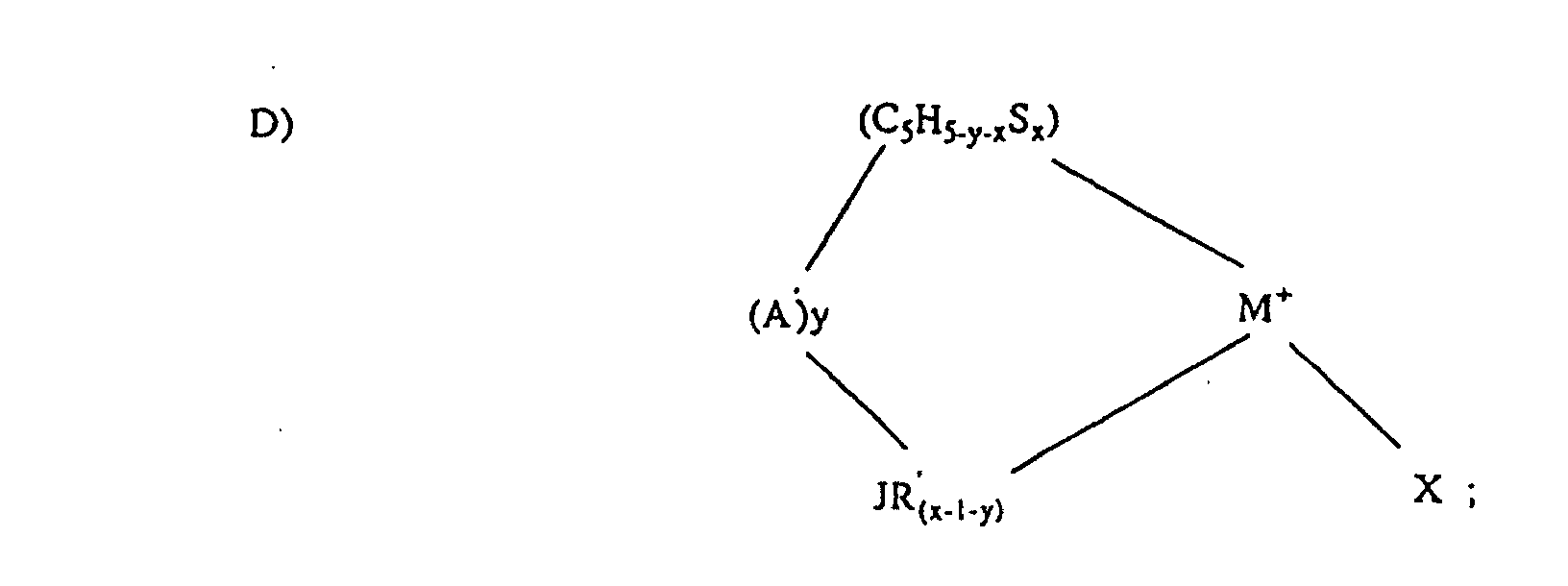 wobei
wobei
(A-Cp) entweder (Cp)(Cp*) oder Cp-A'-Cp* ist;Cp und Cp* gleiche oder verschiedene Cyclopentadienylgruppen sind, die mit Null bis fünf Substituentengruppen S substituiert sind, wobei jede Substituentengruppe S unabhängig von den anderen ein Rest ist, bei dem es sich um einen Kohlenwasserstoff-, substituierten Kohlenwasserstoff-, Halogenkohlenstoff-, substituierten Halogenkohlenstoff-, kohlenwasserstoffsubstituierten Organometalloid-, halogenkohlenstoffsubstituierten Organometalloid-, disubstituierten Bor-, disubstituierten Pnicogen-, substituierten Chalcogen- oder Halogenrest handelt, oder Cp und Cp* Cyclopentadienylgruppen sind, bei denen zwei beliebige benachbarte S-Gruppen unter Bildung eines C4- bis C20-Ringsystems miteinander verknüpft sind, so dass man einen gesättigten oder ungesättigten polycyclischen Cyclopentadienylliganden erhält;R ein Substituent an einem der Cyclopentadienylreste ist;A' eine verbrückende Gruppe ist, wobei diese Gruppe dazu dienen kann, die Rotation der Cp- und Cp*-Ringe oder der (C5H5-y-xSx)- und JR'(z-1-y)-Gruppen einzuschränken;M ein Übergangsmetall aus der Gruppe 4, 5 oder 6 ist;y = 0 oder 1 ist;(C5H5-y-xSx) ein Cyclopentadienylrest ist, der mit Null bis fünf S-Resten substituiert ist;x = 0 bis 5 ist und den Substitutionsgrad angibt;JR'(z-1-y) ein Heteroatomligand ist, bei dem J ein Element aus der Gruppe 15 mit einer Koordinationszahl von drei oder ein Element aus der Gruppe 16 mit einer Koordinationszahl von zwei ist;R" eine Kohlenwasserstoffgruppe ist;X und X1 unabhängig voneinander ein Hydridrest, ein Kohlenwasserstoffrest, ein substituierter Kohlenwasserstoffrest, ein Halogenkohlenstoffrest, ein substituierter Halogenkohlenstoffrest, ein kohlenwasserstoff- oder halogenkohlenstoffsubstituierter Organometalloidrest oder ein substituierter Pnicogenrest ist; undL ein Olefin-, Diolefin- oder Arinligand oder eine neutrale Lewis-Base ist. - Verfahren gemäß Anspruch 1, wobei das substituierte Kohlenstoffkation durch die Formeldargestellt wird, wobei R1, R2 und R3 unabhängig voneinander Wasserstoff oder eine lineare, verzweigte oder cyclische aliphatische oder aromatische Gruppe sind, mit der Maßgabe, dass nur einer der Reste R1, R2 oder R3 Wasserstoff sein kann.

- Verfahren gemäß Anspruch 1, wobei das substituierte Silyliumkation durch die Formeldargestellt wird, wobei R1, R2 und R3 unabhängig voneinander Wasserstoff oder eine lineare, verzweigte oder cyclische aliphatische oder aromatische Gruppe sind, mit der Maßgabe, dass nur einer der Reste R1, R2 oder R3 Wasserstoff sein kann.

- Verfahren gemäß Anspruch 1, wobei das substituierte Metallkation aus den Verbindungen ausgewählt ist, die durch die folgende Formel dargestellt werden:wobei M Germanium, Zinn oder Blei ist und R1, R2 und R3 unabhängig voneinander Wasserstoff oder eine lineare, verzweigte oder cyclische aliphatische oder aromatische Gruppe sind, mit der Maßgabe, dass nur einer der Reste R1, R2 oder R3 Wasserstoff sein kann.

- Verfahren gemäß Anspruch 2, wobei das Metall des Cyclopentadienyl-Übergangsmetallkations Titan, Zirconium oder Hafnium ist.
- Verfahren gemäß einem der Ansprüche 1 bis 6, wobei das verträgliche nichtkoordinierende Anion durch die FormelM' ein Metall oder Metalloid ist;d eine ganze Zahl von größer oder gleich 1 ist;Q1 bis Qn unabhängig voneinander verbrückte oder unverbrückte Hydridreste, Dialkylamidoreste, Alkoxid- oder Aryloxidreste, Kohlenwasserstoffund substituierte Kohlenwasserstoffreste, Halogenkohlenstoff- und substituierte Halogenkohlenstoffreste oder kohlenwasserstoff- oder halogenkohlenstoffsubstituierte Organometalloidreste sind und einer der Reste Q1 bis Qn ein Halogenidrest sein kann;m eine ganze Zahl ist, die die Valenzladung von M' darstellt; undn die Gesamtzahl der Liganden Q ist.
- Verfahren gemäß Anspruch 1, wobei es sich bei dem verträglichen nichtkoordinierenden Anion um Triphenylmethylperfluortetraphenylbor oder Tris(pentafluorphenyl)bor handelt.
- Verfahren gemäß einem der vorstehenden Ansprüche, das weiterhin einen Protonenfänger beinhaltet, bei dem es sich um eine Zusammensetzung handelt, die mit freien Protonen reagieren kann, ohne ein Produkt zu erzeugen, das ein aktiver Katalysator des Verfahrens ist.
- Verfahren gemäß Anspruch 9, wobei es sich bei dem Protonenfänger um eine der Verbindungen 2,6-Di-tert-butylpyridin, 4-Methyl-2,6-di-tert-butylpyridin, 1,8-Bis(dimethylamino)naphthalin, Diisopropylethylamin oder Gemische davon handelt.
- Verfahren gemäß einem der vorstehenden Ansprüche, wobei die Polymerisationsbedingungen eine Temperatur von weniger als -20 °C beinhalten.
- Verfahren gemäß einem der vorstehenden Ansprüche, wobei das molare Verhältnis von Kation zu nichtkoordinierendem Anion 1 zu 1 beträgt.
- Verfahren gemäß einem der vorstehenden Ansprüche, wobei das Lösungsmittel ein polares Lösungsmittel ist.
- Verfahren zur Herstellung eines Gemischs aus einem Polymer von einem oder mehreren koordinationspolymerisierbaren Monomeren und einem Polymer von einem oder mehreren kationisch polymerisierbaren, geminal disubstituierten Olefinmonomeren, umfassend das In-Kontakt-Bringen eines Cyclopentadienyl-Übergangsmetallkations und eines verträglichen nichtkoordinierenden Anions unter Polymerisationsbedingungen in einem oder mehreren Lösungsmitteln mit einem koordinationspolymerisierbaren Monomer und einem kationisch polymerisierbaren Monomer.
- Verfahren gemäß Anspruch 14, wobei die Polymerisation bei einer Temperatur zwischen -150 °C und +20 °C durchgeführt wird.
- Verfahren gemäß Anspruch 14, wobei es sich bei dem Olefin um Isobutylen handelt.
- Verfahren gemäß Anspruch 16, wobei das Olefin auch Isopren beinhaltet.
- Verfahren gemäß Anspruch 16, wobei das Olefin auch para-Alkylstyrol beinhaltet.
- Verfahren gemäß Anspruch 18, wobei es sich bei dem para-Alkylstyrol um para-Methylstyrol handelt.
- Verfahren gemäß Anspruch 15, wobei die Polymerisationstemperatur zwischen -50 °C und 0 °C liegt.
Applications Claiming Priority (3)
| Application Number | Priority Date | Filing Date | Title |
|---|---|---|---|
| US08/234,782 US6008307A (en) | 1994-04-28 | 1994-04-28 | Process for producing olefin polymers using cationic catalysts |
| US234782 | 1994-04-28 | ||
| PCT/US1995/005302 WO1995029940A1 (en) | 1994-04-28 | 1995-04-28 | Cationic catalysts and process for using said catalysts |
Publications (2)
| Publication Number | Publication Date |
|---|---|
| EP0757698A1 EP0757698A1 (de) | 1997-02-12 |
| EP0757698B1 true EP0757698B1 (de) | 2002-08-28 |
Family
ID=22882806
Family Applications (1)
| Application Number | Title | Priority Date | Filing Date |
|---|---|---|---|
| EP95917752A Expired - Lifetime EP0757698B1 (de) | 1994-04-28 | 1995-04-28 | Cationische katalysatoren und verfahren zur verwendung derselben |
Country Status (13)
| Country | Link |
|---|---|
| US (1) | US6008307A (de) |
| EP (1) | EP0757698B1 (de) |
| JP (2) | JPH10504048A (de) |
| KR (1) | KR100266114B1 (de) |
| CN (1) | CN1159812A (de) |
| AU (1) | AU2369495A (de) |
| BR (1) | BR9507536A (de) |
| CZ (1) | CZ314996A3 (de) |
| DE (1) | DE69527952T2 (de) |
| ES (1) | ES2177647T3 (de) |
| HU (1) | HUT76863A (de) |
| PL (1) | PL316989A1 (de) |
| WO (1) | WO1995029940A1 (de) |
Families Citing this family (28)
| Publication number | Priority date | Publication date | Assignee | Title |
|---|---|---|---|---|
| FR2732682B1 (fr) * | 1995-04-07 | 1997-06-20 | Enichem Polymeres France | Dialkylmagnesium a longues chaines, son procede de preparation et ses applications |
| NL1003020C2 (nl) * | 1996-05-03 | 1997-11-06 | Dsm Nv | Cyclopentadieenverbinding met een niet-coördinerend anion. |
| US5763556A (en) * | 1996-05-21 | 1998-06-09 | Exxon Chemical Patents Inc. | Copolymers of ethylene and geminally disubstituted olefins |
| US6100354A (en) * | 1997-02-24 | 2000-08-08 | Exxon Chemical Patents Inc. | Olefin copolymers from bridged bis(arylamido) Group 4 catalyst compounds |
| CN1309670A (zh) * | 1998-07-17 | 2001-08-22 | 拜尔公司 | 可阳离子聚合烯烃的聚合方法 |
| US6486088B1 (en) | 1998-10-23 | 2002-11-26 | Exxonmobil Chemical Patents Inc. | High activity carbenium-activated polymerization catalysts |
| US6300433B1 (en) * | 1998-10-23 | 2001-10-09 | Exxonmobil Chemical Patents Inc. | Olefin copolymerization process with bridged hafnocenes |
| US6252021B1 (en) * | 1998-11-23 | 2001-06-26 | Korea Kumho Petrochemical Co., Ltd. | Process for producing polyisobutene using a catalytic system comprising transition metal-benzene derivative compound-methylaluminoxane |
| US20020010291A1 (en) * | 1998-12-04 | 2002-01-24 | Vince Murphy | Ionic liquids and processes for production of high molecular weight polyisoolefins |
| US6787617B1 (en) | 1999-05-10 | 2004-09-07 | Japan As Represented By Director General Of The Agency Of Industrial Science And Technology | Process for producing olefin living polymer |
| ATE291594T1 (de) * | 1999-06-04 | 2005-04-15 | Goodrich Corp | Katalysator und verfahren zur herstellung von oligomeren von alpha-methyl- styrol |
| US6346585B1 (en) | 1999-06-24 | 2002-02-12 | The Lubrizol Corporation | Ammonium heteropolyacid catalized polymerization of olefins |
| US6444768B1 (en) | 1999-11-15 | 2002-09-03 | Exxonmobil Chemical Patents Inc. | Production of polyisobutylene copolymers |
| US6858690B2 (en) | 1999-11-15 | 2005-02-22 | Exxonmobil Chemical Patents Inc. | Process for polymerizing cationically polymerizable monomers |
| EP2267045B1 (de) * | 2000-01-26 | 2015-07-15 | Mitsui Chemicals, Inc. | Olefinpolymer mit sehr niedriger Polydispersität und Verfahren zu seiner Herstellung |
| CA2332203A1 (en) * | 2001-01-24 | 2002-07-24 | Bayer Inc. | Process for making high molecular weight isobutylene polymers |
| US7202317B2 (en) * | 2003-04-17 | 2007-04-10 | The University Of Akron | Polymerization of i-butene in hydrocarbon media using bis(borane) co-initiators |
| US7196149B2 (en) * | 2003-04-17 | 2007-03-27 | The University Of Akron | Polymerization of i-butane in hydrocarbon media using bis(borane) co-initiators |
| US7037989B2 (en) | 2003-05-27 | 2006-05-02 | Exxonmobil Chemical Patents Inc. | Copolymers of ethylene and/or α-olefins and vicinally disubstituted olefins |
| CA2441079C (en) * | 2003-09-16 | 2012-04-24 | Bayer Inc. | Process for production of butyl rubber |
| CA2618051A1 (en) * | 2005-08-04 | 2007-02-08 | The Regents Of The University Of Colorado, A Body Corporate | Catalysts for radical polymerization |
| CA2578679A1 (en) | 2006-03-14 | 2007-09-14 | Lanxess Inc. | Polymerization process using zinc halide initiators |
| RU2506277C2 (ru) | 2009-09-25 | 2014-02-10 | Чайна Петролеум & Кемикал Корпорейшн | Система и способ катионной полимеризации |
| CN111630071B (zh) * | 2018-01-10 | 2022-10-18 | 博里利斯股份公司 | 相稳定的乙烯α烯烃共聚合方法 |
| KR102363032B1 (ko) | 2018-03-21 | 2022-02-16 | 주식회사 엘지화학 | 전이금속 복합체의 제조 방법 |
| CN111247175B (zh) | 2018-04-05 | 2023-01-06 | Lg化学株式会社 | 具有阳离子金属配合物和基于硼酸根的大体积阴离子的有机金属催化剂,其制备方法,以及使用该催化剂制备低聚物或聚合物的方法 |
| CN113661185B (zh) | 2019-08-19 | 2023-12-29 | 株式会社Lg化学 | 有机硼酸盐类催化剂、使用它制备异丁烯低聚物的方法和由此制备的异丁烯低聚物 |
| JP7450054B2 (ja) * | 2020-02-26 | 2024-03-14 | ワッカー ケミー アクチエンゲゼルシャフト | ハロゲン化テトラシリルボラネート |
Family Cites Families (34)
| Publication number | Priority date | Publication date | Assignee | Title |
|---|---|---|---|---|
| US3631002A (en) * | 1968-12-26 | 1971-12-28 | Canadian Patents Dev | Polymerization of olefins |
| PL276385A1 (en) * | 1987-01-30 | 1989-07-24 | Exxon Chemical Patents Inc | Method for polymerization of olefines,diolefins and acetylene unsaturated compounds |
| US5384299A (en) * | 1987-01-30 | 1995-01-24 | Exxon Chemical Patents Inc. | Ionic metallocene catalyst compositions |
| IL85097A (en) * | 1987-01-30 | 1992-02-16 | Exxon Chemical Patents Inc | Catalysts based on derivatives of a bis(cyclopentadienyl)group ivb metal compound,their preparation and their use in polymerization processes |
| US5153157A (en) * | 1987-01-30 | 1992-10-06 | Exxon Chemical Patents Inc. | Catalyst system of enhanced productivity |
| US5241025A (en) * | 1987-01-30 | 1993-08-31 | Exxon Chemical Patents Inc. | Catalyst system of enhanced productivity |
| US5198401A (en) * | 1987-01-30 | 1993-03-30 | Exxon Chemical Patents Inc. | Ionic metallocene catalyst compositions |
| US4808680A (en) * | 1987-06-08 | 1989-02-28 | The Dow Chemical Company | Polymerization of vinyl aromatic monomers using cyclopentadienyl zirconium catalysts |
| US5196490A (en) * | 1987-06-17 | 1993-03-23 | The Dow Chemical Company | Process for preparation of syndiotactic polystyrene |
| US5045517A (en) * | 1987-06-17 | 1991-09-03 | The Dow Chemical Company | Catalyst and process for preparation of syndiotactic polystyrene |
| US5169914A (en) * | 1988-05-03 | 1992-12-08 | Edison Polymer Innovation Corporation | Uniform molecular weight polymers |
| US5223468A (en) * | 1988-07-15 | 1993-06-29 | Fina Technology, Inc. | Process and catalyst for producing syndiotactic polymers |
| SE8901048D0 (sv) * | 1989-03-23 | 1989-03-23 | Becker Wilhelm Ab | Polymerisationsinitiator |
| US5026798A (en) * | 1989-09-13 | 1991-06-25 | Exxon Chemical Patents Inc. | Process for producing crystalline poly-α-olefins with a monocyclopentadienyl transition metal catalyst system |
| US5064802A (en) * | 1989-09-14 | 1991-11-12 | The Dow Chemical Company | Metal complex compounds |
| US5066741A (en) * | 1990-03-22 | 1991-11-19 | The Dow Chemical Company | Process for preparation of syndiotactic vinyl aromatic polymers |
| US5763549A (en) * | 1989-10-10 | 1998-06-09 | Fina Technology, Inc. | Cationic metallocene catalysts based on organoaluminum anions |
| US5084586A (en) * | 1990-02-12 | 1992-01-28 | Minnesota Mining And Manufacturing Company | Novel initiators for cationic polymerization |
| JPH04175303A (ja) * | 1990-08-21 | 1992-06-23 | Dainippon Ink & Chem Inc | カチオン重合開始剤及びカチオン重合性組成物 |
| ES2116299T3 (es) * | 1991-01-12 | 1998-07-16 | Targor Gmbh | (co)polimeros de metaloceno, procedimiento para su obtencion, y su empleo como catalizadores. |
| JP2927566B2 (ja) * | 1991-03-28 | 1999-07-28 | 出光興産株式会社 | スチレン系共重合体の製造方法 |
| EP0505997B1 (de) * | 1991-03-29 | 1997-05-28 | Idemitsu Kosan Company Limited | Verfahren zur Herstellung eines Homo- oder Copolymerisates des Styrols |
| JP3194438B2 (ja) * | 1992-01-08 | 2001-07-30 | 出光興産株式会社 | スチレン系重合体の製造方法及びその触媒 |
| DE9201253U1 (de) * | 1992-02-01 | 1992-05-27 | Roka-Werk GmbH Dämmbau-Elemente und Großküchengeräte, 6296 Mengerskirchen | Präsentationstheke |
| US5219948A (en) * | 1992-02-21 | 1993-06-15 | University Of Southern Mississippi | Process for cationic polymerizations |
| US5330948A (en) * | 1992-03-31 | 1994-07-19 | Northwestern University | Homogeneous catalysts for stereoregular olefin polymerization |
| US5296433A (en) * | 1992-04-14 | 1994-03-22 | Minnesota Mining And Manufacturing Company | Tris(pentafluorophenyl)borane complexes and catalysts derived therefrom |
| BE1005957A5 (fr) * | 1992-06-05 | 1994-04-05 | Solvay | Procede de preparation d'un systeme catalytique, procede de (co)polymerisation d'olefines et (co)polymeres d'au moins une olefine. |
| US5446117A (en) * | 1993-08-19 | 1995-08-29 | Queen's University At Kingston | Process for producing amorphous syndiotactic polystyrene |
| SK282416B6 (sk) * | 1993-09-17 | 2002-01-07 | Bp Chemicals Limited | Spôsob výroby etylénového polyméru s dlhým reťazcom vetvenia v plynnej fáze |
| US5391619A (en) * | 1993-10-19 | 1995-02-21 | Phillips Petroleum Company | Poly(ethylene terephthalate) and monovinylarene/conjugated diene block copolymer blends |
| DE4345129A1 (de) * | 1993-12-30 | 1995-07-06 | Detroit Holding Ltd | Verfahren zur Herstellung eines Fluidfilters |
| US5439996A (en) * | 1994-06-01 | 1995-08-08 | Queen's University At Kingston | Synthesis of polymers of vinyl ethers, 1,5-hexadiene and N-vinylcarbazole |
| US5448001A (en) * | 1994-10-07 | 1995-09-05 | Queen's University At Kingston | Polymerization of iso-butylene |
-
1994
- 1994-04-28 US US08/234,782 patent/US6008307A/en not_active Expired - Lifetime
-
1995
- 1995-04-28 CN CN95193318A patent/CN1159812A/zh active Pending
- 1995-04-28 WO PCT/US1995/005302 patent/WO1995029940A1/en not_active Ceased
- 1995-04-28 AU AU23694/95A patent/AU2369495A/en not_active Abandoned
- 1995-04-28 DE DE69527952T patent/DE69527952T2/de not_active Expired - Lifetime
- 1995-04-28 EP EP95917752A patent/EP0757698B1/de not_active Expired - Lifetime
- 1995-04-28 ES ES95917752T patent/ES2177647T3/es not_active Expired - Lifetime
- 1995-04-28 JP JP7528419A patent/JPH10504048A/ja active Pending
- 1995-04-28 KR KR1019960706014A patent/KR100266114B1/ko not_active Expired - Fee Related
- 1995-04-28 BR BR9507536A patent/BR9507536A/pt not_active Application Discontinuation
- 1995-04-28 PL PL95316989A patent/PL316989A1/xx unknown
- 1995-04-28 CZ CZ963149A patent/CZ314996A3/cs unknown
- 1995-04-28 HU HU9602974A patent/HUT76863A/hu unknown
-
2004
- 2004-06-09 JP JP2004171823A patent/JP2004315828A/ja active Pending
Also Published As
| Publication number | Publication date |
|---|---|
| JP2004315828A (ja) | 2004-11-11 |
| JPH10504048A (ja) | 1998-04-14 |
| BR9507536A (pt) | 1997-11-18 |
| KR100266114B1 (ko) | 2000-09-15 |
| HUT76863A (en) | 1997-12-29 |
| DE69527952D1 (de) | 2002-10-02 |
| US6008307A (en) | 1999-12-28 |
| KR970702884A (ko) | 1997-06-10 |
| PL316989A1 (en) | 1997-03-03 |
| ES2177647T3 (es) | 2002-12-16 |
| CZ314996A3 (cs) | 1998-07-15 |
| WO1995029940A1 (en) | 1995-11-09 |
| CN1159812A (zh) | 1997-09-17 |
| HU9602974D0 (en) | 1997-01-28 |
| EP0757698A1 (de) | 1997-02-12 |
| MX9605175A (es) | 1998-06-28 |
| DE69527952T2 (de) | 2003-04-24 |
| AU2369495A (en) | 1995-11-29 |
Similar Documents
| Publication | Publication Date | Title |
|---|---|---|
| EP0757698B1 (de) | Cationische katalysatoren und verfahren zur verwendung derselben | |
| US6245706B1 (en) | Ionic metallocene catalyst compositions | |
| CN102066442B (zh) | 聚大分子单体及其生产方法 | |
| TWI549972B (zh) | 帶有乙烯基終端之高級烯烴共聚物及其製法 | |
| US5198401A (en) | Ionic metallocene catalyst compositions | |
| JP5623912B2 (ja) | リビング配位連鎖移動重合によるポリオレフィンの調製プロセス | |
| RU2139291C1 (ru) | Металлоорганическое соединение | |
| CN1095853C (zh) | 乙烯与同碳二取代烯烃的共聚物 | |
| JP5793820B2 (ja) | 分枝ビニル末端ポリマー及びその製造方法 | |
| WO1994000500A1 (en) | Solution phase polymerization process utilizing metallocene catalyst with production of olefin polymers | |
| EP0702700A1 (de) | Ionische übergangsmetallkatalysatoreren auf träger für olefinpolymerisation | |
| CN100389131C (zh) | 由桥连双(芳基氨基)第4族催化剂化合物制备的烯烃共聚物 | |
| WO1992001723A1 (fr) | CATALYSEUR POUR POLYMERISATION α-OLEFINIQUE ET PRODUCTION D'UNE POLY-α-OLEFINE A L'AIDE DE CE CATALYSEUR | |
| KR20010031180A (ko) | 다중핵 메탈로센 촉매를 사용한 다중모드 중합체 조성물제조방법 | |
| JPWO2006022355A1 (ja) | オレフィン重合用触媒、オレフィン重合体の製造方法、オレフィン共重合体、新規な遷移金属化合物および遷移金属化合物の製造方法 | |
| US9416069B2 (en) | Scalable production of precision hydrocarbons from trialkylaluminum via ternary living coordinative chain transfer polymerization | |
| US20020132943A1 (en) | Polyolefin containing a terminal phenyl or substituted phenyl group and process for preparing same | |
| US6699938B2 (en) | Cationic catalysts and process for using said catalysts | |
| CN103443144B (zh) | 乙烯基封端的高级烯烃共聚物及其制造方法 | |
| CA2188951C (en) | Cationic catalysts and process for using said catalysts | |
| MXPA96005175A (en) | Catiónic catalysts and process for using such catalysts | |
| JPH05331226A (ja) | ポリオレフィンの製造方法 | |
| JPH05331227A (ja) | ポリオレフィンの製造方法 |
Legal Events
| Date | Code | Title | Description |
|---|---|---|---|
| PUAI | Public reference made under article 153(3) epc to a published international application that has entered the european phase |
Free format text: ORIGINAL CODE: 0009012 |
|
| 17P | Request for examination filed |
Effective date: 19961128 |
|
| AK | Designated contracting states |
Kind code of ref document: A1 Designated state(s): BE DE ES FR GB IT LU NL |
|
| 17Q | First examination report despatched |
Effective date: 19970523 |
|
| RAP1 | Party data changed (applicant data changed or rights of an application transferred) |
Owner name: EXXONMOBIL CHEMICAL PATENTS INC. |
|
| GRAG | Despatch of communication of intention to grant |
Free format text: ORIGINAL CODE: EPIDOS AGRA |
|
| GRAG | Despatch of communication of intention to grant |
Free format text: ORIGINAL CODE: EPIDOS AGRA |
|
| GRAH | Despatch of communication of intention to grant a patent |
Free format text: ORIGINAL CODE: EPIDOS IGRA |
|
| GRAH | Despatch of communication of intention to grant a patent |
Free format text: ORIGINAL CODE: EPIDOS IGRA |
|
| GRAA | (expected) grant |
Free format text: ORIGINAL CODE: 0009210 |
|
| AK | Designated contracting states |
Kind code of ref document: B1 Designated state(s): BE DE ES FR GB IT LU NL |
|
| REG | Reference to a national code |
Ref country code: GB Ref legal event code: FG4D |
|
| REF | Corresponds to: |
Ref document number: 69527952 Country of ref document: DE Date of ref document: 20021002 |
|
| REG | Reference to a national code |
Ref country code: ES Ref legal event code: FG2A Ref document number: 2177647 Country of ref document: ES Kind code of ref document: T3 |
|
| ET | Fr: translation filed | ||
| PLBE | No opposition filed within time limit |
Free format text: ORIGINAL CODE: 0009261 |
|
| STAA | Information on the status of an ep patent application or granted ep patent |
Free format text: STATUS: NO OPPOSITION FILED WITHIN TIME LIMIT |
|
| 26N | No opposition filed |
Effective date: 20030530 |
|
| PGFP | Annual fee paid to national office [announced via postgrant information from national office to epo] |
Ref country code: NL Payment date: 20040316 Year of fee payment: 10 |
|
| PGFP | Annual fee paid to national office [announced via postgrant information from national office to epo] |
Ref country code: LU Payment date: 20040325 Year of fee payment: 10 |
|
| PGFP | Annual fee paid to national office [announced via postgrant information from national office to epo] |
Ref country code: ES Payment date: 20040421 Year of fee payment: 10 |
|
| PG25 | Lapsed in a contracting state [announced via postgrant information from national office to epo] |
Ref country code: LU Free format text: LAPSE BECAUSE OF NON-PAYMENT OF DUE FEES Effective date: 20050428 |
|
| PG25 | Lapsed in a contracting state [announced via postgrant information from national office to epo] |
Ref country code: ES Free format text: LAPSE BECAUSE OF NON-PAYMENT OF DUE FEES Effective date: 20050429 |
|
| PG25 | Lapsed in a contracting state [announced via postgrant information from national office to epo] |
Ref country code: NL Free format text: LAPSE BECAUSE OF NON-PAYMENT OF DUE FEES Effective date: 20051101 |
|
| NLV4 | Nl: lapsed or anulled due to non-payment of the annual fee |
Effective date: 20051101 |
|
| REG | Reference to a national code |
Ref country code: ES Ref legal event code: FD2A Effective date: 20050429 |
|
| PGFP | Annual fee paid to national office [announced via postgrant information from national office to epo] |
Ref country code: GB Payment date: 20140325 Year of fee payment: 20 |
|
| PGFP | Annual fee paid to national office [announced via postgrant information from national office to epo] |
Ref country code: IT Payment date: 20140414 Year of fee payment: 20 Ref country code: FR Payment date: 20140328 Year of fee payment: 20 Ref country code: DE Payment date: 20140430 Year of fee payment: 20 |
|
| PGFP | Annual fee paid to national office [announced via postgrant information from national office to epo] |
Ref country code: BE Payment date: 20140509 Year of fee payment: 20 |
|
| REG | Reference to a national code |
Ref country code: DE Ref legal event code: R071 Ref document number: 69527952 Country of ref document: DE |
|
| REG | Reference to a national code |
Ref country code: DE Ref legal event code: R071 Ref document number: 69527952 Country of ref document: DE |
|
| REG | Reference to a national code |
Ref country code: GB Ref legal event code: PE20 Expiry date: 20150427 |
|
| PG25 | Lapsed in a contracting state [announced via postgrant information from national office to epo] |
Ref country code: GB Free format text: LAPSE BECAUSE OF EXPIRATION OF PROTECTION Effective date: 20150427 |