EP0752494A1 - Verfahren zum Reduzieren der Toxizität von Restflotten und neue kationische Farbstoffe - Google Patents
Verfahren zum Reduzieren der Toxizität von Restflotten und neue kationische Farbstoffe Download PDFInfo
- Publication number
- EP0752494A1 EP0752494A1 EP96109918A EP96109918A EP0752494A1 EP 0752494 A1 EP0752494 A1 EP 0752494A1 EP 96109918 A EP96109918 A EP 96109918A EP 96109918 A EP96109918 A EP 96109918A EP 0752494 A1 EP0752494 A1 EP 0752494A1
- Authority
- EP
- European Patent Office
- Prior art keywords
- alkyl
- alkoxy
- halogen
- hydrogen
- independently
- Prior art date
- Legal status (The legal status is an assumption and is not a legal conclusion. Google has not performed a legal analysis and makes no representation as to the accuracy of the status listed.)
- Ceased
Links
- 239000000975 dye Substances 0.000 title claims abstract description 142
- 125000002091 cationic group Chemical group 0.000 title claims abstract description 65
- 231100000419 toxicity Toxicity 0.000 title claims abstract description 13
- 230000001988 toxicity Effects 0.000 title claims abstract description 13
- 238000000034 method Methods 0.000 title claims abstract description 10
- -1 hydroxy- Chemical class 0.000 claims abstract description 193
- 150000001450 anions Chemical class 0.000 claims abstract description 73
- 229910052736 halogen Inorganic materials 0.000 claims abstract description 58
- 150000002367 halogens Chemical class 0.000 claims abstract description 58
- 125000001797 benzyl group Chemical group [H]C1=C([H])C([H])=C(C([H])=C1[H])C([H])([H])* 0.000 claims abstract description 49
- 125000001997 phenyl group Chemical group [H]C1=C([H])C([H])=C(*)C([H])=C1[H] 0.000 claims abstract description 31
- 125000000094 2-phenylethyl group Chemical group [H]C1=C([H])C([H])=C(C([H])=C1[H])C([H])([H])C([H])([H])* 0.000 claims abstract description 26
- 125000001731 2-cyanoethyl group Chemical group [H]C([H])(*)C([H])([H])C#N 0.000 claims abstract description 23
- 125000003917 carbamoyl group Chemical group [H]N([H])C(*)=O 0.000 claims abstract description 22
- 229910052801 chlorine Inorganic materials 0.000 claims abstract description 19
- 238000004043 dyeing Methods 0.000 claims abstract description 18
- 125000000753 cycloalkyl group Chemical group 0.000 claims abstract description 16
- 125000004573 morpholin-4-yl group Chemical group N1(CCOCC1)* 0.000 claims abstract description 14
- 125000003368 amide group Chemical group 0.000 claims abstract description 12
- 229910052794 bromium Inorganic materials 0.000 claims abstract description 12
- 125000003118 aryl group Chemical group 0.000 claims abstract description 11
- 125000003710 aryl alkyl group Chemical group 0.000 claims abstract description 10
- 230000036571 hydration Effects 0.000 claims abstract description 10
- 238000006703 hydration reaction Methods 0.000 claims abstract description 10
- 125000003178 carboxy group Chemical group [H]OC(*)=O 0.000 claims abstract description 9
- 125000006367 bivalent amino carbonyl group Chemical group [H]N([*:1])C([*:2])=O 0.000 claims abstract description 8
- 125000004473 dialkylaminocarbonyl group Chemical group 0.000 claims abstract description 8
- 229910052760 oxygen Inorganic materials 0.000 claims abstract description 6
- 125000000043 benzamido group Chemical group [H]N([*])C(=O)C1=C([H])C([H])=C([H])C([H])=C1[H] 0.000 claims abstract description 5
- 125000000951 phenoxy group Chemical group [H]C1=C([H])C([H])=C(O*)C([H])=C1[H] 0.000 claims abstract description 5
- 125000004391 aryl sulfonyl group Chemical group 0.000 claims abstract description 4
- 125000003903 2-propenyl group Chemical group [H]C([*])([H])C([H])=C([H])[H] 0.000 claims abstract description 3
- 125000002496 methyl group Chemical group [H]C([H])([H])* 0.000 claims description 118
- 229910052739 hydrogen Inorganic materials 0.000 claims description 91
- 239000001257 hydrogen Substances 0.000 claims description 91
- UFHFLCQGNIYNRP-UHFFFAOYSA-N Hydrogen Chemical compound [H][H] UFHFLCQGNIYNRP-UHFFFAOYSA-N 0.000 claims description 85
- 150000002431 hydrogen Chemical class 0.000 claims description 61
- 125000000956 methoxy group Chemical group [H]C([H])([H])O* 0.000 claims description 35
- 239000000460 chlorine Substances 0.000 claims description 34
- 125000004093 cyano group Chemical group *C#N 0.000 claims description 34
- 239000000203 mixture Substances 0.000 claims description 33
- 125000006297 carbonyl amino group Chemical group [H]N([*:2])C([*:1])=O 0.000 claims description 23
- ZAMOUSCENKQFHK-UHFFFAOYSA-N Chlorine atom Chemical compound [Cl] ZAMOUSCENKQFHK-UHFFFAOYSA-N 0.000 claims description 21
- 125000000449 nitro group Chemical group [O-][N+](*)=O 0.000 claims description 16
- 125000002887 hydroxy group Chemical group [H]O* 0.000 claims description 13
- WKBOTKDWSSQWDR-UHFFFAOYSA-N Bromine atom Chemical compound [Br] WKBOTKDWSSQWDR-UHFFFAOYSA-N 0.000 claims description 11
- HEDRZPFGACZZDS-UHFFFAOYSA-N Chloroform Chemical compound ClC(Cl)Cl HEDRZPFGACZZDS-UHFFFAOYSA-N 0.000 claims description 11
- PXBRQCKWGAHEHS-UHFFFAOYSA-N dichlorodifluoromethane Chemical compound FC(F)(Cl)Cl PXBRQCKWGAHEHS-UHFFFAOYSA-N 0.000 claims description 11
- GDTBXPJZTBHREO-UHFFFAOYSA-N bromine Substances BrBr GDTBXPJZTBHREO-UHFFFAOYSA-N 0.000 claims description 10
- 125000004432 carbon atom Chemical group C* 0.000 claims description 10
- NEHMKBQYUWJMIP-UHFFFAOYSA-N chloromethane Chemical compound ClC NEHMKBQYUWJMIP-UHFFFAOYSA-N 0.000 claims description 10
- NBVXSUQYWXRMNV-UHFFFAOYSA-N fluoromethane Chemical compound FC NBVXSUQYWXRMNV-UHFFFAOYSA-N 0.000 claims description 10
- VOPWNXZWBYDODV-UHFFFAOYSA-N Chlorodifluoromethane Chemical compound FC(F)Cl VOPWNXZWBYDODV-UHFFFAOYSA-N 0.000 claims description 8
- XEEYBQQBJWHFJM-UHFFFAOYSA-N Iron Chemical compound [Fe] XEEYBQQBJWHFJM-UHFFFAOYSA-N 0.000 claims description 8
- DTXOCJGLLMAFBX-UHFFFAOYSA-N oxo-[[1-[2-[[4-(oxoazaniumylmethylidene)pyridin-1-yl]methoxy]ethoxymethyl]pyridin-4-ylidene]methyl]azanium;dichloride Chemical compound [Cl-].[Cl-].C1=CC(=C[NH+]=O)C=CN1COCCOCN1C=CC(=C[NH+]=O)C=C1 DTXOCJGLLMAFBX-UHFFFAOYSA-N 0.000 claims description 8
- OSDBJMYIUDLIRI-UHFFFAOYSA-N oxo-[[1-[[4-[[4-(oxoazaniumylmethylidene)pyridin-1-yl]methoxy]cyclohexyl]oxymethyl]pyridin-4-ylidene]methyl]azanium;dichloride Chemical compound [Cl-].[Cl-].C1=CC(=C[NH+]=O)C=CN1COC1CCC(OCN2C=CC(=C[NH+]=O)C=C2)CC1 OSDBJMYIUDLIRI-UHFFFAOYSA-N 0.000 claims description 8
- OMJKVIFSWSQTGQ-UHFFFAOYSA-N 6,7-bis(aziridin-1-yl)quinazoline-5,8-dione Chemical compound C1CN1C=1C(=O)C2=NC=NC=C2C(=O)C=1N1CC1 OMJKVIFSWSQTGQ-UHFFFAOYSA-N 0.000 claims description 6
- PCPQWYHRMVULIX-UHFFFAOYSA-P [1-[2,3-dihydroxy-4-[4-(oxoazaniumylmethylidene)pyridin-1-yl]butyl]pyridin-4-ylidene]methyl-oxoazanium;dinitrate Chemical compound [O-][N+]([O-])=O.[O-][N+]([O-])=O.C1=CC(=C[NH+]=O)C=CN1CC(O)C(O)CN1C=CC(=C[NH+]=O)C=C1 PCPQWYHRMVULIX-UHFFFAOYSA-P 0.000 claims description 6
- VNWKTOKETHGBQD-UHFFFAOYSA-N methane Chemical compound C VNWKTOKETHGBQD-UHFFFAOYSA-N 0.000 claims description 6
- VHVGFEDTMPYCSX-UHFFFAOYSA-N [1-[[2,2-dimethyl-3-[[4-(oxoazaniumylmethylidene)pyridin-1-yl]methoxy]propoxy]methyl]pyridin-4-ylidene]methyl-oxoazanium;dichloride Chemical compound [Cl-].[Cl-].C1=CC(=C[NH+]=O)C=CN1COCC(C)(C)COCN1C=CC(=C[NH+]=O)C=C1 VHVGFEDTMPYCSX-UHFFFAOYSA-N 0.000 claims description 4
- CIUQDSCDWFSTQR-UHFFFAOYSA-N [C]1=CC=CC=C1 Chemical compound [C]1=CC=CC=C1 CIUQDSCDWFSTQR-UHFFFAOYSA-N 0.000 claims description 2
- UNLBRWACURAHRZ-UHFFFAOYSA-N oxo-[[1-[[5-[[4-(oxoazaniumylmethylidene)pyridin-1-yl]methyl]thiophen-2-yl]methyl]pyridin-4-ylidene]methyl]azanium;diperchlorate Chemical compound [O-]Cl(=O)(=O)=O.[O-]Cl(=O)(=O)=O.C1=CC(=C[NH+]=O)C=CN1CC(S1)=CC=C1CN1C=CC(=C[NH+]=O)C=C1 UNLBRWACURAHRZ-UHFFFAOYSA-N 0.000 claims description 2
- 125000000217 alkyl group Chemical group 0.000 abstract description 45
- 125000003545 alkoxy group Chemical group 0.000 abstract description 15
- 125000000738 acetamido group Chemical group [H]C([H])([H])C(=O)N([H])[*] 0.000 abstract description 5
- 125000005236 alkanoylamino group Chemical group 0.000 abstract description 2
- 125000004453 alkoxycarbonyl group Chemical group 0.000 abstract 5
- 125000002915 carbonyl group Chemical group [*:2]C([*:1])=O 0.000 abstract 5
- JCXJVPUVTGWSNB-UHFFFAOYSA-N Nitrogen dioxide Chemical compound O=[N]=O JCXJVPUVTGWSNB-UHFFFAOYSA-N 0.000 abstract 3
- 125000004390 alkyl sulfonyl group Chemical group 0.000 abstract 3
- 125000004104 aryloxy group Chemical group 0.000 abstract 3
- 125000005010 perfluoroalkyl group Chemical group 0.000 abstract 3
- 125000003806 alkyl carbonyl amino group Chemical group 0.000 abstract 2
- 125000004448 alkyl carbonyl group Chemical group 0.000 abstract 2
- 125000004656 alkyl sulfonylamino group Chemical group 0.000 abstract 2
- 125000004663 dialkyl amino group Chemical group 0.000 abstract 2
- 125000004442 acylamino group Chemical group 0.000 abstract 1
- 125000000286 phenylethyl group Chemical group [H]C1=C([H])C([H])=C(C([H])=C1[H])C([H])([H])C([H])([H])* 0.000 abstract 1
- 125000002924 primary amino group Chemical group [H]N([H])* 0.000 abstract 1
- 238000012216 screening Methods 0.000 abstract 1
- QTBSBXVTEAMEQO-UHFFFAOYSA-N Acetic acid Chemical compound CC(O)=O QTBSBXVTEAMEQO-UHFFFAOYSA-N 0.000 description 58
- 125000001495 ethyl group Chemical group [H]C([H])([H])C([H])([H])* 0.000 description 53
- OKKJLVBELUTLKV-UHFFFAOYSA-N Methanol Chemical compound OC OKKJLVBELUTLKV-UHFFFAOYSA-N 0.000 description 48
- XLYOFNOQVPJJNP-UHFFFAOYSA-N water Substances O XLYOFNOQVPJJNP-UHFFFAOYSA-N 0.000 description 40
- 239000000243 solution Substances 0.000 description 35
- 229960000583 acetic acid Drugs 0.000 description 26
- 125000004051 hexyl group Chemical group [H]C([H])([H])C([H])([H])C([H])([H])C([H])([H])C([H])([H])C([H])([H])* 0.000 description 21
- 239000012362 glacial acetic acid Substances 0.000 description 20
- GAWIXWVDTYZWAW-UHFFFAOYSA-N C[CH]O Chemical group C[CH]O GAWIXWVDTYZWAW-UHFFFAOYSA-N 0.000 description 19
- 125000001436 propyl group Chemical group [H]C([*])([H])C([H])([H])C([H])([H])[H] 0.000 description 16
- HEMHJVSKTPXQMS-UHFFFAOYSA-M sodium hydroxide Inorganic materials [OH-].[Na+] HEMHJVSKTPXQMS-UHFFFAOYSA-M 0.000 description 16
- 125000000484 butyl group Chemical group [H]C([*])([H])C([H])([H])C([H])([H])C([H])([H])[H] 0.000 description 14
- 238000010521 absorption reaction Methods 0.000 description 13
- 229920002239 polyacrylonitrile Polymers 0.000 description 13
- ZMXDDKWLCZADIW-UHFFFAOYSA-N N,N-Dimethylformamide Chemical compound CN(C)C=O ZMXDDKWLCZADIW-UHFFFAOYSA-N 0.000 description 12
- YXFVVABEGXRONW-UHFFFAOYSA-N Toluene Chemical compound CC1=CC=CC=C1 YXFVVABEGXRONW-UHFFFAOYSA-N 0.000 description 12
- VEXZGXHMUGYJMC-UHFFFAOYSA-N Hydrochloric acid Chemical compound Cl VEXZGXHMUGYJMC-UHFFFAOYSA-N 0.000 description 10
- VMHLLURERBWHNL-UHFFFAOYSA-M Sodium acetate Chemical compound [Na+].CC([O-])=O VMHLLURERBWHNL-UHFFFAOYSA-M 0.000 description 10
- QAOWNCQODCNURD-UHFFFAOYSA-N Sulfuric acid Chemical compound OS(O)(=O)=O QAOWNCQODCNURD-UHFFFAOYSA-N 0.000 description 10
- 239000000835 fiber Substances 0.000 description 10
- 125000001449 isopropyl group Chemical group [H]C([H])([H])C([H])(*)C([H])([H])[H] 0.000 description 10
- 239000002904 solvent Substances 0.000 description 10
- 238000006243 chemical reaction Methods 0.000 description 9
- VAYGXNSJCAHWJZ-UHFFFAOYSA-N dimethyl sulfate Chemical compound COS(=O)(=O)OC VAYGXNSJCAHWJZ-UHFFFAOYSA-N 0.000 description 9
- 239000000463 material Substances 0.000 description 9
- 241000251468 Actinopterygii Species 0.000 description 8
- 235000005956 Cosmos caudatus Nutrition 0.000 description 8
- 241000238578 Daphnia Species 0.000 description 8
- NBIIXXVUZAFLBC-UHFFFAOYSA-N Phosphoric acid Chemical compound OP(O)(O)=O NBIIXXVUZAFLBC-UHFFFAOYSA-N 0.000 description 8
- NQRYJNQNLNOLGT-UHFFFAOYSA-N Piperidine Chemical compound C1CCNCC1 NQRYJNQNLNOLGT-UHFFFAOYSA-N 0.000 description 8
- MVPPADPHJFYWMZ-UHFFFAOYSA-N chlorobenzene Chemical compound ClC1=CC=CC=C1 MVPPADPHJFYWMZ-UHFFFAOYSA-N 0.000 description 8
- 230000008878 coupling Effects 0.000 description 8
- 238000010168 coupling process Methods 0.000 description 8
- 238000005859 coupling reaction Methods 0.000 description 8
- 125000002112 pyrrolidino group Chemical group [*]N1C([H])([H])C([H])([H])C([H])([H])C1([H])[H] 0.000 description 8
- 239000001632 sodium acetate Substances 0.000 description 8
- 235000017281 sodium acetate Nutrition 0.000 description 8
- LPXPTNMVRIOKMN-UHFFFAOYSA-M sodium nitrite Chemical compound [Na+].[O-]N=O LPXPTNMVRIOKMN-UHFFFAOYSA-M 0.000 description 8
- 125000002023 trifluoromethyl group Chemical group FC(F)(F)* 0.000 description 8
- FAPWRFPIFSIZLT-UHFFFAOYSA-M Sodium chloride Chemical class [Na+].[Cl-] FAPWRFPIFSIZLT-UHFFFAOYSA-M 0.000 description 7
- 230000002378 acidificating effect Effects 0.000 description 7
- 238000003756 stirring Methods 0.000 description 7
- 125000003944 tolyl group Chemical group 0.000 description 7
- WFDIJRYMOXRFFG-UHFFFAOYSA-N Acetic anhydride Chemical compound CC(=O)OC(C)=O WFDIJRYMOXRFFG-UHFFFAOYSA-N 0.000 description 6
- VEXZGXHMUGYJMC-UHFFFAOYSA-M Chloride anion Chemical compound [Cl-] VEXZGXHMUGYJMC-UHFFFAOYSA-M 0.000 description 6
- LFQSCWFLJHTTHZ-UHFFFAOYSA-N Ethanol Chemical compound CCO LFQSCWFLJHTTHZ-UHFFFAOYSA-N 0.000 description 6
- DNIAPMSPPWPWGF-UHFFFAOYSA-N Propylene glycol Chemical compound CC(O)CO DNIAPMSPPWPWGF-UHFFFAOYSA-N 0.000 description 6
- JUJWROOIHBZHMG-UHFFFAOYSA-N Pyridine Chemical compound C1=CC=NC=C1 JUJWROOIHBZHMG-UHFFFAOYSA-N 0.000 description 6
- RWRDLPDLKQPQOW-UHFFFAOYSA-N Pyrrolidine Chemical compound C1CCNC1 RWRDLPDLKQPQOW-UHFFFAOYSA-N 0.000 description 6
- 235000011054 acetic acid Nutrition 0.000 description 6
- 150000001448 anilines Chemical class 0.000 description 6
- 238000001035 drying Methods 0.000 description 6
- 125000003754 ethoxycarbonyl group Chemical group C(=O)(OCC)* 0.000 description 6
- 239000004744 fabric Substances 0.000 description 6
- 125000000959 isobutyl group Chemical group [H]C([H])([H])C([H])(C([H])([H])[H])C([H])([H])* 0.000 description 6
- 125000002914 sec-butyl group Chemical group [H]C([H])([H])C([H])([H])C([H])(*)C([H])([H])[H] 0.000 description 6
- 239000002351 wastewater Substances 0.000 description 6
- 241000195493 Cryptophyta Species 0.000 description 5
- KWYUFKZDYYNOTN-UHFFFAOYSA-M Potassium hydroxide Chemical compound [OH-].[K+] KWYUFKZDYYNOTN-UHFFFAOYSA-M 0.000 description 5
- 238000007792 addition Methods 0.000 description 5
- 238000006193 diazotization reaction Methods 0.000 description 5
- 229940093915 gynecological organic acid Drugs 0.000 description 5
- 150000007524 organic acids Chemical class 0.000 description 5
- 235000005985 organic acids Nutrition 0.000 description 5
- UUEVFMOUBSLVJW-UHFFFAOYSA-N oxo-[[1-[2-[2-[2-[4-(oxoazaniumylmethylidene)pyridin-1-yl]ethoxy]ethoxy]ethyl]pyridin-4-ylidene]methyl]azanium;dibromide Chemical compound [Br-].[Br-].C1=CC(=C[NH+]=O)C=CN1CCOCCOCCN1C=CC(=C[NH+]=O)C=C1 UUEVFMOUBSLVJW-UHFFFAOYSA-N 0.000 description 5
- 238000010023 transfer printing Methods 0.000 description 5
- JIAARYAFYJHUJI-UHFFFAOYSA-L zinc dichloride Chemical compound [Cl-].[Cl-].[Zn+2] JIAARYAFYJHUJI-UHFFFAOYSA-L 0.000 description 5
- YEJRWHAVMIAJKC-UHFFFAOYSA-N 4-Butyrolactone Chemical compound O=C1CCCO1 YEJRWHAVMIAJKC-UHFFFAOYSA-N 0.000 description 4
- FKNQCJSGGFJEIZ-UHFFFAOYSA-N 4-methylpyridine Chemical compound CC1=CC=NC=C1 FKNQCJSGGFJEIZ-UHFFFAOYSA-N 0.000 description 4
- RXQNKKRGJJRMKD-UHFFFAOYSA-N 5-bromo-2-methylaniline Chemical compound CC1=CC=C(Br)C=C1N RXQNKKRGJJRMKD-UHFFFAOYSA-N 0.000 description 4
- NLHHRLWOUZZQLW-UHFFFAOYSA-N Acrylonitrile Chemical compound C=CC#N NLHHRLWOUZZQLW-UHFFFAOYSA-N 0.000 description 4
- DGAQECJNVWCQMB-PUAWFVPOSA-M Ilexoside XXIX Chemical compound C[C@@H]1CC[C@@]2(CC[C@@]3(C(=CC[C@H]4[C@]3(CC[C@@H]5[C@@]4(CC[C@@H](C5(C)C)OS(=O)(=O)[O-])C)C)[C@@H]2[C@]1(C)O)C)C(=O)O[C@H]6[C@@H]([C@H]([C@@H]([C@H](O6)CO)O)O)O.[Na+] DGAQECJNVWCQMB-PUAWFVPOSA-M 0.000 description 4
- GLUUGHFHXGJENI-UHFFFAOYSA-N Piperazine Chemical compound C1CNCCN1 GLUUGHFHXGJENI-UHFFFAOYSA-N 0.000 description 4
- QAOWNCQODCNURD-UHFFFAOYSA-L Sulfate Chemical compound [O-]S([O-])(=O)=O QAOWNCQODCNURD-UHFFFAOYSA-L 0.000 description 4
- 239000002168 alkylating agent Substances 0.000 description 4
- 229940100198 alkylating agent Drugs 0.000 description 4
- 229910000147 aluminium phosphate Inorganic materials 0.000 description 4
- 239000007864 aqueous solution Substances 0.000 description 4
- 150000004982 aromatic amines Chemical class 0.000 description 4
- 239000003054 catalyst Substances 0.000 description 4
- 239000003795 chemical substances by application Substances 0.000 description 4
- 239000012530 fluid Substances 0.000 description 4
- 231100001231 less toxic Toxicity 0.000 description 4
- 239000000395 magnesium oxide Substances 0.000 description 4
- CPLXHLVBOLITMK-UHFFFAOYSA-N magnesium oxide Inorganic materials [Mg]=O CPLXHLVBOLITMK-UHFFFAOYSA-N 0.000 description 4
- 235000012245 magnesium oxide Nutrition 0.000 description 4
- AXZKOIWUVFPNLO-UHFFFAOYSA-N magnesium;oxygen(2-) Chemical compound [O-2].[Mg+2] AXZKOIWUVFPNLO-UHFFFAOYSA-N 0.000 description 4
- XHXFXVLFKHQFAL-UHFFFAOYSA-N phosphoryl trichloride Chemical compound ClP(Cl)(Cl)=O XHXFXVLFKHQFAL-UHFFFAOYSA-N 0.000 description 4
- 125000000587 piperidin-1-yl group Chemical group [H]C1([H])N(*)C([H])([H])C([H])([H])C([H])([H])C1([H])[H] 0.000 description 4
- 229920000728 polyester Polymers 0.000 description 4
- 239000000843 powder Substances 0.000 description 4
- 150000003254 radicals Chemical class 0.000 description 4
- 235000010288 sodium nitrite Nutrition 0.000 description 4
- 238000012360 testing method Methods 0.000 description 4
- FFRBMBIXVSCUFS-UHFFFAOYSA-N 2,4-dinitro-1-naphthol Chemical compound C1=CC=C2C(O)=C([N+]([O-])=O)C=C([N+]([O-])=O)C2=C1 FFRBMBIXVSCUFS-UHFFFAOYSA-N 0.000 description 3
- CSCPPACGZOOCGX-UHFFFAOYSA-N Acetone Chemical compound CC(C)=O CSCPPACGZOOCGX-UHFFFAOYSA-N 0.000 description 3
- WEVYAHXRMPXWCK-UHFFFAOYSA-N Acetonitrile Chemical compound CC#N WEVYAHXRMPXWCK-UHFFFAOYSA-N 0.000 description 3
- XEKOWRVHYACXOJ-UHFFFAOYSA-N Ethyl acetate Chemical compound CCOC(C)=O XEKOWRVHYACXOJ-UHFFFAOYSA-N 0.000 description 3
- LYCAIKOWRPUZTN-UHFFFAOYSA-N Ethylene glycol Chemical compound OCCO LYCAIKOWRPUZTN-UHFFFAOYSA-N 0.000 description 3
- PXGOKWXKJXAPGV-UHFFFAOYSA-N Fluorine Chemical group FF PXGOKWXKJXAPGV-UHFFFAOYSA-N 0.000 description 3
- WSFSSNUMVMOOMR-UHFFFAOYSA-N Formaldehyde Chemical compound O=C WSFSSNUMVMOOMR-UHFFFAOYSA-N 0.000 description 3
- AFVFQIVMOAPDHO-UHFFFAOYSA-N Methanesulfonic acid Chemical compound CS(O)(=O)=O AFVFQIVMOAPDHO-UHFFFAOYSA-N 0.000 description 3
- CTQNGGLPUBDAKN-UHFFFAOYSA-N O-Xylene Chemical compound CC1=CC=CC=C1C CTQNGGLPUBDAKN-UHFFFAOYSA-N 0.000 description 3
- GOOHAUXETOMSMM-UHFFFAOYSA-N Propylene oxide Chemical compound CC1CO1 GOOHAUXETOMSMM-UHFFFAOYSA-N 0.000 description 3
- ZMANZCXQSJIPKH-UHFFFAOYSA-N Triethylamine Chemical compound CCN(CC)CC ZMANZCXQSJIPKH-UHFFFAOYSA-N 0.000 description 3
- PQLVXDKIJBQVDF-UHFFFAOYSA-N acetic acid;hydrate Chemical compound O.CC(O)=O PQLVXDKIJBQVDF-UHFFFAOYSA-N 0.000 description 3
- 150000001412 amines Chemical class 0.000 description 3
- 238000004364 calculation method Methods 0.000 description 3
- 229910052799 carbon Inorganic materials 0.000 description 3
- 239000001913 cellulose Substances 0.000 description 3
- 229920002678 cellulose Polymers 0.000 description 3
- 238000001816 cooling Methods 0.000 description 3
- 229920001577 copolymer Polymers 0.000 description 3
- 229910052731 fluorine Inorganic materials 0.000 description 3
- 239000011737 fluorine Chemical group 0.000 description 3
- 239000010985 leather Substances 0.000 description 3
- UCFFGYASXIPWPD-UHFFFAOYSA-N methyl hypochlorite Chemical compound COCl UCFFGYASXIPWPD-UHFFFAOYSA-N 0.000 description 3
- 125000004170 methylsulfonyl group Chemical group [H]C([H])([H])S(*)(=O)=O 0.000 description 3
- 150000007522 mineralic acids Chemical class 0.000 description 3
- 230000007935 neutral effect Effects 0.000 description 3
- 229920000642 polymer Polymers 0.000 description 3
- 238000007639 printing Methods 0.000 description 3
- UMJSCPRVCHMLSP-UHFFFAOYSA-N pyridine Natural products COC1=CC=CN=C1 UMJSCPRVCHMLSP-UHFFFAOYSA-N 0.000 description 3
- 238000005956 quaternization reaction Methods 0.000 description 3
- 238000007363 ring formation reaction Methods 0.000 description 3
- 239000011780 sodium chloride Substances 0.000 description 3
- 125000001424 substituent group Chemical group 0.000 description 3
- HXJUTPCZVOIRIF-UHFFFAOYSA-N sulfolane Chemical compound O=S1(=O)CCCC1 HXJUTPCZVOIRIF-UHFFFAOYSA-N 0.000 description 3
- 239000002023 wood Substances 0.000 description 3
- 239000008096 xylene Substances 0.000 description 3
- QLAJNZSPVITUCQ-UHFFFAOYSA-N 1,3,2-dioxathietane 2,2-dioxide Chemical compound O=S1(=O)OCO1 QLAJNZSPVITUCQ-UHFFFAOYSA-N 0.000 description 2
- GVNVAWHJIKLAGL-UHFFFAOYSA-N 2-(cyclohexen-1-yl)cyclohexan-1-one Chemical compound O=C1CCCCC1C1=CCCCC1 GVNVAWHJIKLAGL-UHFFFAOYSA-N 0.000 description 2
- ZWEHNKRNPOVVGH-UHFFFAOYSA-N 2-Butanone Chemical compound CCC(C)=O ZWEHNKRNPOVVGH-UHFFFAOYSA-N 0.000 description 2
- NMKUIHQPXZUGIB-UHFFFAOYSA-N 2-n,2-n-di(propan-2-yl)-1,3,4-thiadiazole-2,5-diamine Chemical compound CC(C)N(C(C)C)C1=NN=C(N)S1 NMKUIHQPXZUGIB-UHFFFAOYSA-N 0.000 description 2
- IXXLKTZOCSRXEM-UHFFFAOYSA-N 3-(n-methylanilino)propanenitrile Chemical compound N#CCCN(C)C1=CC=CC=C1 IXXLKTZOCSRXEM-UHFFFAOYSA-N 0.000 description 2
- 125000004801 4-cyanophenyl group Chemical group [H]C1=C([H])C(C#N)=C([H])C([H])=C1* 0.000 description 2
- 125000004172 4-methoxyphenyl group Chemical group [H]C1=C([H])C(OC([H])([H])[H])=C([H])C([H])=C1* 0.000 description 2
- QTBSBXVTEAMEQO-UHFFFAOYSA-M Acetate Chemical compound CC([O-])=O QTBSBXVTEAMEQO-UHFFFAOYSA-M 0.000 description 2
- PAYRUJLWNCNPSJ-UHFFFAOYSA-N Aniline Chemical compound NC1=CC=CC=C1 PAYRUJLWNCNPSJ-UHFFFAOYSA-N 0.000 description 2
- IJGRMHOSHXDMSA-UHFFFAOYSA-N Atomic nitrogen Chemical group N#N IJGRMHOSHXDMSA-UHFFFAOYSA-N 0.000 description 2
- CPELXLSAUQHCOX-UHFFFAOYSA-M Bromide Chemical compound [Br-] CPELXLSAUQHCOX-UHFFFAOYSA-M 0.000 description 2
- 0 CC1(*)c(cc(C)cc2)c2*(*)=C1C=*[*@@](c1ccc(*)cc1)NC Chemical compound CC1(*)c(cc(C)cc2)c2*(*)=C1C=*[*@@](c1ccc(*)cc1)NC 0.000 description 2
- 101150065749 Churc1 gene Proteins 0.000 description 2
- RGSFGYAAUTVSQA-UHFFFAOYSA-N Cyclopentane Chemical compound C1CCCC1 RGSFGYAAUTVSQA-UHFFFAOYSA-N 0.000 description 2
- IAYPIBMASNFSPL-UHFFFAOYSA-N Ethylene oxide Chemical compound C1CO1 IAYPIBMASNFSPL-UHFFFAOYSA-N 0.000 description 2
- KFZMGEQAYNKOFK-UHFFFAOYSA-N Isopropanol Chemical compound CC(C)O KFZMGEQAYNKOFK-UHFFFAOYSA-N 0.000 description 2
- JLTDJTHDQAWBAV-UHFFFAOYSA-N N,N-dimethylaniline Chemical compound CN(C)C1=CC=CC=C1 JLTDJTHDQAWBAV-UHFFFAOYSA-N 0.000 description 2
- LRHPLDYGYMQRHN-UHFFFAOYSA-N N-Butanol Chemical compound CCCCO LRHPLDYGYMQRHN-UHFFFAOYSA-N 0.000 description 2
- SECXISVLQFMRJM-UHFFFAOYSA-N N-Methylpyrrolidone Chemical compound CN1CCCC1=O SECXISVLQFMRJM-UHFFFAOYSA-N 0.000 description 2
- AMQJEAYHLZJPGS-UHFFFAOYSA-N N-Pentanol Chemical compound CCCCCO AMQJEAYHLZJPGS-UHFFFAOYSA-N 0.000 description 2
- PVNIIMVLHYAWGP-UHFFFAOYSA-N Niacin Chemical compound OC(=O)C1=CC=CN=C1 PVNIIMVLHYAWGP-UHFFFAOYSA-N 0.000 description 2
- MUBZPKHOEPUJKR-UHFFFAOYSA-N Oxalic acid Chemical compound OC(=O)C(O)=O MUBZPKHOEPUJKR-UHFFFAOYSA-N 0.000 description 2
- 239000004952 Polyamide Substances 0.000 description 2
- 102100038239 Protein Churchill Human genes 0.000 description 2
- CDBYLPFSWZWCQE-UHFFFAOYSA-L Sodium Carbonate Chemical compound [Na+].[Na+].[O-]C([O-])=O CDBYLPFSWZWCQE-UHFFFAOYSA-L 0.000 description 2
- WQDUMFSSJAZKTM-UHFFFAOYSA-N Sodium methoxide Chemical compound [Na+].[O-]C WQDUMFSSJAZKTM-UHFFFAOYSA-N 0.000 description 2
- GSEJCLTVZPLZKY-UHFFFAOYSA-N Triethanolamine Chemical compound OCCN(CCO)CCO GSEJCLTVZPLZKY-UHFFFAOYSA-N 0.000 description 2
- SLINHMUFWFWBMU-UHFFFAOYSA-N Triisopropanolamine Chemical compound CC(O)CN(CC(C)O)CC(C)O SLINHMUFWFWBMU-UHFFFAOYSA-N 0.000 description 2
- 239000002253 acid Substances 0.000 description 2
- 150000001298 alcohols Chemical class 0.000 description 2
- 150000001299 aldehydes Chemical class 0.000 description 2
- 125000001931 aliphatic group Chemical group 0.000 description 2
- 239000003849 aromatic solvent Substances 0.000 description 2
- 239000000987 azo dye Substances 0.000 description 2
- 125000000751 azo group Chemical group [*]N=N[*] 0.000 description 2
- 238000009835 boiling Methods 0.000 description 2
- KYPOHTVBFVELTG-UHFFFAOYSA-N but-2-enedinitrile Chemical group N#CC=CC#N KYPOHTVBFVELTG-UHFFFAOYSA-N 0.000 description 2
- 125000000068 chlorophenyl group Chemical group 0.000 description 2
- 238000004040 coloring Methods 0.000 description 2
- 238000009833 condensation Methods 0.000 description 2
- 230000005494 condensation Effects 0.000 description 2
- MLIREBYILWEBDM-UHFFFAOYSA-N cyanoacetic acid Chemical compound OC(=O)CC#N MLIREBYILWEBDM-UHFFFAOYSA-N 0.000 description 2
- 125000004122 cyclic group Chemical group 0.000 description 2
- 125000000113 cyclohexyl group Chemical group [H]C1([H])C([H])([H])C([H])([H])C([H])(*)C([H])([H])C1([H])[H] 0.000 description 2
- 125000000664 diazo group Chemical group [N-]=[N+]=[*] 0.000 description 2
- 238000009792 diffusion process Methods 0.000 description 2
- XBDQKXXYIPTUBI-UHFFFAOYSA-N dimethylselenoniopropionate Natural products CCC(O)=O XBDQKXXYIPTUBI-UHFFFAOYSA-N 0.000 description 2
- 230000000694 effects Effects 0.000 description 2
- 125000004672 ethylcarbonyl group Chemical group [H]C([H])([H])C([H])([H])C(*)=O 0.000 description 2
- 125000006125 ethylsulfonyl group Chemical group 0.000 description 2
- 239000003292 glue Substances 0.000 description 2
- ZSIAUFGUXNUGDI-UHFFFAOYSA-N hexan-1-ol Chemical compound CCCCCCO ZSIAUFGUXNUGDI-UHFFFAOYSA-N 0.000 description 2
- 231100000086 high toxicity Toxicity 0.000 description 2
- QAOWNCQODCNURD-UHFFFAOYSA-M hydrogensulfate Chemical compound OS([O-])(=O)=O QAOWNCQODCNURD-UHFFFAOYSA-M 0.000 description 2
- 239000000976 ink Substances 0.000 description 2
- 229920005610 lignin Polymers 0.000 description 2
- 238000004519 manufacturing process Methods 0.000 description 2
- 229940098779 methanesulfonic acid Drugs 0.000 description 2
- BDAGIHXWWSANSR-UHFFFAOYSA-N methanoic acid Natural products OC=O BDAGIHXWWSANSR-UHFFFAOYSA-N 0.000 description 2
- WCYWZMWISLQXQU-UHFFFAOYSA-N methyl Chemical compound [CH3] WCYWZMWISLQXQU-UHFFFAOYSA-N 0.000 description 2
- LSYOTQKXIPGLDP-UHFFFAOYSA-N n-[3-(diethylamino)phenyl]methanesulfonamide Chemical compound CCN(CC)C1=CC=CC(NS(C)(=O)=O)=C1 LSYOTQKXIPGLDP-UHFFFAOYSA-N 0.000 description 2
- 239000004745 nonwoven fabric Substances 0.000 description 2
- BHAAPTBBJKJZER-UHFFFAOYSA-N p-anisidine Chemical compound COC1=CC=C(N)C=C1 BHAAPTBBJKJZER-UHFFFAOYSA-N 0.000 description 2
- 125000000636 p-nitrophenyl group Chemical group [H]C1=C([H])C(=C([H])C([H])=C1*)[N+]([O-])=O 0.000 description 2
- 125000001037 p-tolyl group Chemical group [H]C1=C([H])C(=C([H])C([H])=C1*)C([H])([H])[H] 0.000 description 2
- 125000003170 phenylsulfonyl group Chemical group C1(=CC=CC=C1)S(=O)(=O)* 0.000 description 2
- 229920002647 polyamide Polymers 0.000 description 2
- SCVFZCLFOSHCOH-UHFFFAOYSA-M potassium acetate Chemical compound [K+].CC([O-])=O SCVFZCLFOSHCOH-UHFFFAOYSA-M 0.000 description 2
- 239000012429 reaction media Substances 0.000 description 2
- 229920005989 resin Polymers 0.000 description 2
- 239000011347 resin Substances 0.000 description 2
- 229910052708 sodium Inorganic materials 0.000 description 2
- 238000000859 sublimation Methods 0.000 description 2
- 230000008022 sublimation Effects 0.000 description 2
- 239000000758 substrate Substances 0.000 description 2
- 239000002352 surface water Substances 0.000 description 2
- 239000000725 suspension Substances 0.000 description 2
- 239000011592 zinc chloride Substances 0.000 description 2
- 235000005074 zinc chloride Nutrition 0.000 description 2
- WSLDOOZREJYCGB-UHFFFAOYSA-N 1,2-Dichloroethane Chemical compound ClCCCl WSLDOOZREJYCGB-UHFFFAOYSA-N 0.000 description 1
- QUKGLNCXGVWCJX-UHFFFAOYSA-N 1,3,4-thiadiazol-2-amine Chemical class NC1=NN=CS1 QUKGLNCXGVWCJX-UHFFFAOYSA-N 0.000 description 1
- MAPWYRGGJSHAAU-UHFFFAOYSA-N 1,3-bis(4-aminophenyl)urea Chemical compound C1=CC(N)=CC=C1NC(=O)NC1=CC=C(N)C=C1 MAPWYRGGJSHAAU-UHFFFAOYSA-N 0.000 description 1
- ABDDQTDRAHXHOC-QMMMGPOBSA-N 1-[(7s)-5,7-dihydro-4h-thieno[2,3-c]pyran-7-yl]-n-methylmethanamine Chemical compound CNC[C@@H]1OCCC2=C1SC=C2 ABDDQTDRAHXHOC-QMMMGPOBSA-N 0.000 description 1
- LNDOFFQTYOPALC-UHFFFAOYSA-N 2-(3,3-dimethyl-2-methylideneindol-1-yl)acetamide Chemical compound C1=CC=C2C(C)(C)C(=C)N(CC(N)=O)C2=C1 LNDOFFQTYOPALC-UHFFFAOYSA-N 0.000 description 1
- YCWRFIYBUQBHJI-UHFFFAOYSA-N 2-(4-aminophenyl)acetonitrile Chemical compound NC1=CC=C(CC#N)C=C1 YCWRFIYBUQBHJI-UHFFFAOYSA-N 0.000 description 1
- LBLYYCQCTBFVLH-UHFFFAOYSA-N 2-Methylbenzenesulfonic acid Chemical compound CC1=CC=CC=C1S(O)(=O)=O LBLYYCQCTBFVLH-UHFFFAOYSA-N 0.000 description 1
- QRWRJDVVXAXGBT-UHFFFAOYSA-N 2-Methylindoline Chemical compound C1=CC=C2NC(C)CC2=C1 QRWRJDVVXAXGBT-UHFFFAOYSA-N 0.000 description 1
- ADHXBHNUORRTDT-UHFFFAOYSA-N 2-[1-(1,1-dioxothiolan-3-yl)-3,3-dimethylindol-2-ylidene]acetaldehyde Chemical compound C12=CC=CC=C2C(C)(C)C(=CC=O)N1C1CCS(=O)(=O)C1 ADHXBHNUORRTDT-UHFFFAOYSA-N 0.000 description 1
- SNKWVTJLFLXEIV-UHFFFAOYSA-N 2-[1-(2-hydroxypropyl)-3,3-dimethylindol-2-ylidene]acetaldehyde Chemical compound C1=CC=C2N(CC(O)C)C(=CC=O)C(C)(C)C2=C1 SNKWVTJLFLXEIV-UHFFFAOYSA-N 0.000 description 1
- KZHWIEHHONLXGE-UHFFFAOYSA-N 2-[3-(dimethylamino)propyl-(2-phenylethyl)amino]benzaldehyde Chemical compound C=1C=CC=C(C=O)C=1N(CCCN(C)C)CCC1=CC=CC=C1 KZHWIEHHONLXGE-UHFFFAOYSA-N 0.000 description 1
- LSSXVZQBVWZWHK-UHFFFAOYSA-N 2-[benzyl(2-hydroxyethyl)amino]benzaldehyde Chemical compound C=1C=CC=C(C=O)C=1N(CCO)CC1=CC=CC=C1 LSSXVZQBVWZWHK-UHFFFAOYSA-N 0.000 description 1
- UHGULLIUJBCTEF-UHFFFAOYSA-N 2-aminobenzothiazole Chemical class C1=CC=C2SC(N)=NC2=C1 UHGULLIUJBCTEF-UHFFFAOYSA-N 0.000 description 1
- LDLCZOVUSADOIV-UHFFFAOYSA-N 2-bromoethanol Chemical compound OCCBr LDLCZOVUSADOIV-UHFFFAOYSA-N 0.000 description 1
- SZIFAVKTNFCBPC-UHFFFAOYSA-N 2-chloroethanol Chemical compound OCCCl SZIFAVKTNFCBPC-UHFFFAOYSA-N 0.000 description 1
- MLIREBYILWEBDM-UHFFFAOYSA-M 2-cyanoacetate Chemical compound [O-]C(=O)CC#N MLIREBYILWEBDM-UHFFFAOYSA-M 0.000 description 1
- LBLYYCQCTBFVLH-UHFFFAOYSA-M 2-methylbenzenesulfonate Chemical compound CC1=CC=CC=C1S([O-])(=O)=O LBLYYCQCTBFVLH-UHFFFAOYSA-M 0.000 description 1
- SLRMQYXOBQWXCR-UHFFFAOYSA-N 2154-56-5 Chemical compound [CH2]C1=CC=CC=C1 SLRMQYXOBQWXCR-UHFFFAOYSA-N 0.000 description 1
- VAKYJEJIGFBLDD-UHFFFAOYSA-N 3-(1-amino-1,2,4-triazol-3-yl)propanenitrile Chemical compound NN1C=NC(CCC#N)=N1 VAKYJEJIGFBLDD-UHFFFAOYSA-N 0.000 description 1
- HCDMJFOHIXMBOV-UHFFFAOYSA-N 3-(2,6-difluoro-3,5-dimethoxyphenyl)-1-ethyl-8-(morpholin-4-ylmethyl)-4,7-dihydropyrrolo[4,5]pyrido[1,2-d]pyrimidin-2-one Chemical compound C=1C2=C3N(CC)C(=O)N(C=4C(=C(OC)C=C(OC)C=4F)F)CC3=CN=C2NC=1CN1CCOCC1 HCDMJFOHIXMBOV-UHFFFAOYSA-N 0.000 description 1
- LQNGXQDONUOKQT-UHFFFAOYSA-N 3-(2-aminotriazol-4-yl)propanenitrile Chemical class NN1N=CC(CCC#N)=N1 LQNGXQDONUOKQT-UHFFFAOYSA-N 0.000 description 1
- WNEODWDFDXWOLU-QHCPKHFHSA-N 3-[3-(hydroxymethyl)-4-[1-methyl-5-[[5-[(2s)-2-methyl-4-(oxetan-3-yl)piperazin-1-yl]pyridin-2-yl]amino]-6-oxopyridin-3-yl]pyridin-2-yl]-7,7-dimethyl-1,2,6,8-tetrahydrocyclopenta[3,4]pyrrolo[3,5-b]pyrazin-4-one Chemical compound C([C@@H](N(CC1)C=2C=NC(NC=3C(N(C)C=C(C=3)C=3C(=C(N4C(C5=CC=6CC(C)(C)CC=6N5CC4)=O)N=CC=3)CO)=O)=CC=2)C)N1C1COC1 WNEODWDFDXWOLU-QHCPKHFHSA-N 0.000 description 1
- BMYNFMYTOJXKLE-UHFFFAOYSA-N 3-azaniumyl-2-hydroxypropanoate Chemical compound NCC(O)C(O)=O BMYNFMYTOJXKLE-UHFFFAOYSA-N 0.000 description 1
- JNRLEMMIVRBKJE-UHFFFAOYSA-N 4,4'-Methylenebis(N,N-dimethylaniline) Chemical compound C1=CC(N(C)C)=CC=C1CC1=CC=C(N(C)C)C=C1 JNRLEMMIVRBKJE-UHFFFAOYSA-N 0.000 description 1
- OSWFIVFLDKOXQC-UHFFFAOYSA-N 4-(3-methoxyphenyl)aniline Chemical compound COC1=CC=CC(C=2C=CC(N)=CC=2)=C1 OSWFIVFLDKOXQC-UHFFFAOYSA-N 0.000 description 1
- KVCQTKNUUQOELD-UHFFFAOYSA-N 4-amino-n-[1-(3-chloro-2-fluoroanilino)-6-methylisoquinolin-5-yl]thieno[3,2-d]pyrimidine-7-carboxamide Chemical compound N=1C=CC2=C(NC(=O)C=3C4=NC=NC(N)=C4SC=3)C(C)=CC=C2C=1NC1=CC=CC(Cl)=C1F KVCQTKNUUQOELD-UHFFFAOYSA-N 0.000 description 1
- KZHGPDSVHSDCMX-UHFFFAOYSA-N 6-methoxy-1,3-benzothiazol-2-amine Chemical compound COC1=CC=C2N=C(N)SC2=C1 KZHGPDSVHSDCMX-UHFFFAOYSA-N 0.000 description 1
- HRPVXLWXLXDGHG-UHFFFAOYSA-N Acrylamide Chemical compound NC(=O)C=C HRPVXLWXLXDGHG-UHFFFAOYSA-N 0.000 description 1
- 235000018185 Betula X alpestris Nutrition 0.000 description 1
- 235000018212 Betula X uliginosa Nutrition 0.000 description 1
- BVKZGUZCCUSVTD-UHFFFAOYSA-M Bicarbonate Chemical compound OC([O-])=O BVKZGUZCCUSVTD-UHFFFAOYSA-M 0.000 description 1
- NXUNKOQMXLBQMO-UHFFFAOYSA-N C1(=CC=CC=C1)NN1CSC=N1 Chemical compound C1(=CC=CC=C1)NN1CSC=N1 NXUNKOQMXLBQMO-UHFFFAOYSA-N 0.000 description 1
- UXVMQQNJUSDDNG-UHFFFAOYSA-L Calcium chloride Chemical compound [Cl-].[Cl-].[Ca+2] UXVMQQNJUSDDNG-UHFFFAOYSA-L 0.000 description 1
- BVKZGUZCCUSVTD-UHFFFAOYSA-L Carbonate Chemical compound [O-]C([O-])=O BVKZGUZCCUSVTD-UHFFFAOYSA-L 0.000 description 1
- 229920003043 Cellulose fiber Polymers 0.000 description 1
- KRKNYBCHXYNGOX-UHFFFAOYSA-K Citrate Chemical compound [O-]C(=O)CC(O)(CC([O-])=O)C([O-])=O KRKNYBCHXYNGOX-UHFFFAOYSA-K 0.000 description 1
- 229920000742 Cotton Polymers 0.000 description 1
- 241000238557 Decapoda Species 0.000 description 1
- 241000196324 Embryophyta Species 0.000 description 1
- KIWBPDUYBMNFTB-UHFFFAOYSA-N Ethyl hydrogen sulfate Chemical compound CCOS(O)(=O)=O KIWBPDUYBMNFTB-UHFFFAOYSA-N 0.000 description 1
- KMTRUDSVKNLOMY-UHFFFAOYSA-N Ethylene carbonate Chemical compound O=C1OCCO1 KMTRUDSVKNLOMY-UHFFFAOYSA-N 0.000 description 1
- KRHYYFGTRYWZRS-UHFFFAOYSA-M Fluoride anion Chemical compound [F-] KRHYYFGTRYWZRS-UHFFFAOYSA-M 0.000 description 1
- BDAGIHXWWSANSR-UHFFFAOYSA-M Formate Chemical compound [O-]C=O BDAGIHXWWSANSR-UHFFFAOYSA-M 0.000 description 1
- AEMRFAOFKBGASW-UHFFFAOYSA-M Glycolate Chemical compound OCC([O-])=O AEMRFAOFKBGASW-UHFFFAOYSA-M 0.000 description 1
- JVTAAEKCZFNVCJ-UHFFFAOYSA-M Lactate Chemical compound CC(O)C([O-])=O JVTAAEKCZFNVCJ-UHFFFAOYSA-M 0.000 description 1
- 241001465754 Metazoa Species 0.000 description 1
- JGFZNNIVVJXRND-UHFFFAOYSA-N N,N-Diisopropylethylamine (DIPEA) Chemical compound CCN(C(C)C)C(C)C JGFZNNIVVJXRND-UHFFFAOYSA-N 0.000 description 1
- FXHOOIRPVKKKFG-UHFFFAOYSA-N N,N-Dimethylacetamide Chemical compound CN(C)C(C)=O FXHOOIRPVKKKFG-UHFFFAOYSA-N 0.000 description 1
- 229910019142 PO4 Inorganic materials 0.000 description 1
- NBIIXXVUZAFLBC-UHFFFAOYSA-L Phosphate ion(2-) Chemical compound OP([O-])([O-])=O NBIIXXVUZAFLBC-UHFFFAOYSA-L 0.000 description 1
- 235000008331 Pinus X rigitaeda Nutrition 0.000 description 1
- 235000011613 Pinus brutia Nutrition 0.000 description 1
- 241000018646 Pinus brutia Species 0.000 description 1
- ZLMJMSJWJFRBEC-UHFFFAOYSA-N Potassium Chemical compound [K] ZLMJMSJWJFRBEC-UHFFFAOYSA-N 0.000 description 1
- XBDQKXXYIPTUBI-UHFFFAOYSA-M Propionate Chemical compound CCC([O-])=O XBDQKXXYIPTUBI-UHFFFAOYSA-M 0.000 description 1
- 229920001131 Pulp (paper) Polymers 0.000 description 1
- NINIDFKCEFEMDL-UHFFFAOYSA-N Sulfur Chemical compound [S] NINIDFKCEFEMDL-UHFFFAOYSA-N 0.000 description 1
- LSNNMFCWUKXFEE-UHFFFAOYSA-N Sulfurous acid Chemical compound OS(O)=O LSNNMFCWUKXFEE-UHFFFAOYSA-N 0.000 description 1
- ZMZDMBWJUHKJPS-UHFFFAOYSA-M Thiocyanate anion Chemical compound [S-]C#N ZMZDMBWJUHKJPS-UHFFFAOYSA-M 0.000 description 1
- 241000251539 Vertebrata <Metazoa> Species 0.000 description 1
- 125000005396 acrylic acid ester group Chemical group 0.000 description 1
- 239000013543 active substance Substances 0.000 description 1
- 230000009692 acute damage Effects 0.000 description 1
- 125000005138 alkoxysulfonyl group Chemical group 0.000 description 1
- 125000002947 alkylene group Chemical group 0.000 description 1
- RMRFFCXPLWYOOY-UHFFFAOYSA-N allyl radical Chemical compound [CH2]C=C RMRFFCXPLWYOOY-UHFFFAOYSA-N 0.000 description 1
- 229940037003 alum Drugs 0.000 description 1
- DIZPMCHEQGEION-UHFFFAOYSA-H aluminium sulfate (anhydrous) Chemical compound [Al+3].[Al+3].[O-]S([O-])(=O)=O.[O-]S([O-])(=O)=O.[O-]S([O-])(=O)=O DIZPMCHEQGEION-UHFFFAOYSA-H 0.000 description 1
- 150000001408 amides Chemical class 0.000 description 1
- 150000001449 anionic compounds Chemical class 0.000 description 1
- 150000005840 aryl radicals Chemical class 0.000 description 1
- QVGXLLKOCUKJST-UHFFFAOYSA-N atomic oxygen Chemical group [O] QVGXLLKOCUKJST-UHFFFAOYSA-N 0.000 description 1
- POJOORKDYOPQLS-UHFFFAOYSA-L barium(2+) 5-chloro-2-[(2-hydroxynaphthalen-1-yl)diazenyl]-4-methylbenzenesulfonate Chemical compound [Ba+2].C1=C(Cl)C(C)=CC(N=NC=2C3=CC=CC=C3C=CC=2O)=C1S([O-])(=O)=O.C1=C(Cl)C(C)=CC(N=NC=2C3=CC=CC=C3C=CC=2O)=C1S([O-])(=O)=O POJOORKDYOPQLS-UHFFFAOYSA-L 0.000 description 1
- SRSXLGNVWSONIS-UHFFFAOYSA-M benzenesulfonate Chemical compound [O-]S(=O)(=O)C1=CC=CC=C1 SRSXLGNVWSONIS-UHFFFAOYSA-M 0.000 description 1
- 229940077388 benzenesulfonate Drugs 0.000 description 1
- SRSXLGNVWSONIS-UHFFFAOYSA-N benzenesulfonic acid Chemical compound OS(=O)(=O)C1=CC=CC=C1 SRSXLGNVWSONIS-UHFFFAOYSA-N 0.000 description 1
- 229940092714 benzenesulfonic acid Drugs 0.000 description 1
- CSKNSYBAZOQPLR-UHFFFAOYSA-N benzenesulfonyl chloride Chemical compound ClS(=O)(=O)C1=CC=CC=C1 CSKNSYBAZOQPLR-UHFFFAOYSA-N 0.000 description 1
- WPYMKLBDIGXBTP-UHFFFAOYSA-N benzoic acid Chemical compound OC(=O)C1=CC=CC=C1 WPYMKLBDIGXBTP-UHFFFAOYSA-N 0.000 description 1
- VBQDSLGFSUGBBE-UHFFFAOYSA-N benzyl(triethyl)azanium Chemical compound CC[N+](CC)(CC)CC1=CC=CC=C1 VBQDSLGFSUGBBE-UHFFFAOYSA-N 0.000 description 1
- HTZCNXWZYVXIMZ-UHFFFAOYSA-M benzyl(triethyl)azanium;chloride Chemical compound [Cl-].CC[N+](CC)(CC)CC1=CC=CC=C1 HTZCNXWZYVXIMZ-UHFFFAOYSA-M 0.000 description 1
- 230000001588 bifunctional effect Effects 0.000 description 1
- 239000011230 binding agent Substances 0.000 description 1
- 230000008033 biological extinction Effects 0.000 description 1
- 230000015572 biosynthetic process Effects 0.000 description 1
- OPVXPOIGBSHXNM-UHFFFAOYSA-M bis(2-hydroxyethyl)-dimethylazanium;chloride Chemical compound [Cl-].OCC[N+](C)(C)CCO OPVXPOIGBSHXNM-UHFFFAOYSA-M 0.000 description 1
- CODNYICXDISAEA-UHFFFAOYSA-N bromine monochloride Chemical compound BrCl CODNYICXDISAEA-UHFFFAOYSA-N 0.000 description 1
- 229930188620 butyrolactone Natural products 0.000 description 1
- 239000001110 calcium chloride Substances 0.000 description 1
- 229910001628 calcium chloride Inorganic materials 0.000 description 1
- AXCZMVOFGPJBDE-UHFFFAOYSA-L calcium dihydroxide Chemical compound [OH-].[OH-].[Ca+2] AXCZMVOFGPJBDE-UHFFFAOYSA-L 0.000 description 1
- 239000000920 calcium hydroxide Substances 0.000 description 1
- 229910001861 calcium hydroxide Inorganic materials 0.000 description 1
- 230000004663 cell proliferation Effects 0.000 description 1
- GTRGJJDVSJFNTE-UHFFFAOYSA-N chembl2009633 Chemical compound OC1=CC=C2C=C(S(O)(=O)=O)C=CC2=C1N=NC1=CC=CC=C1 GTRGJJDVSJFNTE-UHFFFAOYSA-N 0.000 description 1
- JOYKCMAPFCSKNO-UHFFFAOYSA-N chloro benzenesulfonate Chemical compound ClOS(=O)(=O)C1=CC=CC=C1 JOYKCMAPFCSKNO-UHFFFAOYSA-N 0.000 description 1
- 239000004927 clay Substances 0.000 description 1
- 238000004140 cleaning Methods 0.000 description 1
- 239000003245 coal Substances 0.000 description 1
- 239000003086 colorant Substances 0.000 description 1
- 230000000052 comparative effect Effects 0.000 description 1
- 239000007859 condensation product Substances 0.000 description 1
- 239000000470 constituent Substances 0.000 description 1
- 238000010411 cooking Methods 0.000 description 1
- XLJMAIOERFSOGZ-UHFFFAOYSA-M cyanate Chemical compound [O-]C#N XLJMAIOERFSOGZ-UHFFFAOYSA-M 0.000 description 1
- 125000001511 cyclopentyl group Chemical group [H]C1([H])C([H])([H])C([H])([H])C([H])(*)C1([H])[H] 0.000 description 1
- 230000007423 decrease Effects 0.000 description 1
- 239000002274 desiccant Substances 0.000 description 1
- 238000011161 development Methods 0.000 description 1
- 239000012954 diazonium Substances 0.000 description 1
- 150000001989 diazonium salts Chemical class 0.000 description 1
- GSPKZYJPUDYKPI-UHFFFAOYSA-N diethoxy sulfate Chemical compound CCOOS(=O)(=O)OOCC GSPKZYJPUDYKPI-UHFFFAOYSA-N 0.000 description 1
- DENRZWYUOJLTMF-UHFFFAOYSA-N diethyl sulfate Chemical compound CCOS(=O)(=O)OCC DENRZWYUOJLTMF-UHFFFAOYSA-N 0.000 description 1
- 229940008406 diethyl sulfate Drugs 0.000 description 1
- GGSUCNLOZRCGPQ-UHFFFAOYSA-N diethylaniline Chemical compound CCN(CC)C1=CC=CC=C1 GGSUCNLOZRCGPQ-UHFFFAOYSA-N 0.000 description 1
- NBIIXXVUZAFLBC-UHFFFAOYSA-M dihydrogenphosphate Chemical compound OP(O)([O-])=O NBIIXXVUZAFLBC-UHFFFAOYSA-M 0.000 description 1
- 238000010790 dilution Methods 0.000 description 1
- 239000012895 dilution Substances 0.000 description 1
- 125000000118 dimethyl group Chemical group [H]C([H])([H])* 0.000 description 1
- 238000004821 distillation Methods 0.000 description 1
- 230000002063 effect on algae Effects 0.000 description 1
- 229920001971 elastomer Polymers 0.000 description 1
- 230000032050 esterification Effects 0.000 description 1
- 238000005886 esterification reaction Methods 0.000 description 1
- 150000002148 esters Chemical class 0.000 description 1
- CCIVGXIOQKPBKL-UHFFFAOYSA-M ethanesulfonate Chemical compound CCS([O-])(=O)=O CCIVGXIOQKPBKL-UHFFFAOYSA-M 0.000 description 1
- 125000000816 ethylene group Chemical group [H]C([H])([*:1])C([H])([H])[*:2] 0.000 description 1
- 235000019253 formic acid Nutrition 0.000 description 1
- 239000011521 glass Substances 0.000 description 1
- 150000002334 glycols Chemical class 0.000 description 1
- 150000004820 halides Chemical class 0.000 description 1
- 125000005843 halogen group Chemical group 0.000 description 1
- DMEGYFMYUHOHGS-UHFFFAOYSA-N heptamethylene Natural products C1CCCCCC1 DMEGYFMYUHOHGS-UHFFFAOYSA-N 0.000 description 1
- 125000005842 heteroatom Chemical group 0.000 description 1
- 125000000623 heterocyclic group Chemical group 0.000 description 1
- 150000004761 hexafluorosilicates Chemical class 0.000 description 1
- XMBWDFGMSWQBCA-UHFFFAOYSA-N hydrogen iodide Chemical compound I XMBWDFGMSWQBCA-UHFFFAOYSA-N 0.000 description 1
- ZMZDMBWJUHKJPS-UHFFFAOYSA-N hydrogen thiocyanate Natural products SC#N ZMZDMBWJUHKJPS-UHFFFAOYSA-N 0.000 description 1
- 230000002209 hydrophobic effect Effects 0.000 description 1
- XLYOFNOQVPJJNP-UHFFFAOYSA-M hydroxide Chemical compound [OH-] XLYOFNOQVPJJNP-UHFFFAOYSA-M 0.000 description 1
- 150000004679 hydroxides Chemical class 0.000 description 1
- ORTFAQDWJHRMNX-UHFFFAOYSA-N hydroxidooxidocarbon(.) Chemical group O[C]=O ORTFAQDWJHRMNX-UHFFFAOYSA-N 0.000 description 1
- 239000005457 ice water Substances 0.000 description 1
- 238000007654 immersion Methods 0.000 description 1
- 150000002476 indolines Chemical class 0.000 description 1
- 239000012442 inert solvent Substances 0.000 description 1
- 230000005764 inhibitory process Effects 0.000 description 1
- 229910001412 inorganic anion Inorganic materials 0.000 description 1
- 229910052740 iodine Inorganic materials 0.000 description 1
- 150000002576 ketones Chemical class 0.000 description 1
- 231100000518 lethal Toxicity 0.000 description 1
- 230000001665 lethal effect Effects 0.000 description 1
- 125000000040 m-tolyl group Chemical group [H]C1=C([H])C(*)=C([H])C(=C1[H])C([H])([H])[H] 0.000 description 1
- 230000014759 maintenance of location Effects 0.000 description 1
- QARBMVPHQWIHKH-UHFFFAOYSA-N methanesulfonyl chloride Chemical compound CS(Cl)(=O)=O QARBMVPHQWIHKH-UHFFFAOYSA-N 0.000 description 1
- CZXGXYBOQYQXQD-UHFFFAOYSA-N methyl benzenesulfonate Chemical compound COS(=O)(=O)C1=CC=CC=C1 CZXGXYBOQYQXQD-UHFFFAOYSA-N 0.000 description 1
- JZMJDSHXVKJFKW-UHFFFAOYSA-M methyl sulfate(1-) Chemical compound COS([O-])(=O)=O JZMJDSHXVKJFKW-UHFFFAOYSA-M 0.000 description 1
- ZUZLIXGTXQBUDC-UHFFFAOYSA-N methyltrioctylammonium Chemical compound CCCCCCCC[N+](C)(CCCCCCCC)CCCCCCCC ZUZLIXGTXQBUDC-UHFFFAOYSA-N 0.000 description 1
- PSZYNBSKGUBXEH-UHFFFAOYSA-N naphthalene-1-sulfonic acid Chemical compound C1=CC=C2C(S(=O)(=O)O)=CC=CC2=C1 PSZYNBSKGUBXEH-UHFFFAOYSA-N 0.000 description 1
- 235000001968 nicotinic acid Nutrition 0.000 description 1
- 229960003512 nicotinic acid Drugs 0.000 description 1
- 239000011664 nicotinic acid Substances 0.000 description 1
- 229910052757 nitrogen Inorganic materials 0.000 description 1
- 125000003261 o-tolyl group Chemical group [H]C1=C([H])C(*)=C(C([H])=C1[H])C([H])([H])[H] 0.000 description 1
- 238000005457 optimization Methods 0.000 description 1
- 150000002891 organic anions Chemical class 0.000 description 1
- 150000002924 oxiranes Chemical class 0.000 description 1
- 239000001301 oxygen Substances 0.000 description 1
- VLTRZXGMWDSKGL-UHFFFAOYSA-M perchlorate Inorganic materials [O-]Cl(=O)(=O)=O VLTRZXGMWDSKGL-UHFFFAOYSA-M 0.000 description 1
- VLTRZXGMWDSKGL-UHFFFAOYSA-N perchloric acid Chemical compound OCl(=O)(=O)=O VLTRZXGMWDSKGL-UHFFFAOYSA-N 0.000 description 1
- 239000003444 phase transfer catalyst Substances 0.000 description 1
- 229920001568 phenolic resin Polymers 0.000 description 1
- 239000005011 phenolic resin Substances 0.000 description 1
- 239000010452 phosphate Substances 0.000 description 1
- NBIIXXVUZAFLBC-UHFFFAOYSA-K phosphate Chemical compound [O-]P([O-])([O-])=O NBIIXXVUZAFLBC-UHFFFAOYSA-K 0.000 description 1
- 239000002985 plastic film Substances 0.000 description 1
- 229920006255 plastic film Polymers 0.000 description 1
- 229920006149 polyester-amide block copolymer Polymers 0.000 description 1
- 235000011056 potassium acetate Nutrition 0.000 description 1
- 238000001556 precipitation Methods 0.000 description 1
- 239000002243 precursor Substances 0.000 description 1
- 238000002360 preparation method Methods 0.000 description 1
- 239000000047 product Substances 0.000 description 1
- BDERNNFJNOPAEC-UHFFFAOYSA-N propan-1-ol Chemical compound CCCO BDERNNFJNOPAEC-UHFFFAOYSA-N 0.000 description 1
- 235000019260 propionic acid Nutrition 0.000 description 1
- RUOJZAUFBMNUDX-UHFFFAOYSA-N propylene carbonate Chemical compound CC1COC(=O)O1 RUOJZAUFBMNUDX-UHFFFAOYSA-N 0.000 description 1
- 230000005588 protonation Effects 0.000 description 1
- 150000003242 quaternary ammonium salts Chemical class 0.000 description 1
- IUVKMZGDUIUOCP-BTNSXGMBSA-N quinbolone Chemical compound O([C@H]1CC[C@H]2[C@H]3[C@@H]([C@]4(C=CC(=O)C=C4CC3)C)CC[C@@]21C)C1=CCCC1 IUVKMZGDUIUOCP-BTNSXGMBSA-N 0.000 description 1
- 239000011541 reaction mixture Substances 0.000 description 1
- 238000012552 review Methods 0.000 description 1
- 239000005060 rubber Substances 0.000 description 1
- 150000003870 salicylic acids Chemical class 0.000 description 1
- 238000005185 salting out Methods 0.000 description 1
- 150000003839 salts Chemical class 0.000 description 1
- 229920006395 saturated elastomer Polymers 0.000 description 1
- 238000004513 sizing Methods 0.000 description 1
- 239000002002 slurry Substances 0.000 description 1
- 239000011734 sodium Substances 0.000 description 1
- 229910000029 sodium carbonate Inorganic materials 0.000 description 1
- 239000007787 solid Substances 0.000 description 1
- 125000006850 spacer group Chemical group 0.000 description 1
- 238000009987 spinning Methods 0.000 description 1
- 238000010186 staining Methods 0.000 description 1
- 239000007858 starting material Substances 0.000 description 1
- 238000001256 steam distillation Methods 0.000 description 1
- 150000003460 sulfonic acids Chemical class 0.000 description 1
- 229910052717 sulfur Inorganic materials 0.000 description 1
- 239000011593 sulfur Substances 0.000 description 1
- 238000003786 synthesis reaction Methods 0.000 description 1
- 229920002994 synthetic fiber Polymers 0.000 description 1
- DZLFLBLQUQXARW-UHFFFAOYSA-N tetrabutylammonium Chemical compound CCCC[N+](CCCC)(CCCC)CCCC DZLFLBLQUQXARW-UHFFFAOYSA-N 0.000 description 1
- 239000004753 textile Substances 0.000 description 1
- JOXIMZWYDAKGHI-UHFFFAOYSA-N toluene-4-sulfonic acid Chemical compound CC1=CC=C(S(O)(=O)=O)C=C1 JOXIMZWYDAKGHI-UHFFFAOYSA-N 0.000 description 1
- 238000005406 washing Methods 0.000 description 1
- 239000003643 water by type Substances 0.000 description 1
- 239000001043 yellow dye Substances 0.000 description 1
Classifications
-
- C—CHEMISTRY; METALLURGY
- C09—DYES; PAINTS; POLISHES; NATURAL RESINS; ADHESIVES; COMPOSITIONS NOT OTHERWISE PROVIDED FOR; APPLICATIONS OF MATERIALS NOT OTHERWISE PROVIDED FOR
- C09B—ORGANIC DYES OR CLOSELY-RELATED COMPOUNDS FOR PRODUCING DYES, e.g. PIGMENTS; MORDANTS; LAKES
- C09B23/00—Methine or polymethine dyes, e.g. cyanine dyes
- C09B23/14—Styryl dyes
- C09B23/143—Styryl dyes the ethylene chain carrying a COOH or a functionally modified derivative, e.g.-CN, -COR, -COOR, -CON=, C6H5-CH=C-CN
-
- C—CHEMISTRY; METALLURGY
- C09—DYES; PAINTS; POLISHES; NATURAL RESINS; ADHESIVES; COMPOSITIONS NOT OTHERWISE PROVIDED FOR; APPLICATIONS OF MATERIALS NOT OTHERWISE PROVIDED FOR
- C09B—ORGANIC DYES OR CLOSELY-RELATED COMPOUNDS FOR PRODUCING DYES, e.g. PIGMENTS; MORDANTS; LAKES
- C09B23/00—Methine or polymethine dyes, e.g. cyanine dyes
- C09B23/14—Styryl dyes
- C09B23/145—Styryl dyes the ethylene chain carrying an heterocyclic residue, e.g. heterocycle-CH=CH-C6H5
-
- C—CHEMISTRY; METALLURGY
- C09—DYES; PAINTS; POLISHES; NATURAL RESINS; ADHESIVES; COMPOSITIONS NOT OTHERWISE PROVIDED FOR; APPLICATIONS OF MATERIALS NOT OTHERWISE PROVIDED FOR
- C09B—ORGANIC DYES OR CLOSELY-RELATED COMPOUNDS FOR PRODUCING DYES, e.g. PIGMENTS; MORDANTS; LAKES
- C09B23/00—Methine or polymethine dyes, e.g. cyanine dyes
- C09B23/16—Methine or polymethine dyes, e.g. cyanine dyes the polymethine chain containing hetero atoms
- C09B23/162—Methine or polymethine dyes, e.g. cyanine dyes the polymethine chain containing hetero atoms only nitrogen atoms
- C09B23/164—Methine or polymethine dyes, e.g. cyanine dyes the polymethine chain containing hetero atoms only nitrogen atoms containing one nitrogen atom
-
- C—CHEMISTRY; METALLURGY
- C09—DYES; PAINTS; POLISHES; NATURAL RESINS; ADHESIVES; COMPOSITIONS NOT OTHERWISE PROVIDED FOR; APPLICATIONS OF MATERIALS NOT OTHERWISE PROVIDED FOR
- C09B—ORGANIC DYES OR CLOSELY-RELATED COMPOUNDS FOR PRODUCING DYES, e.g. PIGMENTS; MORDANTS; LAKES
- C09B26/00—Hydrazone dyes; Triazene dyes
- C09B26/02—Hydrazone dyes
- C09B26/04—Hydrazone dyes cationic
-
- C—CHEMISTRY; METALLURGY
- C09—DYES; PAINTS; POLISHES; NATURAL RESINS; ADHESIVES; COMPOSITIONS NOT OTHERWISE PROVIDED FOR; APPLICATIONS OF MATERIALS NOT OTHERWISE PROVIDED FOR
- C09B—ORGANIC DYES OR CLOSELY-RELATED COMPOUNDS FOR PRODUCING DYES, e.g. PIGMENTS; MORDANTS; LAKES
- C09B44/00—Azo dyes containing onium groups
- C09B44/10—Azo dyes containing onium groups containing cyclammonium groups attached to an azo group by a carbon atom of the ring system
-
- D—TEXTILES; PAPER
- D06—TREATMENT OF TEXTILES OR THE LIKE; LAUNDERING; FLEXIBLE MATERIALS NOT OTHERWISE PROVIDED FOR
- D06P—DYEING OR PRINTING TEXTILES; DYEING LEATHER, FURS OR SOLID MACROMOLECULAR SUBSTANCES IN ANY FORM
- D06P1/00—General processes of dyeing or printing textiles, or general processes of dyeing leather, furs, or solid macromolecular substances in any form, classified according to the dyes, pigments, or auxiliary substances employed
- D06P1/41—General processes of dyeing or printing textiles, or general processes of dyeing leather, furs, or solid macromolecular substances in any form, classified according to the dyes, pigments, or auxiliary substances employed using basic dyes
-
- Y—GENERAL TAGGING OF NEW TECHNOLOGICAL DEVELOPMENTS; GENERAL TAGGING OF CROSS-SECTIONAL TECHNOLOGIES SPANNING OVER SEVERAL SECTIONS OF THE IPC; TECHNICAL SUBJECTS COVERED BY FORMER USPC CROSS-REFERENCE ART COLLECTIONS [XRACs] AND DIGESTS
- Y10—TECHNICAL SUBJECTS COVERED BY FORMER USPC
- Y10S—TECHNICAL SUBJECTS COVERED BY FORMER USPC CROSS-REFERENCE ART COLLECTIONS [XRACs] AND DIGESTS
- Y10S8/00—Bleaching and dyeing; fluid treatment and chemical modification of textiles and fibers
- Y10S8/916—Natural fiber dyeing
- Y10S8/917—Wool or silk
-
- Y—GENERAL TAGGING OF NEW TECHNOLOGICAL DEVELOPMENTS; GENERAL TAGGING OF CROSS-SECTIONAL TECHNOLOGIES SPANNING OVER SEVERAL SECTIONS OF THE IPC; TECHNICAL SUBJECTS COVERED BY FORMER USPC CROSS-REFERENCE ART COLLECTIONS [XRACs] AND DIGESTS
- Y10—TECHNICAL SUBJECTS COVERED BY FORMER USPC
- Y10S—TECHNICAL SUBJECTS COVERED BY FORMER USPC CROSS-REFERENCE ART COLLECTIONS [XRACs] AND DIGESTS
- Y10S8/00—Bleaching and dyeing; fluid treatment and chemical modification of textiles and fibers
- Y10S8/916—Natural fiber dyeing
- Y10S8/919—Paper
-
- Y—GENERAL TAGGING OF NEW TECHNOLOGICAL DEVELOPMENTS; GENERAL TAGGING OF CROSS-SECTIONAL TECHNOLOGIES SPANNING OVER SEVERAL SECTIONS OF THE IPC; TECHNICAL SUBJECTS COVERED BY FORMER USPC CROSS-REFERENCE ART COLLECTIONS [XRACs] AND DIGESTS
- Y10—TECHNICAL SUBJECTS COVERED BY FORMER USPC
- Y10S—TECHNICAL SUBJECTS COVERED BY FORMER USPC CROSS-REFERENCE ART COLLECTIONS [XRACs] AND DIGESTS
- Y10S8/00—Bleaching and dyeing; fluid treatment and chemical modification of textiles and fibers
- Y10S8/92—Synthetic fiber dyeing
- Y10S8/922—Polyester fiber
-
- Y—GENERAL TAGGING OF NEW TECHNOLOGICAL DEVELOPMENTS; GENERAL TAGGING OF CROSS-SECTIONAL TECHNOLOGIES SPANNING OVER SEVERAL SECTIONS OF THE IPC; TECHNICAL SUBJECTS COVERED BY FORMER USPC CROSS-REFERENCE ART COLLECTIONS [XRACs] AND DIGESTS
- Y10—TECHNICAL SUBJECTS COVERED BY FORMER USPC
- Y10S—TECHNICAL SUBJECTS COVERED BY FORMER USPC CROSS-REFERENCE ART COLLECTIONS [XRACs] AND DIGESTS
- Y10S8/00—Bleaching and dyeing; fluid treatment and chemical modification of textiles and fibers
- Y10S8/92—Synthetic fiber dyeing
- Y10S8/924—Polyamide fiber
-
- Y—GENERAL TAGGING OF NEW TECHNOLOGICAL DEVELOPMENTS; GENERAL TAGGING OF CROSS-SECTIONAL TECHNOLOGIES SPANNING OVER SEVERAL SECTIONS OF THE IPC; TECHNICAL SUBJECTS COVERED BY FORMER USPC CROSS-REFERENCE ART COLLECTIONS [XRACs] AND DIGESTS
- Y10—TECHNICAL SUBJECTS COVERED BY FORMER USPC
- Y10S—TECHNICAL SUBJECTS COVERED BY FORMER USPC CROSS-REFERENCE ART COLLECTIONS [XRACs] AND DIGESTS
- Y10S8/00—Bleaching and dyeing; fluid treatment and chemical modification of textiles and fibers
- Y10S8/92—Synthetic fiber dyeing
- Y10S8/927—Polyacrylonitrile fiber
Definitions
- Cationic dyes have long been used to dye suitable natural and synthetic materials.
- Such cationically dyeable materials are, for example, paper, leather, silk, tannic cotton or other cellulose materials, polymers and copolymers of acrylonitrile or dicyanoethylene or acid-modified polyester or polyamide, all forms such as flakes, fibers, threads, fabrics, knitted fabrics or nonwoven nonwovens being meant should be.
- the cationic dyes used to dye these materials are generally distinguished by high color strength, brilliance and a high degree of exhaustion on the material to be dyed. These properties make them superior to other types of dyes, so that they can only be replaced with difficulty and with technical losses.
- cationic dyes generally have a high toxicity to living organisms, especially aquatic organisms.
- Fish vertebrates
- daphnia crabs
- algae plants are representative of aquatic life.
- the used-up dyeing liquors are not suitable for being discharged into surface waters without further post-treatment. Furthermore, for example, accidental pollution of waters with such dyes can impair their ecosystem.
- the object was therefore to provide less toxic cationic dyes which have the same good application properties as the known ones.
- the value of the lethal (for fish) or effective (for daphnia) concentration in water was selected as a measure of the toxicity, at which 50% of the animals died or stopped moving after the test (LCF 50 or ECD 50 ).
- the test duration was 96 hours for fish and 48 hours for daphnia.
- the effect on algae was examined in the cell proliferation inhibition test.
- the test duration was 72 hours.
- the effective concentration in water at which the growth rate is 50% of that without active substance (ECA 50 ) was selected as a measure of the toxicity.
- the toxicity to fish, daphnia and algae is> 15 to 20 ⁇ mol / l if the hydration energy COSMO ⁇ 50 kcal / mol, preferably> 55 kcal / mol.
- a concentration of 15 to 20 ⁇ mol / l corresponds to a concentration of approx. 10 mg / l for molecular weights (including anions) of typical cationic dyes from 500 to 650 g / mol.
- the invention accordingly relates to a process for reducing the toxicity of residual liquors from dyeing with cationic dyes or mixtures thereof, characterized in that dyeing is carried out with cationic dyes which have a calculated electrostatic shielding energy (idealized hydration energy) of ⁇ 50 kcal / mol, in particular of more than 55 kcal / mol.
- the dyes In order to achieve COSMO energies (idealized hydration energies) above the specified limits, the dyes must have hydrophilic residues. Since the effect of the individual hydrophilic residues differs, the total number of residues required to exceed the limits depends on their type. Their position in the molecule also has a certain influence on the effect. Overall, however, it can be said that with at least two hydrophilic residues in the dye molecule, COSMO values above the specified limits are generally achieved.
- a particular subject of the invention is accordingly a process for reducing the toxicity of residual liquors, characterized in that the cationic dyes used are those which carry at least two hydrophilic residues.
- hydrophilic radicals mean those which carry polar groups.
- Such polar groups generally contain heteroatoms such as oxygen, nitrogen, fluorine and / or sulfur.
- polar radicals can either be bonded directly to the dye molecule or via spacer groups, for example alkylene or arylene radicals.
- Aromatic residues, cycloalkyl residues and saturated heterocyclic residues have proven to be particularly advantageous here. Examples include: phenyl, tolyl, benzyl, phenethyl, cyclopentyl, cyclohexyl, pyrrolidino, piperidino. They can also be combined with the polar groups, for example to give benzoylamino.
- dyes with COSMO hydration energy of more than 50 kcal / mol are significantly less toxic than dyes with COSMO hydration energy of less than 50 kcal / mol. It can also be seen that the toxicity of the dyes decreases with increasing number of hydrophilic residues per molecule.
- Alkyl residues also modified, such as. B. alkoxy and aralkyl, are preferably those with 1 to 8, preferably 1 to 4 carbon atoms, unless otherwise stated. They can also be branched. Cycloalkyl radicals are understood to mean in particular those having 4 to 7, preferably 5 or 6, carbon atoms.
- Alkenyl radicals are those with 2 to 6, preferably 2 or 3, carbon atoms.
- Aryl radicals including those in aralkyl radicals, are preferably phenyl radicals which are optionally substituted by 1 to 3 radicals from the group consisting of fluorine, chlorine, methyl, ethyl, methoxy, ethoxy, cyano, hydroxy or nitro.
- Halogen is to be understood in particular as fluorine, chlorine and bromine.
- Colorless, organic and inorganic anions are preferred as anions, for example fluoride, chloride, bromide, iodide, perchlorate, tetrafluoroborate, hydroxide, hydrogen sulfate, sulfate, dihydrogen phosphate, hydrogen phosphate, phosphate, hydrogen carbonate, carbonate, methyl sulfate, ethyl sulfate, cyanate, thiocyanate, or tetrachlorozincate, tetrachloroferrate, hexafluorosilicate and anions of saturated or unsaturated aliphatic, cycloaliphatic, aromatic or heterocyclic carboxylic or sulfonic acids such as formate, acetate, hydroxyacetate, cyanoacetate, propionate, hydroxypropionate, oxalate, citrate, lacthexanate, phenoate, cycloacetate, taroate, trio Benzoate, the anion
- the cationic dyes according to the invention can be prepared by processes known per se.
- the dyes of the formula (I) are obtained, for example, by condensing quaternized 4-methylpyridine with corresponding 4-substituted-amino-benzaldehydes. This can be done, for example, in solvents such as alcohols, for example ethanol, propanol, butanol, pentanol or hexanol, or glycols, for example ethylene glycol or propylene glycol, cyclic esters, for example ethylene carbonate, propylene carbonate or butyrolactone and amides, for example dimethylformamide, dimethylacetamide or N-methylpyrrolidone in the presence of acidic, for example glacial acetic acid or methanesulfonic acid, and / or preferably basic catalysts, for example piperidine, pyrrolidine, piperazine or pyridine Temperatures between 70 and 180 ° C.
- solvents such as alcohols, for example ethanol, propanol, butanol, pentanol
- the dyes of the formula (II) are obtained, for example, by condensing suitable cyanoacetic esters with 4-substituted-amino-benzaldehydes. This can be done under the conditions specified for the dyes of the formula (I). However, the reaction temperature is between room temperature and 100 ° C. Acetic anhydride, optionally in the presence of the acidic or basic catalysts described above, is also a suitable reaction medium.
- the dyes of the formulas (III), (V), (VI), (IX) and (XIV) are obtained, for example, by using suitable 2-aminobenzothiazoles, 2-amino-1,3,4-thiadiazoles or 2-amino -5-cyanoethyltriazoles diazotized and coupled to suitable substituted anilines or derivatives thereof and the azo dyes thus obtained quaternized with suitable alkylating agents.
- the diazotization takes place, for example, in inorganic or organic acids or acid mixtures with sodium nitrite or nitrosylsulfuric acid.
- the coupling takes place, for example, in water, inorganic or organic acids or with water-miscible solvents or mixtures thereof, optionally with the addition of bases.
- the quaternization takes place, for example, in water, organic acids or solvents which are inert to alkylating agents or mixtures thereof, if appropriate in the presence of bases.
- Inorganic acids are, for example, hydrochloric acid, sulfuric acid and phosphoric acid
- organic acids are, for example, formic acid, acetic acid and propionic acid.
- Inert solvents are, for example, the organic acids just mentioned, ⁇ -butyrolactone, N-methylpyrrolidone, acetonitrile, tetramethylene sulfone, toluene, xylene or chlorobenzene.
- alkylating agents are dimethyl or diethyl sulfate, methyl benzenesulfonate, ethylene oxide, propylene oxide, acrylonitrile, acrylic acid ester or acrylic acid amide.
- Suitable bases are, for example, sodium or potassium acetate, magnesium oxide, triethanolamine or triisopropanolamine.
- Examples of leaving groups Y are I, Br, Cl, OSO 2 CH 3 , OSO 2 C 6 H 5 , OSO 3 H or the like.
- Diazotization, tetrazotization and coupling are carried out as described above for the dyes of the formulas (III), (V), (VI), (IX) and (XIV).
- the coupling medium is advantageously adjusted from neutral to slightly alkaline and, if appropriate, the process is carried out at temperatures between room temperature and 70.degree.
- the functionalized aromatic amines of the formula (XVIIIa) and anilines of the formula (XIXa) are prepared from the corresponding amines of the formula (XVIII) or anilines of the formula (XIX) by reaction with, for example, aliphatic chlorine or bromine alcohols such as 2-bromoethanol or epoxides such as ethylene oxide or propylene oxide and subsequent conversion of the hydroxy group into the leaving group Y by, for example, esterification with methanesulfonic acid chloride, benzenesulfonic acid chloride or sulfuric acid or conversion into the halides with, for example, hydrobromic acid or hydrochloric acid.
- the dyes of the formula (X) are prepared by condensation of 1-substituted 2-formylmethylene-3,3-dimethylindolines with suitable indolines or anilines.
- the condensation can be carried out using water-releasing agents such as phosphorus oxychloride, if appropriate in the presence of solvents, or in solvents in the presence of acidic and / or basic catalysts, in the latter case the water of reaction is advantageously distilled off.
- the reaction temperature is from room temperature to 60 ° C, in the case of the removal of water by distillation at the boiling point of the solvent or its azeotrope with water.
- Suitable solvents are preferably aromatic solvents such as toluene, xylene or chlorobenzene as well as chloroform and ethylene chloride.
- suitable catalysts are glacial acetic acid, methane or benzenesulfonic acid, piperidine, piperazine, pyrrolidine or pyridine.
- the dyes of the formula (XIII) are prepared by diazotizing and coupling suitable anilines onto 1-substituted 2-methylene-3,3-dimethylindolines and subsequent quaternization of the intermediate dyes. Suitable conditions for diazotization and coupling have already been described in the preparation of the dyes of the formulas (III), (V), (VI), (IX) and (XIV).
- the quaternization can be carried out in water or solvents or mixtures thereof in the presence of bases at temperatures between room temperature and 80 ° C. Dimethyl sulfate or, for example, methyl benzenesulfonic acid is used as the quaternizing agent.
- Suitable solvents are aromatic solvents such as toluene, xylene or chlorobenzene
- suitable bases are sodium or potassium hydroxide, preferably in the form of their aqueous solutions, magnesium oxide, ethyldiisopropylamine or triisopropanolamine.
- a phase transfer catalyst for example a quaternary ammonium salt such as triethylbenzylammonium, tetrabutylammonium or methyltrioctylammonium, in the form of, for example, their chloride or bromide, is recommended.
- the cationic dyes of the formulas (I) to (VI), (IX), (XIII) and (XIV) according to the invention are outstandingly suitable for dyeing and printing cationically dyeable fibers, preferably polymers and copolymers of acrylonitrile and dicyanoethylene , as well as acid-modified fibers made of polyamide and polyester, whereby real colors are obtained.
- waste water is obtained that is generally less toxic in the sense of the definition given at the beginning.
- the dyestuffs can also be used for dyeing and printing tannelled cellulose materials, paper, silk and leather. They are also suitable for the production of writing fluids, stamp fluids, ballpoint pen pastes and inkjet inks. They can also be used in rubber printing.
- the coloring of, for example, polymers and copolymers of acrylonitrile can e.g. take place from a weakly acidic liquor, the dye bath preferably entering at 40 to 60 ° C and then dyeing at the boiling temperature. You can also dye under pressure at temperatures above 100 ° C.
- the cationic dyes according to the invention can be used to prepare spinning solutions for dyeing fibers containing polyacrylonitrile. The fibers can be spun dry or wet.
- the dyeing of paper takes place, for example, in the aqueous slurry of cellulose fibers before and during the emergence on the paper machine under acidic to neutral conditions in the presence or absence of organic and / or inorganic sizing agents and, if appropriate, in the presence of further auxiliaries for paper production, for. B. retention and / or wet strength agents.
- the colorations of the cationic dyes according to the invention on materials made from polyacrylonitrile are distinguished by very good light, wet and rub fastness properties.
- the dyes have a high affinity for paper, so that only a small part remains in the waste water during the dyeing.
- the cationic dyes according to the invention can be used individually, in mixtures with one another or in a mixture with other dyes.
- the present invention also relates to cationically colored fibers, tannic cellulose materials, paper, silk, leather, writing fluids, stamp fluids, ballpoint pen pastes and inkjet inks, which are characterized in that they contain at least one dye of the formulas (I) to (VI), ( IX), (X), (XIII) and (XIV) included.
- the anhydro bases of the formulas (XV), (XVI) and (XVII) can be obtained from the dyes of the formulas (III), (V) and (XIV) by reaction with bases.
- bases are, for example, hydroxides such as sodium, potassium or calcium hydroxide, oxides such as magnesium oxide, alcoholates such as sodium methylate or amines such as triethylamine, di- or triethanolamine, piperidine or pyridine.
- Suitable reaction media for the reaction with such bases are, for example, water, alcohols such as methanol, ethanol, isopropanol, ketones such as acetone or butanone or mixtures thereof.
- the anhydro bases of the formulas (XV), (XVI) and (XVII) are suitable for dyeing fibers and fabrics made of polyester and as dyes for sublimation or diffusion transfer printing.
- Transfer printing is known for textile use, for example from US Pat. No. 4,137,042, for use on paper or other substrates for information or image display, for example from EP-A 0 384 040.
- transfer printing on paper or comparable substrates such as plastic films or nonwovens, which are coated with an acidic layer.
- Such layers can consist, for example, of acidic clays or phenolic resins or salicylic acids or their salts in suitable binder systems.
- the invention also relates to fibers and fabrics made of polyester, which are colored with anhydro bases of the formulas (XV), (XVI) or (XVII). It also relates to fabrics made of polyester or polyacrylonitrile, which are printed with these anhydro bases. It also relates to materials for sublimation or diffusion transfer printing for displaying information or images which contain at least one anhydrobase of the formulas (XV), (XVI) or (XVII) in their donor layer.
- Lignin-containing paper was colored in a brilliant orange with good wastewater values.
- Lignin-containing paper was colored in a brilliant greenish yellow with good wastewater values.
- Polyacrylonitrile fiber was dyed in a slightly reddish blue with good fastness properties.
- Acetic acid has an absorption maximum at 442 nm.
- Lignin-free paper was colored in an intense brilliant yellow with good wastewater values.
- He dyed polyacrylonitrile in a reddish blue with good fastness properties He dyed polyacrylonitrile in a reddish blue with good fastness properties.
- the dye dyed polyacrylonitrile in a greenish blue shade with excellent fastness properties.
- the dye dyed polyacrylonitrile in a greenish blue shade with good fastness properties.
- the dye dyed polyacrylonitrile in a greenish yellow shade with excellent fastness properties.
- the dye had a maximum absorption at 436 nm in methanol.
- the dye dyed polyacrylonitrile in a golden yellow shade with excellent fastness properties.
- the dye had an absorption wavelength of 522 nm in dimethylformamide.
- Example 25 0.1 g of the cationic dye of Example 25 was made into a paste in 2 ml of water with the addition of a little acetic acid and dissolved in 50 ml of hot water. Then 1.2 g of a condensation product of naphthalenesulfonic acid and formaldehyde were added and made up to 500 ml with cold water.
- this dye liquor was adjusted to 4.5 to 5 with acetic acid and sodium acetate.
- 10 g piece goods made of polyacrylonitrile fibers were kept in constant motion, while the temperature was raised to 100 ° C. in 30 minutes. Staining was carried out at cooking temperature for 60 min, then the material was rinsed with cold water and dried at 60-70 ° C.
- Example 129 (Dyeing paper containing pulp)
- a drying agent consisting of 60% wood pulp and 40% unbleached sulfite pulp was beaten in the Dutch with so much water and ground to a freeness of 40 ° SR that the dry matter content was a little over 2.5%. Then exactly 2.5% dry matter content of the thick matter was adjusted with water. 200 g of this thick matter were mixed with 5 g of a 0.5 wt. added aqueous solution of the dye of Example 2, stirred for 5 min, 2% resin glue and 4% alum, based on dry matter, added and again stirred homogeneously for a few minutes. The mass was then diluted to 700 ml with water and paper sheets were produced therefrom in a known manner by suction through a sheet former. They had an intense greenish yellow color.
- the colored and sized paper mass was placed on a laboratory sheet former, evenly distributed and suctioned off. The yellow-colored paper sheet was then pressed between filter paper and dried.
- a solution in dimethylformamide had an absorption maximum at 531 nm.
Landscapes
- Chemical & Material Sciences (AREA)
- Organic Chemistry (AREA)
- Engineering & Computer Science (AREA)
- Textile Engineering (AREA)
- Coloring (AREA)
- Inks, Pencil-Leads, Or Crayons (AREA)
- Cosmetics (AREA)
- Pyridine Compounds (AREA)
- Plural Heterocyclic Compounds (AREA)
Abstract
Description
- Kationische Farbstoffe werden seit langem zum Färben geeigneter natürlicher und synthetischer Materialien verwendet. Solche kationisch färbbaren Materialien sind beispielsweise Papier, Leder, Seide, tannierte Baumwolle oder andere Cellulosematerialien, Polymerisate und Mischpolymerisate des Acrylnitrils oder Dicyanoethylens oder sauer modifiziertes Polyester oder Polyamid, wobei hierbei sämtliche Formen wie Flocken, Fasern, Fäden, Gewebe, Gewirke oder nichtgewebte Vliese gemeint sein sollen.
- Die zum Färben dieser Materialien eingesetzten kationischen Farbstoffe zeichnen sich in der Regel durch hohe Farbstärke, Brillanz und einen hohen Ausziehgrad auf das zu färbende Material aus. Diese Eigenschaften machen sie gegenüber anderen Farbstofftypen überlegen, so daß sie durch diese nur schwierig und mit technischen Einbußen ersetzt werden könnten.
- Kationische Farbstoffe besitzen jedoch in der Regel eine hohe Toxizität gegenüber Lebewesen, vor allem gegenüber Wasserlebewesen. Stellvertretend für Wasserlebewesen seien Fische (Wirbeltiere), Daphnien (Krebse) und Algen (Pflanzen) genannt.
- Wegen dieser hohen Toxizität sind trotz des hohen Ausziehgrads dieser Farbstoffe die ausgezehrten Färbeflotten unverdünnt oder mäßig verdünnt ohne weitere Nachbehandlungen nicht geeignet, in Oberflächengewässer eingeleitet zu werden. Weiterhin kann beispielsweise durch unfallbedingte Verunreinigung von Gewässern mit solchen Farbstoffen deren Ökosystem beeinträchtigt werden.
- Es bestand demnach die Aufgabe, weniger toxische kationische Farbstoffe bereitzustellen, die gleich gute anwendungstechnische Eigenschaften wie die bekannten aufweisen. Hierfür zeigte es sich als besonders hinderlich, daß die Toxizität gegen Fische, Daphnien und Algen offenbar in allen bekannten Klassen kationischer Farbstoffe sehr hoch ist und vom Farbstofftyp weitgehend unabhängig ist. Aus der Literatur waren keine Zusammenhänge zwischen strukturellen Merkmalen und der Toxizität bekannt.
- Es wurde nun überraschenderweise gefunden, daß zwischen der berechneten idealisierten Hydratationsenergie der kationischen Farbstoffe und ihrer Toxizität gegenüber Fischen, Daphnien und Algen ein (logarithmischer) Zusammenhang besteht, der es erlaubt, gezielt mindertoxische Farbstoffe auszuwählen und zu synthetisieren.
- Die idealisierte Hydratationsenergie der kationischen Farbstoffe wurde nicht experimentell, sondern nach einem Computerrechenverfahren ermittelt. Diese sog. COSMO-Energie wurde an konformationsoptimierten Molekülstrukturen mit dem aus "Klamt, Schüürmann, J. Chem. Soc. Perkin II, 1993, 799" bekannten Rechenverfahren berechnet. Ganz analog lassen sich aber auch andere Rechenmodelle einsetzen, wie z. B. in "Tomas, Persico, Chem. Rev. 1994, 94, 2027" oder "Cramer, Truhlar, Reviews in Computational Chemistry, New York, Vol.6" beschrieben. Die Konformationsoptimerung wurde nach dem semiempirischen AM1-Verfahren mit dem Programm MOPAC durchgeführt ("J.P. Stewart, Quant. Chem. Prog. Exch., 10:86, 1990").
- Als Maß für die Toxizität wurde hier der Wert der letalen (bei Fischen) oder effektiven (bei Daphnien) Konzentration in Wasser ausgewählt, bei dem 50% der Tiere nach Ablauf des Tests gestorben sind bzw. sich nicht mehr bewegen (LCF50 bzw. ECD50). Die Testdauer betrug 96 Stunden bei Fischen und 48h bei Daphnien. Die Wirkung auf Algen wurde im Zellvermehrungshemmtest untersucht. Die Testdauer betrug 72 Stunden. Als Maß für die Toxizität wurde die effektive Konzentration in Wasser ausgewählt, bei der die Wachstumsrate 50% der ohne Wirksubstanz beträgt (ECA50). Es zeigte sich nun, daß weitgehend unabhängig von der Strukturklasse der kationischen Farbstoffe die Toxizität gegenüber Fischen, Daphnien und Algen > 15 bis 20 µmol/l liegt, wenn die Hydratationsenergie COSMO ≧50 kcal/mol, vorzugsweise >55 kcal/mol liegt. Eine Konzentration von 15 bis 20 µmol/l entspricht bei Molekulargewichten (inclusive Anion) typischer kationischer Farbstoffe von 500 bis 650 g/mol einer Konzentration von ca. 10 mg/l.
- Gegenstand der Erfindung ist demnach ein Verfahren zum Reduzieren der Toxizität von Restflotten aus dem Färben mit kationischen Farbstoffen oder Mischungen davon, dadurch gekennzeichnet, daß man mit kationischen Farbstoffen färbt, die eine berechnete elektrostatische Abschirmungsenergie (idealisierte Hydratationsenergie) von ≧50 kcal/mol, insbesondere von mehr als 55 kcal/mol, aufweisen.
- Um COSMO-Energien (idealisierte Hydratationsenergien) oberhalb der angegebenen Grenzen zu erreichen, müssen die Farbstoffe hydrophile Reste tragen. Da die Wirkung der einzelnen hydrophilen Reste unterschiedlich ist, hängt die Gesamtzahl der für ein Überschreiten der Grenzen erforderlichen Reste von deren Typ ab. Auch ihre Position im Molekül hat einen gewissen Einfluß auf die Wirkung. Insgesamt läßt sich jedoch sagen, daß mit mindestens zwei hydrophilen Resten im Farbstoffmolekül in der Regel COSMO-Werte oberhalb der angegebenen Grenzen erreicht werden.
- Ein besonderer Gegenstand der Erfindung ist demnach ein Verfahren zum Reduzieren der Toxizität von Restflotten, dadurch gekennzeichnet, daß man als kationische Farbstoffe solche einsetzt, die mindestens zwei hydrophile Reste tragen.
- Unter hydrophilen Resten im Sinne der Erfindung sind solche gemeint, die polare Gruppen tragen. Solche polaren Gruppen enthalten im allgemeinen Heteroatome wie Sauerstoff, Stickstoff, Fluor und/oder Schwefel.
- Diese polaren Reste können entweder direkt an das Farbstoffmolekül gebunden sein oder aber über Abstandsgruppen, beispielsweise Alkylen- oder Arylenreste.
- Die polaren Gruppen entstammen vorzugsweise den Reihen Perfluor-C1- bis -C4-alkyl, C1- bis C3-Alkoxy, Cyano, Nitro, SO2, C=O, Hydroxy, NH und -O-. Sie können auch untereinander kombiniert werden beispielsweise zu Hydroxycarbonyl, Alkoxysulfonyl, Alkanoylamino, Perfluoralkylsulfonylamino, usw. SO2, C=O, NH und -O- können auch Bestandteile von Ringen sein, beispielsweise Tetrahydrothiophen-1,1-dioxid (Tetramethylensulfon).
- In einigen Fällen ist es erforderlich zur Optimierung anwendungstechnischer Eigenschaften wie Ziehvermögen oder Kombinierbarkeit, durch Einbau von hydrophoben, vorzugsweise cyclischen Resten gegenzusteuern. Als vorteilhaft haben sich hier insbesondere aromatische Reste, Cycloalkylreste und gesättigte heterocyclische Reste herausgestellt. Als Beispiele seien genannt: Phenyl, Tolyl, Benzyl, Phenethyl, Cyclopentyl, Cyclohexyl, Pyrrolidino, Piperidino. Sie können auch mit den polaren Gruppen kombiniert werden, beispielsweise zu Benzoylamino.
- Werden nun solche erfindungsgemäßen kationischen Farbstoffe oder Mischungen davon unter üblichen Färbebedingungen eingesetzt, so erhält man ein Färbereiabwasser, das unverdünnt oder mäßig verdünnt beim Einleiten in Oberflächengewässer keinen akuten Schaden bei Wasserlebewesen wie Fischen und Daphnien bewirkt.
- Die nachfolgenden Beispiele zeigen für eine Vielzahl verschiedener Farbstoffe die berechneten COSMO-Hydratationsenergien in kcal/mol (=COSMO) und die für die Farbstoffe gemessenen Toxizitäten gegenüber Fischen (LCF50), Daphnien (ECD50) und Algen (ECA50) jeweils in mg/l. Die Ermittlung dieser Werte erfolgte so wie es in der vorstehenden Beschreibung angegeben ist. Zusätzlich ist in Spalte "HP" jeweils die Anzahl der pro Molekül vorhandenen hydrophilen Reste und in Spalte "EV" angegeben, ob es sich um ein erfindungsgemäßes Beispiel (=E) oder ein Vergleichsbeispiel (=V) handelt.
- Es ist klar zu erkennen, daß Farbstoffe mit COSMO-Hydratationsenergie von über 50 kcal/mol deutlich weniger toxisch sind als Farbstoffe mit COSMO-Hydratationsenergien von weniger als 50 kcal/mol. Außerdem ist zu erkennen, daß die Toxizität der Farbstoffe mit zunehmender Anzahl pro Molekül vorhandener hydrophilen Reste abnimmt.
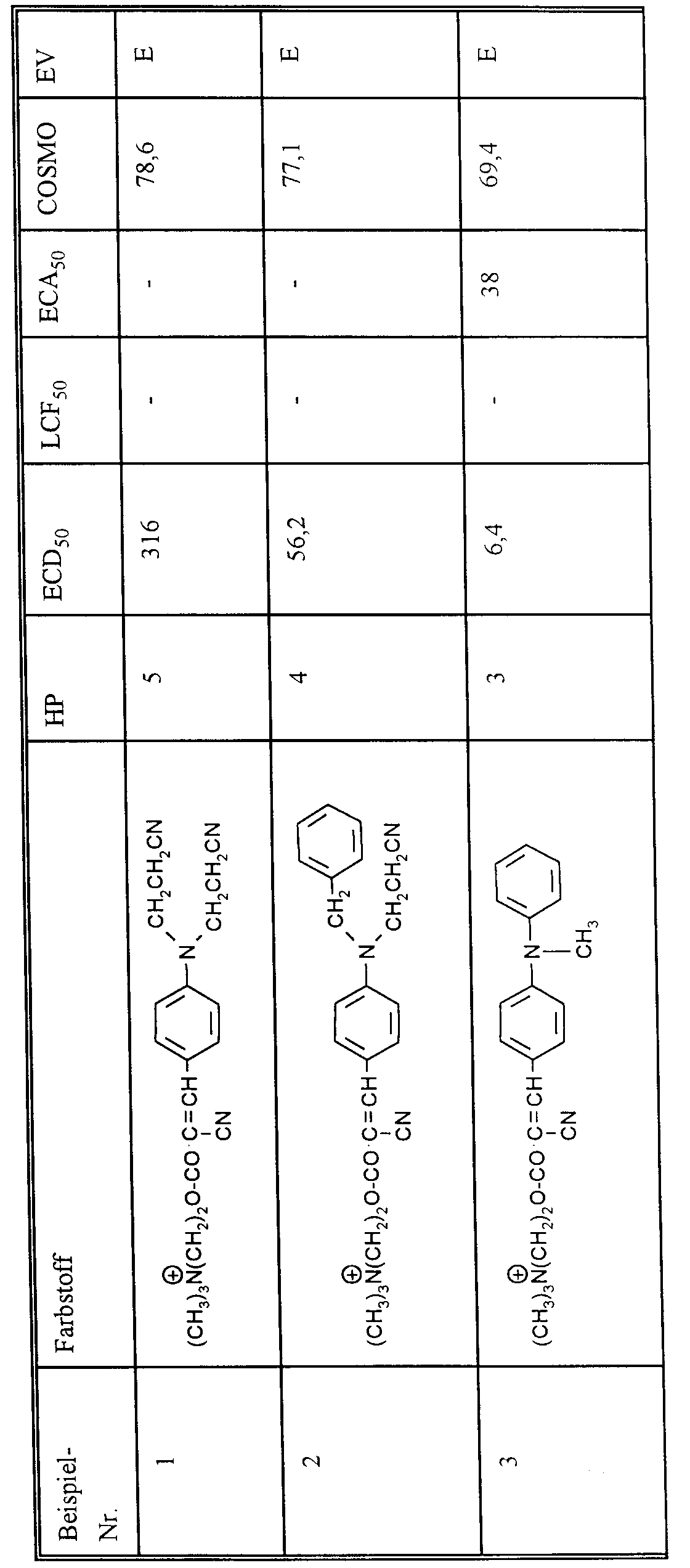
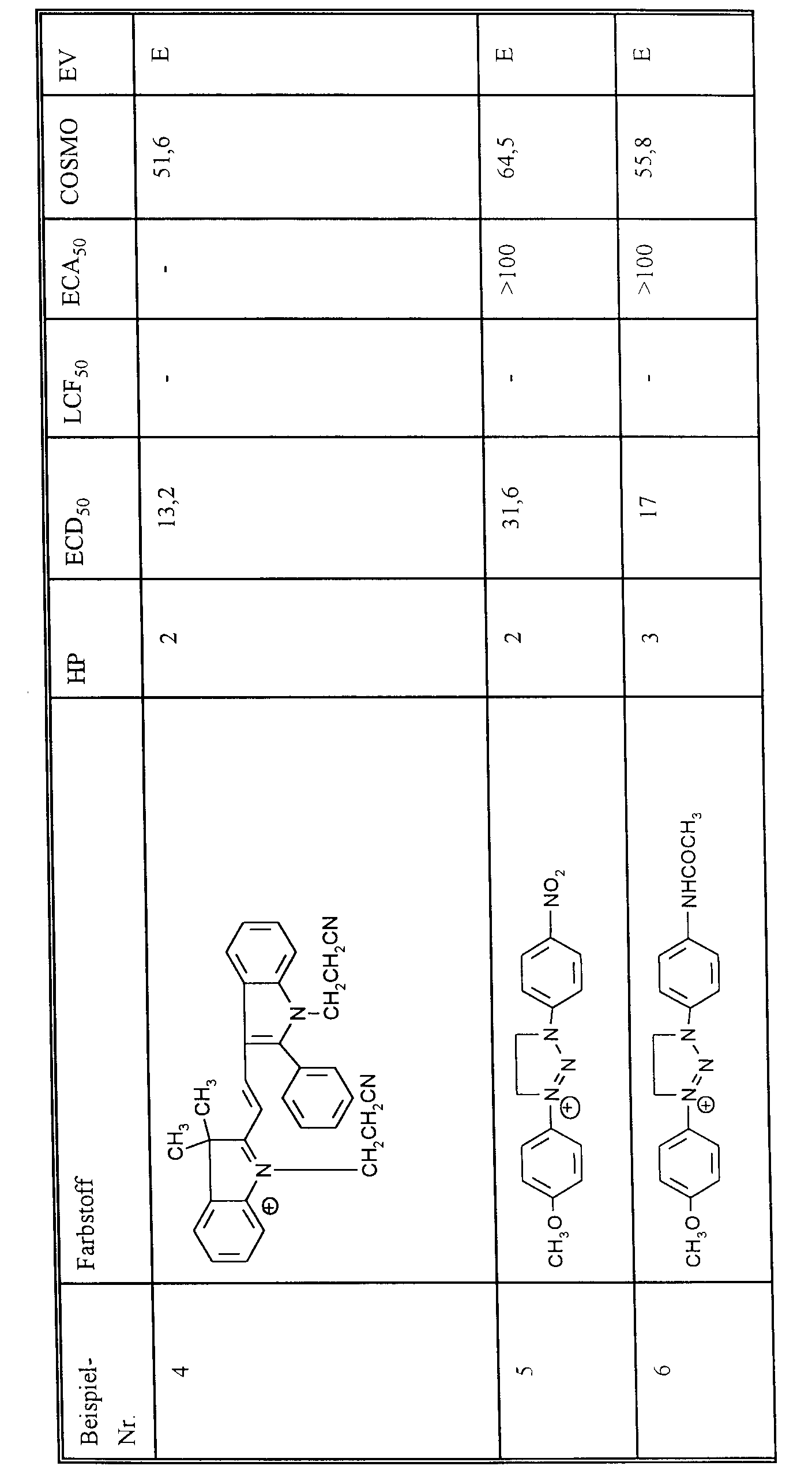


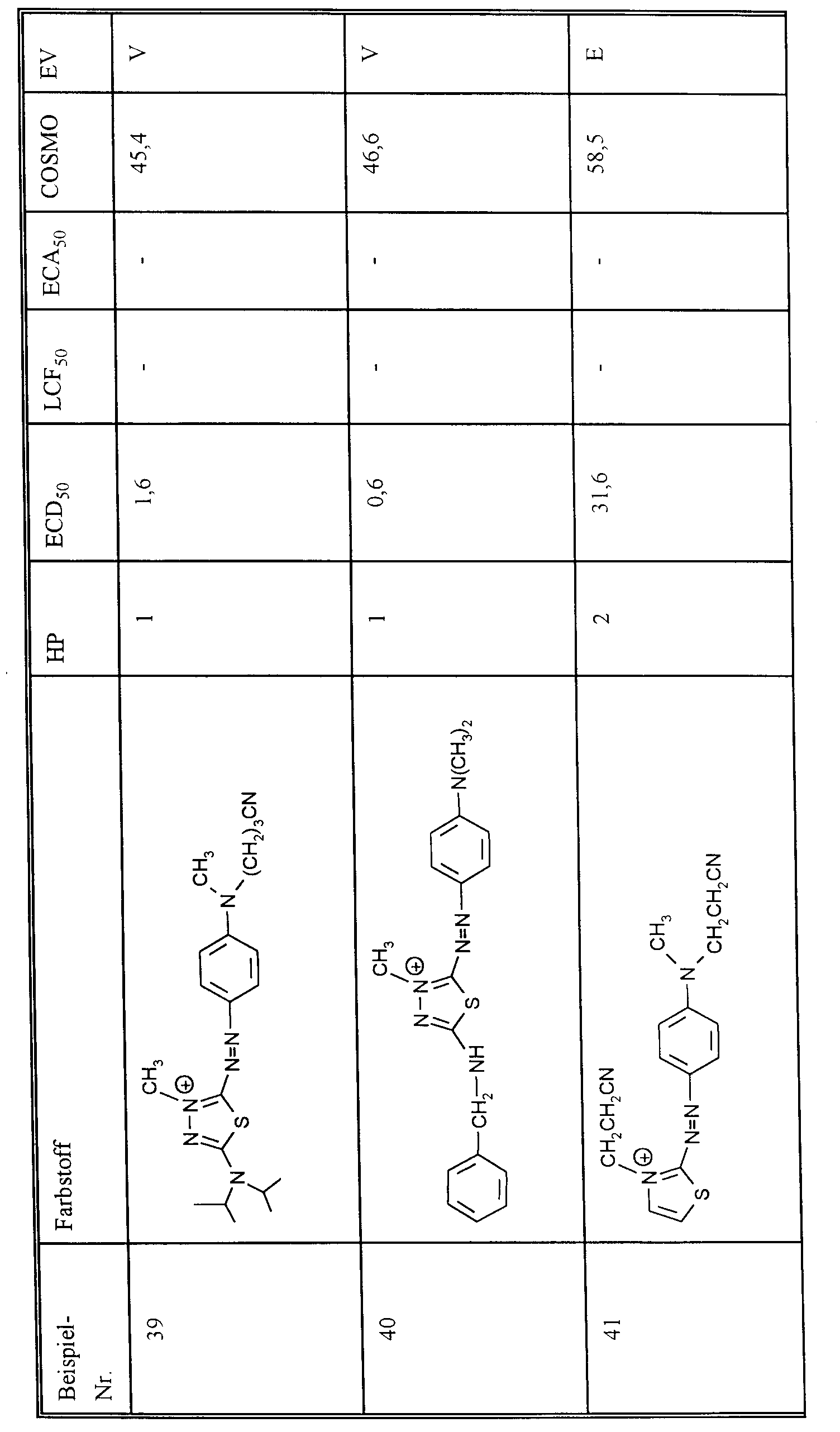


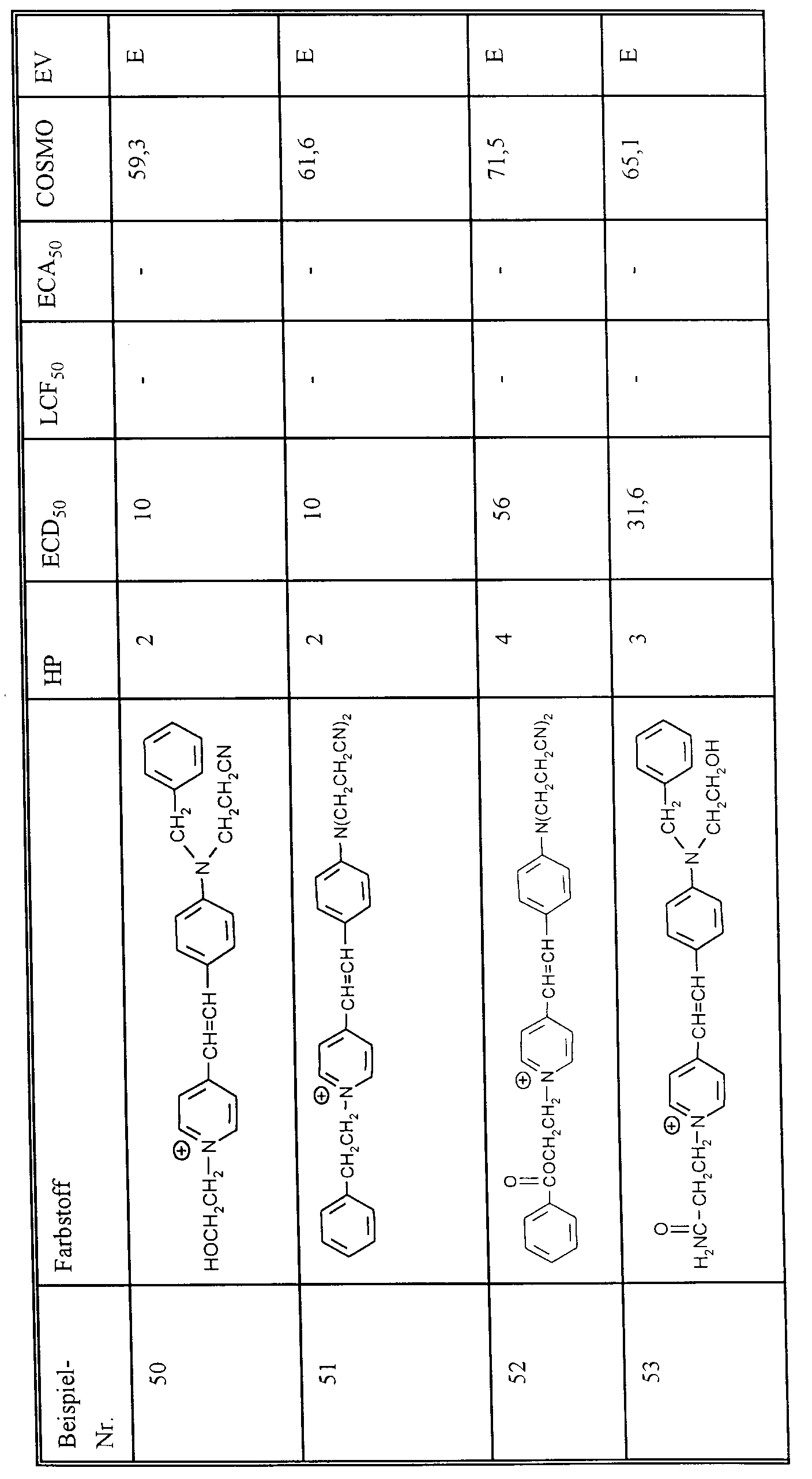
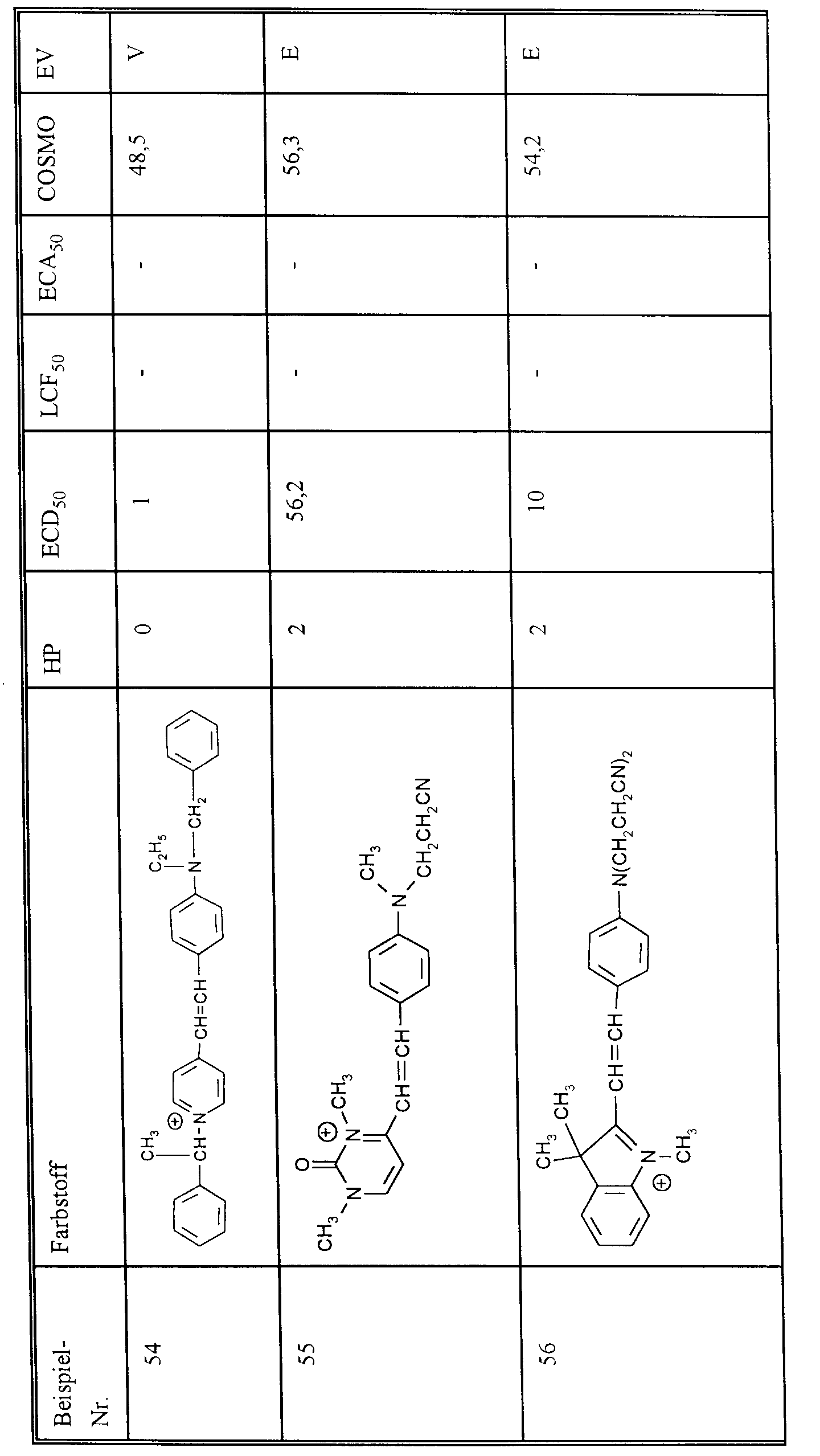


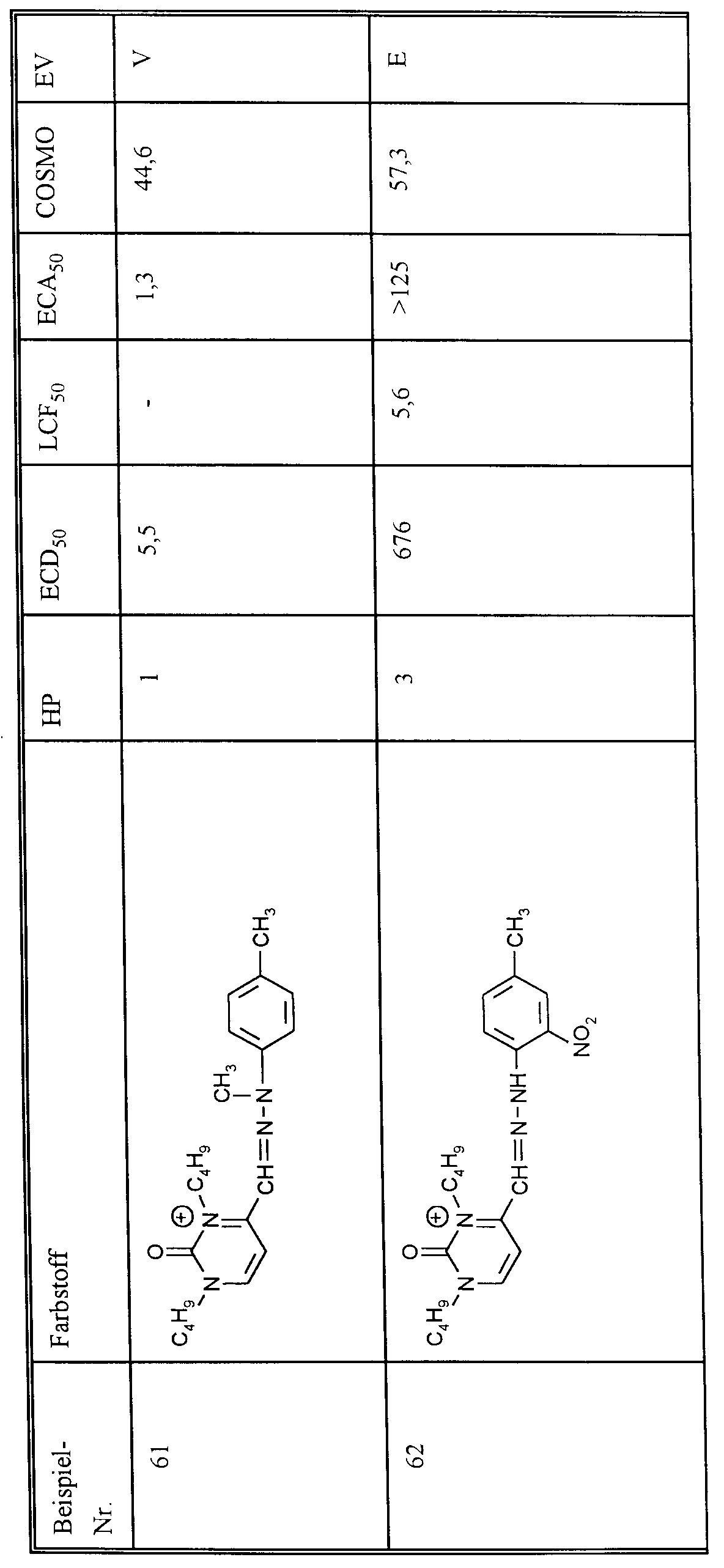
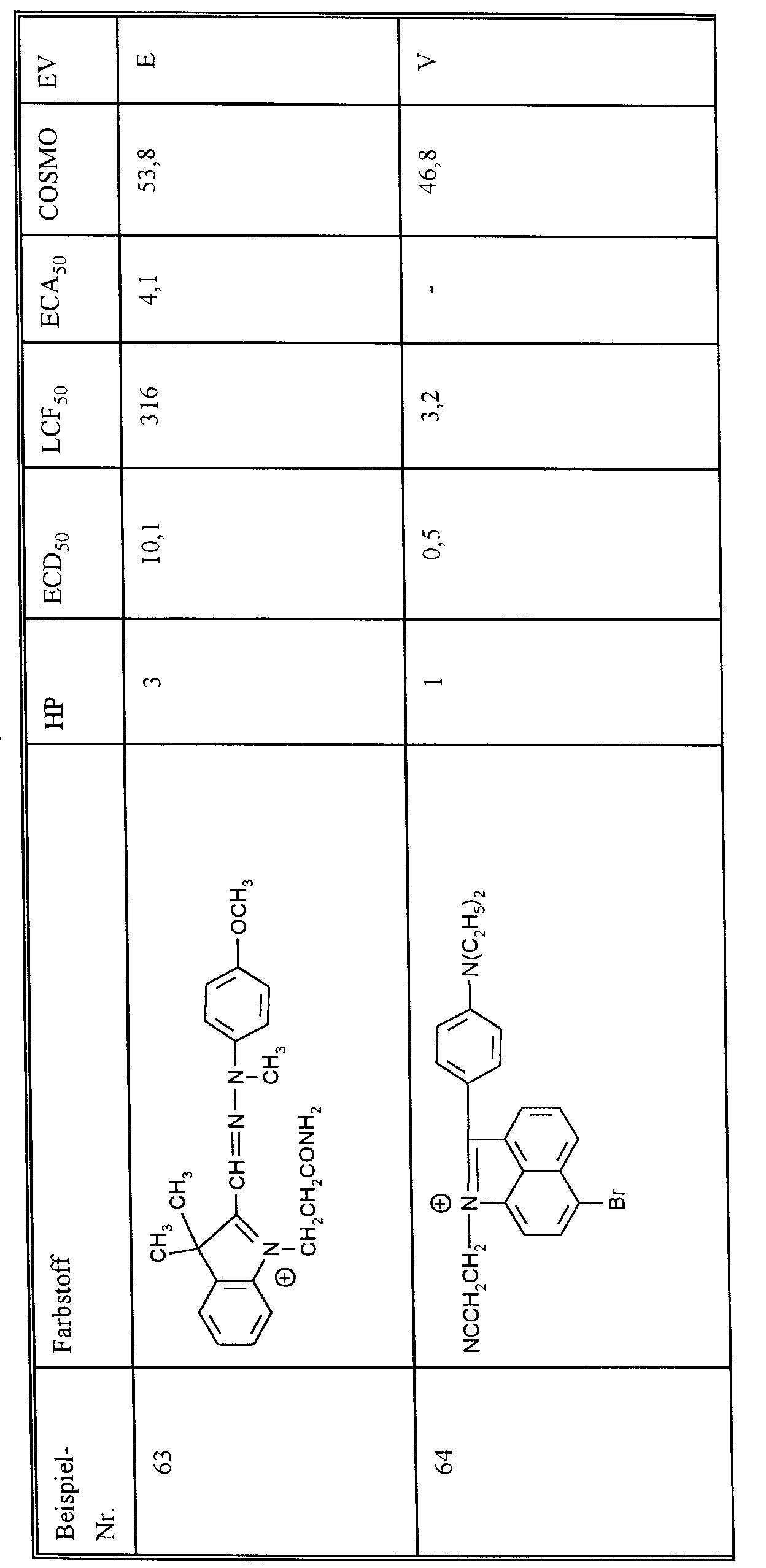

- Ein weiterer Gegenstand der Erfindung sind kationische Farbstoffe der Formel

- R1 und R3
- unabhängig voneinander -(CH2)n-N(C1- bis C4-alkyl)2, Hydroxy-C2- bis -C6-alkyl, Acetoxy-C2- bis -C6-alkyl, Cyano-C2- bis -C6-alkyl, Amidocarbonyl-C2- bis -C6-alkyl, -(CH2)n-O-(CH2)m-OH oder -(CH2)n-O-(CH2)m-OCOCH3 bedeuten,
- R2
- C1- bis C6-Alkyl, Benzyl oder Phenethyl bedeutet oder die Bedeutung von R3 besitzt,
- R4
- Wasserstoff oder C1- bis C6-Alkyl bedeutet,
- n und m
- unabhängig voneinander 2, 3 oder 4 bedeuten und
- X-
- ein Anion bedeutet.
- Ein besonderer Gegenstand der Erfindung sind kationische Farbstoffe der Formel (I),
worin - R1 und R3
- unabhängig voneinander -(CH2)2-N(CH3)2, -(CH2)3-N(CH3)2, -(CH2)3-N(C2H5)2, -CH2CH2OH, -CH2CH(OH)CH3, -CH2CH2-OCOCH3, - CH2CH2CN, -(CH2)2CONH2, -(CH2)2-O-(CH2)2-OH oder -(CH2)2-O-(CH2)2-OCOCH3 bedeuten,
- R2
- Methyl, Ethyl, Propyl, Isopropyl, Butyl, Isobutyl, s-Butyl, Benzyl oder Phenethyl bedeutet oder die Bedeutung von R3 besitzt,
- R4
- Wasserstoff oder Methyl bedeutet und
- X-
- ein Anion bedeutet.
- Ein ganz besonderer Gegenstand der Erfindung sind kationische Farbstoffe der Formel (I),
worin - R'
- -(CH2)2-OH oder -(CH2)2-CONH2 bedeutet,
- R2
- Benzyl bedeutet,
- R3
- -(CH2)2-OH oder -(CH2)2-CN bedeutet,
- R4
- Wasserstoff bedeutet und
- X-
- ein Anion bedeutet.
- Ein weiterer Gegenstand der Erfindung sind kationische Farbstoffe der Formel

- R5
- C1- bis C6-Alkyl, Hydroxy-C2- bis -C6-alkyl, Acetoxy-C2- bis -C6-alkyl, - (CH2)n-O-(CH2)m-OH oder -(CH2)n-O-(CH2)m-OCOCH3 bedeutet,
- R6
- C1- bis C6-Alkyl, Benzyl oder Phenethyl bedeutet oder die Bedeutung von R7 besitzt,
- R7
- -(CH2)n-N(C1- bis C4-alkyl)2, Hydroxy-C2- bis -C6-alkyl, Amidocarbonyl-C2- bis -C6-alkyl oder -(CH2)n-O-(CH2)m-OH bedeutet,
- R8
- Wassserstoff oder C1- bis C6-Alkyl bedeutet,
- n und m
- unabhängig voneinander 2, 3 oder 4 bedeuten und
- X-
- ein Anion bedeutet.
- Ein besonderer Gegenstand der Erfindung sind kationische Farbstoffe der Formel (II),
worin - R5
- Methyl, Ethyl, Propyl, Isopropyl, Butyl, Isobutyl, s-Butyl, -CH2CH2OH, - CH2CH(OH)CH3, -CH2CH2OCOCH3, -CH2CH(CH3)OCOCH3, -(CH2)2-O-(CH2)2-OH oder -(CH2)2-O-(CH2)2-OCOCH3 bedeutet,
- R6
- Methyl, Ethyl, Propyl, Isopropyl, Butyl, Isobutyl, s-Butyl, Benzyl oder Phenethyl bedeutet oder die Bedeutung von R7 besitzt,
- R7
- -(CH2)2-N(CH3)2, -(CH2)3-N(CH3)2, -(CH2)3-N(C2H5)2, -CH2CH2OH, -CH2CH(OH)CH3, -(CH2)2CONH2 oder -(CH2)2-O-(CH2)2-OH bedeutet,
- R8
- Wasserstoff oder Methyl bedeutet und
- X-
- ein Anion bedeutet.
- Ein ganz besonderer Gegenstand der Erfindung sind kationische Farbstoffe der Formel (II),
worin - R5
- Hydroxyethyl oder Acetoxyethyl bedeutet,
- R6
- Benzyl oder Phenethyl bedeutet,
- R7
- -(CH2)3-N(CH3)2 oder Cyanethyl bedeutet,
- R8
- Wasserstoff oder Methyl bedeutet und
- X-
- ein Anion bedeutet.
- Ein weiterer Gegenstand der Erfindung sind kationische Farbstoffe der Formelworin

- R9 und R11
- unabhängig voneinander Wasserstoff, Halogen, C1- bis C6-Alkyl oder C1- bis C6-Alkoxy bedeuten,
- R10
- gegebenenfalls durch Halogen, Cyano, Hydroxy, C1- bis C4-Alkoxy oder phenylsubstituiertes C1- bis C6-Alkyl bedeutet,
- R12
- gegebenenfalls durch Halogen, Cyano, Hydroxy, C1- bis C4-Alkoxy oder Phenyl substituierte C1- bis C6-Alkyl-, C4- bis C7-Cycloalkyl- oder Phenylreste bedeutet,
- R13 und R14
- unabhängig voneinander Wasserstoff, gegebenenfalls durch Halogen, Cyano, Hydroxy, C1- bis C4-Alkoxy oder Phenyl substituierte C1- bis C6-Alkyl-, C4- bis C7-Cycloalkyl- oder Phenylreste bedeuten oder
- NR13R14
- Pyrrolidino, Piperidino oder Morpholino bedeutet und
- X-
- ein Anion bedeutet.
- Ein besonderer Gegenstand der Erfindung sind kationische Farbstoffe der Formel (III),
worin - R9 und R11
- unabhängig voneinander Wasserstoff, Chlor, Methyl oder Methoxy bedeuten,
- R10
- Methyl, Ethyl, Hydroxyethyl, 2-Hydroxypropyl, Cyanethyl, Amidocarbonylethyl oder Benzyl bedeutet,
- R12
- Methyl, Ethyl, Propyl, Butyl, Trifluormethyl, Phenyl, Tolyl oder Chlorphenyl bedeutet,
- R13 und R14
- unabhängig voneinander Methyl, Ethyl, Propyl, Butyl, Benzyl, Hydroxyethyl, Methoxyethyl, Cyanethyl, Phenyl, Tolyl, Methoxyphenyl oder Chlorphenyl bedeuten und
- R13
- zusätzlich Wasserstoff bedeuten kann oder
- NR13R14
- Pyrrolidino, Piperidino oder Morpholino bedeutet und
- X-
- ein Anion bedeutet.
- Ein ganz besonderer Gegenstand der Erfindung sind kationische Farbstoffe der Formel (III),
worin - R9
- Wasserstoff oder Methoxy bedeutet,
- R10
- Methyl bedeutet,
- R11
- Wasserstoff, Methyl oder Methoxy bedeutet,
- R12
- Methyl oder Ethyl bedeutet,
- NR13R14
- Dimethylamino, Diethylamino, Dipropylamino oder Pyrrolidino bedeutet und
- X-
- ein Anion bedeutet.
- Ein weiterer Gegenstand der Erfindung sind kationische Farbstoffe der Formel
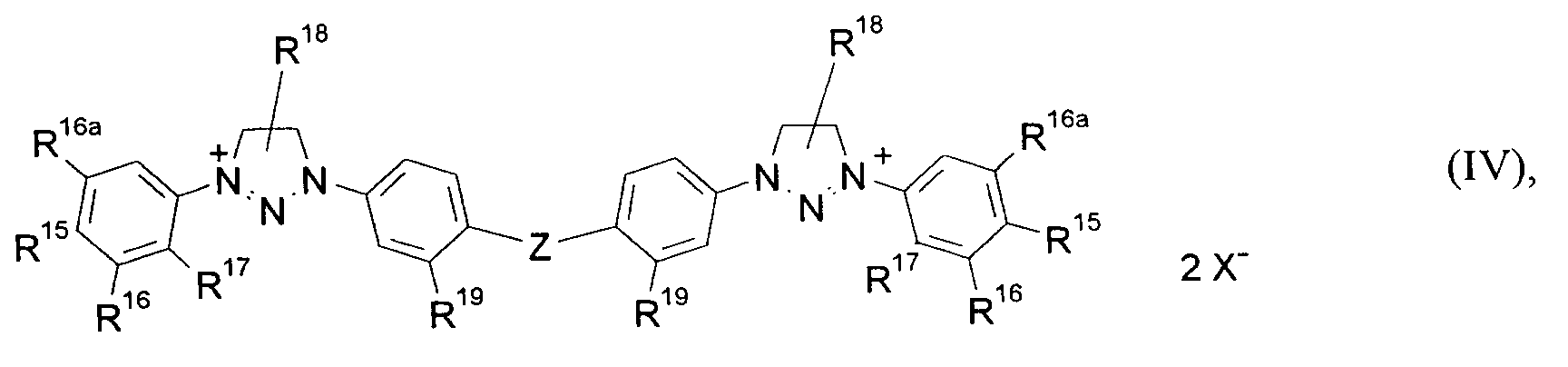
- R15, R16, R16a und R17
- unabhängig voneinander Wasserstoff, Halogen, C1- bis C6-Alkyl, C1- bis C6-Alkoxy, Phenoxy, C1- bis C6-Alkanoylamino, Benzoylamino, C1- bis C6-Alkansulfonylamino, Benzolsulfonylamino, Cyano oder Nitro bedeuten,
- R18
- Wasserstoff oder C1- bis C6-Alkyl bedeutet,
- R19
- Wasserstoff, Methyl oder Methoxy bedeutet,
- Z
- eine Brücke der Formeln -(CH2)m-, O, NH, SO2, NHCO, NHCONH, NHSO2NH, NHCOCONH oder
- m
- 1, 2 oder 3 bedeutet und
- X-
- ein Anion bedeutet.
- Ein besonderer Gegenstand der Erfindung sind kationische Farbstoffe der Formel (IV),
worin - R15, R16 und R17
- unabhängig voneinander Wasserstoff, Chlor, Methyl, Ethyl, Methoxy, Ethoxy, Phenoxy, Acetylamino, Propionylamino, Benzoylamino, Methansulfonylamino, Ethansulfonylamino, Cyano oder Nitro bedeuten,
- R16a und R19
- Wasserstoff,
- R18
- Wasserstoff oder Methyl bedeutet,
- Z
- eine Brücke der Formeln CH2, CH2CH2, NH, NHCO, NHCONH oder

- X-
- ein Anion bedeutet.
- Ein ganz besonderer Gegenstand der Erfindung sind kationische Farbstoffe der Formel (IV),
worin - R15
- Methoxy, Phenoxy oder Acetylamino bedeutet,
- R16
- Wasserstoff, Methyl oder Methoxy bedeutet,
- R16a, R17, R18 und R19
- Wasserstoff bedeuten,
- Z
- NH, NHCO, NHCONH oder
- X-
- ein Anion bedeutet.
- Ein weiterer Gegenstand der Erfindung sind kationische Farbstoffe der Formelworin

- R20, R21, R24 und R25
- unabhängig voneinander ggf. durch Hydroxy, Cyano oder Methoxy substituiertes C1- bis C6-Alkyl, Benzyl, ggf. durch Methyl, Methoxy oder Cyano substituiertes Phenyl oder Tetramethylensulfonyl bedeuten und
- R20 und R24
- unabhängig voneinander zusätzlich Wasserstoff bedeuten können oder
- NR20R21 und NR24R25
- unabhängig voneinander Pyrrolidino Piperidino oder Morpholino bedeuten können,
- R22 und R23
- unabhängig voneinander C1- bis C6-Alkyl bedeuten und
- X-
- ein Anion bedeutet.
- Ein besonderer Gegenstand der Erfindung sind kationische Farbstoffe der Formel (V),
worin - R20 und R21
- unabhängig voneinander C1- bis C6-Alkyl bedeuten,
- R22 und R23
- unabhängig voneinander C1- bis C4-Alkyl bedeuten,
- R24 und R25
- unabhängig voneinander C1- bis C6-Alkyl, Benzyl oder Phenyl bedeuten oder
- NR24R25
- Pyrrolidino oder Piperidino bedeutet und
- X-
- ein Anion bedeutet.
- Ein ganz besonderer Gegenstand der Erfindung sind kationische Farbstoffe der Formel (V),
worin - R20R21
- Diisopropylamino bedeutet,
- R22
- Methyl bedeutet,
- R23
- Methyl oder Ethyl bedeutet,
- NR24R25
- Dimethylamino, Diethylamino, Dipropylamino oder Pyrrolidino bedeutet und
- X-
- ein Anion bedeutet.
- Ein weiterer Gegenstand der Erfindung sind kationische Farbstoffe der Formel

- A
- für eine Struktur der Formel

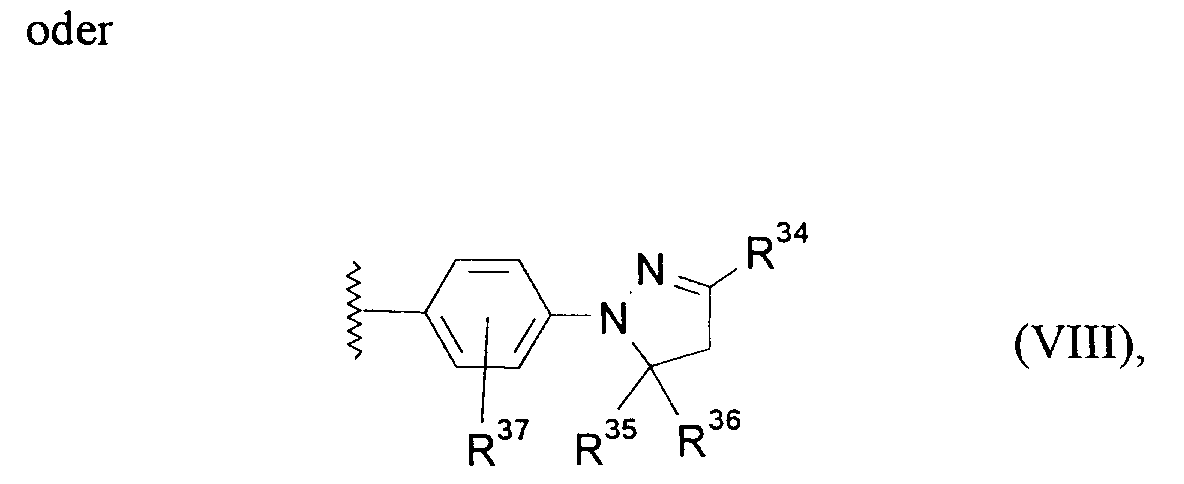
- R26 und R27
- unabhängig voneinander gegebenenfalls durch OH, CN oder CONH2 substituiertes C1- bis C4-Alkyl bedeuten,
- R28
- einen gegebenenfalls verzweigten C1- bis C4-Alkyl-, Cyano-C1- bis -C4-Alkyl-, Hydroxy-C1- bis -C4-Alkyl-, Amido-C1- bis -C4-Alkyl-, C1- bis C4-Alkoxycarbonyl-C1- bis -C4-Alkyl-, Benzyl-, Phenethyl- oder Pyridylethylrest bedeutet,
- R29 und R30
- unabhängig voneinander Wasserstoff C1- bis C4-Alkyl, C7- bis C9-Aralkyl oder C4- bis C7-Cycloalkyl bedeuten,
- R31 und R32
- unabhängig voneinander Wasserstoff C1- bis C4-Alkyl, C6- bis C10-Aryl, C7- bis C9-Aralkyl oder C4- bis C7-Cycloalkyl bedeuten oder
gemeinsam mit dem sie verbindenden C-Atom einen 5-, 6- oder mehrgliedrigen Ring bilden können, - R33
- einen oder mehrere C1- bis C4-Alkyl-, C1- bis C4-Alkoxy-, C7- bis C9-Aralkyl-, C4- bis C7-Cycloalkyl-, Halogen-, C1- bis C4-Alkylcarbonylamino- oder C1- bis C4-Alkylsulfonylaminoreste bedeutet,
- R36
- C1- bis C4-Alkyl bedeutet,
- R34 und R35
- unabhängig voneinander C1- bis C4-Alkyl oder C6- bis C10-Aryl bedeuten,
- R37
- einen oder mehrere C1- bis C4-Alkyl-, Chlor-, Brom-, C1- bis C4-Alkoxy-, C1- bis C4-Alkoxycarbonyl- oder C1- bis C4-Acylaminoreste bedeutet und
- X-
- ein Anion bedeutet.
- Ein besonderer Gegenstand der Erfindung sind kationische Farbstoffe der Formel (VI),
wobei - A
- für eine Struktur der Formeln (VII) oder (VIII) steht,
- R26 und R27
- unabhängig voneinander gegebenenfalls durch OH oder CN substituiertes C1- bis C3-Alkyl bedeuten,
- R28
- einen gegebenenfalls verzweigten C1- bis C4-Alkyl-, Cyano-C1- bis -C2-Alkyl-, Hydroxy-C1- bis -C3-Alkyl-, Amido-C1- bis -C2-Alkyl- oder Benzylrest bedeutet,
- R29 und R30
- unabhängig voneinander Wasserstoff oder C1- bis C4-Alkyl bedeuten,
- R31 und R32
- unabhängig voneinander Wasserstoff oder C1- bis C4-Alkyl bedeuten oder
gemeinsam mit dem sie verbindenden C-Atom einen 5- oder 6-gliedrigen Ring bilden können, - R33
- C1- bis C4-Alkyl, C1- bis C4-Alkoxy, C6-Aryl, C5- oder C6-Cycloalkyl, Halogen, C1- bis C4-Alkylcarbonylamino oder C1- bis C4-Alkylsulfonylamino bedeutet,
- R36
- C1- bis C4-Alkyl bedeutet,
- R34 und R35
- unabhängig voneinander C1- bis C4-Alkyl oder C6-Aryl bedeuten,
- R37
- C1- bis C4-Alkyl, Chlor, Brom, C1- bis C4-Alkoxy, C1- bis C4-Alkoxycarbonyl oder C1- bis C4-Acylamino bedeutet und
- X-
- ein Anion bedeutet.
- Ein ganz besonderer Gegenstand der Erfindung sind kationische Farbstoffe der Formel (VI),
wobei - A
- für eine Struktur der Formeln (VII) oder (VIII) steht,
- R26 und R27
- unabhängig voneinander Methyl, Ethyl, Propyl, Isopropyl, Cyanethyl oder 2-Hydroxypropyl bedeuten,
- R28
- Methyl, Ethyl, Propyl, Butyl, Cyanethyl, 2-Hydroxypropyl, Amidoethyl oder Benzyl bedeutet,
- R29 und R30
- unabhängig voneinander Wasserstoff, Methyl, Ethyl oder Butyl bedeuten,
- R31 und R32
- unabhängig voneinander Wasserstoff, Methyl oder Ethyl bedeuten oder
gemeinsam mit dem sie verbindenden C-Atom einen Cyclopentan- oder Cyclohexan-Ring bilden können, - R33
- Methyl, Methoxy, Chlor, Brom, Methylcarbonylamino oder Methylsulfonylamino bedeutet,
- R36
- Methyl bedeutet,
- R34 und R35
- unabhängig voneinander Methyl oder Phenyl bedeuten,
- R37
- Methyl, Chlor, Brom, Methoxy, Methoxycarbonyl oder Acetylamino bedeutet und
- X-
- ein Anion bedeutet.
- Ein weiterer Gegenstand der Erfindung sind kationische Farbstoffe der Formel (IX)worin

- R38 und R39
- unabhängig voneinander Wasserstoff, C1- bis C6-Alkyl, C1- bis C4-Perfluoralkyl, Halogen, Nitro, Cyano, C1- bis C4-Alkoxy-, C6- bis C10-Aryloxy, C1- bis C4-Alkylcarbonyl, C1- bis C4-Dialkylamino, Aminocarbonyl, C1- bis C4-Alkylcarbonylamino, C1- bis C4- Alkoxycarbonyl, C1-bis C4-Alkylsulfonyl oder C6- bis C10-Arylsulfonyl bedeuten.
- R40 und R41
- unabhängig voneinander ggf. mit Cyano, Hydroxy, Aminocarbonyl, C1- bis C4-Mono- oder Dialkylaminocarbonyl, C1- bis C4-Alkoxycarbonyl oder Carboxyl substituiertes C1- bis C6-Alkyl bedeuten, wobei R40 und R41 nicht gleichzeitig unsubstituiertes C1- bis C6-Alkyl sein dürfen,
- R42 und R43
- unabhängig voneinander Wasserstoff C1- bis C6-Alkyl, C1- bis C4-Perfluoralkyl, Halogen, Nitro, Cyano, C1- bis C4-Alkoxy-, C6- bis C10-Aryloxy, C1- bis C4-Alkylcarbonyl oder C1- bis C4- Alkoxycarbonyl bedeuten,
- R44 und R45
- unabhängig voneinander ggf. mit Cyano, Hydroxy, Aminocarbonyl, C1- bis C4-Mono- oder Dialkylaminocarbonyl, C1- bis C4-Alkoxycarbonyl, Carboxyl, C1- bis C4-Alkylsulfonyl substituiertes C1- bis C6-Alkyl oder gegebenenfalls mit Wasserstoff, C1- bis C6-Alkyl, C1- bis C4-Perfluoralkyl, Halogen, Nitro, Cyano, C1- bis C4-Alkoxy, C6- bis C10- Aryloxy, C1- bis C4-Alkylcarbonyl, C1- bis C4-Dialkylamino, Aminocarbonyl, C1- bis C4-Alkoxycarbonyl, C1- bis C4-Alkylsulfonyl oder C6- bis C10-Arylsulfonyl substituiertes C6- bis C10-Aryl bedeuten und
- X-
- ein Anion bedeutet.
- Ein besonderer Gegenstand der Erfindung sind kationische Farbstoffe der Formel (IX),
worin - R38 und R39
- unabhängig voneinander Wasserstoff, Methyl, Ethyl, Trifluormethyl, Brom, Chlor, Nitro, Cyano, Methoxy, Ethoxy, Phenyloxy, Methylcarbonyl, Ethylcarbonyl, Dimethylamino, Diethylamino, Aminocarbonyl, Acetylamino, Methoxycarbonyl, Ethoxycarbonyl, Methylsulfonyl, Ethylsulfonyl oder Phenylsulfonyl bedeuten,
- R40 und R41
- unabhängig voneinander Methyl, Cyanomethyl, Cyanoethyl, Amidocarbonylethyl, 2-Hydroxypropyl, Hydroxyethyl, Dimethylaminocarbonylethyl, Methoxycarbonylethyl, Ethylcarboxylethyl oder Carboxylethyl bedeuten,
wobei - R40 und R41
- nicht gleichzeitig Methyl sind,
- R42 und R43
- unabhängig voneinander Wasserstoff, Methyl, Ethyl, Trifluormethyl, Chlor, Nitro, Cyano, Methoxy, Ethoxy, Methylcarbonyl, Phenoxy, Methoxycarbonyl oder Ethoxycarbonyl bedeuten,
- R44 und R45
- unabhängig voneinander Methyl, Ethyl, Cyanethyl, Hydroxyethyl, Methansulfonylethyl, Methoxycarbonylethyl, Aminocarbonylethyl, Dimethylamino-carbonylethyl, Phenyl, 2-,3- oder 4-Tolyl, 2-,3- oder 4- Anisidyl, 4-Trifluormethyl, 4-Phenoxphenyl, 3- oder 4-Acetaminophenyl, 3 - oder 4-Nitrophenyl, 3- oder 4-Cyanophenyl, 3- oder 4- Acetylphenyl, 4-Diethylaminophenyl, 4-Methoxycarbonylphenyl, 4-Ethoxycarbonylphenyl oder 4-Methylsulfonylphenyl bedeuten und
- X-
- ein Anion bedeutet.
- Ein ganz besonderer Gegenstand der Erfindung sind kationische Farbstoffe der Formel (IX),
worin - R38
- Wasserstoff, Methyl, Methoxy, Phenoxy, Nitro, Cyano, Methoxycarbonyl, Ethoxycarbonyl oder Methansulfonyl bedeutet,
- R39
- Wasserstoff, Methyl, Trifluormethyl oder Cyano bedeutet,
- R40
- Methyl, Ethyl, Cyanethyl oder Hydroxyethyl bedeutet,
- R41
- Methyl, Ethyl, Cyanethyl, Hydroxyethyl, 2-Hydroxypropyl, Hydroxycarbonylethyl oder Aminocarbonylethyl bedeutet,
- R40 und R41
- nicht gleichzeitig Methyl sind,
- R42 und R43
- unabhängig voneinander Wasserstoff, Methyl oder Methoxy bedeuten,
- R44
- Wasserstoff, Methyl, Ethyl, Cyanethyl, Hydroxyethyl oder Methansulfonylethyl bedeutet,
- R45
- Methyl, Ethyl, Phenyl oder 4-Methoxyphenyl bedeutet und
- X-
- ein Anion bedeutet.
- Ein weiterer Gegenstand der Erfindung sind kationische Farbstoffe der Formelwobei B für eine Struktur der Formeln
 steht, worin
- R46
- einen gegebenenfalls verzweigten Cyano-C1- bis -C4-Alkyl-, Hydroxy-C1- bis -C4-Alkyl-, Amido-C1- bis -C4-Alkyl-, C1- bis C4-Alkoxycarbonyl-C1- bis -C4-Alkyl-Rest oder einen 3-Sulfolanylrest bedeutet oder,
wenn B für die Formel (XII) steht und R52 und/oder R53 ein durch OH, CN oder CONH2 substituiertes C1- bis C4-Alkyl bedeuten, zusätzlich einen C1- bis C4-Alkylrest bedeuten kann, - R47
- Wasserstoff C1- bis C4-Alkyl, C1- bis C4-Alkoxy oder Halogen bedeutet,
- R48, R49 und R50
- unabhängig voneinander Wasserstoff oder C1- bis C4-Alkyl bedeuten,
- R51
- Wasserstoff, C1 - bis C4-Alkyl, C1- bis C4-Alkoxy oder Halogen bedeutet,
- R52 und R53
- unabhängig voneinander Wasserstoff, gegebenenfalls durch OH, CN oderCONH2 substituiertes C1- bis C4-Alkyl, C1- bis C4-Alkoxy oder Halogen bedeuten und
- X-
- ein Anion bedeutet.
- Ein besonderer Gegenstand der Erfindung sind kationische Farbstoffe der Formel (X),
worin - R46
- einen Cyanethyl-, 2-Hydroxypropyl-, Amidoethyl- oder 3-Sulfolanylrest bedeutet oder,
wenn B für die Formel (XII) steht und R52 und/oder R53Cyanmethyl oder Cyanethyl bedeuten, zusätzlich einen Methylrest bedeuten kann, - R47
- Wasserstoff, Methyl, Methoxy, Chlor oder Brom bedeutet,
- R48, R49 und R50
- unabhängig voneinander Wasserstoff oder Methyl bedeuten,
- R51
- Wasserstoff, Methyl, Methoxy oder Chlor bedeutet,
- R52 und R53
- unabhängig voneinander Wasserstoff, Cyanmethyl, Cyanethyl, Methoxy oder Chlor bedeuten und
- X-
- ein Anion bedeutet.
- Ein weiterer Gegenstand der Erfindung sind kationische Farbstoffe der Formelworin

- R54
- einen gegebenenfalls verzweigten und durch CN oder CONH2 substituierten C1- oder C3-Alkylrest, einen Allylrest oder einen 3-Sulfolanylrest bedeutet oder,
wenn R56 durch OH, CN oder CONH2 substituiertes C1- bis C4-Alkyl darstellt, zusätzlich einen gegebenenfalls verzweigten und gegebenenfalls durch OH, CN oder CONH2 substituierten C1- bis C4-Alkylrest bedeuten kann, - R55
- Wasserstoff, C1- bis C4-Alkyl, C1 - bis C4-Alkoxy oder Halogen bedeutet,
- R56
- Wasserstoff, einen gegebenenfalls verzweigten C1- bis C4-Alkyl-, C1- bis C4-Alkoxy-, Cyano-C1- bis C4-Alkyl-, Hydroxy-C1- bis C4-Alkyl- oder Amido-C1- bis C4-Alkylrest bedeutet und
- X-
- ein Anion bedeutet.
- Ein besonderer Gegenstand der Erfindung sind kationische Farbstoffe der Formel (XIII),
worin - R54
- einen Amidomethyl-, Cyanpropyl-, Allyl- oder 3-Sulfolanylrest bedeutet oder,
wenn R56 Cyanmethyl darstellt, zusätzlich einen Methylrest bedeuten kann, - R55
- Wasserstoff, Methyl, Methoxy oder Chlor bedeutet,
- R56
- Wasserstoff, Methyl, Methoxy oder Cyanmethyl bedeutet und
- X-
- ein Anion bedeutet.
- Ein weiterer Gegenstand der Erfindung sind kationische Farbstoffe der Formelworin
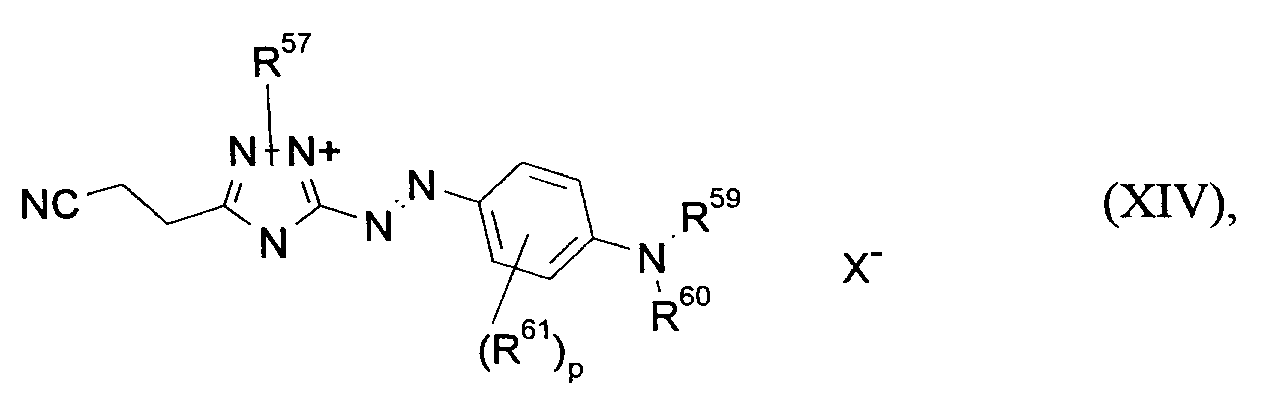
- R57 und R58
- unabhängig voneinander einen gegebenenfalls durch OH, CN oder CONH2substituierten C1- bis C4-Alkylrest, Benzyl oder Phenethyl bedeuten,
- R59 und R60
- unabhängig voneinander Wasserstoff, einen gegebenenfalls verzweigten C1- bis C4-Alkyl-, Cyano-C1- bis -C4-Alkyl-, Hydroxy-C1- bis -C4-Alkyl-, Amido-C1- bis -C4-Alkyl-, C1- bis C4-Alkoxycarbonyl-C1- bis -C4-Alkylrest, Benzyl, Phenethyl oder einen gegebenenfalls durch Methyl, Methoxy, Acetylamino oder Chlor substituierten Phenylrest bedeuten oder
- NR59R60
- Pyrrolidino, Piperidino oder Morpholino bedeutet,
- R61
- Wasserstoff C1- bis C4-Alkyl, C1- bis C4-Alkoxy, C6-Aryl, C5- bis C7-Cycloalkyl, Halogen, C1- bis C4-Alkylcarbonylamino oder C1- bis C4-Alkylsulfonylamino bedeutet,
- p
- 1 oder 2 bedeutet und
- X-
- ein Anion bedeutet.
- Ein besonderer Gegenstand der Erfindung sind kationische Farbstoffe der Formel (XIV),
worin - R57 und R58
- unabhängig voneinander Methyl, Ethyl, Propyl, Cyanethyl, Hydroxyethyl, 2-Hydroxypropyl, Amidoethyl oder Benzyl bedeuten,
- R59 und R60
- unabhängig voneinander gegebenenfalls verzweigte C1- bis C4-Alkyl- oder Cyano-C1- bis -C4-Alkylreste, Benzyl, Phenyl, Tolyl oder Methoxyphenyl bedeuten und
- R59
- zusätzlich Wasserstoff bedeuten kann oder
- NR59R60
- Pyrrolidino oder Piperidino bedeutet,
- R61
- in o-Stellung zur Azogruppe steht und Wasserstoff, C1- bis C4-Alkyl, Halogen, C1- bis C4-Alkylcarbonylamino oder C1- bis C4-Alkylsulfonylamino bedeutet,
- p
- 1 bedeutet und
- X-
- ein Anion bedeutet.
- Ein ganz besonderer Gegenstand der Erfindung sind kationische Farbstoffe der Formel (XIV),
worin - R57 und R58
- gleich sind und Methyl, Ethyl, Cyanethyl oder Benzyl bedeuten,
- R59 und R60
- unabhängig voneinander Methyl, Ethyl, Cyanoethyl, Benzyl oder Phenyl bedeuten und
- R59
- zusätzlich Wasserstoff bedeuten kann,
- R61
- in o-Stellung zur Azogruppe steht und Wasserstoff, Methyl, Chlor, Brom, Methylcarbonylamino oder Methylsulfonylamino bedeutet,
- p
- 1 bedeutet und
- X-
- ein Anion bedeutet.
- Ein weiterer Gegenstand der Erfindung sind Anhydrobasen der Formelnworin

- R9 bis R14, R20 bis R25 und R57 bis R60
- die oben angegebene allgemeine, besondere oder ganz besondere Bedeutung besitzen und
- R62
- Wasserstoff oder Cyanethyl, insbesondere Wasserstoff, bedeutet und
- R63
- C1- bis C4-Alkyl, insbesondere Methyl und Ethyl, bedeutet.
- Alkylreste, auch abgewandelte, wie z. B. Alkoxy- und Aralkylreste, sind vorzugsweise solche mit 1 bis 8, vorzugsweise 1 bis 4 C-Atomen, sofern nichts Anderes angegeben ist. Sie können auch verzweigt sein. Unter Cycloalkylresten werden insbesondere solche mit 4 bis 7, vorzugsweise 5 oder 6 C-Atomen verstanden.
- Alkenylreste sind solche mit 2 bis 6, vorzugsweise 2 oder 3 C-Atomen.
- Arylreste, auch solche in Aralkylresten, sind vorzugsweise Phenylreste, die gegebenenfalls durch 1 bis 3 Reste aus der Gruppe Fluor, Chlor, Methyl, Ethyl, Methoxy, Ethoxy, Cyano, Hydroxy oder Nitro substituiert sind.
- Unter Halogen sind insbesondere Fluor, Chlor und Brom zu verstehen.
- Als Anionen sind farblose, organische und anorganische Anionen bevorzugt, beispielsweise Fluorid, Chlorid, Bromid, Iodid, Perchlorat, Tetrafluoroborat, Hydroxid, Hydrogensulfat, Sulfat, Dihydrogenphosphat, Hydrogenphosphat, Phosphat, Hydrogencarbonat, Carbonat, Methylsulfat, Ethylsulfat, Cyanat, Thiocyanat, Tri- oder Tetrachlorozinkat, Tetrachloroferrat, Hexafluorosilikat und Anionen gesättigter oder ungesättigter aliphatischer, cycloaliphatischer, aromatischer oder heterocyclischer Carbon- oder Sulfonsäuren wie Formiat, Acetat, Hydroxyacetat, Cyanacetat, Propionat, Hydroxypropionat, Oxalat, Citrat, Lactat, Tartrat, das Anion der Cyclohexancarbonsäure, Phenylacetat, Benzoat, das Anion der Nikotinsäure, Methansulfonat, Ethansulfonat, Benzolsulfonat, Chlorbenzolsulfonat oder Toluolsulfonat. Wenn es sich um mehrwertige Anionen handelt, wie z. B. um Sulfat oder Oxalat, dann steht X- für ein Äquivalent solch eines mehrwertigen Anions.
- Die erfindungsgemäßen kationischen Farbstoffe lassen sich nach an sich bekannten Verfahren herstellen.
- Die Farbstoffe der Formel (I) erhält man beispielsweise, indem man quaterniertes 4-Methylpyridin mit entsprechenden 4-Substituiert-amino-benzaldehyden kondensiert. Dies kann beispielsweise geschehen in Lösungsmitteln wie Alkoholen, z.B. Ethanol, Propanol, Butanol, Pentanol oder Hexanol, oder Glycolen, z.B. Ethylenglycol oder Propylenglycol, cyclischen Estern, z.B. Ethylencarbonat, Propylencarbonat oder Butyrolacton sowie Amiden, z.B. Dimethylformamid, Dimethylacetamid oder N-Methylpyrrolidon in Gegenwart von sauren, z.B. Eisessig oder Methansulfonsäure, und/oder vorzugsweise basischen Katalysatoren, z.B. Piperidin, Pyrrolidin, Piperazin oder Pyridin, bei Temperaturen zwischen 70 und 180°C.
- Die Farbstoffe der Formel (II) erhält man beispielsweise, indem man geeignete Cyanessigester mit 4-Substituiert-amino-benzaldehyden kondensiert. Dies kann unter Bedingungen geschehen, wie sie bei den Farbstoffen der Formel (I) angegeben sind. Die Reaktionstemperatur liegt jedoch zwischen Raumtemperatur und 100°C. Auch Acetanhydrid, gegebenenfalls in Gegenwart der oben beschriebenen sauren oder basischen Katalysatoren ist ein geeignetes Reaktionsmedium.
- Die Farbstoffe der Formeln (III), (V), (VI), (IX) und (XIV) erhält man beispielsweise, indem man geeignete 2-Aminobenzthiazole, 2-Amino-1,3,4-thiadiazole bzw. 2-Amino-5-cyanethyltriazole diazotiert und auf geeignete substituierte Aniline oder Derivate davon kuppelt und die so erhaltenen Azofarbstoffe mit geeigneten Alkylierungsmitteln quaterniert. Die Diazotierung erfolgt beispielsweise in anorganischen oder organischen Säuren oder Säuremischungen mit Natriumnitrit oder Nitrosylschwefelsäure. Die Kupplung erfolgt beispielsweise in Wasser, anorganischen oder organischen Säuren oder mit Wasser mischbaren Lösungsmitteln oder Mischungen davon gegebenenfalls unter Zusatz von Basen. Die Quaternierung erfolgt beispielsweise in Wasser, organischen Säuren oder gegen Alkylierungsmittel inerten Lösungsmitteln oder Mischungen davon, gegebenenfalls in Gegenwart von Basen. Anorganische Säuren sind beispielsweise Salzsäure, Schwefelsäure und Phosphorsäure, organische Säuren sind beispielsweise Ameisensäure, Essigsäure und Propionsäure. Inerte Lösungsmittel sind beispielsweise die eben genannten organischen Säuren, γ-Butyrolacton, N-Methylpyrrolidon, Acetonitril, Tetramethylensulfon, Toluol, Xylol oder Chlorbenzol. Alkylierungsmittel sind beispielsweise Dimethyl- oder Diethylsulfat, Benzolsulfonsäuremethylester, Ethylenoxid, Propylenoxid, Acrylnitril, Acrylsäureester oder Acrylsäureamid. Geeignete Basen sind beispielsweise Natrium- oder Kaliumacetat, Magnesiumoxid, Triethanolamin oder Triisopropanolamin.
- Die Farbstoffe der Formel (IV) erhält man beispielsweise durch Tetrazotieren von bifunktionellen aromatischen Aminen der Formel

- R19 und Z
- die oben angegebene Bedeutung besitzen,
- R15 bis R18
- die oben angegebene Bedeutung besitzen und
- Y
- für eine Abgangsgruppe steht,
- R15 bis R17
- die oben angegebene Bedeutung besitzen,
- R18, R19 und Z
- die oben angegebene Bedeutung besitzen und
- Y
- für eine Abgangsgruppe steht,
- Beispiele für Abgangsgruppen Y sind I, Br, Cl, OSO2CH3, OSO2C6H5, OSO3H oder ähnliche.
- Diazotierung, Tetrazotierung und Kupplung werden wie oben bei den Farbstoffen der Formeln (III), (V), (VI), (IX) und (XIV) beschrieben durchgeführt. Für den Cyclisierungsschritt wird vorteilhaft das Kupplungsmedium neutral bis schwach alkalisch eingestellt und gegebenenfalls bei Temperaturen zwischen Raumtemperatur und 70°C gearbeitet.
- Die funktionalisierten aromatischen Amine der Formel (XVIIIa) und Aniline der Formel (XIXa) werden aus den entsprechenden Aminen der Formel (XVIII) bzw. Anilinen der Formel (XIX) hergestellt durch Umsetzung mit beispielsweise aliphatischen Chlor- oder Bromalkoholen wie 2-Bromethanol oder Epoxiden wie Ethylenoxid oder Propylenoxid und anschließende Überführung der Hydroxygruppe in die Abgangsgruppe Y durch beispielsweise Veresterung mit Methansulfonsäurechlorid, Benzolsulfonsäurechlorid oder Schwefelsäure oder Überführung in die Halogenide mit beispielsweise Bromwasserstoffsäure oder Chlorwasserstoffsäure.
- Die Farbstoffe der Formel (X) werden hergestellt durch Kondensation von 1-substituierten 2-Formylmethylen-3,3-dimethylindolinen mit geeigneten Indolinen oder Anilinen. Die Kondensation kann mit wassersabspaltenden Mitteln wie Phosphoroxychlorid, gegebenenfalls in Gegenwart von Lösungsmitteln, oder in Lösungsmitteln in Gegenwart saurer und/oder basischer Katalysatoren erfolgen, wobei in letzterem Falle das Reaktionswasser vorteilhaft abdestilliert wird. Die Reaktionstemperatur liegt bei Raumtemperatur bis 60°C, im Falle der destillativen Entfernung von Wasser bei der Siedetemperatur des Lösungsmittels oder seines Azeotrops mit Wasser. Geeignete Lösungsmittel sind vorzugsweise aromatische Lösungsmittel wie Toluol, Xylol oder Chlorbenzol sowie Chloroform und Ethylenchlorid. Als Katalysatoren kommen beispielsweise in Frage Eisessig, Methan- oder Benzolsulfonsäure, Piperidin, Piperazin, Pyrrolidin oder Pyridin.
- Die Farbstoffe der Formel (XIII) werden hergestellt durch Diazotieren und Kuppeln von geeigneten Anilinen auf 1-substituierte 2-Methylen-3,3-dimethylindoline und anschließende Quaternierung der Farbstoffzwischenprodukte. Geeignete Bedingungen für Diazotierung und Kupplung sind bereits bei der Herstellung der Farbstoffe der Formeln (III), (V), (VI), (IX) und (XIV) beschrieben worden. Die Quaternierung kann erfolgen in Wasser oder Lösungsmitteln oder Mischungen davon in Gegenwart von Basen bei Temperaturen zwischen Raumtemperatur und 80°C. Als Quaternierungsmittel wird Dimethylsulfat oder beispielsweise Benzolsulfonsäuremethylester eingesetzt. Geeignete Lösungsmittel sind aromatische Lösungsmittel wie Toluol, Xylol oder Chlorbenzol, geeignete Basen sind Natrium- oder Kaliumhydroxid, vorzugsweise in Form ihrer wäßrigen Lösungen, Magnesiumoxid, Ethyl-diisopropylamin oder Triisopropanolamin. Beim Arbeiten in Zweiphasenmischungen aus Wasser und Lösungsmittel empfiehlt sich der Zusatz eines Phasentransferkatalysators, beispielsweise eines quartären Ammoniumsalzes wie Triethylbenzylammonium, Tetrabutylammonium oder Methyltrioctylammonium jeweils in Form beispielsweise ihres Chlorids oder Bromids.
- Die erfindungsgemäßen kationischen Farbstoffe der Formeln (I) bis (VI), (IX), (X), (XIII) und (XIV) eignen sich hervorragend zum Färben und Bedrucken von kationisch färbbaren Fasern, vorzugsweise von Polymerisaten und Mischpolymerisaten des Acrylnitrils und Dicyanoethylens, sowie von sauer modifizierten Fasern aus Polyamid und Polyester, wobei echte Farbtöne erhalten werden. Bei diesen Färbeverfahren werden Abwässer erhalten, die im Sinne der eingangs gegebenen Definition in der Regel mindertoxisch sind. Die Farbstoffe können auch Verwendung finden zum Färben und Bedrucken von tannierten Cellulosematerialien, Papier, Seide und Leder. Sie sind weiterhin geeignet zur Herstellung von Schreibflüssigkeiten, Stempelflüssigkeiten, Kugelschreiberpasten und Inkjet-Tinten. Sie lassen sich auch im Gummidruck verwenden.
- Das Färben von beispielsweise Polymerisaten und Mischpolymerisaten des Acrylnitrils kann z.B. aus schwach sauerer Flotte erfolgen, wobei man in das Färbebad vorzugsweise bei 40 bis 60°C eingeht und dann bei Kochtemperatur färbt. Man kann auch unter Druck bei Temperaturen über 100°C färben. Desweiteren lassen sich mit den erfindungsgemäßen kationischen Farbstoffen Spinnlösungen zum Färben polyacrylnitrilhaltiger Fasern herstellen. Die Fasern können trocken oder naß versponnen werden.
- Das Färben von Papier erfolgt beispielsweise in der wäßrigen Aufschlämmung von Cellulosefasern vor und während des Auflaufs auf die Papiermaschine unter sauren bis neutralen Bedingungen in Gegenwart oder Abwesenheit von organischen und/oder anorganischen Leimungsmitteln und gegebenenfalls in Gegenwart weiterer Hilfsstoffe zur Papiererzeugung, z. B. Retentions- und/oder Naßfestmittel.
- Die Färbungen der erfindungsgemäßen kationischen Farbstoffe auf Materialien aus Polyacrylnitril zeichnen sich durch sehr gute Licht-, Naß- und Reibechtheiten aus. Die Farbstoffe zeigen eine hohe Affinität zu Papier, so daß bei der Färbung nur ein geringer Teil im Abwasser verbleibt.
- Die erfindungsgemäßen kationischen Farbstoffe können einzeln, in Mischungen untereinander oder in Mischung mit anderen Farbstoffen angewendet werden.
- Die vorliegende Erfindung betrifft schließlich auch kationisch gefärbte Fasern, tannierte Cellulosematerialien, Papier, Seide, Leder, Schreibflüssigkeiten, Stempelflüssigkeiten, Kugelschreiberpasten und Inkjet-Tinten, die dadurch gekennzeichnet sind, daß sie mindestens einen Farbstoff der Formeln (I) bis (VI), (IX), (X), (XIII) und (XIV) enthalten.
- Die Anhydrobasen der Formeln (XV), (XVI) und (XVII) können aus den Farbstoffen der Formeln (III), (V) bzw. (XIV) durch Umsetzung mit Basen erhalten werden. Geeignete Basen sind beispielsweise Hydroxide wie Natrium-, Kalium- oder Calciumhydroxid, Oxide wie Magnesiumoxid, Alkoholate wie Natriummethylat oder Amine wie Triethylamin, Di- oder Triethanolamin, Piperidin oder Pyridin. Geeignete Reaktionsmedien für die Umsetzung mit solchen Basen sind beispielsweise Wasser, Alkohole wie Methanol, Ethanol, Isopropanol, Ketone wie Aceton oder Butanon oder Mischungen davon.
- Die Anhydrobasen der Formeln (XV), (XVI) und (XVII) sind geeignet zum Anfärben von Fasern und Geweben aus Polyester sowie als Farbstoffe für den Sublimations- oder Diffusionstransferdruck. Transferdruck ist für die textile Anwendung beispielsweise aus US-P 4 137 042, für die Anwendung auf Papier oder sonstigen Substraten zur Informations- oder Bilddarstellung beispielsweise aus EP-A 0 384 040 bekannt. Insbesondere von Interesse ist der Transferdruck auf Papier oder vergleichbare Substrate wie Kunstoffolien oder -vliese, die mit einer sauren Schicht belegt sind. Solche Schichten können beispielsweise aus sauren Tonen oder Phenolharzen oder Salicylsäuren oder deren Salze in geeigneten Bindersystemen bestehen. Bei der Übertragung der Anhydrobasen der Formeln (XV), (XVI) oder (XVII) auf solche sauer beschichteten Papiere werden in dieser Schicht durch Protonierung die Farbstoffe der Formeln (III), (V) bzw. (XIV) zurückgebildet.
- Die Erfindung betrifft auch Fasern und Gewebe aus Polyester, die mit Anhydrobasen der Formeln (XV), (XVI) oder (XVII) gefärbt sind. Sie betrifft auch Gewebe aus Polyester oder Polyacrylnitril, die mit diesen Anhydrobasen bedruckt sind. Sie betrifft ebenso Materialien für den Sublimations- oder Diffusionstransferdruck zur Darstellung von Informationen oder Bildern, die in ihrer Geberschicht mindestens eine Anhydrobase der Formeln (XV), (XVI) oder (XVII) enthalten.
- 9.4 g γ-Picolin und 6.9 g Propylenglycol wurden auf 120°C erhitzt. Bei dieser Temperatur wurden langsam 7.3 g Chlorethanol zugetropft. Anschließend wurde 1 h bei 120°C und 3 h bei 140°C nachgerührt. Nach dem Abkühlen auf 80°C wurden 17.2 g N-Benzyl-N-hydroxyethyl-aminobenzaldehyd und 0.7 g Piperidin zugegeben. Nach 4 h bei 80°C wurden die flüchtigen Bestandteile durch Wasserdampfdestillation entfernt. Verdünnen des Rückstands mit 12 ml Wasser/Eisessig 10:2 ergab eine gebrauchsfertige 25-gew.-proz. Lösung des Farbstoffs der Formel (I) mit R1 = R3 = Hydroxyethyl, R2 = Benzyl, R4 = Wasserstoff und X- = Chlorid.
- Diese Lösung zeigte ein Absorptionsmaximum bei 432 nm.
- Ligninhaltiges Papier wurde in einem brillanten Orange mit guten Abwasserwerten gefärbt.
- Analog wurden die Farbstoffe der folgenden Tabelle hergestellt:
Tabelle Beispiel R1 R2 R3 R4 X- λmax a) 68 -(CH2)2-OH -CH2-C6H5 -(CH2)2-OH CH3 Cl- 438 nm 69 -(CH2)2CONH2 -CH2-C6H5 -(CH2)2-OH H Cl- 474 nm 70 -(CH2)2-OH -C2H4-C6H5 -(CH2)2-CN H Cl- 462 nm 71 -(CH2)2-OH -CH2-C6H5 -(CH2)2-CN H Cl- 456 nm 72 -(CH2)2CONH2 -C2H4-C6H5 -(CH2)2-CN H Cl- 466 nm 73 -(CH2)2CONH2 -CH2-C6H5 -(CH2)2-CN H Cl- 458 nm a) in Wasser/Eisessig 10:2 - 30 g Essigsäureanhydrid und 8.5 g Cyanessigsäure wurden bei Raumtemperatur mit 24 g Bis-hydroxyethyl-dimethylammoniumchlorid versetzt und 12 h bei Raumtemperatur verrührt. Es wurden 24.8 g N-Phenethyl-N-(3-dimethylaminopropyl)aminobenzaldehyd zugegeben und 6 h bei 70°C gerührt. Die Mischung wurde mit 12 g Wasser und 1.2 g Eisessig verdünnt. Man erhielt so eine gebrauchsfertige Lösung des Farbstoffs der Formel (II) mit R5 = Acetoxyethyl, R6 = Phenethyl, R7 = -(CH2)3-N(CH3)2, R8 = Wasserstoff und X- = Acetat.
- Diese Lösung zeigte ein Absorptionsmaximum bei 423 nm.
- Ligninhaltiges Papier wurde in einem brillanten grünstichigen Gelb mit guten Abwasserwerten gefärbt.
- Analog wurden die Farbstoffe der folgenden Tabelle hergestellt:
Tabelle Beispiel R5 R6 R7 R8 X- λmax a) 75 -(CH2)2-OCOCH3 -C2H4-C6H5 -(CH2)3-N(CH3)2 CH3 Cl- 435 nm 76 -(CH2)2-OCOCH3 -C2H4-C6H5 -(CH2)3-N(C2H5)2 H Cl- 435 nm 77 -(CH2)2-OCOCH3 -CH2-C6H5 -(CH2)2-CN H Cl- 421 nm a) in Wasser/Eisessig 10:2 - 18 g 2-Amino-6-methoxy-benzthiazol wurden in einer Mischung aus 200 ml Eisessig, 40 ml 85-gew.-proz. Phosphorsäure und 30 ml 48-gew.-proz. Schwefelsäure gelöst. Bei 0-5°C wurden während 30 min 34 g Nitrosylschwefelsäure zugetropft. Nach 30 min Rühren bei 0-5°C wurde diese Diazotierung zu einer Lösung von 24.2 g 3-Methansulfonylamino-N,N-diethylanilin in 200 ml Eisessig während 30 min bei 0-5°C getropft. Über Nacht wurde bei Raumtemperatur gerührt, auf 3.5 l Wasser ausgetragen und abgesaugt. Nach Waschen mit Wasser und Trocknen erhielt man 34 g (78.5% d. Th.) des Farbstoffs der Formel

- 34 g dieses Farbstoffs wurden in 300 ml Eisessig gelöst und bei 35°C mit 6.6 g Natriumacetat und 15.2 ml Dimethylsulfat versetzt. Nach 11 h bei dieser Temperatur wurden weitere 1.3 g Natriumacetat und 3.0 ml Dimethylsulfat zugesetzt und weitere 15 h gerührt. Es wurde auf 1 l Wasser ausgetragen, mit 350 ml gesättigter Kochsalzlösung ausgesalzen, abgesaugt und mit 250 ml 15-gew.-proz. Kochsalzlösung gewaschen. Nach dem Trocknen erhielt man 42.3 g (94.5% d. Th.) des Farbstoffs der Formel (III) mit R9 = Methoxy, R10 = R12 = Methyl, R11 = Wasserstoff, R13 = R14 = Ethyl und X- = Methosulfat.
- Eine Lösung in Methanol/Eisessig 9:1 zeigte ein Absorptionsmaximum bei 586 nm.
- Polyacrylnitrlfaser wurde in einem leicht rotstichigen Blau mit guten Echtheiten gefärbt.
- Analog wurden die Farbstoffe der folgenden Tabelle hergestellt:
Tabelle Beispiel R9 R10 R11 R12 R13 R14 X- λmax a) 79 H CH3 H CH3 C2H5 C2H5 Cl- 582 nm 80 H CH3 H CH3 C3H7 C3H7 Cl- 584 nm 81 CH3 -CH2CHCH3 \OH OCH3 C4H9 CH3 CH3 ZnCl3 - 605 nm 82 OCH3 CH3 H CH3 C3H7 C3H7 CH3OSO3 - 589 nm 83 Cl -(CH2)2CONH2 H C6H5 -(CH2)4- Cl- 591 nm a) in Methanol/Eisessig 9:1 - 5.3 g Bis-(4-aminophenyl)-harnstoff wurden in 50 ml Wasser durch Zusatz von 15 ml 30-gew.-proz. Salzsäure teilweise gelöst. Während 1/2 h tropften 10.2 ml einer wäßrigen Natriumnitritlösung (30 g NaNO2 in 100 ml Lösung). Es wurde 1 h bei Raumtemperatur nachgerührt.
- 11.7 g Natrium-2-(4-Methoxyanilino)-ethoxysulfat wurden in 80 ml Wasser suspendiert. 10.5 g Calciumchlorid wurden zugesetzt. Während 1 h wurde obige Tetrazotierung zugetropft und dabei der pH durch Einwurf von festem Natriumcarbonat auf 8 gehalten. Danach wurde 1.5 h bei 40-45°C und pH = 8 gerührt. Die orange Suspension wurde abgesaugt, mit 300 ml Wasser angeschlagen und erneut abgesaugt. Nach dem Trocknen erhielt man 21.5 g des Farbstoffs der Formel (IV) mit R15 = Methoxy, R16 bis R19 = Wasserstoff, Z = NHCONH und X- = Hydrogensulfat.
- Er zeigte in 50-gew.-proz. Essigsäure ein Absorptionsmaximum bei 442 nm.
- Ligninfreies Papier wurde in einem intensiven brillanten Gelb mit guten Abwasserwerten gefärbt.
- Analog wurden die Farbstoffe der folgenden Tabelle hergestellt.
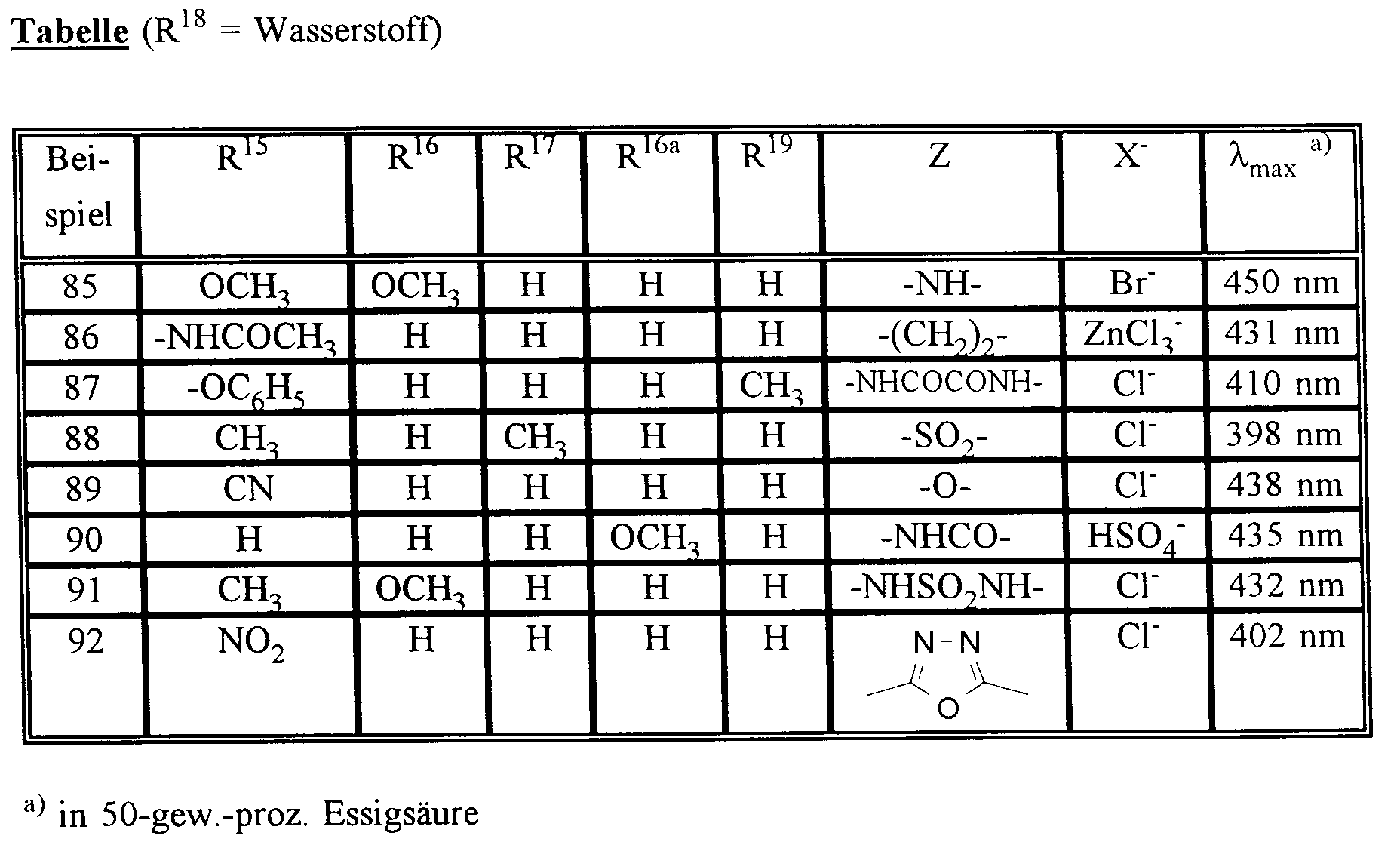
- Zu einer Lösung von 20.0 g 2-Amino-5-diisopropylamino-1,3,4-thiadiazol und 24.2 g 3-Methansulfonylamino-N,N-diethylanilin in 200 ml Eisessig tropften bei 10-15°C während 90 min 20 ml einer 5-molaren wäßrigen Nartriumacetatlösung. Nach Rühren über Nacht bei Raumtemperatur wurde auf 600 ml Eiswasser ausgetragen, abgesaugt und mit viel Wasser gewaschen. Nach Trocknen erhielt man 35 g (77% d. Th.) des Farbstoffs der Formel

- 15 g dieses Farbstoffs wurden in 100 ml Eisessig gelöst und bei 35°C mit 2.7 g Natriumacetat und 6.3 ml Dimethylsulfat versetzt. Nach 18 h bei dieser Temperatur wurde auf 500 ml Wasser ausgetragen. 150 ml 2-molare Zinkchloridlösung und anschließend 450 ml gesättigte Kochsalzlösung wurden zugetropft. Nach Rühren über Nacht wurde abgesaugt, mit 10-gew.-proz. Kochsalzlösung gewaschen und getrocknet. Man erhielt 14.3 g (65% d. Th.) des Farbstoffs der Formel (V) mit R20 = R21 = Isopropyl, R22 = R23 = Methyl, R24 = R25 = Ethyl und X- = ZnCl3 -.
- Er besaß in Methanol/Eisessig 9:1 ein Absorptionsmaximum bei 590 nm.
- Polyacrylnitril färbte er in einem rotstichigen Blau mit guten Echtheiten.
- Die Farbstoffe der folgenden Tabelle wurden analog hergestellt:
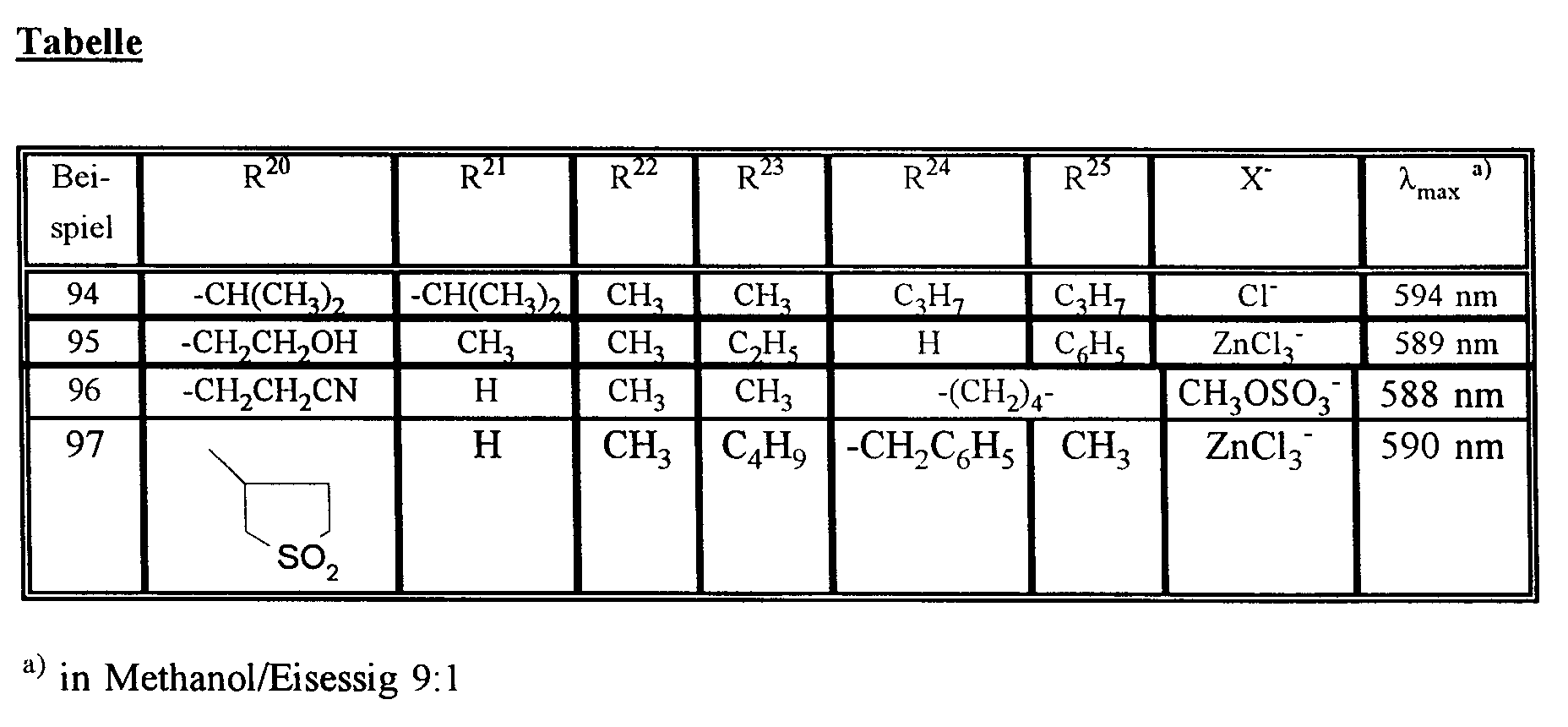
- 20 Teile 2-Amino-5-(diisopropylamino)-1,3,4-thiadiazol wurden bei 0 bis 5°C in einer Mischung aus 50 Teilen Eisessig, 15 Teilen 48 gew.-%iger Schwefelsäure und 5 Teilen 85 gew.-%iger Phosphorsäure mit 34 Teilen 40 gew.-%iger Nitrosylschwefelsäure diazotiert. Nach zweistündigem Rühren wurde die Diazoniumsalzlösung zu einer Lösung von 23 Teilen 1,4-Dimethyl-3-spirocyclopentanchinoxalin-2-on getropft und eine Stunde gerührt. Nach Zusatz von 100 Teilen gesättigter Natriumacetatlösung wurde erneut gerührt und die beginnende Fällung der Farbbase mit konzenrtrierter Natronlauge vervollständigt. Man erhielt 40 Teile Farbbase, die in 100 Teilen Eisessig gelöst wurde. Bei 100°C wurden zu dieser Lösung drei Portionen von je 6 Teilen Propylenoxid durch ein Tauchrohr zugetropft. Nach jeder Portion wurde zwei Stunden bei 100°C gerührt. Nach dem Abkühlen wurde mit 400 Teilen gesättigter Kochsalzlösung ausgefällt Man erhielt 32 Teile eines Farbstoffs der Formel (VI) mit A = Formel (VII), R26 = R27 = Isopropyl, R28 = 2-Hydroxypropyl, R29 = R30 = Methyl, R31-R32 = -(CH2)4-, R33 = Wasserstoff und X- = Chlorid.
- Eine Lösung in Methanol zeigte ein Absorptionsmaximum von 621 nm.
- Der Farbstoff färbte Polyacrylnitril in grünstichig blauer Nuance mit hervorragenden Echtheiten.
- Durch Variation der Substituenten an der Diazokomponente und des Alkylierungsmittels, sowie Einsatz entsprechender Kupplungskomponenten erhielt man weitere coloristisch wertvolle Farbstoffe, die der folgenden Tabelle entnommen werden können:

- 6.2 g (25 mmol) 2-Amino-5-N-cyanethyl,N-phenyl-amino-1,3,4-thiadiazol und 3.0 g (25 mmol) N,N-Dimethyl-anilin wurden in 50 ml Essigsäure bei 20°C mit 5 ml (25 mmol) Natriumnitritlösung versetzt und 2 Stunden nachgerührt. Nach Versetzen mit Wasser wurden 7.2 g (19 mmol) roter Azofarbstoff abgesaugt.
- Zu diesem wurden in 100 ml Essigsäure 3.3 g (40 mmol) Natriumacetat gegeben. Nach Zutropfen von 3.8 ml (42 mmol) Dimethylsulfat wurde bei 45°C einen Tag nachgerührt, eine weitere Portion von 3.8 ml (42 mmol) Dimethylsulfat nachgesetzt und einen weiteren Tag auf 45°C erwärmt. Austragen auf Wasser, Aussalzen mit gesättigter Kochsalzlösung/gesättigter Zinkchloridlösung, Ausrühren in 7.5 gew.-%-Kochsalzlösung und Reinigung in Methanol/Essigester brachte 3.4 g getrockneten kationischen Farbstoff der Formel (IX) mit R38 = R39 = R42 = R43 = Wasserstoff, R40 = Cyanethyl, R41 = R44 = R45 = Methyl und X- = ZnCl3 - als schwarzes Pulver.
- Eine Lösung in Methanol/Eisessig 9:1 besaß ein λmax = 600 nm und einen Extinktionskoeffizienten ε = 71000.
- Der Farbstoff färbte Polyacrylnitril in einem grünstichig blauen Farbton mit guten Echtheiten.
- Ganz analog wurden die Farbstoffe der folgenden Tabelle hergestellt:
Tabelle (X- = Cl-) Bsp. R38 R39 R40 R41 R42 R43 R44 R45 λmax a) 106 H H C2H4CN Me H H Me Me 600nm 107 H H Et C2H4CONH2 H H C2H4CN Me 596nm 108 Me H Me C2H4CN H H C2H4CN Et 601nm 109 H CF3 Me C2H4COOH H H Me Me 603nm 110 OMe H Me CH2CH(OH)Me H H C2H4SO2Me Et 592nm 111 OPh H C2H4CN C2H4CONH2 Me H Et Et 604nm 112 H Me C2H4OH Me H H C2H4OH Et 602nm 113 NO2 H Me C2H4CONMe2 H OMe H Phenyl 620nm 114 H CN C2H4CN Me H OMe H p-Anisidyl 618nm 115 CO2Et H Et C2H4CONH2 H H C2H4CN Me 603nm a) in Methanol/Eisessig 9:1 - 10 Teile 1-(2-Hydroxypropyl)-2-formylmethylen-3,3-dimethylindolin wurden mit 25 Teilen Phosphoroxychlorid gemischt. Bei anschließender Zugabe von 6 Teilen 2-Methylindolin bildete sich unter Wärmeentwicklung der Farbstoff. Nach Abklingen der exothermen Reaktion wurde noch zwei Stunden bei Raumtemperatur nachgerührt. Die Reaktionsmischung wurde auf Eis ausgetragen und neutralgestellt. Nach Absaugen und Trocknen erhielt man 9.2 Teile des Farbstoffs der Formel (X) mit B = Formel (XI), R46 = 2-Hydroxypropyl, R47= R49 = R50 = R51 = Wasserstoff, R48 = Methyl und X- = Cl-.
- Er besaß in Methanol ein Absorptionsmaximum bei 418 nm.
- Der Farbstoff färbte Polyacrylnitril in grünstichig gelber Nuance mit hervorragenden Echtheiten.
- Durch Variation der Substituenten an der Aldehydkomponente erhielt man weitere coloristisch wertvolle Farbstoffe:


- 20.1 Teile Fischeraldehyd und 13.2 Teile 4-Cyanmethylanilin wurden in 250 Teilen Toluol unter Zusatz von 3 Teilen Toluolsulfonsäure sechs Stunden am Wasserabscheider gekocht. Nach dem Erkalten wurden 10 Teile konzentrierte Salzsäure zugesetzt und zur Trockene einrotiert. Nach dem Umlösen aus Methanol und Klären mit Kohle erhielt man 22 Teile des Farbstoffs der Formel (X) mit B = Formel (XII), R46 = Methyl, R47 = R53 = Wasserstoff, R52 = Cyanmethyl und X- = Chlorid.
- Der Farbstoff wies eine maximale Absorption bei 436 nm in Methanol auf.
- Er färbte Polyacrylnitril mit hervoragenden Echtheiten in goldgelber Nuance.
- Verfuhr man in der gleichen Weise mit 1-(3-Sulfolanyl)-2-formylmethylen-3,3-dimethylindolin und p-Anisidin als Ausgangsmaterialien, so erhielt man in 96 % Ausbeute einen hochechten goldgelben Farbstoff der Formel (X) mit B = Formel (XII), R46 = Sulfolan-3-yl, R47 = R53 = Wasserstoff, R52 = Methoxy und X- = Chlorid.
- Er zeigte ein Absorptionsmaximum von 438 nm in Methanol.
- 12.3 Teile p-Anisidin wurden in 80 Teilen halbkonzentrierter Salzsäure gelöst und mit einer Lösung von 7.2 Teilen Natriumnitrit in 13 Teilen Wasser bei 0°C diazotiert. In diese Lösung wurden 21.6 Teile 1-Aminocarbonylmethyl-2-methylen-3,3-dimethylindolin und 120 Teile 20 gew.-%ige Natriumacetatlösung eingetragen und über Nacht bei Raumtemperatur gerührt. Es wurden 300 Teile gesättigte Natriumacetatlösung zugegeben und nach Ausfallen der Farbbase wurde abgesaugt. 31 Teile dieses Zwischenproduktes wurden in 100 Teilen Chlorbenzol gelöst und mit 50 Teilen konzentrierter Natronlauge, sowie 5 Teilen Triethylbenzylammoniumchlorid versetzt. Bei 60°C wurden dann 20 Teile Dimethylsulfat zugetropft und es wurde vier Stunden bei der gleichen Temperatur nachgerührt. Der in einer Ausbeute von 34 Teilen ausgefallene Farbstoff der Formel (XIII) mit R54 = Amidocarbonylmethyl, R55 = Wasserstoff, R56 = Methoxy und X- = Methosulfat wurde abgesaugt und getrocknet.
- Er wies in Methanol ein Absorptionsmaximum von 436 nm auf.
- Der Farbstoff färbte Polyacrylnitril in goldgelber Nuance mit hervorragenden Echtheiten.
- Durch Variation der Substituenten an der Methylenbase, sowie Einsatz entsprechender Diazokomponenten erhält man weitere coloristisch wertvolle Farbstoffe:


- 13.7 Teile 2-Amino-5-cyanethyl-1,2,4-triazol wurden in einem Gemisch aus 50 Teilen Eisessig, 15 Teilen 48 gew.-%iger Schwefelsäure und 5 Teilen 85 gew.-%iger Phosphorsäure bei -5°C mit 34 Teilen 40 gew.-%iger Nitrosylschwefelsäure diazotiert und 2 Stunden bei 0°C nachgerührt. Diese Diazotierung wurde zu einer Lösung aus 16 Teilen N-Methyl-N-cyanethylanilin in 100 Teilen Eisessig getropft und 30 Minuten bei Raumtemperatur gerührt. Durch Zugabe von 100 Teilen gesättigter Natriumacetatlösung wurde die Farbbase ausgefällt. Die erhaltenen 15.4 Teile der Vorstufe wurden in 50 Teilen Wasser suspendiert, mit konzentrierter Natronlauge alkalisch gestellt und mit 3 Teilen Magnesiumoxid versetzt. Bei Raumtemperatur wurden dann 18.9 Teile Dimethylsulfat zugetropft und über Nacht gerührt. Nach erneuter Zugabe von 6.6 g Dimethylsulfat wurde 8 Stunden gerührt und mit Zinkchlorid ausgefällt. Man erhielt 9.8 Teile des Farbstoffs der Formel (XIV) mit R57 = R58 = R59 = Methyl, R60 = 2-Cyanethyl, R61 = Wasserstoff, p = 1 und X- = ZnCl3 -.
- Der Farbstoff wies eine Absorptionswellenlänge von 522 nm in Dimethylformamid auf.
- Er färbte Polyacrylnitril in brillanter roter Nuance mit hervorragenden Echtheiten.
- Einen ähnlich wertvollen Farbstoff erhielt man, wenn statt N-Methyl-N-cyanethylanilin Diethylanilin Verwendung fand. Das Absorptionsmaximum des so erhaltenen Farbstoffs mit R57 = R58 = Methyl, R60 = R61 = Ethyl, R61 = Wasserstoff, p = 1 und X- = ZnCl3 - lag in Methanol bei 540 nm.
- 0.1 g des kationischen Farbstoffs des Beispiels 25 wurden in 2 ml Wasser unter Zusatz von wenig Essigsäure angeteigt und mit 50 ml heißem Wasser gelöst. Dann wurden 1.2 g eines Kondensationsprodukts aus Naphthalinsulfonsäure und Formaldehyd zugesetzt und mit kaltem Wasser auf 500 ml aufgefüllt.
- Der pH-Wert dieser Färbeflotte wurde mit Essigsäure und Natriumacetat auf 4.5 bis 5 eingestellt. In dieser Färbeflotte wurden 10 g Stückware aus Polyacrylnitrilfasern ständig in Bewegung gehalten, während in 30 min die Temperatur auf 100°C erhöht wurde. Bei Kochtemperatur wurde 60 min gefärbt, dann das Material mit kaltem Wasser gespült und bei 60 - 70°C getrocknet.
- Man erhielt ein intensiv neutral blau gefärbtes Stoffstück mit guten coloristischen Echtheiten. Analog ließen sich die Farbstoffe der Beispiele 4 bis 24, 26 bis 48, 55 bis 66, 78 bis 83 und 93 bis 127 verwenden.
- Ein aus 60 % Holzschliff und 40 % ungebleichtem Sulfitzellstoff bestehender Trockenstoff wurde im Holländer mit soviel Wasser angeschlagen und bis zum Mahlgrad 40° SR gemahlen, daß der Trockengehalt etwas über 2.5 % lag. Anschließend wurde mit Wasser exakt 2.5 % Trockengehalt des Dickstoffs eingestellt. 200 g dieses Dickstoffs wurden mit 5 g einer 0.5 gew.-proz. wäßrigen Lösung des Farbstoffs des Beispiels 2 versetzt, 5 min verrührt, 2 % Harzleim und 4 % Alaun, bezogen auf Trockenstoff, hinzugegeben und wiederum einige Minuten homogen verrührt. Dann wurde die Masse mit Wasser auf 700 ml verdünnt und hieraus in bekannter Weise durch Absaugen über einen Blattbildner Papierblätter hergestellt. Sie wiesen eine intensive grünstichig gelbe Färbung auf.
- Analog ließen sich die Farbstoffe der Beispiele 1, 3, 5, 6, 19, 21, 30 bis 36, 49 bis 53, 67 bis 83 und 93 bis 97 verwenden.
- 5 g einer Mischung aus 70 Gew.-% Birkenholzsulfat-Zellstoff und 30 Gew.-% Kiefernholzsulfat-Zellstoff wurden in 395 ml Wasser in einem Laborholländer auf 30 bis 40° SR gemahlen. Diese Mischung wurde auf 1 l mit Wasser aufgefüllt. Hierzu wurde eine Lösung von 25 ml des Farbstoffs des Beispiels 84 in 2.5 ml Wasser, 10 ml einer 1 gew.-proz. wäßrigen Lösung von Harzleim Dynacoll VS 50 der Fa. Akzo Chemie, Düren, und 15 ml einer 1 gew.-proz. wäßrigen Lösung von Aluminiumsulfat gegeben, wobei zwischen den Zugaben 8 Minuten gerührt wurde.
- Die gefärbte und geleimte Papiermasse wurde auf einen Laborblattbildner gegeben, gleichmäßig verteilt und abgesaugt. Anschließend wurde das gelb gefärbte Papierblatt zwischen Filterpapier gepreßt und getrocknet.
- Ganz analog konnten die Farbstoffe der Beispiele 85 bis 92 eingesetzt werden.
- 11.2 g des Farbstoffs des Beispiels 78 wurden in 100 ml Methanol gelöst. 20 ml 10-gew.-proz. Natronlauge wurden zugetropft. Es bildete sich eine violette Suspension, die abgesaugt und mit Methanol und Wasser gewaschen wurde. Nach dem Trocknen erhielt man 6.5 g (73 % d. Th.) des Farbstoffs der Formel (XV) mit R9 = Methoxy, R10 = R12 = Methyl, R11 = Wasserstoff und R13 = R14 = Ethyl als violettes Pulver.
- Eine Lösung in Dimethylformamid besaß ein Absorptionsmaximum bei 531 nm.
- Analog wurden die Farbstoffe der beiden folgenden Tabellen hergestellt:
Tabelle (Anhydrobasen der Formel XV) Beispiel R9 R10 R11 R12 R13 R14 λmax a) 132 H CH3 H CH3 C2H5 C2H5 527 nm 133 H CH3 H CH3 C3H7 C3H7 529 nm 134 CH3 -CH2CHCH3 \OH OCH3 C4H9 CH3 CH3 550 nm 135 OCH3 CH3 H CH3 C3H7 C3H7 533nm 136 Cl -(CH2)2CONH2 H C6H5 -(CH2)4- 534 nm a) in Dimethylformamid 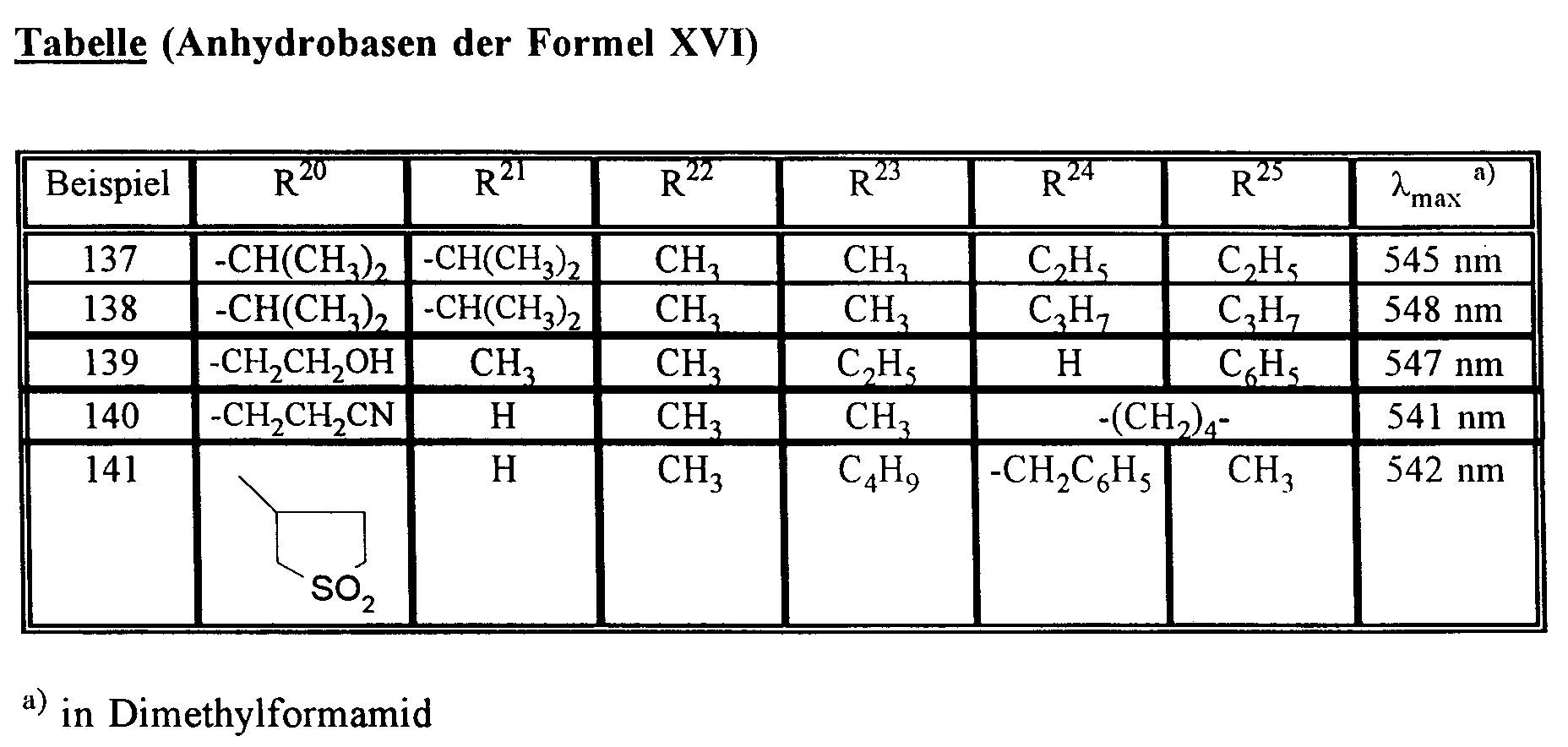
- Mit einer 2-Gew.proz. Lösung des Farbstoffs des Beispiels 131 wurde ein Filterpapierstreifen getränkt und getrocknet. Dieser Papierstreifen wurde nun auf die beschichtete Seite eines handelsüblichen CF-Papiers für kohlefreie Durchschreibepapiere gelegt, dessen Nehmerschicht aus aktiviertem Ton bestand (Reacto®, Fa. Köhler). Das Filterpapier wurde mit einem heißen Glasstab beschrieben. Dabei wurde der Farbstoff auf das Nehmerpapier übertragen und ergab dort eine intensive, rotstichig blaue Markierung.

durch Diazotieren von aromatischen Aminen der Formel

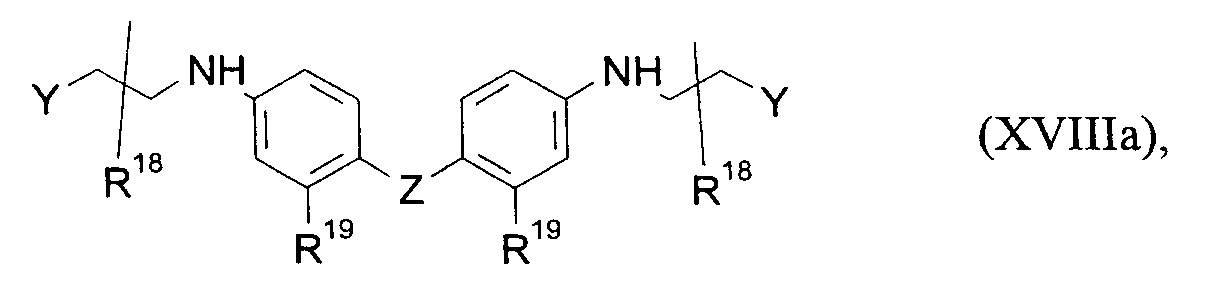
Claims (13)
- Verfahren zum Reduzieren der Toxizität von Restflotten aus dem Färben mit kationischen Farbstoffen oder Mischungen davon, dadurch gekennzeichnet, daß man mit kationischen Farbstoffen färbt, die eine berechnete elektrostatische Abschirmungsenergie (idealisierte Hydratationsenergie) von ≧50 kcal/mol aufweisen.
- Verfahren gemäß Anspruch 1, dadurch gekennzeichnet, daß man als kationische Farbstoffe solche einsetzt, die mindestens zwei hydrophile Reste tragen.
- Kationische Farbstoffe der Formel
 R1 und R3 unabhängig voneinander -(CH2)n-N(C1- bis C4-alkyl)2, Hydroxy-C2- bis -C6-alkyl, Acetoxy-C2- bis -C6-alkyl, Cyano-C2- bis -C6-alkyl, Amidocarbonyl-C2- bis -C6-alkyl, -(CH2)n-O-(CH2)m-OH oder -(CH2)n-O-(CH2)m-OCOCH3 bedeuten,R2 C1- bis C6-Alkyl, Benzyl oder Phenethyl bedeutet oder die Bedeutung von R3 besitzt,R4 Wasserstoff oder C1- bis C6-Alkyl bedeutet,n und m unabhängig 2, 3 oder 4 bedeuten undX- ein Anion bedeutet.
 - Kationische Farbstoffe der Formel
 R5 C1- bis C6-Alkyl, Hydroxy-C2- bis -C6-alkyl, Acetoxy-C2- bis -C6-alkyl, -(CH2)n-O-(CH2)m-OH oder -(CH2)n-O-(CH2)m-OCOCH3 bedeutet,R6 C1- bis C6-Alkyl, Benzyl oder Phenethyl bedeutet oder die Bedeutung von R7 besitzt,R7 -(CH2)n-N(C1- bis C4-alkyl)2, Hydroxy-C2- bis -C6-alkyl, Amidocarbonyl-C2- bis -C6-alkyl oder -(CH2)n-O-(CH2)m-OH bedeutet,R8 Wassserstoff oder C1- bis C6-Alkyl bedeutet,n und m unabhängig voneinander 2, 3 oder 4 bedeuten undX- ein Anion bedeutet.
 - Kationische Farbstoffe der Formel
 R9 und R11 unabhängig voneinander Wasserstoff, Halogen, C1- bis C6-Alkyl oder C1- bis C6-Alkoxy bedeuten,R10 gegebenenfalls durch Halogen, Cyano, Hydroxy, C1- bis C4-Alkoxy oder Phenyl substituiertes C1- bis C6-Alkyl bedeutet,R12 gegebenenfalls durch Halogen, Cyano, Hydroxy, C1- bis C4-Alkoxy oder Phenyl substituierte C1- bis C6-Alkyl-, C4- bis C7-Cycloalkyl- oder Phenylreste bedeutet,R13 und R14 unabhängig voneinander Wasserstoff, gegebenenfalls durch Halogen, Cyano, Hydroxy, C1- bis C4-Alkoxy oder Phenyl substituierte C1- bis C6-Alkyl-, C4- bis C7-Cycloalkyl- oder Phenylreste bedeuten oderNR13R14 Pyrrolidino, Piperidino oder Morpholino bedeutet undX- ein Anion bedeutet.
 - Kationische Farbstoffe der Formel
 R15, R16, R16a und R17 unabhängig voneinander Wasserstoff, Halogen, C1- bis C6-Alkyl, C1- bis C6-Alkoxy, Phenoxy, C1- bis C6-Alkanoylamino, Benzoylamino, C1- bis C6-Alkansulfonylamino, Benzolsulfonylamino, Cyano oder Nitro bedeuten,R18 Wasserstoff oder C1- bis C6-Alkyl bedeutet,R19 Wasserstoff, Methyl oder Methoxy bedeutet,Z eine Brücke der Formeln -(CH2)m-, O, NH, SO2, NHCO, NHCONH, NHSO2NH, NHCOCONH oder
 m 1, 2 oder 3 bedeutet undX- ein Anion bedeutet.
 - Kationische Farbstoffe der Formel
 R20, R21, R24 und R25 unabhängig voneinander ggf. durch Hydroxy, Cyano oder Methoxy substituiertes C1- bis C6-Alkyl, Benzyl, ggf. durch Methyl, Methoxy oder Cyano substituiertes Phenyl oder Tetramethylensulfonyl bedeuten undR20 und R24 unabhängig voneinander zusätzlich Wasserstoff bedeuten können oderNR20R21 und NR24R25 unabhängig voneinander Pyrrolidino, Piperidino oder Morpholino bedeuten können,R22 und R23 unabhängig voneinander C1- bis C6-Alkyl bedeuten undX- ein Anion bedeutet.
 - Kationische Farbstoffe der Formel.
 A für eine Struktur der Formelsteht,
worinR26 und R27 unabhängig voneinander gegebenenfalls durch OH, CN oder CONH2 substituiertes C1- bis C4-Alkyl bedeuten,R28 einen gegebenenfalls verzweigten C1- bis C4-Alkyl-, Cyano-C1- bis -C4-Alkyl-, Hydroxy-C1- bis -C4-Alkyl-, Amido-C1- bis -C4-Alkyl-, C1- bis C4-Alkoxycarbonyl-C1- bis -C4-Alkyl-, Benzyl-, Phenethyl- oder Pyridylethylrest bedeutet,R29 und R30 unabhängig voneinander Wasserstoff, C1- bis C4-Alkyl, C7- bis C9-Aralkyl oder C4- bis C7-Cycloalkyl bedeuten,R31 und R32 unabhängig voneinander Wasserstoff, C1- bis C4-Alkyl, C6-bis C10-Aryl, C7- bis C9-Aralkyl oder C4- bis C7-Cycloalkyl bedeuten oder
gemeinsam mit dem sie verbindenden C-Atom einen 5-, 6- oder mehrgliedrigen Ring bilden können,R33 einen oder mehrere C1- bis C4-Alkyl-, C1- bis C4-Alkoxy-, C7- bis C9-Aralkyl-, C4- bis C7-Cycloalkyl-, Halogen-, C1- bis C4-Alkylcarbonylamino- oder C1- bis C4-Alkylsulfonylaminoreste bedeutet,R36 C1- bis C4-Alkyl bedeutet,R34 und R35 unabhängig voneinander C1- bis C4-Alkyl oder C6- bis C10-Aryl bedeuten,R37 einen oder mehrere C1- bis C4-Alkyl-, Chlor-, Brom-, C1- bis C4-Alkoxy-, C1- bis C4-Alkoxycarbonyl- oder C1- bis C4-Acylaminoreste bedeutet undX- ein Anion bedeutet. - Kationische Farbstoffe der Formel
 R38 und R39 unabhängig voneinander Wasserstoff, C1- bis C6-Alkyl, C1- bis C4- Perfluoralkyl, Halogen, Nitro, Cyano, C1- bis C4-Alkoxy-, C6- bis C10- Aryloxy, C1- bis C4-Alkylcarbonyl, C1- bis C4-Dialkylamino, Aminocarbonyl, C1- bis C4-Alkylcarbonylamino, C1- bis C4-Alkoxycarbonyl, C1- bis C4-Alkylsulfonyl oder C6- bis C10-Arylsulfonyl bedeuten.R40 und R41 unabhängig voneinander ggf. mit Cyano, Hydroxy, Aminocarbonyl, C1- bis C4-Mono- oder Dialkylaminocarbonyl, C1- bis C4-Alkoxycarbonyl oder Carboxyl substituiertes C1- bis C6-Alkyl bedeuten, wobei R40 und R41 nicht gleichzeitig unsubstituiertes C1- bis C6-Alkyl sein dürfen,R42 und R43 unabhängig voneinander Wasserstoff C1- bis C6-Alkyl C1- bis C4- Perfluoralkyl, Halogen, Nitro, Cyano, C1- bis C4-Alkoxy-, C6- bis C10-Aryloxy, C1- bis C4-Alkylcarbonyl oder C1- bis C4-Alkoxycarbonyl bedeuten,R44 und R45 unabhängig voneinander ggf. mit Cyano, Hydroxy, Aminocarbonyl, C1- bis C4- Mono- oder Dialkylaminocarbonyl, C1- bis C4-Alkoxycarbonyl, Carboxyl, C1- bis C4-Alkylsulfonyl substituiertes C1- bis C6-Alkyl oder gegebenenfalls mit Wasserstoff, C1- bis C6-Alkyl, C1- bis C4-Perfluoralkyl, Halogen, Nitro, Cyano, C1- bis C4-Alkoxy, C6- bis C10- Aryloxy, C1- bis C4-Alkylcarbonyl, C1- bis C4-Dialkylamino, Aminocarbonyl, C1- bis C4- Alkoxycarbonyl, C1- bis C4-Alkylsulfonyl oder C6- bis C10-Arylsulfonyl substituiertes C6- bis C10-Aryl bedeuten undX- ein Anion bedeutet.
 - Kationische Farbstoffe der Formel
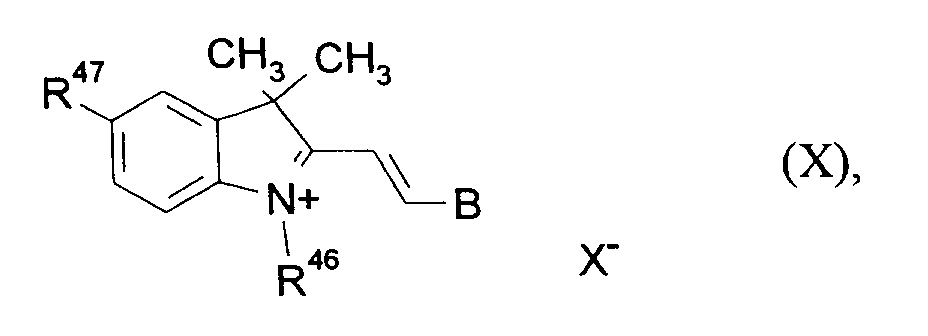
 R46 einen gegebenenfalls verzweigten Cyano-C1- bis -C4-Alkyl-, Hydroxy-C1- bis -C4-Alkyl-, Amido-C1- bis -C4-Alkyl-, C1- bis C4-Alkoxycarbonyl-C1- bis -C4-Alkyl-Rest oder einen 3-Sulfolanylrest bedeutet oder,
wenn B für die Formel (XII) steht und R52 und/oder R53 ein durch OH, CN oder CONH2 substituierten C1- bis C4-Alkyl bedeuten, zusätzlich einen C1- bis C4-Alkylrest bedeuten kann,R47 Wasserstoff, C1- bis C4-Alkyl, C1- bis C4-Alkoxy oder Halogen bedeutet,R48, R49 und R50 unabhängig voneinander Wasserstoff oder C1- bis C4-Alkyl bedeuten,R51 Wasserstoff, C1- bis C4-Alkyl, C1- bis C4-Alkoxy oder Halogen bedeutet,R52 und R53 unabhängig voneinander Wasserstoff, gegebenenfalls durch OH, CN oderCONH2 substituiertes C1- bis C4-Alkyl, C1- bis C4-Alkoxy oder Halogen bedeuten undX- ein Anion bedeutet. - Kationische Farbstoffe der Formel
 R54 einen gegebenenfalls verzweigten und durch CN oder CONH2 substituierten C1- oder C3-Alkylrest, einen Allylrest oder einen 3-Sulfolanylrest bedeutet oder,
wenn R56 durch OH, CN oder CONH2 substituiertes C1- bis C4-Alkyl darstellt, zusätzlich einen gegebenenfalls verzweigten und gegebenenfalls durch OH, CN oder CONH2 substituierten C1- bis C4-Alkylrest bedeuten kann,R55 Wasserstoff C1- bis C4-Alkyl, C1- bis C4-Alkoxy oder Halogen bedeutet,R56 Wasserstoff einen gegebenenfalls verzweigten C1- bis C4-Alkyl-, C1- bis C4-Alkoxy-, Cyano-C1- bis C4-Alkyl-, Hydroxy-C1- bis C4-Alkyl- oder Amido-C1- bis C4-Alkylrest bedeutet undX- ein Anion bedeutet. - Kationische Farbstoffe der Formel
 R57 und R58 unabhängig voneinander einen gegebenenfalls durch OH, CN oder CONH2substituierten C1- bis C4-Alkylrest, Benzyl oder Phenethyl bedeuten,R59 und R60 unabhängig voneinander Wasserstoff, einen gegebenenfalls verzweigten C1- bis C4-Alkyl-, Cyano-C1- bis -C4-Alkyl-, Hydroxy-C1- bis -C4-Alkyl-, Amido-C1- bis -C4-Alkyl -, C1- bis C4-Alkoxycarbonyl-C1- bis -C4-Alkylrest, Benzyl, Phenethyl oder einen gegebenenfalls durch Methyl, Methoxy, Acetylamino oder Chlor substituierten Phenylrest bedeuten oderNR59R60 Pyrrolidino, Piperidino oder Morpholino bedeutet,R61 Wasserstoff C1- bis C4-Alkyl, C1- bis C4-Alkoxy, C6-Aryl, C5- bis C7-Cycloalkyl, Halogen, C1- bis C4-Alkylcarbonylamino oder C1- bis C4-Alkylsulfonylamino bedeutet,p 1 oder 2 bedeutet undX- ein Anion bedeutet.
 - Anhydrobasen der Formeln

 R9 bis R14, R20 bis R25 und R57 bis R60 die in Anspruch 5, 7 bzw. 12 angegebene Bedeutung besitzen undR62 Wasserstoff oder Cyanethyl bedeutet undR63 C1- bis C4-Alkyl bedeutet.
Applications Claiming Priority (2)
| Application Number | Priority Date | Filing Date | Title |
|---|---|---|---|
| DE19524134 | 1995-07-03 | ||
| DE19524134A DE19524134A1 (de) | 1995-07-03 | 1995-07-03 | Verfahren zum Reduzieren der Toxizität von Restflotten und neue kationische Farbstoffe |
Publications (1)
| Publication Number | Publication Date |
|---|---|
| EP0752494A1 true EP0752494A1 (de) | 1997-01-08 |
Family
ID=7765844
Family Applications (1)
| Application Number | Title | Priority Date | Filing Date |
|---|---|---|---|
| EP96109918A Ceased EP0752494A1 (de) | 1995-07-03 | 1996-06-20 | Verfahren zum Reduzieren der Toxizität von Restflotten und neue kationische Farbstoffe |
Country Status (4)
| Country | Link |
|---|---|
| US (2) | US5725607A (de) |
| EP (1) | EP0752494A1 (de) |
| JP (1) | JPH0912914A (de) |
| DE (1) | DE19524134A1 (de) |
Cited By (2)
| Publication number | Priority date | Publication date | Assignee | Title |
|---|---|---|---|---|
| EP1153761A3 (de) * | 2000-05-08 | 2002-01-02 | Eastman Kodak Company | Tintenstrahldruckverfahren |
| WO2004013234A3 (de) * | 2002-07-26 | 2004-05-27 | Bayer Chemicals Ag | Metallkomplexe als lichtabsorbierende verbindungen in der informationsschicht von optischen datenträgern |
Families Citing this family (5)
| Publication number | Priority date | Publication date | Assignee | Title |
|---|---|---|---|---|
| DE19724583A1 (de) * | 1997-06-11 | 1998-12-17 | Bayer Ag | Kationische Diphenylaminfarbstoffe und deren Anhydrobasen |
| US6547834B1 (en) | 2000-03-17 | 2003-04-15 | Kao Corporation | Hair dye composition |
| DE10241076A1 (de) * | 2002-09-05 | 2004-03-11 | Henkel Kgaa | Mittel zum Färben von keratinhaltigen Fasern |
| DE102004028845A1 (de) * | 2004-06-16 | 2006-01-05 | Bayer Chemicals Ag | Optischer Datenträger enthaltend in der Informationsschicht einen Hemicyaninfarbstoff als lichtabsorbierende Verbindung |
| CN112210229A (zh) * | 2019-07-12 | 2021-01-12 | 上海汇友精密化学品有限公司 | 一种阳离子液体染料的制备方法 |
Citations (7)
| Publication number | Priority date | Publication date | Assignee | Title |
|---|---|---|---|---|
| JPS5247065A (en) * | 1975-10-11 | 1977-04-14 | Kyodo Printing Co Ltd | Method of manufacture of decorative metal sheet |
| EP0019997A1 (de) * | 1979-04-05 | 1980-12-10 | American Color & Chemical Corporation | Kationische Alpha-cyano-cinnamoyl-Farbstoffe, ihre Verwendung und mit ihnen gefärbtes Papier |
| EP0023991A1 (de) * | 1979-08-08 | 1981-02-18 | Bayer Ag | Styrylfarbstoffe, ihre Herstellung und ihre Verwendung zum Färben von insbesondere Papier |
| DE3602587A1 (de) * | 1986-01-29 | 1987-07-30 | Hoechst Ag | Verfahren zur herstellung von hochkonzentrierten farbstoffloesungen kationischer farbstoffe |
| EP0272212A2 (de) * | 1986-12-15 | 1988-06-22 | Ciba-Geigy Ag | Verfahren zur kontinuierlichen Herstellung kationischer Azo- oder Hydrazonfarbstoffe |
| EP0495250A1 (de) * | 1991-01-12 | 1992-07-22 | Bayer Ag | Kationische 1,3,4-Thiadiazolfarbstoffe |
| EP0624628A1 (de) * | 1993-05-08 | 1994-11-17 | Bayer Ag | Kationische Diazacyaninfarbstoffe |
Family Cites Families (5)
| Publication number | Priority date | Publication date | Assignee | Title |
|---|---|---|---|---|
| BE794010A (fr) * | 1972-01-13 | 1973-05-02 | Du Pont | Colorants cationiques de couleur jaune-vert |
| US4063882A (en) * | 1976-04-15 | 1977-12-20 | E. I. Du Pont De Nemours And Company | Storage-stable quaternary styryl dye solutions |
| DE2714653C3 (de) * | 1977-04-01 | 1980-10-30 | Bayer Ag, 5090 Leverkusen | Kationische Styrylfarbstoffe und Verfahren zum Färben mit diesen Farbstoffen |
| DE2942185A1 (de) * | 1979-10-18 | 1981-04-30 | Basf Ag, 6700 Ludwigshafen | Basische farbstoffe |
| FR2637289B1 (fr) * | 1988-10-05 | 1992-11-06 | Sandoz Sa | Composes azoiques de la serie de la pyridone, leur preparation et leur utilisation comme colorants |
-
1995
- 1995-07-03 DE DE19524134A patent/DE19524134A1/de not_active Withdrawn
-
1996
- 1996-06-20 EP EP96109918A patent/EP0752494A1/de not_active Ceased
- 1996-06-25 US US08/670,045 patent/US5725607A/en not_active Expired - Fee Related
- 1996-06-28 JP JP8188091A patent/JPH0912914A/ja active Pending
-
1997
- 1997-09-25 US US08/937,289 patent/US5869731A/en not_active Expired - Fee Related
Patent Citations (7)
| Publication number | Priority date | Publication date | Assignee | Title |
|---|---|---|---|---|
| JPS5247065A (en) * | 1975-10-11 | 1977-04-14 | Kyodo Printing Co Ltd | Method of manufacture of decorative metal sheet |
| EP0019997A1 (de) * | 1979-04-05 | 1980-12-10 | American Color & Chemical Corporation | Kationische Alpha-cyano-cinnamoyl-Farbstoffe, ihre Verwendung und mit ihnen gefärbtes Papier |
| EP0023991A1 (de) * | 1979-08-08 | 1981-02-18 | Bayer Ag | Styrylfarbstoffe, ihre Herstellung und ihre Verwendung zum Färben von insbesondere Papier |
| DE3602587A1 (de) * | 1986-01-29 | 1987-07-30 | Hoechst Ag | Verfahren zur herstellung von hochkonzentrierten farbstoffloesungen kationischer farbstoffe |
| EP0272212A2 (de) * | 1986-12-15 | 1988-06-22 | Ciba-Geigy Ag | Verfahren zur kontinuierlichen Herstellung kationischer Azo- oder Hydrazonfarbstoffe |
| EP0495250A1 (de) * | 1991-01-12 | 1992-07-22 | Bayer Ag | Kationische 1,3,4-Thiadiazolfarbstoffe |
| EP0624628A1 (de) * | 1993-05-08 | 1994-11-17 | Bayer Ag | Kationische Diazacyaninfarbstoffe |
Non-Patent Citations (2)
| Title |
|---|
| A.KLAMMT ET AL.: "COSMO: a new approach to dielectric screening in solvents with explicit expressions for the screening energy and its gradient", JOURNAL OF THE CHEMICAL SOCIETY, PERKIN TRANSACTIONS 2, no. 5, May 1993 (1993-05-01), LETCHWORTH GB, pages 799 - 805, XP002016358 * |
| CHEMICAL ABSTRACTS, vol. 89, no. 2, 10 July 1978, Columbus, Ohio, US; abstract no. 7591q, S.FUJINO ET AL.: "cationic dyes" page 72; XP002016359 * |
Cited By (2)
| Publication number | Priority date | Publication date | Assignee | Title |
|---|---|---|---|---|
| EP1153761A3 (de) * | 2000-05-08 | 2002-01-02 | Eastman Kodak Company | Tintenstrahldruckverfahren |
| WO2004013234A3 (de) * | 2002-07-26 | 2004-05-27 | Bayer Chemicals Ag | Metallkomplexe als lichtabsorbierende verbindungen in der informationsschicht von optischen datenträgern |
Also Published As
| Publication number | Publication date |
|---|---|
| US5725607A (en) | 1998-03-10 |
| JPH0912914A (ja) | 1997-01-14 |
| DE19524134A1 (de) | 1997-01-09 |
| US5869731A (en) | 1999-02-09 |
Similar Documents
| Publication | Publication Date | Title |
|---|---|---|
| EP0029136B1 (de) | Quartäre und basische Azamethinverbindungen, Verfahren zu ihrer Herstellung und ihre Verwendung als Farbmittel | |
| EP0176472A1 (de) | Methinazoverbindungen | |
| EP0579011B1 (de) | Kationische Thiadiazoldiphenylaminfarbstoffe | |
| EP0752494A1 (de) | Verfahren zum Reduzieren der Toxizität von Restflotten und neue kationische Farbstoffe | |
| EP0675169B1 (de) | Kationische Thiadiazolfarbstoffe | |
| DE3313797C2 (de) | ||
| EP0482508B1 (de) | Biskationische Azofarbstoffe sowie deren Zwischenprodukte | |
| DE60022876T2 (de) | Triphendioxazin-verbindungen | |
| DE2714653A1 (de) | Kationische styrylfarbstoffe | |
| DE2022624B2 (de) | Basischer Disazofarbstoff, Ver fahren zu dessen Herstellung und dessen Verwendung | |
| EP0037491B1 (de) | Dimethinfarbstoffe, ihre Herstellung und ihre Verwendung zum Färben von synthetischen und natürlichen Materialien | |
| EP0023991B1 (de) | Styrylfarbstoffe, ihre Herstellung und ihre Verwendung zum Färben von insbesondere Papier | |
| DE2039492A1 (de) | Kationische Farbstoffe | |
| DE2500071A1 (de) | Azofarbstoffe fuer den transferdruck | |
| DE3040911A1 (de) | Kationische styrylfarbstoffe, ihre herstellung und ihre verwendung zum faerben von natuerlichen und synthetischen kationisch anfaerbbaren substraten | |
| EP0210139B1 (de) | Kationische 1,2,3-Thiadiazolazoverbindungen | |
| EP0757083A2 (de) | Kationische Thiazolazu- und Benzthiazolazofarbstoffe | |
| DE1644104B2 (de) | Basiche monoazofarbstoffe | |
| DE2849995B2 (de) | Monoazofarbstoffe, Verfahren zu deren Herstellung und ihre Verwendung | |
| DE3540090A1 (de) | Kationische isothiazolazoverbindungen | |
| DE2850706C3 (de) | Kationische Monoazofarbstoffe, Verfahren zu deren Herstellung und Verfahren zum Färben und Bedrucken | |
| DE1644105A1 (de) | Neue basische Farbstoffe und Verfahren zu deren Herstellung | |
| DE1644104C3 (de) | Besiehe Monoazofarbstoffe | |
| DE4444863A1 (de) | Kationische 1,3,4-Thiadiazolfarbstoffe | |
| EP0060468B1 (de) | Verfahren zum Färben von Papier und gefärbtes Papier |
Legal Events
| Date | Code | Title | Description |
|---|---|---|---|
| PUAI | Public reference made under article 153(3) epc to a published international application that has entered the european phase |
Free format text: ORIGINAL CODE: 0009012 |
|
| AK | Designated contracting states |
Kind code of ref document: A1 Designated state(s): CH DE FR GB LI |
|
| 17P | Request for examination filed |
Effective date: 19970708 |
|
| 17Q | First examination report despatched |
Effective date: 20000726 |
|
| RAP1 | Party data changed (applicant data changed or rights of an application transferred) |
Owner name: BAYER CHEMICALS AG |
|
| RAP1 | Party data changed (applicant data changed or rights of an application transferred) |
Owner name: LANXESS DEUTSCHLAND GMBH |
|
| APAF | Appeal reference modified |
Free format text: ORIGINAL CODE: EPIDOSCREFNE |
|
| APBT | Appeal procedure closed |
Free format text: ORIGINAL CODE: EPIDOSNNOA9E |
|
| STAA | Information on the status of an ep patent application or granted ep patent |
Free format text: STATUS: THE APPLICATION HAS BEEN REFUSED |
|
| 18R | Application refused |
Effective date: 20071007 |