EP0051187A2 - Kationische Styrylfarbstoffe, ihre Herstellung und ihre Verwendung zum Färben von natürlichen und synthetischen kationisch anfärbbaren Substraten - Google Patents
Kationische Styrylfarbstoffe, ihre Herstellung und ihre Verwendung zum Färben von natürlichen und synthetischen kationisch anfärbbaren Substraten Download PDFInfo
- Publication number
- EP0051187A2 EP0051187A2 EP81108411A EP81108411A EP0051187A2 EP 0051187 A2 EP0051187 A2 EP 0051187A2 EP 81108411 A EP81108411 A EP 81108411A EP 81108411 A EP81108411 A EP 81108411A EP 0051187 A2 EP0051187 A2 EP 0051187A2
- Authority
- EP
- European Patent Office
- Prior art keywords
- alkyl
- und
- phenyl
- hydrogen
- substituted
- Prior art date
- Legal status (The legal status is an assumption and is not a legal conclusion. Google has not performed a legal analysis and makes no representation as to the accuracy of the status listed.)
- Granted
Links
- 239000000975 dye Substances 0.000 title claims abstract description 59
- 239000000758 substrate Substances 0.000 title claims abstract description 7
- 238000002360 preparation method Methods 0.000 title claims description 6
- 125000000217 alkyl group Chemical group 0.000 claims abstract description 30
- 229910052739 hydrogen Inorganic materials 0.000 claims abstract description 26
- 239000001257 hydrogen Substances 0.000 claims abstract description 26
- UFHFLCQGNIYNRP-UHFFFAOYSA-N Hydrogen Chemical compound [H][H] UFHFLCQGNIYNRP-UHFFFAOYSA-N 0.000 claims abstract description 22
- 238000004043 dyeing Methods 0.000 claims abstract description 18
- 150000002431 hydrogen Chemical class 0.000 claims abstract description 17
- 125000003118 aryl group Chemical group 0.000 claims abstract description 15
- 125000003342 alkenyl group Chemical group 0.000 claims abstract description 13
- 150000001450 anions Chemical class 0.000 claims abstract description 13
- 125000003710 aryl alkyl group Chemical group 0.000 claims abstract description 13
- 125000004122 cyclic group Chemical group 0.000 claims abstract description 12
- 125000004433 nitrogen atom Chemical group N* 0.000 claims abstract description 12
- 238000006798 ring closing metathesis reaction Methods 0.000 claims abstract description 7
- 125000002091 cationic group Chemical group 0.000 claims abstract description 6
- 125000000623 heterocyclic group Chemical group 0.000 claims abstract description 5
- -1 hydroxy, amino, formylamino Chemical group 0.000 claims description 52
- 125000001997 phenyl group Chemical group [H]C1=C([H])C([H])=C(*)C([H])=C1[H] 0.000 claims description 33
- 239000000460 chlorine Substances 0.000 claims description 24
- ZAMOUSCENKQFHK-UHFFFAOYSA-N Chlorine atom Chemical compound [Cl] ZAMOUSCENKQFHK-UHFFFAOYSA-N 0.000 claims description 23
- 229910052801 chlorine Inorganic materials 0.000 claims description 22
- 125000002496 methyl group Chemical group [H]C([H])([H])* 0.000 claims description 19
- WKBOTKDWSSQWDR-UHFFFAOYSA-N Bromine atom Chemical compound [Br] WKBOTKDWSSQWDR-UHFFFAOYSA-N 0.000 claims description 13
- 125000001495 ethyl group Chemical group [H]C([H])([H])C([H])([H])* 0.000 claims description 13
- 150000003254 radicals Chemical class 0.000 claims description 13
- 229910052794 bromium Inorganic materials 0.000 claims description 12
- 229910052757 nitrogen Inorganic materials 0.000 claims description 12
- GDTBXPJZTBHREO-UHFFFAOYSA-N bromine Substances BrBr GDTBXPJZTBHREO-UHFFFAOYSA-N 0.000 claims description 10
- 239000000203 mixture Substances 0.000 claims description 10
- IJGRMHOSHXDMSA-UHFFFAOYSA-N nitrogen Substances N#N IJGRMHOSHXDMSA-UHFFFAOYSA-N 0.000 claims description 10
- PXGOKWXKJXAPGV-UHFFFAOYSA-N Fluorine Chemical compound FF PXGOKWXKJXAPGV-UHFFFAOYSA-N 0.000 claims description 9
- 229910052731 fluorine Inorganic materials 0.000 claims description 9
- 229910052717 sulfur Inorganic materials 0.000 claims description 9
- HEDRZPFGACZZDS-UHFFFAOYSA-N Chloroform Chemical compound ClC(Cl)Cl HEDRZPFGACZZDS-UHFFFAOYSA-N 0.000 claims description 8
- 239000011737 fluorine Substances 0.000 claims description 7
- 125000002887 hydroxy group Chemical group [H]O* 0.000 claims description 7
- 238000000034 method Methods 0.000 claims description 7
- 229910052760 oxygen Inorganic materials 0.000 claims description 7
- LBUJPTNKIBCYBY-UHFFFAOYSA-N 1,2,3,4-tetrahydroquinoline Chemical compound C1=CC=C2CCCNC2=C1 LBUJPTNKIBCYBY-UHFFFAOYSA-N 0.000 claims description 6
- 125000006367 bivalent amino carbonyl group Chemical group [H]N([*:1])C([*:2])=O 0.000 claims description 6
- 125000004093 cyano group Chemical group *C#N 0.000 claims description 6
- 125000000113 cyclohexyl group Chemical group [H]C1([H])C([H])([H])C([H])([H])C([H])(*)C([H])([H])C1([H])[H] 0.000 claims description 6
- 125000001140 1,4-phenylene group Chemical group [H]C1=C([H])C([*:2])=C([H])C([H])=C1[*:1] 0.000 claims description 5
- 239000000463 material Substances 0.000 claims description 5
- 125000000951 phenoxy group Chemical group [H]C1=C([H])C([H])=C(O*)C([H])=C1[H] 0.000 claims description 5
- JUJWROOIHBZHMG-UHFFFAOYSA-O pyridinium Chemical compound C1=CC=[NH+]C=C1 JUJWROOIHBZHMG-UHFFFAOYSA-O 0.000 claims description 5
- 229910052799 carbon Inorganic materials 0.000 claims description 4
- LPAGFVYQRIESJQ-UHFFFAOYSA-N indoline Chemical compound C1=CC=C2NCCC2=C1 LPAGFVYQRIESJQ-UHFFFAOYSA-N 0.000 claims description 4
- QJGQUHMNIGDVPM-UHFFFAOYSA-N nitrogen group Chemical group [N] QJGQUHMNIGDVPM-UHFFFAOYSA-N 0.000 claims description 4
- 125000000843 phenylene group Chemical group C1(=C(C=CC=C1)*)* 0.000 claims description 4
- 125000000022 2-aminoethyl group Chemical group [H]C([*])([H])C([H])([H])N([H])[H] 0.000 claims description 3
- GAWIXWVDTYZWAW-UHFFFAOYSA-N C[CH]O Chemical group C[CH]O GAWIXWVDTYZWAW-UHFFFAOYSA-N 0.000 claims description 3
- 125000001797 benzyl group Chemical group [H]C1=C([H])C([H])=C(C([H])=C1[H])C([H])([H])* 0.000 claims description 3
- 125000000484 butyl group Chemical group [H]C([*])([H])C([H])([H])C([H])([H])C([H])([H])[H] 0.000 claims description 3
- 125000001511 cyclopentyl group Chemical group [H]C1([H])C([H])([H])C([H])([H])C([H])(*)C1([H])[H] 0.000 claims description 3
- 125000005448 ethoxyethyl group Chemical group [H]C([H])([H])C([H])([H])OC([H])([H])C([H])([H])* 0.000 claims description 3
- 125000000956 methoxy group Chemical group [H]C([H])([H])O* 0.000 claims description 3
- 125000004957 naphthylene group Chemical group 0.000 claims description 3
- 125000001436 propyl group Chemical group [H]C([*])([H])C([H])([H])C([H])([H])[H] 0.000 claims description 3
- 125000004178 (C1-C4) alkyl group Chemical group 0.000 claims description 2
- 125000001731 2-cyanoethyl group Chemical group [H]C([H])(*)C([H])([H])C#N 0.000 claims description 2
- BGDOLELXXPTPFX-UHFFFAOYSA-N 3,4-dihydro-2h-1,2-benzoxazine Chemical compound C1=CC=C2ONCCC2=C1 BGDOLELXXPTPFX-UHFFFAOYSA-N 0.000 claims description 2
- YMWUJEATGCHHMB-UHFFFAOYSA-N Dichloromethane Chemical compound ClCCl YMWUJEATGCHHMB-UHFFFAOYSA-N 0.000 claims description 2
- SIKJAQJRHWYJAI-UHFFFAOYSA-N Indole Chemical compound C1=CC=C2NC=CC2=C1 SIKJAQJRHWYJAI-UHFFFAOYSA-N 0.000 claims description 2
- CIUQDSCDWFSTQR-UHFFFAOYSA-N [C]1=CC=CC=C1 Chemical compound [C]1=CC=CC=C1 CIUQDSCDWFSTQR-UHFFFAOYSA-N 0.000 claims description 2
- 125000001309 chloro group Chemical group Cl* 0.000 claims description 2
- 239000000470 constituent Substances 0.000 claims description 2
- GLUUGHFHXGJENI-UHFFFAOYSA-O hydron piperazine Chemical compound [H+].C1CNCCN1 GLUUGHFHXGJENI-UHFFFAOYSA-O 0.000 claims description 2
- 238000005956 quaternization reaction Methods 0.000 claims description 2
- 125000002485 formyl group Chemical class [H]C(*)=O 0.000 claims 3
- 150000001875 compounds Chemical class 0.000 claims 1
- OKKJLVBELUTLKV-UHFFFAOYSA-N Methanol Chemical compound OC OKKJLVBELUTLKV-UHFFFAOYSA-N 0.000 description 33
- QTBSBXVTEAMEQO-UHFFFAOYSA-N Acetic acid Chemical compound CC(O)=O QTBSBXVTEAMEQO-UHFFFAOYSA-N 0.000 description 27
- LFQSCWFLJHTTHZ-UHFFFAOYSA-N Ethanol Chemical compound CCO LFQSCWFLJHTTHZ-UHFFFAOYSA-N 0.000 description 18
- 150000001299 aldehydes Chemical class 0.000 description 13
- XLYOFNOQVPJJNP-UHFFFAOYSA-N water Substances O XLYOFNOQVPJJNP-UHFFFAOYSA-N 0.000 description 11
- ZMXDDKWLCZADIW-UHFFFAOYSA-N N,N-Dimethylformamide Chemical compound CN(C)C=O ZMXDDKWLCZADIW-UHFFFAOYSA-N 0.000 description 10
- 125000001570 methylene group Chemical group [H]C([H])([*:1])[*:2] 0.000 description 10
- 229920001131 Pulp (paper) Polymers 0.000 description 9
- 229920002239 polyacrylonitrile Polymers 0.000 description 9
- 239000000243 solution Substances 0.000 description 9
- 239000002351 wastewater Substances 0.000 description 9
- NQRYJNQNLNOLGT-UHFFFAOYSA-N Piperidine Chemical compound C1CCNCC1 NQRYJNQNLNOLGT-UHFFFAOYSA-N 0.000 description 8
- LSNNMFCWUKXFEE-UHFFFAOYSA-N Sulfurous acid Chemical compound OS(O)=O LSNNMFCWUKXFEE-UHFFFAOYSA-N 0.000 description 8
- 239000000835 fiber Substances 0.000 description 8
- MUVFZOSESRRBCU-UHFFFAOYSA-N 2,2-dicyanoacetamide Chemical class NC(=O)C(C#N)C#N MUVFZOSESRRBCU-UHFFFAOYSA-N 0.000 description 7
- JUJWROOIHBZHMG-UHFFFAOYSA-N Pyridine Chemical compound C1=CC=NC=C1 JUJWROOIHBZHMG-UHFFFAOYSA-N 0.000 description 7
- 239000002585 base Substances 0.000 description 7
- JNLCTEORUQCYOG-UHFFFAOYSA-N 2-acetamido-4-cyano-n-(4-cyanophenyl)benzamide Chemical compound CC(=O)NC1=CC(C#N)=CC=C1C(=O)NC1=CC=C(C#N)C=C1 JNLCTEORUQCYOG-UHFFFAOYSA-N 0.000 description 6
- RTZKZFJDLAIYFH-UHFFFAOYSA-N Diethyl ether Chemical compound CCOCC RTZKZFJDLAIYFH-UHFFFAOYSA-N 0.000 description 6
- DNIAPMSPPWPWGF-UHFFFAOYSA-N Propylene glycol Chemical compound CC(O)CO DNIAPMSPPWPWGF-UHFFFAOYSA-N 0.000 description 6
- 238000003756 stirring Methods 0.000 description 6
- YXFVVABEGXRONW-UHFFFAOYSA-N Toluene Chemical compound CC1=CC=CC=C1 YXFVVABEGXRONW-UHFFFAOYSA-N 0.000 description 5
- 239000002904 solvent Substances 0.000 description 5
- 238000005406 washing Methods 0.000 description 5
- 238000006243 chemical reaction Methods 0.000 description 4
- 238000001035 drying Methods 0.000 description 4
- 238000004519 manufacturing process Methods 0.000 description 4
- 238000002844 melting Methods 0.000 description 4
- 230000008018 melting Effects 0.000 description 4
- 125000001434 methanylylidene group Chemical group [H]C#[*] 0.000 description 4
- 150000003839 salts Chemical class 0.000 description 4
- 239000007858 starting material Substances 0.000 description 4
- WFDIJRYMOXRFFG-UHFFFAOYSA-N Acetic anhydride Chemical compound CC(=O)OC(C)=O WFDIJRYMOXRFFG-UHFFFAOYSA-N 0.000 description 3
- WEVYAHXRMPXWCK-UHFFFAOYSA-N Acetonitrile Chemical compound CC#N WEVYAHXRMPXWCK-UHFFFAOYSA-N 0.000 description 3
- 0 CC(CCC(*CC1)C2CC(*C3)C3C2)C1C1CC1 Chemical compound CC(CCC(*CC1)C2CC(*C3)C3C2)C1C1CC1 0.000 description 3
- XEKOWRVHYACXOJ-UHFFFAOYSA-N Ethyl acetate Chemical compound CCOC(C)=O XEKOWRVHYACXOJ-UHFFFAOYSA-N 0.000 description 3
- FXHOOIRPVKKKFG-UHFFFAOYSA-N N,N-Dimethylacetamide Chemical compound CN(C)C(C)=O FXHOOIRPVKKKFG-UHFFFAOYSA-N 0.000 description 3
- SJRJJKPEHAURKC-UHFFFAOYSA-N N-Methylmorpholine Chemical compound CN1CCOCC1 SJRJJKPEHAURKC-UHFFFAOYSA-N 0.000 description 3
- QAOWNCQODCNURD-UHFFFAOYSA-L Sulfate Chemical compound [O-]S([O-])(=O)=O QAOWNCQODCNURD-UHFFFAOYSA-L 0.000 description 3
- ZMANZCXQSJIPKH-UHFFFAOYSA-N Triethylamine Chemical compound CCN(CC)CC ZMANZCXQSJIPKH-UHFFFAOYSA-N 0.000 description 3
- 229940037003 alum Drugs 0.000 description 3
- JFDZBHWFFUWGJE-UHFFFAOYSA-N benzonitrile Chemical compound N#CC1=CC=CC=C1 JFDZBHWFFUWGJE-UHFFFAOYSA-N 0.000 description 3
- 230000015572 biosynthetic process Effects 0.000 description 3
- 239000003292 glue Substances 0.000 description 3
- 229910052736 halogen Inorganic materials 0.000 description 3
- 150000002367 halogens Chemical class 0.000 description 3
- 229920000151 polyglycol Polymers 0.000 description 3
- 239000010695 polyglycol Substances 0.000 description 3
- 239000000047 product Substances 0.000 description 3
- 239000011541 reaction mixture Substances 0.000 description 3
- 229920005989 resin Polymers 0.000 description 3
- 239000011347 resin Substances 0.000 description 3
- 125000001424 substituent group Chemical group 0.000 description 3
- 238000003786 synthesis reaction Methods 0.000 description 3
- YDYSEBSNAKCEQU-UHFFFAOYSA-N 2,3-diamino-n-phenylbenzamide Chemical compound NC1=CC=CC(C(=O)NC=2C=CC=CC=2)=C1N YDYSEBSNAKCEQU-UHFFFAOYSA-N 0.000 description 2
- BCHZICNRHXRCHY-UHFFFAOYSA-N 2h-oxazine Chemical compound N1OC=CC=C1 BCHZICNRHXRCHY-UHFFFAOYSA-N 0.000 description 2
- XPAQFJJCWGSXGJ-UHFFFAOYSA-N 4-amino-n-(4-aminophenyl)benzamide Chemical compound C1=CC(N)=CC=C1NC(=O)C1=CC=C(N)C=C1 XPAQFJJCWGSXGJ-UHFFFAOYSA-N 0.000 description 2
- 244000198134 Agave sisalana Species 0.000 description 2
- QGZKDVFQNNGYKY-UHFFFAOYSA-N Ammonia Chemical compound N QGZKDVFQNNGYKY-UHFFFAOYSA-N 0.000 description 2
- QGZKDVFQNNGYKY-UHFFFAOYSA-O Ammonium Chemical compound [NH4+] QGZKDVFQNNGYKY-UHFFFAOYSA-O 0.000 description 2
- VEXZGXHMUGYJMC-UHFFFAOYSA-M Chloride anion Chemical compound [Cl-] VEXZGXHMUGYJMC-UHFFFAOYSA-M 0.000 description 2
- 244000060011 Cocos nucifera Species 0.000 description 2
- 235000013162 Cocos nucifera Nutrition 0.000 description 2
- 240000000491 Corchorus aestuans Species 0.000 description 2
- 235000011777 Corchorus aestuans Nutrition 0.000 description 2
- 235000010862 Corchorus capsularis Nutrition 0.000 description 2
- 229920000742 Cotton Polymers 0.000 description 2
- IAYPIBMASNFSPL-UHFFFAOYSA-N Ethylene oxide Chemical compound C1CO1 IAYPIBMASNFSPL-UHFFFAOYSA-N 0.000 description 2
- KFZMGEQAYNKOFK-UHFFFAOYSA-N Isopropanol Chemical compound CC(C)O KFZMGEQAYNKOFK-UHFFFAOYSA-N 0.000 description 2
- 239000004952 Polyamide Substances 0.000 description 2
- VYPSYNLAJGMNEJ-UHFFFAOYSA-N Silicium dioxide Chemical compound O=[Si]=O VYPSYNLAJGMNEJ-UHFFFAOYSA-N 0.000 description 2
- VMHLLURERBWHNL-UHFFFAOYSA-M Sodium acetate Chemical compound [Na+].CC([O-])=O VMHLLURERBWHNL-UHFFFAOYSA-M 0.000 description 2
- 150000001242 acetic acid derivatives Chemical class 0.000 description 2
- 125000000129 anionic group Chemical group 0.000 description 2
- 239000007864 aqueous solution Substances 0.000 description 2
- 238000009835 boiling Methods 0.000 description 2
- 239000003638 chemical reducing agent Substances 0.000 description 2
- 238000004140 cleaning Methods 0.000 description 2
- 239000003086 colorant Substances 0.000 description 2
- 238000009833 condensation Methods 0.000 description 2
- 230000005494 condensation Effects 0.000 description 2
- 238000004821 distillation Methods 0.000 description 2
- ZIUSEGSNTOUIPT-UHFFFAOYSA-N ethyl 2-cyanoacetate Chemical compound CCOC(=O)CC#N ZIUSEGSNTOUIPT-UHFFFAOYSA-N 0.000 description 2
- 125000000816 ethylene group Chemical group [H]C([H])([*:1])C([H])([H])[*:2] 0.000 description 2
- 239000000706 filtrate Substances 0.000 description 2
- OAKJQQAXSVQMHS-UHFFFAOYSA-O hydrazinium(1+) Chemical compound [NH3+]N OAKJQQAXSVQMHS-UHFFFAOYSA-O 0.000 description 2
- RBLWMQWAHONKNC-UHFFFAOYSA-N hydroxyazanium Chemical compound O[NH3+] RBLWMQWAHONKNC-UHFFFAOYSA-N 0.000 description 2
- 239000000976 ink Substances 0.000 description 2
- JVTAAEKCZFNVCJ-UHFFFAOYSA-N lactic acid Chemical compound CC(O)C(O)=O JVTAAEKCZFNVCJ-UHFFFAOYSA-N 0.000 description 2
- 239000010985 leather Substances 0.000 description 2
- 229920005610 lignin Polymers 0.000 description 2
- 239000007788 liquid Substances 0.000 description 2
- 239000012669 liquid formulation Substances 0.000 description 2
- BDAGIHXWWSANSR-UHFFFAOYSA-N methanoic acid Natural products OC=O BDAGIHXWWSANSR-UHFFFAOYSA-N 0.000 description 2
- QPJVMBTYPHYUOC-UHFFFAOYSA-N methyl benzoate Chemical compound COC(=O)C1=CC=CC=C1 QPJVMBTYPHYUOC-UHFFFAOYSA-N 0.000 description 2
- ANGDWNBGPBMQHW-UHFFFAOYSA-N methyl cyanoacetate Chemical compound COC(=O)CC#N ANGDWNBGPBMQHW-UHFFFAOYSA-N 0.000 description 2
- 125000001117 oleyl group Chemical group [H]C([*])([H])C([H])([H])C([H])([H])C([H])([H])C([H])([H])C([H])([H])C([H])([H])C([H])([H])/C([H])=C([H])\C([H])([H])C([H])([H])C([H])([H])C([H])([H])C([H])([H])C([H])([H])C([H])([H])C([H])([H])[H] 0.000 description 2
- 229920002647 polyamide Polymers 0.000 description 2
- 239000002243 precursor Substances 0.000 description 2
- UMJSCPRVCHMLSP-UHFFFAOYSA-N pyridine Natural products COC1=CC=CN=C1 UMJSCPRVCHMLSP-UHFFFAOYSA-N 0.000 description 2
- 238000004064 recycling Methods 0.000 description 2
- 238000010992 reflux Methods 0.000 description 2
- 239000000741 silica gel Substances 0.000 description 2
- 229910002027 silica gel Inorganic materials 0.000 description 2
- 239000001632 sodium acetate Substances 0.000 description 2
- 235000017281 sodium acetate Nutrition 0.000 description 2
- GEHJYWRUCIMESM-UHFFFAOYSA-L sodium sulfite Chemical compound [Na+].[Na+].[O-]S([O-])=O GEHJYWRUCIMESM-UHFFFAOYSA-L 0.000 description 2
- 238000010186 staining Methods 0.000 description 2
- RWSOTUBLDIXVET-UHFFFAOYSA-O sulfonium Chemical compound [SH3+] RWSOTUBLDIXVET-UHFFFAOYSA-O 0.000 description 2
- INDZTCRIYSRWOH-UHFFFAOYSA-N undec-10-enyl carbamimidothioate;hydroiodide Chemical compound I.NC(=N)SCCCCCCCCCC=C INDZTCRIYSRWOH-UHFFFAOYSA-N 0.000 description 2
- AVQQQNCBBIEMEU-UHFFFAOYSA-N 1,1,3,3-tetramethylurea Chemical compound CN(C)C(=O)N(C)C AVQQQNCBBIEMEU-UHFFFAOYSA-N 0.000 description 1
- 125000004958 1,4-naphthylene group Chemical group 0.000 description 1
- OEPOKWHJYJXUGD-UHFFFAOYSA-N 2-(3-phenylmethoxyphenyl)-1,3-thiazole-4-carbaldehyde Chemical compound O=CC1=CSC(C=2C=C(OCC=3C=CC=CC=3)C=CC=2)=N1 OEPOKWHJYJXUGD-UHFFFAOYSA-N 0.000 description 1
- ONIKNECPXCLUHT-UHFFFAOYSA-N 2-chlorobenzoyl chloride Chemical compound ClC(=O)C1=CC=CC=C1Cl ONIKNECPXCLUHT-UHFFFAOYSA-N 0.000 description 1
- CNYUIXDBVQHHTQ-UHFFFAOYSA-N 2-cyano-n-[3-[(2-cyanoacetyl)amino]-4-methylphenyl]acetamide Chemical compound CC1=CC=C(NC(=O)CC#N)C=C1NC(=O)CC#N CNYUIXDBVQHHTQ-UHFFFAOYSA-N 0.000 description 1
- 125000000954 2-hydroxyethyl group Chemical group [H]C([*])([H])C([H])([H])O[H] 0.000 description 1
- FCYVWWWTHPPJII-UHFFFAOYSA-N 2-methylidenepropanedinitrile Chemical compound N#CC(=C)C#N FCYVWWWTHPPJII-UHFFFAOYSA-N 0.000 description 1
- OSWFIVFLDKOXQC-UHFFFAOYSA-N 4-(3-methoxyphenyl)aniline Chemical compound COC1=CC=CC(C=2C=CC(N)=CC=2)=C1 OSWFIVFLDKOXQC-UHFFFAOYSA-N 0.000 description 1
- USFZMSVCRYTOJT-UHFFFAOYSA-N Ammonium acetate Chemical compound N.CC(O)=O USFZMSVCRYTOJT-UHFFFAOYSA-N 0.000 description 1
- 239000005695 Ammonium acetate Substances 0.000 description 1
- OKTJSMMVPCPJKN-UHFFFAOYSA-N Carbon Chemical compound [C] OKTJSMMVPCPJKN-UHFFFAOYSA-N 0.000 description 1
- 206010013786 Dry skin Diseases 0.000 description 1
- IMROMDMJAWUWLK-UHFFFAOYSA-N Ethenol Chemical compound OC=C IMROMDMJAWUWLK-UHFFFAOYSA-N 0.000 description 1
- WSFSSNUMVMOOMR-UHFFFAOYSA-N Formaldehyde Chemical compound O=C WSFSSNUMVMOOMR-UHFFFAOYSA-N 0.000 description 1
- AEMRFAOFKBGASW-UHFFFAOYSA-N Glycolic acid Chemical class OCC(O)=O AEMRFAOFKBGASW-UHFFFAOYSA-N 0.000 description 1
- AVXURJPOCDRRFD-UHFFFAOYSA-N Hydroxylamine Chemical compound ON AVXURJPOCDRRFD-UHFFFAOYSA-N 0.000 description 1
- 238000006000 Knoevenagel condensation reaction Methods 0.000 description 1
- LRHPLDYGYMQRHN-UHFFFAOYSA-N N-Butanol Chemical class CCCCO LRHPLDYGYMQRHN-UHFFFAOYSA-N 0.000 description 1
- HTLZVHNRZJPSMI-UHFFFAOYSA-N N-ethylpiperidine Chemical compound CCN1CCCCC1 HTLZVHNRZJPSMI-UHFFFAOYSA-N 0.000 description 1
- GYSIGNCFCHZROO-JANZRGBASA-N Neochrom Natural products CC(=C/C=C/C=C(C)/C=C/C=C(C)/C(=C=C1C(C)(C)CC(O)CC1(C)O)C)C=CC=C(/C)C2OC3(C)CC(O)CC(C)(C)C3=C2 GYSIGNCFCHZROO-JANZRGBASA-N 0.000 description 1
- XBDQKXXYIPTUBI-UHFFFAOYSA-N Propionic acid Chemical class CCC(O)=O XBDQKXXYIPTUBI-UHFFFAOYSA-N 0.000 description 1
- CDBYLPFSWZWCQE-UHFFFAOYSA-L Sodium Carbonate Chemical compound [Na+].[Na+].[O-]C([O-])=O CDBYLPFSWZWCQE-UHFFFAOYSA-L 0.000 description 1
- PMZURENOXWZQFD-UHFFFAOYSA-L Sodium Sulfate Chemical compound [Na+].[Na+].[O-]S([O-])(=O)=O PMZURENOXWZQFD-UHFFFAOYSA-L 0.000 description 1
- DWAQJAXMDSEUJJ-UHFFFAOYSA-M Sodium bisulfite Chemical compound [Na+].OS([O-])=O DWAQJAXMDSEUJJ-UHFFFAOYSA-M 0.000 description 1
- 238000005874 Vilsmeier-Haack formylation reaction Methods 0.000 description 1
- XTXRWKRVRITETP-UHFFFAOYSA-N Vinyl acetate Chemical compound CC(=O)OC=C XTXRWKRVRITETP-UHFFFAOYSA-N 0.000 description 1
- BZHJMEDXRYGGRV-UHFFFAOYSA-N Vinyl chloride Chemical compound ClC=C BZHJMEDXRYGGRV-UHFFFAOYSA-N 0.000 description 1
- 150000001252 acrylic acid derivatives Chemical class 0.000 description 1
- NIXOWILDQLNWCW-UHFFFAOYSA-N acrylic acid group Chemical group C(C=C)(=O)O NIXOWILDQLNWCW-UHFFFAOYSA-N 0.000 description 1
- 150000001298 alcohols Chemical class 0.000 description 1
- 229910052783 alkali metal Inorganic materials 0.000 description 1
- 229910000288 alkali metal carbonate Inorganic materials 0.000 description 1
- 150000008041 alkali metal carbonates Chemical class 0.000 description 1
- 125000003545 alkoxy group Chemical group 0.000 description 1
- 125000004453 alkoxycarbonyl group Chemical group 0.000 description 1
- 125000003806 alkyl carbonyl amino group Chemical group 0.000 description 1
- 125000005196 alkyl carbonyloxy group Chemical group 0.000 description 1
- 229910021529 ammonia Inorganic materials 0.000 description 1
- 235000019257 ammonium acetate Nutrition 0.000 description 1
- 229940043376 ammonium acetate Drugs 0.000 description 1
- 150000001449 anionic compounds Chemical class 0.000 description 1
- 125000004104 aryloxy group Chemical group 0.000 description 1
- 239000000987 azo dye Substances 0.000 description 1
- JBIROUFYLSSYDX-UHFFFAOYSA-M benzododecinium chloride Chemical compound [Cl-].CCCCCCCCCCCC[N+](C)(C)CC1=CC=CC=C1 JBIROUFYLSSYDX-UHFFFAOYSA-M 0.000 description 1
- 150000001649 bromium compounds Chemical class 0.000 description 1
- 239000003054 catalyst Substances 0.000 description 1
- 150000001767 cationic compounds Chemical class 0.000 description 1
- 150000001768 cations Chemical class 0.000 description 1
- 229920002301 cellulose acetate Polymers 0.000 description 1
- 239000007795 chemical reaction product Substances 0.000 description 1
- 150000001805 chlorine compounds Chemical class 0.000 description 1
- 238000004040 coloring Methods 0.000 description 1
- 239000007859 condensation product Substances 0.000 description 1
- 238000010411 cooking Methods 0.000 description 1
- 238000001816 cooling Methods 0.000 description 1
- 229920001577 copolymer Polymers 0.000 description 1
- 238000005034 decoration Methods 0.000 description 1
- 239000002274 desiccant Substances 0.000 description 1
- 150000004985 diamines Chemical class 0.000 description 1
- IPZJQDSFZGZEOY-UHFFFAOYSA-N dimethylmethylene Chemical compound C[C]C IPZJQDSFZGZEOY-UHFFFAOYSA-N 0.000 description 1
- 239000003480 eluent Substances 0.000 description 1
- 125000000219 ethylidene group Chemical group [H]C(=[*])C([H])([H])[H] 0.000 description 1
- 239000004744 fabric Substances 0.000 description 1
- 235000019253 formic acid Nutrition 0.000 description 1
- 150000004675 formic acid derivatives Chemical class 0.000 description 1
- 230000022244 formylation Effects 0.000 description 1
- 238000006170 formylation reaction Methods 0.000 description 1
- 238000013467 fragmentation Methods 0.000 description 1
- 238000006062 fragmentation reaction Methods 0.000 description 1
- 239000000499 gel Substances 0.000 description 1
- 150000004820 halides Chemical class 0.000 description 1
- 150000002429 hydrazines Chemical class 0.000 description 1
- 125000004435 hydrogen atom Chemical group [H]* 0.000 description 1
- 238000010409 ironing Methods 0.000 description 1
- 150000003893 lactate salts Chemical class 0.000 description 1
- 239000004310 lactic acid Substances 0.000 description 1
- 235000014655 lactic acid Nutrition 0.000 description 1
- 238000001819 mass spectrum Methods 0.000 description 1
- 125000005395 methacrylic acid group Chemical group 0.000 description 1
- 125000005528 methosulfate group Chemical group 0.000 description 1
- 229940095102 methyl benzoate Drugs 0.000 description 1
- GRVDJDISBSALJP-UHFFFAOYSA-N methyloxidanyl Chemical compound [O]C GRVDJDISBSALJP-UHFFFAOYSA-N 0.000 description 1
- 239000000178 monomer Substances 0.000 description 1
- AZWZSPIMUCCCSJ-UHFFFAOYSA-N n-(2,5-dicyanophenyl)acetamide Chemical compound CC(=O)NC1=CC(C#N)=CC=C1C#N AZWZSPIMUCCCSJ-UHFFFAOYSA-N 0.000 description 1
- PSZYNBSKGUBXEH-UHFFFAOYSA-N naphthalene-1-sulfonic acid Chemical class C1=CC=C2C(S(=O)(=O)O)=CC=CC2=C1 PSZYNBSKGUBXEH-UHFFFAOYSA-N 0.000 description 1
- 150000002823 nitrates Chemical class 0.000 description 1
- 125000000449 nitro group Chemical group [O-][N+](*)=O 0.000 description 1
- 239000003921 oil Substances 0.000 description 1
- 150000002891 organic anions Chemical class 0.000 description 1
- 125000001477 organic nitrogen group Chemical group 0.000 description 1
- 239000003960 organic solvent Substances 0.000 description 1
- 239000010893 paper waste Substances 0.000 description 1
- GJVFBWCTGUSGDD-UHFFFAOYSA-L pentamethonium bromide Chemical compound [Br-].[Br-].C[N+](C)(C)CCCCC[N+](C)(C)C GJVFBWCTGUSGDD-UHFFFAOYSA-L 0.000 description 1
- WVDDGKGOMKODPV-ZQBYOMGUSA-N phenyl(114C)methanol Chemical compound O[14CH2]C1=CC=CC=C1 WVDDGKGOMKODPV-ZQBYOMGUSA-N 0.000 description 1
- RAIYODFGMLZUDF-UHFFFAOYSA-N piperidin-1-ium;acetate Chemical compound CC([O-])=O.C1CC[NH2+]CC1 RAIYODFGMLZUDF-UHFFFAOYSA-N 0.000 description 1
- 239000003495 polar organic solvent Substances 0.000 description 1
- 229920000728 polyester Polymers 0.000 description 1
- 229920000139 polyethylene terephthalate Polymers 0.000 description 1
- 239000005020 polyethylene terephthalate Substances 0.000 description 1
- 239000000843 powder Substances 0.000 description 1
- 230000001376 precipitating effect Effects 0.000 description 1
- 238000001556 precipitation Methods 0.000 description 1
- BDERNNFJNOPAEC-UHFFFAOYSA-N propan-1-ol Chemical class CCCO BDERNNFJNOPAEC-UHFFFAOYSA-N 0.000 description 1
- 230000005588 protonation Effects 0.000 description 1
- JVBXVOWTABLYPX-UHFFFAOYSA-L sodium dithionite Chemical compound [Na+].[Na+].[O-]S(=O)S([O-])=O JVBXVOWTABLYPX-UHFFFAOYSA-L 0.000 description 1
- 235000010267 sodium hydrogen sulphite Nutrition 0.000 description 1
- 229910052938 sodium sulfate Inorganic materials 0.000 description 1
- 235000011152 sodium sulphate Nutrition 0.000 description 1
- 235000010265 sodium sulphite Nutrition 0.000 description 1
- 238000009987 spinning Methods 0.000 description 1
- 239000011550 stock solution Substances 0.000 description 1
- 238000000967 suction filtration Methods 0.000 description 1
- LSNNMFCWUKXFEE-UHFFFAOYSA-L sulfite Chemical class [O-]S([O-])=O LSNNMFCWUKXFEE-UHFFFAOYSA-L 0.000 description 1
- 150000003467 sulfuric acid derivatives Chemical class 0.000 description 1
- KKEYFWRCBNTPAC-UHFFFAOYSA-L terephthalate(2-) Chemical compound [O-]C(=O)C1=CC=C(C([O-])=O)C=C1 KKEYFWRCBNTPAC-UHFFFAOYSA-L 0.000 description 1
- 238000004809 thin layer chromatography Methods 0.000 description 1
- LBLYYCQCTBFVLH-UHFFFAOYSA-M toluenesulfonate group Chemical group C=1(C(=CC=CC1)S(=O)(=O)[O-])C LBLYYCQCTBFVLH-UHFFFAOYSA-M 0.000 description 1
- 125000002023 trifluoromethyl group Chemical group FC(F)(F)* 0.000 description 1
- 125000000391 vinyl group Chemical group [H]C([*])=C([H])[H] 0.000 description 1
- 229920002554 vinyl polymer Polymers 0.000 description 1
- 238000010792 warming Methods 0.000 description 1
Classifications
-
- D—TEXTILES; PAPER
- D21—PAPER-MAKING; PRODUCTION OF CELLULOSE
- D21H—PULP COMPOSITIONS; PREPARATION THEREOF NOT COVERED BY SUBCLASSES D21C OR D21D; IMPREGNATING OR COATING OF PAPER; TREATMENT OF FINISHED PAPER NOT COVERED BY CLASS B31 OR SUBCLASS D21G; PAPER NOT OTHERWISE PROVIDED FOR
- D21H21/00—Non-fibrous material added to the pulp, characterised by its function, form or properties; Paper-impregnating or coating material, characterised by its function, form or properties
- D21H21/14—Non-fibrous material added to the pulp, characterised by its function, form or properties; Paper-impregnating or coating material, characterised by its function, form or properties characterised by function or properties in or on the paper
- D21H21/28—Colorants ; Pigments or opacifying agents
-
- C—CHEMISTRY; METALLURGY
- C09—DYES; PAINTS; POLISHES; NATURAL RESINS; ADHESIVES; COMPOSITIONS NOT OTHERWISE PROVIDED FOR; APPLICATIONS OF MATERIALS NOT OTHERWISE PROVIDED FOR
- C09B—ORGANIC DYES OR CLOSELY-RELATED COMPOUNDS FOR PRODUCING DYES, e.g. PIGMENTS; MORDANTS; LAKES
- C09B23/00—Methine or polymethine dyes, e.g. cyanine dyes
- C09B23/0091—Methine or polymethine dyes, e.g. cyanine dyes having only one heterocyclic ring at one end of the methine chain, e.g. hemicyamines, hemioxonol
-
- C—CHEMISTRY; METALLURGY
- C09—DYES; PAINTS; POLISHES; NATURAL RESINS; ADHESIVES; COMPOSITIONS NOT OTHERWISE PROVIDED FOR; APPLICATIONS OF MATERIALS NOT OTHERWISE PROVIDED FOR
- C09B—ORGANIC DYES OR CLOSELY-RELATED COMPOUNDS FOR PRODUCING DYES, e.g. PIGMENTS; MORDANTS; LAKES
- C09B23/00—Methine or polymethine dyes, e.g. cyanine dyes
- C09B23/14—Styryl dyes
- C09B23/143—Styryl dyes the ethylene chain carrying a COOH or a functionally modified derivative, e.g.-CN, -COR, -COOR, -CON=, C6H5-CH=C-CN
-
- D—TEXTILES; PAPER
- D06—TREATMENT OF TEXTILES OR THE LIKE; LAUNDERING; FLEXIBLE MATERIALS NOT OTHERWISE PROVIDED FOR
- D06P—DYEING OR PRINTING TEXTILES; DYEING LEATHER, FURS OR SOLID MACROMOLECULAR SUBSTANCES IN ANY FORM
- D06P1/00—General processes of dyeing or printing textiles, or general processes of dyeing leather, furs, or solid macromolecular substances in any form, classified according to the dyes, pigments, or auxiliary substances employed
- D06P1/41—General processes of dyeing or printing textiles, or general processes of dyeing leather, furs, or solid macromolecular substances in any form, classified according to the dyes, pigments, or auxiliary substances employed using basic dyes
Definitions
- Linking chains X which may be branched chains are C n H 2n , C n H 2n -0-C m H 2m , C n H 2n OCOC m H 2m and C n H 2n OCOCH 2 , in which n and m independently of one another are the numerical values 2 - 4 can accept, and which are optionally substituted by 1 - 2 Cl, hydroxy, C 1 - to C 4 -alkyloxy or phenyl.
- Alkyl denotes in particular a C 1 to C 4 alkyl, alkenyl a C 3 to C 5 alkenyl and aralkyl an aryl C 1 to C 3 alkyl radical, the optionally branched alk (en) yl radicals additionally by halogen (fluorine, bromine, preferably chlorine), cyano, hydroxyl, amino, formylamino, C - to C3-alkylcarbonylamino, phenylcarbonylamino, C 1 - to C 4- alkyloxy, C 1 .- to C 4 -alkyloxycarbonyl, C 1 - to C 3 -alkylcarbonyloxy, aryloxy or aryl-C 1 - to C 3 -alkyloxy may be substituted.
- halogen fluorine, bromine, preferably chlorine
- Aryl preferably denotes phenyl, which, if appropriate, as nonionic substituents C 1 to C 4 alkyl, C 1 to C 4 alkyloxy, cyano, C 1 to C 4 alkylcarbonyl, C 1 to C 4 alkylcarbonyloxy, C 1 - C 4 alkyloxycarbonyl, C 1 - to C 3 alkylcarbonylamino, halogen (fluorine, bromine, preferably chlorine) or trifluoromethyl.
- a 1,4-arylene group is preferably understood to mean 1,4-phenylene, which optionally contains 1 to 2 substituents from the series C 1 to C 2 alkyl, C 1 to C 2 alkoxy, halogen (fluorine, bromine, preferably chlorine), C 1 - to C alkyloxycarbonyl, C 1 - to C 2 alkyl carbonyloxy, C 1 - to C 2 alkylcarbonylamino, cyano, CF 3 or nitro contains.
- 1,4-phenylene which optionally contains 1 to 2 substituents from the series C 1 to C 2 alkyl, C 1 to C 2 alkoxy, halogen (fluorine, bromine, preferably chlorine), C 1 - to C alkyloxycarbonyl, C 1 - to C 2 alkyl carbonyloxy, C 1 - to C 2 alkylcarbonylamino, cyano, CF 3 or nitro contains.
- fused ring systems such as those from a ring closure of the 1,4-arylene group with the radical R via the common N atom.
- it is preferably optionally substituted by 1 - 4 C 1 - to C 4 -alkyl and / or 1 - 2 carbon - to C 4 -alkoxy, phenyl, F or Cl-substituted 2,3-dihydroindole, 1,2 , 3,4-tetrahydroquinoline or 2,3-dihydro-benz- [b] oxazine (1,4) systems.
- aromatic radicals may be substituted non-ionic, wherein primarily C - to C 4- alkyl, C 1 - to C 4 alkyloxy, CF 3, CN, F, C1 and Br come into question.
- the aromatic nuclei functioning as bridges B or bridge members are preferably 1,3- or 1,4-arylenes.
- Anionic residues which can be used are the inorganic and organic anions customary for cationic dyes (cf., for example, DE-OS 2 128 326, pages 5-7, and DE-OS 2 520 816, pages 4-6). Colorless anions are preferred which give the dye in question the solubility properties desired for the intended dyeing process.
- the anion is mostly given by the manufacturing process and the possible cleaning of the cationic compound.
- the dyes are present as halides, in particular chlorides or bromides, or as methosulfates, ethosulfates, sulfates, nitrates, chlorozincates, benzo- or toluenesulfonates, naphthalenesulfonates, acetates, propionates, glycolates, lactates, acrylates or formates.
- Phenylene cores are preferably present as 1,3- or 1,4-phenylenes and the phenyl radicals mentioned, phenylene, naphthylene and condensed benzoid cores additionally by 1 to 3 C 1 to C 4 alkyl, C 1 to C 4 Alk y loxy, C 1 - to C 4 -alkyloxycarbonyl, cyan or CF 3 groups and / or Br or Cl can be substituted.
- the new dyes are prepared in a manner known per se by using bis-cyanoacetamides of the formula with aldehydes of the general formula or their functional derivatives (azomethines, imonium salts, etc.) condensed, where R 1 , B, Q + , R, X, A and An have the meanings explained above.
- the condensations are carried out at temperatures between 20 and 140 ° C, preferably in the range 50-110 ° C, in an organic solvent.
- Suitable as such are, for example, alcohols, such as methanol, ethanol, the propanols and butanols, furthermore benzyl alcohol, ethyl acetate, methyl benzoate, formic acid, acetic acid, acetic anhydride, dimethylformamide, dimethylacetamide, tetramethylurea, acetonitrile, benzonitrile, C 2 - to C 4 -C 4 -glycols C to C ether and others.
- basic catalysts can be added, such as, for example, triethylamine, pyridine, piperidine, N-ethylpiperidine, N-methylmorpholine, alkali metal carbonates, alkali metal acetates and acetates of inorganic or organic nitrogen bases, such as, for. B. ammonium acetate or piperidine acetate.
- a suitable choice of the solvent gives immediately stable dye-liquid settings.
- Suitable bis-cyanoacetamides of the formula V are obtained by cyanoacetylation of the corresponding diamines H 2 NB-NH 2 by taking advantage of them adheres with methyl or ethyl cyanoacetate at elevated temperature (above 100 ° C).
- Suitable basic aldehydes VI such as the reaction of ammonia or the relevant primary, secondary or tertiary N-bases, hydroxylamine or hydrazine derivatives or cyclic nitrogen bases with aldehydes of the formula or with the aromatic bases of the formula and subsequent formylation according to Vilsmeier and Haack, where Hal is preferably chlorine or bromine.
- the dyes according to the invention are suitable for dyeing, printing and mass dyeing materials which consist predominantly or completely of polyacrylonitrile or its copolymers with other vinyl monomers, such as vinylidene cyanide, vinylidene chloride, vinyl chloride, vinyl acetate, vinyl alcohol, acrylic or methacrylic esters, or of acid-modified polyesters or polyamides.
- the dyeings and prints obtained, especially on polyacrylonitrile are distinguished by high general fastness properties, in particular by high light, wet and perspiration fastness properties, by a high affinity for the fiber and by a high pH stability.
- the dyes are also suitable for the other known applications of cationic dyes, such as dyeing and printing cellulose acetate, coconut fibers, jute, sisal, silk and tannic cotton, leather, for the preparation of ballpoint pen pastes, inter alia by precipitation with anionic dyes, of stamping inks and for use in rubber printing.
- cationic dyes such as dyeing and printing cellulose acetate, coconut fibers, jute, sisal, silk and tannic cotton, leather, for the preparation of ballpoint pen pastes, inter alia by precipitation with anionic dyes, of stamping inks and for use in rubber printing.
- the dyes predominantly have very good solubilities in water and polar organic solvents, so that they enable the production of stable, highly concentrated solutions. They are smoothly decolorized by reducing agents, such as dithionites or sulfites, so that the recycling of waste paper colored with them is readily possible.
- the dye dyes polyacrylonitrile and acid-modified polyethylene terephthalate using the customary processes in brilliant, greenish yellow shades of good light fastness with an excellent general fastness level. It is also suitable for the production of stamping inks and ballpoint pen pastes as well as for rubber printing. In addition, it gives brilliant, true yellow colors to coconut fibers, jute, sisal, silk, cotton, leather and keratinous substrates.
- the dye for dyeing wood pulp and especially lignin-free paper pulp e.g. B. on the basis of bleached sulfite or sulfate pulps, one observes an excellent affinity for fibers and very little wastewater staining.
- the colored papers show strong greenish yellow shades of high clarity.
- the amount of polyacrylonitrile fibers corresponding to the liquor ratio 1:40 is introduced at 40 ° C. into an aqueous dyebath containing 0.75 g of 30% acetic acid, 0.38 g of sodium acetate and 0.15 g of the dye described in Example 1 per 1,000 ml , heats to boiling within 20 - 30 min and colors at boiling temperature for 30 - 60 min.
- the subsequently rinsed and dried material to be dyed has a brilliant, greenish yellow color, which is generally distinguished by good fastness properties, in particular by good fastness to light, washing and decoration.
- a stock solution prepared from 15 g of the dye according to Example 41, 15 g of polyacrylonitrile and 70 g of dimethylformamide is added to a conventional spinning solution of polyacrylonitrile in the desired amount and the colored solution is spun in a known manner.
- the result is polyacrylonitrile threads with a greenish yellow color, which have excellent fastness properties, in particular very good light, washing and decorative fastness properties.
- a polyacrylonitrile fabric is printed with a printing paste of the following composition:
- the brilliant, greenish yellow print obtained is dried, steamed for 30 minutes and then rinsed. It is characterized by good fastness properties.
- Acid-modified polyglycol terephthalate fibers as described in the Belgian patent 549 199 and in the US patent 2 893 816, are placed at 20 ° C. and a liquor ratio 1:40 in a dyebath containing 3 to 10 g of sodium sulfate per 1,000 ml Contains 0.1-2 g of oleyl polyglycol ether (contains 50 mol of ethylene oxide), 0-15 g of dimethylbenzyldodecylammonium chloride and 0.3 g of dye according to Example 67 and with acetic acid or sodium acetate to a pH of 4.5-5.5 was discontinued. The mixture is heated to 98 ° C. within 30 minutes and the bath is kept at this temperature for 60 minutes. After the fibers have been rinsed and dried, they have a brilliant, greenish yellow color with good fastness properties.
- a desiccant consisting of 60% wood pulp and 40% unbleached sulfite pulp is beaten in the Dutch with so much water and ground to a degree of 40 ° SR that the dryness is a little over 2.5%, and then with water to exactly 2.5% dryness of the thick matter adjusted.
- 200 g of this thick matter are mixed with 5 g of a 0.25% aqueous solution of the dye according to Example 39, stirred for about 5 minutes, 2% resin glue and 4% alum, based on dry matter, are added and again stirred homogeneously for a few minutes.
- the mass is diluted to approx. 500 g of water to 700 ml and paper sheets are produced from it in a known manner by suction through a sheet former.
- the dye solution can be diluted indefinitely with water and is excellently suited for dyeing pulps, especially bleached sulfite and sulfate pulp, in bulk, whereby intense, clear greenish yellow tones are achieved and the waste water is practically colorless.
Landscapes
- Chemical & Material Sciences (AREA)
- Organic Chemistry (AREA)
- Engineering & Computer Science (AREA)
- Textile Engineering (AREA)
- Coloring (AREA)
- Paper (AREA)
- Plural Heterocyclic Compounds (AREA)
Abstract
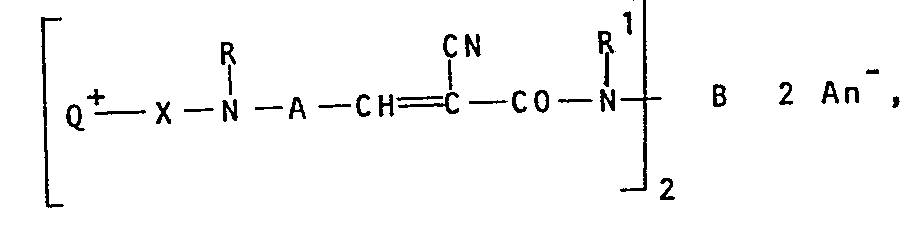
- Q+ eine kationische Gruppierung,
- X ein Bindeglied und
- R Wasserstoff, Alkyl, Alkenyl, Aralkyl, Aryl, einen Rest der Formel -X-Q+ An- bezeichnen oder durch Ringschluß mit -X-Q+ und dem N-Atom einen Heterocyclus der Formel
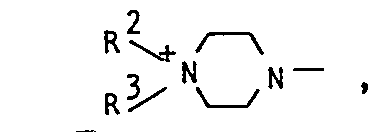
- R2 gleich Wasserstoff, Alkyl, Alkenyl oder Aralkyl und
- R 3 gleich Alkyl oder
- R2 und R3 gemeinsam (CH2)4 oder (CH2)5.
- A eine 1,4-Arylengruppe, die gegebenenfalls durch Ringschluß mit N-R ein anelliertes Ringsystem ergibt,
- R1 Wasserstoff oder Alkyl,
- B eine zweiwertige, nichtionische aromatische und/oder heteroaromatische Brücke und
- An- ein Anion bezeichnen und die cyclischen und acyclischen Substituenten, Bindeglieder und Brücken nichtionische Reste tragen können, werden zum Färben von natürlichen und synthetischen kationisch anfärbbaren Substraten, vorzugsweise zum Färben von Papier verwendet.
Description
- Gegenstand der vorliegenden Erfindung sind Farbstoffe der allgemeinen Formel

- Q+ eine kationische Gruppierung,
- X ein Bindeglied und
- R Wasserstoff, Alkyl, Alkenyl, Aralkyl, Aryl, einen Rest der Formel -X-Q+ An bezeichnen oder durch Ringschluß mit -X-Q+ und dem N-Atom einen Heterocyclus der Formel

- R2 = H, Alkyl, Alkenyl oder Aralkyl und
- R 3 = Alkyl oder
- R2 und R3 gemeinsam (CH2)4 oder (CH2)5'
- A eine 1,4-Arylengruppe, die gegebenenfalls durch Ringschluß mit N-R ein anelliertes Ringsystem ergibt,
- R Wasserstoff oder Alkyl,
- B eine zweiwertige, nichtionische aromatische und/oder heteroaromatische Brücke und
- An ein Anion bezeichnen und
- Als kationische Gruppierungen Q+ gelten die folgenden, bei extern-kationischen Farbstoffen üblichen Gruppen:
- Ammonium, Cycloammonium, Hydrazinium, verethertes Hydroxylammonium, Sulfonium und Isothiuronium, wobei neben Alkenyl, Aralkyl, Aryl und C5- bis C6-Cycloalkyl vorzugsweise Wasserstoff und Alkyl als Substituenten an N, S und 0 Verwendung finden.
- Als Bindeglieder X kommen gegebenenfalls verzweigte Ketten CnH2n, CnH2n-0-CmH2m, CnH2nOCOCmH2m und CnH2nOCOCH2 in Betracht, worin n und m unabhängig voneinander die Zahlenwerte 2 - 4 annehmen können, und die gegebenenfalls durch 1 - 2 Cl, Hydroxy, C1- bis C4-Alkyloxy oder Phenyl substituiert sind.
- Alkyl bezeichnet insbesondere einen C1- bis C4-Alkyl-, Alkenyl einen C3- bis C5-Alkenyl- und Aralkyl einen Aryl-C1- bis -C3-alkylrest, wobei die gegebenenfalls verzweigten Alk(en)ylreste zusätzlich durch Halogen (Fluor, Brom, vorzugsweise Chlor), Cyan,Hydroxy, Amino, Formylamino, C - bis C3-Alkyl- carbonylamino, Phenylcarbonylamino, C1- bis C4-Alkyloxy, C1.- bis C4-Alkyloxycarbonyl, C1- bis C3-Alkylcarbonyloxy, Aryloxy oder Aryl-C1- bis -C3-alkyloxy substituiert sein können.
- Aryl bezeichnet vorzugsweise Phenyl, das gegebenenfalls als nichtionische Substituenten C1- bis C4-Alkyl, C1- bis C4-Alkyloxy, Cyan, C1- bis C4-Alkylcarbonyl, C1- bis C4-Alkylcarbonyloxy, C1- bis C4-Alkyloxycarbonyl, C1- bis C3-Alkylcarbonylamino, Halogen (Fluor, Brom, vorzugsweise Chlor) oder Trifluormethyl trägt.
- Unter einer 1,4-Arylengruppe wird neben 1,4-Naphthylen vorzugsweise 1,4-Phenylen verstanden, das gegebenenfalls 1 - 2 Substituenten aus der Reihe C1- bis C2-Alkyl, C1- bis C2-Alkoxy, Halogen (Fluor, Brom, vorzugsweise Chlor), C1- bis C-Alkyloxycarbonyl, C1- bis C2 Alkyl- carbonyloxy, C1- bis C2-Alkylcarbonylamino, Cyan, CF3 oder Nitro enthält.
- Bei den anellierten Ringsystemen, wie sie aus einem Ringschluß der 1,4-Arylengruppe mit dem Rest R über das gemeinsame N-Atom. resultieren, handelt es sich vorzugsweise um gegebenenfalls durch 1 - 4 C1- bis C4-Alkyl und/oder 1 - 2 C - bis C4-Alkoxy, Phenyl, F oder Cl substituierte 2,3-Dihydroindol-, 1,2,3,4-Tetrahydrochinolin- oder 2,3-Dihydro-benz-[b]oxazin-(1,4)-Systeme.
- Geeignete zweiwertige nichtionische Brücken B sind im Rahmen der Erfindung vorzugsweise folgende, direkt oder über Methylengruppen an die beiden N-Atome gebundene Systeme:


- Die genannten aromatischen Reste können nichtionisch substituiert sein, wobei vor allem C - bis C4-Alkyl, C1- bis C4-Alkyloxy, CF3, CN, F, C1 und Br in Frage kommen.
- Die als Brücken B oder Brückenglieder fungierenden aromatischen Kerne sind vorzugsweise 1,3- oder 1,4-Arylene.
- Als anionische Reste An kommen die für kationische Farbstoffe üblichen anorganischen und organischen Anionen in Betracht (vgl. z. B. DE-OS 2 128 326, Seiten 5 - 7, und DE-OS 2 520 816, Seiten 4 - 6). Bevorzugt sind farblose Anionen, die dem betreffenden Farbstoff die für den vorgesehenen Färbevorgang gewünschten Löslichkeitseigenschaften verleihen.
- Das Anion ist zumeist'durch das Herstellungsverfahren und die evtl. vorgenommene Reinigung der kationischen Verbindung gegeben. Im allgemeinen liegen die Farbstoffe als Halogenide, insbesondere Chloride oder Bromide, oder als Methosulfate, Ethosulfate, Sulfate, Nitrate, Chlorozinkate, Benzo- oder Toluolsulfonate,Naphthalinsulfonate, Acetate, Propionate, Glykolate, Lactate, Acrylate oder Formiate vor.
- Diese Anionen können in bekannter Weise gegen andere ausgetauscht werden. Hierzu zählt auch die Möglichkeit der Fällung der Farbstoffkationen mit schwerlöslich machenden farblosen Anionen oder mit Farbstoffanionen.
- Bevorzugt werden Farbstoffe der Formel

- Q+1 für

- R8 R9 R10 und R11 unabhängig voneinander für Wasserstoff, C1- bis C4-Alkyl, das durch Hydroxy, Amino, Formylamino, C1-bis C4-Alkoxy, Hydroxy-C2-bis -C4-alkoxy,Phenyl,Phenyloxy, C1-bis C3-Alkylcarbonyloxy, Fluor, Chlor oder Brom substituiert sein kann, und
- R8 zusätzlich für C1- bis C4-Alkoxy, Amino, Formylamino, Phenyl, Cyclopentyl oder Cyclohexyl,
- Z1 für eine direkte Bindung, CH2, C2H4, 0, S, NH oder N-C1- bis C2-Alkyl,
- R12 für 1 - 3 Reste aus der Reihe Wasserstoff, C1- bis C4-Alkyl, Fluor, Chlor oder Brom,
- Y für 0, S, NH, N-C1- bis C2-Alkyl oder CH=CH,
- X1 für gegebenenfalls verzweigtes und/oder durch Hydroxy, C1- bis C4-Alkoxy oder Phenyl substituiertes C2- bis C3-Alkylen und
- R 6 für gegebenenfalls durch Chlor, Cyan, C1- bis C4-Alkyloxy, Phenyl oder Phenyloxy substituiertes C1- bis C4-Alkyl, für Phenyl oder für den Rest -X-Q+1] An- stehen oder
- R6 mit -X-Q+1 und dem N-Atom, an das beide gebunden sind, gemeinsam ein Piperazinium-System der Struktur

- R13 für Wasserstoff, C1- bis C4-Alkyl, das durch C1- bis C4-Alkyloxy, Hydroxy, C1- bis C3-Alkylcarbonyloxy oder Phenyl substituiert sein kann,
- R14 für C1- bis C4-Alkyl oder
- R13 und R14 gemeinsam für (CH2)4 oder (CH2)5 stehen oder
- R6 und R7 gemeinsam mit dem Benzolring und dem Stickstoffatom, an das R6 gebunden ist, Bestandteile eines gegebenenfalls im Heterocyclus durch 1-4 C1-bis C4-Alkylgruppen oder einen Phenylrest substituierten Indolin-, 1,2,3;4-Tetrahydrochinolin- oder 2,3-Dihydro-benzoxazin-(1,4)-Ringsystems sind oder
- R7 und R15 unabhängig voneinander Wasserstoff, C1- bis C2-Alkyl, C1- bis C2-Alkyloxy, Brom oder Chlor bedeuten und
- B1 für


- Z2 eine direkte Bindung oder ein Bindeglied aus der Reihe 0, S, .


- R16 und R 16a unabhängig voneinander für C1- bis C2-Alkyl und besonders für Wasserstoff und im Falle

- a für 0, S oder NR16 und
- An- für ein Anion stehen, worin
- Phenylenkerne vorzugsweise als 1,3- oder 1,4-Phenylene vorliegen und die genannten Phenylreste, Phenylen-, Naphthylen- und kondensierten benzoiden Kerne zusätzlich durch 1 - 3 C1- bis C4-Alkyl-,C1- bis C4-Alkyloxy-, C1- bis C4-Alkyloxycarbonyl-, Cyan- oder CF3-Gruppen und/oder Br oder Cl substituiert sein können.
- Von besonderem technischen Interesse sind die Farbstoffe der allgemeinen Formel

- An- die genannte Bedeutung besitzt,
- R20, R21 und R22 unabhängig voneinander für Wasserstoff, C1- bis C4-Alkyl, das durch Hydroxy, Amino, Formylamino, C1- bis C4-Alkoxy, Hydroxy-C2- bis -C4-alkoxy, Phenyl, Phenoxy, C1- bis C3-Alkylcarbonyloxy oder Chlor substituiert sein kann und
- R20 zusätzlich für Phenyl oder Cyclohexyl oder
- R20, R21 und R22 zusammen mit dem quaternären Stickstoff für gegebenenfalls durch Methyl oder Ethyl substituiertes Pyridinium,
- X2 für gegebenenfalls verzweigtes C2- bisC3-Alkylen,
- R 17 für gegebenenfalls durch Cyan, C1- bis C4-Alkyloxy, Phenyl oder Phenyloxy substituiertes C1- bis C4-Alkyl,
- R18 und R19 unabhängig voneinander für Wasserstoff, C1- bis C2-Alkyl, C1- bis C2-Alkyloxy oder Chlor oder
- R17 und R18 gemeinsam für die zur Bildung eines Dihydroindol-, 1,2,3,4-Tetrahydrochinolin- oder 2,3-Dihydrobenz[b]-oxazin-(1,4)-Systems erforderlichen Ringglieder, insbesondere für die Glieder CH2CH(CH3) , C(CH3)2CH (CH3) , CH2CH2CH(CH3), CH(CH3)CH2C(CH3)2, OCH2CH2, OCH2CH(CH3), OCH2CH(C6H5) oder O(CH3)2CH(CH3) stehen und
- 2 B

- Z3 eine direkte Bindung oder die Brückenglieder (CH2)2, CH=CH,


- Besonders wertvolle Farbstoffe im Rahmen der Erfindung entsprechen der Formel

- An die genannte Bedeutung besitzt und
- R28, R26 und R27 unabhängig voneinander gleich H, Methyl, Ethyl, Propyl, Butyl, Hydroxyethyl, Hydroxypropyl, Formylaminoethyl, Formylaminopropyl,Aminoethyl, Aminopropyl oder
- R28, R2S und R27 zusammen mit dem quaternären Stickstoff für gegebenenfalls durch Methyl oder Ethyl substituiertes Pyridinium,
- R 29 Methyl, Ethyl, Methoxyethyl, Ethoxyethyl, Cyanethyl, Phenyl, Benzyl, α- oder ß-Phenylethyl, Phenyloxyethyl oder Phenyloxypropyl,
- R30 Wasserstoff oder Methyl und
- B3 1,3- oder 1,4-Phenylen oder einen Rest der Formel

- Z4 eine direkte Bindung oder die Brückenglieder CH2, (CH2)2' C(CH3)2, NHCO oder NHCONH bezeichnet.
- Die neuen Farbstoffe werden in an sich bekannter Weise hergestellt, indem man Bis-cyanacetamide der Formel


- Die Kondensationen werden bei Temperaturen zwischen 20 und 140°C, vorzugsweise im Bereich 50 - 110°C, in einem organischen Lösungsmittel durchgeführt. Als solche eignen sich beispielsweise Alkohole, wie Methanol, Ethanol, die Propanole und Butanole, ferner Benzylalkohol, Essigsäureethylester, Benzoesäuremethylester, Ameisensäure, Essigsäure, Essigsäureanhydrid, Dimethylformamid, Dimethylacetamid, Tetramethylharnstoff, Acetonitril, Benzonitril, C2- bis C4-Glykole und deren C - bis C - Ether und andere.
- Zur Beschleunigung der Knoevenagel-Kondensationsreaktion können basische Katalysatoren zugesetzt werden, wie beispielsweise Triethylamin, Pyridin, Piperidin, N-Ethylpiperidin, N-Methylmorpholin, Alkalicarbonate, Alkaliacetate und Acetate anorganischer oder organischer Stickstoffbasen, wie z. B. Ammoniumacetat oder Piperidinacetat. Geeignete Wahl der Lösungstaittel ergibt unmittelbar stabile Farbstoff-Flüssigeinstellungen. Geeignete Bis-cyanacetamide der Formel V erhält man durch Cyanacetylierung der entsprechenden Diamine H2N-B-NH2, indem man diese vorteilhaft mit Cyanessigsäuremethyl- oder -ethylester bei erhöhter Temperatur (oberhalb 100°C) zur Reaktion bringt.
- Für die Darstellung geeigneter basischer Aldehyde VI kommen verschiedene Wege in Frage, so die Umsetzung von Ammoniak oder der betreffenden primären, sekundären oder tertiären N-Basen, Hydroxylamin- oder Hydrazinderivate oder cyclischen Stickstoffbasen mit Aldehyden der Formel


- In manchen Fällen kann es auch von. Vorteil sein, anstelle der quartären Aldehyde VI tertiäre Aldehyde


- Die zur Darstellung der erfindungsgemäßen Farbstoffe erforderlichen Aldehyde bzw. ihre Vorprodukte sind aus der Chemie basischer Methin- bzw. Azofarbstoffe bekannt oder leicht nach analogen Herstellungsmethoden erhältlich. Entsprechende Angaben können zum Beispiel folgendem Schrifttum entnommen werden:
- Deutsche Offenlegungsschriften 1 619 394, 1 910 465, 2 011 429, Deutsche Auslegeschriften 1 103 485, 1 406 841,
- BE-PS 583 002, GB-PS 1 287 886, US-PS 3 141 018, 3 424 756 oder 3987022. Weitere Hinweise ergeben sich aus den nachfolgenden Patentbeispielen.
- Die erfindungsgemäßen Farbstoffe eignen sich zum Färben, Bedrucken und Massefärben von Materialien, die überwiegend oder vollständig aus Polyacrylnitril oder seinen Mischpolymerisaten mit anderen Vinylmonomeren, wie Vinylidencyanid, Vinylidenchlorid, Vinylchlorid, Vinylacetat, Vinylalkohol, Acryl- oder Methacrylester, bestehen, oder aus sauer modifizierten Polyestern oder Polyamiden. Die erhaltenen Färbungen und Drucke, vor allem auf Polyacrylnitril, zeichnen sich durch hohe Allgemeinechtheiten, insbesondere durch hohe Licht-, Naß- und Schweißechtheiten, durch eine hohe Affinität zur Faser und durch eine hohe pH-Stabilität aus.
- Die Farbstoffe eignen sich ferner für die übrigen bekannten Anwendungen kationischer Farbstoffe, wie beispielsweise das Färben und Bedrucken von Celluloseacetat, Kokosfasern, Jute, Sisal, Seide und tannierter Baumwolle, Leder, zur Bereitung von Kugelschreiberpasten, unter anderem durch Fällung mit anionischen Farbstoffen, von Stempelfarben und zur Verwendung im Gummidruck.
- Besonders hervorzuheben ist das ausgezeichnete Verhalten der erfindungsgemäßen Farbstoffe beim Färben von geleimten und ungeleimten Papieren in der Masse, wobei besonders hohe Affinitäten sowohl zu ligninhaltigen (holzschliffhaltigen) als auch zu ligninfreien Papier- massen (z. B. gebleichten Sulfit- und Sulfatzellstoffen) festzustellen sind, so daß sie hervorragend zur Herstellung in der Masse gefärbter Papiere geeignet sind, ohne die anfallenden Abwässer nennenswert mit Farbstoff zu belasten.
- Die Farbstoffe besitzen überwiegend sehr gute Löslichkeiten in Wasser und polaren organischen Lösungsmitteln, so daß sie die Herstellung stabiler, hochkonzentrierter Lösungen ermöglichen. Sie werden durch Reduktionsmittel, wie Dithionite oder Sulfite, glatt entfärbt, so daß das Recycling von mit ihnen eingefärbten Altpapieren ohne weiteres möglich ist.
- 18 g 4,4'-Bis-cyanacetamino-benzanilid und 29 g [N-Ethyl-N-ß-(1-pyridinium)-ethyl]-4-aminobenzaldehyd-chlorid werden in 150 ml Ethanol unter Zusatz von 1 ml Piperidin 2 h zum Rückfluß erhitzt. Das Kondensationsprodukt scheidet sich kristallin ab und wird nach Abkühlen der Reaktionsmischung auf Raumtemperatur durch Absaugen, Waschen mit Ethanol und Trocknen bei 80°C im Vakuumschrank als gelbes Pulver isoliert. Die Ausbeute beträgt 45 g Farbstoff der Formel:
-

- Schmelzpunkt 216 - 218°. λmax = 422 am in 50%iger Essigsäure. Der Farbstoff färbt Polyacrylnitril und sauer modifiziertes Polyethylenterephthalat nach den üblichen Verfahren in brillanten, grünstichig gelben Tönen von guter Lichtechtheit bei hervorragendem allgemeinem Echtheitsniveau. Er eignet sich ferner zur Herstellung von Stempelfarben und Kugelschreiberpasten sowie für den Gummidruck. Darüber hinaus gibt er auf Kokosfasern, Jute, Sisal, Seide, Baumwolle, Leder und keratinhaltigen Substraten brillante, echte Gelbfärbungen.
- Bei der bevorzugten Verwendung des Farbstoffes zum Färben von holzschliffhaltigen und besonders von ligninfreien Papiermassen, z. B. auf Basis gebleichter Sulfit- oder Sulfatzellstoffe, beobachtet man eine hervorragende Faseraffinität und sehr geringe Abwasseranfärbung. Die eingefärbten Papiere zeigen stark grünstichig gelbe Nuancen hoher Klarheit.
- Die zur Synthese des Farbstoffes erforderlichen.Ausgangsmaterialien gewinnt man beispielsweise auf folgende Weise:
- (a) 4,4'-Bis-cyanacetamino-benzanilid: Eine Mischung von 461,4 g 4,4'-Diamino-benzanilid, 423 g Cyanessigsäuremethylester und 860 g Dimethylacetamid wird unter Rühren ca. 4 - 5 h auf 165 - 170°C erhitzt,bis kein Methanol mehr abdestilliert und im Dünnschichtchromatogramm (Kieselsäuregel) kein Diaminobenzanilid mehr erkennbar ist und das Monocyanacetyl-produkt nur noch in sehr geringer Menge vorliegt. Darauf entfernt man den Großteil des Lösungsmittels durch Destillation unter reduziertem Druck, versetzt den Rückstand mit 1,5 1 Methanol und rührt 15 min bei Raumtemperatur nach. Durch Absaugen, Waschen mit Methanol und Trocknen bei 80°C im Vakuum erhält man ca. 580 g 4,4'-Bis-cyanacetamino-benzanilid vom Schmelzpunkt 320°C, dessen Identität durch das Massenspektrum bestätigt wird (ber. Molgewicht: 361; gefunden m/e = 361 und entsprechende Fragmentierung). Auf gleiche Weise wurden die übrigen für die Beispiele herangezogenen Bis-cyanacetamide dargestellt und charakterisiert. Dabei wurde zum Teil auf ein besonderes Lösungsmittel verzichtet und stattdessen Cyanessigsäuremethylester oder Cyanessigsäureethylester im Überschuß eingesetzt und dieser aus den Mutterlaugen destillativ in wiederverwendbarer Reinheit zurückgewonnen.
- (b) [N-Ethyl-N-ß-(1-pyridinium)-ethyl]-4-aminobenzaldehyd-chlorid: 95,2 g N-Ethyl-N-ß-chlorethyl-4-aminobenzaldehyd werden in 300 ml trockenem Pyridin ca. 17 h zum Rückfluß (Innentemperatur ca. 120°C) erhitzt, bis das Dünnschichtchromatogramm vollständige Umsetzung zum quartären Aldehyd anzeigt. Man saugt das auskristallisierte Reaktionsprodukt bei 0°C ab, wäscht es mit Toluol und trocknet es bei 80°C i. Vak. Die Ausbeute an rohem quartärem Aldehyd ist nahezu quantitativ, sein Schmelzpunkt liegt bei 149 - 151°C.
- (c) Zum gleichen Aldehyd gelangt man auch, indem man die quartäre Base wie folgt nach Vilsmeier und Haack formyliert: 39,4 g N-Ethyl-N-ß-(1-pyridinium)-ethylanilin-chlorid werden in 50ml Dimethylformamid auf 70 - 75°C erwärmt und unter Rühren bei dieser Temperatur binnen 1 h 25,3 g Phosptcoroxychlorid zugetropft. Nach weiterem 4stündigen Rühren bei 75°C ist die Umsetzung vollständig. Man tropft nun nacheinander 100 ml Ethanol und ca. 30 ml 459>ige Natron-
- lauge bis zum Erreichen von pH 9 hinzu, rührt 1 h nach, entfernt die abgeschiedenen anorganischen Salze durch Absaugen des Reaktionsgemisches. Die Salze werden mit Ethanol gewaschen und die vereinigten Filtrate unter vermindertem Druck vom Lösungsmittel befreit. Zum öligen Rückstand gibt man 250 ml trockenes Isopropanol, rührt einige Zeit bei 50°C und saugt nochmals eine kleine Menge anorganischer Salze ab. Sie werden mit 50 ml trockenem Methanol gewaschen und der quartäre Aldehyd aus den Filtraten durch Abdestillieren der Lösungsmittel unter reduziertem Druck als durchkristallisierendes viskoses Öl (42,6 g) erhalten, das für die vorgesehenen Umsetzungen keiner weiteren Reinigungsoperationen bedarf.
- Nach den unter (b) und (c) beschriebenen, an sich bekannten Verfahrensweisen wurde die Mehrzahl der in den Beispielen verwendeten quartären und tertiären Aldehyde durch entsprechende Variation der Ausgangsverbindungen erhalten. Die übrigen waren entweder als solche beschrieben oder nach Analogmethoden zugänglich.
- 54 g 4,4'-Bis-cyanacetamino-benzanilid und 66 g N-Ethyl-N-ß-dimethylaminoethyl-4-amino-benzaldehyd werden in 1 1 trockenem Methanol nach Zugabe von 5 ml Piperidin unter Rühren ca. 10 h zum Rückfluß erhitzt, bis der Aldehyd vollständig umgesetzt ist. Man isoliert das abgeschiedene Farbstoffvorprodukt durch Absaugen bei Raumtemperatur, Waschen mit Methanol und Trocknen bei 70°C im Vakuum. Die Ausbeute beträgt 109 g Vorprodukt der Formel


- der im Gegensatz zum Vorprodukt leicht wasserlöslich und hervorragend zum Färben geeignet ist, insbesondere von Papierstoffen in der Masse. Hierbei resultieren brillant grünstichig gelb gefärbte Papiere, während die Abwässer selbst bei ligninfreien Papiermassen nicht nennenswert angefärbt werden.
- Ersetzt man die Aldehyde und/oder Bis-cyanacetamide in den Beispielen 1 und 2 durch andere anspruchsgemäße Ausgangsverbindungen, so erhält man weitere erfindungsgemäße Farbstoffe, die sich durch gute färberische Eigenschaften gegenüber kationisch anfärbbaren Substraten auszeichnen, vor allem durch hervorragende Affinität zu ligninhaltigen, aber auch besonders zu ligninfreien Papiermassen. Eine Auswahl ist in den folgenden Tabellen aufgeführt unter Angabe der Farbtöne, die in der Masse gefärbte Papiere auf Basis gebleichten Sulfitzellstoffs durch diese Farbstoffe annehmen.
-


- 25,6 g N,N'-Bis-cyanacetyl-2,4-diamino-toluol und 68,9 g N-ß-(1-Pyridi- , nium)-ethyl-2,2,4-trimethyl-6-formyl-1,2,3,4-tetrahydrochinolin-chlorid werden in 100 g Propylenglykol unter Zusatz von 5 g Piperidin ca. 4 h unter Rühren auf 60 - 70°C erhitzt. Man erhält 200 g einer klaren, tiefgelben Lösung des Farbstoffes der Formel

- Ähnliche Eigenschaften zeigen die in Tabelle 2 aufgeführten Farbstoffe:

- In ein wäßriges Färbebad, das pro 1 000 ml 0,75 g 30Zige Essigsäure, 0,38 g Natriumacetat und 0,15 g des in Beispiel beschriebenen Farbstoffes enthält, bringt man bei 40°C die dem Flottenverhältnis 1:40 entsprechende Menge Polyacrylnitrilfasern ein, erhitzt innerhalb von 20 - 30 min zum Sieden und färbt 30 - 60 min bei Siedetemperatur. Das anschließend gespülte und getrocknete Färbegut weist eine brillante, grünstichig gelbe Färbung auf, die sich allgemein durch gute Echtheiten, insbesondere durch gute Licht-, Wasch- und Dekaturechtheit auszeichnet.
- Färbt man mit dem gleichen Farbstoff unter-den Bedingungen des sogenannten NEOCHROM-Prozesses naßgesponnene Polyacrylnitrilfasern im Gelzustand, so erhält man ebenfalls Färbungen von vergleichbarem Echtheitsniveau.
- Eine aus 15 g des Farbstoffes gemäß Beispiel 41, 15 g Polyacrylnitril und 70 g Dimethylformamid bereitete Stammlösung wird einer üblichen Spinnlösung von Polyacrylnitril in der gewünschten Menge zugesetzt und die gefärbte Lösung in bekannter Weise versponnen. Es resultieren Polyacrylnitrilfäden von grünstichig gelber Färbung, die hervorragende Echtheitseigenschaften aufweisen, insbesondere sehr gute Licht-, Wasch-und Dekaturechtheiten.
- Ein Gewebe aus Polyacrylnitril wird mit einer Druckpaste der folgenden Zusammensetzung bedruckt:


- Der erhaltene brillante, grünstichig gelbe Druck wird getrocknet, 30 min gedämpft und anschließend gespült. Er zeichnet sich durch gute Echtheitseigenschaften aus.
- Sauer modifizierte Polyglykolterephthalatfasern, wie sie in der belgischen Patentschrift 549 1i9 und in der USA-Patentschrift 2 893 816 beschrieben sind, werden bei 20°C und einem Flottenverhältnis 1:40 in ein Färbebad gegeben, das pro 1 000 ml 3 - 10 g Natriumsulfat, 0,1 - 2 g Oleylpolyglykolether (enth. 50 mol Ethylenoxid), 0 - 15 g Dimethylbenzyldodecylammoniumchlorid und 0,3 g Farbstoff gemäß Beispiel 67 enthält und mit Essigsäure bzw. Natriumacetat auf einen pH-Wert von 4,5 - 5,5 eingestellt wurde. Man erhitzt innerhalb von 30 min auf 98°C und hält das Bad 60 min bei dieser Temperatur. Nach dem anschließenden Spülen und Trocknen der Fasern weisen diese eine brillante, grünstichig gelbe Färbung mit guten Echtheitseigenschaften auf.
- In einem Färbebecher von 500 ml Inhalt, der sich in einem beheizten Wasserbad befindet, werden 0,2 g der Farbstofflösung gemäß Beispiel 81 nach Zusatz von 0,5 g Oleylpolyglykolether (enth. 50 mol Ethylenoxid) mit Wasser auf 500 ml aufgefüllt und der pH-Wert der Färbeflotte auf 4,5 - 5 eingestellt. In dieser Flotte werden 10 g Stückware aus sauer modifiziertem Polyamid ständig bewegt, während die Badtemperatur binnen 15 min auf 100°C erhöht wird. Nach 15 - 20minütigem Färben bei Kochtemperatur wird das gefärbte Gut gespült und getrocknet, z. B. durch Bügeln oder bei 60 - 70°C im Trockenschrank. Man erhält eine klare, grünstichig gelbe Färbung mit guten Echtheitseigenschaften.
- Ein aus 60 % Holzschliff und 40 % ungebleichtem Sulfitzellstoff bestehender Trockenstoff wird im Holländer mit soviel Wasser angeschlagen und bis zum Mahlgrad 40° SR gemahlen, daß der Trockengehalt etwas über 2,5 % liegt, und anschließend mit Wasser auf exakt 2,5 % Trockengehalt des Dickstoffes eingestellt. 200 g dieses Dickstoffes werden mit 5 g einer 0,25%igen wäßrigen Lösung des Farbstoffes gemäß Beispiel 39 versetzt, ca. 5 min verrührt, 2 % Harzleim und 4 % Alaun, bezogen auf Trockenstoff, hinzugegeben und wiederum einige Minuten homogen verrührt. Man verdünnt die Masse mit ca. 500 g Wasser auf 700 ml und stellt hieraus in bekannter Weise durch Absaugen über einen Blattbildner Papierblätter her. Sie weisen eine intensive, grünstichig gelbe Färbung auf. Im Abwasser des Blattbildners ermittelt man fotometrisch (bei λmax = 430 nm) die Menge des nicht an das Papier gebundenen Farbstoffes zu ca. 2 %. Beim Färben ungeleimter Papiermassen werden bei sonst gleicher Verfahrensweise ca. 3 % nicht fixierten Farbstoffes festgestellt. Ähnlich geringe Abwasseranfärbungen zeigen unter obigen Arbeitsbedingungen praktisch alle erfindungsgemäßen Farbstoffe.
- 200 g eines analog Beispiel 93, jedoch ausschließlich unter Verwendung von gebleichtem Sulfitzellstoff bereiteten 2,5%igen Dickstoffes (Mahlgrad 35° SR) werden mit 5 g einer 0,5%igen wäßrigen Lösung der in Beispiel 81 hergestellten ca. 36%igen Farbstofflösung λmax = 422 nm) versetzt und ohne Zusatz von Harzleim und Alaun zu Papier verarbeitet. Man erhält ein in kräftigem, klarem Gelbtoneingefärbtes Blattpapier. Das Abwasser enthält laut fotometrischer Bestimmung nur ca. 3 % des eingesetzten Farbstoffes. Erfolgt die Einfärbung der Papiermassen in Gegenwart von 2 % Harzleim und 4 % Alaun (vgl. Beispiel 93), so erhält man ein ähnliches Ergebnis, und nur ca. 2 % des Farbstoffes verbleiben im Abwasser.
- 10 g des gemäß Beispiel 93 gefärbten Papiers werden in 200 g Wasser unter Zusatz von 0,2 g Natriumsulfit und 0,1 g Natriumhydrogensulfit 1 h auf 60°C erwärmt. Die Papiermasse ist völlig entfärbt; sie kann erneuter Einfärbung und Papierherstellung zugeführt werden (Recycling). Zum gleichen Ergebnis gelangt man bei Verwendung von 2 % Natriumdithionit als Reduktionsmittel (60°/30 min) oder bei Einsatz von gefärbtem Sulfitzellstoff des Beispiels 94.
- Zu einer Lösung von 94 g N-Ethyl-N-B-dimethylaminoethyl-2-methyl-4-amino- benzaldehyd in 100 g Essigsäure gibt man 51 g 1,4-Bis-cyanacetamino-benzol und erhitzt das Reaktionsgemisch unter Rühren 3 - 4 h auf 60 - 65°C, bis die Ausgangsstoffe praktisch vollständig umgesetzt sind (Dünnschichtchromatographie an Kieselsäuregel; Laufmittel Chloroform/Methanol 9:1 v/v). Anschließend versetzt man mit 100 g Wasser und erhält 345 g einer niedrigviskosen, lagerstabilen, ca. 45Xigen Flüssigeinstellung des Farbstoffes der Formel

- Die Farbstofflösung ist unbegrenzt mit Wasser verdünnbar und eignet sich hervorragend zum Färben von Papierstoffen, insbesondere von gebleichtem Sulfit- und Sulfatzellstoff, in der Masse, wobei intensive, klare grünstichige Gelbtöne erzielt werden und die Abwässer praktisch farblos sind.
die cyclischen und acyclischen Substituenten, Bindeglieder und Brücken nichtionische Reste tragen können, sowie deren Herstellung und Verwendung zum Färben von natürlichen und synthetischen kationisch anfärbbaren Substraten und Massen, vorzugsweise zum Färben, Beschreiben und Bedrucken cellulosehaltiger Materialien, insbesondere von Papier in der Masse und in der Oberfläche.
Claims (6)


die cyclischen und acyclischen Substituenten,Bindeglieder und Brücken nichtionische Reste tragen können.


Phenylenkerne vorzugsweise als 1,3- oder 1,4-Phenylene vorliegen und die genannten Phenylreste, Phenylen-, Naphthylen- und kondensierten benzoiden Kerne zusätzlich durch 1-3 C1- bis C4-Alkyl, C1- bis C4-Alkyloxy-, C1- bis C4-Alkyloxycarbonyl-, Cyan- oder CF3-Gruppen und/ oder Br oder Cl substituiert sein können.


Applications Claiming Priority (2)
| Application Number | Priority Date | Filing Date | Title |
|---|---|---|---|
| DE3040911 | 1980-10-30 | ||
| DE19803040911 DE3040911A1 (de) | 1980-10-30 | 1980-10-30 | Kationische styrylfarbstoffe, ihre herstellung und ihre verwendung zum faerben von natuerlichen und synthetischen kationisch anfaerbbaren substraten |
Publications (3)
| Publication Number | Publication Date |
|---|---|
| EP0051187A2 true EP0051187A2 (de) | 1982-05-12 |
| EP0051187A3 EP0051187A3 (en) | 1982-09-08 |
| EP0051187B1 EP0051187B1 (de) | 1984-03-28 |
Family
ID=6115568
Family Applications (1)
| Application Number | Title | Priority Date | Filing Date |
|---|---|---|---|
| EP81108411A Expired EP0051187B1 (de) | 1980-10-30 | 1981-10-16 | Kationische Styrylfarbstoffe, ihre Herstellung und ihre Verwendung zum Färben von natürlichen und synthetischen kationisch anfärbbaren Substraten |
Country Status (4)
| Country | Link |
|---|---|
| US (1) | US4422969A (de) |
| EP (1) | EP0051187B1 (de) |
| JP (1) | JPS57100159A (de) |
| DE (2) | DE3040911A1 (de) |
Cited By (2)
| Publication number | Priority date | Publication date | Assignee | Title |
|---|---|---|---|---|
| EP0331983A3 (en) * | 1988-02-24 | 1990-11-07 | F. Hoffmann-La Roche Ag | Stilbene derivatives, their preparation and their use in medicines |
| US5250562A (en) * | 1988-02-24 | 1993-10-05 | Hoffmann-La Roche Inc. | Stilbene derivatives |
Families Citing this family (3)
| Publication number | Priority date | Publication date | Assignee | Title |
|---|---|---|---|---|
| FR2706475B1 (fr) * | 1993-06-16 | 1997-08-29 | Sandoz Sa | Teinture dans la masse de polymères synthétiques. |
| US8664289B2 (en) | 2010-09-22 | 2014-03-04 | Adeka Corporation | Dye and coloring photosensitive composition |
| JP6721809B2 (ja) * | 2016-05-20 | 2020-07-15 | 山田化学工業株式会社 | 色素化合物 |
Family Cites Families (3)
| Publication number | Priority date | Publication date | Assignee | Title |
|---|---|---|---|---|
| FR1372691A (fr) * | 1962-08-20 | 1964-09-18 | Du Pont | Colorants de méthine et procédé pour leur préparation |
| US3257394A (en) * | 1962-08-20 | 1966-06-21 | Du Pont | Substantive methine dyes |
| DE2826981C2 (de) * | 1978-06-20 | 1987-04-09 | Basf Ag, 6700 Ludwigshafen | Basische Farbstoffe |
-
1980
- 1980-10-30 DE DE19803040911 patent/DE3040911A1/de not_active Withdrawn
-
1981
- 1981-10-16 EP EP81108411A patent/EP0051187B1/de not_active Expired
- 1981-10-16 DE DE8181108411T patent/DE3162903D1/de not_active Expired
- 1981-10-20 US US06/313,111 patent/US4422969A/en not_active Expired - Fee Related
- 1981-10-27 JP JP56170853A patent/JPS57100159A/ja active Pending
Cited By (3)
| Publication number | Priority date | Publication date | Assignee | Title |
|---|---|---|---|---|
| EP0331983A3 (en) * | 1988-02-24 | 1990-11-07 | F. Hoffmann-La Roche Ag | Stilbene derivatives, their preparation and their use in medicines |
| US5250562A (en) * | 1988-02-24 | 1993-10-05 | Hoffmann-La Roche Inc. | Stilbene derivatives |
| US5378705A (en) * | 1988-02-24 | 1995-01-03 | Hoffmann-La Roche Inc. | Stilbene derivatives |
Also Published As
| Publication number | Publication date |
|---|---|
| DE3162903D1 (en) | 1984-05-03 |
| DE3040911A1 (de) | 1982-06-03 |
| US4422969A (en) | 1983-12-27 |
| EP0051187A3 (en) | 1982-09-08 |
| EP0051187B1 (de) | 1984-03-28 |
| JPS57100159A (en) | 1982-06-22 |
Similar Documents
| Publication | Publication Date | Title |
|---|---|---|
| EP0029136B1 (de) | Quartäre und basische Azamethinverbindungen, Verfahren zu ihrer Herstellung und ihre Verwendung als Farbmittel | |
| EP0176472A1 (de) | Methinazoverbindungen | |
| DE2711521C3 (de) | Verfahren zum Färben von Papiermaterial | |
| EP0051187B1 (de) | Kationische Styrylfarbstoffe, ihre Herstellung und ihre Verwendung zum Färben von natürlichen und synthetischen kationisch anfärbbaren Substraten | |
| DE2714653C3 (de) | Kationische Styrylfarbstoffe und Verfahren zum Färben mit diesen Farbstoffen | |
| DE3313797C2 (de) | ||
| EP0037491B1 (de) | Dimethinfarbstoffe, ihre Herstellung und ihre Verwendung zum Färben von synthetischen und natürlichen Materialien | |
| EP0023991B1 (de) | Styrylfarbstoffe, ihre Herstellung und ihre Verwendung zum Färben von insbesondere Papier | |
| DE2732384A1 (de) | Neue kationische farbstoffe, deren herstellung und verwendung | |
| DE60022876T2 (de) | Triphendioxazin-verbindungen | |
| EP0074569B1 (de) | Kationische Methinfarbstoffe, Verfahren zu ihrer Herstellung sowie deren Verwendung zum Färben von Textilmaterialien und anderen Substraten | |
| EP0752451A1 (de) | Die Verwendung von neuen und bekannten kationischen 4,5-Dihydro-1H-1,2,3-triazoliumverbindungen als Farbstoffe und neue kationische 4,5-Dihydro-1H-1,2,3-Triazoliumverbindungen | |
| EP0184991B1 (de) | Kationische Phthalocyanin-Verbindungen | |
| DE19524134A1 (de) | Verfahren zum Reduzieren der Toxizität von Restflotten und neue kationische Farbstoffe | |
| DE3717667A1 (de) | Wasserloesliche naphthyl-azo-pyrazolon-verbindungen, verfahren zu ihrer herstellung und ihre verwendung als farbstoffe | |
| DE3703565A1 (de) | Wasserloesliche monoazo-pyrazolon-verbindungen, verfahren zu ihrer herstellung und ihre verwendung als farbstoffe | |
| EP0061623A1 (de) | Verfahren zum Färben oder Bedrucken von Papier und neue kationische Phthalocyaninfarbstoffe | |
| DE2039492A1 (de) | Kationische Farbstoffe | |
| EP0105031B1 (de) | Kationische Azoverbindungen | |
| DE1569734B2 (de) | Mischungen von methinfarbstoffen | |
| EP0005449A1 (de) | Wasserlösliche Monoazofarbstoffe, ihre Herstellung, konzentrierte wässrige Lösungen, welche die Monoazofarbstoffe enthalten, die Herstellung der Lösungen,die Verwendung der Farbstoffe und konzentrierten Lösungen und damit gefärbte und bedruckte Materialien | |
| DE3625576A1 (de) | Basische, sulfonsaeuregruppenhaltige monoazo- oder disazoverbindungen | |
| DE2850706C3 (de) | Kationische Monoazofarbstoffe, Verfahren zu deren Herstellung und Verfahren zum Färben und Bedrucken | |
| EP0060468B1 (de) | Verfahren zum Färben von Papier und gefärbtes Papier | |
| EP0292433B1 (de) | Kationische Verbindungen |
Legal Events
| Date | Code | Title | Description |
|---|---|---|---|
| PUAI | Public reference made under article 153(3) epc to a published international application that has entered the european phase |
Free format text: ORIGINAL CODE: 0009012 |
|
| 17P | Request for examination filed |
Effective date: 19811016 |
|
| AK | Designated contracting states |
Designated state(s): CH DE FR GB |
|
| PUAL | Search report despatched |
Free format text: ORIGINAL CODE: 0009013 |
|
| AK | Designated contracting states |
Designated state(s): CH DE FR GB |
|
| GRAA | (expected) grant |
Free format text: ORIGINAL CODE: 0009210 |
|
| AK | Designated contracting states |
Designated state(s): CH DE FR GB LI |
|
| REF | Corresponds to: |
Ref document number: 3162903 Country of ref document: DE Date of ref document: 19840503 |
|
| ET | Fr: translation filed | ||
| PGFP | Annual fee paid to national office [announced via postgrant information from national office to epo] |
Ref country code: DE Payment date: 19840926 Year of fee payment: 4 |
|
| PGFP | Annual fee paid to national office [announced via postgrant information from national office to epo] |
Ref country code: FR Payment date: 19840928 Year of fee payment: 4 |
|
| PGFP | Annual fee paid to national office [announced via postgrant information from national office to epo] |
Ref country code: CH Payment date: 19841205 Year of fee payment: 4 |
|
| PLBE | No opposition filed within time limit |
Free format text: ORIGINAL CODE: 0009261 |
|
| STAA | Information on the status of an ep patent application or granted ep patent |
Free format text: STATUS: NO OPPOSITION FILED WITHIN TIME LIMIT |
|
| 26N | No opposition filed | ||
| PG25 | Lapsed in a contracting state [announced via postgrant information from national office to epo] |
Ref country code: GB Effective date: 19881016 |
|
| PG25 | Lapsed in a contracting state [announced via postgrant information from national office to epo] |
Ref country code: LI Effective date: 19881031 Ref country code: CH Effective date: 19881031 |
|
| PG25 | Lapsed in a contracting state [announced via postgrant information from national office to epo] |
Ref country code: FR Free format text: LAPSE BECAUSE OF NON-PAYMENT OF DUE FEES Effective date: 19890630 |
|
| REG | Reference to a national code |
Ref country code: CH Ref legal event code: PL |
|
| PG25 | Lapsed in a contracting state [announced via postgrant information from national office to epo] |
Ref country code: DE Effective date: 19890701 |
|
| GBPC | Gb: european patent ceased through non-payment of renewal fee | ||
| REG | Reference to a national code |
Ref country code: FR Ref legal event code: ST |